US7915421B2 - Method for preparing phenyl acetic acid derivatives - Google Patents
Method for preparing phenyl acetic acid derivatives Download PDFInfo
- Publication number
- US7915421B2 US7915421B2 US10/556,268 US55626804A US7915421B2 US 7915421 B2 US7915421 B2 US 7915421B2 US 55626804 A US55626804 A US 55626804A US 7915421 B2 US7915421 B2 US 7915421B2
- Authority
- US
- United States
- Prior art keywords
- acid
- optically active
- group
- formula
- substituted
- Prior art date
- Legal status (The legal status is an assumption and is not a legal conclusion. Google has not performed a legal analysis and makes no representation as to the accuracy of the status listed.)
- Expired - Fee Related, expires
Links
- 0 [1*][C@@H](NC(=O)CC1=CC(C)=C(C(=O)O)C=C1)C1=CC=CC=C1N1CCCCC1 Chemical compound [1*][C@@H](NC(=O)CC1=CC(C)=C(C(=O)O)C=C1)C1=CC=CC=C1N1CCCCC1 0.000 description 10
- OTTPBKINJOYJGW-UHFFFAOYSA-N CC1=C(C)C=C(CC(=O)O)C=C1 Chemical compound CC1=C(C)C=C(CC(=O)O)C=C1 OTTPBKINJOYJGW-UHFFFAOYSA-N 0.000 description 3
Images


Classifications
-
- C—CHEMISTRY; METALLURGY
- C07—ORGANIC CHEMISTRY
- C07D—HETEROCYCLIC COMPOUNDS
- C07D295/00—Heterocyclic compounds containing polymethylene-imine rings with at least five ring members, 3-azabicyclo [3.2.2] nonane, piperazine, morpholine or thiomorpholine rings, having only hydrogen atoms directly attached to the ring carbon atoms
- C07D295/04—Heterocyclic compounds containing polymethylene-imine rings with at least five ring members, 3-azabicyclo [3.2.2] nonane, piperazine, morpholine or thiomorpholine rings, having only hydrogen atoms directly attached to the ring carbon atoms with substituted hydrocarbon radicals attached to ring nitrogen atoms
- C07D295/12—Heterocyclic compounds containing polymethylene-imine rings with at least five ring members, 3-azabicyclo [3.2.2] nonane, piperazine, morpholine or thiomorpholine rings, having only hydrogen atoms directly attached to the ring carbon atoms with substituted hydrocarbon radicals attached to ring nitrogen atoms substituted by singly or doubly bound nitrogen atoms
- C07D295/135—Heterocyclic compounds containing polymethylene-imine rings with at least five ring members, 3-azabicyclo [3.2.2] nonane, piperazine, morpholine or thiomorpholine rings, having only hydrogen atoms directly attached to the ring carbon atoms with substituted hydrocarbon radicals attached to ring nitrogen atoms substituted by singly or doubly bound nitrogen atoms with the ring nitrogen atoms and the substituent nitrogen atoms separated by carbocyclic rings or by carbon chains interrupted by carbocyclic rings
-
- Y—GENERAL TAGGING OF NEW TECHNOLOGICAL DEVELOPMENTS; GENERAL TAGGING OF CROSS-SECTIONAL TECHNOLOGIES SPANNING OVER SEVERAL SECTIONS OF THE IPC; TECHNICAL SUBJECTS COVERED BY FORMER USPC CROSS-REFERENCE ART COLLECTIONS [XRACs] AND DIGESTS
- Y02—TECHNOLOGIES OR APPLICATIONS FOR MITIGATION OR ADAPTATION AGAINST CLIMATE CHANGE
- Y02P—CLIMATE CHANGE MITIGATION TECHNOLOGIES IN THE PRODUCTION OR PROCESSING OF GOODS
- Y02P20/00—Technologies relating to chemical industry
- Y02P20/50—Improvements relating to the production of bulk chemicals
- Y02P20/55—Design of synthesis routes, e.g. reducing the use of auxiliary or protecting groups
Definitions
- the present invention concerns a technique for preparing phenyl acetic acid derivatives, especially, the (S)(+)-2-ethoxy-4-[N-[1-(2-piperidino-phenyl)-1-alkyl]-amino-carbonyl-methyl]-benzoic acid and (S)(+)-2-ethoxy-4-[N-[1-(2-piperidino-phenyl)-1-benzyl]-amino-carbonyl-methyl]-benzoic acid.
- Repaglinid and the related compounds are described, for instance, in EP 0 589 874 and EP 0 965 591. These compounds are effective in particular for reducing blood sugar.
- the appropriate primary amine i.e. a (S)-1-(2-piperidino-phenyl)-1-alkylamine, or (S)-1-(2-piperidino-phenyl)-1-benzylamine, is reacted with an appropriate, substituted, phenyl acetic acid. Thereafter in the compound, thus obtained, the carboxyl group, bonded to the phenyl ring and protected as an ester group, is converted into the free carboxyl group.
- FIG. 1 illustrates the polymorphic form III which is characterized by X-ray-powder diffraction.
- FIG. 2 illustrates the polymorphic form IV which is characterized by X-ray-powder diffraction.
- FIG. 3 illustrates the polymorphic form V which is characterized by X-ray-powder diffraction.
- FIG. 4 illustrates the polymorphic form VI which is characterized by X-ray-powder diffraction.
- FIG. 5 illustrates a Rontgen powder diagram of the polymorphic form I.
- This secondary amine or the appropriate salt of the compound thereof can be reacted with an appropriate substituted phenyl acetic acid, resulting in the cleavage of the nucleofuge, such that the carboxyl groups, which are bonded at the phenyl ring and optionally protected as ester groups, are released from the compound obtained.
- an appropriate substituted phenyl acetic acid such that the carboxyl groups, which are bonded at the phenyl ring and optionally protected as ester groups, are released from the compound obtained.
- a nonhazardous halobenzaldehyde such as 2-fluoro-benzaldehyde
- R 1 is as defined above, and
- R 2 is the same as above, and
- the reaction of the compounds of the formula (II) with a compound having the formula (III) can be done under the reaction environment which is known from the analogous transformations.
- the substituent R 3 of the compound from the general formula (II) is stable under the alkaline conditions, and can be removed or substituted in an acidic medium.
- an organic solvent such as benzol, toluene, tetrahydrofuran, ethyl acetate, methyl acetate, acetonitrile, dimethylformamide, preferably in an aprotic solvent, preferably in a polar aprotic solvent.
- an acid such as hydrochloric acid, sulphuric acid, perchloric acid, trifluoroacetic acid, methanesulphonic acid, chlorosulphonic acid, p-toluenesulphonic acid, benzolsulphonic acid, preferably methanesulphonic acid, chlorosulphonic acid and/or p-toluenesulphonic acid, preferably methanesulphonic acid.
- an acid such as hydrochloric acid, sulphuric acid, perchloric acid, trifluoroacetic acid, methanesulphonic acid, chlorosulphonic acid, p-toluenesulphonic acid, benzolsulphonic acid, preferably methanesulphonic acid, chlorosulphonic acid and/or p-toluenesulphonic acid, preferably methanesulphonic acid.
- the molar ratio of the compound, or a suitable salt of the compound of the formula (II), to the acid used, lies primarily in the range of 1:1 to 1:50, particularly in the range of 1:1 to 1:5.
- Salts of the compounds of the formula (II), used for the reaction with a compound of the formula (III), as described earlier, are especially the salts of the compounds having the chiral acids, which, by themselves, are optically active (marked here with “A”), such as optically active carboxylic acids, e.g. mandelic acid [C 6 H 5 —*CH(OH)COOH] which is optionally substituted at the phenyl ring, optically active camphorsulphonic acid, optically active tartaric acid and optically active substituted tartaric acid or also optically active phosphoric acid, e.g. 1,1′-binaphthalin-2,2′-diyl-phosphoric acid.
- A optically active carboxylic acids
- optically active camphorsulphonic acid optically active tartaric acid and optically active substituted tartaric acid or also optically active phospho
- salts are obtained as intermediate products while preparing the compounds having the formula (II) as per the invention. If one treats the compound, having the formula (II) present in the salt form, in the conventional way with an alkali, then one gets the compound of the formula (II).
- Suitable salts of the compounds of the formula (II) needed for the reaction with the compound having the formula (III) are especially the salts of the optically active camphorsulphonic acids and the optically active phosphoric acids.
- the present invention concerns a method for preparing the compounds having the general formula (II), which is characterised by the fact that one converts a racemic mixture of compounds of general formula (IV) by a conventional method by reacting with a chiral acid “A”, such that the suitable salt is obtained in accordance with the formula (V). Subsequently, it is removed and converted to the compound having the general formula (II) in the alkaline medium.
- optically active chiral acid as defined above, preferably a carboxylic acid.
- Substituted optically active mandelic acids are, for instance, o-chloromandelic acid, p-chlormandelic acid, p-bromomandelic acid.
- Substituted optically active tartaric acids are the tartaric acids esterified at the hydroxyl groups, such as di-O,O′-p-toluyl-tartaric acid or di-O,O′-pivaloyl-tartaric acid.
- the salt of the formula (V) is formed, from which the amine having the formula (II) can be obtained with a high enantiomeric purity.
- the suitable chiral acid is either laevo- or dextrorotatory.
- mandelic acid and the 2-chloromandelic acid one preferably uses the laevorotatory form. The fact whether the laevo- or the dextrorotatory form is optimum for the separation of the racemic mixture or not, can be ascertained easily by a person skilled in the art for the respective acids used.
- R 1 , R 3 and A relate to the respective groups given above.
- the present invention also pertains to a technique for preparing the compounds having the general formula (V), which is characterised by the fact that one converts a racemic mixture of compounds having the general formula (IV):
- low-molecular weight alcohols such as methanol, ethanol, isopropanol, butanol (also mixed with water to the extent possible)
- low-molecular weight ketones such as dimethylketone, dieth
- the molar ratio of amine [compound of the formula (IV)]: chiral acid during the preparation of the salt and the precipitation lies in the range of about 3:1 to 1:10, particularly in the range of about 2:1 to 1:2.
- the acidic value (pH) during the salt formation and the precipitation lies preferably in the range of 3.5 to 10.0, particularly in the range of 5.0 to 7.5.
- the reaction temperature is relatively non-critical and can generally lie in the range of 0° C. to 100° C., whereby the salt which forms at high temperature gets crystallised or precipitated on cooling.
- the present invention pertains to a technique for preparing the compounds of the general formula (II), which is characterised by the fact that one treats a salt of the general formula (V) with a base, preferably with alkali and thus converts it to the compound of the general formula (II).
- the racemic mixture of the compounds of the general formula (IV) are prepared, for instance, by starting with 2-fluoro-benzaldehyde and substituting the fluorine atom with piperidine nucleophile.
- the resultant product is converted to imine with p-methoxybenzylamine, and the imine obtained thus, is subsequently reacted with a Grignard reagent, whereby the racemic mixture of the compounds of the general formula (IV) is obtained.
- This mixture is then, as already described, converted with a chiral acid “A”.
- the entire method starting from 2-fluorobenzaldehyde till the formation of the compounds of the formula (V) can be carried out without the isolation of any intermediate product, whereby the yield is much higher than the yield of the methods described in the prior art.
- the present invention also pertains to the hitherto unknown polymorphic forms of Repaglinid.
- two polymorphic forms of Repaglinid are known, namely one form (called here as the polymorphic form I) with a melting point of 132-133° C. and another polymorphic form (called here as polymorphic form II) with a melting point of 102° C.
- polymorphic form I one form with a melting point of 132-133° C.
- polymorphic form II another polymorphic form with a melting point of 102° C.
- four more polymorphic or pseudo-polymorphic forms of Repaglinid exist.
- These other polymorphic forms have specific technical advantages, such as different solution behaviours that is, in part with a better solubility and in part can also be formulated in a better way than the known forms.
- the polymorphic form III with a melting point of 118-119° C. is obtained, for instance, by crystallising from a mixture of 2.0 parts of isopropanol and 20 parts of cyclohexane.
- the polymorphic form IV with a melting point of 105-107° C. is obtained, for instance, by crystallising from a mixture of 30 parts of tert-butylmethylether and 27 parts of toluene.
- the polymorphic form V with a melting point of 73-76° C. is obtained, for instance, by crystallising from methanol.
- This polymorphic form V represents a hemi-methanolate i.e. for each two molecules of repaglinid the form contains one molecule of methanol.
- the polymorphic form VI with a melting point of 66-70° C. is obtained, for instance, by crystallising from 50 parts of methanol and 10 parts water.
- This polymorphic form VI represents a hydrate, in which 0.25 equivalent water is present for one molecule of repaglinid.
- the mixture is then hydrolysed with a mixture comprising of 184.5 g glacial acetic acid and 603 g water.
- the separated organic phase is reacted with 111.2 g (0.73 mole) L-mandelic acid as well as 900 ml ethyl acetate and heated at reflux. Upon cooling, crystals of the desired product separate out at about 50° C.
- the mixture is filtered at room temperature. Yield: 210 g product.
- the product is re-crystallised once from a mixture comprising of 525 ml water and 525 ml methanol. Yield: 182 g (30% with reference to 2-fluorobenzaldehyde).
- the solution obtained is added to a freshly prepared solution of 90 g n-propyl magnesium bromide (0.61 mole) in 630 ml of ether. After a complete conversion, a hydrolysis is done with a mixture comprising of 35.1 g glacial acetic acid and 130 g of water. The separated organic phase is reacted with 40.7 g (0.27 mole) of L-mandelic acid as well as 385 ml of acetonitrile and heated to reflux temperature. Upon cooling, the crystals of the desired product separate out at about 50° C. The crystals are filtered out at room temperature. Yield: 46.9 g of the desired product.
- the product is recrystallised with a mixture comprising of 100 ml water and 100 ml ethanol. Yield: 41.8 g (30% with reference to 2-fluorobenzaldehyde).
- the aqueous phase is acidified with hydrochloric acid to a pH value of 5.1 and is shaken with 300 ml ethyl acetate.
- the ethyl acetate phase is concentrated to about a third.
- the product precipitates out. It is filtered out at room temperature. Yield: 64.4 g of colourless crystals (73.7% with respect to (S)-1-(2-piperidino-phenyl)-3-methyl-1-butyl-N-4-methoxy-benzyl-ammonium-L-mandelate).
- the raw product is recrystallised with a mixture of 200 ml acetonitrile and 100 ml water. Yield 61.2 g (70%).
- the polymorph I with a melting point of 132-133° C. is obtained.
- the phases are separated and the aqueous phase is acidified with hydrochloric acid to a pH value of 5.1 and shaken with 10 ml ethyl acetate.
- the ethyl acetate phase is concentrated to about a third.
- the product crystallises and is then filtered out at room temperature. Yield: 0.15 g colourless crystals (16.2% calculated on (S)-1-(2-piperidino-phenyl)-3-methyl-1-butyl-N-benzylammonium-L-mandelate).
Landscapes
- Chemical & Material Sciences (AREA)
- Organic Chemistry (AREA)
- Organic Low-Molecular-Weight Compounds And Preparation Thereof (AREA)
- Hydrogenated Pyridines (AREA)
Abstract

wherein R1 is a linear or branched alkyl group with 1-6 carbon atoms or substituted benzyl group, and R2 is methyl, ethyl or propyl group said method, characterised in that a compound of the general formula (II):
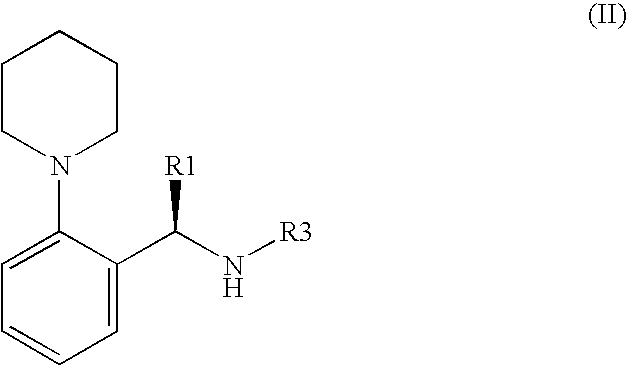
wherein R1 is as given above, and R3 is a nucleofuge, or a suitable salt of a compound of the general formula (II) is reacted with a compound having the general formula (III):

wherein R2 is as given above, and R4 is hydrogen or a nucleofuge that can be removed hydrolytically, and the protective group R4 that may be present, may be subsequently removed hydrolytically.
Description

wherein
- R1 is a linear or branched alkyl group with 1-6 carbon atoms or optionally substituted benzyl group, and
- R2 is a methyl, ethyl or propyl group,
said method is characterised in that - (S)-1-(2-piperidino-phenyl)amine or a compound having the general formula (II):

where R1 is as defined above, and
- R3 is a nucleofuge, or a suitable salt of a compound having the general formula (II), is reacted
with a compound having the general formula (III):

where R2 is the same as above, and
- R4 is hydrogen or protective group that can be removed hydrolytically, and thereafter the protective group R4, which may be present and which can be removed hydrolytically, is removed.
- R1 is preferably a methyl, ethyl, n-propyl, n-butyl, n-pentyl, n-hexyl, 2-methyl-propyl or benzyl group, preferably 2-methyl-propyl group.
- R2 is preferably an ethyl group.
- R3 as nucleofuge is preferably a benzyl or substituted benzyl or allyl group, preferably substituted benzyl group, which is substituted at the phenyl ring by at least one electronegative, electron-supplying substituent. Such electronegative substituents are, for instance, (C1-4)-alkoxy, preferably methoxy or ethoxy, or chlorine. Similarly, benzyl radicals can be used as nucleofuges, which bring to the methylene (—CH2—) of the benzyl radical, a suitable, preferably electronegative, electron-supplying, substituent, such as for instance (C1-4)-alkyl or optionally substituted phenyl, whereby in the latter case the methylene preferably shows two identical optionally substituted phenyl rings. Benzyl, which is substituted by at least one methoxy group at the phenyl ring is preferred. R3 preferably stands for 2-methoxybenzyl, 4-methoxybenzyl, or 2,4-dimethoxybenzyl.
- R4 preferably is hydrogen, methyl, ethyl, butyl, or propyl group, as well as optionally substituted benzyl group, preferably ethyl, butyl, propyl or benzyl group.

a racemic mixture of compounds having the general formula (IV) are reacted with a chiral acid “A”, by a conventional method, such that the appropriate acid salt is obtained in accordance with the formula (V). This salt is removed and converted to the (S)-1-(2-piperidino-phenyl) amine or the compound having the general formula (II) in the alkaline medium. In the reaction scheme given above, the substituents R1 and R3 have the values as stated above.

wherein R1, R3 and A relate to the respective groups given above.

with a chiral acid “A”, whereby the suitable salt is obtained according to the general formula (V) and the compound of the formula (V) is isolated (racemate splitting).
Claims (12)


Applications Claiming Priority (3)
| Application Number | Priority Date | Filing Date | Title |
|---|---|---|---|
| CH0847/03 | 2003-05-14 | ||
| CH8472003 | 2003-05-14 | ||
| PCT/CH2004/000292 WO2004101540A2 (en) | 2003-05-14 | 2004-05-13 | Method for the production of phenylacetic acid derivatives |
Publications (2)
| Publication Number | Publication Date |
|---|---|
| US20070123564A1 US20070123564A1 (en) | 2007-05-31 |
| US7915421B2 true US7915421B2 (en) | 2011-03-29 |
Family
ID=33438099
Family Applications (1)
| Application Number | Title | Priority Date | Filing Date |
|---|---|---|---|
| US10/556,268 Expired - Fee Related US7915421B2 (en) | 2003-05-14 | 2004-05-13 | Method for preparing phenyl acetic acid derivatives |
Country Status (3)
| Country | Link |
|---|---|
| US (1) | US7915421B2 (en) |
| EP (1) | EP1636199A2 (en) |
| WO (1) | WO2004101540A2 (en) |
Families Citing this family (11)
| Publication number | Priority date | Publication date | Assignee | Title |
|---|---|---|---|---|
| US8101769B2 (en) * | 2007-02-15 | 2012-01-24 | Actavis Group Ptc Ehf | Process for preparing ethyl (S)-2-ethoxy-4-[N-[1-(2-piperidinophenyl)-3-methyl-1-butyl]aminocarbonyl methyl]benzoate and use thereof for the preparation of Repaglinide |
| EP2155706A2 (en) * | 2007-06-06 | 2010-02-24 | Actavis Group PTC EHF | Repaglinide substantially free of dimer impurity |
| CN101481363B (en) * | 2008-01-10 | 2011-05-04 | 江苏豪森药业股份有限公司 | Method for preparing repaglinide |
| CN101538253B (en) * | 2008-03-21 | 2012-03-21 | 江苏豪森医药集团连云港宏创医药有限公司 | Method for preparing repaglinide intermediate |
| WO2010046360A1 (en) * | 2008-10-20 | 2010-04-29 | Krka, Tovarna Zdravil, D.D., Novo Mesto | Process for the preparation of substantially optically pure repaglinide and precursors thereof |
| EP2177221A1 (en) | 2008-10-20 | 2010-04-21 | Krka Tovarna Zdravil, D.D., Novo Mesto | Process for the preparation of substantially optically pure Repaglinide and precursors thereof |
| EP2364977A1 (en) * | 2010-01-26 | 2011-09-14 | Reuter Chemische Apparatebau KG | Process for the enantiomeric enrichment of 3-methyl-1-(2-piperidinophenyl)-1-butylamine |
| CN101781272B (en) * | 2010-02-11 | 2012-12-05 | 上海百灵医药科技有限公司 | Method for preparing repaglinide amine and intermediate thereof |
| CN102786498A (en) * | 2011-05-20 | 2012-11-21 | 江苏豪森医药集团连云港宏创医药有限公司 | Method for preparing repaglinide |
| PL3214077T3 (en) | 2016-03-01 | 2020-09-07 | Zakłady Farmaceutyczne POLPHARMA S.A. | Process for the purification of a pharmaceutical agent |
| CN107868005A (en) * | 2016-09-28 | 2018-04-03 | 齐鲁工业大学 | The crystal structure and fluorescence property of a kind of carboxylic acid compound |
Citations (6)
| Publication number | Priority date | Publication date | Assignee | Title |
|---|---|---|---|---|
| EP0207331A1 (en) | 1983-12-30 | 1987-01-07 | Dr. Karl Thomae GmbH | Solid forms of 2-ethoxy-4-[N-(1-(2-piperidino-phenyl)-3-methyl-1-butyl)-amino-carbonylmethyl]-benzoic acid, medicaments containing these forms and process for their preparation |
| CA2111851A1 (en) * | 1991-06-21 | 1993-01-07 | Wolfgang Grell | (s)(+)-2-ethoxy-4-[n-{1-(2-piperidino-phenyl)-3-methyl-1-butyl]aminocarbonylmethyl]benzoic acid |
| US5312924A (en) | 1983-12-30 | 1994-05-17 | Dr. Karl Thomae Gmbh | Phenylacetic acid benzylamides |
| EP0965591A1 (en) | 1991-06-21 | 1999-12-22 | Boehringer Ingelheim Pharma KG | (s)-3-methyl-1-(2-piperidino-phenyl)-1-butylamine, its salts, synthesis and use in the long term therapy of diabetes mellitus |
| WO2004018442A1 (en) | 2002-08-23 | 2004-03-04 | Dr. Reddy's Laboratories Limited | Crystalline and amorphous forms of (s) -repaglinide and the processes for preparation thereof |
| US7148355B2 (en) * | 2001-09-25 | 2006-12-12 | Ranbaxy Laboratories Limited | Process for the preparation of repaglinide |
-
2004
- 2004-05-13 EP EP04732562A patent/EP1636199A2/en not_active Withdrawn
- 2004-05-13 US US10/556,268 patent/US7915421B2/en not_active Expired - Fee Related
- 2004-05-13 WO PCT/CH2004/000292 patent/WO2004101540A2/en not_active Ceased
Patent Citations (8)
| Publication number | Priority date | Publication date | Assignee | Title |
|---|---|---|---|---|
| EP0207331A1 (en) | 1983-12-30 | 1987-01-07 | Dr. Karl Thomae GmbH | Solid forms of 2-ethoxy-4-[N-(1-(2-piperidino-phenyl)-3-methyl-1-butyl)-amino-carbonylmethyl]-benzoic acid, medicaments containing these forms and process for their preparation |
| US5312924A (en) | 1983-12-30 | 1994-05-17 | Dr. Karl Thomae Gmbh | Phenylacetic acid benzylamides |
| US6143769A (en) | 1983-12-30 | 2000-11-07 | Karl Thomae Gmbh | Phenylacetic acid benzylamides |
| CA2111851A1 (en) * | 1991-06-21 | 1993-01-07 | Wolfgang Grell | (s)(+)-2-ethoxy-4-[n-{1-(2-piperidino-phenyl)-3-methyl-1-butyl]aminocarbonylmethyl]benzoic acid |
| WO1993000337A1 (en) | 1991-06-21 | 1993-01-07 | Dr. Karl Thomae Gmbh | (s)(+)-2-ethoxy-4-[n-[1-(2-piperidinophenyl)-3-methyl-1-butyl]aminocarbonylmethyl]benzoic acid |
| EP0965591A1 (en) | 1991-06-21 | 1999-12-22 | Boehringer Ingelheim Pharma KG | (s)-3-methyl-1-(2-piperidino-phenyl)-1-butylamine, its salts, synthesis and use in the long term therapy of diabetes mellitus |
| US7148355B2 (en) * | 2001-09-25 | 2006-12-12 | Ranbaxy Laboratories Limited | Process for the preparation of repaglinide |
| WO2004018442A1 (en) | 2002-08-23 | 2004-03-04 | Dr. Reddy's Laboratories Limited | Crystalline and amorphous forms of (s) -repaglinide and the processes for preparation thereof |
Non-Patent Citations (3)
| Title |
|---|
| Nucleofuge Web definition, Chem dictionary p. 1 (2010). * |
| Nucleofuge Web deifinition, chemiPlus p. 1 (2010). * |
| Stn. Exhibit I p. 1 (2010). * |
Also Published As
| Publication number | Publication date |
|---|---|
| WO2004101540A3 (en) | 2005-03-03 |
| US20070123564A1 (en) | 2007-05-31 |
| EP1636199A2 (en) | 2006-03-22 |
| WO2004101540A2 (en) | 2004-11-25 |
Similar Documents
| Publication | Publication Date | Title |
|---|---|---|
| ES2372414T3 (en) | PURIFICATION PROCEDURE OF MONTELUKAST AND ITS SALTS OF AMINAS. | |
| US20230008387A1 (en) | Process for the preparation of enantiomerically enriched 3-aminopiperidine | |
| CA2295800A1 (en) | Resolution of amines | |
| US20070123564A1 (en) | Method for preparing phenyl acetic acid derivatives | |
| EP1349828A1 (en) | Process for preparing isomers of salbutamol | |
| IL182439A (en) | Intermediates useful for the preparation of aripiprazole and methods for the preparation of the intermediates and aripiprazole | |
| AU2006250977A1 (en) | A process for the dynamic resolution of (substituted) (R) - or (S) -mandelic acid | |
| EA015801B1 (en) | Optically active carbamates, process for preparation thereof and use thereof as pharmaceutical intermediates | |
| KR100928776B1 (en) | (R) -1-[(4-chlorophenyl) phenylmethyl] piperazine or a salt thereof | |
| RU2470018C2 (en) | New pyrocatechol derivatives | |
| JP2001521498A (en) | Method for producing O- (3-amino-2-hydroxy-propyl) -hydroxymic acid halide | |
| ES2912409T3 (en) | Intermediates and processes for the preparation of linagliptin and its salts | |
| WO2002068391A1 (en) | Process for resolving racemic mixtures of piperidine derivatives | |
| KR100998067B1 (en) | Bis (1-[(4-chlorophenyl) phenylmethyl] piperazin) -2,3-dibenzoyl tartaric acid novel intermediate salt and optically pure 1-[(4-chlorophenyl) phenylmethyl] piperazin using the same How to separate | |
| JP2009518380A (en) | Preparation of 2-chloroethoxy-acetic acid-N, N-dimethylamide | |
| EP1864973A1 (en) | Process for the preparation of perindopril and salts thereof | |
| US6506907B1 (en) | Process | |
| JP2003277348A (en) | METHOD FOR PRODUCING delta-AMINOPENTADIENOIC ACID ESTER DERIVATIVE | |
| US20040122099A1 (en) | Process for preparing S-(2-aminoethyl)-2-methyl-L-cysteine | |
| US20040039206A1 (en) | Process for resolving racemic mixtures of piperidine derivatives | |
| US8383833B2 (en) | Method for producing optically active amino acid derivative | |
| CN1315781C (en) | Preparation of 4-amino-1-naphthol ethers | |
| HU229801B1 (en) | 2,2-disubstituted 1,3-dioxolanes as antitussive agents | |
| WO2004106309A1 (en) | A process for preparing 1-methyl-3-phenylpiperazine | |
| JPH11322668A (en) | Optical resolution method of 1,1'-binaphthyl-2,2'-dicarboxylic acid |
Legal Events
| Date | Code | Title | Description |
|---|---|---|---|
| AS | Assignment |
Owner name: CILAG LTD., SWITZERLAND Free format text: ASSIGNMENT OF ASSIGNORS INTEREST;ASSIGNORS:HECK, RAINER;JUSTUS, MICHAEL;MULLER, ROLAND;AND OTHERS;SIGNING DATES FROM 20050910 TO 20051008;REEL/FRAME:017910/0377 Owner name: CILAG LTD., SWITZERLAND Free format text: ASSIGNMENT OF ASSIGNORS INTEREST;ASSIGNORS:HECK, RAINER;JUSTUS, MICHAEL;MULLER, ROLAND;AND OTHERS;REEL/FRAME:017910/0377;SIGNING DATES FROM 20050910 TO 20051008 |
|
| REMI | Maintenance fee reminder mailed | ||
| LAPS | Lapse for failure to pay maintenance fees | ||
| STCH | Information on status: patent discontinuation |
Free format text: PATENT EXPIRED DUE TO NONPAYMENT OF MAINTENANCE FEES UNDER 37 CFR 1.362 |
|
| STCH | Information on status: patent discontinuation |
Free format text: PATENT EXPIRED DUE TO NONPAYMENT OF MAINTENANCE FEES UNDER 37 CFR 1.362 |
|
| FP | Lapsed due to failure to pay maintenance fee |
Effective date: 20150329 |