US7868356B2 - Compound semiconductor substrate for a field effect transistor - Google Patents

Compound semiconductor substrate for a field effect transistor Download PDF

Info

Publication number
US7868356B2
US7868356B2 US12/432,864 US43286409A US7868356B2 US 7868356 B2 US7868356 B2 US 7868356B2 US 43286409 A US43286409 A US 43286409A US 7868356 B2 US7868356 B2 US 7868356B2
Authority
US
United States
Prior art keywords
layer
semiconductor substrate
compound semiconductor
etch stop
recess
Prior art date
Legal status (The legal status is an assumption and is not a legal conclusion. Google has not performed a legal analysis and makes no representation as to the accuracy of the status listed.)
Expired - Fee Related
Application number
US12/432,864
Other versions
US20090261382A1 (en
Inventor
Matthew Francis O'Keefe
Michael Charles Clausen
Richard Alun Davies
Robert Grey
Current Assignee (The listed assignees may be inaccurate. Google has not performed a legal analysis and makes no representation or warranty as to the accuracy of the list.)
Filtronic PLC
Original Assignee
Filtronic PLC
Priority date (The priority date is an assumption and is not a legal conclusion. Google has not performed a legal analysis and makes no representation as to the accuracy of the date listed.)
Filing date
Publication date
Application filed by Filtronic PLC filed Critical Filtronic PLC
Priority to US12/432,864 priority Critical patent/US7868356B2/en
Assigned to FILTRONIC COMPOUND SEMICONDUCTORS LIMITED reassignment FILTRONIC COMPOUND SEMICONDUCTORS LIMITED ASSIGNMENT OF ASSIGNORS INTEREST (SEE DOCUMENT FOR DETAILS). Assignors: CLAUSEN, MICHAEL CHARLES, DAVIES, RICHARD ALUN, GREY, ROBERT, O'KEEFE, MATTHEW FRANCIS
Assigned to FILTRONIC PLC reassignment FILTRONIC PLC ASSIGNMENT OF ASSIGNORS INTEREST (SEE DOCUMENT FOR DETAILS). Assignors: FILTRONIC COMPOUND SEMICONDUCTORS LIMITED
Publication of US20090261382A1 publication Critical patent/US20090261382A1/en
Application granted granted Critical
Publication of US7868356B2 publication Critical patent/US7868356B2/en
Anticipated expiration legal-status Critical
Expired - Fee Related legal-status Critical Current

Links

Images

Classifications

    • HELECTRICITY
    • H10SEMICONDUCTOR DEVICES; ELECTRIC SOLID-STATE DEVICES NOT OTHERWISE PROVIDED FOR
    • H10DINORGANIC ELECTRIC SEMICONDUCTOR DEVICES
    • H10D30/00Field-effect transistors [FET]
    • H10D30/40FETs having zero-dimensional [0D], one-dimensional [1D] or two-dimensional [2D] charge carrier gas channels
    • H10D30/47FETs having zero-dimensional [0D], one-dimensional [1D] or two-dimensional [2D] charge carrier gas channels having 2D charge carrier gas channels, e.g. nanoribbon FETs or high electron mobility transistors [HEMT]
    • H10D30/471High electron mobility transistors [HEMT] or high hole mobility transistors [HHMT]
    • H10D30/473High electron mobility transistors [HEMT] or high hole mobility transistors [HHMT] having confinement of carriers by multiple heterojunctions, e.g. quantum well HEMT
    • H10D30/4732High electron mobility transistors [HEMT] or high hole mobility transistors [HHMT] having confinement of carriers by multiple heterojunctions, e.g. quantum well HEMT using Group III-V semiconductor material
    • H10D30/4735High electron mobility transistors [HEMT] or high hole mobility transistors [HHMT] having confinement of carriers by multiple heterojunctions, e.g. quantum well HEMT using Group III-V semiconductor material having delta-doped or planar-doped donor layers
    • HELECTRICITY
    • H10SEMICONDUCTOR DEVICES; ELECTRIC SOLID-STATE DEVICES NOT OTHERWISE PROVIDED FOR
    • H10DINORGANIC ELECTRIC SEMICONDUCTOR DEVICES
    • H10D30/00Field-effect transistors [FET]
    • H10D30/01Manufacture or treatment
    • H10D30/015Manufacture or treatment of FETs having heterojunction interface channels or heterojunction gate electrodes, e.g. HEMT
    • HELECTRICITY
    • H10SEMICONDUCTOR DEVICES; ELECTRIC SOLID-STATE DEVICES NOT OTHERWISE PROVIDED FOR
    • H10DINORGANIC ELECTRIC SEMICONDUCTOR DEVICES
    • H10D30/00Field-effect transistors [FET]
    • H10D30/40FETs having zero-dimensional [0D], one-dimensional [1D] or two-dimensional [2D] charge carrier gas channels
    • H10D30/47FETs having zero-dimensional [0D], one-dimensional [1D] or two-dimensional [2D] charge carrier gas channels having 2D charge carrier gas channels, e.g. nanoribbon FETs or high electron mobility transistors [HEMT]
    • H10D30/471High electron mobility transistors [HEMT] or high hole mobility transistors [HHMT]
    • H10D30/473High electron mobility transistors [HEMT] or high hole mobility transistors [HHMT] having confinement of carriers by multiple heterojunctions, e.g. quantum well HEMT
    • H10D30/4732High electron mobility transistors [HEMT] or high hole mobility transistors [HHMT] having confinement of carriers by multiple heterojunctions, e.g. quantum well HEMT using Group III-V semiconductor material
    • H10D30/4738High electron mobility transistors [HEMT] or high hole mobility transistors [HHMT] having confinement of carriers by multiple heterojunctions, e.g. quantum well HEMT using Group III-V semiconductor material having multiple donor layers

Definitions

  • the present invention relates to a III-V field effect transistor (FET) in which a recess is formed using an etch stop layer.
  • FET field effect transistor
  • the present invention also relates to a compound semiconductor substrate including an etch stop layer in which the FET can be formed, and a method of forming the recess.
  • the field effect transistor in particular the high electron mobility transistor (HEMT) and pseudomorphic high electron mobility transistor (pHEMT) can achieve fast switching times and are particularly suited for modem telecommunications apparatus.
  • FETs have three electrical connections, a gate, a source and a drain.
  • the structure conventionally comprises a semiconductor channel layer having an electrically conducting channel and a ohmic contact layer thereon. A recess is etched through the ohmic contact layer to the semiconductor channel layer.
  • the electrically conducting channel is typically (although not always) separated from the bottom of the recess by a Schottky layer.
  • the drain and source are formed on opposite sides of the recess on the ohmic contact layer.
  • the gate is formed in the recess in contact with the semiconductor channel layer.
  • the electrically conducting channel is modulated by the gate.
  • the recess formed within the ohmic contact layer is a vital part of the FET structure.
  • Various techniques for forming this recess have been proposed.
  • U.S. Pat. No. 6,242,293 B1 discusses a pHEMT structure in which one or more etch stop layers is used to define the depth of the recess.
  • the etch stop layer is present within the compound semiconductor structure.
  • the chemistry of the etchant is chosen so that it does not etch the etch stop layer. This allows precise control of the depth of the recess.
  • the method described in Danzilio uses layers of InGaP to function as etch stop layers. This is an effective etch stop for a wet etch chemistry, but not for a dry etch chemistry.
  • etch chemistry depends on the width of the recess required. A dry etch chemistry has little tendency to etch underneath the edges of the resist. This results in a recess which conforms strongly to the dimensions of the resist. Conversely, a wet etch chemistry tends to etch underneath the resist. Thus in a wet etch process, the width of the recess will be larger than the width of the gap in the resist.
  • U.S. Pat. No. 5,610,410 proposes including a layer of InAlP on top of a transition layer of AlGaAs. The gate is then formed on top of the InAlP layer. The use of this layer increases the Schottky barrier level and allows use at higher gate voltages.
  • the present invention provides a FET including an etch stop layer which comprises both Aluminium and Phosphorous.
  • etch stop layer which comprises both Aluminium and Phosphorous.
  • Aluminium allows a dry etch chemistry to be effective and the presence of Phosphorous allows a wet etch chemistry to be effective. Therefore, the FET can be created using either a wet etch or a dry etch chemistry depending on the precise device characteristics required.
  • the present invention provides a III-V field effect transistor comprising
  • the recess structure extends entirely through the etch stop layer to the semiconductor channel layer, unlike the device disclosed in Imanishi.
  • the presence of the etch stop layer comprising Aluminium and Phosphorous allows a choice of wet etch chemistry or dry etch chemistry to be used depending on the transistor characteristics required. This allows a wide choice of fabrication techniques, with only the actual chemistry itself required to be altered.
  • the structure of the etch stop layer had to be chosen depending on whether a wet etch chemistry or a dry etch chemistry was to be used in manufacture. This construction overcomes this difficulty by allowing the use of a wet etch or a dry etch chemistry depending on the precise result required.
  • the recess has a stepped profile and the ohmic contact layer comprises a plurality of etch stop layers comprising Aluminium and Phosphorus, the bottom etch stop layer defining the shape of the recess at its junction with the semiconductor channel layer.
  • the etch stop layer comprises Indium Aluminium Phosphide.
  • the etch stop layer comprises Aluminium Gallium Phosphide.
  • the III-V field effect transistor can further comprise a substrate supporting the semiconductor layer.
  • the substrate can be GaAs.
  • the III-V field effect transistor further comprises a buffer layer between substrate and semiconductor channel layer.
  • the buffer layer can be AlGaAs.
  • the buffer layer can be a lattice matching layer for matching the substrate lattice to the lattice of the semiconductor channel layer.
  • the electrically conducting channel can be the top layer of the semiconductor channel layer.
  • the III-V field effect transistor can be a MESFET.
  • the semiconductor layer can comprise a Schottky layer separating the electrically conducting channel from the bottom of the recess.
  • the electron supply layer can be one of an n-AlGaAs layer or layer of silicon atoms.
  • a III-V field effect transistor can further comprise a spacer layer spacing the electron supply layer from the semiconductor channel layer, the spacer layer preferably being AlGaAs.
  • the semiconductor layer can be GaAs.
  • the transistor can be a HEMT.
  • the electrically conducting channel can comprises an InGaAs channel layer containing a 2DEG electron gas.
  • the InGaAs channel layer can be sandwiched between AlGaAs spacer layers.
  • the III-V field effect transistor can further comprise at least one electron supply layer on the opposite side of the spacer layer to the electrically conducting channel.
  • the electron supply layer can be a layer of silicon atoms.
  • the Schottky layer can be AlGaAs.
  • the ohmic contact layer can be GaAs.
  • the electrically conducting channel can comprise InGaAs.
  • the InGaAs layer can be sandwiched between InAlAs spacer layers.
  • the III-V field effect transistor further comprises at least one electron supply layer on the opposite side of the spacer layer to the electrically conducting channel.
  • the electron supply layer can be a layer of silicon atoms.
  • the Schottky layer can be InAlAs.
  • a III-V field effect transistor wherein the ohmic contact layer is InAlAs.
  • the transistor can be a mHEMT.
  • the etch stop layer can be Indium Aluminium Phosphide.
  • a compound semiconductor substrate can comprise a plurality of etch stop layers with the ohmic contact layer.
  • Each of the plurality of etch stop layers can comprise Aluminium and Phosphorous.
  • the etching of the recess can be carried out with a dry etch chemistry.
  • the etching of the recess can be carried out with a wet etch chemistry.
  • the wet etch chemistry can comprise a mixture of hydrogen peroxide and dilute sulphuric acid.
  • the wet etch chemistry can comprise a mixture of hydrogen peroxide and dilute hydrofluoric acid.
  • the wet etch chemistry can comprise hydrogen peroxide and dilute ammonia.
  • the masking material can be a resist, preferably a photoresist.
  • FIG. 1 shows a cross section through a pHEMT structure according to the invention
  • FIG. 2 shows a cross section through a HEMT structure according to the invention
  • FIG. 3 shows a cross section through a mHEMT structure according to the invention
  • FIGS. 4 a to 4 i show a method of forming a recess according to an embodiment of the invention
  • FIG. 5 illustrates the saturated current of a transistor according to the invention against etch time for different wet etch chemistries
  • FIG. 6 illustrates the saturated current of a transistor against the etch time for a dry etch chemistry
  • FIG. 7 illustrates the etch depth against time for a further wet etch chemistry.
  • FIG. 1 Shown in FIG. 1 is a cross section through a III-V field effect transistor 1 according to the invention.
  • the transistor 1 is a GaAs pHEMT comprising a GaAs substrate 2 .
  • a GaAs substrate On the GaAs substrate is a AlGaAs buffer layer 3 .
  • a semiconductor channel layer 4 On top of the buffer layer is a semiconductor channel layer 4 .
  • the semiconductor channel layer 4 comprises an InGaAs electrically conducting channel 5 .
  • On each side of the electrically conducting channel is a supply layer of silicon atoms 6 .
  • the silicon atoms 6 are spaced from the electrically conducting channel 5 by AlGaAs spacer layers 7 .
  • the supply layer of silicon atoms 6 supplies electrons to the electrically conducting channel 5 forming a high mobility two dimensional electron gas (2DEG).
  • an AlGaAs Schottky layer 8 On top of the top Si supply layer is an AlGaAs Schottky layer 8 and forming
  • the ohmic contact layer 10 comprises a plurality of etch stop layers of InAlP 11 separated by layers of GaAs 12 .
  • the top layer of the ohmic contact layer is a GaAs layer 12 .
  • the bottom layer in contact with the semiconductor etched layer is InAlP.
  • a stepped recess 13 is formed in the ohmic contact layer 10 .
  • the recess 13 extends through the bottom etch stop layer 11 to the semiconductor channel layer 4 .
  • the depth of the steps are determined by the position of the etch stop layers 11 within the ohmic contact layer 10 .
  • a source 14 and a drain 15 are connected to opposite sides of the recess 13 .
  • a gate 16 is connected to the semiconductor channel layer 4 at the bottom of the recess 13 .
  • the width of the recess 13 is determined according to the chemistry used during the manufacture of the recess 13 .
  • a greater width is possible using wet etch techniques and a narrower width is possible using dry etch techniques.
  • the choice of etch technique will depend on the particular transistor characteristics desired. This choice of etch chemistry is possible because the layers of InAlP 11 will act as an etch stop for both wet and dry etch chemistry. The etch chemistries used in this embodiment will be described in more detail later.
  • FIG. 1 includes twin silicon supply layers 6 , one on either side of the electrically conducting channel 5 .
  • the silicon supply layer 6 is replaced with a bulk doping layer.
  • FIG. 2 Shown in FIG. 2 is a further embodiment of a III-V field effect transistor according to the invention.
  • the III-V FET is a GaAs HEMT.
  • the GaAs HEMT comprises an n-AlGaAs supply layer 18 sandwiched between AlGaAs spacer layers 19 .
  • the bottom spacer layer 19 is deposited on a GaAs buffer layer 20 which is in turn deposited on a GaAs substrate 21 .
  • a GaAs semiconductor channel layer 4 is deposited on top of the top spacer layer 19 .
  • the semiconductor channel layer 4 comprises a 2DEG separated from the top of the layer by a Schottky layer 22 .
  • a ohmic contact layer 10 Deposited on top of the semiconductor channel layer is a ohmic contact layer 10 .
  • the ohmic contact layer 10 is identical to that of the pHEMT and will not be described in detail.
  • FIG. 3 Shown in FIG. 3 is a further embodiment of a III-V transistor according to the invention.
  • the transistor comprises a mHEMT comprising a GaAs substrate 23 .
  • Deposited on the substrate 23 is a metamorphic buffer 24 and a semiconductor channel layer 4 .
  • the metamorphic buffer 24 allows for the lattice mismatch between the substrate 23 and the semiconductor channel layer 4 .
  • the semiconductor channel layer 4 comprises an InAlAs electrically conducting channel 25 sandwiched between InAlAs spacer layers 26 .
  • the ohmic contact layer 10 On top of the semiconductor channel layer is the ohmic contact layer 10 .
  • the ohmic contact layer 10 comprises a plurality of InAlP etch stop layers 29 , separated by InAlAs layers 30 .
  • the bottom layer of the ohmic contact layer 10 is InAlP.
  • the source and drain (not shown) are connected on opposite sides of the recess 31 on the ohmic contact layer 4 .
  • the gate 32 is formed within the recess.
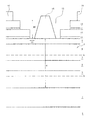
  • FIG. 4 a illustrates a substrate 33 on which the source and drain contacts 14 , 15 have already been deposited and the first step of the recess etched.
  • a layer of resist 34 is present on top of the substrate 33 and a gap 35 has been formed to etch a further recess by removing the resist.
  • the general process for both wet and dry etching is similar, apart from the chemistry used to etch. The dry and wet etch chemistry will be discussed in detail later.
  • the substrate is exposed to the etchant. This etches through the exposed GaAs ohmic contact layer 12 until the lower etch stop layer 11 is reached. However, at this point the difference between the wet and the dry etch chemistry becomes apparent. A wet etch chemistry will increase the width of the recess by etching away material which is present under the resist 34 and adjacent to the gap 35 in the resist 34 . On the other hand, a dry etch etches very little material from under the resist 34 . The etchant is applied for a specified time and then removed. The resulting structure is shown in FIG. 4 b for a dry etch.
  • the GaAs layer 12 has been etched in line with the gap 35 in the resist 34 .
  • the GaAs layer 12 has also been etched under the resist 34 , resulting in a wider recess 35 .
  • a further etchant is then applied to remove the InAlP etch stop layer 11 . This exposes the semiconductor channel layer 4 .
  • this stage of the process is illustrated in FIG. 4 c , and FIG. 4 g for a wet etch.
  • the gate electrode 16 is formed. It can be seen in FIG. 4 d that there is very little space between the edge of the recess 35 and the edge of the gate electrode 16 for a dry etch process. However, for a wet etch process, because the GaAs layer 12 has been removed under the edges of the resist 34 , there is a larger distance between the edges of the recess 35 and the gate 16 .
  • the resist 34 is removed leaving the completed pHEMT structure according to the first embodiment of the invention.
  • a first step ignites the plasma and removes any native oxide from the GaAs surface. This is followed by a main etch step.
  • Table 1 below shows the chemicals and physical quantities for each of these etch steps:
  • the timing is kept low to reduce the amount of GaAs removed. Removal of GaAs is also reduced by keeping the ICP power, RF power and pressure to a minimum. If significantly lower values than those specified in Table 1 were used, the plasma ignition would become unstable.
  • chemistries for wet etching were used. These included using orthophosphoric (H 3 PO 4 ) or hydrofluoric acid (HF) in place of the sulphuric acid.
  • FIG. 5 is a graph of the saturated current versus etch time. It can be seen that the best results are achieved with sulphuric acid. For sulphuric acid, the presence of a plateau where the etch stop layer is effective can be clearly seen.
  • a further wet etch chemistry is used.
  • the etch is NH 4 OH:H 2 O 2 :H 2 O in approximately the ratio (1:1:300)
  • Shown in FIG. 7 is a graph of etch depth against time showing the high selectivity of the etch.

Landscapes

  • Junction Field-Effect Transistors (AREA)

Abstract

A III-V field effect transistor comprising
    • a semiconductor channel layer having an electrically conducting channel;
    • an ohmic contact layer on the semiconductor channel layer, the ohmic contact layer having a recess structure disposed therethrough to the semiconductor channel layer;
    • the bottom of the ohmic contact layer comprising an etch stop layer comprising Aluminium and Phosphorous and defining the shape of the recess at its junction with the semiconductor channel layer.

Description

RELATED APPLICATIONS
The subject patent application is a divisional of U.S. patent application Ser. No. 11/153,785, filed on Jun. 15, 2005, now U.S. Pat. No. 7,538,365, which in turn claims the benefit of United Kingdom Application No. 0413277.5 filed on Jun. 15, 2004.
The present invention relates to a III-V field effect transistor (FET) in which a recess is formed using an etch stop layer. The present invention also relates to a compound semiconductor substrate including an etch stop layer in which the FET can be formed, and a method of forming the recess.
The field effect transistor, in particular the high electron mobility transistor (HEMT) and pseudomorphic high electron mobility transistor (pHEMT) can achieve fast switching times and are particularly suited for modem telecommunications apparatus. FETs have three electrical connections, a gate, a source and a drain. The structure conventionally comprises a semiconductor channel layer having an electrically conducting channel and a ohmic contact layer thereon. A recess is etched through the ohmic contact layer to the semiconductor channel layer. The electrically conducting channel is typically (although not always) separated from the bottom of the recess by a Schottky layer. The drain and source are formed on opposite sides of the recess on the ohmic contact layer. The gate is formed in the recess in contact with the semiconductor channel layer. The electrically conducting channel is modulated by the gate.
It can therefore be seen that the recess formed within the ohmic contact layer is a vital part of the FET structure. Various techniques for forming this recess have been proposed. For example, U.S. Pat. No. 6,242,293 B1 (Danzilio) discusses a pHEMT structure in which one or more etch stop layers is used to define the depth of the recess. The etch stop layer is present within the compound semiconductor structure. When the recess is etched using lithography techniques, the chemistry of the etchant is chosen so that it does not etch the etch stop layer. This allows precise control of the depth of the recess. The method described in Danzilio uses layers of InGaP to function as etch stop layers. This is an effective etch stop for a wet etch chemistry, but not for a dry etch chemistry.
The choice of etch chemistry depends on the width of the recess required. A dry etch chemistry has little tendency to etch underneath the edges of the resist. This results in a recess which conforms strongly to the dimensions of the resist. Conversely, a wet etch chemistry tends to etch underneath the resist. Thus in a wet etch process, the width of the recess will be larger than the width of the gap in the resist.
The choice of chemistry will depend on the precise characteristics of the individual transistor. In the Danzilio patent, it is only possible to use wet etch chemistry. There is no option of using dry etch chemistry without producing a different compound semiconductor substrate with a different etch stop layer.
U.S. Pat. No. 5,610,410 (Imanishi) proposes including a layer of InAlP on top of a transition layer of AlGaAs. The gate is then formed on top of the InAlP layer. The use of this layer increases the Schottky barrier level and allows use at higher gate voltages.
The present invention provides a FET including an etch stop layer which comprises both Aluminium and Phosphorous. The presence of Aluminium allows a dry etch chemistry to be effective and the presence of Phosphorous allows a wet etch chemistry to be effective. Therefore, the FET can be created using either a wet etch or a dry etch chemistry depending on the precise device characteristics required.
Accordingly, in a first aspect the present invention provides a III-V field effect transistor comprising
    • a semiconductor channel layer having an electrically conducting channel;
    • an ohmic contact layer on the semiconductor channel layer, the ohmic contact layer having a recess structure disposed therethrough to the semiconductor channel layer;
    • the bottom of the ohmic contact layer comprising an etch stop layer comprising Aluminium and Phosphorous and defining the shape of the recess at its junction with the semiconductor channel layer.
The recess structure extends entirely through the etch stop layer to the semiconductor channel layer, unlike the device disclosed in Imanishi. The presence of the etch stop layer comprising Aluminium and Phosphorous allows a choice of wet etch chemistry or dry etch chemistry to be used depending on the transistor characteristics required. This allows a wide choice of fabrication techniques, with only the actual chemistry itself required to be altered. In previous methods and devices, the structure of the etch stop layer had to be chosen depending on whether a wet etch chemistry or a dry etch chemistry was to be used in manufacture. This construction overcomes this difficulty by allowing the use of a wet etch or a dry etch chemistry depending on the precise result required.
Preferably, the recess has a stepped profile and the ohmic contact layer comprises a plurality of etch stop layers comprising Aluminium and Phosphorus, the bottom etch stop layer defining the shape of the recess at its junction with the semiconductor channel layer.
Preferably, the etch stop layer comprises Indium Aluminium Phosphide.
Alternatively, the etch stop layer comprises Aluminium Gallium Phosphide.
Preferably, the III-V field effect transistor can further comprise a substrate supporting the semiconductor layer.
The substrate can be GaAs.
The III-V field effect transistor further comprises a buffer layer between substrate and semiconductor channel layer.
The buffer layer can be AlGaAs.
The buffer layer can be a lattice matching layer for matching the substrate lattice to the lattice of the semiconductor channel layer.
The electrically conducting channel can be the top layer of the semiconductor channel layer.
The III-V field effect transistor can be a MESFET.
The semiconductor layer can comprise a Schottky layer separating the electrically conducting channel from the bottom of the recess.
Preferably, the III-V field effect transistor further comprises an electron supply layer proximate to the electrically conducting channel.
The electron supply layer can be one of an n-AlGaAs layer or layer of silicon atoms.
A III-V field effect transistor can further comprise a spacer layer spacing the electron supply layer from the semiconductor channel layer, the spacer layer preferably being AlGaAs.
The semiconductor layer can be GaAs.
The transistor can be a HEMT.
The electrically conducting channel can comprises an InGaAs channel layer containing a 2DEG electron gas.
The InGaAs channel layer can be sandwiched between AlGaAs spacer layers.
The III-V field effect transistor can further comprise at least one electron supply layer on the opposite side of the spacer layer to the electrically conducting channel.
The electron supply layer can be a layer of silicon atoms.
The Schottky layer can be AlGaAs.
The transistor can be a pHEMT.
The ohmic contact layer can be GaAs.
The electrically conducting channel can comprise InGaAs.
The InGaAs layer can be sandwiched between InAlAs spacer layers.
Preferably, the III-V field effect transistor further comprises at least one electron supply layer on the opposite side of the spacer layer to the electrically conducting channel.
The electron supply layer can be a layer of silicon atoms.
The Schottky layer can be InAlAs.
A III-V field effect transistor, wherein the ohmic contact layer is InAlAs.
The transistor can be a mHEMT.
In a further aspect of the invention there is provided a compound semiconductor substrate for processing to produce a field effect transistor, the substrate comprising a semiconductor channel layer having an electrically conducting channel and an ohmic-contact layer on the semiconductor channel layer
    • the substrate further comprising an etch stop layer sandwiched between the ohmic contact layer and semiconductor channel layer, the etch stop layer comprising Aluminium and Phosphorous.
The etch stop layer can be Indium Aluminium Phosphide.
The etch stop layer can be Aluminium Gallium Phosphide.
A compound semiconductor substrate can comprise a plurality of etch stop layers with the ohmic contact layer.
Each of the plurality of etch stop layers can comprise Aluminium and Phosphorous.
In a further aspect of the invention there is provided a process for forming a recess in a semiconductor substrate comprising the steps of
    • covering part of the ohmic contact layer in a masking material;
    • forming at least one recess in the ohmic contact layer by etching the area not covered in the masking material, where the depth of the recess is determined by the at least one etch stop layer; and
    • further etching through the etch stop layer;
    • wherein the etching of the recess is carried out with either a dry etch chemistry or wet etch chemistry.
The etching of the recess can be carried out with a dry etch chemistry.
The dry etch chemistry can comprise a mixture of fluorine and chlorine.
The etching of the recess can be carried out with a wet etch chemistry.
The wet etch chemistry can comprise a mixture of hydrogen peroxide and a dilute acid or base.
Alternatively, the wet etch chemistry can comprise a mixture of hydrogen peroxide and dilute sulphuric acid.
Alternatively, the wet etch chemistry can comprise a mixture of hydrogen peroxide and dilute hydrofluoric acid.
Alternatively, the wet etch chemistry can comprise hydrogen peroxide and dilute ammonia. The masking material can be a resist, preferably a photoresist.
The present invention will now be described by way of example only and not in any limitative sense with reference to the accompanying drawings, in which
FIG. 1 shows a cross section through a pHEMT structure according to the invention;
FIG. 2 shows a cross section through a HEMT structure according to the invention;
FIG. 3 shows a cross section through a mHEMT structure according to the invention;
FIGS. 4 a to 4 i show a method of forming a recess according to an embodiment of the invention;
FIG. 5 illustrates the saturated current of a transistor according to the invention against etch time for different wet etch chemistries;
FIG. 6 illustrates the saturated current of a transistor against the etch time for a dry etch chemistry; and,
FIG. 7 illustrates the etch depth against time for a further wet etch chemistry.
Shown in FIG. 1 is a cross section through a III-V field effect transistor 1 according to the invention. The transistor 1 is a GaAs pHEMT comprising a GaAs substrate 2. On the GaAs substrate is a AlGaAs buffer layer 3. On top of the buffer layer is a semiconductor channel layer 4. The semiconductor channel layer 4 comprises an InGaAs electrically conducting channel 5. On each side of the electrically conducting channel is a supply layer of silicon atoms 6. The silicon atoms 6 are spaced from the electrically conducting channel 5 by AlGaAs spacer layers 7. The supply layer of silicon atoms 6 supplies electrons to the electrically conducting channel 5 forming a high mobility two dimensional electron gas (2DEG). On top of the top Si supply layer is an AlGaAs Schottky layer 8 and forming the upper surface of the semiconductor channel layer is a GaAs coating 9.
Formed on the semiconductor channel layer 4 is an ohmic contact layer 10. The ohmic contact layer 10 comprises a plurality of etch stop layers of InAlP 11 separated by layers of GaAs 12. The top layer of the ohmic contact layer is a GaAs layer 12. The bottom layer in contact with the semiconductor etched layer is InAlP.
A stepped recess 13 is formed in the ohmic contact layer 10. The recess 13 extends through the bottom etch stop layer 11 to the semiconductor channel layer 4. The depth of the steps are determined by the position of the etch stop layers 11 within the ohmic contact layer 10.
A source 14 and a drain 15 are connected to opposite sides of the recess 13. A gate 16 is connected to the semiconductor channel layer 4 at the bottom of the recess 13.
The width of the recess 13, for example the distance between the edge of the first step and the edge of the gate 16 shown by arrow 17 on FIG. 1, is determined according to the chemistry used during the manufacture of the recess 13. A greater width is possible using wet etch techniques and a narrower width is possible using dry etch techniques. The choice of etch technique will depend on the particular transistor characteristics desired. This choice of etch chemistry is possible because the layers of InAlP 11 will act as an etch stop for both wet and dry etch chemistry. The etch chemistries used in this embodiment will be described in more detail later.
The embodiment of FIG. 1 includes twin silicon supply layers 6, one on either side of the electrically conducting channel 5. In an alternative embodiment there is only one silicon supply layer. This reduces the electron density of the 2DEG. In a further alternative embodiment the silicon supply layer 6 is replaced with a bulk doping layer.
Shown in FIG. 2 is a further embodiment of a III-V field effect transistor according to the invention. The III-V FET is a GaAs HEMT. The GaAs HEMT comprises an n-AlGaAs supply layer 18 sandwiched between AlGaAs spacer layers 19. The bottom spacer layer 19 is deposited on a GaAs buffer layer 20 which is in turn deposited on a GaAs substrate 21.
A GaAs semiconductor channel layer 4 is deposited on top of the top spacer layer 19. The semiconductor channel layer 4 comprises a 2DEG separated from the top of the layer by a Schottky layer 22.
Deposited on top of the semiconductor channel layer is a ohmic contact layer 10. The ohmic contact layer 10 is identical to that of the pHEMT and will not be described in detail.
Shown in FIG. 3 is a further embodiment of a III-V transistor according to the invention. The transistor comprises a mHEMT comprising a GaAs substrate 23. Deposited on the substrate 23 is a metamorphic buffer 24 and a semiconductor channel layer 4. The metamorphic buffer 24 allows for the lattice mismatch between the substrate 23 and the semiconductor channel layer 4.
The semiconductor channel layer 4 comprises an InAlAs electrically conducting channel 25 sandwiched between InAlAs spacer layers 26. On the top spacer layer 26 is a planar doped Si layer 27 acting as an electron source providing the 2DEG for the electrically conducting channel 25. This is in turn separated from the bottom of the recess by the Schottky layer 28.
On top of the semiconductor channel layer is the ohmic contact layer 10. The ohmic contact layer 10 comprises a plurality of InAlP etch stop layers 29, separated by InAlAs layers 30. The bottom layer of the ohmic contact layer 10 is InAlP.
The source and drain (not shown) are connected on opposite sides of the recess 31 on the ohmic contact layer 4. The gate 32 is formed within the recess.
FIG. 4 a illustrates a substrate 33 on which the source and drain contacts 14,15 have already been deposited and the first step of the recess etched. A layer of resist 34 is present on top of the substrate 33 and a gap 35 has been formed to etch a further recess by removing the resist. The general process for both wet and dry etching is similar, apart from the chemistry used to etch. The dry and wet etch chemistry will be discussed in detail later.
In a first processing stage, the substrate is exposed to the etchant. This etches through the exposed GaAs ohmic contact layer 12 until the lower etch stop layer 11 is reached. However, at this point the difference between the wet and the dry etch chemistry becomes apparent. A wet etch chemistry will increase the width of the recess by etching away material which is present under the resist 34 and adjacent to the gap 35 in the resist 34. On the other hand, a dry etch etches very little material from under the resist 34. The etchant is applied for a specified time and then removed. The resulting structure is shown in FIG. 4 b for a dry etch. It can be seen that the GaAs layer 12 has been etched in line with the gap 35 in the resist 34. However, with a wet etch chemistry, as shown in FIG. 4 f, the GaAs layer 12 has also been etched under the resist 34, resulting in a wider recess 35.
A further etchant is then applied to remove the InAlP etch stop layer 11. This exposes the semiconductor channel layer 4. For a dry etch, this stage of the process is illustrated in FIG. 4 c, and FIG. 4 g for a wet etch.
Next, the gate electrode 16 is formed. It can be seen in FIG. 4 d that there is very little space between the edge of the recess 35 and the edge of the gate electrode 16 for a dry etch process. However, for a wet etch process, because the GaAs layer 12 has been removed under the edges of the resist 34, there is a larger distance between the edges of the recess 35 and the gate 16.
In a final step, the resist 34 is removed leaving the completed pHEMT structure according to the first embodiment of the invention.
The wet etch chemistry will now be described in detail. A solution of Sulphuric acid (H2SO4)/hydrogen peroxide (H2O2)/DI water (H2O) is used in this embodiment in a ratio of 1:9:700, respectively. Typical volumes of each constituent are 25 ml: 210 ml: 17500 ml. At 20° C. this produces an etch rate of approximately 8 Å per second. Selectivity of this chemistry was calculated at 40:1.
For a dry etching technique, there are two steps to the etch. A first step, known as the breakthrough step, ignites the plasma and removes any native oxide from the GaAs surface. This is followed by a main etch step. Table 1 below shows the chemicals and physical quantities for each of these etch steps:
TABLE 1
Dry Etch Chemistry
BREAKTHROUGH STEP MAIN ETCH
BCl3 7.5 7.5
SF6 1 3
N 2 2 4
He 3 6
Pressure (Atm) 5 3
Inductively 300 300
Coupled Plasma
Power (W)
RF Power (W) 25 5
Time (s) 3 Timed
In the breakthrough step, the timing is kept low to reduce the amount of GaAs removed. Removal of GaAs is also reduced by keeping the ICP power, RF power and pressure to a minimum. If significantly lower values than those specified in Table 1 were used, the plasma ignition would become unstable.
In the main etching step a ratio of BCl3 to SF6 of 2.5:1 is used. Process flows of 7.5:3 standard cubic centimetres (SCCM) were chosen to ensure that selectivity requirements were met.
The results of the dry etch are shown in FIG. 6, The effect of the saturation current of the transistor (ISAT) are shown versus the etched time. It can be seen that a plateau is reached where ISAT remains constant at just under 80 mA, and this illustrates the effect of the etch stop layer.
In an alternative embodiment, other chemistries for wet etching were used. These included using orthophosphoric (H3PO4) or hydrofluoric acid (HF) in place of the sulphuric acid.
The results are illustrated in FIG. 5 which is a graph of the saturated current versus etch time. It can be seen that the best results are achieved with sulphuric acid. For sulphuric acid, the presence of a plateau where the etch stop layer is effective can be clearly seen.
In a further embodiment of the invention a further wet etch chemistry is used. In this embodiment the etch is NH4OH:H2O2:H2O in approximately the ratio (1:1:300) Shown in FIG. 7 is a graph of etch depth against time showing the high selectivity of the etch.
Claims (17)

1. A compound semiconductor substrate for processing to produce a field effect transistor, the substrate comprising:
a semiconductor channel layer having an electrically conducting channel and an ohmic-contact layer on the semiconductor channel layer, the ohmic contact layer having a recess structure disposed therethrough to the semiconductor channel layer; and
wherein
the ohmic-contact layer includes an etch stop layer at its junction with the semiconductor channel layer the etch stop layer comprising Aluminium and Phosphorous.
2. A compound semiconductor substrate as claimed in claim 1 wherein the etch stop layer is Indium Aluminium Phosphide.
3. A compound semiconductor substrate as claimed in claim 1 wherein the etch stop layer is Aluminium Gallium Phosphide.
4. A compound semiconductor substrate as claimed in claim 1, comprising a plurality of etch stop layers with the ohmic contact layer.
5. A compound semiconductor substrate as claimed in claim 4, wherein each of the plurality of etch stop layers comprises Aluminium and Phosphorous.
6. A compound semiconductor substrate as claimed in claim 1 wherein the etch stop layer defines the shape of the recess at a junction of the ohmic-contact layer with the semiconductor channel layer.
7. A compound semiconductor substrate as claimed in claim 6 wherein the etch stop layer is disposed at the bottom of the ohmic-contact layer.
8. A compound semiconductor substrate as claimed in claim 4 wherein the etch stop layer is Indium Aluminium Phosphide.
9. A compound semiconductor substrate as claimed in claim 4 wherein the etch stop layer is Aluminium Gallium Phosphide.
10. A compound semiconductor substrate as claimed in claim 1 further comprising a buffer layer between the ohmic-contact layer and the semiconductor contact layer.
11. A compound semiconductor substrate as claimed in claim 10 where the buffer layer is AlGaAs.
12. A compound semiconductor substrate as claimed in claim 10 where the buffer layer is a lattice matching layer for matching the lattice of the ohmic-contact layer to the lattice of the semiconductor contact layer.
13. A compound semiconductor substrate as claimed in claim 1, wherein the semiconductor channel layer includes a Schottky layer separating the electrically conducting channel from the bottom of the recess.
14. A compound semiconductor substrate as claimed in claim 13, further comprising an electron supply layer proximate to the electrically conducting channel.
15. A compound semiconductor substrate as claimed in claim 14, wherein the electron supply layer is one of an n-AlGaAs layer or a layer of silicon atoms.
16. A compound semiconductor substrate as claimed in claim 15, further comprising a spacer layer spacing the electron supply layer from the semiconductor channel layer, the spacer layer preferably being AlGaAs.
17. A compound semiconductor substrate as claimed in claim 16 wherein the semiconductor layer is GaAs.
US12/432,864 2004-06-15 2009-04-30 Compound semiconductor substrate for a field effect transistor Expired - Fee Related US7868356B2 (en)

Priority Applications (1)

Application Number Priority Date Filing Date Title
US12/432,864 US7868356B2 (en) 2004-06-15 2009-04-30 Compound semiconductor substrate for a field effect transistor

Applications Claiming Priority (4)

Application Number Priority Date Filing Date Title
GBGB0413277.5A GB0413277D0 (en) 2004-06-15 2004-06-15 Pseudomorphic hemt structure compound semiconductor substrate and process for forming a recess therein
GB0413277.5 2004-06-15
US11/153,785 US7538365B2 (en) 2004-06-15 2005-06-15 Field effect transistor with aluminum and phosphorus etch stop layer
US12/432,864 US7868356B2 (en) 2004-06-15 2009-04-30 Compound semiconductor substrate for a field effect transistor

Related Parent Applications (1)

Application Number Title Priority Date Filing Date
US11/153,785 Division US7538365B2 (en) 2004-06-15 2005-06-15 Field effect transistor with aluminum and phosphorus etch stop layer

Publications (2)

Publication Number Publication Date
US20090261382A1 US20090261382A1 (en) 2009-10-22
US7868356B2 true US7868356B2 (en) 2011-01-11

Family

ID=32732488

Family Applications (3)

Application Number Title Priority Date Filing Date
US11/153,785 Expired - Fee Related US7538365B2 (en) 2004-06-15 2005-06-15 Field effect transistor with aluminum and phosphorus etch stop layer
US12/044,628 Abandoned US20080153303A1 (en) 2004-06-15 2008-03-07 Field effect transistor, compound semiconductor substrate and process for forming a recess therein
US12/432,864 Expired - Fee Related US7868356B2 (en) 2004-06-15 2009-04-30 Compound semiconductor substrate for a field effect transistor

Family Applications Before (2)

Application Number Title Priority Date Filing Date
US11/153,785 Expired - Fee Related US7538365B2 (en) 2004-06-15 2005-06-15 Field effect transistor with aluminum and phosphorus etch stop layer
US12/044,628 Abandoned US20080153303A1 (en) 2004-06-15 2008-03-07 Field effect transistor, compound semiconductor substrate and process for forming a recess therein

Country Status (2)

Country Link
US (3) US7538365B2 (en)
GB (2) GB0413277D0 (en)

Cited By (1)

* Cited by examiner, † Cited by third party
Publication number Priority date Publication date Assignee Title
US20110057257A1 (en) * 2009-09-08 2011-03-10 Samsung Electro-Mechanics Co., Ltd. Semiconductor device and method for manufacturing the same

Families Citing this family (6)

* Cited by examiner, † Cited by third party
Publication number Priority date Publication date Assignee Title
US7877058B2 (en) * 2006-11-10 2011-01-25 Skyworks Solutions, Inc. Compact low loss high frequency switch with improved linearity performance
JP5329044B2 (en) * 2007-01-22 2013-10-30 三菱電機株式会社 Field effect transistor
GB2447921B (en) 2007-03-28 2012-01-25 Rfmd Uk Ltd A Transistor
GB2453115A (en) * 2007-09-25 2009-04-01 Filtronic Compound Semiconduct HBT and FET BiFET hetrostructure and substrate with etch stop layers
US10756206B2 (en) * 2017-07-10 2020-08-25 Qualcomm Incorporated High power compound semiconductor field effect transistor devices with low doped drain
RU2690859C1 (en) * 2018-05-30 2019-06-06 Российская Федерация, от имени которой выступает ФОНД ПЕРСПЕКТИВНЫХ ИССЛЕДОВАНИЙ METHOD OF MAKING SEMICONDUCTOR HETEROSTRUCTURES WITH ATOMICALLY SMOOTH InGaP AND InP STOP LAYERS ON GaAs AND InP SUBSTRATES

Citations (1)

* Cited by examiner, † Cited by third party
Publication number Priority date Publication date Assignee Title
US7282425B2 (en) * 2005-01-31 2007-10-16 International Business Machines Corporation Structure and method of integrating compound and elemental semiconductors for high-performance CMOS

Family Cites Families (10)

* Cited by examiner, † Cited by third party
Publication number Priority date Publication date Assignee Title
US5352909A (en) * 1991-12-19 1994-10-04 Nec Corporation Field effect transistor and method for manufacturing the same
US5508535A (en) * 1992-01-09 1996-04-16 Mitsubishi Denki Kabushiki Kaisha Compound semiconductor devices
US5304825A (en) * 1992-08-20 1994-04-19 Motorola, Inc. Linear heterojunction field effect transistor
JP3376078B2 (en) 1994-03-18 2003-02-10 富士通株式会社 High electron mobility transistor
JP2685032B2 (en) 1995-06-09 1997-12-03 日本電気株式会社 Field effect transistor and method of manufacturing the same
US6144048A (en) * 1998-01-13 2000-11-07 Nippon Telegraph And Telephone Corporation Heterojunction field effect transistor and method of fabricating the same
US6242293B1 (en) * 1998-06-30 2001-06-05 The Whitaker Corporation Process for fabricating double recess pseudomorphic high electron mobility transistor structures
JP2003163226A (en) * 2001-11-27 2003-06-06 Fujitsu Quantum Devices Ltd Field effect type compound semiconductor device and method of manufacturing the same
CN1501493B (en) * 2002-11-13 2013-07-17 日本冲信息株式会社 Combined semiconductor device with semiconductor thin film
US7449728B2 (en) 2003-11-24 2008-11-11 Tri Quint Semiconductor, Inc. Monolithic integrated enhancement mode and depletion mode field effect transistors and method of making the same

Patent Citations (2)

* Cited by examiner, † Cited by third party
Publication number Priority date Publication date Assignee Title
US7282425B2 (en) * 2005-01-31 2007-10-16 International Business Machines Corporation Structure and method of integrating compound and elemental semiconductors for high-performance CMOS
US7504311B2 (en) * 2005-01-31 2009-03-17 International Business Machines Corporation Structure and method of integrating compound and elemental semiconductors for high-performance CMOS

Cited By (1)

* Cited by examiner, † Cited by third party
Publication number Priority date Publication date Assignee Title
US20110057257A1 (en) * 2009-09-08 2011-03-10 Samsung Electro-Mechanics Co., Ltd. Semiconductor device and method for manufacturing the same

Also Published As

Publication number Publication date
US20090261382A1 (en) 2009-10-22
GB2415292B (en) 2008-12-17
GB0512196D0 (en) 2005-07-27
US20080153303A1 (en) 2008-06-26
GB0413277D0 (en) 2004-07-14
US7538365B2 (en) 2009-05-26
US20050285144A1 (en) 2005-12-29
GB2415292A (en) 2005-12-21

Similar Documents

Publication Publication Date Title
US6893947B2 (en) Advanced RF enhancement-mode FETs with improved gate properties
US7868356B2 (en) Compound semiconductor substrate for a field effect transistor
EP2080228B1 (en) Single voltage supply pseudomorphic high electron mobility transistor (phemt) power device and process for manufacturing the same
JP2009224801A (en) Transistor device having enhancement/depletion mode pseudomorphic high electron mobility
KR20120125041A (en) High electron mobility transistor and method of manufacturing the same
KR20070052337A (en) Non-planar apparatus and manufacturing method having a thin lower body portion
EP1131849B1 (en) Pseudomorphic high electron mobility transistors
US8987781B2 (en) Structure of heterojunction field effect transistor and a fabrication method thereof
US10868162B1 (en) Self-aligned gallium nitride FinFET and method of fabricating the same
JPH10107213A (en) Semiconductor device and manufacturing method thereof
EP0855748B1 (en) Heterojunction field-effect transistor and method of fabricating the same
US5702975A (en) Method for isolating semiconductor device
US5231040A (en) Method of making a field effect transistor
US12477771B2 (en) Semiconductor device
US12266713B2 (en) Transistor with dielectric spacers and method of fabrication therefor
EP0892441A2 (en) Field effect transistor with recessed gate and a method for manufacturing the same
JP2626220B2 (en) Field effect transistor and method of manufacturing the same
JP2000223504A (en) Field effect type semiconductor device and method of manufacturing the same
JP3903243B2 (en) Method for manufacturing field-effect semiconductor device
US6232159B1 (en) Method for fabricating compound semiconductor device
US12369380B2 (en) Transistor with dielectric spacers and field plate and method of fabrication therefor
US20080064155A1 (en) Method for Producing a Multi-Stage Recess in a Layer Structure and a Field Effect Transistor with a Multi-Recessed Gate
CN220065708U (en) Power device with composite gate structure
US12543379B2 (en) Integrated circuit structure in porous semiconductor region and method to form same
EP0394590A2 (en) Field effect transistors and method of making a field effect transistor

Legal Events

Date Code Title Description
AS Assignment

Owner name: FILTRONIC PLC, UNITED KINGDOM

Free format text: ASSIGNMENT OF ASSIGNORS INTEREST;ASSIGNOR:FILTRONIC COMPOUND SEMICONDUCTORS LIMITED;REEL/FRAME:022618/0148

Effective date: 20071218

Owner name: FILTRONIC COMPOUND SEMICONDUCTORS LIMITED, UNITED

Free format text: ASSIGNMENT OF ASSIGNORS INTEREST;ASSIGNORS:O'KEEFE, MATTHEW FRANCIS;CLAUSEN, MICHAEL CHARLES;DAVIES, RICHARD ALUN;AND OTHERS;REEL/FRAME:022618/0083

Effective date: 20050812

CC Certificate of correction
FPAY Fee payment

Year of fee payment: 4

FEPP Fee payment procedure

Free format text: MAINTENANCE FEE REMINDER MAILED (ORIGINAL EVENT CODE: REM.); ENTITY STATUS OF PATENT OWNER: LARGE ENTITY

LAPS Lapse for failure to pay maintenance fees

Free format text: PATENT EXPIRED FOR FAILURE TO PAY MAINTENANCE FEES (ORIGINAL EVENT CODE: EXP.); ENTITY STATUS OF PATENT OWNER: LARGE ENTITY

STCH Information on status: patent discontinuation

Free format text: PATENT EXPIRED DUE TO NONPAYMENT OF MAINTENANCE FEES UNDER 37 CFR 1.362

FP Lapsed due to failure to pay maintenance fee

Effective date: 20190111