US7855002B2 - Magnetic disk substrate and magnetic recording medium thereof - Google Patents
Magnetic disk substrate and magnetic recording medium thereof Download PDFInfo
- Publication number
- US7855002B2 US7855002B2 US12/095,431 US9543106A US7855002B2 US 7855002 B2 US7855002 B2 US 7855002B2 US 9543106 A US9543106 A US 9543106A US 7855002 B2 US7855002 B2 US 7855002B2
- Authority
- US
- United States
- Prior art keywords
- amplitude
- waviness
- substrate
- microwaviness
- magnetic disk
- Prior art date
- Legal status (The legal status is an assumption and is not a legal conclusion. Google has not performed a legal analysis and makes no representation as to the accuracy of the status listed.)
- Active, expires
Links
Images


Classifications
-
- G—PHYSICS
- G11—INFORMATION STORAGE
- G11B—INFORMATION STORAGE BASED ON RELATIVE MOVEMENT BETWEEN RECORD CARRIER AND TRANSDUCER
- G11B5/00—Recording by magnetisation or demagnetisation of a record carrier; Reproducing by magnetic means; Record carriers therefor
- G11B5/62—Record carriers characterised by the selection of the material
- G11B5/73—Base layers, i.e. all non-magnetic layers lying under a lowermost magnetic recording layer, e.g. including any non-magnetic layer in between a first magnetic recording layer and either an underlying substrate or a soft magnetic underlayer
- G11B5/739—Magnetic recording media substrates
- G11B5/73911—Inorganic substrates
- G11B5/73921—Glass or ceramic substrates
-
- G—PHYSICS
- G11—INFORMATION STORAGE
- G11B—INFORMATION STORAGE BASED ON RELATIVE MOVEMENT BETWEEN RECORD CARRIER AND TRANSDUCER
- G11B5/00—Recording by magnetisation or demagnetisation of a record carrier; Reproducing by magnetic means; Record carriers therefor
- G11B5/62—Record carriers characterised by the selection of the material
- G11B5/73—Base layers, i.e. all non-magnetic layers lying under a lowermost magnetic recording layer, e.g. including any non-magnetic layer in between a first magnetic recording layer and either an underlying substrate or a soft magnetic underlayer
- G11B5/739—Magnetic recording media substrates
- G11B5/73911—Inorganic substrates
Definitions
- the present invention relates to a magnetic disk substrate, and a magnetic recording medium using the same. More specifically, the present invention relates to a magnetic disk substrate which can achieve a magnetic recording medium which enables reading and writing that is compatible with high recording density.
- patent document 2 proposes a magnetic disk in which the microwaviness of the surface has a cycle of 0.1 mm to 5 mm, and amplitude of 0.1 nm to 1 nm.
- patent document 3 describes a glass substrate in which, letting the height of the waviness, which generates on the surface of the substrate, measured by using an interferometer for versatile disks at a measuring wave-length ( ⁇ ) of 0.4 mm to 5.0 mm be Wa (nm), and letting the height of the microwaviness, which generates on the waviness, measured by using a microscopy for three-dimensional surface-structural analysis at a measuring wave-length ( ⁇ ) of 0.2 mm to 1.4 mm be NRa (nm), Wa is 0.8 or less, and the ratio of NRa to Wa (NRa/Wa) is 1/1.5 or less if Wa is 0.4 or less; 1 ⁇ 2 or less if Wa is greater than 0.4 to 0.5; and 1 ⁇ 3 or less if Wa is greater than 0.5 to 0.8.
- Patent Document 1 Japanese Unexamined Patent Application, Publication No. H6-96436
- Patent Document 2 Japanese Unexamined Patent Application, Publication No. 2000-207733
- Patent Document 3 Japanese Unexamined Patent Application, Publication No. 2003-223711
- the glass substrate described in patent document 3 was of no practical use because it was difficult to mass-produce.
- the value of Wa in substrates currently mass-produced is about 0.3 nm, but suppose that the value of Wa is 0.3 nm in the art of patent document 3, the ratio of NRa to Wa (NRa/Wa) would have to be 0.6 or less, and this would require a lot of time and effort for production, worsen the yield, and consequently, it would be difficult to mass-produce.
- the present invention results from studies on above-described circumstances, and the object of the present invention is to provide a magnetic disk substrate which can achieve a magnetic recording medium which enables reading and writing that is compatible with high recording density, can be mass-produced, and has excellent electromagnetic conversion characteristics, and to provide a magnetic recording medium using the same.
- a magnetic disk substrate which can be mass-produced and has excellent electromagnetic conversion characteristics can be obtained by manufacturing the substrate such that the amplitude Wa of the waviness on the surface measured by using an interferometer for versatile disks at a measuring wave-length of 5.0 mm (hereinafter, abbreviated as “the amplitude of the waviness”) is within the range of 0.1 nm to 0.5 nm; the average amplitude Wb of the microwaviness generated on the above-mentioned waviness measured by using a microscopy for three-dimensional surface-structural analysis at a measuring wave-length of 30 ⁇ m to 200 ⁇ m (hereinafter, abbreviated as “the average amplitude of the microwaviness”) is 0.3 nm or less; and the value calculated by dividing the average amplitude Wb of the microwaviness by the amplitude Wa of the waviness, namely Wb/Wa, is 0.6 or
- the amplitude Wa of the waviness refers to the amplitude represented by the waviness curve of the reference wave-length of 5.0 mm, as shown in FIG. 1A .
- the average amplitude Wb of the microwaviness refers to the amplitude of the microwaviness generated on the waviness, namely the amplitude of the microwaviness represented if the waviness curve were linear (arithmetic average roughness Ra).
- the magnetic head cannot track the waviness of the substrate in the magnetic recording medium thereof, and there is concern that the output waveform of the electromagnetic conversion is disrupted because of this. If the amplitude Wa of the waviness of the substrate is quite large, then, the magnetic head crashes into the magnetic recording medium. To the contrary, the inventors discovered that a magnetic recording medium with excellent electromagnetic conversion characteristics can be achieved by making the amplitude Wa of the waviness of the substrate less than 0.5 nm.
- the inventors confirmed that the output waveform of the electromagnetic conversion of the magnetic recording medium was disrupted irrespective of the amplitude Wa of the waviness of the substrate even if the amplitude Wa of the waviness of the substrate was adjusted to less than 0.5 nm when the flying height of the magnetic head was lowered. Moreover, the inventors found that the disruption of the output waveform got worse as the average amplitude Wb of the microwaviness became large when the amplitude Wa of the waviness of the substrate was made less than 0.5 nm.
- a magnetic recording medium with excellent electromagnetic conversion characteristics can be achieved by making the average amplitude Wb of the microwaviness 0.3 nm or less as well as by making the amplitude Wa of the waviness of the substrate less than 0.5 nm, and further by adjusting the value Wb/Wa to 0.6 or more, which is calculated by dividing the average amplitude Wb of the microwaviness by the amplitude Wa of the waviness.
- the amplitude Wa of the waviness of the substrate, and the average amplitude Wb of the microwaviness be much smaller, but it gets difficult to mass-produce as it gets smaller and smaller.
- Wb the amplitude Wa of the waviness of the substrate
- Wb the average amplitude Wb of the microwaviness
- a magnetic recording medium which includes the above-described magnetic disk substrate according to any one of (1) to (3).
- a magnetic disk substrate of the present invention in which the amplitude Wa of the waviness is within the range of 0.1 nm to 0.5 nm, the average amplitude Wb of the microwaviness is 0.3 nm or less, and the value calculated by dividing the average amplitude Wb of the microwaviness by the amplitude Wa of the waviness, namely Wb/Wa, is 0.6 or more, a magnetic recording medium which can be mass-produced, has excellent electromagnetic conversion characteristics, and enables reading and writing that is compatible with high recording density can be achieved.
- the magnetic recording medium of the present invention enables reading and writing that is compatible with high recording density because it uses the magnetic disk substrate of the present invention.
- FIG. 1A illustrates the amplitude Wa of the waviness.
- FIG. 1B illustrates the average amplitude Wb of the microwaviness in the present invention.
- FIG. 2 is a diagram showing one example of the magnetic recording medium of the present invention.
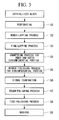
- FIG. 3 is a flow diagram illustrating one example of the process of producing the magnetic disk substrate of the present invention.
- FIG. 1A illustrates the amplitude Wa of the waviness.
- FIG. 1B illustrates the average amplitude Wb of the microwaviness in the present invention.
- Wa represents the amplitude of the waviness.
- Wb represents the average amplitude of the microwaviness.
- FIG. 2 is a diagram showing one example of the magnetic recording medium of the present embodiments.
- the magnetic recording medium 1 includes a magnetic disk substrate 2 ; and primary coats 3 of chromium alloy, magnetic layers 4 of cobalt alloy, and carbon layers 5 of diamond-like carbon which are formed in order on both sides of magnetic disk substrate 2 .
- the amplitude Wa of the waviness is within the range of 0.1 nm to 0.5 nm, the average amplitude Wb of the microwaviness is 0.3 nm or less, and the value calculated by dividing the average amplitude Wb of the microwaviness by the amplitude Wa of the waviness, namely Wb/Wa, is 0.6 or more.
- the electromagnetic conversion characteristics of the magnetic recording medium 1 become inferior, and therefore, such conditions are not preferable.
- the amplitude Wa of the waviness of the substrate is less than 1 nm or when the value calculated by dividing the average amplitude Wb of the microwaviness by the amplitude Wa of the waviness, namely Wb/Wa, is less than 0.6, it is required for the production to take a lot of time and effort, the yield gets worse, and it would be difficult to mass-produce.
- the substrate whose amplitude Wa of the waviness is less than 0.1 nm is difficult to produce.
- the magnetic disk substrate 2 shown in FIG. 2 can be made from glass, but this may be made from silicon.
- the substrate 2 for magnetic disks can be produced by way of the method described below.
- glass is prepared as a raw material for the magnetic disk substrate 2 , this raw material glass is molten, mixed and pressed, and a plate of glass which is disk-shaped is made. Then, the crystal nuclei are formed and the crystals are formed therein by heat-treating the obtained plate of glass, a crystallized glass is formed in which the crystal phases are lithium disilicate and ⁇ -quartz, particles of the aggregated ⁇ -quartz are dispersed on the glass.
- the plate of crystallized glass is perforated with a cylindrical grinding stone, a central aperture is formed in the central portion of the plate of crystallized glass, and a substrate is prepared (S 1 ).
- a two-stage lapping process namely a rough-lapping process (S 2 ) and a fine-lapping process (S 3 ) is conducted on one side of the obtained substrate which becomes a main surface, so that the width and surface-roughness of the substrate are adjusted.
- the inner and outer circumferential portions of the substrate are chamfered in a chamfering process (S 4 ) in order to form chamfered portions.
- the inner and outer circumferential portions of the substrate are mirror-finished in a mirror finishing process (S 5 ), and a visual examination is conducted thereon (S 6 ).
- the rough-polishing process of (1) is conducted by using a device which can polish both sides of a substrate, and an abrasive containing cerium oxide.
- the main surface of the substrate is mirror-finished by conducting the fine-polishing process (S 8 ).
- the fine-polishing process can be carried out by using the device which can polish the both sides of substrate, and an abrasive containing at least one of cerium oxide powder and colloidal silica. It is preferable that the abrasive whose particle size is 0.1 ⁇ m to 1 ⁇ m be used in the fine-polishing process. If the particle size of the abrasive is over 1 ⁇ m, the amplitude Wa of the waviness tends to be large, and therefore, it is not preferable. If the particle size of the abrasive is less than 0.1 ⁇ m, its processing rate is lowered, and it is difficult to mass-produce. In addition, when plural abrasives are mixed for use, it may include abrasives which are different in particle size.
- a pad made from a urethane or suede can be used.
- the magnetic disk substrate shown in FIG. 2 can be obtained by washing the substrate (S 9 ).
- the magnetic disk substrate 2 is mounted in sputtering equipment, and primary coats 3 made from chromium alloy, and magnetic layers 4 made from cobalt alloy are successively formed on both sides of the magnetic disk substrate 2 by way of sputtering. Then, the carbon layers 5 made from diamond-like carbon are formed on the magnetic layers 4 by way of the CVD method, and the magnetic recording medium 1 shown in FIG. 2 can be obtained. In addition, the carbon layers 5 may be coated with Fonblin Z-Tetraol (produced by Sovay Solexis Inc.) as a lubricant.
- Fonblin Z-Tetraol produced by Sovay Solexis Inc.
- a raw material glass mainly including 77% of SiO 2 , 11% of Li 2 O, 4% of Al 2 O 3 , and 3% of MgO was prepared as a material for each magnetic disk substrate.
- the raw material glass was molten at approximately 1350° C. to 1500° C. by using a melting device, and this was mixed, pressed and cooled, and a disk-like plate of glass having a diameter of 66 mm, and width of about 1 mm was obtained. Then, the obtained plate of glass was heat-treated at 540° C. for about five hours to form crystal nuclei, the crystals were formed at 780° C. for two hours, and the crystallized glass was formed in which the crystal phases were lithium disilicate and ⁇ -quartz, and particles of the aggregated ⁇ -quartz were dispersed on the glass.
- a central aperture was formed in the central portion of the plate of crystallized glass by using a cylindrical grinding stone, and a substrate was prepared. Then, the two-stage lapping process including a rough-lapping process and fine-lapping process was conducted to one side of the obtained substrate which became a main surface by using a polishing device which can polish the both sides of substrate and uses a diamond pellet, and the thickness and surface-roughness of the substrate were adjusted. Then, the inner circumferential portion of the substrate, which fronts on the central aperture, and the outer circumferential portion were chamfered with a grinding stone by using an internal-external processing device, and chamfered portions are formed.
- the inner and outer circumferential portion was mirror-finished, visual examinations were conducted thereon, and the main surfaces of the substrates were finally mirror-finished by using the polishing device which can polish the both sides of substrate.
- This polishing process included a rough-polishing step and fine-polishing step.
- the abrasive containing cerium oxide powder (ceria) (“ROX” produced by Showa Denko K.K.), and colloidal silica (“Compol” produced by Fujimi Incorporated) was used therein. Commercially available urethane or suede pads were used for polishing them.
- each magnetic disk substrate corresponding to Test Cases 1 to 12 were obtained, which were different in the amplitudes Wa of the waviness, and the average amplitudes Wb of the microwaviness, but had an identical diameter of 65 mm, and internal diameter of 20 mm.
- Test Cases 1 to 12 were scrub-brush washed, further ultrasonically cleaned in an oxalic acid solution, and extraneous matters attached on the surfaces were removed. Then, the amplitudes Wa of the waviness, and the average amplitudes Wb of the microwaviness of the substrates were measured. The results are shown in Table 1.
- the amplitudes Wa were obtained by using a interferometer “OptiFlat” produced by ADE Phase Shift, Inc. with a high-pass filter of 5 mm. Also, the average amplitudes Wb of the microwaviness were measured at a measuring wave-length of 30 ⁇ m to 200 ⁇ m by using MicroXam with a band-pass filter.
- Each of the substrates of Test Cases 1 to 12 was texture-treated by using a non-woven fabric and a diamond slurry, then loaded into sputtering equipment, and primary coats of chromium alloy and magnetic layers of cobalt alloy were formed on both sides of the substrate by way of sputtering. Then, diamond-like carbon layers were formed thereon by way of the CVD method, a lubricant “Fonblin Z-Tetraol” (produced by Solvay Solexis, Inc.) was coated thereon, and a magnetic recording medium was produced.
- the sum of the thicknesses of the primary coat and the magnetic layer was 90 nm, and the thickness of the diamond-like carbon layer was 10 nm.
- the relative value of the electromagnetic conversion characteristics was 1 or more when the electromagnetic conversion characteristics of the Test Case 8 were regarded as 1; or
- Table 1 revealed that the substrates of Test Cases 1 to 4, whose amplitudes Wa of the waviness of the substrate were over 0.5 nm, had inferior electromagnetic conversion characteristics. Also, it was revealed that those of Test Cases 1 and 10, whose average amplitudes Wb of the microwaviness were over 0.3 nm, had inferior electromagnetic conversion characteristics.
- a magnetic disk substrate which can achieve a magnetic recording medium compatible with high recording density, and has excellent electromagnetic conversion characteristics can be mass-produced. Therefore, the present invention is highly applicable to the field of information technology or the like.
Landscapes
- Chemical & Material Sciences (AREA)
- Inorganic Chemistry (AREA)
- Engineering & Computer Science (AREA)
- Ceramic Engineering (AREA)
- Magnetic Record Carriers (AREA)
- Manufacturing Of Magnetic Record Carriers (AREA)
Abstract
Description
| TABLE 1 | ||||||||||
| Particle | ||||||||||
| size of | Evaluation | Electromagnetic | Electromagnetic | |||||||
| Case | Wa | Wb | abrasive | of | conversion | conversion | ||||
| # | (nm) | (nm) | Wb/Wa | Abrasive | (μm) | Yield | | characteristics | characteristics | |
| 1 | 0.78 | 0.35 | 0.45 | Ceria | 0.8 | 1.85 | Good | 0.89 | Bad |
| 2 | 0.75 | 0.29 | 0.39 | Ceria | 0.8 | 1.62 | Good | 0.90 | Bad |
| 3 | 0.62 | 0.19 | 0.31 | Ceria | 0.8 | 1.56 | Good | 0.92 | Bad |
| 4 | 0.61 | 0.18 | 0.30 | Ceria | 0.8 | 1.35 | Good | 0.94 | Bad |
| 5 | 0.42 | 0.19 | 0.45 | Ceria | 0.2 | 0.85 | Bad | 1.01 | Good |
| 6 | 0.39 | 0.21 | 0.54 | Ceria | 0.2 | 0.83 | Bad | 1.00 | Good |
| 7 | 0.32 | 0.16 | 0.50 | Ceria | 0.2 | 0.73 | Bad | 1.02 | Good |
| 8 | 0.30 | 0.22 | 0.73 | Ceria/Colloidal | 0.45/0.08 | 1.00 | Good | 1.00 | |
| silica | |||||||||
| 9 | 0.21 | 0.23 | 1.10 | Ceria/Colloidal | 0.45/0.08 | 0.97 | Good | 1.00 | Good |
| silica | |||||||||
| 10 | 0.2 | 0.32 | 1.60 | Ceria | 0.45 | 0.12 | Good | 0.95 | Bad |
| 11 | 0.25 | 0.14 | 0.56 | Colloidal silica | 0.08 | 0.27 | Bad | 1.04 | Good |
| 12 | 0.2 | 0.09 | 0.45 | Colloidal silica | 0.06 | 0.08 | Bad | 1.07 | Good |
Claims (4)
Priority Applications (1)
| Application Number | Priority Date | Filing Date | Title |
|---|---|---|---|
| US12/095,431 US7855002B2 (en) | 2005-12-15 | 2006-11-29 | Magnetic disk substrate and magnetic recording medium thereof |
Applications Claiming Priority (5)
| Application Number | Priority Date | Filing Date | Title |
|---|---|---|---|
| JP2005361719A JP2007164916A (en) | 2005-12-15 | 2005-12-15 | Substrate for magnetic disk and magnetic recording medium |
| JP2005-361719 | 2005-12-15 | ||
| US75239405P | 2005-12-22 | 2005-12-22 | |
| US12/095,431 US7855002B2 (en) | 2005-12-15 | 2006-11-29 | Magnetic disk substrate and magnetic recording medium thereof |
| PCT/JP2006/324297 WO2007069501A1 (en) | 2005-12-15 | 2006-11-29 | Magnetic disc substrate and magnetic recording medium thereof |
Publications (2)
| Publication Number | Publication Date |
|---|---|
| US20090161242A1 US20090161242A1 (en) | 2009-06-25 |
| US7855002B2 true US7855002B2 (en) | 2010-12-21 |
Family
ID=38162811
Family Applications (1)
| Application Number | Title | Priority Date | Filing Date |
|---|---|---|---|
| US12/095,431 Active 2027-07-24 US7855002B2 (en) | 2005-12-15 | 2006-11-29 | Magnetic disk substrate and magnetic recording medium thereof |
Country Status (2)
| Country | Link |
|---|---|
| US (1) | US7855002B2 (en) |
| WO (1) | WO2007069501A1 (en) |
Families Citing this family (4)
| Publication number | Priority date | Publication date | Assignee | Title |
|---|---|---|---|---|
| MY156392A (en) | 2007-12-28 | 2016-02-15 | Hoya Corp | Glass substrate for a magnetic disk, magnetic disk and method of manufacturing a magnetic disk |
| WO2011033948A1 (en) * | 2009-09-18 | 2011-03-24 | コニカミノルタオプト株式会社 | Glass substrate for information recording medium, information recording medium, and method for producing glass substrate for information recording medium |
| JP6225248B2 (en) * | 2013-10-31 | 2017-11-01 | ホーヤ ガラスディスク ベトナム Ii リミテッド | Glass substrate for magnetic disk, magnetic disk for heat-assisted magnetic recording, and method for manufacturing magnetic disk for heat-assisted magnetic recording |
| US20240371404A1 (en) * | 2021-08-26 | 2024-11-07 | Furukawa Electric Co., Ltd. | Substrate for magnetic disk, manufacturing method thereof, and magnetic disk |
Citations (10)
| Publication number | Priority date | Publication date | Assignee | Title |
|---|---|---|---|---|
| JPH0696436A (en) | 1992-09-11 | 1994-04-08 | Hitachi Metals Ltd | Magnetic recording medium |
| JP2000207733A (en) | 1999-01-11 | 2000-07-28 | Nippon Sheet Glass Co Ltd | Magnetic disc, production thereof and magnetic recorder employing the same |
| US20020159077A1 (en) * | 2001-04-26 | 2002-10-31 | Iwao Sakaguchi | Apparatus for measuring distortion of cylindrical body |
| US20020164505A1 (en) * | 2000-10-19 | 2002-11-07 | Hoya Corporation | Substrate for information recording medium, information recording medium, and method for controlling surface of substrate for information recording medium |
| JP2003223711A (en) | 2002-01-24 | 2003-08-08 | Nippon Sheet Glass Co Ltd | Glass plate for information recording medium and its manufacturing method |
| US20030172677A1 (en) * | 1999-09-30 | 2003-09-18 | Hoya Corporation | Chemical reinforced glass substrate having desirable edge profile and method of manufacturing the same |
| US20040123527A1 (en) * | 2002-12-26 | 2004-07-01 | Hiroaki Kitayama | Polishing composition |
| US20040162012A1 (en) * | 2003-02-05 | 2004-08-19 | Kenichi Suenaga | Polishing composition |
| WO2006022443A1 (en) * | 2004-08-27 | 2006-03-02 | Showa Denko K.K. | Magnetic disk substrate and production method of magnetic disk |
| US20060194080A1 (en) * | 2002-10-23 | 2006-08-31 | Norimasa Ishii | Magnetic recording medium glass substrate and method of producing the same |
-
2006
- 2006-11-29 WO PCT/JP2006/324297 patent/WO2007069501A1/en not_active Ceased
- 2006-11-29 US US12/095,431 patent/US7855002B2/en active Active
Patent Citations (10)
| Publication number | Priority date | Publication date | Assignee | Title |
|---|---|---|---|---|
| JPH0696436A (en) | 1992-09-11 | 1994-04-08 | Hitachi Metals Ltd | Magnetic recording medium |
| JP2000207733A (en) | 1999-01-11 | 2000-07-28 | Nippon Sheet Glass Co Ltd | Magnetic disc, production thereof and magnetic recorder employing the same |
| US20030172677A1 (en) * | 1999-09-30 | 2003-09-18 | Hoya Corporation | Chemical reinforced glass substrate having desirable edge profile and method of manufacturing the same |
| US20020164505A1 (en) * | 2000-10-19 | 2002-11-07 | Hoya Corporation | Substrate for information recording medium, information recording medium, and method for controlling surface of substrate for information recording medium |
| US20020159077A1 (en) * | 2001-04-26 | 2002-10-31 | Iwao Sakaguchi | Apparatus for measuring distortion of cylindrical body |
| JP2003223711A (en) | 2002-01-24 | 2003-08-08 | Nippon Sheet Glass Co Ltd | Glass plate for information recording medium and its manufacturing method |
| US20060194080A1 (en) * | 2002-10-23 | 2006-08-31 | Norimasa Ishii | Magnetic recording medium glass substrate and method of producing the same |
| US20040123527A1 (en) * | 2002-12-26 | 2004-07-01 | Hiroaki Kitayama | Polishing composition |
| US20040162012A1 (en) * | 2003-02-05 | 2004-08-19 | Kenichi Suenaga | Polishing composition |
| WO2006022443A1 (en) * | 2004-08-27 | 2006-03-02 | Showa Denko K.K. | Magnetic disk substrate and production method of magnetic disk |
Non-Patent Citations (2)
| Title |
|---|
| Translation Minami et al JP 2003-223711 (Aug. 2008). * |
| Translation Okuda et al JP 2000-207733 (Jul. 2000). * |
Also Published As
| Publication number | Publication date |
|---|---|
| US20090161242A1 (en) | 2009-06-25 |
| WO2007069501A1 (en) | 2007-06-21 |
Similar Documents
| Publication | Publication Date | Title |
|---|---|---|
| US8096148B2 (en) | Method for fabricating a glass substrate, magnetic disk, and method for fabricating the same | |
| JP6215770B2 (en) | Glass substrate for magnetic disk, magnetic disk, and method for manufacturing glass substrate for magnetic disk | |
| US6790509B2 (en) | Substrate for information recording medium, information recording medium, and method for controlling surface of substrate for information recording medium | |
| JP6089039B2 (en) | Glass substrate for magnetic disk, magnetic disk | |
| US9135939B2 (en) | Glass substrate for information recording medium, information recording medium and method of manufacturing glass substrate for information recording medium | |
| JP6120810B2 (en) | Glass substrate for magnetic disk, magnetic disk | |
| JP2006092722A (en) | Magnetic disk substrate and production method of magnetic disk | |
| JP4785406B2 (en) | Polishing slurry, method for producing glass substrate for information recording medium, and method for producing information recording medium | |
| US7855002B2 (en) | Magnetic disk substrate and magnetic recording medium thereof | |
| JP3554476B2 (en) | Glass substrate for information recording medium, method of manufacturing the same, magnetic recording medium using the substrate, and method of manufacturing the same | |
| US20030203244A1 (en) | Magnetic recording medium and method of producing the same | |
| CN101331542A (en) | Disk substrate and its magnetic recording medium | |
| JP4808985B2 (en) | Manufacturing method of glass substrate for magnetic disk and manufacturing method of magnetic disk | |
| JP3600767B2 (en) | Glass substrate for information recording medium, method of manufacturing the same, magnetic recording medium using the substrate, and method of manufacturing the same | |
| JP2015060614A (en) | Method for manufacturing glass substrate for information recording medium | |
| CN103050133B (en) | Glass base plate for magnetic recording carrier and employ the magnetic recording media of this glass base plate for magnetic recording carrier | |
| JP5360331B2 (en) | Manufacturing method of glass substrate for HDD | |
| WO2014103284A1 (en) | Method for producing glass substrate for information recording medium | |
| JP2012203959A (en) | Manufacturing method for glass substrate for magnetic information recording medium | |
| JP2003242632A (en) | Method for manufacturing glass substrate for magnetic recording medium and method for manufacturing magnetic recording medium | |
| JP2015011743A (en) | Method of manufacturing glass substrate for information recording medium | |
| WO2014045654A1 (en) | Method for producing glass substrate for information recording medium |
Legal Events
| Date | Code | Title | Description |
|---|---|---|---|
| AS | Assignment |
Owner name: SHOWA DENKO K.K.,JAPAN Free format text: ASSIGNMENT OF ASSIGNORS INTEREST;ASSIGNORS:AIDA, KATSUAKI;MACHIDA, HIROYUKI;REEL/FRAME:021016/0623 Effective date: 20080513 Owner name: SHOWA DENKO K.K., JAPAN Free format text: ASSIGNMENT OF ASSIGNORS INTEREST;ASSIGNORS:AIDA, KATSUAKI;MACHIDA, HIROYUKI;REEL/FRAME:021016/0623 Effective date: 20080513 |
|
| STCF | Information on status: patent grant |
Free format text: PATENTED CASE |
|
| FEPP | Fee payment procedure |
Free format text: PAYOR NUMBER ASSIGNED (ORIGINAL EVENT CODE: ASPN); ENTITY STATUS OF PATENT OWNER: LARGE ENTITY |
|
| FPAY | Fee payment |
Year of fee payment: 4 |
|
| MAFP | Maintenance fee payment |
Free format text: PAYMENT OF MAINTENANCE FEE, 8TH YEAR, LARGE ENTITY (ORIGINAL EVENT CODE: M1552) Year of fee payment: 8 |
|
| MAFP | Maintenance fee payment |
Free format text: PAYMENT OF MAINTENANCE FEE, 12TH YEAR, LARGE ENTITY (ORIGINAL EVENT CODE: M1553); ENTITY STATUS OF PATENT OWNER: LARGE ENTITY Year of fee payment: 12 |
|
| AS | Assignment |
Owner name: RESONAC CORPORATION, JAPAN Free format text: CHANGE OF NAME;ASSIGNOR:SHOWA DENKO K.K.;REEL/FRAME:064082/0513 Effective date: 20230623 |
|
| AS | Assignment |
Owner name: RESONAC CORPORATION, JAPAN Free format text: CHANGE OF ADDRESS;ASSIGNOR:RESONAC CORPORATION;REEL/FRAME:066599/0037 Effective date: 20231001 |
|
| AS | Assignment |
Owner name: RESONAC HARD DISK CORPORATION, JAPAN Free format text: ASSIGNMENT OF ASSIGNORS INTEREST;ASSIGNOR:RESONAC CORPORATION;REEL/FRAME:069167/0673 Effective date: 20240830 |