US7809334B2 - Signal transmitting and receiving apparatus capable of preventing the receiving end from saturating - Google Patents

Signal transmitting and receiving apparatus capable of preventing the receiving end from saturating Download PDF

Info

Publication number
US7809334B2
US7809334B2 US11/549,976 US54997606A US7809334B2 US 7809334 B2 US7809334 B2 US 7809334B2 US 54997606 A US54997606 A US 54997606A US 7809334 B2 US7809334 B2 US 7809334B2
Authority
US
United States
Prior art keywords
signal
oscillating
receiving unit
receiving
transmitting
Prior art date
Legal status (The legal status is an assumption and is not a legal conclusion. Google has not performed a legal analysis and makes no representation as to the accuracy of the status listed.)
Active, expires
Application number
US11/549,976
Other versions
US20070275673A1 (en
Inventor
Shoufang Chen
Steve Wiyi Yang
Current Assignee (The listed assignees may be inaccurate. Google has not performed a legal analysis and makes no representation or warranty as to the accuracy of the list.)
Xueshan Technologies Inc
Original Assignee
MStar Semiconductor Inc Taiwan
Priority date (The priority date is an assumption and is not a legal conclusion. Google has not performed a legal analysis and makes no representation as to the accuracy of the date listed.)
Filing date
Publication date
Application filed by MStar Semiconductor Inc Taiwan filed Critical MStar Semiconductor Inc Taiwan
Assigned to MSTAR SEMICONDUCTOR, INC. reassignment MSTAR SEMICONDUCTOR, INC. ASSIGNMENT OF ASSIGNORS INTEREST (SEE DOCUMENT FOR DETAILS). Assignors: CHEN, SHOUFANG, YANG, STEVE WIYI
Publication of US20070275673A1 publication Critical patent/US20070275673A1/en
Application granted granted Critical
Publication of US7809334B2 publication Critical patent/US7809334B2/en
Assigned to MEDIATEK INC. reassignment MEDIATEK INC. MERGER (SEE DOCUMENT FOR DETAILS). Assignors: MSTAR SEMICONDUCTOR, INC.
Assigned to XUESHAN TECHNOLOGIES INC. reassignment XUESHAN TECHNOLOGIES INC. ASSIGNMENT OF ASSIGNORS INTEREST (SEE DOCUMENT FOR DETAILS). Assignors: MEDIATEK INC.
Active legal-status Critical Current
Adjusted expiration legal-status Critical

Links

Images

Classifications

    • GPHYSICS
    • G06COMPUTING OR CALCULATING; COUNTING
    • G06KGRAPHICAL DATA READING; PRESENTATION OF DATA; RECORD CARRIERS; HANDLING RECORD CARRIERS
    • G06K7/00Methods or arrangements for sensing record carriers, e.g. for reading patterns
    • G06K7/0008General problems related to the reading of electronic memory record carriers, independent of its reading method, e.g. power transfer

Definitions

  • the present invention relates to a signal transmitting and receiving apparatus and the method thereof, especially to a signal transmitting and receiving apparatus capable of preventing the receiving end from saturating and the corresponding method.
  • FIG. 1 illustrates an application circuit for Radio Frequency Identification (RFID) technology.
  • a reader 100 includes a receiving circuit 130 , a demodulator 140 , a processing circuit 150 , a modulator 160 , an oscillator 170 and a power amplifier 180 .
  • the receiving circuit 130 receives RF signal through the antenna 110 and the power amplifier 180 emits RF signal through the antenna 120 .
  • the modulator 160 modulates an oscillating signal generated by the oscillator 170 according to the control signal of the processing circuit 150 to form a modulated signal and the modulated signal is then amplified by the power amplifier 180 before being emitted through the antenna 120 .
  • the RFID tag 200 receives the RF signal RF 1 from the antenna 120 and reflects an RF signal RF 2 to the reader 100 after processing the signal RF 1 .
  • the reflection RF signal RF 2 is transmitted to the antenna 110 and then received by the receiving circuit 130 .
  • the signal RF 2 is further processed by the processing circuit 150 .
  • the RF signal emitted through the antenna 120 will be transmitted to only the RFID tag 200 ; however in practice, a portion of the leakage RF signal, RF 3 , will be received by the antenna 110 .
  • signals amplified by the power amplifier 180 possess larger power (e.g., 30 dBm).
  • the antenna isolation is not good enough (e.g., 25 dB to 30 dB)
  • the receiving circuit 130 will probably saturate upon receiving the high-power leakage signal RF 3 .
  • the reader 100 fails since the receiving circuit 130 is not able to receive the reflection signal RF 2 having a power of e.g., ⁇ 80 dBm.
  • a signal transmitting and receiving apparatus includes a signal receiving unit, a a first signal generator, and a second signal generator.
  • the signal receiving unit receives a first signal and a second signal.
  • the first signal generator generates the first signal.
  • the second signal generator which is coupled to the signal receiving unit, generates the second signal. There is a phase difference between the second signal and the first signal such that in the signal receiving unit the first signal and the second signal eliminate each other's power.
  • a method for receiving and transmitting a signal includes: generating a first signal; generating a second signal; and transmitting the first signal and the second signal to a signal receiving unit. There is a phase difference between the second signal and the first signal such that in the signal receiving unit the first signal and the second signal eliminate each other's power.
  • an RFID reader is disclosed.
  • the RFID reader is characterized by including a receiving unit, an oscillator, a first modulator, a power amplifier, and a second modulator.
  • the receiving unit receives a first signal and a second signal.
  • the oscillator generates an oscillating signal.
  • the first modulator which is coupled to the oscillator, modulates the oscillating signal to generate the first signal.
  • the power amplifier which is coupled to the first modulator, amplifies the first signal.
  • the second modulator which is coupled to the oscillator and the receiving unit, modulates the oscillating signal to generate the second signal. There is a phase difference between the second signal and the first signal such that in the signal receiving unit the first signal and the second signal eliminate each other's power.
  • FIG. 1 is an application circuit for RFID technology.
  • FIG. 2 is a signal transmitting and receiving apparatus capable of preventing the receiving end from saturating according to a first embodiment of the present invention.
  • FIG. 3 is a signal transmitting and receiving apparatus capable of preventing the receiving end from saturating according to a second embodiment of the present invention.
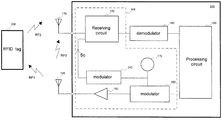
  • FIG. 2 shows the signal transmitting and receiving apparatus according to a first embodiment of this invention.
  • the reader 300 includes a receiving circuit 130 , a demodulator 140 , a processing circuit 150 , a modulator 160 , an oscillator 170 , a power amplifier 180 , and a modulator 310 .
  • the receiving circuit 130 receives signal through the antenna 110 , and the power amplifier 180 emits signal through the antenna 120 .
  • the receiving circuit 130 , the modulator 160 , the oscillator 170 , the power amplifier 180 and the modulator 310 form the signal transmitting and receiving circuit 305 of this present invention.
  • the elements of the reader 300 possess the same function as those designated by the same number of the reader 100 .
  • the difference between the reader 300 and the reader 100 is that the reader 300 has a modulator 310 , which is coupled to the receiving circuit 130 for modulating an oscillating signal generated by the oscillator 170 . Then, the modulated signal Sc generated by the modulator 310 is transmitted to the receiving circuit 130 through a conductive wire in order to attenuate the RF signal RF 3 transmitted through wireless transmission.
  • the oscillating signal generated by the oscillator 170 is assumed to be represented in the form of cos(w c t+ ⁇ ).
  • the modulator 160 modulates the oscillating signal in the form of A 1 cos(w m t)cos(w c t+ ⁇ ) to carry the command. It is noted that the RFID tag 200 does not yet reflect the reflecting signal RF 2 to the antenna 110 at that time.
  • the modulator 160 stops modulating, and then the reader 300 keeps emitting an RF signal to provide power to the RFID tag 200 .
  • the receiving circuit 130 is ready to receive the reflection signal RF 2 . It is assumed that the signal which is utilized to power the RFID tag 200 and carries no command is represented in the form of A 2 cos(w c t+ ⁇ ).
  • the modulator 310 modulates the oscillating signal such that the modulated signal Sc has the same frequency and a 180 degree phase difference with respect to the RF signal RF 3 . Furthermore, by adjusting the amplitude of the signal Sc to be close to the amplitude of the RF signal RF 3 , these two signals will eliminate each other's power when they are received by the receiving circuit 130 because of the phase difference and amplitudes. As a result, the receiving circuit 130 will not saturate due to the reception of the high-power RF signal RF 3 .
  • one of the modulating methods of the modulator 310 is to adjust amplitude and phase of the oscillating signal.
  • the receiving circuit 130 receives the RF signal RF 3 and the signal Sc at the same time.
  • the leakage power from the antenna 120 to the antenna 110 can be eliminated by properly adjusting the amplitude B of the signal Sc to restrain the amplitude of the RF signal RF 3 .
  • One of the main purposes of the modulator 310 is to adjust the phase of the oscillating signal, and it could be performed by several methods. In general, the phase adjustment can be implemented by the signal delay generated by a resistor connected in series with a capacitor or an inductor connected in series with a capacitor.
  • FIG. 3 shows the signal transmitting and receiving apparatus according to a second embodiment of the present invention.
  • the reader 400 includes a receiving circuit 130 , a demodulator 140 , a processing circuit 150 , a modulator 160 , an oscillator 170 , a power amplifier 180 , a modulator 310 and an oscillator 320 .
  • the receiving circuit 130 receives signal through the antenna 110 , and the power amplifier 180 emits signal through the antenna 120 .
  • the receiving circuit 130 , the modulator 160 , the oscillator 170 , the power amplifier 180 , the modulator 310 and the oscillator 320 form the signal transmitting and receiving circuit 405 of this present invention.
  • the elements of the reader 400 possess the same function as those designated by the same number of the reader 300 .
  • the difference between the reader 300 and the reader 400 is that in the reader 400 there is an additional oscillator 320 .
  • the oscillator 320 and the oscillator 170 are synchronous by sharing the same reference source.
  • the oscillator 320 is coupled to the modulator 310 for generating an oscillating signal different from the signal generated by the oscillator 170 .
  • the oscillating signal generated by the oscillator 170 is referred to as the first oscillating signal
  • the oscillating signal generated by the oscillator 320 is referred to as the second oscillating signal.
  • the modulator 310 modulates the second oscillating signal and then transmits the modulated signal Sc to the receiving circuit 130 through a conductive wire in order that the signal Sc attenuates the RF signal RF 3 transmitted through wireless transmission.
  • the modulator 310 modulates the frequency and the phase of the second oscillating signal to make the frequency of the signal Sc to be equal or close to the frequency of the RF signal RF 3 and also make the signal Sc has a 180 degree phase difference with respect to the RF signal RF 3 .
  • the first and the second oscillating signals which are generated by the oscillator 170 and the oscillator 320 respectively, are represented in the form of cos(w c t+ ⁇ ).
  • the modulator 160 modulates the oscillating signal in the form of A 1 cos(w m t)cos(w c t+ ⁇ ) to carry the command.
  • the RFID tag 200 does not yet reflect the reflecting signal RF 2 to the antenna 110 at that time.
  • the modulator 160 stops modulating, and then the reader 400 keeps emitting an RF signal to provide power to the RFID tag 200 .
  • the receiving circuit 130 is ready to receive the reflection signal RF 2 .
  • the signal which is utilized to power the RFID tag 200 and carries no command is represented in the form of A 2 cos(w c t+ ⁇ ).
  • the modulator 310 modulates the second oscillating signal such that the modulated signal Sc has the same frequency and a 180 degree phase difference with respect to the RF signal RF 3 .
  • the amplitude of the signal Sc will eliminate each other's power when they are received by the receiving circuit 130 because of the phase difference and amplitudes. As a result, the receiving circuit 130 will not saturate due to the reception of the high-power RF signal RF 3 .
  • one of modulating methods of the modulator 310 is to adjust the frequency, phase and amplitude of the second oscillating signal.
  • the receiving circuit 130 receives the RF signal RF 3 and the signal Sc at the same time.
  • the leakage power from the antenna 120 to the antenna 110 can be eliminated by properly adjusting the amplitude B of the signal Sc to restrain the amplitude of RF signal RF 3 .
  • One of the main purposes of the modulator 310 is to adjust the phase of the oscillating signal, and it could be performed by several methods. In general, the phase adjustment can be implemented by the signal delay generated by a resistor connected in series with a capacitor or an inductor connected in series with a capacitor.
  • an emitting signal from the transmitting end of a signal transmitting and receiving apparatus might be received unexpectedly by the receiving end. If the power of the emitting signal is larger than the capacity of the receiving end, the receiving end will saturate and therefore is not able to receive signals with small power. This kind of problem is usually encountered by an RFID reader.
  • the present invention discloses a method and the corresponding apparatus to solve this problem.
  • the signal transmitting and receiving apparatus is provided with a modulator coupled to the receiving end for generating a modulated signal.
  • the modulated signal is then transmitted through a conductive wire to the receiving end to eliminate the leakage signal from the transmitting end. As a result, the receiving end will not saturate.

Landscapes

  • Engineering & Computer Science (AREA)
  • Artificial Intelligence (AREA)
  • Computer Vision & Pattern Recognition (AREA)
  • Physics & Mathematics (AREA)
  • General Physics & Mathematics (AREA)
  • Theoretical Computer Science (AREA)
  • Near-Field Transmission Systems (AREA)
  • Radar Systems Or Details Thereof (AREA)

Abstract

The present invention provides a signal emitting and receiving circuit and the operating method thereof. The circuit includes a signal receiving unit, a first signal generator and a second signal generator. The signal receiving unit receives a first signal and a second signal. The first signal generator generates the first signal. The second signal generator, which is couple to the signal receiving unit, generates the second signal. There is a phase difference between the first signal and the second signal such that in the signal receiving unit the two signals eliminate each other's power.

Description

BACKGROUND OF INVENTION
1. Field of the Invention
The present invention relates to a signal transmitting and receiving apparatus and the method thereof, especially to a signal transmitting and receiving apparatus capable of preventing the receiving end from saturating and the corresponding method.
2. Description of the Prior Art
FIG. 1 illustrates an application circuit for Radio Frequency Identification (RFID) technology. In FIG. 1, a reader 100 includes a receiving circuit 130, a demodulator 140, a processing circuit 150, a modulator 160, an oscillator 170 and a power amplifier 180. The receiving circuit 130 receives RF signal through the antenna 110 and the power amplifier 180 emits RF signal through the antenna 120. When the reader 100 is about to emit an RF signal to the RFID tag 200, the modulator 160 modulates an oscillating signal generated by the oscillator 170 according to the control signal of the processing circuit 150 to form a modulated signal and the modulated signal is then amplified by the power amplifier 180 before being emitted through the antenna 120. The RFID tag 200 receives the RF signal RF1 from the antenna 120 and reflects an RF signal RF2 to the reader 100 after processing the signal RF1. The reflection RF signal RF2 is transmitted to the antenna 110 and then received by the receiving circuit 130. After being demodulated by the demodulator 140, the signal RF2 is further processed by the processing circuit 150. Ideally, the RF signal emitted through the antenna 120 will be transmitted to only the RFID tag 200; however in practice, a portion of the leakage RF signal, RF3, will be received by the antenna 110. Generally, signals amplified by the power amplifier 180 possess larger power (e.g., 30 dBm). Therefore, if the antenna isolation is not good enough (e.g., 25 dB to 30 dB), the receiving circuit 130 will probably saturate upon receiving the high-power leakage signal RF3. As a result, the reader 100 fails since the receiving circuit 130 is not able to receive the reflection signal RF2 having a power of e.g., −80 dBm.
SUMMARY OF INVENTION
It is therefore a primary objective of the claimed invention to provide a signal transmitting and receiving apparatus capable of preventing the receiving end from saturating.
According to an embodiment of the claimed invention, a signal transmitting and receiving apparatus is disclosed. The apparatus includes a signal receiving unit, a a first signal generator, and a second signal generator. The signal receiving unit receives a first signal and a second signal. The first signal generator generates the first signal. The second signal generator, which is coupled to the signal receiving unit, generates the second signal. There is a phase difference between the second signal and the first signal such that in the signal receiving unit the first signal and the second signal eliminate each other's power.
According to another embodiment of the claimed invention, a method for receiving and transmitting a signal is disclosed. The method includes: generating a first signal; generating a second signal; and transmitting the first signal and the second signal to a signal receiving unit. There is a phase difference between the second signal and the first signal such that in the signal receiving unit the first signal and the second signal eliminate each other's power.
According to still another embodiment of the claimed invention, an RFID reader is disclosed. The RFID reader is characterized by including a receiving unit, an oscillator, a first modulator, a power amplifier, and a second modulator. The receiving unit receives a first signal and a second signal. The oscillator generates an oscillating signal. The first modulator, which is coupled to the oscillator, modulates the oscillating signal to generate the first signal. The power amplifier, which is coupled to the first modulator, amplifies the first signal. The second modulator, which is coupled to the oscillator and the receiving unit, modulates the oscillating signal to generate the second signal. There is a phase difference between the second signal and the first signal such that in the signal receiving unit the first signal and the second signal eliminate each other's power.
These and other objectives of the present invention will no doubt become obvious to those of ordinary skill in the art after reading the following detailed description of the preferred embodiment that is illustrated in the various figures and drawings.
BRIEF DESCRIPTION OF DRAWINGS
FIG. 1 is an application circuit for RFID technology.
FIG. 2 is a signal transmitting and receiving apparatus capable of preventing the receiving end from saturating according to a first embodiment of the present invention.
FIG. 3 is a signal transmitting and receiving apparatus capable of preventing the receiving end from saturating according to a second embodiment of the present invention.
DETAILED DESCRIPTION
Certain terms are used throughout the description and following claims to refer to particular components. As one skilled in the art will appreciate, electronic equipment manufacturers may refer to a component by different names. This document does not intend to distinguish between components that differ in name but not function. In the following description and in the claims, the terms “include” and “comprise” are used in an open-ended fashion, and thus should be interpreted to mean “include, but not limited to . . . ”. Also, the term “couple” is intended to mean either an indirect or direct electrical connection. Accordingly, if one device is coupled to another device, that connection may be through a direct electrical connection, or through an indirect electrical connection via other devices and connections.
FIG. 2 shows the signal transmitting and receiving apparatus according to a first embodiment of this invention. The reader 300 includes a receiving circuit 130, a demodulator 140, a processing circuit 150, a modulator 160, an oscillator 170, a power amplifier 180, and a modulator 310. The receiving circuit 130 receives signal through the antenna 110, and the power amplifier 180 emits signal through the antenna 120. The receiving circuit 130, the modulator 160, the oscillator 170, the power amplifier 180 and the modulator 310 form the signal transmitting and receiving circuit 305 of this present invention. The elements of the reader 300 possess the same function as those designated by the same number of the reader 100. The difference between the reader 300 and the reader 100 is that the reader 300 has a modulator 310, which is coupled to the receiving circuit 130 for modulating an oscillating signal generated by the oscillator 170. Then, the modulated signal Sc generated by the modulator 310 is transmitted to the receiving circuit 130 through a conductive wire in order to attenuate the RF signal RF3 transmitted through wireless transmission. For example, the oscillating signal generated by the oscillator 170 is assumed to be represented in the form of cos(wct+φ). When the reader 300 is about to send a command to the RFID tag 200, the modulator 160 modulates the oscillating signal in the form of A1 cos(wmt)cos(wct+φ) to carry the command. It is noted that the RFID tag 200 does not yet reflect the reflecting signal RF2 to the antenna 110 at that time. When the reader 300 finishes transmitting the command to the RFID tag 200, the modulator 160 stops modulating, and then the reader 300 keeps emitting an RF signal to provide power to the RFID tag 200. At that time the receiving circuit 130 is ready to receive the reflection signal RF2. It is assumed that the signal which is utilized to power the RFID tag 200 and carries no command is represented in the form of A2 cos(wct+φ). On the other hand, to prevent the receiving circuit 130 from saturating, the modulator 310 modulates the oscillating signal such that the modulated signal Sc has the same frequency and a 180 degree phase difference with respect to the RF signal RF3. Furthermore, by adjusting the amplitude of the signal Sc to be close to the amplitude of the RF signal RF3, these two signals will eliminate each other's power when they are received by the receiving circuit 130 because of the phase difference and amplitudes. As a result, the receiving circuit 130 will not saturate due to the reception of the high-power RF signal RF3. Hence, one of the modulating methods of the modulator 310 is to adjust amplitude and phase of the oscillating signal. The modulated signal Sc could be represented in the form of B cos(wct+φ), where φ=φ±π.
Sc = B cos ( w c t + φ ) = B cos ( w c t + ϕ ± π ) = - B cos ( w c t + ϕ )
The receiving circuit 130 receives the RF signal RF3 and the signal Sc at the same time.
signal_in = A 2 cos ( w c t + ϕ ) - B cos ( w c t + ϕ ) = ( A 2 - B ) cos ( w c t + ϕ )
According to the above equation, the leakage power from the antenna 120 to the antenna 110 can be eliminated by properly adjusting the amplitude B of the signal Sc to restrain the amplitude of the RF signal RF3. One of the main purposes of the modulator 310 is to adjust the phase of the oscillating signal, and it could be performed by several methods. In general, the phase adjustment can be implemented by the signal delay generated by a resistor connected in series with a capacitor or an inductor connected in series with a capacitor.
FIG. 3 shows the signal transmitting and receiving apparatus according to a second embodiment of the present invention. The reader 400 includes a receiving circuit 130, a demodulator 140, a processing circuit 150, a modulator 160, an oscillator 170, a power amplifier 180, a modulator 310 and an oscillator 320. The receiving circuit 130 receives signal through the antenna 110, and the power amplifier 180 emits signal through the antenna 120. The receiving circuit 130, the modulator 160, the oscillator 170, the power amplifier 180, the modulator 310 and the oscillator 320 form the signal transmitting and receiving circuit 405 of this present invention. The elements of the reader 400 possess the same function as those designated by the same number of the reader 300. The difference between the reader 300 and the reader 400 is that in the reader 400 there is an additional oscillator 320. The oscillator 320 and the oscillator 170 are synchronous by sharing the same reference source. The oscillator 320 is coupled to the modulator 310 for generating an oscillating signal different from the signal generated by the oscillator 170. The oscillating signal generated by the oscillator 170 is referred to as the first oscillating signal, and the oscillating signal generated by the oscillator 320 is referred to as the second oscillating signal. The modulator 310 modulates the second oscillating signal and then transmits the modulated signal Sc to the receiving circuit 130 through a conductive wire in order that the signal Sc attenuates the RF signal RF3 transmitted through wireless transmission. The modulator 310 modulates the frequency and the phase of the second oscillating signal to make the frequency of the signal Sc to be equal or close to the frequency of the RF signal RF3 and also make the signal Sc has a 180 degree phase difference with respect to the RF signal RF3. For example, the first and the second oscillating signals, which are generated by the oscillator 170 and the oscillator 320 respectively, are represented in the form of cos(wct+φ). When the reader 400 is about to send a command to the RFID tag 200, the modulator 160 modulates the oscillating signal in the form of A1 cos(wmt)cos(wct+φ) to carry the command. It is noted that the RFID tag 200 does not yet reflect the reflecting signal RF2 to the antenna 110 at that time. When the reader 400 finishes transmitting the command to the RFID tag 200, the modulator 160 stops modulating, and then the reader 400 keeps emitting an RF signal to provide power to the RFID tag 200. At that time, the receiving circuit 130 is ready to receive the reflection signal RF2. It is assumed that the signal which is utilized to power the RFID tag 200 and carries no command is represented in the form of A2 cos(wct+φ). On the other hand, to prevent the receiving circuit 130 from saturating, the modulator 310 modulates the second oscillating signal such that the modulated signal Sc has the same frequency and a 180 degree phase difference with respect to the RF signal RF3. Furthermore, by adjusting the amplitude of the signal Sc to be close to the amplitude of the RF signal RF3, these two signals will eliminate each other's power when they are received by the receiving circuit 130 because of the phase difference and amplitudes. As a result, the receiving circuit 130 will not saturate due to the reception of the high-power RF signal RF3. Hence, one of modulating methods of the modulator 310 is to adjust the frequency, phase and amplitude of the second oscillating signal. The modulated signal Sc could be represented in the form of B cos(wct+φ), where φ=φ±π.
Sc = B cos ( w c t + φ ) = B cos ( w c t + ϕ ± π ) = - B cos ( w c t + ϕ )
The receiving circuit 130 receives the RF signal RF3 and the signal Sc at the same time.
signal_in = A 2 cos ( w c t + ϕ ) - B cos ( w c t + ϕ ) = ( A 2 - B ) cos ( w c t + ϕ )
According to the above equation, the leakage power from the antenna 120 to the antenna 110 can be eliminated by properly adjusting the amplitude B of the signal Sc to restrain the amplitude of RF signal RF3. One of the main purposes of the modulator 310 is to adjust the phase of the oscillating signal, and it could be performed by several methods. In general, the phase adjustment can be implemented by the signal delay generated by a resistor connected in series with a capacitor or an inductor connected in series with a capacitor.
In summary, an emitting signal from the transmitting end of a signal transmitting and receiving apparatus might be received unexpectedly by the receiving end. If the power of the emitting signal is larger than the capacity of the receiving end, the receiving end will saturate and therefore is not able to receive signals with small power. This kind of problem is usually encountered by an RFID reader. The present invention discloses a method and the corresponding apparatus to solve this problem. The signal transmitting and receiving apparatus is provided with a modulator coupled to the receiving end for generating a modulated signal. The modulated signal is then transmitted through a conductive wire to the receiving end to eliminate the leakage signal from the transmitting end. As a result, the receiving end will not saturate.
Those skilled in the art will readily observe that numerous modifications and alterations of the device and method may be made while retaining the teachings of the invention. Accordingly, the above disclosure should be construed as limited only by the metes and bounds of the appended claims.

Claims (19)

1. A signal transmitting and receiving apparatus, comprising:
a signal receiving unit for receiving a first signal and a second signal;
a first signal generator for generating the first signal; a second signal generator coupled to the signal receiving unit for generating the second signal; and
an oscillator coupled to the first signal generator and the second signal generator for generating an oscillating signal;
wherein the first signal generator modulates the oscillating signal to form the first signal, and the second signal generator modulates the oscillating signal to form the second signal, and there is a phase difference between the second signal and the first signal such that in the signal receiving unit the first signal and the second signal eliminate each other's power, and the signal receiving unit receives the first signal through wireless transmission and receives the second signal through a conductive wire.
2. The signal transmitting and receiving apparatus of claim 1, wherein the signal transmitting and receiving apparatus is an RFID reader for communicating with an RFID tag.
3. The signal transmitting and receiving apparatus of claim 1, wherein the first signal and the second signal have the same frequency and the phase difference between the first and the second signals is 180 degree.
4. The signal transmitting and receiving apparatus of claim 1, wherein the second signal generator is a phase delay circuit formed by a resistor connected in series with a capacitor.
5. The signal transmitting and receiving apparatus of claim 1, wherein the second signal generator is a phase delay circuit formed by an inductor connected in series with a capacitor.
6. A signal transmitting and receiving apparatus, comprising:
a first oscillator for generating a first oscillating signal;
a second oscillator for generating a second oscillating signal;
a first signal generator, coupled to the first oscillator for modulating the first oscillating signal to form the first signal;
a second signal generator, coupled to the second oscillator for modulating the second oscillating signal to form the second signal;
a signal receiving unit, coupled to the second signal generator for receiving the first signal and the second signal;
wherein there is a phase difference between the second signal and the first signal such that in the signal receiving unit the first signal and the second signal eliminate each other's power, and the signal receiving unit receives the first signal through wireless transmission and receives the second signal through a conductive wire.
7. The signal transmitting and receiving apparatus of claim 6, wherein the first oscillating signal and the second oscillating signal are synchronous.
8. A method for receiving and transmitting a signal, comprising:
generating an oscillating signal;
modulating the oscillating signal to generate a first signal;
modulating the oscillating signal to generate a second signal;
transmitting the first signal to a signal receiving unit through wireless transmission; and
transmitting the second signal to the signal receiving unit through a conductive wire;
wherein there is a phase difference between the second signal and the first signal such that in the signal receiving unit the first signal and the second signal eliminate each other's power.
9. The method of claim 8, wherein the first signal and the second signal have the same frequency and the phase difference between the first and the second signals is 180 degree.
10. The method of claim 8, wherein the second signal is formed by delaying the phase of the oscillating signal, and the phase delay is 180 degree.
11. The method of claim 8, further comprising:
modulating the amplitude of the oscillating signal such that the amplitude of the second signal is close to the amplitude of the first signal.
12. A method for receiving and transmitting a signal, comprising:
generating a first oscillating signal;
generating a second oscillating signal which is synchronous to the first oscillating signal;
modulating the first oscillating signal to generate a first signal;
modulating the second oscillating signal to generate a second signal;
transmitting the first signal to a signal receiving unit through wireless transmission; and
transmitting the second signal to the signal receiving unit through a conductive wire;
wherein there is a phase difference between the second signal and the first signal such that in the signal receiving unit the first signal and the second signal eliminate each other's power.
13. The method of claim 12, wherein the second signal is formed by modulating the frequency and the phase of the second oscillating signal, and the first signal and the second signal have the same frequency and the phase difference between the first and the second signals is 180 degree.
14. An RFID reader, characterized by comprising:
a receiving unit for receiving a first signal and a second signal;
an oscillator for generating an oscillating signal
a first modulator, coupled to the oscillator for modulating the oscillating signal to generate the first signal;
a power amplifier, coupled to the first modulator for amplifying the first signal; and
a second modulator, coupled to the oscillator and the receiving unit for modulating the oscillating signal to generate the second signal;
wherein there is a phase difference between the second signal and the first signal such that in the signal receiving unit the first signal and the second signal eliminate each other's power.
15. The RFID reader of claim 14, wherein the signal receiving unit receives the first signal through wireless transmission, and receives the second signal through a conductive wire.
16. The RFID reader of claim 14, wherein the first signal and the second signal have the same frequency and the phase difference between the first and the second signals is 180 degree.
17. The RFID reader of claim 14, wherein the second modulator is a phase delay circuit formed by a resistor connected in series with a capacitor.
18. The RFID reader of claim 14, wherein the second modulator is a phase delay circuit formed by an inductor connected in series with a capacitor.
19. A signal transmitting and receiving apparatus, comprising:
a signal receiving unit for receiving a first signal and a second signal;
a first signal generator for generating the first signal;
a second signal generator coupled to the signal receiving unit for generating the second signal; and
an oscillator coupled to the first signal generator and the second signal generator for generating an oscillating signal;
wherein there is a phase difference between the second signal and the first signal such that in the signal receiving unit the first signal and the second signal eliminate each other's power, and the first signal generator modulates the oscillating signal to form the first signal, and the second signal generator modulates the oscillating signal to form the second signal.
US11/549,976 2006-05-23 2006-10-17 Signal transmitting and receiving apparatus capable of preventing the receiving end from saturating Active 2029-06-23 US7809334B2 (en)

Applications Claiming Priority (3)

Application Number Priority Date Filing Date Title
TW095118247 2006-05-23
TW95118247A 2006-05-23
TW095118247A TWI314402B (en) 2006-05-23 2006-05-23 Signal transmitting and receiving apparatus capable of preventing the receiving end from saturating

Publications (2)

Publication Number Publication Date
US20070275673A1 US20070275673A1 (en) 2007-11-29
US7809334B2 true US7809334B2 (en) 2010-10-05

Family

ID=38750115

Family Applications (1)

Application Number Title Priority Date Filing Date
US11/549,976 Active 2029-06-23 US7809334B2 (en) 2006-05-23 2006-10-17 Signal transmitting and receiving apparatus capable of preventing the receiving end from saturating

Country Status (2)

Country Link
US (1) US7809334B2 (en)
TW (1) TWI314402B (en)

Cited By (1)

* Cited by examiner, † Cited by third party
Publication number Priority date Publication date Assignee Title
US20130040582A1 (en) * 2010-04-27 2013-02-14 Nec Corporation Wireless communication device, high-frequency circuit system, and local leak reduction method

Families Citing this family (2)

* Cited by examiner, † Cited by third party
Publication number Priority date Publication date Assignee Title
KR100932064B1 (en) * 2007-09-04 2009-12-15 한국전자통신연구원 RDF tag and its control method
WO2016164970A1 (en) * 2015-04-13 2016-10-20 Rfid Technologies Pty Ltd Rfid tag and reader

Citations (8)

* Cited by examiner, † Cited by third party
Publication number Priority date Publication date Assignee Title
US5444864A (en) * 1992-12-22 1995-08-22 E-Systems, Inc. Method and apparatus for cancelling in-band energy leakage from transmitter to receiver
EP0905914A2 (en) 1997-08-27 1999-03-31 Shin-A Telecom Apparatus for cancelling radio frequency interference between transmitting antenna and receiving antenna, repeating system and transmitting and receiving system using the same
US5974301A (en) * 1996-09-18 1999-10-26 Ludwig Kipp Frequency cancelling system and method
US6311045B1 (en) 1997-07-28 2001-10-30 Roke Manor Research Limited Apparatus for signal isolation in a radio transmitter-receiver
US6539204B1 (en) * 2000-09-29 2003-03-25 Mobilian Corporation Analog active cancellation of a wireless coupled transmit signal
US20030080862A1 (en) 2001-10-31 2003-05-01 Kranz Mark J. Tire pressure monitoring system
US6567649B2 (en) * 2000-08-22 2003-05-20 Novatel Wireless, Inc. Method and apparatus for transmitter noise cancellation in an RF communications system
US20060252398A1 (en) * 2005-05-09 2006-11-09 Park Kyung H Receiver of RFID reader for eliminating leakage signal

Patent Citations (8)

* Cited by examiner, † Cited by third party
Publication number Priority date Publication date Assignee Title
US5444864A (en) * 1992-12-22 1995-08-22 E-Systems, Inc. Method and apparatus for cancelling in-band energy leakage from transmitter to receiver
US5974301A (en) * 1996-09-18 1999-10-26 Ludwig Kipp Frequency cancelling system and method
US6311045B1 (en) 1997-07-28 2001-10-30 Roke Manor Research Limited Apparatus for signal isolation in a radio transmitter-receiver
EP0905914A2 (en) 1997-08-27 1999-03-31 Shin-A Telecom Apparatus for cancelling radio frequency interference between transmitting antenna and receiving antenna, repeating system and transmitting and receiving system using the same
US6567649B2 (en) * 2000-08-22 2003-05-20 Novatel Wireless, Inc. Method and apparatus for transmitter noise cancellation in an RF communications system
US6539204B1 (en) * 2000-09-29 2003-03-25 Mobilian Corporation Analog active cancellation of a wireless coupled transmit signal
US20030080862A1 (en) 2001-10-31 2003-05-01 Kranz Mark J. Tire pressure monitoring system
US20060252398A1 (en) * 2005-05-09 2006-11-09 Park Kyung H Receiver of RFID reader for eliminating leakage signal

Cited By (2)

* Cited by examiner, † Cited by third party
Publication number Priority date Publication date Assignee Title
US20130040582A1 (en) * 2010-04-27 2013-02-14 Nec Corporation Wireless communication device, high-frequency circuit system, and local leak reduction method
US8805286B2 (en) * 2010-04-27 2014-08-12 Nec Corporation Wireless communication device, high-frequency circuit system, and local leak reduction method

Also Published As

Publication number Publication date
TWI314402B (en) 2009-09-01
US20070275673A1 (en) 2007-11-29
TW200744327A (en) 2007-12-01

Similar Documents

Publication Publication Date Title
JP4387323B2 (en) RFID transceiver
US7369811B2 (en) System and method for sensitivity optimization of RF receiver using adaptive nulling
EP2597778B1 (en) A method and apparatus for canceling the transmitted signal in a homodyne duplex transceiver
US20050253688A1 (en) Radio communication system, radio communication device, and radio communication method
US20070066224A1 (en) High efficiency RF amplifier and envelope modulator
US7817742B2 (en) Power supply apparatus and power supply method
US20080030336A1 (en) Semiconductor integrated circuit device and receiving device
KR20080097115A (en) Radio frequency identification device
US7546137B2 (en) Power control loop and LO generation method
US7809334B2 (en) Signal transmitting and receiving apparatus capable of preventing the receiving end from saturating
US7039362B2 (en) Wireless transceiver and method for remote ultrasonic measurements
JP4604964B2 (en) Transmission / reception device, modulation integrated circuit, and RFID reader / writer
JP4516029B2 (en) Reader / writer device
JP7408373B2 (en) Communication equipment, transmission parts and communication systems
JP2008187227A (en) Rfid reader
JP2003218315A (en) Semiconductor device
KR100961672B1 (en) Modulator device for electromagnetic signals transmitted by contactless transmission / reception system
JP4095632B2 (en) Interrogator
KR101870389B1 (en) Method and RF receiver for receiving in low-power short-range on IoT(internet of things) sensor network environment
CN101083479B (en) Signal transceiving device and method for preventing receiver saturation
JP2008022045A (en) Receiver, transmitter and data communication system
US7383026B1 (en) Wideband retroreflector
JP2021044607A (en) Wireless devices, self-diagnosis methods and programs for wireless devices
JPH05252164A (en) Local area network system
JP2001358609A (en) Interrogator

Legal Events

Date Code Title Description
AS Assignment

Owner name: MSTAR SEMICONDUCTOR, INC., TAIWAN

Free format text: ASSIGNMENT OF ASSIGNORS INTEREST;ASSIGNORS:CHEN, SHOUFANG;YANG, STEVE WIYI;REEL/FRAME:018396/0624

Effective date: 20061009

STCF Information on status: patent grant

Free format text: PATENTED CASE

FPAY Fee payment

Year of fee payment: 4

MAFP Maintenance fee payment

Free format text: PAYMENT OF MAINTENANCE FEE, 8TH YEAR, LARGE ENTITY (ORIGINAL EVENT CODE: M1552)

Year of fee payment: 8

AS Assignment

Owner name: MEDIATEK INC., TAIWAN

Free format text: MERGER;ASSIGNOR:MSTAR SEMICONDUCTOR, INC.;REEL/FRAME:052931/0468

Effective date: 20190115

AS Assignment

Owner name: XUESHAN TECHNOLOGIES INC., CANADA

Free format text: ASSIGNMENT OF ASSIGNORS INTEREST;ASSIGNOR:MEDIATEK INC.;REEL/FRAME:055443/0818

Effective date: 20201223

MAFP Maintenance fee payment

Free format text: PAYMENT OF MAINTENANCE FEE, 12TH YEAR, LARGE ENTITY (ORIGINAL EVENT CODE: M1553); ENTITY STATUS OF PATENT OWNER: LARGE ENTITY

Year of fee payment: 12