US7742574B2 - Approach and device for focusing x-rays - Google Patents

Approach and device for focusing x-rays Download PDF

Info

Publication number
US7742574B2
US7742574B2 US12/081,235 US8123508A US7742574B2 US 7742574 B2 US7742574 B2 US 7742574B2 US 8123508 A US8123508 A US 8123508A US 7742574 B2 US7742574 B2 US 7742574B2
Authority
US
United States
Prior art keywords
prisms
ray
rays
optical axis
discs
Prior art date
Legal status (The legal status is an assumption and is not a legal conclusion. Google has not performed a legal analysis and makes no representation as to the accuracy of the status listed.)
Expired - Fee Related
Application number
US12/081,235
Other versions
US20090257563A1 (en
Inventor
Staffan Karlsson
Current Assignee (The listed assignees may be inaccurate. Google has not performed a legal analysis and makes no representation or warranty as to the accuracy of the list.)
Individual
Original Assignee
Individual
Priority date (The priority date is an assumption and is not a legal conclusion. Google has not performed a legal analysis and makes no representation as to the accuracy of the date listed.)
Filing date
Publication date
Application filed by Individual filed Critical Individual
Priority to US12/081,235 priority Critical patent/US7742574B2/en
Priority to EP09156639A priority patent/EP2109115A1/en
Publication of US20090257563A1 publication Critical patent/US20090257563A1/en
Assigned to DANIELSSON, MATS reassignment DANIELSSON, MATS ASSIGNMENT OF ASSIGNORS INTEREST (SEE DOCUMENT FOR DETAILS). Assignors: KARLSSON, STAFFAN
Application granted granted Critical
Publication of US7742574B2 publication Critical patent/US7742574B2/en
Expired - Fee Related legal-status Critical Current
Anticipated expiration legal-status Critical

Links

Images

Classifications

    • GPHYSICS
    • G21NUCLEAR PHYSICS; NUCLEAR ENGINEERING
    • G21KTECHNIQUES FOR HANDLING PARTICLES OR IONISING RADIATION NOT OTHERWISE PROVIDED FOR; IRRADIATION DEVICES; GAMMA RAY OR X-RAY MICROSCOPES
    • G21K1/00Arrangements for handling particles or ionising radiation, e.g. focusing or moderating
    • G21K1/06Arrangements for handling particles or ionising radiation, e.g. focusing or moderating using diffraction, refraction or reflection, e.g. monochromators
    • GPHYSICS
    • G21NUCLEAR PHYSICS; NUCLEAR ENGINEERING
    • G21KTECHNIQUES FOR HANDLING PARTICLES OR IONISING RADIATION NOT OTHERWISE PROVIDED FOR; IRRADIATION DEVICES; GAMMA RAY OR X-RAY MICROSCOPES
    • G21K1/00Arrangements for handling particles or ionising radiation, e.g. focusing or moderating
    • G21K1/06Arrangements for handling particles or ionising radiation, e.g. focusing or moderating using diffraction, refraction or reflection, e.g. monochromators
    • G21K1/065Arrangements for handling particles or ionising radiation, e.g. focusing or moderating using diffraction, refraction or reflection, e.g. monochromators using refraction, e.g. Tomie lenses
    • GPHYSICS
    • G21NUCLEAR PHYSICS; NUCLEAR ENGINEERING
    • G21KTECHNIQUES FOR HANDLING PARTICLES OR IONISING RADIATION NOT OTHERWISE PROVIDED FOR; IRRADIATION DEVICES; GAMMA RAY OR X-RAY MICROSCOPES
    • G21K2201/00Arrangements for handling radiation or particles
    • G21K2201/06Arrangements for handling radiation or particles using diffractive, refractive or reflecting elements
    • G21K2201/067Construction details

Definitions

  • optics is an important tool to increase the performance for the imaging task.
  • the optics can for example enable higher spatial resolution through magnification and also higher fluxes by collecting the light rays.
  • the technology describe herein also relates to an x-ray imaging system based on the novel x-ray optics device.
  • FIGS. 1A-C are schematic diagrams illustrating examples of a new x-ray focusing device together with a cross-section of the device including the multitude of prisms and how they may be arranged relative to each other.
  • FIGS. 2A-D are schematic diagrams illustrating preferred embodiments of the design and manufacturing of a device assembled from a multitude of discs or plates and possible designs for the discs or plates are also outlined including the possibility to manufacture many devices in parallel.
  • FIGS. 3A-F are schematic diagrams illustrating the design and manufacturing of an exemplary embodiment of the device where a thin foil with a prism structure can be rolled to achieve the desired three-dimensional structure.
  • FIG. 4 is a schematic block diagram of an x-ray imaging system according to an exemplary embodiment.
  • FIG. 5 is a schematic flow diagram of an exemplary manufacturing method.
  • the invention offers a solution to the challenges in state-of-the-art x-ray optics by offering means for efficient two dimensional focusing of x-rays with energy above around 10 keV with a device that is easy to align, handle and produce.
  • FIG. 1A illustrates an example of a device including a multitude of prisms which are traversed by incoming x-rays.
  • the prisms ( 1 A) are preferably arranged in one or more layers along an axis of symmetry, the so called optical axis ( 1 B), and for x-rays entering substantially parallel to the optical axis there will be a focusing effect.
  • the device will also work for x-rays entering the lens which are not entirely parallel to the optical axis, in this case with a slight reduction in the efficiency. As shown in FIG.
  • the orientation of the “lens” is preferably such that the flat back of the prisms ( 1 C) is oriented to be substantially parallel to the optical axis, the obtuse corner ( 1 D) is pointing in substantially right angle to the optical axis while the sharp angles ( 1 E) is pointing substantially along the optical axis 1 A.
  • the number of prisms in cross-section i.e. orthogonal to the optical axis
  • changes when moving along the optical axis and a corresponding void also changes in diameter. The reason is that x-rays further away from the optical axis requires more deflection than x-rays close to the optical axis.
  • the prisms are arranged in such a way to achieve the desired focusing effects which is in turn decided by the amount of material and the number of surfaces traversed by any single x-ray.
  • the three-dimensional prism structure is thus arranged such that x-rays further away from the optical axis will traverse more prisms than x-rays close to the optical axis.
  • the optimum design of the device will depend on the x-ray energy and has to be decided through experiments and/or calculations in each case.
  • mechanical support structures are included to hold the individual prisms. It is beneficial to make the prisms and/or the support structures out of plastic or any other material which is mainly transparent to x-rays.
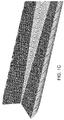
  • FIG. 1C illustrates part of an exemplary three-dimensional prism arrangement.
  • each prism ( 1 F) should be around 140 micrometers while the height ( 1 G) should be around 7 micrometers.
  • the number of prisms orthogonally to the optical axis may be around 60 and the number of prisms along the optical axis may be around 230, yielding an outer diameter of the device of around 0.5 millimeters and a length of about 33 millimeters, including support structures.
  • increasing the diameter of the device would yield an increase in the so called aperture and a corresponding increase in collecting incoming x-rays but this is not the case since the absorption will increase towards the edges and approaches one hundred percent.
  • Increasing the diameter beyond what is indicated in the example above for 27 keV will for example be less useful.
  • x-ray absorption in the device decreases its efficiency and to minimize this effect a light element of low atomic number should be used, as for example a polymer made of Hydrogen, Oxygen and Carbon.
  • the prisms should be fabricated to high surface finish and form tolerance to work well.
  • the device in a preferred exemplary embodiment of the device, as mentioned above, it can be built from slices such as discs or plates arranged or assembled side by side along the optical axis according to FIG. 2A .
  • Each disc preferably has a rotationally symmetric or near-symmetric (e.g. hexagonal) form, and accordingly the overall prism arrangement also has a rotationally symmetric or near-symmetric (e.g. hexagonal) form.
  • the discs arranged along the optical axis are preferably grouped, and the number of prisms (seen in a direction orthogonal to the optical axis) in a first group of discs generally differs from the number of prisms in a second group of discs. In this way, the number of prisms in cross section (i.e. orthogonal to the optical axis) will be different at different positions along the optical axis.
  • the distance of a given layer of prisms in relation to the optical axis may differ between different discs within a group of discs, as can be seen from FIG. 2C .
  • the groups having the same number of prisms in a direction orthogonal to the optical axis, may be re-arranged in any arbitrary order along the optical axis.
  • the discs may optionally be arranged in any arbitrary order, without any concept of groups.
  • Each disc may have one or more layers of at least one prism. With many layers, each layer typically has one or more prisms. It is even possible to build discs that contain only a fraction of a prism. Preferably, however, an entire prism or several layers of one or more prisms is/are contained in a disc. Generally, each disc includes at least one layer of at least part of a prism.
  • Each disc or plate ( 2 A) can be fabricated through standard techniques such as mechanical tooling, ablation for example with a laser, hot embossing, UV embossing or molding using a master or other methods. It has been recognized that a master for molding may be fabricated through etching in e.g. Silicon or through laser ablation.
  • FIG. 2C a preferred example of a design for mechanical support ( 2 A, 2 B) of the prisms is illustrated.
  • the advantage with this design is that all prisms in a layer are in one piece and not in two or more pieces, which will need alignment later.
  • the different discs or plates can in the assembly process be aligned relative to each other either in an assembly machine or through built-in structures, so called passive alignment, or they may be aligned manually.
  • a great advantage with this manufacturing process is that many individual “lenses” or x-ray optics devices can be fabricated in parallel as indicated in FIG. 2D . As illustrated in FIG. 2D , a number of independent discs are produced on a common substrate.
  • FIG. 2D also illustrates the principle of constructing the prisms in several (e.g. two) pieces that will subsequently be assembled in order to provide a full prism or one or more layers of full prisms.
  • Another embodiment of the invention is based on preparing a thin foil with a layer of prisms as illustrated in FIG. 3A .
  • the advantage with this method it that it is easy to manufacture a film or similar thin substrate with the desired structure since the height of the prisms above the film is relatively small.
  • the prisms on the foil may for example be manufactured through hot embossing or UV embossing.
  • the prisms may be manufactured by embossing from a laser-abladed, etched or machined master, and then arranged on the foil.
  • the prisms may be formed directly into the foil by any of the above-mentioned methods (e.g. laser ablation, etching, machining).
  • the foil is of the same type as now used for holography.
  • the foil Before rolling the foil it is preferably cut in a general diagonally curved form (see FIG. 3F ), preferably into a stair-like structure (see FIGS. 3B and 3F ), in order to obtain the desired three-dimensional structure (when rolled).
  • the foil is subsequently rolled, for example into a cylindrical or similar rotationally symmetric or near-symmetric structure according to FIG. 3C , in order to assume the desired shape of the device (see FIG. 3D ).
  • the foil After the rolling is completed the foil is fixed with for example glue.
  • the rolling can be performed manually under a microscope or in dedicated machines.
  • the cross-section number of prisms (i.e. the number of prisms stacked orthogonal to the optical axis) will differ at different positions along the optical axis.
  • the number of prisms in cross section of the device will change successively along the optical axis.
  • FIG. 4 is a schematic block diagram of an x-ray imaging system using an x-ray optics device.
  • the x-ray imaging system basically comprises an x-ray source ( 4 A), x-ray optics ( 4 B) and a detector ( 4 C) connectable to image processing circuitry ( 4 D).
  • the x-ray optics, and more particularly the optical axis of the three-dimensional prism structure, is preferably aligned with the general direction of incoming x-rays from the x-ray source.
  • the x-ray optics comprises a three dimensional structure of a multitude of prisms for both refraction and diffraction of incoming x-rays in order to focus radiation from the x-ray source.
  • the detector is configured for registering radiation from the x-ray source that has been focused by said x-ray optics and has passed an object ( 4 E) to be imaged.
  • the detector is preferably connectable to image processing circuitry to obtain a useful image.
  • the imaging system may for example be used for medical imaging, e.g. to obtain diagnostic images.
  • the prisms are arranged in at least one layer along an optical axis for incoming x-rays to achieve the desired focusing effect.
  • the three-dimensional prism structure is arranged such that x-rays further away from the optical axis will traverse more prisms than x-rays close to the optical axis.
  • Example embodiments of a prism structure that can be used have been discussed above.
  • FIG. 5 is a schematic flow diagram of a method for manufacturing an x-ray optics device.
  • step S 1 a multitude of prisms is provided.
  • step S 2 the prisms are arranged in at least one layer along an optical axis for incoming x-rays to provide a three-dimensional prism structure for both refraction and diffraction of x-rays to shape the x-ray flux.
  • the overall manufacturing procedure covers different methods including that described above in connection with FIGS. 2A-D as well as that described in connection with FIGS. 3A-F .
  • a number of discs, each having at least one layer of prisms may be assembled side by side in alignment along the optical axis to form the three-dimensional prism structure.

Landscapes

  • Physics & Mathematics (AREA)
  • Spectroscopy & Molecular Physics (AREA)
  • Engineering & Computer Science (AREA)
  • General Engineering & Computer Science (AREA)
  • High Energy & Nuclear Physics (AREA)
  • Analysing Materials By The Use Of Radiation (AREA)

Abstract

A new device for x-ray optics is proposed which is an analogous to zone plates but works for higher x-ray energies. This is achieved by using both refraction and diffraction of the x-rays and building the new device(s) in a three dimensional structure, contrary to the zone plates which are basically a two dimensional device. The three dimensional structure is built from a multitude of prisms, utilizing both refraction and diffraction of incoming x-rays to shape the overall x-ray flux. True two dimensional focusing is achieved in the x-ray energy range usually employed in medical imaging and may be used in a wide area of applications in this field and in other fields of x-ray imaging. The device can be readily produced in large volumes.

Description

TECHNICAL BACKGROUND
In all imaging systems utilizing visible light, optics is an important tool to increase the performance for the imaging task. The optics can for example enable higher spatial resolution through magnification and also higher fluxes by collecting the light rays.
In X-ray imaging this is not true, in e.g., medical x-ray imaging, there are no x-ray optics in regular clinical use. The explanation is that for energies exceeding around 15 keV, the difference in refraction index in any material compared to vacuum is very small, several orders of magnitude smaller than for visible light. This means that any optics are very hard to construct. At lower X-ray energies, so called zone plates are successfully used in many applications, while at higher energies they become increasingly inefficient and difficult to manufacture. In spite of these challenges, some X-ray optics have been tested to also work at higher energies. One example is grazing incidence optics as described in U.S. Pat. No. 6,949,748 where the x-rays hit a curved surface at a very small angle. Other examples are refractive optics as outlined in U.S. Pat. Nos. 6,668,040 and 6,091,798 and also the so-called phase array lens as described in B. Cederström, C. Ribbing and M. Lundqvist, “Generalized prism-array lenses for hard X-rays”, J. Sync. Rad, vol 12(3), pp. 340-344, 2005.
A summary of state of the art x-ray optics can be found in “Soft X-Rays and Extreme Ultraviolet Radiation—Principles and Applications”, David Attwood ISBN-13: 9780521029971, Cambridge University Press 2007. The optics for higher energies are generally one dimensional which sometimes fits the application, such as imaging using scanning line detectors, but in most cases optics that work in two dimensions is desirable. This can be achieved by crossing two one dimensional lenses, putting one after the other. This however results in a bulky device with compromised performance since absorption is increased and the two dimensional performance becomes sub-optimum by using one dimensional devices. This may be why these arrangements are not in wide practical use, or in fact, are hardly used at all for any application.
SUMMARY
The technology describe herein overcomes these and other drawbacks.
In the technology describe herein, we propose technology similar to the zone plates but working for higher x-ray energies, normally exceeding 10 keV. This is achieved by using both refraction and diffraction and building the new device(s) in a three dimensional structure, contrary to the zone plates which are basically a two dimensional device. The three dimensional structure is built from a multitude of prisms, utilizing both refraction and diffraction of incoming x-rays to shape the overall x-ray flux. The result will be the first ever device achieving true two dimensional focusing in the x-ray energy range usually employed in medical imaging and may be used in a wide area of applications in this field and in other fields of x-ray imaging. The device will further be fairly straight forward to produce in large volumes.
In another aspect, there is provided a method of manufacturing such x-ray optics devices.
The technology describe herein also relates to an x-ray imaging system based on the novel x-ray optics device.
BRIEF DESCRIPTION OF DRAWINGS
FIGS. 1A-C are schematic diagrams illustrating examples of a new x-ray focusing device together with a cross-section of the device including the multitude of prisms and how they may be arranged relative to each other.
FIGS. 2A-D are schematic diagrams illustrating preferred embodiments of the design and manufacturing of a device assembled from a multitude of discs or plates and possible designs for the discs or plates are also outlined including the possibility to manufacture many devices in parallel.
FIGS. 3A-F are schematic diagrams illustrating the design and manufacturing of an exemplary embodiment of the device where a thin foil with a prism structure can be rolled to achieve the desired three-dimensional structure.
FIG. 4 is a schematic block diagram of an x-ray imaging system according to an exemplary embodiment.
FIG. 5 is a schematic flow diagram of an exemplary manufacturing method.
DETAILED DESCRIPTION
In the following, the technology describe herein will be described with reference to exemplary and non-limiting embodiments of a new x-ray optics device based on a three dimensional prism structure or arrangement utilizing both refraction and diffraction for shaping the incoming x-ray flux.
In particular, the invention offers a solution to the challenges in state-of-the-art x-ray optics by offering means for efficient two dimensional focusing of x-rays with energy above around 10 keV with a device that is easy to align, handle and produce.
FIG. 1A illustrates an example of a device including a multitude of prisms which are traversed by incoming x-rays. The prisms (1A) are preferably arranged in one or more layers along an axis of symmetry, the so called optical axis (1B), and for x-rays entering substantially parallel to the optical axis there will be a focusing effect. The device will also work for x-rays entering the lens which are not entirely parallel to the optical axis, in this case with a slight reduction in the efficiency. As shown in FIG. 1B, the orientation of the “lens” is preferably such that the flat back of the prisms (1C) is oriented to be substantially parallel to the optical axis, the obtuse corner (1D) is pointing in substantially right angle to the optical axis while the sharp angles (1E) is pointing substantially along the optical axis 1A. The number of prisms in cross-section (i.e. orthogonal to the optical axis) changes when moving along the optical axis and a corresponding void also changes in diameter. The reason is that x-rays further away from the optical axis requires more deflection than x-rays close to the optical axis. The prisms are arranged in such a way to achieve the desired focusing effects which is in turn decided by the amount of material and the number of surfaces traversed by any single x-ray. The three-dimensional prism structure is thus arranged such that x-rays further away from the optical axis will traverse more prisms than x-rays close to the optical axis. The optimum design of the device will depend on the x-ray energy and has to be decided through experiments and/or calculations in each case.
Typically, mechanical support structures are included to hold the individual prisms. It is beneficial to make the prisms and/or the support structures out of plastic or any other material which is mainly transparent to x-rays.
It should be understood that the number of prisms is normally relatively large, compared to the schematic diagrams of FIGS. 1A-B. An example of a more realistic configuration is shown in FIG. 1C, which illustrates part of an exemplary three-dimensional prism arrangement.
As an example, for an optimum effect at around 27 keV the length of each prism (1F) should be around 140 micrometers while the height (1G) should be around 7 micrometers. In a particular exemplary realization, the number of prisms orthogonally to the optical axis may be around 60 and the number of prisms along the optical axis may be around 230, yielding an outer diameter of the device of around 0.5 millimeters and a length of about 33 millimeters, including support structures. One may think that increasing the diameter of the device would yield an increase in the so called aperture and a corresponding increase in collecting incoming x-rays but this is not the case since the absorption will increase towards the edges and approaches one hundred percent. Increasing the diameter beyond what is indicated in the example above for 27 keV will for example be less useful.
In general x-ray absorption in the device decreases its efficiency and to minimize this effect a light element of low atomic number should be used, as for example a polymer made of Hydrogen, Oxygen and Carbon.
The prisms should be fabricated to high surface finish and form tolerance to work well.
Since ideal structures may be hard to manufacture, one or more of a number of practical approaches may be taken:
    • 1) Divide the device in discs or slices along the optical axis.
    • 2) Make these (ideally circular) discs not circular but hexagonal or other shapes. It should thus be understood that the discs are not necessarily circular, but may have other forms.
    • 3) Sub-dividing the discs into sectors.
    • 4) Divide the device in layers orthogonally to the optical axis.
    • 5) Divide the individual prisms in two or more parts to be assembled later.
    • 6) Introduce a radius for the edges of the prisms—they will not be infinitely sharp.
    • 7) Introduce space between the individual prisms and rearrange them while keeping the projected amount of material and the number of prism surfaces traversed as seen by the incoming x-rays.
    • 8) Add material to mechanically support the individual prisms.
In a preferred exemplary embodiment of the device, as mentioned above, it can be built from slices such as discs or plates arranged or assembled side by side along the optical axis according to FIG. 2A.
A corresponding cross-section view is illustrated in FIG. 2B. Each disc preferably has a rotationally symmetric or near-symmetric (e.g. hexagonal) form, and accordingly the overall prism arrangement also has a rotationally symmetric or near-symmetric (e.g. hexagonal) form. The discs arranged along the optical axis are preferably grouped, and the number of prisms (seen in a direction orthogonal to the optical axis) in a first group of discs generally differs from the number of prisms in a second group of discs. In this way, the number of prisms in cross section (i.e. orthogonal to the optical axis) will be different at different positions along the optical axis. In addition, the distance of a given layer of prisms in relation to the optical axis may differ between different discs within a group of discs, as can be seen from FIG. 2C.
It should though be understood that the groups, having the same number of prisms in a direction orthogonal to the optical axis, may be re-arranged in any arbitrary order along the optical axis.
In fact, the discs may optionally be arranged in any arbitrary order, without any concept of groups.
Each disc may have one or more layers of at least one prism. With many layers, each layer typically has one or more prisms. It is even possible to build discs that contain only a fraction of a prism. Preferably, however, an entire prism or several layers of one or more prisms is/are contained in a disc. Generally, each disc includes at least one layer of at least part of a prism.
Each disc or plate (2A) can be fabricated through standard techniques such as mechanical tooling, ablation for example with a laser, hot embossing, UV embossing or molding using a master or other methods. It has been recognized that a master for molding may be fabricated through etching in e.g. Silicon or through laser ablation.
In the magnified cross-section view of FIG. 2C, a preferred example of a design for mechanical support (2A, 2B) of the prisms is illustrated. The advantage with this design is that all prisms in a layer are in one piece and not in two or more pieces, which will need alignment later. The different discs or plates can in the assembly process be aligned relative to each other either in an assembly machine or through built-in structures, so called passive alignment, or they may be aligned manually. A great advantage with this manufacturing process is that many individual “lenses” or x-ray optics devices can be fabricated in parallel as indicated in FIG. 2D. As illustrated in FIG. 2D, a number of independent discs are produced on a common substrate. It is possible to produce two or more x-ray optics devices in parallel by stacking a number of such substrates in proper alignment and mechanically attaching them and finally extracting individual three-dimensional prism structures. FIG. 2D also illustrates the principle of constructing the prisms in several (e.g. two) pieces that will subsequently be assembled in order to provide a full prism or one or more layers of full prisms.
Another embodiment of the invention is based on preparing a thin foil with a layer of prisms as illustrated in FIG. 3A. The advantage with this method it that it is easy to manufacture a film or similar thin substrate with the desired structure since the height of the prisms above the film is relatively small. The prisms on the foil may for example be manufactured through hot embossing or UV embossing. For example, the prisms may be manufactured by embossing from a laser-abladed, etched or machined master, and then arranged on the foil. Alternatively, the prisms may be formed directly into the foil by any of the above-mentioned methods (e.g. laser ablation, etching, machining). Preferably, the foil is of the same type as now used for holography. There exist commercial foils for embossing that are used for hologram markings on e.g. credit cards. Before rolling the foil it is preferably cut in a general diagonally curved form (see FIG. 3F), preferably into a stair-like structure (see FIGS. 3B and 3F), in order to obtain the desired three-dimensional structure (when rolled). The foil is subsequently rolled, for example into a cylindrical or similar rotationally symmetric or near-symmetric structure according to FIG. 3C, in order to assume the desired shape of the device (see FIG. 3D). After the rolling is completed the foil is fixed with for example glue. The rolling can be performed manually under a microscope or in dedicated machines. As can be seen from the cross-section view of FIG. 3E, the cross-section number of prisms (i.e. the number of prisms stacked orthogonal to the optical axis) will differ at different positions along the optical axis. Preferably, with the manufacturing procedure of FIGS. 3A-F, the number of prisms in cross section of the device will change successively along the optical axis.
FIG. 4 is a schematic block diagram of an x-ray imaging system using an x-ray optics device. The x-ray imaging system basically comprises an x-ray source (4A), x-ray optics (4B) and a detector (4C) connectable to image processing circuitry (4D). The x-ray optics, and more particularly the optical axis of the three-dimensional prism structure, is preferably aligned with the general direction of incoming x-rays from the x-ray source. In particular the x-ray optics comprises a three dimensional structure of a multitude of prisms for both refraction and diffraction of incoming x-rays in order to focus radiation from the x-ray source. The detector is configured for registering radiation from the x-ray source that has been focused by said x-ray optics and has passed an object (4E) to be imaged. The detector is preferably connectable to image processing circuitry to obtain a useful image. The imaging system may for example be used for medical imaging, e.g. to obtain diagnostic images.
In a preferred exemplary embodiment of the invention, the prisms are arranged in at least one layer along an optical axis for incoming x-rays to achieve the desired focusing effect. Advantageously, the three-dimensional prism structure is arranged such that x-rays further away from the optical axis will traverse more prisms than x-rays close to the optical axis. Example embodiments of a prism structure that can be used have been discussed above.
FIG. 5 is a schematic flow diagram of a method for manufacturing an x-ray optics device. In step S1, a multitude of prisms is provided. In step S2 the prisms are arranged in at least one layer along an optical axis for incoming x-rays to provide a three-dimensional prism structure for both refraction and diffraction of x-rays to shape the x-ray flux. The overall manufacturing procedure covers different methods including that described above in connection with FIGS. 2A-D as well as that described in connection with FIGS. 3A-F. For example, a number of discs, each having at least one layer of prisms, may be assembled side by side in alignment along the optical axis to form the three-dimensional prism structure. Alternatively, it is possible to prepare a foil containing the prisms, and then rolling the foil into the three-dimensional prism structure.
The embodiments described above are merely given as examples, and it should be understood that the claims are not limited thereto. Further modifications, changes and improvements which retain the basic underlying principles disclosed are within the scope of the claims.

Claims (25)

1. An x-ray optics device arrangement, wherein said x-ray optics device arrangement is arranged for x-rays of energies exceeding 10 keV, and comprising a plurality of individual three-dimensional prism structures, each having a multitude of prisms for both refraction and diffraction of incoming x-rays to shape the x-ray flux, said multitude of prisms being arranged in at least one layer around an axis of symmetry, corresponding to an optical axis for incoming x-rays, to enable a two-dimensional focusing effect,
wherein a number of independent discs, each disc having at least one layer of at least part of a prism, are provided in parallel on a common substrate and a number of such substrates are stacked in alignment to form said plurality of three-dimensional prism structures, such that each three-dimensional prism structure is formed as a rotationally symmetric or near symmetric assembly of a plurality of discs stacked along the optical axis.
2. An x-ray optics device arrangement according to claim 1, wherein each three-dimensional prism structure is arranged such that x-rays further away from the optical axis will traverse more prisms than x-rays close to the optical axis.
3. An x-ray optics device arrangement according to claim 1, wherein the number of prisms orthogonal to the optical axis will be different at different positions along the optical axis.
4. An x-ray optics device arrangement according to claim 1, wherein the discs along the optical axis are grouped, and the number of prisms in a direction orthogonal to the optical axis in a first group of discs generally differs from the number of prisms in a second group of discs.
5. An x-ray optics device arrangement according to claim 4, wherein the distance of a given layer of prisms to the optical axis differs between different discs within a group of discs.
6. An x-ray optics device arrangement according to claim 1, wherein each of a number of discs contains a fraction of a prism.
7. An x-ray optics device arrangement according to claim 1, wherein each of a number of discs contains at least one layer of at least one prism.
8. An x-ray optics device arrangement according to claim 7, wherein each of a number of discs contains two or more layers of at least one prism.
9. An x-ray optics device arrangement according to claim 1, where said discs are fabricated through laser ablation, or through embossing or molding using a master.
10. An x-ray optics device arrangement according to claim 9, where said master is fabricated through etching technique in Silicon.
11. An x-ray optics device arrangement according to claim 9, wherein said master is fabricated through laser ablation.
12. An x-ray optics device arrangement according to claim 1, wherein the flat back of the prisms is oriented to be substantially parallel to the optical axis, an obtuse corner of each prism is pointing in a substantially right angle to the optical axis while sharp angles of each prism are pointing substantially along the optical axis.
13. An x-ray optics device arrangement according to claim 1, wherein mechanical support structures are included to hold the individual prisms.
14. An x-ray optics device arrangement according to claim 13, wherein said prisms and said support structures are made of plastic or any other material which is mainly transparent to x-rays.
15. An x-ray optics device arrangement according to claim 1, wherein said discs have a circular or hexagonal form.
16. An x-ray optics device, wherein said x-ray optics device is adapted for x-rays of energies exceeding 10 keV, and comprising a three dimensional structure of a multitude of prisms for both refraction and diffraction of incoming x-rays to shape the x-ray flux, wherein said multitude of prisms is arranged in at least one layer around an axis of symmetry, corresponding to an optical axis for incoming x-rays, to enable a focusing effect, wherein the x-ray optics device is based on an assembly of a plurality of discs, each disc having at least one layer of at least part of a prism, said discs being stacked along the optical axis to form said three-dimensional prism structure, wherein the discs along the optical axis are grouped, and the number of prisms in a direction orthogonal to the optical axis in a first group of discs generally differs from the number of prisms in a second group of discs.
17. A device according to claim 16, wherein the distance of a given layer of prisms to the optical axis differs between different discs within a group of discs.
18. An x-ray optics device, wherein said x-ray optics device is adapted for x-rays of energies exceeding 10 keV, and comprising a three dimensional structure of a multitude of prisms for both refraction and diffraction of incoming x-rays to shape the x-ray flux, wherein the x-ray optics device is based on a foil having prisms arranged over the foil surface and rolled into said three-dimensional prism structure.
19. A device according to claim 18, where said foil is based on a film of the same type as now used for holography.
20. An x-ray imaging system comprising:
an x-ray source;
x-ray optics arranged for x-rays of energies exceeding 10 keV, said x-ray optics comprising a plurality of individual three dimensional structures, each having a multitude of prisms for both refraction and diffraction of incoming x-rays in order to focus radiation from said x-ray source, said multitude of prisms being arranged in at least one layer around an axis of symmetry, corresponding to an optical axis for incoming x-rays, to enable a two-dimensional focusing effect,
wherein a number of independent discs, each disc having at least one layer of at least part of a prism, are provided in parallel on a common substrate and a number of such substrates are stacked in alignment to form said plurality of three-dimensional prism structures, such that each three-dimensional prism structure is formed as a rotationally symmetric or near symmetric assembly of a plurality of discs stacked along the optical axis; and
a detector for registering radiation from said x-ray source that has been focused by said x-ray optics and has passed an object to be imaged, said x-ray detector being connectable to image processing circuitry.
21. An x-ray imaging system comprising:
an x-ray source;
x-ray optics arranged for x-rays of energies exceeding 10 keV, said x-ray optics comprising a three dimensional structure of a multitude of prisms for both refraction and diffraction of incoming x-rays in order to focus radiation from said x-ray source, wherein said multitude of prisms is arranged in at least one layer around an axis of symmetry, corresponding to an optical axis for incoming x-rays, to enable a focusing effect,
wherein the x-ray optics device is based on an assembly of a plurality of discs, each disc having at least one layer of at least part of a prism, said discs being stacked along the optical axis to form said three-dimensional prism structure, wherein the discs along the optical axis are grouped, and the number of prisms in a direction orthogonal to the optical axis in a first group of discs generally differs from the number of prisms in a second group of discs; and
a detector for registering radiation from said x-ray source that has been focused by said x-ray optics and has passed an object to be imaged, said x-ray detector being connectable to image processing circuitry.
22. An x-ray imaging system comprising:
an x-ray source;
x-ray optics arranged for x-rays of energies exceeding 10 keV, said x-ray optics comprising a three dimensional structure of a multitude of prisms for both refraction and diffraction of incoming x-rays in order to focus radiation from said x-ray source, wherein the x- ray optics device is based on a foil having prisms arranged over the foil surface and rolled into said three-dimensional prism structure; and
a detector for registering radiation from said x-ray source that has been focused by said x-ray optics and has passed an object to be imaged, said x-ray detector being connectable to image processing circuitry.
23. A method of manufacturing an x-ray optics device arrangement, said method comprising the steps of:
providing a number of independent discs, each disc having at least one layer of at least part of a prism, in parallel on a common substrate;
stacking a number of such substrates in alignment to form a plurality of three-dimensional prism structures such that each three-dimensional prism structure is formed as a rotationally symmetric or near symmetric assembly of a plurality of discs stacked along an axis of symmetry, corresponding to an optical axis for incoming x-rays, each three-dimensional prism structure having a multitude of prisms being arranged in at least one layer around the optical axis for incoming x-rays for both refraction and diffraction of x-rays to shape the x-ray flux.
24. A method of manufacturing an x-ray optics device, said method comprising the steps of:
preparing a foil including a multitude of prisms;
arranging said multitude of prisms in at least one layer around an axis of symmetry, corresponding to an optical axis for incoming x-rays, by rolling said foil into a three-dimensional prism structure for both refraction and diffraction of x-rays to shape the x-ray flux.
25. A method according to claim 24, wherein said foil is cut in a generally diagonally curved form before said step of rolling the foil such that, when the rolled three-dimensional prism structure is used for focusing incoming x-rays, x-rays further away from the optical axis will traverse more prisms than x-rays close to the optical axis.
US12/081,235 2008-04-11 2008-04-11 Approach and device for focusing x-rays Expired - Fee Related US7742574B2 (en)

Priority Applications (2)

Application Number Priority Date Filing Date Title
US12/081,235 US7742574B2 (en) 2008-04-11 2008-04-11 Approach and device for focusing x-rays
EP09156639A EP2109115A1 (en) 2008-04-11 2009-03-30 New approach and decive for focusing X-rays

Applications Claiming Priority (1)

Application Number Priority Date Filing Date Title
US12/081,235 US7742574B2 (en) 2008-04-11 2008-04-11 Approach and device for focusing x-rays

Publications (2)

Publication Number Publication Date
US20090257563A1 US20090257563A1 (en) 2009-10-15
US7742574B2 true US7742574B2 (en) 2010-06-22

Family

ID=40834508

Family Applications (1)

Application Number Title Priority Date Filing Date
US12/081,235 Expired - Fee Related US7742574B2 (en) 2008-04-11 2008-04-11 Approach and device for focusing x-rays

Country Status (2)

Country Link
US (1) US7742574B2 (en)
EP (1) EP2109115A1 (en)

Cited By (3)

* Cited by examiner, † Cited by third party
Publication number Priority date Publication date Assignee Title
US20100014641A1 (en) * 2008-07-18 2010-01-21 Energetiq Technology, Inc. High-Resolution X-Ray Optic and Method for Constructing an X-Ray Optic
EP2623964A1 (en) 2012-02-06 2013-08-07 Jürgen Kupper X-ray device and x-ray method for studying a three-dimensional object
US11357458B2 (en) * 2017-07-31 2022-06-14 Lawrence Livermore National Security, Llc High-contrast, convergent x-ray imaging with laser-Compton sources

Families Citing this family (4)

* Cited by examiner, † Cited by third party
Publication number Priority date Publication date Assignee Title
DE102009031476B4 (en) * 2009-07-01 2017-06-01 Baden-Württemberg Stiftung Ggmbh X-Roll lens
US8223925B2 (en) * 2010-04-15 2012-07-17 Bruker Axs Handheld, Inc. Compact collimating device
FR2959344B1 (en) * 2010-04-26 2013-03-22 Commissariat Energie Atomique OPTICAL DEVICE FOR ANALYZING A SAMPLE BY DIFFUSION OF AN X-RAY BEAM, COLLIMATING DEVICE AND COLLIMATOR THEREFOR
DE102011102446A1 (en) 2011-05-25 2012-11-29 Karlsruher Institut für Technologie Device for use in spiral mirror optics for concentration or collimation of x-ray beam, comprises film that is reflective for x-ray beams, where film is provided with certain thickness and wound over spacers

Citations (16)

* Cited by examiner, † Cited by third party
Publication number Priority date Publication date Assignee Title
US3254556A (en) * 1961-05-29 1966-06-07 Coleman Instr Corp Composite optical prism unit
US4146306A (en) * 1977-06-27 1979-03-27 Wallach David L Optical lens
US4315671A (en) * 1977-10-03 1982-02-16 Bunch Jesse C Lenticulated lens
US4934798A (en) * 1983-03-16 1990-06-19 Bunch Jesse C Lens deflection system
US5703722A (en) * 1995-02-27 1997-12-30 Blankenbecler; Richard Segmented axial gradinet array lens
US5837082A (en) * 1994-08-17 1998-11-17 Graefe; Guenther Method of manufacturing prisms, particularly microprisms and beam-splitting prisms
US6091798A (en) * 1997-09-23 2000-07-18 The Regents Of The University Of California Compound refractive X-ray lens
US6269145B1 (en) 1999-05-07 2001-07-31 Adelphi Technology, Inc. Compound refractive lens for x-rays
US6444994B1 (en) 1999-08-30 2002-09-03 Riken Apparatus and method for processing the components of a neutron lens
US20020148956A1 (en) 2000-09-27 2002-10-17 Piestrup Melvin A. Methods of imaging, focusing and conditioning neutrons
US20020159561A1 (en) * 1999-07-19 2002-10-31 Bjorn Cederstrom Refractive X-ray arrangement
US20030081724A1 (en) 2001-09-17 2003-05-01 Piestrup Melvin A. X-ray and neutron imaging
US6949748B2 (en) 2002-04-16 2005-09-27 The Regents Of The University Of California Biomedical nuclear and X-ray imager using high-energy grazing incidence mirrors
US20060251215A1 (en) 2003-05-31 2006-11-09 Council For The Central Laboratory Of The Research Councils Tomographic energy dispersive x-ray diffraction apparatus comprinsing an array of detectors of associated collimators
US20060256919A1 (en) * 2003-03-21 2006-11-16 Sectra Mamea Ab Refractive x-ray element
US20070121784A1 (en) * 2005-09-20 2007-05-31 Sectra Mamea Ab X-ray imaging arrangement

Patent Citations (17)

* Cited by examiner, † Cited by third party
Publication number Priority date Publication date Assignee Title
US3254556A (en) * 1961-05-29 1966-06-07 Coleman Instr Corp Composite optical prism unit
US4146306A (en) * 1977-06-27 1979-03-27 Wallach David L Optical lens
US4315671A (en) * 1977-10-03 1982-02-16 Bunch Jesse C Lenticulated lens
US4934798A (en) * 1983-03-16 1990-06-19 Bunch Jesse C Lens deflection system
US5837082A (en) * 1994-08-17 1998-11-17 Graefe; Guenther Method of manufacturing prisms, particularly microprisms and beam-splitting prisms
US5703722A (en) * 1995-02-27 1997-12-30 Blankenbecler; Richard Segmented axial gradinet array lens
US6091798A (en) * 1997-09-23 2000-07-18 The Regents Of The University Of California Compound refractive X-ray lens
US6269145B1 (en) 1999-05-07 2001-07-31 Adelphi Technology, Inc. Compound refractive lens for x-rays
US6668040B2 (en) 1999-07-19 2003-12-23 Mamea Imaging Ab Refractive X-ray arrangement
US20020159561A1 (en) * 1999-07-19 2002-10-31 Bjorn Cederstrom Refractive X-ray arrangement
US6444994B1 (en) 1999-08-30 2002-09-03 Riken Apparatus and method for processing the components of a neutron lens
US20020148956A1 (en) 2000-09-27 2002-10-17 Piestrup Melvin A. Methods of imaging, focusing and conditioning neutrons
US20030081724A1 (en) 2001-09-17 2003-05-01 Piestrup Melvin A. X-ray and neutron imaging
US6949748B2 (en) 2002-04-16 2005-09-27 The Regents Of The University Of California Biomedical nuclear and X-ray imager using high-energy grazing incidence mirrors
US20060256919A1 (en) * 2003-03-21 2006-11-16 Sectra Mamea Ab Refractive x-ray element
US20060251215A1 (en) 2003-05-31 2006-11-09 Council For The Central Laboratory Of The Research Councils Tomographic energy dispersive x-ray diffraction apparatus comprinsing an array of detectors of associated collimators
US20070121784A1 (en) * 2005-09-20 2007-05-31 Sectra Mamea Ab X-ray imaging arrangement

Non-Patent Citations (27)

* Cited by examiner, † Cited by third party
Title
Attwood, Soft X-Rays and Extreme Ultraviolet Radiation, Principles and Applications, Cambridge University Press, Table of Contents.
Batignani et al., Double-sided silicon strip detectors in Pisa, Nuclear Instruments and Methods in Physics Research A 360 (1995) pp. 98-102.
Beckman, U-SPECT-I: A Novel System for Submillimeter-Resolution Tomography with Radiolabeled Molecules in Mice, The Journal of Nuclear Medicine, vol. 46, No. 7, Jul. 2005, pp. 1194-1200.
Budinger et al., Imaging Transgenic Animals, Annu. Rev. Biomed. Eng., 1999, 01:611-648.
Bushberg et al., The Essential Physics of Medical Imaging, Second Edition, Lippincott Williams & Wilkins, Table of Contents.
Campbell, The Science and Engineering of Microelectronic Fabrication, 2nd Edition, New York, Oxford University Press, 2001, Table of Contents.
Cederström, et al., Generalized prism-array lenses for hard X-rays, J. Synchrotron Rad., vol. 12, No. 3, May 2005, pp. 340-344, XP-002537854.
Chmeissani et al., First Experimental Tests With a CdTe Photon Counting pixel Detector Hybridized With a Medipix2 Readout Chip, IEEE Transactions on Nuclear Science, vol. 51, No. 5, Oct. 2004, pp. 2379-2385.
Danielsson U.S. Appl. No. 11/984,541 filed on Nov. 17, 2007.
Fowler et al., PET and Drug Research and Development, The Journal of Nuclear Medicine, vol. 40, No. 7, Jul. 1999, pp. 1154-1163.
Fredenberg et al., Prism-array lenses for energy filtering in medical X-ray imaging, vol. 6510, 2007, pp. 65100S-2 -65100S-12, XP040237087.
Gambhir et al., Imaging adenoviral-directed reporter gene expression in living animals with positron emission tomography, Proc. Natl. Acad. Sci. USA, vol. 96, pp. Mar. 1999, pp. 2333-2338.
International Search Report mailed Jul. 22, 2009 in corresponding European Application No. 09156639.Aug. 2208.
Jark et al., Focusing X-rays with simple arrays of prism-like structures, J. Synchrotron Rad., vol. 11, 2004, pp. 248-253, XP002537855.
Kastis, Compact CT/SPECT Small-Animal Imaging System, IEEE, 2003, pp. 797-801.
King et al., Introduction to the Physics of Molecular Imaging With Radioactive Tracers in Small Animals, Journal of Cellular Biochemistry Supplement 39:221-230 (2002).
Lengeler, A microscope for hard x rays based on parabolic compound refractive lenses, Applied Physics Letters, vol. 74, No. 26, Jun. 28, 1999, pp. 3924-3926.
Meikle et al., CoALA-Spect: A Coded Aperture Laboratory Animal SPECT System for Pre Clinical Imaging, IEEE, 2003, pp. 1061-1065.
Moses, Trends in PET imaging, Nuclear Instruments and Methods in Physical Research A 471 (2001) 209-214.
Office Action mailed Mar. 19, 2009 in U.S. Appl. No. 11/984,541.
Office Action mailed Oct. 7, 2008 in U.S. Appl. No. 11/984,541.
Office Action mailed Sep. 3, 2009 in U.S. Appl. No. 11/984,541.
Ribbing et al., Microfabrication of saw-tooth refractive X-ray lenses in low-Z materials, Journal of Micromechanics & Microengineering, vol. 13, No. 5, Sep. 1, 2003, pp. 714-720, XP020068983.
Skula et al., Position emission tomography: An overview, Journal of Medical Physics, vol. 31, No. 1, 2006, pp. 1-9.
Solomon et al., Applications of Positron Emission Tomography in the development of Molecular Targeted Cancer Therapeutics, Biodrugs 2003: 17(5):339-354.
Stein et al., Fabrication of silicon kinoform lenses for hard X-ray focusing by electron beam lithography and deep reactive ion etching, Journal of Vacuum Science and Technology: Part B, vol. 26, No. 1, Jan. 4, 2008, pp. 122-127, XP012114059.

Cited By (4)

* Cited by examiner, † Cited by third party
Publication number Priority date Publication date Assignee Title
US20100014641A1 (en) * 2008-07-18 2010-01-21 Energetiq Technology, Inc. High-Resolution X-Ray Optic and Method for Constructing an X-Ray Optic
US8019043B2 (en) * 2008-07-18 2011-09-13 Energetiq Technology Inc. High-resolution X-ray optic and method for constructing an X-ray optic
EP2623964A1 (en) 2012-02-06 2013-08-07 Jürgen Kupper X-ray device and x-ray method for studying a three-dimensional object
US11357458B2 (en) * 2017-07-31 2022-06-14 Lawrence Livermore National Security, Llc High-contrast, convergent x-ray imaging with laser-Compton sources

Also Published As

Publication number Publication date
US20090257563A1 (en) 2009-10-15
EP2109115A1 (en) 2009-10-14

Similar Documents

Publication Publication Date Title
US7742574B2 (en) Approach and device for focusing x-rays
EP0708970B1 (en) Spherical mirror grazing incidence x-ray optics
Zhang et al. Development of a low cost high precision three-layer 3D artificial compound eye
US7881432B2 (en) X-ray focusing device
JP2002329935A (en) Laser light source device, laser device, laser emission method, and method of manufacturing laser light source device
WO2020227000A1 (en) Metasurface imager for quantitative phase gradient detection
US20030067680A1 (en) Inter-objective baffle system
CN107783206A (en) Double-layer microlens array optical element
US7597475B1 (en) Multidimensional alignment apparatus for hard x-ray focusing with two multilayer laue lenses
WO2011079856A1 (en) Photovoltaic concentrator with optical stepped lens and optical stepped lens
CN102385169A (en) Three-dimensional dammann array generator
EP0626700B1 (en) Micro-channel plates
JP5248305B2 (en) Solar system
TW201250405A (en) Lithography system for processing at least a part of a target
CN1487328A (en) An Array Angular Beam Expander
CN217085432U (en) Medium microcolumn structure, high-resolution imaging device and laser processing device
US20240061264A1 (en) Optical device for controlling a light beam
CN204463842U (en) A Two-dimensional X-ray Plane Composite Refractive Lens with Adjustable Focus Spot
US20030089856A1 (en) Fabrication of unit lenses for compound refractive lenses
KR20250053709A (en) Microlens array for multi-focus plenoptic image acquisition and manufacturing method thereof
CN2639917Y (en) Array type angle extender
JPH05249370A (en) Inverted telephoto objective lens
CN104681118B (en) Focal-spot-adjustable two-dimensional X-ray planar combined refractive lens
Jark On aberrations in saw-tooth refractive X-ray lenses and on their removal
Nazmov et al. Multi-field x-ray microscope based on array of refractive lenses

Legal Events

Date Code Title Description
AS Assignment

Owner name: DANIELSSON, MATS,SWEDEN

Free format text: ASSIGNMENT OF ASSIGNORS INTEREST;ASSIGNOR:KARLSSON, STAFFAN;REEL/FRAME:024164/0597

Effective date: 20100317

STCF Information on status: patent grant

Free format text: PATENTED CASE

FPAY Fee payment

Year of fee payment: 4

MAFP Maintenance fee payment

Free format text: PAYMENT OF MAINTENANCE FEE, 8TH YEAR, LARGE ENTITY (ORIGINAL EVENT CODE: M1552)

Year of fee payment: 8

FEPP Fee payment procedure

Free format text: ENTITY STATUS SET TO SMALL (ORIGINAL EVENT CODE: SMAL); ENTITY STATUS OF PATENT OWNER: SMALL ENTITY

FEPP Fee payment procedure

Free format text: MAINTENANCE FEE REMINDER MAILED (ORIGINAL EVENT CODE: REM.); ENTITY STATUS OF PATENT OWNER: SMALL ENTITY

LAPS Lapse for failure to pay maintenance fees

Free format text: PATENT EXPIRED FOR FAILURE TO PAY MAINTENANCE FEES (ORIGINAL EVENT CODE: EXP.); ENTITY STATUS OF PATENT OWNER: SMALL ENTITY

STCH Information on status: patent discontinuation

Free format text: PATENT EXPIRED DUE TO NONPAYMENT OF MAINTENANCE FEES UNDER 37 CFR 1.362

FP Lapsed due to failure to pay maintenance fee

Effective date: 20220622