US7718342B2 - Polymers, resist compositions and patterning process - Google Patents
Polymers, resist compositions and patterning process Download PDFInfo
- Publication number
- US7718342B2 US7718342B2 US11/645,751 US64575106A US7718342B2 US 7718342 B2 US7718342 B2 US 7718342B2 US 64575106 A US64575106 A US 64575106A US 7718342 B2 US7718342 B2 US 7718342B2
- Authority
- US
- United States
- Prior art keywords
- mol
- polymer
- units
- bis
- straight
- Prior art date
- Legal status (The legal status is an assumption and is not a legal conclusion. Google has not performed a legal analysis and makes no representation as to the accuracy of the status listed.)
- Expired - Fee Related, expires
Links
- 0 [1*]C(C)(C(=O)OC1C2OC(=O)C3C([2*])C1[Y]C23)C([H])([H])C.[11*]C(C)(C(=O)O[12*])C([H])([H])C.[3*]C(C)(C(=O)OCOC1C2CC3CC(C2)CC1C3)C([H])([H])C.[4*]C(C)(C(=O)OC12CC3([5*])CC([6*])(CC(O)(C3)C1)C2)C([H])([H])C.[7*]C(C)(C(=O)O[8*])C([H])([H])C.[9*]C(C)(C(=O)O[H])C([H])([H])C Chemical compound [1*]C(C)(C(=O)OC1C2OC(=O)C3C([2*])C1[Y]C23)C([H])([H])C.[11*]C(C)(C(=O)O[12*])C([H])([H])C.[3*]C(C)(C(=O)OCOC1C2CC3CC(C2)CC1C3)C([H])([H])C.[4*]C(C)(C(=O)OC12CC3([5*])CC([6*])(CC(O)(C3)C1)C2)C([H])([H])C.[7*]C(C)(C(=O)O[8*])C([H])([H])C.[9*]C(C)(C(=O)O[H])C([H])([H])C 0.000 description 28
- WWJKBSXWXDIOQU-UHFFFAOYSA-N C.C.C.C.[H]OC(=O)C(C)(C)C([H])([H])C.[H]OC(=O)C([H])(C)C([H])([H])C Chemical compound C.C.C.C.[H]OC(=O)C(C)(C)C([H])([H])C.[H]OC(=O)C([H])(C)C([H])([H])C WWJKBSXWXDIOQU-UHFFFAOYSA-N 0.000 description 1
- ZLCRSTKEMNPCKF-UHFFFAOYSA-N CC(C(=O)O)(C1=CC=C(O)C=C1)C1=CC=C(O)C=C1.CC(C(=O)O)(C1=CC=CC=C1)C1=CC=CC=C1.CC(CCC(=O)O)(C1=CC=C(O)C=C1)C1=CC=C(O)C=C1.CC(CCC(=O)O)(C1=CC=CC=C1)C1=CC=CC=C1.O=C(O)C12CC3CC(CC(C3)C1)C2.O=C(O)C1=CC=CC2=CC=CC=C21.O=C(O)CC1=CC=C(O)C=C1.O=C(O)CC1=CC=CC=C1 Chemical compound CC(C(=O)O)(C1=CC=C(O)C=C1)C1=CC=C(O)C=C1.CC(C(=O)O)(C1=CC=CC=C1)C1=CC=CC=C1.CC(CCC(=O)O)(C1=CC=C(O)C=C1)C1=CC=C(O)C=C1.CC(CCC(=O)O)(C1=CC=CC=C1)C1=CC=CC=C1.O=C(O)C12CC3CC(CC(C3)C1)C2.O=C(O)C1=CC=CC2=CC=CC=C21.O=C(O)CC1=CC=C(O)C=C1.O=C(O)CC1=CC=CC=C1 ZLCRSTKEMNPCKF-UHFFFAOYSA-N 0.000 description 1
- NKTCTHZDUUASQR-UHFFFAOYSA-N CC(C)(C)C.CC1(C)C(C)(C)C2(C)C(C)(C)C(C)(C)C1(C)C2(C)C.CC1(C)C=CCCC1.CCC(C)=O Chemical compound CC(C)(C)C.CC1(C)C(C)(C)C2(C)C(C)(C)C(C)(C)C1(C)C2(C)C.CC1(C)C=CCCC1.CCC(C)=O NKTCTHZDUUASQR-UHFFFAOYSA-N 0.000 description 1
- SESCSYBWAXMOBX-IKLMQBEWSA-N CC(C)OC1CCCC1.CC(C)OC1CCCCC1.CCCCOCC.CCCOC(C)C.CCCOCC.CCCO[C@H](C)CC.CCCO[C@H](C)CCC.CCC[C@@H](C)OC.CCC[C@@H](C)OCC.CCOC.CCOC(C)(C)C.CCOC(C)(C)C.CCOC(C)C.CCOC(C)C.CCOCC.CCO[C@H](C)CC.CC[C@@H](C)OC.COC(C)(C)C.COC(C)C Chemical compound CC(C)OC1CCCC1.CC(C)OC1CCCCC1.CCCCOCC.CCCOC(C)C.CCCOCC.CCCO[C@H](C)CC.CCCO[C@H](C)CCC.CCC[C@@H](C)OC.CCC[C@@H](C)OCC.CCOC.CCOC(C)(C)C.CCOC(C)(C)C.CCOC(C)C.CCOC(C)C.CCOCC.CCO[C@H](C)CC.CC[C@@H](C)OC.COC(C)(C)C.COC(C)C SESCSYBWAXMOBX-IKLMQBEWSA-N 0.000 description 1
- CWJWDGARWKIAJP-UHFFFAOYSA-N CC(CCC(=O)O)C1CCC2C3CCC4CC(O)CCC4(C)C3CCC12C.O=C(O)CC12CC3CC(CC(C3)C1)C2 Chemical compound CC(CCC(=O)O)C1CCC2C3CCC4CC(O)CCC4(C)C3CCC12C.O=C(O)CC12CC3CC(CC(C3)C1)C2 CWJWDGARWKIAJP-UHFFFAOYSA-N 0.000 description 1
- HPPKHMSHMAHXCC-UHFFFAOYSA-N CC.CC.CC.CC(CC(C1=CC=CC=C1)C1=CC=CC=C1)C1=CC=CC=C1.CC1=CC=C(C(C)(C)C2=CC=C(C)C=C2)C=C1.CC1=CC=C(C2=CC=C(C)C=C2)C=C1.CC1=CC=C(CC2=CC=C(C)C=C2)C=C1.CC1=CC=C(OC2=CC=C(C)C=C2)C=C1.CC1=CC=CC2=CC=CC=C12.CCC(C)(C1=CC=C(C)C=C1)C1=CC=C(C)C=C1.CCCC(C)(C1=CC=C(C)C=C1)C1=CC=C(C)C=C1 Chemical compound CC.CC.CC.CC(CC(C1=CC=CC=C1)C1=CC=CC=C1)C1=CC=CC=C1.CC1=CC=C(C(C)(C)C2=CC=C(C)C=C2)C=C1.CC1=CC=C(C2=CC=C(C)C=C2)C=C1.CC1=CC=C(CC2=CC=C(C)C=C2)C=C1.CC1=CC=C(OC2=CC=C(C)C=C2)C=C1.CC1=CC=CC2=CC=CC=C12.CCC(C)(C1=CC=C(C)C=C1)C1=CC=C(C)C=C1.CCCC(C)(C1=CC=C(C)C=C1)C1=CC=C(C)C=C1 HPPKHMSHMAHXCC-UHFFFAOYSA-N 0.000 description 1
- SJTQGRHPLONWRY-UHFFFAOYSA-N CC.CC1=CC(C(C)CC(C2=CC(C)=C(C)C(C)=C2)C2=CC(C)=C(C)C(C)=C2)=CC(C)=C1C.CC1=CC=C(C)C=C1.CC1=CC=C(C2(C)OC3=CC(C)=C(C)C=C3C2(C)C)C(C)=C1.CC1=CC=C2CCC(C3=C(C)C=C(C)C=C3)OC2=C1.CCC(C)C1=CC=C(C)C=C1.CCC1=CC=CC(C)=C1 Chemical compound CC.CC1=CC(C(C)CC(C2=CC(C)=C(C)C(C)=C2)C2=CC(C)=C(C)C(C)=C2)=CC(C)=C1C.CC1=CC=C(C)C=C1.CC1=CC=C(C2(C)OC3=CC(C)=C(C)C=C3C2(C)C)C(C)=C1.CC1=CC=C2CCC(C3=C(C)C=C(C)C=C3)OC2=C1.CCC(C)C1=CC=C(C)C=C1.CCC1=CC=CC(C)=C1 SJTQGRHPLONWRY-UHFFFAOYSA-N 0.000 description 1
- IUJPKHLELTUYBH-VVRNJWBCSA-N CC1(C)CC2CC1C1C3CCC(C3)C21.CC1(C)CC2CC1C1CCCC21.CC1(C)CC2CCC1(C)C2(C)C.CC1(C)CC2CCC1C2.CC[C@@]1(C)CC2CC1C1C3CCC(C3)C21.CC[C@@]1(C)CC2CC1C1CCCC21.CC[C@@]1(C)CC2CCC1(C)C2(C)C.CC[C@@]1(C)CC2CCC1C2 Chemical compound CC1(C)CC2CC1C1C3CCC(C3)C21.CC1(C)CC2CC1C1CCCC21.CC1(C)CC2CCC1(C)C2(C)C.CC1(C)CC2CCC1C2.CC[C@@]1(C)CC2CC1C1C3CCC(C3)C21.CC[C@@]1(C)CC2CC1C1CCCC21.CC[C@@]1(C)CC2CCC1(C)C2(C)C.CC[C@@]1(C)CC2CCC1C2 IUJPKHLELTUYBH-VVRNJWBCSA-N 0.000 description 1
- LQSQJCHHCWACTG-UHFFFAOYSA-N CCC1CCC(CO)CC1.CCC1COC(=O)O1.CCCCCCCO.CCCCCO.CCCCOCCC.CCCOCCO Chemical compound CCC1CCC(CO)CC1.CCC1COC(=O)O1.CCCCCCCO.CCCCCO.CCCCOCCC.CCCOCCO LQSQJCHHCWACTG-UHFFFAOYSA-N 0.000 description 1
- SHXMATYDQLFMFT-BLPCPCFDSA-N CC[C@@]1(OC(=O)C23CC4CC(CC(C4)C2)C3)C[C@H]2CC[C@@H]1C2.O=C(OC1CCCCO1)C1C[C@H]2CC[C@@H]1C2.[H]C(=O)O[C@H]1C[C@]2([H])[C@@]3(C)CC[C@@H](OC([H])=O)C[C@@]3([H])C[C@@H](OC([H])=O)[C@@]2([H])[C@]2([H])CC[C@H]([C@H](C)CCC(=O)O[C@@]3(CC)C[C@@H]4CC[C@H]3C4)[C@@]12C.[H][C@@]12C[C@H](O)CC[C@]1(C)[C@@]1([H])C[C@H](O)[C@]3(C)[C@@H]([C@H](C)CCC(=O)OC(C)(C)C)CC[C@@]3([H])[C@]1([H])[C@H](O)C2 Chemical compound CC[C@@]1(OC(=O)C23CC4CC(CC(C4)C2)C3)C[C@H]2CC[C@@H]1C2.O=C(OC1CCCCO1)C1C[C@H]2CC[C@@H]1C2.[H]C(=O)O[C@H]1C[C@]2([H])[C@@]3(C)CC[C@@H](OC([H])=O)C[C@@]3([H])C[C@@H](OC([H])=O)[C@@]2([H])[C@]2([H])CC[C@H]([C@H](C)CCC(=O)O[C@@]3(CC)C[C@@H]4CC[C@H]3C4)[C@@]12C.[H][C@@]12C[C@H](O)CC[C@]1(C)[C@@]1([H])C[C@H](O)[C@]3(C)[C@@H]([C@H](C)CCC(=O)OC(C)(C)C)CC[C@@]3([H])[C@]1([H])[C@H](O)C2 SHXMATYDQLFMFT-BLPCPCFDSA-N 0.000 description 1
- BAVYZALUXZFZLV-UHFFFAOYSA-N CN.[7*:0] Chemical compound CN.[7*:0] BAVYZALUXZFZLV-UHFFFAOYSA-N 0.000 description 1
- GPASKFIFXOCRNP-UHFFFAOYSA-N CN=C(C)C Chemical compound CN=C(C)C GPASKFIFXOCRNP-UHFFFAOYSA-N 0.000 description 1
- IRUMEWLRCPORJD-UHFFFAOYSA-N OC(C(F)(F)F)(C(F)(F)F)C1(F)CC2CCC1C2.OC(CC1CC2CCC1C2)(C(F)(F)F)C(F)(F)F.[H]C([H])(C)C(C)(C)C(=O)OC.[H]C([H])(C)C(C)(C)C(=O)OC.[H]C([H])(C)C(C)(C)C(=O)OC1CC(C(O)(C(F)(F)F)C(F)(F)F)CC(C(O)(C(F)(F)F)C(F)(F)F)C1.[H]C([H])(C)C(C)(C)C(=O)OC1CCCC(C(O)(C(F)(F)F)C(F)(F)F)C1.[H]C([H])(C)C([H])(C)C(=O)OC(C)(C)C(F)(F)C(O)(CCC)C(F)(F)F.[H]C([H])(C)C([H])(C)C(=O)OC(C)(C)C(F)(F)C(O)C(F)(F)F.[H]C([H])(C)C([H])(C)C(=O)OC(C)C(F)(F)C(O)C(F)(F)F.[H]C([H])(C)C([H])(C)C(=O)OC1(C(F)(F)C(O)C(F)(F)F)CCCCC1.[H]C([H])(C)C([H])(C)C(=O)OCC(F)(F)C(C)(O)C(F)(F)F.[H]C([H])(C)C([H])(C)C(=O)OCC(F)(F)C(O)C(F)(F)F Chemical compound OC(C(F)(F)F)(C(F)(F)F)C1(F)CC2CCC1C2.OC(CC1CC2CCC1C2)(C(F)(F)F)C(F)(F)F.[H]C([H])(C)C(C)(C)C(=O)OC.[H]C([H])(C)C(C)(C)C(=O)OC.[H]C([H])(C)C(C)(C)C(=O)OC1CC(C(O)(C(F)(F)F)C(F)(F)F)CC(C(O)(C(F)(F)F)C(F)(F)F)C1.[H]C([H])(C)C(C)(C)C(=O)OC1CCCC(C(O)(C(F)(F)F)C(F)(F)F)C1.[H]C([H])(C)C([H])(C)C(=O)OC(C)(C)C(F)(F)C(O)(CCC)C(F)(F)F.[H]C([H])(C)C([H])(C)C(=O)OC(C)(C)C(F)(F)C(O)C(F)(F)F.[H]C([H])(C)C([H])(C)C(=O)OC(C)C(F)(F)C(O)C(F)(F)F.[H]C([H])(C)C([H])(C)C(=O)OC1(C(F)(F)C(O)C(F)(F)F)CCCCC1.[H]C([H])(C)C([H])(C)C(=O)OCC(F)(F)C(C)(O)C(F)(F)F.[H]C([H])(C)C([H])(C)C(=O)OCC(F)(F)C(O)C(F)(F)F IRUMEWLRCPORJD-UHFFFAOYSA-N 0.000 description 1
- BLTMLBUSMOMEFK-UHFFFAOYSA-N OC(C(F)(F)F)(C(F)(F)F)C1(F)CC2CCC1C2.OC(CC1CC2CCC1C2)(C(F)(F)F)C(F)(F)F.[H]C([H])(C)C([H])(C)C(=O)OC.[H]C([H])(C)C([H])(C)C(=O)OC.[H]C([H])(C)C([H])(C)C(=O)OC(C(F)(F)F)C(F)(F)C(O)(C(F)(F)F)C(F)(F)F.[H]C([H])(C)C([H])(C)C(=O)OC(C(F)(F)F)C(F)(F)C(O)(C(F)F)C(F)(F)F.[H]C([H])(C)C([H])(C)C(=O)OC(C1CCCCC1)C(F)(F)C(O)C(F)(F)F.[H]C([H])(C)C([H])(C)C(=O)OC1(C(F)(F)C(C)(O)C(F)(F)F)C(C)CC2CCCC1C2.[H]C([H])(C)C([H])(C)C(=O)OC1(C(F)(F)C(C)(O)C(F)(F)F)CCCCC1.[H]C([H])(C)C([H])(C)C(=O)OC1(C(F)(F)C(O)C(F)(F)F)C(C)CC2CCCC1C2.[H]C([H])(C)C([H])(C)C(=O)OC1CC(C(O)(C(F)(F)F)C(F)(F)F)CC(C(O)(C(F)(F)F)C(F)(F)F)C1.[H]C([H])(C)C([H])(C)C(=O)OC1CCCC(C(O)(C(F)(F)F)C(F)(F)F)C1 Chemical compound OC(C(F)(F)F)(C(F)(F)F)C1(F)CC2CCC1C2.OC(CC1CC2CCC1C2)(C(F)(F)F)C(F)(F)F.[H]C([H])(C)C([H])(C)C(=O)OC.[H]C([H])(C)C([H])(C)C(=O)OC.[H]C([H])(C)C([H])(C)C(=O)OC(C(F)(F)F)C(F)(F)C(O)(C(F)(F)F)C(F)(F)F.[H]C([H])(C)C([H])(C)C(=O)OC(C(F)(F)F)C(F)(F)C(O)(C(F)F)C(F)(F)F.[H]C([H])(C)C([H])(C)C(=O)OC(C1CCCCC1)C(F)(F)C(O)C(F)(F)F.[H]C([H])(C)C([H])(C)C(=O)OC1(C(F)(F)C(C)(O)C(F)(F)F)C(C)CC2CCCC1C2.[H]C([H])(C)C([H])(C)C(=O)OC1(C(F)(F)C(C)(O)C(F)(F)F)CCCCC1.[H]C([H])(C)C([H])(C)C(=O)OC1(C(F)(F)C(O)C(F)(F)F)C(C)CC2CCCC1C2.[H]C([H])(C)C([H])(C)C(=O)OC1CC(C(O)(C(F)(F)F)C(F)(F)F)CC(C(O)(C(F)(F)F)C(F)(F)F)C1.[H]C([H])(C)C([H])(C)C(=O)OC1CCCC(C(O)(C(F)(F)F)C(F)(F)F)C1 BLTMLBUSMOMEFK-UHFFFAOYSA-N 0.000 description 1
- VUAXHMVRKOTJKP-UHFFFAOYSA-N [H]C([H])(C)C(C)(C)C(=O)O Chemical compound [H]C([H])(C)C(C)(C)C(=O)O VUAXHMVRKOTJKP-UHFFFAOYSA-N 0.000 description 1
- YBBLVUORYDCJPV-UHFFFAOYSA-N [H]C([H])(C)C(C)(C)C(=O)OC(C(F)(F)F)C(F)(F)C(O)(C(F)(F)F)C(F)(F)F.[H]C([H])(C)C(C)(C)C(=O)OC(C(F)(F)F)C(F)(F)C(O)(C(F)F)C(F)(F)F.[H]C([H])(C)C(C)(C)C(=O)OC(C)(C)C(F)(F)C(O)(CCC)C(F)(F)F.[H]C([H])(C)C(C)(C)C(=O)OC(C)(C)C(F)(F)C(O)C(F)(F)F.[H]C([H])(C)C(C)(C)C(=O)OC(C)C(F)(F)C(O)C(F)(F)F.[H]C([H])(C)C(C)(C)C(=O)OC(C1CCCCC1)C(F)(F)C(O)C(F)(F)F.[H]C([H])(C)C(C)(C)C(=O)OC1(C(F)(F)C(C)(O)C(F)(F)F)C2CC3CC(C2)CC1C3.[H]C([H])(C)C(C)(C)C(=O)OC1(C(F)(F)C(C)(O)C(F)(F)F)CCCCC1.[H]C([H])(C)C(C)(C)C(=O)OC1(C(F)(F)C(O)C(F)(F)F)C2CC3CC(C2)CC1C3.[H]C([H])(C)C(C)(C)C(=O)OC1(C(F)(F)C(O)C(F)(F)F)CCCCC1 Chemical compound [H]C([H])(C)C(C)(C)C(=O)OC(C(F)(F)F)C(F)(F)C(O)(C(F)(F)F)C(F)(F)F.[H]C([H])(C)C(C)(C)C(=O)OC(C(F)(F)F)C(F)(F)C(O)(C(F)F)C(F)(F)F.[H]C([H])(C)C(C)(C)C(=O)OC(C)(C)C(F)(F)C(O)(CCC)C(F)(F)F.[H]C([H])(C)C(C)(C)C(=O)OC(C)(C)C(F)(F)C(O)C(F)(F)F.[H]C([H])(C)C(C)(C)C(=O)OC(C)C(F)(F)C(O)C(F)(F)F.[H]C([H])(C)C(C)(C)C(=O)OC(C1CCCCC1)C(F)(F)C(O)C(F)(F)F.[H]C([H])(C)C(C)(C)C(=O)OC1(C(F)(F)C(C)(O)C(F)(F)F)C2CC3CC(C2)CC1C3.[H]C([H])(C)C(C)(C)C(=O)OC1(C(F)(F)C(C)(O)C(F)(F)F)CCCCC1.[H]C([H])(C)C(C)(C)C(=O)OC1(C(F)(F)C(O)C(F)(F)F)C2CC3CC(C2)CC1C3.[H]C([H])(C)C(C)(C)C(=O)OC1(C(F)(F)C(O)C(F)(F)F)CCCCC1 YBBLVUORYDCJPV-UHFFFAOYSA-N 0.000 description 1
- DJCFPZPTSAVFPX-UHFFFAOYSA-N [H]C([H])(C)C(C)(C)C(=O)OC(C)(C)C.[H]C([H])(C)C(C)(C)C(=O)OC(C)(C)C1CCCCC1.[H]C([H])(C)C(C)(C)C(=O)OC(C)(C)CC.[H]C([H])(C)C(C)(C)C(=O)OC(C)(CC)C1CCCCC1.[H]C([H])(C)C(C)(C)C(=O)OC(C)(CC)CC.[H]C([H])(C)C(C)(C)C(=O)OC(CC)(CC)C1CCCCC1.[H]C([H])(C)C([H])(C)C(=O)OC(C)(C)C.[H]C([H])(C)C([H])(C)C(=O)OC(C)(C)C1CCCCC1.[H]C([H])(C)C([H])(C)C(=O)OC(C)(C)CC.[H]C([H])(C)C([H])(C)C(=O)OC(C)(CC)C1CCCCC1.[H]C([H])(C)C([H])(C)C(=O)OC(C)(CC)CC.[H]C([H])(C)C([H])(C)C(=O)OC(CC)(CC)C1CCCCC1 Chemical compound [H]C([H])(C)C(C)(C)C(=O)OC(C)(C)C.[H]C([H])(C)C(C)(C)C(=O)OC(C)(C)C1CCCCC1.[H]C([H])(C)C(C)(C)C(=O)OC(C)(C)CC.[H]C([H])(C)C(C)(C)C(=O)OC(C)(CC)C1CCCCC1.[H]C([H])(C)C(C)(C)C(=O)OC(C)(CC)CC.[H]C([H])(C)C(C)(C)C(=O)OC(CC)(CC)C1CCCCC1.[H]C([H])(C)C([H])(C)C(=O)OC(C)(C)C.[H]C([H])(C)C([H])(C)C(=O)OC(C)(C)C1CCCCC1.[H]C([H])(C)C([H])(C)C(=O)OC(C)(C)CC.[H]C([H])(C)C([H])(C)C(=O)OC(C)(CC)C1CCCCC1.[H]C([H])(C)C([H])(C)C(=O)OC(C)(CC)CC.[H]C([H])(C)C([H])(C)C(=O)OC(CC)(CC)C1CCCCC1 DJCFPZPTSAVFPX-UHFFFAOYSA-N 0.000 description 1
- DFAVWNMMVXOGTE-UHFFFAOYSA-N [H]C([H])(C)C(C)(C)C(=O)OC(C)(C)C12CC3CC(CC(C3)C1)C2.[H]C([H])(C)C(C)(C)C(=O)OC(C)(C)C1CC2CCC1C2.[H]C([H])(C)C(C)(C)C(=O)OC(C)(CC)C12CC3CC(CC(C3)C1)C2.[H]C([H])(C)C(C)(C)C(=O)OC(C)(CC)C1CC2CCC1C2.[H]C([H])(C)C(C)(C)C(=O)OC(CC)(CC)C12CC3CC(CC(C3)C1)C2.[H]C([H])(C)C(C)(C)C(=O)OC(CC)(CC)C1CC2CCC1C2.[H]C([H])(C)C([H])(C)C(=O)OC(C)(C)C12CC3CC(CC(C3)C1)C2.[H]C([H])(C)C([H])(C)C(=O)OC(C)(C)C1CC2CCC1C2.[H]C([H])(C)C([H])(C)C(=O)OC(C)(CC)C1CC2CCC1C2.[H]C([H])(C)C([H])(C)C(=O)OC(CC)(CC)C1CC2CCC1C2 Chemical compound [H]C([H])(C)C(C)(C)C(=O)OC(C)(C)C12CC3CC(CC(C3)C1)C2.[H]C([H])(C)C(C)(C)C(=O)OC(C)(C)C1CC2CCC1C2.[H]C([H])(C)C(C)(C)C(=O)OC(C)(CC)C12CC3CC(CC(C3)C1)C2.[H]C([H])(C)C(C)(C)C(=O)OC(C)(CC)C1CC2CCC1C2.[H]C([H])(C)C(C)(C)C(=O)OC(CC)(CC)C12CC3CC(CC(C3)C1)C2.[H]C([H])(C)C(C)(C)C(=O)OC(CC)(CC)C1CC2CCC1C2.[H]C([H])(C)C([H])(C)C(=O)OC(C)(C)C12CC3CC(CC(C3)C1)C2.[H]C([H])(C)C([H])(C)C(=O)OC(C)(C)C1CC2CCC1C2.[H]C([H])(C)C([H])(C)C(=O)OC(C)(CC)C1CC2CCC1C2.[H]C([H])(C)C([H])(C)C(=O)OC(CC)(CC)C1CC2CCC1C2 DFAVWNMMVXOGTE-UHFFFAOYSA-N 0.000 description 1
- AZQQDCUTTZQUSA-UHFFFAOYSA-N [H]C([H])(C)C(C)(C)C(=O)OC1(C(C)(C)C)CCCC1.[H]C([H])(C)C(C)(C)C(=O)OC1(C(C)(C)C)CCCCC1.[H]C([H])(C)C(C)(C)C(=O)OC1(C(C)C)CCCC1.[H]C([H])(C)C(C)(C)C(=O)OC1(C(C)C)CCCCC1.[H]C([H])(C)C(C)(C)C(=O)OC1(C(C)CC)CCCC1.[H]C([H])(C)C(C)(C)C(=O)OC1(C(C)CC)CCCCC1.[H]C([H])(C)C(C)(C)C(=O)OC1(C)CCCC1.[H]C([H])(C)C(C)(C)C(=O)OC1(C)CCCCC1.[H]C([H])(C)C(C)(C)C(=O)OC1(C2CC3CCC2O3)CCCC1.[H]C([H])(C)C(C)(C)C(=O)OC1(C2CC3CCC2O3)CCCCC1.[H]C([H])(C)C(C)(C)C(=O)OC1(CC)CCCC1.[H]C([H])(C)C(C)(C)C(=O)OC1(CC)CCCCC1 Chemical compound [H]C([H])(C)C(C)(C)C(=O)OC1(C(C)(C)C)CCCC1.[H]C([H])(C)C(C)(C)C(=O)OC1(C(C)(C)C)CCCCC1.[H]C([H])(C)C(C)(C)C(=O)OC1(C(C)C)CCCC1.[H]C([H])(C)C(C)(C)C(=O)OC1(C(C)C)CCCCC1.[H]C([H])(C)C(C)(C)C(=O)OC1(C(C)CC)CCCC1.[H]C([H])(C)C(C)(C)C(=O)OC1(C(C)CC)CCCCC1.[H]C([H])(C)C(C)(C)C(=O)OC1(C)CCCC1.[H]C([H])(C)C(C)(C)C(=O)OC1(C)CCCCC1.[H]C([H])(C)C(C)(C)C(=O)OC1(C2CC3CCC2O3)CCCC1.[H]C([H])(C)C(C)(C)C(=O)OC1(C2CC3CCC2O3)CCCCC1.[H]C([H])(C)C(C)(C)C(=O)OC1(CC)CCCC1.[H]C([H])(C)C(C)(C)C(=O)OC1(CC)CCCCC1 AZQQDCUTTZQUSA-UHFFFAOYSA-N 0.000 description 1
- BKYLXZXPBVLXJA-UHFFFAOYSA-N [H]C([H])(C)C(C)(C)C(=O)OC1(C(C)C)C2CC3CC(C2)CC1C3.[H]C([H])(C)C(C)(C)C(=O)OC1(C(C)C)CC2CCC1C2.[H]C([H])(C)C(C)(C)C(=O)OC1(C)C2CC3CC(C2)CC1C3.[H]C([H])(C)C(C)(C)C(=O)OC1(C)CC2CC1C1CCCC21.[H]C([H])(C)C(C)(C)C(=O)OC1(C)CC2CCC1C2.[H]C([H])(C)C(C)(C)C(=O)OC1(CC)C2CC3CC(C2)CC1C3.[H]C([H])(C)C(C)(C)C(=O)OC1(CC)CC2CCC1C2.[H]C([H])(C)C([H])(C)C(=O)OC1(C)C2CC3CC(C2)CC1C3.[H]C([H])(C)C([H])(C)C(=O)OC1(C)CC2CCC1C2.[H]C([H])(C)C([H])(C)C(=O)OC1(CC)C2CC3CC(C2)CC1C3.[H]C([H])(C)C([H])(C)C(=O)OC1(CC)CC2CCC1C2 Chemical compound [H]C([H])(C)C(C)(C)C(=O)OC1(C(C)C)C2CC3CC(C2)CC1C3.[H]C([H])(C)C(C)(C)C(=O)OC1(C(C)C)CC2CCC1C2.[H]C([H])(C)C(C)(C)C(=O)OC1(C)C2CC3CC(C2)CC1C3.[H]C([H])(C)C(C)(C)C(=O)OC1(C)CC2CC1C1CCCC21.[H]C([H])(C)C(C)(C)C(=O)OC1(C)CC2CCC1C2.[H]C([H])(C)C(C)(C)C(=O)OC1(CC)C2CC3CC(C2)CC1C3.[H]C([H])(C)C(C)(C)C(=O)OC1(CC)CC2CCC1C2.[H]C([H])(C)C([H])(C)C(=O)OC1(C)C2CC3CC(C2)CC1C3.[H]C([H])(C)C([H])(C)C(=O)OC1(C)CC2CCC1C2.[H]C([H])(C)C([H])(C)C(=O)OC1(CC)C2CC3CC(C2)CC1C3.[H]C([H])(C)C([H])(C)C(=O)OC1(CC)CC2CCC1C2 BKYLXZXPBVLXJA-UHFFFAOYSA-N 0.000 description 1
- TVGXUTMUPCDPFX-UHFFFAOYSA-N [H]C([H])(C)C(C)(C)C(=O)OC1(C(C)C)CC2CC1C1C3CCC(C3)C21.[H]C([H])(C)C([H])(C)C(=O)OC1(C)CC2CC1C1C3CCC(C3)C21.[H]C([H])(C)C([H])(C)C(=O)OC1(CC)CC2CC1C1C3CCC(C3)C21 Chemical compound [H]C([H])(C)C(C)(C)C(=O)OC1(C(C)C)CC2CC1C1C3CCC(C3)C21.[H]C([H])(C)C([H])(C)C(=O)OC1(C)CC2CC1C1C3CCC(C3)C21.[H]C([H])(C)C([H])(C)C(=O)OC1(CC)CC2CC1C1C3CCC(C3)C21 TVGXUTMUPCDPFX-UHFFFAOYSA-N 0.000 description 1
- COXPSDOYORJTKV-UHFFFAOYSA-N [H]C([H])(C)C(C)(C)C(=O)OC1(C(C)C)CC2CC1C1CCCC21.[H]C([H])(C)C(C)(C)C(=O)OC1(C)CC2CC1C1C3CCC(C3)C21.[H]C([H])(C)C(C)(C)C(=O)OC1(CC)CC2CC1C1C3CCC(C3)C21.[H]C([H])(C)C(C)(C)C(=O)OC1(CC)CC2CC1C1CCCC21.[H]C([H])(C)C([H])(C)C(=O)OC1(C)CC2CC1C1CCCC21.[H]C([H])(C)C([H])(C)C(=O)OC1(CC)CC2CC1C1CCCC21 Chemical compound [H]C([H])(C)C(C)(C)C(=O)OC1(C(C)C)CC2CC1C1CCCC21.[H]C([H])(C)C(C)(C)C(=O)OC1(C)CC2CC1C1C3CCC(C3)C21.[H]C([H])(C)C(C)(C)C(=O)OC1(CC)CC2CC1C1C3CCC(C3)C21.[H]C([H])(C)C(C)(C)C(=O)OC1(CC)CC2CC1C1CCCC21.[H]C([H])(C)C([H])(C)C(=O)OC1(C)CC2CC1C1CCCC21.[H]C([H])(C)C([H])(C)C(=O)OC1(CC)CC2CC1C1CCCC21 COXPSDOYORJTKV-UHFFFAOYSA-N 0.000 description 1
- AFKVQWNSZSFJBZ-UHFFFAOYSA-N [H]C([H])(C)C(C)(C)C(=O)OC1(C)C2CC3CC(C2)CC1C3 Chemical compound [H]C([H])(C)C(C)(C)C(=O)OC1(C)C2CC3CC(C2)CC1C3 AFKVQWNSZSFJBZ-UHFFFAOYSA-N 0.000 description 1
- FLNVLUOYEQISTI-UHFFFAOYSA-N [H]C([H])(C)C(C)(C)C(=O)OC1(C)COC(O)(C(F)(F)F)C1(F)F Chemical compound [H]C([H])(C)C(C)(C)C(=O)OC1(C)COC(O)(C(F)(F)F)C1(F)F FLNVLUOYEQISTI-UHFFFAOYSA-N 0.000 description 1
- UXTWFMFPMJRYEL-UHFFFAOYSA-N [H]C([H])(C)C(C)(C)C(=O)OC1(C)COC(O)(C(F)(F)F)C1(F)F.[H]C([H])(C)C(C)(C)C(=O)OC1(CC)COC(O)(C(F)(F)F)C1(F)F.[H]C([H])(C)C(C)(C)C(=O)OC1C(C)(C)OC(O)(C(F)(F)F)C1(F)F.[H]C([H])(C)C(C)(C)C(=O)OC1COC(O)(C(F)(F)F)C1(F)F.[H]C([H])(C)C(C)(C)C(=O)OCC1(C)OC(C)(C)OC(O)(C(F)(F)F)C1(F)F.[H]C([H])(C)C(C)(C)C(=O)OCC1(C)OC(C)OC(O)(C(F)(F)F)C1(F)F.[H]C([H])(C)C(C)(C)C(=O)OCC1(C)OC(C23CC4CC(CC(C4)C2)C3)OC(O)(C(F)(F)F)C1(F)F.[H]C([H])(C)C(C)(C)C(=O)OCC1(C)OC(C2CCCCC2)OC(O)(C(F)(F)F)C1(F)F.[H]C([H])(C)C([H])(C)C(=O)OC1COC(O)(C(F)(F)F)C1(F)F Chemical compound [H]C([H])(C)C(C)(C)C(=O)OC1(C)COC(O)(C(F)(F)F)C1(F)F.[H]C([H])(C)C(C)(C)C(=O)OC1(CC)COC(O)(C(F)(F)F)C1(F)F.[H]C([H])(C)C(C)(C)C(=O)OC1C(C)(C)OC(O)(C(F)(F)F)C1(F)F.[H]C([H])(C)C(C)(C)C(=O)OC1COC(O)(C(F)(F)F)C1(F)F.[H]C([H])(C)C(C)(C)C(=O)OCC1(C)OC(C)(C)OC(O)(C(F)(F)F)C1(F)F.[H]C([H])(C)C(C)(C)C(=O)OCC1(C)OC(C)OC(O)(C(F)(F)F)C1(F)F.[H]C([H])(C)C(C)(C)C(=O)OCC1(C)OC(C23CC4CC(CC(C4)C2)C3)OC(O)(C(F)(F)F)C1(F)F.[H]C([H])(C)C(C)(C)C(=O)OCC1(C)OC(C2CCCCC2)OC(O)(C(F)(F)F)C1(F)F.[H]C([H])(C)C([H])(C)C(=O)OC1COC(O)(C(F)(F)F)C1(F)F UXTWFMFPMJRYEL-UHFFFAOYSA-N 0.000 description 1
- BDMVQOFESOFOAS-UHFFFAOYSA-N [H]C([H])(C)C(C)(C)C(=O)OC1(CC)CC2CC1C1C3CCC(C3)C21 Chemical compound [H]C([H])(C)C(C)(C)C(=O)OC1(CC)CC2CC1C1C3CCC(C3)C21 BDMVQOFESOFOAS-UHFFFAOYSA-N 0.000 description 1
- LBUVKERVPNZJDJ-UHFFFAOYSA-N [H]C([H])(C)C(C)(C)C(=O)OC1(CC)CCCC1 Chemical compound [H]C([H])(C)C(C)(C)C(=O)OC1(CC)CCCC1 LBUVKERVPNZJDJ-UHFFFAOYSA-N 0.000 description 1
- ZUHAVQJDSAKHDG-UHFFFAOYSA-N [H]C([H])(C)C(C)(C)C(=O)OC12CC3(O)CC(O)(CC(O)(C3)C1)C2.[H]C([H])(C)C(C)(C)C(=O)OC12CC3CC(CC(O)(C3)C1)C2.[H]C([H])(C)C(C)(C)C(=O)OC12CC3CC(O)(CC(O)(C3)C1)C2.[H]C([H])(C)C([H])(C)C(=O)OC12CC3(O)CC(O)(CC(O)(C3)C1)C2.[H]C([H])(C)C([H])(C)C(=O)OC12CC3CC(CC(O)(C3)C1)C2.[H]C([H])(C)C([H])(C)C(=O)OC12CC3CC(O)(CC(O)(C3)C1)C2 Chemical compound [H]C([H])(C)C(C)(C)C(=O)OC12CC3(O)CC(O)(CC(O)(C3)C1)C2.[H]C([H])(C)C(C)(C)C(=O)OC12CC3CC(CC(O)(C3)C1)C2.[H]C([H])(C)C(C)(C)C(=O)OC12CC3CC(O)(CC(O)(C3)C1)C2.[H]C([H])(C)C([H])(C)C(=O)OC12CC3(O)CC(O)(CC(O)(C3)C1)C2.[H]C([H])(C)C([H])(C)C(=O)OC12CC3CC(CC(O)(C3)C1)C2.[H]C([H])(C)C([H])(C)C(=O)OC12CC3CC(O)(CC(O)(C3)C1)C2 ZUHAVQJDSAKHDG-UHFFFAOYSA-N 0.000 description 1
- AFYUJBIUJMRYLC-UHFFFAOYSA-N [H]C([H])(C)C(C)(C)C(=O)OC12CC3CC(CC(O)(C3)C1)C2 Chemical compound [H]C([H])(C)C(C)(C)C(=O)OC12CC3CC(CC(O)(C3)C1)C2 AFYUJBIUJMRYLC-UHFFFAOYSA-N 0.000 description 1
- AGHKORFOMFRIHF-UHFFFAOYSA-N [H]C([H])(C)C(C)(C)C(=O)OC12CC3CC(O)(CC(O)(C3)C1)C2 Chemical compound [H]C([H])(C)C(C)(C)C(=O)OC12CC3CC(O)(CC(O)(C3)C1)C2 AGHKORFOMFRIHF-UHFFFAOYSA-N 0.000 description 1
- QWQHNAMVCWLGOO-UHFFFAOYSA-N [H]C([H])(C)C(C)(C)C(=O)OC1C2CC3C(=O)OC1C3C2 Chemical compound [H]C([H])(C)C(C)(C)C(=O)OC1C2CC3C(=O)OC1C3C2 QWQHNAMVCWLGOO-UHFFFAOYSA-N 0.000 description 1
- UOBWBMQJMISIRD-UHFFFAOYSA-N [H]C([H])(C)C(C)(C)C(=O)OC1C2CC3C(=O)OC1C3O2 Chemical compound [H]C([H])(C)C(C)(C)C(=O)OC1C2CC3C(=O)OC1C3O2 UOBWBMQJMISIRD-UHFFFAOYSA-N 0.000 description 1
- LBJQUMSWZHESON-UHFFFAOYSA-N [H]C([H])(C)C(C)(C)C(=O)OC1C2CC3C(=O)OC1C3O2.[H]C([H])(C)C(C)(C)C(=O)OC1C2OC(=O)C3C2OC1C3C(=O)OC.[H]C([H])(C)C(C)(C)C(=O)OC1C2OC(=O)C3C2OC1C3C(=O)OC(C)(C)C.[H]C([H])(C)C(C)(C)C(=O)OC1C2OC(=O)C3C2OC1C3C(=O)OCC.[H]C([H])(C)C([H])(C)C(=O)OC1C2CC3C1OC(=O)C3C2C(=O)OC(C)(C)C.[H]C([H])(C)C([H])(C)C(=O)OC1C2CC3C1OC(=O)C3C2C(=O)OC1(CC)CCCC1.[H]C([H])(C)C([H])(C)C(=O)OC1C2CC3C1OC(=O)C3C2C(=O)OCOC Chemical compound [H]C([H])(C)C(C)(C)C(=O)OC1C2CC3C(=O)OC1C3O2.[H]C([H])(C)C(C)(C)C(=O)OC1C2OC(=O)C3C2OC1C3C(=O)OC.[H]C([H])(C)C(C)(C)C(=O)OC1C2OC(=O)C3C2OC1C3C(=O)OC(C)(C)C.[H]C([H])(C)C(C)(C)C(=O)OC1C2OC(=O)C3C2OC1C3C(=O)OCC.[H]C([H])(C)C([H])(C)C(=O)OC1C2CC3C1OC(=O)C3C2C(=O)OC(C)(C)C.[H]C([H])(C)C([H])(C)C(=O)OC1C2CC3C1OC(=O)C3C2C(=O)OC1(CC)CCCC1.[H]C([H])(C)C([H])(C)C(=O)OC1C2CC3C1OC(=O)C3C2C(=O)OCOC LBJQUMSWZHESON-UHFFFAOYSA-N 0.000 description 1
- PXQNVZIFVAREHD-UHFFFAOYSA-N [H]C([H])(C)C(C)(C)C(=O)OC1C2CC3C1OC(=O)C3C2C(=O)OC Chemical compound [H]C([H])(C)C(C)(C)C(=O)OC1C2CC3C1OC(=O)C3C2C(=O)OC PXQNVZIFVAREHD-UHFFFAOYSA-N 0.000 description 1
- NKDHKSQTFHTJFB-UHFFFAOYSA-N [H]C([H])(C)C(C)(C)C(=O)OC1C2CC3C1OC(=O)C3C2C(=O)OC.[H]C([H])(C)C(C)(C)C(=O)OC1C2CC3C1OC(=O)C3C2C(=O)OC(C)(C)C.[H]C([H])(C)C(C)(C)C(=O)OC1C2CC3C1OC(=O)C3C2C(=O)OC1(CC)CCCC1.[H]C([H])(C)C(C)(C)C(=O)OC1C2CC3C1OC(=O)C3C2C(=O)OCC.[H]C([H])(C)C(C)(C)C(=O)OC1C2CC3C1OC(=O)C3C2C(=O)OCOC.[H]C([H])(C)C([H])(C)C(=O)OC1C2CC3C1OC(=O)C3C2C(=O)OC.[H]C([H])(C)C([H])(C)C(=O)OC1C2CC3C1OC(=O)C3C2C(=O)OCC Chemical compound [H]C([H])(C)C(C)(C)C(=O)OC1C2CC3C1OC(=O)C3C2C(=O)OC.[H]C([H])(C)C(C)(C)C(=O)OC1C2CC3C1OC(=O)C3C2C(=O)OC(C)(C)C.[H]C([H])(C)C(C)(C)C(=O)OC1C2CC3C1OC(=O)C3C2C(=O)OC1(CC)CCCC1.[H]C([H])(C)C(C)(C)C(=O)OC1C2CC3C1OC(=O)C3C2C(=O)OCC.[H]C([H])(C)C(C)(C)C(=O)OC1C2CC3C1OC(=O)C3C2C(=O)OCOC.[H]C([H])(C)C([H])(C)C(=O)OC1C2CC3C1OC(=O)C3C2C(=O)OC.[H]C([H])(C)C([H])(C)C(=O)OC1C2CC3C1OC(=O)C3C2C(=O)OCC NKDHKSQTFHTJFB-UHFFFAOYSA-N 0.000 description 1
- FENOZGBUWYNOKP-UHFFFAOYSA-N [H]C([H])(C)C(C)(C)C(=O)OC1C2OC(=O)C3C2OC1C3C(=O)OC1(CC)CCCC1.[H]C([H])(C)C(C)(C)C(=O)OC1C2OC(=O)C3C2OC1C3C(=O)OCOC.[H]C([H])(C)C([H])(C)C(=O)OC1C2CC3C(=O)OC1C3O2.[H]C([H])(C)C([H])(C)C(=O)OC1C2OC(=O)C3C2OC1C3C(=O)OC.[H]C([H])(C)C([H])(C)C(=O)OC1C2OC(=O)C3C2OC1C3C(=O)OC(C)(C)C.[H]C([H])(C)C([H])(C)C(=O)OC1C2OC(=O)C3C2OC1C3C(=O)OC1(CC)CCCC1.[H]C([H])(C)C([H])(C)C(=O)OC1C2OC(=O)C3C2OC1C3C(=O)OCC Chemical compound [H]C([H])(C)C(C)(C)C(=O)OC1C2OC(=O)C3C2OC1C3C(=O)OC1(CC)CCCC1.[H]C([H])(C)C(C)(C)C(=O)OC1C2OC(=O)C3C2OC1C3C(=O)OCOC.[H]C([H])(C)C([H])(C)C(=O)OC1C2CC3C(=O)OC1C3O2.[H]C([H])(C)C([H])(C)C(=O)OC1C2OC(=O)C3C2OC1C3C(=O)OC.[H]C([H])(C)C([H])(C)C(=O)OC1C2OC(=O)C3C2OC1C3C(=O)OC(C)(C)C.[H]C([H])(C)C([H])(C)C(=O)OC1C2OC(=O)C3C2OC1C3C(=O)OC1(CC)CCCC1.[H]C([H])(C)C([H])(C)C(=O)OC1C2OC(=O)C3C2OC1C3C(=O)OCC FENOZGBUWYNOKP-UHFFFAOYSA-N 0.000 description 1
- TYFFKSIANZBZBV-UHFFFAOYSA-N [H]C([H])(C)C(C)(C)C(=O)OC1CC(C(O)(C(F)(F)F)C(F)(F)F)CC(C(O)(C(F)(F)F)C(F)(F)F)C1 Chemical compound [H]C([H])(C)C(C)(C)C(=O)OC1CC(C(O)(C(F)(F)F)C(F)(F)F)CC(C(O)(C(F)(F)F)C(F)(F)F)C1 TYFFKSIANZBZBV-UHFFFAOYSA-N 0.000 description 1
- MAXKBSFURLRHCV-UHFFFAOYSA-N [H]C([H])(C)C(C)(C)C(=O)OCC(F)(F)C(C)(O)C(F)(F)F.[H]C([H])(C)C(C)(C)C(=O)OCC(F)(F)C(O)C(F)(F)F.[H]C([H])(C)C([H])(C)C(=O)OC1(C)COC(O)(C(F)(F)F)C1(F)F.[H]C([H])(C)C([H])(C)C(=O)OC1(CC)COC(O)(C(F)(F)F)C1(F)F.[H]C([H])(C)C([H])(C)C(=O)OC1C(C)(C)OC(O)(C(F)(F)F)C1(F)F.[H]C([H])(C)C([H])(C)C(=O)OCC1(C)OC(C)(C)OC(O)(C(F)(F)F)C1(F)F.[H]C([H])(C)C([H])(C)C(=O)OCC1(C)OC(C)OC(O)(C(F)(F)F)C1(F)F.[H]C([H])(C)C([H])(C)C(=O)OCC1(C)OC(C23CC4CC(CC(C4)C2)C3)OC(O)(C(F)(F)F)C1(F)F.[H]C([H])(C)C([H])(C)C(=O)OCC1(C)OC(C2CCCCC2)OC(O)(C(F)(F)F)C1(F)F Chemical compound [H]C([H])(C)C(C)(C)C(=O)OCC(F)(F)C(C)(O)C(F)(F)F.[H]C([H])(C)C(C)(C)C(=O)OCC(F)(F)C(O)C(F)(F)F.[H]C([H])(C)C([H])(C)C(=O)OC1(C)COC(O)(C(F)(F)F)C1(F)F.[H]C([H])(C)C([H])(C)C(=O)OC1(CC)COC(O)(C(F)(F)F)C1(F)F.[H]C([H])(C)C([H])(C)C(=O)OC1C(C)(C)OC(O)(C(F)(F)F)C1(F)F.[H]C([H])(C)C([H])(C)C(=O)OCC1(C)OC(C)(C)OC(O)(C(F)(F)F)C1(F)F.[H]C([H])(C)C([H])(C)C(=O)OCC1(C)OC(C)OC(O)(C(F)(F)F)C1(F)F.[H]C([H])(C)C([H])(C)C(=O)OCC1(C)OC(C23CC4CC(CC(C4)C2)C3)OC(O)(C(F)(F)F)C1(F)F.[H]C([H])(C)C([H])(C)C(=O)OCC1(C)OC(C2CCCCC2)OC(O)(C(F)(F)F)C1(F)F MAXKBSFURLRHCV-UHFFFAOYSA-N 0.000 description 1
- AVZGOVYDYVAOLP-UHFFFAOYSA-N [H]C([H])(C)C(C)(C)C(=O)OCOC12CC3CC(CC(C3)C1)C2 Chemical compound [H]C([H])(C)C(C)(C)C(=O)OCOC12CC3CC(CC(C3)C1)C2 AVZGOVYDYVAOLP-UHFFFAOYSA-N 0.000 description 1
- BOYTYWNVLCXLCE-UHFFFAOYSA-N [H]C([H])(C)C(C)(C)C(=O)OCOC1C2CC3CC(C2)CC1C3 Chemical compound [H]C([H])(C)C(C)(C)C(=O)OCOC1C2CC3CC(C2)CC1C3 BOYTYWNVLCXLCE-UHFFFAOYSA-N 0.000 description 1
- BUTMOFQNFCYLFJ-UHFFFAOYSA-N [H]C([H])(C)C(C)(C)C(=O)OCOC1C2CC3CC(C2)CC1C3.[H]C([H])(C)C([H])(C)C(=O)OCOC1C2CC3CC(C2)CC1C3 Chemical compound [H]C([H])(C)C(C)(C)C(=O)OCOC1C2CC3CC(C2)CC1C3.[H]C([H])(C)C([H])(C)C(=O)OCOC1C2CC3CC(C2)CC1C3 BUTMOFQNFCYLFJ-UHFFFAOYSA-N 0.000 description 1
- XXOSDPNWGDUYLO-UHFFFAOYSA-N [H]C([H])(C)C(C)(C)C(=O)OCOCC12CC3CC(CC(C3)C1)C2 Chemical compound [H]C([H])(C)C(C)(C)C(=O)OCOCC12CC3CC(CC(C3)C1)C2 XXOSDPNWGDUYLO-UHFFFAOYSA-N 0.000 description 1
- OPDNXLOGPBEFPY-UHFFFAOYSA-N [H]C([H])(C)C([H])(C)C(=O)OC(C)(CC)C12CC3CC(CC(C3)C1)C2.[H]C([H])(C)C([H])(C)C(=O)OC(CC)(CC)C12CC3CC(CC(C3)C1)C2 Chemical compound [H]C([H])(C)C([H])(C)C(=O)OC(C)(CC)C12CC3CC(CC(C3)C1)C2.[H]C([H])(C)C([H])(C)C(=O)OC(CC)(CC)C12CC3CC(CC(C3)C1)C2 OPDNXLOGPBEFPY-UHFFFAOYSA-N 0.000 description 1
- RVQXRHUVGSQRGL-UHFFFAOYSA-N [H]C([H])(C)C([H])(C)C(=O)OC1(C(C)(C)C)CCCC1.[H]C([H])(C)C([H])(C)C(=O)OC1(C(C)(C)C)CCCCC1.[H]C([H])(C)C([H])(C)C(=O)OC1(C(C)C)CCCC1.[H]C([H])(C)C([H])(C)C(=O)OC1(C(C)C)CCCCC1.[H]C([H])(C)C([H])(C)C(=O)OC1(C(C)CC)CCCC1.[H]C([H])(C)C([H])(C)C(=O)OC1(C(C)CC)CCCCC1.[H]C([H])(C)C([H])(C)C(=O)OC1(C)CCCC1.[H]C([H])(C)C([H])(C)C(=O)OC1(C)CCCCC1.[H]C([H])(C)C([H])(C)C(=O)OC1(C2CC3CCC2O3)CCCC1.[H]C([H])(C)C([H])(C)C(=O)OC1(C2CC3CCC2O3)CCCCC1.[H]C([H])(C)C([H])(C)C(=O)OC1(CC)CCCC1.[H]C([H])(C)C([H])(C)C(=O)OC1(CC)CCCCC1 Chemical compound [H]C([H])(C)C([H])(C)C(=O)OC1(C(C)(C)C)CCCC1.[H]C([H])(C)C([H])(C)C(=O)OC1(C(C)(C)C)CCCCC1.[H]C([H])(C)C([H])(C)C(=O)OC1(C(C)C)CCCC1.[H]C([H])(C)C([H])(C)C(=O)OC1(C(C)C)CCCCC1.[H]C([H])(C)C([H])(C)C(=O)OC1(C(C)CC)CCCC1.[H]C([H])(C)C([H])(C)C(=O)OC1(C(C)CC)CCCCC1.[H]C([H])(C)C([H])(C)C(=O)OC1(C)CCCC1.[H]C([H])(C)C([H])(C)C(=O)OC1(C)CCCCC1.[H]C([H])(C)C([H])(C)C(=O)OC1(C2CC3CCC2O3)CCCC1.[H]C([H])(C)C([H])(C)C(=O)OC1(C2CC3CCC2O3)CCCCC1.[H]C([H])(C)C([H])(C)C(=O)OC1(CC)CCCC1.[H]C([H])(C)C([H])(C)C(=O)OC1(CC)CCCCC1 RVQXRHUVGSQRGL-UHFFFAOYSA-N 0.000 description 1
- SLHGHMJYWOMFDF-UHFFFAOYSA-N [H]C([H])(C)C([H])(C)C(=O)OC12CC3CC(CC(O)(C3)C1)C2 Chemical compound [H]C([H])(C)C([H])(C)C(=O)OC12CC3CC(CC(O)(C3)C1)C2 SLHGHMJYWOMFDF-UHFFFAOYSA-N 0.000 description 1
- HFKWPITVDDYLDX-UHFFFAOYSA-N [H]C([H])(C)C([H])(C)C(=O)OC1C2CC3C1OC(=O)C3C2C(=O)OC Chemical compound [H]C([H])(C)C([H])(C)C(=O)OC1C2CC3C1OC(=O)C3C2C(=O)OC HFKWPITVDDYLDX-UHFFFAOYSA-N 0.000 description 1
- POLRWYCHRGHPJG-UHFFFAOYSA-N [H]C([H])(C)C([H])(C)C(=O)OC1C2OC(=O)C3C2OC1C3C(=O)OCOC Chemical compound [H]C([H])(C)C([H])(C)C(=O)OC1C2OC(=O)C3C2OC1C3C(=O)OCOC POLRWYCHRGHPJG-UHFFFAOYSA-N 0.000 description 1
- JOGJLBAWDIUYPF-UHFFFAOYSA-N [H]C([H])(C)C([H])(C)C(=O)OCOC1C2CC3CC(C2)CC1C3 Chemical compound [H]C([H])(C)C([H])(C)C(=O)OCOC1C2CC3CC(C2)CC1C3 JOGJLBAWDIUYPF-UHFFFAOYSA-N 0.000 description 1
Classifications
-
- G—PHYSICS
- G03—PHOTOGRAPHY; CINEMATOGRAPHY; ANALOGOUS TECHNIQUES USING WAVES OTHER THAN OPTICAL WAVES; ELECTROGRAPHY; HOLOGRAPHY
- G03F—PHOTOMECHANICAL PRODUCTION OF TEXTURED OR PATTERNED SURFACES, e.g. FOR PRINTING, FOR PROCESSING OF SEMICONDUCTOR DEVICES; MATERIALS THEREFOR; ORIGINALS THEREFOR; APPARATUS SPECIALLY ADAPTED THEREFOR
- G03F7/00—Photomechanical, e.g. photolithographic, production of textured or patterned surfaces, e.g. printing surfaces; Materials therefor, e.g. comprising photoresists; Apparatus specially adapted therefor
- G03F7/004—Photosensitive materials
- G03F7/039—Macromolecular compounds which are photodegradable, e.g. positive electron resists
- G03F7/0392—Macromolecular compounds which are photodegradable, e.g. positive electron resists the macromolecular compound being present in a chemically amplified positive photoresist composition
- G03F7/0397—Macromolecular compounds which are photodegradable, e.g. positive electron resists the macromolecular compound being present in a chemically amplified positive photoresist composition the macromolecular compound having an alicyclic moiety in a side chain
-
- C—CHEMISTRY; METALLURGY
- C08—ORGANIC MACROMOLECULAR COMPOUNDS; THEIR PREPARATION OR CHEMICAL WORKING-UP; COMPOSITIONS BASED THEREON
- C08F—MACROMOLECULAR COMPOUNDS OBTAINED BY REACTIONS ONLY INVOLVING CARBON-TO-CARBON UNSATURATED BONDS
- C08F220/00—Copolymers of compounds having one or more unsaturated aliphatic radicals, each having only one carbon-to-carbon double bond, and only one being terminated by only one carboxyl radical or a salt, anhydride ester, amide, imide or nitrile thereof
- C08F220/02—Monocarboxylic acids having less than ten carbon atoms; Derivatives thereof
- C08F220/04—Acids; Metal salts or ammonium salts thereof
- C08F220/06—Acrylic acid; Methacrylic acid; Metal salts or ammonium salts thereof
-
- C—CHEMISTRY; METALLURGY
- C08—ORGANIC MACROMOLECULAR COMPOUNDS; THEIR PREPARATION OR CHEMICAL WORKING-UP; COMPOSITIONS BASED THEREON
- C08F—MACROMOLECULAR COMPOUNDS OBTAINED BY REACTIONS ONLY INVOLVING CARBON-TO-CARBON UNSATURATED BONDS
- C08F220/00—Copolymers of compounds having one or more unsaturated aliphatic radicals, each having only one carbon-to-carbon double bond, and only one being terminated by only one carboxyl radical or a salt, anhydride ester, amide, imide or nitrile thereof
- C08F220/02—Monocarboxylic acids having less than ten carbon atoms; Derivatives thereof
- C08F220/10—Esters
- C08F220/12—Esters of monohydric alcohols or phenols
- C08F220/16—Esters of monohydric alcohols or phenols of phenols or of alcohols containing two or more carbon atoms
- C08F220/18—Esters of monohydric alcohols or phenols of phenols or of alcohols containing two or more carbon atoms with acrylic or methacrylic acids
-
- C—CHEMISTRY; METALLURGY
- C08—ORGANIC MACROMOLECULAR COMPOUNDS; THEIR PREPARATION OR CHEMICAL WORKING-UP; COMPOSITIONS BASED THEREON
- C08F—MACROMOLECULAR COMPOUNDS OBTAINED BY REACTIONS ONLY INVOLVING CARBON-TO-CARBON UNSATURATED BONDS
- C08F220/00—Copolymers of compounds having one or more unsaturated aliphatic radicals, each having only one carbon-to-carbon double bond, and only one being terminated by only one carboxyl radical or a salt, anhydride ester, amide, imide or nitrile thereof
- C08F220/02—Monocarboxylic acids having less than ten carbon atoms; Derivatives thereof
- C08F220/10—Esters
- C08F220/12—Esters of monohydric alcohols or phenols
- C08F220/16—Esters of monohydric alcohols or phenols of phenols or of alcohols containing two or more carbon atoms
- C08F220/18—Esters of monohydric alcohols or phenols of phenols or of alcohols containing two or more carbon atoms with acrylic or methacrylic acids
- C08F220/1811—C10or C11-(Meth)acrylate, e.g. isodecyl (meth)acrylate, isobornyl (meth)acrylate or 2-naphthyl (meth)acrylate
-
- C—CHEMISTRY; METALLURGY
- C08—ORGANIC MACROMOLECULAR COMPOUNDS; THEIR PREPARATION OR CHEMICAL WORKING-UP; COMPOSITIONS BASED THEREON
- C08F—MACROMOLECULAR COMPOUNDS OBTAINED BY REACTIONS ONLY INVOLVING CARBON-TO-CARBON UNSATURATED BONDS
- C08F220/00—Copolymers of compounds having one or more unsaturated aliphatic radicals, each having only one carbon-to-carbon double bond, and only one being terminated by only one carboxyl radical or a salt, anhydride ester, amide, imide or nitrile thereof
- C08F220/02—Monocarboxylic acids having less than ten carbon atoms; Derivatives thereof
- C08F220/10—Esters
- C08F220/22—Esters containing halogen
- C08F220/24—Esters containing halogen containing perhaloalkyl radicals
-
- C—CHEMISTRY; METALLURGY
- C08—ORGANIC MACROMOLECULAR COMPOUNDS; THEIR PREPARATION OR CHEMICAL WORKING-UP; COMPOSITIONS BASED THEREON
- C08F—MACROMOLECULAR COMPOUNDS OBTAINED BY REACTIONS ONLY INVOLVING CARBON-TO-CARBON UNSATURATED BONDS
- C08F220/00—Copolymers of compounds having one or more unsaturated aliphatic radicals, each having only one carbon-to-carbon double bond, and only one being terminated by only one carboxyl radical or a salt, anhydride ester, amide, imide or nitrile thereof
- C08F220/02—Monocarboxylic acids having less than ten carbon atoms; Derivatives thereof
- C08F220/10—Esters
- C08F220/26—Esters containing oxygen in addition to the carboxy oxygen
- C08F220/28—Esters containing oxygen in addition to the carboxy oxygen containing no aromatic rings in the alcohol moiety
-
- C—CHEMISTRY; METALLURGY
- C08—ORGANIC MACROMOLECULAR COMPOUNDS; THEIR PREPARATION OR CHEMICAL WORKING-UP; COMPOSITIONS BASED THEREON
- C08F—MACROMOLECULAR COMPOUNDS OBTAINED BY REACTIONS ONLY INVOLVING CARBON-TO-CARBON UNSATURATED BONDS
- C08F220/00—Copolymers of compounds having one or more unsaturated aliphatic radicals, each having only one carbon-to-carbon double bond, and only one being terminated by only one carboxyl radical or a salt, anhydride ester, amide, imide or nitrile thereof
- C08F220/02—Monocarboxylic acids having less than ten carbon atoms; Derivatives thereof
- C08F220/10—Esters
- C08F220/26—Esters containing oxygen in addition to the carboxy oxygen
- C08F220/28—Esters containing oxygen in addition to the carboxy oxygen containing no aromatic rings in the alcohol moiety
- C08F220/283—Esters containing oxygen in addition to the carboxy oxygen containing no aromatic rings in the alcohol moiety and containing one or more carboxylic moiety in the chain, e.g. acetoacetoxyethyl(meth)acrylate
-
- G—PHYSICS
- G03—PHOTOGRAPHY; CINEMATOGRAPHY; ANALOGOUS TECHNIQUES USING WAVES OTHER THAN OPTICAL WAVES; ELECTROGRAPHY; HOLOGRAPHY
- G03F—PHOTOMECHANICAL PRODUCTION OF TEXTURED OR PATTERNED SURFACES, e.g. FOR PRINTING, FOR PROCESSING OF SEMICONDUCTOR DEVICES; MATERIALS THEREFOR; ORIGINALS THEREFOR; APPARATUS SPECIALLY ADAPTED THEREFOR
- G03F7/00—Photomechanical, e.g. photolithographic, production of textured or patterned surfaces, e.g. printing surfaces; Materials therefor, e.g. comprising photoresists; Apparatus specially adapted therefor
- G03F7/004—Photosensitive materials
- G03F7/0045—Photosensitive materials with organic non-macromolecular light-sensitive compounds not otherwise provided for, e.g. dissolution inhibitors
-
- G—PHYSICS
- G03—PHOTOGRAPHY; CINEMATOGRAPHY; ANALOGOUS TECHNIQUES USING WAVES OTHER THAN OPTICAL WAVES; ELECTROGRAPHY; HOLOGRAPHY
- G03F—PHOTOMECHANICAL PRODUCTION OF TEXTURED OR PATTERNED SURFACES, e.g. FOR PRINTING, FOR PROCESSING OF SEMICONDUCTOR DEVICES; MATERIALS THEREFOR; ORIGINALS THEREFOR; APPARATUS SPECIALLY ADAPTED THEREFOR
- G03F7/00—Photomechanical, e.g. photolithographic, production of textured or patterned surfaces, e.g. printing surfaces; Materials therefor, e.g. comprising photoresists; Apparatus specially adapted therefor
- G03F7/004—Photosensitive materials
- G03F7/0046—Photosensitive materials with perfluoro compounds, e.g. for dry lithography
-
- Y—GENERAL TAGGING OF NEW TECHNOLOGICAL DEVELOPMENTS; GENERAL TAGGING OF CROSS-SECTIONAL TECHNOLOGIES SPANNING OVER SEVERAL SECTIONS OF THE IPC; TECHNICAL SUBJECTS COVERED BY FORMER USPC CROSS-REFERENCE ART COLLECTIONS [XRACs] AND DIGESTS
- Y10—TECHNICAL SUBJECTS COVERED BY FORMER USPC
- Y10S—TECHNICAL SUBJECTS COVERED BY FORMER USPC CROSS-REFERENCE ART COLLECTIONS [XRACs] AND DIGESTS
- Y10S430/00—Radiation imagery chemistry: process, composition, or product thereof
- Y10S430/1053—Imaging affecting physical property or radiation sensitive material, or producing nonplanar or printing surface - process, composition, or product: radiation sensitive composition or product or process of making binder containing
- Y10S430/1055—Radiation sensitive composition or product or process of making
- Y10S430/106—Binder containing
- Y10S430/108—Polyolefin or halogen containing
-
- Y—GENERAL TAGGING OF NEW TECHNOLOGICAL DEVELOPMENTS; GENERAL TAGGING OF CROSS-SECTIONAL TECHNOLOGIES SPANNING OVER SEVERAL SECTIONS OF THE IPC; TECHNICAL SUBJECTS COVERED BY FORMER USPC CROSS-REFERENCE ART COLLECTIONS [XRACs] AND DIGESTS
- Y10—TECHNICAL SUBJECTS COVERED BY FORMER USPC
- Y10S—TECHNICAL SUBJECTS COVERED BY FORMER USPC CROSS-REFERENCE ART COLLECTIONS [XRACs] AND DIGESTS
- Y10S430/00—Radiation imagery chemistry: process, composition, or product thereof
- Y10S430/1053—Imaging affecting physical property or radiation sensitive material, or producing nonplanar or printing surface - process, composition, or product: radiation sensitive composition or product or process of making binder containing
- Y10S430/1055—Radiation sensitive composition or product or process of making
- Y10S430/106—Binder containing
- Y10S430/111—Polymer of unsaturated acid or ester
Definitions
- This invention relates to polymers having a specific structure and molecular weight, resist compositions comprising the polymers, adapted for exposure to high-energy radiation with a wavelength of up to 300 nm, and a patterning process using the same.
- the pattern rule is made drastically finer. Active efforts have been made on the development of micro-processing technology using deep ultraviolet lithography and vacuum ultraviolet lithography.
- the ArF excimer laser as a light source of the generation next to the KrF excimer laser is recognized essential to the advanced semiconductor photolithography of 90 to 45-nm node.
- the base resins proposed thus far include poly(meth)acrylic acids and derivatives thereof having tertiary ester type acid-labile protective groups as typified by 2-ethyladamantyl and 2-methyladamantyl. They ensure a certain level of etch resistance attributable to a high carbon density of adamantyl group and the transparency of a single resin, achieving some advantages including a high sensitivity and a certain level of resolution. See JP-A 9-73173 and JP-A 9-90637.
- polymers comprising as constituent units (2-adamantyloxy)-methyl methacrylate, 3-hydroxyadamantyl methacrylate, and a lactone structure-bearing methacrylate such as ⁇ -butyrolactone methacrylate or norbornane lactone methacrylate (see WO 2005080473). They have a good sensitivity even when a weak acid is generated from the acid generator, succeeding in acquiring relatively good resist characteristics.
- resins comprising norbornane lactone methacrylate have an increased LER due to swelling.
- Resins comprising ⁇ -butyrolactone methacrylate have an increased acid diffusion and an increased size difference between isolated and grouped patterns (known as I/G bias). These resins are thus impractical in the lithography because a further pattern rule reduction is needed in the future.
- polymers comprising as constituent units adamantylmethoxymethyl methacrylate, 3,3′-dihydroxyadamantyl methacrylate, and a lactone structure-bearing methacrylate such as oxanorbornane lactone methacrylate or 9-methoxycarbonyl-4-oxatricyclo[4.2.1.0 3,7 ]nonan-5-on-2-yl methacrylate are certainly superior in process margin and exposure margin (see JP-A 2005-234449).
- polymers comprising (1-adamantyloxy)methyl methacrylate and oxanorbornane lactone methacrylate are certainly superior in process margin and exposure margin (see JP-A 2005-234450). Since they lack 3-hydroxyadamantyl methacrylate and 3,3′-dihydroxyadamantyl methacrylate as found in the foregoing polymers, they fail to hold down acid diffusion by introducing a hydroxyadamantane structure as typified by 3-hydroxyadamantyl methacrylate and 3,3′-dihydroxyadamantyl methacrylate for imparting a certain rigidity to resins. In addition, these resins have a lower carbon density and hence, lower etch resistance and are thus impractical.
- An object of the present invention is to provide a polymer useful in formulating a resist composition for forming at a high resolution a pattern with minimal LER and minimal I/G bias, a resist composition comprising the polymer, and a patterning process using the resist composition.
- a resist composition comprising a polymer having a specific structure and molecular weight possesses a high resolution and is effective in improving LER and I/G bias.
- a polymer comprising recurring units having the general formulas (1), (2), (3), (4), (5), and (6), shown below, in amounts of 1 to 60 mol % of units (1), 1 to 60 mol % of units (2), 1 to 50 mol % of units (3), 0 to 60 mol % of units (4), 0 to 30 mol % of units (5), and 0 to 30 mol % of units (6), and having a weight average molecular weight of 3,000 to 30,000 and a dispersity of 1.5 to 2.5 is useful as a base resin in a resist composition; and that a resist composition comprising the polymer possesses a high resolution and is effective in improving LER and I/G bias, and the polymer is quite effective as a resist material for precise micropatterning. This is because the polymer has a high dissolution contrast and the acid diffusion length in the polymer is reduced.
- the present invention provides a polymer, a resist composition, and a patterning process, as defined below.
- the invention provides a polymer comprising recurring units having the general formulas (1), (2), (3), (4), (5), and (6), shown below, in amounts of 1 to 60 mol % of units (1), 1 to 60 mol % of units (2), 1 to 50 mol % of units (3), 0 to 60 mol % of units (4), 0 to 30 mol % of units (5), and 0 to 30 mol % of units (6), the polymer having a weight average molecular weight of 3,000 to 30,000 and a dispersity of 1.5 to 2.5.
- R 1 , R 3 , R 4 , R 7 , R 9 , and R 11 are each independently hydrogen or methyl
- Y is methylene or an oxygen atom
- R 2 is CO 2 R 10 when Y is methylene and R 2 is hydrogen or CO 2 R 10 when Y is an oxygen atom
- R 10 is a straight, branched or cyclic alkyl group of 1 to 15 carbon atoms or a similar alkyl group in which at least one oxygen atom intervenes in an arbitrary carbon-to-carbon bond thereof
- R 5 and R 6 are each independently hydrogen or a hydroxyl group
- R 8 is a tertiary ester type acid-labile protective group selected from the general formulas (R 8 -1) and (R 8 -2), shown below
- R 12 is a fluoroalkyl group containing a hydroxyl group and in which some or all hydrogen atoms on an alkyl group are substituted by fluorine atoms, which may have an oxygen-containing functional group substitute
- R 13 , R 14 , and R 15 are each independently a straight, branched or cyclic alkyl group of 1 to 15 carbon atoms
- R 16 is a straight or branched alkyl group of 1 to 15 carbon atoms
- Z is an atomic grouping which forms cyclopentane, cyclohexane, adamantane, norbornane, tricyclo[5.2.1.0 2,6 ]decane or tetracyclo[4.4.0.1 2,5 .1 7,10 ]-dodecane or a derivative thereof with the carbon atom to which it is bonded.
- the recurring units of formula (1) have the formula (1-1) or (1-2):
- the polymer has a weight average molecular weight of 4,000 to less than 8,000 and a dispersity of 1.5 to 2.3.
- the invention provides a resist composition comprising the polymer defined above.
- the invention provides a process for forming a pattern comprising the steps of applying the resist composition onto a substrate to form a coating, heat treating the coating, exposing the coating to high-energy radiation or electron beam through a photomask, heat treating the exposed coating and developing it with a developer.
- the resist composition comprising the inventive polymer as a base resin possesses a high resolution and is improved in line edge roughness (LER) and I/G bias.
- LER line edge roughness
- the notation (Cn-Cm) means a group containing from n to m carbon atoms per group.
- the novel polymer or high-molecular-weight compound of the invention is defined as comprising recurring units having the general formulas (1), (2), (3), (4), (5), and (6), shown below, in amounts of 1 to 60 mol % of units (1), 1 to 60 mol % of units (2), 1 to 50 mol % of units (3), 0 to 60 mol % of units (4), 0 to 30 mol % of units (5), and 0 to 30 mol % of units (6), the polymer having a weight average molecular weight of 3,000 to 30,000 and a dispersity of 1.5 to 2.5.
- R 1 , R 3 , R 4 , R 7 , R 9 , and R 11 are each independently hydrogen or methyl.
- Y is methylene or an oxygen atom.
- R 2 is CO 2 R 10 when Y is methylene, and R 2 is hydrogen or CO 2 R 10 when Y is an oxygen atom.
- R 10 is a straight, branched or cyclic C 1 -C 15 alkyl group or a similar alkyl group in which at least one oxygen atom intervenes in an arbitrary carbon-to-carbon bond thereof.
- R 10 examples include, but are not limited to, methyl, ethyl, propyl, isopropyl, n-butyl, sec-butyl, tert-butyl, tert-amyl, n-pentyl, n-hexyl, cyclopentyl, and cyclohexyl.
- alkyl group in which at least one oxygen atom intervenes in an arbitrary carbon-to-carbon bond thereof include, but are not limited to, methoxymethyl, methoxyethoxymethyl, 1-ethoxyethyl, 2-tetrahydrofuranyl, and 2-tetrahydropyranyl.
- R 5 and R 6 are each independently hydrogen or a hydroxyl group.
- R 8 is a tertiary ester type acid-labile protective group selected from the following general formulas (R 8 -1) and (R 8 -2).
- R 13 , R 14 , and R 15 are each independently a straight, branched or cyclic C 1 -C 15 alkyl group, examples of which include methyl, ethyl, propyl, isopropyl, n-butyl, sec-butyl, tert-butyl, tert-amyl, n-pentyl, n-hexyl, cyclopentyl, cyclohexyl, 1-norbornyl, 2-norbornyl, 1-adamantyl, and 2-adamantyl.
- R 16 is a straight or branched C 1 -C 15 alkyl group, examples of which include methyl, ethyl, propyl, isopropyl, n-butyl, sec-butyl, tert-butyl, tert-amyl, n-pentyl, n-hexyl, cyclopentyl, and cyclohexyl.
- Z is an atomic grouping which forms cyclopentane, cyclohexane, adamantane, norbornane, tricyclo[5.2.1.0 2,6 ]decane or tetracyclo[4.4.0.1 2,5 .1 7,10 ]dodecane or a derivative thereof with the carbon atom to which it is bonded.
- R 12 is a fluoroalkyl group containing a hydroxyl group and in which some or all hydrogen atoms on an alkyl group are substituted by fluorine atoms, which may have an oxygen-containing functional group substituted thereon and/or in which an oxygen atom may intervene in an arbitrary carbon-to-carbon bond thereof.
- R 1 is hydrogen or methyl.
- the formula (R 8 -2-2) is representative of one or a mixture of groups having the following general formulas (R 8 -2-2-1) and (R 8 -2-2-2).
- the broken line denotes a bond site and bond direction.
- R 16 is as defined above.
- R 8 -2-3-3 is representative of one or a mixture of groups having the following general formulas (R 8 -2-3-1) to (R 8 -2-3-4).
- the broken line denotes a bond site and bond direction.
- R 16 is as defined above.
- Each of formulas (R 8 -2-1) to (R 8 -2-3), (R 8 -2-2-1) and (R 8 -2-2-2), and (R 8 -2-3-1) to (R 8 -2-3-4) collectively represents an enantiomer thereof and a mixture of enantiomers.
- the broken line denotes a bond site and bond direction.
- R 16 is as defined above.
- Performing copolymerization while suitably adjusting recurring units of formulas (5) and (6) imparts an appropriate dissolution of a resist film in a developer and contributes to a lowering of LER.
- Mw weight average molecular weight
- GPC gel permeation chromatography
- the polymer of the invention is prepared through copolymerization reaction using compounds of the following general formulas (1a), (2a) and (3a) as first, second and third monomers, optionally a compound of the following general formula (4a) as a fourth monomer, further optionally a compound of the following general formula (5a) as a fifth monomer, and still further optionally a compound of the following general formula (6a) as a sixth monomer.
- R 1 to R 9 , R 11 , R 12 and Y are as defined above.
- a polymer capable of exerting better performance as a resist material may be obtained by adjusting a proportion of the respective monomers as appropriate during the copolymerization reaction.
- the polymer of the invention may have further copolymerized therein (v) a monomer having a carbon-to-carbon double bond other than the above (i) to (iv), for example, substituted acrylates such as methyl methacrylate, methyl chrotonate, dimethyl maleate, and dimethyl itaconate, unsaturated carboxylic acids such as maleic acid, fumaric acid and itaconic acid, (substituted) norbornenes such as norbornene and methyl norbornene-5-carboxylate, unsaturated acid anhydrides such as maleic anhydride and itaconic anhydride, and other monomers.
- substituted acrylates such as methyl methacrylate, methyl chrotonate, dimethyl maleate, and dimethyl itaconate
- unsaturated carboxylic acids such as maleic acid, fumaric acid and itaconic acid
- norbornenes such as norbornene and methyl norbornene-5-carboxylate
- inventive polymers appropriate proportions of the respective recurring units derived from the monomers are given below.
- inventive polymers may contain:
- the monomer of formula (1a) from which units of formula (1) essential to the inventive polymers are derived is commercially available and may be prepared by the method described in JP-A 2000-159758.
- the monomer of formula (2a) from which units of formula (2) are derived is commercially available and may be prepared from 2-chloromethyloxyadamantane as the starting material by a known organochemical method.
- the monomer of formula (3a) from which units of formula (3) are derived is commercially available and may be prepared from a hydroxyadamantane as the starting material by a known organochemical method.
- the monomer of formula (4a) from which units of formula (4) are derived is commercially available and may be prepared from a norbornane carboxylate, adamantane carboxylate, cyclopentanone, cyclohexanone or adamantanone as the starting material by a known organochemical method.
- the monomer of formula (4) wherein R 8 is (R 8 -2) can be prepared by the methods described in JP-A 2000-336121 and JP-A 2002-285161.
- the monomer of formula (6a) from which units of formula (6) are derived may be prepared by a known organochemical method or the methods described in Japanese Patent Application Nos. 2004-283788 and 2005-308044.
- the copolymerization reaction to produce the inventive polymers may be performed in various modes, preferably radical polymerization.
- the preferred conditions under which radical polymerization is performed include (a) a solvent selected from among hydrocarbons such as benzene, ethers such as tetrahydrofuran and propylene glycol monomethyl ether acetate (PGMEA), alcohols such as ethanol and isopropyl alcohol, ketones such as methyl ethyl ketone and methyl isobutyl ketone, and esters such as ethyl acetate and ⁇ -butyrolactone; (b) a polymerization initiator selected from among azo compounds such as 2,2′-azobisisobutyronitrile and dimethyl 2,2′-azobis(2-methyl propionate), and peroxides such as benzoyl peroxide and lauroyl peroxide; (c) an optional chain transfer agent selected from among thiols such as octanethiol, 2-mercaptoethanol, 2-mercaptopropionic acid, benzenethiol, benzylthiol,
- the polymer of the invention is useful as the base resin in a resist composition, specifically chemically amplified resist composition, and especially chemically amplified positive working resist composition. Therefore, in another aspect, the invention provides a resist composition comprising the polymer.
- the resist composition of the invention may comprise the inventive polymer as a base resin, an acid generator, an organic solvent, and optional other components.
- a photoacid generator is typically used. It is any compound capable of generating an acid in response to high-energy radiation or electron beam. Suitable photoacid generators include sulfonium salts, iodonium salts, sulfonyldiazomethane, N-sulfonyloxyimide, and oxime-O-sulfonate acid generators. Exemplary acid generators are given below while they may be used alone or in admixture of two or more.
- Sulfonium salts are salts of sulfonium cations with sulfonates, bis(substituted alkylsulfonyl)imides and tris(substituted alkylsulfonyl)methides.
- Exemplary sulfonium cations include triphenylsulfonium, (4-tert-butoxyphenyl)diphenylsulfonium, bis(4-tert-butoxyphenyl)phenylsulfonium, tris(4-tert-butoxyphenyl)sulfonium, (3-tert-butoxyphenyl)diphenylsulfonium, bis(3-tert-butoxyphenyl)phenylsulfonium, tris(3-tert-butoxyphenyl)sulfonium, (3,4-di-tert-butoxyphenyl)diphenylsulfonium, bis(3,4-di-tert-butoxyphenyl)phenylsulfonium, tris(3,4-di-tert-butoxyphenyl)sulfonium, diphenyl(4-thiophenoxyphenyl)sulfonium, (4-tert-butoxycarbony
- Exemplary sulfonates include trifluoromethanesulfonate, pentafluoroethanesulfonate, nonafluorobutanesulfonate, dodecafluorohexanesulfonate, pentafluoroethylperfluorocyclohexanesulfonate, heptadecafluorooctanesulfonate, 2,2,2-trifluoroethanesulfonate, pentafluorobenzenesulfonate, 4-trifluoromethylbenzenesulfonate, 4-fluorobenzenesulfonate, mesitylenesulfonate, 2,4,6-triisopropylbenzenesulfonate, toluenesulfonate, benzenesulfonate, 4-(4′-toluenesulfonyloxy)benzenesulfonate, naphthalenesulfon
- Exemplary bis(substituted alkylsulfonyl)imides include bistrifluoromethylsulfonylimide, bispentafluoroethylsulfonylimide, bisheptafluoropropylsulfonylimide, and 1,3-propylenebissulfonylimide.
- a typical tris(substituted alkylsulfonyl)methide is tristrifluoromethylsulfonylmethide.
- Sulfonium salts based on combination of the foregoing examples are included.
- Iodonium salts are salts of iodonium cations with sulfonates, bis(substituted alkylsulfonyl)imides and tris(substituted alkylsulfonyl)methides.
- Exemplary iodonium cations are aryliodonium cations including diphenyliodinium, bis(4-tert-butylphenyl)iodonium, 4-tert-butoxyphenylphenyliodonium, and 4-methoxyphenylphenyliodonium.
- Exemplary sulfonates include trifluoromethanesulfonate, pentafluoroethanesulfonate, nonafluorobutanesulfonate, dodecafluorohexanesulfonate, pentafluoroethylperfluorocyclohexanesulfonate, heptadecafluorooctanesulfonate, 2,2,2-trifluoroethanesulfonate, pentafluorobenzenesulfonate, 4-trifluoromethylbenzenesulfonate, 4-fluorobenzenesulfonate, mesitylenesulfonate, 2,4,6-triisopropylbenzenesulfonate, toluenesulfonate, benzenesulfonate, 4-(4-toluenesulfonyloxy)benzenesulfonate, naphthalenesulfonate
- Exemplary bis(substituted alkylsulfonyl)imides include bistrifluoromethylsulfonylimide, bispentafluoroethylsulfonylimide, bisheptafluoropropylsulfonylimide, and 1,3-propylenebissulfonylimide.
- a typical tris(substituted alkylsulfonyl)methide is tristrifluoromethylsulfonylmethide.
- Iodonium salts based on combination of the foregoing examples are included.
- Exemplary sulfonyldiazomethane compounds include bissulfonyldiazomethane compounds and sulfonyl-carbonyldiazomethane compounds such as bis(ethylsulfonyl)diazomethane, bis(1-methylpropylsulfonyl)diazomethane, bis(2-methylpropylsulfonyl)diazomethane, bis(1,1-dimethylethylsulfonyl)diazomethane, bis(cyclohexylsulfonyl)diazomethane, bis(perfluoroisopropylsulfonyl)diazomethane, bis(phenylsulfonyl)diazomethane, bis(4-methylphenylsulfonyl)diazomethane, bis(2,4-dimethylphenylsulfonyl)diazomethane, bis
- N-sulfonyloxyimide photoacid generators include combinations of imide skeletons with sulfonates.
- Exemplary imide skeletons are succinimide, naphthalene dicarboxylic acid imide, phthalimide, cyclohexyldicarboxylic acid imide, 5-norbornene-2,3-dicarboxylic acid imide, and 7-oxabicyclo[2.2.1]-5-heptene-2,3-dicarboxylic acid imide.
- Exemplary sulfonates include trifluoromethanesulfonate, pentafluoroethanesulfonate, nonafluorobutanesulfonate, dodecafluorohexanesulfonate, pentafluoroethylperfluorocyclohexanesulfonate, heptadecafluorooctanesulfonate, 2,2,2-trifluoroethanesulfonate, pentafluorobenzenesulfonate, 4-trifluoromethylbenzenesulfonate, 4-fluorobenzenesulfonate, mesitylenesulfonate, 2,4,6-triisopropylbenzenesulfonate, toluenesulfonate, benzenesulfonate, naphthalenesulfonate, camphorsulfonate, octanesulfonate, dodecylbenz
- Benzoinsulfonate photoacid generators include benzoin tosylate, benzoin mesylate, and benzoin butanesulfonate.
- Pyrogallol trisulfonate photoacid generators include pyrogallol, phloroglucinol, catechol, resorcinol, and hydroquinone, in which all the hydroxyl groups are substituted by trifluoromethanesulfonate, pentafluoroethanesulfonate, nonafluorobutanesulfonate, dodecafluorohexanesulfonate, pentafluoroethylperfluorocyclohexanesulfonate, heptadecafluorooctanesulfonate, 2,2,2-trifluoroethanesulfonate, pentafluorobenzenesulfonate, 4-trifluoromethylbenzenesulfonate, 4-fluorobenzenesulfonate, toluenesulfonate, benzenesulfonate, naphthalenesulfonate, camphor
- Nitrobenzyl sulfonate photoacid generators include 2,4-dinitrobenzyl sulfonate, 2-nitrobenzyl sulfonate, and 2,6-dinitrobenzyl sulfonate, with exemplary sulfonates including trifluoromethanesulfonate, pentafluoroethanesulfonate, nonafluorobutanesulfonate, dodecafluorohexanesulfonate, pentafluoroethylperfluorocyclohexanesulfonate, heptadecafluorooctanesulfonate, 2,2,2-trifluoroethanesulfonate, pentafluorobenzenesulfonate, 4-trifluoromethylbenzenesulfonate, 4-fluorobenzenesulfonate, toluenesulfonate, benzenesulfonate, naphthal
- Sulfone photoacid generators include bis(phenylsulfonyl)methane, bis(4-methylphenylsulfonyl)methane, bis(2-naphthylsulfonyl)methane, 2,2-bis(phenylsulfonyl)propane, 2,2-bis(4-methylphenylsulfonyl)propane, 2,2-bis(2-naphthylsulfonyl)propane, 2-methyl-2-(p-toluenesulfonyl)propiophenone, 2-cyclohexylcarbonyl-2-(p-toluenesulfonyl)propane, and 2,4-dimethyl-2-(p-toluenesulfonyl)pentan-3-one.
- Photoacid generators in the form of glyoxime derivatives are described in Japanese Patent No. 2,906,999 and JP-A 9-301948 and include
- oxime sulfonates described in U.S. Pat. No. 6,261,738 and JP-A 2000-314956, for example, 2,2,2-trifluoro-1-phenyl-ethanone oxime-O-methylsulfonate; 2,2,2-trifluoro-1-phenyl-ethanone oxime-O-(10-camphorylsulfonate); 2,2,2-trifluoro-1-phenyl-ethanone oxime-O-(4-methoxyphenylsulfonate); 2,2,2-trifluoro-1-phenyl-ethanone oxime-O-(1-naphthylsulfonate); 2,2,2-trifluoro-1-phenyl-ethanone oxime-O-(2-naphthylsulfonate); 2,2,2-trifluoro-1-phenyl-ethanone oxime-O-(2,4,6-trimethylphenylsulfonate); 2,2,2-tri
- oxime sulfonates described in U.S. Pat. No. 6,916,591, for example, 2,2,2-trifluoro-1-(4-(3-(4-(2,2,2-trifluoro-1-(4-(4-methylphenylsulfonyloxy)phenylsulfonyloxyimino)-ethyl)-phenoxy)-propoxy)-phenyl)ethanone oxime(4-(4-methylphenylsulfonyloxy)phenylsulfonate) and 2,2,2-trifluoro-1-(4-(3-(4-(2,2,2-trifluoro-1-(2,5-bis(4-methylphenylsulfonyloxy)-benzenesulfonyloxy)phenylsulfonyloxyimino)-ethyl)-phenoxy)-propoxy)-phenyl)ethanone oxime(2,5-bis(4-methylphenylsulf
- oxime sulfonates having the formula:
- R s1 is a substituted or unsubstituted haloalkylsulfonyl or halobenzenesulfonyl group of 1 to 10 carbon atoms
- R s2 is a haloalkyl group of 1 to 11 carbon atoms
- Ar s1 is substituted or unsubstituted aromatic or hetero-aromatic group, as described in WO 2004/074242. Examples include
- Suitable bisoxime sulfonates include those described in JP-A 9-208554, for example,
- preferred photoacid generators are sulfonium salts, bissulfonyldiazomethanes, N-sulfonyloxyimides, oxime-O-sulfonates and glyoxime derivatives. More preferred photoacid generators are sulfonium salts, bissulfonyldiazomethanes, N-sulfonyloxyimides, and oxime-O-sulfonates.
- Typical examples include triphenylsulfonium p-toluenesulfonate, triphenylsulfonium camphorsulfonate, triphenylsulfonium pentafluorobenzenesulfonate, triphenylsulfonium nonafluorobutanesulfonate, triphenylsulfonium 4-(4′-toluenesulfonyloxy)benzenesulfonate, triphenylsulfonium 2,4,6-triisopropylbenzenesulfonate, 4-tert-butoxyphenyldiphenylsulfonium p-toluenesulfonate, 4-tert-butoxyphenyldiphenylsulfonium camphorsulfonate, 4-tert-butoxyphenyldiphenylsulfonium 4-(4′-toluenesulfonyloxy)benzenesulf
- an appropriate amount of the photoacid generator is, but not limited to, 0.1 to 10 parts, and especially 0.1 to 5 parts by weight per 100 parts by weight of the base resin. Too high a proportion of the photoacid generator may give rise to problems of degraded resolution and foreign matter upon development and resist film peeling.
- the photoacid generators may be used alone or in admixture of two or more.
- the transmittance of the resist film can be controlled by using a photoacid generator having a low transmittance at the exposure wavelength and adjusting the amount of the photoacid generator added.
- the resist composition there may be added a compound which is decomposed with an acid to generate an acid, that is, acid-amplifier compound.
- acid-amplifier compound a compound which is decomposed with an acid to generate an acid.
- the acid-amplifier compound examples include tert-butyl-2-methyl-2-tosyloxymethyl acetoacetate and 2-phenyl-2-(2-tosyloxyethyl)-1,3-dioxolane, but are not limited thereto.
- photoacid generators many of those compounds having poor stability, especially poor thermal stability exhibit an acid amplifier-like behavior.
- an appropriate amount of the acid-amplifier compound is up to 2 parts, and especially up to 1 part by weight per 100 parts by weight of the base resin. Excessive amounts of the acid-amplifier compound make diffusion control difficult, leading to degradation of resolution and pattern profile.
- the organic solvent used herein may be any organic solvent in which the base resin, photoacid generator, and other components are soluble.
- the organic solvent include ketones such as cyclohexanone and methyl n-amyl ketone; alcohols such as 3-methoxybutanol, 3-methyl-3-methoxybutanol, 1-methoxy-2-propanol, and 1-ethoxy-2-propanol; ethers such as propylene glycol monomethyl ether, ethylene glycol monomethyl ether, propylene glycol monoethyl ether, ethylene glycol monoethyl ether, propylene glycol dimethyl ether, and diethylene glycol dimethyl ether; esters such as propylene glycol monomethyl ether acetate (PGMEA), propylene glycol monoethyl ether acetate, ethyl lactate, ethyl pyruvate, butyl acetate, methyl 3-methoxyprop
- solvents may be used alone or in combinations of two or more thereof.
- organic solvents it is recommended to use diethylene glycol dimethyl ether, 1-ethoxy-2-propanol, propylene glycol monomethyl ether acetate, and mixtures thereof because the acid generator is most soluble therein.
- An appropriate amount of the organic solvent used is about 200 to 1,000 parts, especially about 400 to 800 parts by weight per 100 parts by weight of the solids in the resist composition.
- another polymer other than the inventive polymer may also be added.
- the other polymers that can be added to the resist composition are, for example, those polymers comprising units of the following formula (R1) or (R2) and having a weight average molecular weight of about 1,000 to about 100,000, especially about 3,000 to about 30,000 although the other polymers are not limited thereto.
- R 001 is hydrogen, methyl or CH 2 CO 2 R 003 .
- R 002 is hydrogen, methyl or CO 2 R 003 .
- R 003 is a straight, branched or cyclic C 1 -C 15 alkyl group, for example, methyl, ethyl, propyl, isopropyl, n-butyl, sec-butyl, tert-butyl, tert-amyl, n-pentyl, n-hexyl, cyclopentyl, cyclohexyl, ethylcyclopentyl, butylcyclopentyl, ethylcyclohexyl, butylcyclohexyl, adamantyl, ethyladamantyl, and butyladamantyl.
- R 004 is hydrogen or a monovalent C 1 -C 15 hydrocarbon group having a carboxyl or hydroxyl group, for example, hydrogen, carboxyethyl, carboxybutyl, carboxycyclopentyl, carboxycyclohexyl, carboxynorbornyl, carboxyadamantyl, hydroxyethyl, hydroxybutyl, hydroxycyclopentyl, hydroxycyclohexyl, hydroxynorbornyl, and hydroxyadamantyl.
- At least one of R 005 to R 008 represents a monovalent C 1 -C 15 hydrocarbon group having a carboxyl or hydroxyl group while the remaining R's independently represent hydrogen or a straight, branched or cyclic C 1 -C 15 alkyl group.
- Examples of the carboxyl or hydroxyl-bearing monovalent C 1 -C 15 hydrocarbon group include carboxy, carboxymethyl, carboxyethyl, carboxybutyl, hydroxymethyl, hydroxyethyl, hydroxybutyl, 2-carboxyethoxycarbonyl, 4-carboxybutoxycarbonyl, 2-hydroxyethoxycarbonyl, 4-hydroxybutoxycarbonyl, carboxycyclopentyloxycarbonyl, carboxycyclohexyloxycarbonyl, carboxynorbornyloxycarbonyl, carboxyadamantyloxycarbonyl, hydroxycyclopentyloxycarbonyl, hydroxycyclohexyloxycarbonyl, hydroxynorbornyloxycarbonyl, and hydroxyadamantyloxycarbonyl.
- Examples of the straight, branched or cyclic C 1 -C 15 alkyl group are the same as exemplified for R 003 .
- R 005 to R 008 taken together, may form a ring, and in that event, at least one of R 005 to R 008 is a divalent C 1 -C 15 hydrocarbon group having a carboxyl or hydroxyl group, while the remaining R's are independently single bonds or straight, branched or cyclic C 1 -C 15 alkylene groups.
- the carboxyl or hydroxyl-bearing divalent C 1 -C 15 hydrocarbon group include the groups exemplified as the carboxyl or hydroxyl-bearing monovalent hydrocarbon group, with one hydrogen atom eliminated therefrom.
- Examples of the straight, branched or cyclic C 1 -C 15 alkylene groups include the groups exemplified for R 003 , with one hydrogen atom eliminated therefrom.
- R 009 is a monovalent C 3 -C 15 hydrocarbon group containing a —CO 2 — partial structure, for example, 2-oxooxolan-3-yl, 4,4-dimethyl-2-oxooxolan-3-yl, 4-methyl-2-oxooxan-4-yl, 2-oxo-1,3-dioxolan-4-ylmethyl, and 5-methyl-2-oxooxolan-5-yl.
- At least one of R 010 to R 013 is a monovalent C 2 -C 15 hydrocarbon group containing a —CO 2 — partial structure, while the remaining R's are independently hydrogen or straight, branched or cyclic C 1 -C 15 alkyl groups.
- Examples of the monovalent C 2 -C 15 hydrocarbon group containing a —CO 2 — partial structure include 2-oxooxolan-3-yloxycarbonyl, 4,4-dimethyl-2-oxooxolan-3-yloxycarbonyl, 4-methyl-2-oxooxan-4-yloxycarbonyl, 2-oxo-1,3-dioxolan-4-ylmethyloxycarbonyl, and 5-methyl-2-oxooxolan-5-yloxycarbonyl.
- Examples of the straight, branched or cyclic C 1 -C 15 alkyl groups are the same as exemplified for R 003 .
- R 010 to R 013 taken together, may form a ring, and in that event, at least one of R 010 to R 013 is a divalent C 1 -C 15 hydrocarbon group containing a —CO 2 — partial structure, while the remaining R's are independently single bonds or straight, branched or cyclic C 1 -C 15 alkylene groups.
- Examples of the divalent C 1 -C 15 hydrocarbon group containing a —CO 2 — partial structure include 1-oxo-2-oxapropane-1,3-diyl, 1,3-dioxo-2-oxapropane-1,3-diyl, 1-oxo-2-oxabutane-1,4-diyl, and 1,3-dioxo-2-oxabutane-1,4-diyl, as well as the groups exemplified as the monovalent hydrocarbon group containing a —CO 2 — partial structure, with one hydrogen atom eliminated therefrom.
- Examples of the straight, branched or cyclic C 1 -C 15 alkylene groups include the groups exemplified for R 003 , with one hydrogen atom eliminated therefrom.
- R 014 is a polycyclic C 1 -C 15 hydrocarbon group or an alkyl group containing a polycyclic hydrocarbon group, for example, norbornyl, bicyclo[3.3.1]nonyl, tricyclo[5.2.1.0 2,6 ]decyl, adamantyl, ethyladamantyl, butyladamantyl, norbornylmethyl, and adamantylmethyl.
- R 015 is an acid labile group, which will be described later.
- X is CH 2 or an oxygen atom.
- the subscript k is 0 or 1.
- the acid labile groups represented by R 015 may be selected from a variety of such groups.
- Examples of the acid labile group are groups of the following general formulae (L1) to (L4), tertiary alkyl groups of 4 to 20 carbon atoms, preferably 4 to 15 carbon atoms, trialkylsilyl groups in which each alkyl moiety has 1 to 6 carbon atoms, and oxoalkyl groups of 4 to 20 carbon atoms.
- the broken line indicates a bonding site and direction.
- y is an integer of 0 to 6
- m is 0 or 1
- n is 0, 1, 2 or 3
- 2m+n is equal to 2 or 3.
- R L01 and R L02 are hydrogen or straight, branched or cyclic alkyl groups of 1 to 18 carbon atoms, preferably 1 to 10 carbon atoms.
- Exemplary alkyl groups include methyl, ethyl, propyl, isopropyl, n-butyl, sec-butyl, tert-butyl, cyclopentyl, cyclohexyl, 2-ethylhexyl, and n-octyl.
- R L03 is a monovalent hydrocarbon group of 1 to 18 carbon atoms, preferably 1 to 10 carbon atoms, which may contain a hetero atom such as oxygen, examples of which include unsubstituted straight, branched or cyclic alkyl groups and straight, branched or cyclic alkyl groups in which some hydrogen atoms are replaced by hydroxyl, alkoxy, oxo, amino, alkylamino or the like.
- Illustrative examples are the substituted alkyl groups shown below wherein the broken line indicates a bonding site.
- R L01 and R L02 , R L01 and R L03 , or R L02 and R L03 may form a ring.
- Each of R L01 , R L02 and R L03 is a straight or branched alkylene group of 1 to 18 carbon atoms, preferably 1 to 10 carbon atoms when they form a ring.
- R L04 is a tertiary alkyl group of 4 to 20 carbon atoms, preferably 4 to 15 carbon atoms, a trialkylsilyl group in which each alkyl moiety has 1 to 6 carbon atoms, an oxoalkyl group of 4 to 20 carbon atoms, or a group of formula (L1).
- tertiary alkyl groups are tert-butyl, tert-amyl, 1,1-diethylpropyl, 2-cyclopentylpropan-2-yl, 2-cyclohexylpropan-2-yl, 2-(bicyclo[2.2.1]heptan-2-yl)propan-2-yl, 2-(adamantan-1-yl)propan-2-yl, 1-ethylcyclopentyl, 1-butylcyclopentyl, 1-ethylcyclohexyl, 1-butylcyclohexyl, 1-ethyl-2-cyclopentenyl, 1-ethyl-2-cyclohexenyl, 2-methyl-2-adamantyl, and 2-ethyl-2-adamantyl.
- Exemplary trialkylsilyl groups are trimethylsilyl, triethylsilyl, and dimethyl-tert-butylsilyl.
- Exemplary oxoalkyl groups are 3-oxocyclohexyl, 4-methyl-2-oxooxan-4-yl, and 5-methyl-2-oxooxolan-5-yl.
- R L05 is a substituted or unsubstituted, C 1 -C 8 straight, branched or cyclic alkyl group or a substituted or unsubstituted C 6 -C 20 aryl group.
- substituted or unsubstituted alkyl groups include straight, branched or cyclic ones such as methyl, ethyl, propyl, isopropyl, n-butyl, sec-butyl, tert-butyl, tert-amyl, n-pentyl, n-hexyl, cyclopentyl and cyclohexyl, and substituted forms of the foregoing in which some hydrogen atoms are replaced by hydroxyl, alkoxy, carboxy, alkoxycarbonyl, oxo, amino, alkylamino, cyano, mercapto, alkylthio, sulfo or other groups.
- R L06 is a substituted or unsubstituted, C 1 -C 8 straight, branched or cyclic alkyl group or a substituted or unsubstituted C 6 -C 20 aryl group. Examples of these groups are the same as exemplified for R L05 .
- R L07 to R L16 independently represent hydrogen or monovalent C 1 -C 15 hydrocarbon groups which may contain a hetero atom.
- exemplary hydrocarbon groups are straight, branched or cyclic alkyl groups such as methyl, ethyl, propyl, isopropyl, n-butyl, sec-butyl, tert-butyl, tert-amyl, n-pentyl, n-hexyl, n-octyl, n-nonyl, n-decyl, cyclopentyl, cyclohexyl, cyclopentylmethyl, cyclopentylethyl, cyclopentylbutyl, cyclohexylmethyl, cyclohexylethyl and cyclohexylbutyl, and substituted forms of the foregoing in which some hydrogen atoms are replaced by hydroxyl, alkoxy, carboxy, alkoxycarbonyl,
- R L07 to R L16 taken together, may form a ring (for example, a pair of R L07 and R L08 , R L07 and R L09 , R L08 and R L10 , R L09 and R L10 , R L11 and R L12 , R L13 and R L14 , or a similar pair form a ring).
- Each of R L07 to R L16 represents a divalent C 1 -C 15 hydrocarbon group which may contain a hetero atom, when they form a ring, examples of which are the ones exemplified above for the monovalent hydrocarbon groups, with one hydrogen atom being eliminated.
- R L07 to R L16 which are attached to adjoining carbon atoms (for example, a pair of R L07 and R L09 , R L09 and R L15 , R L13 and R L15 , or a similar pair) may bond together directly to form a double bond.
- the cyclic ones are, for example, tetrahydrofuran-2-yl, 2-methyltetrahydrofuran-2-yl, tetrahydropyran-2-yl, and 2-methyltetrahydropyran-2-yl.
- Examples of the acid labile groups of formula (L2) include tert-butoxycarbonyl, tert-butoxycarbonylmethyl, tert-amyloxycarbonyl, tert-amyloxycarbonylmethyl, 1,1-diethylpropyloxycarbonyl, 1,1-diethylpropyloxycarbonylmethyl, 1-ethylcyclopentyloxycarbonyl, 1-ethylcyclopentyloxycarbonylmethyl, 1-ethyl-2-cyclopentenyloxycarbonyl, 1-ethyl-2-cyclopentenyloxycarbonylmethyl, 1-ethoxyethoxycarbonylmethyl, 2-tetrahydropyranyloxycarbonylmethyl, and 2-tetrahydrofuranyloxycarbonylmethyl groups.
- Examples of the acid labile groups of formula (L3) include 1-methylcyclopentyl, 1-ethylcyclopentyl, 1-n-propylcyclopentyl, 1-isopropylcyclopentyl, 1-n-butylcyclopentyl, 1-sec-butylcyclopentyl, 1-cyclohexylcyclopentyl, 1-(4-methoxy-n-butyl)cyclopentyl, 1-methylcyclohexyl, 1-ethylcyclohexyl, 3-methyl-1-cyclopenten-3-yl, 3-ethyl-1-cyclopenten-3-yl, 3-methyl-1-cyclohexen-3-yl, and 3-ethyl-1-cyclohexen-3-yl groups.
- the acid labile groups of formula (L4) are exemplified by the following groups wherein the broken line indicates a bonding site and direction.
- Examples of the tertiary C 4 -C 20 alkyl, tri(C 1 -C 6 -alkyl)silyl and C 4 -C 20 oxoalkyl groups included in the acid labile groups represented by R 015 are as exemplified above for R L04 .
- R 016 is hydrogen or methyl.
- R 017 is a straight, branched or cyclic C 1 -C 8 alkyl group.
- x′, y′ and z′ are each an integer of 0 to 3, satisfying 1 ⁇ x′+y′+z′ ⁇ 5
- the inventive polymer and the other polymer are preferably blended in a weight ratio from 100:0 to 10:90, more preferably from 100:0 to 20:80. If the blend ratio of the inventive polymer is below this range, the resist composition would become poor in some of the desired properties.
- the properties of the resist composition can be adjusted by properly changing the blend ratio of the inventive polymer.
- the other polymer is not limited to one type and a mixture of two or more other polymers may be added.
- the use of plural polymers allows for easy adjustment of resist properties.
- a dissolution regulator may be added.
- the dissolution regulator is a compound having on the molecule at least two phenolic hydroxyl groups, in which an average of from 0 to 100 mol % of all the hydrogen atoms on the phenolic hydroxyl groups are replaced with acid labile groups or a compound having on the molecule at least one carboxyl group, in which an average of 50 to 100 mol % of all the hydrogen atoms on the carboxyl groups are replaced with acid labile groups, both the compounds having an average molecular weight within a range of 100 to 1,000, and preferably 150 to 800.
- the degree of substitution of the hydrogen atoms on the phenolic hydroxyl groups with acid labile groups is on average at least 0 mol %, and preferably at least 30 mol %, of all the phenolic hydroxyl groups.
- the upper limit is 100 mol %, and preferably 80 mol %.
- the degree of substitution of the hydrogen atoms on the carboxyl groups with acid labile groups is on average at least 50 mol %, and preferably at least 70 mol %, of all the carboxyl groups, with the upper limit being 100 mol %.
- Such compounds having two or more phenolic hydroxyl groups or compounds having at least one carboxyl group include those of formulas (D1) to (D14) below.
- R 201 and R 202 are each hydrogen or a straight or branched C 1 -C 8 alkyl or alkenyl group, for example, hydrogen, methyl, ethyl, butyl, propyl, ethynyl and cyclohexyl.
- R 203 is hydrogen, a straight or branched C 1 -C 8 alkyl or alkenyl group, or —(R 207 ) h —COOH wherein R 207 is a straight or branched C 1 -C 10 alkylene, for example, those exemplified for R 201 and R 202 and —COOH and —CH 2 COOH.
- R 205 is a C 1 -C 10 alkylene, a C 6 -C 10 arylene, carbonyl, sulfonyl, an oxygen atom, or a sulfur atom, for example, methylene and those exemplified for R 204 .
- R 206 is hydrogen, a straight or branched C 1 -C 8 alkyl or alkenyl, or a hydroxyl-substituted phenyl or naphthyl, for example, hydrogen, methyl, ethyl, butyl, propyl, ethynyl, cyclohexyl, hydroxyl-substituted phenyl, and hydroxyl-substituted naphthyl.
- R 208 is hydrogen or hydroxyl.
- Exemplary acid labile groups on the dissolution regulator include a variety of such groups, typically groups of the general formulae (L1) to (L4), tertiary alkyl groups of 4 to 20 carbon atoms, trialkylsilyl groups in which each of the alkyls has 1 to 6 carbon atoms, and oxoalkyl groups of 4 to 20 carbon atoms. Examples of the respective groups are as previously described.
- the dissolution regulator may be formulated in an amount of 0 to 50 parts, preferably 0 to 40 parts, and more preferably 0 to 30 parts by weight, per 100 parts by weight of the base resin, and may be used singly or as a mixture of two or more thereof.
- the use of more than 50 parts of the dissolution regulator would lead to slimming of the patterned film, and thus a decline in resolution.
- the dissolution regulator can be synthesized by introducing acid labile groups into a compound having phenolic hydroxyl or carboxyl groups in accordance with an organic chemical formulation.
- an organic nitrogen-containing compound or compounds may be compounded.
- the organic nitrogen-containing compound used herein is preferably a compound capable of suppressing the rate of diffusion when the acid generated by the acid generator diffuses within the resist film.
- the inclusion of this type of organic nitrogen-containing compound holds down the rate of acid diffusion within the resist film, resulting in better resolution.
- it suppresses changes in sensitivity following exposure and reduces substrate and environment dependence, as well as improving the exposure latitude and the pattern profile.
- organic nitrogen-containing compounds include primary, secondary, and tertiary aliphatic amines, mixed amines, aromatic amines, heterocyclic amines, nitrogen-containing compounds having carboxyl group, nitrogen-containing compounds having sulfonyl group, nitrogen-containing compounds having hydroxyl group, nitrogen-containing compounds having hydroxyphenyl group, alcoholic nitrogen-containing compounds, amide derivatives, imide derivatives, and carbamate derivatives.
- Suitable primary aliphatic amines include ammonia, methylamine, ethylamine, n-propylamine, isopropylamine, n-butylamine, isobutylamine, sec-butylamine, tert-butylamine, pentylamine, tert-amylamine, cyclopentylamine, hexylamine, cyclohexylamine, heptylamine, octylamine, nonylamine, decylamine, dodecylamine, cetylamine, methylenediamine, ethylenediamine, and tetraethylenepentamine.
- Suitable secondary aliphatic amines include dimethylamine, diethylamine, di-n-propylamine, diisopropylamine, di-n-butylamine, diisobutylamine, di-sec-butylamine, dipentylamine, dicyclopentylamine, dihexylamine, dicyclohexylamine, diheptylamine, dioctylamine, dinonylamine, didecylamine, didodecylamine, dicetylamine, N,N-dimethylmethylenediamine, N,N-dimethylethylenediamine, and N,N-dimethyltetraethylenepentamine.
- Suitable tertiary aliphatic amines include trimethylamine, triethylamine, tri-n-propylamine, triisopropylamine, tri-n-butylamine, triisobutylamine, tri-sec-butylamine, tripentylamine, tricyclopentylamine, trihexylamine, tricyclohexylamine, triheptylamine, trioctylamine, trinonylamine, tridecylamine, tridodecylamine, tricetylamine, N,N,N′,N′-tetramethylmethylenediamine, N,N,N′,N′-tetramethylethylenediamine, and N,N,N′,N′-tetramethyltetraethylenepentamine.
- suitable mixed amines include dimethylethylamine, methylethylpropylamine, benzylamine, phenethylamine, and benzyldimethylamine.
- suitable aromatic and heterocyclic amines include aniline derivatives (e.g., aniline, N-methylaniline, N-ethylaniline, N-propylaniline, N,N-dimethylaniline, 2-methylaniline, 3-methylaniline, 4-methylaniline, ethylaniline, propylaniline, trimethylaniline, 2-nitroaniline, 3-nitroaniline, 4-nitroaniline, 2,4-dinitroaniline, 2,6-dinitroaniline, 3,5-dinitroaniline, and N,N-dimethyltoluidine), diphenyl(p-tolyl)amine, methyldiphenylamine, triphenylamine, phenylenediamine, naphthylamine, diaminonaphthalene, pyrrole derivatives (
- suitable nitrogen-containing compounds having carboxyl group include aminobenzoic acid, indolecarboxylic acid, and amino acid derivatives (e.g. nicotinic acid, alanine, alginine, aspartic acid, glutamic acid, glycine, histidine, isoleucine, glycylleucine, leucine, methionine, phenylalanine, threonine, lysine, 3-aminopyrazine-2-carboxylic acid, and methoxyalanine).
- suitable nitrogen-containing compounds having sulfonyl group include. 3-pyridinesulfonic acid and pyridinium p-toluenesulfonate.
- nitrogen-containing compounds having hydroxyl group nitrogen-containing compounds having hydroxyphenyl group, and alcoholic nitrogen-containing compounds
- 2-hydroxypyridine aminocresol, 2,4-quinolinediol, 3-indolemethanol hydrate, monoethanolamine, diethanolamine, triethanolamine, N-ethyldiethanolamine, N,N-diethylethanolamine, triisopropanolamine, 2,2′-iminodiethanol, 2-aminoethanol, 3-amino-1-propanol, 4-amino-1-butanol, 4-(2-hydroxyethyl)morpholine, 2-(2-hydroxyethyl)pyridine, 1-(2-hydroxyethyl)piperazine, 1-[2-(2-hydroxyethoxy)ethyl]piperazine, piperidine ethanol, 1-(2-hydroxyethyl)pyrrolidine, 1-(2-hydroxyethyl)-2-pyrrolidinone, 3-piperidino-1,2-propanediol, 3-pyr
- Suitable amide derivatives include formamide, N-methylformamide, N,N-dimethylformamide, acetamide, N-methylacetamide, N,N-dimethylacetamide, propionamide, benzamide, and 1-cyclohexylpyrrolidone.
- Suitable imide derivatives include phthalimide, succinimide, and maleimide.
- Suitable carbamate derivatives include N-t-butoxycarbonyl-N,N-dicyclohexylamine, N-t-butoxycarbonylbenzimidazole and oxazolidinone.
- organic nitrogen-containing compounds of the following general formula (B)-1 may also be included alone or in admixture.
- R 300 , R 302 and R 305 are independently straight or branched alkylene groups of 1 to 4 carbon atoms;
- R 301 and R 304 are independently hydrogen, straight, branched or cyclic alkyl groups of 1 to 20 carbon atoms, which may contain at least one hydroxyl, ether, ester group or lactone ring;
- R 303 is a single bond or a straight or branched alkylene group of 1 to 4 carbon atoms;
- R 306 is a straight, branched or cyclic alkyl group of 1 to 20 carbon atoms, which may contain at least one hydroxyl, ether, ester group or lactone ring.
- Illustrative examples of the compounds of formula (B)-1 include tris(2-methoxymethoxyethyl)amine, tris ⁇ 2-(2-methoxyethoxy)ethyl ⁇ amine, tris ⁇ 2-(2-methoxyethoxymethoxy)ethyl ⁇ amine, tris ⁇ 2-(1-methoxyethoxy)ethyl ⁇ amine, tris ⁇ 2-(1-ethoxyethoxy)ethyl ⁇ amine, tris ⁇ 2-(1-ethoxypropoxy)ethyl ⁇ amine, tris[2- ⁇ 2-(2-hydroxyethoxy)ethoxy ⁇ ethyl]amine, 4,7,13,16,21,24-hexaoxa-1,10-diazabicyclo[8.8.8]hexacosane, 4,7,13,18-tetraoxa-1,10-diazabicyclo[8.5.5]eicosane, 1,4,10,13-tetraoxa-7,16-d
- R 307 is a straight or branched alkylene group of 2 to 20 carbon atoms which may contain one or more carbonyl, ether, ester or sulfide groups.
- organic nitrogen-containing compounds having formula (B)-2 include
- one or more organic nitrogen-containing compounds having cyano group represented by the following general formulae (B)-3 to (B)-6 may be blended.
- X, R 307 and n are as defined above, and R 308 and R 309 are each independently a straight or branched alkylene group of 1 to 4 carbon atoms.
- organic nitrogen-containing compounds having cyano represented by formulae (B)-3 to (B)-6 include
- organic nitrogen-containing compounds having an imidazole structure and a polar functional group, represented by the general formula (B)-7.
- R 310 is a straight, branched or cyclic alkyl group of 2 to 20 carbon atoms bearing at least one polar functional group selected from among hydroxyl, carbonyl, ester, ether, sulfide, carbonate, cyano and acetal groups;
- R 311 , R 312 and R 313 are each independently a hydrogen atom, a straight, branched or cyclic alkyl group, aryl group or aralkyl group having 1 to 10 carbon atoms.
- organic nitrogen-containing compounds having a benzimidazole structure and a polar functional group, represented by the general formula (B)-8.
- R 314 is a hydrogen atom, a straight, branched or cyclic alkyl group, aryl group or aralkyl group having 1 to 10 carbon atoms.
- R 315 is a polar functional group-bearing, straight, branched or cyclic alkyl group of 1 to 20 carbon atoms, and the alkyl group contains as the polar functional group at least one group selected from among ester, acetal and cyano groups, and may additionally contain at least one group selected from among hydroxyl, carbonyl, ether, sulfide and carbonate groups.
- heterocyclic nitrogen-containing compounds having a polar functional group represented by the general formulae (B)-9 and (B)-10.
- A is a nitrogen atom or ⁇ C—R 322
- B is a nitrogen atom or ⁇ C—R 323
- R 316 is a straight, branched or cyclic alkyl group of 2 to 20 carbon atoms bearing at least one polar functional group selected from among hydroxyl, carbonyl, ester, ether, sulfide, carbonate, cyano and acetal groups
- R 317 , R 318 , R 319 and R 320 are each independently a hydrogen atom, a straight, branched or cyclic alkyl group or aryl group having 1 to 10 carbon atoms, or a pair of R 317 and R 318 and a pair of R 319 and R 320 , taken together, may form a benzene, naphthalene or pyridine ring
- R 321 is a hydrogen atom, a straight, branched or cyclic alkyl group or aryl group having 1 to 10 carbon atoms
- organic nitrogen-containing compounds of aromatic carboxylic ester structure having the general formulae (B)-11 to (B)-14.
- R 324 is a C 6 -C 20 aryl group or C 4 -C 20 hetero-aromatic group, in which some or all of hydrogen atoms may be replaced by halogen atoms, straight, branched or cyclic C 1 -C 20 alkyl groups, C 6 -C 20 aryl groups, C 7 -C 20 aralkyl groups, C 1 -C 10 alkoxy groups, C 1 -C 10 acyloxy groups or C 1 -C 10 alkylthio groups.
- R 325 is CO 2 R 326 , OR 327 or cyano group.
- R 326 is a C 1 -C 10 alkyl group, in which some methylene groups may be replaced by oxygen atoms.
- R 327 is a C 1 -C 10 alkyl or acyl group, in which some methylene groups may be replaced by oxygen atoms.
- R 328 is a single bond, methylene, ethylene, sulfur atom or —O(CH 2 CH 2 O) m — group wherein m is 0, 1, 2, 3 or 4.
- R 329 is hydrogen, methyl, ethyl or phenyl.
- X is a nitrogen atom or CR 330 .
- Y is a nitrogen atom or CR 331 .
- Z is a nitrogen atom or CR 332 .
- R 330 , R 331 and R 332 are each independently hydrogen, methyl or phenyl.
- a pair of R 330 and R 331 or a pair of R 331 and R 332 may bond together to form a C 6 -C 20 aromatic ring or C 2 -C 20 hetero-aromatic ring.
- organic nitrogen-containing compounds of 7-oxanorbornane-2-carboxylic ester structure having the general formula (B)-15 are organic nitrogen-containing compounds of 7-oxanorbornane-2-carboxylic ester structure having the general formula (B)-15.
- R 333 is hydrogen or a straight, branched or cyclic C 1 -C 10 alkyl group.
- R 334 and R 335 are each independently a C 1 -C 20 alkyl group, C 6 -C 20 aryl group or C 7 -C 20 aralkyl group, which may contain one or more polar functional groups selected from among ether, carbonyl, ester, alcohol, sulfide, nitrile, amine, imine, and amide and in which some hydrogen atoms may be replaced by halogen atoms.
- R 334 and R 335 taken together, may form a heterocyclic or hetero-aromatic ring of 2 to 20 carbon atoms.
- the organic nitrogen-containing compounds may be used alone or in admixture of two or more.
- the organic nitrogen-containing compound is preferably formulated in an amount of 0.001 to 2 parts, and especially 0.01 to 1 part by weight, per 100 parts by weight of the entire base resin. Less than 0.001 part of the nitrogen-containing compound achieves no or little addition effect whereas more than 2 parts would result in too low a sensitivity.
- a compound having a group ⁇ C—COOH in a molecule may be blended.
- exemplary, non-limiting compounds having a group ⁇ C—COOH include one or more compounds selected from Groups I and II below. Including this compound improves the PED stability of the resist and ameliorates edge roughness on nitride film substrates.
- R 408 is hydrogen or methyl;
- R 402 and R 403 are each hydrogen or a straight or branched C 1 -C 8 alkyl or alkenyl;
- R 404 is hydrogen, a straight or branched C 1 -C 8 alkyl or alkenyl, or a —(R 409 ) h —COOR′ group (R′ being hydrogen or —R 409 —COOH);
- R 405 is —(CH 2 ) i —(wherein i is 2 to 10), a C 6 -C 10 —arylene, carbonyl, sulfonyl, an oxygen atom, or a sulfur atom;
- R 406 is a C 1 -C 10 alkylene, a C 6 -C 10 arylene, carbonyl, sulfonyl, an oxygen atom, or a sulfur atom;
- R 407 is hydrogen, a straight or branched C 1 -C 8 alkyl or alken
- Illustrative, non-limiting examples of the compound having a carboxyl group include compounds of the general formulas AI-1 to AI-14 and AII-1 to AII-10 below.
- R′′ is hydrogen or a —CH 2 COOH group such that the —CH 2 COOH group accounts for 10 to 100 mol % of R′′ in each compound, ⁇ and ⁇ are as defined above.
- the compound having a ⁇ C—COOH group may be used singly or as combinations of two or more thereof.
- the compound having a ⁇ C—COOH group is added in an amount ranging from 0 to 5 parts, preferably 0.1 to 5 parts, more preferably 0.1 to 3 parts, further preferably 0.1 to 2 parts by weight, per 100 parts by weight of the base resin. More than 5 parts of the compound can reduce the resolution of the resist composition.
- the resist composition of the invention may additionally include an acetylene alcohol derivative for the purpose of enhancing the shelf stability.
- Preferred acetylene alcohol derivatives are those having the general formula (S1) or (S2) below.
- R 501 , R 502 , R 503 , R 504 and R 505 are each hydrogen or a straight, branched or cyclic C 1 -C 8 alkyl; and X and Y are each 0 or a positive number, satisfying 0 ⁇ X ⁇ 30, 0 ⁇ Y ⁇ 30, and 0 ⁇ X+Y ⁇ 40.
- acetylene alcohol derivative examples include Surfynol 61, Surfynol 82, Surfynol 104, Surfynol 104E, Surfynol 104H, Surfynol 104A, Surfynol TG, Surfynol PC, Surfynol 440, Surfynol 465, and Surfynol 485 from Air Products and Chemicals Inc., and Surfynol E1004 from Nisshin Chemical Industry K.K.
- the acetylene alcohol derivative is preferably added in an amount of 0.01 to 2% by weight, and more preferably 0.02 to 1% by weight, per 100% by weight of the resist composition. Less than 0.01% by weight would be ineffective for improving coating characteristics and shelf stability, whereas more than 2% by weight would result in a resist having a low resolution.
- the resist composition of the invention may include optional ingredients, for example, a surfactant which is commonly used for improving the coating characteristics.
- Optional ingredients may be added in conventional amounts so long as this does not compromise the objects of the invention.
- Nonionic surfactants are preferred, examples of which include perfluoroalkylpolyoxyethylene ethanols, fluorinated alkyl esters, perfluoroalkylamine oxides, perfluoroalkyl EO-addition products, and fluorinated organosiloxane compounds.
- Useful surfactants are commercially available under the trade names Fluorad FC-430 and FC-431 from Sumitomo 3M, Ltd., Surflon S-141, S-145, KH-10, KH-20, KH-30 and KH-40 from Asahi Glass Co., Ltd., Unidyne DS-401, DS-403 and DS-451 from Daikin Industry Co., Ltd., Megaface F-8151 from Dai-Nippon Ink & Chemicals, Inc., and X-70-092 and X-70-093 from Shin-Etsu Chemical Co., Ltd.
- Preferred surfactants are Fluorad FC-430 from Sumitomo 3M, Ltd., KH-20 and KH-30 from Asahi Glass Co., Ltd., and X-70-093 from Shin-Etsu Chemical Co., Ltd.
- Pattern formation using the resist composition of the invention may be carried out by a known lithographic technique.
- the resist composition is applied onto a substrate such as a silicon wafer by spin coating or the like to form a resist film having a thickness of 0.1 to 2.0 ⁇ m, which is then pre-baked on a hot plate at 60 to 150° C. for 1 to 10 minutes, and preferably at 80 to 130° C. for 1 to 5 minutes.
- a patterning mask having the desired pattern is then placed over the resist film, and the film exposed through the mask to an electron beam or to high-energy radiation such as deep-UV rays, an excimer laser, or x-rays in a dose of about 1 to 200 mJ/cm 2 , and preferably about 5 to 100 mJ/cm 2 .
- Light exposure may be done by a conventional exposure process or in some cases, by an immersion process of providing liquid impregnation between the mask and the resist.
- the resist film is then post-exposure baked (PEB) on a hot plate at 60 to 150° C. for 1 to 5 minutes, and preferably at 80 to 130° C. for 1 to 3 minutes.
- PEB post-exposure baked
- aqueous alkali solution such as a 0.1 to 5 wt % (preferably 2 to 3 wt %) aqueous solution of tetramethylammonium hydroxide (TMAH), this being done by a conventional method such as dip, puddle, or spray development for a period of 0.1 to 3 minutes, and preferably 0.5 to 2 minutes.
- TMAH tetramethylammonium hydroxide
- the resist composition of the invention is best suited to fine pattern formation with, in particular, deep-UV rays having a wavelength of 248 to 193 nm, an excimer laser, x-rays, or an electron beam.
- the desired pattern may not be obtainable outside the upper and lower limits of the above range.
- Mw is a weight average molecular weight as measured by GPC using polystyrene standards, and the polydispersity is calculated therefrom.
- Polymers 2 to 25 were synthesized by the same procedure as above except that the type and proportion of monomers were changed, with their compositions and properties being shown in Table 1.
- the structure of the monomers in Table 1 is shown in Table 2.
- Resist compositions were formulated using the inventive polymers as the base resin and examined for sensitivity and resolution.
- Resist compositions were prepared by using inventive Polymers 1 to 18 or (comparative) Polymers 19 to 25, identified in Table 1, as the base resin, and dissolving the polymer, a photoacid generator (PAG1, 2), a dissolution inhibitor (DRR1-4), and a basic compound (Base 1) in a solvent (PGMEA) containing 0.01 wt % of surfactant KH-20 (Asahi Glass Co., Ltd.) in accordance with the recipe shown in Tables 3 and 4. These compositions were each filtered through a Teflon® filter having a pore diameter 0.2 ⁇ m, thereby giving resist solutions.
- an antireflective coating solution (ARC29A by Nissan Chemical Co., Ltd.) was coated on a silicon substrate and baked at 200° C. for 60 seconds to form an antireflective coating of 78 nm thick.
- Each resist solution was spin coated onto the antireflective film on the substrate and baked on a hot plate at 120° C. for 60 seconds to form a resist film of 300 nm thick.
- the resist film was exposed using an ArF excimer laser stepper NSR-S305B (Nikon Corporation; NA 0.68, ⁇ 0.85, 2/3 annular illumination, Cr mask), then baked (PEB) at 100° C. for 90 seconds, and developed with a solution of 2.38 wt % tetramethylammonium hydroxide in water for 30 seconds, thereby forming a positive pattern.
- the optimal exposure (Eop, mJ/cm 2 ) was defined as the exposure dose which provided a 1:1 resolution at the top and bottom of a 0.12- ⁇ m group line-and-space pattern.
- the resolution of the resist under evaluation was defined as the minimum line width ( ⁇ m) of the lines and spaces that separated at the optimal exposure.
- the width of an isolated line in a 1:10 line-and-space pattern at the same exposure was measured, and the grouped line width minus the isolated line width was the size difference between isolated and grouped patterns (I/G bias).
- the group lines were examined for roughness, which was reported as line edge roughness (LER). The results are shown in Tables 3 and 4.
Landscapes
- Chemical & Material Sciences (AREA)
- Physics & Mathematics (AREA)
- Health & Medical Sciences (AREA)
- Chemical Kinetics & Catalysis (AREA)
- Medicinal Chemistry (AREA)
- Polymers & Plastics (AREA)
- Organic Chemistry (AREA)
- Spectroscopy & Molecular Physics (AREA)
- General Physics & Mathematics (AREA)
- Materials For Photolithography (AREA)
- Addition Polymer Or Copolymer, Post-Treatments, Or Chemical Modifications (AREA)
- Exposure And Positioning Against Photoresist Photosensitive Materials (AREA)
Abstract

Description

Herein R1, R3, R4, R7, R9, and R11 are each independently hydrogen or methyl, Y is methylene or an oxygen atom, R2 is CO2R10 when Y is methylene and R2 is hydrogen or CO2R10 when Y is an oxygen atom, R10 is a straight, branched or cyclic alkyl group of 1 to 15 carbon atoms or a similar alkyl group in which at least one oxygen atom intervenes in an arbitrary carbon-to-carbon bond thereof, R5 and R6 are each independently hydrogen or a hydroxyl group, R8 is a tertiary ester type acid-labile protective group selected from the general formulas (R8-1) and (R8-2), shown below, R12 is a fluoroalkyl group containing a hydroxyl group and in which some or all hydrogen atoms on an alkyl group are substituted by fluorine atoms, which may have an oxygen-containing functional group substituted thereon and/or in which an oxygen atom may intervene in an arbitrary carbon-to-carbon bond thereof,

wherein R13, R14, and R15 are each independently a straight, branched or cyclic alkyl group of 1 to 15 carbon atoms, R16 is a straight or branched alkyl group of 1 to 15 carbon atoms, and Z is an atomic grouping which forms cyclopentane, cyclohexane, adamantane, norbornane, tricyclo[5.2.1.02,6]decane or tetracyclo[4.4.0.12,5.17,10]-dodecane or a derivative thereof with the carbon atom to which it is bonded.

wherein R1 is hydrogen or methyl. In a preferred embodiment, the polymer has a weight average molecular weight of 4,000 to less than 8,000 and a dispersity of 1.5 to 2.3.


Herein R13, R14, and R15 are each independently a straight, branched or cyclic C1-C15 alkyl group, examples of which include methyl, ethyl, propyl, isopropyl, n-butyl, sec-butyl, tert-butyl, tert-amyl, n-pentyl, n-hexyl, cyclopentyl, cyclohexyl, 1-norbornyl, 2-norbornyl, 1-adamantyl, and 2-adamantyl. R16 is a straight or branched C1-C15 alkyl group, examples of which include methyl, ethyl, propyl, isopropyl, n-butyl, sec-butyl, tert-butyl, tert-amyl, n-pentyl, n-hexyl, cyclopentyl, and cyclohexyl.


Note that R1 is hydrogen or methyl.


In formulas, the broken line denotes a bond site and bond direction. R16 is as defined above.

In formulas, the broken line denotes a bond site and bond direction. R16 is as defined above.

In formulas, the broken line denotes a bond site and bond direction. R16 is as defined above.


In the above formulas, R1 to R9, R11, R12 and Y are as defined above.
- (I) recurring units of formula (1) derived from monomer of formula (1a) in a proportion of 1 to 60 mol %, preferably 10 to 50 mol %, and more preferably 20 to 45 mol %,
- (II) recurring units of formula (2) derived from monomer of formula (2a) in a proportion of 1 to 60 mol %, preferably 5 to 50 mol %, and more preferably 20 to 45 mol %,
- (III) recurring units of formula (3) derived from monomer of formula (3a) in a proportion of 1 to 50 mol %, preferably 5 to 40 mol %, and more preferably 10 to 35 mol %,
- (IV) recurring units of formula (4) derived from monomer of formula (4a) in a proportion of 0 to 60 mol %, preferably 0 to 50 mol %, more preferably 5 to 40 mol %, and even more preferably 10 to 30 mol %,
- (V) recurring units of formula (5) derived from monomer of formula (5a) in a proportion of 0 to 30 mol %, preferably 3 to 20 mol %, and more preferably 5 to 15 mol %,
- (VI) recurring units of formula (6) derived from monomer of formula (6a) in a proportion of 0 to 30 mol %, preferably 3 to 25 mol %, and more preferably 5 to 20 mol %, and
- (VII) recurring units derived from another monomer in a proportion of 0 to 40 mol %, preferably 0 to 30 mol %, and more preferably 0 to 20 mol %,
based on the total moles of constituent units.
- bis-O-(p-toluenesulfonyl)-α-dimethylglyoxime,
- bis-O-(p-toluenesulfonyl)-α-diphenylglyoxime,
- bis-O-(p-toluenesulfonyl)-α-dicyclohexylglyoxime,
- bis-O-(p-toluenesulfonyl)-2,3-pentanedioneglyoxime,
- bis-O-(n-butanesulfonyl)-α-dimethylglyoxime,
- bis-O-(n-butanesulfonyl)-α-diphenylglyoxime,
- bis-O-(n-butanesulfonyl)-α-dicyclohexylglyoxime,
- bis-O-(methanesulfonyl)-α-dimethylglyoxime,
- bis-O-(trifluoromethanesulfonyl)-α-dimethylglyoxime,
- bis-O-(2,2,2-trifluoroethanesulfonyl)-α-dimethylglyoxime,
- bis-O-(10-camphorsulfonyl)-α-dimethylglyoxime,
- bis-O-(benzenesulfonyl)-α-dimethylglyoxime,
- bis-O-(p-fluorobenzenesulfonyl)-α-dimethylglyoxime,
- bis-O-(p-trifluoromethylbenzenesulfonyl)-α-dimethylglyoxime,
- bis-O-(xylenesulfonyl)-α-dimethylglyoxime,
- bis-O-(trifluoromethanesulfonyl)-nioxime,
- bis-O-(2,2,2-trifluoroethanesulfonyl)-nioxime,
- bis-O-(10-camphorsulfonyl)-nioxime,
- bis-O-(benzenesulfonyl)-nioxime,
- bis-O-(p-fluorobenzenesulfonyl)-nioxime,
- bis-O-(p-trifluoromethylbenzenesulfonyl)-nioxime, and
- bis-O-(xylenesulfonyl)-nioxime.
- (5-(4-toluenesulfonyl)oxyimino-5H-thiophen-2-ylidene)phenylacetonitrile,
- (5-(10-camphorsulfonyl)oxyimino-5H-thiophen-2-ylidene)phenylacetonitrile,
- (5-n-octanesulfonyloxyimino-5H-thiophen-2-ylidene)phenylacetonitrile,
- (5-(4-toluenesulfonyl)oxyimino-5H-thiophen-2-ylidene)(2-methylphenyl)acetonitrile,
- (5-(10-camphorsulfonyl)oxyimino-5H-thiophen-2-ylidene)(2-methylphenyl)acetonitrile,
- (5-n-octanesulfonyloxyimino-5H-thiophen-2-ylidene)(2-methyl-phenyl)acetonitrile, etc. Also included are the oxime sulfonates described in U.S. Pat. No. 6,916,591, for example,
- (5-(4-(4-toluenesulfonyloxy)benzenesulfonyl)oxyimino-5H-thiophen-2-ylidene)phenylacetonitrile and
- (5-(2,5-bis(4-toluenesulfonyloxy)benzenesulfonyl)oxyimino-5H-thiophen-2-ylidene)phenylacetonitrile.
- α-(p-toluenesulfonyloxyimino)-phenylacetonitrile,
- α-(p-chlorobenzenesulfonyloxyimino)-phenylacetonitrile,
- α-(4-nitrobenzenesulfonyloxyimino)-phenylacetonitrile,
- α-(4-nitro-2-trifluoromethylbenzenesulfonyloxyimino)-phenylacetonitrile,
- α-(benzenesulfonyloxyimino)-4-chlorophenylacetonitrile,
- α-(benzenesulfonyloxyimino)-2,4-dichlorophenylacetonitrile,
- α-(benzenesulfonyloxyimino)-2,6-dichlorophenylacetonitrile,
- α-(benzenesulfonyloxyimino)-4-methoxyphenylacetonitrile,
- α-(2-chlorobenzenesulfonyloxyimino)-4-methoxyphenylacetonitrile,
- α-(benzenesulfonyloxyimino)-2-thienylacetonitrile,
- α-(4-dodecylbenzenesulfonyloxyimino)-phenylacetonitrile,
- α-[(4-toluenesulfonyloxyimino)-4-methoxyphenyl]acetonitrile,
- α-[(dodecylbenzenesulfonyloxyimino)-4-methoxyphenyl]acetonitrile,
- α-(tosyloxyimino)-3-thienylacetonitrile,
- α-(methylsulfonyloxyimino)-1-cyclopentenylacetonitrile,
- α-(ethylsulfonyloxyimino)-1-cyclopentenylacetonitrile,
- α-(isopropylsulfonyloxyimino)-1-cyclopentenylacetonitrile,
- α-(n-butylsulfonyloxyimino)-1-cyclopentenylacetonitrile,
- α-(ethylsulfonyloxyimino)-1-cyclohexenylacetonitrile,
- α-(isopropylsulfonyloxyimino)-1-cyclohexenylacetonitrile, and
- α-(n-butylsulfonyloxyimino)-1-cyclohexenylacetonitrile.

wherein Rs1 is a substituted or unsubstituted haloalkylsulfonyl or halobenzenesulfonyl group of 1 to 10 carbon atoms, Rs2 is a haloalkyl group of 1 to 11 carbon atoms, and Ars1 is substituted or unsubstituted aromatic or hetero-aromatic group, as described in WO 2004/074242. Examples include
- 2-[2,2,3,3,4,4,5,5-octafluoro-1-(nonafluorobutylsulfonyloxyimino)-pentyl]-fluorene,
- 2-[2,2,3,3,4,4-pentafluoro-1-(nonafluorobutylsulfonyloxyimino)-butyl]-fluorene,
- 2-[2,2,3,3,4,4,5,5,6,6-decafluoro-1-(nonafluorobutylsulfonyloxyimino)-hexyl]-fluorene,
- 2-[2,2,3,3,4,4,5,5-octafluoro-1-(nonafluorobutylsulfonyloxyimino)-pentyl]-4-biphenyl,
- 2-[2,2,3,3,4,4-pentafluoro-1-(nonafluorobutylsulfonyloxyimino)-butyl]-4-biphenyl, and
- 2-[2,2,3,3,4,4,5,5,6,6-decafluoro-1-(nonafluorobutylsulfonyloxyimino)-hexyl]-4-biphenyl.
- bis(α-(4-toluenesulfonyloxy)imino)-p-phenylenediacetonitrile,
- bis(α-(benzenesulfonyloxy)imino)-p-phenylenediacetonitrile,
- bis(α-(methanesulfonyloxy)imino)-p-phenylenediacetonitrile,
- bis(α-(butanesulfonyloxy)imino)-p-phenylenediacetonitrile,
- bis(α-(10-camphorsulfonyloxy)imino)-p-phenylenediacetonitrile,
- bis(α-(4-toluenesulfonyloxy)imino)-p-phenylenediacetonitrile,
- bis(α-(trifluoromethanesulfonyloxy)imino)-p-phenylenediacetonitrile,
- bis(α-(4-methoxybenzenesulfonyloxy)imino)-p-phenylenediacetonitrile,
- bis(α-(4-toluenesulfonyloxy)imino)-m-phenylenediacetonitrile,
- bis(α-(benzenesulfonyloxy)imino)-m-phenylenediacetonitrile,
- bis(α-(methanesulfonyloxy)imino)-m-phenylenediacetonitrile,
- bis(α-(butanesulfonyloxy)imino)-m-phenylenediacetonitrile,
- bis(α-(10-camphorsulfonyloxy)imino)-m-phenylenediacetonitrile,
- bis(α-(4-toluenesulfonyloxy)imino)-m-phenylenediacetonitrile,
- bis(α-(trifluoromethanesulfonyloxy)imino)-m-phenylenediacetonitrile,
- bis(α-(4-methoxybenzenesulfonyloxy)imino)-m-phenylenediacetonitrile, etc.


N(X)n(Y)3−n (B)-1


Herein X is as defined above, and R307 is a straight or branched alkylene group of 2 to 20 carbon atoms which may contain one or more carbonyl, ether, ester or sulfide groups.
- 1-[2-(methoxymethoxy)ethyl]pyrrolidine,
- 1-[2-(methoxymethoxy)ethyl]piperidine,
- 4-[2-(methoxymethoxy)ethyl]morpholine,
- 1-[2-[(2-methoxyethoxy)methoxy]ethyl]pyrrolidine,
- 1-[2-[(2-methoxyethoxy)methoxy]ethyl]piperidine,
- 4-[2-[(2-methoxyethoxy)methoxy]ethyl]morpholine,
- 2-(1-pyrrolidinyl)ethyl acetate, 2-piperidinoethyl acetate,
- 2-morpholinoethyl acetate, 2-(1-pyrrolidinyl)ethyl formate,
- 2-piperidinoethyl propionate,
- 2-morpholinoethyl acetoxyacetate,
- 2-(1-pyrrolidinyl)ethyl methoxyacetate,
- 4-[2-(methoxycarbonyloxy)ethyl]morpholine,
- 1-[2-(t-butoxycarbonyloxy)ethyl]piperidine,
- 4-[2-(2-methoxyethoxycarbonyloxy)ethyl]morpholine,
- methyl 3-(1-pyrrolidinyl)propionate,
- methyl 3-piperidinopropionate, methyl 3-morpholinopropionate,
- methyl 3-(thiomorpholino)propionate,
- methyl 2-methyl-3-(1-pyrrolidinyl)propionate,
- ethyl 3-morpholinopropionate,
- methoxycarbonylmethyl 3-piperidinopropionate,
- 2-hydroxyethyl 3-(1-pyrrolidinyl)propionate,
- 2-acetoxyethyl 3-morpholinopropionate,
- 2-oxotetrahydrofuran-3-yl 3-(1-pyrrolidinyl)propionate,
- tetrahydrofurfuryl 3-morpholinopropionate,
- glycidyl 3-piperidinopropionate,
- 2-methoxyethyl 3-morpholinopropionate,
- 2-(2-methoxyethoxy)ethyl 3-(1-pyrrolidinyl)propionate,
- butyl 3-morpholinopropionate,
- cyclohexyl 3-piperidinopropionate,
- α-(1-pyrrolidinyl)methyl-γ-butyrolactone,
- β-piperidino-γ-butyrolactone, β-morpholino-δ-valerolactone,
- methyl 1-pyrrolidinylacetate, methyl piperidinoacetate,
- methyl morpholinoacetate, methyl thiomorpholinoacetate,
- ethyl 1-pyrrolidinylacetate, and
- 2-methoxyethyl morpholinoacetate.

Herein, X, R307 and n are as defined above, and R308 and R309 are each independently a straight or branched alkylene group of 1 to 4 carbon atoms.
- 3-(diethylamino)propiononitrile,
- N,N-bis(2-hydroxyethyl)-3-aminopropiononitrile,
- N,N-bis(2-acetoxyethyl)-3-aminopropiononitrile,
- N,N-bis(2-formyloxyethyl)-3-aminopropiononitrile,
- N,N-bis(2-methoxyethyl)-3-aminopropiononitrile,
- N,N-bis[2-(methoxymethoxy)ethyl]-3-aminopropiononitrile,
- methyl N-(2-cyanoethyl)-N-(2-methoxyethyl)-3-aminopropionate,
- methyl N-(2-cyanoethyl)-N-(2-hydroxyethyl)-3-aminopropionate,
- methyl N-(2-acetoxyethyl)-N-(2-cyanoethyl)-3-aminopropionate,
- N-(2-cyanoethyl)-N-ethyl-3-aminopropiononitrile,
- N-(2-cyanoethyl)-N-(2-hydroxyethyl)-3-aminopropiononitrile,
- N-(2-acetoxyethyl)-N-(2-cyanoethyl)-3-aminopropiononitrile,
- N-(2-cyanoethyl)-N-(2-formyloxyethyl)-3-aminopropiononitrile,
- N-(2-cyanoethyl)-N-(2-methoxyethyl)-3-aminopropiononitrile,
- N-(2-cyanoethyl)-N-[2-(methoxymethoxy)ethyl]-3-aminopropiononitrile,
- N-(2-cyanoethyl)-N-(3-hydroxy-1-propyl)-3-aminopropiononitrile,
- N-(3-acetoxy-1-propyl)-N-(2-cyanoethyl)-3-aminopropiononitrile,
- N-(2-cyanoethyl)-N-(3-formyloxy-1-propyl)-3-aminopropiononitrile,
- N-(2-cyanoethyl)-N-tetrahydrofurfuryl-3-aminopropiononitrile,
- N,N-bis(2-cyanoethyl)-3-aminopropiononitrile, diethylaminoacetonitrile,
- N,N-bis(2-hydroxyethyl)aminoacetonitrile,
- N,N-bis(2-acetoxyethyl)aminoacetonitrile,
- N,N-bis(2-formyloxyethyl)aminoacetonitrile,
- N,N-bis(2-methoxyethyl)aminoacetonitrile,
- N,N-bis[2-(methoxymethoxy)ethyl]aminoacetonitrile,
- methyl N-cyanomethyl-N-(2-methoxyethyl)-3-aminopropionate,
- methyl N-cyanomethyl-N-(2-hydroxyethyl)-3-aminopropionate,
- methyl N-(2-acetoxyethyl)-N-cyanomethyl-3-aminopropionate,
- N-cyanomethyl-N-(2-hydroxyethyl)aminoacetonitrile,
- N-(2-acetoxyethyl)-N-(cyanomethyl)aminoacetonitrile,
- N-cyanomethyl-N-(2-formyloxyethyl)aminoacetonitrile,
- N-cyanomethyl-N-(2-methoxyethyl)aminoacetonitrile,
- N-cyanomethyl-N-[2-(methoxymethoxy)ethyl)aminoacetonitrile,
- N-cyanomethyl-N-(3-hydroxy-1-propyl)aminoacetonitrile,
- N-(3-acetoxy-1-propyl)-N-(cyanomethyl)aminoacetonitrile,
- N-cyanomethyl-N-(3-formyloxy-1-propyl)aminoacetonitrile,
- N,N-bis(cyanomethyl)aminoacetonitrile,
- 1-pyrrolidinepropiononitrile, 1-piperidinepropiononitrile,
- 4-morpholinepropiononitrile, 1-pyrrolidineacetonitrile,
- 1-piperidineacetonitrile, 4-morpholineacetonitrile,
- cyanomethyl 3-diethylaminopropionate,
- cyanomethyl N,N-bis(2-hydroxyethyl)-3-aminopropionate,
- cyanomethyl N,N-bis(2-acetoxyethyl)-3-aminopropionate,
- cyanomethyl N,N-bis(2-formyloxyethyl)-3-aminopropionate,
- cyanomethyl N,N-bis(2-methoxyethyl)-3-aminopropionate,
- cyanomethyl N,N-bis[2-(methoxymethoxy)ethyl]-3-aminopropionate,
- 2-cyanoethyl 3-diethylaminopropionate,
- 2-cyanoethyl N,N-bis(2-hydroxyethyl)-3-aminopropionate,
- 2-cyanoethyl N,N-bis(2-acetoxyethyl)-3-aminopropionate,
- 2-cyanoethyl N,N-bis(2-formyloxyethyl)-3-aminopropionate,
- 2-cyanoethyl N,N-bis(2-methoxyethyl)-3-aminopropionate,
- 2-cyanoethyl N,N-bis[2-(methoxymethoxy)ethyl]-3-aminopropionate,
- cyanomethyl 1-pyrrolidinepropionate,
- cyanomethyl 1-piperidinepropionate,
- cyanomethyl 4-morpholinepropionate,
- 2-cyanoethyl 1-pyrrolidinepropionate,
- 2-cyanoethyl 1-piperidinepropionate, and
- 2-cyanoethyl 4-morpholinepropionate.

Herein, R310 is a straight, branched or cyclic alkyl group of 2 to 20 carbon atoms bearing at least one polar functional group selected from among hydroxyl, carbonyl, ester, ether, sulfide, carbonate, cyano and acetal groups; R311, R312 and R313 are each independently a hydrogen atom, a straight, branched or cyclic alkyl group, aryl group or aralkyl group having 1 to 10 carbon atoms.

Herein, R314 is a hydrogen atom, a straight, branched or cyclic alkyl group, aryl group or aralkyl group having 1 to 10 carbon atoms. R315 is a polar functional group-bearing, straight, branched or cyclic alkyl group of 1 to 20 carbon atoms, and the alkyl group contains as the polar functional group at least one group selected from among ester, acetal and cyano groups, and may additionally contain at least one group selected from among hydroxyl, carbonyl, ether, sulfide and carbonate groups.

Herein, A is a nitrogen atom or ≡C—R322, B is a nitrogen atom or ≡C—R323, R316 is a straight, branched or cyclic alkyl group of 2 to 20 carbon atoms bearing at least one polar functional group selected from among hydroxyl, carbonyl, ester, ether, sulfide, carbonate, cyano and acetal groups; R317, R318, R319 and R320 are each independently a hydrogen atom, a straight, branched or cyclic alkyl group or aryl group having 1 to 10 carbon atoms, or a pair of R317 and R318 and a pair of R319 and R320, taken together, may form a benzene, naphthalene or pyridine ring; R321 is a hydrogen atom, a straight, branched or cyclic alkyl group or aryl group having 1 to 10 carbon atoms; R322 and R323 each are a hydrogen atom, a straight, branched or cyclic alkyl group or aryl group having 1 to 10 carbon atoms, or a pair of R321 and R323, taken together, may form a benzene or naphthalene ring.

Herein R324 is a C6-C20 aryl group or C4-C20 hetero-aromatic group, in which some or all of hydrogen atoms may be replaced by halogen atoms, straight, branched or cyclic C1-C20 alkyl groups, C6-C20 aryl groups, C7-C20 aralkyl groups, C1-C10 alkoxy groups, C1-C10 acyloxy groups or C1-C10 alkylthio groups. R325 is CO2R326, OR327 or cyano group. R326 is a C1-C10 alkyl group, in which some methylene groups may be replaced by oxygen atoms. R327 is a C1-C10 alkyl or acyl group, in which some methylene groups may be replaced by oxygen atoms. R328 is a single bond, methylene, ethylene, sulfur atom or —O(CH2CH2O)m— group wherein m is 0, 1, 2, 3 or 4. R329 is hydrogen, methyl, ethyl or phenyl. X is a nitrogen atom or CR330. Y is a nitrogen atom or CR331. Z is a nitrogen atom or CR332. R330, R331 and R332 are each independently hydrogen, methyl or phenyl. Alternatively, a pair of R330 and R331 or a pair of R331 and R332 may bond together to form a C6-C20 aromatic ring or C2-C20 hetero-aromatic ring.

Herein R333 is hydrogen or a straight, branched or cyclic C1-C10 alkyl group. R334 and R335 are each independently a C1-C20 alkyl group, C6-C20 aryl group or C7-C20 aralkyl group, which may contain one or more polar functional groups selected from among ether, carbonyl, ester, alcohol, sulfide, nitrile, amine, imine, and amide and in which some hydrogen atoms may be replaced by halogen atoms. R334 and R335, taken together, may form a heterocyclic or hetero-aromatic ring of 2 to 20 carbon atoms.


| TABLE 1 | ||||||||
| Dis- | ||||||||
| Unit 1 | Unit 2 | Unit 3 | Unit 4 | Unit 5 | per- | |||
| (ratio) | (ratio) | (ratio) | (ratio) | (ratio) | Mw | sity | ||
| Polymer 1 | A-1 | C-1 | D-1 | — | — | 7,800 | 2.1 |
| (0.30) | (0.25) | (0.45) | |||||
| Polymer 2 | A-1 | C-1 | D-1 | — | — | 7,600 | 2.0 |
| (0.40) | (0.25) | (0.35) | |||||
| Polymer 3 | A-1 | C-1 | D-1 | — | — | 7,900 | 1.9 |
| (0.50) | (0.25) | (0.25) | |||||
| Polymer 4 | A-1 | C-1 | D-2 | — | — | 7,500 | 1.9 |
| (0.40) | (0.25) | (0.35) | |||||
| Polymer 5 | A-1 | A-3 | C-1 | D-1 | — | 7,600 | 1.9 |
| (0.25) | (0.15) | (0.25) | (0.35) | ||||
| Polymer 6 | A-1 | A-3 | C-1 | D-1 | — | 7,500 | 1.9 |
| (0.25) | (0.25) | (0.25) | (0.25) | ||||
| Polymer 7 | A-1 | A-4 | C-1 | D-1 | — | 7,300 | 1.9 |
| (0.25) | (0.15) | (0.25) | (0.35) | ||||
| Polymer 8 | A-1 | A-5 | C-1 | D-1 | — | 7,500 | 1.9 |
| (0.25) | (0.15) | (0.25) | (0.35) | ||||
| Polymer 9 | A-1 | B-1 | C-1 | D-1 | — | 7,300 | 2.3 |
| (0.30) | (0.10) | (0.25) | (0.35) | ||||
| Polymer | A-1 | B-2 | C-1 | D-1 | — | 7,900 | 1.9 |
| 10 | (0.30) | (0.10) | (0.25) | (0.35) | |||
| Polymer | A-1 | B-3 | C-1 | D-1 | — | 7,700 | 1.9 |
| 11 | (0.30) | (0.10) | (0.25) | (0.35) | |||
| Polymer | A-1 | A-3 | B-1 | C-1 | D-1 | 7,700 | 2.2 |
| 12 | (0.25) | (0.10) | (0.05) | (0.25) | (0.35) | ||
| Polymer | A-1 | A-3 | B-2 | C-1 | D-1 | 7,900 | 1.8 |
| 13 | (0.25) | (0.10) | (0.05) | (0.25) | (0.35) | ||
| Polymer | A-1 | A-4 | B-3 | C-1 | D-1 | 7,800 | 1.9 |
| 14 | (0.25) | (0.10) | (0.05) | (0.25) | (0.35) | ||
| Polymer | A-1 | C-2 | D-1 | — | — | 8,100 | 2.2 |
| 15 | (0.40) | (0.25) | (0.35) | ||||
| Polymer | A-1 | C-1 | D-3 | — | — | 8,300 | 2.3 |
| 16 | (0.40) | (0.25) | (0.35) | ||||
| Polymer | A-1 | C-2 | D-3 | — | — | 8,700 | 2.2 |
| 17 | (0.40) | (0.25) | (0.35) | ||||
| Polymer | A-2 | C-2 | D-3 | — | — | 8,500 | 2.3 |
| 18 | (0.40) | (0.25) | (0.35) | ||||
| Polymer | A-5 | C-1 | D-4 | — | — | 7,700 | 2.0 |
| 19 | (0.40) | (0.25) | (0.35) | ||||
| Polymer | A-1 | C-1 | D-4 | — | — | 8,300 | 2.0 |
| 20 | (0.40) | (0.25) | (0.35) | ||||
| Polymer | A-5 | C-1 | D-1 | — | — | 7,600 | 1.9 |
| 21 | (0.40) | (0.25) | (0.35) | ||||
| Polymer | A-6 | D-1 | — | — | — | 8,800 | 2.2 |
| 22 | (0.50) | (0.50) | |||||
| Polymer | A-7 | D-1 | — | — | — | 9,100 | 2.1 |
| 23 | (0.50) | (0.50) | |||||
| Polymer | A-7 | C-1 | D-2 | — | — | 8,500 | 2.2 |
| 24 | (0.30) | (0.20) | (0.50) | ||||
| Polymer | A-7 | C-3 | D-2 | — | — | 8,700 | 2.1 |
| 25 | (0.30) | (0.20) | (0.50) | ||||
| Note: | |||||||
| The ratio is a ratio in mol % of the referenced unit based on the entire units of a polymer. | |||||||
| TABLE 2 | ||
| A-1 formula (2) | ||
 |
||
| A-2 formula (2) | ||
 |
||
| A-3 formula (4) | ||
 |
||
| A-4 formula (4) | ||
 |
||
| A-5 formula (4) | ||
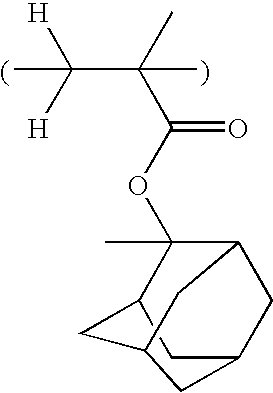 |
||
| A-6 Comparative Example | ||
 |
||
| A-7 Comparative Example | ||
 |
||
| B-1 formula (5) | ||
 |
||
| B-2 formula (6) | ||
 |
||
| B-3 formula (6) | ||
 |
||
| C-1 formula (3) | ||
 |
||
| C-2 formula (3) | ||
 |
||
| C-3 formula (3) | ||
 |
||
| D-1 formula (1) | ||
 |
||
| D-2 formula (1) | ||
 |
||
| D-3 formula (1) | ||
 |
||
| D-4 Comparative Example | ||
 |
||
- PAG1: triphenylsulfonium nonafluorobutanesulfonate
- PAG2: 4-t-butylphenyldiphenylsulfonium nonafluorobutanesulfonate

- Base 1: trismethoxymethoxyethylamine
- PGMEA: propylene glycol methyl ether acetate
| TABLE 3 | ||||||||||
| Photoacid | Dissolution | Basic | I/G | |||||||
| Resin | generator | inhibitor | compound | Solvent | Eop | Resolution | bias | LER | ||
| (pbw) | (pbw) | (pbw) | (pbw) | (pbw) | (mJ/cm2) | (μm) | (nm) | (nm) | ||
| Example | 1 | Polymer 1 | PAG1 | Base1 | PGMEA | 30 | 0.11 | 25 | 8.0 | |
| (80) | (3.0) | (0.35) | (800) | |||||||
| 2 | Polymer 2 | PAG1 | Base1 | PGMEA | 25 | 0.11 | 20 | 6.0 | ||
| (80) | (3.0) | (0.35) | (800) | |||||||
| 3 | Polymer 3 | PAG1 | Base1 | PGMEA | 28 | 0.11 | 22 | 6.7 | ||
| (80) | (3.0) | (0.35) | (800) | |||||||
| 4 | Polymer 4 | PAG1 | Base1 | PGMEA | 29 | 0.11 | 22 | 7.5 | ||
| (80) | (3.0) | (0.35) | (800) | |||||||
| 5 | Polymer 5 | PAG1 | Base1 | PGMEA | 32 | 0.11 | 18 | 7.8 | ||
| (80) | (3.0) | (0.35) | (800) | |||||||
| 6 | Polymer 6 | PAG1 | Base1 | PGMEA | 20 | 0.11 | 27 | 6.3 | ||
| (80) | (3.0) | (0.35) | (800) | |||||||
| 7 | Polymer 7 | PAG1 | Base1 | PGMEA | 30 | 0.11 | 19 | 7.9 | ||
| (80) | (3.0) | (0.35) | (800) | |||||||
| 8 | Polymer 8 | PAG1 | Base1 | PGMEA | 29 | 0.11 | 25 | 7.2 | ||
| (80) | (3.0) | (0.35) | (800) | |||||||
| 9 | Polymer 9 | PAG1 | Base1 | PGMEA | 29 | 0.11 | 19 | 8.1 | ||
| (80) | (3.0) | (0.35) | (800) | |||||||
| 10 | Polymer 10 | PAG1 | Base1 | PGMEA | 30 | 0.11 | 23 | 6.9 | ||
| (80) | (3.0) | (0.35) | (800) | |||||||
| 11 | Polymer 11 | PAG1 | Base1 | PGMEA | 27 | 0.11 | 28 | 7.1 | ||
| (80) | (3.0) | (0.35) | (800) | |||||||
| 12 | Polymer 12 | PAG1 | Base1 | PGMEA | 25 | 0.11 | 20 | 7.9 | ||
| (80) | (3.0) | (0.35) | (800) | |||||||
| 13 | Polymer 13 | PAG1 | Base1 | PGMEA | 27 | 0.11 | 27 | 6.3 | ||
| (80) | (3.0) | (0.35) | (800) | |||||||
| 14 | Polymer 14 | PAG1 | Base1 | PGMEA | 27 | 0.11 | 29 | 5.9 | ||
| (80) | (3.0) | (0.35) | (800) | |||||||
| 15 | Polymer 15 | PAG1 | Base1 | PGMEA | 21 | 0.11 | 33 | 5.9 | ||
| (80) | (3.0) | (0.35) | (800) | |||||||
| 16 | Polymer 16 | PAG1 | Base1 | PGMEA | 23 | 0.12 | 36 | 5.3 | ||
| (80) | (3.0) | (0.35) | (800) | |||||||
| 17 | Polymer 17 | PAG1 | Base1 | PGMEA | 24 | 0.12 | 38 | 5.4 | ||
| (80) | (3.0) | (0.35) | (800) | |||||||
| 18 | Polymer 18 | PAG1 | Base1 | PGMEA | 27 | 0.12 | 41 | 5.3 | ||
| (80) | (3.0) | (0.35) | (800) | |||||||
| 19 | Polymer 1 | PAG2 | Base1 | PGMEA | 34 | 0.11 | 26 | 6.6 | ||
| (80) | (3.0) | (0.35) | (800) | |||||||
| 20 | Polymer 2 | PAG2 | Base1 | PGMEA | 30 | 0.11 | 18 | 8.0 | ||
| (80) | (3.0) | (0.35) | (800) | |||||||
| 21 | Polymer 1 | PAG1 | DRR1 | Base1 | PGMEA | 31 | 0.10 | 22 | 7.5 | |
| (80) | (3.0) | (0.35) | (800) | |||||||
| 22 | Polymer 1 | PAG1 | DRR2 | Base1 | PGMEA | 36 | 0.10 | 21 | 7.8 | |
| (80) | (3.0) | (0.35) | (800) | |||||||
| 23 | Polymer 1 | PAG1 | DRR3 | Base1 | PGMEA | 33 | 0.11 | 23 | 7.5 | |
| (80) | (3.0) | (0.35) | (800) | |||||||
| 24 | Polymer 1 | PAG1 | DRR4 | Base1 | PGMEA | 31 | 0.10 | 27 | 7.1 | |
| (80) | (3.0) | (0.35) | (800) | |||||||
| TABLE 4 | ||||||||||
| Photoacid | Dissolution | Basic | I/G | |||||||
| Resin | generator | inhibitor | compound | Solvent | Eop | Resolution | bias | LER | ||
| (pbw) | (pbw) | (pbw) | (pbw) | (pbw) | (mJ/cm2) | (μm) | (nm) | (nm) | ||
| Comparative | 1 | Polymer 19 | PAG1 | Base1 | PGMEA | 34 | 0.12 | 25 | 14.3 |
| Example | (80) | (3.0) | (0.35) | (800) | |||||
| 2 | Polymer 20 | PAG1 | Base1 | PGMEA | 33 | 0.11 | 44 | 8.2 | |
| (80) | (3.0) | (0.35) | (800) | ||||||
| 3 | Polymer 21 | PAG1 | Base1 | PGMEA | 40 | 0.12 | 36 | 10.1 | |
| (80) | (3.0) | (0.35) | (800) | ||||||
| 4 | Polymer 22 | PAG1 | Base1 | PGMEA | 25 | 0.13 | 40 | 13.5 | |
| (80) | (3.0) | (0.35) | (800) | ||||||
| 5 | Polymer 23 | PAG1 | Base1 | PGMEA | 21 | 0.13 | 43 | 15.7 | |
| (80) | (3.0) | (0.35) | (800) | ||||||
| 6 | Polymer 24 | PAG1 | Base1 | PGMEA | 31 | 0.12 | 37 | 10.8 | |
| (80) | (3.0) | (0.35) | (800) | ||||||
| 7 | Polymer 25 | PAG1 | Base1 | PGMEA | 35 | 0.12 | 30 | 9.9 | |
| (80) | (3.0) | (0.35) | (800) | ||||||
Claims (15)


Applications Claiming Priority (2)
| Application Number | Priority Date | Filing Date | Title |
|---|---|---|---|
| JP2005-374831 | 2005-12-27 | ||
| JP2005374831A JP4716016B2 (en) | 2005-12-27 | 2005-12-27 | Polymer compound, resist material, and pattern forming method |
Publications (2)
| Publication Number | Publication Date |
|---|---|
| US20070148594A1 US20070148594A1 (en) | 2007-06-28 |
| US7718342B2 true US7718342B2 (en) | 2010-05-18 |
Family
ID=38194246
Family Applications (1)
| Application Number | Title | Priority Date | Filing Date |
|---|---|---|---|
| US11/645,751 Expired - Fee Related US7718342B2 (en) | 2005-12-27 | 2006-12-27 | Polymers, resist compositions and patterning process |
Country Status (4)
| Country | Link |
|---|---|
| US (1) | US7718342B2 (en) |
| JP (1) | JP4716016B2 (en) |
| KR (1) | KR101152000B1 (en) |
| TW (1) | TWI389923B (en) |
Cited By (4)
| Publication number | Priority date | Publication date | Assignee | Title |
|---|---|---|---|---|
| US20110269072A1 (en) * | 2010-04-28 | 2011-11-03 | Fujifilm Corporation | Actinic-ray- or radiation-sensitive resin composition and method of forming pattern using the same |
| US20120219897A1 (en) * | 2011-02-24 | 2012-08-30 | Taiwan Semiconductor Manufacturing Company, Ltd. | Photoresist having improved extreme-ultraviolet lithography imaging performance |
| US20120295197A1 (en) * | 2009-11-18 | 2012-11-22 | Jsr Corporation | Radiation-sensitive resin composition, polymer and method for forming a resist pattern |
| US20130004740A1 (en) * | 2011-06-30 | 2013-01-03 | Fujifilm Corporation | Actinic-ray-sensitive or radiation-sensitive resin composition, resist film and pattern forming method each using the composition, method for preparing electronic device, and electronic device |
Families Citing this family (14)
| Publication number | Priority date | Publication date | Assignee | Title |
|---|---|---|---|---|
| JP2006096965A (en) * | 2004-02-20 | 2006-04-13 | Tokyo Ohka Kogyo Co Ltd | Polymer compound, photoresist composition containing such polymer compound, and method for forming resist pattern |
| JP4777174B2 (en) * | 2006-07-26 | 2011-09-21 | 東京応化工業株式会社 | Positive resist composition and resist pattern forming method |
| JP4288518B2 (en) * | 2006-07-28 | 2009-07-01 | 信越化学工業株式会社 | Lactone-containing compound, polymer compound, resist material, and pattern forming method |
| JP4910662B2 (en) * | 2006-11-29 | 2012-04-04 | 信越化学工業株式会社 | Positive resist material and pattern forming method |
| JP5162290B2 (en) * | 2007-03-23 | 2013-03-13 | 富士フイルム株式会社 | Resist composition and pattern forming method using the same |
| US8252503B2 (en) * | 2007-08-24 | 2012-08-28 | Az Electronic Materials Usa Corp. | Photoresist compositions |
| JP5646149B2 (en) * | 2009-05-22 | 2014-12-24 | 丸善石油化学株式会社 | Copolymer for photoresist, production method and storage method thereof |
| JP5216032B2 (en) * | 2010-02-02 | 2013-06-19 | 信越化学工業株式会社 | Novel sulfonium salt, polymer compound, method for producing polymer compound, resist material and pattern forming method |
| JP5491450B2 (en) * | 2011-05-30 | 2014-05-14 | 信越化学工業株式会社 | A polymer compound, a chemically amplified resist material, and a pattern forming method using the chemically amplified resist material. |
| JP5411893B2 (en) | 2011-05-30 | 2014-02-12 | 信越化学工業株式会社 | Sulfonium salt, polymer compound, chemically amplified resist composition and resist pattern forming method using the polymer compound |
| JP6059517B2 (en) * | 2012-05-16 | 2017-01-11 | 東京応化工業株式会社 | Resist composition and resist pattern forming method |
| JP6271650B2 (en) * | 2012-05-16 | 2018-01-31 | 東京応化工業株式会社 | Polymer compounds, compounds |
| JP6651965B2 (en) * | 2016-04-14 | 2020-02-19 | 信越化学工業株式会社 | Monomer, polymer compound, resist composition and pattern forming method |
| CN114690552A (en) * | 2020-12-30 | 2022-07-01 | 罗门哈斯电子材料有限责任公司 | Photoresist composition and pattern forming method |
Citations (24)
| Publication number | Priority date | Publication date | Assignee | Title |
|---|---|---|---|---|
| JPH0973173A (en) | 1995-06-28 | 1997-03-18 | Fujitsu Ltd | Resist material and method of forming resist pattern |
| JPH0990637A (en) | 1995-07-14 | 1997-04-04 | Fujitsu Ltd | Resist composition and method for forming resist pattern |
| JPH0995479A (en) | 1995-09-29 | 1997-04-08 | Tokyo Ohka Kogyo Co Ltd | Oximesulfonate compound and acid generator for resist |
| JPH09208554A (en) | 1996-02-02 | 1997-08-12 | Tokyo Ohka Kogyo Co Ltd | Oxime sulfonate compound and acid generating agent for resist |
| JPH09230588A (en) | 1995-12-20 | 1997-09-05 | Tokyo Ohka Kogyo Co Ltd | Chemical amplification type resist composition and acid generating agent used for the same |
| JPH09301948A (en) | 1996-05-08 | 1997-11-25 | Sumitomo Chem Co Ltd | Glyoxime-based ester, production method and use thereof |
| JP2906999B2 (en) | 1994-04-26 | 1999-06-21 | 信越化学工業株式会社 | Resist material |
| US6004724A (en) | 1997-07-01 | 1999-12-21 | Ciba Specialty Chemicals Corporation | Oxime sulfonates and the use thereof as latent sulfonic acids |
| JP2000159758A (en) | 1998-09-25 | 2000-06-13 | Shin Etsu Chem Co Ltd | Novel lactone-containing compound, polymer compound, resist material and pattern forming method |
| JP2000314956A (en) | 1999-03-31 | 2000-11-14 | Ciba Specialty Chem Holding Inc | Oxime derivatives and their use as latent acids |
| JP2000336121A (en) | 1998-11-02 | 2000-12-05 | Shin Etsu Chem Co Ltd | Novel ester compound, polymer compound, resist material, and pattern forming method |
| US6200725B1 (en) | 1995-06-28 | 2001-03-13 | Fujitsu Limited | Chemically amplified resist compositions and process for the formation of resist patterns |
| US6312867B1 (en) | 1998-11-02 | 2001-11-06 | Shin-Etsu Chemical Co., Ltd. | Ester compounds, polymers, resist compositions and patterning process |
| JP2002285161A (en) | 2001-03-26 | 2002-10-03 | Chisso Corp | Liquid crystal composition, liquid crystal display device using the liquid crystal composition, and method of manufacturing the same |
| WO2004074242A2 (en) | 2003-02-19 | 2004-09-02 | Ciba Specialty Chemicals Holding Inc. | Halogenated oxime derivatives and the use thereof as latent acids |
| JP2004283788A (en) | 2003-03-25 | 2004-10-14 | Toyoda Gosei Co Ltd | Method for coating long article and production method for weatherstrip |
| US6916591B2 (en) | 2002-03-22 | 2005-07-12 | Shin-Etsu Chemical Co., Ltd. | Photoacid generators, chemically amplified resist compositions, and patterning process |
| WO2005080473A1 (en) | 2004-02-20 | 2005-09-01 | Tokyo Ohka Kogyo Co., Ltd. | Polymer compound, photoresist composition containing such polymer compound, and method for forming resist pattern |
| JP2005234450A (en) | 2004-02-23 | 2005-09-02 | Fuji Photo Film Co Ltd | Positive resist composition and pattern forming method using the same |
| JP2005234449A (en) | 2004-02-23 | 2005-09-02 | Fuji Photo Film Co Ltd | Positive resist composition and pattern forming method using the same |
| US20050227174A1 (en) * | 2004-04-09 | 2005-10-13 | Shin-Etsu Chemical Co., Ltd. | Positive resist compositions and patterning process |
| JP2005308044A (en) | 2004-04-20 | 2005-11-04 | Honda Motor Co Ltd | Parallel shaft automatic transmission |
| US20070099112A1 (en) * | 2005-10-31 | 2007-05-03 | Shin-Etsu Chemical Co., Ltd. | Novel sulfonate salts and derivatives, photoacid generators, resist compositions, and patterning process |
| US20070099113A1 (en) * | 2005-10-31 | 2007-05-03 | Shin-Etsu Chemical Co., Ltd. | Novel sulfonate salts and derivatives, photoacid generators, resist compositions, and patterning process |
Family Cites Families (3)
| Publication number | Priority date | Publication date | Assignee | Title |
|---|---|---|---|---|
| JP4398783B2 (en) * | 2003-09-03 | 2010-01-13 | 信越化学工業株式会社 | Polymer compound, resist material, and pattern forming method |
| JP4424500B2 (en) * | 2004-04-09 | 2010-03-03 | 信越化学工業株式会社 | Positive resist material and pattern forming method |
| JP4866237B2 (en) * | 2004-05-18 | 2012-02-01 | 出光興産株式会社 | Adamantane derivative, method for producing the same, and photosensitive material for photoresist |
-
2005
- 2005-12-27 JP JP2005374831A patent/JP4716016B2/en not_active Expired - Lifetime
-
2006
- 2006-12-26 KR KR1020060133610A patent/KR101152000B1/en not_active Expired - Fee Related
- 2006-12-27 TW TW095149254A patent/TWI389923B/en active
- 2006-12-27 US US11/645,751 patent/US7718342B2/en not_active Expired - Fee Related
Patent Citations (28)
| Publication number | Priority date | Publication date | Assignee | Title |
|---|---|---|---|---|
| JP2906999B2 (en) | 1994-04-26 | 1999-06-21 | 信越化学工業株式会社 | Resist material |
| US6329125B2 (en) | 1995-06-28 | 2001-12-11 | Fujitsu Limited | Chemically amplified resist compositions and process for the formation of resist patterns |
| JPH0973173A (en) | 1995-06-28 | 1997-03-18 | Fujitsu Ltd | Resist material and method of forming resist pattern |
| US6200725B1 (en) | 1995-06-28 | 2001-03-13 | Fujitsu Limited | Chemically amplified resist compositions and process for the formation of resist patterns |
| JPH0990637A (en) | 1995-07-14 | 1997-04-04 | Fujitsu Ltd | Resist composition and method for forming resist pattern |
| JPH0995479A (en) | 1995-09-29 | 1997-04-08 | Tokyo Ohka Kogyo Co Ltd | Oximesulfonate compound and acid generator for resist |
| JPH09230588A (en) | 1995-12-20 | 1997-09-05 | Tokyo Ohka Kogyo Co Ltd | Chemical amplification type resist composition and acid generating agent used for the same |
| JPH09208554A (en) | 1996-02-02 | 1997-08-12 | Tokyo Ohka Kogyo Co Ltd | Oxime sulfonate compound and acid generating agent for resist |
| JPH09301948A (en) | 1996-05-08 | 1997-11-25 | Sumitomo Chem Co Ltd | Glyoxime-based ester, production method and use thereof |
| US6004724A (en) | 1997-07-01 | 1999-12-21 | Ciba Specialty Chemicals Corporation | Oxime sulfonates and the use thereof as latent sulfonic acids |
| US6280898B1 (en) | 1998-09-25 | 2001-08-28 | Shin-Etsu Chemical Co., Ltd. | Lactone-containing compounds, polymers, resist compositions, and patterning method |
| JP2000159758A (en) | 1998-09-25 | 2000-06-13 | Shin Etsu Chem Co Ltd | Novel lactone-containing compound, polymer compound, resist material and pattern forming method |
| US6312867B1 (en) | 1998-11-02 | 2001-11-06 | Shin-Etsu Chemical Co., Ltd. | Ester compounds, polymers, resist compositions and patterning process |
| JP2000336121A (en) | 1998-11-02 | 2000-12-05 | Shin Etsu Chem Co Ltd | Novel ester compound, polymer compound, resist material, and pattern forming method |
| US6261738B1 (en) | 1999-03-31 | 2001-07-17 | Ciba Specialty Chemicals Corporation | Oxime derivatives and the use thereof as latent acids |
| JP2000314956A (en) | 1999-03-31 | 2000-11-14 | Ciba Specialty Chem Holding Inc | Oxime derivatives and their use as latent acids |
| JP2002285161A (en) | 2001-03-26 | 2002-10-03 | Chisso Corp | Liquid crystal composition, liquid crystal display device using the liquid crystal composition, and method of manufacturing the same |
| US6916591B2 (en) | 2002-03-22 | 2005-07-12 | Shin-Etsu Chemical Co., Ltd. | Photoacid generators, chemically amplified resist compositions, and patterning process |
| WO2004074242A2 (en) | 2003-02-19 | 2004-09-02 | Ciba Specialty Chemicals Holding Inc. | Halogenated oxime derivatives and the use thereof as latent acids |
| US20060246377A1 (en) | 2003-02-19 | 2006-11-02 | Hitoshi Yamato | Halogenated oxime derivatives and the use thereof as latent acids |
| JP2004283788A (en) | 2003-03-25 | 2004-10-14 | Toyoda Gosei Co Ltd | Method for coating long article and production method for weatherstrip |
| WO2005080473A1 (en) | 2004-02-20 | 2005-09-01 | Tokyo Ohka Kogyo Co., Ltd. | Polymer compound, photoresist composition containing such polymer compound, and method for forming resist pattern |
| JP2005234450A (en) | 2004-02-23 | 2005-09-02 | Fuji Photo Film Co Ltd | Positive resist composition and pattern forming method using the same |
| JP2005234449A (en) | 2004-02-23 | 2005-09-02 | Fuji Photo Film Co Ltd | Positive resist composition and pattern forming method using the same |
| US20050227174A1 (en) * | 2004-04-09 | 2005-10-13 | Shin-Etsu Chemical Co., Ltd. | Positive resist compositions and patterning process |
| JP2005308044A (en) | 2004-04-20 | 2005-11-04 | Honda Motor Co Ltd | Parallel shaft automatic transmission |
| US20070099112A1 (en) * | 2005-10-31 | 2007-05-03 | Shin-Etsu Chemical Co., Ltd. | Novel sulfonate salts and derivatives, photoacid generators, resist compositions, and patterning process |
| US20070099113A1 (en) * | 2005-10-31 | 2007-05-03 | Shin-Etsu Chemical Co., Ltd. | Novel sulfonate salts and derivatives, photoacid generators, resist compositions, and patterning process |
Non-Patent Citations (3)
| Title |
|---|
| J. Photopolym. Sci. and Tech., 8, pp. 43-44, pp. 45-46 (1995). |
| J. Photopolym. Sci. and Tech., 9, pp. 29-30 (1996). |
| Machine assisted English translation of JP 2005-234450 (Iwato) provided by JPO. * |
Cited By (9)
| Publication number | Priority date | Publication date | Assignee | Title |
|---|---|---|---|---|
| US20120295197A1 (en) * | 2009-11-18 | 2012-11-22 | Jsr Corporation | Radiation-sensitive resin composition, polymer and method for forming a resist pattern |
| US9598520B2 (en) * | 2009-11-18 | 2017-03-21 | Jsr Corporation | Radiation-sensitive resin composition, polymer and method for forming a resist pattern |
| US20110269072A1 (en) * | 2010-04-28 | 2011-11-03 | Fujifilm Corporation | Actinic-ray- or radiation-sensitive resin composition and method of forming pattern using the same |
| US8541160B2 (en) * | 2010-04-28 | 2013-09-24 | Fujifilm Corporation | Actinic-ray- or radiation-sensitive resin composition and method of forming pattern using the same |
| US20120219897A1 (en) * | 2011-02-24 | 2012-08-30 | Taiwan Semiconductor Manufacturing Company, Ltd. | Photoresist having improved extreme-ultraviolet lithography imaging performance |
| US9081280B2 (en) * | 2011-02-24 | 2015-07-14 | Taiwan Semiconductor Manufacturing Company, Ltd. | Photoresist having improved extreme-ultraviolet lithography imaging performance |
| US9389506B2 (en) | 2011-02-24 | 2016-07-12 | Taiwan Semiconductor Manufacturing Company, Ltd. | Photoresist having improved extreme-ultraviolet lithography imaging performance |
| US20130004740A1 (en) * | 2011-06-30 | 2013-01-03 | Fujifilm Corporation | Actinic-ray-sensitive or radiation-sensitive resin composition, resist film and pattern forming method each using the composition, method for preparing electronic device, and electronic device |
| US8841060B2 (en) * | 2011-06-30 | 2014-09-23 | Fujifilm Corporation | Actinic-ray-sensitive or radiation-sensitive resin composition, resist film and pattern forming method each using the composition, method for preparing electronic device, and electronic device |
Also Published As
| Publication number | Publication date |
|---|---|
| TWI389923B (en) | 2013-03-21 |
| JP4716016B2 (en) | 2011-07-06 |
| US20070148594A1 (en) | 2007-06-28 |
| TW200801051A (en) | 2008-01-01 |
| JP2007177016A (en) | 2007-07-12 |
| KR20070069041A (en) | 2007-07-02 |
| KR101152000B1 (en) | 2012-06-01 |
Similar Documents
| Publication | Publication Date | Title |
|---|---|---|
| US7537880B2 (en) | Polymer, resist composition, and patterning process | |
| EP2090598B1 (en) | Polymer, resist composition, and patterning process | |
| US8101335B2 (en) | Resist composition and patterning process | |
| KR101028646B1 (en) | Positive resist material and pattern formation method | |
| JP4513990B2 (en) | Positive resist material and pattern forming method | |
| JP5105128B2 (en) | Positive resist material and pattern forming method | |
| US20080090173A1 (en) | Polymer, resist composition, and patterning process | |
| US7157207B2 (en) | Polymer, resist material and patterning processing | |
| US20090081588A1 (en) | Resist composition and patterning process | |
| EP2081084B1 (en) | Positive resist compositions and patterning process | |
| KR101022602B1 (en) | Positive resist material and pattern formation method | |
| US7687222B2 (en) | Polymerizable ester compounds, polymers, resist compositions and patterning process | |
| EP2081085B1 (en) | Positive resist compositions and patterning process | |
| US7718342B2 (en) | Polymers, resist compositions and patterning process | |
| US20110054133A1 (en) | Resist polymer, preparing method, resist composition and patterning process | |
| JP4243859B2 (en) | Polymer compound, resist material, and pattern forming method | |
| US7601479B2 (en) | Polymer, resist composition and patterning process | |
| KR101094563B1 (en) | Positive resist material and pattern formation method | |
| JP4274057B2 (en) | Polymer compound, resist material, and pattern forming method | |
| JP2007298953A (en) | Resist material and pattern forming method | |
| US7691561B2 (en) | Positive resist compositions and patterning process | |
| US20080118863A1 (en) | Positive resist compositions and patterning process | |
| JP2007256448A (en) | Resist material and pattern forming method |
Legal Events
| Date | Code | Title | Description |
|---|---|---|---|
| AS | Assignment |
Owner name: SHIN-ETSU CHEMICAL CO., LTD., JAPAN Free format text: ASSIGNMENT OF ASSIGNORS INTEREST;ASSIGNORS:FUNATSU, KENJI;KOBAYASHI, TOMOHIRO;HASEGAWA, KOJI;AND OTHERS;REEL/FRAME:018745/0351 Effective date: 20061204 Owner name: SHIN-ETSU CHEMICAL CO., LTD.,JAPAN Free format text: ASSIGNMENT OF ASSIGNORS INTEREST;ASSIGNORS:FUNATSU, KENJI;KOBAYASHI, TOMOHIRO;HASEGAWA, KOJI;AND OTHERS;REEL/FRAME:018745/0351 Effective date: 20061204 |
|
| FEPP | Fee payment procedure |
Free format text: PAYOR NUMBER ASSIGNED (ORIGINAL EVENT CODE: ASPN); ENTITY STATUS OF PATENT OWNER: LARGE ENTITY |
|
| STCF | Information on status: patent grant |
Free format text: PATENTED CASE |
|
| FPAY | Fee payment |
Year of fee payment: 4 |
|
| MAFP | Maintenance fee payment |
Free format text: PAYMENT OF MAINTENANCE FEE, 8TH YEAR, LARGE ENTITY (ORIGINAL EVENT CODE: M1552) Year of fee payment: 8 |
|
| FEPP | Fee payment procedure |
Free format text: MAINTENANCE FEE REMINDER MAILED (ORIGINAL EVENT CODE: REM.); ENTITY STATUS OF PATENT OWNER: LARGE ENTITY |
|
| LAPS | Lapse for failure to pay maintenance fees |
Free format text: PATENT EXPIRED FOR FAILURE TO PAY MAINTENANCE FEES (ORIGINAL EVENT CODE: EXP.); ENTITY STATUS OF PATENT OWNER: LARGE ENTITY |
|
| STCH | Information on status: patent discontinuation |
Free format text: PATENT EXPIRED DUE TO NONPAYMENT OF MAINTENANCE FEES UNDER 37 CFR 1.362 |
|
| STCH | Information on status: patent discontinuation |
Free format text: PATENT EXPIRED DUE TO NONPAYMENT OF MAINTENANCE FEES UNDER 37 CFR 1.362 |
|
| FP | Lapsed due to failure to pay maintenance fee |
Effective date: 20220518 |