US7655769B2 - Orthogonally protected disaccharide building blocks for synthesis of heparin - Google Patents
Orthogonally protected disaccharide building blocks for synthesis of heparin Download PDFInfo
- Publication number
- US7655769B2 US7655769B2 US11/970,274 US97027408A US7655769B2 US 7655769 B2 US7655769 B2 US 7655769B2 US 97027408 A US97027408 A US 97027408A US 7655769 B2 US7655769 B2 US 7655769B2
- Authority
- US
- United States
- Prior art keywords
- compound
- formula
- heparin
- product
- substituted
- Prior art date
- Legal status (The legal status is an assumption and is not a legal conclusion. Google has not performed a legal analysis and makes no representation as to the accuracy of the status listed.)
- Expired - Lifetime
Links
- 0 *C1O[C@@H](CC)[C@@H](OC2OC(CC)C(OC)[C@H](C)[C@@H]2N=[N+]=[N-])C(C)C1C.COC1OC(COC(=O)C2=CC=CC=C2)C(O)[C@H](C)[C@@H]1N=[N+]=[N-] Chemical compound *C1O[C@@H](CC)[C@@H](OC2OC(CC)C(OC)[C@H](C)[C@@H]2N=[N+]=[N-])C(C)C1C.COC1OC(COC(=O)C2=CC=CC=C2)C(O)[C@H](C)[C@@H]1N=[N+]=[N-] 0.000 description 16
- KWTHKPCLCDSWJM-KZGMFBSISA-N CC1(C)OC2[C@H](O[C@H]([C@@H](COC(=O)C3=CC=CC=C3)OS(C)(=O)=O)[C@H]2OCC2=CC=CC=C2)O1 Chemical compound CC1(C)OC2[C@H](O[C@H]([C@@H](COC(=O)C3=CC=CC=C3)OS(C)(=O)=O)[C@H]2OCC2=CC=CC=C2)O1 KWTHKPCLCDSWJM-KZGMFBSISA-N 0.000 description 9
- CIFFIYJOTIJKSX-XJNHOWJQSA-N CC1(C)OC2[C@H](O[C@H]([C@H](O)CO)[C@H]2OCC2=CC=CC=C2)O1 Chemical compound CC1(C)OC2[C@H](O[C@H]([C@H](O)CO)[C@H]2OCC2=CC=CC=C2)O1 CIFFIYJOTIJKSX-XJNHOWJQSA-N 0.000 description 8
- VFUQRKSHMCOOAH-FVOHVMHYSA-N CCC1OC(O[C@H]2C(C)C(C)C(C)O[C@H]2CC)[C@@H](N=[N+]=[N-])[C@@H](C)C1OC Chemical compound CCC1OC(O[C@H]2C(C)C(C)C(C)O[C@H]2CC)[C@@H](N=[N+]=[N-])[C@@H](C)C1OC VFUQRKSHMCOOAH-FVOHVMHYSA-N 0.000 description 6
- JOLDSMPYOPOECD-ORNXTZRQSA-N CC1C(COC(=O)C2=CC=CC=C2)OC(OC2C3COC(C3)[C@@H](OC(=O)C3=CC=CC=C3)[C@H]2OCC2=CC=CC=C2)[C@@H](N=[N+]=[N-])[C@H]1OCC1=CC=CC=C1 Chemical compound CC1C(COC(=O)C2=CC=CC=C2)OC(OC2C3COC(C3)[C@@H](OC(=O)C3=CC=CC=C3)[C@H]2OCC2=CC=CC=C2)[C@@H](N=[N+]=[N-])[C@H]1OCC1=CC=CC=C1 JOLDSMPYOPOECD-ORNXTZRQSA-N 0.000 description 4
- UMPHVXBYPFNAAI-XQHGLPTISA-I CCC1OC(OC)[C@@H](/N=[SH]/OO[O-])[C@@H](O)C1O[C@@H]1O[C@@H](C(=O)[O-])[C@@H](OC2OC(COS(=O)(=O)[O-])C(O)[C@H](O)[C@@H]2/N=[SH]/OO[O-])C(O)C1OS(=O)(=O)[O-] Chemical compound CCC1OC(OC)[C@@H](/N=[SH]/OO[O-])[C@@H](O)C1O[C@@H]1O[C@@H](C(=O)[O-])[C@@H](OC2OC(COS(=O)(=O)[O-])C(O)[C@H](O)[C@@H]2/N=[SH]/OO[O-])C(O)C1OS(=O)(=O)[O-] UMPHVXBYPFNAAI-XQHGLPTISA-I 0.000 description 4
- CWCGFKIHIBFNPW-GIVJDJEMSA-N O=C(O[C@@H]1C2CC(CO2)C(O)[C@@H]1OCC1=CC=CC=C1)C1=CC=CC=C1 Chemical compound O=C(O[C@@H]1C2CC(CO2)C(O)[C@@H]1OCC1=CC=CC=C1)C1=CC=CC=C1 CWCGFKIHIBFNPW-GIVJDJEMSA-N 0.000 description 3
- FFKSRBDNLQJPFJ-JJRYREJMSA-N OC1C2COC(C2)[C@@H](O)[C@H]1OCC1=CC=CC=C1 Chemical compound OC1C2COC(C2)[C@@H](O)[C@H]1OCC1=CC=CC=C1 FFKSRBDNLQJPFJ-JJRYREJMSA-N 0.000 description 3
- VXBGGSRGHGCPCR-FFQNZSFNSA-K [H]OC1C(COS(=O)(=O)[O-])OC(O[C@H]2C(O)C(OS(=O)(=O)[O-])[C@H](OC3C(COS(=O)(=O)[O-])OC(OC)[C@@H](C)[C@H]3O)O[C@H]2C)[C@@H](C)[C@H]1O Chemical compound [H]OC1C(COS(=O)(=O)[O-])OC(O[C@H]2C(O)C(OS(=O)(=O)[O-])[C@H](OC3C(COS(=O)(=O)[O-])OC(OC)[C@@H](C)[C@H]3O)O[C@H]2C)[C@@H](C)[C@H]1O VXBGGSRGHGCPCR-FFQNZSFNSA-K 0.000 description 3
- TXTBLFUJNJXJJY-ZZJYBBSESA-N C.CC[C@@H]1OC(C)C(OC(=O)C2=CC=CC=C2)C(C)[C@@H]1OC1OC(COC(=O)C2=CC=CC=C2)C(C)[C@H](C)[C@@H]1N=[N+]=[N-] Chemical compound C.CC[C@@H]1OC(C)C(OC(=O)C2=CC=CC=C2)C(C)[C@@H]1OC1OC(COC(=O)C2=CC=CC=C2)C(C)[C@H](C)[C@@H]1N=[N+]=[N-] TXTBLFUJNJXJJY-ZZJYBBSESA-N 0.000 description 2
- NELJOPZSSPRBBA-MGGRMPCGSA-N CC(=O)OC[C@@H]1OC(C)C(OC(=O)C2=CC=CC=C2)C(OCC2=CC=CC=C2)[C@@H]1OC1OC(COC(=O)C2=CC=CC=C2)C(C)[C@H](OCC2=CC=CC=C2)[C@@H]1N=[N+]=[N-] Chemical compound CC(=O)OC[C@@H]1OC(C)C(OC(=O)C2=CC=CC=C2)C(OCC2=CC=CC=C2)[C@@H]1OC1OC(COC(=O)C2=CC=CC=C2)C(C)[C@H](OCC2=CC=CC=C2)[C@@H]1N=[N+]=[N-] NELJOPZSSPRBBA-MGGRMPCGSA-N 0.000 description 2
- YZUJVGZMINCPQW-IRCQAWJZSA-N CC(=O)OC[C@@H]1OC(C=N)C(OC(=O)C2=CC=CC=C2)C(OCC2=CC=CC=C2)[C@@H]1OC1OC(COC(=O)C2=CC=CC=C2)C(C)[C@H](OCC2=CC=CC=C2)[C@@H]1N=[N+]=[N-] Chemical compound CC(=O)OC[C@@H]1OC(C=N)C(OC(=O)C2=CC=CC=C2)C(OCC2=CC=CC=C2)[C@@H]1OC1OC(COC(=O)C2=CC=CC=C2)C(C)[C@H](OCC2=CC=CC=C2)[C@@H]1N=[N+]=[N-] YZUJVGZMINCPQW-IRCQAWJZSA-N 0.000 description 2
- NWHHQYKSOIIEPS-HAOCOXAPSA-N CC1C(COC(=O)C2=CC=CC=C2)OC(OC2C3COC(O3)[C@@H](C)[C@H]2C)C(N=[N+]=[N-])[C@H]1C Chemical compound CC1C(COC(=O)C2=CC=CC=C2)OC(OC2C3COC(O3)[C@@H](C)[C@H]2C)C(N=[N+]=[N-])[C@H]1C NWHHQYKSOIIEPS-HAOCOXAPSA-N 0.000 description 2
- DYBUOKVRBVBEID-UWICXLGBSA-G CCC1OC(O)[C@@H](/N=[SH]/OO[O-])[C@@H](O)C1O[C@@H]1O[C@@H](C(=O)[O-])[C@@H](OC2OC(COS(=O)(=O)[O-])C(O[C@@H]3OC(C(=O)[O-])=C[C@H](O)C3OSOO[O-])[C@H](O)[C@@H]2/N=[SH]/OO[O-])C(O)C1OS(=O)(=O)[O-] Chemical compound CCC1OC(O)[C@@H](/N=[SH]/OO[O-])[C@@H](O)C1O[C@@H]1O[C@@H](C(=O)[O-])[C@@H](OC2OC(COS(=O)(=O)[O-])C(O[C@@H]3OC(C(=O)[O-])=C[C@H](O)C3OSOO[O-])[C@H](O)[C@@H]2/N=[SH]/OO[O-])C(O)C1OS(=O)(=O)[O-] DYBUOKVRBVBEID-UWICXLGBSA-G 0.000 description 2
- IILUCCFYSGIAAR-HDEZJDKTSA-N CCC1OC(O)[C@@H](N=[N+]=[N-])[C@@H](OCC2=CC=CC=C2)C1C Chemical compound CCC1OC(O)[C@@H](N=[N+]=[N-])[C@@H](OCC2=CC=CC=C2)C1C IILUCCFYSGIAAR-HDEZJDKTSA-N 0.000 description 2
- HMMWJRLJXDYPJA-JWRGBJGHSA-N CCC1OC(OC)[C@@H](N=[N+]=[N-])[C@@H](OCC2=CC=CC=C2)C1O[C@@H]1O[C@@H](CC)[C@@H](OC2OC(COC(=O)C3=CC=CC=C3)C(OC)[C@H](OCC3=CC=CC=C3)[C@@H]2N=[N+]=[N-])C(OCC2=CC=CC=C2)C1OC(=O)C1=CC=CC=C1 Chemical compound CCC1OC(OC)[C@@H](N=[N+]=[N-])[C@@H](OCC2=CC=CC=C2)C1O[C@@H]1O[C@@H](CC)[C@@H](OC2OC(COC(=O)C3=CC=CC=C3)C(OC)[C@H](OCC3=CC=CC=C3)[C@@H]2N=[N+]=[N-])C(OCC2=CC=CC=C2)C1OC(=O)C1=CC=CC=C1 HMMWJRLJXDYPJA-JWRGBJGHSA-N 0.000 description 2
- VMSGLJHGYANCFJ-OOYZGYNGSA-N CCC1OC(OC)[C@@H](N=[N+]=[N-])[C@@H](OCC2=CC=CC=C2)C1O[C@@H]1O[C@@H](COC(C)=O)[C@@H](OC2OC(COC(=O)C3=CC=CC=C3)C(OC)[C@H](OCC3=CC=CC=C3)[C@@H]2N=[N+]=[N-])C(OCC2=CC=CC=C2)C1OC(=O)C1=CC=CC=C1 Chemical compound CCC1OC(OC)[C@@H](N=[N+]=[N-])[C@@H](OCC2=CC=CC=C2)C1O[C@@H]1O[C@@H](COC(C)=O)[C@@H](OC2OC(COC(=O)C3=CC=CC=C3)C(OC)[C@H](OCC3=CC=CC=C3)[C@@H]2N=[N+]=[N-])C(OCC2=CC=CC=C2)C1OC(=O)C1=CC=CC=C1 VMSGLJHGYANCFJ-OOYZGYNGSA-N 0.000 description 2
- KSWCVEXICWMXJW-CHIQQQGSSA-N CC[C@@H]1OC(C)C(OC(=O)C2=CC=CC=C2)C(OCC2=CC=CC=C2)[C@@H]1OC1OC(COC(=O)C2=CC=CC=C2)C(C)[C@H](OCC2=CC=CC=C2)[C@@H]1N=[N+]=[N-] Chemical compound CC[C@@H]1OC(C)C(OC(=O)C2=CC=CC=C2)C(OCC2=CC=CC=C2)[C@@H]1OC1OC(COC(=O)C2=CC=CC=C2)C(C)[C@H](OCC2=CC=CC=C2)[C@@H]1N=[N+]=[N-] KSWCVEXICWMXJW-CHIQQQGSSA-N 0.000 description 2
- OWGKNHXMFIGCQI-DKHMWJMHSA-N CC[C@@H]1OC(C=N)C(OC(=O)C2=CC=CC=C2)C(OCC2=CC=CC=C2)[C@@H]1OC1OC(COC(=O)C2=CC=CC=C2)C(C)[C@H](OCC2=CC=CC=C2)[C@@H]1N=[N+]=[N-] Chemical compound CC[C@@H]1OC(C=N)C(OC(=O)C2=CC=CC=C2)C(OCC2=CC=CC=C2)[C@@H]1OC1OC(COC(=O)C2=CC=CC=C2)C(C)[C@H](OCC2=CC=CC=C2)[C@@H]1N=[N+]=[N-] OWGKNHXMFIGCQI-DKHMWJMHSA-N 0.000 description 2
- GEMQPRRXBCXDEA-HXAAPNBMSA-N CC[C@@H]1OC(O)C(OC(=O)C2=CC=CC=C2)C(C)[C@@H]1OC1OC(COC(=O)C2=CC=CC=C2)C(C)[C@H](C)[C@@H]1N=[N+]=[N-] Chemical compound CC[C@@H]1OC(O)C(OC(=O)C2=CC=CC=C2)C(C)[C@@H]1OC1OC(COC(=O)C2=CC=CC=C2)C(C)[C@H](C)[C@@H]1N=[N+]=[N-] GEMQPRRXBCXDEA-HXAAPNBMSA-N 0.000 description 2
- KVRUWJNHTOLIMF-XVOSGTTGSA-N CC1C(COC(=O)C2=CC=CC=C2)OC(OC2C3COC(C3)[C@@H](C)[C@H]2C)C(N=[N+]=[N-])[C@H]1C.CC[C@@H]1OC(C)C(OC(=O)C2=CC=CC=C2)C(C)[C@@H]1OC1OC(COC(=O)C2=CC=CC=C2)C(C)[C@H](C)[C@@H]1N=[N+]=[N-].CC[C@@H]1OC(C)C(OC(=O)C2=CC=CC=C2)C(C)[C@@H]1OC1OC(COC(=O)C2=CC=CC=C2)C(C)[C@H](C)[C@@H]1N=[N+]=[N-] Chemical compound CC1C(COC(=O)C2=CC=CC=C2)OC(OC2C3COC(C3)[C@@H](C)[C@H]2C)C(N=[N+]=[N-])[C@H]1C.CC[C@@H]1OC(C)C(OC(=O)C2=CC=CC=C2)C(C)[C@@H]1OC1OC(COC(=O)C2=CC=CC=C2)C(C)[C@H](C)[C@@H]1N=[N+]=[N-].CC[C@@H]1OC(C)C(OC(=O)C2=CC=CC=C2)C(C)[C@@H]1OC1OC(COC(=O)C2=CC=CC=C2)C(C)[C@H](C)[C@@H]1N=[N+]=[N-] KVRUWJNHTOLIMF-XVOSGTTGSA-N 0.000 description 1
- SVCIRPJWXCJZBA-HLXVYDAUSA-N CC1OCC2OC(C)[C@@H](N=[N+]=[N-])[C@@H](O)C2O1 Chemical compound CC1OCC2OC(C)[C@@H](N=[N+]=[N-])[C@@H](O)C2O1 SVCIRPJWXCJZBA-HLXVYDAUSA-N 0.000 description 1
- SBGSBRUIIFEQIE-PZXCANPASA-N CC1OCC2OC(C)[C@@H](N=[N+]=[N-])[C@@H](OCC3=CC=CC=C3)C2O1 Chemical compound CC1OCC2OC(C)[C@@H](N=[N+]=[N-])[C@@H](OCC3=CC=CC=C3)C2O1 SBGSBRUIIFEQIE-PZXCANPASA-N 0.000 description 1
- DJZTYWQMGOBPPE-ILJOKMMRSA-N CC1O[C@@H](CO)[C@@H](OC2OC(COC(=O)C3=CC=CC=C3)C(C)[C@H](C)[C@@H]2N=[N+]=[N-])C(C)C1OC(=O)C1=CC=CC=C1 Chemical compound CC1O[C@@H](CO)[C@@H](OC2OC(COC(=O)C3=CC=CC=C3)C(C)[C@H](C)[C@@H]2N=[N+]=[N-])C(C)C1OC(=O)C1=CC=CC=C1 DJZTYWQMGOBPPE-ILJOKMMRSA-N 0.000 description 1
- ABJUABRUEJRVAT-VNECMYLUSA-N CCC1OC(OC)[C@@H](N=[N+]=[N-])[C@@H](OCC2=CC=CC=C2)C1O Chemical compound CCC1OC(OC)[C@@H](N=[N+]=[N-])[C@@H](OCC2=CC=CC=C2)C1O ABJUABRUEJRVAT-VNECMYLUSA-N 0.000 description 1
- JEAWAIUXAVOAKX-DFKBDUSLSA-N CCC1OC(OC)[C@@H](N=[N+]=[N-])[C@@H](OCC2=CC=CC=C2)C1O[C@@H]1O[C@@H](C(=O)O)[C@@H](OC2OC(COC(=O)C3=CC=CC=C3)C(OC)[C@H](OCC3=CC=CC=C3)[C@@H]2N=[N+]=[N-])C(OCC2=CC=CC=C2)C1OC(=O)C1=CC=CC=C1 Chemical compound CCC1OC(OC)[C@@H](N=[N+]=[N-])[C@@H](OCC2=CC=CC=C2)C1O[C@@H]1O[C@@H](C(=O)O)[C@@H](OC2OC(COC(=O)C3=CC=CC=C3)C(OC)[C@H](OCC3=CC=CC=C3)[C@@H]2N=[N+]=[N-])C(OCC2=CC=CC=C2)C1OC(=O)C1=CC=CC=C1 JEAWAIUXAVOAKX-DFKBDUSLSA-N 0.000 description 1
- ODTGVKYZADCOHU-BMSOPKMZSA-N CCC1OC(OC2C3COC(C3)[C@@H](C)[C@H]2C)[C@@H](N=[N+]=[N-])[C@@H](C)C1OC Chemical compound CCC1OC(OC2C3COC(C3)[C@@H](C)[C@H]2C)[C@@H](N=[N+]=[N-])[C@@H](C)C1OC ODTGVKYZADCOHU-BMSOPKMZSA-N 0.000 description 1
- AVHMNBQTTZWCPW-JFJAWSMESA-N CCC1OC(OC2C3COC(O3)[C@@H](C)[C@H]2C)C(N=[N+]=[N-])[C@@H](C)C1C Chemical compound CCC1OC(OC2C3COC(O3)[C@@H](C)[C@H]2C)C(N=[N+]=[N-])[C@@H](C)C1C AVHMNBQTTZWCPW-JFJAWSMESA-N 0.000 description 1
- ODFLREBSYGMMCH-WGXMJUBASA-N COC1OC(COC(=O)C2=CC=CC=C2)C(O[C@@H]2O[C@@H](COC(C)=O)[C@@H](OC3OC(COC(=O)C4=CC=CC=C4)C(OC)[C@H](OCC4=CC=CC=C4)[C@@H]3N=[N+]=[N-])C(OCC3=CC=CC=C3)C2OC(=O)C2=CC=CC=C2)[C@H](OCC2=CC=CC=C2)[C@@H]1N=[N+]=[N-] Chemical compound COC1OC(COC(=O)C2=CC=CC=C2)C(O[C@@H]2O[C@@H](COC(C)=O)[C@@H](OC3OC(COC(=O)C4=CC=CC=C4)C(OC)[C@H](OCC4=CC=CC=C4)[C@@H]3N=[N+]=[N-])C(OCC3=CC=CC=C3)C2OC(=O)C2=CC=CC=C2)[C@H](OCC2=CC=CC=C2)[C@@H]1N=[N+]=[N-] ODFLREBSYGMMCH-WGXMJUBASA-N 0.000 description 1
- MQGHPCGTMIVOQI-KNDDYUOGSA-N C[C@@H](COC(c1ccccc1)=O)C12OC3(C)OC(C)(C)OC3C1C2OCc1ccccc1 Chemical compound C[C@@H](COC(c1ccccc1)=O)C12OC3(C)OC(C)(C)OC3C1C2OCc1ccccc1 MQGHPCGTMIVOQI-KNDDYUOGSA-N 0.000 description 1
- PHDVZEOBVKLEGP-XSCIDGEOSA-N C[C@@H]1C2OCC(O2)C(O)[C@@H]1C Chemical compound C[C@@H]1C2OCC(O2)C(O)[C@@H]1C PHDVZEOBVKLEGP-XSCIDGEOSA-N 0.000 description 1
- UARNTKGEXRCIQS-OQPLKVDDSA-N C[C@H]1C(OCC2=CC3=C(C=CC=C3)C=C2)C(COC(=O)C2=CC=CC=C2)OC(OC(=N)C(Cl)(Cl)Cl)[C@H]1N=[N+]=[N-] Chemical compound C[C@H]1C(OCC2=CC3=C(C=CC=C3)C=C2)C(COC(=O)C2=CC=CC=C2)OC(OC(=N)C(Cl)(Cl)Cl)[C@H]1N=[N+]=[N-] UARNTKGEXRCIQS-OQPLKVDDSA-N 0.000 description 1
- BVDOZTZQWUVHSJ-DDKNWXHBSA-N OC[C@@H]1CCC[C@@H](O[C@H]2CCCOC2)O1.[H]C1(CO)CCCC([H])(O[C@@]2([H])CCCOC2)O1 Chemical compound OC[C@@H]1CCC[C@@H](O[C@H]2CCCOC2)O1.[H]C1(CO)CCCC([H])(O[C@@]2([H])CCCOC2)O1 BVDOZTZQWUVHSJ-DDKNWXHBSA-N 0.000 description 1
- BVDOZTZQWUVHSJ-AKFOWLLJSA-N OC[C@@H]1CCC[C@H](O[C@H]2CCCOC2)O1.[H]C1(CO)CCCC([H])(O[C@@]2([H])CCCOC2)O1 Chemical compound OC[C@@H]1CCC[C@H](O[C@H]2CCCOC2)O1.[H]C1(CO)CCCC([H])(O[C@@]2([H])CCCOC2)O1 BVDOZTZQWUVHSJ-AKFOWLLJSA-N 0.000 description 1
Images


Classifications
-
- A—HUMAN NECESSITIES
- A61—MEDICAL OR VETERINARY SCIENCE; HYGIENE
- A61K—PREPARATIONS FOR MEDICAL, DENTAL OR TOILETRY PURPOSES
- A61K31/00—Medicinal preparations containing organic active ingredients
- A61K31/70—Carbohydrates; Sugars; Derivatives thereof
- A61K31/715—Polysaccharides, i.e. having more than five saccharide radicals attached to each other by glycosidic linkages; Derivatives thereof, e.g. ethers, esters
- A61K31/726—Glycosaminoglycans, i.e. mucopolysaccharides
- A61K31/727—Heparin; Heparan
-
- C—CHEMISTRY; METALLURGY
- C07—ORGANIC CHEMISTRY
- C07H—SUGARS; DERIVATIVES THEREOF; NUCLEOSIDES; NUCLEOTIDES; NUCLEIC ACIDS
- C07H15/00—Compounds containing hydrocarbon or substituted hydrocarbon radicals directly attached to hetero atoms of saccharide radicals
- C07H15/02—Acyclic radicals, not substituted by cyclic structures
- C07H15/04—Acyclic radicals, not substituted by cyclic structures attached to an oxygen atom of the saccharide radical
-
- C—CHEMISTRY; METALLURGY
- C07—ORGANIC CHEMISTRY
- C07H—SUGARS; DERIVATIVES THEREOF; NUCLEOSIDES; NUCLEOTIDES; NUCLEIC ACIDS
- C07H15/00—Compounds containing hydrocarbon or substituted hydrocarbon radicals directly attached to hetero atoms of saccharide radicals
- C07H15/20—Carbocyclic rings
- C07H15/203—Monocyclic carbocyclic rings other than cyclohexane rings; Bicyclic carbocyclic ring systems
-
- C—CHEMISTRY; METALLURGY
- C07—ORGANIC CHEMISTRY
- C07H—SUGARS; DERIVATIVES THEREOF; NUCLEOSIDES; NUCLEOTIDES; NUCLEIC ACIDS
- C07H3/00—Compounds containing only hydrogen atoms and saccharide radicals having only carbon, hydrogen, and oxygen atoms
- C07H3/06—Oligosaccharides, i.e. having three to five saccharide radicals attached to each other by glycosidic linkages
-
- C—CHEMISTRY; METALLURGY
- C08—ORGANIC MACROMOLECULAR COMPOUNDS; THEIR PREPARATION OR CHEMICAL WORKING-UP; COMPOSITIONS BASED THEREON
- C08B—POLYSACCHARIDES; DERIVATIVES THEREOF
- C08B37/00—Preparation of polysaccharides not provided for in groups C08B1/00 - C08B35/00; Derivatives thereof
- C08B37/006—Heteroglycans, i.e. polysaccharides having more than one sugar residue in the main chain in either alternating or less regular sequence; Gellans; Succinoglycans; Arabinogalactans; Tragacanth or gum tragacanth or traganth from Astragalus; Gum Karaya from Sterculia urens; Gum Ghatti from Anogeissus latifolia; Derivatives thereof
- C08B37/0063—Glycosaminoglycans or mucopolysaccharides, e.g. keratan sulfate; Derivatives thereof, e.g. fucoidan
- C08B37/0075—Heparin; Heparan sulfate; Derivatives thereof, e.g. heparosan; Purification or extraction methods thereof
- C08B37/0078—Degradation products
-
- C—CHEMISTRY; METALLURGY
- C08—ORGANIC MACROMOLECULAR COMPOUNDS; THEIR PREPARATION OR CHEMICAL WORKING-UP; COMPOSITIONS BASED THEREON
- C08L—COMPOSITIONS OF MACROMOLECULAR COMPOUNDS
- C08L5/00—Compositions of polysaccharides or of their derivatives not provided for in groups C08L1/00 or C08L3/00
- C08L5/10—Heparin; Derivatives thereof
-
- Y—GENERAL TAGGING OF NEW TECHNOLOGICAL DEVELOPMENTS; GENERAL TAGGING OF CROSS-SECTIONAL TECHNOLOGIES SPANNING OVER SEVERAL SECTIONS OF THE IPC; TECHNICAL SUBJECTS COVERED BY FORMER USPC CROSS-REFERENCE ART COLLECTIONS [XRACs] AND DIGESTS
- Y02—TECHNOLOGIES OR APPLICATIONS FOR MITIGATION OR ADAPTATION AGAINST CLIMATE CHANGE
- Y02P—CLIMATE CHANGE MITIGATION TECHNOLOGIES IN THE PRODUCTION OR PROCESSING OF GOODS
- Y02P20/00—Technologies relating to chemical industry
- Y02P20/50—Improvements relating to the production of bulk chemicals
- Y02P20/55—Design of synthesis routes, e.g. reducing the use of auxiliary or protecting groups
Definitions
- the present invention relates to composition and methods for the synthesis of low molecular weight heparins and heparinoids.
- the present invention also relates to compositions having substantially homogenous populations of desired heparin molecules, or molecules useful in the synthesis of heparin oligosaccharides.
- Heparin and its structurally related heparan sulfate, the linear sulfated polysaccharides belonging to the family of glycosamino-glycans play significant roles in a diverse set of biological processes, including blood coagulation, virus infection, cell growth, inflammation, wound healing, tumor metastasis, lipid metabolism, and diseases of the nervous system.
- Heparin has a well-established utility as an anticoagulant drug and contains a trisulfated disaccharide repeating unit as the major component consisting of alternating D-glucosamine and L-iduronic acid with alpha 1 ⁇ 4 linkages:
- Enzymatic degradation of heparin with heparinase gives a mixture of oligosaccharides with even sugar units invariably having an unsaturated D-glucuronic acid residue at the non-reducing end:
- heparins and heparinoids such as fondaparinux sodium (ARIXTRA), methyl O-2-deoxy-6-O-sulfo-2-(sulfoamino)-alpha-D-glucopyranosyl-(1 ⁇ 4)-O-beta-D-glucopyranuronosyl-(1 ⁇ 4)-O-2-deoxy-3,6-di-O-sulfo-2-(sulfoamino)-alpha-D-glucopyranosyl-(1 ⁇ 4)-O-2-O-sulfo-alpha-L-idopyranuronosyl-(1 ⁇ 4)-2-deoxy-6-O-sulfo-2-(sulfoamino)-alpha-D-glucopyranoside, decasodium salt and tinzaparin sodium (INNOHEP):
- Tinzaparin sodium is obtained by controlled enzymatic depolymerization of heparin from porcine intestinal mucosa using heparinase from Flavobacterium heparinum resulting in molecular weight distributions from ⁇ 2,000 daltons to >8,000 daltons.
- low molecular weight heparins and heparinoids including dalteparin, enoxaparin, ardeparin, certoparin, nadroparin, parnaparin, and reviparin are obtained by depolymerization methods of mucosa resulting in compositions having various molecular weight distributions.
- Low molecular weight heparins of varying molecular weights can have substantial therapeutic implications, such as undesirable side effects. It is well known that producing therapeutics with more homogeneous compositions can decrease side effects. For example, current low molecular weight heparins and heparinoids when concurrently used with spinal epidural anesthesia, or spinal puncture may cause bleeding or hematomas (collection of blood) within the spinal column. When bleeding occurs in the spinal column, increased pressure on the spinal cord may result in permanent paralysis. The exact reason for this occurrence is not understood; however, it is hypothesized to be the side effect of one or more of undesirable low molecular weight heparin or heparinoid compositions or conformations. Thus, there is a need for improved methods of obtaining low molecular weight heparins polymers that are substantially pure and have homogeneous structural configurations, confirmations, and stereomeric compositions.
- the frequently encountered problems in the synthesis of polymeric heparin molecules with substantially homogeneous compositions include the generation of rare L-idose, the differentiation of the isomeric configuration of hydroxyl groups on each sugar residue, stereocontrol in the construction of alpha and beta-glycosidic bonds, the cleavage of multi-protecting groups, and the transformation of multi-functional groups.
- there is a need for synthetic methods of producing low molecular weight heparins and heparinoid that reduce the efforts for the generation of L-idose, allow the cleavage of multiple protecting groups, differentiation of hydroxyl groups on the sugar residues and allow for the control of the construction of alpha and beta-glycosidic bonds.
- the present invention provides composition and methods for the synthesis of low molecular weight heparins and heparinoids (e.g., useful as antithrombotics).
- the present invention also provides compositions having substantially homogenous populations of desired heparin molecules, or molecules useful in the synthesis of heparin oligosaccharides.
- the present invention provides a compound comprising the following formula:
- L is alkoxy or trichloroacetimidate
- P 1 is a hydrogen, benzoyl or substituted benzoyl
- P 2 is a hydrogen, alkylcarbonyl, or substituted alkylcarbonyl
- P 3 is a benzyl or substituted benzyl
- P 4 is hydrogen, 2-naphthylmethyl, substituted 2-naphthylmethyl, p-methoxybenzyloxymethyl, substituted p-methoxybenzyloxymethyl, p-methoxybenzyl, or substituted p-methoxybenzyl.
- the present invention provides compositions comprising a compound component, wherein the compound component is composed of all the molecules of the above compound present in the composition.
- the compound component comprises greater than 55%, or greater than 65%, 75%, 80% or 90% of the alpha-linked isomer of the above compound.
- the compound component comprises greater than 55%, or greater than 80% or 90% of the beta-linked isomer of the above compound.
- the present invention provides a compound comprising the following formula:
- the present invention provides compositions comprising a compound component, wherein the compound component is composed of all the molecules of the above compound present in the composition.
- the compound component comprises greater than 55%, or greater than 65%, 75%, 80% or 90% (e.g., about 95%) of the alpha-linked isomer of the above compound (e.g., about 95% of all the molecules in the composition that fall within the formula given above are the alpha-linked isomer).
- the compound component comprises greater than 55%, or greater than 80% or 90% (e.g., about 95%) of the beta-linked isomer of the above compound.
- the present invention provides a compound comprising the following formula:
- the present invention provides compositions comprising a compound component, wherein the compound component is composed of all the molecules of the above compound present in the composition.
- the compound component comprises greater than 55%, or greater than 65%, 75%, 80% or 90% of the alpha-linked isomer of the above compound.
- the compound component comprises greater than 55%, or greater than 80% or 90% of the beta-linked isomer of the above compound.
- any of the compositions disclosed herein comprise an excipient component.
- the present invention provides a compound having the following formula:
- P 1 is a benzoyl, or substituted benzoyl
- P 3 is a benzyl or substituted benzyl
- P 4 is hydrogen, 2-naphthylmethyl, substituted 2-naphthylmethyl, p-methoxybenzyloxymethyl, substituted p-methoxybenzyloxymethyl, p-methoxybenzyl, or substituted p-methoxybenzyl.
- the present invention provides compositions comprising a compound component, wherein the compound component is composed of all the molecules of the above compound present in the composition.
- the compound component comprises greater than 55%, or greater than 65%, 75%, 80% or 90% of the alpha-linked isomer of the above compound.
- the compound component comprises greater than 55%, or greater than 80% or 90% of the beta-linked isomer of the above compound.
- the present invention provides a compound with the following formula:
- the present invention provides compositions comprising a compound component, wherein the compound component is composed of all the molecules of the above compound present in the composition.
- the compound component comprises greater than 55%, or greater than 65%, 75%, 80% or 90% of the alpha-linked isomer of the above compound.
- the compound component comprises greater than 55%, or greater than 80% or 90% of the beta-linked isomer of the above compound.
- the present invention provides compounds with the following formula:
- the present invention provides compounds with the following formula:
- the present invention provides compounds with the following formula:
- R 1 is a alkyl, substituted alkyl, saccharide, polysaccharide, or
- L is alkoxy or trichloroacetimidate;
- P 1 is a benzoyl;
- P 2 is an alkylcarbonyl or substituted alkylcarbonyl;
- P 3 is a benzyl;
- R 2 is a hydrogen, alkyl, substituted alkyl, 2-O-sulpho-4-enepyranosuronic acid, 2-naphthylmethyl, substituted 2-naphthylmethyl, p-methoxybenzyloxymethyl, substituted p-methoxybenzyloxymethyl, p-methoxybenzyl, substituted p-methoxybenzyl, saccharide or polysaccharide.
- the present invention provides compositions comprising a compound component, wherein the compound component is composed of all the molecules of the above compound present in the composition.
- the compound component comprises greater than 55%, or greater than 65%, 75%, 80% or 90% of the all alpha-linked isomer of the above compound.
- the compound component comprises greater than 55%, or greater than 80% or 90% of the all beta-linked isomer of the above compound.
- the present invention provides compositions comprising a heparin component, wherein the heparin component is composed of all the heparin or heparinoid molecules present in the composition.
- the heparin component comprises greater than 55%, or greater than 80% or 90% of the above compound.
- the present invention provides compositions consisting essentially of the above compound.
- the present invention provides a compound with the formula:
- n 1 to 1000.
- the present invention provides compositions comprising a compound component, wherein the compound component is composed of all the molecules of the above compound present in the composition.
- the compound component comprises greater than 55%, or greater than 65%, 75%, 80% or 90% of the all alpha-linked isomer of the above compound.
- the compound component comprises greater than 55%, or greater than 80% or 90% of the all beta-linked isomer of the above compound.
- the present invention provides compounds with the following formula:
- L is a leaving group for creating a chemical bond between the adjoining methane carbon and the oxygen of an alcohol
- P 1 is a leaving group for preventing modification of the adjoining oxygen and exposing a hydroxyl group in a solution consisting essentially of the compound and sodium methoxide at room temperature
- P 2 is a leaving group for preventing modification of the adjoining oxygen and exposing a hydroxyl group in a solution consisting essentially of the compound and hydrazine at room temperature
- P 3 is a leaving group for preventing modification of the adjoining oxygen and exposing a hydroxyl group in a solution consisting essentially of the compound, hydrogen gas, and 10% Pd/C when under 50 psi pressure of hydrogen gas at room temperature
- P 4 is a leaving group for preventing modification of the adjoining oxygen and exposing a hydroxyl group in a solution consisting essentially of either 1) the compound, hydrogen gas, and 10% Pd/C when under 50 psi pressure of hydrogen gas at room temperature or 2) the compound and 2,3-
- the present invention provides compositions comprising a heparin component, wherein the heparin component is composed of all the heparin or heparinoid molecules present in the composition.
- the heparin component comprises greater than 55%, or greater than 65%, 75%, 80% or 90% of the above compound.
- the present invention provides compositions consisting essentially of the above compound.
- the present invention provides compounds having the following formula:
- L is a leaving group for creating a chemical bond between the adjoining methane carbon and the oxygen of an alcohol
- P 1 is a leaving group for preventing modification of the adjoining oxygen and exposing a hydroxyl group in a solution consisting essentially of the compound and sodium methoxide at room temperature
- P 2 is a leaving group for preventing modification of the adjoining oxygen and exposing a hydroxyl group in a solution consisting essentially of the compound and hydrazine at room temperature
- P 3 is a leaving group for preventing modification of the adjoining oxygen and exposing a hydroxyl group in a solution consisting essentially of the compound, hydrogen gas, and 10% Pd/C when under 50 psi pressure of hydrogen gas at room temperature
- P 4 is a leaving group for preventing modification of the adjoining oxygen and exposing a hydroxyl group in a solution consisting essentially of either 1) the compound, hydrogen gas, and 10% Pd/C when under 50 psi pressure of hydrogen gas at room temperature or 2) the compound and 2,3-
- the present invention provides compounds with the following formula:
- L is an agent for creating a chemical bond between the adjoining methane carbon and the oxygen of an alcohol
- P 1 is an agent for preventing modification of the adjoining oxygen and exposing a hydroxyl group in a solution comprising the compound and sodium methoxide at room temperature
- P 2 is an agent for preventing modification of the adjoining oxygen and exposing a hydroxyl group in a solution comprising the compound and hydrazine at room temperature
- P 3 is an agent for preventing modification of the adjoining oxygen and exposing a hydroxyl group in a solution comprising the compound, hydrogen gas, and 10% Pd/C when under 50 psi pressure of hydrogen gas at room temperature
- P 4 is an agent for preventing modification of the adjoining oxygen and exposing a hydroxyl group in a solution comprising either 1) the compound, hydrogen gas, and 10% Pd/C when under 50 psi pressure of hydrogen gas at room temperature or 2) the compound and 2,3-dichloro-5,6-dicyano-1,4-benzoquinone at
- the present invention provides compositions comprising a heparin component, wherein the heparin component is composed of all the heparin or heparinoid molecules present in the composition.
- the composition comprises a heparin component comprising greater than 80%, or greater than 90%, 95% or 99% of a heparin compound with the following formula:
- the present invention provides compositions consisting essentially of the above compound.
- the composition comprises a heparin component comprising greater than 80%, or greater than 90%, 95% or 99% of a heparin compound with the following formula:
- the composition comprises a heparin component comprising greater than 80%, or greater than 90%, 95% or 99% of a heparin compound with the following formula:
- the composition comprises a heparin component comprising greater than 80%, or greater than 90%, 95% or 99% of a heparin compound with the following formula:
- the composition comprises a heparin component comprising greater than 80%, or greater than 90%, 95% or 99% of a heparin compound with the following formula:
- the composition comprises a heparin component comprising greater than 80%, or greater than 90%, 95% or 99% of a heparin compound with the following formula:
- the present invention provides compositions comprising a compound component, wherein the compound component is composed of all the molecules present in the composition with the following formula:
- the compound component comprises greater than 65% or 75% of the alpha-linked isomer of the above compound.
- the present invention provides compositions comprising a compound component, wherein the compound component is composed of all the molecules present in the composition with the following formula:
- n 2 to 50; wherein R 1 is hydrogen, alkyl, substituted alkyl, saccharide, or substituted saccharide and wherein R 2 is hydrogen, alkyl, substituted alkyl, saccharide, or substituted saccharide.
- the compound component comprises greater than 75% of the all alpha-linked isomer of the above compound.
- the present invention provides methods of making a first compound of the formula:
- the present invention provides methods of making a first compound of the formula:
- benzoyl chloride methanesulfonyl chloride, and a coupling catalyst (e.g. preferably pyridine); b) mixing the second compound, coupling catalyst, benzoyl chloride, and methanesulfonyl chloride under conditions such that the first compound is generated.
- a coupling catalyst e.g. preferably pyridine
- benzoyl chloride, methanesulfonyl chloride, and a coupling catalyst e.g., preferably pyridine
- the present invention provides methods of making a first compound of the formula:
- the present invention provides methods of making a first compound with the formula:
- the present invention provides methods of making a first compound with the formula:
- the present invention provides methods of making a first compound with the following formula:
- a basic composition e.g. preferably potassium t-butoxide
- a solvent preferably tert-butyl alcohol and methylene chloride
- a high temperature boiling solvent e.g. preferably diglyme
- a basic compound e.g. preferably potassium carbonate
- a solvent e.g. preferably methylene chloride
- a leaving group reagent e.g., preferably trichloroacetonitrile
- a coupling catalyst e.g., preferably trimethylsilyl trifluoromethanesulfonate
- R 2 is a hydrogen, alkyl, substituted alkyl, 2-O-sulpho-4-enepyranosuronic acid, 2-naphthylmethyl, substituted 2-naphthylmethyl, p-methoxybenzyloxymethyl, substituted p-methoxybenzyloxymethyl, p-methoxybenzyl, substituted p-methoxybenzyl, saccharide or polysaccharide and wherein R 1 is an alkyl, substituted alkyl, saccharide, or polysaccharide; comprising a) providing a basic compound (e.g. preferably potassium carbonate), a solvent (e.g.
- a basic compound e.g. preferably potassium carbonate
- a solvent e.g.
- a leaving group reagent e.g., preferably trichloroacetonitrile
- a coupling catalyst e.g. preferably trimethylsilyl trifluoromethanesulfonate
- the present invention provides methods of treating a subject comprising; a) providing, i) a subject; and ii) a composition comprising one or more of the heparin or heparinoid compounds described above; and b) administering the composition to the subject.
- the composition is administered as an antithrombotic.
- the subject has a disease and the administering reduces or eliminates at least one symptom of the disease.
- FIGS. 1A , 1 B, 1 C and 1 D show synthesis schemes from Examples 1-4.
- FIGS. 2A , 2 B, and 2 C show synthesis schemes from Example 5-7.
- “Adjoining” atoms means atoms that are chemically bonded to each other.
- Alkyl means a straight chain or branched, noncyclic or cyclic, unsaturated or saturated aliphatic hydrocarbon containing from 1 to 10 carbon atoms, while the term “lower alkyl” has the same meaning as alkyl but contains from 1 to 6 carbon atoms. The term “higher alkyl” has the same meaning as alkyl but contains from 2 to 10 carbon atoms.
- Representative saturated straight chain alkyls include methyl, ethyl, n-propyl, n-butyl, n-pentyl, n-hexyl, and the like; while saturated branched alkyls include isopropyl, sec-butyl, isobutyl, tert-butyl, isopentyl, and the like.
- Representative saturated cyclic alkyls include cyclopropyl, cyclobutyl, cyclopentyl, cyclohexyl, and the like; while unsaturated cyclic alkyls include cyclopentenyl and cyclohexenyl, and the like.
- Cyclic alkyls are also referred to herein as a “homocycles” or “homocyclic rings.” Unsaturated alkyls contain at least one double or triple bond between adjacent carbon atoms (referred to as an “alkenyl” or “alkynyl,” respectively).
- Representative straight chain and branched alkenyls include ethylenyl, propylenyl, 1-butenyl, 2-butenyl, isobutylenyl, 1-pentenyl, 2-pentenyl, 3-methyl-1-butenyl, 2-methyl-2-butenyl, 2,3-dimethyl-2-butenyl, and the like; while representative straight chain and branched alkynyls include acetylenyl, propynyl, 1-butynyl, 2-butynyl, 1-pentynyl, 2-pentynyl, 3-methyl-1-butynyl, and the like.
- Alkoxy means an alkyl moiety attached through an oxygen bridge (i.e., —O-alkyl) such as methoxy, ethoxy, and the like.
- Alkycarbonyl means an alkyl moiety attached through an carbonyl bridge (i.e., —C( ⁇ O)-alkyl) such as acetyl and the like.
- Alkylthio means an alkyl moiety attached through a sulfur bridge (i.e., —S-alkyl) such as methylthio, ethylthio, and the like.
- Alkylsulfonyl means an alkyl moiety attached through a sulfonyl bridge (i.e., —SO 2 -alkyl) such as methylsulfonyl, ethylsulfonyl, and the like.
- Alkylamino and dialkylamino mean one or two alkyl moiety attached through a nitrogen bridge (i.e., —N-alkyl) such as methylamino, ethylamino, dimethylamino, diethylamino, and the like.
- Alpha-linked isomer means a sugar attached through an oxygen bridge to another sugar such that the oxygen of the oxygen bridge on the first carbon and the methylene on the fifth carbon have a trans confirmation:
- Aryl means an aromatic carbocyclic moiety such as phenyl or naphthyl.
- Arylalkyl means an alkyl having at least one alkyl hydrogen atoms replaced with an aryl moiety, such as benzyl, —(CH 2 ) 2 phenyl, —(CH 2 ) 3 phenyl, —CH(phenyl) 2 , and the like.
- Beta-linked isomer means a sugar attached through an oxygen bridge to another sugar such that the oxygen of the oxygen bridge on the first carbon and the methylene on the fifth carbon has a cis confirmation:
- a “coupling catalyst” means a molecular entity that temporarily interacts with a molecule after displacing a leaving group until the entity is itself displaced by a nucleophile.
- pyridine or dimethylamino pyridine are routinely uses as carboxylic acid coupling catalyst because the pyridine reacts with activated carbonyls and is itself displaced by other nucleophiles (i.e., alcohols, amines, etc.)
- “Exposing” or “deprotecting” a first atom, and the like means breaking chemical bonds between the first atom and a second atom in a chemical structure intended to prevent modification of the first atom until exposure to a selected deprotecting reagent.
- Heteroaryl means an aromatic heterocycle ring of 5- to 10 members and having at least one heteroatom selected from nitrogen, oxygen and sulfur, and containing at least 1 carbon atom, including both mono- and bicyclic ring systems.
- Representative heteroaryls are furyl, benzofuranyl, thiophenyl, benzothiophenyl, pyrrolyl, indolyl, isoindolyl, azaindolyl, pyridyl, quinolinyl, isoquinolinyl, oxazolyl, isooxazolyl, benzoxazolyl, pyrazolyl, imidazolyl, benzimidazolyl, thiazolyl, benzothiazolyl, isothiazolyl, pyridazinyl, pyrimidinyl, pyrazinyl, triazinyl, cinnolinyl, phthalazinyl, and quinazolinyl.
- Halogen means fluoro, chloro, bromo and iodo.
- Haloalkyl means an alkyl having at least one hydrogen atom replaced with halogen, such as trifluoromethyl and the like.
- Heparin (or heparinoid) compounds and the like means substituted or unsubstituted compounds of the following formula:
- R 1 is a alkyl, substituted alkyl, saccharide, substituted saccharide, polysaccharide, or substituted polysaccharide
- R 2 is a hydrogen, alkyl, substituted alkyl, 2-O-sulpho-4-enepyranosuronic acid, 2-naphthylmethyl, substituted 2-naphthylmethyl, p-methoxybenzyloxymethyl, substituted p-methoxybenzyloxymethyl, p-methoxybenzyl, substituted p-methoxybenzyl, saccharide, substituted saccharide, polysaccharide or substituted polysaccharide.
- the term “compound component” refers to that part of a composition that contains all of the molecules of a given compound, including all conformational and stereomeric forms.
- a given isomer of a compound makes up a large percentage (e.g. by number of molecules and/or by weight) of the compound component.
- an isomer of a certain compound may be present in an aqueous composition at a level where 70% of all the molecules of the compound are a particular isomer (e.g. alpha-linked isomer), while most of the composition itself is composed of water.
- heparin component refers to that part of a composition that contains all of the heparin or heparinoid molecules in a given composition, including all conformational and stereomeric forms.
- a given compound e.g. designated by a structure
- makes up a large percentage e.g. by number of molecules and/or by weight
- a given heparin or heparinoid molecule may be present in an aqueous composition at a level where 70% of all the heparin or heparinoid molecules are of that given compound, while most of the composition itself is composed of water.
- Heteroarylalkyl means an alkyl having at least one alkyl hydrogen atom replaced with a heteroaryl moiety, such as —CH 2 pyridinyl, —CH 2 pyrimidinyl, and the like.
- Heterocycle (also referred to herein as a “heterocyclic ring”) means a 4- to 7-membered monocyclic, or 7- to 10-membered bicyclic, heterocyclic ring which is either saturated, unsaturated, or aromatic, and which contains from 1 to 4 heteroatoms independently selected from nitrogen, oxygen and sulfur, and wherein the nitrogen and sulfur heteroatoms may be optionally oxidized, and the nitrogen heteroatom may be optionally quaternized, including bicyclic rings in which any of the above heterocycles are fused to a benzene ring.
- the heterocycle may be attached via any heteroatom or carbon atom.
- Heterocycles include heteroaryls as defined above.
- heterocycles also include morpholinyl, pyrrolidinonyl, pyrrolidinyl, piperidinyl, hydantoinyl, valerolactamyl, oxiranyl, oxetanyl, tetrahydrofuranyl, tetrahydropyranyl, tetrahydropyridinyl, tetrahydroprimidinyl, tetrahydrothiophenyl, tetrahydrothiopyranyl, tetrahydropyrimidinyl, tetrahydrothiophenyl, tetrahydrothiopyranyl, and the like.
- Heterocyclealkyl means an alkyl having at least one alkyl hydrogen atom replaced with a heterocycle, such as —CH 2 morpholinyl, and the like.
- “Homocycle” (also referred to herein as “homocyclic ring”) means a saturated or unsaturated (but not aromatic) carbocyclic ring containing from 3-7 carbon atoms, such as cyclopropane, cyclobutane, cyclopentane, cyclohexane, cycloheptane, cyclohexene, and the like.
- a “leaving group” means a molecular arrangement that creates higher relative reactivity by shifting electron density away from a reactive site causing nucleophiles to bond with the reactive site and break bonds with the leaving group.
- the chlorine of an acid chloride shifts electron density away from the carbon of the carbonyl group increasing the carbonyl's carbon reactivity to alcohols that will form bonds between the oxygen and the carbonyl's carbon and break the bond with the chlorine.
- a “leaving group reagent” means a reagent used with the intent to introduce leaving groups into molecules.
- Modification of an atom means adding a new chemically bonded atom to said atom, eliminating the atom, and/or reducing or oxidizing the atomic hybridization state (i.e., sp 2 to an sp 3 , reduction, or sp 3 to an sp, oxidation).
- nucleophile (or nucleophilic reagent) is a reagent that forms a bond to its reaction partner by donating bonding electrons.
- Polysaccharide means a compound that consists of two or more saccharide residues.
- saccharide means a sugar (i.e., compounds having a large ratio of primary and secondary protected or unprotected hydroxyl groups).
- substituted means any of the above groups (i.e., alkyl, aryl, arylalkyl, heteroaryl, heteroarylalkyl, homocycle, heterocycle and/or heterocyclealkyl) wherein at least one hydrogen atom is replaced with a substituent.
- substituents i.e., alkyl, aryl, arylalkyl, heteroaryl, heteroarylalkyl, homocycle, heterocycle and/or heterocyclealkyl
- substituted When substituted one or more of the above groups are substituted, “substituents” within the context of this invention are halogen, hydroxyl, oxo, cyano, nitro, amino, alkylamino, dialkylamino, alkyl, alkoxy, alkylthio, haloalkyl, aryl, arylalkyl, heteroaryl, heteroarylalkyl, heterocycle and heterocyclealkyl, as well as —NR a R b , —NR a C( ⁇ O)R b , —NR a C( ⁇ O)NR a NR b , —NR a C( ⁇ O)OR b —NR a SO 2 R b , —C( ⁇ O)R a , —C( ⁇ O)OR a , —C( ⁇ O)NR a R b , —OC( ⁇ O)NR a R b , —OR a , —SR
- substituents may be further substituted with one or more of the above substituents, such that the substituent substituted alkyl, substituted aryl, substituted arylalkyl, substituted heterocycle or substituted heterocyclealkyl.
- R a and R b in this context may be the same or different and independently hydrogen, alkyl, haloalkyl, substituted alkyl, aryl, substituted aryl, arylalkyl, substituted arylalkyl, heterocycle, substituted heterocycle, heterocyclealkyl or substituted heterocyclealkyl.
- Metal carbon means a carbon that is in an sp 3 hybridized state that is bonded to three other atoms and a single hydrogen atom.
- the present invention provides composition and methods for the synthesis of low molecular weight heparins and heparinoids (e.g. useful as antithrombotics).
- the present invention also provides compositions having substantially homogenous populations of desired heparin molecules, or molecules useful in the synthesis of heparin oligosaccharides.
- This invention provides methods of preparing low molecular weight heparin and heparinoid compounds, which are polysaccharides having, for example, the following structures:
- the ester protecting groups (P 1 ) not only offers anchimeric assistance (neighboring group participation) to generate 1,2-trans-glycosidic linkages, but also can be selectively removed to free those hydroxyls that ultimately carry sulfonate groups.
- a temporary protection (P 2 ) is used to mask the primary hydroxyl on L-idose that could be oxidized to a carboxylic acid.
- the elongation disaccharide may be produced using a L-idopyranosyl sugar:
- the L-idopyranosyl sugar is obtained from a 5,6-diol:
- the 5,6-diol may undergo one-pot benzoylation-mesylation to yield a furanose:
- Glucosamine (D) hydrochloride may be first transformed into a 1,3-diol:
- the benzoyl and benzylated intermediate may be subjected to sequential O6-ring opening, O6-benzoylation, and anomeric debenzoylation to provide a 1-alcohol:
- the alpha-linked 1,6-diacetate may be elective O1-deacetylated and converted to a first alpha-linked disaccharide trichloroacetimidate:
- the beta-linked 1,6-diacetate results in a first beta-linked disaccharide trichloroacetimidate:
- Methyl 2-azido-3-O-benzyl-2-deoxy-alpha-D-glucopyranoside may be prepared according to the procedures provide in Tebeur et al. Carohydr. Res. 1996, 281, 253 (herein incorporated by reference).
- Elective O6-benzoylation of methyl 2-azido-3-O-benzyl-2-deoxy-alpha-D-glucopyranoside provides a 4-alcohol, 2-azido-2-deoxy-3,6-O,O-dibenzyl-alpha-D-glucopyranoside:
- the 4-alcohol may be coupled with the alpha-linked disaccharide trichloroacetimidate to provide a first alpha,alpha-linked trisaccharide:
- the 4-alcohol may be coupled with the beta-linked disaccharide trichloroacetimidate to provide a first alpha, beta-linked trisaccharide:
- the second alpha-linked disaccharide trichloroacetimidate may be coupled with the previously described 4-alcohol in likewise manner to construct a second alpha, alpha-linked trisaccharide:
- the elongation cycle may then be repeated multiple times to assemble polysaccharides. Cleavage of the Lev groups followed by oxidation using TEMPO, individually, furnishes acids:
- the Bz groups may be removed from the acids, followed by O-sulfonation, and hydrogenolysis reducing the OBn, O-2-NAP, and N 3 groups and subsequent N-sulfonation to provide the desired low molecular weight heparin derivatives:
- the heparin compositions of the present invention are useful for treating a subject with a disease.
- the heparin compositions are administered to a patient with deep vein thrombosis, proximal venous thrombosis, clots in a patient, sepsis, or other conditions where heparin is generally useful (see, e.g., Hirsh et al., Circulation, 2001 Jun. 19; 103(24):2994-3018, herein incorporated by reference in its entirety for all purposes).
- the heparin or heparoinoid molecules are conjugated to various radiolabels for both diagnostic and therapeutic purposes.
- exemplary radiolabels include, but are not limited to, 131 I, 125 I, 123 I, 99 Tc, 67 Ga, 111 In, 188 Re, 186 Re, and preferably, 90 Y.
- the heparin and heparinoid molecules of the present invention may also be administered in combination with other therapeutic moieties such as antibiotics or anti-thrombotic agents.
- heparin or heparinoid molecules of the present invention may be administered by any suitable means, including parenteral, non-parenteral, subcutaneous, topical, intraperitoneal, intrapulmonary, intranasal, and intralesional administration.
- Parenteral infusions include, but are not limited to, intramuscular, intravenous, intra-arterial, intraperitoneal, or subcutaneous administration.
- Dosage regimens may be adjusted to provide the optimum desired response (e.g., a therapeutic or prophylactic response). For example, a single bolus may be administered, several divided doses may be administered over time or the dose may be proportionally reduced or increased as indicated by the exigencies of the therapeutic situation. It is advantageous to formulate parenteral compositions in dosage unit form for ease of administration and uniformity of dosage.
- the dosages of the heparin or heparinoid molecules of the present invention are generally dependent on (a) the unique characteristics of the active compound and the particular therapeutic or prophylactic effect to be achieved, and (b) the limitations inherent in the art of compounding such an active compound for the treatment of sensitivity in individuals. Exemplary dosages are provided in Hirsh et al. ( Circulation, 2001 Jun. 19; 103(24):2994-3018, herein incorporated by reference).
- the dosage administered will, of course, vary depending upon known factors such as the pharmacodynamic characteristics of the particular agent, its mode and route of administration, the age, health, and weight of the recipient, the nature and extent of symptoms, the kind of concurrent treatment, the frequency of treatment, and the effect desired.
- the heparin and heparinoid molecules of the invention can be incorporated into pharmaceutical compositions suitable for administration to a subject.
- the pharmaceutical composition may comprise a heparin or heparinoid molecule and a pharmaceutically acceptable carrier.
- pharmaceutically acceptable carrier includes solvents, dispersion media, coatings, antibacterial and antifungal agents, isotonic and absorption delaying agents, and the like that are physiologically compatible.
- pharmaceutically acceptable carriers include one or more of the following: water, saline, buffered saline solution, phosphate buffered saline, dextrose, glycerol, ethanol and the like, as well as combinations thereof.
- isotonic agents for example, sugars, polyalcohols such as mannitol, sorbitol, or sodium chloride in the composition.
- Pharmaceutically acceptable carriers may further comprise minor amounts of auxiliary substances such as wetting or emulsifying agents, preservatives or buffers, which enhance the shelf life or effectiveness of the heparin or heparinoid molecules.
- compositions of this invention may be in a variety of forms. These include, for example, liquid, semi-solid and solid dosage forms, such as liquid solutions (e.g., injectable and infusible solutions), dispersions or suspensions, tablets, pills, powders, liposomes and suppositories.
- liquid solutions e.g., injectable and infusible solutions
- dispersions or suspensions tablets, pills, powders, liposomes and suppositories.
- the preferred form depends on the intended mode of administration and therapeutic application.
- Typical preferred compositions are in the form of injectable or infusible solutions.
- compositions typically are sterile and stable under the conditions of manufacture and storage.
- the composition can be formulated as a solution, microemulsion, dispersion, liposome, or other ordered structure suitable to high drug concentration.
- Sterile injectable solutions can be prepared by incorporating the active compound in the required amount in an appropriate solvent with one or a combination of ingredients enumerated above, as required, followed by sterile filtration.
- dispersions are prepared by incorporating the active compound into a sterile vehicle that contains a basic dispersion medium and the required other ingredients from those enumerated above.
- the preferred methods of preparation are vacuum drying and freeze-drying that yield a powder of the active ingredient plus any additional desired ingredient from a previously sterile-filtered solution thereof.
- the proper fluidity of a solution can be maintained, for example, by the use of a coating such as lecithin, by the maintenance of the required particle size in the case of dispersion and by the use of surfactants.
- Prolonged absorption of injectable compositions can be brought about by including in the composition an agent that delays absorption, for example, monostearate salts and gelatin.
- the active compound may be prepared with a carrier that will protect the compound against rapid release, such as a controlled release formulation, including implants, transdermal patches, and microencapsulated delivery systems.
- a controlled release formulation including implants, transdermal patches, and microencapsulated delivery systems.
- Biodegradable, biocompatible polymers can be used, such as ethylene vinyl acetate, polyanhydrides, polyglycolic acid, collagen, polyorthoesters, and polylactic acid. Many methods for the preparation of such formulations are patented or generally known to those skilled in the art (see, e.g., Sustained and Controlled Release Drug Delivery Systems, J. R. Robinson. ed., Marcel Dekker, Inc., New York, 1978).
- the heparin or heparinoid molecules of the invention may be orally administered, for example, with an inert diluent or an assimilable edible carrier.
- the compound (and other ingredients, if desired) may also be enclosed in a hard or soft shell gelatin capsule, compressed into tablets, or incorporated directly into the subject's diet.
- the compounds may be incorporated with excipients and used in the form of ingestible tablets, buccal tablets, troches, capsules, elixirs, suspensions, syrups, wafers, and the like.
- Solvents were purified and dried from a safe purification system. Flash column chromatography was carried out on Silica Gel 60 (230-400 mesh, E. Merck). TLC was performed on pre-coated glass plates of Silica Gel 60 F254 (0.25 mm, E. Merck); detection was executed by spraying with a solution of Ce(NH 4 ) 2 (NO 3 ) 6 , (NH 4 ) 6 Mo 7 O 24 , and H 2 SO 4 in water or ninhydrin and acetic acid solution in n-butanol and subsequent heating on a hot plate. Melting points were determined with a Büchi B-540 apparatus and are uncorrected. Optical rotations were measured with a Jasco DIP-370 polarimeter at ⁇ 25° C.
- the Furanose, compound 9, refer to FIG. 1A .
- pyridine 0.5 mL, 6.18 mmol
- Benzoyl chloride 87 ⁇ L, 0.75 mmol
- methanesulfonyl chloride 73 ⁇ L, 0.94 mmol
- the 2,4-diol, compound 10 refer to FIG. 1B .
- potassium t-butoxide (0.60 g, 5.36 mmol) at 0° C. under nitrogen.
- the reaction was neutralized with 0.6 N H 2 SO 4(aq) (ca. 4.5 mL) and the flask was equipped with a simple distillation head to evaporate CH 2 Cl 2 and t BuOH under reduced pressure.
- the second alpha,alpha-linked trisaccharide, compound 23 refer to FIG. 1D .
Landscapes
- Chemical & Material Sciences (AREA)
- Health & Medical Sciences (AREA)
- Organic Chemistry (AREA)
- Life Sciences & Earth Sciences (AREA)
- General Health & Medical Sciences (AREA)
- Molecular Biology (AREA)
- Engineering & Computer Science (AREA)
- Biochemistry (AREA)
- Genetics & Genomics (AREA)
- Biotechnology (AREA)
- Medicinal Chemistry (AREA)
- Polymers & Plastics (AREA)
- Chemical Kinetics & Catalysis (AREA)
- Crystallography & Structural Chemistry (AREA)
- Materials Engineering (AREA)
- Dermatology (AREA)
- Pharmacology & Pharmacy (AREA)
- Epidemiology (AREA)
- Animal Behavior & Ethology (AREA)
- Public Health (AREA)
- Veterinary Medicine (AREA)
- Pharmaceuticals Containing Other Organic And Inorganic Compounds (AREA)
Abstract


Description


are FDA approved antithrombotics with well-known utilities for the prevention of blood clotting. Tinzaparin sodium is obtained by controlled enzymatic depolymerization of heparin from porcine intestinal mucosa using heparinase from Flavobacterium heparinum resulting in molecular weight distributions from <2,000 daltons to >8,000 daltons. Similarly, low molecular weight heparins and heparinoids including dalteparin, enoxaparin, ardeparin, certoparin, nadroparin, parnaparin, and reviparin are obtained by depolymerization methods of mucosa resulting in compositions having various molecular weight distributions.

wherein L is alkoxy or trichloroacetimidate; P1 is a hydrogen, benzoyl or substituted benzoyl; P2 is a hydrogen, alkylcarbonyl, or substituted alkylcarbonyl; P3 is a benzyl or substituted benzyl; and P4 is hydrogen, 2-naphthylmethyl, substituted 2-naphthylmethyl, p-methoxybenzyloxymethyl, substituted p-methoxybenzyloxymethyl, p-methoxybenzyl, or substituted p-methoxybenzyl.


wherein P1 is a benzoyl, or substituted benzoyl; P3 is a benzyl or substituted benzyl; and P4 is hydrogen, 2-naphthylmethyl, substituted 2-naphthylmethyl, p-methoxybenzyloxymethyl, substituted p-methoxybenzyloxymethyl, p-methoxybenzyl, or substituted p-methoxybenzyl.


wherein n is 1 to 1000; R1 is a alkyl, substituted alkyl, saccharide, polysaccharide, or

L is alkoxy or trichloroacetimidate; P1 is a benzoyl; P2 is an alkylcarbonyl or substituted alkylcarbonyl; P3 is a benzyl; and R2 is a hydrogen, alkyl, substituted alkyl, 2-O-sulpho-4-enepyranosuronic acid, 2-naphthylmethyl, substituted 2-naphthylmethyl, p-methoxybenzyloxymethyl, substituted p-methoxybenzyloxymethyl, p-methoxybenzyl, substituted p-methoxybenzyl, saccharide or polysaccharide.

wherein n is 1 to 1000.

wherein L is a leaving group for creating a chemical bond between the adjoining methane carbon and the oxygen of an alcohol; P1 is a leaving group for preventing modification of the adjoining oxygen and exposing a hydroxyl group in a solution consisting essentially of the compound and sodium methoxide at room temperature; P2 is a leaving group for preventing modification of the adjoining oxygen and exposing a hydroxyl group in a solution consisting essentially of the compound and hydrazine at room temperature; P3 is a leaving group for preventing modification of the adjoining oxygen and exposing a hydroxyl group in a solution consisting essentially of the compound, hydrogen gas, and 10% Pd/C when under 50 psi pressure of hydrogen gas at room temperature; P4 is a leaving group for preventing modification of the adjoining oxygen and exposing a hydroxyl group in a solution consisting essentially of either 1) the compound, hydrogen gas, and 10% Pd/C when under 50 psi pressure of hydrogen gas at room temperature or 2) the compound and 2,3-dichloro-5,6-dicyano-1,4-benzoquinone at room temperature.

wherein L is a leaving group for creating a chemical bond between the adjoining methane carbon and the oxygen of an alcohol; P1 is a leaving group for preventing modification of the adjoining oxygen and exposing a hydroxyl group in a solution consisting essentially of the compound and sodium methoxide at room temperature; P2 is a leaving group for preventing modification of the adjoining oxygen and exposing a hydroxyl group in a solution consisting essentially of the compound and hydrazine at room temperature; P3 is a leaving group for preventing modification of the adjoining oxygen and exposing a hydroxyl group in a solution consisting essentially of the compound, hydrogen gas, and 10% Pd/C when under 50 psi pressure of hydrogen gas at room temperature; P4 is a leaving group for preventing modification of the adjoining oxygen and exposing a hydroxyl group in a solution consisting essentially of either 1) the compound, hydrogen gas, and 10% Pd/C when under 50 psi pressure of hydrogen gas at room temperature or 2) the compound and 2,3-dichloro-5,6-dicyano-1,4-benzoquinone at room temperature.

wherein L is an agent for creating a chemical bond between the adjoining methane carbon and the oxygen of an alcohol; P1 is an agent for preventing modification of the adjoining oxygen and exposing a hydroxyl group in a solution comprising the compound and sodium methoxide at room temperature; P2 is an agent for preventing modification of the adjoining oxygen and exposing a hydroxyl group in a solution comprising the compound and hydrazine at room temperature; P3 is an agent for preventing modification of the adjoining oxygen and exposing a hydroxyl group in a solution comprising the compound, hydrogen gas, and 10% Pd/C when under 50 psi pressure of hydrogen gas at room temperature; P4 is an agent for preventing modification of the adjoining oxygen and exposing a hydroxyl group in a solution comprising either 1) the compound, hydrogen gas, and 10% Pd/C when under 50 psi pressure of hydrogen gas at room temperature or 2) the compound and 2,3-dichloro-5,6-dicyano-1,4-benzoquinone at room temperature.


comprising a) providing a second compound of the formula:

benzoyl chloride, and methanesulfonyl chloride; b) mixing the second compound, benzoyl chloride, and methanesulfonyl chloride under conditions such that the first compound is generated.

comprising a) providing a second compound of the formula:

benzoyl chloride, methanesulfonyl chloride, and a coupling catalyst (e.g. preferably pyridine); b) mixing the second compound, coupling catalyst, benzoyl chloride, and methanesulfonyl chloride under conditions such that the first compound is generated.

comprising a) providing a second compound of the formula:

benzoyl chloride, methanesulfonyl chloride, and a coupling catalyst (e.g., preferably pyridine); b) mixing the second compound and coupling catalyst, and c) adding to the mixture benzoyl chloride and methanesulfonyl chloride under conditions such that the first compound is generated.

comprising a) providing a second compound of the formula:

benzoyl chloride, methanesulfonyl chloride, and a coupling catalyst preferably pyridine; b) mixing the second compound, and the coupling catalyst; c) cooling the second compound and the coupling catalyst mixture to at least about 0° C.; and d) adding to the mixture benzoyl chloride and methanesulfonyl chloride under conditions such that the first compound is generated.

comprising a) providing a second compound of the formula:

benzoyl chloride, methanesulfonyl chloride, and a coupling catalyst preferably pyridine; b) mixing the second compound and the coupling catalyst; c) cooling the second compound, and pyridine mixture to 0° C.; d) adding to the mixture benzoyl chloride before adding the methanesulfonyl chloride, and e) adding the methanesulfonyl chloride under conditions such that the first compound is generated.

comprising a) providing a second compound of the formula:

benzoyl chloride, methanesulfonyl chloride, and coupling catalyst (e.g., preferably pyridine); b) mixing the second compound:

and coupling catalyst; c) cooling the second compound and coupling catalyst mixture to about 0° C.; d) adding benzoyl chloride to the mixture before adding methanesulfonyl chloride; e) adding methanesulfonyl chloride to the mixture, and f) isolating the first compound (e.g. in substantially pure form).

comprising a) providing a basic composition (e.g. preferably potassium t-butoxide), a solvent preferably tert-butyl alcohol and methylene chloride, a high temperature boiling solvent (e.g. preferably diglyme), and a second compound of the formula:

b) mixing the solvent and the second compound, c) cooling the mixture of the solvent and the second compound to 0° C.; d) adding the basic composition to the mixture, e) adding the high temperature boiling solvent to the mixture, and f) heating the mixture to a temperature >100° C. in order to generate the first compound.

comprising a) providing a basic compound (e.g. preferably potassium carbonate), a solvent (e.g. preferably methylene chloride), a leaving group reagent (e.g., preferably trichloroacetonitrile), a coupling catalyst (e.g., preferably trimethylsilyl trifluoromethanesulfonate), a second compound of the formula:

and a third compound of the formula:

b) mixing the solvent and the third compound; c) cooling the mixture of the solvent and the third compound to a temperature below 0° C. (e.g. preferably below −75° C.); d) adding the leaving group reagent to the mixture; e) removing substantially any excess leaving group reagent; f) adding the second compound to the mixture; and g) adding the coupling catalyst under conditions such that the first compound is generated.

wherein R2 is a hydrogen, alkyl, substituted alkyl, 2-O-sulpho-4-enepyranosuronic acid, 2-naphthylmethyl, substituted 2-naphthylmethyl, p-methoxybenzyloxymethyl, substituted p-methoxybenzyloxymethyl, p-methoxybenzyl, substituted p-methoxybenzyl, saccharide or polysaccharide and wherein R1 is an alkyl, substituted alkyl, saccharide, or polysaccharide; comprising a) providing a basic compound (e.g. preferably potassium carbonate), a solvent (e.g. preferably methylene chloride), a leaving group reagent (e.g., preferably trichloroacetonitrile), and a coupling catalyst (e.g. preferably trimethylsilyl trifluoromethanesulfonate), a second compound of the formula: R1—OH, and a third compound of the formula:

b) mixing the solvent and the third compound; c) cooling the mixture of the solvent and the third compound to a temperature below 0° C. (e.g., preferably below −75° C.); d) adding the leaving group reagent to the mixture; e) removing substantially any excess first leaving group reagent from the mixture; f) adding the second compound to the mixture; and g) adding the coupling catalyst under conditions such that the first compound is generated.


by elongation of a free hydroxyl group with an elongation disaccharide having the following formula:

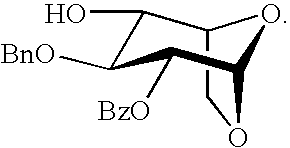
The L-idopyranosyl sugar is obtained from a 5,6-diol:

generated from, for example, commercially available diacetone alpha-D-glucose. The 5,6-diol may undergo one-pot benzoylation-mesylation to yield a furanose:

Treatment of the furanose with t-BuOK in t-BuOH followed by addition of a 1:2 mixture of 0.6 N H2SO4 and diglyme and subsequent heating at elevated temperature (160° C.) for 16 hours leads to the a 2,4-diol:


by employing a combination of amino-azido conversion at C2 and 4,6-O-naphthylidenation. Regioselective O1-benzoylation of the 1,3 diol: with 1-N-(benzyloxy)benzotriazole (BzOBT) followed by O3-benzylation affords a benzoyl and benzylated intermediate:


and a first beta-linked disaccharide:


Claims (7)


Priority Applications (1)
| Application Number | Priority Date | Filing Date | Title |
|---|---|---|---|
| US11/970,274 US7655769B2 (en) | 2004-07-20 | 2008-01-07 | Orthogonally protected disaccharide building blocks for synthesis of heparin |
Applications Claiming Priority (3)
| Application Number | Priority Date | Filing Date | Title |
|---|---|---|---|
| US58949604P | 2004-07-20 | 2004-07-20 | |
| US11/185,664 US7582737B2 (en) | 2004-07-20 | 2005-07-20 | Orthogonally protected disaccharide building blocks for synthesis of heparin oligosaccharides |
| US11/970,274 US7655769B2 (en) | 2004-07-20 | 2008-01-07 | Orthogonally protected disaccharide building blocks for synthesis of heparin |
Related Parent Applications (1)
| Application Number | Title | Priority Date | Filing Date |
|---|---|---|---|
| US11/185,664 Continuation US7582737B2 (en) | 2004-07-20 | 2005-07-20 | Orthogonally protected disaccharide building blocks for synthesis of heparin oligosaccharides |
Publications (2)
| Publication Number | Publication Date |
|---|---|
| US20080171722A1 US20080171722A1 (en) | 2008-07-17 |
| US7655769B2 true US7655769B2 (en) | 2010-02-02 |
Family
ID=36146140
Family Applications (2)
| Application Number | Title | Priority Date | Filing Date |
|---|---|---|---|
| US11/185,664 Expired - Lifetime US7582737B2 (en) | 2004-07-20 | 2005-07-20 | Orthogonally protected disaccharide building blocks for synthesis of heparin oligosaccharides |
| US11/970,274 Expired - Lifetime US7655769B2 (en) | 2004-07-20 | 2008-01-07 | Orthogonally protected disaccharide building blocks for synthesis of heparin |
Family Applications Before (1)
| Application Number | Title | Priority Date | Filing Date |
|---|---|---|---|
| US11/185,664 Expired - Lifetime US7582737B2 (en) | 2004-07-20 | 2005-07-20 | Orthogonally protected disaccharide building blocks for synthesis of heparin oligosaccharides |
Country Status (1)
| Country | Link |
|---|---|
| US (2) | US7582737B2 (en) |
Cited By (1)
| Publication number | Priority date | Publication date | Assignee | Title |
|---|---|---|---|---|
| US8614314B2 (en) | 2008-05-30 | 2013-12-24 | Momenta Pharmaceuticals, Inc. | Saccharide structures and methods of making and using such structures |
Families Citing this family (12)
| Publication number | Priority date | Publication date | Assignee | Title |
|---|---|---|---|---|
| US20090137793A1 (en) * | 2007-11-19 | 2009-05-28 | Academia Sinica | Disaccharide compounds |
| US9029530B2 (en) | 2009-01-02 | 2015-05-12 | Biomarin Pharmaceutical Inc. | Detection of oligosaccharides |
| US8232073B2 (en) | 2009-01-02 | 2012-07-31 | Zacharon Pharmaceuticals, Inc. | Quantification of non-reducing end glycan residual compounds |
| US8809009B2 (en) | 2009-01-02 | 2014-08-19 | Biomarin Pharmaceutical Inc. | Methods of diagnosing a disease and methods of monitoring treatment of a disease by quantifying a non-reducing end glycan residual compound and comparing to a second biomarker |
| CA2757091A1 (en) * | 2009-03-30 | 2010-10-14 | University Of Georgia Research Foundation, Inc. | Heparan sulfate synthesis |
| WO2011014793A2 (en) * | 2009-07-31 | 2011-02-03 | Reliable Biopharmaceutical Corporation | Process for preparing fondaparinux sodium and intermediates useful in the synthesis thereof |
| FR2949114B1 (en) | 2009-08-14 | 2011-08-26 | Sanofi Aventis | FGF RECEPTOR ACTIVATORY N-ACYLATED OCTASACCHARIDES, THEIR PREPARATION AND THEIR THERAPEUTIC APPLICATION |
| FR2949115B1 (en) * | 2009-08-14 | 2012-11-02 | Sanofi Aventis | FGF RECEPTOR ACTIVATOR N-SULFATE OLIGOSACCHARIDES, THEIR PREPARATION AND THEIR THERAPEUTIC APPLICATION |
| US8420790B2 (en) | 2009-10-30 | 2013-04-16 | Reliable Biopharmaceutical Corporation | Efficient and scalable process for the manufacture of Fondaparinux sodium |
| WO2013184564A1 (en) * | 2012-06-05 | 2013-12-12 | Academia Sinica | Methods and intermediates for the preparation of fondaparinux |
| EP3024840B1 (en) * | 2013-07-25 | 2019-10-02 | ScinoPharm Taiwan, Ltd. | Process for the production of fondaparinux sodium |
| WO2024054682A2 (en) * | 2022-09-09 | 2024-03-14 | The University Of North Carolina At Chapel Hill | Ultralow molecular weight heparin |
-
2005
- 2005-07-20 US US11/185,664 patent/US7582737B2/en not_active Expired - Lifetime
-
2008
- 2008-01-07 US US11/970,274 patent/US7655769B2/en not_active Expired - Lifetime
Non-Patent Citations (8)
| Title |
|---|
| Hirsh et al,, "Guide to Anticoagulant Therapy: Heparin: A Statement for Healthcare Professionals From The American the American Heart Association," Circulation, Jun. 19, 2001;103(24)2994-3018. |
| Lee et al, "Synthesis of Heparin Oligosaccharides," J. Am Chem. Soc, 126:476-477 (2004) Publication Date Dec. 19, 2003, Plus Supplemental Information. |
| Lohman et al., "A Sterochemical Surprise at the Late Stage of the Synthesis of a Fully N-Differentiated Heparin Oligosaccharides Containing Amino, Acetamido, and N-Sulfonate Groups," Journal of Organic Chemistry, 69(12), 4081-4093 (2004). * |
| Noti et al., "Preparation and Use of Microarrays Containing Synthetic Heparin Oligosaccharides for the Rapid Analysis of Heparin-Protein Interacitons," Chemistry: A European Journal, 12(34), 8664-8686 (2006). * |
| O'Neil et al. (eds.), The Merck Index, An Encyclopedia of Chemicals, Drugs, and Biologicals, 13th Editions, 2001, Merck & Co., Whitehouse Station, NJ, only pp. 830-831 supplied, see entry 4670 ("Heparin"). * |
| Tabeur et al, "L-iduronic acid derivatives as glycosyl donors," Carohydr. Res. 23;281(2)253-76. |
| Tabeur et al., "L-Iduronic Acid Derivatives as GLycosyl Donors," Carbohydrate Research, 281(2), 253-276 (1996). * |
| Yu et al., "Novel Efficient Routes to Heparin Monosaccharides and Disaccharides Achived via Regio- and Stereoselective Glycosidation," Organic Letters, 6(5), 723-726 .(2004). * |
Cited By (2)
| Publication number | Priority date | Publication date | Assignee | Title |
|---|---|---|---|---|
| US8614314B2 (en) | 2008-05-30 | 2013-12-24 | Momenta Pharmaceuticals, Inc. | Saccharide structures and methods of making and using such structures |
| US9163047B2 (en) | 2008-05-30 | 2015-10-20 | Momenta Pharmaceuticals, Inc. | Saccharide structures and methods of making and using such structures |
Also Published As
| Publication number | Publication date |
|---|---|
| US20080171722A1 (en) | 2008-07-17 |
| US7582737B2 (en) | 2009-09-01 |
| US20060079483A1 (en) | 2006-04-13 |
Similar Documents
| Publication | Publication Date | Title |
|---|---|---|
| US20080171722A1 (en) | Heparin Oligosaccharides | |
| US8703923B2 (en) | Process for preparing fondaparinux sodium and intermediates useful in the synthesis thereof | |
| JP4688414B2 (en) | Synthetic heparin pentasaccharide | |
| JPH0566392B2 (en) | ||
| EP0084999B1 (en) | Process for the preparation of organic oligosaccharides, corresponding to fragments of natural muco-polysaccharides, oligosaccharides obtained and their biological applications | |
| JP2000500807A (en) | Synthetic polysaccharides, their preparation and pharmaceutical compositions containing them | |
| PL204623B1 (en) | Novel oligosaccharides, preparation method and pharmaceutical compositions containing same | |
| JP4364959B2 (en) | Carbohydrate derivatives | |
| EP0165134B1 (en) | Oligosaccharides, their preparation by synthesis and their biological use | |
| JP4695756B2 (en) | Novel pentasaccharide, process for producing the same and pharmaceutical composition containing the same | |
| US20100081708A1 (en) | Anticoagulant compounds | |
| CA2771055C (en) | Fgf receptor-activating n-sulfate oligosaccharides, preparation thereof, and therapeutic use thereof | |
| US20100184711A1 (en) | Alpha-GLYCOSYL THIOLS AND alpha-S-LINKED GLYCOLIPIDS | |
| EP3981777A1 (en) | Antiviral compounds and polymers | |
| EP2857411B1 (en) | Method for preparing fully protection heparin pentasaccharide and intermediate thereof | |
| WO2001044263A1 (en) | Oligosaccharides, a process for preparation thereof and pharmaceutical combination containing the same compounds | |
| EP3000820A1 (en) | Synthetic vaccines against Streptococcus pneumoniae serotype 8 | |
| JPWO1995024412A1 (en) | Novel anthracycline derivatives bearing trifluoromethylated sugars | |
| HK1028406B (en) | Carbohydrate derivatives | |
| JPH0576448B2 (en) |
Legal Events
| Date | Code | Title | Description |
|---|---|---|---|
| AS | Assignment |
Owner name: ACADEMIA SINICA, TAIWAN Free format text: ASSIGNMENT OF ASSIGNORS INTEREST;ASSIGNORS:HUNG, SHANG-CHEN;LEE, JINQ-CHYI;LU, XIN-AN;REEL/FRAME:020916/0546;SIGNING DATES FROM 20051021 TO 20051109 Owner name: ACADEMIA SINICA,TAIWAN Free format text: ASSIGNMENT OF ASSIGNORS INTEREST;ASSIGNORS:HUNG, SHANG-CHEN;LEE, JINQ-CHYI;LU, XIN-AN;SIGNING DATES FROM 20051021 TO 20051109;REEL/FRAME:020916/0546 |
|
| STCF | Information on status: patent grant |
Free format text: PATENTED CASE |
|
| FPAY | Fee payment |
Year of fee payment: 4 |
|
| FPAY | Fee payment |
Year of fee payment: 8 |
|
| MAFP | Maintenance fee payment |
Free format text: PAYMENT OF MAINTENANCE FEE, 12TH YEAR, LARGE ENTITY (ORIGINAL EVENT CODE: M1553); ENTITY STATUS OF PATENT OWNER: LARGE ENTITY Year of fee payment: 12 |