US7474649B2 - Scheduling in packet switched networks - Google Patents
Scheduling in packet switched networks Download PDFInfo
- Publication number
- US7474649B2 US7474649B2 US10/506,846 US50684605A US7474649B2 US 7474649 B2 US7474649 B2 US 7474649B2 US 50684605 A US50684605 A US 50684605A US 7474649 B2 US7474649 B2 US 7474649B2
- Authority
- US
- United States
- Prior art keywords
- user
- scheduling
- users
- scheduled
- weight
- Prior art date
- Legal status (The legal status is an assumption and is not a legal conclusion. Google has not performed a legal analysis and makes no representation as to the accuracy of the status listed.)
- Expired - Lifetime, expires
Links
- 238000000034 method Methods 0.000 claims abstract description 20
- 238000004891 communication Methods 0.000 claims abstract description 11
- 230000005540 biological transmission Effects 0.000 claims 2
- 230000001419 dependent effect Effects 0.000 claims 2
- 101150005271 TBF-1 gene Proteins 0.000 description 23
- 238000004364 calculation method Methods 0.000 description 3
- 230000004075 alteration Effects 0.000 description 1
- 230000007423 decrease Effects 0.000 description 1
- 238000005516 engineering process Methods 0.000 description 1
- 238000013468 resource allocation Methods 0.000 description 1
Images



Classifications
-
- H—ELECTRICITY
- H04—ELECTRIC COMMUNICATION TECHNIQUE
- H04L—TRANSMISSION OF DIGITAL INFORMATION, e.g. TELEGRAPHIC COMMUNICATION
- H04L47/00—Traffic control in data switching networks
- H04L47/10—Flow control; Congestion control
- H04L47/24—Traffic characterised by specific attributes, e.g. priority or QoS
-
- H—ELECTRICITY
- H04—ELECTRIC COMMUNICATION TECHNIQUE
- H04W—WIRELESS COMMUNICATION NETWORKS
- H04W72/00—Local resource management
- H04W72/50—Allocation or scheduling criteria for wireless resources
- H04W72/56—Allocation or scheduling criteria for wireless resources based on priority criteria
- H04W72/566—Allocation or scheduling criteria for wireless resources based on priority criteria of the information or information source or recipient
-
- H—ELECTRICITY
- H04—ELECTRIC COMMUNICATION TECHNIQUE
- H04W—WIRELESS COMMUNICATION NETWORKS
- H04W8/00—Network data management
- H04W8/02—Processing of mobility data, e.g. registration information at HLR [Home Location Register] or VLR [Visitor Location Register]; Transfer of mobility data, e.g. between HLR, VLR or external networks
- H04W8/04—Registration at HLR or HSS [Home Subscriber Server]
Definitions
- the invention relates to scheduling of time slots on the radio interface to different users in a packet switched telecommunication network.
- a Time Division Multiple Access, TDMA, radio communication system divides the time space in time slots on a particular transmitting frequency.
- the time slots are grouped together in TDMA-frames and each user gets one time slot. This means that there are as many users as there are time slots in each frame and sharing the same radio frequency. That is the case at least in principle, but some time slots or channels are normally reserved for control information.
- connection When a time slot is assigned to a user in the way described the connection is regarded as circuit switched and the user owns the time slot as long as he needs the connection.
- Circuit switched connections are suitable for connections where there is a continuously ongoing flow of information over the channel, like voice communication, which is also sensitive to delay.
- the traffic is data which has a bursty character and which is not that delay sensitive, the user does not need the channel all the time. He only needs it when there actually is a data packet to send or receive. In the mean time the channel could be used by others. This is the background to packet switched connections where several users may share the same channel.
- the universal TDMA-system GSM was originally designed for circuit switched connections but by adding some extra nodes, this existing system may also be used for packet switched connections, the GPRS-solution (General Packet Radio System).
- GPRS-solution General Packet Radio System
- each user gets one or several time slots reserved for his disposal.
- Other users may, however, use the same time slots and there is a need for scheduling the time slots on the different users, especially when they request service at the same time.
- QoS Quality of Service
- the QoS for a certain data packet also has an impact on the scheduling and users with high class QoS will be favoured in relation to those having lower classes. Thus depending on several parameters the scheduling could become quite complicated.
- the scheduling must be able to distribute the radio resources momentarily between the users according to their weights as far as the reservation situation allows and as soon as they request service.
- the alteration between users must be as finely grained as possible.
- the system When a new user requests service or when another ceases his request, the system must react accordingly without delay.
- the scheduler When there is an unbalance of the reservation distribution, the scheduler must still make full use of each timeslot and a problem with existing prior art solutions is that such efficient use of schedulers cannot be done without favouring or disfavouring certain users.
- Another object is that the scheduling is performed efficiently and without loosing any time slots.
- Still another object is to, without loosing efficiency, keep the balance independent of the number of users, but dependant on the weights associated with each user and the number of available channels.
- a scheduling number for each user i.e. a number defining a certain user's position in a queue for upcoming available channels.
- the user pattern may change during the scheduling sessions. New users enter the scene, while others leave.
- the QoS may also change during a user's session. In an ideal hypothetical situation a new user coming in at the same time as another one leaves having the same QoS and other parameters, the new user replaces the old one without affecting the queue for the remaining users.
- the invention is further defined in the appended claims relating to methods, systems and network elements, wholly or partly incorporated in the systems, for the purpose of scheduling radio resources in a packet switched telecommunication entity.
- FIG. 1 is a general overview of a GPRS-network.
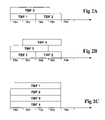
- FIG. 2 shows examples of reservations of a number of users on a packet switched channels in the GPRS-network.
- FIG. 3 is a flowchart describing one embodiment of the invention
- FIG. 1 shows a general overview of a GPRS-system integrated in a conventional GSM-network with its Mobile Switching Centre, MSC, Gateway, GMSC, and Base Station Controller, BSC.
- the added nodes for GPRS are the Serving GPRS Support Node, SGSN, and the Gateway, GGSN, communicating with an IP-network for example.
- a Packet Control Unit, PCU is added to the BSC.
- the described components are connected to Base Station Transceivers, BTS, which communicate with Mobile Stations over a radio interface.
- TBF Temporary Block Flow
- the TBF is divided into a number of radio blocks each consisting of four bursts on a particular channel in four consecutive TDMA-frames.
- a PSET is defined as a number of packet data channels, PDCH, in the TDMA-frame assigned to the users of packet switching on a radio frequency, while the rest of the time slots in the frame are used for circuit switched traffic and control information.
- PDCH packet data channels
- the PCU in the BSC controls the packet data flow.
- the Medium Access Control (MAC)-protocol multiplexes the concurrent TBFs onto the radio interface.
- MAC Medium Access Control
- Each TBF has an associated weight related to the QoS for the priority of traffic handling. In an ideal situation, the schedulings a certain TBF receives is proportional to its weight divided by the sum of weights.
- the PSET is not necessarily limited to a fixed number of channels on the carrier frequency, but could vary during the session and include different time slots. For simplicity reasons, however, this description is further on limited to a fixed PSET.
- a scheduling session starts when at least one user requests packet switched service on the PSET and ends when all users participating in the session have sent their last packet.
- a new scheduling number is calculated for each user whenever the system is ready to send a new radio block.
- the number depends on the QoS weight but is independent of the structure of the PSET and the particular time slots allocated to each user. Account is also taken for changes in user pattern.
- the invention aims to give a new user a place in the scheduling queue which place he would have had if he had been there from the start.
- “virtual” scheduling number is used. “Virtual” means that the number may differ from the real number for calculation reason. For example a starting value for the number differing from zero must be used according to a suggested algorithm below.
- FIGS. 2A and B A first example of a scheduling scheme is explained by reference to FIGS. 2A and B and some tables below.
- FIG. 2A shows the packet switched reservations for three TBFs, TBF1-3 on a PSET occupying the first four time slots TS0-3 of a TDMA-frequency. The rest of the time slots (only TS4 is shown) are used for other traffic.
- TBF1 has a reservation on the two first time slots TS0 and TS1.
- TBF2 uses time slots TS2 and TS3 while TBF3 partly covers the others by being reserved on the three time slots TS0-2.
- the weights for the three users are:
- Table 1 shows the first two schedulings rounds of the three TBFs. All the start values for S are 1.
- the maximum r-ratio decides which TBF will get the first time slot, TS0. As seen r2 is greatest (4/1), but TBF2 does not use TS0—see FIG. 2A . Second greatest is r3 (3/1) and since TBF3 uses TS0 that user gets the first time slot. S3 is increased by one and its r-value decreases (to 3/2). Now the greatest r-value still is r2 (4/1), but TBF2 neither uses TS1. Second greatest is once again r3 (3/2) and TBF3 also gets TS1. TBF2 uses TS2 and gets this time slot and also the last one, TS3, of the first scheduling round.
- TBF1 has the first highest r-value (1/1) of the users of TS0 and TBF1 gets that time slot.
- TBF3 has the same r-value (3/3) but in this example the user number is decisive.
- TBF3 gets one and TBF2 two more time slots.
- eight time slots have been scheduled and TBF1 got one, TBF2 got four and TBF3 three, i.e. according to their weights, which would had been expected for a correct method.
- That user has a reservation consisting of TS1-3, a weight of 2 and gets a starting value S 1 of 11/4 (11*2/(10-2) according to the expression for S 1 above.
- the real numbers fulfil the weights.
- the numbers within parenthesis represent ideal values. Even if the example shows a good result, the calculations indicate that a user like TBF2 with high QoS-value may be disfavoured if his reservation is limited to a few time slots. A conclusion is that users with high weights should get more time slots on the PSET.
- FIG. 2C Another example is given in FIG. 2C .
- TBF1-3 and 5 have had an ongoing scheduling procedure for forty rounds.
- table 3 the distribution of time slots among the TBFs are shown from the 41 st round. After the 46 th round the new user TBF4 is set up. According to the general expression for S1 above the starting value for S for the new user will be 33.133. The new user is shown in bold characters.
- TBF1 TBF5 TBF2 TBF3 41 TBF1 TBF5 TBF2 TBF3 42 TBF2 TBF1 TBF5 TBF2 43 TBF1 TBF5 TBF2 TBF3 44 TBF2 TBF1 TBF5 TBF2 45 TBF1 TBF5 TBF2 TBF3 46 TBF2 TBF1 TBF5 TBF2 47 TBF1 TBF4 TBF5 TBF2 48 TBF3 TBF2 TBF1 TBF5 49 TBF2 TBF1 TBF4 TBF5 50 TBF2 TBF3 TBF2 TBF1 51 TBF5 TBF2 TBF1 TBF4 TBF5 50 TBF2 TBF3 TBF2 TBF1 51 TBF5 TBF2 TBF1 TBF4
- table 4 the new values for the 47 th scheduling are shown. At least the integer part of the S-numbers exactly corresponds to the weights associated with all the users. It should be noted that the new user with a weight of 1 has almost the same value (33.133 vs. 33.300) as the existing user TBF3 having the same weight.
- the actual scheduling is performed on the radio interface by the transmitters, i.e. in the radio base stations and mobile stations, but under control of the PCU.
- Control information is sent over the A-bis interface between the BSC and the BTSs for control of the transceivers, TRXs, of the base stations and further on over the air to the mobiles when these are the objects of the scheduling scheme.
- FIG. 3 shows a flow chart for scheduling a user TBFi on its packet switched channels belonging to a PSET according to the invention.
- i represents the number of the user and j is a scheduling step where one radio block is scheduled for a particular user.
- the total number of radio blocks for the user's session is denoted n.
- j is set to 1 and the system prepares for scheduling the user's first radio block.
- the initial Sij-value (Sil for user i) is established in box 31 .
- the rij-relation between Sij and the weight Wi for the user is calculated in box 32 .
- the calculated value is stored in box 33 together with r-values belonging to other users.
- FIG. 3 thus shows two main loops to be passed when scheduling a user in a packet switched communication system i.e.
- the invention relates to scheduling of several users in a packet switched radio communication network.
- the idea of the invention is to calculate a scheduling number for each user before each scheduling event.
- the number is related to the QoS requested by the particular user and earlier schedulings.
- the relation is decisive of which user to be scheduled in the next event.
- the chosen algorithm for the scheduling according to the preferred embodiments above should rather be regarded as examples for realising the idea of the invention. It is possible to use other start values and calculations along the way. For example it would be possible to use real scheduling numbers for at least the original users, start on zero and use another expression for the r-relation. A new user will, however, have to use a higher start value matching the users already in scheduling sessions, thus denoting at least the new users scheduling number a “virtual” dito.
- the invention has been described mainly in relation to GSM and its related packet switched system GPRS. However, the skilled man immediately realises, that the idea of the invention is applicable as soon there are several users sharing the same radio resources and where there are good reasons to distribute the resources as evenly and fair as possible, especially over a time divisional radio interface with a dynamic behaviour among the users.
Landscapes
- Engineering & Computer Science (AREA)
- Computer Networks & Wireless Communication (AREA)
- Signal Processing (AREA)
- Databases & Information Systems (AREA)
- Mobile Radio Communication Systems (AREA)
- Data Exchanges In Wide-Area Networks (AREA)
- Ultra Sonic Daignosis Equipment (AREA)
Applications Claiming Priority (1)
| Application Number | Priority Date | Filing Date | Title |
|---|---|---|---|
| PCT/SE2002/000389 WO2003075600A1 (en) | 2002-03-05 | 2002-03-05 | Scheduling in packet switched networks |
Publications (2)
| Publication Number | Publication Date |
|---|---|
| US20050180427A1 US20050180427A1 (en) | 2005-08-18 |
| US7474649B2 true US7474649B2 (en) | 2009-01-06 |
Family
ID=27786632
Family Applications (1)
| Application Number | Title | Priority Date | Filing Date |
|---|---|---|---|
| US10/506,846 Expired - Lifetime US7474649B2 (en) | 2002-03-05 | 2002-03-05 | Scheduling in packet switched networks |
Country Status (7)
| Country | Link |
|---|---|
| US (1) | US7474649B2 (de) |
| EP (1) | EP1483928B1 (de) |
| AT (1) | ATE475291T1 (de) |
| AU (1) | AU2002235092A1 (de) |
| DE (1) | DE60237117D1 (de) |
| ES (1) | ES2349274T3 (de) |
| WO (1) | WO2003075600A1 (de) |
Cited By (1)
| Publication number | Priority date | Publication date | Assignee | Title |
|---|---|---|---|---|
| US20120213067A1 (en) * | 2004-09-03 | 2012-08-23 | Harper Matthew H | Rf-aware packet filtering in radio access networks |
Families Citing this family (7)
| Publication number | Priority date | Publication date | Assignee | Title |
|---|---|---|---|---|
| US7313143B1 (en) * | 2003-09-26 | 2007-12-25 | Itt Manufacturing Enterprises, Inc. | Method for diversity site group operations in air/ground communications |
| KR20050038977A (ko) * | 2003-10-23 | 2005-04-29 | 삼성전자주식회사 | 무선 통신 시스템에서 자원 할당 정보 송수신 시스템 및방법 |
| ATE494748T1 (de) * | 2003-11-27 | 2011-01-15 | Telecom Italia Spa | Verfahren zur simulation eines kommunikationsnetzes, das die dienstqualität betrachtet |
| US7711373B2 (en) * | 2006-05-11 | 2010-05-04 | Nokia Corporation | Multiradio control interface |
| US7693486B2 (en) * | 2006-05-11 | 2010-04-06 | Nokia Corporation | Distributed multiradio controller |
| US20080118014A1 (en) * | 2006-11-16 | 2008-05-22 | Nokia Corporation | Utilizing wake-up signals for synchronizing multiradio timing |
| US8797983B2 (en) * | 2012-01-05 | 2014-08-05 | Telefonaktiebolaget L M Ericsson (Publ) | Apparatuses and methods for allocating spectrum resources in a wireless communication network |
Citations (11)
| Publication number | Priority date | Publication date | Assignee | Title |
|---|---|---|---|---|
| EP0545533A2 (de) | 1991-11-01 | 1993-06-09 | AT&T Corp. | Zuweisung der Kommunikationsmitteln in einem schnurlosen Fernmeldesystem |
| WO2001035278A1 (en) | 1999-11-10 | 2001-05-17 | Fakhouri Sameh A | A decision based system for managing distributed resources and modeling the global optimization problem |
| WO2001052588A1 (en) | 2000-01-07 | 2001-07-19 | Qualcomm Incorporated | System for allocating resources in a communication system |
| WO2002009358A2 (en) | 2000-07-26 | 2002-01-31 | Santera Systems, Inc. | Method of active dynamic resource assignment in a telecommunications network |
| WO2002019744A2 (en) | 2000-09-01 | 2002-03-07 | Nokia Mobile Phones Limited | Class based bandwidth scheduling for cdma air interfaces |
| US20020041566A1 (en) * | 2000-08-11 | 2002-04-11 | Jen-Shun Yang | Dynamic scheduling for packet data network |
| US20020044527A1 (en) * | 2000-02-18 | 2002-04-18 | Zhimei Jiang | Channel efficiency based packet scheduling for interactive data in cellular networks |
| US20020150115A1 (en) * | 2001-03-09 | 2002-10-17 | O. Raif Onvural | Time based packet scheduling and sorting system |
| US20030081635A1 (en) * | 2001-10-31 | 2003-05-01 | Nec Corporation | Packet communication system and packet communication method for use in the same system |
| US20030198207A1 (en) * | 2001-12-11 | 2003-10-23 | Samsung Electronics Co., Ltd. | Method and apparatus for scheduling data packet transmission according to QoS in a mobile communication system |
| US6748220B1 (en) * | 2000-05-05 | 2004-06-08 | Nortel Networks Limited | Resource allocation in wireless networks |
-
2002
- 2002-03-05 DE DE60237117T patent/DE60237117D1/de not_active Expired - Lifetime
- 2002-03-05 AU AU2002235092A patent/AU2002235092A1/en not_active Abandoned
- 2002-03-05 WO PCT/SE2002/000389 patent/WO2003075600A1/en not_active Ceased
- 2002-03-05 EP EP02701863A patent/EP1483928B1/de not_active Expired - Lifetime
- 2002-03-05 AT AT02701863T patent/ATE475291T1/de not_active IP Right Cessation
- 2002-03-05 ES ES02701863T patent/ES2349274T3/es not_active Expired - Lifetime
- 2002-03-05 US US10/506,846 patent/US7474649B2/en not_active Expired - Lifetime
Patent Citations (11)
| Publication number | Priority date | Publication date | Assignee | Title |
|---|---|---|---|---|
| EP0545533A2 (de) | 1991-11-01 | 1993-06-09 | AT&T Corp. | Zuweisung der Kommunikationsmitteln in einem schnurlosen Fernmeldesystem |
| WO2001035278A1 (en) | 1999-11-10 | 2001-05-17 | Fakhouri Sameh A | A decision based system for managing distributed resources and modeling the global optimization problem |
| WO2001052588A1 (en) | 2000-01-07 | 2001-07-19 | Qualcomm Incorporated | System for allocating resources in a communication system |
| US20020044527A1 (en) * | 2000-02-18 | 2002-04-18 | Zhimei Jiang | Channel efficiency based packet scheduling for interactive data in cellular networks |
| US6748220B1 (en) * | 2000-05-05 | 2004-06-08 | Nortel Networks Limited | Resource allocation in wireless networks |
| WO2002009358A2 (en) | 2000-07-26 | 2002-01-31 | Santera Systems, Inc. | Method of active dynamic resource assignment in a telecommunications network |
| US20020041566A1 (en) * | 2000-08-11 | 2002-04-11 | Jen-Shun Yang | Dynamic scheduling for packet data network |
| WO2002019744A2 (en) | 2000-09-01 | 2002-03-07 | Nokia Mobile Phones Limited | Class based bandwidth scheduling for cdma air interfaces |
| US20020150115A1 (en) * | 2001-03-09 | 2002-10-17 | O. Raif Onvural | Time based packet scheduling and sorting system |
| US20030081635A1 (en) * | 2001-10-31 | 2003-05-01 | Nec Corporation | Packet communication system and packet communication method for use in the same system |
| US20030198207A1 (en) * | 2001-12-11 | 2003-10-23 | Samsung Electronics Co., Ltd. | Method and apparatus for scheduling data packet transmission according to QoS in a mobile communication system |
Cited By (3)
| Publication number | Priority date | Publication date | Assignee | Title |
|---|---|---|---|---|
| US20120213067A1 (en) * | 2004-09-03 | 2012-08-23 | Harper Matthew H | Rf-aware packet filtering in radio access networks |
| US9160712B2 (en) * | 2004-09-03 | 2015-10-13 | Cisco Technology, Inc. | RF-aware packet filtering in radio access networks |
| US9906455B2 (en) | 2004-09-03 | 2018-02-27 | Cisco Technology, Inc. | RF-aware packet filtering in radio access networks |
Also Published As
| Publication number | Publication date |
|---|---|
| WO2003075600A1 (en) | 2003-09-12 |
| AU2002235092A1 (en) | 2003-09-16 |
| EP1483928A1 (de) | 2004-12-08 |
| ATE475291T1 (de) | 2010-08-15 |
| US20050180427A1 (en) | 2005-08-18 |
| ES2349274T3 (es) | 2010-12-29 |
| DE60237117D1 (de) | 2010-09-02 |
| EP1483928B1 (de) | 2010-07-21 |
Similar Documents
| Publication | Publication Date | Title |
|---|---|---|
| US7190684B2 (en) | Method and system for UMTS packet transmission scheduling on shared downlink channels | |
| Akyildiz et al. | Medium access control protocols for multimedia traffic in wireless networks | |
| EP0975186B1 (de) | Ressourcenzuweisung auf Burstebene in zellularen Systemen | |
| US7948962B2 (en) | Cellular communication system, apparatus and method for management of backhaul resources | |
| US20040156367A1 (en) | Hierarchically distributed scheduling apparatus and method | |
| EP1209936A1 (de) | Verfahren und System zur Ablaufsteuerung der Versendung von UMTS-Paketen auf gemeisamen Abwärtskanälen | |
| CN101480077A (zh) | 蜂窝通信系统中的动态资源重用模式选择 | |
| JPWO2005039209A1 (ja) | シグナリング方法、システム、基地局並びに移動局 | |
| EP1209940A1 (de) | Verfahren und System zur Ablaufsteuerung der Versendung von UMTS-Paketen auf Aufwärtskanäle | |
| US7474649B2 (en) | Scheduling in packet switched networks | |
| EP1476983B1 (de) | Hierarchische und gewichtete warteschlangenablaufsteuerung für paketdaten | |
| CA2378619A1 (en) | Multiplexing of real time users and non-priority users on an egprs channel | |
| JP2001036503A (ja) | 符号分割多重アクセス移動体無線通信システムにおいて、容量を分配する方法 | |
| EP1853009A1 (de) | Resourcensteuerung für geplanten und nicht-geplanten Datenverkehr | |
| Rhee et al. | A wireless fair scheduling algorithm for 1/spl times/EV-DO system | |
| US7197023B2 (en) | Method and apparatus for controlling the sending of data blocks | |
| Yu et al. | Dynamic adaptive QoS provisioning over GPRS wireless mobile links | |
| WO2007129186A1 (en) | Resource control for scheduled and non-scheduled traffic | |
| Kwok et al. | Performance evaluation of multiple access control schemes for wireless multimedia services | |
| Tataranni et al. | Modeling and Analysis of the Behavior of GPRS Systems | |
| Ouni | Dynamic slot assignment protocol for QoS support on TDMA-based mobile networks | |
| Wang et al. | A wireless TDMA/FDD MAC protocol based on a novel resource updating scheme | |
| Ajib et al. | Effects of circuit switched transmissions over GPRS performance | |
| Yu et al. | QoS provisioning over GPRS wireless mobile links | |
| Haas et al. | The dynamic packet reservation multiple access scheme for multimedia traffic |
Legal Events
| Date | Code | Title | Description |
|---|---|---|---|
| AS | Assignment |
Owner name: TELEFONAKTIEBOLAGET LM ERICSSON (PUBL), SWEDEN Free format text: ASSIGNMENT OF ASSIGNORS INTEREST;ASSIGNORS:ERIKSSON, ANN-CHRISTINE;WERNER, PETER;ERIKSSON, HEINZ ROBERT;REEL/FRAME:015955/0311;SIGNING DATES FROM 20040823 TO 20050310 |
|
| STCF | Information on status: patent grant |
Free format text: PATENTED CASE |
|
| CC | Certificate of correction | ||
| FPAY | Fee payment |
Year of fee payment: 4 |
|
| FPAY | Fee payment |
Year of fee payment: 8 |
|
| MAFP | Maintenance fee payment |
Free format text: PAYMENT OF MAINTENANCE FEE, 12TH YEAR, LARGE ENTITY (ORIGINAL EVENT CODE: M1553); ENTITY STATUS OF PATENT OWNER: LARGE ENTITY Year of fee payment: 12 |