US7462975B2 - Actuator - Google Patents
Actuator Download PDFInfo
- Publication number
- US7462975B2 US7462975B2 US11/880,202 US88020207A US7462975B2 US 7462975 B2 US7462975 B2 US 7462975B2 US 88020207 A US88020207 A US 88020207A US 7462975 B2 US7462975 B2 US 7462975B2
- Authority
- US
- United States
- Prior art keywords
- electrode
- electric field
- moving body
- vibrating
- faces
- Prior art date
- Legal status (The legal status is an assumption and is not a legal conclusion. Google has not performed a legal analysis and makes no representation as to the accuracy of the status listed.)
- Active
Links
Images


Classifications
-
- H—ELECTRICITY
- H02—GENERATION; CONVERSION OR DISTRIBUTION OF ELECTRIC POWER
- H02N—ELECTRIC MACHINES NOT OTHERWISE PROVIDED FOR
- H02N2/00—Electric machines in general using piezoelectric effect, electrostriction or magnetostriction
- H02N2/02—Electric machines in general using piezoelectric effect, electrostriction or magnetostriction producing linear motion, e.g. actuators; Linear positioners ; Linear motors
- H02N2/021—Electric machines in general using piezoelectric effect, electrostriction or magnetostriction producing linear motion, e.g. actuators; Linear positioners ; Linear motors using intermittent driving, e.g. step motors, piezoleg motors
- H02N2/025—Inertial sliding motors
Definitions
- This invention relates to an actuator which synchronizes electrostatic adsorption with the vibration of a piezoelectric element to perform a step-driving operation.
- an electrostatic actuator is proposed instead of the conventional electromagnetic actuator.
- an actuator which synchronizes electrostatic adsorption with the vibration of a piezoelectric element to perform a step-driving operation is known as is disclosed in U.S. Pat. No. 6,841,899, for example.
- the step-driving actuator includes a substrate extended in a predetermined direction, a vibrating member supported on the substrate vibratably in the predetermined direction, a vibration generating portion configured to vibrate the vibrating member in the predetermined direction, a movable member having a first facing surface confronting the substrate and a second facing surface confronting the vibrating member, a movable electrode disposed at any one of the first facing surface and second facing surface of the movable member, and a counter electrode disposed on any one of the substrate and the vibrating member so as to confront the movable electrode.
- a potential difference is applied between the movable electrode and the counter electrode to cause an electrostatic force to act such that an apparent sliding resistance between the vibrating member and the movable member is greater than an apparent sliding resistance between the substrate and the movable member when displacing the vibrating member in a desired direction relatively on the substrate by vibrating in the predetermined direction, and thereby the movable member is relatively moved in the desired direction on the substrate.
- an actuator comprising:
- a fixing member formed to extend in a predetermined direction
- a vibrator disposed on the fixing member and configured to cause minute displacement in a first direction along the predetermined direction and in a second direction which is opposite to the first direction;
- a vibrating substrate having a first electrode on a surface thereof and configured to be reciprocally moved according to the minute displacement of the vibrator
- a moving body arranged on the surface of the vibrating substrate and having a second electrode on a surface thereof which faces the first electrode with an insulating layer disposed therebetween;
- a controller configured to move the moving body by applying voltage between the first and second electrodes to exert electrostatic adsorptive force therebetween and controlling frictional force between the vibrating substrate and the moving body;
- an electric field reduction area configured to shield an electric field occurring between the first and second electrodes by the voltage applied therebetween in a portion which lies outside the first electrode on the surface of the vibrating substrate and faces the moving body.
- FIG. 1A is a perspective view of an actuator according to a first embodiment of this invention
- FIG. 1B is a plan view of the actuator according to the first embodiment
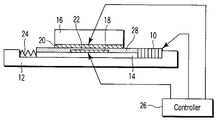
- FIG. 1C is a side view of the actuator according to the first embodiment
- FIG. 2A is a diagram showing driving waveforms when a moving body is moved in a left direction in FIGS. 1B and 1C ;
- FIG. 2B is a diagram showing driving waveforms when the moving body is moved in a right direction
- FIG. 3A is a view for explaining an electric field reduction area in a case where the moving body is moved in the left direction;
- FIG. 3B is a view for explaining the electric field reduction area in a case where the moving body is moved in the right direction;
- FIG. 4 is an enlarged view showing the electric field reduction area, for illustrating the operation and effect of the actuator according to the first embodiment
- FIG. 5A is a plan view of an actuator according to a second embodiment of this invention.
- FIG. 5B is a side view of the actuator according to the second embodiment
- FIG. 6 is a side view of a modification of the actuator according to the second embodiment
- FIG. 7A is a side view of an actuator according to a third embodiment of this invention.
- FIG. 7B is a plan view showing a vibrating substrate (the moving body is not shown).
- FIG. 8A is a side view of a modification of the actuator according to the third embodiment.
- FIG. 8B is a plan view showing a vibrating substrate (the moving body is not shown).
- a piezoelectric element 10 as a vibrator is fixed on a fixing member 12 and the other end thereof is fixed on one end of a vibrating substrate 14 .
- a moving body 16 which is movable in a vibrating direction of the piezoelectric element 10 is disposed on the vibrating substrate 14 .
- a first electrode 18 is formed on the surface of the vibrating substrate 14 which faces the moving body 16 and a second electrode 20 is formed on the surface of the moving body 16 which faces the vibrating substrate 14 .
- FIG. 1C only the electrodes 18 , 20 are shown in a cross-sectional form. This applies to the other drawings explained below.
- the first and second electrodes 18 , 20 are arranged to face each other while an insulating film 22 which is an insulating layer formed on the first electrode 18 is disposed therebetween.
- electrostatic adsorptive force is applied between the electrodes.
- guide rails are provided to prevent the moving body 16 from being moved in an undesired direction and into an undesired range and restrict the moving direction and moving range as in the conventional case.
- the other end of the vibrating substrate 14 is biased towards the piezoelectric element 10 by a bias spring 24 .
- the following driving voltages are applied to the piezoelectric element 10 and first and second electrodes 18 , 20 from a controller 26 .
- the controller is shown only in FIG. 1C and is not shown in the other drawing (likewise, the controller is not shown in the other drawings explained below).
- FIG. 2A shows a case where the moving body 16 is moved in the left direction in FIGS. 1B and 1C and FIG. 2B shows a case where the moving body 16 is moved in the right direction or in the reverse direction.
- the driving principle of the actuator is explained with reference to FIG. 2A .
- a waveform applied to the piezoelectric element 10 rapidly rises in a period from the time point A to the time point B as shown in FIG. 2A .
- the piezoelectric element 10 is rapidly displaced in the left direction and the vibrating substrate 14 is also rapidly moved in the left direction.
- a potential difference occurs between the voltages respectively applied to the first and second electrodes 18 and 20 . Therefore, electrostatic adsorptive force is applied between the vibrating substrate 14 and the moving body 16 to increase the frictional force therebetween.
- the moving body 16 is also moved in the left direction according to the displacement of the vibrating substrate 14 .
- the waveform applied to the piezoelectric element 10 rapidly falls in a period from the time point C to the time point D as shown in FIG. 2A .
- the piezoelectric element 10 is rapidly contracted and the vibrating substrate 14 is rapidly moved in the right direction accordingly.
- the voltage applied to the first electrode 18 is the same as the voltage applied to the second electrode 20 , no electrostatic adsorptive force is applied between the electrodes.
- inertial force of the moving body 16 overcomes the frictional force between the vibrating substrate 14 and the moving body 16 and the moving body 16 tends to stay in the present position.
- the moving body 16 moves in the left direction with respect to the vibrating substrate 14 .
- a potential difference may be applied between the electrodes when the piezoelectric element 10 is rapidly contracted as shown in FIG. 2B .
- Frictional force is applied in synchronism with piezoelectric vibration. Since the moving body 16 is moved only when the frictional force is increased, the driving efficiency is enhanced. Further, the inertial driving operation can be performed without changing the displacement speed of the piezoelectric element 10 in the right and left directions and the driving waveforms can be simplified.
- an electric field reduction area 28 is present in a region which is the surface of the vibrating substrate 14 except a portion corresponding to the first electrode 18 and a portion thereof facing the moving body 16 (in the range in which the moving body 16 is moved).
- the electric field reduction area 28 is an area in which no electric field is generated. Therefore, even when water is formed by condensation on the above portion due to high humidity, a dielectrophoresis phenomenon does not occur since no electric field occurs. Therefore, the water will not be drawn into between the first and second electrodes 18 and 20 .
- the dielectrophoresis phenomenon is a phenomenon in which water is drawn into the electric field if the water is present near a portion where the strong electric field occurs.
- an electrode which faces the second electrode 20 is not formed on the electric field reduction area 28 .
- the electric field reduction area 28 is present on both sides of the first electrode 18 and outside the first electrode 18 (although the plan view is not shown). Therefore, the facing areas of the first and second electrodes 18 and 20 are surrounded with the electric field reduction area 28 .
- a portion of the electric field reduction area 28 which an electrode facing the second electrode 20 is not formed is provided around the first electrode 18 .
- the dielectrophoresis phenomenon that water is drawn into between the electrodes does not occur since the strength of the electric field in the electric field reduction area 28 is not set so high as to draw water therein or an electric field does not occur.
- an electric field reduction area 28 is formed on a portion corresponding to the surface of a moving body 16 excluding a second electrode 20 and the surface of a vibrating substrate 14 facing the moving body 16 .
- the second electrode 20 is contained in the electric field reduction area 28 , but in the actuator according to the present embodiment, the second electrode 20 is not contained. Therefore, an electric field between the first and second electrodes 18 and 20 is shielded by the electric field reduction area 28 .
- a dielectrophoresis phenomenon that water is drawn into between the first and second electrodes 18 and 20 does not occur even when water is formed by condensation on the vibrating substrate. Therefore, the ability of the actuator can be fully exhibited even when the actuator according to the present embodiment is used under the high-humidity environment.
- the lengths of the facing surfaces of the first and second electrodes 18 and 20 are set to the same length, but as shown in FIG. 6 , the facing surface of the second electrode 20 may be made shorter than the facing surface of the first electrode 18 .
- a ring-form electric field shielding electrode 32 is formed to surround the outer periphery of a first electrode 18 in an electric field reduction area 28 .
- the electric field shielding electrode 32 is formed to face a second electrode 20 arranged on a moving body 16 .
- FIG. 7B for easy understanding of the feature of the present embodiment, it should be noted that the moving body 16 on the vibrating substrate 14 is not shown in the drawing.
- the electric field shielding electrode 32 By arranging the electric field shielding electrode 32 outside the first electrode 18 , the same effect as that obtained by arranging one type of a guard electrode can be attained. That is, an electric field occurring between the first and second electrodes 18 and 20 will not leak to the exterior of the electric field shielding electrode 32 by the presence of the electric field shielding electrode 32 . Therefore, occurrence of a dielectrophoresis phenomenon can be suppressed and a variation in electrostatic force can be suppressed.
- voltage applied to the second electrode 20 is kept applied to the ring-form electric field shielding electrode 32 .
- potentials of the electric field shielding electrode 32 and the second electrode 20 are set equal and the electric field between the first and second electrodes 18 and 20 can be shielded.
- a dielectrophoresis phenomenon does not occur, and therefore, water is not drawn into an inside portion of the electric field shielding electrode 32 .
- the dielectrophoresis phenomenon is a phenomenon that water is drawn into the electric field if the water is present near a portion where the strong electric field occurs. However, the drawn water is not discharged from the electric field and is stably kept remain in the electric field.
- the condition is set to generate an electric field between the electric field shielding electrode 32 and the second electrode 20 by applying voltage to cause a potential difference to always occur between the electric field shielding electrode 32 and the second electrode 20 .
- water 30 is drawn by the electric field between the electric field shielding electrode 32 and the second electrode 20 , stably stays in the electric field and is not discharged from the area even if the water 30 is present on the vibrating substrate 14 by condensation or the like. Therefore, the water is not drawn into between the first and second electrodes 18 and 20 and electrostatic force between the first and second electrodes 18 and 20 will not vary.
- the electric field shielding electrode 32 is formed in a ring form, but this invention is not limited to this case.
- the same effect can be attained by arranging electric field shielding electrodes 32 only outside the sides of the first electrode 18 to which the moving body 16 moves.
- the vibrator is not limited to the piezoelectric element 10 .
Landscapes
- General Electrical Machinery Utilizing Piezoelectricity, Electrostriction Or Magnetostriction (AREA)
Abstract
Description
Claims (8)
Applications Claiming Priority (2)
| Application Number | Priority Date | Filing Date | Title |
|---|---|---|---|
| JP2006198257A JP2008029108A (en) | 2006-07-20 | 2006-07-20 | Actuator |
| JP2006-198257 | 2006-07-20 |
Publications (2)
| Publication Number | Publication Date |
|---|---|
| US20080018202A1 US20080018202A1 (en) | 2008-01-24 |
| US7462975B2 true US7462975B2 (en) | 2008-12-09 |
Family
ID=38970770
Family Applications (1)
| Application Number | Title | Priority Date | Filing Date |
|---|---|---|---|
| US11/880,202 Active US7462975B2 (en) | 2006-07-20 | 2007-07-20 | Actuator |
Country Status (2)
| Country | Link |
|---|---|
| US (1) | US7462975B2 (en) |
| JP (1) | JP2008029108A (en) |
Cited By (3)
| Publication number | Priority date | Publication date | Assignee | Title |
|---|---|---|---|---|
| US20090015949A1 (en) * | 2007-07-10 | 2009-01-15 | Olympus Corporation | Inertial drive actuator |
| US20090302710A1 (en) * | 2008-06-05 | 2009-12-10 | Olympus Corporation | Inertial drive actuator |
| US9350222B2 (en) | 2011-11-11 | 2016-05-24 | Olympus Corporation | Inertial drive actuator |
Families Citing this family (1)
| Publication number | Priority date | Publication date | Assignee | Title |
|---|---|---|---|---|
| CN105185899A (en) * | 2015-09-23 | 2015-12-23 | 苏州攀特电陶科技股份有限公司 | Preparation method of piezoelectric ceramic polymer composite material |
Citations (2)
| Publication number | Priority date | Publication date | Assignee | Title |
|---|---|---|---|---|
| US6841899B2 (en) * | 2003-03-31 | 2005-01-11 | Olympus Corporation | Actuator, actuator driving method, and atcuator system |
| US7271522B2 (en) * | 2005-02-18 | 2007-09-18 | Konica Minolta Opto, Inc. | Driving device and driving method |
-
2006
- 2006-07-20 JP JP2006198257A patent/JP2008029108A/en not_active Withdrawn
-
2007
- 2007-07-20 US US11/880,202 patent/US7462975B2/en active Active
Patent Citations (2)
| Publication number | Priority date | Publication date | Assignee | Title |
|---|---|---|---|---|
| US6841899B2 (en) * | 2003-03-31 | 2005-01-11 | Olympus Corporation | Actuator, actuator driving method, and atcuator system |
| US7271522B2 (en) * | 2005-02-18 | 2007-09-18 | Konica Minolta Opto, Inc. | Driving device and driving method |
Cited By (5)
| Publication number | Priority date | Publication date | Assignee | Title |
|---|---|---|---|---|
| US20090015949A1 (en) * | 2007-07-10 | 2009-01-15 | Olympus Corporation | Inertial drive actuator |
| US7737606B2 (en) * | 2007-07-10 | 2010-06-15 | Olympus Corporation | Inertial drive actuator |
| US20090302710A1 (en) * | 2008-06-05 | 2009-12-10 | Olympus Corporation | Inertial drive actuator |
| US8253306B2 (en) * | 2008-06-05 | 2012-08-28 | Olympus Corporation | Inertial drive actuator configured to provide arbitrary motion in an X-Y plane |
| US9350222B2 (en) | 2011-11-11 | 2016-05-24 | Olympus Corporation | Inertial drive actuator |
Also Published As
| Publication number | Publication date |
|---|---|
| US20080018202A1 (en) | 2008-01-24 |
| JP2008029108A (en) | 2008-02-07 |
Similar Documents
| Publication | Publication Date | Title |
|---|---|---|
| KR102183393B1 (en) | Lens drive device, camera device, and electronic device | |
| US7764449B2 (en) | Piezoelectric actuator and lens driving device | |
| US7535661B2 (en) | Inertial drive actuator | |
| JP3966704B2 (en) | Electrostatic actuator, driving method of electrostatic actuator, and camera module using the same | |
| WO2008053794A1 (en) | Electrostatic acting device | |
| WO2014203529A1 (en) | Vibration-type actuator, interchangeable lens, image pickup apparatus, and automatic stage | |
| US7462975B2 (en) | Actuator | |
| US10247955B2 (en) | Lens drive device | |
| JP4985945B2 (en) | Method for bonding laminated piezoelectric elements | |
| CN101291121B (en) | Method for driving a driving device | |
| CN102544350B (en) | Piezo-activator | |
| CN101662235A (en) | Method of driving a driving apparatus | |
| US8253306B2 (en) | Inertial drive actuator configured to provide arbitrary motion in an X-Y plane | |
| US10409085B2 (en) | Lens drive device | |
| JP2008289346A (en) | Drive device | |
| JP2008125229A (en) | Inertia driving actuator | |
| US8120231B2 (en) | Inertial drive actuator | |
| US10247956B2 (en) | Lens drive device | |
| JP2008197220A (en) | Lens barrel driving device | |
| JP4343644B2 (en) | Shutter device | |
| JP2006154390A (en) | Lens driving device, and imaging apparatus | |
| JP7264601B2 (en) | lens driver | |
| US8224173B2 (en) | Imaging apparatus | |
| US20060209427A1 (en) | Electrostatic actuator and image pickup apparatus using the same | |
| JP2006078881A (en) | Image blur correction apparatus and small portable terminal having the same |
Legal Events
| Date | Code | Title | Description |
|---|---|---|---|
| AS | Assignment |
Owner name: OLYMPUS CORPORATION, JAPAN Free format text: ASSIGNMENT OF ASSIGNORS INTEREST;ASSIGNOR:MATSUKI, KAORU;REEL/FRAME:019632/0568 Effective date: 20070704 |
|
| STCF | Information on status: patent grant |
Free format text: PATENTED CASE |
|
| FEPP | Fee payment procedure |
Free format text: PAYOR NUMBER ASSIGNED (ORIGINAL EVENT CODE: ASPN); ENTITY STATUS OF PATENT OWNER: LARGE ENTITY |
|
| FEPP | Fee payment procedure |
Free format text: PAYER NUMBER DE-ASSIGNED (ORIGINAL EVENT CODE: RMPN); ENTITY STATUS OF PATENT OWNER: LARGE ENTITY Free format text: PAYOR NUMBER ASSIGNED (ORIGINAL EVENT CODE: ASPN); ENTITY STATUS OF PATENT OWNER: LARGE ENTITY |
|
| FPAY | Fee payment |
Year of fee payment: 4 |
|
| FPAY | Fee payment |
Year of fee payment: 8 |
|
| AS | Assignment |
Owner name: OLYMPUS CORPORATION, JAPAN Free format text: CHANGE OF ADDRESS;ASSIGNOR:OLYMPUS CORPORATION;REEL/FRAME:039344/0502 Effective date: 20160401 |
|
| MAFP | Maintenance fee payment |
Free format text: PAYMENT OF MAINTENANCE FEE, 12TH YEAR, LARGE ENTITY (ORIGINAL EVENT CODE: M1553); ENTITY STATUS OF PATENT OWNER: LARGE ENTITY Year of fee payment: 12 |