US7370246B2 - Method and device of de-interleaving successive sequences of interleaved data samples - Google Patents
Method and device of de-interleaving successive sequences of interleaved data samples Download PDFInfo
- Publication number
- US7370246B2 US7370246B2 US11/007,785 US778504A US7370246B2 US 7370246 B2 US7370246 B2 US 7370246B2 US 778504 A US778504 A US 778504A US 7370246 B2 US7370246 B2 US 7370246B2
- Authority
- US
- United States
- Prior art keywords
- interleaving
- cluster
- row
- data samples
- array
- Prior art date
- Legal status (The legal status is an assumption and is not a legal conclusion. Google has not performed a legal analysis and makes no representation as to the accuracy of the status listed.)
- Expired - Lifetime, expires
Links
Images


Classifications
-
- H—ELECTRICITY
- H03—ELECTRONIC CIRCUITRY
- H03M—CODING; DECODING; CODE CONVERSION IN GENERAL
- H03M13/00—Coding, decoding or code conversion, for error detection or error correction; Coding theory basic assumptions; Coding bounds; Error probability evaluation methods; Channel models; Simulation or testing of codes
- H03M13/27—Coding, decoding or code conversion, for error detection or error correction; Coding theory basic assumptions; Coding bounds; Error probability evaluation methods; Channel models; Simulation or testing of codes using interleaving techniques
- H03M13/2778—Interleaver using block-wise interleaving, e.g. the interleaving matrix is sub-divided into sub-matrices and the permutation is performed in blocks of sub-matrices
-
- H—ELECTRICITY
- H03—ELECTRONIC CIRCUITRY
- H03M—CODING; DECODING; CODE CONVERSION IN GENERAL
- H03M13/00—Coding, decoding or code conversion, for error detection or error correction; Coding theory basic assumptions; Coding bounds; Error probability evaluation methods; Channel models; Simulation or testing of codes
- H03M13/27—Coding, decoding or code conversion, for error detection or error correction; Coding theory basic assumptions; Coding bounds; Error probability evaluation methods; Channel models; Simulation or testing of codes using interleaving techniques
- H03M13/2703—Coding, decoding or code conversion, for error detection or error correction; Coding theory basic assumptions; Coding bounds; Error probability evaluation methods; Channel models; Simulation or testing of codes using interleaving techniques the interleaver involving at least two directions
- H03M13/2707—Simple row-column interleaver, i.e. pure block interleaving
-
- H—ELECTRICITY
- H03—ELECTRONIC CIRCUITRY
- H03M—CODING; DECODING; CODE CONVERSION IN GENERAL
- H03M13/00—Coding, decoding or code conversion, for error detection or error correction; Coding theory basic assumptions; Coding bounds; Error probability evaluation methods; Channel models; Simulation or testing of codes
- H03M13/27—Coding, decoding or code conversion, for error detection or error correction; Coding theory basic assumptions; Coding bounds; Error probability evaluation methods; Channel models; Simulation or testing of codes using interleaving techniques
- H03M13/276—Interleaving address generation
-
- H—ELECTRICITY
- H04—ELECTRIC COMMUNICATION TECHNIQUE
- H04L—TRANSMISSION OF DIGITAL INFORMATION, e.g. TELEGRAPHIC COMMUNICATION
- H04L1/00—Arrangements for detecting or preventing errors in the information received
- H04L1/004—Arrangements for detecting or preventing errors in the information received by using forward error control
- H04L1/0056—Systems characterized by the type of code used
- H04L1/0071—Use of interleaving
Definitions
- the invention relates in general to de-interleaving successive sequences of interleaved data samples, and in particular, for high-throughput applications.
- An application of the invention is in the field of wireless communication systems, and more particularly, to CDMA systems such as the different CDMA based mobile radio systems including 3GPP systems.
- Turbo-codes are part of current communication standards due to their outstanding forward error correction performance.
- Turbo-codes include concatenated component codes that work on the same block of information bits, separated by interleavers.
- Interleaving scrambles the processing order to break up neighbor relations in successive data samples, and de-interleaving brings them into the original sequences again.
- Current de-interleaving approaches present several problems, notably a high memory access rate, a memory re-use bottleneck, and no scalability. Indeed, with current approaches, when high-throughput data is transmitted, an adaptation buffer is used, and its size increases as the throughput increases, and with the memory access rate remaining equal.
- An object of the present invention is to enable high-throughput applications.
- a method of de-interleaving successive sequences of interleaved data samples extracted from a virtual memory array having L0 columns and C0 rows comprises the steps of receiving each sequence of the interleaved data samples and writing row by row the received sequences of interleaved data samples in a de-interleaving memory array having L rows and C columns, with L being greater or equal to L0 and C being greater or equal to C0.
- the method may further comprise de-interleaving the data samples stored in the de-interleaving memory array sub-array by sub-array.
- the predetermined sub-array used may be a square cluster array having a predetermined number SQ of rows and columns.
- a cluster array is a row of the square cluster array comprising SQ data samples, with the number L of rows and the number C of columns of the de-interleaving memory array being multiples of the number SQ of rows and columns.
- the square cluster array may be a virtual square cluster array. De-interleaving the de-interleaving memory array sub-array by sub-array allows avoidance of memory re-use bottlenecks, which decreases memory access rate.
- the writing step may comprise a step of completing the de-interleaving memory with padding data to have L rows and C columns, with L and C being multiples of SQ.
- the method may require a square cluster array, so the method may further comprise a complete de-interleaving of the memory array with padding data.
- the square cluster array comprises consecutive or non-consecutive clusters along rows of the de-interleaving memory array.
- the virtual square cluster array may be used to select SQ clusters, with each cluster containing SQ data samples, to perform sub-array de-interleaving.
- data samples have been interleaved in an interleaver having C0 rows and L0 columns.
- Data samples may be read column by column in an interleaving memory array, with a permutation in the columns order and with a permutation that could be the identity permutation.
- the sub-array de-interleaving step may comprise for a first group of clusters of the current cluster array, reading each cluster of the first group, outputting the first data sample of the cluster, and reordering the other data samples of the cluster in a column of a reordering buffer.
- the data samples de-interleaved in the reordering buffer may be written back into the de-interleaving memory at the last SQ-1 accessed clusters.
- the method may further comprise for a second group of previously reordered clusters, reading each cluster of the second group and outputting all the data samples of the cluster.
- a previously reordered cluster may contain simply the de-interleaved data samples previously reordered in the reordering buffer, and written back to the de-interleaving memory during the first phase referred to as processing with reordering.
- the square cluster array de-interleaving comprises cyclically, C/SQ times, L/SQ consecutive processing with reordering of clusters, and L-L/SQ consecutive processing without reordering of clusters.
- the reordering buffer has SQ-1 rows and SQ columns.
- a look-up table having three lines and a number of columns equal to C ⁇ L/SQ is used.
- the look-up table may contain the logical addresses of some of the samples of the current sequence, and the corresponding physical addresses in the de-interleaving memory array.
- the first row of the look-up table may store the logical addresses of the data samples of interleaved data samples of the current sequence stored in the columns of the de-interleaving memory array indexed p(i)+k ⁇ SQ, where p(i) specifies the inter-columns permutation, with i varying from 0 to L/SQ-1, and k varying from 0 to C/SQ-1.
- the second row of the look-up table may store physical addresses of the respective logical addresses of the first row
- the third row of the look-up table may store physical addresses of data samples of the next sequence of interleaved data samples to be written in the de-interleaving memory array, having the respective logical addresses of the first row.
- the square cluster array de-interleaving step may further comprise, after having processed a previous cluster, selecting in the square cluster array, the next cluster having a first data sample having a logical address immediately following the logical address of the last data sample of the previous cluster.
- a de-interleaved device of successive sequences of interleaved data samples for a receiving system is also proposed, with interleaved data samples being extracted from a virtual memory array having L0 columns and C0 rows.
- the de-interleaving device may comprise a de-interleaving memory array, and receiving means for receiving each sequence of the interleaved data samples, and writing means for writing row by row the received sequences of interleaved data samples in the de-interleaving memory array having L rows and C columns.
- a cluster array is a row of the square cluster array comprising SQ data samples, with L being greater or equal to L0 and C being greater or equal to C0.
- the de-interleaving device may also comprise de-interleaving means for de-interleaving the data samples stored in the de-interleaving memory array sub-array by sub-array.
- the used predetermined sub-array may be a square cluster array having a predetermined number SQ of rows and columns.
- the number L of rows and the number C of columns of the de-interleaving memory array are multiples of the number SQ of rows and columns.
- the square cluster array is a virtual square cluster array.
- the de-interleaving means may comprise completing means for completing, if L0 and C0 are not multiples of SQ, the de-interleaving memory array with padding data to have L rows and C columns multiples of SQ.
- the de-interleaving means device may comprise means for defining the square cluster array comprising consecutive or non-consecutive clusters.
- the de-interleaving device may comprise a reordering buffer.
- the de-interleaving means may further comprise first means for reading each cluster of a first group of clusters of the current cluster array, outputting the first data sample of the cluster, and reordering the other data samples of the cluster in a column of the reordering buffer.
- the first means may write its content back at the SQ-1 last accessed clusters into the de-interleaving memory.
- the device may further comprise second means for reading each cluster of a second group of clusters of the current cluster array, and outputting the cluster.
- the reordering buffer may comprise SQ-1 rows and SQ columns.
- the de-interleaving device comprises a look-up table comprising three rows and a number of columns equal to C ⁇ L/SQ.
- the look-up table may contain the logical addresses of some of the data samples of the current sequence and the corresponding physical addresses in the de-interleaving memory array.
- the de-interleaving means may comprise first storing means for storing, in the first row of the look-up table, the logical addresses of the data samples of interleaved data samples of the current sequence stored in the columns of the de-interleaving memory array indexed p(i)+k ⁇ SQ, where p(i) specifies the inter-columns permutation, with i varying from 0 to L/SQ-1, and k varying from 0 to C/SQ-1.
- the de-interleaving means may further comprise second storing means for storing, in the second row of the look-up table, physical addresses of the respective logical addresses of the first row, and third storing means.
- the third storing means stores, in the third row of the look-up table, physical addresses of data samples of the next sequence of interleaved data samples to be written in the de-interleaving memory array, and having the respective logical addresses of the first row.
- the de-interleaving means may comprise selecting means for selecting, after having processed a previous cluster, in the square cluster array, the next cluster having a first data sample having a logical address immediately following the logical address of the last data sample of the previous cluster.
- a receiving apparatus such as a cellular mobile phone, incorporates a de-interleaving device as above defined.
- FIG. 1 is a block diagram of a cellular mobile phone including a de-interleaving device according to the invention
- FIG. 2 is a block diagram of the de-interleaving device shown in FIG. 1 ;
- FIG. 3 illustrates the main steps for de-interleaving according to the invention.
- FIG. 4 illustrates sub-array de-interleaving for the de-interleaving steps shown in FIG. 3 .
- FIG. 1 a de-interleaving device according to the invention is illustrated, which is incorporated in the reception chain of a cellular mobile phone TP.
- the invention is not limited to this particular application.
- the interleaved signal is received by the antenna ANT and processed by the radio frequency stage RF of the receiver.
- the signal is converted into the digital domain by an A/D converter.
- the converted signal is transmitted to a digital process stage DPS which comprises a de-interleaving device according to the invention, and is part of a processing chain which processes the digital base band signal.
- the de-interleaving device 1 comprises a de-interleaving memory 2 , which can be organized as an array.
- Successive sequences of interleaved data samples are received by receiving means 3 , and written row by row in the de-interleaving memory array 2 by writing means 4 .
- the written row by row in the de-interleaving memory array 2 is done cluster by cluster, i.e., each time a cluster is output a new cluster can be written to the empty de-interleaving memory location thereby enabling continuous memory-reuse.
- the de-interleaving memory array 2 has L rows and C columns, where L is greater or equal to L0 and C is greater or equal to C0, with C0 and L0 being respectively the number of rows and the number of columns of a virtual memory array from which interleaved data samples are extracted after interleaving.
- the extraction of data samples is done column by column in the interleaving memory array with a possible permutation of the columns order.
- De-interleaving means 5 allow de-interleaving in the de-interleaving memory array 2 sub-array by sub-array.
- the used predetermined sub-array is a square cluster array having a number SQ of rows and columns.
- a cluster is a row of the square cluster array, containing SQ data samples.
- the square cluster array is virtual, it groups SQ clusters, where the logical address of the first data sample in each cluster follows a chronological order that need to be considered during one reordering step.
- De-interleaving means 5 comprise completing means 6 for completing the de-interleaving memory array 2 with padding data to have L rows and C columns multiples of SQ, if L0 and C0 are not multiples of SQ. Padding data will be eliminated afterwards.
- De-interleaving means 5 also comprise means 7 for defining the square cluster array comprising consecutive or non-consecutive clusters, along rows of the de-interleaving memory array 2 .
- a cluster array comprising SQ clusters of data samples is stored in SQ consecutive columns of the de-interleaving memory array 2 .
- the de-interleaving device 1 further comprises a reordering buffer 8 comprising SQ-1 rows and SQ columns, and the de-interleaving means 5 comprise first means 9 for reading each cluster of a first group of clusters of the current cluster array, outputting the first value of the cluster, and reordering the other values of the cluster in a column of the reordering buffer 8 .
- the de-interleaving means 5 further comprise second means 10 for reading each cluster of a second group of clusters of the current cluster array and outputting the cluster.
- the de-interleaving device 1 also comprises a look-up table 11 comprising three rows and a number of columns equal to C ⁇ L/SQ.
- This look-up table 11 contains the logical addresses of some of the samples of the current sequence, where those samples simply represent the first data sample of a given cluster, and the corresponding physical addresses in the de-interleaving memory array 2 .
- the de-interleaving memory array 2 further comprises first storing means 12 for storing, in the first row of the look-up table 11 , the logical addresses of the samples of interleaved data samples of the current sequence stored in the columns of the de-interleaving memory array 2 indexed p(i)+k ⁇ SQ, where p(i) specifies the inter-columns permutation table and defines the original column position of the i th permuted column in the interleaver, with i varying from 0 to L/SQ-1, and with k varying from 0 to C/SQ-1.
- the de-interleaving memory array 2 also comprises second storing means 13 for storing, in the second row of the look-up table 11 , physical addresses of the respective logical addresses of the first row, and third storing means 14 for storing, in the third row of the look-up table 11 , physical addresses of samples of the next sequence of interleaved data samples to be written in the de-interleaving memory array 2 , having the respective logical addresses of the first row.
- the de-interleaving means 5 comprise selecting means 15 for selecting, after having processed a previous cluster, in the square cluster array, the next cluster having a first data sample having a logical address immediately following the logical address of the last sample of said previous cluster.
- FIG. 3 illustrates an example of a method of de-interleaving successive sequences of interleaved data samples extracted from a virtual memory array having L0 columns and C0 rows.
- the method comprises first (step 20 , FIG. 3 ) receiving (step 200 , FIG. 3 ) each sequence of the interleaved data samples and writing (step 201 , FIG. 3 ) row by row the received sequences of interleaved data samples in the de-interleaving memory array 2 having L rows and C columns, with L being greater or equal to L0 and C being greater or equal to C0.
- the data samples are then stored in the de-interleaving memory array 2 are de-interleaved (step 21 , FIG. 3 ) sub-array by sub-array.
- the used predetermined sub-array is a square cluster array having a predetermined number SQ of rows and of columns.
- a cluster is a row of the square cluster array which comprises SQ data samples.
- the number L of rows and the number C of columns of the de-interleaving memory array 2 are multiples of the number SQ of rows and columns.
- the writing step comprises a step of completing the de-interleaving memory array ( 2 ) with padding data to have L rows and C columns multiples of SQ.
- FIG. 4 illustrates an example embodiment of the sub-array by sub-array de-interleaving step 21 from FIG. 3 .
- First for a first group of clusters of the current cluster array, each cluster of the first group is read (step 2100 , FIG. 4 ).
- the first value of the cluster is output (step 2101 , FIG. 4 ), and the other values of the cluster are reordered (step 2102 , FIG. 4 ) in a column of the reordering buffer 8 .
- the data samples de-interleaved are written back (step 2103 , FIG. 4 ) in the reordering buffer 8 into the de-interleaving memory at the last SQ-1 accessed clusters.
- each cluster of the second group is read (step 2110 , FIG. 4 ) and all the data samples of the cluster are output (step 2111 , FIG. 4 ).
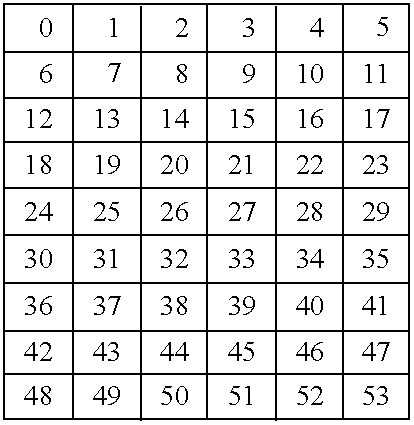
- a sequence with data samples having logical addresses ordered from 0 to 53 has been written in the interleaving memory array row by row.
- the interleaving memory array is read column by column, with the identical permutation in this example, so the sequence of logical addresses of data samples read on its output is: 0, 6, 12, 18, 24, 30, 36, 42, 48, 1, 7, 13, 19, 25, 31, 37, 43, 49, 2, 8, 7, 14, 20, 26, 32, 38, 44, 50, 3, 9, 15, 21, 27, 33, 39, 45, 51, 4, 10, 16, 22, 28, 34, 40, 46, 52, 5, 11, 17, 23, 29, 35, 41, 47, 53.
- This sequence is stored row by row in the de-interleaving memory array, so the de-interleaving memory array 2 contains the data samples having the logical addresses represented in:
- de-interleaving memory array 2 de-interleaving memory array 2 :
- the look-up table 11 contains:
- the first row are the logical addresses of the first data samples in a given cluster, where one cluster contains SQ data samples, and in the second row, the corresponding physical address in the de-interleaving memory array 2 .
- These physical addresses are addresses for reading data samples in the de-interleaving memory array 2 .
- the size SQ ⁇ SQ of the square cluster array is 3 ⁇ 3, as represented above on the de-interleaving memory array 2 .
- the method begins with consideration of the first cluster array, and more particularly, the first cluster of the cluster array, as known, the cluster with the first data sample having the smallest logical address, here 0.
- This first data sample of the first cluster is output, and other data samples of the cluster are reordered in the reordering buffer 8 , written in the first column of the reordering buffer 8 .
- de-interleaving memory array 2 de-interleaving memory array 2 :
- the physical address 0,0 corresponding to the cluster containing the data sample with the logical address 0 is highlighted in the look-up table 11 above.
- the next data sample to be output is the data sample of the cluster of the current cluster array, with the first logical address being 1. This is given by the look-up table, as the physical corresponding address, here 1,0.
- the first data sample of this cluster having the logical address immediately following the last output, is output, and other data samples of the cluster are reordered in the reordering buffer 8 , written in the first column of the reordering buffer 8 .
- de-interleaving memory array 2 de-interleaving memory array 2 :
- the physical address 1,0 corresponding to the cluster containing the data sample with the logical address 1 is highlighted in the look-up table 11 above.
- the next data sample to be output is the data sample of the cluster of the current cluster array, with the first logical address being 2. This is given by the look-up table, as the physical corresponding address, here 2,0.
- the first data sample of this cluster having the logical address immediately following the last output, is output, and other data samples of the cluster are reordered in the reordering buffer 8 , written in the first column of the reordering buffer 8 .
- the physical address 2,0 corresponding to the cluster containing the data sample with the logical address 2 is highlighted in the look-up table 11 above.
- de-interleaving memory array 2 de-interleaving memory array 2 :
- a second step of reordering begins so, with, as above described reading of clusters of the second square cluster array, with outputting the first data sample of the clusters, and writing others data samples in the columns of the reordering buffer 8 :
- de-interleaving memory array 2 de-interleaving memory array 2 :
- de-interleaving memory array 2 de-interleaving memory array 2 :
- the SQ next data samples of the next sequence are stored in the free cluster:
- de-interleaving memory array 2 de-interleaving memory array 2 :
- de-interleaving memory array 2 de-interleaving memory array 2 :
- the method continues in the same way, cluster array by cluster array, until the first sequence has been de-interleaved, and then the next sequence is stored in the de-interleaving memory array 2 .
- de-interleaving memory array 2 is completed with padding data, the method is identical, and the padding data are then eliminated.
- the method keeps the same, but clusters of a square cluster array are not consecutive.
- An example will describe the method according to the invention, similar to the precedent example, but with a permutation of the reading order of the interleaving memory array, which is not the identical permutation.
- a sequence with data samples having logical addresses ordered from 0 to 53 has been written in the interleaving memory array row by row.
- the interleaving memory array is read column by column, with a permutation on the columns, for example the permutation: (L 0 , L 1 , L 2 , L 3 , L 4 , L 5 ) ⁇ (L 0 , L 2 , L 3 , L 1 , L 5 , L 4 )
- the sequence of logical addresses of data samples read on its output is so: 0, 6, 12, 18, 24, 30, 36, 42, 48, 2, 8, 7, 14, 20, 26, 32, 38, 44, 50, 3, 9, 15, 21, 27, 33, 39, 45, 51, 1, 7, 13, 19, 25, 31, 37, 43, 49, 5, 11, 17, 23, 29, 35, 41, 47, 53, 4, 10, 16, 22, 28, 34, 40, 46, 52.
- This sequence is stored row by row in the de-interleaving memory array, so the de-interleaving memory array 2 contains the data samples having the logical addresses represented in:
- de-interleaving memory array 2 de-interleaving memory array 2 :
- the look-up table 11 contains:
- the logical addresses of the data samples of the sequence which are the first of a cluster and in the second row, the corresponding physical address in the de-interleaving memory array 2 .
- These physical addresses are addresses for reading data samples in the de-interleaving memory array 2 .
- the method begins with considering of the first cluster array, and more particularly, the first cluster of the cluster array, as known, the cluster with the first data sample having the smallest logical address.
- a cluster array is not formed by successive clusters, for example, the first cluster array comprises logical addresses underlined.
- This first data sample of the first cluster is output, and other data samples of the cluster are reordered in the reordering buffer 8 , written in the first column of the reordering buffer 8 .
- de-interleaving memory array 2 de-interleaving memory array 2 :
- the physical address 0,0 corresponding to the cluster containing the data sample with the logical address 0 is highlighted in the look-up table 11 above.
- the next data sample to be output is the data sample of the cluster of the current cluster array, with the first logical address being 1. This is given by the look-up table, as the physical corresponding address, here 3,0.
- the first data sample of this cluster having the logical address immediately following the last output, is output, and other data samples of the cluster are reordered in the reordering buffer 8 , written in the first column of the reordering buffer 8 .
- de-interleaving memory array 2 de-interleaving memory array 2 :
- the physical address 3,0 corresponding to the cluster containing the data sample with the logical address 1 is highlighted in the look-up table 11 above.
- the next data sample to be output is the data sample of the cluster of the current cluster array, with the first logical address being 2. This is given by the look-up table, as the physical corresponding address, here 1,0.
- the first data sample of this cluster having the logical address immediately following the last output, is output, and other data samples of the cluster are reordered in the reordering buffer 8 , written in the first column of the reordering buffer 8 .
- de-interleaving memory array 2 de-interleaving memory array 2 :
- the physical address 1,0 corresponding to the cluster containing the data sample with the logical address 2 is highlighted in the look-up table 11 above.
- de-interleaving memory array 2 de-interleaving memory array 2 :
- de-interleaving memory array 2 de-interleaving memory array 2 :
- a second step of reordering begins, as above described, for reading clusters of the second square cluster array, with the logical addresses underlined, and with outputting the first data sample of the clusters, and writing others data samples in the columns of the reordering buffer 8 :
- de-interleaving memory array 2 de-interleaving memory array 2 :
- de-interleaving memory array 2 de-interleaving memory array 2 :
- the physical addresses 2,0; 5,0; 4,0 corresponding to the cluster containing the data sample with the logical addresses 3; 4; 5 are highlighted in the look-up table 11 above.
- de-interleaving memory array 2 de-interleaving memory array 2 :
- the SQ next data samples of the next sequence are stored in the free cluster:
- de-interleaving memory array 2 de-interleaving memory array 2 :
- de-interleaving memory array 2 de-interleaving memory array 2 :
- the method continues in the same way, cluster array by cluster array, until the first sequence has been de-interleaved, and then the next sequence is stored in the de-interleaving memory array 2 .
- de-interleaving memory array 2 is completed with padding data, the method is identical, and the padding data are than eliminated.
- the invention avoids having adaptation buffers which decrease the memory access rate.
- the invention also allows a high-throughput application while avoiding bottlenecks. Low power is also consumed.
Landscapes
- Engineering & Computer Science (AREA)
- Physics & Mathematics (AREA)
- Probability & Statistics with Applications (AREA)
- Theoretical Computer Science (AREA)
- Computer Networks & Wireless Communication (AREA)
- Signal Processing (AREA)
- Mathematical Physics (AREA)
- Error Detection And Correction (AREA)
Abstract
Description


output:

and the look-up table 11:


output:

reordering buffer 8:

and the look-up table 11:


output: 0 1 2 and reordering buffer 8:

and the look-up table 11:


output: 0 1 2 and
reordering buffer 8:


output:

reordering buffer 8:


output:

reordering buffer 8:

and the look-up table 11:


and the look-up table 11:


output:

reordering buffer 8:

and the look-up table 11:


A sequence with data samples having logical addresses ordered from 0 to 53 has been written in the interleaving memory array row by row. The interleaving memory array is read column by column, with a permutation on the columns, for example the permutation:
(L0, L1, L2, L3, L4, L5)→(L0, L2, L3, L1, L5, L4)


output:
-
- 0
reordering buffer 8:
- 0

and the look-up table 11:


output:

reordering buffer 8:
and the look-up table 11:


output:

reordering buffer 8:

and the look-up table 11:


output:

reordering buffer 8:


output:

reordering buffer 8:


and so:
de-interleaving memory array 2:

output:

reordering buffer 8:

and the look-up table 11:


and the look-up table 11:


output:

reordering buffer 8:

and the look-up table 11:

Claims (27)
Applications Claiming Priority (2)
| Application Number | Priority Date | Filing Date | Title |
|---|---|---|---|
| EP03293074A EP1542368B1 (en) | 2003-12-09 | 2003-12-09 | Method and device of de-interleaving successive sequences of interleaved data samples |
| EP03293074.5 | 2003-12-09 |
Publications (2)
| Publication Number | Publication Date |
|---|---|
| US20050160342A1 US20050160342A1 (en) | 2005-07-21 |
| US7370246B2 true US7370246B2 (en) | 2008-05-06 |
Family
ID=34486447
Family Applications (1)
| Application Number | Title | Priority Date | Filing Date |
|---|---|---|---|
| US11/007,785 Expired - Lifetime US7370246B2 (en) | 2003-12-09 | 2004-12-08 | Method and device of de-interleaving successive sequences of interleaved data samples |
Country Status (3)
| Country | Link |
|---|---|
| US (1) | US7370246B2 (en) |
| EP (1) | EP1542368B1 (en) |
| DE (1) | DE60322550D1 (en) |
Families Citing this family (6)
| Publication number | Priority date | Publication date | Assignee | Title |
|---|---|---|---|---|
| US7477186B2 (en) * | 2005-10-11 | 2009-01-13 | Sony Ericsson Mobile Communications Ab | Memory systems with column read to an arithmetic operation circuit, pattern detector circuits and methods and computer program products for the same |
| US9712279B2 (en) | 2007-10-04 | 2017-07-18 | Samsung Electronics Co., Ltd. | Method and apparatus for interleaving data in a mobile communication system |
| KR101613893B1 (en) | 2007-10-04 | 2016-04-20 | 삼성전자주식회사 | Method and apparatus for interleaving data in mobile telecommunication system |
| US10203881B2 (en) * | 2011-12-19 | 2019-02-12 | Apple Inc. | Optimized execution of interleaved write operations in solid state drives |
| US10459803B2 (en) * | 2017-06-28 | 2019-10-29 | Western Digital Technologies, Inc. | Method for management tables recovery |
| US10879936B2 (en) * | 2018-08-23 | 2020-12-29 | Keysight Technologies, Inc. | Methods, systems, and computer readable media for de-interleaving data in a communication system |
Citations (9)
| Publication number | Priority date | Publication date | Assignee | Title |
|---|---|---|---|---|
| EP0660558A2 (en) | 1993-12-23 | 1995-06-28 | Nokia Mobile Phones Ltd. | Interleaving method and apparatus for digital data transmission in GSM-networks |
| US5572532A (en) | 1993-12-29 | 1996-11-05 | Zenith Electronics Corp. | Convolutional interleaver and deinterleaver |
| US5623459A (en) * | 1993-09-29 | 1997-04-22 | Sony Corporation | Method and apparatus for error correcting reproduced data |
| US5659578A (en) * | 1994-11-23 | 1997-08-19 | At&T Wireless Services, Inc. | High rate Reed-Solomon concatenated trellis coded 16 star QAM system for transmission of data over cellular mobile radio |
| US5978883A (en) | 1993-12-07 | 1999-11-02 | Thomson Multimedia Sa | Block interleaving and deinterleaving method and device therefor |
| US6061820A (en) * | 1994-12-28 | 2000-05-09 | Kabushiki Kaisha Toshiba | Scheme for error control on ATM adaptation layer in ATM networks |
| WO2000062461A2 (en) | 1999-04-09 | 2000-10-19 | Sony Electronics Inc. | Interleavers and de-interleavers |
| US20030101196A1 (en) | 2000-04-25 | 2003-05-29 | Woodard Jason Paul | Data processing |
| US6603412B2 (en) * | 2001-06-08 | 2003-08-05 | Texas Instruments Incorporated | Interleaved coder and method |
-
2003
- 2003-12-09 EP EP03293074A patent/EP1542368B1/en not_active Expired - Lifetime
- 2003-12-09 DE DE60322550T patent/DE60322550D1/en not_active Expired - Lifetime
-
2004
- 2004-12-08 US US11/007,785 patent/US7370246B2/en not_active Expired - Lifetime
Patent Citations (9)
| Publication number | Priority date | Publication date | Assignee | Title |
|---|---|---|---|---|
| US5623459A (en) * | 1993-09-29 | 1997-04-22 | Sony Corporation | Method and apparatus for error correcting reproduced data |
| US5978883A (en) | 1993-12-07 | 1999-11-02 | Thomson Multimedia Sa | Block interleaving and deinterleaving method and device therefor |
| EP0660558A2 (en) | 1993-12-23 | 1995-06-28 | Nokia Mobile Phones Ltd. | Interleaving method and apparatus for digital data transmission in GSM-networks |
| US5572532A (en) | 1993-12-29 | 1996-11-05 | Zenith Electronics Corp. | Convolutional interleaver and deinterleaver |
| US5659578A (en) * | 1994-11-23 | 1997-08-19 | At&T Wireless Services, Inc. | High rate Reed-Solomon concatenated trellis coded 16 star QAM system for transmission of data over cellular mobile radio |
| US6061820A (en) * | 1994-12-28 | 2000-05-09 | Kabushiki Kaisha Toshiba | Scheme for error control on ATM adaptation layer in ATM networks |
| WO2000062461A2 (en) | 1999-04-09 | 2000-10-19 | Sony Electronics Inc. | Interleavers and de-interleavers |
| US20030101196A1 (en) | 2000-04-25 | 2003-05-29 | Woodard Jason Paul | Data processing |
| US6603412B2 (en) * | 2001-06-08 | 2003-08-05 | Texas Instruments Incorporated | Interleaved coder and method |
Also Published As
| Publication number | Publication date |
|---|---|
| EP1542368A1 (en) | 2005-06-15 |
| DE60322550D1 (en) | 2008-09-11 |
| EP1542368B1 (en) | 2008-07-30 |
| US20050160342A1 (en) | 2005-07-21 |
Similar Documents
| Publication | Publication Date | Title |
|---|---|---|
| TW543303B (en) | Buffer architecture for a turbo decoder | |
| EP1187339A1 (en) | Interleave address generator | |
| EP1264409A1 (en) | Interleaver and method for interleaving an input data bit sequence using a coded storing of symbol and additional information | |
| US7370246B2 (en) | Method and device of de-interleaving successive sequences of interleaved data samples | |
| WO2009134846A1 (en) | Method and apparatus for contention-free interleaving using a single memory | |
| US8640004B2 (en) | Data rearrangement for decoder | |
| EP0715416A2 (en) | System and method deinterleaving digital data | |
| KR101110201B1 (en) | Parallel Latin Dustproof Interleaving Method and Device in Communication System | |
| US7900097B2 (en) | Method of de-interleaving interleaved data samples sequences, and associated system | |
| US5933431A (en) | Frame-based modulus interleaver | |
| US10819469B2 (en) | High speed interleaver/deinterleaver device supporting line rate, and method thereof | |
| EP1089440A1 (en) | Interleaver and method for interleaving a data bit sequence | |
| CN1953418A (en) | Method for processing information packets and telecommunication device using the method | |
| US9467252B2 (en) | Turbo decoders with extrinsic addressing and associated methods | |
| US7899022B2 (en) | Block de-interleaving system | |
| US7117317B2 (en) | Apparatus and method for efficient storage of data streams that each comprise separately transmitted data blocks | |
| CN102118220B (en) | Method and device for decoding rate matching | |
| US8694874B2 (en) | Circuit and method for parallel perforation in rate matching | |
| JP2007538452A (en) | Turbo decoder input reordering | |
| CN103840912B (en) | Method for rate dematching of LTE/LTE-A system traffic channel | |
| US20140359397A1 (en) | Memory access apparatus and method for interleaving and deinterleaving | |
| KR20010112276A (en) | Method and apparatus for adaptively selecting a soft symbol | |
| JP2009231979A (en) | Memory reduction rate matching processor for broadcast channel | |
| JPH1188199A (en) | Interleave circuit and de-interleave circuit | |
| EP1445885A1 (en) | Code puncturing method and apparatus |
Legal Events
| Date | Code | Title | Description |
|---|---|---|---|
| AS | Assignment |
Owner name: STMICROELECTRONICS N.V., NETHERLANDS Free format text: ASSIGNMENT OF ASSIGNORS INTEREST;ASSIGNORS:WELLIG, ARMIN;ZORY, JULIEN;REEL/FRAME:016358/0236 Effective date: 20050118 |
|
| STCF | Information on status: patent grant |
Free format text: PATENTED CASE |
|
| FPAY | Fee payment |
Year of fee payment: 4 |
|
| FPAY | Fee payment |
Year of fee payment: 8 |
|
| MAFP | Maintenance fee payment |
Free format text: PAYMENT OF MAINTENANCE FEE, 12TH YEAR, LARGE ENTITY (ORIGINAL EVENT CODE: M1553); ENTITY STATUS OF PATENT OWNER: LARGE ENTITY Year of fee payment: 12 |
|
| AS | Assignment |
Owner name: STMICROELECTRONICS INTERNATIONAL N.V., SWITZERLAND Free format text: ASSIGNMENT OF ASSIGNORS INTEREST;ASSIGNOR:STMICROELECTRONICS N.V.;REEL/FRAME:062201/0917 Effective date: 20221219 |