US7093412B1 - Glass base material packing method - Google Patents

Glass base material packing method Download PDF

Info

Publication number
US7093412B1
US7093412B1 US09/512,276 US51227600A US7093412B1 US 7093412 B1 US7093412 B1 US 7093412B1 US 51227600 A US51227600 A US 51227600A US 7093412 B1 US7093412 B1 US 7093412B1
Authority
US
United States
Prior art keywords
glass base
base material
packing
cylindrical container
caps
Prior art date
Legal status (The legal status is an assumption and is not a legal conclusion. Google has not performed a legal analysis and makes no representation as to the accuracy of the status listed.)
Expired - Fee Related
Application number
US09/512,276
Inventor
Takaaki Nagao
Tadakatsu Shimada
Hideo Hirasawa
Current Assignee (The listed assignees may be inaccurate. Google has not performed a legal analysis and makes no representation or warranty as to the accuracy of the list.)
Shin Etsu Chemical Co Ltd
Original Assignee
Shin Etsu Chemical Co Ltd
Priority date (The priority date is an assumption and is not a legal conclusion. Google has not performed a legal analysis and makes no representation as to the accuracy of the date listed.)
Filing date
Publication date
Application filed by Shin Etsu Chemical Co Ltd filed Critical Shin Etsu Chemical Co Ltd
Assigned to SHIN-ETSU CHEMICAL CO., LTD. reassignment SHIN-ETSU CHEMICAL CO., LTD. ASSIGNMENT OF ASSIGNORS INTEREST (SEE DOCUMENT FOR DETAILS). Assignors: HIRASAWA, HIDEO, NAGAO, TAKAAKI, SHIMADA, TADAKATSU
Priority to US10/184,897 priority Critical patent/US6652257B2/en
Application granted granted Critical
Publication of US7093412B1 publication Critical patent/US7093412B1/en
Anticipated expiration legal-status Critical
Expired - Fee Related legal-status Critical Current

Links

Images

Classifications

    • BPERFORMING OPERATIONS; TRANSPORTING
    • B65CONVEYING; PACKING; STORING; HANDLING THIN OR FILAMENTARY MATERIAL
    • B65DCONTAINERS FOR STORAGE OR TRANSPORT OF ARTICLES OR MATERIALS, e.g. BAGS, BARRELS, BOTTLES, BOXES, CANS, CARTONS, CRATES, DRUMS, JARS, TANKS, HOPPERS, FORWARDING CONTAINERS; ACCESSORIES, CLOSURES, OR FITTINGS THEREFOR; PACKAGING ELEMENTS; PACKAGES
    • B65D65/00Wrappers or flexible covers; Packaging materials of special type or form
    • B65D65/38Packaging materials of special type or form
    • B65D65/44Applications of resilient shock-absorbing materials, e.g. foamed plastics material, honeycomb material
    • CCHEMISTRY; METALLURGY
    • C03GLASS; MINERAL OR SLAG WOOL
    • C03BMANUFACTURE, SHAPING, OR SUPPLEMENTARY PROCESSES
    • C03B37/00Manufacture or treatment of flakes, fibres, or filaments from softened glass, minerals, or slags
    • C03B37/01Manufacture of glass fibres or filaments
    • C03B37/012Manufacture of preforms for drawing fibres or filaments
    • C03B37/01202Means for storing or carrying optical fibre preforms, e.g. containers
    • BPERFORMING OPERATIONS; TRANSPORTING
    • B65CONVEYING; PACKING; STORING; HANDLING THIN OR FILAMENTARY MATERIAL
    • B65DCONTAINERS FOR STORAGE OR TRANSPORT OF ARTICLES OR MATERIALS, e.g. BAGS, BARRELS, BOTTLES, BOXES, CANS, CARTONS, CRATES, DRUMS, JARS, TANKS, HOPPERS, FORWARDING CONTAINERS; ACCESSORIES, CLOSURES, OR FITTINGS THEREFOR; PACKAGING ELEMENTS; PACKAGES
    • B65D77/00Packages formed by enclosing articles or materials in preformed containers, e.g. boxes, cartons, sacks or bags
    • B65D77/02Wrapped articles enclosed in rigid or semi-rigid containers
    • BPERFORMING OPERATIONS; TRANSPORTING
    • B65CONVEYING; PACKING; STORING; HANDLING THIN OR FILAMENTARY MATERIAL
    • B65DCONTAINERS FOR STORAGE OR TRANSPORT OF ARTICLES OR MATERIALS, e.g. BAGS, BARRELS, BOTTLES, BOXES, CANS, CARTONS, CRATES, DRUMS, JARS, TANKS, HOPPERS, FORWARDING CONTAINERS; ACCESSORIES, CLOSURES, OR FITTINGS THEREFOR; PACKAGING ELEMENTS; PACKAGES
    • B65D81/00Containers, packaging elements, or packages, for contents presenting particular transport or storage problems, or adapted to be used for non-packaging purposes after removal of contents
    • B65D81/02Containers, packaging elements, or packages, for contents presenting particular transport or storage problems, or adapted to be used for non-packaging purposes after removal of contents specially adapted to protect contents from mechanical damage
    • B65D81/03Wrappers or envelopes with shock-absorbing properties, e.g. bubble films
    • BPERFORMING OPERATIONS; TRANSPORTING
    • B65CONVEYING; PACKING; STORING; HANDLING THIN OR FILAMENTARY MATERIAL
    • B65DCONTAINERS FOR STORAGE OR TRANSPORT OF ARTICLES OR MATERIALS, e.g. BAGS, BARRELS, BOTTLES, BOXES, CANS, CARTONS, CRATES, DRUMS, JARS, TANKS, HOPPERS, FORWARDING CONTAINERS; ACCESSORIES, CLOSURES, OR FITTINGS THEREFOR; PACKAGING ELEMENTS; PACKAGES
    • B65D85/00Containers, packaging elements or packages, specially adapted for particular articles or materials
    • B65D85/20Containers, packaging elements or packages, specially adapted for particular articles or materials for incompressible or rigid rod-shaped or tubular articles
    • BPERFORMING OPERATIONS; TRANSPORTING
    • B65CONVEYING; PACKING; STORING; HANDLING THIN OR FILAMENTARY MATERIAL
    • B65DCONTAINERS FOR STORAGE OR TRANSPORT OF ARTICLES OR MATERIALS, e.g. BAGS, BARRELS, BOTTLES, BOXES, CANS, CARTONS, CRATES, DRUMS, JARS, TANKS, HOPPERS, FORWARDING CONTAINERS; ACCESSORIES, CLOSURES, OR FITTINGS THEREFOR; PACKAGING ELEMENTS; PACKAGES
    • B65D85/00Containers, packaging elements or packages, specially adapted for particular articles or materials
    • B65D85/30Containers, packaging elements or packages, specially adapted for particular articles or materials for articles particularly sensitive to damage by shock or pressure

Definitions

  • the present invention is related to a packing method for packing quartz glass or quartz glass base material, which is a base material of optical fibers used for optical communications.
  • Quartz glass or a quartz glass base material which is a base material of optical fibers used for optical communications, is manufactured by sintering and vitrifying soot sediment.
  • the soot sediment can be manufactured by one of vapor-phase axial deposition (VAD) method, outside vapor deposition (OVD) method, and modified chemical vapor deposition (MCVD) method.
  • VAD vapor-phase axial deposition
  • OLED outside vapor deposition
  • MCVD modified chemical vapor deposition
  • glass base material was put into a square-shaped box, and the opening between the glass base material and the box was filled with a cushion for shipping.
  • the glass base materials may be damaged because the glass base materials may contact with each other due to the vibration occurring during the transportation of the glass base materials.
  • the cushion is filled in the opening between the glass base material and the box to prevent the glass base material from contacting with each other.
  • the conventional square-shaped box has large openings between the glass base material and the box and thus needs a large amount of cushion material.
  • the cushion is made with soft material, the glass base materials inside the box may collide with each other due to the vibration during the transportation. In the worst case, the glass base materials may crack during the transportation.
  • every individual glass base materials must be wrapped with buffer material for packing, such as air packing, which contains air inside. Then, one piece of the glass base material is packed in one box, or a plurality of glass base materials are packed together in one box to prevent cracking and breaking.
  • the conventional packing method requires a large amount of buffer material and the box, and thus the conventional packing method has an economic disadvantage. Furthermore, the conventional packing method needs a large amount labor and time for packing. If there is space between the end of the glass base material and the end of the box in the longitudinal direction, the glass base material moves in the longitudinal direction during the transportation. Thereby, the end of the glass base material contacts with the box which may cause a crack or breakage of the glass base material.
  • a method of packing a glass base material which is a base material of an optical fiber
  • the method of packing a glass base material comprises packing the glass base material into a cylindrical container.
  • the packing may have: putting the glass base material into a plastic bag; and packing the glass base material, which is put into the plastic bag, into the cylindrical container.
  • the packing may further have: wrapping the glass base material, which is put into the plastic bag, with air packing material, which contains air inside; and packing the glass base material wrapped with the air packing material into the cylindrical container.
  • the wrapping may wrap the glass base material, which is put into the plastic bag, with three-layers of the air packing material.
  • the packing may pack the glass base material in the cylindrical container which has an inside diameter of approximately 10 mm larger than a diameter of the glass base material.
  • the packing may further have: capping both ends of the cylindrical container, which packs the glass base material, by caps.
  • the packing may further have: filling space between an end of the glass base material and the cap with a cushion material.
  • the packing may further have: providing an inside cap, which has a shape that can fit with a shape of end of the glass base material, on a space between the end of the glass base material and the cap.
  • the method of packing a glass base material can be provided which further comprises: packing a plurality of the cylindrical containers, each of which is packed with the glass base material, into a cylindrical container.
  • the method of packing a glass base material can be provided which further comprises: packing a plurality of the cylindrical containers, each of which is packed with the glass base material, into a square-shaped box.
  • the packing may pack a plurality of the glass base materials into the cylindrical container.
  • the packing may have: putting each of the plurality of the glass base materials into each of individual plastic bags; and packing the plurality of the glass base materials, each of which are put into the each of individual plastic bags, into the cylindrical container.
  • the packing may further have: wrapping together the plurality of the glass base materials, each of which are put into the each of individual plastic bags, with air packing material, which contains air inside; and packing the plurality of the glass base materials wrapped with the air packing material into the cylindrical container.
  • the packing may pack the plurality of the glass base materials in the cylindrical container which has an inside diameter of approximately 10 mm larger than total diameter of the plurality of the glass base materials.
  • the packing may have: putting each of seven pieces of the glass base materials into the each of individual plastic bags; and bundling together the seven pieces of the glass base materials, each of which are put into the each of individual plastic bags, such that six pieces of the glass base materials are arranged in a hexagonal arrangement around one central the glass base material; and packing the seven pieces of the glass base materials bundled together into the cylindrical container.
  • a packing which comprises: a glass base material which is a base material of an optical fiber; and a cylindrical container which contains the glass base material inside.
  • a packing which further comprises: a plastic bag which packs the glass base material inside; wherein the cylindrical container contains the glass base material which is packed in the plastic bag.
  • a packing which further comprises: an air packing material which wraps the glass base material packed in the plastic bag; wherein the cylindrical container contains the glass base material which is wrapped with the air packing material.
  • the air packing material may wrap a plurality of the glass base materials, each of which is packed in each of individual the plastic bags; and the cylindrical container contains the plurality of the glass base materials wrapped with the air packing material.
  • the cylindrical container may contain seven pieces of the glass base materials, each of which are put into the each of individual plastic bags; and the air packing material wraps the seven pieces of the glass base materials such that six pieces of the glass base materials are arranged in a hexagonal arrangement around one central the glass base material.
  • the cylindrical container may have an inside diameter of approximately 10 mm larger than a diameter of the glass base material.
  • the cylindrical container can be made of at least one of cardboard, plastic, and cardboard plastic.
  • the cylindrical container may have caps on both ends of the cylindrical container.
  • the caps can be made of at least one of cardboard, plastic, and cardboard plastic.
  • a packing can be provided which further comprises a cushion material which fills space between an end of the glass base material and the cap.
  • the cushion material can be made of at least one of styrene foam and an elastic body made of rubber.
  • a packing can be provided which further comprises an inside cap which has a shape that can fit with a shape of end of the glass base material.
  • the inside cap can be made of at least one of styrene foam and an elastic body made of rubber.
  • a packing can be provided which further comprises a secondary cylindrical container which contains a plurality of the cylindrical containers, each of which is packed with the glass base material.
  • a packing can be provided which further has a square-shaped box which contains a plurality of the cylindrical containers, each of which is packed with the glass base material.
  • FIG. 1 shows a packing method of an embodiment of the present invention.
  • FIG. 2 shows a packing method of a comparative example to the packing method shown in FIG. 1 .
  • FIG. 3 shows another embodiment of the packing method of the present invention.
  • FIG. 4 shows a packing method of a comparative example to the packing method shown in FIG. 3 .
  • FIG. 5 shows another embodiment of the packing method of the present invention.
  • FIG. 6 shows a packing method of a comparative example to the packing method shown in FIG. 5 .
  • FIG. 7 shows another embodiment of the packing method of the present invention.
  • FIG. 8 shows another embodiment of the packing method of the present invention.
  • FIG. 9 shows other embodiment of the packing method, combining the embodiment shown in FIG. 3 and the embodiment shown in FIG. 7 .
  • FIG. 10 shows another embodiment of the packing method combining the embodiment shown in FIG. 3 and the embodiment shown in FIG. 8 .
  • FIG. 11 shows other embodiment of the packing method of the present invention.
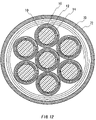
  • FIG. 12 shows another embodiment of the packing method of the present invention.
  • FIG. 1 shows a packing method of an embodiment of the present invention.
  • the glass base material 10 is put into the plastic bag 12 in order not to damage the glass base material 10 when the glass base material 10 is put into a cylindrical container 16 .
  • the glass base material 10 is then wrapped with three-layers of air packing material 14 .
  • the number of layers of air packing material 14 wrapping on the glass base material 10 can be changed depending on the diameter of the glass base material 10 and inside diameter of the cylindrical container 16 .
  • the air packing material contains air inside to act as a cushion.
  • the glass base material 10 wrapped with the air packing material 14 is put into the cylindrical container 16 .
  • both ends of the cylindrical container 16 are capped with caps.
  • the cylindrical container 16 and the caps can be made of at least one of cardboard, plastic, and cardboard plastic that can withstand the load of the glass base material 10 .
  • the cylindrical container 16 and caps can also be made of wood or metal.
  • Cardboard plastic is made by processing plastic into a cardboard form. Although cardboard has enough strength to withstand the load of the glass base material 10 , plastic is preferably used for the cylindrical container 16 because plastic has greater strength than cardboard. Furthermore, a container made from plastic can be recycled.
  • the cylindrical container 16 has an inside diameter 10 mm larger than the diameter of the glass base material 10 in order to have enough room for the air packing material 14 .
  • a glass base material 10 having a diameter of 60 mm and length of 1000 mm was put into a plastic bag 12 and wrapped with three-layers of an air packing material 14 .
  • the glass base material 10 wrapped with the air packing material was put into the cylindrical cardboard box 16 .
  • the cylindrical cardboard box 16 had an inside diameter of 80 mm and length of 1100 mm.
  • both ends of the cylindrical cardboard box were capped with caps.
  • the caps were made of cardboard.
  • the glass base material 10 could not move or rotate inside the cylindrical container 16 . Furthermore, because the glass base material 10 was wrapped with elastic air packing material 14 , the glass base material 10 did not suffer any impact caused by collision of the glass base materials with each other during transportation.
  • FIG. 2 shows a packing method of a comparative example to the packing method shown in FIG. 1 .
  • the glass base material 10 was put into a plastic bag 12 and wrapped with three-layers of an air packing material 14 .
  • the glass base material 10 wrapped with the air packing material was put into a square-shaped cardboard box 18 .
  • the square-shaped cardboard box 18 had an inside height and width of 80 mm and inside length of 1100 mm.
  • both ends of the square-shaped cardboard box 18 were capped with caps.
  • the caps were made of cardboard.
  • each corner of the square-shaped cardboard box 18 had to be filled with elastic buffer materials so that the glass base material 10 did not move inside the square-shaped cardboard box 18 during transportation. Therefore, the cost for packing increased because of the use of extra material such as buffer materials and because of the extra time needed for packing the buffer materials into the corners of the square-shaped cardboard box 18 .
  • FIG. 3 shows another embodiment of the packing method of the present invention.
  • Each of seven pieces of glass base material 20 is put into each of individual plastic bags 22 so as not to damage the glass base material 20 when the glass base material 20 is put into the cylindrical container 26 .
  • the seven pieces of glass base material 20 are bundled together such that six pieces of the glass base material 20 are arranged in a hexagonal arrangement around one central glass base material 20 .
  • the seven pieces of the glass base material 20 bundled together in the hexagonal arrangement are wrapped with three-layers of air packing material 24 .
  • the number of layers of air packing material 24 wrapping on the glass base material 20 can be changed depending on the diameter of the glass base material 20 and inside diameter of the cylindrical container 26 .
  • the seven pieces of the glass base material 20 wrapped with the air packing material 24 are put into the cylindrical container 26 .
  • both ends of the cylindrical container 26 are capped with caps.
  • the cylindrical container 26 and the caps may be made of at least one of cardboard, plastic, and cardboard plastic, which can withstand the load of the glass base material 20 .
  • the cylindrical container 26 and the caps may also be made of wood or metal.
  • the cylindrical container 26 has an inside diameter 10 mm larger than the total diameter of the seven pieces of glass base material 20 bundled together in a hexagonal arrangement in order to have a room for the air packing material 24 .
  • Each of the seven pieces of glass base material 20 was put into each of individual plastic bags 22 .
  • Each of the glass base materials 20 had a 20 mm diameter and 1000 mm length. Then, the seven pieces of glass base material 20 were bundled together such that six pieces of glass base material 20 were arranged in a hexagonal arrangement around one central glass base material 20 .
  • the seven pieces of glass base material 20 were wrapped with three-layers of air packing material 24 .
  • the seven pieces of glass base material 20 wrapped with the air packing material 24 were then put into the cylindrical container 26 .
  • the cylindrical container 26 had an inside diameter of 80 mm and inside length of 1100 mm. Then, both ends of the cylindrical container 26 were capped with caps.
  • the caps were made of cardboard.
  • the glass base materials 20 could not move or rotate inside the cylindrical container 26 . Furthermore, because the glass base materials 20 were wrapped with air packing material 24 having elasticity, the glass base materials 20 did not suffer any impact caused by collisions of the glass base materials 20 with each other during transportation.
  • FIG. 4 shows a packing method of a comparative example to the packing method shown in FIG. 3 .
  • Each of seven pieces of glass base material 20 were put into each of individual plastic bags 22 .
  • Each of the glass base materials 20 had a 20 mm diameter and 1000 mm length. Then, the seven pieces of glass base material 20 were bundled together such that six pieces of the glass base material 20 were arranged in a hexagonal arrangement around one central glass base material 20 .
  • the seven pieces of glass base material 20 were wrapped with three-layers of air packing material 24 .
  • the seven pieces of glass base material 20 wrapped with the air packing material 24 were then put into the square-shaped cardboard box 28 .
  • the square-shaped cardboard box 28 had an inside height and width of 80 mm and inside length of 1100 mm.
  • both ends of the square-shaped cardboard box 28 were capped with caps.
  • the caps were made of cardboard.
  • each corner of the square-shaped cardboard box 28 had to be filled with elastic buffer materials so that the glass base materials 20 did not move inside the square-shaped cardboard box 28 during transportation. Therefore, the cost for packing increased because of use of the extra materials such as buffer materials and because of the extra time needed for packing the buffer materials into the corners of the square-shaped cardboard box 28 .
  • FIG. 5 shows another embodiment of the packing method of the present invention.
  • Each of seven pieces of glass base material 30 is put into each of individual plastic bags 32 .
  • each of the Fm seven pieces of glass base material 30 put into each of individual plastic bags 32 is further wrapped with the air packing material 35 .
  • the seven pieces of glass base material 30 are bundled together such that six pieces of the glass base material 30 are arranged in a hexagonal arrangement around one central glass base material 30 .
  • the seven pieces of glass base material 30 are wrapped with three-layers of air packing material 34 .
  • the numbers of layers of air packing material 34 wrapping the glass base material 30 can be changed depending on the diameter of the glass base material 30 and the inside diameter of the cylindrical container 36 .
  • the seven pieces of glass base material 30 wrapped with air packing material 34 are put into the cylindrical container 36 .
  • both ends of the cylindrical container 36 are capped with caps.
  • the cylindrical container 36 and the caps can be made of at least one of cardboard, plastic, and cardboard plastic which can withstand the load of the glass base material 30 .
  • the cylindrical container 36 and the caps can also be made of wood or metal.
  • the cylindrical container 36 has an inside diameter 10 mm larger than the total diameter of the seven pieces of glass base material 30 bundled together in a hexagonal arrangement in order to have a room for the air packing material 34 .
  • Each of seven pieces of glass base material 30 were put into each of individual plastic bags 32 .
  • Each of the glass base materials 30 had a 20 mm diameter and 1000 mm length. Then, each of the seven pieces of glass base material 30 put into each of the individual plastic bags 32 was further wrapped with air packing material 36 . Next, the seven pieces of glass base material 30 were bundled together such that six pieces of the glass base material 30 were arranged in a hexagonal arrangement around one central glass base material 30 .
  • the seven pieces of glass base material 30 were wrapped with three-layers of air packing material 34 .
  • the seven pieces of glass base material 30 wrapped with the air packing material 34 were then put into a cylindrical container 36 .
  • the cylindrical container 36 had an inside diameter of 80 mm and inside length of 1100 mm. Then, both ends of the cylindrical container 36 were capped with caps.
  • the caps were made of cardboard.
  • the glass base materials 30 could not move or rotate inside the cylindrical container 36 . Furthermore, because the glass base materials 30 were wrapped with elastic air packing material 34 and 35 , the glass base materials 30 did not suffer any impact caused by collisions of the glass base materials 30 with each other during transportation.
  • FIG. 6 shows a packing method of a comparative example to the packing method shown in FIG. 5 .
  • Each of seven pieces of glass base material 30 were put into each of individual plastic bags 32 .
  • Each of the glass base materials 30 had a 20 mm diameter and 1000 mm length.
  • each of the seven pieces of glass base material 30 put into the each of the individual plastic bags 32 was further wrapped with air packing material 35 .
  • the seven pieces of glass base material 30 were bundled together such that six pieces of the glass base material 30 were arranged in a hexagonal arrangement around one central glass base material 30 .
  • the seven pieces of glass base material 30 were wrapped with three-layers of air packing material 34 .
  • the seven pieces of glass base material 30 wrapped with the air packing material 34 were then put into a square-shaped cardboard box 38 .
  • the square-shaped cardboard box 38 had an inside height and width of 80 mm and inside length of 1100 mm. Then, both ends of the square-shaped cardboard box 38 were capped with caps. The caps were made of cardboard.
  • each corner of the square-shaped cardboard box 38 had to be filled with elastic buffer materials so that the glass base materials 30 did not move inside the square-shaped cardboard box 38 during transportation. Therefore, the cost for packing increased because of the use of extra materials such as buffer materials and because of the extra time needed for packing the buffer materials into the corners of the square-shaped cardboard box 38 .
  • FIG. 7 shows another embodiment of the packing method of the present invention.
  • the elements having a same coding between FIG. 1 and FIG. 7 have same structure and functions.
  • the A—A cross section of FIG. 7 is identical to FIG. 1 .
  • the cushion materials 40 are provided on the front and the rear of the glass base material 10 along the longitudinal direction of the glass base material 10 .
  • the cushion materials 40 can be made of material that can absorb impacts caused by vibrations occurring during transportation, such as styrene foam or an elastic body such as rubber.
  • both ends of the cylindrical container 16 are capped with caps 42 .
  • the caps 42 can be made of at least one of cardboard, plastic, and cardboard plastic.
  • the caps 42 may also be made of wood or metal.
  • the cushion materials 40 can protect both ends of the glass base material 10 by preventing damage caused by contact between the glass base material 10 and the caps 42 during transportation.
  • the shape of the glass base material 10 is a right-angle shape.
  • the cushion materials 40 can be used for a glass base material 10 having cone-shaped ends.
  • a glass base material 10 having a diameter of 60 mm and length of 1000 mm was put into a plastic bag 12 and wrapped with three-layers of an air packing material 14 The shapes of both ends of the glass base material 10 were cone-shape.
  • the glass base material 10 wrapped with the air packing material was put into a cylindrical cardboard box 16 .
  • the cylindrical cardboard box 16 had an inside diameter of 80 mm and inside length of 1200 mm.
  • the cushion materials 40 made of styrene foam were provided on the front and the rear of the glass base material 10 in the longitudinal direction of the glass base material 10 .
  • both ends of the cylindrical cardboard box were capped with caps made of cardboard.
  • FIG. 8 shows another embodiment of the packing method of the present invention.
  • the elements having a same coding between FIG. 1 and FIG. 8 have same structure and functions.
  • the A—A cross section of the FIG. 8 is identical to FIG. 1 .
  • Both ends of the glass base material 10 shown in FIG. 8 have a cone-shape.
  • Inside caps 46 which have a shape that can fit with the shape of each end of the glass base material 10 , are provided on both ends of the glass base material 10 .
  • the inside caps 46 can be made of material that can absorb impacts caused by vibrations occurring during transportation, such as styrene foam or an elastic body such as rubber.
  • both ends of the cylindrical container 16 are capped with caps 44 .
  • the caps 44 can be made of at least one of cardboard, plastic, and cardboard plastic.
  • the caps 44 may also be made of wood or metal.
  • the inside caps 46 can protect both ends of the glass base material 10 by fixing the position of the glass base material 10 inside the cylindrical container 16 . Therefore, the inside caps 46 can prevent damage caused by contact between the glass base material 10 and the caps 44 during transportation.
  • a glass base material 10 having a diameter of 60 mm and length of 1000 mm was put into a plastic bag 12 and wrapped with three-layers of an air packing material 14 .
  • the shapes of both ends of the glass base material 10 were cone-shape.
  • the glass base material 10 wrapped with the air packing material was put into a cylindrical cardboard box 16 .
  • the cylindrical cardboard box 16 had an inside diameter of 80 mm and inside length of 1200 mm.
  • Inside caps 46 which have a shape that can fit with the shape of each end of the glass base material 10 , are provided on both ends of the glass base material 10 .
  • the inside caps 46 were made of styrene foam.
  • both ends of the cylindrical cardboard box were capped with caps made of cardboard.
  • FIG. 9 shows other embodiment of the packing method, combining the embodiment shown in FIG. 3 and the embodiment shown in FIG. 7 .
  • the elements having a same coding between FIG. 3 and FIG. 9 have a same structure and functions.
  • the B—B cross section of FIG. 9 is identical to FIG. 3 .
  • the packing method shown in FIG. 9 can also be applied to glass base material 20 packed as having a cross section shown in FIG. 5 .
  • the seven pieces of glass base material 20 wrapped with the air packing material 24 shown in FIG. 3 are put into the cylindrical container 26 .
  • the cushion materials 50 are provided on the front and the rear of the glass base materials 20 along the longitudinal direction of the glass base materials 20 .
  • the cushion materials 50 can be made of styrene foam or an elastic body such as rubber.
  • both ends of the cylindrical container 26 are capped with caps 52 .
  • the caps 42 can be made of at least one of cardboard, plastic, and cardboard plastic.
  • the caps 42 may also be made of wood or metal.
  • the cushion materials 50 can protect both ends of the glass base material 20 by preventing damage caused by contact between the glass base material 20 and the caps 52 during transportation.
  • the shape of the glass base material 20 is a right-angle shape.
  • the cushion materials 50 can be used for glass base materials 20 having cone-shaped ends.
  • FIG. 10 shows another embodiment of the packing method combining the embodiment shown in FIG. 3 and the embodiment shown in FIG. 8 .
  • the elements having a same coding between FIG. 3 and FIG. 10 have same structure and functions.
  • the B—B cross section of FIG. 10 is identical to FIG. 3 .
  • the packing method shown in FIG. 10 can also be applied to glass base material 20 packed as having a cross section shown in FIG. 5 .
  • the seven pieces of glass base materials 20 wrapped with the air packing material 24 shown in FIG. 3 are put into the cylindrical container 26 . Both ends of the glass base material 20 shown in FIG. 10 have a cone-shape.
  • the inside caps 56 which have a shape that can fit with the shape of each end of the glass base materials 20 , are provided on both ends of the glass base materials 20 .
  • the inside caps 46 can be made of styrene foam or an elastic body such as rubber.
  • both ends of the cylindrical container 26 are capped with caps 54 .
  • the caps 54 can be made of at least one of cardboard, plastic, and cardboard plastic.
  • the caps 54 may also be made of wood or metal.
  • the inside caps 56 can protect both ends of the glass base materials 20 by fixing the position of the glass base materials 20 inside the cylindrical container 26 . Therefore, the inside caps 56 can prevent damage caused by contact between the glass base material 20 and the caps 54 during transportation.
  • FIG. 11 shows other embodiment of the packing method of the present invention.
  • Each of four pieces of glass base material 10 are packed as in FIG. 1 then put into a square-shaped cardboard box 60 .
  • Two glass base materials 10 are placed on the bottom of the square-shaped cardboard box 60 , and another two glass base materials 10 are placed on top of the two glass base material 10 which were placed on the bottom.
  • Each corner of the square-shaped cardboard box 60 is filled with elastic buffer materials 62 so that the glass base materials 10 do not move inside the square-shaped cardboard box 60 during transportation
  • a square-shaped cardboard box 18 can be used for packing a plurality of glass base materials 10 .
  • the plurality of glass base materials 10 do not suffer from any impacts caused by collision of the glass base material 10 with each other during transportation, even when packed in the square-shaped cardboard box 60 , because each glass base material 10 is packed using the packing method shown in FIG. 1 .
  • the glass base materials 10 could not move or rotate inside the cylindrical container 16 . Furthermore, because the glass base materials 10 were wrapped with air packing material 14 having elasticity, the glass base materials 10 did not suffer from impacts caused by collision of the glass base materials 10 with each other during transportation.
  • FIG. 12 shows another embodiment of the packing method of the present invention.
  • Each of seven pieces of glass base material 10 are packed as in FIG. 1 then further put into the cylindrical container 70 .
  • the seven pieces of glass base material 10 packed as in FIG. 1 are bundled together such that six pieces of the glass base material 10 are arranged in a hexagonal arrangement around one central glass base material 10 .
  • the seven pieces of the glass base materials 10 are wrapped with three-layers of air packing material 70 .
  • the seven pieces of the glass base materials 10 wrapped with the air packing material 70 are then put into the cylindrical container 72 .
  • both ends of the cylindrical container 72 are capped with caps.
  • a plurality of glass base materials 10 can be transported without damage because each of the glass base materials 10 are packed into the cylindrical container 16 and further packed into the cylindrical container 72 .

Landscapes

  • Engineering & Computer Science (AREA)
  • Mechanical Engineering (AREA)
  • Chemical & Material Sciences (AREA)
  • Materials Engineering (AREA)
  • Manufacturing & Machinery (AREA)
  • Geochemistry & Mineralogy (AREA)
  • Life Sciences & Earth Sciences (AREA)
  • Organic Chemistry (AREA)
  • General Life Sciences & Earth Sciences (AREA)
  • Buffer Packaging (AREA)
  • Packaging Frangible Articles (AREA)
  • Wrapping Of Specific Fragile Articles (AREA)
  • Packages (AREA)
  • Re-Forming, After-Treatment, Cutting And Transporting Of Glass Products (AREA)

Abstract

A method of packing a glass base material (10, 20, 30), which is a base material of an optical fiber comprising packing the glass base material (10, 20, 30) into a cylindrical container (16, 26, 36). The packing has: putting the glass base material (10, 20, 30) into a plastic bag (12, 22, 32); and packing the glass base material (10, 20, 30), which is put into the plastic bag (12, 22, 32), into the cylindrical container (16, 26, 36). The packing further has: wrapping the glass base material (10, 20, 30), which is put into the plastic bag (12, 22, 32), with air packing material (14, 24, 34), which contains air inside; and packing the glass base material (10, 20, 30) wrapped with the air packing material (14, 24, 34) into the cylindrical container (16, 26, 36).

Description

This patent application claims priority based on a Japanese patent application, H11-046143 filed on Feb. 24, 1999, the contents of which are incorporated herein by reference.
BACKGROUND OF INVENTION
1. Field of the Invention
The present invention is related to a packing method for packing quartz glass or quartz glass base material, which is a base material of optical fibers used for optical communications.
2. Description of Related Art
Quartz glass or a quartz glass base material, which is a base material of optical fibers used for optical communications, is manufactured by sintering and vitrifying soot sediment. The soot sediment can be manufactured by one of vapor-phase axial deposition (VAD) method, outside vapor deposition (OVD) method, and modified chemical vapor deposition (MCVD) method. The glass base material is elongated to a predetermined diameter and then shipped.
If there is a crack on the surface of the glass base material, the optical fiber drawn from the glass base material having a crack will be cut during the drawing. Therefore, much care is needed in order not to damage the surface of the glass base material. Conventionally, glass base material was put into a square-shaped box, and the opening between the glass base material and the box was filled with a cushion for shipping.
Recently, because of the development of the optical fiber communication industry, the demand for quartz glass base material has increased, and the quantity of shipments of glass base material has also increased. A plurality of glass base materials is usually put together into one box to be shipped.
However, if a plurality of glass base materials are packed together in one box, the glass base materials may be damaged because the glass base materials may contact with each other due to the vibration occurring during the transportation of the glass base materials. The cushion is filled in the opening between the glass base material and the box to prevent the glass base material from contacting with each other. However, the conventional square-shaped box has large openings between the glass base material and the box and thus needs a large amount of cushion material. Furthermore, when packing a plurality of glass base materials in one box, if the cushion is made with soft material, the glass base materials inside the box may collide with each other due to the vibration during the transportation. In the worst case, the glass base materials may crack during the transportation.
Therefore, every individual glass base materials must be wrapped with buffer material for packing, such as air packing, which contains air inside. Then, one piece of the glass base material is packed in one box, or a plurality of glass base materials are packed together in one box to prevent cracking and breaking. However, the conventional packing method requires a large amount of buffer material and the box, and thus the conventional packing method has an economic disadvantage. Furthermore, the conventional packing method needs a large amount labor and time for packing. If there is space between the end of the glass base material and the end of the box in the longitudinal direction, the glass base material moves in the longitudinal direction during the transportation. Thereby, the end of the glass base material contacts with the box which may cause a crack or breakage of the glass base material.
SUMMARY OF THE INVENTION
Therefore, it is an object of the present invention to provide a packing method for glass base materials which overcomes the above issues in the related art. This object is achieved by combinations described in the independent claims. The dependent claims define further advantageous and exemplary combinations of the present invention.
According to the first aspect of the present invention, a method of packing a glass base material, which is a base material of an optical fiber can be provided. The method of packing a glass base material comprises packing the glass base material into a cylindrical container.
The packing may have: putting the glass base material into a plastic bag; and packing the glass base material, which is put into the plastic bag, into the cylindrical container. The packing may further have: wrapping the glass base material, which is put into the plastic bag, with air packing material, which contains air inside; and packing the glass base material wrapped with the air packing material into the cylindrical container.
The wrapping may wrap the glass base material, which is put into the plastic bag, with three-layers of the air packing material. The packing may pack the glass base material in the cylindrical container which has an inside diameter of approximately 10 mm larger than a diameter of the glass base material.
The packing may further have: capping both ends of the cylindrical container, which packs the glass base material, by caps. The packing may further have: filling space between an end of the glass base material and the cap with a cushion material. The packing may further have: providing an inside cap, which has a shape that can fit with a shape of end of the glass base material, on a space between the end of the glass base material and the cap.
The method of packing a glass base material can be provided which further comprises: packing a plurality of the cylindrical containers, each of which is packed with the glass base material, into a cylindrical container. The method of packing a glass base material can be provided which further comprises: packing a plurality of the cylindrical containers, each of which is packed with the glass base material, into a square-shaped box.
The packing may pack a plurality of the glass base materials into the cylindrical container. The packing may have: putting each of the plurality of the glass base materials into each of individual plastic bags; and packing the plurality of the glass base materials, each of which are put into the each of individual plastic bags, into the cylindrical container.
The packing may further have: wrapping together the plurality of the glass base materials, each of which are put into the each of individual plastic bags, with air packing material, which contains air inside; and packing the plurality of the glass base materials wrapped with the air packing material into the cylindrical container.
The packing may pack the plurality of the glass base materials in the cylindrical container which has an inside diameter of approximately 10 mm larger than total diameter of the plurality of the glass base materials. The packing may have: putting each of seven pieces of the glass base materials into the each of individual plastic bags; and bundling together the seven pieces of the glass base materials, each of which are put into the each of individual plastic bags, such that six pieces of the glass base materials are arranged in a hexagonal arrangement around one central the glass base material; and packing the seven pieces of the glass base materials bundled together into the cylindrical container.
According to the second aspect of the present invention, a packing can be provided which comprises: a glass base material which is a base material of an optical fiber; and a cylindrical container which contains the glass base material inside.
A packing can be provided which further comprises: a plastic bag which packs the glass base material inside; wherein the cylindrical container contains the glass base material which is packed in the plastic bag.
A packing can be provided which further comprises: an air packing material which wraps the glass base material packed in the plastic bag; wherein the cylindrical container contains the glass base material which is wrapped with the air packing material.
The air packing material may wrap a plurality of the glass base materials, each of which is packed in each of individual the plastic bags; and the cylindrical container contains the plurality of the glass base materials wrapped with the air packing material. The cylindrical container may contain seven pieces of the glass base materials, each of which are put into the each of individual plastic bags; and the air packing material wraps the seven pieces of the glass base materials such that six pieces of the glass base materials are arranged in a hexagonal arrangement around one central the glass base material.
The cylindrical container may have an inside diameter of approximately 10 mm larger than a diameter of the glass base material. The cylindrical container can be made of at least one of cardboard, plastic, and cardboard plastic. The cylindrical container may have caps on both ends of the cylindrical container. The caps can be made of at least one of cardboard, plastic, and cardboard plastic.
A packing can be provided which further comprises a cushion material which fills space between an end of the glass base material and the cap. The cushion material can be made of at least one of styrene foam and an elastic body made of rubber. A packing can be provided which further comprises an inside cap which has a shape that can fit with a shape of end of the glass base material.
The inside cap can be made of at least one of styrene foam and an elastic body made of rubber.
A packing can be provided which further comprises a secondary cylindrical container which contains a plurality of the cylindrical containers, each of which is packed with the glass base material. A packing can be provided which further has a square-shaped box which contains a plurality of the cylindrical containers, each of which is packed with the glass base material.
This summary of the invention does not necessarily describe all necessary features. The invention may also be a sub-combination of these described features.
BRIEF DESCRIPTION OF DRAWING
FIG. 1 shows a packing method of an embodiment of the present invention.
FIG. 2 shows a packing method of a comparative example to the packing method shown in FIG. 1.
FIG. 3 shows another embodiment of the packing method of the present invention.
FIG. 4 shows a packing method of a comparative example to the packing method shown in FIG. 3.
FIG. 5 shows another embodiment of the packing method of the present invention.
FIG. 6 shows a packing method of a comparative example to the packing method shown in FIG. 5.
FIG. 7 shows another embodiment of the packing method of the present invention.
FIG. 8 shows another embodiment of the packing method of the present invention.
FIG. 9 shows other embodiment of the packing method, combining the embodiment shown in FIG. 3 and the embodiment shown in FIG. 7.
FIG. 10 shows another embodiment of the packing method combining the embodiment shown in FIG. 3 and the embodiment shown in FIG. 8.
FIG. 11 shows other embodiment of the packing method of the present invention.
FIG. 12 shows another embodiment of the packing method of the present invention.
DETAILED DESCRIPTION OF THE INVENTION
The invention will now be described based on the preferred embodiments, which do not intend to limit the scope of the present invention, but exemplify the invention. All of the features and the combinations thereof described in the embodiment are not necessarily essential to the invention.
FIG. 1 shows a packing method of an embodiment of the present invention. The glass base material 10 is put into the plastic bag 12 in order not to damage the glass base material 10 when the glass base material 10 is put into a cylindrical container 16. The glass base material 10 is then wrapped with three-layers of air packing material 14. The number of layers of air packing material 14 wrapping on the glass base material 10 can be changed depending on the diameter of the glass base material 10 and inside diameter of the cylindrical container 16. The air packing material contains air inside to act as a cushion. Next, the glass base material 10 wrapped with the air packing material 14 is put into the cylindrical container 16. Then, both ends of the cylindrical container 16 are capped with caps.
The cylindrical container 16 and the caps can be made of at least one of cardboard, plastic, and cardboard plastic that can withstand the load of the glass base material 10. The cylindrical container 16 and caps can also be made of wood or metal. Cardboard plastic is made by processing plastic into a cardboard form. Although cardboard has enough strength to withstand the load of the glass base material 10, plastic is preferably used for the cylindrical container 16 because plastic has greater strength than cardboard. Furthermore, a container made from plastic can be recycled. The cylindrical container 16 has an inside diameter 10 mm larger than the diameter of the glass base material 10 in order to have enough room for the air packing material 14.
EXAMPLE 1
A glass base material 10 having a diameter of 60 mm and length of 1000 mm was put into a plastic bag 12 and wrapped with three-layers of an air packing material 14. Next, the glass base material 10 wrapped with the air packing material was put into the cylindrical cardboard box 16. The cylindrical cardboard box 16 had an inside diameter of 80 mm and length of 1100 mm. Then, both ends of the cylindrical cardboard box were capped with caps. The caps were made of cardboard.
Because there was no space between the glass base material 10 and the cylindrical container 16, the glass base material 10 could not move or rotate inside the cylindrical container 16. Furthermore, because the glass base material 10 was wrapped with elastic air packing material 14, the glass base material 10 did not suffer any impact caused by collision of the glass base materials with each other during transportation.
COMPARATIVE EXAMPLE 1
FIG. 2 shows a packing method of a comparative example to the packing method shown in FIG. 1. The glass base material 10 was put into a plastic bag 12 and wrapped with three-layers of an air packing material 14. Next, the glass base material 10 wrapped with the air packing material was put into a square-shaped cardboard box 18. The square-shaped cardboard box 18 had an inside height and width of 80 mm and inside length of 1100 mm. Then, both ends of the square-shaped cardboard box 18 were capped with caps. The caps were made of cardboard.
To pack the glass base material 10 inside the square-shaped cardboard box 18, each corner of the square-shaped cardboard box 18 had to be filled with elastic buffer materials so that the glass base material 10 did not move inside the square-shaped cardboard box 18 during transportation. Therefore, the cost for packing increased because of the use of extra material such as buffer materials and because of the extra time needed for packing the buffer materials into the corners of the square-shaped cardboard box 18.
FIG. 3 shows another embodiment of the packing method of the present invention. Each of seven pieces of glass base material 20 is put into each of individual plastic bags 22 so as not to damage the glass base material 20 when the glass base material 20 is put into the cylindrical container 26. Then, the seven pieces of glass base material 20 are bundled together such that six pieces of the glass base material 20 are arranged in a hexagonal arrangement around one central glass base material 20. Next, the seven pieces of the glass base material 20 bundled together in the hexagonal arrangement are wrapped with three-layers of air packing material 24. The number of layers of air packing material 24 wrapping on the glass base material 20 can be changed depending on the diameter of the glass base material 20 and inside diameter of the cylindrical container 26. Next, the seven pieces of the glass base material 20 wrapped with the air packing material 24 are put into the cylindrical container 26. Then, both ends of the cylindrical container 26 are capped with caps.
The cylindrical container 26 and the caps may be made of at least one of cardboard, plastic, and cardboard plastic, which can withstand the load of the glass base material 20. The cylindrical container 26 and the caps may also be made of wood or metal. The cylindrical container 26 has an inside diameter 10 mm larger than the total diameter of the seven pieces of glass base material 20 bundled together in a hexagonal arrangement in order to have a room for the air packing material 24.
EXAMPLE 2
Each of the seven pieces of glass base material 20 was put into each of individual plastic bags 22. Each of the glass base materials 20 had a 20 mm diameter and 1000 mm length. Then, the seven pieces of glass base material 20 were bundled together such that six pieces of glass base material 20 were arranged in a hexagonal arrangement around one central glass base material 20.
Next, the seven pieces of glass base material 20 were wrapped with three-layers of air packing material 24. The seven pieces of glass base material 20 wrapped with the air packing material 24 were then put into the cylindrical container 26. The cylindrical container 26 had an inside diameter of 80 mm and inside length of 1100 mm. Then, both ends of the cylindrical container 26 were capped with caps. The caps were made of cardboard.
Because there was no space between the glass base materials 20 and the cylindrical container 26, the glass base materials 20 could not move or rotate inside the cylindrical container 26. Furthermore, because the glass base materials 20 were wrapped with air packing material 24 having elasticity, the glass base materials 20 did not suffer any impact caused by collisions of the glass base materials 20 with each other during transportation.
COMPARATIVE EXAMPLE 2
FIG. 4 shows a packing method of a comparative example to the packing method shown in FIG. 3. Each of seven pieces of glass base material 20 were put into each of individual plastic bags 22. Each of the glass base materials 20 had a 20 mm diameter and 1000 mm length. Then, the seven pieces of glass base material 20 were bundled together such that six pieces of the glass base material 20 were arranged in a hexagonal arrangement around one central glass base material 20.
Next, the seven pieces of glass base material 20 were wrapped with three-layers of air packing material 24. The seven pieces of glass base material 20 wrapped with the air packing material 24 were then put into the square-shaped cardboard box 28. The square-shaped cardboard box 28 had an inside height and width of 80 mm and inside length of 1100 mm. Then, both ends of the square-shaped cardboard box 28 were capped with caps. The caps were made of cardboard.
To pack glass base materials 20 inside the square-shaped cardboard box 28, each corner of the square-shaped cardboard box 28 had to be filled with elastic buffer materials so that the glass base materials 20 did not move inside the square-shaped cardboard box 28 during transportation. Therefore, the cost for packing increased because of use of the extra materials such as buffer materials and because of the extra time needed for packing the buffer materials into the corners of the square-shaped cardboard box 28.
FIG. 5 shows another embodiment of the packing method of the present invention. Each of seven pieces of glass base material 30 is put into each of individual plastic bags 32. Then, each of the Fm seven pieces of glass base material 30 put into each of individual plastic bags 32 is further wrapped with the air packing material 35. The seven pieces of glass base material 30 are bundled together such that six pieces of the glass base material 30 are arranged in a hexagonal arrangement around one central glass base material 30. Next, the seven pieces of glass base material 30 are wrapped with three-layers of air packing material 34. The numbers of layers of air packing material 34 wrapping the glass base material 30 can be changed depending on the diameter of the glass base material 30 and the inside diameter of the cylindrical container 36. Next, the seven pieces of glass base material 30 wrapped with air packing material 34 are put into the cylindrical container 36. Then, both ends of the cylindrical container 36 are capped with caps.
The cylindrical container 36 and the caps can be made of at least one of cardboard, plastic, and cardboard plastic which can withstand the load of the glass base material 30. The cylindrical container 36 and the caps can also be made of wood or metal. The cylindrical container 36 has an inside diameter 10 mm larger than the total diameter of the seven pieces of glass base material 30 bundled together in a hexagonal arrangement in order to have a room for the air packing material 34.
EXAMPLE 3
Each of seven pieces of glass base material 30 were put into each of individual plastic bags 32. Each of the glass base materials 30 had a 20 mm diameter and 1000 mm length. Then, each of the seven pieces of glass base material 30 put into each of the individual plastic bags 32 was further wrapped with air packing material 36. Next, the seven pieces of glass base material 30 were bundled together such that six pieces of the glass base material 30 were arranged in a hexagonal arrangement around one central glass base material 30.
Next, the seven pieces of glass base material 30 were wrapped with three-layers of air packing material 34. The seven pieces of glass base material 30 wrapped with the air packing material 34 were then put into a cylindrical container 36. The cylindrical container 36 had an inside diameter of 80 mm and inside length of 1100 mm. Then, both ends of the cylindrical container 36 were capped with caps. The caps were made of cardboard.
Because there was no space between the glass base materials 30 and the cylindrical container 36, the glass base materials 30 could not move or rotate inside the cylindrical container 36. Furthermore, because the glass base materials 30 were wrapped with elastic air packing material 34 and 35, the glass base materials 30 did not suffer any impact caused by collisions of the glass base materials 30 with each other during transportation.
COMPARATIVE EXAMPLE 3
FIG. 6 shows a packing method of a comparative example to the packing method shown in FIG. 5. Each of seven pieces of glass base material 30 were put into each of individual plastic bags 32. Each of the glass base materials 30 had a 20 mm diameter and 1000 mm length. Then, each of the seven pieces of glass base material 30 put into the each of the individual plastic bags 32 was further wrapped with air packing material 35. Next, the seven pieces of glass base material 30 were bundled together such that six pieces of the glass base material 30 were arranged in a hexagonal arrangement around one central glass base material 30.
Next, the seven pieces of glass base material 30 were wrapped with three-layers of air packing material 34. The seven pieces of glass base material 30 wrapped with the air packing material 34 were then put into a square-shaped cardboard box 38. The square-shaped cardboard box 38 had an inside height and width of 80 mm and inside length of 1100 mm. Then, both ends of the square-shaped cardboard box 38 were capped with caps. The caps were made of cardboard.
To pack glass base materials 30 inside a square-shaped cardboard box 38, each corner of the square-shaped cardboard box 38 had to be filled with elastic buffer materials so that the glass base materials 30 did not move inside the square-shaped cardboard box 38 during transportation. Therefore, the cost for packing increased because of the use of extra materials such as buffer materials and because of the extra time needed for packing the buffer materials into the corners of the square-shaped cardboard box 38.
FIG. 7 shows another embodiment of the packing method of the present invention. The elements having a same coding between FIG. 1 and FIG. 7 have same structure and functions. The A—A cross section of FIG. 7 is identical to FIG. 1.
The cushion materials 40 are provided on the front and the rear of the glass base material 10 along the longitudinal direction of the glass base material 10. The cushion materials 40 can be made of material that can absorb impacts caused by vibrations occurring during transportation, such as styrene foam or an elastic body such as rubber. Then, both ends of the cylindrical container 16 are capped with caps 42. The caps 42 can be made of at least one of cardboard, plastic, and cardboard plastic. The caps 42 may also be made of wood or metal.
The cushion materials 40 can protect both ends of the glass base material 10 by preventing damage caused by contact between the glass base material 10 and the caps 42 during transportation. In FIG. 7, the shape of the glass base material 10 is a right-angle shape. However, the cushion materials 40 can be used for a glass base material 10 having cone-shaped ends.
EXAMPLE 4
A glass base material 10 having a diameter of 60 mm and length of 1000 mm was put into a plastic bag 12 and wrapped with three-layers of an air packing material 14 The shapes of both ends of the glass base material 10 were cone-shape. Next, the glass base material 10 wrapped with the air packing material was put into a cylindrical cardboard box 16. The cylindrical cardboard box 16 had an inside diameter of 80 mm and inside length of 1200 mm. Next, the cushion materials 40 made of styrene foam were provided on the front and the rear of the glass base material 10 in the longitudinal direction of the glass base material 10. Then, both ends of the cylindrical cardboard box were capped with caps made of cardboard.
Because the cushion materials 40 protected both ends of the glass base material 10, damage caused by contact between the glass base material 10 and the caps 42 during transportation was prevented.
FIG. 8 shows another embodiment of the packing method of the present invention. The elements having a same coding between FIG. 1 and FIG. 8 have same structure and functions. The A—A cross section of the FIG. 8 is identical to FIG. 1.
Both ends of the glass base material 10 shown in FIG. 8 have a cone-shape. Inside caps 46, which have a shape that can fit with the shape of each end of the glass base material 10, are provided on both ends of the glass base material 10. The inside caps 46 can be made of material that can absorb impacts caused by vibrations occurring during transportation, such as styrene foam or an elastic body such as rubber. Then, both ends of the cylindrical container 16 are capped with caps 44. The caps 44 can be made of at least one of cardboard, plastic, and cardboard plastic. The caps 44 may also be made of wood or metal.
The inside caps 46 can protect both ends of the glass base material 10 by fixing the position of the glass base material 10 inside the cylindrical container 16. Therefore, the inside caps 46 can prevent damage caused by contact between the glass base material 10 and the caps 44 during transportation.
EXAMPLE 5
A glass base material 10 having a diameter of 60 mm and length of 1000 mm was put into a plastic bag 12 and wrapped with three-layers of an air packing material 14. The shapes of both ends of the glass base material 10 were cone-shape. Next, the glass base material 10 wrapped with the air packing material was put into a cylindrical cardboard box 16. The cylindrical cardboard box 16 had an inside diameter of 80 mm and inside length of 1200 mm. Inside caps 46, which have a shape that can fit with the shape of each end of the glass base material 10, are provided on both ends of the glass base material 10. The inside caps 46 were made of styrene foam. Then, both ends of the cylindrical cardboard box were capped with caps made of cardboard.
Because the inside caps 46 protected both ends of the glass base material 10 by fixing the position of the glass base material 10 inside the cylindrical container 16, there was no damage caused by contact between the glass base material 10 and the caps 44 during transportation.
FIG. 9 shows other embodiment of the packing method, combining the embodiment shown in FIG. 3 and the embodiment shown in FIG. 7. The elements having a same coding between FIG. 3 and FIG. 9 have a same structure and functions. The B—B cross section of FIG. 9 is identical to FIG. 3. The packing method shown in FIG. 9 can also be applied to glass base material 20 packed as having a cross section shown in FIG. 5.
The seven pieces of glass base material 20 wrapped with the air packing material 24 shown in FIG. 3 are put into the cylindrical container 26. The cushion materials 50 are provided on the front and the rear of the glass base materials 20 along the longitudinal direction of the glass base materials 20. The cushion materials 50 can be made of styrene foam or an elastic body such as rubber. Then, both ends of the cylindrical container 26 are capped with caps 52. The caps 42 can be made of at least one of cardboard, plastic, and cardboard plastic. The caps 42 may also be made of wood or metal.
The cushion materials 50 can protect both ends of the glass base material 20 by preventing damage caused by contact between the glass base material 20 and the caps 52 during transportation. In FIG. 9, the shape of the glass base material 20 is a right-angle shape. However, the cushion materials 50 can be used for glass base materials 20 having cone-shaped ends.
FIG. 10 shows another embodiment of the packing method combining the embodiment shown in FIG. 3 and the embodiment shown in FIG. 8. The elements having a same coding between FIG. 3 and FIG. 10 have same structure and functions. The B—B cross section of FIG. 10 is identical to FIG. 3. The packing method shown in FIG. 10 can also be applied to glass base material 20 packed as having a cross section shown in FIG. 5.
The seven pieces of glass base materials 20 wrapped with the air packing material 24 shown in FIG. 3 are put into the cylindrical container 26. Both ends of the glass base material 20 shown in FIG. 10 have a cone-shape. The inside caps 56, which have a shape that can fit with the shape of each end of the glass base materials 20, are provided on both ends of the glass base materials 20. The inside caps 46 can be made of styrene foam or an elastic body such as rubber. Then, both ends of the cylindrical container 26 are capped with caps 54. The caps 54 can be made of at least one of cardboard, plastic, and cardboard plastic. The caps 54 may also be made of wood or metal.
The inside caps 56 can protect both ends of the glass base materials 20 by fixing the position of the glass base materials 20 inside the cylindrical container 26. Therefore, the inside caps 56 can prevent damage caused by contact between the glass base material 20 and the caps 54 during transportation.
FIG. 11 shows other embodiment of the packing method of the present invention. Each of four pieces of glass base material 10 are packed as in FIG. 1 then put into a square-shaped cardboard box 60. Two glass base materials 10 are placed on the bottom of the square-shaped cardboard box 60, and another two glass base materials 10 are placed on top of the two glass base material 10 which were placed on the bottom. Each corner of the square-shaped cardboard box 60 is filled with elastic buffer materials 62 so that the glass base materials 10 do not move inside the square-shaped cardboard box 60 during transportation
Using the packing method shown in FIG. 11, a square-shaped cardboard box 18 can be used for packing a plurality of glass base materials 10. The plurality of glass base materials 10 do not suffer from any impacts caused by collision of the glass base material 10 with each other during transportation, even when packed in the square-shaped cardboard box 60, because each glass base material 10 is packed using the packing method shown in FIG. 1.
Because there was no space between the glass base materials 10 and the cylindrical container 16, the glass base materials 10 could not move or rotate inside the cylindrical container 16. Furthermore, because the glass base materials 10 were wrapped with air packing material 14 having elasticity, the glass base materials 10 did not suffer from impacts caused by collision of the glass base materials 10 with each other during transportation.
FIG. 12 shows another embodiment of the packing method of the present invention. Each of seven pieces of glass base material 10 are packed as in FIG. 1 then further put into the cylindrical container 70. The seven pieces of glass base material 10 packed as in FIG. 1 are bundled together such that six pieces of the glass base material 10 are arranged in a hexagonal arrangement around one central glass base material 10. Next, the seven pieces of the glass base materials 10 are wrapped with three-layers of air packing material 70. The seven pieces of the glass base materials 10 wrapped with the air packing material 70 are then put into the cylindrical container 72. Then, both ends of the cylindrical container 72 are capped with caps.
Using the packing method shown in FIG. 12, a plurality of glass base materials 10 can be transported without damage because each of the glass base materials 10 are packed into the cylindrical container 16 and further packed into the cylindrical container 72.
Although the present invention has been described with reference to specific embodiments, the scope of the present invention is not limited to these embodiments. Those skilled in the art can make various modifications and improvements to these embodiments of the present invention. It is clear from the appended claims that such modifications or improvements are also covered by the scope of the present invention.

Claims (9)

1. A method of packing a glass base material, which is a base material of an optical fiber, for preventing damage of said glass base material during transportation, comprising:
putting the glass base material having a cylindrical shape over its whole length into a plastic bag;
wrapping said plastic bag containing said glass base material with air packing material, which contains air therein;
packing the glass base material in said plastic bag and wrapped in said air packing material into a cylindrical container so that space between the glass base material and said cylindrical container is filled with said plastic bag and said air packing material.
2. A method as claimed in claim 1, wherein said plastic bag is wrapped with three-layers of said air packing material.
3. A method as claimed in claim 1, wherein said cylindrical container has an inside diameter that is approximately 10 mm larger than a diameter of said glass base material.
4. A method as claimed in claim 1, further comprising:
capping both ends of said cylindrical container.
5. A method of packing a glass base material as claimed in claim 4, wherein said packing further has:
filling space between an end of said glass base material and said cap with a cushion material.
6. A method as claimed in claim 4, further comprising:
providing an inside cap, which has a shape that is compatible with a shape of an end of said glass base material, in a space between said end of said glass base material and said cap.
7. A method of packing a glass base material as claimed in claim 1, further comprising:
packing a plurality of said cylindrical containers, each of which is packed with said bagged and wrapped glass base material, into a cylindrical container.
8. A method of packing a glass base material as claimed in claim 1, further comprising:
packing a plurality of said cylindrical containers, each of which is packed with said glass base material, into a square-shaped box.
9. A method as claimed in claim 1, wherein said cylindrical container is made of at least one of a material selected from the group consisting of cardboard, plastic, cardboard plastic, wood and metal.
US09/512,276 1999-02-24 2000-02-24 Glass base material packing method Expired - Fee Related US7093412B1 (en)

Priority Applications (1)

Application Number Priority Date Filing Date Title
US10/184,897 US6652257B2 (en) 1999-02-26 2002-07-01 Apparatus for producing ceramic moldings

Applications Claiming Priority (1)

Application Number Priority Date Filing Date Title
JP4614399A JP3575788B2 (en) 1999-02-24 1999-02-24 Packaging method for quartz glass preform for optical fiber

Related Child Applications (1)

Application Number Title Priority Date Filing Date
US10/184,897 Division US6652257B2 (en) 1999-02-26 2002-07-01 Apparatus for producing ceramic moldings

Publications (1)

Publication Number Publication Date
US7093412B1 true US7093412B1 (en) 2006-08-22

Family

ID=12738758

Family Applications (1)

Application Number Title Priority Date Filing Date
US09/512,276 Expired - Fee Related US7093412B1 (en) 1999-02-24 2000-02-24 Glass base material packing method

Country Status (6)

Country Link
US (1) US7093412B1 (en)
EP (1) EP1033321B1 (en)
JP (1) JP3575788B2 (en)
KR (1) KR20010006672A (en)
DE (1) DE60010948T2 (en)
TW (1) TW593180B (en)

Cited By (3)

* Cited by examiner, † Cited by third party
Publication number Priority date Publication date Assignee Title
US20090272152A1 (en) * 2002-05-09 2009-11-05 The Furukawa Electric Co., Ltd. Method for manufacturing optical fiber
US20160176607A1 (en) * 2013-04-18 2016-06-23 Robert Dale Beadles Container
CN118414286A (en) * 2022-12-23 2024-07-30 信越化学工业株式会社 Quartz glass cloth packaging method

Families Citing this family (4)

* Cited by examiner, † Cited by third party
Publication number Priority date Publication date Assignee Title
US6546756B1 (en) 1999-12-27 2003-04-15 Corning Incorporated Method of making an optical fiber, with storage in a new bag
US20120133065A1 (en) * 2010-11-30 2012-05-31 Stephen John Caffrey Real-time, closed-loop shape control of extruded ceramic honeycomb structures
CN104816889B (en) * 2015-04-13 2017-03-29 中国工程物理研究院激光聚变研究中心 Keep the method and packaging facilities of 100 grades of cleanliness factors of optical element
CN107284853B (en) * 2017-07-25 2019-02-01 江苏贺鸿电子有限公司 Toter is used in a kind of transport of pcb board

Citations (33)

* Cited by examiner, † Cited by third party
Publication number Priority date Publication date Assignee Title
US2458737A (en) * 1947-02-26 1949-01-11 Mortimer B Salkowitz Shockproof bottle container
US3187886A (en) * 1964-01-29 1965-06-08 Robert L Honey Cushioning carrier for pneumatic tube systems
US3384221A (en) * 1966-01-24 1968-05-21 Lear Siegler Inc Shock absorptive packaging construction
US3572574A (en) * 1969-02-24 1971-03-30 Evans Bellhouse Ltd Packaging
US4098050A (en) 1971-06-16 1978-07-04 Gerber Products Company Method of stagger pack partitionless packaging
US4190160A (en) * 1979-03-06 1980-02-26 The United States Of America As Represented By The United States Department Of Energy Accident resistant transport container
US4267928A (en) * 1978-07-26 1981-05-19 Curry Byron V Jun Composite container structure
US4268567A (en) * 1978-09-27 1981-05-19 Harmony Richard C Insulator for canned drinks
US4560069A (en) * 1985-05-02 1985-12-24 Simon B Kenneth Package for hazardous materials
US4573578A (en) * 1983-12-19 1986-03-04 The Dow Chemical Company Method and material for the restraint of polar organic liquids
US4643307A (en) * 1986-02-07 1987-02-17 Don Wilkinson Packing arrangement for articles of different size
US4681225A (en) * 1986-06-16 1987-07-21 Schuster Lorenz M Glass and bottle tote
EP0336107A2 (en) 1988-02-26 1989-10-11 Herbert C. Spencer Container for the transport of diagnostic specimens
US4880119A (en) * 1987-04-06 1989-11-14 Simon B Kenneth Cushioned container for hazardous material
US4880114A (en) * 1987-07-09 1989-11-14 Heinrich Korte Package
US4955480A (en) * 1989-07-21 1990-09-11 Sexton Wilson C Portable insulated carrier
US5213215A (en) * 1991-03-22 1993-05-25 Societe Dite Les Isolants Du Sudouest Advanced shock-proof packing fragile objects, such as bottles
US5236088A (en) * 1992-07-29 1993-08-17 Smith & Nephew Richards, Inc. Biomedical material shipment kit and method
US5274846A (en) * 1990-06-12 1994-01-04 Hpi Health Protection, Inc. Cushion having multilayer closed cell structure
US5450948A (en) * 1994-04-14 1995-09-19 Gtel Environmental Laboratories, Inc. Container and package for transporting temperature sensitive samples
US5515971A (en) * 1995-03-20 1996-05-14 Segrest; Edward J. Apparatus for transporting lamp bulbs
US5600958A (en) * 1995-03-30 1997-02-11 Henning; Steve Shipper
JPH09110454A (en) 1995-10-17 1997-04-28 Furukawa Electric Co Ltd:The Optical fiber preform carrier
JPH09156711A (en) 1995-12-12 1997-06-17 Tokyo Nichiyu Kk Device for carrying, storing, stocking and delivering slender material easy to break
US5665456A (en) * 1995-12-06 1997-09-09 Sealed Air Corporation Heat-shrinkable flexible cushioning material and method of forming the same
JPH09249425A (en) * 1996-03-13 1997-09-22 Kawamura Kogyo Kk Patterned glassware and its production
US5738216A (en) * 1995-06-15 1998-04-14 Hewlett-Packard Company Adjustable and reusable protective packaging system
WO1998018733A1 (en) 1996-10-25 1998-05-07 Corning Incorporated Apparatus and method for reducing breakage of fibers drawn from blanks
JPH1179771A (en) 1997-09-08 1999-03-23 Fujikura Ltd Shielding device for transporting optical fiber preform etc.
EP0916623A1 (en) 1997-11-17 1999-05-19 Shin-Etsu Chemical Co., Ltd. Method and apparatus for storing, heating and drawing a glass preform
US6055825A (en) * 1998-03-18 2000-05-02 Choy; Anthony Insulated shipping container
JP2000143269A (en) * 1998-11-05 2000-05-23 Shin Etsu Chem Co Ltd A method for obtaining an optical fiber preform without surface irregularities
US6546756B1 (en) * 1999-12-27 2003-04-15 Corning Incorporated Method of making an optical fiber, with storage in a new bag

Family Cites Families (3)

* Cited by examiner, † Cited by third party
Publication number Priority date Publication date Assignee Title
JPS5855094U (en) * 1981-10-09 1983-04-14 シャープ株式会社 packaging equipment
US5160021A (en) * 1991-07-30 1992-11-03 Barry Sibley Leak-proof cylindrical container for the transport of diagnostic specimens or dangerous substances
JP2000085714A (en) * 1998-09-04 2000-03-28 Shin Etsu Chem Co Ltd How to transport or store glass base material

Patent Citations (35)

* Cited by examiner, † Cited by third party
Publication number Priority date Publication date Assignee Title
US2458737A (en) * 1947-02-26 1949-01-11 Mortimer B Salkowitz Shockproof bottle container
US3187886A (en) * 1964-01-29 1965-06-08 Robert L Honey Cushioning carrier for pneumatic tube systems
US3384221A (en) * 1966-01-24 1968-05-21 Lear Siegler Inc Shock absorptive packaging construction
US3572574A (en) * 1969-02-24 1971-03-30 Evans Bellhouse Ltd Packaging
US4098050A (en) 1971-06-16 1978-07-04 Gerber Products Company Method of stagger pack partitionless packaging
US4267928A (en) * 1978-07-26 1981-05-19 Curry Byron V Jun Composite container structure
US4268567A (en) * 1978-09-27 1981-05-19 Harmony Richard C Insulator for canned drinks
US4190160A (en) * 1979-03-06 1980-02-26 The United States Of America As Represented By The United States Department Of Energy Accident resistant transport container
US4573578A (en) * 1983-12-19 1986-03-04 The Dow Chemical Company Method and material for the restraint of polar organic liquids
US4560069A (en) * 1985-05-02 1985-12-24 Simon B Kenneth Package for hazardous materials
US4643307A (en) * 1986-02-07 1987-02-17 Don Wilkinson Packing arrangement for articles of different size
US4681225A (en) * 1986-06-16 1987-07-21 Schuster Lorenz M Glass and bottle tote
US4880119A (en) * 1987-04-06 1989-11-14 Simon B Kenneth Cushioned container for hazardous material
US4880114A (en) * 1987-07-09 1989-11-14 Heinrich Korte Package
EP0336107A2 (en) 1988-02-26 1989-10-11 Herbert C. Spencer Container for the transport of diagnostic specimens
US4882893A (en) 1988-02-26 1989-11-28 Spencer Herbert C Container for the transport of diagnostic specimens
US4955480A (en) * 1989-07-21 1990-09-11 Sexton Wilson C Portable insulated carrier
US5274846A (en) * 1990-06-12 1994-01-04 Hpi Health Protection, Inc. Cushion having multilayer closed cell structure
US5213215A (en) * 1991-03-22 1993-05-25 Societe Dite Les Isolants Du Sudouest Advanced shock-proof packing fragile objects, such as bottles
US5236088A (en) * 1992-07-29 1993-08-17 Smith & Nephew Richards, Inc. Biomedical material shipment kit and method
US5450948A (en) * 1994-04-14 1995-09-19 Gtel Environmental Laboratories, Inc. Container and package for transporting temperature sensitive samples
US5515971A (en) * 1995-03-20 1996-05-14 Segrest; Edward J. Apparatus for transporting lamp bulbs
US5600958A (en) * 1995-03-30 1997-02-11 Henning; Steve Shipper
US5738216A (en) * 1995-06-15 1998-04-14 Hewlett-Packard Company Adjustable and reusable protective packaging system
JPH09110454A (en) 1995-10-17 1997-04-28 Furukawa Electric Co Ltd:The Optical fiber preform carrier
US5665456A (en) * 1995-12-06 1997-09-09 Sealed Air Corporation Heat-shrinkable flexible cushioning material and method of forming the same
JPH09156711A (en) 1995-12-12 1997-06-17 Tokyo Nichiyu Kk Device for carrying, storing, stocking and delivering slender material easy to break
JPH09249425A (en) * 1996-03-13 1997-09-22 Kawamura Kogyo Kk Patterned glassware and its production
WO1998018733A1 (en) 1996-10-25 1998-05-07 Corning Incorporated Apparatus and method for reducing breakage of fibers drawn from blanks
JPH1179771A (en) 1997-09-08 1999-03-23 Fujikura Ltd Shielding device for transporting optical fiber preform etc.
EP0916623A1 (en) 1997-11-17 1999-05-19 Shin-Etsu Chemical Co., Ltd. Method and apparatus for storing, heating and drawing a glass preform
EP1369393A2 (en) * 1997-11-17 2003-12-10 Shin-Etsu Chemical Co., Ltd. Apparatus for heating and drawing a glass preform
US6055825A (en) * 1998-03-18 2000-05-02 Choy; Anthony Insulated shipping container
JP2000143269A (en) * 1998-11-05 2000-05-23 Shin Etsu Chem Co Ltd A method for obtaining an optical fiber preform without surface irregularities
US6546756B1 (en) * 1999-12-27 2003-04-15 Corning Incorporated Method of making an optical fiber, with storage in a new bag

Non-Patent Citations (5)

* Cited by examiner, † Cited by third party
Title
English Abstract of JP 9-110454.
English Translation of Preliminary Notice of the Second Office Action from Taiwan Patent Office.
Patent Abstract of Japan, vol. 1997, No. 8, Apr. 28, 1997.
Patent Abstract of Japan, vol. 2000 No. 6, Mar. 28, 2000.
Preliminary Notice of the Second Office Action from Taiwan Patent Office.

Cited By (3)

* Cited by examiner, † Cited by third party
Publication number Priority date Publication date Assignee Title
US20090272152A1 (en) * 2002-05-09 2009-11-05 The Furukawa Electric Co., Ltd. Method for manufacturing optical fiber
US20160176607A1 (en) * 2013-04-18 2016-06-23 Robert Dale Beadles Container
CN118414286A (en) * 2022-12-23 2024-07-30 信越化学工业株式会社 Quartz glass cloth packaging method

Also Published As

Publication number Publication date
EP1033321A2 (en) 2000-09-06
KR20010006672A (en) 2001-01-26
EP1033321A3 (en) 2001-03-14
JP2000238712A (en) 2000-09-05
DE60010948T2 (en) 2005-06-23
DE60010948D1 (en) 2004-07-01
JP3575788B2 (en) 2004-10-13
TW593180B (en) 2004-06-21
EP1033321B1 (en) 2004-05-26

Similar Documents

Publication Publication Date Title
US8844718B2 (en) Bottle shipment packaging and method
US5967320A (en) Box and insert for shipping glass bottles
US5335770A (en) Molded pulp fiber interior package cushioning structures
US7093412B1 (en) Glass base material packing method
US3292778A (en) Foam packaging member
US5950829A (en) Packaging including a shell for bottles
WO1996019392A1 (en) Packaging units for packaging a plurality of generally cylindrical objects
US5875896A (en) Unified semiconductor wafer packaging system to unify irregular shape buffer materials
US3487920A (en) Packaging rod-like articles
GB2472434A (en) Packaging material for protecting articles
KR20100006029U (en) Package box for bottle
CN214357346U (en) Bottle buffer package body
JP3137613B2 (en) How to pack quartz glass base material
CN218840256U (en) Safe type egg packing box
KR101974926B1 (en) A Buff packing method for delivery box
KR102914535B1 (en) Pulp mold for home appliance packaging
CN211392324U (en) Optical fiber perform plug packaging structure
JP2017149427A (en) Cushioning body
KR20250069288A (en) Rubber shock absorbing glass bottle shipping tray
KR200316741Y1 (en) Pallet for delivering bottles
CN216970345U (en) Effectual fragile article corrugated box of shock attenuation
KR200305958Y1 (en) Package
WO2006112319A1 (en) Partition and packaging structure for bottle
CN111516985A (en) Packing bag with air column structure and manufacturing method thereof
KR19990033103A (en) Carrier for Tray Packing

Legal Events

Date Code Title Description
AS Assignment

Owner name: SHIN-ETSU CHEMICAL CO., LTD., JAPAN

Free format text: ASSIGNMENT OF ASSIGNORS INTEREST;ASSIGNORS:NAGAO, TAKAAKI;SHIMADA, TADAKATSU;HIRASAWA, HIDEO;REEL/FRAME:010823/0121

Effective date: 20000316

FEPP Fee payment procedure

Free format text: PAYER NUMBER DE-ASSIGNED (ORIGINAL EVENT CODE: RMPN); ENTITY STATUS OF PATENT OWNER: LARGE ENTITY

Free format text: PAYOR NUMBER ASSIGNED (ORIGINAL EVENT CODE: ASPN); ENTITY STATUS OF PATENT OWNER: LARGE ENTITY

FPAY Fee payment

Year of fee payment: 4

REMI Maintenance fee reminder mailed
LAPS Lapse for failure to pay maintenance fees
STCH Information on status: patent discontinuation

Free format text: PATENT EXPIRED DUE TO NONPAYMENT OF MAINTENANCE FEES UNDER 37 CFR 1.362

FP Lapsed due to failure to pay maintenance fee

Effective date: 20140822