US7084176B2 - N-arylphenylacetamide derivatives and medicinal compositions containing the same - Google Patents
N-arylphenylacetamide derivatives and medicinal compositions containing the same Download PDFInfo
- Publication number
- US7084176B2 US7084176B2 US10/480,377 US48037703A US7084176B2 US 7084176 B2 US7084176 B2 US 7084176B2 US 48037703 A US48037703 A US 48037703A US 7084176 B2 US7084176 B2 US 7084176B2
- Authority
- US
- United States
- Prior art keywords
- group
- phenyl
- alkyl
- hydroxy
- aminoethoxy
- Prior art date
- Legal status (The legal status is an assumption and is not a legal conclusion. Google has not performed a legal analysis and makes no representation as to the accuracy of the status listed.)
- Expired - Fee Related, expires
Links
- 0 [1*]C1=C(O[2*])C=CC(CC(=O)N(C)C2=CC=CC=C2)=C1.[3*]C.[4*]C.[5*]C Chemical compound [1*]C1=C(O[2*])C=CC(CC(=O)N(C)C2=CC=CC=C2)=C1.[3*]C.[4*]C.[5*]C 0.000 description 54
- DXHKVJUQOVYVSE-UHFFFAOYSA-N CC.CC.CC.CC.CC1CC1 Chemical compound CC.CC.CC.CC.CC1CC1 DXHKVJUQOVYVSE-UHFFFAOYSA-N 0.000 description 8
- WRWPPGUCZBJXKX-UHFFFAOYSA-N CC1=CC=C(F)C=C1 Chemical compound CC1=CC=C(F)C=C1 WRWPPGUCZBJXKX-UHFFFAOYSA-N 0.000 description 5
- YNQLUTRBYVCPMQ-UHFFFAOYSA-N CCC1=CC=CC=C1 Chemical compound CCC1=CC=CC=C1 YNQLUTRBYVCPMQ-UHFFFAOYSA-N 0.000 description 5
- ALLIZEAXNXSFGD-UHFFFAOYSA-N CC1=C(C2=CC=CC=C2)C=CC=C1 Chemical compound CC1=C(C2=CC=CC=C2)C=CC=C1 ALLIZEAXNXSFGD-UHFFFAOYSA-N 0.000 description 4
- GHPODDMCSOYWNE-UHFFFAOYSA-N CC1=CC=C2OCOC2=C1 Chemical compound CC1=CC=C2OCOC2=C1 GHPODDMCSOYWNE-UHFFFAOYSA-N 0.000 description 4
- VJYXZJGDFJJDGF-UHFFFAOYSA-N CC1=CC=CC(C(F)(F)F)=C1 Chemical compound CC1=CC=CC(C(F)(F)F)=C1 VJYXZJGDFJJDGF-UHFFFAOYSA-N 0.000 description 4
- QRMPKOFEUHIBNM-UHFFFAOYSA-N CC1CCC(C)CC1 Chemical compound CC1CCC(C)CC1 QRMPKOFEUHIBNM-UHFFFAOYSA-N 0.000 description 4
- UAEPNZWRGJTJPN-UHFFFAOYSA-N CC1CCCCC1 Chemical compound CC1CCCCC1 UAEPNZWRGJTJPN-UHFFFAOYSA-N 0.000 description 4
- OCKPCBLVNKHBMX-UHFFFAOYSA-N CCCCC1=CC=CC=C1 Chemical compound CCCCC1=CC=CC=C1 OCKPCBLVNKHBMX-UHFFFAOYSA-N 0.000 description 4
- TVMXDCGIABBOFY-UHFFFAOYSA-N CCCCCCCC Chemical compound CCCCCCCC TVMXDCGIABBOFY-UHFFFAOYSA-N 0.000 description 4
- QVTPSLPHAZLMJG-UHFFFAOYSA-N CC.CC.CC1CC1.C[RaH].C[Rb] Chemical compound CC.CC.CC1CC1.C[RaH].C[Rb] QVTPSLPHAZLMJG-UHFFFAOYSA-N 0.000 description 3
- ZEEUJGOPANQIOK-UHFFFAOYSA-N CC.CC.CN1CCCCC1 Chemical compound CC.CC.CN1CCCCC1 ZEEUJGOPANQIOK-UHFFFAOYSA-N 0.000 description 3
- IBSQPLPBRSHTTG-UHFFFAOYSA-N CC1=C(Cl)C=CC=C1 Chemical compound CC1=C(Cl)C=CC=C1 IBSQPLPBRSHTTG-UHFFFAOYSA-N 0.000 description 3
- MMZYCBHLNZVROM-UHFFFAOYSA-N CC1=C(F)C=CC=C1 Chemical compound CC1=C(F)C=CC=C1 MMZYCBHLNZVROM-UHFFFAOYSA-N 0.000 description 3
- QIMMUPPBPVKWKM-UHFFFAOYSA-N CC1=CC2=C(C=CC=C2)C=C1 Chemical compound CC1=CC2=C(C=CC=C2)C=C1 QIMMUPPBPVKWKM-UHFFFAOYSA-N 0.000 description 3
- URLKBWYHVLBVBO-UHFFFAOYSA-N CC1=CC=C(C)C=C1 Chemical compound CC1=CC=C(C)C=C1 URLKBWYHVLBVBO-UHFFFAOYSA-N 0.000 description 3
- NPDACUSDTOMAMK-UHFFFAOYSA-N CC1=CC=C(Cl)C=C1 Chemical compound CC1=CC=C(Cl)C=C1 NPDACUSDTOMAMK-UHFFFAOYSA-N 0.000 description 3
- YPKBCLZFIYBSHK-UHFFFAOYSA-N CC1=CC=C2NC=CC2=C1 Chemical compound CC1=CC=C2NC=CC2=C1 YPKBCLZFIYBSHK-UHFFFAOYSA-N 0.000 description 3
- IVSZLXZYQVIEFR-UHFFFAOYSA-N CC1=CC=CC(C)=C1 Chemical compound CC1=CC=CC(C)=C1 IVSZLXZYQVIEFR-UHFFFAOYSA-N 0.000 description 3
- BTQZKHUEUDPRST-UHFFFAOYSA-N CC1=CC=CC(F)=C1 Chemical compound CC1=CC=CC(F)=C1 BTQZKHUEUDPRST-UHFFFAOYSA-N 0.000 description 3
- KJRRQXYWFQKJIP-UHFFFAOYSA-N CC1=COC=C1 Chemical compound CC1=COC=C1 KJRRQXYWFQKJIP-UHFFFAOYSA-N 0.000 description 3
- TVSMLBGFGKLKOO-UHFFFAOYSA-N CC1CCN(C)CC1 Chemical compound CC1CCN(C)CC1 TVSMLBGFGKLKOO-UHFFFAOYSA-N 0.000 description 3
- FMKMQHMUVCGXGS-UHFFFAOYSA-N CN1CCCCC1.C[Re].C[Rf] Chemical compound CN1CCCCC1.C[Re].C[Rf] FMKMQHMUVCGXGS-UHFFFAOYSA-N 0.000 description 3
- RDOXTESZEPMUJZ-UHFFFAOYSA-N COC1=CC=CC=C1 Chemical compound COC1=CC=CC=C1 RDOXTESZEPMUJZ-UHFFFAOYSA-N 0.000 description 3
- QROGIFZRVHSFLM-QHHAFSJGSA-N C/C=C/C1=CC=CC=C1 Chemical compound C/C=C/C1=CC=CC=C1 QROGIFZRVHSFLM-QHHAFSJGSA-N 0.000 description 2
- LPAGTJGGXLZMRM-UHFFFAOYSA-N CC.CN1CCCCC1.C[Rf] Chemical compound CC.CN1CCCCC1.C[Rf] LPAGTJGGXLZMRM-UHFFFAOYSA-N 0.000 description 2
- XLTFRTTTZWMJJQ-UHFFFAOYSA-N CC1=C2\OC3=C(C=CC=C3)\C2=C/C=C\1 Chemical compound CC1=C2\OC3=C(C=CC=C3)\C2=C/C=C\1 XLTFRTTTZWMJJQ-UHFFFAOYSA-N 0.000 description 2
- ULBWADKCMNAMFJ-UHFFFAOYSA-N CC1=CC(C2CCCCC2)=CC=C1 Chemical compound CC1=CC(C2CCCCC2)=CC=C1 ULBWADKCMNAMFJ-UHFFFAOYSA-N 0.000 description 2
- JJYPMNFTHPTTDI-UHFFFAOYSA-N CC1=CC(N)=CC=C1 Chemical compound CC1=CC(N)=CC=C1 JJYPMNFTHPTTDI-UHFFFAOYSA-N 0.000 description 2
- WRNXOOXIPSTAGJ-UHFFFAOYSA-N CC1=CC(OC(F)(F)F)=CC=C1 Chemical compound CC1=CC(OC(F)(F)F)=CC=C1 WRNXOOXIPSTAGJ-UHFFFAOYSA-N 0.000 description 2
- LRLRAYMYEXQKID-UHFFFAOYSA-N CC1=CC=C(C(F)(F)F)C=C1 Chemical compound CC1=CC=C(C(F)(F)F)C=C1 LRLRAYMYEXQKID-UHFFFAOYSA-N 0.000 description 2
- IWDCLRJOBJJRNH-UHFFFAOYSA-N CC1=CC=C(O)C=C1 Chemical compound CC1=CC=C(O)C=C1 IWDCLRJOBJJRNH-UHFFFAOYSA-N 0.000 description 2
- LMYRWZFENFIFIT-UHFFFAOYSA-N CC1=CC=C(S(N)(=O)=O)C=C1 Chemical compound CC1=CC=C(S(N)(=O)=O)C=C1 LMYRWZFENFIFIT-UHFFFAOYSA-N 0.000 description 2
- OSOUNOBYRMOXQQ-UHFFFAOYSA-N CC1=CC=CC(Cl)=C1 Chemical compound CC1=CC=CC(Cl)=C1 OSOUNOBYRMOXQQ-UHFFFAOYSA-N 0.000 description 2
- FRQUHSBKTAMSDF-UHFFFAOYSA-N CC1=CC=CC(OCC2=CC=CC=C2)=C1 Chemical compound CC1=CC=CC(OCC2=CC=CC=C2)=C1 FRQUHSBKTAMSDF-UHFFFAOYSA-N 0.000 description 2
- QPUYECUOLPXSFR-UHFFFAOYSA-N CC1=CC=CC2=C1C=CC=C2 Chemical compound CC1=CC=CC2=C1C=CC=C2 QPUYECUOLPXSFR-UHFFFAOYSA-N 0.000 description 2
- FKNQCJSGGFJEIZ-UHFFFAOYSA-N CC1=CC=NC=C1 Chemical compound CC1=CC=NC=C1 FKNQCJSGGFJEIZ-UHFFFAOYSA-N 0.000 description 2
- KMGDYKOGDOVDCW-UHFFFAOYSA-N CC1=CCC(C)CC1 Chemical compound CC1=CCC(C)CC1 KMGDYKOGDOVDCW-UHFFFAOYSA-N 0.000 description 2
- QENGPZGAWFQWCZ-UHFFFAOYSA-N CC1=CSC=C1 Chemical compound CC1=CSC=C1 QENGPZGAWFQWCZ-UHFFFAOYSA-N 0.000 description 2
- YFVAFSNSJVCBTE-UHFFFAOYSA-N CC1CCCCC1C1=CC=CC=C1 Chemical compound CC1CCCCC1C1=CC=CC=C1 YFVAFSNSJVCBTE-UHFFFAOYSA-N 0.000 description 2
- AORMDLNPRGXHHL-UHFFFAOYSA-N CCC(CC)CC Chemical compound CCC(CC)CC AORMDLNPRGXHHL-UHFFFAOYSA-N 0.000 description 2
- RJTJVVYSTUQWNI-UHFFFAOYSA-N CCC1=CC2=C(C=CC=C2)C=C1 Chemical compound CCC1=CC2=C(C=CC=C2)C=C1 RJTJVVYSTUQWNI-UHFFFAOYSA-N 0.000 description 2
- JRLPEMVDPFPYPJ-UHFFFAOYSA-N CCC1=CC=C(C)C=C1 Chemical compound CCC1=CC=C(C)C=C1 JRLPEMVDPFPYPJ-UHFFFAOYSA-N 0.000 description 2
- ZLCSFXXPPANWQY-UHFFFAOYSA-N CCC1=CC=CC(C)=C1 Chemical compound CCC1=CC=CC(C)=C1 ZLCSFXXPPANWQY-UHFFFAOYSA-N 0.000 description 2
- VJXRKZJMGVSXPX-UHFFFAOYSA-N CCC1=CC=NC=C1 Chemical compound CCC1=CC=NC=C1 VJXRKZJMGVSXPX-UHFFFAOYSA-N 0.000 description 2
- IIEWJVIFRVWJOD-UHFFFAOYSA-N CCC1CCCCC1 Chemical compound CCC1CCCCC1 IIEWJVIFRVWJOD-UHFFFAOYSA-N 0.000 description 2
- ODLMAHJVESYWTB-UHFFFAOYSA-N CCCC1=CC=CC=C1 Chemical compound CCCC1=CC=CC=C1 ODLMAHJVESYWTB-UHFFFAOYSA-N 0.000 description 2
- INOJWDTUVMKCHF-UHFFFAOYSA-N CN1CCCC(C2CCCCC2)C1 Chemical compound CN1CCCC(C2CCCCC2)C1 INOJWDTUVMKCHF-UHFFFAOYSA-N 0.000 description 2
- PAMIQIKDUOTOBW-UHFFFAOYSA-N CN1CCCCC1 Chemical compound CN1CCCCC1 PAMIQIKDUOTOBW-UHFFFAOYSA-N 0.000 description 2
- SJRJJKPEHAURKC-UHFFFAOYSA-N CN1CCOCC1 Chemical compound CN1CCOCC1 SJRJJKPEHAURKC-UHFFFAOYSA-N 0.000 description 2
- OWADARRIVZMNDS-UHFFFAOYSA-N COC1=C(OC(C)=O)C=CC(CC(=O)NC2=CC=CC(C3=CC=CC=C3)=C2)=C1 Chemical compound COC1=C(OC(C)=O)C=CC(CC(=O)NC2=CC=CC(C3=CC=CC=C3)=C2)=C1 OWADARRIVZMNDS-UHFFFAOYSA-N 0.000 description 2
- RSNKTJRVDISGNU-UHFFFAOYSA-N COC1=C(OCCNC(=O)OC(C)(C)C)C=CC(CC(=O)OC2=C(F)C(F)=C(F)C(F)=C2F)=C1 Chemical compound COC1=C(OCCNC(=O)OC(C)(C)C)C=CC(CC(=O)OC2=C(F)C(F)=C(F)C(F)=C2F)=C1 RSNKTJRVDISGNU-UHFFFAOYSA-N 0.000 description 2
- OSIGJGFTADMDOB-UHFFFAOYSA-N COC1=CC(C)=CC=C1 Chemical compound COC1=CC(C)=CC=C1 OSIGJGFTADMDOB-UHFFFAOYSA-N 0.000 description 2
- YRGAYAGBVIXNAQ-UHFFFAOYSA-N COC1=CC=C(Cl)C=C1 Chemical compound COC1=CC=C(Cl)C=C1 YRGAYAGBVIXNAQ-UHFFFAOYSA-N 0.000 description 2
- DTFKRVXLBCAIOZ-UHFFFAOYSA-N COC1=CC=CC=C1C Chemical compound COC1=CC=CC=C1C DTFKRVXLBCAIOZ-UHFFFAOYSA-N 0.000 description 2
- GHDIHPNJQVDFBL-UHFFFAOYSA-N COC1CCCCC1 Chemical compound COC1CCCCC1 GHDIHPNJQVDFBL-UHFFFAOYSA-N 0.000 description 2
- BHWJMPDCCDMCKC-UHFFFAOYSA-N CSC1=CC=CC=C1C Chemical compound CSC1=CC=CC=C1C BHWJMPDCCDMCKC-UHFFFAOYSA-N 0.000 description 2
- SHHIUWFOBYRJAM-CMDGGOBGSA-N C/N=N/C1=CC=CC=C1 Chemical compound C/N=N/C1=CC=CC=C1 SHHIUWFOBYRJAM-CMDGGOBGSA-N 0.000 description 1
- LIKMAJRDDDTEIG-UHFFFAOYSA-N C=CCCCC Chemical compound C=CCCCC LIKMAJRDDDTEIG-UHFFFAOYSA-N 0.000 description 1
- GHUURDQYRGVEHX-UHFFFAOYSA-N CC#CC1=CC=CC=C1 Chemical compound CC#CC1=CC=CC=C1 GHUURDQYRGVEHX-UHFFFAOYSA-N 0.000 description 1
- BWHOZHOGCMHOBV-BQYQJAHWSA-N CC(=O)/C=C/C1=CC=CC=C1 Chemical compound CC(=O)/C=C/C1=CC=CC=C1 BWHOZHOGCMHOBV-BQYQJAHWSA-N 0.000 description 1
- FSPSELPMWGWDRY-UHFFFAOYSA-N CC(=O)C1=CC=CC(C)=C1 Chemical compound CC(=O)C1=CC=CC(C)=C1 FSPSELPMWGWDRY-UHFFFAOYSA-N 0.000 description 1
- UYHTUQHYGKAYJM-UHFFFAOYSA-N CC(=O)C1=CC=CC(OC(F)(F)F)=C1 Chemical compound CC(=O)C1=CC=CC(OC(F)(F)F)=C1 UYHTUQHYGKAYJM-UHFFFAOYSA-N 0.000 description 1
- KWOLFJPFCHCOCG-UHFFFAOYSA-N CC(=O)C1=CC=CC=C1 Chemical compound CC(=O)C1=CC=CC=C1 KWOLFJPFCHCOCG-UHFFFAOYSA-N 0.000 description 1
- RIFKADJTWUGDOV-UHFFFAOYSA-N CC(=O)C1CCCCC1 Chemical compound CC(=O)C1CCCCC1 RIFKADJTWUGDOV-UHFFFAOYSA-N 0.000 description 1
- QCCDLTOVEPVEJK-UHFFFAOYSA-N CC(=O)CC1=CC=CC=C1 Chemical compound CC(=O)CC1=CC=CC=C1 QCCDLTOVEPVEJK-UHFFFAOYSA-N 0.000 description 1
- AQLLDCFUQXGLHM-UHFFFAOYSA-N CC(=O)NC1=CC=CC(F)=C1 Chemical compound CC(=O)NC1=CC=CC(F)=C1 AQLLDCFUQXGLHM-UHFFFAOYSA-N 0.000 description 1
- CSCPPACGZOOCGX-UHFFFAOYSA-N CC(C)=O Chemical compound CC(C)=O CSCPPACGZOOCGX-UHFFFAOYSA-N 0.000 description 1
- PQTAUFTUHHRKSS-UHFFFAOYSA-N CC1=C(CC2=CC=CC=C2)C=CC=C1 Chemical compound CC1=C(CC2=CC=CC=C2)C=CC=C1 PQTAUFTUHHRKSS-UHFFFAOYSA-N 0.000 description 1
- LEIKPMFRIYWHKW-UHFFFAOYSA-N CC1=C2SC3=C(C=CC=C3)SC2=CC=C1 Chemical compound CC1=C2SC3=C(C=CC=C3)SC2=CC=C1 LEIKPMFRIYWHKW-UHFFFAOYSA-N 0.000 description 1
- BOHCMQZJWOGWTA-UHFFFAOYSA-N CC1=CC(C#N)=CC=C1 Chemical compound CC1=CC(C#N)=CC=C1 BOHCMQZJWOGWTA-UHFFFAOYSA-N 0.000 description 1
- BFIMMTCNYPIMRN-UHFFFAOYSA-N CC1=CC(C)=C(C)C(C)=C1 Chemical compound CC1=CC(C)=C(C)C(C)=C1 BFIMMTCNYPIMRN-UHFFFAOYSA-N 0.000 description 1
- GWHJZXXIDMPWGX-UHFFFAOYSA-N CC1=CC(C)=C(C)C=C1 Chemical compound CC1=CC(C)=C(C)C=C1 GWHJZXXIDMPWGX-UHFFFAOYSA-N 0.000 description 1
- NPDIDUXTRAITDE-UHFFFAOYSA-N CC1=CC(C2=CC=CC=C2)=CC=C1 Chemical compound CC1=CC(C2=CC=CC=C2)=CC=C1 NPDIDUXTRAITDE-UHFFFAOYSA-N 0.000 description 1
- IKNQPNLSEBWZKX-UHFFFAOYSA-N CC1=CC(Cl)=C(F)C=C1 Chemical compound CC1=CC(Cl)=C(F)C=C1 IKNQPNLSEBWZKX-UHFFFAOYSA-N 0.000 description 1
- RYMMNSVHOKXTNN-UHFFFAOYSA-N CC1=CC(Cl)=CC(Cl)=C1 Chemical compound CC1=CC(Cl)=CC(Cl)=C1 RYMMNSVHOKXTNN-UHFFFAOYSA-N 0.000 description 1
- YISYUYYETHYYMD-UHFFFAOYSA-N CC1=CC(F)=CC(F)=C1 Chemical compound CC1=CC(F)=CC(F)=C1 YISYUYYETHYYMD-UHFFFAOYSA-N 0.000 description 1
- QZYHIOPPLUPUJF-UHFFFAOYSA-N CC1=CC([N+](=O)[O-])=CC=C1 Chemical compound CC1=CC([N+](=O)[O-])=CC=C1 QZYHIOPPLUPUJF-UHFFFAOYSA-N 0.000 description 1
- BLZKSRBAQDZAIX-UHFFFAOYSA-N CC1=CC2=C(/C=C\C=C/2)S1 Chemical compound CC1=CC2=C(/C=C\C=C/2)S1 BLZKSRBAQDZAIX-UHFFFAOYSA-N 0.000 description 1
- VLHHRFAANFDHFC-UHFFFAOYSA-N CC1=CC2=C(C=C1)OCCCO2 Chemical compound CC1=CC2=C(C=C1)OCCCO2 VLHHRFAANFDHFC-UHFFFAOYSA-N 0.000 description 1
- AYTGARGOCPEHGL-UHFFFAOYSA-N CC1=CC2=C(C=C1)OCCO2 Chemical compound CC1=CC2=C(C=C1)OCCO2 AYTGARGOCPEHGL-UHFFFAOYSA-N 0.000 description 1
- GBGPVUAOTCNZPT-UHFFFAOYSA-N CC1=CC2=CC=CC=C2O1 Chemical compound CC1=CC2=CC=CC=C2O1 GBGPVUAOTCNZPT-UHFFFAOYSA-N 0.000 description 1
- LNXGEZSXCGDUSD-UHFFFAOYSA-N CC1=CC=C(C(=O)OCC2=CC=CC=C2)C=C1 Chemical compound CC1=CC=C(C(=O)OCC2=CC=CC=C2)C=C1 LNXGEZSXCGDUSD-UHFFFAOYSA-N 0.000 description 1
- ZZLCFHIKESPLTH-UHFFFAOYSA-N CC1=CC=C(C2=CC=CC=C2)C=C1 Chemical compound CC1=CC=C(C2=CC=CC=C2)C=C1 ZZLCFHIKESPLTH-UHFFFAOYSA-N 0.000 description 1
- JSMMZMYGEVUURX-UHFFFAOYSA-N CC1=CC=C(Cl)S1 Chemical compound CC1=CC=C(Cl)S1 JSMMZMYGEVUURX-UHFFFAOYSA-N 0.000 description 1
- RZXMPPFPUUCRFN-UHFFFAOYSA-N CC1=CC=C(N)C=C1 Chemical compound CC1=CC=C(N)C=C1 RZXMPPFPUUCRFN-UHFFFAOYSA-N 0.000 description 1
- ZPTVNYMJQHSSEA-UHFFFAOYSA-N CC1=CC=C([N+](=O)[O-])C=C1 Chemical compound CC1=CC=C([N+](=O)[O-])C=C1 ZPTVNYMJQHSSEA-UHFFFAOYSA-N 0.000 description 1
- PZNYKBLADPHGMI-UHFFFAOYSA-N CC1=CC=C2C(=C1)C=CN2C Chemical compound CC1=CC=C2C(=C1)C=CN2C PZNYKBLADPHGMI-UHFFFAOYSA-N 0.000 description 1
- RKJHJMAZNPASHY-UHFFFAOYSA-N CC1=CC=C2C(=C1)CC1=C2C=CC=C1 Chemical compound CC1=CC=C2C(=C1)CC1=C2C=CC=C1 RKJHJMAZNPASHY-UHFFFAOYSA-N 0.000 description 1
- FYGHSUNMUKGBRK-UHFFFAOYSA-N CC1=CC=CC(C)=C1C Chemical compound CC1=CC=CC(C)=C1C FYGHSUNMUKGBRK-UHFFFAOYSA-N 0.000 description 1
- YXFVVABEGXRONW-UHFFFAOYSA-N CC1=CC=CC=C1 Chemical compound CC1=CC=CC=C1 YXFVVABEGXRONW-UHFFFAOYSA-N 0.000 description 1
- CTQNGGLPUBDAKN-UHFFFAOYSA-N CC1=CC=CC=C1C Chemical compound CC1=CC=CC=C1C CTQNGGLPUBDAKN-UHFFFAOYSA-N 0.000 description 1
- AXHVNJGQOJFMHT-UHFFFAOYSA-N CC1=CC=CC=C1C(C)(C)C Chemical compound CC1=CC=CC=C1C(C)(C)C AXHVNJGQOJFMHT-UHFFFAOYSA-N 0.000 description 1
- DVFVNJHIVAPTMS-UHFFFAOYSA-N CC1=CC=CC=C1C(F)(F)F Chemical compound CC1=CC=CC=C1C(F)(F)F DVFVNJHIVAPTMS-UHFFFAOYSA-N 0.000 description 1
- BTFQKIATRPGRBS-UHFFFAOYSA-N CC1=CC=CC=C1C=O Chemical compound CC1=CC=CC=C1C=O BTFQKIATRPGRBS-UHFFFAOYSA-N 0.000 description 1
- RNVCVTLRINQCPJ-UHFFFAOYSA-N CC1=CC=CC=C1N Chemical compound CC1=CC=CC=C1N RNVCVTLRINQCPJ-UHFFFAOYSA-N 0.000 description 1
- PLAZTCDQAHEYBI-UHFFFAOYSA-N CC1=CC=CC=C1[N+](=O)[O-] Chemical compound CC1=CC=CC=C1[N+](=O)[O-] PLAZTCDQAHEYBI-UHFFFAOYSA-N 0.000 description 1
- GNFLFHZJXXFDRA-UHFFFAOYSA-N CC1=CC=CN1C Chemical compound CC1=CC=CN1C GNFLFHZJXXFDRA-UHFFFAOYSA-N 0.000 description 1
- DTBDAFLSBDGPEA-UHFFFAOYSA-N CC1=CN=C2C=CC=CC2=C1 Chemical compound CC1=CN=C2C=CC=CC2=C1 DTBDAFLSBDGPEA-UHFFFAOYSA-N 0.000 description 1
- ITQTTZVARXURQS-UHFFFAOYSA-N CC1=CN=CC=C1 Chemical compound CC1=CN=CC=C1 ITQTTZVARXURQS-UHFFFAOYSA-N 0.000 description 1
- VZWOXDYRBDIHMA-UHFFFAOYSA-N CC1=NC=CS1 Chemical compound CC1=NC=CS1 VZWOXDYRBDIHMA-UHFFFAOYSA-N 0.000 description 1
- MGHKWBQZEBMFOH-UHFFFAOYSA-N CC1=NOC(C)=C1C Chemical compound CC1=NOC(C)=C1C MGHKWBQZEBMFOH-UHFFFAOYSA-N 0.000 description 1
- VMODAALDMAYACB-UHFFFAOYSA-N CC1C2CC3CC(C2)CC1C3 Chemical compound CC1C2CC3CC(C2)CC1C3 VMODAALDMAYACB-UHFFFAOYSA-N 0.000 description 1
- UDZIYCXWVKAIGA-UHFFFAOYSA-N CC1C2CC3CC(C2)CC1C3.CC1C2CCCC1CC2.CC1C2CCCC1CCC2.CC1CC2CC2C1.CC1CC2CCC1C2.CC1CC2CCC1CC2.CC1CC2CCCCC2C1.CC1CCC2CCCC2C1.CC1CCC2CCCCC12.CC1CCC2CCCCC2C1.CC1CCCC2CC12.CC1CCCC2CCCCC12 Chemical compound CC1C2CC3CC(C2)CC1C3.CC1C2CCCC1CC2.CC1C2CCCC1CCC2.CC1CC2CC2C1.CC1CC2CCC1C2.CC1CC2CCC1CC2.CC1CC2CCCCC2C1.CC1CCC2CCCC2C1.CC1CCC2CCCCC12.CC1CCC2CCCCC2C1.CC1CCCC2CC12.CC1CCCC2CCCCC12 UDZIYCXWVKAIGA-UHFFFAOYSA-N 0.000 description 1
- AUBOCPGIGWSTNB-UHFFFAOYSA-N CC1CC(C)(C)CC(C)(C)C1 Chemical compound CC1CC(C)(C)CC(C)(C)C1 AUBOCPGIGWSTNB-UHFFFAOYSA-N 0.000 description 1
- ODNRTOSCFYDTKF-UHFFFAOYSA-N CC1CC(C)CC(C)C1 Chemical compound CC1CC(C)CC(C)C1 ODNRTOSCFYDTKF-UHFFFAOYSA-N 0.000 description 1
- KWSARSUDWPZTFF-UHFFFAOYSA-N CC1CC2CCC1C2 Chemical compound CC1CC2CCC1C2 KWSARSUDWPZTFF-UHFFFAOYSA-N 0.000 description 1
- YZKFCSOACWTUBF-UHFFFAOYSA-N CC1CCC(C(F)(F)F)CC1 Chemical compound CC1CCC(C(F)(F)F)CC1 YZKFCSOACWTUBF-UHFFFAOYSA-N 0.000 description 1
- UIWORXHEVNIOJG-UHFFFAOYSA-N CC1CCC(C)(C)CC1 Chemical compound CC1CCC(C)(C)CC1 UIWORXHEVNIOJG-UHFFFAOYSA-N 0.000 description 1
- ZVKVBTYICJPIPW-UHFFFAOYSA-N CC1CCC(C2=CC=CC=C2)(C2=CC=CC=C2)CC1 Chemical compound CC1CCC(C2=CC=CC=C2)(C2=CC=CC=C2)CC1 ZVKVBTYICJPIPW-UHFFFAOYSA-N 0.000 description 1
- NZIYCOOLMANTHT-UHFFFAOYSA-N CC1CCC(C2=CC=CC=C2)CC1 Chemical compound CC1CCC(C2=CC=CC=C2)CC1 NZIYCOOLMANTHT-UHFFFAOYSA-N 0.000 description 1
- WQNDAVGXCMQSSH-UHFFFAOYSA-N CC1CCC(F)(F)CC1 Chemical compound CC1CCC(F)(F)CC1 WQNDAVGXCMQSSH-UHFFFAOYSA-N 0.000 description 1
- HZKPOLWHEWGJIY-UHFFFAOYSA-N CC1CCC2(CCCC2)CC1 Chemical compound CC1CCC2(CCCC2)CC1 HZKPOLWHEWGJIY-UHFFFAOYSA-N 0.000 description 1
- MCEIADAUPHISLJ-UHFFFAOYSA-N CC1CCC2(CCCC2)CC1.CC1CCC2(CCCCC2)CC1.CC1CCC2(CCOCC2)CC1.CC1CCCC2(CCCCC2)C1 Chemical compound CC1CCC2(CCCC2)CC1.CC1CCC2(CCCCC2)CC1.CC1CCC2(CCOCC2)CC1.CC1CCCC2(CCCCC2)C1 MCEIADAUPHISLJ-UHFFFAOYSA-N 0.000 description 1
- UJBOOUHRTQVGRU-UHFFFAOYSA-N CC1CCCC(=O)C1 Chemical compound CC1CCCC(=O)C1 UJBOOUHRTQVGRU-UHFFFAOYSA-N 0.000 description 1
- SGVUHPSBDNVHKL-UHFFFAOYSA-N CC1CCCC(C)C1 Chemical compound CC1CCCC(C)C1 SGVUHPSBDNVHKL-UHFFFAOYSA-N 0.000 description 1
- DQTVJLHNWPRPPH-UHFFFAOYSA-N CC1CCCC(C)C1C Chemical compound CC1CCCC(C)C1C DQTVJLHNWPRPPH-UHFFFAOYSA-N 0.000 description 1
- GDOPTJXRTPNYNR-UHFFFAOYSA-N CC1CCCC1 Chemical compound CC1CCCC1 GDOPTJXRTPNYNR-UHFFFAOYSA-N 0.000 description 1
- GSYFDULLCGVSNJ-UHFFFAOYSA-N CC1CCCCC(=O)C1 Chemical compound CC1CCCCC(=O)C1 GSYFDULLCGVSNJ-UHFFFAOYSA-N 0.000 description 1
- KVZJLSYJROEPSQ-UHFFFAOYSA-N CC1CCCCC1C Chemical compound CC1CCCCC1C KVZJLSYJROEPSQ-UHFFFAOYSA-N 0.000 description 1
- ONQLCPDIXPYJSS-UHFFFAOYSA-N CC1CCCN(C)C1 Chemical compound CC1CCCN(C)C1 ONQLCPDIXPYJSS-UHFFFAOYSA-N 0.000 description 1
- MWWNRVUPOPMHJL-UHFFFAOYSA-N CC1CCN(C)CC1.CN1CCCC(C2=CC=CC=C2)C1.CN1CCCC(C2CCCCC2)C1.CN1CCCC2(CCCC2)C1.CN1CCCC2(CCCCC2)C1.CN1CCCCC1.CN1CCCCC12CCCCC2.CN1CCOC2(CCCCC2)C1.CN1CCOCC1.CN1CCSCC1 Chemical compound CC1CCN(C)CC1.CN1CCCC(C2=CC=CC=C2)C1.CN1CCCC(C2CCCCC2)C1.CN1CCCC2(CCCC2)C1.CN1CCCC2(CCCCC2)C1.CN1CCCCC1.CN1CCCCC12CCCCC2.CN1CCOC2(CCCCC2)C1.CN1CCOCC1.CN1CCSCC1 MWWNRVUPOPMHJL-UHFFFAOYSA-N 0.000 description 1
- DWLZULQNIPIABE-UHFFFAOYSA-N CCC1=CC(OC)=CC=C1 Chemical compound CCC1=CC(OC)=CC=C1 DWLZULQNIPIABE-UHFFFAOYSA-N 0.000 description 1
- HDNRAPAFJLXKBV-UHFFFAOYSA-N CCC1=CC=C(OC)C=C1 Chemical compound CCC1=CC=C(OC)C=C1 HDNRAPAFJLXKBV-UHFFFAOYSA-N 0.000 description 1
- HYFLWBNQFMXCPA-UHFFFAOYSA-N CCC1=CC=CC=C1C Chemical compound CCC1=CC=CC=C1C HYFLWBNQFMXCPA-UHFFFAOYSA-N 0.000 description 1
- MFEIKQPHQINPRI-UHFFFAOYSA-N CCC1=CN=CC=C1 Chemical compound CCC1=CN=CC=C1 MFEIKQPHQINPRI-UHFFFAOYSA-N 0.000 description 1
- NRGGMCIBEHEAIL-UHFFFAOYSA-N CCC1=NC=CC=C1 Chemical compound CCC1=NC=CC=C1 NRGGMCIBEHEAIL-UHFFFAOYSA-N 0.000 description 1
- PQAMFDRRWURCFQ-UHFFFAOYSA-N CCC1=NC=CN1 Chemical compound CCC1=NC=CN1 PQAMFDRRWURCFQ-UHFFFAOYSA-N 0.000 description 1
- IJDNQMDRQITEOD-UHFFFAOYSA-N CCCC Chemical compound CCCC IJDNQMDRQITEOD-UHFFFAOYSA-N 0.000 description 1
- CHBAWFGIXDBEBT-UHFFFAOYSA-N CCCC(C)CCC Chemical compound CCCC(C)CCC CHBAWFGIXDBEBT-UHFFFAOYSA-N 0.000 description 1
- YXFJTCHEZLFVFU-UHFFFAOYSA-N CCCC1(CCC)CCC(C)CC1 Chemical compound CCCC1(CCC)CCC(C)CC1 YXFJTCHEZLFVFU-UHFFFAOYSA-N 0.000 description 1
- QZNFRMXKQCIPQY-UHFFFAOYSA-N CCCC1=CSC=C1 Chemical compound CCCC1=CSC=C1 QZNFRMXKQCIPQY-UHFFFAOYSA-N 0.000 description 1
- CJZNZUMUPIJOMM-UHFFFAOYSA-N CCCC1CCCCCC1 Chemical compound CCCC1CCCCCC1 CJZNZUMUPIJOMM-UHFFFAOYSA-N 0.000 description 1
- OFBQJSOFQDEBGM-UHFFFAOYSA-N CCCCC Chemical compound CCCCC OFBQJSOFQDEBGM-UHFFFAOYSA-N 0.000 description 1
- IMNFDUFMRHMDMM-UHFFFAOYSA-N CCCCCCC Chemical compound CCCCCCC IMNFDUFMRHMDMM-UHFFFAOYSA-N 0.000 description 1
- IYUPGEAFNRIVCY-UHFFFAOYSA-N CCOC(=O)C(C)(C)C1=CC=C(C)C=C1 Chemical compound CCOC(=O)C(C)(C)C1=CC=C(C)C=C1 IYUPGEAFNRIVCY-UHFFFAOYSA-N 0.000 description 1
- MCTWTZJPVLRJOU-UHFFFAOYSA-N CN1C=CN=C1 Chemical compound CN1C=CN=C1 MCTWTZJPVLRJOU-UHFFFAOYSA-N 0.000 description 1
- ZETXHVRPKUXQIT-UHFFFAOYSA-N CN1CCC(C2=CC=CC=C2)CC1 Chemical compound CN1CCC(C2=CC=CC=C2)CC1 ZETXHVRPKUXQIT-UHFFFAOYSA-N 0.000 description 1
- QLAQDAALXYBLIF-UHFFFAOYSA-N CN1CCC(CC2=CC=CC=C2)CC1 Chemical compound CN1CCC(CC2=CC=CC=C2)CC1 QLAQDAALXYBLIF-UHFFFAOYSA-N 0.000 description 1
- SIYWTPMDRMFZJQ-UHFFFAOYSA-N CN1CCCC(C2=CC=CC(C(F)(F)F)=C2)C1 Chemical compound CN1CCCC(C2=CC=CC(C(F)(F)F)=C2)C1 SIYWTPMDRMFZJQ-UHFFFAOYSA-N 0.000 description 1
- GJHSFWOQUODKIX-UHFFFAOYSA-N CN1CCCC(C2=CC=CC(F)=C2)C1 Chemical compound CN1CCCC(C2=CC=CC(F)=C2)C1 GJHSFWOQUODKIX-UHFFFAOYSA-N 0.000 description 1
- AVIAGAGHRPKXCE-UHFFFAOYSA-N CN1CCCC(C2=CC=CC=C2)C1 Chemical compound CN1CCCC(C2=CC=CC=C2)C1 AVIAGAGHRPKXCE-UHFFFAOYSA-N 0.000 description 1
- KTGLLSVNOMWZTG-UHFFFAOYSA-N CN1CCCC(CC2=CC=CC=C2)C1 Chemical compound CN1CCCC(CC2=CC=CC=C2)C1 KTGLLSVNOMWZTG-UHFFFAOYSA-N 0.000 description 1
- VVPABCHGNPLIJB-UHFFFAOYSA-N CN1CCCC2(CCCCC2)C1 Chemical compound CN1CCCC2(CCCCC2)C1 VVPABCHGNPLIJB-UHFFFAOYSA-N 0.000 description 1
- FXDYCASQPGXSMZ-UHFFFAOYSA-N CN1CCOC(C2=CC=CC=C2)C1 Chemical compound CN1CCOC(C2=CC=CC=C2)C1 FXDYCASQPGXSMZ-UHFFFAOYSA-N 0.000 description 1
- STANOOQFDWRFCD-UHFFFAOYSA-N CNCCOC1=C(OC)C=C(CC(=O)NC2=CC=CC(C3CCC(C)CC3)=C2)C=C1 Chemical compound CNCCOC1=C(OC)C=C(CC(=O)NC2=CC=CC(C3CCC(C)CC3)=C2)C=C1 STANOOQFDWRFCD-UHFFFAOYSA-N 0.000 description 1
- MDWDRWHHKASKIE-UHFFFAOYSA-N COC(=O)C1=C(C2=CC(NC(=O)CC3=CC(OC)=C(OCCN)C=C3)=CC=C2)C=CC=C1 Chemical compound COC(=O)C1=C(C2=CC(NC(=O)CC3=CC(OC)=C(OCCN)C=C3)=CC=C2)C=CC=C1 MDWDRWHHKASKIE-UHFFFAOYSA-N 0.000 description 1
- QSSJZLPUHJDYKF-UHFFFAOYSA-N COC(=O)C1=CC=C(C)C=C1 Chemical compound COC(=O)C1=CC=C(C)C=C1 QSSJZLPUHJDYKF-UHFFFAOYSA-N 0.000 description 1
- CPXCDEMFNPKOEF-UHFFFAOYSA-N COC(=O)C1=CC=CC(C)=C1 Chemical compound COC(=O)C1=CC=CC(C)=C1 CPXCDEMFNPKOEF-UHFFFAOYSA-N 0.000 description 1
- JEWLMQONTODMLR-UHFFFAOYSA-N COC1=C(O)C=CC(CC(=O)NC2=C(C)C=CC(C#CC3=CC=CC=C3)=C2)=C1 Chemical compound COC1=C(O)C=CC(CC(=O)NC2=C(C)C=CC(C#CC3=CC=CC=C3)=C2)=C1 JEWLMQONTODMLR-UHFFFAOYSA-N 0.000 description 1
- LFMRGYSHQQKZEL-UHFFFAOYSA-N COC1=C(O)C=CC(CC(=O)NC2=CC=C(C3=CC=CC=C3)C=C2)=C1 Chemical compound COC1=C(O)C=CC(CC(=O)NC2=CC=C(C3=CC=CC=C3)C=C2)=C1 LFMRGYSHQQKZEL-UHFFFAOYSA-N 0.000 description 1
- HQWNMGYNEBDONE-UHFFFAOYSA-N COC1=C(O)C=CC(CC(=O)NC2=CC=C(CCC3=CC=CC=C3)C=C2)=C1 Chemical compound COC1=C(O)C=CC(CC(=O)NC2=CC=C(CCC3=CC=CC=C3)C=C2)=C1 HQWNMGYNEBDONE-UHFFFAOYSA-N 0.000 description 1
- LGISRQPERBJGHA-LICLKQGHSA-N COC1=C(O)C=CC(CC(=O)NC2=CC=C3CC/C(=C\C(C)C)C(=O)C3=C2)=C1 Chemical compound COC1=C(O)C=CC(CC(=O)NC2=CC=C3CC/C(=C\C(C)C)C(=O)C3=C2)=C1 LGISRQPERBJGHA-LICLKQGHSA-N 0.000 description 1
- UFURKXFVPDGJPE-DEDYPNTBSA-N COC1=C(O)C=CC(CC(=O)NC2=CC=C3CC/C(=C\C4=CC=CC=C4)C(=O)C3=C2)=C1 Chemical compound COC1=C(O)C=CC(CC(=O)NC2=CC=C3CC/C(=C\C4=CC=CC=C4)C(=O)C3=C2)=C1 UFURKXFVPDGJPE-DEDYPNTBSA-N 0.000 description 1
- HXPNCKPQBKJJSE-UHFFFAOYSA-N COC1=C(O)C=CC(CC(=O)NC2=CC=C3CCC(CC(C)C)C(=O)C3=C2)=C1 Chemical compound COC1=C(O)C=CC(CC(=O)NC2=CC=C3CCC(CC(C)C)C(=O)C3=C2)=C1 HXPNCKPQBKJJSE-UHFFFAOYSA-N 0.000 description 1
- OJOANFMLLKEOHI-UHFFFAOYSA-N COC1=C(O)C=CC(CC(=O)NC2=CC=C3CCC(CC4=CC=CC=C4)C(=O)C3=C2)=C1 Chemical compound COC1=C(O)C=CC(CC(=O)NC2=CC=C3CCC(CC4=CC=CC=C4)C(=O)C3=C2)=C1 OJOANFMLLKEOHI-UHFFFAOYSA-N 0.000 description 1
- PVICPCLRSIPWED-KHPPLWFESA-N COC1=C(O)C=CC(CC(=O)NC2=CC=CC(/C=C\C3=CC=CC=C3)=C2)=C1 Chemical compound COC1=C(O)C=CC(CC(=O)NC2=CC=CC(/C=C\C3=CC=CC=C3)=C2)=C1 PVICPCLRSIPWED-KHPPLWFESA-N 0.000 description 1
- RDZULBJIXXKKEH-UHFFFAOYSA-N COC1=C(O)C=CC(CC(=O)NC2=CC=CC(C#CC3=CC=CC=C3)=C2)=C1 Chemical compound COC1=C(O)C=CC(CC(=O)NC2=CC=CC(C#CC3=CC=CC=C3)=C2)=C1 RDZULBJIXXKKEH-UHFFFAOYSA-N 0.000 description 1
- QGXOCKDBJNKAAB-UHFFFAOYSA-N COC1=C(O)C=CC(CC(=O)NC2=CC=CC(C#CC3=CC=CC=C3C(F)(F)F)=C2)=C1 Chemical compound COC1=C(O)C=CC(CC(=O)NC2=CC=CC(C#CC3=CC=CC=C3C(F)(F)F)=C2)=C1 QGXOCKDBJNKAAB-UHFFFAOYSA-N 0.000 description 1
- DCTJYHRMJLCZSQ-UHFFFAOYSA-N COC1=C(O)C=CC(CC(=O)NC2=CC=CC(C(=O)NC3CCCCC3)=C2)=C1 Chemical compound COC1=C(O)C=CC(CC(=O)NC2=CC=CC(C(=O)NC3CCCCC3)=C2)=C1 DCTJYHRMJLCZSQ-UHFFFAOYSA-N 0.000 description 1
- JRWQFMGEPDTOSI-UHFFFAOYSA-N COC1=C(O)C=CC(CC(=O)NC2=CC=CC(C)=C2)=C1 Chemical compound COC1=C(O)C=CC(CC(=O)NC2=CC=CC(C)=C2)=C1 JRWQFMGEPDTOSI-UHFFFAOYSA-N 0.000 description 1
- WSDUGFQZLCGJPG-UHFFFAOYSA-N COC1=C(O)C=CC(CC(=O)NC2=CC=CC(C3=CC=CC=C3)=C2)=C1 Chemical compound COC1=C(O)C=CC(CC(=O)NC2=CC=CC(C3=CC=CC=C3)=C2)=C1 WSDUGFQZLCGJPG-UHFFFAOYSA-N 0.000 description 1
- WPINOABJEQKYJX-UHFFFAOYSA-N COC1=C(O)C=CC(CC(=O)NC2=CC=CC(C3=CC=CN3)=C2)=C1 Chemical compound COC1=C(O)C=CC(CC(=O)NC2=CC=CC(C3=CC=CN3)=C2)=C1 WPINOABJEQKYJX-UHFFFAOYSA-N 0.000 description 1
- OWDHOAPTHIIBDW-UHFFFAOYSA-N COC1=C(O)C=CC(CC(=O)NC2=CC=CC(C3=CCCCC3)=C2)=C1 Chemical compound COC1=C(O)C=CC(CC(=O)NC2=CC=CC(C3=CCCCC3)=C2)=C1 OWDHOAPTHIIBDW-UHFFFAOYSA-N 0.000 description 1
- XWLMMEOEYWFXLL-UHFFFAOYSA-N COC1=C(O)C=CC(CC(=O)NC2=CC=CC(C3CCCCC3)=C2)=C1 Chemical compound COC1=C(O)C=CC(CC(=O)NC2=CC=CC(C3CCCCC3)=C2)=C1 XWLMMEOEYWFXLL-UHFFFAOYSA-N 0.000 description 1
- ZDOKPOPGKQHXSY-UHFFFAOYSA-N COC1=C(O)C=CC(CC(=O)NC2=CC=CC(CCC3=CC=CC=C3)=C2)=C1 Chemical compound COC1=C(O)C=CC(CC(=O)NC2=CC=CC(CCC3=CC=CC=C3)=C2)=C1 ZDOKPOPGKQHXSY-UHFFFAOYSA-N 0.000 description 1
- FRVOFTKMWOKADC-QBFSEMIESA-N COC1=C(O)C=CC(CC(=O)NC2=CC=CC=C2/C=C\C2=CC=CC=C2)=C1 Chemical compound COC1=C(O)C=CC(CC(=O)NC2=CC=CC=C2/C=C\C2=CC=CC=C2)=C1 FRVOFTKMWOKADC-QBFSEMIESA-N 0.000 description 1
- NHXQSPKAMJDLGL-UHFFFAOYSA-N COC1=C(O)C=CC(CC(=O)NC2=CC=CC=C2C#CC2=CC=CC=C2)=C1 Chemical compound COC1=C(O)C=CC(CC(=O)NC2=CC=CC=C2C#CC2=CC=CC=C2)=C1 NHXQSPKAMJDLGL-UHFFFAOYSA-N 0.000 description 1
- BCIGUGRZCLTAED-UHFFFAOYSA-N COC1=C(O)C=CC(CC(=O)NC2=CC=CC=C2CC2=CC=CC=C2)=C1 Chemical compound COC1=C(O)C=CC(CC(=O)NC2=CC=CC=C2CC2=CC=CC=C2)=C1 BCIGUGRZCLTAED-UHFFFAOYSA-N 0.000 description 1
- AATGMFSNUDZBNI-UHFFFAOYSA-N COC1=C(O)C=CC(CC(=O)NC2=CC=CC=C2CCC2=CC=CC=C2)=C1 Chemical compound COC1=C(O)C=CC(CC(=O)NC2=CC=CC=C2CCC2=CC=CC=C2)=C1 AATGMFSNUDZBNI-UHFFFAOYSA-N 0.000 description 1
- TVSJNMOWGNQCLL-UHFFFAOYSA-N COC1=C(O)C=CC(CC(=O)NC2=CC=CC=C2OC2=CC=CC=C2)=C1 Chemical compound COC1=C(O)C=CC(CC(=O)NC2=CC=CC=C2OC2=CC=CC=C2)=C1 TVSJNMOWGNQCLL-UHFFFAOYSA-N 0.000 description 1
- LBVWAFZRWDYEHP-UHFFFAOYSA-N COC1=C(OC(=O)C(C)(C)C)C=CC(CC(=O)NC2=CC=CC(C3CCC(C)CC3)=C2)=C1 Chemical compound COC1=C(OC(=O)C(C)(C)C)C=CC(CC(=O)NC2=CC=CC(C3CCC(C)CC3)=C2)=C1 LBVWAFZRWDYEHP-UHFFFAOYSA-N 0.000 description 1
- TXKQPFVDGRPXDW-UHFFFAOYSA-N COC1=C(OC(=O)C2=CC=CC=C2)C=CC(CC(=O)NC2=CC=CC(C3CCC(C)CC3)=C2)=C1 Chemical compound COC1=C(OC(=O)C2=CC=CC=C2)C=CC(CC(=O)NC2=CC=CC(C3CCC(C)CC3)=C2)=C1 TXKQPFVDGRPXDW-UHFFFAOYSA-N 0.000 description 1
- FSWJKVPYKTUQMS-UHFFFAOYSA-N COC1=C(OC(C)=O)C=CC(CC(=O)NC2=CC=CC(C3CCC(C)CC3)=C2)=C1 Chemical compound COC1=C(OC(C)=O)C=CC(CC(=O)NC2=CC=CC(C3CCC(C)CC3)=C2)=C1 FSWJKVPYKTUQMS-UHFFFAOYSA-N 0.000 description 1
- WXYBFXMQGZKYHG-UHFFFAOYSA-N COC1=C(OCCBr)C=CC(CC(=O)NC2=CC=CC(C3CCC(C)CC3)=C2)=C1 Chemical compound COC1=C(OCCBr)C=CC(CC(=O)NC2=CC=CC(C3CCC(C)CC3)=C2)=C1 WXYBFXMQGZKYHG-UHFFFAOYSA-N 0.000 description 1
- YHWWJFKYZFPXBD-MDZDMXLPSA-N COC1=C(OCCN)C=CC(CC(=O)NC2=CC=CC(/C=C/C3=CC(C)=CC=C3)=C2)=C1.Cl Chemical compound COC1=C(OCCN)C=CC(CC(=O)NC2=CC=CC(/C=C/C3=CC(C)=CC=C3)=C2)=C1.Cl YHWWJFKYZFPXBD-MDZDMXLPSA-N 0.000 description 1
- ISMSRQWVCJLYRQ-UHFFFAOYSA-N COC1=C(OCCN)C=CC(CC(=O)NC2=CC=CC(C3=C(C4CCCCC4)C=CC=C3)=C2)=C1 Chemical compound COC1=C(OCCN)C=CC(CC(=O)NC2=CC=CC(C3=C(C4CCCCC4)C=CC=C3)=C2)=C1 ISMSRQWVCJLYRQ-UHFFFAOYSA-N 0.000 description 1
- BTOUPRLVLKJGIH-UHFFFAOYSA-N COC1=C(OCCN)C=CC(CC(=O)NC2=CC=CC(C3=CC(C(=O)O)=CC=C3)=C2)=C1.O=C(O)C(F)(F)F Chemical compound COC1=C(OCCN)C=CC(CC(=O)NC2=CC=CC(C3=CC(C(=O)O)=CC=C3)=C2)=C1.O=C(O)C(F)(F)F BTOUPRLVLKJGIH-UHFFFAOYSA-N 0.000 description 1
- WAGPJVBQKCZTMM-UHFFFAOYSA-N COC1=C(OCCN)C=CC(CC(=O)NC2=CC=CC(C3=CC(C)=CC=C3)=C2)=C1.Cl Chemical compound COC1=C(OCCN)C=CC(CC(=O)NC2=CC=CC(C3=CC(C)=CC=C3)=C2)=C1.Cl WAGPJVBQKCZTMM-UHFFFAOYSA-N 0.000 description 1
- YNEMLMORJCXEHW-UHFFFAOYSA-N COC1=C(OCCN)C=CC(CC(=O)NC2=CC=CC(C3=CC=C(C(C)(C)C(=O)O)C=C3)=C2)=C1.O=C(O)C(F)(F)F Chemical compound COC1=C(OCCN)C=CC(CC(=O)NC2=CC=CC(C3=CC=C(C(C)(C)C(=O)O)C=C3)=C2)=C1.O=C(O)C(F)(F)F YNEMLMORJCXEHW-UHFFFAOYSA-N 0.000 description 1
- JCAWDWLZWJLETF-UHFFFAOYSA-N COC1=C(OCCN)C=CC(CC(=O)NC2=CC=CC(C3=CC=CC=C3)=C2)=C1.Cl Chemical compound COC1=C(OCCN)C=CC(CC(=O)NC2=CC=CC(C3=CC=CC=C3)=C2)=C1.Cl JCAWDWLZWJLETF-UHFFFAOYSA-N 0.000 description 1
- DHSNCYUBBGFIAC-UHFFFAOYSA-N COC1=C(OCCN)C=CC(CC(=O)NC2=CC=CC(C3CCCCCC3)=C2)=C1.Cl Chemical compound COC1=C(OCCN)C=CC(CC(=O)NC2=CC=CC(C3CCCCCC3)=C2)=C1.Cl DHSNCYUBBGFIAC-UHFFFAOYSA-N 0.000 description 1
- GWWIMYKFSUUDFB-UHFFFAOYSA-N COC1=C(OCCN)C=CC(CC(=O)NC2=CC=CC(CCC3=CC=CC(C)=C3)=C2)=C1.Cl Chemical compound COC1=C(OCCN)C=CC(CC(=O)NC2=CC=CC(CCC3=CC=CC(C)=C3)=C2)=C1.Cl GWWIMYKFSUUDFB-UHFFFAOYSA-N 0.000 description 1
- YTLHCDDHSQBZMG-UHFFFAOYSA-N COC1=C(OCCNC(=O)OC(C)(C)C)C=CC(CC(=O)NC2=CC=CC(B3OC(C)(C)C(C)(C)O3)=C2)=C1 Chemical compound COC1=C(OCCNC(=O)OC(C)(C)C)C=CC(CC(=O)NC2=CC=CC(B3OC(C)(C)C(C)(C)O3)=C2)=C1 YTLHCDDHSQBZMG-UHFFFAOYSA-N 0.000 description 1
- MHKHICUDLCDHEB-UHFFFAOYSA-N COC1=C(OCCNC(=O)OC(C)(C)C)C=CC(CC(=O)NC2=CC=CC(I)=C2)=C1 Chemical compound COC1=C(OCCNC(=O)OC(C)(C)C)C=CC(CC(=O)NC2=CC=CC(I)=C2)=C1 MHKHICUDLCDHEB-UHFFFAOYSA-N 0.000 description 1
- UINQOAIUTOGOFA-UHFFFAOYSA-N COC1=C(OCCNC=O)C=CC(CC(=O)NC2=CC=CC(C3CCC(C)CC3)=C2)=C1 Chemical compound COC1=C(OCCNC=O)C=CC(CC(=O)NC2=CC=CC(C3CCC(C)CC3)=C2)=C1 UINQOAIUTOGOFA-UHFFFAOYSA-N 0.000 description 1
- NUFPBDKVSNGKSK-UHFFFAOYSA-N COC1=C(OCCNCCO)C=CC(CC(=O)NC2=CC=CC(C3CCC(C)CC3)=C2)=C1 Chemical compound COC1=C(OCCNCCO)C=CC(CC(=O)NC2=CC=CC(C3CCC(C)CC3)=C2)=C1 NUFPBDKVSNGKSK-UHFFFAOYSA-N 0.000 description 1
- XSZSVRPUFIOMSM-UHFFFAOYSA-N COC1=C(OCCO)C=CC(CC(=O)NC2=CC=CC(C3CCC(C)CC3)=C2)=C1 Chemical compound COC1=C(OCCO)C=CC(CC(=O)NC2=CC=CC(C3CCC(C)CC3)=C2)=C1 XSZSVRPUFIOMSM-UHFFFAOYSA-N 0.000 description 1
- DIZOQTMLPWPAFP-UHFFFAOYSA-N COC1=C(OCOCO)C=CC(CC(=O)NC2=CC=CC(C3CCC(C)CC3)=C2)=C1 Chemical compound COC1=C(OCOCO)C=CC(CC(=O)NC2=CC=CC(C3CCC(C)CC3)=C2)=C1 DIZOQTMLPWPAFP-UHFFFAOYSA-N 0.000 description 1
- KCIZTNZGSBSSRM-UHFFFAOYSA-N COC1=CC(C)=CC(OC)=C1OC Chemical compound COC1=CC(C)=CC(OC)=C1OC KCIZTNZGSBSSRM-UHFFFAOYSA-N 0.000 description 1
- VDYDAUQHTVCCBX-UHFFFAOYSA-N COC1=CC=C(Cl)C=C1C Chemical compound COC1=CC=C(Cl)C=C1C VDYDAUQHTVCCBX-UHFFFAOYSA-N 0.000 description 1
- BLMBNEVGYRXFNA-UHFFFAOYSA-N COC1=CC=CC(C)=C1C Chemical compound COC1=CC=CC(C)=C1C BLMBNEVGYRXFNA-UHFFFAOYSA-N 0.000 description 1
- QOKFHFUSIPXAJO-UHFFFAOYSA-N COC1=NC(OC)=C(C)C=N1 Chemical compound COC1=NC(OC)=C(C)C=N1 QOKFHFUSIPXAJO-UHFFFAOYSA-N 0.000 description 1
- CQLYXIUHVFRXLT-UHFFFAOYSA-N COCCC1=CC=CC=C1 Chemical compound COCCC1=CC=CC=C1 CQLYXIUHVFRXLT-UHFFFAOYSA-N 0.000 description 1
- DRUXTVFIHWYXQI-UHFFFAOYSA-N COCCCC1=C(C(F)(F)F)C=CC=C1 Chemical compound COCCCC1=C(C(F)(F)F)C=CC=C1 DRUXTVFIHWYXQI-UHFFFAOYSA-N 0.000 description 1
- XNBCYCMELJTSRH-UHFFFAOYSA-N COO/[SH]=N/C1=C(OCCN)C=CC(CC(=O)NC2=CC=CC(C3CCC(C)CC3)=C2)=C1.Cl Chemical compound COO/[SH]=N/C1=C(OCCN)C=CC(CC(=O)NC2=CC=CC(C3CCC(C)CC3)=C2)=C1.Cl XNBCYCMELJTSRH-UHFFFAOYSA-N 0.000 description 1
- CGZICJOWKXUWQR-UHFFFAOYSA-N COc(cc(CC(CNc1cccc(C#Cc2c(C(F)(F)F)cccc2)c1)=O)cc1)c1O Chemical compound COc(cc(CC(CNc1cccc(C#Cc2c(C(F)(F)F)cccc2)c1)=O)cc1)c1O CGZICJOWKXUWQR-UHFFFAOYSA-N 0.000 description 1
- JCDWETOKTFWTHA-UHFFFAOYSA-N CS(=O)(=O)C1=CC=CC=C1 Chemical compound CS(=O)(=O)C1=CC=CC=C1 JCDWETOKTFWTHA-UHFFFAOYSA-N 0.000 description 1
- XQSZWXIHUFBDHN-UHFFFAOYSA-N CS(=O)(=O)NC1=C(O)C=CC(CC(=O)NC2=CC=CC(C3CCCCC3)=C2)=C1 Chemical compound CS(=O)(=O)NC1=C(O)C=CC(CC(=O)NC2=CC=CC(C3CCCCC3)=C2)=C1 XQSZWXIHUFBDHN-UHFFFAOYSA-N 0.000 description 1
- QRMPKOFEUHIBNM-OCAPTIKFSA-N C[C@H]1CC[C@@H](C)CC1 Chemical compound C[C@H]1CC[C@@H](C)CC1 QRMPKOFEUHIBNM-OCAPTIKFSA-N 0.000 description 1
- QRMPKOFEUHIBNM-ZKCHVHJHSA-N C[C@H]1CC[C@H](C)CC1 Chemical compound C[C@H]1CC[C@H](C)CC1 QRMPKOFEUHIBNM-ZKCHVHJHSA-N 0.000 description 1
- DYOWOCJKTXVJRP-UHFFFAOYSA-N Cc(c(-c1ccccc1)ccc1)c1OC Chemical compound Cc(c(-c1ccccc1)ccc1)c1OC DYOWOCJKTXVJRP-UHFFFAOYSA-N 0.000 description 1
- BCOKRFSANFIPRW-UHFFFAOYSA-N NC1=C(OCC2=CC=CC=C2)C=CC(CC(=O)NC2=CC=CC(C3CCCCC3)=C2)=C1 Chemical compound NC1=C(OCC2=CC=CC=C2)C=CC(CC(=O)NC2=CC=CC(C3CCCCC3)=C2)=C1 BCOKRFSANFIPRW-UHFFFAOYSA-N 0.000 description 1
- UOQORHZEJBHZAP-UHFFFAOYSA-N NC1=CC=C2C=CN(CC3=CC=CC=C3)C2=C1 Chemical compound NC1=CC=C2C=CN(CC3=CC=CC=C3)C2=C1 UOQORHZEJBHZAP-UHFFFAOYSA-N 0.000 description 1
- VUTFEGNRJODOGH-UHFFFAOYSA-N NC1=CC=C2CCC(CC3=CC=CC=N3)C(=O)C2=C1 Chemical compound NC1=CC=C2CCC(CC3=CC=CC=N3)C(=O)C2=C1 VUTFEGNRJODOGH-UHFFFAOYSA-N 0.000 description 1
- MWWATHDPGQKSAR-UHFFFAOYSA-N [H]C#CC Chemical compound [H]C#CC MWWATHDPGQKSAR-UHFFFAOYSA-N 0.000 description 1
Classifications
-
- A—HUMAN NECESSITIES
- A61—MEDICAL OR VETERINARY SCIENCE; HYGIENE
- A61K—PREPARATIONS FOR MEDICAL, DENTAL OR TOILETRY PURPOSES
- A61K31/00—Medicinal preparations containing organic active ingredients
- A61K31/33—Heterocyclic compounds
- A61K31/395—Heterocyclic compounds having nitrogen as a ring hetero atom, e.g. guanethidine or rifamycins
- A61K31/41—Heterocyclic compounds having nitrogen as a ring hetero atom, e.g. guanethidine or rifamycins having five-membered rings with two or more ring hetero atoms, at least one of which being nitrogen, e.g. tetrazole
- A61K31/4164—1,3-Diazoles
-
- A—HUMAN NECESSITIES
- A61—MEDICAL OR VETERINARY SCIENCE; HYGIENE
- A61K—PREPARATIONS FOR MEDICAL, DENTAL OR TOILETRY PURPOSES
- A61K31/00—Medicinal preparations containing organic active ingredients
- A61K31/16—Amides, e.g. hydroxamic acids
- A61K31/165—Amides, e.g. hydroxamic acids having aromatic rings, e.g. colchicine, atenolol, progabide
- A61K31/167—Amides, e.g. hydroxamic acids having aromatic rings, e.g. colchicine, atenolol, progabide having the nitrogen of a carboxamide group directly attached to the aromatic ring, e.g. lidocaine, paracetamol
-
- A—HUMAN NECESSITIES
- A61—MEDICAL OR VETERINARY SCIENCE; HYGIENE
- A61K—PREPARATIONS FOR MEDICAL, DENTAL OR TOILETRY PURPOSES
- A61K31/00—Medicinal preparations containing organic active ingredients
- A61K31/33—Heterocyclic compounds
- A61K31/335—Heterocyclic compounds having oxygen as the only ring hetero atom, e.g. fungichromin
- A61K31/34—Heterocyclic compounds having oxygen as the only ring hetero atom, e.g. fungichromin having five-membered rings with one oxygen as the only ring hetero atom, e.g. isosorbide
- A61K31/341—Heterocyclic compounds having oxygen as the only ring hetero atom, e.g. fungichromin having five-membered rings with one oxygen as the only ring hetero atom, e.g. isosorbide not condensed with another ring, e.g. ranitidine, furosemide, bufetolol, muscarine
-
- A—HUMAN NECESSITIES
- A61—MEDICAL OR VETERINARY SCIENCE; HYGIENE
- A61K—PREPARATIONS FOR MEDICAL, DENTAL OR TOILETRY PURPOSES
- A61K31/00—Medicinal preparations containing organic active ingredients
- A61K31/33—Heterocyclic compounds
- A61K31/335—Heterocyclic compounds having oxygen as the only ring hetero atom, e.g. fungichromin
- A61K31/357—Heterocyclic compounds having oxygen as the only ring hetero atom, e.g. fungichromin having two or more oxygen atoms in the same ring, e.g. crown ethers, guanadrel
-
- A—HUMAN NECESSITIES
- A61—MEDICAL OR VETERINARY SCIENCE; HYGIENE
- A61K—PREPARATIONS FOR MEDICAL, DENTAL OR TOILETRY PURPOSES
- A61K31/00—Medicinal preparations containing organic active ingredients
- A61K31/33—Heterocyclic compounds
- A61K31/335—Heterocyclic compounds having oxygen as the only ring hetero atom, e.g. fungichromin
- A61K31/357—Heterocyclic compounds having oxygen as the only ring hetero atom, e.g. fungichromin having two or more oxygen atoms in the same ring, e.g. crown ethers, guanadrel
- A61K31/36—Compounds containing methylenedioxyphenyl groups, e.g. sesamin
-
- A—HUMAN NECESSITIES
- A61—MEDICAL OR VETERINARY SCIENCE; HYGIENE
- A61K—PREPARATIONS FOR MEDICAL, DENTAL OR TOILETRY PURPOSES
- A61K31/00—Medicinal preparations containing organic active ingredients
- A61K31/33—Heterocyclic compounds
- A61K31/38—Heterocyclic compounds having sulfur as a ring hetero atom
- A61K31/381—Heterocyclic compounds having sulfur as a ring hetero atom having five-membered rings
-
- A—HUMAN NECESSITIES
- A61—MEDICAL OR VETERINARY SCIENCE; HYGIENE
- A61K—PREPARATIONS FOR MEDICAL, DENTAL OR TOILETRY PURPOSES
- A61K31/00—Medicinal preparations containing organic active ingredients
- A61K31/33—Heterocyclic compounds
- A61K31/38—Heterocyclic compounds having sulfur as a ring hetero atom
- A61K31/385—Heterocyclic compounds having sulfur as a ring hetero atom having two or more sulfur atoms in the same ring
-
- A—HUMAN NECESSITIES
- A61—MEDICAL OR VETERINARY SCIENCE; HYGIENE
- A61K—PREPARATIONS FOR MEDICAL, DENTAL OR TOILETRY PURPOSES
- A61K31/00—Medicinal preparations containing organic active ingredients
- A61K31/33—Heterocyclic compounds
- A61K31/395—Heterocyclic compounds having nitrogen as a ring hetero atom, e.g. guanethidine or rifamycins
- A61K31/40—Heterocyclic compounds having nitrogen as a ring hetero atom, e.g. guanethidine or rifamycins having five-membered rings with one nitrogen as the only ring hetero atom, e.g. sulpiride, succinimide, tolmetin, buflomedil
-
- A—HUMAN NECESSITIES
- A61—MEDICAL OR VETERINARY SCIENCE; HYGIENE
- A61K—PREPARATIONS FOR MEDICAL, DENTAL OR TOILETRY PURPOSES
- A61K31/00—Medicinal preparations containing organic active ingredients
- A61K31/33—Heterocyclic compounds
- A61K31/395—Heterocyclic compounds having nitrogen as a ring hetero atom, e.g. guanethidine or rifamycins
- A61K31/40—Heterocyclic compounds having nitrogen as a ring hetero atom, e.g. guanethidine or rifamycins having five-membered rings with one nitrogen as the only ring hetero atom, e.g. sulpiride, succinimide, tolmetin, buflomedil
- A61K31/403—Heterocyclic compounds having nitrogen as a ring hetero atom, e.g. guanethidine or rifamycins having five-membered rings with one nitrogen as the only ring hetero atom, e.g. sulpiride, succinimide, tolmetin, buflomedil condensed with carbocyclic rings, e.g. carbazole
- A61K31/404—Indoles, e.g. pindolol
-
- A—HUMAN NECESSITIES
- A61—MEDICAL OR VETERINARY SCIENCE; HYGIENE
- A61K—PREPARATIONS FOR MEDICAL, DENTAL OR TOILETRY PURPOSES
- A61K31/00—Medicinal preparations containing organic active ingredients
- A61K31/33—Heterocyclic compounds
- A61K31/395—Heterocyclic compounds having nitrogen as a ring hetero atom, e.g. guanethidine or rifamycins
- A61K31/41—Heterocyclic compounds having nitrogen as a ring hetero atom, e.g. guanethidine or rifamycins having five-membered rings with two or more ring hetero atoms, at least one of which being nitrogen, e.g. tetrazole
- A61K31/425—Thiazoles
- A61K31/426—1,3-Thiazoles
-
- A—HUMAN NECESSITIES
- A61—MEDICAL OR VETERINARY SCIENCE; HYGIENE
- A61K—PREPARATIONS FOR MEDICAL, DENTAL OR TOILETRY PURPOSES
- A61K31/00—Medicinal preparations containing organic active ingredients
- A61K31/33—Heterocyclic compounds
- A61K31/395—Heterocyclic compounds having nitrogen as a ring hetero atom, e.g. guanethidine or rifamycins
- A61K31/435—Heterocyclic compounds having nitrogen as a ring hetero atom, e.g. guanethidine or rifamycins having six-membered rings with one nitrogen as the only ring hetero atom
- A61K31/44—Non condensed pyridines; Hydrogenated derivatives thereof
- A61K31/4402—Non condensed pyridines; Hydrogenated derivatives thereof only substituted in position 2, e.g. pheniramine, bisacodyl
-
- A—HUMAN NECESSITIES
- A61—MEDICAL OR VETERINARY SCIENCE; HYGIENE
- A61K—PREPARATIONS FOR MEDICAL, DENTAL OR TOILETRY PURPOSES
- A61K31/00—Medicinal preparations containing organic active ingredients
- A61K31/33—Heterocyclic compounds
- A61K31/395—Heterocyclic compounds having nitrogen as a ring hetero atom, e.g. guanethidine or rifamycins
- A61K31/435—Heterocyclic compounds having nitrogen as a ring hetero atom, e.g. guanethidine or rifamycins having six-membered rings with one nitrogen as the only ring hetero atom
- A61K31/44—Non condensed pyridines; Hydrogenated derivatives thereof
- A61K31/4406—Non condensed pyridines; Hydrogenated derivatives thereof only substituted in position 3, e.g. zimeldine
-
- A—HUMAN NECESSITIES
- A61—MEDICAL OR VETERINARY SCIENCE; HYGIENE
- A61K—PREPARATIONS FOR MEDICAL, DENTAL OR TOILETRY PURPOSES
- A61K31/00—Medicinal preparations containing organic active ingredients
- A61K31/33—Heterocyclic compounds
- A61K31/395—Heterocyclic compounds having nitrogen as a ring hetero atom, e.g. guanethidine or rifamycins
- A61K31/435—Heterocyclic compounds having nitrogen as a ring hetero atom, e.g. guanethidine or rifamycins having six-membered rings with one nitrogen as the only ring hetero atom
- A61K31/44—Non condensed pyridines; Hydrogenated derivatives thereof
- A61K31/4409—Non condensed pyridines; Hydrogenated derivatives thereof only substituted in position 4, e.g. isoniazid, iproniazid
-
- A—HUMAN NECESSITIES
- A61—MEDICAL OR VETERINARY SCIENCE; HYGIENE
- A61K—PREPARATIONS FOR MEDICAL, DENTAL OR TOILETRY PURPOSES
- A61K31/00—Medicinal preparations containing organic active ingredients
- A61K31/33—Heterocyclic compounds
- A61K31/395—Heterocyclic compounds having nitrogen as a ring hetero atom, e.g. guanethidine or rifamycins
- A61K31/435—Heterocyclic compounds having nitrogen as a ring hetero atom, e.g. guanethidine or rifamycins having six-membered rings with one nitrogen as the only ring hetero atom
- A61K31/44—Non condensed pyridines; Hydrogenated derivatives thereof
- A61K31/445—Non condensed piperidines, e.g. piperocaine
-
- A—HUMAN NECESSITIES
- A61—MEDICAL OR VETERINARY SCIENCE; HYGIENE
- A61K—PREPARATIONS FOR MEDICAL, DENTAL OR TOILETRY PURPOSES
- A61K31/00—Medicinal preparations containing organic active ingredients
- A61K31/33—Heterocyclic compounds
- A61K31/395—Heterocyclic compounds having nitrogen as a ring hetero atom, e.g. guanethidine or rifamycins
- A61K31/435—Heterocyclic compounds having nitrogen as a ring hetero atom, e.g. guanethidine or rifamycins having six-membered rings with one nitrogen as the only ring hetero atom
- A61K31/44—Non condensed pyridines; Hydrogenated derivatives thereof
- A61K31/445—Non condensed piperidines, e.g. piperocaine
- A61K31/4453—Non condensed piperidines, e.g. piperocaine only substituted in position 1, e.g. propipocaine, diperodon
-
- A—HUMAN NECESSITIES
- A61—MEDICAL OR VETERINARY SCIENCE; HYGIENE
- A61K—PREPARATIONS FOR MEDICAL, DENTAL OR TOILETRY PURPOSES
- A61K31/00—Medicinal preparations containing organic active ingredients
- A61K31/33—Heterocyclic compounds
- A61K31/395—Heterocyclic compounds having nitrogen as a ring hetero atom, e.g. guanethidine or rifamycins
- A61K31/435—Heterocyclic compounds having nitrogen as a ring hetero atom, e.g. guanethidine or rifamycins having six-membered rings with one nitrogen as the only ring hetero atom
- A61K31/44—Non condensed pyridines; Hydrogenated derivatives thereof
- A61K31/445—Non condensed piperidines, e.g. piperocaine
- A61K31/451—Non condensed piperidines, e.g. piperocaine having a carbocyclic group directly attached to the heterocyclic ring, e.g. glutethimide, meperidine, loperamide, phencyclidine, piminodine
-
- A—HUMAN NECESSITIES
- A61—MEDICAL OR VETERINARY SCIENCE; HYGIENE
- A61K—PREPARATIONS FOR MEDICAL, DENTAL OR TOILETRY PURPOSES
- A61K31/00—Medicinal preparations containing organic active ingredients
- A61K31/33—Heterocyclic compounds
- A61K31/395—Heterocyclic compounds having nitrogen as a ring hetero atom, e.g. guanethidine or rifamycins
- A61K31/435—Heterocyclic compounds having nitrogen as a ring hetero atom, e.g. guanethidine or rifamycins having six-membered rings with one nitrogen as the only ring hetero atom
- A61K31/47—Quinolines; Isoquinolines
-
- A—HUMAN NECESSITIES
- A61—MEDICAL OR VETERINARY SCIENCE; HYGIENE
- A61K—PREPARATIONS FOR MEDICAL, DENTAL OR TOILETRY PURPOSES
- A61K31/00—Medicinal preparations containing organic active ingredients
- A61K31/33—Heterocyclic compounds
- A61K31/395—Heterocyclic compounds having nitrogen as a ring hetero atom, e.g. guanethidine or rifamycins
- A61K31/495—Heterocyclic compounds having nitrogen as a ring hetero atom, e.g. guanethidine or rifamycins having six-membered rings with two or more nitrogen atoms as the only ring heteroatoms, e.g. piperazine or tetrazines
- A61K31/505—Pyrimidines; Hydrogenated pyrimidines, e.g. trimethoprim
-
- A—HUMAN NECESSITIES
- A61—MEDICAL OR VETERINARY SCIENCE; HYGIENE
- A61K—PREPARATIONS FOR MEDICAL, DENTAL OR TOILETRY PURPOSES
- A61K31/00—Medicinal preparations containing organic active ingredients
- A61K31/33—Heterocyclic compounds
- A61K31/395—Heterocyclic compounds having nitrogen as a ring hetero atom, e.g. guanethidine or rifamycins
- A61K31/535—Heterocyclic compounds having nitrogen as a ring hetero atom, e.g. guanethidine or rifamycins having six-membered rings with at least one nitrogen and one oxygen as the ring hetero atoms, e.g. 1,2-oxazines
- A61K31/5375—1,4-Oxazines, e.g. morpholine
-
- A—HUMAN NECESSITIES
- A61—MEDICAL OR VETERINARY SCIENCE; HYGIENE
- A61K—PREPARATIONS FOR MEDICAL, DENTAL OR TOILETRY PURPOSES
- A61K31/00—Medicinal preparations containing organic active ingredients
- A61K31/33—Heterocyclic compounds
- A61K31/395—Heterocyclic compounds having nitrogen as a ring hetero atom, e.g. guanethidine or rifamycins
- A61K31/55—Heterocyclic compounds having nitrogen as a ring hetero atom, e.g. guanethidine or rifamycins having seven-membered rings, e.g. azelastine, pentylenetetrazole
-
- A—HUMAN NECESSITIES
- A61—MEDICAL OR VETERINARY SCIENCE; HYGIENE
- A61P—SPECIFIC THERAPEUTIC ACTIVITY OF CHEMICAL COMPOUNDS OR MEDICINAL PREPARATIONS
- A61P11/00—Drugs for disorders of the respiratory system
-
- A—HUMAN NECESSITIES
- A61—MEDICAL OR VETERINARY SCIENCE; HYGIENE
- A61P—SPECIFIC THERAPEUTIC ACTIVITY OF CHEMICAL COMPOUNDS OR MEDICINAL PREPARATIONS
- A61P13/00—Drugs for disorders of the urinary system
-
- A—HUMAN NECESSITIES
- A61—MEDICAL OR VETERINARY SCIENCE; HYGIENE
- A61P—SPECIFIC THERAPEUTIC ACTIVITY OF CHEMICAL COMPOUNDS OR MEDICINAL PREPARATIONS
- A61P17/00—Drugs for dermatological disorders
- A61P17/04—Antipruritics
-
- A—HUMAN NECESSITIES
- A61—MEDICAL OR VETERINARY SCIENCE; HYGIENE
- A61P—SPECIFIC THERAPEUTIC ACTIVITY OF CHEMICAL COMPOUNDS OR MEDICINAL PREPARATIONS
- A61P25/00—Drugs for disorders of the nervous system
- A61P25/04—Centrally acting analgesics, e.g. opioids
-
- A—HUMAN NECESSITIES
- A61—MEDICAL OR VETERINARY SCIENCE; HYGIENE
- A61P—SPECIFIC THERAPEUTIC ACTIVITY OF CHEMICAL COMPOUNDS OR MEDICINAL PREPARATIONS
- A61P27/00—Drugs for disorders of the senses
- A61P27/16—Otologicals
-
- A—HUMAN NECESSITIES
- A61—MEDICAL OR VETERINARY SCIENCE; HYGIENE
- A61P—SPECIFIC THERAPEUTIC ACTIVITY OF CHEMICAL COMPOUNDS OR MEDICINAL PREPARATIONS
- A61P29/00—Non-central analgesic, antipyretic or antiinflammatory agents, e.g. antirheumatic agents; Non-steroidal antiinflammatory drugs [NSAID]
-
- A—HUMAN NECESSITIES
- A61—MEDICAL OR VETERINARY SCIENCE; HYGIENE
- A61P—SPECIFIC THERAPEUTIC ACTIVITY OF CHEMICAL COMPOUNDS OR MEDICINAL PREPARATIONS
- A61P37/00—Drugs for immunological or allergic disorders
- A61P37/08—Antiallergic agents
-
- C—CHEMISTRY; METALLURGY
- C07—ORGANIC CHEMISTRY
- C07C—ACYCLIC OR CARBOCYCLIC COMPOUNDS
- C07C235/00—Carboxylic acid amides, the carbon skeleton of the acid part being further substituted by oxygen atoms
- C07C235/02—Carboxylic acid amides, the carbon skeleton of the acid part being further substituted by oxygen atoms having carbon atoms of carboxamide groups bound to acyclic carbon atoms and singly-bound oxygen atoms bound to the same carbon skeleton
- C07C235/32—Carboxylic acid amides, the carbon skeleton of the acid part being further substituted by oxygen atoms having carbon atoms of carboxamide groups bound to acyclic carbon atoms and singly-bound oxygen atoms bound to the same carbon skeleton the carbon skeleton containing six-membered aromatic rings
- C07C235/38—Carboxylic acid amides, the carbon skeleton of the acid part being further substituted by oxygen atoms having carbon atoms of carboxamide groups bound to acyclic carbon atoms and singly-bound oxygen atoms bound to the same carbon skeleton the carbon skeleton containing six-membered aromatic rings having the nitrogen atom of at least one of the carboxamide groups bound to a carbon atom of a six-membered aromatic ring
-
- C—CHEMISTRY; METALLURGY
- C07—ORGANIC CHEMISTRY
- C07C—ACYCLIC OR CARBOCYCLIC COMPOUNDS
- C07C311/00—Amides of sulfonic acids, i.e. compounds having singly-bound oxygen atoms of sulfo groups replaced by nitrogen atoms, not being part of nitro or nitroso groups
- C07C311/01—Sulfonamides having sulfur atoms of sulfonamide groups bound to acyclic carbon atoms
- C07C311/02—Sulfonamides having sulfur atoms of sulfonamide groups bound to acyclic carbon atoms of an acyclic saturated carbon skeleton
- C07C311/08—Sulfonamides having sulfur atoms of sulfonamide groups bound to acyclic carbon atoms of an acyclic saturated carbon skeleton having the nitrogen atom of at least one of the sulfonamide groups bound to a carbon atom of a six-membered aromatic ring
-
- C—CHEMISTRY; METALLURGY
- C07—ORGANIC CHEMISTRY
- C07C—ACYCLIC OR CARBOCYCLIC COMPOUNDS
- C07C311/00—Amides of sulfonic acids, i.e. compounds having singly-bound oxygen atoms of sulfo groups replaced by nitrogen atoms, not being part of nitro or nitroso groups
- C07C311/30—Sulfonamides, the carbon skeleton of the acid part being further substituted by singly-bound nitrogen atoms, not being part of nitro or nitroso groups
- C07C311/45—Sulfonamides, the carbon skeleton of the acid part being further substituted by singly-bound nitrogen atoms, not being part of nitro or nitroso groups at least one of the singly-bound nitrogen atoms being part of any of the groups, X being a hetero atom, Y being any atom, e.g. N-acylaminosulfonamides
- C07C311/46—Y being a hydrogen or a carbon atom
-
- C—CHEMISTRY; METALLURGY
- C07—ORGANIC CHEMISTRY
- C07D—HETEROCYCLIC COMPOUNDS
- C07D333/00—Heterocyclic compounds containing five-membered rings having one sulfur atom as the only ring hetero atom
- C07D333/02—Heterocyclic compounds containing five-membered rings having one sulfur atom as the only ring hetero atom not condensed with other rings
- C07D333/04—Heterocyclic compounds containing five-membered rings having one sulfur atom as the only ring hetero atom not condensed with other rings not substituted on the ring sulphur atom
- C07D333/06—Heterocyclic compounds containing five-membered rings having one sulfur atom as the only ring hetero atom not condensed with other rings not substituted on the ring sulphur atom with only hydrogen atoms, hydrocarbon or substituted hydrocarbon radicals, directly attached to the ring carbon atoms
- C07D333/14—Radicals substituted by singly bound hetero atoms other than halogen
- C07D333/20—Radicals substituted by singly bound hetero atoms other than halogen by nitrogen atoms
-
- C—CHEMISTRY; METALLURGY
- C07—ORGANIC CHEMISTRY
- C07C—ACYCLIC OR CARBOCYCLIC COMPOUNDS
- C07C2601/00—Systems containing only non-condensed rings
- C07C2601/06—Systems containing only non-condensed rings with a five-membered ring
- C07C2601/08—Systems containing only non-condensed rings with a five-membered ring the ring being saturated
-
- C—CHEMISTRY; METALLURGY
- C07—ORGANIC CHEMISTRY
- C07C—ACYCLIC OR CARBOCYCLIC COMPOUNDS
- C07C2601/00—Systems containing only non-condensed rings
- C07C2601/12—Systems containing only non-condensed rings with a six-membered ring
- C07C2601/14—The ring being saturated
-
- C—CHEMISTRY; METALLURGY
- C07—ORGANIC CHEMISTRY
- C07C—ACYCLIC OR CARBOCYCLIC COMPOUNDS
- C07C2601/00—Systems containing only non-condensed rings
- C07C2601/12—Systems containing only non-condensed rings with a six-membered ring
- C07C2601/16—Systems containing only non-condensed rings with a six-membered ring the ring being unsaturated
-
- C—CHEMISTRY; METALLURGY
- C07—ORGANIC CHEMISTRY
- C07C—ACYCLIC OR CARBOCYCLIC COMPOUNDS
- C07C2601/00—Systems containing only non-condensed rings
- C07C2601/18—Systems containing only non-condensed rings with a ring being at least seven-membered
-
- C—CHEMISTRY; METALLURGY
- C07—ORGANIC CHEMISTRY
- C07C—ACYCLIC OR CARBOCYCLIC COMPOUNDS
- C07C2603/00—Systems containing at least three condensed rings
- C07C2603/02—Ortho- or ortho- and peri-condensed systems
- C07C2603/04—Ortho- or ortho- and peri-condensed systems containing three rings
- C07C2603/06—Ortho- or ortho- and peri-condensed systems containing three rings containing at least one ring with less than six ring members
- C07C2603/10—Ortho- or ortho- and peri-condensed systems containing three rings containing at least one ring with less than six ring members containing five-membered rings
- C07C2603/12—Ortho- or ortho- and peri-condensed systems containing three rings containing at least one ring with less than six ring members containing five-membered rings only one five-membered ring
- C07C2603/18—Fluorenes; Hydrogenated fluorenes
-
- C—CHEMISTRY; METALLURGY
- C07—ORGANIC CHEMISTRY
- C07C—ACYCLIC OR CARBOCYCLIC COMPOUNDS
- C07C2603/00—Systems containing at least three condensed rings
- C07C2603/56—Ring systems containing bridged rings
- C07C2603/58—Ring systems containing bridged rings containing three rings
- C07C2603/70—Ring systems containing bridged rings containing three rings containing only six-membered rings
- C07C2603/74—Adamantanes
Definitions
- the present invention relates to an N-arylphenylacetamide derivative being useful as an agent for treatment of pain and inflammation, and a pharmaceutical composition containing the same.
- Capsaicin trans-8-methyl-N-vanillyl-6-nonenamide
- Capsaicin has been commonly used as a spice, and further, it has been known to exhibit an analgesic effect and an antiinflammatory effect.
- Capsaicin has been considered to act on a specific receptor being present in primary afferent sensory nerves (C-fibers: capsaicin-sensitive nerves), whereby it causes a drastic pungency (pain) and further exhibits an analgesic effect and an antiinflammatory effect thereafter.
- C-fibers primary afferent sensory nerves
- said receptor has been cloned and named as vanilloid receptor subtype 1 (hereinafter, referred to as VR1) (cf., Nature, 389, 816 (1997)).
- VR1 has been considered from its amino acid sequence as an ion channel having six transmembrane domains and showing a high Ca 2+ permeability, and it is suggested that VR1 is possibly activated not only by capsaicin-like compounds but also by thermal stimuli or protons, and further that VR1 may possibly be involved with pain in various clinical conditions.
- capsaicin acts on VR1 in primary afferent sensory nerves, a cation channel is opened, and the membrane is depolarized so that neuropeptides such as substance P are released to induce pain.
- Capsaicin a pain inducing substance, is actually used in the treatment of painful disorders such as diabetic neuropathy and rheumatic arthritis.
- narcotic analgesics morphine, etc.
- nonnarcotic analgesics NSAIDs, etc.
- analgesic agent for neuropathic pains such as pains caused by diabetic neuropathy, post herpetic neuralgia, trigeminal neuralgia, it has also been desired to develop a novel analgesic agent to treat them.
- Capsaicin-like compounds acting on VR1 receptor have been considered to exhibit their effects based on a completely different action mechanism from the existing analgesic agents, i.e., desensitization of capsaicin-sensitive sensory nerve, and hence, the efficacy of such compounds has greatly been expected for the treatment of neuropathic pains for which the existing analgesic agents cannot be effective, or pains induced in various pathologic conditions such as rheumatic arthritis.
- VR1 receptor antagonists may also be an agent for treatment of various pains.
- C-fibers primary afferent sensory nerves
- diseases in which primary afferent sensory nerves (C-fibers) are concerned such as essential pruritus, allergy or nonallergic rhinitis, frequent urination and urinary incontinence with overactive bladder, stroke, irritable bowel syndrome, respiratory disorders such as asthma and chronic obstructive pulmonary disease, dermatitis, mucositis, gastric and duodenal ulcers, inflammatory bowel diseases.
- capsaicin exhibits an anti-obesity activity by promoting the hypersecretion of adrenalin (cf., Pharmacol. Rev., 38, 179 (1986))
- capsaicin-like compounds will be useful as an agent for treatment of obesity.
- WO 00/16756 discloses N-acylvanillinamide derivatives.
- WO 99/29674 discloses that the following anilides are compounds inhibiting the metabolism of retinoic acid.
- R 1 is hydrogen atom, a C 1-6 alkyl group, etc.
- R 2 is a hydrogen atom, a C 1-12 alkyl group, a C 2-8 alkenyl group, etc.
- R 3 is a hydrogen atom, a C 1-6 alkyl group, etc.
- R 4 is an aryl group, etc.
- Het is an unsaturated heterocyclic group selected from a pyrrolyl group, a pyrazolyl group, an imidazolyl group, a triazolyl group, a tetrazolyl group and a pyrimidinyl group, which may optionally be substituted by an amino, a mercapto, a C 1-6 alkyl, a C 1-6 alkylthio, or an aryl.
- the present inventors have intensively studied, and have found that the N-arylphenylacetamide derivatives of the following formula (I) exhibit a potent analgesic effect, and hardly cause a pain in the early stage of administration, and further they are efficacious in oral administration, and finally they have accomplished the present invention.
- the present invention provides an N-arylphenylacetamide derivative of the following formula (I), or a pharmaceutically acceptable salt thereof, or a hydrate or solvate thereof (hereinafter, referred to as “the present compound(s)”), a process for preparing the same, and a pharmaceutical composition containing the same.
- R 1 is a C 1-6 alkoxy group, a hydroxy group, a halogen atom, a nitro group, an amino group, a C 1-6 alkylamino group, a di-(C 1-6 alkyl)-amino group, a C 1-6 alkylsulfonylamino group, or an arylsulfonylamino group,
- R 2 is a hydrogen atom, a C 1-6 alkylcarbonyl group, an arylcarbonyl group, —(CH 2 ) m —N(R 6 )(R 7 ), —(CH 2 ) m OH or —(CH 2 ) q COOH (in which m is an integer of 2 to 4, q is an integer of 1 to 4, R 6 is a hydrogen atom, a C 1-3 alkyl group, a hydroxy-C 2-3 alkyl group, an amino-C 2-3 alkyl group, a formyl group, a C 1-3 alkylcarbonyl group, a C 1-4 alkoxycarbonyl group, an arylcarbonyl group, or an aryl-C 1-3 alkyloxycarbonyl group, R 7 is a hydrogen atom, a C 1-3 alkyl group, a hydroxy-C 2-3 alkyl group, or an amino-C 2-3 alkyl group),
- R 3 is a hydrogen atom, a halogen atom, a C 1-6 alkyl group, a C 1-4 alkoxy group, an aryl group, or a formyl group,
- R 4 is a C 6-10 alkyl group, a group of the following formula (A) or a group of the following formula (C), and the group of the formula (A) is a group of the formula: —Y—R 8 (A) [in which Y is a single bond, a C 1-3 alkylene group, a C 2-3 alkenylene group, a C 2-3 alkynylene group, —CO(CH 2 ) p —, a C 2-3 alkenylenecarbonyl group, —O—, —O—(CH 2 ) 2 —, —O—(CH 2 ) 3 —, or —CONH(CH 2 ) p —, and p is an integer of 0 to 3, R 8 is a monocyclic group or a polycyclic group consisting of a 5- or 6-membered aromatic ring containing 0 to 3 heteroatoms selected from N, O and S, which may optionally be substituted by 1 to 3 atoms or groups selected from a hal
- R a , R b , R c and R d are the same or different and each is a hydrogen atom, a C 1-6 alkyl group, a C 3-7 cycloalkyl group, a halogen atom, a trifluoromethyl group, a C 1-4 alkoxycarbonyl group, an aryl group, an aryl-C 1-6 alkyl group, a C 1-3 alkoxy group or a hydroxy group, or when R a and R b attach to the same carbon atom, then these groups may combine to form an oxo group or a thioxo group, or when R c and R d attach to the same carbon atom, then these groups may combine together with said carbon atom to form a spiro ring, or 2 or 3 groups selected from R a , R b and R c may combine to form a C 6-15 polycycloalkyl group, and n is an integer of 1 to 6)], and the group of the formula (C
- R e and R f are the same or different and each is a hydrogen atom, a C 1-6 alkyl group, a C 3-7 cycloalkyl group, a halogen atom, a trifluoromethyl group, a C 1-4 alkoxycarbonyl group, an aryl group, an aryl-C 1-6 alkyl group, a C 1-3 alkoxy group or a hydroxy group, or when R e and R f attach to the same carbon atom, then these groups may combine together with said carbon atom to form a spiro ring, and Z is a carbon atom, an oxygen atom or a sulfur atom),
- R 5 is a hydrogen atom, a halogen atom, a C 1-6 alkyl group, a trifluoromethyl group, a C 1-3 alkoxy group, a trifluoromethoxy group, a cyano group, a nitro group, an amino group, a hydroxy group, a carboxyl group, a C 1-6 alkylcarbonyloxymethyl group, or an aryl group,
- R 4 and R 5 may combine together with the benzene ring to which they bond, and form a tetralone ring or an indole ring, which is substituted by one group selected from a C 1-8 alkyl, a C 1-8 alkenyl, an aryl-C 1-3 alkyl, a C 3-7 cycloalkyl-C 1-3 alkyl, an arylsulfonyl, a C 1-8 alkylidene, a C 1-8 alkenylidene, an aryl-C 1-3 alkylidene and a C 3-7 cycloalkyl-C 1-3 alkylidene,
- X 1 is a hydrogen atom
- R 4 is —Y—R 8 at the para-position (in which Y is a C 1-3 alkylene group or a C 2-3 alkenylene group, and R 8 is an unsaturated heterocyclic group selected from a pyrrolyl group, a pyrazolyl group, an imidazolyl group, a triazolyl group, a tetrazolyl group, and a pyrimidyl group, which may optionally be substituted by an amino, a C 1-6 alkyl, an aryl or a C 1-3 alkylthio group).
- the pharmaceutically acceptable salt of the compound of the formula (I) includes a pharmaceutically acceptable acid addition salt of the compound of the formula (I) having a group being capable of producing an acid addition salt within the structure thereof, or a pharmaceutically acceptable salt with a base of the compound of the formula (I) having a group being capable of producing a salt with a base within the structure thereof.
- Suitable acid addition salts are, for example, a salt with an inorganic acid such as hydrochloride, hydrobromide, hydroiodide, sulfate, perchlorate, phosphate, etc., and a salt with an organic acid such as oxalate, malonate, maleate, fumarate, lactate, malate, citrate, tartrate, benzoate, trifluoroacetate, acetate, methanesulfonate, p-toluenesulfonate, trifluoromethanesulfonate, etc., an amino acid salt such as glutamate, aspartate, etc.
- an inorganic acid such as hydrochloride, hydrobromide, hydroiodide, sulfate, perchlorate, phosphate, etc.
- an organic acid such as oxalate, malonate, maleate, fumarate, lactate, malate, citrate, tartrate, benzoate, trifluoroacetate,
- a salt with a base examples include an alkali metal salt or an alkaline earth metal salt (e.g., sodium salt, potassium salt, calcium salt, etc.), a salt with an organic base (e.g., pyridine salt, triethylamine salt, etc.), a salt with an amino acid (e.g., a salt with lysine, arginine, etc.).
- an alkali metal salt or an alkaline earth metal salt e.g., sodium salt, potassium salt, calcium salt, etc.
- a salt with an organic base e.g., pyridine salt, triethylamine salt, etc.
- a salt with an amino acid e.g., a salt with lysine, arginine, etc.
- the compound of the formula (I) or a salt thereof may exist in the form of a hydrate and/or a solvate, and these hydrates and/or solvates are also included in the compounds of the present invention. Further, the compound of the formula (I) may optionally have one or more asymmetric carbon atoms, and may have isomerism. Therefore, the compound of the formula (I) may exist in the form of several stereoisomers, and these stereoisomers, a mixture thereof and racemic compounds thereof are also included in the compounds of the present invention.
- the number of the carbon atoms is defined such as “C 1-6 alkylcarbonyl”, and the number of the carbon atoms is applied to only the group or moiety immediately following thereto. Therefore, in the above case, since C 1-6 indicate only the number of carbon atom of the alkyl, and hence, “ C 1 alkylcarbonyl” means acetyl.
- halogen atom is fluorine atom, chlorine atom, bromine atom, and iodine atom.
- the “C 1-6 alkyl group” may be either a straight chain alkyl group or a branched chain alkyl group, for example, methyl, ethyl, propyl, isopropyl, butyl, isobutyl, sec-butyl, tert-butyl, pentyl, isopentyl, hexyl, and the equivalents thereof.
- the “C 6-10 alkyl group” may be either a straight chain alkyl group or a branched chain alkyl group, for example, octyl, nonyl, decyl, and the equivalents thereof.
- the “C 2-6 alkenyl group” includes either a straight chain alkenyl group or a branched chain alkenyl group, having at least one double bond, for example, vinyl, allyl, 1-propenyl, isopropenyl, 1-, 2- or 3-butenyl, 2-, 3- or 4-pentenyl, 2-methyl-2-butenyl, 3-methyl-2-butenyl, 5-hexenyl, and the equivalents thereof.
- the “C 2-6 alkynyl group” may be either a straight chain alkynyl group or a branched chain alkynyl group, having at least one triple bond, for example, ethynyl, 1- or 2-propynyl, 1-, 2- or 3-butynyl, 1-methyl-2-propynyl, and the equivalents thereof.
- C 3-7 cycloalkyl group is, for example, cyclopropyl, cyclobutyl, cyclopentyl, cyclohexyl, cycloheptyl, and the equivalents thereof.
- the “C 5-7 cycloalkenyl group” is, for example, cyclopenten-1-yl, cyclohexen-1-yl, cyclohepten-5-yl, and the equivalents thereof.
- the “aryl group” includes either an unsubstituted aryl group or a substituted aryl group, and the unsubstituted aryl group is a monocyclic or polycyclic group consisting of 5- or 6-membered aromatic ring, which contains 0 to 3 heteroatoms selected from N, O and S, and when it is a polycyclic group, then it has at least one aromatic ring.
- Examples of the unsubstituted aryl group are phenyl, naphthyl, fluorenyl, antholyl, biphenylyl, tetrahydronaphthyl, indanyl, phenanthryl, furyl, thienyl, pyrrolyl, imidazolyl, pyrazolyl, oxazolyl, thiazolyl, isoxazolyl, isothiazolyl, pyridyl, pyrazinyl, pyrimidinyl, pyridazinyl, indolyl, quinolyl, benzo[d]-1,3-dioxolanyl, benzo[b]-1,4-dioxolanyl, benzo[d]oxazolyl, benzo[b]-1,4-dioxepinyl, benzo[d]thiazolyl, benzo[b]thiophenyl, benzo[b]fur
- the substituted aryl group is the above-mentioned unsubstituted aryl groups, which are substituted by 1 to 3 atoms or groups selected from a halogen, a C 1-6 alkyl, a C 3-7 cycloalkyl, a C 1-3 alkoxy, a trifluoromethyl, a trifluoromethoxy, a C 1-3 alkylthio, a cyano, a hydroxy, a carboxyl, a C 1-3 alkoxycarbonyl, a C 1-3 alkylcarbonyl, a formyl, a nitro, an amino, a C 1-3 alkylamino, a phenyl, a benzyl, and a benzyloxy, and examples of the substituted aryl group are 2-, 3- or 4-methylphenyl, 2-, 3- or 4-ethylphenyl, 2-, 3- or 4-isopropylphenyl, 2-, 3- or 4-tert-butylphen
- the “C 1-3 alkylene group” may be either a straight chain alkylene group or a branched chain alkylene group, and examples thereof are —CH 2 —, —CH 2 CH 2 —, —CH 2 CH 2 CH 2 — and the equivalents thereof.
- the “C 2-3 alkenylene group” may be either a straight chain alkenylene group or a branched chain alkenylene group, having at least one double bond, and examples thereof are —CH ⁇ CH—, —CH 2 —CH ⁇ CH—, and the equivalents thereof.
- Examples of the “C 2-3 alkynylene group” are —C ⁇ C—, —CH 2 —C ⁇ C—, and —C ⁇ C—CH 2 —.
- Examples of complexes consisting of the alkyl, cycloalkyl, alkenyl or alkynyl moiety, or the aryl, alkylene, alkenylene or alkynylene moiety, where the number of carbon atom of these moieties are defined, are ones wherein the above mentioned examples for each group are respectively applied to the relevant moiety.
- examples of the C 1-6 alkoxy group are methoxy, ethoxy, propoxy, isopropoxy, butoxy, isobutoxy, tert-butoxy, pentyloxy, isopentyloxy, hexyloxy, and the equivalents thereof.
- the unsubstituted C 3-8 cycloalkyl group is, for example, a cyclopentyl group, a cyclohexyl group, a cycloheptyl group.
- the substituted C 3-8 cycloalkyl group is, for example, a cyclopentyl group, a cyclohexyl group, or a cycloheptyl group, which is substituted by 1 to 4 atoms or groups selected from a methyl, an ethyl, a propyl, an isopropyl, a tert-butyl, a fluorine, a trifluoromethyl, a methoxycarbonyl, a phenyl, a methoxy and a hydroxy; a 3-oxocyclopentyl group; a 3-oxocyclohexyl group; a 3-oxocycloheptyl group, and the equivalents thereof.
- C 6-15 polycycloalkyl group means “groups derived from a C 6-15 condensed polycyclic saturated hydrocarbons” and “groups derived from a C 6-15 cross-linked saturated hydrocarbons”. Examples of the unsubstituted C 6-15 polycycloalkyl group are as described below, and the equivalents thereof are also included therein.
- the spiro ring means a 3- to 7-membered one optionally having 0 to 2 heteroatoms selected from O, N and S.
- Examples of the unsubstituted spiro ring are as described below, and the equivalents thereof are also included therein.
- C 1-8 alkylidene is, for example, a methylidene, an ethylidene, and the equivalents thereof.
- the preferable compounds of the present invention are N-arylphenylacetamide derivatives of the formula (I) or a pharmaceutically acceptable salt thereof, or a hydrate or solvate thereof, where R 1 is a C 1-4 alkoxy group, a hydroxy group, a halogen atom, a nitro group, an amino group, a C 1-6 alkylsulfonylamino group, or an arylsulfonylamino group,
- R 2 is a hydrogen atom, a C 1-6 alkylcarbonyl group, an arylcarbonyl group, —(CH 2 ) 2 —N(R 61 )(R 71 ) (in which R 61 is a hydrogen atom, a C 1-3 alkyl group, a hydroxy-C 2-3 alkyl group, an amino-C 2-3 alkyl group, a formyl group, a C 1-3 alkylcarbonyl group, a C 1-4 alkoxycarbonyl group, an arylcarbonyl group or an aryl-C 1-3 alkyloxycarbonyl group, and R 71 is a hydrogen atom, a C 1-3 alkyl group, a hydroxy-C 2-3 alkyl group, or an amino-C 2-3 alkyl group),
- R 4 is a C 6-10 alkyl group, the group of the above-mentioned formula (C), or the group of the above-mentioned formula (A) (provided that in the above-mentioned formula (A), Y is a single bond, a C 1-3 alkylene group, a C 2-3 alkenylene group, a C 2-3 alkynylene group, —CO(CH 2 ) p′ —, a C 2-3 alkenylenecarbonyl group, —O— or —O—(CH 2 ) 2 —, p′ is an integer of 0 to 2, R 8 is a monocyclic or polycyclic group consisting of a 5- or 6-membered aromatic ring containing 0 to 3 heteroatoms selected from N, O and S, which may optionally be substituted by 1 to 3 atoms or groups selected from a halogen, a C 1-6 alkyl, a C 3-7 cycloalkyl, a trifluoromethyl, a triflu
- R 3 , R 5 and X 1 are as defined above.
- More preferable compounds are N-arylphenylacetamide derivatives of the formula (I) or a pharmaceutically acceptable salt thereof, or a hydrate or solvate thereof, wherein R 4 is located at the meta-position with respect to the group —N(X 1 )—, and R 1 , R 2 , R 3 , R 4 , R 5 and X 1 are as defined above.
- R 1′ is a C 1-4 alkoxy group, a hydroxy group, a halogen atom, a nitro group, an amino group, a C 1-6 alkylsulfonylamino group or an arylsulfonylamino group,
- R 2 ′ is a hydrogen atom, a C 1-6 alkylcarbonyl group, an arylcarbonyl group or —(CH 2 ) 2 —N(R 6′ )(R 7′ ), in which R 6′ is a hydrogen atom, a C 1-3 alkyl group, a hydroxy-C 2-3 alkyl group, an amino-C 2-3 alkyl group, a formyl group, or an aryl-C 1-3 alkyloxycarbonyl group, and R 7′ is a hydrogen atom, a C 1-3 alkyl group, a hydroxy-C 2-3 alkyl group, or an amino-C 2-3 alkyl group,
- R 3′ is a hydrogen atom, a halogen atom, a C 1-4 alkyl group or an aryl group,
- R 4′ is a C 6-10 alkyl group, a group of the following formula (A′), or a group of the following formula (C′), in which the group of the formula (A′) is a group of the formula: —Y′—R 8′ (A′) [in which Y′ is a single bond, —CH 2 —, —(CH 2 ) 2 —, —(CH 2 ) 3 —, —CH ⁇ CH—, —C ⁇ C—, —CO—, —COCH 2 —, —CO(CH 2 ) 2 —, —COCH ⁇ CH—, —O— or —O(CH 2 ) 2 —, and R 8′ is a monocyclic or polycyclic group consisting of a 5- or 6-membered aromatic ring containing 0 to 3 heteroatoms selected from N, O and S, which may optionally be substituted by 1 to 3 atoms or groups selected from a halogen, a C 1-6 alkyl, a
- R a′ , R b′ , R c′ and R d′ are the same or different and each is a hydrogen atom, a C 1-6 alkyl group, a C 3-7 cycloalkyl group, a fluorine atom, a trifluoromethyl group, an aryl group, a C 1-3 alkoxy group or a hydroxy group, or when R a′ and R b′ attach to the same carbon atom, then these groups may combine to form an oxo group, or when R c′ and R d′ 0 attach to the same carbon atom, then these groups may combine together with said carbon atom to form a spiro ring, or 2 or 3 groups selected from R a′ , R b′ and R c′ may combine to form a C 6-15 polycycloalkyl group, and n′ is an integer of 1 to 5)], and the group of the formula (C′) is a group of the formula:
- R e′ and R f′ are the same or different and each is a hydrogen atom, a C 1-6 alkyl group, a C 3-7 cycloalkyl group, a fluorine atom, a trifluoromethyl group, an aryl group, a C 1-3 alkoxy group or a hydroxy group, or R e′ and R f′ attach to the same carbon atom, then these groups may combine together with said carbon atom to form a spiro ring, and Z is a carbon atom, an oxygen atom or a sulfur atom),
- R 5′ is a hydrogen atom, a halogen atom, a C 1-3 alkyl group, a trifluoromethyl group, a C 1-3 alkoxy group, a trifluoromethoxy group or an aryl group,
- R 4′ and R 5′ may combine together with the benzene ring to which they bond, and form a tetralone ring or an indole ring, which is substituted by one group selected from a C 1-8 alkyl, an aryl-C 1-3 alkyl, a C 3-7 cycloalkyl-C 1-3 alkyl, an arylsulfonyl, a C 1-8 alkylidene, a C 1-8 alkenylidene, an aryl-C 1-3 alkylidene and a C 3-7 cycloalkyl-C 1-3 alkylidene.
- the compound of the above formula (I′) includes N-arylphenylacetamide derivatives of the following formula (Ia), or a pharmaceutically acceptable salt thereof, or a hydrate or solvate thereof.
- R 11 is a C 1-4 alkoxy group, a hydroxy group, a halogen atom, a nitro group, an amino group, a C 1-6 alkylsulfonylamino group or an arylsulfonylamino group,
- R 21 is a hydrogen atom, a C 1-6 alkylcarbonyl group, an arylcarbonyl group or —(CH 2 ) 2 —N(R 62 )(R 72 ), in which R 62 is a hydrogen atom, a C 1-3 alkyl group, a hydroxy-C 2-3 alkyl group, an amino-C 2-3 alkyl group, a formyl group, or an aryl-C 1-3 alkyloxycarbonyl group, R 72 is a hydrogen atom, a C 1-3 alkyl group, a hydroxy-C 2-3 alkyl group or an amino-C 2-3 alkyl group,
- R 31 is a hydrogen atom, a halogen atom, a C 1-4 alkyl group or an aryl group,
- R 41 is a C 6-10 alkyl group; a monocyclic group or a polycyclic group consisting of a 5- or 6-membered aromatic ring containing 0 to 3 heteroatoms selected from N, O and S, which may optionally be substituted by 1 to 3 atoms or groups selected from a halogen, a C 1-6 alkyl, a C 3-7 cycloalkyl, a trifluoromethyl, a trifluoroethyl, an aryl, an aryl-C 1-3 alkyl, a C 1-3 alkoxy, a trifluoromethoxy, an aryloxy, a C 1-3 alkylcarbonyl, a C 3-7 cycloalkylcarbonyl, a nitro, a cyano, a hydroxy, a C 1-3 alkylthio, a C 1-4 alkoxycarbonyl-C 1-3 alkyl, a carboxy-C 1-3 alkyl, a C 1-4 alk
- R a′ , R b′ , R c′ and R d′ are the same or different and each is a hydrogen atom, a C 1-6 alkyl group, a C 3-7 cycloalkyl group, a fluorine atom, a trifluoromethyl group, an aryl group, a C 1-3 alkoxy group or a hydroxy group, or when R a′ and R b′ attach to the same carbon atom, then these groups may combine to form an oxo group, or when R c′ and R d′ attach to the same carbon atom, then these groups may combine together with said carbon atom to form a spiro ring, or 2 or 3 groups selected from R a′ , R b′ and R c′ may combine to form a C 6-15 polycycloalkyl group, and n′ is an integer of 1 to 5); or a group of the formula (C′):
- R e′ and R f′ are the same or different and each is a hydrogen atom, a C 1-6 alkyl group, a C 3-7 cycloalkyl group, a fluorine atom, a trifluoromethyl group, an aryl group, a C 1-3 alkoxy group, or a hydroxy group, or when R e′ and R f′ attach to the same carbon atom, then these groups may combine together with said carbon atom to form a spiro ring, and Z is a carbon atom, an oxygen atom or a sulfur atom),
- R 51 is a hydrogen atom, a halogen atom, a C 1-3 alkyl group, a trifluoromethyl group, a C 1-3 alkoxy group, a trifluoromethoxy group or an aryl group.
- Preferable compounds of the formula (Ia) are compounds of the formula (Ia), wherein R 41 is a monocyclic group or a polycyclic group consisting of a 5- or 6-membered aromatic ring containing 0 to 3 heteroatoms selected from N, O and S, which may optionally be substituted by 1 to 3 atoms or groups selected from a halogen, a C 1-6 alkyl, a C 3-7 cycloalkyl, a trifluoromethyl, an aryl, an aryl-C 1-3 alkyl, a C 1-3 alkoxy, a trifluoromethoxy, a cyano, a C 1-3 alkylthio, a C 1-4 alkoxycarbonyl and a carboxyl; a C 5-7 cycloalkenyl group which may optionally be substituted by 1 to 4 atoms or groups selected from a C 1-6 alkyl, a C 3-7 cycloalkyl, a fluorine, a triflu
- R a′′ , R b′′ , R c′′ and R d′′ are the same or different and each is a hydrogen atom, a C 1-6 alkyl group, a C 3-7 cycloalkyl group, a fluorine atom, a trifluoromethyl group, an aryl group, or a C 1-3 alkoxy group, or when R a′′ and R b′′ attach to the same carbon atom, then these group may combine to form an oxo group, or when R c′′ and R d′′ attach to the same carbon atom, then these groups may combine together with said carbon atom to form a spiro ring, or 2 or 3 groups selected from R a′′ , R b′′ and R c′′ may combine to form a C 6-15 polycycloalkyl group, and n′ is an integer of 1 to 5); or a group of the following formula (C′′):
- R e′′ and R f′′ are the same or different and each is a hydrogen atom, a C 1-6 alkyl group, a C 3-7 cycloalkyl group, a fluorine atom, a trifluoromethyl group, an aryl group or a C 1-3 alkoxy group, or when R e′′ and R f′′ attach to the same carbon atom, then these groups may combine together with said carbon atom to form a spiro ring, Z is a carbon atom, an oxygen atom, or a sulfur atom),
- R 11 , R 21 , R 31 , R 51 are as defined above,
- compounds of the formula (Ia) are N-arylphenylacetamide derivatives of the formula (Ia) wherein R 11 is a methoxy group,
- R 21 is a hydrogen atom, an acetyl group, an ethylcarbonyl group, a propylcarbonyl group, an isopropylcarbonyl group, a butylcarbonyl group, a tert-butylcarbonyl group, a benzoyl group or a 2-aminoethyl group,
- R 31 is a hydrogen atom or a iodine atom
- R 41 is a phenyl group, a naphthyl group, a thienyl group, a pyrrolyl group, a benzo[d]-1,3-dioxolanyl group, a benzo[b]furanyl group, a benzo[b]thiophenyl group or a dibenzo[b,d]furanyl group, which may optionally be substituted by 1 to 3 atoms or groups selected from a fluorine, a chlorine, a methyl, an ethyl, a propyl, an isopropyl, a tert-butyl, a cyclopentyl, a cyclohexyl, a trifluoromethyl, a phenyl, a fluorophenyl, a chlorophenyl, a methylphenyl, a trifluoromethylphenyl, a trifluoromethoxyphenyl, a trifluoromethoxy,
- R 51 is a hydrogen atom, a fluorine atom, a methyl group, a trifluoromethyl group, a methoxy group, a trifluoromethoxy group or a phenyl group,
- R 11 is a C 1-4 alkoxy group, a hydroxy group, a halogen atom, a nitro group, an amino group, a C 1-6 alkylsulfonylamino group, or an arylsulfonylamino group,
- R 21 is a hydrogen atom, a C 1-6 alkylcarbonyl group, an arylcarbonyl group or —(CH 2 ) 2 —N(R 62 )(R 72 ), in which R 62 is a hydrogen atom, a C 1-3 alkyl group, a hydroxy-C 2-3 alkyl group, an amino-C 2-3 alkyl group, a formyl group, or an aryl-C 1-3 alkyloxycarbonyl group, and R 72 is a hydrogen atom, a C 1-3 alkyl group, a hydroxy-C 2-3 alkyl group or an amino-C 2-3 alkyl group,
- R 31 is a hydrogen atom, a halogen atom, a C 1-4 alkyl group or an aryl group,
- Y′′ is —CH 2 —, —(CH 2 ) 2 —, —(CH 2 ) 3 —, —CH ⁇ CH—, —C ⁇ C—, —CO—, —COCH 2 —, —CO(CH 2 ) 2 —, —COCH ⁇ CH—, —O— or —O(CH 2 ) 2 —,
- R 81 is a monocyclic group or a polycyclic group consisting of a 5- or 6-membered aromatic ring containing 0 to 3 heteroatoms selected from N, O and S, which may optionally be substituted by 1 to 3 atoms or groups selected from a halogen, a C 1-6 alkyl, a C 3-7 cycloalkyl, a trifluoromethyl, a trifluoroethyl, an aryl, an aryl-C 1-3 alkyl, a C 1-3 alkoxy, a trifluoromethoxy, an aryloxy, a C 1-3 alkylcarbonyl, a C 3-7 cycloalkylcarbonyl, a nitro, a cyano, a hydroxy, a C 1-3 alkylthio, a C 1-4 alkoxycarbonyl-C 1-3 alkyl, a carboxy-C 1-3 alkyl, a C 1-4 alkoxycarbonyl and a carboxy
- R a′ , R b′ , R c′ and R d′ are the same or different and each is a hydrogen atom, a C 1-6 alkyl group, a C 3-7 cycloalkyl group, a fluorine atom, a trifluoromethyl group, an aryl group, a C 1-3 alkoxy group or a hydroxy group, or when R a′ and R b′ attach to the same carbon atom, then these groups may combine to form an oxo group, or when R c′ and R d′ attach to the same carbon atom, then these groups may combine together with said carbon atom to form a spiro ring, or 2 or 3 groups selected from R a′ , R b′ and R c′ may combine to form a C 6-15 polycycloalkyl group, and n′ is an integer of 1 to 5),
- R 51 is a hydrogen atom, a halogen atom, a C 1-3 alkyl group, a trifluoromethyl group, a C 1-3 alkoxy group, a trifluoromethoxy group or an aryl group.
- More preferable compounds of the formula (Ib) are compounds of the formula (Ib), wherein Y′′ is —(CH 2 ) 2 —, —CH ⁇ CH—, —C ⁇ C—, —O— or —O(CH 2 ) 2 —, R 81 is a monocyclic group or a polycyclic group consisting of a 5- or 6-membered aromatic ring containing 0 to 3 heteroatoms selected from N, O and S, which may optionally be substituted by 1 to 3 atoms or groups selected from a halogen, a C 1-6 alkyl, a C 3-7 cycloalkyl, a trifluoromethyl, an aryl, an aryl-C 1-3 alkyl, a C 1-3 alkoxy, a trifluoromethoxy, a cyano, a C 1-3 alkylthio, a C 1-4 alkoxycarbonyl and a carboxyl; a C 5-7 cycloalkenyl group which may
- R a′′ , R b′′ , R c′′ and R d′′ are the same or different and each is a hydrogen atom, a C 1-6 alkyl group, a C 3-7 cycloalkyl group, a fluorine atom, a trifluoromethyl group, an aryl group or a C 1-3 alkoxy group, or when R a′′ and R b′′ attach to the same carbon atom, then these groups may combine to form an oxo group, or when R c′′ and R d′′ attach to the same carbon atom, then these groups may combine together with said carbon atom to form a spiro ring, or 2 or 3 groups selected from R a′′ , R b′′ and R c′′ may combine to form a C 6-15 polycycloalkyl group, and n′ is an integer of 1 to 5), and R 11 , R 21 , R 31 , R 51 are as defined above, or a pharmaceutically acceptable salt thereof, or a hydrate or
- R 21 is a hydrogen atom, an acetyl group, an ethylcarbonyl group, a propylcarbonyl group, an isopropylcarbonyl group, a butylcarbonyl group, a tert-butylcarbonyl group, a benzoyl group, a 2-aminoethyl group,
- R 31 is a hydrogen atom or a iodine atom
- Y′′ is —(CH 2 ) 2 —, —CH ⁇ CH—, —C ⁇ C—, —O— or —O(CH 2 ) 2 —,
- R 81 is a phenyl group, a naphthyl group or a thienyl group, which may optionally be substituted by 1 to 3 atoms or groups selected from a fluorine, a chlorine, a methyl, an ethyl, a propyl, an isopropyl, a tert-butyl, a cyclopentyl, a cyclohexyl, a trifluoromethyl, a phenyl, a fluorophenyl, a chlorophenyl, a methylphenyl, a trifluoromethylphenyl, a trifluoromethoxyphenyl, a trifluoromethoxy, a methylthio and a methoxycarbonyl; or a cyclohexenyl group, a cyclopentyl group, a cyclohexyl group, a cycloheptyl group, a bicyclo[2,2,2
- R 51 is a hydrogen atom, a fluorine atom, a methyl group, a trifluoromethyl group, a methoxy group, a trifluoromethoxy group or a phenyl group,
- N-arylphenylacetamide derivatives of the following formula (Ic) or a pharmaceutically acceptable salt thereof, or a hydrate or solvate thereof may also be included within the compound of the formula (I′).
- R 11 is a C 1-4 alkoxy group, a hydroxy group, a halogen atom, a nitro group, an amino group, a C 1-6 alkylsulfonylamino group or an arylsulfonylamino group,
- R 21 is a hydrogen atom, a C 1-6 alkylcarbonyl group, an arylcarbonyl group or —(CH 2 ) 2 —N(R 62 )(R 72 ), in which R 62 is a hydrogen atom, a C 1-3 alkyl group, a hydroxy-C 2-3 alkyl group, an amino-C 2-3 alkyl group, a formyl group or an aryl-C 1-3 alkyloxycarbonyl group, and R 72 is a hydrogen atom, a C 1-3 alkyl group, a hydroxy-C 2-3 alkyl group or an amino-C 2-3 alkyl group,
- R 31 is a hydrogen atom, a halogen atom, a C 1-4 alkyl group or an aryl group,
- R 42 and R 52 may combine together with the benzene ring to which they bond to form a group selected from the following group:
- R 91 is a C 1-8 alkyl group; an aryl-C 1-3 alkyl group; a C 3-7 cycloalkyl-C 1-3 alkyl group; or an arylsulfonyl group
- R 92 is a C 1-7 alkyl group; a C 1-7 alkenyl group; a phenyl group which may optionally be substituted by 1 to 3 atoms or groups selected from a halogen, a C 1-6 alkyl, a C 3-7 cycloalkyl, a trifluoromethyl, a trifluoroethyl, an aryl, an aryl-C 1-3 alkyl, a C 1-3 alkoxy, a trifluoromethoxy, an aryloxy, a C 1-3 alkylcarbonyl, a C 3-7 cycloalkylcarbonyl, a nitro, a cyano, a hydroxy, a C 1-3 alkylthio, a
- More preferable compounds of the formula (Ic) are N-arylphenylacetamide derivatives of the formula (Ic), wherein R 11 is a methoxy group,
- R 21 is a hydrogen atom, an acetyl group, an ethylcarbonyl group, a propylcarbonyl group, an isopropylcarbonyl group, a butylcarbonyl group, a tert-butylcarbonyl group, a benzoyl group, a 2-aminoethyl group,
- R 31 is a hydrogen atom or a iodine atom
- R 42 and R 52 may combine together with the benzene ring to which they bond to form a group selected from the following group:
- R 93 is a butyl group, a pentyl group, a hexyl group, an isobutyl group, a heptyl group, or a benzyl group, a phenethyl group or a phenylpropyl group, wherein the benzene ring moiety may optionally be substituted by 1 to 3 atoms or groups selected from a fluorine, a chlorine, a methyl, an ethyl, a propyl, an isopropyl, a tert-butyl, a cyclohexyl, a trifluoromethyl, a phenyl, a fluorophenyl, a chlorophenyl, a methylphenyl, a trifluoromethylphenyl, a trifluoromethoxyphenyl, a trifluoromethoxy, a methylthio and a methoxycarbonyl, and R 94 is an iso
- the compounds of the present invention may be grouped as follows, according to the characteristics of the chemical structure of the substituent R 2 .
- N-arylphenylacetamide derivatives of the formulae (I′), (Ia), (Ib) and (Ic), or a pharmaceutically acceptable salt thereof, or a hydrate or solvate thereof may also be grouped according to the above classification.
- Examples of the preferable compounds are the following compounds, or a pharmaceutically acceptable salt thereof, or a hydrate or solvate thereof.
- the compounds of the formula (I) include, for example, in addition to the compounds of Examples as described below, the compounds of Table 1, and a pharmaceutically acceptable salt thereof, or a hydrate or solvate thereof.
- Me methyl group
- Et ethyl group
- i-Pr isopropyl group
- Bu butyl group
- t-Bu tert-butyl group
- Ph phenyl group
- Ms methanesulfonyl group
- Boc tert-butoxycarbonyl group.
- the compounds of the formula (I) may be prepared, for example, by the following Processes.
- the compound of the formula (I) wherein R 2 is a-hydrogen atom, a C 1-6 alkylcarbonyl group, an arylcarbonyl group or —(CH 2 ) m —N(R 6 )(R 7 ) [m, R 6 and R 7 are as defined above, except that —N(R 6 )(R 7 ) is a primary or secondary amino group] may be prepared by reacting a compound of the formula (IIa):
- R 22 is a hydrogen atom, a C 1-6 alkylcarbonyl group, an arylcarbonyl group or —(CH 2 ) m —N(R 6 )(R 7 ) [m, R 6 and R 7 are as defined above, excluding the compound wherein —N(R 6 )(R 7 ) is a primary or secondary amino group], R 1 and R 3 are as defined above, with a compound of the formula (III):
- R 4 , R 5 and X 1 are as defined above.
- reaction of the compound of the formula (IIa) and the compound of the formula (III) is carried out under conventional reaction conditions for amide bond forming reaction.
- the compound of the formula (IIa) may be reacted with the compound of the formula (III) after it is converted into a reactive derivative at the carboxyl group thereof.
- the reactive derivative of a carboxyl group of the compound of the formula (IIa) is, for example, a lower alkyl ester (especially, methyl ester), an active ester, an acid anhydride, an acid halide (especially an acid chloride).
- the active ester is, for example, p-nitrophenyl ester, N-hydroxysuccinimide ester, pentafluorophenyl ester.
- the acid anhydride is, for example, a symmetric acid anhydride or a mixed acid anhydride with ethyl chlorocarbonate, isobutyl chlorocarbonate, isovaleric acid, pivalic acid, etc.
- the present reaction is usually carried out in the presence of a condensing agent.
- the condensing agent is, for example, N,N′-dicyclohexylcarbodiimide, 1-ethyl-3-(3-dimethylaminopropyl)carbodiimide hydrochloride, N,N′-carbonyldiimidazole, benzotriazol-1-yloxy-tris(pyrrolidino)phosphonium hexafluorophosphate, etc.
- These condensing agents are used alone, or in a combination of these condensing agents and a peptide synthesis reagent such as N-hydroxysuccinimide, N-hydroxybenzotriazole, etc.
- the reaction of the compound of the formula (IIa) or a reactive derivative thereof with the compound of the formula (III) is carried out in a solvent or without a solvent.
- the solvent used should be selected according to the kinds of the starting compound, etc., and includes, for example, toluene, tetrahydrofuran, dioxane, ethylene glycol dimethyl ether, methylene chloride, chloroform, ethyl acetate, acetone, acetonitrile, dimethylformamide, etc. These solvents may be used alone or in the form of a mixture of two or more solvents.
- the compound of the formula (III) may be used in the form of an acid addition salt such as hydrochloride, etc., to produce a free basic compound in the reaction system.
- the reaction is usually carried out in the presence of a base.
- the base includes, for example, an inorganic base such as potassium carbonate, sodium hydrogen carbonate, or an organic base such as triethylamine, ethyldiisopropylamine, N-methylmorpholine, pyridine, 4-dimethylaminopyridine, etc.
- the reaction temperature may vary according to the kinds of the starting compounds used, and it is usually in the range of about ⁇ 30° C. to about 150° C., preferably in the range of about ⁇ 10° C. to about 70° C.
- the compound (IIa) or the compound (III) has a functional group participating in the reaction within the structure thereof, it is preferable to protect such functional groups by a conventional method, and to remove the protecting groups after the reaction is complete.
- the starting compound (IIa) of this reaction may be commercially available ones or may be prepared by a conventional method, such as methods disclosed in Korean J. Med. Chem., 1, 36 (1991); J. Med. Chem., 39, 4942 (1996); J. Chem. Soc. Perkin Trans. 1, 833 (1984); J. Am. Chem. Soc., 72, 5163 (1950); J. Org. Chem., 24, 4658 (1983) and Synthesis, 126 (1981), or a modified method of these methods.
- the compound of the formula (III) may be commercially available ones or may be prepared by the following Process.
- A is a leaving atom or a leaving group
- R 4 , R 5 and X 1 are as defined above.
- the leaving atom or leaving group for A in the formula (IV) is, for example, a halogen atom, a trifluoromethanesulfonyloxy group, a hydroxy group, and a boronic acid group.
- R 4 of the compound of the formula (V) is a C 6-10 alkyl group, or a group of the above formula (A) [in which Y is a single bond, a C 1-3 alkylene group, a C 2-3 alkenylene group, a C 2-3 alkynylene group or a C 2-3 alkenylenecarbonyl group, and R 8 is as defined above], for example, when A of the compound of the formula (IV) is a halogen atom or a trifluoromethanesulfonyloxy group, Step 1 is carried out using an organo zinc derivative, an organo tin derivative, an arylboronic acid derivative, an alkyne derivative, an alkene derivative, etc., and when the compound of the formula (IV) is an organo zinc derivative, an organo tin derivative, an arylboronic acid derivative, an alkyne derivative or an alkene derivative, then Step 1 is carried out using a halogen derivative, a trifluoromethanesulfon
- the compound of the formula (V) wherein R 4 is a group of the above formula (A) may be commercially available ones or prepared by a conventional method or a modified method thereof.
- Step 1 is carried out, for example, by the method disclosed in Tetrahedron Lett., 39, 7979 (1998) or Tetrahedron, 55, 13285 (1999), or a modified method thereof.
- This Step is carried out by treating the compound of the formula (V) in a suitable solvent with a reducing agent suitable for reduction of a nitro group into an amino group, or by catalytic reduction.
- the reducing agent is, for example, a combination of a metal (e.g., iron, zinc, tin, etc.) or a metal salt (e.g., stannic chloride, etc.) and an acid or a salt thereof (e.g., hydrochloric acid, acetic acid, ammonium acetate, etc.).
- Stannic chloride may be used alone.
- the catalytic reduction is carried out in the presence of a catalyst (e.g., palladium on carbon, platinum, etc.) under atmospheric pressure or under pressure.
- the solvent used should be selected according to the kinds of the reducing agent or catalyst, etc., and includes, for example, ethanol, ethyl acetate, acetone, dimethylformamide, water, acetic acid, hydrochloric acid, etc., and these solvents may be used alone, or in the form of a mixture of two or more of these solvents.
- the reaction temperature may vary according to the kinds of the reducing agents or catalysts to be used, etc. and it is usually in the range of 20° C. to 150° C.
- the compound of the formula (III) wherein R 4 and R 5 combine together with the benzene ring to which they bond, and form a tetralone ring or an indole ring may be prepared by aldole reaction or alkylation reaction in the presence of a base of a commercially available tetralone or indole derivative, followed by treating in a similar manner to the above (Step 2). Examples of this reaction are shown in Reference Example 8 and Reference Example 9.
- the compound of the formula (I) wherein R 2 is —(CH 2 ) m OH or —(CH 2 ) q COOH may be prepared by hydrolysis, acid decomposition or catalytic hydrogenation of a compound of the formula (Id):
- R 23 is —(CH 2 ) m OW 1 or —(CH 2 ) q COOW 1
- W 1 is a C 1-6 alkyl group which may optionally be substituted by a methoxy group or an ethoxy group, a benzyl group which may optionally be substituted by 1 or 2 methoxy groups
- R 1 , R 3 , R 4 , R 5 , X 1 , m and q are as defined above.
- W 1 of the above formula (Id) is a methyl group, an ethyl group, a tert-butyl group, a methoxymethyl group, a 2-ethoxyethyl group, a benzyl group, a 4-methoxybenzyl group, a 2,4-dimethoxybenzyl group.
- the hydrolysis is carried out by a conventional method, for example, by reacting with an alkali hydroxide such as sodium hydroxide, potassium hydroxide in a suitable solvent.
- the solvent used is, for example, methanol, ethanol, tetrahydrofuran, water, and these solvents may be used alone, or in the form of a mixture of two or more solvents.
- the acid decomposition is carried out, for example, by treating with a Lewis acid (e.g., trimethylsilyl trifluoromethanesulfonic acid ester, boron trifluoride diethyl ether complex), an organic acid (e.g., trifluoroacetic acid, trifluoromethanesulfonic acid, etc.), an inorganic acid (e.g., hydrochloric acid, etc.).
- the solvent used is, for example, diethyl ether, methylene chloride, ethyl acetate, methanol, ethanol, tetrahydrofuran, water, and these solvents may be used alone, or in the form of a mixture of two or more solvents.
- the catalytic hydrogenation is carried out in a conventional manner, for example, using palladium on carbon, palladium hydroxide, platinum as a catalyst.
- the solvent used is, for example, ethyl acetate, methanol, ethanol, tetrahydrofuran, water, and these solvents may be used alone, or in the form of a mixture of two or more solvents.
- reaction may be carried out by a novel method, and said method should not be defined or limited.
- the compound of the above formula (Id) may be prepared by reacting a compound of the formula (IIb):
- the starting compound (IIb) may be commercially available ones or may be prepared by a conventional method, for example, it can be prepared by a similar method to the method for preparing the starting compound (IIa) in the above Process A or by a modified method thereof.
- the compound of the formula (I) wherein R 2 is —(CH 2 ) m —NH(R 6 ) may be prepared by the hydrolysis, acid decomposition or catalytic hydrogenation as disclosed in Process B, or by reduction, catalytic hydrogenation or hydrolysis as mentioned below of a compound of the formula (Ie):
- R 24 is —(CH 2 ) m —N(R 6 )(W 2 ), —(CH 2 ) m —N 3 or —(CH 2 ) m W 3
- W 2 is a C 1-6 alkyloxycarbonyl group, an aryloxycarbonyl group, an aryl-C 1-3 alkyloxycarbonyl group, a C 1-6 alkylcarbonyl group or an arylcarbonyl group
- W 3 is a cyclic imide group binding onto the nitrogen atom
- R 1 , R 3 , R 4 , R 5 , R 6 , X 1 and m are as defined above.
- W 2 of the above formula (Ie) are tert-butyloxycarbonyl group, 9-fluorenyloxy-carbonyl group, benzyloxycarbonyl group.
- W 3 is phthalimid-1-yl group.
- the compound of the formula (Ie) wherein R 24 is —(CH 2 ) m —N 3 may be converted into the compound of the formula (I) by treating with a reducing agent suitable for reduction of an azide group into an amino group such as triphenylphosphine, or by catalytic hydrogenation.
- the catalytic hydrogenation is carried out in a conventional manner, for example, using palladium on carbon, palladium hydroxide, platinum, as a catalyst.
- the solvent used is, for example, ethyl acetate, methanol, ethanol, tetrahydrofuran, water, and these solvents may be used alone, or in the form of a mixture of two or more solvents.
- the compound of the formula (Ie) wherein R 24 is —(CH 2 ) m W 3 may be converted into the compound of the formula (I) by a method suitable for conversion of a cyclic imide group into an amino group, for example, by treating with hydrazine, an acid or a base.
- the acid used is, for example, hydrochloric acid, sulfuric acid, etc.
- the base used is, for example, sodium hydroxide, potassium hydroxide, etc.
- the solvent used is, for example, ethyl acetate, methanol, ethanol, tetrahydrofuran, water, and these solvents may be used alone, or in the form of a mixture of two or more solvents.
- the compound of the above formula (Ie) may be prepared by reacting a compound of the formula (IIc):
- the starting compound (IIc) may be commercially available ones, or may be prepared by a conventional method, for example, by the method disclosed in J. Med. Chem., 39, 2939 (1996), or the method for preparing the starting compound (IIa) in the above Process A, or a modified method thereof.
- the compound of the formula (I) may be prepared by the reaction disclosed in Step 1 of the above Process A using as a starting compound a compound of the formula (If):
- R 1 , R 2 , R 3 , R 5 , X 1 and A are as defined above.
- the starting compound (If) of this reaction may be prepared in a similar manner to the method disclosed in the above Process A, Process B and Process C.
- the compound of the formula (I) may be prepared by a conventional method, for example, by the methods disclosed in WO 00/50387 and JP-A-63-295537, or a modified method thereof, using as a starting compound a compound of the formula (Ig):
- R 1 , R 3 , R 4 , X 1 and R 5 are as defined above.
- Examples of this Process are shown in Examples 33, 69, 70, 71, 72, 73, 74, 119 and 206.
- the compounds of the formula (I) obtained by the above Processes can be isolated and purified by a conventional method such as chromatography, recrystallization, re-precipitation, etc.
- the compound of the formula (I) can be obtained either in the form of a free base or an acid addition salt thereof, according to the kinds of functional groups within the structure, the selection of the starting compounds, and reaction conditions, and these salts can be converted into the compound of the formula (I) by a conventional method.
- the compound of the formula (I) having a group being capable of forming an acid addition salt within the structure thereof may be converted into an acid addition salt thereof by treating with various acids in a conventional manner.
- PBQ phenyl-1,4-benzoquinone
- test compound was administered 60 minutes before the intraperitoneal injection of PBQ solution (0.02% in physiological saline solution containing 5% ethanol), and the number of writhing movements for each mouse was counted for 10 minutes from 5 minutes after the injection of PBQ.
- PBQ solution 0.02% in physiological saline solution containing 5% ethanol
- a physiological saline solution containing 10% Tween 80 and 10% ethanol was administered in the case of subcutaneous administration, or a 0.5% tragacanth solution was administered in the case of oral administration.
- the number of writhing movements in the test compound-treated group was compared with that in the control group, and the writhing inhibitory percentage was calculated therefrom and considered as an analgesic effect.
- Writhing inhibitory percentage (%) [( A ⁇ B )/ A] ⁇ 100
- A means the number of writhing movements in the control group
- B means the number of writhing movements in the test compound-treated group.
- ED 50 (mg/kg) was calculated by logit analysis. The test results are shown in Table 2, Table 3, Table 4 and Table 5.
- the compounds of the present invention exhibited a potent analgesic activity by subcutaneous administration.
- the compounds of Examples as shown in Table 3 showed a potent analgesic activity with an ED 50 of not more than 1 mg/kg (subcutaneous administration), and among them, the compounds of Examples 1, 13, 20, 36, 54, 63, 69, 83 and 249 especially showed an extremely potent analgesic activity with an ED 50 of not more than 0.1 mg/kg (subcutaneous administration).
- the compounds of the present invention as shown in Table 4 showed a comparatively potent analgesic activity by oral administration.
- the compounds of Examples 59, 60, 62, 63, 122, 123, 124, 125, 171, 173, 179 and 184 showed a potent analgesic activity with an ED 50 of not more than 1 mg/kg (oral administration).
- test compounds were studied referring to the method of Jancso et al. [Acta Physiol. Acad. Sci. Hung., 19, 113–131 (1961)] and the method of Szallasi et al. [Brit. J. Pharmacol., 119, 283–290 (1996)].
- a test compound was dissolved in a physiological saline solution containing 10% ethanol and 10% Tween 80 into various concentrations ( ⁇ g/ml), and a drop of the solution thereof was added dropwise into the eye of Jcl:SD strain male rats (5 to 25 mice per group, body weight; 220 to 280 g).
- test results are expressed as average value ⁇ S.E.M., and the statistical significant differences between each test compound-treated group and the control group were analyzed using non-parametric Dunnett's multiple range test, and p ⁇ 0.05 was considered as significant difference.
- Table 6 The results are shown in Table 6.
- capsaicin significantly increased the number of wiping movements at a dose of 5 ⁇ g/ml.
- the pungency of each compound of Examples as listed in Table 6 was one-tenth or less weaker than that of capsaicin.
- the compounds of Examples 60, 62, 66, 164 and 225 showed no significant increase in the number of wiping movements even at a high dose of 500 ⁇ g/ml, and their pungency is quiet weak.
- the compounds of the present invention exhibit a potent analgesic effect with a weak pungency, and they are efficacious even in oral administration. Therefore, the compounds of the present invention are useful as analgesic agents and antiinflammatory agents, and as an agent for treatment of neuropathic pain to which conventional analgesic agents are ineffective, or pain caused by rheumatic arthritis.
- the compounds of the present invention are also useful as a preventive and/or an agent for treatment of essential pruritus, allergy or nonallergic rhinitis, frequent urination and urinary incontinence with overactive bladder, stroke, irritable bowel syndrome, respiratory disorders such as asthma and chronic obstructive pulmonary disease, dermatitis, mucositis, gastric and duodenal ulcer, inflammatory bowel diseases and obesity.
- the compounds of the present invention can be administered either orally, parenterally, percutaneouslly, rectally or intravaginally, but oral administration, injection and percutaneous administration are more preferable.
- the dose of the compounds of the present invention may vary according to the kinds of the compound, the administration routes, the conditions, ages of the patients, etc., but it is usually in the range of 0.01–150 mg/kg/day, preferably in the range of 0.1–20 mg/kg/day, which can be administered once a day or divided into several dosage forms.
- the compounds of the present invention are usually administered in the form of a pharmaceutical preparation, which is prepared by mixing thereof with a pharmaceutically acceptable carrier or diluent.
- the pharmaceutical preparation is, for example, oral preparations such as tablets, capsules, granules, powders, syrups, etc., external preparations such as inhalants, nasal drops, ointments, patches, powders, etc., injection preparations such as intravenous injections, intramuscular injections, etc., drip infusions, eye-drops, suppositories, etc.
- oral preparations such as tablets, capsules, granules, powders, syrups, etc.
- external preparations such as inhalants, nasal drops, ointments, patches, powders, etc.
- injection preparations such as intravenous injections, intramuscular injections, etc., drip infusions, eye-drops, suppositories, etc.
- These pharmaceutical formulations may be prepared by a conventional method.
- the pharmaceutically acceptable carrier or diluent may be any conventional ones usually used in the pharmaceutical field, and does not react with the compounds of the present invention.
- suitable examples of the pharmaceutically acceptable carrier or diluent for preparing tablets, capsules, granules and powders are, for example, excipients such as lactose, corn starch, white sugar, mannitol, calcium sulfate, crystalline cellulose, etc., disintegrants such as carmellose sodium, pregelatinized starch, carmellose calcium, etc., binders such as methylcellulose, gelatin, gum arabic, ethylcellulose, hydroxypropyl cellulose, polyvinylpyrrolidone, etc., lubricants such as light anhydrous silicic acid, magnesium stearate, talc, hydrogenated oil, etc.
- Tablets may be coated in a conventional manner with a coating agent such as carnauba wax, hydroxypropylmethylcellulose, macrogol, hydroxypropylmethyl phthalate, cellulose acetate phthalate, white sugar, titanium oxide, sorbitan fatty acid esters, calcium phosphate, etc.
- a coating agent such as carnauba wax, hydroxypropylmethylcellulose, macrogol, hydroxypropylmethyl phthalate, cellulose acetate phthalate, white sugar, titanium oxide, sorbitan fatty acid esters, calcium phosphate, etc.
- Suitable examples of the pharmaceutically acceptable carrier or diluent for preparing syrups are sweetening agents such as white sugar, glucose, fructose, etc., suspending agents such as gum arabic, tragacanth, carmellose sodium, methylcellulose, sodium alginate, crystalline cellulose, bee gum, etc., dispersing agents such as sorbitan fatty acid ester, sodium lauryl sulfate, polysorbate 80, etc. If necessary, corrigents, flavors, preservatives may be added to syrups. Syrups may be in the form of a dry syrup, which is dissolved or suspended when used.
- Suitable examples of the base for ointments are white petrolatum, plastivase, bleached beeswax, purified lanolin, hydrogenated caster oil, macrogol.
- white petrolatum plastivase
- bleached beeswax lanolin
- purified caster oil macrogol.
- macrogol macrogol.
- Suitable examples of the adhesive base for patches are polymer bases such as polyvinylpyrrolidone, polyisobutylene, vinyl acetate copolymer, acrylic copolymer, etc., plasticizers such as glycerin, propylene glycol, polyethylene glycol, triethyl citrate, acetyl triethyl citrate, diethyl phthalate, diethyl sebacate, dibutyl sebacate, acetylated monoglyceride, etc.
- polymer bases such as polyvinylpyrrolidone, polyisobutylene, vinyl acetate copolymer, acrylic copolymer, etc.
- plasticizers such as glycerin, propylene glycol, polyethylene glycol, triethyl citrate, acetyl triethyl citrate, diethyl phthalate, diethyl sebacate, dibutyl sebacate, acetylated monoglyceride, etc
- Suitable examples of the base for suppositories are cacao butter, saturated fatty acid glycerin ester, glycerogelatin, macrogol. when preparing suppositories, if necessary, surfactants, preservatives may be added to suppositories.
- Injection preparations may be prepared by dissolving an acid addition salt of the compound (I) in a distilled water for injection, but if necessary, there may be added solubilizing agents, buffering agents, pH adjusters, isotonic agents, soothing agents, preservatives.
- injection preparations may be in the form of a suspension, which is prepared by suspending the compound of the present invention per se in distilled water for injection or a vegetable oil. In these cases, if necessary, bases, suspending agents, thickening agents may be added thereto.
- injection preparations may be in the form of powder or may be lyophilized, and it is dissolved when used, and in these cases, if necessary, excipients, etc. may be added thereto.
- the content of the compound of the present invention in pharmaceutical compositions may vary based on the dosage forms, and it is usually in the range of 0.01 to 70% by weight to the total weight of the pharmaceutical composition.
- These pharmaceutical compositions may also contain other therapeutically effective compounds as well.
- Solvent for elution 10%, 20%, 25%, 30%, 40%, 45%, 50%, 65% or 75% acetonitrile/0.05% aqueous trifluoroacetic acid solution (concentration for each Example is shown in Table 36), UV (254 nm).
- the extract is washed with water, and the solvent is evaporated under reduced pressure.
- the residue is dissolved in ethanol (50 ml), and thereto is added hydrazine monohydrate (600 mg), and heated under reflux for 3 hours.
- the insoluble materials are removed by filtration, and the filtrate is concentrated, extracted with chloroform, washed with water, and the solvent is evaporated under reduced pressure.
- the residue is dissolved in chloroform (50 ml) and thereto is added di-tert-butyl dicarbonate (4.3 g). The mixture is stirred at 25° C. for 18 hours, and the solvent is evaporated under reduced pressure.
- the residue is purified by silica gel column chromatography (eluent: gradient from 0% to 100% hexane/ethyl acetate) to give the desired compound (5.2 g).
- Example 7 Using various zinc bromides instead of cyclohexyl zinc bromide in Example 1, the compounds as listed in Table 7 are obtained in a similar manner to Example 1.
- Example 9 instead of 3-(cyclohexen-1-yl)aniline (Intermediate 2) in Example 9, various aniline derivatives are treated in a similar manner to Example 9 to give the compounds as listed in Table 9, Table 10 and Table 11.
- Example 9 instead of 4-hydroxy-3-methoxyphenylacetic acid pentafluorophenyl ester and Intermediate 2 in Example 9, various pentafluorophenyl esters and Intermediate 3 are used respectively, and treated in a similar manner to Example 9 to give the compounds as listed in Table 12.
- the residue is purified by silica gel column chromatography (eluent: gradient from 0% to 100% hexane/ethyl acetate) to give 4-benzyloxy-N-(3-cyclohexylphenyl)-3-nitrophenylacetamide (320 mg).
- This product is dissolved in ethanol (5 ml), and thereto are added reduced iron (200 mg), ammonium chloride (80 mg) and water (5 ml), and the mixture is heated under reflux for one hour.
- the reaction solution is filtered through Celite, and the filtrate is concentrated, and the residue is dissolved in chloroform.
- the organic layer is washed with water, dried over sodium sulfate, and the solvent is evaporated under reduced pressure.
- the residue is purified by silica gel column chromatography (eluent: gradient from 0% to 100% hexane/ethyl acetate) to give the desired compound (240 mg).
- the residue is purified by silica gel column chromatography (eluent: gradient from 0% to 100% hexane/ethyl acetate) to give 4-benzyloxy-N-(3-cyclohexylphenyl)-3-methanesulfonylaminophenyl-acetamide (200 mg).
- This product is dissolved in ethanol (10 ml), and thereto is added 10% palladium on carbon (20 mg).
- the mixture is subjected to catalytic hydrogenation at 25° C.
- the catalyst is removed by filtration, and the solvent is evaporated under reduced pressure.
- the residue is purified by silica gel column chromatography (eluent: gradient from 0% to 10% chloroform/methanol) to give the desired compound (120 mg).
- Example 37 instead of 1-trifluoromethyl-2-iodobenzene in Example 37, various iodobenzene derivatives are treated in a similar manner to Example 37 to give the compounds as listed in Table 13.
- Example 22 is treated in a similar manner to Example 54 to give the desired compound.
- Example 36 4-Hydroxy-3-methoxy-N-[3-(2-phenylethynyl)phenyl]phenylacetamide (150 mg) obtained in Example 36 is dissolved in ethyl acetate (10 ml), and thereto is added Lindlar catalyst (5% lead-poisoned palladium-calcium carbonate) (15 mg), and the mixture is subjected to catalytic hydrogenation at 25° C. The catalyst is removed by filtration, and the solvent is evaporated under reduced pressure. The residue is purified by silica gel column chromatography (eluent: gradient from 0% to 100% hexane/ethyl acetate) to give the desired compound (50 mg).
- Lindlar catalyst 5% lead-poisoned palladium-calcium carbonate
- 3-Methoxy-4-(2-phthalimidoethoxy)phenylacetic acid pentafluorophenyl ester (690 mg) and 3-cycloheptylaniline (500 mg) are dissolved in ethyl acetate (10 ml), and the mixture is heated with stirring at 60° C. for 18 hours. The solvent is evaporated under reduced pressure, and the residue is purified by silica gel column chromatography (eluent: gradient from 0% to 100% hexane/ethyl acetate) to give N-(3-cycloheptylphenyl)-3-methoxy-4-(2-phthalimidoethoxy)phenylacetamide (500 mg).
- Example 58 instead of 3-cycloheptylaniline in Example 58, the corresponding compounds are treated in a similar manner to Example 58 to give the compounds as listed in Table 14.
- Example 63 instead of phenylboronic acid in Example 63, various boronic acid derivatives are treated in a similar manner to Example 63 to give the compounds as listed in Table 15.
- N-[3-(4-tert-Butylcyclohexan-1-yl)phenyl]-4-hydroxy-3-methoxyphenylacetamide (100 mg) obtained in Example 20, triethylamine (94 mg) and 4-dimethylaminopyridine (5 mg) are dissolved in methylene chloride (5 ml), and thereto is added dropwise acetyl chloride (40 mg) under ice-cooling. The mixture is stirred at 25° C. for 18 hours, and the reaction solution is washed with water. The organic layer is dried over sodium sulfate, and the solvent is evaporated under reduced pressure. The residue is purified by silica gel column chromatography (eluent: gradient from 0% to 100% hexane/ethyl acetate) to give the desired compound (90 mg).
- Example 69 instead of acetyl chloride in Example 69, various acyl chloride derivatives are treated in a similar manner to Example 69 to give the compounds as listed in Table 16.
- N-[3-(4-tert-butylcyclohexan-1-yl)phenyl]-4-hydroxy-3-methoxyphenylacetamide (130 mg) and ethyl bromoacetate (84 mg) are dissolved in acetone, and thereto is added potassium carbonate (180 mg), and the reaction solution is heated under reflux for 18 hours. The reaction solution is filtered, and the filtrate is concentrated.
- the residue is purified by silica gel column chromatography (eluent: gradient from 0% to 100% hexane/ethyl acetate) to give N-[3-(4-tert-butylcyclohexan-1-yl)phenyl]-4-ethoxycarbonylmethyloxy 3-methoxyphenylacetamide (120 mg).
- This product is dissolved in methanol (2 ml), and thereto is added 2 M aqueous sodium hydroxide solution (1 ml), and the mixture is stirred at 25° C. for 1 hour.
- the mixture is neutralized with acetic acid, and water is added thereto.
- the mixture is extracted with chloroform, and the organic layer is dried over sodium sulfate.
- the solvent is evaporated under reduced pressure, and the residue is purified by silica gel column chromatography (eluent: gradient from 0% to 25% chloroform/methanol) to give the desired compound (45 mg).
- Example 73 Instead of 2-aminoethanol in Example 73, methylamine is treated in a similar manner to Example 73 to give the desired compound.
- Example 2 instead of cyclohexylzinc bromide in Example 1, various zinc bromide compounds are treated in a similar manner to Example 1 to give the compounds as listed in Table 17.
- Example 35 instead of phenyboronic acid in Example 35, various arylboronic acid derivatives are treated in a similar manner to Example 35 to give the compounds as listed in Table 20.
- Example 37 instead of 1-trifluoromethyl-2-iodobenzene in Example 37, various iodobenzene derivatives are treated in a similar manner to Example 37 to give the compounds as listed in Table 21.
- Example 54 instead of 4-hydroxy-3-methoxy-N-[3-(2-phenylethynyl)phenyl]-phenylacetamide in Example 54, various ethynyl derivatives are treated in a similar manner to Example 54 to give the compounds as listed in Table 22.
- Example 10 4-hydroxy-3-methoxy-N-[3-(2-phenylethynyl)phenyl]-phenylacetamide (the compound of Example 36) in Example 54, 4-hydroxy-3-methoxy-N-[2-(2-phenylethynyl)phenyl]phenylacetamide (the compound of Example 107) is treated in a similar manner to Example 54 to give the desired compound.
- Example 10 4-hydroxy-3-methoxy-N-[3-(2-phenylethynyl)phenyl]-phenylacetamide (the compound of Example 36) in Example 56, 4-hydroxy-3-methoxy-N-[2-(2-phenylethynyl)phenyl]phenylacetamide (the compound of Example 107) is treated in a similar manner to Example 56 to give the desired compound.
- Example 69 instead of N-[3-(4-tert-butylcyclohexan-1-yl)phenyl]-4-hydroxy-3-methoxyphenylacetamide in Example 69, the compound of Example 35 is treated in a similar manner to Example 69 to give the desired compound.
- Example 101 The compound of Example 101 (100 mg) is dissolved in 30% hydrochloric acid-ethanol, and the mixture is stirred at 50° C. for 10 minutes. The solvent is evaporated under reduced pressure, and the residue is purified by silica gel column chromatography (eluent: gradient from 0% to 10% chloroform/methanol) to give the desired compound (50 mg).
- Example 121 2-cyclohexyl-1-iodobenzene is treated in a similar manner to Example 121 to give the desired compound.
- Example 63 instead of phenylboronic acid in Example 63, various boronic acid derivatives are treated in a similar manner to Example 63 to give the compounds as listed in Table 23.
- Example 169 Instead of 3-(tert-butyl)aniline in Example 169, various aniline derivatives are treated in a similar manner to Example 169 to give the compounds as listed in Tables 24 and 25.
- Example 146 The compound of Example 146 (50 mg) is dissolved in methanol (3 ml), and thereto are added lithium hydroxide (10 mg) and water (1 ml), and the mixture is stirred at 25° C. for 5 minutes. The solvent is evaporated, and the residue is purified by CHP-20 (manufactured by Mitsubishi Kasei Corporation; high porous styrene resin: 75 to 150 ⁇ m) (eluent: gradient from 40% to 70% (0.05% aqueous trifluoroacetic acid solution)/methanol) to give the desired compound (30 mg).
- CHP-20 manufactured by Mitsubishi Kasei Corporation; high porous styrene resin: 75 to 150 ⁇ m
- Example 185 is treated in a similar manner to Example 203 to give the desired compound.
- N-[3-(4-tert-Butylcyclohexan-1-yl)phenyl]-4-ethoxycarbonylmethyloxy-3-methoxyphenylacetamide (240 mg), which is an intermediate of Example 72, is dissolved in ethanol, and thereto is added sodium borohydride (35 mg), and the mixture is stirred at room temperature for 2 hours. A saturated aqueous ammonium chloride solution is added thereto, and the mixture is extracted with chloroform. The extracted is washed with water, and the solvent is evaporated under reduced pressure. The residue is purified by silica gel column chromatography (eluent: gradient from 0% to 100% hexane/ethyl acetate) to give the desired compound (110 mg).
- N-[3-(4-tert-Butylcyclohexan-1-yl)phenyl]-4-hydroxy-3-nitrophenylacetamide (550 mg), which is prepared in a similar manner to Example 9, is treated in a similar manner to Reference Example 4 to give N-[3-(4-tert-butylcyclohexan-1-yl)phenyl]-3-nitro-4-(2-phthalimidoethoxy)phenylacetamide (500 mg).
- This product is dissolved in ethanol (10 ml), and thereto are added reduced iron (240 mg), ammonium chloride (90 mg) and water (5 ml), and the mixture is heated under reflux for one hour. The insoluble materials are removed by filtration, and the solvent is evaporated under reduced pressure.
- Example 207 instead of 3-methylvinylbenzene in Example 207, various vinyl derivatives are treated in a similar manner to Example 207 to give the compounds as listed in Table 26.
- Example 217 instead of 4-[2-(tert-butoxycarbonylamino)ethoxy]-3-methoxy-N-[3-[(E)-2-(3-methylphenyl)vinyl]phenyl]phenylacetamide in Example 217, the corresponding derivatives are treated in a similar manner to Example 217 to give the compounds as listed in Table 27.
- Example 169 Instead of 3-(tert-butyl)aniline in Example 169, Intermediate 8 of Reference Example 8, and 7-amino-1-oxo-1,2,3,4-tetrahydronaphthalene derivatives obtained in a similar manner to Reference Example 8 are used and treated in a similar manner to Example 169 to give the compounds as listed in Table 28.
- Example 248 The compound of Example 248 (500 mg) is dissolved in ethyl acetate (20 ml), and thereto is added 10% palladium on carbon (50 mg), and the mixture is subjected to catalytic hydrogenation at 25° C. The catalyst is removed by filtration, and the solvent is evaporated under reduced pressure. The residue is purified by silica gel column chromatography (eluent: gradient from 0% to 100% hexane/ethyl acetate) to give the desired compound (350 mg).
- Example 248 isobutyl aldehyde is treated in a similar manner to Example 248 to give the desired compound.
- Example 250 The compound of Example 250 is treated in a similar manner to Example 249 to give the desired compound.
- Example 58 6-aminoindole derivatives are treated in a similar manner to Example 58 to give the compounds as listed in Table 33.
- Example 35 Instead of phenylboronic acid in Example 35, the corresponding derivatives are treated in a similar manner to Example 35 to give the compounds as listed in Table 34.
- Example 9 instead of 3-(cyclohexen-1-yl)aniline in Example 9, the corresponding derivatives are treated in a similar manner to Example 9 to give the compounds as listed in Table 35.
- the above components are mixed and kneaded in a conventional manner, and the mixture is granulated and dried.
- To the mixture are added light anhydrous silicic acid (0.7 g) and magnesium stearate (1.3 g), and the mixture is further tabletted to give 1,000 tablets (each 145 mg).
- the above components are mixed and kneaded in a conventional manner, and the mixture is granulated and dried.
- To the mixture are added light anhydrous silicic acid (1.8 g) and magnesium stearate (2.7 g), and each 200 mg of the resulting granule is packed into a capsule to give 1,000 capsules.
- the above components are kneaded in a conventional manner with heating, if necessary, to give an ointment.
- the above components are warmed, if necessary, and uniformly kneaded to give adhesive base containing a medicament for patches.
- the resulting base is applied and flatted onto a suitable filmy support so as to give patches containing 12.5 mg of said base per 1 cm 2 of the support, then, the base layer is dried and coated with a protective film, and cut into a suitable shape of a suitable size corresponding to the dose (area: 2 cm 2 ) to give patches.
- the compounds of the present invention exhibit a potent analgesic activity with weak pungency, and they can be effective even in oral administration. Therefore, the present compounds are useful as an agent for treatment of neuropathic pain to which conventional analgesic agents are ineffective, or pain caused by rheumatic arthritis, and as a preventive and/or a remedy for treatment of essential pruritus, allergy or nonallergic rhinitis, frequent urination and urinary incontinence with overactive bladder, stroke, irritable bowel syndrome, respiratory disorders such as asthma and chronic obstructive pulmonary disease, dermatitis, mucositis, gastric and duodenal ulcer, inflammatory bowel diseases and obesity.
Landscapes
- Health & Medical Sciences (AREA)
- Chemical & Material Sciences (AREA)
- Pharmacology & Pharmacy (AREA)
- Veterinary Medicine (AREA)
- Public Health (AREA)
- General Health & Medical Sciences (AREA)
- Animal Behavior & Ethology (AREA)
- Medicinal Chemistry (AREA)
- Life Sciences & Earth Sciences (AREA)
- Epidemiology (AREA)
- Organic Chemistry (AREA)
- General Chemical & Material Sciences (AREA)
- Nuclear Medicine, Radiotherapy & Molecular Imaging (AREA)
- Chemical Kinetics & Catalysis (AREA)
- Bioinformatics & Cheminformatics (AREA)
- Engineering & Computer Science (AREA)
- Pain & Pain Management (AREA)
- Pulmonology (AREA)
- Neurosurgery (AREA)
- Neurology (AREA)
- Biomedical Technology (AREA)
- Rheumatology (AREA)
- Immunology (AREA)
- Dermatology (AREA)
- Urology & Nephrology (AREA)
- Pharmaceuticals Containing Other Organic And Inorganic Compounds (AREA)
- Acyclic And Carbocyclic Compounds In Medicinal Compositions (AREA)
- Organic Low-Molecular-Weight Compounds And Preparation Thereof (AREA)
Abstract
N-Arylphenylacetamide derivatives represented by the following formula [I]:

(wherein R1 is C1-6 alkoxy, etc.; R2 is hydrogen, —(CH2)m—N(R6)(R7) (m is an integer of from 1 to 4; R6 is hydrogen, C1-4 alkyl, etc., R7 is hydrogen, etc.), etc.; R3 is hydrogen, halogen, etc.; R4 is C6-10 alkyl, —Y—R8 (Y is a single bond, C1-6 alkylene, C2-6 alkenylene, C2-6 alkynylene, etc., R8 is aryl, C3-8 cycloalkyl, C6-15 polycycloalkyl, etc.), etc.; R5 is hydrogen, etc.; and X1 is hydrogen), or pharmaceutically acceptable salts thereof or hydrates or solvates of the same, and a pharmaceutical composition containing the same. These compounds are useful as preventives and/or remedies giving no pain at the early stage of administration, which are efficacious in oral administration and have potent analgesic and antiinflammatory effects.
Description
The present invention relates to an N-arylphenylacetamide derivative being useful as an agent for treatment of pain and inflammation, and a pharmaceutical composition containing the same.
Capsaicin (trans-8-methyl-N-vanillyl-6-nonenamide) is present in juices of Capsicum plants, and it has been commonly used as a spice, and further, it has been known to exhibit an analgesic effect and an antiinflammatory effect. Capsaicin has been considered to act on a specific receptor being present in primary afferent sensory nerves (C-fibers: capsaicin-sensitive nerves), whereby it causes a drastic pungency (pain) and further exhibits an analgesic effect and an antiinflammatory effect thereafter. Recently, said receptor has been cloned and named as vanilloid receptor subtype 1 (hereinafter, referred to as VR1) (cf., Nature, 389, 816 (1997)). VR1 has been considered from its amino acid sequence as an ion channel having six transmembrane domains and showing a high Ca2+ permeability, and it is suggested that VR1 is possibly activated not only by capsaicin-like compounds but also by thermal stimuli or protons, and further that VR1 may possibly be involved with pain in various clinical conditions. When capsaicin acts on VR1 in primary afferent sensory nerves, a cation channel is opened, and the membrane is depolarized so that neuropeptides such as substance P are released to induce pain. Capsaicin, a pain inducing substance, is actually used in the treatment of painful disorders such as diabetic neuropathy and rheumatic arthritis. The reason for this paradoxical use of capsaicin has been considered that sensory nerves are insensitive (desensitized) to painful stimuli as a result of continuous VR1 cation channel opening after repeatedly application of capsaicin (cf., Pharmacol. Rev., 51, 159 (1999)).
At the moment, narcotic analgesics (morphine, etc.) and nonnarcotic analgesics (NSAIDs, etc.) are commonly used as an analgesic agent. However, the use of narcotic analgesics is strictly restricted, because of development of tolerance, dependency or serious side effects thereof. Further, nonnarcotic analgesics are not effective to severe pain, and it has been known that nonnarcotic analgesics are associated with significant rates of upper digestive disorders or liver disorders by prolonged administration thereof. Under the circumstances, it has been desired to develop an analgesic agent exhibiting a higher analgesic effect with few side effects. Moreover, since there is no effective analgesic agent for neuropathic pains such as pains caused by diabetic neuropathy, post herpetic neuralgia, trigeminal neuralgia, it has also been desired to develop a novel analgesic agent to treat them.
Capsaicin-like compounds acting on VR1 receptor (VR1 receptor agonists) have been considered to exhibit their effects based on a completely different action mechanism from the existing analgesic agents, i.e., desensitization of capsaicin-sensitive sensory nerve, and hence, the efficacy of such compounds has greatly been expected for the treatment of neuropathic pains for which the existing analgesic agents cannot be effective, or pains induced in various pathologic conditions such as rheumatic arthritis.
Since it is reported that capsazepin, which is an only-known VR1 receptor antagonist, exhibits a significant analgesic effect in an animal pain model (cf., Life Science, 69, 2911 (2001)), VR1 receptor antagonists may also be an agent for treatment of various pains.
The compounds with similar actions of capsaicin may be useful as an agent for treatment of diseases in which primary afferent sensory nerves (C-fibers) are concerned, such as essential pruritus, allergy or nonallergic rhinitis, frequent urination and urinary incontinence with overactive bladder, stroke, irritable bowel syndrome, respiratory disorders such as asthma and chronic obstructive pulmonary disease, dermatitis, mucositis, gastric and duodenal ulcers, inflammatory bowel diseases.
Further, since it has been reported that capsaicin exhibits an anti-obesity activity by promoting the hypersecretion of adrenalin (cf., Pharmacol. Rev., 38, 179 (1986)), capsaicin-like compounds will be useful as an agent for treatment of obesity.
As capsaicin analogous compounds having an analgesic activity, JP-A-63-295537 (=EP 0282127B, U.S. Pat. No. 5,099,030, U.S. Pat. No. 5,045,565) discloses beta-aminoethyl-substituted phenyl compounds, JP-A-4-230257 (=EP 0462933B) discloses N-benzyl-N′-phenyl- and -phenylalkyl-thiourea compounds, and WO 00/16756 discloses N-acylvanillinamide derivatives. In addition, J. Med. Chem., 36, 2595 (1993) discloses with respect to the analgesic effects of N-(4-hydroxy-3-methoxybenzyl)-4-pentylbenzamide, but it is reported that this compound has no analgesic effect. The compounds disclosed in these patent publications and literatures are N-benzylamide derivatives or N-benzylthiourea derivatives, but the compounds of the formula (I) as described hereinafter are phenylacetamide derivatives, and therefore, these compounds are different in the chemical structures thereof.
It has been disclosed that the substituted phenylacetamide derivatives (in JP-A-62-48657 (=EP 206609B, U.S. Pat. No. 5,013,759)) and the N-arylalkylphenylacetamide compounds (in JP-A-5-320113 (=EP 0525360B, U.S. Pat. No. 5,242,944) and JP-A-8-283220 (=EP 0721939B, U.S. Pat. No. 5,670,546)) exhibit an analgesic effect. Furthermore, GB 2168975 discloses an aralkaneamide compound having an analgesic effect. However, these patent publications never specifically disclose the N-arylacetamide derivative of the formula (I) as described below.
WO 99/29674 discloses that the following anilides are compounds inhibiting the metabolism of retinoic acid.

wherein X is O, etc., R1 is hydrogen atom, a C1-6 alkyl group, etc., R2 is a hydrogen atom, a C1-12 alkyl group, a C2-8 alkenyl group, etc., R3 is a hydrogen atom, a C1-6 alkyl group, etc., R4 is an aryl group, etc., Het is an unsaturated heterocyclic group selected from a pyrrolyl group, a pyrazolyl group, an imidazolyl group, a triazolyl group, a tetrazolyl group and a pyrimidinyl group, which may optionally be substituted by an amino, a mercapto, a C1-6 alkyl, a C1-6 alkylthio, or an aryl.
The present inventors have intensively studied, and have found that the N-arylphenylacetamide derivatives of the following formula (I) exhibit a potent analgesic effect, and hardly cause a pain in the early stage of administration, and further they are efficacious in oral administration, and finally they have accomplished the present invention.
An object of the present invention is to provide a novel N-arylphenylacetamide derivative being useful as an agent for treatment of pain and inflammation. Another object of the present invention is to provide a pharmaceutical composition containing said compound. These objects and other objects or advantages of the present invention may be apparent to any skilled persons in this art from the following disclosure.
The present invention provides an N-arylphenylacetamide derivative of the following formula (I), or a pharmaceutically acceptable salt thereof, or a hydrate or solvate thereof (hereinafter, referred to as “the present compound(s)”), a process for preparing the same, and a pharmaceutical composition containing the same.

(wherein R1 is a C1-6 alkoxy group, a hydroxy group, a halogen atom, a nitro group, an amino group, a C1-6 alkylamino group, a di-(C1-6 alkyl)-amino group, a C1-6 alkylsulfonylamino group, or an arylsulfonylamino group,
R2 is a hydrogen atom, a C1-6 alkylcarbonyl group, an arylcarbonyl group, —(CH2)m—N(R6)(R7), —(CH2)mOH or —(CH2)qCOOH (in which m is an integer of 2 to 4, q is an integer of 1 to 4, R6 is a hydrogen atom, a C1-3 alkyl group, a hydroxy-C2-3 alkyl group, an amino-C2-3 alkyl group, a formyl group, a C1-3 alkylcarbonyl group, a C1-4 alkoxycarbonyl group, an arylcarbonyl group, or an aryl-C1-3 alkyloxycarbonyl group, R7 is a hydrogen atom, a C1-3 alkyl group, a hydroxy-C2-3 alkyl group, or an amino-C2-3 alkyl group),
R3 is a hydrogen atom, a halogen atom, a C1-6 alkyl group, a C1-4 alkoxy group, an aryl group, or a formyl group,
R4 is a C6-10 alkyl group, a group of the following formula (A) or a group of the following formula (C), and the group of the formula (A) is a group of the formula:
—Y—R8 (A)
[in which Y is a single bond, a C1-3 alkylene group, a C2-3 alkenylene group, a C2-3 alkynylene group, —CO(CH2)p—, a C2-3 alkenylenecarbonyl group, —O—, —O—(CH2)2—, —O—(CH2)3—, or —CONH(CH2)p—, and p is an integer of 0 to 3, R8 is a monocyclic group or a polycyclic group consisting of a 5- or 6-membered aromatic ring containing 0 to 3 heteroatoms selected from N, O and S, which may optionally be substituted by 1 to 3 atoms or groups selected from a halogen, a C1-6 alkyl, a C3-7 cycloalkyl, a C2-6 alkenyl, a C2-6 alkynyl, a trifluoromethyl, a trifluoroethyl, an aryl, an aryl-C1-6 alkyl, a C1-6 alkoxy, a trifluoromethoxy, a C3-7 cycloalkyloxy, an aryloxy, an aryl-C1-3 alkyloxy, a C1-6 alkylcarbonyl, a C3-7 cycloalkylcarbonyl, a formyl, a nitro, an amino, a di-(C1-6 alkyl)amino, a cyano, a hydroxy, a C1-3 alkylthio, a C1-4 alkoxycarbonyl-C1-3 alkyl, a carboxy-C1-3 alkyl, a C1-4 alkoxycarbonyl, an aryl-C1-3 alkyloxycarbonyl, a carboxy and a sulfamoyl; a C5-7 cycloalkenyl group which may optionally be substituted by 1 to 4 atoms or groups selected from a C1-6 alkyl, a C3-7 cycloalkyl, a halogen, a trifluoromethyl, a C1-4 alkoxycarbonyl, an aryl, an aryl-C1-6 alkyl, a C1-3 alkoxy and a hydroxy; or a group of the formula (B):
—Y—R8 (A)
[in which Y is a single bond, a C1-3 alkylene group, a C2-3 alkenylene group, a C2-3 alkynylene group, —CO(CH2)p—, a C2-3 alkenylenecarbonyl group, —O—, —O—(CH2)2—, —O—(CH2)3—, or —CONH(CH2)p—, and p is an integer of 0 to 3, R8 is a monocyclic group or a polycyclic group consisting of a 5- or 6-membered aromatic ring containing 0 to 3 heteroatoms selected from N, O and S, which may optionally be substituted by 1 to 3 atoms or groups selected from a halogen, a C1-6 alkyl, a C3-7 cycloalkyl, a C2-6 alkenyl, a C2-6 alkynyl, a trifluoromethyl, a trifluoroethyl, an aryl, an aryl-C1-6 alkyl, a C1-6 alkoxy, a trifluoromethoxy, a C3-7 cycloalkyloxy, an aryloxy, an aryl-C1-3 alkyloxy, a C1-6 alkylcarbonyl, a C3-7 cycloalkylcarbonyl, a formyl, a nitro, an amino, a di-(C1-6 alkyl)amino, a cyano, a hydroxy, a C1-3 alkylthio, a C1-4 alkoxycarbonyl-C1-3 alkyl, a carboxy-C1-3 alkyl, a C1-4 alkoxycarbonyl, an aryl-C1-3 alkyloxycarbonyl, a carboxy and a sulfamoyl; a C5-7 cycloalkenyl group which may optionally be substituted by 1 to 4 atoms or groups selected from a C1-6 alkyl, a C3-7 cycloalkyl, a halogen, a trifluoromethyl, a C1-4 alkoxycarbonyl, an aryl, an aryl-C1-6 alkyl, a C1-3 alkoxy and a hydroxy; or a group of the formula (B):

(Ra, Rb, Rc and Rd are the same or different and each is a hydrogen atom, a C1-6 alkyl group, a C3-7 cycloalkyl group, a halogen atom, a trifluoromethyl group, a C1-4 alkoxycarbonyl group, an aryl group, an aryl-C1-6 alkyl group, a C1-3 alkoxy group or a hydroxy group, or when Ra and Rb attach to the same carbon atom, then these groups may combine to form an oxo group or a thioxo group, or when Rc and Rd attach to the same carbon atom, then these groups may combine together with said carbon atom to form a spiro ring, or 2 or 3 groups selected from Ra, Rb and Rc may combine to form a C6-15 polycycloalkyl group, and n is an integer of 1 to 6)], and the group of the formula (C) is a group of the formula:

(Re and Rf are the same or different and each is a hydrogen atom, a C1-6 alkyl group, a C3-7 cycloalkyl group, a halogen atom, a trifluoromethyl group, a C1-4 alkoxycarbonyl group, an aryl group, an aryl-C1-6 alkyl group, a C1-3 alkoxy group or a hydroxy group, or when Re and Rf attach to the same carbon atom, then these groups may combine together with said carbon atom to form a spiro ring, and Z is a carbon atom, an oxygen atom or a sulfur atom),
R5 is a hydrogen atom, a halogen atom, a C1-6 alkyl group, a trifluoromethyl group, a C1-3 alkoxy group, a trifluoromethoxy group, a cyano group, a nitro group, an amino group, a hydroxy group, a carboxyl group, a C1-6 alkylcarbonyloxymethyl group, or an aryl group,
or R4 and R5 may combine together with the benzene ring to which they bond, and form a tetralone ring or an indole ring, which is substituted by one group selected from a C1-8 alkyl, a C1-8 alkenyl, an aryl-C1-3 alkyl, a C3-7 cycloalkyl-C1-3 alkyl, an arylsulfonyl, a C1-8 alkylidene, a C1-8 alkenylidene, an aryl-C1-3 alkylidene and a C3-7 cycloalkyl-C1-3 alkylidene,
X1 is a hydrogen atom,
excluding the compound of the formula (I) wherein R4 is —Y—R8 at the para-position (in which Y is a C1-3 alkylene group or a C2-3 alkenylene group, and R8 is an unsaturated heterocyclic group selected from a pyrrolyl group, a pyrazolyl group, an imidazolyl group, a triazolyl group, a tetrazolyl group, and a pyrimidyl group, which may optionally be substituted by an amino, a C1-6 alkyl, an aryl or a C1-3 alkylthio group).
The pharmaceutically acceptable salt of the compound of the formula (I) includes a pharmaceutically acceptable acid addition salt of the compound of the formula (I) having a group being capable of producing an acid addition salt within the structure thereof, or a pharmaceutically acceptable salt with a base of the compound of the formula (I) having a group being capable of producing a salt with a base within the structure thereof. Suitable acid addition salts are, for example, a salt with an inorganic acid such as hydrochloride, hydrobromide, hydroiodide, sulfate, perchlorate, phosphate, etc., and a salt with an organic acid such as oxalate, malonate, maleate, fumarate, lactate, malate, citrate, tartrate, benzoate, trifluoroacetate, acetate, methanesulfonate, p-toluenesulfonate, trifluoromethanesulfonate, etc., an amino acid salt such as glutamate, aspartate, etc. Suitable examples of a salt with a base are an alkali metal salt or an alkaline earth metal salt (e.g., sodium salt, potassium salt, calcium salt, etc.), a salt with an organic base (e.g., pyridine salt, triethylamine salt, etc.), a salt with an amino acid (e.g., a salt with lysine, arginine, etc.).
The compound of the formula (I) or a salt thereof may exist in the form of a hydrate and/or a solvate, and these hydrates and/or solvates are also included in the compounds of the present invention. Further, the compound of the formula (I) may optionally have one or more asymmetric carbon atoms, and may have isomerism. Therefore, the compound of the formula (I) may exist in the form of several stereoisomers, and these stereoisomers, a mixture thereof and racemic compounds thereof are also included in the compounds of the present invention.
The terms in the present specification are explained below.
In the present specification, the number of the carbon atoms is defined such as “C1-6 alkylcarbonyl”, and the number of the carbon atoms is applied to only the group or moiety immediately following thereto. Therefore, in the above case, since C1-6 indicate only the number of carbon atom of the alkyl, and hence, “ C1 alkylcarbonyl” means acetyl.
The “halogen atom” is fluorine atom, chlorine atom, bromine atom, and iodine atom.
The “C1-6 alkyl group” may be either a straight chain alkyl group or a branched chain alkyl group, for example, methyl, ethyl, propyl, isopropyl, butyl, isobutyl, sec-butyl, tert-butyl, pentyl, isopentyl, hexyl, and the equivalents thereof. The “C6-10 alkyl group” may be either a straight chain alkyl group or a branched chain alkyl group, for example, octyl, nonyl, decyl, and the equivalents thereof.
The “C2-6 alkenyl group” includes either a straight chain alkenyl group or a branched chain alkenyl group, having at least one double bond, for example, vinyl, allyl, 1-propenyl, isopropenyl, 1-, 2- or 3-butenyl, 2-, 3- or 4-pentenyl, 2-methyl-2-butenyl, 3-methyl-2-butenyl, 5-hexenyl, and the equivalents thereof.
The “C2-6 alkynyl group” may be either a straight chain alkynyl group or a branched chain alkynyl group, having at least one triple bond, for example, ethynyl, 1- or 2-propynyl, 1-, 2- or 3-butynyl, 1-methyl-2-propynyl, and the equivalents thereof.
The “C3-7 cycloalkyl group” is, for example, cyclopropyl, cyclobutyl, cyclopentyl, cyclohexyl, cycloheptyl, and the equivalents thereof.
The “C5-7 cycloalkenyl group” is, for example, cyclopenten-1-yl, cyclohexen-1-yl, cyclohepten-5-yl, and the equivalents thereof.
The “aryl group” includes either an unsubstituted aryl group or a substituted aryl group, and the unsubstituted aryl group is a monocyclic or polycyclic group consisting of 5- or 6-membered aromatic ring, which contains 0 to 3 heteroatoms selected from N, O and S, and when it is a polycyclic group, then it has at least one aromatic ring. Examples of the unsubstituted aryl group are phenyl, naphthyl, fluorenyl, antholyl, biphenylyl, tetrahydronaphthyl, indanyl, phenanthryl, furyl, thienyl, pyrrolyl, imidazolyl, pyrazolyl, oxazolyl, thiazolyl, isoxazolyl, isothiazolyl, pyridyl, pyrazinyl, pyrimidinyl, pyridazinyl, indolyl, quinolyl, benzo[d]-1,3-dioxolanyl, benzo[b]-1,4-dioxolanyl, benzo[d]oxazolyl, benzo[b]-1,4-dioxepinyl, benzo[d]thiazolyl, benzo[b]thiophenyl, benzo[b]furanyl, benzimidazolyl, 1H-imidazo[4,5-b]-pyridyl, tetrahydroquinolyl, tetrahydro-1,8-naphthyridinyl, dibenzo[b,d]-furanyl, and the equivalents thereof.
The substituted aryl group is the above-mentioned unsubstituted aryl groups, which are substituted by 1 to 3 atoms or groups selected from a halogen, a C1-6 alkyl, a C3-7 cycloalkyl, a C1-3 alkoxy, a trifluoromethyl, a trifluoromethoxy, a C1-3 alkylthio, a cyano, a hydroxy, a carboxyl, a C1-3 alkoxycarbonyl, a C1-3 alkylcarbonyl, a formyl, a nitro, an amino, a C1-3 alkylamino, a phenyl, a benzyl, and a benzyloxy, and examples of the substituted aryl group are 2-, 3- or 4-methylphenyl, 2-, 3- or 4-ethylphenyl, 2-, 3- or 4-isopropylphenyl, 2-, 3- or 4-tert-butylphenyl, 2-, 3- or 4-fluorophenyl, 2-, 3- or 4-chlorophenyl, 2-, 3- or 4-trifluoromethylphenyl, 2-, 3- or 4-methoxyphenyl, 2-, 3- or 4-difluoromethoxyphenyl, 2-, 3- or 4-trifluoromethoxyphenyl, 2-, 3- or 4-cyanophenyl, 2-, 3- or 4-hydroxyphenyl, 2-, 3- or 4-carboxyphenyl, 2-, 3- or 4-methoxycarbonylphenyl, 2-, 3- or 4-acetylphenyl, 2-, 3- or 4-formylphenyl, 2-, 3- or 4-nitrophenyl, 2-, 3- or 4-cyclohexylphenyl, 2-, 3- or 4-methylthiophenyl, 2-, 3- or 4-aminophenyl, 2-, 3- or 4-phenylphenyl, 2-, 3- or 4-benzylphenyl, 2-, 3- or 4-benzyloxyphenyl, 2,3-difluorophenyl, 2,4-difluorophenyl, 3,4-difluorophenyl, 3,5-difluorophenyl, 2,3-dichlorophenyl, 2,4-dichlorophenyl, 3,4-dichlorophenyl, 3-chloro-4-fluorophenyl, 2,3-dimethylphenyl, 2,4-dimethylphenyl, 3,4-dimethylphenyl, 2-fluoro-4-hydroxyphenyl, 4-hydroxy-3-methoxyphenyl, 4-hydroxy-3,5-dimethoxyphenyl, 2,4,6-trimethylphenyl, 2-aminopyridyl, 2-methylaminopyridyl, 5-methyl-pyrimidinyl, 1-methyl-2-pyrrolyl, 2-acetylamino-4-methyl-5-thiazolyl, 1-methylbenzimidazol-2-yl, 4-methyl-2-thienyl, 5-methyl-2-thienyl, 5-methyl-2-furyl, 5-methylbenzo[d]-1,3-dioxolanyl, 3,5-dimethyl-4-isoxazolyl, and the equivalents thereof.
The “C1-3 alkylene group” may be either a straight chain alkylene group or a branched chain alkylene group, and examples thereof are —CH2—, —CH2CH2—, —CH2CH2CH2— and the equivalents thereof.
The “C2-3 alkenylene group” may be either a straight chain alkenylene group or a branched chain alkenylene group, having at least one double bond, and examples thereof are —CH═CH—, —CH2—CH═CH—, and the equivalents thereof.
Examples of the “C2-3 alkynylene group” are —C≡C—, —CH2—C≡C—, and —C≡C—CH2—.
Examples of complexes consisting of the alkyl, cycloalkyl, alkenyl or alkynyl moiety, or the aryl, alkylene, alkenylene or alkynylene moiety, where the number of carbon atom of these moieties are defined, are ones wherein the above mentioned examples for each group are respectively applied to the relevant moiety. For example, examples of the C1-6 alkoxy group are methoxy, ethoxy, propoxy, isopropoxy, butoxy, isobutoxy, tert-butoxy, pentyloxy, isopentyloxy, hexyloxy, and the equivalents thereof.
The group of the formula (B):

is, for example, an optionally substituted C3-8 cycloalkyl group, an optionally substituted C6-15 polycycloalkyl group and an optionally substituted spiro ring. The unsubstituted C3-8 cycloalkyl group is, for example, a cyclopentyl group, a cyclohexyl group, a cycloheptyl group. The substituted C3-8 cycloalkyl group is, for example, a cyclopentyl group, a cyclohexyl group, or a cycloheptyl group, which is substituted by 1 to 4 atoms or groups selected from a methyl, an ethyl, a propyl, an isopropyl, a tert-butyl, a fluorine, a trifluoromethyl, a methoxycarbonyl, a phenyl, a methoxy and a hydroxy; a 3-oxocyclopentyl group; a 3-oxocyclohexyl group; a 3-oxocycloheptyl group, and the equivalents thereof.
The “C6-15 polycycloalkyl group” means “groups derived from a C6-15 condensed polycyclic saturated hydrocarbons” and “groups derived from a C6-15 cross-linked saturated hydrocarbons”. Examples of the unsubstituted C6-15 polycycloalkyl group are as described below, and the equivalents thereof are also included therein.

The spiro ring means a 3- to 7-membered one optionally having 0 to 2 heteroatoms selected from O, N and S. Examples of the unsubstituted spiro ring are as described below, and the equivalents thereof are also included therein.

The “C1-8 alkylidene” is, for example, a methylidene, an ethylidene, and the equivalents thereof.
Examples of the group of the following formula (C):

are as described below, and the equivalents thereof are also included therein.

The preferable compounds of the present invention are N-arylphenylacetamide derivatives of the formula (I) or a pharmaceutically acceptable salt thereof, or a hydrate or solvate thereof, where R1 is a C1-4 alkoxy group, a hydroxy group, a halogen atom, a nitro group, an amino group, a C1-6 alkylsulfonylamino group, or an arylsulfonylamino group,
R2 is a hydrogen atom, a C1-6 alkylcarbonyl group, an arylcarbonyl group, —(CH2)2—N(R61)(R71) (in which R61 is a hydrogen atom, a C1-3 alkyl group, a hydroxy-C2-3 alkyl group, an amino-C2-3 alkyl group, a formyl group, a C1-3 alkylcarbonyl group, a C1-4 alkoxycarbonyl group, an arylcarbonyl group or an aryl-C1-3 alkyloxycarbonyl group, and R71 is a hydrogen atom, a C1-3 alkyl group, a hydroxy-C2-3 alkyl group, or an amino-C2-3alkyl group),
R4 is a C6-10 alkyl group, the group of the above-mentioned formula (C), or the group of the above-mentioned formula (A) (provided that in the above-mentioned formula (A), Y is a single bond, a C1-3 alkylene group, a C2-3 alkenylene group, a C2-3 alkynylene group, —CO(CH2)p′—, a C2-3 alkenylenecarbonyl group, —O— or —O—(CH2)2—, p′ is an integer of 0 to 2, R8 is a monocyclic or polycyclic group consisting of a 5- or 6-membered aromatic ring containing 0 to 3 heteroatoms selected from N, O and S, which may optionally be substituted by 1 to 3 atoms or groups selected from a halogen, a C1-6 alkyl, a C3-7 cycloalkyl, a trifluoromethyl, a trifluoroethyl, an aryl, an aryl-C1-3 alkyl, a C1-3 alkoxy, a trifluoromethoxy, an aryloxy, a C1-3 alkylcarbonyl, a C3-7 cycloalkylcarbonyl, a formyl, a nitro, a cyano, a hydroxy, a C1-3 alkylthio, a C1-4 alkoxycarbonyl-C1-3 alkyl, a carboxy-C1-3 alkyl, a C1-4 alkoxycarbonyl, an aryl-C1-3 alkyloxycarbonyl and a carboxyl; a C5-7 cycloalkenyl group which may optionally be substituted by 1 to 4 atoms or groups selected from a C1-6 alkyl, a C3-7 cycloalkyl, a halogen, a trifluoromethyl, a C1-4 alkoxycarbonyl, an aryl, an aryl-C1-6 alkyl, a C1-3 alkoxy and a hydroxy; or the group of the above-mentioned formula (B)),
R3, R5 and X1 are as defined above.
More preferable compounds are N-arylphenylacetamide derivatives of the formula (I) or a pharmaceutically acceptable salt thereof, or a hydrate or solvate thereof, wherein R4 is located at the meta-position with respect to the group —N(X1)—, and R1, R2, R3, R4, R5 and X1 are as defined above.
Further preferable compounds are N-arylphenylacetamide derivatives of the following formula (I′) or a pharmaceutically acceptable salt thereof, or a hydrate or solvate thereof.

wherein R1′ is a C1-4 alkoxy group, a hydroxy group, a halogen atom, a nitro group, an amino group, a C1-6 alkylsulfonylamino group or an arylsulfonylamino group,
R2′ is a hydrogen atom, a C1-6 alkylcarbonyl group, an arylcarbonyl group or —(CH2)2—N(R6′)(R7′), in which R6′ is a hydrogen atom, a C1-3 alkyl group, a hydroxy-C2-3 alkyl group, an amino-C2-3 alkyl group, a formyl group, or an aryl-C1-3 alkyloxycarbonyl group, and R7′ is a hydrogen atom, a C1-3 alkyl group, a hydroxy-C2-3 alkyl group, or an amino-C2-3 alkyl group,
R3′ is a hydrogen atom, a halogen atom, a C1-4 alkyl group or an aryl group,
R4′ is a C6-10 alkyl group, a group of the following formula (A′), or a group of the following formula (C′), in which the group of the formula (A′) is a group of the formula:
—Y′—R8′ (A′)
[in which Y′ is a single bond, —CH2—, —(CH2)2—, —(CH2)3—, —CH═CH—, —C≡C—, —CO—, —COCH2—, —CO(CH2)2—, —COCH═CH—, —O— or —O(CH2)2—, and R8′ is a monocyclic or polycyclic group consisting of a 5- or 6-membered aromatic ring containing 0 to 3 heteroatoms selected from N, O and S, which may optionally be substituted by 1 to 3 atoms or groups selected from a halogen, a C1-6 alkyl, a C3-7 cycloalkyl, a trifluoromethyl, a trifluoroethyl, an aryl, an aryl-C1-3 alkyl, a C1-3 alkoxy, a trifluoromethoxy, an aryloxy, a C1-3 alkylcarbonyl, a C3-7 cycloalkylcarbonyl, a nitro, a cyano, a hydroxy, a C1-3 alkylthio, a C1-4 alkoxycarbonyl-C1-3 alkyl, a carboxy-C1-3 alkyl, a C1-4 alkoxycarbonyl and a carboxy; a C5-7 cycloalkenyl group which may optionally be substituted by 1 to 4 atoms or groups selected from a C1-6 alkyl, a C3-7 cycloalkyl, a fluorine, a trifluoromethyl, an aryl, a C1-3 alkoxy and a hydroxy; or a group of the formula (B′):
—Y′—R8′ (A′)
[in which Y′ is a single bond, —CH2—, —(CH2)2—, —(CH2)3—, —CH═CH—, —C≡C—, —CO—, —COCH2—, —CO(CH2)2—, —COCH═CH—, —O— or —O(CH2)2—, and R8′ is a monocyclic or polycyclic group consisting of a 5- or 6-membered aromatic ring containing 0 to 3 heteroatoms selected from N, O and S, which may optionally be substituted by 1 to 3 atoms or groups selected from a halogen, a C1-6 alkyl, a C3-7 cycloalkyl, a trifluoromethyl, a trifluoroethyl, an aryl, an aryl-C1-3 alkyl, a C1-3 alkoxy, a trifluoromethoxy, an aryloxy, a C1-3 alkylcarbonyl, a C3-7 cycloalkylcarbonyl, a nitro, a cyano, a hydroxy, a C1-3 alkylthio, a C1-4 alkoxycarbonyl-C1-3 alkyl, a carboxy-C1-3 alkyl, a C1-4 alkoxycarbonyl and a carboxy; a C5-7 cycloalkenyl group which may optionally be substituted by 1 to 4 atoms or groups selected from a C1-6 alkyl, a C3-7 cycloalkyl, a fluorine, a trifluoromethyl, an aryl, a C1-3 alkoxy and a hydroxy; or a group of the formula (B′):

(Ra′, Rb′, Rc′ and Rd′ are the same or different and each is a hydrogen atom, a C1-6 alkyl group, a C3-7 cycloalkyl group, a fluorine atom, a trifluoromethyl group, an aryl group, a C1-3 alkoxy group or a hydroxy group, or when Ra′ and Rb′ attach to the same carbon atom, then these groups may combine to form an oxo group, or when Rc′ and Rd′ 0 attach to the same carbon atom, then these groups may combine together with said carbon atom to form a spiro ring, or 2 or 3 groups selected from Ra′, Rb′ and Rc′ may combine to form a C6-15 polycycloalkyl group, and n′ is an integer of 1 to 5)], and the group of the formula (C′) is a group of the formula:

(Re′ and Rf′ are the same or different and each is a hydrogen atom, a C1-6 alkyl group, a C3-7 cycloalkyl group, a fluorine atom, a trifluoromethyl group, an aryl group, a C1-3 alkoxy group or a hydroxy group, or Re′ and Rf′ attach to the same carbon atom, then these groups may combine together with said carbon atom to form a spiro ring, and Z is a carbon atom, an oxygen atom or a sulfur atom),
R5′ is a hydrogen atom, a halogen atom, a C1-3 alkyl group, a trifluoromethyl group, a C1-3 alkoxy group, a trifluoromethoxy group or an aryl group,
or R4′ and R5′ may combine together with the benzene ring to which they bond, and form a tetralone ring or an indole ring, which is substituted by one group selected from a C1-8 alkyl, an aryl-C1-3 alkyl, a C3-7 cycloalkyl-C1-3 alkyl, an arylsulfonyl, a C1-8 alkylidene, a C1-8 alkenylidene, an aryl-C1-3 alkylidene and a C3-7 cycloalkyl-C1-3 alkylidene.
The compound of the above formula (I′) includes N-arylphenylacetamide derivatives of the following formula (Ia), or a pharmaceutically acceptable salt thereof, or a hydrate or solvate thereof.

wherein R11 is a C1-4 alkoxy group, a hydroxy group, a halogen atom, a nitro group, an amino group, a C1-6 alkylsulfonylamino group or an arylsulfonylamino group,
R21 is a hydrogen atom, a C1-6 alkylcarbonyl group, an arylcarbonyl group or —(CH2)2—N(R62)(R72), in which R62 is a hydrogen atom, a C1-3 alkyl group, a hydroxy-C2-3 alkyl group, an amino-C2-3 alkyl group, a formyl group, or an aryl-C1-3 alkyloxycarbonyl group, R72 is a hydrogen atom, a C1-3 alkyl group, a hydroxy-C2-3 alkyl group or an amino-C2-3 alkyl group,
R31 is a hydrogen atom, a halogen atom, a C1-4 alkyl group or an aryl group,
R41 is a C6-10 alkyl group; a monocyclic group or a polycyclic group consisting of a 5- or 6-membered aromatic ring containing 0 to 3 heteroatoms selected from N, O and S, which may optionally be substituted by 1 to 3 atoms or groups selected from a halogen, a C1-6 alkyl, a C3-7 cycloalkyl, a trifluoromethyl, a trifluoroethyl, an aryl, an aryl-C1-3 alkyl, a C1-3 alkoxy, a trifluoromethoxy, an aryloxy, a C1-3 alkylcarbonyl, a C3-7 cycloalkylcarbonyl, a nitro, a cyano, a hydroxy, a C1-3 alkylthio, a C1-4 alkoxycarbonyl-C1-3 alkyl, a carboxy-C1-3 alkyl, a C1-4 alkoxycarbonyl and carboxyl; a C5-7 cycloalkenyl group which may optionally be substituted by 1 to 4 atoms or groups selected from a C1-6 alkyl, a C3-7 cycloalkyl, a fluorine, a trifluoromethyl, an aryl, a C1-3 alkoxy and a hydroxy; a group of the formula (B′):

(Ra′, Rb′, Rc′ and Rd′ are the same or different and each is a hydrogen atom, a C1-6 alkyl group, a C3-7 cycloalkyl group, a fluorine atom, a trifluoromethyl group, an aryl group, a C1-3 alkoxy group or a hydroxy group, or when Ra′ and Rb′ attach to the same carbon atom, then these groups may combine to form an oxo group, or when Rc′ and Rd′ attach to the same carbon atom, then these groups may combine together with said carbon atom to form a spiro ring, or 2 or 3 groups selected from Ra′, Rb′ and Rc′ may combine to form a C6-15 polycycloalkyl group, and n′ is an integer of 1 to 5); or a group of the formula (C′):

(Re′ and Rf′ are the same or different and each is a hydrogen atom, a C1-6 alkyl group, a C3-7 cycloalkyl group, a fluorine atom, a trifluoromethyl group, an aryl group, a C1-3 alkoxy group, or a hydroxy group, or when Re′ and Rf′ attach to the same carbon atom, then these groups may combine together with said carbon atom to form a spiro ring, and Z is a carbon atom, an oxygen atom or a sulfur atom),
R51 is a hydrogen atom, a halogen atom, a C1-3 alkyl group, a trifluoromethyl group, a C1-3 alkoxy group, a trifluoromethoxy group or an aryl group.
Preferable compounds of the formula (Ia) are compounds of the formula (Ia), wherein R41 is a monocyclic group or a polycyclic group consisting of a 5- or 6-membered aromatic ring containing 0 to 3 heteroatoms selected from N, O and S, which may optionally be substituted by 1 to 3 atoms or groups selected from a halogen, a C1-6 alkyl, a C3-7 cycloalkyl, a trifluoromethyl, an aryl, an aryl-C1-3 alkyl, a C1-3 alkoxy, a trifluoromethoxy, a cyano, a C1-3 alkylthio, a C1-4 alkoxycarbonyl and a carboxyl; a C5-7 cycloalkenyl group which may optionally be substituted by 1 to 4 atoms or groups selected from a C1-6 alkyl, a C3-7 cycloalkyl, a fluorine, a trifluoromethyl, an aryl and a C1-3 alkoxy; a group of the formula (B″):

(Ra″, Rb″, Rc″ and Rd″ are the same or different and each is a hydrogen atom, a C1-6 alkyl group, a C3-7 cycloalkyl group, a fluorine atom, a trifluoromethyl group, an aryl group, or a C1-3 alkoxy group, or when Ra″ and Rb″ attach to the same carbon atom, then these group may combine to form an oxo group, or when Rc″ and Rd″ attach to the same carbon atom, then these groups may combine together with said carbon atom to form a spiro ring, or 2 or 3 groups selected from Ra″, Rb″ and Rc″ may combine to form a C6-15 polycycloalkyl group, and n′ is an integer of 1 to 5); or a group of the following formula (C″):

(Re″ and Rf″ are the same or different and each is a hydrogen atom, a C1-6 alkyl group, a C3-7 cycloalkyl group, a fluorine atom, a trifluoromethyl group, an aryl group or a C1-3 alkoxy group, or when Re″ and Rf″ attach to the same carbon atom, then these groups may combine together with said carbon atom to form a spiro ring, Z is a carbon atom, an oxygen atom, or a sulfur atom),
R11, R21, R31, R51 are as defined above,
or a pharmaceutically acceptable salt thereof, or a hydrate or solvent thereof.
More preferably compounds of the formula (Ia) are N-arylphenylacetamide derivatives of the formula (Ia) wherein R11 is a methoxy group,
R21 is a hydrogen atom, an acetyl group, an ethylcarbonyl group, a propylcarbonyl group, an isopropylcarbonyl group, a butylcarbonyl group, a tert-butylcarbonyl group, a benzoyl group or a 2-aminoethyl group,
R31 is a hydrogen atom or a iodine atom,
R41 is a phenyl group, a naphthyl group, a thienyl group, a pyrrolyl group, a benzo[d]-1,3-dioxolanyl group, a benzo[b]furanyl group, a benzo[b]thiophenyl group or a dibenzo[b,d]furanyl group, which may optionally be substituted by 1 to 3 atoms or groups selected from a fluorine, a chlorine, a methyl, an ethyl, a propyl, an isopropyl, a tert-butyl, a cyclopentyl, a cyclohexyl, a trifluoromethyl, a phenyl, a fluorophenyl, a chlorophenyl, a methylphenyl, a trifluoromethylphenyl, a trifluoromethoxyphenyl, a trifluoromethoxy, a methylthio, a methoxycarbonyl, an ethoxycarbonyl, a tert-butoxycarbonyl and a carboxyl; or a cyclohexenyl group, a cyclopentyl group, a cyclohexyl group, a cycloheptyl group, a bicyclo[2,2,2]octyl group, an adamantyl group, a 1-piperidinyl group, a 7-azaspiro[4,5]decan-7-yl group, a 2-azaspiro[5,5]-undecan-2-yl group, a 1-azaspiro[5,5]undecan-1-yl group, a 4-morpholinyl group, a 4-thiomorpholinyl group or a 1-oxa-4-azaspiro-[5,5]undecan-4-yl group, which may optionally be substituted by 1 to 4 atoms or groups selected from a methyl, an ethyl, a propyl, an isopropyl, a tert-butyl, a cyclopentyl, a cyclohexyl, a fluorine, a trifluoromethyl, a phenyl, a fluorophenyl, a chlorophenyl, a methylphenyl, a trifluoromethylphenyl and a trifluoromethoxyphenyl,
R51 is a hydrogen atom, a fluorine atom, a methyl group, a trifluoromethyl group, a methoxy group, a trifluoromethoxy group or a phenyl group,
or a pharmaceutically acceptable salt thereof, or a hydrate or solvate thereof.
N-arylphenylacetamide derivatives of the following formula (Ib),
or a pharmaceutically acceptable salt thereof, or a hydrate or solvate thereof may also be included within the compounds of the above formula (I′).

wherein R11 is a C1-4 alkoxy group, a hydroxy group, a halogen atom, a nitro group, an amino group, a C1-6 alkylsulfonylamino group, or an arylsulfonylamino group,
R21 is a hydrogen atom, a C1-6 alkylcarbonyl group, an arylcarbonyl group or —(CH2)2—N(R62)(R72), in which R62 is a hydrogen atom, a C1-3 alkyl group, a hydroxy-C2-3 alkyl group, an amino-C2-3 alkyl group, a formyl group, or an aryl-C1-3 alkyloxycarbonyl group, and R72 is a hydrogen atom, a C1-3 alkyl group, a hydroxy-C2-3 alkyl group or an amino-C2-3 alkyl group,
R31 is a hydrogen atom, a halogen atom, a C1-4 alkyl group or an aryl group,
Y″ is —CH2—, —(CH2)2—, —(CH2)3—, —CH═CH—, —C≡C—, —CO—, —COCH2—, —CO(CH2)2—, —COCH═CH—, —O— or —O(CH2)2—,
R81 is a monocyclic group or a polycyclic group consisting of a 5- or 6-membered aromatic ring containing 0 to 3 heteroatoms selected from N, O and S, which may optionally be substituted by 1 to 3 atoms or groups selected from a halogen, a C1-6 alkyl, a C3-7 cycloalkyl, a trifluoromethyl, a trifluoroethyl, an aryl, an aryl-C1-3 alkyl, a C1-3 alkoxy, a trifluoromethoxy, an aryloxy, a C1-3 alkylcarbonyl, a C3-7 cycloalkylcarbonyl, a nitro, a cyano, a hydroxy, a C1-3 alkylthio, a C1-4 alkoxycarbonyl-C1-3 alkyl, a carboxy-C1-3 alkyl, a C1-4 alkoxycarbonyl and a carboxyl; a C5-7 cycloalkenyl group which may optionally be substituted by 1 to 4 atoms or groups selected from a C1-6 alkyl, a C3-7 cycloalkyl, a fluorine, a trifluoromethyl, an aryl, a C1-3 alkoxy and a hydroxy; or a group of the formula (B′):

(Ra′, Rb′, Rc′ and Rd′ are the same or different and each is a hydrogen atom, a C1-6 alkyl group, a C3-7 cycloalkyl group, a fluorine atom, a trifluoromethyl group, an aryl group, a C1-3 alkoxy group or a hydroxy group, or when Ra′ and Rb′ attach to the same carbon atom, then these groups may combine to form an oxo group, or when Rc′ and Rd′ attach to the same carbon atom, then these groups may combine together with said carbon atom to form a spiro ring, or 2 or 3 groups selected from Ra′, Rb′ and Rc′ may combine to form a C6-15 polycycloalkyl group, and n′ is an integer of 1 to 5),
R51 is a hydrogen atom, a halogen atom, a C1-3 alkyl group, a trifluoromethyl group, a C1-3 alkoxy group, a trifluoromethoxy group or an aryl group.
More preferable compounds of the formula (Ib) are compounds of the formula (Ib), wherein Y″ is —(CH2)2—, —CH═CH—, —C≡C—, —O— or —O(CH2)2—, R81 is a monocyclic group or a polycyclic group consisting of a 5- or 6-membered aromatic ring containing 0 to 3 heteroatoms selected from N, O and S, which may optionally be substituted by 1 to 3 atoms or groups selected from a halogen, a C1-6 alkyl, a C3-7 cycloalkyl, a trifluoromethyl, an aryl, an aryl-C1-3 alkyl, a C1-3 alkoxy, a trifluoromethoxy, a cyano, a C1-3 alkylthio, a C1-4 alkoxycarbonyl and a carboxyl; a C5-7 cycloalkenyl group which may optionally be substituted by 1 to 4 atoms or groups selected from a C1-6 alkyl, a C3-7 cycloalkyl, a fluorine, a trifluoromethyl, an aryl and a C1-3 alkoxy; or a group of the formula (B″):

(wherein Ra″, Rb″, Rc″ and Rd″ are the same or different and each is a hydrogen atom, a C1-6 alkyl group, a C3-7 cycloalkyl group, a fluorine atom, a trifluoromethyl group, an aryl group or a C1-3 alkoxy group, or when Ra″ and Rb″ attach to the same carbon atom, then these groups may combine to form an oxo group, or when Rc″ and Rd″ attach to the same carbon atom, then these groups may combine together with said carbon atom to form a spiro ring, or 2 or 3 groups selected from Ra″, Rb″ and Rc″ may combine to form a C6-15 polycycloalkyl group, and n′ is an integer of 1 to 5), and R11, R21, R31, R51 are as defined above,
or a pharmaceutically acceptable salt thereof, or a hydrate or solvate thereof.
Further preferable compounds of the formula (Ib) are N-arylphenylacetamide derivatives of the formula (Ib), wherein R11 is a methoxy group,
R21 is a hydrogen atom, an acetyl group, an ethylcarbonyl group, a propylcarbonyl group, an isopropylcarbonyl group, a butylcarbonyl group, a tert-butylcarbonyl group, a benzoyl group, a 2-aminoethyl group,
R31 is a hydrogen atom or a iodine atom,
Y″ is —(CH2)2—, —CH═CH—, —C≡C—, —O— or —O(CH2)2—,
R81 is a phenyl group, a naphthyl group or a thienyl group, which may optionally be substituted by 1 to 3 atoms or groups selected from a fluorine, a chlorine, a methyl, an ethyl, a propyl, an isopropyl, a tert-butyl, a cyclopentyl, a cyclohexyl, a trifluoromethyl, a phenyl, a fluorophenyl, a chlorophenyl, a methylphenyl, a trifluoromethylphenyl, a trifluoromethoxyphenyl, a trifluoromethoxy, a methylthio and a methoxycarbonyl; or a cyclohexenyl group, a cyclopentyl group, a cyclohexyl group, a cycloheptyl group, a bicyclo[2,2,2]octyl group or an adamantyl group, which may optionally be substituted by 1 to 4 atoms or groups selected from a methyl, an ethyl, a propyl, an isopropyl, a tert-butyl, a cyclopentyl, a cyclohexyl, a fluorine, a trifluoromethyl, a phenyl, a fluorophenyl, a chlorophenyl, a methylphenyl, a trifluoromethylphenyl and a trifluoromethoxyphenyl,
R51 is a hydrogen atom, a fluorine atom, a methyl group, a trifluoromethyl group, a methoxy group, a trifluoromethoxy group or a phenyl group,
or a pharmaceutically acceptable salt thereof, or a hydrate or solvate thereof.
N-arylphenylacetamide derivatives of the following formula (Ic) or a pharmaceutically acceptable salt thereof, or a hydrate or solvate thereof may also be included within the compound of the formula (I′).

wherein R11 is a C1-4 alkoxy group, a hydroxy group, a halogen atom, a nitro group, an amino group, a C1-6 alkylsulfonylamino group or an arylsulfonylamino group,
R21 is a hydrogen atom, a C1-6 alkylcarbonyl group, an arylcarbonyl group or —(CH2)2—N(R62)(R72), in which R62 is a hydrogen atom, a C1-3 alkyl group, a hydroxy-C2-3 alkyl group, an amino-C2-3 alkyl group, a formyl group or an aryl-C1-3 alkyloxycarbonyl group, and R72 is a hydrogen atom, a C1-3 alkyl group, a hydroxy-C2-3 alkyl group or an amino-C2-3 alkyl group,
R31 is a hydrogen atom, a halogen atom, a C1-4 alkyl group or an aryl group,
R42 and R52 may combine together with the benzene ring to which they bond to form a group selected from the following group:

(R91 is a C1-8 alkyl group; an aryl-C1-3 alkyl group; a C3-7 cycloalkyl-C1-3 alkyl group; or an arylsulfonyl group, R92 is a C1-7 alkyl group; a C1-7 alkenyl group; a phenyl group which may optionally be substituted by 1 to 3 atoms or groups selected from a halogen, a C1-6 alkyl, a C3-7 cycloalkyl, a trifluoromethyl, a trifluoroethyl, an aryl, an aryl-C1-3 alkyl, a C1-3 alkoxy, a trifluoromethoxy, an aryloxy, a C1-3 alkylcarbonyl, a C3-7 cycloalkylcarbonyl, a nitro, a cyano, a hydroxy, a C1-3 alkylthio, a C1-4 alkoxycarbonyl-C1-3 alkyl, a carboxy-C1-3 alkyl, a C1-4 alkoxycarbonyl and a carboxyl; an aryl-C1-2 alkyl group; a C3-7 cycloalkyl group; or a C3-7 cycloalkyl-C1-2 alkyl group).
More preferable compounds of the formula (Ic) are N-arylphenylacetamide derivatives of the formula (Ic), wherein R11 is a methoxy group,
R21 is a hydrogen atom, an acetyl group, an ethylcarbonyl group, a propylcarbonyl group, an isopropylcarbonyl group, a butylcarbonyl group, a tert-butylcarbonyl group, a benzoyl group, a 2-aminoethyl group,
R31 is a hydrogen atom or a iodine atom,
R42 and R52 may combine together with the benzene ring to which they bond to form a group selected from the following group:

(R93 is a butyl group, a pentyl group, a hexyl group, an isobutyl group, a heptyl group, or a benzyl group, a phenethyl group or a phenylpropyl group, wherein the benzene ring moiety may optionally be substituted by 1 to 3 atoms or groups selected from a fluorine, a chlorine, a methyl, an ethyl, a propyl, an isopropyl, a tert-butyl, a cyclohexyl, a trifluoromethyl, a phenyl, a fluorophenyl, a chlorophenyl, a methylphenyl, a trifluoromethylphenyl, a trifluoromethoxyphenyl, a trifluoromethoxy, a methylthio and a methoxycarbonyl, and R94 is an isopropyl group, or a phenyl group which may optionally be substituted by 1 to 3 atoms or groups selected from a fluorine, a chlorine, a methyl, an ethyl, a propyl, an isopropyl, a tert-butyl, a cyclohexyl, a trifluoromethyl, a phenyl, a fluorophenyl, a chlorophenyl, a methylphenyl, a trifluoromethylphenyl, a trifluoromethoxyphenyl, a trifluoromethoxy, a methylthio and a methoxycarbonyl),
or a pharmaceutically acceptable salt thereof, or a hydrate or solvate thereof.
The compounds of the present invention may be grouped as follows, according to the characteristics of the chemical structure of the substituent R2.
Compound of the formula (I) wherein R2 is a hydrogen atom, and R1, R3, R4, R5 and X1 are as defined above, or a pharmaceutically acceptable salt thereof, or a hydrate or solvate thereof;
Compound of the formula (I), wherein R2 is a C1-6 alkylcarbonyl group or an arylcarbonyl group, and R1, R3, R4, R5 and X1 are as defined above, or a pharmaceutically acceptable salt thereof, or a hydrate or solvate thereof;
Compound of the formula (I) wherein R2 is —(CH2)m—N(R6)(R7), and R1, R3, R4, R5, m, R6, R7 and X1 are as defined above, or a pharmaceutically acceptable salt thereof, or a hydrate or solvate thereof; and
Compound of the formula (I) wherein R2 is —(CH2)mOH or —(CH2)qCOOH, and R1, R3, R4, R5, m, q and X1 are as defined above, or a pharmaceutically acceptable salt thereof, or a hydrate or solvate thereof.
The N-arylphenylacetamide derivatives of the formulae (I′), (Ia), (Ib) and (Ic), or a pharmaceutically acceptable salt thereof, or a hydrate or solvate thereof may also be grouped according to the above classification.
Examples of the preferable compounds are the following compounds, or a pharmaceutically acceptable salt thereof, or a hydrate or solvate thereof.
- N-(3-cyclohexylphenyl)-4-hydroxy-3-methoxyphenylacetamide (the compound of Example 1),
- N-[3-(adamantan-2-yl)phenyl]-4-hydroxy-3-methoxyphenylacetamide (the compound of Example 3),
- N-(3-cyclopentylphenyl)-4-hydroxy-3-methoxyphenylacetamide (the compound of Example 4),
- N-[3-(cyclohexylmethyl)phenyl]-4-hydroxy-3-methoxyphenylacetamide (the compound of Example 5),
- N-[3-(cyclohexen-1-yl)phenyl]-4-hydroxy-3-methoxyphenylacetamide (the compound of Example 9),
- 4-hydroxy-3-methoxy-N-[3-(2-phenylcyclohexan-1-yl) phenyl]-phenylacetamide (the compound of Example 11),
- 4-hydroxy-3-methoxy-N-[3-(4-methylcyclohexan-1-yl)phenyl]-phenylacetamide (the compound of Example 13),
- N-[3-(4-tert-butylcyclohexan-1-yl)phenyl]-4-hydroxy-3-methoxyphenylacetamide (the compound of Example 20),
- 4-hydroxy-3-methoxy-N-(3-phenylphenyl)phenylacetamide (the compound of Example 35),
- 4-hydroxy-3-methoxy-N-[3-(2-phenylethynyl)phenyl]phenylacetamide (the compound of Example 36),
- 4-hydroxy-3-methoxy-N-[3-(2-phenylethyl)phenyl]phenylacetamide (the compound of Example 54),
- 4-hydroxy-3-methoxy-N-[3-[(Z)-2-phenylvinyl]phenyl]phenylacetamide (the compound of Example 56),
- 4-(2-aminoethoxy)-3-methoxy-N-[3-(2-phenylethyl)phenyl]-phenylacetamide (the compound of Example 60),
- 4-(2-aminoethoxy)-N-(3-cyclohexylphenyl)-3-methoxyphenylacetamide (the compound of Example 61),
- 4-(2-aminoethoxy)-N-[3-(4-tert-butylcyclohexan-1-yl)phenyl]-3-methoxyphenylacetamide (the compound of Example 62),
- 4-(2-aminoethoxy)-3-methoxy-N-(3-phenylphenyl)phenylacetamide (the compound of Example 63),
- 4-(2-aminoethoxy)-N-[3-(3-fluorophenyl)phenyl]-3-methoxyphenylacetamide (the compound of Example 66),
- 4-(2-aminoethoxy)-N-[3-(4-chlorophenyl)phenyl]-3-methoxyphenylacetamide (the compound of Example 67),
- 4-acetoxy-N-[3-(4-tert-butylcyclohexan-1-yl)phenyl]-3-methoxyphenylacetamide (the compound of Example 69),
- 4-benzoyloxy-N-[3-(4-tert-butylcyclohexan-1-yl)phenyl]-3-methoxyphenylacetamide (the compound of Example 70),
- 4-tert-butylcarbonyloxy-N-[3-(4-tert-butylcyclohexan-1-yl)-phenyl]-3-methoxyphenylacetamide (the compound of Example 71),
- N-[3-(4-tert-butylcyclohexen-1-yl)phenyl]-4-hydroxy-3-methoxyphenylacetamide (the compound of Example 80),
- 4-hydroxy-3-methoxy-N-[3-(4-trifluoromethylcyclohexan-1-yl)-phenyl]phenylacetamide (the compound of Example 81),
- 4-hydroxy-3-methoxy-N-[3-(3-methylcyclohexan-1-yl)phenyl]-phenylacetamide (the compound of Example 83),
- N-[3-(2,6-dimethylcyclohexan-1-yl)phenyl]-4-hydroxy-3-methoxyphenylacetamide (the compound of Example 84),
- N-[3-(3,5-dimethylcyclohexan-1-yl)phenyl]-4-hydroxy-3-methoxyphenylacetamide (the compound of Example 85),
- N-[3-(4-tert-butylpiperidin-1-yl)phenyl]-4-hydroxy-3-methoxyphenylacetamide (the compound of Example 86),
- N-[3-(3-cyclohexylpiperidin-1-yl)phenyl]-4-hydroxy-3-methoxyphenylacetamide (the compound of Example 87),
- N-[3-(3-methylpiperidin-1-yl)phenyl]-4-hydroxy-3-methoxyphenylacetamide (the compound of Example 88),
- N-[3-(4-tert-butylcyclohexan-1-yl)phenyl]-4-hydroxy-5-iodo-3-methoxyphenylacetamide (the compound of Example 98),
- 4-hydroxy-3-methoxy-N-[3-(2-chlorothiophen-5-yl)phenyl]-phenylacetamide (the compound of Example 100),
- 4-hydroxy-3-methoxy-N-[3-(1-tert-butoxycarbonylpyrrol-2-yl)-phenyl]phenylacetamide (the compound of Example 101),
- 4-hydroxy-3-methoxy-N-[3-(2-cyclohexylethyl)phenyl]phenylacetamide (the compound of Example 114),
- 4-(2-aminoethoxy)-N-[3-(2-cyclohexylphenyl)phenyl]-3-methoxyphenylacetamide (the compound of Example 122),
- 4-(2-aminoethoxy)-N-[3-(2-fluorophenyl)phenyl]-3-methoxyphenylacetamide (the compound of Example 123),
- 4-(2-aminoethoxy)-N-[3-(4-fluorophenyl)phenyl]-3-methoxyphenylacetamide (the compound of Example 124),
- 4-(2-aminoethoxy)-N-[3-(2-chlorophenyl)phenyl]-3-methoxyphenylacetamide (the compound of Example 125),
- 4-(2-aminoethoxy)-N-[3-(3-chlorophenyl)phenyl]-3-methoxyphenylacetamide (the compound of Example 126),
- 4-(2-aminoethoxy)-N-[3-(3,5-difluorophenyl)phenyl]-3-methoxyphenylacetamide (the compound of Example 129),
- 4-(2-aminoethoxy)-3-methoxy-N-[3-(2-methylphenyl)phenyl]-phenylacetamide (the compound of Example 131),
- 4-(2-aminoethoxy)-3-methoxy-N-[3-(2,4,6-trimethylphenyl)-phenyl]phenylacetamide (the compound of Example 133),
- 4-(2-aminoethoxy)-N-[3-(3-isopropylphenyl)phenyl]-3-methoxyphenylacetamide (the compound of Example 136),
- 4-(2-aminoethoxy)-3-methoxy-N-[3-(4-trifluoromethylphenyl)-phenyl]phenylacetamide (the compound of Example 140),
- 4-(2-aminoethoxy)-3-methoxy-N-[3-(2-trifluoromethylphenyl)-phenyl]phenylacetamide (the compound of Example 142),
- 4-(2-aminoethoxy)-3-methoxy-N-[3-(2-phenylphenyl)phenyl]-phenylacetamide (the compound of Example 143),
- 4-(2-aminoethoxy)-3-methoxy-N-[3-(3-phenylphenyl)phenyl]-phenylacetamide (the compound of Example 145),
- 4-(2-aminoethoxy)-N-[3-(3-methoxycarbonylphenyl)phenyl]-3-methoxyphenylacetamide (the compound of Example 146),
- 4-(2-aminoethoxy)-3-methoxy-N-[3-(3-trifluoromethoxyphenyl)-phenyl]phenylacetamide (the compound of Example 150),
- 4-(2-aminoethoxy)-3-methoxy-N-[3-(2-methylthiophenyl)-phenyl]phenylacetamide (the compound of Example 158),
- 4-(2-aminoethoxy)-3-methoxy-N-[3-(thiophen-3-yl)phenyl]-phenylacetamide (the compound of Example 161),
- 4-(2-aminoethoxy)-3-methoxy-N-[3-(naphthalen-1-yl)phenyl]-phenylacetamide (the compound of Example 163),
- 4-(2-aminoethoxy)-N-[3-(2H-benzo[d]-1,3-dioxolan-5-yl)phenyl]-3-methoxyphenylacetamide (the compound of Example 164),
- 4-(2-aminoethoxy)-N-[3-(benzofuran-2-yl)phenyl]-3-methoxyphenylacetamide (the compound of Example 166),
- 4-(2-aminoethoxy)-N-[3-(3-tert-butylphenyl)phenyl]-3-methoxyphenylacetamide (the compound of Example 169),
- 4-(2-aminoethoxy)-N-[(2-fluoro-5-phenyl)phenyl]-3-methoxyphenylacetamide (the compound of Example 170),
- 4-(2-aminoethoxy)-N-[(2-methoxy-3-fluoro-5-phenyl)phenyl]-3-methoxyphenylacetamide (the compound of Example 171),
- 4-(2-aminoethoxy)-N-[(2-methyl-5-phenyl)phenyl]-3-methoxyphenylacetamide (the compound of Example 172),
- 4-(2-aminoethoxy)-3-methoxy-N-[(3-phenyl-4-methyl)phenyl]-phenylacetamide (the compound of Example 173),
- 4-(2-aminoethoxy)-3-methoxy-N-[(2-methoxy-5-phenyl)phenyl]-phenylacetamide (the compound of Example 177),
- 4-(2-aminoethoxy)-3-methoxy-N-[(3-trifluoromethyl-5-phenyl)-phenyl]phenylacetamide (the compound of Example 178),
- 4-(2-aminoethoxy)-3-methoxy-N-[(3-phenyl-4-trifluoromethoxy)-phenyl]phenylacetamide (the compound of Example 179),
- 4-(2-aminoethoxy)-3-methoxy-N-[(4-methyl-3,5-diphenyl)-phenyl]phenylacetamide (the compound of Example 181),
- 4-(2-aminoethoxy)-N-[3-(3-cyclohexylphenyl)phenyl]-3-methoxyphenylacetamide (the compound of Example 183),
- 4-(2-aminoethoxy)-N-[3-(2-tert-butylphenyl)phenyl]-3-methoxyphenylacetamide (the compound of Example 184),
- 4-(2-aminoethoxy)-3-methoxy-N-[3-(3-phenoxyphenyl)phenyl]-phenylacetamide (the compound of Example 186),
- 4-(2-aminoethoxy)-3-methoxy-N-[3-(2-phenylethyloxy)phenyl]-phenylacetamide (the compound of Example 187),
- 4-(2-aminoethoxy)-N-[3-[(cis)-4-tert-butylcyclohexan-1-yl]-phenyl]-3-methoxyphenylacetamide (the compound of Example 194),
- 4-(2-aminoethoxy)-N-[3-[(trans)-4-tert-butylcyclohexan-1-yl]-phenyl]-3-methoxyphenylacetamide (the compound of Example 195),
- 4-(2-aminoethoxy)-3-methoxy-N-[3-(piperidin-1-yl)phenyl]-phenylacetamide (the compound of Example 197),
- 4-(2-aminoethoxy)-N-[3-(3-cyclohexylpiperidin-1-yl)phenyl]-3-methoxyphenylacetamide (the compound of Example 199),
- 4-(2-aminoethoxy)-3-methoxy-N-[3-(3-phenylpiperidin-1-yl)-phenyl]phenylacetamide (the compound of Example 200),
- 4-(2-aminoethoxy)-3-methoxy-N-[3-(2-azaspiro[5, 5]undecan-2-yl)phenyl]phenylacetamide (the compound of Example 201),
- 4-(2-aminoethoxy)-3-methoxy-N-[3-[2-(3-methylphenyl)ethyl]-phenyl]phenylacetamide (the compound of Example 217),
- 4-(2-aminoethoxy)-3-methoxy-N-[3-[2-(2-fluorophenyl)ethyl]-phenyl]phenylacetamide (the compound of Example 219),
- 4-(2-aminoethoxy)-3-methoxy-N-[1-oxo-2-phenylmethyl-1,2,3,4-tetrahydronaphthalen-7-yl]phenylacetamide (the compound of Example 225),
- 4-(2-aminoethoxy)-3-methoxy-N-[1-benzylindol-6-yl]phenylacetamide (the compound of Example 238), and
- 4-hydroxy-3-methoxy-N-[1-oxo-2-phenylmethyl-1,2,3,4-tetrahydronaphthalen-7-yl]phenylacetamide (the compound of Example 249).
The compounds of the formula (I) include, for example, in addition to the compounds of Examples as described below, the compounds of Table 1, and a pharmaceutically acceptable salt thereof, or a hydrate or solvate thereof.
The following abbreviations may be used in the following Table 1, Reference Examples and Examples in order to simplify the description.
Me: methyl group, Et: ethyl group, i-Pr: isopropyl group, Bu: butyl group, t-Bu: tert-butyl group, Ph: phenyl group, Ms: methanesulfonyl group, Boc: tert-butoxycarbonyl group.
| TABLE 1 |
 |
| R1 | R2 | R3 | R4 | R5 |
| MeO | H2NCH2CH2— | H |
 |
H |
| HO | H | 6-I |
 |
4-CF3 |
| MsNH | H2NCH2CH2— | H |
 |
H |
| MeO | H | 5-I |
 |
H |
| MeO | H2NCH2CH2— | 2-I | —Ph | 4-F |
| Cl | H2NCH2CH2— | H | —CH2CH2Ph | H |
| PhSO2NH | H2NCH2CH2— | H | —Ph | H |
| MeO | HOCH2CH2HNCH2CH2— | H | —Ph | 3-OCF3 |
| MeO | (HOCH2CH2)2NCH2CH2— | H |
 |
H |
| MeO | H2NCH2CH2HNCH2CH2— | 5-Br |
 |
H |
| MeO | HOOCCH2CH2— | 5-Cl |
 |
H |
| NO2 | H2NCH2CH2— | H |
 |
2-Me |
| MeO | H2NCH2CH2— | H |
 |
H |
| MeO | H2NCH2CH2— | 5-Bu-t |
 |
H |
| NH2 | H | H |
 |
H |
| MeO | H2NCH2CH2— | 5-CHO |
 |
H |
| Me2N | H | H |
 |
H |
| MeO | PhCO— | H |
 |
H |
| MeO | H2NCH2CH2— | H |
 |
4-Cl |
The compounds of the formula (I) may be prepared, for example, by the following Processes.
Process A
The compound of the formula (I) wherein R2 is a-hydrogen atom, a C1-6 alkylcarbonyl group, an arylcarbonyl group or —(CH2)m—N(R6)(R7) [m, R6 and R7 are as defined above, except that —N(R6)(R7) is a primary or secondary amino group] may be prepared by reacting a compound of the formula (IIa):

wherein R22 is a hydrogen atom, a C1-6 alkylcarbonyl group, an arylcarbonyl group or —(CH2)m—N(R6)(R7) [m, R6 and R7 are as defined above, excluding the compound wherein —N(R6)(R7) is a primary or secondary amino group], R1 and R3 are as defined above, with a compound of the formula (III):

wherein R4, R5 and X1 are as defined above.
The reaction of the compound of the formula (IIa) and the compound of the formula (III) is carried out under conventional reaction conditions for amide bond forming reaction. The compound of the formula (IIa) may be reacted with the compound of the formula (III) after it is converted into a reactive derivative at the carboxyl group thereof.
The reactive derivative of a carboxyl group of the compound of the formula (IIa) is, for example, a lower alkyl ester (especially, methyl ester), an active ester, an acid anhydride, an acid halide (especially an acid chloride). The active ester is, for example, p-nitrophenyl ester, N-hydroxysuccinimide ester, pentafluorophenyl ester. The acid anhydride is, for example, a symmetric acid anhydride or a mixed acid anhydride with ethyl chlorocarbonate, isobutyl chlorocarbonate, isovaleric acid, pivalic acid, etc.
When the compound of the formula (IIa) per se is used, the present reaction is usually carried out in the presence of a condensing agent. The condensing agent is, for example, N,N′-dicyclohexylcarbodiimide, 1-ethyl-3-(3-dimethylaminopropyl)carbodiimide hydrochloride, N,N′-carbonyldiimidazole, benzotriazol-1-yloxy-tris(pyrrolidino)phosphonium hexafluorophosphate, etc. These condensing agents are used alone, or in a combination of these condensing agents and a peptide synthesis reagent such as N-hydroxysuccinimide, N-hydroxybenzotriazole, etc.
The reaction of the compound of the formula (IIa) or a reactive derivative thereof with the compound of the formula (III) is carried out in a solvent or without a solvent. The solvent used should be selected according to the kinds of the starting compound, etc., and includes, for example, toluene, tetrahydrofuran, dioxane, ethylene glycol dimethyl ether, methylene chloride, chloroform, ethyl acetate, acetone, acetonitrile, dimethylformamide, etc. These solvents may be used alone or in the form of a mixture of two or more solvents. The compound of the formula (III) may be used in the form of an acid addition salt such as hydrochloride, etc., to produce a free basic compound in the reaction system.
This reaction is usually carried out in the presence of a base. The base includes, for example, an inorganic base such as potassium carbonate, sodium hydrogen carbonate, or an organic base such as triethylamine, ethyldiisopropylamine, N-methylmorpholine, pyridine, 4-dimethylaminopyridine, etc. The reaction temperature may vary according to the kinds of the starting compounds used, and it is usually in the range of about −30° C. to about 150° C., preferably in the range of about −10° C. to about 70° C. When the compound (IIa) or the compound (III) has a functional group participating in the reaction within the structure thereof, it is preferable to protect such functional groups by a conventional method, and to remove the protecting groups after the reaction is complete.
The starting compound (IIa) of this reaction may be commercially available ones or may be prepared by a conventional method, such as methods disclosed in Korean J. Med. Chem., 1, 36 (1991); J. Med. Chem., 39, 4942 (1996); J. Chem. Soc. Perkin Trans. 1, 833 (1984); J. Am. Chem. Soc., 72, 5163 (1950); J. Org. Chem., 24, 4658 (1983) and Synthesis, 126 (1981), or a modified method of these methods.
On the other hand, the compound of the formula (III) may be commercially available ones or may be prepared by the following Process.

wherein A is a leaving atom or a leaving group, and R4, R5 and X1 are as defined above.
The leaving atom or leaving group for A in the formula (IV) is, for example, a halogen atom, a trifluoromethanesulfonyloxy group, a hydroxy group, and a boronic acid group.
(Step 1)
When R4 of the compound of the formula (V) is a C6-10 alkyl group, or a group of the above formula (A) [in which Y is a single bond, a C1-3 alkylene group, a C2-3 alkenylene group, a C2-3 alkynylene group or a C2-3 alkenylenecarbonyl group, and R8 is as defined above], for example, when A of the compound of the formula (IV) is a halogen atom or a trifluoromethanesulfonyloxy group, Step 1 is carried out using an organo zinc derivative, an organo tin derivative, an arylboronic acid derivative, an alkyne derivative, an alkene derivative, etc., and when the compound of the formula (IV) is an organo zinc derivative, an organo tin derivative, an arylboronic acid derivative, an alkyne derivative or an alkene derivative, then Step 1 is carried out using a halogen derivative, a trifluoromethanesulfonyloxy derivative, etc., by the method disclosed in J. Org. Chem., 56, 1445 (1991); Angew. Chem. Int. Ed. Engl., 25, 508 (1986); Synth. Commun., 11, 513 (1981); Synthesis, 627 (1980); Org. React., 27, 345 (1982) or Synthesis, 993 (1991), or by a modified method thereof.
The compound of the formula (V) wherein R4 is a group of the above formula (A) (in which Y is —CO(CH2)p— or —CONH(CH2)p— and R8 is as defined above) may be commercially available ones or prepared by a conventional method or a modified method thereof.
In the case of the compound of the formula (V) wherein R4 is a group of the formula (A) (in which Y is —O—, —O—(CH2)2— or —O—(CH2)3— and R8 is as defined above), for example, when the starting compound of the formula (IV) wherein A is a halogen atom, and a phenol derivative are used, the reaction is carried out by the method disclosed in Chem. Ber., 38, 2212 (1905) or J. Org. Chem., 50, 3717 (1985), or when the staring compound of the formula (IV) wherein A is a hydroxy group and a halogen derivative or an alcohol compound are used, the reaction is carried out by the method disclosed in J. Med. Chem., 25, 57 (1982); J. Pharm. Sci., 56, 871 (1967) or Org. React., 42, 335 (1992), or a modified method thereof.
In the case of the compound of the formula (V) wherein R4 is a group of the above formula (C), for example, when the starting compound of the formula (IV) wherein A is a trifluoromethanesulfonyloxy group or a halogen atom, and an amine derivative are used, Step 1 is carried out, for example, by the method disclosed in Tetrahedron Lett., 39, 7979 (1998) or Tetrahedron, 55, 13285 (1999), or a modified method thereof.
(Step 2)
This Step is carried out by treating the compound of the formula (V) in a suitable solvent with a reducing agent suitable for reduction of a nitro group into an amino group, or by catalytic reduction. The reducing agent is, for example, a combination of a metal (e.g., iron, zinc, tin, etc.) or a metal salt (e.g., stannic chloride, etc.) and an acid or a salt thereof (e.g., hydrochloric acid, acetic acid, ammonium acetate, etc.). Stannic chloride may be used alone. The catalytic reduction is carried out in the presence of a catalyst (e.g., palladium on carbon, platinum, etc.) under atmospheric pressure or under pressure. The solvent used should be selected according to the kinds of the reducing agent or catalyst, etc., and includes, for example, ethanol, ethyl acetate, acetone, dimethylformamide, water, acetic acid, hydrochloric acid, etc., and these solvents may be used alone, or in the form of a mixture of two or more of these solvents. The reaction temperature may vary according to the kinds of the reducing agents or catalysts to be used, etc. and it is usually in the range of 20° C. to 150° C.
The compound of the formula (III) wherein R4 and R5 combine together with the benzene ring to which they bond, and form a tetralone ring or an indole ring may be prepared by aldole reaction or alkylation reaction in the presence of a base of a commercially available tetralone or indole derivative, followed by treating in a similar manner to the above (Step 2). Examples of this reaction are shown in Reference Example 8 and Reference Example 9.
Process B
The compound of the formula (I) wherein R2 is —(CH2)mOH or —(CH2)qCOOH may be prepared by hydrolysis, acid decomposition or catalytic hydrogenation of a compound of the formula (Id):

wherein R23 is —(CH2)mOW1 or —(CH2)qCOOW1, W1 is a C1-6 alkyl group which may optionally be substituted by a methoxy group or an ethoxy group, a benzyl group which may optionally be substituted by 1 or 2 methoxy groups, and R1, R3, R4, R5, X1, m and q are as defined above.
Examples of W1 of the above formula (Id) is a methyl group, an ethyl group, a tert-butyl group, a methoxymethyl group, a 2-ethoxyethyl group, a benzyl group, a 4-methoxybenzyl group, a 2,4-dimethoxybenzyl group. The hydrolysis is carried out by a conventional method, for example, by reacting with an alkali hydroxide such as sodium hydroxide, potassium hydroxide in a suitable solvent. The solvent used is, for example, methanol, ethanol, tetrahydrofuran, water, and these solvents may be used alone, or in the form of a mixture of two or more solvents.
The acid decomposition is carried out, for example, by treating with a Lewis acid (e.g., trimethylsilyl trifluoromethanesulfonic acid ester, boron trifluoride diethyl ether complex), an organic acid (e.g., trifluoroacetic acid, trifluoromethanesulfonic acid, etc.), an inorganic acid (e.g., hydrochloric acid, etc.). The solvent used is, for example, diethyl ether, methylene chloride, ethyl acetate, methanol, ethanol, tetrahydrofuran, water, and these solvents may be used alone, or in the form of a mixture of two or more solvents.
The catalytic hydrogenation is carried out in a conventional manner, for example, using palladium on carbon, palladium hydroxide, platinum as a catalyst. The solvent used is, for example, ethyl acetate, methanol, ethanol, tetrahydrofuran, water, and these solvents may be used alone, or in the form of a mixture of two or more solvents.
In addition, said reaction may be carried out by a novel method, and said method should not be defined or limited.
The compound of the above formula (Id) may be prepared by reacting a compound of the formula (IIb):

wherein R1, R23 and R3 are as defined above,
with the compound of the above formula (III) by a similar method disclosed in the above Process A.
The starting compound (IIb) may be commercially available ones or may be prepared by a conventional method, for example, it can be prepared by a similar method to the method for preparing the starting compound (IIa) in the above Process A or by a modified method thereof.
Process C
The compound of the formula (I) wherein R2 is —(CH2)m—NH(R6) may be prepared by the hydrolysis, acid decomposition or catalytic hydrogenation as disclosed in Process B, or by reduction, catalytic hydrogenation or hydrolysis as mentioned below of a compound of the formula (Ie):

wherein R24 is —(CH2)m—N(R6)(W2), —(CH2)m—N3 or —(CH2)mW3, W2 is a C1-6 alkyloxycarbonyl group, an aryloxycarbonyl group, an aryl-C1-3 alkyloxycarbonyl group, a C1-6 alkylcarbonyl group or an arylcarbonyl group, W3 is a cyclic imide group binding onto the nitrogen atom, and R1, R3, R4, R5, R6, X1 and m are as defined above. Examples of W2 of the above formula (Ie) are tert-butyloxycarbonyl group, 9-fluorenyloxy-carbonyl group, benzyloxycarbonyl group. Example of W3 is phthalimid-1-yl group.
The compound of the formula (Ie) wherein R24 is —(CH2)m—N3 may be converted into the compound of the formula (I) by treating with a reducing agent suitable for reduction of an azide group into an amino group such as triphenylphosphine, or by catalytic hydrogenation. The catalytic hydrogenation is carried out in a conventional manner, for example, using palladium on carbon, palladium hydroxide, platinum, as a catalyst. The solvent used is, for example, ethyl acetate, methanol, ethanol, tetrahydrofuran, water, and these solvents may be used alone, or in the form of a mixture of two or more solvents.
The compound of the formula (Ie) wherein R24 is —(CH2)mW3 may be converted into the compound of the formula (I) by a method suitable for conversion of a cyclic imide group into an amino group, for example, by treating with hydrazine, an acid or a base. The acid used is, for example, hydrochloric acid, sulfuric acid, etc., and the base used is, for example, sodium hydroxide, potassium hydroxide, etc. The solvent used is, for example, ethyl acetate, methanol, ethanol, tetrahydrofuran, water, and these solvents may be used alone, or in the form of a mixture of two or more solvents.
The compound of the above formula (Ie) may be prepared by reacting a compound of the formula (IIc):

wherein R1, R24 and R3 are as defined above,
with the compound of the formula (III) in a similar manner to the above Process A.
The starting compound (IIc) may be commercially available ones, or may be prepared by a conventional method, for example, by the method disclosed in J. Med. Chem., 39, 2939 (1996), or the method for preparing the starting compound (IIa) in the above Process A, or a modified method thereof.
Process D
The compound of the formula (I) may be prepared by the reaction disclosed in Step 1 of the above Process A using as a starting compound a compound of the formula (If):

wherein R1, R2, R3, R5, X1 and A are as defined above.
The starting compound (If) of this reaction may be prepared in a similar manner to the method disclosed in the above Process A, Process B and Process C.
Process E
The compound of the formula (I) may be prepared by a conventional method, for example, by the methods disclosed in WO 00/50387 and JP-A-63-295537, or a modified method thereof, using as a starting compound a compound of the formula (Ig):

wherein R1, R3, R4, X1 and R5 are as defined above.
Examples of this Process are shown in Examples 33, 69, 70, 71, 72, 73, 74, 119 and 206.
The compounds of the formula (I) obtained by the above Processes can be isolated and purified by a conventional method such as chromatography, recrystallization, re-precipitation, etc. The compound of the formula (I) can be obtained either in the form of a free base or an acid addition salt thereof, according to the kinds of functional groups within the structure, the selection of the starting compounds, and reaction conditions, and these salts can be converted into the compound of the formula (I) by a conventional method. On the other hand, the compound of the formula (I) having a group being capable of forming an acid addition salt within the structure thereof may be converted into an acid addition salt thereof by treating with various acids in a conventional manner.
The pharmacological activities of the present compounds are explained by the following pharmacological experiments on the representative compounds of the present invention, but the present invention should not be construed to be limited to these pharmacological experiments.
Experiment 1: Phenyl-1,4-benzoquinone-induced Writhing Test
Referring to the method disclosed in Proc. Soc. exp. Biol. Med., 95, 729 (1957), the effect of the test compounds on the writhing test induced by phenyl-1,4-benzoquinone (Wako Pure Chemical Industries, Ltd., Japan) (hereinafter, referred to as PBQ) was examined using male Std:ddY mice fasted overnight (five mice per group, body weight: 15 to 20 g). For subcutaneous administration, a test compound was dissolved in a physiological saline solution containing 10% Tween 80 (Sigma, USA) and 10% ethanol to give a suitable concentration. For oral administration, a test compound was suspended in 0.5% tragacanth solution. A test compound was administered 60 minutes before the intraperitoneal injection of PBQ solution (0.02% in physiological saline solution containing 5% ethanol), and the number of writhing movements for each mouse was counted for 10 minutes from 5 minutes after the injection of PBQ. In the control group, a physiological saline solution containing 10% Tween 80 and 10% ethanol was administered in the case of subcutaneous administration, or a 0.5% tragacanth solution was administered in the case of oral administration. The number of writhing movements in the test compound-treated group was compared with that in the control group, and the writhing inhibitory percentage was calculated therefrom and considered as an analgesic effect.
Writhing inhibitory percentage (%)=[(A−B)/A]×100
Writhing inhibitory percentage (%)=[(A−B)/A]×100
In the above equation, A means the number of writhing movements in the control group, and B means the number of writhing movements in the test compound-treated group. From the writhing inhibitory percentage of the test compound, ED50 (mg/kg) was calculated by logit analysis. The test results are shown in Table 2, Table 3, Table 4 and Table 5.
| TABLE 2 | |||
| Inhibitory | |||
| Test | percentage | ||
| Comp. | (%)* | ||
| Ex. 1 | 100 | ||
| Ex. 3 | 91.3 | ||
| Ex. 4 | 79.6 | ||
| Ex. 5 | 83.5 | ||
| Ex. 6 | 68.9 | ||
| Ex. 9 | 93.2 | ||
| Ex. 11 | 88.4 | ||
| Ex. 12 | 78.7 | ||
| Ex. 13 | 100 | ||
| Ex. 15 | 72.8 | ||
| Ex. 16 | 64.1 | ||
| Ex. 17 | 68.3 | ||
| Ex. 20 | 96.1 | ||
| Ex. 21 | 45.2 | ||
| Ex. 24 | 47.1 | ||
| Ex. 34 | 41.5 | ||
| Ex. 35 | 89.4 | ||
| Ex. 36 | 92.3 | ||
| Ex. 37 | 59.6 | ||
| Ex. 45 | 58.3 | ||
| Ex. 48 | 48.6 | ||
| Ex. 51 | 57.7 | ||
| Ex. 52 | 47.6 | ||
| Ex. 54 | 90.4 | ||
| Ex. 56 | 82.7 | ||
| Ex. 58 | 54.4 | ||
| Ex. 59 | 61.0 | ||
| Ex. 60 | 50.5 | ||
| Ex. 61 | 72.8 | ||
| Ex. 62 | 100 | ||
| Ex. 63 | 100 | ||
| Ex. 64 | 56.1 | ||
| Ex. 69 | 99.0 | ||
| Ex. 70 | 93.2 | ||
| Ex. 71 | 94.2 | ||
| Ex. 77 | 100 | ||
| Ex. 78 | 94.5 | ||
| Ex. 80 | 100 | ||
| Ex. 81 | 100 | ||
| Ex. 82 | 66.7 | ||
| Ex. 83 | 83.0 | ||
| Ex. 84 | 67.7 | ||
| Ex. 85 | 76.9 | ||
| Ex. 86 | 78.8 | ||
| Ex. 87 | 95.8 | ||
| Ex. 88 | 76.6 | ||
| Ex. 93 | 65.3 | ||
| Ex. 95 | 62.2 | ||
| Ex. 96 | 47.0 | ||
| Ex. 97 | 54.9 | ||
| Ex. 100 | 100 | ||
| Ex. 101 | 100 | ||
| Ex. 102 | 58.1 | ||
| Ex. 114 | 98.0 | ||
| Ex. 160 | 47.4 | ||
| Ex. 167 | 55.2 | ||
| Ex. 189 | 65.9 | ||
| Ex. 210 | 40.5 | ||
| Ex. 233 | 67.0 | ||
| Ex. 238 | 70.2 | ||
| Ex. 243 | 62.2 | ||
| Ex. 245 | 55.4 | ||
| Ex. 247 | 59.2 | ||
| Ex. 249 | 89.4 | ||
| Ex. 250 | 55.0 | ||
| Ex. 251 | 42.7 | ||
| Ex. 253 | 48.3 | ||
| Ex. 254 | 42.5 | ||
| Ex. 255 | 64.9 | ||
| Capsaicin | 46.6 | ||
| *Inhibitory percentage (%) when a test compound was subcutaneously administered at a dose of 1 mg/kg. | |||
| TABLE 3 | |||
| Test | ED50 | ||
| Comp. | (mg/kg sc) | ||
| Ex. 1 | 0.014 | ||
| Ex. 3 | 0.46 | ||
| Ex. 5 | 0.57 | ||
| Ex. 9 | 0.23 | ||
| Ex. 11 | 0.19 | ||
| Ex. 12 | 0.32 | ||
| Ex. 13 | 0.097 | ||
| Ex. 17 | 0.62 | ||
| Ex. 20 | 0.056 | ||
| Ex. 34 | 0.48 | ||
| Ex. 35 | 0.23 | ||
| Ex. 36 | 0.046 | ||
| Ex. 37 | 0.46 | ||
| Ex. 45 | 0.55 | ||
| Ex. 51 | 0.74 | ||
| Ex. 54 | 0.081 | ||
| Ex. 56 | 0.11 | ||
| Ex. 59 | 0.53 | ||
| Ex. 60 | 0.83 | ||
| Ex. 61 | 0.13 | ||
| Ex. 62 | 0.23 | ||
| Ex. 63 | 0.016 | ||
| Ex. 69 | 0.088 | ||
| Ex. 70 | 0.16 | ||
| Ex. 71 | 0.16 | ||
| Ex. 77 | 0.25 | ||
| Ex. 78 | 0.13 | ||
| Ex. 80 | 0.37 | ||
| Ex. 83 | 0.10 | ||
| Ex. 84 | 0.45 | ||
| Ex. 85 | 0.31 | ||
| Ex. 86 | 0.33 | ||
| Ex. 87 | 0.40 | ||
| Ex. 101 | 0.23 | ||
| Ex. 233 | 0.55 | ||
| Ex. 238 | 0.37 | ||
| Ex. 249 | 0.043 | ||
| Capsaicin | 1.15 | ||
| TABLE 4 | |||
| Inhibitory | |||
| Test | percentage | ||
| Comp. | (%)* | ||
| Ex. 20 | 97.1 | ||
| Ex. 59 | 75.5 | ||
| Ex. 61 | 89.0 | ||
| Ex. 62 | 96.1 | ||
| Ex. 63 | 100 | ||
| Ex. 66 | 100 | ||
| Ex. 67 | 90.2 | ||
| Ex. 69 | 73.5 | ||
| Ex. 70 | 68.6 | ||
| Ex. 122 | 99.0 | ||
| Ex. 123 | 100 | ||
| Ex. 124 | 100 | ||
| Ex. 125 | 93.0 | ||
| Ex. 126 | 89.9 | ||
| Ex. 129 | 76.9 | ||
| Ex. 131 | 100 | ||
| Ex. 133 | 94.0 | ||
| Ex. 136 | 99.0 | ||
| Ex. 140 | 91.0 | ||
| Ex. 142 | 98.9 | ||
| Ex. 143 | 73.2 | ||
| Ex. 145 | 85.9 | ||
| Ex. 146 | 76.9 | ||
| Ex. 150 | 100 | ||
| Ex. 158 | 95.1 | ||
| Ex. 161 | 79.4 | ||
| Ex. 163 | 87.9 | ||
| Ex. 164 | 99.0 | ||
| Ex. 166 | 96.0 | ||
| Ex. 169 | 100 | ||
| Ex. 170 | 87.9 | ||
| Ex. 171 | 94.0 | ||
| Ex. 172 | 75.9 | ||
| Ex. 173 | 100 | ||
| Ex. 177 | 78.9 | ||
| Ex. 178 | 100 | ||
| Ex. 179 | 100 | ||
| Ex. 181 | 80.9 | ||
| Ex. 183 | 83.5 | ||
| Ex. 184 | 100 | ||
| Ex. 186 | 84.3 | ||
| Ex. 194 | 96.2 | ||
| Ex. 195 | 77.7 | ||
| Ex. 197 | 89.1 | ||
| Ex. 199 | 71.6 | ||
| Ex. 200 | 84.2 | ||
| Ex. 201 | 100 | ||
| Ex. 209 | 73.0 | ||
| Ex. 217 | 96.3 | ||
| Ex. 218 | 74.0 | ||
| Ex. 219 | 94.0 | ||
| Ex. 225 | 73.5 | ||
| Capsaicin | 20.6** | ||
| *Inhibitory percentage (%) when a test compound was orally administered at a dose of 10 mg/kg. | |||
| **Inhibitory percentage (%) when Capsaicin was orally administered at a dose of 30 mg/kg. | |||
| TABLE 5 | |||
| Test | ED50 | ||
| Comp. | (mg/kg po) | ||
| Ex. 20 | 1.28 | ||
| Ex. 59 | 0.93 | ||
| Ex. 60 | 0.68 | ||
| Ex. 61 | 3.00 | ||
| Ex. 62 | 0.43 | ||
| Ex. 63 | 0.021 | ||
| Ex. 69 | 2.81 | ||
| Ex. 70 | 9.70 | ||
| Ex. 122 | 0.58 | ||
| Ex. 123 | 0.76 | ||
| Ex. 124 | 0.71 | ||
| Ex. 125 | 0.71 | ||
| Ex. 126 | 2.19 | ||
| Ex. 129 | 1.89 | ||
| Ex. 131 | 1.10 | ||
| Ex. 133 | 1.28 | ||
| Ex. 136 | 3.11 | ||
| Ex. 140 | 2.18 | ||
| Ex. 142 | 1.19 | ||
| Ex. 143 | 3.72 | ||
| Ex. 146 | 2.68 | ||
| Ex. 150 | 1.32 | ||
| Ex. 158 | 2.12 | ||
| Ex. 161 | 2.79 | ||
| Ex. 163 | 1.61 | ||
| Ex. 164 | 1.56 | ||
| Ex. 166 | 2.40 | ||
| Ex. 169 | 1.29 | ||
| Ex. 170 | 1.06 | ||
| Ex. 171 | 0.96 | ||
| Ex. 172 | 4.42 | ||
| Ex. 173 | 0.87 | ||
| Ex. 177 | 3.41 | ||
| Ex. 178 | 1.65 | ||
| Ex. 179 | 0.95 | ||
| Ex. 181 | 1.11 | ||
| Ex. 183 | 3.09 | ||
| Ex. 184 | 0.60 | ||
| Ex. 186 | 1.83 | ||
| Ex. 194 | 1.05 | ||
| Ex. 197 | 5.26 | ||
| Ex. 201 | 2.04 | ||
| Ex. 209 | 6.79 | ||
| Ex. 217 | 1.13 | ||
| Ex. 218 | 1.82 | ||
| Ex. 219 | 1.46 | ||
| Ex. 225 | 4.79 | ||
| Capsaicin | >30 | ||
As shown in Table 2, the compounds of the present invention exhibited a potent analgesic activity by subcutaneous administration. The compounds of Examples as shown in Table 3 showed a potent analgesic activity with an ED50 of not more than 1 mg/kg (subcutaneous administration), and among them, the compounds of Examples 1, 13, 20, 36, 54, 63, 69, 83 and 249 especially showed an extremely potent analgesic activity with an ED50 of not more than 0.1 mg/kg (subcutaneous administration).
The compounds of the present invention as shown in Table 4 showed a comparatively potent analgesic activity by oral administration. Especially, the compounds of Examples 59, 60, 62, 63, 122, 123, 124, 125, 171, 173, 179 and 184 showed a potent analgesic activity with an ED50 of not more than 1 mg/kg (oral administration).
Experiment 2: Study of Pungency (Eye Wiping Test)
The pungency of the test compounds were studied referring to the method of Jancso et al. [Acta Physiol. Acad. Sci. Hung., 19, 113–131 (1961)] and the method of Szallasi et al. [Brit. J. Pharmacol., 119, 283–290 (1996)]. A test compound was dissolved in a physiological saline solution containing 10% ethanol and 10% Tween 80 into various concentrations (μg/ml), and a drop of the solution thereof was added dropwise into the eye of Jcl:SD strain male rats (5 to 25 mice per group, body weight; 220 to 280 g). Then, the number of the protective wiping movements with forefoot was counted for 3 minutes, and was considered as an index for pungency. The test results are expressed as average value±S.E.M., and the statistical significant differences between each test compound-treated group and the control group were analyzed using non-parametric Dunnett's multiple range test, and p<0.05 was considered as significant difference. The results are shown in Table 6.
| TABLE 6 | ||||
| Number of | ||||
| Concentration | wiping | |||
| Test Comp. | (μg/ml) | movements | ||
| Vehicle- | — | 2.0 ± 0.4 | ||
| Control | ||||
| group | ||||
| Capsaicin | 1 | 6.0 ± 0.8 | ||
| 2 | 7.8 ± 1.4 | |||
| 5 | 11.2 ± 3.0* | |||
| 10 | 26.4 ± 6.0*** | |||
| 20 | 38.0 ± 4.8*** | |||
| Vehicle- | — | 3.2 ± 1.2 | ||
| Control | ||||
| group | ||||
| Ex. 61 | 20 | 2.0 ± 0.8 | ||
| 100 | 7.4 ± 2.1 | |||
| 500 | 15.6 ± 4.5* | |||
| Vehicle- | — | 3.2 ± 1.1 | ||
| Control | ||||
| group | ||||
| Ex. 60 | 500 | 4.2 ± 1.2 | ||
| 1000 | 8.4 ± 2.1 | |||
| Ex. 62 | 500 | 4.6 ± 1.2 | ||
| 1000 | 7.6 ± 1.4 | |||
| Vehicle- | — | 1.2 ± 0.4 | ||
| Control | ||||
| group | ||||
| Ex. 63 | 50 | 7.2 ± 1.2 | ||
| 200 | 12.8 ± 1.7** | |||
| Vehicle- | — | 2.0 ± 1.1 | ||
| Control | ||||
| group | ||||
| Ex. 20 | 100 | 5.0 ± 1.3 | ||
| 500 | 10.6 ± 0.7** | |||
| Ex. 66 | 100 | 5.6 ± 2.4 | ||
| 500 | 3.6 ± 1.6 | |||
| Ex. 67 | 100 | 3.8 ± 1.3 | ||
| 500 | 13.4 ± 2.8** | |||
| Ex. 164 | 100 | 5.4 ± 2.8 | ||
| 500 | 2.8 ± 1.7 | |||
| Ex. 186 | 100 | 4.0 ± 1.1 | ||
| 500 | 12.2 ± 2.0** | |||
| Vehicle- | — | 2.2 ± 1.1 | ||
| Control | ||||
| group | ||||
| Ex. 225 | 500 | 4.4 ± 2.1 | ||
| 1000 | 1.6 ± 1.2 | |||
| *p < 0.05, **p < 0.01, ***p < 0.001 (in comparison with the corresponding vehicle control group) | ||||
As is shown in Table 6, capsaicin significantly increased the number of wiping movements at a dose of 5 μg/ml. On the other hand, the pungency of each compound of Examples as listed in Table 6 was one-tenth or less weaker than that of capsaicin. Among them, the compounds of Examples 60, 62, 66, 164 and 225 showed no significant increase in the number of wiping movements even at a high dose of 500 μg/ml, and their pungency is quiet weak.
As is apparent from the above test results, the compounds of the present invention, a pharmaceutically acceptable salt thereof, and a hydrate or solvate thereof exhibit a potent analgesic effect with a weak pungency, and they are efficacious even in oral administration. Therefore, the compounds of the present invention are useful as analgesic agents and antiinflammatory agents, and as an agent for treatment of neuropathic pain to which conventional analgesic agents are ineffective, or pain caused by rheumatic arthritis. In addition, the compounds of the present invention are also useful as a preventive and/or an agent for treatment of essential pruritus, allergy or nonallergic rhinitis, frequent urination and urinary incontinence with overactive bladder, stroke, irritable bowel syndrome, respiratory disorders such as asthma and chronic obstructive pulmonary disease, dermatitis, mucositis, gastric and duodenal ulcer, inflammatory bowel diseases and obesity.
The compounds of the present invention can be administered either orally, parenterally, percutaneouslly, rectally or intravaginally, but oral administration, injection and percutaneous administration are more preferable. The dose of the compounds of the present invention may vary according to the kinds of the compound, the administration routes, the conditions, ages of the patients, etc., but it is usually in the range of 0.01–150 mg/kg/day, preferably in the range of 0.1–20 mg/kg/day, which can be administered once a day or divided into several dosage forms.
The compounds of the present invention are usually administered in the form of a pharmaceutical preparation, which is prepared by mixing thereof with a pharmaceutically acceptable carrier or diluent. The pharmaceutical preparation is, for example, oral preparations such as tablets, capsules, granules, powders, syrups, etc., external preparations such as inhalants, nasal drops, ointments, patches, powders, etc., injection preparations such as intravenous injections, intramuscular injections, etc., drip infusions, eye-drops, suppositories, etc. These pharmaceutical formulations may be prepared by a conventional method.
The pharmaceutically acceptable carrier or diluent may be any conventional ones usually used in the pharmaceutical field, and does not react with the compounds of the present invention. Suitable examples of the pharmaceutically acceptable carrier or diluent for preparing tablets, capsules, granules and powders are, for example, excipients such as lactose, corn starch, white sugar, mannitol, calcium sulfate, crystalline cellulose, etc., disintegrants such as carmellose sodium, pregelatinized starch, carmellose calcium, etc., binders such as methylcellulose, gelatin, gum arabic, ethylcellulose, hydroxypropyl cellulose, polyvinylpyrrolidone, etc., lubricants such as light anhydrous silicic acid, magnesium stearate, talc, hydrogenated oil, etc. Tablets may be coated in a conventional manner with a coating agent such as carnauba wax, hydroxypropylmethylcellulose, macrogol, hydroxypropylmethyl phthalate, cellulose acetate phthalate, white sugar, titanium oxide, sorbitan fatty acid esters, calcium phosphate, etc.
Suitable examples of the pharmaceutically acceptable carrier or diluent for preparing syrups are sweetening agents such as white sugar, glucose, fructose, etc., suspending agents such as gum arabic, tragacanth, carmellose sodium, methylcellulose, sodium alginate, crystalline cellulose, bee gum, etc., dispersing agents such as sorbitan fatty acid ester, sodium lauryl sulfate, polysorbate 80, etc. If necessary, corrigents, flavors, preservatives may be added to syrups. Syrups may be in the form of a dry syrup, which is dissolved or suspended when used.
Suitable examples of the base for ointments are white petrolatum, plastivase, bleached beeswax, purified lanolin, hydrogenated caster oil, macrogol. When preparing ointments, if necessary, vegetable oils, liquid paraffin, etc. may be added thereto.
Suitable examples of the adhesive base for patches are polymer bases such as polyvinylpyrrolidone, polyisobutylene, vinyl acetate copolymer, acrylic copolymer, etc., plasticizers such as glycerin, propylene glycol, polyethylene glycol, triethyl citrate, acetyl triethyl citrate, diethyl phthalate, diethyl sebacate, dibutyl sebacate, acetylated monoglyceride, etc.
Suitable examples of the base for suppositories are cacao butter, saturated fatty acid glycerin ester, glycerogelatin, macrogol. when preparing suppositories, if necessary, surfactants, preservatives may be added to suppositories.
Injection preparations may be prepared by dissolving an acid addition salt of the compound (I) in a distilled water for injection, but if necessary, there may be added solubilizing agents, buffering agents, pH adjusters, isotonic agents, soothing agents, preservatives. Moreover, injection preparations may be in the form of a suspension, which is prepared by suspending the compound of the present invention per se in distilled water for injection or a vegetable oil. In these cases, if necessary, bases, suspending agents, thickening agents may be added thereto. Further, injection preparations may be in the form of powder or may be lyophilized, and it is dissolved when used, and in these cases, if necessary, excipients, etc. may be added thereto.
The content of the compound of the present invention in pharmaceutical compositions may vary based on the dosage forms, and it is usually in the range of 0.01 to 70% by weight to the total weight of the pharmaceutical composition. These pharmaceutical compositions may also contain other therapeutically effective compounds as well.
The present invention will be illustrated in more detail by Reference Examples and Examples, but it should not be construed to be limited thereto. The compounds were identified by Elementary Analysis, Mass spectrum, IR spectrum, NMR spectrum, HPLC, etc.
The conditions for HPLC are as follows:
Column: CAPCELL PAK C18 SG 120 (manufactured by Shiseido Co., Ltd.), φ 4.6×150 mm,
Temperature: 25° C.,
Flow: 1 ml/min.,
Solvent for elution: 10%, 20%, 25%, 30%, 40%, 45%, 50%, 65% or 75% acetonitrile/0.05% aqueous trifluoroacetic acid solution (concentration for each Example is shown in Table 36), UV (254 nm).

A mixture of 4-hydroxy-3-methoxyphenylacetic acid (4.65 g), pentafluorophenol (4.2 g), 1-ethyl-3-(3-dimethylaminopropyl)-carbodiimide hydrochloride (4.9 g) and methylene chloride (50 ml) was stirred at room temperature for 18 hours. The reaction solution was washed with water, and the organic layer was dried over sodium sulfate, and the solvent was evaporated under reduced pressure. The residue was purified by silica gel column chromatography (eluent: gradient from 0% to 100% hexane/ethyl acetate) to give 4-hydroxy-3-methoxyphenylacetic acid pentafluorophenyl ester (7.8 g). This product is dissolved in ethyl acetate (80 ml), and thereto is added 3-iodeaniline (7.4 g). The mixture is heated at 60° C. under stirring for 18 hours. The solvent is evaporated under reduced pressure, and the residue is purified by silica gel column chromatography (eluent: gradient from 0% to 100% hexane/ethyl acetate) to give the desired compound (6.2 g).
(1) Cyclohexanone (1 ml) and 2,6-di-tert-butyl-4-methylpyridine (2.4 g) are dissolved in methylene chloride (10 ml), and thereto is added trifluoromethanesulfonic anhydride (1.8 ml), and the mixture is stirred at room temperature for 18 hours. The insoluble materials are removed by filtration, and the filtrate is evaporated under reduced pressure. The residue is purified by silica gel column chromatography (eluent: gradient from 0% to 100% hexane/ethyl acetate) to give (cyclohexen-1-yl)trifluoromethyl sulfonate (1.3 g).
(2) The above product (1.3 g) is dissolved in ethylene glycol dimethyl ether (10 ml), and thereto are added 3-nitrophenylboronic acid (1.3 g), tetrakis(triphenylphosphine)palladium (0) (330 mg), lithium chloride (720 mg) and 2M aqueous sodium carbonate (8 ml), and the mixture is heated under reflux for 3 hours. To the mixture is added ethyl acetate, and the organic layer is washed with water, and the solvent is evaporated under reduced pressure. The residue is purified by silica gel column chromatography (eluent: gradient from 0% to 100% hexane/ethyl acetate) to give 3-(cyclohexen-1-yl)-1-nitrobenzene (700 mg).
(3) The above product (100 mg) is dissolved in ethanol (5 ml), and thereto are added reduced iron (140 mg), ammonium chloride (53 mg) and water (5 ml), and the mixture is heated under reflux for one hour. The insoluble materials are removed by filtration, and the solvent is evaporated under reduced pressure. The residue is purified by silica gel column chromatography (eluent: gradient from 0% to 100% hexane/ethyl acetate) to give the desired compound (60 mg).
3-(Cyclohexen-1-yl)-1-nitrobenzene(7.5 g) is dissolved in ethanol (150 ml), and thereto is added 10% palladium on carbon (750 mg), and the mixture is subjected to catalytic hydrogenation at 25° C. The catalyst is removed by filtration, and the solvent is evaporated under reduced pressure. The residue is purified by silica gel column chromatography (eluent: gradient from 0% to 100% hexane/ethyl acetate) to give the desired compound (5.1 g).

A mixture of Intermediate 1 (8.4 g), 1,2-dibromethane (160 ml), 40% aqueous potassium hydroxide solution (45 ml) and 40% aqueous tetrabutylammonium hydroxide solution (4.5 ml) is heated with stirring at 40° C. for 18 hours. The reaction solution is washed with water, and the organic layer is dried over sodium sulfate, and the solvent is evaporated under reduced pressure. The residue is dissolved in dimethylformamide (45 ml), and thereto is added potassium phthalimide (1.9 g). The mixture is stirred at 50° C. for 18 hours. The reaction solution is poured into ice-water, and the mixture is extracted with chloroform. The extract is washed with water, and the solvent is evaporated under reduced pressure. The residue is dissolved in ethanol (50 ml), and thereto is added hydrazine monohydrate (600 mg), and heated under reflux for 3 hours. The insoluble materials are removed by filtration, and the filtrate is concentrated, extracted with chloroform, washed with water, and the solvent is evaporated under reduced pressure. The residue is dissolved in chloroform (50 ml) and thereto is added di-tert-butyl dicarbonate (4.3 g). The mixture is stirred at 25° C. for 18 hours, and the solvent is evaporated under reduced pressure. The residue is purified by silica gel column chromatography (eluent: gradient from 0% to 100% hexane/ethyl acetate) to give the desired compound (5.2 g).

A mixture of N-[3-(4-tert-butylcyclohexan-1-yl)phenyl]-4-hydroxy-3-methoxyphenylacetamide (the compound of Example 20) (1.5 g), 1,2-dibromethane (15 ml), 40% aqueous potassium hydroxide solution (5 ml) and 40% aqueous tetrabutylammonium hydroxide solution (0.5 ml) is stirred at 50° C. for 18 hours. The reaction solution is washed with water, and the organic layer is dried over sodium sulfate, and the solvent is evaporated under reduced pressure. The residue is purified by silica gel column chromatography (eluent: gradient from 0% to 100% hexane/ethyl acetate) to give the desired compound (1.6 g).

Intermediate 4 (4.2 g) is dissolved in dimethylformamide (42 ml), and thereto are added bis(pinacolato)diboron (6 g), potassium acetate (2.35 g), 1,1′-bis(diphenylphosphino)ferrocene dichloropalladium complex (652 mg), and the mixture is heated with stirring at 80° C. for 24 hours under argon atmosphere. To the reaction solution is added ethyl acetate, and the mixture is washed with water, 1 M aqueous sodium hydroxide solution, and the organic layer is dried over sodium sulfate. The solvent is evaporated under reduced pressure, and the residue is purified by silica gel column chromatography (eluent: gradient from 0% to 100% hexane/ethyl acetate) to give the desired compound (4 g).

(1) 4-(2-Azidoethoxy)-3-methoxyphenylacetic acid methyl ester (72 g), which is prepared by the method disclosed in EP 0721939, is dissolved in ethanol (1 L), and thereto is added 10% palladium on carbon (5 g), and the mixture is subjected to catalytic hydrogenation at 25° C. The catalyst is removed by filtration, and the solvent is evaporated under reduced pressure to give 4-(2-aminoethoxy)-3-methoxyphenylacetic acid methyl ester. This product is dissolved in chloroform (500 ml), and thereto is added di-tert-butyl dicarbonate (90 g), and the mixture is stirred at 25° C. for 18 hours. The solvent is evaporated under reduced pressure, and the residue is purified by silica gel column chromatography (eluent: gradient from 0% to 100% hexane/ethyl acetate) to give 4-[2-(tert-butoxycarbonylamino)ethoxy]-3methoxyphenylacetic acid methyl ester (43.7 g).
(2) The above ester compound is dissolved in methanol (350 ml), and thereto is added 1 M aqueous sodium hydroxide solution (350 ml), and the mixture is stirred at 25° C. for 18 hours. The solvent is evaporated under reduced pressure, and the residue is acidified with acetic acid, and the mixture is extracted with ethyl acetate. The solvent is evaporated under reduced pressure, and the residue is dissolved in methylene chloride (500 ml), and thereto are added pentafluorophenol (22 g) and 1-ethyl-3-(3-dimethylaminopropyl)carbodiimide hydrochloride (23 g). The mixture is stirred at 25° C. for 18 hours, and the reaction solution is washed with water, and the solvent is evaporated under reduced pressure, and the residue is purified by silica gel column chromatography (eluent: gradient from 0% to 100% hexane/ethyl acetate) to give the desired compound (42.3 g).

(1) 7-Nitro-1-tetralone (500 mg), pyridine-2-aldehyde (315 mg), piperidine (0.15 ml) and acetic acid (0.4 ml) are dissolved in toluene (10 ml), and the mixture is heated under reflux for 12 hours. The reaction solution is washed with water, and the organic layer is dried over sodium sulfate. The solvent is evaporated under reduced pressure. The residue is purified by silica gel chromatography (eluent: gradient from 0% to 100% hexane/ethyl acetate) to give 7-nitro-1-oxo-2-(2-pyridylmethylidene)-1,2,3,4-tetrahydronaphthalene (140 mg).
(2) The above product (140 mg) is dissolved in ethanol (5 ml), and thereto is added 10% palladium on carbon (20 mg), and the mixture is subjected to catalytic hydrogenation at 25° C. The catalyst is removed by filtration, and the solvent is evaporated. The residue is purified by silica gel column chromatography (eluent: gradient of 0% to 100% hexane/ethyl acetate) to give Intermediate 8 (35 mg).

(1) 6-Nitroindole (1.0 g) and benzyl chloride (2.2 g) are dissolved in dimethylsulfoxide (10 ml), and thereto is added potassium hydroxide (1.0 g), and the mixture is stirred at room temperature for 12 hours. To the mixture is added ethyl acetate, and the organic layer is washed with water, dried over sodium sulfate, and the solvent is evaporated under reduced pressure. The residue is purified by silica gel column chromatography (eluent: gradient from 0% to 100% hexane/ethyl acetate) to give N-benzyl-6-nitroindole (1.4 g).
(2) The above product (1.4 g) is dissolved in ethanol (20 ml), and thereto are added reduced iron (1.7 g), ammonium chloride (660 mg) and water (10 ml), and the mixture is heated under reflux for one hour. The insoluble materials are removed by filtration, and the solvent is evaporated under reduced pressure. The residue is purified by silica gel column chromatography (eluent: gradient from 0% to 100% hexane/ethyl acetate) to give the title compound (660 mg).

Intermediate 1 (850 mg) and tetrakis(triphenylphosphine)-palladium (0) (250 mg) are dissolved in tetrahydrofuran (16 ml), and thereto is added a 0.5 M tetrahydrofuran solution (20 ml) of cyclohexylzinc bromide under argon atmosphere at room temperature, and the mixture is stirred for 18 hours. A saturated aqueous ammonium chloride solution is added to the reaction solution, and the mixture is extracted with ethyl acetate. The organic layer is dried over sodium sulfate, and the solvent is evaporated under reduced pressure. The residue is purified by silica gel column chromatography (eluent: gradient from 0% to 100% hexane/ethyl acetate) to give the desired compound (120 mg).
1H-NMR (300 MHz, CDCl3, δ): 1.18–1.85 (10H, m), 2.45 (1H, m), 3.65 (2H, s), 3.90 (3H, s), 5.67 (1H, s), 6.81–6.82 (2H, m), 6.93 (1H, s), 6.95 (1H, d), 7.07 (1H, s), 7.17–7.25 (3H, m).
Using various zinc bromides instead of cyclohexyl zinc bromide in Example 1, the compounds as listed in Table 7 are obtained in a similar manner to Example 1.
| TABLE 7 |
 |
| Ex. No. | R4 | ||
| 2 |
 |
||
| 3 |
 |
||
| 4 |
 |
||
| 5 |
 |
||
| 6 |
 |
||
Instead of 4-hydroxy-N-(3-iodophenyl)-3-methoxyphenylacetamide (Intermediate 1) in Example 1, various phenylacetamide derivatives are treated in a similar manner to Example 1 to give the compounds as listed in Table 8.
| TABLE 8 |
 |
| Ex. No. | R1 | ||
| 7 | F | ||
| 8 | Cl | ||

4-Hydroxy-3-methoxyphenylacetic acid pentafluorophenyl ester (60 mg) and Intermediate 2 (60 mg) are dissolved in ethyl acetate, and the mixture is stirred at 60° C. for 18 hours. The solvent is evaporated under reduced pressure, and the residue is purified by silica gel column chromatography (eluent: gradient from 0% to 100% hexane/ethyl acetate) to give the title compound (50 mg).
1H-NMR (300 MHz, CDCl3, δ): 1.63 (2H, m), 1.75 (2H, m), 2.17 (2H, m), 2.35 (2H, m), 3.67 (2H, s), 3.90 (3H, s), 5.65 (1H, s), 6.08 (1H, s), 6.82 (2H, m), 6.95 (1H, d), 7.05–7.15 (2H, m), 7.17–7.38 (3H, m).
Instead of 3-(cyclohexen-1-yl)aniline (Intermediate 2) in Example 9, various aniline derivatives are treated in a similar manner to Example 9 to give the compounds as listed in Table 9, Table 10 and Table 11.
| TABLE 9 |
 |
| Ex. No. | R4 | ||
| 10 |
 |
||
| 11 |
 |
||
| 12 |
 |
||
| 13 |
 |
||
| 14 |
 |
||
| 15 |
 |
||
| 16 |
 |
||
| 17 |
 |
||
| 18 |
 |
||
| 19 |
 |
||
| 20 |
 |
||
| TABLE 10 |
 |
| Ex. No. | R4 | ||
| 21 |
 |
||
| 22 |
 |
||
| 23 |
 |
||
| 24 |
 |
||
| 25 |
 |
||
| 26 |
 |
||
| TABLE 11 | |
| Ex. No. | Compound |
| 27 |
 |
| 28 |
 |
Instead of 4-hydroxy-3-methoxyphenylacetic acid pentafluorophenyl ester and Intermediate 2 in Example 9, various pentafluorophenyl esters and Intermediate 3 are used respectively, and treated in a similar manner to Example 9 to give the compounds as listed in Table 12.
| TABLE 12 |
 |
| Ex. No. | R1 | R3 |
| 29 | NO2 | H |
| 30 | MeO | Ph |
| 31 | t-Bu | t-Bu |
| 32 | MeO | CHO |

A mixture of N-(3-cyclohexylphenyl)-4-hydroxy-3-nitrophenylacetamide (the compound of Example 29) (300 mg), benzyl bromide (287 mg), potassium carbonate (500 mg) and acetone (10 ml) is heated under reflux for 18 hours. After cooling, water is added to the mixture, and the mixture is extracted with ethyl acetate. The organic layer is dried over sodium sulfate, and the solvent is evaporated under reduced pressure. The residue is purified by silica gel column chromatography (eluent: gradient from 0% to 100% hexane/ethyl acetate) to give 4-benzyloxy-N-(3-cyclohexylphenyl)-3-nitrophenylacetamide (320 mg). This product is dissolved in ethanol (5 ml), and thereto are added reduced iron (200 mg), ammonium chloride (80 mg) and water (5 ml), and the mixture is heated under reflux for one hour. The reaction solution is filtered through Celite, and the filtrate is concentrated, and the residue is dissolved in chloroform. The organic layer is washed with water, dried over sodium sulfate, and the solvent is evaporated under reduced pressure. The residue is purified by silica gel column chromatography (eluent: gradient from 0% to 100% hexane/ethyl acetate) to give the desired compound (240 mg).
1H-NMR (300 MHz, CDCl3, δ): 1.20–1.45 (5H, m), 1.70–1.90 (5H, m), 2.44 (1H, m), 3.59 (2H, s), 5.10 (2H, s), 6.63 (1H, dd), 6.69 (1H, d), 6.86 (1H, d), 6.92 (1H, d), 7.10 (1H, m), 7.18–7.24 (3H, m), 7.30–7.46 (5H, m).

3-Amino-4-benzyloxy-N-(3-cyclohexylphenyl)phenylacetamide (the compound of Example 33) (200 mg) is dissolved in pyridine (5 ml), and thereto is added dropwise methanesulfonyl chloride (111 mg), and the mixture is stirred for 0.5 hour. Water is added to the mixture, and the mixture is extracted with ethyl acetate. The organic layer is dried under sodium sulfate, and the solvent is evaporated under reduced pressure. The residue is purified by silica gel column chromatography (eluent: gradient from 0% to 100% hexane/ethyl acetate) to give 4-benzyloxy-N-(3-cyclohexylphenyl)-3-methanesulfonylaminophenyl-acetamide (200 mg). This product is dissolved in ethanol (10 ml), and thereto is added 10% palladium on carbon (20 mg). The mixture is subjected to catalytic hydrogenation at 25° C. The catalyst is removed by filtration, and the solvent is evaporated under reduced pressure. The residue is purified by silica gel column chromatography (eluent: gradient from 0% to 10% chloroform/methanol) to give the desired compound (120 mg).
1H-NMR (300 MHz, DMSO-d6, δ): 1.20–1.46 (5H, m), 1.65–1.85 (5H, m), 2.42 (1H, m), 2.94 (3H, s), 3.46 (2H, s), 6.82 (1H, d), 6.87 (1H, d), 6.99 (1H, dd), 7.13–7.19 (2H, m), 7.36 (1H, d), 7.46 (1H, s), 9.99 (1H, s).

Intermediate 1 (500 mg), phenylboronic acid (300 mg), tetrakis(triphenylphosphine)palladium (0) (150 mg) are dissolved in tetrahydrofuran (20 ml), and thereto are added cesium carbonate (850 mg) and water (10 ml). The mixture is heated under reflux for 18 hours under argon atmosphere. The reaction solution is extracted with ethyl acetate, and the organic layer is dried over sodium sulfate, and the solvent is evaporated under reduced pressure. The residue is purified by silica gel column chromatography (eluent: gradient from 0% to 100% hexane/ethyl acetate) to give the desired compound (360 mg).
1H-NMR (300 MHz, CDCl3, δ): 3.69 (2H, s), 3.91 (3H, s), 5.65 (1H, s), 6.81–6.87 (2H, m), 6.96 (1H, d), 7.16 (1H, s), 7.29–7.50 (6H, m), 7.56 (2H, m), 7.62 (1H, s).

A mixture of Intermediate 1 (2.5 g), ethynylbenzene (800 mg), copper (I) iodide (124 mg), bis(triphenylphosphine)palladium (II) dichloride (1.37 g), triethylamine (19.0 g) and acetonitrile (20 ml) is heated with stirring at 50° C. under argon atmosphere. The solvent is evaporated under reduced pressure, and the residue is purified by silica gel column chromatography (eluent: gradient from 0% to 100% hexane/ethyl acetate) to give the desired compound (1.8 g).
1H-NMR (300 MHz, CDCl3, δ): 3.68 (2H, s), 3.91 (3H, s), 5.67 (1H, s), 6.82–6.84 (2H, m), 6.96 (1H, d), 7.10 (1H, s), 7.25–7.35 (5H, m), 7.46–7.53 (4H, m).

A mixture of N-(3-ethynylphenyl)-4-hydroxy-3-methoxypheny-acetamide (the compound of Example 19) (200 mg), 1-trifluoromethyl-2-iodobenzene (280 mg), copper (I) iodide (19 mg), bis(triphenylphosphine)palladium (II) dichloride (70 mg), triethylamine (1 g) and acetonitrile (3 ml) is heated with stirring at 50° C. under argon atmosphere for 18 hours. The solvent is evaporated under reduced pressure, and the residue is purified by silica gel column chromatography (eluent: gradient from 0% to 100% hexane/ethyl acetate) to give the desired compound (120 mg).
1H-NMR (300 MHz, CDCl3, δ): 3.68 (2H, s), 3.92 (3H, s), 5.65 (1H, s), 6.83 (2H, m), 6.96 (1H, d), 7.11 (1H, s), 7.25–7.35 (2H, m), 7.42 (1H, m), 7.44–7.60 (3H, m), 7.52–7.71 (2H, m).
Instead of 1-trifluoromethyl-2-iodobenzene in Example 37, various iodobenzene derivatives are treated in a similar manner to Example 37 to give the compounds as listed in Table 13.
| TABLE 13 |
 |
| Ex. | |||
| No. | R8 | ||
| 38 |
 |
||
| 39 |
 |
||
| 40 |
 |
||
| 41 |
 |
||
| 42 |
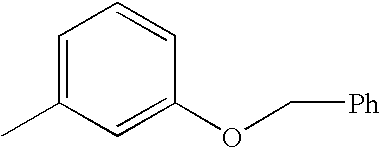 |
||
| 43 |
 |
||
| 44 |
 |
||
| 45 |
 |
||
| 46 |
 |
||
| 47 |
 |
||
| 48 |
 |
||
| 49 |
 |
||
| 50 |
 |
||
| 51 |
 |
||
| 52 |
 |
||
| 53 |
 |
||

4-Hydroxy-3-methoxy-N-[3-(2-phenylethynyl)phenyl]phenylacetamide (the compound of Example 36) (250 mg) is dissolved in ethyl acetate (10 ml), and thereto is added 10% palladium on carbon (25 mg), and the mixture is subjected to catalytic hydrogenation at 25° C. The catalyst is removed by filtration, and the solvent is evaporated under reduced pressure. The residue is purified by silica gel column chromatography (eluent: gradient from 0% to 100% hexane/ethyl acetate) to give the desired compound (200 mg).
1H-NMR (300 MHz, CDCl3, δ): 2.86 (4H, s), 3.66 (2H, s), 3.90 (3H, s), 5.68 (1H, s), 6.81–7.01 (4H, m), 6.96 (1H, s), 7.09–7.42 (7H, m), 7.72 (1H, d).

Instead of the compound of Example 36, the compound of Example 22 is treated in a similar manner to Example 54 to give the desired compound.

4-Hydroxy-3-methoxy-N-[3-(2-phenylethynyl)phenyl]phenylacetamide (150 mg) obtained in Example 36 is dissolved in ethyl acetate (10 ml), and thereto is added Lindlar catalyst (5% lead-poisoned palladium-calcium carbonate) (15 mg), and the mixture is subjected to catalytic hydrogenation at 25° C. The catalyst is removed by filtration, and the solvent is evaporated under reduced pressure. The residue is purified by silica gel column chromatography (eluent: gradient from 0% to 100% hexane/ethyl acetate) to give the desired compound (50 mg).
1H-NMR (300 MHz, CDCl3, δ): 3.62 (2H, s), 3.88 (3H, s), 5.68 (1H, s), 6.51 (1H, d), 6.59 (1H, d); 6.76–7.26 (12H, m), 7.44 (1H, d).

A mixture of N-(3-carboxyphenyl)-4-hydroxy-3-methoxyphenylacetamide (500 mg), pentafluorophenol (305 mg), 1-ethyl-3-(3-dimethylaminopropyl)carbodiimide hydrochloride (320 mg) and methylene chloride (10 ml) is stirred at 25° C. for 18 hours. The reaction solution is washed with water, and the solvent is evaporated under reduced pressure. To the residue are added ethyl acetate (10 ml) and cyclohexylamine (174 mg), and the mixture is heated with stirring at 60° C. for 18 hours. The solvent is evaporated and the residue is purified by silica gel column chromatography (eluent: gradient from 0% to 100% hexane/ethyl acetate) to give the desired compound (600 mg).
1H-NMR (300 MHz, CDCl3, δ): 1.17–1.51 (4H, m), 1.63–1.88 (4H, m), 1.95–2.07 (2H, m), 3.68 (2H, s), 3.90 (3H, s), 3.94 (1H, m), 5.70 (1H, s), 6.03 (1H, d), 6.81 (2H, m), 6.94 (1H, d), 7.32–7.46 (3H, m), 7.68 (1H, d), 7.74 (1H, s).

3-Methoxy-4-(2-phthalimidoethoxy)phenylacetic acid pentafluorophenyl ester (690 mg) and 3-cycloheptylaniline (500 mg) are dissolved in ethyl acetate (10 ml), and the mixture is heated with stirring at 60° C. for 18 hours. The solvent is evaporated under reduced pressure, and the residue is purified by silica gel column chromatography (eluent: gradient from 0% to 100% hexane/ethyl acetate) to give N-(3-cycloheptylphenyl)-3-methoxy-4-(2-phthalimidoethoxy)phenylacetamide (500 mg). This product is dissolved in ethanol (10 ml), and thereto is added hydrazine monohydrate (610 mg), and the mixture is heated under reflux for 2 hours. The insoluble materials are removed by filtration, and the solvent is evaporated under reduced pressure. To the residue is added water, and the mixture is extracted with chloroform. The organic layer is dried over sodium sulfate, and the residue is purified by silica gel column chromatography (eluent: gradient from 0% to 30% chloroform/methanol), and treated with 10% hydrogen chloride-methanol to give the desired compound (170 mg).
1H-NMR (300 MHz, DMSO-d6, δ): 1.47–1.82 (12H, m), 2.60 (1H, m), 3.16 (2H, t), 3.57 (2H, s), 3.78 (3H, s), 4.13 (2H, t), 6.86 (2H, m), 7.00 (2H, m), 7.16 (1H, t), 7.39 (1H, d), 7.48 (1H, s), 8.12 (3H, s), 10.17 (1H, s).
Instead of 3-cycloheptylaniline in Example 58, the corresponding compounds are treated in a similar manner to Example 58 to give the compounds as listed in Table 14.
| TABLE 14 |
 |
| Ex. No. | R4 | ||
| 59 |
 |
||
| 60 |
 |
||
| 61 |
 |
||
| 62 |
 |
||

Intermediate 4 (500 mg) is dissolved in tetrahydrofuran (10 ml), and thereto are added tetrakis(triphenylphosphine)palladium (0) (110 mg), phenylboronic acid (230 mg), cesium carbonate (1.2 g) and water (2 ml), and the mixture is heated under reflux for 18 hours under argon atmosphere. The solvent is evaporated under reduced pressure, and the residue is purified by silica gel column chromatography (eluent: gradient from 0% to 100% hexane/ethyl acetate) to give 4-[2-(tert-butoxycarbonylamino)ethoxy]-3-methoxy-N-(3-phenylphenyl)phenylacetamide (350 mg). This product is treated with 10% hydrogen chloride-methanol to give the desired compound (210 mg).
1H-NMR (300 MHz, DMSO-d6, δ): 3.18 (2H, t), 3.61 (2H, s), 3.79 (3H, s), 4.11 (2H, t), 6.88 (1H, m), 7.01 (2H, m), 7.30–7.50 (5H, m), 7.60 (3H, m), 7.85–8.00 (4H, m), 10.25 (1H, s).
Instead of phenylboronic acid in Example 63, various boronic acid derivatives are treated in a similar manner to Example 63 to give the compounds as listed in Table 15.
| TABLE 15 |
 |
| Ex. No. | R4 | ||
| 64 |
 |
||
| 65 |
 |
||
| 66 |
 |
||
| 67 |
 |
||
| 68 |
 |
||

N-[3-(4-tert-Butylcyclohexan-1-yl)phenyl]-4-hydroxy-3-methoxyphenylacetamide (100 mg) obtained in Example 20, triethylamine (94 mg) and 4-dimethylaminopyridine (5 mg) are dissolved in methylene chloride (5 ml), and thereto is added dropwise acetyl chloride (40 mg) under ice-cooling. The mixture is stirred at 25° C. for 18 hours, and the reaction solution is washed with water. The organic layer is dried over sodium sulfate, and the solvent is evaporated under reduced pressure. The residue is purified by silica gel column chromatography (eluent: gradient from 0% to 100% hexane/ethyl acetate) to give the desired compound (90 mg).
1H-NMR (300 MHz, CDCl3, δ): 0.78, 0.86 (9H, m), 1.0–1.25 (3H, m), 1.30–1.93 (5H, m), 2.20 (1H, m), 2.32 (3H, s), 2.40, 2.98 (1H, m), 3.70 (2H, s), 3.83 (3H, s), 6.83–7.42 (8H, m).
Instead of acetyl chloride in Example 69, various acyl chloride derivatives are treated in a similar manner to Example 69 to give the compounds as listed in Table 16.
| TABLE 16 | |
| Ex. No. | Compound |
| 70 |
 |
| 71 |
 |

N-[3-(4-tert-butylcyclohexan-1-yl)phenyl]-4-hydroxy-3-methoxyphenylacetamide (130 mg) and ethyl bromoacetate (84 mg) are dissolved in acetone, and thereto is added potassium carbonate (180 mg), and the reaction solution is heated under reflux for 18 hours. The reaction solution is filtered, and the filtrate is concentrated. The residue is purified by silica gel column chromatography (eluent: gradient from 0% to 100% hexane/ethyl acetate) to give N-[3-(4-tert-butylcyclohexan-1-yl)phenyl]-4-ethoxycarbonylmethyloxy 3-methoxyphenylacetamide (120 mg). This product is dissolved in methanol (2 ml), and thereto is added 2 M aqueous sodium hydroxide solution (1 ml), and the mixture is stirred at 25° C. for 1 hour. The mixture is neutralized with acetic acid, and water is added thereto. The mixture is extracted with chloroform, and the organic layer is dried over sodium sulfate. The solvent is evaporated under reduced pressure, and the residue is purified by silica gel column chromatography (eluent: gradient from 0% to 25% chloroform/methanol) to give the desired compound (45 mg).
1H-NMR (300 MHz, CDCl3, δ): 0.79, 0.87 (9H, m), 1.05–1.95 (8H, m), 2.20 (1H, m), 2.38, 2.98 (1H, m), 3.68 (2H, s), 3.90 (3H, s), 4.69 (2H, s), 6.84–7.44 (8H, m).

Intermediate 5 (200 mg), 2-aminoethanol (122 mg) and triethylamine (45 mg) are dissolved in acetonitrile (5 ml), and the mixture is heated under reflux for 18 hours. To the reaction solution is added chloroform, and the mixture is washed with water. The organic layer is dried over sodium sulfate, and the solvent is evaporated under reduced pressure. The residue is purified by silica gel column chromatography (eluent: gradient from 0% to 20% chloroform/methanol) to give the desired compound (170 mg).
1H-NMR (300 MHz, CDCl3, δ): 0.79, 0.87 (9H, m), 1.05–2.25 (9H, m), 2.40, 2.98 (1H, m), 2.90 (2H, t), 3.10 (2H, t), 3.68 (2H, s), 3.71 (2H, t), 3.86 (3H, s), 4.16 (2H, t), 6.81–7.42 (8H, m).

Instead of 2-aminoethanol in Example 73, methylamine is treated in a similar manner to Example 73 to give the desired compound.

Formic acid (30 mg) is slowly added to acetic anhydride (75 mg), and the mixture is heated with stirring at 60° C. for 2 hours. To the mixture is added dry tetrahydrofuran (0.2 ml), and further added 4-(2-aminoethoxy)-N-[3-(4-tert-butylcyclohexan-1-yl)phenyl]-3-methoxyphenylacetamide (100 mg) obtained in Example 62 at −20° C. The mixture is stirred at room temperature for 3 hours. The solvent is evaporated under reduced pressure, and the residue is purified by silica gel column chromatography (eluent: gradient from 0% to 100% hexane/ethyl acetate) to give the desired compound (80 mg).
1H-NMR (300 MHz, CDCl3, δ): 0.79, 0.86 (9H, m), 1.03–1.94 (8H, m), 2.20 (1H, m), 2.40, 2.98 (1H, m), 3.67 (2H, s), 3.74 (2H, q), 3.88 (3H, s), 4.12 (2H, t), 6.27 (1H, m), 6.81–7.45 (8H, m), 8.24 (1H, s).
Instead of cyclohexylzinc bromide in Example 1, various zinc bromide compounds are treated in a similar manner to Example 1 to give the compounds as listed in Table 17.
| TABLE 17 |
 |
| Ex. No. | R4 | ||
| 76 |
 |
||
| 77 |
 |
||
| 78 |
 |
||
| 79 |
 |
||
Instead of 3-(cyclohexen-1-yl)aniline (Intermediate 2) in Example 9, various aniline derivatives are treated in a similar manner to Example 9 to give the compounds as listed in Table 18.
| TABLE 18 |
 |
| Ex. No. | R4 | R5 |
| 80 |
 |
H |
| 81 |
 |
H |
| 82 |
 |
H |
| 83 |
 |
H |
| 84 |
 |
H |
| 85 |
 |
H |
| 86 |
 |
H |
| 87 |
 |
H |
| 88 |
 |
H |
| 89 |
 |
H |
| 90 |
 |
H |
| 91 | —Ph | t-BuCOOCH2— |
| 92 | —Ph | Me |
| 93 |
 |
H |
| 94 |
 |
H |
| 95 |
 |
H |
| 96 |
 |
H |

The corresponding strating compounds are treated in a similar manner to Example 9 to give the desired compounds.
Instead of 3-(cyclohexen-1-yl)aniline (Intermediate 2) and 4-hydroxy-3-methoxyphenylacetic acid pentafluorophenyl ester in Example 9, 3-(4-tert-butylcyclohexan-1-yl)aniline and various pentafluorophenyl esters are used respectively and treated in a similar manner to Example 9 to give the compounds as listed in Table 19.
| TABLE 19 |
 |
| Ex. No. | R2 | R3 |
| 98 | H | I |
| 99 | Me | H |
Instead of phenyboronic acid in Example 35, various arylboronic acid derivatives are treated in a similar manner to Example 35 to give the compounds as listed in Table 20.
| TABLE 20 |
 |
| Ex. No. | R4 | ||
| 100 |
 |
||
| 101 |
 |
||
| 102 |
 |
||
| 103 |
 |
||
| 104 |
 |
||
| 105 |
 |
||

Instead of Intermediate 1 in Example 35, 4-hydroxy-N-(4-iodophenyl)-3-methoxyphenylacetamide is treated in a similar manner to Example 35 to give the desired compound.

Instead of Intermediate 1 in Example 36, 4-hydroxy-N-(2-iodophenyl)-3-methoxyphenylacetamide is treated in a similar manner to Example 36 to give the desired compound.
Instead of 1-trifluoromethyl-2-iodobenzene in Example 37, various iodobenzene derivatives are treated in a similar manner to Example 37 to give the compounds as listed in Table 21.
| TABLE 21 |
 |
| Ex. No. | R8 | ||
| 108 |
 |
||
| 109 |
 |
||
| 110 |
 |
||
| 111 |
 |
||
| 112 |
 |
||
Instead of 4-hydroxy-3-methoxy-N-[3-(2-phenylethynyl)phenyl]-phenylacetamide in Example 54, various ethynyl derivatives are treated in a similar manner to Example 54 to give the compounds as listed in Table 22.
| TABLE 22 |
 |
| Ex. No. | R8 | ||
| 113 |
 |
||
| 114 |
 |
||
| 115 |
 |
||
| 116 |
 |
||

Instead of 4-hydroxy-3-methoxy-N-[3-(2-phenylethynyl)phenyl]-phenylacetamide (the compound of Example 36) in Example 54, 4-hydroxy-3-methoxy-N-[2-(2-phenylethynyl)phenyl]phenylacetamide (the compound of Example 107) is treated in a similar manner to Example 54 to give the desired compound.

Instead of 4-hydroxy-3-methoxy-N-[3-(2-phenylethynyl)phenyl]-phenylacetamide (the compound of Example 36) in Example 56, 4-hydroxy-3-methoxy-N-[2-(2-phenylethynyl)phenyl]phenylacetamide (the compound of Example 107) is treated in a similar manner to Example 56 to give the desired compound.

Instead of N-[3-(4-tert-butylcyclohexan-1-yl)phenyl]-4-hydroxy-3-methoxyphenylacetamide in Example 69, the compound of Example 35 is treated in a similar manner to Example 69 to give the desired compound.

The compound of Example 101 (100 mg) is dissolved in 30% hydrochloric acid-ethanol, and the mixture is stirred at 50° C. for 10 minutes. The solvent is evaporated under reduced pressure, and the residue is purified by silica gel column chromatography (eluent: gradient from 0% to 10% chloroform/methanol) to give the desired compound (50 mg).
1H-NMR (300 MHz, DMSO-d6, δ): 3.51 (2H, s), 3.74 (3H, s), 6.31 (1H, m), 6.41 (1H, d), 6.69–6.72 (4H, m), 6.91 (1H, d), 7.25–7.38 (2H, m), 7.88 (1H, s), 8.81 (1H, bs), 10.15 (1H, s), 11.49 (1H, s).

Intermediate 6 (526 mg) is dissolved in tetrahydrofuran (7 ml), and thereto are added tetrakis(triphenylphosphine)palladium (0) (115 mg), methyl 2-iodobenzoate (786 mg), cesium carbonate (978 mg) and water (1 ml), and the mixture is heated under reflux for 42 hours under argon atmosphere. The solvent is evaporated under reduced pressure, and the residue is purified by silica gel column chromatography (eluent: gradient from 0% to 100% hexane/ethyl acetate) to give 4-[2-(tert-butoxycarbonylamino)ethoxy]-3-methoxy-N-[3-(2-methoxycarbonylphenyl)phenyl]phenylacetamide (100 mg). This product is treated with 10% hydrogen chloride-methanol to give the desired compound (50 mg).
1H-NMR (300 MHz, DMSO-d6, δ): 3.16 (2H, t), 3.58 (3H, s), 3.61 (2H, s), 3.78 (3H, s), 4.12 (2H, t), 6.88 (1H, m), 7.01 (2H, m), 7.31–7.51 (4H, m), 7.60 (3H, m), 7.71 (1H, m), 7.73–8.40 (3H, bs), 10.34 (1H, s).

Instead of methyl 2-iodobenzoate in Example 121, 2-cyclohexyl-1-iodobenzene is treated in a similar manner to Example 121 to give the desired compound.
Instead of phenylboronic acid in Example 63, various boronic acid derivatives are treated in a similar manner to Example 63 to give the compounds as listed in Table 23.
| TABLE 23 |
 |
| Ex. No. | R4 | ||
| 123 |
 |
||
| 124 |
 |
||
| 125 |
 |
||
| 126 |
 |
||
| 127 |
 |
||
| 128 |
 |
||
| 129 |
 |
||
| 130 |
 |
||
| 131 |
 |
||
| 132 |
 |
||
| 133 |
 |
||
| 134 |
 |
||
| 135 |
 |
||
| 136 |
 |
||
| 137 |
 |
||
| 138 |
 |
||
| 139 |
 |
||
| 140 |
 |
||
| 141 |
 |
||
| 142 |
 |
||
| 143 |
 |
||
| 144 |
 |
||
| 145 |
 |
||
| 146 |
 |
||
| 147 |
 |
||
| 148 |
 |
||
| 149 |
 |
||
| 150 |
 |
||
| 151 |
 |
||
| 152 |
 |
||
| 153 |
 |
||
| 154 |
 |
||
| 155 |
 |
||
| 156 |
 |
||
| 157 |
 |
||
| 158 |
 |
||
| 159 |
 |
||
| 160 |
 |
||
| 161 |
 |
||
| 162 |
 |
||
| 163 |
 |
||
| 164 |
 |
||
| 165 |
 |
||
| 166 |
 |
||
| 167 |
 |
||
| 168 |
 |
||

Intermediate 7 (2.4 g) and 3-(tert-butyl)aniline (1.7 g) are dissolved in ethyl acetate, and the mixture is heated under reflux for 18 hours. The solvent is evaporated under reduced pressure, and the residue is purified by silica gel column chromatography (eluent: gradient from 0% to 100% hexane/ethyl acetate) to give 4-[2-(tert-butoxycarbonylamino)ethoxy]-N-[3-(3-tert-butylphenyl)phenyl]-3-methoxyphenylacetamide (700 mg). This product is treated with 10% hydrogen chloride-methanol to give the desired compound (200 mg).
1H-NMR (300 MHz, CD3OD, δ): 1.33 (9H, s), 3.30 (2H, t), 3.71 (2H, s), 3.85 (3H, s), 4.17 (2H, t), 6.94 (2H, m), 7.09 (1H, s), 7.28–7.37 (5H, m), 7.62 (2H, m), 7.95 (1H, s).
Instead of 3-(tert-butyl)aniline in Example 169, various aniline derivatives are treated in a similar manner to Example 169 to give the compounds as listed in Tables 24 and 25.
| TABLE 24 |
 |
| Ex. No. | R5 |
| 170 | 6-F |
| 171 | 5-F-6-MeO |
| 172 | 6-Me |
| 173 | 4-Me |
| 174 | 2-Me |
| 175 | 2,4,6-(Me)3 |
| 176 | 4-MeO |
| 177 | 6-MeO |
| 178 | 5-CF3 |
| 179 | 4-CF3O |
| 180 | 4-Ph |
| 181 | 4-Me-5-Ph |
| TABLE 25 |
 |
| Ex. No. | R4 | X1 |
| 182 |
 |
H |
| 183 |
 |
H |
| 184 |
 |
H |
| 185 |
 |
H |
| 186 |
 |
H |
| 187 |
 |
H |
| 188 |
 |
H |
| 189 |
 |
H |
| 190 |
 |
H |
| 191 |
 |
H |
| 192 |
 |
H |
| 193 |
 |
H |
| 194 |
 |
H |
| 195 |
 |
H |
| 196 |
 |
Me |
| 197 |
 |
H |
| 198 |
 |
H |
| 199 |
 |
H |
| 200 |
 |
H |
| 201 |
 |
H |
| 202 |
 |
H |

The compound of Example 146 (50 mg) is dissolved in methanol (3 ml), and thereto are added lithium hydroxide (10 mg) and water (1 ml), and the mixture is stirred at 25° C. for 5 minutes. The solvent is evaporated, and the residue is purified by CHP-20 (manufactured by Mitsubishi Kasei Corporation; high porous styrene resin: 75 to 150 μm) (eluent: gradient from 40% to 70% (0.05% aqueous trifluoroacetic acid solution)/methanol) to give the desired compound (30 mg).
1H-NMR (300 MHz, DMSO-d6, δ): 3.18 (2H, t), 3.61 (2H, s), 3.79 (3H, s), 4.11 (2H, t), 6.88 (1H, d), 6.70–7.04 (2H, m), 7.38–7.45 (2H, m), 7.57–7.65 (2H, m), 7.85–7.98 (3H, m), 8.15 (1H, s), 10.29 (1H, s).

Instead of the compound of Example 146 in Example 203, the compound of Example 185 is treated in a similar manner to Example 203 to give the desired compound.

N-[3-(4-tert-Butylcyclohexan-1-yl)phenyl]-4-ethoxycarbonylmethyloxy-3-methoxyphenylacetamide (240 mg), which is an intermediate of Example 72, is dissolved in ethanol, and thereto is added sodium borohydride (35 mg), and the mixture is stirred at room temperature for 2 hours. A saturated aqueous ammonium chloride solution is added thereto, and the mixture is extracted with chloroform. The extracted is washed with water, and the solvent is evaporated under reduced pressure. The residue is purified by silica gel column chromatography (eluent: gradient from 0% to 100% hexane/ethyl acetate) to give the desired compound (110 mg).
1H-NMR (300 MHz, CDCl3, δ): 0.79, 0.86 (9H, m), 1.0–1.30 (3H, m), 1.33–1.48 (1H, m), 1.50–1.95 (4H, m), 2.20 (1H, m), 2.40, 2.98 (1H, m), 3.67 (2H, s), 3.87 (3H, s), 3.96 (2H, t), 4.14 (2H, t), 6.83–7.42 (8H, m).

N-[3-(4-tert-Butylcyclohexan-1-yl)phenyl]-4-hydroxy-3-nitrophenylacetamide (550 mg), which is prepared in a similar manner to Example 9, is treated in a similar manner to Reference Example 4 to give N-[3-(4-tert-butylcyclohexan-1-yl)phenyl]-3-nitro-4-(2-phthalimidoethoxy)phenylacetamide (500 mg). This product is dissolved in ethanol (10 ml), and thereto are added reduced iron (240 mg), ammonium chloride (90 mg) and water (5 ml), and the mixture is heated under reflux for one hour. The insoluble materials are removed by filtration, and the solvent is evaporated under reduced pressure. The residue is purified by silica gel column chromatography (eluent: gradient from 0% to 100% hexane/ethyl acetate) to give 3-amino-N-[3-(4-tert-butylcyclohexan-1-yl)phenyl]-4-(2-phthalimidoethoxy)phenylacetamide (140 mg). This product is dissolved in methylene chloride (5 ml), and thereto is added triethylamine (33 mg). To the mixture is added dropwise methanesulfonyl chloride (33 mg), and the mixture is stirred for 2 hours. The mixture is washed with water, and the solvent is evaporated under reduced pressure. The residue is purified by silica gel column chromatography (eluent: gradient from 0% to 100% hexane/ethyl acetate) to give N-[3-(4-tert-butylcyclohexan-1-yl)phenyl]-3-methanesulfonylamino-4-(2-phthalimidoethoxy)phenylacetamide (70 mg). This product is treated with hydrazine monohydrate in a similar manner to Example 58 to give the desired compound (30 mg).
1H-NMR (300 MHz, DMSO-d6, δ): 0.76, 0.85 (9H, m), 1.0–1.90 (8H, m), 2.10–2.20 (1H, m), 2.50, 2.94 (1H, m), 2.95 (3H, s), 3.30 (2H, m), 3.55 (2H, s) 4.15 (2H, t), 6.85–7.60 (7H, m), 8.01 (3H, brs), 8.88 (1H, s), 10.02 (1H, m).

Intermediate 4 (1 g) is dissolved in dimethylformamide (10 ml), and thereto are added 3-methylvinylbenzene (826 mg), palladium (II) acetate (105 mg), tris(2-methylphenyl)phosphine (143 mg), tetra-n-butyl ammonium chloride (130 mg), and the mixture is heated with stirring at 97° C. for 18 hours under argon atmosphere. To the reaction solution is added ethyl acetate, and the mixture is washed with water and 2 M hydrochloric acid. The organic layer is dried over sodium sulfate, and the solvent is evaporated under reduced pressure. The residue is purified by silica gel column chromatography (eluent: gradient from 0% to 100% hexane/ethyl acetate) to give 4-[2-(tert-butoxycarbonylamino)-ethoxy]-3-methoxy-N-[3-[(E)-2-(3-methylphenyl)vinyl]phenyl]phenylacetamide (370 mg). This product is treated with 10% hydrogen chloride-methanol to give the desired compound (120 mg).
1H-NMR (300 MHz, DMSO-d6, δ): 2.33 (3H, s), 3.17 (2H, t), 3.62 (2H, s), 3.80 (3H, s), 4.14 (2H, t), 6.87–7.49 (12H, m), 7.87 (1H, s), 8.09 (3H, bs), 10.31 (1H, s).
Instead of 3-methylvinylbenzene in Example 207, various vinyl derivatives are treated in a similar manner to Example 207 to give the compounds as listed in Table 26.
| TABLE 26 |
 |
| Ex. No. | R8 | ||
| 208 |
 |
||
| 209 |
 |
||
| 210 |
 |
||
| 211 |
 |
||
| 212 |
 |
||
| 213 |
 |
||
| 214 |
 |
||
| 215 |
 |
||
| 216 |
 |
||

4-[2-(tert-Butoxycarbonylamino)ethoxy]-3-methoxy-N-[3-[(E)-2-(3-methylphenyl)vinyl]phenyl]phenylacetamide (100 mg) is dissolved in methanol (10 ml) and acetic acid (1 ml), and thereto is added 10% palladium on carbon (10 mg), and the mixture is subjected to catalytic hydrogenation at 50° C. The catalyst is removed by filtration, and the solvent is evaporated to give 4-[2-(tert-butoxycarbonylamino)ethoxy]-3-methoxy-N-[3-[2-(3-methylphenyl)ethyl]phenyl]phenylacetamide (80 mg). This product is treated with 10% hydrogen chloride-methanol to give the desired compound (50 mg).
1H-NMR (300 MHz, DMSO-d6, δ): 2.26 (3H, s), 2.80 (4H, s), 3.17 (2H, t), 3.57 (2H, s), 3.79 (3H, s), 4.13 (2H, t), 6.85–7.44 (10H, m), 7.51 (1H, s), 8.02 (3H, bs), 10.14 (1H, s).
Instead of 4-[2-(tert-butoxycarbonylamino)ethoxy]-3-methoxy-N-[3-[(E)-2-(3-methylphenyl)vinyl]phenyl]phenylacetamide in Example 217, the corresponding derivatives are treated in a similar manner to Example 217 to give the compounds as listed in Table 27.
| TABLE 27 |
 |
| Ex. No. | R8 | ||
| 218 |
 |
||
| 219 |
 |
||
| 220 |
 |
||
| 221 |
 |
||
| 222 |
 |
||
| 223 |
 |
||
| 224 |
 |
||
Instead of 3-(tert-butyl)aniline in Example 169, Intermediate 8 of Reference Example 8, and 7-amino-1-oxo-1,2,3,4-tetrahydronaphthalene derivatives obtained in a similar manner to Reference Example 8 are used and treated in a similar manner to Example 169 to give the compounds as listed in Table 28.
| TABLE 28 |
 |
| Ex. No. | R91 | ||
| 225 |
 |
||
| 226 |
 |
||
| 227 |
 |
||
| 228 |
 |
||
| 229 |
 |
||
| 230 |
 |
||
| 231 |
 |
||
| 232 |
 |
||
| 233 |
 |
||
| 234 |
 |
||
| 235 |
 |
||
Instead of 3-(cyclohexen-1-yl)aniline in Example 9, Intermediate 9 and aminoindole derivatives obtained in a similar manner to Reference Example 9 are used and treated in a similar manner to Example 9 to give the compounds as listed in Tables 29 to 32.
| TABLE 29 |
 |
| Ex. No. | R91 | ||
| 236 |
 |
||
| 237 |
 |
||
| TABLE 30 |
 |
| Ex. No. | R91 | ||
| 238 |
 |
||
| 239 |
 |
||
| 240 |
 |
||
| 241 |
 |
||
| 242 |
 |
||
| 243 |
 |
||
| TABLE 31 |
 |
| Ex. No. | R91 | ||
| 244 |
 |
||
| 245 |
 |
||
| TABLE 32 |
 |
| Ex. No. | R91 | ||
| 246 |
 |
||
| 247 |
 |
||

Instead of 3-(cyclohexen-1-yl)aniline (Intermediate 2) in Example 9, 7-amino-1-tetralone is treated in a similar manner to Example 9. The resulting 4-hydroxy-3-methoxy-N-[1-oxo-1,2,3,4-tetrahydronaphthalen-7-yl]phenylacetamide (1 g) is dissolved in 30% hydrogen chloride-ethanol (5 ml), and thereto is added benzaldehyde (433 mg). The mixture is stirred at 25° C. for 18 hours. The precipitated crystals are collected by filtration, and washed with diethyl ether to give the desired compound (700 mg).
1H-NMR (300 MHz, CDCl3, δ): 2.89 (2H, t), 3.10 (2H, t), 3.69 (2H, s), 3.89 (3H, s), 5.70 (1H, s), 6.80–6.85 (2H, m), 6.95 (2H, d), 7.22 (1H, d), 7.30–7.43 (5H, m), 7.66 (1H, d), 7.84 (1H, s), 8.09 (1H, dd).

The compound of Example 248 (500 mg) is dissolved in ethyl acetate (20 ml), and thereto is added 10% palladium on carbon (50 mg), and the mixture is subjected to catalytic hydrogenation at 25° C. The catalyst is removed by filtration, and the solvent is evaporated under reduced pressure. The residue is purified by silica gel column chromatography (eluent: gradient from 0% to 100% hexane/ethyl acetate) to give the desired compound (350 mg).
1H-NMR (300 MHz, CDCl3, δ): 1.67–1.81 (1H, m), 2.05–2.13 (1H, m), 2.58–2.94 (4H, m), 3.43 (1H, dd), 3.67 (2H, s), 3.91 (3H, s), 5.67 (1H, s), 6.80–7.00 (3H, m), 7.25–7.35 (7H, m), 7.60 (1H, d), 8.01 (1H, dd).
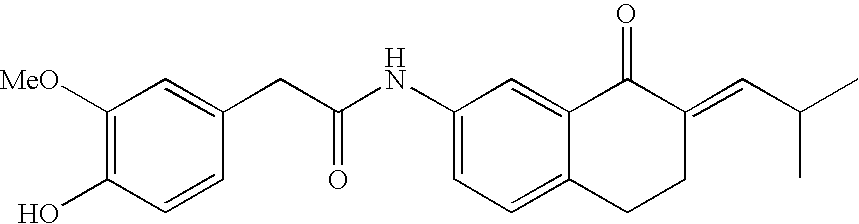
Instead of benzaldehyde in Example 248, isobutyl aldehyde is treated in a similar manner to Example 248 to give the desired compound.

The compound of Example 250 is treated in a similar manner to Example 249 to give the desired compound.
Instead of 3-cycloheptylaniline in Example 58, 6-aminoindole derivatives are treated in a similar manner to Example 58 to give the compounds as listed in Table 33.
| TABLE 33 |
 |
| Ex. No. | R91 | ||
| 252 |
 |
||
| 253 |
 |
||
| 254 |
 |
||
| 255 |
 |
||
Instead of phenylboronic acid in Example 35, the corresponding derivatives are treated in a similar manner to Example 35 to give the compounds as listed in Table 34.
| TABLE 34 |
 |
| Ex. No. | R4 | ||
| 256 |
 |
||
| 257 |
 |
||
| 258 |
 |
||
Instead of 3-(cyclohexen-1-yl)aniline in Example 9, the corresponding derivatives are treated in a similar manner to Example 9 to give the compounds as listed in Table 35.
| TABLE 35 |
 |
| Ex. No. | R4 | ||
| 259 |
 |
||
| 260 |
 |
||
The results of the analysis by HPLC of the compounds of the above Examples such as retention time (Rt) and the analysis conditions are shown in Table 36.
| TABLE 36 | ||||
| Ex. No. | Rt | Conditions* | ||
| 1 | 3.75 | a | ||
| 2 | 2.86 | a | ||
| 3 | 5.99 | a | ||
| 4 | 3.21 | a | ||
| 5 | 4.66 | a | ||
| 6 | 3.20 | a | ||
| 7 | 3.85 | a | ||
| 8 | 4.23 | a | ||
| 9 | 3.42 | a | ||
| 10 | 2.29 | a | ||
| 11 | 4.76 | a | ||
| 12 | 5.16 | a | ||
| 13** | 4.39, 4.64 | a | ||
| 14 | 2.15 | a | ||
| 15 | 3.27 | a | ||
| 16 | 1.50 | a | ||
| 17 | 2.47 | a | ||
| 18 | 2.01 | a | ||
| 19 | 2.21 | a | ||
| 20** | 7.85, 9.13 | a | ||
| 21 | 2.86 | a | ||
| 22 | 3.25 | a | ||
| 23 | 2.75 | a | ||
| 24 | 3.27 | a | ||
| 25 | 1.43 | a | ||
| 26 | 3.25 | a | ||
| 27 | 3.39 | a | ||
| 28 | 2.84 | a | ||
| 29 | 5.34 | a | ||
| 30 | 6.95 | a | ||
| 31 | 7.29 | c | ||
| 32 | 4.36 | a | ||
| 33 | 3.09 | a | ||
| 34 | 3.08 | a | ||
| 35 | 2.76 | a | ||
| 36 | 3.36 | a | ||
| 37 | 3.77 | a | ||
| 38 | 4.03 | a | ||
| 39 | 4.67 | a | ||
| 40 | 3.02 | a | ||
| 41 | 3.38 | a | ||
| 42 | 5.33 | a | ||
| 43 | 5.00 | a | ||
| 44 | 5.43 | a | ||
| 45 | 3.54 | a | ||
| 46 | 3.33 | a | ||
| 47 | 3.46 | a | ||
| 48 | 3.82 | a | ||
| 49 | 4.46 | a | ||
| 50 | 4.62 | a | ||
| 51 | 4.53 | a | ||
| 52 | 4.82 | a | ||
| 53 | 6.89 | a | ||
| 54 | 3.20 | a | ||
| 55 | 3.16 | a | ||
| 56 | 3.15 | a | ||
| 57 | 2.22 | a | ||
| 58 | 5.52 | b | ||
| 59 | 4.09 | b | ||
| 60 | 3.75 | b | ||
| 61 | 4.18 | b | ||
| 62** | 12.58, 16.39 | b | ||
| 63 | 2.68 | b | ||
| 64 | 7.50 | b | ||
| 65 | 2.67 | b | ||
| 66 | 3.11 | b | ||
| 67 | 3.96 | b | ||
| 68 | 3.54 | b | ||
| 69** | 11.49, 13.45 | a | ||
| 70** | 9.25, 10.46 | c | ||
| 71** | 10.23, 11.58 | c | ||
| 72** | 6.31, 7.28 | a | ||
| 73** | 12.22, 16.14 | b | ||
| 74** | 2.78, 3.07 | a | ||
| 75** | 5.86, 6.73 | a | ||
| 76 | 4.57 | a | ||
| 77 | 5.19 | a | ||
| 78 | 4.14 | a | ||
| 79 | 3.87 | a | ||
| 80 | 7.41 | a | ||
| 81** | 3.44, 3.68 | a | ||
| 82** | 3.99, 4.26 | a | ||
| 83** | 4.26, 4.47 | a | ||
| 84 | 5.07 | a | ||
| 85** | 5.30, 5.66 | a | ||
| 86 | 2.25 | d | ||
| 87 | 2.40 | d | ||
| 88 | 3.10 | f | ||
| 89 | 3.05 | f | ||
| 90 | 2.41 | d | ||
| 91 | 9.76 | d | ||
| 92 | 4.93 | d | ||
| 93 | 2.78 | a | ||
| 94 | 4.97 | d | ||
| 95 | 2.67 | d | ||
| 96 | 3.60 | d | ||
| 97 | 2.68 | a | ||
| 98** | 11.7, 14.0 | a | ||
| 99** | 9.72, 11.4 | a | ||
| 100 | 8.2 | d | ||
| 101 | 7.5 | d | ||
| 102 | 9.63 | d | ||
| 103 | 2.08 | d | ||
| 104 | 5.90 | d | ||
| 105 | 4.20 | d | ||
| 106 | 2.76 | a | ||
| 107 | 7.8 | d | ||
| 108 | 3.06 | a | ||
| 109 | 2.28 | a | ||
| 110 | 2.75 | a | ||
| 111 | 2.42 | a | ||
| 112 | 3.11 | a | ||
| 113 | 2.45 | a | ||
| 114 | 5.80 | a | ||
| 115 | 2.71 | a | ||
| 116 | 2.93 | a | ||
| 117 | 5.14 | d | ||
| 118 | 5.8 | d | ||
| 119 | 8.22 | d | ||
| 120 | 2.15 | d | ||
| 121 | 2.24 | d | ||
| 122 | 5.57 | d | ||
| 123 | 2.33 | d | ||
| 124 | 2.44 | d | ||
| 125 | 2.58 | d | ||
| 126 | 2.80 | d | ||
| 127 | 2.97 | d | ||
| 128 | 3.81 | d | ||
| 129 | 2.65 | d | ||
| 130 | 2.89 | d | ||
| 131 | 2.55 | d | ||
| 132 | 3.03 | d | ||
| 133 | 3.57 | d | ||
| 134 | 3.20 | d | ||
| 135 | 3.86 | d | ||
| 136 | 4.04 | d | ||
| 137 | 3.62 | d | ||
| 138 | 2.39 | d | ||
| 139 | 2.05 | d | ||
| 140 | 3.24 | d | ||
| 141 | 2.90 | d | ||
| 142 | 2.59 | d | ||
| 143 | 3.20 | d | ||
| 144 | 4.14 | d | ||
| 145 | 4.01 | d | ||
| 146 | 2.41 | d | ||
| 147 | 4.70 | d | ||
| 148 | 2.05 | d | ||
| 149 | 2.06 | d | ||
| 150 | 3.13 | d | ||
| 151 | 2.47 | d | ||
| 152 | 2.49 | d | ||
| 153 | 2.29 | d | ||
| 154 | 4.28 | d | ||
| 155 | 2.78 | d | ||
| 156 | 2.64 | d | ||
| 157 | 2.21 | d | ||
| 158 | 2.48 | d | ||
| 159 | 2.74 | i | ||
| 160 | 4.69 | f | ||
| 161 | 3.88 | g | ||
| 162 | 3.2 | d | ||
| 163 | 3.11 | d | ||
| 164 | 2.27 | d | ||
| 165 | 2.33 | d | ||
| 166 | 2.84 | d | ||
| 167 | 5.95 | d | ||
| 168 | 5.20 | d | ||
| 169 | 4.06 | d | ||
| 170 | 2.26 | d | ||
| 171 | 2.63 | d | ||
| 172 | 2.21 | d | ||
| 173 | 2.44 | d | ||
| 174 | 2.16 | d | ||
| 175 | 2.41 | d | ||
| 176 | 2.14 | d | ||
| 177 | 2.34 | d | ||
| 178 | 3.25 | d | ||
| 179 | 3.03 | d | ||
| 180 | 3.30 | d | ||
| 181 | 4.34 | d | ||
| 182 | 2.94 | d | ||
| 183 | 6.53 | d | ||
| 184 | 3.67 | d | ||
| 185 | 3.17 | d | ||
| 186 | 2.28 | d | ||
| 187 | 2.56 | d | ||
| 188 | 2.35 | d | ||
| 189 | 4.35 | d | ||
| 190 | 6.85 | d | ||
| 191 | 6.59 | d | ||
| 192 | 3.82 | a | ||
| 193 | 6.96 | d | ||
| 194 | 6.60 | d | ||
| 195 | 8.13 | d | ||
| 196** | 6.34, 8.31 | d | ||
| 197 | 2.64 | h | ||
| 198 | 3.40 | f | ||
| 199 | 6.19 | f | ||
| 200 | 4.18 | f | ||
| 201 | 6.36 | f | ||
| 202 | 2.39 | f | ||
| 203 | 6.94 | f | ||
| 204 | 2.01 | d | ||
| 205** | 6.19, 7.13 | a | ||
| 206 | 6.33 | d | ||
| 207 | 3.43 | d | ||
| 208 | 2.91 | d | ||
| 209 | 3.11 | d | ||
| 210 | 3.51 | d | ||
| 211 | 3.77 | d | ||
| 212 | 3.98 | d | ||
| 213 | 6.09 | f | ||
| 214 | 2.96 | e | ||
| 215 | 5.61 | h | ||
| 216 | 4.32 | d | ||
| 217 | 3.37 | d | ||
| 218 | 2.73 | d | ||
| 219 | 2.97 | d | ||
| 220 | 3.74 | d | ||
| 221 | 5.74 | f | ||
| 222 | 2.96 | d | ||
| 223 | 4.05 | h | ||
| 224 | 4.00 | d | ||
| 225 | 2.79 | d | ||
| 226 | 3.19 | d | ||
| 227 | 3.36 | d | ||
| 228 | 3.40 | d | ||
| 229 | 2.70 | d | ||
| 230 | 2.65 | d | ||
| 231 | 4.38 | h | ||
| 232 | 5.02 | h | ||
| 233 | 5.02 | h | ||
| 234 | 3.33 | h | ||
| 235 | 4.11 | d | ||
| 236 | 2.96 | a | ||
| 237 | 3.69 | a | ||
| 238 | 2.73 | a | ||
| 239 | 2.96 | a | ||
| 240 | 3.82 | a | ||
| 241 | 3.57 | a | ||
| 242 | 2.85 | a | ||
| 243 | 4.60 | a | ||
| 244 | 3.18 | a | ||
| 245 | 4.48 | a | ||
| 246 | 3.31 | a | ||
| 247 | 4.77 | a | ||
| 248 | 3.17 | a | ||
| 249 | 3.23 | a | ||
| 250 | 3.04 | a | ||
| 251 | 3.39 | a | ||
| 252 | 2.30 | d | ||
| 253 | 2.98 | d | ||
| 254 | 2.21 | d | ||
| 255 | 2.96 | d | ||
| 256 | 4.66 | d | ||
| 257 | 3.84 | d | ||
| 258 | 3.26 | d | ||
| 259 | 2.28 | d | ||
| 260 | 2.41 | d | ||
| *Conditions for analysis: | ||||
| a: 65% acetonitrile/0.05% aqueous trifluoroacetic acid solution | ||||
| b: 45% acetonitrile/0.05% aqueous trifluoroacetic acid solution | ||||
| c: 75% acetonitrile/0.05% aqueous trifluoroacetic acid solution | ||||
| d: 50% acetonitrile/0.05% aqueous trifluoroacetic acid solution | ||||
| e: 40% acetonitrile/0.05% aqueous trifluoroacetic acid solution | ||||
| f: 30% acetonitrile/0.05% aqueous trifluoroacetic acid solution | ||||
| g: 25% acetonitrile/0.05% aqueous trifluoroacetic acid solution | ||||
| h: 20% acetonitrile/0.05% aqueous trifluoroacetic acid solution | ||||
| i: 10% acetonitrile/0.05% aqueous trifluoroacetic acid solution | ||||
| **Under the conditions of these Examples, diastereomers are separated. | ||||
Preparation 1: Preparation of Tablets
| 4-(2-Aminoethoxy)-3-methoxy-N- | 25 g | ||
| [3-(2-phenylethynyl)phenyl]-phenylacetamide | |||
| Lactose | 70 g | ||
| Corn strach | 20 g | ||
| Crystalline cellulose | 25 g | ||
| Hydroxypropyl cellulose | 3 g | ||
The above components are mixed and kneaded in a conventional manner, and the mixture is granulated and dried. To the mixture are added light anhydrous silicic acid (0.7 g) and magnesium stearate (1.3 g), and the mixture is further tabletted to give 1,000 tablets (each 145 mg).
Preparation 2: Preparation of Capsules
| 4-(2-Aminoethoxy)-3-methoxy-N- | 50 g | ||
| [3-(2-phenylethyl)phenyl]-phenylacetamide | |||
| Lactose | 117 g | ||
| Corn strach | 25 g | ||
| Hydroxypropyl cellulose | 3.5 g | ||
| Purified water | 100 g | ||
The above components are mixed and kneaded in a conventional manner, and the mixture is granulated and dried. To the mixture are added light anhydrous silicic acid (1.8 g) and magnesium stearate (2.7 g), and each 200 mg of the resulting granule is packed into a capsule to give 1,000 capsules.
Preparation 3: Preparation of Powder
| 4-(2-Aminoethoxy)-N-(3-cyclohexylphenyl)- | 200 g | ||
| 3-methoxyphenyl-acetamide | |||
| Lactose | 770 g | ||
The above components and light anhydrous silicic acid (5 g) are mixed in a conventional manner to give a powder preparation.
Preparation 4: Preparation of Ointment Using an Oleaginous Base
| 4-(2-Aminoethoxy)-3-methoxy-N- | 0.1 g | ||
| (3-phenylphenyl)phenyl-acetamide | |||
| Plastibase | 99.9 g | ||
The above components are mixed in a conventional manner to give an ointment.
Preparation 5: Preparation of Ointment Using an Aqueous Base
| 4-(2-Aminoethoxy)-N-[3-(4-tert-butylcyclohexan-1-yl)- | 1 g | ||
| phenyl]-3-methoxyphenylacetamide | |||
| Polyethylene glycol 4000 | 44 g | ||
| Polyethylene glycol 400 | 55 g | ||
The above components are kneaded in a conventional manner with heating, if necessary, to give an ointment.
Preparation 6: Preparation of Patch
| 4-(2-Aminoethoxy)-3-methoxy-N- | 10 g | ||
| (3-phenylphenyl)-phenylacetamide | |||
| Eudragit E100 | 20.5 g | ||
| Tributyl acetylcitrate | 10.3 g | ||
| Succinic acid | 0.7 g | ||
| Purified water | 58.5 g | ||
The above components are warmed, if necessary, and uniformly kneaded to give adhesive base containing a medicament for patches. The resulting base is applied and flatted onto a suitable filmy support so as to give patches containing 12.5 mg of said base per 1 cm2 of the support, then, the base layer is dried and coated with a protective film, and cut into a suitable shape of a suitable size corresponding to the dose (area: 2 cm2) to give patches.
The compounds of the present invention exhibit a potent analgesic activity with weak pungency, and they can be effective even in oral administration. Therefore, the present compounds are useful as an agent for treatment of neuropathic pain to which conventional analgesic agents are ineffective, or pain caused by rheumatic arthritis, and as a preventive and/or a remedy for treatment of essential pruritus, allergy or nonallergic rhinitis, frequent urination and urinary incontinence with overactive bladder, stroke, irritable bowel syndrome, respiratory disorders such as asthma and chronic obstructive pulmonary disease, dermatitis, mucositis, gastric and duodenal ulcer, inflammatory bowel diseases and obesity.
Claims (16)
1. An N-arylphenylacetamide derivative of the following formula (I):

(wherein R1 is a C1-6 alkoxy group, a hydroxy group, a halogen atom, a nitro group, an amino group, a C1-6 alkylamino group, a di-(C1-6 alkyl)-amino group, a C1-6 alkylsulfonylamino group, or an arylsulfonylamino group,
R2 is a hydrogen atom, a C1-6 alkylcarbonyl group, an arylcarbonyl group, —(CH2)m—N(R6)(R7), —(CH2)mOH or —(CH2)qCOOH (in which m is an integer of 2 to 4, q is an integer of 1 to 4, R6 is a hydrogen atom, a C1-3 alkyl group, a hydroxy-C2-3 alkyl group, an amino-C2-3 alkyl group, a formyl group, a C1-3 alkylcarbonyl group, a C1-4 alkoxycarbonyl group, an arylcarbonyl group, or an aryl-C1-3 alkyloxycarbonyl group, R7 is a hydrogen atom, a C1-3 alkyl group, a hydroxy-C2-3 alkyl group, or an amino-C2-3 alkyl group),
R3 is a hydrogen atom, a halogen atom, a C1-6 alkyl group, a C1-4 alkoxy group, an aryl group, or a formyl group,
R4, which is located at the meta-position with respect to the group —N(X1)—, is a C6-10 alkyl group, a group of the following formula (A) or a group of the following formula (C), and the group of the formula (A) is a group of the formula:
—Y—R8 (A)
—Y—R8 (A)
[in which Y is a single bond, a C1-3 alkylene group, a C2-3 alkenylene group, a C2-3 alkynylene group, —CO(CH2)p—, a C2-3 alkenylenecarbonyl group, —O—, —O—(CH2)2—, —O—(CH2)3—, or —CONH(CH2)p—, and p is an integer of 0 to 3, R8 is a monocyclic group or a polycyclic group consisting of a 5- or 6-membered aromatic ring containing 0 to 3 heteroatoms selected from N, O and S, which may optionally be substituted by 1 to 3 atoms or groups selected from a halogen, a C1-6 alkyl, a C3-7 cycloalkyl, a C2-6 alkenyl, a C2-6 alkynyl, a trifluoromethyl, a trifluoroethyl, an aryl, an aryl-C1-6 alkyl, a C1-6 alkoxy, a trifluoromethoxy, a C3-7 cycloalkyloxy, an aryloxy, an aryl-C1-3 alkyloxy, a C1-6 alkylcarbonyl, a C3-7 cycloalkylcarbonyl, a formyl, a nitro, an amino, a di-(C1-6 alkyl)amino, a cyano, a hydroxy, a C1-3 alkylthio, a C1-4 alkoxycarbonyl-C1-3 alkyl, a carboxy-C1-3 alkyl, a C1-4 alkoxycarbonyl, an aryl-C1-3 alkyloxycarbonyl, a carboxy and a sulfamoyl; a C5-7 cycloalkenyl group which may optionally be substituted by 1 to 4 atoms or groups selected from a C1-6 alkyl, a C3-7 cycloalkyl, a halogen, a trifluoromethyl, a C1-4 alkoxycarbonyl, an aryl, an aryl-C1-6 alkyl, a C1-3 alkoxy and a hydroxy; or a group of the formula (B):

(Ra, Rb, Rc and Rd are the same or different and each is a hydrogen atom, a C1-6 alkyl group, a C3-7 cycloalkyl group, a halogen atom, a trifluoromethyl group, a C1-4 alkoxycarbonyl group, an aryl group, an aryl-C1-6 alkyl group, a C1-3 alkoxy group or a hydroxy group, or when Ra and Rb attach to the same carbon atom, then these groups may combine to form an oxo group or a thioxo group, or when Rc and Rd attach to the same carbon atom, then these groups may combine together with said carbon atom to form a spiro ring, or 2 or 3 groups selected from Ra, Rb and Rc may combine to form a C6-15 polycycloalkyl group, and n is an integer of 1 to 6)], and the group of the formula (C) is a group of the formula:

(Re and Rf are the same or different and each is a hydrogen atom, a C1-6 alkyl group, a C3-7 cycloalkyl group, a halogen atom, a trifluoromethyl group, a C1-4 alkoxycarbonyl group, an aryl group, an aryl-C1-6 alkyl group, a C1-3 alkoxy group or a hydroxy group, or when Re and Rf attach to the same carbon atom, then these groups may combine together with said carbon atom to form a spiro ring, and Z is a carbon atom, an oxygen atom or a sulfur atom),
R5 is a hydrogen atom, a halogen atom, a C1-6 alkyl group, a trifluoromethyl group, a C1-3 alkoxy group, a trifluoromethoxy group, a cyano group, a nitro group, an amino group, a hydroxy group, a carboxyl group, a C1-6 alkylcarbonyloxymethyl group, or an aryl group,
or R4 and R5 may combine together with the benzene ring to which they bond, and form a tetralone ring or an indole ring, which is substituted by one group selected from a C1-8 alkyl, a C1-8 alkenyl, an aryl-C1-3 alkyl, a C3-7 cycloalkyl-C1-3 alkyl, an arylsulfonyl, a C1-8 alkylidene, a C1-8 alkenylidene, an aryl-C1-3 alkylidene and a C3-7 cycloalkyl-C1-3 alkylidene,
X1 is a hydrogen atom,
or a pharmaceutically acceptable salt thereof, or a hydrate or solvate thereof.
2. The N-arylphenylacetamide derivative according to claim 1 of the following formula (I′):

wherein R1′ is a C1-4 alkoxy group, a hydroxy group, a halogen atom, a nitro group, an amino group, a C1-6 alkylsulfonylamino group or an arylsulfonylamino group,
R2′ is a hydrogen atom, a C1-6 alkylcarbonyl group, an arylcarbonyl group or —(CH2)2—N(R6′)(R7′), in which R6′ is a hydrogen atom, a C1-3 alkyl group, a hydroxy-C2-3 alkyl group, an amino-C2-3 alkyl group, a formyl group, or an aryl-C1-3 alkyloxycarbonyl group, and R7′ is a hydrogen atom, a C1-3 alkyl group, a hydroxy-C2-3 alkyl group, or an amino-C2-3 alkyl group,
R3′ is a hydrogen atom, a halogen atom, a C1-4 alkyl group or an aryl group,
R4′ is a C6-10 alkyl group, a group of the following formula (A′), or a group of the following formula (C′), in which the group of the formula (A′) is a group of the formula:
—Y′—R8′ (A′)
—Y′—R8′ (A′)
[in which Y′ is a single bond, —CH2—, —(CH2)2—, —(CH2)3—, —CH═CH—, —C≡C—, —CO—, —COCH2—, —CO(CH2)2—, —COCH═CH—, —O— or —O(CH2)2—, and R8′ is a monocyclic or polycyclic group consisting of a 5- or 6-membered aromatic ring containing 0 to 3 heteroatoms selected from N, O and S, which may optionally be substituted by 1 to 3 atoms or groups selected from a halogen, a C1-6 alkyl, a C3-7 cycloalkyl, a trifluoromethyl, a trifluoroethyl, an aryl, an aryl-C1-3 alkyl, a C1-3 alkoxy, a trifluoromethoxy, an aryloxy, a C1-3 alkylcarbonyl, a C3-7 cycloalkylcarbonyl, a nitro, a cyano, a hydroxy, a C1-3 alkylthio, a C1-4 alkoxycarbonyl-C1-3 alkyl, a carboxy-C1-3 alkyl, a C1-4 alkoxycarbonyl and a carboxy; a C5-7 cycloalkenyl group which may optionally be substituted by 1 to 4 atoms or groups selected from a C1-6 alkyl, a C3-7 cycloalkyl, a fluorine, a trifluoromethyl, an aryl, a C1-3 alkoxy and a hydroxy; or a group of the formula (B′):

(Ra′, Rb′, Rc′ and Rd′ are the same or different and each is a hydrogen atom, a C1-6 alkyl group, a C3-7 cycloalkyl group, a fluorine atom, a trifluoromethyl group, an aryl group, a C1-3 alkoxy group or a hydroxy group, or when Ra′ and Rb′ attach to the same carbon atom, then these groups may combine to form an oxo group, or when Rc′ and Rd′ attach to the same carbon atom, then these groups may combine together with said carbon atom to form a spiro ring, or 2 or 3 groups selected from Ra′, Rb′ and Rc′ may combine to form a C6-15 polycycloalkyl group, and n′ is an integer of 1 to 5)], and the group of the formula (C′) is a group of the formula:

(Re′ and Rf′ are the same or different and each is a hydrogen atom, a C1-6 alkyl group, a C3-7 cycloalkyl group, a fluorine atom, a trifluoromethyl group, an aryl group, a C1-3 alkoxy group or a hydroxy group, or Re′ and Rf′ attach to the same carbon atom, then these groups may combine together with said carbon atom to form a spiro ring, and Z is a carbon atom, an oxygen atom or a sulfur atom),
R5′ is a hydrogen atom, a halogen atom, a C1-3 alkyl group, a trifluoromethyl group, a C1-3 alkoxy group, a trifluoromethoxy group or an aryl group,
or R4′ and R5′ may combine together with the benzene ring to which they bond, and form a tetralone ring or an indole ring, which is substituted by one group selected from a C1-8 alkyl, an aryl-C1-3 alkyl, a C3-7 cycloalkyl-C1-3 alkyl, an arylsulfonyl, a C1-8 alkylidene, a C1-8 alkenylidene, an aryl-C1-3 alkylidene and a C3-7 cycloalkyl-C1-3 alkylidene,
or a pharmaceutically acceptable salt thereof, or a hydrate or solvate thereof.
3. An N-arylphenylacetamide derivative of the formula (Ia):

wherein R11 is a C1-4 alkoxy group, a hydroxy group, a halogen atom, a nitro group, an amino group, a C1-6 alkylsulfonylamino group or an arylsulfonylamino group,
R21 is a hydrogen atom, a C1-6 alkylcarbonyl group, an arylcarbonyl group or —(CH2)2—N(R62)(R72), in which R62 is a hydrogen atom, a C1-3 alkyl group, a hydroxy-C2-3 alkyl group, an amino-C2-3 alkyl group, a formyl group, or an aryl-C1-3 alkyloxycarbonyl group, R72 is a hydrogen atom, a C1-3 alkyl group, a hydroxy-C2-3 alkyl group or an amino-C2-3 alkyl group,
R31 is a hydrogen atom, a halogen atom, a C1-4 alkyl group or an aryl group,
R41 is a C6-10 alkyl group; a monocyclic group or a polycyclic group consisting of a 5- or 6-membered aromatic ring containing 0 to 3 heteroatoms selected from N, O and S, which may optionally be substituted by 1 to 3 atoms or groups selected from a halogen, a C1-6 alkyl, a C3-7 cycloalkyl, a trifluoromethyl, a trifluoroethyl, an aryl, an aryl-C1-3 alkyl, a C1-3 alkoxy, a trifluoromethoxy, an aryloxy, a C1-3 alkylcarbonyl, a C3-7 cycloalkylcarbonyl, a nitro, a cyano, a hydroxy, a C1-3 alkylthio, a C1-4 alkoxycarbonyl-C1-3 alkyl, a carboxy-C1-3 alkyl, a C1-4 alkoxycarbonyl and carboxyl; a C5-7 cycloalkenyl group which may optionally be substituted by 1 to 4 atoms or groups selected from a C1-6 alkyl, a C3-7 cycloalkyl, a fluorine, a trifluoromethyl, an aryl, a C1-3 alkoxy and a hydroxy; a group of the formula (B′):

(Ra′, Rb′, Rc′ and Rd′ are the same or different and each is a hydrogen atom, a C1-6 alkyl group, a C3-7 cycloalkyl group, a fluorine atom, a trifluoromethyl group, an aryl group, a C1-3 alkoxy group or a hydroxy group, or when Ra′ and Rb′ attach to the same carbon atom, then these groups may combine to form an oxo group, or when Rc′ and Rd′ attach to the same carbon atom, then these groups may combine together with said carbon atom to form a spiro ring, or 2 or 3 groups selected from Ra′, Rb′ and Rc′ may combine to form a C6-15 polycycloalkyl group, and n′ is an integer of 1 to 5); or a group of the formula (C′):

(Re′ and Rf′ are the same or different and each is a hydrogen atom, a C1-6 alkyl group, a C3-7 cycloalkyl group, a fluorine atom, a trifluoromethyl group, an aryl group, a C1-3 alkoxy group, or a hydroxy group, or when Re′ and Rf′ attach to the same carbon atom, then these groups may combine together with said carbon atom to form a spiro ring, and Z is a carbon atom, an oxygen atom or a sulfur atom),
R51 is a hydrogen atom, a halogen atom, a C1-3 alkyl group, a trifluoromethyl group, a C1-3 alkoxy group, a trifluoromethoxy group or an aryl group,
or a pharmaceutically acceptable salt thereof, or a hydrate or solvate thereof.
4. The N-arylphenylacetamide derivative according to claim 3 , wherein R11 is a methoxy group,
R21 is a hydrogen atom, an acetyl group, an ethylcarbonyl group, a propylcarbonyl group, an isopropylcarbonyl group, a butylcarbonyl group, a tert-butylcarbonyl group, a benzoyl group or a 2-aminoethyl group,
R31 is a hydrogen atom or a iodine atom,
R41 is a phenyl group, a naphthyl group, a thienyl group, a pyrrolyl group, a benzo[d]-1,3-dioxolanyl group, a benzo[b]furanyl group, a benzo[b]thiophenyl group or a dibenzo[b,d]furanyl group, which may optionally be substituted by 1 to 3 atoms or groups selected from a fluorine, a chlorine, a methyl, an ethyl, a propyl, an isopropyl, a tert-butyl, a cyclopentyl, a cyclohexyl, a trifluoromethyl, a phenyl, a fluorophenyl, a chlorophenyl, a methylphenyl, a trifluoromethylphenyl, a trifluoromethoxyphenyl, a trifluoromethoxy, a methylthio, a methoxycarbonyl, an ethoxycarbonyl, a tert-butoxycarbonyl and a carboxyl; or a cyclohexenyl group, a cyclopentyl group, a cyclohexyl group, a cycloheptyl group, a bicyclo[2,2,2]octyl group, an adamantyl group, a 1-piperidinyl group, a 7-azaspiro[4,5]decan-7-yl group, a 2-azaspiro[5,5]-undecan-2-yl group, a 1-azaspiro[5,5]undecan-1-yl group, a 4-morpholinyl group, a 4-thiomorpholinyl group or a 1-oxa-4-azaspiro-[5,5]undecan-4-yl group, which may optionally be substituted by 1 to 4 atoms or groups selected from a methyl, an ethyl, a propyl, an isopropyl, a tert-butyl, a cyclopentyl, a cyclohexyl, a fluorine, a trifluoromethyl, a phenyl, a fluorophenyl, a chlorophenyl, a methylphenyl, a trifluoromethylphenyl and a trifluoromethoxyphenyl,
R51 is a hydrogen atom, a fluorine atom, a methyl group, a trifluoromethyl group, a methoxy group, a trifluoromethoxy group or a phenyl group,
or a pharmaceutically acceptable salt thereof, or a hydrate or solvate thereof.
5. An N-arylphenylacetamide derivative of the formula (Ib):

wherein R11 is a C1-4 alkoxy group, a hydroxy group, a halogen atom, a nitro group, an amino group, a C1-6 alkylsulfonylamino group, or an arylsulfonylamino group,
R21 is a hydrogen atom, a C1-6 alkylcarbonyl group, an arylcarbonyl group or —(CH2)2—N(R62)(R72), in which R62 is a hydrogen atom, a C1-3 alkyl group, a hydroxy-C2-3 alkyl group, an amino-C2-3 alkyl group, a formyl group, or an aryl-C1-3 alkyloxycarbonyl group, and R72 is a hydrogen atom, a C1-3 alkyl group, a hydroxy-C2-3 alkyl group or an amino-C2-3 alkyl group,
R31 is a hydrogen atom, a halogen atom, a C1-4 alkyl group or an aryl group,
Y″ is —CH2—, —(CH2)2—, —(CH2)3—, —CH═CH—, —C≡C—, —CO—, —COCH2—, —CO(CH2)2—, —COCH═CH—, —O— or —O(CH2)2—,
R81 is a monocyclic group or a polycyclic group consisting of a 5- or 6-membered aromatic ring containing 0 to 3 heteroatoms selected from N, O and S, which may optionally be substituted by 1 to 3 atoms or groups selected from a halogen, a C1-6 alkyl, a C3-7 cycloalkyl, a trifluoromethyl, a trifluoroethyl, an aryl, an aryl-C1-3 alkyl, a C1-3 alkoxy, a trifluoromethoxy, an aryloxy, a C1-3 alkylcarbonyl, a C3-7 cycloalkylcarbonyl, a nitro, a cyano, a hydroxy, a C1-3 alkylthio, a C1-4 alkoxycarbonyl-C1-3 alkyl, a carboxy-C1-3 alkyl, a C1-4 alkoxycarbonyl and a carboxyl; a C5-7 cycloalkenyl group which may optionally be substituted by 1 to 4 atoms or groups selected from a C1-6 alkyl, a C3-7 cycloalkyl, a fluorine, a trifluoromethyl, an aryl, a C1-3 alkoxy and a hydroxy; or a group of the formula (B′):

(Ra′, Rb′, Rc′ and Rd′ are the same or different and each is a hydrogen atom, a C1-6 alkyl group, a C3-7 cycloalkyl group, a fluorine atom, a trifluoromethyl group, an aryl group, a C1-3 alkoxy group or a hydroxy group, or when Ra′ and Rb′ attach to the same carbon atom, then these groups may combine to form an oxo group, or when Rc′ and Rd′ attach to the same carbon atom, then these groups may combine together with said carbon atom to form a spiro ring, or 2 or 3 groups selected from Ra′, Rb′ and Rc′ may combine to form a C6-15 polycycloalkyl group, and n′ is an integer of 1 to 5),
R51 is a hydrogen atom, a halogen atom, a C1-3 alkyl group, a trifluoromethyl group, a C1-3 alkoxy group, a trifluoromethoxy group or an aryl group,
or a pharmaceutically acceptable salt thereof, or a hydrate or solvate thereof.
6. The N-arylphenylacetamide derivative according to claim 5 , wherein R11 is a methoxy group,
R21 is a hydrogen atom, an acetyl group, an ethylcarbonyl group, a propylcarbonyl group, an isopropylcarbonyl group, a butylcarbonyl group, a tert-butylcarbonyl group, a benzoyl group, a 2-aminoethyl group,
R31 is a hydrogen atom or a iodine atom,
Y″ is —(CH2)2—, —CH═CH—, —C≡C—, —O— or —O(CH2)2—,
R81 is a phenyl group, a naphthyl group or a thienyl group, which may optionally be substituted by 1 to 3 atoms or groups selected from a fluorine, a chlorine, a methyl, an ethyl, a propyl, an isopropyl, a tert-butyl, a cyclopentyl, a cyclohexyl, a trifluoromethyl, a phenyl, a fluorophenyl, a chlorophenyl, a methylphenyl, a trifluoromethylphenyl, a trifluoromethoxyphenyl, a trifluoromethoxy, a methylthio and a methoxycarbonyl; or a cyclohexenyl group, a cyclopentyl group, a cyclohexyl group, a cycloheptyl group, a bicyclo[2,2,2]octyl group or an adamantyl group, which may optionally be substituted by 1 to 4 atoms or groups selected from a methyl, an ethyl, a propyl, an isopropyl, a tert-butyl, a cyclopentyl, a cyclohexyl, a fluorine, a trifluoromethyl, a phenyl, a fluorophenyl, a chlorophenyl, a methylphenyl, a trifluoromethylphenyl and a trifluoromethoxyphenyl,
R51 is a hydrogen atom, a fluorine atom, a methyl group, a trifluoromethyl group, a methoxy group, a trifluoromethoxy group or a phenyl group,
or a pharmaceutically acceptable salt thereof, or a hydrate or solvate thereof.
7. An N-arylphenylacetamide derivative of the formula (Ic):

wherein R11 is a C1-4 alkoxy group, a hydroxy group, a halogen atom, a nitro group, an amino group, a C1-6 alkylsulfonylamino group or an arylsulfonylamino group,
R21 is a hydrogen atom, a C1-6 alkylcarbonyl group, an arylcarbonyl group or —(CH2)2—N(R62)(R72), in which R62 is a hydrogen atom, a C1-3 alkyl group, a hydroxy-C2-3 alkyl group, an amino-C2-3 alkyl group, a formyl group or an aryl-C1-3 alkyloxycarbonyl group, and R72 is a hydrogen atom, a C1-3 alkyl group, a hydroxy-C2-3 alkyl group or an amino-C2-3 alkyl group,
R31 is a hydrogen atom, a halogen atom, a C1-4 alkyl group or an aryl group,
R42 and R52 may combine together with the benzene ring to which they bond to form a group selected from the following group:

(R91 is a C1-8 alkyl group; an aryl-C1-3 alkyl group; a C3-7 cycloalkyl-C1-3 alkyl group; or an arylsulfonyl group, R92 is a C1-7 alkyl group; a C1-7 alkenyl group; a phenyl group which may optionally be substituted by 1 to 3 atoms or groups selected from a halogen, a C1-6 alkyl, a C3-7 cycloalkyl, a trifluoromethyl, a trifluoroethyl, an aryl, an aryl-C1-3 alkyl, a C1-3 alkoxy, a trifluoromethoxy, an aryloxy, a C1-3 alkylcarbonyl, a C3-7 cycloalkylcarbonyl, a nitro, a cyano, a hydroxy, a C1-3 alkylthio, a C1-4 alkoxycarbonyl-C1-3 alkyl, a carboxy-C1-3 alkyl, a C1-4 alkoxycarbonyl and a carboxyl; an aryl-C1-2 alkyl group; a C3-7 cycloalkyl group; or a C3-7 cycloalkyl-C1-2 alkyl group),
or a pharmaceutically acceptable salt thereof, or a hydrate or solvate thereof.
8. The N-arylphenylacetamide derivative according to claim 7 , wherein R11 is a methoxy group,
R21 is a hydrogen atom, an acetyl group, an ethylcarbonyl group, a propylcarbonyl group, an isopropylcarbonyl group, a butylcarbonyl group, a tert-butylcarbonyl group, a benzoyl group, a 2-aminoethyl group,
R31 is a hydrogen atom or a iodine atom,
R42 and R52 may combine together with the benzene ring to which they bond to form a group selected from the following group:

(R93 is a butyl group, a pentyl group, a hexyl group, an isobutyl group, a heptyl group, or a benzyl group, a phenethyl group or a phenylpropyl group, wherein the benzene ring moiety may optionally be substituted by 1 to 3 atoms or groups selected from a fluorine, a chlorine, a methyl, an ethyl, a propyl, an isopropyl, a tert-butyl, a cyclohexyl, a trifluoromethyl, a phenyl, a fluorophenyl, a chlorophenyl, a methylphenyl, a trifluoromethylphenyl, a trifluoromethoxyphenyl, a trifluoromethoxy, a methylthio and a methoxycarbonyl, and R94 is an isopropyl group, or a phenyl group which may optionally be substituted by 1 to 3 atoms or groups selected from a fluorine, a chlorine, a methyl, an ethyl, a propyl, an isopropyl, a tert-butyl, a cyclohexyl, a trifluoromethyl, a phenyl, a fluorophenyl, a chlorophenyl, a methylphenyl, a trifluoromethylphenyl, a trifluoromethoxyphenyl, a trifluoromethoxy, a methylthio and a methoxycarbonyl),
or a pharmaceutically acceptable salt thereof, or a hydrate or solvate thereof.
9. The N-arylphenylacetamide derivative according to claim 1 , wherein R2 is a hydrogen atom, or a pharmaceutically acceptable salt thereof, or a hydrate or solvate thereof.
10. The N-arylphenylacetamide derivative according to claim 1 , wherein R2 is a C1-6 alkylcarbonyl group or an arylcarbonyl group, or a pharmaceutically acceptable salt thereof, or a hydrate or solvate thereof.
11. The N-arylphenylacetamide derivative according to claim 1 , wherein R2 is —(CH2)2—N(R6)(R7), or a pharmaceutically acceptable salt thereof, or a hydrate or solvate thereof.
12. The N-arylphenylacetamide derivative according to claim 1 , wherein R2 is —(CH2)mOH or —(CH2)qCOOH, or a pharmaceutically acceptable salt thereof, or a hydrate or solvate thereof.
13. An N-arylphenylacetamide derivative selected from the following compounds:
N-(3-cyclohexylphenyl)-4-hydroxy-3-methoxyphenylacetamide,
N-[3-(adamantan-2-yl)phenyl]-4-hydroxy-3-methoxyphenylacetamide,
N-(3-cyclopentylphenyl)-4-hydroxy-3-methoxyphenylacetamide,
N-[3-(cyclohexylmethyl) phenyl]-4-hydroxy-3-methoxyphenylacetamide,
N-[3-(cyclohexen-1-yl)phenyl]-4-hydroxy-3-methoxyphenylacetamide,
4-hydroxy-3-methoxy-N-[3-(2-phenylcyclohexan-1-yl)phenyl]-phenylacetamide,
4-hydroxy-3-methoxy-N-[3-(4-methylcyclohexan-1-yl)phenyl]-phenylacetamide,
N-[3-(4-tert-butylcyclohexan-1-yl)phenyl]-4-hydroxy-3-methoxyphenylacetamide,
4-hydroxy-3-methoxy-N-(3-phenylphenyl)phenylacetamide,
4-hydroxy-3-methoxy-N-[3-(2-phenylethynyl)phenyl]phenylacetamide,
4-hydroxy-3-methoxy-N-[3-(2-phenylethyl) phenyl]phenylacetamide,
4-hydroxy-3-methoxy-N-[3-[(Z)-2-phenylvinyl]phenyl]phenylacetamide,
4-(2-aminoethoxy)-3-methoxy-N-[3-(2-phenylethyl)phenyl]phenylacetamide,
4-(2-aminoethoxy)-N-(3-cyclohexylphenyl)-3-methoxyphenylacetamide,
4-(2-aminoethoxy)-N-[3-(4-tert-butylcyclohexan-1-yl)phenyl]-3-methoxyphenylacetamide,
4-(2-aminoethoxy)-3-methoxy-N-(3-phenylphenyl)phenylacetamide,
4-(2-aminoethoxy)-N-[3-(3-fluorophenyl)phenyl]-3-methoxyphenylacetamide,
4-(2-aminoethoxy)-N-[3-(4-chlorophenyl)phenyl]-3-methoxyphenylacetamide,
4-acetoxy-N-[3-(4-tert-butylcyclohexan-1-yl)phenyl]-3-methoxyphenylacetamide,
4-benzoyloxy-N-[3-(4-tert-butylcyclohexan-1-yl)phenyl]-3-methoxyphenylacetamide,
4-tert-butylcarbonyloxy-N-[3-(4-tert-butylcyclohexan-1-yl)phenyl]-3-methoxyphenylacetamide,
N-[3-(4-tert-butylcyclohexen-1-yl)phenyl]-4-hydroxy-3-methoxyphenylacetamide,
4-hydroxy-3-methoxy-N-[3-(4-trifluoromethylcyclohexan-1-yl)-phenyl]phenylacetamide,
4-hydroxy-3-methoxy-N-[3-(3-methylcyclohexan-1-yl)phenyl]-phenylacetamide,
N-[3-(2,6-dimethylcyclohexan-1-yl)phenyl]-4-hydroxy-3-methoxyphenylacetamide,
N-[3-(3,5-dimethylcyclohexan-1-yl)phenyl]-4-hydroxy-3-methoxyphenylacetamide,
N-[3-(4-tert-butylpiperidin-1-yl)phenyl]-4-hydroxy-3-methoxyphenylacetamide,
N-[3-(3-cyclohexylpiperidin-1-yl)phenyl]-4-hydroxy-3-methoxyphenylacetamide,
N-[3-(3-methylpiperidin-1-yl)phenyl]-4-hydroxy-3-methoxyphenylacetamide,
N-[3-(4-tert-butylcyclohexan-1-yl)phenyl]-4-hydroxy-5-iodo-3-methoxyphenylacetamide,
4-hydroxy-3-methoxy-N-[3-(2-chlorothiophen-5-yl)phenyl]-phenylacetamide,
4-hydroxy-3-methoxy-N-[3-(1-tert-butoxycarbonylpyrrol-2-yl)-phenyl]phenylacetamide,
4-hydroxy-3-methoxy-N-[3-(2-cyclohexylethyl)phenyl]phenylacetamide,
4-(2-aminoethoxy)-N-[3-(2-cyclohexylphenyl)phenyl]-3-methoxyphenylacetamide,
4-(2-aminoethoxy)-N-[3-(2-fluorophenyl)phenyl]-3-methoxyphenylacetamide,
4-(2-aminoethoxy)-N-[3-(4-fluorophenyl)phenyl]-3-methoxyphenylacetamide,
4-(2-aminoethoxy)-N-[3-(2-chlorophenyl)phenyl]-3-methoxyphenylacetamide,
4-(2-aminoethoxy)-N-[3-(3-chlorophenyl)phenyl]-3-methoxyphenylacetamide,
4-(2-aminoethoxy)-N-[3-(3,5-difluorophenyl)phenyl]-3-methoxyphenylacetamide,
4-(2-aminoethoxy)-3-methoxy-N-[3-(2-methylphenyl)phenyl]-phenylacetamide,
4-(2-aminoethoxy)-3-methoxy-N-[3-(2,4,6-trimethylphenyl)phenyl]-phenylacetamide,
4-(2-aminoethoxy)-N-[3-(3-isopropylphenyl)phenyl]-3-methoxyphenylacetamide,
4-(2-aminoethoxy)-3-methoxy-N-[3-(4-trifluoromethylphenyl)-phenyl]phenylacetamide,
4-(2-aminoethoxy)-3-methoxy-N-[3-(2-trifluoromethylphenyl)-phenyl]phenylacetamide,
4-(2-aminoethoxy)-3-methoxy-N-[3-(2-phenylphenyl)phenyl]-phenylacetamide,
4-(2-aminoethoxy)-3-methoxy-N-[3-(3-phenylphenyl)phenyl]phenylacetamide,
4-(2-aminoethoxy)-N-[3-(3-methoxycarbonylphenyl)phenyl]-3-methoxyphenylacetamide,
4-(2-aminoethoxy)-3-methoxy-N-[3-(3-trifluoromethoxyphenyl)-phenyl]phenylacetamide,
4-(2-aminoethoxy)-3-methoxy-N-[3-(2-methylthiophenyl)phenyl]-phenylacetamide,
4-(2-aminoethoxy)-3-methoxy-N-[3-(thiophen-3-yl)phenyl]phenylacetamide,
4-(2-aminoethoxy)-3-methoxy-N-[3-(naphthalen-1-yl)phenyl]-phenylacetamide,
4-(2-aminoethoxy)-N-[3-(2H-benzo[d]-1,3-dioxolan-5-yl)phenyl]-3-methoxyphenylacetamide,
4-(2-aminoethoxy)-N-[3-(benzofuran-2-yl)phenyl]-3-methoxyphenylacetamide,
4-(2-aminoethoxy)-N-[3-(3-tert-butylphenyl)phenyl]-3-methoxyphenylacetamide,
4-(2-aminoethoxy)-N-[(2-fluoro-5-phenyl)phenyl]-3-methoxyphenylacetamide,
4-(2-aminoethoxy)-N-[(2-methoxy-3-fluoro-5-phenyl)phenyl]-3-methoxyphenylacetamide,
4-(2-aminoethoxy)-N-[(2-methyl-5-phenyl)phenyl]-3-methoxyphenylacetamide,
4-(2-aminoethoxy)-3-methoxy-N-[(3-phenyl-4-methyl)phenyl]-phenylacetamide,
4-(2-aminoethoxy)-3-methoxy-N-[(2-methoxy-5-phenyl)phenyl]-phenylacetamide,
4-(2-aminoethoxy)-3-methoxy-N-[(3-trifluoromethyl-5-phenyl)-phenyl]phenylacetamide,
4-(2-aminoethoxy)-3-methoxy-N-[(3-phenyl-4-trifluoromethoxy)-phenyl]phenylacetamide,
4-(2-aminoethoxy)-3-methoxy-N-[(4-methyl-3,5-diphenyl)phenyl]-phenylacetamide,
4-(2-aminoethoxy)-N-[3-(3-cyclohexylphenyl)phenyl]-3-methoxyphenylacetamide,
4-(2-aminoethoxy)-N-[3-(2-tert-butylphenyl)phenyl]-3-methoxyphenylacetamide,
4-(2-aminoethoxy)-3-methoxy-N-[3-(3-phenoxyphenyl)phenyl]-phenylacetamide,
4-(2-aminoethoxy)-3-methoxy-N-[3-(2-phenylethyloxy)phenyl]-phenylacetamide,
4-(2-aminoethoxy)-N-[3-[(cis)-4-tert-butylcyclohexan-1-yl]phenyl]-3-methoxyphenylacetamide,
4-(2-aminoethoxy)-N-[3-[(trans)-4-tert-butylcyclohexan-1-yl]-phenyl]-3-methoxyphenylacetamide,
4-(2-aminoethoxy)-3-methoxy-N-[3-(piperidin-1-yl)phenyl]phenylacetamide,
4-(2-aminoethoxy)-N-[3-(3-cyclohexylpiperidin-1-yl)phenyl]-3-methoxyphenylacetamide,
4-(2-aminoethoxy)-3-methoxy-N-[3-(3-phenylpiperidin-1-yl)-phenyl]phenylacetamide,
4-(2-aminoethoxy)-3-methoxy-N-[3-(2-azaspiro[5,5]undecan-2-yl)-phenyl]phenylacetamide,
4-(2-aminoethoxy)-3-methoxy-N-[3-[2-(3-methylphenyl)ethyl]-phenyl]phenylacetamide,
4-(2-aminoethoxy)-3-methoxy-N-[3-[2-(2-fluorophenyl)ethyl]-phenyl]phenylacetamide,
4-(2-aminoethoxy)-3-methoxy-N-[1-oxo-2-phenylmethyl-1,2,3,4-tetrahydronaphthalen-7-yl]phenylacetamide,
4-(2-aminoethoxy)-3-methoxy-N-[1-benzylindol-6-yl]phenylacetamide, and
4-hydroxy-3-methoxy-N-[1-oxo-2-phenylmethyl-1,2,3,4-tetrahydronaphthalen-7-yl]phenylacetamide,
or a pharmaceutically acceptable salt thereof, or a hydrate or solvate thereof.
14. A pharmaceutical composition, which comprises as an active ingredient the N-arylphenylacetamide derivative as set forth in any one of claims 1 to 13 , or a pharmaceutically acceptable salt thereof, or a hydrate or solvate thereof.
15. An analgesic agent or an antiinflammatory agent, which comprises as an active ingredient the N-arylphenylacetamide derivative as set forth in any one of claims 1 to 13 ,
or a pharmaceutically acceptable salt thereof, or a hydrate or solvate thereof.
16. A method for treatment of pain or inflammation, which comprises administering an effective amount of the N-arylphenylacetamide derivative as set forth in any one of claims 1 to 13 , or a pharmaceutically acceptable salt thereof, or a hydrate or solvate thereof, to a patient having a pain or an inflammation.
Applications Claiming Priority (3)
| Application Number | Priority Date | Filing Date | Title |
|---|---|---|---|
| JP2001176252 | 2001-06-11 | ||
| JP2001-176252 | 2001-06-11 | ||
| PCT/JP2002/005586 WO2002100819A1 (en) | 2001-06-11 | 2002-06-06 | N-arylphenylacetamide derivatives and medicinal compositions containing the same |
Publications (2)
| Publication Number | Publication Date |
|---|---|
| US20040248983A1 US20040248983A1 (en) | 2004-12-09 |
| US7084176B2 true US7084176B2 (en) | 2006-08-01 |
Family
ID=19017269
Family Applications (1)
| Application Number | Title | Priority Date | Filing Date |
|---|---|---|---|
| US10/480,377 Expired - Fee Related US7084176B2 (en) | 2001-06-11 | 2002-06-06 | N-arylphenylacetamide derivatives and medicinal compositions containing the same |
Country Status (11)
| Country | Link |
|---|---|
| US (1) | US7084176B2 (en) |
| EP (1) | EP1403235A4 (en) |
| JP (1) | JPWO2002100819A1 (en) |
| KR (1) | KR20040017227A (en) |
| CN (1) | CN1282640C (en) |
| AU (1) | AU2002306269B2 (en) |
| BR (1) | BR0210297A (en) |
| CA (1) | CA2448764A1 (en) |
| MX (1) | MXPA03011448A (en) |
| TW (1) | TWI239942B (en) |
| WO (1) | WO2002100819A1 (en) |
Cited By (21)
| Publication number | Priority date | Publication date | Assignee | Title |
|---|---|---|---|---|
| US20060264496A1 (en) * | 2003-04-25 | 2006-11-23 | H. Lundbeck A/S | Substituted indoline and indole derivatives |
| US20080058401A1 (en) * | 2006-08-25 | 2008-03-06 | Abbott Laboratories | Compounds that inhibit trpv1 and uses thereof |
| US20090318497A1 (en) * | 2006-09-15 | 2009-12-24 | Pfizer, Inc. | Substituted pyridylmethyl bicycliccarboxyamide compounds |
| US20100087480A1 (en) * | 2006-10-23 | 2010-04-08 | Pfizer Inc. | Substituted phenylmethyl bicyclocarboxyamide compounds |
| US7964732B2 (en) | 2006-11-17 | 2011-06-21 | Pfizer Inc. | Substituted bicyclocarboxyamide compounds |
| US20110166132A1 (en) * | 2007-12-13 | 2011-07-07 | Amgen Inc. | Gamma Secretase Modulators |
| US9394315B2 (en) | 2012-05-08 | 2016-07-19 | Lycera Corporation | Tetrahydro[1,8]naphthyridine sulfonamide and related compounds for use as agonists of RORγ and the treatment of disease |
| US9512111B2 (en) | 2010-11-08 | 2016-12-06 | Lycera Corporation | N-sulfonylated tetrahydroquinolines and related bicyclic compounds for inhibition of RORγ activity and the treatment of disease |
| US9657033B2 (en) | 2012-05-08 | 2017-05-23 | Lycera Corporation | Tetrahydronaphthyridine and related bicyclic compounds for inhibition of RORγ activity and the treatment of disease |
| US9663502B2 (en) | 2013-12-20 | 2017-05-30 | Lycera Corporation | 2-Acylamidomethyl and sulfonylamidomethyl benzoxazine carbamates for inhibition of RORgamma activity and the treatment of disease |
| US9783511B2 (en) | 2013-12-20 | 2017-10-10 | Lycera Corporation | Carbamate benzoxazine propionic acids and acid derivatives for modulation of RORgamma activity and the treatment of disease |
| US9809561B2 (en) | 2013-12-20 | 2017-11-07 | Merck Sharp & Dohme Corp. | Tetrahydronaphthyridine, benzoxazine, aza-benzoxazine and related bicyclic compounds for inhibition of RORgamma activity and the treatment of disease |
| US9896441B2 (en) | 2014-05-05 | 2018-02-20 | Lycera Corporation | Tetrahydroquinoline sulfonamide and related compounds for use as agonists of RORγ and the treatment of disease |
| US10189777B2 (en) | 2014-05-05 | 2019-01-29 | Lycera Corporation | Benzenesulfonamido and related compounds for use as agonists of RORγ and the treatment of disease |
| US10221142B2 (en) | 2015-02-11 | 2019-03-05 | Merck Sharp & Dohme Corp. | Substituted pyrazole compounds as RORgammaT inhibitors and uses thereof |
| US10287272B2 (en) | 2015-10-27 | 2019-05-14 | Merck Sharp & Dohme Corp. | Substituted indazole compounds as RORgammaT inhibitors and uses thereof |
| US10344000B2 (en) | 2015-10-27 | 2019-07-09 | Merck Sharp & Dohme Corp. | Substituted bicyclic pyrazole compounds as RORgammaT inhibitors and uses thereof |
| US10421751B2 (en) | 2015-05-05 | 2019-09-24 | Lycera Corporation | Dihydro-2H-benzo[b][1,4]oxazine sulfonamide and related compounds for use as agonists of RORγ and the treatment of disease |
| US10532088B2 (en) | 2014-02-27 | 2020-01-14 | Lycera Corporation | Adoptive cellular therapy using an agonist of retinoic acid receptor-related orphan receptor gamma and related therapeutic methods |
| US10584121B2 (en) | 2015-10-27 | 2020-03-10 | Merck Sharp & Dohme Corp. | Heteroaryl substituted benzoic acids as RORgammaT inhibitors and uses thereof |
| US10611740B2 (en) | 2015-06-11 | 2020-04-07 | Lycera Corporation | Aryl dihydro-2H-benzo[b][1,4]oxazine sulfonamide and related compounds for use as agonists of RORγ and the treatment of disease |
Families Citing this family (21)
| Publication number | Priority date | Publication date | Assignee | Title |
|---|---|---|---|---|
| CA2476936A1 (en) * | 2002-02-20 | 2003-08-28 | Chih-Hung Lee | Fused azabicyclic compounds that inhibit vanilloid receptor subtype 1 (vr1) receptor |
| SE0301446D0 (en) * | 2003-05-16 | 2003-05-16 | Astrazeneca Ab | New Compounds |
| GB0319150D0 (en) | 2003-08-14 | 2003-09-17 | Glaxo Group Ltd | Novel compounds |
| US6806291B1 (en) * | 2003-10-09 | 2004-10-19 | The Foundation For The Lsu Health Sciences Center | Analgesic compounds, their synthesis and pharmaceutical compositions containing them |
| US7767854B2 (en) | 2005-04-21 | 2010-08-03 | Dainippon Sumitomo Pharma Co., Ltd. | N-substituted phenylacetamide derivative and pharmaceutical composition containing the same |
| UY30048A1 (en) | 2005-12-23 | 2007-07-31 | Astrazeneca Ab | SUBSTITUTED DERIVATIVES OF THE N, 2- (1H-BENZIMIDAZOL-1-IL) ACETAMIDE, PHARMACEUTICAL COMPOSITIONS CONTAINING THEM, PREPARATION PROCESSES AND APPLICATIONS |
| US7977346B2 (en) * | 2006-01-17 | 2011-07-12 | Guoqing Paul Chen | Spiro compounds and methods of use |
| CA2640090A1 (en) * | 2006-01-25 | 2007-08-02 | Synta Pharmaceuticals Corp. | Substituted aromatic compounds for inflammation and immune-related uses |
| CA2642813A1 (en) | 2006-02-28 | 2007-09-07 | Merck & Co., Inc. | Inhibitors of histone deacetylase |
| TWI433839B (en) | 2006-08-11 | 2014-04-11 | Neomed Inst | Novel benzimidazole derivatives 290 |
| US8030518B2 (en) * | 2006-11-28 | 2011-10-04 | Valeant Pharmaceuticals International | 1,4 diamino bicyclic retigabine analogues as potassium channel modulators |
| DE102007018151A1 (en) * | 2007-04-16 | 2008-10-23 | Günenthal GmbH | Novel vanilloid receptor ligands and their use in the preparation of medicines |
| US8461189B2 (en) | 2007-06-27 | 2013-06-11 | Merck Sharp & Dohme Corp. | Pyridyl derivatives as histone deacetylase inhibitors |
| AU2008269154B2 (en) | 2007-06-27 | 2014-06-12 | Merck Sharp & Dohme Llc | 4-carboxybenzylamino derivatives as histone deacetylase inhibitors |
| US8367835B2 (en) | 2008-05-07 | 2013-02-05 | Dainippon Sumitomo Pharma Co., Ltd. | Cyclic amine-1-carboxylic acid ester derivative and pharmaceutical composition containing the same |
| CN103373936B (en) * | 2012-04-16 | 2015-12-02 | 南京大学连云港高新技术研究院 | One class contains phenylacetamide analog derivative and the method for making thereof of class paracetamol structure |
| GB201801355D0 (en) * | 2018-01-26 | 2018-03-14 | Enterprise Therapeutics Ltd | Compounds |
| CN112110829B (en) * | 2019-06-19 | 2023-08-01 | 复旦大学 | A small molecular compound capable of binding to α-synuclein aggregates, its preparation method and use |
| JPWO2021065893A1 (en) * | 2019-09-30 | 2021-04-08 | ||
| CA3188472A1 (en) | 2020-09-07 | 2022-03-10 | Kozo Yoshida | Phenol derivative |
| WO2024067560A1 (en) * | 2022-09-26 | 2024-04-04 | 中国药科大学 | Sulfonamide compound and medical use thereof |
Citations (9)
| Publication number | Priority date | Publication date | Assignee | Title |
|---|---|---|---|---|
| GB2168975A (en) | 1984-12-20 | 1986-07-02 | Procter & Gamble | Amides and compositions thereof having anti-inflammatory and analgesic activity |
| EP0282127A2 (en) | 1987-03-09 | 1988-09-14 | The Procter & Gamble Company | Beta-aminoethyl-substituted phenyl compounds, and anti-inflammatory or analgesic compositions containing them |
| US5013759A (en) | 1985-06-10 | 1991-05-07 | The Procter & Gamble Company | Compounds and compositions having anti-inflammatory and analgesic activity |
| EP0462933A1 (en) | 1990-06-18 | 1991-12-27 | Sandoz Ltd. | Novel N-benzyl-N1-phenyl and -phenalkyl-thioureas |
| EP0525360A2 (en) | 1991-07-30 | 1993-02-03 | Korea Research Institute Of Chemical Technology | Novel phenylacetamide derivatives and processes for the preparation thereof |
| EP0721939A1 (en) | 1995-01-10 | 1996-07-17 | Korea Research Institute of Chemical Technology | N-arylalkylphenylacetamide derivatives |
| WO1999029674A1 (en) | 1997-12-11 | 1999-06-17 | Janssen Pharmaceutica N.V. | Retinoic acid mimetic anilides |
| WO2000016756A2 (en) | 1998-09-24 | 2000-03-30 | Innovet Italia S.R.L. | Use of n-acylvanillinamide derivatives as agonists of peripheral cannabinoid cb1 receptors |
| WO2001023347A1 (en) | 1999-09-29 | 2001-04-05 | Novo Nordisk A/S | Novel aromatic compounds |
-
2002
- 2002-06-05 TW TW091112065A patent/TWI239942B/en not_active IP Right Cessation
- 2002-06-06 WO PCT/JP2002/005586 patent/WO2002100819A1/en not_active Ceased
- 2002-06-06 CA CA002448764A patent/CA2448764A1/en not_active Abandoned
- 2002-06-06 BR BR0210297-8A patent/BR0210297A/en not_active IP Right Cessation
- 2002-06-06 AU AU2002306269A patent/AU2002306269B2/en not_active Ceased
- 2002-06-06 JP JP2003503589A patent/JPWO2002100819A1/en active Pending
- 2002-06-06 CN CNB028143124A patent/CN1282640C/en not_active Expired - Fee Related
- 2002-06-06 MX MXPA03011448A patent/MXPA03011448A/en active IP Right Grant
- 2002-06-06 KR KR10-2003-7016120A patent/KR20040017227A/en not_active Ceased
- 2002-06-06 EP EP02733338A patent/EP1403235A4/en not_active Withdrawn
- 2002-06-06 US US10/480,377 patent/US7084176B2/en not_active Expired - Fee Related
Patent Citations (9)
| Publication number | Priority date | Publication date | Assignee | Title |
|---|---|---|---|---|
| GB2168975A (en) | 1984-12-20 | 1986-07-02 | Procter & Gamble | Amides and compositions thereof having anti-inflammatory and analgesic activity |
| US5013759A (en) | 1985-06-10 | 1991-05-07 | The Procter & Gamble Company | Compounds and compositions having anti-inflammatory and analgesic activity |
| EP0282127A2 (en) | 1987-03-09 | 1988-09-14 | The Procter & Gamble Company | Beta-aminoethyl-substituted phenyl compounds, and anti-inflammatory or analgesic compositions containing them |
| EP0462933A1 (en) | 1990-06-18 | 1991-12-27 | Sandoz Ltd. | Novel N-benzyl-N1-phenyl and -phenalkyl-thioureas |
| EP0525360A2 (en) | 1991-07-30 | 1993-02-03 | Korea Research Institute Of Chemical Technology | Novel phenylacetamide derivatives and processes for the preparation thereof |
| EP0721939A1 (en) | 1995-01-10 | 1996-07-17 | Korea Research Institute of Chemical Technology | N-arylalkylphenylacetamide derivatives |
| WO1999029674A1 (en) | 1997-12-11 | 1999-06-17 | Janssen Pharmaceutica N.V. | Retinoic acid mimetic anilides |
| WO2000016756A2 (en) | 1998-09-24 | 2000-03-30 | Innovet Italia S.R.L. | Use of n-acylvanillinamide derivatives as agonists of peripheral cannabinoid cb1 receptors |
| WO2001023347A1 (en) | 1999-09-29 | 2001-04-05 | Novo Nordisk A/S | Novel aromatic compounds |
Non-Patent Citations (5)
| Title |
|---|
| Arpad Szallasi et al., "Vanilloid (Capsaicin) Receptors and Mechanisms", Pharmacol. Rev. 51, pp. 159-211, 1999. |
| John M. Janusz, et al., "Vanilloids. 1. Analogs of Capsaicin with Antinociceptive and Antiinflammatory Activity", J. Med. Chem., 36, pp. 2595-2604, 1993. |
| Michael J. Caterina et al., "The capsaicin receptor: a heat-activated ion channel in the pain pathway", Nature, 389, pp. 816-824, 1997. |
| Stephen H. Buck et al., "The Neuropharmacology of Capsaicin: Review of Some Recent Obsevations", Pharmacol. Rev., 38, pp. 179-226, 1986. |
| Yuri Ikeda et al., "Involvement of vanilloid receptor VR1 and prostanoids in the acid-induced writhing responses of mice", Life Scienes, 69, pp. 2911-2919, 2001. |
Cited By (35)
| Publication number | Priority date | Publication date | Assignee | Title |
|---|---|---|---|---|
| US20060264496A1 (en) * | 2003-04-25 | 2006-11-23 | H. Lundbeck A/S | Substituted indoline and indole derivatives |
| US20080058401A1 (en) * | 2006-08-25 | 2008-03-06 | Abbott Laboratories | Compounds that inhibit trpv1 and uses thereof |
| US7767705B2 (en) | 2006-08-25 | 2010-08-03 | Abbott Laboratories | Compounds that inhibit TRPV1 and uses thereof |
| US20100249203A1 (en) * | 2006-08-25 | 2010-09-30 | Abbott Laboratories | Compounds that inhibit trpv1 and uses thereof |
| US8815930B2 (en) | 2006-08-25 | 2014-08-26 | Abbvie Inc. | Compounds that inhibit TRPV1 and uses thereof |
| US20090318497A1 (en) * | 2006-09-15 | 2009-12-24 | Pfizer, Inc. | Substituted pyridylmethyl bicycliccarboxyamide compounds |
| US8178558B2 (en) | 2006-09-15 | 2012-05-15 | Pfizer Inc. | Substituted pyridylmethyl bicycliccarboxyamide compounds |
| US20100087480A1 (en) * | 2006-10-23 | 2010-04-08 | Pfizer Inc. | Substituted phenylmethyl bicyclocarboxyamide compounds |
| US8158650B2 (en) | 2006-10-23 | 2012-04-17 | Pfizer Inc. | Substituted phenylmethyl bicyclocarboxyamide compounds |
| US7964732B2 (en) | 2006-11-17 | 2011-06-21 | Pfizer Inc. | Substituted bicyclocarboxyamide compounds |
| US20110166132A1 (en) * | 2007-12-13 | 2011-07-07 | Amgen Inc. | Gamma Secretase Modulators |
| US9512111B2 (en) | 2010-11-08 | 2016-12-06 | Lycera Corporation | N-sulfonylated tetrahydroquinolines and related bicyclic compounds for inhibition of RORγ activity and the treatment of disease |
| US9802958B2 (en) | 2012-05-08 | 2017-10-31 | Lycera Corporation | Tetrahydro[1,8]naphthyridine sulfonamide and related compounds for use as agonists of RORy and the treatment of disease |
| US10377768B2 (en) | 2012-05-08 | 2019-08-13 | Lycera Corporation | Tetrahydronaphthyridine and related bicyclic compounds for inhibition of RORgamma activity and the treatment of disease |
| US9394315B2 (en) | 2012-05-08 | 2016-07-19 | Lycera Corporation | Tetrahydro[1,8]naphthyridine sulfonamide and related compounds for use as agonists of RORγ and the treatment of disease |
| US10208061B2 (en) | 2012-05-08 | 2019-02-19 | Lycera Corporation | Tetrahydro[1,8]naphthyridine sulfonamide and related compounds for use as agonists of RORγ and the treatment of disease |
| US9657033B2 (en) | 2012-05-08 | 2017-05-23 | Lycera Corporation | Tetrahydronaphthyridine and related bicyclic compounds for inhibition of RORγ activity and the treatment of disease |
| US9663502B2 (en) | 2013-12-20 | 2017-05-30 | Lycera Corporation | 2-Acylamidomethyl and sulfonylamidomethyl benzoxazine carbamates for inhibition of RORgamma activity and the treatment of disease |
| US9783511B2 (en) | 2013-12-20 | 2017-10-10 | Lycera Corporation | Carbamate benzoxazine propionic acids and acid derivatives for modulation of RORgamma activity and the treatment of disease |
| US9809561B2 (en) | 2013-12-20 | 2017-11-07 | Merck Sharp & Dohme Corp. | Tetrahydronaphthyridine, benzoxazine, aza-benzoxazine and related bicyclic compounds for inhibition of RORgamma activity and the treatment of disease |
| US10745364B2 (en) | 2013-12-20 | 2020-08-18 | Lycera Corporation | Tetrahydronaphthyridine, benzoxazine, aza-benzoxazine and related bicyclic compounds for inhibition of RORgamma activity and the treatment of disease |
| US10221146B2 (en) | 2013-12-20 | 2019-03-05 | Lycera Corporation | Tetrahydronaphthyridine, benzoxazine, aza-benzoxazine and related bicyclic compounds for inhibition of RORgamma activity and the treatment of disease |
| US10532088B2 (en) | 2014-02-27 | 2020-01-14 | Lycera Corporation | Adoptive cellular therapy using an agonist of retinoic acid receptor-related orphan receptor gamma and related therapeutic methods |
| US10442798B2 (en) | 2014-05-05 | 2019-10-15 | Lycera Corporation | Tetrahydroquinoline sulfonamide and related compounds for use as agonists of RORγ and the treatment of disease |
| US10364237B2 (en) | 2014-05-05 | 2019-07-30 | Lycera Corporation | Tetrahydroquinoline sulfonamide and related compounds for use as agonists of RORγ and the treatment of disease |
| US10189777B2 (en) | 2014-05-05 | 2019-01-29 | Lycera Corporation | Benzenesulfonamido and related compounds for use as agonists of RORγ and the treatment of disease |
| US9896441B2 (en) | 2014-05-05 | 2018-02-20 | Lycera Corporation | Tetrahydroquinoline sulfonamide and related compounds for use as agonists of RORγ and the treatment of disease |
| US10221142B2 (en) | 2015-02-11 | 2019-03-05 | Merck Sharp & Dohme Corp. | Substituted pyrazole compounds as RORgammaT inhibitors and uses thereof |
| US10421751B2 (en) | 2015-05-05 | 2019-09-24 | Lycera Corporation | Dihydro-2H-benzo[b][1,4]oxazine sulfonamide and related compounds for use as agonists of RORγ and the treatment of disease |
| US10611740B2 (en) | 2015-06-11 | 2020-04-07 | Lycera Corporation | Aryl dihydro-2H-benzo[b][1,4]oxazine sulfonamide and related compounds for use as agonists of RORγ and the treatment of disease |
| US11059796B2 (en) | 2015-06-11 | 2021-07-13 | The Regents Of The University Of Michigan | Aryl dihydro-2H benzo[b][1,4]oxazine sulfonamide and related compounds for use as agonists of RORγ and the treatment of disease |
| US10344000B2 (en) | 2015-10-27 | 2019-07-09 | Merck Sharp & Dohme Corp. | Substituted bicyclic pyrazole compounds as RORgammaT inhibitors and uses thereof |
| US10287272B2 (en) | 2015-10-27 | 2019-05-14 | Merck Sharp & Dohme Corp. | Substituted indazole compounds as RORgammaT inhibitors and uses thereof |
| US10584121B2 (en) | 2015-10-27 | 2020-03-10 | Merck Sharp & Dohme Corp. | Heteroaryl substituted benzoic acids as RORgammaT inhibitors and uses thereof |
| US10689369B2 (en) | 2015-10-27 | 2020-06-23 | Merck Sharp & Dohme Corp. | Substituted indazole compounds as RORgammaT inhibitors and uses thereof |
Also Published As
| Publication number | Publication date |
|---|---|
| WO2002100819A1 (en) | 2002-12-19 |
| BR0210297A (en) | 2004-07-13 |
| CN1282640C (en) | 2006-11-01 |
| JPWO2002100819A1 (en) | 2004-09-24 |
| EP1403235A1 (en) | 2004-03-31 |
| US20040248983A1 (en) | 2004-12-09 |
| CA2448764A1 (en) | 2002-12-19 |
| TWI239942B (en) | 2005-09-21 |
| CN1529692A (en) | 2004-09-15 |
| AU2002306269B2 (en) | 2007-07-05 |
| MXPA03011448A (en) | 2004-07-01 |
| EP1403235A4 (en) | 2006-08-30 |
| KR20040017227A (en) | 2004-02-26 |
Similar Documents
| Publication | Publication Date | Title |
|---|---|---|
| US20040248983A1 (en) | N-arylphenylacetamide derivatives and medicinal compositions containing the same | |
| TWI376370B (en) | Compounds for inflammation and immune-related uses | |
| KR101981347B1 (en) | Guanidinobenzoic acid compound | |
| US10196358B2 (en) | KCNQ2-5 channel activator | |
| US10822301B2 (en) | 3-carbon substituted 4-aminocyclopent-1-ene-1-carboxylic acid compounds as inhibitors of gamma-aminobutyric acid (GABA) aminotransferase | |
| US20090312328A1 (en) | Sulfonamide compound or salt thereof | |
| US20110237618A1 (en) | Methods for treating migraines with huperzine a derivatives | |
| US20210087184A1 (en) | Amino-benzoisothiazole and amino-benzoisothiadiazole amide compounds | |
| US7176199B2 (en) | Aryl-substituted alicyclic compound and medical composition comprising the same | |
| TWI335220B (en) | Use of caffeic acid phenethyl ester for manufacturing a medicament for treating neurodegenerative and cardiovascular disorders | |
| US20230159439A1 (en) | Arylamides and methods of use thereof | |
| KR101061764B1 (en) | New pyruvate derivatives with neuroprotective effect, process for preparing and pharmaceutical composition comprising the same | |
| JP4661595B2 (en) | Phenylacetic acid derivative, its production method and use | |
| EP2547203A1 (en) | Ccr5 modulators for treating hiv | |
| AU2017204652B2 (en) | Treatment of Type I and Type II diabetes | |
| US20240165077A1 (en) | Compositions and methods for treating neurologic diseases | |
| CN102382036A (en) | Phenoxyacetic acid compound, preparation method thereof and drug application | |
| JP2012524767A (en) | Thiophene inhibitor of IKK-B serine / threonine protein kinase | |
| US6589975B2 (en) | Synthetic compounds for treatment of inflammation | |
| HK1064362A (en) | N-arylphenylacetamide derivatives and medicinal compositions containing the same | |
| JP2002532417A (en) | N-formylhydroxylamine derivatives as antibacterial agents | |
| WO2009073138A2 (en) | Treatment of metabolic syndrome with novel amides | |
| TWI337864B (en) | Novel vinylogous acids derivatives ii | |
| US20240059725A1 (en) | Coumarin compounds and a process for preparation thereof | |
| WO2024239762A1 (en) | Phosphodiesterase-4 inhibitor, pharmaceutical composition comprising same, and use thereof |
Legal Events
| Date | Code | Title | Description |
|---|---|---|---|
| AS | Assignment |
Owner name: DAINIPPON PHARMACEUTICAL CO., LTD., JAPAN Free format text: ASSIGNMENT OF ASSIGNORS INTEREST;ASSIGNORS:MORIE, TOSHIYA;ADACHI, KEIJI;NIIDOME, KAZUMI;AND OTHERS;REEL/FRAME:015567/0129;SIGNING DATES FROM 20031110 TO 20031118 |
|
| REMI | Maintenance fee reminder mailed | ||
| LAPS | Lapse for failure to pay maintenance fees | ||
| STCH | Information on status: patent discontinuation |
Free format text: PATENT EXPIRED DUE TO NONPAYMENT OF MAINTENANCE FEES UNDER 37 CFR 1.362 |
|
| FP | Expired due to failure to pay maintenance fee |
Effective date: 20100801 |