US7058038B2 - Method for allocating common packet channels - Google Patents
Method for allocating common packet channels Download PDFInfo
- Publication number
- US7058038B2 US7058038B2 US09/773,574 US77357401A US7058038B2 US 7058038 B2 US7058038 B2 US 7058038B2 US 77357401 A US77357401 A US 77357401A US 7058038 B2 US7058038 B2 US 7058038B2
- Authority
- US
- United States
- Prior art keywords
- codes
- code
- scrambling
- mobile station
- message
- Prior art date
- Legal status (The legal status is an assumption and is not a legal conclusion. Google has not performed a legal analysis and makes no representation as to the accuracy of the status listed.)
- Expired - Fee Related, expires
Links
Images




Classifications
-
- H—ELECTRICITY
- H04—ELECTRIC COMMUNICATION TECHNIQUE
- H04W—WIRELESS COMMUNICATION NETWORKS
- H04W8/00—Network data management
- H04W8/02—Processing of mobility data, e.g. registration information at HLR [Home Location Register] or VLR [Visitor Location Register]; Transfer of mobility data, e.g. between HLR, VLR or external networks
- H04W8/04—Registration at HLR or HSS [Home Subscriber Server]
-
- H—ELECTRICITY
- H04—ELECTRIC COMMUNICATION TECHNIQUE
- H04W—WIRELESS COMMUNICATION NETWORKS
- H04W74/00—Wireless channel access
- H04W74/002—Transmission of channel access control information
-
- H—ELECTRICITY
- H04—ELECTRIC COMMUNICATION TECHNIQUE
- H04W—WIRELESS COMMUNICATION NETWORKS
- H04W48/00—Access restriction; Network selection; Access point selection
- H04W48/16—Discovering, processing access restriction or access information
-
- H—ELECTRICITY
- H04—ELECTRIC COMMUNICATION TECHNIQUE
- H04W—WIRELESS COMMUNICATION NETWORKS
- H04W72/00—Local resource management
- H04W72/20—Control channels or signalling for resource management
- H04W72/21—Control channels or signalling for resource management in the uplink direction of a wireless link, i.e. towards the network
-
- H—ELECTRICITY
- H04—ELECTRIC COMMUNICATION TECHNIQUE
- H04W—WIRELESS COMMUNICATION NETWORKS
- H04W72/00—Local resource management
- H04W72/20—Control channels or signalling for resource management
- H04W72/23—Control channels or signalling for resource management in the downlink direction of a wireless link, i.e. towards a terminal
-
- H—ELECTRICITY
- H04—ELECTRIC COMMUNICATION TECHNIQUE
- H04W—WIRELESS COMMUNICATION NETWORKS
- H04W74/00—Wireless channel access
- H04W74/08—Non-scheduled access, e.g. ALOHA
- H04W74/0833—Random access procedures, e.g. with 4-step access
Definitions
- the present invention relates to a mobile communications system, and more particularly to a method for allocating common packet channels in a next generation mobile communication system.
- FIG. 1 shows a transmission structure of a related art common packet channel (CPCH).
- a related art CPCH includes a CPCH status indicator channel (CSICH) for transmitting status information of a CPCH of a current cell from a base station and, an access preamble (AP), which is transmitted by a mobile station that received the CSICH in order to request allocation of a specific CPCH.
- An AP acquisition indicator channel (AP-AICH) is provided for transmitting a response signal to the AP by the base station
- a collision detection preamble (CD-P) is provided for detecting a collision of the CPCH generated when a plurality of mobile stations request the same CPCH. The CD-P thereafter releases the collision.
- AP-AICH AP acquisition indicator channel
- CD-P collision detection preamble
- a collision detection preamble acquisition indicator channel (CD-ICH) is provided for transmitting from the base station a response to the CD-P, and a power control preamble (PC-P), having a 0 or 8 slot length, is provided for setting transmission power level before transmission of a message part.
- the CPCH also includes a down link-dedicated physical control channel (DL-DPCCH) for implementing closed loop power control (CL-PC), and a message part for transmitting user packet data.
- the message part includes a data part and a control part.
- a mobile station which desires to transmit packet data identifies a currently available (or non-available) channel by referring to a CSICH being broadcasted from a base station.
- the mobile station tries to access the base station when a CPCH that can support a desired transmission data rate is vacant.
- the mobile station then transmits an AP to the base station to inform a desired CPCH. That is, the mobile station respectively selects an AP signature and an access slot, and transmits an AP consisting of the selected AP signature and access slot to the base station in compliance with a start point of the access slot.
- the AP signature indicates each CPCH.
- the mobile station increases transmission power to retransmit the AP in compliance with the start point of the access slot when an acquisition response of the AP is not received after a prescribed time period. Such retransmission is repeated for a number of threshold times.
- the base station receives the AP from the mobile station to sense a maximum data rate or a minimum spreading factor requested by the mobile station. Then, the base station determines whether to allocate a CPCH requested by the mobile station after considering resource usage of the current CPCH and an amount of total traffic.
- the mobile station since one cell can serve up to 16 CPCHs or less, 16 signatures exist.
- the mobile station selects one of the 16 signatures to transmit it to the base station.
- the 16 signatures are one-to-one mapped with a node having a spreading factor of 16 in a channelization orthogonal variable spreading factor (OVSF) code tree, and then transmitted (see FIG. 2 , for example).
- OVSF channelization orthogonal variable spreading factor
- the base station determines whether the CPCH can be allocated. If the CPCH can be allocated, the base station transmits the signature equal to the received AP as an acknowledgment (ACK) signal in compliance with the start point of the access slot. If the CPCH cannot be allocated, the base station transmits an inverted signature of the received AP as a non-acknowledgment (NACK) in compliance with the start point of the access slot.
- ACK acknowledgment
- NACK non-acknowledgment
- the base station When a number of mobile stations simultaneously transmit an AP with the same signature, the base station does not identify the mobile stations from the same signature, and therefore transmits the ACK signal to all mobile stations. Thus, the mobile stations that received the ACK signal transmit a CD-P to the base station to detect a collision. Any one of the 16 signatures equal to the AP is used as the CD-P. Likewise, any one of 16 signatures is used as scrambling codes in the same manner as the AP, but codes shifted as much as 4096 chips are used as the scrambling codes.
- the base station determines that a collision has not occurred, and transmits the signature equal to that of the received CD-P to the mobile station through the CD-ICH.
- the base station determines that a collision has occurred, and selects the CD-P having the highest power among the received CD-Ps, and transmits the CD-ICH to the corresponding mobile station.
- the base station transmits a CA-ICH containing channel information in a signature format to the mobile station.
- the channel information contained in the CA-ICH includes a channelization code and a scrambling code of a down link-dedicated physical control channel (DL-DPCCH) and a physical common packet channel (PCPCH).
- DL-DPCCH down link-dedicated physical control channel
- PCPCH physical common packet channel
- the mobile station that received the CD-ICH and the CA-ICH starts to transmit a message.
- the mobile station controls transmitting power using the PC-P, if necessary, to start to transmit the message consisting of a data part and a control part.
- the base station transmits the DL-DPCCH to the mobile station.
- the mobile station transmits the PC-P for a constant time of 0 or 8 slots through the signature information of the CA-ICH before transmitting the message consisting of the data part and the control part through a physical channel.
- the mobile station uses a code mapped one-to-one with the signature of the CA-ICH as a scrambling code, and also uses a node having a spreading factor of 2C (2.0) on an OVSF code tree against all of CA-ICHs as a channelization code.
- the signatures of the AP are one-to-one mapped with the channelization codes of the message part. That is, as shown in FIG. 3 , if the minimum spreading factor SF min of the data part is 32, in the OVSF code tree, the AP selects one of codes having spreading factors of 32 ⁇ 256 in an up branch direction from the node having a spreading factor of 16 as a channelization code C d of the data part to map therewith. It also selects a code located last in a down branch, i.e., a code having a spreading factor of 256, as a channelization code C c to map therewith. A gold code, a M-sequence code, and a Kasami code may be used as a scrambling code of the message part.
- the base station decodes the control part using the channelization code Cc determined by the AP signature. Since the data part corresponds to one of spreading factors 32 ⁇ 256, the base station partially codes an OVSF code having a spreading factor of 16 and then decodes the control part. The base station detects an exact spreading factor of the data part to decode the data part.
- the AP signature is not mapped with the channelization code of the message part one to one. Accordingly, as shown in FIG. 4 , a fixed channel structure is used.
- FIG. 4 shows a mapping structure between the AP signature and the CPCH when a related art spreading factor is 4. Referring to FIG. 4 , if the minimum spreading factor SFmin of the CPCH serviced by the cell is 4, 8, and 16, a specific AP is fixed to indicate a specific channel.
- the channelization code C d of the data part is determined as one of codes of the next node as shown in FIG. 5 .
- the channelization code C c of the control part is determined as a code located last in a down branch direction, i.e., a code having a spreading factor of 256.
- CSICH denotes a status of CH# 0 ⁇ CH# 6 .
- a specific mobile station desires to transmit data having a spreading factor of 4, one of AP# 0 ⁇ AP# 7 corresponding to CH# 0 is selected as the signature of the AP.
- a specific mobile station desires to transmit data having a spreading factor below 32, one of AP# 12 ⁇ AP# 15 is selected.
- the aforementioned related art has several problems. For example, since 16 signatures of the CA-ICH are used in the related art CPCH, PCPCHs more than 16 cannot be allocated with the CA-ICH. In this case, when considering that the next generation mobile communication system should support 64 maximum PCPCHs per one cell for low rate data service, a method for allocating a CPCH is required to more efficiently use a channel resource.
- mapping method between a signature of the CA-ICH for channel allocation and an OVSF code that is a channelization code of the CPCH has not been suggested. Accordingly, the channel resource is not efficiently used. For this reason, a mapping method between the signature of the CA-ICH and the OVSF code is required.
- the CPCH has a data rate of 960 ⁇ 15 kbps and thus a spreading factor is variable at 4 ⁇ 256.
- a spreading factor is variable at 4 ⁇ 256.
- the signature of the AP in access step of the mobile station is mapped with 16 nodes having a spreading factor of 16 on the OVSF code tree. Accordingly, transmitting data having a spreading factor below 32 can be accomplished. However, in transmitting data having a spreading factor of 4, 8 and 16, one-to-one mapping between the signature of the AP and the node is not performed. In this case, a fixed channel structure is required. Accordingly, to use a data rate of 4 in the fixed channel structure, the specific mobile station should select one of 8 signatures, as opposed to 16 signatures. This increases the probability of collision of the CPCH in the access step. At this time, if data having a spreading factor of 32 or less is transmitted, as shown in FIG. 4 , the AP of one of AP# 12 ⁇ AP# 15 should be selected. This also results in that the probability of collision of the CPCH increases in the access step.
- AP# 4 ⁇ AP# 6 can be used for data transmission having a spreading factor of 32 or less.
- the APs remain vacant. This causes a problem that the channel resource is inefficiently used.
- mapping table information since different spreading factors are supported to the respective AP signatures, a separate mapping table between the AP signature and the spreading factor is required. Also, since the system should periodically broadcast the mapping table information to the mobile station through a broadcasting channel BCH, problems arise in that the capacity of the system increases and interference increases.
- An object of the present invention is to provide a method for allocating CPCHs in a mobile communication system that substantially obviates one or more of the problems due to limitations and disadvantages of the related art.
- Another object of the present invention is to provide a method for allocating CPCHs in a mobile communication system, in which a channel resource can be efficiently used.
- Another object of the present invention is to provide a method for allocating CPCHs in a mobile communication system, in which variable spreading factors can be served.
- Another object of the present invention is to provide a method for allocating CPCHs in a mobile communication system which can support 16 or more CPCHs for low data rate service in a base station.
- a set of scrambling codes used for the PCPCH message part that have one-to-one correspondence to the signature sequences and the access sub-channels used by the access preamble part. Both long or short scrambling codes can be used to scramble the CPCH message part.
- a method for allocating CPCHs in a next generation mobile communication system including the steps of transmitting status information of the CPCHs from a system to a mobile station, mapping a signature for indicating a specific CPCH to be used in accordance with the status information with a scrambling code, and transmitting an AP with the signature to the system to request allocation of the CPCH.
- the mobile station can preferably map respective signatures of the CPCHs that can be serviced by the system with different scrambling codes. Also, the mobile station divides a specific scrambling code into chip codes of a predetermined length, and the signatures of the CPCHs can be mapped with the divided scrambling chip codes.
- a mobile station that receives status information of a CPCH from a system, and tries to access the system for use of the CPCH in accordance with the received status information.
- the system maps signatures of a CA-ICH for the CPCH to be allocated with scrambling codes, and the mobile station transmits a message to a corresponding physical channel in accordance with the CA-ICH.
- the mobile station can preferably map respective signatures of the CA-ICH with different scrambling codes for the CPCH to be allocated. Also, the system divides a specific scrambling code into chip codes of a predetermined length, and the respective signatures of the CA-ICH can be mapped with the divided scrambling chip codes.
- the mobile station can preferably select one of codes located in an up branch from a node having a spreading factor of 2 in a code tree of the scrambling codes as a channelization code of a data part and can select a code last located in a down branch as a channelization code of a control part. Also, the mobile station can select a code last located among codes in an up branch from a node having a spreading factor of 2 as a channelization code of the control part, and can select one of codes in an up branch among branches of a code located in a lower code of the node as a channelization code of the data part.
- a method for allocating CPCHs including the steps of transmitting a maximum data rate and a minimum spreading factor of a desired channel from a mobile station to a system to request allocation of the channel, determining at the system whether allocation of the requested channel is available and responding to the mobile station, mapping a CD-P for preventing channel collision with a specific scrambling code set and transmitting the CD-P from the mobile station to the system, selecting at the system a scrambling code from the scrambling code set designated by the transmitted CD-P, mapping the selected scrambling code with a CA-ICH, and transmitting a message from the mobile station to the system using a scrambling code designated by the transmitted CA-ICH.
- one signature of the CD-P is mapped with one scrambling code set one to one in accordance with the number of available scrambling code sets, or a plurality of signatures are mapped to indicate a specific scrambling code set.
- FIG. 1 is a drawing illustrating a related art transmission structure of a CPCH
- FIG. 2 is a drawing illustrating a related art mapping structure between AP signatures and the CPCH when a spreading factor is 16;
- FIG. 3 is a drawing illustrating a related art method for determining a channelization code of a message part of the CPCH when a spreading factor is 32;
- FIG. 4 is a drawing illustrating a related art mapping structure between AP signatures and the CPCH when a spreading factor is 4;
- FIG. 5 is a drawing illustrating a related art method for determining a channelization code of a message part of the CPCH when a spreading factor is 4, 8, and 16;
- FIG. 6 is a drawing illustrating an example of a mapping structure between AP signatures and scrambling codes according to the first embodiment of the present invention
- FIGS. 7 a and 7 b are drawings illustrating a method for determining a channelization code of a message part of the CPCH according to the first embodiment of the present invention
- FIG. 8 is a drawing illustrating another example of a mapping structure between AP signatures and scrambling codes according to the first embodiment of the present invention.
- FIG. 9 is a drawing illustrating other example of a mapping structure between AP signatures and scrambling codes according to the first embodiment of the present invention.
- FIG. 10 is a drawing illustrating an example of a mapping structure between CA-ICH signatures and scrambling codes according to the second embodiment of the present invention.
- FIGS. 11 a and 11 b are drawings illustrating a method for determining a channelization code of a message part according to the second embodiment of the present invention
- FIG. 12 is a drawing illustrating another example of a mapping structure between CA-ICH signatures and scrambling codes according to the second embodiment of the present invention.
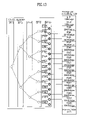
- FIG. 13 is a drawing illustrating other example of a mapping structure between CA-ICH signatures and scrambling codes according to the second embodiment of the present invention.
- FIG. 14 is a drawing illustrating an example of a mapping method between a CD-P and a CA-ICH according to the third embodiment of the present invention.
- FIG. 15 is a drawing illustrating another example of a mapping method between a CD-P and a CA-ICH according another embodiment of the present invention.
- the 32768 PCPCH scrambling codes are divided into 512 groups with 64 codes in each group. There is a one-to-one correspondence between the group of PCPCH preamble scrambling codes in a cell and the primary scrambling code used in the downlink of the cell.
- a channel resource is efficiently used, and a mapping method between AP signatures and a CPCH is able to serve all data rates.
- AP signatures are mapped with scrambling codes of a message part, and three types of mapping methods are presented. Also, two methods for selecting data of a message part and a channelization code of a control part are available when the AP signatures are mapped with the scrambling codes.
- FIG. 6 shows an example of a mapping structure between AP signatures and scrambling codes according to the first mapping method of the first preferred embodiment.
- first mapping method individual scrambling codes SC#i are mapped with each AP signature AP#i.
- 16 AP signatures are one-to-one mapped to different scrambling codes. That is, AP signatures of AP# 0 ⁇ AP# 15 are mapped to indicate scrambling codes SC# 0 ⁇ SC# 15 of the message part. At this time, since the scrambling codes SC# 0 ⁇ SC# 15 are each different scrambling codes, 16 scrambling codes are required according to this embodiment. However, the number of the scrambling codes is 2 25 , so there is no deficiency of the codes.
- each of the 16 scrambling codes are different from one another.
- the respective scrambling codes SC#i have a channelization OVSF code tree. Accordingly, the channelization code of a data part (C d ) and a control part (C c ) in a message part is selected in the channelization OVSF code tree of the respective scrambling code.
- FIGS. 7 a and 7 b two methods are provided for selecting the channelization code according to the first embodiment.
- a channelization code C d of the data part is selected from the codes having spreading factors 4 ⁇ 256 in a direction of an up branch C SF,0 or C SF,SF/2 from a node C 2,0 or C 2,1 having a spreading factor of 2.
- a code C 256,127 or C 256,255 which is located last in a direction of a down branch, i.e., a code having a spreading factor of 256, is selected as a channelization code C c of the control part.
- the (n)th channelization code with a spreading factor SF can also be written C ch,SF,n .
- a code C 256,0 or C 256,128 which is located last in a direction of an up branch from a node having a spreading factor of 2 is selected as a channelization code C c of the control part. Additionally, a lower node of two nodes having a spreading factor of 4 generated from a node having a spreading factor of 2 is selected and one of codes having spreading factors 4 ⁇ 256 in a direction of an up branch C SF,SF/4 , C SF,3*SF/4 of the selected node is selected as a channelization code C d of the data part.
- FIG. 8 shows an example of a mapping structure between AP signatures and scrambling codes according to the second mapping method of the first preferred embodiment.
- the second mapping method uses one scrambling code in common. Particularly, the second mapping method considers a minimum spreading factor SF min of a CPCH that can be serviced by a cell. In FIG. 8 , it is assumed that the minimum spreading factor SF min is 8.
- the number of scrambling codes mapped with the AP signatures is determined according to the minimum spreading factor SF min that can be serviced by the cell. That is, the number of the scrambling codes is determined by the following equation (1):
- one OVSF code tree has two nodes having a spreading factor of 2. That is, the nodes are C 2,0 and C 2,1 . Therefore, considering that the spreading factors used in the CPCH are 4 ⁇ 256, two scrambling codes can use one OVSF code tree in common.
- AP# 0 ⁇ AP# 7 are mapped to indicate the node C 2,0 of SC# 0 ⁇ SC# 7
- AP# 8 ⁇ AP# 15 are mapped to indicate the node C 2,1
- 16 AP signatures can respectively be mapped with total 8 scrambling codes.
- the scrambling codes smaller than 8 can be used in accordance with the minimum spreading factor SF min .
- AP# 0 , AP# 4 , AP# 8 , and AP# 12 are mapped with each node of SC# 0 .
- AP# 1 , AP# 5 , AP# 9 , and AP# 13 are mapped with each node of SC# 1 , AP# 2 , AP# 6 , AP# 10 , and AP# 14 are mapped with each node of SC# 2 , and AP# 3 , AP# 7 , AP# 11 , and AP# 15 are mapped with each node of SC# 3 .
- the channelization code of the message part can be selected in accordance with two methods described in the first mapping method.
- FIG. 9 shows an example of a mapping structure between AP signatures and scrambling codes according to the third mapping method of the first preferred embodiment.
- one scrambling code is divided into a plurality of chip codes to map with each AP signature.
- the message part of the CPCH has a length of 38400 N, only 38400 chips are required as a scrambling code of the message part. Thus, one scrambling code is divided into a number of codes.
- the divided scrambling codes are different from each other, and the same result as the first mapping method for allocating different scrambling codes occurs.
- one scrambling code divides a portion other than the AP portion and the CD-P portion into codes having 38400 chips.
- the divided scrambling codes are mapped with each AP signature. Accordingly, the 16 AP signatures can sufficiently be mapped with one scrambling code.
- the divided chip scrambling codes SC#i respectively have an OVSF code tree. Accordingly, the number of codes mapped with the AP signatures can be controlled depending on the minimum spreading factor SF min within the cell in the same manner as the second mapping method. That is, if the minimum spreading factor SF min is 8, then 4 chip scrambling codes among the divided chip scrambling codes are mapped with the 16 AP signatures.
- the channelization code of the message part is selected by the two methods described in the first mapping method.
- a mobile station which desires to transmit packet data identifies a currently available (or non-available) channel referring to a CSICH broadcasting from a base station, and tries to access the base station when a CPCH that can support a desired transmission data rate is vacant.
- the mobile station transmits an AP to the base station to inform a desired CPCH.
- the AP consists of signatures, and each signature indicates each CPCH.
- Each AP signature is mapped with the scrambling codes of the message part in each CPCH. As described in the first, second, and third mapping methods, each AP signature is mapped with different scrambling codes or one scrambling code divided into codes with a predetermined chip interval. The number of the scrambling codes can then be controlled depending on the minimum spreading factor SF min that can be supported by the cell.
- a channelization code of the message part is selected from the channelization OVSF code tree of a corresponding scrambling code by the aforementioned two methods.
- the base station receives the AP from the mobile station to determine whether each CPCH can be used. If each CPCH can be used, the base station transmits a signature equal to the received AP to the mobile station as an ACK signal. If each CPCH cannot be used, the base station transmits an inverted signature of the received AP to the mobile station as a non-acknowledgment (NACK).
- NACK non-acknowledgment
- the base station When a number of mobile stations simultaneously transmit the AP with the same signature to the base station, the base station does not identify the mobile stations from the same signature. Hence, it transmits the ACK signal to all of the mobile stations. Thus, the mobile stations that receive the ACK signal transmit a CD-P to the base station to detect collision. Any one of the 16 signatures equal to the AP is used as the CD-P. In the same manner as the AP, codes shifted as much as 4096 chips are used as the scrambling codes.
- the base station determines that a collision has not occurred, and transmits the signature equal to that of the received CD-P to the mobile station through the CD-ICH.
- the base station determines that collision has occurred, and selects the CD-P having the highest power among the received CD-Ps to transmit the CD-ICH to the corresponding mobile station.
- the mobile station which received the CD-ICH begins to transmit a message to the base station.
- the mobile station uses the scrambling codes mapped with the AP signatures to transmit the message, and selects the channelization code to be used in the data part and the control part of the message using one of the two methods shown in FIGS. 7 a and 7 b.
- the base station maps the CA-ICH signatures with scrambling codes of the message part, and four types of mapping methods are described. Also, two methods for selecting a channelization code in a message part and a control part in the message are provided when the base station maps the signatures with the scrambling codes.
- mapping methods The four types of mapping methods and two methods for selecting a channelization code will be next described.
- FIG. 10 shows an example of a mapping structure between the CA-ICH signatures and scrambling codes according to the first mapping method of the second embodiment of the present invention.
- the 16 CA-ICH signatures are mapped with different scrambling codes one to one. That is, CA-ICH signatures of CA# 0 ⁇ CA# 15 are mapped to indicate scrambling codes SC# 0 ⁇ SC# 15 of the message part. At this time, since the scrambling codes SC# 0 ⁇ SC# 15 are different scrambling codes, 16 scrambling codes are additionally required. However, since the number of the scrambling codes is 2 25 -1, there is no deficiency of codes.
- the 16 scrambling codes are different from one another.
- the respective scrambling codes SC#i respectively have a channelization OVSF code tree. Accordingly, the channelization code of the data part and the control part in the message part is selected in the channelization OVSF code tree of the respective scrambling code.
- a channelization code C d of the data part is selected from codes having spreading factors 4 ⁇ 256 in a direction of an up branch C SF,0 or C SF,SF/2 from a node C 2,0 or C 2,1 having a spreading factor of 2.
- a code C 256,0 or C 256,128 located last in a direction of an up branch from a node having a spreading factor of 2 is selected as a channelization code C c of the control part, while a lower node of two nodes having a spreading factor of 4 generated from a node having a spreading factor of 2 is selected and one C SF,SF/4 , C SF,3*SF/4 of codes having spreading factors 4 ⁇ 256 in a direction of the up branch from the selected lower node is selected as a channelization code C d of the data part.
- FIG. 12 shows an example of a mapping structure between the CA-ICH signatures and scrambling codes according to the second mapping method of the second embodiment of the present invention.
- the CA-ICH signatures use one scrambling code in common.
- the second mapping method considers a minimum spreading factor SF min of a CPCH that can be serviced by a cell.
- the minimum spreading factor SF min is 8 for purposes of example.
- the number of scrambling codes mapped with the CA-ICH signatures is determined in accordance with the minimum spreading factor SF min that can be serviced by the cell. That is, the number of the scrambling codes is determined by the following equation (2).
- one OVSF code tree has two nodes having a spreading factor of 2. That is, the nodes are C 2,0 and C 2,1 . Therefore, considering that the spreading factors used in the CPCH are 4 ⁇ 256, two scrambling codes can use one OVSF code tree in common.
- CA# 0 ⁇ CA# 7 are mapped to indicate the node C 2,0 of SC# 0 ⁇ SC# 7
- CA# 8 ⁇ CA# 15 are mapped to indicate the node C 2,1
- the 16 CA-ICH signatures can respectively be mapped with total 8 scrambling codes.
- the minimum spreading factor SFmin supported by the cell is greater than 4, scrambling codes smaller than 8 can be used in accordance with the minimum spreading factor SF min .
- CA# 0 , CA# 4 , CA# 8 , and CA# 12 are mapped with each node of SC# 0 , CA# 1 , CA# 5 , CA# 9 , and CA# 13 are mapped with each node of SC# 1 , CA# 2 , CA# 6 , CA# 10 , and CA# 14 are mapped with each node of SC# 2 , and CA# 3 , CA# 7 , CA# 11 , and CA# 15 are mapped with each node of SC# 3 .
- the channelization code of the message part can be selected by two methods described in the first mapping method.
- FIG. 13 shows an example of a mapping structure between CA-ICH signatures and scrambling codes according to the third mapping method of the second embodiment of the present invention.
- the third mapping method one scrambling code is divided into a plurality of codes to map with each CA-ICH signature.
- each scrambling code used in an uplink of a wide band code division multiple access communication system has 2 25 -1 codes as long codes.
- the message part of the CPCH has a length of 38400 N
- chips having a length of 38400 are only required as scrambling codes for the message part.
- one scrambling code is divided into a number of codes.
- one scrambling code divides a portion other than the AP portion and the CD-P portion into codes having a chip length of 38400.
- the divided scrambling chip codes are mapped with the CA-ICH signatures. Accordingly, the 16 CA-ICH signatures can be mapped with one scrambling code only.
- the divided chip scrambling codes SC#i respectively have an OVSF code tree. Accordingly, the number of codes mapped with the CA-ICH signatures can be controlled in accordance with on the minimum spreading factor SF min within the cell in the same manner as the second mapping method. That is, if the minimum spreading factor SF min is 8, then 4 chip scrambling codes among the divided chip scrambling codes are mapped with the 16 CA-ICH signatures.
- the channelization code of the message part is preferably selected by the two methods described in the first mapping method.
- mapping method when 16 or more CPCHs are allocated, a mapping method between the CA-ICH signatures and the scrambling codes is provided.
- the base station respectively designates the CPCHs and the scrambling codes in a prescribed number of groups. Then, the base station broadcasts information of the groups to the mobile station through the CSICH.
- the mobile station After the mobile station acquires group information of the CPCHs through the CSICH, the mobile station contacts the base station of a group belonging to a desired CPCH through the AP. At this time, the mobile station also informs the base station of a desired maximum transmission rate through the AP.
- the base station maps the CA-ICH of the CPCH included in a group designated by the AP with the scrambling codes of a corresponding group and then transmits the mapped CA-ICH to the mobile station.
- a mapping method between the CA-ICH and the scrambling codes is identical to the first mapping method to the third mapping method. Accordingly, one CPCH group includes 16 or 8 scrambling codes. If the number of the scrambling codes is small, one CPCH group may include scrambling codes less than 16 or 8.
- the AP transmitted by the mobile station designates each group as shown in Table 1 to Table 3.
- Table 1 shows an example of when the first mapping method is applied.
- each group includes 16 scrambling codes, and an AP of the mobile station designates one group.
- the CA-ICH signatures of the CPCH belonging to each group are respectively mapped with 16 scrambling codes of a corresponding group.
- Table 2 shows an example of when the second mapping method is applied.
- one group includes 8 scrambling codes
- an AP of the mobile station designates one group.
- the CA-ICH signatures of the CPCH belonging to each group are respectively mapped with the nodes C 2,0 and C 2,1 of 8 scrambling codes of a corresponding group.
- Table 3 shows another example of when the second mapping method is applied.
- one group includes 16 scrambling codes, and an AP of the mobile station designates one group.
- the CA-ICH signatures of the CPCH belonging to each group are respectively mapped with the node C 2,0 or C 2,1 of 8 scrambling codes of a corresponding group.
- the base station transmits either a maximum transmission rate of the CPCH that can be serviced through the CSICH, or an availability of each data rate.
- the base station transmits group information of the CPCHs in addition to the maximum transmission rate or the availability of each data rate.
- the mobile station that desires to transmit packet data identifies a currently available (or non-available) channel referring to the CSICH broadcasting from the base station. At this time, after the mobile station identifies the available maximum transmission rate and group information of the CPCHs, the mobile station tries to access the base station when a CPCH that can support a desired transmission data rate is vacant.
- the mobile station preferably selects one AP signature and one access slot among 16 AP signatures and access slots, and transmits an AP consisting of the selected AP signature and the access slot to the base station in compliance with a start point of the access slot.
- the mobile station transmits the AP signature and the access slot to the base station in the access step, so as to inform the base station of a maximum data rate or a minimum spreading factor SF min in the message part requested for data transmission.
- the mobile station increases transmission power to retransmit the AP in compliance with the start point of the access slot if an acquisition response of the AP is not received after a prescribed period of time. Such retransmission is repeated until a given number of attempts is reached.
- the base station receives the AP from the mobile station to determine a maximum data rate or a minimum spreading factor requested by the mobile station. Then, the base station determines whether to allocate a CPCH requested by the mobile station, after considering a resource of the current CPCH and a total amount of traffic. As a result, if the CPCH can be allocated, the base station transmits the signature equal to the received AP signature as an acknowledgment (ACK) signal in compliance with the start point of the access slot. If the CPCH cannot be allocated, the base station transmits an inverted signature of the received AP signature to the mobile station as a non-acknowledgment (NACK) in compliance with the start point of the access slot.
- NACK non-acknowledgment
- the base station When more than one mobile stations simultaneously transmit the AP with the same signature to the base station, the base station does not identify the mobile stations from the same signature. The base station thus transmits the ACK signal to all of the mobile stations. Thus, the mobile stations which received the ACK signal transmit a CD-P to the base station to reduce the possibility of a collision. In the same manner as the AP, any one of the 16 signatures is used as the CD-P.
- the base station determines that a collision has not occurred, and transmits the signature equal to that of the received CD-P to the mobile station through the CD-ICH. However, if the base station receives a number of CD-Ps, the base station determines that a collision has occurred, and selects the CD-P having the highest power among the received CD-Ps, and transmits the CD-ICH to the corresponding mobile station.
- the base station transmits the CA-ICH containing CPCH information to be allocated in a signature format to a corresponding mobile station.
- the CA-ICH signature is mapped with the scrambling codes.
- a method for mapping the CA-ICH signature with the scrambling codes is performed by the aforementioned first to fourth mapping methods.
- the channel information contained in the CA-ICH includes a channelization code and a scrambling code of a down link-dedicated physical control channel (DL-DPCCH) and a physical common channel (PCPCH).
- DL-DPCCH down link-dedicated physical control channel
- PCPCH physical common channel
- the mobile station that received the CD-ICH and the CA-ICH starts to transmit a message.
- the mobile station controls transmitting power using the PC-P if necessary to transmit the message.
- the base station transmits the DL-DPCCH to the mobile station.
- the mobile station transmits the message part with the physical channel allocated in accordance with the scrambling codes mapped with the CA-ICH signatures.
- One of the methods shown in FIGS. 11 a and 11 b is preferably used to select a channelization code of the data part and the control part in the message part.
- a method for allocating a CPCH that can serve 16 or more CPCHs using a CD-P transmitted by the mobile station to detect and solve collision and a CA-ICH transmitted by the base station to allocate channels is provided.
- the CD-P is mapped with the CA-ICH to indicate scrambling codes used to transmit the message part. Accordingly, the CD-P used in the third embodiment of the present invention serves to indicate the scrambling codes used to transmit the message part in addition to a function that detects and solves collisions of the channels.
- FIG. 14 shows an example of a first mapping method between a CD-P and a CA-ICH according to the third embodiment of the present invention.
- the mobile station indicates a scrambling code set Set#j through the CD-P, and indicates a scrambling code SC#K through the CA-ICH.
- the mobile station selects one of 16 signatures CD# 0 ⁇ CD# 15 to detect a collision of channels, and transmits a CD-P with the selected signature to the base station.
- the mobile station performs mapping so that the selected signature indicates a specific scrambling code set Set#j.
- CD# 0 ⁇ CD# 3 are mapped to indicate a scrambling code set Set# 1
- CD# 8 ⁇ CD# 11 are mapped to indicate a scrambling code set Set# 2
- CD 12 ⁇ CD# 15 are mapped to indicate a scrambling code set Set# 3 .
- the number of the scrambling code sets available in the cell is 16, 16 signatures are respectively mapped with 16 different scrambling code sets one to one.
- the mobile station transmits the CD-P mapped to indicate a specific scrambling code set to the base station.
- the base station then transmits the ACK signal to the mobile station through the CD-ICH if it is determined that no channel collision exists in the received CD-P, and an available PCPCH exists therein.
- the base station transmits the CA-ICH to the mobile station.
- the base station selects one SC#k from a specific scrambling code set Set#j designated by the CD-P and maps the CA-ICH signatures with the selected scrambling code SC#k so that the CA-ICH indicates the selected scrambling code SC#k. That is, since one scrambling code set Set#j includes 16 scrambling codes, 16 signatures of the CA-ICH are respectively mapped to indicate one scrambling code.
- the mobile station which received the CD-ICH and the CA-ICH detects scrambling codes required to transmit the message through the CA-ICH and uses them when transmitting the message part.
- the CPCHs are allocated by the above mapping method, it is possible to support 64 CPCHs when the number of scrambling code sets available in the cell is 4 while it is possible to support 256 CPCHs when the number of scrambling code sets is 16.
- FIG. 15 shows another example of a mapping method between a CD-P and a CA-ICH according to the third preferred embodiment of the present invention.
- the mobile station indicates a scrambling code SC#k through the CD-P and indicates a scrambling code set Set#j through the CA-ICH.
- the mobile station selects one of 16 signatures CD# 0 ⁇ CD# 15 to detect a collision of channels and transmits a CD-P with the selected signature to the base station.
- the mobile station performs a mapping function so that the selected signature indicates a specific scrambling code SC#k.
- 16 signatures of the CD-P are respectively mapped to indicate 16 different scrambling codes.
- the mobile station transmits the CD-P mapped to indicate the specific scrambling code to the base station.
- the base station then transmits the ACK signal to the mobile station through the CD-ICH if it is determined that no channel collision exists in the received CD-P and an available PCPCH exists therein.
- the base station transmits the CA-ICH to the mobile station.
- the base station selects a scrambling code set Set#j that can use a specific scrambling code SC#k designated by the CD-P and maps the CA-ICH signatures to indicate the selected scrambling code set Set#j by the CA-ICH.
- the base station maps CA# 0 ⁇ CA# 3 to indicate a scrambling code set # 0 , CA# 4 ⁇ CA# 7 to indicate a scrambling code set # 1 , CA# 8 ⁇ CA# 11 to indicate a scrambling code set # 2 , and CA# 12 ⁇ CA# 15 to indicate a scrambling code set # 3 .
- the number of the scrambling code sets available in one cell is 16, 16 signatures are respectively mapped one-to-one with 16 different scrambling code sets.
- the mobile station that received the CD-ICH and the CA-ICH detects scrambling codes required to transmit the message part through the CA-ICH, and uses them when transmitting the message part.
- the CPCHs are allocated by the above mapping methods, it is possible to support 64 CPCHs when the number of scrambling code sets that can be used in the cell is 4, while it is possible to support 256 CPCHs when the number of scrambling code sets is 16.
- the channelization code of the PCPCHs uses a node C 2,0 having a spreading factor of 2 in the OVSF code tree, one scrambling code is allocated to one PCPCH to allocate the whole PCPCHs.
- one scrambling code set includes 16 scrambling codes, and if 4 scrambling codes are used in one cell, a maximum of 64 PCPCHs can be used. That is, since the mobile station informs the base station of data rate through the AP in the access step, a maximum of 256 PCPCHs can be used by using 16 CD-Ps and the CA-ICH.
- the mobile station which desires to transmit packet data through the CPCH identifies a currently available (or non-available) CPCH referring to the CSICH transmitted from the base station. After the mobile station identifies the available maximum transmission rate, the mobile station tries to access the base station with a desired transmission data rate when a CPCH that can support the desired transmission data rate is vacant.
- the mobile station selects one AP signature and one access slot, and transmits an AP consisting of the selected AP signature and the access slot to the base station in compliance with a start point of the access slot.
- the mobile station next transmits the AP signature and the access slot to the base station in the access step, so as to inform the base station of a maximum data rate or a minimum spreading factor SF min in the message part required for data transmission.
- the mobile station subsequently increases a transmission power to retransmit the AP in accordance with the start point of the access slot when an acquisition response of the AP is not received after a prescribed period of time. Such retransmission is repeated for a prescribed number of threshold times.
- the base station receives the AP from the mobile station to determine a maximum data rate or a minimum spreading factor requested by the mobile station. Then, the base station determines whether to allocate a CPCH requested by the mobile station, by considering the available resources of the current CPCH and a total amount of traffic. As a result, if a desired CPCH can be allocated, the base station transmits the signature equal to the received AP signature to the mobile station as an ACK signal in compliance with the start point of the access slot. If the desired CPCH cannot be allocated, however, the base station transmits an inverted signature of the received AP signature to the mobile station as a NACK signal in compliance with the start point of the access slot.
- the base station When more than one mobile stations simultaneously transmit the AP with the same signature to the base station, the base station does not identify the mobile stations from the same signature. The base station accordingly transmits the ACK signal to all of the mobile stations. In this case, a collision of the CPCHs occurs. Thus, the mobile stations which received the ACK signal transmit the CD-P to the base station to prevent such a collision. At this time, the mobile station selects one of 16 signatures equal to 16 signatures of the AP to use it as the CD-P. Also, the mobile station maps a specific scrambling code set Set#j or a scrambling code SC#k to be used, with the signature of the selected CD-P and transmits it to the base station.
- the base station determines that a collision has not occurred, and transmits the signature equal to that of the received CD-P to the mobile station through the CD-ICH.
- the base station determines that a collision has occurred, and selects the CD-P having the highest power among the received CD-Ps to transmit the CD-ICH to the corresponding mobile station.
- the base station transmits the CA-ICH containing CPCH information to be allocated in a signature format to the mobile station.
- the base station maps the CA-ICH signature with the specific scrambling code SC#k or scrambling code set Set#j and transmits them to the mobile station.
- the CD-P signature indicates the specific scrambling code set Set#j, then a scrambling code available in the designated scrambling code set Set#j is mapped with the CA-ICH signature. If the CD-P signature indicates the specific scrambling code SC#k, then the scrambling code set Set#j that can use the designated scrambling code is mapped with the CA-ICH signature.
- the mobile station which received the CD-ICH and the CA-ICH then starts to transmit a message using the scrambling code designated by the CA-ICH.
- the mobile station controls transmitting power using the PC-P if necessary to transmit the message.
- the base station transmits the DL-DPCCH to the mobile station.
- the mobile station transmits the PC-P to the base station for a constant time of 0 or 8 slots before transmitting the message consisting of the data part and the control part in a physical channel format to the base station.
- the mobile station In transmission of the PCPCH, the mobile station uses a node C 2,0 having a spreading factor of 2 on the OVSF code tree against all of the CA-ICHs as a channelization code.
- the mobile station uses a node C 256,0 as a channelization code of the control part in the message part of the PCPCH and a node C SF,SF/4 variable depending on the spreading factor as a channelization code of the data part.
- the method for allocating a CPCH according to the embodiments of the present invention has many advantages. For example, it is possible to use 16 or more CPCHs by allocating scrambling codes used to transmit the message part using the CD-P and the CA-ICH.
- the CA-ICH is mapped with the scrambling code, so that other mobile stations can use other signatures of the CA-ICH without any interference, while a specific mobile station transmits data at high transmission rate. Accordingly, it is possible to efficiently use channel resources.
- the channelization code of the message part in RACH or DPCH format.
- the 16 AP signatures support spreading factors of 4 ⁇ 256, it is possible to always select 16 AP signatures in even case that packet data are transmitted with any one of the spreading factors of 4 ⁇ 256. Accordingly, it is possible to remarkably reduce the probability of collision of the CPCHs.
- the specific mobile station transmits data at high data transmission rate having a spreading factor of 4
- the other mobile stations can use other AP signatures. Accordingly, it is possible to efficiently use limited channel resources.
- the system does not require a broadcasting channel (BCH).
- BCH broadcasting channel
Landscapes
- Engineering & Computer Science (AREA)
- Computer Networks & Wireless Communication (AREA)
- Signal Processing (AREA)
- Databases & Information Systems (AREA)
- Mobile Radio Communication Systems (AREA)
- Data Exchanges In Wide-Area Networks (AREA)
- Small-Scale Networks (AREA)
Applications Claiming Priority (4)
| Application Number | Priority Date | Filing Date | Title |
|---|---|---|---|
| KRP2000-5065 | 2000-02-02 | ||
| KR1020000005065A KR100767659B1 (ko) | 2000-02-02 | 2000-02-02 | 공통 패킷 채널의 전송 방법 |
| KR1020000006361A KR100672350B1 (ko) | 2000-02-11 | 2000-02-11 | 공통 패킷 채널의 할당 방법 |
| KR1020000009007A KR100606704B1 (ko) | 2000-02-24 | 2000-02-24 | 공통 패킷 채널의 할당 방법 |
Publications (2)
| Publication Number | Publication Date |
|---|---|
| US20010012301A1 US20010012301A1 (en) | 2001-08-09 |
| US7058038B2 true US7058038B2 (en) | 2006-06-06 |
Family
ID=27350158
Family Applications (1)
| Application Number | Title | Priority Date | Filing Date |
|---|---|---|---|
| US09/773,574 Expired - Fee Related US7058038B2 (en) | 2000-02-02 | 2001-02-02 | Method for allocating common packet channels |
Country Status (3)
| Country | Link |
|---|---|
| US (1) | US7058038B2 (enExample) |
| JP (1) | JP2001251667A (enExample) |
| CN (1) | CN1227921C (enExample) |
Cited By (9)
| Publication number | Priority date | Publication date | Assignee | Title |
|---|---|---|---|---|
| US20010026543A1 (en) * | 2000-02-16 | 2001-10-04 | Samsung Electronics Co.,Ltd. | Apparatus and method for assigning a common packet channel in a CDMA communication system |
| US20030134656A1 (en) * | 2002-01-14 | 2003-07-17 | Samsung Electronics Co., Ltd. | Apparatus and method for performing an outer loop power control in a mobile communication system |
| US20030224798A1 (en) * | 2002-05-31 | 2003-12-04 | Serge Willenegger | Dynamic channelization code allocation |
| US20040252655A1 (en) * | 2001-10-20 | 2004-12-16 | Kwang-Jae Lim | Method and apparatus for common packet channel access in mobile satellite communication system |
| US20040258027A1 (en) * | 2003-06-23 | 2004-12-23 | Boris Tsybakov | Code channel management in a wireless communications system |
| US20050124348A1 (en) * | 2003-11-26 | 2005-06-09 | Peter Gaal | Code channel management in a wireless communications system |
| US20060018289A1 (en) * | 2002-09-27 | 2006-01-26 | Matthias Schulist | Requesting and controlling access in a wireless communications network |
| US20070218889A1 (en) * | 2004-06-24 | 2007-09-20 | Nortel Networks Limited | Efficient Location Updates, Paging and Short Bursts |
| US9282535B2 (en) | 2004-10-15 | 2016-03-08 | Apple Inc. | Efficient location updates, paging and short bursts |
Families Citing this family (18)
| Publication number | Priority date | Publication date | Assignee | Title |
|---|---|---|---|---|
| EP1523809A1 (en) * | 2002-06-06 | 2005-04-20 | Nokia Corporation | System and method for optimized utilization of code resource in communication networks |
| EP1513297B1 (en) * | 2003-08-11 | 2007-08-01 | Alcatel Lucent | A method for dynamic allocation of codes to a base station |
| US8085806B2 (en) * | 2003-09-26 | 2011-12-27 | Agere Systems Inc. | Method and apparatus for detecting a collision in a carrier sense multiple access wireless system |
| US7636328B2 (en) * | 2004-10-20 | 2009-12-22 | Qualcomm Incorporated | Efficient transmission of signaling using channel constraints |
| JP2006311490A (ja) * | 2005-03-30 | 2006-11-09 | Hitachi Kokusai Electric Inc | 無線基地局装置 |
| SE530387C2 (sv) * | 2005-05-10 | 2008-05-20 | Scania Cv Abp | Överföring av fordonsrelaterad data mellan ett fordon och ett fordonsunderstödscenter |
| JP4907133B2 (ja) * | 2005-08-08 | 2012-03-28 | 三星電子株式会社 | 無線通信システム及び無線通信方法並びに通信装置 |
| US7689222B2 (en) * | 2006-01-27 | 2010-03-30 | Alcatel-Lucent Usa Inc. | Method of managing use of channelization codes during soft handoff |
| KR100938102B1 (ko) * | 2006-08-18 | 2010-01-21 | 삼성전자주식회사 | Rach 신호 송수신 방법 및 장치 |
| JP5055291B2 (ja) | 2006-10-31 | 2012-10-24 | シャープ株式会社 | 移動通信システム、基地局装置および移動局装置 |
| US20100056053A1 (en) * | 2006-11-23 | 2010-03-04 | Nxp, B.V. | Single communication channel between a contactless frontend device and a transceiver device |
| US9131465B2 (en) * | 2007-06-08 | 2015-09-08 | Samsung Electronics Co., Ltd. | Methods and apparatus for mapping control channels to resources in OFDM systems |
| US8391253B2 (en) | 2008-11-20 | 2013-03-05 | Telefonaktiebolaget L M Ericsson (Publ) | Time-division multiplexed pilot signal for integrated mobile broadcasts |
| JP5348013B2 (ja) | 2009-05-26 | 2013-11-20 | ソニー株式会社 | 無線通信装置、推定サーバ、無線通信方法および推定方法 |
| US8433966B2 (en) * | 2009-07-06 | 2013-04-30 | Intel Corporation | Acknowledgment channel design for wireless access networks |
| IL205803A0 (en) * | 2010-05-16 | 2010-12-30 | Yaron Sella | Collision-based signature scheme |
| IL206139A0 (en) * | 2010-06-02 | 2010-12-30 | Yaron Sella | Efficient multivariate signature generation |
| WO2015112067A1 (en) * | 2014-01-27 | 2015-07-30 | Telefonaktiebolaget L M Ericsson (Publ) | Network node, and method for handling a request for an application to access a wireless local area network |
Citations (10)
| Publication number | Priority date | Publication date | Assignee | Title |
|---|---|---|---|---|
| US6169759B1 (en) * | 1999-03-22 | 2001-01-02 | Golden Bridge Technology | Common packet channel |
| WO2001005050A1 (en) | 1999-07-07 | 2001-01-18 | Samsung Electronics Co., Ltd. | Channel assignment apparatus and method for common packet channel in a wcdma mobile communication system |
| EP1089587A2 (en) | 1999-10-02 | 2001-04-04 | Lg Electronics Inc. | Method of allocating common packet channel in next generation communication system |
| WO2001039416A1 (en) | 1999-11-29 | 2001-05-31 | Golden Bridge Technology, Inc. | Second level collision resolution for packet data communications |
| US20010053140A1 (en) * | 1999-11-29 | 2001-12-20 | Sung-Ho Choi | Apparatus and method for assigning a common packet channel in a CDMA communication system |
| US20020018457A1 (en) * | 2000-01-17 | 2002-02-14 | Sung-Ho Choi | Apparatus and method for allocating channel using OVSF code for uplink synchronous transmission scheme in a W-CDMA communication system |
| US20020080745A1 (en) * | 1999-05-19 | 2002-06-27 | Interdigital Technology Corporation | Base station for code assignment for a common packet channel |
| US6621807B1 (en) * | 1998-04-13 | 2003-09-16 | Samsung Electronics Co., Ltd. | Device and method for transmitting common channel message in CDMA communication system |
| US6643318B1 (en) * | 1999-10-26 | 2003-11-04 | Golden Bridge Technology Incorporated | Hybrid DSMA/CDMA (digital sense multiple access/code division multiple access) method with collision resolution for packet communications |
| US6674739B1 (en) * | 1998-03-26 | 2004-01-06 | Samsung Electronics Co., Ltd. | Device and method for assigning spreading code for reverse common channel message in CDMA communication system |
-
2001
- 2001-01-30 JP JP2001022510A patent/JP2001251667A/ja active Pending
- 2001-02-02 US US09/773,574 patent/US7058038B2/en not_active Expired - Fee Related
- 2001-02-02 CN CNB011024631A patent/CN1227921C/zh not_active Expired - Fee Related
Patent Citations (14)
| Publication number | Priority date | Publication date | Assignee | Title |
|---|---|---|---|---|
| US6674739B1 (en) * | 1998-03-26 | 2004-01-06 | Samsung Electronics Co., Ltd. | Device and method for assigning spreading code for reverse common channel message in CDMA communication system |
| US6621807B1 (en) * | 1998-04-13 | 2003-09-16 | Samsung Electronics Co., Ltd. | Device and method for transmitting common channel message in CDMA communication system |
| US6169759B1 (en) * | 1999-03-22 | 2001-01-02 | Golden Bridge Technology | Common packet channel |
| US20020080745A1 (en) * | 1999-05-19 | 2002-06-27 | Interdigital Technology Corporation | Base station for code assignment for a common packet channel |
| JP2003504935A (ja) | 1999-07-07 | 2003-02-04 | サムスン エレクトロニクス カンパニー リミテッド | 広帯域符号分割多重接続移動通信システムにおける共通パケットチャンネルのチャンネル割当て装置及び方法 |
| WO2001005050A1 (en) | 1999-07-07 | 2001-01-18 | Samsung Electronics Co., Ltd. | Channel assignment apparatus and method for common packet channel in a wcdma mobile communication system |
| EP1089587A2 (en) | 1999-10-02 | 2001-04-04 | Lg Electronics Inc. | Method of allocating common packet channel in next generation communication system |
| JP2001157251A (ja) | 1999-10-02 | 2001-06-08 | Lg Electronics Inc | 次世代移動通信における共通パケットチャンネル(cpch)割当方法 |
| US6643318B1 (en) * | 1999-10-26 | 2003-11-04 | Golden Bridge Technology Incorporated | Hybrid DSMA/CDMA (digital sense multiple access/code division multiple access) method with collision resolution for packet communications |
| WO2001039416A1 (en) | 1999-11-29 | 2001-05-31 | Golden Bridge Technology, Inc. | Second level collision resolution for packet data communications |
| JP2003516021A (ja) | 1999-11-29 | 2003-05-07 | サムスン エレクトロニクス カンパニー リミテッド | 符号分割多重接続通信システムの共通パケットチャネルのチャネル割り当て方法及び装置 |
| US6480525B1 (en) * | 1999-11-29 | 2002-11-12 | Golden Bridge Technology Inc. | Second level collision resolution for packet data communications |
| US20010053140A1 (en) * | 1999-11-29 | 2001-12-20 | Sung-Ho Choi | Apparatus and method for assigning a common packet channel in a CDMA communication system |
| US20020018457A1 (en) * | 2000-01-17 | 2002-02-14 | Sung-Ho Choi | Apparatus and method for allocating channel using OVSF code for uplink synchronous transmission scheme in a W-CDMA communication system |
Non-Patent Citations (6)
| Title |
|---|
| "CPCH Access Methods Comparison" TSG-RAN Working Group 1 meeting #10 Bejing (China), Jan. 18-Jan. 21, 2000 (TSGR1#10(00)0106). |
| "Dynamic OVSF Code Assignment for PCPCH Message Part", TSG-RAN Working Group 1 meeting #10 Jan. 18-21, Bejing, China (RSGR1#10(00)01). |
| 3GPP TSG RAN Meeting #7, Document R1-00-0233, Agreed Change Requests to TS 25.214(1), Madrid, Spain, Mar. 13-15, 2000 (XP-002203811). |
| ETSI TS 125 213 V3.1.1 (Jan. 2000), "Universal Mobile Telecommunications Systems (UMTS); Physical Layer Procedures (FDD)," (3G TS 25.213 version 3.1.1 Release 1999, Jan. 2000 (XP-002235041). |
| ETSI TS 125 214 V3.1.1 (Jan. 2000), "Universal Mobile Telecommunications Systems (UMTS); Physical Layer Procedures (FDD)," (3G TS 25.214 version 3.1.1 Release 1999, Jan. 2000 (XP-002207980). |
| JP Office Action dated Dec. 7, 2004 (full text and English Translation). |
Cited By (20)
| Publication number | Priority date | Publication date | Assignee | Title |
|---|---|---|---|---|
| US20010026543A1 (en) * | 2000-02-16 | 2001-10-04 | Samsung Electronics Co.,Ltd. | Apparatus and method for assigning a common packet channel in a CDMA communication system |
| US20040252655A1 (en) * | 2001-10-20 | 2004-12-16 | Kwang-Jae Lim | Method and apparatus for common packet channel access in mobile satellite communication system |
| US7701961B2 (en) * | 2001-10-20 | 2010-04-20 | Electronics And Telecommunications Research Institute | Method and apparatus for common packet channel access in mobile satellite communication system |
| US7218946B2 (en) * | 2002-01-14 | 2007-05-15 | Samsung Electronics Co., Ltd. | Apparatus and method for performing an outer loop power control in a mobile communication system |
| US20030134656A1 (en) * | 2002-01-14 | 2003-07-17 | Samsung Electronics Co., Ltd. | Apparatus and method for performing an outer loop power control in a mobile communication system |
| US20030224798A1 (en) * | 2002-05-31 | 2003-12-04 | Serge Willenegger | Dynamic channelization code allocation |
| US8699505B2 (en) | 2002-05-31 | 2014-04-15 | Qualcomm Incorporated | Dynamic channelization code allocation |
| US20060018289A1 (en) * | 2002-09-27 | 2006-01-26 | Matthias Schulist | Requesting and controlling access in a wireless communications network |
| US7706824B2 (en) * | 2002-09-27 | 2010-04-27 | Telefonaktiebolaget L M Ericsson (Publ) | Requesting and controlling access in a wireless communications network |
| US7933250B2 (en) | 2003-06-23 | 2011-04-26 | Qualcomm Incorporated | Code channel management in a wireless communications system |
| US20090103427A1 (en) * | 2003-06-23 | 2009-04-23 | Qualcomm Incorporated | Code channel management in a wireless communications system |
| US20040258027A1 (en) * | 2003-06-23 | 2004-12-23 | Boris Tsybakov | Code channel management in a wireless communications system |
| US7881327B2 (en) | 2003-06-23 | 2011-02-01 | Qualcomm Incorporated | Code channel management in a wireless communications system |
| US20050124348A1 (en) * | 2003-11-26 | 2005-06-09 | Peter Gaal | Code channel management in a wireless communications system |
| US8072942B2 (en) | 2003-11-26 | 2011-12-06 | Qualcomm Incorporated | Code channel management in a wireless communications system |
| US8014377B2 (en) * | 2004-06-24 | 2011-09-06 | Nortel Networks Limited | Efficient location updates, paging and short bursts |
| US20070218889A1 (en) * | 2004-06-24 | 2007-09-20 | Nortel Networks Limited | Efficient Location Updates, Paging and Short Bursts |
| US8917703B2 (en) | 2004-06-24 | 2014-12-23 | Apple Inc. | Efficient location updates, paging and short bursts |
| US9277570B2 (en) | 2004-06-24 | 2016-03-01 | Apple Inc. | Efficient location updates, paging and short bursts |
| US9282535B2 (en) | 2004-10-15 | 2016-03-08 | Apple Inc. | Efficient location updates, paging and short bursts |
Also Published As
| Publication number | Publication date |
|---|---|
| CN1227921C (zh) | 2005-11-16 |
| US20010012301A1 (en) | 2001-08-09 |
| JP2001251667A (ja) | 2001-09-14 |
| CN1320000A (zh) | 2001-10-31 |
Similar Documents
| Publication | Publication Date | Title |
|---|---|---|
| US20010012301A1 (en) | Method for allocating common packet channels | |
| CA2283906C (en) | Random access channel prioritization scheme | |
| JP3967339B2 (ja) | 広帯域符号分割多重接続移動通信システムにおける共通パケットチャンネルのチャンネル割当て装置及び方法 | |
| US6480525B1 (en) | Second level collision resolution for packet data communications | |
| US7113496B2 (en) | Apparatus and method for assigning a common packet channel in a CDMA communication system | |
| US7233577B2 (en) | Method for measuring confusion rate of a common packet channel in a CDMA communication system | |
| US7643454B2 (en) | Methods of avoiding multiple detections of random access channel preamble in wireless communication systems | |
| US6504832B1 (en) | Channel assigning device and method using quasi-orthogonal code in a CDMA communication system | |
| JP4472927B2 (ja) | 時分割複信におけるランダムアクセスチャネル用のサブチャネル | |
| US20020141331A1 (en) | Method and device for downlink packet switching | |
| US20010026543A1 (en) | Apparatus and method for assigning a common packet channel in a CDMA communication system | |
| RU2518176C2 (ru) | Указание ресурсов е-dch для e-rach | |
| KR100842553B1 (ko) | 직교주파수분할 다중접속 무선통신 시스템에서 셀과 인접셀들 간에 다른 레인징 코드 세트 할당 방법 | |
| US6904012B1 (en) | Apparatus and method for allocating forward common channels in CDMA communication system | |
| KR100767659B1 (ko) | 공통 패킷 채널의 전송 방법 | |
| KR20030015113A (ko) | 이동 통신시스템의 선택적 역방향 데이터 전송 장치 및 방법 | |
| EP1122964A2 (en) | Method for allocating common packet channels in a CDMA based mobile communication system | |
| KR100662283B1 (ko) | 시분할 듀플렉스 모드에서의 랜덤 액세스 방법 | |
| KR100672350B1 (ko) | 공통 패킷 채널의 할당 방법 | |
| KR100606704B1 (ko) | 공통 패킷 채널의 할당 방법 | |
| US8228939B1 (en) | Radio communication system | |
| KR20010069163A (ko) | 공통 패킷 채널의 채널화 코드 할당 방법 | |
| KR20010073313A (ko) | 공통 패킷 채널의 할당 방법 | |
| KR20010091790A (ko) | 이동통신 시스템의 물리적 채널 할당 방법 | |
| KR20110055016A (ko) | 상향링크 전송을 위한 전용자원 할당 방법 및 그 시스템 |
Legal Events
| Date | Code | Title | Description |
|---|---|---|---|
| AS | Assignment |
Owner name: LG ELECTRONICS INC., KOREA, REPUBLIC OF Free format text: ASSIGNMENT OF ASSIGNORS INTEREST;ASSIGNORS:YI, SEUNG JUNE;LEE, YOUNG DAE;KWON, SUNG LARK;REEL/FRAME:011528/0077 Effective date: 20010202 |
|
| FEPP | Fee payment procedure |
Free format text: PAYOR NUMBER ASSIGNED (ORIGINAL EVENT CODE: ASPN); ENTITY STATUS OF PATENT OWNER: LARGE ENTITY |
|
| CC | Certificate of correction | ||
| FPAY | Fee payment |
Year of fee payment: 4 |
|
| FEPP | Fee payment procedure |
Free format text: PAYOR NUMBER ASSIGNED (ORIGINAL EVENT CODE: ASPN); ENTITY STATUS OF PATENT OWNER: LARGE ENTITY Free format text: PAYER NUMBER DE-ASSIGNED (ORIGINAL EVENT CODE: RMPN); ENTITY STATUS OF PATENT OWNER: LARGE ENTITY |
|
| REMI | Maintenance fee reminder mailed | ||
| LAPS | Lapse for failure to pay maintenance fees | ||
| STCH | Information on status: patent discontinuation |
Free format text: PATENT EXPIRED DUE TO NONPAYMENT OF MAINTENANCE FEES UNDER 37 CFR 1.362 |
|
| STCH | Information on status: patent discontinuation |
Free format text: PATENT EXPIRED DUE TO NONPAYMENT OF MAINTENANCE FEES UNDER 37 CFR 1.362 |
|
| FP | Lapsed due to failure to pay maintenance fee |
Effective date: 20140606 |