US698564A - Ice-box cover. - Google Patents
Ice-box cover. Download PDFInfo
- Publication number
- US698564A US698564A US7427901A US1901074279A US698564A US 698564 A US698564 A US 698564A US 7427901 A US7427901 A US 7427901A US 1901074279 A US1901074279 A US 1901074279A US 698564 A US698564 A US 698564A
- Authority
- US
- United States
- Prior art keywords
- sheet
- ice
- asbestos
- metal
- box
- Prior art date
- Legal status (The legal status is an assumption and is not a legal conclusion. Google has not performed a legal analysis and makes no representation as to the accuracy of the status listed.)
- Expired - Lifetime
Links
Images
Classifications
-
- F—MECHANICAL ENGINEERING; LIGHTING; HEATING; WEAPONS; BLASTING
- F25—REFRIGERATION OR COOLING; COMBINED HEATING AND REFRIGERATION SYSTEMS; HEAT PUMP SYSTEMS; MANUFACTURE OR STORAGE OF ICE; LIQUEFACTION SOLIDIFICATION OF GASES
- F25D—REFRIGERATORS; COLD ROOMS; ICE-BOXES; COOLING OR FREEZING APPARATUS NOT OTHERWISE PROVIDED FOR
- F25D3/00—Devices using other cold materials; Devices using cold-storage bodies
- F25D3/02—Devices using other cold materials; Devices using cold-storage bodies using ice, e.g. ice-boxes
- F25D3/04—Stationary cabinets
- F25D3/045—Details
Definitions
- the invention relates to non-conducting covers for all types of ice-boxes and refrigerators, but is intended more especially for service in bar ice-boxes, in which the box is a suitably-constructed compartment formed in the bar or counter.
- Boxes of this class are usually of sheet metal and have a large opening at the top, through which the ice is introduced. This opening is closed by a simple sheet-metal cover and the whole concealed beneath a removable open-work or perforated metal plate flush with and forming part of the upper surface of the bar or counter.
- this common form of box the upper portion is exposed to the air at the temperature of the apartment practically without insulation, and consequently a large proportion of the contained ice melts uneconomically.
- My invention supplies a non-conducting cover for the box and by protecting the opening therein, which is nearly the whole area of the top, effects a considerable saving in the amount of ice used. It is also inexpensive and neat and attractive in appearance.
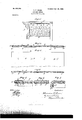
- Figure 1 is a transverse sectionthrough the upper portion of a bar or counter having an ice-box equipped with a preferred form of cover.
- Fig. 2 is a transverse section, on a larger scale, of the same cover alone.
- Fig. 3 is a corresponding top or plan view of a portion of the same.
- Fig. 4 is a section similar to Fig. 2, but showing a simpler form of the invention.
- Figs. 5, 6, and 7 are sections on a still larger scale, showing the construction of three different forms of the invention.
- Fig. 5 corresponds to the form shown in Figs. 1, 2, and 3.
- Fig. 6 corresponds to the modification shown in Fig. 4, and
- Fig. 7 shows 'another modified form.
- A is the upper portion of a bar or counter containing an ice-box A and having an opening above the latter closed by the removable perforated plate A All these parts may be of the ordinary or any approved construction.
- the box mayinclose coils of pipe (not shown) serving to cool any liquid passing therethrough andhas the usual opening of large area provided with the surrounding coaming sheet 0, preferably zinc, such as is generally used in the construction of boxes of this class, having a thick sheet D of asbestos applied on the under face and a covering-sheet E of canvas, duck, or other strong woven fabric applied below the asbestos.
- the sheets of asbestos and canvas are held to the metal by folding over the edges of the latter upon the margins of the canvas to firmly clasp it and the inclosed asbestos sheet and securely hold them, and also by rivets F, set at intervals, having large flat heads adjacent to the canvas and slender shanks extending through the asbestos, canvas, and zinc and headed on the upper face of the metal.
- the construction of the marginal attachment may be varied.
- the sheet metal is bent or folded around the margins of the canvas, as at O, sufficiently to securely engage them andis then bent downward to form a low depending flange 0 adapted to inclose the lip A on theice-box, and thus be held in place thereon.
- Fig. 5 I have shown the inner face of the canvas as having been treated with a suitable waterproofing material, asindicated at G. Such treatment may bedesirable in some situations,but will not be generally necessary.
- Fig. 7 shows a form in which the asbestos and canvas sheets are bent downwardly at the margin with the metal sheet to form a composite flange 0*, reinforced on its inner face where it contacts with the lip A" by the upward extension of the sheet metal at 0
- This construction has the additional feature of protecting the lip A with a non-conducting flange, as well as covering the ice box opening.
- the rivets F serve in holding the asbestos and canvas from sagging away from the metal and becoming torn or defaced by contact with the ice or articles in the box.
- the sheet metal supplies the required rigidity
- the asbestos serves efficiently in preventing the transmission of heat to the ice
- the canvas offers a clean protective covering to the soft absorbent asbestos.
- the canvas or duck is peculiarly well adapted to withstand the wear to which the cover is subjected and by its porous or open character allows any moisture or odors absorbed by the asbestos to escape freely when the cover is reversed and exposed to the action of the air and sunlight.
- the rivets F may be omitted in small covers, and the thickness of the asbestos sheet may be varied, or this portion may be built up of several thin sheets.
- the cover may be applied in other forms of refrigerators than the bar ice box shown, and the proportions may be varied to suit the requirements of the various situations in which the cover may be employed.
- I claim- 1 The ice-box cover described, comprising a sheet of metal forming the body, a sheet of asbestos on the under face thereof, and a covering-sheet of woven fabric applied on the under face of said asbestos sheet, the latter and said fabric held in position by folding the edges of the metal upon them and securely clamping both, all combined substantially as specified.
- the ice-box cover described comprising a sheet of metal forming the body, a sheet of asbestos on the under face thereof, and a covering-sheet of woven fabric applied on the under face of said asbestos sheet, the latter and said fabric held in position by folding the edges of the metal upon them and securely clamping both, and rivets extending through said fabric, asbestos, and metal to hold said fabric and asbestos sheets closely adjacent to said metal sheet throughout the whole area, all combined substantially as specified.
Landscapes
- Engineering & Computer Science (AREA)
- Chemical & Material Sciences (AREA)
- Combustion & Propulsion (AREA)
- Physics & Mathematics (AREA)
- Mechanical Engineering (AREA)
- Thermal Sciences (AREA)
- General Engineering & Computer Science (AREA)
- Packages (AREA)
Description
No. 698,564. Patented Apr. 29, I902.
T. r, SEGOR,
ICE Box cuvzni (Applicafibn filed Sept, 4, 1901.
(No miual.
I Jul/53711503:
A fimw THE ricnms PETERS co. PHOYO7LITNOW WASHINGTON, n. c.
NITEn STATES PATENT omea ICE-BOX COVER.
$PEGIFIGATION' forming part of Letters Patent No. 698,564, dated April 29, mos. Application filed st temter 4', 1901. Serial No. 74,279. (No model.)
- the county and State of New York, have invented a certain new and useful Improvement in Ice-Box Covers, of which the following is a specification.
The invention relates to non-conducting covers for all types of ice-boxes and refrigerators, but is intended more especially for service in bar ice-boxes, in which the box is a suitably-constructed compartment formed in the bar or counter. Boxes of this class are usually of sheet metal and have a large opening at the top, through which the ice is introduced. This opening is closed by a simple sheet-metal cover and the whole concealed beneath a removable open-work or perforated metal plate flush with and forming part of the upper surface of the bar or counter. In, this common form of box the upper portion is exposed to the air at the temperature of the apartment practically without insulation, and consequently a large proportion of the contained ice melts uneconomically.
My invention supplies a non-conducting cover for the box and by protecting the opening therein, which is nearly the whole area of the top, effects a considerable saving in the amount of ice used. It is also inexpensive and neat and attractive in appearance.
The accompanying drawings form a part of this specification and show what I consider the best forms of the invention.
Figure 1 is a transverse sectionthrough the upper portion of a bar or counter having an ice-box equipped with a preferred form of cover. Fig. 2 is a transverse section, on a larger scale, of the same cover alone. Fig. 3 is a corresponding top or plan view of a portion of the same. Fig. 4 is a section similar to Fig. 2, but showing a simpler form of the invention. Figs. 5, 6, and 7 are sections on a still larger scale, showing the construction of three different forms of the invention. Fig. 5 corresponds to the form shown in Figs. 1, 2, and 3. Fig. 6 corresponds to the modification shown in Fig. 4, and Fig. 7 shows 'another modified form.
Similar letters of reference indicate like parts in all the figures where they appear.
A is the upper portion of a bar or counter containing an ice-box A and having an opening above the latter closed by the removable perforated plate A All these parts may be of the ordinary or any approved construction. The box mayinclose coils of pipe (not shown) serving to cool any liquid passing therethrough andhas the usual opening of large area provided with the surrounding coaming sheet 0, preferably zinc, such as is generally used in the construction of boxes of this class, having a thick sheet D of asbestos applied on the under face and a covering-sheet E of canvas, duck, or other strong woven fabric applied below the asbestos. The sheets of asbestos and canvas are held to the metal by folding over the edges of the latter upon the margins of the canvas to firmly clasp it and the inclosed asbestos sheet and securely hold them, and also by rivets F, set at intervals, having large flat heads adjacent to the canvas and slender shanks extending through the asbestos, canvas, and zinc and headed on the upper face of the metal.
The construction of the marginal attachment may be varied. In the preferred form (shown in Figs. 1, 2, and 5) the sheet metal is bent or folded around the margins of the canvas, as at O, sufficiently to securely engage them andis then bent downward to form a low depending flange 0 adapted to inclose the lip A on theice-box, and thus be held in place thereon.
In Fig. 5 I have shown the inner face of the canvas as having been treated with a suitable waterproofing material, asindicated at G. Such treatment may bedesirable in some situations,but will not be generally necessary.
In the form shown in Figs. 4 and 6 the sheet metal is simply folded down at 0 upon the margins of the asbestos and canvas sheets and the flange C of the above-described form is omitted. This simple form of the invention by reason of avoiding the necessity for closely matching to the contour of the lip A is much less expensive to manufacture.
Fig. 7 shows a form in which the asbestos and canvas sheets are bent downwardly at the margin with the metal sheet to form a composite flange 0*, reinforced on its inner face where it contacts with the lip A" by the upward extension of the sheet metal at 0 This construction has the additional feature of protecting the lip A with a non-conducting flange, as well as covering the ice box opening.
The rivets F serve in holding the asbestos and canvas from sagging away from the metal and becoming torn or defaced by contact with the ice or articles in the box.
The sheet metal supplies the required rigidity, the asbestos serves efficiently in preventing the transmission of heat to the ice, and the canvas offers a clean protective covering to the soft absorbent asbestos. The canvas or duck is peculiarly well adapted to withstand the wear to which the cover is subjected and by its porous or open character allows any moisture or odors absorbed by the asbestos to escape freely when the cover is reversed and exposed to the action of the air and sunlight.
The rivets F may be omitted in small covers, and the thickness of the asbestos sheet may be varied, or this portion may be built up of several thin sheets.
Other strong fabric than canvas or duck may be used for the covering-sheet, if preferred, and the sheet forming the body, described as zinc, may be of other metal. Y
The cover may be applied in other forms of refrigerators than the bar ice box shown, and the proportions may be varied to suit the requirements of the various situations in which the cover may be employed.
I claim- 1. The ice-box cover described, comprising a sheet of metal forming the body, a sheet of asbestos on the under face thereof, and a covering-sheet of woven fabric applied on the under face of said asbestos sheet, the latter and said fabric held in position by folding the edges of the metal upon them and securely clamping both, all combined substantially as specified.
2. The ice-box cover described, comprising a sheet of metal forming the body, a sheet of asbestos on the under face thereof, and a covering-sheet of woven fabric applied on the under face of said asbestos sheet, the latter and said fabric held in position by folding the edges of the metal upon them and securely clamping both, and rivets extending through said fabric, asbestos, and metal to hold said fabric and asbestos sheets closely adjacent to said metal sheet throughout the whole area, all combined substantially as specified.
3. .The metal sheet C, asbestos sheet D, and fabric sheet E superposed upon each other, the fold 0 along the margins of said metal sheet, serving to hold the edges of said asbestos and fabric sheets, and the flange 0 formed by bending downward the edges of said metal sheet, all combined and arranged to serve with abar ice-box,substantiallyas herein specified.
4-. The metal sheet C, asbestos sheet D, and fabric sheet E superposed upon each other, the fold 0 along the margins of said metal sheet, serving to hold the edges of said asbestos and fabric sheets, the flange 0 formed by bending downward the edges of said metal sheet, and the rivets F serving to hold said asbestos and fabric sheets to said metal sheet throughout the whole area, all combined and arranged to serve with a bar ice-box, substantially as herein specified.
In testimony that I claim the invention above set forth I affix my signature in presence of two witnesses.
THEODOSIUS F. SECOR.
Witnesses:
RoBr. CONNOR, CHARLES R. SEARLE.
Priority Applications (1)
| Application Number | Priority Date | Filing Date | Title |
|---|---|---|---|
| US7427901A US698564A (en) | 1901-09-04 | 1901-09-04 | Ice-box cover. |
Applications Claiming Priority (1)
| Application Number | Priority Date | Filing Date | Title |
|---|---|---|---|
| US7427901A US698564A (en) | 1901-09-04 | 1901-09-04 | Ice-box cover. |
Publications (1)
| Publication Number | Publication Date |
|---|---|
| US698564A true US698564A (en) | 1902-04-29 |
Family
ID=2767096
Family Applications (1)
| Application Number | Title | Priority Date | Filing Date |
|---|---|---|---|
| US7427901A Expired - Lifetime US698564A (en) | 1901-09-04 | 1901-09-04 | Ice-box cover. |
Country Status (1)
| Country | Link |
|---|---|
| US (1) | US698564A (en) |
Cited By (1)
| Publication number | Priority date | Publication date | Assignee | Title |
|---|---|---|---|---|
| US8827109B1 (en) | 2014-03-07 | 2014-09-09 | Donna Sheehan | Ice chest cover with body and lid pockets |
-
1901
- 1901-09-04 US US7427901A patent/US698564A/en not_active Expired - Lifetime
Cited By (1)
| Publication number | Priority date | Publication date | Assignee | Title |
|---|---|---|---|---|
| US8827109B1 (en) | 2014-03-07 | 2014-09-09 | Donna Sheehan | Ice chest cover with body and lid pockets |
Similar Documents
| Publication | Publication Date | Title |
|---|---|---|
| US698564A (en) | Ice-box cover. | |
| US1480831A (en) | Ice box for autos | |
| US1103085A (en) | Car-roof. | |
| US862052A (en) | Ice-protector. | |
| US858550A (en) | Hot-water bag or bottle. | |
| US1082675A (en) | Weather-strip. | |
| US13329A (en) | William mootry | |
| US310371A (en) | Refrigerator | |
| US1174082A (en) | Evaporative refrigerator. | |
| US1191309A (en) | Refrigerator. | |
| US945421A (en) | Guard for berths. | |
| US1005434A (en) | Sanitary butter-tub. | |
| US1213246A (en) | Car-roof. | |
| US184189A (en) | Improvement in refrigerating-buildings | |
| US668549A (en) | Corrugated-iron roof. | |
| US952817A (en) | Cement or concrete refrigerator. | |
| US431221A (en) | Refrigerator-car | |
| US446780A (en) | Car-roof | |
| US908107A (en) | Heat-retaining cover. | |
| US500147A (en) | The iwrbis pttcrs co | |
| US673646A (en) | Car-roof construction. | |
| US1523553A (en) | Floor board | |
| US144448A (en) | Improvement in milk-coolers | |
| US287205A (en) | Milk-can | |
| US101582A (en) | Improved refrigerator |