US6979126B2 - Linear guide apparatus - Google Patents
Linear guide apparatus Download PDFInfo
- Publication number
- US6979126B2 US6979126B2 US10/830,024 US83002404A US6979126B2 US 6979126 B2 US6979126 B2 US 6979126B2 US 83002404 A US83002404 A US 83002404A US 6979126 B2 US6979126 B2 US 6979126B2
- Authority
- US
- United States
- Prior art keywords
- track
- faces
- slider
- guide rail
- face
- Prior art date
- Legal status (The legal status is an assumption and is not a legal conclusion. Google has not performed a legal analysis and makes no representation as to the accuracy of the status listed.)
- Expired - Lifetime, expires
Links
Images




Classifications
-
- F—MECHANICAL ENGINEERING; LIGHTING; HEATING; WEAPONS; BLASTING
- F16—ENGINEERING ELEMENTS AND UNITS; GENERAL MEASURES FOR PRODUCING AND MAINTAINING EFFECTIVE FUNCTIONING OF MACHINES OR INSTALLATIONS; THERMAL INSULATION IN GENERAL
- F16C—SHAFTS; FLEXIBLE SHAFTS; ELEMENTS OR CRANKSHAFT MECHANISMS; ROTARY BODIES OTHER THAN GEARING ELEMENTS; BEARINGS
- F16C29/00—Bearings for parts moving only linearly
- F16C29/12—Arrangements for adjusting play
-
- F—MECHANICAL ENGINEERING; LIGHTING; HEATING; WEAPONS; BLASTING
- F16—ENGINEERING ELEMENTS AND UNITS; GENERAL MEASURES FOR PRODUCING AND MAINTAINING EFFECTIVE FUNCTIONING OF MACHINES OR INSTALLATIONS; THERMAL INSULATION IN GENERAL
- F16C—SHAFTS; FLEXIBLE SHAFTS; ELEMENTS OR CRANKSHAFT MECHANISMS; ROTARY BODIES OTHER THAN GEARING ELEMENTS; BEARINGS
- F16C29/00—Bearings for parts moving only linearly
- F16C29/04—Ball or roller bearings
- F16C29/06—Ball or roller bearings in which the rolling bodies circulate partly without carrying load
- F16C29/0602—Details of the bearing body or carriage or parts thereof, e.g. methods for manufacturing or assembly
-
- F—MECHANICAL ENGINEERING; LIGHTING; HEATING; WEAPONS; BLASTING
- F16—ENGINEERING ELEMENTS AND UNITS; GENERAL MEASURES FOR PRODUCING AND MAINTAINING EFFECTIVE FUNCTIONING OF MACHINES OR INSTALLATIONS; THERMAL INSULATION IN GENERAL
- F16C—SHAFTS; FLEXIBLE SHAFTS; ELEMENTS OR CRANKSHAFT MECHANISMS; ROTARY BODIES OTHER THAN GEARING ELEMENTS; BEARINGS
- F16C29/00—Bearings for parts moving only linearly
- F16C29/04—Ball or roller bearings
- F16C29/06—Ball or roller bearings in which the rolling bodies circulate partly without carrying load
- F16C29/0633—Ball or roller bearings in which the rolling bodies circulate partly without carrying load with a bearing body defining a U-shaped carriage, i.e. surrounding a guide rail or track on three sides
- F16C29/0635—Ball or roller bearings in which the rolling bodies circulate partly without carrying load with a bearing body defining a U-shaped carriage, i.e. surrounding a guide rail or track on three sides whereby the return paths are provided as bores in a main body of the U-shaped carriage, e.g. the main body of the U-shaped carriage is a single part with end caps provided at each end
- F16C29/065—Ball or roller bearings in which the rolling bodies circulate partly without carrying load with a bearing body defining a U-shaped carriage, i.e. surrounding a guide rail or track on three sides whereby the return paths are provided as bores in a main body of the U-shaped carriage, e.g. the main body of the U-shaped carriage is a single part with end caps provided at each end with rollers
Definitions
- the present invention relates to a linear guide apparatus used in various machines of a manufacturing apparatus, a working machine, a measuring instrument and the like.
- a linear guide apparatus is an apparatus for linearly guiding an object to be guided, not illustrated, fixed to a slider as disclosed in, for example, JP-A-5-280537.
- a linear guide apparatus is provided with a guide rail 1 and a slider.
- the slider 2 has a section substantially in a U-like shape riding over the guide rail 1 and is attached with the object to be guided.
- guide rail side trace faces 3 , 4 are formed at side faces of the guide rail 1
- slider side track faces 5 , 6 are formed at inner peripheral faces of leg portions of the slider 2 .
- a load portion track path is formed by arranging the guide rail side trace faces 3 , 4 and the slider side track faces 5 , 6 opposedly to each other.
- Circulation passages are formed at end caps 50 and at inside of the slider 2 . Both of the load portion track path and the circulation passages form an endless circulation passage for rollers. A plurality of cylindrical rollers are arranged at inside of the endless circulation passage and the plurality of cylindrical rollers are rolled at inside of the endless circulation passage in accordance with relative movement of the slider 2 . Further, as described above, the linear guide apparatus is used in various machines of a semiconductor manufacturing apparatus, a precision working machine, a precision measuring instrument and the like.
- the track faces of the guide rail 1 and the slider 2 are worked to finish such that the two track faces constitute faces in parallel with each other in view from an axial direction of the guide rail 1 in a no load state in which the rollers are not interposed thereto.
- the linear guide apparatus in which rolling elements are the cylindrical rollers is frequently used for use needing a high rigidity particularly in a machine tool or the like. Therefore, in order to achieve a sufficient rigidity, the rollers are interposed between the track faces opposed to each other by being applied with a sufficient preload.
- FIG. 5 shows a result of calculating a state of the elastic deformation by an FEM analysis.
- FIG. 5B left and right sides of a horizontal portion 2 B are warped to an upper side and deformed in a shape of opening a total of the left and right leg portions 2 A. Therefore, in a state of bringing the linear guide into a usable state by interposing the cylindrical rollers, the slider side track faces 5 , 6 are inclined by a predetermined angle relative to the guide rail side track faces 3 , 4 .
- a degree of the inclination differs by loading an external load from the object to be guided or the like.
- FIG. 5C shows a result in consideration of the external load.
- FIG. 9 shows a result of calculating a state of distributing the contact pressure between the roller and the track in a direction of a roller axis.
- Running life of a total of the linear guide apparatus is significantly dependent on running life of a portion of the roller at which the contact pressure is the largest. That is, when there is a deviation in the distribution of the contact pressure as shown by FIG.
- a face pressure of a portion of the roller is abnormally increased to thereby shorten the life of the total of the linear guide apparatus. Further, when the roller is brought into an uneven contact state in this way, there is a concern of effecting an influence on an attitude of the rolling roller.
- the liner guide apparatus comprising;
- a guide rail including a track face extended in an axial direction
- a slider including a track face opposed to the track face of the guide rail and movable relative to the guide rail;
- one of the track faces opposed to each other is inclined to the other of the track faces relatively in an initial state of no load in which the cylindrical rollers are not interposed between the track faces by an inclined angle which cancels or reduces an amount of inclination of the track faces by a deformation of a member such that the track faces opposed to each other are in parallel with each other or substantially in parallel with each other in a state in which the member is deformed by being loaded with at least one of an external load to be loaded in using the linear guide and the preload.
- the linear guide apparatus comprising:
- a guide rail including a track face extended in an axial direction
- a slider including a track face opposed to the track face of the guide rail and movable relative to the guide rail;
- At least one of the track faces is inclined from a reference track face in an initial state of no load in which the cylindrical rollers are not interposed between the track faces by an inclined angle which cancels or reduces an amount of inclination from the reference track face produced by a deformation of a member by being loaded with at least one of an external load to be loaded in using the linear guide and the preload.
- FIG. 1 is a partially disassembled view showing a linear guide apparatus according to an embodiment of the present invention
- FIG. 2 is a view showing a relationship between track faces opposed to each other according to the embodiment of the present invention
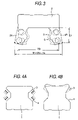
- FIG. 3 is a view showing elastic deformation of a slider according to the embodiment of the present invention.
- FIGS. 4A and 4B illustrate views showing elastic deformation of a rail according to the embodiment of the present invention
- FIGS. 5A to 5C illustrate views showing the elastic deformation of the slider according to the embodiment of the present invention
- FIG. 6 is a view showing an example of a measuring method according to the embodiment.
- FIG. 7 is a view showing another example of a measuring method according to the embodiment.
- FIGS. 8A and 8B illustrate views showing a relationship between track faces opposed to each other of an example of a related art
- FIG. 9 is a diagram showing a distribution of a contact face pressure in the example of the related art.
- FIG. 10 is a diagram showing a distribution of a contact face pressure according to the embodiment of the present invention.
- FIG. 11 is a view showing a working method according to the embodiment of the present invention.
- FIG. 12 is a view showing the working method according to the embodiment of the present invention.
- FIG. 13 is a view showing the working method according to the embodiment of the present invention.
- FIG. 14 is a perspective view showing a linear guide apparatus.
- a basic constitution of a linear guide apparatus of the embodiment is similar to that of the related art.
- a slider 2 substantially in a U-like shape rides over a guide rail 1 and is made to be movable along the guide rail 1 relatively thereto.
- Left and right side faces of the guide rail 1 are formed with a total of four tracks of respective two tracks of guide rail side track faces 3 , 4 .
- slider side track faces 5 , 6 are formed at positions of inner peripheral portions of leg portions of the slider 2 opposedly to the respective guide rail side track faces 3 , 4 .
- Notation 7 designates a rolling element return path.
- a plurality of cylindrical rollers 8 are arranged on load rolling paths comprising the guide rail side track faces 3 , 4 and the slider side track faces 5 , 6 opposed to each other along the load rolling path with a predetermined preload. In the case of being operated, the cylindrical rollers 8 are rolled on the load rolling paths.
- the slider side track faces 5 , 6 in a no load state before interposing the roller 8 are worked such that positions 3 A, 4 A of the guide rail side track faces and positions 5 A, 6 A of the slider side track faces are in parallel with each other in a state of being deformed by the preload. That is, the slider side track faces 5 , 6 in a no load state are worked to constitute faces which are inclined, by initial inclined angles of ⁇ 1 , ⁇ 2 , from faces 5 A, 6 A.
- both of the upper side track face 5 and the lower side track face 6 are brought into a state that they pivot by a predetermined angle in a counterclockwise direction relative to positions of the track faces under no load.
- the upper side back face 3 is brought into a state that it pivots by a predetermined angle in a counterclockwise direction relative to the position of the track face under no load.
- the lower side track face 4 is hardly changed by presence or absence of the preload. Further, the guide rail sidetrack faces 3 , 4 in the no load state are set to reference track faces constituting references as in the related art.
- the track faces 5 , 6 are worked into faces which are inclined by predetermined initial inclined angles relative to reference track faces constituting a reference as shown in FIG. 2 . That is, the upper side track face 5 is worked into a face inclined relative to a reference track face (not illustrated) by an initial inclined angle, which cancels amounts of inclinations of both of the guide rail side track face 3 and the slider side track face 5 due to deformation.
- the lower side track face 6 is worked into a face inclined relative to a reference track face (a face designated by notation 6 A) by an initial inclined angle, which cancels an amount of inclination produced by deforming a member of the slider side trace face 5 .
- the amounts of inclinations by the elastic deformation from the reference track faces in the no load state may be calculated by an analysis of a finite element method or the like or may be provided by an experiment.
- initial inclined angle K 1 ⁇ (preload)+ K 2 where notations K1, K2 are coefficients.
- the inclined angle may be determined by adding also elastic deformation by an external load produced by a self weight of the slider 2 per se or an object or the like attached to the slider 2 .
- an object to be guided (machine apparatus) is normally attached to an upper face of the slider 2 and therefore, the object to be guided is operated to restrain deformation of an upper face of the horizontal portion of the slider 2 as shown by FIGS. 5B through 5C and under a normal condition of use, a rate of contributing to deformation of the track faces by the external load is small. Therefore, in order to determine the initial inclined angle, generally, when a consideration is given to only the preload, the constitution is sufficient. Naturally, a further ideal initial inclined angle may be calculated by taking a consideration also to the external load.
- the embodiment is not limited thereto.
- Only the guide rail side track faces 3 , 4 may be inclined from the reference track faces or the guide rail side track faces 3 , 4 and the slider side track faces 5 , 6 may respectively be distributed with inclinations by a predetermined distributing rate to thereby incline the both from the reference track faces to thereby cancel the respective inclined amounts from the faces under no load by loading the preload to the guide rail side track faces 3 , 4 and the slider side track faces 5 , 6 .
- the guide rail side track faces 3 , 4 and the slider side track faces 5 , 6 may be worked respectively to faces inclined relative to individual reference track faces constituting a target determined by design or the like (inclination in a direction reverse to inclination by deformation) under a no load state before interposing the roller 8 to thereby cancel amounts of inclinations produced by elastic deformation of a member (slider 2 or guide rail 1 ) by loading the preload in interposing the roller 8 .
- the guide rail side track faces 3 , 4 and the slider side track faces 5 , 6 opposed to each other are in parallel with each other or substantially in parallel with each other and the deviations in the contact face pressures between the respective track faces and the roller can be restrained in the state of interposing the roller 8 .
- the respective target reference track faces can be constituted by the respective track faces when the rollers a are interposed and therefore, there is also achieved an effect of capable of constituting a desired inclination by the inclination of the interposed rollers.
- the side of the slider side track faces 5 , 6 is inclined by the predetermined initial inclined angle to cancel the amounts of inclinations by deformation respectively produced at the guide rail side track faces 3 , 4 and the slider side track faces 5 , 6 .
- the initial inclined angle is determined as follows.
- the roller 8 is applied with a preload.
- the preload is set to 8000 N.
- the slider 2 is operated with a downward load of 5000 N as the self weight.
- a state of deforming the slider 2 and the guide rail 1 when the preload is operated can be calculated by a publicly-known analysis method of an FEM analysis or the like.
- FIG. 5B is a view of a result of calculating the deformation of the member of the slider 2 by an FEM analysis.
- the initial inclined angles of the slider side track faces 5 , 6 disregarding deformation of the side of the guide rail 1 may be constituted by 6.8 ⁇ 10 ⁇ 4 rad (a direction of the initial inclined angle is reverse to a direction inclined by deformation) both in the upper side and the lower side members.
- a total of the leg portions is deformed to integrally open and therefore, the amounts of inclinations of the upper side track face and the lower side track face by deforming the members are substantially the same value.
- the inclined angle is calculated by the FEM analysis
- the both substantially coincide with each other. Further, also in cases of a square shape and a flange shape as the shape of the slider 2 , the both substantially coincide with each other similarly. Therefore, the amount of deforming the slider 2 can be predicted by calculation by the finite element method with excellent accuracy. From the result, also with regard to an amount of inclination of the track face by deforming the member, the both may be regarded to coincide with each other by experiment and analysis with sufficient accuracy.
- the FEM analysis is utilized, an initial inclined angle relative to the reference track face can be determined without trial fabrication and measurement of a product. Therefore, a time period and cost for trial fabrication and measurement can be reduced.
- the initial inclined angle relative to the reference track face is determined by calculating the initial inclined angle by the FEM analysis also with regard to deformation of the member on the side of the guide rail 1 .
- the condition is the same as the above-described.
- amounts of inclination of the upper side track face and the lower side track face by deforming the members are respectively +1.1 ⁇ 10 ⁇ 4 rad on the upper side and ⁇ 0.1 ⁇ 10 ⁇ 4 rad on the lower side (clockwise direction is positive as sign).
- the amount of inclination on the side of the guide rail 1 may be dealt with by inclining the track faces on the side of the guide rail 1 from the reference track faces, or the slider side track face 5 , 6 opposed there to may be inclined from the reference track faces by adding also the amounts of inclinations on the side of the guide rail 1 .
- the initial inclined angles of the upper side track face and the lower side track face differ from each other and therefore, working is carried out by inclining, for example, a shaping grindstone individually such that the track faces are inclined by the respective initial inclined angles from the reference track faces by a unit of each track face, or working is carried out by using a shaping grindstone formed by a rotary dresser having different inclined angles for the upper and lower track faces.
- the initial inclined angles of the upper and lower track faces may be set to 6.3 ⁇ 10 ⁇ 4 rad by taking an average of the both. Even by setting in this way, the deviation in the contact face pressure distribution between the roller 8 and the track face is alleviated.
- Comparative Example 1 by the related art is used.
- Comparative Example 1 in a state in which the preload is not applied, the track faces of the guide rail 1 and the slider 2 are in parallel with each other constituting inclinations equal to those of reference trace faces constituting a target. Otherwise, dimensions of the linear guide apparatus of Example 1 and Comparative Example, 1 are the same.
- FIG. 9 shows the contact pressure distribution of Comparative Example 1 (by the related art), which is not preferable since the deviation in the contact pressure is large and the life is shortened. Meanwhile, in the contact pressure distribution of the Example 1, as shown by FIG. 10 , the deviation in the contact pressure is small. Therefore, the life can be prevented from being shortened.
- Two track faces disposed at the inner peripheral faces of the leg portions of the slider 2 are simultaneously worked by using a shaping grindstone 40 .
- an outer peripheral face of the shaping grindstone 40 is formed by a rotary dresser 41 accuracy of which is correctly controlled to a shape of finishing the inner peripheral faces of the leg portions of the slider 2 (shapes of track faces are set by inclinations of reference track faces).
- a face in correspondence with the track face constituting the inclination of the reference track face is transcribed to the grindstone 40 by making a shaft of the rotary dresser 41 and a rotating shaft of the grindstone 40 in parallel with each other and pressing the outer periphery of the grindstone 40 to the rotary dresser 41 to form.
- the outer periphery of the grindstone 40 is pressed to the rotary dresser 41 to form by bringing the shaft of the rotary dresser 41 into a state of being inclined thereto by the initial inclined angle.
- the grindstone 40 is transcribed with the face in correspondence with the track face inclined to the reference track face by the initial inclined angle.
- the rotating shaft of the shaping grindstone may be inclined by the initial inclined angle to form.
- the inclined angle is, for example, 6.8 ⁇ 10 ⁇ 4 rad in the case of Example 1.
- both of the upper side track face and the lower side track face are worked to finish to the track faces inclined from the reference inclined angles by the initial inclined angles.
- the face of the shaping grindstone 40 is formed in the shape of the face in correspondence with the track faces inclined from the reference track faces by the initial inclined angles, the embodiment is not limited thereto.
- the shaping grindstone 40 is formed by making the shaft of the rotary dresser. 41 and the rotating shaft of the shaping grindstone 40 in parallel with each other, the grindstone 40 is transcribed with the face in correspondence with the track faces constituting the inclinations of the reference track faces. Further, in working to finish the inner peripheral faces of the leg portions on the slider side 2 , as shown by FIG. 12 and FIG. 13 , the rotating shaft of the shaping grindstone 40 or a work (slider 2 ) is inclined by the initial inclined angle.
- both of the two upper and lower track faces on the leg portion of the slider 2 on one side can be worked to the track faces inclined to the reference track faces by the desirable initial inclined angles.
- the upper side track face is worked to the track face inclined from the reference track face by the initial inclined angle by similar working.
- a first measuring method is a method of measuring the shape of the left and right track faces of either one of the upper side and the lower side track faces.
- the left and right track faces are measured by a shape measuring instrument by bringing a measuring probe 31 into a supportable state by hanging a connecting member 30 comprising a paper piece or the like to span the left and right leg portions 2 A.
- the initial inclined angle is provided by an angle constituted by the left and right track faces.
- the shape of the dresser can be ensured with high accuracy. Therefore, when the required initial inclined angle is provided to the lower side track face, also the upper side track face may be regarded to be provided with the required initial inclined angle.
- FIG. 7 shows a second measuring method.
- measuring rollers 32 are brought into contact with recess portions respectively constituted by the track faces and flange portions and distances W 1 and W 2 between the left and right rollers 32 are measured.
- a distance between the upper and lower rollers 32 is designated by notation h
- the flange portions are constituted only at the track faces on the side of the slider 2 . Therefore, it is convenient for the linear guide apparatus of the type that the inclinations are provided only by the track faces on the side of the slider 2 .
- the shape of dresser becomes complicated and cost is increased. Therefore, it is preferable to provide the flange portion to only one of the slider 2 or the guide line 1 . Further, it is preferable to provide the inclined angles only to the member provided with the flange portions.
Landscapes
- Engineering & Computer Science (AREA)
- General Engineering & Computer Science (AREA)
- Mechanical Engineering (AREA)
- Bearings For Parts Moving Linearly (AREA)
- Support Of The Bearing (AREA)
- Rolling Contact Bearings (AREA)
Abstract
Description
initial inclined angle=K1×(preload)+K2
where notations K1, K2 are coefficients.
θ=ΔW/(2×Lb)
Claims (2)
Applications Claiming Priority (2)
| Application Number | Priority Date | Filing Date | Title |
|---|---|---|---|
| JP2003118895A JP2004324737A (en) | 2003-04-23 | 2003-04-23 | Linear guide device |
| JPP.2003-118895 | 2003-04-23 |
Publications (2)
| Publication Number | Publication Date |
|---|---|
| US20040240757A1 US20040240757A1 (en) | 2004-12-02 |
| US6979126B2 true US6979126B2 (en) | 2005-12-27 |
Family
ID=32959639
Family Applications (1)
| Application Number | Title | Priority Date | Filing Date |
|---|---|---|---|
| US10/830,024 Expired - Lifetime US6979126B2 (en) | 2003-04-23 | 2004-04-23 | Linear guide apparatus |
Country Status (3)
| Country | Link |
|---|---|
| US (1) | US6979126B2 (en) |
| EP (1) | EP1471273A3 (en) |
| JP (1) | JP2004324737A (en) |
Cited By (1)
| Publication number | Priority date | Publication date | Assignee | Title |
|---|---|---|---|---|
| US20070237435A1 (en) * | 2006-03-29 | 2007-10-11 | Shouji Nagao | Linear Motion Guide Unit And Method For Detecting Strain On The Same |
Families Citing this family (4)
| Publication number | Priority date | Publication date | Assignee | Title |
|---|---|---|---|---|
| JP2007298120A (en) * | 2006-04-28 | 2007-11-15 | Nsk Ltd | Slider for linear motion guide device, linear motion guide device, method for manufacturing slider for linear motion guide device, movable member for transport device, and transport device |
| WO2013035212A1 (en) * | 2011-09-07 | 2013-03-14 | 日本精工株式会社 | Linear motion guide device |
| GB2560727B (en) * | 2017-03-22 | 2020-06-17 | Accuride Int Ltd | An adjustable bearing assembly |
| KR102836684B1 (en) * | 2018-11-27 | 2025-07-21 | 티에치케이 가부시끼가이샤 | Exercise Guidance Device |
Citations (1)
| Publication number | Priority date | Publication date | Assignee | Title |
|---|---|---|---|---|
| JPH05280537A (en) | 1992-03-31 | 1993-10-26 | Nippon Thompson Co Ltd | Rolling guide unit |
Family Cites Families (10)
| Publication number | Priority date | Publication date | Assignee | Title |
|---|---|---|---|---|
| US4496197A (en) * | 1983-04-11 | 1985-01-29 | The Bendix Corporation | Linear motion bearing truck and rail assembly |
| JPS59219518A (en) * | 1983-05-26 | 1984-12-10 | Hiroshi Teramachi | Roller bearing unit for linear slide motion |
| JPS6025628A (en) * | 1983-07-20 | 1985-02-08 | Hiroshi Teramachi | Table assembly for straight sliding |
| JPS6196213A (en) * | 1984-10-16 | 1986-05-14 | Hiroshi Teramachi | Linear sliding roller bearing |
| JPS6188017A (en) * | 1984-09-21 | 1986-05-06 | Hiroshi Teramachi | Linearly sliding roller bearing |
| JPS6196215A (en) * | 1984-10-16 | 1986-05-14 | Hiroshi Teramachi | Linear sliding roller bearing and linear guide device |
| JPS61100337A (en) * | 1984-10-23 | 1986-05-19 | Hiroshi Teramachi | Linear guide apparatus |
| US5005988A (en) * | 1990-03-28 | 1991-04-09 | Thomson Industries, Inc. | Linear motion bearing |
| JP3751101B2 (en) * | 1995-12-28 | 2006-03-01 | Thk株式会社 | Linear roller guide device |
| JP4479066B2 (en) * | 2000-06-23 | 2010-06-09 | 日本精工株式会社 | Rolling guide unit |
-
2003
- 2003-04-23 JP JP2003118895A patent/JP2004324737A/en active Pending
-
2004
- 2004-04-23 EP EP04009733A patent/EP1471273A3/en not_active Withdrawn
- 2004-04-23 US US10/830,024 patent/US6979126B2/en not_active Expired - Lifetime
Patent Citations (1)
| Publication number | Priority date | Publication date | Assignee | Title |
|---|---|---|---|---|
| JPH05280537A (en) | 1992-03-31 | 1993-10-26 | Nippon Thompson Co Ltd | Rolling guide unit |
Cited By (1)
| Publication number | Priority date | Publication date | Assignee | Title |
|---|---|---|---|---|
| US20070237435A1 (en) * | 2006-03-29 | 2007-10-11 | Shouji Nagao | Linear Motion Guide Unit And Method For Detecting Strain On The Same |
Also Published As
| Publication number | Publication date |
|---|---|
| EP1471273A3 (en) | 2009-10-28 |
| EP1471273A2 (en) | 2004-10-27 |
| JP2004324737A (en) | 2004-11-18 |
| US20040240757A1 (en) | 2004-12-02 |
Similar Documents
| Publication | Publication Date | Title |
|---|---|---|
| CN101238297B (en) | Linear guide | |
| KR100687310B1 (en) | Rolling method and rolling apparatus of metal sheet | |
| AU2009222231B2 (en) | Rolling mill and rolling method for flat products of steel | |
| US6979126B2 (en) | Linear guide apparatus | |
| CN109661293A (en) | The automation of rail vehicle part is processed and welding | |
| US3231319A (en) | Precision slide | |
| EP1469277B1 (en) | Linear guide rail with an air bearing for measuring machine | |
| KR19980071607A (en) | Rolling mill and rolling method | |
| CN108608219A (en) | A kind of travelling gantry frame with self-compensating function | |
| JPH10501470A (en) | Multi-roll type polisher and its use | |
| KR20170132560A (en) | Machining center | |
| US5092720A (en) | Method for determination of longitudinal and profile modification of tool gear tooth surface | |
| EP2740953B1 (en) | Hydrostatic fluid guide device | |
| US4095079A (en) | Tool holder for a spark erosion machine tool | |
| JPH03153915A (en) | Bearing for linear sliding | |
| JP3105490B2 (en) | Variable capillary device for hydrostatic bearing and motion error correction method using the same | |
| JP2978056B2 (en) | Prediction method of contact wear between rolls of rolling mill | |
| EP1310689B1 (en) | Linear guide bearing apparatus | |
| CN223477605U (en) | A height adjuster with a scale | |
| DE112010005364T5 (en) | Parallel shifter with a linear air guide, control method therefor and measuring device using the same | |
| JP5182034B2 (en) | Identification method of main rolling deformation characteristics of rolling mill | |
| JPH049205A (en) | Method and device for asymmetry correction of plate shape | |
| JP4932769B2 (en) | Zeroing method of rolling mill | |
| JP3988445B2 (en) | Linear motion device, table device, and attitude adjustment method | |
| JP6653058B2 (en) | CMM |
Legal Events
| Date | Code | Title | Description |
|---|---|---|---|
| AS | Assignment |
Owner name: NSK LTD., JAPAN Free format text: ASSIGNMENT OF ASSIGNORS INTEREST;ASSIGNOR:MATSUMOTO, JUN;REEL/FRAME:015257/0508 Effective date: 20040420 |
|
| FEPP | Fee payment procedure |
Free format text: PAYOR NUMBER ASSIGNED (ORIGINAL EVENT CODE: ASPN); ENTITY STATUS OF PATENT OWNER: LARGE ENTITY |
|
| FPAY | Fee payment |
Year of fee payment: 4 |
|
| FPAY | Fee payment |
Year of fee payment: 8 |
|
| REMI | Maintenance fee reminder mailed | ||
| LAPS | Lapse for failure to pay maintenance fees |
Free format text: PATENT EXPIRED FOR FAILURE TO PAY MAINTENANCE FEES (ORIGINAL EVENT CODE: EXP.) |
|
| FP | Lapsed due to failure to pay maintenance fee |
Effective date: 20171227 |
|
| PRDP | Patent reinstated due to the acceptance of a late maintenance fee |
Effective date: 20180510 |
|
| FEPP | Fee payment procedure |
Free format text: SURCHARGE, PETITION TO ACCEPT PYMT AFTER EXP, UNINTENTIONAL (ORIGINAL EVENT CODE: M1558) Free format text: PETITION RELATED TO MAINTENANCE FEES FILED (ORIGINAL EVENT CODE: PMFP) Free format text: PETITION RELATED TO MAINTENANCE FEES GRANTED (ORIGINAL EVENT CODE: PMFG) |
|
| MAFP | Maintenance fee payment |
Free format text: PAYMENT OF MAINTENANCE FEE, 12TH YEAR, LARGE ENTITY (ORIGINAL EVENT CODE: M1553) Year of fee payment: 12 |
|
| STCF | Information on status: patent grant |
Free format text: PATENTED CASE |