US6683890B1 - Method and circuit for improving the pointer processing in synchronous digital hierarchy (SDH) transmission frames - Google Patents
Method and circuit for improving the pointer processing in synchronous digital hierarchy (SDH) transmission frames Download PDFInfo
- Publication number
- US6683890B1 US6683890B1 US09/432,279 US43227999A US6683890B1 US 6683890 B1 US6683890 B1 US 6683890B1 US 43227999 A US43227999 A US 43227999A US 6683890 B1 US6683890 B1 US 6683890B1
- Authority
- US
- United States
- Prior art keywords
- state
- concatenation
- conc
- normal
- processing
- Prior art date
- Legal status (The legal status is an assumption and is not a legal conclusion. Google has not performed a legal analysis and makes no representation as to the accuracy of the status listed.)
- Expired - Fee Related
Links
Images


Classifications
-
- H—ELECTRICITY
- H04—ELECTRIC COMMUNICATION TECHNIQUE
- H04J—MULTIPLEX COMMUNICATION
- H04J3/00—Time-division multiplex systems
- H04J3/02—Details
- H04J3/06—Synchronising arrangements
- H04J3/062—Synchronisation of signals having the same nominal but fluctuating bit rates, e.g. using buffers
- H04J3/0623—Synchronous multiplexing systems, e.g. synchronous digital hierarchy/synchronous optical network (SDH/SONET), synchronisation with a pointer process
Definitions
- the present invention relates to the field of synchronous digital transmissions and in particular to a method and implementation circuit that permit of improving the pointer processing in the event of payload contiguous concatenation in synchronous digital hierarchy (SDH) frames.
- SDH synchronous digital hierarchy
- Synchronous Digital Hierarchy (briefly, SDH) is known since the end of the Eighties and it will not be described in greater detail being considered as known to a person skilled in the art.
- Docs. 1 and 2 show two different state diagrams to be used with the algorithm for pointer processing in case of concatenated payload or in case of non-concatenated payload.
- a primary object of the present invention is to solve the above mentioned problem, and thus provide a means for automatically transitioning between the states of one diagram and those of another diagram.
- the present invention provides a method and a circuit which can be represented through a state diagram containing therein both the diagrams contemplated by the Standards but which, through the introduction of one or more intermediate states and the special processing of data from individual pointer processors, does not require the prior configuration of the operation.
- Two different exemplary embodiments will be described in detail, with the first being extremely modular.
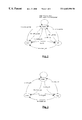
- FIG. 1 is a state diagram used in the pointer interpretation circuits in the event of non concatenated payload (first embodiment);
- FIG. 2 is a state diagram used in the pointer interpretation circuits in the event of concatenated payload
- FIG. 3 is a complete block diagram for AU-4c, AU4-16c and AU4-64c concatenation;
- FIG. 4 is a state diagram for the steps carried out by the CON_MACHINE_ 4 block of FIG. 3;
- FIG. 5 depicts the steps of the method which are carried out in the CONC_MACHINE_ 16 block of FIG. 3;
- FIG. 6 depicts the steps of the method which are carried out in CONC_MACHINE_ 64 block of FIG. 3;
- FIG. 7 depicts a block diagram for the pointer interpretation algorithm in case of concatenation and of non concatenation (second embodiment).
- FIG. 8 depicts a possible state diagram for the pointer interpretation algorithm in case of concatenation and of non concatenation.
- FIG. 1 shows the state diagram used in the interpretation circuits of the AU4 pointer (see Doc. 1), where AU designates the Administrative Unit.
- the contemplated states are the following: NORM (Normal) corresponding to the normal state: LOP (Loss of Pointer) corresponding to the loss of pointer state; and AIS (Alarm Indication Signal) corresponding to the alarm indication state.
- NORM Normal
- LOP Loss of Pointer
- AIS Alarm Indication Signal
- the pointer interpretation circuit related to the event of concatenated payload provides for the states CONC (Concatenation), corresponding to the concatenation state, LOPC (Loss of Pointer in Concatenation), corresponding to the loss of pointer in concatenation state, and AISC (Alarm Indication Signal in Concatenation), corresponding to the alarm indication in concatenation state.
- CONC Concatenation
- LOPC Loss of Pointer in Concatenation
- AISC Alarm Indication Signal in Concatenation
- the whole condition is defined by considering the states at which the pointer interpretation circuits of all the AU4's pertaining to AU4-Xc are.
- a correct concatenation condition occurs when the pointer interpretation circuit of the first AU4 (master) is in a non-alarm condition (NORM state) and the other circuits (slaves) are in the concatenation state (CONC) since they contain the concatenation string.
- the overall AIS state occurs when all the pointer interpretation circuits of the AU4-Xc's are in the AIS state. For all the other cases, the overall state is LOPC.
- Doc. 2 For a more detailed explanation, reference should be made to Doc. 2.
- the construction of blocks managing the concatenation has been realized by means of a hierarchical and modular structure.
- This means that the different levels of the circuit have been conceived in such a way that, by using the first level, only the AU4-4c concatenation is managed, using the first and the second levels in cascade the AU4-4c and AU4-16c concatenations can be managed, while using all three levels in cascade the AU4-4c, AU4-16c and AU4-64c concatenations can be managed. Consequently, this has entailed the design of the three different types of circuit. while using the three levels in cascade the AU4-4c, AU4-16c and AU4-64c concatenations can be managed. This has entailed the design of the three different types of circuit.
- the structure thus defined allows the use of these blocks in a precise manner taking the particularity of the application into account. This avoids the hardware oversizing in the systems in which the concatenation recognition is carried out with flows of maximum capability equal to STM4 or STM16.
- FIG. 3 there is illustrated the complete block diagram for the AU4-64c case.
- STM-4 frames it suffices to use a single CONC_MACHINE_ 4 block
- STM-16 frames it suffices to use four CONC_MACHINE_ 4 blocks and one CONC_MACHINE_ 16 block.
- the circuit represented by block CONC_MACHINE_ 4 of FIG. 3 is recognizing a possible concatenation state on the basis of the indications received from the four independent circuits POINT_INT that process the AU4 pointers.
- Circuit POINT_INT# 1 is related to the first AU4 and can be both master and slave, depending on the overall concatenation state, while circuits POINT_INT# 2 , POINT_INT# 3 and POINT_INT# 4 can be only slave, should the related AU4's contain the concatenation indication.
- the pointer interpretation circuits concerning the various AU4's operate in a rather independent manner, producing the AIS (AIS 1 , . . . , AIS 4 , in general AISx) and the LOP (LOP 1 , . . . , LOP 4 , in general LOPx) signals as defects; they can also generate the CONC (CONC 1 , . . . , CONC 4 , in general CONCx) signal, when they recognize the concatenation indication in the pointer.
- AIS AIS 1 , . . . , AIS 4 , in general AISx
- LOP 1 , . . . , LOP 4 in general LOPx
- the CONC_MACHINE_ 4 circuit receives these signals as input and evolves in a suitable manner: by controlling the signals generated by all the four pointer interpretation circuits, it can decide if the overall condition of the quadruplet is compatible with the existence of a concatenation state, if it indicates the presence of four independent (non-concatenated) AU4's or if it indicates an illegal state and therefore an error condition.
- the behavior of such a circuit whose diagram is illustrated in FIG. 4, will be analyzed hereinafter.
- the IND_NORM state represents the non-concatenation case. Further, there are the states related to the case of payload constituted by four concatenated AU4's (AU4-4c) i.e. IND_CONC 4 , IND_LOPC 4 and IND_AISC 4 which together form a macrostate termed CONC 4 _STATE.
- Ni, Ai, Li, Ci designate the signals generated by the single pointer processing blocks, indicating NORM, AIS, LOP, CONC respectively;
- NORMi, AISi, LOPi, CONCi designate the states at which the single pointer processing circuits are, IND_NORM, IND_CONC 4 , IND_LOPC 4 , IND_AISC 4 , IND_CONC 16 , IND_LOPC 16 , IND_AISC 16 and IND_INTERM_LOPC designate the states of the overall diagram of FIG. 4 .
- Each of the various AU4's is individually in the NORMi, AISi or LOPi states.
- NORM 1 +CONC 2 +CONC 3 +CONC 4 condition occurs, i.e. CONC_MACHINE_ 4 block receives the N 1 , C 2 , C 3 , C 4 signals, it evolves in the IND_CONC 4 state; when the CONC 1 +CONC 2 +CONC 3 +CONC 4 conditions occurs, i.e. the CONC_MACHINE_ 4 block receives the C 1 , C 2 , C 3 , C 4 signals, it evolves into the IND_CONC 16 state; when at least one of the AU4's goes to the CONCi state, i.e. a CONCx signal is received (but one is not in the NORM 1 +CONC 2 +CONC 3 +CONC 4 or CONC 1 +CONC 2 +CONC 3 +CONC 4 conditions) the IND_INTERM_LOPC state is reached.
- the circuit enters this state only starting from those states forming part of the CONC 4 _STATE macrostate.
- the various AU4's are in such a condition that the overall state results in being in neither the IND_CONC 4 nor IND_AISC 4 states. If there is no longer any CONCx indication, the circuit goes to the IND_NORM state.
- NORM 1 +CONC 2 +CONC 3 +CONC 4 condition occurs, the circuit goes to the IND_CONC 4 state; and when the CONC 1 +CONC 2 +CONC 3 +CONC 4 condition occurs, the circuit goes to the IND_CONC 16 state.
- all pointers are in the AISi state, i.e., all the signals A 1 , A 2 , A 3 and A 4 are active, the machine evolves into the IND_AISC 4 state.
- the circuit enters this state only starting from states forming part of the macrostate CONC 4 _STATE. All four AU4's should be in the AISi state, i.e. the signals A 1 , A 2 , A 3 and A 4 must be active.
- the circuit goes to the IND_NORM state; when condition NORM 1 +CONC 2 +CONC 3 +CONC 4 occurs, the circuit goes to the IND_CONC 4 state; when CONC 1 +CONC 2 +CONC 3 +CONC 4 condition occurs, the circuit goes to the IND_CONC 16 state; when even only one of the AU4's goes to any state different from those considered above which allows it to stay at IND_AISC 4 or to evolve into the IND_CONC 4 , IND_CONC 16 or IND_NORM state, the circuit goes to IND_LOPC 4 state.
- the circuit enters this state only starting from those states belonging to the CONC 16 _STATE macrostate. All four AU4's must be in the AISi state, i.e., the signals A 1 , A 2 , A 3 , and A 4 must be active. If there is no longer any CONCx indication the circuit goes to the IND_NORM state. When the CONC 1 +CONC 2 +CON 3 +CONC 4 condition occurs, the circuit goes to the IND_CONC 16 state; and when the NORM 1 +CONC 2 +CONC 3 +CONC 4 condition occurs, the circuit goes to the IND_CONC 4 state.
- the circuit goes to the IND_LOPC 16 state.
- the circuit enters this state only starting from states belonging to the CONC_STATE macrostate. All four AU4's must be in the AISi state, i.e. the signals A 1 , A 2 , A 3 , and A 4 must be active, if there is no longer any CONCx indication the circuit goes to the IND_NORM state; when the CONC 1 +CONC 2 +CON 3 +CONC 4 condition occurs, the circuit goes to the IND_CONC 16 state; when the NORM 1 +CONC 2 +CONC 3 +CONC 4 condition occurs, the circuit goes to the IND_CONC 4 state; when at least one of the AU4's goes to any state different from those considered above in order to stay in IND_AISC 16 or to evolve into the IND_CONC 4 , IND_CONC 16 or IND_NORM state, the circuit goes to the IND_LOPC 16 state.
- IND_CONC 64 in case of an STM-64 flow
- An AU4-4c concatenation indication comes from the CONC_MACHINE_ 4 # 1 ; and indications of possible AU4-16c concatenations come from the remaining CONC_MACHINE 4 (# 2 , # 3 , # 4 ).
- the CONC 16 _STATE signal will then be activated.
- An AU4-4c concatenation indication comes from the CONC_MACHINE_ 4 # 1 ; indications of possible AU4-16c concatenations come from the remaining CONC_MACHINE_ 4 (# 2 , # 3 , # 4 ).
- the CONC 16 _STATE indication will be then activated.
- a possible AU4-64c concatenation state is recognized.
- the CONC 4 _STATEm is recognized at the machines that have provided the active indication. Against the other CONC 4 _STATEm machines, the CONC_MACHINE_ 16 block behaves in a transparent manner, i.e. it allows the IND_NORM and/or IND_INTERM_LOPC indications from CONC_MACHINE_ 4 blocks to pass.
- CONC_MACHINE_ 16 block behaves in a transparent manner, i.e. it allows the IND_NORM and/or IND_INTERM_LOPC indications from CONC_MACHINE_ 4 blocks to pass.
- the circuit receives at its input the indications from the four CONC_MACHINE_ 16 blocks, generated according to the modalities described above.
- CONC 64 _STATE the AU4-64c concatenation state, designated by CONC 64 _STATE, is defined in addition to the concatenation state AU4-4c and AU4-16c.
- FIG. 6 there is depicted the decision algorithm of the concatenation states. Such an algorithm will be described hereinafter.
- the AU4-64c concatenation state is recognized as valid.
- One or more independent AU4-4c and/or AU4-16c concatenations are required. The following situations must occur: no IND_CONC 64 m indication must be active and the active CONC 4 _STATEn and/or CONC 16 -STATEm indications must come from the CONC_MACHINE- 16 blocks.
- the concatenation states recognized by the CONC_MACHINE_ 16 blocks are defined in the CONC_MACHINE_ 64 block.
- the operation is transparent, i.e. the indications from the previous blocks are recopied at the output.
- One or more independent AU4-4c and/or AU4-16c concatenations are recognized but with AU4-64c concatenation problems.
- at least one IND_CONC 64 m indication is active and CONC 4 _STATEn and/or CONC 16 _STATEm active indications come from the CONC_MACHINE_ 16 blocks.
- the diagram according to the second embodiment is obtained by a circuit which in FIG. 7 is represented by block CONC_MACHINE, for the AU4-4c concatenation case, while one should keep in mind that the present invention can be applied to a number of AU-4's different from four as well.
- the pointer interpretation circuit POINTINT# 1 (master) relates to the first AU-4
- circuits POINT_INT# 2 -POINT_INT# 4 relate to the AU-4's whose pointer contains the concatenation information.
- Each of the pointer interpretation circuits (POINT_INT#) relating to the various AU-4's operate in a complete independent manner, producing the int_AISi (int_AIS 1 , int_AIS 2 , . . . , int_AIS 4 ) and the int_LOPi (int_LOP 1 , int_LOP 2 , . . . , int_LOP 4 ) interpretation signals, as defects.
- Blocks POINT_INT# 2 , POINT_INT# 3 and POINT_INT# 4 can generate also the int_CONCx (intCONC 2 , int_CONC 3 , . . . , int_CONC 4 ) signal, when they recognize the concatenation indication in the pointer.
- Circuit CONC_MACHINE receives these signals as inputs and evolves in a suitable manner: having the signals generated by all four pointer interpretation circuits, it can decide whether the whole condition is a concatenation or non-concatenation one.
- FIG. 8 the whole diagram of FIG. 1 is incorporated in the state NORM_STATE.
- states concerning the concatenated payload case namely CONC, LOPC and AISC.
- CONC_STATE states concerning the concatenated payload case
- LOPC LOPC
- AISC states concerning the concatenated payload case
- the present invention provides for the addition of at least one intermediate state.
- two intermediate states CONC 1 _INT and CONC 2 _INT are defined.
- the state CONC 1 _INT allows the transition from a non-concatenation condition to a concatenation one.
- the state CONC 2 _INT allows the transition from a concatenation condition to a non-concatenation condition.
- the diagram evolves according to the following rules:
- CONC 1 _INT is the transitional state from NORM_STATE to CONC_STATE in the case where the transition is not immediate, i.e. when the three slaves do not generate the int_CONCx signals at the same time.
- One or more AU-4 pointers contain the concatenation string, but the CONC or LOPC state has not been reached yet: should this situation remain for a programmable value of j ms, the circuit evolves to LOPC state (“cond 3 ”); if, on the other hand, there is not any concatenation indication int_CONCx, the circuit returns back to NORM-STATE (“cond 4 ”).
- the third possibility consists in having NORM 1 +CONC 2 +CONC 3 +CONC 4 and in this event the circuit evolves into the CONC state (“cond 5 ”).
- CONC 2 _INT represents the transitional state from the CONC_STATE to the NORM_STATE in the case where the transition is not immediate.
- One or more AU-4 pointers contain the concatenation string, but the CONC or LOPC state has not been reached. Should this situation remain for a predetermined time of k ms, the LOPC state (“Cond 6 ” of FIG. 8) is reached. If to the contrary, there is no int_CONCx indication, the circuit goes to the NORM_STATE (“Cond 7 ”). Alternatively, when NORM 1 +CONC 2 +CON 3 +CONC 4 occurs, the circuit evolves into the CONC state (“Cond 8 ”). Furthermore, if block CONC_MACHINE receives signals int_AIS 1 , int_AIS 2 , int_AIS 3 and int_AIS 4 , it evolves into the AISC state (“cond 9 ”).
- the circuit enters the AISC state only starting from states which belong to CONC_STATE. All the four AU-4's must be in the AISi state, i.e. signals int_AIS 1 , int_AIS 2 , int_AIS 3 and int_AIS 4 should be active. From the AISC state, when condition NORM 1 +CONC 2 +CONC 3 +CONC 4 occurs, the circuit goes to CONC state (“cond 10 ”); but when at least one of the AU-4's goes to any state different from those contemplated above to remain in AISC or to evolve to CONC state, the circuit goes to the LOPC state (“cond 11 ”).
- the CONC state is the state which is provided when the pointer interpretation circuit of the first AU-4 generates the int_NORM 1 signal and the other three generate the concatenation indication int_CONC 2 , int_CONC 3 and int_CONC 4 . If the machine does not receive any int_CONCx indication, it goes to NORM_STATE (“cond 12 ”); when signals int_AIS 1 , int_AIS 2 , int_AIS 3 and int_AIS 4 are active, the block goes to AISC state (“cond 13 ”); when at least one of the AU-4's goes to any state different from those contemplated above, the circuit evolves into the CONC 2 _INT state (“cond 14 ”).
- the various AU-4's are in such a condition that the whole state is neither AISC, nor CONC 1 _INT, nor CONC 2 _INT, nor CONC, nor NORM. From this condition, in case any INT_CONCx indication is missing, the circuit goes to the NORM_STATE (“cond 15 ”); when, on the contrary, the condition NORM 1 +CONC 2 +CONC 3 +CONC 4 occurs, the circuit goes to the CONC state (“cond 16 ”); while when all pointers are in the AISi state, i.e. signals int_AIS 1 , int_AIS 2 , int_AIS 3 and int_AIS 4 are all active, the machine evolves into the AISC state (“cond 17 ”).
- the present invention may indifferently be implemented through hardware or computer software capable of carrying out all the steps of the method.
- the invention extends to computer readable medium having a program recorded thereon, said computer readable medium comprising computer program code means adapted to perform all the steps of the method when said program is run on a computer.
Landscapes
- Engineering & Computer Science (AREA)
- Computer Hardware Design (AREA)
- Computer Networks & Wireless Communication (AREA)
- Signal Processing (AREA)
- Mobile Radio Communication Systems (AREA)
- Time-Division Multiplex Systems (AREA)
- Data Exchanges In Wide-Area Networks (AREA)
Abstract
Description
Claims (10)
Applications Claiming Priority (4)
| Application Number | Priority Date | Filing Date | Title |
|---|---|---|---|
| IT002354 IT1303297B1 (en) | 1998-11-03 | 1998-11-03 | Pointer processing method for SDH transmission frames, involves blocks deciding if concatenation states exist or not and configuring succeeding blocks to enable automatic recognition |
| ITMI98A2354 | 1998-11-03 | ||
| ITMI98A1674 | 1999-07-28 | ||
| IT99MI001674 IT1313256B1 (en) | 1999-07-28 | 1999-07-28 | Pointer processing method for SDH transmission frames, involves blocks deciding if concatenation states exist or not and configuring succeeding blocks to enable automatic recognition |
Publications (1)
| Publication Number | Publication Date |
|---|---|
| US6683890B1 true US6683890B1 (en) | 2004-01-27 |
Family
ID=26331619
Family Applications (1)
| Application Number | Title | Priority Date | Filing Date |
|---|---|---|---|
| US09/432,279 Expired - Fee Related US6683890B1 (en) | 1998-11-03 | 1999-11-02 | Method and circuit for improving the pointer processing in synchronous digital hierarchy (SDH) transmission frames |
Country Status (6)
| Country | Link |
|---|---|
| US (1) | US6683890B1 (en) |
| EP (1) | EP0999667B1 (en) |
| JP (1) | JP2000151536A (en) |
| AT (1) | ATE357096T1 (en) |
| CA (1) | CA2287610A1 (en) |
| DE (1) | DE69935485T2 (en) |
Cited By (3)
| Publication number | Priority date | Publication date | Assignee | Title |
|---|---|---|---|---|
| US20050078713A1 (en) * | 2003-10-14 | 2005-04-14 | Alcatel | Enhanced management of pointer processing in case of concatenated payload in SDH and SONET frames |
| US6973041B1 (en) * | 2000-06-15 | 2005-12-06 | Cisco Technology, Inc. | Path AIS insertion for concatenated payloads across multiple processors |
| US8179785B1 (en) * | 2010-02-17 | 2012-05-15 | Tellabs Operations, Inc. | Deterministic switching protection over aggregated links |
Families Citing this family (1)
| Publication number | Priority date | Publication date | Assignee | Title |
|---|---|---|---|---|
| EP1367751A1 (en) * | 2002-05-28 | 2003-12-03 | Alcatel | Fallback in transmission of data signals through a synchronous digital network using virtual concatenated containers |
Citations (3)
| Publication number | Priority date | Publication date | Assignee | Title |
|---|---|---|---|---|
| US5539750A (en) * | 1992-07-01 | 1996-07-23 | Nokia Telecommunications Oy | Method for receiving a signal used in a synchronous digital telecommunication system |
| US5724342A (en) * | 1993-11-12 | 1998-03-03 | Nokia Telecommunications Oy | Method for receiving a signal in a synchronous digital telecommunications system |
| US6094440A (en) * | 1996-07-05 | 2000-07-25 | Hitachi, Ltd. | Multiplex type transmitting apparatus |
Family Cites Families (1)
| Publication number | Priority date | Publication date | Assignee | Title |
|---|---|---|---|---|
| FI91697C (en) * | 1992-07-01 | 1994-07-25 | Nokia Telecommunications Oy | Method for receiving a signal used in a synchronous digital communication system |
-
1999
- 1999-10-26 CA CA002287610A patent/CA2287610A1/en not_active Abandoned
- 1999-10-27 JP JP11304895A patent/JP2000151536A/en active Pending
- 1999-10-29 EP EP99440292A patent/EP0999667B1/en not_active Expired - Lifetime
- 1999-10-29 DE DE69935485T patent/DE69935485T2/en not_active Expired - Lifetime
- 1999-10-29 AT AT99440292T patent/ATE357096T1/en not_active IP Right Cessation
- 1999-11-02 US US09/432,279 patent/US6683890B1/en not_active Expired - Fee Related
Patent Citations (3)
| Publication number | Priority date | Publication date | Assignee | Title |
|---|---|---|---|---|
| US5539750A (en) * | 1992-07-01 | 1996-07-23 | Nokia Telecommunications Oy | Method for receiving a signal used in a synchronous digital telecommunication system |
| US5724342A (en) * | 1993-11-12 | 1998-03-03 | Nokia Telecommunications Oy | Method for receiving a signal in a synchronous digital telecommunications system |
| US6094440A (en) * | 1996-07-05 | 2000-07-25 | Hitachi, Ltd. | Multiplex type transmitting apparatus |
Non-Patent Citations (5)
| Title |
|---|
| Andrew S. Tanenbaum, Computer Networks, 1996, Prentice Hall PTR, Third Edition, pp. 125-130.* * |
| ETS300 417-1-1, Jan. 1996, "Transmission and Multiplexing (TM) Generic functional requirements for Synchronous Digital Hierarchy (SDH) equipment; Part 1-1: Generic processes and performance". |
| ETS300 417-1-1, Jan. 1996, "Transmission and Multiplexing ™ Generic functional requirements for Synchronous Digital Hierarchy (SDH) equipment; Part 1-1: Generic processes and performance". |
| Recommendations: ITU-T G.707 (3/96). |
| Recommendations: ITU-T G.783 "Characteristics of Synchronous Digital Hierarchy (SDH) equipment functional blocks", Annex C-Algorithm for pointer detection. |
Cited By (3)
| Publication number | Priority date | Publication date | Assignee | Title |
|---|---|---|---|---|
| US6973041B1 (en) * | 2000-06-15 | 2005-12-06 | Cisco Technology, Inc. | Path AIS insertion for concatenated payloads across multiple processors |
| US20050078713A1 (en) * | 2003-10-14 | 2005-04-14 | Alcatel | Enhanced management of pointer processing in case of concatenated payload in SDH and SONET frames |
| US8179785B1 (en) * | 2010-02-17 | 2012-05-15 | Tellabs Operations, Inc. | Deterministic switching protection over aggregated links |
Also Published As
| Publication number | Publication date |
|---|---|
| JP2000151536A (en) | 2000-05-30 |
| EP0999667A2 (en) | 2000-05-10 |
| CA2287610A1 (en) | 2000-05-03 |
| EP0999667A3 (en) | 2003-12-17 |
| ATE357096T1 (en) | 2007-04-15 |
| DE69935485T2 (en) | 2007-11-29 |
| EP0999667B1 (en) | 2007-03-14 |
| DE69935485D1 (en) | 2007-04-26 |
Similar Documents
| Publication | Publication Date | Title |
|---|---|---|
| US5857092A (en) | Interface apparatus for SDH/SONET interconnection | |
| US6205562B1 (en) | Path switching method, path switching apparatus and nodes of UPSR | |
| US5265096A (en) | Sonet alarm indication signal transmission method and apparatus | |
| US6118795A (en) | Reception pointer processing apparatus in SDH transmission system | |
| JPH07264223A (en) | Network signal rescue method and apparatus | |
| US7346081B2 (en) | Traffic handling in a protected synchronous communication network | |
| US5790520A (en) | Path protection switch ring system for line saving even though line setting operation was not carried out | |
| US6477184B1 (en) | Time-division multiplexing transmission system | |
| US6094440A (en) | Multiplex type transmitting apparatus | |
| US5751720A (en) | Pointer processor and pointer processing scheme for SDH/SONET transmission system | |
| US8068518B2 (en) | Method and device for virtual concatenation transmission | |
| EP0999667B1 (en) | Method and circuit for improving the pointer processing in synchronous digital hierarchy (SDH) transmission frames | |
| US7633858B2 (en) | Providing embedded protection in a network cross-connect device for SONET networks | |
| US6970463B2 (en) | Apparatus for establishing path in synchronous digital hierarchy system and method thereof | |
| EP1531567B1 (en) | Method and apparatus for carrying out connection and related input/output processing functions in a synchronous digital hierarchy transport node | |
| US5528580A (en) | Add-drop control apparatus | |
| US20010023494A1 (en) | BIP-N processing apparatus and BIP-N processing method therefor | |
| JPH05336066A (en) | Repeating installation | |
| US6337848B1 (en) | Path switching device for transmission apparatus | |
| EP1524788B1 (en) | Enhanced management of pointer processing in case of concatenated payload in SDH and SONET frames | |
| JP2603165B2 (en) | Failure notification signal detection circuit | |
| KR0171765B1 (en) | Board Switching Method of Low Speed Multiplexer in Synchronous Transmission System | |
| JP2678174B2 (en) | Frame synchronization circuit | |
| ITMI991674A1 (en) | METHOD AND MODULAR CIRCUIT FOR THE PROCESSING OF THE STICKER IN SDH WEFT FOR TRANSMISSIONS | |
| JP2965449B2 (en) | Data separation output circuit |
Legal Events
| Date | Code | Title | Description |
|---|---|---|---|
| AS | Assignment |
Owner name: ALCATEL, FRANCE Free format text: ASSIGNMENT OF ASSIGNORS INTEREST;ASSIGNORS:ROSSI, ALESSANDRA;LOMETTI, ALBERTO;RAZZETTI, LUCA;AND OTHERS;REEL/FRAME:010679/0505 Effective date: 20000407 |
|
| FEPP | Fee payment procedure |
Free format text: PAYOR NUMBER ASSIGNED (ORIGINAL EVENT CODE: ASPN); ENTITY STATUS OF PATENT OWNER: LARGE ENTITY |
|
| FEPP | Fee payment procedure |
Free format text: PAYOR NUMBER ASSIGNED (ORIGINAL EVENT CODE: ASPN); ENTITY STATUS OF PATENT OWNER: LARGE ENTITY Free format text: PAYER NUMBER DE-ASSIGNED (ORIGINAL EVENT CODE: RMPN); ENTITY STATUS OF PATENT OWNER: LARGE ENTITY |
|
| FPAY | Fee payment |
Year of fee payment: 4 |
|
| FPAY | Fee payment |
Year of fee payment: 8 |
|
| AS | Assignment |
Owner name: CREDIT SUISSE AG, NEW YORK Free format text: SECURITY AGREEMENT;ASSIGNOR:LUCENT, ALCATEL;REEL/FRAME:029821/0001 Effective date: 20130130 Owner name: CREDIT SUISSE AG, NEW YORK Free format text: SECURITY AGREEMENT;ASSIGNOR:ALCATEL LUCENT;REEL/FRAME:029821/0001 Effective date: 20130130 |
|
| AS | Assignment |
Owner name: ALCATEL LUCENT, FRANCE Free format text: RELEASE BY SECURED PARTY;ASSIGNOR:CREDIT SUISSE AG;REEL/FRAME:033868/0001 Effective date: 20140819 |
|
| REMI | Maintenance fee reminder mailed | ||
| LAPS | Lapse for failure to pay maintenance fees | ||
| STCH | Information on status: patent discontinuation |
Free format text: PATENT EXPIRED DUE TO NONPAYMENT OF MAINTENANCE FEES UNDER 37 CFR 1.362 |
|
| FP | Lapsed due to failure to pay maintenance fee |
Effective date: 20160127 |