US6649583B2 - Bleaching compositions - Google Patents
Bleaching compositions Download PDFInfo
- Publication number
- US6649583B2 US6649583B2 US10/301,169 US30116902A US6649583B2 US 6649583 B2 US6649583 B2 US 6649583B2 US 30116902 A US30116902 A US 30116902A US 6649583 B2 US6649583 B2 US 6649583B2
- Authority
- US
- United States
- Prior art keywords
- alkyl
- fabrics
- present
- composition
- compositions
- Prior art date
- Legal status (The legal status is an assumption and is not a legal conclusion. Google has not performed a legal analysis and makes no representation as to the accuracy of the status listed.)
- Expired - Fee Related
Links
- 239000000203 mixture Substances 0.000 title claims abstract description 133
- 238000004061 bleaching Methods 0.000 title claims description 42
- -1 alkyl ethoxy sulphate Chemical compound 0.000 claims abstract description 90
- 239000007788 liquid Substances 0.000 claims abstract description 25
- 239000007844 bleaching agent Substances 0.000 claims abstract description 24
- 125000001301 ethoxy group Chemical group [H]C([H])([H])C([H])([H])O* 0.000 claims abstract description 11
- 239000004744 fabric Substances 0.000 claims description 52
- 125000000217 alkyl group Chemical group 0.000 claims description 39
- 239000004094 surface-active agent Substances 0.000 claims description 35
- 125000004432 carbon atom Chemical group C* 0.000 claims description 24
- 229910052783 alkali metal Inorganic materials 0.000 claims description 22
- 238000000034 method Methods 0.000 claims description 15
- 150000001340 alkali metals Chemical class 0.000 claims description 11
- 238000005406 washing Methods 0.000 claims description 9
- 125000001183 hydrocarbyl group Chemical group 0.000 claims description 3
- 229920000642 polymer Polymers 0.000 description 27
- 239000002738 chelating agent Substances 0.000 description 24
- HEMHJVSKTPXQMS-UHFFFAOYSA-M Sodium hydroxide Chemical compound [OH-].[Na+] HEMHJVSKTPXQMS-UHFFFAOYSA-M 0.000 description 21
- 239000002253 acid Substances 0.000 description 19
- 239000011734 sodium Substances 0.000 description 17
- 239000002516 radical scavenger Substances 0.000 description 16
- 150000001875 compounds Chemical class 0.000 description 13
- 239000003599 detergent Substances 0.000 description 13
- DGAQECJNVWCQMB-PUAWFVPOSA-M Ilexoside XXIX Chemical compound C[C@@H]1CC[C@@]2(CC[C@@]3(C(=CC[C@H]4[C@]3(CC[C@@H]5[C@@]4(CC[C@@H](C5(C)C)OS(=O)(=O)[O-])C)C)[C@@H]2[C@]1(C)O)C)C(=O)O[C@H]6[C@@H]([C@H]([C@@H]([C@H](O6)CO)O)O)O.[Na+] DGAQECJNVWCQMB-PUAWFVPOSA-M 0.000 description 12
- 150000007513 acids Chemical class 0.000 description 12
- WPYMKLBDIGXBTP-UHFFFAOYSA-N benzoic acid Chemical compound OC(=O)C1=CC=CC=C1 WPYMKLBDIGXBTP-UHFFFAOYSA-N 0.000 description 12
- 150000003839 salts Chemical class 0.000 description 12
- IAYPIBMASNFSPL-UHFFFAOYSA-N Ethylene oxide Chemical compound C1CO1 IAYPIBMASNFSPL-UHFFFAOYSA-N 0.000 description 11
- 229910019142 PO4 Inorganic materials 0.000 description 11
- 235000021317 phosphate Nutrition 0.000 description 11
- 229910052708 sodium Inorganic materials 0.000 description 11
- XLYOFNOQVPJJNP-UHFFFAOYSA-N water Substances O XLYOFNOQVPJJNP-UHFFFAOYSA-N 0.000 description 11
- 0 *C(C)([Y])C(=O)[O-].*C(C)([Y])S(=O)(=O)[O-].*C(C)[Y].*C(C)[Y].C.C.Cc1ccccc1.Cc1ccccc1.c1ccc2ccccc2c1.c1ccc2ccccc2c1 Chemical compound *C(C)([Y])C(=O)[O-].*C(C)([Y])S(=O)(=O)[O-].*C(C)[Y].*C(C)[Y].C.C.Cc1ccccc1.Cc1ccccc1.c1ccc2ccccc2c1.c1ccc2ccccc2c1 0.000 description 9
- ZLMJMSJWJFRBEC-UHFFFAOYSA-N Potassium Chemical compound [K] ZLMJMSJWJFRBEC-UHFFFAOYSA-N 0.000 description 9
- 230000003139 buffering effect Effects 0.000 description 9
- NBIIXXVUZAFLBC-UHFFFAOYSA-K phosphate Chemical compound [O-]P([O-])([O-])=O NBIIXXVUZAFLBC-UHFFFAOYSA-K 0.000 description 9
- 239000010452 phosphate Substances 0.000 description 9
- 229910052700 potassium Inorganic materials 0.000 description 9
- 239000011591 potassium Substances 0.000 description 9
- 235000019832 sodium triphosphate Nutrition 0.000 description 9
- IMQLKJBTEOYOSI-GPIVLXJGSA-N Inositol-hexakisphosphate Chemical compound OP(O)(=O)O[C@H]1[C@H](OP(O)(O)=O)[C@@H](OP(O)(O)=O)[C@H](OP(O)(O)=O)[C@H](OP(O)(O)=O)[C@@H]1OP(O)(O)=O IMQLKJBTEOYOSI-GPIVLXJGSA-N 0.000 description 8
- IMQLKJBTEOYOSI-UHFFFAOYSA-N Phytic acid Natural products OP(O)(=O)OC1C(OP(O)(O)=O)C(OP(O)(O)=O)C(OP(O)(O)=O)C(OP(O)(O)=O)C1OP(O)(O)=O IMQLKJBTEOYOSI-UHFFFAOYSA-N 0.000 description 8
- CDBYLPFSWZWCQE-UHFFFAOYSA-L Sodium Carbonate Chemical compound [Na+].[Na+].[O-]C([O-])=O CDBYLPFSWZWCQE-UHFFFAOYSA-L 0.000 description 8
- 230000002209 hydrophobic effect Effects 0.000 description 8
- WQYVRQLZKVEZGA-UHFFFAOYSA-N hypochlorite Chemical compound Cl[O-] WQYVRQLZKVEZGA-UHFFFAOYSA-N 0.000 description 8
- 239000000467 phytic acid Substances 0.000 description 8
- 235000002949 phytic acid Nutrition 0.000 description 8
- 229940068041 phytic acid Drugs 0.000 description 8
- 229920000058 polyacrylate Polymers 0.000 description 8
- 229940071089 sarcosinate Drugs 0.000 description 8
- QGZKDVFQNNGYKY-UHFFFAOYSA-O Ammonium Chemical compound [NH4+] QGZKDVFQNNGYKY-UHFFFAOYSA-O 0.000 description 7
- 150000001768 cations Chemical class 0.000 description 7
- 229920001577 copolymer Polymers 0.000 description 7
- 239000005711 Benzoic acid Substances 0.000 description 6
- KWYUFKZDYYNOTN-UHFFFAOYSA-M Potassium hydroxide Chemical compound [OH-].[K+] KWYUFKZDYYNOTN-UHFFFAOYSA-M 0.000 description 6
- ZMANZCXQSJIPKH-UHFFFAOYSA-N Triethylamine Chemical compound CCN(CC)CC ZMANZCXQSJIPKH-UHFFFAOYSA-N 0.000 description 6
- 150000001412 amines Chemical class 0.000 description 6
- 239000003945 anionic surfactant Substances 0.000 description 6
- 235000010233 benzoic acid Nutrition 0.000 description 6
- 229910052739 hydrogen Inorganic materials 0.000 description 6
- 239000001257 hydrogen Substances 0.000 description 6
- 125000002496 methyl group Chemical group [H]C([H])([H])* 0.000 description 6
- 239000000047 product Substances 0.000 description 6
- YGUMVDWOQQJBGA-VAWYXSNFSA-N 5-[(4-anilino-6-morpholin-4-yl-1,3,5-triazin-2-yl)amino]-2-[(e)-2-[4-[(4-anilino-6-morpholin-4-yl-1,3,5-triazin-2-yl)amino]-2-sulfophenyl]ethenyl]benzenesulfonic acid Chemical compound C=1C=C(\C=C\C=2C(=CC(NC=3N=C(N=C(NC=4C=CC=CC=4)N=3)N3CCOCC3)=CC=2)S(O)(=O)=O)C(S(=O)(=O)O)=CC=1NC(N=C(N=1)N2CCOCC2)=NC=1NC1=CC=CC=C1 YGUMVDWOQQJBGA-VAWYXSNFSA-N 0.000 description 5
- PIICEJLVQHRZGT-UHFFFAOYSA-N Ethylenediamine Chemical compound NCCN PIICEJLVQHRZGT-UHFFFAOYSA-N 0.000 description 5
- 239000005708 Sodium hypochlorite Substances 0.000 description 5
- 230000002378 acidificating effect Effects 0.000 description 5
- 125000002252 acyl group Chemical group 0.000 description 5
- 229910052784 alkaline earth metal Inorganic materials 0.000 description 5
- 125000003118 aryl group Chemical group 0.000 description 5
- 229910021538 borax Inorganic materials 0.000 description 5
- 150000001638 boron Chemical class 0.000 description 5
- 239000003093 cationic surfactant Substances 0.000 description 5
- 239000002736 nonionic surfactant Substances 0.000 description 5
- 235000010339 sodium tetraborate Nutrition 0.000 description 5
- 239000002689 soil Substances 0.000 description 5
- ZEYHEAKUIGZSGI-UHFFFAOYSA-N 4-methoxybenzoic acid Chemical compound COC1=CC=C(C(O)=O)C=C1 ZEYHEAKUIGZSGI-UHFFFAOYSA-N 0.000 description 4
- CPELXLSAUQHCOX-UHFFFAOYSA-M Bromide Chemical compound [Br-] CPELXLSAUQHCOX-UHFFFAOYSA-M 0.000 description 4
- QUSNBJAOOMFDIB-UHFFFAOYSA-N Ethylamine Chemical compound CCN QUSNBJAOOMFDIB-UHFFFAOYSA-N 0.000 description 4
- OFOBLEOULBTSOW-UHFFFAOYSA-N Propanedioic acid Natural products OC(=O)CC(O)=O OFOBLEOULBTSOW-UHFFFAOYSA-N 0.000 description 4
- 101710194948 Protein phosphatase PhpP Proteins 0.000 description 4
- 239000004115 Sodium Silicate Substances 0.000 description 4
- 229920002125 Sokalan® Polymers 0.000 description 4
- 238000006243 chemical reaction Methods 0.000 description 4
- 238000009833 condensation Methods 0.000 description 4
- 230000005494 condensation Effects 0.000 description 4
- 239000007859 condensation product Substances 0.000 description 4
- 150000004820 halides Chemical class 0.000 description 4
- 125000004435 hydrogen atom Chemical group [H]* 0.000 description 4
- 239000004615 ingredient Substances 0.000 description 4
- VZCYOOQTPOCHFL-UPHRSURJSA-N maleic acid Chemical compound OC(=O)\C=C/C(O)=O VZCYOOQTPOCHFL-UPHRSURJSA-N 0.000 description 4
- 239000011976 maleic acid Substances 0.000 description 4
- IZYBEMGNIUSSAX-UHFFFAOYSA-N methyl benzenecarboperoxoate Chemical compound COOC(=O)C1=CC=CC=C1 IZYBEMGNIUSSAX-UHFFFAOYSA-N 0.000 description 4
- HWGNBUXHKFFFIH-UHFFFAOYSA-I pentasodium;[oxido(phosphonatooxy)phosphoryl] phosphate Chemical compound [Na+].[Na+].[Na+].[Na+].[Na+].[O-]P([O-])(=O)OP([O-])(=O)OP([O-])([O-])=O HWGNBUXHKFFFIH-UHFFFAOYSA-I 0.000 description 4
- UEZVMMHDMIWARA-UHFFFAOYSA-M phosphonate Chemical compound [O-]P(=O)=O UEZVMMHDMIWARA-UHFFFAOYSA-M 0.000 description 4
- 239000011347 resin Substances 0.000 description 4
- 229920005989 resin Polymers 0.000 description 4
- 229910000029 sodium carbonate Inorganic materials 0.000 description 4
- SUKJFIGYRHOWBL-UHFFFAOYSA-N sodium hypochlorite Chemical compound [Na+].Cl[O-] SUKJFIGYRHOWBL-UHFFFAOYSA-N 0.000 description 4
- NVIFVTYDZMXWGX-UHFFFAOYSA-N sodium metaborate Chemical compound [Na+].[O-]B=O NVIFVTYDZMXWGX-UHFFFAOYSA-N 0.000 description 4
- NTHWMYGWWRZVTN-UHFFFAOYSA-N sodium silicate Chemical compound [Na+].[Na+].[O-][Si]([O-])=O NTHWMYGWWRZVTN-UHFFFAOYSA-N 0.000 description 4
- 229910052911 sodium silicate Inorganic materials 0.000 description 4
- 238000003860 storage Methods 0.000 description 4
- VZCYOOQTPOCHFL-UHFFFAOYSA-N trans-butenedioic acid Natural products OC(=O)C=CC(O)=O VZCYOOQTPOCHFL-UHFFFAOYSA-N 0.000 description 4
- AGBXYHCHUYARJY-UHFFFAOYSA-N 2-phenylethenesulfonic acid Chemical compound OS(=O)(=O)C=CC1=CC=CC=C1 AGBXYHCHUYARJY-UHFFFAOYSA-N 0.000 description 3
- WHXSMMKQMYFTQS-UHFFFAOYSA-N Lithium Chemical compound [Li] WHXSMMKQMYFTQS-UHFFFAOYSA-N 0.000 description 3
- WMFOQBRAJBCJND-UHFFFAOYSA-M Lithium hydroxide Chemical compound [Li+].[OH-] WMFOQBRAJBCJND-UHFFFAOYSA-M 0.000 description 3
- ABLZXFCXXLZCGV-UHFFFAOYSA-N Phosphorous acid Chemical class OP(O)=O ABLZXFCXXLZCGV-UHFFFAOYSA-N 0.000 description 3
- 229920003171 Poly (ethylene oxide) Polymers 0.000 description 3
- DNIAPMSPPWPWGF-UHFFFAOYSA-N Propylene glycol Chemical compound CC(O)CO DNIAPMSPPWPWGF-UHFFFAOYSA-N 0.000 description 3
- GOOHAUXETOMSMM-UHFFFAOYSA-N Propylene oxide Chemical compound CC1CO1 GOOHAUXETOMSMM-UHFFFAOYSA-N 0.000 description 3
- ULUAUXLGCMPNKK-UHFFFAOYSA-N Sulfobutanedioic acid Chemical class OC(=O)CC(C(O)=O)S(O)(=O)=O ULUAUXLGCMPNKK-UHFFFAOYSA-N 0.000 description 3
- 230000032683 aging Effects 0.000 description 3
- 125000003342 alkenyl group Chemical group 0.000 description 3
- 150000003863 ammonium salts Chemical class 0.000 description 3
- 150000001450 anions Chemical class 0.000 description 3
- 239000002585 base Substances 0.000 description 3
- 125000001797 benzyl group Chemical group [H]C1=C([H])C([H])=C(C([H])=C1[H])C([H])([H])* 0.000 description 3
- 239000006227 byproduct Substances 0.000 description 3
- 125000002091 cationic group Chemical group 0.000 description 3
- 239000003518 caustics Substances 0.000 description 3
- 229940096386 coconut alcohol Drugs 0.000 description 3
- 238000010790 dilution Methods 0.000 description 3
- 239000012895 dilution Substances 0.000 description 3
- 125000000118 dimethyl group Chemical group [H]C([H])([H])* 0.000 description 3
- 239000006081 fluorescent whitening agent Substances 0.000 description 3
- 229910052744 lithium Inorganic materials 0.000 description 3
- 229910052757 nitrogen Inorganic materials 0.000 description 3
- 230000003287 optical effect Effects 0.000 description 3
- 150000003254 radicals Chemical class 0.000 description 3
- 239000004328 sodium tetraborate Substances 0.000 description 3
- 241000894007 species Species 0.000 description 3
- PJANXHGTPQOBST-UHFFFAOYSA-N stilbene Chemical class C=1C=CC=CC=1C=CC1=CC=CC=C1 PJANXHGTPQOBST-UHFFFAOYSA-N 0.000 description 3
- 150000003467 sulfuric acid derivatives Chemical class 0.000 description 3
- BSVBQGMMJUBVOD-UHFFFAOYSA-N trisodium borate Chemical compound [Na+].[Na+].[Na+].[O-]B([O-])[O-] BSVBQGMMJUBVOD-UHFFFAOYSA-N 0.000 description 3
- 125000004178 (C1-C4) alkyl group Chemical group 0.000 description 2
- SMZOUWXMTYCWNB-UHFFFAOYSA-N 2-(2-methoxy-5-methylphenyl)ethanamine Chemical compound COC1=CC=C(C)C=C1CCN SMZOUWXMTYCWNB-UHFFFAOYSA-N 0.000 description 2
- NIXOWILDQLNWCW-UHFFFAOYSA-N 2-Propenoic acid Natural products OC(=O)C=C NIXOWILDQLNWCW-UHFFFAOYSA-N 0.000 description 2
- MPNXSZJPSVBLHP-UHFFFAOYSA-N 2-chloro-n-phenylpyridine-3-carboxamide Chemical compound ClC1=NC=CC=C1C(=O)NC1=CC=CC=C1 MPNXSZJPSVBLHP-UHFFFAOYSA-N 0.000 description 2
- 125000000954 2-hydroxyethyl group Chemical group [H]C([*])([H])C([H])([H])O[H] 0.000 description 2
- AFPHTEQTJZKQAQ-UHFFFAOYSA-N 3-nitrobenzoic acid Chemical compound OC(=O)C1=CC=CC([N+]([O-])=O)=C1 AFPHTEQTJZKQAQ-UHFFFAOYSA-N 0.000 description 2
- RSWGJHLUYNHPMX-UHFFFAOYSA-N Abietic-Saeure Natural products C12CCC(C(C)C)=CC2=CCC2C1(C)CCCC2(C)C(O)=O RSWGJHLUYNHPMX-UHFFFAOYSA-N 0.000 description 2
- NLXLAEXVIDQMFP-UHFFFAOYSA-N Ammonia chloride Chemical compound [NH4+].[Cl-] NLXLAEXVIDQMFP-UHFFFAOYSA-N 0.000 description 2
- VTYYLEPIZMXCLO-UHFFFAOYSA-L Calcium carbonate Chemical compound [Ca+2].[O-]C([O-])=O VTYYLEPIZMXCLO-UHFFFAOYSA-L 0.000 description 2
- QDHHCQZDFGDHMP-UHFFFAOYSA-N Chloramine Chemical class ClN QDHHCQZDFGDHMP-UHFFFAOYSA-N 0.000 description 2
- 244000060011 Cocos nucifera Species 0.000 description 2
- 235000013162 Cocos nucifera Nutrition 0.000 description 2
- DBVJJBKOTRCVKF-UHFFFAOYSA-N Etidronic acid Chemical compound OP(=O)(O)C(O)(C)P(O)(O)=O DBVJJBKOTRCVKF-UHFFFAOYSA-N 0.000 description 2
- PEDCQBHIVMGVHV-UHFFFAOYSA-N Glycerol Natural products OCC(O)CO PEDCQBHIVMGVHV-UHFFFAOYSA-N 0.000 description 2
- UFHFLCQGNIYNRP-UHFFFAOYSA-N Hydrogen Chemical compound [H][H] UFHFLCQGNIYNRP-UHFFFAOYSA-N 0.000 description 2
- FYYHWMGAXLPEAU-UHFFFAOYSA-N Magnesium Chemical compound [Mg] FYYHWMGAXLPEAU-UHFFFAOYSA-N 0.000 description 2
- XYFCBTPGUUZFHI-UHFFFAOYSA-N Phosphine Chemical compound P XYFCBTPGUUZFHI-UHFFFAOYSA-N 0.000 description 2
- 229920000388 Polyphosphate Polymers 0.000 description 2
- KAESVJOAVNADME-UHFFFAOYSA-N Pyrrole Chemical compound C=1C=CNC=1 KAESVJOAVNADME-UHFFFAOYSA-N 0.000 description 2
- KHPCPRHQVVSZAH-HUOMCSJISA-N Rosin Natural products O(C/C=C/c1ccccc1)[C@H]1[C@H](O)[C@@H](O)[C@@H](O)[C@@H](CO)O1 KHPCPRHQVVSZAH-HUOMCSJISA-N 0.000 description 2
- QAOWNCQODCNURD-UHFFFAOYSA-L Sulfate Chemical compound [O-]S([O-])(=O)=O QAOWNCQODCNURD-UHFFFAOYSA-L 0.000 description 2
- 239000003513 alkali Substances 0.000 description 2
- 125000002947 alkylene group Chemical group 0.000 description 2
- 125000000129 anionic group Chemical group 0.000 description 2
- 239000007864 aqueous solution Substances 0.000 description 2
- UJMDYLWCYJJYMO-UHFFFAOYSA-N benzene-1,2,3-tricarboxylic acid Chemical compound OC(=O)C1=CC=CC(C(O)=O)=C1C(O)=O UJMDYLWCYJJYMO-UHFFFAOYSA-N 0.000 description 2
- 230000015572 biosynthetic process Effects 0.000 description 2
- WTEOIRVLGSZEPR-UHFFFAOYSA-N boron trifluoride Chemical compound FB(F)F WTEOIRVLGSZEPR-UHFFFAOYSA-N 0.000 description 2
- 239000003795 chemical substances by application Substances 0.000 description 2
- NEHMKBQYUWJMIP-UHFFFAOYSA-N chloromethane Chemical compound ClC NEHMKBQYUWJMIP-UHFFFAOYSA-N 0.000 description 2
- 125000004122 cyclic group Chemical group 0.000 description 2
- 238000000354 decomposition reaction Methods 0.000 description 2
- ZRKZFNZPJKEWPC-UHFFFAOYSA-N decylamine-N,N-dimethyl-N-oxide Chemical compound CCCCCCCCCC[N+](C)(C)[O-] ZRKZFNZPJKEWPC-UHFFFAOYSA-N 0.000 description 2
- 150000005690 diesters Chemical class 0.000 description 2
- 235000014113 dietary fatty acids Nutrition 0.000 description 2
- HPNMFZURTQLUMO-UHFFFAOYSA-N diethylamine Chemical compound CCNCC HPNMFZURTQLUMO-UHFFFAOYSA-N 0.000 description 2
- ZUOUZKKEUPVFJK-UHFFFAOYSA-N diphenyl Chemical compound C1=CC=CC=C1C1=CC=CC=C1 ZUOUZKKEUPVFJK-UHFFFAOYSA-N 0.000 description 2
- UZABCLFSICXBCM-UHFFFAOYSA-N ethoxy hydrogen sulfate Chemical compound CCOOS(O)(=O)=O UZABCLFSICXBCM-UHFFFAOYSA-N 0.000 description 2
- 238000007046 ethoxylation reaction Methods 0.000 description 2
- 125000001495 ethyl group Chemical group [H]C([H])([H])C([H])([H])* 0.000 description 2
- 239000000194 fatty acid Substances 0.000 description 2
- 229930195729 fatty acid Natural products 0.000 description 2
- 150000004665 fatty acids Chemical class 0.000 description 2
- 239000011777 magnesium Substances 0.000 description 2
- 229910052749 magnesium Inorganic materials 0.000 description 2
- 238000004519 manufacturing process Methods 0.000 description 2
- 125000000956 methoxy group Chemical group [H]C([H])([H])O* 0.000 description 2
- ILUJQPXNXACGAN-UHFFFAOYSA-N ortho-methoxybenzoic acid Natural products COC1=CC=CC=C1C(O)=O ILUJQPXNXACGAN-UHFFFAOYSA-N 0.000 description 2
- XNGIFLGASWRNHJ-UHFFFAOYSA-N phthalic acid Chemical compound OC(=O)C1=CC=CC=C1C(O)=O XNGIFLGASWRNHJ-UHFFFAOYSA-N 0.000 description 2
- 239000001205 polyphosphate Substances 0.000 description 2
- 235000011176 polyphosphates Nutrition 0.000 description 2
- 239000000843 powder Substances 0.000 description 2
- CYIDZMCFTVVTJO-UHFFFAOYSA-N pyromellitic acid Chemical compound OC(=O)C1=CC(C(O)=O)=C(C(O)=O)C=C1C(O)=O CYIDZMCFTVVTJO-UHFFFAOYSA-N 0.000 description 2
- 150000003856 quaternary ammonium compounds Chemical class 0.000 description 2
- 229920006395 saturated elastomer Polymers 0.000 description 2
- ZUFONQSOSYEWCN-UHFFFAOYSA-M sodium;2-(methylamino)acetate Chemical compound [Na+].CNCC([O-])=O ZUFONQSOSYEWCN-UHFFFAOYSA-M 0.000 description 2
- 239000000243 solution Substances 0.000 description 2
- 238000010998 test method Methods 0.000 description 2
- QEMXHQIAXOOASZ-UHFFFAOYSA-N tetramethylammonium Chemical compound C[N+](C)(C)C QEMXHQIAXOOASZ-UHFFFAOYSA-N 0.000 description 2
- KHPCPRHQVVSZAH-UHFFFAOYSA-N trans-cinnamyl beta-D-glucopyranoside Natural products OC1C(O)C(O)C(CO)OC1OCC=CC1=CC=CC=C1 KHPCPRHQVVSZAH-UHFFFAOYSA-N 0.000 description 2
- ARCGXLSVLAOJQL-UHFFFAOYSA-N trimellitic acid Chemical compound OC(=O)C1=CC=C(C(O)=O)C(C(O)=O)=C1 ARCGXLSVLAOJQL-UHFFFAOYSA-N 0.000 description 2
- BHMLFPOTZYRDKA-IRXDYDNUSA-N (2s)-2-[(s)-(2-iodophenoxy)-phenylmethyl]morpholine Chemical compound IC1=CC=CC=C1O[C@@H](C=1C=CC=CC=1)[C@H]1OCCNC1 BHMLFPOTZYRDKA-IRXDYDNUSA-N 0.000 description 1
- 125000000008 (C1-C10) alkyl group Chemical group 0.000 description 1
- 125000006273 (C1-C3) alkyl group Chemical group 0.000 description 1
- 125000006527 (C1-C5) alkyl group Chemical group 0.000 description 1
- MZAGXDHQGXUDDX-JSRXJHBZSA-N (e,2z)-4-ethyl-2-hydroxyimino-5-nitrohex-3-enamide Chemical compound [O-][N+](=O)C(C)C(/CC)=C/C(=N/O)/C(N)=O MZAGXDHQGXUDDX-JSRXJHBZSA-N 0.000 description 1
- PUNFIBHMZSHFKF-KTKRTIGZSA-N (z)-henicos-12-ene-1,2,3-triol Chemical compound CCCCCCCC\C=C/CCCCCCCCC(O)C(O)CO PUNFIBHMZSHFKF-KTKRTIGZSA-N 0.000 description 1
- QLAJNZSPVITUCQ-UHFFFAOYSA-N 1,3,2-dioxathietane 2,2-dioxide Chemical compound O=S1(=O)OCO1 QLAJNZSPVITUCQ-UHFFFAOYSA-N 0.000 description 1
- BCMCBBGGLRIHSE-UHFFFAOYSA-N 1,3-benzoxazole Chemical compound C1=CC=C2OC=NC2=C1 BCMCBBGGLRIHSE-UHFFFAOYSA-N 0.000 description 1
- VLDPXPPHXDGHEW-UHFFFAOYSA-N 1-chloro-2-dichlorophosphoryloxybenzene Chemical compound ClC1=CC=CC=C1OP(Cl)(Cl)=O VLDPXPPHXDGHEW-UHFFFAOYSA-N 0.000 description 1
- ZSGCBBCGHYYEGU-UHFFFAOYSA-N 1-dimethylphosphoryltetradecane Chemical group CCCCCCCCCCCCCCP(C)(C)=O ZSGCBBCGHYYEGU-UHFFFAOYSA-N 0.000 description 1
- HYZJCKYKOHLVJF-UHFFFAOYSA-N 1H-benzimidazole Chemical compound C1=CC=C2NC=NC2=C1 HYZJCKYKOHLVJF-UHFFFAOYSA-N 0.000 description 1
- FRYOUKNFWFXASU-UHFFFAOYSA-N 2-(methylamino)acetic acid Chemical compound CNCC(O)=O.CNCC(O)=O FRYOUKNFWFXASU-UHFFFAOYSA-N 0.000 description 1
- VKZRWSNIWNFCIQ-UHFFFAOYSA-N 2-[2-(1,2-dicarboxyethylamino)ethylamino]butanedioic acid Chemical compound OC(=O)CC(C(O)=O)NCCNC(C(O)=O)CC(O)=O VKZRWSNIWNFCIQ-UHFFFAOYSA-N 0.000 description 1
- HECHAOUMONWDAO-UHFFFAOYSA-N 2-[4-[2-[4-(triazol-2-yl)phenyl]ethenyl]phenyl]triazole Chemical class C=1C=C(N2N=CC=N2)C=CC=1C=CC(C=C1)=CC=C1N1N=CC=N1 HECHAOUMONWDAO-UHFFFAOYSA-N 0.000 description 1
- PUAQLLVFLMYYJJ-UHFFFAOYSA-N 2-aminopropiophenone Chemical compound CC(N)C(=O)C1=CC=CC=C1 PUAQLLVFLMYYJJ-UHFFFAOYSA-N 0.000 description 1
- QXFADXLALKKHIZ-UHFFFAOYSA-N 2-octylbenzoic acid Chemical compound CCCCCCCCC1=CC=CC=C1C(O)=O QXFADXLALKKHIZ-UHFFFAOYSA-N 0.000 description 1
- CJAZCKUGLFWINJ-UHFFFAOYSA-N 3,4-dihydroxybenzene-1,2-disulfonic acid Chemical class OC1=CC=C(S(O)(=O)=O)C(S(O)(=O)=O)=C1O CJAZCKUGLFWINJ-UHFFFAOYSA-N 0.000 description 1
- GDTSJMKGXGJFGQ-UHFFFAOYSA-N 3,7-dioxido-2,4,6,8,9-pentaoxa-1,3,5,7-tetraborabicyclo[3.3.1]nonane Chemical compound O1B([O-])OB2OB([O-])OB1O2 GDTSJMKGXGJFGQ-UHFFFAOYSA-N 0.000 description 1
- AEDQNOLIADXSBB-UHFFFAOYSA-N 3-(dodecylazaniumyl)propanoate Chemical compound CCCCCCCCCCCCNCCC(O)=O AEDQNOLIADXSBB-UHFFFAOYSA-N 0.000 description 1
- QWZHDKGQKYEBKK-UHFFFAOYSA-N 3-aminochromen-2-one Chemical class C1=CC=C2OC(=O)C(N)=CC2=C1 QWZHDKGQKYEBKK-UHFFFAOYSA-N 0.000 description 1
- SDGNNLQZAPXALR-UHFFFAOYSA-N 3-sulfophthalic acid Chemical compound OC(=O)C1=CC=CC(S(O)(=O)=O)=C1C(O)=O SDGNNLQZAPXALR-UHFFFAOYSA-N 0.000 description 1
- QTBSBXVTEAMEQO-UHFFFAOYSA-N Acetic acid Chemical compound CC(O)=O QTBSBXVTEAMEQO-UHFFFAOYSA-N 0.000 description 1
- 229910015900 BF3 Inorganic materials 0.000 description 1
- KWIUHFFTVRNATP-UHFFFAOYSA-N Betaine Natural products C[N+](C)(C)CC([O-])=O KWIUHFFTVRNATP-UHFFFAOYSA-N 0.000 description 1
- BTBUEUYNUDRHOZ-UHFFFAOYSA-N Borate Chemical class [O-]B([O-])[O-] BTBUEUYNUDRHOZ-UHFFFAOYSA-N 0.000 description 1
- GQMFBKFBTGOMEE-UHFFFAOYSA-N C.C.O.O.O=P(O)(O)O.O=P(O)(O)O.O=P(O)(O)OP(=O)(O)O Chemical compound C.C.O.O.O=P(O)(O)O.O=P(O)(O)O.O=P(O)(O)OP(=O)(O)O GQMFBKFBTGOMEE-UHFFFAOYSA-N 0.000 description 1
- VCCWZAQTNBYODU-UHFFFAOYSA-N CC(=C)CC(C)CCC(C)=C Chemical group CC(=C)CC(C)CCC(C)=C VCCWZAQTNBYODU-UHFFFAOYSA-N 0.000 description 1
- UYNKVBYVIGUBMK-UHFFFAOYSA-N CC.OOP(=O)OP(O)=O Chemical compound CC.OOP(=O)OP(O)=O UYNKVBYVIGUBMK-UHFFFAOYSA-N 0.000 description 1
- XEKOWRVHYACXOJ-UHFFFAOYSA-N CCOC(C)=O Chemical compound CCOC(C)=O XEKOWRVHYACXOJ-UHFFFAOYSA-N 0.000 description 1
- OYPRJOBELJOOCE-UHFFFAOYSA-N Calcium Chemical compound [Ca] OYPRJOBELJOOCE-UHFFFAOYSA-N 0.000 description 1
- ZKQDCIXGCQPQNV-UHFFFAOYSA-N Calcium hypochlorite Chemical class [Ca+2].Cl[O-].Cl[O-] ZKQDCIXGCQPQNV-UHFFFAOYSA-N 0.000 description 1
- VEXZGXHMUGYJMC-UHFFFAOYSA-M Chloride anion Chemical compound [Cl-] VEXZGXHMUGYJMC-UHFFFAOYSA-M 0.000 description 1
- XXAXVMUWHZHZMJ-UHFFFAOYSA-N Chymopapain Chemical compound OC1=CC(S(O)(=O)=O)=CC(S(O)(=O)=O)=C1O XXAXVMUWHZHZMJ-UHFFFAOYSA-N 0.000 description 1
- RPNUMPOLZDHAAY-UHFFFAOYSA-N Diethylenetriamine Chemical compound NCCNCCN RPNUMPOLZDHAAY-UHFFFAOYSA-N 0.000 description 1
- ROSDSFDQCJNGOL-UHFFFAOYSA-N Dimethylamine Chemical group CNC ROSDSFDQCJNGOL-UHFFFAOYSA-N 0.000 description 1
- OWYWGLHRNBIFJP-UHFFFAOYSA-N Ipazine Chemical compound CCN(CC)C1=NC(Cl)=NC(NC(C)C)=N1 OWYWGLHRNBIFJP-UHFFFAOYSA-N 0.000 description 1
- KWIUHFFTVRNATP-UHFFFAOYSA-O N,N,N-trimethylglycinium Chemical compound C[N+](C)(C)CC(O)=O KWIUHFFTVRNATP-UHFFFAOYSA-O 0.000 description 1
- BCXBKOQDEOJNRH-UHFFFAOYSA-N NOP(O)=O Chemical class NOP(O)=O BCXBKOQDEOJNRH-UHFFFAOYSA-N 0.000 description 1
- RXTCWPTWYYNTOA-UHFFFAOYSA-N O=P1OCCCCCO1 Chemical compound O=P1OCCCCCO1 RXTCWPTWYYNTOA-UHFFFAOYSA-N 0.000 description 1
- 239000004435 Oxo alcohol Substances 0.000 description 1
- OAICVXFJPJFONN-UHFFFAOYSA-N Phosphorus Chemical compound [P] OAICVXFJPJFONN-UHFFFAOYSA-N 0.000 description 1
- LGRFSURHDFAFJT-UHFFFAOYSA-N Phthalic anhydride Natural products C1=CC=C2C(=O)OC(=O)C2=C1 LGRFSURHDFAFJT-UHFFFAOYSA-N 0.000 description 1
- 229920002257 Plurafac® Polymers 0.000 description 1
- 229910006067 SO3−M Inorganic materials 0.000 description 1
- 229920002472 Starch Polymers 0.000 description 1
- 240000008042 Zea mays Species 0.000 description 1
- 235000005824 Zea mays ssp. parviglumis Nutrition 0.000 description 1
- 235000002017 Zea mays subsp mays Nutrition 0.000 description 1
- FENRSEGZMITUEF-ATTCVCFYSA-E [Na+].[Na+].[Na+].[Na+].[Na+].[Na+].[Na+].[Na+].[Na+].OP(=O)([O-])O[C@@H]1[C@@H](OP(=O)([O-])[O-])[C@H](OP(=O)(O)[O-])[C@H](OP(=O)([O-])[O-])[C@H](OP(=O)(O)[O-])[C@H]1OP(=O)([O-])[O-] Chemical compound [Na+].[Na+].[Na+].[Na+].[Na+].[Na+].[Na+].[Na+].[Na+].OP(=O)([O-])O[C@@H]1[C@@H](OP(=O)([O-])[O-])[C@H](OP(=O)(O)[O-])[C@H](OP(=O)([O-])[O-])[C@H](OP(=O)(O)[O-])[C@H]1OP(=O)([O-])[O-] FENRSEGZMITUEF-ATTCVCFYSA-E 0.000 description 1
- YDONNITUKPKTIG-UHFFFAOYSA-N [Nitrilotris(methylene)]trisphosphonic acid Chemical compound OP(O)(=O)CN(CP(O)(O)=O)CP(O)(O)=O YDONNITUKPKTIG-UHFFFAOYSA-N 0.000 description 1
- LSYVCAOPFHHUHM-UHFFFAOYSA-N [hydroxy-[hydroxy-[hydroxy(phosphonooxy)phosphoryl]oxyphosphoryl]oxyphosphoryl] phosphono hydrogen phosphate Chemical compound OP(O)(=O)OP(O)(=O)OP(O)(=O)OP(O)(=O)OP(O)(=O)OP(O)(O)=O LSYVCAOPFHHUHM-UHFFFAOYSA-N 0.000 description 1
- 230000002411 adverse Effects 0.000 description 1
- 125000001931 aliphatic group Chemical group 0.000 description 1
- 229910000272 alkali metal oxide Inorganic materials 0.000 description 1
- 150000001342 alkaline earth metals Chemical class 0.000 description 1
- 150000001336 alkenes Chemical class 0.000 description 1
- 150000003973 alkyl amines Chemical class 0.000 description 1
- 125000002877 alkyl aryl group Chemical group 0.000 description 1
- 125000006177 alkyl benzyl group Chemical group 0.000 description 1
- 150000008051 alkyl sulfates Chemical class 0.000 description 1
- 125000005211 alkyl trimethyl ammonium group Chemical group 0.000 description 1
- 150000001413 amino acids Chemical class 0.000 description 1
- 235000019270 ammonium chloride Nutrition 0.000 description 1
- 239000002280 amphoteric surfactant Substances 0.000 description 1
- 150000008064 anhydrides Chemical class 0.000 description 1
- 150000004303 annulenes Chemical class 0.000 description 1
- 125000005228 aryl sulfonate group Chemical group 0.000 description 1
- 206010003549 asthenia Diseases 0.000 description 1
- QVGXLLKOCUKJST-UHFFFAOYSA-N atomic oxygen Chemical compound [O] QVGXLLKOCUKJST-UHFFFAOYSA-N 0.000 description 1
- RFRXIWQYSOIBDI-UHFFFAOYSA-N benzarone Chemical compound CCC=1OC2=CC=CC=C2C=1C(=O)C1=CC=C(O)C=C1 RFRXIWQYSOIBDI-UHFFFAOYSA-N 0.000 description 1
- 150000001555 benzenes Chemical class 0.000 description 1
- JBIROUFYLSSYDX-UHFFFAOYSA-M benzododecinium chloride Chemical compound [Cl-].CCCCCCCCCCCC[N+](C)(C)CC1=CC=CC=C1 JBIROUFYLSSYDX-UHFFFAOYSA-M 0.000 description 1
- 229960003237 betaine Drugs 0.000 description 1
- 239000004305 biphenyl Substances 0.000 description 1
- 235000010290 biphenyl Nutrition 0.000 description 1
- KGBXLFKZBHKPEV-UHFFFAOYSA-N boric acid Chemical compound OB(O)O KGBXLFKZBHKPEV-UHFFFAOYSA-N 0.000 description 1
- 239000004327 boric acid Substances 0.000 description 1
- 150000001642 boronic acid derivatives Chemical class 0.000 description 1
- 238000005282 brightening Methods 0.000 description 1
- JHIWVOJDXOSYLW-UHFFFAOYSA-N butyl 2,2-difluorocyclopropane-1-carboxylate Chemical compound CCCCOC(=O)C1CC1(F)F JHIWVOJDXOSYLW-UHFFFAOYSA-N 0.000 description 1
- 239000011575 calcium Substances 0.000 description 1
- 229910052791 calcium Inorganic materials 0.000 description 1
- 229910000019 calcium carbonate Inorganic materials 0.000 description 1
- ZFXVRMSLJDYJCH-UHFFFAOYSA-N calcium magnesium Chemical compound [Mg].[Ca] ZFXVRMSLJDYJCH-UHFFFAOYSA-N 0.000 description 1
- 150000004649 carbonic acid derivatives Chemical class 0.000 description 1
- 125000003178 carboxy group Chemical group [H]OC(*)=O 0.000 description 1
- 150000007942 carboxylates Chemical class 0.000 description 1
- 150000001735 carboxylic acids Chemical class 0.000 description 1
- 239000004464 cereal grain Substances 0.000 description 1
- 239000007795 chemical reaction product Substances 0.000 description 1
- 238000004140 cleaning Methods 0.000 description 1
- 235000005822 corn Nutrition 0.000 description 1
- ZSWFCLXCOIISFI-UHFFFAOYSA-N cyclopentadiene Chemical class C1C=CC=C1 ZSWFCLXCOIISFI-UHFFFAOYSA-N 0.000 description 1
- 150000001943 cyclopropenes Chemical class 0.000 description 1
- CDJGWBCMWHSUHR-UHFFFAOYSA-M decyl(triethyl)azanium;chloride Chemical compound [Cl-].CCCCCCCCCC[N+](CC)(CC)CC CDJGWBCMWHSUHR-UHFFFAOYSA-M 0.000 description 1
- IKJFYINYNJYDTA-UHFFFAOYSA-N dibenzothiophene sulfone Chemical compound C1=CC=C2S(=O)(=O)C3=CC=CC=C3C2=C1 IKJFYINYNJYDTA-UHFFFAOYSA-N 0.000 description 1
- GSPKZYJPUDYKPI-UHFFFAOYSA-N diethoxy sulfate Chemical compound CCOOS(=O)(=O)OOCC GSPKZYJPUDYKPI-UHFFFAOYSA-N 0.000 description 1
- XPPKVPWEQAFLFU-UHFFFAOYSA-J diphosphate(4-) Chemical compound [O-]P([O-])(=O)OP([O-])([O-])=O XPPKVPWEQAFLFU-UHFFFAOYSA-J 0.000 description 1
- 235000011180 diphosphates Nutrition 0.000 description 1
- PMPJQLCPEQFEJW-GNTLFSRWSA-L disodium;2-[(z)-2-[4-[4-[(z)-2-(2-sulfonatophenyl)ethenyl]phenyl]phenyl]ethenyl]benzenesulfonate Chemical compound [Na+].[Na+].[O-]S(=O)(=O)C1=CC=CC=C1\C=C/C1=CC=C(C=2C=CC(\C=C/C=3C(=CC=CC=3)S([O-])(=O)=O)=CC=2)C=C1 PMPJQLCPEQFEJW-GNTLFSRWSA-L 0.000 description 1
- UQGFMSUEHSUPRD-UHFFFAOYSA-N disodium;3,7-dioxido-2,4,6,8,9-pentaoxa-1,3,5,7-tetraborabicyclo[3.3.1]nonane Chemical compound [Na+].[Na+].O1B([O-])OB2OB([O-])OB1O2 UQGFMSUEHSUPRD-UHFFFAOYSA-N 0.000 description 1
- YJHDFAAFYNRKQE-YHPRVSEPSA-L disodium;5-[[4-anilino-6-[bis(2-hydroxyethyl)amino]-1,3,5-triazin-2-yl]amino]-2-[(e)-2-[4-[[4-anilino-6-[bis(2-hydroxyethyl)amino]-1,3,5-triazin-2-yl]amino]-2-sulfonatophenyl]ethenyl]benzenesulfonate Chemical compound [Na+].[Na+].N=1C(NC=2C=C(C(\C=C\C=3C(=CC(NC=4N=C(N=C(NC=5C=CC=CC=5)N=4)N(CCO)CCO)=CC=3)S([O-])(=O)=O)=CC=2)S([O-])(=O)=O)=NC(N(CCO)CCO)=NC=1NC1=CC=CC=C1 YJHDFAAFYNRKQE-YHPRVSEPSA-L 0.000 description 1
- JRBPAEWTRLWTQC-UHFFFAOYSA-N dodecylamine Chemical compound CCCCCCCCCCCCN JRBPAEWTRLWTQC-UHFFFAOYSA-N 0.000 description 1
- SYELZBGXAIXKHU-UHFFFAOYSA-N dodecyldimethylamine N-oxide Chemical compound CCCCCCCCCCCC[N+](C)(C)[O-] SYELZBGXAIXKHU-UHFFFAOYSA-N 0.000 description 1
- 239000000975 dye Substances 0.000 description 1
- 239000003995 emulsifying agent Substances 0.000 description 1
- RTZKZFJDLAIYFH-UHFFFAOYSA-N ether Substances CCOCC RTZKZFJDLAIYFH-UHFFFAOYSA-N 0.000 description 1
- KUGSJJNCCNSRMM-UHFFFAOYSA-N ethoxyboronic acid Chemical compound CCOB(O)O KUGSJJNCCNSRMM-UHFFFAOYSA-N 0.000 description 1
- XSFJVAJPIHIPKU-XWCQMRHXSA-N flunisolide Chemical compound C1([C@@H](F)C2)=CC(=O)C=C[C@]1(C)[C@@H]1[C@@H]2[C@@H]2C[C@H]3OC(C)(C)O[C@@]3(C(=O)CO)[C@@]2(C)C[C@@H]1O XSFJVAJPIHIPKU-XWCQMRHXSA-N 0.000 description 1
- 125000000524 functional group Chemical group 0.000 description 1
- 125000000623 heterocyclic group Chemical group 0.000 description 1
- 125000001165 hydrophobic group Chemical group 0.000 description 1
- 125000002887 hydroxy group Chemical group [H]O* 0.000 description 1
- TUJKJAMUKRIRHC-UHFFFAOYSA-N hydroxyl Chemical group [OH] TUJKJAMUKRIRHC-UHFFFAOYSA-N 0.000 description 1
- CUILPNURFADTPE-UHFFFAOYSA-N hypobromous acid Chemical class BrO CUILPNURFADTPE-UHFFFAOYSA-N 0.000 description 1
- GEOVEUCEIQCBKH-UHFFFAOYSA-N hypoiodous acid Chemical class IO GEOVEUCEIQCBKH-UHFFFAOYSA-N 0.000 description 1
- SUMDYPCJJOFFON-UHFFFAOYSA-N isethionic acid Chemical class OCCS(O)(=O)=O SUMDYPCJJOFFON-UHFFFAOYSA-N 0.000 description 1
- 238000005304 joining Methods 0.000 description 1
- 239000000463 material Substances 0.000 description 1
- 229910052751 metal Inorganic materials 0.000 description 1
- 239000002184 metal Substances 0.000 description 1
- 229910021645 metal ion Inorganic materials 0.000 description 1
- 125000005341 metaphosphate group Chemical group 0.000 description 1
- MLSKXPOBNQFGHW-UHFFFAOYSA-N methoxy(dioxido)borane Chemical compound COB([O-])[O-] MLSKXPOBNQFGHW-UHFFFAOYSA-N 0.000 description 1
- JZMJDSHXVKJFKW-UHFFFAOYSA-M methyl sulfate(1-) Chemical compound COS([O-])(=O)=O JZMJDSHXVKJFKW-UHFFFAOYSA-M 0.000 description 1
- VXBSKVAMQMBCCA-UHFFFAOYSA-M methyl sulfate;trimethyl(tetradecyl)azanium Chemical compound COS([O-])(=O)=O.CCCCCCCCCCCCCC[N+](C)(C)C VXBSKVAMQMBCCA-UHFFFAOYSA-M 0.000 description 1
- 239000000178 monomer Substances 0.000 description 1
- ONHFWHCMZAJCFB-UHFFFAOYSA-N myristamine oxide Chemical compound CCCCCCCCCCCCCC[N+](C)(C)[O-] ONHFWHCMZAJCFB-UHFFFAOYSA-N 0.000 description 1
- GORUZQZCUPHPAX-UHFFFAOYSA-N n,n-dimethyldocosan-1-amine oxide Chemical compound CCCCCCCCCCCCCCCCCCCCCC[N+](C)(C)[O-] GORUZQZCUPHPAX-UHFFFAOYSA-N 0.000 description 1
- IBOBFGGLRNWLIL-UHFFFAOYSA-N n,n-dimethylhexadecan-1-amine oxide Chemical compound CCCCCCCCCCCCCCCC[N+](C)(C)[O-] IBOBFGGLRNWLIL-UHFFFAOYSA-N 0.000 description 1
- YYRMITYYFKZLLJ-UHFFFAOYSA-N n,n-dimethylhexan-1-amine oxide Chemical compound CCCCCC[N+](C)(C)[O-] YYRMITYYFKZLLJ-UHFFFAOYSA-N 0.000 description 1
- RBOXRVKINXQHTC-UHFFFAOYSA-N n,n-dimethylicosan-1-amine oxide Chemical compound CCCCCCCCCCCCCCCCCCCC[N+](C)(C)[O-] RBOXRVKINXQHTC-UHFFFAOYSA-N 0.000 description 1
- UTTVXKGNTWZECK-UHFFFAOYSA-N n,n-dimethyloctadecan-1-amine oxide Chemical compound CCCCCCCCCCCCCCCCCC[N+](C)(C)[O-] UTTVXKGNTWZECK-UHFFFAOYSA-N 0.000 description 1
- RSVIRMFSJVHWJV-UHFFFAOYSA-N n,n-dimethyloctan-1-amine oxide Chemical compound CCCCCCCC[N+](C)(C)[O-] RSVIRMFSJVHWJV-UHFFFAOYSA-N 0.000 description 1
- VJIFACQYZPRFGN-UHFFFAOYSA-N n,n-dimethyltetracosan-1-amine oxide Chemical compound CCCCCCCCCCCCCCCCCCCCCCCC[N+](C)(C)[O-] VJIFACQYZPRFGN-UHFFFAOYSA-N 0.000 description 1
- 150000002790 naphthalenes Chemical class 0.000 description 1
- ZCYXXKJEDCHMGH-UHFFFAOYSA-N nonane Chemical compound CCCC[CH]CCCC ZCYXXKJEDCHMGH-UHFFFAOYSA-N 0.000 description 1
- BKIMMITUMNQMOS-UHFFFAOYSA-N normal nonane Natural products CCCCCCCCC BKIMMITUMNQMOS-UHFFFAOYSA-N 0.000 description 1
- TVMXDCGIABBOFY-UHFFFAOYSA-N octane Chemical compound CCCCCCCC TVMXDCGIABBOFY-UHFFFAOYSA-N 0.000 description 1
- WLGDAKIJYPIYLR-UHFFFAOYSA-N octane-1-sulfonic acid Chemical compound CCCCCCCCS(O)(=O)=O WLGDAKIJYPIYLR-UHFFFAOYSA-N 0.000 description 1
- JRZJOMJEPLMPRA-UHFFFAOYSA-N olefin Natural products CCCCCCCC=C JRZJOMJEPLMPRA-UHFFFAOYSA-N 0.000 description 1
- 230000001590 oxidative effect Effects 0.000 description 1
- MPQXHAGKBWFSNV-UHFFFAOYSA-N oxidophosphanium Chemical class [PH3]=O MPQXHAGKBWFSNV-UHFFFAOYSA-N 0.000 description 1
- 229910052760 oxygen Inorganic materials 0.000 description 1
- 239000001301 oxygen Substances 0.000 description 1
- 239000006179 pH buffering agent Substances 0.000 description 1
- 239000012188 paraffin wax Substances 0.000 description 1
- 229940055076 parasympathomimetics choline ester Drugs 0.000 description 1
- 239000002304 perfume Substances 0.000 description 1
- 150000003009 phosphonic acids Chemical class 0.000 description 1
- 150000003013 phosphoric acid derivatives Chemical class 0.000 description 1
- 229910052698 phosphorus Inorganic materials 0.000 description 1
- 239000011574 phosphorus Substances 0.000 description 1
- 229910000073 phosphorus hydride Inorganic materials 0.000 description 1
- 239000000049 pigment Substances 0.000 description 1
- 239000004417 polycarbonate Chemical class 0.000 description 1
- 229920000515 polycarbonate Chemical class 0.000 description 1
- CHWRSCGUEQEHOH-UHFFFAOYSA-N potassium oxide Chemical compound [O-2].[K+].[K+] CHWRSCGUEQEHOH-UHFFFAOYSA-N 0.000 description 1
- 229910001950 potassium oxide Inorganic materials 0.000 description 1
- 159000000001 potassium salts Chemical class 0.000 description 1
- JVUYWILPYBCNNG-UHFFFAOYSA-N potassium;oxido(oxo)borane Chemical compound [K+].[O-]B=O JVUYWILPYBCNNG-UHFFFAOYSA-N 0.000 description 1
- 238000002360 preparation method Methods 0.000 description 1
- 238000002203 pretreatment Methods 0.000 description 1
- 125000002572 propoxy group Chemical group [*]OC([H])([H])C(C([H])([H])[H])([H])[H] 0.000 description 1
- DNXIASIHZYFFRO-UHFFFAOYSA-N pyrazoline Chemical compound C1CN=NC1 DNXIASIHZYFFRO-UHFFFAOYSA-N 0.000 description 1
- 229940048084 pyrophosphate Drugs 0.000 description 1
- 125000001453 quaternary ammonium group Chemical group 0.000 description 1
- 150000003248 quinolines Chemical class 0.000 description 1
- 239000002994 raw material Substances 0.000 description 1
- 230000000717 retained effect Effects 0.000 description 1
- 150000003333 secondary alcohols Chemical class 0.000 description 1
- 150000004760 silicates Chemical class 0.000 description 1
- 239000000344 soap Substances 0.000 description 1
- FQENQNTWSFEDLI-UHFFFAOYSA-J sodium diphosphate Chemical compound [Na+].[Na+].[Na+].[Na+].[O-]P([O-])(=O)OP([O-])([O-])=O FQENQNTWSFEDLI-UHFFFAOYSA-J 0.000 description 1
- 229940045998 sodium isethionate Drugs 0.000 description 1
- KSAVQLQVUXSOCR-UHFFFAOYSA-M sodium lauroyl sarcosinate Chemical compound [Na+].CCCCCCCCCCCC(=O)N(C)CC([O-])=O KSAVQLQVUXSOCR-UHFFFAOYSA-M 0.000 description 1
- 229910001948 sodium oxide Inorganic materials 0.000 description 1
- 229940083982 sodium phytate Drugs 0.000 description 1
- 229940048086 sodium pyrophosphate Drugs 0.000 description 1
- 159000000000 sodium salts Chemical class 0.000 description 1
- LADXKQRVAFSPTR-UHFFFAOYSA-M sodium;2-hydroxyethanesulfonate Chemical compound [Na+].OCCS([O-])(=O)=O LADXKQRVAFSPTR-UHFFFAOYSA-M 0.000 description 1
- 239000002904 solvent Substances 0.000 description 1
- 125000005402 stannate group Chemical class 0.000 description 1
- 239000008107 starch Substances 0.000 description 1
- 235000019698 starch Nutrition 0.000 description 1
- 239000000126 substance Substances 0.000 description 1
- 150000003871 sulfonates Chemical class 0.000 description 1
- 238000006277 sulfonation reaction Methods 0.000 description 1
- 150000003460 sulfonic acids Chemical class 0.000 description 1
- 150000003462 sulfoxides Chemical class 0.000 description 1
- 229910052717 sulfur Inorganic materials 0.000 description 1
- 125000004434 sulfur atom Chemical group 0.000 description 1
- 229910021653 sulphate ion Inorganic materials 0.000 description 1
- 238000003786 synthesis reaction Methods 0.000 description 1
- 239000000271 synthetic detergent Substances 0.000 description 1
- 239000003784 tall oil Substances 0.000 description 1
- 229920001897 terpolymer Polymers 0.000 description 1
- 235000019818 tetrasodium diphosphate Nutrition 0.000 description 1
- 239000001577 tetrasodium phosphonato phosphate Substances 0.000 description 1
- 239000002562 thickening agent Substances 0.000 description 1
- JOXIMZWYDAKGHI-UHFFFAOYSA-N toluene-4-sulfonic acid Chemical compound CC1=CC=C(S(O)(=O)=O)C=C1 JOXIMZWYDAKGHI-UHFFFAOYSA-N 0.000 description 1
- 125000005270 trialkylamine group Chemical group 0.000 description 1
- 150000003852 triazoles Chemical class 0.000 description 1
- GETQZCLCWQTVFV-UHFFFAOYSA-N trimethylamine Chemical compound CN(C)C GETQZCLCWQTVFV-UHFFFAOYSA-N 0.000 description 1
- UNXRWKVEANCORM-UHFFFAOYSA-I triphosphate(5-) Chemical compound [O-]P([O-])(=O)OP([O-])(=O)OP([O-])([O-])=O UNXRWKVEANCORM-UHFFFAOYSA-I 0.000 description 1
- LTEHWCSSIHAVOQ-UHFFFAOYSA-N tripropyl borate Chemical compound CCCOB(OCCC)OCCC LTEHWCSSIHAVOQ-UHFFFAOYSA-N 0.000 description 1
- ASTWEMOBIXQPPV-UHFFFAOYSA-K trisodium;phosphate;dodecahydrate Chemical class O.O.O.O.O.O.O.O.O.O.O.O.[Na+].[Na+].[Na+].[O-]P([O-])([O-])=O ASTWEMOBIXQPPV-UHFFFAOYSA-K 0.000 description 1
- NLVXSWCKKBEXTG-UHFFFAOYSA-N vinylsulfonic acid Chemical compound OS(=O)(=O)C=C NLVXSWCKKBEXTG-UHFFFAOYSA-N 0.000 description 1
- 238000004383 yellowing Methods 0.000 description 1
- 239000002888 zwitterionic surfactant Substances 0.000 description 1
Classifications
-
- C—CHEMISTRY; METALLURGY
- C11—ANIMAL OR VEGETABLE OILS, FATS, FATTY SUBSTANCES OR WAXES; FATTY ACIDS THEREFROM; DETERGENTS; CANDLES
- C11D—DETERGENT COMPOSITIONS; USE OF SINGLE SUBSTANCES AS DETERGENTS; SOAP OR SOAP-MAKING; RESIN SOAPS; RECOVERY OF GLYCEROL
- C11D1/00—Detergent compositions based essentially on surface-active compounds; Use of these compounds as a detergent
- C11D1/02—Anionic compounds
- C11D1/12—Sulfonic acids or sulfuric acid esters; Salts thereof
- C11D1/29—Sulfates of polyoxyalkylene ethers
-
- C—CHEMISTRY; METALLURGY
- C11—ANIMAL OR VEGETABLE OILS, FATS, FATTY SUBSTANCES OR WAXES; FATTY ACIDS THEREFROM; DETERGENTS; CANDLES
- C11D—DETERGENT COMPOSITIONS; USE OF SINGLE SUBSTANCES AS DETERGENTS; SOAP OR SOAP-MAKING; RESIN SOAPS; RECOVERY OF GLYCEROL
- C11D3/00—Other compounding ingredients of detergent compositions covered in group C11D1/00
- C11D3/395—Bleaching agents
- C11D3/3956—Liquid compositions
Definitions
- the present invention relates to bleaching compositions, in particular to hypochlorite bleaching compositions, suitable for use in various laundry applications including hand and machine laundry methods.
- Bleaching compositions are well-known in the art. Amongst the different bleaching compositions available, those relying on bleaching by hypohalite bleaches such as hypochlorite are often preferred, mainly for performance reasons, especially at lower temperature.
- hypohalite bleaches are known to be aggressive bleaching agents that may potentially facilitate the decomposition of other components of a bleaching composition.
- the Applicant has found that this is particularly true of alkyl ethoxy sulphates which are often preferred anionic surfactants of hypohalite bleach-containing compositions.
- EP 243 685 and EP 181 212 both describe compositions comprising alkyl ethoxy sulphate having an average of from 1 to 3 and less than 6 moles of ethoxy groups respectively. However neither document describe compositions comprising hypohalite bleach.
- EP 580 245 describes a composition comprising alky ethoxy sulphate having from 1 to 11 moles of ethoxy groups and optionally on oxygen-releasing bleach.
- the object of the present invention is to provide a hypohalite-containing composition comprising an alkyl ethoxy sulphate that is stable and provides improved soil removal benefits.
- the present invention provides a liquid bleaching composition
- a liquid bleaching composition comprising a hypohalite bleach and an alkyl ethoxy sulphate having an average of 2 or less moles of ethoxy groups.
- compositions according to the present invention are in liquid form.
- the compositions of the invention are in liquid aqueous form. More preferably, they comprise water in an amount of from 60% to 98% by weight, more preferably of from 80% to 97% and most preferably of from 85% to 97% by weight of the total aqueous liquid bleaching composition.
- Hypohalite bleaches may be provided by a variety of sources, including bleaches that are oxidative bleaches and subsequently lead to the formation of positive halide ions as well as bleaches that are organic based sources of halides such as chloroisocyanurates.
- Suitable hypohalite bleaches for use herein include the alkali metal and alkaline earth metal hypochlorites, hypobromites, hypoiodites, chlorinated trisodium phosphate dodecahydrates, potassium and sodium dichloroisocyanurates, potassium and sodium trichlorocyanurates, N-chloroimides, N-chloroamides, N-chloroamines and chlorohydantoins.
- the preferred hypohalite bleaches among the above described are the alkali metal and/or alkaline earth metal hypochlorites selected from the group consisting of sodium, potassium, magnesium, lithium and calcium hypochlorites, and mixtures thereof, more preferably alkali metal sodium hypochlorite.
- the liquid compositions according to the present invention comprise said hypohalite bleach such that the content of active halide in the composition is from 0.1% to 20% by weight, more preferably from 0.25% to 8% by weight, most preferably from 0.5% to 6% by weight of the composition.
- the second essential component of the composition of the present invention is an alky ethoxy sulphate.
- the alkyl ethoxy sulphate is preferably a water-soluble salt or acid of the formula RO(A) m SO 3 M wherein R is an unsubstituted C 6 -C 30 linear or branched alkyl group, preferably a C 10 -C 20 linear or branched alkyl, more preferably C 12 -C 18, most preferably C 12 -C 14 linear or branched alkyl group, A is an ethoxy unit, m is 2 or less, more preferably between 0.05 and 2, most preferably 0.05 to less than 1 mole, and M is H or a cation which can be, for example, a metal cation, preferably an alkali or alkaline earth metal, (e.g., sodium, potassium, lithium, calcium, magnesium, etc.), ammonium or substituted ammonium cation.
- R is an unsubstituted C 6
- substituted ammonium cations include methyl-, dimethyl-, trimethyl-ammonium and quaternary ammonium cations, such as tetramethyl-ammonium, dimethyl piperdinium and cations derived from alkanolamines such as ethylamine, diethylamine, triethylamine, mixtures thereof, and the like.
- alkanolamines such as ethylamine, diethylamine, triethylamine, mixtures thereof, and the like.
- alkyl ethoxy sulphates are selected from the group consisting of C 12 -C 14 ethoxy sulfate.
- the most preferred alkyl ethoxy sulfate is the sodium salt of lauryl ethoxy (1) sulfate or C 12 H 25 OCH 2 CH 2 OSO 3 Na.
- compositions of the present invention provide improved soil removal fabric whiteness and storage stability versus identical compositions, not comprising an alkyl ethoxy sulfate having 2 or less moles of ethoxy groups.
- compositions of the present invention exhibit improved stability versus identical compositions comprising the alkyl ethoxy sulfate with a higher degree of ethoxylation, i.e. greater than 2. It is believed that this stability benefit is achieved because, as the Applicant has found, it is the ethoxy groups of alkyl ethoxy sulfate that are sensitive to hypohalite bleach. Thus, the Applicant has found that by lowering the number of moles of ethoxy groups of 2 or less, the stability of the surfactant and the composition can be improved without adversely affecting solubility of the surfactant.
- compositions according to the present invention have a viscosity between 0 cps and 2000 cps, preferably between 50 cps and 1100 cps.
- the viscosity of the composition can be further modified by addition of a co-surfactant. Where present the ratio of alkyl ethoxy sulfate and a co-surfactant will determine the actual viscosity. Viscosity is measured with a rheometer like carri-med CSL2-100® at the following viscosity parameters : angle: 1°58, gap: 60, diameter : 4.0 cm, iner: 63.60 at a temperature of 25° C. and a shear rate of 30 1/sec.
- the bleaching composition may also comprise one or more optional components.
- Optional components may be selected from brightener, radical scavenger, chelating agent, pH buffering agent, co-surfactant and polymers.
- An optional component of the invention is a brightener. Any brighteners known to those skilled in the art may be used herein including both hydrophobic and hydrophilic brighteners and mixtures thereof.
- Brighteners are compounds which have the ability to fluorescence by absorbing ultraviolet wave-lengths of light and re-emitting visible light. Brighteners, also referred to as fluorescent whitening agents (FWA), have been extensively described in the art, see for instance EP-A-0 265 041, EP-A-0 322 564, EP-A-0 317 979 or “Fluorescent whitening agents” by A. K. Sarkar, published by MERROW, especially page 71-72.
- FWA fluorescent whitening agents
- optical brighteners which may be useful in the present invention can be classified into subgroups, which include, but are not necessarily limited to, derivatives of stilbene, pyrazoline, coumarin, carboxylic acid, methinecyanine, dibenzothiophene-5,5-dioxide, azole, 5- and 6-membered-ring heterocycle, and other miscellaneous agents. Examples of such brighteners are disclosed in “The Production and Application of Fluorescent Brightening Agents”, M. Zahradnik, Published by John Wiley & Sons, New York (1982). Further optical brighteners which may also be used in the present invention include naphthlimide, benzoxazole, benzofuran, benzimidazole and any mixtures thereof. Particularly preferred brighteners for use herein are the derivatives of stilbene and mixtures thereof.
- optical brighteners which are useful in the present compositions are those identified in U.S. Pat. No. 4,790,856. These brighteners include the PHORWHITE® series of brighteners from Verona. Other brighteners disclosed in this reference include: Tinopal-UNPA®, Tinopal CBS® and Tinopal 5BM® available from Ciba-Geigy; Artic White CC® and Artic White CWD®; the 2-(4-styryl-phenyl)-2H-naptho[1,2-d]triazoles; 4,4′-bis(1,2,3-triazol-2-yl)-stilbenes; 4,4′-bis(styryl)bisphenyls; and the aminocoumarins.
- An other optional component of the invention is a radical scavenger.
- the radical scavengers have to be stable to the hypohalite bleach.
- Suitable radical scavengers for use herein include aromatic radical scavengers comprising an unsaturated ring system of from 3 to 20 carbon atoms, preferably of from 3 to 18 and more preferably of from 5 to 14 and having a double bond set comprising a total of 4n+2 electrons, wherein n is an integer of from 0 to 4, preferably of from 1 to 3.
- aromatic radical scavengers include benzene derivatives, naphthalene derivatives, annulene derivatives, cyclopentadiene derivatives, cyclopropene derivatives and the like, especially aryl carboxylates and/or aryl sulfonates.
- radical scavengers aryl carboxylates, aryl sulphonate and derivatives thereof
- aryl carboxylates, aryl sulphonate and derivatives thereof have one of the following formulas:
- each X, Y, and Z are —H, —COO—M + , —Cl, —Br, —SO 3 —M + , —NO 2 , —OCH 3 , or a C 1 to C 10 primary and secondary alkyl groups and M is H or an alkali metal, or mixtures thereof.
- these components include pyromellitic acid, i.e. where X, Y and Z are —COO—H + ; hemimellitic acid, trimellitic acid, i.e. where X and Y are —COO—H + and Z is H.
- radical scavengers are phthalic acid; sulfophthalic acid; other mono-substituted phthalic acids; di-substituted benzoic acids; alkyl-, chloro-, bromo-, sulfo-, nitro- and alkoxy-benzoic acids, i.e. where Y and Z are —H and X is a C 1 to C 10 primary and secondary alkyl groups, —Cl, —Br, —SO 3 —H + , —NO 2 , and —OCH 3 respectively and substituted sulfonic acids.
- radical scavengers useful in the present invention are benzoic acid, methoxy benzoic acid, 3-nitrobenzoic acid, 4-toluene sulfonic acid, 2 n-octyl benzoic acid, 2 n-octyl sulfonic acid, anisic acid or salts thereof or mixtures thereof.
- Highly preferred examples of radical scavengers herein are benzoic acid and/or methoxy benzoic acid and/or 3-nitro benzoic acid.
- radical scavengers described above are the acidic form of the species, i.e. M is H. It is intended that the present invention also covers the salt derivatives of these species, i.e. M is an alkali metal, preferably sodium or potassium. In fact, since the pH of the compositions of the present invention is in the alkaline range, the radical scavengers of the present invention exist primarily as the ionized salt in the aqueous composition herein.
- the anhydrous derivatives of certain species described herein above can also be used in the present invention, e.g. pyromellitic dianhydride, phthalic anhydride, sulphthalic anhydride and the like.
- radical scavenger may be present at a level of from 0.001% to 10% by weight of the total composition of a radical scavenger, preferably from 0.01% to 8%, more preferably from 0.1% to 6% and most preferably from 0.2% to 4%.
- a chelating agent is an optional but preferred component.
- the chelating agents have to be stable to the hypohalite bleach.
- Suitable chelating agents may be any of those known to those skilled in the art such as the ones selected from the group comprising phosphonate chelating agents, phosphate chelating agents, polyfunctionally-substituted aromatic chelating agents, ethylenediamine N,N′-disuccinic acids, or mixtures thereof.
- Chelating agents may be desired in the compositions of the present invention, preferably phosphate chelating agents like phytic acid, as they further contribute to the benefit delivered by the radical scavengers herein by further improving the stability of the brighteners, thus delivering effective whiteness performance in any laundry application upon ageing of the compositions, i.e. after prolonged periods of storage.
- the present invention encompasses the use, in a hypohalite bleaching composition comprising a brightener, of a chelating agent, for improved brightener stability in said composition as well as the use, in a hypohalite bleaching composition comprising a brightener, of a chelating agent, for effective whiteness performance upon ageing of the composition.
- the presence of chelating agents may also contribute to reduce tensile strength loss of fabrics and/or colour damage, especially in a laundry pretreatment application. Indeed, the chelating agents inactivate the metal ions present on the surface of the fabrics and/or in the cleaning compositions (neat or diluted) that otherwise would contribute to the radical decomposition of the hypohalite bleach.
- Fabric safety may be evaluated by different test methods including the degree of polymerisation test method according to UNI (Ente Nazionale Italiano di Unificazione) official method UNI 8282-Determinazione della viscosita intrinseca in soluée di cuprietilendiammina (CED).
- UNI Ente Nazionale Italiano di Unificacade
- CED cuprietilendiammina
- Suitable phosphonate chelating agents for use herein may include alkali metal ethane 1-hydroxy diphosphonates (HEDP), alkylene poly (alkylene phosphonate), as well as amino phosphonate compounds, including amino aminotri(methylene phosphonic acid) (ATMP), nitrilo trimethylene phosphonates (NTP), ethylene diamine tetra methylene phosphonates, and diethylene triamine penta methylene phosphonates (DTPMP).
- the phosphonate compounds may be present either in their acid form or as salts of different cations on some or all of their acid functionalities.
- Preferred phosphonate chelating agents to be used herein are diethylene triamine penta methylene phosphonate (DTPMP) and ethane 1-hydroxy diphosphonate (HEDP). Such phosphonate chelating agents are commercially available from Monsanto under the trade name DEQUEST®.
- Suitable phosphate chelating agents are as following: Phosphonic acid can be condensed in the reaction:
- reaction can be repeated with any of the reactive OH groups, and phosphate ingredients are obtained which can be
- M is a counterion, preferably alkali metal
- cyclic polyphosphates also referred to as metaphosphates
- the phosphate compound contains both cycles and branched chain, and can be referred to as an ultraphosphate.
- M is a counterion, preferably an alkali metal
- phosphate ingredients are suitable for use herein, and preferred are linear phosphate ingredients (i.e. R is M) where n is 1 (pyrophosphate) and n is 2 (tripolyphosphate (STPP)), most preferably where n is 2.
- R linear phosphate ingredients
- n is 1 (pyrophosphate) and n is 2 (tripolyphosphate (STPP)
- STPP tripolyphosphate
- M is Sodium
- Phytic acid which is particularly suitable for use herein, is a hexa-phosphoric acid that occurs naturally in the seeds of many cereal grains, generally in the form of the insoluble calcium-magnesium salt. It may also be derived from corn steep liquor. Commercial grade phytic acid is commercially available from J. T. Baker Co., e.g. as a 40% aqueous solution. It is intended that the present invention covers the acidic form of phytic acid as well as alkali metal salt derivatives thereof, particularly sodium or potassium salts thereof. Sodium phytate is available from Jonas Chemical Co (Brooklyn, N.Y.).
- the phytic acid component exists primarily as the ionized salt in the liquid compositions herein even if it is added in its acidic form. Mixtures of such salts of phytic acid are also covered.
- Polyfunctionally-substituted aromatic chelating agents may also be useful in the compositions herein. See U.S. Pat. No. 3,812,044, issued May 21, 1974, to Connor et al.
- Preferred compounds of this type in acid form are dihydroxydisulfobenzenes such as 1,2-dihydroxy -3,5-disulfobenzene.
- a preferred biodegradable chelating agent for use herein is ethylene diamine N,N′-disuccinic acid, or alkali metal, or alkaline earth, ammonium or substitutes ammonium salts thereof or mixtures thereof.
- Ethylenediamine N,N′-disuccinic acids, especially the (S,S) isomer have been extensively described in U.S. Pat. No. 4,704,233, Nov. 3, 1987, to Hartman and Perkins.
- Ethylenediamine N,N′-disuccinic acids is, for instance, commercially available under the tradename ssEDDS® from Palmer Research Laboratories.
- Particularly preferred chelating agents for use herein are phosphate chelating agents like sodium pyrophosphate, sodium tripolyphosphate, phytic acid, and mixtures thereof.
- compositions according to the present invention comprise up to 10% by weight of the total composition of a chelating agent, or mixtures thereof, preferably from 0.01% to 5% by weight, more preferably from 0.05% to 2% and most preferably from 0.1% to 1.5%.
- the liquid compositions of the present invention have a pH of preferably from 8 to 14, more preferably from 9 to 14, most preferably from 10 to 13.
- the pH of the diluted solution is preferably from 7.5 to 13, more preferably from 8 to 12, most preferably from 8.5 to 11.5. It is in this alkaline range that the optimum stability and performance of the hypohalite, as well as fabric whiteness and/or safety are obtained.
- the pH range is suitably provided by the hypohalite bleach mentioned hereinbefore and optionally the pH buffering component when present, which are alkalis. However, in addition to these components, a strong source of alkalinity may also optionally be used.
- Suitable sources of alkalinity are the caustic alkalis such as sodium hydroxide, potassium hydroxide and/or lithium hydroxide, and/or the alkali metal oxides such as sodium and/or potassium oxide.
- a preferred strong source of alkalinity is a caustic alkali, more preferably sodium hydroxide and/or potassium hydroxide. Typical levels of such caustic alkalis, when present, are of from 0.1% to 1.5% by weight, preferably from 0.5% to 1.5% by weight of the composition.
- compositions of the present invention the presence of a pH buffering component is not compulsory, but is highly preferred.
- the pH buffering component ensures that the pH of the composition and diluted solution are buffered to pH range described above.
- Suitable pH buffering components for use herein are selected from the group consisting of alkali metal salts of carbonates, polycarbonates, sesquicarbonates, silicates, polysilicates, boron salts, phosphates, stannates, alluminates and mixtures thereof.
- the preferred alkali metal salts for use herein are sodium and potassium.
- Suitable boron salts or mixtures thereof for use herein include alkali metal salts of borates and alkyl borates and mixtures thereof.
- Examples of boron salts include boric acid, alkali metal salts of metaborate, tetraborate, octoborate, pentaborate, dodecaboron, borontrifluoride and alkyl borate containing from 1 to 12 carbon atoms, preferably from 1 to 4.
- Suitable alkyl borate includes methyl borate, ethyl borate and propyl borate.
- Particularly preferred boron salts herein are the alkali metal salts of metaborate, such as sodium metaborate, potassium metaborate, and the alkali metal salts of borate, such as sodium borate, or mixtures thereof.
- Boron salts like sodium metaborate and sodium tetraborate are commercially available from Borax and Societa Chimica Larderello under the name sodium metaborate and Borax®.
- pH buffering components are selected from the group consisting of sodium carbonate, sodium silicate, sodium borate, sodium metaborate and mixtures thereof.
- the raw materials involved in the preparation of hypohalite bleaches usually contain by-products, e.g. calcium carbonate resulting in an amount of up to 0.4% by weight of by-product within the hypohalite composition. However, at such amount, the by-product will not have the buffering action defined above.
- by-products e.g. calcium carbonate resulting in an amount of up to 0.4% by weight of by-product within the hypohalite composition.
- the by-product will not have the buffering action defined above.
- Liquid bleaching compositions herein will preferably contain an amount of pH buffering component of from 0.5% to 9% by weight, more preferably from 0.5% to 5% by weight, and most preferably in an amount of from 0.6% to 3% by weight of the composition.
- composition according to the invention may comprise other optional components such as bleach-stable surfactants, organic or inorganic alkalis, builders, thickening agents, polymers, pigments, dyes, solvents, perfumes, and mixtures thereof.
- the liquid compositions of the present invention may further comprise a co-surfactant or a mixture thereof as an optional ingredient.
- Said co-surfactants may be present in the compositions according to the present invention in amounts of preferably from 0.1% to 50% by weight of the total composition, more preferably of from 0.1% to 40% and most preferably of from 1% to 30%.
- Surfactants suitable for use herein as co-surfactants include additional anionic surfactants, nonionic surfactants, cationic surfactants, amphoteric surfactants, zwitterionic surfactants, and mixtures thereof.
- Suitable anionic surfactants for use in the compositions herein include water-soluble salts or acids of the formula ROSO 3 M wherein R preferably is a C 10 -C 24 hydrocarbyl, preferably linear or branched alkyl having a C 10 -C 20 alkyl component, more preferably a C 12 -C 18 linear or branched alkyl, and M is H or a cation, e.g., an alkali metal cation (e.g., sodium, potassium, lithium), or ammonium or substituted ammonium (e.g., methyl-, dimethyl-, and trimethyl ammonium cations and quaternary ammonium cations, such as tetramethyl-ammonium and dimethyl piperdinium cations and quaternary ammonium cations derived from alkylamines such as ethylamine, diethylamine, triethylamine, and mixtures thereof, and the like.
- R preferably is a
- alkyl propoxylated sulfates preferably having from 0.5 to 30, more preferably 0.5 to 5 moles of propoxy groups.
- anionic surfactants useful for detersive purposes can also be used herein. These can include salts (including, for example, sodium, potassium, ammonium, and substituted ammonium salts such as mono-, di-and triethanolamine salts) of soap, C 9 -C 20 linear alkylbenzenesulfonates, C 8 -C 22 primary or secondary alkanesulfonates, C 8 -C 24 olefinsulfonates, sulfonated polycarboxylic acids prepared by sulfonation of the pyrolyzed product of alkaline earth metal citrates, e.g., as described in British patent specification No.
- salts including, for example, sodium, potassium, ammonium, and substituted ammonium salts such as mono-, di-and triethanolamine salts
- C 9 -C 20 linear alkylbenzenesulfonates C 8 -C 22 primary or secondary alkanesulfonates
- alkylpolyglycolethersulfates (containing up to 10 moles of ethylene oxide); alkyl ester sulfonates such as C 14-16 methyl ester sulfonates; acyl glycerol sulfonates, fatty oleyl glycerol sulfates, alkyl phenol ethylene oxide ether sulfates, paraffin sulfonates, alkyl phosphates, isethionates such as the acyl isethionates, N-acyl taurates, alkyl succinamates and sulfosuccinates, monoesters of sulfosuccinate (especially saturated and unsaturated C 12 -C 18 monoesters) diesters of sulfosuccinate (especially saturated and unsaturated C 6 -C 14 diesters), sulfates of alkylpolysaccharides such as the sulfates of alkylpolysaccharides such as
- Resin acids and hydrogenated resin acids are also suitable, such as rosin, hydrogenated rosin, and resin acids and hydrogenated resin acids present in or derived from tall oil. Further examples are given in “Surface Active Agents and Detergents” (Vol. I and II by Schwartz, Perry and Berch). A variety of such surfactants are also generally disclosed in U.S. Pat. No. 3,929,678, issued Dec. 30, 1975, to Laughlin, et al. at Column 23, line 58 through Column 29, line 23 (herein incorporated by reference).
- acyl sarcosinate or mixtures thereof, in its acid and/or salt form preferably long chain acyl sarcosinates having the following formula:
- M is hydrogen or a cationic moiety and wherein R is an alkyl group of from 11 to 15 carbon atoms, preferably of from 11 to 13 carbon atoms.
- M are hydrogen and alkali metal salts, especially sodium and potassium.
- Said acyl sarcosinate surfactants are derived from natural fatty acids and the amino-acid sarcosine (N-methyl glycine). They are suitable to be used as aqueous solution of their salt or in their acidic form as powder. Being derivatives of natural fatty acids, said acyl sarcosinates are rapidly and completely biodegradable and have good skin compatibility.
- suitable long chain acyl sarcosinates to be used herein include C 12 acyl sarcosinate (i.e., an acyl sarcosinate according to the above formula wherein M is hydrogen and R is an alkyl group of 11 carbon atoms) and C 14 acyl sarcosinate (i.e., an acyl sarcosinate according to the above formula wherein M is hydrogen and R is an alkyl group of 13 carbon atoms).
- C 12 acyl sarcosinate is commercially available, for example, as Hamposyl L-30® supplied by Hampshire.
- C 14 acyl sarcosinate is commercially available, for example, as Hamposyl M-30® supplied by Hampshire.
- Suitable nonionic surfactants for use herein include a class of compounds which may be broadly defined as compounds produced by the condensation of alkylene oxide groups (hydrophilic in nature) with an organic hydrophobic compound, which may be branched or linear aliphatic (e.g. Guerbet or secondary alcohol) or alkyl aromatic in nature.
- the length of the hydrophilic or polyoxyalkylene radical which is condensed with any particular hydrophobic group can be readily adjusted to yield a water-soluble compound having the desired degree of balance between hydrophilic and hydrophobic elements.
- suitable nonionic synthetic surfactants include:
- the polyethylene oxide condensates of alkyl phenols, e.g., the condensation products of alkyl phenols having an alkyl group containing from 6 to 20 carbon atoms in either a straight chain or branched chain configuration, preferably from 8 to 12 carbon atoms, with ethylene oxide, the said ethylene oxide being present in amounts equal to 10 to 25 moles of ethylene oxide per mole of alkyl phenol.
- the alkyl substituent in such compounds may be derived from polymerized propylene, diisobutylene, octane, and nonane;
- the hydrophobic portion of these compounds will preferably have a molecular weight of from about 1500 to about 1800 and will exhibit water insolubility.
- the addition of polyoxyethylene moieties to this hydrophobic portion tends to increase the water solubility of the molecule as a whole, and the liquid character of the product is retained up to the point where the polyoxyethylene content is about 50% of the total weight of the condensation product, which corresponds to condensation with up to about 40 moles of ethylene oxide.
- nonionic surfactants for use herein are capped nonionic ethoxylated surfactants according to the formula:
- R 1 is a C 8 -C 18 linear or branched alkyl or alkenyl group, aryl group, alkaryl group, preferably, R 1 is a C 10 -C 15 alkyl or alkenyl group, more preferably a C 10 -C 15 alkyl group;
- R 2 is a C 2 -C 10 linear or branched alkyl group, preferably a C 4 group;
- R 3 is a C 1 -C 10 alkyl or alkenyl group, preferably a C 1 -C 5 alkyl group, and
- n is an integer ranging in the range of from 1 to 20, preferably from 1 to 10, more preferably from 1 to 5;
- surfactants are commercially available from BASF under the trade name Plurafac®, from HOECHST under the trade name Genapol® or from ICI under the trade name Symperonic®.
- Preferred capped nonionic ethoxylated surfactant of the above formula are those commercially available under the tradename Genapol® L 2.5 NR from Hoechst, and Symperonic® LF/CS 1100 from ICI.
- Suitable nonionic surfactants for use herein include the amine oxides corresponding to the formula:
- R is a primary alkyl group containing 6-24 carbons, preferably 10-18 carbons, and wherein R′ and R′′ are, each, independently, an alkyl group containing 1 to 6 carbon atoms.
- the arrow in the formula is a conventional representation of a semi-polar bond.
- the preferred amine oxides are those in which the primary alkyl group has a straight chain in at least most of the molecules, generally at least 70%, preferably at least 90% of the molecules, and the amine oxides which are especially preferred are those in which R contains 10-18 carbons and R′ and R′′ are both methyl.
- Exemplary of the preferred amine oxides are the N-hexyldimethylamine oxide, N-octyldimethylamine oxide, N-decyldimethylamine oxide, N-dodecyl dimethylamine oxide, N-tetradecyldimethylamine oxide, N-hexadecyl dimethylamine oxide, N-octadecyldimethylamine oxide, N-eicosyldimethylamine oxide, N-docosyldimethylamine oxide, N-tetracosyl dimethylamine oxide, the corresponding amine oxides in which one or both of the methyl groups are replaced with ethyl or 2-hydroxyethyl groups and mixtures thereof.
- a most preferred amine oxide for use herein is N-decyldimethylamine oxide.
- Suitable nonionic surfactants for the purpose of the invention are the phosphine or sulfoxide surfactants of formula:
- A is phosphorus or sulfur atom
- R is a primary alkyl group containing 6-24 carbons, preferably 10-18 carbons
- R′ and R′′ are, each, independently selected from methyl, ethyl and 2-hydroxyethyl.
- the arrow in the formula is a conventional representation of a semi-polar bond.
- Suitable zwitterionic detergents for use herein comprise the betaine and betaine-like detergents wherein the molecule contains both basic and acidic groups which form an inner salt giving the molecule both cationic and anionic hydrophilic groups over a broad range of pH values.
- Some common examples of these detergents are described in U.S. Pat. Nos. 2,082,275, 2,702,279 and 2,255,082, incorporated herein by reference.
- Preferred zwitterionic detergent compounds have the formula:
- R1 is an alkyl radical containing from 8 to 22 carbon atoms
- R2 and R3 contain from 1 to 3 carbon atoms
- R4 is an alkylene chain containing from 1 to 3 carbon atoms
- X is selected from the group consisting of hydrogen and a hydroxyl radical
- Y is selected from the group consisting of carboxyl and sulfonyl radicals and wherein the sum of R1, R2 and R3 radicals is from 14 to 24 carbon atoms.
- Amphoteric and ampholytic detergents which can be either cationic or anionic depending upon the pH of the system are represented by detergents such as dodecylbeta-alanine, N-alkyltaurines such as the one prepared by reacting dodecylamine with sodium isethionate according to the teaching of U.S. Pat. No. 2,658,072, N-higher alkylaspartic acids such as those produced according to the teaching of U.S. Pat. No. 2,438,091, and the products sold under the trade name “Miranol”, and described in U.S. Pat. No. 2,528,378, said patents being incorporated herein by reference. Additional synthetic detergents and listings of their commercial sources can be found in McCutcheon's Detergents and Emulsifiers, North American Ed. 1980, incorporated herein by reference.
- Cationic surfactants suitable for use in compositions of the present invention are those having a long-chain hydrocarbyl group.
- cationic surfactants include the ammonium surfactants such as alkyltrimethylammonium halogenides, and those surfactants having the formula:
- R 2 is an alkyl or alkyl benzyl group having from 8 to 18 carbon atoms in the alkyl chain
- each R 3 is selected from the group consisting of —CH 2 CH 2 —, —CH 2 CH(CH 3 )—, —CH 2 CH 2 CH 2 —, and mixtures thereof
- each R 4 is selected from the group consisting of C 1 -C 4 alkyl, benzyl ring structures formed by joining the two R 4 groups, and hydrogen when y is not 0
- R 5 is the same as R 4 or is an alkyl chain wherein the total number of carbon atoms of R 2 plus R 5 is not more than about 18
- each y is from 0 to about 10 and the sum of the y values is from 0 to about 15
- X is any compatible anion.
- Quaternary ammonium surfactant suitable for the present invention has the formula (I):
- R1 is a short chainlength alkyl (C6-C10)
- y is 2-4, preferably 3
- R2 is H or a C1-C3 alkyl
- x is 0-4, preferably 0-2, most preferably 0,
- R3, R4 and R5 are either the same or different and can be either a short chain alkyl (C1-C3) or alkoxylated alkyl of the formula II,
- X ⁇ is a counterion, preferably a halide, e.g. chloride or methylsulfate.
- R6 is C 1 -C 4 and z is 1 or 2.
- Preferred quat ammonium surfactants are those as defined in formula I whereby
- R 3 , R 4 , R 5 CH 3 .
- Highly preferred cationic surfactants are the water-soluble quaternary ammonium compounds useful in the present composition having the formula
- R 1 is C 8 -C 16 alkyl
- each of R 2 , R 3 and R 4 is independently C 1 -C 4 alkyl, benzyl, and —(C 2 H 40 ) x H where x has a value from 2 to 5, and X is an anion.
- R 2 , R 3 or R 4 should be benzyl.
- the preferred alkyl chain length for R 1 is C 12 -C 15 particularly where the alkyl group is a mixture of chain lengths derived from coconut or palm kernel fat or is derived synthetically by olefin build up or OXO alcohols synthesis.
- Preferred groups for R 2 R 3 and R 4 are methyl and the anion X may be selected from halide, methosulphate, acetate and phosphate ions. Examples of suitable quaternary ammonium compounds of formulae (i) for use herein are:
- coconut trimethyl ammonium chloride or bromide coconut trimethyl ammonium chloride or bromide
- compositions herein is a polymer. That polymer, has surprisingly been found to also reduce the yellowing of the fabrics treated therewith, i.e. improve whiteness, as well as improve fabric safety. Naturally, for the purpose of the invention, the polymer has to be stable to the hypohalite bleach.
- Suitable polymers for use are polymers comprising monomeric units selected from the group consisting of unsaturated carboxylic acids, polycarboxylic acids, sulphonic acids, phosphonic acids and mixtures thereof. Co-polymerisation of the above monomeric units among them or with other co-monomers such as styrenesulfonic acid is also suitable.
- Preferred examples of such polymers are the polymers and co-polymers of monomeric units selected from the group consisting of acrylic acid, maleic acid, vinylsulphonic acid and mixtures thereof. Also suitable for use herein are the above mentioned polymers and co-polymers which are modified in order to contain other functional groups such as aminophosphonic and/or phosphonic units. More preferred polymers are selected from the group consisting of polyacrylate polymers, co-polymers of acrylic and maleic acid, co-polymers of styrene sulphonic acid and maleic acid, and mixtures thereof, preferably modified with aminophosphonic and/or phosphonic groups.
- the molecular weight for these polymers and co-polymers is preferably below 100,000, most preferably between 500 and 50,000. Most suitable polymers and co-polymers for use herein will be soluble in an amount up to 0.1% by weight, in an aqueous composition comprising 5% by weight of sodium hypochlorite with its pH adjusted to 13 with sodium hydroxide.
- polyacrylate polymers sold under the tradename Good-Rite® from BF Goodrich, Acrysol® from Rohm & Haas, Sokalan® from BASF, Norasol® from Norso Haas.
- co-polymers of styrene sulphonic acid and maleic acid commercially available under the tradename Versaflex® from National Starch such as Versaflex 157, as well as Acumer® terpolymers from Rohm and Haas, in particular Acumer® 3100.
- Preferred commercially available polymers are the polyacrylate polymers, especially the Norasol® polyacrylate polymers and more preferred are the polyacrylate polymer Norasol® 410N (MW 10,000) and the polyacrylate polymer modified with phosphonic groups Norasol® 440N (MW 4000) and its corresponding acid form Norasol® QR 784 (MW 4000).
- a preferred polymer for use herein is a polyacrylate polymer modified with phosphonic groups commercially available under the tradename Norasol® 440N (MW 4000) and its corresponding acid form Norasol® QR 784 (MW 4000) from Norso-Haas.
- Polymers herein are preferably present in low amounts, i.e. in amounts of up to 10%, preferably up to 1%, more preferably up to 0.5% by weight, even more preferably from 0.001% to 0.3% by weight, and most preferably from 0.005% to 0.2% by weight of the liquid composition.
- Particularly preferred surfaces to be bleached with the compositions herein are fabrics including for example clothes, curtains, drapes, bed linens, bath linens, table cloths, sleeping bags, tents, upholstered furniture and the like, and carpets.
- the present invention further encompasses a method of bleaching fabrics which comprises the step of contacting said fabrics with a bleaching composition according to the present invention.
- the compositions used in said method of bleaching fabrics are liquid hypochlorite-containing compositions that may further comprise a chelating agent and/or a pH buffering component as defined hereinbefore. Said method according to the present invention delivers effective whiteness performance upon ageing of the compositions.
- compositions according to the present invention are preferably contacted to fabrics in a liquid form. Indeed, by “in a liquid form”, it is meant herein the liquid compositions according to the present invention per se in neat or diluted form.
- compositions according to the present invention are typically used in diluted form in a laundry operation.
- diluted form it is meant herein that the compositions for the bleaching of fabrics according to the present invention may be diluted by the user, preferably with water. Such dilution may occur for instance in hand laundry applications as well as by other means such as in a washing machine.
- Said compositions can be diluted up to 500 times, preferably from 5 to 200 times and more preferably from 10 to 80 times.
- the method of bleaching fabrics according to the present invention comprises the steps of first contacting said fabrics with a bleaching composition according to the present invention, in its diluted form, then allowing said fabrics to remain in contact with said composition, for a period of time sufficient to bleach said fabrics, typically 1 to 60 minutes, preferably 5 to 30 minutes, then rinsing said fabrics with water. If said fabrics are to be washed, i.e., with a conventional composition comprising at least one surface active agent, said washing may be conducted together with the bleaching of said fabrics by contacting said fabrics at the same time with a bleaching composition according to the present invention and said detergent composition, or said washing may be conducted before or after that said fabrics have been bleached.
- said method according to the present invention allows to bleach fabrics and optionally to wash fabrics with a detergent composition comprising at least one surface active agent before the step of contacting said fabrics with said bleaching composition and/or in the step where said fabrics are contacted with said bleaching composition and/or after the step where said fabrics are contacted with the bleaching composition and before the rinsing step and/or after the rinsing step.
- the method of bleaching fabrics comprises the step of contacting fabrics with a liquid bleaching composition according to the present invention, in its neat form, of allowing said fabrics to remain in contact with said bleaching composition for a period of time sufficient to bleach said fabrics, typically 5 seconds to 30 minutes, preferably 1 minute to 10 minutes and then rinsing said fabrics with water. If said fabrics are to be washed, i.e., with a conventional composition comprising at least one surface active agent, said washing may be conducted before or after that said fabrics have been bleached.
- the level of hypohalite bleach is from 0.01% to 5%, preferably from 0.1% to 3.5%, more preferably from 0.2% to 2% and most preferably from 0.2% to 1%.
- the present invention provides liquid hypohalite bleach-containing compositions that may be applied neat onto a fabric to bleach, despite a standing prejudice against using hypochlorite-containing compositions neat on fabrics.
- the bleaching pre-treatment operation may also be followed by the diluted bleaching method as described herein before either in bucket (hand operation) or in a washing machine.
- Optiblanc ® is a stilbene derivative brightener available from 3 V Sigma.
- Na C12-C14 E0.5,1,2S are alkyl (ethoxy) 0.5,1,2 sulphate commercially available from Rhone Poulenc and Albright & Wilson.
- Benzoic acid is commercially available from Elf Atochem, Enichem, or Albright & Wilson.
- Methoxy benzoate is commercially available from Aldrich.
- Norasol 440N ® is a polyacrylate polymer modified with phosphonic groups (MW 4000) from Norso Haas.
- compositions exemplified above exhibit effective whiteness performance when used to bleach fabrics both in neat or diluted conditions (e.g. at a dilution of 200 (typical dilution)) after 3 months of storage at room temperature (e.g. about 25° C.) after their manufacturing.
Landscapes
- Chemical & Material Sciences (AREA)
- Life Sciences & Earth Sciences (AREA)
- Engineering & Computer Science (AREA)
- Chemical Kinetics & Catalysis (AREA)
- Oil, Petroleum & Natural Gas (AREA)
- Wood Science & Technology (AREA)
- Organic Chemistry (AREA)
- Detergent Compositions (AREA)
Abstract
The present invention relates to liquid hypohalite bleach-containing compositions which comprise an alkyl ethoxy sulphate having a low number of moles of ethoxy groups.
Description
This application is a continuation under 35 U.S.C. §120 of U.S. application Ser. No. 09/786,076 filed on Feb. 28, 2001 now U.S. Pat. No. 6,506,718, which is a national stage entry under 35 U.S.C. §371 of PCT/US99/20127, filed Sep. 1, 1999, which in turn claims priority to EP 98870185.0 filed Sep. 1, 1998.
The present invention relates to bleaching compositions, in particular to hypochlorite bleaching compositions, suitable for use in various laundry applications including hand and machine laundry methods.
Bleaching compositions are well-known in the art. Amongst the different bleaching compositions available, those relying on bleaching by hypohalite bleaches such as hypochlorite are often preferred, mainly for performance reasons, especially at lower temperature.
However hypohalite bleaches are known to be aggressive bleaching agents that may potentially facilitate the decomposition of other components of a bleaching composition. The Applicant has found that this is particularly true of alkyl ethoxy sulphates which are often preferred anionic surfactants of hypohalite bleach-containing compositions.
EP 243 685 and EP 181 212 both describe compositions comprising alkyl ethoxy sulphate having an average of from 1 to 3 and less than 6 moles of ethoxy groups respectively. However neither document describe compositions comprising hypohalite bleach.
EP 580 245 describes a composition comprising alky ethoxy sulphate having from 1 to 11 moles of ethoxy groups and optionally on oxygen-releasing bleach.
Hence, the object of the present invention is to provide a hypohalite-containing composition comprising an alkyl ethoxy sulphate that is stable and provides improved soil removal benefits.
The present invention provides a liquid bleaching composition comprising a hypohalite bleach and an alkyl ethoxy sulphate having an average of 2 or less moles of ethoxy groups.
In another aspect of the present invention there is provided the use of said composition to provide improved stain removal and/or fabric whiteness and storage stability.
The compositions according to the present invention are in liquid form. Preferably, the compositions of the invention are in liquid aqueous form. More preferably, they comprise water in an amount of from 60% to 98% by weight, more preferably of from 80% to 97% and most preferably of from 85% to 97% by weight of the total aqueous liquid bleaching composition.
An essential component of the invention is a hypohalite bleach. Hypohalite bleaches may be provided by a variety of sources, including bleaches that are oxidative bleaches and subsequently lead to the formation of positive halide ions as well as bleaches that are organic based sources of halides such as chloroisocyanurates.
Suitable hypohalite bleaches for use herein include the alkali metal and alkaline earth metal hypochlorites, hypobromites, hypoiodites, chlorinated trisodium phosphate dodecahydrates, potassium and sodium dichloroisocyanurates, potassium and sodium trichlorocyanurates, N-chloroimides, N-chloroamides, N-chloroamines and chlorohydantoins.
The preferred hypohalite bleaches among the above described, are the alkali metal and/or alkaline earth metal hypochlorites selected from the group consisting of sodium, potassium, magnesium, lithium and calcium hypochlorites, and mixtures thereof, more preferably alkali metal sodium hypochlorite.
Preferably, the liquid compositions according to the present invention comprise said hypohalite bleach such that the content of active halide in the composition is from 0.1% to 20% by weight, more preferably from 0.25% to 8% by weight, most preferably from 0.5% to 6% by weight of the composition.
The second essential component of the composition of the present invention is an alky ethoxy sulphate. The alkyl ethoxy sulphate is preferably a water-soluble salt or acid of the formula RO(A)mSO3M wherein R is an unsubstituted C6-C30 linear or branched alkyl group, preferably a C10-C20 linear or branched alkyl, more preferably C12-C18, most preferably C12-C14 linear or branched alkyl group, A is an ethoxy unit, m is 2 or less, more preferably between 0.05 and 2, most preferably 0.05 to less than 1 mole, and M is H or a cation which can be, for example, a metal cation, preferably an alkali or alkaline earth metal, (e.g., sodium, potassium, lithium, calcium, magnesium, etc.), ammonium or substituted ammonium cation. Specific examples of substituted ammonium cations include methyl-, dimethyl-, trimethyl-ammonium and quaternary ammonium cations, such as tetramethyl-ammonium, dimethyl piperdinium and cations derived from alkanolamines such as ethylamine, diethylamine, triethylamine, mixtures thereof, and the like. Preferred examples of alkyl ethoxy sulphates are selected from the group consisting of C12-C14 ethoxy sulfate. The most preferred alkyl ethoxy sulfate is the sodium salt of lauryl ethoxy (1) sulfate or C12H25OCH2CH2OSO3Na.
The compositions of the present invention provide improved soil removal fabric whiteness and storage stability versus identical compositions, not comprising an alkyl ethoxy sulfate having 2 or less moles of ethoxy groups.
It is believed that the improved soil removal is achieved due to the higher hydrophobicity of the surfactant and thus the higher affinity for soils. Additionally, the lower the ethoxylation degree, the more weight effective the surfactant, i.e., the higher the molar concentration for a given surfactant level in the finished product. The increased affinity for and subsequent solubilisation and removal of soils is perceived as an improvement in fabric whiteness by consumers.
Furthermore, the compositions of the present invention exhibit improved stability versus identical compositions comprising the alkyl ethoxy sulfate with a higher degree of ethoxylation, i.e. greater than 2. It is believed that this stability benefit is achieved because, as the Applicant has found, it is the ethoxy groups of alkyl ethoxy sulfate that are sensitive to hypohalite bleach. Thus, the Applicant has found that by lowering the number of moles of ethoxy groups of 2 or less, the stability of the surfactant and the composition can be improved without adversely affecting solubility of the surfactant.
Typically such compositions according to the present invention have a viscosity between 0 cps and 2000 cps, preferably between 50 cps and 1100 cps. Has a preferred embodiment of the present invention, the viscosity of the composition can be further modified by addition of a co-surfactant. Where present the ratio of alkyl ethoxy sulfate and a co-surfactant will determine the actual viscosity. Viscosity is measured with a rheometer like carri-med CSL2-100® at the following viscosity parameters : angle: 1°58, gap: 60, diameter : 4.0 cm, iner: 63.60 at a temperature of 25° C. and a shear rate of 30 1/sec.
In addition to the essential components described above, the bleaching composition may also comprise one or more optional components. Optional components may be selected from brightener, radical scavenger, chelating agent, pH buffering agent, co-surfactant and polymers.
An optional component of the invention is a brightener. Any brighteners known to those skilled in the art may be used herein including both hydrophobic and hydrophilic brighteners and mixtures thereof.
Brighteners are compounds which have the ability to fluorescence by absorbing ultraviolet wave-lengths of light and re-emitting visible light. Brighteners, also referred to as fluorescent whitening agents (FWA), have been extensively described in the art, see for instance EP-A-0 265 041, EP-A-0 322 564, EP-A-0 317 979 or “Fluorescent whitening agents” by A. K. Sarkar, published by MERROW, especially page 71-72.
Commercial optical brighteners which may be useful in the present invention can be classified into subgroups, which include, but are not necessarily limited to, derivatives of stilbene, pyrazoline, coumarin, carboxylic acid, methinecyanine, dibenzothiophene-5,5-dioxide, azole, 5- and 6-membered-ring heterocycle, and other miscellaneous agents. Examples of such brighteners are disclosed in “The Production and Application of Fluorescent Brightening Agents”, M. Zahradnik, Published by John Wiley & Sons, New York (1982). Further optical brighteners which may also be used in the present invention include naphthlimide, benzoxazole, benzofuran, benzimidazole and any mixtures thereof. Particularly preferred brighteners for use herein are the derivatives of stilbene and mixtures thereof.
Examples of optical brighteners which are useful in the present compositions are those identified in U.S. Pat. No. 4,790,856. These brighteners include the PHORWHITE® series of brighteners from Verona. Other brighteners disclosed in this reference include: Tinopal-UNPA®, Tinopal CBS® and Tinopal 5BM® available from Ciba-Geigy; Artic White CC® and Artic White CWD®; the 2-(4-styryl-phenyl)-2H-naptho[1,2-d]triazoles; 4,4′-bis(1,2,3-triazol-2-yl)-stilbenes; 4,4′-bis(styryl)bisphenyls; and the aminocoumarins.
An other optional component of the invention is a radical scavenger. Naturally, for the purpose of the present invention, the radical scavengers have to be stable to the hypohalite bleach.
Suitable radical scavengers for use herein include aromatic radical scavengers comprising an unsaturated ring system of from 3 to 20 carbon atoms, preferably of from 3 to 18 and more preferably of from 5 to 14 and having a double bond set comprising a total of 4n+2 electrons, wherein n is an integer of from 0 to 4, preferably of from 1 to 3. Indeed said aromatic radical scavengers include benzene derivatives, naphthalene derivatives, annulene derivatives, cyclopentadiene derivatives, cyclopropene derivatives and the like, especially aryl carboxylates and/or aryl sulfonates.
Particularly suitable radical scavengers (aryl carboxylates, aryl sulphonate and derivatives thereof) for use in the present invention have one of the following formulas: 
wherein each X, Y, and Z are —H, —COO—M+, —Cl, —Br, —SO3—M+, —NO2, —OCH3, or a C1 to C10 primary and secondary alkyl groups and M is H or an alkali metal, or mixtures thereof. Examples of these components include pyromellitic acid, i.e. where X, Y and Z are —COO—H+; hemimellitic acid, trimellitic acid, i.e. where X and Y are —COO—H+ and Z is H. Preferred to be used in the present invention as radical scavengers are phthalic acid; sulfophthalic acid; other mono-substituted phthalic acids; di-substituted benzoic acids; alkyl-, chloro-, bromo-, sulfo-, nitro- and alkoxy-benzoic acids, i.e. where Y and Z are —H and X is a C1 to C10 primary and secondary alkyl groups, —Cl, —Br, —SO3—H+, —NO2, and —OCH3 respectively and substituted sulfonic acids. Preferred examples of the radical scavengers useful in the present invention are benzoic acid, methoxy benzoic acid, 3-nitrobenzoic acid, 4-toluene sulfonic acid, 2 n-octyl benzoic acid, 2 n-octyl sulfonic acid, anisic acid or salts thereof or mixtures thereof. Highly preferred examples of radical scavengers herein are benzoic acid and/or methoxy benzoic acid and/or 3-nitro benzoic acid.
All the radical scavengers described above are the acidic form of the species, i.e. M is H. It is intended that the present invention also covers the salt derivatives of these species, i.e. M is an alkali metal, preferably sodium or potassium. In fact, since the pH of the compositions of the present invention is in the alkaline range, the radical scavengers of the present invention exist primarily as the ionized salt in the aqueous composition herein. The anhydrous derivatives of certain species described herein above can also be used in the present invention, e.g. pyromellitic dianhydride, phthalic anhydride, sulphthalic anhydride and the like.
Where present the radical scavenger may be present at a level of from 0.001% to 10% by weight of the total composition of a radical scavenger, preferably from 0.01% to 8%, more preferably from 0.1% to 6% and most preferably from 0.2% to 4%.
In the compositions of the present invention, a chelating agent is an optional but preferred component. Naturally, for the purpose of the present invention, the chelating agents have to be stable to the hypohalite bleach.
Suitable chelating agents may be any of those known to those skilled in the art such as the ones selected from the group comprising phosphonate chelating agents, phosphate chelating agents, polyfunctionally-substituted aromatic chelating agents, ethylenediamine N,N′-disuccinic acids, or mixtures thereof.
Chelating agents may be desired in the compositions of the present invention, preferably phosphate chelating agents like phytic acid, as they further contribute to the benefit delivered by the radical scavengers herein by further improving the stability of the brighteners, thus delivering effective whiteness performance in any laundry application upon ageing of the compositions, i.e. after prolonged periods of storage. Thus, in its broadest aspect the present invention encompasses the use, in a hypohalite bleaching composition comprising a brightener, of a chelating agent, for improved brightener stability in said composition as well as the use, in a hypohalite bleaching composition comprising a brightener, of a chelating agent, for effective whiteness performance upon ageing of the composition.
The presence of chelating agents may also contribute to reduce tensile strength loss of fabrics and/or colour damage, especially in a laundry pretreatment application. Indeed, the chelating agents inactivate the metal ions present on the surface of the fabrics and/or in the cleaning compositions (neat or diluted) that otherwise would contribute to the radical decomposition of the hypohalite bleach.
Fabric safety may be evaluated by different test methods including the degree of polymerisation test method according to UNI (Ente Nazionale Italiano di Unificazione) official method UNI 8282-Determinazione della viscosita intrinseca in soluzione di cuprietilendiammina (CED).
Suitable phosphonate chelating agents for use herein may include alkali metal ethane 1-hydroxy diphosphonates (HEDP), alkylene poly (alkylene phosphonate), as well as amino phosphonate compounds, including amino aminotri(methylene phosphonic acid) (ATMP), nitrilo trimethylene phosphonates (NTP), ethylene diamine tetra methylene phosphonates, and diethylene triamine penta methylene phosphonates (DTPMP). The phosphonate compounds may be present either in their acid form or as salts of different cations on some or all of their acid functionalities. Preferred phosphonate chelating agents to be used herein are diethylene triamine penta methylene phosphonate (DTPMP) and ethane 1-hydroxy diphosphonate (HEDP). Such phosphonate chelating agents are commercially available from Monsanto under the trade name DEQUEST®.
Suitable phosphate chelating agents are as following: Phosphonic acid can be condensed in the reaction: 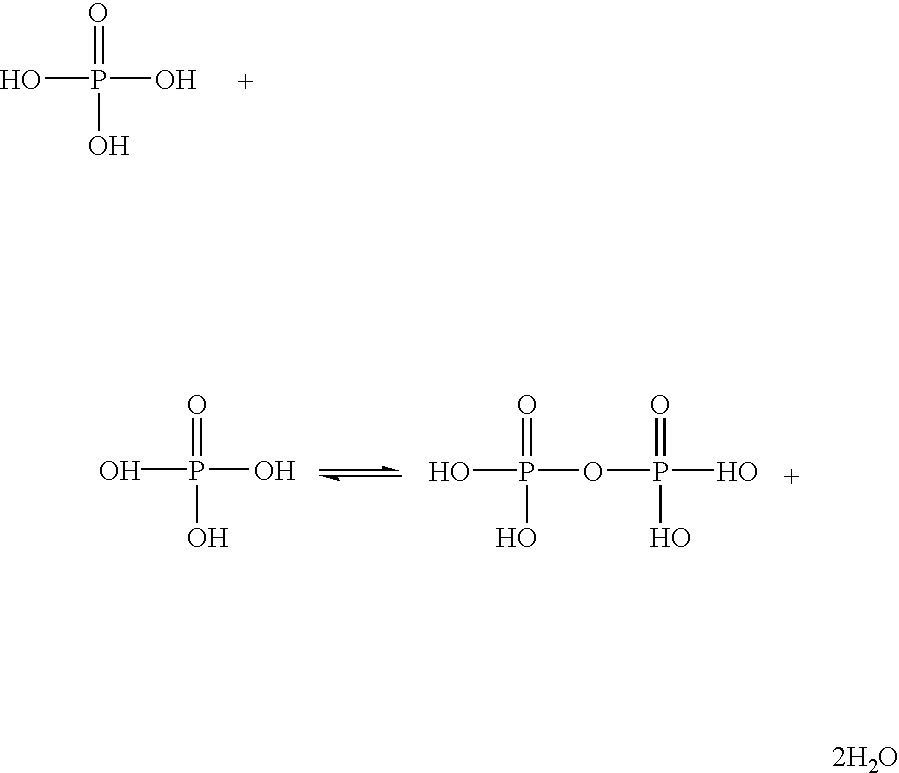
The reaction can be repeated with any of the reactive OH groups, and phosphate ingredients are obtained which can be
linear or branched polyphosphates of structure: 
when M is a counterion, preferably alkali metal;
when O≦n+m<500 (if n+m=0 then the compound is phosphonic acid)
cyclic polyphosphates (also referred to as metaphosphates), of structure: 
the phosphate compound contains both cycles and branched chain, and can be referred to as an ultraphosphate.)
where M is a counterion, preferably an alkali metal
where O≦n+m<500
All such phosphate ingredients are suitable for use herein, and preferred are linear phosphate ingredients (i.e. R is M) where n is 1 (pyrophosphate) and n is 2 (tripolyphosphate (STPP)), most preferably where n is 2. The most commonly available form of these phosphate is where M is Sodium.
Phytic acid, which is particularly suitable for use herein, is a hexa-phosphoric acid that occurs naturally in the seeds of many cereal grains, generally in the form of the insoluble calcium-magnesium salt. It may also be derived from corn steep liquor. Commercial grade phytic acid is commercially available from J. T. Baker Co., e.g. as a 40% aqueous solution. It is intended that the present invention covers the acidic form of phytic acid as well as alkali metal salt derivatives thereof, particularly sodium or potassium salts thereof. Sodium phytate is available from Jonas Chemical Co (Brooklyn, N.Y.). In fact since the typical pH of the compositions of the present invention are in the alkaline pH range, the phytic acid component exists primarily as the ionized salt in the liquid compositions herein even if it is added in its acidic form. Mixtures of such salts of phytic acid are also covered.
Polyfunctionally-substituted aromatic chelating agents may also be useful in the compositions herein. See U.S. Pat. No. 3,812,044, issued May 21, 1974, to Connor et al. Preferred compounds of this type in acid form are dihydroxydisulfobenzenes such as 1,2-dihydroxy -3,5-disulfobenzene.
A preferred biodegradable chelating agent for use herein is ethylene diamine N,N′-disuccinic acid, or alkali metal, or alkaline earth, ammonium or substitutes ammonium salts thereof or mixtures thereof. Ethylenediamine N,N′-disuccinic acids, especially the (S,S) isomer have been extensively described in U.S. Pat. No. 4,704,233, Nov. 3, 1987, to Hartman and Perkins. Ethylenediamine N,N′-disuccinic acids is, for instance, commercially available under the tradename ssEDDS® from Palmer Research Laboratories.
Particularly preferred chelating agents for use herein are phosphate chelating agents like sodium pyrophosphate, sodium tripolyphosphate, phytic acid, and mixtures thereof.
Typically, the compositions according to the present invention comprise up to 10% by weight of the total composition of a chelating agent, or mixtures thereof, preferably from 0.01% to 5% by weight, more preferably from 0.05% to 2% and most preferably from 0.1% to 1.5%.
The liquid compositions of the present invention have a pH of preferably from 8 to 14, more preferably from 9 to 14, most preferably from 10 to 13. When diluted into 1 to 500 times its weight of water, the pH of the diluted solution is preferably from 7.5 to 13, more preferably from 8 to 12, most preferably from 8.5 to 11.5. It is in this alkaline range that the optimum stability and performance of the hypohalite, as well as fabric whiteness and/or safety are obtained. The pH range is suitably provided by the hypohalite bleach mentioned hereinbefore and optionally the pH buffering component when present, which are alkalis. However, in addition to these components, a strong source of alkalinity may also optionally be used.
Suitable sources of alkalinity are the caustic alkalis such as sodium hydroxide, potassium hydroxide and/or lithium hydroxide, and/or the alkali metal oxides such as sodium and/or potassium oxide. A preferred strong source of alkalinity is a caustic alkali, more preferably sodium hydroxide and/or potassium hydroxide. Typical levels of such caustic alkalis, when present, are of from 0.1% to 1.5% by weight, preferably from 0.5% to 1.5% by weight of the composition.
In the compositions of the present invention, the presence of a pH buffering component is not compulsory, but is highly preferred.
The pH buffering component ensures that the pH of the composition and diluted solution are buffered to pH range described above.
Suitable pH buffering components for use herein are selected from the group consisting of alkali metal salts of carbonates, polycarbonates, sesquicarbonates, silicates, polysilicates, boron salts, phosphates, stannates, alluminates and mixtures thereof. The preferred alkali metal salts for use herein are sodium and potassium.
Suitable boron salts or mixtures thereof for use herein include alkali metal salts of borates and alkyl borates and mixtures thereof. Examples of boron salts include boric acid, alkali metal salts of metaborate, tetraborate, octoborate, pentaborate, dodecaboron, borontrifluoride and alkyl borate containing from 1 to 12 carbon atoms, preferably from 1 to 4. Suitable alkyl borate includes methyl borate, ethyl borate and propyl borate. Particularly preferred boron salts herein are the alkali metal salts of metaborate, such as sodium metaborate, potassium metaborate, and the alkali metal salts of borate, such as sodium borate, or mixtures thereof. Boron salts like sodium metaborate and sodium tetraborate are commercially available from Borax and Societa Chimica Larderello under the name sodium metaborate and Borax®.
Particularly preferred pH buffering components are selected from the group consisting of sodium carbonate, sodium silicate, sodium borate, sodium metaborate and mixtures thereof.
The raw materials involved in the preparation of hypohalite bleaches usually contain by-products, e.g. calcium carbonate resulting in an amount of up to 0.4% by weight of by-product within the hypohalite composition. However, at such amount, the by-product will not have the buffering action defined above.
Liquid bleaching compositions herein will preferably contain an amount of pH buffering component of from 0.5% to 9% by weight, more preferably from 0.5% to 5% by weight, and most preferably in an amount of from 0.6% to 3% by weight of the composition.
The composition according to the invention may comprise other optional components such as bleach-stable surfactants, organic or inorganic alkalis, builders, thickening agents, polymers, pigments, dyes, solvents, perfumes, and mixtures thereof.
The liquid compositions of the present invention may further comprise a co-surfactant or a mixture thereof as an optional ingredient. Said co-surfactants may be present in the compositions according to the present invention in amounts of preferably from 0.1% to 50% by weight of the total composition, more preferably of from 0.1% to 40% and most preferably of from 1% to 30%.
Surfactants suitable for use herein as co-surfactants include additional anionic surfactants, nonionic surfactants, cationic surfactants, amphoteric surfactants, zwitterionic surfactants, and mixtures thereof.
Suitable anionic surfactants for use in the compositions herein include water-soluble salts or acids of the formula ROSO3M wherein R preferably is a C10-C24 hydrocarbyl, preferably linear or branched alkyl having a C10-C20 alkyl component, more preferably a C12-C18 linear or branched alkyl, and M is H or a cation, e.g., an alkali metal cation (e.g., sodium, potassium, lithium), or ammonium or substituted ammonium (e.g., methyl-, dimethyl-, and trimethyl ammonium cations and quaternary ammonium cations, such as tetramethyl-ammonium and dimethyl piperdinium cations and quaternary ammonium cations derived from alkylamines such as ethylamine, diethylamine, triethylamine, and mixtures thereof, and the like.
Other suitable additional anionic surfactants are alkyl propoxylated sulfates, preferably having from 0.5 to 30, more preferably 0.5 to 5 moles of propoxy groups.
Other anionic surfactants useful for detersive purposes can also be used herein. These can include salts (including, for example, sodium, potassium, ammonium, and substituted ammonium salts such as mono-, di-and triethanolamine salts) of soap, C9-C20 linear alkylbenzenesulfonates, C8-C22 primary or secondary alkanesulfonates, C8-C24 olefinsulfonates, sulfonated polycarboxylic acids prepared by sulfonation of the pyrolyzed product of alkaline earth metal citrates, e.g., as described in British patent specification No. 1,082,179, C8-C24 alkylpolyglycolethersulfates (containing up to 10 moles of ethylene oxide); alkyl ester sulfonates such as C14-16 methyl ester sulfonates; acyl glycerol sulfonates, fatty oleyl glycerol sulfates, alkyl phenol ethylene oxide ether sulfates, paraffin sulfonates, alkyl phosphates, isethionates such as the acyl isethionates, N-acyl taurates, alkyl succinamates and sulfosuccinates, monoesters of sulfosuccinate (especially saturated and unsaturated C12-C18 monoesters) diesters of sulfosuccinate (especially saturated and unsaturated C6-C14 diesters), sulfates of alkylpolysaccharides such as the sulfates of alkylpolyglucoside (the nonionic nonsulfated compounds being described below), branched primary alkyl sulfates, alkyl polyethoxy carboxylates such as those of the formula RO(CH2CH2O)kCH2COO—M+ wherein R is a C8-C22 alkyl, k is an integer from 0 to 10, and M is a soluble salt-forming cation. Resin acids and hydrogenated resin acids are also suitable, such as rosin, hydrogenated rosin, and resin acids and hydrogenated resin acids present in or derived from tall oil. Further examples are given in “Surface Active Agents and Detergents” (Vol. I and II by Schwartz, Perry and Berch). A variety of such surfactants are also generally disclosed in U.S. Pat. No. 3,929,678, issued Dec. 30, 1975, to Laughlin, et al. at Column 23, line 58 through Column 29, line 23 (herein incorporated by reference).
Other suitable anionic surfactants for use herein also include acyl sarcosinate or mixtures thereof, in its acid and/or salt form, preferably long chain acyl sarcosinates having the following formula: 
wherein M is hydrogen or a cationic moiety and wherein R is an alkyl group of from 11 to 15 carbon atoms, preferably of from 11 to 13 carbon atoms. Preferred M are hydrogen and alkali metal salts, especially sodium and potassium. Said acyl sarcosinate surfactants are derived from natural fatty acids and the amino-acid sarcosine (N-methyl glycine). They are suitable to be used as aqueous solution of their salt or in their acidic form as powder. Being derivatives of natural fatty acids, said acyl sarcosinates are rapidly and completely biodegradable and have good skin compatibility.
Accordingly, suitable long chain acyl sarcosinates to be used herein include C12 acyl sarcosinate (i.e., an acyl sarcosinate according to the above formula wherein M is hydrogen and R is an alkyl group of 11 carbon atoms) and C14 acyl sarcosinate (i.e., an acyl sarcosinate according to the above formula wherein M is hydrogen and R is an alkyl group of 13 carbon atoms). C12 acyl sarcosinate is commercially available, for example, as Hamposyl L-30® supplied by Hampshire. C14 acyl sarcosinate is commercially available, for example, as Hamposyl M-30® supplied by Hampshire.
Suitable nonionic surfactants for use herein include a class of compounds which may be broadly defined as compounds produced by the condensation of alkylene oxide groups (hydrophilic in nature) with an organic hydrophobic compound, which may be branched or linear aliphatic (e.g. Guerbet or secondary alcohol) or alkyl aromatic in nature. The length of the hydrophilic or polyoxyalkylene radical which is condensed with any particular hydrophobic group can be readily adjusted to yield a water-soluble compound having the desired degree of balance between hydrophilic and hydrophobic elements. Accordingly suitable nonionic synthetic surfactants include:
(i) The polyethylene oxide condensates of alkyl phenols, e.g., the condensation products of alkyl phenols having an alkyl group containing from 6 to 20 carbon atoms in either a straight chain or branched chain configuration, preferably from 8 to 12 carbon atoms, with ethylene oxide, the said ethylene oxide being present in amounts equal to 10 to 25 moles of ethylene oxide per mole of alkyl phenol. The alkyl substituent in such compounds may be derived from polymerized propylene, diisobutylene, octane, and nonane;
(ii) Those derived from the condensation of ethylene oxide with the product resulting from the reaction of propylene oxide and ethylene diamine products which may be varied in composition depending upon the balance between the hydrophobic and hydrophilic elements which is desired. Examples are compounds containing from about 40% to about 80% polyoxyethylene by weight and having a molecular weight of from about 5000 to about 11000 resulting from the reaction of ethylene oxide groups with a hydrophobic base constituted of the reaction product of ethylene diamine and excess propylene oxide, said base having a molecular weight of the order of 2500 to 3000;
(iii) The condensation product of aliphatic alcohols having from 6 to 22 carbon atoms, in either straight chain or branched chain configuration, preferably from 8 to 18 carbon atoms, with from 2 to 35 moles of ethylene oxide, preferably from 4 to 25 and more preferably from 5 to 18. Example of this type of material are a coconut alcohol ethylene oxide condensate having from 5 to 18 moles of ethylene oxide per mole of coconut alcohol, the coconut alcohol fraction having from 9 to 14 carbon atoms;
(iv) Trialkyl amine oxides and trialkyl phosphine oxides wherein one alkyl group ranges from 10 to 18 carbon atoms and two alkyl groups range from 1 to 3 carbon atoms; specific example is tetradecyl dimethyl phosphine oxide;
(v) The condensation products of ethylene oxide with a hydrophobic base formed by the condensation of propylene oxide with propylene glycol; The hydrophobic portion of these compounds will preferably have a molecular weight of from about 1500 to about 1800 and will exhibit water insolubility. The addition of polyoxyethylene moieties to this hydrophobic portion tends to increase the water solubility of the molecule as a whole, and the liquid character of the product is retained up to the point where the polyoxyethylene content is about 50% of the total weight of the condensation product, which corresponds to condensation with up to about 40 moles of ethylene oxide.
Particularly suitable nonionic surfactants for use herein are capped nonionic ethoxylated surfactants according to the formula:
wherein R1 is a C8-C18 linear or branched alkyl or alkenyl group, aryl group, alkaryl group, preferably, R1 is a C10-C15 alkyl or alkenyl group, more preferably a C10-C15 alkyl group;
R2 is a C2-C10 linear or branched alkyl group, preferably a C4 group;
R3 is a C1-C10 alkyl or alkenyl group, preferably a C1-C5 alkyl group, and
n is an integer ranging in the range of from 1 to 20, preferably from 1 to 10, more preferably from 1 to 5;
or mixtures thereof.
These surfactants are commercially available from BASF under the trade name Plurafac®, from HOECHST under the trade name Genapol® or from ICI under the trade name Symperonic®. Preferred capped nonionic ethoxylated surfactant of the above formula are those commercially available under the tradename Genapol® L 2.5 NR from Hoechst, and Symperonic® LF/CS 1100 from ICI.
Other suitable nonionic surfactants for use herein include the amine oxides corresponding to the formula:
wherein R is a primary alkyl group containing 6-24 carbons, preferably 10-18 carbons, and wherein R′ and R″ are, each, independently, an alkyl group containing 1 to 6 carbon atoms. The arrow in the formula is a conventional representation of a semi-polar bond. The preferred amine oxides are those in which the primary alkyl group has a straight chain in at least most of the molecules, generally at least 70%, preferably at least 90% of the molecules, and the amine oxides which are especially preferred are those in which R contains 10-18 carbons and R′ and R″ are both methyl. Exemplary of the preferred amine oxides are the N-hexyldimethylamine oxide, N-octyldimethylamine oxide, N-decyldimethylamine oxide, N-dodecyl dimethylamine oxide, N-tetradecyldimethylamine oxide, N-hexadecyl dimethylamine oxide, N-octadecyldimethylamine oxide, N-eicosyldimethylamine oxide, N-docosyldimethylamine oxide, N-tetracosyl dimethylamine oxide, the corresponding amine oxides in which one or both of the methyl groups are replaced with ethyl or 2-hydroxyethyl groups and mixtures thereof. A most preferred amine oxide for use herein is N-decyldimethylamine oxide.
Other suitable nonionic surfactants for the purpose of the invention are the phosphine or sulfoxide surfactants of formula:
wherein A is phosphorus or sulfur atom, R is a primary alkyl group containing 6-24 carbons, preferably 10-18 carbons, and wherein R′ and R″ are, each, independently selected from methyl, ethyl and 2-hydroxyethyl. The arrow in the formula is a conventional representation of a semi-polar bond.
Suitable zwitterionic detergents for use herein comprise the betaine and betaine-like detergents wherein the molecule contains both basic and acidic groups which form an inner salt giving the molecule both cationic and anionic hydrophilic groups over a broad range of pH values. Some common examples of these detergents are described in U.S. Pat. Nos. 2,082,275, 2,702,279 and 2,255,082, incorporated herein by reference. Preferred zwitterionic detergent compounds have the formula: 
wherein R1 is an alkyl radical containing from 8 to 22 carbon atoms, R2 and R3 contain from 1 to 3 carbon atoms, R4 is an alkylene chain containing from 1 to 3 carbon atoms, X is selected from the group consisting of hydrogen and a hydroxyl radical, Y is selected from the group consisting of carboxyl and sulfonyl radicals and wherein the sum of R1, R2 and R3 radicals is from 14 to 24 carbon atoms.
Amphoteric and ampholytic detergents which can be either cationic or anionic depending upon the pH of the system are represented by detergents such as dodecylbeta-alanine, N-alkyltaurines such as the one prepared by reacting dodecylamine with sodium isethionate according to the teaching of U.S. Pat. No. 2,658,072, N-higher alkylaspartic acids such as those produced according to the teaching of U.S. Pat. No. 2,438,091, and the products sold under the trade name “Miranol”, and described in U.S. Pat. No. 2,528,378, said patents being incorporated herein by reference. Additional synthetic detergents and listings of their commercial sources can be found in McCutcheon's Detergents and Emulsifiers, North American Ed. 1980, incorporated herein by reference.
Cationic surfactants suitable for use in compositions of the present invention are those having a long-chain hydrocarbyl group. Examples of such cationic surfactants include the ammonium surfactants such as alkyltrimethylammonium halogenides, and those surfactants having the formula:
wherein R2 is an alkyl or alkyl benzyl group having from 8 to 18 carbon atoms in the alkyl chain, each R3 is selected from the group consisting of —CH2CH2—, —CH2CH(CH3)—, —CH2CH2CH2—, and mixtures thereof; each R4 is selected from the group consisting of C1-C4 alkyl, benzyl ring structures formed by joining the two R4 groups, and hydrogen when y is not 0; R5 is the same as R4 or is an alkyl chain wherein the total number of carbon atoms of R2 plus R5 is not more than about 18; each y is from 0 to about 10 and the sum of the y values is from 0 to about 15; and X is any compatible anion.
Quaternary ammonium surfactant suitable for the present invention has the formula (I): 
whereby R1 is a short chainlength alkyl (C6-C10)
y is 2-4, preferably 3
whereby R2 is H or a C1-C3 alkyl,
whereby x is 0-4, preferably 0-2, most preferably 0,
whereby R3, R4 and R5 are either the same or different and can be either a short chain alkyl (C1-C3) or alkoxylated alkyl of the formula II,
whereby X− is a counterion, preferably a halide, e.g. chloride or methylsulfate. 
R6 is C1-C4 and z is 1 or 2.
Preferred quat ammonium surfactants are those as defined in formula I whereby
R1 is C8, C10 or mixtures thereof, x=o,
R3, R4, R5=CH3.
Highly preferred cationic surfactants are the water-soluble quaternary ammonium compounds useful in the present composition having the formula
wherein R1 is C8-C16 alkyl, each of R2, R3 and R4 is independently C1-C4 alkyl, benzyl, and —(C2H40)xH where x has a value from 2 to 5, and X is an anion. Not more than one of R2, R3 or R4 should be benzyl.
The preferred alkyl chain length for R1 is C12-C15 particularly where the alkyl group is a mixture of chain lengths derived from coconut or palm kernel fat or is derived synthetically by olefin build up or OXO alcohols synthesis. Preferred groups for R2R3 and R4 are methyl and the anion X may be selected from halide, methosulphate, acetate and phosphate ions. Examples of suitable quaternary ammonium compounds of formulae (i) for use herein are:
coconut trimethyl ammonium chloride or bromide;
decyl triethyl ammonium chloride;
C12-15 trimethyl ammonium chloride or bromide;
myristyl trimethyl ammonium methyl sulphate;
lauryl dimethyl benzyl ammonium chloride or bromide;
lauryl dimethyl (ethenoxy)4 ammonium chloride or bromide;
choline esters (compounds of formula (i) wherein R1 is 
alkyl and R2R3R4 are methyl).
di-alkyl imidazolines
Other cationic surfactants useful herein are also described in U.S. Pat. No. 4,228,044, Cambre, issued Oct. 14, 1980 and in European Patent Application EP 000,224.
An optional component of the compositions herein is a polymer. That polymer, has surprisingly been found to also reduce the yellowing of the fabrics treated therewith, i.e. improve whiteness, as well as improve fabric safety. Naturally, for the purpose of the invention, the polymer has to be stable to the hypohalite bleach.
Suitable polymers for use are polymers comprising monomeric units selected from the group consisting of unsaturated carboxylic acids, polycarboxylic acids, sulphonic acids, phosphonic acids and mixtures thereof. Co-polymerisation of the above monomeric units among them or with other co-monomers such as styrenesulfonic acid is also suitable.
Preferred examples of such polymers are the polymers and co-polymers of monomeric units selected from the group consisting of acrylic acid, maleic acid, vinylsulphonic acid and mixtures thereof. Also suitable for use herein are the above mentioned polymers and co-polymers which are modified in order to contain other functional groups such as aminophosphonic and/or phosphonic units. More preferred polymers are selected from the group consisting of polyacrylate polymers, co-polymers of acrylic and maleic acid, co-polymers of styrene sulphonic acid and maleic acid, and mixtures thereof, preferably modified with aminophosphonic and/or phosphonic groups.
The molecular weight for these polymers and co-polymers is preferably below 100,000, most preferably between 500 and 50,000. Most suitable polymers and co-polymers for use herein will be soluble in an amount up to 0.1% by weight, in an aqueous composition comprising 5% by weight of sodium hypochlorite with its pH adjusted to 13 with sodium hydroxide.
Commercially available such polymers, suitable for use herein, are the polyacrylate polymers sold under the tradename Good-Rite® from BF Goodrich, Acrysol® from Rohm & Haas, Sokalan® from BASF, Norasol® from Norso Haas. Also suitable for use herein are the co-polymers of styrene sulphonic acid and maleic acid, commercially available under the tradename Versaflex® from National Starch such as Versaflex 157, as well as Acumer® terpolymers from Rohm and Haas, in particular Acumer® 3100. Preferred commercially available polymers are the polyacrylate polymers, especially the Norasol® polyacrylate polymers and more preferred are the polyacrylate polymer Norasol® 410N (MW 10,000) and the polyacrylate polymer modified with phosphonic groups Norasol® 440N (MW 4000) and its corresponding acid form Norasol® QR 784 (MW 4000).
A preferred polymer for use herein is a polyacrylate polymer modified with phosphonic groups commercially available under the tradename Norasol® 440N (MW 4000) and its corresponding acid form Norasol® QR 784 (MW 4000) from Norso-Haas.
Mixtures of polymers as herein described may also be used in the present invention.
Polymers herein are preferably present in low amounts, i.e. in amounts of up to 10%, preferably up to 1%, more preferably up to 0.5% by weight, even more preferably from 0.001% to 0.3% by weight, and most preferably from 0.005% to 0.2% by weight of the liquid composition.
Particularly preferred surfaces to be bleached with the compositions herein are fabrics including for example clothes, curtains, drapes, bed linens, bath linens, table cloths, sleeping bags, tents, upholstered furniture and the like, and carpets.
Thus, the present invention further encompasses a method of bleaching fabrics which comprises the step of contacting said fabrics with a bleaching composition according to the present invention. In a preferred embodiment, the compositions used in said method of bleaching fabrics are liquid hypochlorite-containing compositions that may further comprise a chelating agent and/or a pH buffering component as defined hereinbefore. Said method according to the present invention delivers effective whiteness performance upon ageing of the compositions.
The compositions according to the present invention are preferably contacted to fabrics in a liquid form. Indeed, by “in a liquid form”, it is meant herein the liquid compositions according to the present invention per se in neat or diluted form.
The compositions according to the present invention are typically used in diluted form in a laundry operation. By “in diluted form”, it is meant herein that the compositions for the bleaching of fabrics according to the present invention may be diluted by the user, preferably with water. Such dilution may occur for instance in hand laundry applications as well as by other means such as in a washing machine. Said compositions can be diluted up to 500 times, preferably from 5 to 200 times and more preferably from 10 to 80 times.
More specifically, the method of bleaching fabrics according to the present invention comprises the steps of first contacting said fabrics with a bleaching composition according to the present invention, in its diluted form, then allowing said fabrics to remain in contact with said composition, for a period of time sufficient to bleach said fabrics, typically 1 to 60 minutes, preferably 5 to 30 minutes, then rinsing said fabrics with water. If said fabrics are to be washed, i.e., with a conventional composition comprising at least one surface active agent, said washing may be conducted together with the bleaching of said fabrics by contacting said fabrics at the same time with a bleaching composition according to the present invention and said detergent composition, or said washing may be conducted before or after that said fabrics have been bleached. Accordingly, said method according to the present invention allows to bleach fabrics and optionally to wash fabrics with a detergent composition comprising at least one surface active agent before the step of contacting said fabrics with said bleaching composition and/or in the step where said fabrics are contacted with said bleaching composition and/or after the step where said fabrics are contacted with the bleaching composition and before the rinsing step and/or after the rinsing step.
In another embodiment of the present invention the method of bleaching fabrics comprises the step of contacting fabrics with a liquid bleaching composition according to the present invention, in its neat form, of allowing said fabrics to remain in contact with said bleaching composition for a period of time sufficient to bleach said fabrics, typically 5 seconds to 30 minutes, preferably 1 minute to 10 minutes and then rinsing said fabrics with water. If said fabrics are to be washed, i.e., with a conventional composition comprising at least one surface active agent, said washing may be conducted before or after that said fabrics have been bleached. In the embodiment of the present invention wherein the liquid bleaching composition of the present invention, is contacted to the fabrics in its neat form, it is preferred that the level of hypohalite bleach, is from 0.01% to 5%, preferably from 0.1% to 3.5%, more preferably from 0.2% to 2% and most preferably from 0.2% to 1%. Advantageously, the present invention provides liquid hypohalite bleach-containing compositions that may be applied neat onto a fabric to bleach, despite a standing prejudice against using hypochlorite-containing compositions neat on fabrics.
It is preferred to perform the bleaching methods herein before said fabrics are washed. Indeed, it has been observed that bleaching said fabrics with the compositions according to the present invention (diluted and/or neat bleaching methods) prior to washing them with a detergent composition provides superior whiteness and stain removal with less energy and detergent than if said fabrics are washed first, then bleached.
Alternatively instead of following the neat bleaching method as described herein above (pretreater application) by a rinsing step with water and/or a conventional washing step with a liquid or powder conventional detergent, the bleaching pre-treatment operation may also be followed by the diluted bleaching method as described herein before either in bucket (hand operation) or in a washing machine.
The invention is illustrated in the following non-limiting examples, in which all percentages are on a weight basis unless otherwise stated.
| Composition (weight %) | I | II | III | IV | ||
| Sodium hypochlorite | 3.5 | 3.5 | 3.5 | 5.0 | |
| Sodium hydroxide* | 1.25 | 1.25 | 1.25 | 1.0 | |
| Sodium carbonate | 3.0 | 3.0 | 3.0 | 1.2 | |
| Sodium silicate | 0.5 | 0.5 | 0.5 | 0.5 | |
| Benzoic acid | 0.5 | — | 1.0 | 0.5 | |
| Na C12-C14 E2S | 7.0 | 7.0 | 7.0 | 7.0 | |
| Methoxy benzoate | 0.5 | 1.0 | — | 0.5 | |
| Tinopal PLC ® | 0.01 | 0.01 | 0.01 | 0.01 | |
| Sodium tripolyphosphate | 0.1 | 0.1 | 0.1 | — | |
| (STPP) |
| Water and minors | up to 100% | ||
| Composition (weight %) | V | VI | VII | VIII | ||
| Sodium hypochlorite | 5.0 | 5.0 | 3.5 | 3.5 | |
| Sodium hydroxide* | 1.0 | 1.0 | 1.25 | 1.25 | |
| Sodium carbonate | 1.25 | 1.25 | 3.0 | 3.0 | |
| Sodium silicate | 0.5 | 0.5 | 0.5 | 0.5 | |
| Benzoic acid | — | 1.0 | — | — | |
| Na C12-C14 E1S | 7.0 | 7.0 | 7.0 | 7.0 | |
| Methoxy benzoate | 1.0 | — | 1.0 | 1.0 | |
| Tinopal PLC ® | 0.01 | 0.01 | 0.01 | 0.01 | |
| Phytic acid | — | — | — | 1.0 | |
| Norasol 440N ® | — | — | 0.1 | 0.1 | |
| Sodium tripolyphosphate | 0.1 | 0.1 | — | — | |
| (STPP) |
| Water and minors | up to 100% | ||
| Composition (weight %) | IX | X | XI | XII | ||
| Sodium hypochlorite | 3.6 | 3.5 | 3.5 | 3.5 | |
| Sodium hydroxide* | 1.25 | 1.25 | 1.25 | 1.25 | |
| Sodium carbonate | 3.0 | 3.0 | 3.0 | 3.0 | |
| Sodium silicate | 0.5 | 0.50 | 0.50 | 0.5 | |
| Benzoic acid | 3.0 | — | — | — | |
| Na C12-C14 E0.5S | 7.0 | 7.0 | 7.0 | 7.0 | |
| Sodium borate | — | — | 3.0 | 3.0 | |
| Methoxy benzoate | — | 1.0 | 1.0 | 1.0 | |
| Tinopal PLC ® | — | — | — | 0.01 | |
| Optiblanc BRB ® | 0.01 | 0.01 | 0.01 | — | |
| Sodium tripolyphosphate | — | 0.1 | — | 0.1 | |
| (STPP) |
| Water and minors | up to 100% | ||
| *added NaOH | |||
| Tinopal PLC ® is bis(sulfobenzenfuranyl)biphenyl available from Ciba Geigy. | |||
| Optiblanc ® is a stilbene derivative brightener available from 3 V Sigma. | |||
| Na C12-C14 E0.5,1,2S are alkyl (ethoxy) 0.5,1,2 sulphate commercially available from Rhone Poulenc and Albright & Wilson. | |||
| Benzoic acid is commercially available from Elf Atochem, Enichem, or Albright & Wilson. | |||
| Methoxy benzoate is commercially available from Aldrich. | |||
| Norasol 440N ® is a polyacrylate polymer modified with phosphonic groups (MW 4000) from Norso Haas. | |||
The compositions exemplified above exhibit effective whiteness performance when used to bleach fabrics both in neat or diluted conditions (e.g. at a dilution of 200 (typical dilution)) after 3 months of storage at room temperature (e.g. about 25° C.) after their manufacturing.
Claims (6)
1. A liquid bleaching composition comprising from 0.01% to 1% of a hypohalite bleach and an alkyl ethoxy sulphate surfactant having an average of 2 or less moles of ethoxy groups and up to 50% by weight of a surfactant having the following formula: 
wherein R1 is a linear or branched chain lower alkyl of from 1 to 4 carbon atoms; R2 represents a hydrocarbon chain; and M is an alkali metal.
2. A liquid bleaching composition according to claim 1 comprising 0% by weight of a surfactant having the following formula: 
wherein R1 is a linear or branched chain lower alkyl of from 1 to 4 carbon atoms; R2 represents a hydrocarbon chain; and M is an alkali metal.
3. A process of bleaching fabrics which comprises the steps of contacting a fabric or portion thereof with the composition of claim 1 , in its neat or diluted form, before rinsing said fabrics or washing then rinsing said fabrics.
4. A liquid bleaching composition comprising from 0.01% to 1% of a hypohalite bleach and an alkyl ethoxy sulphate surfactant having an average of 2 or less moles of ethoxy groups and up to 50% by weight of a surfactant having the following formula:
wherein R3 represents a linear or branched alkyl group of from about 8 to about 18 carbon atoms; and M is an alkali metal.
5. A liquid bleaching composition according to claim 4 comprising 0% by weight of a surfactant having the following formula:
wherein R3 represents a linear or branched alkyl group of from about 8 to about 18 carbon atoms; and M is an alkali metal.
6. A process of bleaching fabrics which comprises the steps of contacting a fabric or portion thereof with the composition of claim 4 , in its neat or diluted form, before rinsing said fabrics or washing then rinsing said fabrics.
Priority Applications (1)
| Application Number | Priority Date | Filing Date | Title |
|---|---|---|---|
| US10/301,169 US6649583B2 (en) | 1998-09-01 | 2002-11-21 | Bleaching compositions |
Applications Claiming Priority (5)
| Application Number | Priority Date | Filing Date | Title |
|---|---|---|---|
| EP98870185.0 | 1998-09-01 | ||
| EP98870185A EP0984059A1 (en) | 1998-09-01 | 1998-09-01 | Bleaching compositions |
| EP98870185 | 1998-09-01 | ||
| US09/786,076 US6506718B1 (en) | 1998-09-01 | 1999-09-01 | Bleaching compositions |
| US10/301,169 US6649583B2 (en) | 1998-09-01 | 2002-11-21 | Bleaching compositions |
Related Parent Applications (2)
| Application Number | Title | Priority Date | Filing Date |
|---|---|---|---|
| PCT/US1999/020127 Continuation WO2000012668A1 (en) | 1998-09-01 | 1999-09-01 | Bleaching compositions |
| US09/786,076 Continuation US6506718B1 (en) | 1998-09-01 | 1999-09-01 | Bleaching compositions |
Publications (2)
| Publication Number | Publication Date |
|---|---|
| US20030109404A1 US20030109404A1 (en) | 2003-06-12 |
| US6649583B2 true US6649583B2 (en) | 2003-11-18 |
Family
ID=26152288
Family Applications (2)
| Application Number | Title | Priority Date | Filing Date |
|---|---|---|---|
| US09/786,076 Expired - Fee Related US6506718B1 (en) | 1998-09-01 | 1999-09-01 | Bleaching compositions |
| US10/301,169 Expired - Fee Related US6649583B2 (en) | 1998-09-01 | 2002-11-21 | Bleaching compositions |
Family Applications Before (1)
| Application Number | Title | Priority Date | Filing Date |
|---|---|---|---|
| US09/786,076 Expired - Fee Related US6506718B1 (en) | 1998-09-01 | 1999-09-01 | Bleaching compositions |
Country Status (1)
| Country | Link |
|---|---|
| US (2) | US6506718B1 (en) |
Cited By (12)
| Publication number | Priority date | Publication date | Assignee | Title |
|---|---|---|---|---|
| US6946435B1 (en) * | 2002-11-06 | 2005-09-20 | Taylor Lawnie H | Methods and equipment for removing stains from fabrics |
| US20060225224A1 (en) * | 2005-04-08 | 2006-10-12 | Taylor Lawnie H | Formation of patterns of fades on fabrics |
| US20060247151A1 (en) * | 2005-04-29 | 2006-11-02 | Kaaret Thomas W | Oxidizing compositions and methods thereof |
| US20060281657A1 (en) * | 2002-11-06 | 2006-12-14 | Taylor Lawnie H | Methods and equipment for removing stains from fabrics |
| US20070287652A1 (en) * | 2006-06-07 | 2007-12-13 | Lhtaylor Assoc, Inc. | Systems and methods for making stable, cotton-gentle chlorine bleach and products thereof |
| US20080261839A1 (en) * | 2005-12-22 | 2008-10-23 | Carlos Malet | Odor reduction for agents containing hypochlorite |
| US20080274934A1 (en) * | 2005-12-29 | 2008-11-06 | Carlos Malet | Inhibiting the corrosive properties of liquid cleaning agents containing hypochlorite |
| US20080305981A1 (en) * | 2005-12-30 | 2008-12-11 | Carlos Malet | stability of detergents containing hypochlorite |
| US20080305980A1 (en) * | 2005-12-30 | 2008-12-11 | Carlos Malet | Stability of detergents containing hypochlorite |
| US20080308767A1 (en) * | 2005-12-07 | 2008-12-18 | Carlos Malet | Increasing the stability of liquid hypochlorite-containing washing and cleaning compositions |
| US20080308766A1 (en) * | 2005-12-06 | 2008-12-18 | Carlos Malet | Stability improvement of liquid hypochlorite-containing washing and cleaning compositions |
| US7582597B1 (en) * | 2002-11-06 | 2009-09-01 | Taylor Lawnie H | Products, methods and equipment for removing stains from fabrics |
Families Citing this family (8)
| Publication number | Priority date | Publication date | Assignee | Title |
|---|---|---|---|---|
| US6506718B1 (en) * | 1998-09-01 | 2003-01-14 | The Procter & Gamble Company | Bleaching compositions |
| MXPA03009081A (en) * | 2003-10-03 | 2005-04-06 | Fermin Enecoiz Gomez | Cleaning and bleaching solutions containing phosphates and/or phosphoric acid and improved processes for their use. |
| US20050282722A1 (en) * | 2004-06-16 | 2005-12-22 | Mcreynolds Kent B | Two part cleaning composition |
| GB0501831D0 (en) * | 2004-10-21 | 2005-03-09 | Unilever Plc | Improved detergent composition |
| WO2006071215A1 (en) | 2004-12-23 | 2006-07-06 | Albemarle Corporation | Microbiocidal control in the processing of meat-producing four-legged animals |
| US20120230871A1 (en) | 2009-12-04 | 2012-09-13 | Albemarle Corporation | Microbiocidal Control in Drinking Line Systems |
| EP2581438A1 (en) * | 2011-10-12 | 2013-04-17 | The Procter and Gamble Company | Detergent composition |
| CN107205401A (en) | 2015-01-23 | 2017-09-26 | 雅宝公司 | Microbicide Control in Poultry Processing |
Citations (14)
| Publication number | Priority date | Publication date | Assignee | Title |
|---|---|---|---|---|
| US3560389A (en) | 1966-08-11 | 1971-02-02 | Cyclo Chemicals Ltd | Liquid detergent bleach composition |
| US3929661A (en) | 1973-12-11 | 1975-12-30 | Kao Corp | Liquid detergent bleaching composition |
| US4388204A (en) * | 1982-03-23 | 1983-06-14 | The Drackett Company | Thickened alkali metal hypochlorite compositions |
| US4588514A (en) | 1983-09-23 | 1986-05-13 | Lever Brothers Company | Liquid thickened bleaching composition |
| US4671894A (en) | 1984-11-07 | 1987-06-09 | The Procter & Gamble Company | Liquid detergent compositions |
| EP0243685A2 (en) | 1986-04-09 | 1987-11-04 | MIRA LANZA S.p.a. | Dilutable concentrated detergent composition |
| EP0340371A2 (en) | 1988-05-05 | 1989-11-08 | Henkel Iberica, S.A. | Bleaching composition containing alkaline hypochlorite and process for its manufacture |
| US5034150A (en) | 1989-05-03 | 1991-07-23 | The Clorox Company | Thickened hypochlorite bleach solution and method of use |
| US5279758A (en) | 1991-10-22 | 1994-01-18 | The Clorox Company | Thickened aqueous cleaning compositions |
| US5364553A (en) | 1990-04-13 | 1994-11-15 | Colgate-Palmolive Company | Stabilized built aqueous liquid softergent compositions |
| JPH10204495A (en) | 1997-01-28 | 1998-08-04 | Kao Corp | Bleach composition for hard surfaces |
| EP0903403A1 (en) | 1997-09-19 | 1999-03-24 | The Procter & Gamble Company | Stable bleaching compositions |
| EP0931829A1 (en) | 1998-01-16 | 1999-07-28 | The Procter & Gamble Company | Stable coloured thickened bleaching compositions |
| US6506718B1 (en) * | 1998-09-01 | 2003-01-14 | The Procter & Gamble Company | Bleaching compositions |
-
1999
- 1999-09-01 US US09/786,076 patent/US6506718B1/en not_active Expired - Fee Related
-
2002
- 2002-11-21 US US10/301,169 patent/US6649583B2/en not_active Expired - Fee Related
Patent Citations (14)
| Publication number | Priority date | Publication date | Assignee | Title |
|---|---|---|---|---|
| US3560389A (en) | 1966-08-11 | 1971-02-02 | Cyclo Chemicals Ltd | Liquid detergent bleach composition |
| US3929661A (en) | 1973-12-11 | 1975-12-30 | Kao Corp | Liquid detergent bleaching composition |
| US4388204A (en) * | 1982-03-23 | 1983-06-14 | The Drackett Company | Thickened alkali metal hypochlorite compositions |
| US4588514A (en) | 1983-09-23 | 1986-05-13 | Lever Brothers Company | Liquid thickened bleaching composition |
| US4671894A (en) | 1984-11-07 | 1987-06-09 | The Procter & Gamble Company | Liquid detergent compositions |
| EP0243685A2 (en) | 1986-04-09 | 1987-11-04 | MIRA LANZA S.p.a. | Dilutable concentrated detergent composition |
| EP0340371A2 (en) | 1988-05-05 | 1989-11-08 | Henkel Iberica, S.A. | Bleaching composition containing alkaline hypochlorite and process for its manufacture |
| US5034150A (en) | 1989-05-03 | 1991-07-23 | The Clorox Company | Thickened hypochlorite bleach solution and method of use |
| US5364553A (en) | 1990-04-13 | 1994-11-15 | Colgate-Palmolive Company | Stabilized built aqueous liquid softergent compositions |
| US5279758A (en) | 1991-10-22 | 1994-01-18 | The Clorox Company | Thickened aqueous cleaning compositions |
| JPH10204495A (en) | 1997-01-28 | 1998-08-04 | Kao Corp | Bleach composition for hard surfaces |
| EP0903403A1 (en) | 1997-09-19 | 1999-03-24 | The Procter & Gamble Company | Stable bleaching compositions |
| EP0931829A1 (en) | 1998-01-16 | 1999-07-28 | The Procter & Gamble Company | Stable coloured thickened bleaching compositions |
| US6506718B1 (en) * | 1998-09-01 | 2003-01-14 | The Procter & Gamble Company | Bleaching compositions |
Cited By (19)
| Publication number | Priority date | Publication date | Assignee | Title |
|---|---|---|---|---|
| US7582597B1 (en) * | 2002-11-06 | 2009-09-01 | Taylor Lawnie H | Products, methods and equipment for removing stains from fabrics |
| US20060281657A1 (en) * | 2002-11-06 | 2006-12-14 | Taylor Lawnie H | Methods and equipment for removing stains from fabrics |
| US8349788B2 (en) | 2002-11-06 | 2013-01-08 | Lawnie Henderson Taylor | Cotton-gentle hypochlorite bleach |
| US7585829B1 (en) * | 2002-11-06 | 2009-09-08 | Taylor Lawnie H | Products, methods and equipment for removing stains from fabrics |
| US7582596B1 (en) * | 2002-11-06 | 2009-09-01 | Taylor Lawnie H | Products, methods and equipment for removing stains from fabrics using an alkali metal hydroxide/hypochlorite salt mixture |
| US7582595B1 (en) * | 2002-11-06 | 2009-09-01 | Taylor Lawnie H | Hypochlorous acid/alkali metal hydoxide-containing products, methods and equipment for removing stains from fabrics |
| US6946435B1 (en) * | 2002-11-06 | 2005-09-20 | Taylor Lawnie H | Methods and equipment for removing stains from fabrics |
| US20060225224A1 (en) * | 2005-04-08 | 2006-10-12 | Taylor Lawnie H | Formation of patterns of fades on fabrics |
| US7628822B2 (en) | 2005-04-08 | 2009-12-08 | Taylor Lawnie H | Formation of patterns of fades on fabrics |
| US20060247151A1 (en) * | 2005-04-29 | 2006-11-02 | Kaaret Thomas W | Oxidizing compositions and methods thereof |
| US20080308766A1 (en) * | 2005-12-06 | 2008-12-18 | Carlos Malet | Stability improvement of liquid hypochlorite-containing washing and cleaning compositions |
| US20080308767A1 (en) * | 2005-12-07 | 2008-12-18 | Carlos Malet | Increasing the stability of liquid hypochlorite-containing washing and cleaning compositions |
| US8008238B2 (en) | 2005-12-22 | 2011-08-30 | Henkel Ag & Co. Kgaa | Odor reduction for agents containing hypochlorite |
| US20080261839A1 (en) * | 2005-12-22 | 2008-10-23 | Carlos Malet | Odor reduction for agents containing hypochlorite |
| US20080274934A1 (en) * | 2005-12-29 | 2008-11-06 | Carlos Malet | Inhibiting the corrosive properties of liquid cleaning agents containing hypochlorite |
| US20080305980A1 (en) * | 2005-12-30 | 2008-12-11 | Carlos Malet | Stability of detergents containing hypochlorite |
| US7786066B2 (en) * | 2005-12-30 | 2010-08-31 | Henkel Ag & Co. Kgaa | Stability of detergents containing hypochlorite, phosphonate chelant, and optical brightener |
| US20080305981A1 (en) * | 2005-12-30 | 2008-12-11 | Carlos Malet | stability of detergents containing hypochlorite |
| US20070287652A1 (en) * | 2006-06-07 | 2007-12-13 | Lhtaylor Assoc, Inc. | Systems and methods for making stable, cotton-gentle chlorine bleach and products thereof |
Also Published As
| Publication number | Publication date |
|---|---|
| US6506718B1 (en) | 2003-01-14 |
| US20030109404A1 (en) | 2003-06-12 |
Similar Documents
| Publication | Publication Date | Title |
|---|---|---|
| US6649583B2 (en) | Bleaching compositions | |
| US6448215B1 (en) | Stable colored thickened bleaching compositions | |
| EP0931829B1 (en) | Stable coloured thickened bleaching compositions | |
| EP1001010B1 (en) | Bleaching compositions | |
| EP0905225B1 (en) | Processes of bleaching fabrics | |
| US6894015B1 (en) | Bleaching compositions | |
| EP0905224A1 (en) | Bleaching compositions | |
| EP0903403B1 (en) | Stable bleaching compositions | |
| EP0905223B1 (en) | Self thickened bleaching compositions | |
| EP0984059A1 (en) | Bleaching compositions | |
| US7842655B2 (en) | Colored bleaching composition | |
| EP0990696B1 (en) | Stable bleaching compositions | |
| US6534465B1 (en) | Bleaching compositions | |
| EP1029912A1 (en) | Bleaching compositions comprising an oligocarboxylate and a complex-facilitating co-agent | |
| EP0992576A1 (en) | Stable bleaching compositions | |
| CA2341188A1 (en) | Bleaching compositions | |
| EP3310890A1 (en) | Stable bleaching composition | |
| EP0987313A1 (en) | Bleaching compositions |
Legal Events
| Date | Code | Title | Description |
|---|---|---|---|
| FEPP | Fee payment procedure |
Free format text: PAYOR NUMBER ASSIGNED (ORIGINAL EVENT CODE: ASPN); ENTITY STATUS OF PATENT OWNER: LARGE ENTITY |
|
| FPAY | Fee payment |
Year of fee payment: 4 |
|
| REMI | Maintenance fee reminder mailed | ||
| LAPS | Lapse for failure to pay maintenance fees | ||
| STCH | Information on status: patent discontinuation |
Free format text: PATENT EXPIRED DUE TO NONPAYMENT OF MAINTENANCE FEES UNDER 37 CFR 1.362 |
|
| FP | Lapsed due to failure to pay maintenance fee |
Effective date: 20111118 |