US6643062B1 - Finder optical system and image pickup apparatus using the same - Google Patents
Finder optical system and image pickup apparatus using the same Download PDFInfo
- Publication number
- US6643062B1 US6643062B1 US09/657,517 US65751700A US6643062B1 US 6643062 B1 US6643062 B1 US 6643062B1 US 65751700 A US65751700 A US 65751700A US 6643062 B1 US6643062 B1 US 6643062B1
- Authority
- US
- United States
- Prior art keywords
- optical system
- prism
- finder
- objective optical
- objective
- Prior art date
- Legal status (The legal status is an assumption and is not a legal conclusion. Google has not performed a legal analysis and makes no representation as to the accuracy of the status listed.)
- Expired - Lifetime
Links
Images

Classifications
-
- G—PHYSICS
- G02—OPTICS
- G02B—OPTICAL ELEMENTS, SYSTEMS OR APPARATUS
- G02B17/00—Systems with reflecting surfaces, with or without refracting elements
- G02B17/08—Catadioptric systems
- G02B17/0856—Catadioptric systems comprising a refractive element with a reflective surface, the reflection taking place inside the element, e.g. Mangin mirrors
- G02B17/086—Catadioptric systems comprising a refractive element with a reflective surface, the reflection taking place inside the element, e.g. Mangin mirrors wherein the system is made of a single block of optical material, e.g. solid catadioptric systems
-
- G—PHYSICS
- G02—OPTICS
- G02B—OPTICAL ELEMENTS, SYSTEMS OR APPARATUS
- G02B13/00—Optical objectives specially designed for the purposes specified below
- G02B13/22—Telecentric objectives or lens systems
-
- G—PHYSICS
- G02—OPTICS
- G02B—OPTICAL ELEMENTS, SYSTEMS OR APPARATUS
- G02B17/00—Systems with reflecting surfaces, with or without refracting elements
- G02B17/02—Catoptric systems, e.g. image erecting and reversing system
- G02B17/04—Catoptric systems, e.g. image erecting and reversing system using prisms only
- G02B17/045—Catoptric systems, e.g. image erecting and reversing system using prisms only having static image erecting or reversing properties only
-
- G—PHYSICS
- G02—OPTICS
- G02B—OPTICAL ELEMENTS, SYSTEMS OR APPARATUS
- G02B17/00—Systems with reflecting surfaces, with or without refracting elements
- G02B17/08—Catadioptric systems
- G02B17/0804—Catadioptric systems using two curved mirrors
- G02B17/0816—Catadioptric systems using two curved mirrors off-axis or unobscured systems in which not all of the mirrors share a common axis of rotational symmetry, e.g. at least one of the mirrors is warped, tilted or decentered with respect to the other elements
-
- G—PHYSICS
- G02—OPTICS
- G02B—OPTICAL ELEMENTS, SYSTEMS OR APPARATUS
- G02B17/00—Systems with reflecting surfaces, with or without refracting elements
- G02B17/08—Catadioptric systems
- G02B17/082—Catadioptric systems using three curved mirrors
- G02B17/0832—Catadioptric systems using three curved mirrors off-axis or unobscured systems in which not all of the mirrors share a common axis of rotational symmetry, e.g. at least one of the mirrors is warped, tilted or decentered with respect to the other elements
-
- G—PHYSICS
- G02—OPTICS
- G02B—OPTICAL ELEMENTS, SYSTEMS OR APPARATUS
- G02B17/00—Systems with reflecting surfaces, with or without refracting elements
- G02B17/08—Catadioptric systems
- G02B17/0836—Catadioptric systems using more than three curved mirrors
- G02B17/0848—Catadioptric systems using more than three curved mirrors off-axis or unobscured systems in which not all of the mirrors share a common axis of rotational symmetry, e.g. at least one of the mirrors is warped, tilted or decentered with respect to the other elements
-
- G—PHYSICS
- G02—OPTICS
- G02B—OPTICAL ELEMENTS, SYSTEMS OR APPARATUS
- G02B23/00—Telescopes, e.g. binoculars; Periscopes; Instruments for viewing the inside of hollow bodies; Viewfinders; Optical aiming or sighting devices
- G02B23/14—Viewfinders
-
- G—PHYSICS
- G02—OPTICS
- G02B—OPTICAL ELEMENTS, SYSTEMS OR APPARATUS
- G02B23/00—Telescopes, e.g. binoculars; Periscopes; Instruments for viewing the inside of hollow bodies; Viewfinders; Optical aiming or sighting devices
- G02B23/14—Viewfinders
- G02B23/145—Zoom viewfinders
Definitions
- the present invention relates to a finder optical system having an image-inverting optical system. More particularly, the present invention relates to a finder optical system for use in a camera, a video camera, etc. which uses an image-inverting optical system whereby an inverted image of an object formed by an objective optical system is observed as an erect image. The present invention also relates to an image pickup apparatus using the finder optical system.
- a finder optical system used in a compact camera or the like is constructed separately from a photographic optical system and generally placed above the photographic optical system.
- finder optical systems of this type real-image finders are well known, in which a real image formed as a first image by an objective optical system is inverted by an image-inverting optical system and observed as an erect image through an ocular optical system.
- finder optical systems In the case of finder optical systems, however, the collapsible barrel system as used in taking lenses is unfavorable from the viewpoint of camera design. Therefore, it is very difficult to reduce the thickness of finder optical systems. This is an obstacle in attaining a reduction in size of cameras.
- JP(A) Japanese Patent Application Unexamined Publication Number
- Hei 5-53054 has, in order from the object side, a negative first unit, a positive second unit, and a negative third unit.
- the first and second units move for zooming.
- the negative third unit which is stationary, ensures the negative power by refraction through a refracting lens or a prism entrance surface.
- the optical system attains a reduction in overall length by disposing a negative unit closest to the pupil.
- JP(A) Hei 8-248481 used a rotationally symmetric curved surface as a reflecting surface of a prism in a real-image finder.
- an aspherical surface or a toric surface is applicable to the curved surface
- the curved surface disclosed in the specification is a rotationally symmetric aspherical surface.
- a toric surface is symmetric with respect to two coordinate axes. Therefore, it is not an asymmetric surface. No numerical values are mentioned in regard to the amounts of displacement of reflecting surfaces in Examples.
- this finder optical system fails to disclose design examples. Therefore, the performance, size, etc. of the finder optical system are unclear.
- Numerical Example 5 of this finder optical system uses rotationally asymmetric curved surfaces as refracting and reflecting surfaces of a prism in the finder optical system.
- the image-inverting optical system is arranged to have the function of an ocular lens, thereby reducing the number of lenses used.
- JP(A) Hei 11-38472 and 11-38473 use a rotationally asymmetric surface as a reflecting surface of one of Porro prisms of a real-image finder that is disposed on the object side of the intermediate image formation plane, thereby attaining a reduction in the thickness of the finder optical system.
- JP(A) Hei 5-53054 if a strong power is given to the negative third unit, the positive power of the second unit unavoidably needs to be increased in order to ensure the required power, which is unfavorable from the viewpoint of performance. For this reason, a very strong power cannot be given to the third unit. Therefore, the effect of reducing the overall length is limited. Moreover, an optical system having a power cannot be placed on the pupil side of the third unit, and it is therefore necessary to ensure a long back focus. For this reason, the basic structure of the optical system is the retrofocus type. Accordingly, it is still difficult to reduce the overall length of the optical system.
- JP(A) Hei 8-248481 a power is given to a reflecting surface of a prism.
- this reflecting surface is tilted so as to be decentered with respect to the axial principal ray, rotationally asymmetric decentration aberrations are produced.
- the aberrations cannot be corrected by the rotationally symmetric aspherical surface configuration.
- aberration correction with respect to skew rays cannot satisfactorily be performed.
- no solution means is disclosed for any of the arrangements of this optical system.
- the disclosed optical system is unsatisfactory in terms of performance.
- the size of the optical system is unclear from the numerical values mentioned in the specification.
- JP(A) Hei 10-197796 states a layout and arrangement of prisms, etc. that seem to allow the finder optical system to be reduced in size.
- the disclosed technique lacks feasibility.
- Numerical Example 5 a reduction in thickness is attained by reducing the number of lenses constituting the ocular optical system. Accordingly, the objective optical system itself cannot be reduced in thickness.
- the optical system is arranged to attain a higher zoom ratio, it is difficult to reduce the thickness satisfactorily.
- the prisms are large in size although the spacing between the movable lens units is reduced. Accordingly, the overall size of the finder optical system, including the prism arrangement, has not yet been reduced satisfactorily.
- an object of the present invention is to provide a high-performance real-image finder optical system reduced in size, particularly reduced in thickness.
- the present invention provides a first finder optical system that includes, in order from the object side thereof: an objective optical system having a positive refracting power; an image-inverting optical system for erecting an intermediate image formed by the objective optical system; and an ocular optical system having a positive refracting power.
- the objective optical system has at least two movable units moving when zooming is performed.
- a prism is placed on the object side of the intermediate image formed by the objective optical system.
- the prism includes at least one reflecting surface having a rotationally asymmetric surface configuration.
- the image-inverting optical system has at least one reflecting surface formed from a roof surface.
- the finder optical system satisfies the following condition:
- d is the distance from the entrance surface of the objective optical system to the first reflecting surface of the image-inverting optical system
- f W is the focal length of the objective optical system at the wide-angle end
- ⁇ W is the maximum field angle of the objective optical system at the wide-angle end
- Z is a zoom ratio
- the present invention provides a second finder optical system that includes, in order from the object side thereof: an objective optical system having a positive refracting power; an image-inverting optical system for erecting an intermediate image formed by the objective optical system; and an ocular optical system having a positive refracting power.
- the objective optical system has at least two movable units moving when zooming is performed.
- a prism is placed on the object side of the intermediate image formed by the objective optical system.
- the prism includes at least one reflecting surface having a rotationally asymmetric surface configuration.
- the image-inverting optical system is formed from a Porro prism.
- the finder optical system satisfies the following conditions:
- d is the distance from the entrance surface of the objective optical system to the first reflecting surface of the image-inverting optical system
- f W is the focal length of the objective optical system at the wide-angle end
- ⁇ W is the maximum field angle of the objective optical system at the wide-angle end
- Z is a zoom ratio
- dp is the distance from the entrance surface of the image-inverting optical system placed on the object side of the intermediate image to the first reflecting surface.
- the present invention provides a third finder optical system that includes, in order from the object side thereof: an objective optical system having a positive refracting power; an image-inverting optical system for erecting an intermediate image formed by the objective optical system; and an ocular optical system having a positive refracting power.
- the objective optical system includes an optical system having at least two movable units moving when zooming is performed.
- the optical system has a positive composite power.
- a prism is placed on the pupil side of the optical system having at least two movable units.
- the prism includes an image-inverting function.
- the prism includes at least one reflecting surface having a rotationally asymmetric surface configuration. At least either one of the first transmitting surface and first reflecting surface of the prism has a negative power.
- the second transmitting surface of the prism has a positive power.
- the present invention provides a fourth finder optical system that includes, in order from the object side thereof: an objective optical system having a positive refracting power; an image-inverting optical system for erecting an intermediate image formed by the objective optical system; and an ocular optical system having a positive refracting power.
- the objective optical system has at least two movable units moving when zooming is performed.
- a prism is placed on the object side of the intermediate image formed by the objective optical system.
- the prism has two reflecting surfaces. At least one of the reflecting surfaces has a rotationally asymmetric surface configuration.
- the finder optical system satisfies the following condition:
- f W is the focal length of the objective optical system at the wide-angle end
- ⁇ W is the maximum field angle of the objective optical system at the wide-angle end
- dp is the distance from the entrance surface of the image-inverting optical system placed on the object side of the intermediate image to the first reflecting surface thereof.
- the present invention provides a fifth finder optical system that includes, in order from the object side thereof: an objective optical system having a positive refracting power; an image-inverting optical system for erecting an intermediate image formed by the objective optical system; and an ocular optical system having a positive refracting power.
- the objective optical system has at least two movable units moving when zooming is performed.
- a prism is placed on the object side of the intermediate image formed by the objective optical system.
- the prism has three reflecting surfaces. At least one of the reflecting surfaces has a rotationally asymmetric surface configuration.
- the present invention provides a sixth finder optical system that includes, in order from the object side thereof: an objective optical system having a positive refracting power; an image-inverting optical system for erecting an intermediate image formed by the objective optical system; and an ocular optical system having a positive refracting power.
- the objective optical system includes, in order from the object side thereof, a negative first unit, a positive second unit, and a negative third unit. At least the first unit and the second unit are movable units moving when zooming is performed.
- the third unit is formed from a prism including an image-inverting function.
- the prism includes at least one reflecting surface having a rotationally asymmetric surface configuration.
- the present invention provides a seventh finder optical system that includes, in order from the object side thereof: an objective optical system having a positive refracting power; an image-inverting optical system for erecting an intermediate image formed by the objective optical system; and an ocular optical system having a positive refracting power.
- the objective optical system includes, in order from the object side thereof, a negative first unit, a positive second unit, and a positive third unit. At least the first unit and the second unit are movable units moving when zooming is performed.
- the third unit is formed from a prism including an image-inverting function.
- the prism includes at least one reflecting surface having a rotationally asymmetric surface configuration.
- the prism includes at least one transmitting surface or reflecting surface that has a negative power.
- the third unit has a principal point positioned on the pupil side of a plane where the intermediate image is formed.
- An eighth finder optical system includes, in order from the object side thereof: an objective optical system having a positive refracting power; an image-inverting optical system for erecting an intermediate image formed by the objective optical system; and an ocular optical system having a positive refracting power.
- the objective optical system has at least two movable units moving when zooming is performed.
- a prism is placed on the object side of the intermediate image formed by the objective optical system.
- the prism includes two reflecting surfaces. At least one of the reflecting surfaces has a rotationally asymmetric surface configuration.
- the first transmitting surface and second reflecting surface of the prism are formed from the identical surface having both transmitting and reflecting actions.
- the prism has an optical path in which the axial principal ray or a projective axial principal ray defined by projecting the axial principal ray onto a plane containing a part of the axial principal ray bends in different directions from each other with respect to the travel direction of light rays at the two reflecting surfaces.
- the present invention provides a ninth finder optical system that includes, in order from the object side thereof: an objective optical system having a positive refracting power; an image-inverting optical system for erecting an intermediate image formed by the objective optical system; and an ocular optical system having a positive refracting power.
- the objective optical system has at least two movable units moving when zooming is performed.
- a prism is placed on the object side of the intermediate image formed by the objective optical system.
- the prism includes two reflecting surfaces. Both of the reflecting surfaces are independent of other transmitting and reflecting surfaces. At least one of the reflecting surfaces has a rotationally asymmetric surface configuration.
- the prism has an optical path in which the axial principal ray or a projective axial principal ray defined by projecting the axial principal ray onto a plane containing a part of the axial principal ray bends in the same direction with respect to the travel direction of light rays at the two reflecting surfaces.
- the finder optical system satisfies the following condition:
- dp is the distance from the entrance surface of the image-inverting optical system placed on the object side of the intermediate image to the first reflecting surface thereof;
- f W is the focal length of the objective optical system at the wide-angle end; and
- ⁇ W is the maximum field angle of the objective optical system at the wide-angle end.
- the present invention provides a tenth finder optical system that includes, in order from the object side thereof: an objective optical system having a positive refracting power; an image-inverting optical system for erecting an intermediate image formed by the objective optical system; and an ocular optical system having a positive refracting power.
- the objective optical system has at least two movable units moving when zooming is performed.
- a prism is placed on the object side of the intermediate image formed by the objective optical system.
- the prism includes three reflecting surfaces. All of the reflecting surfaces are independent of other transmitting and reflecting surfaces. At least one of the reflecting surfaces has a rotationally asymmetric surface configuration.
- the prism has an optical path in which the axial principal ray or a projective axial principal ray defined by projecting the axial principal ray onto a plane containing a part of the axial principal ray bends in the same direction with respect to the travel direction of light rays at two consecutive reflecting surfaces and bends in a direction different from the above-mentioned direction at the other reflecting surface.
- the present invention provides an eleventh finder optical system that includes, in order from the object side thereof: an objective optical system having a positive refracting power; an image-inverting optical system for erecting an intermediate image formed by the objective optical system; and an ocular optical system having a positive refracting power.
- the objective optical system has at least two movable units moving when zooming is performed.
- a prism is placed on the object side of the intermediate image formed by the objective optical system.
- the prism includes three reflecting surfaces. At least one of the reflecting surfaces has a rotationally asymmetric surface configuration.
- the first reflecting surface and third reflecting surface of the prism are independent of other transmitting and reflecting surfaces.
- the second reflecting surface of the prism is formed from the identical surface with the second transmitting surface of the prism.
- the prism has an optical path in which the axial principal ray or a projective axial principal ray defined by projecting the axial principal ray onto a plane containing a part of the axial principal ray bends in the same direction with respect to the travel direction of light rays at two consecutive reflecting surfaces and bends in a direction different from the above-mentioned direction at the other reflecting surface.
- the present invention provides a twelfth finder optical system that includes, in order from the object side thereof: an objective optical system having a positive refracting power; an image-inverting optical system for erecting an intermediate image formed by the objective optical system; and an ocular optical system having a positive refracting power.
- the objective optical system has at least two movable units moving when zooming is performed.
- a prism is placed on the object side of the intermediate image formed by the objective optical system.
- the prism includes three reflecting surfaces. At least one of the reflecting surfaces has a rotationally asymmetric surface configuration. The first reflecting surface and third reflecting surface of the prism are independent of other transmitting and reflecting surfaces.
- the second reflecting surface of the prism is formed from the identical surface with the first and second transmitting surfaces of the prism.
- the prism has an optical path in which the axial principal ray or a projective axial principal ray defined by projecting the axial principal ray onto a plane containing a part of the axial principal ray bends at each of the three reflecting surfaces in a direction different from the direction of bending at the preceding reflecting surface with respect to the travel direction of light rays.
- the present invention provides a thirteenth finder optical system that includes, in order from the object side thereof: an objective optical system having a positive refracting power; an image-inverting optical system for erecting an intermediate image formed by the objective optical system; and an ocular optical system having a positive refracting power.
- the objective optical system has at least two movable units moving when zooming is performed.
- a prism is placed on the object side of the intermediate image formed by the objective optical system.
- the prism includes three reflecting surfaces. At least one of the reflecting surfaces has a rotationally asymmetric surface configuration. The three reflecting surfaces are all independent of other transmitting and reflecting surfaces.
- the prism has an optical path in which the axial principal ray or a projective axial principal ray defined by projecting the axial principal ray onto a plane containing a part of the axial principal ray bends in the same direction with respect to the travel direction of light rays at the first reflecting surface and the second reflecting surface and is twisted by the third reflecting surface.
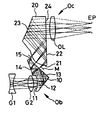
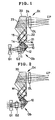
- FIG. 1 is a sectional view of a finder optical system according to Example 1 of the present invention at the wide-angle end.
- FIG. 2 is a sectional view of the finder optical system according to Example 1 at the standard position.
- FIG. 3 is a sectional view of the finder optical system according to Example 1 at the telephoto end.
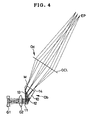
- FIG. 4 is a sectional view of a finder optical system according to Example 2 of the present invention at the wide-angle end.
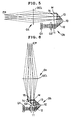
- FIG. 5 is a sectional view of a finder optical system according to Example 3 of the present invention at the wide-angle end.
- FIG. 6 is a sectional view of a finder optical system according to Example 4 of the present invention at the wide-angle end.
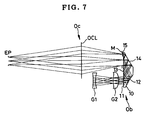
- FIG. 7 is a sectional view of a finder optical system according to Example 5 of the present invention at the wide-angle end.
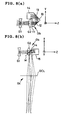
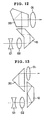
- FIGS. 8 ( a ) and 8 ( b ) are sectional view of a finder optical system according to Example 6 of the present invention at the wide-angle end.
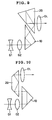
- FIG. 9 is a diagram schematically showing a modification of the finder optical system according to Example 2.
- FIG. 10 is a diagram schematically showing a modification of the finder optical system according to Example 3.
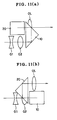
- FIGS. 11 ( a ) and 11 ( b ) are diagrams schematically showing a modification of the finder optical system according to Example 3.
- FIG. 12 is a diagram schematically showing a modification of the finder optical system according to Example 4.
- FIG. 13 is a diagram schematically showing a modification of the finder optical system according to Example 5.
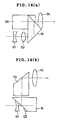
- FIGS. 14 ( a ) and 14 ( b ) are diagrams schematically showing a modification of the finder optical system according to Example 6.
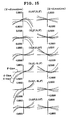
- FIG. 15 is an aberrational diagram illustrating lateral aberrations produced at the wide-angle end in Example 1.
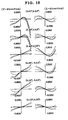
- FIG. 16 is an aberrational diagram illustrating lateral aberrations produced at the standard position in Example 1.
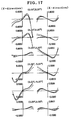
- FIG. 17 is an aberrational diagram illustrating lateral aberrations produced at the telephoto end in Example 1.
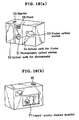
- FIGS. 18 ( a ) and 18 ( b ) are diagrams for describing an electronic camera having a finder optical system according to the present invention.
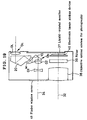
- FIG. 19 is a ray path diagram showing an optical system of the electronic camera in FIG. 18 .
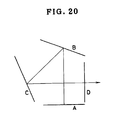
- FIG. 20 is a diagram for describing problems associated with a prism in which an optical path crosses itself.
- the present invention provides a first finder optical system that includes, in order from the object side thereof: an objective optical system having a positive refracting power; an image-inverting optical system for erecting an intermediate image formed by the objective optical system; and an ocular optical system having a positive refracting power.
- the objective optical system has at least two movable units moving when zooming is performed.
- a prism is placed on the object side of the intermediate image formed by the objective optical system.
- the prism includes at least one reflecting surface having a rotationally asymmetric surface configuration.
- the image-inverting optical system has at least one reflecting surface formed from a roof surface.
- the finder optical system satisfies the following condition:
- d is the distance from the entrance surface of the objective optical system to the first reflecting surface of the image-inverting optical system
- f w is the focal length of the objective optical system at the wide-angle end
- ⁇ w is the maximum field angle of the objective optical system at the wide-angle end
- Z is a zoom ratio
- an image-inverting optical system In a real-image finder, an image-inverting optical system is generally placed on the pupil side of an objective optical system. Therefore, the objective optical system needs to be arranged in the form a retrofocus type such that the image-inverting optical system can be placed on the pupil side thereof, thereby ensuring the required back focus.
- the retrofocus type arrangement makes it difficult to reduce the overall length of the optical system. Therefore, it is an unfavorable lens arrangement for the attainment of a reduction in size.
- the type of adoptable image-inverting prisms is limited by the amount of back focus, there are cases where the finder optical system cannot be arranged in a compact form.
- a power is given to a reflecting surface of the image-inverting optical system.
- the function of an objective optical system can also be imparted to the image-inverting optical system.
- the taking lens when the taking lens is arranged to have a higher zoom ratio, a larger aperture is needed in order to keep the same F-number at the telephoto end. Consequently, the lens barrel becomes undesirably large in diameter. Accordingly, when the taking lens is arranged to have a higher zoom ratio, the size of the camera in the direction of height is also likely to increase. When laid out in a camera, the finder optical system is often placed above the taking lens. Therefore, an effective way of preventing the height of the camera from increasing even when the taking lens is arranged to have a higher zoom ratio is to minimize the size of the finder in the direction of height. For this reason, it is desirable to use a roof surface in the image-inverting optical system.
- the finder optical system in both size and thickness.
- a reduction in thickness cannot always be attained unless careful consideration is given to the layout and arrangement of the objective optical system and the image-inverting optical system, which also has the function of an objective optical system.
- the reflecting surfaces of the image-inverting optical system are powerless and irrespective of the optical performance. Therefore, it has heretofore been possible to set the reflecting surface separation and position relatively freely.
- the reflecting surface separation also needs to be considered.
- the object of the present invention cannot be attained unless the movable range of the movable units and the above-described distances are reduced. Accordingly, it is necessary to satisfy the following condition:
- d is the distance from the entrance surface of the objective optical system to the first reflecting surface of the image-inverting optical system at the wide-angle end
- f W is the focal length of the objective optical system at the wide-angle end
- ⁇ w is the maximum field angle of the objective optical system at the wide-angle end
- Z is a zoom ratio
- the definition of the focal length f in the following description of the present invention is as follows.
- a light ray which is parallel to the axial principal ray and which has a small height h is made to enter the objective optical system from the object side thereof.
- the angle that is formed between that ray and the axial principal ray exiting from the objective optical system is denoted by ⁇ (units:radian).
- the focal length f is given by
- d is the distance between the two surfaces as measured at the points on the axial principal ray in parallel to the entering optical axis.
- d/(f W ⁇ tan ⁇ w ⁇ Z) is not smaller than the upper limit of the condition (1), i.e. 2.5, it becomes impossible to attain a reduction in thickness. If d/(f W ⁇ tan ⁇ w ⁇ Z) is not larger than the lower limit, i.e. 1.0, the power of each unit becomes excessively strong, causing the performance to be degraded.
- the roof surface should be placed on the pupil side of the intermediate image.
- the roof edge generally fails to be a continuous surface because of the structure thereof. Therefore, such a roof surface cannot be produced. Accordingly, the roof surface needs to be formed from plane surfaces. For this reason, if the roof surface is placed closer to the objective optical system, the finder optical system becomes unfavorable from the viewpoint of performance, and the thickness of the finder optical system cannot be reduced satisfactorily. For this reason, it is desirable to place the roof surface closer to the ocular optical system, i.e. on the pupil side of the intermediate image.
- the present invention provides a second finder optical system that includes, in order from the object side thereof: an objective optical system having a positive refracting power; an image-inverting optical system for erecting an intermediate image formed by the objective optical system; and an ocular optical system having a positive refracting power.
- the objective optical system has at least two movable units moving when zooming is performed.
- a prism is placed on the object side of the intermediate image formed by the objective optical system.
- the prism includes at least one reflecting surface having a rotationally asymmetric surface configuration.
- the image-inverting optical system is formed from a Porro prism.
- the finder optical system satisfies the following conditions:
- d is the distance from the entrance surface of the objective optical system to the first reflecting surface of the image-inverting optical system at the wide-angle end
- f W is the focal length of the objective optical system at the wide-angle end
- ⁇ w is the maximum field angle of the objective optical system at the wide-angle end
- Z is a zoom ratio
- dp is the distance from the entrance surface of the image-inverting optical system placed on the object side of the intermediate image to the first reflecting surface.
- the reflection angle at the first reflecting surface is set at approximately 45°.
- the effective area of the reflecting surface becomes large.
- the size in the direction of thickness becomes large unfavorably.
- dp is the distance between the two surfaces as measured at the points on the axial principal ray in parallel to the entering optical axis as in the case of the distance d.
- d/(f W ⁇ tan ⁇ w ⁇ Z) is not smaller than the upper limit of the condition (3), i.e. 2.5, it becomes impossible to attain a reduction in thickness. If d/d/(f W ⁇ tan ⁇ w ⁇ Z) is not larger than the lower limit, i.e. 1.0, the power of each unit becomes excessively strong, causing the performance to be degraded.
- dp/(fw ⁇ tan ⁇ w ) is not smaller than the upper limit of the condition (4), i.e. 1.1, it becomes difficult to attain a reduction in thickness. If dp/(f W ⁇ tan ⁇ w )) is not larger than the lower limit, i.e. 0.5, the effective portions of the first transmitting surface and the first reflecting surface overlap each other undesirably. Consequently, it becomes impossible to ensure the required edge wall thickness.
- the second transmitting surface of the prism of the objective optical system should have a power.
- a power should preferably be given to a transmitting surface as well.
- giving a power to the second transmitting surface facilitates the correction of distortion and also makes it possible to change the position of the exit pupil of the objective optical system. This is favorable from the viewpoint of design and performance.
- the second transmitting surface of the prism should have a rotationally asymmetric surface configuration.
- a rotationally asymmetric surface is used as a reflecting surface as in the present invention, the exit pupil position also becomes rotationally asymmetric. If this is corrected by the reflecting surface itself, other aberrations are affected unfavorably. Therefore, it is preferable to correct the exit pupil position by using a rotationally asymmetric surface for the second transmitting surface, at which the light beam is narrowed and which has minimal influence on other aberrations.
- the first reflecting surface of the objective optical system should have a power.
- the reflection angle at the second reflecting surface is also large, i.e. about 45°. Therefore, the performance is degraded unless the power distribution is optimized.
- the first reflecting surface is far from the intermediate image formation plane. Therefore, the axial ray height is large at the first reflecting surface. Accordingly, the first reflecting surface can produce a strong aberration correcting effect. For this reason, it is desirable to give a power to the first reflecting surface.
- the number of reflections in the prism should be two or three.
- the prism If there is only one reflection in the prism, it is impossible to give a sufficient power for aberration correction. Therefore, the aberration correcting effect is weak. If the number of reflections in the prism is four or more, the prism becomes undesirably large in size. Therefore, a reduction in size cannot be attained. If the prism is arranged so that two or three reflections take place therein, it is possible to attain both high performance and size reduction with good balance.
- the number of movable units should be two.
- the present invention provides a third finder optical system that includes, in order from the object side thereof: an objective optical system having a positive refracting power; an image-inverting optical system for erecting an intermediate image formed by the objective optical system; and an ocular optical system having a positive refracting power.
- the objective optical system includes an optical system having at least two movable units moving when zooming is performed.
- the optical system has a positive composite power.
- a prism is placed on the pupil side of the optical system having at least two movable units.
- the prism includes an image-inverting function.
- the prism includes at least one reflecting surface having a rotationally asymmetric surface configuration. At least either one of the first transmitting surface and first reflecting surface of the prism has a negative power.
- the second transmitting surface of the prism has a positive power.
- the prism power arrangement for reducing the thickness of the finder even more effectively will be described.
- the prism is placed on the pupil side of an optical system having a positive composite power to fold the optical axis.
- a negative power is distributed to the prism to form a telephoto type lens system, thereby effectively reducing the thickness of the optical system.
- a negative power is given to at least either one of the first transmitting surface and the first reflecting surface, which are relatively close to the object.
- at least one reflecting surface is formed from a rotationally asymmetric surface.
- the volume of the prism itself depends on the area of each effective surface. Therefore, it is necessary to reduce the effective area of each reflecting surface. Accordingly, in the present invention, a positive power is given to the second transmitting surface, at which the light beam is narrowed and the influence of power on aberrations weakens, thereby bringing the entrance pupil position close to the prism while minimizing the influence on the performance, and thus reducing the size of the prism.
- either one of the first transmitting surface and the first reflecting surface should have a positive power.
- a relatively strong negative power is needed. Consequently, the amount of aberration produced in the optical system becomes unfavorably large. Therefore, it is preferable to give a positive power to either the first transmitting surface or the first reflecting surface so that the aberrations produced by the surface of negative power are corrected by cancellation with the surface of positive power.
- the number of reflections in the prism should be two or three.
- the prism If there is only one reflection in the prism, it is impossible to give a sufficient power for aberration correction. Therefore, the aberration correcting effect is weak. If the number of reflections in the prism is four or more, the prism becomes undesirably large in size. Therefore, a reduction in size cannot be attained. If the prism is arranged so that two or three reflections take place therein, it is possible to attain both high performance and size reduction with good balance.
- the composite focal length of the objective movable units should satisfy the following condition:
- f move is the composite focal length of the objective movable units at the wide-angle end
- f W is the focal length of the objective optical system at the wide-angle end
- a telephoto type lens system is constructed of the first and second units that have a positive composite power and the third unit having a negative power.
- the composite power of the first and second units is stronger than the power of the whole objective optical system, the amount of aberration produced by the first and second units tends to increase. Accordingly, from the viewpoint of attaining a further reduction in size while maintaining favorable performance over the entire zooming range, it is desirable to satisfy the following condition:
- f move /f W is not smaller than the upper limit of the condition (7), i.e. 0.9, the advantageous effect of the telephoto type lens system weakens, and it becomes impossible to attain a reduction in thickness. If f move /f W is not larger than the lower limit, i.e. 0.3, the power of each unit becomes excessively strong, causing the performance to be degraded.
- the present invention provides a fourth finder optical system that includes, in order from the object side thereof: an objective optical system having a positive refracting power; an image-inverting optical system for erecting an intermediate image formed by the objective optical system; and an ocular optical system having a positive refracting power.
- the objective optical system has at least two movable units moving when zooming is performed.
- a prism is placed on the object side of the intermediate image formed by the objective optical system.
- the prism has two reflecting surfaces. At least one of the reflecting surfaces has a rotationally asymmetric surface configuration.
- the finder optical system satisfies the following condition:
- f W is the focal length of the objective optical system at the wide-angle end
- ⁇ w is the max mum field angle of the objective optical system at the wide-angle end
- dp is the distance from the entrance surface of the image-inverting optical system placed on the object side of the intermediate image to the first reflecting surface thereof.
- the reflection angle of the image-inverting optical system is limited, and an arrangement having an excessively small number of reflecting surfaces is unfavorable from the viewpoint of performance. Accordingly, it is necessary to provide at least two reflecting surfaces on the objective optical system side in order to ensure the required performance.
- reflecting surfaces are sensitive to errors that may occur during production, assembly, etc. in comparison to refracting surfaces. Therefore, if the number of reflecting surfaces with power is large, the performance is degraded severely. In view of this fact, it is preferable to use a prism in which the number of reflecting surfaces is only two.
- dp/(f W ⁇ tan ⁇ w ) is not smaller than the upper limit of the condition (9), i.e. 1.1, it becomes difficult to attain a reduction in thickness. If dp/(f W ⁇ tan ⁇ w ) is not larger than the lower limit, i.e. 0.5, the effective portions of the first transmitting surface an the first reflecting surface overlap each other undesirably. Consequently, it becomes impossible to ensure the required edge wall thickness.
- the first reflecting surface of the prism should have a rotationally asymmetric surface configuration and be formed from an independent surface that is separate from other transmitting and reflecting surfaces.
- a reflecting surface When a reflecting surface is arranged to have a total reflection critical angle, it can serve as both reflecting and transmitting surfaces. That is, a transmitting surface and a reflecting surface can be formed on the identical surface by using a total reflection critical angle. With this arrangement, because it is unnecessary to separate the effective portions of the transmitting surface and the reflecting surface, the prism can be reduced in size. However, because the prism needs to have a total reflection critical angle as a reflection angle, the arrangement is unfavorable from the viewpoint of performance.
- the axial ray height is the highest at the first reflecting surface of the reflecting surfaces thereof, the effect of correcting aberrations such as spherical aberration is remarkable at the first reflecting surface. Therefore, it is not preferable to increase the reflection angle at the first reflecting surface. Accordingly, it is preferable that the first reflecting surface should be formed separately from other transmitting and reflecting surfaces.
- the second transmitting surface of the prism should have a power.
- a power should preferably be given to a transmitting surface as well.
- giving a power to the second transmitting surface facilitates the correction of distortion and also makes it possible to change the position of the exit pupil of the objective optical system. This is favorable from the viewpoint of design and performance.
- the second transmitting surface should have a rotationally asymmetric surface configuration.
- a rotationally asymmetric surface is used as a reflecting surface as in the present invention, the exit pupil position also becomes rotationally asymmetric. If this is corrected by the reflecting surface itself, other aberrations are affected unfavorably. Therefore, it is preferable to correct the exit pupil position by using a rotationally asymmetric surface for the second transmitting surface, at which the light beam is narrowed and which has minimal influence on other aberrations.
- the axial principal ray or a projective axial principal ray defined by projecting the axial principal ray onto a plane containing a part of the axial principal ray should not cross itself in the prism.
- a prism allows an optical system to be arranged in a compact form by folding the axial principal ray (optical axis) with reflecting surfaces.
- optical path it is necessary to appropriately set the direction of travel of the optical axis (hereinafter referred to as the “optical path”).
- the prism can be made compact in size because light rays pass through the same portion of the prism twice.
- the prism is constructed by making the optical path cross itself, as shown in FIG. 20, the separation between the surfaces A and B depends on the size of the effective portion of the surface C or D, and the separation between the surfaces C and D depends on the size of the effective portion of the surface A or B. Therefore, there are cases where the prism cannot be reduced in size when the effective portions are large in size. Accordingly, it is preferable in the present invention that the axial principal ray should not cross itself.
- the optical path does not cross itself. This is, however, technically the same as the above. Therefore, in the present invention, a plane containing a part of the axial principal ray is defined.
- the axial principal ray is projected onto the plane, and the resulting two-dimensional axial principal ray is defined as a projective axial principal ray.
- the prism is preferably constructed so that the projective axial principal ray does not cross itself in the prism.
- first transmitting surface or first reflecting surface of the prism should have a negative power.
- a substantially telephoto type lens system By placing a negative power on the pupil side of the objective units having a positive composite power, a substantially telephoto type lens system can be constructed. Thus, it is possible to obtain an arrangement most suitable for attaining a reduction in thickness.
- the composite focal length of the objective movable units should satisfy the following condition:
- f move is the composite focal length of the objective movable units at the wide-angle end
- f w is the focal length of the objective optical system at the wide-angle end
- a telephoto type lens system is constructed of the first and second units that have a positive composite power and the third unit having a negative power.
- the composite power of the first and second units is stronger than the power of the whole objective optical system, the amount of aberration produced by the first and second units tends to increase. Accordingly, from the viewpoint of attaining a further reduction in size while maintaining favorable performance over the entire zooming range, it is desirable to satisfy the following condition:
- f move /f W is not smaller than the upper limit of the condition (11), i.e. 0.9, the advantageous effect of the telephoto type lens system weakens, and it becomes impossible to attain a reduction in thickness,. If f move /f W is not larger than the lower limit, i.e. 0.3, the power of each unit becomes excessively strong, causing the performance to be degraded.
- the present invention provides a fifth finder optical system that includes, in order from the object side thereof an objective optical system having a positive refracting power; an image-inverting optical system for erecting an intermediate image formed by the objective optical system; and an ocular optical system having a positive refracting power.
- the objective optical system has at least two movable units moving when zooming is performed.
- a prism is placed on the object side of the intermediate image formed by the objective optical system.
- the prism has three reflecting surfaces. At least one of the reflecting surfaces has a rotationally asymmetric surface configuration.
- the prism is formed from three reflecting surfaces, thereby allowing residual aberrations to be corrected favorably even when the reflection angle is made relatively large.
- it is possible to construct a finder optical system exhibiting favorable performance even if it is arranged to provide a higher zoom ratio while maintaining a thin structure.
- At least two of the three reflecting surfaces of the prism should be formed from independent surfaces, respectively, which are separate from other transmitting and reflecting surfaces.
- a reflecting surface When a reflecting surface is arranged to have a total reflection critical angle, it can serve as both reflecting and transmitting surfaces. That is, a transmitting surface and a reflecting surface can be formed on the identical surface by using a total reflection critical angle.
- the reflection angle needs to be a total reflection critical angle, the arrangement becomes unfavorable from the viewpoint of performance.
- the exit direction of the prism is limited undesirably. Accordingly, the use of total reflection may be unfavorable for the reduction in thickness of the finder.
- the prism In the present invention, aberration correction is performed even more strictly by using three reflecting surfaces in the prism. Therefore, if an excessively large number of reflecting surfaces are formed as the identical surfaces with other surfaces, the prism becomes unfavorable from the viewpoint of performance, and it becomes impossible to fully satisfy the object of the present invention. Accordingly, it is desirable that at least two of the three reflecting surfaces of the prism should be formed from independent surfaces, respectively, which are separate from other transmitting and reflecting surfaces.
- the first reflecting surface of the prism should have a rotationally asymmetric surface configuration and be formed from an independent surface that is separate from other transmitting and reflecting surfaces.
- a reflecting surface When a reflecting surface is arranged to have a total reflection critical angle, it can serve as both reflecting and transmitting surfaces. That is, a transmitting surface and a reflecting surface can be formed on the identical surface by using a total reflection critical angle. With this arrangement, because it is unnecessary to separate the effective portions of the transmitting surface and the reflecting surface, the prism can be reduced in size. However, because the prism needs to have a total reflection critical angle as a reflection angle, the arrangement is unfavorable from the viewpoint of performance.
- the axial ray height is the highest at the first reflecting surface of the reflecting surfaces thereof, the effect of correcting aberrations such as spherical aberration is remarkable at the first reflecting surface. Therefore, it is not preferable to increase the-reflection angle at the first reflecting surface. Accordingly, it is preferable that the first reflecting surface should be formed separately from other transmitting and reflecting surfaces.
- the third reflecting surface of the prism should have a rotationally asymmetric surface configuration and be formed from an independent surface that is separate from other transmitting and reflecting surfaces.
- the marginal ray height is the highest at the third reflecting surface of the reflecting surfaces thereof, the effect of correcting aberrations such as astigmatic and comatic aberrations is remarkable at the third reflecting surface. Therefore, it is not preferable to increase the reflection angle at the third reflecting surface. Accordingly, it is preferable that the third reflecting surface should be formed separately from other transmitting and reflecting surfaces.
- the second transmitting surface of the prism should have a power.
- a power should preferably be given to a transmitting surface as well.
- giving a power to the second transmitting surface facilitates the correction of distortion and also makes it possible to change the position of the exit pupil of the objective optical system. This is favorable from the viewpoint of design and performance.
- the second transmitting surface should have a rotationally asymmetric surface configuration.
- a rotationally asymmetric surface is used as a reflecting surface as in the present invention, the exit pupil position also becomes rotationally asymmetric. If this is corrected by the reflecting surface itself, other aberrations are affected unfavorably. Therefore, it is preferable to correct the exit pupil position by using a rotationally asymmetric surface for the second transmitting surface, at which the light beam is narrowed and which has minimal influence on other aberrations.
- the axial principal ray or a projective axial principal ray defined by projecting the axial principal ray onto a plane containing a part of the axial principal ray should not cross itself in the prism.
- a prism allows an optical system to be arranged in a compact form by folding the axial principal ray (optical axis) with reflecting surfaces.
- optical path it is necessary to appropriately set the direction of travel of the optical axis (hereinafter referred to as the “optical path”).
- the prism can be made compact in size because light rays pass through the same portion of the prism twice.
- the prism is constructed by making the optical path cross itself, as shown in FIG. 20, the separation between the surfaces A and B depends on the size of the effective portion of the surface C or D, and the separation between the surfaces C and D depends on the size of the effective portion of the surface A or B. Therefore, there are cases where the prism cannot be reduced in size when the effective portions are large in size. Accordingly, it is preferable in the present invention that the axial principal ray should not cross itself.
- the optical path does not cross itself. This is, however, technically the same as the above. Therefore, in the present invention, a plane containing a part of the axial principal ray is defined.
- the axial principal ray is projected onto the plane, and the resulting two-dimensional axial principal ray is defined as a projective axial principal ray.
- the prism is preferably constructed so that the projective axial principal ray does not cross itself in the prism.
- first transmitting surface or first reflecting surface of the prism should have a negative power.
- a substantially telephoto type lens system By placing a negative power on the pupil side of the objective units having a positive composite power, a substantially telephoto type lens system can be constructed. Thus, it is possible to obtain an arrangement most suitable for attaining a reduction in thickness.
- the composite focal length of the objective movable units should satisfy the following condition:
- f move is the composite focal length of the objective movable units at the wide-angle end
- f W is the focal length of the objective optical system at the wide-angle end
- a telephoto type lens system is constructed of the first and second units that have a positive composite power and the third unit having a negative power.
- the composite power of the first and second units is stronger than the power of the whole objective optical system, the amount of aberration produced by the first and second units tends to increase. Accordingly, from the viewpoint of attaining a further reduction in size while maintaining favorable performance over the entire zooming range, it is desirable to satisfy the following condition:
- f move /f W is not smaller than the upper limit of the condition (13), i.e. 0.9, the advantageous effect of the telephoto type lens system weakens, and it becomes impossible to attain a reduction in thickness. If f move /f W is not larger than the lower limit, i.e. 0.3, the power of each unit becomes excessively strong, causing the performance to be degraded.
- the present invention provides a sixth finder optical system that includes, in order from the object side thereof: an objective optical system having a positive refracting power; an image-inverting optical system for erecting an intermediate image formed by the objective optical system; and an ocular optical system having a positive refracting power.
- the objective optical system includes, in order from the object side thereof, a negative first unit, a positive second unit, and a negative third unit. At least the first unit and the second unit are movable units moving when zooming is performed.
- the third unit is formed from a prism including an image-inverting function.
- the prism includes at least one reflecting surface having a rotationally asymmetric surface configuration.
- the present invention provides a seventh finder optical system that includes, in order from the object side thereof: an objective optical system having a positive refracting power; an image-inverting optical system for erecting an intermediate image formed by the objective optical; and an ocular optical system having a positive refracting power.
- the objective optical system includes, in order from the object side thereof, a negative first unit, a positive second unit, and a positive third unit. At least the first unit and the second unit are movable units moving when zooming is performed.
- the third unit is formed from a prism including an image-inverting function.
- the prism includes at least one reflecting surface having a rotationally asymmetric surface configuration.
- the prism includes at least one transmitting surface or reflecting surface that has a negative power.
- the third unit has a principal point positioned on the pupil side of a plane where the intermediate image is formed.
- the smallest number of optical units for zooming is two, it is necessary to increase the number of optical units in order to attain a higher zoom ratio. It is difficult to ensure the required performance unless the number of optical units is increased.
- the sum total of the thicknesses of optical components increases undesirably as the number of optical units increases. Consequently, it becomes difficult to attain a reduction in thickness.
- the objective optical system is formed from three units, in which the first and second units are arranged in the form of moving units to have a zooming function.
- the third unit is formed from an image-inverting prism having the function of an objective optical system to fold the optical axis, thereby preventing the optical system from increasing in size in the direction of thickness while ensuring the required performance.
- the first unit is given a negative power and the second unit is given a positive power to ensure a certain back focus.
- a surface of negative power is disposed in the third unit.
- a substantially telephoto type lens system is constructed of the first and second units having a positive composite power and the third unit of negative power to provide an arrangement that is most suitable for attaining a reduction in thickness.
- a reflecting surface in the prism is given a power and formed from a rotationally asymmetric surface, thereby allowing the practical back focus to be shortened effectively.
- the prism surfaces a surface of low magnification that is not very closely related to the construction of a telephoto type lens system, e.g. the second transmitting surface, which is located near the intermediate image plane, does not exert a very strong influence on the focal length and the effect of shortening the overall length even when the power of the surface is changed. Therefore, the power of the whole prism, which constitutes the third unit, does not always need to be made negative. Accordingly, the prism may be arranged to have a positive power. In this case, however, at least one transmitting surface or reflecting surface needs to have a negative power in order to construct a telephoto type lens system as stated above.
- the second transmitting surface should have a power.
- a power should preferably be given to a transmitting surface as well.
- giving a power to the second transmitting surface facilitates the correction of distortion and also makes it possible to change the position of the exit pupil of the objective optical system. This is favorable from the viewpoint of design and performance.
- the second transmitting surface should have a rotationally asymmetric surface configuration.
- a rotationally asymmetric surface is used as a reflecting surface as in the present invention, the exit pupil position also becomes rotationally asymmetric. If this is corrected by the reflecting surface itself, other aberrations are affected unfavorably. Therefore, it is preferable to correct the exit pupil position by using a rotationally asymmetric surface for the second transmitting surface, at which the light beam is narrowed and which has minimal influence on other aberrations.
- the number of reflections in the prism should be two or three.
- the prism If there is only one reflection in the prism, it is impossible to give a sufficient power for aberration correction. Therefore, the aberration correcting effect is weak. If the number of reflections in the prism is four or more, the prism becomes undesirably large in size. Therefore, a reduction in size cannot be attained. If the prism is arranged so that two or three reflections take place therein, it is possible to attain both high performance and size reduction with good balance.
- the composite focal length of the objective movable units should satisfy the following condition:
- f move is the composite focal length of the objective movable units at the wide-angle end
- f W is the focal length of the objective optical system at the wide-angle end
- a telephoto type lens system is constructed of the first and second units that have a positive composite power and the third unit having a negative power.
- the composite power of the first and second units is stronger than the power of the whole objective optical system, the amount of aberration produced by the first and second units tends to increase. Accordingly, from the viewpoint of attaining a further reduction in size while maintaining favorable performance over the entire zooming range, it is desirable to satisfy the following condition:
- f move /f W is not smaller than the upper limit of the condition (15), i.e. 0.9, the advantageous effect of the telephoto type lens system weakens, and it becomes impossible to attain a reduction in thickness. If f move /f W is not larger than the lower limit, i.e. 0.3, the power of each unit becomes excessively strong, causing the performance to be degraded.
- the third unit should be stationary with respect to a plane where the intermediate image is formed.
- the intermediate image formation plane moves undesirably as the prism is moved for zooming. Consequently, a complicated mechanism is needed unfavorably to transmit the image to the ocular optical system.
- the prism becomes large in size in comparison to a refracting lens, the mechanism for moving the prism also becomes unfavorably complicated. Accordingly, it is desirable that the third unit should be stationary with respect to the intermediate image formation plane.
- both the objective movable units should be formed from refracting lenses.
- the objective movable units can be formed from prisms as in the case of the third unit. However, if prisms are used, the objective movable units become large in size in comparison to refracting lenses, making it impossible to attain a reduction in thickness satisfactorily. Therefore, it is preferable to form the objective movable units by using refracting lenses.
- the objective movable units should be each formed from a single refracting lens.
- each of the objective movable units is formed from a single refracting lens.
- An eighth finder optical system includes, in order from the object side thereof: an objective optical system having a positive refracting power; an image-inverting optical system for erecting an intermediate image formed by the objective optical system; and an ocular optical system having a positive refracting power.
- the objective optical system has at least two movable units moving when zooming is performed.
- a prism is placed on the object side of the intermediate image formed by the objective optical system.
- the prism includes two reflecting surfaces. At least one of the reflecting surfaces has a rotationally asymmetric surface configuration.
- the first transmitting surface and second reflecting surface of the prism are formed from the identical surface having both transmitting and reflecting actions.
- the prism has an optical path in which the axial principal ray or a projective axial principal ray defined by projecting the axial principal ray onto a plane containing a part of the axial principal ray bends in different directions from each other with respect to the travel direction of light rays at the two reflecting surfaces.
- first transmitting surface and second reflecting surface of the prism By forming the first transmitting surface and second reflecting surface of the prism from the identical surface, it becomes unnecessary to separate the respective effective areas of the two surfaces. Consequently, it is possible to minimize the separation between the first transmitting surface and the first reflecting surface and hence possible to attain a reduction in thickness.
- the first reflecting surface of the prism should have a negative power.
- the second reflecting surface needs to have a total reflection critical angle. For this reason, giving a strong power to the remaining reflecting surface (i.e. the first reflecting surface) is favorable from the viewpoint of aberration correcting performance.
- the reflection angle at the first reflecting surface of the prism should satisfy the following condition:
- ⁇ A1 is the reflection angle at the first reflecting surface.
- ⁇ A1 is 27.2°.
- the exit angle of the prism with respect to the optical axis entering the objective optical system should satisfy the following condition:
- ⁇ A is the exit angle of the prism with respect to the optical axis entering the objective optical system.
- ⁇ A is 55.6°.
- the number of optical units placed in the direction of the optical axis entering the objective optical system is increased, it becomes difficult to attain a reduction in thickness. Therefore, it is preferable to change the direction of the exiting optical axis by appropriately arranging the reflecting surfaces of the prism.
- the reflection angle is excessively large, the performance is degraded. For this reason, it is necessary to set an optimum exit angle. Accordingly, it is desirable to satisfy the condition (19). If ⁇ A is not smaller than the upper limit of the condition (19), i.e. 75°, the reflection angle at each reflecting surface becomes excessively large, causing the performance to be degraded. If ⁇ A is not larger than the lower limit, i.e. 25°, it becomes impossible to attain a reduction in thickness.
- the present invention provides a ninth finder optical system that includes, in order from the object side thereof: an objective optical system having a positive refracting power; an image-inverting optical system for erecting an intermediate image formed by the objective optical system; and an ocular optical system having a positive refracting power.
- the objective optical system has at least two movable units moving when zooming is performed.
- a prism is placed on the object side of the intermediate image formed by the objective optical system.
- the prism includes two reflecting surfaces. Both of the reflecting surfaces are independent of other transmitting and reflecting surfaces. At least one of the reflecting surfaces has a rotationally asymmetric surface configuration.
- the prism has an optical path in which the axial principal ray or a projective axial principal ray defined by projecting the axial principal ray onto a plane containing a part of the axial principal ray bends in the same direction with respect to the travel direction of light rays at the two reflecting surfaces.
- the finder optical system satisfies the following condition:
- dp is the distance from the entrance surface of the image-inverting optical system placed on the object side of the intermediate image to the first reflecting surface thereof;
- f W is the focal length of the objective optical system at the wide-angle end;
- ⁇ w is the maximum field angle of the objective optical system at the wide-angle end.
- two transmitting surfaces and two reflecting surfaces of the prism can be formed from independent surface configurations, respectively. This is favorable from the viewpoint of performance. A reduction in thickness of the finder cannot be attained unless the prism itself is reduced in size.
- the optical path from the first transmitting surface to the first reflecting surface is approximately parallel to the direction of the entering optical axis. Therefore, it is necessary to minimize the distance between the first transmitting surface and the first reflecting surface. Accordingly, it is desirable to satisfy the following condition:
- dp is the distance from the entrance surface of the image-inverting optical system placed on the object side of the intermediate image to the first reflecting surface thereof;
- f W is the focal length of the objective optical system at the wide-angle end; and 6w is the maximum field angle of the objective optical system at the wide-angle end.
- dp/(f W ⁇ tan ⁇ w ) is not smaller than the upper limit of the condition (21), i.e. 1.1, it becomes difficult to attain a reduction in thickness, whereas if dp/(f W ⁇ tan ⁇ w ) is not larger than the lower limit, i.e. 0.5, the effective portions of the first transmitting surface and the first reflecting surface overlap each other undesirably. Consequently, it becomes impossible to ensure the required edge wall thickness.
- the first transmitting surface of the prism should have a negative power.
- the optical system in the form of a telephoto type lens system from the viewpoint of attaining a reduction in thickness.
- the first transmitting surface which is the entrance surface, is more away from the intermediate image than the other transmitting surface. Therefore, at the first transmitting surface, the axial ray height is high, and this is effective in correcting aberrations. Accordingly, it is preferable to give a negative power to the first transmitting surface of the prism.
- the second transmitting surface of the prism should have a positive power.
- the volume of the prism depends on the area of each effective surface. Therefore, it is preferable to minimize the area of the effective portion of each reflecting surface by bringing the position of the entrance pupil of the objective lens system close to the prism. Accordingly, it is desirable to bring the entrance pupil position close to the prism by giving a positive power to the second transmitting surface, at which the light beam is narrowed and the influence of power on aberrations weakens.
- the reflection angle at the first reflecting surface of the prism should satisfy the following condition:
- ⁇ B1 is the reflection angle at the first reflecting surface.
- ⁇ B1 is 49.00.
- the prism in this, finder optical system has an optical path in which the axial principal ray bends in the same direction with respect to the travel direction of light rays at the two reflecting surfaces. Therefore, it is impossible to attain both high performance and size reduction with good balance unless the reflection angle at the first reflecting surface is set appropriately. Accordingly, it is desirable to satisfy the condition (23). If ⁇ B1 is not smaller than the upper limit of the condition (23), i.e. 60°, decentration aberrations are produced undesirably, and moreover, it is necessary to position the second reflecting surface even closer to the pupil. Consequently, it is impossible to attain a reduction in thickness. If OBI is not larger than the lower limit, i.e. 30°, the second reflecting surface and the objective optical system interfere with each other unfavorably.
- the reflection angle at the second reflecting surface of the prism satisfies the following condition:
- ⁇ B2 is the reflection angle at the second reflecting surface.
- ⁇ B2 is 41.0°.
- the second reflecting surface should preferably satisfy the condition (25) for the same reasons as stated above. If ⁇ B2 is not smaller than the upper limit of the condition (25), i.e. 60°, decentration aberrations are produced undesirably, which is unfavorable from the viewpoint of performance. If ⁇ B2 is not larger than the lower limit, i.e. 30°, the ocular optical system and the objective optical system interfere with each other unfavorably.
- the exit angle of the prism with respect to the optical axis entering the objective optical system should satisfy the following condition:
- ⁇ B is the exit angle of the prism with respect to the optical axis entering the objective optical system.
- ⁇ B is 180°.
- the exit angle of the prism should preferably satisfy the condition (27). If ⁇ B is not smaller than the upper limit of the condition (27), i.e. 210°, it becomes necessary to increase the reflection angle at each surface. Therefore, the optical system becomes unfavorable from the viewpoint of performance. If ⁇ B is not larger than the lower limit, i.e. 150°, the ocular optical system and the objective optical system interfere with each other unfavorably.
- a roof surface should be disposed on the pupil side of the intermediate image.
- the roof edge generally fails to be a continuous surface because of the structure thereof. Therefore, such a roof surface cannot be produced. Accordingly, the roof surface needs to be formed from plane surfaces. For this reason, if the roof surface is placed closer to the objective optical system, the finder optical system becomes unfavorable from the viewpoint of performance, and the thickness of the finder optical system cannot be reduced satisfactorily. For this reason, it is desirable to place the roof surface closer to the ocular optical system, i.e. on the pupil side of the intermediate image.
- the image-inverting optical system should be a Porro prism.
- Porro prism In the case of a Porro prism, the number of reflections is smaller than that in the case of using a roof surface by one. Therefore, the use of a Porro prism is favorable in terms of light quantity.
- the present invention provides a tenth finder optical system that includes, in order from the object side thereof: an objective optical system having a positive refracting power; an image-inverting optical system for erecting an intermediate image formed by the objective optical system; and an ocular optical system having a positive refracting power.
- the objective optical system has at least two movable units moving when zooming is performed.
- a prism is placed on the object side of the intermediate image formed by the objective optical system.
- the prism includes three reflecting surfaces. All of the reflecting surfaces are independent of other transmitting and reflecting surfaces. At least one of the reflecting surfaces has a rotationally asymmetric surface configuration.
- the prism has an optical path in which the axial principal ray or a projective axial principal ray defined by projecting the axial principal ray onto a plane containing a part of the axial principal ray bends in the same direction with respect to the travel direction of light rays at two consecutive reflecting surfaces and bends in a direction different from the above-mentioned direction at the other reflecting surface.
- two transmitting surfaces and three reflecting surfaces of the prism can be formed from independent surface configurations, respectively. This is favorable from the viewpoint of performance. Further, performance degradation is small even when the angle of each reflecting surface is set relatively large. Therefore, the degree of freedom for the exit direction is high, so that it is possible to dispose the prism while taking into consideration the layout of the camera.
- the optical path bends in a different direction from the direction of bending at the other two reflecting surfaces. Therefore, even when the reflection angle is reduced, it is unlikely that the prism will interfere with another optical system or the effective portions of the reflecting surfaces will overlap each other. Accordingly, it is possible to construct a compact and high-performance prism.
- the first transmitting surface of the prism should have a negative power.
- the optical system in the form of a telephoto type lens system from the viewpoint of attaining a reduction in thickness.
- the first transmitting surface which is the entrance surface, is more away from the intermediate image than the other transmitting surface. Therefore, at the first transmitting surface, the axial ray height is high, and this is effective in correcting aberrations. Accordingly, it is preferable to give a negative power to the first transmitting surface of the prism.
- the reflection angle at the first reflecting surface of the prism should satisfy the following condition:
- ⁇ C1 is the reflection angle at the first reflecting surface.
- ⁇ C1 is 43.8°. Because it folds the axial principal ray first, the first reflecting surface affects the size of the optical system and the prism arrangement adversely unless the reflection angle at the first reflecting surface is set appropriately. Therefore, it is desirable to satisfy the condition (29). If Ac, is not smaller than the upper limit of the condition (29), i.e. 60°, the second reflecting surface is placed closer to the pupil. Consequently, it becomes impossible to attain a reduction in thickness. If ⁇ C1 is not larger than the lower limit, i.e. 30°, the third reflecting surface interferes with the objective optical system undesirably.
- the reflection angle at the third reflecting surface of the prism should satisfy the following condition:
- ⁇ C3 is the reflection angle at the third reflecting surface.
- ⁇ C3 is 41.7°. It is desirable for the third reflecting surface to satisfy the condition (31). If ⁇ C3 is not smaller than the upper limit of the condition (31), i.e. 60°, the third reflecting surface overlaps the effective portion of the second reflecting surface. If 6C3 is not larger than the lower limit, i.e. 30°, the amount of decentration aberrations produced by the third reflecting surface becomes large. This is unfavorable from the viewpoint of performance.
- the exit angle of the prism with respect to the optical axis entering the objective optical system should satisfy the following condition:
- ⁇ C is the exit angle of the prism with respect to the optical axis entering the objective optical system.
- ⁇ C is 90°. It is desirable for the exit angle of the prism to satisfy the condition (33). If ⁇ C is not smaller than the upper limit of the condition (33), i.e. 110°, or not larger than the lower limit, i.e. 70°, the amount to which the ocular optical system extends in the direction of the entering optical axis increases. Consequently, it becomes impossible to attain a reduction in thickness.
- the present invention provides an eleventh finder optical system that includes, in order from the object side thereof: an objective optical system having a positive refracting power; an image-inverting optical system for erecting an intermediate image formed by the objective optical system; and an ocular optical system having a positive refracting power.
- the objective optical system has at least two movable units moving when zooming is performed.
- a prism is placed on the object side of the intermediate image formed by the objective optical system.
- the prism includes three reflecting surfaces. At least one of the reflecting surfaces has a rotationally asymmetric surface configuration.
- the first reflecting surface and third reflecting surface of the prism are independent of other transmitting and reflecting surfaces.
- the second reflecting surface of the prism is formed from the identical surface with the second transmitting surface of the prism.
- the prism has an optical path in which the axial principal ray or a projective axial principal ray defined by projecting the axial principal ray onto a plane containing a part of the axial principal ray bends in the same direction with respect to the travel direction of light rays at two consecutive reflecting surfaces and bends in a direction different from the above-mentioned direction at the other reflecting surface.
- two transmitting surfaces and two reflecting surfaces of the prism can be formed from independent surface configurations, respectively. This is favorable from the viewpoint of performance. Further, performance degradation is small even when the angle of each reflecting surface is set relatively large. Therefore, the degree of freedom for the exit direction is high, so that it is possible to dispose the prism while taking into consideration the layout of the camera.
- the optical path bends in a different direction from the direction of. bending at the other two reflecting surfaces. Therefore, even when the reflection angle is reduced, it is unlikely that the prism will interfere with another optical system or the effective portions of the reflecting surfaces will overlap each other. Accordingly, it is possible to construct a compact and high-performance prism. In addition, because total reflection takes place at one surface, the prism arrangement is favorable in terms of light quantity.
- each pair of adjacent reflecting surfaces needs to have a sufficiently large separation therebetween to separate the effective portions of the reflecting surfaces from each other.
- a reflecting surface when arranged to have a total reflection critical angle, it can serve as both reflecting and transmitting surfaces. That is, a transmitting surface and a reflecting surface can be formed on the identical surface by using a total reflection critical angle.
- the optical path between the second and third reflecting surfaces is approximately parallel to the direction of the entering optical axis. Therefore, if these reflecting surfaces are formed from independent surfaces, it is necessary to increase the separation between the reflecting surfaces. This adversely affects the attainment of a reduction in thickness. Therefore, according to the present invention, the second reflecting surface and the second transmitting surface are formed from the identical surface, thereby setting a minimal separation between the second and third reflecting surfaces, and thus attaining a further reduction in thickness.
- the first transmitting surface of the prism should have a negative power.
- the optical system in the form of a telephoto type lens system from the viewpoint of attaining a reduction in thickness.
- the first transmitting surface which is the entrance surface, is more away from the intermediate image than the other transmitting surface. Therefore, at the first transmitting surface, the axial ray height is high, and this is effective in correcting aberrations. Accordingly, it is preferable to give a negative power to the first transmitting surface of the prism.
- the reflection angle at the first reflecting surface of the prism should satisfy the following condition:
- ⁇ D1 is the reflection angle at the first reflecting surface.
- ⁇ D1 is 39.4°. Because it folds the axial principal ray first, the first reflecting surface affects the size of the optical system and the prism arrangement adversely unless the reflection angle at the first reflecting surface is set appropriately. Therefore, it is desirable to satisfy the condition (35). If ⁇ D1 is not smaller than the upper limit of the condition (35), i.e. 60°, the second reflecting surface is placed closer to the pupil. Consequently, it becomes impossible to attain a reduction in thickness. If 8D1 is not larger than the lower limit, i.e. 20°, the third reflecting surface interferes with the objective optical system undesirably.
- the reflection angle at the third reflecting surface of the prism should satisfy the following condition:
- ⁇ D3 is the reflection angle at the third reflecting surface.
- ⁇ D3 is 29.3°. It is desirable for the third reflecting surface of the prism to satisfy the condition (37). If ⁇ D3 is not smaller than the upper limit of the condition (3?), i.e. 50°, rays are totally reflected by the second transmitting surface, failing to pass therethrough. If ⁇ D3 is not larger than the lower limit, i.e. 10°, the amount of decentration aberrations produced by the third reflecting surface becomes large. This is unfavorable from the viewpoint of performance.
- the exit angle of the prism with respect to the optical axis entering the objective optical system should satisfy the following condition:
- ⁇ D is the exit angle of the prism with respect to the optical axis entering the objective optical system.
- ⁇ D is 40.5°. It is desirable for the exit angle of the prism to satisfy the condition (39). If ⁇ D is not smaller than the upper limit of the condition (39), i.e. 60°, the prism and the objective optical system interfere with each other undesirably. If ⁇ D is not larger than the lower limit, i.e. 20°, it becomes necessary to increase the reflection angle at each surface. This is unfavorable from the viewpoint of performance.
- the present invention provides a twelfth finder optical system that includes, in order from the object side thereof: an objective optical system having a positive refracting power; an image-inverting optical system for erecting an intermediate image formed by the objective optical system; and an ocular optical system having a positive refracting power.
- the objective optical system has at least two movable units moving when zooming is performed.
- a prism is placed on the object side of the intermediate image formed by the objective optical system.
- the prism includes three reflecting surfaces. At least one of the reflecting surfaces has a rotationally asymmetric surface configuration. The first reflecting surface and third reflecting surface of the prism are independent of other transmitting and reflecting surfaces.
- the second reflecting surface of the prism is formed from the identical surface with the first and second transmitting surfaces of the prism.
- the prism has an optical path in which the axial principal ray or a projective axial principal ray defined by projecting the axial principal ray onto a plane containing a part of the axial principal ray bends at each of the three reflecting surfaces in a direction different from the direction of bending at the preceding reflecting surface with respect to the travel direction of light rays.
- the prism in the twelfth finder optical system is very thin in thickness despite the fact that it has three reflecting surfaces. Moreover, the prism has an optical path in which the axial principal ray bends at each of the three reflecting surfaces in a direction different from the direction of bending at the preceding reflecting surface. Accordingly, the optical path extends in the lateral direction. Thus, the prism is unlikely to interfere with the objective optical system or the ocular optical system. For this reason, the reflection angle at each reflecting surface can be reduced, which is favorable from the viewpoint of performance. In addition, because total reflection takes place at one surface, the prism arrangement is favorable in terms of light quantity.
- the first reflecting surface of the prism should have a negative power.
- the second reflecting surface is the identical with the first transmitting surface, the second reflecting surface needs to have a total reflection critical angle. Therefore, if a strong power is given to the second reflecting surface, the amount of decentration aberrations produced by this surface becomes unfavorably large.
- the third reflecting surface is not very effective in correcting aberrations because the axial ray height is not very high at this surface. Accordingly, giving a strong power to the remaining reflecting surface (i.e. the first reflecting surface) is favorable from the viewpoint of aberration correcting performance.
- the reflection angle at the first reflecting surface of the prism should satisfy the following condition:
- ⁇ E1 is the reflection angle at the first reflecting surface.
- ⁇ E1 is 30.4°. It is desirable for the first reflecting surface of the prism to satisfy the condition (41). If ⁇ E1 is not smaller than the upper limit of the condition (41), i.e. 45°, the amount of decentration aberrations produced by the first reflecting surface becomes large, which is unfavorable from the viewpoint of performance. If ⁇ E1 is not larger than the lower limit, i.e. 15°, it becomes difficult for rays to be totally reflected by the second reflecting surface.
- the reflection angle at the third reflecting surface of the prism should satisfy the following condition:
- ⁇ E3 is the reflection angle at the third reflecting surface.
- ⁇ E3 is 30.7°. It is desirable for the third reflecting surface of the prism to satisfy the condition (43). If ⁇ E3 is not smaller than the upper limit of the condition (43), i.e. 45°, the amount of decentration aberrations produced by the third reflecting surface becomes large, which is unfavorable from the viewpoint of performance. If ⁇ E3 is not larger than the lower limit, i.e. 15°, it becomes difficult for rays to be totally reflected by the second reflecting surface.
- the exit angle of the prism with respect to the optical axis entering the objective optical system should satisfy the following condition:
- ⁇ E is the exit angle of the prism with respect to the optical axis entering the objective optical system.
- ⁇ E is 180°.
- the first and second transmitting surfaces are the identical surface. Therefore, if the positional relationship between the entering optical axis and the exiting optical axis deviates from being parallel, decentration aberrations are produced in the prism undesirably. Accordingly, it is desirable for the exit angle of the prism to satisfy the condition (45). If ⁇ E is not smaller than the upper limit of the condition (45), i.e. 200°, or not larger than the lower limit, i.e. 160°, the amount of decentration aberrations produced in the prism becomes large, which is unfavorable from the viewpoint of performance.
- the present invention provides a thirteenth finder optical system that includes, in order from the object side thereof: an objective optical system having a positive refracting power; an image-inverting optical system for erecting an intermediate image formed by the objective optical system; and an ocular optical system having a positive refracting power.
- the objective optical system has at least two movable units moving when zooming is performed.
- a prism is placed on the object side of the intermediate image formed by the objective optical system.
- the prism includes three reflecting surfaces. At least one of the reflecting surfaces has a rotationally asymmetric surface configuration. The three reflecting surfaces are all independent of other transmitting and reflecting surfaces.
- the prism has an optical path in which the axial principal ray or a projective axial principal ray defined by projecting the axial principal ray onto a plane containing a part of the axial principal ray bends in the same direction with respect to the travel direction of light rays at the first reflecting surface and the second reflecting surface and is twisted by the third reflecting surface.
- the reflection angle at the first reflecting surface of the prism should satisfy the following condition:
- ⁇ F1 is the reflection angle at the first reflecting surface.
- ⁇ F1 is 45°. It is desirable for the first reflecting surface of the prism to satisfy the condition (47). If ⁇ F1 is not smaller than the upper limit of the condition (47). i.e. 60°, the second reflecting surface is placed closer to the pupil. Consequently, it becomes impossible to attain a reduction in thickness. If ⁇ F1 is not larger than the lower limit, i.e. 30°, the third reflecting surface interferes with the objective optical system undesirably.
- the reflection angle at the third reflecting surface of the prism should satisfy the following condition:
- ⁇ F3 is the reflection angle at the third reflecting surface.
- ⁇ F3 is 45°. It is desirable for the third reflecting surface of the prism to satisfy the condition (49). If ⁇ F3 is not smaller than the upper limit of the condition (49), i.e. 60°, the third reflecting surface overlaps the effective portion of the second reflecting surface. If 6.3 is not larger than the lower limit, i.e. 30°, the amount of decentration aberrations produced by the third reflecting surface becomes large. This is unfavorable from the viewpoint of performance.
- the exit angle of the prism with respect to the optical axis entering the objective optical system should satisfy the following condition:
- ⁇ F is the exit angle of the prism with respect to the optical axis entering the objective optical system.
- ⁇ F is 90°. It is desirable for the exit angle of the prism to satisfy the condition (51). If ⁇ F is not smaller than the upper limit of the condition (51), i.e. 110°, or not larger than the lower limit, i.e. 70°, the amount to which the ocular optical system extends in the direction of the entering optical axis increases. Consequently, it becomes impossible to attain a reduction in thickness.
- the prism should be placed closer to the pupil than any of the movable units.
- the back focus of an optical system can be shortened by selecting an appropriate lens type.
- a zoom lens system in particular, it is difficult to shorten the back focus because the focal length is long at the telephoto end.
- the optical path should be folded by the prism to minimize the space required for the back focus. Accordingly, it is desirable that the prism should be placed closer to the pupil than any of the movable units having a zooming function.
- the center of a specific plane (hypothetic plane of surface No. 5: HRP) of the optical system is defined as the origin of a decentered optical system, and an axial principal ray is defined by a ray emanating from the center of an object (not shown in the figures) and passing through the center of a stop (eye point: EP).
- a Z-axis is taken in the direction in which the axial principal ray travels from the object center to the first surface of the optical system.
- a plane containing the Z-axis and the center of an image plane formed by the objective optical system is defined as a YZ-plane.
- a Y-axis is taken in a direction in a plane in which rays are folded by the surfaces of the optical system, perpendicularly intersecting the Z-axis in the YZ-plane.
- the direction in which the Z-axis extends from the object point toward the first surface of the optical system is defined as a positive direction of the Z-axis.
- the upward direction as viewed in the figures is defined as a positive direction of the Y-axis.
- An axis that constitutes a right-handed orthogonal coordinate system in combination with the Y- and Z-axes is defined as an X-axis.
- Example 1 decentration of each surface is made in the YZ-plane, and one and only plane of symmetry of each rotationally asymmetric free-form surface is the YZ-plane.
- Example 6 the third reflecting surface is decentered in the XY-plane, and each rotationally asymmetric free-form surface has no plane of symmetry.
- each surface is given displacements in the X-, Y- and Z-axis directions (X, Y and Z, respectively) of the vertex position of the surface from the origin of the optical system, and tilt angles (degrees) of the center axis of the surface [the Z-axis of the following equation (a) in regard to free-form surfaces] with respect to the X-, Y- and Z-axes ( ⁇ , ⁇ and ⁇ , respectively).
- positive ⁇ and ⁇ mean counterclockwise rotation relative to the positive directions of the corresponding axes
- positive ⁇ means clockwise rotation relative to the positive direction of the Z-axis.
- optical functional surfaces constituting the optical system in each example a specific surface and a surface subsequent thereto are given a surface separation when these surfaces form a coaxial optical system.
- the refractive index and Abbe's number of each medium are given according to the conventional method.
- the refractive index is expressed by the refractive index for the spectral d-line (wavelength: 587.56 nanometers). Lengths are given in millimeters.
- the configuration of a free-form surface used in the present invention is defined by the following equation (a).
- the Z-axis of the defining equation is the axis of the free-form surface.
- the first term is a spherical surface term
- the second term is a free-form surface term
- the above-described free-form surface does not have planes of symmetry in both the XZ- and YZ-planes.
- a free-form surface having only one plane of symmetry parallel to the YZ-plane is obtained by making all terms of odd-numbered degrees with respect to X zero.
- the coefficients of the terms C 2 , C 5 , C 7 , C 9 , C 12 , C 14 , C 16 , C 18 , C 20 , C 23 , C 25 , C 27 , C 29 , C 31 , C 33 , C 35 , . . . are set equal to zero. By doing so, it is possible to obtain a free-form surface having only one plane of symmetry parallel to the YZ-plane.
- a free-form surface having only one plane of symmetry parallel to the XZ-plane is obtained by making all terms of odd-numbered degrees with respect to Y zero.
- the coefficients of the terms C 3 , C 5 , C 8 , C 10 , C 12 , C 14 , C 17 , C 19 , C 21 , C 23 , C 25 , C 27 , C 30 , C 32 , C 34 , C 36 , . . . are set equal to zero. By doing so, it is possible to obtain a free-form surface having only one plane of symmetry parallel to the XZ-plane.
- Free-form surfaces may also be defined by Zernike polynomials. That is, the configuration of a free-form surface may be defined by the following equation (b).
- the Z-axis of the defining equation (b) is the axis of Zernike polynomial.
- a rotationally asymmetric surface is defined by polar coordinates of the height of the Z-axis with respect to the XY-plane.
- A is the distance from the Z-axis in the XY-plane
- R is the azimuth angle about the Z-axis, which is expressed by the angle of rotation measured from the Z-axis.
- Aspherical surfaces are rotationally symmetric aspherical surfaces given by the following equation:
- Z is an optical axis (axial principal ray) for which the direction of travel of light is defined as a positive direction, and y is taken in a direction perpendicular to the optical axis.
- R is a paraxial curvature radius
- K is a conic constant
- A, B, C, D . . . are 4th-, 6th-, 8th- and 10th-order aspherical coefficients, respectively.
- the Z-axis of this defining equation is the axis of the rotationally symmetric aspherical surface.
- the prisms and refracting lenses in Examples 1 to 6 are formed by using a plastic material, it should be noted that these optical elements may be made of glass.
- a plastic material in particular, it is desirable to use a material of low moisture absorption because performance degradation caused by environmental changes is minimized by the use of such a material.
- the spherical surfaces may be changed to rotationally symmetric aspherical surfaces.
- the spherical or aspherical surfaces may be changed to rotationally asymmetric free-form surfaces.
- FIGS. 1 to 3 are sectional views of Example 1 taken along the YZ-plane containing the axial principal ray.
- FIG. 1 is a sectional view of Example 1 at the wide-angle end.
- FIG. 2 is a sectional view of Example 1 at the standard position.
- FIG. 3 is a sectional view of Example 1 at the telephoto end.
- Example 1 the horizontal half field angle is 14.19°, and the vertical half field angle is 21.36°.
- the pupil diameter is 4 millimeters.
- the size of the intermediate image is 2.04 ⁇ 2.96 millimeters (the diagonal image height: 3.59 millimeters).
- the finder magnification is 0.4 to 0.96 times.
- the focal length of the objective optical system is equivalent to 8.43 millimeters to 20.26 millimeters.
- the focal length of the ocular optical system is 21.0 millimeters.
- the displacements of each of the surface Nos. 6 to 16 are expressed by the amounts of displacement from the decentration reference plane of surface No. 5 (hypothetic plane: HRP).
- the finder optical system according to Example 1 has, in order in which light passes from the object side, an objective optical system Ob, a field mask M for defining the visual field, and an ocular optical system Oc.
- the objective optical system Ob includes a lens group having a negative first unit G 1 consisting essentially of a biconcave lens and a positive second unit G 2 consisting essentially of a biconvex lens.
- the objective optical system Ob further includes a first prism 10 of negative power which has a first transmitting surface 11 of negative power, a first reflecting surface 12 of negative power, a second reflecting surface 13 of positive power, a third reflecting surface 14 of negative power, and a second transmitting surface 15 of positive power.
- the ocular optical system Oc includes a second prism 20 having a first transmitting surface 21 of positive power, a first reflecting surface 22 , a second reflecting surface 23 formed from a roof surface, and a second transmitting surface 24 .
- the ocular optical system Oc further includes a biconvex positive lens OL.
- the prism 10 which forms the third unit, is stationary. It should be noted that in FIGS. 1 to 3 , the eye point is denoted by EP (the same shall apply hereinafter).
- the first reflecting surface 12 , the third reflecting surface 14 and the first transmitting surface 11 are all independent optical functional surfaces that are separate from other surfaces.
- the second transmitting surface 15 and the second reflecting surface 13 are formed from the identical optical functional surface having both transmitting and reflecting actions.
- the first transmitting surface 11 , the second transmitting surface 15 , the first reflecting surface 12 , the second reflecting surface 13 and the third reflecting surface 14 are all formed from rotationally asymmetric free-form surfaces.
- the first prism 10 has an optical path in which the axial principal ray bends in the same direction at the first reflecting surface 12 and the second reflecting surface 13 with respect to the travel direction of light and further bends in the opposite direction to the above at the third reflecting surface 14 .
- the reflecting surfaces 22 and 23 of the second prism 20 in this example are formed from plane surfaces, these surfaces may also be formed from free-form surfaces.
- the arrangement may be such that the second transmitting surface 24 and the first reflecting surface 22 of the second prism 20 are formed from independent surfaces, and a roof surface is provided on the first reflecting surface 22 .
- FIG. 4 is a sectional view of Example 2 taken along the YZ-plane containing the axial principal ray.
- FIG. 4 is a sectional view of Example 2 at the wide-angle end. Illustration of sectional views showing Example 2 at the standard position and the telephoto end is omitted (the same shall apply to Examples 3 to 6).
- Example 2 the horizontal half field angle is 14.19°, and the vertical half field angle is 21.36°.
- the pupil diameter is 4 millimeters.
- the size of the intermediate image is 2.04 ⁇ 2.96 millimeters (the diagonal image height: 3.59 millimeters).
- the finder magnification is 0.4 to 0.96 times.
- the focal length of the objective optical system is equivalent to 8.43 millimeters to 20.26 millimeters.
- the focal length of the ocular optical system is 21.0 millimeters.
- the displacements of each of the surface Nos. 6 to 10 are expressed by the amounts of displacement from the decentration reference plane of surface No. 5 (hypothetic plane: HRP).
- the finder optical system according to Example 2 has an objective optical system Ob, a field mask M for defining the visual field, and an ocular optical system Oc.
- the objective optical system Ob includes a lens group having a negative first unit G 1 consisting essentially of a biconcave lens and a positive second unit G2 consisting essentially of a biconvex lens.
- the objective optical system Ob further includes a prism 10 of negative power which has a first transmitting surface 11 with a positive power in the X-direction and a negative power in the Y-direction, a first reflecting surface 12 of negative power, a second reflecting surface 13 with a positive power in the X-direction and a negative power in the Y-direction, and a second transmitting surface 14 of positive power.
- the ocular optical system Oc is formed from an ideal lens OCL. During zooming, the first unit G 1 and the second unit G 2 move.
- the prism 10 which forms the third unit, is stationary.
- the first reflecting surface 12 and the second transmitting surface 14 are both independent optical functional surfaces that are separate from other surfaces.
- the first transmitting surface 11 and the second reflecting surface 13 are formed from the identical optical functional surface having both transmitting and reflecting actions.
- the first transmitting surface 11 , the second transmitting surface 14 , the first reflecting surface 12 and the second reflecting surface 13 are all formed from rotationally asymmetric free-form surfaces.
- the prism 10 has an optical path in which the axial principal ray bends in opposite directions to each other at the first reflecting surface 12 and the second reflecting surface 13 with respect to the travel direction of light.
- the second prism 20 constitutes an image-inverting optical system, and it is necessary to provide a roof surface for inverting an image on the second reflecting surface 23 .
- the transmitting surfaces and reflecting surfaces of the image-inverting optical system may also be formed from free-form surfaces.
- FIG. 5 is a sectional view of Example 3 taken along the YZ-plane containing the axial principal ray.
- the horizontal half field angle is 14.19°
- the vertical half field angle is 21.36°.
- the pupil diameter is 4 millimeters.
- the size of the intermediate image is 2.04 ⁇ 2.96 millimeters (the diagonal image height: 3.59 millimeters) .
- the finder magnification is 0.4 to 0.96 times.
- the focal length of the objective optical system is equivalent to 8.43 millimeters to 20.26 millimeters.
- the focal length of the ocular optical system is 21.0 millimeters.
- the displacements of each of the surface Nos. 6 to 10 are expressed by the amounts of displacement from the decentration reference plane of surface No. 5 (hypothetic plane: HRP).
- the finder optical system according to Example 3 has, in order in which light passes from the object side, an objective optical system Ob, a field mask M for defining the visual field, and an ocular optical system Oc.
- the objective optical system Ob includes a lens group having a negative first unit G 1 consisting essentially of a biconcave lens and a positive second unit G 2 consisting essentially of a biconvex lens.
- the objective optical system Ob further includes a prism 10 of positive power which has a first transmitting surface 11 of negative power, a first reflecting surface 12 of positive power, a second reflecting surface 13 with a positive power in the X-direction and a negative power in the Y-direction, and a second transmitting surface 14 of positive power.
- the ocular optical system Oc is formed from an ideal lens OCL. During zooming, the first unit G 1 and the second unit G 2 move.
- the prism 10 which forms the third unit, is stationary.
- the first reflecting surface 12 , the second reflecting surface 13 , the first transmitting surface 11 and the second transmitting surface 14 are all independent optical functional surfaces that are separate from other surfaces.
- the first transmitting surface 11 , the second transmitting surface 14 , the first reflecting surface 12 and the second reflecting surface 13 are all formed from rotationally asymmetric free-form surfaces.
- the prism 10 has an optical path in which the axial principal ray bends in the same direction at the first reflecting surface 12 and the second reflecting surface 13 with respect to the travel direction of light.
- the second prism 20 constitutes an image-inverting optical system, and it is necessary to provide a roof surface for inverting an image on the first reflecting surface 22 or the third transmitting surface 24 .
- the transmitting surfaces and reflecting surfaces of the image-inverting optical system may also be formed from free-form surfaces.
- Part (a) of FIG. 11 is a side view, and part (b) of FIG. 11 is a top plan view.
- the second prism 20 constitutes an image-inverting optical system.
- the transmitting surfaces and reflecting surfaces of the image-inverting optical system may also be formed from free-form surfaces.
- FIG. 6 is a sectional view of Example 4 taken along the YZ-plane containing the axial principal ray.
- the horizontal half field angle is 14.19°
- the vertical half field angle is 21.36°.
- the pupil diameter is 4 millimeters.
- the size of the intermediate image is 2.04 ⁇ 2.96 millimeters (the diagonal image height: 3.59 millimeters).
- the finder magnification is 0.4 to 0.96 times.
- the focal length of a rotationally symmetric optical system the focal length of the objective optical system is equivalent to 8.43 millimeters to 20.26 millimeters.
- the focal length of the ocular optical system is 21.0 millimeters.
- the displacements of each of the surface Nos. 6 to 11 are expressed by the amounts of displacement from the decentration reference plane of surface No. 5 (hypothetic plane: HRP).
- the finder optical system according to Example 4 has, in order in which light passes from the object side, an objective optical system Ob, a field mask M for defining the visual field, and an ocular optical system Oc.
- the objective optical system Ob includes a lens group having a negative first unit G 1 consisting essentially of a biconcave lens and a positive second unit G 2 consisting essentially of a biconvex lens.
- the objective optical system Ob further includes a prism 10 of negative power which has a first transmitting surface 11 of negative power, a first reflecting surface 12 of positive power, a second reflecting surface 13 of positive power, a third reflecting surface 14 of negative power, and a second transmitting surface 15 of positive power.
- the ocular optical system Oc is formed from an ideal lens OCL. During zooming, the first unit G 1 and the second unit G 2 move.
- the prism 10 which forms the third unit, is stationary.
- the first reflecting surface 12 , the second reflecting surface 13 , the third reflecting surface 14 , the first transmitting surface 11 and the second transmitting surface 15 are all independent optical functional surfaces that are separate from other surfaces.
- the first transmitting surface 11 , the second transmitting surface 15 , the first reflecting surface 12 , the second reflecting surface 13 and the third reflecting surface 14 are all formed from rotationally asymmetric free-form surfaces.
- the prism 10 has an optical path in which the axial principal ray bends in the same direction at the first reflecting surface 12 and the second reflecting surface 13 with respect to the travel direction of light and further bends in the opposite direction to the above at the third reflecting surface 14 .
- the second prism 20 constitutes an image-inverting optical system, and it is necessary to provide a roof surface for inverting an image on one of the surfaces thereof.
- the transmitting surfaces and reflecting surfaces of the image-inverting optical system may also be formed from free-form surfaces.
- FIG. 7 is a sectional view of Example 5 taken along the YZ-plane containing the axial principal ray.
- the horizontal half field angle is 14.19°
- the vertical half field angle is 21.36°.
- the pupil diameter is 4 millimeters.
- the size of the intermediate image is 2.04 ⁇ 2.96 millimeters (the diagonal image height: 3.59 millimeters).
- the finder magnification is 0.4 to 0.96 times.
- the focal length of a rotationally symmetric optical system the focal length of the objective optical system is equivalent to 8.43 millimeters 5 to 20.26 millimeters.
- the focal length of the ocular optical system is 21.0 millimeters.
- the displacements of each of the surface Nos. 6 to 11 are expressed by the amounts of displacement from the decentration reference plane of surface No. 5 (hypothetic plane: HRP).
- the finder optical system according to Example 5 has, in order in which light passes from the object side, an objective optical system Ob, a field mask M for defining the visual field, and an ocular optical system Oc.
- the objective optical system Ob includes a lens group having a negative first unit G 1 consisting essentially of a biconcave lens and a positive second unit G 2 consisting essentially of a biconvex lens.
- the objective optical system Ob further includes a prism 10 of positive power which has a first transmitting surface 11 of positive power, a first reflecting surface 12 with a positive power in the X-direction and a negative power in the Y-direction, a second reflecting surface 13 of positive power, a third reflecting surface 14 with a negative power in the X-direction and a positive power in the Y-direction, and a second transmitting surface 15 of positive power.
- the ocular optical system Oc is formed from an ideal lens OCL. During zooming, the first unit G 1 and the second unit G 2 move.
- the prism 10 which forms the third unit, is stationary.
- the first reflecting surface 12 and the third reflecting surface 14 are both independent optical functional surfaces that are separate from other surfaces.
- the first transmitting surface 11 , the second transmitting surface 15 and the second reflecting surface 13 are formed from the identical optical functional surface having both transmitting and reflecting actions.
- the first transmitting surface 11 , the second transmitting surface 15 , the first reflecting surface 12 , the second reflecting surface 13 and the third reflecting surface 14 are all formed from rotationally asymmetric free-form surfaces.
- the prism 10 has an optical path in which the axial principal ray bends in the opposite directions to each other successively at the first reflecting surface 12 , the second reflecting surface 13 and the third reflecting surface 14 with respect to the travel direction of light.
- the second prism 20 constitutes an image-inverting optical system, and it is necessary to provide a roof surface for inverting an image on one of the surfaces thereof.
- the transmitting surfaces and reflecting surfaces of the image-inverting optical system may also be formed from free-form surfaces.
- Part (a) of FIG. 8 is a sectional view of Example 6 taken along the YZ-plane containing the axial principal ray.
- Part (b) of FIG. 8 is a sectional view of Example 6 taken along the XZ-plane containing the axial principal ray.
- Example 6 the horizontal half field angle is 14.19°, and the vertical half field angle is 21.36°.
- the pupil diameter is 4 millimeters.
- the size of the intermediate image is 2.04 ⁇ 2.96 millimeters (the diagonal image height: 3.59 millimeters).
- the finder magnification is 0.4 to 0.96 times.
- the focal length of the objective optical system is equivalent to 8.43 millimeters to 20.26 millimeters.
- the focal length of the ocular optical system is 21.0 millimeters.
- the displacements of each of the surface Nos. 6 to 11 are expressed by the amounts of displacement from the decentration reference plane of surface No. 5 (hypothetic plane: HRP).
- the finder optical system according to Example 6 has, in order in which light passes from the object side, an objective optical system Ob, a field mask M for defining the visual field, and an ocular optical system Oc.
- the objective optical system Ob includes a lens group having a negative first unit G 1 consisting essentially of a biconcave lens and a positive second unit G 2 consisting essentially of a biconvex lens.
- the objective optical system Ob further includes a prism 10 of positive power which has a first transmitting surface 11 of negative power, a first reflecting surface 12 with a positive power in the X-direction and a negative power in the Y-direction, a second reflecting surface 13 with a negative power in the X-direction and a positive power in the Y-direction, a third reflecting surface 14 with a positive power in the X-direction and approximately zero power in the Y-direction, and a second transmitting surface 15 with a positive power in the X-direction and a negative power in the Y-direction.
- the ocular optical system Oc is formed from an ideal lens OCL. During zooming, the first unit G 1 and the second unit G 2 move.
- the prism 10 which forms the third unit, is stationary.
- the first reflecting surface 12 , the second reflecting surface 13 , the third reflecting surface 14 , the first transmitting surface 11 and the second transmitting surface 15 are all independent optical functional surfaces that are separate from other surfaces.
- the first transmitting surface 11 , the second transmitting surface 15 , the first reflecting surface 12 , the second reflecting surface 13 and the third reflecting surface 14 are all formed from rotationally asymmetric free-form surfaces.
- the prism 10 has an optical path in which the axial principal ray bends in the same direction at the first reflecting surface 12 and the second reflecting surface 13 with respect to the travel direction of light and which is twisted at the third reflecting surface 14 .
- an image-inverting optical system on the pupil side of the intermediate image formation plane as shown in the schematic view of FIG. 14 .
- a thin finder optical system can be attained.
- Part (a) of FIG. 14 is a side view
- part (b) of FIG. 14 is a top plan view.
- the second prism 20 constitutes an image-inverting optical system.
- the transmitting surfaces and reflecting surfaces of the image-inverting optical system may also be formed from free-form surfaces.
- the first unit G 1 moves toward the pupil side during zooming from the wide-angle end to the intermediate position and moves toward the object side during zooming from the intermediate position to the telephoto end.
- the second unit G 2 moves toward the object side during zooming from the wide-angle end to the telephoto end.
- FFS free-form surface
- ASS rotationally symmetric aspherical surface
- RS rotationally symmetric aspherical surface
- MSK field mask
- OCL ocular lens (ideal lens)
- EP denotes an eye point (stop)
- HRP hypothetic plane
- FIGS. 15 to 17 graphically show lateral aberrations in the above-described Example 1 at the wide-angle end, standard position and telephoto end, respectively.
- the numerals in the parentheses denote (horizontal (X-direction) field angle, vertical (Y-direction) field angle), and lateral aberrations at the field angles are shown.
- each aberrational diagram shows, in order from the bottom toward the top of the diagram, lateral aberrations in the center of the image field; lateral aberrations at the position of minus about 70% of the image height on the Y-axis; lateral aberrations at the position of about 70% of the image height in the X-axis direction and minus about 70% of the image height in the Y-axis direction; lateral aberrations at the position of about 70% of the image height on the X-axis; lateral aberrations at the position of about 70% of the image height in the X-axis direction and about 70% of the image height in the Y-axis direction; and lateral aberrations at the position of about 70% of the image height on the Y-axis.
- the above-described finder optical system according to the present invention can be used as a finder optical system 33 of an electronic camera as shown for example in FIG. 18 .
- part (a) is a perspective view of the electronic camera as viewed from the front thereof
- part (b) is a perspective view of the electronic camera as viewed from the rear thereof.
- FIG. 19 is a ray path diagram showing the optical system of the electronic camera.
- the electronic camera includes a photographic optical system 31 having an optical path 32 for photography; a finder optical system 33 having an optical path 34 for a finder; a shutter 35 ; a flash 36 ; and a liquid-crystal display monitor 37 .
- the finder optical system 33 includes an objective optical system Ob and an ocular optical system Oc as in Example 1 shown in FIG. 1, for example.
- the finder optical system 33 is of the type which enables the visual field to be viewed directly. It should be noted that a transparent finder window cover 41 is placed on the entrance side of the objective optical system Ob in the finder optical system 33 .
- the photographic optical system 31 includes an objective optical system 38 for photography, a filter 39 , e.g. an infrared cutoff filter, and an electronic image pickup device 40 placed in the image-formation plane of the objective optical system 38 .
- a subject image taken by the electronic image pickup device 40 or an image recorded in a recording device is displayed on the liquid-crystal display monitor 37 .
- the finder optical system according to the present invention can be used as a finder optical system of a compact camera for photography in which a photographic film is disposed in place of the electronic image pickup device 40 to take a picture of a subject.
- the present invention makes it possible to provide a thin, high-performance finder optical system favorably corrected for aberrations due to decentration by appropriately disposing rotationally asymmetric surfaces.
Landscapes
- Physics & Mathematics (AREA)
- General Physics & Mathematics (AREA)
- Optics & Photonics (AREA)
- Astronomy & Astrophysics (AREA)
- Lenses (AREA)
- Viewfinders (AREA)
Priority Applications (1)
| Application Number | Priority Date | Filing Date | Title |
|---|---|---|---|
| US10/631,742 US20040027475A1 (en) | 1999-09-07 | 2003-08-01 | Finder optical system and image pickup apparatus using the same |
Applications Claiming Priority (2)
| Application Number | Priority Date | Filing Date | Title |
|---|---|---|---|
| JP11-252535 | 1999-09-07 | ||
| JP25253599A JP2001075023A (ja) | 1999-09-07 | 1999-09-07 | ファインダ光学系 |
Related Child Applications (1)
| Application Number | Title | Priority Date | Filing Date |
|---|---|---|---|
| US10/631,742 Division US20040027475A1 (en) | 1999-09-07 | 2003-08-01 | Finder optical system and image pickup apparatus using the same |
Publications (1)
| Publication Number | Publication Date |
|---|---|
| US6643062B1 true US6643062B1 (en) | 2003-11-04 |
Family
ID=17238733
Family Applications (2)
| Application Number | Title | Priority Date | Filing Date |
|---|---|---|---|
| US09/657,517 Expired - Lifetime US6643062B1 (en) | 1999-09-07 | 2000-09-07 | Finder optical system and image pickup apparatus using the same |
| US10/631,742 Abandoned US20040027475A1 (en) | 1999-09-07 | 2003-08-01 | Finder optical system and image pickup apparatus using the same |
Family Applications After (1)
| Application Number | Title | Priority Date | Filing Date |
|---|---|---|---|
| US10/631,742 Abandoned US20040027475A1 (en) | 1999-09-07 | 2003-08-01 | Finder optical system and image pickup apparatus using the same |
Country Status (2)
| Country | Link |
|---|---|
| US (2) | US6643062B1 (enExample) |
| JP (1) | JP2001075023A (enExample) |
Cited By (27)
| Publication number | Priority date | Publication date | Assignee | Title |
|---|---|---|---|---|
| US20040027475A1 (en) * | 1999-09-07 | 2004-02-12 | Olympus Optical Co., Ltd. | Finder optical system and image pickup apparatus using the same |
| US20050041284A1 (en) * | 2003-07-18 | 2005-02-24 | Sony Corporation | Variable power finder and imaging apparatus |
| US20070263304A1 (en) * | 2006-05-12 | 2007-11-15 | Nalux Co., Ltd. | Imaging optical system and rangefinder |
| US20070279744A1 (en) * | 2006-06-06 | 2007-12-06 | Canon Kabushiki Kaisha | Display optical system and image display apparatus including the same |
| US8467133B2 (en) | 2010-02-28 | 2013-06-18 | Osterhout Group, Inc. | See-through display with an optical assembly including a wedge-shaped illumination system |
| US8472120B2 (en) | 2010-02-28 | 2013-06-25 | Osterhout Group, Inc. | See-through near-eye display glasses with a small scale image source |
| US8477425B2 (en) | 2010-02-28 | 2013-07-02 | Osterhout Group, Inc. | See-through near-eye display glasses including a partially reflective, partially transmitting optical element |
| US8482859B2 (en) | 2010-02-28 | 2013-07-09 | Osterhout Group, Inc. | See-through near-eye display glasses wherein image light is transmitted to and reflected from an optically flat film |
| US8488246B2 (en) | 2010-02-28 | 2013-07-16 | Osterhout Group, Inc. | See-through near-eye display glasses including a curved polarizing film in the image source, a partially reflective, partially transmitting optical element and an optically flat film |
| US8814691B2 (en) | 2010-02-28 | 2014-08-26 | Microsoft Corporation | System and method for social networking gaming with an augmented reality |
| US9091851B2 (en) | 2010-02-28 | 2015-07-28 | Microsoft Technology Licensing, Llc | Light control in head mounted displays |
| US9097890B2 (en) | 2010-02-28 | 2015-08-04 | Microsoft Technology Licensing, Llc | Grating in a light transmissive illumination system for see-through near-eye display glasses |
| US9097891B2 (en) | 2010-02-28 | 2015-08-04 | Microsoft Technology Licensing, Llc | See-through near-eye display glasses including an auto-brightness control for the display brightness based on the brightness in the environment |
| US9129295B2 (en) | 2010-02-28 | 2015-09-08 | Microsoft Technology Licensing, Llc | See-through near-eye display glasses with a fast response photochromic film system for quick transition from dark to clear |
| US9128281B2 (en) | 2010-09-14 | 2015-09-08 | Microsoft Technology Licensing, Llc | Eyepiece with uniformly illuminated reflective display |
| US9134534B2 (en) | 2010-02-28 | 2015-09-15 | Microsoft Technology Licensing, Llc | See-through near-eye display glasses including a modular image source |
| US9182596B2 (en) | 2010-02-28 | 2015-11-10 | Microsoft Technology Licensing, Llc | See-through near-eye display glasses with the optical assembly including absorptive polarizers or anti-reflective coatings to reduce stray light |
| US9223134B2 (en) | 2010-02-28 | 2015-12-29 | Microsoft Technology Licensing, Llc | Optical imperfections in a light transmissive illumination system for see-through near-eye display glasses |
| US9229227B2 (en) | 2010-02-28 | 2016-01-05 | Microsoft Technology Licensing, Llc | See-through near-eye display glasses with a light transmissive wedge shaped illumination system |
| US9285589B2 (en) | 2010-02-28 | 2016-03-15 | Microsoft Technology Licensing, Llc | AR glasses with event and sensor triggered control of AR eyepiece applications |
| US20160103306A1 (en) * | 2014-10-08 | 2016-04-14 | Olympus Corporation | Decentered optical system, image projection apparatus incorporating a decentered optical system, and imaging apparatus incorporating a decentered optical system |
| US9341843B2 (en) | 2010-02-28 | 2016-05-17 | Microsoft Technology Licensing, Llc | See-through near-eye display glasses with a small scale image source |
| US9366862B2 (en) | 2010-02-28 | 2016-06-14 | Microsoft Technology Licensing, Llc | System and method for delivering content to a group of see-through near eye display eyepieces |
| US9759917B2 (en) | 2010-02-28 | 2017-09-12 | Microsoft Technology Licensing, Llc | AR glasses with event and sensor triggered AR eyepiece interface to external devices |
| US10180572B2 (en) | 2010-02-28 | 2019-01-15 | Microsoft Technology Licensing, Llc | AR glasses with event and user action control of external applications |
| US10539787B2 (en) | 2010-02-28 | 2020-01-21 | Microsoft Technology Licensing, Llc | Head-worn adaptive display |
| US10860100B2 (en) | 2010-02-28 | 2020-12-08 | Microsoft Technology Licensing, Llc | AR glasses with predictive control of external device based on event input |
Families Citing this family (5)
| Publication number | Priority date | Publication date | Assignee | Title |
|---|---|---|---|---|
| ATE434200T1 (de) * | 2005-12-29 | 2009-07-15 | Fiat Ricerche | Optisches system zur bildübertragung, besonders für projektionsgeräte der kopfmontierten art |
| TW200813469A (en) * | 2006-09-08 | 2008-03-16 | Asia Optical Co Inc | Micro-type imaging-capturing lens |
| JP6221731B2 (ja) * | 2013-09-03 | 2017-11-01 | セイコーエプソン株式会社 | 虚像表示装置 |
| CN104597600B (zh) * | 2015-02-28 | 2016-09-07 | 青岛奥美克医疗科技有限公司 | 一种结构紧凑的开普勒光学系统 |
| US11054621B2 (en) * | 2017-07-25 | 2021-07-06 | Lg Electronics Inc. | Camera, and image display apparatus including the same |
Citations (7)
| Publication number | Priority date | Publication date | Assignee | Title |
|---|---|---|---|---|
| US5231534A (en) | 1991-01-17 | 1993-07-27 | Olympus Optical Co., Ltd. | Real image mode variable magnification finder optical system |
| US5323264A (en) | 1991-08-23 | 1994-06-21 | Olympus Optical Co., Ltd. | Real image mode variable magnification finder optical system |
| EP0722106A2 (en) | 1995-01-11 | 1996-07-17 | Canon Kabushiki Kaisha | Viewfinder optical system |
| JPH10197796A (ja) | 1996-12-27 | 1998-07-31 | Olympus Optical Co Ltd | ファインダー光学系 |
| JPH1138472A (ja) | 1997-07-18 | 1999-02-12 | Olympus Optical Co Ltd | 実像式ファインダー |
| JPH1138473A (ja) | 1997-07-18 | 1999-02-12 | Olympus Optical Co Ltd | 実像式ファインダー |
| US6259564B1 (en) * | 1998-11-24 | 2001-07-10 | Olympus Optical Co., Ltd. | Finder optical system |
Family Cites Families (1)
| Publication number | Priority date | Publication date | Assignee | Title |
|---|---|---|---|---|
| JP2001075023A (ja) * | 1999-09-07 | 2001-03-23 | Olympus Optical Co Ltd | ファインダ光学系 |
-
1999
- 1999-09-07 JP JP25253599A patent/JP2001075023A/ja active Pending
-
2000
- 2000-09-07 US US09/657,517 patent/US6643062B1/en not_active Expired - Lifetime
-
2003
- 2003-08-01 US US10/631,742 patent/US20040027475A1/en not_active Abandoned
Patent Citations (8)
| Publication number | Priority date | Publication date | Assignee | Title |
|---|---|---|---|---|
| US5231534A (en) | 1991-01-17 | 1993-07-27 | Olympus Optical Co., Ltd. | Real image mode variable magnification finder optical system |
| US5323264A (en) | 1991-08-23 | 1994-06-21 | Olympus Optical Co., Ltd. | Real image mode variable magnification finder optical system |
| EP0722106A2 (en) | 1995-01-11 | 1996-07-17 | Canon Kabushiki Kaisha | Viewfinder optical system |
| JPH10197796A (ja) | 1996-12-27 | 1998-07-31 | Olympus Optical Co Ltd | ファインダー光学系 |
| US6178052B1 (en) * | 1996-12-27 | 2001-01-23 | Olympus Optical Co., Ltd. | Finder optical system |
| JPH1138472A (ja) | 1997-07-18 | 1999-02-12 | Olympus Optical Co Ltd | 実像式ファインダー |
| JPH1138473A (ja) | 1997-07-18 | 1999-02-12 | Olympus Optical Co Ltd | 実像式ファインダー |
| US6259564B1 (en) * | 1998-11-24 | 2001-07-10 | Olympus Optical Co., Ltd. | Finder optical system |
Cited By (33)
| Publication number | Priority date | Publication date | Assignee | Title |
|---|---|---|---|---|
| US20040027475A1 (en) * | 1999-09-07 | 2004-02-12 | Olympus Optical Co., Ltd. | Finder optical system and image pickup apparatus using the same |
| US20050041284A1 (en) * | 2003-07-18 | 2005-02-24 | Sony Corporation | Variable power finder and imaging apparatus |
| US7184208B2 (en) * | 2003-07-18 | 2007-02-27 | Sony Corporation | Variable power finder and imaging apparatus |
| US20070263304A1 (en) * | 2006-05-12 | 2007-11-15 | Nalux Co., Ltd. | Imaging optical system and rangefinder |
| US20070279744A1 (en) * | 2006-06-06 | 2007-12-06 | Canon Kabushiki Kaisha | Display optical system and image display apparatus including the same |
| US7894138B2 (en) * | 2006-06-06 | 2011-02-22 | Canon Kabushiki Kaisha | Display optical system and image display apparatus including the same |
| US9341843B2 (en) | 2010-02-28 | 2016-05-17 | Microsoft Technology Licensing, Llc | See-through near-eye display glasses with a small scale image source |
| US9223134B2 (en) | 2010-02-28 | 2015-12-29 | Microsoft Technology Licensing, Llc | Optical imperfections in a light transmissive illumination system for see-through near-eye display glasses |
| US8477425B2 (en) | 2010-02-28 | 2013-07-02 | Osterhout Group, Inc. | See-through near-eye display glasses including a partially reflective, partially transmitting optical element |
| US8482859B2 (en) | 2010-02-28 | 2013-07-09 | Osterhout Group, Inc. | See-through near-eye display glasses wherein image light is transmitted to and reflected from an optically flat film |
| US8488246B2 (en) | 2010-02-28 | 2013-07-16 | Osterhout Group, Inc. | See-through near-eye display glasses including a curved polarizing film in the image source, a partially reflective, partially transmitting optical element and an optically flat film |
| US8814691B2 (en) | 2010-02-28 | 2014-08-26 | Microsoft Corporation | System and method for social networking gaming with an augmented reality |
| US9091851B2 (en) | 2010-02-28 | 2015-07-28 | Microsoft Technology Licensing, Llc | Light control in head mounted displays |
| US9097890B2 (en) | 2010-02-28 | 2015-08-04 | Microsoft Technology Licensing, Llc | Grating in a light transmissive illumination system for see-through near-eye display glasses |
| US9097891B2 (en) | 2010-02-28 | 2015-08-04 | Microsoft Technology Licensing, Llc | See-through near-eye display glasses including an auto-brightness control for the display brightness based on the brightness in the environment |
| US9129295B2 (en) | 2010-02-28 | 2015-09-08 | Microsoft Technology Licensing, Llc | See-through near-eye display glasses with a fast response photochromic film system for quick transition from dark to clear |
| US10860100B2 (en) | 2010-02-28 | 2020-12-08 | Microsoft Technology Licensing, Llc | AR glasses with predictive control of external device based on event input |
| US9134534B2 (en) | 2010-02-28 | 2015-09-15 | Microsoft Technology Licensing, Llc | See-through near-eye display glasses including a modular image source |
| US9182596B2 (en) | 2010-02-28 | 2015-11-10 | Microsoft Technology Licensing, Llc | See-through near-eye display glasses with the optical assembly including absorptive polarizers or anti-reflective coatings to reduce stray light |
| US8472120B2 (en) | 2010-02-28 | 2013-06-25 | Osterhout Group, Inc. | See-through near-eye display glasses with a small scale image source |
| US9229227B2 (en) | 2010-02-28 | 2016-01-05 | Microsoft Technology Licensing, Llc | See-through near-eye display glasses with a light transmissive wedge shaped illumination system |
| US9285589B2 (en) | 2010-02-28 | 2016-03-15 | Microsoft Technology Licensing, Llc | AR glasses with event and sensor triggered control of AR eyepiece applications |
| US10539787B2 (en) | 2010-02-28 | 2020-01-21 | Microsoft Technology Licensing, Llc | Head-worn adaptive display |
| US9329689B2 (en) | 2010-02-28 | 2016-05-03 | Microsoft Technology Licensing, Llc | Method and apparatus for biometric data capture |
| US8467133B2 (en) | 2010-02-28 | 2013-06-18 | Osterhout Group, Inc. | See-through display with an optical assembly including a wedge-shaped illumination system |
| US9366862B2 (en) | 2010-02-28 | 2016-06-14 | Microsoft Technology Licensing, Llc | System and method for delivering content to a group of see-through near eye display eyepieces |
| US9759917B2 (en) | 2010-02-28 | 2017-09-12 | Microsoft Technology Licensing, Llc | AR glasses with event and sensor triggered AR eyepiece interface to external devices |
| US10268888B2 (en) | 2010-02-28 | 2019-04-23 | Microsoft Technology Licensing, Llc | Method and apparatus for biometric data capture |
| US9875406B2 (en) | 2010-02-28 | 2018-01-23 | Microsoft Technology Licensing, Llc | Adjustable extension for temple arm |
| US10180572B2 (en) | 2010-02-28 | 2019-01-15 | Microsoft Technology Licensing, Llc | AR glasses with event and user action control of external applications |
| US9128281B2 (en) | 2010-09-14 | 2015-09-08 | Microsoft Technology Licensing, Llc | Eyepiece with uniformly illuminated reflective display |
| US9804373B2 (en) * | 2014-10-08 | 2017-10-31 | Olympus Corporation | Decentered optical system, image projection apparatus incorporating a decentered optical system, and imaging apparatus incorporating a decentered optical system |
| US20160103306A1 (en) * | 2014-10-08 | 2016-04-14 | Olympus Corporation | Decentered optical system, image projection apparatus incorporating a decentered optical system, and imaging apparatus incorporating a decentered optical system |
Also Published As
| Publication number | Publication date |
|---|---|
| US20040027475A1 (en) | 2004-02-12 |
| JP2001075023A (ja) | 2001-03-23 |
Similar Documents
| Publication | Publication Date | Title |
|---|---|---|
| US6643062B1 (en) | Finder optical system and image pickup apparatus using the same | |
| US6327094B1 (en) | High-performance and compact image-forming optical system using prism elements | |
| US6788343B1 (en) | Image-forming optical system | |
| US6249391B1 (en) | Image-forming optical system | |
| US6147808A (en) | Decentered image-forming optical system | |
| US6185046B1 (en) | Multiple prism image forming optical system | |
| US6510006B1 (en) | Image-forming optical system | |
| US6301064B1 (en) | Optical apparatus | |
| US6201646B1 (en) | Image-forming optical system and viewing optical system | |
| US6310736B1 (en) | Image-forming optical system and viewing optical system | |
| US6829113B2 (en) | Image-forming optical system | |
| US6166858A (en) | Image-forming optical system using prism elements | |
| US6124989A (en) | Image-forming optical system | |
| US6041193A (en) | Real-image zoom finder with rotationally asymmetric surface | |
| US6459530B2 (en) | Small-sized variable magnification optical system | |
| US6639729B2 (en) | Reflecting type of zoom lens | |
| US6078411A (en) | Real-image finder optical system and apparatus using the same | |
| US20020101666A1 (en) | Variable focal length optical element and optical system using the same | |
| JP3929153B2 (ja) | 結像光学系 | |
| US6549332B2 (en) | Reflecting optical system | |
| JPH10161018A (ja) | 光学系 | |
| JP2002098915A (ja) | 実像式変倍ファインダ | |
| US6178052B1 (en) | Finder optical system | |
| US6760164B2 (en) | Optical system | |
| US6178048B1 (en) | Image-forming optical system |
Legal Events
| Date | Code | Title | Description |
|---|---|---|---|
| AS | Assignment |
Owner name: OLYMPUS OPTICAL CO., LTD., JAPAN Free format text: ASSIGNMENT OF ASSIGNORS INTEREST;ASSIGNOR:KAMO, YUJI;REEL/FRAME:011085/0355 Effective date: 20000822 |
|
| STCF | Information on status: patent grant |
Free format text: PATENTED CASE |
|
| FEPP | Fee payment procedure |
Free format text: PAYER NUMBER DE-ASSIGNED (ORIGINAL EVENT CODE: RMPN); ENTITY STATUS OF PATENT OWNER: LARGE ENTITY Free format text: PAYOR NUMBER ASSIGNED (ORIGINAL EVENT CODE: ASPN); ENTITY STATUS OF PATENT OWNER: LARGE ENTITY |
|
| FPAY | Fee payment |
Year of fee payment: 4 |
|
| FPAY | Fee payment |
Year of fee payment: 8 |
|
| FPAY | Fee payment |
Year of fee payment: 12 |
|
| AS | Assignment |
Owner name: OLYMPUS CORPORATION, JAPAN Free format text: CHANGE OF ADDRESS;ASSIGNOR:OLYMPUS CORPORATION;REEL/FRAME:039344/0502 Effective date: 20160401 |