US6632895B1 - Functionalized alkoxyamine initiators - Google Patents
Functionalized alkoxyamine initiators Download PDFInfo
- Publication number
- US6632895B1 US6632895B1 US09/652,203 US65220300A US6632895B1 US 6632895 B1 US6632895 B1 US 6632895B1 US 65220300 A US65220300 A US 65220300A US 6632895 B1 US6632895 B1 US 6632895B1
- Authority
- US
- United States
- Prior art keywords
- radicals
- cyclo
- aliphatic
- groups
- alkyl
- Prior art date
- Legal status (The legal status is an assumption and is not a legal conclusion. Google has not performed a legal analysis and makes no representation as to the accuracy of the status listed.)
- Expired - Fee Related, expires
Links
- 239000003999 initiator Substances 0.000 title claims abstract description 59
- 125000005262 alkoxyamine group Chemical group 0.000 title claims abstract description 54
- 238000000034 method Methods 0.000 claims abstract description 29
- 238000002360 preparation method Methods 0.000 claims abstract description 14
- 150000003254 radicals Chemical class 0.000 claims description 44
- -1 aromatic radicals Chemical class 0.000 claims description 43
- 125000000524 functional group Chemical group 0.000 claims description 28
- MHAJPDPJQMAIIY-UHFFFAOYSA-N Hydrogen peroxide Chemical compound OO MHAJPDPJQMAIIY-UHFFFAOYSA-N 0.000 claims description 26
- PPBRXRYQALVLMV-UHFFFAOYSA-N Styrene Chemical compound C=CC1=CC=CC=C1 PPBRXRYQALVLMV-UHFFFAOYSA-N 0.000 claims description 25
- BAPJBEWLBFYGME-UHFFFAOYSA-N Methyl acrylate Chemical compound COC(=O)C=C BAPJBEWLBFYGME-UHFFFAOYSA-N 0.000 claims description 16
- 125000001424 substituent group Chemical group 0.000 claims description 16
- 125000001931 aliphatic group Chemical group 0.000 claims description 14
- 150000001875 compounds Chemical class 0.000 claims description 14
- 229910052739 hydrogen Inorganic materials 0.000 claims description 14
- 239000001257 hydrogen Substances 0.000 claims description 14
- 239000000178 monomer Substances 0.000 claims description 14
- 125000000217 alkyl group Chemical group 0.000 claims description 12
- 229910052757 nitrogen Inorganic materials 0.000 claims description 12
- UFHFLCQGNIYNRP-UHFFFAOYSA-N Hydrogen Chemical compound [H][H] UFHFLCQGNIYNRP-UHFFFAOYSA-N 0.000 claims description 11
- 229910052799 carbon Inorganic materials 0.000 claims description 11
- 125000002887 hydroxy group Chemical group [H]O* 0.000 claims description 11
- VVQNEPGJFQJSBK-UHFFFAOYSA-N Methyl methacrylate Chemical compound COC(=O)C(C)=C VVQNEPGJFQJSBK-UHFFFAOYSA-N 0.000 claims description 8
- 125000004432 carbon atom Chemical group C* 0.000 claims description 8
- 229910052760 oxygen Inorganic materials 0.000 claims description 8
- OKTJSMMVPCPJKN-UHFFFAOYSA-N Carbon Chemical compound [C] OKTJSMMVPCPJKN-UHFFFAOYSA-N 0.000 claims description 6
- MYMOFIZGZYHOMD-UHFFFAOYSA-N Dioxygen Chemical compound O=O MYMOFIZGZYHOMD-UHFFFAOYSA-N 0.000 claims description 5
- NINIDFKCEFEMDL-UHFFFAOYSA-N Sulfur Chemical compound [S] NINIDFKCEFEMDL-UHFFFAOYSA-N 0.000 claims description 5
- 150000001721 carbon Chemical group 0.000 claims description 5
- 229910052736 halogen Inorganic materials 0.000 claims description 5
- 150000002367 halogens Chemical class 0.000 claims description 5
- 125000004433 nitrogen atom Chemical group N* 0.000 claims description 5
- 239000001301 oxygen Substances 0.000 claims description 5
- 239000002904 solvent Substances 0.000 claims description 5
- 229910052717 sulfur Inorganic materials 0.000 claims description 5
- 239000011593 sulfur Substances 0.000 claims description 5
- SOGAXMICEFXMKE-UHFFFAOYSA-N Butylmethacrylate Chemical compound CCCCOC(=O)C(C)=C SOGAXMICEFXMKE-UHFFFAOYSA-N 0.000 claims description 4
- 125000003368 amide group Chemical group 0.000 claims description 4
- 125000003118 aryl group Chemical group 0.000 claims description 4
- 125000004093 cyano group Chemical group *C#N 0.000 claims description 4
- 125000004122 cyclic group Chemical group 0.000 claims description 4
- 150000002118 epoxides Chemical class 0.000 claims description 4
- 125000001033 ether group Chemical group 0.000 claims description 4
- 125000004435 hydrogen atom Chemical group [H]* 0.000 claims description 4
- 125000005907 alkyl ester group Chemical group 0.000 claims description 3
- FPYJFEHAWHCUMM-UHFFFAOYSA-N maleic anhydride Chemical compound O=C1OC(=O)C=C1 FPYJFEHAWHCUMM-UHFFFAOYSA-N 0.000 claims description 3
- 230000001603 reducing effect Effects 0.000 claims description 3
- 150000003839 salts Chemical class 0.000 claims description 3
- GOXQRTZXKQZDDN-UHFFFAOYSA-N 2-Ethylhexyl acrylate Chemical compound CCCCC(CC)COC(=O)C=C GOXQRTZXKQZDDN-UHFFFAOYSA-N 0.000 claims description 2
- IAXXETNIOYFMLW-COPLHBTASA-N [(1s,3s,4s)-4,7,7-trimethyl-3-bicyclo[2.2.1]heptanyl] 2-methylprop-2-enoate Chemical compound C1C[C@]2(C)[C@@H](OC(=O)C(=C)C)C[C@H]1C2(C)C IAXXETNIOYFMLW-COPLHBTASA-N 0.000 claims description 2
- CQEYYJKEWSMYFG-UHFFFAOYSA-N butyl acrylate Chemical compound CCCCOC(=O)C=C CQEYYJKEWSMYFG-UHFFFAOYSA-N 0.000 claims description 2
- OIWOHHBRDFKZNC-UHFFFAOYSA-N cyclohexyl 2-methylprop-2-enoate Chemical compound CC(=C)C(=O)OC1CCCCC1 OIWOHHBRDFKZNC-UHFFFAOYSA-N 0.000 claims description 2
- 125000004185 ester group Chemical group 0.000 claims description 2
- 229940119545 isobornyl methacrylate Drugs 0.000 claims description 2
- 150000003335 secondary amines Chemical class 0.000 claims 3
- 150000003141 primary amines Chemical class 0.000 claims 2
- 150000001412 amines Chemical class 0.000 claims 1
- 229920000642 polymer Polymers 0.000 abstract description 6
- NIXOWILDQLNWCW-UHFFFAOYSA-M Acrylate Chemical compound [O-]C(=O)C=C NIXOWILDQLNWCW-UHFFFAOYSA-M 0.000 abstract description 3
- OKKJLVBELUTLKV-UHFFFAOYSA-N Methanol Chemical compound OC OKKJLVBELUTLKV-UHFFFAOYSA-N 0.000 description 66
- 238000006243 chemical reaction Methods 0.000 description 44
- RTZKZFJDLAIYFH-UHFFFAOYSA-N Diethyl ether Chemical compound CCOCC RTZKZFJDLAIYFH-UHFFFAOYSA-N 0.000 description 37
- UIIMBOGNXHQVGW-UHFFFAOYSA-M Sodium bicarbonate Chemical compound [Na+].OC([O-])=O UIIMBOGNXHQVGW-UHFFFAOYSA-M 0.000 description 30
- 239000000243 solution Substances 0.000 description 26
- 229910000030 sodium bicarbonate Inorganic materials 0.000 description 15
- BAUYGSIQEAFULO-UHFFFAOYSA-L iron(2+) sulfate (anhydrous) Chemical compound [Fe+2].[O-]S([O-])(=O)=O BAUYGSIQEAFULO-UHFFFAOYSA-L 0.000 description 14
- 239000000047 product Substances 0.000 description 11
- 230000015572 biosynthetic process Effects 0.000 description 10
- 229920002521 macromolecule Polymers 0.000 description 10
- 238000003786 synthesis reaction Methods 0.000 description 10
- VTLYFUHAOXGGBS-UHFFFAOYSA-N Fe3+ Chemical compound [Fe+3] VTLYFUHAOXGGBS-UHFFFAOYSA-N 0.000 description 9
- 238000000576 coating method Methods 0.000 description 9
- 238000004132 cross linking Methods 0.000 description 9
- 238000010526 radical polymerization reaction Methods 0.000 description 9
- 239000007832 Na2SO4 Substances 0.000 description 8
- PMZURENOXWZQFD-UHFFFAOYSA-L Sodium Sulfate Chemical compound [Na+].[Na+].[O-]S([O-])(=O)=O PMZURENOXWZQFD-UHFFFAOYSA-L 0.000 description 8
- 239000008346 aqueous phase Substances 0.000 description 8
- 238000000605 extraction Methods 0.000 description 8
- 125000002496 methyl group Chemical group [H]C([H])([H])* 0.000 description 8
- 239000000203 mixture Substances 0.000 description 8
- 239000012299 nitrogen atmosphere Substances 0.000 description 8
- 229910052938 sodium sulfate Inorganic materials 0.000 description 8
- 238000003756 stirring Methods 0.000 description 8
- 0 *C.*C(C)(C)N(OC(C)([Y])[N+]#[C-])C(*)(C)C.*C(C)(C)N(OC(C)C1=CC=CC=C1)C(*)(C)C.*C(C)(C)N(OC(CC)C1=CC=CC=C1)C(*)(C)C.*C(C)(C)N(OC(CO)C1=CC=CC=C1)C(*)(C)C.*C(C)(C)N(OC(COC(=O)C1=CC=CC=C1)C1=CC=CC=C1)C(C)(C)C.*C(C)(C)N(OC([1*])([2*])[3*])C(*)(C)C.CO.I.I.I.II.O[K] Chemical compound *C.*C(C)(C)N(OC(C)([Y])[N+]#[C-])C(*)(C)C.*C(C)(C)N(OC(C)C1=CC=CC=C1)C(*)(C)C.*C(C)(C)N(OC(CC)C1=CC=CC=C1)C(*)(C)C.*C(C)(C)N(OC(CO)C1=CC=CC=C1)C(*)(C)C.*C(C)(C)N(OC(COC(=O)C1=CC=CC=C1)C1=CC=CC=C1)C(C)(C)C.*C(C)(C)N(OC([1*])([2*])[3*])C(*)(C)C.CO.I.I.I.II.O[K] 0.000 description 7
- 239000002274 desiccant Substances 0.000 description 7
- 239000000706 filtrate Substances 0.000 description 7
- 238000001914 filtration Methods 0.000 description 7
- 239000012456 homogeneous solution Substances 0.000 description 7
- XLYOFNOQVPJJNP-UHFFFAOYSA-M hydroxide Chemical compound [OH-] XLYOFNOQVPJJNP-UHFFFAOYSA-M 0.000 description 7
- 239000011541 reaction mixture Substances 0.000 description 7
- GDOPTJXRTPNYNR-UHFFFAOYSA-N methyl-cyclopentane Natural products CC1CCCC1 GDOPTJXRTPNYNR-UHFFFAOYSA-N 0.000 description 5
- 229920002554 vinyl polymer Polymers 0.000 description 5
- VUZNLSBZRVZGIK-UHFFFAOYSA-N 2,2,6,6-Tetramethyl-1-piperidinol Chemical group CC1(C)CCCC(C)(C)N1O VUZNLSBZRVZGIK-UHFFFAOYSA-N 0.000 description 4
- CIWBSHSKHKDKBQ-JLAZNSOCSA-N Ascorbic acid Chemical compound OC[C@H](O)[C@H]1OC(=O)C(O)=C1O CIWBSHSKHKDKBQ-JLAZNSOCSA-N 0.000 description 4
- 238000010494 dissociation reaction Methods 0.000 description 4
- 230000005593 dissociations Effects 0.000 description 4
- XLSMFKSTNGKWQX-UHFFFAOYSA-N hydroxyacetone Chemical compound CC(=O)CO XLSMFKSTNGKWQX-UHFFFAOYSA-N 0.000 description 4
- ZWEHNKRNPOVVGH-UHFFFAOYSA-N 2-Butanone Chemical compound CCC(C)=O ZWEHNKRNPOVVGH-UHFFFAOYSA-N 0.000 description 3
- UZFMOKQJFYMBGY-UHFFFAOYSA-N 4-hydroxy-TEMPO Chemical group CC1(C)CC(O)CC(C)(C)N1[O] UZFMOKQJFYMBGY-UHFFFAOYSA-N 0.000 description 3
- CSCPPACGZOOCGX-UHFFFAOYSA-N Acetone Chemical compound CC(C)=O CSCPPACGZOOCGX-UHFFFAOYSA-N 0.000 description 3
- YMWUJEATGCHHMB-UHFFFAOYSA-N Dichloromethane Chemical compound ClCCl YMWUJEATGCHHMB-UHFFFAOYSA-N 0.000 description 3
- LFQSCWFLJHTTHZ-UHFFFAOYSA-N Ethanol Chemical compound CCO LFQSCWFLJHTTHZ-UHFFFAOYSA-N 0.000 description 3
- LYCAIKOWRPUZTN-UHFFFAOYSA-N Ethylene glycol Chemical compound OCCO LYCAIKOWRPUZTN-UHFFFAOYSA-N 0.000 description 3
- 150000001336 alkenes Chemical class 0.000 description 3
- 150000001723 carbon free-radicals Chemical class 0.000 description 3
- 150000001728 carbonyl compounds Chemical class 0.000 description 3
- 229910021645 metal ion Inorganic materials 0.000 description 3
- 150000002894 organic compounds Chemical class 0.000 description 3
- 239000000126 substance Substances 0.000 description 3
- 125000000391 vinyl group Chemical group [H]C([*])=C([H])[H] 0.000 description 3
- XLYOFNOQVPJJNP-UHFFFAOYSA-N water Chemical compound O XLYOFNOQVPJJNP-UHFFFAOYSA-N 0.000 description 3
- XKRFYHLGVUSROY-UHFFFAOYSA-N Argon Chemical compound [Ar] XKRFYHLGVUSROY-UHFFFAOYSA-N 0.000 description 2
- IJGRMHOSHXDMSA-UHFFFAOYSA-N Atomic nitrogen Chemical compound N#N IJGRMHOSHXDMSA-UHFFFAOYSA-N 0.000 description 2
- WKBOTKDWSSQWDR-UHFFFAOYSA-N Bromine atom Chemical class [Br] WKBOTKDWSSQWDR-UHFFFAOYSA-N 0.000 description 2
- KFZMGEQAYNKOFK-UHFFFAOYSA-N Isopropanol Chemical compound CC(C)O KFZMGEQAYNKOFK-UHFFFAOYSA-N 0.000 description 2
- DWAQJAXMDSEUJJ-UHFFFAOYSA-M Sodium bisulfite Chemical compound [Na+].OS([O-])=O DWAQJAXMDSEUJJ-UHFFFAOYSA-M 0.000 description 2
- WYURNTSHIVDZCO-UHFFFAOYSA-N Tetrahydrofuran Chemical compound C1CCOC1 WYURNTSHIVDZCO-UHFFFAOYSA-N 0.000 description 2
- 125000003277 amino group Chemical group 0.000 description 2
- 239000007864 aqueous solution Substances 0.000 description 2
- 235000010323 ascorbic acid Nutrition 0.000 description 2
- 229960005070 ascorbic acid Drugs 0.000 description 2
- 239000011668 ascorbic acid Substances 0.000 description 2
- 239000012298 atmosphere Substances 0.000 description 2
- 125000004429 atom Chemical group 0.000 description 2
- 239000003153 chemical reaction reagent Substances 0.000 description 2
- 229950006159 etersalate Drugs 0.000 description 2
- 230000007062 hydrolysis Effects 0.000 description 2
- 238000006460 hydrolysis reaction Methods 0.000 description 2
- 239000011261 inert gas Substances 0.000 description 2
- NUJOXMJBOLGQSY-UHFFFAOYSA-N manganese dioxide Chemical compound O=[Mn]=O NUJOXMJBOLGQSY-UHFFFAOYSA-N 0.000 description 2
- 230000003647 oxidation Effects 0.000 description 2
- 238000007254 oxidation reaction Methods 0.000 description 2
- 150000002978 peroxides Chemical class 0.000 description 2
- 239000012071 phase Substances 0.000 description 2
- 125000001997 phenyl group Chemical group [H]C1=C([H])C([H])=C(*)C([H])=C1[H] 0.000 description 2
- 238000006116 polymerization reaction Methods 0.000 description 2
- 125000006239 protecting group Chemical group 0.000 description 2
- 238000001953 recrystallisation Methods 0.000 description 2
- 238000006479 redox reaction Methods 0.000 description 2
- 229940079827 sodium hydrogen sulfite Drugs 0.000 description 2
- 235000010267 sodium hydrogen sulphite Nutrition 0.000 description 2
- IJVRPNIWWODHHA-UHFFFAOYSA-N 2-cyanoprop-2-enoic acid Chemical class OC(=O)C(=C)C#N IJVRPNIWWODHHA-UHFFFAOYSA-N 0.000 description 1
- PGMMQIGGQSIEGH-UHFFFAOYSA-N 2-ethenyl-1,3-oxazole Chemical class C=CC1=NC=CO1 PGMMQIGGQSIEGH-UHFFFAOYSA-N 0.000 description 1
- JDCUKFVNOWJNBU-UHFFFAOYSA-N 2-ethenyl-1,3-thiazole Chemical class C=CC1=NC=CS1 JDCUKFVNOWJNBU-UHFFFAOYSA-N 0.000 description 1
- MLMGJTAJUDSUKA-UHFFFAOYSA-N 2-ethenyl-1h-imidazole Chemical class C=CC1=NC=CN1 MLMGJTAJUDSUKA-UHFFFAOYSA-N 0.000 description 1
- BQBSIHIZDSHADD-UHFFFAOYSA-N 2-ethenyl-4,5-dihydro-1,3-oxazole Chemical class C=CC1=NCCO1 BQBSIHIZDSHADD-UHFFFAOYSA-N 0.000 description 1
- ZDHWTWWXCXEGIC-UHFFFAOYSA-N 2-ethenylpyrimidine Chemical class C=CC1=NC=CC=N1 ZDHWTWWXCXEGIC-UHFFFAOYSA-N 0.000 description 1
- KGIGUEBEKRSTEW-UHFFFAOYSA-N 2-vinylpyridine Chemical class C=CC1=CC=CC=N1 KGIGUEBEKRSTEW-UHFFFAOYSA-N 0.000 description 1
- NLHHRLWOUZZQLW-UHFFFAOYSA-N Acrylonitrile Chemical compound C=CC#N NLHHRLWOUZZQLW-UHFFFAOYSA-N 0.000 description 1
- ROFVEXUMMXZLPA-UHFFFAOYSA-N Bipyridyl Chemical class N1=CC=CC=C1C1=CC=CC=N1 ROFVEXUMMXZLPA-UHFFFAOYSA-N 0.000 description 1
- NPYLYFTULIVJHF-UHFFFAOYSA-N CC(=O)NC1CC(C)(C)N(OC(CO)C2=CC=CC=C2)C(C)(C)C1 Chemical compound CC(=O)NC1CC(C)(C)N(OC(CO)C2=CC=CC=C2)C(C)(C)C1 NPYLYFTULIVJHF-UHFFFAOYSA-N 0.000 description 1
- JNSCNNQUJSCAOL-UHFFFAOYSA-N CC1(C)CC(N)CC(C)(C)N1OC(CO)C1=CC=CC=C1 Chemical compound CC1(C)CC(N)CC(C)(C)N1OC(CO)C1=CC=CC=C1 JNSCNNQUJSCAOL-UHFFFAOYSA-N 0.000 description 1
- BWVUAECMGLUUGH-UHFFFAOYSA-N CC1(C)CC(O)CC(C)(C)N1OC(CO)C1=CC=CC=C1 Chemical compound CC1(C)CC(O)CC(C)(C)N1OC(CO)C1=CC=CC=C1 BWVUAECMGLUUGH-UHFFFAOYSA-N 0.000 description 1
- CCFURAUANOKHRG-UHFFFAOYSA-N CC1(C)CCCC(C)(C)N1OC(CO)C1=CC=CC=C1 Chemical compound CC1(C)CCCC(C)(C)N1OC(CO)C1=CC=CC=C1 CCFURAUANOKHRG-UHFFFAOYSA-N 0.000 description 1
- IVQBNWGOOYUMDU-UHFFFAOYSA-N COC(=O)C(C)(CO)ON1C(C)(C)CC(O)CC1(C)C Chemical compound COC(=O)C(C)(CO)ON1C(C)(C)CC(O)CC1(C)C IVQBNWGOOYUMDU-UHFFFAOYSA-N 0.000 description 1
- ZVKXUYVBWDFXQF-UHFFFAOYSA-N COC(=O)C(C)(CO)ON1C(C)(C)CCCC1(C)C Chemical compound COC(=O)C(C)(CO)ON1C(C)(C)CCCC1(C)C ZVKXUYVBWDFXQF-UHFFFAOYSA-N 0.000 description 1
- TVIKXPLAKBEXCG-UHFFFAOYSA-N COC(=O)C(CO)ON1C(C)(C)CC(O)CC1(C)C Chemical compound COC(=O)C(CO)ON1C(C)(C)CC(O)CC1(C)C TVIKXPLAKBEXCG-UHFFFAOYSA-N 0.000 description 1
- LWJJNKIFNLNWHP-UHFFFAOYSA-N COC(=O)C(CO)ON1C(C)(C)CCCC1(C)C Chemical compound COC(=O)C(CO)ON1C(C)(C)CCCC1(C)C LWJJNKIFNLNWHP-UHFFFAOYSA-N 0.000 description 1
- 239000004215 Carbon black (E152) Substances 0.000 description 1
- 239000012028 Fenton's reagent Substances 0.000 description 1
- AVXURJPOCDRRFD-UHFFFAOYSA-N Hydroxylamine Chemical class ON AVXURJPOCDRRFD-UHFFFAOYSA-N 0.000 description 1
- CERQOIWHTDAKMF-UHFFFAOYSA-M Methacrylate Chemical compound CC(=C)C([O-])=O CERQOIWHTDAKMF-UHFFFAOYSA-M 0.000 description 1
- CERQOIWHTDAKMF-UHFFFAOYSA-N Methacrylic acid Chemical class CC(=C)C(O)=O CERQOIWHTDAKMF-UHFFFAOYSA-N 0.000 description 1
- OFOBLEOULBTSOW-UHFFFAOYSA-N Propanedioic acid Natural products OC(=O)CC(O)=O OFOBLEOULBTSOW-UHFFFAOYSA-N 0.000 description 1
- IKHGUXGNUITLKF-XPULMUKRSA-N acetaldehyde Chemical compound [14CH]([14CH3])=O IKHGUXGNUITLKF-XPULMUKRSA-N 0.000 description 1
- 150000003869 acetamides Chemical class 0.000 description 1
- 239000002253 acid Substances 0.000 description 1
- 150000001298 alcohols Chemical class 0.000 description 1
- 125000003342 alkenyl group Chemical group 0.000 description 1
- SHGAZHPCJJPHSC-YCNIQYBTSA-N all-trans-retinoic acid Chemical compound OC(=O)\C=C(/C)\C=C\C=C(/C)\C=C\C1=C(C)CCCC1(C)C SHGAZHPCJJPHSC-YCNIQYBTSA-N 0.000 description 1
- 229910052786 argon Inorganic materials 0.000 description 1
- 235000019400 benzoyl peroxide Nutrition 0.000 description 1
- 125000001743 benzylic group Chemical group 0.000 description 1
- 230000000903 blocking effect Effects 0.000 description 1
- 239000003054 catalyst Substances 0.000 description 1
- 239000003638 chemical reducing agent Substances 0.000 description 1
- 239000003795 chemical substances by application Substances 0.000 description 1
- 239000013078 crystal Substances 0.000 description 1
- IBAHLNWTOIHLKE-UHFFFAOYSA-N cyano cyanate Chemical compound N#COC#N IBAHLNWTOIHLKE-UHFFFAOYSA-N 0.000 description 1
- LSXWFXONGKSEMY-UHFFFAOYSA-N di-tert-butyl peroxide Chemical compound CC(C)(C)OOC(C)(C)C LSXWFXONGKSEMY-UHFFFAOYSA-N 0.000 description 1
- 238000004821 distillation Methods 0.000 description 1
- 150000002019 disulfides Chemical class 0.000 description 1
- 239000000428 dust Substances 0.000 description 1
- 125000003700 epoxy group Chemical group 0.000 description 1
- 150000002148 esters Chemical group 0.000 description 1
- 150000002170 ethers Chemical class 0.000 description 1
- 125000003754 ethoxycarbonyl group Chemical group C(=O)(OCC)* 0.000 description 1
- 238000007306 functionalization reaction Methods 0.000 description 1
- 150000002334 glycols Chemical class 0.000 description 1
- 125000005842 heteroatom Chemical group 0.000 description 1
- 229930195733 hydrocarbon Natural products 0.000 description 1
- MGZTXXNFBIUONY-UHFFFAOYSA-N hydrogen peroxide;iron(2+);sulfuric acid Chemical compound [Fe+2].OO.OS(O)(=O)=O MGZTXXNFBIUONY-UHFFFAOYSA-N 0.000 description 1
- 150000003949 imides Chemical class 0.000 description 1
- 238000011065 in-situ storage Methods 0.000 description 1
- 230000000977 initiatory effect Effects 0.000 description 1
- 150000002500 ions Chemical class 0.000 description 1
- 239000004922 lacquer Substances 0.000 description 1
- 238000010550 living polymerization reaction Methods 0.000 description 1
- 239000011976 maleic acid Substances 0.000 description 1
- 229910052751 metal Inorganic materials 0.000 description 1
- 239000002184 metal Substances 0.000 description 1
- 150000002739 metals Chemical class 0.000 description 1
- 238000003541 multi-stage reaction Methods 0.000 description 1
- 125000000449 nitro group Chemical group [O-][N+](*)=O 0.000 description 1
- 229910052755 nonmetal Inorganic materials 0.000 description 1
- 230000000269 nucleophilic effect Effects 0.000 description 1
- 238000010534 nucleophilic substitution reaction Methods 0.000 description 1
- 125000002524 organometallic group Chemical group 0.000 description 1
- 238000006464 oxidative addition reaction Methods 0.000 description 1
- 230000001590 oxidative effect Effects 0.000 description 1
- 239000002245 particle Substances 0.000 description 1
- UCUUFSAXZMGPGH-UHFFFAOYSA-N penta-1,4-dien-3-one Chemical class C=CC(=O)C=C UCUUFSAXZMGPGH-UHFFFAOYSA-N 0.000 description 1
- 229920000058 polyacrylate Polymers 0.000 description 1
- 125000002924 primary amino group Chemical group [H]N([H])* 0.000 description 1
- 238000007342 radical addition reaction Methods 0.000 description 1
- 238000001226 reprecipitation Methods 0.000 description 1
- 230000002441 reversible effect Effects 0.000 description 1
- 229920006395 saturated elastomer Polymers 0.000 description 1
- 238000007086 side reaction Methods 0.000 description 1
- 239000007787 solid Substances 0.000 description 1
- 239000011877 solvent mixture Substances 0.000 description 1
- 150000003440 styrenes Chemical class 0.000 description 1
- 125000003107 substituted aryl group Chemical group 0.000 description 1
- 238000006467 substitution reaction Methods 0.000 description 1
- 239000000758 substrate Substances 0.000 description 1
- 150000003464 sulfur compounds Chemical class 0.000 description 1
- 125000000999 tert-butyl group Chemical group [H]C([H])([H])C(*)(C([H])([H])[H])C([H])([H])[H] 0.000 description 1
- 238000005979 thermal decomposition reaction Methods 0.000 description 1
- VZCYOOQTPOCHFL-UHFFFAOYSA-N trans-butenedioic acid Natural products OC(=O)C=CC(O)=O VZCYOOQTPOCHFL-UHFFFAOYSA-N 0.000 description 1
- 238000006276 transfer reaction Methods 0.000 description 1
- 150000003623 transition metal compounds Chemical class 0.000 description 1
- 229920006163 vinyl copolymer Polymers 0.000 description 1
Classifications
-
- C—CHEMISTRY; METALLURGY
- C08—ORGANIC MACROMOLECULAR COMPOUNDS; THEIR PREPARATION OR CHEMICAL WORKING-UP; COMPOSITIONS BASED THEREON
- C08F—MACROMOLECULAR COMPOUNDS OBTAINED BY REACTIONS ONLY INVOLVING CARBON-TO-CARBON UNSATURATED BONDS
- C08F4/00—Polymerisation catalysts
-
- C—CHEMISTRY; METALLURGY
- C07—ORGANIC CHEMISTRY
- C07D—HETEROCYCLIC COMPOUNDS
- C07D211/00—Heterocyclic compounds containing hydrogenated pyridine rings, not condensed with other rings
- C07D211/04—Heterocyclic compounds containing hydrogenated pyridine rings, not condensed with other rings with only hydrogen or carbon atoms directly attached to the ring nitrogen atom
- C07D211/06—Heterocyclic compounds containing hydrogenated pyridine rings, not condensed with other rings with only hydrogen or carbon atoms directly attached to the ring nitrogen atom having no double bonds between ring members or between ring members and non-ring members
- C07D211/36—Heterocyclic compounds containing hydrogenated pyridine rings, not condensed with other rings with only hydrogen or carbon atoms directly attached to the ring nitrogen atom having no double bonds between ring members or between ring members and non-ring members with hetero atoms or with carbon atoms having three bonds to hetero atoms with at the most one bond to halogen, e.g. ester or nitrile radicals, directly attached to ring carbon atoms
- C07D211/40—Oxygen atoms
- C07D211/44—Oxygen atoms attached in position 4
- C07D211/46—Oxygen atoms attached in position 4 having a hydrogen atom as the second substituent in position 4
-
- C—CHEMISTRY; METALLURGY
- C07—ORGANIC CHEMISTRY
- C07D—HETEROCYCLIC COMPOUNDS
- C07D211/00—Heterocyclic compounds containing hydrogenated pyridine rings, not condensed with other rings
- C07D211/04—Heterocyclic compounds containing hydrogenated pyridine rings, not condensed with other rings with only hydrogen or carbon atoms directly attached to the ring nitrogen atom
- C07D211/06—Heterocyclic compounds containing hydrogenated pyridine rings, not condensed with other rings with only hydrogen or carbon atoms directly attached to the ring nitrogen atom having no double bonds between ring members or between ring members and non-ring members
- C07D211/36—Heterocyclic compounds containing hydrogenated pyridine rings, not condensed with other rings with only hydrogen or carbon atoms directly attached to the ring nitrogen atom having no double bonds between ring members or between ring members and non-ring members with hetero atoms or with carbon atoms having three bonds to hetero atoms with at the most one bond to halogen, e.g. ester or nitrile radicals, directly attached to ring carbon atoms
- C07D211/56—Nitrogen atoms
- C07D211/58—Nitrogen atoms attached in position 4
Definitions
- the present invention relates to a new process for the preparation of functionalized alkoxyamine initiators, new alkoxyamine initiators based on (meth)acrylate which are prepared by this process, and their use for the preparation of polymers.
- Living free radical polymerization is a relatively young method of controlled free radical polymerization. It combines the advantages of a conventional free radical polymerization (simple synthesis process, broad monomer base) with those of a living polymerization (polymers of defined structure, molecular weight and distribution and end group functionality).
- the aim of precise control of free radical polymerization is achieved here by a reversible chain termination or blocking (“end-capping”) after each growth step.
- the equilibrium concentration of the polymerization-active (“living”) chain ends in this case is so low compared with the equilibrium concentration of the blocked (“dormant”) chain ends that termination and transfer reactions are severely suppressed compared with the growth reaction. Since the end-capping proceeds reversibly, all the chain ends remain “living” if no termination reagent is present. This allows control of the molecular weight, a low polydispersity and controlled functionalization of the chain ends by termination reagents.
- U.S. Pat. No. 4,581,429 discloses alkoxyamines which are formed by reaction of linear or cyclic nitroxides, such as 2,2,6,6-tetra-methylpiperidin-1-oxyl (TEMPO) with organic carbon-based free radicals, and a process for the preparation of vinyl polymers using these compounds as initiators.
- TEMPO 2,2,6,6-tetra-methylpiperidin-1-oxyl
- the C—ON bond can be cleaved reversibly to re-form the C radical (“active species”) and the stable nitroxide radical.
- active species active species
- stable nitroxide radical The equilibrium lies far on the side of the alkoxyamine (“dormant species”).
- the carbon radicals are prepared by addition of free radical initiators (peroxides or azo initiators) on to monomers which can be polymerized by free radicals; these free radicals are then captured in situ by TEMPO to give alkoxyamines.
- free radical initiators peroxides or azo initiators
- TEMPO TEMPO-like TEMPO
- alkoxyamines are the actual initiators, since they are cleaved reversibly at temperatures >100° C. into free radicals and can thus initiate polymerization of the monomers metered in.
- the use of functionalized alkoxyamine initiators would thus allow the synthesis of polymers of controlled end group functionality in a simple manner if the functional groups of the alkoxyamine initiators remain in the terminal position in the polymer.
- alkoxyamine initiators and specifically those functional alkoxyamine initiators for SFRP of vinyl monomers.
- the following partly functionalized alkoxyamine initiators I-IV have been prepared by this synthesis by reaction of a free radical species with a stable nitroxide radical, by nucleophilic substitution reactions or oxidative addition.
- alkoxyamine initiators of type II by the method of Hawker et al. ( Macromolecules 1996, 29, 5245-5254), Yozo Miura et al. ( Macromolecules 1998, 31, 4659-4661) and Braslau et al. ( Macromolecules 1997, 30, 6445-6450) takes place with free radical initiators which, after their dissociation, can abstract activated hydrogen atoms from suitable substrates.
- Typical initiators are di-tert-butyl peroxide, di-tert-butyl hyponitrite and di-tert-butyl diperoxalate. Yields of these reactions are in the range from 40 to 90%.
- Alkoxyamine initiators of type I and IV were prepared by Matyjaszewski et al. ( Macromolecules 1998, 31, 5955-5957) by reaction of benzylic or otherwise activated bromine compounds with a system, similar to ATRP (Atom Transfer Radical Polymerisation), of Cu 0 /Cu 2+ and a substituted bipyridine in the presence of a stable nitroxide radical.
- a carbon radical is generated here by an ATRA reaction (Atom Transfer Radical Addition) with abstraction of the bromine atom, and is captured immediately by the nitroxide radical. The yields for this reaction are between 76 and 92%; functionalized alkoxyamine initiators were not prepared.
- the object of the present invention was therefore to provide a process for the preparation of functional initiators of the type In—OH and/or Y—In—OH which does not have the abovementioned disadvantages of the prior art, wherein “In” represents a substituted hydrocarbon radical which is capable of initiating an SFRP and Y represents a functional group which is capable of a further reaction or crosslinking with the known functional groups in coatings chemistry.
- the present invention relates to a process for the preparation of alkoxyamine initiators of the formula (I)
- R 1 , R 2 and R 3 are the same or different and represent H, C 1 -C 20 -(cyclo)alkyl, C 6 -C 24 -aryl, halogen, CN, C 1 -C 20 -(cyclo)alkyl ester or -amide or C 6 -C 24 -aryl ester or -amide, and
- R 4 and R 5 are the same or different and represent aliphatic, cycloaliphatic or mixed aliphatic/aromatic radicals having 1 to 24 carbon atoms, which can also be part of a 4- to 8-membered ring, wherein the carbon atom of the radicals R 4 and R 5 directly adjacent to the alkoxyamine nitrogen atom is in each case substituted by 3 further organic substituents (i.e. not hydrogen) or a double-bonded carbon, oxygen, sulfur or nitrogen atom and a further organic substituent (not hydrogen), and
- At least one of the radicals R 4 and R 5 can contain a functional group Y which is capable of a further reaction or crosslinking with the known functional groups in coatings chemistry,
- R 1 , R 2 and R 3 are the same or different and represent H, C 1 -C 20 -(cyclo)alkyl, C 6 -C 24 -aryl, halogen, CN, C 1 -C 20 -(cyclo)alkyl ester or -amide or C 6 -C 24 -aryl ester or -amide,
- R 4 and R 5 are the same or different and represent aliphatic, cycloaliphatic or mixed aliphatic/aromatic, optionally substituted radicals having 1 to 24 carbon atoms, which can also be part of a 4- to 8-membered ring, wherein the carbon atom of the radicals R 4 and R 5 directly adjacent to the alkoxyamine nitrogen atom is in each case substituted by 3 further organic substituents (i.e. not hydrogen) or a double-bonded carbon, oxygen, sulfur or nitrogen atom and a further organic substituent (not hydrogen), and wherein at least one of the radicals R 4 and R 5 can contain a functional group Y which is capable of a further reaction or crosslinking with the known functional groups in coatings chemistry.
- the process according to the invention allows simple, one-stage preparation of the functionalized alkoxyamine initiators in high yields starting from inexpensive, easily accessible base chemicals.
- the present invention also relates to new alkoxyamine initiators prepared by the process according to the invention, of the formula (II)
- R 4 and R 5 have the meaning given in the case of formula (I),
- R 6 can be H or a C 1 -C 20 -(cyclo)alkyl radical
- R 7 can be a linear or branched C 1 -C 24 -(cyclo)alkyloxocarbonyl radical ((cyclo)aliphatic ester group) or CN.
- the invention also relates to the use of the alkoxyamine initiators of the formulae (I) and (II) prepared by the process according to the invention, in particular of the new alkoxyamine initiators of the formula II, for the preparation of polymers.
- Monomers (M) of component (A) include all the olefins which can be polymerized by free radicals and are known from the prior art. These olefins can also be substituted. Possible substituents for the olefins include:
- cycloalkyl radicals which can also carry heteroatoms, such as O, N, or S in the ring and optionally further substituents,
- the double bond of the monomers (M) can also be part of a ring, such as in the case of cyclic oleflins or olefiically unsaturated cyclic anhydrides or imides.
- Monomers which are preferably employed are (meth)acrylic acid esters of C 1 -C 20 -alcohols, acrylonitrile, cyanoacrylic acid esters of C 1 -C 20 -alcohols, maleic acid di-esters of C 1 -C 6 -alcohols, maleic anhydride, vinylpyridines, vinyl(alkylpyrroles), vinyloxazoles, vinyloxazolines, vinylthiazoles, vinylimidazoles, vinylpyrimidines, vinyl ketones, styrene or styrene derivatives which carry a C 1 -C 6 -alkyl radical or halogen in the ⁇ -position and carry up to 3 further substituents on the aromatic ring.
- Methyl acrylate, methyl methacrylate, butyl acrylate, butyl methacrylate, 2-ethyl-hexyl acrylate, cyclohexyl methacrylate, isobornyl methacrylate, maleic anhydride or styrene are particularly preferably employed.
- the compound having a reducing action is a reducing agent, such as transition metal compounds, sulfur compounds of a low oxidation level or compounds which can easily be enolized.
- a reducing agent such as transition metal compounds, sulfur compounds of a low oxidation level or compounds which can easily be enolized.
- Sodium hydrogen sulfite, carbonyl compounds which can easily be enolized, such as ascorbic acid and hydroxy-acetone, and metal ions, such as Fe 2+ , Ti 3+ and Cu 1+ , are preferably employed.
- Fe 2+ , Ti 3+ and Cu 1+ in the form of inorganic salts or organic salts are particularly preferred.
- Component B2 is a compound which can be split into one or more free radicals by the action of component B1.
- Hydrogen peroxide is preferably employed as component B2 in the context of the present invention.
- the use of hydrogen peroxide as a supplier of free radicals is mentioned in none of the documents described above in the prior art for the synthesis of alkoxyamine initiators.
- Hydrogen peroxide is a thermodynamically metastable compound as the pure substance and in aqueous solution (e.g. 30% perhydrol).
- the rate of dissociation of hydrogen peroxide is greatly increased, even at room temperature, by catalysts, (e.g. finely divided metals, manganese dioxide, dust particles, non-metal ions, such as I ⁇ , IO 3 ⁇ and OH ⁇ , or metal ions, such as Fe 2+ , Fe 3+ and Cu 2+ ).
- Hydroxyl radicals can be generated in a controlled manner from hydrogen peroxide by thermal decomposition of the hydrogen peroxide or by one-electron redox reactions of the hydrogen peroxide with a suitable electron donor.
- Typical compounds are e.g.
- Fe 2+ ⁇ , Ti 3+ and Cu 1+ The reaction of Fe 2+ with hydrogen peroxide to give HO. radicals which can be used for oxidation of organic compounds has become known by the name Fenton's reagent:
- the HO ⁇ formed in the redox reaction can also initiate the peroxide dissociation.
- the hydroxy radical can react with abstraction of H. Furthermore, the HO. radicals are also capable of adding on to multiple bonds of unsaturated organic compounds.
- an OH radical adds on to a C ⁇ C double bond of the monomer (M) which can be polymerized by free radicals, and thus introduces a hydroxyl group into the alkoxyamine initiator.
- component B2 other compounds of the type R′—O—O—R′′ which form free radicals can also be used as component B2 if the radicals R′ and R′′ contain a functional group Y which is capable of a further reaction or crosslinking with the known functional groups in coatings chemistry, e.g. OH, NH 2 , NHR or epoxide.
- a functional group Y which is capable of a further reaction or crosslinking with the known functional groups in coatings chemistry, e.g. OH, NH 2 , NHR or epoxide.
- the use of compounds of such a type as component B2 is not preferred.
- Component B3 comprises compounds which act as agents which trap free radicals and which capture the monomer radical formed from components A and (B1+B2) before a further reaction in the sense of a polymerization.
- cyclic or acyclic nitroxides of the formula (N) are employed as component B3.
- R 4 and R 5 are the same or different and denote aliphatic, cycloaliphatic or mixed aliphatic/aromatic radicals having 1 to 24 carbon atoms.
- the carbon atom of the radicals R 4 and R 5 directly adjacent to the alkoxyamine nitrogen atom is in each case substituted by 3 further organic substituents (i.e.
- R 4 and R 5 can contain a functional group Y which is capable of a further reaction or crosslinking with the known functional groups in coatings chemistry.
- R 4 and R 5 can also be part of a 4- to 8-membered ring.
- R 8 , R 9 , R 10 and R 11 are the same or different and represent C 1 -C 20 -(cyclo)alkyl or C 6 -C 24 -aryl radicals or C 7 -C 24 -aliphatic/aromatic hydrocarbon radicals, which can additionally contain cyano groups, ether groups, amide groups or OH groups and can also be part of a ring structure,
- X can also be CH 2 or C ⁇ O
- Z represents O or N—R 12 and
- R 12 , R 15 and R 16 are the same or different and represent H or a C 1 -C 20 -(cyclo)alkyl or C 6 -C 24 -aryl radical or a C 7 -C 24 -aliphatic/aromatic hydrocarbon radical, wherein these substituents can also be part of a ring structure, and
- R 13 and R 14 are the same or different and denote C 1 -C 20 -(cyclo)alkyl, C 6 -C 24 -aryl or C 7 -C 24 -aliphatic/aromatic hydrocarbon radicals and can also be part of a ring structure, wherein
- R 13 and/or R 14 may contain functional groups chosen from substituted or unsubstituted phenyl, cyano, ether, hydroxyl, nitro, dialkyloxyphosphonyl or carbonyl-carrying groups and the groups
- CR 8 R 9 R 13 and/or CR 10 R 11 R 14 can also be part of an aromatic ring system or can form a phenyl group.
- Components which are preferably used as component B3 are those of the formula (VII)
- R 17 is either hydrogen or a functional group Y which is capable of a further reaction or crosslinking with the known functional groups in coatings chemistry; Y,can be e.g. a hydroxyl group, amino group or epoxide group.
- Nitroxides of formula VII where R 8 ⁇ R 9 ⁇ R 10 ⁇ R 11 ⁇ CH 3 and R 17 ⁇ H, OH or NH 2 are particularly preferably employed as component B3.
- a solution of components A, B1 and B3 in a solvent or solvent mixture is initially introduced into the reaction vessel and the component B2 which forms free radicals is slowly metered in, with stirring.
- B2 is preferably metered in here as an aqueous solution in a 0.1- to 20-fold molar excess with respect to B3.
- B1 is employed in an equimolar amount, but preferably in an up to 20% molar excess, with respect to B3.
- the monomer A is employed in a 0.2- to 20-fold molar excess with respect to B3. Excess portions of the components, employed are removed again by distillation or extraction when the reaction has ended. The reaction takes place at temperatures between 0° C.
- reaction solution can optionally be adjusted to a range from 5 to 7 with substances such as NaHCO 3 .
- functional groups e.g. Y ⁇ NH 2
- a protective group during the reaction described (e.g. protection of amino groups as acetamides; later liberation of the amino function by hydrolysis with a base); for Y ⁇ OH, however, it is not necessary to use protective groups.
- Solvents include water, alcohols, preferably methanol, ethanol or isopropanol, ethers, preferably diethyl ether, oligoethylene glycols or THF, carbonyl compounds, preferably acetaldehyde, acetone or methyl ethyl ketone, or any desired mixtures of the solvents mentioned.
- the functionalized alkoxyamine initiators prepared according to the invention have the formula (I)
- Particularly preferred new alkoxyamine initiators are those of the formula (IIb)
- R 8 , R 9 , R 10 and R 11 have the meaning given in the case of formula (VII),
- R 17 represents hydrogen or a functional group Y which is capable of a further reaction or crosslinking with the known functional groups in coatings chemistry and
- R 18 represents a (cyclo)aliphatic alkyl group having 1 to 20 carbon atoms and R 19 represents H or CH 3 .
- R 19 represents H or CH 3 .
- R 8 ⁇ R 9 ⁇ R 10 ⁇ R 11 ⁇ CH 3 and Y is one of the functional groups OH, NH 2 or NHR which are introduced into the alkoxyamine initiator via the nitroxide component B3.
- alkoxyamine initiators of the formula (I) prepared according to the invention can be used e.g. as free radical initiators for the preparation of vinyl (co)polymers or oligomers, in particular of those with functional groups as end groups.
- HOSTOH 1-Phenyl-1-(4′-hydroxy-2′,2′,6′,6′-tetramethyl-1′-piperidinyloxy)-2-hydroxyethane
- HOSTNHCOCH 3 1-Phenyl-1-(4′-acetylamido-2′,2′,6′,6′-tetramethyl-1′-piperidinyloxy)-2-hydroxyethane
- HOSTNHCOCH 3 0.0018 mol HOSTNHCOCH 3 (0.6 g) was added to a solution of 10 g KOH in 20 ml water and 20 ml ethylene glycol in a 200 ml Schlenk flask under a nitrogen atmosphere. The solution was heated at 100° C. for 12 h and thereafter extracted 5 times with 20 ml ether each time. The ethereal phase was washed twice with 30 ml of an aqueous HCl solution with a pH of 3. The product was now in the acid aqueous phase. 10 g KOH were added to this and it was extracted again with ether.
- the ethereal phase was dried over Na 2 SO 4 and filtered, the ether was removed on a rotary evaporator and the product was dried under a high vacuum.
- the difunctionalized alkoxyamine initiator HOSTNH 2 was obtained as a white solid in a yield of 59%.
- HOMATOH Methyl 3-Hydroxy-2-(4′-hydroxy-2′,2′,6′,6′-tetramethyl-1′-piperidinyloxy)-propionate
- HOMMAT Methyl 3-Hydroxy-2-methyl-2-(2′,2′,6′,6′-tetramethyl-1′-piperidinyloxy)-propionate
- HOMMATOH Methyl 3-Hydroxy-2-methyl-2-(4′-hydroxy-2′,2′,6′,6′-tetramethyl-1′-piperidinyloxy)-propionate
- the products of examples 1 to 8 can optionally be purified further by reprecipitation or recrystallization.
Landscapes
- Chemical & Material Sciences (AREA)
- Organic Chemistry (AREA)
- Medicinal Chemistry (AREA)
- Materials Engineering (AREA)
- Health & Medical Sciences (AREA)
- Chemical Kinetics & Catalysis (AREA)
- Engineering & Computer Science (AREA)
- Polymers & Plastics (AREA)
- Addition Polymer Or Copolymer, Post-Treatments, Or Chemical Modifications (AREA)
- Polymerization Catalysts (AREA)
- Paints Or Removers (AREA)
- Organic Low-Molecular-Weight Compounds And Preparation Thereof (AREA)
- Adhesives Or Adhesive Processes (AREA)
- Hydrogenated Pyridines (AREA)
- Low-Molecular Organic Synthesis Reactions Using Catalysts (AREA)
Abstract
The invention relates to a new process for the preparation of functionalized alkoxyamine initiators, new alkoxyamine initiators based on (meth)acrylate which are prepared by this process, and their use for the preparation of polymers.
Description
1. Field of the invention
The present invention relates to a new process for the preparation of functionalized alkoxyamine initiators, new alkoxyamine initiators based on (meth)acrylate which are prepared by this process, and their use for the preparation of polymers.
2. Description of the Prior Art
Living free radical polymerization is a relatively young method of controlled free radical polymerization. It combines the advantages of a conventional free radical polymerization (simple synthesis process, broad monomer base) with those of a living polymerization (polymers of defined structure, molecular weight and distribution and end group functionality). The aim of precise control of free radical polymerization is achieved here by a reversible chain termination or blocking (“end-capping”) after each growth step. The equilibrium concentration of the polymerization-active (“living”) chain ends in this case is so low compared with the equilibrium concentration of the blocked (“dormant”) chain ends that termination and transfer reactions are severely suppressed compared with the growth reaction. Since the end-capping proceeds reversibly, all the chain ends remain “living” if no termination reagent is present. This allows control of the molecular weight, a low polydispersity and controlled functionalization of the chain ends by termination reagents.
Controlled free radical polymerization using tetraalkythiuram disulfides is described by Otsu et al. (Makromol. Chem., Rapid Commun. 1982, 3, 127-132).
U.S. Pat. No. 4,581,429 discloses alkoxyamines which are formed by reaction of linear or cyclic nitroxides, such as 2,2,6,6-tetra-methylpiperidin-1-oxyl (TEMPO) with organic carbon-based free radicals, and a process for the preparation of vinyl polymers using these compounds as initiators. At temperatures >100° C., the C—ON bond can be cleaved reversibly to re-form the C radical (“active species”) and the stable nitroxide radical. The equilibrium lies far on the side of the alkoxyamine (“dormant species”).
The result of this reaction is a low, stationary, concentration of free radicals which, in the free radical polymerization of vinyl monomers, means that bimolecular termination reactions are disadvantaged kinetically compared with the unimolecular growth reaction. Side reactions are thus largely suppressed and a “living” reaction procedure is possible for the free-radical polymerization. The use of alkoxyamine initiators which additionally carry functional groups is not described.
The preparation of vinyl polymers by living free radical polymerization (“Stable Free Radical Polymerization”, SFRP) on the basis of alkoxyamines is described by Hawker et al. (J. Am. chem. Soc. 1994, 116, 11185; Macromolecules 1995, 28, 1993) and Georges et al. (Xerox Comp., U.S. Pat. No. 5,322,912, U.S. Pat. No. 5,401,804, U.S. Pat. No. 5,412,047, U.S. Pat. No. 5,449,724, WO 94/11412, WO 95/26987 and WO 95/31484). The carbon radicals are prepared by addition of free radical initiators (peroxides or azo initiators) on to monomers which can be polymerized by free radicals; these free radicals are then captured in situ by TEMPO to give alkoxyamines. These alkoxyamines are the actual initiators, since they are cleaved reversibly at temperatures >100° C. into free radicals and can thus initiate polymerization of the monomers metered in. The use of functionalized alkoxyamine initiators would thus allow the synthesis of polymers of controlled end group functionality in a simple manner if the functional groups of the alkoxyamine initiators remain in the terminal position in the polymer.
Various working groups have concerned themselves with the synthesis of alkoxyamine initiators, and specifically those functional alkoxyamine initiators for SFRP of vinyl monomers. The following partly functionalized alkoxyamine initiators I-IV have been prepared by this synthesis by reaction of a free radical species with a stable nitroxide radical, by nucleophilic substitution reactions or oxidative addition. 
Hawker el al. (Macromolecules 1996, 29, 5245-5254) developed a synthesis route for species I in which dibenzoyl peroxide free radical initiator initially introduced into the reaction vessel is captured by a stable nitroxide radical after addition on to a styrene monomer. Subsequent hydrolysis of the ester function gives a mono- or difunctional alkoxyamine initiator, depending on the substitution of the nitroxide radical. This process shows a low selectivity and gives only yields of <<40% of functionalized products.
The synthesis of alkoxyamine initiators of type II by the method of Hawker et al. (Macromolecules 1996, 29, 5245-5254), Yozo Miura et al. (Macromolecules 1998, 31, 4659-4661) and Braslau et al. (Macromolecules 1997, 30, 6445-6450) takes place with free radical initiators which, after their dissociation, can abstract activated hydrogen atoms from suitable substrates. Typical initiators are di-tert-butyl peroxide, di-tert-butyl hyponitrite and di-tert-butyl diperoxalate. Yields of these reactions are in the range from 40 to 90%. By using substituted aromatics (Br, COOEt, OMe), the synthesis of hydroxy-functional alkoxyamine initiators is possible in further reaction steps (Yozo Miura et al. Macromolecules 1998, 31, 4659-4661). The expensive multi-stage reaction procedure via organometallic intermediate stages makes this process scarcely realizable industrially and economically uninteresting.
Compounds of type III were obtained by Hawker et al. (Macromolecules 1996, 29, 5245-5254) by capturing the carbon radicals formed on dissociation of azo free radical initiators. By using expensive functionalized azo free radical initiators, synthesis of functionalized alkoxyamine initiators is thus possible. The yields of this reaction are <30%.
Alkoxyamine initiators of type I and IV were prepared by Matyjaszewski et al. (Macromolecules 1998, 31, 5955-5957) by reaction of benzylic or otherwise activated bromine compounds with a system, similar to ATRP (Atom Transfer Radical Polymerisation), of Cu0/Cu2+ and a substituted bipyridine in the presence of a stable nitroxide radical. A carbon radical is generated here by an ATRA reaction (Atom Transfer Radical Addition) with abstraction of the bromine atom, and is captured immediately by the nitroxide radical. The yields for this reaction are between 76 and 92%; functionalized alkoxyamine initiators were not prepared.
Braslai el al. (Macromolecules 1997, 30, 6445-6450) report on the synthesis of alkoxyamine initiators of type II and IV by various demanding multi-stage nucleophilic and oxidative or photooxidative addition routes with yields of 30-78%. Functionalized alkoxyamine initiators were not prepared.
Another route to alkoxyamine initiators according to Bergbreiter et al. (Macromolecules 1998, 31, 6380-6382) leads to N-allyloxyamines in yields of 10 to 74% starting from allylic amines. Functional alkoxyamine initiators were not prepared.
With none of the methods described can functionalized alkoxyamines with 1 or 2 functional groups which are capable of a further reaction or crosslinking with the known functional groups in coatings chemistry be prepared in an industrially simple manner and in high yields.
The object of the present invention was therefore to provide a process for the preparation of functional initiators of the type In—OH and/or Y—In—OH which does not have the abovementioned disadvantages of the prior art, wherein “In” represents a substituted hydrocarbon radical which is capable of initiating an SFRP and Y represents a functional group which is capable of a further reaction or crosslinking with the known functional groups in coatings chemistry.
The present invention relates to a process for the preparation of alkoxyamine initiators of the formula (I) 
wherein
R1, R2 and R3 are the same or different and represent H, C1-C20-(cyclo)alkyl, C6-C24-aryl, halogen, CN, C1-C20-(cyclo)alkyl ester or -amide or C6-C24-aryl ester or -amide, and
R4 and R5 are the same or different and represent aliphatic, cycloaliphatic or mixed aliphatic/aromatic radicals having 1 to 24 carbon atoms, which can also be part of a 4- to 8-membered ring, wherein the carbon atom of the radicals R4 and R5 directly adjacent to the alkoxyamine nitrogen atom is in each case substituted by 3 further organic substituents (i.e. not hydrogen) or a double-bonded carbon, oxygen, sulfur or nitrogen atom and a further organic substituent (not hydrogen), and
wherein
at least one of the radicals R4 and R5 can contain a functional group Y which is capable of a further reaction or crosslinking with the known functional groups in coatings chemistry,
wherein
A) a monomer which can be polymerized by free radicals, of the formula (M)
wherein
R1, R2 and R3 are the same or different and represent H, C1-C20-(cyclo)alkyl, C6-C24-aryl, halogen, CN, C1-C20-(cyclo)alkyl ester or -amide or C6-C24-aryl ester or -amide,
is reacted in a solvent with
B) a system, which produces free radicals, of
B1) a compound having a reducing action,
B2) a compound which can be split into one or more free radicals by the action of component B1,
B3) a cyclic or acyclic nitroxide of the formula (N)
R4R5NO
wherein
R4 and R5 are the same or different and represent aliphatic, cycloaliphatic or mixed aliphatic/aromatic, optionally substituted radicals having 1 to 24 carbon atoms, which can also be part of a 4- to 8-membered ring, wherein the carbon atom of the radicals R4 and R5 directly adjacent to the alkoxyamine nitrogen atom is in each case substituted by 3 further organic substituents (i.e. not hydrogen) or a double-bonded carbon, oxygen, sulfur or nitrogen atom and a further organic substituent (not hydrogen), and wherein at least one of the radicals R4 and R5 can contain a functional group Y which is capable of a further reaction or crosslinking with the known functional groups in coatings chemistry.
The process according to the invention allows simple, one-stage preparation of the functionalized alkoxyamine initiators in high yields starting from inexpensive, easily accessible base chemicals.
The present invention also relates to new alkoxyamine initiators prepared by the process according to the invention, of the formula (II) 
wherein
R4 and R5 have the meaning given in the case of formula (I),
R6 can be H or a C1-C20-(cyclo)alkyl radical and
R7 can be a linear or branched C1-C24-(cyclo)alkyloxocarbonyl radical ((cyclo)aliphatic ester group) or CN.
The invention also relates to the use of the alkoxyamine initiators of the formulae (I) and (II) prepared by the process according to the invention, in particular of the new alkoxyamine initiators of the formula II, for the preparation of polymers.
Monomers (M) of component (A) include all the olefins which can be polymerized by free radicals and are known from the prior art. These olefins can also be substituted. Possible substituents for the olefins include:
H
linear or branched alkyl radicals having 1 to 20 carbon atoms, which can optionally also carry further substituents,
α.β-unsaturated linear or branched alkenyl or alkinyl radicals, which can optionally also carry further substituents,
cycloalkyl radicals, which can also carry heteroatoms, such as O, N, or S in the ring and optionally further substituents,
optionally substituted aryl or heteroaryl radicals,
halogen, CN, CF3, COOR and COR.
The double bond of the monomers (M) can also be part of a ring, such as in the case of cyclic oleflins or olefiically unsaturated cyclic anhydrides or imides.
Monomers which are preferably employed are (meth)acrylic acid esters of C1-C20-alcohols, acrylonitrile, cyanoacrylic acid esters of C1-C20-alcohols, maleic acid di-esters of C1-C6-alcohols, maleic anhydride, vinylpyridines, vinyl(alkylpyrroles), vinyloxazoles, vinyloxazolines, vinylthiazoles, vinylimidazoles, vinylpyrimidines, vinyl ketones, styrene or styrene derivatives which carry a C1-C6-alkyl radical or halogen in the α-position and carry up to 3 further substituents on the aromatic ring.
Methyl acrylate, methyl methacrylate, butyl acrylate, butyl methacrylate, 2-ethyl-hexyl acrylate, cyclohexyl methacrylate, isobornyl methacrylate, maleic anhydride or styrene are particularly preferably employed.
B1 The compound having a reducing action is a reducing agent, such as transition metal compounds, sulfur compounds of a low oxidation level or compounds which can easily be enolized. Sodium hydrogen sulfite, carbonyl compounds which can easily be enolized, such as ascorbic acid and hydroxy-acetone, and metal ions, such as Fe2+, Ti3+ and Cu1+, are preferably employed. Fe2+, Ti3+ and Cu1+ in the form of inorganic salts or organic salts are particularly preferred.
B2 Component B2 is a compound which can be split into one or more free radicals by the action of component B1. Hydrogen peroxide is preferably employed as component B2 in the context of the present invention. The use of hydrogen peroxide as a supplier of free radicals is mentioned in none of the documents described above in the prior art for the synthesis of alkoxyamine initiators.
Hydrogen peroxide is a thermodynamically metastable compound as the pure substance and in aqueous solution (e.g. 30% perhydrol). The rate of dissociation of hydrogen peroxide is greatly increased, even at room temperature, by catalysts, (e.g. finely divided metals, manganese dioxide, dust particles, non-metal ions, such as I−, IO3 − and OH−, or metal ions, such as Fe2+, Fe3+ and Cu2+). Hydroxyl radicals can be generated in a controlled manner from hydrogen peroxide by thermal decomposition of the hydrogen peroxide or by one-electron redox reactions of the hydrogen peroxide with a suitable electron donor. Typical compounds are e.g. sodium hydrogen sulfite, carbonyl compounds which can easily be enolized, such as ascorbic acid and hydroxyacetone, and metal ions, such as Fe2+−, Ti3+ and Cu1+. The reaction of Fe2+ with hydrogen peroxide to give HO. radicals which can be used for oxidation of organic compounds has become known by the name Fenton's reagent:
The HO− formed in the redox reaction can also initiate the peroxide dissociation.
In the presence of saturated organic compounds HR, the hydroxy radical can react with abstraction of H. Furthermore, the HO. radicals are also capable of adding on to multiple bonds of unsaturated organic compounds.
In the process according to the invention for the preparation of an alkoxyamine initiator of the formula (I), an OH radical adds on to a C═C double bond of the monomer (M) which can be polymerized by free radicals, and thus introduces a hydroxyl group into the alkoxyamine initiator.
In principle, other compounds of the type R′—O—O—R″ which form free radicals can also be used as component B2 if the radicals R′ and R″ contain a functional group Y which is capable of a further reaction or crosslinking with the known functional groups in coatings chemistry, e.g. OH, NH2, NHR or epoxide. However, the use of compounds of such a type as component B2 is not preferred.
B3 Component B3 comprises compounds which act as agents which trap free radicals and which capture the monomer radical formed from components A and (B1+B2) before a further reaction in the sense of a polymerization. In the present invention, cyclic or acyclic nitroxides of the formula (N) are employed as component B3. In formula (N), R4 and R5 are the same or different and denote aliphatic, cycloaliphatic or mixed aliphatic/aromatic radicals having 1 to 24 carbon atoms. The carbon atom of the radicals R4 and R5 directly adjacent to the alkoxyamine nitrogen atom is in each case substituted by 3 further organic substituents (i.e. not hydrogen) or a double-bonded carbon, oxygen, sulfur or nitrogen atom and a further organic substituent (not hydrogen), wherein at least one of the radicals R4 and R5 can contain a functional group Y which is capable of a further reaction or crosslinking with the known functional groups in coatings chemistry. R4 and R5 can also be part of a 4- to 8-membered ring.
Nitroxides of one of the following formulae (III) to (VI) are employed according to the invention as component B3 
wherein in
R8, R9, R10 and R11 are the same or different and represent C1-C20-(cyclo)alkyl or C6-C24-aryl radicals or C7-C24-aliphatic/aromatic hydrocarbon radicals, which can additionally contain cyano groups, ether groups, amide groups or OH groups and can also be part of a ring structure,
wherein
X can also be CH2 or C═O,
Z represents O or N—R12 and
R12, R15 and R16 are the same or different and represent H or a C1-C20-(cyclo)alkyl or C6-C24-aryl radical or a C7-C24-aliphatic/aromatic hydrocarbon radical, wherein these substituents can also be part of a ring structure, and
R13 and R14 are the same or different and denote C1-C20-(cyclo)alkyl, C6-C24-aryl or C7-C24-aliphatic/aromatic hydrocarbon radicals and can also be part of a ring structure, wherein
R13 and/or R14 may contain functional groups chosen from substituted or unsubstituted phenyl, cyano, ether, hydroxyl, nitro, dialkyloxyphosphonyl or carbonyl-carrying groups and the groups
CR8R9R13 and/or CR10R11R14 can also be part of an aromatic ring system or can form a phenyl group.
Components which are preferably used as component B3 are those of the formula (VII) 
wherein
R17 is either hydrogen or a functional group Y which is capable of a further reaction or crosslinking with the known functional groups in coatings chemistry; Y,can be e.g. a hydroxyl group, amino group or epoxide group.
Nitroxides of formula VII where R8═R9═R10═R11═CH3 and R17═H, OH or NH2 are particularly preferably employed as component B3.
In one possible way for carrying out the process according to the invention a solution of components A, B1 and B3 in a solvent or solvent mixture is initially introduced into the reaction vessel and the component B2 which forms free radicals is slowly metered in, with stirring. B2 is preferably metered in here as an aqueous solution in a 0.1- to 20-fold molar excess with respect to B3. B1 is employed in an equimolar amount, but preferably in an up to 20% molar excess, with respect to B3. The monomer A is employed in a 0.2- to 20-fold molar excess with respect to B3. Excess portions of the components, employed are removed again by distillation or extraction when the reaction has ended. The reaction takes place at temperatures between 0° C. and 150° C., preferably 40° C. to 100° C. It can be carried out in air or in an inert gas atmosphere; an inert gas atmosphere (e.g. nitrogen or argon) is preferably used. The pH of the reaction solution can optionally be adjusted to a range from 5 to 7 with substances such as NaHCO3. With certain functional groups (e.g. Y═NH2), it may be advantageous to provide the functional groups with a protective group during the reaction described (e.g. protection of amino groups as acetamides; later liberation of the amino function by hydrolysis with a base); for Y═OH, however, it is not necessary to use protective groups.
Solvents include water, alcohols, preferably methanol, ethanol or isopropanol, ethers, preferably diethyl ether, oligoethylene glycols or THF, carbonyl compounds, preferably acetaldehyde, acetone or methyl ethyl ketone, or any desired mixtures of the solvents mentioned.
The functionalized alkoxyamine initiators prepared according to the invention have the formula (I) 
wherein
in particular, new alkoxyamine initiators of the formula (II) 
in which
can be prepared in a simple manner and a high yield by the process according to the invention on the basis of acrylate and methacrylate monomers such as are conventionally employed in polyacrylate (co)polymers in lacquer technology. These new alkoxyamine initiators of the formula (II) contain at least one OH group; preferably, in at least one of the radicals R4 and R5 they also contain a further functional group Y which is capable of a further reaction or crosslinking with the known functional groups in coatings chemistry.
Particularly preferred new alkoxyamine initiators are those of the formula (IIb) 
wherein
R8, R9, R10 and R11 have the meaning given in the case of formula (VII),
R17 represents hydrogen or a functional group Y which is capable of a further reaction or crosslinking with the known functional groups in coatings chemistry and
R18 represents a (cyclo)aliphatic alkyl group having 1 to 20 carbon atoms and R19 represents H or CH3.
R19 represents H or CH3.
In particular, in formula (IIb) R8═R9═R10═R11═CH3 and Y is one of the functional groups OH, NH2 or NHR which are introduced into the alkoxyamine initiator via the nitroxide component B3.
The alkoxyamine initiators of the formula (I) prepared according to the invention can be used e.g. as free radical initiators for the preparation of vinyl (co)polymers or oligomers, in particular of those with functional groups as end groups.
Preparation according to the invention of the functionalized alkoxyamine initiators: All data in % are based on the weight.

0.12 mol Fe(II)SO4. 7H2O (33.36 g) and 18.5 g NaHCO3 (0.24 mol) were added to a homogeneous solution of 1 mol styrene (104.14 g) and 0.1 mol TEMPO (2,2,6,6-tetramethylpiperidin-1-oxyl, 15.6 g) in 300 ml methanol in a 1 l two-necked flask under a nitrogen atmosphere and the mixture was heated to 40° C. with vigorous stirring. 50 ml 30% H2O2 solution in 50 ml methanol were slowly added dropwise to the red reaction solution in the course of 5 h.
After the red coloration had disappeared—indication of a complete conversion of TEMPO—the Fe(III) hydroxide formed and unreacted Fe(II)SO4. 7H2O and NaHCO3 were removed from the reaction mixture by filtration. The filtrate was freed from methanol on a rotary evaporator at RT. The product (HOST) and styrene were separated from the aqueous phase by extraction with ether. The ethereal solution was dried over Na2SO4. The desiccant was filtered off and ether and styrene were stripped off on a rotary evaporator at 40° C. The monofunctionalized alkoxyamine initiator was obtained in a yield of 71%.
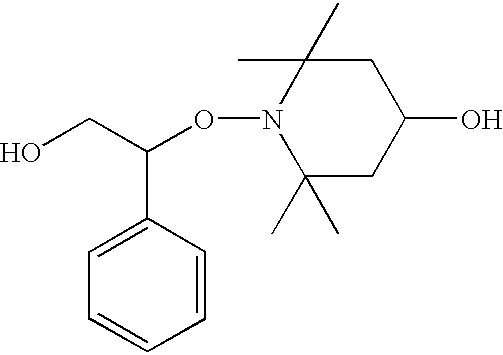
0.12 mol Fe(II)SO4. 7H2O (33.36 g) and 18.5 g NaHCO3 (0.24 mol) were added to a homogeneous solution of 1 mol styrene (104.14 g) and 0.1 mol 4-HO-TEMPO (4-hydroxy-2,2,6,6-tetramethylpiperidin-1-oxyl, 17.33 g) in 300 ml methanol in a 1 l two-necked flask under a nitrogen atmosphere and the mixture was heated to 40° C. with vigorous stirring. 50 ml 30% H2O2 solution in 50 ml methanol were slowly added dropwise to the red reaction solution in the course of 5 h.
After the red coloration had disappeared—indication of a complete conversion of 4-HO-TEMPO—the Fe(III) hydroxide formed and unreacted Fe(II)SO4. 7H2O and NaHCO3 were removed from the reaction mixture by filtration. The filtrate was freed from methanol on a rotary evaporator at RT. The product (HOSTOH) and styrene were separated from the aqueous phase by extraction with ether. The ethereal solution was dried over Na2SO4. The desiccant was filtered off and ether and styrene were stripped off on a rotary evaporator at 40° C. The difunctionalized alkoxyamine initiator is obtained in a yield of 95%.

0.04 mol Fe(II)SO4. 7H2O (11.1 g) and 6.7 g NaHCO3 (0.08 mol) were added to a homogeneous solution of 0.5 mol styrene (52.07 g) and 0.03 mol 4-acetylamido-TEMPO (4-acetylamido-2,2,6,6-tetramethylpiperidin-1-oxyl, 6.03 g) in 150 ml methanol in a 0.5 l two-necked flask under a nitrogen atmosphere and the mixture was heated to 40° C. with vigorous stirring. 20 ml 30% H2O2 solution in 20 ml methanol were slowly added dropwise to the red reaction solution in the course of 5 h.
After the red coloration had disappeared—indication of a complete conversion of 4-acetylamido-TEMPO—the Fe(III) hydroxide formed and unreacted Fe(II)SO4. 7H2O and NaHCO3 were removed from the reaction mixture by filtration. The filtrate was freed from methanol on a rotary evaporator at RT. The product (HOSTNHCOCH3) and styrene were separated from the aqueous phase by extraction with ether. The ethereal solution was dried over Na2SO4. The desiccant was filtered off and ether and styrene were stripped off on a rotary evaporator at 40° C. The monofunctionalized alkoxyamine initiator was obtained in a yield of 85%.

0.0018 mol HOSTNHCOCH3 (0.6 g) was added to a solution of 10 g KOH in 20 ml water and 20 ml ethylene glycol in a 200 ml Schlenk flask under a nitrogen atmosphere. The solution was heated at 100° C. for 12 h and thereafter extracted 5 times with 20 ml ether each time. The ethereal phase was washed twice with 30 ml of an aqueous HCl solution with a pH of 3. The product was now in the acid aqueous phase. 10 g KOH were added to this and it was extracted again with ether. The ethereal phase was dried over Na2SO4 and filtered, the ether was removed on a rotary evaporator and the product was dried under a high vacuum. The difunctionalized alkoxyamine initiator HOSTNH2 was obtained as a white solid in a yield of 59%.

0.12 mol Fe(II)SO4. 7H2O (33.36 g) and 18.5 g NaHCO3 (0.24 mol) were added to a homogeneous solution of 1 mol methyl acrylate (86.09 g) and 0.1 mol TEMPO (2,2,6,6-tetramethylpiperidin-1-oxyl, 15.6 g) in 300 ml methanol in a 1 l two-necked flask under a nitrogen atmosphere and the mixture was heated to 40° C. with vigorous stirring. 50 ml 30% H2O2 solution in 50 ml methanol were slowly added dropwise to the red reaction solution in the course of 5 h.
After the red coloration had disappeared—indication of a complete conversion of TEMPO—the Fe(III) hydroxide formed and unreacted Fe(II)SO4. 7H2O and NaHCO3 were removed from the reaction mixture by filtration. The filtrate was freed from methanol on a rotary evaporator at RT. The product (HOMAT) and methyl acrylate were separated from the aqueous phase by extraction with ether. The ethereal solution was dried over Na2SO4. The desiccant was filtered off and ether and methyl acrylate were stripped off on a rotary evaporator at 40° C. The difunctionalized alkoxyamine initiator was obtained in a yield of 76%.

0.12 mol Fe(II)SO4. 7H2O (33.36g) and 18.5 g NaHCO3 (0.12 mol) were added to a homogeneous solution of 1 mol methyl acrylate (86.09 g) and 0.1 mol 4-HO-TEMPO (4-hydroxy-2,2,6,6-tetramethylpiperidin-1-oxyl, 17.33 g) in 300 ml methanol in a 1 l two-necked flask under a nitrogen atmosphere and the mixture was heated to 40° C. with vigorous stirring. 50 ml 30% H2O2 solution in 50 ml methanol were slowly added dropwise to the red reaction solution in the course of 5 h.
After the red coloration had disappeared—indication of a complete conversion of 4-HO-TEMPO—the Fe(III) hydroxide formed and unreacted Fe(II)SO4. 7H2O and NaHCO3 were removed from the reaction mixture by filtration. The filtrate was freed from methanol on a rotary evaporator at RT. The product (HOMATOH) and methyl acrylate were separated from the aqueous phase by extraction with ether. The ethereal solution was dried over Na2SO4. The desiccant was filtered off and ether and methyl acrylate were stripped off on a rotary evaporator at 40° C. The difunctionalized alkoxyamine initiator was obtained in a yield of 60%.

0.06 mol Fe(II)SO4. 7H2O (16.68 g) and 9.25 g NaHCO3 (0.12 mol) were added to a homogeneous solution of 0.5 mol methyl methacrylate (50 g) and 0.05 mol TEMPO (2,2,6,6-tetramethylpiperidin-1-oxyl, 7.8 g) in 150 ml methanol in a 0.5 l two-necked flask with a magnet core under a nitrogen atmosphere and the mixture was heated to 40° C. with vigorous stirring. 25 ml 30% H2O2 solution in 25 ml methanol were slowly added dropwise to the red reaction solution in the course of 5 h.
After the red coloration had disappeared—indication of a complete conversion of TEMPO—the Fe(III) hydroxide formed and unreacted Fe(II)SO4. 7H2O and NaHCO3 were removed from the reaction mixture by filtration. The filtrate was freed from methanol on a rotary evaporator at RT. The product (HOMMAT) and methyl methacrylate were separated from the aqueous phase by extraction with ether. The ethereal solution was dried over Na2SO4. The desiccant was filtered off and ether and methyl methacrylate were stripped off on a rotary evaporator at 40° C. The monofunctionalized alkoxyamine initiator was obtained in a yield of 66%.

0.06 mol Fe(II)SO4. 7H2O (16.68 g) and 9.25 g NaHCO3 (0.12 mol) were added to a homogeneous solution of 0.5 mol methyl methacrylate (50 g) and 0.05 mol 4-HO-TEMPO (4-hydroxy-2,2,6,6-tetramethylpiperidin-1-oxyl, 8.66 g) in 150 ml methanol in a 0.5 l two-necked flask under a nitrogen atmosphere and the mixture was heated to 40° C. with vigorous stirring. 25 ml 30% H2O2 solution in 25 ml methanol were slowly added dropwise to the red reaction solution in the course of 5 h.
After the red coloration had disappeared—indication of a complete conversion of 4-HO-TEMPO—the Fe(III) hydroxide formed and unreacted Fe(II)SO4. 7H2O and NaHCO3 were removed from the reaction mixture by filtration. The filtrate was freed from methanol on a rotary evaporator at RT. The product (HOMMATOH) and methyl methacrylate were separated from the aqueous phase by extraction with ether. The ethereal solution was dried over Na2SO4. The desiccant was filtered off and ether and methyl methacrylate were stripped off on a rotary evaporator at 40° C. After recrystallization from methylene chloride, the difunctionalized alkoxyamine initiator HOMMATOH was obtained as colourless crystals (yield: 37%).
The products of examples 1 to 8 can optionally be purified further by reprecipitation or recrystallization.
Although the invention has been described in detail in the foregoing for the purpose of illustration, it is to be understood that such detail is solely for that purpose and that variations can be made therein by those skilled in the art without departing from the spirit and scope of the invention except as it may be limited by the claims.
Claims (11)
1. A process for the preparation of mono- and difunctional alkoxyamine initiators of the formula (I) 
wherein
R1, R2 and R3 are the same or different and represent H, C1-C20-(cyclo)alkyl, C6-C24-aryl, halogen, CN, C1-C20-(cyclo)alkyl ester or -amide or C6-C24-aryl ester or -amide, and
R4 and R5 are the same or different and represent aliphatic, cycloaliphatic or mixed aliphatic/aromatic radicals having 1 to 24 carbon atoms, which can also be part of a 4- to 8-membered ring,
wherein the carbon atom of the radicals R4 and R5 directly adjacent to the alkoxyamine nitrogen atom is in each case substituted by 3 further organic substituents (i.e. not hydrogen) or a double-bonded carbon, oxygen, sulfur or nitrogen atom and a further organic substituent (not hydrogen), and
wherein at least one of the radicals R4 and R5 can contain a functional group Y selected from the group consisting of hydroxy, primary amine, secondary amine and epoxide,
wherein
A) a monomer which can be polymerized by free radicals, of the formula (M)
is reacted with
B) a system, which produces free radicals, of
B1) a compound having a reducing action,
B2) a compound which can be split into one or more free radicals by the action of component B1,
B3) a cyclic or acyclic nitroxide of the formula (N)
in a solvent.
2. The process of claim 1 , wherein in formula (I) R1═H, R2═H or a C1-C20-(cyclo)alkyl radical and R3 is a linear or branched C1-C24-(cyclo)alkyloxocarbonyl radical or CN.
3. The process of claim 1 , wherein component A is selected from the group consisting of methyl acrylate, methyl methacrylate, butyl acrylate, butyl methacrylate, 2-ethylhexyl acrylate, cyclohexyl methacrylate, isobornyl methacrylate, maleic anhydride and styrene.
4. The process of claim 1 , wherein Fe2+, Ti3+ and Cu1+ in the form of their inorganic or organic salts are used as component B1.
5. The process of claim 1 , wherein component B2 is hydrogen peroxide.
6. The process of claim 1 , wherein component B3, nitroxides of one of the following formulae (III) to (VI) 
are employed, wherein:
R8, R9, R10 and R11 are the same or different and represent C1-C20-(cyclo)alkyl or C6-C24-aryl radicals or C7-C24-aliphatic/aromatic hydrocarbon radicals, which can additionally contain cyano groups, ether groups, amide groups or OH groups and can also be part of a ring structure, wherein X can also be CH2 or C═O,
Z can represent O or N—R12 and
R12, R15 and R16 are the same or different and represent H or a C1-C20-(cyclo)alkyl or C6-C24-aryl radical or a C7-C24-aliphatic/aromatic.
7. The process of claim 5 , wherein as component B3, nitroxides of the formula (VII) are employed 
wherein
R8, R9, R10 and R11 are the same or different and represent C1-C20-(cyclo)alkyl or C6-C24-aryl radicals or C7-C24-aliphatic/aromatic hydrocarbon radicals, which can additionally contain cyano groups, ether groups, amide groups or OH groups and can also be part of a ring structure,
R17 represents hydrogen or a functional group Y.
8. The process of claim 7 , wherein as component B3, nitroxides of the structural formula (VII) where R8═R9═R10═R11═CH3 and R17═H, OH or NH2 are employed.
9. Alkoxyamine initiators of the formula (II) 
wherein
R4 and R5 are the same or different and represent aliphatic, cycloaliphatic or mixed aliphatic/aromatic radicals having 1 to 24 carbon atoms, which can also be part of a 4- to 8-membered ring,
wherein the carbon atom of the radicals R4 and R5 directly adjacent to the alkoxyamine nitrogen atom is in each case substituted by 3 further organic substituents (i.e. not hydrogen) or a double-bonded carbon, oxygen, sulfur or nitrogen atom and a further organic substituent (not hydrogen), and
wherein at least one of the radicals R4 and R5 can contain a functional group Y selected from the group consisting of hydroxy, primary amine, secondary amine and epoxide,
R6 represents H or a C1-C20-(cyclo)alkyl radical and
R7 represents a linear or branched C1-C24-(cyclo)alkyloxocarbonyl radical (i.e. a (cyclo)aliphatic ester group) or CN.
10. Alkoxyamine initiators of the formula (IIb) 
wherein
R8, R9, R10 and R11 are the same or different and represent C1-C20-(cyclo)alkyl or C6-C24-aryl radicals or C7-C24-aliphatic/aromatic hydrocarbon radicals, which can additionally contain cyano groups, ether groups, amide groups or OH groups and can also be part of a ring structure,
R17 represents hydrogen or a group selected from the group consisting of hydroxy, primary, amine, secondary amine and epoxide
R18 is a (cyclo)aliphatic alkyl group having 1 to 20 carbon atoms and
R19 is H or CH3.
11. Alkoxyamine initiators according to claim 10 , wherein R8═R9═R10═R11═CH3, R17═H, OH, NH2 or NHR and R18═CH3 or C4H9 and R19═H or CH3.
Applications Claiming Priority (4)
| Application Number | Priority Date | Filing Date | Title |
|---|---|---|---|
| DE1999142614 DE19942614A1 (en) | 1999-09-07 | 1999-09-07 | Preparation of novel telechilic oligomers and polymers of molecular weight 500-10000, useful as structural units of plastics, adhesives etc., comprises radical polymerization of monomer, alkoxyamine initiator and functionalizing reagent |
| DE19942614 | 1999-09-07 | ||
| DE19942615 | 1999-09-07 | ||
| DE1999142615 DE19942615A1 (en) | 1999-09-07 | 1999-09-07 | Preparation of an alkoxyamine, useful for the synthesis of vinyl(co)polymers, comprises reaction of a polymerizable monomer with a reducing agent, hydrogen peroxide and a cyclic or acyclic nitroxide |
Publications (1)
| Publication Number | Publication Date |
|---|---|
| US6632895B1 true US6632895B1 (en) | 2003-10-14 |
Family
ID=26054862
Family Applications (3)
| Application Number | Title | Priority Date | Filing Date |
|---|---|---|---|
| US09/652,203 Expired - Fee Related US6632895B1 (en) | 1999-09-07 | 2000-08-31 | Functionalized alkoxyamine initiators |
| US09/652,075 Expired - Fee Related US6573346B1 (en) | 1999-07-07 | 2000-08-31 | Oligomeric and polymeric telechelics |
| US10/408,625 Expired - Fee Related US6800708B2 (en) | 1999-09-07 | 2003-04-07 | Oligomeric and polymeric telechelics |
Family Applications After (2)
| Application Number | Title | Priority Date | Filing Date |
|---|---|---|---|
| US09/652,075 Expired - Fee Related US6573346B1 (en) | 1999-07-07 | 2000-08-31 | Oligomeric and polymeric telechelics |
| US10/408,625 Expired - Fee Related US6800708B2 (en) | 1999-09-07 | 2003-04-07 | Oligomeric and polymeric telechelics |
Country Status (6)
| Country | Link |
|---|---|
| US (3) | US6632895B1 (en) |
| EP (2) | EP1083186B1 (en) |
| JP (2) | JP2001106713A (en) |
| CA (2) | CA2317321A1 (en) |
| DE (2) | DE50015539D1 (en) |
| ES (2) | ES2208197T3 (en) |
Cited By (6)
| Publication number | Priority date | Publication date | Assignee | Title |
|---|---|---|---|---|
| US20030125489A1 (en) * | 1998-07-31 | 2003-07-03 | Peter Nesvadba | Open chain alkoxyamine compounds and their use as polymerization regulators |
| US6919481B1 (en) * | 1998-07-22 | 2005-07-19 | Nof Corporation | Alkoxyamines containing a vinyl group, their applications and methods of their production |
| US20070132949A1 (en) * | 2005-12-14 | 2007-06-14 | Phelan John C | Method for preparing silicone hydrogels |
| US20080108755A1 (en) * | 2003-09-27 | 2008-05-08 | Ludger Heiliger | Microgel-containing composition |
| US20090062470A1 (en) * | 2007-08-31 | 2009-03-05 | Micron Technology, Inc. | Zwitterionic block copolymers and methods |
| US9000107B2 (en) | 2011-01-31 | 2015-04-07 | Bridgestone Corporation | Process for producing polydienes |
Families Citing this family (20)
| Publication number | Priority date | Publication date | Assignee | Title |
|---|---|---|---|---|
| GB0003326D0 (en) * | 1999-02-25 | 2000-04-05 | Ciba Sc Holding Ag | Hydroxy-Substituted N-Alkoxy hindered amines |
| US6392041B1 (en) | 1999-02-25 | 2002-05-21 | Ciba Specialty Chemicals Corporation | Hydroxy-substituted N-alkoxy hindered amines and compositions stabilized therewith |
| DE50015539D1 (en) * | 1999-09-07 | 2009-03-19 | Bayer Materialscience Ag | Oligomeric and polymeric telechelics |
| JP2001234117A (en) * | 2000-02-21 | 2001-08-28 | Arakawa Chem Ind Co Ltd | Coating material composition |
| EP1375457A1 (en) | 2002-06-25 | 2004-01-02 | Bayer Aktiengesellschaft | One-pot process for the preparation of functionalized alkoxyamines |
| EP1375476A1 (en) * | 2002-06-25 | 2004-01-02 | Bayer Aktiengesellschaft | A new process for the synthesis of alkoxyamines active in controlled radical polymerization |
| DE10344975A1 (en) * | 2003-09-27 | 2005-04-21 | Rhein Chemie Rheinau Gmbh | Microgels in non-crosslinkable organic media |
| DE10344976A1 (en) * | 2003-09-27 | 2005-04-21 | Rhein Chemie Rheinau Gmbh | Microgels in cross-linkable, organic media |
| WO2005118651A1 (en) * | 2004-05-27 | 2005-12-15 | Ciba Specialty Chemicals Holding Inc. | Alkoxyamines containing a radically polymerizable group |
| US20060079624A1 (en) * | 2004-10-08 | 2006-04-13 | Hildeberto Nava | Crosslinkable polymer systems |
| DE102004062551A1 (en) * | 2004-12-24 | 2006-07-06 | Rhein Chemie Rheinau Gmbh | Microgel-containing thermoset composition |
| US20060173142A1 (en) * | 2005-02-01 | 2006-08-03 | Hildeberto Nava | Functionalized thermosetting resin systems |
| DE102005014272A1 (en) | 2005-03-24 | 2006-09-28 | Rhein Chemie Rheinau Gmbh | Microgel and thickener containing compositions |
| DE102005014271A1 (en) * | 2005-03-24 | 2006-09-28 | Rhein Chemie Rheinau Gmbh | Microgels in combination with functional additives |
| DE102005014270A1 (en) * | 2005-03-24 | 2006-10-05 | Rhein Chemie Rheinau Gmbh | Use of cross-linked microgel as a rheological additive for the modification of the non-cross-linkable organic medium, at specific temperature |
| US7947782B2 (en) * | 2005-05-16 | 2011-05-24 | Rhein Chemie Rheinau Gmbh | Microgel-containing vulcanisable composition |
| DE102005059625A1 (en) | 2005-12-14 | 2007-06-21 | Lanxess Deutschland Gmbh | Microgel-containing vulcanizable composition based on hydrogenated nitrile rubber |
| DE102007020451A1 (en) * | 2007-04-27 | 2008-10-30 | Lanxess Deutschland Gmbh | Process for the preparation of rubber compounds |
| EP3502094A1 (en) | 2017-12-21 | 2019-06-26 | Covestro Deutschland AG | Method for the preparation of telechelic polymers polyols from trithiocarbonates |
| FR3096369B1 (en) * | 2019-05-24 | 2022-01-14 | Arkema France | Process for polymerizing a composition in the presence of block copolymer |
Citations (8)
| Publication number | Priority date | Publication date | Assignee | Title |
|---|---|---|---|---|
| US4581429A (en) | 1983-07-11 | 1986-04-08 | Commonwealth Scientific And Industrial Research Organization | Polymerization process and polymers produced thereby |
| US5322916A (en) | 1993-03-16 | 1994-06-21 | The Dow Chemical Company | Method for the preparation of amide oligomers and polybenzazole polymers therefrom |
| US5401804A (en) | 1992-11-16 | 1995-03-28 | Xerox Corporation | Polymerization process and toner compositions therefrom |
| US5412047A (en) | 1994-05-13 | 1995-05-02 | Xerox Corporation | Homoacrylate polymerization processes with oxonitroxides |
| US5449724A (en) | 1994-12-14 | 1995-09-12 | Xerox Corporation | Stable free radical polymerization process and thermoplastic materials produced therefrom |
| WO1995026987A1 (en) | 1994-04-04 | 1995-10-12 | Xerox Corporation | Aqueous polymerization processes |
| WO1997046593A1 (en) | 1996-06-04 | 1997-12-11 | Elf Atochem S.A. | Method for preparing telechelic 1,3-diene oligomers by the controlled free radical polymerization of 1,3-dienes in presence of a stable free radical |
| EP0911350A1 (en) | 1997-10-24 | 1999-04-28 | Elf Atochem S.A. | Fabrication process for copolymers of controlled architecture via the use of functional radical initiators in a living radical polymerisation, and initiator compositions and corresponding copolymers |
Family Cites Families (9)
| Publication number | Priority date | Publication date | Assignee | Title |
|---|---|---|---|---|
| DE4306537A1 (en) | 1993-03-03 | 1994-09-08 | Goldschmidt Ag Th | Polymethacrylic acid esters, the ester groups of which in the alpha and optionally additionally in the omega position differ from the ester groups in the chain |
| DE4314111A1 (en) * | 1993-04-29 | 1994-11-03 | Goldschmidt Ag Th | alpha, omega-polymethacrylate diols, process for their preparation and their use for the production of polymers, in particular polyurethanes and polyesters |
| US5627248A (en) * | 1995-09-26 | 1997-05-06 | The Dow Chemical Company | Difunctional living free radical polymerization initiators |
| AUPO460797A0 (en) * | 1997-01-15 | 1997-02-06 | University Of Melbourne, The | Polymerisation process |
| JP3701795B2 (en) * | 1997-07-28 | 2005-10-05 | 株式会社カネカ | Polymers and applications |
| US6121380A (en) * | 1997-11-06 | 2000-09-19 | Nitto Denko Corporation | Preparation of adhesive (CO) polymers from isocyanate chain extended narrow molecular weight distribution telechelic (CO) polymers made by pseudo living polymerization |
| JP2000281718A (en) * | 1999-01-28 | 2000-10-10 | Kanegafuchi Chem Ind Co Ltd | Polymer, method for producing the polymer, and curable composition using the polymer |
| US6472486B2 (en) * | 1999-03-09 | 2002-10-29 | Symyx Technologies, Inc. | Controlled stable free radical emulsion polymerization processes |
| DE50015539D1 (en) * | 1999-09-07 | 2009-03-19 | Bayer Materialscience Ag | Oligomeric and polymeric telechelics |
-
2000
- 2000-08-28 DE DE50015539T patent/DE50015539D1/en not_active Expired - Lifetime
- 2000-08-28 ES ES00118124T patent/ES2208197T3/en not_active Expired - Lifetime
- 2000-08-28 DE DE50004231T patent/DE50004231D1/en not_active Expired - Fee Related
- 2000-08-28 ES ES00118125T patent/ES2319252T3/en not_active Expired - Lifetime
- 2000-08-28 EP EP00118125A patent/EP1083186B1/en not_active Expired - Lifetime
- 2000-08-28 EP EP00118124A patent/EP1083169B1/en not_active Expired - Lifetime
- 2000-08-31 US US09/652,203 patent/US6632895B1/en not_active Expired - Fee Related
- 2000-08-31 US US09/652,075 patent/US6573346B1/en not_active Expired - Fee Related
- 2000-09-01 CA CA002317321A patent/CA2317321A1/en not_active Abandoned
- 2000-09-01 CA CA002317323A patent/CA2317323C/en not_active Expired - Fee Related
- 2000-09-07 JP JP2000271549A patent/JP2001106713A/en active Pending
- 2000-09-07 JP JP2000271541A patent/JP2001081117A/en active Pending
-
2003
- 2003-04-07 US US10/408,625 patent/US6800708B2/en not_active Expired - Fee Related
Patent Citations (9)
| Publication number | Priority date | Publication date | Assignee | Title |
|---|---|---|---|---|
| US4581429A (en) | 1983-07-11 | 1986-04-08 | Commonwealth Scientific And Industrial Research Organization | Polymerization process and polymers produced thereby |
| US5401804A (en) | 1992-11-16 | 1995-03-28 | Xerox Corporation | Polymerization process and toner compositions therefrom |
| US5549998A (en) | 1992-11-16 | 1996-08-27 | Xerox Corporation | Polymerization process and toner compositions therefrom |
| US5322916A (en) | 1993-03-16 | 1994-06-21 | The Dow Chemical Company | Method for the preparation of amide oligomers and polybenzazole polymers therefrom |
| WO1995026987A1 (en) | 1994-04-04 | 1995-10-12 | Xerox Corporation | Aqueous polymerization processes |
| US5412047A (en) | 1994-05-13 | 1995-05-02 | Xerox Corporation | Homoacrylate polymerization processes with oxonitroxides |
| US5449724A (en) | 1994-12-14 | 1995-09-12 | Xerox Corporation | Stable free radical polymerization process and thermoplastic materials produced therefrom |
| WO1997046593A1 (en) | 1996-06-04 | 1997-12-11 | Elf Atochem S.A. | Method for preparing telechelic 1,3-diene oligomers by the controlled free radical polymerization of 1,3-dienes in presence of a stable free radical |
| EP0911350A1 (en) | 1997-10-24 | 1999-04-28 | Elf Atochem S.A. | Fabrication process for copolymers of controlled architecture via the use of functional radical initiators in a living radical polymerisation, and initiator compositions and corresponding copolymers |
Non-Patent Citations (24)
Cited By (16)
| Publication number | Priority date | Publication date | Assignee | Title |
|---|---|---|---|---|
| US6919481B1 (en) * | 1998-07-22 | 2005-07-19 | Nof Corporation | Alkoxyamines containing a vinyl group, their applications and methods of their production |
| US20030125489A1 (en) * | 1998-07-31 | 2003-07-03 | Peter Nesvadba | Open chain alkoxyamine compounds and their use as polymerization regulators |
| US6841703B2 (en) * | 1998-07-31 | 2005-01-11 | Ciba Specialty Chemicals Corporation | Open chain alkoxyamine compounds and their use as polymerization regulators |
| US20080108755A1 (en) * | 2003-09-27 | 2008-05-08 | Ludger Heiliger | Microgel-containing composition |
| US20070132949A1 (en) * | 2005-12-14 | 2007-06-14 | Phelan John C | Method for preparing silicone hydrogels |
| US8501833B2 (en) | 2005-12-14 | 2013-08-06 | Novartis Ag | Method for preparing silicone hydrogels |
| US20100227944A1 (en) * | 2005-12-14 | 2010-09-09 | John Christopher Phelan | Method for preparing silicone hydrogels |
| US7744785B2 (en) | 2005-12-14 | 2010-06-29 | Novartis Ag | Method for preparing silicone hydrogels |
| US20100204402A1 (en) * | 2007-08-31 | 2010-08-12 | Micron Technology, Inc. | Zwitterionic Block Copolymers And Methods |
| US7732533B2 (en) | 2007-08-31 | 2010-06-08 | Micron Technology, Inc. | Zwitterionic block copolymers and methods |
| US7910660B2 (en) | 2007-08-31 | 2011-03-22 | Micron Technology, Inc. | Zwitterionic block copolymers and methods |
| US20110144275A1 (en) * | 2007-08-31 | 2011-06-16 | Micron Technology, Inc. | Zwitterionic Block Copolymers and Methods |
| US8022147B2 (en) | 2007-08-31 | 2011-09-20 | Micron Technology, Inc. | Zwitterionic block copolymers and methods |
| US8236899B2 (en) | 2007-08-31 | 2012-08-07 | Micron Technology, Inc. | Zwitterionic block copolymers and methods |
| US20090062470A1 (en) * | 2007-08-31 | 2009-03-05 | Micron Technology, Inc. | Zwitterionic block copolymers and methods |
| US9000107B2 (en) | 2011-01-31 | 2015-04-07 | Bridgestone Corporation | Process for producing polydienes |
Also Published As
| Publication number | Publication date |
|---|---|
| US20030208021A1 (en) | 2003-11-06 |
| US6573346B1 (en) | 2003-06-03 |
| DE50015539D1 (en) | 2009-03-19 |
| ES2319252T3 (en) | 2009-05-06 |
| US6800708B2 (en) | 2004-10-05 |
| EP1083169B1 (en) | 2003-10-29 |
| CA2317321A1 (en) | 2001-03-07 |
| JP2001081117A (en) | 2001-03-27 |
| DE50004231D1 (en) | 2003-12-04 |
| CA2317323C (en) | 2009-11-24 |
| JP2001106713A (en) | 2001-04-17 |
| EP1083186A1 (en) | 2001-03-14 |
| EP1083186B1 (en) | 2009-01-28 |
| EP1083169A1 (en) | 2001-03-14 |
| ES2208197T3 (en) | 2004-06-16 |
| CA2317323A1 (en) | 2001-03-07 |
Similar Documents
| Publication | Publication Date | Title |
|---|---|---|
| US6632895B1 (en) | Functionalized alkoxyamine initiators | |
| EP0869137B1 (en) | Controlled free radical polymerization process | |
| Matyjaszewski et al. | Simple and efficient synthesis of various alkoxyamines for stable free radical polymerization | |
| CN1823042B (en) | Hydrogen peroxide catalyzed method for preparing sterically hindered N-alkoxyamines | |
| KR19990077710A (en) | 1-Alkoxy-polyalkyl-piperidine derivatives and their use as polymerization regulators | |
| JP4705248B2 (en) | Method for producing alkoxyamine from nitroxide | |
| Harrisson et al. | Simple and efficient copper metal-mediated synthesis of alkoxyamine initiators | |
| Schulte et al. | New seven-and eight-membered cyclic alkoxyamines for the living free radical polymerization | |
| EP1397349B1 (en) | 4-imino-n-alkoxy or oxy-polyalkyl-piperidine compounds and their use as polymerization regulators | |
| Ananchenko et al. | Controlled/living radical polymerization of tert-butyl acrylate mediated by chiral nitroxides. A stereochemical study | |
| US6686424B2 (en) | Preparation of functionalized alkoxyamine initiator and its use | |
| Krause et al. | A novel method for the synthesis of alkoxyamine initiators for nitroxide-mediated radical polymerization using Mn (OAc) 3 as electron-transfer reagent | |
| US7411053B2 (en) | Ligand-functionalized/azo compounds and methods of use thereof | |
| JP3357462B2 (en) | Method for producing sterically hindered nitroxyl compound | |
| US6455645B1 (en) | Process for the production of telechelic polymers, telechelic polymers produced in this manner and use thereof | |
| US20040002606A1 (en) | Process for the synthesis for alkoxy amines and their use in controlled radical polymerization | |
| DE19942615A1 (en) | Preparation of an alkoxyamine, useful for the synthesis of vinyl(co)polymers, comprises reaction of a polymerizable monomer with a reducing agent, hydrogen peroxide and a cyclic or acyclic nitroxide | |
| US20080274074A1 (en) | Method for Controlled Free Radical Polymerization or Copolymerization of Methacrylic and/or Methacrylate Monomers or Exclusively Methacrylic and/or Methacrylate Copolymers | |
| KR100569753B1 (en) | Water-soluble dithioesters and method for polymerization thereof |
Legal Events
| Date | Code | Title | Description |
|---|---|---|---|
| AS | Assignment |
Owner name: BAYER AKTIENGESELLSCHAFT, GERMANY Free format text: ASSIGNMENT OF ASSIGNORS INTEREST;ASSIGNORS:MELCHIORS, MARTIN;HOCKER, HARTWIG;KEUL, HELMUT;AND OTHERS;REEL/FRAME:011408/0499;SIGNING DATES FROM 20000910 TO 20001010 |
|
| REMI | Maintenance fee reminder mailed | ||
| LAPS | Lapse for failure to pay maintenance fees | ||
| STCH | Information on status: patent discontinuation |
Free format text: PATENT EXPIRED DUE TO NONPAYMENT OF MAINTENANCE FEES UNDER 37 CFR 1.362 |
|
| FP | Lapsed due to failure to pay maintenance fee |
Effective date: 20071014 |