US6579904B1 - Process for making betaine transition metal complexes for use in animal feed supplements and compositions thereof - Google Patents

Process for making betaine transition metal complexes for use in animal feed supplements and compositions thereof Download PDF

Info

Publication number
US6579904B1
US6579904B1 US09/668,618 US66861800A US6579904B1 US 6579904 B1 US6579904 B1 US 6579904B1 US 66861800 A US66861800 A US 66861800A US 6579904 B1 US6579904 B1 US 6579904B1
Authority
US
United States
Prior art keywords
transition metal
betaine
solution including
complex
zinc
Prior art date
Legal status (The legal status is an assumption and is not a legal conclusion. Google has not performed a legal analysis and makes no representation as to the accuracy of the status listed.)
Expired - Lifetime, expires
Application number
US09/668,618
Inventor
Harvey B. Hopps
Gary Culp
Steven B. Malcolm
Ken W. Ridenour
Jay Thurman
Current Assignee (The listed assignees may be inaccurate. Google has not performed a legal analysis and makes no representation or warranty as to the accuracy of the list.)
KER Associates Inc
Original Assignee
KER Associates Inc
Priority date (The priority date is an assumption and is not a legal conclusion. Google has not performed a legal analysis and makes no representation as to the accuracy of the date listed.)
Filing date
Publication date
Application filed by KER Associates Inc filed Critical KER Associates Inc
Priority to US09/668,618 priority Critical patent/US6579904B1/en
Assigned to K.E.R. ASSOCIATES, INC. reassignment K.E.R. ASSOCIATES, INC. ASSIGNMENT OF ASSIGNORS INTEREST (SEE DOCUMENT FOR DETAILS). Assignors: THURMAN, JAY, RIDENOUR, KEN W., CULP, GARY, MALCOLM, STEVEN B.
Priority to ZA200107840A priority patent/ZA200107840B/en
Priority to AU75569/01A priority patent/AU778928B2/en
Application granted granted Critical
Publication of US6579904B1 publication Critical patent/US6579904B1/en
Adjusted expiration legal-status Critical
Expired - Lifetime legal-status Critical Current

Links

Classifications

    • CCHEMISTRY; METALLURGY
    • C07ORGANIC CHEMISTRY
    • C07FACYCLIC, CARBOCYCLIC OR HETEROCYCLIC COMPOUNDS CONTAINING ELEMENTS OTHER THAN CARBON, HYDROGEN, HALOGEN, OXYGEN, NITROGEN, SULFUR, SELENIUM OR TELLURIUM
    • C07F11/00Compounds containing elements of Groups 6 or 16 of the Periodic Table
    • C07F11/005Compounds containing elements of Groups 6 or 16 of the Periodic Table compounds without a metal-carbon linkage
    • AHUMAN NECESSITIES
    • A23FOODS OR FOODSTUFFS; TREATMENT THEREOF, NOT COVERED BY OTHER CLASSES
    • A23KFODDER
    • A23K20/00Accessory food factors for animal feeding-stuffs
    • A23K20/10Organic substances
    • A23K20/105Aliphatic or alicyclic compounds
    • AHUMAN NECESSITIES
    • A23FOODS OR FOODSTUFFS; TREATMENT THEREOF, NOT COVERED BY OTHER CLASSES
    • A23KFODDER
    • A23K20/00Accessory food factors for animal feeding-stuffs
    • A23K20/20Inorganic substances, e.g. oligoelements
    • A23K20/30Oligoelements
    • CCHEMISTRY; METALLURGY
    • C07ORGANIC CHEMISTRY
    • C07CACYCLIC OR CARBOCYCLIC COMPOUNDS
    • C07C227/00Preparation of compounds containing amino and carboxyl groups bound to the same carbon skeleton
    • C07C227/04Formation of amino groups in compounds containing carboxyl groups
    • C07C227/06Formation of amino groups in compounds containing carboxyl groups by addition or substitution reactions, without increasing the number of carbon atoms in the carbon skeleton of the acid
    • C07C227/08Formation of amino groups in compounds containing carboxyl groups by addition or substitution reactions, without increasing the number of carbon atoms in the carbon skeleton of the acid by reaction of ammonia or amines with acids containing functional groups
    • CCHEMISTRY; METALLURGY
    • C07ORGANIC CHEMISTRY
    • C07FACYCLIC, CARBOCYCLIC OR HETEROCYCLIC COMPOUNDS CONTAINING ELEMENTS OTHER THAN CARBON, HYDROGEN, HALOGEN, OXYGEN, NITROGEN, SULFUR, SELENIUM OR TELLURIUM
    • C07F1/00Compounds containing elements of Groups 1 or 11 of the Periodic Table
    • C07F1/005Compounds containing elements of Groups 1 or 11 of the Periodic Table without C-Metal linkages
    • CCHEMISTRY; METALLURGY
    • C07ORGANIC CHEMISTRY
    • C07FACYCLIC, CARBOCYCLIC OR HETEROCYCLIC COMPOUNDS CONTAINING ELEMENTS OTHER THAN CARBON, HYDROGEN, HALOGEN, OXYGEN, NITROGEN, SULFUR, SELENIUM OR TELLURIUM
    • C07F13/00Compounds containing elements of Groups 7 or 17 of the Periodic Table
    • C07F13/005Compounds without a metal-carbon linkage
    • CCHEMISTRY; METALLURGY
    • C07ORGANIC CHEMISTRY
    • C07FACYCLIC, CARBOCYCLIC OR HETEROCYCLIC COMPOUNDS CONTAINING ELEMENTS OTHER THAN CARBON, HYDROGEN, HALOGEN, OXYGEN, NITROGEN, SULFUR, SELENIUM OR TELLURIUM
    • C07F15/00Compounds containing elements of Groups 8, 9, 10 or 18 of the Periodic Table
    • C07F15/02Iron compounds
    • C07F15/025Iron compounds without a metal-carbon linkage
    • CCHEMISTRY; METALLURGY
    • C07ORGANIC CHEMISTRY
    • C07FACYCLIC, CARBOCYCLIC OR HETEROCYCLIC COMPOUNDS CONTAINING ELEMENTS OTHER THAN CARBON, HYDROGEN, HALOGEN, OXYGEN, NITROGEN, SULFUR, SELENIUM OR TELLURIUM
    • C07F15/00Compounds containing elements of Groups 8, 9, 10 or 18 of the Periodic Table
    • C07F15/06Cobalt compounds
    • C07F15/065Cobalt compounds without a metal-carbon linkage
    • CCHEMISTRY; METALLURGY
    • C07ORGANIC CHEMISTRY
    • C07FACYCLIC, CARBOCYCLIC OR HETEROCYCLIC COMPOUNDS CONTAINING ELEMENTS OTHER THAN CARBON, HYDROGEN, HALOGEN, OXYGEN, NITROGEN, SULFUR, SELENIUM OR TELLURIUM
    • C07F3/00Compounds containing elements of Groups 2 or 12 of the Periodic Table
    • C07F3/003Compounds containing elements of Groups 2 or 12 of the Periodic Table without C-Metal linkages

Definitions

  • the present invention relates to a method of making a betaine transition metal complex, and the use and compositions including the betaine transition metal complex as a feed supplement for animals.
  • Common agents administered to animals as feed supplements include antibiotics, vitamins, amino acids and trace minerals such as zinc, chromium, manganese, iron, cobalt and copper.
  • Betaine can potentially be beneficial to livestock if administered as a feed supplement.
  • Betaine can act as a methyl donor, a metabolic role that is typically performed by two other important nutrients: methionine and choline. By relieving these two nutrients of their methyl donating duties, betaine can spare methionine and choline to perform other important physiological functions, thus increasing growth in the animal.
  • Betaine also plays a role in osmotic regulation and stabilizes cellular metabolism. These functions help the animal adapt to environmental stress. Betaine has been explored as a feed additive for poultry and swine, but thus far has not been extensively studied for use in cattle.
  • a betaine food supplement must deliver the intended agent in a bio-available form. This is sometimes problematic. For example, bacteria in the rumen of cattle can degrade amino acid sources like lysine and methionine before the sources have time to pass from the rumen to the small intestine where they can be absorbed. Thus, the amino acids are not bio-available and therefore the animal does not reap the benefit of the supplement. Likewise, it is known that trace minerals in the form of inorganic salts are not readily absorbed in the gut of many animals. In natural food sources these minerals are usually present as coordination complexes.
  • EDTA ethylenediaminetetraacetate
  • One method of delivering bio-available trace minerals and amino acids to live stock is to form a complex of the amino acid and the trace mineral.
  • the essential amino acid methionine has been used to provide a bio-available amino acid-trace mineral complex supplement with trace minerals such as zinc, chromium, manganese, magnesium, copper, cobalt, and iron.
  • Betaine is typically prepared by the reaction of a haloalkanoate salt with excess trimethylamine.
  • a drawback to this process is that the product is often contaminated with unreacted starting materials, particularly trimethylamine, which is difficult to remove.
  • free betaine is not the most ideal form of betaine to use as a feed supplement, particularly if the intended recipient animal is a ruminant.
  • bacteria in the rumen can degrade betaine before it can be absorbed in the intestine. It would be highly desirable to have a synthetic method yielding betaine in a highly bio-available form and not requiring difficult purification of the product.
  • the present invention is generally directed to a method of making a betaine transition metal complex, and the use and compositions including the betaine transition metal complex as a feed supplement for animals.
  • the inventive method includes the steps of: a) reacting a solution including an alkali metal salt of chloroacetic acid with a solution including the transition metal salt to give a solution including a chloroacetate transition metal complex; and b) reacting the solution including the chloroacetate transition metal complex with trimethylamine to give a solution including the betaine transition metal complex.
  • the inventive method may be carried out such that reacting chloroacetic acid with a neutralizing amount of alkali metal hydroxide to give the alkali metal salt of chloroacetic acid generates the alkali metal salt of chloroacetic acid.
  • the transition metal salt is selected from zinc salts, copper salts, iron salts, chromium salts, manganese salts, cobalt salts, their hydrates and mixtures of these salts, and in a more preferred method the transition metal salt is selected from zinc halide salts, zinc sulfate salts, zinc nitrate salts, copper halide, copper sulfate copper nitrate, iron halide, iron sulfate, iron nitrate, chromium halide, chromium sulfate, chromium nitrate, manganese halide, manganese sulfate, manganese nitrate, cobalt halide, cobalt sulfate, cobalt nitrate, the hydrates of these salts and the mixture of these salts.
  • the transition metal salt is a zinc salt, and preferably the zinc salt is selected from zinc chloride, zinc bromide, zinc sulfate, zinc nitrate, their hydrates and combinations of these.
  • the reactions of the method may take place in any suitable solvent, but preferably the reactions take place in an aqueous solvent.
  • the inventive method may further include the step of stripping any excess trimethylamine from the solution including the betaine transition metal complex.
  • the isolation of the betaine transition metal complex may also be included as a step within the inventive method in which case the process would include the step of isolating the betaine transition metal complex by precipitation or evaporative reduction of the solution including the betaine transition metal complex.
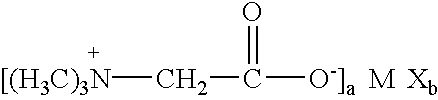
  • the product of the inventive method is a betaine transition metal betaine complex salt having the formula
  • a is a value between 1 and 6; M is a transition metal ion selected from zinc, copper, iron, chromium, manganese, cobalt and mixtures thereof; X is a counter ion and b is a whole integer selected to electrostatically balance the charge of the complex salt.
  • the counter ion X is selected from halide, sulfate, nitrate and mixtures thereof.
  • transition metal ion may be selected from zinc (II), copper (II), copper (I), iron (II), iron (III), cobalt (II), cobalt (III), chromium (II), chromium (III), manganese (II) manganese (III), and mixtures of these.
  • the transition metal ion M is zinc and the counter ion X is a halide, sulfate or other similar suitable counter ion.
  • the value of a may have a value from 1 upto and including 6, but preferably the value of a is 2 to 4.
  • trace metal feed supplement comprising an effective amount of the transition metal betaine complex that is preferably the product of the above described process.
  • the illustrative trace metal feed supplement may be delivered as a solution, preferably an aqueous solution, or it may be delivered in solid form.
  • the solid form may include a carrier such as animal feed, rice hulls, or other suitable carrier for feed supplements.
  • the present invention also includes other related aspects such as a method for providing the above described trace metal-betaine feed supplement to an animal.
  • a method for providing the above described trace metal-betaine feed supplement includes the steps: a) mixing a suitable animal feed mixture with an effective amount of a trace metal betaine complex, and b) providing said supplemented feed mixture to the animal for consumption by the animal.
  • An additional aspect of the present invention is the animal feed composition itself which includes: an effective amount of a trace metal betaine described herein and a suitable animal feed mixture for said animal.
  • the present invention also should be understood to include a method of making an animal feed composition including mixing an effective amount of a trace metal betaine complex salt with a suitable animal feed mixture for said animal to form said animal feed mixture.
  • a betaine transition metal complex is made by: a) reacting a solution of an alkali metal salt of chloroacetic acid with a solution including the transition metal salt to give a solution including a chloroacetate transition metal complex; and b) reacting the solution including the chloroacetate transition metal complex with trimethylamine to give a solution including the betaine transition metal complex.
  • the first step in the synthesis of the transition metal betaine complexes disclosed herein is the dissolution of chloroacetic acid in an appropriate solvent.
  • suitable solvents include water, methanol, ethanol, diethyl ether, ethyl acetate, tetrahydrofuran and other polar solvents.
  • a particularly suitable solvent is water.
  • the pH of the solution should be raised to deprotonate the chloroacetic acid to form chloroacetate ion in solution.
  • the resulting pH of the solution may preferably be from about 3.0 to about 13.0, more preferably from about 5.0 to about 10.0 and most preferably from about 7.8 to about 9.0.
  • the pH of the solution should be raised by the addition of a neutralizing amount of a basic solution.
  • Suitable bases include hydroxides of alkali metals, rare earth metals, ammonia and quaternary amines, protonated tertiary amines and other compounds that may neutralize chloroacetic acid. Particularly suitable bases are sodium hydroxide and potassium hydroxide.
  • the temperature of the solution should be maintained between the freezing point and up to and including the boiling point of the solution at ambient pressure. Preferably the temperature of the solution may be maintained below the boiling point of the solution, and most preferably the solution is maintained at or about that of the ambient room temperature. A solution of the metal salt may then be added to the solution of the chloroacetate although the order of addition is not critical. However, one of skill in the art of forming transition metal complexes should understand and appreciate that it is preferable to add the transition metal to the solution containing the complexing agent as opposed to the opposite.
  • the metal salt may be a transition metal of the first row. More preferably the transition metal is one or more selected from zinc salts, copper salts, iron salts, chromium salts, manganese salts, cobalt salts, their hydrates and mixtures of these salts.
  • the selection of the transition metal may have differing effects on the nutritional aspects of the present invention.
  • the transition metal salt is selected from zinc halide salts, zinc sulfate salts, zinc nitrate salts, copper halide, copper sulfate copper nitrate, iron halide, iron sulfate, iron nitrate, chromium halide, chromium sulfate, chromium nitrate, manganese halide, manganese sulfate, manganese nitrate, cobalt halide, cobalt sulfate, cobalt nitrate, the hydrates of these salts and the mixture of these salts.
  • the transition metal salt is a zinc salt, and preferably the zinc salt is selected from zinc chloride, zinc bromide, zinc sulfate, zinc nitrate, their hydrates and combinations of these.
  • trimethylamine may be then added to the solution of chloroacetate-metal complex to yield the betaine-metal complex.
  • Trimethylamine can be added as a solution of trimethylamine in an appropriate solvent, or alternatively, it may be added as a gas.
  • the amount added should be sufficient to react with the chloroacetate metal complex to form the betaine complex.
  • the amount of trimethylamine added is a slight molar excess of the chloroacetate content transition metal complex.
  • trimethylamine is added as an aqueous solution that is about 25% in trimethylamine.
  • the resulting solution is stirred for a time ranging from 0.5 to about 24 hours so as to allow the reaction to come to a point of completion.
  • the reaction mixture is stirred for about 5 minutes to about 90 minutes and more preferably from about 15 minutes to about 30 minutes.
  • Excess trimethylamine is then removed from the reaction mixture by sparging with an inert gas such as nitrogen, distillation, extraction or other suitable method. According to one embodiment of the present invention, excess trimethylamine is removed from the reacting mixture by distillation.
  • Another preferred method of isolating the betaine-transition metal complex includes the evaporative reduction of the solution, which results in the precipitation and isolation of the betaine transition metal complex.
  • the present invention is directed to the product of the above-described method. That is to say, the present invention also encompasses transition metal complexes of betaine.
  • Such a metal complex should have the general formula:
  • a is a value between 1 and 6 and M is a transition metal ion selected from the first row transition metals and preferably zinc, copper, iron, chromium, manganese cobalt and mixtures thereof.
  • X serves as a counter ion and b is a whole integer selected to electrostatically balance the charge of the complex salt.
  • the counter ion X may be selected from any suitable counter ion, but preferably may be selected from halide, sulfate, nitrate and mixtures thereof.
  • the transition metal ion may be selected from zinc (II), copper (II), copper (I), iron (II), iron (III), cobalt (II), cobalt (III), chromium (II), chromium (III), manganese (II) manganese (III), and mixtures of these.
  • the transition metal ion M is zinc and the counter ion X is a halide, sulfate or other similar suitable counter ion.
  • the value of a may have a nominal value from 1 upto and including 6, but preferably the value of a is 2 to 4.
  • a trace metal feed supplement comprising an effective amount of the transition metal betaine complex that is preferably the product of the above described process.
  • the illustrative trace metal feed supplement may be delivered as a solution, preferably an aqueous solution, or it may be delivered in solid form.
  • the solid form may be made by the combination of the transition metal betaine complex with a suitable carrier.
  • suitable carriers may include a suitable animal feed for the target animal, rice hulls, cracked grains such as cracked corn, cracked wheat, cracked barley and the like or other suitable carrier for feed supplements.
  • Also within the scope of the present invention is a method of enhancing the growth of animals by supplementing the animal feed with the transition metal betaine complexes of the present invention.
  • an effective amount of the transition metal betaine complexes of the present invention are fed to animals in order to enhance growth and market value.
  • the transition metal betaine complex is mixed, sprayed, or otherwise included in the feed provided to the animal in preparation of the animal for market.
  • One of ordinary skill in the art of animal husbandry should be able by empirical methods to determine the optimum amount of betaine transition metal complex that should be added to the feed to achieve the desired results.
  • transition metal betaine complexes of the present invention may be sprayed onto the feed or a suitable carrier may be used to enhance the ability to handle and mix the feed.
  • suitable carriers may include rice hulls, cracked grains such as cracked corn, cracked wheat, cracked barley and the like or other suitable carriers for feed supplements.
  • Chloroacetic acid (0.01 mol.) was dissolved into distilled water (250 ml). Sodium hydroxide (0.25 M) was added until the pH of the solution reached 8.4, thus yielding the sodium salt of chloroacetic acid (sodium chloroacetate) in situ. An aqueous solution of zinc chloride was added dropwise until 0.01 moles had been added, thus yielding the metal-chloroacetate compound in situ. Trimethylamine solution (25%, aqueous) was added until a total of 0.01 moles had been added. The solution was allowed to stir for about 15 to about 30 minutes at 25° C., thus yielding a betaine-metal complex as the final product.
  • Chloroacetic acid (0.01 mol.) was dissolved into distilled water (250 ml). Sodium hydroxide (0.25 M) was added until the pH of the solution reached 8.4, thus yielding the sodium salt of chloroacetic acid (sodium chloroacetate) in situ. An aqueous solution of copper sulfate was added dropwise until 0.01 moles had been added, thus yielding the metal-chloroacetate compound in situ. Trimethylamine solution (25%, aqueous) was added until a total of 0.01 moles had been added. The solution was allowed to stir for about 15 to about 30 minutes at 25° C., thus yielding a betaine-metal complex as the final product.
  • one illustrative embodiment of the present invention includes a method of making a betaine transition metal complex.
  • Such an illustrative method may include the steps of: a) reacting a solution including an alkali metal salt of chloroacetic acid with a solution including the transition metal salt to give a solution including a chloroacetate transition metal complex; and b) reacting the solution including the chloroacetate transition metal complex with trimethylamine to give a solution including the betaine transition metal complex.
  • the illustrative method may be carried out such that reacting chloroacetic acid with a neutralizing amount of alkali metal hydroxide to give the alkali metal salt of chloroacetic acid generates the alkali metal salt of chloroacetic acid.
  • the transition metal salt is selected from zinc salts, copper salts, iron salts, chromium salts, manganese salts, cobalt salts, their hydrates and mixtures of these salts, and in a more preferred illustrative method the transition metal salt is selected from zinc halide salts, zinc sulfate salts, zinc nitrate salts, copper halide, copper sulfate copper nitrate, iron halide, iron sulfate, iron nitrate, chromium halide, chromium sulfate, chromium nitrate, manganese halide, manganese sulfate, manganese nitrate, cobalt halide, cobalt sulfate, cobalt nitrate, the hydrates of these salts and the mixture of these salts.
  • the transition metal salt is a zinc salt, and preferably the zinc salt is selected from zinc chloride, zinc bromide, zinc sulfate, zinc nitrate, their hydrates and combinations of these.
  • the reactions of the present illustrative method may take place in any suitable solvent, but preferably the reactions take place in an aqueous solvent.
  • the illustrative method may further include the step of stripping any excess trimethylamine from the solution including the betaine transition metal complex.
  • the isolation of the betaine transition metal complex may also be included as a step in the illustrative embodiment in which case the process would include the step of isolating the betaine transition metal complex by precipitation or evaporative reduction of the solution including the betaine transition metal complex.
  • the product of the illustrative method is a betaine transition metal complex having the general formula
  • a is a whole number from 1upto and including 6; M is a transition metal ion selected from zinc, copper, iron, chromium, manganese cobalt and mixtures thereof; X is a counter ion and b is a whole integer selected to electrostatically balance the charge of the complex salt.
  • the transition metal ion M is zinc and the counter ion X is a halide, sulfate or other similar suitable counter ion.
  • the value of a may have a value from 1 upto and including 6, but preferably the value of a is 2 to 4.
  • a is a value between 1 and 6; M is a transition metal ion selected from zinc, copper, iron, chromium, manganese cobalt and mixtures thereof; X is a counter ion and b is a whole integer selected to electrostatically balance the charge of the complex salt.
  • the counter ion X is selected from halide, sulfate, nitrate and mixtures thereof
  • the transition metal ion may be selected from zinc (II), copper (II), copper (I), iron (II), iron (III), cobalt (II), cobalt (III), chromium (II), chromium (III), manganese (II) manganese (III), and mixtures of these.
  • the transition metal ion M is zinc and the counter ion X is a halide, sulfate or other similar suitable counter ion.
  • the value of a may have a value from 1 upto and including 6, but preferably the value of a is 2 to 4.
  • the illustrative transition metal-betaine complex is preferably the product of the process including the steps: a) reacting a solution including an alkali metal salt of chloroacetic acid with a solution including the transition metal salt to give a solution including a chloroacetate transition metal complex; and b) reacting the solution including the chloroacetate transition metal complex with trimethylamine to give a solution including the betaine transition metal complex.
  • the method may further include the step of stripping any excess trimethylamine from the solution including the betaine transition metal complex.
  • the isolation of the betaine transition metal complex may also be included as a step in which case the process would include the step of isolating the betaine transition metal complex by precipitation or evaporative reduction of the solution including the betaine transition metal complex.
  • a is a value between 1 and 6; M is a transition metal ion selected from zinc, copper, iron, chromium, manganese cobalt and mixtures thereof; X is a counter ion and b is a whole integer selected to electrostatically balance the charge of the complex salt.
  • the counter ion X is selected from halide, sulfate, nitrate and mixtures thereof.
  • transition metal ion may be selected from zinc (II), copper (II), copper (I), iron (II), iron (III), cobalt (II), cobalt (III), chromium (II), chromium (III), manganese (II) manganese (III), and mixtures of these.
  • the transition metal ion M is zinc and the counter ion X is a halide, sulfate or other similar suitable counter ion.
  • the value of a may have a value from 1 upto and including 6, but preferably the value of a is 2 to 4.
  • the transition metal-betaine complex is preferably the product of the process including the steps: a) reacting a solution including an alkali metal salt of chloroacetic acid with a solution including the transition metal salt to give a solution including a chloroacetate transition metal complex; and b) reacting the solution including the chloroacetate transition metal complex with trimethylamine to give a solution including the betaine transition metal complex.
  • the method may further include the step of stripping any excess trimethylamine from the solution including the betaine transition metal complex.
  • the isolation of the betaine transition metal complex may also be included as a step in which case the process would include the step of isolating the betaine transition metal complex by precipitation or evaporative reduction of the solution including the betaine transition metal complex.
  • the illustrative trace metal feed supplement may be delivered as a solution, preferably an aqueous solution, or it may be delivered in solid form.
  • the solid form may include a carrier such as animal feed, rice hulls, or other suitable carrier for feed supplements.
  • the present invention also includes a method for providing a trace metal-betaine feed supplement to an animal.
  • a method for providing a trace metal-betaine feed supplement includes the steps: a) mixing a suitable animal feed mixture with an effective amount of a trace metal betaine complex, and b) providing said supplemented feed mixture to the animal for consumption by the animal. It is preferred within such illustrative method that the trace metal-betaine complexes have the general formula
  • a is a whole number between 1 and 6; M is a transition metal ion selected from zinc, copper, iron, chromium, manganese cobalt and mixtures thereof; X is a counter ion and b is a whole integer selected to electrostatically balance the charge of the complex salt.
  • the counter ion X is selected from halide, sulfate, nitrate and mixtures thereof.
  • transition metal ion may be selected from zinc (II), copper (II), copper (I), iron (II), iron (III), cobalt (II), cobalt (III), chromium (II), chromium (III), manganese (II) manganese (III), and mixtures of these.
  • the transition metal ion M is zinc and the counter ion X is a halide, sulfate or other similar suitable counter ion.
  • the value of a may have a value from 1 upto and including 6, but preferably the value of a is 2 to 4.
  • the trace metal-betaine complex is the product of the process including the steps: a) reacting a solution including an alkali metal salt of chloroacetic acid with a solution including the transition metal salt to give a solution including a chloroacetate transition metal complex; and b) reacting the solution including the chloroacetate transition metal complex with trimethylamine to give a solution including the betaine transition metal complex.
  • the method may further include the step of stripping any excess trimethylamine from the solution including the betaine transition metal complex.
  • the isolation of the betaine transition metal complex may also be included as a step in which case the process would include the step of isolating the betaine transition metal complex by precipitation or evaporative reduction of the solution including the betaine transition metal complex.
  • a further illustrative aspect of the present invention is an animal feed composition that includes: an effective amount of a trace metal betaine complex salt having the formula
  • a is a whole number between 1 and 6;
  • M is a transition metal ion selected from zinc, copper, iron, chromium, manganese cobalt and mixtures thereof;
  • X is a counter ion and b is a whole integer selected to electrostatically balance the charge of the complex salt, and a suitable animal feed mixture for said animal.
  • the transition metal ion is selected from zinc (II), copper (II), copper (I), iron (II), iron (III), cobalt (II), cobalt (III), chromium (II), chromium (III), manganese (II) manganese (III), and mixtures of these and the counter ion X is selected from halide, sulfate, nitrate and mixtures thereof.
  • the trace metal-betaine complex salt is the product of the process including the steps: a) reacting a solution including an alkali metal salt of chloroacetic acid with a solution including the transition metal salt to give a solution including a chloroacetate transition metal complex; and b) reacting the solution including the chloroacetate transition metal complex with trimethylamine to give a solution including the betaine transition metal complex.
  • the process utilized to make the trace metal betaine complex may further include the step of stripping any excess trimethylamine from the solution including the betaine transition metal complex.
  • the isolation of the betaine transition metal complex may also be included as a step in which case the process would include the step of isolating the betaine transition metal complex by precipitation or evaporative reduction of the solution including the betaine transition metal complex.
  • the present invention also should be understood to include a method of making animal feed composition.
  • Such a method may include the step of mixing an effective amount of a trace metal betaine complex salt having the formula
  • a is a whole number between 1 and 6; M is a transition metal ion selected from zinc, copper, iron, chromium, manganese cobalt and mixtures thereof; X is a counter ion and b is a whole integer selected to electrostatically balance the charge of the complex salt, with a suitable animal feed mixture for said animal to form said animal feed mixture.
  • the transition metal ion is selected from zinc (II), copper (II), copper (I), iron (II), iron (III), cobalt (II), cobalt (III), chromium (II), chromium (III), manganese (II) manganese (III), and mixtures of these and the counter ion X is selected from halide, sulfate, nitrate and mixtures thereof.
  • the trace metal-betaine complex salt is the product of the process including the steps of: a) reacting a solution including an alkali metal salt of chloroacetic acid with a solution including the transition metal salt to give a solution including a chloroacetate transition metal complex; and b) reacting the solution including the chloroacetate transition metal complex with trimethylamine to give a solution including the betaine transition metal complex.
  • the process utilized to make the trace metal betaine complex may further include the step of stripping any excess trimethylamine from the solution including the betaine transition metal complex.
  • the isolation of the betaine transition metal complex may also be included as a step in which case the process would include the step of isolating the betaine transition metal complex by precipitation or evaporative reduction of the solution including the betaine transition metal complex.

Landscapes

  • Chemical & Material Sciences (AREA)
  • Organic Chemistry (AREA)
  • Life Sciences & Earth Sciences (AREA)
  • Polymers & Plastics (AREA)
  • Chemical Kinetics & Catalysis (AREA)
  • Animal Husbandry (AREA)
  • Zoology (AREA)
  • Engineering & Computer Science (AREA)
  • Food Science & Technology (AREA)
  • Inorganic Chemistry (AREA)
  • Fodder In General (AREA)

Abstract

Betaine transition metal complexes are formed by: a) reacting a solution including an alkali metal salt of chloroacetic acid with a solution including the transition metal salt to give a solution including a chloroacetate transition metal complex; and b) reacting the solution including the chloroacetate transition metal complex with trimethylamine to give a solution including the betaine transition metal complex. Such betaine transition metal complexes may be used as a feed supplement for animals in the process of preparing such animals for market.

Description

BACKGROUND OF THE INVENTION
The present invention relates to a method of making a betaine transition metal complex, and the use and compositions including the betaine transition metal complex as a feed supplement for animals.
Due to efforts to supply food to a growing population of consumers, it has become common practice to supplement the feed of livestock and poultry with additives to stimulate growth, retard disease, and to achieve other such desirable results. Common agents administered to animals as feed supplements include antibiotics, vitamins, amino acids and trace minerals such as zinc, chromium, manganese, iron, cobalt and copper.
Betaine can potentially be beneficial to livestock if administered as a feed supplement. Betaine can act as a methyl donor, a metabolic role that is typically performed by two other important nutrients: methionine and choline. By relieving these two nutrients of their methyl donating duties, betaine can spare methionine and choline to perform other important physiological functions, thus increasing growth in the animal. Betaine also plays a role in osmotic regulation and stabilizes cellular metabolism. These functions help the animal adapt to environmental stress. Betaine has been explored as a feed additive for poultry and swine, but thus far has not been extensively studied for use in cattle.
One consideration in designing a betaine food supplement is bio-availability. To be effective, a food supplement must deliver the intended agent in a bio-available form. This is sometimes problematic. For example, bacteria in the rumen of cattle can degrade amino acid sources like lysine and methionine before the sources have time to pass from the rumen to the small intestine where they can be absorbed. Thus, the amino acids are not bio-available and therefore the animal does not reap the benefit of the supplement. Likewise, it is known that trace minerals in the form of inorganic salts are not readily absorbed in the gut of many animals. In natural food sources these minerals are usually present as coordination complexes. However, simply complexing the minerals with complexing agents such as ethylenediaminetetraacetate (EDTA) does not solve the problem because the complexes are so stable that they are readily excreted rather than absorbed. To be bio-available, a complex must have an intermediate stability so that it can withstand the conditions of the gastrointestinal tract and can also be absorbed by the animal.
One method of delivering bio-available trace minerals and amino acids to live stock is to form a complex of the amino acid and the trace mineral. For example, the essential amino acid methionine has been used to provide a bio-available amino acid-trace mineral complex supplement with trace minerals such as zinc, chromium, manganese, magnesium, copper, cobalt, and iron.
Another consideration in developing a betaine food supplement is its synthesis. Betaine is typically prepared by the reaction of a haloalkanoate salt with excess trimethylamine. A drawback to this process is that the product is often contaminated with unreacted starting materials, particularly trimethylamine, which is difficult to remove.
Furthermore, free betaine is not the most ideal form of betaine to use as a feed supplement, particularly if the intended recipient animal is a ruminant. As with lysine and methionine mentioned above, bacteria in the rumen can degrade betaine before it can be absorbed in the intestine. It would be highly desirable to have a synthetic method yielding betaine in a highly bio-available form and not requiring difficult purification of the product.
SUMMARY OF THE INVENTION
The present invention is generally directed to a method of making a betaine transition metal complex, and the use and compositions including the betaine transition metal complex as a feed supplement for animals. The inventive method includes the steps of: a) reacting a solution including an alkali metal salt of chloroacetic acid with a solution including the transition metal salt to give a solution including a chloroacetate transition metal complex; and b) reacting the solution including the chloroacetate transition metal complex with trimethylamine to give a solution including the betaine transition metal complex. The inventive method may be carried out such that reacting chloroacetic acid with a neutralizing amount of alkali metal hydroxide to give the alkali metal salt of chloroacetic acid generates the alkali metal salt of chloroacetic acid. In one preferred embodiment of the inventive method, the transition metal salt is selected from zinc salts, copper salts, iron salts, chromium salts, manganese salts, cobalt salts, their hydrates and mixtures of these salts, and in a more preferred method the transition metal salt is selected from zinc halide salts, zinc sulfate salts, zinc nitrate salts, copper halide, copper sulfate copper nitrate, iron halide, iron sulfate, iron nitrate, chromium halide, chromium sulfate, chromium nitrate, manganese halide, manganese sulfate, manganese nitrate, cobalt halide, cobalt sulfate, cobalt nitrate, the hydrates of these salts and the mixture of these salts. In another embodiment, the transition metal salt is a zinc salt, and preferably the zinc salt is selected from zinc chloride, zinc bromide, zinc sulfate, zinc nitrate, their hydrates and combinations of these. The reactions of the method may take place in any suitable solvent, but preferably the reactions take place in an aqueous solvent. The inventive method may further include the step of stripping any excess trimethylamine from the solution including the betaine transition metal complex. The isolation of the betaine transition metal complex may also be included as a step within the inventive method in which case the process would include the step of isolating the betaine transition metal complex by precipitation or evaporative reduction of the solution including the betaine transition metal complex.
The product of the inventive method is a betaine transition metal betaine complex salt having the formula
Figure US06579904-20030617-C00001
wherein a is a value between 1 and 6; M is a transition metal ion selected from zinc, copper, iron, chromium, manganese, cobalt and mixtures thereof; X is a counter ion and b is a whole integer selected to electrostatically balance the charge of the complex salt. Within such an illustrative embodiment, it is preferred that the counter ion X is selected from halide, sulfate, nitrate and mixtures thereof. Further the transition metal ion may be selected from zinc (II), copper (II), copper (I), iron (II), iron (III), cobalt (II), cobalt (III), chromium (II), chromium (III), manganese (II) manganese (III), and mixtures of these. Preferably the transition metal ion M is zinc and the counter ion X is a halide, sulfate or other similar suitable counter ion. As indicated the value of a may have a value from 1 upto and including 6, but preferably the value of a is 2 to 4.
Another embodiment of the present invention is a trace metal feed supplement comprising an effective amount of the transition metal betaine complex that is preferably the product of the above described process. The illustrative trace metal feed supplement may be delivered as a solution, preferably an aqueous solution, or it may be delivered in solid form. The solid form may include a carrier such as animal feed, rice hulls, or other suitable carrier for feed supplements.
One of skill in the art should also appreciate that the present invention also includes other related aspects such as a method for providing the above described trace metal-betaine feed supplement to an animal. Such a method includes the steps: a) mixing a suitable animal feed mixture with an effective amount of a trace metal betaine complex, and b) providing said supplemented feed mixture to the animal for consumption by the animal. An additional aspect of the present invention is the animal feed composition itself which includes: an effective amount of a trace metal betaine described herein and a suitable animal feed mixture for said animal. The present invention also should be understood to include a method of making an animal feed composition including mixing an effective amount of a trace metal betaine complex salt with a suitable animal feed mixture for said animal to form said animal feed mixture.
These and other features of the present invention are more fully set forth in the following description of illustrative embodiments of the invention.
DESCRIPTION OF ILLUSTRATIVE EMBODIMENTS
According to one aspect of the present invention, a betaine transition metal complex is made by: a) reacting a solution of an alkali metal salt of chloroacetic acid with a solution including the transition metal salt to give a solution including a chloroacetate transition metal complex; and b) reacting the solution including the chloroacetate transition metal complex with trimethylamine to give a solution including the betaine transition metal complex.
In accordance with the teachings of the present invention, the first step in the synthesis of the transition metal betaine complexes disclosed herein is the dissolution of chloroacetic acid in an appropriate solvent. Suitable solvents include water, methanol, ethanol, diethyl ether, ethyl acetate, tetrahydrofuran and other polar solvents. A particularly suitable solvent is water. The pH of the solution should be raised to deprotonate the chloroacetic acid to form chloroacetate ion in solution. The resulting pH of the solution may preferably be from about 3.0 to about 13.0, more preferably from about 5.0 to about 10.0 and most preferably from about 7.8 to about 9.0. The pH of the solution should be raised by the addition of a neutralizing amount of a basic solution. Suitable bases include hydroxides of alkali metals, rare earth metals, ammonia and quaternary amines, protonated tertiary amines and other compounds that may neutralize chloroacetic acid. Particularly suitable bases are sodium hydroxide and potassium hydroxide. The temperature of the solution should be maintained between the freezing point and up to and including the boiling point of the solution at ambient pressure. Preferably the temperature of the solution may be maintained below the boiling point of the solution, and most preferably the solution is maintained at or about that of the ambient room temperature. A solution of the metal salt may then be added to the solution of the chloroacetate although the order of addition is not critical. However, one of skill in the art of forming transition metal complexes should understand and appreciate that it is preferable to add the transition metal to the solution containing the complexing agent as opposed to the opposite.
In one preferred embodiment of the illustrative method, the metal salt may be a transition metal of the first row. More preferably the transition metal is one or more selected from zinc salts, copper salts, iron salts, chromium salts, manganese salts, cobalt salts, their hydrates and mixtures of these salts. One of skill in the art should appreciate that the selection of the transition metal may have differing effects on the nutritional aspects of the present invention. In a more preferred illustrative method the transition metal salt is selected from zinc halide salts, zinc sulfate salts, zinc nitrate salts, copper halide, copper sulfate copper nitrate, iron halide, iron sulfate, iron nitrate, chromium halide, chromium sulfate, chromium nitrate, manganese halide, manganese sulfate, manganese nitrate, cobalt halide, cobalt sulfate, cobalt nitrate, the hydrates of these salts and the mixture of these salts. In another illustrative embodiment, the transition metal salt is a zinc salt, and preferably the zinc salt is selected from zinc chloride, zinc bromide, zinc sulfate, zinc nitrate, their hydrates and combinations of these.
In the second step of the present illustrative method, trimethylamine may be then added to the solution of chloroacetate-metal complex to yield the betaine-metal complex. Trimethylamine can be added as a solution of trimethylamine in an appropriate solvent, or alternatively, it may be added as a gas. The amount added should be sufficient to react with the chloroacetate metal complex to form the betaine complex. In one preferred embodiment the amount of trimethylamine added is a slight molar excess of the chloroacetate content transition metal complex. According to a preferred embodiment of the present invention, trimethylamine is added as an aqueous solution that is about 25% in trimethylamine. The resulting solution is stirred for a time ranging from 0.5 to about 24 hours so as to allow the reaction to come to a point of completion. Preferably the reaction mixture is stirred for about 5 minutes to about 90 minutes and more preferably from about 15 minutes to about 30 minutes. Excess trimethylamine is then removed from the reaction mixture by sparging with an inert gas such as nitrogen, distillation, extraction or other suitable method. According to one embodiment of the present invention, excess trimethylamine is removed from the reacting mixture by distillation. Another preferred method of isolating the betaine-transition metal complex includes the evaporative reduction of the solution, which results in the precipitation and isolation of the betaine transition metal complex.
In addition to the above method, the present invention is directed to the product of the above-described method. That is to say, the present invention also encompasses transition metal complexes of betaine. Such a metal complex should have the general formula:
Figure US06579904-20030617-C00002
wherein a is a value between 1 and 6 and M is a transition metal ion selected from the first row transition metals and preferably zinc, copper, iron, chromium, manganese cobalt and mixtures thereof. In order to achieve electrostatic balance, X serves as a counter ion and b is a whole integer selected to electrostatically balance the charge of the complex salt. Within such an illustrative embodiment, it is preferred that the counter ion X may be selected from any suitable counter ion, but preferably may be selected from halide, sulfate, nitrate and mixtures thereof. In a more preferred illustrative embodiment, the transition metal ion may be selected from zinc (II), copper (II), copper (I), iron (II), iron (III), cobalt (II), cobalt (III), chromium (II), chromium (III), manganese (II) manganese (III), and mixtures of these. Optimally, the transition metal ion M is zinc and the counter ion X is a halide, sulfate or other similar suitable counter ion. As indicated the value of a may have a nominal value from 1 upto and including 6, but preferably the value of a is 2 to 4. The exact value will depend upon the selection of the metal ion, the condition under which the complex is formed and the potential for the formation of other more stable complexes. Such factors in the formation of transition metal complexes should be known to one of ordinary skill in the art and the determination of the exact value for a is not necessarily critical to the functioning of the present invention.
Another illustrative embodiment of the present invention is a trace metal feed supplement comprising an effective amount of the transition metal betaine complex that is preferably the product of the above described process. The illustrative trace metal feed supplement may be delivered as a solution, preferably an aqueous solution, or it may be delivered in solid form. The solid form may be made by the combination of the transition metal betaine complex with a suitable carrier. Such suitable carriers may include a suitable animal feed for the target animal, rice hulls, cracked grains such as cracked corn, cracked wheat, cracked barley and the like or other suitable carrier for feed supplements.
Also within the scope of the present invention is a method of enhancing the growth of animals by supplementing the animal feed with the transition metal betaine complexes of the present invention. In such a method an effective amount of the transition metal betaine complexes of the present invention are fed to animals in order to enhance growth and market value. Typically, in such an embodiment, the transition metal betaine complex is mixed, sprayed, or otherwise included in the feed provided to the animal in preparation of the animal for market. One of ordinary skill in the art of animal husbandry should be able by empirical methods to determine the optimum amount of betaine transition metal complex that should be added to the feed to achieve the desired results. Care and professional judgement should be used in determining the amount of transition metal betaine complex to be fed a particular animal so as to avoid any deleterious effects on the animal. The transition metal betaine complexes of the present invention may be sprayed onto the feed or a suitable carrier may be used to enhance the ability to handle and mix the feed. For example, suitable carriers may include rice hulls, cracked grains such as cracked corn, cracked wheat, cracked barley and the like or other suitable carriers for feed supplements.
The following examples are included to demonstrate embodiments of the invention for the formation of the transition metal betaine complex. It should be appreciated by those of skill in the art that the techniques disclosed in the examples which follow represent techniques discovered by the inventors to function well in the practice of the invention, and thus can be considered to constitute preferred modes for its practice. However, those of skill in the art should, in light of the present disclosure, appreciate that many changes can be made in the specific embodiments which are disclosed and still obtain a like or similar result without departing from the scope of the invention.
EXAMPLE 1.
Chloroacetic acid (0.01 mol.) was dissolved into distilled water (250 ml). Sodium hydroxide (0.25 M) was added until the pH of the solution reached 8.4, thus yielding the sodium salt of chloroacetic acid (sodium chloroacetate) in situ. An aqueous solution of zinc chloride was added dropwise until 0.01 moles had been added, thus yielding the metal-chloroacetate compound in situ. Trimethylamine solution (25%, aqueous) was added until a total of 0.01 moles had been added. The solution was allowed to stir for about 15 to about 30 minutes at 25° C., thus yielding a betaine-metal complex as the final product.
EXAMPLE 2.
Chloroacetic acid (0.01 mol.) was dissolved into distilled water (250 ml). Sodium hydroxide (0.25 M) was added until the pH of the solution reached 8.4, thus yielding the sodium salt of chloroacetic acid (sodium chloroacetate) in situ. An aqueous solution of copper sulfate was added dropwise until 0.01 moles had been added, thus yielding the metal-chloroacetate compound in situ. Trimethylamine solution (25%, aqueous) was added until a total of 0.01 moles had been added. The solution was allowed to stir for about 15 to about 30 minutes at 25° C., thus yielding a betaine-metal complex as the final product.
In view of the above disclosure, one of skill in the art should appreciate that one illustrative embodiment of the present invention includes a method of making a betaine transition metal complex. Such an illustrative method may include the steps of: a) reacting a solution including an alkali metal salt of chloroacetic acid with a solution including the transition metal salt to give a solution including a chloroacetate transition metal complex; and b) reacting the solution including the chloroacetate transition metal complex with trimethylamine to give a solution including the betaine transition metal complex. The illustrative method may be carried out such that reacting chloroacetic acid with a neutralizing amount of alkali metal hydroxide to give the alkali metal salt of chloroacetic acid generates the alkali metal salt of chloroacetic acid.
In one preferred embodiment of the illustrative method, the transition metal salt is selected from zinc salts, copper salts, iron salts, chromium salts, manganese salts, cobalt salts, their hydrates and mixtures of these salts, and in a more preferred illustrative method the transition metal salt is selected from zinc halide salts, zinc sulfate salts, zinc nitrate salts, copper halide, copper sulfate copper nitrate, iron halide, iron sulfate, iron nitrate, chromium halide, chromium sulfate, chromium nitrate, manganese halide, manganese sulfate, manganese nitrate, cobalt halide, cobalt sulfate, cobalt nitrate, the hydrates of these salts and the mixture of these salts. In another illustrative embodiment, the transition metal salt is a zinc salt, and preferably the zinc salt is selected from zinc chloride, zinc bromide, zinc sulfate, zinc nitrate, their hydrates and combinations of these. The reactions of the present illustrative method may take place in any suitable solvent, but preferably the reactions take place in an aqueous solvent. The illustrative method may further include the step of stripping any excess trimethylamine from the solution including the betaine transition metal complex. The isolation of the betaine transition metal complex may also be included as a step in the illustrative embodiment in which case the process would include the step of isolating the betaine transition metal complex by precipitation or evaporative reduction of the solution including the betaine transition metal complex. The product of the illustrative method is a betaine transition metal complex having the general formula
Figure US06579904-20030617-C00003
wherein a is a whole number from 1upto and including 6; M is a transition metal ion selected from zinc, copper, iron, chromium, manganese cobalt and mixtures thereof; X is a counter ion and b is a whole integer selected to electrostatically balance the charge of the complex salt. Preferably the transition metal ion M is zinc and the counter ion X is a halide, sulfate or other similar suitable counter ion. As indicated the value of a may have a value from 1 upto and including 6, but preferably the value of a is 2 to 4.
The scope of the present disclosure should be understood to also include a transition metal betaine complex salt having the formula
Figure US06579904-20030617-C00004
wherein a is a value between 1 and 6; M is a transition metal ion selected from zinc, copper, iron, chromium, manganese cobalt and mixtures thereof; X is a counter ion and b is a whole integer selected to electrostatically balance the charge of the complex salt. Within such an illustrative embodiment, it is preferred that the counter ion X is selected from halide, sulfate, nitrate and mixtures thereof Further the transition metal ion may be selected from zinc (II), copper (II), copper (I), iron (II), iron (III), cobalt (II), cobalt (III), chromium (II), chromium (III), manganese (II) manganese (III), and mixtures of these. Preferably the transition metal ion M is zinc and the counter ion X is a halide, sulfate or other similar suitable counter ion. As indicated the value of a may have a value from 1 upto and including 6, but preferably the value of a is 2 to 4. The illustrative transition metal-betaine complex is preferably the product of the process including the steps: a) reacting a solution including an alkali metal salt of chloroacetic acid with a solution including the transition metal salt to give a solution including a chloroacetate transition metal complex; and b) reacting the solution including the chloroacetate transition metal complex with trimethylamine to give a solution including the betaine transition metal complex. The method may further include the step of stripping any excess trimethylamine from the solution including the betaine transition metal complex. The isolation of the betaine transition metal complex may also be included as a step in which case the process would include the step of isolating the betaine transition metal complex by precipitation or evaporative reduction of the solution including the betaine transition metal complex.
Another illustrative embodiment of the present invention is a trace metal feed supplement comprising an effective amount of a transition metal betaine complex having the general formula:
Figure US06579904-20030617-C00005
wherein a is a value between 1 and 6; M is a transition metal ion selected from zinc, copper, iron, chromium, manganese cobalt and mixtures thereof; X is a counter ion and b is a whole integer selected to electrostatically balance the charge of the complex salt. Within such an illustrative embodiment, it is preferred that the counter ion X is selected from halide, sulfate, nitrate and mixtures thereof. Further the transition metal ion may be selected from zinc (II), copper (II), copper (I), iron (II), iron (III), cobalt (II), cobalt (III), chromium (II), chromium (III), manganese (II) manganese (III), and mixtures of these. Preferably the transition metal ion M is zinc and the counter ion X is a halide, sulfate or other similar suitable counter ion. As indicated the value of a may have a value from 1 upto and including 6, but preferably the value of a is 2 to 4. The transition metal-betaine complex is preferably the product of the process including the steps: a) reacting a solution including an alkali metal salt of chloroacetic acid with a solution including the transition metal salt to give a solution including a chloroacetate transition metal complex; and b) reacting the solution including the chloroacetate transition metal complex with trimethylamine to give a solution including the betaine transition metal complex. The method may further include the step of stripping any excess trimethylamine from the solution including the betaine transition metal complex. The isolation of the betaine transition metal complex may also be included as a step in which case the process would include the step of isolating the betaine transition metal complex by precipitation or evaporative reduction of the solution including the betaine transition metal complex. The illustrative trace metal feed supplement may be delivered as a solution, preferably an aqueous solution, or it may be delivered in solid form. The solid form may include a carrier such as animal feed, rice hulls, or other suitable carrier for feed supplements.
One of skill in the art should also appreciate that the present invention also includes a method for providing a trace metal-betaine feed supplement to an animal. Such an illustrative method includes the steps: a) mixing a suitable animal feed mixture with an effective amount of a trace metal betaine complex, and b) providing said supplemented feed mixture to the animal for consumption by the animal. It is preferred within such illustrative method that the trace metal-betaine complexes have the general formula
Figure US06579904-20030617-C00006
wherein a is a whole number between 1 and 6; M is a transition metal ion selected from zinc, copper, iron, chromium, manganese cobalt and mixtures thereof; X is a counter ion and b is a whole integer selected to electrostatically balance the charge of the complex salt. Within such an illustrative embodiment, it is preferred that the counter ion X is selected from halide, sulfate, nitrate and mixtures thereof. Further the transition metal ion may be selected from zinc (II), copper (II), copper (I), iron (II), iron (III), cobalt (II), cobalt (III), chromium (II), chromium (III), manganese (II) manganese (III), and mixtures of these. Preferably the transition metal ion M is zinc and the counter ion X is a halide, sulfate or other similar suitable counter ion. As indicated the value of a may have a value from 1 upto and including 6, but preferably the value of a is 2 to 4. It is more preferred that the trace metal-betaine complex is the product of the process including the steps: a) reacting a solution including an alkali metal salt of chloroacetic acid with a solution including the transition metal salt to give a solution including a chloroacetate transition metal complex; and b) reacting the solution including the chloroacetate transition metal complex with trimethylamine to give a solution including the betaine transition metal complex. The method may further include the step of stripping any excess trimethylamine from the solution including the betaine transition metal complex. The isolation of the betaine transition metal complex may also be included as a step in which case the process would include the step of isolating the betaine transition metal complex by precipitation or evaporative reduction of the solution including the betaine transition metal complex.
A further illustrative aspect of the present invention is an animal feed composition that includes: an effective amount of a trace metal betaine complex salt having the formula
Figure US06579904-20030617-C00007
wherein a is a whole number between 1 and 6; M is a transition metal ion selected from zinc, copper, iron, chromium, manganese cobalt and mixtures thereof; X is a counter ion and b is a whole integer selected to electrostatically balance the charge of the complex salt, and a suitable animal feed mixture for said animal. Preferably within such illustrative embodiment, the transition metal ion is selected from zinc (II), copper (II), copper (I), iron (II), iron (III), cobalt (II), cobalt (III), chromium (II), chromium (III), manganese (II) manganese (III), and mixtures of these and the counter ion X is selected from halide, sulfate, nitrate and mixtures thereof. It is more preferred that the trace metal-betaine complex salt is the product of the process including the steps: a) reacting a solution including an alkali metal salt of chloroacetic acid with a solution including the transition metal salt to give a solution including a chloroacetate transition metal complex; and b) reacting the solution including the chloroacetate transition metal complex with trimethylamine to give a solution including the betaine transition metal complex. The process utilized to make the trace metal betaine complex may further include the step of stripping any excess trimethylamine from the solution including the betaine transition metal complex. The isolation of the betaine transition metal complex may also be included as a step in which case the process would include the step of isolating the betaine transition metal complex by precipitation or evaporative reduction of the solution including the betaine transition metal complex.
The present invention also should be understood to include a method of making animal feed composition. Such a method may include the step of mixing an effective amount of a trace metal betaine complex salt having the formula
Figure US06579904-20030617-C00008
wherein a is a whole number between 1 and 6; M is a transition metal ion selected from zinc, copper, iron, chromium, manganese cobalt and mixtures thereof; X is a counter ion and b is a whole integer selected to electrostatically balance the charge of the complex salt, with a suitable animal feed mixture for said animal to form said animal feed mixture. It is preferred that the transition metal ion is selected from zinc (II), copper (II), copper (I), iron (II), iron (III), cobalt (II), cobalt (III), chromium (II), chromium (III), manganese (II) manganese (III), and mixtures of these and the counter ion X is selected from halide, sulfate, nitrate and mixtures thereof. It is more preferred that the trace metal-betaine complex salt is the product of the process including the steps of: a) reacting a solution including an alkali metal salt of chloroacetic acid with a solution including the transition metal salt to give a solution including a chloroacetate transition metal complex; and b) reacting the solution including the chloroacetate transition metal complex with trimethylamine to give a solution including the betaine transition metal complex. The process utilized to make the trace metal betaine complex may further include the step of stripping any excess trimethylamine from the solution including the betaine transition metal complex. The isolation of the betaine transition metal complex may also be included as a step in which case the process would include the step of isolating the betaine transition metal complex by precipitation or evaporative reduction of the solution including the betaine transition metal complex.
While the compositions and methods of this invention have been described in terms of preferred embodiments, it will be apparent to those of skill in the art that variations may be applied to the process described herein without departing from the concept and scope of the invention. All such similar substitutes and modifications apparent to those skilled in the art are deemed to be within the scope and concept of the invention as it is set out in the following claims.

Claims (25)

What is claimed is:
1. A method of making a betaine transition metal complex, the method comprising
a) reacting a solution including an alkali metal salt of chloroacetic acid with a solution including the transition metal salt to give a solution including a chloroacetate transition metal complex; and
b) reacting the solution including the chloroacetate transition metal complex with trimethylamine to give a solution including the betaine transition metal complex.
2. The method of claim 1 wherein the alkali metal salt of chloroacetic acid is generated by reacting chloroacetic acid with a neutralizing amount of alkali metal hydroxide to give the alkali metal salt of chloroacetic acid.
3. The method of claim 1 wherein the transition metal salt is selected from zinc salts, copper salts, iron salts, chromium salts, manganese salts, cobalt salts, their hydrates and mixtures of these salts.
4. The method of claim 1 wherein the transition metal salt is selected from zinc halide salts, zinc sulfate salts, zinc nitrate salts, copper halide, copper sulfate copper nitrate, iron halide, iron sulfate, iron nitrate, chromium halide, chromium sulfate, chromium nitrate, manganese halide, manganese sulfate, manganese nitrate, cobalt halide, cobalt sulfate, cobalt nitrate, the hydrates of these salts and the mixture of these salts.
5. The method of claim 1 wherein the transition metal salt is a zinc salt.
6. The method of claim 1 wherein the transition metal salt is selected from zinc chloride, zinc bromide, zinc sulfate, zinc nitrate, their hydrates and combinations of these.
7. The method of claim 1 wherein the reactions take place in an aqueous solvent.
8. The method of claim 1 further comprising stripping any excess trimethylamine from the solution including the betaine transition metal complex.
9. The method of claim 8 further comprising isolating the betaine transition metal complex by precipitation or evaporative reduction of the solution including the betaine transition metal complex.
10. The method of claim 1 wherein said betaine transition metal complex has the general formula
Figure US06579904-20030617-C00009
wherein a is a whole number between 1 and 6; M is a transition metal ion selected from zinc, copper, iron, chromium, manganese cobalt and mixtures thereof; X is a counter ion and b is a whole integer selected to electrostatically balance the charge of the complex salt.
11. A trace metal feed supplement comprising an effective amount of a compound having the general formula:
Figure US06579904-20030617-C00010
wherein a is a whole number between 1 and 6; M is a transition metal ion selected from zinc, copper, iron, chromium, manganese cobalt and mixtures thereof; X is a counter ion and b is a whole integer selected to electrostatically balance the charge of the complex salt.
12. The composition of claim 11 wherein the counter ion X is selected from halide, sulfate, nitrate and mixtures thereof.
13. The composition of claim 12 wherein the transition metal ion is selected from zinc (II), copper (II), copper (I), iron (II), iron (III), cobalt (II), cobalt (III), chromium (II), chromium (III), manganese (II) manganese (III), and mixtures of these.
14. The composition of claim 13 wherein the trace metal-feed supplement is the product of the process comprising
a) reacting a solution including an alkali metal salt of chloroacetic acid with a solution including the transition metal salt to give a solution including a chloroacetate transition metal complex; and
b) reacting the solution including the chloroacetate transition metal complex with trimethylamine to give a solution including the betaine transition metal complex.
15. A method of providing a trace metal-betaine feed supplement to an animal, said method comprising
a) mixing a suitable animal feed mixture with an effective amount of a trace metal betaine complex,
b) providing said supplemented feed mixture to the animal for consumption by the animal.
16. The method of claim 15 wherein said trace metal-betaine complex has the general formula
Figure US06579904-20030617-C00011
wherein a is a whole number between 1 and 6; M is a transition metal ion selected from zinc, copper, iron, chromium, manganese cobalt and mixtures thereof; X is a counter ion and b is a whole integer selected to electrostatically balance the charge of the complex salt.
17. The method of claim 15 wherein the trace metal-betaine complex is the product of the process comprising
a) reacting a solution including an alkali metal salt of chloroacetic acid with a solution including the transition metal salt to give a solution including a chloroacetate transition metal complex; and
b) reacting the solution including the chloroacetate transition metal complex with trimethylamine to give a solution including the betaine transition metal complex.
18. An animal feed composition comprising
an effective amount of a trace metal betaine complex salt having the formula
Figure US06579904-20030617-C00012
wherein a is a whole number between 1 and 6; M is a transition metal ion selected from 11 zinc, copper, iron, chromium, manganese cobalt and mixtures thereof; X is a counter ion and b is a whole integer selected to electrostatically balance the charge of the complex salt, and a suitable animal feed mixture for said animal.
19. The composition of claim 18 wherein the counter ion X is selected from halide, sulfate, nitrate and mixtures thereof.
20. The composition of claim 18 wherein the transition metal ion is selected from zinc (II), copper (II), copper (I), iron (II), iron (III), cobalt (II), cobalt (III), chromium (II), chromium (III), manganese (II) manganese (III), and mixtures of these.
21. The composition of claim 18 wherein the trace metal-betaine complex salt is the product of the process comprising
a) reacting a solution including an alkali metal salt of chloroacetic acid with a solution including the transition metal salt to give a solution including a chloroacetate transition metal complex; and
b) reacting the solution including the chloroacetate transition metal complex with trimethylamine to give a solution including the betaine transition metal complex.
22. A method of making an animal feed composition, said method comprising
mixing an effective amount of a trace metal betaine complex salt having the formula
Figure US06579904-20030617-C00013
 wherein a is a whole number between 1 and 6; M is a transition metal ion selected from zinc, copper, iron, chromium, manganese cobalt and mixtures thereof; X is a counter ion and b is a whole integer selected to electrostatically balance the charge of the complex salt, and a suitable animal feed mixture for said animal to form said animal feed mixture.
23. The composition of claim 22 wherein the counter ion X is selected from: halide, sulfate, nitrate and mixtures thereof.
24. The composition of claim 22 wherein the transition metal ion is selected from zinc (II), copper (II), copper (I), iron (II), iron (III), cobalt (II), cobalt (III), chromium (II), chromium (III), manganese (II) manganese (III), and mixtures of these.
25. The composition of claim 22 wherein the trace metal-betaine complex salt is the product of the process comprising
a) reacting a solution including an alkali metal salt of chloroacetic acid with a solution including the transition metal salt to give a solution including a chloroacetate transition metal complex; and
b) reacting the solution including the chloroacetate transition metal complex with trimethylamine to give a solution including the betaine transition metal complex.
US09/668,618 2000-09-22 2000-09-22 Process for making betaine transition metal complexes for use in animal feed supplements and compositions thereof Expired - Lifetime US6579904B1 (en)

Priority Applications (3)

Application Number Priority Date Filing Date Title
US09/668,618 US6579904B1 (en) 2000-09-22 2000-09-22 Process for making betaine transition metal complexes for use in animal feed supplements and compositions thereof
ZA200107840A ZA200107840B (en) 2000-09-22 2001-09-21 Process for making betaine transition metal complexes for use in animal feed supplements and compositions thereof.
AU75569/01A AU778928B2 (en) 2000-09-22 2001-09-24 Process for making betaine transition metal complexes for use in animal feed supplements and compositions thereof

Applications Claiming Priority (1)

Application Number Priority Date Filing Date Title
US09/668,618 US6579904B1 (en) 2000-09-22 2000-09-22 Process for making betaine transition metal complexes for use in animal feed supplements and compositions thereof

Publications (1)

Publication Number Publication Date
US6579904B1 true US6579904B1 (en) 2003-06-17

Family

ID=24683082

Family Applications (1)

Application Number Title Priority Date Filing Date
US09/668,618 Expired - Lifetime US6579904B1 (en) 2000-09-22 2000-09-22 Process for making betaine transition metal complexes for use in animal feed supplements and compositions thereof

Country Status (3)

Country Link
US (1) US6579904B1 (en)
AU (1) AU778928B2 (en)
ZA (1) ZA200107840B (en)

Cited By (9)

* Cited by examiner, † Cited by third party
Publication number Priority date Publication date Assignee Title
KR100452157B1 (en) * 2002-01-24 2004-10-12 지엠피바이오(주) Method for Production of Metal Chelated with DL Methionine
US20060027174A1 (en) * 2004-08-06 2006-02-09 Tech-Mix, Inc. Feed supplement and method
CN102827012A (en) * 2011-06-16 2012-12-19 山东奥克特化工有限公司 Betaine production technology
CN103739509A (en) * 2014-01-09 2014-04-23 山东祥维斯生物科技有限公司 Industrial production and preparation process of glycine chelated manganese
CN105494951A (en) * 2015-12-02 2016-04-20 山东祥维斯生物科技股份有限公司 Method for producing 650 betaine
DE102020114858A1 (en) 2020-06-04 2021-12-09 BIOCHEM Zusatzstoffe Handels- und Produktionsgesellschaft mbH Complex containing betaine, transition metal and sulfate
CN114736130A (en) * 2022-05-12 2022-07-12 长沙兴嘉生物工程股份有限公司 A kind of betaine zinc complex and preparation method thereof
CN114853622A (en) * 2022-05-12 2022-08-05 昕嘉生物技术(长沙)有限公司 A kind of microwave-assisted method for synthesizing betaine metal chelate
RU2850401C1 (en) * 2020-06-04 2025-11-11 Биохем Цузацштоффе Хандельс- Унд Продукционсгезельшафт Мбх Complex containing betaine, transition metal and sulphate

Citations (39)

* Cited by examiner, † Cited by third party
Publication number Priority date Publication date Assignee Title
US2800502A (en) 1953-11-23 1957-07-23 Int Minerals & Chem Corp Synthesis of betaine hydrate
US3463858A (en) 1965-05-06 1969-08-26 Dean R Anderson Organic zinc feed additive and method of making same
US3925433A (en) 1973-09-10 1975-12-09 Zinpro Corp 1:1 And 2:1 chromium, alpha amino acid complex salts
US3941818A (en) 1973-08-20 1976-03-02 Zinpro Corporation 1:1 Zinc methionine complexes
US3950372A (en) 1974-07-03 1976-04-13 Zinpro Corporation 1:1 Manganese alpha amino acid complexes
US4021569A (en) 1973-08-20 1977-05-03 Zinpro Corporation Method of nutritional supplementation for zinc and methionine by ingesting 1:1 zinc methionine complexes
US4039681A (en) 1973-08-20 1977-08-02 Zinpro Corporation Zinc methionine complex for acne treatment
US4067994A (en) 1976-03-26 1978-01-10 Zinpro Corporation Iron methionine complex salts
US4485261A (en) 1981-04-10 1984-11-27 Nitto Kagaku Kogyo Kabushiki Kaisha Process for producing methylamines
US4670269A (en) 1985-06-26 1987-06-02 Zinpro Corporation Cobalt complexes and their use as nutritional supplements
US4678854A (en) 1986-11-25 1987-07-07 Zinpro Corporation Cobalt complexes and their use as nutritional supplements
US4764633A (en) 1987-08-31 1988-08-16 Zinpro Corporation Ferric ion catalyzed complexation of zinc and/or manganese with alpha amino acids
US4900561A (en) 1989-01-03 1990-02-13 Zinpro Corporation Copper complexes of alpha-amino acids that contain terminal amino groups, and their use as nutritional supplements
US4956188A (en) 1988-10-20 1990-09-11 Zinpro Corporation Copper complexes with alpha hydroxy organic acids and their use as nutritional supplements
US4980353A (en) 1985-05-15 1990-12-25 Bayer Aktiengesellschaft 1-aryl-4-quinolone-3-carboxylic acids
US4990517A (en) 1988-07-15 1991-02-05 Bayer Aktiengesellschaft 7-(1-pyrrolidinyl)-3-quinolone- and -naphthyridonecarboxylic acid derivatives as antibacterial agents and feed additives
US5075498A (en) 1991-02-08 1991-12-24 Ethyl Corporation Process for preparing solid betaines
US5081293A (en) 1991-02-08 1992-01-14 Ethyl Corporation Process for preparing solid betaines
US5105008A (en) 1991-07-01 1992-04-14 Ethyl Corporation Process for preparing solid betaines
US5120873A (en) 1991-07-01 1992-06-09 Ethyl Corporation Process for preparing solid betaines
US5292538A (en) 1992-07-22 1994-03-08 Metagenics, Inc. Improved sustained energy and anabolic composition and method of making
US5292942A (en) 1992-04-03 1994-03-08 Hoechst Aktiengesellschaft Process for the preparation of aqueous betaine solutions
US5371250A (en) 1992-09-25 1994-12-06 Hoechst Aktiengesellschaft Process for the preparation of pure aqueous betaine solutions
US5464565A (en) 1993-10-08 1995-11-07 Witco Surfactants Gmbh Process for the preparation of highly concentrated free-flowing aqueous solutions of betaines
US5571527A (en) 1991-03-25 1996-11-05 Showa Denko K. K. Granular agent for ruminants and process for producing the same
WO1996036598A1 (en) 1995-05-19 1996-11-21 Zinpro Corporation Salts of alpha-hydroxy aliphatic carboxylic acids and uses thereof as a source of methionine for dietary supplementation
US5633004A (en) 1991-03-25 1997-05-27 Showa Denko K.K. Granular agent for ruminants and process for producing the same
US5635198A (en) 1991-03-25 1997-06-03 Showa Denko K.K. Granular agent for ruminants and process for producing the same
US5681972A (en) 1994-04-12 1997-10-28 Witco Surfactants Gmbh Process for preparing highly concentrated, free-flowing aqueous solutions of betaines
US5684191A (en) 1996-10-31 1997-11-04 Ducoa, L.P. Process for the combined synthesis of betaine and choline chloride
US5696287A (en) 1996-07-22 1997-12-09 Ducoa, L. P. Process for making aqueous betaine solutions
US5698724A (en) 1996-04-30 1997-12-16 Zinpro Corporation Amino acid metal complexes using hydrolyzed protein as the amino acid source and methods re same
EP0891719A1 (en) 1997-07-14 1999-01-20 N.V. Nutricia Nutritional composition containing methionine
US5885610A (en) 1997-03-04 1999-03-23 Zinpro Corporation By-pass rumen product
US5895823A (en) 1998-01-30 1999-04-20 Air Products And Chemicals, Inc. Process for the preparation of aqueous solutions of betaine
US5962708A (en) 1995-04-29 1999-10-05 Witco Surfactants Gmbh Process for preparation of highly concentrated free-flowing aqueous solutions of betaines
US5962709A (en) 1993-03-12 1999-10-05 Henkel Kommanditgesellschaft Auf Aktien (Kgaa) Process for the aftertreatment of betaines and amphoteric surfactants
WO1999063943A2 (en) 1998-06-12 1999-12-16 Craig Anthony Cooney Nutritional methyl supplements change epigenetics, dna methylation, phenotype, and appearance of mammalian offspring
US6034216A (en) 1994-11-16 2000-03-07 Genentech Inc. Low molecular weight peptidomimetic growth hormone secretagogues

Patent Citations (41)

* Cited by examiner, † Cited by third party
Publication number Priority date Publication date Assignee Title
US2800502A (en) 1953-11-23 1957-07-23 Int Minerals & Chem Corp Synthesis of betaine hydrate
US3463858A (en) 1965-05-06 1969-08-26 Dean R Anderson Organic zinc feed additive and method of making same
US3941818A (en) 1973-08-20 1976-03-02 Zinpro Corporation 1:1 Zinc methionine complexes
US4021569A (en) 1973-08-20 1977-05-03 Zinpro Corporation Method of nutritional supplementation for zinc and methionine by ingesting 1:1 zinc methionine complexes
US4039681A (en) 1973-08-20 1977-08-02 Zinpro Corporation Zinc methionine complex for acne treatment
US3925433A (en) 1973-09-10 1975-12-09 Zinpro Corp 1:1 And 2:1 chromium, alpha amino acid complex salts
US3950372A (en) 1974-07-03 1976-04-13 Zinpro Corporation 1:1 Manganese alpha amino acid complexes
US4067994A (en) 1976-03-26 1978-01-10 Zinpro Corporation Iron methionine complex salts
US4485261A (en) 1981-04-10 1984-11-27 Nitto Kagaku Kogyo Kabushiki Kaisha Process for producing methylamines
US4981854A (en) 1985-05-15 1991-01-01 Bayer Aktiengesellschaft A-aryl-4-quinolone-3-carboxylic acids
US4980353A (en) 1985-05-15 1990-12-25 Bayer Aktiengesellschaft 1-aryl-4-quinolone-3-carboxylic acids
US4670269A (en) 1985-06-26 1987-06-02 Zinpro Corporation Cobalt complexes and their use as nutritional supplements
US4678854A (en) 1986-11-25 1987-07-07 Zinpro Corporation Cobalt complexes and their use as nutritional supplements
US4764633A (en) 1987-08-31 1988-08-16 Zinpro Corporation Ferric ion catalyzed complexation of zinc and/or manganese with alpha amino acids
US4990517A (en) 1988-07-15 1991-02-05 Bayer Aktiengesellschaft 7-(1-pyrrolidinyl)-3-quinolone- and -naphthyridonecarboxylic acid derivatives as antibacterial agents and feed additives
US4956188A (en) 1988-10-20 1990-09-11 Zinpro Corporation Copper complexes with alpha hydroxy organic acids and their use as nutritional supplements
US4900561A (en) 1989-01-03 1990-02-13 Zinpro Corporation Copper complexes of alpha-amino acids that contain terminal amino groups, and their use as nutritional supplements
US5075498A (en) 1991-02-08 1991-12-24 Ethyl Corporation Process for preparing solid betaines
US5081293A (en) 1991-02-08 1992-01-14 Ethyl Corporation Process for preparing solid betaines
US5571527A (en) 1991-03-25 1996-11-05 Showa Denko K. K. Granular agent for ruminants and process for producing the same
US5635198A (en) 1991-03-25 1997-06-03 Showa Denko K.K. Granular agent for ruminants and process for producing the same
US5633004A (en) 1991-03-25 1997-05-27 Showa Denko K.K. Granular agent for ruminants and process for producing the same
US5120873A (en) 1991-07-01 1992-06-09 Ethyl Corporation Process for preparing solid betaines
US5105008A (en) 1991-07-01 1992-04-14 Ethyl Corporation Process for preparing solid betaines
US5292942A (en) 1992-04-03 1994-03-08 Hoechst Aktiengesellschaft Process for the preparation of aqueous betaine solutions
US5292538A (en) 1992-07-22 1994-03-08 Metagenics, Inc. Improved sustained energy and anabolic composition and method of making
US5371250A (en) 1992-09-25 1994-12-06 Hoechst Aktiengesellschaft Process for the preparation of pure aqueous betaine solutions
US5962709A (en) 1993-03-12 1999-10-05 Henkel Kommanditgesellschaft Auf Aktien (Kgaa) Process for the aftertreatment of betaines and amphoteric surfactants
US5464565A (en) 1993-10-08 1995-11-07 Witco Surfactants Gmbh Process for the preparation of highly concentrated free-flowing aqueous solutions of betaines
US5681972A (en) 1994-04-12 1997-10-28 Witco Surfactants Gmbh Process for preparing highly concentrated, free-flowing aqueous solutions of betaines
US6034216A (en) 1994-11-16 2000-03-07 Genentech Inc. Low molecular weight peptidomimetic growth hormone secretagogues
US5962708A (en) 1995-04-29 1999-10-05 Witco Surfactants Gmbh Process for preparation of highly concentrated free-flowing aqueous solutions of betaines
WO1996036598A1 (en) 1995-05-19 1996-11-21 Zinpro Corporation Salts of alpha-hydroxy aliphatic carboxylic acids and uses thereof as a source of methionine for dietary supplementation
US5583243A (en) 1995-05-19 1996-12-10 Zinpro Corporation Salts of alpha-hydroxy aliphatic carboxylic acids and uses thereof
US5698724A (en) 1996-04-30 1997-12-16 Zinpro Corporation Amino acid metal complexes using hydrolyzed protein as the amino acid source and methods re same
US5696287A (en) 1996-07-22 1997-12-09 Ducoa, L. P. Process for making aqueous betaine solutions
US5684191A (en) 1996-10-31 1997-11-04 Ducoa, L.P. Process for the combined synthesis of betaine and choline chloride
US5885610A (en) 1997-03-04 1999-03-23 Zinpro Corporation By-pass rumen product
EP0891719A1 (en) 1997-07-14 1999-01-20 N.V. Nutricia Nutritional composition containing methionine
US5895823A (en) 1998-01-30 1999-04-20 Air Products And Chemicals, Inc. Process for the preparation of aqueous solutions of betaine
WO1999063943A2 (en) 1998-06-12 1999-12-16 Craig Anthony Cooney Nutritional methyl supplements change epigenetics, dna methylation, phenotype, and appearance of mammalian offspring

Non-Patent Citations (26)

* Cited by examiner, † Cited by third party
Title
Abstract 1054, "The Effects of Dictary Carnitine, Betaine and Chromium Nicotinate Supplementation on Growth and Carcass Characteristics in Growing-Finishing Pigs," by J.W. Smith, et al., J. Anim. Sci., vol. 72, Suppl. 1, p. 274 (1994).
Abstract 169, "Carcass and Performance Responses to Feeding Betaine in Pigs," by K.R. Cera et al., J. Anim. Sci., vol. 73, Suppl. 1, p. 82 (1995).
Abstract 170, "The Effects of Betaine Supplementation on Growth Performance and Carcass Characteristics in Finishing Pigs," by D.M. Webel, et al., J. Anim. Sci., vol. 73, Suppl. 1, p. 82 (1995).
Abstract 171, "Interrelationships Between Dictary Methionine and Betaine on the Growth Performance of Pigs from 65 to 100 kg," by R.G. Campbell, et al., J. Anim. Sci., vol. 73, Suppl. 1, p. 82 (1995).
Abstract 172, "Effect of Dietary Betaine Additions and Amino: Calorie Ratio on Performance and Carcass Traits of Finishing Pigs," by K.D. Haydon, et al., J. Anim. Sci., vol. 73, Suppl. 1, p. 82 (1995).
Abstract 173, "The Effects of Supplementing Growing Finishing Swine Diets with Betaine and (or) Choline on Growth and Carcass Characteristics," by J.W. Smith, et al., J. Anim. Sci., vol. 73, Suppl. 1, p. 83 (1995).
Abstract 258, "The Role of Methionine as a Methyl Group Donor in Cattle," by C.A. Loest, et al., J. Anim. Sci., vol. 77, Suppl. 1, p. 85.
Abstract 340, "Performance of Pigs Fed Betaine from 60 to 110 kg Body Weight," by B.V. Lawrence, et al., J. Anim. Sci., vol. 73, Suppl. 1, p. 195 (1995).
Abstract 341, "Effects of Betaine (Betafin-BCR) on Growth and Carcass Characteristics of Finishing Pigs," by J.O. Matthews, et al., J. Anim. Sci., vol. 73, Suppl. 1, p. 82 (1995).
Abstract 602, "Effects of Dietary Protein and Ruminally Protected Betaine or Choline on Productivity of Angora Doelings," by R. Puchala, et al., J. Anim. Sci., vol. 73, Suppl. 1, p. 261.
Article "Betaine and Carnitine," by Jack Odle, Feed Management, vol. 47, No. 1, Jan. 1996.
Article "Betaine as a Dietary Supplement For Finishing Cattle," by C.A. Loest, et al. Cattlemen's Day, pp. 76-78 (1998).
Article "Betaine's Benefits in Poultry Production," by Philip Lobo, Feed Management, vol. 50, No. 10, pp. 13-16, Dec. 1999.
Article "Can Betafin Spare Methionine," by Luisa Rosi, Betafin News.
Article "Can Betaine Replace Supplemental DL-Methionine in Broiler Diets," by H.S. Rostagno, et al., J. of Applied Poultry Research, vol. 5, No. 2 (1996).
Article "Hepatic and Renal Betaine-Homocysteine Methyltransferase Activity in Pigs as Affected by Dietary Intakes of Sulfur Amino Acide, Choline, and Betaine," by Jason L. Emmert, et al., J. Anim. Sci., vol. 76, pp. 606-610 (1998).
Article "Interactive Effects of Betaine, Momensin in Chicks Reported," by William A. Dudley-Cash, Feedstuffs, Aug. 4, 1997.
Article "Review Compares Use of Betaine as Methionine Replacement for Poultry," by William A. Dudley-Cash.
Article "The Influence of Betaine on Untrained and Trained Horses Exercising to Fatigue," by L. K. Warren, et al., J. Anim. Sci., vol. 77, pp. 677-684 (1999).
Article Effect of Trimethylamine Oxide and Betaine in Swine Diets on Growth Performance, Carcass Characteristics, Nutrient Digestibility, and Sensory Quality of Pork, ′by M. Overland, et al. J. Anim. Sci., vol. 77, pp. 2143-2153 (1999).
Article Effect of Trimethylamine Oxide and Betaine in Swine Diets on Growth Performance, Carcass Characteristics, Nutrient Digestibility, and Sensory Quality of Pork, 'by M. Overland, et al. J. Anim. Sci., vol. 77, pp. 2143-2153 (1999).
Chapter 3, "Betaine in Animal Metabolism," The Betafin Briefing, vol. 1, Finsugar 3ioproducts, pp. 17-29.
Chemical Abstracts No. 123144627:123(11) 144627r. "Synthetic Method of Betainem" by Changmao Hong et al. Based on CN1084505A, Mar. 30, 1994.
Chen et al., Inorganica Chimica Acta, vol. 182, pp. 139-144 (1991).* *
Chen et al., Polyhedron, vol. 10, No. 2, pp. 273-276 (1991).* *
Section 1201, "Betaine," The Merck Index, pp. 183-184 (1989).

Cited By (16)

* Cited by examiner, † Cited by third party
Publication number Priority date Publication date Assignee Title
KR100452157B1 (en) * 2002-01-24 2004-10-12 지엠피바이오(주) Method for Production of Metal Chelated with DL Methionine
US20060027174A1 (en) * 2004-08-06 2006-02-09 Tech-Mix, Inc. Feed supplement and method
US20080241227A1 (en) * 2004-08-06 2008-10-02 Tech-Mix, Inc. Composition for Treating Dehydration in Large Mammals
US20080260897A1 (en) * 2004-08-06 2008-10-23 Tech-Mix, Inc. Method of Treating Dehydration in Large Mammals
US7527816B2 (en) 2004-08-06 2009-05-05 Techmix, Inc. Feed supplement and method
CN102827012A (en) * 2011-06-16 2012-12-19 山东奥克特化工有限公司 Betaine production technology
CN103739509A (en) * 2014-01-09 2014-04-23 山东祥维斯生物科技有限公司 Industrial production and preparation process of glycine chelated manganese
CN105494951A (en) * 2015-12-02 2016-04-20 山东祥维斯生物科技股份有限公司 Method for producing 650 betaine
DE102020114858A1 (en) 2020-06-04 2021-12-09 BIOCHEM Zusatzstoffe Handels- und Produktionsgesellschaft mbH Complex containing betaine, transition metal and sulfate
WO2021245148A1 (en) 2020-06-04 2021-12-09 BIOCHEM Zusatzstoffe Handels- und Produktionsgesellschaft mbH Complex containing betaine, transition metal and sulfate
CN115461346A (en) * 2020-06-04 2022-12-09 生物化学添加剂贸易和生产有限责任公司 Complexes comprising betaines, transition metals and sulfates
US20230212206A1 (en) * 2020-06-04 2023-07-06 BIOCHEM Zusatzstoffe Handels- und Produktionsgesellschaft mbH Complex Containing Betaine, Transition Metal and Sulfate
US12344624B2 (en) * 2020-06-04 2025-07-01 BIOCHEM Zusatzstoffe Handels- und Produktionsgesellschaft mbH Complex containing betaine, transition metal and sulfate
RU2850401C1 (en) * 2020-06-04 2025-11-11 Биохем Цузацштоффе Хандельс- Унд Продукционсгезельшафт Мбх Complex containing betaine, transition metal and sulphate
CN114736130A (en) * 2022-05-12 2022-07-12 长沙兴嘉生物工程股份有限公司 A kind of betaine zinc complex and preparation method thereof
CN114853622A (en) * 2022-05-12 2022-08-05 昕嘉生物技术(长沙)有限公司 A kind of microwave-assisted method for synthesizing betaine metal chelate

Also Published As

Publication number Publication date
AU7556901A (en) 2002-03-28
AU778928B2 (en) 2004-12-23
ZA200107840B (en) 2003-03-24

Similar Documents

Publication Publication Date Title
US7141689B2 (en) Metal complexes of alpha amino dicarboxylic acids
US5631031A (en) Water-insoluble amino acid salt
JP5819519B2 (en) Complexes of mixed amino acids with metal salts
CA2514896A1 (en) Derivatives of seleno-amino acids with improved bioavailability and method for assuring adequate dietary requirements of selenium for livestock
US6579904B1 (en) Process for making betaine transition metal complexes for use in animal feed supplements and compositions thereof
US6461664B1 (en) Chelated feed additive and method of preparation
US9427001B2 (en) Enhanced bioavailable iodine molecules
US4705689A (en) Use of aqueous sodium or potassium methioninate solution for supplemental mixed fodders with methionine
JP6956250B2 (en) Methionine-metal chelate and its manufacturing method
CN101223134B (en) Derivatives of seleno-amino acids
US10206415B2 (en) Folic acid rumen by-pass method and composition
US10981937B2 (en) Methionine-metal chelate and manufacturing method thereof
EP4649071A1 (en) Organic trace minerals of l-lysine or a derivative thereof and their use in human or animal feed
NZ614841B2 (en) Enhanced bioavailable iodine molecules
HK1188377A (en) Enhanced bioavailable iodine molecules
CN115260068A (en) Divalent metal co-salt compound with hydroxymethionine as base and preparation method and application thereof
EP3878287A1 (en) Application of acylated derivative of amino acid in preparation of animal feed additive
JPS6094065A (en) Animal feed supplement composition

Legal Events

Date Code Title Description
AS Assignment

Owner name: K.E.R. ASSOCIATES, INC., TEXAS

Free format text: ASSIGNMENT OF ASSIGNORS INTEREST;ASSIGNORS:THURMAN, JAY;CULP, GARY;MALCOLM, STEVEN B.;AND OTHERS;REEL/FRAME:011178/0910;SIGNING DATES FROM 20000911 TO 20000918

STCF Information on status: patent grant

Free format text: PATENTED CASE

CC Certificate of correction
FPAY Fee payment

Year of fee payment: 4

FPAY Fee payment

Year of fee payment: 8

FEPP Fee payment procedure

Free format text: PAT HOLDER CLAIMS SMALL ENTITY STATUS, ENTITY STATUS SET TO SMALL (ORIGINAL EVENT CODE: LTOS); ENTITY STATUS OF PATENT OWNER: SMALL ENTITY

FPAY Fee payment

Year of fee payment: 12