US6463825B2 - Brake turntable for actuating a brake system for a walker - Google Patents

Brake turntable for actuating a brake system for a walker Download PDF

Info

Publication number
US6463825B2
US6463825B2 US10/012,544 US1254401A US6463825B2 US 6463825 B2 US6463825 B2 US 6463825B2 US 1254401 A US1254401 A US 1254401A US 6463825 B2 US6463825 B2 US 6463825B2
Authority
US
United States
Prior art keywords
brake
base
pair
turning block
sockets
Prior art date
Legal status (The legal status is an assumption and is not a legal conclusion. Google has not performed a legal analysis and makes no representation as to the accuracy of the status listed.)
Expired - Fee Related
Application number
US10/012,544
Other versions
US20020050427A1 (en
Inventor
Charles Lee
Current Assignee (The listed assignees may be inaccurate. Google has not performed a legal analysis and makes no representation or warranty as to the accuracy of the list.)
Wellell Inc
Essential Medical Supply Inc
Original Assignee
Apex Medical Corp
Essential Medical Supply Inc
Priority date (The priority date is an assumption and is not a legal conclusion. Google has not performed a legal analysis and makes no representation as to the accuracy of the date listed.)
Filing date
Publication date
Application filed by Apex Medical Corp, Essential Medical Supply Inc filed Critical Apex Medical Corp
Priority to US10/012,544 priority Critical patent/US6463825B2/en
Publication of US20020050427A1 publication Critical patent/US20020050427A1/en
Application granted granted Critical
Publication of US6463825B2 publication Critical patent/US6463825B2/en
Assigned to GE BUSINESS FINANCIAL SERVICES INC. (F/K/A MERRILL LYNCH BUSINESS FINANCIAL SERVICES INC.), AS ADMINISTRATIVE AGENT reassignment GE BUSINESS FINANCIAL SERVICES INC. (F/K/A MERRILL LYNCH BUSINESS FINANCIAL SERVICES INC.), AS ADMINISTRATIVE AGENT SECURITY AGREEMENT Assignors: APEX MEDICAL CORPORATION
Assigned to GE BUSINESS FINANCIAL SERVICES INC. reassignment GE BUSINESS FINANCIAL SERVICES INC. CORRECTIVE ASSIGNMENT TO CORRECT THE APPLICATION NUMBERS 11701101 AND 11645914 PREVIOUSLY RECORDED ON REEL 022309 FRAME 0850. ASSIGNOR(S) HEREBY CONFIRMS THE SECURITY AGREEMENT. Assignors: APEX MEDICAL CORPORATION
Anticipated expiration legal-status Critical
Expired - Fee Related legal-status Critical Current

Links

Images

Classifications

    • BPERFORMING OPERATIONS; TRANSPORTING
    • B60VEHICLES IN GENERAL
    • B60TVEHICLE BRAKE CONTROL SYSTEMS OR PARTS THEREOF; BRAKE CONTROL SYSTEMS OR PARTS THEREOF, IN GENERAL; ARRANGEMENT OF BRAKING ELEMENTS ON VEHICLES IN GENERAL; PORTABLE DEVICES FOR PREVENTING UNWANTED MOVEMENT OF VEHICLES; VEHICLE MODIFICATIONS TO FACILITATE COOLING OF BRAKES
    • B60T1/00Arrangements of braking elements, i.e. of those parts where braking effect occurs specially for vehicles
    • B60T1/005Arrangements of braking elements, i.e. of those parts where braking effect occurs specially for vehicles by locking of wheel or transmission rotation
    • AHUMAN NECESSITIES
    • A61MEDICAL OR VETERINARY SCIENCE; HYGIENE
    • A61HPHYSICAL THERAPY APPARATUS, e.g. DEVICES FOR LOCATING OR STIMULATING REFLEX POINTS IN THE BODY; ARTIFICIAL RESPIRATION; MASSAGE; BATHING DEVICES FOR SPECIAL THERAPEUTIC OR HYGIENIC PURPOSES OR SPECIFIC PARTS OF THE BODY
    • A61H3/00Appliances for aiding patients or disabled persons to walk about
    • A61H3/04Wheeled walking aids for patients or disabled persons
    • BPERFORMING OPERATIONS; TRANSPORTING
    • B62LAND VEHICLES FOR TRAVELLING OTHERWISE THAN ON RAILS
    • B62LBRAKES SPECIALLY ADAPTED FOR CYCLES
    • B62L3/00Brake-actuating mechanisms; Arrangements thereof
    • B62L3/08Mechanisms specially adapted for braking more than one wheel
    • FMECHANICAL ENGINEERING; LIGHTING; HEATING; WEAPONS; BLASTING
    • F16ENGINEERING ELEMENTS AND UNITS; GENERAL MEASURES FOR PRODUCING AND MAINTAINING EFFECTIVE FUNCTIONING OF MACHINES OR INSTALLATIONS; THERMAL INSULATION IN GENERAL
    • F16DCOUPLINGS FOR TRANSMITTING ROTATION; CLUTCHES; BRAKES
    • F16D49/00Brakes with a braking member co-operating with the periphery of a drum, wheel-rim, or the like
    • FMECHANICAL ENGINEERING; LIGHTING; HEATING; WEAPONS; BLASTING
    • F16ENGINEERING ELEMENTS AND UNITS; GENERAL MEASURES FOR PRODUCING AND MAINTAINING EFFECTIVE FUNCTIONING OF MACHINES OR INSTALLATIONS; THERMAL INSULATION IN GENERAL
    • F16DCOUPLINGS FOR TRANSMITTING ROTATION; CLUTCHES; BRAKES
    • F16D63/00Brakes not otherwise provided for; Brakes combining more than one of the types of groups F16D49/00 - F16D61/00
    • F16D63/006Positive locking brakes
    • AHUMAN NECESSITIES
    • A61MEDICAL OR VETERINARY SCIENCE; HYGIENE
    • A61HPHYSICAL THERAPY APPARATUS, e.g. DEVICES FOR LOCATING OR STIMULATING REFLEX POINTS IN THE BODY; ARTIFICIAL RESPIRATION; MASSAGE; BATHING DEVICES FOR SPECIAL THERAPEUTIC OR HYGIENIC PURPOSES OR SPECIFIC PARTS OF THE BODY
    • A61H3/00Appliances for aiding patients or disabled persons to walk about
    • A61H3/04Wheeled walking aids for patients or disabled persons
    • A61H2003/046Wheeled walking aids for patients or disabled persons with braking means
    • FMECHANICAL ENGINEERING; LIGHTING; HEATING; WEAPONS; BLASTING
    • F16ENGINEERING ELEMENTS AND UNITS; GENERAL MEASURES FOR PRODUCING AND MAINTAINING EFFECTIVE FUNCTIONING OF MACHINES OR INSTALLATIONS; THERMAL INSULATION IN GENERAL
    • F16DCOUPLINGS FOR TRANSMITTING ROTATION; CLUTCHES; BRAKES
    • F16D2121/00Type of actuator operation force
    • F16D2121/14Mechanical
    • F16D2121/16Mechanical for releasing a normally applied brake
    • FMECHANICAL ENGINEERING; LIGHTING; HEATING; WEAPONS; BLASTING
    • F16ENGINEERING ELEMENTS AND UNITS; GENERAL MEASURES FOR PRODUCING AND MAINTAINING EFFECTIVE FUNCTIONING OF MACHINES OR INSTALLATIONS; THERMAL INSULATION IN GENERAL
    • F16DCOUPLINGS FOR TRANSMITTING ROTATION; CLUTCHES; BRAKES
    • F16D2125/00Components of actuators
    • F16D2125/18Mechanical mechanisms
    • F16D2125/58Mechanical mechanisms transmitting linear movement
    • F16D2125/60Cables or chains, e.g. Bowden cables
    • YGENERAL TAGGING OF NEW TECHNOLOGICAL DEVELOPMENTS; GENERAL TAGGING OF CROSS-SECTIONAL TECHNOLOGIES SPANNING OVER SEVERAL SECTIONS OF THE IPC; TECHNICAL SUBJECTS COVERED BY FORMER USPC CROSS-REFERENCE ART COLLECTIONS [XRACs] AND DIGESTS
    • Y10TECHNICAL SUBJECTS COVERED BY FORMER USPC
    • Y10TTECHNICAL SUBJECTS COVERED BY FORMER US CLASSIFICATION
    • Y10T74/00Machine element or mechanism
    • Y10T74/20Control lever and linkage systems
    • Y10T74/20396Hand operated
    • Y10T74/20402Flexible transmitter [e.g., Bowden cable]
    • Y10T74/2042Flexible transmitter [e.g., Bowden cable] and hand operator

Definitions

  • the present invention relates to a brake mechanism for a walker, and more particularly to one that allows normal brake or release the brake, two-step brake and synchronously release or brake both wheels by pulling either the right or the left handle.
  • the brake mechanism for a walker generally available in the market is adapted from that used on a bicycle. That is, a brake handle is connected with a wire in a brake so that once the brake handle is pulled, the wire is also pulled to brake the walker.
  • both of the right and the left brake handles are separately provided to achieve the respective control of the brake of the right and the left wheels.
  • An improved prior art provides synchronous brake applied to both of the right and the left wheels.
  • a brake lever extends from and integrated to both wheels to hold against or restrict the wheels in conjunction with the operation by a linkage type of single brake handle. Much more force from a user of the walker is required than that for the walker with separate brake handle.
  • the primary purpose of the present invention is to provide a brake mechanism for a walker, wherein by the side of each wheel of the walker is provided with a brake disk with toothed peripheral, and a brake base that can be displaced in relation to the brake disk. Two certain sections are toothed opposite to each other inside the brake base that is subject to the plunge by an elastic member with said toothed sections engaged to the teeth from the brake disk to brake the wheels under normal conditions.
  • Another purpose of the present invention is to provide a brake mechanism for a walker by having both of the right and the left handles connected with a cable to a turning block in the shape of a turntable.
  • the turning block is connected to two brake cables for synchronously applying the brake mechanism of both wheels by pulling either brake handle to easily brake or release the walker.
  • Another purpose yet of the present invention is to provide a brake mechanism for a walker.
  • a brake mechanism for a walker by the side of the right and the left wheels is each separately provided with a brake disk with toothed peripheral, and a brake base that can be displaced in relation to the brake disk. Toothed sections are provided inside the brake base, which is subject to the plunge by an elastic member with said toothed sections engaged to the teeth from the brake disk to brake the wheels under normal conditions.
  • both RH and LH handles are connected to a turning block in the shape of a turntable with the same brake cable and the turning block is further connected with another two brake wires to synchronously operate both brake mechanisms of the RH and LH wheels.
  • a two-step brake is achieved when either handle is pulled, the turning block turns and makes the toothed section at the bottom of the brake block to disengage from the peripheral teeth at the lower part of the brake disk thus to release the brake. Then the other handle is pulled to make the turning block to turn for an even greater angle.
  • the brake base being subject to the pull is brought down for a greater distance so to allow the toothed section at the top of the brake base to hold against the peripheral teeth at the upper part of the brake disk and to brake the wheels once again.
  • FIG. 1 is a schematic view showing a preferred embodiment of the present invention adapted to a walker.
  • FIG. 2 is a schematic view of the structure of the preferred embodiment of the present invention.
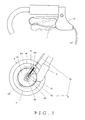
  • FIG. 3 is a schematic view showing the operation of the preferred embodiment of the present invention.
  • FIG. 4 is a schematic view showing a preferred embodiment of a changed structure of the present invention.
  • FIG. 5 is a schematic view showing the preferred embodiment of a changed structure of the present invention connected to a turning block.
  • FIG. 6 is a schematic view showing an arrangement of the preferred embodiment of a changed structure of the present invention adapted to a walker.
  • FIG. 7 is a view showing the breakdown of the structure of the turning block adapted to the preferred embodiment of a changed structure of the present invention.
  • FIG. 8 is a schematic view showing the operation of the preferred embodiment of a changed structure of the present invention.
  • FIG. 9 is a schematic view showing the operation of the turning block adapted to the preferred embodiment of a changed structure of the present invention.
  • FIG. 10 is another schematic view showing the operation of the turning block adapted to the preferred embodiment of a changed structure of the present invention.
  • FIG. 11 is another schematic view showing the operation of the preferred embodiment of a changed structure of the present invention.
  • FIG. 12 is a schematic view showing the structure of a preferred embodiment of a changed brake disk of the present invention.
  • FIG. 13 is a schematic view showing an assembly of the preferred embodiment of a changed brake disk of the present invention.
  • a brake mechanism of a preferred embodiment of the present invention is applied in a configuration of having both brake handles ( 1 ) to respectively control both (rear) wheels ( 2 ), i.e. the brake mechanism provided to the RH wheel is identical with that to the LH wheel. Therefore, the same model is designed for respectively control the brake status on both wheels.
  • the design for single side model is essentially comprised of a brake disk ( 21 ) is fixed by the side of the wheel ( 2 ), a brake base ( 4 ) is provided on the corresponding side of a wheel caliper ( 3 ) and a brake cable ( 5 ) in length greater than the linear distance between the brake base ( 4 ) and the brake handle ( 1 ).
  • said wheel ( 2 ) and brake disk ( 21 ) is pivoted to the wheel caliper ( 3 ) with a shaft ( 22 ).
  • Said brake disk ( 21 ) is formed with toothed peripheral ( 211 ) and a guide ( 32 ) is fixed at the inner side to the wheel caliper ( 3 ) with a fixing bolt ( 31 ).
  • a recess( 41 ) is formed in the brake base ( 4 ) facing the guide ( 32 ) and accommodates the insertion of is the guide ( 32 ).
  • a slit ( 42 ) provided through the shaft ( 22 ) on the brake base ( 4 ) allows the brake base ( 4 ) to travel in the restricted space in said recess ( 41 ) and slit ( 42 ) against the brake disk ( 21 ) for the wheel ( 2 ) pivoted to the wheel caliper ( 3 ).
  • the bottom of the brake base ( 4 ) when subject to the plunge by an elastic member ( 43 ) holds against the lower edge of the brake disk ( 21 ) while a toothed section ( 44 ) provided at the bottom of the brake base ( 4 ) bites and is fixed in position by the toothed peripheral ( 211 ) of the brake disk ( 21 ).
  • one end of the brake cable ( 5 ) is fixed to the brake base ( 4 ) with an outer wire ( 51 ).
  • An inner wire ( 52 ) is made mobile and penetrates through the brake base ( 4 ) to be connected to the fixing bolt ( 31 ) on the wheel caliper ( 3 ), and the other end of the brake cable ( 5 ) is connected to the brake handle ( 1 ) as featured in the prior art of the present invention.
  • the wheel ( 2 ) When the brake handle ( 1 ) is not yet applied, the wheel ( 2 ) is under its normal condition as illustrated in FIG. 2 .
  • Said brake base ( 4 ) is subject to the plunge by the elastic member ( 43 ) and held in position indicating an elevated status with its recess ( 41 ) and slit ( 42 ) in relation to the guide ( 32 ) and shaft ( 22 ) on the wheel caliper ( 3 ). Meanwhile, the tooth section ( 44 ) at the bottom of the brake base ( 4 ) holds against and bites in position the toothed peripheral ( 211 ) at the lower part of the brake disk ( 21 ) to brake the wheel ( 2 ).
  • the brake handle ( 1 ) is pulled, so that the inner wire ( 52 ) in the brake cable ( 5 ) is also pulled to relatively exert pressure on the end where the outer wire ( 52 ) holds against a pivot seat ( 11 ) of the brake handle ( 1 ). That puts the entire length of the outer wire ( 51 ) to create compression effect, resulting in a counter winding force to forthwith push with another end of the outer wire ( 51 ) against the brake base ( 4 ) to compress the elastic member ( 43 ).
  • both of the recess ( 41 ) and the slit ( 42 ) move downward in relation to the guide ( 32 ) and the shaft ( 22 ) for the toothed section ( 44 ) at the bottom of the brake base ( 4 ) to clear from the toothed peripheral ( 211 ) at the lower edge of the brake disk ( 21 ) and to release the wheel ( 2 ).
  • a brake cable ( 5 A) of the brake base ( 4 ) provided at where connected to both wheels ( 2 ) is connected to a turning block ( 51 ) of a turntable ( 6 ) and is driven by the turning block ( 61 ) rotating in a single direction.
  • Another brake cable ( 5 B) is provided between the brake handle ( 1 ) and the turning table ( 6 ).
  • An inner wire ( 52 B) is inserted through a groove ( 611 ) provided in the turning block ( 61 ) with both ends of the same cable connected to and as a linkage to both brake handles ( 1 ). That is, by pulling either brake handle ( 1 ), the brake cable ( 5 A) from both brake bases ( 4 ) is drawn to control the brake status.
  • the brake handle ( 1 ) can be made as to allow to be pulled in both ways and held position after the pull.
  • FIG. 7 shows the detailed structure of the turntable ( 6 ).
  • the turntable ( 6 ) is essentially comprised of a base ( 62 ) having the turning block ( 61 ) inside, the radial groove ( 611 ) in the turning block ( 61 ), a snap gap ( 612 ) each at both relatively crossing radial ends, four sockets ( 621 ) at both ends on both sides of the base ( 62 ), and a cover plate ( 63 ) with tenons.
  • the upper section of the brake cable ( 5 B) connecting both of said RH and LH handles ( 1 ) is fixed to two said sockets ( 621 ) relatively at an inclination to both sides of the base ( 62 ) of the turntable ( 6 ).
  • the connecting inner wire ( 52 B) is inserted through the groove ( 611 ) in the turning block ( 61 ) to properly hold the wire ( 52 B) in position.
  • the lower section of the brake cable ( 5 A) connecting both of RH and LH brake mechanisms is fixed to another two of those four sockets ( 621 ) relatively at an inclination to both sides of the base ( 62 ) of the turntable ( 6 ).
  • Their two inner wires ( 52 A) further extend to be snapped into the respective snap gap ( 612 ) at both radial ends of the turning block ( 61 ).
  • the same inner wire ( 52 B) connecting the upper section of the brake cable ( 5 B) drives the turning block ( 61 ) for rotation.
  • the inner wire ( 52 B) penetrating through the groove ( 611 ) of the turning block ( 61 ) instantaneously drive the turning block ( 61 ) to rotate since the head section of inner wire ( 52 B) is pulled to hold against the groove ( 611 ).
  • Both inner wires ( 52 A) of the lower section of the brake cable ( 5 A) connecting both RH and LH brake mechanisms are stretched due to the rotation in single direction by the turning block ( 61 ), thus the stretched inner wires ( 52 A) controls the operation of both RH and LH wheels in conjunction with an outer wire ( 51 A) to brake or release the brake.
  • the turntable ( 6 ) of the present invention allows the operation of a single brake handle for the turntable ( 6 ) to rotate for a certain angle for synchronous control of both RH and LH brake mechanisms.
  • the inner wire ( 52 B) inside the groove ( 611 ) of the turning block ( 61 ) is moved due to the rotation by the turning block ( 61 ).
  • the rear section of the inner wire ( 52 B) passing through the groove ( 611 ) is squeezed and compacted, resulting in that the force holding against the groove ( 611 ) by the inner wire ( 52 B) is reduced because of being pushed back by its rear section.
  • the turntable ( 6 ) of the present invention can be adapted to a 2-step brake mechanism as illustrated in FIG. 11 .
  • the rear section of the inner wire ( 52 B) is made as an initial end of the pulling to once again rotate the turning block ( 61 ) of the turntable ( 6 ).
  • the turning block ( 61 ) of the turntable ( 6 ) is activated again for rotation, so that the brake base ( 4 ) being pushed by the outer wire ( 51 A) of the lower section of the brake cable ( 5 A) moves even lower.
  • the toothed section ( 45 ) separately provided at the top of the brake base moves downward to hold against the toothed peripheral ( 211 ) at the upper edge of the brake disk ( 21 ) to brake the wheel ( 2 ).
  • the present invention provides an improvement option as illustrated in FIGS. 12 and 13. Wherein, a joint disk ( 24 ) is provided between the brake disk ( 21 ) and a hub ( 23 ) of the wheel ( 2 ).
  • a protrusion ( 242 ) and a gap ( 232 ) are respectively provided on a pin shaft ( 241 ) abutted into the wheel hub ( 23 ) and on the edge of a shaft hole ( 231 ) in relation to the joint disk ( 24 ). Both of said protrusion ( 242 ) and the gap ( 232 ) are provided for the joint disk ( 24 ) to be fixed in position at the hub ( 23 ) while preventing the hub ( 23 ) and the joint disk ( 24 ) from engaging in relative turning.
  • An elastic member ( 25 ) is provided in the hub ( 23 ) to push in radial direction against the joint disk ( 24 ).
  • a plane ( 243 ) at a certain inclination is formed on the side of the joint disk ( 24 ) facing the brake disk ( 21 ).
  • a concave ( 212 ) is formed on the relative side of the brake disk ( 21 ) and binds the slant plane ( 243 ) on the brake disk ( 21 ) when subject to the push by the elastic member ( 25 ).
  • the wheel ( 2 ) is capable of having a mild turning before being braked even the wheel is deadlocked.

Landscapes

  • Engineering & Computer Science (AREA)
  • General Engineering & Computer Science (AREA)
  • Mechanical Engineering (AREA)
  • Health & Medical Sciences (AREA)
  • Physical Education & Sports Medicine (AREA)
  • Pain & Pain Management (AREA)
  • Epidemiology (AREA)
  • Rehabilitation Therapy (AREA)
  • Life Sciences & Earth Sciences (AREA)
  • Animal Behavior & Ethology (AREA)
  • General Health & Medical Sciences (AREA)
  • Public Health (AREA)
  • Veterinary Medicine (AREA)
  • Transportation (AREA)
  • Handcart (AREA)

Abstract

A brake mechanism for a walker, essentially comprised of a brake disk with toothed peripheral is provided on the side of the wheel, a brake base allows relative displacement, and toothed section on the inner side of the brake base, wherein, said brake base as pushed by an elastic member holds with its toothed section against the toothed peripheral of the brake disk to brake the wheel in normal status, a handle is used to manipulate a brake cable to pull the brake base so to release the brake; furthermore, a turning block in the shape of a turntable is provided to accommodate the same brake cable connecting both brake handle, the turning block is further connected to another two brake cables to synchronously activate the brake mechanisms for the RH and the LH wheels; by pulling either brake handle, the synchronous release or brake of both brake mechanism can be achieved while allowing a 2-step brake.

Description

This application is a division of Ser. No. 09/702,613 filed on Nov. 1, 2000.
BACKGROUND OF THE INVENTION
(a) Field of the Invention
The present invention relates to a brake mechanism for a walker, and more particularly to one that allows normal brake or release the brake, two-step brake and synchronously release or brake both wheels by pulling either the right or the left handle.
(b) Description of the Prior Art
Whereas, the brake mechanism for a walker generally available in the market is adapted from that used on a bicycle. That is, a brake handle is connected with a wire in a brake so that once the brake handle is pulled, the wire is also pulled to brake the walker. Wherein, both of the right and the left brake handles are separately provided to achieve the respective control of the brake of the right and the left wheels.
An improved prior art provides synchronous brake applied to both of the right and the left wheels. Wherein, a brake lever extends from and integrated to both wheels to hold against or restrict the wheels in conjunction with the operation by a linkage type of single brake handle. Much more force from a user of the walker is required than that for the walker with separate brake handle.
A considerable amount of force is applied to brake a walker with the prior art of brake model. That could cause danger to the user who is usually in poor physical condition and slower in response in case of emergency.
SUMMARY OF THE INVENTION
The primary purpose of the present invention is to provide a brake mechanism for a walker, wherein by the side of each wheel of the walker is provided with a brake disk with toothed peripheral, and a brake base that can be displaced in relation to the brake disk. Two certain sections are toothed opposite to each other inside the brake base that is subject to the plunge by an elastic member with said toothed sections engaged to the teeth from the brake disk to brake the wheels under normal conditions. By operating a brake cable from a handle to pull the brake base, the brake is released for pushing forward the walker from improving the safety for the user of the walker.
Another purpose of the present invention is to provide a brake mechanism for a walker by having both of the right and the left handles connected with a cable to a turning block in the shape of a turntable. The turning block is connected to two brake cables for synchronously applying the brake mechanism of both wheels by pulling either brake handle to easily brake or release the walker.
Another purpose yet of the present invention is to provide a brake mechanism for a walker. Wherein, by the side of the right and the left wheels is each separately provided with a brake disk with toothed peripheral, and a brake base that can be displaced in relation to the brake disk. Toothed sections are provided inside the brake base, which is subject to the plunge by an elastic member with said toothed sections engaged to the teeth from the brake disk to brake the wheels under normal conditions. Furthermore, both RH and LH handles are connected to a turning block in the shape of a turntable with the same brake cable and the turning block is further connected with another two brake wires to synchronously operate both brake mechanisms of the RH and LH wheels. By means of such configuration, a two-step brake is achieved when either handle is pulled, the turning block turns and makes the toothed section at the bottom of the brake block to disengage from the peripheral teeth at the lower part of the brake disk thus to release the brake. Then the other handle is pulled to make the turning block to turn for an even greater angle. The brake base being subject to the pull is brought down for a greater distance so to allow the toothed section at the top of the brake base to hold against the peripheral teeth at the upper part of the brake disk and to brake the wheels once again.
BRIEF DESCRIPTION OF THE DRAWINGS
FIG. 1 is a schematic view showing a preferred embodiment of the present invention adapted to a walker.
FIG. 2 is a schematic view of the structure of the preferred embodiment of the present invention.
FIG. 3 is a schematic view showing the operation of the preferred embodiment of the present invention.
FIG. 4 is a schematic view showing a preferred embodiment of a changed structure of the present invention.
FIG. 5 is a schematic view showing the preferred embodiment of a changed structure of the present invention connected to a turning block.
FIG. 6 is a schematic view showing an arrangement of the preferred embodiment of a changed structure of the present invention adapted to a walker.
FIG. 7 is a view showing the breakdown of the structure of the turning block adapted to the preferred embodiment of a changed structure of the present invention.
FIG. 8 is a schematic view showing the operation of the preferred embodiment of a changed structure of the present invention.
FIG. 9 is a schematic view showing the operation of the turning block adapted to the preferred embodiment of a changed structure of the present invention.
FIG. 10 is another schematic view showing the operation of the turning block adapted to the preferred embodiment of a changed structure of the present invention.
FIG. 11 is another schematic view showing the operation of the preferred embodiment of a changed structure of the present invention.
FIG. 12 is a schematic view showing the structure of a preferred embodiment of a changed brake disk of the present invention.
FIG. 13 is a schematic view showing an assembly of the preferred embodiment of a changed brake disk of the present invention.
DETAILED DESCRIPTION OF THE PREFERRED EMBODIMENTS
As illustrated in FIGS. 1 and 2, a brake mechanism of a preferred embodiment of the present invention is applied in a configuration of having both brake handles (1) to respectively control both (rear) wheels (2), i.e. the brake mechanism provided to the RH wheel is identical with that to the LH wheel. Therefore, the same model is designed for respectively control the brake status on both wheels. The design for single side model is essentially comprised of a brake disk (21) is fixed by the side of the wheel (2), a brake base (4) is provided on the corresponding side of a wheel caliper (3) and a brake cable (5) in length greater than the linear distance between the brake base (4) and the brake handle (1). Within, said wheel (2) and brake disk (21) is pivoted to the wheel caliper (3) with a shaft (22). Said brake disk (21) is formed with toothed peripheral (211) and a guide (32) is fixed at the inner side to the wheel caliper (3) with a fixing bolt (31). A recess(41) is formed in the brake base (4) facing the guide (32) and accommodates the insertion of is the guide (32). A slit (42) provided through the shaft (22) on the brake base (4) allows the brake base (4) to travel in the restricted space in said recess (41) and slit (42) against the brake disk (21) for the wheel (2) pivoted to the wheel caliper (3). The bottom of the brake base (4) when subject to the plunge by an elastic member (43) holds against the lower edge of the brake disk (21) while a toothed section (44) provided at the bottom of the brake base (4) bites and is fixed in position by the toothed peripheral (211) of the brake disk (21). Furthermore, one end of the brake cable (5) is fixed to the brake base (4) with an outer wire (51). An inner wire (52) is made mobile and penetrates through the brake base (4) to be connected to the fixing bolt (31) on the wheel caliper (3), and the other end of the brake cable (5) is connected to the brake handle (1) as featured in the prior art of the present invention.
When the brake handle (1) is not yet applied, the wheel (2) is under its normal condition as illustrated in FIG. 2. Said brake base (4) is subject to the plunge by the elastic member (43) and held in position indicating an elevated status with its recess (41) and slit (42) in relation to the guide (32) and shaft (22) on the wheel caliper (3). Meanwhile, the tooth section (44) at the bottom of the brake base (4) holds against and bites in position the toothed peripheral (211) at the lower part of the brake disk (21) to brake the wheel (2).
Now referring to FIG. 3, for the operation of releasing the brake from the wheel (2), the brake handle (1) is pulled, so that the inner wire (52) in the brake cable (5) is also pulled to relatively exert pressure on the end where the outer wire (52) holds against a pivot seat (11) of the brake handle (1). That puts the entire length of the outer wire (51) to create compression effect, resulting in a counter winding force to forthwith push with another end of the outer wire (51) against the brake base (4) to compress the elastic member (43). Consequently, both of the recess (41) and the slit (42) move downward in relation to the guide (32) and the shaft (22) for the toothed section (44) at the bottom of the brake base (4) to clear from the toothed peripheral (211) at the lower edge of the brake disk (21) and to release the wheel (2).
The design disclosed in the preferred embodiment above is essentially applied in a configuration that both of the RH and LH brake handles separately control the RH wheel and the LH wheel, and the brake status of both wheels is released simply by pulling in the brake handle. However, with a turning block adapted to the brake mechanism at the wheel, different forms of preferred embodiment can be derived from the present invention. First referring to FIG. 4, wherein, another toothed section (45) is formed at the upper end of the brake base (4). When in the status that the relative brake base (4) is driven as described above, so that the toothed section (44) at the brake base (4) is disengaged from the toothed peripheral (211) at the lower end of the brake disk (21), said toothed section (45) is separated from the upper edge of the brake disk (21) for a certain distance (also referring to FIG. 8). As illustrated in FIGS. 5 and 6, a brake cable (5A) of the brake base (4) provided at where connected to both wheels (2) is connected to a turning block (51) of a turntable (6) and is driven by the turning block (61) rotating in a single direction. Another brake cable (5B) is provided between the brake handle (1) and the turning table (6). An inner wire (52B) is inserted through a groove (611) provided in the turning block (61) with both ends of the same cable connected to and as a linkage to both brake handles (1). That is, by pulling either brake handle (1), the brake cable (5A) from both brake bases (4) is drawn to control the brake status. Furthermore, the brake handle (1) can be made as to allow to be pulled in both ways and held position after the pull. FIG. 7 shows the detailed structure of the turntable (6). The turntable (6) is essentially comprised of a base (62) having the turning block (61) inside, the radial groove (611) in the turning block (61), a snap gap (612) each at both relatively crossing radial ends, four sockets (621) at both ends on both sides of the base (62), and a cover plate (63) with tenons.
As illustrated in FIG. 8, the upper section of the brake cable (5B) connecting both of said RH and LH handles (1) is fixed to two said sockets (621) relatively at an inclination to both sides of the base (62) of the turntable (6). The connecting inner wire (52B) is inserted through the groove (611) in the turning block (61) to properly hold the wire (52B) in position.
The lower section of the brake cable (5A) connecting both of RH and LH brake mechanisms is fixed to another two of those four sockets (621) relatively at an inclination to both sides of the base (62) of the turntable (6). Their two inner wires (52A) further extend to be snapped into the respective snap gap (612) at both radial ends of the turning block (61).
Once either brake handle (1) is selected to be pulled alone as illustrated in FIG. 9, the same inner wire (52B) connecting the upper section of the brake cable (5B) drives the turning block (61) for rotation. Wherein, the inner wire (52B) penetrating through the groove (611) of the turning block (61) instantaneously drive the turning block (61) to rotate since the head section of inner wire (52B) is pulled to hold against the groove (611). Both inner wires (52A) of the lower section of the brake cable (5A) connecting both RH and LH brake mechanisms are stretched due to the rotation in single direction by the turning block (61), thus the stretched inner wires (52A) controls the operation of both RH and LH wheels in conjunction with an outer wire (51A) to brake or release the brake.
Furthermore, by applying the turntable (6) of the present invention to allow the operation of a single brake handle for the turntable (6) to rotate for a certain angle for synchronous control of both RH and LH brake mechanisms. Meanwhile, the inner wire (52B) inside the groove (611) of the turning block (61) is moved due to the rotation by the turning block (61). The rear section of the inner wire (52B) passing through the groove (611) is squeezed and compacted, resulting in that the force holding against the groove (611) by the inner wire (52B) is reduced because of being pushed back by its rear section. As a result, the distance traveled by the inner wire (52B) when pulled is not sufficient to completely drive the turning block (61) for relative rotation. The momentum is only enough for the turning block (61) to rotate for a certain degree just sufficient to operate the brake mechanism. Once the turning block (61) is driven and held in position, said rear section of the inner wire (52B) under compressed condition returns to its tension. Then as illustrated in FIG. 10, when the other brake handle is pulled, the rear section of the inner wire (52B) becomes an initial end of the pulling to rotate the turning block (61) once again. The resultant rotation degree for activating the brake mechanism for the second time. By such design, the turntable (6) of the present invention can be adapted to a 2-step brake mechanism as illustrated in FIG. 11. The rear section of the inner wire (52B) is made as an initial end of the pulling to once again rotate the turning block (61) of the turntable (6). Then, the turning block (61) of the turntable (6) is activated again for rotation, so that the brake base (4) being pushed by the outer wire (51A) of the lower section of the brake cable (5A) moves even lower. As a result, the toothed section (45) separately provided at the top of the brake base moves downward to hold against the toothed peripheral (211) at the upper edge of the brake disk (21) to brake the wheel (2).
However, if the brake handle is pulled to brake the walker while it is advancing, the toothed section (44) at the bottom of the brake base (4) will directly hold against and bite the toothed peripheral at the lower edge of the brake disk (21). The wheel (2) will be suddenly deadlocked. The present invention provides an improvement option as illustrated in FIGS. 12 and 13. Wherein, a joint disk (24) is provided between the brake disk (21) and a hub (23) of the wheel (2). A protrusion (242) and a gap (232) are respectively provided on a pin shaft (241) abutted into the wheel hub (23) and on the edge of a shaft hole (231) in relation to the joint disk (24). Both of said protrusion (242) and the gap (232) are provided for the joint disk (24) to be fixed in position at the hub (23) while preventing the hub (23) and the joint disk (24) from engaging in relative turning. An elastic member (25) is provided in the hub (23) to push in radial direction against the joint disk (24). A plane (243) at a certain inclination is formed on the side of the joint disk (24) facing the brake disk (21). A concave (212) is formed on the relative side of the brake disk (21) and binds the slant plane (243) on the brake disk (21) when subject to the push by the elastic member (25). As a limited turning for the joint disk (24) fixed to the brake disk (21) in relation to said wheel (2) is allowed, the wheel (2) is capable of having a mild turning before being braked even the wheel is deadlocked.

Claims (1)

I claim:
1. A brake turntable for a walker having a pair of first brake cables extending from corresponding braking mechanisms and each being respectively formed by an inner wire extending through an outer sleeve, the walker having a second brake cable coupled on opposing ends thereof to a pair of brake handles and being formed by an inner wire extending through a pair of outer sleeves, said brake turntable comprising:
a base having a centrally disposed opening, a pair of sockets formed in a first end thereof in open communication with said opening, and a pair of sockets formed in an opposing second end of said base in open communication with said opening, a first of said pair of sockets in said first end receiving one of said pair of outer sleeves of said second brake cables therein, a second of said pair of sockets in said first end receiving one of said first brake cables therein, a first of said pair of sockets in said second end receiving the other of said pair of first brake cables, a second of said pair of sockets in said second end receiving the other of said pair of outer sleeves of said second brake cables therein;
a turning block rotatably disposed in said opening of said base and having a circumferential recess formed therein, said turning block having a radially extending groove with diametrically opposed exits in open communication with said circumferential recess, two diametrically opposed snap gaps being formed in said turning block adjacent said circumferential recess in angularly spaced relationship with respect to said exits of said radial groove, said inner wire of said second brake cable passing from said first socket of said first end, through said radial groove of said turning block, and passing through said second socket of said second end, said inner wire of each of said first brake cables being coupled to a corresponding one of said snap gaps; and,
a cover overlaying said base, wherein initially said turning block is oriented with said exits of radial groove being angularly offset with respect to said first socket of said first end of said base and said second socket of said second end of said base and each of said snap gaps being respectively aligned with said second socket of said first end of said base and said first socket of said second end of said base, and wherein operation of either of the pair of brake handles displaces said inner wire of said second brake cable to rotate said turning block relative to said base and thereby displace said inner wires of both of said pair of first brake cables.
US10/012,544 2000-11-01 2001-12-12 Brake turntable for actuating a brake system for a walker Expired - Fee Related US6463825B2 (en)

Priority Applications (1)

Application Number Priority Date Filing Date Title
US10/012,544 US6463825B2 (en) 2000-11-01 2001-12-12 Brake turntable for actuating a brake system for a walker

Applications Claiming Priority (2)

Application Number Priority Date Filing Date Title
US09/702,613 US6378663B1 (en) 2000-11-01 2000-11-01 Brake mechanism for a walker
US10/012,544 US6463825B2 (en) 2000-11-01 2001-12-12 Brake turntable for actuating a brake system for a walker

Related Parent Applications (1)

Application Number Title Priority Date Filing Date
US09/702,613 Division US6378663B1 (en) 2000-11-01 2000-11-01 Brake mechanism for a walker

Publications (2)

Publication Number Publication Date
US20020050427A1 US20020050427A1 (en) 2002-05-02
US6463825B2 true US6463825B2 (en) 2002-10-15

Family

ID=24821937

Family Applications (2)

Application Number Title Priority Date Filing Date
US09/702,613 Expired - Fee Related US6378663B1 (en) 2000-11-01 2000-11-01 Brake mechanism for a walker
US10/012,544 Expired - Fee Related US6463825B2 (en) 2000-11-01 2001-12-12 Brake turntable for actuating a brake system for a walker

Family Applications Before (1)

Application Number Title Priority Date Filing Date
US09/702,613 Expired - Fee Related US6378663B1 (en) 2000-11-01 2000-11-01 Brake mechanism for a walker

Country Status (1)

Country Link
US (2) US6378663B1 (en)

Cited By (8)

* Cited by examiner, † Cited by third party
Publication number Priority date Publication date Assignee Title
US20100300817A1 (en) * 2009-05-27 2010-12-02 Sheng-Lung Chiang Brake mechanism for simultaneously activating front and rear brakes of bicycle
US20120160617A1 (en) * 2010-12-27 2012-06-28 T & S Co., Ltd. Baggage caster lock device
CN102770283A (en) * 2010-02-25 2012-11-07 株式会社日乃本锭前 Caster system equipped with hand-operated brakes
WO2018014139A1 (en) * 2016-07-22 2018-01-25 9208-5216 Québec Inc. Rollator
WO2018056829A1 (en) * 2016-09-26 2018-03-29 TOPRO Industri AS Three state inverse brake system for rollator
US11305835B2 (en) * 2018-10-08 2022-04-19 Wistron Corp. Brake module
US11559459B2 (en) 2021-02-16 2023-01-24 Drive Devilbiss Healthcare Rollator
USD976763S1 (en) 2021-02-10 2023-01-31 Drive Devilbiss Healthcare Rollator

Families Citing this family (34)

* Cited by examiner, † Cited by third party
Publication number Priority date Publication date Assignee Title
GB9904607D0 (en) * 1999-03-01 1999-04-21 Stedman Kenneth B Wheel hub
US6510927B1 (en) * 2001-12-11 2003-01-28 Sports World Enterprise Co., Ltd. Locking device for wheels of a golf cart
US6957596B2 (en) * 2002-10-25 2005-10-25 L&P Property Management Company Apparatus and method for braking ergonomic support actuator
TWM264187U (en) * 2004-10-05 2005-05-11 Link Treasure Ltd Brake driving structure for direction-changeable baby stroller
US8820447B2 (en) * 2005-03-18 2014-09-02 Gatekeeper Systems, Inc. Power generation systems and methods for wheeled objects
CA2547498A1 (en) * 2005-05-26 2006-11-26 Invacare Corporation Wheel lock for mobility aid
US20070007739A1 (en) * 2005-07-09 2007-01-11 Bailey Eric S Steerable Carriage Apparatus
US7669863B2 (en) 2006-01-24 2010-03-02 Rensselaer Polytechnic Institute Walker with lift-assisting seat assembly
WO2007112723A1 (en) * 2006-03-31 2007-10-11 Josef Jessberger Vehicle, in particular sport and fun sport device
ES1066681Y (en) * 2007-11-30 2008-05-16 Jane Sa BRAKE DEVICE FOR CHILDREN'S CARS.
SE532000C2 (en) * 2008-02-04 2009-09-22 Liko Res & Dev Ab rollator brake
GB2463877B (en) * 2008-09-25 2012-09-19 Mamas & Papas Holdings Ltd Wheel braking mechanism
JP5396206B2 (en) * 2009-09-04 2014-01-22 本田技研工業株式会社 Parking brake lever arrangement structure and operation lever arrangement structure in a vehicle
CN103079929B (en) * 2010-05-28 2016-02-10 贝比赞公司 Braking systems for carts and carts
TWM424940U (en) * 2011-09-09 2012-03-21 Miao-Yuan Huang Walking-aid vehicle with improved brake device
US8840124B2 (en) * 2012-01-13 2014-09-23 Medical Depot, Inc. Rollator having a sit-to-lock brake
US8998223B2 (en) * 2013-03-15 2015-04-07 Flying Eagle Technology Inc. Braking system, rollator and transport chair with the same
DE102014206206A1 (en) * 2014-04-01 2015-10-15 Meyra Gmbh walker
US10619685B2 (en) * 2014-09-26 2020-04-14 Uusi, Llc Parking brake system
US10053062B2 (en) * 2015-09-02 2018-08-21 Evolution Technologies Inc. Brake assembly for a height-adjustable walker apparatus
US11648922B2 (en) 2015-09-02 2023-05-16 Evolution Technologies Inc. Manually-operated, height-adjustable wheeled vehicle, and a brake assembly and wheel fork assembly thereof
US10730489B2 (en) 2015-09-02 2020-08-04 Evolution Technologies Inc. Brake assembly for height-adjustable patient transport apparatus
US9849057B1 (en) 2016-11-18 2017-12-26 More Joyful Living, LLC Stroller rollator
USD851543S1 (en) 2017-08-18 2019-06-18 More Joyful Living, LLC Stroller rollator
TWM557209U (en) * 2017-11-10 2018-03-21 Der Sheng Co Ltd Caster brake device
GB2571929A (en) * 2018-03-08 2019-09-18 Mark Ball Richard Mechanical brake system
TWM574907U (en) * 2018-09-28 2019-03-01 蔡木章 Brake structure
SE542808C2 (en) * 2018-10-10 2020-07-14 Electro Mobility Europe Ab Wheel assembly for a self-propelling trolley comprising a mechanical brake allowing for a safe rocking pattern
IT202000025645A1 (en) * 2020-10-29 2022-04-29 Claudio Rosin WHEELED WALKER
US12440402B2 (en) * 2021-03-04 2025-10-14 Push Lox, LLC Wheelchair wheel lock lever assembly
CN113339425A (en) * 2021-08-04 2021-09-03 江苏三铭智达科技有限公司 Braking device of rescue robot
KR102891762B1 (en) * 2023-08-31 2025-11-26 한국기술교육대학교 산학협력단 Devices for assisting in walking
CN118082769B (en) * 2023-12-26 2025-02-07 广州车胜教学设备有限公司 Autonomous driving multi-sensory fusion training vehicle
US12329713B1 (en) * 2024-10-23 2025-06-17 Yongkang Beiqin Industry & Trade Co., Ltd Easily adjustable walking aid

Citations (8)

* Cited by examiner, † Cited by third party
Publication number Priority date Publication date Assignee Title
US4057127A (en) * 1975-11-06 1977-11-08 J. C. Penney Company, Inc. Safety actuating device adapted for two wheeled vehicles
US5339929A (en) * 1993-07-02 1994-08-23 Tsoung Ren Chern Brake assembly for a bicycle
US5505105A (en) * 1995-02-17 1996-04-09 Kuo; Yung-Pin Connector for engaging brake cables
US5566790A (en) * 1995-11-13 1996-10-22 Chen; Tsung-I Bicycle brake assembly
US6098486A (en) * 1997-05-10 2000-08-08 Liao; Chi-Chao Brake system for a bicycle
US6186282B1 (en) * 1999-03-10 2001-02-13 Chih-Chen Juan Balanced braking system
US6212969B1 (en) * 2000-02-14 2001-04-10 Kuo Yung-Pin Brake device for simultaneously actuating two brake mechanisms
US6311805B1 (en) * 2000-02-16 2001-11-06 Chih-Chen Juan Balanced braking system for a bicycle

Family Cites Families (5)

* Cited by examiner, † Cited by third party
Publication number Priority date Publication date Assignee Title
US1798808A (en) * 1928-09-26 1931-03-31 Wallace E Potter Braking attachment
US4384713A (en) * 1980-05-28 1983-05-24 White Cap Enterprises Corporation Safety rolling invalid walker
US5984334A (en) * 1997-09-29 1999-11-16 Dugas; Grady A. Automatic braking wheelchair
US6148942A (en) * 1998-10-22 2000-11-21 Mackert, Sr.; James M. Infant stroller safely propelled by a DC electric motor having controlled acceleration and deceleration
CN1126679C (en) * 1999-07-05 2003-11-05 英属维京群岛商育丰有限公司 Braking device of pram

Patent Citations (8)

* Cited by examiner, † Cited by third party
Publication number Priority date Publication date Assignee Title
US4057127A (en) * 1975-11-06 1977-11-08 J. C. Penney Company, Inc. Safety actuating device adapted for two wheeled vehicles
US5339929A (en) * 1993-07-02 1994-08-23 Tsoung Ren Chern Brake assembly for a bicycle
US5505105A (en) * 1995-02-17 1996-04-09 Kuo; Yung-Pin Connector for engaging brake cables
US5566790A (en) * 1995-11-13 1996-10-22 Chen; Tsung-I Bicycle brake assembly
US6098486A (en) * 1997-05-10 2000-08-08 Liao; Chi-Chao Brake system for a bicycle
US6186282B1 (en) * 1999-03-10 2001-02-13 Chih-Chen Juan Balanced braking system
US6212969B1 (en) * 2000-02-14 2001-04-10 Kuo Yung-Pin Brake device for simultaneously actuating two brake mechanisms
US6311805B1 (en) * 2000-02-16 2001-11-06 Chih-Chen Juan Balanced braking system for a bicycle

Cited By (14)

* Cited by examiner, † Cited by third party
Publication number Priority date Publication date Assignee Title
US20100300817A1 (en) * 2009-05-27 2010-12-02 Sheng-Lung Chiang Brake mechanism for simultaneously activating front and rear brakes of bicycle
CN102770283A (en) * 2010-02-25 2012-11-07 株式会社日乃本锭前 Caster system equipped with hand-operated brakes
US20120311821A1 (en) * 2010-02-25 2012-12-13 Kabushiki Kaisha Hinomoto Jomae Caster system equipped with hand-operated brakes
US8806714B2 (en) * 2010-02-25 2014-08-19 Kabushiki Kaisha Hinomoto Jomae Caster system equipped with hand-operated brakes
CN102770283B (en) * 2010-02-25 2015-05-13 株式会社日乃本锭前 Caster system equipped with hand-operated brakes
US20120160617A1 (en) * 2010-12-27 2012-06-28 T & S Co., Ltd. Baggage caster lock device
WO2018014139A1 (en) * 2016-07-22 2018-01-25 9208-5216 Québec Inc. Rollator
EP3487464A4 (en) * 2016-07-22 2020-07-22 9208-5216 Québec Inc. Rollator
WO2018056829A1 (en) * 2016-09-26 2018-03-29 TOPRO Industri AS Three state inverse brake system for rollator
US11305835B2 (en) * 2018-10-08 2022-04-19 Wistron Corp. Brake module
USD976763S1 (en) 2021-02-10 2023-01-31 Drive Devilbiss Healthcare Rollator
US11559459B2 (en) 2021-02-16 2023-01-24 Drive Devilbiss Healthcare Rollator
US11766378B2 (en) 2021-02-16 2023-09-26 Drive Devilbiss Healthcare Rollator
USD1077691S1 (en) 2021-02-16 2025-06-03 Medical Depot, Inc. Backrest of a rollator

Also Published As

Publication number Publication date
US6378663B1 (en) 2002-04-30
US20020050427A1 (en) 2002-05-02

Similar Documents

Publication Publication Date Title
US6463825B2 (en) Brake turntable for actuating a brake system for a walker
CN2929322Y (en) brake mechanism
JPH01244950A (en) Manual brake assembly for car
JPH0130655Y2 (en)
AU2022228124B2 (en) Brake Caliper
US6234281B1 (en) Attachment of a brake cable with an actuator of a parking brake
US4296846A (en) Brake release mechanism
KR20240051636A (en) Breake device, break system and vehicle
CN218172373U (en) Brake device for rear wheel of baby carriage
JP3130143B2 (en) Operation mechanism of stick-type parking brake
KR200249721Y1 (en) Parking brake system of electric scooter
CN217367033U (en) Brake structure and exercise bicycle of exercise bicycle
WO2021035519A1 (en) Dual-drive mechanical disk brake with dual brake lines
JP3027682U (en) Brake structure for driving forward
HK40040721B (en) Double brake line double drive mechanical disc brake
KR100380932B1 (en) Foot Pedal Parking Brake System of One Touch Way
KR100217676B1 (en) Brake shoe operating device for parking brake
JPH0621059Y2 (en) Reel breaker
KR20240053859A (en) Brake device for agricultural vehicle
US20080035436A1 (en) structure of a hand-brake
JPH0538254Y2 (en)
JPS6244766U (en)
JPH0514671U (en) Parking brake mechanism for drum brakes
JPS60156098U (en) Vehicle parking brake actuation device
KR100526195B1 (en) A damping device of electromotion toy for a riding

Legal Events

Date Code Title Description
REMI Maintenance fee reminder mailed
LAPS Lapse for failure to pay maintenance fees
STCH Information on status: patent discontinuation

Free format text: PATENT EXPIRED DUE TO NONPAYMENT OF MAINTENANCE FEES UNDER 37 CFR 1.362

FP Lapsed due to failure to pay maintenance fee

Effective date: 20061015

AS Assignment

Owner name: GE BUSINESS FINANCIAL SERVICES INC. (F/K/A MERRILL

Free format text: SECURITY AGREEMENT;ASSIGNOR:APEX MEDICAL CORPORATION;REEL/FRAME:022309/0850

Effective date: 20090225

AS Assignment

Owner name: GE BUSINESS FINANCIAL SERVICES INC., ILLINOIS

Free format text: CORRECTIVE ASSIGNMENT TO CORRECT THE APPLICATION NUMBERS 11701101 AND 11645914 PREVIOUSLY RECORDED ON REEL 022309 FRAME 0850. ASSIGNOR(S) HEREBY CONFIRMS THE SECURITY AGREEMENT;ASSIGNOR:APEX MEDICAL CORPORATION;REEL/FRAME:043180/0956

Effective date: 20090225