US6322644B1 - Magnesium-based casting alloys having improved elevated temperature performance - Google Patents

Magnesium-based casting alloys having improved elevated temperature performance Download PDF

Info

Publication number
US6322644B1
US6322644B1 US09/461,538 US46153899A US6322644B1 US 6322644 B1 US6322644 B1 US 6322644B1 US 46153899 A US46153899 A US 46153899A US 6322644 B1 US6322644 B1 US 6322644B1
Authority
US
United States
Prior art keywords
magnesium
alloy
alloys
run
diecast
Prior art date
Legal status (The legal status is an assumption and is not a legal conclusion. Google has not performed a legal analysis and makes no representation as to the accuracy of the status listed.)
Expired - Lifetime
Application number
US09/461,538
Inventor
Mihriban Ozden Pekguleryuz
Pierre Labelle
Current Assignee (The listed assignees may be inaccurate. Google has not performed a legal analysis and makes no representation or warranty as to the accuracy of the list.)
Glencore Canada Corp
Original Assignee
Noranda Inc
Priority date (The priority date is an assumption and is not a legal conclusion. Google has not performed a legal analysis and makes no representation as to the accuracy of the date listed.)
Filing date
Publication date
Application filed by Noranda Inc filed Critical Noranda Inc
Priority to US09/461,538 priority Critical patent/US6322644B1/en
Assigned to NORANDA, INC. reassignment NORANDA, INC. ASSIGNMENT OF ASSIGNORS INTEREST (SEE DOCUMENT FOR DETAILS). Assignors: LABELLE, PIERRE, PEKGULERYUZ, MIHRIBAN OZDEN
Priority to DK00984734T priority patent/DK1242644T3/en
Priority to AT00984734T priority patent/ATE268823T1/en
Priority to TW089126704A priority patent/TW593693B/en
Priority to CA002394122A priority patent/CA2394122C/en
Priority to JP2001545606A priority patent/JP5209162B2/en
Priority to ES00984734T priority patent/ES2221864T3/en
Priority to AU21377/01A priority patent/AU2137701A/en
Priority to EP00984734A priority patent/EP1242644B1/en
Priority to DE60011470T priority patent/DE60011470T2/en
Priority to PCT/CA2000/001527 priority patent/WO2001044529A1/en
Priority to US09/995,086 priority patent/US6808679B2/en
Publication of US6322644B1 publication Critical patent/US6322644B1/en
Application granted granted Critical
Assigned to FALCONBRIDGE LIMITED/FALCONBRIDGE LIMITEE reassignment FALCONBRIDGE LIMITED/FALCONBRIDGE LIMITEE MERGER (SEE DOCUMENT FOR DETAILS). Assignors: FALCONBRIDGE LIMITED, NORANDA INC.
Assigned to XSTRATA CANADA CORPORATION reassignment XSTRATA CANADA CORPORATION CHANGE OF NAME (SEE DOCUMENT FOR DETAILS). Assignors: FALCONBRIDGE LIMITED/FALCONBRIDGE LIMITEE
Anticipated expiration legal-status Critical
Expired - Lifetime legal-status Critical Current

Links

Images

Classifications

    • CCHEMISTRY; METALLURGY
    • C22METALLURGY; FERROUS OR NON-FERROUS ALLOYS; TREATMENT OF ALLOYS OR NON-FERROUS METALS
    • C22CALLOYS
    • C22C23/00Alloys based on magnesium
    • C22C23/02Alloys based on magnesium with aluminium as the next major constituent
    • CCHEMISTRY; METALLURGY
    • C22METALLURGY; FERROUS OR NON-FERROUS ALLOYS; TREATMENT OF ALLOYS OR NON-FERROUS METALS
    • C22CALLOYS
    • C22C23/00Alloys based on magnesium

Definitions

  • the present invention generally relates to magnesium based casting alloys having improved elevated temperature performance and more particularly relates to magnesium-aluminum-strontium alloys having good salt-spray corrosion resistance and good creep resistance, tensile yield strength and bolt-load retention, particularly at elevated temperatures of at least 150° C.
  • Magnesium-based alloys have been widely used as cast parts in the aerospace and automotive industries and are mainly based on the following four systems:
  • Mg—Al system i.e., AM20, AM50, AM60
  • Mg—Al—Zn system i.e., AZ91D
  • Mg—Al—Si system i.e., AS21, AS41
  • Mg—Al—Rare Earth system i.e., AE41, AE42.
  • Magnesium-based alloy cast parts can be produced by conventional casting methods which include diecasting, sand casting, permanent and semi-permanent mold casting, plaster-mold casting and investment casting.
  • These materials demonstrate a number of particularly advantageous properties that have prompted an increased demand for magnesium-based alloy cast parts in the automotive industry. These properties include low density, high strength-to-weight ratio, good castability, easy machineability and good damping characteristics.
  • AM and AZ alloys are limited to low-temperature applications where they are known to lose their creep resistance at temperatures above 140° C.
  • AS and AE alloys while developed for higher temperature applications, offer only a small improvement in creep resistance and/or are expensive.
  • the present invention therefore provides a magnesium-based casting alloy comprising, in weight percent, 2 to 9% aluminum and 0.5 to 7% strontium with the balance being magnesium except for impurities commonly found in magnesium alloys.
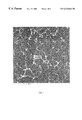
  • FIG. 1 is a photomicrograph showing the microstructure of a diecast alloy of the present invention, hereinafter referred to as alloy A1;
  • FIG. 2 is a photomicrograph showing the microstructure of another diecast alloy of the present invention, hereinafter referred to as alloy A2 ;
  • FIG. 3 is a photomicrograph showing the microstructure of permanent mold cast alloy AD9.
  • FIG. 4 is a photomicrograph showing the microstructure of permanent mold cast alloy AD10.
  • the magnesium-based casting alloys of the present invention are relatively low cost alloys that demonstrate improved creep resistance, tensile yield strength and bolt-load retention at 150° C.
  • the inventive alloys also demonstrate good salt-spray corrosion resistance.
  • inventive alloys are suitable for use in a wide variety of applications including various elevated temperature automotive applications such as automotive engine components and housings for automotive automatic transmissions.
  • the inventive alloys generally will have a preferred average % creep deformation at 150° C. of ⁇ 0.06% for diecast alloys and ⁇ 0.03% for perrnanent-mold cast alloys.
  • the alloys generally will have an average bolt-load-loss (measured as additional angle to re-torque) at 150° C. of ⁇ 6.3° for alloys in the diecast state and ⁇ 3.75° for alloys in the permanent-mold cast state.
  • the inventive alloys will generally have an average tensile yield strength (ASTM E8-99 and E21-92 at 150° C.) of >100 megapascals (MPa) for diecast alloys and >57MPa for permanent-mold cast alloys.
  • the average resistance of the inventive alloys to salt-spray corrosion when measured in accordance with ASTM B117, is preferably ⁇ 0.155 milligrams per square centimeter per day (mg/cm 2 /day) for alloys in the diecast state.
  • the magnesium-based alloys of the present invention are 100% crystalline alloys that contain, in weight percent, 2 to 9% aluminum and 0.5 to 7% strontium, with the balance being magnesium.
  • Main impurities commonly found in magnesium alloys namely—iron (Fe), copper (Cu) and nickel (Ni), are preferably kept below the following amounts(by weight): Fe ⁇ 0.004%; Cu ⁇ 0.03%; and Ni ⁇ 0.001% to ensure good salt-spray corrosion resistance.
  • the alloys of the present invention may contain the elements manganese (Mn) and/or zinc (Zn) in the following proportions (by weight): 0-0.60% Mn; and 0-0.35% Zn.
  • the inventive magnesium-based alloys contain, in weight percent, 4 to 6% aluminum, 1 to 5% strontium (more preferably 1 to 3%), 0.25 to 0.35% manganese and 0 to 0.1% zinc, with the balance magnesium.
  • the inventive alloys contain, in weight percent, 4.5 to 5.5% aluminum, 1.2 to 2.2% strontium, 0.28 to 0.35% manganese and 0 to 0.05% zinc, with the balance magnesium.
  • inventive alloys may advantageously contain other additives provided any such additives do not adversely impact upon the elevated temperature performance and salt-spray corrosion resistance of the inventive alloys.
  • the inventive alloy can be produced by conventional casting methods which include diecasting, permanent and semi-permanent mold casting, sand-casting, squeeze casting and semi-solid casting and forming. It is noted that such methods involve solidification rates of ⁇ 10 2 K/sec.
  • the alloy of the present invention is prepared by melting a magnesium alloy (e.g., AM50), stabilizing the temperature of the melt between 675 and 700° C., adding a strontium aluminum master alloy (e.g., 90-10 Sr—Al master alloy) to the melt and then casting the melt into a die cavity using either diecasting or permanent mold casting techniques.
  • a magnesium alloy e.g., AM50
  • a strontium aluminum master alloy e.g., 90-10 Sr—Al master alloy
  • the microstructure of the alloys obtained is described as follows.
  • the matrix is made up of grains of magnesium having a mean particle size of from about 10 to about 200 micrometers ( ⁇ m) (preferably from about 10 to about 30 ⁇ m for alloys in the diecast state and greater than 30 ⁇ m for alloys in the permanent mold cast state).
  • the matrix is reinforced by precipitates of intermetallic compounds dispersed homogeneously therein, preferably at the grain boundaries, that have a mean particle size of from about 2 to about 100 ⁇ m (preferably from about 5 to about 60 ⁇ m for diecast alloys and slightly larger for permanent mold cast alloys).
  • the microstructures of inventive diecast alloys A1 and A2 which have a chemical composition as described in Table 1 hereinbelow, contain Al—Sr—Mg containing second phases approximately 25 ⁇ m long and 2 ⁇ m thick.
  • the microstructures of inventive permanent mold cast alloys AD9 and AD10 which have a chemical composition as described in Table 1 hereinbelow, contain Al—Sr—Mg containing second phases approximately 30 ⁇ m long and 5 ⁇ m thick.
  • AM50 a magnesium alloy containing 4.17% by weight of aluminum and 0.32% by weight of manganese obtained from Norsk-Hydro, Bécancour, Québec, Canada.
  • AZ91D a magnesium alloy containing 8.9 (8.3-9.7)% by weight aluminum, 0.7 (0.35-1.0)% by weight zinc and 0.18 (0.15-0.5)% by weight manganese obtained from Norsk-Hydro.
  • AM50 a magnesium alloy containing 4.7 (4.4-5.5)% by weight aluminum and 0.34 (0.26-0.60)% by weight manganese obtained from Norsk-Hydro.
  • AS41 a magnesium alloy containing 4.2-4.8 (3.5-5.0)% by weight aluminum and 0.21 (0.1-0.7)% by weight manganese obtained from The Dow Chemical Company, Midland, Mich.
  • AM60B a magnesium alloy containing 5.7 (5.5-6.5)% by weight aluminum and 0.24 (0.24-0.60)% by weight manganese obtained from Norsk-Hydro.
  • AE42 a magnesium alloy containing 3.95 (3.4-4.6)% by weight aluminum and 2.2 (2.0-3.0)% by weight of rare earth elements and a minimum of 0.1% by weight manganese obtained from Magnesium Elektron, Inc., Flemington, N.J.
  • Two different alloys were prepared by: charging ingots of AM50 into an 800 kilogram (kg) crucible positioned in a Dynarad MS-600 electric resistance furnace; melting the charge; stabilizing the temperature of the melt at 670° C.; and adding 90-10 Sr—A1 master alloy to the melt.
  • the temperature of the melt was maintained at 670° C. for 30 minutes, stirred and then chemical analysis samples taken by pouring equal quantities of the melt into copper spectrometer molds.
  • the chemical analysis samples were analyzed using ICP mass spectrometry.
  • the chemical composition of the prepared alloys, namely—A1 and A2, are shown in Table 1 hereinbelow.
  • the recovery rate of strontium was determined to be approximately 90%.
  • the temperature of the melt was cooled to 500° C. while the ICP chemical analysis was carried out on the melt samples.
  • the melt temperature was monitored by both a furnace controller and by a hand-held K-type thermocouple connected to a Fluke-51 digital thermometer.
  • the molten metal was die-cast using a 600-tonne Prince (Prince-629) cold-chamber diecasting machine to produce diecast flat-tensile specimens measuring 8.3 ⁇ 2.5 ⁇ 0.3 cm (gage 1.5 ⁇ 0.6 cm), round tensile specimens measuring 10 ⁇ 1.3 cm (gage 2.54 ⁇ 0.6 cm), cylindrical test specimens measuring 4 ⁇ 2.5 cm and corrosion test plates measuring 10 ⁇ 15 ⁇ 0.5 cm.
  • the temperature of the melt was maintained at either 675° C. for 30 minutes or at 700° C. for 10 minutes, stirred and then chemical analysis samples taken by pouring equal quantities of the melt into copper spectrometer molds.
  • the chemical analysis samples were analyzed using ICP mass spectrometry.
  • the chemical composition of the prepared alloys, namely—AD9 to AD14, are shown in Table 1 hereinbelow.
  • the recovery rate of strontium was determined to be 87-92%.
  • the temperature of the melt was measured by a K-type Chromel-Alumel thermocouple immersed in the melt.
  • the molten metal was permanent mold cast using copper permanent molds having mold cavities measuring 3 cm in height with each mold cavity having a top diameter of 5.5 cm and a bottom diameter of 5 cm.
  • the molten metal was permanent mold cast using an H-13 (mild) steel permanent mold.
  • the mold contained cavities for two ASTM standard test bars each measuring 14.2 cm in length and 0.7 cm in depth or thickness. Grip width was 1.9 cm while gage length and gage width was 5.08 cm and 1.27 cm, respectively.
  • the mold was provided with a sprue, riser and gating system to bottom-feed the two tensile bar cavities.
  • the creep resistance of the diecast and permanent mold cast test specimens was measured in accordance with ASTM E139-83.
  • test specimens were exposed to air for a period of 60 minutes and then subjected, for a period of 200 hr, to a constant stress of 35 MPa via an Applied Test Systems, Inc. (ATS) Lever Arm Tester-2320 creep testing machine while being maintained at a temperature of 150° C.
  • ATS Applied Test Systems, Inc.
  • the gage length of each test specimen was then measured and the difference between the original gage length (i.e., 1.27 cm) and the gage length of each specimen at the end of the 200 hr test period was determined.
  • the difference in gage length determined for each test specimen was then divided by 1.27 cm and the result reported as a percent (%).
  • the bolt-load-retention of the diecast test specimens was measured in accordance with the following procedure: diecast cylinders of the alloys were used to machine disc samples measuring 25.4 ⁇ 9 mm. A hole having a diameter of 8.4 mm was then drilled in the middle of each sample. An M8 steel bolt and nut (1.25 pitch) were then screwed with a torque-wrench into each disc sample using a washer of 15.75 mm OD and 8.55 ID and torqued to 265 lbs.in (30Nm). A special set-up was used to measure the initial angle to which the bolt had to be rotated to reach the prescribed torque.
  • the special set-up consisted of a 360° mild steel protractor fabricated by the machine shop at Noranda Inc. Technology Center.
  • the protractor had a central hole in the shape of an M10 nut, machined to receive and fix the test specimen in place.
  • a machined M8 socket was used to adapt the hole to an M8 bolt.
  • the protractor was bolted to a table to counteract the rotation force applied during torquing with a digital torque wrench (model Computorq II-64-566 manufactured by Armstrong Tool, USA).
  • the bolted samples were then immersed in an oil bath having a temperature of 150° C. and were kept in the oil bath for 48 hours where the bolts lost some torque due to stress relaxation.
  • the samples were then removed from the oil bath, cooled to room temperature and the bolts re-tightened to the initial torque of 265 lbs.in (30Nm). The additional angle required to reach the initial torque was then measured and this value used as a measure of bolt-loosening. The results are reported in degrees (°).
  • the bolt-load-retention of the permanent mold cast test specimens was measured in accordance with the following procedure: permanent mold cast disc samples of the alloys were machined to discs measuring 35 ⁇ 11 mm. A hole having a diameter of 10.25 was then drilled in the middle of each sample. An M10 steel bolt and nut (1.5 pitch) were then screwed with a torque-wrench into each disc sample using a washer of 19.75 mm OD and 10.75 ID and torqued to 440 lbs.in (50Nm). A special set-up was used to measure the initial angle to which the bolt had to be rotated to reach the prescribed torque. The set-up was identical to that noted above, except that a machined M8 bolt was not used to adapt the central hole to the M8 bolt.
  • the bolted samples were then immersed in an oil bath having a temperature of 150° C. and were kept in the oil bath for 48 hours where the bolts lost some torque due to stress relaxation.
  • the samples were then removed from the oil bath, cooled to room temperature and the bolts re-tightened to the initial torque of 440 lbs.in (50Nm).
  • the additional angle required to reach the initial torque was then measured and this value used as a measure of bolt-loosening. The results are reported in degrees (°).
  • Tensile properties i.e., tensile yield strength, ultimate tensile strength and elongation
  • An Instron servovalve hydraulic Universal Testing Machine (model number 8502-1988) equipped with an Instron oven (model number 3116) and an Instron extensiometer (model number 2630-052) were used in conjunction with the subject test methods.
  • test specimens were clamped within the test assembly and heated to a temperature of 150° C. and then maintained at this temperature for a period of 30 minutes. Specimens were then tested at 0.13 cm/cm/min through yield and at 1.9 cm/min to failure.
  • Tensile yield strength was determined by passing a tangent to the part of the stress-strain curve between 20.5-34.5 MPa and by passing a second line parallel to the one intersecting the y-axis at a 0.2% extension. Results are reported in megapascals (MPa).
  • Elongation was determined by measuring the gage length of each test specimen before and after testing. Results are reported in percent (%).
  • the resistance of the diecast corrosion test plate test specimens to corrosion was measured in accordance with ASTM B117.
  • specimens were cleaned using a 4% NaOH solution at 80° C., rinsed in cold water and dried with acetone.
  • the specimens were then weighed and then vertically mounted at 20° from the vertical axis within a SINGLETON salt-spray test cabinet (model number SCCH #22).
  • SCCH #22 SINGLETON salt-spray test cabinet
  • the vertically mounted specimens were then exposed to a 5% NaOH/distilled water fog for a period of 200 hr.
  • the fog tower was adjusted to a collection rate of 1 cc/hr and the parameters of the cabinet checked every 2 days.
  • chromic acid solution i.e., chromic acid containing silver nitrate and barium nitrate
  • ASTM B117 a chromic acid solution
  • the samples were then re-weighed and the weight change per sample determined. The results are reported in milligrams per square centimeter per day (mg/cm 2 /day).
  • diecast specimens prepared in accordance with the teachings of the present invention and diecast magnesium alloys AZ91D, AE42, AS41 and AM60B and aluminum alloy A380 were tested for creep resistance, bolt-load retention, various tensile properties at both room temperature and at 150° C. and salt-spray corrosion resistance. The results are tabulated in Table 2.
  • Examples 1 and 2 demonstrated improved creep resistance over comparative Examples C1(AZ91D), C2(AE42) and C5(A380) and better bolt-load retention (smaller angle of loss) than Comparative Examples C1 to C3(AZ91D, AE42 and AS41).
  • Examples 1 and 2 demonstrated improved yield strength (at room temperature and at 150° C.) over Comparative Examples C2(AE42) and C3(AS41) and improved elongation (at room temperature and at 150° C.) over Comparative Example C5(A380).
  • Examples 1 and 2 further demonstrated improved salt-spray corrosion resistance over Comparative Examples C2(AE42), C3(AS41), C4(AM60B) and C5(A380) and comparable salt-spray corrosion resistance to that demonstrated by Comparative Example C1(AZ91D).
  • the permanent mold cast alloys of the present invention demonstrate improved bolt-load retention (smaller angle of loss) when compared to magnesium alloys AZ91D, AM50, AS41 and AE42 (i.e., C6 to C9) and comparable bolt-load retention to that demonstrated by aluminum alloy A380 (i.e., C10).
  • the permanent mold cast alloys of the present invention demonstrate improved creep resistance at 150° C. when compared to magnesium alloys AZ91D and A380 (i.e., C11 and C13) and comparable creep resistance to that demonstrated by magnesium alloy AE42 (i.e., C12).
  • the permanent mold cast alloys of the present invention demonstrate improved yield strength at 150° C. when compared to magnesium alloy AE42 (i.e., C15).

Landscapes

  • Chemical & Material Sciences (AREA)
  • Engineering & Computer Science (AREA)
  • Materials Engineering (AREA)
  • Mechanical Engineering (AREA)
  • Metallurgy (AREA)
  • Organic Chemistry (AREA)
  • Continuous Casting (AREA)
  • Powder Metallurgy (AREA)
  • Manufacture Of Alloys Or Alloy Compounds (AREA)
  • Preventing Corrosion Or Incrustation Of Metals (AREA)
  • Forging (AREA)
  • Mold Materials And Core Materials (AREA)
  • Prevention Of Electric Corrosion (AREA)

Abstract

A magnesium-based casting alloy having good salt-spray corrosion resistance and improved creep resistance, tensile yield strength and bolt-load retention, particularly at elevated temperatures of at least 150° C., is provided. The inventive alloy comprises, in weight percent, 2 to 9% aluminum and 0.5 to 7% strontium, with the balance being magnesium except for impurities commonly found in magnesium alloys.

Description

FIELD OF THE INVENTION
The present invention generally relates to magnesium based casting alloys having improved elevated temperature performance and more particularly relates to magnesium-aluminum-strontium alloys having good salt-spray corrosion resistance and good creep resistance, tensile yield strength and bolt-load retention, particularly at elevated temperatures of at least 150° C.
BACKGROUND OF THE INVENTION
Magnesium-based alloys have been widely used as cast parts in the aerospace and automotive industries and are mainly based on the following four systems:
Mg—Al system (i.e., AM20, AM50, AM60);
Mg—Al—Zn system (i.e., AZ91D);
Mg—Al—Si system (i.e., AS21, AS41); and
Mg—Al—Rare Earth system (i.e., AE41, AE42).
Magnesium-based alloy cast parts can be produced by conventional casting methods which include diecasting, sand casting, permanent and semi-permanent mold casting, plaster-mold casting and investment casting.
These materials demonstrate a number of particularly advantageous properties that have prompted an increased demand for magnesium-based alloy cast parts in the automotive industry. These properties include low density, high strength-to-weight ratio, good castability, easy machineability and good damping characteristics.
AM and AZ alloys, however, are limited to low-temperature applications where they are known to lose their creep resistance at temperatures above 140° C. AS and AE alloys, while developed for higher temperature applications, offer only a small improvement in creep resistance and/or are expensive.
It is therefore an object of the present invention to provide relatively low cost magnesium-based alloys with improved elevated-temperature performance.
It is a more particular object to provide relatively low cost magnesium-aluminum-strontium alloys with good creep resistance, tensile yield strength and bolt-load retention, particularly at elevated temperatures of at least 150° C., and good salt-spray corrosion resistance.
SUMMARY OF THE INVENTION
The present invention therefore provides a magnesium-based casting alloy comprising, in weight percent, 2 to 9% aluminum and 0.5 to 7% strontium with the balance being magnesium except for impurities commonly found in magnesium alloys.
The foregoing and other features and advantages of the present invention will become more apparent from the following description and accompanying drawings.
BRIEF DESCRIPTION OF THE DRAWINGS
Particular features of the disclosed invention are illustrated by reference to the accompanying drawings in which:
FIG. 1 is a photomicrograph showing the microstructure of a diecast alloy of the present invention, hereinafter referred to as alloy A1;
FIG. 2 is a photomicrograph showing the microstructure of another diecast alloy of the present invention, hereinafter referred to as alloy A2 ;
FIG. 3 is a photomicrograph showing the microstructure of permanent mold cast alloy AD9; and
FIG. 4 is a photomicrograph showing the microstructure of permanent mold cast alloy AD10.
DETAILED DESCRIPTION OF THE PREFERRED EMBODIMENT
The magnesium-based casting alloys of the present invention are relatively low cost alloys that demonstrate improved creep resistance, tensile yield strength and bolt-load retention at 150° C. The inventive alloys also demonstrate good salt-spray corrosion resistance.
As a result of the above-identified properties, the inventive alloys are suitable for use in a wide variety of applications including various elevated temperature automotive applications such as automotive engine components and housings for automotive automatic transmissions.
The inventive alloys generally will have a preferred average % creep deformation at 150° C. of ≦0.06% for diecast alloys and ≦0.03% for perrnanent-mold cast alloys. In addition, the alloys generally will have an average bolt-load-loss (measured as additional angle to re-torque) at 150° C. of ≦6.3° for alloys in the diecast state and ≦3.75° for alloys in the permanent-mold cast state.
In regard to tensile properties, the inventive alloys will generally have an average tensile yield strength (ASTM E8-99 and E21-92 at 150° C.) of >100 megapascals (MPa) for diecast alloys and >57MPa for permanent-mold cast alloys.
The average resistance of the inventive alloys to salt-spray corrosion, when measured in accordance with ASTM B117, is preferably ≦0.155 milligrams per square centimeter per day (mg/cm2/day) for alloys in the diecast state.
In general, the magnesium-based alloys of the present invention are 100% crystalline alloys that contain, in weight percent, 2 to 9% aluminum and 0.5 to 7% strontium, with the balance being magnesium. Main impurities commonly found in magnesium alloys, namely—iron (Fe), copper (Cu) and nickel (Ni), are preferably kept below the following amounts(by weight): Fe≦0.004%; Cu≦0.03%; and Ni≦0.001% to ensure good salt-spray corrosion resistance.
In addition to the above components, the alloys of the present invention may contain the elements manganese (Mn) and/or zinc (Zn) in the following proportions (by weight): 0-0.60% Mn; and 0-0.35% Zn.
In a preferred embodiment, the inventive magnesium-based alloys contain, in weight percent, 4 to 6% aluminum, 1 to 5% strontium (more preferably 1 to 3%), 0.25 to 0.35% manganese and 0 to 0.1% zinc, with the balance magnesium. In yet a more preferred embodiment, the inventive alloys contain, in weight percent, 4.5 to 5.5% aluminum, 1.2 to 2.2% strontium, 0.28 to 0.35% manganese and 0 to 0.05% zinc, with the balance magnesium.
The inventive alloys may advantageously contain other additives provided any such additives do not adversely impact upon the elevated temperature performance and salt-spray corrosion resistance of the inventive alloys.
The inventive alloy can be produced by conventional casting methods which include diecasting, permanent and semi-permanent mold casting, sand-casting, squeeze casting and semi-solid casting and forming. It is noted that such methods involve solidification rates of <102K/sec.
In a preferred embodiment, the alloy of the present invention is prepared by melting a magnesium alloy (e.g., AM50), stabilizing the temperature of the melt between 675 and 700° C., adding a strontium aluminum master alloy (e.g., 90-10 Sr—Al master alloy) to the melt and then casting the melt into a die cavity using either diecasting or permanent mold casting techniques.
The microstructure of the alloys obtained is described as follows. The matrix is made up of grains of magnesium having a mean particle size of from about 10 to about 200 micrometers (μm) (preferably from about 10 to about 30 μm for alloys in the diecast state and greater than 30 μm for alloys in the permanent mold cast state). The matrix is reinforced by precipitates of intermetallic compounds dispersed homogeneously therein, preferably at the grain boundaries, that have a mean particle size of from about 2 to about 100 μm (preferably from about 5 to about 60 μm for diecast alloys and slightly larger for permanent mold cast alloys).
Scanning electron microscopy of the inventive alloys show that the diecast alloys contain Al—Sr—Mg containing second phases approximately 2 to 30 μm long and approximately 1 to 3 μm thick while the permanent mold cast alloys contain Al—Sr—Mg containing second phases approximately 10 to 30 μm long and approximately 2 to 10 μm thick.
As best shown by the scanning electron micrographs of FIGS. 1 and 2, the microstructures of inventive diecast alloys A1 and A2, which have a chemical composition as described in Table 1 hereinbelow, contain Al—Sr—Mg containing second phases approximately 25 μm long and 2 μm thick.
As best shown by the scanning electron micrographs of FIGS. 3 and 4, the microstructures of inventive permanent mold cast alloys AD9 and AD10, which have a chemical composition as described in Table 1 hereinbelow, contain Al—Sr—Mg containing second phases approximately 30 μm long and 5 μm thick.
The present invention is described in more detail with reference to the following Examples which are for purposes of illustration only and are not to be understood as indicating or implying any limitation on the broad invention described herein.
Working Examples Components Used
AM50—a magnesium alloy containing 4.17% by weight of aluminum and 0.32% by weight of manganese obtained from Norsk-Hydro, Bécancour, Québec, Canada.
90-10 Sr—Al—a strontium-aluminum master alloy containing 90% by weight master alloy strontium and 10% by weight aluminum obtained from Timminco Metals, a division of Timminco Ltd., Haley, Ontario, Canada.
AZ91D—a magnesium alloy containing 8.9 (8.3-9.7)% by weight aluminum, 0.7 (0.35-1.0)% by weight zinc and 0.18 (0.15-0.5)% by weight manganese obtained from Norsk-Hydro.
AM50—a magnesium alloy containing 4.7 (4.4-5.5)% by weight aluminum and 0.34 (0.26-0.60)% by weight manganese obtained from Norsk-Hydro.
AS41—a magnesium alloy containing 4.2-4.8 (3.5-5.0)% by weight aluminum and 0.21 (0.1-0.7)% by weight manganese obtained from The Dow Chemical Company, Midland, Mich.
AM60B—a magnesium alloy containing 5.7 (5.5-6.5)% by weight aluminum and 0.24 (0.24-0.60)% by weight manganese obtained from Norsk-Hydro.
AE42—a magnesium alloy containing 3.95 (3.4-4.6)% by weight aluminum and 2.2 (2.0-3.0)% by weight of rare earth elements and a minimum of 0.1% by weight manganese obtained from Magnesium Elektron, Inc., Flemington, N.J.
A380—an aluminum alloy containing 7.9% by weight silicon and 2.1% by weight zinc obtained from Roth Bros. Smelting Corp., East Syracuse, N.Y.
Sample Preparation Alloys A1 and A2
Two different alloys were prepared by: charging ingots of AM50 into an 800 kilogram (kg) crucible positioned in a Dynarad MS-600 electric resistance furnace; melting the charge; stabilizing the temperature of the melt at 670° C.; and adding 90-10 Sr—A1 master alloy to the melt.
The temperature of the melt was maintained at 670° C. for 30 minutes, stirred and then chemical analysis samples taken by pouring equal quantities of the melt into copper spectrometer molds.
The chemical analysis samples were analyzed using ICP mass spectrometry. The chemical composition of the prepared alloys, namely—A1 and A2, are shown in Table 1 hereinbelow. The recovery rate of strontium was determined to be approximately 90%.
The temperature of the melt was cooled to 500° C. while the ICP chemical analysis was carried out on the melt samples. The melt temperature was monitored by both a furnace controller and by a hand-held K-type thermocouple connected to a Fluke-51 digital thermometer.
During melting and holding, the melt was protected under a gas mixture of 0.5% SF6—25% CO2, balance air.
The molten metal was die-cast using a 600-tonne Prince (Prince-629) cold-chamber diecasting machine to produce diecast flat-tensile specimens measuring 8.3×2.5×0.3 cm (gage 1.5×0.6 cm), round tensile specimens measuring 10×1.3 cm (gage 2.54×0.6 cm), cylindrical test specimens measuring 4×2.5 cm and corrosion test plates measuring 10×15×0.5 cm.
Operating parameters used for the cold-chamber diecasting machine are shown below.
Operating Parameters AZ91D AS41 AE42 AM60 A380 A1 A2
Alloy Temp. (° C.) 680 720 750 750 750 720 720
Temperature Of Metal 250 300 300 300 300 275 275
Before Injection (° C.)
Pressure (MPa) 13.8 13.8 13.8 13.8 13.8 13.8 13.8
Piston length (cm) 3.8/29.2 3.8/29.2 3.8/29.2 3.8/29.2 3.8/29.2 3.8/29.2 3.8/29.2
Base speed (cm/sec) 28-51 28-51 28-51 28-48 28-48 28-51 28-51
Fast speed (cm/sec) 384-516 315-498 368-587 417 312-330 384-516 384-516
Average cycle time (sec) 44-58 43-73 46-50  43 42-49 44-58 44-58
Average die opening time 30-44 29-54 32-36 18-29 18-35 30-44 30-44
(sec)
Die Lubricant Rdl-3188 Rdl-3188 Rdl-3188 Rdl-3188 Rdl-3188 Rdl-3188 Rdl-3188
Alloys AD9-AD14
Six different alloys were prepared by: charging 250 g ingots of AM50 into a 2 kg steel crucible positioned in a Lindberg Blue-M electric resistance furnace; melting the charge; stabilizing the temperature of the melt between 675 and 700° C.; and adding small pieces of 90-10 Sr—Al master alloy to the melt.
The temperature of the melt was maintained at either 675° C. for 30 minutes or at 700° C. for 10 minutes, stirred and then chemical analysis samples taken by pouring equal quantities of the melt into copper spectrometer molds.
The chemical analysis samples were analyzed using ICP mass spectrometry. The chemical composition of the prepared alloys, namely—AD9 to AD14, are shown in Table 1 hereinbelow. The recovery rate of strontium was determined to be 87-92%.
The temperature of the melt was measured by a K-type Chromel-Alumel thermocouple immersed in the melt.
During melting and holding, the melt was protected under a gas mixture of 0.5% SF6, balance CO2.
The molten metal was permanent mold cast using copper permanent molds having mold cavities measuring 3 cm in height with each mold cavity having a top diameter of 5.5 cm and a bottom diameter of 5 cm.
Alloys AC2, AC4, AC6, AC9 and AC10
Five different alloys were prepared in accordance with the test procedure detailed above for Alloys AD9-AD14.
Chemical analysis samples were taken from the melt and analyzed using ICP mass spectrometry. The chemical composition of the prepared alloys, namely—AC2, AC4, AC6, AC9 and AC10, are shown in Table 1 hereinbelow. The recovery rate of strontium was determined to be 87-92%.
The molten metal was permanent mold cast using an H-13 (mild) steel permanent mold. The mold contained cavities for two ASTM standard test bars each measuring 14.2 cm in length and 0.7 cm in depth or thickness. Grip width was 1.9 cm while gage length and gage width was 5.08 cm and 1.27 cm, respectively. The mold was provided with a sprue, riser and gating system to bottom-feed the two tensile bar cavities.
TABLE 1
CHEMICAL COMPOSITION
ALLOY Al, wt % Sr, wt % Mn, wt % Zn (ppm) Fe (ppm) Cu (ppm) Ni (ppm) Si (ppm) Ca (ppm)
AM50 5.0 0.32 200 20 10 10 70 20
90-10 Sr—Al 10 90
master alloy
A1 4.90 1.74 0.26 94 23 4 3 34 18
A2 4.85 1.23 0.29 94 11 2 3 47 17
AD9 4.96 0.94 0.28 56 <10 <2 <2 17
AD10 5.07 1.21 0.29 61 <10 <2 <2 18
AD11 5.00 1.54 0.28 54 <10 <2 <2 18
AD12 5.18 2.31 0.28 54 <10 <2 <2 18
AD13 5.10 3.77 0.28 54 <10 <2 <2 18
AD14 5.71 6.89 0.28 54 <10 <2 <2 18
AC2 4.90 1.59 0.30 43 60 <2 <2 <10
AC4 4.70 1.26 0.33 78 84 122 7 35
AC6 4.89 1.22 0.32 69 41 127 9 40
AC9 4.82 1.07 0.32 42 39 82 3 31
AC10 5.08 1.46 0.29 52 39 150 2 8
Various properties of the alloys were then tested as set forth below and compared against other magnesium alloys and aluminum alloy A380.
Test Methods
The diecast and permanent mold cast test specimens were subjected to the following tests:
Creep Resistance or Creep Extension
The creep resistance of the diecast and permanent mold cast test specimens was measured in accordance with ASTM E139-83. In particular, test specimens were exposed to air for a period of 60 minutes and then subjected, for a period of 200 hr, to a constant stress of 35 MPa via an Applied Test Systems, Inc. (ATS) Lever Arm Tester-2320 creep testing machine while being maintained at a temperature of 150° C. The gage length of each test specimen was then measured and the difference between the original gage length (i.e., 1.27 cm) and the gage length of each specimen at the end of the 200 hr test period was determined. The difference in gage length determined for each test specimen was then divided by 1.27 cm and the result reported as a percent (%).
Bolt-Load-Retention or Bolt-Load-Loss
The bolt-load-retention of the diecast test specimens was measured in accordance with the following procedure: diecast cylinders of the alloys were used to machine disc samples measuring 25.4×9 mm. A hole having a diameter of 8.4 mm was then drilled in the middle of each sample. An M8 steel bolt and nut (1.25 pitch) were then screwed with a torque-wrench into each disc sample using a washer of 15.75 mm OD and 8.55 ID and torqued to 265 lbs.in (30Nm). A special set-up was used to measure the initial angle to which the bolt had to be rotated to reach the prescribed torque.
The special set-up consisted of a 360° mild steel protractor fabricated by the machine shop at Noranda Inc. Technology Center. The protractor had a central hole in the shape of an M10 nut, machined to receive and fix the test specimen in place. A machined M8 socket was used to adapt the hole to an M8 bolt. The protractor was bolted to a table to counteract the rotation force applied during torquing with a digital torque wrench (model Computorq II-64-566 manufactured by Armstrong Tool, USA).
The bolted samples were then immersed in an oil bath having a temperature of 150° C. and were kept in the oil bath for 48 hours where the bolts lost some torque due to stress relaxation. The samples were then removed from the oil bath, cooled to room temperature and the bolts re-tightened to the initial torque of 265 lbs.in (30Nm). The additional angle required to reach the initial torque was then measured and this value used as a measure of bolt-loosening. The results are reported in degrees (°).
The bolt-load-retention of the permanent mold cast test specimens was measured in accordance with the following procedure: permanent mold cast disc samples of the alloys were machined to discs measuring 35×11 mm. A hole having a diameter of 10.25 was then drilled in the middle of each sample. An M10 steel bolt and nut (1.5 pitch) were then screwed with a torque-wrench into each disc sample using a washer of 19.75 mm OD and 10.75 ID and torqued to 440 lbs.in (50Nm). A special set-up was used to measure the initial angle to which the bolt had to be rotated to reach the prescribed torque. The set-up was identical to that noted above, except that a machined M8 bolt was not used to adapt the central hole to the M8 bolt. The bolted samples were then immersed in an oil bath having a temperature of 150° C. and were kept in the oil bath for 48 hours where the bolts lost some torque due to stress relaxation. The samples were then removed from the oil bath, cooled to room temperature and the bolts re-tightened to the initial torque of 440 lbs.in (50Nm). The additional angle required to reach the initial torque was then measured and this value used as a measure of bolt-loosening. The results are reported in degrees (°).
Tensile Properties
Tensile properties (i.e., tensile yield strength, ultimate tensile strength and elongation) at an elevated temperature of 150° C. and at room temperature were measured in accordance with ASTM E8-99 and E21-92. An Instron servovalve hydraulic Universal Testing Machine (model number 8502-1988) equipped with an Instron oven (model number 3116) and an Instron extensiometer (model number 2630-052) were used in conjunction with the subject test methods.
For tensile testing at 150° C., test specimens were clamped within the test assembly and heated to a temperature of 150° C. and then maintained at this temperature for a period of 30 minutes. Specimens were then tested at 0.13 cm/cm/min through yield and at 1.9 cm/min to failure.
For room temperature tensile testing, specimens were tested at 0.7 MPa/min through yield and at 1.9 cm/min to failure.
Tensile yield strength was determined by passing a tangent to the part of the stress-strain curve between 20.5-34.5 MPa and by passing a second line parallel to the one intersecting the y-axis at a 0.2% extension. Results are reported in megapascals (MPa).
Ultimate tensile strength was determined as the stress at rupture or as the maximum stress in the stress-strain curve. Results are reported in MPa.
Elongation was determined by measuring the gage length of each test specimen before and after testing. Results are reported in percent (%).
Salt-Spray Corrosion Resistance
The resistance of the diecast corrosion test plate test specimens to corrosion was measured in accordance with ASTM B117. In particular, specimens were cleaned using a 4% NaOH solution at 80° C., rinsed in cold water and dried with acetone. The specimens were then weighed and then vertically mounted at 20° from the vertical axis within a SINGLETON salt-spray test cabinet (model number SCCH #22). The vertically mounted specimens were then exposed to a 5% NaOH/distilled water fog for a period of 200 hr. During the test period, the fog tower was adjusted to a collection rate of 1 cc/hr and the parameters of the cabinet checked every 2 days. At the end of the 200 hr test period, the specimens were removed, washed in cold water and cleaned in a chromic acid solution (i.e., chromic acid containing silver nitrate and barium nitrate) as per ASTM B117. The samples were then re-weighed and the weight change per sample determined. The results are reported in milligrams per square centimeter per day (mg/cm2/day).
EXAMPLES 1 AND 2 AND COMPARATIVE EXAMPLES C1 TO C5
In these examples diecast specimens prepared in accordance with the teachings of the present invention and diecast magnesium alloys AZ91D, AE42, AS41 and AM60B and aluminum alloy A380 were tested for creep resistance, bolt-load retention, various tensile properties at both room temperature and at 150° C. and salt-spray corrosion resistance. The results are tabulated in Table 2.
TABLE 2
Summary of Examples 1 and 2 and Comparative Examples C1 to C5
EXAMPLE 1 2 C1 C2 C3 C4 C5
ALLOY A1 A2 AZ91D AE42 AS41 AM60B A380
Properties:
Creep Extension (%) at 150° C.
Run 1 0.05% 0.12% 1.64% 0.09% 0.168% 0.192%
Run 2 0.03% 0.07% 0.90% 0.06% 0.102% 0.154%
Run 3 0.02% 0.02% 1.08% 0.05% 0.12% 0.154%
AVERAGE 0.03% 0.06% 1.21% 0.07% 0.13% 0.18%
Bolt-Load-Loss (°) at 150° C.
Run 1 6.0° 6.0° 14.0° 9.0° 10.5° 2.0°
Run 2 6.0° 6.5° 14.5° 7.5° 11.0° 2.0°
AVERAGE 6.0° 6.3° 14.3° 8.3° 10.8° 2.0°
Tensile Properties at 150° C.
Yield Strength (MPa)
Run 1 119.9 100.8 108.2 85.4 87.7 168.5
Run 2 111.1 105.0 99.5 96.2 96.3 147.6
Run 3 112.8 100.0 104.4 87.2 92.0 152.0
Run 4 108.5 106.0 85.0 98.4 146.5
Run 5 106.9 100.0 106.9 89.7 89.6 158.6
Run 6 100.0 96.6 106.9 82.8 89.6 148.2
Run 7 103.4 96.6 103.4 86.2 93.1 137.9
AVERAGE 108.9 100.7 104.9 87.5 92.4 151.3
Ultimate Tensile Strength (MPa)
Run 1 188.3 150.8 179.9 139.0 154.0 293.0
Run 2 168.1 143.3 161.6 162.6 153.0 235.7
Run 3 171.1 149.7 174.3 152.3 155.3 264.3
Run 4 161.1 157.9 143.5 147.9 259.9
Run 5 158.6 148.3 169.0 137.9 144.8 251.7
Run 6 158.6 144.8 169.0 127.6 137.9 255.1
Run 7 151.7 148.3 165.5 137.9 155.1 220.6
AVERAGE 165.4 149.0 169.9 143.0 149.7 254.3
Elongation %
Run 1 11.7 19.3 20.6 16.1 19.8 4.4
Run 2 8.0 9.2 12.5 24.4 20.4 3.1
Run 3 22.0 17.6 12.6 30.2 19.5 7.5
Run 4 8.2 24.9 25.6 7.4 7.5
Run 5 22.1 11.7 19.5 21.6 17.6 4.5
Run 6 14.3 23.4 11.7 22.3 16.7 7.9
Run 7 7.8 19.5 19.5 24.6 17.8 4.5
AVERAGE 13.4% 17.9% 16% 23.5% 17% 6.7%
Tensile Properties at Room Temperature
Yield Strength (MPa)
Run 1 136.7 136.6 154.1 132.0 118.1 141.9
Run 2 146.0 136.2 156.9 131.5 139.3 157.8
Run 3 139.7 136.2 150.8 130.9 136.8 160.6
Run 4 146.6 136.0 154.8 131.2 135.7 156.4
Run 5 136.2 135.3 131.0 129.6 155.9
Run 6 151.7 141.4 162.1 137.9 148.2 162.0
Run 7 144.8 137.9 158.6 137.9 151.7 148.2
Run 8 148.3 141.4 158.6 137.9 131.0 158.6
AVERAGE 143.7 137.6 156.6 133.8 123.8 155.2
Ultimate Tensile Strength (MPa)
Run 1 206.8 228.0 257.0 240.3 255.4 247.4
Run 2 215.5 223.1 249.4 221.6 231.0 233.0
Run 3 215.3 236.5 220.7 212.8 241.5 332.5
Run 4 222.9 228.5 231.5 240.3 254.6 312.1
Run 5 241.6 238.2 240.7 262.6 323.5
Run 6 186.2 231.0 231.0 206.9 196.5 310.3
Run 7 234.5 227.6 227.6 217.2 251.7
Run 8 193.1 241.4 248.3 224.1 231.0 317.2
AVERAGE 211.6 232.7 237.9 226.8 236.3 291.0
Elongation %
Run 1 3.7 7.6 5.6 13.2 11.0 1.8
Run 2 4.1 6.4 4.4 8.3 5.4 1.7
Run 3 5.0 9.2 3.6 5.6 8.0 4.7
Run 4 5.0 8.2 3.5 12.4 9.8 4.0
Run 5 7.9 8.4 4.3 10.2 10.1 3.0
Run 6 3.7 6.2 5.0 6.2 3.3 4.4
Run 7 2.5 11.2 5.0 10.0 4.4 2.2
Run 8 2.5 11.2 6.2 8.7 7.8 3.4
AVERAGE 4.3% 8.6% 4.7% 9.3% 7.4% 3.2%
Salt-Spray Corrosion Rate (mg/cm2/day)
Run 1 0.104 0.119 0.127 0.172 0.019 0.307 0.322
Run 2 0.097 0.105 0.097 0.251 0.174 0.236 0.330
Run 3 0.057 0.197 0.085 0.144 0.317 0.175 0.380
AVERAGE 0.086 0.155 0.103 0.189 0.170 0.260 0.344
A review of the average creep extension, bolt-load-loss, tensile properties and salt-spray corrosion rate values in Table 2 indicates that the magnesium-based casting alloys of the present invention have improved overall elevated temperature performance as compared to magnesium alloys AZ91D, AE42, AS41 and AM60B and aluminum alloy A380.
In particular, Examples 1 and 2 demonstrated improved creep resistance over comparative Examples C1(AZ91D), C2(AE42) and C5(A380) and better bolt-load retention (smaller angle of loss) than Comparative Examples C1 to C3(AZ91D, AE42 and AS41).
In terms of tensile properties, Examples 1 and 2 demonstrated improved yield strength (at room temperature and at 150° C.) over Comparative Examples C2(AE42) and C3(AS41) and improved elongation (at room temperature and at 150° C.) over Comparative Example C5(A380).
Examples 1 and 2 further demonstrated improved salt-spray corrosion resistance over Comparative Examples C2(AE42), C3(AS41), C4(AM60B) and C5(A380) and comparable salt-spray corrosion resistance to that demonstrated by Comparative Example C1(AZ91D).
EXAMPLES 3 TO 8 AND COMPARATIVE EXAMPLES C6 TO C10
In these examples permanent mold cast disc specimens prepared in accordance with the present invention and permanent mold cast magnesium alloys AZ91D, AM50, AS41 and AE42 and aluminum alloy A380 were tested for bolt-load retention. The results are tabulated in Table 3.
TABLE 3
Summary of Examples 3 to 8 and Comparative Examples C6 to C10
EXAMPLE 3 4 5 6 7 8 C6 C7 C8 C9 C10
ALLOY AD90 AD10 AD11 AD12 AD13 AD14 AZ91D AM50 AS41 AE42 A380
Properties:
Bolt-Load-Loss (°)
Run 1 3.25° 2.5° 2.5° 4.5° 2.0° 2.0° 9.5° 4.75° 3.0° 3.0° 2.0°
Run 2 2.75° 3.0° 3.0° 3.0° 2.5° 2.0° 9.5° 7.5° 6.0° 3.0° 2.0°
Run 3 8.5° 7.0° 4.5°
Run 4 9.5° 7.5° 3.5°
Run 5 8.5° 7.0°
AVERAGE 3.0° 2.75° 2.75° 3.75° 2.25° 2.0° 9.1° 6.7° 4.5° 4.2° 2.0°
By way of the average bolt-load-loss values shown in Table 3, it can be seen that the permanent mold cast alloys of the present invention (i.e., Examples 3 to 8) demonstrate improved bolt-load retention (smaller angle of loss) when compared to magnesium alloys AZ91D, AM50, AS41 and AE42 (i.e., C6 to C9) and comparable bolt-load retention to that demonstrated by aluminum alloy A380 (i.e., C10).
EXAMPLES 9 TO 12 AND COMPARATIVE EXAMPLES C11 TO C13
In these examples permanent mold cast ASTM standard flat tensile specimens prepared in accordance with the present invention and permanent mold cast magnesium alloys AZ91D and AE42 and aluminum alloy A380 were tested for creep resistance. The results are tabulated in Table 4.
TABLE 4
Summary of Examples 9 to 12 and Comparative Examples C11 to C13
EXAMPLE 9 10 11 12 C11 C12 C13
ALLOY AC9 AC4 AC6 AC10 AZ91D AE42 A380
Properties:
Creep Extension (%) at 150° C.
Run 1 0.012% 0.006% 0.0215% 0.03% 0.136% 0.035% 0.092%
Run 2 0.029% 0.014% 0.099%
AVERAGE 0.01% 0.01% 0.03% 0.03% 0.136% 0.03% 0.096%
By way of the average creep extension values shown in Table 4, it can be seen that the permanent mold cast alloys of the present invention (i.e., Examples 9 to 12) demonstrate improved creep resistance at 150° C. when compared to magnesium alloys AZ91D and A380 (i.e., C11 and C13) and comparable creep resistance to that demonstrated by magnesium alloy AE42 (i.e., C12).
EXAMPLES 13 TO 16 AND COMPARATIVE EXAMPLES C14 TO C16
In these examples permanent mold cast ASTM standard flat tensile specimens prepared in accordance with the present invention and permanent mold cast magnesium alloys AZ91D and AE42 and aluminum alloy A380 were tested for tensile properties at 150° C. The results are tabulated in Table 5.
TABLE 5
Summary of Examples 13 to 16 and Comparative Examples C14
to C16
EXAMPLE 13 14 15 16 C14 C15 C16
ALLOY AC9 AC6-AC4 AC10 AC2 AZ91D AE42 A380
Properties:
Tensile Properties at 150° C.
Yield Strength (MPa)
Run 1 56.5 59.3 62.0 69.7 81.2 43.9 124.3
Run 2 58.6 66.7 62.1 62.9 78.7 48.0 126.4
Run 3 66.5 79.4 43.4
Run 4 93.1 44.8
AVERAGE 57.6 64.2 62.1 66.3 83.1 45.0 125.4
Ultimate Tensile Strength (MPa)
Run 1 118.0 96.4 100.0 95.5 169.9 111.0 187.5
Run 2 95.5 117.2 99.9 176.7 113.2 162.4
Run 3 89.7 166.5 113.4
Run 4 162.1 117.2
AVERAGE 118.0 93.9 108.6 97.70 168.8 113.6 175.0
Elongation %
Run 1 5.7 4.6 3.1 1.9 5.6 10.5 1.3
Run 2 5.5 2.6 11.0 11.3 0.9
Run 3 2.5 8.7 11.0
Run 4 9.0 3.0
AVERAGE 5.7% 3.6% 4.3% 2.3% 8.6% 9.0% 1.1%
By way of the average tensile properties values shown in table 5, it can be seen that the permanent mold cast alloys of the present invention (i.e., examples 13 to 16) demonstrate improved yield strength at 150° C. when compared to magnesium alloy AE42 (i.e., C15).
Claims (15)

Having thus described the invention, what is claimed is:
1. A magnesium-based diecast alloy having improved elevated temperature performance which consists of, in weight percent, 2 to 9% aluminum, 0.5 to 7% strontium, 0 to 0.60% manganese, and 0 to 0.35% zinc, with the balance being magnesium except for impurities commonly found in magnesium alloys,
wherein, said alloy has a structure including a matrix of grains of magnesium having a mean particle size of from about 10 to about 200 μm reinforced by intermetallic compounds having a mean particle size of from about 2 to about 100 μm.
2. The magnesium-based diecast alloy of claim 1, wherein said alloy comprises 4 to 6% aluminum.
3. The magnesium-based diecast alloy of claim 1, wherein said alloy comprises 4.5 to 5.5% aluminum.
4. The magnesium-based diecast alloy of claim 1, where said alloy comprises 1 to 5% strontium.
5. The magnesium-based diecast alloy of claim 1, where said alloy comprises 1 to 3% strontium.
6. The magnesium-based diecast alloy of claim 1, where said alloy comprises 1.2 to 2.2% strontium.
7. The magnesium-based diecast alloy of claim 1, wherein said alloy comprises 0.25 to 0.35% manganese.
8. The magnesium-based diecast alloy of claim 1, wherein said alloy comprises 0.28 to 0.35% manganese.
9. The magnesium-based diecast alloy of claim 1, wherein said alloy comprises 0 to 0.1% zinc.
10. The magnesium-based diecast alloy of claim 1, wherein said alloy comprises 0 to 0.05% zinc.
11. The magnesium-based diecast alloy of claim 1, wherein said alloy has an average % creep deformation at 150° C. of less than or equal to 0.06%, an average bolt-load-loss at 150EC of less than or equal to 6.3°, and an average tensile yield strength at 150° C. of greater than 100 MPa.
12. The magnesium-based diecast alloy consisting of, in weight percent, 4 to 6% aluminum, 1 to 5% strontium, 0.25 to 0.35% manganese, and 0 to 0.1% zinc with the balance being magnesium except for impurities commonly found in magnesium alloys,
wherein, said alloy has a structure including a matrix of grains of magnesium having a mean particle size of from about 10 to about 200 μm reinforced by intermetallic compounds having a mean particle size of from about 2 to about 100 μm.
13. The magnesium-based diecast alloy of claim 12, wherein said alloy has an average % creep deformation at 150° C. of less than or equal to 0.06%, an average bolt-load-loss at 150° C. of less than or equal to 6.3°, and an average tensile yield strength at 150° C. of greater than 100 MPa.
14. A magnesium-based diecast alloy consisting of, in weight percent, 4 to 6% aluminum, 1 to 3% strontium, 0.25 to 0.35% manganese, and 0 to 0.1% zinc with the balance being magnesium except for impurities commonly found in magnesium alloys,
wherein, said alloy has a structure including a matrix of grains of magnesium having a mean particle size of from about 10 to about 200 μm reinforced by intermetallic compounds having a mean particle size of from about 2 to about 100 μm.
15. A magnesium-based diecast alloy consisting of, in weight percent, 4.5 to 5.5% aluminum, 1.2 to 2.2% strontium, 0.28 to 0.35% manganese, and 0 to 0.05% zinc with the balance being magnesium except for impurities commonly found in magnesium alloys,
wherein, said alloy has a structure including a matrix of grains of magnesium having a mean particle size of from about 10 to about 200 μm reinforced by intermetallic compounds having a mean particle size of from about 2 to about 100 μm.
US09/461,538 1999-12-15 1999-12-15 Magnesium-based casting alloys having improved elevated temperature performance Expired - Lifetime US6322644B1 (en)

Priority Applications (12)

Application Number Priority Date Filing Date Title
US09/461,538 US6322644B1 (en) 1999-12-15 1999-12-15 Magnesium-based casting alloys having improved elevated temperature performance
EP00984734A EP1242644B1 (en) 1999-12-15 2000-12-14 Magnesium-based casting alloys having improved elevated temperature performance
PCT/CA2000/001527 WO2001044529A1 (en) 1999-12-15 2000-12-14 Magnesium-based casting alloys having improved elevated temperature performance
TW089126704A TW593693B (en) 1999-12-15 2000-12-14 Magnesium-based casting alloys having improved elevated temperature performance
CA002394122A CA2394122C (en) 1999-12-15 2000-12-14 Magnesium-based casting alloys having improved elevated temperature performance
JP2001545606A JP5209162B2 (en) 1999-12-15 2000-12-14 Magnesium-based cast alloy with excellent high temperature characteristics
ES00984734T ES2221864T3 (en) 1999-12-15 2000-12-14 MOLDING ALLOYS BASED ON MAGNESIUM THAT HAS IMPROVED PERFORMANCE AT HIGH TEMPERATURE
AU21377/01A AU2137701A (en) 1999-12-15 2000-12-14 Magnesium-based casting alloys having improved elevated temperature performance
DK00984734T DK1242644T3 (en) 1999-12-15 2000-12-14 Magnesium based alloys with improved performance at elevated temperature
DE60011470T DE60011470T2 (en) 1999-12-15 2000-12-14 MAGNESIUM ALLOY ALLOYS WITH HIGH HIGH-TEMPERATURE PROPERTIES
AT00984734T ATE268823T1 (en) 1999-12-15 2000-12-14 MAGNESIUM CASTING ALLOYS WITH HIGH HIGH TEMPERATURE PROPERTIES
US09/995,086 US6808679B2 (en) 1999-12-15 2001-11-27 Magnesium-based casting alloys having improved elevated temperature performance, oxidation-resistant magnesium alloy melts, magnesium-based alloy castings prepared therefrom and methods for preparing same

Applications Claiming Priority (1)

Application Number Priority Date Filing Date Title
US09/461,538 US6322644B1 (en) 1999-12-15 1999-12-15 Magnesium-based casting alloys having improved elevated temperature performance

Related Child Applications (1)

Application Number Title Priority Date Filing Date
US09/995,086 Continuation-In-Part US6808679B2 (en) 1999-12-15 2001-11-27 Magnesium-based casting alloys having improved elevated temperature performance, oxidation-resistant magnesium alloy melts, magnesium-based alloy castings prepared therefrom and methods for preparing same

Publications (1)

Publication Number Publication Date
US6322644B1 true US6322644B1 (en) 2001-11-27

Family

ID=23832970

Family Applications (1)

Application Number Title Priority Date Filing Date
US09/461,538 Expired - Lifetime US6322644B1 (en) 1999-12-15 1999-12-15 Magnesium-based casting alloys having improved elevated temperature performance

Country Status (11)

Country Link
US (1) US6322644B1 (en)
EP (1) EP1242644B1 (en)
JP (1) JP5209162B2 (en)
AT (1) ATE268823T1 (en)
AU (1) AU2137701A (en)
CA (1) CA2394122C (en)
DE (1) DE60011470T2 (en)
DK (1) DK1242644T3 (en)
ES (1) ES2221864T3 (en)
TW (1) TW593693B (en)
WO (1) WO2001044529A1 (en)

Cited By (14)

* Cited by examiner, † Cited by third party
Publication number Priority date Publication date Assignee Title
EP1418247A1 (en) * 2002-11-06 2004-05-12 Bayerische Motoren Werke Aktiengesellschaft Magnesium alloy
US20040159188A1 (en) * 2003-02-17 2004-08-19 Pekguleryuz Mihriban O. Strontium for melt oxidation reduction of magnesium and a method for adding stronium to magnesium
US6808679B2 (en) * 1999-12-15 2004-10-26 Noranda, Inc. Magnesium-based casting alloys having improved elevated temperature performance, oxidation-resistant magnesium alloy melts, magnesium-based alloy castings prepared therefrom and methods for preparing same
US6846451B2 (en) * 2001-08-23 2005-01-25 The Japan Steel Works, Ltd. Magnesium alloy and magnesium alloy member superior in corrosion resistance
US20050061403A1 (en) * 2003-09-18 2005-03-24 Pierre Labelle Magnesium-based alloy for semi-solid casting having elevated temperature properties
US20050112017A1 (en) * 2003-11-25 2005-05-26 Beals Randy S. Creep resistant magnesium alloy
US20050150577A1 (en) * 2004-01-09 2005-07-14 Takata Corporation Magnesium alloy and magnesium alloy die casting
US20050194072A1 (en) * 2004-03-04 2005-09-08 Luo Aihua A. Magnesium wrought alloy having improved extrudability and formability
US20060219327A1 (en) * 2005-03-31 2006-10-05 Ga-Lane Chen Magnesium alloy
US20070000577A1 (en) * 2005-04-22 2007-01-04 Ga-Lane Chen Creep resistant magnesium alloy
US20080219880A1 (en) * 2007-03-08 2008-09-11 Dead Sea Magnesium Ltd. Creep-resistant magnesium alloy for casting
US20090196787A1 (en) * 2008-01-31 2009-08-06 Beals Randy S Magnesium alloy
CN114871418A (en) * 2015-09-10 2022-08-09 南线有限责任公司 Ultrasonic grain refinement and degassing procedure and system for metal casting
CN120041729A (en) * 2025-03-11 2025-05-27 吉林大学 High-performance fatigue-resistant nanoparticle reinforced magnesium alloy and preparation method thereof

Families Citing this family (8)

* Cited by examiner, † Cited by third party
Publication number Priority date Publication date Assignee Title
IL146336A0 (en) 2001-11-05 2002-07-25 Dead Sea Magnesium Ltd High strength creep resistant magnesium alloy
IL146335A0 (en) 2001-11-05 2002-07-25 Dead Sea Magnesium Ltd Creep resistant magnesium alloys with improved castability
JP4613965B2 (en) * 2008-01-24 2011-01-19 住友電気工業株式会社 Magnesium alloy sheet
JP5327515B2 (en) * 2008-11-14 2013-10-30 株式会社豊田自動織機 Magnesium alloys for casting and magnesium alloy castings
JP6464475B2 (en) * 2015-03-02 2019-02-06 清水建設株式会社 Method for analyzing radioactive strontium
JPWO2018235591A1 (en) * 2017-06-22 2020-04-23 住友電気工業株式会社 Magnesium alloy plate
CN111593244A (en) * 2020-06-11 2020-08-28 哈尔滨理工大学 A new type of multi-component corrosion-resistant magnesium alloy and preparation method thereof
WO2023167999A1 (en) * 2022-03-04 2023-09-07 Magnesium Products of America Inc. Cast magnesium alloy with improved ductility

Citations (16)

* Cited by examiner, † Cited by third party
Publication number Priority date Publication date Assignee Title
US4965046A (en) * 1988-10-04 1990-10-23 Noranda Inc. Creep resistant zinc-aluminum based casting alloy
US5118368A (en) 1990-06-13 1992-06-02 Tsuyoshi Masumoto High strength magnesium-based alloys
US5143564A (en) 1991-03-28 1992-09-01 Mcgill University Low porosity, fine grain sized strontium-treated magnesium alloy castings
US5147603A (en) * 1990-06-01 1992-09-15 Pechiney Electrometallurgie Rapidly solidified and worked high strength magnesium alloy containing strontium
US5221376A (en) 1990-06-13 1993-06-22 Tsuyoshi Masumoto High strength magnesium-based alloys
US5223215A (en) * 1990-09-28 1993-06-29 Pechiney Electrometallurgie Method of improving the performance of magnesium alloys in respect of microshrinkage
JPH06200348A (en) * 1992-05-22 1994-07-19 Mitsui Mining & Smelting Co Ltd Highly strong magnesium alloy
US5340416A (en) 1991-12-26 1994-08-23 Tsuyoshi Masumoto High-strength magnesium-based alloy
JPH06279906A (en) * 1993-03-26 1994-10-04 Mitsui Mining & Smelting Co Ltd Lightweight highly strong magnesium alloy for casting
JPH06316751A (en) * 1993-03-30 1994-11-15 Mitsui Mining & Smelting Co Ltd Preparation of mg-si system alloy
JPH0718364A (en) * 1993-06-30 1995-01-20 Toyota Central Res & Dev Lab Inc Heat resistant magnesium alloy
EP0665229A1 (en) 1994-02-01 1995-08-02 Ajinomoto Co., Inc. Process for the production of nucleic acid base derivatives
JPH0841576A (en) * 1994-07-28 1996-02-13 Honda Motor Co Ltd Heat treatment method for high strength magnesium alloy and magnesium alloy casting
JPH08260090A (en) * 1995-03-24 1996-10-08 Toyota Central Res & Dev Lab Inc Mg-Si-Ca hypereutectic alloy with excellent die casting properties
US5895518A (en) * 1996-04-23 1999-04-20 Sandia Corporation Synthesis of alloys with controlled phase structure
US6143097A (en) * 1993-12-17 2000-11-07 Mazda Motor Corporation Magnesium alloy cast material for plastic processing, magnesium alloy member using the same, and manufacturing method thereof

Family Cites Families (5)

* Cited by examiner, † Cited by third party
Publication number Priority date Publication date Assignee Title
JP3509163B2 (en) * 1993-02-12 2004-03-22 マツダ株式会社 Manufacturing method of magnesium alloy member
JP3254848B2 (en) * 1993-10-07 2002-02-12 宇部興産株式会社 Magnesium alloy for pressure casting with low crack sensitivity
JPH06279889A (en) * 1993-03-30 1994-10-04 Ube Ind Ltd Method for improving metal structure of Si-containing magnesium alloy
JP3525486B2 (en) * 1993-12-17 2004-05-10 マツダ株式会社 Magnesium alloy casting material for plastic working, magnesium alloy member using the same, and methods for producing them
JPH0924338A (en) * 1995-07-07 1997-01-28 Mazda Motor Corp Method for forming coating film with high corrosion resistance on magnesium alloy material

Patent Citations (16)

* Cited by examiner, † Cited by third party
Publication number Priority date Publication date Assignee Title
US4965046A (en) * 1988-10-04 1990-10-23 Noranda Inc. Creep resistant zinc-aluminum based casting alloy
US5147603A (en) * 1990-06-01 1992-09-15 Pechiney Electrometallurgie Rapidly solidified and worked high strength magnesium alloy containing strontium
US5118368A (en) 1990-06-13 1992-06-02 Tsuyoshi Masumoto High strength magnesium-based alloys
US5221376A (en) 1990-06-13 1993-06-22 Tsuyoshi Masumoto High strength magnesium-based alloys
US5223215A (en) * 1990-09-28 1993-06-29 Pechiney Electrometallurgie Method of improving the performance of magnesium alloys in respect of microshrinkage
US5143564A (en) 1991-03-28 1992-09-01 Mcgill University Low porosity, fine grain sized strontium-treated magnesium alloy castings
US5340416A (en) 1991-12-26 1994-08-23 Tsuyoshi Masumoto High-strength magnesium-based alloy
JPH06200348A (en) * 1992-05-22 1994-07-19 Mitsui Mining & Smelting Co Ltd Highly strong magnesium alloy
JPH06279906A (en) * 1993-03-26 1994-10-04 Mitsui Mining & Smelting Co Ltd Lightweight highly strong magnesium alloy for casting
JPH06316751A (en) * 1993-03-30 1994-11-15 Mitsui Mining & Smelting Co Ltd Preparation of mg-si system alloy
JPH0718364A (en) * 1993-06-30 1995-01-20 Toyota Central Res & Dev Lab Inc Heat resistant magnesium alloy
US6143097A (en) * 1993-12-17 2000-11-07 Mazda Motor Corporation Magnesium alloy cast material for plastic processing, magnesium alloy member using the same, and manufacturing method thereof
EP0665229A1 (en) 1994-02-01 1995-08-02 Ajinomoto Co., Inc. Process for the production of nucleic acid base derivatives
JPH0841576A (en) * 1994-07-28 1996-02-13 Honda Motor Co Ltd Heat treatment method for high strength magnesium alloy and magnesium alloy casting
JPH08260090A (en) * 1995-03-24 1996-10-08 Toyota Central Res & Dev Lab Inc Mg-Si-Ca hypereutectic alloy with excellent die casting properties
US5895518A (en) * 1996-04-23 1999-04-20 Sandia Corporation Synthesis of alloys with controlled phase structure

Non-Patent Citations (6)

* Cited by examiner, † Cited by third party
Title
Makhmudov, et al., "Study of the Liquidus Surface of the Strontium/Strontium-Magnesium (SRMG2) Strontium-Aluminum (SRA14) System", Zavod. Lab. (1982), 48(10), 61-2.
Makhmudov, et al., "Thermodynamic Activity of Strontium in Alloys with Aluminum and Magnesium", DOKL. AKAD. NAUK TADZH. SSR (1981) 24(4), 242-5.
Mihriban O. Pekguleryuz, Ph.D., "Magnesium Automotive Alloy Development at Noranda", By M.O. Pekguleryuz, PhD, Magnesium Industry, No. 10, Jun. 1999, at 36-38.
Mihriban O. Pekguleryuz, Ph.D., Development of Creep Resistant Magnesium Diecasting Alloys-An Overview, Presented in Aalen, Germany, on Sep. 30, 1999.
Mihriban O. Pekguleryuz, PhD; "Magnesium Automotive Alloy Development at Noranda"; Dec. 1995; Magnesium Industry; p. 37 and 38.*
Nussbaum, G., et al., "New magnesium-aluminum based alloys with improved casting and corrosion properties", Chemical Abstracts (Nov. 1, 1993), vol. 119, Abstract No. 18. "Magnesium Alloys Their Appl.", [Pap. DGM Conf.] 1992, 351-8; Edited by Mordike, Barry L., et al., DGM Informationsges, Oberursel, Germany. Abstract and full-text article copy enclosed.

Cited By (23)

* Cited by examiner, † Cited by third party
Publication number Priority date Publication date Assignee Title
US6808679B2 (en) * 1999-12-15 2004-10-26 Noranda, Inc. Magnesium-based casting alloys having improved elevated temperature performance, oxidation-resistant magnesium alloy melts, magnesium-based alloy castings prepared therefrom and methods for preparing same
US6846451B2 (en) * 2001-08-23 2005-01-25 The Japan Steel Works, Ltd. Magnesium alloy and magnesium alloy member superior in corrosion resistance
EP1418247A1 (en) * 2002-11-06 2004-05-12 Bayerische Motoren Werke Aktiengesellschaft Magnesium alloy
US20040159188A1 (en) * 2003-02-17 2004-08-19 Pekguleryuz Mihriban O. Strontium for melt oxidation reduction of magnesium and a method for adding stronium to magnesium
US20050061403A1 (en) * 2003-09-18 2005-03-24 Pierre Labelle Magnesium-based alloy for semi-solid casting having elevated temperature properties
US20060115373A1 (en) * 2003-11-25 2006-06-01 Beals Randy S Creep resistant magnesium alloy
US7029626B2 (en) 2003-11-25 2006-04-18 Daimlerchrysler Corporation Creep resistant magnesium alloy
US20050112017A1 (en) * 2003-11-25 2005-05-26 Beals Randy S. Creep resistant magnesium alloy
US7445751B2 (en) 2003-11-25 2008-11-04 Chrysler Llc Creep resistant magnesium alloy
US20050150577A1 (en) * 2004-01-09 2005-07-14 Takata Corporation Magnesium alloy and magnesium alloy die casting
US7967928B2 (en) 2004-03-04 2011-06-28 GM Global Technologies Operations LLC Methods of extruding magnesium alloys
US20050194072A1 (en) * 2004-03-04 2005-09-08 Luo Aihua A. Magnesium wrought alloy having improved extrudability and formability
WO2005091863A3 (en) * 2004-03-04 2006-05-26 Gen Motors Corp Magnesium wrought alloy having improved extrudability and formability
US20080017286A1 (en) * 2004-03-04 2008-01-24 Gm Global Technology Operations, Inc. Methods of extruding magnesium alloys
CN100436623C (en) * 2004-03-04 2008-11-26 通用汽车公司 Magnesium wrought alloy with improved extrudability and formability
US20060219327A1 (en) * 2005-03-31 2006-10-05 Ga-Lane Chen Magnesium alloy
US20070000577A1 (en) * 2005-04-22 2007-01-04 Ga-Lane Chen Creep resistant magnesium alloy
US20080219880A1 (en) * 2007-03-08 2008-09-11 Dead Sea Magnesium Ltd. Creep-resistant magnesium alloy for casting
US7547411B2 (en) * 2007-03-08 2009-06-16 Dead Sea Manesium Ltd. Creep-resistant magnesium alloy for casting
US20090196787A1 (en) * 2008-01-31 2009-08-06 Beals Randy S Magnesium alloy
CN114871418A (en) * 2015-09-10 2022-08-09 南线有限责任公司 Ultrasonic grain refinement and degassing procedure and system for metal casting
CN114871418B (en) * 2015-09-10 2025-01-10 南线有限责任公司 Molten metal processing device, method, system and casting machine for forming metal products
CN120041729A (en) * 2025-03-11 2025-05-27 吉林大学 High-performance fatigue-resistant nanoparticle reinforced magnesium alloy and preparation method thereof

Also Published As

Publication number Publication date
CA2394122A1 (en) 2001-06-21
CA2394122C (en) 2004-10-26
EP1242644A1 (en) 2002-09-25
AU2137701A (en) 2001-06-25
DE60011470D1 (en) 2004-07-15
ES2221864T3 (en) 2005-01-16
JP5209162B2 (en) 2013-06-12
TW593693B (en) 2004-06-21
JP2003517098A (en) 2003-05-20
DK1242644T3 (en) 2004-09-20
DE60011470T2 (en) 2005-06-09
ATE268823T1 (en) 2004-06-15
WO2001044529A1 (en) 2001-06-21
EP1242644B1 (en) 2004-06-09

Similar Documents

Publication Publication Date Title
US6322644B1 (en) Magnesium-based casting alloys having improved elevated temperature performance
US6342180B1 (en) Magnesium-based casting alloys having improved elevated temperature properties
EP3175011B1 (en) Creep resistant, ductile magnesium alloys for die casting
US6808679B2 (en) Magnesium-based casting alloys having improved elevated temperature performance, oxidation-resistant magnesium alloy melts, magnesium-based alloy castings prepared therefrom and methods for preparing same
US7041179B2 (en) High strength creep resistant magnesium alloys
EP1967600B1 (en) Creep-resistant magnesium alloy for casting
US7169240B2 (en) Creep resistant magnesium alloys with improved castability
JP4526768B2 (en) Magnesium alloy
CN100366775C (en) High Strength Creep Resistant Magnesium-Based Alloy
US7029626B2 (en) Creep resistant magnesium alloy
Labelle et al. Heat resistant magnesium alloys for power-train applications
CN102051510B (en) Creep-resistance magnesium alloy with improved casting property
WO2002099147A1 (en) Magnesium-based casting alloys having improved elevated temperature properties
CN121183188A (en) A magnesium alloy material and its preparation method, and a vehicle structural component.

Legal Events

Date Code Title Description
AS Assignment

Owner name: NORANDA, INC., CANADA

Free format text: ASSIGNMENT OF ASSIGNORS INTEREST;ASSIGNORS:PEKGULERYUZ, MIHRIBAN OZDEN;LABELLE, PIERRE;REEL/FRAME:010673/0994

Effective date: 20000222

STCF Information on status: patent grant

Free format text: PATENTED CASE

CC Certificate of correction
FPAY Fee payment

Year of fee payment: 4

FEPP Fee payment procedure

Free format text: PAYOR NUMBER ASSIGNED (ORIGINAL EVENT CODE: ASPN); ENTITY STATUS OF PATENT OWNER: LARGE ENTITY

AS Assignment

Owner name: XSTRATA CANADA CORPORATION, CANADA

Free format text: CHANGE OF NAME;ASSIGNOR:FALCONBRIDGE LIMITED/FALCONBRIDGE LIMITEE;REEL/FRAME:020339/0487

Effective date: 20071022

Owner name: FALCONBRIDGE LIMITED/FALCONBRIDGE LIMITEE, CANADA

Free format text: MERGER;ASSIGNORS:NORANDA INC.;FALCONBRIDGE LIMITED;REEL/FRAME:020339/0494

Effective date: 20050630

FPAY Fee payment

Year of fee payment: 8

FPAY Fee payment

Year of fee payment: 12