US6214954B1 - Olefin polymerization catalyst - Google Patents
Olefin polymerization catalyst Download PDFInfo
- Publication number
- US6214954B1 US6214954B1 US08/849,835 US84983597A US6214954B1 US 6214954 B1 US6214954 B1 US 6214954B1 US 84983597 A US84983597 A US 84983597A US 6214954 B1 US6214954 B1 US 6214954B1
- Authority
- US
- United States
- Prior art keywords
- group
- substituted
- transition metal
- catalyst
- mixture
- Prior art date
- Legal status (The legal status is an assumption and is not a legal conclusion. Google has not performed a legal analysis and makes no representation as to the accuracy of the status listed.)
- Expired - Lifetime
Links
- 150000001336 alkenes Chemical class 0.000 title claims abstract description 88
- JRZJOMJEPLMPRA-UHFFFAOYSA-N olefin Natural products CCCCCCCC=C JRZJOMJEPLMPRA-UHFFFAOYSA-N 0.000 title claims abstract description 86
- 239000002685 polymerization catalyst Substances 0.000 title claims abstract description 43
- 239000003054 catalyst Substances 0.000 claims abstract description 222
- 150000003623 transition metal compounds Chemical class 0.000 claims abstract description 143
- 229910052726 zirconium Inorganic materials 0.000 claims abstract description 120
- 239000003446 ligand Substances 0.000 claims abstract description 101
- 125000000058 cyclopentadienyl group Chemical group C1(=CC=CC1)* 0.000 claims abstract description 100
- 238000000034 method Methods 0.000 claims abstract description 73
- 229910052760 oxygen Inorganic materials 0.000 claims abstract description 66
- 229910052723 transition metal Inorganic materials 0.000 claims abstract description 48
- 150000003624 transition metals Chemical class 0.000 claims abstract description 48
- 229910052717 sulfur Inorganic materials 0.000 claims abstract description 43
- 229910052711 selenium Inorganic materials 0.000 claims abstract description 36
- 229910052714 tellurium Inorganic materials 0.000 claims abstract description 31
- 229910052735 hafnium Inorganic materials 0.000 claims abstract description 27
- 229910052719 titanium Inorganic materials 0.000 claims abstract description 25
- 229910052757 nitrogen Inorganic materials 0.000 claims abstract description 13
- 229920001519 homopolymer Polymers 0.000 claims abstract description 11
- 125000000129 anionic group Chemical group 0.000 claims abstract description 7
- -1 phosphino group Chemical group 0.000 claims description 290
- 150000001875 compounds Chemical class 0.000 claims description 113
- 125000005843 halogen group Chemical group 0.000 claims description 43
- 125000004429 atom Chemical group 0.000 claims description 38
- 125000004435 hydrogen atom Chemical group [H]* 0.000 claims description 32
- 125000003860 C1-C20 alkoxy group Chemical group 0.000 claims description 30
- 150000001768 cations Chemical class 0.000 claims description 17
- 125000004432 carbon atom Chemical group C* 0.000 claims description 16
- 125000003277 amino group Chemical group 0.000 claims description 15
- NAWXUBYGYWOOIX-SFHVURJKSA-N (2s)-2-[[4-[2-(2,4-diaminoquinazolin-6-yl)ethyl]benzoyl]amino]-4-methylidenepentanedioic acid Chemical compound C1=CC2=NC(N)=NC(N)=C2C=C1CCC1=CC=C(C(=O)N[C@@H](CC(=C)C(O)=O)C(O)=O)C=C1 NAWXUBYGYWOOIX-SFHVURJKSA-N 0.000 claims description 13
- 238000004519 manufacturing process Methods 0.000 claims description 13
- 229920001577 copolymer Polymers 0.000 claims description 11
- 125000000524 functional group Chemical group 0.000 claims description 9
- 125000003808 silyl group Chemical group [H][Si]([H])([H])[*] 0.000 claims description 8
- 229910052799 carbon Inorganic materials 0.000 claims description 5
- 125000004433 nitrogen atom Chemical group N* 0.000 claims description 5
- 125000001183 hydrocarbyl group Chemical group 0.000 claims 6
- 229920000642 polymer Polymers 0.000 abstract description 156
- 238000009826 distribution Methods 0.000 abstract description 31
- 238000007334 copolymerization reaction Methods 0.000 abstract description 12
- 230000000379 polymerizing effect Effects 0.000 abstract description 7
- 229920000089 Cyclic olefin copolymer Polymers 0.000 abstract description 6
- 230000000903 blocking effect Effects 0.000 abstract description 5
- 238000005336 cracking Methods 0.000 abstract description 5
- 238000007789 sealing Methods 0.000 abstract description 5
- YXFVVABEGXRONW-UHFFFAOYSA-N Toluene Chemical compound CC1=CC=CC=C1 YXFVVABEGXRONW-UHFFFAOYSA-N 0.000 description 585
- 239000000243 solution Substances 0.000 description 228
- 239000000203 mixture Substances 0.000 description 221
- 239000007787 solid Substances 0.000 description 207
- YMWUJEATGCHHMB-UHFFFAOYSA-N Dichloromethane Chemical compound ClCCl YMWUJEATGCHHMB-UHFFFAOYSA-N 0.000 description 204
- 238000006243 chemical reaction Methods 0.000 description 192
- 239000000706 filtrate Substances 0.000 description 179
- WEVYAHXRMPXWCK-UHFFFAOYSA-N Acetonitrile Chemical compound CC#N WEVYAHXRMPXWCK-UHFFFAOYSA-N 0.000 description 156
- 238000006116 polymerization reaction Methods 0.000 description 111
- IJGRMHOSHXDMSA-UHFFFAOYSA-N Atomic nitrogen Chemical compound N#N IJGRMHOSHXDMSA-UHFFFAOYSA-N 0.000 description 110
- 229910001873 dinitrogen Inorganic materials 0.000 description 106
- QCWXUUIWCKQGHC-UHFFFAOYSA-N Zirconium Chemical compound [Zr] QCWXUUIWCKQGHC-UHFFFAOYSA-N 0.000 description 102
- 239000011541 reaction mixture Substances 0.000 description 96
- 239000007983 Tris buffer Substances 0.000 description 94
- 230000000694 effects Effects 0.000 description 92
- VLKZOEOYAKHREP-UHFFFAOYSA-N n-Hexane Chemical compound CCCCCC VLKZOEOYAKHREP-UHFFFAOYSA-N 0.000 description 87
- 239000011521 glass Substances 0.000 description 81
- 239000000047 product Substances 0.000 description 80
- WYURNTSHIVDZCO-UHFFFAOYSA-N Tetrahydrofuran Chemical compound C1CCOC1 WYURNTSHIVDZCO-UHFFFAOYSA-N 0.000 description 70
- RTZKZFJDLAIYFH-UHFFFAOYSA-N Diethyl ether Chemical compound CCOCC RTZKZFJDLAIYFH-UHFFFAOYSA-N 0.000 description 69
- 230000015572 biosynthetic process Effects 0.000 description 69
- 238000003786 synthesis reaction Methods 0.000 description 69
- 238000004821 distillation Methods 0.000 description 65
- 238000000921 elemental analysis Methods 0.000 description 65
- 239000000126 substance Substances 0.000 description 63
- ZMANZCXQSJIPKH-UHFFFAOYSA-N Triethylamine Chemical compound CCN(CC)CC ZMANZCXQSJIPKH-UHFFFAOYSA-N 0.000 description 60
- ZSWFCLXCOIISFI-UHFFFAOYSA-N endo-cyclopentadiene Natural products C1C=CC=C1 ZSWFCLXCOIISFI-UHFFFAOYSA-N 0.000 description 59
- VGGSQFUCUMXWEO-UHFFFAOYSA-N Ethene Chemical compound C=C VGGSQFUCUMXWEO-UHFFFAOYSA-N 0.000 description 58
- 239000005977 Ethylene Substances 0.000 description 58
- OFBQJSOFQDEBGM-UHFFFAOYSA-N n-pentane Natural products CCCCC OFBQJSOFQDEBGM-UHFFFAOYSA-N 0.000 description 58
- 239000007789 gas Substances 0.000 description 52
- 239000000460 chlorine Substances 0.000 description 49
- 125000002097 pentamethylcyclopentadienyl group Chemical group 0.000 description 48
- 239000011369 resultant mixture Substances 0.000 description 43
- 238000002156 mixing Methods 0.000 description 41
- YLQBMQCUIZJEEH-UHFFFAOYSA-N tetrahydrofuran Natural products C=1C=COC=1 YLQBMQCUIZJEEH-UHFFFAOYSA-N 0.000 description 35
- LIKMAJRDDDTEIG-UHFFFAOYSA-N 1-hexene Chemical compound CCCCC=C LIKMAJRDDDTEIG-UHFFFAOYSA-N 0.000 description 34
- 239000010936 titanium Substances 0.000 description 34
- UHOVQNZJYSORNB-UHFFFAOYSA-N Benzene Chemical compound C1=CC=CC=C1 UHOVQNZJYSORNB-UHFFFAOYSA-N 0.000 description 33
- 229910052782 aluminium Inorganic materials 0.000 description 32
- XAGFODPZIPBFFR-UHFFFAOYSA-N aluminium Chemical compound [Al] XAGFODPZIPBFFR-UHFFFAOYSA-N 0.000 description 32
- 150000002430 hydrocarbons Chemical group 0.000 description 32
- 125000003454 indenyl group Chemical group C1(C=CC2=CC=CC=C12)* 0.000 description 29
- 239000002904 solvent Substances 0.000 description 28
- YBYIRNPNPLQARY-UHFFFAOYSA-N 1H-indene Natural products C1=CC=C2CC=CC2=C1 YBYIRNPNPLQARY-UHFFFAOYSA-N 0.000 description 27
- 239000012141 concentrate Substances 0.000 description 26
- DIOQZVSQGTUSAI-UHFFFAOYSA-N decane Chemical compound CCCCCCCCCC DIOQZVSQGTUSAI-UHFFFAOYSA-N 0.000 description 22
- 125000002496 methyl group Chemical group [H]C([H])([H])* 0.000 description 21
- HEDRZPFGACZZDS-UHFFFAOYSA-N Chloroform Chemical compound ClC(Cl)Cl HEDRZPFGACZZDS-UHFFFAOYSA-N 0.000 description 18
- VZGDMQKNWNREIO-UHFFFAOYSA-N tetrachloromethane Chemical compound ClC(Cl)(Cl)Cl VZGDMQKNWNREIO-UHFFFAOYSA-N 0.000 description 18
- 239000007810 chemical reaction solvent Substances 0.000 description 17
- 239000000178 monomer Substances 0.000 description 17
- 125000001997 phenyl group Chemical group [H]C1=C([H])C([H])=C(*)C([H])=C1[H] 0.000 description 17
- MZRVEZGGRBJDDB-UHFFFAOYSA-N N-Butyllithium Chemical compound [Li]CCCC MZRVEZGGRBJDDB-UHFFFAOYSA-N 0.000 description 16
- 125000003983 fluorenyl group Chemical group C1(=CC=CC=2C3=CC=CC=C3CC12)* 0.000 description 16
- 125000000956 methoxy group Chemical group [H]C([H])([H])O* 0.000 description 16
- 125000001797 benzyl group Chemical group [H]C1=C([H])C([H])=C(C([H])=C1[H])C([H])([H])* 0.000 description 15
- 125000001495 ethyl group Chemical group [H]C([H])([H])C([H])([H])* 0.000 description 15
- 125000001449 isopropyl group Chemical group [H]C([H])([H])C([H])(*)C([H])([H])[H] 0.000 description 15
- CPOFMOWDMVWCLF-UHFFFAOYSA-N methyl(oxo)alumane Chemical compound C[Al]=O CPOFMOWDMVWCLF-UHFFFAOYSA-N 0.000 description 15
- 238000003756 stirring Methods 0.000 description 15
- 125000004123 n-propyl group Chemical group [H]C([H])([H])C([H])([H])C([H])([H])* 0.000 description 14
- 150000002170 ethers Chemical class 0.000 description 13
- 150000008282 halocarbons Chemical class 0.000 description 13
- 125000000999 tert-butyl group Chemical group [H]C([H])([H])C(*)(C([H])([H])[H])C([H])([H])[H] 0.000 description 13
- FOKGVHRHBBEPPI-UHFFFAOYSA-K 1,2,3,4,5-pentamethylcyclopentane;trichlorozirconium Chemical compound Cl[Zr](Cl)Cl.C[C]1[C](C)[C](C)[C](C)[C]1C FOKGVHRHBBEPPI-UHFFFAOYSA-K 0.000 description 12
- 229910007928 ZrCl2 Inorganic materials 0.000 description 12
- 150000004945 aromatic hydrocarbons Chemical class 0.000 description 12
- 125000000113 cyclohexyl group Chemical group [H]C1([H])C([H])([H])C([H])([H])C([H])(*)C([H])([H])C1([H])[H] 0.000 description 12
- 125000002147 dimethylamino group Chemical group [H]C([H])([H])N(*)C([H])([H])[H] 0.000 description 12
- JZZIHCLFHIXETF-UHFFFAOYSA-N dimethylsilicon Chemical group C[Si]C JZZIHCLFHIXETF-UHFFFAOYSA-N 0.000 description 12
- 229910052708 sodium Inorganic materials 0.000 description 12
- 239000011734 sodium Substances 0.000 description 12
- 125000003944 tolyl group Chemical group 0.000 description 12
- 125000003837 (C1-C20) alkyl group Chemical group 0.000 description 11
- 125000004974 2-butenyl group Chemical group C(C=CC)* 0.000 description 11
- 125000003903 2-propenyl group Chemical group [H]C([*])([H])C([H])=C([H])[H] 0.000 description 11
- 125000003358 C2-C20 alkenyl group Chemical group 0.000 description 11
- KZBUYRJDOAKODT-UHFFFAOYSA-N Chlorine Chemical compound ClCl KZBUYRJDOAKODT-UHFFFAOYSA-N 0.000 description 11
- CTQNGGLPUBDAKN-UHFFFAOYSA-N O-Xylene Chemical compound CC1=CC=CC=C1C CTQNGGLPUBDAKN-UHFFFAOYSA-N 0.000 description 11
- 150000001338 aliphatic hydrocarbons Chemical class 0.000 description 11
- 125000001511 cyclopentyl group Chemical group [H]C1([H])C([H])([H])C([H])([H])C([H])(*)C1([H])[H] 0.000 description 11
- KSCFJBIXMNOVSH-UHFFFAOYSA-N dyphylline Chemical group O=C1N(C)C(=O)N(C)C2=C1N(CC(O)CO)C=N2 KSCFJBIXMNOVSH-UHFFFAOYSA-N 0.000 description 11
- 229930195733 hydrocarbon Natural products 0.000 description 11
- 238000005259 measurement Methods 0.000 description 11
- 239000008096 xylene Substances 0.000 description 11
- 229910052801 chlorine Inorganic materials 0.000 description 10
- 229910052751 metal Inorganic materials 0.000 description 10
- 239000002184 metal Substances 0.000 description 10
- MCULRUJILOGHCJ-UHFFFAOYSA-N triisobutylaluminium Chemical compound CC(C)C[Al](CC(C)C)CC(C)C MCULRUJILOGHCJ-UHFFFAOYSA-N 0.000 description 10
- 239000004215 Carbon black (E152) Substances 0.000 description 9
- VBJZVLUMGGDVMO-UHFFFAOYSA-N hafnium atom Chemical group [Hf] VBJZVLUMGGDVMO-UHFFFAOYSA-N 0.000 description 9
- 125000000951 phenoxy group Chemical group [H]C1=C([H])C([H])=C(O*)C([H])=C1[H] 0.000 description 9
- 230000035484 reaction time Effects 0.000 description 9
- KWKAKUADMBZCLK-UHFFFAOYSA-N 1-octene Chemical compound CCCCCCC=C KWKAKUADMBZCLK-UHFFFAOYSA-N 0.000 description 8
- QGZKDVFQNNGYKY-UHFFFAOYSA-O Ammonium Chemical compound [NH4+] QGZKDVFQNNGYKY-UHFFFAOYSA-O 0.000 description 8
- WKBOTKDWSSQWDR-UHFFFAOYSA-N Bromine atom Chemical compound [Br] WKBOTKDWSSQWDR-UHFFFAOYSA-N 0.000 description 8
- RTAQQCXQSZGOHL-UHFFFAOYSA-N Titanium Chemical compound [Ti] RTAQQCXQSZGOHL-UHFFFAOYSA-N 0.000 description 8
- CIYCKVXGRWSAQQ-UHFFFAOYSA-M [Cl-].[Zr+] Chemical compound [Cl-].[Zr+] CIYCKVXGRWSAQQ-UHFFFAOYSA-M 0.000 description 8
- 125000003118 aryl group Chemical group 0.000 description 8
- GDTBXPJZTBHREO-UHFFFAOYSA-N bromine Chemical compound BrBr GDTBXPJZTBHREO-UHFFFAOYSA-N 0.000 description 8
- 230000000052 comparative effect Effects 0.000 description 8
- 229910052744 lithium Inorganic materials 0.000 description 8
- 230000000737 periodic effect Effects 0.000 description 8
- ZCYVEMRRCGMTRW-UHFFFAOYSA-N 7553-56-2 Chemical group [I] ZCYVEMRRCGMTRW-UHFFFAOYSA-N 0.000 description 7
- PXGOKWXKJXAPGV-UHFFFAOYSA-N Fluorine Chemical compound FF PXGOKWXKJXAPGV-UHFFFAOYSA-N 0.000 description 7
- 229910052794 bromium Inorganic materials 0.000 description 7
- 125000001301 ethoxy group Chemical group [H]C([H])([H])C([H])([H])O* 0.000 description 7
- 238000001914 filtration Methods 0.000 description 7
- 239000011737 fluorine Substances 0.000 description 7
- 229910052731 fluorine Inorganic materials 0.000 description 7
- 229910052740 iodine Inorganic materials 0.000 description 7
- 229910052700 potassium Inorganic materials 0.000 description 7
- 238000001953 recrystallisation Methods 0.000 description 7
- LENZDBCJOHFCAS-UHFFFAOYSA-N tris Chemical compound OCC(N)(CO)CO LENZDBCJOHFCAS-UHFFFAOYSA-N 0.000 description 7
- OBAJXDYVZBHCGT-UHFFFAOYSA-N tris(pentafluorophenyl)borane Chemical compound FC1=C(F)C(F)=C(F)C(F)=C1B(C=1C(=C(F)C(F)=C(F)C=1F)F)C1=C(F)C(F)=C(F)C(F)=C1F OBAJXDYVZBHCGT-UHFFFAOYSA-N 0.000 description 7
- XLYOFNOQVPJJNP-UHFFFAOYSA-N water Substances O XLYOFNOQVPJJNP-UHFFFAOYSA-N 0.000 description 7
- 125000006736 (C6-C20) aryl group Chemical group 0.000 description 6
- IZYHZMFAUFITLK-UHFFFAOYSA-N 1-ethenyl-2,4-difluorobenzene Chemical compound FC1=CC=C(C=C)C(F)=C1 IZYHZMFAUFITLK-UHFFFAOYSA-N 0.000 description 6
- 238000005160 1H NMR spectroscopy Methods 0.000 description 6
- RSPAIISXQHXRKX-UHFFFAOYSA-L 5-butylcyclopenta-1,3-diene;zirconium(4+);dichloride Chemical compound Cl[Zr+2]Cl.CCCCC1=CC=C[CH-]1.CCCCC1=CC=C[CH-]1 RSPAIISXQHXRKX-UHFFFAOYSA-L 0.000 description 6
- BTBUEUYNUDRHOZ-UHFFFAOYSA-N Borate Chemical compound [O-]B([O-])[O-] BTBUEUYNUDRHOZ-UHFFFAOYSA-N 0.000 description 6
- ZAMOUSCENKQFHK-UHFFFAOYSA-N Chlorine atom Chemical compound [Cl] ZAMOUSCENKQFHK-UHFFFAOYSA-N 0.000 description 6
- RGSFGYAAUTVSQA-UHFFFAOYSA-N Cyclopentane Chemical compound C1CCCC1 RGSFGYAAUTVSQA-UHFFFAOYSA-N 0.000 description 6
- 238000005033 Fourier transform infrared spectroscopy Methods 0.000 description 6
- DGAQECJNVWCQMB-PUAWFVPOSA-M Ilexoside XXIX Chemical compound C[C@@H]1CC[C@@]2(CC[C@@]3(C(=CC[C@H]4[C@]3(CC[C@@H]5[C@@]4(CC[C@@H](C5(C)C)OS(=O)(=O)[O-])C)C)[C@@H]2[C@]1(C)O)C)C(=O)O[C@H]6[C@@H]([C@H]([C@@H]([C@H](O6)CO)O)O)O.[Na+] DGAQECJNVWCQMB-PUAWFVPOSA-M 0.000 description 6
- MOXDIXPGGWJTKM-UHFFFAOYSA-K [Cl-].[Cl-].[Cl-].C[Si](C)(C)C1=C(C(=C(C1(C)[Zr+3])C)C)C Chemical compound [Cl-].[Cl-].[Cl-].C[Si](C)(C)C1=C(C(=C(C1(C)[Zr+3])C)C)C MOXDIXPGGWJTKM-UHFFFAOYSA-K 0.000 description 6
- 229910052783 alkali metal Inorganic materials 0.000 description 6
- 150000001340 alkali metals Chemical class 0.000 description 6
- GWWKZPLMVIATIO-UHFFFAOYSA-L dibromozirconium Chemical compound Br[Zr]Br GWWKZPLMVIATIO-UHFFFAOYSA-L 0.000 description 6
- 239000000463 material Substances 0.000 description 6
- UGHSGZIDZZRZKT-UHFFFAOYSA-N methane;zirconium Chemical compound C.[Zr] UGHSGZIDZZRZKT-UHFFFAOYSA-N 0.000 description 6
- 125000001624 naphthyl group Chemical group 0.000 description 6
- 125000001424 substituent group Chemical group 0.000 description 6
- 150000003512 tertiary amines Chemical class 0.000 description 6
- DUNKXUFBGCUVQW-UHFFFAOYSA-J zirconium tetrachloride Chemical compound Cl[Zr](Cl)(Cl)Cl DUNKXUFBGCUVQW-UHFFFAOYSA-J 0.000 description 6
- QCEOZLISXJGWSW-UHFFFAOYSA-K 1,2,3,4,5-pentamethylcyclopentane;trichlorotitanium Chemical compound [Cl-].[Cl-].[Cl-].CC1=C(C)C(C)([Ti+3])C(C)=C1C QCEOZLISXJGWSW-UHFFFAOYSA-K 0.000 description 5
- OXLXAPYJCPFBFT-UHFFFAOYSA-L CC1=CC(C)(C=C1)[Zr](Cl)(Cl)C1(C)C=CC(C)=C1 Chemical compound CC1=CC(C)(C=C1)[Zr](Cl)(Cl)C1(C)C=CC(C)=C1 OXLXAPYJCPFBFT-UHFFFAOYSA-L 0.000 description 5
- 239000004793 Polystyrene Substances 0.000 description 5
- VYPSYNLAJGMNEJ-UHFFFAOYSA-N Silicium dioxide Chemical compound O=[Si]=O VYPSYNLAJGMNEJ-UHFFFAOYSA-N 0.000 description 5
- HEDRZPFGACZZDS-MICDWDOJSA-N Trichloro(2H)methane Chemical compound [2H]C(Cl)(Cl)Cl HEDRZPFGACZZDS-MICDWDOJSA-N 0.000 description 5
- 239000013256 coordination polymer Substances 0.000 description 5
- 238000010528 free radical solution polymerization reaction Methods 0.000 description 5
- 238000012685 gas phase polymerization Methods 0.000 description 5
- 125000006606 n-butoxy group Chemical group 0.000 description 5
- 125000004805 propylene group Chemical group [H]C([H])([H])C([H])([*:1])C([H])([H])[*:2] 0.000 description 5
- 125000003107 substituted aryl group Chemical group 0.000 description 5
- 238000010558 suspension polymerization method Methods 0.000 description 5
- 150000003755 zirconium compounds Chemical class 0.000 description 5
- 125000006649 (C2-C20) alkynyl group Chemical group 0.000 description 4
- VXNZUUAINFGPBY-UHFFFAOYSA-N 1-Butene Chemical compound CCC=C VXNZUUAINFGPBY-UHFFFAOYSA-N 0.000 description 4
- GSFSVEDCYBDIGW-UHFFFAOYSA-N 2-(1,3-benzothiazol-2-yl)-6-chlorophenol Chemical compound OC1=C(Cl)C=CC=C1C1=NC2=CC=CC=C2S1 GSFSVEDCYBDIGW-UHFFFAOYSA-N 0.000 description 4
- 125000000069 2-butynyl group Chemical group [H]C([H])([H])C#CC([H])([H])* 0.000 description 4
- JUJWROOIHBZHMG-UHFFFAOYSA-N Pyridine Chemical compound C1=CC=NC=C1 JUJWROOIHBZHMG-UHFFFAOYSA-N 0.000 description 4
- AWXKEFJIQBQSSC-UHFFFAOYSA-L [Cl-].[Cl-].CC1=CC(C)([Zr++]C2(C)C=C(C)C(C)=C2)C=C1C Chemical compound [Cl-].[Cl-].CC1=CC(C)([Zr++]C2(C)C=C(C)C(C)=C2)C=C1C AWXKEFJIQBQSSC-UHFFFAOYSA-L 0.000 description 4
- 125000005234 alkyl aluminium group Chemical group 0.000 description 4
- 125000000217 alkyl group Chemical group 0.000 description 4
- UORVGPXVDQYIDP-UHFFFAOYSA-N borane Chemical compound B UORVGPXVDQYIDP-UHFFFAOYSA-N 0.000 description 4
- 125000001309 chloro group Chemical group Cl* 0.000 description 4
- QJWCAWHRSWFNNM-UHFFFAOYSA-N chloro-dimethyl-(1,2,3,4-tetramethylcyclopenta-2,4-dien-1-yl)silane Chemical compound CC=1C(=C(C(C=1)(C)[Si](C)(C)Cl)C)C QJWCAWHRSWFNNM-UHFFFAOYSA-N 0.000 description 4
- QRUYYSPCOGSZGQ-UHFFFAOYSA-L cyclopentane;dichlorozirconium Chemical compound Cl[Zr]Cl.[CH]1[CH][CH][CH][CH]1.[CH]1[CH][CH][CH][CH]1 QRUYYSPCOGSZGQ-UHFFFAOYSA-L 0.000 description 4
- LPIQUOYDBNQMRZ-UHFFFAOYSA-N cyclopentene Chemical compound C1CC=CC1 LPIQUOYDBNQMRZ-UHFFFAOYSA-N 0.000 description 4
- IVTQDRJBWSBJQM-UHFFFAOYSA-L dichlorozirconium;indene Chemical compound C1=CC2=CC=CC=C2C1[Zr](Cl)(Cl)C1C2=CC=CC=C2C=C1 IVTQDRJBWSBJQM-UHFFFAOYSA-L 0.000 description 4
- SNRUBQQJIBEYMU-UHFFFAOYSA-N dodecane Chemical compound CCCCCCCCCCCC SNRUBQQJIBEYMU-UHFFFAOYSA-N 0.000 description 4
- DCAYPVUWAIABOU-UHFFFAOYSA-N hexadecane Chemical compound CCCCCCCCCCCCCCCC DCAYPVUWAIABOU-UHFFFAOYSA-N 0.000 description 4
- NNPPMTNAJDCUHE-UHFFFAOYSA-N isobutane Chemical compound CC(C)C NNPPMTNAJDCUHE-UHFFFAOYSA-N 0.000 description 4
- JILPJDVXYVTZDQ-UHFFFAOYSA-N lithium methoxide Chemical compound [Li+].[O-]C JILPJDVXYVTZDQ-UHFFFAOYSA-N 0.000 description 4
- GDOPTJXRTPNYNR-UHFFFAOYSA-N methylcyclopentane Chemical compound CC1CCCC1 GDOPTJXRTPNYNR-UHFFFAOYSA-N 0.000 description 4
- 125000001570 methylene group Chemical group [H]C([H])([*:1])[*:2] 0.000 description 4
- RZJRJXONCZWCBN-UHFFFAOYSA-N octadecane Chemical compound CCCCCCCCCCCCCCCCCC RZJRJXONCZWCBN-UHFFFAOYSA-N 0.000 description 4
- 229960003540 oxyquinoline Drugs 0.000 description 4
- 230000037048 polymerization activity Effects 0.000 description 4
- MCJGNVYPOGVAJF-UHFFFAOYSA-N quinolin-8-ol Chemical compound C1=CN=C2C(O)=CC=CC2=C1 MCJGNVYPOGVAJF-UHFFFAOYSA-N 0.000 description 4
- DDXWCWBJFFJKGP-UHFFFAOYSA-N CN(C)C(C)(C)C(C)(C)C Chemical compound CN(C)C(C)(C)C(C)(C)C DDXWCWBJFFJKGP-UHFFFAOYSA-N 0.000 description 3
- KTZSFYNCPSAEKK-UHFFFAOYSA-N C[PH](C)(C)C Chemical compound C[PH](C)(C)C KTZSFYNCPSAEKK-UHFFFAOYSA-N 0.000 description 3
- OKKJLVBELUTLKV-UHFFFAOYSA-N Methanol Chemical compound OC OKKJLVBELUTLKV-UHFFFAOYSA-N 0.000 description 3
- NINIDFKCEFEMDL-UHFFFAOYSA-N Sulfur Chemical compound [S] NINIDFKCEFEMDL-UHFFFAOYSA-N 0.000 description 3
- HFRHTRKMBOQLLL-UHFFFAOYSA-N azane;diethoxy-sulfanyl-sulfanylidene-$l^{5}-phosphane Chemical compound [NH4+].CCOP([S-])(=S)OCC HFRHTRKMBOQLLL-UHFFFAOYSA-N 0.000 description 3
- IJOOHPMOJXWVHK-UHFFFAOYSA-N chlorotrimethylsilane Chemical compound C[Si](C)(C)Cl IJOOHPMOJXWVHK-UHFFFAOYSA-N 0.000 description 3
- 238000005227 gel permeation chromatography Methods 0.000 description 3
- 125000000623 heterocyclic group Chemical group 0.000 description 3
- 239000011261 inert gas Substances 0.000 description 3
- 125000000959 isobutyl group Chemical group [H]C([H])([H])C([H])(C([H])([H])[H])C([H])([H])* 0.000 description 3
- TVMXDCGIABBOFY-UHFFFAOYSA-N octane Chemical compound CCCCCCCC TVMXDCGIABBOFY-UHFFFAOYSA-N 0.000 description 3
- SHNUBALDGXWUJI-UHFFFAOYSA-N pyridin-2-ylmethanol Chemical compound OCC1=CC=CC=N1 SHNUBALDGXWUJI-UHFFFAOYSA-N 0.000 description 3
- 239000000741 silica gel Substances 0.000 description 3
- 229910002027 silica gel Inorganic materials 0.000 description 3
- 239000011593 sulfur Substances 0.000 description 3
- 238000009827 uniform distribution Methods 0.000 description 3
- 125000000008 (C1-C10) alkyl group Chemical group 0.000 description 2
- 0 **(#CC1=C(C)C(C)=C(C)C1C(C)(C)PC)PC.C.CC(C)=C1C(C)=C(C)C(C)=C1C Chemical compound **(#CC1=C(C)C(C)=C(C)C1C(C)(C)PC)PC.C.CC(C)=C1C(C)=C(C)C(C)=C1C 0.000 description 2
- AFFLGGQVNFXPEV-UHFFFAOYSA-N 1-decene Chemical compound CCCCCCCCC=C AFFLGGQVNFXPEV-UHFFFAOYSA-N 0.000 description 2
- GQEZCXVZFLOKMC-UHFFFAOYSA-N 1-hexadecene Chemical compound CCCCCCCCCCCCCCC=C GQEZCXVZFLOKMC-UHFFFAOYSA-N 0.000 description 2
- HFDVRLIODXPAHB-UHFFFAOYSA-N 1-tetradecene Chemical compound CCCCCCCCCCCCC=C HFDVRLIODXPAHB-UHFFFAOYSA-N 0.000 description 2
- MWGATWIBSKHFMR-UHFFFAOYSA-N 2-anilinoethanol Chemical compound OCCNC1=CC=CC=C1 MWGATWIBSKHFMR-UHFFFAOYSA-N 0.000 description 2
- IIFFFBSAXDNJHX-UHFFFAOYSA-N 2-methyl-n,n-bis(2-methylpropyl)propan-1-amine Chemical compound CC(C)CN(CC(C)C)CC(C)C IIFFFBSAXDNJHX-UHFFFAOYSA-N 0.000 description 2
- WSSSPWUEQFSQQG-UHFFFAOYSA-N 4-methyl-1-pentene Chemical compound CC(C)CC=C WSSSPWUEQFSQQG-UHFFFAOYSA-N 0.000 description 2
- XKRFYHLGVUSROY-UHFFFAOYSA-N Argon Chemical compound [Ar] XKRFYHLGVUSROY-UHFFFAOYSA-N 0.000 description 2
- YRYLXDMAPQMJNO-UHFFFAOYSA-N C1(=CC=CC=C1)P(C1=CC=CC=C1)[Zr]P(C1=CC=CC=C1)C1=CC=CC=C1 Chemical compound C1(=CC=CC=C1)P(C1=CC=CC=C1)[Zr]P(C1=CC=CC=C1)C1=CC=CC=C1 YRYLXDMAPQMJNO-UHFFFAOYSA-N 0.000 description 2
- MCEJJXNBAPNTMY-UHFFFAOYSA-N CC(C)=C1C(C)=C(C)C(C)=C1C Chemical compound CC(C)=C1C(C)=C(C)C(C)=C1C MCEJJXNBAPNTMY-UHFFFAOYSA-N 0.000 description 2
- VMOWKUTXPNPTEN-UHFFFAOYSA-N CC(C)N(C)C Chemical compound CC(C)N(C)C VMOWKUTXPNPTEN-UHFFFAOYSA-N 0.000 description 2
- WUVOHTDZYHGRJX-UHFFFAOYSA-N CC1=C(C)C(C)=C(C)C(C(C)(C)C)=N1 Chemical compound CC1=C(C)C(C)=C(C)C(C(C)(C)C)=N1 WUVOHTDZYHGRJX-UHFFFAOYSA-N 0.000 description 2
- QWTDNUCVQCZILF-UHFFFAOYSA-N CCC(C)C Chemical compound CCC(C)C QWTDNUCVQCZILF-UHFFFAOYSA-N 0.000 description 2
- ZXDNRXVZARCQPZ-UHFFFAOYSA-Q CCC(C=CC=C1)=C1P(S)([Zr](C1(C)C(C)=C(C)C(C)=C1C)(P(C1=C(CC)C=CC=C1)(S)=S)P(C1=C(CC)C=CC=C1)(S)=S)=S Chemical compound CCC(C=CC=C1)=C1P(S)([Zr](C1(C)C(C)=C(C)C(C)=C1C)(P(C1=C(CC)C=CC=C1)(S)=S)P(C1=C(CC)C=CC=C1)(S)=S)=S ZXDNRXVZARCQPZ-UHFFFAOYSA-Q 0.000 description 2
- RYVKZCUQZDELAS-UHFFFAOYSA-N CO[Zr](OC)(OC)C1(C)C(C)=C(C)C(C)=C1C Chemical compound CO[Zr](OC)(OC)C1(C)C(C)=C(C)C(C)=C1C RYVKZCUQZDELAS-UHFFFAOYSA-N 0.000 description 2
- OKTJSMMVPCPJKN-UHFFFAOYSA-N Carbon Chemical group [C] OKTJSMMVPCPJKN-UHFFFAOYSA-N 0.000 description 2
- PIAAFYBHDHIBAA-UHFFFAOYSA-K Cl[Zr](SCc1ccccn1)(SCc1ccccn1)C1C=Cc2ccccc12 Chemical compound Cl[Zr](SCc1ccccn1)(SCc1ccccn1)C1C=Cc2ccccc12 PIAAFYBHDHIBAA-UHFFFAOYSA-K 0.000 description 2
- XDTMQSROBMDMFD-UHFFFAOYSA-N Cyclohexane Chemical compound C1CCCCC1 XDTMQSROBMDMFD-UHFFFAOYSA-N 0.000 description 2
- LFQSCWFLJHTTHZ-UHFFFAOYSA-N Ethanol Chemical compound CCO LFQSCWFLJHTTHZ-UHFFFAOYSA-N 0.000 description 2
- WHXSMMKQMYFTQS-UHFFFAOYSA-N Lithium Chemical compound [Li] WHXSMMKQMYFTQS-UHFFFAOYSA-N 0.000 description 2
- TWRXJAOTZQYOKJ-UHFFFAOYSA-L Magnesium chloride Chemical compound [Mg+2].[Cl-].[Cl-] TWRXJAOTZQYOKJ-UHFFFAOYSA-L 0.000 description 2
- CPLXHLVBOLITMK-UHFFFAOYSA-N Magnesium oxide Chemical compound [Mg]=O CPLXHLVBOLITMK-UHFFFAOYSA-N 0.000 description 2
- PPBRXRYQALVLMV-UHFFFAOYSA-N Styrene Chemical compound C=CC1=CC=CC=C1 PPBRXRYQALVLMV-UHFFFAOYSA-N 0.000 description 2
- GWEVSGVZZGPLCZ-UHFFFAOYSA-N Titan oxide Chemical compound O=[Ti]=O GWEVSGVZZGPLCZ-UHFFFAOYSA-N 0.000 description 2
- MCMNRKCIXSYSNV-UHFFFAOYSA-N Zirconium dioxide Chemical compound O=[Zr]=O MCMNRKCIXSYSNV-UHFFFAOYSA-N 0.000 description 2
- OQOPYASQCXEJLF-UHFFFAOYSA-K [Cl-].[Cl-].[Cl-].CC1=CC(C)([Zr+3])C(C)=C1 Chemical compound [Cl-].[Cl-].[Cl-].CC1=CC(C)([Zr+3])C(C)=C1 OQOPYASQCXEJLF-UHFFFAOYSA-K 0.000 description 2
- CZSDIVJXOWZBBP-UHFFFAOYSA-K [O-]C1=CC=CC=C1.[O-]C1=CC=CC=C1.[O-]C1=CC=CC=C1.C[Si](C)(C)C1=C(C(=C(C1(C)[Zr+3])C)C)C Chemical compound [O-]C1=CC=CC=C1.[O-]C1=CC=CC=C1.[O-]C1=CC=CC=C1.C[Si](C)(C)C1=C(C(=C(C1(C)[Zr+3])C)C)C CZSDIVJXOWZBBP-UHFFFAOYSA-K 0.000 description 2
- 125000003545 alkoxy group Chemical group 0.000 description 2
- PNEYBMLMFCGWSK-UHFFFAOYSA-N aluminium oxide Inorganic materials [O-2].[O-2].[O-2].[Al+3].[Al+3] PNEYBMLMFCGWSK-UHFFFAOYSA-N 0.000 description 2
- 229910000085 borane Inorganic materials 0.000 description 2
- 150000001639 boron compounds Chemical group 0.000 description 2
- 239000001273 butane Substances 0.000 description 2
- 125000002837 carbocyclic group Chemical group 0.000 description 2
- 239000003034 coal gas Substances 0.000 description 2
- 238000007796 conventional method Methods 0.000 description 2
- WJTCGQSWYFHTAC-UHFFFAOYSA-N cyclooctane Chemical compound C1CCCCCCC1 WJTCGQSWYFHTAC-UHFFFAOYSA-N 0.000 description 2
- 239000004914 cyclooctane Substances 0.000 description 2
- 125000002704 decyl group Chemical group [H]C([H])([H])C([H])([H])C([H])([H])C([H])([H])C([H])([H])C([H])([H])C([H])([H])C([H])([H])C([H])([H])C([H])([H])* 0.000 description 2
- 239000003085 diluting agent Substances 0.000 description 2
- HQQADJVZYDDRJT-UHFFFAOYSA-N ethene;prop-1-ene Chemical group C=C.CC=C HQQADJVZYDDRJT-UHFFFAOYSA-N 0.000 description 2
- 125000000219 ethylidene group Chemical group [H]C(=[*])C([H])([H])[H] 0.000 description 2
- DMEGYFMYUHOHGS-UHFFFAOYSA-N heptamethylene Natural products C1CCCCCC1 DMEGYFMYUHOHGS-UHFFFAOYSA-N 0.000 description 2
- 125000004051 hexyl group Chemical group [H]C([H])([H])C([H])([H])C([H])([H])C([H])([H])C([H])([H])C([H])([H])* 0.000 description 2
- 239000001282 iso-butane Substances 0.000 description 2
- YNXURHRFIMQACJ-UHFFFAOYSA-N lithium;methanidylbenzene Chemical compound [Li+].[CH2-]C1=CC=CC=C1 YNXURHRFIMQACJ-UHFFFAOYSA-N 0.000 description 2
- XAVQZBGEXVFCJI-UHFFFAOYSA-M lithium;phenoxide Chemical compound [Li+].[O-]C1=CC=CC=C1 XAVQZBGEXVFCJI-UHFFFAOYSA-M 0.000 description 2
- 150000002736 metal compounds Chemical class 0.000 description 2
- 150000002739 metals Chemical class 0.000 description 2
- VAMFXQBUQXONLZ-UHFFFAOYSA-N n-alpha-eicosene Natural products CCCCCCCCCCCCCCCCCCC=C VAMFXQBUQXONLZ-UHFFFAOYSA-N 0.000 description 2
- IJDNQMDRQITEOD-UHFFFAOYSA-N n-butane Chemical compound CCCC IJDNQMDRQITEOD-UHFFFAOYSA-N 0.000 description 2
- 125000004108 n-butyl group Chemical group [H]C([H])([H])C([H])([H])C([H])([H])C([H])([H])* 0.000 description 2
- 230000007935 neutral effect Effects 0.000 description 2
- QJGQUHMNIGDVPM-UHFFFAOYSA-N nitrogen group Chemical group [N] QJGQUHMNIGDVPM-UHFFFAOYSA-N 0.000 description 2
- 239000010742 number 1 fuel oil Substances 0.000 description 2
- CCCMONHAUSKTEQ-UHFFFAOYSA-N octadec-1-ene Chemical compound CCCCCCCCCCCCCCCCC=C CCCMONHAUSKTEQ-UHFFFAOYSA-N 0.000 description 2
- 229940038384 octadecane Drugs 0.000 description 2
- 125000002347 octyl group Chemical group [H]C([*])([H])C([H])([H])C([H])([H])C([H])([H])C([H])([H])C([H])([H])C([H])([H])C([H])([H])[H] 0.000 description 2
- 239000003921 oil Substances 0.000 description 2
- YWAKXRMUMFPDSH-UHFFFAOYSA-N pentene Chemical compound CCCC=C YWAKXRMUMFPDSH-UHFFFAOYSA-N 0.000 description 2
- 125000001147 pentyl group Chemical group C(CCCC)* 0.000 description 2
- 239000003208 petroleum Substances 0.000 description 2
- NHKJPPKXDNZFBJ-UHFFFAOYSA-N phenyllithium Chemical compound [Li]C1=CC=CC=C1 NHKJPPKXDNZFBJ-UHFFFAOYSA-N 0.000 description 2
- 125000003386 piperidinyl group Chemical group 0.000 description 2
- UMJSCPRVCHMLSP-UHFFFAOYSA-N pyridine Natural products COC1=CC=CN=C1 UMJSCPRVCHMLSP-UHFFFAOYSA-N 0.000 description 2
- 125000000168 pyrrolyl group Chemical group 0.000 description 2
- 125000002914 sec-butyl group Chemical group [H]C([H])([H])C([H])([H])C([H])(*)C([H])([H])[H] 0.000 description 2
- RZFBEFUNINJXRQ-UHFFFAOYSA-M sodium ethyl xanthate Chemical compound [Na+].CCOC([S-])=S RZFBEFUNINJXRQ-UHFFFAOYSA-M 0.000 description 2
- 239000007858 starting material Substances 0.000 description 2
- 239000000725 suspension Substances 0.000 description 2
- 238000010557 suspension polymerization reaction Methods 0.000 description 2
- 230000002194 synthesizing effect Effects 0.000 description 2
- VCGRFBXVSFAGGA-UHFFFAOYSA-N (1,1-dioxo-1,4-thiazinan-4-yl)-[6-[[3-(4-fluorophenyl)-5-methyl-1,2-oxazol-4-yl]methoxy]pyridin-3-yl]methanone Chemical compound CC=1ON=C(C=2C=CC(F)=CC=2)C=1COC(N=C1)=CC=C1C(=O)N1CCS(=O)(=O)CC1 VCGRFBXVSFAGGA-UHFFFAOYSA-N 0.000 description 1
- LWNGJAHMBMVCJR-UHFFFAOYSA-N (2,3,4,5,6-pentafluorophenoxy)boronic acid Chemical class OB(O)OC1=C(F)C(F)=C(F)C(F)=C1F LWNGJAHMBMVCJR-UHFFFAOYSA-N 0.000 description 1
- MTYDTSHOQKECQS-UHFFFAOYSA-N (4-methylpyridin-2-yl)methanol Chemical compound CC1=CC=NC(CO)=C1 MTYDTSHOQKECQS-UHFFFAOYSA-N 0.000 description 1
- OJOWICOBYCXEKR-KRXBUXKQSA-N (5e)-5-ethylidenebicyclo[2.2.1]hept-2-ene Chemical compound C1C2C(=C/C)/CC1C=C2 OJOWICOBYCXEKR-KRXBUXKQSA-N 0.000 description 1
- PRBHEGAFLDMLAL-UHFFFAOYSA-N 1,5-Hexadiene Natural products CC=CCC=C PRBHEGAFLDMLAL-UHFFFAOYSA-N 0.000 description 1
- GZMMGLNJCAVNHG-UHFFFAOYSA-N 1-(3-ethoxypyridin-2-yl)ethanol Chemical compound CCOC1=CC=CN=C1C(C)O GZMMGLNJCAVNHG-UHFFFAOYSA-N 0.000 description 1
- UJPKMTDFFUTLGM-UHFFFAOYSA-N 1-aminoethanol Chemical class CC(N)O UJPKMTDFFUTLGM-UHFFFAOYSA-N 0.000 description 1
- 229940106006 1-eicosene Drugs 0.000 description 1
- FIKTURVKRGQNQD-UHFFFAOYSA-N 1-eicosene Natural products CCCCCCCCCCCCCCCCCC=CC(O)=O FIKTURVKRGQNQD-UHFFFAOYSA-N 0.000 description 1
- SDRZFSPCVYEJTP-UHFFFAOYSA-N 1-ethenylcyclohexene Chemical compound C=CC1=CCCCC1 SDRZFSPCVYEJTP-UHFFFAOYSA-N 0.000 description 1
- RZVNDVLALZZLCV-UHFFFAOYSA-N 10-hydroxy-9h-acridine Chemical compound C1=CC=C2N(O)C3=CC=CC=C3CC2=C1 RZVNDVLALZZLCV-UHFFFAOYSA-N 0.000 description 1
- 125000006069 2,3-dimethyl-2-butenyl group Chemical group 0.000 description 1
- NGCCQISMNZBKJJ-UHFFFAOYSA-N 2,6-dichloro-3-methylquinoline Chemical compound ClC1=CC=C2N=C(Cl)C(C)=CC2=C1 NGCCQISMNZBKJJ-UHFFFAOYSA-N 0.000 description 1
- GUIVWDGHJPXFJU-UHFFFAOYSA-N 2-(dimethylamino)benzenethiol Chemical compound CN(C)C1=CC=CC=C1S GUIVWDGHJPXFJU-UHFFFAOYSA-N 0.000 description 1
- AUABZJZJXPSZCN-UHFFFAOYSA-N 2-(dimethylamino)phenol Chemical compound CN(C)C1=CC=CC=C1O AUABZJZJXPSZCN-UHFFFAOYSA-N 0.000 description 1
- BLCSQUZTWKPKSR-UHFFFAOYSA-N 2-(propan-2-ylamino)phenol Chemical compound CC(C)NC1=CC=CC=C1O BLCSQUZTWKPKSR-UHFFFAOYSA-N 0.000 description 1
- NBYLBWHHTUWMER-UHFFFAOYSA-N 2-Methylquinolin-8-ol Chemical compound C1=CC=C(O)C2=NC(C)=CC=C21 NBYLBWHHTUWMER-UHFFFAOYSA-N 0.000 description 1
- CWQKDQOZSPOCRK-UHFFFAOYSA-N 2-methyl-1-pyridin-2-ylpropan-1-ol Chemical compound CC(C)C(O)C1=CC=CC=N1 CWQKDQOZSPOCRK-UHFFFAOYSA-N 0.000 description 1
- ZGSBDRFDXWRZAE-UHFFFAOYSA-N 2-pyrrolidin-1-ylphenol Chemical compound OC1=CC=CC=C1N1CCCC1 ZGSBDRFDXWRZAE-UHFFFAOYSA-N 0.000 description 1
- HCDMJFOHIXMBOV-UHFFFAOYSA-N 3-(2,6-difluoro-3,5-dimethoxyphenyl)-1-ethyl-8-(morpholin-4-ylmethyl)-4,7-dihydropyrrolo[4,5]pyrido[1,2-d]pyrimidin-2-one Chemical compound C=1C2=C3N(CC)C(=O)N(C=4C(=C(OC)C=C(OC)C=4F)F)CC3=CN=C2NC=1CN1CCOCC1 HCDMJFOHIXMBOV-UHFFFAOYSA-N 0.000 description 1
- XIQMOJPBTZCSDM-UHFFFAOYSA-N 3-(dimethylamino)-2,3-dimethylbutan-2-ol Chemical compound CN(C)C(C)(C)C(C)(C)O XIQMOJPBTZCSDM-UHFFFAOYSA-N 0.000 description 1
- XGGFVEQPGLZMJX-UHFFFAOYSA-N 4-amino-2-(diethylamino)phenol Chemical compound CCN(CC)C1=CC(N)=CC=C1O XGGFVEQPGLZMJX-UHFFFAOYSA-N 0.000 description 1
- KVCQTKNUUQOELD-UHFFFAOYSA-N 4-amino-n-[1-(3-chloro-2-fluoroanilino)-6-methylisoquinolin-5-yl]thieno[3,2-d]pyrimidine-7-carboxamide Chemical compound N=1C=CC2=C(NC(=O)C=3C4=NC=NC(N)=C4SC=3)C(C)=CC=C2C=1NC1=CC=CC(Cl)=C1F KVCQTKNUUQOELD-UHFFFAOYSA-N 0.000 description 1
- IBJOBEYKDQUWOO-UHFFFAOYSA-N 4-butyl-2-(dimethylamino)phenol Chemical compound CCCCC1=CC=C(O)C(N(C)C)=C1 IBJOBEYKDQUWOO-UHFFFAOYSA-N 0.000 description 1
- PCBPVYHMZBWMAZ-UHFFFAOYSA-N 5-methylbicyclo[2.2.1]hept-2-ene Chemical compound C1C2C(C)CC1C=C2 PCBPVYHMZBWMAZ-UHFFFAOYSA-N 0.000 description 1
- CYJRNFFLTBEQSQ-UHFFFAOYSA-N 8-(3-methyl-1-benzothiophen-5-yl)-N-(4-methylsulfonylpyridin-3-yl)quinoxalin-6-amine Chemical compound CS(=O)(=O)C1=C(C=NC=C1)NC=1C=C2N=CC=NC2=C(C=1)C=1C=CC2=C(C(=CS2)C)C=1 CYJRNFFLTBEQSQ-UHFFFAOYSA-N 0.000 description 1
- QGZKDVFQNNGYKY-UHFFFAOYSA-N Ammonia Chemical compound N QGZKDVFQNNGYKY-UHFFFAOYSA-N 0.000 description 1
- ZOXJGFHDIHLPTG-UHFFFAOYSA-N Boron Chemical group [B] ZOXJGFHDIHLPTG-UHFFFAOYSA-N 0.000 description 1
- ASHFYIXGYBKYGF-UHFFFAOYSA-M C(=CC)SC([O-])=S.[Na+] Chemical compound C(=CC)SC([O-])=S.[Na+] ASHFYIXGYBKYGF-UHFFFAOYSA-M 0.000 description 1
- PHKFQUHJYLOTDU-UHFFFAOYSA-M C(C)[SH-]C([S-])=S.[Na+].[Na+] Chemical compound C(C)[SH-]C([S-])=S.[Na+].[Na+] PHKFQUHJYLOTDU-UHFFFAOYSA-M 0.000 description 1
- ZUSKXJXTMCLUOB-UHFFFAOYSA-L C(CCC)C1(C=CC=C1)[Zr](C1=CC=CC=C1)(SCC1=NC=CC=C1)SCC1=NC=CC=C1 Chemical compound C(CCC)C1(C=CC=C1)[Zr](C1=CC=CC=C1)(SCC1=NC=CC=C1)SCC1=NC=CC=C1 ZUSKXJXTMCLUOB-UHFFFAOYSA-L 0.000 description 1
- PBSGOGPKZQBSDK-UHFFFAOYSA-N C.COC(C)C.COC(C)C Chemical compound C.COC(C)C.COC(C)C PBSGOGPKZQBSDK-UHFFFAOYSA-N 0.000 description 1
- HTLLSEVWQAQFRY-UHFFFAOYSA-K C1(C=CC=C1)[Zr](Cl)(Cl)SCC1=NC=CC=C1 Chemical compound C1(C=CC=C1)[Zr](Cl)(Cl)SCC1=NC=CC=C1 HTLLSEVWQAQFRY-UHFFFAOYSA-K 0.000 description 1
- LWWYLTUYCWJJID-UHFFFAOYSA-N C1(CCCCC1)[Zr] Chemical compound C1(CCCCC1)[Zr] LWWYLTUYCWJJID-UHFFFAOYSA-N 0.000 description 1
- VHNNPTGLWYHNHE-UHFFFAOYSA-N C1=CC2=CC=CC=C2C1[Zr]C1C2=CC=CC=C2C=C1 Chemical compound C1=CC2=CC=CC=C2C1[Zr]C1C2=CC=CC=C2C=C1 VHNNPTGLWYHNHE-UHFFFAOYSA-N 0.000 description 1
- OFNGTIULULJQEW-UHFFFAOYSA-M CC1(C(=CC(=C1)C)C)[Zr](CC1=CC=CC=C1)(CC1=CC=CC=C1)SC(C)C1=NC=CC=C1CCC Chemical compound CC1(C(=CC(=C1)C)C)[Zr](CC1=CC=CC=C1)(CC1=CC=CC=C1)SC(C)C1=NC=CC=C1CCC OFNGTIULULJQEW-UHFFFAOYSA-M 0.000 description 1
- GRXIXCKCWNGHHI-UHFFFAOYSA-L CC1(C[Si](C)=S=P(C2=CC=CC=C2)(S)[Zr](Cl)Cl)C(C)=C(C)C(C)=C1 Chemical compound CC1(C[Si](C)=S=P(C2=CC=CC=C2)(S)[Zr](Cl)Cl)C(C)=C(C)C(C)=C1 GRXIXCKCWNGHHI-UHFFFAOYSA-L 0.000 description 1
- UMEJTYDKUUZGIR-UHFFFAOYSA-K CC1=CC(C)(C=C1)[Zr](Cl)(Cl)Cl Chemical compound CC1=CC(C)(C=C1)[Zr](Cl)(Cl)Cl UMEJTYDKUUZGIR-UHFFFAOYSA-K 0.000 description 1
- SFAMGCXGKVMOHI-UHFFFAOYSA-N CCO[Zr] Chemical compound CCO[Zr] SFAMGCXGKVMOHI-UHFFFAOYSA-N 0.000 description 1
- MYWKSOOTYIPMHG-UHFFFAOYSA-N CCS(C1=CC=CC=C1)=P(O)(O)S.N.N.N Chemical compound CCS(C1=CC=CC=C1)=P(O)(O)S.N.N.N MYWKSOOTYIPMHG-UHFFFAOYSA-N 0.000 description 1
- DEYKZOYIZRLJCS-UHFFFAOYSA-K CN(C)CCS[Zr](Cl)(SCCN(C)C)C1(C)C=C(C)C=C1C Chemical compound CN(C)CCS[Zr](Cl)(SCCN(C)C)C1(C)C=C(C)C=C1C DEYKZOYIZRLJCS-UHFFFAOYSA-K 0.000 description 1
- PULVCHXDNLGASZ-UHFFFAOYSA-N CN(C)[Zr] Chemical compound CN(C)[Zr] PULVCHXDNLGASZ-UHFFFAOYSA-N 0.000 description 1
- QCDFBFJGMNKBDO-UHFFFAOYSA-N Clioquinol Chemical compound C1=CN=C2C(O)=C(I)C=C(Cl)C2=C1 QCDFBFJGMNKBDO-UHFFFAOYSA-N 0.000 description 1
- PGTKVMVZBBZCKQ-UHFFFAOYSA-N Fulvene Chemical compound C=C1C=CC=C1 PGTKVMVZBBZCKQ-UHFFFAOYSA-N 0.000 description 1
- UFHFLCQGNIYNRP-UHFFFAOYSA-N Hydrogen Chemical compound [H][H] UFHFLCQGNIYNRP-UHFFFAOYSA-N 0.000 description 1
- AYCPARAPKDAOEN-LJQANCHMSA-N N-[(1S)-2-(dimethylamino)-1-phenylethyl]-6,6-dimethyl-3-[(2-methyl-4-thieno[3,2-d]pyrimidinyl)amino]-1,4-dihydropyrrolo[3,4-c]pyrazole-5-carboxamide Chemical compound C1([C@H](NC(=O)N2C(C=3NN=C(NC=4C=5SC=CC=5N=C(C)N=4)C=3C2)(C)C)CN(C)C)=CC=CC=C1 AYCPARAPKDAOEN-LJQANCHMSA-N 0.000 description 1
- UEEJHVSXFDXPFK-UHFFFAOYSA-N N-dimethylaminoethanol Chemical compound CN(C)CCO UEEJHVSXFDXPFK-UHFFFAOYSA-N 0.000 description 1
- 239000004698 Polyethylene Substances 0.000 description 1
- 239000004743 Polypropylene Substances 0.000 description 1
- ZLMJMSJWJFRBEC-UHFFFAOYSA-N Potassium Chemical compound [K] ZLMJMSJWJFRBEC-UHFFFAOYSA-N 0.000 description 1
- RWRDLPDLKQPQOW-UHFFFAOYSA-N Pyrrolidine Chemical group C1CCNC1 RWRDLPDLKQPQOW-UHFFFAOYSA-N 0.000 description 1
- LPOWNNVYVAXLTD-UHFFFAOYSA-M [Br-].[Zr+] Chemical compound [Br-].[Zr+] LPOWNNVYVAXLTD-UHFFFAOYSA-M 0.000 description 1
- VAUAMEDMLANPBY-UHFFFAOYSA-N [Zr]CC1=CC=CC=C1 Chemical compound [Zr]CC1=CC=CC=C1 VAUAMEDMLANPBY-UHFFFAOYSA-N 0.000 description 1
- MUJQIBAJNVZYRI-UHFFFAOYSA-M [Zr]I Chemical compound [Zr]I MUJQIBAJNVZYRI-UHFFFAOYSA-M 0.000 description 1
- YRKCREAYFQTBPV-UHFFFAOYSA-N acetylacetone Chemical compound CC(=O)CC(C)=O YRKCREAYFQTBPV-UHFFFAOYSA-N 0.000 description 1
- 125000000641 acridinyl group Chemical group C1(=CC=CC2=NC3=CC=CC=C3C=C12)* 0.000 description 1
- 150000001298 alcohols Chemical class 0.000 description 1
- 125000003342 alkenyl group Chemical group 0.000 description 1
- 125000002877 alkyl aryl group Chemical group 0.000 description 1
- 125000000304 alkynyl group Chemical group 0.000 description 1
- 150000001408 amides Chemical class 0.000 description 1
- 150000001450 anions Chemical class 0.000 description 1
- 229910052786 argon Inorganic materials 0.000 description 1
- 125000003710 aryl alkyl group Chemical group 0.000 description 1
- 229910052796 boron Inorganic materials 0.000 description 1
- 125000000484 butyl group Chemical group [H]C([*])([H])C([H])([H])C([H])([H])C([H])([H])[H] 0.000 description 1
- 150000004657 carbamic acid derivatives Chemical class 0.000 description 1
- 230000003197 catalytic effect Effects 0.000 description 1
- NPCGBGCBMXKWIH-UHFFFAOYSA-N chloro-bis(2,3,4,5,6-pentafluorophenyl)borane Chemical compound FC1=C(F)C(F)=C(F)C(F)=C1B(Cl)C1=C(F)C(F)=C(F)C(F)=C1F NPCGBGCBMXKWIH-UHFFFAOYSA-N 0.000 description 1
- CTQMJYWDVABFRZ-UHFFFAOYSA-N cloxiquine Chemical compound C1=CN=C2C(O)=CC=C(Cl)C2=C1 CTQMJYWDVABFRZ-UHFFFAOYSA-N 0.000 description 1
- 238000012718 coordination polymerization Methods 0.000 description 1
- CYKLGTUKGYURDP-UHFFFAOYSA-L copper;hydrogen sulfate;hydroxide Chemical compound O.[Cu+2].[O-]S([O-])(=O)=O CYKLGTUKGYURDP-UHFFFAOYSA-L 0.000 description 1
- 239000013078 crystal Substances 0.000 description 1
- 125000000753 cycloalkyl group Chemical group 0.000 description 1
- ZXIJMRYMVAMXQP-UHFFFAOYSA-N cycloheptene Chemical compound C1CCC=CCC1 ZXIJMRYMVAMXQP-UHFFFAOYSA-N 0.000 description 1
- KSFCHHFBQJDGFF-UHFFFAOYSA-L cyclopenta-1,3-diene;dichlorotitanium Chemical compound Cl[Ti]Cl.C1C=CC=C1.C1C=CC=C1 KSFCHHFBQJDGFF-UHFFFAOYSA-L 0.000 description 1
- BOXSCYUXSBYGRD-UHFFFAOYSA-N cyclopenta-1,3-diene;iron(3+) Chemical compound [Fe+3].C=1C=C[CH-]C=1.C=1C=C[CH-]C=1 BOXSCYUXSBYGRD-UHFFFAOYSA-N 0.000 description 1
- 238000001514 detection method Methods 0.000 description 1
- BUACSMWVFUNQET-UHFFFAOYSA-H dialuminum;trisulfate;hydrate Chemical compound O.[Al+3].[Al+3].[O-]S([O-])(=O)=O.[O-]S([O-])(=O)=O.[O-]S([O-])(=O)=O BUACSMWVFUNQET-UHFFFAOYSA-H 0.000 description 1
- BKRWCWOGWRFENZ-UHFFFAOYSA-N diethyl-sulfanyl-sulfanylidene-$l^{5}-phosphane Chemical compound CCP(S)(=S)CC BKRWCWOGWRFENZ-UHFFFAOYSA-N 0.000 description 1
- COSHNDIHSFYGTR-UHFFFAOYSA-L difluorozirconium Chemical compound F[Zr]F COSHNDIHSFYGTR-UHFFFAOYSA-L 0.000 description 1
- CLUOCCWZZAGLPM-UHFFFAOYSA-N diphenyl-sulfanyl-sulfanylidene-$l^{5}-phosphane Chemical compound C=1C=CC=CC=1P(=S)(S)C1=CC=CC=C1 CLUOCCWZZAGLPM-UHFFFAOYSA-N 0.000 description 1
- BXOUVIIITJXIKB-UHFFFAOYSA-N ethene;styrene Chemical compound C=C.C=CC1=CC=CC=C1 BXOUVIIITJXIKB-UHFFFAOYSA-N 0.000 description 1
- 125000004705 ethylthio group Chemical group C(C)S* 0.000 description 1
- XWMDCRPECVJIGR-UHFFFAOYSA-N fluoro(diphenyl)borane Chemical compound C=1C=CC=CC=1B(F)C1=CC=CC=C1 XWMDCRPECVJIGR-UHFFFAOYSA-N 0.000 description 1
- 125000001207 fluorophenyl group Chemical group 0.000 description 1
- 238000010438 heat treatment Methods 0.000 description 1
- 125000003187 heptyl group Chemical group [H]C([*])([H])C([H])([H])C([H])([H])C([H])([H])C([H])([H])C([H])([H])C([H])([H])[H] 0.000 description 1
- PYGSKMBEVAICCR-UHFFFAOYSA-N hexa-1,5-diene Chemical compound C=CCCC=C PYGSKMBEVAICCR-UHFFFAOYSA-N 0.000 description 1
- 239000001257 hydrogen Substances 0.000 description 1
- 229910052739 hydrogen Inorganic materials 0.000 description 1
- 150000002440 hydroxy compounds Chemical class 0.000 description 1
- 229910010272 inorganic material Inorganic materials 0.000 description 1
- 239000011147 inorganic material Substances 0.000 description 1
- 229910052809 inorganic oxide Inorganic materials 0.000 description 1
- 150000002500 ions Chemical class 0.000 description 1
- 125000001972 isopentyl group Chemical group [H]C([H])([H])C([H])(C([H])([H])[H])C([H])([H])C([H])([H])* 0.000 description 1
- 125000002183 isoquinolinyl group Chemical group C1(=NC=CC2=CC=CC=C12)* 0.000 description 1
- 239000007791 liquid phase Substances 0.000 description 1
- 229910001629 magnesium chloride Inorganic materials 0.000 description 1
- 239000000395 magnesium oxide Substances 0.000 description 1
- PZNSYTBBZMPKJS-UHFFFAOYSA-N methanolate;zirconium(2+) Chemical compound [Zr+2].[O-]C.[O-]C PZNSYTBBZMPKJS-UHFFFAOYSA-N 0.000 description 1
- JVRGLGIDPIOAFN-UHFFFAOYSA-N methoxyphosphane Chemical compound COP JVRGLGIDPIOAFN-UHFFFAOYSA-N 0.000 description 1
- ZYWUVGFIXPNBDL-UHFFFAOYSA-N n,n-diisopropylaminoethanol Chemical compound CC(C)N(C(C)C)CCO ZYWUVGFIXPNBDL-UHFFFAOYSA-N 0.000 description 1
- 125000000740 n-pentyl group Chemical group [H]C([H])([H])C([H])([H])C([H])([H])C([H])([H])C([H])([H])* 0.000 description 1
- 239000012299 nitrogen atmosphere Substances 0.000 description 1
- 125000001400 nonyl group Chemical group [H]C([*])([H])C([H])([H])C([H])([H])C([H])([H])C([H])([H])C([H])([H])C([H])([H])C([H])([H])C([H])([H])[H] 0.000 description 1
- JFNLZVQOOSMTJK-KNVOCYPGSA-N norbornene Chemical compound C1[C@@H]2CC[C@H]1C=C2 JFNLZVQOOSMTJK-KNVOCYPGSA-N 0.000 description 1
- 239000011368 organic material Substances 0.000 description 1
- 150000002903 organophosphorus compounds Chemical class 0.000 description 1
- 125000004430 oxygen atom Chemical group O* 0.000 description 1
- MUJIDPITZJWBSW-UHFFFAOYSA-N palladium(2+) Chemical compound [Pd+2] MUJIDPITZJWBSW-UHFFFAOYSA-N 0.000 description 1
- UYESUYBXKHPUDU-UHFFFAOYSA-N phenyl(pyridin-2-yl)methanol Chemical compound C=1C=CC=NC=1C(O)C1=CC=CC=C1 UYESUYBXKHPUDU-UHFFFAOYSA-N 0.000 description 1
- 229920000573 polyethylene Polymers 0.000 description 1
- 229920000098 polyolefin Polymers 0.000 description 1
- 229920001155 polypropylene Polymers 0.000 description 1
- 229920002223 polystyrene Polymers 0.000 description 1
- 239000011591 potassium Substances 0.000 description 1
- JCBJVAJGLKENNC-UHFFFAOYSA-M potassium ethyl xanthate Chemical compound [K+].CCOC([S-])=S JCBJVAJGLKENNC-UHFFFAOYSA-M 0.000 description 1
- 239000000843 powder Substances 0.000 description 1
- QQONPFPTGQHPMA-UHFFFAOYSA-N propylene Natural products CC=C QQONPFPTGQHPMA-UHFFFAOYSA-N 0.000 description 1
- SJIIDWBFRZACDQ-UHFFFAOYSA-N pyridin-2-ylmethanethiol Chemical compound SCC1=CC=CC=N1 SJIIDWBFRZACDQ-UHFFFAOYSA-N 0.000 description 1
- 125000000719 pyrrolidinyl group Chemical group 0.000 description 1
- MHTSJSRDFXZFHQ-UHFFFAOYSA-N quinoline-8-thiol Chemical compound C1=CN=C2C(S)=CC=CC2=C1 MHTSJSRDFXZFHQ-UHFFFAOYSA-N 0.000 description 1
- 150000004322 quinolinols Chemical class 0.000 description 1
- 125000002943 quinolinyl group Chemical group N1=C(C=CC2=CC=CC=C12)* 0.000 description 1
- 239000000377 silicon dioxide Substances 0.000 description 1
- NSVHDIYWJVLAGH-UHFFFAOYSA-M silver;n,n-diethylcarbamodithioate Chemical compound [Ag+].CCN(CC)C([S-])=S NSVHDIYWJVLAGH-UHFFFAOYSA-M 0.000 description 1
- SCABQASLNUQUKD-UHFFFAOYSA-N silylium Chemical compound [SiH3+] SCABQASLNUQUKD-UHFFFAOYSA-N 0.000 description 1
- XGVXKJKTISMIOW-ZDUSSCGKSA-N simurosertib Chemical compound N1N=CC(C=2SC=3C(=O)NC(=NC=3C=2)[C@H]2N3CCC(CC3)C2)=C1C XGVXKJKTISMIOW-ZDUSSCGKSA-N 0.000 description 1
- UCMANOMWSXCXDP-UHFFFAOYSA-M sodium;n,n-di(propan-2-yl)carbamodithioate Chemical compound [Na+].CC(C)N(C(C)C)C([S-])=S UCMANOMWSXCXDP-UHFFFAOYSA-M 0.000 description 1
- GGPGDPFTWIUSRT-UHFFFAOYSA-M sodium;n,n-dibutylcarbamodiselenoate Chemical compound [Na+].CCCCN(C([Se-])=[Se])CCCC GGPGDPFTWIUSRT-UHFFFAOYSA-M 0.000 description 1
- XGKWAKBAJCWBPM-UHFFFAOYSA-M sodium;n-pyrrolidin-1-ylcarbamodithioate Chemical compound [Na+].[S-]C(=S)NN1CCCC1 XGKWAKBAJCWBPM-UHFFFAOYSA-M 0.000 description 1
- RWSOTUBLDIXVET-UHFFFAOYSA-O sulfonium Chemical compound [SH3+] RWSOTUBLDIXVET-UHFFFAOYSA-O 0.000 description 1
- XBFJAVXCNXDMBH-UHFFFAOYSA-N tetracyclo[6.2.1.1(3,6).0(2,7)]dodec-4-ene Chemical compound C1C(C23)C=CC1C3C1CC2CC1 XBFJAVXCNXDMBH-UHFFFAOYSA-N 0.000 description 1
- KUAZQDVKQLNFPE-UHFFFAOYSA-N thiram Chemical compound CN(C)C(=S)SSC(=S)N(C)C KUAZQDVKQLNFPE-UHFFFAOYSA-N 0.000 description 1
- 229960002447 thiram Drugs 0.000 description 1
- LALRXNPLTWZJIJ-UHFFFAOYSA-N triethylborane Chemical compound CCB(CC)CC LALRXNPLTWZJIJ-UHFFFAOYSA-N 0.000 description 1
- WXRGABKACDFXMG-UHFFFAOYSA-N trimethylborane Chemical compound CB(C)C WXRGABKACDFXMG-UHFFFAOYSA-N 0.000 description 1
- MXSVLWZRHLXFKH-UHFFFAOYSA-N triphenylborane Chemical compound C1=CC=CC=C1B(C=1C=CC=CC=1)C1=CC=CC=C1 MXSVLWZRHLXFKH-UHFFFAOYSA-N 0.000 description 1
- NPHLURKGGOFSPO-UHFFFAOYSA-N tris(2,3,4,5-tetrafluorophenyl)borane Chemical compound FC1=C(F)C(F)=CC(B(C=2C(=C(F)C(F)=C(F)C=2)F)C=2C(=C(F)C(F)=C(F)C=2)F)=C1F NPHLURKGGOFSPO-UHFFFAOYSA-N 0.000 description 1
- DEHQSHNHUNLJRK-UHFFFAOYSA-N tris(2,3-difluorophenyl)borane Chemical compound FC1=CC=CC(B(C=2C(=C(F)C=CC=2)F)C=2C(=C(F)C=CC=2)F)=C1F DEHQSHNHUNLJRK-UHFFFAOYSA-N 0.000 description 1
- HPKBFHDRGPIYAG-UHFFFAOYSA-N tris(2,4,6-trifluorophenyl)borane Chemical compound FC1=CC(F)=CC(F)=C1B(C=1C(=CC(F)=CC=1F)F)C1=C(F)C=C(F)C=C1F HPKBFHDRGPIYAG-UHFFFAOYSA-N 0.000 description 1
- QNJHGTXKXSFGPP-UHFFFAOYSA-N tris(2-fluorophenyl)borane Chemical compound FC1=CC=CC=C1B(C=1C(=CC=CC=1)F)C1=CC=CC=C1F QNJHGTXKXSFGPP-UHFFFAOYSA-N 0.000 description 1
- RUHDHWYKQRTETI-UHFFFAOYSA-N tris(trifluoromethyl)borane Chemical compound FC(F)(F)B(C(F)(F)F)C(F)(F)F RUHDHWYKQRTETI-UHFFFAOYSA-N 0.000 description 1
- 239000003643 water by type Substances 0.000 description 1
- 239000012991 xanthate Substances 0.000 description 1
- 125000005023 xylyl group Chemical group 0.000 description 1
- VPGLGRNSAYHXPY-UHFFFAOYSA-L zirconium(2+);dichloride Chemical compound Cl[Zr]Cl VPGLGRNSAYHXPY-UHFFFAOYSA-L 0.000 description 1
Classifications
-
- C—CHEMISTRY; METALLURGY
- C08—ORGANIC MACROMOLECULAR COMPOUNDS; THEIR PREPARATION OR CHEMICAL WORKING-UP; COMPOSITIONS BASED THEREON
- C08F—MACROMOLECULAR COMPOUNDS OBTAINED BY REACTIONS ONLY INVOLVING CARBON-TO-CARBON UNSATURATED BONDS
- C08F10/00—Homopolymers and copolymers of unsaturated aliphatic hydrocarbons having only one carbon-to-carbon double bond
-
- C—CHEMISTRY; METALLURGY
- C08—ORGANIC MACROMOLECULAR COMPOUNDS; THEIR PREPARATION OR CHEMICAL WORKING-UP; COMPOSITIONS BASED THEREON
- C08F—MACROMOLECULAR COMPOUNDS OBTAINED BY REACTIONS ONLY INVOLVING CARBON-TO-CARBON UNSATURATED BONDS
- C08F4/00—Polymerisation catalysts
- C08F4/42—Metals; Metal hydrides; Metallo-organic compounds; Use thereof as catalyst precursors
- C08F4/44—Metals; Metal hydrides; Metallo-organic compounds; Use thereof as catalyst precursors selected from light metals, zinc, cadmium, mercury, copper, silver, gold, boron, gallium, indium, thallium, rare earths or actinides
- C08F4/60—Metals; Metal hydrides; Metallo-organic compounds; Use thereof as catalyst precursors selected from light metals, zinc, cadmium, mercury, copper, silver, gold, boron, gallium, indium, thallium, rare earths or actinides together with refractory metals, iron group metals, platinum group metals, manganese, rhenium technetium or compounds thereof
- C08F4/62—Refractory metals or compounds thereof
- C08F4/64—Titanium, zirconium, hafnium or compounds thereof
- C08F4/659—Component covered by group C08F4/64 containing a transition metal-carbon bond
- C08F4/65908—Component covered by group C08F4/64 containing a transition metal-carbon bond in combination with an ionising compound other than alumoxane, e.g. (C6F5)4B-X+
-
- C—CHEMISTRY; METALLURGY
- C08—ORGANIC MACROMOLECULAR COMPOUNDS; THEIR PREPARATION OR CHEMICAL WORKING-UP; COMPOSITIONS BASED THEREON
- C08F—MACROMOLECULAR COMPOUNDS OBTAINED BY REACTIONS ONLY INVOLVING CARBON-TO-CARBON UNSATURATED BONDS
- C08F4/00—Polymerisation catalysts
- C08F4/42—Metals; Metal hydrides; Metallo-organic compounds; Use thereof as catalyst precursors
- C08F4/44—Metals; Metal hydrides; Metallo-organic compounds; Use thereof as catalyst precursors selected from light metals, zinc, cadmium, mercury, copper, silver, gold, boron, gallium, indium, thallium, rare earths or actinides
- C08F4/60—Metals; Metal hydrides; Metallo-organic compounds; Use thereof as catalyst precursors selected from light metals, zinc, cadmium, mercury, copper, silver, gold, boron, gallium, indium, thallium, rare earths or actinides together with refractory metals, iron group metals, platinum group metals, manganese, rhenium technetium or compounds thereof
- C08F4/62—Refractory metals or compounds thereof
- C08F4/64—Titanium, zirconium, hafnium or compounds thereof
- C08F4/659—Component covered by group C08F4/64 containing a transition metal-carbon bond
- C08F4/65912—Component covered by group C08F4/64 containing a transition metal-carbon bond in combination with an organoaluminium compound
-
- C—CHEMISTRY; METALLURGY
- C08—ORGANIC MACROMOLECULAR COMPOUNDS; THEIR PREPARATION OR CHEMICAL WORKING-UP; COMPOSITIONS BASED THEREON
- C08F—MACROMOLECULAR COMPOUNDS OBTAINED BY REACTIONS ONLY INVOLVING CARBON-TO-CARBON UNSATURATED BONDS
- C08F4/00—Polymerisation catalysts
- C08F4/42—Metals; Metal hydrides; Metallo-organic compounds; Use thereof as catalyst precursors
- C08F4/44—Metals; Metal hydrides; Metallo-organic compounds; Use thereof as catalyst precursors selected from light metals, zinc, cadmium, mercury, copper, silver, gold, boron, gallium, indium, thallium, rare earths or actinides
- C08F4/60—Metals; Metal hydrides; Metallo-organic compounds; Use thereof as catalyst precursors selected from light metals, zinc, cadmium, mercury, copper, silver, gold, boron, gallium, indium, thallium, rare earths or actinides together with refractory metals, iron group metals, platinum group metals, manganese, rhenium technetium or compounds thereof
- C08F4/62—Refractory metals or compounds thereof
- C08F4/64—Titanium, zirconium, hafnium or compounds thereof
- C08F4/659—Component covered by group C08F4/64 containing a transition metal-carbon bond
- C08F4/6592—Component covered by group C08F4/64 containing a transition metal-carbon bond containing at least one cyclopentadienyl ring, condensed or not, e.g. an indenyl or a fluorenyl ring
-
- Y—GENERAL TAGGING OF NEW TECHNOLOGICAL DEVELOPMENTS; GENERAL TAGGING OF CROSS-SECTIONAL TECHNOLOGIES SPANNING OVER SEVERAL SECTIONS OF THE IPC; TECHNICAL SUBJECTS COVERED BY FORMER USPC CROSS-REFERENCE ART COLLECTIONS [XRACs] AND DIGESTS
- Y10—TECHNICAL SUBJECTS COVERED BY FORMER USPC
- Y10S—TECHNICAL SUBJECTS COVERED BY FORMER USPC CROSS-REFERENCE ART COLLECTIONS [XRACs] AND DIGESTS
- Y10S526/00—Synthetic resins or natural rubbers -- part of the class 520 series
- Y10S526/943—Polymerization with metallocene catalysts
Definitions
- the present invention relates to a novel olefin polymerization catalyst and a method for polymerizing an olefin using the catalyst. More particularly, the present invention is concerned with an olefin polymerization catalyst comprising a transition metal compound which comprises one transition metal selected from Ti, Zr and Hf, and at least two ligands, wherein one ligand is a group having a cyclopentadienyl skeleton, and the remaining at least one ligand is a monovalent, bidentate, anionic chelating ligand having two coordinating atoms, one of which atoms is selected from O, S, Se and Te, and the other of which atoms is selected from N, S, Se and Te.
- the present invention is also concerned with a method for efficiently producing an olefin homopolymer or olefin copolymer by using this catalyst.
- the transition metal compound of the olefin polymerization catalyst of the present invention is a novel compound.
- polymerizing an olefin using the olefin polymerization catalyst of the present invention there can be advantageously produced an olefin homopolymer having a narrow molecular weight distribution or an olefin copolymer having not only a narrow molecular weight distribution but also a uniform copolymerization distribution (i.e., uniform distribution with respect to the proportions of different component monomer units constituting the copolymer), and the resulting polymer has advantages in that it has high impact strength, high resistance to stress cracking, high transparency, excellent heat sealing properties at low temperatures, high blocking resistance, low tackiness, low extractability and the like.
- transition metal complexes can be roughly classified into two groups.
- One of the two groups of transition metal complexes is a group of the so-called “metallocene compounds”, that is, transition metal complexes each comprising a transition metal selected from Group 4A of the Periodic Table and, coordinated thereto, two ligands each having a cyclopentadienyl skeleton.
- Olefin polymerization methods using a metallocene compound as a catalyst are disclosed in, for example, Unexamined Japanese Patent Application Laid-Open Specification Nos.
- transition metal complexes 58-19309 (corresponding to EP 069951), 60-35007 (corresponding to EP 129368), 61-130314 (corresponding to EP 0185918), 1-301706 (corresponding to EP 142143) and 2-41303 (corresponding to EP 351392).
- the other of the two groups of transition metal complexes is a group of the so-called “geometrically constrained compounds”, that is, transition metal complexes each comprising a transition metal selected from those metals belonging to Group 4A of the Periodic Table and, coordinated thereto, a crosslinked product between a cyclopentadienyl skeleton-containing molecule and an electron donative molecule, such as amide, wherein the transition metal and the crosslinked product together constitute a transition metal-containing condensed ring.
- Olefin polymerization methods using a geometrically constrained compound as a catalyst are disclosed in, for example, Unexamined Japanese Patent Application Laid-Open Specification Nos. 3-163088 (corresponding to EP 416815), 5-194641 (corresponding to EP 502732), 5-230123 (corresponding to EP 514828) and 6-306121.
- a third-type transition metal complex which contains a transition metal selected from Group 4A of the Periodic Table, but does not belong to any of the above-described two groups of transition metal complexes.
- a third-type transition metal complex which does not belong to any of the above-described two groups of transition metal complexes, has low polymerization activity which does not reach the practically acceptable level, as compared to the above-described two groups of transition metal complexes.
- 5-170820 discloses a polymerization method using, as a catalyst, a transition metal complex comprising a transition metal selected from Group 4A of the Periodic Table and, coordinated thereto, two ligands, namely, a ligand having a cyclopentadienyl skeleton and a chelating ligand having two coordinating oxygen atoms, which complex is represented by the formula CpM(R 1 COCR 2 COR 3 ) 2 X wherein M represents Zr or Hf, Cp represents a group having a cyclopentadienyl skeleton, each of R 1 , R 2 and R 3 represents a hydrocarbon group, and X represents a halogen atom or —SO 3 CF 3 .
- the present inventors have made extensive and intensive studies with a view toward developing a novel transition metal complex compound having high olefin-polymerization activity. As a result, they have succeeded in obtaining a novel type of transition metal complex compound, and have found that the compound has high olefin-polymerization activity. The present invention has been completed, based on this finding.
- the present invention provides a novel catalyst comprising a novel transition metal compound which exhibits high activity as an olefin polymerization catalyst.
- the transition metal compound of the catalyst of the present invention is characterized in that it has a specific monovalent, bidentate, anionic chelating ligand having two coordinating atoms each coordinated to the transition metal, one of which atoms is selected from O, S, Se and Te and the other of which atoms is selected from N, S, Se and Te.
- the obtained polymer is advantageous in that it can exhibit high impact strength, high stress-cracking resistance, high transparency, excellent heat-sealing properties at low temperatures, high blocking resistance, low tackiness, low extractability and the like.
- the olefin polymerization catalyst of the present invention is an olefin polymerization catalyst comprising a transition metal compound, the transition metal compound comprising a transition metal selected from the group consisting of Ti, Zr and Hf, and at least two ligands, wherein one ligand is a group having a cyclopentadienyl skeleton, and the remaining at least one ligand is a monovalent, bidentate, anionic chelating ligand having two coordinating atoms each coordinated to the transition metal, one of which atoms is selected from the group consisting of O, S, Se and Te, and the other of which atoms is selected from the group consisting of N, S, Se and Te, and wherein one of the remaining at least one ligand is optionally bonded to the group having a cyclopentadienyl skeleton through a bridging group.
- the transition metal compound used in the present invention may be preferably employed in combination with an organoaluminumoxy compound as an auxiliary catalyst.
- the transition metal compound used in the present invention may also be preferably employed in combination with a cation generator as an auxiliary catalyst.
- an olefin polymerization catalyst comprising a transition metal compound, the transition metal compound comprising one transition metal selected from the group consisting of Ti, Zr and Hf, and at least two ligands, wherein one ligand is a group having a cyclopentadienyl skeleton, and the remaining at least one ligand is a monovalent, bidentate, anionic chelating ligand having two coordinating atoms each coordinated to the transition metal, one of which atoms is selected from the group consisting of O, S, Se and Te, and the other of which atoms is selected from the group consisting of N, S, Se and Te, and wherein one ligand of the remaining at least one ligand is optionally bonded to the group having a cyclopentadienyl skeleton through a bridging group.
- polymerization used herein frequently means not only homopolymerization but also copolymerization, and the term “polymer” used herein frequently means not only a homopolymer but also a copolymer.
- hydrocarbon group used herein is intended to mean any of alkyl, cycloalkyl, alkenyl, alkynyl, arylalkyl, aryl and alkylaryl groups.
- the olefin polymerization catalyst of the present invention comprises a transition metal compound comprising a transition metal selected from Ti, Zr and Hf, and a combination of a ligand having a cyclopentadienyl skeleton and one, two or three monovalent, bidentate, anionic chelating ligands each having two coordinating atoms, one of which atoms is selected from O, S, Se and Te and the other of which atoms is selected from N, S, Se and Te.
- ligand having a cyclopentadienyl skeleton means an unsubstituted cyclopentadienyl group, a substituted cyclopentadienyl group or a condensed ring type cyclopentadienyl group in which two adjacent carbon atoms in the cyclopentadienyl ring are bonded to other carbon atoms to form a 4-, 5- or 6-membered ring.
- a substituted cyclopentadienyl group has from 1 to 5 substituents. Examples of such substituents include a C 1 -C 20 hydrocarbon group and a silyl group substituted with at least one C 1 -C 20 hydrocarbon group.
- Examples of condensed ring type cyclopentadienyl groups in which two adjacent carbon atoms in the cyclopentadienyl ring are bonded to other carbon atoms to form a 4-, 5- or 6-membered ring include an indenyl group, a tetrahydroindenyl group and a fluorenyl group.
- the condensed ring type cyclopentadienyl group may have a substituent, such as a C 1 -C 20 hydrocarbon group or a silyl group substituted with a C 1 -C 20 hydrocarbon group.
- Examples of groups having a cyclopentadienyl skeleton include a cyclopentadienyl group, a methylcyclopentadienyl group, an ethylcyclopentadienyl group, an isopropylcyclopentadienyl group, an n-butylcyclopentadienyl group, an isobutylcyclopentadienyl group, a 1,2-dimethylcyclopentadienyl group, a 1,3-dimethylcyclopentadienyl group, a 1,2,4-trimethylcyclopentadienyl group, a 1,2,3-trimethylcyclopentadienyl group, a tetramethylcyclopentadienyl group, a pentamethylcyclopentadienyl group, a trimethylsilylcyclopentadienyl group, a trimethylsilyltetramethylcyclopentadienyl group,
- transition metal compound of the polymerization catalyst of the present invention there can be mentioned a compound represented by the following formula (1):
- Cp represents a group having a cyclopentadienyl skeleton
- M represents a central metal atom selected from Ti, Zr and Hf, which are transition metals belonging to Group 4A of the Periodic Table.
- L 1 represents a bidentate chelating ligand represented by the following formula (2):
- each of X 1 and X 2 is a coordinating atom, wherein X 1 represents O, S, Se or Te, and X 2 represents S, Se or Te.
- L 1 is a monothiocarbamato ligand or a dithiocarbamato ligand, and it is more preferred that L 1 is a dithiocarbamato ligand.
- Each of R 1 and R 2 independently represents an unsubstituted or substituted C 1 -C 20 hydrocarbon group, with the proviso that R 1 and R 2 are optionally bonded to each other, so that R 1 , R 2 and N together form a heterocyclic ring containing a nitrogen atom.
- a hydrocarbon group usable as R 1 and R 2 there can be mentioned a C 1 -C 20 alkyl group, such as a methyl group, an ethyl group, an n-propyl group, an isopropyl group or a tert-butyl group; a C 5 -C 20 cycloalkyl group, such as a cyclopentyl group or a cyclohexyl group; a C 6 -C 20 aryl group, such as a phenyl group, a tolyl group or a naphthyl group; a C 7 -C 20 arylalkyl group, such as a benzyl group or a neophyl group; a C 2 -C 20 alkenyl group, such as an allyl group, a 2-butenyl group or a 2,3-dimethyl-2-butenyl group; and a C 2 -C 20 alkynyl group, such
- heterocyclic rings formed by R 1 , R 2 and N include a pyrrolidine ring, a pyrrole ring, a piperidine ring and the like. At least one hydrogen atom in the above-mentioned groups and rings may be replaced by a substituent selected from a halogen atom, a C 1 -C 20 alkoxy group, a C 6 -C 20 aryloxy group, a C 1 -C 20 alkylsilyl group and a C 6 -C 20 arylsilyl group.
- R 1 and R 2 may be the same or different.
- Y in formula (1) represents a halogen atom, a C 1 -C 20 hydrocarbon group, a C 1 -C 20 alkoxy group, a C 1 -C 20 thioalkoxy group, a C 6 -C 20 aryloxy group, a C 6 -C 20 thioaryloxy group, an amino group substituted with a C 1 -C 20 hydrocarbon group, or a phosphino group substituted with a C 1 -C 20 hydrocarbon group.
- Y include a halogen atom, such as a fluorine, chlorine, bromine or iodine atom, a C 1 -C 20 alkyl group, such as a methyl group, an ethyl group, an n-propyl group, an isopropyl group or a tert-butyl group; a C 5 -C 20 cycloalkyl group, such as a cyclopentyl group or a cyclohexyl group; a C 6 -C 20 unsubstituted or substituted aryl group, such as a phenyl group, a tolyl group or a methoxyphenyl group; a C 7 -C 20 arylalkyl group, such as a benzyl group or a neophyl group; a C 2 -C 20 alkenyl group, such as an allyl group or a 2-butenyl group; a C 1 -C 20 alky
- n in formula (1) represents 1, 2 or 3.
- transition metal compounds represented by formula (1) include those which are mentioned below. However, examples of transition metal compounds represented by formula (1) are not limited to those compounds.
- transition metal compounds represented by formula (1) include:
- transition metal compounds represented by formula (1) also include those transition metal compounds which are obtained by replacing the zirconium atom of the above-mentioned zirconium compounds of formula (1) by a titanium or a hafnium atom.
- Transition metal compounds represented by formula (1) can be produced by several methods.
- a transition metal compound represented by formula (1) can be produced from a transition metal compound represented by the following formula (13) (containing a metal belonging to Group 4A of the Periodic Table) and a compound represented by the following formula (14) in accordance with the following reaction formula (15).
- L 1 is as defined for formula (1) above and represented by formula (2) above, and Z 1 represents an alkali metal, such as Li, Na or K, or Ag;
- the reaction temperature is generally in the range of from ⁇ 20 to 100° C., preferably from 0 to 80° C. and the reaction time is generally in the range of from 0.1 to 70 hours, preferably from 0.5 to 50 hours.
- solvents usable in the reactions there can be mentioned aliphatic hydrocarbons, such as hexane and decane; ethers, such as diethyl ether and tetrahydrofuran; aromatic hydrocarbons, such as benzene, toluene and xylene; halogenated hydrocarbons, such as carbon tetrachloride, chloroform and methylene chloride. Of these solvents, halogenated hydrocarbons are preferred.
- These reaction solvents are generally used in an amount 10 to 500 times by weight the amount of compound (13) above or compound (16) above.
- the desired transition metal compound can be produced.
- the thus produced transition metal compound can be purified by a method in which a reaction mixture containing the produced transition metal compound is subjected to filtration to obtain a filtrate; the filtrate is subjected to concentration under reduced pressure to isolate the transition metal compound; the isolated transition metal compound is subjected to recrystallization; and the recrystallized transition metal compound is dried under reduced pressure.
- M represents a transition metal which is a central metal atom and is selected from Ti, Zr and Hf, and
- L 2 represents a bidentate chelating ligand represented by the following formula (4):
- each of X 1 and X 2 is a coordinating atom, wherein X 1 represents O, S, Se or Te,
- X 2 represents S, Se or Te
- X 3 represents O, S, Se or Te
- R 3 represents an unsubstituted or substituted C 1 -C 20 hydrocarbon group.
- R 3 include a C 1 -C 20 alkyl group, such as a methyl group, an ethyl group, an n-propyl group, an iso-propyl group or a tert-butyl group; a C 5 -C 20 cycloalkyl group, such as a cyclopentyl group or a cyclohexyl group; a C 6 -C 20 aryl group, such as a phenyl group, a tolyl group or a naphthyl group; a C 7 -C 20 arylalkyl group, such as a benzyl group or a neophyl group; a C 2 -C 20 alkenyl group, such as an allyl group or a 2-butenyl group; and a C 2 -C 20 alkynyl group, such as
- Y in formula (3) above represents a halogen atom, a C 1 -C 20 hydrocarbon group, a C 1 -C 20 alkoxy group, a C 1 -C 20 thioalkoxy group, a C 6 -C 20 aryloxy group, a C 6 -C 20 thioaryloxy group, an amino group substituted with a C 1 -C 20 hydrocarbon group, or a phosphino group substituted with a C 1 -C 20 hydrocarbon group.
- Y include a halogen atom, such as a fluorine, a chlorine, a bromine or an iodine atom; a C 1 -C 20 alkyl group, such as a methyl group, an ethyl group, an n-propyl group, an isopropyl group or a tert-butyl group; a C 5 -C 20 cycloalkyl group, such as a cyclopentyl group or a cyclohexyl group; a C 6 -C 20 unsubstituted or substituted aryl group, such as a phenyl group, a tolyl group or a methoxyphenyl group; a C 7 -C 20 arylalkyl group, such as a benzyl group or a neophyl group; a C 2 -C 20 alkenyl group, such as an allyl group or a 2-butenyl group; a C 2
- n in formula (3) represents 1, 2 or 3.
- transition metal compounds represented by formula (3) include those which are mentioned below. However, examples of transition metal compounds represented by formula (3) are not limited to those compounds.
- transition metal compounds represented by formula (3) include:
- transition metal compounds represented by formula (3) above also include those which are obtained by replacing the zirconium in the above-mentioned zirconium compounds by titanium or hafnium.
- Transition metal compounds of formula (3) above can be produced by several methods.
- a transition metal compound of formula (3) above can be produced from a transition metal compound represented by the following formula (13) and a compound represented by the following formula (18) by a reaction represented by the following reaction formula (19).
- L 2 is as defined for formula (3) above and is represented by formula (4), and Z 1 represents an alkali metal, such as Li, Na or K, or Ag;
- reaction temperature is generally in the range of from ⁇ 20 to 100° C., preferably from 0 to 80° C.
- reaction time is generally in the range of from 0.1 to 70 hours, preferably from 0.5 to 50 hours.
- reaction solvents usable in the reactions there can be mentioned aliphatic hydrocarbons, such as hexane and decane; ethers, such as diethyl ether and tetrahydrofuran; aromatic hydrocarbons, such as benzene, toluene and xylene; and halogenated hydrocarbons, such as carbon tetrachloride, chloroform and methylene chloride. Of these solvents, halogenated hydrocarbons are preferred.
- These reaction solvents are generally used in an amount 10 to 500 times by weight the amount of the compound of formula (13) above or the compound of formula (16) above.
- a desired transition metal compound can be produced.
- the thus produced transition metal compound can be purified by a method in which a reaction mixture containing the produced transition metal compound is subjected to filtration to obtain a filtrate; the filtrate is subjected to concentration under reduced pressure to isolate the transition metal compound; the isolated transition metal compound is subjected to recrystallization; and the recrystallized transition metal compound is dried under reduced pressure.
- transition metal compound of the present invention there can be mentioned a compound, containing a bidentate chelating ligand L 3 , which compound is represented by the following formula (5) or (6):
- Cp represents a group having a cyclopentadienyl skeleton
- Cq represents a group, having a cyclopentadienyl skeleton, covalently bonded to A
- M represents a transition metal which is a central metal atom and is Ti, Zr or Hf.
- L 3 represents a bidentate chelating functional group represented by the following formula (7):
- each of X 1 and X 2 is a coordinating atom, wherein X 1 represents O, S, Se or Te, and X 2 represents S, Se or Te, and
- R 5 is represented by X 5 R 7 or R 7 , wherein X 5 represents O, S, Se or Te, and R 7 represents an unsubstituted or substituted C 1 -C 20 hydrocarbon group.
- R 7 examples include a C 1 -C 20 alkyl group, such as a methyl group, an ethyl group, an n-propyl group, an isopropyl group or a tert-butyl group; a C 5 -C 20 cycloalkyl group, such as a cyclopentyl group or a cyclohexyl group; a C 6 -C 20 aryl group, such as a phenyl group, a tolyl group or a naphthyl group; a C 7 -C 20 arylalkyl group, such as a benzyl group or a neophyl group; a C 2 -C 20 alkenyl group, such as an allyl group or a 2-butenyl group; and a C 2 -C 20 alkynyl group, such as a 2-butynyl group.
- a C 1 -C 20 alkyl group such as a methyl
- At least one hydrogen atom of each of these hydrocarbon groups as R 7 may be replaced by a substituent group selected from a halogen atom, a C 1 -C 20 alkoxy group, a C 6 -C 20 aryloxy group, a C 1 -C 20 alkylsilyl group and a C 6 -C 20 arylsilyl group.
- (L 3 -R 4 ) represents a bidentate chelating ligand represented by the following formula (21):
- R 4 is represented by X 4 R 6 or R 6 , wherein X 4 represents O, S, Se or Te, and R 6 represents an unsubstituted or substituted C 1 -C 20 hydrocarbon group. At least one hydrogen atom of a hydrocarbon group as R 6 may be replaced by a substituent atom or group selected from a halogen atom, a C 1 -C 20 alkoxy group, a C 6 -C 20 aryloxy group, a C 1 -C 20 alkylsilyl group and a C 6 -C 20 arylsilyl group.
- (Cq-A-L 3 ) represents a ligand in which the bidentate chelating functional group L 3 and the group Cq having a cyclopentadienyl skeleton are linked to each other through bridging group A.
- A represents a bridging group or atom forming the bridging by covalent bonding, and is selected from the group consisting of —CR 8 2 —, —CR 8 2 CR 8 2 —, —CR 8 ⁇ CR 8 —, —SiR 8 2 —, —SiR 8 2 SiR 8 2 —, —GeR 8 2 —, —BR 8 —, —AlR 8 —, —PR 8 —, —P(O)R 8 2 —, —NR 8 —, —SO 2 —, —SO—, —O—, —S—, —Ge—, —Sn—, and —CO—, wherein R 8 represents a hydrogen atom, a halogen atom, or an unsubstituted or replaced C 1 -C 20 hydrocarbon group.
- At least one hydrogen atom of a hydrocarbon group as R 8 may be replaced by a substituent atom or group selected from a halogen atom, a C 1 -C 20 alkoxy group, a C 6 -C 20 aryloxy group, a C 1 -C 20 alkylsilyl group and a C 6 -C 20 arylsilyl group.
- Y represents a halogen atom, a C 1 -C 20 hydrocarbon group, a C 1 -C 20 alkoxy group, a C 1 -C 20 thioalkoxy group, a C 6 -C 20 aryloxy group, a C 6 -C 20 thioaryloxy group, an amino group substituted with a C 1 -C 20 hydrocarbon group, or a phosphino group substituted with a C 1 -C 20 hydrocarbon group.
- Y examples include a halogen atom, such as a fluorine, a chlorine, a bromine or an iodine atom; a C 1 -C 20 alkyl group, such as a methyl group, an ethyl group, an n-propyl group, an isopropyl group or a tertbutyl group; a C 5 -C 20 cycloalkyl group, such as a cyclopentyl group or a cyclohexyl group; a C 6 -C 20 unsubstituted or substituted aryl group, such as a phenyl group, a tolyl group or a methoxyphenyl group; a C 7 -C 20 arylalkyl group, such as a benzyl group or a neophyl group; a C 2 -C 20 alkenyl group, such as an allyl group or a 2-butenyl group; a C 1
- n 0, 1 or 2.
- transition metal compounds represented by formula (5) or (6) include those which are mentioned below. However, examples of transition metal compounds represented by formula (5) or (6) are not limited to those compounds.
- transition metal compounds represented by formula (5) or (6) include:
- transition metal compounds represented by formula (5) or (6) above also include those which are obtained by replacing the zirconium in the above-mentioned zirconium compounds by titanium or hafnium.
- Transition metal compounds of formula (5): CpM(L 3 -R 4 ) m Y 3-m can be produced by several methods.
- a transition metal compound of formula (5) can be produced from a transition metal compound represented by the following formula (13) and a compound represented by the following formula (55) by a reaction represented by the following reaction formula (22).
- L 3 is as defined for formula (5) above and is represented by formula (7) above, and Z 2 represents an alkali metal, such as Li, Na or K, or one member selected from NH 4 and Ag; and
- reaction temperature is generally in the range of from ⁇ 20 to 100° C., preferably from 0 to 80° C.
- reaction time is generally in the range of from 0.1 to 70 hours, preferably from 0.5 to 50 hours.
- reaction solvents usable in the reactions there can be mentioned aliphatic hydrocarbons, such as hexane and decane; ethers, such as diethyl ether and tetrahydrofuran; aromatic hydrocarbons, such as benzene, toluene and xylene; and halogenated hydrocarbons, such as carbon tetrachloride, chloroform and methylene chloride. Of these solvents, halogenated hydrocarbons are preferred.
- These reaction solvents are generally used in an amount 10 to 500 times by weight the amount of the compound of formula (13) or the compound of formula (16).
- a desired transition metal compound can be produced.
- the thus produced transition metal compound can be purified by a method in which a reaction mixture containing the produced transition metal compound is subjected to filtration to obtain a filtrate; the filtrate is subjected to concentration under reduced pressure to isolate the transition metal compound; the isolated transition metal compound is subjected to recrystallization; and the recrystallized transition metal compound is dried under reduced pressure.
- a transition metal compound having the bridging group-containing ligand (Cq-A-L 3 ), i.e., a transition metal compound of formula (6) (Cq-A-L 3 )M(L 3 -R 4 ) n Y 2-n , can be produced, for example, by the following method.
- each of Cq and A is as defined for formula (6) above, and W represents a reactive group, such as a halogen atom, a hydrogen atom or an alkoxy group;
- R 5 is as defined for formula (7) above, and Z 3 represents an alkali metal, such as Li, Na or K;
- R 21 is a hydrocarbon group, and Z 4 represents an alkali metal, such as Li, Na or K;
- a transition metal compound of formula (6): (Cq-A-L 3 )M(L 3 -R 4 ) n Y 2-n can be obtained, for example, by reacting (Cq-A-L 3 )MY 2 [obtained by the reaction of reaction formula (32)] with an equimolar amount of Z 2 (L 3 -R 4 ) [i.e., the compound of formula (55) above] in accordance with the following reaction formula (33):
- the reaction temperature is generally in the range of from ⁇ 20 to 100° C., preferably from 0 to 80° C.
- the reaction time is generally in the range of from 0.1 to 70 hours, preferably from 0.5 to 50 hours.
- reaction solvents usable in the reactions there can be mentioned aliphatic hydrocarbons, such as hexane and decane; ethers, such as diethyl ether and tetrahydrofuran; aromatic hydrocarbons, such as benzene, toluene and xylene; halogenated hydrocarbons, such as carbon tetrachloride, chloroform and methylene chloride; alcohols, such as methanol and ethanol; and water.
- ethers are preferred.
- aromatic hydrocarbons are preferred.
- halogenated hydrocarbons are preferred.
- the desired transition metal compound can be produced.
- the thus produced transition metal compound can be purified by a method in which a reaction mixture containing the produced transition metal compound is subjected to filtration to obtain a filtrate; the filtrate is subjected to concentration under reduced pressure to isolate the transition metal compound; the isolated transition metal compound is subjected to recrystallization; and the recrystallized transition metal compound is dried under reduced pressure.
- a transition metal compound of formula (6): (Cq-A-L 3 )M (L 3 -R 4 ) n Y 2-n wherein the bridging group A is a substituted methylene group CR 21 2 can also be produced by the following method. That is, first, the compound represented by the formula Cq-A-PR 5 H is produced from a compound represented by the below-mentioned formula (34) and the compound of formula (25) in accordance with a reaction represented by the below-mentioned reaction formula (35). Then, using the obtained compound of the formula Cq-A-PR 5 H, the reactions of reaction formulae (30), (31), (32) and (33) above are successively performed.
- each of the two R 22 s independently represents a hydrogen atom or a C 1 -C 5 hydrocarbon group, such as a methyl group or a tert-butyl group
- each of the four R 23 s independently represents a hydrogen atom, a C 1 -C 5 hydrocarbon group or a silyl group substituted with a C 1 -C 20 hydrocarbon group, with the proviso that two adjacent R 23 s are optionally bonded to each other to form a 4-, 5- or 6-membered ring.
- reaction temperature is generally in the range of from ⁇ 20 to 100° C., preferably from 0 to 80° C.
- reaction time is generally in the range of from 0.1 to 20 hours, preferably from 0.2 to 10 hours.
- reaction solvents usable in the reaction there can be mentioned aliphatic hydrocarbons, such as hexane and decane; ethers, such as diethyl ether and tetrahydrofuran; aromatic hydrocarbons, such as benzene, toluene and xylene; and halogenated hydrocarbons, such as carbon tetrachloride, chloroform and methylene chloride. Of these solvents, ethers are preferred. These reaction solvents are generally used in an amount 10 to 500 times by weight the amount of the compound of formula (34).
- Cp represents a group having a cyclopentadienyl skeleton
- M represents a transition metal which is a central metal atom and is Ti, Zr or Hf,
- L 4 represents a bidentate chelating ligand represented by the following formula (9):
- each of R 9 , R 10 , R 11 , R 12 , R 13 and R 14 independently represents a hydrogen atom, a halogen atom, an unsubstituted or substituted C 1 -C 20 hydrocarbon group, an unsubstituted or substituted C 1 -C 20 alkoxy group, or a silyl group substituted with an unsubstituted or substituted C 1 -C 20 hydrocarbon group, with the proviso that when each of R 9 , R 10 , R 11 , R 12 , R 13 and R 14 independently represents an unsubstituted or substituted hydrocarbon group, a pair of members of at least one combination of R 9 and R 10 , R 10 and R 11 , R 11 and R 12 , and R 12 and R 13 are optionally bonded to each other, so that at least one combination of R 9 and R 10 , R 10 and R 11 , R 11 and R 12 , and R 12 and R 13 forms a 4-, 5- or 6-membered
- Examples of atoms or groups which can be used as each of R 9 , R 10 , R 11 , R 12 , R 13 and R 14 include a hydrogen atom; a halogen atom, such as a fluorine, a chlorine, a bromine or an iodine atom; a C 1 -C 20 alkyl group, such as a methyl group, an ethyl group, an n-propyl group, an isopropyl group or a tert-butyl group; a C 5 -C 20 cycloalkyl group, such as a cyclopentyl group or a cyclohexyl group; a C 6 -C 20 aryl group, such as a phenyl group, a tolyl group or a naphthyl group; a C 7 -C 20 arylalkyl group, such as a benzyl group or a neophyl group; a C 2 -C
- At least one hydrogen atom of each of these groups may be replaced by a substituent atom or group selected from a halogen atom, a C 1 -C 20 alkoxy group, a C 6 -C 20 aryloxy group, a C 1 -C 20 alkylsilyl group and a C 6 -C 20 arylsilyl group.
- carbocyclic skeletons in which at least one pair of members of at least one combination of R 9 and R 10 , R 10 and R 11 , R 11 and R 12 , and R 12 and R 13 are bonded to each other to form at least one carbon ring
- a quinoline structure wherein R 12 and R 13 are bonded to each other to form a 6-membered aromatic ring
- an acridine structure wherein R 9 and R 10 are bonded to each other to form a 6-membered aromatic ring and R 12 and R 13 are also bonded to each other to form another 6-membered aromatic ring
- an isoquinoline structure wherein either a pair of R 10 and R 11 or a pair of R 11 and R 12 are bonded to each other to form a 6-membered aromatic ring.
- X 6 represents O, S, Se or Te.
- Y represents a halogen atom, a C 1 -C 20 hydrocarbon group, a C 1 -C 20 alkoxy group, a C 1 -C 20 thioalkoxy group, a C 6 -C 20 aryloxy group, a C 6 -C 20 thioaryloxy group, an amino group substituted with a C 1 -C 20 hydrocarbon group, or a phosphino group substituted with a C 1 -C 20 hydrocarbon group.
- Y include a halogen atom, such as a fluorine, a chlorine, a bromine or an iodine atom; a C 1 -C 20 alkyl group, such as a methyl group, an ethyl group, an n-propyl group, an isopropyl group or a tert-butyl group; a C 5 -C 20 cycloalkyl group, such as a cyclopentyl group or a cyclohexyl group; a C 6 -C 20 unsubstituted or substituted aryl group, such as a phenyl group, a tolyl group or a methoxyphenyl group; a C 7 -C 20 arylalkyl group, such as a benzyl group or a neophyl group; a C 2 -C 20 alkenyl group, such as an allyl group or a 2-butenyl group; a C 2
- n 1 or 2.
- transition metal compounds represented by formula (8) above wherein L 4 is represented by formula (9) above include those which are mentioned below. However, examples of transition metal compounds represented by formula (8) wherein L 4 is represented by formula (9) are not limited to those compounds.
- transition metal compounds examples include:
- transition metal compounds represented by formula (8) above also include those which are obtained by replacing the zirconium in the above-mentioned zirconium compounds by titanium or hafnium.
- Transition metal compounds of formula (8) above: CpML 4 n Y 3-n can be produced by several methods.
- a transition metal compound of formula (8) above can be produced from a Group 4A transition metal compound represented by the following formula (13) and a compound represented by the following formula (36) by a reaction represented by the following reaction formula (37).
- a tertiary amine such as triethylamine or triisobutylamine, can be used for trapping by-produced HY.
- the molar amount of the tertiary amine is generally from 1 to 100 times that of the compound of formula (36).
- the reaction temperature is generally in the range of from ⁇ 20 to 100° C., preferably from 0 to 80° C.
- the reaction time is generally in the range of from 0.1 to 50 hours, preferably from 0.5 to 30 hours.
- reaction solvents usable in the reaction there can be mentioned aliphatic hydrocarbons, such as hexane and decane; ethers, such as diethyl ether and tetrahydrofuran; aromatic hydrocarbons, such as benzene, toluene and xylene; halogenated hydrocarbons, such as carbon tetrachloride, chloroform and methylene chloride; and nitrogen-containing compounds, such as acetonitrile and pyridine. Of these solvents, acetonitrile is preferred.
- These reaction solvents are generally used in an amount 10 to 500 times by weight the amount of the compound of formula (13) or the compound of formula (16).
- the desired transition metal compound can be produced.
- the thus produced transition metal compound can be purified by a method in which a reaction mixture containing the produced transition metal compound is subjected to filtration to obtain a filtrate; the filtrate is subjected to concentration under reduced pressure to isolate the transition metal compound; the isolated transition metal compound is subjected to recrystallization; and the recrystallized transition metal compound is dried under reduced pressure.
- transition metal compound of the olefin polymerization catalyst of the present invention there can be mentioned a transition metal compound, having a bindentate chelating functional group L 5 , represented by the following formula (10) or (11):
- Cp represents a group having a cyclopentadienyl skeleton
- Cq represents a group, having a cyclopentadienyl skeleton, covalently bonded to A
- M represents a central metal atom which is a transition metal selected from Zr, Ti and Hf.
- L 5 represents a bidentate chelating functional group represented by the following formula (12):
- X 7 represents O, S, Se or Te
- each of R 16 , R 17 , R 18 and R 19 independently represents a hydrogen atom, a halogen atom, an unsubstituted or substituted C 1 -C 20 hydrocarbon group, an unsubstituted or substituted C 1 -C 20 alkoxy group, or a silyl group substituted with a C 1 -C 20 hydrocarbon group, or
- L 5 represents a bidentate chelating functional group having a structure such that, in the formula (12), each of the two carbon atoms has one or two unsubstituted or substituted hydrocarbon groups, wherein arbitrarily selected two hydrocarbon groups, which are respectively bonded to the two carbon atoms, are bonded to each other so that the two carbon atoms and the arbitrarily selected two hydrocarbon groups together form a 4-, 5- or 6-membered ring or wherein each of R 16 and R 18 is the hydrocarbon group and each of R 17 and R 19 is null, the R 16 and the R 18 being bonded to each other, so that the two carbon atoms, R 16 and R 18 together form a 4-, 5- or 6-membered ring containing at least one carbon-to-carbon double bond, or wherein each of R 17 and R 19 is the hydrocarbon group and each of R 16 and R 18 is null, the R 17 and the R 19 being bonded to each other, so that said two carbon atoms, R 17 and R 19 together form 4-, 5-
- each of R 16 , R 17 , R 18 and R 19 include a hydrogen atom; a halogen atom, such as a fluorine, a chlorine, a bromine or an iodine atom; a C 1 -C 20 alkyl group, such as a methyl group, an ethyl group, an n-propyl group, an isopropyl group or a tert-butyl group; a C 5 -C 20 cycloalkyl group, such as a cyclopentyl group or a cyclohexyl group; a C 6 -C 20 aryl group, such as a phenyl group, a tolyl group or a naphtyl group; a C 7 -C 20 arylalkyl group, such as a benzyl group or a neophyl group; a C 2 -C 20 alkenyl group, such as an allyl group or a 2-but
- At least one hydrogen atom of each of R 16 , R 17 , R 18 and R 19 may be replaced by a substituent atom or group selected from a halogen atom, a C 1 -C 20 alkoxy group, a C 6 -C 20 aryloxy group, a C 1 -C 20 alkylsilyl group and a C 6 -C 20 arylsilyl group.
- Examples of the carbocyclic structures formed by the two carbon atoms in formula (12) and hydrocarbon groups respectively bonded thereto include a benzene structure which is a 6-membered aromatic ring formed by bonding R 16 and R 18 to each other, and a cyclohexane structure which is an 6-membered ring formed by bonding R 16 and R 18 to each other.
- L 5 -R 15 represents a bidentate chelating ligand represented by the following formula (39):
- R 20 is as defined for formula (12) above.
- Each of R 15 and R 20 independently represents a hydrogen atom, a hydrocarbon group, with the proviso that R 15 and R 20 are optionally bonded to each other to form a 5- or 6-membered ring containing a nitrogen atom.
- Examples of each of R 15 and R 20 include a halogen atom, a C 1 -C 20 alkyl group, such as a methyl group, an ethyl group, an n-propyl group, an isopropyl group or a tert-butyl group; a C 5 -C 20 cycloalkyl group, such as a cyclopentyl group or a cyclohexyl group; a C 6 -C 20 aryl group, such as a phenyl group, a tolyl group or a naphthyl group; a C 7 -C 20 arylalkyl group, such as a benzyl group or a neophyl group; a C
- Examples of skeleton structures of heterocyclic rings containing a nitrogen include a 5-membered pyrrolidine structure, a 6-membered piperidine structure, and a pyrrole structure which is a 5-membered aromatic ring. At least one hydrogen atom of each of these groups may be replaced by a substituent atom or group selected from a halogen atom, a C 1 -C 20 alkoxy group, a C 6 -C 20 aryloxy group, a C 1 -C 20 alkylsilyl group and a C 6 -C 20 arylsilyl group.
- Cq-A-L 5 in formula (11) represents a ligand in which the bidentate chelating functional group L 5 and the group Cq having a cyclopentadienyl skeleton are linked to each other through briding group A.
- A represents a bridging group or atom forming the bridging by covalent bonding, and is selected from the group consisting of —CR 8 2 —, —CR 8 2 CR 8 2 —, —CR 8 ⁇ CR 8 —, —SiR 8 2 —, —SiR 8 2 SiR 8 2 —, —GeR 8 2 —, —BR 8 —, —AlR 8 —, —PR 8 —, —P(O)R 8 2 —, —NR 8 —, —SO 2 —, —SO—, —O—, —S—, —Ge—, —Sn—, and —CO—, wherein R 8 represents a hydrogen atom, a halogen atom, or an unsubstituted or substituted C 1 -C 20 hydrocarbon group.
- At least one hydrogen atom of a hydrocarbon group as R 8 may be replaced by a substituent atom or group selected from a halogen atom, a C 1 -C 20 alkoxy group and a C 6 -C 20 aryloxy group.
- Y in formulae (10) and (11) represents a halogen atom, a C 1 -C 20 hydrocarbon group, a C 1 -C 20 alkoxy group, a C 1 -C 20 thioalkoxy group, a C 6 -C 20 aryloxy group, a C 6 -C 20 thioaryloxy group, an amino group substituted with a C 1 -C 20 hydrocarbon group, or a phosphino group substituted with a C 1 -C 20 hydrocarbon group.
- Y examples include a halogen atom, such as a fluorine, a chlorine, a bromine or an iodine atom; a C 1 -C 20 alkyl group, such as a methyl group, an ethyl group, an n-propyl group, an iso-propyl group or a tert-butyl group; a C 5 -C 20 cycloalkyl group, such as a cyclopentyl group or a cyclohexyl group; a C 6 -C 20 unsubstituted or substituted aryl group, such as a phenyl group, a tolyl group or a methoxyphenyl group; a C 7 -C 20 arylalkyl group, such as a benzyl group or a neophyl group; a C 2 -C 20 alkenyl group, such as an allyl group or a 2-butenyl group; a C
- n 0, 1 or 2.
- transition metal compounds represented by formula (10) or (11) include those which are mentioned below. However, examples of transition metal compounds represented by formula (10) or (11) are not limited to those compounds.
- transition metal compounds represented by formula (10) or (11) include:
- transition metal compounds represented by formula (10) or (11) above also include those which are obtained by replacing the zirconium in the above-mentioned zirconium compounds by titanium or hafnium.
- Transition metal compounds of formula (10) above: CpM(L 5 -R 15 ) m Y 3-m can be produced by several methods.
- a transition metal compound of formula (10) above can be produced from a transition metal compound represented by the following formula (13) and a compound represented by the following formula (40) by a reaction represented by the following reaction formula (41).
- L 5 is as defined for formula (10) above and is represented by formula (12) above, and R 15 is as defined for formula (10) above;
- a tertiary amine such as triethylamine or triisobutylamine, can be used for trapping by-produced HY.
- the molar amount of the tertiary amine is generally from 1 to 100 times that of the compound of formula (40).
- the reaction temperature is generally in the range of from ⁇ 20 to 100° C., preferably from 0 to 80° C.
- the reaction time is generally in-the range of from 0.1 to 70 hours, preferably from 0.5 to 50 hours.
- reaction solvents usable in the reactions there can be mentioned aliphatic hydrocarbons, such as hexane and decane; ethers, such as diethyl ether and tetrahydrofuran; aromatic hydrocarbons, such as benzene, toluene and xylene; halogenated hydrocarbons, such as carbon tetrachloride, chloroform and methylene chloride; and nitrogen-containing compounds, such as acetonitrile and pyridine. Of these solvents, acetonitrile is preferred.
- These reaction solvents are generally used in an amount 10 to 500 times by weight the amount of the compound of formula (13) above or the compound of formula (16) above.
- a desired transition metal compound can be produced.
- the thus produced transition metal compound can be purified by a method in which a reaction mixture containing the produced transition metal compound is subjected to filtration to obtain a filtrate; the filtrate is subjected to concentration under reduced pressure to isolate the transition metal compound; the isolated transition metal compound is subjected to recrystallization; and the recrystallized transition metal compound is dried under reduced pressure.
- a transition metal compound having the bridging group-containing ligand (Cq-A-L 5 ) i.e., a transition metal compound of formula (6): (Cq-A-L 5 )M(L 5 -R 15 ) n Y 2-n )
- a transition metal compound having the bridging group-containing ligand (Cq-A-L 5 )M(L 5 -R 15 ) n Y 2-n
- each of Cq and A is as defined for formula (11) above, and W represents a reactive group, such as a halogen atom, a hydrogen atom or an alkoxy group;
- L 5 is as defined for formula (11) above and is represented by formula (12) above;
- R 21 is a hydrocarbon group, and Z 4 represents an alkali metal, such as Li, Na or K;
- a transition metal compound of formula (6): (Cq-A-L 5 )M(L 5 -R 15 ) n Y 2-n can be obtained, for example, by reacting (Cq-A-L 5 )MY 2 [obtained by the reaction of reaction formula (32)] with an equimolar amount of (L 5 -R 15 )H [i.e., the compound of formula (40) above] in accordance with the following reaction formula (47):
- the reaction temperature is generally in the range of from ⁇ 20 to 100° C., preferably from 0 to 80° C.
- the reaction time is generally in the range of from 0.1 to 70 hours, preferably from 0.5 to 50 hours.
- reaction solvents usable in the reactions there can be mentioned aliphatic hydrocarbons, such as hexane and decane; ethers, such as diethyl ether and tetrahydrofuran; aromatic hydrocarbons, such as benzene, toluene and xylene; and halogenated hydrocarbons, such as carbon tetrachloride, chloroform and methylene chloride.
- aliphatic hydrocarbons such as hexane and decane
- ethers such as diethyl ether and tetrahydrofuran
- aromatic hydrocarbons such as benzene, toluene and xylene
- halogenated hydrocarbons such as carbon tetrachloride, chloroform and methylene chloride.
- reaction solvents are generally used in an amount 10 to 500 times by weight the amount of the starting compound used in the reaction.
- the desired transition metal compound can be produced.
- the thus produced transition metal compound can be purified by a method in which a reaction mixture containing the produced transition metal compound is subjected to filtration to obtain a filtrate; the filtrate is subjected to concentration under reduced pressure to isolate the transition metal compound; the isolated transition metal compound is subjected to recrystallization; and the recrystallized transition metal compound is dried under reduced pressure.
- a transition metal compound of formula (11): (Cq-A-L 5 )M (L 5 -R 15 ) n Y 2-n , wherein the bridging group A is a substituted methylene group CR 21 2 , can also be produced by the following method. That is, first, the compound represented by the formula Cq-A-L 5 H is produced from a compound represented by the below-mentioned formula (34), the compound of formula (27) and the compound of formula (43) in accordance with a reaction represented by the below-mentioned reaction formulae (48) and (49). Then, using the obtained compound of the formula Cq-A-L 5 H, the reactions of reaction formulae (45), (46) and (47) above are successively performed.
- each of the two R 22 s independently represents a hydrogen atom or a C 1 -C 5 hydrocarbon group, such as a methyl group or a tert-butyl group
- each of the four R 23 s independently represents a hydrogen atom, a C 1 -C 5 hydrocarbon group or a silyl group substituted with a C 1 -C 20 hydrocarbon group, with the proviso that two adjacent R 23 s are optionally bonded to each other to form a 4-, 5- or 6-membered ring
- reaction temperature is generally in the range of from ⁇ 20 to 100° C., preferably from 0 to 80° C.
- reaction time is generally in the range of from 0.1 to 20 hours, preferably from 0.2 to 10 hours.
- reaction solvents usable in the reaction there can be mentioned aliphatic hydrocarbons, such as hexane and decane; ethers, such as diethyl ether and tetrahydrofuran; aromatic hydrocarbons, such as benzene, toluene and xylene; and halogenated hydrocarbons, such as carbon tetrachloride, chloroform and methylene chloride. Of these solvents, ethers are preferred. These reaction solvents are generally used in an amount 10 to 500 times by weight the amount of the compound of formula (34).
- the olefin polymerization catalyst of the present invention which comprises the above-specified transition metal compound, futher comprises at least one auxiliary catalyst selected from the group consisting of an organoaluminumoxy compound and a cation generator.
- auxiliary catalyst a conventional compound can be used.
- the organoaluminumoxy compound is an alkylaluminoxane which is represented by one of the following formulae (50) and (51):
- each R 24 independently represents a hydrogen atom, a halogen atom or a C 1 -C 10 alkyl group, and p is an integer of from 2 to 40.
- R 24 in each of formulae (50) and (51) include a hydrogen atom; a halogen atom, such as a chlorine atom or a bromine atom; and an alkyl group, such as a methyl group, an ethyl group, an n-propyl group, an isopropyl group, an n-butyl group, an isobutyl group, a sec-butyl group, a pentyl group, a hexyl group, a heptyl group, an octyl group, a nonyl group or a decyl group. These atoms and groups can be used in combination.
- each R 24 is a methyl group or that R 24 s are different and are a combination of a methyl group and other atom(s) and group(s).
- the number of recurring units i.e., p is preferably in the range of from 2 to 40, more preferably from 5 to 40.
- the alkylaluminoxane can be prepared by a customary method, for example, a method in which a trialkylaluminum is dissolved in a hydrocarbon solvent to obtain a solution and then, one equivalent of water, relative to the amount of the trialkylaluminum, is gradually added to the solution to hydrolyze the trialkylaluminum; a method in which copper sulfate hydrate, aluminum sulfate hydrate or the like is suspended in a hydrocarbon solvent and then, 1 to 3 equivalents of trialkylaluminum, relative to the crystal water of the suspended hydrate, are contacted with the hydrate to thereby gradually hydrolyze the trialkylaluminum; or a method in which silica gel having water adsorbed thereon is suspended in a hydrocarbon solvent and then, 1 to 3 equivalents of trialkylaluminum, relative to the water adsorbed on the suspended silica gel, are contacted with the silica gel to thereby gradually hydrolyze the trialkylaluminum.
- cation generators there can be mentioned cation generators of the neutral type and cation generators of the ion-pair type.
- cation generators of the neutral type is an organoboron compound which is represented by the following formula (52):
- each R 25 independently represents a C 1 -C 20 hydrocarbon group.
- the organoboron compound is not specifically limited, as long as it is a boron compound in which a hydrocarbon group as a substituent is bonded to a boron atom. At least one hydrogen atom of the hydrocarbon group may be replaced by a halogen atom.
- R 25 examples include alkyl groups, such as a methyl group, an ethyl group, an n-propyl group, an amyl group, an iso-amyl group, an isobutyl group and an n-octyl group; and aryl groups, such as a phenyl group, a fluorophenyl group, a tolyl group and a xylyl group.
- the three R 25 groups may be the same or different.
- organic boron compounds represented by formula (52) include triphenylborane, tri(pentafluorophenyl)borane, tri(2,3,4,5-tetrafluorophenyl)borane, tri(2,4,6-trifluorophenyl)borane, tri(2,3-difluorophenyl)borane, tri(2-fluorophenyl)borane, tri[(3,5-di(trifluoromethyl)phenyl]borane, tri[(4-trifluoromethyl)phenyl]borane, trimethylborane, triethylborane, tri(trifluoromethyl)borane, diphenylfluoroborane and di(pentafluorophenyl)chloroborane.
- tri(pentafluorophenyl)borane is especially preferred.
- [On] + represents a metal cation, such as an ion of a metal belonging to Group 1B, 2B or 8 of the Periodic Table, or a cation, such as a carbonium ion, a silylium ion, an oxonium ion, a sulfonium ion, an ammonium ion or a phosphonium ion, and [BR 26 4 ] ⁇ represents an anion which has no or poor coordinating property.
- a metal cation such as an ion of a metal belonging to Group 1B, 2B or 8 of the Periodic Table
- a cation such as a carbonium ion, a silylium ion, an oxonium ion, a sulfonium ion, an ammonium ion or a phosphonium ion
- [BR 26 4 ] ⁇ represents an anion which has no or poor coordinating property.
- R 26 is the same as R 25 in formula (52).
- Preferred specific examples of cation generators represented by formula (53) include tetra (pentafluorophenyl) borate salts and the like, such as ferrocenium tetra(pentafluorophenyl)borate, silver(I) tetra(pentafluorophenyl)borate, copper(I) tetra(pentafluorophenyl)borate, mercury(II) bis[tetra(pentafluorophenyl)borate], palladium(II) bis[tetra(pentafluorophenyl)borate], platinum(II) bis[tetra(pentafluorophenyl)borate], diphenylhydrocarbonium tetra(pentafluorophenyl)borate, triphenylcarbonium tetra(pentafluorophenyl)borate, triphenylsilylium
- the polymerization catalyst of the present invention may further comprise an alkylaluminum represented by the following formula (54) in addition to the above-mentioned auxiliary catalyst (i.e., an organoaluminumoxy compound and/or a cation generator), so as to stabilize the catalyst and the auxiliary catalyst and to reduce the amount of the auxiliary catalyst to be used;
- auxiliary catalyst i.e., an organoaluminumoxy compound and/or a cation generator
- each R 27 independently represents a hydrogen atom, a halogen atom or a C 1 -C 10 alkyl group, and q is 1 or 2.
- R 27 examples include a hydrogen atom; a halogen atom, such as a chlorine atom or a bromine atom; an alkyl group, such as a methyl group, an ethyl group, an n-propyl group, an isopropyl group, an n-butyl group, an isobutyl group, a sec-butyl group, a pentyl group, a hexyl group, an octyl group or a decyl group.
- a hydrogen atom such as a chlorine atom or a bromine atom
- an alkyl group such as a methyl group, an ethyl group, an n-propyl group, an isopropyl group, an n-butyl group, an isobutyl group, a sec-butyl group, a pentyl group, a hexyl group, an octyl group or a decyl group.
- the olefin polymerization catalyst of the present invention can be prepared by a method in which components of the catalyst, namely the above-mentioned specific transition metal compound as the main component, at least one auxiliary catalyst selected from an organoaluminumoxy compound and cation generator, and, optionally, an alkylaluminum compound, are added to and dissolved in an inert hydrocarbon solvent or an olefin monomer medium, to obtain a catalyst solution for use in polymerization.
- the order of adding the components for the catalyst is not particularity limited and can be arbitrarily selected.
- the transition metal component and the auxiliary catalyst may be mixed with each other prior to addition thereof into the polymerization reaction system, or may be added separately to the polymerization reaction system.
- the catalyst of the present invention may contain other components capable of effectively catalyzing the olefn polymerization reaction, in addition to the above-mentioned catalyst components. Furthermore, when it is intended to produce a polymer having a multi-modal molecular weight distribution so as to impart the polymer with improved characteristics, a combination of two or more types of transition metal compounds falling in the definition of the transition metal compound of the catalyst of the present invention may be used, or, alternatively, the catalyst of the present invention may be used in combination with conventional catalyst components.
- the transition metal compound of the catalyst of the present invention is used in an amount of from 10 ⁇ 8 to 10 ⁇ 1 mole, preferably from 10 ⁇ 7 to 10 ⁇ 3 mole, in terms of the amount of the transition metal, per unit volume (liter) of the olefin monomer.
- the “volume of the olefin monomer” generally means the volume of the olefin monomer as a material. However, in a suspension or solution polymerization in which a solvent is used, the “volume of the olefin monomer” means the total volume of the olefin monomer and the solvent.
- the “volume of the olefin monomer” means the total volume of the olefin monomer and the diluent gas.
- the volume of the inert gas is not included in the “volume of the olefin monomer”.
- the organoaluminumoxy compound is used as an auxiliary catalyst, the organoaluminumoxy compound is used in an amount such that the atomic ratio of the aluminum contained in the organoaluminumoxy compound to the transition metal contained in the catalyst is generally in the range of from 10 to 10 5 , preferably from 50 to 5 ⁇ 10 3 .
- the cation generator is used in an amount of from 0.5 to 10, preferably from 1 to 3, in terms of the molar ratio of the cation generator to the transition metal compound.
- the alkylaluminum is used in an amount of from 1 to 10 5 , preferably from 10 to 10 4 , in terms of the atomic ratio of the aluminum contained in the alkylaluminum to the transition metal contained in the transition metal compound.
- the catalyst comprising the transition metal compound is subjected to a preliminary treatment (described below) prior to the polymerization.
- a preliminary treatment (described below) prior to the polymerization.
- the preliminary treatment is very effective for improving the polymerization activity.
- the preliminary treatment is conducted in such a manner as mentioned below: the transition metal compound, the auxiliary catalyst and an olefin are mixed together in an inert hydrocarbon solvent to thereby obtain a mixture, and the obtained mixture is heated and maintained at a high temperature.
- inert hydrocarbon solvents used in the preliminary treatment include aliphatic hydrocarbons, such as butane, isobutane, pentane, hexane, octane, decane, dodecane, hexadecane and octadecane; alicyclic hydrocarbons, such as cyclopentane, methylcyclopentane, cyclohexane and cyclooctane; aromatic hydrocarbons, such as benzene, toluene and xylene; petroleum fractions, such as naphtha, coal oil and gas oil.
- aliphatic hydrocarbons such as butane, isobutane, pentane, hexane, octane, decane, dodecane, hexadecane and octadecane
- alicyclic hydrocarbons such as cyclopentane, methylcyclopentane, cyclohex
- the olefin used in the preliminary treatment may be either the same olefin as used as an olefin monomer in the polymerization reaction, or an olefin which is other than the olefin monomer used in the polymerization reaction and which has from 2 to 20 carbon atoms.
- the olefin is used in an amount such that the molar ratio of the olefin to the transition metal compound is in the range of about 10 to 10 3 .
- the temperature and time of the heat treatment are, respectively, selected from the range of from about 90 to 120° C. and the range of from about 10 to 60 minutes.
- a customary polymerization method such as a suspension polymerization method, a solution polymerization method and a gas phase polymerization method.
- the transition metal compound and/or the auxiliary catalyst can be used in such a form as carried on a carrier.
- materials for the carrier include an inorganic oxide material, such as silica, alumina, silica-alumina, magnesia, titania or zirconia; an inorganic material, such as magnesium chloride; and an organic material, such as polystyrene, polyethylene, polypropylene or carbon.
- an inorganic oxide material such as silica, alumina, silica-alumina, magnesia, titania or zirconia
- an inorganic material such as magnesium chloride
- an organic material such as polystyrene, polyethylene, polypropylene or carbon.
- a preliminary polymerization of an olefin may be conducted using such a catalyst prior to the full-scale polymerization of the olefin. It is preferred that the preliminary polymerization is conducted in a scale such that an olefin polymer is obtained in an amount of from 0.05 to 500 g, more preferably 0.1 to 100 g, per gram of the carried catalyst.
- the use of the transition metal compound and/or the auxiliary catalyst in such a form as carried on a carrier is effective for improving the powder characteristics and bulk density of a polymer produced by a suspension polymerization method or a gas phase polymerization method.
- an inert hydrocarbon solvent or an olefin monomer itself which is subjected to the polymerization can be used as a solvent for the polymerization reaction.
- inert hydrocarbon solvents used in the polymerization reaction include aliphatic hydrocarbons, such as butane, isobutane, pentane, hexane, octane, decane, dodecane, hexadecane and octadecane; alicyclic hydrocarbons, such as cyclopentane, methylcyclopentane, cyclohexane and cyclooctane; aromatic hydrocarbons, such as benzene, toluene and xylene; and petroleum fractions, such as naphtha, coal oil and gas oil.
- the polymerization reaction is carried out at a temperature of from ⁇ 20 to 100° C., preferably from 20 to 90° C.
- the polymerization reaction is carried out at a temperature of from 0 to 300° C., preferably from 100 to 250° C.
- the polymerization reaction is carried out at a temperature of from 0 to 120° C., preferably from 20 to 100° C.
- the polymerization pressure is generally from atmospheric pressure to 300 kg/cm 2 , preferably from atmospheric pressure to 100 kg/cm 2 .
- the polymerization may be conducted in a batchwise manner, a semi-continuous manner or a continuous manner. Further, it is possible to conduct the polymerization reaction in a two(or more)-stage manner, wherein the reaction conditions in one stage are different from the reaction conditions in the other stage (or stages).
- the molecular weight of a polymer produced can be adjusted by customary techniques, such as control of the reaction temperature and addition of hydrogen to the reaction system.
- copolymerization can be conducted between two or more different olefins, e.g., ethylene/propylene, ethylene/1-butene, ethylene/1-hexene, ethylene/l-octene, ethylene/cyclopentene, ethylene/styrene, ethylene/propylene/ethylidenenorbornene, to thereby obtain a copolymer having a low density and a copolymer having a uniform copolymerization distribution (i.e., uniform distribution with respect to the proportions of different component monomer units constituting the copolymer).
- olefins e.g., ethylene/propylene, ethylene/1-butene, ethylene/1-hexene, ethylene/l-octene, ethylene/cyclopentene, ethylene/styrene, ethylene/propylene/ethylidenenorbornene
- the organic acid salts and hydroxy compounds used as materials for synthesizing the transition metal compounds of the present invention were those which are mentioned below.
- Carbamates commercially available products, or products synthesized by the method described in the literature (for example, “Inorganic Chemistry, 22, 2000 (1983)”, “Inorganic Chemistry, 17, 2114 (1978)”) or synthesized substantially in accordance with the above method.
- Xanthates commercially available products, or products synthesized by the method described in the literature (for example, “Inorganic Chemistry, 33, 2790 (1994)”) or synthesized substantially in accordance with the above method.
- Dithiophosphates commercially available products, or products synthesized by the method described in the literature (for example, “Inorganic Chemistry, 29, 4974 (1990)”) or synthesized substantially in accordance with the above method.
- Quinolinols commercially available products, or products synthesized by the method described in the literature (for example, “Zesz. Nauk. Politech. Rzeszowskiej, 3, 63 (1984)”) or synthesized substantially in accordance with the above method.
- Pyridylmethanols commercially available products, or products synthesized by the method described in the literature (for example, “Synthetic Communications, 25, 629 (1995)”) or synthesized substantially in accordance with the above method.
- Aminoethanols commercially available products, or products synthesized by the method described in the literature (for example, “Journal of Chemical Society, 3623 (1953)”, and “Synthetic Communications, 14, 1213 (1984)”) or synthesized substantially in accordance with the above method.
- metallocenes and transition metal compounds as materials for synthesizing the transition metal compounds characteristic of the present invention, commercially available products, or products obtained by conventional methods in the art were used.
- the catalyst was synthesized and isolated in a nitrogen atmosphere by the Schlenk's method or in a gloved box.
- the materials and the synthesized transition metal compounds were identified by elemental analysis and 1 H-NMR.
- the molecular weight and molecular weight distribution of a homopolymer or a copolymer obtained by the polymerization or copolymerization reaction were obtained, by gel permeation chromatography (GPC) (detection: differential refractive index) (apparatus: 150CV manufactured and sold by Waters Assoc. Co., U.S.A.).
- GPC gel permeation chromatography
- the comonomer distribution in a copolymer obtained by the copolymerization reaction was obtained using a Fourier transform infrared (FT-IR) spectrophotometer (M550, manufactured and sold by Nicolet Instrument Co., U.S.A.) which is connected to the above GPC apparatus.
- FT-IR Fourier transform infrared
- Me, Et, iPr, Bu, Ph and Cp represent methyl, ethyl, isopropyl, butyl, phenyl and a group having a cyclopentadienyl skeleton, respectively.
- Cp* and Me 3 SiCp* represent (CH 3 ) 5 Cp and (Me 3 Si)Me 4 Cp, respectively.
- ⁇ overscore (Mw) ⁇ represents a weight average molecular weight
- ⁇ overscore (Mn) ⁇ represents a number average molecular weight
- the obtained solid was dissolved in toluene to obtain a solution, and the solution was filtered to obtain a filtrate.
- the obtained filtrate was subjected to distillation to obtain a solid.
- (trimethylsilyltetramethylcyclopentadienyl)zirconium triphenoxide was obtained.
- the obtained solid as such was used for the subsequent reaction.
- the temperature of the inside of the autoclave was maintained at 80° C. and then, ethylene gas was charged into the autoclave at a pressure of 10 kg/cm 2 •G. A polymerization reaction was allowed to proceed for 1 hour, while supplying ethylene gas to maintain the total pressure in the autoclave at a constant level. 32.6 g of a polymer was obtained. It was found that the ⁇ overscore (Mw) ⁇ of the polymer was 565,000 and the ⁇ overscore (Mw) ⁇ / ⁇ overscore (Mn) ⁇ was 2.56.
- a polymerization reaction was conducted in substantially the same manner as in Example 12 except that use was made of catalyst 2 [(nBuCp)Zr(S 2 CNiPr 2 ) 3 ] instead of catalyst 1. 26.5 g of a polymer was obtained. It was found that the ⁇ overscore (Mw) ⁇ of the polymer was 643,000 and the ⁇ overscore (Mw) ⁇ / ⁇ overscore (Mn) ⁇ was 2.41.
- a polymerization reaction was conducted in substantially the same manner as in Example 12 except that use was made of catalyst 3 [(Cp*Zr(S 2 CNMe 2 )Cl 2 ]. 29.3 g of a polymer was obtained. It was found that the ⁇ overscore (Mw) ⁇ of the polymer was 525,000 and the ⁇ overscore (Mw) ⁇ / ⁇ overscore (Mn) ⁇ was 2.30.
- a polymerization reaction was conducted in substantially the same manner as in Example 15 except that use was made of catalyst 5 [CpTi(S 2 CNMe 2 ) 3 ] instead of catalyst 4. 24.1 g of a polymer was obtained. It was found that the ⁇ overscore (Mw) ⁇ of the polymer was 433,000 and the ⁇ overscore (Mw) ⁇ / ⁇ overscore (Mn) ⁇ was 2.95.
- a polymerization reaction was conducted in substantially the same manner as in Example 18 except that use was made of catalyst 8 [Cp*Zr(SOCNMe 2 ) 3 ] instead of catalyst 7. 34.6 g of a polymer was obtained. It was found that the ⁇ overscore (Mw) ⁇ of the polymer was 435,000, the ⁇ overscore (Mw) ⁇ / ⁇ overscore (Mn) ⁇ was 2.71 and the density was 0.926 g/cm 3 .
- a polymerization reaction was conducted in substantially the same manner as in Example 18 except that use was made of catalyst 9 [(Me 3 SiCp*)Zr(S 2 CNC 4 H 8 ) (OPh) 2 ]. 37.3 g of a polymer was obtained. It was found that the ⁇ overscore (Mw) ⁇ of the polymer was 403,000, the ⁇ overscore (Mw) ⁇ / ⁇ overscore (Mn) ⁇ was 2.47 and the density was 0.929 g/cm 3 .
- a polymerization reaction was conducted in substantially the same manner as in Example 18 except that use was made of catalyst 10 [CpHf(S 2 CNMe 2 ) 3 ]. 27.5 g of a polymer was obtained. It was found that the ⁇ overscore (Mw) ⁇ of the polymer was 410,000, the ⁇ overscore (Mw) ⁇ / ⁇ overscore (Mn) ⁇ was 3.03 and the density was 0.920 g/cm 3 .
- the obtained solid was dissolved in toluene to obtain a solution, and the toluene was filtered to obtain a filtrate.
- the obtained filtrate was subjected to distillation to obtain a solid.
- (pentamethylcyclopentadienyl) zirconium trimethoxide was obtained.
- the obtained solid as such was used for the subsequent reaction.
- the temperature of the inside of the autoclave was maintained at 80° C. and then, ethylene gas was charged into the autoclave at a pressure of 10 kg/cm 2 •G. A polymerization reaction was allowed to proceed for 1 hour, while supplying ethylene gas to maintain the total pressure in the autoclave at a constant level. 40.3 g of a polymer was obtained. It was found that the ⁇ overscore (Mw) ⁇ of the polymer was 495,000 and the ⁇ overscore (Mw) ⁇ / ⁇ overscore (Mn) ⁇ was 2.83.
- a polymerization reaction was conducted in substantially the same manner as in Example 33 except that use was made of catalyst 13 [Cp*Zr(S 2 COEt)Cl 2 ] instead of catalyst 12. 36.2 g of a polymer was obtained. It was found that the ⁇ overscore (Mw) ⁇ of the polymer was 611,000 and the ⁇ overscore (Mw) ⁇ / ⁇ overscore (Mn) ⁇ was 2.71.
- a polymerization reaction was conducted in substantially the same manner as in Example 35 except that use was made of catalyst 15 [Cp*Ti(S 2 COC 6 H 11 ) 3 ] instead of catalyst 14. 29.4 g of a polymer was obtained. It was found that the ⁇ overscore (Mw) ⁇ of the polymer was 399,000 and the ⁇ overscore (Mw) ⁇ / ⁇ overscore (Mn) ⁇ was 3.01.
- a polymerization reaction was conducted in substantially the same manner as in Example 38 except that use was made of catalyst 18 [Cp*Zr(S 2 COCH ⁇ CHCH 3 )(OMe) 2 ] instead of catalyst 17. 45.6 g of a polymer was obtained. It was found that the ⁇ overscore (Mw) ⁇ of the polymer was 271,000, the ⁇ overscore (Mw) ⁇ / ⁇ overscore (Mn) ⁇ was 2.77 and the density was 0.919 g/cm 3 .
- a polymerization reaction was conducted in substantially the same manner as in Example 38 except that use was made of catalyst 19 [(1,3-Me 2 Cp)Zr(S 2 COCH 2 Ph) 3 ]. 41.6 g of a polymer was obtained. It was found that the ⁇ overscore (Mw) ⁇ of the polymer was 306,000, the ⁇ overscore (Mw) ⁇ / ⁇ overscore (Mn) ⁇ was 2.46 and the density was 0.921 g/cm 3 .
- a polymerization reaction was conducted in substantially the same manner as in Example 38 except that use was made of catalyst 20 [CpHf(S 2 COEt) 3 ]. 36.2 g of a polymer was obtained. It was found that the ⁇ overscore (Mw) ⁇ of the polymer was 264,000, the ⁇ overscore (Mw) ⁇ / ⁇ overscore (Mn) ⁇ was 4.31 and the density was 0.922 g/cm 3 .
- the obtained mixture was stirred for 12 hours at room temperature to effect a reaction.
- the resultant reaction mixture was filtered to obtain a filtrate, and the obtained filtrate was subjected to distillation.
- 2.2 g of an oily substance was obtained.
- 50 ml of tetrahydrofuran and 13.8 ml of a hexane solution of n-butyllithium (1 mole/liter) were added to obtain a mixture.
- the obtained mixture was stirred at room temperature for 6 hours to effect a reaction.
- 1.6 g of zirconium tetrachloride was added to obtain a mixture.
- the obtained mixture was stirred at room temperature for 12 hours to effect a reaction.
- the obtained mixture was stirred at room temperature for 12 hours to effect a reaction.
- the resultant reaction mixture was filtered to obtain a filtrate, and the obtained filtrate was subjected to distillation.
- 2.3 g of an oily substance was obtained.
- 30 ml of tetrahydrofuran and 12.9 ml of a hexane solution of n-butyllithium (1 mole/liter) were added to obtain a mixture.
- the obtained mixture was stirred at room temperature for 6 hours to effect a reaction.
- 1.5 g of zirconium tetrachloride was added to the reaction mixture to obtain a mixture, and the obtained mixture was stirred at room temperature for 12 hours to effect a reaction.
- the obtained ether solution was subjected to distillation to obtain 1.8 g of an oily substance.
- To the obtained oily substance were added 30 ml of tetrahydrofuran and 0.8 g of sulfur to obtain a mixture, and the obtained mixture was stirred at room temperature for 12 hours to effect a reaction.
- the resultant reaction mixture was filtered to obtain a filtrate, and the obtained filtrate was subjected to distillation.
- 1.3 g of an oily substance was obtained.
- To the oily substance were added 50 ml of tetrahydrofuran and 10.7 ml of a hexane solution of n-butyllithium (1 mole/liter) to obtain a mixture.
- a 5 ml toluene solution containing 0.5 ⁇ mole of catalyst 22 [Cp*Zr ⁇ S 2 P(OEt) 2 ⁇ 3 ] and 5 ml of a toluene solution MMAO (methylaluminoxane, manufactured and sold by Tosoh Akzo Corp., Japan) were charged together with 0.6 liter of dehydrated and deoxidated toluene, wherein the MMAO concentration of the toluene solution of MMAO was 0.1 mole/liter in terms of the amount of aluminum and, accordingly, 5 ml of the toluene solution contained MMAO in an amount of 0.5 mmole in terms of the amount of aluminum.
- the temperature of the inside of the autoclave was maintained at 80° C. and then, ethylene gas was charged into the autoclave at a pressure of 10 kg/cm 2 •G. A polymerization reaction was allowed to proceed for 1 hour, while supplying ethylene gas to maintain the total pressure in the autoclave at a constant level. 61.0 g of a polymer was obtained. It was found that the ⁇ overscore (Mw) ⁇ of the polymer was 523,000 and the ⁇ overscore (Mw) ⁇ / ⁇ overscore (Mn) ⁇ was 2.66.
- a polymerization reaction was conducted in substantially the same manner as in Example 57 except that use was made of catalyst 23 ⁇ (nBuCp)Zr[S 2 P(OC 6 H 11 ) 2 ⁇ 3 ] instead of catalyst 22. 49.1 g of a polymer was obtained. It was found that the ⁇ overscore (Mw) ⁇ of the polymer was 559,000 and the ⁇ overscore (Mw) ⁇ / ⁇ overscore (Mn) ⁇ was 2.94.
- a polymerization reaction was conducted in substantially the same manner as in Example 57 except that use was made of catalyst 24 [Cp*Zr ⁇ S 2 P(OEt) 2 ⁇ Cl 2 ]. 57.2 g of a polymer was obtained. It was found that the ⁇ overscore (Mw) ⁇ of the polymer was 476,000 and the ⁇ overscore (Mw) ⁇ / ⁇ overscore (Mn) ⁇ was 3.02.
- a polymerization reaction was conducted in substantially the same manner as in Example 60 except that use was made of catalyst 26 [CpHf ⁇ S 2 P(OEt) 2 ⁇ 3 ] instead of catalyst 25. 31.6 g of a polymer was obtained. It was found that the ⁇ overscore (Mw) ⁇ was 652,000 and the ⁇ overscore (Mw) ⁇ / ⁇ overscore (Mn) ⁇ was 4.22.
- a polymerization reaction was conducted in substantially the same manner as in Example 60 except that use was made of catalyst 27 [Cp*Zr ⁇ Se 2 P(OEt) 2 ⁇ 3 ]. 38.7 g of a polymer was obtained. It was found that the ⁇ overscore (Mw) ⁇ of the polymer was 498,000 and the ⁇ overscore (Mw) ⁇ / ⁇ overscore (Mn) ⁇ was 3.65.
- a polymerization reaction was conducted in substantially the same manner as in Example 64 except that use was made of catalyst 30 [Cp*Zr(S 2 PEtPh) 3 ] instead of catalyst 29. 55.8 g of a polymer was obtained. It was found that the ⁇ overscore (Mw) ⁇ of the polymer was 284,000, the ⁇ overscore (Mw) ⁇ / ⁇ overscore (Mn) ⁇ was 2.68 and the density was 0.921 g/cm 3 .
- a polymerization reaction was conducted in substantially the same manner as in Example 64 except that use was made of catalyst 31 [Cp*Ti ⁇ S 2 P(OPh) 2 ⁇ (OMe) 2 ]. 39.9 g of a polymer was obtained. It was found that the ⁇ overscore (Mw) ⁇ of the polymer was 256,000, the ⁇ overscore (Mw) ⁇ / ⁇ overscore (Mn) ⁇ was 3.65 and the density was 0.920 g/cm 3 .
- a polymerization reaction was conducted in substantially the same manner as in Example 64 except that use was made of catalyst 32 [CpZr ⁇ Te 2 P(OMe) 2 ⁇ 3 ]. 48.7 g of a polymer was obtained. It was found that the ⁇ overscore (Mw) ⁇ of the polymer was 319,000, the ⁇ overscore (Mw) ⁇ / ⁇ overscore (Mn) ⁇ was 3.28 and the density was 0.916 g/cm 3 .
- a polymerization reaction was conducted in substantially the same manner as in Example 64 except that use was made of catalyst 33 [(Cp*SiMe 2 PPhS 2 )ZrCl 2 ]. 76.2 g of a polymer was obtained. It was found that the ⁇ overscore (Mw) ⁇ of the polymer was 275,000, the ⁇ overscore (Mw) ⁇ / ⁇ overscore (Mn) ⁇ was 3.35 and the density was 0.908 g/cm 3 .
- a polymerization reaction was conducted in substantially the same manner as in Example 64 except that use was made of catalyst 34 [ ⁇ CpCH 2 PS 2 (OMe) ⁇ ZrCl 2 ]. 64.1 g of a polymer was obtained. It was found that the ⁇ overscore (Mw) ⁇ of the polymer was 260,000, the ⁇ overscore (Mw) ⁇ / ⁇ overscore (Mn) ⁇ was 3.85 and the density was 0.905 g/cm 3 .
- the obtained filtrate was subjected to distillation to obtain a solid.
- the obtained solid was dissolved in 30 ml of tetrahydrofuran to obtain a solution, and to the obtained solution was added 4.5 ml of diethyl ether solution of phenyllithium (phenyllithium concentration: 1 mole/liter).
- the resultant mixture was allowed to react at room temperature for 3 hours.
- the resultant reaction mixture was evaporated to dryness under reduced pressure to obtain a solid.
- toluene was added to obtain a mixture, and the mixture was filtered to obtain a filtrate.
- the obtained filtrate was concentrated.
- pentane to precipitate a solid.
- 1.6 g of a white solid was obtained (yield: 51%).
- the results of elemental analysis of the product were as follows. C, 66.3; H, 7.1; N, 5.2; Zr, 16.3 (wt %)
- a 5 ml toluene solution containing 0.5 ⁇ mole of catalyst 36 [Cp*Zr(C 9 H 6 NO) 2 Cl] and 5 ml of a toluene solution of MMAO (type 4) (methylaluminoxane, manufactured and sold by Tosoh Akzo Corp., Japan) were charged together with 0.6 liter of dehydrated and deoxidated toluene, wherein the MMAO concentration of the toluene solution of MMAO was 0.1 mole/liter in terms of the amount of aluminum and, accordingly, 5 ml of the toluene solution contained MMAO in an amount of 0.5 mmole in terms of the amount of aluminum.
- the temperature of the inside of the autoclave was maintained at 80° C. and then, ethylene gas was charged into the autoclave at a pressure of 10 kg/cm 2 •G. A polymerization reaction was allowed to proceed for 1 hour, while supplying ethylene gas to maintain the total pressure in the autoclave at a constant level. 24.3 g of a polymer was obtained. It was found that the ⁇ overscore (Mw) ⁇ of the polymer was 952,000 and the ⁇ overscore (Mw) ⁇ / ⁇ overscore (Mn) ⁇ was 2.65.
- a polymerization reaction was conducted in substantially the same manner as in Example 88 except that use was made of catalyst 37 [(1,3-Me 2 Cp)Zr(EtOC 5 H 3 N—MeCHO) 2 Cl] instead of catalyst 36. 22.1 g of a polymer was obtained. It was found that the ⁇ overscore (Mw) ⁇ of the polymer was 960,000 and the ⁇ overscore (Mw) ⁇ / ⁇ overscore (Mn) ⁇ was 2.86.
- a polymerization reaction was conducted in substantially the same manner as in Example 88 except that use was made of catalyst 38 [(Me 3 SiMe 4 Cp)Zr(OCH 2 -4-MeC 5 H 3 N)Cl 2 ]. 25.6 g of a polymer was obtained. It was found that the ⁇ overscore (Mw) ⁇ of the polymer was 862,000 and the ⁇ overscore (Mw) ⁇ / ⁇ overscore (Mn) ⁇ was 2.10.
- a polymerization reaction was conducted in substantially the same manner as in Example 91 except that use was made of catalyst 40 [CpZr(7-nPr—C 9 H 5 NO) 2 Cl] instead of catalyst 39. 19.6 g of a polymer was obtained. It was found that the ⁇ overscore (Mw) ⁇ was 1,023,000 and the ⁇ overscore (Mw) ⁇ / ⁇ overscore (Mn) ⁇ was 2.32.
- a polymerization reaction was conducted in substantially the same manner as in Example 91 except that use was made of catalyst 41 [(nBuCp)Zr(5-Cl-7-I—C 9 H 4 NO) 2 Cl]. 20.8 g of a polymer was obtained. It was found that the ⁇ overscore (Mw) ⁇ of the polymer was 1,025,000 and the ⁇ overscore (Mw) ⁇ / ⁇ overscore (Mn) ⁇ was 2.41.
- a polymerization reaction was conducted in substantially the same manner as in Example 91 except that use was made of catalyst 42 [(1,3-Me 2 Cp)Zr(C 9 H 6 NS) 2 Cl]. 21.2 g of a polymer was obtained. It was found that the ⁇ overscore (Mw) ⁇ of the polymer was 952,000 and the ⁇ overscore (Mw) ⁇ / ⁇ overscore (Mn) ⁇ was 2.79.
- a polymerization reaction was conducted in substantially the same manner as in Example 96 except that use was made of catalyst 45 [(Ind)Zr(SCH 2 —C 5 H 4 N) 2 Cl] instead of catalyst 44. 33.0 g of a polymer was obtained. It was found that the ⁇ overscore (Mw) ⁇ of the polymer was 774,000, the ⁇ overscore (Mw) ⁇ / ⁇ overscore (Mn) ⁇ was 2.60 and the density was 0.914 g/cm 3 .
- a polymerization reaction was conducted in substantially the same manner as in Example 96 except that use was made of catalyst 46 [(1,2,4-Me 3 Cp)Zr(OCHiPr—C 5 H 4 N) 2 Ph]. 35.0 g of a polymer was obtained. It was found that the ⁇ overscore (Mw) ⁇ of the polymer was 717,000, the ⁇ overscore (Mw) ⁇ / ⁇ overscore (Mn) ⁇ was 2.66 and the density was 0.916 g/cm 3 .
- a polymerization reaction was conducted in substantially the same manner as in Example 96 except that use was made of catalyst 47 [CpHf(OCH 2 —C 5 H 4 N) 2 Cl]. 30.6 g of a polymer was obtained. It was found that the ⁇ overscore (Mw) ⁇ of the polymer was 685,000, the ⁇ overscore (Mw) ⁇ / ⁇ overscore (Mn) ⁇ was 3.05 and the density was 0.921 g/cm 3 .
- a polymerization reaction was conducted in substantially the same manner as in Example 96 except that use was made of catalyst 48 [Cp*Zr(OCH 2 —C 5 H 4 N) 2 Cl]. 36.5 g of a polymer was obtained. It was found that the ⁇ overscore (Mw) ⁇ of the polymer was 743,000, the ⁇ overscore (Mw) ⁇ / ⁇ overscore (Mn) ⁇ was 2.33 and the density was 0.910 g/cm 3 .
- a polymerization reaction was conducted in substantially the same manner as in Example 96 except that use was made of catalyst 49 [(Ind)Zr(2-Me—C 9 H 5 NO) 2 Cl]. 32.6 g of a polymer was obtained. It was found that the ⁇ overscore (Mw) ⁇ of the polymer was 721,000, the ⁇ overscore (Mw) ⁇ / ⁇ overscore (Mn) ⁇ was 2.80 and the density was 0.916 g/cm 3 .
- a polymerization reaction was conducted in substantially the same manner as in Example 96 except that use was made of catalyst 50 [(1,2,4-Me 3 Cp)Zr(5-Cl—C 9 H 5 NO) 2 (CH 2 Ph)]. 35.2 g of a polymer was obtained. It was found that the ⁇ overscore (Mw) ⁇ of the polymer was 666,000, the ⁇ overscore (Mw) ⁇ / ⁇ overscore (Mn) ⁇ was 2.37 and the density was 0.914 g/cm 3 .
- a polymerization reaction was conducted in substantially the same manner as in Example 96 except that use was made of catalyst 51 [Cp*Ti(C 9 H 6 NO) 2 Cl]. 30.4 g of a polymer was obtained. It was found that the ⁇ overscore (Mw) ⁇ of the polymer was 737,000, the ⁇ overscore (Mw) ⁇ / ⁇ overscore (Mn) ⁇ was 3.46 and the density was 0.911 g/cm 3 .
- the obtained filtrate was subjected to distillation to obtain a solid.
- the obtained solid was dissolved in 30 ml of tetrahydrofuran to obtain a solution.
- To the obtained solution was added 5.2 ml of a tetrahydrofuran solution of lithium methoxide (1 mole/liter) to obtain a mixture, and the obtained mixture was stirred at room temperature for 3 hours to effect a reaction.
- the resultant reaction mixture was evaporated to dryness under reduced pressure to obtain a solid.
- Toluene was added to the obtained solid to obtain a mixture, and the obtained mixture was filtered to obtain a filtrate.
- the obtained filtrate was concentrated.
- To the resultant concentrate was added pentane to precipitate a solid. As a result, 1.5 g of a yellow solid was obtained (yield: 49%).
- the results of elemental analysis of the product were as follows. C, 63.1; H, 6.2; N, 5.2; Zr, 16.7 (wt %)
- a 5 ml toluene solution containing 0.5 ⁇ mole of catalyst 53 [Cp*Zr(O—C 6 H 4 —NMe 2 ) 2 Cl] and 5 ml of a toluene solution of MMAO (type 4) (methylaluminoxane, manufactured and sold by Tosoh Akzo Corp., Japan) were charged together with 0.6 liter of dehydrated and deoxidated toluene, wherein the MMAO concentration of the toluene solution of MMAO was 0.1 mole/liter in terms of the amount of aluminum and, accordingly, 5 ml of the toluene solution contained MMAO in an amount of 0.5 mmole in terms of the amount of aluminum.
- the temperature of the inside of the autoclave was maintained at 80° C. and then, ethylene gas was charged into the autoclave at a pressure of 10 kg/cm 2 •G. A polymerization reaction was allowed to proceed for 1 hour, while supplying ethylene gas to maintain the total pressure in the autoclave at a constant level. 26.2 g of a polymer was obtained. It was found that the ⁇ overscore (Mw) ⁇ of the polymer was 929,000 and the ⁇ overscore (Mw) ⁇ / ⁇ overscore (Mn) ⁇ was 2.52.
- a polymerization reaction was conducted in substantially the same manner as in Example 117 except that use was made of catalyst 54 [(Ind)Zr(O—CH 2 CH 2 —NiPr 2 ) 2 Cl] instead of catalyst 53. 23.1 g of a polymer was obtained. It was found that the ⁇ overscore (Mw) ⁇ of the polymer was 834,000 and the ⁇ overscore (Mw) ⁇ / ⁇ overscore (Mn) ⁇ was 2.16.
- a polymerization reaction was conducted in substantially the same manner as in Example 119 except that use was made of catalyst 56 [Cp*Ti(O—CH 2 CH 2 —NMe 2 ) 2 Cl] instead of catalyst 55. 22.0 g of a polymer was obtained. It was found that the ⁇ overscore (Mw) ⁇ of the polymer was 767,000 and the ⁇ overscore (Mw) ⁇ / ⁇ overscore (Mn) ⁇ was 2.98.
- a polymerization reaction was conducted in substantially the same manner as in Example 119 except that use was made of catalyst 57 ⁇ [Cp*SiMe 2 NphCH 2 CH 2 O]ZrCl 2 ⁇ . 31.6 g of a polymer was obtained. It was found that the ⁇ overscore (Mw) ⁇ of the polymer was 691,000 and the ⁇ overscore (Mw) ⁇ / ⁇ overscore (Mn) ⁇ was 3.07.
- a polymerization reaction was conducted in substantially the same manner as in Example 123 except that use was made of catalyst 60 [(nBuCp)Zr(O—C 6 H 4 —NC 4 H 8 ) 2 Cl] instead of catalyst 59. 30.5 g of a polymer was obtained. It was found that the ⁇ overscore (Mw) ⁇ of the polymer was 665,000, the ⁇ overscore (Mw) ⁇ / ⁇ overscore (Mn) ⁇ was 2.95 and the density was 0.911 g/cm 3 .
- a polymerization reaction was conducted in substantially the same manner as in Example 123 except that use was made of catalyst 61 [CpHf(O—CMe 2 CMe 2 —NMe 2 ) 2 Cl]. 29.6 g of a polymer was obtained. It was found that the ⁇ overscore (Mw) ⁇ of the polymer was 683,000, the ⁇ overscore (Mw) ⁇ / ⁇ overscore (Mn) ⁇ was 3.62 and the density was 0.920 g/cm 3 .
- a polymerization reaction was conducted in substantially the same manner as in Example 123 except that use was made of catalyst 62 [(Cp*SiMe 2 NiPr—C 6 H 4 —O)ZrCl 2 ]. 40.6 g of a polymer was obtained. It was found that the ⁇ overscore (Mw) ⁇ of the polymer was 465,000, the ⁇ overscore (Mw) ⁇ / ⁇ overscore (Mn) ⁇ was 3.45 and the density was 0.909 g/cm 3 .
- a polymerization reaction was conducted in substantially the same manner as in Example 123 except that use was made of catalyst 63 [ ⁇ (1,3-Me 2 Cp)CMe 2 NPhCH 2 CH 2 —O ⁇ ZrCl 2 ]. 39.5 g of a polymer was obtained. It was found that the ⁇ overscore (Mw) ⁇ of the polymer was 354,000, the ⁇ overscore (Mw) ⁇ / ⁇ overscore (Mn) ⁇ was 3.60 and the density was 0.907 g/cm 3 .
- the produced polymer has advantages in that it has high impact strength, high resistance to stress cracking, high transparency, excellent heat sealing properties at low temperatures, high blocking resistance, low tackiness, low extractability and the like.
Landscapes
- Chemical & Material Sciences (AREA)
- Health & Medical Sciences (AREA)
- Chemical Kinetics & Catalysis (AREA)
- Medicinal Chemistry (AREA)
- Polymers & Plastics (AREA)
- Organic Chemistry (AREA)
- Transition And Organic Metals Composition Catalysts For Addition Polymerization (AREA)
Abstract
Disclosed is an olefin polymerization catalyst comprising: a transition metal compound comprising one transition metal selected from the group consisting of Ti, Zr and Hf, and at least two ligands, wherein one ligand is a group having a cyclopentadienyl skeleton, and the remaining at least one ligand is a monovalent, bidentate, anionic chelating ligand having two coordinating atoms each coordinated to the transition metal, one of which atoms is selected from the group consisting of O, S, Se and Te, and the other of which atoms is selected from the group consisting of N, S, Se and Te, and wherein one of the remaining at least one ligand is optionally bonded to the group having a cyclopentadienyl skeleton through a bridging group. Also disclosed is a method for efficiently producing an olefin homopolymer or olefin copolymer by using this catalyst. By polymerizing an olefin using the olefin polymerization catalyst of the present invention, there can be advantageously produced an olefin homopolymer having a narrow molecular weight distribution or an olefin copolymer having not only a narrow molecular weight distribution but also a uniform copolymerization distribution. The produced polymer has high impact strength, high resistance to stress cracking, high transparency, excellent heat sealing properties at low temperatures, high blocking resistance, low tackiness, low extractability and the like.
Description
1. Field of the Invention
The present invention relates to a novel olefin polymerization catalyst and a method for polymerizing an olefin using the catalyst. More particularly, the present invention is concerned with an olefin polymerization catalyst comprising a transition metal compound which comprises one transition metal selected from Ti, Zr and Hf, and at least two ligands, wherein one ligand is a group having a cyclopentadienyl skeleton, and the remaining at least one ligand is a monovalent, bidentate, anionic chelating ligand having two coordinating atoms, one of which atoms is selected from O, S, Se and Te, and the other of which atoms is selected from N, S, Se and Te. The present invention is also concerned with a method for efficiently producing an olefin homopolymer or olefin copolymer by using this catalyst.
The transition metal compound of the olefin polymerization catalyst of the present invention is a novel compound. By polymerizing an olefin using the olefin polymerization catalyst of the present invention, there can be advantageously produced an olefin homopolymer having a narrow molecular weight distribution or an olefin copolymer having not only a narrow molecular weight distribution but also a uniform copolymerization distribution (i.e., uniform distribution with respect to the proportions of different component monomer units constituting the copolymer), and the resulting polymer has advantages in that it has high impact strength, high resistance to stress cracking, high transparency, excellent heat sealing properties at low temperatures, high blocking resistance, low tackiness, low extractability and the like.
2. Prior Art
In recent years, olefin polymerization methods have been proposed in which a solvent-soluble transition metal complex is used as a coordination polymerization catalyst. Representative examples of such transition metal complexes can be roughly classified into two groups. One of the two groups of transition metal complexes is a group of the so-called “metallocene compounds”, that is, transition metal complexes each comprising a transition metal selected from Group 4A of the Periodic Table and, coordinated thereto, two ligands each having a cyclopentadienyl skeleton. Olefin polymerization methods using a metallocene compound as a catalyst are disclosed in, for example, Unexamined Japanese Patent Application Laid-Open Specification Nos. 58-19309 (corresponding to EP 069951), 60-35007 (corresponding to EP 129368), 61-130314 (corresponding to EP 0185918), 1-301706 (corresponding to EP 142143) and 2-41303 (corresponding to EP 351392). The other of the two groups of transition metal complexes is a group of the so-called “geometrically constrained compounds”, that is, transition metal complexes each comprising a transition metal selected from those metals belonging to Group 4A of the Periodic Table and, coordinated thereto, a crosslinked product between a cyclopentadienyl skeleton-containing molecule and an electron donative molecule, such as amide, wherein the transition metal and the crosslinked product together constitute a transition metal-containing condensed ring. Olefin polymerization methods using a geometrically constrained compound as a catalyst are disclosed in, for example, Unexamined Japanese Patent Application Laid-Open Specification Nos. 3-163088 (corresponding to EP 416815), 5-194641 (corresponding to EP 502732), 5-230123 (corresponding to EP 514828) and 6-306121. It is known that, with respect to an olefin polymerization method in which any of these transition metal complexes is used as a catalyst and an aluminoxane or a cation generator is used as an auxiliary catalyst, advantages can be obtained in that an olefin homopolymer having a narrow molecular weight distribution can be produced and that a copolymerization can be performed with high copolymerizability, thus enabling the production of an olefin copolymer having uniform copolymerization distribution.
On the other hand, it has also been attempted to use, as an olefin polymerization catalyst, a third-type transition metal complex which contains a transition metal selected from Group 4A of the Periodic Table, but does not belong to any of the above-described two groups of transition metal complexes. However, such a third-type transition metal complex, which does not belong to any of the above-described two groups of transition metal complexes, has low polymerization activity which does not reach the practically acceptable level, as compared to the above-described two groups of transition metal complexes. As an olefin polymerization method using such a third-type transition metal complex, Unexamined Japanese Patent Application Laid-Open Specification No. 5-170820 discloses a polymerization method using, as a catalyst, a transition metal complex comprising a transition metal selected from Group 4A of the Periodic Table and, coordinated thereto, two ligands, namely, a ligand having a cyclopentadienyl skeleton and a chelating ligand having two coordinating oxygen atoms, which complex is represented by the formula CpM(R1COCR2COR3)2X wherein M represents Zr or Hf, Cp represents a group having a cyclopentadienyl skeleton, each of R1, R2 and R3 represents a hydrocarbon group, and X represents a halogen atom or —SO3CF3. As another olefin polymerization method using such a third-type transition metal complex, the Journal of Chemical Society, Chemical Communications [J. Chem. Soc., Chem. Commun., 18, 1415-1417 (1993)] discloses a polymerization method using, as a catalyst, a transition metal complex comprising a transition metal selected from those metals belonging to Group 4A of the Periodic Table and, coordinated thereto, two ligands, namely, a ligand having a cyclopentadienyl skeleton and a chelating ligand having two coordinating nitrogen atoms, which complex is represented by the formula CpM[(NSiMe3)2CPh]X2 wherein Me represents CH3, Ph represents C6H5, Cp represents C5H5 or C5Me5, X represents a chlorine atom or —CH2Ph and M represents Zr, Ti or Hf. The transition metal complex catalysts disclosed in these publications tend to have low activity.
Therefore, it has been desired to develop a new type olefin polymerization catalyst which does not belong to any of the above-described two groups of transition metal complexes, but has high polymerization activity.
The present inventors have made extensive and intensive studies with a view toward developing a novel transition metal complex compound having high olefin-polymerization activity. As a result, they have succeeded in obtaining a novel type of transition metal complex compound, and have found that the compound has high olefin-polymerization activity. The present invention has been completed, based on this finding.
Accordingly, it is a primary object of the present invention to provide an olefin polymerization catalyst comprising a novel type of transition metal complex compound.
It is another object of the present invention to provide an olefin polymerization catalyst which can be advantageously used for producing a homopolymer having a narrow molecular weight distribution and a copolymer having both a narrow molecular weight distribution and a uniform copolymerization distribution.
It is still another object of the present invention to provide an olefin polymerization catalyst which can be advantageously used for producing a polymer which has high impact strength, high resistance to stress cracking, high transparency, excellent heat-sealing properties at low temperatures, high blocking resistance, low tackiness, low extractability and the like.
It is a further object of the present invention to provide a method for polymerizing an olefin using the above-mentioned catalyst, which method can be used to produce a polymer having the above-mentioned excellent properties.
The foregoing and other objects, features and advantages of the present invention will become apparent to those skilled in the art from the following detailed description and appended claims.
The present invention provides a novel catalyst comprising a novel transition metal compound which exhibits high activity as an olefin polymerization catalyst. The transition metal compound of the catalyst of the present invention is characterized in that it has a specific monovalent, bidentate, anionic chelating ligand having two coordinating atoms each coordinated to the transition metal, one of which atoms is selected from O, S, Se and Te and the other of which atoms is selected from N, S, Se and Te. By using the olefin polymerization catalyst of the present invention, a homopolymer having a narrow molecular weight distribution or a copolymer having both a narrow molecular weight distribution and a uniform copolymerization distribution can be produced. By virtue of the above-mentioned performance of the catalyst of the present invention, the obtained polymer is advantageous in that it can exhibit high impact strength, high stress-cracking resistance, high transparency, excellent heat-sealing properties at low temperatures, high blocking resistance, low tackiness, low extractability and the like.
The olefin polymerization catalyst of the present invention is an olefin polymerization catalyst comprising a transition metal compound, the transition metal compound comprising a transition metal selected from the group consisting of Ti, Zr and Hf, and at least two ligands, wherein one ligand is a group having a cyclopentadienyl skeleton, and the remaining at least one ligand is a monovalent, bidentate, anionic chelating ligand having two coordinating atoms each coordinated to the transition metal, one of which atoms is selected from the group consisting of O, S, Se and Te, and the other of which atoms is selected from the group consisting of N, S, Se and Te, and wherein one of the remaining at least one ligand is optionally bonded to the group having a cyclopentadienyl skeleton through a bridging group.
The transition metal compound used in the present invention may be preferably employed in combination with an organoaluminumoxy compound as an auxiliary catalyst.
The transition metal compound used in the present invention may also be preferably employed in combination with a cation generator as an auxiliary catalyst.
In one aspect of the present invention, there is provided an olefin polymerization catalyst comprising a transition metal compound, the transition metal compound comprising one transition metal selected from the group consisting of Ti, Zr and Hf, and at least two ligands, wherein one ligand is a group having a cyclopentadienyl skeleton, and the remaining at least one ligand is a monovalent, bidentate, anionic chelating ligand having two coordinating atoms each coordinated to the transition metal, one of which atoms is selected from the group consisting of O, S, Se and Te, and the other of which atoms is selected from the group consisting of N, S, Se and Te, and wherein one ligand of the remaining at least one ligand is optionally bonded to the group having a cyclopentadienyl skeleton through a bridging group.
In another aspect of the present invention, there is provided a method for polymerizing an olefin in the presence of the above-mentioned catalyst.
Hereinbelow, detailed explanation is made on the olefin polymerization catalyst of the present invention and the method for polymerizing an olefin using the catalyst.
The term “polymerization” used herein frequently means not only homopolymerization but also copolymerization, and the term “polymer” used herein frequently means not only a homopolymer but also a copolymer. The term “hydrocarbon group” used herein is intended to mean any of alkyl, cycloalkyl, alkenyl, alkynyl, arylalkyl, aryl and alkylaryl groups.
The olefin polymerization catalyst of the present invention comprises a transition metal compound comprising a transition metal selected from Ti, Zr and Hf, and a combination of a ligand having a cyclopentadienyl skeleton and one, two or three monovalent, bidentate, anionic chelating ligands each having two coordinating atoms, one of which atoms is selected from O, S, Se and Te and the other of which atoms is selected from N, S, Se and Te.
The term “ligand having a cyclopentadienyl skeleton” means an unsubstituted cyclopentadienyl group, a substituted cyclopentadienyl group or a condensed ring type cyclopentadienyl group in which two adjacent carbon atoms in the cyclopentadienyl ring are bonded to other carbon atoms to form a 4-, 5- or 6-membered ring. A substituted cyclopentadienyl group has from 1 to 5 substituents. Examples of such substituents include a C1-C20 hydrocarbon group and a silyl group substituted with at least one C1-C20 hydrocarbon group. Examples of condensed ring type cyclopentadienyl groups in which two adjacent carbon atoms in the cyclopentadienyl ring are bonded to other carbon atoms to form a 4-, 5- or 6-membered ring include an indenyl group, a tetrahydroindenyl group and a fluorenyl group. The condensed ring type cyclopentadienyl group may have a substituent, such as a C1-C20 hydrocarbon group or a silyl group substituted with a C1-C20 hydrocarbon group.
Examples of groups having a cyclopentadienyl skeleton include a cyclopentadienyl group, a methylcyclopentadienyl group, an ethylcyclopentadienyl group, an isopropylcyclopentadienyl group, an n-butylcyclopentadienyl group, an isobutylcyclopentadienyl group, a 1,2-dimethylcyclopentadienyl group, a 1,3-dimethylcyclopentadienyl group, a 1,2,4-trimethylcyclopentadienyl group, a 1,2,3-trimethylcyclopentadienyl group, a tetramethylcyclopentadienyl group, a pentamethylcyclopentadienyl group, a trimethylsilylcyclopentadienyl group, a trimethylsilyltetramethylcyclopentadienyl group, a (phenyldimethylsilyl)cyclopentadienyl group, a triphenylsilylcyclopentadienyl group, a 1,3-di(trimethylsilyl)cyclopentadienyl group, a cyclohexylcyclopentadienyl group, an allylcyclopentadienyl group, a benzylcyclopentadienyl group, a phenylcyclopentadienyl group, a tolylcyclopentadienyl group, an indenyl group, a 1-methylindenyl group, a 2-methylindenyl group, a 4-methylindenyl group, a 5-methylindenyl group, a 2,4-dimethylindenyl group, a 4,7-dimethylindenyl group, a 2-methyl,4-ethylindenyl group, a 2-methyl-4,6-diisopropylindenyl group, a naphthylindenyl group, a 4,5,6,7-tetrahydroindenyl group, a 2-methyltetrahydroindenyl group, a fluorenyl group, a 2-methylfluorenyl group, a 2,7-di-tert-butylfuruorenyl group and the like.
As an example of the transition metal compound of the polymerization catalyst of the present invention, there can be mentioned a compound represented by the following formula (1):
In formula (1) above:
Cp represents a group having a cyclopentadienyl skeleton, and M represents a central metal atom selected from Ti, Zr and Hf, which are transition metals belonging to Group 4A of the Periodic Table.
L1 represents a bidentate chelating ligand represented by the following formula (2): 
wherein each of X1 and X2 is a coordinating atom, wherein X1 represents O, S, Se or Te, and X2 represents S, Se or Te.
Specifically, bidentate chelating ligand L1 is selected from a monothiocarbamato ligand (X1=O, X2=S), a dithiocarbamato ligand (X1=S, X2=S), a monoselenocarbamato ligand (X1=O, X2=Se), a thioselenocarbamato ligand (X1=S, X2=Se), a diselenocarbamato ligand (X1=Se, X2=Se), a monotellurbcarbamato ligand (X1=O, X2=Te), a thiotellurocarbamato ligand (X1=S, X2=Te) a selenotellurocarbamato ligand (X1=Se, X2=Te) and a ditellurocarbamato ligand (X1=Te, X2=Te). Any of the above-mentioned carbamato ligands is usable in the present invention; however, it is preferred that L1 is a monothiocarbamato ligand or a dithiocarbamato ligand, and it is more preferred that L1 is a dithiocarbamato ligand.
Each of R1 and R2 independently represents an unsubstituted or substituted C1-C20 hydrocarbon group, with the proviso that R1 and R2 are optionally bonded to each other, so that R1, R2 and N together form a heterocyclic ring containing a nitrogen atom.
As a hydrocarbon group usable as R1 and R2, there can be mentioned a C1-C20 alkyl group, such as a methyl group, an ethyl group, an n-propyl group, an isopropyl group or a tert-butyl group; a C5-C20 cycloalkyl group, such as a cyclopentyl group or a cyclohexyl group; a C6-C20 aryl group, such as a phenyl group, a tolyl group or a naphthyl group; a C7-C20 arylalkyl group, such as a benzyl group or a neophyl group; a C2-C20 alkenyl group, such as an allyl group, a 2-butenyl group or a 2,3-dimethyl-2-butenyl group; and a C2-C20 alkynyl group, such as 2-butynyl group. Examples of heterocyclic rings formed by R1, R2 and N include a pyrrolidine ring, a pyrrole ring, a piperidine ring and the like. At least one hydrogen atom in the above-mentioned groups and rings may be replaced by a substituent selected from a halogen atom, a C1-C20 alkoxy group, a C6-C20 aryloxy group, a C1-C20 alkylsilyl group and a C6-C20 arylsilyl group.
R1 and R2 may be the same or different.
Y in formula (1) represents a halogen atom, a C1-C20 hydrocarbon group, a C1-C20 alkoxy group, a C1-C20 thioalkoxy group, a C6-C20 aryloxy group, a C6-C20 thioaryloxy group, an amino group substituted with a C1-C20 hydrocarbon group, or a phosphino group substituted with a C1-C20 hydrocarbon group. Specific examples of Y include a halogen atom, such as a fluorine, chlorine, bromine or iodine atom, a C1-C20 alkyl group, such as a methyl group, an ethyl group, an n-propyl group, an isopropyl group or a tert-butyl group; a C5-C20 cycloalkyl group, such as a cyclopentyl group or a cyclohexyl group; a C6-C20 unsubstituted or substituted aryl group, such as a phenyl group, a tolyl group or a methoxyphenyl group; a C7-C20 arylalkyl group, such as a benzyl group or a neophyl group; a C2-C20 alkenyl group, such as an allyl group or a 2-butenyl group; a C1-C20 alkoxy group, such as a methoxy group, an ethoxy group or an n-butoxy group; a C1-C20 thioalkoxy group, such as a thioisopropoxy group or a thiobenzylalkoxy group; a C6-C20 aryloxy group, such as a phenoxy group or a p-tolyloxy group; a C6-C20 thioaryloxy group, such as a thiophenoxy group; an amino group substituted with a C1-C20 hydrocarbon group, such as a di(n-propyl)amino group or a dibenzylamino group; and a phosphino group substituted with a C1-C20 hydrocarbon group, such as a diisoamylphosphino group or diphenylphosphino group.
m in formula (1) represents 1, 2 or 3.
Specific examples of transition metal compounds represented by formula (1) include those which are mentioned below. However, examples of transition metal compounds represented by formula (1) are not limited to those compounds.
Specific examples of transition metal compounds represented by formula (1) include:
(cyclopentadienyl)tris(diethyldithiocarbamato)zirconium,
(cyclopentadienyl)tris(dimethyldithiocarbamato)zirconium, (n-butylcyclopentadienyl)tris(dimethyldithiocarbamato)zirconium,
(1,3-dimethylcyclopentadienyl)tris(dimethyldithiocarbamato)zirconium,
(pentamethylcyclopentadienyl)tris(dimethyldithiocarbamato)zirconium,
(indenyl)tris(dimethyldithiocarbamato)zirconium, (cyclopentadienyl)tris(methylethyldithiocarbamato)zirconium,
(methylcyclopentadienyl)tris(di-n-propyldithiocarbamato)zirconium,
(ethylcyclopentadienyl)tris(di-n-butyldithiocarbamato)zirconium,
(n-propylcyclopentadienyl)tris(dicyclohexyldithiocarbamato)zirconium,
(n-butylcyclopentadienyl)tris(ethylcyclohexyldithiocarbamato)zirconium,
(1,3-dimethylcyclopentadienyl)tris(phenyltolyldithiocarbamato)zirconium,
(1,2,4-trimethylcyclopentadienyl)tris(dibenzyldithiocarbamato)zirconium,
(tetramethylcyclopentadienyl)tris(diallyldithiocarbamato)zirconium,
(pentamethylcyclopentadienyl)tris(diisopropyldithiocarbamato)zirconium,
(trimethylsilyltetramethylcyclopentadienyl)tris(pyrrolyldithiocarbamato)zirconium,
(indenyl)tris(di-n-butyldiselenocarbamato)zirconium, (tetrahydroindenyl)tris(dimethylditellurocarbamato)zirconium,
(fluorenyl)tris(dimethylmonothiocarbamato)zirconium, (cyclopentadienyl)bis(dimethyldithiocarbamato)chlorozirconium,
(n-butylcyclopentadienyl)bis(diethyldithiocarbamato)chlorozirconium,
(1,3-dimethylcyclopentadienyl)(diethyldithiocarbamato)dimethylzirconium,
(pentamethylcyclopentadienyl)(diethyldithiocarbamato)diphenylzirconium,
(trimethylsilyltetramethylcyclopentadienyl)(pyrrolidinodithiocarbamato)diphenoxyzirconium,
(indenyl)bis(dimethyldithiocarbamato)bromozirconium,
(heptamethylindenyl)bis(diphenyldithiocarbamato)fluorozirconium,
(2,7-di-tert-butylfluorenyl)(dimethylmonoselenocarbamato)diaminozirconium,
(pentamethylcyclopentadienyl)(dimethylmonotellurocarbamato)diphenylzirconium, and
(2,4,6-trimethylindenyl)(diethylselenotellurocarbamato) bis(diphenylphosphino)zirconium.
Specific examples of transition metal compounds represented by formula (1) also include those transition metal compounds which are obtained by replacing the zirconium atom of the above-mentioned zirconium compounds of formula (1) by a titanium or a hafnium atom.
Transition metal compounds represented by formula (1): CpML1 mY3-m can be produced by several methods. For example, a transition metal compound represented by formula (1) can be produced from a transition metal compound represented by the following formula (13) (containing a metal belonging to Group 4A of the Periodic Table) and a compound represented by the following formula (14) in accordance with the following reaction formula (15).
wherein M, Cp and Y are as defined for formula (1) above;
wherein L1 is as defined for formula (1) above and represented by formula (2) above, and Z1 represents an alkali metal, such as Li, Na or K, or Ag; and
In the reaction of formula (15), from the viewpoint of efficiency, it is preferred:
that, when m=1, the compound of formula (14) above is used in an equimolar amount relative to the molar amount of the compound of formula (13),
that, when m=2, the compound of formula (14) above is used in a molar amount two times the molar amount of the compound of formula (13), and
that, when m=3, the compound of formula (14) above is used in a molar amount three times the molar amount of the compound of formula (13).
As an example of reactions according to reaction formula (15) above, production of (pentamethylcyclopentadienyl)tris(dimethyldithiocarbamato)zirconium has been reported in Inorganic Chemistry, 26, 3701-3703 (1987). Similar compounds can also be produced substantially in accordance with the above-mentioned reaction method.
A transition metal compound of formula (1) above in which m=3, i.e., a transition metal compound represented by the formula: CpML1 3, can be efficiently produced from a metallocene compound represented by the following formula (16) and a compound of formula (14) above by a reaction represented by the following reaction formula (17).
wherein each of M, Cp and Y is as defined above for formula (1); and
As examples of reactions according to reaction formula (17), production of (cyclopentadienyl)tris(dimethyldithiocarbamato)zirconium is reported in J. Am. Chem. Soc., 98, 6932-6938 (1976), and production of (cyclopentadienyl)tris(dimethyldithiocarbamato)titanium, (cyclopentadienyl)tris(dimethyldithiocarbamato)zirconium and (cyclopentadienyl)tris(dimethyldithiocarbamato)hafnium is reported in Inorganic Chemistry, 23, 1079-1089 (1984). Similar compounds can also be produced substantially in accordance with the above-mentioned reaction method.
With respect to the conditions for effecting each of the reactions of reaction formulae (15) and (17), the reaction temperature is generally in the range of from −20 to 100° C., preferably from 0 to 80° C. and the reaction time is generally in the range of from 0.1 to 70 hours, preferably from 0.5 to 50 hours. As examples of solvents usable in the reactions, there can be mentioned aliphatic hydrocarbons, such as hexane and decane; ethers, such as diethyl ether and tetrahydrofuran; aromatic hydrocarbons, such as benzene, toluene and xylene; halogenated hydrocarbons, such as carbon tetrachloride, chloroform and methylene chloride. Of these solvents, halogenated hydrocarbons are preferred. These reaction solvents are generally used in an amount 10 to 500 times by weight the amount of compound (13) above or compound (16) above.
By the above-mentioned production methods, the desired transition metal compound can be produced. The thus produced transition metal compound can be purified by a method in which a reaction mixture containing the produced transition metal compound is subjected to filtration to obtain a filtrate; the filtrate is subjected to concentration under reduced pressure to isolate the transition metal compound; the isolated transition metal compound is subjected to recrystallization; and the recrystallized transition metal compound is dried under reduced pressure.
As another example of the transition metal compound of the catalyst of the present invention, there can be mentioned a compound represented by the following formula (3):
In formula (3) above:
Cp represents a group having a cyclopentadienyl skeleton,
M represents a transition metal which is a central metal atom and is selected from Ti, Zr and Hf, and
L2 represents a bidentate chelating ligand represented by the following formula (4): 
wherein each of X1 and X2 is a coordinating atom, wherein X1 represents O, S, Se or Te,
X2 represents S, Se or Te, and X3 represents O, S, Se or Te.
That is, examples of bidentate chelating ligand L2 include a monothiocarbonato ligand (X1=O, X2=S, X3=O), a thiomonothiocarbonato ligand (X1=O, X2=S, X3=S), a selenomonothiocarbonato ligand (X1=O, X2=S, X3=Se), a telluromonothiocarbonato ligand (X1=O, X2=S, X3=Te), a monoselenocarbonato ligand (X1=O, X2=Se, X3=O), a thiomonoselenocarbonato ligand (X1=O, X2=Se, X3=S), a selenomonoselenocarbonato ligand (X1=O, X2=Se, X3=Se), a telluromonoselenocarbonato ligand (X1=O, X2=Se, X3=Te), a monotellurocarbonato ligand (X1=O, X2=Te, X3=O), a thiomonotellurocarbonato ligand (X1=O, X2=Te, X3=S), a selenomonotellurocarbonato ligand (X1=O, X2=Te, X3=Se), a telluromonotellurocarbonato ligand (X1=O, X2=Te, X3=Te), a dithiocarbonato ligand (X1=S, X2=S, X3=O), a trithiocarbonato ligand (X1=S, X2=S, X3=S), a selenodithiocarbonato ligand (X1=S, X2=S, X3=Se), a tellurodithiocarbonato ligand (X1=S, X2=S, X3=Te), a thioselenocarbonato ligand (X1=S, X2=Se, X3=O), a dithioselenocarbonato ligand (X1=S, X2=Se, X3=S), a selenothioselenocarbonato ligand (X1=S, X2=Se, X3=Se), a tellurothioselenocarbonato ligand (X1=S, X2=Se, X3=Te), a thiotellurocarbonato ligand (X1=S, X2=Te, X3=O), a thiothiotellurocarbonato ligand (X1=S, X2=Te, X3=S), a selenothiotellurocarbonato ligand (X1=S, X2=Te, X3=Se), a tellurothiotellurocarbonato ligand (X1=S, X2=Te, X3=Te), a diselenocarbonato ligand (X1=Se, X2=Se, X3=O), a thiodiselenocarbonato ligand (1=Se, X2=Se, X3=S), a triselenocarbonato ligand (X1=Se, X2=Se, X3=Se), a tellurodiselenocarbonato ligand (X1=Se, X2=Se, X3=Te), a selenotellurocarbonato ligand (X1=Se, X2=Te, X3=O), a thioselenotellurocarbonato ligand (X1=Se, X2=Te, X3=S), a diselenotellurocarbonato ligand (X1=Se, X2=Te, X3=Se), a telluroselenotellurocarbonato ligand (X1=Se, X2=Te, X3=Te), a ditellurocarbonato ligand (X1=Te, X2=Te, X3=O), a thioditellurocarbonato ligand (X1=Te, X2=Te, X3=S), a selenoditellurocarbonato ligand (X1=Te, X2=Te, X3=Se), a tritellurocarbonato ligand (X1=Te, X2=Te, X3=Te) and the like.
In formula (4) above, R3 represents an unsubstituted or substituted C1-C20 hydrocarbon group. Examples of R3 include a C1-C20 alkyl group, such as a methyl group, an ethyl group, an n-propyl group, an iso-propyl group or a tert-butyl group; a C5-C20 cycloalkyl group, such as a cyclopentyl group or a cyclohexyl group; a C6-C20 aryl group, such as a phenyl group, a tolyl group or a naphthyl group; a C7-C20 arylalkyl group, such as a benzyl group or a neophyl group; a C2-C20 alkenyl group, such as an allyl group or a 2-butenyl group; and a C2-C20 alkynyl group, such as a 2-butynyl group. At least one hydrogen atom of each of these hydrocarbon groups may be replaced by a substituent atom or group selected from a halogen atom, a C1-C20 alkoxy group, a C1-C20 aryloxy group, a C1-C20 alkylsilyl and a C6-C20 arylsilyl group.
Y in formula (3) above represents a halogen atom, a C1-C20 hydrocarbon group, a C1-C20 alkoxy group, a C1-C20 thioalkoxy group, a C6-C20 aryloxy group, a C6-C20 thioaryloxy group, an amino group substituted with a C1-C20 hydrocarbon group, or a phosphino group substituted with a C1-C20 hydrocarbon group.
Specific examples of Y include a halogen atom, such as a fluorine, a chlorine, a bromine or an iodine atom; a C1-C20 alkyl group, such as a methyl group, an ethyl group, an n-propyl group, an isopropyl group or a tert-butyl group; a C5-C20 cycloalkyl group, such as a cyclopentyl group or a cyclohexyl group; a C6-C20 unsubstituted or substituted aryl group, such as a phenyl group, a tolyl group or a methoxyphenyl group; a C7-C20 arylalkyl group, such as a benzyl group or a neophyl group; a C2-C20 alkenyl group, such as an allyl group or a 2-butenyl group; a C1-C20 alkoxy group, such as a methoxy group, an ethoxy group or an n-butoxy group; a C1-C20 thioalkoxy group, such as a thioisopropoxy group or a thiobenzylalkoxy group; a C6-C20 aryloxy group, such as a phenoxy group or a p-tolyloxy group; a C6-C20 thioaryloxy group, such as a thiophenoxy group; an amino group substituted with a C1-C20 hydrocarbon group, such as a di(n-propyl)amino group or a dibenzylamino group; and a phosphino group substituted with a C1-C20 hydrocarbon group, such as a diisoamylphosphino group or diphenylphosphino group.
m in formula (3) represents 1, 2 or 3.
Specific examples of transition metal compounds represented by formula (3) include those which are mentioned below. However, examples of transition metal compounds represented by formula (3) are not limited to those compounds.
Specific examples of transition metal compounds represented by formula (3) include:
(cyclopentadienyl)tris(O-methyldithiocarbonato)zirconium,
(cyclopentadienyl)tris(O-ethyldithiocarbonato)zirconium,
(1,3-dimethylcyclopentadienyl)tris(O-ethyldithiocarbonato)zirconium,
(n-butylcyclopentadienyl)tris(O-ethyldithiocarbonato)zirconium,
(pentamethylcyclopentadienyl)tris(O-ethyldithiocarbonato)zirconium,
(indenyl)tris(O-ethyldithiocarbonato)zirconium,
(cyclopentadienyl)tris(S-methyltrithiocarbonato)zirconium,
(methylcyclopentadienyl)tris(O-ethyldithiocarbonato)zirconium,
(methylcyclopentadienyl)tris(S-ethyltrithiocarbonato)zirconium,
(ethylcyclopentadienyl)tris(O-isopropyldithiocarbonato)zirconium,
(n-propylcyclopentadienyl)tris(S-isopropyltrithiocarbonato)zirconium,
(n-butylcyclopentadienyl)tris(O-n-butyldithiocarbonato)zirconium,
(n-butylcyclopentadienyl)tris(S-n-butyltrithiocarbonato)zirconium,
(1,3-dimethylcyclopentadienyl)tris(O-iso-amyldithiocarbonato)zirconium,
(1,2,4-trimethylcyclopentadienyl)tris(S-iso-amyltrithiocarbonato)zirconium,
(tetramethylcyclopentadienyl)tris(O-cyclohexyldithiocarbonato)zirconium,
(pentamethylcyclopentadienyl)tris(S-cyclohexyltrithiocarbonato)zirconium,
(pentamethylcyclopentadienyl)tris(O-tolyldithiocarbonato)zirconium,
(trimethylsilyltetramethylcyclopentadienyl)tris(S-tolyltrithiocarbonato)zirconium,
(trimethylsilylcyclopentadienyl)tris(O-benzyldithiocarbonato)zirconium,
(cyclopentadienyl)tris(Se-ethyltriselenocarbonato)zirconium,
(indenyl)tris(O-benzylmonoselenocarbonato)zirconium,
(indenyl)tris(O-3-methyl-2-pentene-1-yldiselenocarbonato)zirconium,
(indenyl)tris(Te-methyltritellurocarbonato)zirconium,
(tetrahydroindenyl)tris(O-methylmonotellurocarbonato)zirconium,
(fluorenyl)tris(O-ethylditellurocarbonato)zirconium,
(fluorenyl)tris(O-benzylselenotellurocarbonato)zirconium,
(n-butylcyclopentadienyl)(O-ethyldithiocarbonato)dichlorozirconium,
(1,3-dimethylcyclopentadienyl)(O-ethyldithiocarbonato)dibromozirconium,
(1,2,4-trimethylcyclopentadienyl)(O-n-propyldithiocarbonato)dimethylzirconium,
(pentamethylcyclopentadienyl)(O-ethyldithiocarbonato)diphenylzirconium,
(indenyl)(O-isobutyldithiocarbonato)diethoxyzirconium,
(tetrahydroindenyl)(O-sec-butyldithiocarbonato)diaminozirconium,
(fluorenyl)bis(O-ethyldithiocarbonato)chlorozirconium,
(cyclopentadienyl)bis(O-ethyldithiocarbonato)isopropylzirconium,
(n-butylcyclopentadienyl)bis(O-ethyldithiocarbonato)benzylzirconium,
(pentamethylcyclopentadienyl)bis(O-cyclohexyldiselenocarbonato)methoxyzirconium, and
(pentamethylcyclopentadienyl)bis(O-iso-amylditellurocarbonato)phosphinozirconium.
Examples of transition metal compounds represented by formula (3) above also include those which are obtained by replacing the zirconium in the above-mentioned zirconium compounds by titanium or hafnium.
Transition metal compounds of formula (3) above: CpML2 mY3-m can be produced by several methods. For example, a transition metal compound of formula (3) above can be produced from a transition metal compound represented by the following formula (13) and a compound represented by the following formula (18) by a reaction represented by the following reaction formula (19).
CpMY3 (13)
wherein each of M, Cp and Y is as defined for formula (3) above;
wherein L2 is as defined for formula (3) above and is represented by formula (4), and Z1 represents an alkali metal, such as Li, Na or K, or Ag; and
In the reaction of formula (19) above, from the viewpoint of efficiency, it is preferred: that, when m=1, the compound of formula (18) above is used in an equimolar amount relative to the molar amount of the compound of formula (13), that, when m=2, the compound of formula (18) above is used in a molar amount two times the molar amount of the compound of formula (13), and that, when m=3, the compound of formula (18) above is used in a molar amount three times the molar amount of the compound of formula (13).
A transition metal compound of formula (3) above in which m=3, i.e., a transition metal compound represented by the formula: CpML2 3, can be efficiently produced from a metallocene compound represented by the following formula (16) and a compound of formula (18) above by a reaction represented by the following reaction formula (20).
wherein each of M, Cp and Y is as defined for formula (3) above; and
With respect to the conditions for effecting each of the reactions of reaction formulae (19) and (20), the reaction temperature is generally in the range of from −20 to 100° C., preferably from 0 to 80° C., and the reaction time is generally in the range of from 0.1 to 70 hours, preferably from 0.5 to 50 hours. As examples of reaction solvents usable in the reactions, there can be mentioned aliphatic hydrocarbons, such as hexane and decane; ethers, such as diethyl ether and tetrahydrofuran; aromatic hydrocarbons, such as benzene, toluene and xylene; and halogenated hydrocarbons, such as carbon tetrachloride, chloroform and methylene chloride. Of these solvents, halogenated hydrocarbons are preferred. These reaction solvents are generally used in an amount 10 to 500 times by weight the amount of the compound of formula (13) above or the compound of formula (16) above.
By the above-mentioned production methods, a desired transition metal compound can be produced. The thus produced transition metal compound can be purified by a method in which a reaction mixture containing the produced transition metal compound is subjected to filtration to obtain a filtrate; the filtrate is subjected to concentration under reduced pressure to isolate the transition metal compound; the isolated transition metal compound is subjected to recrystallization; and the recrystallized transition metal compound is dried under reduced pressure.
As still another example of the transition metal compound of the present invention, there can be mentioned a compound, containing a bidentate chelating ligand L3, which compound is represented by the following formula (5) or (6):
In formulae (5) and (6) above:
Cp represents a group having a cyclopentadienyl skeleton,
Cq represents a group, having a cyclopentadienyl skeleton, covalently bonded to A,
M represents a transition metal which is a central metal atom and is Ti, Zr or Hf.
L3 represents a bidentate chelating functional group represented by the following formula (7): 
wherein each of X1 and X2 is a coordinating atom, wherein X1 represents O, S, Se or Te, and X2 represents S, Se or Te, and
R5 is represented by X5R7 or R7, wherein X5 represents O, S, Se or Te, and R7 represents an unsubstituted or substituted C1-C20 hydrocarbon group.
Examples of R7 include a C1-C20 alkyl group, such as a methyl group, an ethyl group, an n-propyl group, an isopropyl group or a tert-butyl group; a C5-C20 cycloalkyl group, such as a cyclopentyl group or a cyclohexyl group; a C6-C20 aryl group, such as a phenyl group, a tolyl group or a naphthyl group; a C7-C20 arylalkyl group, such as a benzyl group or a neophyl group; a C2-C20 alkenyl group, such as an allyl group or a 2-butenyl group; and a C2-C20 alkynyl group, such as a 2-butynyl group. At least one hydrogen atom of each of these hydrocarbon groups as R7 may be replaced by a substituent group selected from a halogen atom, a C1-C20 alkoxy group, a C6-C20 aryloxy group, a C1-C20 alkylsilyl group and a C6-C20 arylsilyl group.
In formulae (5) and (6) above, (L3-R4) represents a bidentate chelating ligand represented by the following formula (21): 
wherein X1, X2 and R5 are as defined for formula (7) above.
In formulae (5) and (6), R4 is represented by X4R6 or R6, wherein X4 represents O, S, Se or Te, and R6 represents an unsubstituted or substituted C1-C20 hydrocarbon group. At least one hydrogen atom of a hydrocarbon group as R6 may be replaced by a substituent atom or group selected from a halogen atom, a C1-C20 alkoxy group, a C6-C20 aryloxy group, a C1-C20 alkylsilyl group and a C6-C20 arylsilyl group.
In formula (6) above, (Cq-A-L3) represents a ligand in which the bidentate chelating functional group L3 and the group Cq having a cyclopentadienyl skeleton are linked to each other through bridging group A.
In formula (6), A represents a bridging group or atom forming the bridging by covalent bonding, and is selected from the group consisting of —CR8 2—, —CR8 2CR8 2—, —CR8═CR8—, —SiR8 2—, —SiR8 2SiR8 2—, —GeR8 2—, —BR8—, —AlR8—, —PR8—, —P(O)R8 2—, —NR8—, —SO2—, —SO—, —O—, —S—, —Ge—, —Sn—, and —CO—, wherein R8 represents a hydrogen atom, a halogen atom, or an unsubstituted or replaced C1-C20 hydrocarbon group. At least one hydrogen atom of a hydrocarbon group as R8 may be replaced by a substituent atom or group selected from a halogen atom, a C1-C20 alkoxy group, a C6-C20 aryloxy group, a C1-C20 alkylsilyl group and a C6-C20 arylsilyl group.
In formulae (5) and (6) above, Y represents a halogen atom, a C1-C20 hydrocarbon group, a C1-C20 alkoxy group, a C1-C20 thioalkoxy group, a C6-C20 aryloxy group, a C6-C20 thioaryloxy group, an amino group substituted with a C1-C20 hydrocarbon group, or a phosphino group substituted with a C1-C20 hydrocarbon group.
Examples of Y include a halogen atom, such as a fluorine, a chlorine, a bromine or an iodine atom; a C1-C20 alkyl group, such as a methyl group, an ethyl group, an n-propyl group, an isopropyl group or a tertbutyl group; a C5-C20 cycloalkyl group, such as a cyclopentyl group or a cyclohexyl group; a C6-C20 unsubstituted or substituted aryl group, such as a phenyl group, a tolyl group or a methoxyphenyl group; a C7-C20 arylalkyl group, such as a benzyl group or a neophyl group; a C2-C20 alkenyl group, such as an allyl group or a 2-butenyl group; a C1-C20 alkoxy group, such as a methoxy group, an ethoxy group or an n-butoxy group; a C1-C20 thioalkoxy group, such as a thioisopropoxy group or a thiobenzylalkoxy group; a C6-C20 aryloxy group, such as a phenoxy group or a p-tolyloxy group; a C6-C20 thioaryloxy group, such as a thiophenoxy group; an amino group substituted with a C1-C20 hydrocarbon group, such as a di-n-propylamino group or a dibenzylamino group; and a phosphino group substituted with a C1-C20 hydrocarbon group, such as a diisoamylphosphino group or a diphenylphosphino group.
In formulae (5) and (6) above, m represents 1, 2 or 3, and n represents 0, 1 or 2.
Specific examples of transition metal compounds represented by formula (5) or (6) include those which are mentioned below. However, examples of transition metal compounds represented by formula (5) or (6) are not limited to those compounds.
Specific examples of transition metal compounds represented by formula (5) or (6) include:
(cyclopentadienyl)tris(O,O′-dimethyldithiophosphato) zirconium,
(cyclopentadienyl)tris(O,O′-diethyldithiophosphato) zirconium,
(n-butylcyclopentadienyl)tris(O,O′-diethyldithiophosphato) zirconium,
(1,3-dimethylcyclopentadienyl)tris(O,O′-diethyldithiophosphato)zirconium,
(pentamethylcyclopentadienyl)tris(O,O′-diethyldithiophosphato)zirconium,
(indenyl)tris(O,O′-diethyldithiophosphato)zirconium,
(cyclopentadienyl)tris(S,S′-dimethyltetrathiophosphato) zirconium,
(methylcyclopentadienyl)tris(O,O′-diethyldithiophosphato)zirconium,
(ethylcyclopentadienyl)tris(O,O′-diisopropyldithiophosphato)zirconium,
(n-propylcyclopentadienyl)tris(O,O′-dicyclohexyldithiophosphato)zirconium,
(n-butylcyclopentadienyl)tris(O,O′-diphenyldithiophosphato)zirconium,
(1,3-dimethylcyclopentadienyl)tris(O,O′-dibenzyldithiophosphato)zirconium,
(1,3,4-trimethylcyclopentadienyl)tris(O-ethyl-O′-phenyldithiophosphato)zirconium,
(tetramethylcyclopentadienyl)tris(S,S′-dicyclohexyltetrathiophosphato)zirconium,
(pentamethylcyclopentadienyl)tris(O,O′-dimethyldiselenophosphato)zirconium,
(pentamethylcyclopentadienyl)tris(O,O′-diphenylditellurophosphato)zirconium,
(trimethylsilylcyclopentadienyl)tris(O,O′-dibenzylmonothiophosphato)zirconium,
(trimethylsilyltetramethylcyclopentadienyl)tris(S,S′-dibenzyltetrathiophosphato)zirconium,
(indenyl)tris(O,O′-diallylmonotellurophosphato)zirconium,
(tetrahydroindenyl)tris(O,O′-dicyclohexylmonoselenophosphato)zirconium,
(cyclopentadienyl)tris(diethyldithiophosphinato)zirconium,
(1,2,4-trimethylcyclopentadienyl)tris(diphenyldithiophosphinato)zirconium,
(pentamethylcyclopentadienyl)tris(ethylphenyldithiophosphinato)zirconium,
(cyclopentadienyl)bis(O,O′-diethyldithiophosphato) chlorozirconium,
(methylcyclopentadienyl)bis(O,O′-di-n-propyldithiophosphato)bromozirconium,
(2,7-di-tert-butylfluorenyl)bis(O,O′-diethyldithiophosphato)chlorozirconium,
(cyclopentadienyl)bis(O,O′-diethyldithiophosphato) benzylzirconium,
(pentamethylcyclopentadienyl)bis(S,S′-dicyclohexyltetrathiophosphato)isobutylzirconium,
(pentamethylcyclopentadienyl)bis(O,O′-diisoamylmonothiophosphato)phenoxyzirconium,
(1,2,4-trimethylcyclopentadienyl)(O,O′-di-n-butyldithiophosphato)dibromozirconium,
(1,3-dimethylmethylcyclopentadienyl)(O,O′-dicyclohexylmonothiophosphato)dibenzylzirconium,
(n-butylcyclopentadienyl)(O,O′-diisobutyldiselenophosphato)diphenylzirconium,
(indenyl)(O,O′-diphenylditellurophosphato)dichlorozirconium,
(cyclopentadienyl)dimethylsilylene(O-phenyldithiophosphonato)dichlorozirconium,
(tetramethylcyclopentadienyl)dimethylsilylene(O-2,4,6-trimethylphenylphosphonato)dichlorozirconium,
(3,4-dimethylcyclopentadienyl)dimethylsilylene(O-ethyldithiophosphonato)dichlorozirconium,
(3-methylcyclopentadienyl)tetraethyldisilylene(O-3,5-xylyldithiophosphonato)dichlorozirconium,
(cyclopentadienyl)isopropylene(O-p-tolyldithiophosphonato)dichlorozirconium,
(tetramethylcyclopentadienyl)ethylene(phenyldithiophosphinato)dimethoxyzirconium,
(indenyl)dimethylsilylene(O-phenyldithiophosphonato) bis(O,O′-diphenyldithiophosphato)zirconium,
(tetrahydroindenyl)isopropylene(O-n-butyldithiophosphonato)dichlorozirconium, and
(fluorenyl)methylborene(O-ethylphosphonato)dichlorozirconium.
Examples of transition metal compounds represented by formula (5) or (6) above also include those which are obtained by replacing the zirconium in the above-mentioned zirconium compounds by titanium or hafnium.
Transition metal compounds of formula (5): CpM(L3-R4)m Y3-m can be produced by several methods.
For example, a transition metal compound of formula (5) can be produced from a transition metal compound represented by the following formula (13) and a compound represented by the following formula (55) by a reaction represented by the following reaction formula (22).
wherein each of M, Cp and Y is as defined for formula (5) above;
wherein L3 is as defined for formula (5) above and is represented by formula (7) above, and Z2 represents an alkali metal, such as Li, Na or K, or one member selected from NH4 and Ag; and
In the reaction of formula (22), from the viewpoint of efficiency, it is preferred: that, when m=1, the compound of formula (55) above is used in an equimolar amount relative to the molar amount of the compound of formula (13), that, when m=2, the compound of formula (55) above is used in a molar amount two times the molar amount of the compound of formula (13), and that, when m=3, the compound of formula (55) above is used in a molar amount three times the molar amount of the compound of formula (13).
A transition metal compound of formula (5) above in which m=3, i.e., a transition metal compound represented by the formula: CpM(L3-R4)3, can be efficiently produced from a metallocene compound represented by the following formula (16) and a compound of formula (55) above by a reaction represented by the following reaction formula (23).
wherein each of M, Cp and Y is as defined for formula (5) above; and
With respect to the conditions for effecting each of the reactions of reaction formulae (22) and (20), the reaction temperature is generally in the range of from −20 to 100° C., preferably from 0 to 80° C., and the reaction time is generally in the range of from 0.1 to 70 hours, preferably from 0.5 to 50 hours. As examples of reaction solvents usable in the reactions, there can be mentioned aliphatic hydrocarbons, such as hexane and decane; ethers, such as diethyl ether and tetrahydrofuran; aromatic hydrocarbons, such as benzene, toluene and xylene; and halogenated hydrocarbons, such as carbon tetrachloride, chloroform and methylene chloride. Of these solvents, halogenated hydrocarbons are preferred. These reaction solvents are generally used in an amount 10 to 500 times by weight the amount of the compound of formula (13) or the compound of formula (16).
By the above-mentioned production methods, a desired transition metal compound can be produced. The thus produced transition metal compound can be purified by a method in which a reaction mixture containing the produced transition metal compound is subjected to filtration to obtain a filtrate; the filtrate is subjected to concentration under reduced pressure to isolate the transition metal compound; the isolated transition metal compound is subjected to recrystallization; and the recrystallized transition metal compound is dried under reduced pressure.
On the other hand, a transition metal compound having the bridging group-containing ligand (Cq-A-L3), i.e., a transition metal compound of formula (6) (Cq-A-L3)M(L3-R4)nY2-n, can be produced, for example, by the following method.
That is, using a compound represented by formula (24), which has a group having a cyclopentadienyl skeleton and a bridging group, organophosphorus compounds represented by the following formula (25), a compound represented by the following formula (26), an organoalkali metal compound represented by the following formula (27) and a transition metal compound represented by the following formula (28), reactions represented, respectively, by the following reaction formulae (29), (30), (31) and (32) are successively performed.
wherein each of Cq and A is as defined for formula (6) above, and W represents a reactive group, such as a halogen atom, a hydrogen atom or an alkoxy group;
wherein R5 is as defined for formula (7) above, and Z3 represents an alkali metal, such as Li, Na or K;
wherein each of X1 and X2 is as defined for formula (7) above, and X1 and X2 are the same or different;
wherein R21 is a hydrocarbon group, and Z4 represents an alkali metal, such as Li, Na or K;
wherein each of M and Y is as defined for formula (6) above;
and
(Cq-A-L3) Z4 2+MY4→(Cq-A-L3)MY2+2 Z4Y (32).
A transition metal compound of formula (6): (Cq-A-L3)M(L3-R4)nY2-n can be obtained, for example, by reacting (Cq-A-L3)MY2 [obtained by the reaction of reaction formula (32)] with an equimolar amount of Z2 (L3-R4) [i.e., the compound of formula (55) above] in accordance with the following reaction formula (33):
With respect to the conditions for effecting each of the reactions of reaction formulae (29), (30), (31), (32) and (33), the reaction temperature is generally in the range of from −20 to 100° C., preferably from 0 to 80° C., and the reaction time is generally in the range of from 0.1 to 70 hours, preferably from 0.5 to 50 hours. As examples of reaction solvents usable in the reactions, there can be mentioned aliphatic hydrocarbons, such as hexane and decane; ethers, such as diethyl ether and tetrahydrofuran; aromatic hydrocarbons, such as benzene, toluene and xylene; halogenated hydrocarbons, such as carbon tetrachloride, chloroform and methylene chloride; alcohols, such as methanol and ethanol; and water. As a solvent for the reactions of reaction formulae (28), (30) and (31), ethers are preferred. As a solvent for the reaction of reaction formula (29), aromatic hydrocarbons are preferred. As a solvent for the reaction of reaction formula (33), halogenated hydrocarbons are preferred. These reaction solvents are generally used in an amount 10 to 500 times by weight the amount of the starting compound used in the reaction.
By the above-mentioned production methods, the desired transition metal compound can be produced. The thus produced transition metal compound can be purified by a method in which a reaction mixture containing the produced transition metal compound is subjected to filtration to obtain a filtrate; the filtrate is subjected to concentration under reduced pressure to isolate the transition metal compound; the isolated transition metal compound is subjected to recrystallization; and the recrystallized transition metal compound is dried under reduced pressure.
A transition metal compound of formula (6): (Cq-A-L3)M (L3-R4)nY2-n wherein the bridging group A is a substituted methylene group CR21 2 can also be produced by the following method. That is, first, the compound represented by the formula Cq-A-PR5H is produced from a compound represented by the below-mentioned formula (34) and the compound of formula (25) in accordance with a reaction represented by the below-mentioned reaction formula (35). Then, using the obtained compound of the formula Cq-A-PR5H, the reactions of reaction formulae (30), (31), (32) and (33) above are successively performed. 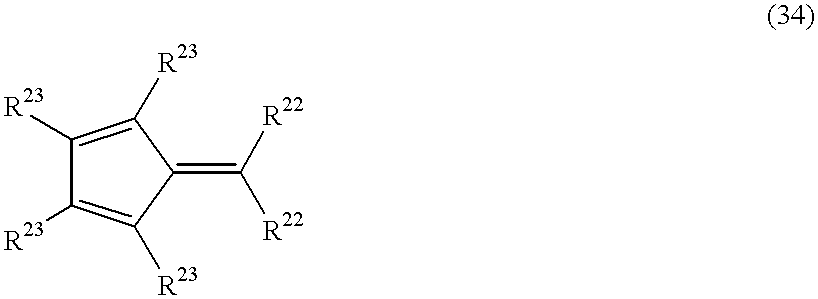
wherein each of the two R22s independently represents a hydrogen atom or a C1-C5 hydrocarbon group, such as a methyl group or a tert-butyl group, and each of the four R23s independently represents a hydrogen atom, a C1-C5 hydrocarbon group or a silyl group substituted with a C1-C20 hydrocarbon group, with the proviso that two adjacent R23s are optionally bonded to each other to form a 4-, 5- or 6-membered ring. 
With respect to the conditions for effecting the reaction of reaction formula (35), the reaction temperature is generally in the range of from −20 to 100° C., preferably from 0 to 80° C., and the reaction time is generally in the range of from 0.1 to 20 hours, preferably from 0.2 to 10 hours. As examples of reaction solvents usable in the reaction, there can be mentioned aliphatic hydrocarbons, such as hexane and decane; ethers, such as diethyl ether and tetrahydrofuran; aromatic hydrocarbons, such as benzene, toluene and xylene; and halogenated hydrocarbons, such as carbon tetrachloride, chloroform and methylene chloride. Of these solvents, ethers are preferred. These reaction solvents are generally used in an amount 10 to 500 times by weight the amount of the compound of formula (34).
As still another example of the transition metal compound of the catalyst of the present invention, there can be mentioned a compound represented by the following formula (8):
In formula (8) above:
Cp represents a group having a cyclopentadienyl skeleton,
M represents a transition metal which is a central metal atom and is Ti, Zr or Hf,
L4 represents a bidentate chelating ligand represented by the following formula (9): 
In formula (9) above, each of R9, R10, R11, R12, R13 and R14 independently represents a hydrogen atom, a halogen atom, an unsubstituted or substituted C1-C20 hydrocarbon group, an unsubstituted or substituted C1-C20 alkoxy group, or a silyl group substituted with an unsubstituted or substituted C1-C20 hydrocarbon group, with the proviso that when each of R9, R10, R11, R12, R13 and R14 independently represents an unsubstituted or substituted hydrocarbon group, a pair of members of at least one combination of R9 and R10, R10 and R11, R11 and R12, and R12 and R13 are optionally bonded to each other, so that at least one combination of R9 and R10, R10 and R11, R11 and R12, and R12 and R13 forms a 4-, 5- or 6-membered ring. Examples of atoms or groups which can be used as each of R9, R10, R11, R12, R13 and R14 include a hydrogen atom; a halogen atom, such as a fluorine, a chlorine, a bromine or an iodine atom; a C1-C20 alkyl group, such as a methyl group, an ethyl group, an n-propyl group, an isopropyl group or a tert-butyl group; a C5-C20 cycloalkyl group, such as a cyclopentyl group or a cyclohexyl group; a C6-C20 aryl group, such as a phenyl group, a tolyl group or a naphthyl group; a C7-C20 arylalkyl group, such as a benzyl group or a neophyl group; a C2-C20 alkenyl group, such as an allyl group or a 2-butenyl group; a C2-C20 alkynyl group, such as a 2-butynyl group; a C1-C20 alkoxy group, such as a methoxy group, an ethoxy group or a phenoxy group; and a C1-C20 trialkylsilyl group. At least one hydrogen atom of each of these groups may be replaced by a substituent atom or group selected from a halogen atom, a C1-C20 alkoxy group, a C6-C20 aryloxy group, a C1-C20 alkylsilyl group and a C6-C20 arylsilyl group. As examples of carbocyclic skeletons in which at least one pair of members of at least one combination of R9 and R10, R10 and R11, R11 and R12, and R12 and R13 are bonded to each other to form at least one carbon ring, there can be mentioned a quinoline structure wherein R12 and R13 are bonded to each other to form a 6-membered aromatic ring; an acridine structure wherein R9 and R10 are bonded to each other to form a 6-membered aromatic ring and R12 and R13 are also bonded to each other to form another 6-membered aromatic ring; and an isoquinoline structure wherein either a pair of R10 and R11 or a pair of R11 and R12 are bonded to each other to form a 6-membered aromatic ring.
In formula (9) above, X6 represents O, S, Se or Te.
In formula (8) above, Y represents a halogen atom, a C1-C20 hydrocarbon group, a C1-C20 alkoxy group, a C1-C20 thioalkoxy group, a C6-C20 aryloxy group, a C6-C20 thioaryloxy group, an amino group substituted with a C1-C20 hydrocarbon group, or a phosphino group substituted with a C1-C20 hydrocarbon group.
Specific examples of Y include a halogen atom, such as a fluorine, a chlorine, a bromine or an iodine atom; a C1-C20 alkyl group, such as a methyl group, an ethyl group, an n-propyl group, an isopropyl group or a tert-butyl group; a C5-C20 cycloalkyl group, such as a cyclopentyl group or a cyclohexyl group; a C6-C20 unsubstituted or substituted aryl group, such as a phenyl group, a tolyl group or a methoxyphenyl group; a C7-C20 arylalkyl group, such as a benzyl group or a neophyl group; a C2-C20 alkenyl group, such as an allyl group or a 2-butenyl group; a C1-C20 alkoxy group, such as a methoxy group, an ethoxy group or an n-butoxy group; a C1-C20 thioalkoxy group, such as a thioisopropoxy group or a thiobenzylalkoxy group; a C6-C20 aryloxy group, such as a phenoxy group or a p-tolyloxy group; a C6-C20 thioaryloxy group, such as a thiophenoxy group; an amino group substituted with a C1-C20 hydrocarbon group, such as a di-n-propylamino group or a dibenzylamino group; and a phosphino group substituted with a C1-C20 hydrocarbon group, such as a diisoamylphosphino group or a diphenylphosphino group.
In formula (8) above, n represents 1 or 2.
Illustrative examples of transition metal compounds represented by formula (8) above wherein L4 is represented by formula (9) above include those which are mentioned below. However, examples of transition metal compounds represented by formula (8) wherein L4 is represented by formula (9) are not limited to those compounds.
Examples of those transition metal compounds include:
(cyclopentadienyl)bis(2-pyridylmethanolato)chlorozirconium,
(n-butylcyclopentadienyl)bis(2-pyridylmethanolato) chlorozirconium,
(1,3-dimethylcyclopentadienyl)bis(2-pyridylmethanolato) chlorozirconium,
(pentamethylcyclopentadienyl)bis(2-pyridylmethanolato) chlorozirconium,
(indenyl)bis(2-pyridylmethanolato)chlorozirconium,
(cyclopentadienyl)bis(3-ethoxy-2-pyridylmethanolato) bromozirconium,
(cyclopentadienyl)bis(2-pyridylmethylthiolato)chlorozirconium,
(methylcyclopentadienyl)bis(2-pyridylmethanolato)chlorozirconium,
(methylcyclopentadienyl)bis(4-methyl-2-pyridylmethanolato)chlorozirconium,
(n-propylcyclopentadienyl)bis(3,4-dimethyl-2-pyridylmethanolato)methylzirconium,
(n-butylcyclopentadienyl)bis(2-pyridyl-phenylmethanolato)chlorozirconium,
(n-butylcyclopentadienyl)bis(2-pyridylmethanolato) ethoxyzirconium,
(n-butylcyclopentadienyl)bis(2-pyridylmethylthio) phenylzirconium,
(1,3-dimethylcyclopentadienyl)bis[(3-propyl-2-pyridyl) methanolato]chlorozirconium,
(1,2,4-trimethylcyclopentadienyl)bis[1-(3-propyl-2-pyridyl)ethanolato]benzylzirconium,
(tetramethylcyclopentadienyl)bis(4-chloro-2-pyridylmethanolato)chlorozirconium,
(pentamethylcyclopentadienyl)bis(2-pyridylmethanolato) chlorozirconium,
(pentamethylcyclopentadienyl)bis(2-pyridyl-diphenylmethanolato)chlorozirconium,
(trimethylsilylcyclopentadienyl)bis[1-(2-pyridyl)-2-methylpropanolato]chlorozirconium,
(trimethylsilyltetramethylcyclopentadienyl)bis(2-pyridylmethanolato)chlorozirconium,
(indenyl)bis(2-pyridylmethanolato)phenoxyzirconium,
(indenyl)bis(2-pyridylmethylthio)chlorozirconium,
(tetrahydroindenyl)bis(4-methyl-2-pyridylmethanolato) dimethylaminozirconium,
(2,4,6-trimethylindenyl)bis(2-pyridylmethanolato)diphenylphosphinozirconium,
(fluorenyl)bis(2-pyridyl-phenylmethanolato)chlorozirconium,
(2,7-di-tert-butylfluorenyl)bis(2-pyridylmethanolato) chlorozirconium,
(cyclopentadienyl)(2-pyridylmethanolato)dichlorozirconium,
(cyclopentadienyl)(2-pyridylmethylthio)dichlorozirconium,
(methylcyclopentadienyl)(2-pyridylmethanolato)dichlorozirconium,
(n-propylcyclopentadienyl)(3,4-dimethyl-2-pyridylmethanolato)dimethylzirconium,
(n-butylcyclopentadienyl)bis(2-pyridyl-phenylmethanolato)chlorozirconium,
(1,3-dimethylcyclopentadienyl)(3-propyl-2-pyridylmethanolato)diethoxyzirconium,
(1,2,4-trimethylcyclopentadienyl)[1-(3-propyl-2-pyridyl)ethylthio]dibenzylzirconium,
(tetramethylcyclopentadienyl)(4-chloro-2-pyridylmethanolato)diallylzirconium,
(pentamethylcyclopentadienyl)bis(2-pyridylmethanolato) iodozirconium,
(trimethylsilyltetramethylcyclopentadienyl)(2-pyridylmethanolato)methylphenylzirconium,
(indenyl)(2-pyridylmethanolato)diaminozirconium, (tetrahydroindenyl)(3-ethoxy-2-pyridylmethanolato) di(diphenylphosphino)zirconium,
(fluorenyl)(2-pyridylmethanolato)dichlorozirconium, (cyclopentadienyl)bis(8-quinolinolato)chlorozirconium, (n-butylcyclopentadienyl)bis(8-quinolinolato)chlorozirconium,
(1,3-dimethylcyclopentadienyl)bis(8-quinolinolato) chlorozirconium,
(pentamethylcyclopentadienyl)bis(8-quinolinolato)chlorozirconium,
(indenyl)bis(8-quinolinolato)chlorozirconium, (cyclopentadienyl)bis(8-quinolinolato)bromozirconium, (cyclopentadienyl)bis(5-chloro-8-quinolinolato)chlorozirconium,
(methylcyclopentadienyl)bis(5-chloro-7-iodo-8-quinolinolato)isopropylzirconium,
(methylcyclopentadienyl)bis(2-methyl-8-quinolinolato) chlorozirconium,
(ethylcyclopentadienyl)bis(10-acridinolato)chlorozirconium,
(ethylcyclopentadienyl)bis(2,7-dimethyl-8-quinolinolato)phenylzirconium,
(n-propylcyclopentadienyl)bis(2-ethyl-5-iodo-8-quinolinolato)chlorozirconium,
(n-butylcyclopentadienyl)bis(10-acridinolato)chlorozirconium,
(1,3-dimethylcyclopentadienyl)bis(8-quinolinolato) cyclohexylzirconium,
(1,3-dimethylcyclopentadienyl)bis(7-n-propyl-8-quinolinolato)chlorozirconium,
(1,2,4-trimethylcyclopentadienyl)bis(7-chloro-8-quinolinolato)chlorozirconium,
(tetramethylcyclopentadienyl)bis(8-quinolinolato)benzylzirconium,
(pentamethylcyclopentadienyl)bis(2-methyl-8-quinolinolato)chlorozirconium,
(trimethylsilyltetramethylcyclopentadienyl)bis(8-quinolinolato)chlorozirconium,
(fluorenyl)bis(7-chloro-8-quinolinolato)chlorozirconium,
(cyclopentadienyl)(8-quinolinolato)dichlorozirconium,
(methylcyclopentadienyl)(10-acridinolato)diphenoxyzirconium,
(ethylcyclopentadienyl)(7-chloro-8-quinolinolato)dibromozirconium,
(n-propylcyclopentadienyl)(8-quinolinolato)dicyclohexylzirconium,
(n-butylcyclopentadienyl)bis(8-quinolinolato)aminozirconium,
(1,3-dimethylcyclopentadienyl)(10-acridinolato)dichlorozirconium,
(1,2,4-trimethylcyclopentadienyl)(8-quinolinolato) dichlorozirconium,
(pentamethylcyclopentadienyl)(2-methyl-8-quinolinolato) dimethoxyzirconium,
(indenyl)(8-quinolinolato)dichlorozirconium, and
(fluorenyl)(7-n-propyl-8-quinolinolato)dichlorozirconium.
Examples of transition metal compounds represented by formula (8) above also include those which are obtained by replacing the zirconium in the above-mentioned zirconium compounds by titanium or hafnium.
Transition metal compounds of formula (8) above: CpML4 nY3-n can be produced by several methods.
For example, a transition metal compound of formula (8) above can be produced from a Group 4A transition metal compound represented by the following formula (13) and a compound represented by the following formula (36) by a reaction represented by the following reaction formula (37).
CpMY3 (13)
wherein each of M, Cp and Y is as defined above for formula (8) above;
wherein L4 is as defined for formula (8) above and is represented by formula (9) above; and
In the reaction of formula (37), from the view-point of efficiency, it is preferred: that, when n=1, the compound of formula (36) above is used in an equimolar amount to the molar amount of the compound of formula (13) above, and that, when n=2, the compound of formula (36) above is used in a molar amount two times the molar amount of the compound of formula (13) above.
A transition metal compound of formula (8) in which n=2, i.e., a transition metal compound represented by the formula: CpML4 2Y, can be efficiently produced from a metallocene compound represented by the following formula (16) and a compound of formula (36) by a reaction represented by the following reaction formula (38).
wherein each of M, Cp and Y is as defined for formula (8) above; and
As examples of this reaction, production of (cyclopentadienyl)bis(8-quinolinolato)fluorotitanium, (cyclopentadienyl)bis(8-quinolinolato)chlorotitanium, (cyclopentadienyl)bis(8-quinolinolato)bromotitanium, (cyclopentadienyl)bis(8-quinolinolato)chlorozirconium, (cyclopentadienyl)bis(8-quinolinolato)bromozirconium, and (cyclopentadienyl)bis(8-quinolinolato)chlorohafnium is disclosed in Journal of Chemical Society (A) [J. Chem. Soc. (A)], 15, 2487-2491 (1971). Similar compounds can also be produced substantially in accordance with the above-mentioned reaction method.
In each of the reactions of reaction formulae (37) and (38), for producing the desired compound efficiently, a tertiary amine, such as triethylamine or triisobutylamine, can be used for trapping by-produced HY. When the tertiary amine is used, the molar amount of the tertiary amine is generally from 1 to 100 times that of the compound of formula (36).
With respect to the conditions for effecting each of the reactions of reaction formulae (37) and (38), the reaction temperature is generally in the range of from −20 to 100° C., preferably from 0 to 80° C., and the reaction time is generally in the range of from 0.1 to 50 hours, preferably from 0.5 to 30 hours. As examples of reaction solvents usable in the reaction, there can be mentioned aliphatic hydrocarbons, such as hexane and decane; ethers, such as diethyl ether and tetrahydrofuran; aromatic hydrocarbons, such as benzene, toluene and xylene; halogenated hydrocarbons, such as carbon tetrachloride, chloroform and methylene chloride; and nitrogen-containing compounds, such as acetonitrile and pyridine. Of these solvents, acetonitrile is preferred. These reaction solvents are generally used in an amount 10 to 500 times by weight the amount of the compound of formula (13) or the compound of formula (16).
By the above-mentioned production methods, the desired transition metal compound can be produced. The thus produced transition metal compound can be purified by a method in which a reaction mixture containing the produced transition metal compound is subjected to filtration to obtain a filtrate; the filtrate is subjected to concentration under reduced pressure to isolate the transition metal compound; the isolated transition metal compound is subjected to recrystallization; and the recrystallized transition metal compound is dried under reduced pressure.
As a further example of the transition metal compound of the olefin polymerization catalyst of the present invention, there can be mentioned a transition metal compound, having a bindentate chelating functional group L5, represented by the following formula (10) or (11):
In formulae (10) and (11) above:
Cp represents a group having a cyclopentadienyl skeleton,
Cq represents a group, having a cyclopentadienyl skeleton, covalently bonded to A, and
M represents a central metal atom which is a transition metal selected from Zr, Ti and Hf.
In formulae (10) and (11), L5 represents a bidentate chelating functional group represented by the following formula (12): 
wherein X7 represents O, S, Se or Te, each of R16, R17, R18 and R19 independently represents a hydrogen atom, a halogen atom, an unsubstituted or substituted C1-C20 hydrocarbon group, an unsubstituted or substituted C1-C20 alkoxy group, or a silyl group substituted with a C1-C20 hydrocarbon group, or
L5 represents a bidentate chelating functional group having a structure such that, in the formula (12), each of the two carbon atoms has one or two unsubstituted or substituted hydrocarbon groups, wherein arbitrarily selected two hydrocarbon groups, which are respectively bonded to the two carbon atoms, are bonded to each other so that the two carbon atoms and the arbitrarily selected two hydrocarbon groups together form a 4-, 5- or 6-membered ring or wherein each of R16 and R18 is the hydrocarbon group and each of R17 and R19 is null, the R16 and the R18 being bonded to each other, so that the two carbon atoms, R16 and R18 together form a 4-, 5- or 6-membered ring containing at least one carbon-to-carbon double bond, or wherein each of R17 and R19 is the hydrocarbon group and each of R16 and R18 is null, the R17 and the R19 being bonded to each other, so that said two carbon atoms, R17 and R19 together form 4-, 5- or 6-membered ring containing at least one carbon-to-carbon double bond.
Examples of each of R16, R17, R18 and R19 include a hydrogen atom; a halogen atom, such as a fluorine, a chlorine, a bromine or an iodine atom; a C1-C20 alkyl group, such as a methyl group, an ethyl group, an n-propyl group, an isopropyl group or a tert-butyl group; a C5-C20 cycloalkyl group, such as a cyclopentyl group or a cyclohexyl group; a C6-C20 aryl group, such as a phenyl group, a tolyl group or a naphtyl group; a C7-C20 arylalkyl group, such as a benzyl group or a neophyl group; a C2-C20 alkenyl group, such as an allyl group or a 2-butenyl group; a C1-C20 alkoxy group, such as a methoxy group, an ethoxy group or a phenoxy group; and a C1-C20 trialkylsilyl group. At least one hydrogen atom of each of R16, R17, R18 and R19 may be replaced by a substituent atom or group selected from a halogen atom, a C1-C20 alkoxy group, a C6-C20 aryloxy group, a C1-C20 alkylsilyl group and a C6-C20 arylsilyl group. Examples of the carbocyclic structures formed by the two carbon atoms in formula (12) and hydrocarbon groups respectively bonded thereto include a benzene structure which is a 6-membered aromatic ring formed by bonding R16 and R18 to each other, and a cyclohexane structure which is an 6-membered ring formed by bonding R16 and R18 to each other.
L5-R15 represents a bidentate chelating ligand represented by the following formula (39): 
wherein each of X7, R16, R17, R18, R19 and
R20 is as defined for formula (12) above.
Each of R15 and R20 independently represents a hydrogen atom, a hydrocarbon group, with the proviso that R15 and R20 are optionally bonded to each other to form a 5- or 6-membered ring containing a nitrogen atom. Examples of each of R15 and R20 include a halogen atom, a C1-C20 alkyl group, such as a methyl group, an ethyl group, an n-propyl group, an isopropyl group or a tert-butyl group; a C5-C20 cycloalkyl group, such as a cyclopentyl group or a cyclohexyl group; a C6-C20 aryl group, such as a phenyl group, a tolyl group or a naphthyl group; a C7-C20 arylalkyl group, such as a benzyl group or a neophyl group; a C2-C20 alkenyl group, such as an allyl group or a 2-butenyl group. Examples of skeleton structures of heterocyclic rings containing a nitrogen include a 5-membered pyrrolidine structure, a 6-membered piperidine structure, and a pyrrole structure which is a 5-membered aromatic ring. At least one hydrogen atom of each of these groups may be replaced by a substituent atom or group selected from a halogen atom, a C1-C20 alkoxy group, a C6-C20 aryloxy group, a C1-C20 alkylsilyl group and a C6-C20 arylsilyl group.
Cq-A-L5 in formula (11) represents a ligand in which the bidentate chelating functional group L5 and the group Cq having a cyclopentadienyl skeleton are linked to each other through briding group A.
In formula (11), A represents a bridging group or atom forming the bridging by covalent bonding, and is selected from the group consisting of —CR8 2—, —CR8 2CR8 2—, —CR8═CR8—, —SiR8 2—, —SiR8 2SiR8 2—, —GeR8 2—, —BR8—, —AlR8—, —PR8—, —P(O)R8 2—, —NR8—, —SO2—, —SO—, —O—, —S—, —Ge—, —Sn—, and —CO—, wherein R8 represents a hydrogen atom, a halogen atom, or an unsubstituted or substituted C1-C20 hydrocarbon group. At least one hydrogen atom of a hydrocarbon group as R8 may be replaced by a substituent atom or group selected from a halogen atom, a C1-C20 alkoxy group and a C6-C20 aryloxy group.
Y in formulae (10) and (11) represents a halogen atom, a C1-C20 hydrocarbon group, a C1-C20 alkoxy group, a C1-C20 thioalkoxy group, a C6-C20 aryloxy group, a C6-C20 thioaryloxy group, an amino group substituted with a C1-C20 hydrocarbon group, or a phosphino group substituted with a C1-C20 hydrocarbon group. Examples of Y include a halogen atom, such as a fluorine, a chlorine, a bromine or an iodine atom; a C1-C20 alkyl group, such as a methyl group, an ethyl group, an n-propyl group, an iso-propyl group or a tert-butyl group; a C5-C20 cycloalkyl group, such as a cyclopentyl group or a cyclohexyl group; a C6-C20 unsubstituted or substituted aryl group, such as a phenyl group, a tolyl group or a methoxyphenyl group; a C7-C20 arylalkyl group, such as a benzyl group or a neophyl group; a C2-C20 alkenyl group, such as an allyl group or a 2-butenyl group; a C1-C20 alkoxy group, such as a methoxy group, an ethoxy group or an n-butoxy group; a C1-C20 thioalkoxy group, such as a thioisopropoxy group or a thiobenzylalkoxy group; a C6-C20 aryloxy group, such as a phenoxy group or p-tolyloxy group; a C6-C20 thioaryloxy group, such as a thiophenoxy group; an amino group substituted with a C1-C20 hydrocarbon group, such as a di-n-propylamino group or a dibenzylamino group; a phosphino group substituted with a C1-C20 hydrocarbon group, such as a di-isoamylphosphino group or a diphenylphosphino group.
In formulae (10) and (11), m represents 1 or 2, and n represents 0, 1 or 2.
Specific examples of transition metal compounds represented by formula (10) or (11) include those which are mentioned below. However, examples of transition metal compounds represented by formula (10) or (11) are not limited to those compounds.
Specific examples of transition metal compounds represented by formula (10) or (11) include:
(cyclopentadienyl)bis(2-dimethylamino-ethanolato)chlorozirconium,
(n-butylcyclopentadienyl)bis(2-dimethylamino-ethanolato)chlorozirconium,
(1,3-dimethylcyclopentadienyl)bis(2-dimethylaminoethanolato)chlorozirconium,
(pentamethylcyclopentadienyl)bis(2-dimethylamino-ethanolato)chlorozirconium,
(indenyl)bis(2-dimethylamino-ethanolato)chlorozirconium,
(cyclopentadienyl)bis(2-diethylamino-ethanolato)chlorozirconium,
(cyclopentadienyl)bis(2-di-n-propylaminoethanolato)bromozirconium,
(methylcyclopentadienyl)bis(2-dimethylaminoethanolato)chlorozirconium,
(methylcyclopentadienyl)bis(2-dimethylamino-1-methylethanolato)methylzirconium,
(ethylcyclopentadienyl)bis(2-dimethylamino-1,2-di-methyl-ethanolato)chlorozirconium,
(n-propylcyclopentadienyl)bis(2-dimethylamino-ethanolato)chlorozirconium,
(n-butylcyclopentadienyl)bis(2-dimethylamino-ethanolato)phenylzirconium,
(n-butylcyclopentadienyl)bis(2-dicyclohexylamino-ethanolato)chlorozirconium,
(1,3-dimethylcyclopentadienyl)bis(2-diphenylaminoethanolato)phenoxyzirconium,
(1,3-dimethylcyclopentadienyl)bis(2-dimethylaminoethanolato)dimethylaminozirconium,
(1,2,4-trimethylcyclopentadienyl)bis(2-dimethylaminoethylthio)chlorozirconium,
(tetramethylcyclopentadienyl)bis(2-dimethylamino-ethanolato)diphenylphosphinozirconium,
(pentamethylcyclopentadienyl)bis(2-dimethylamino-1,2-diethyl-ethanolato)chlorozirconium,
(pentamethylcyclopentadienyl)bis(2-dimethylamino-ethanolato)chlorozirconium,
(trimethylsilyltetramethylcyclopentadienyl)bis[2-(1-pyrrolidino)-ethanolato]thioethoxyzirconium,
(indenyl)bis(2-di-n-propylamino-ethanolato)bromozirconium,
(tetrahydroindenyl)bis[2-(1-piperidino)ethanolato]chlorozirconium,
(2,4,6-trimethylindenyl)bis(2-dimethylamino-1-methylethanolato)ethoxyzirconium,
(fluorenyl)bis[2-(1-pyrrolyl)-ethanolato]chlorozirconium,
(2,7-di-tert-butylfluorenyl)bis(2-dimethylamino-ethanolato)chlorozirconium,
(cyclopentadienyl)(2-dimethylamino-ethanolato)dichlorozirconium,
(cyclopentadienyl)(2-di-n-propylamino-ethanolato)dibromozirconium,
(methylcyclopentadienyl)(2-dimethylaminoethanolato)dichlorozirconium,
(ethylcyclopentadienyl)(2-dimethylamino-1,2-dimethylethanolato)dimethoxyzirconium,
(n-propylcyclopentadienyl)(2-dimethylaminoethanolato)diphenylzirconium,
(n-butylcyclopentadienyl)(2-dimethylaminoethanolato)diethoxyzirconium,
(1,3-dimethylcyclopentadienyl)bis(2-diphenylaminoethanolato)chlorozirconium,
(1,2,4-trimethylcyclopentadienyl)[2-(1-pyrrolidino)ethylthio]bis(diethylamino)zirconium,
(tetramethylcyclopentadienyl)(2-dimethylamino-ethanolato)bis(diphenylphosphino)zirconium,
(pentamethylcyclopentadienyl)(2-dimethylamino-1,2-diethyl-ethanolato)dichlorozirconium,
(trimethylsilyltetramethylcyclopentadienyl)(2-diethylamino-ethanolato)(chloro)methylzirconium,
(indenyl)(2-di-n-propylamino-ethanolato)(methoxy)methylzirconium,
(fluorenyl)(2-dimethylamino-ethanolato)dichlorozirconium,
(cyclopentadienyl)bis(2-dimethylamino-phenolato)chlorozirconium,
(n-butylcyclopentadienyl)bis(2-dimethylaminophenolato)chlorozirconium,
(1, 3-dimethylcyclopentadienyl)bis(2-dimethylaminophenolato)chlorozirconium,
(pentamethylcyclopentadienyl)bis(2-dimethylamino-phenolato)chlorozirconium,
(cyclopentadienyl)bis(2-diethylamino-phenolato)chlorozirconium,
(cyclopentadienyl)bis(4-butyl-2-dimethylamino-phenolato)bromozirconium,
(methylcyclopentadienyl)bis(2-dimethylaminophenolato)methylzirconium,
(methylcyclopentadienyl)bis(2-diphenylaminophenolato)chlorozirconium,
(ethylcyclopentadienyl)bis(2-dicyclohexylamino-phenolato)phenylzirconium,
(ethylcyclopentadienyl)bis(4-amino-2-dimethylaminophenolato)phenoxyzirconium,
(n-propylcyclopentadienyl)bis[2-(1-pyrrolidino)-phenolato]chlorozirconium,
(n-butylcyclopentadienyl)bis(2-dimethylaminophenolato)chlorozirconium,
(n-butylcyclopentadienyl)bis(4-allyl-2-dimethylaminophenolato)diphenylaminozirconium,
(1,3-dimethylcyclopentadienyl)bis(2-dimethylaminophenolato)methoxyzirconium,
(1,3-dimethoxycyclopentadienyl)bis[2-(1-piperidino)phenolato]chlorozirconium,
(1,2,4-trimethylcyclopentadienyl)bis(2-dimethylaminophenolato)chlorozirconium,
(1,2,4-trimethylcyclopentadienyl)bis[2-(1-pyrrolyl)phenolato]bromozirconium,
(tetramethylcyclopentadienyl)bis(2-dimethylamino-phenolato)diethylaminozirconium,
(pentamethylcyclopentadienyl)bis(4-butyl-2-dimethylamino-phenolato)benzylzirconium,
(trimethylsilylcyclopentadienyl)bis(2-diethylaminophenolato)chlorozirconium,
(trimethylsilyltetramethylcyclopentadienyl)bis(2-di-n-propylamino-phenolato)iodozirconium,
(indenyl)bis(2-dimethylamino-phenolato)chlorozirconium,
(tetrahydroindenyl)bis(4-amino-2-diethylamino-phenolato)chlorozirconium,
(2,4,6-trimethylindenyl)bis(2-diethylaminophenolato)chlorozirconium,
(fluorenyl)bis(2-dimethylamino-phenolato)chlorozirconium,
(2,7-di-ethylfluorenyl)bis(2-diisopropylaminophenolato)chlorozirconium,
(cyclopentadienyl)(2-dimethylamino-phenolato)dichlorozirconium,
(methylcyclopentadienyl)bis(2-diethylaminophenolato)methylzirconium,
(ethylcyclopentadienyl)(2-dicyclohexylaminophenolato)dimethoxyzirconium,
(n-propylcyclopentadienyl)[2-(1-pyrrolidino)phenolato]diphenylzirconium,
(n-butylcyclopentadienyl)(2-dimethylaminophenolato)dibenzylzirconium,
(1,3-dimethylcyclopentadienyl)(2-dimethylamino-phenolato)dichlorozirconium,
(1,2,4-trimethylcyclopentadienyl)bis(2-dimethylaminophenolato)(diphenylphosphino)zirconium,
(pentamethylcyclopentadienyl)(2-dimethylamino-phenolato)dichlorozirconium,
(trimethylsilylcyclopentadienyl)(2-diethylamino-phenolato)methoxychlorozirconium,
(trimethylsilyltetramethylcyclopentadienyl)[2-(1-piperidino)-phenolato]dibromozirconium,
(indenyl)(2-dimethylamino-phenolato)diphenylzirconium,
(fluorenyl)(2-dimethylaminophenolato)bis(diethylamino)zirconium,
(tetramethylcyclopentadienyl)dimethylsilylene(2-phenylamino-ethanolato)dichlorozirconium,
(cyclopentadienyl)dimethylsilylene(2-methylaminoethanolato)dichlorozirconium,
(cyclopentadienyl)ethylene(2-phenylamino-2-ethylethanolato)diphenoxyzirconium,
(tetramethylcyclopentadienyl)methylene(2-ethylaminoethanolato)difluorozirconium,
(2-methylcyclopentadienyl)dimethylsilylenedimethylsilylene(2-methylamino-ethanolato)dichlorozirconium,
(3-methylcyclopentadienyl)dimethylsilylene(2-cyclohexylamino-1-methyl-ethanolato)diisobutylzirconium,
(2,4-dimethylcyclopentadienyl)ethylene(2-phenylaminoethanolato)dichlorozirconium,
(3,5-dimethylcyclopentadienyl)isopropylene(2-phenylamino-phenolato)dichlorozirconium,
(indenyl)dimethylsilylene(2-methylaminophenolato)dibromozirconium,
(tetrahydroindenyl)ethylborene(2-methylamino-ethanolato)dimethoxyzirconium, and
(fluorenyl)dimethylsilylene(2-phenylaminophenolato)dibenzylzirconium.
Examples of transition metal compounds represented by formula (10) or (11) above also include those which are obtained by replacing the zirconium in the above-mentioned zirconium compounds by titanium or hafnium.
Transition metal compounds of formula (10) above: CpM(L5-R15)mY3-m can be produced by several methods. For example, a transition metal compound of formula (10) above can be produced from a transition metal compound represented by the following formula (13) and a compound represented by the following formula (40) by a reaction represented by the following reaction formula (41).
wherein each of M, Cp and Y is as defined for formula (10) above;
wherein L5 is as defined for formula (10) above and is represented by formula (12) above, and R15 is as defined for formula (10) above; and
In the reaction of formula (41) above, from the viewpoint of efficiency, it is preferred: that, when m=1, the compound of formula (40) above is used in an equimolar amount to the molar amount of the compound of formula (13), that, when m=2, the compound of formula (40) above is used in a molar amount two times the molar amount of the compound of formula (13).
A transition metal compound of formula (10) above in which m=2, i.e., a transition metal compound represented by the formula: CpM(L5-R15)2Y, can be efficiently produced from a metallocene compound represented by the following formula (16) and a compound of formula (39) above by a reaction represented by the following reaction formula (42).
wherein each of M, Cp and Y is as defined for formula (10) above; and
In each of the reactions of reaction formulae (41) and (42), for producing the desired compound efficiently, a tertiary amine, such as triethylamine or triisobutylamine, can be used for trapping by-produced HY. When the tertiary amine is used, the molar amount of the tertiary amine is generally from 1 to 100 times that of the compound of formula (40).
With respect to the conditions for effecting each of the reactions of reaction formulae (41) and (42), the reaction temperature is generally in the range of from −20 to 100° C., preferably from 0 to 80° C., and the reaction time is generally in-the range of from 0.1 to 70 hours, preferably from 0.5 to 50 hours. As examples of reaction solvents usable in the reactions, there can be mentioned aliphatic hydrocarbons, such as hexane and decane; ethers, such as diethyl ether and tetrahydrofuran; aromatic hydrocarbons, such as benzene, toluene and xylene; halogenated hydrocarbons, such as carbon tetrachloride, chloroform and methylene chloride; and nitrogen-containing compounds, such as acetonitrile and pyridine. Of these solvents, acetonitrile is preferred. These reaction solvents are generally used in an amount 10 to 500 times by weight the amount of the compound of formula (13) above or the compound of formula (16) above.
By the above-mentioned production methods, a desired transition metal compound can be produced. The thus produced transition metal compound can be purified by a method in which a reaction mixture containing the produced transition metal compound is subjected to filtration to obtain a filtrate; the filtrate is subjected to concentration under reduced pressure to isolate the transition metal compound; the isolated transition metal compound is subjected to recrystallization; and the recrystallized transition metal compound is dried under reduced pressure.
On the other hand, a transition metal compound having the bridging group-containing ligand (Cq-A-L5) i.e., a transition metal compound of formula (6): (Cq-A-L5)M(L5-R15)nY2-n, can be produced, for example, by the following method.
That is, using a compound represented by formula (24), which has a group having a cyclopentadienyl skeleton and a bridging group, compound represented by the following formula (43), an organoalkali metal compound represented by the following formula (27) and a transition metal compound represented by the following formula (28), reactions represented, respectively, by the following reaction formulae (44), (45) and (46) are successively performed.
wherein each of Cq and A is as defined for formula (11) above, and W represents a reactive group, such as a halogen atom, a hydrogen atom or an alkoxy group;
wherein L5 is as defined for formula (11) above and is represented by formula (12) above;
wherein R21 is a hydrocarbon group, and Z4 represents an alkali metal, such as Li, Na or K;
wherein each of M and Y is as defined for formula (11) above;
and
A transition metal compound of formula (6): (Cq-A-L5)M(L5-R15)nY2-n can be obtained, for example, by reacting (Cq-A-L5)MY2 [obtained by the reaction of reaction formula (32)] with an equimolar amount of (L5-R15)H [i.e., the compound of formula (40) above] in accordance with the following reaction formula (47):
With respect to the conditions for effecting each of the reactions of reaction formulae (44), (45), (46) and (47), the reaction temperature is generally in the range of from −20 to 100° C., preferably from 0 to 80° C., and the reaction time is generally in the range of from 0.1 to 70 hours, preferably from 0.5 to 50 hours. As examples of reaction solvents usable in the reactions, there can be mentioned aliphatic hydrocarbons, such as hexane and decane; ethers, such as diethyl ether and tetrahydrofuran; aromatic hydrocarbons, such as benzene, toluene and xylene; and halogenated hydrocarbons, such as carbon tetrachloride, chloroform and methylene chloride. Of these solvents, ethers are preferred. These reaction solvents are generally used in an amount 10 to 500 times by weight the amount of the starting compound used in the reaction.
By the above-mentioned production methods, the desired transition metal compound can be produced. The thus produced transition metal compound can be purified by a method in which a reaction mixture containing the produced transition metal compound is subjected to filtration to obtain a filtrate; the filtrate is subjected to concentration under reduced pressure to isolate the transition metal compound; the isolated transition metal compound is subjected to recrystallization; and the recrystallized transition metal compound is dried under reduced pressure.
A transition metal compound of formula (11): (Cq-A-L5)M (L5-R15)nY2-n, wherein the bridging group A is a substituted methylene group CR21 2, can also be produced by the following method. That is, first, the compound represented by the formula Cq-A-L5H is produced from a compound represented by the below-mentioned formula (34), the compound of formula (27) and the compound of formula (43) in accordance with a reaction represented by the below-mentioned reaction formulae (48) and (49). Then, using the obtained compound of the formula Cq-A-L5H, the reactions of reaction formulae (45), (46) and (47) above are successively performed. 
wherein each of the two R22s independently represents a hydrogen atom or a C1-C5 hydrocarbon group, such as a methyl group or a tert-butyl group, and each of the four R23s independently represents a hydrogen atom, a C1-C5 hydrocarbon group or a silyl group substituted with a C1-C20 hydrocarbon group, with the proviso that two adjacent R23s are optionally bonded to each other to form a 4-, 5- or 6-membered ring;
and 
With respect to the conditions for effecting each of the reactions of reaction formulae (48) and (49), the reaction temperature is generally in the range of from −20 to 100° C., preferably from 0 to 80° C., and the reaction time is generally in the range of from 0.1 to 20 hours, preferably from 0.2 to 10 hours. As examples of reaction solvents usable in the reaction, there can be mentioned aliphatic hydrocarbons, such as hexane and decane; ethers, such as diethyl ether and tetrahydrofuran; aromatic hydrocarbons, such as benzene, toluene and xylene; and halogenated hydrocarbons, such as carbon tetrachloride, chloroform and methylene chloride. Of these solvents, ethers are preferred. These reaction solvents are generally used in an amount 10 to 500 times by weight the amount of the compound of formula (34).
It is preferred that the olefin polymerization catalyst of the present invention, which comprises the above-specified transition metal compound, futher comprises at least one auxiliary catalyst selected from the group consisting of an organoaluminumoxy compound and a cation generator. As the auxiliary catalyst, a conventional compound can be used.
The organoaluminumoxy compound is an alkylaluminoxane which is represented by one of the following formulae (50) and (51): 
wherein each R24 independently represents a hydrogen atom, a halogen atom or a C1-C10 alkyl group, and p is an integer of from 2 to 40.
Representative examples of R24 in each of formulae (50) and (51) include a hydrogen atom; a halogen atom, such as a chlorine atom or a bromine atom; and an alkyl group, such as a methyl group, an ethyl group, an n-propyl group, an isopropyl group, an n-butyl group, an isobutyl group, a sec-butyl group, a pentyl group, a hexyl group, a heptyl group, an octyl group, a nonyl group or a decyl group. These atoms and groups can be used in combination. It is preferred that each R24 is a methyl group or that R24s are different and are a combination of a methyl group and other atom(s) and group(s). The number of recurring units (i.e., p) is preferably in the range of from 2 to 40, more preferably from 5 to 40. The alkylaluminoxane can be prepared by a customary method, for example, a method in which a trialkylaluminum is dissolved in a hydrocarbon solvent to obtain a solution and then, one equivalent of water, relative to the amount of the trialkylaluminum, is gradually added to the solution to hydrolyze the trialkylaluminum; a method in which copper sulfate hydrate, aluminum sulfate hydrate or the like is suspended in a hydrocarbon solvent and then, 1 to 3 equivalents of trialkylaluminum, relative to the crystal water of the suspended hydrate, are contacted with the hydrate to thereby gradually hydrolyze the trialkylaluminum; or a method in which silica gel having water adsorbed thereon is suspended in a hydrocarbon solvent and then, 1 to 3 equivalents of trialkylaluminum, relative to the water adsorbed on the suspended silica gel, are contacted with the silica gel to thereby gradually hydrolyze the trialkylaluminum.
As cation generators, there can be mentioned cation generators of the neutral type and cation generators of the ion-pair type.
An example of cation generators of the neutral type is an organoboron compound which is represented by the following formula (52):
wherein each R25 independently represents a C1-C20 hydrocarbon group.
That is, the organoboron compound is not specifically limited, as long as it is a boron compound in which a hydrocarbon group as a substituent is bonded to a boron atom. At least one hydrogen atom of the hydrocarbon group may be replaced by a halogen atom.
Examples of R25 include alkyl groups, such as a methyl group, an ethyl group, an n-propyl group, an amyl group, an iso-amyl group, an isobutyl group and an n-octyl group; and aryl groups, such as a phenyl group, a fluorophenyl group, a tolyl group and a xylyl group. The three R25 groups may be the same or different.
Specific examples of organic boron compounds represented by formula (52) include triphenylborane, tri(pentafluorophenyl)borane, tri(2,3,4,5-tetrafluorophenyl)borane, tri(2,4,6-trifluorophenyl)borane, tri(2,3-difluorophenyl)borane, tri(2-fluorophenyl)borane, tri[(3,5-di(trifluoromethyl)phenyl]borane, tri[(4-trifluoromethyl)phenyl]borane, trimethylborane, triethylborane, tri(trifluoromethyl)borane, diphenylfluoroborane and di(pentafluorophenyl)chloroborane. Among these examples, tri(pentafluorophenyl)borane is especially preferred.
An example of cation generators of the ion-pair type is a compound represented by the following formula (53):
wherein [On]+ represents a metal cation, such as an ion of a metal belonging to Group 1B, 2B or 8 of the Periodic Table, or a cation, such as a carbonium ion, a silylium ion, an oxonium ion, a sulfonium ion, an ammonium ion or a phosphonium ion, and [BR26 4]− represents an anion which has no or poor coordinating property.
R26 is the same as R25 in formula (52). Preferred specific examples of cation generators represented by formula (53) include tetra (pentafluorophenyl) borate salts and the like, such as ferrocenium tetra(pentafluorophenyl)borate, silver(I) tetra(pentafluorophenyl)borate, copper(I) tetra(pentafluorophenyl)borate, mercury(II) bis[tetra(pentafluorophenyl)borate], palladium(II) bis[tetra(pentafluorophenyl)borate], platinum(II) bis[tetra(pentafluorophenyl)borate], diphenylhydrocarbonium tetra(pentafluorophenyl)borate, triphenylcarbonium tetra(pentafluorophenyl)borate, triphenylsilylium tetra(pentafluorophenyl)borate, tricyclohexylcarbonium tetra(pentafluorophenyl)borate, triethyloxonium tetra(pentafluorophenyl)borate, triethylsulfonium tetra(pentafluorophenyl)borate, diethylanilinium tetra(pentafluorophenyl)borate, trimethylammonium tetra(pentafluorophenyl)borate, triethylammonium tetra(pentafluorophenyl)borate, tetra(n-butyl)ammonium tetra(pentafluorophenyl)borate and triphenylphosphonium tetra(pentafluorophenyl)borate.
The polymerization catalyst of the present invention may further comprise an alkylaluminum represented by the following formula (54) in addition to the above-mentioned auxiliary catalyst (i.e., an organoaluminumoxy compound and/or a cation generator), so as to stabilize the catalyst and the auxiliary catalyst and to reduce the amount of the auxiliary catalyst to be used;
wherein each R27 independently represents a hydrogen atom, a halogen atom or a C1-C10 alkyl group, and q is 1 or 2.
Examples of R27 include a hydrogen atom; a halogen atom, such as a chlorine atom or a bromine atom; an alkyl group, such as a methyl group, an ethyl group, an n-propyl group, an isopropyl group, an n-butyl group, an isobutyl group, a sec-butyl group, a pentyl group, a hexyl group, an octyl group or a decyl group.
The olefin polymerization catalyst of the present invention can be prepared by a method in which components of the catalyst, namely the above-mentioned specific transition metal compound as the main component, at least one auxiliary catalyst selected from an organoaluminumoxy compound and cation generator, and, optionally, an alkylaluminum compound, are added to and dissolved in an inert hydrocarbon solvent or an olefin monomer medium, to obtain a catalyst solution for use in polymerization. The order of adding the components for the catalyst is not particularity limited and can be arbitrarily selected. The transition metal component and the auxiliary catalyst may be mixed with each other prior to addition thereof into the polymerization reaction system, or may be added separately to the polymerization reaction system. Further, the catalyst of the present invention may contain other components capable of effectively catalyzing the olefn polymerization reaction, in addition to the above-mentioned catalyst components. Furthermore, when it is intended to produce a polymer having a multi-modal molecular weight distribution so as to impart the polymer with improved characteristics, a combination of two or more types of transition metal compounds falling in the definition of the transition metal compound of the catalyst of the present invention may be used, or, alternatively, the catalyst of the present invention may be used in combination with conventional catalyst components.
In practice of the olefin polymerization method using the catalyst of the present invention, the transition metal compound of the catalyst of the present invention is used in an amount of from 10−8 to 10−1 mole, preferably from 10−7 to 10−3 mole, in terms of the amount of the transition metal, per unit volume (liter) of the olefin monomer. The “volume of the olefin monomer” generally means the volume of the olefin monomer as a material. However, in a suspension or solution polymerization in which a solvent is used, the “volume of the olefin monomer” means the total volume of the olefin monomer and the solvent. In a gas phase polymerization in which a diluent gas, which is an inert gas, such as nitrogen or argon, is used in addition to a gaseous olefin monomer, the “volume of the olefin monomer” means the total volume of the olefin monomer and the diluent gas. However, in a suspension or solution polymerization using a reactor in which a space other than the liquid phase is filled with an inert gas, the volume of the inert gas is not included in the “volume of the olefin monomer”.
When the above-mentioned organoaluminumoxy compound is used as an auxiliary catalyst, the organoaluminumoxy compound is used in an amount such that the atomic ratio of the aluminum contained in the organoaluminumoxy compound to the transition metal contained in the catalyst is generally in the range of from 10 to 105, preferably from 50 to 5×10³. When the above-mentioned cation generator is employed as an auxiliary catalyst, the cation generator is used in an amount of from 0.5 to 10, preferably from 1 to 3, in terms of the molar ratio of the cation generator to the transition metal compound. Further, when the above-mentioned alkylaluminum is used, the alkylaluminum is used in an amount of from 1 to 105, preferably from 10 to 104, in terms of the atomic ratio of the aluminum contained in the alkylaluminum to the transition metal contained in the transition metal compound.
When, among the transition metal compounds of the catalyst of the present invention, a transition metal compound having 2 or 3 bidentate chelating ligands is used, it is occasionally desirable for obtaining a catalyst having improved polymerization activity that the catalyst comprising the transition metal compound is subjected to a preliminary treatment (described below) prior to the polymerization. Especially when the polymerization temperature is about 90° C. or lower, the preliminary treatment is very effective for improving the polymerization activity. The preliminary treatment is conducted in such a manner as mentioned below: the transition metal compound, the auxiliary catalyst and an olefin are mixed together in an inert hydrocarbon solvent to thereby obtain a mixture, and the obtained mixture is heated and maintained at a high temperature. Examples of inert hydrocarbon solvents used in the preliminary treatment include aliphatic hydrocarbons, such as butane, isobutane, pentane, hexane, octane, decane, dodecane, hexadecane and octadecane; alicyclic hydrocarbons, such as cyclopentane, methylcyclopentane, cyclohexane and cyclooctane; aromatic hydrocarbons, such as benzene, toluene and xylene; petroleum fractions, such as naphtha, coal oil and gas oil. With respect to the molar ratio of the transition metal compound to the auxiliary catalyst in the preliminary treatment, there is no particular limitation as long as the molar ratio is in the same range of molar ratio as used for the polymerization reaction. The olefin used in the preliminary treatment may be either the same olefin as used as an olefin monomer in the polymerization reaction, or an olefin which is other than the olefin monomer used in the polymerization reaction and which has from 2 to 20 carbon atoms. The olefin is used in an amount such that the molar ratio of the olefin to the transition metal compound is in the range of about 10 to 103. The temperature and time of the heat treatment are, respectively, selected from the range of from about 90 to 120° C. and the range of from about 10 to 60 minutes.
In practicing the olefin polymerization using the catalyst of the present invention, there may be employed a customary polymerization method, such as a suspension polymerization method, a solution polymerization method and a gas phase polymerization method.
When a suspension polymerization method or a gas phase polymerization method is employed, the transition metal compound and/or the auxiliary catalyst can be used in such a form as carried on a carrier. Examples of materials for the carrier include an inorganic oxide material, such as silica, alumina, silica-alumina, magnesia, titania or zirconia; an inorganic material, such as magnesium chloride; and an organic material, such as polystyrene, polyethylene, polypropylene or carbon. With respect to the method for having the catalyst carried on a carrier, there is no particular limitation, and a conventional method can be used. When the catalyst carried on a carrier is used, a preliminary polymerization of an olefin may be conducted using such a catalyst prior to the full-scale polymerization of the olefin. It is preferred that the preliminary polymerization is conducted in a scale such that an olefin polymer is obtained in an amount of from 0.05 to 500 g, more preferably 0.1 to 100 g, per gram of the carried catalyst. The use of the transition metal compound and/or the auxiliary catalyst in such a form as carried on a carrier is effective for improving the powder characteristics and bulk density of a polymer produced by a suspension polymerization method or a gas phase polymerization method.
In practicing the solution polymerization method or suspension polymerization method, an inert hydrocarbon solvent or an olefin monomer itself which is subjected to the polymerization can be used as a solvent for the polymerization reaction. Examples of inert hydrocarbon solvents used in the polymerization reaction include aliphatic hydrocarbons, such as butane, isobutane, pentane, hexane, octane, decane, dodecane, hexadecane and octadecane; alicyclic hydrocarbons, such as cyclopentane, methylcyclopentane, cyclohexane and cyclooctane; aromatic hydrocarbons, such as benzene, toluene and xylene; and petroleum fractions, such as naphtha, coal oil and gas oil.
In the suspension polymerization method, the polymerization reaction is carried out at a temperature of from −20 to 100° C., preferably from 20 to 90° C. In the solution polymerization method, the polymerization reaction is carried out at a temperature of from 0 to 300° C., preferably from 100 to 250° C. In the gas phase polymerization method, the polymerization reaction is carried out at a temperature of from 0 to 120° C., preferably from 20 to 100° C.
With respect to the pressure of the polymerization reaction, there is no particular limitation. The polymerization pressure is generally from atmospheric pressure to 300 kg/cm2, preferably from atmospheric pressure to 100 kg/cm2. The polymerization may be conducted in a batchwise manner, a semi-continuous manner or a continuous manner. Further, it is possible to conduct the polymerization reaction in a two(or more)-stage manner, wherein the reaction conditions in one stage are different from the reaction conditions in the other stage (or stages).
The molecular weight of a polymer produced can be adjusted by customary techniques, such as control of the reaction temperature and addition of hydrogen to the reaction system.
Examples of olefins which can be polymerized by the olefin polymerization methods of the present invention include ethylene; C3-C20 olefins, such as propylene, 1-butene, 1-pentene, 1-hexene, 4-methyl-1-pentene, 1-octene, 1-decene, 1-tetradecene, 1-hexadecene, 1-octadecene and 1-eicosene; alicyclic olefins, such as cyclopentene, cycloheptene, norbornene, 5-methyl-2-norbornene and tetracyclododecene. Other compounds having a double bond or double bonds, such as styrene, vinylcyclohexene or 1,5-hexadiene, can also be used as an olefin monomer in the polymerization of the present invention. Further, copolymerization can be conducted between two or more different olefins, e.g., ethylene/propylene, ethylene/1-butene, ethylene/1-hexene, ethylene/l-octene, ethylene/cyclopentene, ethylene/styrene, ethylene/propylene/ethylidenenorbornene, to thereby obtain a copolymer having a low density and a copolymer having a uniform copolymerization distribution (i.e., uniform distribution with respect to the proportions of different component monomer units constituting the copolymer).
The present invention will now be further illustrated in more detail with reference to the following Examples and Comparative Examples, which should not be construed as limiting the scope of the present invention.
The organic acid salts and hydroxy compounds used as materials for synthesizing the transition metal compounds of the present invention were those which are mentioned below.
Carbamates: commercially available products, or products synthesized by the method described in the literature (for example, “Inorganic Chemistry, 22, 2000 (1983)”, “Inorganic Chemistry, 17, 2114 (1978)”) or synthesized substantially in accordance with the above method.
Xanthates: commercially available products, or products synthesized by the method described in the literature (for example, “Inorganic Chemistry, 33, 2790 (1994)”) or synthesized substantially in accordance with the above method.
Dithiophosphates: commercially available products, or products synthesized by the method described in the literature (for example, “Inorganic Chemistry, 29, 4974 (1990)”) or synthesized substantially in accordance with the above method.
Quinolinols: commercially available products, or products synthesized by the method described in the literature (for example, “Zesz. Nauk. Politech. Rzeszowskiej, 3, 63 (1984)”) or synthesized substantially in accordance with the above method.
Pyridylmethanols : commercially available products, or products synthesized by the method described in the literature (for example, “Synthetic Communications, 25, 629 (1995)”) or synthesized substantially in accordance with the above method.
Aminoethanols: commercially available products, or products synthesized by the method described in the literature (for example, “Journal of Chemical Society, 3623 (1953)”, and “Synthetic Communications, 14, 1213 (1984)”) or synthesized substantially in accordance with the above method.
With respect to the metallocenes and transition metal compounds as materials for synthesizing the transition metal compounds characteristic of the present invention, commercially available products, or products obtained by conventional methods in the art were used.
In each of the Examples and Comparative Examples, the catalyst was synthesized and isolated in a nitrogen atmosphere by the Schlenk's method or in a gloved box. The materials and the synthesized transition metal compounds were identified by elemental analysis and 1H-NMR.
The molecular weight and molecular weight distribution of a homopolymer or a copolymer obtained by the polymerization or copolymerization reaction were obtained, by gel permeation chromatography (GPC) (detection: differential refractive index) (apparatus: 150CV manufactured and sold by Waters Assoc. Co., U.S.A.). The comonomer distribution in a copolymer obtained by the copolymerization reaction was obtained using a Fourier transform infrared (FT-IR) spectrophotometer (M550, manufactured and sold by Nicolet Instrument Co., U.S.A.) which is connected to the above GPC apparatus.
In the chemical formulae described in the Examples and Comparative Examples, Me, Et, iPr, Bu, Ph and Cp represent methyl, ethyl, isopropyl, butyl, phenyl and a group having a cyclopentadienyl skeleton, respectively.
Cp* and Me3SiCp* represent (CH3)5Cp and (Me3Si)Me4Cp, respectively.
{overscore (Mw)} represents a weight average molecular weight, and {overscore (Mn)} represents a number average molecular weight.
Synthesis of (Pentamethylcyclopentadienyl)Tris(Dimethyldithiocarbamato)Zirconium [Cp*Zr(S2CNMe2)3] (Catalyst 1)
Into a 100 ml glass reactor which had been fully purged with nitrogen gas were charged 2.0 g of (pentamethylcyclopentadienyl)zirconium trichloride and 2.6 g of sodium dimethyldithiocarbamate, followed by mixing to obtain a mixture. 50 ml of methylene chloride was added to the mixture, and the resultant mixture was stirred at room temperature for 12 hours to effect a reaction. The resultant reaction mixture was filtered to obtain a filtrate, and the obtained filtrate was subjected to distillation to obtain a solid. The obtained solid was recrystallized from methylene chloride and then dried under reduced pressure. As a result, 2.8 g of a white solid was obtained (yield: 79%). The results of the measurement by 1H-NMR spectroscopy (δ: ppm, solvent: deuteriochloroform) and elemental analysis of the product were as follows.
δ 1.9 (s, 15H), 3.3 (m, 18H) C, 38.4; H, 5.4; N, 7.5; S, 33.6; Zr, 15.1; (wt %)
Into a 100 ml glass reactor which had been fully purged with nitrogen gas were charged 2.0 g of bis(n-butylcyclopentadienyl)zirconium dichloride and 3.0 g of sodium di-isopropyldithiocarbamate, followed by mixing. 50 ml of methylene chloride was added, and the resultant mixture was stirred at room temperature for 18 hours to effect a reaction. The resultant reaction mixture was filtered to obtain a filtrate, and the obtained filtrate was subjected to distillation to obtain a solid. The obtained solid was recrystallized from methylene chloride and then dried under reduced pressure. As a result, 2.7 g of a white solid was obtained (yield: 75%). The results of elemental analysis of the product were as follows.
C, 48.1; H, 7.3; N, 5.4; S, 26.6; Zr, 12.6; (wt %)
Into a 100 ml glass reactor which had been fully purged with nitrogen gas were charged 2.0 g of (pentamethylcyclopentadienyl)zirconium trichloride and 0.9 g of sodium dimethyldithiocarbamate, followed by mixing. 50 ml of methylene chloride was added to the mixture, and the resultant mixture was stirred at room temperature for 12 hours to effect a reaction. The resultant reaction mixture was filtered to obtain a filtrate, and the obtained filtrate was subjected to distillation to obtain a solid. The obtained solid was recrystallized from methylene chloride and then dried under reduced pressure. As a result, 1.8 g of a yellow solid was obtained (yield: 72%). The results of elemental analysis of the product were as follows.
C, 37.0; H, 5.3; N, 3.7; S, 15.5; Zr, 21.6; (wt %)
Into a 100 ml glass reactor which had been fully purged with nitrogen gas were charged 2.0 g of (1,2,4-trimethylcyclopentadienyl)zirconium trichloride and 4.7 g of sodium dibenzyldithiocarbamate, followed by mixing. 50 ml of methylene chloride was added and the resultant mixture was stirred at room temperature for 18 hours to thereby effect a reaction. The reaction mixture was filtered to obtain a filtrate, and the obtained filtrate was subjected to distillation to obtain a solid. The obtained solid was recrystallized from a methylene chloride and then dried under reduced pressure. As a result, 4.3 g of a white solid was obtained (yield: 80%). The results of elemental analysis of the product were as follows.
C, 62.8; H, 5.0; N, 4.5; S, 18.5; Zr, 9.2; (wt %)
Into a 100 ml glass reactor which had been fully purged with nitrogen gas were charged 2.0 g of bis(cyclopentadienyl)titanium dichloride, 2.3 g of sodium dimethyldithiocarbamate and 1.0 g of tetramethylthiuram disulfide, followed by mixing. 50 ml of tetrahydrofuran was added and the resultant mixture was stirred at room temperature for 6 hours to thereby effect a reaction. The resultant reaction mixture was filtered to obtain a filtrate, and the obtained filtrate was subjected to distillation to obtain a solid. The obtained solid was recrystallized from methylene chloride and then dried under reduced pressure. As a result, 2.5 g of a yellow solid was obtained (yield: 65%). The results of elemental analysis of the product were as follows.
C, 36.0; H, 5.3; N, 8.9; S, 40.1; Ti, 9.7; (wt %)
Into a 100 ml glass reactor which had been fully purged with nitrogen gas were charged 2.0 g of bis(indenyl)zirconium dichloride and 4.3 g of sodium di-n-butyldiselenocarbamate, followed by mixing. 50 ml of methylene chloride was added and the resultant mixture was stirred at room temperature for 18 hours to thereby effect a reaction. The resultant reaction mixture was filtered to obtain a filtrate, and the obtained filtrate was subjected to distillation to obtain a solid. The obtained solid was recrystallized from methylene chloride and then dried under reduced pressure. As a result, 2.7 g of a yellow solid was obtained (yield: 55%). The results of elemental analysis of the product were as follows.
C, 39.0; H, 5.6; N, 3.6; S, 42.8; Zr, 9.0; (wt %)
Into a 100 ml glass reactor which had been fully purged with nitrogen gas were charged 2.0 g of bis(cyclopentadienyl)zirconium dichloride and 5.3 g of silver diethyldithiocarbamate, followed by mixing. 50 ml of methylene chloride was added and the resultant mixture was stirred at room temperature for 18 hours to thereby effect a reaction. The resultant reaction mixture was filtered to obtain a filtrate, and the obtained filtrate was subjected to distillation to obtain a solid. The obtained solid was recrystallized from methylene chloride and then dried under reduced pressure. As a result, 3.2 g of a white solid was obtained (yield: 78%). The results of elemental analysis of the product were as follows.
C, 39.8; H, 6.1; N, 7.3; S, 31.0; Zr, 15.8; (wt %)
Into a 100 ml glass reactor which had been fully purged with nitrogen gas were charged 2.0 g of (pentamethylcyclopentadienyl)zirconium trichloride and 2.3 g of sodium dimethylmonothiocarbamate, followed by mixing. 50 ml of methylene chloride was added and the resultant mixture was stirred at room temperature for 12 hours to effect a reaction. The resultant reaction mixture was filtered to obtain a filtrate, and the obtained filtrate was subjected to distillation to obtain a solid. The obtained solid was recrystallized from methylene chloride and then dried under reduced pressure. As a result, 2.6 g of a yellow solid was obtained (yield: 79%). The results of elemental analysis of the product were as follows.
C, 41.3; H, 6.6; N, 7.9; S, 17.8; Zr, 16.4; (wt %)
Into a 100 ml glass reactor which had been fully purged with nitrogen gas was charged 50 ml of diethyl ether. 2.0 g of (trimethylsilyltetramethylcyclopentadienyl)zirconium trichloride was dissolved in the diethyl ether to obtain a solution. To the solution was added 15.3 ml of a diethyl ether solution of lithium phenoxide (lithium phenoxide concentration: 1 mole/liter) to obtain a mixture, and the resultant mixture was stirred at room temperature for 6 hours to effect a reaction. The resultant reaction mixture was subjected to distillation to obtain a solid. The obtained solid was dissolved in toluene to obtain a solution, and the solution was filtered to obtain a filtrate. The obtained filtrate was subjected to distillation to obtain a solid. As a result, (trimethylsilyltetramethylcyclopentadienyl)zirconium triphenoxide was obtained. The obtained solid as such was used for the subsequent reaction.
Into a 100 ml glass reactor which had been fully purged with nitrogen gas were charged the above-obtained (trimethylsilyltetramethylcyclopentadienyl)zirconium triphenoxide and 0.9 g of sodium pyrrolidinodithiocarbamate, followed by mixing. 50 ml of methylene chloride was added and the resultant mixture was stirred at room temperature for 12 hours to effect a reaction. The resultant reaction mixture was filtered to obtain a filtrate, and the obtained filtrate was subjected to distillation to obtain a solid. The obtained solid was recrystallized from methylene chloride and then dried under reduced pressure. As a result, 1.7 g of a yellow solid was obtained (yield: 55%). The results of elemental analysis of the product were as follows. C, 56.6; H, 6.1; N, 2.7; S, 10.5; Zr, 14.8 (wt %)
Into a 100 ml glass reactor which had been fully purged with nitrogen gas were charged 2.0 g of bis(cyclopentadienyl)hafnium dichloride and 2.3 g of sodium dimethyldithiocarbamate, followed by mixing. 50 ml of methylene chloride was added and the resultant mixture was stirred at room temperature for 18 hours to effect a reaction. The resultant reaction mixture was filtered to obtain a filtrate, and the obtained filtrate was subjected to distillation to obtain a solid. The obtained solid was recrystallized from methylene chloride and then dried under reduced pressure. As a result, 2.4 g of a white solid was obtained (yield: 76%). The results of elemental analysis of the product were as follows. C, 27.2; H, 3.9; N, 7.1; S, 31.9; Hf, 29.9 (wt %).
Into a 100 ml glass reactor which had been fully purged with nitrogen gas were charged 2.0 g of (1,3-dimethylcyclopentadienyl)zirconium trichloride and 8.1 g of sodium dicyclohexylditellurocarbamate, followed by mixing. 50 ml of methylene chloride was added and the resultant mixture was stirred at room temperature for 18 hours to effect a reaction. The resultant reaction mixture was filtered to obtain a filtrate, and the obtained filtrate was subjected to distillation to obtain a solid. The obtained filtrate was recrystallized from methylene chloride and then dried under reduced pressure. As a result, 5.6 g of a yellow solid was obtained (yield: 64%). The results of elemental analysis of the product were as follows. C, 36.7; H, 5.2; N, 2.5; S, 49.0; Zr, 6.6 (wt %)
Into a 1.6-liter autoclave which had been evacuated and fully purged with nitrogen gas, a 5 ml toluene solution containing 0.5 μmole of catalyst 1 [Cp*Zr(S2CNMe2)3] and 5 ml of a toluene solution of MMAO (methylaluminoxane, manufactured and sold by Tosoh Akzo Corp., Japan) were charged together with 0.6 liter of dehydrated and deoxidated toluene, wherein the MMAO concentration of the toluene solution of MMAO was 0.1 mole/liter in terms of the amount of aluminum and, accordingly, 5 ml of the toluene solution contained MMAO in an amount of 0.5 mmole in terms of the amount of aluminum. The temperature of the inside of the autoclave was maintained at 80° C. and then, ethylene gas was charged into the autoclave at a pressure of 10 kg/cm2•G. A polymerization reaction was allowed to proceed for 1 hour, while supplying ethylene gas to maintain the total pressure in the autoclave at a constant level. 32.6 g of a polymer was obtained. It was found that the {overscore (Mw)} of the polymer was 565,000 and the {overscore (Mw)}/{overscore (Mn)} was 2.56.
A polymerization reaction was conducted in substantially the same manner as in Example 12 except that use was made of catalyst 2 [(nBuCp)Zr(S2CNiPr2)3] instead of catalyst 1. 26.5 g of a polymer was obtained. It was found that the {overscore (Mw)} of the polymer was 643,000 and the {overscore (Mw)}/{overscore (Mn)} was 2.41.
A polymerization reaction was conducted in substantially the same manner as in Example 12 except that use was made of catalyst 3 [(Cp*Zr(S2CNMe2)Cl2]. 29.3 g of a polymer was obtained. It was found that the {overscore (Mw)} of the polymer was 525,000 and the {overscore (Mw)}/{overscore (Mn)} was 2.30.
In a 100 ml glass reactor which had been fully purged with nitrogen gas, a 10 ml toluene solution containing 1 μmole of catalyst 4 [(1,2,4-Me3Cp)Zr{S2CN(CH2Ph)2}3], 10 ml of a toluene solution of MMAO (methylaluminoxane, manufactured and sold by Tosoh Akzo Corp., Japan) and 1 ml of octene were mixed, wherein the MMAO concentration of the toluene solution of MMAO was 0.1 mole/liter in terms of the amount of aluminum and, accordingly, 10 ml of the toluene solution contained MMAO in an amount of 1 mmole in terms of the amount of aluminum. The temperature of the inside of the reactor was maintained at 100° C. for 30 minutes while stirring, to thereby obtain a toluene solution of a final olefin polymerization catalyst composition.
10.5 ml of the above-obtained toluene solution of the catalyst composition was charged together with 0.6 liter of dehydrated and deoxidated toluene into a 1.6-liter autoclave which had been evacuated and fully purged with nitrogen gas. The temperature of the inside of the autoclave was maintained at 80° C. and then, ethylene gas was charged into the autoclave at a pressure of 10 kg/cm2•G. A polymerization reaction was allowed to proceed for 1 hour, while supplying ethylene gas to maintain the total pressure in the autoclave at a constant level. 28.3 g of a polymer was obtained. It was found that the {overscore (Mw)} of the polymer was 452,000 and the {overscore (Mw)}/{overscore (Mn)} was 2.86.
A polymerization reaction was conducted in substantially the same manner as in Example 15 except that use was made of catalyst 5 [CpTi(S2CNMe2)3] instead of catalyst 4. 24.1 g of a polymer was obtained. It was found that the {overscore (Mw)} of the polymer was 433,000 and the {overscore (Mw)}/{overscore (Mn)} was 2.95.
In a 100 ml glass reactor which had been fully purged with nitrogen gas, a 10 ml toluene solution containing 1 μmole of catalyst 6 [(Ind)Zr(Se2CNnBu2)3], a 10 ml toluene solution containing 1 mmole of tri-isobutylaluminum and a 10 ml toluene solution containing 2 μmole of tris(pentafluorophenyl)borane were mixed. The temperature of the inside of the reactor was maintained at 120° C. for 10 minutes while stirring, to thereby obtain a toluene solution of a final olefin polymerization catalyst composition.
15 ml of the above-obtained toluene solution of the catalyst composition was charged together with 0.6 liter of dehydrated and deoxidated toluene into a 1.6-liter autoclave which had been evacuated and fully purged with nitrogen gas. The temperature of the inside of the autoclave was maintained at 80° C. and then, ethylene gas was charged into the autoclave at a pressure of 10 kg/cm2•G. A polymerization reaction was allowed to proceed for 1 hour, while supplying ethylene gas to maintain the total pressure in the autoclave at a constant level. 26.0 g of a polymer was obtained. It was found that the {overscore (Mw)} of the polymer was 581,000 and the {overscore (Mw)}/{overscore (Mn)} was 2.77.
Into a 1.6-liter autoclave which had been evacuated and fully purged with nitrogen gas were charged a 5 ml toluene solution containing 0.5 μmole of catalyst 7 [CpZr(S2CNEt2)3], 5 ml of a toluene solution of MMAO (methylaluminoxane, manufactured and sold by Tosoh Akzo Corp., Japan) and 0.5 liter of dehydrated and deoxidated toluene, followed by mixing, wherein the MMAO concentration of the toluene solution of MMAO was 0.1 mole/liter in terms of the amount of aluminum and, accordingly, 5 ml of the toluene solution contained MMAO in an amount of 0.5 mmole in terms of the amount of aluminum. 100 ml of 1-hexene was charged into the autoclave, and the temperature of the inside of the autoclave was maintained at 120° C. Ethylene gas was charged into the autoclave at a pressure of 20 kg/cm2•G. A polymerization reaction was allowed to proceed for 1 hour, while supplying ethylene gas to maintain the total pressure in the autoclave at a constant level. 35.1 g of a polymer was obtained. It was found that the {overscore (Mw)} of the polymer was 421,000 and the {overscore (Mw)}/{overscore (Mn)} was 2.81. The obtained polymer had a density of 0.915 g/cm3. The measurement of the comonomer distribution of the polymer by GPC-(FT-IR) showed that 1-hexene was distributed uniformly from the low molecular region to the high molecular region in the molecular weight distribution of the obtained polymer.
A polymerization reaction was conducted in substantially the same manner as in Example 18 except that use was made of catalyst 8 [Cp*Zr(SOCNMe2)3] instead of catalyst 7. 34.6 g of a polymer was obtained. It was found that the {overscore (Mw)} of the polymer was 435,000, the {overscore (Mw)}/{overscore (Mn)} was 2.71 and the density was 0.926 g/cm3.
A polymerization reaction was conducted in substantially the same manner as in Example 18 except that use was made of catalyst 9 [(Me3SiCp*)Zr(S2CNC4H8) (OPh)2]. 37.3 g of a polymer was obtained. It was found that the {overscore (Mw)} of the polymer was 403,000, the {overscore (Mw)}/{overscore (Mn)} was 2.47 and the density was 0.929 g/cm3.
A polymerization reaction was conducted in substantially the same manner as in Example 18 except that use was made of catalyst 10 [CpHf(S2CNMe2)3]. 27.5 g of a polymer was obtained. It was found that the {overscore (Mw)} of the polymer was 410,000, the {overscore (Mw)}/{overscore (Mn)} was 3.03 and the density was 0.920 g/cm3.
Into a 100 ml glass reactor which had been fully purged with nitrogen gas were charged a 10 ml toluene solution containing 1 μmole of catalyst 11 [(1,3-Me2Cp)Zr{Te2CN(C6H11)2}3], a 10 ml toluene solution containing 1 mmole of tri-isobutylaluminum and a 10 ml toluene solution containing 2 μmole of triphenylcarbonium-tetrakis(pentafluorophenyl)borate, followed by mixing. The temperature of the inside of the reactor was maintained at 30° C. for 10 minutes while stirring, to thereby obtain a toluene solution of a final olefin polymerization catalyst composition.
15 ml of the above-obtained toluene solution of the catalyst composition was charged together with 0.5 liter of dehydrated and deoxidated toluene into a 1.6-liter autoclave which had been evacuated and purged with nitrogen gas. 100 ml of 1-hexene was charged into the autoclave, and the temperature of the inside of the autoclave was maintained at 80° C. Ethylene gas was charged into the autoclave at a pressure of 10 kg/cm2•G. A polymerization reaction was allowed to proceed for 1 hour, while supplying ethylene gas to maintain the total pressure in the autoclave at a constant level. 26.0 g of a polymer was obtained. It was found that the {overscore (Mw)} of the polymer was 581,000 and the {overscore (Mw)}/{overscore (Mn)} was 2.77.
Using comparative catalyst [CpZr(CH3COCH2COCH3)2Cl] which was synthesized according to the method disclosed in Unexamined Japanese Patent Application Laid-Open Specification No. 5-170820, a polymerization reaction was conducted in substantially the same manner as in Example 18. 5.5 g of a polymer was obtained. It was found that the {overscore (Mw)} of the polymer was 344,000, the {overscore (Mw)}/{overscore (Mn)} was 2.35 and the density was 0.925 g/cm3.
Using comparative catalyst [Cp*Zr{(NSiMe3)2CPh} (CH2Ph)2] which had been synthesized according to the method described in “J. Chem. Soc., Chem. Commun., 18, 1415-1417 (1993)”, a polymerization reaction was conducted in substantially the same manner as in Example 18. 3.4 g of a polymer was obtained. It was found that the {overscore (Mw)} of the polymer was 67,000, the {overscore (Mw)}/{overscore (Mn)} was 4.35 and the density was 0.931 g/cm3.
From comparison between Examples and Comparative Examples 1 and 2, it is apparent that the catalyst containing the transition metal compound characteristic of the present invention as a main catalyst component exhibits significantly high catalytic activity for an olefin polymerization as compared to the conventional olefin polymerization catalysts.
Synthesis of (cyclopentadienyl)tris(O-ethyldithiocarbonato)zirconium [CpZr(S2COEt)3] (catalyst 12)
Into a 100 ml glass reactor which had been fully purged with nitrogen gas were charged 2.0 g of bis(cyclopentadienyl)zirconium dichloride and 3.0 g of sodium xanthate followed by mixing to obtain a mixture. 50 ml of methylene chloride was added to the mixture, and the resultant mixture was stirred at room temperature for 18 hours to effect a reaction. The resultant reaction mixture was filtered to obtain a filtrate, and the obtained filtrate was subjected to distillation to obtain a solid. The obtained solid was recrystallized from methylene chloride and then dried under reduced pressure. As a result, 2.2 g of a white solid was obtained (yield: 63%). The results of the measurement by 1H-NMR spectroscopy (δ: ppm, solvent: deuteriochloroform) and elemental analysis of the product were as follows.
δ1.4 (t, 3H), 1.5 (t, 6H), 4.5 (q, 2H), 4.6 (q,4H), 6.1(s, 5H). C, 32.0; H, 3.7; S, 37.8; Zr, 17.5 (wt %)
Into a 100 ml glass reactor which had been fully purged with nitrogen gas were charged 2.0 g of (pentamethylcyclopentadienyl)zirconium trichloride and 1.0 g of potassium xanthate followed by mixing to obtain a mixture. 50 ml of methylene chloride was added to the mixture, and the resultant mixture was stirred at room temperature for 12 hours to effect a reaction. The resultant reaction mixture was filtered to obtain a filtrate, and the obtained filtrate was subjected to distillation to obtain a solid. The obtained solid was recrystallized from methylene chloride and then dried under reduced pressure. As a result, 0.88 g of a yellow solid was obtained (yield: 35%). The results of elemental analysis of the product were as follows. C, 37.4; H, 4.9; S, 15.4; Zr, 21.6 (wt %)
Into a 100 ml glass reactor which had been fully purged with nitrogen gas were charged 2.0 g of bis (indenyl)zirconium dichloride and 2.1 g of sodium S-ethyltrithiocarbonate followed by mixing. 50 ml of methylene chloride was added and the resultant mixture was stirred at room temperature for 18 hours to effect a reaction. The resultant reaction mixture was filtered to obtain a filtrate, and the obtained filtrate was subjected to distillation to obtain a solid. The obtained solid was recrystallized from methylene chloride and then dried under reduced pressure. As a result, 1.3 g of a white solid was obtained (yield: 48%). The results of elemental analysis of the obtained product were as follows. C, 35.5; H, 3.8; S, 46.2; Zr, 14.9 (wt %)
Into a 100 ml glass reactor which had been fully purged with nitrogen gas were charged 2.0 g of (pentamethylcyclopentadienyl)titanium trichloride and 4.4 g of potassium O-cyclohexyldithiocarbonate followed by mixing, 50 ml of methylene chloride was added and the resultant mixture was stirred at room temperature for 12 hours to effect a reaction. The resultant reaction mixture was filtered to obtain a filtrate, and the obtained filtrate was subjected to distillation to obtain a solid. The obtained solid was recrystallized from methylene chloride and then dried under reduced pressure. As a result, 2.7 g of a yellow solid was obtained (yield: 55%). The results of elemental analysis of the obtained product were as follows. C, 51.5; H, 6.5; S, 27.3; Ti, 6.9 (wt %)
Into a 100 ml glass reactor which had been fully purged with nitrogen gas were charged 2.0 g of (trimethylsilyltetramethylcyclopentadienyl)zirconium trichloride and 5.6 g of sodium O-n-butylditerullocarbonate, followed by mixing. 50 ml of methylene chloride was added and the resultant mixture was stirred at room temperature for 12 hours to effect a reaction. The resultant reaction mixture was filtered to obtain a filtrate, and the obtained filtrate was subjected to distillation to obtain a solid. The obtained solid was recrystallized from methylene chloride and then dried under reduced pressure. As a result, 2.7 g of a yellow solid was obtained (yield: 40%). The results of elemental analysis of the product were as follows. C, 25.3; H, 3.6; Zr, 6.6 (wt %)
Into a 100 ml glass reactor which had been fully purged with nitrogen gas were charged 2.0 g of (1,2,4-trimethylcyclopentadienyl)zirconium trichloride and 3.3 g of sodium O-p-tolyldithiocarbonate, followed by mixing. 50 ml of methylene chloride was added and the resultant mixture was stirred at room temperature for 18 hours to effect a reaction. The resultant reaction mixture was filtered to obtain a filtrate, and the obtained filtrate was subjected to distillation to obtain a solid. The obtained solid was recrystallized from methylene chloride and then dried under reduced pressure. As a result, 1.3 g of a white solid was obtained (yield: 56%). The results of elemental analysis of the obtained product were as follows. C, 50.6; H, 4.0; S, 25.8; Zr, 12.6 (wt %)
Into a 100 ml glass reactor which had been fully purged with nitrogen gas was charged 50 ml of diethyl ether and 2.0 g of (pentamethylcyclopentadienyl)zirconium trichloride was dissolved in the diethyl ether to obtain a solution. To the obtained solution was added 18.0 ml of a diethyl ether solution of lithium methoxide (lithium methoxide concentration: 1 mole/liter) to obtain a mixture, and the resultant mixture was stirred at room temperature for 6 hours to effect a reaction. The resultant reaction mixture was filtered to obtain a filtrate and the obtained filtrate was subjected to distillation to obtain a solid. The obtained solid was dissolved in toluene to obtain a solution, and the toluene was filtered to obtain a filtrate. The obtained filtrate was subjected to distillation to obtain a solid. As a result, (pentamethylcyclopentadienyl) zirconium trimethoxide was obtained. The obtained solid as such was used for the subsequent reaction.
Into a 100 ml glass reactor which had been fully purged with nitrogen gas were charged the above-obtained (pentamethylcyclopentadienyl)zirconium tri-methoxide and 1.0 g of sodium 1-propenyldithiocarbonate, followed by mixing to obtain a mixture. 50 ml of methylene chloride was added to the mixture, and the resultant mixture was stirred at room temperature for 12 hours to effect a reaction. The resultant reaction mixture was filtered to obtain a filtrate, and the obtained filtrate was subjected to distillation to obtain a solid. The obtained solid was recrystallized from methylene chloride and then dried under reduced pressure. As a result, 0.6 g of a yellow solids were obtained (yield: 24%). The results of elemental analysis of the product were as follows. C, 46.5; H, 6.4; S, 14.8; Zr, 21.4 (wt %)
Into a 100 ml glass reactor which had been fully purged with nitrogen gas were charged 2.0 g of bis(1,3-dimethylcyclopentadienyl)zirconium dichloride and 3.3 g of sodium O-benzyldithiocarbonate, followed by mixing. 50 ml of methylene chloride was added and the resultant mixture was stirred at room temperature for 18 hours to effect a reaction. The resultant reaction mixture was filtered to obtain a filtrate, and the obtained filtrate was subjected to distillation to obtain a solid. The obtained solid was recrystallized from methylene chloride and then dried under reduced pressure. As a result, 2.1 g of a white solid was obtained (yield: 49%). The results of elemental analysis of the product were as follows. C, 50.8; H, 4.5; S, 25.8; Zr, 12.3 (wt %)
Into a 100 ml glass reactor which had been fully purged with nitrogen gas were charged 2.0 g of bis(cyclopentadienyl)hafnium dichloride and 2.3 g of sodium xanthate, followed by mixing. 50 ml of methylene chloride was added and the resultant mixture was stirred at room temperature for 18 hours to effect a reaction. The resultant reaction mixture was filtered to obtain a filtrate, and the obtained filtrate was subjected to distillation to obtain a solid. The obtained solid were recrystallized from methylene chloride and then dried under reduced pressure. As a result, 1.3 g of a white solids were obtained (yield: 41%). The results of elemental analysis of the product were as follows. C, 27.4; H, 3.4; S, 32.1; Hf, 29.0 (wt %)
Into a 100 ml glass reactor which had been fully purged with nitrogen gas were charged 2.0 g of bis(n-butylcyclopentadienyl)zirconium dichloride and 3.7 g of sodium O-isopropyldiselenocarbonate, followed by mixing. 50 ml of methylene chloride was added and the resultant mixture was stirred at room temperature for 18 hours to effect a reaction. The resultant reaction mixture was filtered to obtain a filtrate, and the obtained filtrate was subjected to distillation to obtain a solid. The obtained solid was recrystallized from methylene chloride and then dried under reduced pressure. As a result, 1.6 g of a yellow solid was obtained (yield: 36%). The results of elemental analysis of the product were as follows. C, 27.6; H, 3.5; S, 53.0; Zr, 10.0 (wt %)
Into a 1.6-liter autoclave which had been evacuated and fully purged with nitrogen gas, a 5 ml toluene solution containing 0.5 μmole of catalyst 12 [CpZr(S2COEt)3] and 5 ml of a toluene solution of MMAO (methylaluminoxane, manufactured and sold by Tosoh Akzo Corp., Japan) were charged together with 0.6 liter of dehydrated and deoxidated toluene, wherein the MMAO concentration of the toluene solution of MMAO was 0.1 mole/liter in terms of the amount of aluminum and, accordingly, 5 ml of the toluene solution contained MMAO in an amount of 0.5 mmole in terms of the amount of aluminum. The temperature of the inside of the autoclave was maintained at 80° C. and then, ethylene gas was charged into the autoclave at a pressure of 10 kg/cm2•G. A polymerization reaction was allowed to proceed for 1 hour, while supplying ethylene gas to maintain the total pressure in the autoclave at a constant level. 40.3 g of a polymer was obtained. It was found that the {overscore (Mw)} of the polymer was 495,000 and the {overscore (Mw)}/{overscore (Mn)} was 2.83.
A polymerization reaction was conducted in substantially the same manner as in Example 33 except that use was made of catalyst 13 [Cp*Zr(S2COEt)Cl2] instead of catalyst 12. 36.2 g of a polymer was obtained. It was found that the {overscore (Mw)} of the polymer was 611,000 and the {overscore (Mw)}/{overscore (Mn)} was 2.71.
In a 100 ml glass reactor which had been fully purged with nitrogen gas, a 10 ml toluene solution containing 1 μmole of catalyst 14 [(Ind)Zr(S2CSEt)3], 10 ml of a toluene solution of MMAO (methylaluminoxane, manufactured and sold by Tosoh Akzo Corp., Japan) and 1 ml of octene were mixed, wherein the MMAO concentration of the toluene solution of MMAO was 0.1 mole/liter in terms of the amount of aluminum and, accordingly, 10 ml of the toluene solution contained MMAO in an amount of 1 mmole in terms of the amount of aluminum. The temperature of the inside of the reactor was maintained at 100° C. for 30 minutes while stirring, to thereby obtain a toluene solution of a final olefin polymerization catalyst composition.
10.5 ml of the above-obtained toluene solution of the catalyst composition was charged together with 0.6 liter of dehydrated and deoxidated toluene into a 1.6-liter autoclave which had been evacuated and fully purged with nitrogen gas. The temperature of the inside of the autoclave was maintained at 80° C. and then, ethylene gas was charged into the autoclave at a pressure of 10 kg/cm2•G. A polymerization reaction was allowed to proceed for 1 hour, while supplying ethylene gas to maintain the total pressure in the autoclave at a constant level. 41.6 g of a polymer was obtained. It was found that the {overscore (Mw)} of the polymer was 531,000 and the {overscore (Mw)}/{overscore (Mn)} was 3.16.
A polymerization reaction was conducted in substantially the same manner as in Example 35 except that use was made of catalyst 15 [Cp*Ti(S2COC6H11)3] instead of catalyst 14. 29.4 g of a polymer was obtained. It was found that the {overscore (Mw)} of the polymer was 399,000 and the {overscore (Mw)}/{overscore (Mn)} was 3.01.
In a 100 ml glass reactor which had been fully purged with nitrogen gas, a 10 ml toluene solution containing 1 μmole of catalyst 16 [(Me3SiMe4Cp)Zr(Te2COnBu)3], a 10 ml toluene solution containing 1 mmole of tri-isobutylaluminum and a 10 ml toluene solution containing 2 μmole of tris(pentafluorophenyl)borane were mixed. The temperature of the inside of the reactor was maintained at 30° C. for 10 minutes while stirring, to thereby obtain a toluene solution of a final olefin polymerization catalyst composition.
15 ml of the above-obtained toluene solution of the catalyst composition was charged together with 0.6 liter of dehydrated and deoxidated toluene into a 1.6-liter autoclave which had been evacuated and fully purged with nitrogen gas. The temperature of the inside of the autoclave was maintained at 80° C. and then, ethylene gas was charged into the autoclave at a pressure of 10 kg/cm2•G. A polymerization reaction was allowed to proceed for 1 hour, while supplying ethylene gas to maintain the total pressure in the autoclave at a constant level. 31.3 g of a polymer was obtained. It was found that the {overscore (Mw)} of the polymer was 452,000 and the {overscore (Mw)}/{overscore (Mn)} was 2.76.
Into a 1.6-liter autoclave which had been evacuated and fully purged with nitrogen gas were charged a 5 ml toluene solution containing 0.5 μmole of catalyst 17 [(1,2,4-Me3Cp)Zr{S2CO(C6H4Me)}3], 5 ml of a toluene solution of MMAO (methylaluminoxane, manufactured and sold by Tosoh Akzo Corp., Japan) and 0.5 liter of dehydrated and deoxidated toluene, followed by mixing, wherein the MMAO concentration of the toluene solution of MMAO was 0.1 mole/liter in terms of the amount of aluminum and, accordingly, 5 ml of the toluene solution contained MMAO in an amount of 0.5 mmole in terms of the amount of aluminum. 100 ml of 1-hexene was charged into the autoclave, and the temperature of the inside of the autoclave was maintained at 120° C. Ethylene gas was charged into the autoclave at a pressure of 20 kg/cm2•G. A polymerization reaction was allowed to proceed for 1 hour, while supplying ethylene gas to maintain the total pressure in the autoclave at a constant level. 50.3 g of a polymer was obtained. It was found that the {overscore (Mw)} of the polymer was 352,000 and the {overscore (Mw)}/{overscore (Mn)} was 2.91. The obtained polymer had a density of 0.918 g/cm3. The measurement of the comonomer distribution of the polymer by FT-IR showed that 1-hexene was distributed uniformly from the low molecular region to the high molecular region in the molecular weight distribution of the obtained polymer.
A polymerization reaction was conducted in substantially the same manner as in Example 38 except that use was made of catalyst 18 [Cp*Zr(S2COCH═CHCH3)(OMe)2] instead of catalyst 17. 45.6 g of a polymer was obtained. It was found that the {overscore (Mw)} of the polymer was 271,000, the {overscore (Mw)}/{overscore (Mn)} was 2.77 and the density was 0.919 g/cm3.
A polymerization reaction was conducted in substantially the same manner as in Example 38 except that use was made of catalyst 19 [(1,3-Me2Cp)Zr(S2COCH2Ph)3]. 41.6 g of a polymer was obtained. It was found that the {overscore (Mw)} of the polymer was 306,000, the {overscore (Mw)}/{overscore (Mn)} was 2.46 and the density was 0.921 g/cm3.
A polymerization reaction was conducted in substantially the same manner as in Example 38 except that use was made of catalyst 20 [CpHf(S2COEt)3]. 36.2 g of a polymer was obtained. It was found that the {overscore (Mw)} of the polymer was 264,000, the {overscore (Mw)}/{overscore (Mn)} was 4.31 and the density was 0.922 g/cm3.
Into a 100 ml glass reactor which had been fully purged with nitrogen gas were charged a 10 ml toluene solution containing 1 μmole of catalyst 21 [(nBuCp)Zr(Se2COiPr)3], a 10 ml toluene solution containing 1 mmole of tri-isobutylaluminum and a 10 ml toluene solution containing 2 μmole of triphenylcarbonium-tetrakis(pentafluorophenyl)borate, followed by mixing. The temperature of the inside of the reactor was maintained at 30° C. for 10 minutes while stirring, to thereby obtain a toluene solution of a final olefin polymerization catalyst composition.
15 ml of the above-obtained toluene solution of the catalyst composition was charged together with 0.5 liter of dehydrated and deoxidated toluene into a 1.6-liter autoclave which had been evacuated and fully purged with nitrogen gas. 100 ml of 1-hexene was charged into the autoclave, and the temperature of the inside of the autoclave was maintained at 80° C. Ethylene gas was charged into the autoclave at a pressure of 10 kg/cm2•G. A polymerization reaction was allowed to proceed for 1 hour, while supplying ethylene gas to maintain the total pressure in the autoclave at a constant level. 38.5 g of a polymer was obtained. It was found that the {overscore (Mw)} of the polymer was 213,000, the {overscore (Mw)}/{overscore (Mn)} was 3.28 and the density was 0.930 g/cm3.
Into a 100 ml glass reactor which had been fully purged with nitrogen gas were charged 2.0 g of (pentamethylcyclopentadienyl)zirconium trichloride and 3.7 g of ammonium O,O′-diethyldithiophosphate, followed by mixing. 50 ml of methylene chloride was added and the resultant mixture was stirred at room temperature for 12 hours to effect a reaction. The resultant reaction mixture was filtered to obtain a filtrate, and the obtained filtrate was subjected to distillation to obtain an oily substance. The obtained oily substance was washed with hexane and then dried under reduced pressure. As a result, 3.2 g of a yellow oily substance was obtained (yield: 68%). The results of the measurement by 1H-NMR spectroscopy (δ: ppm, solvent: deuteriochloroform) and elemental analysis of the product were as follows. δ1.3 (m, 18H), 2.0 (s, 15H), 4.1 (m, 12H) C, 33.4; H, 5.7; P, 12.3; S, 24.8; Zr, 11.5 (wt %)
Into a 100 ml glass reactor which had been fully purged with nitrogen gas were charged 2.0 g of bis(n-butylcyclopentadienyl)zirconium dichloride and 4.6 g of ammonium O,O′-dicyclohexyldithiophosphate, followed by mixing. 50 ml of methylene chloride was added to the obtained mixture, and the resultant mixture was stirred at room temperature for 18 hours to effect a reaction. The resultant reaction mixture was filtered to obtain a filtrate, and the obtained filtrate was subjected to distillation to obtain an oily substance. The obtained oily substance was washed with hexane and then dried under reduced pressure. As a result, 3.8 g of a yellow oily substance was obtained (yield: 70%). The results of elemental analysis of the product were as follows. C, 49.5; H, 7.4; P, 8.3; S, 17.6; Zr, 8.4 (wt %)
Into a 100 ml glass reactor which had been fully purged with nitrogen gas were charged 2.0 g of (pentamethylcyclopentadienyl)zirconium trichloride and 1.2 g of ammonium O,O′-diethyldithiophosphate, followed by mixing. 50 ml of methylene chloride was added to the obtained mixture, and the resultant mixture was stirred at room temperature for 12 hours to effect a reaction. The resultant reaction mixture was filtered to obtain a filtrate, and the obtained filtrate was subjected to distillation to obtain an oily substance. The obtained oily substance was washed with hexane and then dried under reduced pressure. As a result, 2.1 g of a yellow oily substance was obtained (yield: 72%). The results of elemental analysis of the product were as follows. C, 34.9; H, 5.4; P, 6.6; S, 13.1; Zr, 18.7 (wt %)
Into a 100 ml glass reactor which had been fully purged with nitrogen gas were charged 2.0 g of bis(1,2,4-trimethylcyclopentadienyl)zirconium dichloride and 4.8 g of ammonium O,O′-diphenyldithiophosphate, followed by mixing. 50 ml of methylene chloride was added to the obtained mixture, and the resultant mixture was stirred at room temperature for 18 hours to effect a reaction. The resultant reaction mixture was filtered to obtain a filtrate, and the obtained filtrate was subjected to distillation to obtain an oily substance. The obtained oily substance was washed with hexane and then dried under reduced pressure. As a result, 3.6 g of a yellow oily substance was obtained (yield: 65%). The results of elemental analysis of the product were as follows. C, 50.9; H, 4.2; P, 8.6; S, 17.9; Zr, 8.6 (wt %)
Into a 100 ml glass reactor which had been fully purged with nitrogen gas were charged 2.0 g of bis(cyclopentadienyl)hafnium dichloride and 3.2 g of ammonium O,O′-diethyldithiophosphate, followed by mixing to obtain a mixture. 50 ml of methylene chloride was added to the obtained mixture, and the resultant mixture was stirred at room temperature for 18 hours to effect a reaction. The resultant reaction mixture was filtered to obtain a filtrate, and the obtained filtrate was subjected to distillation to obtain an oily substance. The obtained oily substance was washed with hexane and then dried under reduced pressure. As a result, 1.8 g of a yellow oily substance was obtained (yield: 42%). The results of elemental analysis of the product were as follows. C, 50.9; H, 4.2; P, 8.6; S, 17.9; Zr, 8.6 (wt %)
Into a 100 ml glass reactor which had been fully purged with nitrogen gas were charged 2.0 g of (pentamethylcyclopentadienyl)zirconium trichloride and 5.4 g of ammonium O,O′-diethyldiselenophosphate, followed by mixing. 50 ml of methylene chloride was added to the obtained mixture, and the resultant mixture was stirred at room temperature for 12 hours to effect a reaction. The resultant reaction mixture was filtered to obtain a filtrate, and the obtained filtrate was subjected to distillation to obtain an oily substance. The obtained oily substance was washed with hexane and then dried under reduced pressure. As a result, 3.4 g of a yellow oily substance was obtained (yield: 53%). The results of elemental analysis of the product were as follows. C, 24.9; H, 4.4; P, 8.5; Zr, 8.4 (wt %)
In a 100 ml glass reactor which had been fully purged with nitrogen gas, 4.3 g of (tetramethylcyclopentadienyl)dimethylsilyl chloride was dissolved in 50 ml of tetrahydrofuran to obtain a solution. 1.7 g of lithium ethoxyphosphide was added to the obtained solution, and the resultant mixture was stirred at room temperature for 3 hours to effect a reaction. The resultant reaction mixture was filtered to obtain a filtrate, and the obtained filtrate was subjected to distillation. As a result, 2.3 g of an oily substance was obtained. 30 ml of tetrahydrofuran and 0.9 g of sulfur were added to the oily substance to obtain a mixture. The obtained mixture was stirred for 12 hours at room temperature to effect a reaction. The resultant reaction mixture was filtered to obtain a filtrate, and the obtained filtrate was subjected to distillation. As a result, 2.2 g of an oily substance was obtained. To the obtained oily substance, 50 ml of tetrahydrofuran and 13.8 ml of a hexane solution of n-butyllithium (1 mole/liter) were added to obtain a mixture. The obtained mixture was stirred at room temperature for 6 hours to effect a reaction. To the reaction mixture, 1.6 g of zirconium tetrachloride was added to obtain a mixture. The obtained mixture was stirred at room temperature for 12 hours to effect a reaction. The resultant reaction mixture was filtered to obtain a filtrate, and the obtained filtrate was subjected to distillation to obtain a residue. 30 ml of toluene was added to the residue to obtain a mixture. The obtained mixture was filtered to obtain a filtrate. The obtained filtrate was subjected to distillation to obtain a solid. The obtained solid was recrystallized from methylene chloride and then dried under reduced pressure. As a result, 1.4 g of a yellow solid was obtained (yield: 15%). The results of elemental analysis of the product were as follows. C, 32.8; H, 4.6; P, 6.4; S, 14.0; Zr, 18.4 (wt %)
Into a 100 ml glass reactor which had been fully purged with nitrogen gas were charged 2.0 g of (trimethylsilyltetramethylcyclopentadienyl)zirconium trichloride and 4.0 g of ammonium O,O′-di-n-butyl-dithiophosphate, followed by mixing. 50 ml of methylene chloride was added and the resultant mixture was stirred for 12 hours at room temperature to effect a reaction. The resultant reaction mixture was filtered to obtain a filtrate, and the obtained filtrate was subjected to distillation to obtain an oily substance. The obtained oily substance was washed with hexane and then dried under reduced pressure. As a result, 3.3 g of a yellow oily substance was obtained (yield: 63%). The results of elemental analysis of the product were as follows. C, 42.6; H, 6.4; P, 8.8; S, 18.5; Zr, 8.9 (wt %)
Into a 100 ml glass reactor which had been fully purged with nitrogen gas were charged 2.0 g of (pentamethylcyclopentadienyl)zirconium trichloride and 4.0 g of ammonium ethylphenyldithiophosphate, followed by mixing to obtain a mixture. 50 ml of methylene chloride was added to the obtained mixture, and the resultant mixture was stirred at room temperature for 12 hours to effect a reaction. The resultant reaction mixture was filtered to obtain a filtrate, and the obtained filtrate was subjected to distillation to obtain an oily substance. The obtained oily substance was washed with hexane and then dried under reduced pressure. As a result, 3.4 g of a yellow oily substance was obtained (yield: 68%). The results of elemental analysis of the product were as follows. C, 49.5; H, 5.0; P, 11.3; S, 23.6; Zr, 10.6 (wt %)
In a 100 ml glass reactor which had been fully purged with nitrogen gas, 2.0 g of (pentamethylcyclopentadienyl)titanium trichloride was dissolved in 30 ml of diethyl ether to obtain a solution. To the obtained solution was added 21.0 ml of a diethyl ether solution of lithium methoxide (1 mole/liter), and the resultant mixture was stirred at room temperature for 6 hours to effect a reaction. The resultant reaction mixture was subjected to distillation to obtain a solid. To the obtained solid, toluene was added to obtain a mixture, and the obtained mixture was filtered to obtain a filtrate, and the obtained filtrate was subjected to distillation to obtain a solid. 2.1 g of ammonium O,O′-diphenyldithiophosphate was added to the obtained solid to obtain a mixture. 50 ml of methylene chloride was added to the mixture, and the resultant mixture was stirred at room temperature for 12 hours to effect a reaction. The resultant reaction mixture was filtered to obtain a filtrate, and the obtained filtrate was subjected to distillation to obtain a solid. The obtained solid was recrystallized from methylene chloride and then dried under reduced pressure. As a result, 1.2 g of a yellow solid was obtained (yield: 32%). The results of elemental analysis of the product were as follows. C, 54.6; H, 6.1; P, 5.5; S, 12.4; Ti, 8.7 (wt %)
Into a 100 ml glass reactor which had been fully purged with nitrogen gas were charged 2.0 g of bis(cyclopentadienyl)zirconium dichloride and 7.5 g of ammonium O,O′-dimethylditellurophosphate, followed by mixing to obtain a mixture. 50 ml of methylene chloride was added to the obtained mixture, and the resultant mixture was stirred at room temperature for 18 hours to effect a reaction. The resultant reaction mixture was filtered to obtain a filtrate, and the obtained filtrate was subjected to distillation to obtain an oily substance. The obtained oily substance was washed with hexane and then dried under reduced pressure. As a result, 3.5 g of a yellow oily substance was obtained (yield: 43%). The results of elemental analysis of the product were as follows. C, 10.3; H, 2.2; P, 7.9; Zr, 7.5 (wt %)
In a 100 ml glass reactor which had been fully purged with nitrogen gas, 4.3 g of (tetramethylcyclopentadienyl)dimethylsilyl chloride was dissolved in 50 ml of tetrahydrofuran to thereby obtain a solution. 2.3 g of lithium phenylphosphide was added to the obtained solution, and the resultant mixture was stirred at room temperature for 3 hours to effect a reaction. The resultant reaction mixture was filtered to obtain a filtrate, and the obtained filtrate was subjected to distillation. As a result, 4.0 g of an oily substance was obtained. 30 ml of tetrahydrofuran and 0.9 g of sulfur were added to the obtained oily substance to obtain a mixture. The obtained mixture was stirred at room temperature for 12 hours to effect a reaction. The resultant reaction mixture was filtered to obtain a filtrate, and the obtained filtrate was subjected to distillation. As a result, 2.3 g of an oily substance was obtained. To the obtained oily substance, 30 ml of tetrahydrofuran and 12.9 ml of a hexane solution of n-butyllithium (1 mole/liter) were added to obtain a mixture. The obtained mixture was stirred at room temperature for 6 hours to effect a reaction. 1.5 g of zirconium tetrachloride was added to the reaction mixture to obtain a mixture, and the obtained mixture was stirred at room temperature for 12 hours to effect a reaction. The resultant reaction mixture was filtered to obtain a filtrate, and the obtained filtrate was subjected to distillation to obtain a residue. 30 ml of toluene was added to the residue to obtain a mixture. The obtained mixture was filtered to obtain a filtrate, and the obtained filtrate was subjected to distillation to obtain a solid. The obtained solid was recrystallized from methylene chloride and then dried under reduced pressure. As a result, 1.5 g of a yellow solid was obtained (yield: 15%). The results of elemental analysis of the product were as follows. C, 40.4; H, 4.7; P, 6.6; S, 13.0; Zr, 18.1 (wt %)
In a 100 ml glass reactor which had been fully purged with nitrogen gas, 1.3 g of methoxyphosphine was dissolved in 30 ml of tetrahydrofuran to obtain a solution. 20.0 ml of a hexane solution of n-butyllithium (1 mole/liter) was added to the obtained solution to obtain a mixture. The obtained mixture was stirred at room temperature for 1 hour to effect a reaction. 1.6 g of fulvene was added to the resultant reaction mixture, and stirred at room temperature for 12 hours to effect a reaction. To the resultant reaction mixture was added 40 ml of water to obtain an aqueous mixture, and the aqueous mixture was extracted with ether to obtain an ether solution. The obtained ether solution was subjected to distillation to obtain 1.8 g of an oily substance. To the obtained oily substance were added 30 ml of tetrahydrofuran and 0.8 g of sulfur to obtain a mixture, and the obtained mixture was stirred at room temperature for 12 hours to effect a reaction. The resultant reaction mixture was filtered to obtain a filtrate, and the obtained filtrate was subjected to distillation. As a result, 1.3 g of an oily substance was obtained. To the oily substance were added 50 ml of tetrahydrofuran and 10.7 ml of a hexane solution of n-butyllithium (1 mole/liter) to obtain a mixture. The mixture was stirred at room temperature for 6 hours to effect a reaction. To the reaction mixture was added 1.2 g of zirconium tetrachloride, and the resultant mixture was stirred at room temperature for 12 hours to effect a reaction. The resultant reaction mixture was filtered to obtain a filtrate, and the obtained filtrate was subjected to distillation to obtain a residue. 30 ml of toluene was added to the residue to obtain a mixture. The obtained mixture was filtered to obtain a filtrate. The filtrate was subjected to distillation to obtain a solid. The obtained solid was recrystallized from methylene chloride and then dried under reduced pressure. As a result, 1.1 g of a yellow solid was obtained (yield: 14%). The results of elemental analysis of the product were as follows. C, 21.8; H, 2.6; P, 7.5; S, 16.6; Zr, 22.6 (wt %)
Into a 100 ml glass reactor which had been fully purged with nitrogen gas were charged 2.0 g of bis(1,3-dimethylcyclopentadienyl)zirconium dichloride and 4.0 g of ammonium O,O′-di-isopropyldithiophosphate, followed by mixing. 50 ml of methylene chloride was added and the obtained mixture was stirred at room temperature for 18 hours to effect a reaction. The resultant reaction mixture was filtered to obtain a filtrate, and the obtained filtrate was subjected to distillation to obtain an oily substance. The obtained oily substance was washed with hexane and then dried under reduced pressure. As a result, 2.6 g of a yellow oily substance was obtained (yield: 56%). The results of elemental analysis of the product were as follows. C, 36.3; H, 6.2; P, 11.6; S, 22.8; Zr, 11.0 (wt %)
Into a 1.6-liter autoclave which had been evacuated and fully purged with nitrogen gas, a 5 ml toluene solution containing 0.5 μmole of catalyst 22 [Cp*Zr{S2P(OEt)2}3] and 5 ml of a toluene solution MMAO (methylaluminoxane, manufactured and sold by Tosoh Akzo Corp., Japan) were charged together with 0.6 liter of dehydrated and deoxidated toluene, wherein the MMAO concentration of the toluene solution of MMAO was 0.1 mole/liter in terms of the amount of aluminum and, accordingly, 5 ml of the toluene solution contained MMAO in an amount of 0.5 mmole in terms of the amount of aluminum. The temperature of the inside of the autoclave was maintained at 80° C. and then, ethylene gas was charged into the autoclave at a pressure of 10 kg/cm2•G. A polymerization reaction was allowed to proceed for 1 hour, while supplying ethylene gas to maintain the total pressure in the autoclave at a constant level. 61.0 g of a polymer was obtained. It was found that the {overscore (Mw)} of the polymer was 523,000 and the {overscore (Mw)}/{overscore (Mn)} was 2.66.
A polymerization reaction was conducted in substantially the same manner as in Example 57 except that use was made of catalyst 23 {(nBuCp)Zr[S2P(OC6H11)2}3] instead of catalyst 22. 49.1 g of a polymer was obtained. It was found that the {overscore (Mw)} of the polymer was 559,000 and the {overscore (Mw)}/{overscore (Mn)} was 2.94.
A polymerization reaction was conducted in substantially the same manner as in Example 57 except that use was made of catalyst 24 [Cp*Zr{S2P(OEt)2}Cl2]. 57.2 g of a polymer was obtained. It was found that the {overscore (Mw)} of the polymer was 476,000 and the {overscore (Mw)}/{overscore (Mn)} was 3.02.
In a 100 ml glass reactor which had been fully purged with nitrogen gas, a 10 ml toluene solution containing 1 μmole of catalyst 25 [(1,2,4-Me3Cp)Zr{S2P(OPh)2}3], 10 ml of a toluene solution of MMAO (methylaluminoxane, manufactured and sold by Tosoh Akzo Corp., Japan) and 1 ml of octene were mixed, wherein the MMAO concentration of the toluene solution of MMAO was 0.1 mole/liter in terms of the amount of aluminum and, accordingly, 10 ml of the toluene solution contained MMAO in an amount of 1 mmole in terms of the amount of aluminum. The temperature of the inside of the reactor was maintained at 100° C. for 30 minutes while stirring, to thereby obtain a toluene solution of a final olefin polymerization catalyst composition.
10.5 ml of the above-obtained toluene solution of the catalyst composition was charged together with 0.6 liter of dehydrated and deoxidated toluene into a 1.6-liter autoclave which had been evacuated and fully purged with nitrogen gas. The temperature of the inside of the autoclave was maintained at 80° C. and then, ethylene gas was charged into the autoclave at a pressure of 10 kg/cm2•G. A polymerization reaction was allowed to proceed for 1 hour, while supplying ethylene gas to maintain the total pressure in the autoclave at a constant level. 53.4 g of a polymer was obtained. It was found that the {overscore (Mw)} of the polymer was 521,000 and the {overscore (Mw)}/{overscore (Mn)} was 2.35.
A polymerization reaction was conducted in substantially the same manner as in Example 60 except that use was made of catalyst 26 [CpHf{S2P(OEt)2}3] instead of catalyst 25. 31.6 g of a polymer was obtained. It was found that the {overscore (Mw)} was 652,000 and the {overscore (Mw)}/{overscore (Mn)} was 4.22.
A polymerization reaction was conducted in substantially the same manner as in Example 60 except that use was made of catalyst 27 [Cp*Zr{Se2P(OEt)2}3]. 38.7 g of a polymer was obtained. It was found that the {overscore (Mw)} of the polymer was 498,000 and the {overscore (Mw)}/{overscore (Mn)} was 3.65.
In a 100 ml glass reactor which had been fully purged with nitrogen gas, a 10 ml toluene solution containing 1 μmole of catalyst 28 [{Cp*SiMe2PS2(OEt)}ZrCl2], a 10 ml toluene solution containing 1 mmole of tri-isobutylaluminum and a 10 ml toluene solution containing 2 μmole of tris(pentafluorophenyl)borane were mixed. The temperature of the inside of the reactor was maintained at 30° C. for 10 minutes while stirring, to thereby obtain a toluene solution of a final olefin polymerization catalyst composition.
15 ml of the above-obtained toluene solution of the catalyst composition was charged together with 0.6 liter of dehydrated and deoxidated toluene into a 1.6-liter autoclave which had been evacuated and fully purged with nitrogen gas. The temperature of the inside of the autoclave was maintained at 80° C. and then, ethylene gas was charged into the autoclave at a pressure of 10 kg/cm2•G. A polymerization reaction was allowed to proceed for 1 hour, while supplying ethylene gas to maintain the total pressure in the autoclave at a constant level. 58.5 g of a polymer was obtained. It was found that the {overscore (Mw)} of the polymer was 385,000 and the {overscore (Mw)}/{overscore (Mn)} was 4.50.
Into a 1.6-liter autoclave which had been evacuated and fully purged with nitrogen gas were charged a 5 ml toluene solution containing 0.5 μmole of catalyst 29 [(Me3SiCp*)Zr{S2P(OnBu)2}3], 5 ml of a toluene solution of MMAO (methylaluminoxane, manufactured and sold by Tosoh Akzo Corp., Japan) and 0.5 liter of dehydrated and deoxidated toluene, followed by mixing, wherein the MMAO concentration of the toluene solution of MMAO was 0.1 mole/liter in terms of the amount of aluminum and, accordingly, 5 ml of the toluene solution contained MMAO in an amount of 0.5 mmole in terms of the amount of aluminum. 100 ml of 1-hexene was charged into the autoclave, and the temperature of the inside of the autoclave was maintained at 120° C. Ethylene gas was charged into the autoclave at a pressure of 20 kg/cm2•G. A polymerization reaction was allowed to proceed for 1 hour, while supplying ethylene gas to maintain the total pressure in the autoclave at a constant level. 63.4 g of a polymer was obtained. It was found that the {overscore (Mw)} of the polymer was 232,000 and the {overscore (Mw)}/{overscore (Mn)} was 2.12. The obtained polymer had a density of 0.923 g/cm3. The measurement of the comonomer distribution of the polymer by GPC-(FT-IR) showed that 1-hexene was distributed uniformly from the low molecular region to the high molecular region in the molecular weight distribution of the obtained polymer.
A polymerization reaction was conducted in substantially the same manner as in Example 64 except that use was made of catalyst 30 [Cp*Zr(S2PEtPh)3] instead of catalyst 29. 55.8 g of a polymer was obtained. It was found that the {overscore (Mw)} of the polymer was 284,000, the {overscore (Mw)}/{overscore (Mn)} was 2.68 and the density was 0.921 g/cm3.
A polymerization reaction was conducted in substantially the same manner as in Example 64 except that use was made of catalyst 31 [Cp*Ti{S2P(OPh)2}(OMe)2]. 39.9 g of a polymer was obtained. It was found that the {overscore (Mw)} of the polymer was 256,000, the {overscore (Mw)}/{overscore (Mn)} was 3.65 and the density was 0.920 g/cm3.
A polymerization reaction was conducted in substantially the same manner as in Example 64 except that use was made of catalyst 32 [CpZr{Te2P(OMe)2}3]. 48.7 g of a polymer was obtained. It was found that the {overscore (Mw)} of the polymer was 319,000, the {overscore (Mw)}/{overscore (Mn)} was 3.28 and the density was 0.916 g/cm3.
A polymerization reaction was conducted in substantially the same manner as in Example 64 except that use was made of catalyst 33 [(Cp*SiMe2PPhS2)ZrCl2]. 76.2 g of a polymer was obtained. It was found that the {overscore (Mw)} of the polymer was 275,000, the {overscore (Mw)}/{overscore (Mn)} was 3.35 and the density was 0.908 g/cm3.
A polymerization reaction was conducted in substantially the same manner as in Example 64 except that use was made of catalyst 34 [{CpCH2PS2(OMe)}ZrCl2]. 64.1 g of a polymer was obtained. It was found that the {overscore (Mw)} of the polymer was 260,000, the {overscore (Mw)}/{overscore (Mn)} was 3.85 and the density was 0.905 g/cm3.
Into a 100 ml glass reactor which had been fully purged with nitrogen gas were charged a 10 ml toluene solution containing 1 μmole of catalyst 35 [(1,3-Me2Cp)Zr{S2P(OiPr)2}3], a 10 ml toluene solution containing 1 mmole of tri-isobutylaluminum and a 10 ml toluene solution containing 2 μmole of triphenylcarbonium-tetrakis(pentafluorophenyl)borate, followed by mixing. The temperature of the inside of the reactor was maintained at 30° C. for 10 minutes while stirring, to thereby obtain a toluene solution of a final olefin polymerization catalyst composition.
15 ml of the above-obtained toluene solution of the catalyst composition was charged together with 0.5 liter of dehydrated and deoxidated toluene into a 1.6-liter autoclave which had been evacuated and purged with nitrogen gas. 100 ml of 1-hexene was charged into the autoclave, and the temperature of the inside of the autoclave was maintained at 80° C. Ethylene gas was charged into the autoclave at a pressure of 10 kg/cm2•G. A polymerization reaction was allowed to proceed for 1 hour, while supplying ethylene gas to maintain the total pressure in the autoclave at a constant level. 46.8 g of a polymer was obtained. It was found that the {overscore (Mw)} of the polymer was 274,000, the {overscore (Mw)}/{overscore (Mn)} was 2.84 and the density was 0.918 g/cm3.
Into a 100 ml glass reactor which had been fully purged with nitrogen gas was charged a 50 ml of acetonitrile solution containing 2.0 g of (pentamethylcyclopentadienyl)zirconium trichloride. 3.5 g of 8-quinolinol was added to the acetonitrile solution to thereby obtain a mixture, and the obtained mixture was stirred at room temperature for 12 hours to effect a reaction. The resultant reaction mixture was evaporated to dryness under reduced pressure to obtain a solid. To the obtained solid, toluene was added to obtain a mixture, and the mixture was filtered to obtain a filtrate. The obtained filtrate was concentrated. To the obtained concentrate was added pentane to precipitate a solid. As a result, 2.7 g of a yellow solid was obtained (yield: 81%). The results of the measurement by 1H-NMR spectroscopy (δ: ppm, solvent: deuteriochloroform) and elemental analysis of the product were as follows.
δ1.9 (s, 15H), 7.0 (m, 6H), 7.4 (m, 2H), 7.8 (d,1H), 7.9 (d, 1H), 8.1 (d, 1H), 8.5 (d, 1H) C, 61.4; H, 5.5; N, 4.8; Zr, 16.4 (wt %)
Into a 100 ml glass reactor which had been fully purged with nitrogen gas was charged a 50 ml of acetonitrile solution containing 2.0 g of bis(1,3-dimethylcyclopentadienyl)zirconium dichloride. 3.8 g of 1-(3-ethoxy-2-pyridyl)ethanol was added to the acetonitrile solution to thereby obtain a mixture, and the obtained mixture was stirred at room temperature for 18 hours to effect a reaction. The resultant reaction mixture was evaporated to dryness under reduced pressure to obtain a solid. To the obtained solid, toluene was added to obtain a mixture, and the mixture was filtered to obtain a filtrate. The obtained filtrate was concentrated. To the obtained concentrate was added pentane to precipitate a solid. As a result, 2.2 g of a white solid was obtained (yield: 68%). The results of elemental analysis of the product were as follows. C, 54.0; H, 6.2; N, 5.5; Zr, 16.2 (wt %)
Into a 100 ml glass reactor which had been fully purged with nitrogen gas was charged a 50 ml of acetonitrile solution containing 2.0 g of (trimethylsilyltetramethylcyclopentadienyl)zirconium trichloride. 0.6 g of 4-methyl-2-pyridylmethanol and 0.5 g of triethylamine was added to the acetonitrile solution to thereby obtain a mixture, and the obtained mixture was stirred at room temperature for 12 hours to effect a reaction. The resultant reaction mixture was evaporated to dryness under reduced pressure to obtain a solid. To the obtained solid, toluene was added to obtain a mixture, and the mixture was filtered to obtain a filtrate. The obtained filtrate was concentrated. To the obtained concentrate was added pentane to precipitate a solid. As a result, 1.5 g of a yellow solid was obtained (yield: 63%). The results of elemental analysis of the product were as follows. C, 47.2; H, 6.6; N, 3.2; Zr, 19.5 (wt %)
Into a 100 ml glass reactor which had been fully purged with nitrogen gas was charged a 50 ml of acetonitrile solution containing 2.0 g of (pentamethylcyclopentadienyl)titanium trichloride. 1.5 g of 2-pyridylmethanol and 1.4 g of triethylamine was added to the acetonitrile solution to thereby obtain a mixture, and the obtained mixture was stirred at room temperature for 12 hours to effect a reaction. The resultant reaction mixture was evaporated to dryness under reduced pressure to obtain a solid. To the obtained solid, toluene was added to obtain a mixture, and the mixture was filtered to obtain a filtrate. The obtained filtrate was concentrated. To the obtained concentrate was added pentane to precipitate a solid. As a result, 1.2 g of a yellow oily substance was obtained (yield: 41%). The results of elemental analysis of the product were as follows. C, 61.1; H, 6.0; N, 6.8; Ti, 10.7 (wt %)
Into a 100 ml glass reactor which had been fully purged with nitrogen gas was charged a 50 ml of acetonitrile solution containing 2.0 g of bis(cyclopentadienyl)zirconium dichloride. 5.1 g of 8-quinolinol was added to the acetonitrile solution to thereby obtain a mixture, and the obtained mixture was stirred at room temperature for 18 hours to effect a reaction. The resultant reaction mixture was evaporated to dryness under reduced pressure to obtain a solid. To the obtained solid, toluene was added to obtain a mixture, and the mixture was filtered to obtain a filtrate. The obtained filtrate was concentrated. To the obtained concentrate was added pentane to precipitate a solid. As a result, 2.7 g of a yellow solid was obtained (yield: 71%). The results of elemental analysis of the product were as follows. C, 61.0; H, 5.6; N, 4.6; Zr, 16.5 (wt %)
Into a 100 ml glass reactor which had been fully purged with nitrogen gas was charged a 50 ml of acetonitrile solution containing 2.0 g of bis(n-butylcyclopentadienyl)zirconium dichloride. 2.1 g of 5-chloro-7-iodo-8-quinolinol was added to the acetonitrile solution to thereby obtain a mixture, and the obtained mixture was stirred at room temperature for 18 hours to effect a reaction. The resultant reaction mixture was evaporated to dryness under reduced pressure to obtain a solid. To the obtained solid, toluene was added to obtain a mixture, and the mixture was filtered to obtain a filtrate. The obtained filtrate was concentrated. To the obtained concentrate was added pentane to precipitate a solid. As a result, 2.8 g of a yellow solid was obtained (yield: 67%). The results of elemental analysis of the product were as follows. C, 37.3; H, 2.7; N, 3.5; Zr, 10.5 (wt %)
Into a 100 ml glass reactor which had been fully purged with nitrogen gas was charged a 50 ml of acetonitrile solution containing 2.0 g of bis(1,3-dimethylcyclopentadienyl)zirconium dichloride. 2.9 g of 8-quinolinethiol was added to the acetonitrile solution to thereby obtain a mixture, and the obtained mixture was stirred at room temperature for 18 hours to effect a reaction. The resultant reaction mixture was evaporated to dryness under reduced pressure to obtain a solid. To the obtained solid, toluene was added to obtain a mixture, and the mixture was filtered to obtain a filtrate. The obtained filtrate was concentrated. To the obtained concentrate was added pentane to precipitate a solid. As a result, 1.3 g of a yellow solid was obtained (yield: 54%). The results of elemental analysis of the product were as follows. C, 56.3; H, 3.6; N, 5.5; S, 11.5; Zr, 16.9 (wt %)
Into a 100 ml glass reactor which had been fully purged with nitrogen gas was charged a 50 ml of acetonitrile solution containing 2.0 g of bis(cyclopentadienyl)hafnium dichloride. 3.1 g of 8-quinolinol was added to the acetonitrile solution to thereby obtain a mixture, and the obtained mixture was stirred at room temperature for 18 hours to effect a reaction. The resultant reaction mixture was evaporated to dryness under reduced pressure to obtain a solid. To the obtained solid, toluene was added to obtain a mixture, and the mixture was filtered to obtain a filtrate. The obtained filtrate was concentrated. To the obtained concentrate was added pentane to precipitate a solid. As a result, 1.0 g of a yellow solid was obtained (yield: 32%). The results of elemental analysis of the product were as follows. C, 48.4; H, 3.0; N, 4.7; Hf, 31.2, (wt %)
Into a 100 ml glass reactor which had been fully purged with nitrogen gas was charged a 50 ml of acetonitrile solution containing 2.0 g of bis(n-butylcyclopentadienyl)zirconium dichloride. 1.8 g of 2-pyridylphenylmethanol and 0.5 g of triethylamine were added to the acetonitrile solution to thereby obtain a mixture, and the obtained mixture was stirred at room temperature for 18 hours to effect a reaction. The resultant reaction mixture was evaporated to dryness under reduced pressure to obtain a solid. To the obtained solid, toluene was added to obtain a mixture, and the mixture was filtered to obtain a filtrate. The obtained filtrate was concentrated. To the obtained concentrate was added pentane to precipitate a solid. As a result, 2.1 g of a white solid was obtained (yield: 70%). The results of elemental analysis of the product were as follows. C, 64.0; H, 5.2; N, 4.6; Zr, 15.0 (wt %)
Into a 100 ml glass reactor which had been fully purged with nitrogen gas was charged a 50 ml of acetonitrile solution containing 2.0 g of bis(indenyl)zirconium dichloride. 1.1 g of 2-pyridylmethanethiol and 0.5 g of triethylamine were added to the acetonitrile solution to thereby obtain a mixture, and the obtained mixture was stirred at room temperature for 18 hours to effect a reaction. The resultant reaction mixture was evaporated to dryness under reduced pressure to obtain a solid. To the obtained solid, toluene was added to obtain a mixture, and the mixture was filtered to obtain a filtrate. The obtained filtrate was concentrated. To the obtained concentrate was added pentane to precipitate a solid. As a result, 1.4 g of a yellow solid was obtained (yield: 65%). The results of elemental analysis of the product were as follows. C, 51.1; H, 4.2; N, 5.7; S, 12.9; Zr, 18.6 (wt %)
Into a 100 ml glass reactor which had been fully purged with nitrogen gas was charged a 50 ml of acetonitrile solution containing 2.0 g of bis(1,2,4-trimethylcyclopentadienyl)zirconium dichloride. 3.2 g of 2-pyridyl-iso-propylmethanol was added to the acetonitrile solution to thereby obtain a mixture, and the obtained mixture was stirred at room temperature for 12 hours to effect a reaction. The resultant reaction mixture was evaporated to dryness under reduced pressure to obtain a solid. To the obtained solid, toluene was added to obtain a mixture, and the mixture was filtered to obtain a filtrate. The obtained filtrate was subjected to distillation to obtain a solid. The obtained solid was dissolved in 30 ml of tetrahydrofuran to obtain a solution, and to the obtained solution was added 4.5 ml of diethyl ether solution of phenyllithium (phenyllithium concentration: 1 mole/liter). The resultant mixture was allowed to react at room temperature for 3 hours. The resultant reaction mixture was evaporated to dryness under reduced pressure to obtain a solid. To the obtained solid, toluene was added to obtain a mixture, and the mixture was filtered to obtain a filtrate. The obtained filtrate was concentrated. To the obtained concentrate was added pentane to precipitate a solid. As a result, 1.6 g of a white solid was obtained (yield: 51%). The results of elemental analysis of the product were as follows. C, 66.3; H, 7.1; N, 5.2; Zr, 16.3 (wt %)
Into a 100 ml glass reactor which had been fully purged with nitrogen gas was charged a 50 ml of acetonitrile solution containing 2.0 g of bis(cyclopentadienyl)hafnium dichloride. 2.3 g of 2-pyridylmethanol was added to the acetonitrile solution to thereby obtain a mixture, and the obtained mixture was stirred at room temperature for 18 hours to effect a reaction. The resultant reaction mixture was evaporated to dryness under reduced pressure to obtain a solid. To the obtained solid, toluene was added to obtain a mixture, and the mixture was filtered to obtain a filtrate. The obtained filtrate was concentrated. To the obtained concentrate was added pentane to precipitate a solid. As a result, 1.1 g of a white solid was obtained (yield: 43%). The results of elemental analysis of the product were as follows. C, 41.0; H, 3.4; N, 5.5; Hf, 35.8 (wt %)
Into a 100 ml glass reactor which had been fully purged with nitrogen gas was charged a 50 ml of acetonitrile solution containing 2.0 g of (pentametylcytlopentadienyl)zirconium trichloride. 1.3 g of 2-pyridylmethanol and 1.2 g of triethylamine were added to the acetonitrile solution to thereby obtain a mixture, and the obtained mixture was stirred at room temperature for 12 hours to effect a reaction. The resultant reaction mixture was evaporated to dryness under reduced pressure to obtain a solid. To the obtained solid, toluene was added to obtain a mixture, and the mixture was filtered to obtain a filtrate. The obtained filtrate was concentrated. To the obtained concentrate was added pentane to precipitate a solid. As a result, 2.4 g of a yellow solid was obtained (yield: 82%). The results of elemental analysis of the product were as follows. C, 55.1; H, 5.8; N, 5.6; Zr, 19.3 (wt %)
Into a 100 ml glass reactor which had been fully purged with nitrogen gas was charged a 50 ml of acetonitrile solution containing 2.0 g of bis(indenyl)zirconium dichloride. 2.8 g of 2-methyl-8-quinolinol was added to the acetonitrile solution to thereby obtain a mixture, and the obtained mixture was stirred at room temperature for 18 hours to effect a reaction. The resultant reaction mixture was evaporated to dryness under reduced pressure to obtain a solid. To the obtained solid, toluene was added to obtain a mixture, and the mixture was filtered to obtain a filtrate. The obtained filtrate was concentrated. To the obtained concentrate was added pentane to precipitate a solid. As a result, 1.6 g of a yellow solid was obtained (yield: 63%). The results of elemental analysis of the product were as follows. C, 62.3; H, 4.4; N, 4.4; Zr, 14.0 (wt %)
Into a 100 ml glass reactor which had been fully purged with nitrogen gas was charged a 50 ml of acetonitrile solution containing 2.0 g of bis(1,2,4-trimethylcyclopentadienyl)zirconium dichloride. 3.8 g of 5-chloro-8-quinolinol was added to the acetonitrile solution to thereby obtain a mixture, and the obtained mixture was stirred at room temperature for 18 hours to effect a reaction. The resultant reaction mixture was evaporated to dryness under reduced pressure to obtain a solid. To the obtained solid, toluene was added to obtain a mixture, and the mixture was filtered to obtain a filtrate. The obtained filtrate was subjected to distillation to obtain a solid. The obtained solid was dissolved in 30 ml of tetrahydrofuran to obtain a solution, and to the obtained solution was added 5.3 ml of a diethyl ether solution of benzyllithium (benzyllithium concentration: 1 mole/liter). The resultant mixture was allowed to react at room temperature for 3 hours. The reaction mixture was evaporated to dryness under reduced pressure to obtain a solid. To the obtained solid, toluene was added to obtain a mixture, and the mixture was filtered to obtain a filtrate. The obtained filtrate was concentrated. To the obtained concentrate was added pentane to precipitate a solid. As a result, 1.7 g of a yellow solid was obtained (yield: 50%). The results of elemental analysis of the product were as follows. C, 61.7; H, 4.5; N, 4.1; Zr, 14.0 (wt %)
Into a 100 ml glass reactor which had been fully purged with nitrogen gas was charged a 50 ml of acetonitrile solution containing 2.0 g of (pentamethylcyclopentadienyl)titanium trichloride. 2.0 g of 8-quinolinol and 1.4 g of triethylamine were added to the acetonitrile solution to thereby obtain a mixture, and the obtained mixture was stirred at room temperature for 12 hours to effect a reaction. The resultant reaction mixture was evaporated to dryness under reduced pressure to obtain a solid. To the obtained solid, toluene was added to obtain a mixture, and the mixture was filtered to obtain a filtrate. The obtained filtrate was concentrated. To the obtained concentrate was added pentane to precipitate a solid. As a result, 1.4 g of a yellow oily substance was obtained (yield: 39%). The results of elemental analysis of the product were as follows. C, 66.2; H, 5.4; N, 5.6; Ti, 9.8 (wt %)
Into a 100 ml glass reactor which had been fully purged with nitrogen gas was charged a 50 ml of acetonitrile solution containing 2.0 g of (trimethylsilyltetramethylcyclopentadienyl)zirconium trichloride. 1.0 g of 10-acridinol and 0.5 g of triethylamine were added to the acetonitrile solution to thereby obtain a mixture, and the obtained mixture was stirred at room temperature for 12 hours to effect a reaction. The resultant reaction mixture was evaporated to dryness under reduced pressure to obtain a solid. To the obtained solid, toluene was added to obtain a mixture, and the mixture was filtered to obtain a filtrate. The obtained filtrate was concentrated. To the obtained concentrate was added pentane to precipitate a solid. As a result, 2.0 g of a yellow solid was obtained (yield: 72%). The results of elemental analysis of the product were as follows. C, 54.1; H, 5.5; N, 2.6; Zr, 16.7 (wt %)
Into a 1.6-liter autoclave which had been evacuated and fully purged with nitrogen gas, a 5 ml toluene solution containing 0.5 μmole of catalyst 36 [Cp*Zr(C9H6NO)2Cl] and 5 ml of a toluene solution of MMAO (type 4) (methylaluminoxane, manufactured and sold by Tosoh Akzo Corp., Japan) were charged together with 0.6 liter of dehydrated and deoxidated toluene, wherein the MMAO concentration of the toluene solution of MMAO was 0.1 mole/liter in terms of the amount of aluminum and, accordingly, 5 ml of the toluene solution contained MMAO in an amount of 0.5 mmole in terms of the amount of aluminum. The temperature of the inside of the autoclave was maintained at 80° C. and then, ethylene gas was charged into the autoclave at a pressure of 10 kg/cm2•G. A polymerization reaction was allowed to proceed for 1 hour, while supplying ethylene gas to maintain the total pressure in the autoclave at a constant level. 24.3 g of a polymer was obtained. It was found that the {overscore (Mw)} of the polymer was 952,000 and the {overscore (Mw)}/{overscore (Mn)} was 2.65.
A polymerization reaction was conducted in substantially the same manner as in Example 88 except that use was made of catalyst 37 [(1,3-Me2Cp)Zr(EtOC5H3N—MeCHO)2Cl] instead of catalyst 36. 22.1 g of a polymer was obtained. It was found that the {overscore (Mw)} of the polymer was 960,000 and the {overscore (Mw)}/{overscore (Mn)} was 2.86.
A polymerization reaction was conducted in substantially the same manner as in Example 88 except that use was made of catalyst 38 [(Me3SiMe4Cp)Zr(OCH2-4-MeC5H3N)Cl2]. 25.6 g of a polymer was obtained. It was found that the {overscore (Mw)} of the polymer was 862,000 and the {overscore (Mw)}/{overscore (Mn)} was 2.10.
In a 100 ml glass reactor which had been fully purged with nitrogen gas, a 10 ml toluene solution containing 1 μmole of catalyst 39 [Cp*Ti(OCH2—C5H4N)2Cl], 10 ml of a toluene solution of MMAO (methylaluminoxane, manufactured and sold by Tosoh Akzo Corp., Japan) and 1 ml of octene were mixed, wherein the MMAO concentration of the toluene solution of MMAO was 0.1 mole/liter in terms of the amount of aluminum and, accordingly, 10 ml of the toluene solution contained MMAO in an amount of 1 mmole in terms of the amount of aluminum. The temperature of the inside of the reactor was maintained at 100° C. for 30 minutes while stirring, to thereby obtain a toluene solution of a final olefin polymerization catalyst composition.
10.5 ml of the above-obtained toluene solution of the catalyst composition was charged together with 0.6 liter of dehydrated and deoxidated toluene into a 1.6-liter autoclave which had been evacuated and fully purged with nitrogen gas. The temperature of the inside of the autoclave was maintained at 80° C. and then, ethylene gas was charged into the autoclave at a pressure of 10 kg/cm2•G. A polymerization reaction was allowed to proceed for 1 hour, while supplying ethylene gas to maintain the total pressure in the autoclave at a constant level. 18.0 g of a polymer was obtained. It was found that the {overscore (Mw)} of the polymer was 986,000 and the {overscore (Mw)}/{overscore (Mn)} was 2.95.
A polymerization reaction was conducted in substantially the same manner as in Example 91 except that use was made of catalyst 40 [CpZr(7-nPr—C9H5NO)2Cl] instead of catalyst 39. 19.6 g of a polymer was obtained. It was found that the {overscore (Mw)} was 1,023,000 and the {overscore (Mw)}/{overscore (Mn)} was 2.32.
A polymerization reaction was conducted in substantially the same manner as in Example 91 except that use was made of catalyst 41 [(nBuCp)Zr(5-Cl-7-I—C9H4NO)2Cl]. 20.8 g of a polymer was obtained. It was found that the {overscore (Mw)} of the polymer was 1,025,000 and the {overscore (Mw)}/{overscore (Mn)} was 2.41.
A polymerization reaction was conducted in substantially the same manner as in Example 91 except that use was made of catalyst 42 [(1,3-Me2Cp)Zr(C9H6NS)2Cl]. 21.2 g of a polymer was obtained. It was found that the {overscore (Mw)} of the polymer was 952,000 and the {overscore (Mw)}/{overscore (Mn)} was 2.79.
In a 100 ml glass reactor which had been fully purged with nitrogen gas, a 10 ml toluene solution containing 1 μmole of catalyst 43 [CpHf(C9H6NO)2Cl], a 10 ml toluene solution containing 1 mmole of triisobutylaluminum and a 10 ml toluene solution containing 2 μmole of tris(pentafluorophenyl)borane were mixed. The temperature of the inside of the reactor was maintained at 120° C. for 10 minutes while stirring, to thereby obtain a toluene solution of a final olefin polymerization catalyst composition.
15 ml of the above-obtained toluene solution of the catalyst composition was charged together with 0.6 liter of dehydrated and deoxidated toluene into a 1.6-liter autoclave which had been evacuated and fully purged with nitrogen gas. The temperature of the inside of the autoclave was maintained at 80° C. and then, ethylene gas was charged into the autoclave at a pressure of 10 kg/cm2•G. A polymerization reaction was allowed to proceed for 1 hour, while supplying ethylene gas to maintain the total pressure in the autoclave at a constant level. 18.8 g of a polymer was obtained. It was found that the {overscore (Mw)} of the polymer was 1,023,000 and the {overscore (Mw)}/{overscore (Mn)} was 3.65.
Into a 1.6-liter autoclave which had been evacuated and fully purged with nitrogen gas were charged a 5 ml toluene solution containing 0.5 μmole of catalyst 44 [(nBuCp)Zr(OCPhH—C5H4N)2Cl], 5 ml of a toluene solution of MMAO (methylaluminoxane, manufactured and sold by Tosoh Akzo Corp., Japan) and 0.5 liter of dehydrated and deoxidated toluene, followed by mixing, wherein the MMAO concentration of the toluene solution of MMAO was 0.1 mole/liter in terms of the amount of aluminum and, accordingly, 5 ml of the toluene solution contained MMAO in an amount of 0.5 mmole in terms of the amount of aluminum. 100 ml of 1-hexene was charged into the autoclave, and the temperature of the inside of the autoclave was maintained at 120° C. Ethylene gas was charged into the autoclave at a pressure of 20 kg/cm2•G. A polymerization reaction was allowed to proceed for 1 hour, while supplying ethylene gas to maintain the total pressure in the autoclave at a constant level. 31.9 g of a polymer was obtained. It was found that the {overscore (Mw)} of the polymer was 863,000 and the {overscore (Mw)}/{overscore (Mn)} was 2.55. The obtained polymer had a density of 0.908 g/cm3. The measurement of the comonomer distribution of the polymer by GPC-(FT-IR) showed that 1-hexene was distributed uniformly from the low molecular region to the high molecular region in the molecular weight distribution of the obtained polymer.
A polymerization reaction was conducted in substantially the same manner as in Example 96 except that use was made of catalyst 45 [(Ind)Zr(SCH2—C5H4N)2Cl] instead of catalyst 44. 33.0 g of a polymer was obtained. It was found that the {overscore (Mw)} of the polymer was 774,000, the {overscore (Mw)}/{overscore (Mn)} was 2.60 and the density was 0.914 g/cm3.
A polymerization reaction was conducted in substantially the same manner as in Example 96 except that use was made of catalyst 46 [(1,2,4-Me3Cp)Zr(OCHiPr—C5H4N)2Ph]. 35.0 g of a polymer was obtained. It was found that the {overscore (Mw)} of the polymer was 717,000, the {overscore (Mw)}/{overscore (Mn)} was 2.66 and the density was 0.916 g/cm3.
A polymerization reaction was conducted in substantially the same manner as in Example 96 except that use was made of catalyst 47 [CpHf(OCH2—C5H4N)2Cl]. 30.6 g of a polymer was obtained. It was found that the {overscore (Mw)} of the polymer was 685,000, the {overscore (Mw)}/{overscore (Mn)} was 3.05 and the density was 0.921 g/cm3.
A polymerization reaction was conducted in substantially the same manner as in Example 96 except that use was made of catalyst 48 [Cp*Zr(OCH2—C5H4N)2Cl]. 36.5 g of a polymer was obtained. It was found that the {overscore (Mw)} of the polymer was 743,000, the {overscore (Mw)}/{overscore (Mn)} was 2.33 and the density was 0.910 g/cm3.
A polymerization reaction was conducted in substantially the same manner as in Example 96 except that use was made of catalyst 49 [(Ind)Zr(2-Me—C9H5NO)2Cl]. 32.6 g of a polymer was obtained. It was found that the {overscore (Mw)} of the polymer was 721,000, the {overscore (Mw)}/{overscore (Mn)} was 2.80 and the density was 0.916 g/cm3.
A polymerization reaction was conducted in substantially the same manner as in Example 96 except that use was made of catalyst 50 [(1,2,4-Me3Cp)Zr(5-Cl—C9H5NO)2(CH2Ph)]. 35.2 g of a polymer was obtained. It was found that the {overscore (Mw)} of the polymer was 666,000, the {overscore (Mw)}/{overscore (Mn)} was 2.37 and the density was 0.914 g/cm3.
A polymerization reaction was conducted in substantially the same manner as in Example 96 except that use was made of catalyst 51 [Cp*Ti(C9H6NO)2Cl]. 30.4 g of a polymer was obtained. It was found that the {overscore (Mw)} of the polymer was 737,000, the {overscore (Mw)}/{overscore (Mn)} was 3.46 and the density was 0.911 g/cm3.
Into a 100 ml glass reactor which had been fully purged with nitrogen gas were charged a 10 ml toluene solution containing 1 μmole of catalyst 52 [(Me3SiCP*)Zr(C13H8NO)Cl2], a 10 ml toluene solution containing 1 mmole of tri-isobutylaluminum and a 10 ml toluene solution containing 2 μmole of triphenylcarbonium-tetrakis(pentafluorophenyl)borate, followed by mixing. The temperature of the inside of the reactor was maintained at 30° C. for 10 minutes while stirring, to thereby obtain a toluene solution of a final olefin polymerization catalyst composition.
15 ml of the above-obtained toluene solution of the catalyst composition was charged together with 0.5 liter of dehydrated and deoxidated toluene into a 1.6-liter autoclave which had been evacuated and purged with nitrogen gas. 100 ml of 1-hexene was charged into the autoclave, and the temperature of the inside of the autoclave was maintained at 80° C. Ethylene gas was charged into the autoclave at a pressure of 10 kg/cm2•G. A polymerization reaction was allowed to proceed for 1 hour, while supplying ethylene gas to maintain the total pressure in the autoclave at a constant level. 33.1 g of a polymer was obtained. It was found that the {overscore (Mw)} of the polymer was 755,000, the {overscore (Mw)}/{overscore (Mn)} was 2.91 and the density was 0.916 g/cm3.
Into a 100 ml glass reactor which had been fully purged with nitrogen gas was charged a 50 ml acetonitrile solution containing 2.0 g of (pentamethylcyclopentadienyl)zirconium trichloride. 3.3 g of 2-dimethylaminophenol was added to the solution to obtain a mixture, and the obtained mixture was stirred at room temperature for 12 hours to effect a reaction. The resultant reaction mixture was evaporated to dryness under reduced pressure to obtain a solid. Toluene was added to the obtained solid to obtain a mixture, and the obtained mixture was filtered to obtain a filtrate. The obtained filtrate was concentrated. To the resultant concentrate was added pentane to precipitate a solid. As a result, 2.3 g of a yellow solid was obtained (yield: 72%). The results of the measurement by 1H-NMR spectroscopy (δ: ppm, solvent: deuteriochloroform) and elemental analysis of the product were as follows.
δ1.9 (s, 15H), 2.3 (t,12H), 3.6 (s, 12H), 6.4-7.1 (m, 8H)
C, 58.6; H, 6.3; N, 4.9; Zr, 17.3 (wt %)
Into a 100 ml glass reactor which had been fully purged with nitrogen gas was charged a 50 ml acetonitrile solution containing 2.0 g of bis(indenyl)zirconium dichrolide. 1.3 g of 2-di-isopropylaminoethanol and 0.9 g of triethylamine were added to the solution to obtain a mixture, and the obtained mixture was stirred at room temperature for 18 hours to effect a reaction. The resultant reaction mixture was evaporated to dryness under reduced pressure to obtain a solid. Toluene was added to the obtained solid to obtain a solution, and the obtained solution was filtered to obtain a filtrate. The obtained filtrate was concentrated. To the resultant concentrate was added pentane to precipitate a solid. As a result, 1.5 g of a white solid was obtained (yield: 63%). The results of elemental analysis of the product are as follows. C, 56.8; H, 8.2; N, 5.4; Zr, 17.7 (wt %)
Into a 100 ml glass reactor which had been fully purged with nitrogen gas was charged a 50 ml acetonitrile solution containing 2.0 g of bis(1,2,4-trimethylcyclopentadienyl)zirconium dichloride. 1.6 g of 2-dimethylaminothiophenol and 1.1 g of triethylamine were added to the solution to obtain a mixture, and the obtained mixture was stirred at room temperature for 18 hours to effect a reaction. The resultant reaction mixture was evaporated to dryness under reduced pressure to obtain a solid. Toluene was added to the obtained solid to obtain a solution, and the obtained solution was filtered to obtain a filtrate. The obtained filtrate was concentrated. To the resultant concentrate was added pentane to precipitate a solid. As a result, 1.6 g of a yellow solid was obtained (yield: 55%). The results of elemental analysis of the product are as follows. C, 54.0; H, 5.6; N, 5.1; S, 12.3; Zr, 17.3 (wt %)
Into a 100 ml glass reactor which had been fully purged with nitrogen gas was charged a 50 ml acetonitrile solution containing 2.0 g of (pentamethylcyclopentadienyl)titanium trichloride. 1.2 g of 2-dimethylaminoethanol and 1.4 g of triethylamine were added to the solution to obtain a mixture, and the obtained mixture was stirred at room temperature for 12 hours to effect a reaction. The resultant reaction mixture was evaporated to dryness under reduced pressure to obtain a solid. Toluene was added to the obtained solid to obtain a mixture, and the obtained mixture was filtered to obtain a filtrate. The obtained filtrate was concentrated. To the resultant concentrate was added pentane to obtain an oily substance. As a result, 1.4 g of a yellow oily substance was obtained (yield: 53%). The results of elemental analysis of the product were as follows. C, 55.2; H, 8.6; N, 7.1; Ti, 12.3 (wt %)
Into a 100 ml glass reactor which had been fully purged with nitrogen gas was charged a 30 ml tetrahydrofuran solution containing 2.7 g of N-phenyl-2-aminoethanol. 2.1 g of trimethylsilyl chloride and 2.0 g of triethylamine were added to the tetrahydrofuran solution to obtain a mixture, and the obtained mixture was stirred at room temperature for 3 hours to effect a reaction. The resultant reaction mixture was subjected to distillation to obtain an oily substance. 4.0 g of (tetramethylcyclopentadienyl)dimethylsilyl chloride was dissolved in 50 ml of tetrahydrofuran to obtain a solution. To the obtained solution were added the above-obtained oily substance and 1.9 g of triethylamine, and the resultant mixture was stirred at room temperature for 6 hours to effect a reaction. The resultant reaction mixture was subjected to distillation to obtain 4.5 g of an oily substance. To the obtained oily substance were added 50 ml of tetrahydrofuran and 28.3 ml of a hexane solution of n-butyllithium (1 mole/liter) to obtain a mixture, and the obtained mixture was stirred at room temperature for 6 hours to effect a reaction. To the resultant reaction mixture was added 3.3 g of zirconium tetrachloride to obtain a mixture, and the obtained mixture was stirred at room temperature for 12 hours to effect a reaction. The resultant reaction mixture was filtered to obtain a filtrate. The obtained filtrate was subjected to distillation. 30 ml of toluene was added to the resultant residue to obtain a mixture. The obtained, mixture was filtered to obtain a filtrate. The obtained filtrate was subjected to distillation to obtain a solid. The obtained solid was recrystallized from methylene chloride and then, dried under reduced pressure. As a result, 2.9 g of a yellow solid was obtained (yield: 30%). The results of elemental analysis of the product were as follows. C, 47.3; H, 5.7; N, 3.3; Zr, 19.6 (wt %)
Into a 100 ml glass reactor which had been fully purged with nitrogen gas was charged a 50 ml acetonitrile solution containing 2.0 g of (pentamethylcyclopentadienyl)zirconium trichloride. 1.2 g of 4-n-butyl-2-dimethylaminophenol and 0.6 g of triethylamine were added to the acetonitrile solution to obtain a mixture, and the obtained mixture was stirred at room temperature for 12 hours to effect a reaction. The resultant reaction mixture was evaporated to dryness under reduced pressure to obtain a solid. Toluene was added to the obtained solid to obtain a mixture, and the obtained mixture was filtered to obtain a filtrate. The obtained filtrate was concentrated. To the resultant concentrate was added pentane to precipitate a solid. As a result, 1.4 g of a yellow solid was obtained (yield: 46%). The results of elemental analysis of the product were as follows. C, 54.5; H, 6.4; N, 3.1; Zr, 18.7 (wt %)
Into a 100 ml glass reactor which had been fully purged with nitrogen gas was charged a 50 ml acetonitrile solution containing 2.0 g of (trimethylsilyltetramethylcyclopentadienyl)zirconium trichloride. 3.7 g of 4-amino-2-diethylaminophenol was added to the acetonitrile solution to obtain a mixture, and the obtained mixture was stirred at room temperature for 12 hours to effect a reaction. The resultant reaction mixture was evaporated to dryness under reduced pressure to obtain a solid. Toluene was added to the obtained solid to obtain a mixture, and the obtained mixture was filtered to obtain a filtrate. The obtained filtrate was concentrated. To the resultant concentrate was added pentane to precipitate a solid. As a result, 2.1 g of a yellow solid was obtained (yield: 61%). The results of elemental analysis of the product were as follows. C, 56.5; H, 7.4; N, 7.9; Zr, 13.9 (wt %)
Into a 100 ml glass reactor which had been fully purged with nitrogen gas was charged a 50 ml acetonitrile solution containing 2.0 g of bis(n-butylcyclopentadienyl)zirconium dichloride. 3.2 g of 2-pyrrolidinophenol was added to the acetonitrile solution to obtain a mixture, and the obtained mixture was stirred at room temperature for 18 hours to effect a reaction. The resultant reaction mixture was evaporated to dryness under reduced pressure to obtain a solid. Toluene was added to the obtained solid to obtain a mixture, and the obtained mixture was filtered to obtain a filtrate. The obtained filtrate was concentrated. To the resultant concentrate was added pentane to precipitate a solid. As a result, 2.0 g of a yellow solid was obtained (yield: 71%). The results of elemental analysis of the product were as follows. C, 61.5; H, 6.6; N, 4.7; Zr, 15.2 (wt %)
Into a 100 ml glass reactor which had been fully purged with nitrogen gas was charged a 50 ml acetonitrile solution containing 2.0 g of bis(cyclopentadienyl)hafnium dichloride. 1.4 g of 2-dimethylamino-1,1,2,2-tetramethylethanol and 1.1 g of triethylamine were added to the acetonitrile solution to obtain a mixture, and the obtained mixture was stirred at room temperature for 18 hours to effect a reaction. The resultant reaction mixture was evaporated to dryness under reduced pressure to obtain a solid. Toluene was added to the obtained solid to obtain a mixture, and the obtained mixture was filtered to obtain a filtrate. The obtained filtrate was concentrated. To the resultant concentrate was added pentane to precipitate a solid. As a result, 1.6 g of a white solid was obtained (yield: 57%). The results of the measurement by elemental analysis of the product were as follows. C, 42.4; H, 7.7; N, 5.5; Hf, 31.8 (wt %)
Into a 100 ml glass reactor which had been fully purged with nitrogen gas was charged a 30 ml tetrahydrofuran solution containing 3.0 g of 2-isopropylaminophenol. 2.2 g of trimethylsilyl chloride and 2.0 g of triethylamine were added to the tetrahydrofuran solution to obtain a mixture, and the resultant mixture was stirred at room temperature for 3 hours to effect a reaction. The resultant reaction mixture was subjected to distillation to obtain 4.1 g of an oily substance. 3.9 g of (tetramethylcyclopentadienyl)dimethylsilyl chloride was dissolved in 50 ml of tetrahydrofuran to obtain a solution. To the obtained solution were added the above-obtained oily substance and 1.8 g of triethylamine, and the resultant mixture was stirred at room temperature for 6 hours to effect a reaction. The resultant reaction mixture was subjected to distillation to obtain 4.8 g of an oily substance. To the obtained oily substance were added 50 ml of tetrahydrofuran and 29.5 ml of a hexane solution of n-butyllithium (1 mole/liter) to obtain a mixture, and the obtained mixture was stirred at room temperature for 6 hours to effect a reaction. To the resultant reaction mixture was added 3.4 g of zirconium tetrachloride to obtain a mixture, and the obtained mixture was stirred at room temperature for 12 hours to effect a reaction. The resultant reaction mixture was filtered to obtain a filtrate. The obtained filtrate was subjected to distillation. 30 ml of toluene was added to the resultant residue to obtain a mixture. The obtained mixture was filtered to obtain a filtrate. The obtained filtrate was subjected to distillation to obtain a solid. The obtained solid was recrystallized from methylene chloride and then dried under reduced pressure. As a result, 2.6 g of a yellow solid was obtained (yield: 27%). The results of elemental analysis of the product were as follows. C, 49.3; H, 6.1; N, 3.3; Zr, 19.0 (wt %)
Into a 100 ml glass reactor which had been fully purged with nitrogen gas was charged a 30 ml tetrahydrofuran solution containing 2.7 g of N-phenyl-2-aminoethanol. 2.2 g of trimethylsilyl chloride and 2.0 g of triethylamine were added to the tetrahydrofuran solution to obtain a mixture, and the obtained mixture was stirred at room temperature for 3 hours to effect a reaction. The resultant reaction mixture was subjected to distillation to obtain 18.4 g of an oily substance. To the obtained oily substance were added 30 ml of tetrahydrofuran and 18.5 ml of a hexane solution of n-butyllithium (1 mole/liter) to obtain a mixture, and the obtained mixture was stirred at room temperature for 1 hour to effect a reaction. To the resultant reaction mixture was added 2.5 g of 1,1,3,4-tetramethylfulvene to obtain a mixture, and the obtained mixture was stirred at room temperature for 12 hours to effect a reaction. To the resultant reaction mixture was added 40 ml of water to obtain an aqueous mixture, and the aqueous mixture was extracted with ether to obtain an ether solution. The obtained ether solution was subjected to distillation to obtain 2.7 g of an oily substance. To the obtained oily substance were added 30 ml of tetrahydrofuran and 17.7 ml of a hexane solution of n-butyllithium (1 mole/liter) to obtain a mixture, and the obtained mixture was stirred at room temperature for 6 hours to effect a reaction. To the resultant mixture was added 2.0 g of zirconium tetrachloride to obtain a mixture, and the obtained mixture was stirred at room temperature for 24 hours to effect a reaction. The resultant reaction mixture was filtered to obtain a filtrate. The obtained filtrate was subjected to distillation. Toluene was added to the resultant residue to obtain a mixture. The obtained mixture was filtered to obtain a filtrate. The obtained filtrate was subjected to distillation to obtain a solid. The obtained solid was recrystallized from methylene chloride and then dried under reduced pressure. As a result, 1.7 g of a yellow solid was obtained (yield: 19%). The results of elemental analysis of the product were as follows. C, 47.8; H, 5.1; N, 3.2; Zr, 19.2 (wt %)
Into a 100 ml glass reactor which had been fully purged with nitrogen gas was charged a 50 ml acetonitrile solution containing 2.0 g of bis(1,3-dimethylcyclopentadienyl)zirconium dichloride. 1.9 g of 2-dimethylamino-4-allylphenol and 1.2 g of triethylamine were added to the acetonitrile solution to obtain a mixture, and the obtained mixture was stirred at room temperature for 18 hours to effect a reaction. The resultant reaction mixture was evaporated to dryness under reduced pressure to obtain a solid. Toluene was added to the obtained solid to obtain a mixture, and the obtained mixture was filtered to obtain a filtrate. The obtained filtrate was subjected to distillation to obtain a solid. The obtained solid was dissolved in 30 ml of tetrahydrofuran to obtain a solution. To the obtained solution was added 5.2 ml of a tetrahydrofuran solution of lithium methoxide (1 mole/liter) to obtain a mixture, and the obtained mixture was stirred at room temperature for 3 hours to effect a reaction. The resultant reaction mixture was evaporated to dryness under reduced pressure to obtain a solid. Toluene was added to the obtained solid to obtain a mixture, and the obtained mixture was filtered to obtain a filtrate. The obtained filtrate was concentrated. To the resultant concentrate was added pentane to precipitate a solid. As a result, 1.5 g of a yellow solid was obtained (yield: 49%). The results of elemental analysis of the product were as follows. C, 63.1; H, 6.2; N, 5.2; Zr, 16.7 (wt %)
Into a 1.6-liter autoclave which had been evacuated and fully purged with nitrogen gas, a 5 ml toluene solution containing 0.5 μmole of catalyst 53 [Cp*Zr(O—C6H4—NMe2)2Cl] and 5 ml of a toluene solution of MMAO (type 4) (methylaluminoxane, manufactured and sold by Tosoh Akzo Corp., Japan) were charged together with 0.6 liter of dehydrated and deoxidated toluene, wherein the MMAO concentration of the toluene solution of MMAO was 0.1 mole/liter in terms of the amount of aluminum and, accordingly, 5 ml of the toluene solution contained MMAO in an amount of 0.5 mmole in terms of the amount of aluminum. The temperature of the inside of the autoclave was maintained at 80° C. and then, ethylene gas was charged into the autoclave at a pressure of 10 kg/cm2•G. A polymerization reaction was allowed to proceed for 1 hour, while supplying ethylene gas to maintain the total pressure in the autoclave at a constant level. 26.2 g of a polymer was obtained. It was found that the {overscore (Mw)} of the polymer was 929,000 and the {overscore (Mw)}/{overscore (Mn)} was 2.52.
A polymerization reaction was conducted in substantially the same manner as in Example 117 except that use was made of catalyst 54 [(Ind)Zr(O—CH2CH2—NiPr2)2Cl] instead of catalyst 53. 23.1 g of a polymer was obtained. It was found that the {overscore (Mw)} of the polymer was 834,000 and the {overscore (Mw)}/{overscore (Mn)} was 2.16.
In a 100 ml glass reactor which had been fully purged with nitrogen gas, a 10 ml toluene solution containing 1 μmole of catalyst 55 [(1,2,4-Me3Cp)Zr(S—C6H4—NMe2)2Cl], 10 ml of a toluene solution of MMAO (methylaluminoxane, manufactured and sold by Tosoh Akzo Corp., Japan) and 1 ml of octene were mixed, wherein the MMAO concentration of the toluene solution of MMAO was 0.1 mole/liter in terms of the amount of aluminum and, accordingly, 10 ml of the toluene solution contained MMAO in an amount of 1 mmole in terms of the amount of aluminum. The temperature of the inside of the reactor was maintained at 100° C. for 30 minutes while stirring, to thereby obtain a toluene solution of a final olefin polymerization catalyst composition.
10.5 ml of the above-obtained toluene solution of the catalyst composition was charged together with 0.6 liter of dehydrated and deoxidated toluene into a 1.6-liter autoclave which had been evacuated and fully purged with nitrogen gas. The temperature of the inside of the autoclave was maintained at 80° C. and then, ethylene gas was charged into the autoclave at a pressure of 10 kg/cm2•G. A polymerization reaction was allowed to proceed for 1 hour, while supplying ethylene gas to maintain the total pressure in the autoclave at a constant level. 24.9 g of a polymer was obtained. It was found that the {overscore (Mw)} of the polymer was 940,000 and the {overscore (Mw)}/{overscore (Mn)} was 2.65.
A polymerization reaction was conducted in substantially the same manner as in Example 119 except that use was made of catalyst 56 [Cp*Ti(O—CH2CH2—NMe2)2Cl] instead of catalyst 55. 22.0 g of a polymer was obtained. It was found that the {overscore (Mw)} of the polymer was 767,000 and the {overscore (Mw)}/{overscore (Mn)} was 2.98.
A polymerization reaction was conducted in substantially the same manner as in Example 119 except that use was made of catalyst 57 {[Cp*SiMe2NphCH2CH2O]ZrCl2}. 31.6 g of a polymer was obtained. It was found that the {overscore (Mw)} of the polymer was 691,000 and the {overscore (Mw)}/{overscore (Mn)} was 3.07.
In a 100 ml glass reactor which had been fully purged with nitrogen gas, a 10 ml toluene solution containing 1 μmole of catalyst 58 [Cp*Zr(O-4-nBu—C6H3—NMe2)Cl2], a 10 ml toluene solution containing 1 mmole of tri-isobutylaluminum and a 10 ml toluene solution containing 2 μmole of tris(pentafluorophenyl)borane were mixed. The temperature of the inside of the reactor was maintained at 120° C. for 10 minutes while stirring, to thereby obtain a toluene solution of a final olefin polymerization catalyst composition.
15 ml of the above-obtained toluene solution of the catalyst composition was charged together with 0.6 liter of dehydrated and deoxidated toluene into a 1.6-liter autoclave which had been evacuated and fully purged with nitrogen gas. The temperature of the inside of the autoclave was maintained at 80° C. and then, ethylene gas was charged into the autoclave at a pressure of 10 kg/cm2•G. A polymerization reaction was allowed to proceed for 1 hour, while supplying ethylene gas to maintain the total pressure in the autoclave at a constant level. 25.2 g of a polymer was obtained. It was found that the {overscore (Mw)} of the polymer was 827,000 and the {overscore (Mw)}/{overscore (Mn)} was 2.30.
Into a 1.6-liter autoclave which had been evacuated and fully purged with nitrogen gas were charged a 5 ml toluene solution containing 0.5 μmole of catalyst 59 [(Me3SiCp*)Zr(O-4-H2N—C6H3—NEt2)2Cl], 5 ml of a toluene solution of MMAO (methylaluminoxane, manufactured and sold by Tosoh Akzo Corp., Japan) together with 0.5 liter of dehydrated and deoxidated toluene, followed by mixing, wherein the MMAO concentration of the toluene solution of MMAO was 0.1 mole/liter in terms of the amount of aluminum and, accordingly, 5 ml of the toluene solution contained MMAO in an amount of 0.5 mmole in terms of the amount of aluminum. 100 ml of 1-hexene was charged into the autoclave, and the temperature of the inside of the autoclave was maintained at 120° C. Ethylene gas was charged into the autoclave at a pressure of 20 kg/cm2•G. A polymerization reaction was allowed to proceed for 1 hour, while supplying ethylene gas to maintain the total pressure in the autoclave at a constant level. 32.1 g of a polymer was obtained. It was found that the {overscore (Mw)} of the polymer was 726,000 and the {overscore (Mw)}/{overscore (Mn)} was 2.35. The obtained polymer had a density of 0.918 g/cm3. The measurement of the comonomer distribution of the polymer by GPC-(FT-IR) showed that 1-hexene was distributed uniformly from the low molecular region to the high molecular region in the molecular weight distribution of the obtained polymer.
A polymerization reaction was conducted in substantially the same manner as in Example 123 except that use was made of catalyst 60 [(nBuCp)Zr(O—C6H4—NC4H8)2Cl] instead of catalyst 59. 30.5 g of a polymer was obtained. It was found that the {overscore (Mw)} of the polymer was 665,000, the {overscore (Mw)}/{overscore (Mn)} was 2.95 and the density was 0.911 g/cm3.
A polymerization reaction was conducted in substantially the same manner as in Example 123 except that use was made of catalyst 61 [CpHf(O—CMe2CMe2—NMe2)2Cl]. 29.6 g of a polymer was obtained. It was found that the {overscore (Mw)} of the polymer was 683,000, the {overscore (Mw)}/{overscore (Mn)} was 3.62 and the density was 0.920 g/cm3.
A polymerization reaction was conducted in substantially the same manner as in Example 123 except that use was made of catalyst 62 [(Cp*SiMe2NiPr—C6H4—O)ZrCl2]. 40.6 g of a polymer was obtained. It was found that the {overscore (Mw)} of the polymer was 465,000, the {overscore (Mw)}/{overscore (Mn)} was 3.45 and the density was 0.909 g/cm3.
A polymerization reaction was conducted in substantially the same manner as in Example 123 except that use was made of catalyst 63 [{(1,3-Me2Cp)CMe2NPhCH2CH2—O}ZrCl2]. 39.5 g of a polymer was obtained. It was found that the {overscore (Mw)} of the polymer was 354,000, the {overscore (Mw)}/{overscore (Mn)} was 3.60 and the density was 0.907 g/cm3.
Into a 100 ml glass reactor which had been fully purged with nitrogen gas were charged a 10 ml toluene solution containing 1 μmole of catalyst 64 [(1,3-Me2CP)Zr{O-(4-C3H5—C6H3—NMe2)}2(OMe)], a 10 ml toluene solution containing 1 mmole of tri-isobutylaluminum and a 10 ml toluene solution containing 2 μmole of triphenylcarbonium-tetrakis(pentafluorophenyl)borate, followed by mixing. The temperature of the inside of the reactor was maintained at 30° C. for 10 minutes while stirring, to thereby obtain a toluene solution of a final olefin polymerization catalyst composition.
15 ml of the above-obtained toluene solution of the catalyst composition was charged together with 0.5 liter of dehydrated and deoxidated toluene into a 1.6-liter autoclave which had been evacuated and purged with nitrogen gas. 100 ml of 1-hexene was charged into the autoclave, and the temperature of the inside of the autoclave was maintained at 80° C. Ethylene gas was charged into the autoclave at a pressure of 10 kg/cm2•G. A polymerization reaction was allowed to proceed for 1 hour, while supplying ethylene gas to maintain the total pressure in the autoclave at a constant level. 31.2 g of a polymer was obtained. It was found that the {overscore (Mw)} of the polymer was 647,000, the {overscore (Mw)}/{overscore (Mn)} was 2.54 and the density was 0.915 g/cm3.
By polymerizing an olefin using the olefin polymerization catalyst of the present invention, there can be advantageously produced an olefin homopolymer having a narrow molecular weight distribution or an olefin copolymer having not only a narrow molecular weight distribution but also a uniform copolymerization distribution (i.e., uniform distribution with respect to the proportions of different component monomer units constituting the copolymer). The produced polymer has advantages in that it has high impact strength, high resistance to stress cracking, high transparency, excellent heat sealing properties at low temperatures, high blocking resistance, low tackiness, low extractability and the like.
Claims (7)
1. A method for producing a homopolymer or copolymer, said method comprising homopolymerizing or copolymerizing an olefin in the presence of an olefin polymerization catalyst comprising a transition metal compound, said transition metal compound comprising one transition metal selected from the group consisting of Ti, Zr and Hf, and at least two ligands, wherein one ligand is a group having a cyclopentadienyl skeleton, and the remaining at least one ligand is a monovalent, bidentate, anionic chelating ligand having two coordinating atoms each coordinated to said transition metal, one of which atoms is selected from the group consisting of O, S, Se and Te, and the other atom of which is selected from the group consisting of N, S, Se and Te, and wherein one of said remaining at least one ligand is optionally bonded to said group having a cyclopentadienyl skeleton through a bridging group.
2. The method according to claim 1, therein said transition metal compound is a compound represented by the following formula (1):
Wherein Cp represents a group having a cyclopentadienyl skeleton,
M represents Ti, Zr or Hf,
L1 represents a bidentate chelating ligand
Represented by the following formula (2): 
Wherein each of X1 and X2 is a coordinating atom, wherein X1 represents O, S, Se or Te, X2 represents S, Se or Te, and each of R1 and R2 independently represents an unsubstituted or substituted C1-C20 hydrocarbon group, with the proviso that R1 and R2 are optionally bonded to each other, so that R1, R2 and N together form a 5- or 6-membered ring containing a nitrogen atom,
Y represents a halogen atom, a C1-C20 hydrocarbon group, a C1-C20 alkoxy group, a C1-C20 thioalkoxy group, a C6-C20 aryloxy group, a C6-C20 thioaryloxy group, an amino group substituted with a C1-C20 hydrocarbon group, or a phosphino group substituted with a C1-C20 hydrocarbon group, and
m represents 1, 2 or 3.
3. The method according to claim 1, wherein said transition metal compound is a compound represented by the following formula (3):
Wherein Cp represents a group having a cyclopendienyl skeleton,
M represents Ti, Zr or Hf,
L2 represents a bidentate chelating ligand represented by the following formula (4): 
wherein each of X1 and X2 is a coordinating atom, wherein X1 represents O, S, Se or Te, X2 represents S, Se or Te, X3 represents O, S, Se or Te, and R3 represents an unsubstituted or substituted C1-C20 hydrocarbon group, Y represents a halogen atom, a C1-C20 hydrocarbon group, a C1-C20 alkoxy group, a C1-C20 thioalkoxy group, a C6-C20 aryloxy group, a C6-C20 thioaryloxy group, an amino group substituted with a C1-C20 hydrocarbon group, or a phosphino group substituted with a C1-C20 hydrocarbon group, and
m represents 1, 2 or 3.
4. The method according to claim 1, wherein said transition metal compound is a compound represented by the following (5) or (6):
wherein Cp represents a group having a cyclopentadienyl skeleton,
Cq represents a group, having a cycloentadienyl skeleton, covalently bonded to A,
M represents Ti, Zr or Hf,
L3 represents a bidentate chelating functional group represented by the following formula (7): 
wherein each of X1 and X2 is a coordinating atom, wherein X1 represents O, S, Se or Te, X2 represents S, Se or Te, R5 is represented by X5R7 or R7, wherein X5 represents O, S, Se or Te, and
R7 represents an unsubstituted or substituted C1-C20 hydrocarbon group,
R4 is represented by X4R6 or R6, wherein X4 represents O, S, Se or Te, and R6 represents an unsubstituted or substituted C1-C20 hydrocarbon group,
A represents a covalently bonded bridging group or atom selected from the group consisting of —CR8 2—, —CR8 2CR8 2—, —CR8═CR8, —SiR8 2, —SiR8 2SiR8 2—, —GeR8 2—, —BR8—, —AlR8—, —PR8—, —P(O)R8 2—, NR8—, —SO2—, —SO—, —O—, —S—, —Ge—, —Sn—, and —CO—, wherein R8 represents a hydrogen atom, a halogen atom, or an unsubstituted or substituted C1-C20 hydrocarbon group,
Y represents a halogen atom, a C1-C20 hydrocarbon group, a C1-C20 alkoxy group, a C1-C20 thioalkoxy group, a C6-C20 aryloxy group, a C6-C20 thioaryloxy group, an amino group substituted with a C1-C20 hydrocarbon group, or a phosphino group substituted with a C1-C20 hydrocarbon group,
m represents 1, 2 or 3, and
n represents 0, 1 or 2.
5. The method according to claim 1, wherein said transition metal compound is a compound represented by the following formula (8):
Wherein Cp represents a group having a cyclopentadienyl skeleton,
M represents Ti, Zr or Hf,
L4 represents a bidentate chelating ligand represented by the following formula (9): 
wherein each of N and X6 is a coordinating atom, X6 represents O, S, Se or Te, and each of R9, R10, R11, R12, R13 and R14 independently represents a hydrogen atom, a halogen atom, an unsubstituted or substituted C1-C20 hydrocarbon group, an unsubstituted or substituted C1-C20 alkoxy group, or a silyl group substituted with an unsubstituted or substituted C1-C20 hydrocarbon group, with the proviso that when each of R9, R10, R11, R12, R13 and R14 represents an unsubstituted or substituted hydrocarbon group, a pair of members of at least one combination of R9 and R10, R10 and R11, R11 and R12, and R12 and R13 are optionally bonded to each other, so that at least one combination of R9 and R10, R10 and R11, R11 and R12 and R13 forms a 4-, 5- or 6-membered ring,
Y represents a halogen atom, an unsubstituted or substituted C1-C20 hydrocarbon group, a C1-C20 alkoxy group, a C1-C20 thioalkoxy group, a C6-C20 aryloxy group, a C6-C20 thioaryloxy group, an amino group substituted with a C1-C20 hydrocarbon group, or a phosphino group substituted with a C1-C20 hydrocarbon group, and n represents 1 or 2.
6. The method according to claim 1, wherein said transition metal compound is a compound represented by the following formula (10) or (11):
wherein Cp represents a group having a cyclopentadienyl skeleton, Cq represents a group, having a cyclopentadienyl skeleton, covalently bonded to A,
M represents Ti, Zr or Hf,
L5 represents a bidentate chelating functional group represented by the following formula (12): 
Wherein each of X7 and N is a coordinating atom, wherein X7 represents O, S, Se or Te, each of R16, R17, R18 and R19 independently represents a hydrogen atom, a halogen atom, an unsubstituted or substituted C1-C20 hydrocarbon group, an unsubstituted or substituted C1-C20 alkoxy group, or a silyl group substituted with an unsubstituted or substituted C1-C20 hydrocarbon group, or
L5 represents a bidentate chelating functional group having a structure such that, in said formula (12), each of the two carbon atoms has one or two unsubstituted or substituted hydrocarbon groups, wherein two hydrocarbon groups, which are respectively bonded to said two carbon atoms, are bonded to each other so that said two carbon atoms and said two hydrocarbon groups together form a 4-, 5- or 6-membered ring, or wherein each of R16 and R18 is the hydrocarbon group and R17 and R19 together form a second bond, said R16 and said R18 being bonded to each other, so that said two carbon atoms, R16 and R18 together form a 4-, 5- or 6-membered ring containing at least one carbon-to-carbon double bond, or wherein each of R17 and R19 is the hydrocarbon group and each of R16 and R18 together form a second bond, said R17 and said R19 being bonded to each other, so that said two carbon atoms, R17 and R19 together form 4-, 5- or 6-membered ring containing at least one carbon-to-carbon double bond, each of R15 and R20 independently represents a hydrogen atom, or an unsubstituted or substituted C1-C20 hydrocarbon group, with the proviso that R15 and R20 are optionally bonded to each other, so that R15, R20 and N together form a 5- or 6-membered ring containing a nitrogen atom,
A represents a bridging group or atom forming the bridging by covalent bonding, and is selected from the group consisting of —CR8 2—, —CR8 2CR8 2—, —CR8═CR8—, —SiR8 2—, —SiR8 2SiR8 2—, —GeR8 2—, —BR8—, —AlR8—, —PR8—, —P(O)R8 2—, —NR8—, —SO2—, —SO—, —O—, —S—, —Ge—, —Sn—, and —CO—, wherein R8 represents a hydrogen atom, a halogen atom, or an unsubstituted or substituted C1-C20 hydrocarbon group,
Y represents a halogen atom, an unsubstituted or substituted C1-C20 hydrocarbon group, a C1-C20 alkoxy group, a C1-C20 thioalkoxy group, a C6-C20 aryloxy group, a C6-C20 thioaryloxy group, an amino group substituted with a C1-C20 hydrocarbon group, or a phosphino group substituted with a C1-C20 hydrocarbon group,
m represents 1 or 2, and
n represents 0, 1 or 2.
7. The method according to any one of claims 1 to 6, wherein the catalyst further comprises at least one auxiliary catalyst selected from the group consisting of an organoaluminumoxy compound and a cation generator.
Applications Claiming Priority (5)
| Application Number | Priority Date | Filing Date | Title |
|---|---|---|---|
| JP30873094 | 1994-12-13 | ||
| JP6-308729 | 1994-12-13 | ||
| JP6-308730 | 1994-12-13 | ||
| JP30872994 | 1994-12-13 | ||
| PCT/JP1995/002558 WO1996018658A1 (en) | 1994-12-13 | 1995-12-13 | Olefin polymerization catalyst |
Publications (1)
| Publication Number | Publication Date |
|---|---|
| US6214954B1 true US6214954B1 (en) | 2001-04-10 |
Family
ID=26565664
Family Applications (1)
| Application Number | Title | Priority Date | Filing Date |
|---|---|---|---|
| US08/849,835 Expired - Lifetime US6214954B1 (en) | 1994-12-13 | 1995-12-13 | Olefin polymerization catalyst |
Country Status (6)
| Country | Link |
|---|---|
| US (1) | US6214954B1 (en) |
| EP (1) | EP0798313B1 (en) |
| KR (1) | KR100223078B1 (en) |
| CN (1) | CN1085218C (en) |
| DE (1) | DE69520449T2 (en) |
| WO (1) | WO1996018658A1 (en) |
Cited By (1)
| Publication number | Priority date | Publication date | Assignee | Title |
|---|---|---|---|---|
| US6534664B1 (en) | 1998-10-08 | 2003-03-18 | Symyx Technologies, Inc. | Catalyst ligands, catalytic metal complexes and processes using same |
Families Citing this family (7)
| Publication number | Priority date | Publication date | Assignee | Title |
|---|---|---|---|---|
| CZ291970B6 (en) * | 1995-03-29 | 2003-06-18 | Univation Technologies Llc | Ethylene polymer, process of its preparation and use of such ethylene polymer |
| KR100342541B1 (en) | 1998-04-16 | 2002-06-28 | 나까니시 히로유끼 | Olefin polymerization catalyst and polymerization process |
| US6069109A (en) * | 1998-07-01 | 2000-05-30 | Union Carbide Chemicals & Plastics Technology Corporation | Process for the production of half-sandwich transition metal based catalyst precursors |
| CA2248463A1 (en) * | 1998-09-28 | 2000-03-28 | Scott Collins | Iminophosphonamide complexes for olefin polymerization |
| US6333389B2 (en) | 1998-12-18 | 2001-12-25 | Univation Technologies, Llc | Olefin polymerization catalysts, their production and use |
| CN101245084B (en) | 2007-02-14 | 2013-02-20 | 中国石油天然气股份有限公司 | Phosphine-containing substituted vinyl metallocene catalyst and its preparation method and application |
| CN111747995B (en) * | 2020-07-30 | 2023-02-21 | 上海化工研究院有限公司 | Nitrogen-containing aryloxy cyclopentadienyl titanium compound and preparation method and application thereof |
Citations (11)
| Publication number | Priority date | Publication date | Assignee | Title |
|---|---|---|---|---|
| JPS5819309A (en) | 1981-07-09 | 1983-02-04 | ヘキスト・アクチエンゲゼルシヤフト | Manufacture of polyolefin |
| EP0142143A2 (en) | 1983-11-14 | 1985-05-22 | Idemitsu Kosan Company Limited | Process for the production of polyethylene compositions |
| JPS61130314A (en) | 1984-11-27 | 1986-06-18 | ヘキスト・アクチエンゲゼルシヤフト | Manufacture of polyolefin |
| EP0129368B1 (en) | 1983-06-06 | 1989-07-26 | Exxon Research And Engineering Company | Process and catalyst for polyolefin density and molecular weight control |
| EP0351392A2 (en) | 1988-07-15 | 1990-01-17 | Fina Technology, Inc. | Process and catalyst for producing syndiotactic polyolefins |
| EP0416815A2 (en) | 1989-08-31 | 1991-03-13 | The Dow Chemical Company | Constrained geometry addition polymerization catalysts, processes for their preparation, precursors therefor, methods of use, and novel polymers formed therewith |
| EP0514828A1 (en) | 1991-05-20 | 1992-11-25 | The Dow Chemical Company | Preparation of addition polymerization catalysts |
| WO1993008221A2 (en) | 1991-10-15 | 1993-04-29 | The Dow Chemical Company | Elastic substantially linear olefin polymers |
| JPH05170820A (en) | 1991-12-20 | 1993-07-09 | Mitsui Petrochem Ind Ltd | Olefin polymerization catalyst and olefin polymerization method |
| JPH05194641A (en) | 1991-06-24 | 1993-08-03 | Dow Chem Co:The | Homogeneous olefin polymerization catalyst by abstraction with Lewis acid |
| US5527752A (en) * | 1995-03-29 | 1996-06-18 | Union Carbide Chemicals & Plastics Technology Corporation | Catalysts for the production of polyolefins |
Family Cites Families (1)
| Publication number | Priority date | Publication date | Assignee | Title |
|---|---|---|---|---|
| JPS5170820A (en) * | 1974-12-13 | 1976-06-18 | Mitsubishi Chem Ind | Noengeiyosatsukinzai |
-
1995
- 1995-12-13 EP EP95940430A patent/EP0798313B1/en not_active Expired - Lifetime
- 1995-12-13 KR KR1019970703951A patent/KR100223078B1/en not_active Expired - Fee Related
- 1995-12-13 CN CN95196768A patent/CN1085218C/en not_active Expired - Fee Related
- 1995-12-13 DE DE69520449T patent/DE69520449T2/en not_active Expired - Lifetime
- 1995-12-13 WO PCT/JP1995/002558 patent/WO1996018658A1/en not_active Ceased
- 1995-12-13 US US08/849,835 patent/US6214954B1/en not_active Expired - Lifetime
Patent Citations (11)
| Publication number | Priority date | Publication date | Assignee | Title |
|---|---|---|---|---|
| JPS5819309A (en) | 1981-07-09 | 1983-02-04 | ヘキスト・アクチエンゲゼルシヤフト | Manufacture of polyolefin |
| EP0129368B1 (en) | 1983-06-06 | 1989-07-26 | Exxon Research And Engineering Company | Process and catalyst for polyolefin density and molecular weight control |
| EP0142143A2 (en) | 1983-11-14 | 1985-05-22 | Idemitsu Kosan Company Limited | Process for the production of polyethylene compositions |
| JPS61130314A (en) | 1984-11-27 | 1986-06-18 | ヘキスト・アクチエンゲゼルシヤフト | Manufacture of polyolefin |
| EP0351392A2 (en) | 1988-07-15 | 1990-01-17 | Fina Technology, Inc. | Process and catalyst for producing syndiotactic polyolefins |
| EP0416815A2 (en) | 1989-08-31 | 1991-03-13 | The Dow Chemical Company | Constrained geometry addition polymerization catalysts, processes for their preparation, precursors therefor, methods of use, and novel polymers formed therewith |
| EP0514828A1 (en) | 1991-05-20 | 1992-11-25 | The Dow Chemical Company | Preparation of addition polymerization catalysts |
| JPH05194641A (en) | 1991-06-24 | 1993-08-03 | Dow Chem Co:The | Homogeneous olefin polymerization catalyst by abstraction with Lewis acid |
| WO1993008221A2 (en) | 1991-10-15 | 1993-04-29 | The Dow Chemical Company | Elastic substantially linear olefin polymers |
| JPH05170820A (en) | 1991-12-20 | 1993-07-09 | Mitsui Petrochem Ind Ltd | Olefin polymerization catalyst and olefin polymerization method |
| US5527752A (en) * | 1995-03-29 | 1996-06-18 | Union Carbide Chemicals & Plastics Technology Corporation | Catalysts for the production of polyolefins |
Non-Patent Citations (5)
| Title |
|---|
| Bruder et al., Synthesis, characterization and x-ray structure of n5-cyclopendadienyltris(N,N-dimethyldithiocarbamato)-zirconium(IV), J. Amer. Chem. Soc., vol. 98, No. 22, pp.6932-6938, Oct. 1976.* |
| Chernega et al., Mono-n-cyclopentadienyl-benzamidinaot compounds of titanium, zirconium and hafnium, J. Chem. Soc. Chem. Commun., pp. 1415-1417, 1993. * |
| Fay et al., Nuclear Magnetic Resonance Studies of Stereochemical Rearrangements in (n5-cyclopentadienyl)tris(N,N-dimethyldithiocarbamato)titanium(IV),-zirconium(IV), and -hafnium(IV), Inorg. Chem. vol. 23, pp. 1078-1089, 1984.* |
| J. Chem. Soc., Chem. Commun., 18, 1415-1417 (1993). |
| Mu et al., New ligand environments for soluble Ziegler-Natta olefin polymerization catalyst procursors, Polyhedron, vol. 14, No. 1, pp. 1-10, Jan. 1995.* |
Cited By (2)
| Publication number | Priority date | Publication date | Assignee | Title |
|---|---|---|---|---|
| US6534664B1 (en) | 1998-10-08 | 2003-03-18 | Symyx Technologies, Inc. | Catalyst ligands, catalytic metal complexes and processes using same |
| US6610805B1 (en) * | 1998-10-08 | 2003-08-26 | Symyx Technologies, Inc. | Catalyst ligands, catalytic metal complexes and processes using same |
Also Published As
| Publication number | Publication date |
|---|---|
| CN1085218C (en) | 2002-05-22 |
| EP0798313A1 (en) | 1997-10-01 |
| KR100223078B1 (en) | 1999-10-15 |
| DE69520449T2 (en) | 2001-11-08 |
| WO1996018658A1 (en) | 1996-06-20 |
| EP0798313B1 (en) | 2001-03-21 |
| DE69520449D1 (en) | 2001-04-26 |
| CN1169736A (en) | 1998-01-07 |
| EP0798313A4 (en) | 1998-03-25 |
Similar Documents
| Publication | Publication Date | Title |
|---|---|---|
| RU2135522C1 (en) | Catalytic composition and olefin polymerization process | |
| US6943225B2 (en) | Multinuclear metallocene catalyst | |
| EP0260130B1 (en) | New supported polymerization catalyst | |
| EP0495849B1 (en) | Olefin polymerization catalyst from trialkylaluminum mixture, silica gel and a metallocene | |
| US5986024A (en) | Preparation of multimodal polymer compositions using multinuclear metallocene catalysts | |
| WO1999020637A1 (en) | Metallocene catalysts and preparation and use | |
| KR100626258B1 (en) | Metallocene catalysts containing indenyl residues substituted with siloxy or germanyloxy groups at the 4-, 5-, 6- or 7-positions | |
| JPH10502342A (en) | Monocyclopentadienyl metal compound for catalyst for producing ethylene-α-olefin copolymer | |
| JP2588416B2 (en) | High pressure and high temperature polymerization of ethylene | |
| US6096677A (en) | Supported metallocene catalysts | |
| US6214954B1 (en) | Olefin polymerization catalyst | |
| US20020002256A1 (en) | Catalyst composition for the polymerization of olefins | |
| US6228959B1 (en) | Single-site catalysts containing homoaromatic ligands | |
| JP3070257B2 (en) | Method for producing olefin polymer | |
| JP3594205B2 (en) | Olefin polymerization catalyst | |
| JPH08231623A (en) | New catalyst for olefin polymerization | |
| JP3858372B2 (en) | Olefin polymerization catalyst and method for producing polyolefin using the same | |
| KR20010014073A (en) | Process for the polymerization of olefins in the gas phase | |
| CA2337255A1 (en) | Heterogeneous catalyst systems comprising kaolin as support for the polymerization of olefins | |
| US20020103315A1 (en) | Catalyst composition for the polymerization of olefins | |
| JPH09286813A (en) | Olefin polymerization catalyst | |
| JPH0912619A (en) | Novel olefin polymerization catalyst | |
| JP3427488B2 (en) | Novel organic transition metal compound and method for producing polyolefin using the same | |
| JP3070256B2 (en) | Method for producing olefin polymer | |
| CA2219816C (en) | Azaborolinyl metal complexes as olefin polymerization catalysts |
Legal Events
| Date | Code | Title | Description |
|---|---|---|---|
| AS | Assignment |
Owner name: ASAHI KASEI KOGYO KABUSHIKI KAISHA, JAPAN Free format text: ASSIGNMENT OF ASSIGNORS INTEREST;ASSIGNORS:NITTO,YU;AOKI,TOSHIYA;KANESHIMA,TOKITAKA;REEL/FRAME:008618/0202 Effective date: 19970605 |
|
| FEPP | Fee payment procedure |
Free format text: PAYOR NUMBER ASSIGNED (ORIGINAL EVENT CODE: ASPN); ENTITY STATUS OF PATENT OWNER: LARGE ENTITY |
|
| STCF | Information on status: patent grant |
Free format text: PATENTED CASE |
|
| FPAY | Fee payment |
Year of fee payment: 4 |
|
| FPAY | Fee payment |
Year of fee payment: 8 |
|
| FPAY | Fee payment |
Year of fee payment: 12 |