US6214816B1 - Heterocyclic compounds - Google Patents
Heterocyclic compounds Download PDFInfo
- Publication number
- US6214816B1 US6214816B1 US09/266,236 US26623699A US6214816B1 US 6214816 B1 US6214816 B1 US 6214816B1 US 26623699 A US26623699 A US 26623699A US 6214816 B1 US6214816 B1 US 6214816B1
- Authority
- US
- United States
- Prior art keywords
- compound
- formula
- alkyl
- dihydro
- administering
- Prior art date
- Legal status (The legal status is an assumption and is not a legal conclusion. Google has not performed a legal analysis and makes no representation as to the accuracy of the status listed.)
- Expired - Fee Related
Links
- 150000002391 heterocyclic compounds Chemical class 0.000 title 1
- 150000001875 compounds Chemical class 0.000 claims abstract description 112
- 150000003839 salts Chemical class 0.000 claims abstract description 28
- 208000001072 type 2 diabetes mellitus Diseases 0.000 claims abstract description 27
- 125000004169 (C1-C6) alkyl group Chemical group 0.000 claims abstract description 16
- 239000001257 hydrogen Substances 0.000 claims abstract description 13
- 229910052739 hydrogen Inorganic materials 0.000 claims abstract description 13
- 208000007920 Neurogenic Inflammation Diseases 0.000 claims abstract description 11
- 208000004296 neuralgia Diseases 0.000 claims abstract description 11
- 229910052736 halogen Inorganic materials 0.000 claims abstract description 9
- 150000002367 halogens Chemical class 0.000 claims abstract description 9
- UFHFLCQGNIYNRP-UHFFFAOYSA-N Hydrogen Chemical compound [H][H] UFHFLCQGNIYNRP-UHFFFAOYSA-N 0.000 claims abstract description 8
- 125000004191 (C1-C6) alkoxy group Chemical group 0.000 claims abstract description 7
- 230000004054 inflammatory process Effects 0.000 claims abstract description 6
- 150000002431 hydrogen Chemical class 0.000 claims abstract description 5
- 125000002023 trifluoromethyl group Chemical group FC(F)(F)* 0.000 claims abstract description 5
- 125000004122 cyclic group Chemical group 0.000 claims abstract description 4
- 125000004429 atom Chemical group 0.000 claims abstract description 3
- 125000001997 phenyl group Chemical group [H]C1=C([H])C([H])=C(*)C([H])=C1[H] 0.000 claims abstract description 3
- 125000002887 hydroxy group Chemical group [H]O* 0.000 claims abstract 2
- QTBSBXVTEAMEQO-UHFFFAOYSA-N Acetic acid Chemical compound CC(O)=O QTBSBXVTEAMEQO-UHFFFAOYSA-N 0.000 claims description 32
- 238000000034 method Methods 0.000 claims description 26
- 239000008194 pharmaceutical composition Substances 0.000 claims description 14
- 206010022489 Insulin Resistance Diseases 0.000 claims description 8
- 208000019695 Migraine disease Diseases 0.000 claims description 8
- 239000003085 diluting agent Substances 0.000 claims description 8
- 206010027599 migraine Diseases 0.000 claims description 8
- 208000003251 Pruritus Diseases 0.000 claims description 7
- 230000007803 itching Effects 0.000 claims description 7
- 201000001119 neuropathy Diseases 0.000 claims description 7
- 230000007823 neuropathy Effects 0.000 claims description 7
- 208000033808 peripheral neuropathy Diseases 0.000 claims description 7
- 206010039073 rheumatoid arthritis Diseases 0.000 claims description 7
- XBDQKXXYIPTUBI-UHFFFAOYSA-N dimethylselenoniopropionate Natural products CCC(O)=O XBDQKXXYIPTUBI-UHFFFAOYSA-N 0.000 claims description 6
- 230000002829 reductive effect Effects 0.000 claims description 4
- LMBFAGIMSUYTBN-MPZNNTNKSA-N teixobactin Chemical compound C([C@H](C(=O)N[C@@H]([C@@H](C)CC)C(=O)N[C@@H](CO)C(=O)N[C@H](CCC(N)=O)C(=O)N[C@H]([C@@H](C)CC)C(=O)N[C@@H]([C@@H](C)CC)C(=O)N[C@@H](CO)C(=O)N[C@H]1C(N[C@@H](C)C(=O)N[C@@H](C[C@@H]2NC(=N)NC2)C(=O)N[C@H](C(=O)O[C@H]1C)[C@@H](C)CC)=O)NC)C1=CC=CC=C1 LMBFAGIMSUYTBN-MPZNNTNKSA-N 0.000 claims description 4
- WWSWJPWETXMGMY-UHFFFAOYSA-N 2-[2-(5,6-dihydrobenzo[b][1]benzazepin-11-ylmethyl)morpholin-4-yl]acetic acid Chemical compound C1N(CC(=O)O)CCOC1CN1C2=CC=CC=C2CCC2=CC=CC=C21 WWSWJPWETXMGMY-UHFFFAOYSA-N 0.000 claims description 3
- 235000019260 propionic acid Nutrition 0.000 claims description 3
- IUVKMZGDUIUOCP-BTNSXGMBSA-N quinbolone Chemical compound O([C@H]1CC[C@H]2[C@H]3[C@@H]([C@]4(C=CC(=O)C=C4CC3)C)CC[C@@]21C)C1=CCCC1 IUVKMZGDUIUOCP-BTNSXGMBSA-N 0.000 claims description 3
- MRJJPVYLUMRAKZ-UHFFFAOYSA-N 3-[3-(5,6-dihydrobenzo[b][1]benzazepin-11-ylmethyl)pyrrolidin-1-yl]propanoic acid Chemical compound C1N(CCC(=O)O)CCC1CN1C2=CC=CC=C2CCC2=CC=CC=C21 MRJJPVYLUMRAKZ-UHFFFAOYSA-N 0.000 claims description 2
- NOESYZHRGYRDHS-UHFFFAOYSA-N insulin Chemical compound N1C(=O)C(NC(=O)C(CCC(N)=O)NC(=O)C(CCC(O)=O)NC(=O)C(C(C)C)NC(=O)C(NC(=O)CN)C(C)CC)CSSCC(C(NC(CO)C(=O)NC(CC(C)C)C(=O)NC(CC=2C=CC(O)=CC=2)C(=O)NC(CCC(N)=O)C(=O)NC(CC(C)C)C(=O)NC(CCC(O)=O)C(=O)NC(CC(N)=O)C(=O)NC(CC=2C=CC(O)=CC=2)C(=O)NC(CSSCC(NC(=O)C(C(C)C)NC(=O)C(CC(C)C)NC(=O)C(CC=2C=CC(O)=CC=2)NC(=O)C(CC(C)C)NC(=O)C(C)NC(=O)C(CCC(O)=O)NC(=O)C(C(C)C)NC(=O)C(CC(C)C)NC(=O)C(CC=2NC=NC=2)NC(=O)C(CO)NC(=O)CNC2=O)C(=O)NCC(=O)NC(CCC(O)=O)C(=O)NC(CCCNC(N)=N)C(=O)NCC(=O)NC(CC=3C=CC=CC=3)C(=O)NC(CC=3C=CC=CC=3)C(=O)NC(CC=3C=CC(O)=CC=3)C(=O)NC(C(C)O)C(=O)N3C(CCC3)C(=O)NC(CCCCN)C(=O)NC(C)C(O)=O)C(=O)NC(CC(N)=O)C(O)=O)=O)NC(=O)C(C(C)CC)NC(=O)C(CO)NC(=O)C(C(C)O)NC(=O)C1CSSCC2NC(=O)C(CC(C)C)NC(=O)C(NC(=O)C(CCC(N)=O)NC(=O)C(CC(N)=O)NC(=O)C(NC(=O)C(N)CC=1C=CC=CC=1)C(C)C)CC1=CN=CN1 NOESYZHRGYRDHS-UHFFFAOYSA-N 0.000 abstract description 14
- 108090000765 processed proteins & peptides Proteins 0.000 abstract description 14
- 102000004196 processed proteins & peptides Human genes 0.000 abstract description 11
- 208000008589 Obesity Diseases 0.000 abstract description 9
- 230000032683 aging Effects 0.000 abstract description 9
- 230000004968 inflammatory condition Effects 0.000 abstract description 9
- 235000020824 obesity Nutrition 0.000 abstract description 9
- 230000000917 hyperalgesic effect Effects 0.000 abstract description 8
- 102000004877 Insulin Human genes 0.000 abstract description 7
- 108090001061 Insulin Proteins 0.000 abstract description 7
- 229940125396 insulin Drugs 0.000 abstract description 7
- 230000001991 pathophysiological effect Effects 0.000 abstract description 7
- 230000004087 circulation Effects 0.000 abstract description 6
- 230000028327 secretion Effects 0.000 abstract description 6
- 230000003042 antagnostic effect Effects 0.000 abstract description 2
- 210000001170 unmyelinated nerve fiber Anatomy 0.000 abstract description 2
- LFQSCWFLJHTTHZ-UHFFFAOYSA-N Ethanol Chemical compound CCO LFQSCWFLJHTTHZ-UHFFFAOYSA-N 0.000 description 76
- YXFVVABEGXRONW-UHFFFAOYSA-N Toluene Chemical compound CC1=CC=CC=C1 YXFVVABEGXRONW-UHFFFAOYSA-N 0.000 description 66
- 239000000203 mixture Substances 0.000 description 57
- CSCPPACGZOOCGX-UHFFFAOYSA-N Acetone Chemical compound CC(C)=O CSCPPACGZOOCGX-UHFFFAOYSA-N 0.000 description 54
- UHOVQNZJYSORNB-UHFFFAOYSA-N Benzene Chemical compound C1=CC=CC=C1 UHOVQNZJYSORNB-UHFFFAOYSA-N 0.000 description 48
- HEDRZPFGACZZDS-UHFFFAOYSA-N Chloroform Chemical compound ClC(Cl)Cl HEDRZPFGACZZDS-UHFFFAOYSA-N 0.000 description 40
- RTZKZFJDLAIYFH-UHFFFAOYSA-N Diethyl ether Chemical compound CCOCC RTZKZFJDLAIYFH-UHFFFAOYSA-N 0.000 description 38
- YMWUJEATGCHHMB-UHFFFAOYSA-N Dichloromethane Chemical compound ClCCl YMWUJEATGCHHMB-UHFFFAOYSA-N 0.000 description 36
- VYPSYNLAJGMNEJ-UHFFFAOYSA-N Silicium dioxide Chemical compound O=[Si]=O VYPSYNLAJGMNEJ-UHFFFAOYSA-N 0.000 description 35
- 239000002904 solvent Substances 0.000 description 27
- 0 *C[Y]1c2ccccc2*c2ccccc21.CC.CC Chemical compound *C[Y]1c2ccccc2*c2ccccc21.CC.CC 0.000 description 26
- HEMHJVSKTPXQMS-UHFFFAOYSA-M Sodium hydroxide Chemical compound [OH-].[Na+] HEMHJVSKTPXQMS-UHFFFAOYSA-M 0.000 description 24
- XEKOWRVHYACXOJ-UHFFFAOYSA-N Ethyl acetate Chemical compound CCOC(C)=O XEKOWRVHYACXOJ-UHFFFAOYSA-N 0.000 description 23
- WYURNTSHIVDZCO-UHFFFAOYSA-N Tetrahydrofuran Chemical compound C1CCOC1 WYURNTSHIVDZCO-UHFFFAOYSA-N 0.000 description 22
- OKKJLVBELUTLKV-UHFFFAOYSA-N Methanol Chemical compound OC OKKJLVBELUTLKV-UHFFFAOYSA-N 0.000 description 21
- 239000000243 solution Substances 0.000 description 21
- NTYJJOPFIAHURM-UHFFFAOYSA-N Histamine Chemical compound NCCC1=CN=CN1 NTYJJOPFIAHURM-UHFFFAOYSA-N 0.000 description 20
- CSNNHWWHGAXBCP-UHFFFAOYSA-L Magnesium sulfate Chemical compound [Mg+2].[O-][S+2]([O-])([O-])[O-] CSNNHWWHGAXBCP-UHFFFAOYSA-L 0.000 description 20
- QGZKDVFQNNGYKY-UHFFFAOYSA-N Ammonia Chemical compound N QGZKDVFQNNGYKY-UHFFFAOYSA-N 0.000 description 18
- ZMANZCXQSJIPKH-UHFFFAOYSA-N Triethylamine Chemical compound CCN(CC)CC ZMANZCXQSJIPKH-UHFFFAOYSA-N 0.000 description 18
- BWHMMNNQKKPAPP-UHFFFAOYSA-L potassium carbonate Chemical compound [K+].[K+].[O-]C([O-])=O BWHMMNNQKKPAPP-UHFFFAOYSA-L 0.000 description 18
- XLYOFNOQVPJJNP-UHFFFAOYSA-N water Substances O XLYOFNOQVPJJNP-UHFFFAOYSA-N 0.000 description 18
- VEXZGXHMUGYJMC-UHFFFAOYSA-N Hydrochloric acid Chemical compound Cl VEXZGXHMUGYJMC-UHFFFAOYSA-N 0.000 description 16
- ZMXDDKWLCZADIW-UHFFFAOYSA-N N,N-Dimethylformamide Chemical compound CN(C)C=O ZMXDDKWLCZADIW-UHFFFAOYSA-N 0.000 description 15
- -1 methoxy, ethoxy, propoxy, butoxy, pentoxy Chemical group 0.000 description 13
- 238000004809 thin layer chromatography Methods 0.000 description 13
- 239000003480 eluent Substances 0.000 description 12
- 239000007787 solid Substances 0.000 description 12
- MUBZPKHOEPUJKR-UHFFFAOYSA-N Oxalic acid Chemical compound OC(=O)C(O)=O MUBZPKHOEPUJKR-UHFFFAOYSA-N 0.000 description 11
- 239000002585 base Substances 0.000 description 11
- 229910052681 coesite Inorganic materials 0.000 description 11
- 229910052906 cristobalite Inorganic materials 0.000 description 11
- 238000010992 reflux Methods 0.000 description 11
- 239000000741 silica gel Substances 0.000 description 11
- 229910002027 silica gel Inorganic materials 0.000 description 11
- 239000000377 silicon dioxide Substances 0.000 description 11
- 229910052682 stishovite Inorganic materials 0.000 description 11
- YLQBMQCUIZJEEH-UHFFFAOYSA-N tetrahydrofuran Natural products C=1C=COC=1 YLQBMQCUIZJEEH-UHFFFAOYSA-N 0.000 description 11
- 229910052905 tridymite Inorganic materials 0.000 description 11
- WQZGKKKJIJFFOK-GASJEMHNSA-N Glucose Natural products OC[C@H]1OC(O)[C@H](O)[C@@H](O)[C@@H]1O WQZGKKKJIJFFOK-GASJEMHNSA-N 0.000 description 10
- 239000008103 glucose Substances 0.000 description 10
- 229960001340 histamine Drugs 0.000 description 10
- 229910052943 magnesium sulfate Inorganic materials 0.000 description 10
- 229910000027 potassium carbonate Inorganic materials 0.000 description 9
- 108090000932 Calcitonin Gene-Related Peptide Proteins 0.000 description 8
- 102100025588 Calcitonin gene-related peptide 1 Human genes 0.000 description 8
- KDLHZDBZIXYQEI-UHFFFAOYSA-N Palladium Chemical compound [Pd] KDLHZDBZIXYQEI-UHFFFAOYSA-N 0.000 description 8
- NQRYJNQNLNOLGT-UHFFFAOYSA-N Piperidine Chemical compound C1CCNCC1 NQRYJNQNLNOLGT-UHFFFAOYSA-N 0.000 description 8
- 239000002253 acid Substances 0.000 description 8
- 229910021529 ammonia Inorganic materials 0.000 description 8
- 239000012071 phase Substances 0.000 description 8
- 239000011541 reaction mixture Substances 0.000 description 8
- 230000001953 sensory effect Effects 0.000 description 8
- ZWEHNKRNPOVVGH-UHFFFAOYSA-N 2-Butanone Chemical compound CCC(C)=O ZWEHNKRNPOVVGH-UHFFFAOYSA-N 0.000 description 7
- 238000004440 column chromatography Methods 0.000 description 7
- 230000000694 effects Effects 0.000 description 7
- 150000002148 esters Chemical class 0.000 description 7
- 238000002360 preparation method Methods 0.000 description 7
- WEVYAHXRMPXWCK-UHFFFAOYSA-N Acetonitrile Chemical compound CC#N WEVYAHXRMPXWCK-UHFFFAOYSA-N 0.000 description 6
- JLTDJTHDQAWBAV-UHFFFAOYSA-N N,N-dimethylaniline Chemical compound CN(C)C1=CC=CC=C1 JLTDJTHDQAWBAV-UHFFFAOYSA-N 0.000 description 6
- RWRDLPDLKQPQOW-UHFFFAOYSA-N Pyrrolidine Chemical compound C1CCNC1 RWRDLPDLKQPQOW-UHFFFAOYSA-N 0.000 description 6
- 239000008280 blood Substances 0.000 description 6
- 210000004369 blood Anatomy 0.000 description 6
- 239000003054 catalyst Substances 0.000 description 6
- 238000004587 chromatography analysis Methods 0.000 description 6
- 230000005764 inhibitory process Effects 0.000 description 6
- 239000003921 oil Substances 0.000 description 6
- 235000019198 oils Nutrition 0.000 description 6
- 239000012074 organic phase Substances 0.000 description 6
- MUBZPKHOEPUJKR-UHFFFAOYSA-M oxalate(1-) Chemical compound OC(=O)C([O-])=O MUBZPKHOEPUJKR-UHFFFAOYSA-M 0.000 description 6
- FVAUCKIRQBBSSJ-UHFFFAOYSA-M sodium iodide Chemical compound [Na+].[I-] FVAUCKIRQBBSSJ-UHFFFAOYSA-M 0.000 description 6
- 206010030113 Oedema Diseases 0.000 description 5
- 239000002775 capsule Substances 0.000 description 5
- 239000003937 drug carrier Substances 0.000 description 5
- 210000002683 foot Anatomy 0.000 description 5
- 239000000725 suspension Substances 0.000 description 5
- ZSMRRZONCYIFNB-UHFFFAOYSA-N 6,11-dihydro-5h-benzo[b][1]benzazepine Chemical compound C1CC2=CC=CC=C2NC2=CC=CC=C12 ZSMRRZONCYIFNB-UHFFFAOYSA-N 0.000 description 4
- 241001465754 Metazoa Species 0.000 description 4
- DTQVDTLACAAQTR-UHFFFAOYSA-N Trifluoroacetic acid Chemical compound OC(=O)C(F)(F)F DTQVDTLACAAQTR-UHFFFAOYSA-N 0.000 description 4
- 239000004480 active ingredient Substances 0.000 description 4
- 150000001735 carboxylic acids Chemical class 0.000 description 4
- 235000014113 dietary fatty acids Nutrition 0.000 description 4
- 239000000194 fatty acid Substances 0.000 description 4
- 229930195729 fatty acid Natural products 0.000 description 4
- IXCSERBJSXMMFS-UHFFFAOYSA-N hydrogen chloride Substances Cl.Cl IXCSERBJSXMMFS-UHFFFAOYSA-N 0.000 description 4
- 229910000041 hydrogen chloride Inorganic materials 0.000 description 4
- HQKMJHAJHXVSDF-UHFFFAOYSA-L magnesium stearate Chemical compound [Mg+2].CCCCCCCCCCCCCCCCCC([O-])=O.CCCCCCCCCCCCCCCCCC([O-])=O HQKMJHAJHXVSDF-UHFFFAOYSA-L 0.000 description 4
- 210000005036 nerve Anatomy 0.000 description 4
- 210000000653 nervous system Anatomy 0.000 description 4
- GEVPUGOOGXGPIO-UHFFFAOYSA-N oxalic acid;dihydrate Chemical compound O.O.OC(=O)C(O)=O GEVPUGOOGXGPIO-UHFFFAOYSA-N 0.000 description 4
- 239000003826 tablet Substances 0.000 description 4
- VHUUQVKOLVNVRT-UHFFFAOYSA-N Ammonium hydroxide Chemical compound [NH4+].[OH-] VHUUQVKOLVNVRT-UHFFFAOYSA-N 0.000 description 3
- IAZDPXIOMUYVGZ-WFGJKAKNSA-N Dimethyl sulfoxide Chemical compound [2H]C([2H])([2H])S(=O)C([2H])([2H])[2H] IAZDPXIOMUYVGZ-WFGJKAKNSA-N 0.000 description 3
- AFVFQIVMOAPDHO-UHFFFAOYSA-N Methanesulfonic acid Chemical compound CS(O)(=O)=O AFVFQIVMOAPDHO-UHFFFAOYSA-N 0.000 description 3
- 241000699670 Mus sp. Species 0.000 description 3
- 108090000189 Neuropeptides Proteins 0.000 description 3
- 208000002193 Pain Diseases 0.000 description 3
- DNIAPMSPPWPWGF-UHFFFAOYSA-N Propylene glycol Chemical compound CC(O)CO DNIAPMSPPWPWGF-UHFFFAOYSA-N 0.000 description 3
- KEAYESYHFKHZAL-UHFFFAOYSA-N Sodium Chemical compound [Na] KEAYESYHFKHZAL-UHFFFAOYSA-N 0.000 description 3
- HEDRZPFGACZZDS-MICDWDOJSA-N Trichloro(2H)methane Chemical compound [2H]C(Cl)(Cl)Cl HEDRZPFGACZZDS-MICDWDOJSA-N 0.000 description 3
- 125000003545 alkoxy group Chemical group 0.000 description 3
- 235000011114 ammonium hydroxide Nutrition 0.000 description 3
- 239000008346 aqueous phase Substances 0.000 description 3
- 239000012298 atmosphere Substances 0.000 description 3
- 125000001797 benzyl group Chemical group [H]C1=C([H])C([H])=C(C([H])=C1[H])C([H])([H])* 0.000 description 3
- 239000012267 brine Substances 0.000 description 3
- 239000000460 chlorine Substances 0.000 description 3
- 206010012601 diabetes mellitus Diseases 0.000 description 3
- 230000008030 elimination Effects 0.000 description 3
- 238000003379 elimination reaction Methods 0.000 description 3
- PQJJJMRNHATNKG-UHFFFAOYSA-N ethyl bromoacetate Chemical compound CCOC(=O)CBr PQJJJMRNHATNKG-UHFFFAOYSA-N 0.000 description 3
- 239000000706 filtrate Substances 0.000 description 3
- 239000012458 free base Substances 0.000 description 3
- 229960003692 gamma aminobutyric acid Drugs 0.000 description 3
- BTCSSZJGUNDROE-UHFFFAOYSA-N gamma-aminobutyric acid Chemical compound NCCCC(O)=O BTCSSZJGUNDROE-UHFFFAOYSA-N 0.000 description 3
- 239000003112 inhibitor Substances 0.000 description 3
- 239000007924 injection Substances 0.000 description 3
- 238000002347 injection Methods 0.000 description 3
- 239000007788 liquid Substances 0.000 description 3
- 150000007522 mineralic acids Chemical class 0.000 description 3
- 150000007524 organic acids Chemical class 0.000 description 3
- NLKNQRATVPKPDG-UHFFFAOYSA-M potassium iodide Chemical compound [K+].[I-] NLKNQRATVPKPDG-UHFFFAOYSA-M 0.000 description 3
- 239000002244 precipitate Substances 0.000 description 3
- 230000002265 prevention Effects 0.000 description 3
- 239000000047 product Substances 0.000 description 3
- 210000002027 skeletal muscle Anatomy 0.000 description 3
- 239000012312 sodium hydride Substances 0.000 description 3
- 229910000104 sodium hydride Inorganic materials 0.000 description 3
- HPALAKNZSZLMCH-UHFFFAOYSA-M sodium;chloride;hydrate Chemical compound O.[Na+].[Cl-] HPALAKNZSZLMCH-UHFFFAOYSA-M 0.000 description 3
- 239000006188 syrup Substances 0.000 description 3
- 235000020357 syrup Nutrition 0.000 description 3
- JOXIMZWYDAKGHI-UHFFFAOYSA-M toluene-4-sulfonate Chemical compound CC1=CC=C(S([O-])(=O)=O)C=C1 JOXIMZWYDAKGHI-UHFFFAOYSA-M 0.000 description 3
- 239000003981 vehicle Substances 0.000 description 3
- RYHBNJHYFVUHQT-UHFFFAOYSA-N 1,4-Dioxane Chemical compound C1COCCO1 RYHBNJHYFVUHQT-UHFFFAOYSA-N 0.000 description 2
- DURPTKYDGMDSBL-UHFFFAOYSA-N 1-butoxybutane Chemical compound CCCCOCCCC DURPTKYDGMDSBL-UHFFFAOYSA-N 0.000 description 2
- VBICKXHEKHSIBG-UHFFFAOYSA-N 1-monostearoylglycerol Chemical compound CCCCCCCCCCCCCCCCCC(=O)OCC(O)CO VBICKXHEKHSIBG-UHFFFAOYSA-N 0.000 description 2
- IZHVBANLECCAGF-UHFFFAOYSA-N 2-hydroxy-3-(octadecanoyloxy)propyl octadecanoate Chemical compound CCCCCCCCCCCCCCCCCC(=O)OCC(O)COC(=O)CCCCCCCCCCCCCCCCC IZHVBANLECCAGF-UHFFFAOYSA-N 0.000 description 2
- 229910015900 BF3 Inorganic materials 0.000 description 2
- KZMGYPLQYOPHEL-UHFFFAOYSA-N Boron trifluoride etherate Chemical compound FB(F)F.CCOCC KZMGYPLQYOPHEL-UHFFFAOYSA-N 0.000 description 2
- 229920000858 Cyclodextrin Polymers 0.000 description 2
- 201000004624 Dermatitis Diseases 0.000 description 2
- 108010001483 Glycogen Synthase Proteins 0.000 description 2
- GUBGYTABKSRVRQ-QKKXKWKRSA-N Lactose Natural products OC[C@H]1O[C@@H](O[C@H]2[C@H](O)[C@@H](O)C(O)O[C@@H]2CO)[C@H](O)[C@@H](O)[C@H]1O GUBGYTABKSRVRQ-QKKXKWKRSA-N 0.000 description 2
- 241000124008 Mammalia Species 0.000 description 2
- 238000011785 NMRI mouse Methods 0.000 description 2
- 241000283984 Rodentia Species 0.000 description 2
- 230000009471 action Effects 0.000 description 2
- 239000000443 aerosol Substances 0.000 description 2
- 229910052783 alkali metal Inorganic materials 0.000 description 2
- 229910001516 alkali metal iodide Inorganic materials 0.000 description 2
- 238000005804 alkylation reaction Methods 0.000 description 2
- 239000007864 aqueous solution Substances 0.000 description 2
- 208000006673 asthma Diseases 0.000 description 2
- QVGXLLKOCUKJST-UHFFFAOYSA-N atomic oxygen Chemical compound [O] QVGXLLKOCUKJST-UHFFFAOYSA-N 0.000 description 2
- WTEOIRVLGSZEPR-UHFFFAOYSA-N boron trifluoride Substances FB(F)F WTEOIRVLGSZEPR-UHFFFAOYSA-N 0.000 description 2
- 239000000969 carrier Substances 0.000 description 2
- 239000004359 castor oil Substances 0.000 description 2
- 235000019438 castor oil Nutrition 0.000 description 2
- 239000001913 cellulose Substances 0.000 description 2
- 229920002678 cellulose Polymers 0.000 description 2
- 235000010980 cellulose Nutrition 0.000 description 2
- 238000007796 conventional method Methods 0.000 description 2
- 238000006264 debenzylation reaction Methods 0.000 description 2
- 239000002552 dosage form Substances 0.000 description 2
- 239000008298 dragée Substances 0.000 description 2
- 239000003995 emulsifying agent Substances 0.000 description 2
- 238000001704 evaporation Methods 0.000 description 2
- 238000009472 formulation Methods 0.000 description 2
- 229920000159 gelatin Polymers 0.000 description 2
- 239000007903 gelatin capsule Substances 0.000 description 2
- 235000019322 gelatine Nutrition 0.000 description 2
- 230000004153 glucose metabolism Effects 0.000 description 2
- ZEMPKEQAKRGZGQ-XOQCFJPHSA-N glycerol triricinoleate Natural products CCCCCC[C@@H](O)CC=CCCCCCCCC(=O)OC[C@@H](COC(=O)CCCCCCCC=CC[C@@H](O)CCCCCC)OC(=O)CCCCCCCC=CC[C@H](O)CCCCCC ZEMPKEQAKRGZGQ-XOQCFJPHSA-N 0.000 description 2
- PPZMYIBUHIPZOS-UHFFFAOYSA-N histamine dihydrochloride Chemical compound Cl.Cl.NCCC1=CN=CN1 PPZMYIBUHIPZOS-UHFFFAOYSA-N 0.000 description 2
- 230000028709 inflammatory response Effects 0.000 description 2
- 125000004491 isohexyl group Chemical group C(CCC(C)C)* 0.000 description 2
- 125000001972 isopentyl group Chemical group [H]C([H])([H])C([H])(C([H])([H])[H])C([H])([H])C([H])([H])* 0.000 description 2
- 239000008101 lactose Substances 0.000 description 2
- 235000019359 magnesium stearate Nutrition 0.000 description 2
- 229910052751 metal Inorganic materials 0.000 description 2
- 239000002184 metal Chemical class 0.000 description 2
- 239000001788 mono and diglycerides of fatty acids Substances 0.000 description 2
- VLKZOEOYAKHREP-UHFFFAOYSA-N n-Hexane Chemical compound CCCCCC VLKZOEOYAKHREP-UHFFFAOYSA-N 0.000 description 2
- 125000001971 neopentyl group Chemical group [H]C([*])([H])C(C([H])([H])[H])(C([H])([H])[H])C([H])([H])[H] 0.000 description 2
- 230000003287 optical effect Effects 0.000 description 2
- 239000012044 organic layer Substances 0.000 description 2
- 235000006408 oxalic acid Nutrition 0.000 description 2
- 239000001301 oxygen Substances 0.000 description 2
- 229910052760 oxygen Inorganic materials 0.000 description 2
- 230000002093 peripheral effect Effects 0.000 description 2
- 239000000546 pharmaceutical excipient Substances 0.000 description 2
- 230000003389 potentiating effect Effects 0.000 description 2
- 239000003755 preservative agent Substances 0.000 description 2
- 230000004044 response Effects 0.000 description 2
- HFHDHCJBZVLPGP-UHFFFAOYSA-N schardinger α-dextrin Chemical compound O1C(C(C2O)O)C(CO)OC2OC(C(C2O)O)C(CO)OC2OC(C(C2O)O)C(CO)OC2OC(C(O)C2O)C(CO)OC2OC(C(C2O)O)C(CO)OC2OC2C(O)C(O)C1OC2CO HFHDHCJBZVLPGP-UHFFFAOYSA-N 0.000 description 2
- 229910000033 sodium borohydride Inorganic materials 0.000 description 2
- 239000012279 sodium borohydride Substances 0.000 description 2
- 235000009518 sodium iodide Nutrition 0.000 description 2
- 238000003756 stirring Methods 0.000 description 2
- 239000000454 talc Substances 0.000 description 2
- 229910052623 talc Inorganic materials 0.000 description 2
- 230000000699 topical effect Effects 0.000 description 2
- VZCYOOQTPOCHFL-UHFFFAOYSA-N trans-butenedioic acid Natural products OC(=O)C=CC(O)=O VZCYOOQTPOCHFL-UHFFFAOYSA-N 0.000 description 2
- 230000032258 transport Effects 0.000 description 2
- JMUDHRVDWDVLID-UHFFFAOYSA-N (1-benzylpiperidin-3-yl)-(5,6-dihydrobenzo[b][1]benzazepin-11-yl)methanone;oxalic acid Chemical compound OC(=O)C(O)=O.C12=CC=CC=C2CCC2=CC=CC=C2N1C(=O)C(C1)CCCN1CC1=CC=CC=C1 JMUDHRVDWDVLID-UHFFFAOYSA-N 0.000 description 1
- WCSRIOBBQMTWTG-UHFFFAOYSA-N (1-benzylpiperidin-4-yl)-(5,6-dihydrobenzo[b][1]benzazepin-11-yl)methanone Chemical compound C12=CC=CC=C2CCC2=CC=CC=C2N1C(=O)C(CC1)CCN1CC1=CC=CC=C1 WCSRIOBBQMTWTG-UHFFFAOYSA-N 0.000 description 1
- 125000005919 1,2,2-trimethylpropyl group Chemical group 0.000 description 1
- LDVVTQMJQSCDMK-UHFFFAOYSA-N 1,3-dihydroxypropan-2-yl formate Chemical class OCC(CO)OC=O LDVVTQMJQSCDMK-UHFFFAOYSA-N 0.000 description 1
- QWGYCLIMHHUXSL-UHFFFAOYSA-N 1-benzyl-3-(chloromethyl)pyrrolidine Chemical compound C1C(CCl)CCN1CC1=CC=CC=C1 QWGYCLIMHHUXSL-UHFFFAOYSA-N 0.000 description 1
- CYHGFOQBARPYFE-UHFFFAOYSA-N 1-benzylpiperidine-3-carbonyl chloride;hydrochloride Chemical compound Cl.C1C(C(=O)Cl)CCCN1CC1=CC=CC=C1 CYHGFOQBARPYFE-UHFFFAOYSA-N 0.000 description 1
- FGVPCGCALZNHMK-UHFFFAOYSA-N 1-benzylpiperidine-4-carbonyl chloride;hydrochloride Chemical compound Cl.C1CC(C(=O)Cl)CCN1CC1=CC=CC=C1 FGVPCGCALZNHMK-UHFFFAOYSA-N 0.000 description 1
- IIZPXYDJLKNOIY-JXPKJXOSSA-N 1-palmitoyl-2-arachidonoyl-sn-glycero-3-phosphocholine Chemical compound CCCCCCCCCCCCCCCC(=O)OC[C@H](COP([O-])(=O)OCC[N+](C)(C)C)OC(=O)CCC\C=C/C\C=C/C\C=C/C\C=C/CCCCC IIZPXYDJLKNOIY-JXPKJXOSSA-N 0.000 description 1
- JUXGDSBLXKYMSB-UHFFFAOYSA-N 11-(3-piperidin-2-ylpropyl)-5,6-dihydrobenzo[b][1]benzazepine Chemical compound C12=CC=CC=C2CCC2=CC=CC=C2N1CCCC1CCCCN1 JUXGDSBLXKYMSB-UHFFFAOYSA-N 0.000 description 1
- GXQBOSOJJBVOTA-UHFFFAOYSA-N 11-(piperidin-3-ylmethyl)-5,6-dihydrobenzo[b][1]benzazepine Chemical compound C12=CC=CC=C2CCC2=CC=CC=C2N1CC1CCCNC1 GXQBOSOJJBVOTA-UHFFFAOYSA-N 0.000 description 1
- ARGFRWYJUUGWMO-UHFFFAOYSA-N 11-(piperidin-4-ylmethyl)-5,6-dihydrobenzo[b][1]benzazepine Chemical compound C12=CC=CC=C2CCC2=CC=CC=C2N1CC1CCNCC1 ARGFRWYJUUGWMO-UHFFFAOYSA-N 0.000 description 1
- MJTDBBZMZDYULK-UHFFFAOYSA-N 11-(pyrrolidin-3-ylmethyl)-5,6-dihydrobenzo[b][1]benzazepine Chemical compound C12=CC=CC=C2CCC2=CC=CC=C2N1CC1CCNC1 MJTDBBZMZDYULK-UHFFFAOYSA-N 0.000 description 1
- FNJMYNYFWNMZQP-UHFFFAOYSA-N 11-[(1-benzylpiperidin-3-yl)methyl]-5,6-dihydrobenzo[b][1]benzazepine Chemical compound C12=CC=CC=C2CCC2=CC=CC=C2N1CC(C1)CCCN1CC1=CC=CC=C1 FNJMYNYFWNMZQP-UHFFFAOYSA-N 0.000 description 1
- RKXNQEHTTJKWIQ-UHFFFAOYSA-N 11-[(1-benzylpiperidin-4-yl)methyl]-5,6-dihydrobenzo[b][1]benzazepine;oxalic acid Chemical compound OC(=O)C(O)=O.C12=CC=CC=C2CCC2=CC=CC=C2N1CC(CC1)CCN1CC1=CC=CC=C1 RKXNQEHTTJKWIQ-UHFFFAOYSA-N 0.000 description 1
- SRVATIMSCHKBCG-UHFFFAOYSA-N 11-[(1-benzylpyrrolidin-3-yl)methyl]-5,6-dihydrobenzo[b][1]benzazepine Chemical compound C12=CC=CC=C2CCC2=CC=CC=C2N1CC(C1)CCN1CC1=CC=CC=C1 SRVATIMSCHKBCG-UHFFFAOYSA-N 0.000 description 1
- IYDQWBFSZQKBRB-UHFFFAOYSA-N 11-[3-(1-methylsulfonylpiperidin-2-yl)propyl]-5,6-dihydrobenzo[b][1]benzazepine Chemical compound CS(=O)(=O)N1CCCCC1CCCN1C2=CC=CC=C2CCC2=CC=CC=C21 IYDQWBFSZQKBRB-UHFFFAOYSA-N 0.000 description 1
- 238000005160 1H NMR spectroscopy Methods 0.000 description 1
- WKULXSQWEYBIOG-UHFFFAOYSA-N 2-(5,6-dihydrobenzo[b][1]benzazepin-11-ylmethyl)morpholine Chemical compound C12=CC=CC=C2CCC2=CC=CC=C2N1CC1CNCCO1 WKULXSQWEYBIOG-UHFFFAOYSA-N 0.000 description 1
- SLQHKVMYVVLETJ-UHFFFAOYSA-N 2-[2-(5,6-dihydrobenzo[b][1]benzazepin-11-ylmethyl)morpholin-4-yl]acetic acid;oxalic acid Chemical compound OC(=O)C(O)=O.C1N(CC(=O)O)CCOC1CN1C2=CC=CC=C2CCC2=CC=CC=C21 SLQHKVMYVVLETJ-UHFFFAOYSA-N 0.000 description 1
- 125000004493 2-methylbut-1-yl group Chemical group CC(C*)CC 0.000 description 1
- GECNLOSGHZXCFD-UHFFFAOYSA-N 3-(1-methylsulfonylpiperidin-2-yl)propyl methanesulfonate Chemical compound CS(=O)(=O)OCCCC1CCCCN1S(C)(=O)=O GECNLOSGHZXCFD-UHFFFAOYSA-N 0.000 description 1
- 125000003542 3-methylbutan-2-yl group Chemical group [H]C([H])([H])C([H])(*)C([H])(C([H])([H])[H])C([H])([H])[H] 0.000 description 1
- ZCYVEMRRCGMTRW-UHFFFAOYSA-N 7553-56-2 Chemical compound [I] ZCYVEMRRCGMTRW-UHFFFAOYSA-N 0.000 description 1
- QTBSBXVTEAMEQO-UHFFFAOYSA-M Acetate Chemical compound CC([O-])=O QTBSBXVTEAMEQO-UHFFFAOYSA-M 0.000 description 1
- 229910002012 Aerosil® Inorganic materials 0.000 description 1
- 229920001817 Agar Polymers 0.000 description 1
- GUBGYTABKSRVRQ-XLOQQCSPSA-N Alpha-Lactose Chemical compound O[C@@H]1[C@@H](O)[C@@H](O)[C@@H](CO)O[C@H]1O[C@@H]1[C@@H](CO)O[C@H](O)[C@H](O)[C@H]1O GUBGYTABKSRVRQ-XLOQQCSPSA-N 0.000 description 1
- 229920000856 Amylose Polymers 0.000 description 1
- WKBOTKDWSSQWDR-UHFFFAOYSA-N Bromine atom Chemical compound [Br] WKBOTKDWSSQWDR-UHFFFAOYSA-N 0.000 description 1
- YQXPIIYQJLFQIK-UHFFFAOYSA-N C=C(O)CN1CCCC(CN2C3=C(C=CC=C3)CCC3=C2C=CC=C3)C1 Chemical compound C=C(O)CN1CCCC(CN2C3=C(C=CC=C3)CCC3=C2C=CC=C3)C1 YQXPIIYQJLFQIK-UHFFFAOYSA-N 0.000 description 1
- CFEDAMRJSNYGBM-UHFFFAOYSA-N CC(=O)CCN1CCC(CN2C3=C(C=CC=C3)CCC3=C2C=CC=C3)C1 Chemical compound CC(=O)CCN1CCC(CN2C3=C(C=CC=C3)CCC3=C2C=CC=C3)C1 CFEDAMRJSNYGBM-UHFFFAOYSA-N 0.000 description 1
- RNNUDSWSOBBGQE-UHFFFAOYSA-N CC(=O)CN1CCCCC1CCCN1C2=C(C=CC=C2)CCC2=C1C=CC=C2 Chemical compound CC(=O)CN1CCCCC1CCCN1C2=C(C=CC=C2)CCC2=C1C=CC=C2 RNNUDSWSOBBGQE-UHFFFAOYSA-N 0.000 description 1
- YVBSECQAHGIWNF-UHFFFAOYSA-N CN(CCC1)c2c1cccc2 Chemical compound CN(CCC1)c2c1cccc2 YVBSECQAHGIWNF-UHFFFAOYSA-N 0.000 description 1
- 206010058019 Cancer Pain Diseases 0.000 description 1
- 229920002134 Carboxymethyl cellulose Polymers 0.000 description 1
- ZAMOUSCENKQFHK-UHFFFAOYSA-N Chlorine atom Chemical compound [Cl] ZAMOUSCENKQFHK-UHFFFAOYSA-N 0.000 description 1
- 208000000668 Chronic Pancreatitis Diseases 0.000 description 1
- KRKNYBCHXYNGOX-UHFFFAOYSA-K Citrate Chemical compound [O-]C(=O)CC(O)(CC([O-])=O)C([O-])=O KRKNYBCHXYNGOX-UHFFFAOYSA-K 0.000 description 1
- 208000034656 Contusions Diseases 0.000 description 1
- 229920002261 Corn starch Polymers 0.000 description 1
- 206010011224 Cough Diseases 0.000 description 1
- XDTMQSROBMDMFD-UHFFFAOYSA-N Cyclohexane Chemical compound C1CCCCC1 XDTMQSROBMDMFD-UHFFFAOYSA-N 0.000 description 1
- FEWJPZIEWOKRBE-JCYAYHJZSA-N Dextrotartaric acid Chemical compound OC(=O)[C@H](O)[C@@H](O)C(O)=O FEWJPZIEWOKRBE-JCYAYHJZSA-N 0.000 description 1
- JIGUQPWFLRLWPJ-UHFFFAOYSA-N Ethyl acrylate Chemical compound CCOC(=O)C=C JIGUQPWFLRLWPJ-UHFFFAOYSA-N 0.000 description 1
- PXGOKWXKJXAPGV-UHFFFAOYSA-N Fluorine Chemical compound FF PXGOKWXKJXAPGV-UHFFFAOYSA-N 0.000 description 1
- VZCYOOQTPOCHFL-OWOJBTEDSA-N Fumaric acid Chemical compound OC(=O)\C=C\C(O)=O VZCYOOQTPOCHFL-OWOJBTEDSA-N 0.000 description 1
- 229940091860 GABA uptake inhibitor Drugs 0.000 description 1
- 208000018522 Gastrointestinal disease Diseases 0.000 description 1
- 108010010803 Gelatin Proteins 0.000 description 1
- 239000001828 Gelatine Substances 0.000 description 1
- 208000010412 Glaucoma Diseases 0.000 description 1
- 239000004366 Glucose oxidase Substances 0.000 description 1
- 108010015776 Glucose oxidase Proteins 0.000 description 1
- 229920002527 Glycogen Polymers 0.000 description 1
- 201000005569 Gout Diseases 0.000 description 1
- 206010019233 Headaches Diseases 0.000 description 1
- 208000007514 Herpes zoster Diseases 0.000 description 1
- 241000282412 Homo Species 0.000 description 1
- CPELXLSAUQHCOX-UHFFFAOYSA-N Hydrogen bromide Chemical compound Br CPELXLSAUQHCOX-UHFFFAOYSA-N 0.000 description 1
- DGAQECJNVWCQMB-PUAWFVPOSA-M Ilexoside XXIX Chemical compound C[C@@H]1CC[C@@]2(CC[C@@]3(C(=CC[C@H]4[C@]3(CC[C@@H]5[C@@]4(CC[C@@H](C5(C)C)OS(=O)(=O)[O-])C)C)[C@@H]2[C@]1(C)O)C)C(=O)O[C@H]6[C@@H]([C@H]([C@@H]([C@H](O6)CO)O)O)O.[Na+] DGAQECJNVWCQMB-PUAWFVPOSA-M 0.000 description 1
- 208000022559 Inflammatory bowel disease Diseases 0.000 description 1
- 108010041872 Islet Amyloid Polypeptide Proteins 0.000 description 1
- 102000036770 Islet Amyloid Polypeptide Human genes 0.000 description 1
- JVTAAEKCZFNVCJ-UHFFFAOYSA-M Lactate Chemical compound CC(O)C([O-])=O JVTAAEKCZFNVCJ-UHFFFAOYSA-M 0.000 description 1
- 235000010643 Leucaena leucocephala Nutrition 0.000 description 1
- 240000007472 Leucaena leucocephala Species 0.000 description 1
- AFVFQIVMOAPDHO-UHFFFAOYSA-M Methanesulfonate Chemical compound CS([O-])(=O)=O AFVFQIVMOAPDHO-UHFFFAOYSA-M 0.000 description 1
- 239000012359 Methanesulfonyl chloride Substances 0.000 description 1
- 238000005481 NMR spectroscopy Methods 0.000 description 1
- 102000003797 Neuropeptides Human genes 0.000 description 1
- RHCHDRVCFLFNTR-UHFFFAOYSA-N O=C(O)CC(=O)CCN1CCC(CN2C3=C(C=CC=C3)CCC3=C2C=CC=C3)CC1 Chemical compound O=C(O)CC(=O)CCN1CCC(CN2C3=C(C=CC=C3)CCC3=C2C=CC=C3)CC1 RHCHDRVCFLFNTR-UHFFFAOYSA-N 0.000 description 1
- 229910019142 PO4 Inorganic materials 0.000 description 1
- 206010033649 Pancreatitis chronic Diseases 0.000 description 1
- 235000019483 Peanut oil Nutrition 0.000 description 1
- QGMRQYFBGABWDR-UHFFFAOYSA-M Pentobarbital sodium Chemical compound [Na+].CCCC(C)C1(CC)C(=O)NC(=O)[N-]C1=O QGMRQYFBGABWDR-UHFFFAOYSA-M 0.000 description 1
- 229920003171 Poly (ethylene oxide) Polymers 0.000 description 1
- 208000004550 Postoperative Pain Diseases 0.000 description 1
- 201000004681 Psoriasis Diseases 0.000 description 1
- 241000700159 Rattus Species 0.000 description 1
- UIIMBOGNXHQVGW-UHFFFAOYSA-M Sodium bicarbonate Chemical class [Na+].OC([O-])=O UIIMBOGNXHQVGW-UHFFFAOYSA-M 0.000 description 1
- 201000002661 Spondylitis Diseases 0.000 description 1
- 235000021355 Stearic acid Nutrition 0.000 description 1
- CZMRCDWAGMRECN-UGDNZRGBSA-N Sucrose Chemical compound O[C@H]1[C@H](O)[C@@H](CO)O[C@@]1(CO)O[C@@H]1[C@H](O)[C@@H](O)[C@H](O)[C@@H](CO)O1 CZMRCDWAGMRECN-UGDNZRGBSA-N 0.000 description 1
- 229930006000 Sucrose Natural products 0.000 description 1
- QAOWNCQODCNURD-UHFFFAOYSA-L Sulfate Chemical compound [O-]S([O-])(=O)=O QAOWNCQODCNURD-UHFFFAOYSA-L 0.000 description 1
- 241000906446 Theraps Species 0.000 description 1
- QYKIQEUNHZKYBP-UHFFFAOYSA-N Vinyl ether Chemical group C=COC=C QYKIQEUNHZKYBP-UHFFFAOYSA-N 0.000 description 1
- 238000010521 absorption reaction Methods 0.000 description 1
- WRDUXNXDHFMLJX-UHFFFAOYSA-N acetic acid;2-[3-(5,6-dihydrobenzo[b][1]benzazepin-11-ylmethyl)piperidin-1-yl]acetic acid Chemical compound CC(O)=O.C1N(CC(=O)O)CCCC1CN1C2=CC=CC=C2CCC2=CC=CC=C21 WRDUXNXDHFMLJX-UHFFFAOYSA-N 0.000 description 1
- WJGAPUXHSQQWQF-UHFFFAOYSA-N acetic acid;hydrochloride Chemical compound Cl.CC(O)=O WJGAPUXHSQQWQF-UHFFFAOYSA-N 0.000 description 1
- 230000002378 acidificating effect Effects 0.000 description 1
- 208000038016 acute inflammation Diseases 0.000 description 1
- 230000006022 acute inflammation Effects 0.000 description 1
- 238000005917 acylation reaction Methods 0.000 description 1
- 239000000654 additive Substances 0.000 description 1
- 239000008272 agar Substances 0.000 description 1
- 235000010419 agar Nutrition 0.000 description 1
- 150000001298 alcohols Chemical class 0.000 description 1
- 150000008044 alkali metal hydroxides Chemical class 0.000 description 1
- 150000001340 alkali metals Chemical class 0.000 description 1
- 125000005210 alkyl ammonium group Chemical group 0.000 description 1
- 150000005215 alkyl ethers Chemical class 0.000 description 1
- 150000004645 aluminates Chemical class 0.000 description 1
- 239000000908 ammonium hydroxide Substances 0.000 description 1
- 229940043379 ammonium hydroxide Drugs 0.000 description 1
- 150000003863 ammonium salts Chemical class 0.000 description 1
- 239000003708 ampul Substances 0.000 description 1
- 229940124326 anaesthetic agent Drugs 0.000 description 1
- 230000003444 anaesthetic effect Effects 0.000 description 1
- 238000010171 animal model Methods 0.000 description 1
- 230000003459 anti-dromic effect Effects 0.000 description 1
- 239000008365 aqueous carrier Substances 0.000 description 1
- 239000012300 argon atmosphere Substances 0.000 description 1
- 206010003246 arthritis Diseases 0.000 description 1
- 230000001363 autoimmune Effects 0.000 description 1
- 239000012752 auxiliary agent Substances 0.000 description 1
- 239000011230 binding agent Substances 0.000 description 1
- 230000015572 biosynthetic process Effects 0.000 description 1
- 230000037396 body weight Effects 0.000 description 1
- MOOAHMCRPCTRLV-UHFFFAOYSA-N boron sodium Chemical compound [B].[Na] MOOAHMCRPCTRLV-UHFFFAOYSA-N 0.000 description 1
- GDTBXPJZTBHREO-UHFFFAOYSA-N bromine Substances BrBr GDTBXPJZTBHREO-UHFFFAOYSA-N 0.000 description 1
- 229910052794 bromium Inorganic materials 0.000 description 1
- 239000000872 buffer Substances 0.000 description 1
- OSGAYBCDTDRGGQ-UHFFFAOYSA-L calcium sulfate Chemical compound [Ca+2].[O-]S([O-])(=O)=O OSGAYBCDTDRGGQ-UHFFFAOYSA-L 0.000 description 1
- 150000001720 carbohydrates Chemical class 0.000 description 1
- 235000014633 carbohydrates Nutrition 0.000 description 1
- 125000004432 carbon atom Chemical group C* 0.000 description 1
- 239000001768 carboxy methyl cellulose Substances 0.000 description 1
- 235000010948 carboxy methyl cellulose Nutrition 0.000 description 1
- 239000003795 chemical substances by application Substances 0.000 description 1
- 229910052801 chlorine Inorganic materials 0.000 description 1
- 239000002036 chloroform fraction Substances 0.000 description 1
- 230000001684 chronic effect Effects 0.000 description 1
- 239000011248 coating agent Substances 0.000 description 1
- 238000000576 coating method Methods 0.000 description 1
- 229940075614 colloidal silicon dioxide Drugs 0.000 description 1
- 238000004040 coloring Methods 0.000 description 1
- 238000001816 cooling Methods 0.000 description 1
- 239000008120 corn starch Substances 0.000 description 1
- 239000012043 crude product Substances 0.000 description 1
- 239000013078 crystal Substances 0.000 description 1
- 238000002425 crystallisation Methods 0.000 description 1
- 125000002933 cyclohexyloxy group Chemical group C1(CCCCC1)O* 0.000 description 1
- 201000003146 cystitis Diseases 0.000 description 1
- 230000003247 decreasing effect Effects 0.000 description 1
- 230000003111 delayed effect Effects 0.000 description 1
- IJKVHSBPTUYDLN-UHFFFAOYSA-N dihydroxy(oxo)silane Chemical compound O[Si](O)=O IJKVHSBPTUYDLN-UHFFFAOYSA-N 0.000 description 1
- 239000003651 drinking water Substances 0.000 description 1
- 235000020188 drinking water Nutrition 0.000 description 1
- 238000000921 elemental analysis Methods 0.000 description 1
- 230000001804 emulsifying effect Effects 0.000 description 1
- 239000000839 emulsion Substances 0.000 description 1
- 239000003623 enhancer Substances 0.000 description 1
- 125000004185 ester group Chemical group 0.000 description 1
- GWZQUAKEAYFNQN-UHFFFAOYSA-N ethyl 2-[2-(5,6-dihydrobenzo[b][1]benzazepin-11-ylmethyl)morpholin-4-yl]acetate Chemical compound C1N(CC(=O)OCC)CCOC1CN1C2=CC=CC=C2CCC2=CC=CC=C21 GWZQUAKEAYFNQN-UHFFFAOYSA-N 0.000 description 1
- GEZFZXFQQOQLCW-UHFFFAOYSA-N ethyl 2-[3-(5,6-dihydrobenzo[b][1]benzazepin-11-ylmethyl)piperidin-1-yl]acetate Chemical compound C1N(CC(=O)OCC)CCCC1CN1C2=CC=CC=C2CCC2=CC=CC=C21 GEZFZXFQQOQLCW-UHFFFAOYSA-N 0.000 description 1
- ZDBVJVLTFKZTPE-UHFFFAOYSA-N ethyl 3-[3-(5,6-dihydrobenzo[b][1]benzazepin-11-ylmethyl)pyrrolidin-1-yl]propanoate Chemical compound C1N(CCC(=O)OCC)CCC1CN1C2=CC=CC=C2CCC2=CC=CC=C21 ZDBVJVLTFKZTPE-UHFFFAOYSA-N 0.000 description 1
- VNSGPUMWNNUCKK-UHFFFAOYSA-N ethyl 3-[4-(5,6-dihydrobenzo[b][1]benzazepin-11-ylmethyl)piperidin-1-yl]propanoate Chemical compound C1CN(CCC(=O)OCC)CCC1CN1C2=CC=CC=C2CCC2=CC=CC=C21 VNSGPUMWNNUCKK-UHFFFAOYSA-N 0.000 description 1
- FQTIYMRSUOADDK-UHFFFAOYSA-N ethyl 3-bromopropanoate Chemical compound CCOC(=O)CCBr FQTIYMRSUOADDK-UHFFFAOYSA-N 0.000 description 1
- 125000001495 ethyl group Chemical group [H]C([H])([H])C([H])([H])* 0.000 description 1
- 230000005284 excitation Effects 0.000 description 1
- 239000000284 extract Substances 0.000 description 1
- 238000000605 extraction Methods 0.000 description 1
- 210000001508 eye Anatomy 0.000 description 1
- 150000004665 fatty acids Chemical class 0.000 description 1
- 239000007888 film coating Substances 0.000 description 1
- 238000009501 film coating Methods 0.000 description 1
- 238000001914 filtration Methods 0.000 description 1
- 239000000796 flavoring agent Substances 0.000 description 1
- 239000011737 fluorine Substances 0.000 description 1
- 229910052731 fluorine Inorganic materials 0.000 description 1
- 235000013355 food flavoring agent Nutrition 0.000 description 1
- 235000003599 food sweetener Nutrition 0.000 description 1
- 238000001640 fractional crystallisation Methods 0.000 description 1
- 239000002843 gaba uptake inhibitor Substances 0.000 description 1
- 230000002496 gastric effect Effects 0.000 description 1
- 210000001035 gastrointestinal tract Anatomy 0.000 description 1
- 239000008273 gelatin Substances 0.000 description 1
- 235000011852 gelatine desserts Nutrition 0.000 description 1
- 208000007565 gingivitis Diseases 0.000 description 1
- 150000002303 glucose derivatives Chemical class 0.000 description 1
- 229940116332 glucose oxidase Drugs 0.000 description 1
- 235000019420 glucose oxidase Nutrition 0.000 description 1
- 229940074045 glyceryl distearate Drugs 0.000 description 1
- 229940075507 glyceryl monostearate Drugs 0.000 description 1
- 229940096919 glycogen Drugs 0.000 description 1
- 230000002414 glycolytic effect Effects 0.000 description 1
- 244000144993 groups of animals Species 0.000 description 1
- 125000003707 hexyloxy group Chemical group [H]C([H])([H])C([H])([H])C([H])([H])C([H])([H])C([H])([H])C([H])([H])O* 0.000 description 1
- 238000004128 high performance liquid chromatography Methods 0.000 description 1
- 210000000548 hind-foot Anatomy 0.000 description 1
- 150000004677 hydrates Chemical class 0.000 description 1
- 150000002430 hydrocarbons Chemical group 0.000 description 1
- 230000007062 hydrolysis Effects 0.000 description 1
- 238000006460 hydrolysis reaction Methods 0.000 description 1
- 125000004356 hydroxy functional group Chemical group O* 0.000 description 1
- 229920003063 hydroxymethyl cellulose Polymers 0.000 description 1
- 229940031574 hydroxymethyl cellulose Drugs 0.000 description 1
- 235000010979 hydroxypropyl methyl cellulose Nutrition 0.000 description 1
- 229920003088 hydroxypropyl methyl cellulose Polymers 0.000 description 1
- 201000001421 hyperglycemia Diseases 0.000 description 1
- 230000002401 inhibitory effect Effects 0.000 description 1
- 230000030214 innervation Effects 0.000 description 1
- 210000000936 intestine Anatomy 0.000 description 1
- 230000003834 intracellular effect Effects 0.000 description 1
- 238000007918 intramuscular administration Methods 0.000 description 1
- 238000007915 intraurethral administration Methods 0.000 description 1
- 238000001990 intravenous administration Methods 0.000 description 1
- 239000011630 iodine Substances 0.000 description 1
- 229910052740 iodine Inorganic materials 0.000 description 1
- 125000000959 isobutyl group Chemical group [H]C([H])([H])C([H])(C([H])([H])[H])C([H])([H])* 0.000 description 1
- 125000001449 isopropyl group Chemical group [H]C([H])([H])C([H])(*)C([H])([H])[H] 0.000 description 1
- 239000000787 lecithin Substances 0.000 description 1
- 235000010445 lecithin Nutrition 0.000 description 1
- 229940067606 lecithin Drugs 0.000 description 1
- 230000000670 limiting effect Effects 0.000 description 1
- 239000011344 liquid material Substances 0.000 description 1
- 239000006193 liquid solution Substances 0.000 description 1
- 239000006194 liquid suspension Substances 0.000 description 1
- 210000004185 liver Anatomy 0.000 description 1
- 239000007937 lozenge Substances 0.000 description 1
- 230000014759 maintenance of location Effects 0.000 description 1
- VZCYOOQTPOCHFL-UPHRSURJSA-N maleic acid Chemical compound OC(=O)\C=C/C(O)=O VZCYOOQTPOCHFL-UPHRSURJSA-N 0.000 description 1
- 238000004519 manufacturing process Methods 0.000 description 1
- 239000000463 material Substances 0.000 description 1
- 239000002609 medium Substances 0.000 description 1
- 238000002844 melting Methods 0.000 description 1
- 230000008018 melting Effects 0.000 description 1
- 210000002418 meninge Anatomy 0.000 description 1
- QARBMVPHQWIHKH-UHFFFAOYSA-N methanesulfonyl chloride Chemical compound CS(Cl)(=O)=O QARBMVPHQWIHKH-UHFFFAOYSA-N 0.000 description 1
- 125000002496 methyl group Chemical group [H]C([H])([H])* 0.000 description 1
- 125000004170 methylsulfonyl group Chemical group [H]C([H])([H])S(*)(=O)=O 0.000 description 1
- 210000003205 muscle Anatomy 0.000 description 1
- 125000004108 n-butyl group Chemical group [H]C([H])([H])C([H])([H])C([H])([H])C([H])([H])* 0.000 description 1
- 125000001280 n-hexyl group Chemical group C(CCCCC)* 0.000 description 1
- SQDFHQJTAWCFIB-UHFFFAOYSA-N n-methylidenehydroxylamine Chemical group ON=C SQDFHQJTAWCFIB-UHFFFAOYSA-N 0.000 description 1
- 125000000740 n-pentyl group Chemical group [H]C([H])([H])C([H])([H])C([H])([H])C([H])([H])C([H])([H])* 0.000 description 1
- 125000004123 n-propyl group Chemical group [H]C([H])([H])C([H])([H])C([H])([H])* 0.000 description 1
- 210000000715 neuromuscular junction Anatomy 0.000 description 1
- QIQXTHQIDYTFRH-UHFFFAOYSA-N octadecanoic acid Chemical compound CCCCCCCCCCCCCCCCCC(O)=O QIQXTHQIDYTFRH-UHFFFAOYSA-N 0.000 description 1
- OQCDKBAXFALNLD-UHFFFAOYSA-N octadecanoic acid Natural products CCCCCCCC(C)CCCCCCCCC(O)=O OQCDKBAXFALNLD-UHFFFAOYSA-N 0.000 description 1
- 239000002674 ointment Substances 0.000 description 1
- 239000004006 olive oil Substances 0.000 description 1
- 235000008390 olive oil Nutrition 0.000 description 1
- 239000002997 ophthalmic solution Substances 0.000 description 1
- 229940054534 ophthalmic solution Drugs 0.000 description 1
- 230000003204 osmotic effect Effects 0.000 description 1
- 230000001009 osteoporotic effect Effects 0.000 description 1
- 230000001590 oxidative effect Effects 0.000 description 1
- 210000000496 pancreas Anatomy 0.000 description 1
- 230000004963 pathophysiological condition Effects 0.000 description 1
- 230000037361 pathway Effects 0.000 description 1
- 239000000312 peanut oil Substances 0.000 description 1
- 239000001814 pectin Substances 0.000 description 1
- 235000010987 pectin Nutrition 0.000 description 1
- 229920001277 pectin Polymers 0.000 description 1
- 239000008188 pellet Substances 0.000 description 1
- 229960002275 pentobarbital sodium Drugs 0.000 description 1
- PNJWIWWMYCMZRO-UHFFFAOYSA-N pent‐4‐en‐2‐one Natural products CC(=O)CC=C PNJWIWWMYCMZRO-UHFFFAOYSA-N 0.000 description 1
- 230000002263 peptidergic effect Effects 0.000 description 1
- 230000000144 pharmacologic effect Effects 0.000 description 1
- NBIIXXVUZAFLBC-UHFFFAOYSA-K phosphate Chemical compound [O-]P([O-])([O-])=O NBIIXXVUZAFLBC-UHFFFAOYSA-K 0.000 description 1
- 239000010452 phosphate Substances 0.000 description 1
- WTJKGGKOPKCXLL-RRHRGVEJSA-N phosphatidylcholine Chemical compound CCCCCCCCCCCCCCCC(=O)OC[C@H](COP([O-])(=O)OCC[N+](C)(C)C)OC(=O)CCCCCCCC=CCCCCCCCC WTJKGGKOPKCXLL-RRHRGVEJSA-N 0.000 description 1
- 230000004962 physiological condition Effects 0.000 description 1
- 230000036470 plasma concentration Effects 0.000 description 1
- 239000004014 plasticizer Substances 0.000 description 1
- 229920001223 polyethylene glycol Polymers 0.000 description 1
- 239000001267 polyvinylpyrrolidone Substances 0.000 description 1
- 229920000036 polyvinylpyrrolidone Polymers 0.000 description 1
- 235000013855 polyvinylpyrrolidone Nutrition 0.000 description 1
- 229920001592 potato starch Polymers 0.000 description 1
- 239000000843 powder Substances 0.000 description 1
- 238000001556 precipitation Methods 0.000 description 1
- BDERNNFJNOPAEC-UHFFFAOYSA-N propan-1-ol Chemical compound CCCO BDERNNFJNOPAEC-UHFFFAOYSA-N 0.000 description 1
- 201000007094 prostatitis Diseases 0.000 description 1
- 230000002685 pulmonary effect Effects 0.000 description 1
- 238000000746 purification Methods 0.000 description 1
- 238000003127 radioimmunoassay Methods 0.000 description 1
- 230000009467 reduction Effects 0.000 description 1
- 210000002345 respiratory system Anatomy 0.000 description 1
- 206010039083 rhinitis Diseases 0.000 description 1
- 239000012266 salt solution Substances 0.000 description 1
- 229920006395 saturated elastomer Polymers 0.000 description 1
- 229930195734 saturated hydrocarbon Natural products 0.000 description 1
- 125000002914 sec-butyl group Chemical group [H]C([H])([H])C([H])([H])C([H])(*)C([H])([H])[H] 0.000 description 1
- 239000012056 semi-solid material Substances 0.000 description 1
- 210000001044 sensory neuron Anatomy 0.000 description 1
- RMAQACBXLXPBSY-UHFFFAOYSA-N silicic acid Chemical compound O[Si](O)(O)O RMAQACBXLXPBSY-UHFFFAOYSA-N 0.000 description 1
- 235000012239 silicon dioxide Nutrition 0.000 description 1
- 208000017520 skin disease Diseases 0.000 description 1
- 229910052708 sodium Inorganic materials 0.000 description 1
- 239000011734 sodium Substances 0.000 description 1
- ODZPKZBBUMBTMG-UHFFFAOYSA-N sodium amide Chemical compound [NH2-].[Na+] ODZPKZBBUMBTMG-UHFFFAOYSA-N 0.000 description 1
- 239000008279 sol Substances 0.000 description 1
- 239000011343 solid material Substances 0.000 description 1
- 238000013222 sprague-dawley male rat Methods 0.000 description 1
- 238000010561 standard procedure Methods 0.000 description 1
- 239000007858 starting material Substances 0.000 description 1
- 239000008117 stearic acid Substances 0.000 description 1
- 230000000638 stimulation Effects 0.000 description 1
- 238000003860 storage Methods 0.000 description 1
- 238000007920 subcutaneous administration Methods 0.000 description 1
- 239000000126 substance Substances 0.000 description 1
- 125000000547 substituted alkyl group Chemical group 0.000 description 1
- 239000005720 sucrose Substances 0.000 description 1
- 229910021653 sulphate ion Inorganic materials 0.000 description 1
- 239000004094 surface-active agent Substances 0.000 description 1
- 239000000375 suspending agent Substances 0.000 description 1
- 230000002459 sustained effect Effects 0.000 description 1
- 238000013268 sustained release Methods 0.000 description 1
- 239000012730 sustained-release form Substances 0.000 description 1
- 239000003765 sweetening agent Substances 0.000 description 1
- 230000008961 swelling Effects 0.000 description 1
- 238000003786 synthesis reaction Methods 0.000 description 1
- 235000012222 talc Nutrition 0.000 description 1
- 229940095064 tartrate Drugs 0.000 description 1
- 125000000999 tert-butyl group Chemical group [H]C([H])([H])C(*)(C([H])([H])[H])C([H])([H])[H] 0.000 description 1
- 238000002560 therapeutic procedure Methods 0.000 description 1
- 210000001519 tissue Anatomy 0.000 description 1
- 231100000331 toxic Toxicity 0.000 description 1
- 230000002588 toxic effect Effects 0.000 description 1
- 210000001635 urinary tract Anatomy 0.000 description 1
- 230000008728 vascular permeability Effects 0.000 description 1
- 230000024883 vasodilation Effects 0.000 description 1
- 239000000080 wetting agent Substances 0.000 description 1
- 238000011680 zucker rat Methods 0.000 description 1
Classifications
-
- C—CHEMISTRY; METALLURGY
- C07—ORGANIC CHEMISTRY
- C07D—HETEROCYCLIC COMPOUNDS
- C07D403/00—Heterocyclic compounds containing two or more hetero rings, having nitrogen atoms as the only ring hetero atoms, not provided for by group C07D401/00
- C07D403/02—Heterocyclic compounds containing two or more hetero rings, having nitrogen atoms as the only ring hetero atoms, not provided for by group C07D401/00 containing two hetero rings
- C07D403/06—Heterocyclic compounds containing two or more hetero rings, having nitrogen atoms as the only ring hetero atoms, not provided for by group C07D401/00 containing two hetero rings linked by a carbon chain containing only aliphatic carbon atoms
-
- A—HUMAN NECESSITIES
- A61—MEDICAL OR VETERINARY SCIENCE; HYGIENE
- A61P—SPECIFIC THERAPEUTIC ACTIVITY OF CHEMICAL COMPOUNDS OR MEDICINAL PREPARATIONS
- A61P29/00—Non-central analgesic, antipyretic or antiinflammatory agents, e.g. antirheumatic agents; Non-steroidal antiinflammatory drugs [NSAID]
-
- C—CHEMISTRY; METALLURGY
- C07—ORGANIC CHEMISTRY
- C07D—HETEROCYCLIC COMPOUNDS
- C07D413/00—Heterocyclic compounds containing two or more hetero rings, at least one ring having nitrogen and oxygen atoms as the only ring hetero atoms
- C07D413/02—Heterocyclic compounds containing two or more hetero rings, at least one ring having nitrogen and oxygen atoms as the only ring hetero atoms containing two hetero rings
- C07D413/06—Heterocyclic compounds containing two or more hetero rings, at least one ring having nitrogen and oxygen atoms as the only ring hetero atoms containing two hetero rings linked by a carbon chain containing only aliphatic carbon atoms
Definitions
- the present invention relates to novel N-substituted azaheterocyclic compounds in which a substituted alkyl chain forms part of the N-substituent or salts thereof, to methods for their preparation, to compositions containing them, to the use of the compounds for preparing compositions for the clinical treatment of painful, hyperalgesic and/or inflammatory conditions in which C-fibres play a pathophysiological role, and to methods of treating said painful, hyperalgesic and/or inflammatory conditions.
- the invention also relates to the use of the present compounds for reducing blood glucose and/or inhibit the secretion, circulation or effect of insulin antagonizing peptides like CGRP or amylin, the present compounds being known to interfere with neuropeptide containing C-fibres.
- the present compounds can be used in the treatment of non-insulin-dependent diabetes mellitus (NIDDM) in order to improve the glucose tolerance as well as ageing-associated obesity.
- NIDDM non-insulin-dependent diabetes mellitus
- the nervous system exerts a profound effect on the inflammatory response.
- Antidromic stimulation of sensory nerves results in localised vasodilation and increased vascular permeability (Janecso et al. Br. J. Pharmacol. 1967, 31, 138-151), and a similar response is observed following injection of peptides known to be present in sensory nerves. From this and other data it is postulated that peptides released from sensory nerve endings mediate many inflammatory responses in tissues like skin, joint, urinary tract, eye, meninges, gastro-intestinal and respiratory tracts.
- inhibition of sensory nerve peptide release and/or activity may be useful in treatment of for example arthritis, dermatitis, rhinitis, asthma, cystitis, gingivitis, thrombo-phlelitis, glaucoma, gastrointestinal diseases or migraine.
- CGRP may play a physiological role in skeletal muscle glucose metabolism by directing the phosphorylated glucose away from glycogen storage and into the glycolytic and oxidative pathways (Rossetti et al. Am. J. Physiol. 264, E1-E10, 1993).
- This peptide may represent an important physiological modulator of intracellular glucose trafficking in physiological conditions, such as exercise, and may also contribute to the decreased insulin action and skeletal muscle glycogen synthase in pathophysiological conditions like NIDDM or ageing-associated obesity (Melnyk et al.
- the present invention relates to compounds of the general formula 1, wherein X, Y, R 1 , R 2 , Z and r are as defined in the detailed part of the present description.
- the present compounds are useful for the treatment, prevention, elimination, alleviation or amelioration of an indication related to all painful, hyperalgesic and/or inflammatory conditions in which C-fibres play a pathophysiological role, e.g. neurogenic pain, neurogenic inflammation, migraine, neuropathy, itching and rheumatoid arthritis, as well as indications caused by or related to the secretion and circulation of insulin antagonising peptides and other peptides derived from the sensory nervous system, e.g. non-insulin-dependent diabetes mellitus (NIDDM), insulin resistance and ageing-associated obesity.
- NIDDM non-insulin-dependent diabetes mellitus
- the present invention includes within its scope pharmaceutical compositions comprising, as an active ingredient, at least one of the compounds of the general formula I or a pharmaceutically acceptable salt thereof together with a pharmaceutically acceptable carrier or diluent.
- a method of treating painful, hyperalgesic and/or inflammatory conditions in which C-fibres play a pathophysiological role e.g. neurogenic pain, neurogenic inflammation, migraine, neuropathy, itching and rheumatoid arthritis
- C-fibres play a pathophysiological role
- a pathophysiological role e.g. neurogenic pain, neurogenic inflammation, migraine, neuropathy, itching and rheumatoid arthritis
- indications caused by or related to the secretion and circulation of insulin antagonising peptides e.g. non-insulin-dependent diabetes mellitus (NIDDM), insulin resistance and ageing-associated obesity.
- NIDDM non-insulin-dependent diabetes mellitus
- the method of treatment may be described as the treatment, prevention, elimination, alleviation or amelioration of one of the above indications, which comprises the step of administering to the said subject a neurologically effective amount of a compound of the invention, or a pharmaceutically acceptable salt thereof.
- a further aspect of the invention relates to the use of a compound of the present invention for the preparation of a pharmaceutical composition for the treatment of all painful, hyperalgesic and/or inflammatory conditions in which C-fibres play a pathophysiological role, e.g. neurogenic pain, neurogenic inflammation, migraine, neuropathy, itching and rheumatoid arthritis, as well as for the treatment of indications caused by or related to the secretion and circulation of insulin antagonising peptides and other peptides derived from the sensory nervous system, e.g. non-insulin-dependent diabetes mellitus (NIDDM), insulin resistance and ageing-associated obesity.
- NIDDM non-insulin-dependent diabetes mellitus
- the present invention relates to novel N-substituted azaheterocyclic compounds of the general formula I
- R 1 and R 2 independently are hydrogen, halogen, trifluoromethyl, hydroxy, C 1-6 -alkyl or C 1-6 -alkoxy;
- Y is >N—CH 2 —, >C ⁇ CH— or >CH—CH 2 — wherein only the underscored atom participates in the ring system;
- X is ortho-phenylene, —O—, —S—, —C(R 6 R 7 )—, —CH 2 CH 2 —, —CH ⁇ CH—CH 2 —, —CH 2 —CH ⁇ CH—, —CH 2 —(C ⁇ O)—, —(C ⁇ O)—CH 2 —, —CH 2 CH 2 CH 2 —, —CH ⁇ CH—, —N(R 8 )—(C ⁇ O)—, —(C ⁇ O)—N(R 8 )—, —O—CH 2 —O—, —OCH 2 O—, —S—CH 2 —, —CH 2 —S—, —(CH 2 )N(R 8 )—, —N(R 8 )(CH 2 )—, —N(CH 3 )SO 2 —, —SO 2 N(CH 3 )—, CH(R 10 )CH 2 —, —CH 2 CH(R 10 ), —(
- r 0, 1 or 2;
- A is —CH 2 —, —O—, —S— or —N(R 5 )— wherein R 5 is H or C 1-6 -alkyl;
- R 3 is —(CH 2 ) m OH or —(CH 2 ) p COR 4 wherein m and p independently are 1, 2, 3 or 4 and R 4 is OH, NH 2 , NHOH or C 1-6 -alkoxy; or
- the compounds of formula I may exist as geometric and optical isomers and all isomers, as separeted, pure or partially purified stereoisomers or racemic mixtures thereof are included in the scope of the invention. Isomers may be separated by means of standard methods such as chromatographic techniques or fractional crystallisation of suitable salts.
- the compounds of formula I exist as the individual geometric or optical isomers.
- the compounds according to the invention may optionally exist as pharmaceutically acceptable acid addition salts, metal salts or, optionally alkylated, ammonium salts.
- salts include inorganic and organic acid addition salts such as hydrochloride, hydrobromide, sulphate, phosphate, acetate, fumarate, maleate, citrate, lactate, tartrate, oxalate or similar pharmaceutically acceptable inorganic or organic acid addition salts.
- inorganic and organic acid addition salts such as hydrochloride, hydrobromide, sulphate, phosphate, acetate, fumarate, maleate, citrate, lactate, tartrate, oxalate or similar pharmaceutically acceptable inorganic or organic acid addition salts.
- pharmaceutically acceptable inorganic or organic acid addition salts include the pharmaceutically acceptable salts listed in Journal of Pharmaceutical Science , 66, 2 (1977) which are known to the skilled artisan.
- the acid addition salts may be obtained as the direct products of compound synthesis.
- the free base may be dissolved in a suitable solvent containing the appropriate acid, and the salt isolated by evaporating the solvent or by precipitation or crystallisation.
- the compounds of formula I may be administered in a pharmaceutically acceptable acid addition salt form or where possible as a metal or a lower alkylammonium salt. Such salt forms exhibit approximately the same order of activity as the free base forms.
- C 1-6 -alkyl refers to a straight or branched, saturated hydrocarbon chain having 1 to 6 carbon atoms.
- groups include, but are not limited to, methyl, ethyl, n-propyl, iso-propyl, n-butyl, sec-butyl, iso-butyl, tert-butyl, n-pentyl, iso-pentyl, 2-methylbutyl, 3-methylbutyl, n-hexyl, iso-hexyl, 4-methylpentyl, neopentyl, 1,2-dimethylpropyl, 2,2-dimethylpropyl, 1,2,2-trimethylpropyl and the like.
- halogen means fluorine, chlorine, bromine or iodine.
- C 1-6 -alkoxy as used herein, alone or in combination is intended to include those C 1-6 -alkyl groups of the designated length in either a linear or branched or cyclic configuration linked through an ether oxygen having its free valence bond from the ether oxygen.
- linear alkoxy groups are methoxy, ethoxy, propoxy, butoxy, pentoxy and hexoxy.
- branched alkoxy are isoprpoxy, sec-butoxy, tert-butoxy, isopentoxy and isohexoxy.
- cyclic alkoxy are cyclopropyloxy, cyclobutyloxy, cyclopentyloxy and cyclohexyloxy.
- R 1 and R 2 are selected from hydrogen, halogen, trifluoromethyl or C 1-6 -alkyl.
- R 1 and R 2 are hydrogen.
- X is selected from —S—, —CH 2 CH 2 —, —CH ⁇ CH—, —O—CH 2 —, —CH 2 —O—, —OCH 2 O—, —S—CH 2 — or —CH 2 —S—.
- X is —CH 2 CH 2 —.
- Y is >N—CH 2 —.
- r is 0, 1 or 2.
- A is —CH 2 — or —O—.
- R 3 is —(CH 2 ) p COOH wherein p is 1, 2, 3 or4.
- Preferred compounds of the present invention include:
- novel compounds of formula I inhibit neurogenic inflammation which involves the release of neuropeptides from peripheral and central endings of sensory C-fibres. Experimentally this can be demonstrated in animal models of histamine induced paw oedema Amann et al. (Europ. J. Pharmacol. 279, 227-231, 1995) in which the novel compounds of formula I exhibit a potent inhibitory effect.
- Compounds of formula I may be used to treat all painful, hyperalgesic and/or inflammatory conditions in which C-fibres play a pathophysiological role by eliciting neurogenic pain or inflammation, i.e.:
- Acutely painful conditions exemplified by migraine, postoperative pain, burns, bruises, post-herpetic pain (Zoster) and pain as it is generally associated with acute inflammation; chronic, painful and/or inflammatory conditions exemplified by various types of neuropathy (diabetic, post-traumatic, toxic), neuralgia, rheumatoid arthritis, spondylitis, gout, inflammatory bowel disease, prostatitis, cancer pain, chronic headache, coughing, asthma, itching, chronic pancreatitis, inflammatory skin disease including psoriasis and autoimmune dermatoses, osteoporotic pain.
- neuropathy diabetic, post-traumatic, toxic
- neuralgia rheumatoid arthritis
- spondylitis gout
- inflammatory bowel disease exemplified by various types of neuropathy (diabetic, post-traumatic, toxic), neuralgia, rheumatoid arthritis, spondylitis, g
- the compounds of general formula I lower the glucose levels in diabetic rodents (ob/ob mice and diabetic fat Zucker rats) as well as improve the glucose tolerance and that this may result from the reduced release of CGRP from peripheral nervous endings and other peptides derived from the sensory nervous system.
- the compounds of general formula I may be used in the treatment of NIDDM, insulin resistance as well as ageing-associated obesity. Experimentally this can be demonstrated by the administration of histamine chloride icv into NMRI mice with previous treatment ip of a compound of formula I.
- the compounds of formula I may be prepared by the following method A:
- a compound of formula II wherein R 1 , R 2 and X are as defined above may be reacted with a compound of formula III wherein r is as defined above, W is a suitable leaving group such as halogen, p-toluene sulphonate or mesylate, PG is a suitable N-protecting group, e.g. benzyl, and U is selected from
- A is as defined above, to form a compound of formula IV wherein R 1 , R 2 , X, r, U and PG are as defined above.
- This alkylation reaction may be carried out in a solvent such as N,N-dimethylformamide, acetone, dibutylether, 2-butanone, tetrahydrofuran (THF), dioxane or toluene in the presence of a base e.g. sodium hydride and a catalyst, e.g. an alkali metal iodide at a temperature up to reflux temperature for the solvent used for e.g. 1 to 120 h.
- the compound of formula IV may be N-deprotected, e.g.
- debenzylated to give a compound of formula V wherein R 1 , R 2 , X, r and U are as defined above.
- the debenzylation reaction may be carried out in a solvent or a mixture of solvents such as methanol, ethanol or toluene in the presence a catalyst, e.g. Pd/C under a hydrogen atmosphere.
- the compound of formula V may be N-alkylated with a compound of formula VI wherein R 3 is as defined above and V is a suitable leaving group such as halogen, p-toluene sulphonate or mesylate, to give a compound of formula I.
- This alkylation reaction may be carried out in a solvent such as N,N-dimethylformamide, acetone, dibutylether, 2-butanone, tetrahydrofuran (THF), dioxane or toluene in the presence of a base e.g. potassium carbonate or sodium hydride and a catalyst, e.g. an alkali metal iodide at a temperature up to reflux temperature for the solvent used for e.g. 1 to 120 h.
- a base e.g. potassium carbonate or sodium hydride
- a catalyst e.g. an alkali metal iodide at a temperature up to reflux temperature for the solvent used for e.g. 1 to 120 h.
- esters have been prepared in which R 4 is alkoxy
- compounds of formula I wherein R 4 is OH may be prepared by hydrolysis of the ester group, prefarably at room temperature in a mixture of an aqueous alkali metal hydroxide and an alcohol such as methanol or ethanol, for e.g. about 0.5 to 48 h.
- the compounds of formula I may be prepared by the following method B:
- a compound of formula II wherein R 1 , R 2 and X are as defined above may be reacted with a compound of formula VlI wherein r is as defined above, W is a suitable leaving group such as halogen, p-toluene sulphonate or mesylate, PG is a suitable N-protecting group, e.g. benzyl, and U is selected from
- A is as defined above, to form a compound of formula VII wherein R 1 , R 2 X, r, U and PG are as defined above.
- This acylation reaction may be carried out in a solvent such as N,N-dimethylformamide, acetonitrile, acetone, 2-butanone or toluene in the presence of an assisting agent or base such as triethylamine or N,N-dimethylaniline at a temperature up to reflux temperature for the solvent used for e.g. 1 to 120 h.
- the compound of formula VIII may be reduced to give a compound of formula IV wherein R 1 , R 2 , X, r, U and PG are as defined above.
- the reduction may take place in a solvent such as tetrahydrofuran using sodium boron hydride and boron trifluoride ethyl etherate.
- the compound of formula IV may be N-deprotected, e.g. debenzylated to give a compound of formula V wherein R 1 , R 2 , X, r and U are as defined above.
- the debenzylation reaction may be carried out in a solvent or a mixture of solvents such as methanol, ethanol or toluene in the presence of a catalyst, e.g. Pd/C under a hydrogen atmosphere.
- the compound of formula V may be transformed to a compound of formula I as described under method A.
- the rat histamine paw oedema test was performed essentially as described by Amann et al. (Europ. J. Pharmacol. 279, 227-231, 1995). In brief 250-300 g male Sprague-Dawley rats were anaesthetized with pentobarbital sodium, and placed on a 32 degree Celsius heated table. Ten minutes later histamine (50 micoliter, 3 mg/ml) was injected in the right hind paw and 20 minutes hereafter the paw swelling was determined by water plethysmography (Ugo Basile). Test compounds were administered intraperitoneally at 15 minutes before the anaesthetics.
- Conscious unfasted 25 g male NMRI mice are administered histamine chloride (90 nmol) icv according to the method of Nishibori et al. (J. Pharmacol. Exp. Therap. 241, 582-286, 1987). Blood glucose is determined at time 0 and 40 min after the histamine injection. Test compounds are administered at 1.0 mg/kg ip 30 min before the histamine injection, and % inhibition refers to the capacity of the compounds to inhibit the histamine induced blood glucose rise.
- mice 16 weeks of age, where injected glucose (2 g/kg) subcutaneously.
- blood glucose was determined in tail venous blood by the glucose oxidase method.
- glucose oxidase method was determined in tail venous blood by the glucose oxidase method.
- Immunoreactive CGRP was determined in plasma by radio-immuno-assay. Two groups of animals were used. The one group was vehicle treated, whereas the other group received a compound of formula I via drinking water (100 mg/l) for five days before the test.
- the present invention also relates to pharmaceutical compositions comprising, as an active ingredient, at least one of the compounds of the general formula I or a pharmaceutically acceptable salt thereof and, usually, such compositions also contain a pharmaceutically acceptable carrier or diluent.
- compositions comprising a compound of the present invention may be prepared by conventional techniques, e.g. as described in Remington: The Science and Practise of Pharmacy , 19 th Ed ., 1995.
- the compositions may appear in conventional forms, for example capsules, tablets, aerosols, solutions, suspensions or topical applications.
- compositions include a compound of formula I or a pharmaceutically acceptable acid addition salt thereof, associated with a pharmaceutically acceptable excipient which may be a carrier or a diluent or be diluted by a carrier, or enclosed within a carrier which can be in the form of a capsule, sachet, paper or other container.
- a pharmaceutically acceptable excipient which may be a carrier or a diluent or be diluted by a carrier, or enclosed within a carrier which can be in the form of a capsule, sachet, paper or other container.
- the active compound will usually be mixed with a carrier, or diluted by a carrier, or enclosed within a carrier which may be in the form of a ampoule, capsule, sachet, paper, or other container.
- the carrier When the carrier serves as a diluent, it may be solid, semi-solid, or liquid material which acts as a vehicle, excipient, or medium for the active compound.
- the active compound can be adsorbed on a granular solid container for example in a sachet.
- suitable carriers are water, salt solutions, alcohols, polyethylene glycols, polyhydroxyethoxylated castor oil, syrup, peanut oil, olive oil, gelatine, lactose, terra alba, sucrose, cyclodextrin, amylose, magnesium stearate, talc, gelatin, agar, pectin, acacia, stearic acid or lower alkyl ethers of cellulose, silicic acid, fatty acids, fatty acid amines, fatty acid monoglycerides and diglycerides, pentaerythritol fatty acid esters, polyoxyethylene, hydroxymethylcellulose and polyvinylpyrrolidone.
- the carrier or diluent may include any sustained release material known in the art, such as glyceryl monostearate or glyceryl distearate, alone or mixed with a wax.
- the formulations may also include wetting agents, emulsifying and suspending agents, preserving agents, sweetening agents or flavouring agents.
- the formulations of the invention may be formulated so as to provide quick, sustained, or delayed release of the active ingredient after administration to the patient by employing procedures well known in the art.
- compositions can be sterilized and mixed, if desired, with auxiliary agents, emulsifiers, salt for influencing osmotic pressure, buffers and/or colouring substances and the like, which do not deleteriously react with the active compounds.
- the route of administration may be any route, which effectively transports the active compound to the appropriate or desired site of action, such as oral, nasal, pulmonary, transdermal or parenteral e.g. rectal, depot, subcutaneous, intravenous, intraurethral, intramuscular, topical, intranasal, ophthalmic solution or an ointment, the oral route being preferred.
- the preparation may be tabletted, placed in a hard gelatin capsule in powder or pellet form or it can be in the form of a troche or lozenge. If a liquid carrier is used, the preparation may be in the form of a syrup, emulsion, soft gelatin capsule or sterile injectable liquid such as an aqueous or non-aqueous liquid suspension or solution.
- the preparation may contain a compound of formula I dissolved or suspended in a liquid carrier, in particular an aqueous carrier, for aerosol application.
- a liquid carrier in particular an aqueous carrier
- the carrier may contain additives such as solubilizing agents, e.g. propylene glycol, surfactants, absorption enhancers such as lecithin (phosphatidylcholine) or cyclodextrin, or preservatives such as parabenes.
- injectable solutions or suspensions preferably aqueous solutions with the active compound dissolved in polyhydroxylated castor oil.
- Tablets, dragees, or capsules having talc and/or a carbohydrate carrier or binder or the like are particularly suitable for oral application.
- Preferable carriers for tablets, dragees, or capsules include lactose, corn starch, and/or potato starch.
- a syrup or elixir can be used in cases where a sweetened vehicle can be employed.
- a typical tablet which may be prepared by conventional tabletting techniques may contain:
- Active compound as free compound or salt thereof
- Colloidal silicon dioxide (Aerosil) 1.5 mg Cellulose, microcryst.
- (Avicel) 70 mg Modified cellulose gum (Ac-Di-Sol) 7.5 mg
- Magnesium stearate Coating HPMC approx. 9 mg *Mywacett 9-40 T approx. 0.9 mg *Acylated monoglyceride used as plasticizer for film coating.
- the compounds of the invention may be administered to a mammal, especially a human in need of such treatment, prevention, elimination, alleviation or amelioration of an indication related to all painful, hyperalgesic and/or inflammatory conditions in which C-fibres play a pathophysiological role such as e.g. neurogenic pain, neurogenic inflammation, migraine, neuropathy, itching and rheumatoid arthritis, as well as indications caused by or related to the secretion and circulation of insulin antagonising peptides, such as non-insulin-dependent diabetes mellitus (NIDDM), insulin resistance or ageing-associated obesity.
- NIDDM non-insulin-dependent diabetes mellitus
- Such mammals include also animals, both domestic animals, e.g. household pets, and non-domestic animals such as wildlife.
- the compounds of the invention may be administered in the form of an alkali metal or earth alkali metal salt thereof, concurrently, simultaneously, or together with a pharmaceutically acceptable carrier or diluent, especially and preferably in the form of a pharmaceutical composition thereof, in an effective amount.
- the compounds of the invention are effective over a wide dosage range.
- dosages from about 0.5 to about 1000 mg, preferably from about 1 to about 500 mg of compounds of formula I, conveniently given from 1 to 5 times daily.
- a most preferable dosage is from about 50 to about 200 mg per dose when administered to e.g. a human.
- the exact dosage will depend upon the mode of administration, on the therapy desired, form in which administered, the subject to be treated and the body weight of the subject to be treated, and the preference and experience of the physician or veterinarian in charge.
- the compounds of the present invention are dispensed in unit dosage form comprising from about 50 to about 200 mg of active ingredient in or together with a pharmaceutically acceptable carrier per unit dosage.
- dosage forms suitable for oral, nasal, pulmonal or transdermal administration comprise from about 0.5 mg to about 1000 mg, preferably from about 1 mg to about 500 mg of the compounds of formula I admixed with a pharmaceutically acceptable carrier or diluent.
- 10,11-Dihydro-5H-dibenzo[b,f]azepine (4.88 g, 25 mmol) was added to a stirred suspension of 60% sodium hydride (1.1 g, 27 mmol) in dry N,N-dimethylformamide (15 ml). The mixture was slowly heated to 80° C., maintained at that temperature until the evolution of hydrogen ceased (30 minutes) and cooled to room temperature.
- HPLC retention time 17.25 minutes (5 ⁇ m C18 4 ⁇ 250 mm column, eluting with a 20-80% gradient of 0.1% trifluoroacetic acid/acetonitrile and 0.1% trifluoroacetic acid/water over 25 minutes at 35° C.).
- the free base (7.0 g, 17.65 mmol) was released from the above oxalate using aqueous ammonia, and extracted with dichloromethane. The solvent was evaporated and the residue was dissolved in tetrahydrofuran (60 ml). After addition of sodium borohydride (1.25 g) the mixture was stirred for 30 minutes and a solution of boron trifluoride ethyl etherate (5.4 g) in tetrahydrofuran (20 ml) was added dropwise. The mixture was stirred for 5 h at room temperature, 20% hydrochloric acid (40 ml) was added and the mixture was heated at reflux temperature for 7 h.
- the aqueous phase was extracted with dichloromethane (3 ⁇ 30 ml), and the combined dichloromethane phases were washed with water (30 ml), brine (20 ml), dried (MgSO 4 ) and evaporated in vacuo.
- the residue was purified by chromatography (100 g) using benzene, chloroform and chloroform saturated with ammonia, gradually, as eluents, affording oily 2-(3-(10,11-dihydro-5H-dibenz[b,f]azepin-5-yl)-1-propyl)piperidine (2.95 g, 88%).
- the base was librated from the above oxalate using aqueous ammonia, extracting with dichloromethane and evaporating the solvent.
- the residue was dissolved in a mixture of methanol (40 ml), acetic acid (60 ml) and toluene (20 ml).
- 10% Pd/C 4.5 g, suspension in toluene was added and the mixture was hydrogenated at 50° C. and 5 MPa.
- the catalyst was filtered off and the solvents were evaporated, affording a residue, which was made alkaline using 10% ammonia and extracted with dichloromethane (2 ⁇ 50 ml).
Landscapes
- Chemical & Material Sciences (AREA)
- Organic Chemistry (AREA)
- Health & Medical Sciences (AREA)
- Pain & Pain Management (AREA)
- Rheumatology (AREA)
- Chemical Kinetics & Catalysis (AREA)
- General Chemical & Material Sciences (AREA)
- Medicinal Chemistry (AREA)
- Nuclear Medicine, Radiotherapy & Molecular Imaging (AREA)
- Pharmacology & Pharmacy (AREA)
- Life Sciences & Earth Sciences (AREA)
- Animal Behavior & Ethology (AREA)
- General Health & Medical Sciences (AREA)
- Public Health (AREA)
- Veterinary Medicine (AREA)
- Pharmaceuticals Containing Other Organic And Inorganic Compounds (AREA)
Abstract
The compounds are N-substituted azaheterocyclic compounds of formula Iwherein R1 and R2 independently are hydrogen, halogen, trifluoromethyl, hydroxy, C1-6-alkyl or C1-6-alkoxy; and Y is >N-CH2- wherein only the underscored atom participates in the ring system; and X is -C(R6R7)-, -CH2CH2-, -CH=CH-CH2-, -CH2-CH=CH-, -CH2-(C=O)-, -(C=O)-CH2-, -CH2CH2CH2-, -CH=CH-, CH(R10)CH2-, -CH2CH(R10) or -(C=O)- wherein R6 and R7 independently are hydrogen or C1-6-alkyl and wherein R10 is C1-6-alkyl or phenyl; and r is 0, 1 or 2; and Z is selected fromwherein A is -CH2-, -O-, -S- or -N(R5)- wherein R5 is H or C1-6-alkyl; and R3 is -(CH2)pCOR4 wherein p is 1, 2, 3 or 4 and R4 is OH, NH2, NHOH or C1-6-alkoxy; or a pharmaceutically acceptable salt thereof. These compounds are useful for treating painful, hyperalgesic and/or inflammatory conditions in which C-fibers play a pathophysiological role by eliciting neurogenic pain or inflammation. They are also useful for treating indications caused by or related to the secretion and circulation of insulin antagonizing peptides, e.g., non-insulin-dependent diabetes mellitus (NIDDM) and ageing-associated obesity.
Description
This application claims priority under 35 U.S.C. 119 of Danish application serial no. 0366/98 filed Mar. 17, 1998 and U.S. Provisional application serial No. 60/078,954 filed Mar. 23, 1998, the contents of which are fully incorporated herein by reference.
The present invention relates to novel N-substituted azaheterocyclic compounds in which a substituted alkyl chain forms part of the N-substituent or salts thereof, to methods for their preparation, to compositions containing them, to the use of the compounds for preparing compositions for the clinical treatment of painful, hyperalgesic and/or inflammatory conditions in which C-fibres play a pathophysiological role, and to methods of treating said painful, hyperalgesic and/or inflammatory conditions. The invention also relates to the use of the present compounds for reducing blood glucose and/or inhibit the secretion, circulation or effect of insulin antagonizing peptides like CGRP or amylin, the present compounds being known to interfere with neuropeptide containing C-fibres. Hence the present compounds can be used in the treatment of non-insulin-dependent diabetes mellitus (NIDDM) in order to improve the glucose tolerance as well as ageing-associated obesity.
The nervous system exerts a profound effect on the inflammatory response. Antidromic stimulation of sensory nerves results in localised vasodilation and increased vascular permeability (Janecso et al. Br. J. Pharmacol. 1967, 31, 138-151), and a similar response is observed following injection of peptides known to be present in sensory nerves. From this and other data it is postulated that peptides released from sensory nerve endings mediate many inflammatory responses in tissues like skin, joint, urinary tract, eye, meninges, gastro-intestinal and respiratory tracts. Hence inhibition of sensory nerve peptide release and/or activity may be useful in treatment of for example arthritis, dermatitis, rhinitis, asthma, cystitis, gingivitis, thrombo-phlelitis, glaucoma, gastrointestinal diseases or migraine.
Furthermore, the fact that the C-fibers innervate the liver, the intestines and the pancreas suggests that they control various function. The peptidergic innervation has been shown to control glucose tolerance in rodents (Karlsson et al. Am. J. Physiol. 267, R1071-R1077, 1994, Guillot et al. Life Sci. 969-977, 1996).
Further, the potent effects of CGRP on skeletal muscle glycogen synthase activity and muscle glucose metabolism, together with the notion that this peptide is released from the neuromuscular junction by nerve excitation, suggest that CGRP may play a physiological role in skeletal muscle glucose metabolism by directing the phosphorylated glucose away from glycogen storage and into the glycolytic and oxidative pathways (Rossetti et al. Am. J. Physiol. 264, E1-E10, 1993). This peptide may represent an important physiological modulator of intracellular glucose trafficking in physiological conditions, such as exercise, and may also contribute to the decreased insulin action and skeletal muscle glycogen synthase in pathophysiological conditions like NIDDM or ageing-associated obesity (Melnyk et al. Obesity Res. 3, 337-344, 1995) where circulating plasma levels of CGRP are markedly increased. Hence inhibition of release and/or activity of the neuropeptide CGRP and other sensory neuropeptides may be useful in the treatment of insulin resistance related to type 2 diabetes or ageing.
In U.S. Pat. Nos. 4,383,999 and 4,514,414 and in EP 236342 as well as in EP 231996 some derivatives of N-(4,4-disubstituted-3-butenyl)azaheterocyclic carboxylic acids are claimed as inhibitors of GABA uptake. In EP 342635 and EP 374801, N-substituted azaheterocyclic carboxylic acids in which an oxime ether group and vinyl ether group forms part of the N-substituent respectively are claimed as inhibitors of GABA uptake. Further, in WO 9107389 and WO 9220658, N-substituted azacyclic carboxylic acids are claimed as GABA uptake inhibitors. EP 221572 claims that 1-aryloxyalkylpyridine-3-carboxylic acids are inhibitors of GABA uptake. WO 9518793 discloses N-substituted azaheterocyclic carboxylic acids and esters thereof.
The present invention relates to compounds of the general formula 1, wherein X, Y, R1, R2, Z and r are as defined in the detailed part of the present description.
The present compounds are useful for the treatment, prevention, elimination, alleviation or amelioration of an indication related to all painful, hyperalgesic and/or inflammatory conditions in which C-fibres play a pathophysiological role, e.g. neurogenic pain, neurogenic inflammation, migraine, neuropathy, itching and rheumatoid arthritis, as well as indications caused by or related to the secretion and circulation of insulin antagonising peptides and other peptides derived from the sensory nervous system, e.g. non-insulin-dependent diabetes mellitus (NIDDM), insulin resistance and ageing-associated obesity.
In another aspect, the present invention includes within its scope pharmaceutical compositions comprising, as an active ingredient, at least one of the compounds of the general formula I or a pharmaceutically acceptable salt thereof together with a pharmaceutically acceptable carrier or diluent.
In another aspect of the present invention there is provided a method of treating painful, hyperalgesic and/or inflammatory conditions in which C-fibres play a pathophysiological role, e.g. neurogenic pain, neurogenic inflammation, migraine, neuropathy, itching and rheumatoid arthritis, as well as a method of treating indications caused by or related to the secretion and circulation of insulin antagonising peptides, e.g. non-insulin-dependent diabetes mellitus (NIDDM), insulin resistance and ageing-associated obesity.
The method of treatment may be described as the treatment, prevention, elimination, alleviation or amelioration of one of the above indications, which comprises the step of administering to the said subject a neurologically effective amount of a compound of the invention, or a pharmaceutically acceptable salt thereof.
A further aspect of the invention relates to the use of a compound of the present invention for the preparation of a pharmaceutical composition for the treatment of all painful, hyperalgesic and/or inflammatory conditions in which C-fibres play a pathophysiological role, e.g. neurogenic pain, neurogenic inflammation, migraine, neuropathy, itching and rheumatoid arthritis, as well as for the treatment of indications caused by or related to the secretion and circulation of insulin antagonising peptides and other peptides derived from the sensory nervous system, e.g. non-insulin-dependent diabetes mellitus (NIDDM), insulin resistance and ageing-associated obesity.
Further objects will become apparent from the following description.
Accordingly, the present invention relates to novel N-substituted azaheterocyclic compounds of the general formula I 
wherein R1 and R2 independently are hydrogen, halogen, trifluoromethyl, hydroxy, C1-6-alkyl or C1-6-alkoxy; and
Y is >N—CH2—, >C═CH— or >CH—CH2— wherein only the underscored atom participates in the ring system; and
X is ortho-phenylene, —O—, —S—, —C(R6R7)—, —CH2CH2—, —CH═CH—CH2—, —CH2—CH═CH—, —CH2—(C═O)—, —(C═O)—CH2—, —CH2CH2CH2—, —CH═CH—, —N(R8)—(C═O)—, —(C═O)—N(R8)—, —O—CH2—O—, —OCH2O—, —S—CH2—, —CH2—S—, —(CH2)N(R8)—, —N(R8)(CH2)—, —N(CH3)SO2—, —SO2N(CH3)—, CH(R10)CH2—, —CH2CH(R10), —(C═O)—, —N(R9)— or —(S═O)— wherein R6, R7, R8 and R9 independently are hydrogen or C1-6-alkyl and wherein R10 is C1-6-alkyl or phenyl; and
r is 0, 1 or 2; and
Z is selected from 
wherein A is —CH2—, —O—, —S— or —N(R5)— wherein R5 is H or C1-6-alkyl; and
R3 is —(CH2)mOH or —(CH2)pCOR4 wherein m and p independently are 1, 2, 3 or 4 and R4 is OH, NH2, NHOH or C1-6-alkoxy; or
a pharmaceutically acceptable salt thereof.
The compounds of formula I may exist as geometric and optical isomers and all isomers, as separeted, pure or partially purified stereoisomers or racemic mixtures thereof are included in the scope of the invention. Isomers may be separated by means of standard methods such as chromatographic techniques or fractional crystallisation of suitable salts.
Preferably, the compounds of formula I exist as the individual geometric or optical isomers.
The compounds according to the invention may optionally exist as pharmaceutically acceptable acid addition salts, metal salts or, optionally alkylated, ammonium salts.
Examples of such salts include inorganic and organic acid addition salts such as hydrochloride, hydrobromide, sulphate, phosphate, acetate, fumarate, maleate, citrate, lactate, tartrate, oxalate or similar pharmaceutically acceptable inorganic or organic acid addition salts. Further examples of pharmaceutically acceptable inorganic or organic acid addition salts include the pharmaceutically acceptable salts listed in Journal of Pharmaceutical Science, 66, 2 (1977) which are known to the skilled artisan.
Also included are the hydrates of the above mentioned acid addition salts which the present compounds are able to form.
The acid addition salts may be obtained as the direct products of compound synthesis. In the alternative, the free base may be dissolved in a suitable solvent containing the appropriate acid, and the salt isolated by evaporating the solvent or by precipitation or crystallisation.
The compounds of formula I may be administered in a pharmaceutically acceptable acid addition salt form or where possible as a metal or a lower alkylammonium salt. Such salt forms exhibit approximately the same order of activity as the free base forms.
In the above structural formula and throughout the present specification, the following terms have the indicated meaning:
The terms “C1-6-alkyl” as used herein, alone or in combination, refers to a straight or branched, saturated hydrocarbon chain having 1 to 6 carbon atoms. Examples of such groups include, but are not limited to, methyl, ethyl, n-propyl, iso-propyl, n-butyl, sec-butyl, iso-butyl, tert-butyl, n-pentyl, iso-pentyl, 2-methylbutyl, 3-methylbutyl, n-hexyl, iso-hexyl, 4-methylpentyl, neopentyl, 1,2-dimethylpropyl, 2,2-dimethylpropyl, 1,2,2-trimethylpropyl and the like.
The term “halogen” means fluorine, chlorine, bromine or iodine.
The term “C1-6-alkoxy” as used herein, alone or in combination is intended to include those C1-6-alkyl groups of the designated length in either a linear or branched or cyclic configuration linked through an ether oxygen having its free valence bond from the ether oxygen. Examples of linear alkoxy groups are methoxy, ethoxy, propoxy, butoxy, pentoxy and hexoxy. Examples of branched alkoxy are isoprpoxy, sec-butoxy, tert-butoxy, isopentoxy and isohexoxy. Example of cyclic alkoxy are cyclopropyloxy, cyclobutyloxy, cyclopentyloxy and cyclohexyloxy.
In a preferred embodiment of the invention R1 and R2 are selected from hydrogen, halogen, trifluoromethyl or C1-6-alkyl. Preferably R1 and R2 are hydrogen.
In another preferred embodiment of the invention X is selected from —S—, —CH2CH2—, —CH═CH—, —O—CH2—, —CH2—O—, —OCH2O—, —S—CH2— or —CH2—S—. Preferably X is —CH2CH2—.
In another preferred embodiment of the invention Y is >N—CH2—.
In another preferred embodiment of the invention r is 0, 1 or 2.
In another preferred embodiment of the invention Z is selected from 
wherein A is —CH2— or —O—.
In yet another preferred embodiment of the invention R3 is —(CH2)pCOOH wherein p is 1, 2, 3 or4.
Preferred compounds of the present invention include:
3-(3-(10,11-Dihydro-5H-dibenzo[b,f]azepin-5-ylmethyl)-pyrrolidin-1-yl)-propionic acid;
(2-(2-(10,11-Dihydro-5H-dibenzo[b,f]azepin-5-ylmethyl)-morpholin-4-yl)-acetic acid;
(3-(10,11-Dihydro-5H-dibenz[(b,f]azepin-5-ylmethyl)-1-piperidyl)acetic acid;
or a pharmaceutically acceptable salt thereof.
Further preferred compounds of the present invention include:
(2-(3-(10,11-Dihydro-5H-dibenz[b,f]azepin-5-yl)-1-propyl)-1-piperidine)acetic acid;
(4-((10,11-Dihydro-5H-dibenz[b,f]azepin-5-yl)methyl)-1-piperidine)propionic acid;
or a pharmaceutically acceptable salt thereof.
It has been demonstrated that the novel compounds of formula I inhibit neurogenic inflammation which involves the release of neuropeptides from peripheral and central endings of sensory C-fibres. Experimentally this can be demonstrated in animal models of histamine induced paw oedema Amann et al. (Europ. J. Pharmacol. 279, 227-231, 1995) in which the novel compounds of formula I exhibit a potent inhibitory effect. Compounds of formula I may be used to treat all painful, hyperalgesic and/or inflammatory conditions in which C-fibres play a pathophysiological role by eliciting neurogenic pain or inflammation, i.e.:
Acutely painful conditions exemplified by migraine, postoperative pain, burns, bruises, post-herpetic pain (Zoster) and pain as it is generally associated with acute inflammation; chronic, painful and/or inflammatory conditions exemplified by various types of neuropathy (diabetic, post-traumatic, toxic), neuralgia, rheumatoid arthritis, spondylitis, gout, inflammatory bowel disease, prostatitis, cancer pain, chronic headache, coughing, asthma, itching, chronic pancreatitis, inflammatory skin disease including psoriasis and autoimmune dermatoses, osteoporotic pain.
Further, it has been demonstrated that the compounds of general formula I lower the glucose levels in diabetic rodents (ob/ob mice and diabetic fat Zucker rats) as well as improve the glucose tolerance and that this may result from the reduced release of CGRP from peripheral nervous endings and other peptides derived from the sensory nervous system. Hence the compounds of general formula I may be used in the treatment of NIDDM, insulin resistance as well as ageing-associated obesity. Experimentally this can be demonstrated by the administration of histamine chloride icv into NMRI mice with previous treatment ip of a compound of formula I.
The compounds of formula I may be prepared by the following method A: 
A compound of formula II wherein R1, R2 and X are as defined above may be reacted with a compound of formula III wherein r is as defined above, W is a suitable leaving group such as halogen, p-toluene sulphonate or mesylate, PG is a suitable N-protecting group, e.g. benzyl, and U is selected from 
wherein A is as defined above, to form a compound of formula IV wherein R1, R2, X, r, U and PG are as defined above. This alkylation reaction may be carried out in a solvent such as N,N-dimethylformamide, acetone, dibutylether, 2-butanone, tetrahydrofuran (THF), dioxane or toluene in the presence of a base e.g. sodium hydride and a catalyst, e.g. an alkali metal iodide at a temperature up to reflux temperature for the solvent used for e.g. 1 to 120 h. The compound of formula IV may be N-deprotected, e.g. debenzylated to give a compound of formula V wherein R1, R2, X, r and U are as defined above. The debenzylation reaction may be carried out in a solvent or a mixture of solvents such as methanol, ethanol or toluene in the presence a catalyst, e.g. Pd/C under a hydrogen atmosphere. The compound of formula V may be N-alkylated with a compound of formula VI wherein R3 is as defined above and V is a suitable leaving group such as halogen, p-toluene sulphonate or mesylate, to give a compound of formula I. This alkylation reaction may be carried out in a solvent such as N,N-dimethylformamide, acetone, dibutylether, 2-butanone, tetrahydrofuran (THF), dioxane or toluene in the presence of a base e.g. potassium carbonate or sodium hydride and a catalyst, e.g. an alkali metal iodide at a temperature up to reflux temperature for the solvent used for e.g. 1 to 120 h. If esters have been prepared in which R4 is alkoxy, compounds of formula I wherein R4 is OH may be prepared by hydrolysis of the ester group, prefarably at room temperature in a mixture of an aqueous alkali metal hydroxide and an alcohol such as methanol or ethanol, for e.g. about 0.5 to 48 h.
Compounds of formulas II, III and VI may readily be prepared by methods familiar to those skilled in the art.
Alternatively, the compounds of formula I may be prepared by the following method B: 
A compound of formula II wherein R1, R2 and X are as defined above may be reacted with a compound of formula VlI wherein r is as defined above, W is a suitable leaving group such as halogen, p-toluene sulphonate or mesylate, PG is a suitable N-protecting group, e.g. benzyl, and U is selected from 
wherein A is as defined above, to form a compound of formula VII wherein R1, R2 X, r, U and PG are as defined above. This acylation reaction may be carried out in a solvent such as N,N-dimethylformamide, acetonitrile, acetone, 2-butanone or toluene in the presence of an assisting agent or base such as triethylamine or N,N-dimethylaniline at a temperature up to reflux temperature for the solvent used for e.g. 1 to 120 h. The compound of formula VIII may be reduced to give a compound of formula IV wherein R1, R2, X, r, U and PG are as defined above. The reduction may take place in a solvent such as tetrahydrofuran using sodium boron hydride and boron trifluoride ethyl etherate. The compound of formula IV may be N-deprotected, e.g. debenzylated to give a compound of formula V wherein R1, R2, X, r and U are as defined above. The debenzylation reaction may be carried out in a solvent or a mixture of solvents such as methanol, ethanol or toluene in the presence of a catalyst, e.g. Pd/C under a hydrogen atmosphere. The compound of formula V may be transformed to a compound of formula I as described under method A.
Compounds of formulas II, VII and VI may readily be prepared by methods familiar to those skilled in the art.
PHARMACOLOGICAL METHODS
I. Histamine Induced Paw Oedema
The rat histamine paw oedema test was performed essentially as described by Amann et al. (Europ. J. Pharmacol. 279, 227-231, 1995). In brief 250-300 g male Sprague-Dawley rats were anaesthetized with pentobarbital sodium, and placed on a 32 degree Celsius heated table. Ten minutes later histamine (50 micoliter, 3 mg/ml) was injected in the right hind paw and 20 minutes hereafter the paw swelling was determined by water plethysmography (Ugo Basile). Test compounds were administered intraperitoneally at 15 minutes before the anaesthetics.
II. Histamine Induced Hyperglycemia in Mice
Conscious unfasted 25 g male NMRI mice are administered histamine chloride (90 nmol) icv according to the method of Nishibori et al. (J. Pharmacol. Exp. Therap. 241, 582-286, 1987). Blood glucose is determined at time 0 and 40 min after the histamine injection. Test compounds are administered at 1.0 mg/kg ip 30 min before the histamine injection, and % inhibition refers to the capacity of the compounds to inhibit the histamine induced blood glucose rise.
III. Reduced Release of CGRP
ob/ob female mice, 16 weeks of age, where injected glucose (2 g/kg) subcutaneously. At times hereafter blood glucose was determined in tail venous blood by the glucose oxidase method. At the end of the study the animals were decapitated and trunck blood collected. Immunoreactive CGRP was determined in plasma by radio-immuno-assay. Two groups of animals were used. The one group was vehicle treated, whereas the other group received a compound of formula I via drinking water (100 mg/l) for five days before the test.
Values for inhibition of histamine induced oedema response for a representative compound is listed in table I.
| TABLE I |
| Inhibition of histamine induced |
| paw oedema at 1.0 mg/kg |
| Example no. | % inhibition | ||
| 01 | 56 | ||
PHARMACEUTICAL COMPOSITIONS
The present invention also relates to pharmaceutical compositions comprising, as an active ingredient, at least one of the compounds of the general formula I or a pharmaceutically acceptable salt thereof and, usually, such compositions also contain a pharmaceutically acceptable carrier or diluent.
Pharmaceutical compositions comprising a compound of the present invention may be prepared by conventional techniques, e.g. as described in Remington: The Science and Practise of Pharmacy, 19th Ed., 1995. The compositions may appear in conventional forms, for example capsules, tablets, aerosols, solutions, suspensions or topical applications.
Typical compositions include a compound of formula I or a pharmaceutically acceptable acid addition salt thereof, associated with a pharmaceutically acceptable excipient which may be a carrier or a diluent or be diluted by a carrier, or enclosed within a carrier which can be in the form of a capsule, sachet, paper or other container. In making the compositions, conventional techniques for the preparation of pharmaceutical compositions may be used. For example, the active compound will usually be mixed with a carrier, or diluted by a carrier, or enclosed within a carrier which may be in the form of a ampoule, capsule, sachet, paper, or other container. When the carrier serves as a diluent, it may be solid, semi-solid, or liquid material which acts as a vehicle, excipient, or medium for the active compound. The active compound can be adsorbed on a granular solid container for example in a sachet. Some examples of suitable carriers are water, salt solutions, alcohols, polyethylene glycols, polyhydroxyethoxylated castor oil, syrup, peanut oil, olive oil, gelatine, lactose, terra alba, sucrose, cyclodextrin, amylose, magnesium stearate, talc, gelatin, agar, pectin, acacia, stearic acid or lower alkyl ethers of cellulose, silicic acid, fatty acids, fatty acid amines, fatty acid monoglycerides and diglycerides, pentaerythritol fatty acid esters, polyoxyethylene, hydroxymethylcellulose and polyvinylpyrrolidone. Similarly, the carrier or diluent may include any sustained release material known in the art, such as glyceryl monostearate or glyceryl distearate, alone or mixed with a wax. The formulations may also include wetting agents, emulsifying and suspending agents, preserving agents, sweetening agents or flavouring agents. The formulations of the invention may be formulated so as to provide quick, sustained, or delayed release of the active ingredient after administration to the patient by employing procedures well known in the art.
The pharmaceutical compositions can be sterilized and mixed, if desired, with auxiliary agents, emulsifiers, salt for influencing osmotic pressure, buffers and/or colouring substances and the like, which do not deleteriously react with the active compounds.
The route of administration may be any route, which effectively transports the active compound to the appropriate or desired site of action, such as oral, nasal, pulmonary, transdermal or parenteral e.g. rectal, depot, subcutaneous, intravenous, intraurethral, intramuscular, topical, intranasal, ophthalmic solution or an ointment, the oral route being preferred.
If a solid carrier is used for oral administration, the preparation may be tabletted, placed in a hard gelatin capsule in powder or pellet form or it can be in the form of a troche or lozenge. If a liquid carrier is used, the preparation may be in the form of a syrup, emulsion, soft gelatin capsule or sterile injectable liquid such as an aqueous or non-aqueous liquid suspension or solution.
For nasal administration, the preparation may contain a compound of formula I dissolved or suspended in a liquid carrier, in particular an aqueous carrier, for aerosol application. The carrier may contain additives such as solubilizing agents, e.g. propylene glycol, surfactants, absorption enhancers such as lecithin (phosphatidylcholine) or cyclodextrin, or preservatives such as parabenes.
For parenteral application, particularly suitable are injectable solutions or suspensions, preferably aqueous solutions with the active compound dissolved in polyhydroxylated castor oil.
Tablets, dragees, or capsules having talc and/or a carbohydrate carrier or binder or the like are particularly suitable for oral application. Preferable carriers for tablets, dragees, or capsules include lactose, corn starch, and/or potato starch. A syrup or elixir can be used in cases where a sweetened vehicle can be employed.
A typical tablet which may be prepared by conventional tabletting techniques may contain:
| Core: | |||
| Active compound (as free compound or salt thereof) | 100 mg | ||
| Colloidal silicon dioxide (Aerosil) | 1.5 mg | ||
| Cellulose, microcryst. (Avicel) | 70 mg | ||
| Modified cellulose gum (Ac-Di-Sol) | 7.5 mg | ||
| Magnesium stearate | |||
| Coating: | |||
| HPMC approx. | 9 mg | ||
| *Mywacett 9-40 T approx. | 0.9 mg | ||
| *Acylated monoglyceride used as plasticizer for film coating. | |||
The compounds of the invention may be administered to a mammal, especially a human in need of such treatment, prevention, elimination, alleviation or amelioration of an indication related to all painful, hyperalgesic and/or inflammatory conditions in which C-fibres play a pathophysiological role such as e.g. neurogenic pain, neurogenic inflammation, migraine, neuropathy, itching and rheumatoid arthritis, as well as indications caused by or related to the secretion and circulation of insulin antagonising peptides, such as non-insulin-dependent diabetes mellitus (NIDDM), insulin resistance or ageing-associated obesity. Such mammals include also animals, both domestic animals, e.g. household pets, and non-domestic animals such as wildlife.
The compounds of the invention may be administered in the form of an alkali metal or earth alkali metal salt thereof, concurrently, simultaneously, or together with a pharmaceutically acceptable carrier or diluent, especially and preferably in the form of a pharmaceutical composition thereof, in an effective amount.
The compounds of the invention are effective over a wide dosage range. For example, in the treatment of humans, dosages from about 0.5 to about 1000 mg, preferably from about 1 to about 500 mg of compounds of formula I, conveniently given from 1 to 5 times daily. A most preferable dosage is from about 50 to about 200 mg per dose when administered to e.g. a human. The exact dosage will depend upon the mode of administration, on the therapy desired, form in which administered, the subject to be treated and the body weight of the subject to be treated, and the preference and experience of the physician or veterinarian in charge.
Generally, the compounds of the present invention are dispensed in unit dosage form comprising from about 50 to about 200 mg of active ingredient in or together with a pharmaceutically acceptable carrier per unit dosage.
Usually, dosage forms suitable for oral, nasal, pulmonal or transdermal administration comprise from about 0.5 mg to about 1000 mg, preferably from about 1 mg to about 500 mg of the compounds of formula I admixed with a pharmaceutically acceptable carrier or diluent.
Any novel feature or combination of features described herein is considered essential to this invention.
The process for preparing compounds of formula I and preparations containing them is further illustrated in the following examples, which, however, are not to be construed as limiting.
Hereinafter, TLC is thin layer chromatography, CDCl3 is deuterio chloroform and DMSO-d6 is hexadeuterio dimethylsulfoxide. The structures of the compounds are confirmed by either elemental analysis or NMR, where peaks assigned to characteristic protons in the title compounds are presented where appropriate. 1H NMR shifts (δH) are given in parts per million (ppm). M.p. is melting point and is given in ° C. and is not corrected. Column chromatography was carried out using the technique described by W. C. Still et al, J. Org. Chem. (1978), 43, 2923-2925 on Merck silica gel 60 (Art. 9385). Compounds used as starting materials are either known compounds or compounds which can readily be prepared by methods known per se.
3-(3-(10,11-Dihydro-5H-dibenzo[b,f]azepin-5-ylmethyl)-pyrrolidin-1-yl)-propionic acid hydrochloride 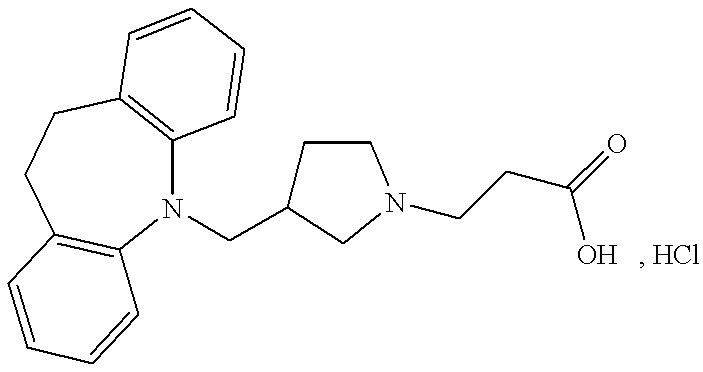
10,11-Dihydro-5H-dibenzo[b,f]azepine (4.88 g, 25 mmol) was added to a stirred suspension of 60% sodium hydride (1.1 g, 27 mmol) in dry N,N-dimethylformamide (15 ml). The mixture was slowly heated to 80° C., maintained at that temperature until the evolution of hydrogen ceased (30 minutes) and cooled to room temperature. A solution of 1-benzyl-3-chloromethylpyrrolidine (5.24 g, 25 mmol, prepared similarly as described in J.Org.Chem., 26, 1519,(1961)) in dry N,N-dimethylformamide (15 ml) was added, followed by sodium iodide (3.75 g, 25 mmol). The mixture was heated at 120° C. for 20 h. The cooled mixture was diluted with toluene (75 ml) and washed with water (4×50 ml), 0.5 N hydrochloric acid (50 ml), saturated sodium hydrogencarbonate (50 ml) and brine (50 ml). The organic phase was dried (MgSO4), filtered, and the solvent evaporated in vacuo. The oily residue (5.6 g) was purified by column chromatography on silica gel using a mixture of toluene, ethyl acetate and triethylamine (30:10:1) as eluent. This afforded 1.37 g (15%) of 5-(1-benzyl-pyrrolidin-3-ylmethyl)-10,11-dihydro-5H-dibenzo[b,f]azepine as an oil.
TLC: Rf=0.31 (SiO2: toluene/ethyl acetate/triethylamine=30:10:1).
A mixture of the above benzyl protected pyrrolidine (1.37 g, 3.6 mmol), 10% palladium on carbon (0.4 g) and ethanol (10 ml) was placed under an atmosphere of hydrogen at 3.5 atm. for 60 h. The reaction mixture was filtered and the solvent was evaporated in vacuo. This afforded 0.78 g (78%) of 5-(pyrrolidin-3-ylmethyl)-10,11-dihydro-5H-dibenzo[b,f]azepine as an oil.
TLC: Rf=0.34 (SiO2: dichloromethane/methanol/acetic acid=80:20:1).
A mixture of the above pyrrolidine (0.75 g, 1.9 mmol), 3-bromopropionic acid ethyl ester (0.68 g, 3.8 mmol), potassium carbonate (0.78 g, 5.7 mmol), sodium iodide (0.28 g, 1.9 mmol) and 2-butanone (10 ml) was heated at reflux temperature for 16 h. The reaction mixture was cooled, diluted with toluene (25 ml) and washed with water (3×10 ml). The organic phase was dried (MgSO4), filtered, and the solvent was evaporated in vacuo. The oily residue was purified by column chromatography on silica gel using a mixture of toluene, ethyl acetate and triethylamine (36:4:1) as eluent. This afforded 0.64 g (89%) of 3-(3-(10,11-dihydro-5H-dibenzo[b,f]azepin-5-ylmethyl)-pyrrolidin-1-yl)-propionic acid ethyl ester as an oil.
TLC: Rf=0.40 (SiO2: toluene/ethyl acetate/triethylamine=20:20:1).
The above ester (0.62 g, 1.6 mmol), dissolved in a mixture of ethanol (10 ml) and 2 N sodium hydroxide (2.7 ml) was stirred at room temperature for 16 h. The mixture was diluted with water (15 ml) and the ethanol was evaporated in vacuo. The aqueous solution was adjusted to pH 6 by addition of 2 N hydrochloric acid and extracted with dichloromethane (2×5 ml). The organic phase was dried (MgSO4), filtered and the solvent was removed in vacuo. The residue was dissolved in tetrahydrofuran (2.5 ml) and precipitated by addition of an excess of a solution of hydrogen chloride in ether. The amorphous precipitate was dissolved in tetrahydrofuran (10 ml) and precipitated by addition of ether (50 ml). The solid was isolated by filtration and dried to give 0.44 g (69%) of the title compound as an amorphous solid.
HPLC retention time=17.25 minutes (5 μm C18 4×250 mm column, eluting with a 20-80% gradient of 0.1% trifluoroacetic acid/acetonitrile and 0.1% trifluoroacetic acid/water over 25 minutes at 35° C.).
Calculated for C22H26N2O2, HCl, 1.25 H2O; C, 64.54%; H, 7.26%; N, 6.84%; Found: C: 64.44%; H: 7.14%; N: 6.57%.
(2-(2-(10,11-Dihydro-5H-dibenzo[b,f]azepin-5-ylmethyl)-morpholin-4-yl)-acetic acid hydrogen oxalate 
A mixture of 5-(2-morpholinylmethyl)-10,11-dihydro-5H-dibenzo[b,f]azepine (1.48 g, 0.005 mol, prepared similarly as described in Ger. Offen. 2,555 351, 1976), ethyl bromoacetate (0.84 g, 0.005 mol), potassium iodide (0.83 g, 0.05 mol) and anhydrous potassium carbonate (2.07 g, 0.015 mol) in 2-butanone (25 ml) was stirred at 70° C. for 7 h. The solid was filtered off, washed with 2-butanone and the filtrates were evaporated in vacuo. The oily residue (2.03 g) was purified by column chromatography on silica gel (40 g) using a mixture of benzene and ethyl acetate (9:1) as eluent. This afforded 1.70 g (89%) of 2-(2-(10,11-dihydrodibenzo[b,f]azepin-5-ylmethyl)morpholin-4-yl)acetic acid ethyl ester as an oil.
TLC: Rf=0.48 (SiO2: n-hexane/acetone=2:1)
A mixture of above ester (1.06 g, 0.0028 mol) and 20% sodium hydroxide (1.85 ml) in ethanol (17 ml) was stirred at room temperature for 18 h. Ethanol was evaporated in vacuo, the residue was dissolved in dichloromethane (50 ml), and the mixture was acidified with acetic acid. The organic layer was separated, washed with water (3 ml), dried (MgSO4) and the solvent was evaporated in vacuo. The residue was dissolved in ether (50 ml), the solution was made acidic with a solution of hydrogen chloride in ether and the mixture was stirred for 20 h. The amorphous residue was filtered off and washed with ether. This afforded 0.82 g (76%) of the hydrochloride of the title compound.
The above hydrochloride was suspended in water (5 ml) and alkalised with concentrated ammoniumhydroxide to pH 12. The mixture was acidified to pH 6.5 with acetic acid and extracted with dichloromethane (3×10 ml). The extracts were washed with water (2 ml), dried (MgSO4) and evaporated in vacuo. The residue (0.55 g, 1.55 mmol) was dissolved in acetone (3 ml) and neutralised with a solution of oxalic acid dihydrate (0.36 g, 1.55 mmol) in acetone (3 ml). The precipitated salt was filtered off, washed with acetone (2×3 ml) and dried. This afforded 0.55 g of the title compound.
M.p. 195-199° C.; Calculated for C21H24N2O3, C2H2O4, 0.5 H2O: C, 61.19%; H, 6.03%; N, 6.20%; Found: C, 61.25%; H, 5.80%; N, 6.13%.
(3-(10,11-Dihydro-5H-dibenz[b,f]azepin-5-ylmethyl)-1-piperidyl)acetic acid acetate 
A mixture of 1-benzyl-3-piperidinecarbonyl chloride hydrochloride (12.5 g, 45.6 mmol), 10,11-dihydro-5H-dibenz[b,f]azepine (8.9 g, 45.6 mmol), N,N-dimethylaniline (15 ml) and toluene (100 ml) was heated at reflux temperature for 14 h. The mixture was decanted and to the remaining solid 10% ammonia (100 ml) and chloroform (100 ml) were added. The phases were separated and the combined toluene and chloroform phases were dried (K2CO3) and evaporated in vacuo. The residue was purified by gradient chromatography on silica gel (200 g) using benzene and chloroform as eluents. The chloroform fractions afforded the crude product. This was dissolved in ethanol (30 ml) and neutralised with oxalic acid in acetone, affording 8.8 g (39%) of 3-(10,11-dihydro-5H-dibenz[b,f]azepin-5-ylcarbonyl)-1-benzylpiperidine hydrogen oxalate hemihydrate.
The free base (7.0 g, 17.65 mmol) was released from the above oxalate using aqueous ammonia, and extracted with dichloromethane. The solvent was evaporated and the residue was dissolved in tetrahydrofuran (60 ml). After addition of sodium borohydride (1.25 g) the mixture was stirred for 30 minutes and a solution of boron trifluoride ethyl etherate (5.4 g) in tetrahydrofuran (20 ml) was added dropwise. The mixture was stirred for 5 h at room temperature, 20% hydrochloric acid (40 ml) was added and the mixture was heated at reflux temperature for 7 h. The mixture was made alkaline with 20% sodium hydroxide and extracted with benzene (3×30 ml). The organic phase was dried (K2CO3) and the solvent was evaporated in vacuo. The residue was purified by chromatography on silica gel (100 g) using chloroform as eluent. This afforded 6.0 g of crude 3-(10,11-dihydro-5H-dibenz[b,f]azepin-5-ylmethyl)-1-benzylpiperidine.
TLC : Rf=0.36 (SiO2: chloroform/ethanol/ammonia=30:1:0.05)
The above protected piperidine (5.9 g, 15.4 mmol) was dissolved in methanol (100 ml), 10% Pd/C (4.0 g) suspended in toluene (15 ml) was added and the mixture was hydrogenated at 30° C. at 5 MPa. The catalyst was filtered off and methanol was evaporated in vacuo. The residue was purified by gradient chromatography on silica gel (50 g) using first chloroform and then ethanol as eluents. This afforded 2.3 g (70%) of 3-(10,11-dihydro-5H-dibenz[b,f]azepin-5-ylmethyl)piperidine.
TLC: Rf=0.07 (SiO2: chloroform/ethanol/ammonia=20:2:0.1)
A mixture of the above piperidine (2.05 g, 7 mmol), ethyl bromoacetate (1.36 g, 8.1 mmol), potassium carbonate (1.7 g, 12.3 mmol) and acetone (50 ml) was heated at reflux temperature under stirring for 7 h. The mixture was filtered and the solvent evaporated in vacuo. The oily residue was purified on silica gel (20 g) using ethyl acetate as eluent to give 2.3 g (87%) 3-(10,11-dihydro-5H-dibenz[b,f]azepin-5-ylmethyl)-1-piperidylacetic acid ethyl ester as an oil.
TLC: Rf=0.70 (SiO2: chloroform/ethanol/ammonia=20:1:0.05
The above ester (2.3 g, 6.1 mmol) was dissolved in ethanol (30 ml) and 20% sodium hydroxide (3 ml) was added. The mixture was allowed to stand for 7 days at room temperature, ethanol was evaporated in vacuo and water (20 ml) was added. The mixture was extracted with diethyl ether and the phases were separated. Acetic acid (3 ml) was added to the aqueous phase and the mixture was extracted with dichloromethane (50 ml). The organic phase was dried (MgSO4) and the solvent was evaporated in vacuo. The residue was dissolved in acetone and the formed precipitate was filtered off. This afforded 1.23 g (50%) of the title compound.
M.p. 142-146° C.; Calculated for C22H26N2O2, CH3COOH: C, 70.22%; H, 7.37%; N, 6.82%; Found: C, 70.37%; H, 7.14%; N, 6.72%.
(2-(3-(10,11-Dihydro-5H-dibenz[b,f]azepin-5-yl)-1-propyl)-1-piperidine)acetic acid hydrochloride 
A solution of 3-(2-piperidine)propanol (12.09 g, 0.084 mol, prepared similarly as described in EP 436 199 (1990)) and triethylamine (34.15 g, 0.337 mol) in benzene (240 ml) was cooled to 10° C. and a solution of methanesulfonyl chloride (21.2 g, 0.185 mol) in benzene (40 ml) was added over 0.5 h. The reaction mixture was allowed to warm up to room temperature and stirred for additional 3 h. The solid was filtered off, the filtrate was washed with water (2×100 ml), dried (MgSO4) and evaporated in vacuo. This afforded 14.0 g (73%) of 1-methylsulfonyl-2-(3-methylsulfonyloxypropyl)piperidine, which was used in the next step without purification.
To a solution of iminodibenzyl (6.24 mol, 0.032 mol) in benzene (100 ml) a 50% suspension of sodium amide in toluene (2.2 g, 0.028 mol) was added, and the mixture was stirred at 68-70° C. for 1.5 h. The reaction mixture was partially cooled, the solution of the above methylsulfonyl derivative (9.0 g, 0.03 mol) in benzene (40 ml) was added and the mixture was stirred at 80-90° C. for 15 h. After cooling, the mixture was washed with water (3×100 ml), dried (MgSO4) and evaporated in vacuo. The residue was purified by column chromatography on silica gel (180 g) using benzene and mixtures of benzene and chloroform as eluents, affording 1-methylsulphonyl-2-(3-(10,11-dihydro-5H-dibenz[b,f]azepin-5-yl)-1-propyl)piperidine (9.8 g, 87%).
TLC: Rf=0.65 (SiO2: chloroform).
To a solution of the above methanesulphonate (4.17 g, 0.0104 mol) in toluene (25 ml) a solution of sodium dihydrido-bis(2-methoxyethoxy)aluminate (63% solution in toluene, 8.34 g, 0.0417 mol) in toluene (10 ml) was added dropwise over 10 minutes under an argon atmosphere. The reaction mixture was warmed up to 110° C. and then stirred at this temperature for 5 h. After standing overnight, the mixture was quenched with 10% sodium hydroxide (25 ml), dichloromethane (120 ml) was added and the phases were separated. The aqueous phase was extracted with dichloromethane (3×30 ml), and the combined dichloromethane phases were washed with water (30 ml), brine (20 ml), dried (MgSO4) and evaporated in vacuo. The residue was purified by chromatography (100 g) using benzene, chloroform and chloroform saturated with ammonia, gradually, as eluents, affording oily 2-(3-(10,11-dihydro-5H-dibenz[b,f]azepin-5-yl)-1-propyl)piperidine (2.95 g, 88%).
TLC: Rf=0.38 (SiO2: chloroform).
A solution of the above piperidine base in diethyl ether (50 ml) was treated with a solution of oxalic acid dihydrate (1.15 g, 9.1 mmol) in ethanol (4 ml). This afforded 3.55 g of the corresponding hydrogen oxalate.
A mixture of the above piperidine (base liberated from hydrogen oxalate, 2.85 g, 0.00883 mol) in 2-butanone (60 ml), ethyl bromoacetate (1.7 g, 0.0102 mol) and potassium carbonate (2.15 g, 0.0155 mol) was stirred at 70-80° C. for 5 h. The reaction mixture was diluted with benzene (60 ml) and the solid was filtered off, washed with benzene (2×10 ml) and the filtrates were evaporated in vacuo. The residue (3.85 g) was purified by column chromatography on silica gel (100 g) using benzene, a mixture of benzene and chloroform (1:1) and chloroform as eluents, affording 3.25 g (91%) of (2-(3-(10,11-dihydro-5H-dibenz[b,f]azepin-5-yl)-1-propyl)-1-piperidine)acetic acid ethyl ester as an oil.
TLC: Rf=0.43 (SiO2: chloroform).
The above base was dissolved in acetone (20 ml) and treated with a solution of oxalic acid dihydrate (1.0 g, 0.008 mol) in acetone (5 ml). Acetone was evaporated and the residue was stirred with diethyl ether (80 ml) for 5 h. Precipitated hydrogen oxalate was filtered off and recrystallised from a mixture of ethanol and diethyl ether. This afforded 2.52 g (63%) of the hydrogen oxalate.
To a solution of the above ester (base liberated from hydrogen oxalate; 2.2 g, 0.0054 mol) in ethanol (14 ml) 15% sodium hydroxide (4.5 ml) was added and the reaction mixture was stirred at the room temperature for 2 h and left standing overnight. The mixture was diluted with dichloromethane (200 ml) and acidified with hydrochloric acid to pH 1. The organic layer was separated and washed with water (5 ml), brine (10 ml), dried (MgSO4) and evaporated in vacuo. The residue was re-evaporated with acetone (3×15 ml) and then stirred with diethyl ether (80 ml) overnight. The precipitated product was filtered off, washed with diethyl ether and dried. This yielded 1.95 g (87%) of the title compound as an amorphous solid.
Calculated for C24H30N2O2, HCl, ¼ H2O: C, 68.80%; H, 7.46%; N, 6.69%; Cl, 8.46%; Found: C, 68.54%; H, 7.51%; N, 6.42%; Cl, 8.50%.
(4-((10,11-Dihydro-5H-dibenz[b,f]azepin-5-yl)methyl)-1-piperidine)propionic acid hydrogen oxalate 
A mixture of 1-benzyl-4-piperidinecarbonylchloride hydrochloride (25.0 g, 91 mmol), 10,11-dihydro-5H-dibenzo[b,f]azepine (17.6 g, 90 mmol), N,N-dimethylaniline (25 ml) and toluene (150 ml) was heated at reflux temperature under stirring for 14 h. The mixture was decanted and to the remaining solid 10% ammonia (100 ml) and chloroform (150 ml) were added. The phases were separated and the combined toluene and chloroform phases were dried (K2CO3) and evaporated in vacuo. The residue was purified by chromatography on silica gel (300 g) using benzene and ethyl acetate as eluents. The crude base was crystallised from cyclohexane, yielding 13.0 g (36%) of 4-((10,11-dihydro-5H-dibenz[b,f]azepin-5-yl)carbonyl)-1-benzylpiperidine.
The above base (10.1 g, 25.5 mmol) was dissolved in tetrahydrofuran (90 ml), sodium borohydride (1.7 g) was added and over a period of 30 minutes, a solution of borontrifluoride etherate (7.4 g) in tetrahydrofuran (30 ml) was added dropwise. The reaction mixture was heated at reflux temperature for 5 h, quenched by addition of 20% hydrochloride acid (50 ml) and heated at reflux temperature for 7 h. The mixture was made alkaline with 20% sodium hydroxide, the product was isolated by extraction with benzene, the organic phase was dried (K2CO3) and the solvent was evaporated in vacuo. The residue was dissolved in diethyl ether and treated with a solution of oxalic acid in acetone yielding 9.3 g (77%) of 4-((10,11-dihydro-5H-dibenz[b,f]azepin-5-yl)methyl)-1-benzylpiperidine hydrogen oxalate
The base was librated from the above oxalate using aqueous ammonia, extracting with dichloromethane and evaporating the solvent. The residue was dissolved in a mixture of methanol (40 ml), acetic acid (60 ml) and toluene (20 ml). 10% Pd/C (4.5 g, suspension in toluene) was added and the mixture was hydrogenated at 50° C. and 5 MPa. The catalyst was filtered off and the solvents were evaporated, affording a residue, which was made alkaline using 10% ammonia and extracted with dichloromethane (2×50 ml). The solvent was evaporated and the residue was purified by column chromatography on silica gel (50 g) using chloroform and ethanol as eluents. This afforded 3.0 g (57%) of 4-((10,11-dihydro-5H-dibenz[b,f]azepin-5-yl)methyl)piperidine.
TLC: Rf=0.05 (SiO2: chloroform/ethanol/ammonia=20:2:0.1)
A mixture of the above base (3.0 g, 10.2 mmol), ethyl acrylate (1.1 g, 11 mmol) and ethanol (50 ml) was heated at reflux temperature for 7 h. The mixture was evaporated in vacuo and the remaining solid was recrystallised from ethanol to give 2.6 g (65%) of 4-((10,11-dihydro-5H-dibenz[b,f]azepin-5-yl)methyl)-1-piperidinepropionic acid ethyl ester as crystals.
The above ester (2.4 g, 6.1 mmol) was dissolved in ethanol (40 ml) and 20% sodium hydroxide (4 ml) was added. The mixture was allowed to stand for 7 days at room temperature, ethanol was evaporated in vacuo and water (70 ml) was added. The mixture was extracted with diethyl ether and the phases were separated. Acetic acid (4 ml) was added to the aqueous phase, and the solid was filtered off and recrystallised from aqueous ethanol, to give the hydrate of the title acid. The hydrate (2.24 g, 5.46 mmol) was dissolved in acetone and treated with oxalic acid dihydrate (0.80 g) in acetone. The precipitate was filtered off, washed with acetone and dried, affording 2.23 g (90%) of the title compound.
M.p. 187-189° C.; Calculated for C23H28N2O2, C2H2O4: C, 66.06%; H, 6.65%; N, 6.16%; Found: C, 66.00%; H, 6.39%; N, 5.79%.
Claims (18)
1. A compound of formula I 
wherein R1 and R2 independently are hydrogen, halogen, trifluoromethyl, hydroxy, C1-6-alkyl or C1-6-alkoxy; and
Y is >N—CH2— wherein only the underscored atom participates in the ring system; and
X is —C(R6R7)—, —CH2CH2—, —CH═CH—CH2—, —CH2—CH═CH—, —CH2—(C═O)—, —(C═O)—CH2—, —CH2CH2CH2—, —CH═CH—, CH(R10)CH2—, —CH2CH(R10) or —(C═O)— wherein R6 and R7 independently are hydrogen or C1-6-alkyl and wherein R10 is C1-6-alkyl or phenyl; and
r is 0, 1 or 2; and
Z is selected from 
wherein A is —CH2—, —O—, —S— or —N(R5)— wherein R5 is H or C1-6-alkyl; and
R3 —(CH2)pCOR4 wherein p is 1, 2, 3 or 4 and
R4 is OH, NH2, NHOH or C1-6-alkoxy; or
a pharmaceutically acceptable salt thereof.
2. A compound according to claim 1 wherein R1 and R2 independently are hydrogen, halogen, trifluoromethyl or C1-6-alkyl.
3. A compound according to claim 1 wherein X is —CH2CH2— or —CH═CH—.
4. A compound according to claim 1 wherein Z is selected from 
wherein A is —CH2— or —O—.
5. A compound according to claim 1 wherein R3 is —(CH2)pCOOH wherein p is 1, 2, 3 or 4.
6. A compound according to claim 1 selected from the following:
3-(3-(10,11-Dihydro-5H-dibenzo[b,f]azepin-5-ylmethyl)-pyrrolidin-1-yl)-propionic acid;
(2-(2-(10,11-Dihydro-5H-dibenzo[b,f]azepin-5-ylmethyl)-morpholin-4-yl)-acetic acid;
(3-(10,11-Dihydro-5H-dibenz[(b,f]azepin-5-ylmethyl)-1-piperidyl)acetic acid;
or a pharmaceutically acceptable salt thereof.
7. A compound according to claim 1 selected from the following:
(2-(3-(10,11-Dihydro-5H-dibenz[b,f]azepin-5-yl)-1-propyl)-1-piperidine)acetic acid;
(4-((10,11-Dihydro-5H-dibenz[b,f]azepin-5-yl)methyl)-1-piperidine)propionic acid;
or a pharmaceutically acceptable salt thereof.
8. A method of preparing a compound according to claim 1, comprising:
A) reacting a compound of formula II 
wherein R1, R2 and X are as defined in claim 1 with a compound of formula III 
wherein r is as defined in claim 1, W is a suitable leaving group, PG is a suitable N-protecting group and U is selected from 
wherein A is as defined in claim 1, to form a compound of formula IV 
wherein the compound of formula IV is N-deprotected to give a compound of formula V 
wherein the compound of formula V is N-alkylated with a compound of formula VI
wherein R3 is as defined in claim 1 and V is a suitable leaving group, to give the compound of formula I; or
B) reacting a compound of formula II 
wherein R1, R2 and X are as defined in claim 1 with a compound of formula VII 
wherein r is as defined in claim 1, W is a suitable leaving group, PG is a suitable N-protecting group and U is selected from 
wherein A is as defined in claim 1, to form a compound of formula VIII 
wherein the compound of formula VIII is reduced to give a compound of formula IV 
wherein the compound of formula IV is N-deprotected to give a compound of formula V 
wherein the compound of formula V is transformed to the compound of formula I as described under A).
9. A pharmaceutical composition comprising as an active component an effective amount of a compound according to claim 1 together with a pharmaceutically carrier or diluent.
10. The pharmaceutical composition according to claim 9 comprising between 0.5 mg and 1000 mg of the compound per unit dose.
11. A method of treating neurogenic pain or inflammation comprising administering to a subject in need thereof an effective amount of a compound according to claim 1.
12. A method of treating neurogenic pain or inflammation comprising administering to a subject in need thereof a pharmaceutical composition according to claim 9.
13. A method of treating neurogenic pain or inflammation associated with neuropathy, rheumatoid arthritis, migraine or itching, comprising administering to a subject in need thereof an effective amount of a compound according to claim 1.
14. A method of treating neurogenic pain or inflammation associated with neuropathy, rheumatoid arthritis, migraine or itching, comprising administering to a subject in need thereof a pharmaceutical composition according to claim 9.
15. A method of treating non-insulin-dependent diabetes mellitus (NIDDM) comprising administering to a subject in need thereof an effective amount of a compound claim 1.
16. A method of treating non-insulin-dependent diabetes mellitus (NIDDM) comprising administering to a subject in need thereof a pharmaceutical composition according to claim 9.
17. A method of treating insulin resistance comprising administering to a subject in need thereof an effective amount of a compound of claim 1.
18. A method of treating insulin resistance comprising administering to a subject in need thereof the pharmaceutical composition of claim 9.
Priority Applications (1)
| Application Number | Priority Date | Filing Date | Title |
|---|---|---|---|
| US09/266,236 US6214816B1 (en) | 1998-03-17 | 1999-03-10 | Heterocyclic compounds |
Applications Claiming Priority (4)
| Application Number | Priority Date | Filing Date | Title |
|---|---|---|---|
| DK36698 | 1998-03-17 | ||
| DE0366/98 | 1998-03-17 | ||
| US7895498P | 1998-03-23 | 1998-03-23 | |
| US09/266,236 US6214816B1 (en) | 1998-03-17 | 1999-03-10 | Heterocyclic compounds |
Publications (1)
| Publication Number | Publication Date |
|---|---|
| US6214816B1 true US6214816B1 (en) | 2001-04-10 |
Family
ID=27220623
Family Applications (1)
| Application Number | Title | Priority Date | Filing Date |
|---|---|---|---|
| US09/266,236 Expired - Fee Related US6214816B1 (en) | 1998-03-17 | 1999-03-10 | Heterocyclic compounds |
Country Status (1)
| Country | Link |
|---|---|
| US (1) | US6214816B1 (en) |
Cited By (3)
| Publication number | Priority date | Publication date | Assignee | Title |
|---|---|---|---|---|
| WO2004014351A3 (en) * | 2002-08-12 | 2004-06-17 | Birkir Sveinsson | Use of cgrp antagonist compounds for treatment of psoriasis |
| US20050080265A1 (en) * | 2001-10-16 | 2005-04-14 | Edgar Dale M. | Treatment of CNS disorders using CNS target modulators |
| US11433119B2 (en) | 2016-11-18 | 2022-09-06 | Nepsone Ehf | Methods of treating inflammatory skin disorders |
Citations (8)
| Publication number | Priority date | Publication date | Assignee | Title |
|---|---|---|---|---|
| GB1013909A (en) | 1962-02-01 | 1965-12-22 | Cilag Chemie | New phenothiazines |
| GB1043158A (en) | 1962-06-07 | 1966-09-21 | Sandoz Ag | Improvements in or relating to piperidylalkidene-5h-dibenzo(a,d)cycloheptenes |
| DE2555351A1 (en) | 1974-12-09 | 1976-06-10 | Sumitomo Chemical Co | TRICYCLIC DIBENZACEEPINE DERIVATIVES |
| DE2600358A1 (en) | 1975-01-06 | 1976-07-08 | Sumitomo Chemical Co | MORPHOLINE DERIVATIVES, METHOD FOR THEIR MANUFACTURING AND MEDICINAL PRODUCTS |
| US4169146A (en) * | 1975-01-06 | 1979-09-25 | Sumitomo Chemical Company, Limited | Novel morpholine derivatives and treating depression therewith |
| WO1996031500A1 (en) | 1995-04-07 | 1996-10-10 | Novo Nordisk A/S | Novel heterocyclic compounds |
| WO1996031497A1 (en) | 1995-04-07 | 1996-10-10 | Novo Nordisk A/S | Novel heterocyclic compounds |
| WO1996031498A1 (en) | 1995-04-07 | 1996-10-10 | Novo Nordisk A/S | Novel heterocyclic compounds |
-
1999
- 1999-03-10 US US09/266,236 patent/US6214816B1/en not_active Expired - Fee Related
Patent Citations (10)
| Publication number | Priority date | Publication date | Assignee | Title |
|---|---|---|---|---|
| GB1013909A (en) | 1962-02-01 | 1965-12-22 | Cilag Chemie | New phenothiazines |
| GB1043158A (en) | 1962-06-07 | 1966-09-21 | Sandoz Ag | Improvements in or relating to piperidylalkidene-5h-dibenzo(a,d)cycloheptenes |
| DE2555351A1 (en) | 1974-12-09 | 1976-06-10 | Sumitomo Chemical Co | TRICYCLIC DIBENZACEEPINE DERIVATIVES |
| US4017621A (en) * | 1974-12-09 | 1977-04-12 | Sumitomo Chemical Company, Limited | 2-Morpholinyl tricyclic dibenzazepine compounds |
| DE2600358A1 (en) | 1975-01-06 | 1976-07-08 | Sumitomo Chemical Co | MORPHOLINE DERIVATIVES, METHOD FOR THEIR MANUFACTURING AND MEDICINAL PRODUCTS |
| US4085210A (en) * | 1975-01-06 | 1978-04-18 | Sumitomo Chemical Company, Limited | Novel morpholine derivatives and the treatment of mental depression |
| US4169146A (en) * | 1975-01-06 | 1979-09-25 | Sumitomo Chemical Company, Limited | Novel morpholine derivatives and treating depression therewith |
| WO1996031500A1 (en) | 1995-04-07 | 1996-10-10 | Novo Nordisk A/S | Novel heterocyclic compounds |
| WO1996031497A1 (en) | 1995-04-07 | 1996-10-10 | Novo Nordisk A/S | Novel heterocyclic compounds |
| WO1996031498A1 (en) | 1995-04-07 | 1996-10-10 | Novo Nordisk A/S | Novel heterocyclic compounds |
Cited By (9)
| Publication number | Priority date | Publication date | Assignee | Title |
|---|---|---|---|---|
| US20050080265A1 (en) * | 2001-10-16 | 2005-04-14 | Edgar Dale M. | Treatment of CNS disorders using CNS target modulators |
| US7355042B2 (en) | 2001-10-16 | 2008-04-08 | Hypnion, Inc. | Treatment of CNS disorders using CNS target modulators |
| WO2004014351A3 (en) * | 2002-08-12 | 2004-06-17 | Birkir Sveinsson | Use of cgrp antagonist compounds for treatment of psoriasis |
| EA008744B1 (en) * | 2002-08-12 | 2007-08-31 | Актавис Груп Хф. | Use of cgrp antagonists compounds for treatment of psoriasis |
| US9585940B2 (en) | 2002-08-12 | 2017-03-07 | Birkir Sveinsson | Use of CGRP antagonist compounds for treatment of psoriasis |
| US10668132B2 (en) | 2002-08-12 | 2020-06-02 | Nepsone Ehf | Use of CGRP antagonist compounds for treatment of psoriasis |
| US11266718B2 (en) | 2002-08-12 | 2022-03-08 | Nepsone Ehf | Methods of treating inflammatory skin disorders |
| US11433119B2 (en) | 2016-11-18 | 2022-09-06 | Nepsone Ehf | Methods of treating inflammatory skin disorders |
| US11517612B2 (en) | 2016-11-18 | 2022-12-06 | Nepsone Ehf | Methods of treating inflammatory skin disorders |
Similar Documents
| Publication | Publication Date | Title |
|---|---|---|
| US6569849B1 (en) | N-Substituted azaheterocyclic compounds | |
| US6100253A (en) | Tricycle substituted with azaheterocyclic carboxylic acids | |
| US6391890B1 (en) | Heterocyclic compounds | |
| EP0820451B1 (en) | Novel heterocyclic compounds | |
| AU740958B2 (en) | N-substituted azaheterocyclic compounds | |
| US6048856A (en) | Heterocyclic compounds | |
| US6166009A (en) | N-substituted azaheterocyclic carboxylic acids and esters thereof | |
| AU700784B2 (en) | Novel heterocyclic compounds | |
| US6071901A (en) | Substituted dibenz[b,f]azepines and uses thereof | |
| US6060468A (en) | N-substituted azaheterocyclic compounds | |
| EP0869954B1 (en) | Heterocyclic compounds for use in the treatment of neurogenic inflammation | |
| US6613791B1 (en) | N-substituted azaheterocyclic carboxylic acids and their use | |
| EP1071679A1 (en) | Novel heterocyclic compounds | |
| US6187770B1 (en) | N-substituted azaheterocyclic compounds | |
| US5721260A (en) | Heterocyclic compounds | |
| JP2002515914A (en) | New heterocyclic compounds | |
| EP1071686A1 (en) | Novel heterocyclic compounds | |
| EP1047673A1 (en) | Novel heterocyclic compounds | |
| JP2002515913A (en) | New heterocyclic compounds |
Legal Events
| Date | Code | Title | Description |
|---|---|---|---|
| AS | Assignment |
Owner name: NOVO NORDISK A/S, DENMARK Free format text: ASSIGNMENT OF ASSIGNORS INTEREST;ASSIGNORS:HOHLWEG, ROLT;JORGENSEN, TINE KROGH;ANDERSEN, KNUD ERIK;AND OTHERS;REEL/FRAME:009910/0866;SIGNING DATES FROM 19990326 TO 19990415 |
|
| CC | Certificate of correction | ||
| REMI | Maintenance fee reminder mailed | ||
| LAPS | Lapse for failure to pay maintenance fees | ||
| STCH | Information on status: patent discontinuation |
Free format text: PATENT EXPIRED DUE TO NONPAYMENT OF MAINTENANCE FEES UNDER 37 CFR 1.362 |
|
| FP | Lapsed due to failure to pay maintenance fee |
Effective date: 20050410 |