US6153515A - Method of forming multilayered film - Google Patents

Method of forming multilayered film Download PDF

Info

Publication number
US6153515A
US6153515A US09/156,896 US15689698A US6153515A US 6153515 A US6153515 A US 6153515A US 15689698 A US15689698 A US 15689698A US 6153515 A US6153515 A US 6153515A
Authority
US
United States
Prior art keywords
film
oxygen
semiconductor substrate
nitrided
nitriding
Prior art date
Legal status (The legal status is an assumption and is not a legal conclusion. Google has not performed a legal analysis and makes no representation as to the accuracy of the status listed.)
Expired - Fee Related
Application number
US09/156,896
Inventor
Seishi Murakami
Tatsuo Hatano
Current Assignee (The listed assignees may be inaccurate. Google has not performed a legal analysis and makes no representation or warranty as to the accuracy of the list.)
Tokyo Electron Ltd
Original Assignee
Tokyo Electron Ltd
Priority date (The priority date is an assumption and is not a legal conclusion. Google has not performed a legal analysis and makes no representation as to the accuracy of the date listed.)
Filing date
Publication date
Assigned to TOKYO ELECTRON LIMITED reassignment TOKYO ELECTRON LIMITED ASSIGNMENT OF ASSIGNORS INTEREST (SEE DOCUMENT FOR DETAILS). Assignors: HATANO, TATSUO, MURAKAMI, SEISHI
Application filed by Tokyo Electron Ltd filed Critical Tokyo Electron Ltd
Assigned to TOKYO ELECTRON LIMITED reassignment TOKYO ELECTRON LIMITED ASSIGNMENT OF ASSIGNOR'S INTEREST RE-RECORD TO CORRECT THE RECORDATION DATE OF 09/16/98 TO 09/18/98 PREVIOUSLY RECORDED AT REEL9484, FRAME 0357 Assignors: HATANO, TATSUO, MURAKAMI, SEISHI
Application granted granted Critical
Publication of US6153515A publication Critical patent/US6153515A/en
Anticipated expiration legal-status Critical
Expired - Fee Related legal-status Critical Current

Links

Images

Classifications

    • H10D64/01318
    • H10D64/01344
    • H10P14/43
    • H10P14/6336
    • H10P14/6938
    • H10W20/033
    • H10W20/048
    • H10W20/40

Definitions

  • the present invention relates to a method of forming a multilayered film of a titanium (Ti) film or the like between an electrode and wiring of a semiconductor circuit device.
  • a multilayered wiring structure tends to be employed as the semiconductor circuit.
  • a technique for electrically connecting a circuit element formed in a silicon substrate to an upper wiring layer through a contact hole and mutually connecting an upper wiring layer and a lower wiring layer through a via hole becomes important.
  • a technique for burying a metal in the contact hole and the via-hole becomes important.
  • aluminium (Al) or tungsten (W), or an alloy mainly made of the aforementioned metal is generally employed.
  • Al aluminium
  • W tungsten
  • an alloy mainly made of the aforementioned metal is generally employed.
  • Al aluminium
  • W tungsten
  • an alloy of the buried metal and Si or Al is likely to be formed in the boundary portion between them since Al absorbs the contact metal.
  • the formation of such an alloy is not preferable since the alloy has a large electric resistance.
  • the alloy due to the large electric resistance, works against a reduction of power consumption and a speedy operation recently required for the device.
  • W or a W alloy as the buried layer of the contact hole, since WF 6 gas, for use in burying W or the W alloy, penetrates into the Si substrate and degrading electric characteristics of the device.
  • a contact metal layer is formed as a barrier layer on the Si substrate and the inner wall of the contact hole or the via-hole so that the contact metal layer may be interposed between the buried metal layer and the Si substrate or the inner wall.
  • the contact metal layer a two-layered film constituting of a Ti film and a TiN film, is generally employed.
  • the two-layered contact metal layer is conventionally formed by a physical vapor deposition (PVD) method.
  • PVD physical vapor deposition
  • the holes tend to be formed in a higher aspect ratio, recently.
  • a chemical vapor deposition (CVD) method has been increasingly employed since the CVD method is also suitable for forming the holes of the higher aspect ratio.
  • the Ti film surface is protected with a thin nitride film, the Ti film is prevented from being etched, reducing the contact resistance.
  • the thin nitride film thus formed on the Ti film surface does not always exhibit a sufficient effect for preventing etching of the Ti film surface.
  • the TiN film sometimes removes from the Ti film, thereby increasing the contact resistance.
  • the occurrence of film removal is not limited to the case where the TiN film is formed on the Ti film and may arise in the case where another type of film is formed on the Ti film by using a halogen containing gas. Hence, it has been desired to find effective means to overcome the film removal.
  • the present invention provides a method of forming a structure connecting a first conductive layer and a second conductive layer in a semiconductor device comprising the steps of:
  • the present invention provides a method of forming a multilayered film interposed between a first conductive layer and a second conductive layer in a semiconductor device, comprising the steps of:
  • a method of forming a multilayered film interposed between a first conductive layer and a second conductive layer comprising the steps of:
  • the first and second conductive layers are typically a combination of members capable of electrically connecting, which are selected from the group consisting of a diffusion layer formed in the semiconductor substrate, a metal wiring layer formed above the semiconductor substrate, and a metal plug buried in the hole in the insulating layer.
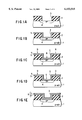
  • FIGS. 1A to 1E explain how to form a barrier metal film according to an embodiment of the present invention
  • FIG. 2 is a cross-sectional view of a semiconductor device formed in accordance with an embodiment of the present invention
  • FIG. 3 is a schematic view of a multi-chamber type film deposition system for use in carrying out the method according to the present invention
  • FIG. 4 is a view showing a structure of a Ti film forming equipment of the film deposition system shown in FIG. 3;
  • FIG. 5 is a graph indicating a contact-resistance ratio versus hole size.
  • FIG. 2 partly shows a cross-sectional view of the semiconductor device formed in accordance with the method of forming a multilayered film of the present invention.
  • a contact hole (or via hole) 3 is formed in an insulating layer 2 so as to expose a circuit element (e.g., a diffusion layer 4 serving as an element electrode) formed in a silicon semiconductor substrate 1. Then, a contact metal (barrier metal) layer 8 constituted of a Ti film 5 and a TiN film 7 is formed on the wall of the contact hole (or via hole) 3 and the diffusion layer 4. Thereafter, an Al layer 9 serving as wiring is buried in the contact hole 3.
  • a circuit element e.g., a diffusion layer 4 serving as an element electrode
  • the present inventors investigated the reasons why the film removal takes place when the Ti film is nitrided by the conventional method, in order to overcome an increase of the contact resistance.
  • the remaining active Ti may be oxidized and therefore the reaction with the halogen containing gas is prevented.
  • the active Ti remaining on the film surface can be terminated with oxygen without fail since oxygen has a high affinity with titanium (Ti).
  • TiO 2 titanium oxide
  • TiO 2 titanium oxide
  • Ti remaining on the TiN film surface dares to be oxidized. Since Ti not terminated with N in the nitriding process presents in few amount, little adverse effect is produced by the Ti oxidation. It is therefore possible to effectively prevent the reaction between Ti and the halogen containing gas.
  • barrier metal film formation method of the present invention will be explained with reference to the manufacturing steps shown in FIGS. 1A to 1E.
  • an insulating film 2 such as a silicon oxide film, is first formed on a semiconductor substrate 1 and then a contact hole 3 is formed.
  • a diffusion region 4 is formed by doping impurities from the opening of the contact hole 3.
  • a Ti film 5 is formed on a wall of the contact hole 3, the diffusion region 4 and the insulating layer 2.
  • the Ti film 5 is formed by the PVD method or the CVD method.
  • the surface of the Ti film 5 is nitrided by a nitrogen-containing processing gas to form a thin nitride film 6.
  • a nitrogen-containing processing gas N 2 gas, NH 3 gas, or the like may be used. However, if a by-product is present, it will be nitrided to cause the film removal. In view of this, a N 2 -H 2 gas mixture is particularly preferable. Nitriding may be effected by only heating the substrate while supplying the nitrogen containing process gas. However, it is preferred to nitride the film in a plasma atmosphere.
  • Ti active titanium
  • the present invention devised that Ti not terminated with a nitrogen molecule (N) and remains on the surface of the Ti film 5, is terminated with oxygen (O) having a high affinity with Ti, by supplying an oxygen-containing gas to the Ti film 5 after the nitriding treatment.
  • any gas may be used as long as it oxidizes Ti.
  • active oxygen e.g. O 2 gas, air, and O 3
  • H 2 O, N 2 O, NO 2 may be used.
  • the temperature of oxidation treatment may be determined appropriately depending upon the type of gas; however, when O 2 gas or air is used, oxidation can be sufficiently performed at normal temperature.
  • the oxidation treatment may be performed either in the Ti film deposition chamber by introducing the oxygen-containing gas therein while the semiconductor substrate placed therein after the Ti-film nitriding is completed or in the TiN film deposition chamber after the substrate is transferred to a TiN film deposition chamber.
  • oxidation may be performed after completion of nitriding treatment by exposing the substrate to the air.
  • a TiN film 7 is formed by the CVD method on the Ti film 5 with the nitrided film 6 interposed between them.
  • TiCl 4 and either NH 3 or monomethylhydrazine (MMH) are used as the reaction gas and N 2 is used as the carrier gas.
  • MMH monomethylhydrazine
  • the nitrided film 6 becomes a part of the TiN film 7 by forming the TiN film 7 thereon.
  • the contact metal layer 8 constituted of two layers, the Ti film 5 and the TiN film 7, is formed.
  • the film thickness of Ti film 5 and TiN film 7 is set at, for example, about 50 nm each.
  • the Al layer 9 serving as a wiring layer is formed on the contact metal layer 8 to thereby form the buried layer in the contact hole 3 and wiring at the same time. In this manner, the structure shown in FIG. 2 is obtained.
  • the diffusion region 4 in the semiconductor substrate 1 and the wiring are electrically communicated with each other by burring the Al layer 9 into the contact hole 3.
  • the material of the wiring layer is not limited to Al.
  • An Al alloy, W, or a W alloy may be used.
  • Application of the present invention is not limited to the contact hole and the present invention may be applied to the via-hole.
  • FIG. 3 is a schematic view of a metal film deposition system by CVD for carrying out the method of the present invention.
  • This system is called a cluster-tool type or a multi-chamber type.
  • two load/unload cassette chambers 11, 12, a degas chamber 13, a Ti film deposition chamber 14, a pre-cleaning chamber 15, a TiN film deposition chamber 16, an Al film deposition chamber 17 and a cooling room 18 are arranged around the transfer room 10 positioned at the center with a gate valve interposed between them.
  • Each of the chambers has a main chamber body having an evacuation function, inner equipment and peripheral equipment required for processing.
  • FIG. 4 shows a specific structure of the film forming equipment mainly constituted of the deposition chamber 14.
  • the Ti film deposition chamber 14 is constituted of a main chamber 21 of virtually a cylindrical shape.
  • the semiconductor substrate W object
  • the main chamber 21 constructed airtight, the semiconductor substrate W (object) is mounted horizontally on a susceptor 22 supported by cylindrical supporting members 23.
  • a guide ring 24 is provided on the outer periphery of the susceptor 22, for guiding the semiconductor substrate W.
  • a heater 25 is built in the susceptor 22. The heater 25 is responsible for heating the semiconductor substrate W to a predetermined temperature by supplying a current from a power source 26. The temperature of the heater 25 is controlled by a controller 27 (connected to the power supply 26) on the basis of a detection signal from a temperature sensor (not shown) attached to the main chamber.
  • a shower head 30 is formed on the ceiling wall 21a of the main chamber 21 so as to face the semiconductor substrate W mounted on the susceptor 22. Numerous gas ejection holes 30a are formed in the surface of the shower head facing the substrate W. A dispersion plate 32 having numerous holes is positioned horizontally in a space 31 within the shower head 30.
  • a gas inlet 33 is formed at the center of the ceiling wall 21a of the main chamber 21, for introducing a gas into the shower head 30.
  • the gas supply pipe 35 is connected to the gas inlet 33.
  • the gas supply pipe 35 is branched into pipes 35a to 35e which are connected to a H 2 source 36, an Ar source 37, a TiCl 4 source 38, a N 2 source 39, and an O 2 source 40, respectively.
  • a desired gas is supplied from these gas sources by way of the gas supply pipe 35 and the shower head 30 into the main chamber 21.
  • the nitriding is performed by supplying N 2 gas and H 2 gas respectively from the N 2 source 39 and the H 2 gas source 36. Thereafter, oxidation is performed by supplying O 2 gas from the O 2 gas source 40.
  • the pipes 35a to 35e connected to the gas sources are equipped with respective valves 41a to 41e for controlling initiation/termination of gas supply, and mass-flow controllers 42a to 42e for controlling respective gas flow-rates.
  • High frequency power source 44 is connected to the ceiling wall 21a of the main chamber 21 via a matching circuit 43.
  • a high frequency power is introduced through the ceiling wall 21a into the main chamber 21 to form a plasma.
  • the ceiling wall 21a is electrically insulated from the side wall of the main chamber 21 with an insulating member 34.
  • the main chamber 21 is grounded.
  • An exhaust port 28 is formed in the bottom 21b of the main chamber 21.
  • the main chamber 21 is evacuated by an exhausting system 29 through the exhaust port 28 to set the inner pressure at a desired pressure.
  • the TiN film deposition chamber 16 has the similar structure to the Ti film deposition chamber 14 except that a TiCl 4 source, an NH 3 source and an MMH source are provided as the gas sources.
  • the Al film deposition chamber 17 has also the similar structure to the Ti film deposition chamber 14 except that gaseous dimethyl aluminum hydride (DMAH) or the like is used as a raw material and H 2 as a carrier gas.
  • DMAH dimethyl aluminum hydride
  • a single semiconductor substrate W is taken out from the load cassette chamber 11 by a transfer arm 19 and loaded into a pre-cleaning chamber 15 to remove a surface oxide or the like, with BrCl 3 . Subsequently, the semiconductor substrate W is transferred into the degas chamber 13 by the transfer arm 19 to degas of the semiconductor substrate W.
  • the semiconductor substrate W is loaded into the main body 21 of the Ti film deposition chamber 14 by the transfer arm 19 and mounted on the susceptor 22.
  • the main chamber 21 is maintained in high vacuum conditions by being evacuated by the exhaust system 9.
  • the main chamber 21 is then set at a pressure of 1 Torr by introducing a process gas mixture.
  • the process gas mixture containing Ar gas, H 2 gas, and TiCl 4 gas is supplied from the shower head 30 at a predetermined flow rate (e.g., Ar:1 SLM, H 2 : 1 SLM, TiCl 4 : 10 sccm), while the semiconductor substrate is maintained at a temperature from 450 to 600° C.
  • a high frequency power is supplied from the high frequency power source 44 into the main chamber 21 to generate a plasma.
  • the formation of the Ti film 5 on the semiconductor substrate W is performed for a predetermined time.
  • the semiconductor substrate W is nitrided in the main chamber 21 while leaving it in the Ti film deposition chamber.
  • the nitriding of the Ti film is performed as follows. First, a N 2 -H 2 gas mixture is supplied from the shower head 30. The N 2 gas and the H 2 gas are supplied in predetermined flow amounts, for example, 500 sccm and 1500 sccm, respectively, to set the inner pressure of the main chamber 21 at about 1 Torr. Simultaneously supplying a high frequency power from the high frequency power source into the main chamber 21 to generate a plasma. As a result of the nitriding process, a thin nitrided film 6 is formed on the surface of the Ti film 5.
  • the Ti film surface is oxidized (post-nitriding oxidation) in the main chamber 21. More specifically, after the supply of N 2 gas and H 2 gas is terminated, O 2 gas is supplied into the main chamber 21 to oxidize active Ti which is not terminated with N and remains on the surface of the nitrided film 6. In this manner, active Ti is terminated with oxygen.
  • the semiconductor substrate W is unloaded from the Ti deposition chamber 14 (the main chamber 21) the transfer arm 19 and transferred to the transfer chamber 10, and then, loaded into the main chamber of the TiN film deposition chamber 16.
  • the TiN film deposition chamber 16 is constructed in a similar manner as the Ti film deposition chamber 14.
  • the main chamber is maintained in high vacuum conditions by being evacuated by the exhausting system.
  • the semiconductor substrate W is heated at, for example, 550 to 650° C. by the heater built in the susceptor.
  • As the process gas either one of N 2 gas, NH 3 gas and MMH gas, or TiCl 4 gas is used.
  • Each of the gases is supplied at a predetermined flow rate (for example, N 2 : 100 sccm, NH 3 : 500 sccm, TiCl 4 : 20 sccm) from the shower head to set the inner pressure of the main chamber at about 0.3 to 0.5 Torr.
  • the film deposition process of the TiN film 7 is performed for a predetermined time without supplying high frequency power. As a result, the thin nitride film 6 formed on the Ti film 5 is integrated into part of the TiN film 7.
  • the semiconductor substrate W is unloaded from the TiN film deposition chamber 16 and transferred into the transfer chamber 10, and then loaded into the Al film deposition chamber 17.
  • the Al layer 9 is formed on the contact metal layer 8 by the CVD method using a process gas containing DMAH and H 2 gas, to thereby fill the contact hole 3 and form wiring.
  • the semiconductor W having a desired structure, thus formed, is cooled in the cooling chamber 18 and stored in the unload cassette chamber 12.
  • a film is formed by the CVD method in the Ti film deposition chamber 14.
  • a PVD method may be used.
  • oxidation is performed by supplying O 2 gas as the oxygen containing gas into the Ti film deposition chamber 14.
  • oxidation may be carried out in the TiN film deposition chamber 16 by loading the semiconductor substrate W thereinto after the nitriding process before the TiN film deposition process.
  • oxidation may be performed in another discrete process chamber.
  • the oxidation may be performed by exposing the semiconductor substrate to the air without particularly supplying the O 2 gas.
  • the semiconductor substrate W is temporarily transferred to the unload cassette chamber 12 and exposed to the air. In this case, most of the surface of the Ti film has been nitrided. Thus TiO 2 formation is limited to so small portion that it has little adverse affect on the electric contact.
  • the present invention it is possible to terminate (oxidize) active Ti (not terminated in the Ti film nitriding process) in the oxidation process.
  • etching of the Ti film 5 with TiCl 4 to be performed in a later TiN film forming step can be prevented.
  • the thin nitride film 6 is present on the surface of the Ti film and an oxide is partly formed on the surface thereof. Since they are rarely etched with TiCl 4 , the Ti film is prevented from being etched. Accordingly, the increase of the contact resistance caused by the removal of the contact metal film can be successfully prevented.
  • the Ti film of 20 nm thick is formed on the semiconductor substrate having numerous contact holes therein.
  • the semiconductor substrate is nitrided in a plasma and oxidized in the air, followed by forming the TiN film of 50 nm thick thereon.
  • the semiconductor substrate is nitrided in a plasma and then the TiN film is formed thereon. Both of them are measured for contact resistance.
  • the results of the contact resistance measurement are shown in FIG. 5.
  • the contact resistance of the semiconductor substrate receiving only nitriding treatment is represented by symbol a.
  • the contact resistance of the semiconductor substrate receiving both nitriding and oxidation is represented by symbol b.
  • the ratio of contact resistance (a/b) is determined with respect to each size of the holes.
  • the film of the present invention formed through nitriding and oxidizing processes always exhibits a lower contact resistance.
  • the advantage of the present invention is particularly apparent in the case of a hole of 0.3 ⁇ m or less, for example, the ratio of the contact resistance (a/b) exhibits 3.5 in the case of 0.25 ⁇ m-hole.
  • a contact metal layer is formed in the contact hole.
  • the present invention may be applied to the case where the contact metal layer is formed in a via hole.
  • the case is shown where the contact metal layer is formed by stacking the TiN film on the Ti film.
  • the present invention is not limited to this and may be effectively applied to the case where another film is formed on the Ti film layer by a CVD method using a halogen containing gas when the Ti film is used as an electrode or the like.
  • the semiconductor substrate is used as the substrate herein.
  • the present invention may be applied to an insulative substrate having a circuit element formation region made of silicon thereon, like an LCD (liquid crystal display) substrate.
  • the present invention is characterized in that the semiconductor substrate is nitrided after the Ti film is formed, to terminate active Ti present in the Ti film surface with nitrogen N, and then subjected to oxidation to terminate Ti, which has not been terminated with N, with oxygen (O). It is therefore possible to prevent the Ti film from being etched in the later CVD film deposition process using halogen containing gas. As a result, it is possible to prevent an increase of contact resistance caused by the removal of the contact metal film.

Landscapes

  • Internal Circuitry In Semiconductor Integrated Circuit Devices (AREA)
  • Electrodes Of Semiconductors (AREA)
  • Chemical Vapour Deposition (AREA)
  • Other Surface Treatments For Metallic Materials (AREA)

Abstract

There is provided a method of forming a structure connecting a first conductive layer and a second conductive layer in a semiconductor device comprising the steps of forming an insulating film on the first conductive layer, forming a hole in the insulating layer in which a surface of the first conductive layer is partially exposed, forming a titanium layer on a surface of the first conductive layer exposed at least in the hole, nitriding a surface of the titanium layer, oxidizing an un-nitrided part of the surface of the titanium layer, forming a titanium nitride layer on the titanium layer, and forming the second conductive layer on the titanium nitride layer.

Description

BACKGROUND OF THE INVENTION
The present invention relates to a method of forming a multilayered film of a titanium (Ti) film or the like between an electrode and wiring of a semiconductor circuit device.
Recently, to satisfy the requirements for high density and high integration of circuit elements in manufacturing the semiconductor device, a multilayered wiring structure tends to be employed as the semiconductor circuit. In this circumstance, a technique for electrically connecting a circuit element formed in a silicon substrate to an upper wiring layer through a contact hole and mutually connecting an upper wiring layer and a lower wiring layer through a via hole becomes important. To be more specific, a technique for burying a metal in the contact hole and the via-hole becomes important.
As the metal to be buried in the contact hole and the via-hole, aluminium (Al) or tungsten (W), or an alloy mainly made of the aforementioned metal, is generally employed. However, in the case where the metal or the alloy is in direct contact with the silicon substrate or an Al wiring, if annealing is applied in a later step, an alloy of the buried metal and Si or Al is likely to be formed in the boundary portion between them since Al absorbs the contact metal. The formation of such an alloy is not preferable since the alloy has a large electric resistance. The alloy, due to the large electric resistance, works against a reduction of power consumption and a speedy operation recently required for the device.
It is also not preferable to use W or a W alloy as the buried layer of the contact hole, since WF6 gas, for use in burying W or the W alloy, penetrates into the Si substrate and degrading electric characteristics of the device.
To prevent the aforementioned undesirable features, a contact metal layer is formed as a barrier layer on the Si substrate and the inner wall of the contact hole or the via-hole so that the contact metal layer may be interposed between the buried metal layer and the Si substrate or the inner wall.
As the contact metal layer, a two-layered film constituting of a Ti film and a TiN film, is generally employed. The two-layered contact metal layer is conventionally formed by a physical vapor deposition (PVD) method. However, with the tendency for fine patterns and high integration of the circuit device, wiring width and an aperture of the holes has been reduced.
In addition to this, the holes tend to be formed in a higher aspect ratio, recently. For these reasons, a chemical vapor deposition (CVD) method has been increasingly employed since the CVD method is also suitable for forming the holes of the higher aspect ratio.
However, in this case where TiCl4 is employed as the reaction gas in the CVD method, Cl2 and HCl generate as by-products. Since these gases etch the Ti film, the TiN film loses sufficient contact with the Ti film. As a result, TiN film removes from the Ti film, increasing contact resistance.
To overcome the increase in contact resistance, a method in which the TiN film is formed after the Ti film surface is nitrided with nitrogen gas and hydrogen gas, is proposed by the present inventors (filed as U.S. Pat. No. 941,272).
According to this method, since the Ti film surface is protected with a thin nitride film, the Ti film is prevented from being etched, reducing the contact resistance.
However, the thin nitride film thus formed on the Ti film surface does not always exhibit a sufficient effect for preventing etching of the Ti film surface. As a matter of fact, it is known that the TiN film sometimes removes from the Ti film, thereby increasing the contact resistance.
The occurrence of film removal is not limited to the case where the TiN film is formed on the Ti film and may arise in the case where another type of film is formed on the Ti film by using a halogen containing gas. Hence, it has been desired to find effective means to overcome the film removal.
BRIEF SUMMARY OF THE INVENTION
To overcome the aforementioned problems, the present invention provides a method of forming a structure connecting a first conductive layer and a second conductive layer in a semiconductor device comprising the steps of:
forming an insulating film on the first conductive layer;
forming a hole in the insulating layer in which a surface of the first conductive layer is partially exposed;
forming a titanium layer on a surface of the first conductive layer exposed in the hole;
nitriding a surface of the titanium layer;
oxidizing an un-nitrided part of the surface of the titanium layer;
forming a titanium nitride layer on the titanium layer; and
forming the second conductive layer on the titanium nitride layer.
In another aspect, the present invention provides a method of forming a multilayered film interposed between a first conductive layer and a second conductive layer in a semiconductor device, comprising the steps of:
forming a titanium layer on the first conductive layer;
nitriding a surface of the titanium layer;
oxidizing at least an un-nitrided part of the surface of the titanium layer;
forming another film by CVD (chemical vapor deposition) on the titanium layer; and
forming the second conductive layer on the another film.
In a further aspect of the present invention, there is provided a method of forming a multilayered film interposed between a first conductive layer and a second conductive layer, comprising the steps of:
forming a titanium layer serving as an underlying layer of the multilayered film on a surface of the first conductive layer;
nitriding a major portion of a surface of the titanium layer;
oxidizing a remaining portion of the surface of the titanium layer; and
forming a titanium nitride layer serving as an upper layer of the multilayered film, on the titanium layer.
The first and second conductive layers are typically a combination of members capable of electrically connecting, which are selected from the group consisting of a diffusion layer formed in the semiconductor substrate, a metal wiring layer formed above the semiconductor substrate, and a metal plug buried in the hole in the insulating layer.
Additional objects and advantages of the invention will be set forth in the description which follows, and in part will be obvious from the description, or may be learned by practice of the invention. The objects and advantages of the invention may be realized and obtained by means of the instrumentalities and combinations particularly pointed out hereinafter.
DESCRIPTION OF THE SEVERAL VIEWS OF THE DRAWING
The accompanying drawings, which are incorporated in and constitute a part of the specification, illustrate presently preferred embodiments of the invention, and together with the general description given above and the detailed description of the preferred embodiments given below, serve to explain the principles of the invention.
FIGS. 1A to 1E explain how to form a barrier metal film according to an embodiment of the present invention;
FIG. 2 is a cross-sectional view of a semiconductor device formed in accordance with an embodiment of the present invention;
FIG. 3 is a schematic view of a multi-chamber type film deposition system for use in carrying out the method according to the present invention;
FIG. 4 is a view showing a structure of a Ti film forming equipment of the film deposition system shown in FIG. 3; and
FIG. 5 is a graph indicating a contact-resistance ratio versus hole size.
DETAILED DESCRIPTION OF THE PREFERRED EMBODIMENT
Now, embodiments of the present invention will be explained with reference to the accompanying drawings.
FIG. 2 partly shows a cross-sectional view of the semiconductor device formed in accordance with the method of forming a multilayered film of the present invention.
A contact hole (or via hole) 3 is formed in an insulating layer 2 so as to expose a circuit element (e.g., a diffusion layer 4 serving as an element electrode) formed in a silicon semiconductor substrate 1. Then, a contact metal (barrier metal) layer 8 constituted of a Ti film 5 and a TiN film 7 is formed on the wall of the contact hole (or via hole) 3 and the diffusion layer 4. Thereafter, an Al layer 9 serving as wiring is buried in the contact hole 3.
Next, we will explain a gist of the present invention, namely, the reasons why Ti film 5 is oxidized after it is nitrided.
The present inventors investigated the reasons why the film removal takes place when the Ti film is nitrided by the conventional method, in order to overcome an increase of the contact resistance.
As a result, they found that the Ti film surface is not completely nitrided by the conventional nitriding method, and that active Ti still remains without being terminated (reacted) with N. They further investigated and revealed that the remaining Ti reacts with a halogen containing gas (e.g., Cl2 and HCl) which is generated when the TiN film is formed consecutively on the Ti film.
They further found that the remaining active Ti may be oxidized and therefore the reaction with the halogen containing gas is prevented. The active Ti remaining on the film surface can be terminated with oxygen without fail since oxygen has a high affinity with titanium (Ti).
It has been a general way to avoid forming TiO2 since titanium oxide (TiO2) exhibits a high resistance. However, in the present invention, Ti remaining on the TiN film surface dares to be oxidized. Since Ti not terminated with N in the nitriding process presents in few amount, little adverse effect is produced by the Ti oxidation. It is therefore possible to effectively prevent the reaction between Ti and the halogen containing gas.
Now, the barrier metal film formation method of the present invention will be explained with reference to the manufacturing steps shown in FIGS. 1A to 1E.
As shown in FIG. 1A, an insulating film 2 such as a silicon oxide film, is first formed on a semiconductor substrate 1 and then a contact hole 3 is formed. A diffusion region 4 is formed by doping impurities from the opening of the contact hole 3.
As shown in FIG. 1B, a Ti film 5 is formed on a wall of the contact hole 3, the diffusion region 4 and the insulating layer 2. The Ti film 5 is formed by the PVD method or the CVD method.
As shown in FIG. 1C, the surface of the Ti film 5 is nitrided by a nitrogen-containing processing gas to form a thin nitride film 6. As the nitrogen-containing processing gas, N2 gas, NH3 gas, or the like may be used. However, if a by-product is present, it will be nitrided to cause the film removal. In view of this, a N2 -H2 gas mixture is particularly preferable. Nitriding may be effected by only heating the substrate while supplying the nitrogen containing process gas. However, it is preferred to nitride the film in a plasma atmosphere.
Most of active titanium (Ti) present on the surface of the Ti film 5 is terminated in the nitriding process. However, Ti not terminated with N remains in a few amount.
Then, as shown in FIG. 1D, the present invention devised that Ti not terminated with a nitrogen molecule (N) and remains on the surface of the Ti film 5, is terminated with oxygen (O) having a high affinity with Ti, by supplying an oxygen-containing gas to the Ti film 5 after the nitriding treatment.
In this manner, it is possible to prevent the Ti film 5 from being etched with C12 gas or HCl gas in a later CVD-TiN film formation step. As the oxygen containing gas used herein, any gas may be used as long as it oxidizes Ti. For example, active oxygen (e.g. O2 gas, air, and O3), H2 O, N2 O, NO2 may be used. The temperature of oxidation treatment may be determined appropriately depending upon the type of gas; however, when O2 gas or air is used, oxidation can be sufficiently performed at normal temperature.
The oxidation treatment may be performed either in the Ti film deposition chamber by introducing the oxygen-containing gas therein while the semiconductor substrate placed therein after the Ti-film nitriding is completed or in the TiN film deposition chamber after the substrate is transferred to a TiN film deposition chamber. Alternatively, oxidation may be performed after completion of nitriding treatment by exposing the substrate to the air.
After oxidation, as shown in FIG. 1E, a TiN film 7 is formed by the CVD method on the Ti film 5 with the nitrided film 6 interposed between them. In this case, TiCl4 and either NH3 or monomethylhydrazine (MMH) are used as the reaction gas and N2 is used as the carrier gas. The nitrided film 6 becomes a part of the TiN film 7 by forming the TiN film 7 thereon. As a result, the contact metal layer 8 constituted of two layers, the Ti film 5 and the TiN film 7, is formed. The film thickness of Ti film 5 and TiN film 7 is set at, for example, about 50 nm each.
Thereafter, the Al layer 9 serving as a wiring layer is formed on the contact metal layer 8 to thereby form the buried layer in the contact hole 3 and wiring at the same time. In this manner, the structure shown in FIG. 2 is obtained.
The diffusion region 4 in the semiconductor substrate 1 and the wiring are electrically communicated with each other by burring the Al layer 9 into the contact hole 3. In this case, since the reaction between Al and Si can be prevented by the presence of the contact metal layer 8, precipitation of a highly resistant compound is avoided. Although Al is used as the wiring layer in this embodiment, the material of the wiring layer is not limited to Al. An Al alloy, W, or a W alloy may be used. Application of the present invention is not limited to the contact hole and the present invention may be applied to the via-hole.
Next, we will explain a film formation apparatus for carrying out the method for a contact metal of the present invention.
FIG. 3 is a schematic view of a metal film deposition system by CVD for carrying out the method of the present invention.
This system is called a cluster-tool type or a multi-chamber type. To be more specific, two load/unload cassette chambers 11, 12, a degas chamber 13, a Ti film deposition chamber 14, a pre-cleaning chamber 15, a TiN film deposition chamber 16, an Al film deposition chamber 17 and a cooling room 18 are arranged around the transfer room 10 positioned at the center with a gate valve interposed between them. Each of the chambers has a main chamber body having an evacuation function, inner equipment and peripheral equipment required for processing.
FIG. 4 shows a specific structure of the film forming equipment mainly constituted of the deposition chamber 14.
The Ti film deposition chamber 14 is constituted of a main chamber 21 of virtually a cylindrical shape. In the main chamber 21 constructed airtight, the semiconductor substrate W (object) is mounted horizontally on a susceptor 22 supported by cylindrical supporting members 23.
A guide ring 24 is provided on the outer periphery of the susceptor 22, for guiding the semiconductor substrate W. A heater 25 is built in the susceptor 22. The heater 25 is responsible for heating the semiconductor substrate W to a predetermined temperature by supplying a current from a power source 26. The temperature of the heater 25 is controlled by a controller 27 (connected to the power supply 26) on the basis of a detection signal from a temperature sensor (not shown) attached to the main chamber.
A shower head 30 is formed on the ceiling wall 21a of the main chamber 21 so as to face the semiconductor substrate W mounted on the susceptor 22. Numerous gas ejection holes 30a are formed in the surface of the shower head facing the substrate W. A dispersion plate 32 having numerous holes is positioned horizontally in a space 31 within the shower head 30.
A gas inlet 33 is formed at the center of the ceiling wall 21a of the main chamber 21, for introducing a gas into the shower head 30. The gas supply pipe 35 is connected to the gas inlet 33.
The gas supply pipe 35 is branched into pipes 35a to 35e which are connected to a H2 source 36, an Ar source 37, a TiCl4 source 38, a N2 source 39, and an O2 source 40, respectively. A desired gas is supplied from these gas sources by way of the gas supply pipe 35 and the shower head 30 into the main chamber 21.
When the Ti film is formed on the semiconductor substrate W by a gas mixture of H2 gas, Ar gas, and TiCl4 gas supplied in a predetermined amount, from the H2 source 36, the Ar source 37, and the TiCl4 source 38, respectively.
The nitriding is performed by supplying N2 gas and H2 gas respectively from the N2 source 39 and the H2 gas source 36. Thereafter, oxidation is performed by supplying O2 gas from the O2 gas source 40. The pipes 35a to 35e connected to the gas sources are equipped with respective valves 41a to 41e for controlling initiation/termination of gas supply, and mass-flow controllers 42a to 42e for controlling respective gas flow-rates.
High frequency power source 44 is connected to the ceiling wall 21a of the main chamber 21 via a matching circuit 43. A high frequency power is introduced through the ceiling wall 21a into the main chamber 21 to form a plasma. Note that the ceiling wall 21a is electrically insulated from the side wall of the main chamber 21 with an insulating member 34. The main chamber 21 is grounded.
An exhaust port 28 is formed in the bottom 21b of the main chamber 21. The main chamber 21 is evacuated by an exhausting system 29 through the exhaust port 28 to set the inner pressure at a desired pressure.
The TiN film deposition chamber 16 has the similar structure to the Ti film deposition chamber 14 except that a TiCl4 source, an NH3 source and an MMH source are provided as the gas sources. The Al film deposition chamber 17 has also the similar structure to the Ti film deposition chamber 14 except that gaseous dimethyl aluminum hydride (DMAH) or the like is used as a raw material and H2 as a carrier gas.
In the aforementioned metal CVD deposition system, a single semiconductor substrate W is taken out from the load cassette chamber 11 by a transfer arm 19 and loaded into a pre-cleaning chamber 15 to remove a surface oxide or the like, with BrCl3. Subsequently, the semiconductor substrate W is transferred into the degas chamber 13 by the transfer arm 19 to degas of the semiconductor substrate W.
Thereafter, the semiconductor substrate W is loaded into the main body 21 of the Ti film deposition chamber 14 by the transfer arm 19 and mounted on the susceptor 22. The main chamber 21 is maintained in high vacuum conditions by being evacuated by the exhaust system 9. The main chamber 21 is then set at a pressure of 1 Torr by introducing a process gas mixture. Subsequently, the process gas mixture containing Ar gas, H2 gas, and TiCl4 gas is supplied from the shower head 30 at a predetermined flow rate (e.g., Ar:1 SLM, H2 : 1 SLM, TiCl4 : 10 sccm), while the semiconductor substrate is maintained at a temperature from 450 to 600° C. In this state, a high frequency power is supplied from the high frequency power source 44 into the main chamber 21 to generate a plasma. Then, the formation of the Ti film 5 on the semiconductor substrate W is performed for a predetermined time.
After completion of the film formation, the supply of Ar gas and TiCl4 gas is terminated. Then, the semiconductor substrate W is nitrided in the main chamber 21 while leaving it in the Ti film deposition chamber. The nitriding of the Ti film is performed as follows. First, a N2 -H2 gas mixture is supplied from the shower head 30. The N2 gas and the H2 gas are supplied in predetermined flow amounts, for example, 500 sccm and 1500 sccm, respectively, to set the inner pressure of the main chamber 21 at about 1 Torr. Simultaneously supplying a high frequency power from the high frequency power source into the main chamber 21 to generate a plasma. As a result of the nitriding process, a thin nitrided film 6 is formed on the surface of the Ti film 5.
Subsequently, the Ti film surface is oxidized (post-nitriding oxidation) in the main chamber 21. More specifically, after the supply of N2 gas and H2 gas is terminated, O2 gas is supplied into the main chamber 21 to oxidize active Ti which is not terminated with N and remains on the surface of the nitrided film 6. In this manner, active Ti is terminated with oxygen.
After the oxidation of the nitrided film 6 is completed, the semiconductor substrate W is unloaded from the Ti deposition chamber 14 (the main chamber 21) the transfer arm 19 and transferred to the transfer chamber 10, and then, loaded into the main chamber of the TiN film deposition chamber 16.
The TiN film deposition chamber 16 is constructed in a similar manner as the Ti film deposition chamber 14. The main chamber is maintained in high vacuum conditions by being evacuated by the exhausting system. The semiconductor substrate W is heated at, for example, 550 to 650° C. by the heater built in the susceptor. As the process gas, either one of N2 gas, NH3 gas and MMH gas, or TiCl4 gas is used. Each of the gases is supplied at a predetermined flow rate (for example, N2 : 100 sccm, NH3 : 500 sccm, TiCl4 : 20 sccm) from the shower head to set the inner pressure of the main chamber at about 0.3 to 0.5 Torr. The film deposition process of the TiN film 7 is performed for a predetermined time without supplying high frequency power. As a result, the thin nitride film 6 formed on the Ti film 5 is integrated into part of the TiN film 7.
After deposition of the TiN film 7 is thus completed, in other words, after a double-layer contact metal layer is formed, the semiconductor substrate W is unloaded from the TiN film deposition chamber 16 and transferred into the transfer chamber 10, and then loaded into the Al film deposition chamber 17.
In the Al film deposition chamber 17, the Al layer 9 is formed on the contact metal layer 8 by the CVD method using a process gas containing DMAH and H2 gas, to thereby fill the contact hole 3 and form wiring.
The semiconductor W having a desired structure, thus formed, is cooled in the cooling chamber 18 and stored in the unload cassette chamber 12.
In the aforementioned film deposition system, a film is formed by the CVD method in the Ti film deposition chamber 14. However, a PVD method may be used. Furthermore, oxidation is performed by supplying O2 gas as the oxygen containing gas into the Ti film deposition chamber 14. Instead, oxidation may be carried out in the TiN film deposition chamber 16 by loading the semiconductor substrate W thereinto after the nitriding process before the TiN film deposition process. Alternatively, oxidation may be performed in another discrete process chamber.
The oxidation may be performed by exposing the semiconductor substrate to the air without particularly supplying the O2 gas. For example, after Ti film is formed and nitrided in the Ti film deposition chamber 14, the semiconductor substrate W is temporarily transferred to the unload cassette chamber 12 and exposed to the air. In this case, most of the surface of the Ti film has been nitrided. Thus TiO2 formation is limited to so small portion that it has little adverse affect on the electric contact.
As described, in the embodiment of the present invention, it is possible to terminate (oxidize) active Ti (not terminated in the Ti film nitriding process) in the oxidation process. As a result, etching of the Ti film 5 with TiCl4 to be performed in a later TiN film forming step can be prevented. To explain more specifically, the thin nitride film 6 is present on the surface of the Ti film and an oxide is partly formed on the surface thereof. Since they are rarely etched with TiCl4, the Ti film is prevented from being etched. Accordingly, the increase of the contact resistance caused by the removal of the contact metal film can be successfully prevented.
The experiment was conducted to demonstrate effects produced by the oxidation treatment. The results thereof will be explained below.
First, the Ti film of 20 nm thick is formed on the semiconductor substrate having numerous contact holes therein. The semiconductor substrate is nitrided in a plasma and oxidized in the air, followed by forming the TiN film of 50 nm thick thereon. On the other hand, the semiconductor substrate is nitrided in a plasma and then the TiN film is formed thereon. Both of them are measured for contact resistance.
The results of the contact resistance measurement are shown in FIG. 5. The contact resistance of the semiconductor substrate receiving only nitriding treatment is represented by symbol a. The contact resistance of the semiconductor substrate receiving both nitriding and oxidation, is represented by symbol b. The ratio of contact resistance (a/b) is determined with respect to each size of the holes.
As is apparent from Table 5, the film of the present invention formed through nitriding and oxidizing processes, always exhibits a lower contact resistance. The advantage of the present invention is particularly apparent in the case of a hole of 0.3 μm or less, for example, the ratio of the contact resistance (a/b) exhibits 3.5 in the case of 0.25 μm-hole.
The present invention is not limited to the aforementioned embodiments and may be modified in various ways. In the embodiments mentioned above, a contact metal layer is formed in the contact hole. However, the present invention may be applied to the case where the contact metal layer is formed in a via hole. Furthermore, the case is shown where the contact metal layer is formed by stacking the TiN film on the Ti film. However, the present invention is not limited to this and may be effectively applied to the case where another film is formed on the Ti film layer by a CVD method using a halogen containing gas when the Ti film is used as an electrode or the like. The semiconductor substrate is used as the substrate herein. However, the present invention may be applied to an insulative substrate having a circuit element formation region made of silicon thereon, like an LCD (liquid crystal display) substrate.
As described in the foregoing, the present invention is characterized in that the semiconductor substrate is nitrided after the Ti film is formed, to terminate active Ti present in the Ti film surface with nitrogen N, and then subjected to oxidation to terminate Ti, which has not been terminated with N, with oxygen (O). It is therefore possible to prevent the Ti film from being etched in the later CVD film deposition process using halogen containing gas. As a result, it is possible to prevent an increase of contact resistance caused by the removal of the contact metal film.
Additional advantages and modifications will readily occur to those skilled in the art. Therefore, the invention in its broader aspects is not limited to the specific details and representative embodiments shown and described herein. Accordingly, various modifications may be made without departing from the spirit or scope of the general inventive concept as defined by the appended claims and their equivalents.
Claims (33)

What is claimed is:
1. A method of forming a barrier metal layer which prevents film peeling in the contact region between a wiring and an electrode of a circuit device formed on a semiconductor substrate, said method comprising:
forming a Ti film over the entire surface of a semiconductor substrate having an insulating film, said insulating film having a contact hole through which part of the semiconductor substrate is exposed;
introducing a nitride-containing gas and performing a nitriding treatment on the Ti film, thereby terminating the surface of the Ti film with nitride;
reacting un-nitrided Ti that remains on the surface of said treated film with an oxygen-containing gas, thereby causing said un-nitrided Ti to unite with oxygen forming TiO2 ; and
forming a barrier metal layer on the surface of the Ti film terminated with nitride and containing TiO2.
2. A method according to claim 1, wherein the nitride-containing gas selected from the group consisting of NH3 and MMH and is introduced using N2 as a carrier gas.
3. A method according to claim 1, wherein the nitriding treatment is performed by generating a plasma using a N2 +H2 gas mixture.
4. A method according to claim 1, wherein the oxygen-containing gas is selected from O2, air and active oxygen compounds comprising O3, H2 O, N2 O, NO2 and mixtures thereof.
5. A method according to claim 1, wherein the oxidation treatment is performed to unite the reactive un-nitrided Ti with oxygen by introducing the oxygen-containing gas into the same Ti film deposition chamber where nitriding of the Ti film has been completed.
6. A method according to claim 1, wherein the oxidation treatment is performed to unite the reactive un-nitrided Ti with oxygen by introducing the oxygen-containing gas in a TiN film deposition chamber after nitriding the Ti film and transferring the semiconductor substrate to the TiN film deposition chamber.
7. A method according to claim 1, wherein the oxidation treatment is performed to unite the reactive un-nitrided Ti with oxygen by exposing the semiconductor substrate to the open atmosphere after forming and nitriding the Ti film in the Ti deposition chamber and transferring the semiconductor substrate to a cassette chamber.
8. A method according to claim 4, wherein the oxidation treatment is performed to unite the reactive un-nitrided Ti with oxygen by introducing the oxygen-containing gas into the same Ti film deposition chamber where nitriding of the Ti film has been completed.
9. A method according to claim 4, wherein the oxidation treatment to unite the reactive un-nitrided Ti with oxygen is performed by introducing the oxygen-containing gas in a TiN film deposition chamber after nitriding the Ti film and transferring the semiconductor substrate to the TiN film deposition chamber.
10. A method according to claim 4, wherein the oxidation treatment is performed to unite the reactive un-nitrided Ti with oxygen by exposing the semiconductor substrate to the open atmosphere after forming and nitriding the Ti film in the Ti deposition chamber and transferring the semiconductor substrate to a cassette chamber.
11. A method according to claim 1, wherein the barrier metal layer is a TiN film formed by a CVD (chemical vapor deposition) method.
12. A method of forming a barrier metal layer which prevents film peeling in the contact region between a wiring and an electrode of a circuit device formed on a semiconductor substrate, said method comprising:
forming a Ti film over the entire surface of a semiconductor substrate having an insulating film, said insulating film having contact hole through which part of the semiconductor substrate is exposed;
generating a plasma by a mixed gas of N2 +H2 and performing a nitriding treatment on a surface of the Ti film, thereby terminating the surface of the Ti film with nitride;
reacting un-nitrided Ti that remains on the surface of said treated film with an oxygen-containing gas, thereby causing said un-nitrided Ti to unite with oxygen forming TiO2 ;
forming a TiN film on the surface of the Ti film terminated with nitride and containing TiO2 ; and
forming a refractory metal layer on the TiN film.
13. A method according to claim 12, wherein the oxygen-containing gas is selected from O2, air and active oxygen compounds comprising O3, H2 O, N2 O, NO2 and mixtures thereof.
14. A method according to claim 12, wherein the oxidation treatment is performed to unite the reactive un-nitrided Ti with oxygen by introducing the oxygen-containing gas into the same Ti film deposition chamber where nitriding of the Ti film has been completed.
15. A method according to claim 12, wherein the oxidation treatment to unite the reactive un-nitrided Ti with oxygen is performed by introducing the oxygen-containing gas in a TiN film deposition chamber after nitriding the Ti film and transferring the semiconductor substrate to the TiN film deposition chamber.
16. A method according to claim 12, wherein the oxidation treatment is performed to unite the reactive un-nitrided Ti with oxygen by exposing the semiconductor substrate to the open atmosphere after forming and nitriding the Ti film in the Ti deposition chamber and transferring the semiconductor substrate to a cassette chamber.
17. A method according to claim 13, wherein the oxidation treatment is performed to unite the reactive un-nitrided Ti with oxygen by introducing the oxygen-containing gas into the same Ti film deposition chamber where nitriding of the Ti film has been completed.
18. A method according to claim 13, wherein the oxidation treatment to unite the reactive un-nitrided Ti with oxygen is performed by introducing the oxygen-containing gas in a TiN film deposition chamber after nitriding the Ti film and transferring the semiconductor substrate to the TiN film deposition chamber.
19. A method according to claim 13, wherein the oxidation treatment is performed to unite the reactive un-nitrided Ti with oxygen by exposing the semiconductor substrate to the open atmosphere after forming and nitriding the Ti film in the Ti deposition chamber and transferring the semiconductor substrate to a cassette chamber.
20. A method according to claim 12, wherein the barrier metal layer is a TiN film formed by a chemical vapor deposition.
21. A method according to claim 12, wherein the refractory metal layer is selected from Al, W, and Al alloy and a W alloy.
22. A method of forming a barrier metal layer which prevents film peeling in the contact region between a wiring and an electrode of a circuit device formed on a semiconductor substrate, said method comprising:
forming a Ti film over the entire surface of a semiconductor substrate having an insulating film, said insulating film having a contact hole through which part of the semiconductor substrate is exposed;
introducing a nitride-containing gas and performing a nitriding treatment on the surface of the Ti film, thereby terminating the surface of the Ti film with nitride;
reacting un-nitrided Ti that remains on the surface of said treated film with an oxygen-containing gas, thereby causing said un-nitrided Ti to unite with oxygen forming TiO2 ;
forming a barrier metal layer on the surface of the Ti film terminated with nitride and containing TiO2 ; and
forming a refractory metal layer on the barrier metal layer.
23. A method according to claim 22, wherein the nitride-containing gas is selected from the group consisting of NH3 and MMH and is introduced using N2 as a carrier gas.
24. A method according to claim 22, wherein the nitriding treatment is performed by generating a plasma using N2 +H2 gas mixture.
25. A method according to claim 22, wherein the oxygen-containing gas is selected from O2, air and active oxygen compounds comprising O3, H2 O, N2 O, NO2 and mixtures thereof.
26. A method according to claim 22, wherein the oxidation treatment is performed to unite the reactive un-nitrided Ti with oxygen by introducing the oxygen-containing gas into a same Ti film deposition chamber where nitriding of the Ti film has been completed.
27. A method according to claim 22, wherein the oxidation treatment to unite the reactive un-nitrided Ti with oxygen is performed by introducing the oxygen-containing gas in a TiN film deposition chamber after nitriding the Ti film and transferring the semiconductor substrate to the TiN film deposition chamber.
28. A method according to claim 13, wherein the oxidation treatment is performed to unite the reactive un-nitrided Ti with oxygen by exposing the semiconductor substrate to the open atmosphere after forming and nitriding the Ti film in the Ti deposition chamber and transferring the semiconductor substrate to a cassette chamber.
29. A method according to claim 25, wherein the oxidation treatment is performed to unite the reactive un-nitrided Ti with oxygen by introducing the oxygen-containing gas into a same Ti film deposition chamber where nitriding of the Ti film has been completed.
30. A method according to claim 25, wherein the oxidation treatment to unite the reactive un-nitrided Ti with oxygen is performed by introducing the oxygen-containing as in a TiN film deposition chamber after nitriding the Ti film and transferring the semiconductor substrate to the TiN film deposition chamber.
31. A method according to claim 25, wherein the oxidation treatment is performed to unite the reactive un-nitrided Ti with oxygen by exposing the semiconductor substrate to the open atmosphere after forming and nitriding the Ti film in the Ti deposition chamber and transferring the semiconductor substrate to a cassette chamber.
32. A method according to claim 22, wherein the barrier metal layer is a TiN film formed by chemical vapor deposition.
33. A method according to claim 22, wherein the refractory metal layer is one of Al, W, an Al alloy and a W alloy.
US09/156,896 1997-09-22 1998-09-18 Method of forming multilayered film Expired - Fee Related US6153515A (en)

Applications Claiming Priority (2)

Application Number Priority Date Filing Date Title
JP9-273307 1997-09-22
JP27330797A JP3381767B2 (en) 1997-09-22 1997-09-22 Film forming method and semiconductor device manufacturing method

Publications (1)

Publication Number Publication Date
US6153515A true US6153515A (en) 2000-11-28

Family

ID=17526053

Family Applications (1)

Application Number Title Priority Date Filing Date
US09/156,896 Expired - Fee Related US6153515A (en) 1997-09-22 1998-09-18 Method of forming multilayered film

Country Status (4)

Country Link
US (1) US6153515A (en)
JP (1) JP3381767B2 (en)
KR (1) KR100390669B1 (en)
TW (1) TW419529B (en)

Cited By (6)

* Cited by examiner, † Cited by third party
Publication number Priority date Publication date Assignee Title
KR20020053939A (en) * 2000-12-26 2002-07-06 박종섭 Method for forming barrier layer of semiconductor device
US6429493B1 (en) * 1998-10-20 2002-08-06 Seiko Epson Corporation Semiconductor device and method for manufacturing semiconductor device
WO2004040642A1 (en) * 2002-10-29 2004-05-13 Asm America, Inc. Oxygen bridge structures and methods
US20040152300A1 (en) * 2002-12-11 2004-08-05 Kew Chan Shim Method for forming metal wiring in a semiconductor device
US20050098109A1 (en) * 1999-11-17 2005-05-12 Tokyo Electron Limited Precoat film forming method, idling method of film forming device, loading table structure, film forming device and film forming method
US11871563B2 (en) 2021-06-29 2024-01-09 Samsung Electronics Co., Ltd. Method of forming contact included in semiconductor device

Families Citing this family (5)

* Cited by examiner, † Cited by third party
Publication number Priority date Publication date Assignee Title
US6432479B2 (en) * 1997-12-02 2002-08-13 Applied Materials, Inc. Method for in-situ, post deposition surface passivation of a chemical vapor deposited film
US7515264B2 (en) 1999-06-15 2009-04-07 Tokyo Electron Limited Particle-measuring system and particle-measuring method
KR100421036B1 (en) * 2001-03-13 2004-03-03 삼성전자주식회사 Wafer processing apparatus and wafer processing method using the same
KR100700986B1 (en) * 2005-08-11 2007-03-29 삼성전자주식회사 Optical device manufacturing apparatus and manufacturing method
KR20090094147A (en) * 2006-12-20 2009-09-03 가부시키가이샤 알박 Method for forming multilayer film and apparatus for forming multilayer film

Citations (15)

* Cited by examiner, † Cited by third party
Publication number Priority date Publication date Assignee Title
US5141897A (en) * 1990-03-23 1992-08-25 At&T Bell Laboratories Method of making integrated circuit interconnection
US5187120A (en) * 1992-08-24 1993-02-16 Hewlett-Packard Company Selective deposition of metal on metal nitride to form interconnect
US5200639A (en) * 1990-05-31 1993-04-06 Canon Kabushiki Kaisha Semiconductor device with isolating groove containing single crystalline aluminum wiring
US5209816A (en) * 1992-06-04 1993-05-11 Micron Technology, Inc. Method of chemical mechanical polishing aluminum containing metal layers and slurry for chemical mechanical polishing
US5217756A (en) * 1990-06-08 1993-06-08 Nec Corporation Selective chemical vapor deposition of aluminum, aluminum CVD materials and process for preparing the same
US5231056A (en) * 1992-01-15 1993-07-27 Micron Technology, Inc. Tungsten silicide (WSix) deposition process for semiconductor manufacture
US5270254A (en) * 1991-03-27 1993-12-14 Sgs-Thomson Microelectronics, Inc. Integrated circuit metallization with zero contact enclosure requirements and method of making the same
US5288665A (en) * 1992-08-12 1994-02-22 Applied Materials, Inc. Process for forming low resistance aluminum plug in via electrically connected to overlying patterned metal layer for integrated circuit structures
US5330921A (en) * 1991-03-19 1994-07-19 Matsushita Electric Industrial Co., Ltd. Method of fabricating semiconductor device
US5344792A (en) * 1993-03-04 1994-09-06 Micron Technology, Inc. Pulsed plasma enhanced CVD of metal silicide conductive films such as TiSi2
US5663097A (en) * 1991-06-21 1997-09-02 Canon Kabushiki Kaisha Method of fabricating a semiconductor device having an insulating side wall
US5834846A (en) * 1995-01-10 1998-11-10 Kawasaki Steel Corporation Semiconductor device with contact structure and method of manufacturing the same
US5858184A (en) * 1995-06-07 1999-01-12 Applied Materials, Inc. Process for forming improved titanium-containing barrier layers
US5869901A (en) * 1995-10-17 1999-02-09 Nissan Motor Co., Ltd. Semiconductor device having aluminum interconnection and method of manufacturing the same
US5877086A (en) * 1996-07-12 1999-03-02 Applied Materials, Inc. Metal planarization using a CVD wetting film

Patent Citations (15)

* Cited by examiner, † Cited by third party
Publication number Priority date Publication date Assignee Title
US5141897A (en) * 1990-03-23 1992-08-25 At&T Bell Laboratories Method of making integrated circuit interconnection
US5200639A (en) * 1990-05-31 1993-04-06 Canon Kabushiki Kaisha Semiconductor device with isolating groove containing single crystalline aluminum wiring
US5217756A (en) * 1990-06-08 1993-06-08 Nec Corporation Selective chemical vapor deposition of aluminum, aluminum CVD materials and process for preparing the same
US5330921A (en) * 1991-03-19 1994-07-19 Matsushita Electric Industrial Co., Ltd. Method of fabricating semiconductor device
US5270254A (en) * 1991-03-27 1993-12-14 Sgs-Thomson Microelectronics, Inc. Integrated circuit metallization with zero contact enclosure requirements and method of making the same
US5663097A (en) * 1991-06-21 1997-09-02 Canon Kabushiki Kaisha Method of fabricating a semiconductor device having an insulating side wall
US5231056A (en) * 1992-01-15 1993-07-27 Micron Technology, Inc. Tungsten silicide (WSix) deposition process for semiconductor manufacture
US5209816A (en) * 1992-06-04 1993-05-11 Micron Technology, Inc. Method of chemical mechanical polishing aluminum containing metal layers and slurry for chemical mechanical polishing
US5288665A (en) * 1992-08-12 1994-02-22 Applied Materials, Inc. Process for forming low resistance aluminum plug in via electrically connected to overlying patterned metal layer for integrated circuit structures
US5187120A (en) * 1992-08-24 1993-02-16 Hewlett-Packard Company Selective deposition of metal on metal nitride to form interconnect
US5344792A (en) * 1993-03-04 1994-09-06 Micron Technology, Inc. Pulsed plasma enhanced CVD of metal silicide conductive films such as TiSi2
US5834846A (en) * 1995-01-10 1998-11-10 Kawasaki Steel Corporation Semiconductor device with contact structure and method of manufacturing the same
US5858184A (en) * 1995-06-07 1999-01-12 Applied Materials, Inc. Process for forming improved titanium-containing barrier layers
US5869901A (en) * 1995-10-17 1999-02-09 Nissan Motor Co., Ltd. Semiconductor device having aluminum interconnection and method of manufacturing the same
US5877086A (en) * 1996-07-12 1999-03-02 Applied Materials, Inc. Metal planarization using a CVD wetting film

Cited By (14)

* Cited by examiner, † Cited by third party
Publication number Priority date Publication date Assignee Title
US6429493B1 (en) * 1998-10-20 2002-08-06 Seiko Epson Corporation Semiconductor device and method for manufacturing semiconductor device
US6511910B2 (en) 1998-10-20 2003-01-28 Seiko Epson Corporation Method for manufacturing semiconductor devices
US20050098109A1 (en) * 1999-11-17 2005-05-12 Tokyo Electron Limited Precoat film forming method, idling method of film forming device, loading table structure, film forming device and film forming method
US20080226822A1 (en) * 1999-11-17 2008-09-18 Satoshi Wakabayashi Precoat film forming method, idling method of film forming device, loading table structure, film forming device and film forming method
KR20020053939A (en) * 2000-12-26 2002-07-06 박종섭 Method for forming barrier layer of semiconductor device
US20060258150A1 (en) * 2002-10-29 2006-11-16 Ivo Raaijmakers Oxygen bridge structures and methods to form oxygen bridge structures
US7034397B2 (en) 2002-10-29 2006-04-25 Asm Internationl, N.V. Oxygen bridge structures and methods to form oxygen bridge structures
US20040092096A1 (en) * 2002-10-29 2004-05-13 Ivo Raaijmakers Oxygen bridge structures and methods to form oxygen bridge structures
WO2004040642A1 (en) * 2002-10-29 2004-05-13 Asm America, Inc. Oxygen bridge structures and methods
US7465658B2 (en) 2002-10-29 2008-12-16 Asm America, Inc. Oxygen bridge structures and methods to form oxygen bridge structures
US6812144B2 (en) * 2002-12-11 2004-11-02 Hynix Semiconductor Inc. Method for forming metal wiring in a semiconductor device
US20040152300A1 (en) * 2002-12-11 2004-08-05 Kew Chan Shim Method for forming metal wiring in a semiconductor device
US11871563B2 (en) 2021-06-29 2024-01-09 Samsung Electronics Co., Ltd. Method of forming contact included in semiconductor device
US12238923B2 (en) 2021-06-29 2025-02-25 Samsung Electronics Co., Ltd. Method of forming contact included in semiconductor device

Also Published As

Publication number Publication date
TW419529B (en) 2001-01-21
JPH1197386A (en) 1999-04-09
KR100390669B1 (en) 2003-08-19
KR19990030018A (en) 1999-04-26
JP3381767B2 (en) 2003-03-04

Similar Documents

Publication Publication Date Title
US6326690B2 (en) Method of titanium/titanium nitride integration
US8440563B2 (en) Film forming method and processing system
US8207061B2 (en) Semiconductor device manufacturing method using valve metal and nitride of valve metal
US6218301B1 (en) Deposition of tungsten films from W(CO)6
US6051281A (en) Method of forming a titanium film and a barrier metal film on a surface of a substrate through lamination
KR101210456B1 (en) Method of manufacturing semiconductor device, method of processing substrate and substrate processing apparatus
JPH11195621A (en) Barrier metal, method of forming the same, gate electrode and method of forming the same
US20200083098A1 (en) Embedding Method and Processing System
US20080184543A1 (en) Method and apparatus for manufacturing semiconductor device, and storage medium for executing the method
US11152260B2 (en) Embedding method and processing system
US6153515A (en) Method of forming multilayered film
US20050089634A1 (en) Method for depositing metallic nitride series thin film
WO2008010371A1 (en) Semiconductor device manufacturing method, semiconductor device manufacturing apparatus, computer program and storage medium
JP3381774B2 (en) Method of forming CVD-Ti film
JP3578155B2 (en) Oxidation method of the object
US6197674B1 (en) CVD-Ti film forming method
JP4151308B2 (en) Gas introduction method for processing equipment
US6537621B1 (en) Method of forming a titanium film and a barrier film on a surface of a substrate through lamination
US20240105445A1 (en) Film forming method and substrate processing system
US6180513B1 (en) Apparatus and method for manufacturing a semiconductor device having a multi-wiring layer structure
JP3767429B2 (en) Method for continuously forming titanium film and titanium nitride film and cluster tool apparatus
KR20010007527A (en) Method of silicide formation in a semiconductor device and processor readable storage medium using the same
KR20260021773A (en) Oxide film etching method and substrate processing device
WO1999035675A1 (en) Method for forming titanium film by cvd
WO2025004810A1 (en) Oxide film etching method and substrate processing device

Legal Events

Date Code Title Description
AS Assignment

Owner name: TOKYO ELECTRON LIMITED, JAPAN

Free format text: ASSIGNMENT OF ASSIGNORS INTEREST;ASSIGNORS:MURAKAMI, SEISHI;HATANO, TATSUO;REEL/FRAME:009484/0357

Effective date: 19980907

AS Assignment

Owner name: TOKYO ELECTRON LIMITED, JAPAN

Free format text: ASSIGNMENT OF ASSIGNORS INTEREST RE-RECORD TO CORRECT THE RECORDATION DATE OF 09/16/98 TO 09/18/98 PREVIOUSLY RECORDED AT REEL9484, FRAME 0357;ASSIGNORS:MURAKAMI, SEISHI;HATANO, TATSUO;REEL/FRAME:009923/0789

Effective date: 19980907

FEPP Fee payment procedure

Free format text: PAYOR NUMBER ASSIGNED (ORIGINAL EVENT CODE: ASPN); ENTITY STATUS OF PATENT OWNER: LARGE ENTITY

FPAY Fee payment

Year of fee payment: 4

FPAY Fee payment

Year of fee payment: 8

REMI Maintenance fee reminder mailed
LAPS Lapse for failure to pay maintenance fees
STCH Information on status: patent discontinuation

Free format text: PATENT EXPIRED DUE TO NONPAYMENT OF MAINTENANCE FEES UNDER 37 CFR 1.362

FP Lapsed due to failure to pay maintenance fee

Effective date: 20121128