US6150733A - Method and device for influencing an impression which is subjectively perceived by an occupant of a vehicle, in particular of a passenger car, when the vehicle is being operated - Google Patents
Method and device for influencing an impression which is subjectively perceived by an occupant of a vehicle, in particular of a passenger car, when the vehicle is being operated Download PDFInfo
- Publication number
- US6150733A US6150733A US09/188,676 US18867698A US6150733A US 6150733 A US6150733 A US 6150733A US 18867698 A US18867698 A US 18867698A US 6150733 A US6150733 A US 6150733A
- Authority
- US
- United States
- Prior art keywords
- oscillations
- vibration
- vehicle
- perceptible
- initial
- Prior art date
- Legal status (The legal status is an assumption and is not a legal conclusion. Google has not performed a legal analysis and makes no representation as to the accuracy of the status listed.)
- Expired - Fee Related
Links
Images
Classifications
-
- B—PERFORMING OPERATIONS; TRANSPORTING
- B62—LAND VEHICLES FOR TRAVELLING OTHERWISE THAN ON RAILS
- B62D—MOTOR VEHICLES; TRAILERS
- B62D7/00—Steering linkage; Stub axles or their mountings
- B62D7/22—Arrangements for reducing or eliminating reaction, e.g. vibration, from parts, e.g. wheels, of the steering system
Definitions
- the invention relates to a method and a device for influencing an impression which is subjectively perceived by an occupant of a vehicle, in particular of a passenger car, when the vehicle is being operated.
- a known method of this type is described in U.S. Pat. No. 5,332,061, the specification of which is incorporated herein by reference.
- U.S. Pat. No. 5,332,061 discloses a method for suppressing vibrations which are induced in the body of a vehicle, as well as disclosing a corresponding vehicle in which the method is practiced.
- the respective induced vibrations originate from the engine and are transmitted to the points where the engine connects to the body of a vehicle.
- the vehicle has shakers, that is to say mechanical vibration exciters, which are arranged in the region of at least a number of connection points between the engine and the body of the vehicle.
- the shakers When the engine is operated, the shakers are excited as a function of the rotational speed of the engine at the resonant frequencies in antiphase with respect to vibrations coming from the engine, thus causing the transmission of the induced vibrations to be at least attenuated.
- the corresponding frequencies and their amplitudes for the secondary oscillations are obtained here from a previously written data field.
- U.S. Pat. No. 5,434,783 A1 discloses a vehicle in which the background noise which can be heard within a passenger cell is influenced by sound waves.
- a piezoelement which excites at least parts of the vehicle body to oscillate and thus influences it so as to emit sound waves; i.e. the piezoelement acts like a coil of a loudspeaker, while the vehicle body represents the oscillating diaphragm.
- the previously known method and device make it possible to improve the subjective sensation within the passenger cell.
- the object of the invention is therefore to develop further the basic method and device in such a way that the subjective sensation of impressions is improved upon.
- the steering wheel is excited so as to undergo mechanical vibration oscillations.
- the vibration oscillations of the steering wheel are those subjected to interference by the primary oscillations.
- a device is also provided for influencing an impression which is subjectively perceived by an occupant of a vehicle, in particular of a passenger car, when the vehicle is being operated, using oscillation exciters with which secondary oscillations can be artificially generated when the vehicle is being operated. In this case, at least certain frequencies are reduced or, if appropriate, also increased due to interference of the secondary oscillations with the primary oscillations produced while the vehicle is operating.
- a vibration exciter which induces vibration oscillations which can be perceived through the human body is assigned to the steering wheel. The steering wheel can therefore be excited to undergo vibration oscillations which can be perceived through the human body, using the oscillation exciter.
- Vibrations perceived by the body are understood to be oscillations which a person notices, for example, as a result of shaking of the steering wheel, rocking or shaking of the seat etc.
- the steering wheel is also, in particular, advantageously assigned an oscillation exciter which excites vibration oscillations. It is particularly surprising here that certain impressions cannot be sensed at all unless corresponding vibration oscillations are excited in the steering wheel. If, on the other hand, the steering wheel is not excited, a completely different impression is produced.
- the vibration oscillations which act at least in part as counter-oscillations are induced in the region of at least the driver's seat and/or of the steering wheel, the results of the interference act precisely on one particular vehicle occupant.
- Their influence on the vehicle body is at most small so that the driving safety of the vehicle is not affected, for which reason it is also impossible for it to be adversely influenced.
- the generation of the vibration oscillations can take place in a way which is analagous to the method known from the field of active-noise reduction so that more precise details on this are not necessary.
- the improvement can include amplifying certain frequencies or frequency patterns or, in particular, suppressing them, and relates not only to the vibrations which can be perceived through the human body and are noticed by the driver and/or the vehicle occupants.
- frequency pattern is understood to be a large number of the frequencies which have, for example, a specific envelope curve or also a specific Fourier spectrum, for example.
- the respective frequencies may be due, for example, to the engine, the chassis, the tires, the condition of the road or else to the activation of the windscreen wiper or fan.
- the vibration oscillations are then generated with the gated-out low-frequency component.
- the signals which cause the vibration oscillations are used, in particular, to actuate oscillation exciters which are arranged in the steering gear and/or on the seat rail. Additionally, it is particularly advantageous to actuate a low-frequency loudspeaker with modified signals.
- the speaker then covers the low-frequency component of the acoustic airborne sound.
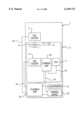
- the single FIGURE is a diagrammatic representation of a passenger car which has various devices for influencing subjective impressions which are perceived by an occupant of the passenger car when the vehicle is being operated.
- the following components are arranged in and/or on the vehicle body: an electrodynamic oscillation exciter 3 arranged in the region of the engine cavity and on the steering gear, a computer unit 7 for detecting and determining the primary oscillations and for generating the secondary oscillations, a control unit 10 for setting the desired influence on the primary oscillations, an electrodynamic oscillation exciter 4 for inducing vibration oscillations in the seat, a playback unit 12 with an amplifier and equalizer for the secondary oscillations and the vibration oscillations which are correlated with the secondary oscillation, and an electronic control device 13 for actuating the aforesaid components which are connected to it via the leads 14.
- the simulation unit also has large speakers (not shown) which are associated with an acoustic-influencing system known under the specialist term “active noise control” or ANC (see U.S. Pat. No. 5,063,598, for example).
- ANC active noise control
- a low-frequency loudspeaker 5 (subwoofer) is arranged within the passenger compartment 2 of the vehicle 1.
- the sound waves which are generated with the low-frequency loudspeaker 5 can also be perceived through the human body, depending on the sound pressure. In the case of these soundwaves, the region of airborne sound and structure-borne sound thus intersect in terms of oscillations perceivable by the human body.
- the oscillation exciter 4 (which is assigned at least to the seat) is arranged in particular in a freely oscillating fashion in the region of the seat, of a seat rail, of the vehicle body 1 and/or of the floor panel.
- the oscillation exciter 3 which is assigned to the steering wheel 6 is preferably rigidly arranged in a convenient fashion in the region of the steering gear.
- the oscillation exciters 4, 3, which are at a minimum indirectly assigned during operation to the seat and to the steering wheel 6, can be used to generate vibration oscillations and induce them in the seat and/or in the steering wheel 6.
- the electrodynamic oscillation exciter 3 which is assigned to the steering wheel is preferably an electric motor.
- the exciter 3 is in particular a D.C. motor.
- the vibration oscillations are induced in the Z direction, preferably as rotary oscillations of the steering wheel 6.
- the artificially generated vibration oscillations are ideally in antiphase with respect to the primary oscillations which are produced when the vehicle is being operated.
- the component of the primary oscillations which can be perceived by the body is, in the most favorable case, cancelled out by negative interference.
- the driver at most, only perceives the oscillations to a small degree through the seat and through the steering wheel 6.
- the primary oscillations have, inter alia, an acoustic component (approximately 16 Hz-16 kHz) and a low-frequency component--the vibration. In particular, this includes vibrations at frequencies between 0.5 and 150 Hz.
- the primary oscillations are determined by different types of detectors, in particular between 0.1 Hz and 20 kHz, preferably between 1 Hz and 16 kHz, and most preferably between 5 Hz and 16 kHz, and are evaluated in a known fashion using the electronic computer unit 7.
- the vibrations of the seat and of the steering wheel 6, inter alia, are advantageously measured.
- the measurement of the vibrations is carried out expediently using acceleration and/or speed and/or displacement sensors in a known fashion.
- the primary oscillations can be determined in a more costly, but also more precise, way by the use of, in particular, multi-channel technology in which both the acoustically perceptible oscillations and also the vibrations (in particular in the seat and at the steering wheel 6) are registered.
- a response signal is generated for the vibration oscillations from the values which are determined; however, only frequencies up to 150 Hz are taken into account for this.
- the response signal is used to actuate the different oscillation exciters 3, 4 which are responsible for the vibration oscillations and which themselves then cause the seat and the steering wheel 6 to undergo vibration oscillations, and also via the air column in the passenger compartment 2 of the vehicle with the aid of the low-frequency loudspeaker 5.
- the subjective impression of the vibrations which can be perceived through the human body is thus reduced or else even amplified.
- the influence on the component of the primary oscillations which can be perceived through the human body is exerted through interference (superimposition) using the artificially generated vibration oscillations in the range of actual perception of the vehicle occupants.
- negative interference increases, in particular, the subjective quietness of driving and thus the comfort.
- vibration data record Those data which are assigned to the vibration oscillations which can be perceived through the human body are extracted, as vibration data record, from the primary data record which has, if appropriate, been in particular electronically buffered.
- the vibrations can thus be converted at any time into a corresponding response signal in order to generate the vibration oscillations.
- the vibration oscillations are generated and/or induced as a function of at least one parameter.
- the travel speed and/or the rotational speed are used as parameters.
Landscapes
- Engineering & Computer Science (AREA)
- Chemical & Material Sciences (AREA)
- Combustion & Propulsion (AREA)
- Transportation (AREA)
- Mechanical Engineering (AREA)
- Fittings On The Vehicle Exterior For Carrying Loads, And Devices For Holding Or Mounting Articles (AREA)
Abstract
Description
Claims (34)
Applications Claiming Priority (2)
| Application Number | Priority Date | Filing Date | Title |
|---|---|---|---|
| DE19749587 | 1997-11-10 | ||
| DE19749587A DE19749587C1 (en) | 1997-11-10 | 1997-11-10 | Vibration reduction method for commercial vehicle driver |
Publications (1)
| Publication Number | Publication Date |
|---|---|
| US6150733A true US6150733A (en) | 2000-11-21 |
Family
ID=7848153
Family Applications (1)
| Application Number | Title | Priority Date | Filing Date |
|---|---|---|---|
| US09/188,676 Expired - Fee Related US6150733A (en) | 1997-11-10 | 1998-11-10 | Method and device for influencing an impression which is subjectively perceived by an occupant of a vehicle, in particular of a passenger car, when the vehicle is being operated |
Country Status (2)
| Country | Link |
|---|---|
| US (1) | US6150733A (en) |
| DE (1) | DE19749587C1 (en) |
Cited By (1)
| Publication number | Priority date | Publication date | Assignee | Title |
|---|---|---|---|---|
| WO2005095180A1 (en) * | 2004-04-01 | 2005-10-13 | A2 Acoustics Ab | A vibration control device providing a desired vibration character in a steering wheel of a vehicle |
Families Citing this family (6)
| Publication number | Priority date | Publication date | Assignee | Title |
|---|---|---|---|---|
| ITBO20000190A1 (en) * | 2000-04-04 | 2001-10-04 | Ferrari Spa | STEERING GROUP FOR VEHICLES. |
| DE202007014209U1 (en) * | 2007-10-10 | 2009-02-26 | Autoliv Development Ab | Driver alarm system for the steering wheel of a motor vehicle |
| AT504424B1 (en) * | 2008-02-08 | 2009-05-15 | Avl List Gmbh | METHOD FOR DETERMINING THE UNITS OF INDIVIDUAL TRANSMISSION PATHS |
| DE102015007825B4 (en) | 2015-06-18 | 2021-07-15 | Audi Ag | Method for controlling at least one actuator of an active chassis and a system for controlling at least one actuator |
| DE102015122194A1 (en) * | 2015-12-18 | 2017-06-22 | Robert Bosch Automotive Steering Gmbh | Method for masking and / or reducing disturbing noises or their conspicuousness in the operation of a motor vehicle |
| DE102023212184A1 (en) * | 2023-12-04 | 2025-06-05 | Volkswagen Aktiengesellschaft | Reducing motor vehicle noise using interference |
Citations (10)
| Publication number | Priority date | Publication date | Assignee | Title |
|---|---|---|---|---|
| US4562589A (en) * | 1982-12-15 | 1985-12-31 | Lord Corporation | Active attenuation of noise in a closed structure |
| US4869474A (en) * | 1987-05-08 | 1989-09-26 | Btr Plc | Vehicle engine suspension systems |
| US5063598A (en) * | 1990-04-25 | 1991-11-05 | Ford Motor Company | Active noise control system with two stage conditioning |
| US5146505A (en) * | 1990-10-04 | 1992-09-08 | General Motors Corporation | Method for actively attenuating engine generated noise |
| DE4219648A1 (en) * | 1991-07-10 | 1993-01-14 | Klein Alb Gmbh Co Kg | Controlling vibrating system e.g. crusher, conveyor chute - generating equal and opposite vibrations to minimise emanations, esp. of air or sound vibrations |
| US5219037A (en) * | 1992-01-21 | 1993-06-15 | General Motors Corporation | Component mount assembly providing active control of vehicle vibration |
| US5332061A (en) * | 1993-03-12 | 1994-07-26 | General Motors Corporation | Active vibration control system for attenuating engine generated vibrations in a vehicle |
| US5434783A (en) * | 1993-01-06 | 1995-07-18 | Nissan Motor Co., Ltd. | Active control system |
| DE19714724A1 (en) * | 1996-04-10 | 1997-11-06 | Nissan Motor | Active oscillation dampening method for motor car |
| US5848168A (en) * | 1996-11-04 | 1998-12-08 | Tenneco Automotive Inc. | Active noise conditioning system |
-
1997
- 1997-11-10 DE DE19749587A patent/DE19749587C1/en not_active Expired - Fee Related
-
1998
- 1998-11-10 US US09/188,676 patent/US6150733A/en not_active Expired - Fee Related
Patent Citations (10)
| Publication number | Priority date | Publication date | Assignee | Title |
|---|---|---|---|---|
| US4562589A (en) * | 1982-12-15 | 1985-12-31 | Lord Corporation | Active attenuation of noise in a closed structure |
| US4869474A (en) * | 1987-05-08 | 1989-09-26 | Btr Plc | Vehicle engine suspension systems |
| US5063598A (en) * | 1990-04-25 | 1991-11-05 | Ford Motor Company | Active noise control system with two stage conditioning |
| US5146505A (en) * | 1990-10-04 | 1992-09-08 | General Motors Corporation | Method for actively attenuating engine generated noise |
| DE4219648A1 (en) * | 1991-07-10 | 1993-01-14 | Klein Alb Gmbh Co Kg | Controlling vibrating system e.g. crusher, conveyor chute - generating equal and opposite vibrations to minimise emanations, esp. of air or sound vibrations |
| US5219037A (en) * | 1992-01-21 | 1993-06-15 | General Motors Corporation | Component mount assembly providing active control of vehicle vibration |
| US5434783A (en) * | 1993-01-06 | 1995-07-18 | Nissan Motor Co., Ltd. | Active control system |
| US5332061A (en) * | 1993-03-12 | 1994-07-26 | General Motors Corporation | Active vibration control system for attenuating engine generated vibrations in a vehicle |
| DE19714724A1 (en) * | 1996-04-10 | 1997-11-06 | Nissan Motor | Active oscillation dampening method for motor car |
| US5848168A (en) * | 1996-11-04 | 1998-12-08 | Tenneco Automotive Inc. | Active noise conditioning system |
Cited By (3)
| Publication number | Priority date | Publication date | Assignee | Title |
|---|---|---|---|---|
| WO2005095180A1 (en) * | 2004-04-01 | 2005-10-13 | A2 Acoustics Ab | A vibration control device providing a desired vibration character in a steering wheel of a vehicle |
| US20070216123A1 (en) * | 2004-04-01 | 2007-09-20 | A2 Acoustics Ab | Vibration Control Device Providing A Desired Vibration Character In A Steering Wheel Of A Vehicle |
| US7562904B2 (en) | 2004-04-01 | 2009-07-21 | A2 Acoustic AB | Vibration control device providing a desired vibration character in a steering wheel of a vehicle |
Also Published As
| Publication number | Publication date |
|---|---|
| DE19749587C1 (en) | 1999-06-24 |
Similar Documents
| Publication | Publication Date | Title |
|---|---|---|
| JP3261128B2 (en) | Acoustic enhancement system | |
| US5371802A (en) | Sound synthesizer in a vehicle | |
| GB2252657A (en) | Vibration and sound generation in vehicles | |
| WO2001081108A3 (en) | Active vibration cancellation of gear mesh vibration | |
| JPH04273B2 (en) | ||
| US12377782B2 (en) | Battery electric vehicle active sound and vibration enhancement systems | |
| JP3257012B2 (en) | Warning sound generator | |
| CN111554262A (en) | A car noise reduction system and a car using the same | |
| US6891954B2 (en) | Vehicle-mounted noise control apparatus | |
| WO2014050295A1 (en) | Active muffler device | |
| US6035720A (en) | Method and device for simulating an impression which is subjectively perceived by an occupant of a vehicle in particular of passenger car when the vehicle is being operated | |
| JPH08328570A (en) | Noise reduction device in the cab of a cab-over vehicle | |
| DE19749587C1 (en) | Vibration reduction method for commercial vehicle driver | |
| JPH10504946A (en) | A device that controls the volume of a car radio depending on running noise | |
| WO2023086310A1 (en) | Active sound and vibration enhancement systems for battery electric vehicle | |
| WO2023086308A1 (en) | Battery electric vehicle active sound and vibration enhancement systems | |
| JPH0633981A (en) | Vibration reduction device of vehicle | |
| US20260008345A1 (en) | Arrangement of an electronic board for a motor vehicle axle with an accelerometer generating a characteristic signal for the production of sound | |
| JP3278173B2 (en) | Vehicle noise control device | |
| CN111681632A (en) | Sound wave processing system and motor vehicle | |
| JP3146489B2 (en) | Active vehicle interior noise reduction device | |
| JP4035961B2 (en) | Body vibration reduction device | |
| WO2019181991A1 (en) | Notification device and notification method | |
| JPS5963251A (en) | Apparatus for reducing noise of vehicle | |
| JPH09281975A (en) | Vibration noise control device |
Legal Events
| Date | Code | Title | Description |
|---|---|---|---|
| AS | Assignment |
Owner name: HEAD ACOUSTICS GMBH, GERMANY Free format text: ASSIGNMENT OF ASSIGNORS INTEREST;ASSIGNORS:PODSZUN, WERNER;GENUIT, KLAUS;REEL/FRAME:009730/0071;SIGNING DATES FROM 19981111 TO 19981123 Owner name: DAIMLER-BENZ ATKIENGESELLSCHAFT, GERMANY Free format text: ASSIGNMENT OF ASSIGNORS INTEREST;ASSIGNORS:PODSZUN, WERNER;GENUIT, KLAUS;REEL/FRAME:009730/0071;SIGNING DATES FROM 19981111 TO 19981123 |
|
| AS | Assignment |
Owner name: DAIMLERCHRYSLER AG, GERMANY Free format text: CHANGE OF NAME;ASSIGNOR:DAIMLER-BENZ AKTIENGESELLSCHAFT;REEL/FRAME:010947/0328 Effective date: 19990108 |
|
| FEPP | Fee payment procedure |
Free format text: PAYOR NUMBER ASSIGNED (ORIGINAL EVENT CODE: ASPN); ENTITY STATUS OF PATENT OWNER: LARGE ENTITY |
|
| FPAY | Fee payment |
Year of fee payment: 4 |
|
| AS | Assignment |
Owner name: DAIMLER AG, GERMANY Free format text: CHANGE OF NAME;ASSIGNOR:DAIMLERCHRYSLER AG;REEL/FRAME:020976/0889 Effective date: 20071019 Owner name: DAIMLER AG,GERMANY Free format text: CHANGE OF NAME;ASSIGNOR:DAIMLERCHRYSLER AG;REEL/FRAME:020976/0889 Effective date: 20071019 |
|
| FPAY | Fee payment |
Year of fee payment: 8 |
|
| REMI | Maintenance fee reminder mailed | ||
| LAPS | Lapse for failure to pay maintenance fees | ||
| STCH | Information on status: patent discontinuation |
Free format text: PATENT EXPIRED DUE TO NONPAYMENT OF MAINTENANCE FEES UNDER 37 CFR 1.362 |
|
| FP | Lapsed due to failure to pay maintenance fee |
Effective date: 20121121 |
|
| AS | Assignment |
Owner name: DAIMLER AG, GERMANY Free format text: CORRECTIVE ASSIGNMENT TO CORRECT THE APPLICATION NO. 10/567,810 PREVIOUSLY RECORDED ON REEL 020976 FRAME 0889. ASSIGNOR(S) HEREBY CONFIRMS THE CHANGE OF NAME;ASSIGNOR:DAIMLERCHRYSLER AG;REEL/FRAME:053583/0493 Effective date: 20071019 |