US6150547A - Iron-casein complex hydrolyzate and process for the production thereof - Google Patents
Iron-casein complex hydrolyzate and process for the production thereof Download PDFInfo
- Publication number
- US6150547A US6150547A US09/194,170 US19417098A US6150547A US 6150547 A US6150547 A US 6150547A US 19417098 A US19417098 A US 19417098A US 6150547 A US6150547 A US 6150547A
- Authority
- US
- United States
- Prior art keywords
- casein
- iron
- acid
- hydrogencarbonic
- solution
- Prior art date
- Legal status (The legal status is an assumption and is not a legal conclusion. Google has not performed a legal analysis and makes no representation as to the accuracy of the status listed.)
- Expired - Fee Related
Links
- 239000005018 casein Substances 0.000 title claims abstract description 222
- 238000000034 method Methods 0.000 title claims abstract description 35
- 238000004519 manufacturing process Methods 0.000 title claims abstract description 9
- BECPQYXYKAMYBN-UHFFFAOYSA-N casein, tech. Chemical class NCCCCC(C(O)=O)N=C(O)C(CC(O)=O)N=C(O)C(CCC(O)=N)N=C(O)C(CC(C)C)N=C(O)C(CCC(O)=O)N=C(O)C(CC(O)=O)N=C(O)C(CCC(O)=O)N=C(O)C(C(C)O)N=C(O)C(CCC(O)=N)N=C(O)C(CCC(O)=N)N=C(O)C(CCC(O)=N)N=C(O)C(CCC(O)=O)N=C(O)C(CCC(O)=O)N=C(O)C(COP(O)(O)=O)N=C(O)C(CCC(O)=N)N=C(O)C(N)CC1=CC=CC=C1 BECPQYXYKAMYBN-UHFFFAOYSA-N 0.000 claims abstract description 232
- 235000021240 caseins Nutrition 0.000 claims abstract description 207
- XEEYBQQBJWHFJM-UHFFFAOYSA-N Iron Chemical compound [Fe] XEEYBQQBJWHFJM-UHFFFAOYSA-N 0.000 claims abstract description 193
- 229910052742 iron Inorganic materials 0.000 claims abstract description 110
- BVKZGUZCCUSVTD-UHFFFAOYSA-N carbonic acid Chemical compound OC(O)=O BVKZGUZCCUSVTD-UHFFFAOYSA-N 0.000 claims abstract description 90
- 230000007062 hydrolysis Effects 0.000 claims abstract description 49
- 238000006460 hydrolysis reaction Methods 0.000 claims abstract description 49
- 239000004365 Protease Substances 0.000 claims abstract description 40
- 108091005804 Peptidases Proteins 0.000 claims abstract description 35
- 102100037486 Reverse transcriptase/ribonuclease H Human genes 0.000 claims abstract description 33
- 235000019606 astringent taste Nutrition 0.000 claims abstract description 23
- 239000007864 aqueous solution Substances 0.000 claims abstract description 22
- 238000002156 mixing Methods 0.000 claims abstract description 16
- 238000001556 precipitation Methods 0.000 claims abstract description 12
- 238000010438 heat treatment Methods 0.000 claims abstract description 7
- 239000000243 solution Substances 0.000 claims description 173
- -1 iron ion Chemical class 0.000 claims description 41
- 238000006243 chemical reaction Methods 0.000 claims description 36
- XLYOFNOQVPJJNP-UHFFFAOYSA-N water Substances O XLYOFNOQVPJJNP-UHFFFAOYSA-N 0.000 claims description 10
- 229910001868 water Inorganic materials 0.000 claims description 10
- 238000002360 preparation method Methods 0.000 claims description 9
- 239000000843 powder Substances 0.000 claims description 3
- 150000001875 compounds Chemical class 0.000 claims description 2
- 239000002994 raw material Substances 0.000 abstract description 6
- 229940079593 drug Drugs 0.000 abstract description 5
- 239000003814 drug Substances 0.000 abstract description 5
- 239000002778 food additive Substances 0.000 abstract 1
- 235000013373 food additive Nutrition 0.000 abstract 1
- 102000011632 Caseins Human genes 0.000 description 206
- 108010076119 Caseins Proteins 0.000 description 206
- HEMHJVSKTPXQMS-UHFFFAOYSA-M Sodium hydroxide Chemical compound [OH-].[Na+] HEMHJVSKTPXQMS-UHFFFAOYSA-M 0.000 description 30
- 235000019419 proteases Nutrition 0.000 description 27
- UIIMBOGNXHQVGW-UHFFFAOYSA-M Sodium bicarbonate Chemical compound [Na+].OC([O-])=O UIIMBOGNXHQVGW-UHFFFAOYSA-M 0.000 description 26
- 238000009826 distribution Methods 0.000 description 16
- 239000011259 mixed solution Substances 0.000 description 13
- 235000017557 sodium bicarbonate Nutrition 0.000 description 13
- 229910000030 sodium bicarbonate Inorganic materials 0.000 description 13
- 239000000047 product Substances 0.000 description 12
- 239000007853 buffer solution Substances 0.000 description 11
- CIWBSHSKHKDKBQ-JLAZNSOCSA-N Ascorbic acid Chemical compound OC[C@H](O)[C@H]1OC(=O)C(O)=C1O CIWBSHSKHKDKBQ-JLAZNSOCSA-N 0.000 description 8
- 102000004190 Enzymes Human genes 0.000 description 8
- 108090000790 Enzymes Proteins 0.000 description 8
- 235000013365 dairy product Nutrition 0.000 description 8
- 229940088598 enzyme Drugs 0.000 description 8
- 230000015572 biosynthetic process Effects 0.000 description 7
- 230000000694 effects Effects 0.000 description 7
- 239000002244 precipitate Substances 0.000 description 7
- 238000003860 storage Methods 0.000 description 7
- 238000004220 aggregation Methods 0.000 description 6
- 230000002776 aggregation Effects 0.000 description 6
- 208000007502 anemia Diseases 0.000 description 6
- 235000013305 food Nutrition 0.000 description 6
- BAUYGSIQEAFULO-UHFFFAOYSA-L iron(2+) sulfate (anhydrous) Chemical compound [Fe+2].[O-]S([O-])(=O)=O BAUYGSIQEAFULO-UHFFFAOYSA-L 0.000 description 6
- 230000001954 sterilising effect Effects 0.000 description 6
- 238000004659 sterilization and disinfection Methods 0.000 description 6
- 239000008366 buffered solution Substances 0.000 description 5
- 238000004090 dissolution Methods 0.000 description 5
- 238000010828 elution Methods 0.000 description 5
- 238000011156 evaluation Methods 0.000 description 5
- 239000011790 ferrous sulphate Substances 0.000 description 5
- 235000003891 ferrous sulphate Nutrition 0.000 description 5
- 229910000359 iron(II) sulfate Inorganic materials 0.000 description 5
- 108090000623 proteins and genes Proteins 0.000 description 5
- 239000007787 solid Substances 0.000 description 5
- 108090000526 Papain Proteins 0.000 description 4
- FAPWRFPIFSIZLT-UHFFFAOYSA-M Sodium chloride Chemical compound [Na+].[Cl-] FAPWRFPIFSIZLT-UHFFFAOYSA-M 0.000 description 4
- 235000019834 papain Nutrition 0.000 description 4
- 229940055729 papain Drugs 0.000 description 4
- 230000001953 sensory effect Effects 0.000 description 4
- 235000019640 taste Nutrition 0.000 description 4
- 235000021247 β-casein Nutrition 0.000 description 4
- WEVYAHXRMPXWCK-UHFFFAOYSA-N Acetonitrile Chemical compound CC#N WEVYAHXRMPXWCK-UHFFFAOYSA-N 0.000 description 3
- 102000001554 Hemoglobins Human genes 0.000 description 3
- 108010054147 Hemoglobins Proteins 0.000 description 3
- 229910021578 Iron(III) chloride Inorganic materials 0.000 description 3
- 241001465754 Metazoa Species 0.000 description 3
- KWYUFKZDYYNOTN-UHFFFAOYSA-M Potassium hydroxide Chemical compound [OH-].[K+] KWYUFKZDYYNOTN-UHFFFAOYSA-M 0.000 description 3
- 241000700159 Rattus Species 0.000 description 3
- 108090000631 Trypsin Proteins 0.000 description 3
- 102000004142 Trypsin Human genes 0.000 description 3
- 210000004369 blood Anatomy 0.000 description 3
- 239000008280 blood Substances 0.000 description 3
- 239000000872 buffer Substances 0.000 description 3
- KRKNYBCHXYNGOX-UHFFFAOYSA-N citric acid Chemical compound OC(=O)CC(O)(C(O)=O)CC(O)=O KRKNYBCHXYNGOX-UHFFFAOYSA-N 0.000 description 3
- 230000000052 comparative effect Effects 0.000 description 3
- 230000002950 deficient Effects 0.000 description 3
- RAXXELZNTBOGNW-UHFFFAOYSA-N imidazole Natural products C1=CNC=N1 RAXXELZNTBOGNW-UHFFFAOYSA-N 0.000 description 3
- RBTARNINKXHZNM-UHFFFAOYSA-K iron trichloride Chemical compound Cl[Fe](Cl)Cl RBTARNINKXHZNM-UHFFFAOYSA-K 0.000 description 3
- 239000000203 mixture Substances 0.000 description 3
- 230000002265 prevention Effects 0.000 description 3
- 108090000765 processed proteins & peptides Proteins 0.000 description 3
- 235000018102 proteins Nutrition 0.000 description 3
- 102000004169 proteins and genes Human genes 0.000 description 3
- 239000011541 reaction mixture Substances 0.000 description 3
- 230000002787 reinforcement Effects 0.000 description 3
- 150000003839 salts Chemical class 0.000 description 3
- 239000011780 sodium chloride Substances 0.000 description 3
- 239000012588 trypsin Substances 0.000 description 3
- 235000021249 α-casein Nutrition 0.000 description 3
- 235000021246 κ-casein Nutrition 0.000 description 3
- QGZKDVFQNNGYKY-UHFFFAOYSA-N Ammonia Chemical compound N QGZKDVFQNNGYKY-UHFFFAOYSA-N 0.000 description 2
- VTYYLEPIZMXCLO-UHFFFAOYSA-L Calcium carbonate Chemical compound [Ca+2].[O-]C([O-])=O VTYYLEPIZMXCLO-UHFFFAOYSA-L 0.000 description 2
- ZZZCUOFIHGPKAK-UHFFFAOYSA-N D-erythro-ascorbic acid Natural products OCC1OC(=O)C(O)=C1O ZZZCUOFIHGPKAK-UHFFFAOYSA-N 0.000 description 2
- VEXZGXHMUGYJMC-UHFFFAOYSA-N Hydrochloric acid Chemical compound Cl VEXZGXHMUGYJMC-UHFFFAOYSA-N 0.000 description 2
- 102000004877 Insulin Human genes 0.000 description 2
- 108090001061 Insulin Proteins 0.000 description 2
- 102000035195 Peptidases Human genes 0.000 description 2
- CDBYLPFSWZWCQE-UHFFFAOYSA-L Sodium Carbonate Chemical compound [Na+].[Na+].[O-]C([O-])=O CDBYLPFSWZWCQE-UHFFFAOYSA-L 0.000 description 2
- DTQVDTLACAAQTR-UHFFFAOYSA-N Trifluoroacetic acid Chemical compound OC(=O)C(F)(F)F DTQVDTLACAAQTR-UHFFFAOYSA-N 0.000 description 2
- 229930003268 Vitamin C Natural products 0.000 description 2
- 238000002835 absorbance Methods 0.000 description 2
- 235000010323 ascorbic acid Nutrition 0.000 description 2
- 239000011668 ascorbic acid Substances 0.000 description 2
- 229960005070 ascorbic acid Drugs 0.000 description 2
- 150000004649 carbonic acid derivatives Chemical class 0.000 description 2
- YPHMISFOHDHNIV-FSZOTQKASA-N cycloheximide Chemical compound C1[C@@H](C)C[C@H](C)C(=O)[C@@H]1[C@H](O)CC1CC(=O)NC(=O)C1 YPHMISFOHDHNIV-FSZOTQKASA-N 0.000 description 2
- 230000002349 favourable effect Effects 0.000 description 2
- RWSXRVCMGQZWBV-WDSKDSINSA-N glutathione Chemical compound OC(=O)[C@@H](N)CCC(=O)N[C@@H](CS)C(=O)NCC(O)=O RWSXRVCMGQZWBV-WDSKDSINSA-N 0.000 description 2
- 150000002506 iron compounds Chemical class 0.000 description 2
- RUTXIHLAWFEWGM-UHFFFAOYSA-H iron(3+) sulfate Chemical compound [Fe+3].[Fe+3].[O-]S([O-])(=O)=O.[O-]S([O-])(=O)=O.[O-]S([O-])(=O)=O RUTXIHLAWFEWGM-UHFFFAOYSA-H 0.000 description 2
- 229910000360 iron(III) sulfate Inorganic materials 0.000 description 2
- JVTAAEKCZFNVCJ-UHFFFAOYSA-N lactic acid Chemical compound CC(O)C(O)=O JVTAAEKCZFNVCJ-UHFFFAOYSA-N 0.000 description 2
- 239000012528 membrane Substances 0.000 description 2
- 244000005700 microbiome Species 0.000 description 2
- 235000013336 milk Nutrition 0.000 description 2
- 239000008267 milk Substances 0.000 description 2
- 210000004080 milk Anatomy 0.000 description 2
- 235000015097 nutrients Nutrition 0.000 description 2
- 238000009928 pasteurization Methods 0.000 description 2
- 239000008363 phosphate buffer Substances 0.000 description 2
- PPASLZSBLFJQEF-RKJRWTFHSA-M sodium ascorbate Substances [Na+].OC[C@@H](O)[C@H]1OC(=O)C(O)=C1[O-] PPASLZSBLFJQEF-RKJRWTFHSA-M 0.000 description 2
- 235000010378 sodium ascorbate Nutrition 0.000 description 2
- 229960005055 sodium ascorbate Drugs 0.000 description 2
- PPASLZSBLFJQEF-RXSVEWSESA-M sodium-L-ascorbate Chemical compound [Na+].OC[C@H](O)[C@H]1OC(=O)C(O)=C1[O-] PPASLZSBLFJQEF-RXSVEWSESA-M 0.000 description 2
- 238000000108 ultra-filtration Methods 0.000 description 2
- 235000019154 vitamin C Nutrition 0.000 description 2
- 239000011718 vitamin C Substances 0.000 description 2
- ATRRKUHOCOJYRX-UHFFFAOYSA-N Ammonium bicarbonate Chemical compound [NH4+].OC([O-])=O ATRRKUHOCOJYRX-UHFFFAOYSA-N 0.000 description 1
- 229910000013 Ammonium bicarbonate Inorganic materials 0.000 description 1
- 102000005862 Angiotensin II Human genes 0.000 description 1
- 101800000733 Angiotensin-2 Proteins 0.000 description 1
- 108010039627 Aprotinin Proteins 0.000 description 1
- 241000283690 Bos taurus Species 0.000 description 1
- 108010004032 Bromelains Proteins 0.000 description 1
- 108090000746 Chymosin Proteins 0.000 description 1
- 108090000317 Chymotrypsin Proteins 0.000 description 1
- KRKNYBCHXYNGOX-UHFFFAOYSA-K Citrate Chemical compound [O-]C(=O)CC(O)(CC([O-])=O)C([O-])=O KRKNYBCHXYNGOX-UHFFFAOYSA-K 0.000 description 1
- 206010013911 Dysgeusia Diseases 0.000 description 1
- 108010024636 Glutathione Proteins 0.000 description 1
- CZGUSIXMZVURDU-JZXHSEFVSA-N Ile(5)-angiotensin II Chemical compound C([C@@H](C(=O)N[C@@H]([C@@H](C)CC)C(=O)N[C@@H](CC=1NC=NC=1)C(=O)N1[C@@H](CCC1)C(=O)N[C@@H](CC=1C=CC=CC=1)C([O-])=O)NC(=O)[C@@H](NC(=O)[C@H](CCCNC(N)=[NH2+])NC(=O)[C@@H]([NH3+])CC([O-])=O)C(C)C)C1=CC=C(O)C=C1 CZGUSIXMZVURDU-JZXHSEFVSA-N 0.000 description 1
- DGAQECJNVWCQMB-PUAWFVPOSA-M Ilexoside XXIX Chemical compound C[C@@H]1CC[C@@]2(CC[C@@]3(C(=CC[C@H]4[C@]3(CC[C@@H]5[C@@]4(CC[C@@H](C5(C)C)OS(=O)(=O)[O-])C)C)[C@@H]2[C@]1(C)O)C)C(=O)O[C@H]6[C@@H]([C@H]([C@@H]([C@H](O6)CO)O)O)O.[Na+] DGAQECJNVWCQMB-PUAWFVPOSA-M 0.000 description 1
- 241000124008 Mammalia Species 0.000 description 1
- 108010019160 Pancreatin Proteins 0.000 description 1
- 108090000284 Pepsin A Proteins 0.000 description 1
- 102000057297 Pepsin A Human genes 0.000 description 1
- 108010001441 Phosphopeptides Proteins 0.000 description 1
- 241000700157 Rattus norvegicus Species 0.000 description 1
- DBMJMQXJHONAFJ-UHFFFAOYSA-M Sodium laurylsulphate Chemical compound [Na+].CCCCCCCCCCCCOS([O-])(=O)=O DBMJMQXJHONAFJ-UHFFFAOYSA-M 0.000 description 1
- 208000027418 Wounds and injury Diseases 0.000 description 1
- 238000010521 absorption reaction Methods 0.000 description 1
- 239000002253 acid Substances 0.000 description 1
- 230000002378 acidificating effect Effects 0.000 description 1
- 150000007513 acids Chemical class 0.000 description 1
- 235000001014 amino acid Nutrition 0.000 description 1
- 150000001413 amino acids Chemical class 0.000 description 1
- 229910021529 ammonia Inorganic materials 0.000 description 1
- 235000012538 ammonium bicarbonate Nutrition 0.000 description 1
- 239000001099 ammonium carbonate Substances 0.000 description 1
- 229950006323 angiotensin ii Drugs 0.000 description 1
- 210000004102 animal cell Anatomy 0.000 description 1
- 229960004405 aprotinin Drugs 0.000 description 1
- FFBHFFJDDLITSX-UHFFFAOYSA-N benzyl N-[2-hydroxy-4-(3-oxomorpholin-4-yl)phenyl]carbamate Chemical compound OC1=C(NC(=O)OCC2=CC=CC=C2)C=CC(=C1)N1CCOCC1=O FFBHFFJDDLITSX-UHFFFAOYSA-N 0.000 description 1
- 210000000601 blood cell Anatomy 0.000 description 1
- 230000037396 body weight Effects 0.000 description 1
- 235000019835 bromelain Nutrition 0.000 description 1
- 229910000019 calcium carbonate Inorganic materials 0.000 description 1
- 235000010216 calcium carbonate Nutrition 0.000 description 1
- 229940080701 chymosin Drugs 0.000 description 1
- 229960002376 chymotrypsin Drugs 0.000 description 1
- 230000015271 coagulation Effects 0.000 description 1
- 238000005345 coagulation Methods 0.000 description 1
- 230000006378 damage Effects 0.000 description 1
- 230000007423 decrease Effects 0.000 description 1
- 238000001962 electrophoresis Methods 0.000 description 1
- 230000001747 exhibiting effect Effects 0.000 description 1
- 235000014106 fortified food Nutrition 0.000 description 1
- 230000002496 gastric effect Effects 0.000 description 1
- 238000003304 gavage Methods 0.000 description 1
- 238000001641 gel filtration chromatography Methods 0.000 description 1
- 229960003180 glutathione Drugs 0.000 description 1
- 150000003278 haem Chemical class 0.000 description 1
- 238000004128 high performance liquid chromatography Methods 0.000 description 1
- ZPNFWUPYTFPOJU-LPYSRVMUSA-N iniprol Chemical compound C([C@H]1C(=O)NCC(=O)NCC(=O)N[C@H]2CSSC[C@H]3C(=O)N[C@@H](CCCCN)C(=O)N[C@@H](C)C(=O)N[C@@H](CCCNC(N)=N)C(=O)N[C@H](C(N[C@H](C(=O)N[C@@H](CCCNC(N)=N)C(=O)N[C@@H](CC=4C=CC(O)=CC=4)C(=O)N[C@@H](CC=4C=CC=CC=4)C(=O)N[C@@H](CC=4C=CC(O)=CC=4)C(=O)N[C@@H](CC(N)=O)C(=O)N[C@@H](C)C(=O)N[C@@H](CCCCN)C(=O)N[C@@H](C)C(=O)NCC(=O)N[C@@H](CC(C)C)C(=O)N[C@@H](CSSC[C@H](NC(=O)[C@H](CC(O)=O)NC(=O)[C@H](CCC(O)=O)NC(=O)[C@H](C)NC(=O)[C@H](CO)NC(=O)[C@H](CCCCN)NC(=O)[C@H](CC=4C=CC=CC=4)NC(=O)[C@H](CC(N)=O)NC(=O)[C@H](CC(N)=O)NC(=O)[C@H](CCCNC(N)=N)NC(=O)[C@H](CCCCN)NC(=O)[C@H](C)NC(=O)[C@H](CCCNC(N)=N)NC2=O)C(=O)N[C@@H](CCSC)C(=O)N[C@@H](CCCNC(N)=N)C(=O)N[C@@H]([C@@H](C)O)C(=O)N[C@@H](CSSC[C@H](NC(=O)[C@H](CC=2C=CC=CC=2)NC(=O)[C@H](CC(O)=O)NC(=O)[C@H]2N(CCC2)C(=O)[C@@H](N)CCCNC(N)=N)C(=O)N[C@@H](CC(C)C)C(=O)N[C@@H](CCC(O)=O)C(=O)N2[C@@H](CCC2)C(=O)N2[C@@H](CCC2)C(=O)N[C@@H](CC=2C=CC(O)=CC=2)C(=O)N[C@@H]([C@@H](C)O)C(=O)NCC(=O)N2[C@@H](CCC2)C(=O)N3)C(=O)NCC(=O)NCC(=O)N[C@@H](C)C(O)=O)C(=O)N[C@@H](CCC(N)=O)C(=O)N[C@H](C(=O)N[C@@H](CC=2C=CC=CC=2)C(=O)N[C@H](C(=O)N1)C(C)C)[C@@H](C)O)[C@@H](C)CC)=O)[C@@H](C)CC)C1=CC=C(O)C=C1 ZPNFWUPYTFPOJU-LPYSRVMUSA-N 0.000 description 1
- 208000014674 injury Diseases 0.000 description 1
- 150000002505 iron Chemical class 0.000 description 1
- 235000014413 iron hydroxide Nutrition 0.000 description 1
- 159000000014 iron salts Chemical class 0.000 description 1
- 229910000358 iron sulfate Inorganic materials 0.000 description 1
- NCNCGGDMXMBVIA-UHFFFAOYSA-L iron(ii) hydroxide Chemical class [OH-].[OH-].[Fe+2] NCNCGGDMXMBVIA-UHFFFAOYSA-L 0.000 description 1
- 239000004310 lactic acid Substances 0.000 description 1
- 235000014655 lactic acid Nutrition 0.000 description 1
- 235000021056 liquid food Nutrition 0.000 description 1
- 235000012054 meals Nutrition 0.000 description 1
- 210000004877 mucosa Anatomy 0.000 description 1
- GNOLWGAJQVLBSM-UHFFFAOYSA-N n,n,5,7-tetramethyl-1,2,3,4-tetrahydronaphthalen-1-amine Chemical compound C1=C(C)C=C2C(N(C)C)CCCC2=C1C GNOLWGAJQVLBSM-UHFFFAOYSA-N 0.000 description 1
- 230000000474 nursing effect Effects 0.000 description 1
- 239000003002 pH adjusting agent Substances 0.000 description 1
- 229940055695 pancreatin Drugs 0.000 description 1
- 229940111202 pepsin Drugs 0.000 description 1
- 239000011736 potassium bicarbonate Substances 0.000 description 1
- 235000015497 potassium bicarbonate Nutrition 0.000 description 1
- 229910000028 potassium bicarbonate Inorganic materials 0.000 description 1
- TYJJADVDDVDEDZ-UHFFFAOYSA-M potassium hydrogencarbonate Chemical compound [K+].OC([O-])=O TYJJADVDDVDEDZ-UHFFFAOYSA-M 0.000 description 1
- 229940086066 potassium hydrogencarbonate Drugs 0.000 description 1
- 239000012744 reinforcing agent Substances 0.000 description 1
- 239000011734 sodium Substances 0.000 description 1
- 229910052708 sodium Inorganic materials 0.000 description 1
- 229910000029 sodium carbonate Inorganic materials 0.000 description 1
- 235000017550 sodium carbonate Nutrition 0.000 description 1
- 229940083575 sodium dodecyl sulfate Drugs 0.000 description 1
- 230000001225 therapeutic effect Effects 0.000 description 1
- 230000009261 transgenic effect Effects 0.000 description 1
- 229960001322 trypsin Drugs 0.000 description 1
- 210000003462 vein Anatomy 0.000 description 1
Images

Classifications
-
- A—HUMAN NECESSITIES
- A23—FOODS OR FOODSTUFFS; TREATMENT THEREOF, NOT COVERED BY OTHER CLASSES
- A23J—PROTEIN COMPOSITIONS FOR FOODSTUFFS; WORKING-UP PROTEINS FOR FOODSTUFFS; PHOSPHATIDE COMPOSITIONS FOR FOODSTUFFS
- A23J3/00—Working-up of proteins for foodstuffs
- A23J3/30—Working-up of proteins for foodstuffs by hydrolysis
- A23J3/32—Working-up of proteins for foodstuffs by hydrolysis using chemical agents
- A23J3/34—Working-up of proteins for foodstuffs by hydrolysis using chemical agents using enzymes
- A23J3/341—Working-up of proteins for foodstuffs by hydrolysis using chemical agents using enzymes of animal proteins
- A23J3/343—Working-up of proteins for foodstuffs by hydrolysis using chemical agents using enzymes of animal proteins of dairy proteins
- A23J3/344—Working-up of proteins for foodstuffs by hydrolysis using chemical agents using enzymes of animal proteins of dairy proteins of casein
-
- A—HUMAN NECESSITIES
- A23—FOODS OR FOODSTUFFS; TREATMENT THEREOF, NOT COVERED BY OTHER CLASSES
- A23J—PROTEIN COMPOSITIONS FOR FOODSTUFFS; WORKING-UP PROTEINS FOR FOODSTUFFS; PHOSPHATIDE COMPOSITIONS FOR FOODSTUFFS
- A23J3/00—Working-up of proteins for foodstuffs
- A23J3/04—Animal proteins
- A23J3/08—Dairy proteins
- A23J3/10—Casein
-
- A—HUMAN NECESSITIES
- A23—FOODS OR FOODSTUFFS; TREATMENT THEREOF, NOT COVERED BY OTHER CLASSES
- A23J—PROTEIN COMPOSITIONS FOR FOODSTUFFS; WORKING-UP PROTEINS FOR FOODSTUFFS; PHOSPHATIDE COMPOSITIONS FOR FOODSTUFFS
- A23J3/00—Working-up of proteins for foodstuffs
- A23J3/30—Working-up of proteins for foodstuffs by hydrolysis
- A23J3/32—Working-up of proteins for foodstuffs by hydrolysis using chemical agents
- A23J3/325—Working-up of proteins for foodstuffs by hydrolysis using chemical agents of casein
-
- A—HUMAN NECESSITIES
- A23—FOODS OR FOODSTUFFS; TREATMENT THEREOF, NOT COVERED BY OTHER CLASSES
- A23K—FODDER
- A23K20/00—Accessory food factors for animal feeding-stuffs
- A23K20/10—Organic substances
- A23K20/142—Amino acids; Derivatives thereof
- A23K20/147—Polymeric derivatives, e.g. peptides or proteins
-
- A—HUMAN NECESSITIES
- A23—FOODS OR FOODSTUFFS; TREATMENT THEREOF, NOT COVERED BY OTHER CLASSES
- A23K—FODDER
- A23K20/00—Accessory food factors for animal feeding-stuffs
- A23K20/20—Inorganic substances, e.g. oligoelements
- A23K20/30—Oligoelements
-
- A—HUMAN NECESSITIES
- A23—FOODS OR FOODSTUFFS; TREATMENT THEREOF, NOT COVERED BY OTHER CLASSES
- A23L—FOODS, FOODSTUFFS OR NON-ALCOHOLIC BEVERAGES, NOT OTHERWISE PROVIDED FOR; PREPARATION OR TREATMENT THEREOF
- A23L33/00—Modifying nutritive qualities of foods; Dietetic products; Preparation or treatment thereof
- A23L33/10—Modifying nutritive qualities of foods; Dietetic products; Preparation or treatment thereof using additives
- A23L33/16—Inorganic salts, minerals or trace elements
- A23L33/165—Complexes or chelates
-
- C—CHEMISTRY; METALLURGY
- C07—ORGANIC CHEMISTRY
- C07K—PEPTIDES
- C07K14/00—Peptides having more than 20 amino acids; Gastrins; Somatostatins; Melanotropins; Derivatives thereof
- C07K14/435—Peptides having more than 20 amino acids; Gastrins; Somatostatins; Melanotropins; Derivatives thereof from animals; from humans
- C07K14/46—Peptides having more than 20 amino acids; Gastrins; Somatostatins; Melanotropins; Derivatives thereof from animals; from humans from vertebrates
- C07K14/47—Peptides having more than 20 amino acids; Gastrins; Somatostatins; Melanotropins; Derivatives thereof from animals; from humans from vertebrates from mammals
- C07K14/4701—Peptides having more than 20 amino acids; Gastrins; Somatostatins; Melanotropins; Derivatives thereof from animals; from humans from vertebrates from mammals not used
- C07K14/4732—Casein
-
- C—CHEMISTRY; METALLURGY
- C12—BIOCHEMISTRY; BEER; SPIRITS; WINE; VINEGAR; MICROBIOLOGY; ENZYMOLOGY; MUTATION OR GENETIC ENGINEERING
- C12P—FERMENTATION OR ENZYME-USING PROCESSES TO SYNTHESISE A DESIRED CHEMICAL COMPOUND OR COMPOSITION OR TO SEPARATE OPTICAL ISOMERS FROM A RACEMIC MIXTURE
- C12P21/00—Preparation of peptides or proteins
- C12P21/06—Preparation of peptides or proteins produced by the hydrolysis of a peptide bond, e.g. hydrolysate products
-
- A—HUMAN NECESSITIES
- A61—MEDICAL OR VETERINARY SCIENCE; HYGIENE
- A61K—PREPARATIONS FOR MEDICAL, DENTAL OR TOILETRY PURPOSES
- A61K38/00—Medicinal preparations containing peptides
Definitions
- This invention relates to carbonic acid- and/or hydrogencarbonic acid-iron-hydrolyzates of casein complexes. Furthermore, this invention relates to processes for the preparation of carbonic acid- and/or hydrogencarbonic acid-iron-hydrolyzates of casein complexes.
- the carbonic acid- and/or hydrogencarbonic acid-iron-hydrolyzates of casein complexes of the present invention have characteristic features of thermoresistance or thermostability without exhibiting iron characteristic astringent taste after heat sterilization and can exist in aqueous solution.
- the compounds of the present invention are useful as raw materials of foods and drinks, medicines and feeds for prevention and treatment of anemia, and reinforcement of iron content in the body.
- the carbonic acid- and/or hydrogencarbonic acid-iron-hydrolyzates of casein complexes of the present invention have advantages that they exhibit favorable taste and can be handled easily in the production procedure without loss of the solid content because they do not aggregate in aqueous solution.
- iron uptake of Japanese has been maintained at about 100% sufficiency without change since 1975, and iron as a nutrient in meals must be taken up with care.
- iron is considered as a nutrient which is often liable to be deficient, particularly the supply of iron in enriched foods and medicines for persons with anemic tendency, and pregnant and nursing females.
- an iron salt such as iron sulfate or citrate as an iron reinforcing agent in foods and drinks
- an organic iron compound, heme iron causes problems in taste such as metallic or fishy taste and its addition to foods is highly limited.
- the inventors of the present invention developed a method to reduce the characteristic astringent taste of iron by binding iron with casein [Japanese Laid-open Patent Application No. 83400 (1990)].
- the iron casein prepared by binding iron with casein is devoid of thermostability and shows characteristic astringent taste of iron by thermal pasteurization at 90° C. for 10 minutes, 120° C. for 2-3 seconds or retort pasteurization. This was considered to be caused by release of iron from casein due to weak binding of iron and casein, and formation of iron hydroxides or the like.
- the inventors of the present invention further investigated and found that the binding of iron and casein can be reinforced by using carbonic acid and/or hydrogencarbonic acid and succeeded to get carbonic acid- and/or hydrogencarbonic acid-iron-casein complexes [Japanese Laid-open Patent Application No. 259572 (1995)].
- the carbonic acid- and/or hydrogencarbonic acid-iron-casein complexes are thermoresistant without showing iron characteristic astringent taste even by heat sterilization and are useful as raw materials of foods and drinks, medicines, feeds and so forth for prevention and treatment of anemia and reinforcement of iron content.
- the carbonic acid- and/or hydrogencarbonic acid-iron-casein complexes had drawbacks of tendency to aggregate by dissolution in water, difficult to treat in the production procedure and liable to lose solid mass. Furthermore, their sandy taste remains to be solved.
- the inventors of the present invention actively investigated methods to solve the above mentioned drawbacks of carbonic acid- and/or hydrogencarbonic acid-iron-casein complexes, and found that carbonic acid- and/or hydrogencarbonic acid-iron-partial hydrolyzates of casein complexes prepared by hydrolysis of carbonic acid- and/or hydrogencarbonic acid-iron-casein complexes with a protease, or by hydrolysis of casein with a protease to give partial hydrolyzates of casein followed by preparation of carbonic acid- and/or hydrogencarbonic acid-iron-partial hydrolyzates of casein complexes provides thermoresistant, stable to heat sterilization products without iron characteristic astringent taste or aggregation by dissolution in water and accomplished the present invention.
- one object of the present invention is to provide carbonic acid- and/or hydrogencarbonic acid-iron-partial hydrolyzates of casein complexes having characteristic features of thermoresistant, stability to heat sterilization without iron characteristic astringent taste or aggregation by dissolution in water.
- the present invention provides processes for the preparation of carbonic acid- and/or hydrogencarbonic acid-iron-partial hydrolyzates of casein complexes.
- the present invention is proposed to solve aforementioned problems and relates to carbonic acid- and/or hydrogencarbonic acid-iron-partial hydrolyzates of casein complexes containing 1-1,000 atoms of iron and one or more molecule of carbonic acid and/or hydrogencarbonic acid per one molecule of casein prior to the hydrolysis.
- the solubility of the dried powder of complexes in water is at least 15% without aggregation or precipitation even after heating at 90° C. for 10 minutes, and the solution is free of iron characteristic astringent taste.
- the above mentioned complexes of the present invention are thermoresistant without shoving iron characteristic astringent taste by heat sterilization, aggregation in aqueous solution or precipitation by heating at 90° C. for 10 minutes.
- the carbonic acid- and/or hydrogencarbonic acid-iron-partial hydrolyzates of casein complexes can be prepared by the following two procedures.
- the first procedure is formation of carbonic acid- and/or hydrogencarbonic acid-iron-casein complexes, followed by partial hydrolysis of casein with a protease.
- the carbonic acid- and/or hydrogencarbonic acid-iron-casein complexes used in the procedure can be prepared by 1) simultaneous mixing of solution containing a carbonic acid, a hydrogencarbonic acid, or a carbonic acid and a hydrogencarbonic acid (solution A), a solution containing iron (solution B) and a solution containing casein (solution C), 2) mixing a carbonic acid, hydrogencarbonic acid, or a carbonic acid and/or a hydrogencarbonic acid solution (solution A), and a solution containing iron and casein (solution B), or 3) mixing a solution containing a carbonic acid, a hydrogencarbonic acid, or a carbonic acid and a hydrogencarbonic acid, and casein (solution A) and an iron containing solution (solution B).
- the molar concentration of iron ion in solution B is made 1/3 or less to those of a carbonic acid and a hydrogencarbonic acid ions dissolved in a mixed solution of A, B and C.
- the molar concentration of casein in solution C is adjusted to 11/1,000 to that of iron ion in solution B.
- the molar concentration of iron ion in solution B is made 1/3 or less to those of a carbonic acid and a hydrogencarbonic acid ions in a mixture of solutions A and B, and the molar number of casein in solution B is adjusted to 11/1,000 to that of iron ion in solution B.
- the molar concentration of iron ion in solution B is made 1/3 or less to those of a carbonic acid and a hydrogencarbonic acid ions in a mixed solutions A and B, and the molar number of casein in solution A is adjusted to 11/1,000 to that of iron ion in solution A.
- the second procedure is a process of partial hydrolysis of casein with a protease in advance to give partial hydrolyzates of casein, and to give carbonic acid- and/or hydrogencarbonic acid-iron-partial hydrolyzates of casein complexes from the partial hydrolyzates of casein.
- carbonic acid- and/or hydrogencarbonic acid-iron-partial hydrolyzates of casein complexes are obtained by mixing i) a carbonic acid, a hydrogencarbonic acid, or a carbonic acid and a hydrogencarbonic acid, ii) iron, and iii) casein partial hydrolyzates prepared by partial hydrolysis of casein with a protease to react to form carbonic acid- and/or hydrogencarbonic acid-iron-partial hydrolyzates of casein complexes.
- solution A Simultaneous mixing of solution containing a carbonic acid, a hydrogencarbonic acid, or a carbonic acid and a hydrogencarbonic acid
- solution B a solution containing iron
- solution C a solution of partial hydrolyzates of casein solution
- solution A solution containing a carbonic acid, a hydrogencarbonic acid, or a carbonic acid and a hydrogencarbonic acid
- solution B solution containing iron and a partial hydrolyzate of casein prepared by partial hydrolysis of casein with a protease
- the molar concentration of iron ion in solution B is made 1/3 or less to those of a carbonic acid and a hydrogencarbonic acid ions dissolved in a mixed solution of A, B and C, and molar number of partial hydrolyzates of casein in solution C is adjusted to 11/1,000 molar number of iron ion in solution B calculated as casein before partial hydrolysis.
- the molar concentration of iron ion in solution B is made 1/3 or less to those of a carbonic acid and a hydrogencarbonic acid ions dissolved in a mixed solution of A and B, and the molar number of hydrolyzates of casein in solution B is adjusted to 11/1,000 to that of iron ion in solution B calculated as casein before hydrolysis.
- the molar concentration of iron ion in solution B is made 1/3 or less to those of a carbonic acid and a hydrogencarbonic acid ions dissolved in a mixed solution of A and B, and the molar number of casein partial hydrolyzed product in solution A is adjusted to 11/1,000 to that of iron ion in solution B calculated as casein before partial hydrolysis.
- carbonic acid- and/or hydrogencarbonic acid-iron-partial hydrolyzates of casein complexes can be prepared to give following properties of 1) to 4).
- the complexes contain 1-1,000 atoms of iron and one or more molecule of a carbonic acid and/or a hydrogencarbonic acid per one molecule of casein prior to the hydrolysis,
- the carbonic acid- and/or hydrogencarbonic acid-iron-partial hydrolyzates of casein complexes of the present invention do not form precipitates in the aqueous solution after heating at 90° C. for 10 minutes, and this thermoresistance is derived from the use of partially and enzymically hydrolyzates of casein as a raw material.
- the enzymic hydrolysis is preferably carried out with a protease to give partial hydrolyzates, no more than 55% of which is a hydrolyzate with molecular weight of 15,000 or more and no more than 34% of which is that with molecular weight of less than 800.
- the present invention is practically explained at first by processes for preparation of the complexes.
- the first processes composed of preparation of carbonic acid- and/or a hydrogencarbonic acid-iron-casein complex, followed by partial hydrolysis of the carbonic acid- and/or hydrogencarbonic acid-iron-casein complex with a protease to give carbonic acid and/or hydrogencarbonic acid-iron-partial hydrolyzates of casein complex are explained.
- the processes have following three variations of (1) to (3).
- the molar concentration of iron ion in solution B is made 1/3 or less of those of a carbonic acid and a hydrogencarbonic acid ions dissolved in a mixed solution of A, B and C, and molar number of partial hydrolyzates of casein in solution C is adjusted to 11/1,000 molar number of iron ion in solution B calculated as casein before partial hydrolysis.
- a carbonic acid and/or a hydrogencarbonic acid used for the preparation of a carbonic acid- and/or a hydrogencarbonic acid-iron-casein complex, or a carbonic acid- and/or a hydrogencarbonic acid-iron-partial hydrolyzates of casein complex may be used in forms of acids or water soluble salts.
- Iron is generally used in the form of a water soluble salt.
- the carbonic acid and/or hydrogencarbonic acid, iron, and casein or partial hydrolyzates of casein may be used in the form of solution or solid such as salts for the preparation of a carbonic acid- and/or a hydrogencarbonic acid-iron-casein complex, or a carbonic acid- and/or a hydrogencarbonic acid-iron-partial hydrolyzates of casein complex.
- Solid state carbonates and/or hydrogencarbonates, iron, and casein or partial hydrolyzates of casein may be simultaneously dissolved and used. However, procedure that would lead to the formation of a solution solely containing carbonates and/or hydrogencarbonates, and iron must be avoided.
- casein used in the present invention may be illustrated, for example, as casein, acidic casein, casein sodium, lactic casein, ⁇ -casein, ⁇ -casein and ⁇ -casein isolated from milk of mammals such as human being and cattle.
- casein are commercially available or as methods to massively isolate them are known, products produced by these methods may also be used.
- products produced by microorganisms, animal cells and transgenic animals using gene technology may also be used.
- crude casein such as mixtures of ⁇ -casein, ⁇ -casein and ⁇ -casein is used as a raw material
- the molar concentration of casein in the solution is estimated from average molecular weight based on the ratios of the components
- the carbonic acid and/or hydrogencarbonic acid used in the present invention may be illustrated as carbonated water, ammonium hydrogencarbonate, sodium hydrogencarbonate, potassium hydrogen-carbonate, sodium carbonate, calcium carbonate and so forth.
- iron compounds water soluble iron salts such as ferric chloride and ferric sulfate may be used.
- pH adjusting agents sodium hydroxide, ammonia, potassium hydroxide, hydrochloric acid, citric acid and lactic acid may simultaneously be used. The pH of the reaction mixture is generally adjusted to 2-9.
- proteases used for partial hydrolysis of carbonic acid- and/or hydrogencarbonic acid-iron-casein complex or those used for partial hydrolysis of casein may be illustrated for example as animal derived pepsin, trypsin, chymotrypsin chymosin and pancreatin, and plant derived papain.
- proteases derived from microorganisms or those prepared by gene recombinant technology may also be used.
- the solubility of carbonic acid- and/or hydrogencarbonic acid-iron-partial hydrolyzates of casein complex largely vary with the molecular weight distribution of partial hydrolyzates of casein in the complex.
- the reaction conditions for partial hydrolysis with protease must be investigated prior to the hydrolysis.
- the molecular weight distribution of hydrolyzates of casein in the carbonic acid- and/or hydrogencarbonic acid-iron-partial hydrolyzates of casein complex is preferably no more than 55% for the hydrolyzates of casein having molecular weight of 15,000 or more, and no more than 34% for that having molecular weight of less than 800.
- partial hydrolysis of casein in the present invention means hydrolysis of casein to give partial hydrolyzates of casein, no more than 55% of which is a hydrolyzate with molecular weight of 15,000 or more and no more than 34% of which is that with molecular weight of less than 800.
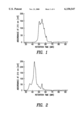
- FIG. 1 shows a molecular weight distribution of partial hydrolyzates of lactic casein obtained by Example 3.
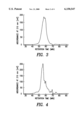
- FIG. 2 shows a molecular weight distribution of partial hydrolyzates of lactic casein obtained by Example 4.
- FIG. 3 shows a molecular weight distribution of partial hydrolyzates of lactic casein obtained by Example 5.
- FIG. 4 shows a molecular weight distribution of partial hydrolyzates of lactic casein obtained by Example 6.
- FIG. 5 shows a molecular weight distribution of partial hydrolyzates of lactic casein obtained by Example 7.
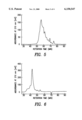
- FIG. 6 shows a molecular weight distribution of hydrolyzates of lactic casein obtained by Reference example 1.
- FIG. 7 shows a molecular weight distribution of hydrolyzates of lactic casein obtained by Reference example 2.
- the average molecular weight was estimated from respective theoretical molecular weight and composition ratio of ⁇ -casein, ⁇ -casein and ⁇ -casein determined by urea-sodium dodecylsulfate (SDS)-electrophoresis.
- SDS urea-sodium dodecylsulfate
- Solution B (0.2 L) and solution C (0.8 L) were mixed to give solution (B+C) (1 L), then the mixed solution (B+C) (1 L) was added to solution A (1 L) to give a hydrogencarbonic acid-iron-casein complex.
- the solution containing the complex was desalted by treatment with an ultrafiltration membrane of 5,000 molecular weight cut, concentrated to make casein concentration up to 5% in the complex, and adjusted to pH 8.0 by adding sodium hydrogencarbonate.
- 1,200 U of protease, trypsin (PTN6.0S: Novo Nordisk)/g casein was added, sodium hydroxide was added to maintain the solution at pH 8.0 and partial hydrolysis of casein was carried out at 50° C.
- the partial hydrolysis was performed till the reaction solution became clear with gross observation.
- the temperature of the reaction mixture was kept at 85° C. for 20 minutes to inactivate the enzyme and to terminate the reaction.
- the partial hydrolysis of casein required about 7 hrs.
- the reaction solution was dialyzed and lyophilized to give 3.0 g of hydrogencarbonic acid-iron-partial hydrolyzates of casein complex.
- the solubility of the hydrogencarbonic acid-iron-partial hydrolyzates of casein complex was examined by dissolving the complex in a simulated liquid food buffer containing 0.05 moll imidazole and 0.15 moll sodium chloride (hereinafter referred as a simulated buffer), up to give 15% solution.
- a simulated buffer containing 0.05 moll imidazole and 0.15 moll sodium chloride
- Solution B (0.2 L) and solution C (0.8 L) were mixed to give solution (B+C) (1 L), and then the mixed solution (B+C) (1 L) was added to solution A (1 L) to give a hydrogencarbonic acid-iron-casein complex.
- the solution containing the complex was desalted by treatment with an ultrafiltration membrane of 5,000 molecular weight cut, concentrated to make casein concentration up to 5% in the complex, and adjusted to pH 8.0 by adding sodium hydrogencarbonate
- 600 U of protease, papain (W-40: Amano Pharmaceutical Co., Ltd.)/g casein was added, sodium hydroxide was added to maintain the solution at pH 8.0 and partial hydrolysis of casein was carried out at 65° C.
- the partial hydrolysis was performed till the reaction solution became clear with gross observation.
- the reaction mixture was kept at 85° C. for 20 minutes to inactivate the enzyme and to terminate the reaction.
- the partial hydrolysis required about 6 hrs.
- the reaction solution was dialyzed and lyophilized to give 2.4 g of hydrogencarbonic acid-iron-partial hydrolyzates of casein complex.
- a sensory evaluation test was carried out for simulated buffer solutions prepared by dissolution of hydrogencarbonic acid-iron-partial hydrolyzates of casein complexes of Examples 1 and 2. That is, 10 male and 10 female panelists were given the simulated buffer solutions containing hydrogencarbonic acid-iron-partial hydrolyzates of casein complex of Example 1 or 2 and asked whether they felt astringent taste or not. A blind-fold was given to each panelist to avoid the influence of appearance to the judgment. Test for one sample was carried out in an order of the control first and then the sample, and at least one day interval was placed prior to the test of the next sample. Furthermore, the test samples were given randomly to each panelist to avoid the deviation between test days for evaluation of sample. Similar sensory evaluation test was performed using solution of ferrous sulfate having iron concentration of 3.6 mmol, which was expected to exhibit astringent taste. The number of panelists who sensed astringent taste is shown in Table 1.
- the hydrogencarbonic acid-iron-partial hydrolyzates of casein complex of Example 1 or 2 has no characteristic astringent taste peculiar to iron.
- the partial hydrolyzates of lactic casein used for the preparation of solution C was prepared as shown below. That is, lactic casein (Dairy Board, New Zealand) was dissolved to give 5% reaction solution and sodium hydrogencarbonate was added to adjust the solution at pH 8.0. A protease, trypsin (PTN6.0S: Novo Nordisk), was added at a ratio of 1,000 U/g of casein and partially hydrolyzed at 50° C. for five hours while maintaining the solution at pH 8.0 by adding sodium hydroxide. The reaction solution was kept at 85° C. for 20 minutes to inactivate the enzymic activity and to terminate the partial hydrolysis. The reaction solution was lyophilized to give 3.1 g of partial hydrolyzates of lactic casein.
- the molecular weight of the partial hydrolyzates of lactic casein was determined with a gel filtration chromatography. That is, a solution of the partial hydrolyzates of lactic casein was made to flow through a high performance liquid chromatography (HPLC) packed with TSKgel 3000PWxl (300 ⁇ 7.8 mm: Tosoh Corp.) and eluted with a 55% acetonitrile containing 0.1% trifluoroacetic acid at a rate of 0.3 ml/minute. The absorbance of elute at 210 nm was determined. Similar procedure was carried out using standard protein and peptide with known molecular weights and the elution time was determined, respectively. The molecular weight and elution time of the standard protein and peptide are shown in Table 2.
- solution B (0.2 L) and solution C (0.8 L) were mixed to give solution (B+C) (1 L) and the resultant solution (B+C) (1 L) was added to solution A (1 L) to give hydrogencarbonic acid-iron-partial hydrolyzates of casein complex.
- a solution containing the complex e was dialyzed and lyophilized to give 2.7 g of hydrogencarbonic acid-iron-partial hydrolyzates of casein complex.
- the diffusate of a solution containing hydrogencarbonic acid-iron-partial hydrolyzates of casein complex was concentrated with an evaporator, however no iron content was detected by determination with an emission spectrophotometer (ICP). Therefore, all iron is considered to be used as a component of hydrogencarbonic acid-iron-partial hydrolyzates of casein complex.
- ICP emission spectrophotometer
- the solubility of the above hydrogencarbonic acid-iron-partial hydrolyzates of casein complex was determined in a similar manner with that of example 1 and found that the complex completely dissolves without forming coagulation or becoming turbid.
- the shelf life of a simulated buffer solution containing the above hydrogencarbonic acid-iron-partial hydrolyzates of casein complex was determined in a similar manner with that of Example 1 and it was found that the buffered solution shows no precipitation even after storage for six months.
- the molecular weight distribution of the hydrolyzates of lactic casein was determined in a similar manner with that of Example 3 and the result is shown in FIG. 2.
- the Figure shows that hydrolyzates of lactic casein having molecular weight of 800-15,000 consists 45% of the total product and the rests have molecular weight of over 15,000.
- a hydrogencarbonic acid-iron-partial hydrolyzates of casein complex was prepared in a similar manner with that of Example 3 using the above mentioned hydrolyzates of lactic casein complex.
- the concentration of iron in diffusate of a solution containing the hydrogencarbonic acid-iron-partial hydrolyzates of casein complex was determined in a similar manner with that of Example 3 and no iron was detected. Therefore, all iron is considered to be used as a component of hydrogencarbonic acid-iron-partial hydrolyzates of casein complex.
- the molecular weight distribution of the hydrolyzates of lactic casein was determined in a similar manner with that of Example 3 and the result is shown in FIG. 3.
- the Figure shows that hydrolyzates of lactic casein having molecular weight of 800-15,000 consists 80% of the total product.
- a hydrogencarbonic acid-iron-partial hydrolyzates of casein complex was prepared in a similar manner with that of Example 3 using the above hydrolyzate of lactic casein complex.
- the concentration of iron in diffusate of a solution containing the hydrogencarbonic acid-iron-partial hydrolyzates of casein complex was determined in a similar manner with that of Example 3 and no iron was detected. Therefore, all iron is considered to be used as a component of hydrogencarbonic acid-iron-partial hydrolyzates of casein complex.
- the molecular weight distribution of the hydrolyzates of lactic casein was determined in a similar manner with that of Example 3 and the result is shown in FIG. 4.
- the Figure shows that hydrolyzates of lactic casein having molecular weight of 800-15,000 consists 80% of the total product and those having molecular weight of over 15,000 consists 2% of the total product, and further those less than 800 consists 18% of the total product.
- a hydrogencarbonic acid-iron-partial hydrolyzates of casein complex was prepared in a similar manner with that of Example 3 using the above mentioned hydrolyzates of lactic casein complex.
- the concentration of iron in diffusate of a solution containing hydrogencarbonic acid-iron-partial hydrolyzates of casein complex was determined in a similar manner with that of Example 3 and no iron was detected. Therefore, all iron is considered to be used as a component of hydrogencarbonic acid-iron-partial hydrolyzates of casein complex.
- the molecular weight distribution of the hydrolyzates of lactic casein was determined in a similar manner with that of Example 3 and the result is shown in FIG. 5.
- the Figure shows that hydrolyzates of lactic casein having molecular weight of 800-15,000 consists 66% of the total product and the rests have molecular weight of less than 800.
- a hydrogencarbonic acid-iron-partial hydrolyzates of casein complex was prepared in a similar manner with that of Example 3 using the above mentioned hydrolyzates of lactic casein.
- the concentration of iron in diffusate of a solution containing hydrogencarbonic acid-iron-partial hydrolyzates of casein complex was determined in a similar manner with that of Example 3 and no iron was detected. Therefore, all iron is considered to be used as a component of hydrogencarbonic acid-iron-partial hydrolyzates of casein complex.
- a sensory evaluation test was carried out for simulated buffer solutions of the hydrogencarbonic acid-iron-partial hydrolyzates of casein complexes of Examples 3-7.
- the sensory evaluation test was carried out in a similar manner with that of Test example 1.
- the number of panelists who sensed astringent taste is shown in Table 3.
- the hydrogencarbonic acid-iron-partial hydrolyzates of casein complexes of Example 3-7 has no characteristic astringent taste of iron.
- a hydrogencarbonic acid-iron-partial hydrolyzates of casein complex of Example 1 (present invention group 1)
- a hydrogencarbonic acid-iron-partial hydrolyzates of casein complex of Example 3 present invention group 2
- ferrous sulfate (control group 1)
- the resultant solutions were heat sterilized at 90° C. for 10 minutes to give test samples.
- a saline phosphate buffer (pH 7.2) containing 6.2 mg/100 g of ascorbic acid and sodium ascorbate as vitamin C was heat sterilized at 90° C. for 10 minutes to give a test sample (control group 2).
- mice of 21 days old just after weaning were selected and fed for two weeks with an iron deficient feed (iron content of 0.25 mg/100 g of feed, Oriental Yeast Co., Ltd.) to prepare anemia rats with blood hemoglobin concentration of 7 g/100 ml blood or less.
- the rats were divided in groups each having 8-11 animals and fed for further six weeks with the iron deficient feed together with 1 ml/day of each of the test sample given by gavage.
- blood was drawn from tail vein of rats and hemoglobin content was determined with an automatic blood cell counter (Toa Medical Electronics Co., Ltd.). The results are shown in Table 4.
- the molecular weight distribution of the hydrolyzates of lactic casein was determined in a similar manner with that of Example 3 and the result is shown in FIG. 6.
- the Figure shows that hydrolyzates of lactic casein having molecular weight of 800-15,000 consists 30% of the total product and the rests have molecular weight of over 15,000.
- a hydrogencarbonic acid-iron-hydrolyzates of casein complex was prepared in a similar manner with that of Example 3 using the above mentioned hydrolyzates of lactic casein.
- the concentration of iron in diffusate of a solution containing hydrogencarbonic acid-iron-hydrolyzates of casein complex was determined in a similar manner with that of Example 3 and no iron was detected. Therefore, all iron is considered to be used as a component of hydrogencarbonic acid-iron-hydrolyzates of casein complex.
- a simulated buffer solution prepared by dissolution of the above mentioned hydrogencarbonic acid-iron-partial hydrolyzates of casein complex was diluted to give iron concentration of 3.6 mmol, and was heat sterilized at 90° C. for 10 minutes, and kept at 5° C. observing the formation of precipitates. Formation of precipitates was found after four hours.
- the molecular weight distribution of the hydrolyzates of lactic casein was determined in a similar manner with that of Example 3 and the result is shown in FIG. 7.
- the Figure shows that hydrolyzates of lactic casein having molecular weight of 800-15,000 consists 39% of the total product and the rests have molecular weight of less than 800.
- a hydrogencarbonic acid-iron-hydrolyzates of casein complex was prepared in a similar manner with that of Example 3 using the above hydrolyzates of lactic casein.
- Above mentioned hydrogen-carbonic acid-iron-hydrolyzates of casein complex was diluted with the simulated buffer solution to give iron concentration of 3.6 mmol and was heat sterilized at 90° C. for 10 minutes, then kept at 5° C. observing the formation of precipitates. Formation of precipitates was found after two hours.
- the carbonic acid- and/or hydrogencarbonic acid-iron-partial hydrolyzates of casein complexes of the present invention have thermoresistance or thermostability, without showing iron characteristic astringent taste after heat sterilization and can exist in aqueous solution, and are useful as raw materials for foods and drinks, medicines and feeds for prevention and treatment of anemia and reinforcement of iron content. Furthermore, as their aqueous solutions do not aggregate or precipitate, and can be handled easily in the production procedure, the loss of the solid mass is very little.
Landscapes
- Chemical & Material Sciences (AREA)
- Life Sciences & Earth Sciences (AREA)
- Polymers & Plastics (AREA)
- Health & Medical Sciences (AREA)
- Engineering & Computer Science (AREA)
- Zoology (AREA)
- Food Science & Technology (AREA)
- Biochemistry (AREA)
- Organic Chemistry (AREA)
- Nutrition Science (AREA)
- General Chemical & Material Sciences (AREA)
- Chemical Kinetics & Catalysis (AREA)
- Proteomics, Peptides & Aminoacids (AREA)
- General Health & Medical Sciences (AREA)
- Molecular Biology (AREA)
- Wood Science & Technology (AREA)
- Animal Husbandry (AREA)
- Genetics & Genomics (AREA)
- Inorganic Chemistry (AREA)
- Medicinal Chemistry (AREA)
- Bioinformatics & Cheminformatics (AREA)
- Gastroenterology & Hepatology (AREA)
- Toxicology (AREA)
- Biotechnology (AREA)
- Microbiology (AREA)
- Biophysics (AREA)
- Mycology (AREA)
- General Engineering & Computer Science (AREA)
- Preparation Of Compounds By Using Micro-Organisms (AREA)
- Coloring Foods And Improving Nutritive Qualities (AREA)
- Medicines That Contain Protein Lipid Enzymes And Other Medicines (AREA)
- Fodder In General (AREA)
- Peptides Or Proteins (AREA)
Abstract
This invention provides carbonic acid- and/or hydrogencarbonic acid-iron-hydrolyzates of casein complexes containing a large amount of iron, without causing precipitation after heating their aqueous solution or astringent taste and the processes for production thereof. The complexes of the present invention are prepared by (1) partial hydrolysis of carbonic acid- and/or hydrogencarbonic acid-iron-casein complexes with a protease or (2) mixing carbonic acid and/or hydrogencarbonic acid, iron and partial hydrolyzates of casein with a protease. These complexes are used favorably as food additives, raw materials of medicines or feed components due to their lack of precipitation by heating their aqueous solution, or astringent taste.
Description
This invention relates to carbonic acid- and/or hydrogencarbonic acid-iron-hydrolyzates of casein complexes. Furthermore, this invention relates to processes for the preparation of carbonic acid- and/or hydrogencarbonic acid-iron-hydrolyzates of casein complexes.
The carbonic acid- and/or hydrogencarbonic acid-iron-hydrolyzates of casein complexes of the present invention have characteristic features of thermoresistance or thermostability without exhibiting iron characteristic astringent taste after heat sterilization and can exist in aqueous solution. Thus, the compounds of the present invention are useful as raw materials of foods and drinks, medicines and feeds for prevention and treatment of anemia, and reinforcement of iron content in the body. Furthermore, the carbonic acid- and/or hydrogencarbonic acid-iron-hydrolyzates of casein complexes of the present invention have advantages that they exhibit favorable taste and can be handled easily in the production procedure without loss of the solid content because they do not aggregate in aqueous solution.
The iron uptake of Japanese has been maintained at about 100% sufficiency without change since 1975, and iron as a nutrient in meals must be taken up with care. In the world, iron is considered as a nutrient which is often liable to be deficient, particularly the supply of iron in enriched foods and medicines for persons with anemic tendency, and pregnant and nursing females. However, addition of an iron salt such as iron sulfate or citrate as an iron reinforcing agent in foods and drinks has drawbacks since it cause problems of characteristic astringent taste when added in foods and drinks and injury to gastrointestinal mucosa, thus the amount of addition is limited. Furthermore, an organic iron compound, heme iron, causes problems in taste such as metallic or fishy taste and its addition to foods is highly limited.
Addition of milk casein, amino acid or casein phosphopeptide has been tried for the improved absorption of iron [Japanese Laid-open Patent Application No. 162843 (1984)]. However, these methods could not diminish characteristic astringent taste of iron without reducing the amount of its addition.
The inventors of the present invention developed a method to reduce the characteristic astringent taste of iron by binding iron with casein [Japanese Laid-open Patent Application No. 83400 (1990)]. However, the iron casein prepared by binding iron with casein is devoid of thermostability and shows characteristic astringent taste of iron by thermal pasteurization at 90° C. for 10 minutes, 120° C. for 2-3 seconds or retort pasteurization. This was considered to be caused by release of iron from casein due to weak binding of iron and casein, and formation of iron hydroxides or the like.
Then, the inventors of the present invention further investigated and found that the binding of iron and casein can be reinforced by using carbonic acid and/or hydrogencarbonic acid and succeeded to get carbonic acid- and/or hydrogencarbonic acid-iron-casein complexes [Japanese Laid-open Patent Application No. 259572 (1995)]. The carbonic acid- and/or hydrogencarbonic acid-iron-casein complexes are thermoresistant without showing iron characteristic astringent taste even by heat sterilization and are useful as raw materials of foods and drinks, medicines, feeds and so forth for prevention and treatment of anemia and reinforcement of iron content. However, the carbonic acid- and/or hydrogencarbonic acid-iron-casein complexes had drawbacks of tendency to aggregate by dissolution in water, difficult to treat in the production procedure and liable to lose solid mass. Furthermore, their sandy taste remains to be solved.
The inventors of the present invention actively investigated methods to solve the above mentioned drawbacks of carbonic acid- and/or hydrogencarbonic acid-iron-casein complexes, and found that carbonic acid- and/or hydrogencarbonic acid-iron-partial hydrolyzates of casein complexes prepared by hydrolysis of carbonic acid- and/or hydrogencarbonic acid-iron-casein complexes with a protease, or by hydrolysis of casein with a protease to give partial hydrolyzates of casein followed by preparation of carbonic acid- and/or hydrogencarbonic acid-iron-partial hydrolyzates of casein complexes provides thermoresistant, stable to heat sterilization products without iron characteristic astringent taste or aggregation by dissolution in water and accomplished the present invention. Therefore, one object of the present invention is to provide carbonic acid- and/or hydrogencarbonic acid-iron-partial hydrolyzates of casein complexes having characteristic features of thermoresistant, stability to heat sterilization without iron characteristic astringent taste or aggregation by dissolution in water. In addition, the present invention provides processes for the preparation of carbonic acid- and/or hydrogencarbonic acid-iron-partial hydrolyzates of casein complexes.
The present invention is proposed to solve aforementioned problems and relates to carbonic acid- and/or hydrogencarbonic acid-iron-partial hydrolyzates of casein complexes containing 1-1,000 atoms of iron and one or more molecule of carbonic acid and/or hydrogencarbonic acid per one molecule of casein prior to the hydrolysis. The solubility of the dried powder of complexes in water is at least 15% without aggregation or precipitation even after heating at 90° C. for 10 minutes, and the solution is free of iron characteristic astringent taste.
The above mentioned complexes of the present invention are thermoresistant without shoving iron characteristic astringent taste by heat sterilization, aggregation in aqueous solution or precipitation by heating at 90° C. for 10 minutes.
The carbonic acid- and/or hydrogencarbonic acid-iron-partial hydrolyzates of casein complexes can be prepared by the following two procedures.
That is, the first procedure is formation of carbonic acid- and/or hydrogencarbonic acid-iron-casein complexes, followed by partial hydrolysis of casein with a protease.
The carbonic acid- and/or hydrogencarbonic acid-iron-casein complexes used in the procedure can be prepared by 1) simultaneous mixing of solution containing a carbonic acid, a hydrogencarbonic acid, or a carbonic acid and a hydrogencarbonic acid (solution A), a solution containing iron (solution B) and a solution containing casein (solution C), 2) mixing a carbonic acid, hydrogencarbonic acid, or a carbonic acid and/or a hydrogencarbonic acid solution (solution A), and a solution containing iron and casein (solution B), or 3) mixing a solution containing a carbonic acid, a hydrogencarbonic acid, or a carbonic acid and a hydrogencarbonic acid, and casein (solution A) and an iron containing solution (solution B).
In the process 1), the molar concentration of iron ion in solution B is made 1/3 or less to those of a carbonic acid and a hydrogencarbonic acid ions dissolved in a mixed solution of A, B and C. The molar concentration of casein in solution C is adjusted to 11/1,000 to that of iron ion in solution B. In the process 2), the molar concentration of iron ion in solution B is made 1/3 or less to those of a carbonic acid and a hydrogencarbonic acid ions in a mixture of solutions A and B, and the molar number of casein in solution B is adjusted to 11/1,000 to that of iron ion in solution B.
In addition, in the process 3), the molar concentration of iron ion in solution B is made 1/3 or less to those of a carbonic acid and a hydrogencarbonic acid ions in a mixed solutions A and B, and the molar number of casein in solution A is adjusted to 11/1,000 to that of iron ion in solution A.
The second procedure is a process of partial hydrolysis of casein with a protease in advance to give partial hydrolyzates of casein, and to give carbonic acid- and/or hydrogencarbonic acid-iron-partial hydrolyzates of casein complexes from the partial hydrolyzates of casein. In other words, carbonic acid- and/or hydrogencarbonic acid-iron-partial hydrolyzates of casein complexes are obtained by mixing i) a carbonic acid, a hydrogencarbonic acid, or a carbonic acid and a hydrogencarbonic acid, ii) iron, and iii) casein partial hydrolyzates prepared by partial hydrolysis of casein with a protease to react to form carbonic acid- and/or hydrogencarbonic acid-iron-partial hydrolyzates of casein complexes.
In the above mentioned second procedure, mixing of the aforementioned three components can be carried out by the following methods, that is:
1) Simultaneous mixing of solution containing a carbonic acid, a hydrogencarbonic acid, or a carbonic acid and a hydrogencarbonic acid (solution A), a solution containing iron (solution B), and a solution of partial hydrolyzates of casein solution (solution C).
2) Mixing of solution containing a carbonic acid, a hydrogencarbonic acid, or a carbonic acid and a hydrogencarbonic acid (solution A) and a solution containing iron and a partial hydrolyzate of casein prepared by partial hydrolysis of casein with a protease (solution B).
3) Mixing of a solution containing a partial hydrolyzate of casein prepared by partial hydrolysis of casein with a protease and a carbonic acid, a hydrogencarbonic acid, or a carbonic acid and a hydrogencarbonic acid (solution A) and a solution containing iron (solution B).
In the procedure 1), the molar concentration of iron ion in solution B is made 1/3 or less to those of a carbonic acid and a hydrogencarbonic acid ions dissolved in a mixed solution of A, B and C, and molar number of partial hydrolyzates of casein in solution C is adjusted to 11/1,000 molar number of iron ion in solution B calculated as casein before partial hydrolysis.
In the procedure 2), the molar concentration of iron ion in solution B is made 1/3 or less to those of a carbonic acid and a hydrogencarbonic acid ions dissolved in a mixed solution of A and B, and the molar number of hydrolyzates of casein in solution B is adjusted to 11/1,000 to that of iron ion in solution B calculated as casein before hydrolysis.
Further, in the procedure 3), the molar concentration of iron ion in solution B is made 1/3 or less to those of a carbonic acid and a hydrogencarbonic acid ions dissolved in a mixed solution of A and B, and the molar number of casein partial hydrolyzed product in solution A is adjusted to 11/1,000 to that of iron ion in solution B calculated as casein before partial hydrolysis.
Thus, the carbonic acid- and/or hydrogencarbonic acid-iron-partial hydrolyzates of casein complexes can be prepared to give following properties of 1) to 4).
1) The complexes contain 1-1,000 atoms of iron and one or more molecule of a carbonic acid and/or a hydrogencarbonic acid per one molecule of casein prior to the hydrolysis,
2) the dried powder of complexes dissolves in water to give at least 15% solution,
3) the aqueous solution gives no precipitate by heating at 90° C. for 10 minutes, and
4) the solution gives no iron characteristic astringent taste.
The carbonic acid- and/or hydrogencarbonic acid-iron-partial hydrolyzates of casein complexes of the present invention do not form precipitates in the aqueous solution after heating at 90° C. for 10 minutes, and this thermoresistance is derived from the use of partially and enzymically hydrolyzates of casein as a raw material. The enzymic hydrolysis is preferably carried out with a protease to give partial hydrolyzates, no more than 55% of which is a hydrolyzate with molecular weight of 15,000 or more and no more than 34% of which is that with molecular weight of less than 800.
The present invention is practically explained at first by processes for preparation of the complexes.
The first processes composed of preparation of carbonic acid- and/or a hydrogencarbonic acid-iron-casein complex, followed by partial hydrolysis of the carbonic acid- and/or hydrogencarbonic acid-iron-casein complex with a protease to give carbonic acid and/or hydrogencarbonic acid-iron-partial hydrolyzates of casein complex are explained.
The processes have following three variations of (1) to (3).
(1) Simultaneous mixing of solution containing a carbonic acid, a hydrogencarbonic acid, or a carbonic acid and a hydrogencarbonic acid (solution A), a solution containing iron (solution B), and a solution containing casein (solution C) to give a carbonic acid- and/or hydrogencarbonic acid-iron-casein complex. However, the molar concentration of iron ion in solution B is made 1/3 or less to those of a carbonic acid and a hydrogencarbonic acid ions dissolved in a mixed solution of A, B and C. The molar number of casein in solution C is adjusted to 11/1,000 to that of iron ion in solution B. The carbonic acid- and/or hydrogencarbonic acid-iron-casein complex is partially hydrolyzed with a protease to give the carbonic acid- and/or hydrogencarbonic acid-iron-partial hydrolyzates of casein complex of the present invention.
(2) Mixing of solution containing a carbonic acid, a hydrogencarbonic acid, or a carbonic acid and a hydrogencarbonic acid (solution A), and a solution containing iron and casein (solution B) to give the complex of carbonic acid- and/or hydrogencarbonic acid-iron-casein complex. However, the molar concentration of iron ion in solution B is made 1/3 or less of those of a carbonic acid and a hydrogencarbonic acid ions dissolved in a mixed solution of A and B, and the molar number of casein in solution B is adjusted to 11/1,000 to that of iron ion in solution B. The carbonic acid- and/or hydrogencarbonic acid-iron-casein complex is partially hydrolyzed with a protease to give the carbonic acid- and/or hydrogencarbonic acid-iron-partial hydrolyzates of casein complex of the present invention.
(3) Mixing of a carbonic acid, a hydrogencarbonic acid, or a carbonic acid and a hydrogencarbonic acid, and casein solution (solution A), and a solution containing iron (solution B) to give the complex of carbonic acid- and/or hydrogencarbonic acid-iron-casein complex. However, the molar concentration of iron ion in solution B is made 1/3 or less of those of a carbonic acid and a hydrogencarbonic acid ions dissolved in a mixed solution of A and B, and the molar number of casein in solution A is adjusted to 1-1/1,000 to that of iron ion in solution B. The carbonic acid- and/or hydrogencarbonic acid-iron-casein complex is partially hydrolyzed with a protease to give the carbonic acid- and/or hydrogencarbonic acid-iron-partial hydrolyzates of casein complex of the present invention.
In the second method, that is the procedures for the production of carbonic acid- and/or hydrogencarbonic acid-iron-partial hydrolyzates of casein complex from partial hydrolyzates of casein prepared by partial hydrolysis of casein with a protease in advance include the following (1) to (3) variations:
(1) Simultaneous mixing of solution containing a carbonic acid, a hydrogencarbonic acid, or a carbonic acid and a hydrogencarbonic acid (solution A), a solution containing iron (solution B), and a solution of partial hydrolyzates of casein solution (solution C) using hydrolyzates of casein prepared by partial hydrolysis of casein with a protease in advance to give carbonic acid-and/or hydrogencarbonic acid-iron-partial hydrolyzates of casein complex of the present invention. However, the molar concentration of iron ion in solution B is made 1/3 or less of those of a carbonic acid and a hydrogencarbonic acid ions dissolved in a mixed solution of A, B and C, and molar number of partial hydrolyzates of casein in solution C is adjusted to 11/1,000 molar number of iron ion in solution B calculated as casein before partial hydrolysis.
(2) Mixing of solution containing a carbonic acid, a hydrogencarbonic acid, or a carbonic acid and a hydrogencarbonic acid (solution A) and a solution containing iron and a partial hydrolyzate of casein (solution B) using hydrolyzates of casein prepared by partial hydrolysis of casein with a protease in advance to give a carbonic acid- and/or hydrogencarbonic acid-iron-partial hydrolyzates of casein complex. However, the molar concentration of iron ion in solution B is made 1/3 or less of those of a carbonic acid and a hydrogencarbonic acid ions dissolved in a mixed solution of A and B. The molar number of partial hydrolyzates of casein in solution B is adjusted to 11/1,000 molar number of iron ion in solution B calculated as casein before hydrolysis.
(3) Mixing of a carbonic acid, a hydrogencarbonic acid, or a carbonic acid and a hydrogencarbonic acid, and partial hydrolyzates of casein solution prepared by partial hydrolysis of casein with a protease in advance (solution A) and a solution containing iron (solution B) to give a carbonic acid- and/or hydrogencarbonic acid-iron-partial hydrolyzates of casein complex. However, the molar concentration of iron ion in solution B is made 1/3 or less of those of a carbonic acid and a hydrogencarbonic acid ions dissolved in a mixed solution of A and B. The molar number of partial hydrolyzates of casein in solution A is adjusted to 11/1,000 molar number of iron ion in solution B calculated as casein before hydrolysis.
In the present invention, a carbonic acid and/or a hydrogencarbonic acid used for the preparation of a carbonic acid- and/or a hydrogencarbonic acid-iron-casein complex, or a carbonic acid- and/or a hydrogencarbonic acid-iron-partial hydrolyzates of casein complex may be used in forms of acids or water soluble salts. Iron is generally used in the form of a water soluble salt.
The carbonic acid and/or hydrogencarbonic acid, iron, and casein or partial hydrolyzates of casein may be used in the form of solution or solid such as salts for the preparation of a carbonic acid- and/or a hydrogencarbonic acid-iron-casein complex, or a carbonic acid- and/or a hydrogencarbonic acid-iron-partial hydrolyzates of casein complex. Solid state carbonates and/or hydrogencarbonates, iron, and casein or partial hydrolyzates of casein may be simultaneously dissolved and used. However, procedure that would lead to the formation of a solution solely containing carbonates and/or hydrogencarbonates, and iron must be avoided.
The casein used in the present invention may be illustrated, for example, as casein, acidic casein, casein sodium, lactic casein, α-casein, β-casein and κ-casein isolated from milk of mammals such as human being and cattle. These casein are commercially available or as methods to massively isolate them are known, products produced by these methods may also be used. In addition, those produced by microorganisms, animal cells and transgenic animals using gene technology may also be used. When crude casein such as mixtures of α-casein, β-casein and κ-casein is used as a raw material, the molar concentration of casein in the solution is estimated from average molecular weight based on the ratios of the components
The carbonic acid and/or hydrogencarbonic acid used in the present invention may be illustrated as carbonated water, ammonium hydrogencarbonate, sodium hydrogencarbonate, potassium hydrogen-carbonate, sodium carbonate, calcium carbonate and so forth. As iron compounds, water soluble iron salts such as ferric chloride and ferric sulfate may be used. As pH adjusting agents, sodium hydroxide, ammonia, potassium hydroxide, hydrochloric acid, citric acid and lactic acid may simultaneously be used. The pH of the reaction mixture is generally adjusted to 2-9.
In the present invention, proteases used for partial hydrolysis of carbonic acid- and/or hydrogencarbonic acid-iron-casein complex or those used for partial hydrolysis of casein may be illustrated for example as animal derived pepsin, trypsin, chymotrypsin chymosin and pancreatin, and plant derived papain. In addition, proteases derived from microorganisms or those prepared by gene recombinant technology may also be used.
In addition, the solubility of carbonic acid- and/or hydrogencarbonic acid-iron-partial hydrolyzates of casein complex largely vary with the molecular weight distribution of partial hydrolyzates of casein in the complex. Thus,the reaction conditions for partial hydrolysis with protease must be investigated prior to the hydrolysis. In this connection, the molecular weight distribution of hydrolyzates of casein in the carbonic acid- and/or hydrogencarbonic acid-iron-partial hydrolyzates of casein complex is preferably no more than 55% for the hydrolyzates of casein having molecular weight of 15,000 or more, and no more than 34% for that having molecular weight of less than 800. Further, preferably, more than 20% of partial hydrolyzates of casein has molecular weight of 800-15,000 and most preferably more than 50%. Therefore, the partial hydrolysis of casein in the present invention means hydrolysis of casein to give partial hydrolyzates of casein, no more than 55% of which is a hydrolyzate with molecular weight of 15,000 or more and no more than 34% of which is that with molecular weight of less than 800.
FIG. 1 shows a molecular weight distribution of partial hydrolyzates of lactic casein obtained by Example 3.
FIG. 2 shows a molecular weight distribution of partial hydrolyzates of lactic casein obtained by Example 4.
FIG. 3 shows a molecular weight distribution of partial hydrolyzates of lactic casein obtained by Example 5.
FIG. 4 shows a molecular weight distribution of partial hydrolyzates of lactic casein obtained by Example 6.
FIG. 5 shows a molecular weight distribution of partial hydrolyzates of lactic casein obtained by Example 7.
FIG. 6 shows a molecular weight distribution of hydrolyzates of lactic casein obtained by Reference example 1.
FIG. 7 shows a molecular weight distribution of hydrolyzates of lactic casein obtained by Reference example 2.
The present invention will be practically explained by the following examples. These examples are shown merely as illustration and not to be constructed to limit the scope of the present invention.
(Solution A) One liter of an aqueous solution of 1,200 mmol sodium hydrogencarbonate.
(Solution B) 0.2 L of an aqueous solution of ferric chloride containing 10mmol of iron.
(Solution C) 0.8 L of an aqueous solution of 0.1 mmol lactic casein (Dairy Board, New Zealand).
However, adjustment of molar concentration was carried out with average molecular weight. The average molecular weight was estimated from respective theoretical molecular weight and composition ratio of α-casein, β-casein and κ-casein determined by urea-sodium dodecylsulfate (SDS)-electrophoresis.
Solution B (0.2 L) and solution C (0.8 L) were mixed to give solution (B+C) (1 L), then the mixed solution (B+C) (1 L) was added to solution A (1 L) to give a hydrogencarbonic acid-iron-casein complex. The solution containing the complex was desalted by treatment with an ultrafiltration membrane of 5,000 molecular weight cut, concentrated to make casein concentration up to 5% in the complex, and adjusted to pH 8.0 by adding sodium hydrogencarbonate. In the reaction solution, 1,200 U of protease, trypsin (PTN6.0S: Novo Nordisk)/g casein was added, sodium hydroxide was added to maintain the solution at pH 8.0 and partial hydrolysis of casein was carried out at 50° C. The partial hydrolysis was performed till the reaction solution became clear with gross observation. The temperature of the reaction mixture was kept at 85° C. for 20 minutes to inactivate the enzyme and to terminate the reaction. The partial hydrolysis of casein required about 7 hrs. The reaction solution was dialyzed and lyophilized to give 3.0 g of hydrogencarbonic acid-iron-partial hydrolyzates of casein complex.
The solubility of the hydrogencarbonic acid-iron-partial hydrolyzates of casein complex was examined by dissolving the complex in a simulated liquid food buffer containing 0.05 moll imidazole and 0.15 moll sodium chloride (hereinafter referred as a simulated buffer), up to give 15% solution. Thus, the hydrogencarbonic acid-iron-partial hydrolyzates of casein complex completely dissolved without becoming turbid or forming aggregation.
The shelf life of the above mentioned hydrogencarbonic acid-iron-partial hydrolyzates of casein complex was examined in a simulated buffer prepared by dissolving the complex. The simulated buffer solution containing the complex was diluted to give iron concentration of 3.6 mmol, heat sterilized at 90° C. for 10 minutes and kept at 5° C. No precipitation was found even after six month storage.
(Solution A) One liter of an aqueous solution of 1,200 mmol sodium hydrogencarbonate.
(Solution B) 0.2 L of an aqueous solution of 9 mmol ferric sulfate containing 9 mmol of iron,
(Solution C) 0.8 L of an aqueous solution of 0.1 mmol lactic casein (Sigma Chemical Co.).
Their molar concentrations were adjusted in a similar manner with that of Example 1.
Solution B (0.2 L) and solution C (0.8 L) were mixed to give solution (B+C) (1 L), and then the mixed solution (B+C) (1 L) was added to solution A (1 L) to give a hydrogencarbonic acid-iron-casein complex. The solution containing the complex was desalted by treatment with an ultrafiltration membrane of 5,000 molecular weight cut, concentrated to make casein concentration up to 5% in the complex, and adjusted to pH 8.0 by adding sodium hydrogencarbonate In the reaction solution, 600 U of protease, papain (W-40: Amano Pharmaceutical Co., Ltd.)/g casein was added, sodium hydroxide was added to maintain the solution at pH 8.0 and partial hydrolysis of casein was carried out at 65° C. The partial hydrolysis was performed till the reaction solution became clear with gross observation. The reaction mixture was kept at 85° C. for 20 minutes to inactivate the enzyme and to terminate the reaction. The partial hydrolysis required about 6 hrs. The reaction solution was dialyzed and lyophilized to give 2.4 g of hydrogencarbonic acid-iron-partial hydrolyzates of casein complex.
The solubility of the hydrogencarbonic acid-iron-partial hydrolyzates of casein complex was examined by a similar manner with that of Example 1. Thus, the hydrogencarbonic acid-iron-partial hydrolyzates of casein complex completely dissolved without becoming turbid or forming aggregation.
The shelf life of the above mentioned hydrogencarbonic acid-iron-partial hydrolyzates of casein complex was examined in a similar manner with that of Example 1. No precipitation was found even after six months storage.
A sensory evaluation test was carried out for simulated buffer solutions prepared by dissolution of hydrogencarbonic acid-iron-partial hydrolyzates of casein complexes of Examples 1 and 2. That is, 10 male and 10 female panelists were given the simulated buffer solutions containing hydrogencarbonic acid-iron-partial hydrolyzates of casein complex of Example 1 or 2 and asked whether they felt astringent taste or not. A blind-fold was given to each panelist to avoid the influence of appearance to the judgment. Test for one sample was carried out in an order of the control first and then the sample, and at least one day interval was placed prior to the test of the next sample. Furthermore, the test samples were given randomly to each panelist to avoid the deviation between test days for evaluation of sample. Similar sensory evaluation test was performed using solution of ferrous sulfate having iron concentration of 3.6 mmol, which was expected to exhibit astringent taste. The number of panelists who sensed astringent taste is shown in Table 1.
              TABLE 1
______________________________________
Sample Number of panelist who sensed astringent taste
______________________________________
       Example 1
                 0/20
  Example 2 0/20
  Ferrous sulfate 20/20
______________________________________
As shown in Table 1, the hydrogencarbonic acid-iron-partial hydrolyzates of casein complex of Example 1 or 2 has no characteristic astringent taste peculiar to iron.
(Solution A) One liter of an aqueous solution of 1,200 mmol sodium hydrogencarbonate.
(Solution B) 0.2 L of an aqueous solution of ferric chloride containing 10 mmol of iron.
(Solution C) 0.8 L of an aqueous solution of 0.1 mmol lactic casein calculated as casein before the partial hydrolysis.
The molar concentration was adjusted in a similar manner with that of Example 1.
The partial hydrolyzates of lactic casein used for the preparation of solution C was prepared as shown below. That is, lactic casein (Dairy Board, New Zealand) was dissolved to give 5% reaction solution and sodium hydrogencarbonate was added to adjust the solution at pH 8.0. A protease, trypsin (PTN6.0S: Novo Nordisk), was added at a ratio of 1,000 U/g of casein and partially hydrolyzed at 50° C. for five hours while maintaining the solution at pH 8.0 by adding sodium hydroxide. The reaction solution was kept at 85° C. for 20 minutes to inactivate the enzymic activity and to terminate the partial hydrolysis. The reaction solution was lyophilized to give 3.1 g of partial hydrolyzates of lactic casein.
The molecular weight of the partial hydrolyzates of lactic casein was determined with a gel filtration chromatography. That is, a solution of the partial hydrolyzates of lactic casein was made to flow through a high performance liquid chromatography (HPLC) packed with TSKgel 3000PWxl (300×7.8 mm: Tosoh Corp.) and eluted with a 55% acetonitrile containing 0.1% trifluoroacetic acid at a rate of 0.3 ml/minute. The absorbance of elute at 210 nm was determined. Similar procedure was carried out using standard protein and peptide with known molecular weights and the elution time was determined, respectively. The molecular weight and elution time of the standard protein and peptide are shown in Table 2.
              TABLE 2
______________________________________
           Molecular weight
                     Elution time
______________________________________
αs-Casein
             23,000      39.8     (minutes)
  β-Casein 24,000 40.0
  Aprotinin 6,500 48.8
  Insulin B chain 3,496 51.8
  Insulin A chain 2,532 55.2
  Angiotensin II 1,046 58.7
  Glutathione 307 64.2
______________________________________
Molecular weight distribution of partial hydrolyzates of lactic casein was estimated from integrated value of absorbance and elution time in referring to the molecular weight and elution time of the standard protein and peptide. The results are shown in FIG. 1. The Figure shows that partial hydrolyzates of lactic casein having molecular weight of 800-15,000 consists 94% of the total product,
Above mentioned solution B (0.2 L) and solution C (0.8 L) were mixed to give solution (B+C) (1 L) and the resultant solution (B+C) (1 L) was added to solution A (1 L) to give hydrogencarbonic acid-iron-partial hydrolyzates of casein complex. A solution containing the complex e was dialyzed and lyophilized to give 2.7 g of hydrogencarbonic acid-iron-partial hydrolyzates of casein complex. The diffusate of a solution containing hydrogencarbonic acid-iron-partial hydrolyzates of casein complex was concentrated with an evaporator, however no iron content was detected by determination with an emission spectrophotometer (ICP). Therefore, all iron is considered to be used as a component of hydrogencarbonic acid-iron-partial hydrolyzates of casein complex.
The solubility of the above hydrogencarbonic acid-iron-partial hydrolyzates of casein complex was determined in a similar manner with that of example 1 and found that the complex completely dissolves without forming coagulation or becoming turbid. The shelf life of a simulated buffer solution containing the above hydrogencarbonic acid-iron-partial hydrolyzates of casein complex was determined in a similar manner with that of Example 1 and it was found that the buffered solution shows no precipitation even after storage for six months.
In a 5% aqueous solution of lactic casein (Dairy Board, New Zealand) at a concentration of 5%, sodium hydrogencarbonate was added to adjust the pH at 0.0. In the reaction solution, a protease, papain (w-40: Amano Pharmaceutical Co., Ltd.) was added at a ratio of 10 U/q of casein and the partial hydrolysis was carried out at 65° C. for three hours while maintaining pH at 8.0 by adding sodium hydroxide. Thereafter, the reaction solution was kept at 85° C. for 20 minutes to inactivate the enzyme activity and terminate the reaction. The treated reaction solution was lyophilized to give 3.4 g of hydrolyzates of lactic casein.
The molecular weight distribution of the hydrolyzates of lactic casein was determined in a similar manner with that of Example 3 and the result is shown in FIG. 2. The Figure shows that hydrolyzates of lactic casein having molecular weight of 800-15,000 consists 45% of the total product and the rests have molecular weight of over 15,000.
A hydrogencarbonic acid-iron-partial hydrolyzates of casein complex was prepared in a similar manner with that of Example 3 using the above mentioned hydrolyzates of lactic casein complex. The concentration of iron in diffusate of a solution containing the hydrogencarbonic acid-iron-partial hydrolyzates of casein complex was determined in a similar manner with that of Example 3 and no iron was detected. Therefore, all iron is considered to be used as a component of hydrogencarbonic acid-iron-partial hydrolyzates of casein complex.
The shelf life of a simulated buffer solution containing the above hydrogencarbonic acid-iron-partial hydrolyzates of casein complex was determined in a similar manner with that of Example 1 and it was found that the buffered solution shows no precipitation even after storage for six months.
In a 5% solution of lactic casein (Dairy Board, New Zealand), sodium hydrogencarbonate was added to make pH 8.0. In the reaction solution, a protease, bromelain F (Amano Pharmaceutical Co., Ltd.) was added at a ratio of 1,000 U/g of casein and caused to partial hydrolysis at 65° C. for five hours while maintaining pH at 8.0 by adding sodium hydroxide. Thereafter, the reaction solution was kept at 85° C. for 20 minutes to inactivate the enzyme activity and terminate the reaction. The treated reaction solution was lyophilized to give 3.0 g of hydrolyzates of lactic casein.
The molecular weight distribution of the hydrolyzates of lactic casein was determined in a similar manner with that of Example 3 and the result is shown in FIG. 3. The Figure shows that hydrolyzates of lactic casein having molecular weight of 800-15,000 consists 80% of the total product.
A hydrogencarbonic acid-iron-partial hydrolyzates of casein complex was prepared in a similar manner with that of Example 3 using the above hydrolyzate of lactic casein complex. The concentration of iron in diffusate of a solution containing the hydrogencarbonic acid-iron-partial hydrolyzates of casein complex was determined in a similar manner with that of Example 3 and no iron was detected. Therefore, all iron is considered to be used as a component of hydrogencarbonic acid-iron-partial hydrolyzates of casein complex.
The shelf life of a simulated buffer solution containing the above hydrogencarbonic acid-iron-partial hydrolyzates of casein complex was determined in a similar manner with that of Example 1 and it was found that the buffered solution shows no precipitation even after storage for six months.
In a 5% solution of lactic casein (Dairy Board, New Zealand), sodium hydrogencarbonate was added to added to adjust the pH at 8.0. In the reaction solution, a protease, protease P (Amano Pharmaceutical Co., Ltd.) was added at a ratio of 10 U/g of casein and the partial hydrolysis was carried out at 45° C. for five hours while maintaining pH at 8.0 by addition of sodium hydroxide. Thereafter, the reaction solution was kept at 85° C. for 20 minutes to inactivate the enzyme activity and terminate the reaction. The treated reaction solution was lyophilized to give 3.1 g of hydrolyzates of lactic casein.
The molecular weight distribution of the hydrolyzates of lactic casein was determined in a similar manner with that of Example 3 and the result is shown in FIG. 4. The Figure shows that hydrolyzates of lactic casein having molecular weight of 800-15,000 consists 80% of the total product and those having molecular weight of over 15,000 consists 2% of the total product, and further those less than 800 consists 18% of the total product.
A hydrogencarbonic acid-iron-partial hydrolyzates of casein complex was prepared in a similar manner with that of Example 3 using the above mentioned hydrolyzates of lactic casein complex. The concentration of iron in diffusate of a solution containing hydrogencarbonic acid-iron-partial hydrolyzates of casein complex was determined in a similar manner with that of Example 3 and no iron was detected. Therefore, all iron is considered to be used as a component of hydrogencarbonic acid-iron-partial hydrolyzates of casein complex.
The shelf life of a simulated buffer solution containing the above mentioned hydrogencarbonic acid-iron-partial hydrolyzates of casein complex was determined in a similar manner with that of Example 1 and it was found that the buffered solution shows no precipitation even after storage for six months.
In a 5% solution of lactic casein (Dairy Board, New Zealand) sodium hydrogencarbonate was added to adjust the pH at 7.0. In the reaction solution, a protease, Fishase (Kaken Pharma Co., Ltd.) was added at a rate of 1,000 U/g of casein and the partial hydrolysis was carried out at 50° C. for one hour while maintaining pH at 7.0 by adding sodium hydroxide. Thereafter, the reaction solution was kept at 85° C. for 20 minutes to inactivate the enzyme activity and terminate the reaction. The treated reaction solution was lyophilized to give 2.8 g of hydrolyzates of lactic casein.
The molecular weight distribution of the hydrolyzates of lactic casein was determined in a similar manner with that of Example 3 and the result is shown in FIG. 5. The Figure shows that hydrolyzates of lactic casein having molecular weight of 800-15,000 consists 66% of the total product and the rests have molecular weight of less than 800.
A hydrogencarbonic acid-iron-partial hydrolyzates of casein complex was prepared in a similar manner with that of Example 3 using the above mentioned hydrolyzates of lactic casein. The concentration of iron in diffusate of a solution containing hydrogencarbonic acid-iron-partial hydrolyzates of casein complex was determined in a similar manner with that of Example 3 and no iron was detected. Therefore, all iron is considered to be used as a component of hydrogencarbonic acid-iron-partial hydrolyzates of casein complex.
The shelf life of a simulated buffer solution containing the above mentioned hydrogencarbonic acid-iron-partial hydrolyzates of casein complex was determined in a similar manner with that of Example 1 and it was found that the buffered solution shows almost no precipitation even after storage for six months.
A sensory evaluation test was carried out for simulated buffer solutions of the hydrogencarbonic acid-iron-partial hydrolyzates of casein complexes of Examples 3-7. The sensory evaluation test was carried out in a similar manner with that of Test example 1. The number of panelists who sensed astringent taste is shown in Table 3.
              TABLE 3
______________________________________
Sample Number of panelists who sensed astringent taste
______________________________________
       Example 3
                0/20
  Example 4 0/20
  Example 5 0/20
  Example 6 0/20
  Example 7 0/20
  Ferrous sulfate 20/20
______________________________________
As shown in Table 3, the hydrogencarbonic acid-iron-partial hydrolyzates of casein complexes of Example 3-7 has no characteristic astringent taste of iron.
In a saline phosphate buffer (pH 7.2) containing 6.2 mg/100 g of ascorbic acid and sodium ascorbate as vitamin C, a hydrogencarbonic acid-iron-partial hydrolyzates of casein complex of Example 1 (present invention group 1), a hydrogencarbonic acid-iron-partial hydrolyzates of casein complex of Example 3 (present invention group 2), or ferrous sulfate (control group 1) was dissolved, respectively, to give iron concentration of 20 mg/100 ml. The resultant solutions were heat sterilized at 90° C. for 10 minutes to give test samples. A saline phosphate buffer (pH 7.2) containing 6.2 mg/100 g of ascorbic acid and sodium ascorbate as vitamin C was heat sterilized at 90° C. for 10 minutes to give a test sample (control group 2).
Female Wistar rats of 21 days old just after weaning (Charles River Japan, Inc.) with body weight of 45-50 g were selected and fed for two weeks with an iron deficient feed (iron content of 0.25 mg/100 g of feed, Oriental Yeast Co., Ltd.) to prepare anemia rats with blood hemoglobin concentration of 7 g/100 ml blood or less. The rats were divided in groups each having 8-11 animals and fed for further six weeks with the iron deficient feed together with 1 ml/day of each of the test sample given by gavage. After six weeks of administration of test samples, blood was drawn from tail vein of rats and hemoglobin content was determined with an automatic blood cell counter (Toa Medical Electronics Co., Ltd.). The results are shown in Table 4.
              TABLE 4
______________________________________
               Hemoglobin value (average ± SD)
______________________________________
Present invention group 1
                 16.1 ± 1.3 (g/100 ml)
  Present invention group 2 15.8 ± 1.2
  Test group 1 11.9 ± 0.9
  Test group 2  4.5 ± 0.5
______________________________________
As shown in Table 4, hydrogencarbonic acid-iron-partial hydrolyzates of casein complexes of Examples 1 and 3 exhibited superior therapeutic effect to anemia than those of ferrous sulfate used as tablets.
In a 5% aqueous solution of lactic casein (Dairy Board, New Zealand), sodium hydrogencarbonate was added to adjust the pH at 8.0. In the reaction solution, a protease, papain (W-40. , Amano Pharmaceutical Co., Ltd.) was added at a ratio of 10 U/g of casein and the partial hydrolysis was carried out at 65° C. for 30 minutes while maintaining pH at 8.0 by addition of sodium hydroxide. Thereafter, the reaction solution was kept at 85° C. for 20 minutes to inactivate the enzyme activity and terminate the partial hydrolysis. The treated reaction solution was lyophilized to give 3.6 g of hydrolyzates of lactic casein.
The molecular weight distribution of the hydrolyzates of lactic casein was determined in a similar manner with that of Example 3 and the result is shown in FIG. 6. The Figure shows that hydrolyzates of lactic casein having molecular weight of 800-15,000 consists 30% of the total product and the rests have molecular weight of over 15,000.
A hydrogencarbonic acid-iron-hydrolyzates of casein complex was prepared in a similar manner with that of Example 3 using the above mentioned hydrolyzates of lactic casein. The concentration of iron in diffusate of a solution containing hydrogencarbonic acid-iron-hydrolyzates of casein complex was determined in a similar manner with that of Example 3 and no iron was detected. Therefore, all iron is considered to be used as a component of hydrogencarbonic acid-iron-hydrolyzates of casein complex.
A simulated buffer solution prepared by dissolution of the above mentioned hydrogencarbonic acid-iron-partial hydrolyzates of casein complex was diluted to give iron concentration of 3.6 mmol, and was heat sterilized at 90° C. for 10 minutes, and kept at 5° C. observing the formation of precipitates. Formation of precipitates was found after four hours.
In a 5% aqueous solution of lactic casein (Dairy Board, New Zealand), sodium hydrogencarbonate was added to adjust the pH at 7.0. In the reaction solution, a protease, Fishase (Kaken Pharma Co., Ltd.) was added at a rate of 1,000 U/g of casein and caused to partial hydrolysis at 50° C. for five hours while maintaining pH at 7.0 by adding sodium hydroxide. Thereafter, the reaction solution was kept at 85° C. for 20 minutes to inactivate the enzyme activity and terminate the partial hydrolysis. The treated reaction solution was lyophilized to give 2.5 g of hydrolyzates of lactic casein.
The molecular weight distribution of the hydrolyzates of lactic casein was determined in a similar manner with that of Example 3 and the result is shown in FIG. 7. The Figure shows that hydrolyzates of lactic casein having molecular weight of 800-15,000 consists 39% of the total product and the rests have molecular weight of less than 800.
A hydrogencarbonic acid-iron-hydrolyzates of casein complex was prepared in a similar manner with that of Example 3 using the above hydrolyzates of lactic casein. Above mentioned hydrogen-carbonic acid-iron-hydrolyzates of casein complex was diluted with the simulated buffer solution to give iron concentration of 3.6 mmol and was heat sterilized at 90° C. for 10 minutes, then kept at 5° C. observing the formation of precipitates. Formation of precipitates was found after two hours.
As shown by Examples 3-7 and Comparative examples 1-2, it is important to prepare hydrogencarbonic acid-iron-hydrolyzates of casein complex having 55% or less hydrolyzates of casein of molecular weight of over 15,000 and not more than 34% of that of molecular weight of less than 800 to give favorable solubility. If the ratio of partial hydrolyzates of casein with larger or smaller molecular weight goes beyond the above value, the solubility of the hydrogencarbonic acid-iron-hydrolyzates of casein complex decreases.
The carbonic acid- and/or hydrogencarbonic acid-iron-partial hydrolyzates of casein complexes of the present invention have thermoresistance or thermostability, without showing iron characteristic astringent taste after heat sterilization and can exist in aqueous solution, and are useful as raw materials for foods and drinks, medicines and feeds for prevention and treatment of anemia and reinforcement of iron content. Furthermore, as their aqueous solutions do not aggregate or precipitate, and can be handled easily in the production procedure, the loss of the solid mass is very little.
Claims (5)
1. A carbonic acid- and/or hydrogencarbonic acid-iron-partial hydrolyzate of a casein complexes having following properties of 1) to 4):
1) The complexes containing 1-1,000 atoms of iron and one molecule or more of carbonic acid and/or hydrogencarbonic acid per one molecule of casein prior to the hydrolysis,
2) the dried powder of the complex dissolves in water to give at least 15% solution,
3) the aqueous solution shows no precipitation by heating at 90° C. for 10 minutes, and
4) the solution shows no iron characteristic astringent taste.
2. The carbonic acid- and/or hydrogencarbonic acid-iron-partial hydrolyzate of the casein complex according to claim 1 wherein the partial hydrolyzate of casein is an enzymically hydrolyzed product with a protease having no more than 55% of that of molecular weight of 15,000 or over and no more than 34% of that with molecular weight of less than 800.
3. A process for production of the carbonic acid- and/or hydrogencarbonic acid-iron-partial hydrolyzates of casein complexes according to claim 1 wherein carbonic acid- and/or hydrogencarbonic acid-iron-casein complexes prepared by a reaction of three compounds of carbonic acid and/or hydrogencarbonic acid, iron and casein are partial hydrolyzates with a protease,
With a proviso, that the molar concentration of iron ion in preparation of carbonic acid- and/or hydrogencarbonic acid-iron-casein complexes is 1/3 or less of that of carbonic and hydrogencarbonic acid ions, and molecule number of casein is 1-1/1,000 of that of iron ion.
4. A process for production of the carbonic acid- and/or hydrogencarbonic acid-iron-partial hydrolyzates of casein complexes according to claim 1 wherein the process is carried out by mixing i) carbonic acid, hydrogencarbonic acid, or carbonic and hydrogencarbonic acids, ii) iron and iii) partial hydrolyzates of casein prepared by partial hydrolysis of casein with a protease to form their complexes,
With a proviso, that the molar concentration of iron in the reaction of
ii) and iii) is 1/3 or less of that of carbonic acid and hydrogencarbonic acid ions, and molecule number of partial hydrolyzates of casein is 1-1/1,000 of that of iron ion calculated as molecule number of casein prior to the partial hydrolysis.
5. A process for production of the carbonic acid- and/or hydrogencarbonic acid-iron-partial hydrolyzates of casein complexes according to claim 3 or 4 wherein the partial hydrolysis is carried out by enzymic hydrolysis of casein with a protease to give hydrolyzed products having no more than 55% of those with molecular weight of 15,000 or more and no more than 34% of those with molecular weight of less than 800.
Applications Claiming Priority (3)
| Application Number | Priority Date | Filing Date | Title |
|---|---|---|---|
| JP9-087378 | 1997-03-21 | ||
| JP8737897 | 1997-03-21 | ||
| PCT/JP1998/001222 WO1998042862A1 (en) | 1997-03-21 | 1998-03-20 | Iron-casein complex hydrolyzate and process for the production thereof |
Publications (1)
| Publication Number | Publication Date |
|---|---|
| US6150547A true US6150547A (en) | 2000-11-21 |
Family
ID=13913243
Family Applications (1)
| Application Number | Title | Priority Date | Filing Date |
|---|---|---|---|
| US09/194,170 Expired - Fee Related US6150547A (en) | 1997-03-21 | 1998-03-20 | Iron-casein complex hydrolyzate and process for the production thereof |
Country Status (7)
| Country | Link |
|---|---|
| US (1) | US6150547A (en) |
| EP (1) | EP0922769A4 (en) |
| JP (1) | JP4191261B2 (en) |
| AU (1) | AU729978B2 (en) |
| CA (1) | CA2287082A1 (en) |
| NZ (1) | NZ332993A (en) |
| WO (1) | WO1998042862A1 (en) |
Cited By (6)
| Publication number | Priority date | Publication date | Assignee | Title |
|---|---|---|---|---|
| US20050033037A1 (en) * | 2002-03-26 | 2005-02-10 | Jh Biotech, Inc. | Metal Complexes Produced by Maillard Reaction Products |
| WO2003018606A3 (en) * | 2001-08-30 | 2005-05-06 | Chay 13 Medical Res Group N V | Casein derived peptides and uses thereof in therapy |
| EA007814B1 (en) * | 2000-03-01 | 2007-02-27 | Чей 13 Медикал Рисерч Груп Н.В. | Casein derived peptides and uses thereof in therapy |
| US20120156188A1 (en) * | 2009-07-28 | 2012-06-21 | Marcelo Vivacqua | Chemical method for sexual sterilization and libido elimination in male mammals |
| AU2013202190A1 (en) * | 2012-06-20 | 2014-01-16 | Massey University | Micronutrient Fortification Process and its Uses |
| US20240268403A1 (en) * | 2021-07-29 | 2024-08-15 | Societe Des Produits Nestle S.A. | Compositions and methods using in-situ complexation of an exogenous mineral with milk casein in liquid form |
Families Citing this family (1)
| Publication number | Priority date | Publication date | Assignee | Title |
|---|---|---|---|---|
| CA2362509A1 (en) * | 1999-03-01 | 2000-09-08 | Alexander Sher | Ferric fortification for foods and drinks |
Citations (3)
| Publication number | Priority date | Publication date | Assignee | Title |
|---|---|---|---|---|
| US2849334A (en) * | 1954-11-04 | 1958-08-26 | Warren S D Co | Process of forming an insolubilized protein film on a base |
| US2945783A (en) * | 1957-06-20 | 1960-07-19 | Reheis Company Inc | Aluminum protein antacid and process of making |
| US4172072A (en) * | 1977-10-20 | 1979-10-23 | Ashmead H H | Buffered enzymatically produced metal proteinates |
Family Cites Families (7)
| Publication number | Priority date | Publication date | Assignee | Title |
|---|---|---|---|---|
| JPH0283400A (en) * | 1988-09-21 | 1990-03-23 | Snow Brand Milk Prod Co Ltd | Production of iron casein |
| JPH0670726A (en) * | 1991-09-26 | 1994-03-15 | Taiyo Kagaku Co Ltd | Readily absorbable mineral-containing food/beverage |
| JPH0640936A (en) * | 1992-07-16 | 1994-02-15 | Sumiaki Tsuru | Preventing and therapeutic agent for hyperlipemia |
| JP2835902B2 (en) * | 1993-02-16 | 1998-12-14 | 雪印乳業株式会社 | Heat-resistant lactoferrin-iron conjugate and method for producing the same |
| JP3379198B2 (en) * | 1994-03-04 | 2003-02-17 | 明治製菓株式会社 | Food and drink promoting mineral absorption |
| JP3253813B2 (en) * | 1994-09-30 | 2002-02-04 | 雪印乳業株式会社 | Nutritional composition containing metal-bound casein |
| JP3596695B2 (en) * | 1995-09-13 | 2004-12-02 | 雪印乳業株式会社 | Iron-casein complex and method for producing the same |
-
1998
- 1998-03-20 JP JP54542498A patent/JP4191261B2/en not_active Expired - Fee Related
- 1998-03-20 NZ NZ332993A patent/NZ332993A/en unknown
- 1998-03-20 WO PCT/JP1998/001222 patent/WO1998042862A1/en not_active Ceased
- 1998-03-20 EP EP98909800A patent/EP0922769A4/en not_active Withdrawn
- 1998-03-20 US US09/194,170 patent/US6150547A/en not_active Expired - Fee Related
- 1998-03-20 CA CA002287082A patent/CA2287082A1/en not_active Abandoned
- 1998-03-20 AU AU64209/98A patent/AU729978B2/en not_active Ceased
Patent Citations (3)
| Publication number | Priority date | Publication date | Assignee | Title |
|---|---|---|---|---|
| US2849334A (en) * | 1954-11-04 | 1958-08-26 | Warren S D Co | Process of forming an insolubilized protein film on a base |
| US2945783A (en) * | 1957-06-20 | 1960-07-19 | Reheis Company Inc | Aluminum protein antacid and process of making |
| US4172072A (en) * | 1977-10-20 | 1979-10-23 | Ashmead H H | Buffered enzymatically produced metal proteinates |
Cited By (9)
| Publication number | Priority date | Publication date | Assignee | Title |
|---|---|---|---|---|
| EA007814B1 (en) * | 2000-03-01 | 2007-02-27 | Чей 13 Медикал Рисерч Груп Н.В. | Casein derived peptides and uses thereof in therapy |
| WO2003018606A3 (en) * | 2001-08-30 | 2005-05-06 | Chay 13 Medical Res Group N V | Casein derived peptides and uses thereof in therapy |
| US20050033037A1 (en) * | 2002-03-26 | 2005-02-10 | Jh Biotech, Inc. | Metal Complexes Produced by Maillard Reaction Products |
| US6992203B2 (en) * | 2002-03-26 | 2006-01-31 | Jh Biotech, Inc. | Metal complexes produced by Maillard Reaction products |
| US20120156188A1 (en) * | 2009-07-28 | 2012-06-21 | Marcelo Vivacqua | Chemical method for sexual sterilization and libido elimination in male mammals |
| AU2013202190A1 (en) * | 2012-06-20 | 2014-01-16 | Massey University | Micronutrient Fortification Process and its Uses |
| AU2013202191A1 (en) * | 2012-06-20 | 2014-01-16 | Massey University | Micronutrient Fortification Process and its Uses |
| US11224246B2 (en) | 2012-06-20 | 2022-01-18 | Societe Des Produits Nestle S.A. | Mineral fortification process and its uses |
| US20240268403A1 (en) * | 2021-07-29 | 2024-08-15 | Societe Des Produits Nestle S.A. | Compositions and methods using in-situ complexation of an exogenous mineral with milk casein in liquid form |
Also Published As
| Publication number | Publication date |
|---|---|
| AU6420998A (en) | 1998-10-20 |
| WO1998042862A1 (en) | 1998-10-01 |
| NZ332993A (en) | 2000-01-28 |
| EP0922769A1 (en) | 1999-06-16 |
| AU729978B2 (en) | 2001-02-22 |
| CA2287082A1 (en) | 1998-10-01 |
| EP0922769A4 (en) | 2000-07-12 |
| JP4191261B2 (en) | 2008-12-03 |
Similar Documents
| Publication | Publication Date | Title |
|---|---|---|
| EP0044032B2 (en) | Process for producing a low-molecular weight peptide composition and nutrient agent containing the same | |
| JP4339979B2 (en) | Folic acid and / or vitamin B12-lactoferrin complex | |
| KR20030046442A (en) | Improved bioactive whey protein hydrolysate | |
| US5606086A (en) | Iron lactoferrin complexes and preparation thereof | |
| JPH0124137B2 (en) | ||
| JP2002000225A (en) | Iron-containing protein composition | |
| EP0922769A1 (en) | Iron-casein complex hydrolyzate and process for the production thereof | |
| JPS63258599A (en) | Production of enzyme protein hydrolysate rich in dipeptide and tripeptide | |
| EP0090406A1 (en) | Health food and drink | |
| JP3742523B2 (en) | Polymeric calcium phosphopeptide complex | |
| EP0979614B1 (en) | Method of producing iron-whey-proteolysate complex | |
| JPWO1998042862A1 (en) | Iron-casein hydrolysate complex and method for producing same | |
| JP3596695B2 (en) | Iron-casein complex and method for producing the same | |
| JP7712057B2 (en) | Method for producing iron-containing protein composition | |
| JPH10117728A (en) | Calcium absorption promoter | |
| AU739336B2 (en) | Iron-casein complexes and methods for preparation thereof | |
| JP3372499B2 (en) | Foods and drinks with mineral absorption promoting action | |
| AU7234900A (en) | Iron-partial hydrolyzates of casein complexes and processes for preparation thereof | |
| JPH10262570A (en) | Iron casein phosphopeptide complex and method for producing the same | |
| JPH0379979B2 (en) | ||
| JPH104921A (en) | Mineral solubilizing material | |
| SK1712001A3 (en) | Protein component for dietetic food | |
| JP2921300B2 (en) | Calcium-containing protein supplement | |
| JPS63290827A (en) | Iron reparation causing no oxidation of lipid and no deterioration of vitamin a | |
| KR910010045B1 (en) | Method for preparing calcium proteinate that is easily absorbed by the body |
Legal Events
| Date | Code | Title | Description |
|---|---|---|---|
| AS | Assignment |
Owner name: SNOW BRAND MILK PRODUCTS, CO., LTD., JAPAN Free format text: ASSIGNMENT OF ASSIGNORS INTEREST;ASSIGNORS:SAKURAI, TOSHIO;IKENAGA, AKIHITO;ODA, TAISHI;AND OTHERS;REEL/FRAME:009828/0631 Effective date: 19981129 |
|
| REMI | Maintenance fee reminder mailed | ||
| LAPS | Lapse for failure to pay maintenance fees | ||
| STCH | Information on status: patent discontinuation |
Free format text: PATENT EXPIRED DUE TO NONPAYMENT OF MAINTENANCE FEES UNDER 37 CFR 1.362 |
|
| FP | Lapsed due to failure to pay maintenance fee |
Effective date: 20041121 |