US6032936A - Fluid mount including a partitionless compensator - Google Patents
Fluid mount including a partitionless compensator Download PDFInfo
- Publication number
- US6032936A US6032936A US08/905,368 US90536897A US6032936A US 6032936 A US6032936 A US 6032936A US 90536897 A US90536897 A US 90536897A US 6032936 A US6032936 A US 6032936A
- Authority
- US
- United States
- Prior art keywords
- fluid
- operating chambers
- filled portion
- mounting
- compensator
- Prior art date
- Legal status (The legal status is an assumption and is not a legal conclusion. Google has not performed a legal analysis and makes no representation as to the accuracy of the status listed.)
- Expired - Fee Related
Links
- 239000012530 fluid Substances 0.000 title claims abstract description 95
- 238000010276 construction Methods 0.000 claims abstract description 7
- 230000004888 barrier function Effects 0.000 claims abstract description 6
- 229920001971 elastomer Polymers 0.000 claims description 14
- 239000000806 elastomer Substances 0.000 claims description 14
- 238000013016 damping Methods 0.000 abstract description 5
- 230000008901 benefit Effects 0.000 description 5
- 230000033001 locomotion Effects 0.000 description 3
- 238000000034 method Methods 0.000 description 3
- 244000043261 Hevea brasiliensis Species 0.000 description 2
- 230000004075 alteration Effects 0.000 description 2
- 230000005540 biological transmission Effects 0.000 description 2
- 230000000694 effects Effects 0.000 description 2
- 239000000463 material Substances 0.000 description 2
- 238000012986 modification Methods 0.000 description 2
- 230000004048 modification Effects 0.000 description 2
- 229920003052 natural elastomer Polymers 0.000 description 2
- 229920001194 natural rubber Polymers 0.000 description 2
- 239000004721 Polyphenylene oxide Substances 0.000 description 1
- 230000006978 adaptation Effects 0.000 description 1
- 230000003416 augmentation Effects 0.000 description 1
- 230000008859 change Effects 0.000 description 1
- 239000011521 glass Substances 0.000 description 1
- 238000002955 isolation Methods 0.000 description 1
- 239000000203 mixture Substances 0.000 description 1
- 238000005192 partition Methods 0.000 description 1
- 229920000570 polyether Polymers 0.000 description 1
- 229920001296 polysiloxane Polymers 0.000 description 1
- 238000000926 separation method Methods 0.000 description 1
Images

Classifications
-
- F—MECHANICAL ENGINEERING; LIGHTING; HEATING; WEAPONS; BLASTING
- F16—ENGINEERING ELEMENTS AND UNITS; GENERAL MEASURES FOR PRODUCING AND MAINTAINING EFFECTIVE FUNCTIONING OF MACHINES OR INSTALLATIONS; THERMAL INSULATION IN GENERAL
- F16F—SPRINGS; SHOCK-ABSORBERS; MEANS FOR DAMPING VIBRATION
- F16F9/00—Springs, vibration-dampers, shock-absorbers, or similarly-constructed movement-dampers using a fluid or the equivalent as damping medium
- F16F9/06—Springs, vibration-dampers, shock-absorbers, or similarly-constructed movement-dampers using a fluid or the equivalent as damping medium using both gas and liquid
- F16F9/066—Units characterised by the partition, baffle or like element
-
- F—MECHANICAL ENGINEERING; LIGHTING; HEATING; WEAPONS; BLASTING
- F16—ENGINEERING ELEMENTS AND UNITS; GENERAL MEASURES FOR PRODUCING AND MAINTAINING EFFECTIVE FUNCTIONING OF MACHINES OR INSTALLATIONS; THERMAL INSULATION IN GENERAL
- F16F—SPRINGS; SHOCK-ABSORBERS; MEANS FOR DAMPING VIBRATION
- F16F1/00—Springs
- F16F1/36—Springs made of rubber or other material having high internal friction, e.g. thermoplastic elastomers
- F16F1/38—Springs made of rubber or other material having high internal friction, e.g. thermoplastic elastomers with a sleeve of elastic material between a rigid outer sleeve and a rigid inner sleeve or pin, i.e. bushing-type
-
- F—MECHANICAL ENGINEERING; LIGHTING; HEATING; WEAPONS; BLASTING
- F16—ENGINEERING ELEMENTS AND UNITS; GENERAL MEASURES FOR PRODUCING AND MAINTAINING EFFECTIVE FUNCTIONING OF MACHINES OR INSTALLATIONS; THERMAL INSULATION IN GENERAL
- F16F—SPRINGS; SHOCK-ABSORBERS; MEANS FOR DAMPING VIBRATION
- F16F13/00—Units comprising springs of the non-fluid type as well as vibration-dampers, shock-absorbers, or fluid springs
- F16F13/04—Units comprising springs of the non-fluid type as well as vibration-dampers, shock-absorbers, or fluid springs comprising both a plastics spring and a damper, e.g. a friction damper
- F16F13/06—Units comprising springs of the non-fluid type as well as vibration-dampers, shock-absorbers, or fluid springs comprising both a plastics spring and a damper, e.g. a friction damper the damper being a fluid damper, e.g. the plastics spring not forming a part of the wall of the fluid chamber of the damper
- F16F13/08—Units comprising springs of the non-fluid type as well as vibration-dampers, shock-absorbers, or fluid springs comprising both a plastics spring and a damper, e.g. a friction damper the damper being a fluid damper, e.g. the plastics spring not forming a part of the wall of the fluid chamber of the damper the plastics spring forming at least a part of the wall of the fluid chamber of the damper
- F16F13/18—Units comprising springs of the non-fluid type as well as vibration-dampers, shock-absorbers, or fluid springs comprising both a plastics spring and a damper, e.g. a friction damper the damper being a fluid damper, e.g. the plastics spring not forming a part of the wall of the fluid chamber of the damper the plastics spring forming at least a part of the wall of the fluid chamber of the damper characterised by the location or the shape of the equilibration chamber, e.g. the equilibration chamber, surrounding the plastics spring or being annular
-
- F—MECHANICAL ENGINEERING; LIGHTING; HEATING; WEAPONS; BLASTING
- F16—ENGINEERING ELEMENTS AND UNITS; GENERAL MEASURES FOR PRODUCING AND MAINTAINING EFFECTIVE FUNCTIONING OF MACHINES OR INSTALLATIONS; THERMAL INSULATION IN GENERAL
- F16F—SPRINGS; SHOCK-ABSORBERS; MEANS FOR DAMPING VIBRATION
- F16F13/00—Units comprising springs of the non-fluid type as well as vibration-dampers, shock-absorbers, or fluid springs
- F16F13/04—Units comprising springs of the non-fluid type as well as vibration-dampers, shock-absorbers, or fluid springs comprising both a plastics spring and a damper, e.g. a friction damper
- F16F13/06—Units comprising springs of the non-fluid type as well as vibration-dampers, shock-absorbers, or fluid springs comprising both a plastics spring and a damper, e.g. a friction damper the damper being a fluid damper, e.g. the plastics spring not forming a part of the wall of the fluid chamber of the damper
- F16F13/24—Units comprising springs of the non-fluid type as well as vibration-dampers, shock-absorbers, or fluid springs comprising both a plastics spring and a damper, e.g. a friction damper the damper being a fluid damper, e.g. the plastics spring not forming a part of the wall of the fluid chamber of the damper the central part of the unit being supported by one element and both extremities of the unit being supported by a single other element, i.e. double acting mounting
Definitions
- This invention relates to devices for controlling dynamic vibration. Specifically, it relates to fluid mountings for control of vibration between a vibrating member and structure.
- Fluid or hydraulic mountings include a fluid which augments isolation and/or damping characteristics that may be achieved in elastomer mountings alone. This augmentation may take the form of adding additional damping or added inertial forces.
- Fluid mountings are generally described in LORD® Technical Article LL-2166 entitled "Understanding Hydraulic Mounts for Improved Vehicle Noise, Vibration and Ride Qualities" by W. C. Flower.
- U.S. Pat. No. 4,811,919 to Jones describes a fluid mounting which incorporates a volume compensator.
- Other examples of fluid mountings and dampers may be found in commonly assigned U.S. Pat. No. 5,413,320 to Herbst, U.S. Pat. No. 5,374,039 to Schmidt et al., U.S. Pat. No.
- Fluid mountings are, in essence, tunable passive devices which use a fluid to add additional damping or tuned-fluid "inertia" effects. In all these devices, compensation of fluid expansion, pressurization, and fill to remove gas bubbles is a problem. However, prior art methods of accomplishing these feats have involved utilization of multi-component systems which tend to add unwanted cost and complexity.
- the present invention is a fluid mounting adapted for attachment between a vibrating member and a structure for isolating or damping vibration therebetween.
- the present invention fluid mounting comprises a first and second operating chambers, a fluid passageway interconnecting the first and second operating chambers, a partitionless volume compensator including a compensator chamber separated into a gas-filled portion and a fluid-filled portion.
- the gas-filled portion overlies the fluid-filled portion and the chamber is devoid of any barrier separating the portions.
- At least one lock passage interconnects the fluid-filled portion with one of said first and second operating chambers. When operated in its upright orientation, any gas bubbles migrate upward through the lock passageway and into the gas-filled portion of the compensator, yet the fluid-filled portion is dynamically locked at the operating frequency of the mounting.
- a bubble trap formed in a wall portion of one of said chambers focuses any bubbles present into said at least one lock passage.
- the bubble trap is an annular groove formed by cooperation between a chamfer formed on a plug hole chamber and a chamfer formed on a plug received within said plug hole.
- a plurality of lock passages increase the speed at which bubbles enter the compensator chamber.
- an extension within the volume compensator extends part way into the compensator chamber and includes an opening cooperating with the lock passageway(s). The opening is always covered by the fluid regardless of an orientation of said mounting. This prevents air, once it leaves the operating chambers, from getting back in.
- the flexible element includes laminated construction which includes at least one rigid shim and at least two elastomer layers.
- Each of the at least two elastomer layers including a sloping end portion, one of which intersects with an end of said at least one rigid shim and another which intersects with an end of said inner member, thereby preventing gas bubbles from becoming trapped. This aids in fill of the mounting.
- the partitionless compensator eliminates one or more components from the fluid mounting.
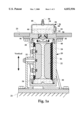
- FIG. 1a is a partial cross-sectioned side view of the present invention fluid mounting including partitionless compensator and bubble shedding features,
- FIG. 1b is an enlarged partial cross-sectioned side view of one embodiment of a bubble trap
- FIG. 1c is an bottom view of the bubble trap along line c--c of FIG. 1a,
- FIG. 1d is an bottom view of a bubble shedding laminated elastomer section
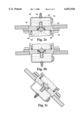
- FIGS. 2a, 2b, 2c are cross-sectioned partial side views of another embodiment of the partitionless compensator shown in different orientations.
- FIG. 1a shown generally at 20, is a first embodiment of the fluid mounting including a partitionless compensator 36.
- the fluid mounting 20 is useful for controlling, and preferably minimizing, dynamic vibration (motion and/or force) transmitted between a vibrating member 21, such as an helicopter transmission or the like, and a structure 23, such as an aircraft fuselage, or the like.
- a vibrating member 21 such as an helicopter transmission or the like
- a structure 23 such as an aircraft fuselage, or the like.
- the fluid mounting 20 comprises an elongated rigid inner member 22 adapted for interconnection to a first member 21, such as a rigid structure, for example, a helicopter fuselage, and an outer member 24 adapted to be attached to a second member 23, such as a vibrating element, for example, a helicopter transmission or pylon.
- a flexible elastomer element 26 flexibly supports the inner member 22 relative to the outer member 24.
- Preferable materials include natural rubber, natural rubber and synthetic blends. Although, other suitable elastomers or flexible materials could also be used. As will be described later, the elastomer section may include laminated construction.
- First 28 and second 30 operating chambers are formed within the mounting 20, each of which preferably interacts with end portions of the flexible elastomer section 26.
- a fluid passageway 32 which may include a tuned fluid inertia (resonant mass effect) interconnects the first and second operating chambers 28, 30. This achieved by appropriate selection of the length and diameter of the passageway 32.
- a fluid 34 is oscillated back and forth through passageway 32 as a result of dynamic vibrations between the inner member 22 and outer member 24.
- a partitionless volume compensator 36 attaches to a portion of the outer member 24.
- the partitionless compensator 36 includes a compensator chamber 38 including a gas-filled portion 40 and a fluid-filled portion 42.
- the gas-filled portion 40 overlies the fluid-filled portion 42 and the chamber 38 is devoid of any barrier separating the portions 40, 42.
- Prior art compensators for fluid mounts include a flexible partition separating the various portions, for example, as is shown in U.S. Pat. No. 4,811,919 to Jones. An additional example may be found in copending application Ser. No. 08/533,227 entitled "High Temperature Fluid Mount". Removal of this diaphragm separation is key to the operation of one aspect of the present invention.
- At least one lock passage 44 interconnects between the fluid-filled portion 42 of chamber 38 and one of the first and second operating chambers 28, 30.
- the lock passage 44 is of the appropriate length and diameter such that flow is minimized at the predominant operating frequency of the mounting, i.e., the passage is locked.
- a fluid 34 such as silicone or perfluorinated polyether is contained within the first and second operating chambers 28, 30, the fluid passageway 32, the fluid-filled portion 42, and the at least one lock passage 44.
- the viscosity of the fluid 34 is relevant to the operation of the invention.
- the apparatus is an isolator a low viscosity (about 1-100 centistoke) fluid is needed, whereas if the device is a damper, a higher viscosity is desired (ex. 100-10000 centistoke).
- the mounting also includes a bubble trap depression 46 formed in a wall portion 48 of one of said chambers 28, 30.
- the bubble trap 46 is an irregularity formed in the surface which focuses any bubbles present into the at least one lock passage 44.
- the surface leading to the bubble trap preferably includes a taper or incline.
- the bubble trap 46 is a depression at an even greater slope than the incline. This preferably dramatic change in slope catches any gas bubble and quickly diverts it through the lock passageway 44.
- the bubble trap 46 is an annular groove formed into a wall portion of the first operating chamber 28.
- the bubble trap 46 is preferably formed by cooperation between a chamfer 52 formed on a plug hole 50 interconnecting between the compensator chamber 38 and one of the operating chambers 28, 30 and a chamfer 52' formed on a plug 54 received within said plug hole 50.
- the chamfers 52, 52' form an annular groove.
- the shape of the groove could be varried.
- the at least one lock passage 44 comprise a plurality of lock passages 44, 44' to increase the speed at which bubbles may enter into the chamber 38.
- a bubble may enter through one lock passage 44 and the displaced fluid may exit through the other lock passage 44'.
- Even more lock passageways may be included if desired (See FIG. 1c).
- the at least one lock passage 44 should exhibit a diameter greater than about 0.03 inch. More preferably, the at least one lock passage 44 exhibits a diameter between about 0.03 inch and 0.09 inch, and most preferably, a diameter of about 0.06 inch.
- a plurality of lock passages 44, 44' interconnect between the compensator chamber 38 and an annular bubble trap 46 formed in a wall portion 48 of a highest one of said operating chambers 28, 30.
- the compensator chamber 38 should preferably be about half full of fluid 34.
- a sight glass 55 is preferably mounted to a vertical wall portion 56 of said compensator chamber 38 enables viewing of the level of fluid 34 within the chamber 38.
- a fill valve 58 provides means for pressurizing said gas-filled portion 40 thereby pressurizing the operating chambers 28, 30.
- an extension 56 projecting from a wall of the chamber 38 within the volume compensator 36 extends part way into the compensator chamber 38.
- the extension 56 includes an opening 58 which is always covered by the fluid 34 regardless of the orientation of the mounting 20.
- various orientations of the mount are illustrated, yet in each case, the fluid 34 within the fluid portion 42 covers the opening 58. Since the opening is covered, no air can be reintroduced back into the operating chambers 28, 30.
- the fluid 34 level in the chamber 38 must be greater than one-half full, and preferably about two-thirds full.
- a plurality of lock passages 44, 44' intersect with the opening 58.
- the extension 56 is formed on a plug 54' which threads into said outer member 24.
- any bubbles formed or within the operating chambers 28, 30 will migrate upward into the bubble trap 46, then into the at least one lock passage 44, through said fluid portion 42, and into said gas-filled portion 40.
- the gas over fluid design improves on prior art designs in that any gas bubbles that are in the chambers 28, 30 can escape.
- the fluid mounting 20 includes a flexible element 26 having laminated construction.
- laminated construction what is meant is any flexible element 26 which includes a least one rigid shim 27 and at least two elastomer layers 29.
- Each of the at least two elastomer layers 29 include a sloping conical end portion 31, one of which preferably intersects with an end of the at least one rigid shim 27 and another which intersects with an end of said inner member 22, thereby preventing gas bubbles from becoming trapped.
- the sloping end portions 31 are angled at an angle theta ⁇ of at least 3 degrees from a horizontal plane.
- the at least one rigid shim 27 is tubular-shaped and includes an inner and outer diameter.
- the sloping end portion 31 preferably intersects the end of the at least one rigid shim 27 at its inner diameter.
- the mold would only locate the shim on this inner diameter. This provides support during bonding and allows the appropriate sloped contour.
Landscapes
- Engineering & Computer Science (AREA)
- General Engineering & Computer Science (AREA)
- Mechanical Engineering (AREA)
- Combined Devices Of Dampers And Springs (AREA)
Abstract
A fluid mounting (20) for isolating or damping vibration between a vibrating member (21) and a structure (23). In one aspect, the fluid mounting (20) includes inner (22) and outer (24) members, a flexible element (26), first (28) and second (30) operating chambers, a fluid passageway (32) interconnecting operating chambers (28, 30), and a partitionless volume compensator (36) including a compensator chamber (38) separated into a gas-filled portion (40) and a fluid-filled portion (42). Notably, the chamber (38) is devoid of any separating barrier. At least one lock passage (44) interconnects the fluid-filled portion (42) with one of the first and second operating chambers (28, 30), and a working fluid (34). Preferably a bubble trap depression (46) focuses any gas bubbles into the lock passage (44). In another aspect, mounting (20) may include laminated shim construction with sloping profiles thereon to prevent bubble trapping.
Description
This invention relates to devices for controlling dynamic vibration. Specifically, it relates to fluid mountings for control of vibration between a vibrating member and structure.
Fluid or hydraulic mountings include a fluid which augments isolation and/or damping characteristics that may be achieved in elastomer mountings alone. This augmentation may take the form of adding additional damping or added inertial forces. Fluid mountings are generally described in LORD® Technical Article LL-2166 entitled "Understanding Hydraulic Mounts for Improved Vehicle Noise, Vibration and Ride Qualities" by W. C. Flower. Commonly assigned U.S. Pat. No. 4,811,919 to Jones describes a fluid mounting which incorporates a volume compensator. Other examples of fluid mountings and dampers may be found in commonly assigned U.S. Pat. No. 5,413,320 to Herbst, U.S. Pat. No. 5,374,039 to Schmidt et al., U.S. Pat. No. 5,127,607 to McGuire, and U.S. Pat. No. 5,197,692 to Jones et al., U.S. Pat. No. 5,540,549, to McGuire and U.S. Pat. No. 5,501,434 to McGuire. Fluid mountings are, in essence, tunable passive devices which use a fluid to add additional damping or tuned-fluid "inertia" effects. In all these devices, compensation of fluid expansion, pressurization, and fill to remove gas bubbles is a problem. However, prior art methods of accomplishing these feats have involved utilization of multi-component systems which tend to add unwanted cost and complexity. In particular, it is very important in aggressive fluid mounting applications, such as in fluid pylon isolators, that no gas bubbles are present in the operating chambers. In essence, relative movement between the inner and outer member will cause any bubble present to expand and contract instead of moving the fluid between the chambers. This degrades performance. Further, reliable methods of providing pressurization to minimize cavitation of the fluid at high relative motions is required.
Therefore, there is a recognized need for more effective and cost efficient methods of compensation, pressurization, and fill in fluid mounts.
Therefore, in light of the advantages and drawbacks of the prior art, the present invention is a fluid mounting adapted for attachment between a vibrating member and a structure for isolating or damping vibration therebetween. Accordingly, the present invention fluid mounting comprises a first and second operating chambers, a fluid passageway interconnecting the first and second operating chambers, a partitionless volume compensator including a compensator chamber separated into a gas-filled portion and a fluid-filled portion. The gas-filled portion overlies the fluid-filled portion and the chamber is devoid of any barrier separating the portions. At least one lock passage interconnects the fluid-filled portion with one of said first and second operating chambers. When operated in its upright orientation, any gas bubbles migrate upward through the lock passageway and into the gas-filled portion of the compensator, yet the fluid-filled portion is dynamically locked at the operating frequency of the mounting.
In another aspect, a bubble trap formed in a wall portion of one of said chambers focuses any bubbles present into said at least one lock passage. Preferably, the bubble trap is an annular groove formed by cooperation between a chamfer formed on a plug hole chamber and a chamfer formed on a plug received within said plug hole. In another aspect, a plurality of lock passages increase the speed at which bubbles enter the compensator chamber. In another aspect, an extension within the volume compensator extends part way into the compensator chamber and includes an opening cooperating with the lock passageway(s). The opening is always covered by the fluid regardless of an orientation of said mounting. This prevents air, once it leaves the operating chambers, from getting back in. In another aspect, the flexible element includes laminated construction which includes at least one rigid shim and at least two elastomer layers. Each of the at least two elastomer layers including a sloping end portion, one of which intersects with an end of said at least one rigid shim and another which intersects with an end of said inner member, thereby preventing gas bubbles from becoming trapped. This aids in fill of the mounting.
It is an advantage of the present invention that the partitionless compensator eliminates one or more components from the fluid mounting.
It is advantage of another aspect of the present invention that gas bubbles can be easily and quickly removed from the operating chambers during fill and during operation.
It is advantage of another aspect of the present invention that once the gas bubbles are removed, it is difficult for them to reenter the operating chambers.
The above-mentioned and further features, advantages and characteristics of the present invention will become apparent from the accompanying descriptions of the preferred embodiments and attached drawings.
The accompanying drawings which form a part of the specification, illustrate several key embodiments of the present invention. The drawings and description together, serve to fully explain the invention. In the drawings,
FIG. 1a is a partial cross-sectioned side view of the present invention fluid mounting including partitionless compensator and bubble shedding features,
FIG. 1b is an enlarged partial cross-sectioned side view of one embodiment of a bubble trap,
FIG. 1c is an bottom view of the bubble trap along line c--c of FIG. 1a,
FIG. 1d is an bottom view of a bubble shedding laminated elastomer section, and
FIGS. 2a, 2b, 2c are cross-sectioned partial side views of another embodiment of the partitionless compensator shown in different orientations.
Referring now to the Drawings where like numerals denote like elements, in FIG. 1a, shown generally at 20, is a first embodiment of the fluid mounting including a partitionless compensator 36. The fluid mounting 20 is useful for controlling, and preferably minimizing, dynamic vibration (motion and/or force) transmitted between a vibrating member 21, such as an helicopter transmission or the like, and a structure 23, such as an aircraft fuselage, or the like. A detailed description of this type of mounting is found in U.S. Pat. No. 4,236,607.
The fluid mounting 20 comprises an elongated rigid inner member 22 adapted for interconnection to a first member 21, such as a rigid structure, for example, a helicopter fuselage, and an outer member 24 adapted to be attached to a second member 23, such as a vibrating element, for example, a helicopter transmission or pylon. A flexible elastomer element 26 flexibly supports the inner member 22 relative to the outer member 24. Preferable materials include natural rubber, natural rubber and synthetic blends. Although, other suitable elastomers or flexible materials could also be used. As will be described later, the elastomer section may include laminated construction.
First 28 and second 30 operating chambers are formed within the mounting 20, each of which preferably interacts with end portions of the flexible elastomer section 26. A fluid passageway 32 which may include a tuned fluid inertia (resonant mass effect) interconnects the first and second operating chambers 28, 30. This achieved by appropriate selection of the length and diameter of the passageway 32. A fluid 34 is oscillated back and forth through passageway 32 as a result of dynamic vibrations between the inner member 22 and outer member 24.
In a particularly novel feature, a partitionless volume compensator 36 attaches to a portion of the outer member 24. The partitionless compensator 36 includes a compensator chamber 38 including a gas-filled portion 40 and a fluid-filled portion 42. The gas-filled portion 40 overlies the fluid-filled portion 42 and the chamber 38 is devoid of any barrier separating the portions 40, 42. Prior art compensators for fluid mounts include a flexible partition separating the various portions, for example, as is shown in U.S. Pat. No. 4,811,919 to Jones. An additional example may be found in copending application Ser. No. 08/533,227 entitled "High Temperature Fluid Mount". Removal of this diaphragm separation is key to the operation of one aspect of the present invention.
At least one lock passage 44 interconnects between the fluid-filled portion 42 of chamber 38 and one of the first and second operating chambers 28, 30. The lock passage 44 is of the appropriate length and diameter such that flow is minimized at the predominant operating frequency of the mounting, i.e., the passage is locked. A fluid 34 such as silicone or perfluorinated polyether is contained within the first and second operating chambers 28, 30, the fluid passageway 32, the fluid-filled portion 42, and the at least one lock passage 44.
The viscosity of the fluid 34 is relevant to the operation of the invention. Notably, if the apparatus is an isolator a low viscosity (about 1-100 centistoke) fluid is needed, whereas if the device is a damper, a higher viscosity is desired (ex. 100-10000 centistoke). Preferably, the mounting also includes a bubble trap depression 46 formed in a wall portion 48 of one of said chambers 28, 30. The bubble trap 46 is an irregularity formed in the surface which focuses any bubbles present into the at least one lock passage 44. The surface leading to the bubble trap preferably includes a taper or incline. Notably, the bubble trap 46 is a depression at an even greater slope than the incline. This preferably dramatic change in slope catches any gas bubble and quickly diverts it through the lock passageway 44.
In one embodiment, as best illustrated in FIG. 1b, the bubble trap 46 is an annular groove formed into a wall portion of the first operating chamber 28. The bubble trap 46 is preferably formed by cooperation between a chamfer 52 formed on a plug hole 50 interconnecting between the compensator chamber 38 and one of the operating chambers 28, 30 and a chamfer 52' formed on a plug 54 received within said plug hole 50. Together, the chamfers 52, 52' form an annular groove. Notably, the shape of the groove could be varried.
In another aspect, it is preferable that the at least one lock passage 44 comprise a plurality of lock passages 44, 44' to increase the speed at which bubbles may enter into the chamber 38. For example, a bubble may enter through one lock passage 44 and the displaced fluid may exit through the other lock passage 44'. Even more lock passageways may be included if desired (See FIG. 1c). Preferably, the at least one lock passage 44 should exhibit a diameter greater than about 0.03 inch. More preferably, the at least one lock passage 44 exhibits a diameter between about 0.03 inch and 0.09 inch, and most preferably, a diameter of about 0.06 inch. Notably, it was discovered by the inventor that for sizes less than about 0.03 inches, bubbles do not pass easily into the chamber 38 and tend to get caught in the operating chamber 28. Bubbles in the chambers 28, 30 may significantly degrade performance. Likewise, diameters above 0.09 inch tend to allow fluid 34 to oscillate through the lock passageway 44. Preferably, a plurality of lock passages 44, 44' interconnect between the compensator chamber 38 and an annular bubble trap 46 formed in a wall portion 48 of a highest one of said operating chambers 28, 30.
The compensator chamber 38 should preferably be about half full of fluid 34. A sight glass 55 is preferably mounted to a vertical wall portion 56 of said compensator chamber 38 enables viewing of the level of fluid 34 within the chamber 38. A fill valve 58 provides means for pressurizing said gas-filled portion 40 thereby pressurizing the operating chambers 28, 30.
Referring to FIG. 2a-2c, in another aspect which prevents gas bubbles from getting into the chambers 28, 30, an extension 56 projecting from a wall of the chamber 38 within the volume compensator 36 extends part way into the compensator chamber 38. The extension 56 includes an opening 58 which is always covered by the fluid 34 regardless of the orientation of the mounting 20. As shown in FIG. 2a-2c, various orientations of the mount are illustrated, yet in each case, the fluid 34 within the fluid portion 42 covers the opening 58. Since the opening is covered, no air can be reintroduced back into the operating chambers 28, 30. In this embodiment, the fluid 34 level in the chamber 38 must be greater than one-half full, and preferably about two-thirds full. In a best mode, a plurality of lock passages 44, 44' intersect with the opening 58. Preferably, the extension 56 is formed on a plug 54' which threads into said outer member 24.
From the foregoing it should be understood that in an upright orientation, any bubbles formed or within the operating chambers 28, 30 will migrate upward into the bubble trap 46, then into the at least one lock passage 44, through said fluid portion 42, and into said gas-filled portion 40. The gas over fluid design improves on prior art designs in that any gas bubbles that are in the chambers 28, 30 can escape.
In another aspect illustrated in FIG. 1d, means are incorporated to prevent air trapping within the chambers 28, 30 if the fluid mounting 20 includes a flexible element 26 having laminated construction. By the term laminated construction, what is meant is any flexible element 26 which includes a least one rigid shim 27 and at least two elastomer layers 29. Each of the at least two elastomer layers 29 include a sloping conical end portion 31, one of which preferably intersects with an end of the at least one rigid shim 27 and another which intersects with an end of said inner member 22, thereby preventing gas bubbles from becoming trapped. Preferably, the sloping end portions 31 are angled at an angle theta Θ of at least 3 degrees from a horizontal plane. Preferably, the at least one rigid shim 27 is tubular-shaped and includes an inner and outer diameter. The sloping end portion 31 preferably intersects the end of the at least one rigid shim 27 at its inner diameter. Notably, the mold would only locate the shim on this inner diameter. This provides support during bonding and allows the appropriate sloped contour.
While various embodiments, including the preferred embodiment of the present invention has been described in detail, various modifications, alterations, changes and adaptations to the aforementioned may be made without departing from the spirit and scope of the present invention defined in the appended claims. It is intended that all such modifications, alterations and changes be considered part of the present invention.
Claims (9)
1. A fluid mounting, comprising:
(a) an inner member,
(b) an outer member,
(c) a flexible element flexibly supporting said inner member relative to said outer member,
(d) first and second operating chambers,
(e) a fluid passageway interconnecting said first and second operating chambers,
(f) a partitionless volume compensator including a compensator chamber separated into a gas-filled portion and a fluid-filled portion, said gas-filled portion overlying said fluid-filled portion, said compensator chamber being devoid of any barrier separating said portions,
(g) at least one lock passage interconnecting said fluid-filled portion with one of said first and second operating chambers,
(h) a fluid within said first and second operating chambers, said fluid passageway, said fluid-filled portion, and said at least one lock passage; and
(i) an extension within said volume compensator which extends part way into said compensator chamber, said extension including an opening interconnecting said at least one lock passage which is always covered by said fluid regardless of an orientation of said mounting.
2. A fluid mounting of claim 1 wherein said fluid fills about two-thirds of said compensator chamber.
3. A fluid mounting of claim 1 wherein a plurality of lock passages intersect said opening.
4. A fluid mounting of claim 1 wherein said extension is formed on a plug which threads into said outer member.
5. A fluid mounting, comprising:
(a) an inner member,
(b) an outer member,
(c) a flexible element flexibly supporting said inner member relative to said outer member,
(d) first and second operating chambers,
(e) a fluid passageway interconnecting said first and second operating chambers,
(f) a partitionless volume compensator including a compensator chamber separated into a gas-filled portion and a fluid-filled portion, said gas-filled portion overlying said fluid-filled portion, said compensator chamber being devoid of any barrier separating said portions,
(g) at least one lock passage interconnecting said fluid-filled portion with one of said first and second operating chambers,
(h) a fluid within said first and second operating chambers, said fluid passageway, said fluid-filled portion, and said at least one lock passage; and
wherein said flexible element exhibits laminated construction further including at least one rigid shim and at least two elastomer layers, each of said at least two elastomer layers including a sloping end portion, one of said end portions intersects with an end of said at least one rigid shim and another of said end portions intersects with an end of said inner member thereby preventing gas bubbles from becoming trapped within a lower one of said operating chambers.
6. A fluid mounting of claim 5 wherein said sloping end portions are angled at an angle greater than 3 degrees from a horizontal plane.
7. A fluid mounting of claim 5 wherein said at least one rigid shim is tubular-shaped and includes an inner and outer diameter, and said sloping end portion intersects said end of said at least one rigid shim at said inner diameter.
8. A fluid mounting, comprising:
(a) an inner member,
(b) an outer member,
(c) a flexible element flexibly supporting said inner member relative to said outer member,
(d) first and second operating chambers,
(e) a fluid passageway interconnecting said first and second operating chambers,
(f) a partitionless volume compensator including a compensator chamber separated into a gas-filled portion and a fluid-filled portion, said gas-filled portion overlying said fluid-filled portion, said chamber being devoid of any barrier separating said portions,
(g) at least one lock passage interconnecting said fluid-filled portion with one of said first and second operating chambers,
(h) a fluid within said first and second operating chambers, said fluid passageway, said fluid-filled portion, and said at least one lock passage, and
(i) an extension having an end portion within said compensator chamber, said end portion being covered with fluid regardless of an orientation of said mounting thereby preventing gas bubbles from reentering said operating chambers.
9. A fluid mounting, comprising:
(a) an inner member,
(b) an outer member,
(c) a flexible element flexibly supporting said inner member relative to said outer member, said flexible element including a laminated construction further including at least one rigid shim and at least two elastomer layers, each of said at least two elastomer layers including a sloping end portion, one of which intersects with an end of said at least one rigid shim and another which intersects with an end of said inner member thereby preventing gas bubbles from becoming trapped,
(d) first and second operating chambers,
(e) a fluid passageway interconnecting said first and second operating chambers,
(f) a volume compensator including a compensator chamber,
(g) at least one lock passage interconnecting said compensator chamber with one of said first and second operating chambers, and
(h) a fluid within said first and second operating chambers, said fluid passageway, said compensator chamber, and said at least one lock passage.
Priority Applications (6)
| Application Number | Priority Date | Filing Date | Title |
|---|---|---|---|
| US08/905,368 US6032936A (en) | 1997-08-04 | 1997-08-04 | Fluid mount including a partitionless compensator |
| CA002299454A CA2299454A1 (en) | 1997-08-04 | 1998-08-03 | Fluid mount including a partitionless compensator |
| DE69808925T DE69808925T2 (en) | 1997-08-04 | 1998-08-03 | FLUIDIC BEARING WITH PARTITION-FREE COMPENSATION DEVICE |
| PCT/US1998/016124 WO1999006733A1 (en) | 1997-08-04 | 1998-08-03 | Fluid mount including a partitionless compensator |
| EP98938298A EP1000273B1 (en) | 1997-08-04 | 1998-08-03 | Fluid mount including a partitionless compensator |
| US09/466,548 US6217011B1 (en) | 1997-08-04 | 1999-12-17 | Fluid mount including a partitionless compensator |
Applications Claiming Priority (1)
| Application Number | Priority Date | Filing Date | Title |
|---|---|---|---|
| US08/905,368 US6032936A (en) | 1997-08-04 | 1997-08-04 | Fluid mount including a partitionless compensator |
Related Child Applications (1)
| Application Number | Title | Priority Date | Filing Date |
|---|---|---|---|
| US09/466,548 Continuation US6217011B1 (en) | 1997-08-04 | 1999-12-17 | Fluid mount including a partitionless compensator |
Publications (1)
| Publication Number | Publication Date |
|---|---|
| US6032936A true US6032936A (en) | 2000-03-07 |
Family
ID=25420708
Family Applications (2)
| Application Number | Title | Priority Date | Filing Date |
|---|---|---|---|
| US08/905,368 Expired - Fee Related US6032936A (en) | 1997-08-04 | 1997-08-04 | Fluid mount including a partitionless compensator |
| US09/466,548 Expired - Lifetime US6217011B1 (en) | 1997-08-04 | 1999-12-17 | Fluid mount including a partitionless compensator |
Family Applications After (1)
| Application Number | Title | Priority Date | Filing Date |
|---|---|---|---|
| US09/466,548 Expired - Lifetime US6217011B1 (en) | 1997-08-04 | 1999-12-17 | Fluid mount including a partitionless compensator |
Country Status (5)
| Country | Link |
|---|---|
| US (2) | US6032936A (en) |
| EP (1) | EP1000273B1 (en) |
| CA (1) | CA2299454A1 (en) |
| DE (1) | DE69808925T2 (en) |
| WO (1) | WO1999006733A1 (en) |
Cited By (14)
| Publication number | Priority date | Publication date | Assignee | Title |
|---|---|---|---|---|
| US6217011B1 (en) * | 1997-08-04 | 2001-04-17 | Lord Corporation | Fluid mount including a partitionless compensator |
| US6378851B1 (en) | 2000-10-25 | 2002-04-30 | Lord Corporation | Fluid and elastomer apparatus with discrete volume compensator and secondary compliance |
| US20030134751A1 (en) * | 2001-04-04 | 2003-07-17 | Jesse Lee | Methods for controlling the rheological properties of viscoelastic surfactants based fluids |
| US20040084818A1 (en) * | 2002-11-06 | 2004-05-06 | Russell Donald D. | Fluid-elastomeric damper assembly including internal pumping mechanism |
| US20050146087A1 (en) * | 2002-11-06 | 2005-07-07 | Lord Corporation | Fluid-elastomeric damper assembly including internal pumping mechanism |
| US20060261530A1 (en) * | 2005-05-18 | 2006-11-23 | Bell Helicopter Textron Inc. | Preloaded one-way valve accumulator |
| CN103629292A (en) * | 2012-08-23 | 2014-03-12 | 贝尔直升机德事隆公司 | System and method for vibration isolation |
| US8882091B2 (en) | 2011-11-11 | 2014-11-11 | Textron Innovations Inc. | Vibration isolation system |
| US8888079B2 (en) | 2009-12-01 | 2014-11-18 | Textron Innovations Inc. | Apparatus for improved vibration isolation |
| US9249856B1 (en) | 2014-03-18 | 2016-02-02 | Bell Helicopter Textron Inc. | Liquid inertia vibration mount |
| US9297439B2 (en) | 2009-03-12 | 2016-03-29 | Textron Innovations Inc. | Method and apparatus for improved vibration isolation |
| US9446841B2 (en) | 2008-12-18 | 2016-09-20 | Textron Innovations Inc. | Method and apparatus for improved vibration isolation |
| US9551393B2 (en) | 2014-04-23 | 2017-01-24 | Bell Helicopter Textron Inc. | Rotorcraft vibration isolation systems |
| US20190113098A1 (en) * | 2017-10-16 | 2019-04-18 | Bell Helicopter Textron Inc. | Vibration attenuating fluid mount with partitioned compensator |
Families Citing this family (10)
| Publication number | Priority date | Publication date | Assignee | Title |
|---|---|---|---|---|
| US6431530B1 (en) * | 2000-05-23 | 2002-08-13 | Bell Helicopter Textron, Inc. | Vertical liquid inertia vibration isolator |
| DE09169320T1 (en) * | 2002-09-24 | 2010-11-25 | Bell Helicopter Textron, Inc., Fort Worth | Piezoelectric liquid inertia vibration eliminating device |
| US7273447B2 (en) * | 2004-04-09 | 2007-09-25 | Otologics, Llc | Implantable hearing aid transducer retention apparatus |
| GB2418670B (en) | 2003-07-18 | 2007-06-27 | Avecia Inkjet Ltd | Phthalocyanines and their use in ink-jet printers |
| KR101193856B1 (en) * | 2005-02-18 | 2012-10-24 | 로드코포레이션 | Fluid-Elastomeric Damper Assembly Including Internal Pumping Mechanism |
| CA2830898C (en) * | 2011-04-11 | 2015-09-08 | Bell Helicopter Textron Inc. | Pylon mounting system with vibration isolation |
| US8672262B2 (en) * | 2012-01-10 | 2014-03-18 | Textron Innovations Inc. | Mechanically optimized liquid inertia vibration eliminator and aircraft pylon system |
| US9416842B2 (en) | 2013-03-27 | 2016-08-16 | Honeywell International Inc. | Isolators having damper-external thermal compensators and spacecraft isolation systems employing the same |
| US9587702B2 (en) | 2014-02-18 | 2017-03-07 | Honeywell International Inc. | Vibration isolator using externally pressurized sealing bellows and an external shaft |
| JP6384986B2 (en) * | 2014-04-24 | 2018-09-05 | 株式会社ブリヂストン | Vibration isolator |
Citations (11)
| Publication number | Priority date | Publication date | Assignee | Title |
|---|---|---|---|---|
| FR1549300A (en) * | 1966-09-02 | 1968-12-13 | ||
| FR2060392A2 (en) * | 1969-09-04 | 1971-06-18 | Ahex Corp | |
| US3651902A (en) * | 1969-12-15 | 1972-03-28 | Peddinghaus Carl Ullrich Dr | Hydropneumatic shock absorber |
| US4103492A (en) * | 1975-08-07 | 1978-08-01 | Tokico Ltd. | Reservoir in master cylinder of vehicle braking system |
| US4236607A (en) * | 1979-02-26 | 1980-12-02 | Textron, Inc. | Vibration suppression system |
| US4349184A (en) * | 1978-04-03 | 1982-09-14 | Barry Wright Corporation | Laminated bearings having elastomer layers of varying dimensions |
| US4817925A (en) * | 1986-09-02 | 1989-04-04 | Metzeler Kautschuk Gmbh | Engine mount with hydraulic damping |
| US5501434A (en) * | 1994-05-10 | 1996-03-26 | Lord Corporation | Hybrid fluid and elastomer damper |
| US5540549A (en) * | 1994-08-05 | 1996-07-30 | Lord Corporation | Fluid damping devices |
| US5735510A (en) * | 1994-06-06 | 1998-04-07 | Mazda Motor Corporation | Vibration damper apparatus |
| US5788372A (en) * | 1996-05-10 | 1998-08-04 | Lord Corporation | Method and apparatus for reducing transient motion between an aircraft power member and structure during takeoff, landing and maneuvers |
Family Cites Families (13)
| Publication number | Priority date | Publication date | Assignee | Title |
|---|---|---|---|---|
| DE3701264A1 (en) * | 1987-01-17 | 1988-07-28 | Opel Adam Ag | HYDRO BEARING |
| US4811919A (en) | 1987-08-06 | 1989-03-14 | Lord Corporation | Volume compensated fluid mount |
| US5219430A (en) * | 1990-03-13 | 1993-06-15 | Aerospatiale Societe Nationale Industrielle | Hydraulic damper and elastic-return strut comprising such a damper |
| US5197692A (en) | 1991-05-29 | 1993-03-30 | Lord Corporation | Adaptive fluid mount |
| US5127607A (en) | 1991-07-09 | 1992-07-07 | Lord Corporation | Fluid torque-restraint system with optimized fluid expansion |
| US5174552A (en) * | 1991-10-15 | 1992-12-29 | Lord Corporation | Fluid mount with active vibration control |
| US6022600A (en) * | 1992-04-24 | 2000-02-08 | Lord Corporation | High-temperature fluid mounting |
| US5374039A (en) | 1992-08-24 | 1994-12-20 | Lord Corporation | Fluid-and-elastomer support device |
| US5413320A (en) | 1993-06-17 | 1995-05-09 | Lord Corporation | Fluid mount for devices such as engines |
| US5435531A (en) * | 1993-08-18 | 1995-07-25 | Bell Helicopter Textron Inc. | Vibration isolation system |
| US6009983A (en) * | 1997-05-30 | 2000-01-04 | Bell Helicopter Textron, Inc. | Method and apparatus for improved vibration isolation |
| US6032936A (en) * | 1997-08-04 | 2000-03-07 | Lord Corporation | Fluid mount including a partitionless compensator |
| US6092795A (en) * | 1997-08-04 | 2000-07-25 | Lord Corporation | Fluid and elastomer damper |
-
1997
- 1997-08-04 US US08/905,368 patent/US6032936A/en not_active Expired - Fee Related
-
1998
- 1998-08-03 CA CA002299454A patent/CA2299454A1/en not_active Abandoned
- 1998-08-03 DE DE69808925T patent/DE69808925T2/en not_active Expired - Fee Related
- 1998-08-03 WO PCT/US1998/016124 patent/WO1999006733A1/en not_active Ceased
- 1998-08-03 EP EP98938298A patent/EP1000273B1/en not_active Expired - Lifetime
-
1999
- 1999-12-17 US US09/466,548 patent/US6217011B1/en not_active Expired - Lifetime
Patent Citations (11)
| Publication number | Priority date | Publication date | Assignee | Title |
|---|---|---|---|---|
| FR1549300A (en) * | 1966-09-02 | 1968-12-13 | ||
| FR2060392A2 (en) * | 1969-09-04 | 1971-06-18 | Ahex Corp | |
| US3651902A (en) * | 1969-12-15 | 1972-03-28 | Peddinghaus Carl Ullrich Dr | Hydropneumatic shock absorber |
| US4103492A (en) * | 1975-08-07 | 1978-08-01 | Tokico Ltd. | Reservoir in master cylinder of vehicle braking system |
| US4349184A (en) * | 1978-04-03 | 1982-09-14 | Barry Wright Corporation | Laminated bearings having elastomer layers of varying dimensions |
| US4236607A (en) * | 1979-02-26 | 1980-12-02 | Textron, Inc. | Vibration suppression system |
| US4817925A (en) * | 1986-09-02 | 1989-04-04 | Metzeler Kautschuk Gmbh | Engine mount with hydraulic damping |
| US5501434A (en) * | 1994-05-10 | 1996-03-26 | Lord Corporation | Hybrid fluid and elastomer damper |
| US5735510A (en) * | 1994-06-06 | 1998-04-07 | Mazda Motor Corporation | Vibration damper apparatus |
| US5540549A (en) * | 1994-08-05 | 1996-07-30 | Lord Corporation | Fluid damping devices |
| US5788372A (en) * | 1996-05-10 | 1998-08-04 | Lord Corporation | Method and apparatus for reducing transient motion between an aircraft power member and structure during takeoff, landing and maneuvers |
Cited By (24)
| Publication number | Priority date | Publication date | Assignee | Title |
|---|---|---|---|---|
| US6217011B1 (en) * | 1997-08-04 | 2001-04-17 | Lord Corporation | Fluid mount including a partitionless compensator |
| US6378851B1 (en) | 2000-10-25 | 2002-04-30 | Lord Corporation | Fluid and elastomer apparatus with discrete volume compensator and secondary compliance |
| US20030134751A1 (en) * | 2001-04-04 | 2003-07-17 | Jesse Lee | Methods for controlling the rheological properties of viscoelastic surfactants based fluids |
| US7931258B2 (en) | 2002-11-06 | 2011-04-26 | Lord Corporation | Fluid-elastomeric damper assembly including internal pumping mechanism |
| US8740200B2 (en) | 2002-11-06 | 2014-06-03 | Lord Corporation | Fluid-elastomeric damper assembly including internal pumping mechanism |
| US20040145102A1 (en) * | 2002-11-06 | 2004-07-29 | Donald Russell | Fluid-elastomeric damper assembly including internal pumping mechanism |
| US20050146087A1 (en) * | 2002-11-06 | 2005-07-07 | Lord Corporation | Fluid-elastomeric damper assembly including internal pumping mechanism |
| US7137624B2 (en) | 2002-11-06 | 2006-11-21 | Lord Corporation | Fluid-elastomeric damper assembly including internal pumping mechanism |
| US6758466B2 (en) * | 2002-11-06 | 2004-07-06 | Lord Corporation | Fluid-elastomeric damper assembly including internal pumping mechanism |
| US7270321B2 (en) | 2002-11-06 | 2007-09-18 | Lord Corporation | Fluid-elastomeric damper assembly including internal pumping mechanism |
| US20070273075A1 (en) * | 2002-11-06 | 2007-11-29 | Russell Donald D | Fluid-elastomeric damper assembly including internal pumping mechanism |
| US20080143028A1 (en) * | 2002-11-06 | 2008-06-19 | Donald Russell | Fluid-elastomeric damper assembly including internal pumping mechanism |
| US20040084818A1 (en) * | 2002-11-06 | 2004-05-06 | Russell Donald D. | Fluid-elastomeric damper assembly including internal pumping mechanism |
| US20060261530A1 (en) * | 2005-05-18 | 2006-11-23 | Bell Helicopter Textron Inc. | Preloaded one-way valve accumulator |
| US9446841B2 (en) | 2008-12-18 | 2016-09-20 | Textron Innovations Inc. | Method and apparatus for improved vibration isolation |
| US9297439B2 (en) | 2009-03-12 | 2016-03-29 | Textron Innovations Inc. | Method and apparatus for improved vibration isolation |
| US8888079B2 (en) | 2009-12-01 | 2014-11-18 | Textron Innovations Inc. | Apparatus for improved vibration isolation |
| US8882091B2 (en) | 2011-11-11 | 2014-11-11 | Textron Innovations Inc. | Vibration isolation system |
| CN103629292A (en) * | 2012-08-23 | 2014-03-12 | 贝尔直升机德事隆公司 | System and method for vibration isolation |
| US9765641B2 (en) | 2012-08-23 | 2017-09-19 | Bell Helicopter Textron Inc. | System and method for vibration isolation |
| US9249856B1 (en) | 2014-03-18 | 2016-02-02 | Bell Helicopter Textron Inc. | Liquid inertia vibration mount |
| US9551393B2 (en) | 2014-04-23 | 2017-01-24 | Bell Helicopter Textron Inc. | Rotorcraft vibration isolation systems |
| US20190113098A1 (en) * | 2017-10-16 | 2019-04-18 | Bell Helicopter Textron Inc. | Vibration attenuating fluid mount with partitioned compensator |
| US11131363B2 (en) * | 2017-10-16 | 2021-09-28 | Textron Innovations Inc. | Vibration attenuating fluid mount with partitioned compensator |
Also Published As
| Publication number | Publication date |
|---|---|
| DE69808925D1 (en) | 2002-11-28 |
| CA2299454A1 (en) | 1999-02-11 |
| US6217011B1 (en) | 2001-04-17 |
| EP1000273A1 (en) | 2000-05-17 |
| DE69808925T2 (en) | 2003-06-18 |
| EP1000273B1 (en) | 2002-10-23 |
| WO1999006733A1 (en) | 1999-02-11 |
Similar Documents
| Publication | Publication Date | Title |
|---|---|---|
| EP1000273B1 (en) | Fluid mount including a partitionless compensator | |
| JP2977796B2 (en) | Fluid-filled elastic vibration damping device | |
| EP0897490B1 (en) | Method for reducing transient motion between an aircraft power member and structure during takeoff, landing and maneuvers | |
| WO1999006732A1 (en) | Fluid and elastomer apparatus | |
| US4971300A (en) | Motor mount having improved hydraulic damping | |
| JP2860701B2 (en) | Liquid filled vibration isolator | |
| US6749186B2 (en) | Hydraulic bushing with springs in parallel | |
| EP0623197B1 (en) | Elasto-hydraulic vibration isolator | |
| JP2986586B2 (en) | Fluid-filled mount | |
| US5816566A (en) | Viscous fluid mount | |
| JPH08303522A (en) | Hydraulic damping rubber support | |
| CN111656045A (en) | Hydraulic damping support | |
| KR101938628B1 (en) | Engine mount with weight body | |
| JPS63266242A (en) | Fluid-sealed type mount device | |
| JP2005233243A (en) | Fluid filled engine mount | |
| JPH0874922A (en) | Movable valve type fluid filled anti-vibration support device | |
| US20050077662A1 (en) | Intergrated channel plate and decoupler assembly for vibration isolator | |
| JPS58124841A (en) | Fluid filled engine mount unit | |
| GB2342977A (en) | Hydroelastic engine mount | |
| KR100533078B1 (en) | Block type rubber mount enclosed fluid for vehicle | |
| US6712345B2 (en) | Powertrain mount with high frequency plunger | |
| JPH06193670A (en) | Fluid filled type vibration damping device | |
| JP2001124132A (en) | Liquid sealed mount | |
| RU2174935C2 (en) | Device for securing flying vehicle engine | |
| KR20180045563A (en) | Nozzle structure of hydro mount |
Legal Events
| Date | Code | Title | Description |
|---|---|---|---|
| AS | Assignment |
Owner name: LORD CORPORATION, NORTH CAROLINA Free format text: ASSIGNMENT OF ASSIGNORS INTEREST;ASSIGNOR:REDINGER, W. SCOTT;REEL/FRAME:009101/0639 Effective date: 19980209 |
|
| REMI | Maintenance fee reminder mailed | ||
| LAPS | Lapse for failure to pay maintenance fees | ||
| FP | Lapsed due to failure to pay maintenance fee |
Effective date: 20040307 |
|
| STCH | Information on status: patent discontinuation |
Free format text: PATENT EXPIRED DUE TO NONPAYMENT OF MAINTENANCE FEES UNDER 37 CFR 1.362 |