US5908015A - Arrangement for interrupting the flow of force between a camshaft and a valve - Google Patents

Arrangement for interrupting the flow of force between a camshaft and a valve Download PDF

Info

Publication number
US5908015A
US5908015A US08/887,562 US88756297A US5908015A US 5908015 A US5908015 A US 5908015A US 88756297 A US88756297 A US 88756297A US 5908015 A US5908015 A US 5908015A
Authority
US
United States
Prior art keywords
rocking lever
actuating
valve
coupling
camshaft
Prior art date
Legal status (The legal status is an assumption and is not a legal conclusion. Google has not performed a legal analysis and makes no representation as to the accuracy of the status listed.)
Expired - Fee Related
Application number
US08/887,562
Inventor
Peter Kreuter
Current Assignee (The listed assignees may be inaccurate. Google has not performed a legal analysis and makes no representation or warranty as to the accuracy of the list.)
Meta Motoren und Energie Technik GmbH
Original Assignee
Meta Motoren und Energie Technik GmbH
Priority date (The priority date is an assumption and is not a legal conclusion. Google has not performed a legal analysis and makes no representation as to the accuracy of the date listed.)
Filing date
Publication date
Priority claimed from DE19630309A external-priority patent/DE19630309C2/en
Application filed by Meta Motoren und Energie Technik GmbH filed Critical Meta Motoren und Energie Technik GmbH
Assigned to META MOTOREN- UND ENERGIE- TECHNIK GMBH reassignment META MOTOREN- UND ENERGIE- TECHNIK GMBH ASSIGNMENT OF ASSIGNORS INTEREST (SEE DOCUMENT FOR DETAILS). Assignors: KREUTER, PETER
Application granted granted Critical
Publication of US5908015A publication Critical patent/US5908015A/en
Anticipated expiration legal-status Critical
Expired - Fee Related legal-status Critical Current

Links

Images

Classifications

    • FMECHANICAL ENGINEERING; LIGHTING; HEATING; WEAPONS; BLASTING
    • F01MACHINES OR ENGINES IN GENERAL; ENGINE PLANTS IN GENERAL; STEAM ENGINES
    • F01LCYCLICALLY OPERATING VALVES FOR MACHINES OR ENGINES
    • F01L13/00Modifications of valve-gear to facilitate reversing, braking, starting, changing compression ratio, or other specific operations
    • F01L13/0005Deactivating valves
    • FMECHANICAL ENGINEERING; LIGHTING; HEATING; WEAPONS; BLASTING
    • F01MACHINES OR ENGINES IN GENERAL; ENGINE PLANTS IN GENERAL; STEAM ENGINES
    • F01LCYCLICALLY OPERATING VALVES FOR MACHINES OR ENGINES
    • F01L1/00Valve-gear or valve arrangements, e.g. lift-valve gear
    • F01L1/12Transmitting gear between valve drive and valve
    • F01L1/18Rocking arms or levers
    • F01L1/185Overhead end-pivot rocking arms

Definitions

  • the invention concerns an arrangement for interrupting the flow of force between a camshaft and a valve.
  • a possible way of reducing the level of fuel consumption of internal combustion piston engines used in particular in private motor vehicles involves temporarily taking individual cylinders out of operation so that the remaining cylinders operate in the part-load range under an increased mean pressure and thus involve a lower level of specific consumption.
  • For taking the cylinders out of operation it is not only necessary to interrupt the feed of fuel thereto, but desirably the charge flow through the corresponding cylinders is also interrupted. To achieve that it is advantageous to stop operation of at least the inlet valves of the corresponding cylinders.
  • the object of the present invention is to provide an arrangement for interrupting the flow of force between a camshaft and a valve, for example in the valve gear of an internal combustion piston engine, which is of a compact construction while affording a high level of operational reliability and simplicity of structure.
  • a further object of the present invention is to provide an arrangement for selectively and controlledly interrupting the actuation of a valve in an internal combustion piston engine, which affords precise and efficient control of selective interruption of valve actuation.
  • an arrangement for interrupting the flow of force between a camshaft and a valve for example in the valve gear of an internal combustion piston engine, comprising a camshaft having a cam, and a rocking lever mounted pivotably about an axis fixed relative to the engine and movable by the cam.
  • An actuating member is carried by the rocking lever and is guided thereon movably relative thereto.
  • a movable coupling member is mounted in the rocking lever movably by an actuating device between a first position of providing a rigid connection between the rocking lever and the actuating member and a second position in which the actuating member is movable relative to the rocking lever so that actuation of the valve is interrupted.
  • the invention permits the arrangement to be of an extremely compact structure, and the arrangement takes up only immaterially more space than a conventional valve gear which includes a rocking lever (pull lever or rocker arm).
  • the actuating member is guided for linear movement in the rocking lever and has an opening in its peripheral surface and the coupling member is a coupling shaft which is mounted rotatably in the rocking lever and which in the region of its engagement with the actuating element has a cross-section such that in the first position it engages into the opening provided in the peripheral surface of the actuating member and in the second position it is free from said engagement. That provides a simple mechanism involving low pressures in relation to surface area and thus a high level of durability.
  • a preferred form of that arrangement provides that the coupling shaft has a part-cylindrical peripheral surface with an end region towards said valve and in the first position said end region of the part-cylindrical peripheral surface bears against a corresponding surface of said opening. This can ensure surface contact between the coupling shaft and the actuating member.
  • the arrangement includes means for constantly urging the rocking lever into contact against the cam, and also a biasing means for constantly urging the coupling member into its first position, wherein the actuating device upon actuation thereof urges the coupling member into the second position, overcoming the force of the biasing means. That has the further advantage that coupling or decoupling as between the actuating member and the rocking lever occurs outside the rest or closed position of the valve, which involves a particularly high level of operational reliability.
  • the design configuration is further such that, in the event of failure of the actuating device for the coupling member, actuation of the valve is reliably ensured, by way of the camshaft.
  • the actuating member may be a hydraulic valve clearance compensating element which in the closed condition of the valve is supported between the valve and a cylindrical base circle of the camshaft. In that way a valve clearance compensating element is integrated into the arrangement, without requiring additional space.
  • a further preferred arrangement according to the invention is one in which the coupling member is a coupling shaft mounted substantially parallel to the camshaft and to the pivot axis of the rocking lever, and including mounted on the coupling shaft at least one roller which follows the cam, giving a particularly compact embodiment of the arrangement according to the invention.
  • the arrangement includes a bush or bushing arranged in the rocking lever substantially parallel to the camshaft and to the pivot axis of the rocking lever for mounting the coupling shaft forming the coupling member and at least one roller carried by the bush or bushing and co-operating with the cam.
  • the rocking lever includes a plurality of actuating members which are guided in the rocking lever and which are each associated with a respective valve, a common coupling shaft being provided for coupling of the actuating members to the rocking lever. That arrangement may include a plurality of rollers co-operable with respectively associated cams of the camshaft.
  • the rocking lever in the region of its mounting in fixed relationship with respect to the engine casing has a longitudinal slot extending along its longitudinal axis
  • the rocking lever includes a mounting region which forms the mounting for the rocking lever in fixed relationship with the engine casing, an actuating region which includes at least two rollers, the coupling shaft and at least two actuating members, and arm means connecting the mounting region and the actuating region, the cross-section of the arm means being such that the arm means have a low moment of inertia perpendicularly to the mounting axis.
  • FIG. 1 is a sectional view of an arrangement according to the invention, in section through an actuating member,
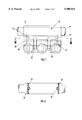
  • FIG. 2 is a plan view of the rocking lever of the arrangement shown in FIG. 1,
  • FIG. 3 is a sectional view of the arrangement shown in FIG. 1, in section through an actuating device,
  • FIG. 4 is a view in cross-section through the arrangement shown in FIG. 1 with the actuating device in section,
  • FIG. 5 is a plan view of an embodiment of a rocking lever which is modified in comparison with FIG. 1,
  • FIG. 6 is a view in section similarly to FIG. 4 of a modified embodiment
  • FIG. 7 is a plan view similarly to FIG. 2 of a modified embodiment.
  • FIG. 8 is a sectional view of the embodiment of FIG. 7, in section taken along the plane VII--VII therein.
  • the valve clearance compensating element 16 is composed of a sleeve 18 accommodated in a through bore 20 in the rocking lever 12, and a thrust member or tappet 22.
  • the thrust member 22 bears with its spherical end surface against the stem of the valve 4.
  • a notch-like opening 28 Provided in the outside surface of the sleeve 18, corresponding to the part-circular-cylinder cross-section of the coupling shaft 24, is a notch-like opening 28 whose cross-section approximately corresponds to the cross-section, extending thereinto, of the coupling shaft 24.
  • That coupling condition as between the sleeve 18 and the rocking lever 12 can be released by the coupling shaft 24 being rotated out of the illustrated position in the clockwise direction in such a way that its cross-section 26 comes free from the opening 28.
  • a roller 30 which is mounted on the coupling shaft 24 is provided for actuation of the rocking lever 12 by means of the cam 8.
  • FIG. 2 showing a plan view of the rocking lever 12 shown in FIG. 1.
  • the rocking lever 12 which is mounted on the shaft 14 has three arms 32 with bores 20 in which the sleeves 18 of the valve clearance compensating elements 16 are guided.
  • the spherical end surfaces with which the sleeves 18 bear in given phases of operation against the corresponding cylindrical base circle portions 10 (FIG. 1) or base circle surfaces of the camshaft are shown in the form of rectangles in the view in FIG. 2.
  • Those spherical end surfaces could also be of a circularly symmetrical configuration if the opening as indicated at 28 in FIG. 1 extends around the entire periphery of the respective sleeve 18 and the sleeve 18 can therefore rotate within the respective bore 20.
  • the coupling shaft 24 is biased in the direction of rotation in the clockwise direction by applying a hydraulic pressure to the piston or plunger component 48.
  • the coupling shaft 24 rotates out of the opening 28 so that the engagement between the sleeve 18 and the rocking lever 12 is released and the valve clearance compensating element 16 is displaceable relative to the rocking lever 12.
  • the valve clearance compensating element 16 Independently of the respective position of the rocking lever 12 the valve clearance compensating element 16 remains in contact between the valve 4 and the cylindrical base circle or base surface 10 of the camshaft 6. The valve 4 is stopped.
  • the space or chamber beneath the piston or plunger component 48 is rendered pressure-less so that the coupling shaft 24 is biased into its engagement condition and rotates into that engagement condition as soon as the opening 28 as shown in FIG. 1 moves for example from below upwardly past the coupling shaft 24 and the cross-sectional portion 26 of the coupling shaft 24 passes with a snapping or latching action into the opening 28, by suitable rotary movement of the coupling shaft 24.
  • the cross-sectional portion 26 of the coupling shaft 24 relative to the cross-section of the opening 28, such latching or snapping engagement may already occur just before the rocking lever 12 reaches the uppermost rotational position. Linear contact with reliable compensation in respect of any tolerances can be achieved by virtue of the fact that the co-operating cross-sections are of slightly different configurations.
  • valve clearance compensating element can be replaced as the actuating member for the valve by a simple thrust member or tappet or can itself be mounted pivotably on the rocking lever, in which case the rocking movement can be blocked by means of a coupling component.
  • Actuation of the coupling component in the illustrated embodiment being the coupling shaft, can be effected electrically, pneumatically or in some other fashion.
  • the arrangement may have respective specific coupling shafts for the three arms of the rocking lever shown in FIG. 2 and coupling of the valve clearance compensating elements disposed therein, so that the valves can be individually taken out of operation.
  • the cross-section of the coupling shaft which engages into the opening can be of widely differing configurations, and so forth.
  • roller or rollers 30 are not mounted on the coupling shaft 24 but on the bushing 60.
  • FIGS. 7 and 8 show an embodiment of the rocking lever which is modified in comparison with FIG. 2, without illustrating the actuating device for the coupling shaft 24.
  • a mounting region 70 of the rocking lever 12, which region is mounted on the shaft 14 or a mounting tube which is fixed with respect to the engine casing is connected by way of two arms 72 to an actuating region 74 of the rocking lever 12 which carries the bush 60 (FIG. 6), the coupling shaft 24 mounted therein and the rollers 30 mounted on the bush 60.
  • the cross-section of the arms 72 which are provided with oil supply ducts 78 is generally in the shape of a plate with the width of the plate which extends parallel to the mounting axes being markedly less than the height of the plate which extends perpendicularly to the mounting axes, whereby the arms 72 can twist or flex in the form of leaf springs, but the actuating region 74 is at the same time held flexurally stiff about an axis which is parallel to the mounting axes.
  • That cross-sectional configuration of the arms 72 is an example of the way in which a low moment of inertia for the arms is achieved, perpendicularly to the mounting axis.
  • the actuating region 74 is additionally deformable by virtue of the incisions of openings therein which are required for the rollers 30 so that uniform and reliable co-operation between the associated cams (not shown) and the rollers 30 or reliable and well-defined actuation of the three valves (not shown) by means of deflection of the two rollers 30 is produced even if the system has tolerance therein.
  • FIG. 6 relating to a torsionally soft structure for the rocking lever 12 can be used in combination with the features of FIGS. 7 and 8 or on their own.
  • the coupling shaft directly forms the coupling between the rocking lever and the valve or valves insofar as, in one position thereof, it comes into engagement with the end surface of the valve stem, while in its other position it is free of such engagement.
  • the entire sleeve with the thrust member may be omitted.
  • the rotatable coupling shaft which in this case at the same time forms the actuating member can also be replaced by a linearly movable component.

Landscapes

  • Engineering & Computer Science (AREA)
  • Mechanical Engineering (AREA)
  • General Engineering & Computer Science (AREA)
  • Valve Device For Special Equipments (AREA)
  • Valve-Gear Or Valve Arrangements (AREA)

Abstract

An arrangement for interrupting the flow of force between a camshaft and a valve in the valve gear of an internal combustion piston engine comprises a camshaft with a cam, a rocking lever which is mounted fixedly with respect to the engine casing and the rocking movement of which is actuated by the cam and an actuating member mounted on the rocking lever and guided on the rocking lever movably relative thereto, for actuation of the valve. A movable coupling member is mounted on the rocking lever and is movable by means of an actuating device into a first position in which for actuation of the valve it provides a rigid connection between the rocking lever and the actuating member and into a second position in which the actuating member is movable relative to the rocking lever so that actuation of the valve is interrupted.

Description

FIELD OF THE INVENTION
The invention concerns an arrangement for interrupting the flow of force between a camshaft and a valve.
BACKGROUND OF THE INVENTION
A possible way of reducing the level of fuel consumption of internal combustion piston engines used in particular in private motor vehicles involves temporarily taking individual cylinders out of operation so that the remaining cylinders operate in the part-load range under an increased mean pressure and thus involve a lower level of specific consumption. For taking the cylinders out of operation, it is not only necessary to interrupt the feed of fuel thereto, but desirably the charge flow through the corresponding cylinders is also interrupted. To achieve that it is advantageous to stop operation of at least the inlet valves of the corresponding cylinders.
An arrangement for interrupting the flow of force from a camshaft to a valve is described in WO 95/02116. That arrangement has a rocking lever which is overall of a two-part structure, wherein its first part is actuated by the camshaft or camshafts and the second part which is mounted coaxially with the first part and which serves to actuate the valve can be coupled to the first part by way of a pin which is linearly slidably guided in the first part and which can be brought into engagement with or brought out of engagement with the second part of the rocking lever, by means of an actuating device which for example operates hydraulically. That thus provides for selective interruption of activation of the valve. A particularity of that arrangement is that, because of the coaxial mounting of the two-part actuating member, the arrangement is comparatively bulky.
SUMMARY OF THE INVENTION
The object of the present invention is to provide an arrangement for interrupting the flow of force between a camshaft and a valve, for example in the valve gear of an internal combustion piston engine, which is of a compact construction while affording a high level of operational reliability and simplicity of structure.
A further object of the present invention is to provide an arrangement for selectively and controlledly interrupting the actuation of a valve in an internal combustion piston engine, which affords precise and efficient control of selective interruption of valve actuation.
In accordance with the invention the foregoing and other objects are attained by an arrangement for interrupting the flow of force between a camshaft and a valve, for example in the valve gear of an internal combustion piston engine, comprising a camshaft having a cam, and a rocking lever mounted pivotably about an axis fixed relative to the engine and movable by the cam. An actuating member is carried by the rocking lever and is guided thereon movably relative thereto. A movable coupling member is mounted in the rocking lever movably by an actuating device between a first position of providing a rigid connection between the rocking lever and the actuating member and a second position in which the actuating member is movable relative to the rocking lever so that actuation of the valve is interrupted.
Because the actuating member is mounted directly to the rocking lever and is guided thereon movably relative to the rocking lever, the invention permits the arrangement to be of an extremely compact structure, and the arrangement takes up only immaterially more space than a conventional valve gear which includes a rocking lever (pull lever or rocker arm).
In a preferred arrangement the actuating member is guided for linear movement in the rocking lever and has an opening in its peripheral surface and the coupling member is a coupling shaft which is mounted rotatably in the rocking lever and which in the region of its engagement with the actuating element has a cross-section such that in the first position it engages into the opening provided in the peripheral surface of the actuating member and in the second position it is free from said engagement. That provides a simple mechanism involving low pressures in relation to surface area and thus a high level of durability.
A preferred form of that arrangement provides that the coupling shaft has a part-cylindrical peripheral surface with an end region towards said valve and in the first position said end region of the part-cylindrical peripheral surface bears against a corresponding surface of said opening. This can ensure surface contact between the coupling shaft and the actuating member.
In a further preferred embodiment the arrangement includes means for constantly urging the rocking lever into contact against the cam, and also a biasing means for constantly urging the coupling member into its first position, wherein the actuating device upon actuation thereof urges the coupling member into the second position, overcoming the force of the biasing means. That has the further advantage that coupling or decoupling as between the actuating member and the rocking lever occurs outside the rest or closed position of the valve, which involves a particularly high level of operational reliability. The design configuration is further such that, in the event of failure of the actuating device for the coupling member, actuation of the valve is reliably ensured, by way of the camshaft.
The actuating member may be a hydraulic valve clearance compensating element which in the closed condition of the valve is supported between the valve and a cylindrical base circle of the camshaft. In that way a valve clearance compensating element is integrated into the arrangement, without requiring additional space.
A further preferred arrangement according to the invention is one in which the coupling member is a coupling shaft mounted substantially parallel to the camshaft and to the pivot axis of the rocking lever, and including mounted on the coupling shaft at least one roller which follows the cam, giving a particularly compact embodiment of the arrangement according to the invention.
In an arrangement which provides well-defined rotatability of the coupling shaft, the arrangement includes a bush or bushing arranged in the rocking lever substantially parallel to the camshaft and to the pivot axis of the rocking lever for mounting the coupling shaft forming the coupling member and at least one roller carried by the bush or bushing and co-operating with the cam.
In an embodiment of the apparatus according to the invention which is suitable in particular for cylinders with more than two charge change valves, the rocking lever includes a plurality of actuating members which are guided in the rocking lever and which are each associated with a respective valve, a common coupling shaft being provided for coupling of the actuating members to the rocking lever. That arrangement may include a plurality of rollers co-operable with respectively associated cams of the camshaft.
In a preferred feature of the invention in the region of its mounting in fixed relationship with respect to the engine casing the rocking lever has a longitudinal slot extending along its longitudinal axis, while in another preferred arrangement the rocking lever includes a mounting region which forms the mounting for the rocking lever in fixed relationship with the engine casing, an actuating region which includes at least two rollers, the coupling shaft and at least two actuating members, and arm means connecting the mounting region and the actuating region, the cross-section of the arm means being such that the arm means have a low moment of inertia perpendicularly to the mounting axis. These features provide that, when there are a plurality of rollers disposed on the rocking lever for following respectively associated cams, tolerances are compensated and the arrangement according to the invention operates in a well-defined manner.
Further objects, features and advantages of the invention will be described with reference to preferred embodiments.
BRIEF DESCRIPTION OF THE DRAWING
FIG. 1 is a sectional view of an arrangement according to the invention, in section through an actuating member,
FIG. 2 is a plan view of the rocking lever of the arrangement shown in FIG. 1,
FIG. 3 is a sectional view of the arrangement shown in FIG. 1, in section through an actuating device,
FIG. 4 is a view in cross-section through the arrangement shown in FIG. 1 with the actuating device in section,
FIG. 5 is a plan view of an embodiment of a rocking lever which is modified in comparison with FIG. 1,
FIG. 6 is a view in section similarly to FIG. 4 of a modified embodiment,
FIG. 7 is a plan view similarly to FIG. 2 of a modified embodiment, and
FIG. 8 is a sectional view of the embodiment of FIG. 7, in section taken along the plane VII--VII therein.
DESCRIPTION OF PREFERRED EMBODIMENTS
Referring to FIG. 1 the arrangement according to the invention includes a valve 4 which is provided with a return spring 2 and the valve stem of which is visible in the drawing, a camshaft 6 which has at least one cam 8 and at least one cylindrical base circle portion 10, and a rocking lever 12 which is mounted pivotably about a pivot axis which is fixed with respect to the engine casing on a shaft 14. Accommodated in the end region of the rocking lever 12, which is remote from the shaft 14, is an actuating member in the form of a valve clearance compensating member or element 16 which is known per se in terms of its design configuration and structure and which for example operates hydraulically.
The rocking lever 12 is biased in the counter-clockwise direction for a rocking movement as shown in FIG. 1, by a return spring 17.
The valve clearance compensating element 16 is composed of a sleeve 18 accommodated in a through bore 20 in the rocking lever 12, and a thrust member or tappet 22. The thrust member 22 bears with its spherical end surface against the stem of the valve 4.
Mounted in the rocking lever 12 substantially parallel to the axis of the shaft 14 is a coupling member in the form of a coupling shaft 24 which can be reciprocated with a rotary movement through an angular range by means of an actuating device that is to be described hereinafter, and which provides for coupling or decoupling as between the sleeve 18 and the rocking lever 12. An oil supply passage 25 is provided for the coupling shaft 24. In the region of the sleeve 18, the coupling shaft 24 is not of a fully circular-cylindrical cross-section but has a part-circular-cylindrical cross-section as indicated at 26, in the illustrated example being of an approximately semicircular cross-section. Provided in the outside surface of the sleeve 18, corresponding to the part-circular-cylinder cross-section of the coupling shaft 24, is a notch-like opening 28 whose cross-section approximately corresponds to the cross-section, extending thereinto, of the coupling shaft 24.
In the position illustrated there is a positively locking and rigid engagement between the coupling shaft 24 and the sleeve 18 and thus a force-locking connection between the rocking lever 12 and the valve 4, which connection opens the valve 4 upon pivotal movement of the rocking lever in the clockwise direction.
That coupling condition as between the sleeve 18 and the rocking lever 12 can be released by the coupling shaft 24 being rotated out of the illustrated position in the clockwise direction in such a way that its cross-section 26 comes free from the opening 28.
A roller 30 which is mounted on the coupling shaft 24 is provided for actuation of the rocking lever 12 by means of the cam 8.
Reference will now be made to FIG. 2 showing a plan view of the rocking lever 12 shown in FIG. 1.
The rocking lever 12 which is mounted on the shaft 14 has three arms 32 with bores 20 in which the sleeves 18 of the valve clearance compensating elements 16 are guided. The spherical end surfaces with which the sleeves 18 bear in given phases of operation against the corresponding cylindrical base circle portions 10 (FIG. 1) or base circle surfaces of the camshaft are shown in the form of rectangles in the view in FIG. 2. Those spherical end surfaces could also be of a circularly symmetrical configuration if the opening as indicated at 28 in FIG. 1 extends around the entire periphery of the respective sleeve 18 and the sleeve 18 can therefore rotate within the respective bore 20.
Extending through all three arms 32 is the coupling shaft 24 so that the three sleeves 18 can be simultaneously coupled to or uncoupled from the rocking lever 12. Left free between the arms 32 are openings in which are arranged the rollers 30 which are mounted on the coupling shaft 24 and which, for actuation of the rocking lever 12, co-operate with cams 8 associated therewith on the camshaft 6. For actuation of the coupling shaft 24, an actuating device 36 is integrated into the end region of the actuating rocking lever 12, being the end region which is at the left in FIG. 2. The structure of the actuating device 36 will be described hereinafter with reference to FIG. 3.
The coupling shaft 24 is non-rotatably connected to a lever 40 which projects with a pin 42 into a bore 44 provided in the rocking lever 12. The pin 42 is held in the bore 44 between two piston or plunger components 46 and 48 which are urged towards each other by springs 50 and 52 into a central rest position in which the rotational position of the coupling shaft 24 is such that the structure is in the engagement condition shown in FIG. 1. For rotation of the coupling shaft 24 into the disengagement condition, the space or chamber beneath the piston or plunger component 48 can be supplied with hydraulic pressure so that the force of the spring 50 is overcome and the coupling shaft 24 is moved in the clockwise direction into the disengagement condition. In the hydraulic pressure-less state, the coupling shaft 24 is automatically urged back into its engagement condition.
Referring now also to FIG. 3, the mode of operation of the described arrangement is as follows:
In the closed condition of the valve 4 the roller 30 bears against the base circle portion 10 of the cam 8 and any valve clearance is compensated by virtue of the fact that the spherical end surface of the thrust member 22 bears against the end of the stem of the valve 4, in which case the coupling shaft 24 is for example in its engagement condition. When the camshaft 6 rotates, the rocking lever 12 is pivoted by way of the engagement between the roller 30 and the cam 8, in which case the valve 4 is actuated in accordance with the position of the camshaft 6, by virtue of the positively locking engagement between the coupling shaft 24 and the sleeve 18.
If the valve 4 is to be stopped, the coupling shaft 24 is biased in the direction of rotation in the clockwise direction by applying a hydraulic pressure to the piston or plunger component 48. As soon as the frictional moment between the coupling shaft 24 and the opening 28 is sufficiently low, that in to say for example just before complete closure of the valve 4, the coupling shaft 24 rotates out of the opening 28 so that the engagement between the sleeve 18 and the rocking lever 12 is released and the valve clearance compensating element 16 is displaceable relative to the rocking lever 12. Independently of the respective position of the rocking lever 12 the valve clearance compensating element 16 remains in contact between the valve 4 and the cylindrical base circle or base surface 10 of the camshaft 6. The valve 4 is stopped.
If the valve 4 is to be brought back into operation, the space or chamber beneath the piston or plunger component 48 is rendered pressure-less so that the coupling shaft 24 is biased into its engagement condition and rotates into that engagement condition as soon as the opening 28 as shown in FIG. 1 moves for example from below upwardly past the coupling shaft 24 and the cross-sectional portion 26 of the coupling shaft 24 passes with a snapping or latching action into the opening 28, by suitable rotary movement of the coupling shaft 24. Depending on the configuration of the cross-sectional portion 26 of the coupling shaft 24 relative to the cross-section of the opening 28, such latching or snapping engagement may already occur just before the rocking lever 12 reaches the uppermost rotational position. Linear contact with reliable compensation in respect of any tolerances can be achieved by virtue of the fact that the co-operating cross-sections are of slightly different configurations.
The above-outlined mechanism ensures an extremely high level of operational reliability with long durability. Coupling as between the rocking lever 12 and the sleeve 18 can already be attained before attainment of the rest condition (on the base circle of the cam), which is advantageous in regard to any tolerances and clearances.
It will be appreciated that numerous modifications may be made in the specific embodiment of the arrangement according to the invention, as just described above. Thus for example the valve clearance compensating element can be replaced as the actuating member for the valve by a simple thrust member or tappet or can itself be mounted pivotably on the rocking lever, in which case the rocking movement can be blocked by means of a coupling component. Actuation of the coupling component, in the illustrated embodiment being the coupling shaft, can be effected electrically, pneumatically or in some other fashion. The arrangement may have respective specific coupling shafts for the three arms of the rocking lever shown in FIG. 2 and coupling of the valve clearance compensating elements disposed therein, so that the valves can be individually taken out of operation. The cross-section of the coupling shaft which engages into the opening can be of widely differing configurations, and so forth.
Reference will now be made to FIG. 4 showing an embodiment of the arrangement which has been altered in relation to the configuration shown in FIG. 1 insofar as the return spring 2 for the valve 4 and the return spring 17 for the rocking lever 12 are arranged in mutually concentric relationship, which is advantageous if the arrangement does not use a multi-arm rocking lever, if for example there is only one valve. The support plate or collet of the return spring 17 bears directly against a spherical projection of suitable configuration on the rocking lever 12, through which the thrust member of the valve clearance compensating element 16 can move.
FIG. 5 shows an embodiment which has been modified in comparison with FIG. 2 of a rocking lever 12 having only two arms 32 and a roller 30, as is used for example for simultaneously stopping two inlet valves.
FIG. 6 shows a construction which is modified in two respects in comparison with FIG. 4. On the one hand the coupling shaft 24 is not mounted directly in the rocking lever 12, but with the interposition of a bushing 60. The bushing 60 is recessed in the region thereof beside the sleeve 18 in such a way that the cross-sectional portion 26 of the coupling shaft 24 can engage into the sleeve 18, as described above with reference to FIG. 1.
The roller or rollers 30 (see FIG. 2) are not mounted on the coupling shaft 24 but on the bushing 60.
The bushing 60 provides that the force from the cam 8 or the roller 30 is not transmitted to the rocking lever 12 by way of the coupling shaft 24 but by way of the bushing 60 so that, for actuation thereof or for rotation thereof into a condition of engagement with the sleeve 18, the coupling shaft 24 remains free of the forces acting from the cam 8, and is thus easily rotatable.
A further alteration in the structure shown in FIG. 6 in comparison with the embodiment shown in FIG. 4 is that the rocking lever 12 is provided with a longitudinal slot 64 in the region 62 where the rocking lever 12 is mounted on the shaft 14, in fixed relationship with respect to the engine casing. The longitudinal slot 64 provides that if necessary the rocking lever 12 can twist in itself if, as shown in FIG. 2, it is designed to compensate for tolerances when the rollers 30 are actuated by cams associated therewith and in that situation different motive forces occur.
FIGS. 7 and 8 show an embodiment of the rocking lever which is modified in comparison with FIG. 2, without illustrating the actuating device for the coupling shaft 24.
A mounting region 70 of the rocking lever 12, which region is mounted on the shaft 14 or a mounting tube which is fixed with respect to the engine casing is connected by way of two arms 72 to an actuating region 74 of the rocking lever 12 which carries the bush 60 (FIG. 6), the coupling shaft 24 mounted therein and the rollers 30 mounted on the bush 60.
As can be seen from FIG. 8 the cross-section of the arms 72 which are provided with oil supply ducts 78 is generally in the shape of a plate with the width of the plate which extends parallel to the mounting axes being markedly less than the height of the plate which extends perpendicularly to the mounting axes, whereby the arms 72 can twist or flex in the form of leaf springs, but the actuating region 74 is at the same time held flexurally stiff about an axis which is parallel to the mounting axes. That cross-sectional configuration of the arms 72 is an example of the way in which a low moment of inertia for the arms is achieved, perpendicularly to the mounting axis. The actuating region 74 is additionally deformable by virtue of the incisions of openings therein which are required for the rollers 30 so that uniform and reliable co-operation between the associated cams (not shown) and the rollers 30 or reliable and well-defined actuation of the three valves (not shown) by means of deflection of the two rollers 30 is produced even if the system has tolerance therein.
The features shown in FIG. 6 relating to a torsionally soft structure for the rocking lever 12 can be used in combination with the features of FIGS. 7 and 8 or on their own.
In a further considerably simplified embodiment (not shown) of the described arrangement the coupling shaft directly forms the coupling between the rocking lever and the valve or valves insofar as, in one position thereof, it comes into engagement with the end surface of the valve stem, while in its other position it is free of such engagement. In that embodiment, the entire sleeve with the thrust member may be omitted. It will be appreciated that the rotatable coupling shaft which in this case at the same time forms the actuating member can also be replaced by a linearly movable component.
It will be appreciated that the above-described embodiments of the invention have been set forth solely by way of example and illustration of the principles of the invention and that various other modifications and alterations may be made therein without thereby departing from the scope of the invention.

Claims (15)

What is claimed is:
1. An arrangement for interrupting the flow of force between a camshaft and a valve, said arrangement comprising:
a camshaft with a cam;
a rocking lever;
means for mounting a first end of said rocking lever so as to pivot about a pivot axis, fixed relative to the engine, upon actuation by said cam;
an actuating member supported in said rocking lever and moveably guided relative to said rocking lever, said actuating member actuating a valve;
a movable coupling member mounted on said rocking lever;
said coupling member movable into a first position, in which said coupling member provides a rigid connection between said rocking lever and said actuating member for actuating the valve, and into a second position, in which said actuating member is movable relative to said rocking lever so that actuation of the valve is interrupted;
an actuating device for moving said coupling member between said first and second position;
said actuating member linearly guided in said rocking lever and having a peripheral surface provided with an opening:
said coupling member being a coupling shaft;
said coupling shaft rotatably mounted in said rocking lever;
said coupling member having a cross-sectional portion in a region of engagement of said actuating member being rotated into said first position for engagement of said opening of said actuating member and rotated to said second position for disengagement with said opening of said actuating member.
2. An arrangement according to claim 1 wherein:
said coupling shaft has a non-circular peripheral surface having one end region facing the valve; and
in said first position said end region of said part-cylindrical peripheral surface bears against a support surface of said opening.
3. An arrangement according to claim 1, including a first biasing means for constantly forcing said rocking lever into contact against said cam and a second biasing means for constantly forcing said coupling member into said first position, wherein said actuating device, when actuated, forces said coupling member into said second position by overcoming a force of said second biasing means.
4. An arrangement according to claim 1, wherein said actuating member is a hydraulic valve clearance compensating element which, in a closed position of the valve, is supported between the valve and a cylindrical base circle of said camshaft.
5. An arrangement according to claim 1, further comprising at least one roller mounted on said coupling member and following said cam, wherein said coupling member is a coupling shaft mounted substantially parallel to said camshaft and parallel to the pivot axis of said rocking lever.
6. An arrangement according to claim 5, wherein said rocking lever includes a plurality of said actuating members guided in said rocking lever and each associated with a respective valve, wherein said coupling member is a coupling shaft coupling all of said actuating members to said rocking lever.
7. An arrangement according to claim 6, including a plurality of said rollers, wherein said camshaft has a plurality of said cams, and wherein said rollers co-operate with respectively associated ones of said cams.
8. An arrangement according to claim 7, wherein said first end of said rocking lever has a longitudinal slot extending along a longitudinal axis thereof.
9. An arrangement according to claim 7, wherein said rocking lever has a second end, where at least two of said rollers, said coupling shaft and at least two of said actuating members are positioned, and arm means connecting said first end and said second end, wherein said arm means have a cross section providing a low moment of inertia perpendicular to said pivot axis.
10. An arrangement according to claim 1, including:
a bushing mounted in said rocking lever substantially parallel to said camshaft and to the pivot axis of said rocking lever, wherein said coupling member is a coupling shaft mounted in said bushing; and
at least one roller supported by said bushing and co-operating with said cam.
11. An arrangement according to claim 10, wherein said rocking lever includes a plurality of said actuating members guided in said rocking lever and each associated with a respective valve, wherein said coupling member is a coupling shaft coupling all of said actuating members to said rocking lever.
12. An arrangement according to claim 11, including a plurality of said rollers, wherein said camshaft has a plurality of said cams, and wherein said rollers co-operate with respectively associated ones of said cams.
13. An arrangement according to claim 12, wherein said first end of said rocking lever has a longitudinal slot extending along a longitudinal axis thereof.
14. An arrangement according to claim 12, wherein said rocking lever has a second end, where at least two of said rollers, said coupling shaft and at least two of said actuating members are positioned, and arm means connecting said first end and said second end, wherein said arm means have a cross section providing a low moment of inertia perpendicular to said pivot axis.
15. An internal combustion engine including a valve; a camshaft with a cam for actuating the valve; and an arrangement for interrupting the flow of actuating force between the camshaft and the valve, said arrangement comprising:
a rocking lever;
means for mounting a first end of said rocking lever so as to pivot about a pivot axis, fixed relative to the engine, upon actuation by said cam;
an actuating member supported in said rocking lever and moveably guided relative to said rocking lever, said actuating member actuating a valve;
a movable coupling member mounted on said rocking lever;
said coupling member movable into a first position, in which said coupling member provides a rigid connection between said rocking lever and said actuating member for actuating the valve, and into a second position, in which said actuating member is movable relative to said rocking lever so that actuation of the valve is interrupted;
an actuating device for moving said coupling member between said first and second positions;
said actuating member linearly guided in said rocking lever and has a peripheral surface provided with an opening;
said coupling member being a coupling shaft;
said coupling shaft rotatably mounted in said rocking lever;
said coupling member having a cross-sectional portion in a region of engagement of said actuating member being rotated into said first position for engagement of said opening of said actuating member and rotated to said second position for disengagement with said opening of said actuating member.
US08/887,562 1996-07-06 1997-07-03 Arrangement for interrupting the flow of force between a camshaft and a valve Expired - Fee Related US5908015A (en)

Applications Claiming Priority (4)

Application Number Priority Date Filing Date Title
DE19627390 1996-07-06
DE19630309A DE19630309C2 (en) 1996-07-06 1996-07-26 Device for interrupting the flow of power between a camshaft and at least one valve
DE19630309 1996-07-26

Publications (1)

Publication Number Publication Date
US5908015A true US5908015A (en) 1999-06-01

Family

ID=26027293

Family Applications (1)

Application Number Title Priority Date Filing Date
US08/887,562 Expired - Fee Related US5908015A (en) 1996-07-06 1997-07-03 Arrangement for interrupting the flow of force between a camshaft and a valve

Country Status (2)

Country Link
US (1) US5908015A (en)
JP (1) JPH10115206A (en)

Cited By (17)

* Cited by examiner, † Cited by third party
Publication number Priority date Publication date Assignee Title
US6092497A (en) * 1997-10-30 2000-07-25 Eaton Corporation Electromechanical latching rocker arm valve deactivator
US6418904B2 (en) 2000-04-03 2002-07-16 Daimlerchrysler Corporation Pulse drive valve deactivator
US6418898B2 (en) * 1999-12-27 2002-07-16 Honda Giken Kogyo Kabushiki Valve operating system in internal combustion engine
US6431135B2 (en) * 1999-12-27 2002-08-13 Honda Giken Kogyo Kabushiki Kaisha Valve operating system in internal combustion engine
EP1113149A3 (en) * 1999-12-27 2002-08-28 Honda Giken Kogyo Kabushiki Kaisha Valve operating system in internal combustion engine
US20030213447A1 (en) * 2002-05-14 2003-11-20 Bloms Jason Kenneth Engine valve actuation system and method
EP1221541A3 (en) * 2001-01-05 2004-07-21 Delphi Technologies, Inc. Valve deactivation system
US20040177820A1 (en) * 2003-03-13 2004-09-16 Peter Kreuter Valve-actuating devices for internal combustion engines having changeable stroke functions
US20040244751A1 (en) * 2003-06-03 2004-12-09 Falkowski Alan G. Deactivating valve lifter
US20040244744A1 (en) * 2003-06-03 2004-12-09 Falkowski Alan G. Multiple displacement system for an engine
US6871622B2 (en) 2002-10-18 2005-03-29 Maclean-Fogg Company Leakdown plunger
US7028654B2 (en) 2002-10-18 2006-04-18 The Maclean-Fogg Company Metering socket
US7128034B2 (en) 2002-10-18 2006-10-31 Maclean-Fogg Company Valve lifter body
US7191745B2 (en) 2002-10-18 2007-03-20 Maclean-Fogg Company Valve operating assembly
US7273026B2 (en) 2002-10-18 2007-09-25 Maclean-Fogg Company Roller follower body
FR2989427A1 (en) * 2012-04-11 2013-10-18 Valeo Sys Controle Moteur Sas System for actuating valve of combustion engine, has rod locking abutment in receiving direction on solid portion of rod, and in another angular position of rod, where rod unlatches abutment by receiving rod in one of recesses
CN106762013A (en) * 2016-12-30 2017-05-31 中国第汽车股份有限公司 A kind of gear rod engine brake mechanism

Families Citing this family (1)

* Cited by examiner, † Cited by third party
Publication number Priority date Publication date Assignee Title
DE10316189A1 (en) * 2003-04-09 2004-10-28 Ina-Schaeffler Kg Tow lever for a combustion engine valve drive has outer and inner levers connected through an axle across the inner lever

Citations (13)

* Cited by examiner, † Cited by third party
Publication number Priority date Publication date Assignee Title
JPS5512206A (en) * 1978-07-12 1980-01-28 Mitsubishi Motors Corp Internal combustion engine
US4607600A (en) * 1984-12-25 1986-08-26 Toyota Jidosha Kabushiki Kaisha Valve actuating apparatus in internal combustion engine
JPS61201807A (en) * 1985-03-04 1986-09-06 Honda Motor Co Ltd Valve pause device of internal-combustion engine
US4768475A (en) * 1986-02-28 1988-09-06 Fuji Jukogyo Kabushiki Kaisha Valve mechanism for an automotive engine
US4768467A (en) * 1986-01-23 1988-09-06 Fuji Jukogyo Kabushiki Kaisha Valve operating system for an automotive engine
DE4235626A1 (en) * 1992-10-22 1994-04-28 Iav Motor Gmbh Valve drive with alternating cams for gas exchange valves - has second U=shaped transfer lever and tappet, for large active lift
WO1995002116A1 (en) * 1993-07-06 1995-01-19 Meta Motoren- Und Energie-Technik Gmbh Variable control process and device for an internal combustion engine valve
US5495831A (en) * 1992-02-21 1996-03-05 Audi Ag Valve actuating mechanism for an internal combustion engine
US5513602A (en) * 1992-07-16 1996-05-07 Audi Ag Valve-actuating mechanism
US5544628A (en) * 1994-07-06 1996-08-13 Volkswagen Ag Valve control arrangement for an internal combustion engine
US5660153A (en) * 1995-03-28 1997-08-26 Eaton Corporation Valve control system
US5669342A (en) * 1994-04-14 1997-09-23 Ina Walzlager Schaeffler Kg Device for simultaneous actuation of at least two gas exchange valves
US5680835A (en) * 1993-08-05 1997-10-28 Bayerische Motoren Werke Aktiengesellschaft Rocker assembly with interconnectable arms

Patent Citations (13)

* Cited by examiner, † Cited by third party
Publication number Priority date Publication date Assignee Title
JPS5512206A (en) * 1978-07-12 1980-01-28 Mitsubishi Motors Corp Internal combustion engine
US4607600A (en) * 1984-12-25 1986-08-26 Toyota Jidosha Kabushiki Kaisha Valve actuating apparatus in internal combustion engine
JPS61201807A (en) * 1985-03-04 1986-09-06 Honda Motor Co Ltd Valve pause device of internal-combustion engine
US4768467A (en) * 1986-01-23 1988-09-06 Fuji Jukogyo Kabushiki Kaisha Valve operating system for an automotive engine
US4768475A (en) * 1986-02-28 1988-09-06 Fuji Jukogyo Kabushiki Kaisha Valve mechanism for an automotive engine
US5495831A (en) * 1992-02-21 1996-03-05 Audi Ag Valve actuating mechanism for an internal combustion engine
US5513602A (en) * 1992-07-16 1996-05-07 Audi Ag Valve-actuating mechanism
DE4235626A1 (en) * 1992-10-22 1994-04-28 Iav Motor Gmbh Valve drive with alternating cams for gas exchange valves - has second U=shaped transfer lever and tappet, for large active lift
WO1995002116A1 (en) * 1993-07-06 1995-01-19 Meta Motoren- Und Energie-Technik Gmbh Variable control process and device for an internal combustion engine valve
US5680835A (en) * 1993-08-05 1997-10-28 Bayerische Motoren Werke Aktiengesellschaft Rocker assembly with interconnectable arms
US5669342A (en) * 1994-04-14 1997-09-23 Ina Walzlager Schaeffler Kg Device for simultaneous actuation of at least two gas exchange valves
US5544628A (en) * 1994-07-06 1996-08-13 Volkswagen Ag Valve control arrangement for an internal combustion engine
US5660153A (en) * 1995-03-28 1997-08-26 Eaton Corporation Valve control system

Cited By (29)

* Cited by examiner, † Cited by third party
Publication number Priority date Publication date Assignee Title
US6092497A (en) * 1997-10-30 2000-07-25 Eaton Corporation Electromechanical latching rocker arm valve deactivator
US6418898B2 (en) * 1999-12-27 2002-07-16 Honda Giken Kogyo Kabushiki Valve operating system in internal combustion engine
US6431135B2 (en) * 1999-12-27 2002-08-13 Honda Giken Kogyo Kabushiki Kaisha Valve operating system in internal combustion engine
EP1113149A3 (en) * 1999-12-27 2002-08-28 Honda Giken Kogyo Kabushiki Kaisha Valve operating system in internal combustion engine
US6418904B2 (en) 2000-04-03 2002-07-16 Daimlerchrysler Corporation Pulse drive valve deactivator
US6568365B2 (en) 2000-04-03 2003-05-27 Daimlerchrysler Corporation Pulse drive valve deactivator
US6799543B2 (en) 2001-01-05 2004-10-05 Delphi Technologies, Inc. Valve deactivation system with free motion spring
US20050039712A1 (en) * 2001-01-05 2005-02-24 Delphi Technologies, Inc. Valve deactivation system with free motion spring
EP1221541A3 (en) * 2001-01-05 2004-07-21 Delphi Technologies, Inc. Valve deactivation system
US7077082B2 (en) 2002-05-14 2006-07-18 Caterpillar, Inc. System and method for monitoring engine valve actuation
US20030213445A1 (en) * 2002-05-14 2003-11-20 Bloms Jason Kenneth System and method for monitoring engine valve actuation
US6807929B2 (en) * 2002-05-14 2004-10-26 Caterpillar Inc Engine valve actuation system and method
US20030213447A1 (en) * 2002-05-14 2003-11-20 Bloms Jason Kenneth Engine valve actuation system and method
US7063055B2 (en) 2002-05-14 2006-06-20 Caterpillar Inc. Engine valve actuation system and method
US20050051119A1 (en) * 2002-05-14 2005-03-10 Caterpillar Inc. Engine valve actuation system and method
US7128034B2 (en) 2002-10-18 2006-10-31 Maclean-Fogg Company Valve lifter body
US7191745B2 (en) 2002-10-18 2007-03-20 Maclean-Fogg Company Valve operating assembly
US6871622B2 (en) 2002-10-18 2005-03-29 Maclean-Fogg Company Leakdown plunger
US7028654B2 (en) 2002-10-18 2006-04-18 The Maclean-Fogg Company Metering socket
US7284520B2 (en) 2002-10-18 2007-10-23 Maclean-Fogg Company Valve lifter body and method of manufacture
US7281329B2 (en) 2002-10-18 2007-10-16 Maclean-Fogg Company Method for fabricating a roller follower assembly
US7273026B2 (en) 2002-10-18 2007-09-25 Maclean-Fogg Company Roller follower body
US20040177820A1 (en) * 2003-03-13 2004-09-16 Peter Kreuter Valve-actuating devices for internal combustion engines having changeable stroke functions
US6814039B2 (en) 2003-03-13 2004-11-09 Meta Motoren-Und Energie-Technik Gmbh Valve-actuating devices for internal combustion engines having changeable stroke functions
US20040244744A1 (en) * 2003-06-03 2004-12-09 Falkowski Alan G. Multiple displacement system for an engine
US20040244751A1 (en) * 2003-06-03 2004-12-09 Falkowski Alan G. Deactivating valve lifter
US7040265B2 (en) 2003-06-03 2006-05-09 Daimlerchrysler Corporation Multiple displacement system for an engine
FR2989427A1 (en) * 2012-04-11 2013-10-18 Valeo Sys Controle Moteur Sas System for actuating valve of combustion engine, has rod locking abutment in receiving direction on solid portion of rod, and in another angular position of rod, where rod unlatches abutment by receiving rod in one of recesses
CN106762013A (en) * 2016-12-30 2017-05-31 中国第汽车股份有限公司 A kind of gear rod engine brake mechanism

Also Published As

Publication number Publication date
JPH10115206A (en) 1998-05-06

Similar Documents

Publication Publication Date Title
US5908015A (en) Arrangement for interrupting the flow of force between a camshaft and a valve
US5653198A (en) Finger follower rocker arm system
EP3430246B1 (en) A device for controlling at least one valve in an internal combustion engine
US7565887B2 (en) Valve actuation device of internal combustion engine
US20070193543A1 (en) Valve deactivation device
US7591238B2 (en) Variable valve-operating device
GB2141172A (en) Controlling opening of multiple i.c. engine intake and exhaust valves
GB2237326A (en) I.c.engine rocker valve gear
US20070039578A1 (en) Valve train for an internal combustion engine
JP3319896B2 (en) Engine Valve Actuator
US7140333B2 (en) Apparatus for an internal combustion engine
JP3746786B2 (en) Cam mechanism
US8109245B2 (en) Variable valve apparatus
US5456226A (en) Method of minimizing play in a valve operating mechanism
CN219826943U (en) Engine valve driving mechanism
US6832584B2 (en) Valve system for internal combustion engine
JPH06229216A (en) Engine valve actuation
US6131545A (en) Apparatus for switching off a load change valve of an internal combustion engine
US5690067A (en) Arrangement for the operation of valves of internal combustion engine
JPS59168211A (en) Valve gear with shutdown function for internal combustion engines
JP3357411B2 (en) Engine Valve Actuator
JP3354251B2 (en) Valve train for internal combustion engine
JP3365136B2 (en) Variable valve train for internal combustion engine
JPH0218245Y2 (en)
JPH0693820A (en) Valve system for internal combustion engine

Legal Events

Date Code Title Description
AS Assignment

Owner name: META MOTOREN- UND ENERGIE- TECHNIK GMBH, GERMANY

Free format text: ASSIGNMENT OF ASSIGNORS INTEREST;ASSIGNOR:KREUTER, PETER;REEL/FRAME:008935/0871

Effective date: 19971023

FEPP Fee payment procedure

Free format text: PAYOR NUMBER ASSIGNED (ORIGINAL EVENT CODE: ASPN); ENTITY STATUS OF PATENT OWNER: SMALL ENTITY

Free format text: PAYER NUMBER DE-ASSIGNED (ORIGINAL EVENT CODE: RMPN); ENTITY STATUS OF PATENT OWNER: SMALL ENTITY

FPAY Fee payment

Year of fee payment: 4

REMI Maintenance fee reminder mailed
LAPS Lapse for failure to pay maintenance fees
STCH Information on status: patent discontinuation

Free format text: PATENT EXPIRED DUE TO NONPAYMENT OF MAINTENANCE FEES UNDER 37 CFR 1.362

FP Lapsed due to failure to pay maintenance fee

Effective date: 20070601