US5894357A - Color separation optical system - Google Patents
Color separation optical system Download PDFInfo
- Publication number
- US5894357A US5894357A US08/936,534 US93653497A US5894357A US 5894357 A US5894357 A US 5894357A US 93653497 A US93653497 A US 93653497A US 5894357 A US5894357 A US 5894357A
- Authority
- US
- United States
- Prior art keywords
- light
- color
- plate
- birefringence
- phase
- Prior art date
- Legal status (The legal status is an assumption and is not a legal conclusion. Google has not performed a legal analysis and makes no representation as to the accuracy of the status listed.)
- Expired - Fee Related
Links
Images



Classifications
-
- H—ELECTRICITY
- H04—ELECTRIC COMMUNICATION TECHNIQUE
- H04N—PICTORIAL COMMUNICATION, e.g. TELEVISION
- H04N1/00—Scanning, transmission or reproduction of documents or the like, e.g. facsimile transmission; Details thereof
- H04N1/46—Colour picture communication systems
- H04N1/48—Picture signal generators
- H04N1/486—Picture signal generators with separate detectors, each detector being used for one specific colour component
Definitions
- the present invention relates to a color separation optical system loaded in a color image readout apparatus and, more specifically, to a color separation optical system suitable for scanner, facsimile, and the like in particular, which separates, in terms of color, a luminous flux reflected by or transmitted through an object, such as an original with a color image, illuminated with light, and outputs thus separated color light components to imaging means comprising a plurality of line sensors.
- the distance between adjacent lines in a line sensor used in general is about 0.1 mm or less, for example.
- the thickness of a beam splitter becomes on the order of several ten ⁇ m or less. In order to manufacture a beam splitter having such a small thickness, it is difficult to favorably maintain an optical flatness, whereby the line sensor may lower its readout accuracy.
- the color separation optical system in accordance with the present invention is loaded in a color image readout apparatus in which an object is illuminated with light from a light source, the light reflected by or transmitted through the object and subsequently emitted through a slit extending in a predetermined direction is separated in terms of color, and thus separated color light components are respectively caused to form images on linear imaging means corresponding thereto;
- the color separation optical system comprising, successively from the object side, a polarizing plate, a first phase plate, a first birefringence plate, a second phase plate, and a second birefringence plate which are disposed on a common optical axis;
- first phase plate and the first birefringence plate separate linearly polarized light, having a plane of vibration in a predetermined direction, emitted from the polarizing plate into a cyan light component and a yellow light component while isolating optical path positions of thus separated cyan and yellow light components from each other;
- the second phase plate and the second birefringence plate separate the cyan light component emitted from the first birefringence plate into a blue light component and a green light component while isolating optical path positions of thus separated blue and green light components from each other, and separate the yellow light component emitted from the first birefringence plate into a green light component and a red light component while isolating optical path positions of thus separated green and red light components from each other;
- the color image readout apparatus performs sub-scanning by relatively moving the object and the slit with respect to each other in a direction orthogonal to both the direction in which the slit extends and the common optical axis.
- the first phase plate is configured so as to impart between linearly polarized light components orthogonal to each other a first phase difference corresponding to a predetermined wavelength of red light.
- the second phase plate is preferably configured so as to impart between linearly polarized light components orthogonal to each other a second phase difference which is twice as large as the first phase difference.
- first and second birefringence plates are preferably made of an identical material with a substantially identical thickness.
- FIG. 1 is a schematic view showing an example of a color scanner apparatus loaded with a color separation optical system in accordance with the present invention
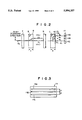
- FIG. 2 is a schematic view showing the color separation optical system in accordance with an embodiment of the present invention.
- FIG. 3 is a front view showing a light receiving means shown in FIG. 2;
- FIG. 4 is a graph showing transmittance characteristics of a first phase plate with respect to two polarized light components orthogonal to each other;
- FIG. 5 is a graph showing transmittance characteristics of a second phase plate with respect to two polarized light components orthogonal to each other.
- FIG. 6 is a graph showing relative spectral characteristics of three color light components emitted from a second birefringence plate.
- FIG. 1 is a schematic view showing an example of a color scanner apparatus using a color separation optical system in accordance with the present invention
- FIGS. 2 and 3 are views for respectively explaining parts of the system.
- the color scanner apparatus irradiates a luminous flux of white light from a light source 2 onto an original 1A including a color image set on the back side of an original glass plate 1; causes a luminous flux 4 carrying color image information reflected by the original 1A to be made incident on a light separation and imaging optical system 5 to 10 through a slit of a slit plate 3; and separates the luminous flux 4 into three color light components of R, G, and B and isolate optical path positions of these three light components from each other by means of the light separation and imaging optical system 5 to 10, so that the three color light components are guided onto and form images respectively on three monochromic line sensors 11A, 11B, and 11C formed on a light receiving means 11.
- the light receiving means 11 is a monolithic three-line sensor in which the three pieces of monochromic line sensors 11A, 11B, and 11C are disposed on a single substrate.
- the color separation and imaging optical system 5 to 10 comprises a polarizing plate 5, an imaging lens 6, a first phase plate 7, a first birefringence plate 8, a second phase plate 9, and a second birefringence plate 10.
- the polarizing plate 7 turns the luminous flux 4 into linearly polarized light
- the imaging lens 6 converges the linearly polarized light.
- the first and second phase plates 7 and 9 disposed within the converged optical path each separate the incident linearly polarized light into two linearly polarized light components (P-polarized light component and S-polarized light component) whose planes of vibration are orthogonal to each other and, while imparting a predetermined phase difference ⁇ therebetween, output the two linearly polarized light components to each of the first and second birefringence plates 8 and 10 respectively disposed downstream thereof within the converged optical path.
- phase difference ⁇ imparted between these two components are adjustable by changing the thickness values of the phase plates 7 and 9 or the like.
- the phase difference ⁇ of the first phase plate 7 is set to 656.25 nm, whereas that of the second phase plate 9 is set to 1,312.5 nm.
- FIGS. 4 and 5 respectively show transmittance characteristics of the first and second phase plate 7 and 9 with respect to each of P-polarized and S-polarized light components in the case where the S-polarized light component is incident thereon.
- the two phase plates 7 and 9 may be made of a plastic sheet or a birefringence crystal, with the latter enabling a higher accuracy in phase difference than with the former. Since the second phase plate 9 has a phase difference twice as large as that of the first phase plate 7, the second phase plate 7 may be constituted by two sheets of first phase plates 7 overlaid on each other with their optic axes aligned.
- phase plates 7 and 9 are disposed so that their optic axis forms an angle of 45 degrees with respect to the main scanning direction.
- the two birefringence plates 8 and 10 respectively disposed downstream thereof are set such that their optic axes are inclined with respect to the optical axis within the plane of incidence by 45 degrees as indicated by arrows B and C.
- an ordinary light beam OL whose plane of vibration aligns with the extending direction of the slit 3 (main scanning direction) within the birefringence plates 8 and 10 are emitted so as to directly advance as it is, whereas an extraordinary light beam EL whose direction of plane of vibration aligns with the sub-scanning direction is emitted as being shifted by a predetermined amount in the sub-scanning direction.
- the birefringence plates 8 and 10 are made of an identical material with an identical thickness, the extraordinary light beam EL yields the same amount of shift with respect to the ordinary light beam OL therein.
- the birefringence plates 8 and 10 may be formed by various kinds of uniaxial crystals such as KDP, ADP, calcite, and quartz.
- a luminous flux 4a carrying color image information which is turned into linearly polarized light (S-polarized light) having a plane of vibration in the slit direction (main scanning direction) by the polarizing plate 5 and then into a convergent luminous flux by the imaging lens 6, is initially separated into P-polarized and S-polarized light components by the first phase plate 7.
- the first phase plate 7 is configured so as to impart a phase difference ⁇ of 656.25 nm between these two components. Accordingly, as shown in FIG.
- phase differences of 1 wavelength, 1 wavelength+1/4 wavelength, and 1 wavelength+1/2 wavelength are imparted between the P-polarized and S-polarized light components with respect to light at wavelengths of 656.25 nm, 525 nm, and 437.5 nm, respectively.
- Its transmittance with respect to the P- polarized light component is 0% at the wavelength of 656.25 nm, 50% at 525 nm, and 100% at 437.5 nm, thereby yielding cyan light (CL) as a whole.
- its transmittance with respect to the S-polarized light component is 100% at 656.25 nm, 50% at 525 nm, and 0% at 437.5 nm, thereby yielding yellow light (YL) as a whole.
- the first phase plate 7 Accordingly emitted from the first phase plate 7 are P-polarized light having a component biased toward cyan light (CL) and S-polarized light having a component biased toward yellow light (YL) which are superposed on each other.
- the S-polarized light component directly advances as an ordinary light beam OL
- the P-polarized light component is refracted in the sub-scanning direction (a direction of arrows A) as an extraordinary light beam EL, whereby they are separated from each other and thereafter advance as luminous fluxes separated from each other by a predetermined distance d.
- the S-polarized light component that is yellow light (YL) has become the ordinary light beam OL
- the P-polarized light component that is cyan light (CL) has become the extraordinary light beam EL. Accordingly, two luminous fluxes of yellow light (YL) and cyan light (CL) are emitted from the first birefringence plate 8.
- phase plate 9 is configured so as to impart a phase difference ⁇ of 1,312.5 nm between the P-polarized and S-polarized light components with respect to each luminous flux incident thereon. Accordingly, as shown in FIG. 5, phase differences of 2 wavelengths, 2 wavelengths+1/2 wavelength, and 3 wavelengths are imparted between the P-polarized and S-polarized light components with respect to light at wavelengths of 656.25 nm, 525 nm, and 437.5 nm, respectively.
- the P-polarized light component Its transmittance with respect to the P-polarized light component is 0% at the wavelength of 656.25 nm, 100% at 525 nm, and 0% at 437.5 nm.
- its transmittance with respect to the S-polarized light component is 100% at 656.25 nm, 0% at 525 nm, and 100% at 437.5 nm.
- the S-polarized light component exhibits such a characteristic in which the curves of P-polarized light shown in FIGS. 4 and 5 are multiplied together, thereby yielding green light (GL) with an amplitude attenuated to about 1/2.
- the P-polarized light component exhibits such a characteristic in which the curve of P-polarized light shown in FIG. 4 and the curve of S-polarized light shown in FIG. 5 are multiplied together, thereby yielding blue light (BL).
- the P-polarized light component exhibits such a characteristic in which the curve of S-polarized light shown in FIG. 4 and the curve of P-polarized light shown in FIG. 5 are multiplied together, thereby yielding green light (GL) with an amplitude attenuated to about 1/2.
- the S- polarized light component exhibits such a characteristic in which the curves of S-polarized light shown in FIGS. 4 and 5 are multiplied together, thereby yielding red light (RL).
- the second phase plate 9 Accordingly emitted from the second phase plate 9 are a luminous flux in which S-polarized light having a green light component (GL) with an amplitude of about 1/2 and P-polarized light having a blue light component (BL) are superposed on each other, and a luminous flux in which P-polarized light having a green light component (GL) with an amplitude of about 1/2 and S-polarized light having a red light component (RL) are superposed on each other.
- S-polarized light having a green light component (GL) with an amplitude of about 1/2 and P-polarized light having a blue light component (BL) are superposed on each other
- P-polarized light having a green light component (GL) with an amplitude of about 1/2 and S-polarized light having a red light component (RL) are superposed on each other.
- the S-polarized light component that is green light (GL) separated from cyan light (CL) becomes an ordinary light beam OL; whereas the P-polarized light component that is blue light (BL) becomes an extraordinary light beam EL.
- the P-polarized light component that is green light (GL) separated from yellow light (YL) becomes an extraordinary light beam EL; whereas the S-polarized light component that is red light (RL) becomes an ordinary light beam OL.
- the distance between the two luminous fluxes 4a incident on the second birefringence plate 10 is equal to the width of separation between the extraordinary light beam EL and the ordinary light beam OL that are isolated from each other within the second birefringence plate 10, whereby the green light component (GL) that is the ordinary light beam OL separated from cyan light (CL) and the green light component (GL) that is the extraordinary light beam (EL) separated from yellow light (YL) are emitted from the same position of the second birefringence plate 10. Since each of these two green light components (GL) is attenuated to about 1/2 in terms of amplitude, green light (GL) is adjusted to its original amplitude when these two light components (GL) are added together as being superposed on each other.
- the second birefringence plate 10 Accordingly emitted from the second birefringence plate 10 are three color light components of BL, GL, and RL as parallel luminous fluxes with intervals of the distance d therebetween.
- the three luminous fluxes respectively formed by the three color light components BL, GL, and RL are made incident on their corresponding monochromic line sensors 11A, 11B, and 11C on the light receiving means 11. As shown in FIG. 3, the distance between the three line sensors 11A, 11B, and 11C is d, coinciding with the distance d between the three luminous fluxes emitted from the second birefringence plate 10.
- FIG. 6 shows relative spectral characteristics of the above-mentioned three luminous fluxes emitted from the second birefringence plate 10 in the case where white light is separated in terms of color by means of the apparatus of the above-mentioned embodiment.
- the three color light components BL, GL, and RL which have securely been separated in terms of color and position, are securely guided to their corresponding line sensors 11A, 11B, and 11C.
- the distance between the line sensors 11A, 11B, and 11C is 10 ⁇ m, for example, it is necessary for the amount of shift d to be 10 ⁇ m, whereby the thickness of each of the birefringence plates 8 and 10 is set to 1.7 mm.
- the color separation optical system in accordance with the present invention may be modified in various manners.
- the positions of polarizing plate and imaging lens may be exchanged, the polarizing plate may transmit P-polarized light therethrough, and additional optical elements such as infrared cut filter may be inserted therein.
- additional optical elements such as infrared cut filter may be inserted therein.
- the birefringence plate a biaxial crystal which separates an incident luminous flux into two extraordinary light beams may be used.
- the amount of shift of extraordinary light beam may not necessarily be the same in the two birefringence plates, two green luminous fluxes are yielded when the amount of shift differs therebetween, thus necessitating four pieces of line sensors in total. In this case, it is necessary for the output values from two line sensors for green light to be added together so as to attain final green light information.
- the color separation optical system in accordance with the present invention is applicable not only to color scanners in a narrow sense but also to various kinds of image readout apparatus having means for optically scanning an object and reading out image information of the object.
- the color separation optical system in accordance with the present invention uses only a polarizing plate, two phase plates, and two birefringence plates so as to separate light carrying color image information into three color components of R, G, and B, and isolate optical path positions of these three light components from each other. Unlike the prior art, since no color filter is used therein, optical efficiency can be greatly improved.
- the individual optical elements are successively disposed on a common optical axis, the assembling process for the optical system can be made easier.
- each line sensor since it is sufficient for each line sensor to be monochromatic, the cost required for imaging means can be reduced.
- two green light components can be positionally superposed on each other at the time of emission, whereby the light beams emitted from the second birefringence plate can be efficiently read out by the three monochromic line sensors.
Landscapes
- Engineering & Computer Science (AREA)
- Multimedia (AREA)
- Signal Processing (AREA)
- Facsimile Heads (AREA)
- Facsimile Scanning Arrangements (AREA)
- Polarising Elements (AREA)
- Color Television Image Signal Generators (AREA)
Applications Claiming Priority (2)
| Application Number | Priority Date | Filing Date | Title |
|---|---|---|---|
| JP29443896A JP3728679B2 (ja) | 1996-10-16 | 1996-10-16 | 色分離光学系装置 |
| JP8-294438 | 1996-10-16 |
Publications (1)
| Publication Number | Publication Date |
|---|---|
| US5894357A true US5894357A (en) | 1999-04-13 |
Family
ID=17807781
Family Applications (1)
| Application Number | Title | Priority Date | Filing Date |
|---|---|---|---|
| US08/936,534 Expired - Fee Related US5894357A (en) | 1996-10-16 | 1997-09-24 | Color separation optical system |
Country Status (2)
| Country | Link |
|---|---|
| US (1) | US5894357A (enExample) |
| JP (1) | JP3728679B2 (enExample) |
Cited By (4)
| Publication number | Priority date | Publication date | Assignee | Title |
|---|---|---|---|---|
| US6139151A (en) * | 1998-09-28 | 2000-10-31 | Nidek Co., Ltd. | Optical member, observation apparatus with the optical member, and examination apparatus with the optical member |
| US6327085B1 (en) * | 1998-03-31 | 2001-12-04 | Nikon Corporation | Optical filter and optical device provided with this optical filter |
| US20080151245A1 (en) * | 2006-12-04 | 2008-06-26 | Carl Zeiss Smt Ag | method and a device for processing birefringent and/or optically active materials and phase plate |
| US20240012261A1 (en) * | 2022-07-08 | 2024-01-11 | Meta Platforms Technologies, Llc | Compact beam expander for vr/ar headsets |
Families Citing this family (1)
| Publication number | Priority date | Publication date | Assignee | Title |
|---|---|---|---|---|
| JP2006243277A (ja) * | 2005-03-02 | 2006-09-14 | Fujinon Corp | 色分離光学系装置 |
Citations (5)
| Publication number | Priority date | Publication date | Assignee | Title |
|---|---|---|---|---|
| US3664248A (en) * | 1968-05-03 | 1972-05-23 | Technical Operations Inc | Optical processing of information including synthesis by complex amplitude addition of diffraction spectra |
| US4831452A (en) * | 1986-12-30 | 1989-05-16 | Victor Company Of Japan Ltd. | Image pickup device having a photoconductive optical modulator element |
| US5032007A (en) * | 1988-04-07 | 1991-07-16 | Honeywell, Inc. | Apparatus and method for an electronically controlled color filter for use in information display applications |
| JPH0618808A (ja) * | 1992-06-29 | 1994-01-28 | Canon Inc | カラー画像読取装置 |
| US5341245A (en) * | 1992-03-13 | 1994-08-23 | Fuji Photo Film Co., Ltd. | Optical apparatus for image scanning |
-
1996
- 1996-10-16 JP JP29443896A patent/JP3728679B2/ja not_active Expired - Fee Related
-
1997
- 1997-09-24 US US08/936,534 patent/US5894357A/en not_active Expired - Fee Related
Patent Citations (5)
| Publication number | Priority date | Publication date | Assignee | Title |
|---|---|---|---|---|
| US3664248A (en) * | 1968-05-03 | 1972-05-23 | Technical Operations Inc | Optical processing of information including synthesis by complex amplitude addition of diffraction spectra |
| US4831452A (en) * | 1986-12-30 | 1989-05-16 | Victor Company Of Japan Ltd. | Image pickup device having a photoconductive optical modulator element |
| US5032007A (en) * | 1988-04-07 | 1991-07-16 | Honeywell, Inc. | Apparatus and method for an electronically controlled color filter for use in information display applications |
| US5341245A (en) * | 1992-03-13 | 1994-08-23 | Fuji Photo Film Co., Ltd. | Optical apparatus for image scanning |
| JPH0618808A (ja) * | 1992-06-29 | 1994-01-28 | Canon Inc | カラー画像読取装置 |
Cited By (13)
| Publication number | Priority date | Publication date | Assignee | Title |
|---|---|---|---|---|
| US20060139752A1 (en) * | 1998-03-31 | 2006-06-29 | Nikon Corporation | Optical filter and optical device provided with this optical filter |
| US6327085B1 (en) * | 1998-03-31 | 2001-12-04 | Nikon Corporation | Optical filter and optical device provided with this optical filter |
| US6392803B2 (en) | 1998-03-31 | 2002-05-21 | Nikon Corporation | Optical filter and optical device provided with this optical filter |
| US6650474B2 (en) | 1998-03-31 | 2003-11-18 | Nikon Corporation | Optical filter and optical device provided with this optical filter |
| US20040042078A1 (en) * | 1998-03-31 | 2004-03-04 | Nikon Corporation | Optical filter and optical device provided with this optical filter |
| US6778325B2 (en) | 1998-03-31 | 2004-08-17 | Nikon Corporation | Optical filter and optical device provided with this optical filter |
| US7075719B2 (en) | 1998-03-31 | 2006-07-11 | Nikon Corporation | Optical filter and optical device provided with this optical filter |
| US20070091438A1 (en) * | 1998-03-31 | 2007-04-26 | Nikon Corporation | Optical filter and optical device provided with this optical filter |
| US7961244B2 (en) | 1998-03-31 | 2011-06-14 | Nikon Corporation | Optical filter and optical device provided with this optical filter |
| US6139151A (en) * | 1998-09-28 | 2000-10-31 | Nidek Co., Ltd. | Optical member, observation apparatus with the optical member, and examination apparatus with the optical member |
| US20080151245A1 (en) * | 2006-12-04 | 2008-06-26 | Carl Zeiss Smt Ag | method and a device for processing birefringent and/or optically active materials and phase plate |
| US20240012261A1 (en) * | 2022-07-08 | 2024-01-11 | Meta Platforms Technologies, Llc | Compact beam expander for vr/ar headsets |
| US12189134B2 (en) * | 2022-07-08 | 2025-01-07 | Meta Platforms Technologies, Llc | Compact beam expander for VR/AR headsets |
Also Published As
| Publication number | Publication date |
|---|---|
| JP3728679B2 (ja) | 2005-12-21 |
| JPH10123464A (ja) | 1998-05-15 |
Similar Documents
| Publication | Publication Date | Title |
|---|---|---|
| EP0993203B1 (en) | Projection-type display device and method of adjustment thereof | |
| KR100922909B1 (ko) | 비점 수차가 낮은 투사 시스템 | |
| EP0468501B1 (en) | Dichroic mirror and projector having the same | |
| US8040611B2 (en) | Color separation optical system and image pickup apparatus | |
| CN100469149C (zh) | 具有低象散的投影系统 | |
| JP3417757B2 (ja) | 液晶表示装置およびその光束分離方法 | |
| KR19990008976A (ko) | 플랫 플레이트를 이용한 광분리 장치와 광분리 방법 및 광분리 장치의 제조 방법 | |
| CN101329422B (zh) | 波长选择性偏振转换元件、照明光学系统和图像投影设备 | |
| EP1443356B1 (en) | Projection type image display apparatus | |
| WO2008042615A1 (en) | Projection system incorporating color correcting element | |
| JPH04366910A (ja) | レーザビーム合成方法 | |
| US6793344B2 (en) | Optical systems for liquid crystal display projectors | |
| US6698893B2 (en) | Optical device suitable for separating and synthesizing light | |
| US6891577B2 (en) | Projection display apparatus | |
| US20030098955A1 (en) | Projection type image display apparatus and image display system | |
| US5894357A (en) | Color separation optical system | |
| US6005718A (en) | Apparatus and a method for combining light using one flat plate and a method for manufacturing the apparatus | |
| US6869184B2 (en) | Polarized-light converting unit and projector using the same | |
| US20090268109A1 (en) | Digital Projection System | |
| CN113168081B (zh) | 偏振分束器和投影仪 | |
| JP3260821B2 (ja) | 光源装置および投影型液晶画像表示装置 | |
| JPH1026756A (ja) | 投射型表示装置 | |
| JPH03268671A (ja) | カラー読取装置における結像調整方式 | |
| JPH0618808A (ja) | カラー画像読取装置 | |
| JP2006243612A (ja) | 光束分岐装置および色分離光学系装置 |
Legal Events
| Date | Code | Title | Description |
|---|---|---|---|
| AS | Assignment |
Owner name: FUJI PHOTO OPTICAL CO., LTD., JAPAN Free format text: ASSIGNMENT OF ASSIGNORS INTEREST;ASSIGNOR:MURAKAMI, TAKASHI;REEL/FRAME:008830/0708 Effective date: 19970922 |
|
| FEPP | Fee payment procedure |
Free format text: PAYOR NUMBER ASSIGNED (ORIGINAL EVENT CODE: ASPN); ENTITY STATUS OF PATENT OWNER: LARGE ENTITY |
|
| FPAY | Fee payment |
Year of fee payment: 4 |
|
| FPAY | Fee payment |
Year of fee payment: 8 |
|
| REMI | Maintenance fee reminder mailed | ||
| LAPS | Lapse for failure to pay maintenance fees | ||
| STCH | Information on status: patent discontinuation |
Free format text: PATENT EXPIRED DUE TO NONPAYMENT OF MAINTENANCE FEES UNDER 37 CFR 1.362 |
|
| FP | Lapsed due to failure to pay maintenance fee |
Effective date: 20110413 |