US5873226A - McLeod harvesting system and method - Google Patents
McLeod harvesting system and method Download PDFInfo
- Publication number
- US5873226A US5873226A US08/742,635 US74263596A US5873226A US 5873226 A US5873226 A US 5873226A US 74263596 A US74263596 A US 74263596A US 5873226 A US5873226 A US 5873226A
- Authority
- US
- United States
- Prior art keywords
- grain
- chaff
- leavings
- weed seeds
- crop
- Prior art date
- Legal status (The legal status is an assumption and is not a legal conclusion. Google has not performed a legal analysis and makes no representation as to the accuracy of the status listed.)
- Expired - Fee Related
Links
Images




Classifications
-
- A—HUMAN NECESSITIES
- A01—AGRICULTURE; FORESTRY; ANIMAL HUSBANDRY; HUNTING; TRAPPING; FISHING
- A01D—HARVESTING; MOWING
- A01D41/00—Combines, i.e. harvesters or mowers combined with threshing devices
-
- A—HUMAN NECESSITIES
- A01—AGRICULTURE; FORESTRY; ANIMAL HUSBANDRY; HUNTING; TRAPPING; FISHING
- A01F—PROCESSING OF HARVESTED PRODUCE; HAY OR STRAW PRESSES; DEVICES FOR STORING AGRICULTURAL OR HORTICULTURAL PRODUCE
- A01F12/00—Parts or details of threshing apparatus
Definitions
- This invention concerns a harvesting system and method designed to simplify and improve existing grain crop harvesting techniques.
- the method threshes the harvested material and separates straw (or its equivalent) in the field from chaff, grain, grain leavings and weed seeds.
- the straw is spread back onto the field.
- the materials other than straw are transported to an automatic cleaning plant.
- the grain is separated and cleaned and the separated chaff is crushed, torn and densified and the grain leavings and weed seeds are also compacted and crushed in a single step for use as animal feed.
- the system includes a simplified harvester, and a single device processing plant, which separates the grain and densifies chaff and destroys weed seeds.
- Grain leavings include small kernels, cracked or split kernels, fines, leaves, hulls, stalks, stems, and the like, and are distinct from chaff. Chaff, grain leavings and weed seeds are present in dockage, the material other than grain from the combine harvesting process. Chaff, grain leavings and weed seeds are clearly visibly different from each other and grain.
- combine harvesters which thresh the grain in a threshing cylinder or rotor then separate out the grain from chaff, grain leavings, straw and weed seeds.
- the combine harvester keeps the grain and rejects the other material, which is left on the field. Its thresher breaks the grain from the stalk or pod.
- a degree of separation is achieved in rotary threshers by using apertures in the thresher tube which allow passage of grain.
- the combine's separation process is not totally efficient, the straw portion includes grain, grain leavings, and chaff, and the grain portion includes chaff, grain leavings and straw. The straw portion is then usually passed along a straw walker to remove more grain from the straw.
- the concave When the thresher is a cylinder and a concave, the concave has apertures to pass the grain portion, but again the straw portion is usually passed along a straw walker to remove additional grain from the straw.
- the grain portion which in combines includes chaff, grain, grain leavings and weed seeds, are then passed through a sieve with air blowing upwards. This is called the shoe and includes the aspiration (blowing) and sieve (cleaning) apparatus.
- the grain falls downward, while chaff, grain leavings and weed seeds and any straw are blown upward. Chaff, grain leavings, straw and weed seeds are left as waste by-products in the field, while the grain is transported to storage.
- Chaff and grain leavings and weed seeds
- the problem with chaff is simply that the farmer has enough problems at harvest without trying to handle chaff in addition to grain.
- the time and labor required to gather chaff, haul it to the farmyard and then mill it to destroy weed seeds are commonly just not available.
- Chaff on mixed farms is either browse fed in field or feedlot without milling. Weed seeds are spread through manure, and weed control is lost.
- ⁇ grain ⁇ is primarily regarded as cereal grain referring to the seeds of grasses including many domesticated species, it is not limited thereto in instant application, since combine harvesters may be used as well for oilseeds, legumes and other domesticated plants.
- the term ⁇ grain ⁇ is herein intended to cover besides the usual definition, all crops harvestable by combine harvesters, especially but not limited to all prairie crops including small grains, and specifically including the major popular crops of alfalfa, barley, beans, buckwheat, canola, clover, corn (maize), flax, grass (most varieties), lentils, lespedeza, millet, mustard, oats, (edible) peas, rice, rye, sorghum, soybeans, sunflower, (birdsfoot) trefoil, vetch, and wheat, which are regularly harvested by combines.
- the new method has several substantial advantages over current practice. At present combines harvest grain, and there is no alternative. A combine's equipment cost can exceed US $150,000. Under the new method the two unit equipment cost is US $95,000. The two units can be traded independently, thus giving farmers more flexibility in purchase decisions.
- Chaff is currently left on the field as waste. Tests show chaff can be removed with no detrimental effects to soil. Chaff has value as animal feed (worth US $7.50 per acre). The new method removes chaff from the field cost effectively. There are other chaff collection methods available which are expensive, awkward, require more labor, but are not in common use.
- Chaff rows which may adversely affect minimal till seeding, are eliminated.
- Fertilizer application is often prevented from entering the soil by crop residue, which is mostly chaff by volume.
- the new method's removal of crop residue other than straw gives a cleaner field.
- the new method produces cleaner grain reducing grain dockage and freight demurrage.
- Grain loss from the combine's shoe is eliminated, which recovers an average of 1 to 2% more grain than conventional combine methods, which is a saving of about US $1,500 for a 700 acre field.
- the new method doesn't spread weed seeds by collecting up to 250,000 weed seeds per acre with the chaff, thereby lowering pesticide (herbicide) and tillage requirements.
- the collected weed seeds are crushed in the method's yard plant, and their fat and protein adds to the collected chaff's feed value.
- the new method is efficient.
- the field, or harvesting unit's has a larger grain bin (up to about three to four times as large as the combine's grain bin) and need be emptied every 10 acres, as opposed to 6 acres for a combine, even though the unit is collecting more material from the field.
- the grain cleaning unit which is preferably electric, operates automatically, and can be left unattended. There is no need to keep up with the field harvesting process, as grain can be cleaned 24 hours per day.
- the yard plant preferably contains a specifically designed roller mill which densifies the chaff, enhancing its value for transport and sale to feed lots.
- a grain dryer can easily be incorporated into the yard plant.
- the invention is directed to a method of harvesting field crops comprising the step of treating a chaff, grain leavings and weed seeds portion of a field crop, including substantially all the chaff, grain leavings and weed seeds of the field crop, to compact and tear the chaff and compact and crush the grain leavings and weed seeds, which may be then treated with anhydrous ammonia.
- the tearing, compacting and crushing is performed by milling. Grain can be added at the milling stage to enrich the resulting mixture.
- a chaff, grain, grain leavings and weed seeds portion of a field crop is separated into two portions, a grain portion including substantially all the grain, and a chaff, grain leavings and weed seeds portion including substantially all the chaff, grain leavings and weed seeds.
- a cut threshed field crop is separated into two portions, a straw portion including substantially all the straw, and a chaff, grain, grain leavings and weed seeds portion including substantially all the chaff, grain, and weed seeds.
- the field crop is cut, then threshed.
- the invention is directed to a method of harvesting field crops comprising the steps of cutting a field crop, then threshing the cut crop, followed by separating the threshed crop into a straw portion including substantially all the straw, and a chaff, grain, grain leavings and weed seeds portion including substantially all the chaff, grain, grain leavings and weed seeds.
- the straw portion may be deposited on the field for baling, or it may be chopped, shredded and spread on the field for decomposition.
- the chaff, grain, grain leavings and weed seeds portion is then transported to a separate plant, where it is separated into two portions, a grain portion including substantially all the grain, and a chaff, grain leavings and weed seeds portion including substantially all the chaff, grain leavings and weed seeds, this portion may be then treated with anhydrous ammonia.
- the chaff, grain leavings and weed seeds portion is then treated to compact and crush the chaff, grain leavings and weed seeds, preferably by milling, after which it may be treated with anhydrous ammonia.
- the invention is directed to a method of harvesting field crops comprising the step of separating a chaff, grain, grain leavings and weed seeds portion of a field crop including substantially all the chaff, grain, grain leavings and weeds seeds of the field crop, into a grain portion including substantially all the grain, and a chaff, grain leavings and weed seeds portion including substantially all the chaff, grain leavings and weed seeds.
- the invention is directed to a method of harvesting field crops comprising the step of separating a cut threshed field crop into two portions, a straw portion including substantially all the straw, and a chaff, grain, grain leavings and weed seeds portion including substantially all the chaff, grain, grain leavings and weed seeds.
- the invention is directed to an improved method of harvesting field crops the providing the step of collecting substantially all chaff, grain leavings and weed seeds with the grain in the absence of collecting straw. More preferably the collected chaff, grain, grain leavings and weed seeds are transported to a separating plant. Preferably the field crop is previously cut, threshed, then separated into two portions, a straw portion including substantially all the straw, and a chaff, grain, grain leavings, and weed seeds portion including substantially all the chaff, grain, grain leavings and weed seeds.
- the collected chaff, grain, grain leavings, and weed seeds portion is subsequently separated into two portions, a grain portion including substantially all the grain, and a chaff, grain leavings and weed seeds portion including substantially all the chaff, grain leavings and weed seeds.
- the chaff, grain leavings and weed seeds portion may be treated with anhydrous ammonia.
- the chaff, grain leavings and weed seeds portion may be treated to tear and compact the chaff, and crush and compact the grain leavings and weed seeds, and then treated with anhydrous ammonia.
- a substantial advantage of collecting the chaff and grain leavings with the threshed grain lies in ease of material handling. This is an advantage in both the field harvesting unit and later. Chaff and grain leavings must be united with the threshed grain for ease of handling. Threshed grain kernels flow like a liquid or fluid. Chaff alone doesn't flow well and tends to bridge. Grain leavings also don't flow well alone. Grain kernels are flowable or pourable, which can thus be moved by auger. Since chaff and grain leavings tend to bridge when passing through narrow openings, they must be mixed with flowable or pourable material for ease of handling. The only practical way to move chaff and grain leavings is when mixed with threshed grain, which is flowable or pourable.
- the grain must be threshed and the by-products must be mixed in with the grain. Straw also does not flow alone.
- the grain is best threshed in the field, then the flowable mixture of chaff, grain, grain leavings and weed seeds transported elsewhere for cleaning and separating.
- simple agitating devices can be added to the system at points where the material flows from one space to another.
- the invention is directed to animal feed comprising chaff, grain leavings and weed seeds.
- the chaff, grain leavings and weed seeds may be treated with anhydrous ammonia, which substantially enhances the nutritional value of the chaff, and when effectively applied kills weed seeds.
- anhydrous ammonia substantially enhances the nutritional value of the chaff, and when effectively applied kills weed seeds.
- the torn and compacted chaff and compacted and crushed grain leavings and weed seeds may be further be treated with anhydrous ammonia. Grain may be added to the chaff, grain leavings and weed seeds to enrich the product.
- Previously grain is first cleaned in the combine, then cleaned again elsewhere (elevator, cleaning mills and the like). Now using the invention the grain is not first cleaned in the combine, the harvested grain, chaff, etc., mixture is instead cleaned outside the combine to superior standards compared to the combine.
- the cleaning system of the invention handles a different mixture from other cleaning plants.
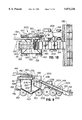
- FIG. 1 shows a flow chart to illustrate an embodiment of the system of the invention.
- FIG. 2 shows a part sectional view of an embodiment of a yard plant cleaning and separating unit of the invention, combined with a seed crushing and chaff densifying unit, in this case the unit is mobile.
- FIG. 3 shows an exploded view of an embodiment of a self-propelled thresher of the invention.
- FIG. 4 shows an exploded view of an embodiment of a self-propelled thresher of the invention.
- FIG. 5 shows an exploded view of another embodiment of a wrap-around thresher of the invention.
- FIG. 6 shows an exploded view of another embodiment of a wrap-around thresher of the invention.
- FIG. 7 shows a top view of the embodiment of FIG. 2 using a different power system.
- FIG. 8 shows a control panel for the embodiment of FIG. 7.
- FIG. 9 shows a side part sectional view of another embodiment of a wrap-around thresher of the invention.
- FIG. 10 shows a top part sectional view of the embodiment of FIG. 9.
- FIG. 11 shows a side part sectional view of another embodiment of a wrap-around combine of the invention.
- FIGS. 12 and 13 show perspective views of another embodiment of a yard plant cleaning and separating unit of the invention, combined with a seed crushing and chaff densifying unit, in this case the unit is stationary.
- FIG. 14 shows the embodiment of FIGS. 12 and 13 set up in a farm yard.
- FIG. 15 shows a top part sectional view of another embodiment of a wrap-around thresher of the invention.
- FIG. 16 shows a side part sectional view of the embodiment of FIG. 15.
- FIG. 17 shows a rear part sectional view of the embodiment of FIG. 16.
- the numeral 10 generally indicates a system of the invention (FIG. 1), header 12, which may pick up a swath, direct-cut or strip-cut the standing grain crop.
- the header cuts the crop leaving behind stubble at a height chosen by the farmer.
- Harvester 14 is directly attached to header 12, and includes a thresher to thresh the grain.
- the grain, chaff, grain leavings and weed seeds proceed together into a holding tank integral with the harvester, desirably with a bottom agitator to help flow from the tank.
- the holding tank is preferably at least about twice up to about three or four times the size of those currently in use on combines.
- the separated straw is may be passed by overshot beater 159 into tine separator 160, which has paired side by side tine separators containing tine rotors 161 having tine arrays 162 thereon. Material is urged along the tine separators smaller material than straw passing through gratings 164 into holding tank 138, emptied by unloading auger 144.
- wrap-around 230 straw and other material is passed by overshot beater 159 onto straw walker 232, which is about fifteen feet long, allowing material other than straw to fall into collection tank 234, as does material passing through concave 158.
- Bottom auger array 236 in collection tank 234 urge the material other than straw to transverse auger 238 which carries it to elevator 240.
- transverse auger 242 carries the material other than straw into grain bin 138, separated from collection tank 234 by internal wall 237.
- Grain bin 138 has bottom transverse auger 244, which carries material to the base of unloading auger 144.
- Grain bin 138 also has bottom auger array 246 to urge material to transverse auger 244, there are also top leveling augers 248, transverse, and 250, longitudinal.
- Wrap-around 230 is attached to tractor 148 by triple hitch 252.
- Tractor PTO 254 drives shaft 256 and gearbox 258, which drives all the moving parts through a system of shafts, belts and sheaves.
- Elevator 134 is driven by shaft 260, which through a belt and sheave system also drives thresher 156 and overshot beater bar 159, elevator 240 and straw spreader 142. Elevator 134 and header 132 are raised and lowered by hydraulic cylinders 262 which are attached to the elevator by front cylinder supports 264 and to outside of grain bin 138 by cylinder supports 266. Elevator 134 has elevator frame 268, enabling support wheel 202 and support wheel axle 270 to support elevator 134. Wrap-around 230 is about 13 feet wide, 22 feet long and 12 feet high, not including unloading auger 144, it has a total capacity of some 1179 cubic feet or approximately 950 bushels.
- wrap-around versions 146, 166, 200, 216 are mounted on conventional tractor, 148, and operated by the usual tractor PTO (power take-off), deposited in the field at the farmer's pleasure either directly as threshed for baling, or optionally through straw chopper, shredder and spreader 16 to decompose in the field.
- tractor PTO power take-off
- high volume and time saving auger 18 is used to load field truck 20.
- truck 20 preferably has truck box sides raised by about 3 feet above normal to increase load capacity, the auger arm is raised to clear these.
- Wheat chaff, weed seeds and wheat grain are considered to have about twice the volume of wheat grain alone, and about 1.16 times the weight of wheat grain alone. Volume and weight ratios vary with crop harvested and moisture content, as those skilled in the art are aware.
- FIGS. 3 to 6, 9 to 11, and 15 to 17 indicate specific threshers: self-propelled thresher 130, (FIG. 3), self-propelled thresher 154 (FIG. 4), wrap-around thresher 146 (FIG. 5), wrap-around thresher 166 (FIG. 6), wrap-around thresher 200 (FIGS. 9 and 10), wrap-around thresher 216 (FIG. 11) and wrap-around thresher 230 (FIGS. 15 to 17), which have conventional interchangeable header 132, which as those skilled in the art realize can be a direct cut, swath pick-up, or stripper header.
- Elevator 134 carries the cut crop to rotary thresher 136, or thresher cylinder 156 and cooperating concave 158, which separates the straw from the rest of the crop.
- elevator 134 In the self-propelled versions of the thresher, 130 and 154, elevator 134 is 641/2 inches wide as are rotary thresher 136, or thresher cylinder 156 and concave 158. In the wrap-around versions elevator 134 is 55 inches wide as are rotary thresher 136, or thresher cylinder 156 and concave 158.
- Either rotary thresher 136, or concave 158 may include apertures to allow grain and other material except straw to pass directly into holding tank 138.
- Material other than straw may be carried by conveyor augers 137 to holding tank 138, optionally equipped with agitators 140. Straw and other material mixed therewith which requires about 200 H.P.
- the tractor PTO operates shaft 206 which powers elevator 134, thresher cylinder 156, overshot beater 159 and tine rotors 161 by gear belt drive (also known as HDT, timing belt, or poly-chain) through belt and sheave arrangements 208, 210, 212, and 214.
- gear belt drive also known as HDT, timing belt, or poly-chain
- a support wheel 202 with support struts 204 and 205 is provided for elevator 134.
- straw spreader 142 spreads straw on the field. These threshers all feature a large holding tank and lack grain cleaning equipment, except 216.
- FIG. 11 shows wrap-around combine 216, which embodies conventional combine grain cleaning equipment 218, including, screen 220, distribution auger 222, sieves 224, aspirator fan 226, which blows chaff, weed seeds and grain leavings out, and tray 228 with accompanying auger.
- Auger 144 is also shown in alternative nonuse position 145.
- the weed seeds harvested will amount to about 50% of weed seeds available at harvest time.
- less grain loss means less volunteer growth.
- removal of weed seeds with the grain will substantially reduce weed growth.
- Numeral 22 sets forth another high volume, time saving, auger unloads the grain truck into surge receiving bin 24, which is part of automatic yard plant 46.
- Surge bin 24 has a large holding capacity and preferably a bottom agitator to ensure steady flow into automatic yard plant 46.
- Auger 26 carries the chaff, grain and weed seeds to stationary separating and cleaning machine 28.
- Combine harvested grain must be cleaned again for market purposes.
- Machine 28 has more cleaning stages than combines, and produces a significantly cleaner product than combine harvested grain, which is typically docked by 2 to 4% for uncleaned grain. Yard cleaned grain will be ⁇ commercial ⁇ quality, with about 1% dockage.
- the stationary yard cleaning machine 28 has the advantages that it is easier, simpler and cheaper to clean and maintain than the combine cleaning machine which is intricate, in a small space, awkward and expensive to repair and maintain. Because it is stationary yard cleaning machine 28 takes less shock and vibration than the combine cleaning machine, and thus lasts longer and depreciates less. Since the yard cleaning machine is built on a solid foundation it can be advantageously positioned for each individual farm.
- the cleaned grain is then carried by auger 36 to optional grain dryer 38, which can be incorporated into automatic yard plant 46, more easily, simply and with less labor than the present system. Grain dryer 38, when available makes drying easier and so enhances grain quality, it can also extend the harvest time.
- the grain whether passed through grain dryer 38 or not, is then passed to bin 40, whence it may be carried by optional auger 42, usually a stationary overhead auger, to optional storage bins 44.
- the grain can be advantageously directed to selected bins separately to even out moisture or quality.
- the residue of chaff, grain leavings and weed seeds from cleaning machine 28 is carried to crushing, tearing and densifying machine 30 preferably a hammermill, or roller mill, which tears, densifies (compacts) and crushes the chaff, preferably to double its original density, while compacting and crushing the weed seeds.
- the chaff may then be moved by auger 32 to chaff bunker 34, which is desirably covered by a tarp, to prevent blowing, alternatively the chaff can be moved by front end loaders.
- FIG. 2 A cleaning and densifying yard plant 48 embodying cleaning/separating 28 and seed crushing/chaff tearing/densifying 30 elements is shown in FIG. 2.
- Plant 48 is mounted on trailer 50 and is about 17 feet high by 24 feet long and 8 feet wide. Although this particular version is mobile, so that it can be tested at a convenient construction site, before moving it elsewhere, generally the plant is intended to be stationary. Yard plant 48 in any event is intended to be used when stationary, and no provision is made for use while moving.
- Grain is fed into grain feed inlet 54 by auger 26 (not shown in FIG. 2).
- Inlet 54 has upper 56 and lower 58 level indicators (sensors), when upper indicator 56 indicates inlet 54 is full, grain flow is stopped, when lower indicator 58 indicates inlet 54 is empty grain flow is resumed.
- aspirator 60 which has top feed roll 62 allowing grain to free fall down aspiration column 64 to base 66.
- Feed roll 62 is regulated to control speed of material intake into aspirator 60.
- Air passes in through air inlet 68 through a set of baffles 70 which force air through the falling grain and then through another set of baffles 72 aspirating light chaff, grain hulls, residual straw, grain fines into duct 74 and cyclone 76.
- the clean grain falls into base 66, where weighted door 78 allows grain to fall into grain cleaner 80.
- Aspirator 60 as shown is an open circuit vertical drop aspirator with a six pass aspiration column having a 56 ⁇ 12 inch opening and a 7 foot vertical drop.
- Feed roll 62 is driven by a 1 H.P. electric motor.
- Cleaner 80 has top hopper 82, which gravity feeds grain onto upper scalping screen 84, which passes grain and retains large material, the grain then falls onto lower scalping screen 86 which again passes grain but retains material larger than grain but smaller than the holes in screen 84. The grain then falls onto fine screen 88, which doesn't pass grain but does pass finer material.
- the grain during falling is deflected by deflector plate 90 while fan 92 passes an air current through it blowing lighter material clear of the grain. This material emerges together with that removed by the scalper screens to fall into hopper 94.
- Cleaner 80 which has a capacity of up to about 300 bushels or 8 metric tons per hour, has a 3 H.P. electric motor, which drives fans 92 and vibrates screens 84, 86 and 88.
- the aspirated material from aspirator 60 passes into cyclone 76 where it is forced around inner tube 104 spiraling downward, the centrifugal effect urges the chaff into the walls and down into cone 106.
- Cyclone 76 is 40 inch external diameter and stands about 111/2 feet tall.
- Airlock valve 108 driven by 3/4 H.P. electric motor 110, has 10 inch square inlets and outlets and an eight vaned rotor.
- Centrifugal fan 114 driven by 71/2 H.P. electric motor 116, has a capacity of 85,000 cfm, and through ducts 74 and 118 provides air for aspirator 60 and cyclone 76, it discharges through outlet 120.
- Augers 102 and 115 discharge the cleanings from the grain into hopper 122, which feeds into roller mill or hammer mill 124, either can be used. When mill 124, is a roller mill it is driven by 15 H.P.
- a specific roller mill designed to crush weed seeds and tear and densify chaff has diagonally grooved rolls.
- the rolls are 103/4 inch diameter, with diagonal grooves, about 3/32 inch deep and about 3/32 inch wide, spaced about 5 or 6 per inch of width of the rolls.
- the rolls are geared to rotate at different speeds, one about 10 to 15% faster or slower than the other, typically one at about 350 RPM the other at about 400 RPM, as those skilled in the art are aware rotational speeds and ratios can be varied.
- the clearance between the rolls is between 3 and 10 mils (0.003 and 0.010 inch), that is they don't quite touch (a normal sheet of paper is about 4 mils), which has two main effects--crushing weed seeds and grain leavings and tearing chaff into smaller fragments.
- Mill 124 discharges into hopper 128 of auger 130.
- seed crusher and chaff tearer/densifier 30 is a hammermill, a more powerful electric motor 126 is required up to a 15-50 H.P. motor.
- FIG. 7 is shown another power system for yard plant 48, in which electric motor 168, preferably a written pole motor, provides power.
- electric motor 168 preferably a written pole motor
- Most farms have single phase electric power, and triple phase power is not available, which limits the amount of electric power which can be used.
- the written pole electric motor has several advantages, it is a precise power single phase ride-through device, having two or four poles, it is fairly lightweight 1200 lbs, it can provide between 25 and 30 rated H.P. using single phase electric power, along a shaft running up to 1800 RPM, and is preferably used to power the plant, except motor 170 driving aspirator feed roller 62. Since feed roller 62 requires a variable drive, it cannot be run at a steady speed, and needs a separate variable speed motor.
- 2 inch steel line shaft 172 is connected to written pole motor 168, by a gear belt drive, (also known as HDT, timing belt, or poly-chain) at a 1:1 ratio.
- Bearings 198 support line shaft 172 about a foot above the deck or floor.
- Cleaning machine 80, airlock valve 108, aspirator fan 114, and roller mill 124 and augers 102 and 115 are connected to line shaft 172 by gear belt drives (also known as HDT, timing belt, or poly-chain) 186, 188, 190, 192, 194, and 196 which drive the devices.
- Each drive consists of two sheaves and a belt, set appropriately to increase or reduce RPMs for a particular drive.
- a gear reduction box may be employed.
- a diesel motor or a tractor PTO may be used to drive line shaft 172 instead of electric motor 168, control panel 174 (described in FIG. 8) is adjacent motor 168.
- control panel 174 for the written pole motor yard plant. This has manual-auto-off switch 176, push button switches having indicator lights 178, indicator lights 180, current meter 182 and aspirator feed control 184.
- the control panel works as follows in when switch 176 is in auto mode the written pole motor 168 starts and drives rolling mill 124, air lock valve 108, fan 114, and cleaning machine 80. Twenty seconds later the transfer augers 102 and 115 kick in as does aspirator feed roller 62. Three seconds after this the feed system activates into bin 54. This bin has automatic high and low switches which control its feed auger.
- FIGS. 12 and 13 show a stationary version of yard plant 48, mounted on base 51.
- Grain is fed through grain feed inlet 54 into aspirator 60, which has top feed roll 62 controlled by feed roll motor 170, then through aspiration column 64 into grain cleaner 80. Clean grain is passed out into hopper 98. Matter cleaned from the grain by cleaner 88 passes into attachment 95 and thence into auger 102.
- the aspirated material from aspirator 60 passes via duct 74 into cyclone 76 where air forces it spiraling downward, and the centrifugal effect urges the chaff into the walls and down into cone 106. At the base of cone 106 the chaff passes through airlock valve 108 into auger 115.
- Centrifugal fan 114 through ducts 74 and 118 provides air for aspirator 60 and cyclone 76, it discharges through outlet 120.
- Augers 102 and 115 discharge the cleanings from the grain into hopper 122, which feeds into roller mill or hammer mill 124, either can be used.
- Mill 124 discharges via auger 125 into hopper 128.
- Auger motors 103 and 107 drive augers 102 and 115 respectively.
- Electric motor 168 and drive shaft 172 are utilized as in FIG. 7, to drive fan 114, airlock valve 108, and grain cleaner 80. When electric motor 168 is a written pole motor, it is preferably controlled by control boxes 175 and 177.
- FIG. 14 shows yard plant 48 of FIGS. 12 and 13.
- Grain truck 20, preferably with raised sides 21, discharges into hopper 23, which is emptied by large grain auger 22, which typically have a 8, 10 or 13 inch diameter tube, into surge storage bin 24.
- Pencil auger 26 typically with a 4 inch diameter tube discharges grain steadily into yard plant 48 mounted on base 51.
- the grain is received by hopper 54 of cleaning machine 28, which includes aspirator 60, having air inlets 68, and cleaning machine 80.
- Cleaning machine 80 discharges clean grain into hopper 98, whence it is carried by pencil auger 26, typically with a 4 inch diameter tube, to storage bin 40.
- Material cleaned from the grain (chaff, grain leavings and weed seeds) is carried and passed through crushing, densifying and tearing machine 30, which includes milling machine 124, then to hopper 128, emptied by pencil auger 32, typically of 4 inch diameter tube, into chaff bunker 34.
- Pencil augers 26, 32, and 36 are operated by electrical motors 131, which are controlled through electric motor 168. That is when yard plant 48 is switched on these augers are running, so that as grain to be cleaned is moved into plant 48, clean grain and treated chaff, grain leavings and weed seeds are removed.
- Pencil augers are used, because large auger 22 has a delivery capacity, up to 9,000 bushels/hour or more, greater than the yard plant 48 can handle.
- Pencil augers 32 and 36 may be controlled by sensors in hoppers 128 and 98 respectively, so that these augers are only switched on when there is material in the hoppers.
- Yard plant 46 can be varied in size without affecting the principles or results involved as those skilled in the art are aware.
- Wheat was harvested by a combine with its shoe and aspirator switched off to yield a mixture of chaff, grain, grain leavings, weed seeds and some straw, which was visibly exceptionally dirty. This wheat mixture was then passed through prototype yard plant 46, the version shown in FIG. 3 using a single rotary shaft driven by a written pole motor using a single phase electric power supply. The capacity of the system is 300 bushels per hour of wheat mixture, which could be easily enlarged to 600 bushels per hour. The resulting wheat grain was commercial export grade formally rated at 1% grain dockage, which is the minimum grain dockage recognized. That is it was a maximum value for material other than grain is 1% of the cleaned grain. Similar harvesting and treatment of barley produced closely similar results.
- the milled wheat chaff, wheat grain leavings and weed seeds mixture was inspected by nutritional experts and considered vastly superior to available wheat chaff as animal feed.
- the milled barley chaff, barley leavings and weed seeds mixture was inspected by nutritional experts and considered vastly superior to available barley chaff as animal feed.
- Current grain cleaning systems handle combine cleaned grain to approximately the same level of dockage. Thus the yard plant cleans grain to commercial export standards in a single operation, compared to the two separate operations (combine and cleaning plant) required at present.
- the entire yard plant 46 as well as yard cleaning machine 28 and seed crushing and chaff densifying and tearing machine 30 are suitably entirely automated, and can use electrical power, which is more energy efficient than mobile combine cleaning machines which are fossil fuel powered.
- Automatic yard plant 46 is intended to utilize as much existing farm equipment as possible to aid in conversion of former harvesting systems to the harvesting system described herein.
- Automatic yard plant 46 besides producing more and cleaner grain, also produces densified chaff and crushed weed seeds both of which contain fat and protein.
- Untreated chaff has a nutritional value between that of straw (low) and hay (high), cattle prefer it to straw. One estimate gives it 75% of the nutritional value of tame hay (equivalent to alfalfa mixed). Ammoniation can substantially increase its nutritional value.
- chaff is a known animal feed
- the current method of collecting is expensive and awkward (chaff wagons). Collecting it as part of the harvesting process is much more efficient.
- the nutrients of the crushed weed seeds enhance the nutritional value of the chaff. Unless the weed seeds are crushed they will pass undigested through the animal's digestive tract.
- the system is designed to harvest all prairie crops including cereal crops, oil seeds, and legumes, including mustard, lentils and beans, to support modern crop rotational methods.
Landscapes
- Life Sciences & Earth Sciences (AREA)
- Environmental Sciences (AREA)
- Adjustment And Processing Of Grains (AREA)
- Harvesting Machines For Specific Crops (AREA)
Abstract
Description
______________________________________
Capital savings
Harvesting Equipment Savings
                      US    $35,000
Operational savings
Chaff collection (wheat)
                      US     $7.35/acre
Chaff collection (barley)
                      US     $4.80/acre
Chaff collection (canola)
                      US     $8.05/acre
Weed collection (less herbicide)
                      US     $3.70/acre
Additional grain (less loss)
                      US     $2.45/acre
Cleaner grain (less dockage)
                      US     $0.55/acre
TOTAL SAVINGS (WHEAT) US    $14.05/acre
______________________________________
Claims (18)
Priority Applications (2)
| Application Number | Priority Date | Filing Date | Title |
|---|---|---|---|
| CA002180691A CA2180691C (en) | 1996-07-08 | 1996-07-08 | Harvesting system and method |
| US08/742,635 US5873226A (en) | 1996-07-08 | 1996-11-01 | McLeod harvesting system and method |
Applications Claiming Priority (2)
| Application Number | Priority Date | Filing Date | Title |
|---|---|---|---|
| CA002180691A CA2180691C (en) | 1996-07-08 | 1996-07-08 | Harvesting system and method |
| US08/742,635 US5873226A (en) | 1996-07-08 | 1996-11-01 | McLeod harvesting system and method |
Publications (1)
| Publication Number | Publication Date |
|---|---|
| US5873226A true US5873226A (en) | 1999-02-23 |
Family
ID=25678540
Family Applications (1)
| Application Number | Title | Priority Date | Filing Date |
|---|---|---|---|
| US08/742,635 Expired - Fee Related US5873226A (en) | 1996-07-08 | 1996-11-01 | McLeod harvesting system and method |
Country Status (2)
| Country | Link |
|---|---|
| US (1) | US5873226A (en) |
| CA (1) | CA2180691C (en) |
Cited By (21)
| Publication number | Priority date | Publication date | Assignee | Title |
|---|---|---|---|---|
| WO2000076294A2 (en) | 1999-06-09 | 2000-12-21 | Mcleod Harvest Inc. | Method and apparatus for harvesting crops |
| US6625964B2 (en) | 2000-12-08 | 2003-09-30 | Mcleod Harvest Inc. | Hydraulic drive line and hitching assembly for pull-type implements |
| US6658830B2 (en) | 2001-10-02 | 2003-12-09 | William Norman Wetzel | Self-propelled flail mower and vacuum |
| WO2003101181A2 (en) | 2002-06-03 | 2003-12-11 | Mcleod Harvest Inc. | Method and apparatus for harvesting and cleaning grain and seed crops |
| US6729951B2 (en) | 2002-03-28 | 2004-05-04 | Bechtel Bwxt Idaho, Llc | Method and apparatus for selectively harvesting multiple components of a plant material |
| US7300003B1 (en) * | 2004-12-07 | 2007-11-27 | Kelly Kreikemeier | Apparatus and method for applying dry inoculant to forage material |
| US20080274778A1 (en) * | 2004-12-14 | 2008-11-06 | Robert John Eyre | Modular Combine Harvesting Machines |
| US20090017885A1 (en) * | 2007-07-09 | 2009-01-15 | Halls Floyd W | Crop processing method and apparatus |
| US20100233772A1 (en) * | 2009-03-16 | 2010-09-16 | Syngenta Participations Ag | Modular system for introducing a stream of processed grain into an ethanol production facility, and associated methods |
| US20100229980A1 (en) * | 2009-03-16 | 2010-09-16 | Syngenta Participations Ag | Modular system for introducing a stream of processed grain into an ethanol production facility, and associated methods |
| US20110221837A1 (en) * | 2010-03-10 | 2011-09-15 | Xerox Corporation | No Spill, Feed Controlled Removable Container For Delivering Pelletized Substances |
| DE202014100608U1 (en) | 2013-02-15 | 2014-04-17 | Raipro Gmbh | Self-propelled agricultural machine |
| RU2519855C2 (en) * | 2012-03-22 | 2014-06-20 | Федеральное государственное бюджетное образовательное учреждение высшего профессионального образования "Кубанский государственный аграрный университет" | Method and multifunctional unit of harvesting agricultural crops |
| US9078397B2 (en) | 2012-11-16 | 2015-07-14 | Cnh Industrial America Llc | System for conveying agricultural material in a harvester |
| RU2601819C1 (en) * | 2015-08-03 | 2016-11-10 | Федеральное государственное бюджетное образовательное учреждение высшего профессионального образования "Приамурский государственный университет имени Шолом-Алейхема" (ФГБОУ ВПО ПГУ им. Шолом-Алейхема) | Field track machine to prepare and collect heaps of grain |
| US20200068870A1 (en) * | 2018-08-28 | 2020-03-05 | Hector Augusto Huergo | Procedure for collection and processing of weed seeds and product obtained |
| US20220370938A1 (en) * | 2019-05-24 | 2022-11-24 | Flory Industries | Dust control system and related methods |
| US20230232746A1 (en) * | 2020-07-10 | 2023-07-27 | Otalicio Pacheco Da Cunha | Agricultural products cleaning machine by a spiral curtain centifugal process |
| US12114609B2 (en) | 2021-07-21 | 2024-10-15 | Cnh Industrial America Llc | Integrated weed seed mill and chopper for combine harvester |
| US12245551B2 (en) | 2017-08-25 | 2025-03-11 | Flory Industries | Tree fruit or nut harvester to minimize machine passes in the orchard |
| WO2025067669A1 (en) | 2023-09-28 | 2025-04-03 | Gentlefarming Inc. | Autonomous machine system and harvesting method |
Families Citing this family (3)
| Publication number | Priority date | Publication date | Assignee | Title |
|---|---|---|---|---|
| EP2547194B1 (en) | 2010-03-19 | 2015-01-28 | RUMPLER, Johann | Method and device for harvesting threshed crops |
| US12096721B2 (en) * | 2018-09-07 | 2024-09-24 | Roy BREWIN | Crop dust separation system |
| DE102022000874B4 (en) | 2022-03-12 | 2023-11-16 | Kluge Gmbh | Method and device for harvesting threshing plants |
Citations (11)
| Publication number | Priority date | Publication date | Assignee | Title |
|---|---|---|---|---|
| CA638703A (en) * | 1962-03-20 | D. Witzel Homer | Centrifugal type thresher | |
| US3580257A (en) * | 1969-12-24 | 1971-05-25 | Earl E Teague | Weed seed collector for a thresher combine |
| DE1952567A1 (en) * | 1969-10-18 | 1971-06-24 | Nordenskjoeld Reinhard Von Dip | Feed stuff briquette producer |
| CA1047876A (en) * | 1976-07-14 | 1979-02-06 | Sperry Rand Corporation | Separating unit for combine harvester |
| CA1053528A (en) * | 1976-07-14 | 1979-05-01 | Sperry Rand Corporation | Combine harvester |
| CA1094904A (en) * | 1979-07-30 | 1981-02-03 | Wendell E. Corbett | Feed residue saver for combines |
| CA1112975A (en) * | 1979-02-12 | 1981-11-24 | Edward W. Rowland-Hill | Isolated pneumatic cleaning system |
| SU1036293A1 (en) * | 1982-04-06 | 1983-08-23 | Сибирский научно-исследовательский институт механизации и электрификации сельского хозяйства | Apparatus for separating loose materials |
| SU1261579A1 (en) * | 1985-05-30 | 1986-10-07 | Краснодарский Ордена Ленина И Ордена Трудового Красного Знамени Научно-Исследовательский Институт Сельского Хозяйства Им.П.П.Лукьяненко | Self-propelled mower |
| DE3528638A1 (en) * | 1985-08-09 | 1987-02-12 | Claas Ohg | METHOD FOR THE PRODUCTION OF FUEL FEED |
| SU1496684A1 (en) * | 1987-05-28 | 1989-07-30 | Центральный Научно-Исследовательский Институт Механизации И Электрификации Сельского Хозяйства Нечерноземной Зоны Ссср | Chaff collector for grain combine harvester |
-
1996
- 1996-07-08 CA CA002180691A patent/CA2180691C/en not_active Expired - Fee Related
- 1996-11-01 US US08/742,635 patent/US5873226A/en not_active Expired - Fee Related
Patent Citations (11)
| Publication number | Priority date | Publication date | Assignee | Title |
|---|---|---|---|---|
| CA638703A (en) * | 1962-03-20 | D. Witzel Homer | Centrifugal type thresher | |
| DE1952567A1 (en) * | 1969-10-18 | 1971-06-24 | Nordenskjoeld Reinhard Von Dip | Feed stuff briquette producer |
| US3580257A (en) * | 1969-12-24 | 1971-05-25 | Earl E Teague | Weed seed collector for a thresher combine |
| CA1047876A (en) * | 1976-07-14 | 1979-02-06 | Sperry Rand Corporation | Separating unit for combine harvester |
| CA1053528A (en) * | 1976-07-14 | 1979-05-01 | Sperry Rand Corporation | Combine harvester |
| CA1112975A (en) * | 1979-02-12 | 1981-11-24 | Edward W. Rowland-Hill | Isolated pneumatic cleaning system |
| CA1094904A (en) * | 1979-07-30 | 1981-02-03 | Wendell E. Corbett | Feed residue saver for combines |
| SU1036293A1 (en) * | 1982-04-06 | 1983-08-23 | Сибирский научно-исследовательский институт механизации и электрификации сельского хозяйства | Apparatus for separating loose materials |
| SU1261579A1 (en) * | 1985-05-30 | 1986-10-07 | Краснодарский Ордена Ленина И Ордена Трудового Красного Знамени Научно-Исследовательский Институт Сельского Хозяйства Им.П.П.Лукьяненко | Self-propelled mower |
| DE3528638A1 (en) * | 1985-08-09 | 1987-02-12 | Claas Ohg | METHOD FOR THE PRODUCTION OF FUEL FEED |
| SU1496684A1 (en) * | 1987-05-28 | 1989-07-30 | Центральный Научно-Исследовательский Институт Механизации И Электрификации Сельского Хозяйства Нечерноземной Зоны Ссср | Chaff collector for grain combine harvester |
Cited By (32)
| Publication number | Priority date | Publication date | Assignee | Title |
|---|---|---|---|---|
| US6966506B2 (en) | 1999-06-09 | 2005-11-22 | Mcleod Harvest Inc. | Method and apparatus for harvesting crops |
| US6712691B2 (en) | 1999-06-09 | 2004-03-30 | Mcleod Harvest Inc. | Mobile harvesting unit |
| US6422937B1 (en) | 1999-06-09 | 2002-07-23 | Mcleod Harvest Inc. | Method and apparatus for harvesting crops wherein crops are cleaned at a remote site |
| AU757711B2 (en) * | 1999-06-09 | 2003-03-06 | Mcleod Harvest Inc. | Method and apparatus for harvesting crops |
| WO2000076294A2 (en) | 1999-06-09 | 2000-12-21 | Mcleod Harvest Inc. | Method and apparatus for harvesting crops |
| US6709329B2 (en) | 1999-06-09 | 2004-03-23 | Mcleod Harvest Inc. | Method and apparatus for harvesting crops wherein crops are cleaned at remote site |
| WO2000076294A3 (en) * | 1999-06-09 | 2001-08-02 | Mcleod Harvest Inc | Method and apparatus for harvesting crops |
| US6711884B1 (en) | 1999-06-09 | 2004-03-30 | Mcleod Harvest Inc. | Mobile harvesting unit |
| US6625964B2 (en) | 2000-12-08 | 2003-09-30 | Mcleod Harvest Inc. | Hydraulic drive line and hitching assembly for pull-type implements |
| US6658830B2 (en) | 2001-10-02 | 2003-12-09 | William Norman Wetzel | Self-propelled flail mower and vacuum |
| US6729951B2 (en) | 2002-03-28 | 2004-05-04 | Bechtel Bwxt Idaho, Llc | Method and apparatus for selectively harvesting multiple components of a plant material |
| WO2003101181A3 (en) * | 2002-06-03 | 2004-05-06 | Mcleod Harvest Inc | Method and apparatus for harvesting and cleaning grain and seed crops |
| WO2003101181A2 (en) | 2002-06-03 | 2003-12-11 | Mcleod Harvest Inc. | Method and apparatus for harvesting and cleaning grain and seed crops |
| US7300003B1 (en) * | 2004-12-07 | 2007-11-27 | Kelly Kreikemeier | Apparatus and method for applying dry inoculant to forage material |
| US20080274778A1 (en) * | 2004-12-14 | 2008-11-06 | Robert John Eyre | Modular Combine Harvesting Machines |
| US20090017885A1 (en) * | 2007-07-09 | 2009-01-15 | Halls Floyd W | Crop processing method and apparatus |
| US20100233772A1 (en) * | 2009-03-16 | 2010-09-16 | Syngenta Participations Ag | Modular system for introducing a stream of processed grain into an ethanol production facility, and associated methods |
| US20100229980A1 (en) * | 2009-03-16 | 2010-09-16 | Syngenta Participations Ag | Modular system for introducing a stream of processed grain into an ethanol production facility, and associated methods |
| US20110221837A1 (en) * | 2010-03-10 | 2011-09-15 | Xerox Corporation | No Spill, Feed Controlled Removable Container For Delivering Pelletized Substances |
| US8240830B2 (en) | 2010-03-10 | 2012-08-14 | Xerox Corporation | No spill, feed controlled removable container for delivering pelletized substances |
| RU2519855C2 (en) * | 2012-03-22 | 2014-06-20 | Федеральное государственное бюджетное образовательное учреждение высшего профессионального образования "Кубанский государственный аграрный университет" | Method and multifunctional unit of harvesting agricultural crops |
| US9625306B2 (en) | 2012-11-16 | 2017-04-18 | Cnh Industrial America Llc | System and method for conveying agricultural material in a harvester |
| US9078397B2 (en) | 2012-11-16 | 2015-07-14 | Cnh Industrial America Llc | System for conveying agricultural material in a harvester |
| DE202014100608U1 (en) | 2013-02-15 | 2014-04-17 | Raipro Gmbh | Self-propelled agricultural machine |
| RU2601819C1 (en) * | 2015-08-03 | 2016-11-10 | Федеральное государственное бюджетное образовательное учреждение высшего профессионального образования "Приамурский государственный университет имени Шолом-Алейхема" (ФГБОУ ВПО ПГУ им. Шолом-Алейхема) | Field track machine to prepare and collect heaps of grain |
| US12245551B2 (en) | 2017-08-25 | 2025-03-11 | Flory Industries | Tree fruit or nut harvester to minimize machine passes in the orchard |
| US20200068870A1 (en) * | 2018-08-28 | 2020-03-05 | Hector Augusto Huergo | Procedure for collection and processing of weed seeds and product obtained |
| US12041925B2 (en) * | 2018-08-28 | 2024-07-23 | Hector Augusto Huergo | Procedure for collection and processing of weed seeds and product obtained |
| US20220370938A1 (en) * | 2019-05-24 | 2022-11-24 | Flory Industries | Dust control system and related methods |
| US20230232746A1 (en) * | 2020-07-10 | 2023-07-27 | Otalicio Pacheco Da Cunha | Agricultural products cleaning machine by a spiral curtain centifugal process |
| US12114609B2 (en) | 2021-07-21 | 2024-10-15 | Cnh Industrial America Llc | Integrated weed seed mill and chopper for combine harvester |
| WO2025067669A1 (en) | 2023-09-28 | 2025-04-03 | Gentlefarming Inc. | Autonomous machine system and harvesting method |
Also Published As
| Publication number | Publication date |
|---|---|
| CA2180691C (en) | 1998-11-17 |
| CA2180691A1 (en) | 1997-05-15 |
Similar Documents
| Publication | Publication Date | Title |
|---|---|---|
| CA2180691C (en) | Harvesting system and method | |
| US3580257A (en) | Weed seed collector for a thresher combine | |
| US5794423A (en) | Mobile harvester for chaff, grain, grain leavings and weed seeds | |
| EP2241174B1 (en) | Agricultural combine with on-board baler and dust suppression capability. | |
| CA2644959C (en) | Separating cobs from grain in a corn harvester | |
| US11026369B2 (en) | Multipurpose leaf crop harvesting apparatus and processing method | |
| US5795222A (en) | McLeod yard plant | |
| Shinners et al. | Single-pass, split-stream of corn grain and stover: Characteristic performance of three harvester configurations | |
| WO2006074667A2 (en) | Method of grain harvesting, combine harvester and harvester's units | |
| Bern et al. | Harvesting and postharvest management | |
| US5453051A (en) | Corn cob mill | |
| DE10016407A1 (en) | Method and device for harvesting and processing fruit stands and residual plants as silage feed | |
| Hanna et al. | Grain harvesting machinery | |
| RU129348U1 (en) | UNIVERSAL TRAILED HARVESTER | |
| US20090000263A1 (en) | Harvesting and Threshing System | |
| Kemble et al. | PM—power and machinery: development and evaluation of kenaf harvesting technology | |
| US3927511A (en) | Method and apparatus for harvesting cotton | |
| US5875622A (en) | Harvesting apparatus for comminuting plant before separation | |
| CA2218901C (en) | Harvesting system and method | |
| RU2208928C2 (en) | Grain combine | |
| RU2147167C1 (en) | Seed harvesting combine | |
| WO2000067554A1 (en) | Harvesting and separating apparatus | |
| RU2649626C1 (en) | Grain harvesting unit | |
| Choudhary et al. | Agripreneurship development on value added fodder products [E-book] | |
| Siemens et al. | A new grain harvesting system for single-pass grain harvest, biomass collection, crop residue sizing, and grain segregation |
Legal Events
| Date | Code | Title | Description |
|---|---|---|---|
| AS | Assignment |
Owner name: BOB MCLEOD INC., CANADA Free format text: ASSIGNMENT OF ASSIGNORS INTEREST;ASSIGNOR:MCLEOD, ROBERT H.;REEL/FRAME:009183/0935 Effective date: 19980512 |
|
| AS | Assignment |
Owner name: MCLEOD HARVEST INC., MANITOBA Free format text: CHANGE OF NAME;ASSIGNOR:BOB MCLEOD INC.;REEL/FRAME:013081/0854 Effective date: 19980716 |
|
| FPAY | Fee payment |
Year of fee payment: 4 |
|
| AS | Assignment |
Owner name: ROYAL BANK OF CANADA, CANADA Free format text: SECURITY AGREEMENT;ASSIGNOR:MCLEOD HARVEST INC.;REEL/FRAME:017262/0095 Effective date: 20040910 |
|
| REMI | Maintenance fee reminder mailed | ||
| FPAY | Fee payment |
Year of fee payment: 8 |
|
| SULP | Surcharge for late payment |
Year of fee payment: 7 |
|
| REMI | Maintenance fee reminder mailed | ||
| LAPS | Lapse for failure to pay maintenance fees | ||
| STCH | Information on status: patent discontinuation |
Free format text: PATENT EXPIRED DUE TO NONPAYMENT OF MAINTENANCE FEES UNDER 37 CFR 1.362 |
|
| FP | Lapsed due to failure to pay maintenance fee |
Effective date: 20110223 |