US5779820A - Process for producing a ferritic stainless steel having an improved corrosion resistance, especially resistance to intergranular and pitting corrosion - Google Patents
Process for producing a ferritic stainless steel having an improved corrosion resistance, especially resistance to intergranular and pitting corrosion Download PDFInfo
- Publication number
- US5779820A US5779820A US08/819,371 US81937197A US5779820A US 5779820 A US5779820 A US 5779820A US 81937197 A US81937197 A US 81937197A US 5779820 A US5779820 A US 5779820A
- Authority
- US
- United States
- Prior art keywords
- steel
- composition
- temperature
- cooling
- resistance
- Prior art date
- Legal status (The legal status is an assumption and is not a legal conclusion. Google has not performed a legal analysis and makes no representation as to the accuracy of the status listed.)
- Expired - Fee Related
Links
- 238000000034 method Methods 0.000 title claims abstract description 17
- 230000008569 process Effects 0.000 title claims abstract description 17
- 229910001220 stainless steel Inorganic materials 0.000 title claims abstract description 11
- 238000005260 corrosion Methods 0.000 title abstract description 33
- 230000007797 corrosion Effects 0.000 title abstract description 32
- 229910000831 Steel Inorganic materials 0.000 claims abstract description 97
- 239000010959 steel Substances 0.000 claims abstract description 97
- 238000001816 cooling Methods 0.000 claims abstract description 31
- PXHVJJICTQNCMI-UHFFFAOYSA-N Nickel Chemical compound [Ni] PXHVJJICTQNCMI-UHFFFAOYSA-N 0.000 claims description 34
- 239000000203 mixture Substances 0.000 claims description 32
- 239000010955 niobium Substances 0.000 claims description 22
- 229910052758 niobium Inorganic materials 0.000 claims description 21
- IJGRMHOSHXDMSA-UHFFFAOYSA-N Atomic nitrogen Chemical compound N#N IJGRMHOSHXDMSA-UHFFFAOYSA-N 0.000 claims description 18
- 229910052759 nickel Inorganic materials 0.000 claims description 17
- 229910052799 carbon Inorganic materials 0.000 claims description 16
- 229910052750 molybdenum Inorganic materials 0.000 claims description 16
- 229910052757 nitrogen Inorganic materials 0.000 claims description 16
- 239000010936 titanium Substances 0.000 claims description 16
- 229910052719 titanium Inorganic materials 0.000 claims description 16
- VYZAMTAEIAYCRO-UHFFFAOYSA-N Chromium Chemical compound [Cr] VYZAMTAEIAYCRO-UHFFFAOYSA-N 0.000 claims description 15
- ZOKXTWBITQBERF-UHFFFAOYSA-N Molybdenum Chemical compound [Mo] ZOKXTWBITQBERF-UHFFFAOYSA-N 0.000 claims description 15
- RTAQQCXQSZGOHL-UHFFFAOYSA-N Titanium Chemical compound [Ti] RTAQQCXQSZGOHL-UHFFFAOYSA-N 0.000 claims description 15
- 229910052804 chromium Inorganic materials 0.000 claims description 15
- 239000011651 chromium Substances 0.000 claims description 15
- 239000011733 molybdenum Substances 0.000 claims description 15
- GUCVJGMIXFAOAE-UHFFFAOYSA-N niobium atom Chemical compound [Nb] GUCVJGMIXFAOAE-UHFFFAOYSA-N 0.000 claims description 14
- OKTJSMMVPCPJKN-UHFFFAOYSA-N Carbon Chemical compound [C] OKTJSMMVPCPJKN-UHFFFAOYSA-N 0.000 claims description 9
- XEEYBQQBJWHFJM-UHFFFAOYSA-N Iron Chemical compound [Fe] XEEYBQQBJWHFJM-UHFFFAOYSA-N 0.000 claims description 9
- 239000011572 manganese Substances 0.000 claims description 9
- 229910052710 silicon Inorganic materials 0.000 claims description 9
- PWHULOQIROXLJO-UHFFFAOYSA-N Manganese Chemical compound [Mn] PWHULOQIROXLJO-UHFFFAOYSA-N 0.000 claims description 8
- NINIDFKCEFEMDL-UHFFFAOYSA-N Sulfur Chemical compound [S] NINIDFKCEFEMDL-UHFFFAOYSA-N 0.000 claims description 8
- 229910052748 manganese Inorganic materials 0.000 claims description 8
- 238000004519 manufacturing process Methods 0.000 claims description 8
- 239000010703 silicon Substances 0.000 claims description 8
- 229910052717 sulfur Inorganic materials 0.000 claims description 8
- 239000011593 sulfur Substances 0.000 claims description 8
- RYGMFSIKBFXOCR-UHFFFAOYSA-N Copper Chemical compound [Cu] RYGMFSIKBFXOCR-UHFFFAOYSA-N 0.000 claims description 7
- OAICVXFJPJFONN-UHFFFAOYSA-N Phosphorus Chemical compound [P] OAICVXFJPJFONN-UHFFFAOYSA-N 0.000 claims description 7
- 239000010949 copper Substances 0.000 claims description 7
- 229910052802 copper Inorganic materials 0.000 claims description 7
- 229910052698 phosphorus Inorganic materials 0.000 claims description 7
- 239000011574 phosphorus Substances 0.000 claims description 7
- 239000012535 impurity Substances 0.000 claims description 5
- 239000000463 material Substances 0.000 claims description 5
- 238000003723 Smelting Methods 0.000 claims description 4
- 229910052742 iron Inorganic materials 0.000 claims description 4
- 238000005098 hot rolling Methods 0.000 claims description 2
- 230000007704 transition Effects 0.000 description 15
- FAPWRFPIFSIZLT-UHFFFAOYSA-M Sodium chloride Chemical compound [Na+].[Cl-] FAPWRFPIFSIZLT-UHFFFAOYSA-M 0.000 description 6
- 229910052782 aluminium Inorganic materials 0.000 description 6
- XAGFODPZIPBFFR-UHFFFAOYSA-N aluminium Chemical compound [Al] XAGFODPZIPBFFR-UHFFFAOYSA-N 0.000 description 5
- 238000006243 chemical reaction Methods 0.000 description 5
- 239000002253 acid Substances 0.000 description 3
- 230000000694 effects Effects 0.000 description 3
- 238000010438 heat treatment Methods 0.000 description 3
- 230000010287 polarization Effects 0.000 description 3
- 239000011780 sodium chloride Substances 0.000 description 3
- 229910052726 zirconium Inorganic materials 0.000 description 3
- NBIIXXVUZAFLBC-UHFFFAOYSA-N Phosphoric acid Chemical compound OP(O)(O)=O NBIIXXVUZAFLBC-UHFFFAOYSA-N 0.000 description 2
- 241000272534 Struthio camelus Species 0.000 description 2
- QAOWNCQODCNURD-UHFFFAOYSA-N Sulfuric acid Chemical compound OS(O)(=O)=O QAOWNCQODCNURD-UHFFFAOYSA-N 0.000 description 2
- QCWXUUIWCKQGHC-UHFFFAOYSA-N Zirconium Chemical compound [Zr] QCWXUUIWCKQGHC-UHFFFAOYSA-N 0.000 description 2
- 230000000052 comparative effect Effects 0.000 description 2
- 238000009749 continuous casting Methods 0.000 description 2
- 230000006641 stabilisation Effects 0.000 description 2
- 238000011105 stabilization Methods 0.000 description 2
- 239000010935 stainless steel Substances 0.000 description 2
- 239000000126 substance Substances 0.000 description 2
- ZOXJGFHDIHLPTG-UHFFFAOYSA-N Boron Chemical compound [B] ZOXJGFHDIHLPTG-UHFFFAOYSA-N 0.000 description 1
- OYPRJOBELJOOCE-UHFFFAOYSA-N Calcium Chemical compound [Ca] OYPRJOBELJOOCE-UHFFFAOYSA-N 0.000 description 1
- 229910052684 Cerium Inorganic materials 0.000 description 1
- ZAMOUSCENKQFHK-UHFFFAOYSA-N Chlorine atom Chemical compound [Cl] ZAMOUSCENKQFHK-UHFFFAOYSA-N 0.000 description 1
- FYYHWMGAXLPEAU-UHFFFAOYSA-N Magnesium Chemical compound [Mg] FYYHWMGAXLPEAU-UHFFFAOYSA-N 0.000 description 1
- 229910000147 aluminium phosphate Inorganic materials 0.000 description 1
- 238000000137 annealing Methods 0.000 description 1
- QVGXLLKOCUKJST-UHFFFAOYSA-N atomic oxygen Chemical compound [O] QVGXLLKOCUKJST-UHFFFAOYSA-N 0.000 description 1
- 229910052796 boron Inorganic materials 0.000 description 1
- 239000011575 calcium Substances 0.000 description 1
- 229910052791 calcium Inorganic materials 0.000 description 1
- ZMIGMASIKSOYAM-UHFFFAOYSA-N cerium Chemical compound [Ce][Ce][Ce][Ce][Ce][Ce][Ce][Ce][Ce][Ce][Ce][Ce][Ce][Ce][Ce][Ce][Ce][Ce][Ce][Ce][Ce][Ce][Ce][Ce][Ce][Ce][Ce][Ce][Ce][Ce][Ce][Ce][Ce][Ce][Ce][Ce][Ce][Ce] ZMIGMASIKSOYAM-UHFFFAOYSA-N 0.000 description 1
- 239000007795 chemical reaction product Substances 0.000 description 1
- 239000000460 chlorine Substances 0.000 description 1
- 229910052801 chlorine Inorganic materials 0.000 description 1
- ZPUCINDJVBIVPJ-LJISPDSOSA-N cocaine Chemical compound O([C@H]1C[C@@H]2CC[C@@H](N2C)[C@H]1C(=O)OC)C(=O)C1=CC=CC=C1 ZPUCINDJVBIVPJ-LJISPDSOSA-N 0.000 description 1
- 238000005336 cracking Methods 0.000 description 1
- 239000011737 fluorine Substances 0.000 description 1
- 229910052731 fluorine Inorganic materials 0.000 description 1
- -1 fluorine ions Chemical class 0.000 description 1
- 238000000227 grinding Methods 0.000 description 1
- BHEPBYXIRTUNPN-UHFFFAOYSA-N hydridophosphorus(.) (triplet) Chemical compound [PH] BHEPBYXIRTUNPN-UHFFFAOYSA-N 0.000 description 1
- 230000006872 improvement Effects 0.000 description 1
- 229910000765 intermetallic Inorganic materials 0.000 description 1
- 239000011777 magnesium Substances 0.000 description 1
- 229910052749 magnesium Inorganic materials 0.000 description 1
- 238000002844 melting Methods 0.000 description 1
- 230000008018 melting Effects 0.000 description 1
- 150000001247 metal acetylides Chemical class 0.000 description 1
- 238000012986 modification Methods 0.000 description 1
- 230000004048 modification Effects 0.000 description 1
- 150000004767 nitrides Chemical class 0.000 description 1
- 229910052760 oxygen Inorganic materials 0.000 description 1
- 239000001301 oxygen Substances 0.000 description 1
- 238000001556 precipitation Methods 0.000 description 1
- 238000007670 refining Methods 0.000 description 1
- 239000011265 semifinished product Substances 0.000 description 1
- 239000003381 stabilizer Substances 0.000 description 1
- 230000000087 stabilizing effect Effects 0.000 description 1
- XLYOFNOQVPJJNP-UHFFFAOYSA-N water Substances O XLYOFNOQVPJJNP-UHFFFAOYSA-N 0.000 description 1
Images



Classifications
-
- C—CHEMISTRY; METALLURGY
- C22—METALLURGY; FERROUS OR NON-FERROUS ALLOYS; TREATMENT OF ALLOYS OR NON-FERROUS METALS
- C22C—ALLOYS
- C22C38/00—Ferrous alloys, e.g. steel alloys
- C22C38/18—Ferrous alloys, e.g. steel alloys containing chromium
- C22C38/40—Ferrous alloys, e.g. steel alloys containing chromium with nickel
- C22C38/50—Ferrous alloys, e.g. steel alloys containing chromium with nickel with titanium or zirconium
-
- C—CHEMISTRY; METALLURGY
- C22—METALLURGY; FERROUS OR NON-FERROUS ALLOYS; TREATMENT OF ALLOYS OR NON-FERROUS METALS
- C22C—ALLOYS
- C22C38/00—Ferrous alloys, e.g. steel alloys
- C22C38/18—Ferrous alloys, e.g. steel alloys containing chromium
- C22C38/40—Ferrous alloys, e.g. steel alloys containing chromium with nickel
- C22C38/44—Ferrous alloys, e.g. steel alloys containing chromium with nickel with molybdenum or tungsten
-
- C—CHEMISTRY; METALLURGY
- C22—METALLURGY; FERROUS OR NON-FERROUS ALLOYS; TREATMENT OF ALLOYS OR NON-FERROUS METALS
- C22C—ALLOYS
- C22C38/00—Ferrous alloys, e.g. steel alloys
- C22C38/18—Ferrous alloys, e.g. steel alloys containing chromium
- C22C38/40—Ferrous alloys, e.g. steel alloys containing chromium with nickel
- C22C38/48—Ferrous alloys, e.g. steel alloys containing chromium with nickel with niobium or tantalum
Definitions
- the present invention relates to a process for manufacturing a ferritic steel having an improved corrosion resistance, and especially resistance to intergranular and pitting corrosion.
- Japanese Patent No. 62,250,150 discloses a corrosion-resistant ferritic stainless steel whose composition is as follows: carbon less than 0.04%, silicon less than 1%, manganese less than 1%, nickel less than 6%, chromium between 19 and 28%, molybdenum between 1 and 6%, nitrogen less than 0.03%, phosphorus less than 0.06% and sulfur less than 0.03%.
- This steel may also contain niobium and/or titanium.
- That document presents a ferritic steel having a high corrosion resistance, used for withstanding a mixture of phosphoric acid, of sulfuric acid and of chlorine and fluorine ions.
- Patent DE 3,221,087 relating to the manufacture of a so-called superferritic CrMoNi stainless steel which includes conventional oxygen refining using an AOD or VOD process, continuous casting of billets or slabs, optional intermediate cooling, and annealing followed by conversion into blooms and end- or semi-finished products.
- the superferritic stainless steel has the following composition: carbon between 0.01 and 0.05%, silicon less than 2%, manganese less than 1%, nickel between 1 and 4%, chromium between 21 and 31%, molybdenum between 1.5 and 3.5%, nitrogen between 0.01 and 0.08%, phosphorus less than 0.0025%, sulfur less than 0.01%, titanium less than 0.24%, zirconium between 0.005 and 0.5%, aluminum between 0.002 and 0.12%, niobium between 0.1 and 0.6% and copper less than 3%.
- This steel may also contain calcium, magnesium, cerium and boron, and the elements of the composition satisfy the following relationships:
- the aluminum may be replaced by doubling the amount of titanium on condition that there is at least 0.002% of aluminum.
- the steel is preferably hot rolled or forged directly after continuous casting, without intermediate cooling.
- One object of the invention is to improve the corrosion resistance of a ferritic steel, especially the resistance to intergranular and pitting corrosion, while at the same time maintaining a conversion process compatible with the conversions of common so-called 17% chromium ferritic steels.
- One subject of the invention is a process for producing a ferritic stainless steel having an improved corrosion resistance, and especially resistance to intergranular corrosion and to pitting corrosion.
- the steel so produced is part of the invention.
- process steel preferably in slab form, containing in its composition (by weight based on total weight):
- All values between all given temperature and cooling rate ranges provided herein are included as part of the invention as are all subranges therebetween.
- cooling rates of 450°, 500° and 550° C./hour may be used in the first phase
- cooling rates of 1250°, 1300° and 1350° C./hour may be used in the second phase.
- the strip obtained is subjected to rapid cooling and then coiled at a temperature of less than 600° C. and preferably at a temperature close to ( ⁇ 10%) 550° C.
- the steel, in slab form contains in its composition by weight:
- the steel furthermore contains, in its composition by weight, less than 0.20% of copper.
- the invention also relates to a ferritic stainless steel obtained by the above process and having improved corrosion resistance, especially resistance to intergranular and pitting corrosion, defined in its composition by weight based on total weight:
- the balance being mostly or wholly iron and impurities resulting from the smelting of the materials necessary for the production.
- the steel is defined in its composition by weight as follows:
- the balance being mostly or wholly iron and impurities resulting from the smelting of the materials necessary for the production.
- the composition furthermore contains less than 0.20% of copper.
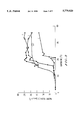
- FIG. 1 shows three ductile-brittle transition curves for a steel of composition A (11721) according to the invention.
- FIG. 2 shows two ductile-brittle transition curves for a steel of composition B (11722) according to the invention.
- FIG. 3 shows ductile-brittle transition curves after rapid cooling of the hot-rolled steel strip.
- FIG. 4 shows ductile-brittle transition curves as a function of varying contents of nickel and molybdenum.
- FIG. 5 shows comparative pitting-corrosion test curves.
- the group of steels having more than 18% of chromium includes steels which are difficult to convert because of the high proportion of chromium which they contain. However, the high chromium contents have the effect of increasing the corrosion resistance, compared with so-called 17% chromium ferritic steels.
- Copper typically cannot be introduced in a smaller amount since it is contained in the composition of the base materials used for production of the steel.
- Molybdenum improves the resistance to generalized corrosion in acid medium and to pitting corrosion. However, it is preferably limited in concentration in order to avoid problems in the area of hot fracture toughness.
- Nickel improves the resistance to corrosion in acid medium, but a maximum limit is preferably imposed since too great an amount of nickel embrittles the steel.
- the steel according to the invention preferably in the form of slab, undergoes a particular heat treatment in order to reduce its embrittlement, especially when the steel is highly stabilized. This is because it has been observed that uncontrolled cooling of the steel during its conversion produces embrittlement of the said steel.
- a slab of the steel is subjected to through-cooling at a rate of between 400° and 600° C./hour down to a temperature of 900° C.
- the slab is subjected to rapid through-cooling at a rate of between 1200° and 1400° C./hour, for example by immersing the slab in a pool of water until this reaches a temperature of approximately 550° C.
- the slab is subjected to cooling in a pool for a period of less than 10 min. Before entering the pool at a temperature of approximately 900° C., the slab is cooled through at a rate of about 600° C./h, and then at a rate of 1300° C./h on going into the pool down to at least a temperature of approximately 550° C.
- FIG. 1 shows three ductile-brittle transition curves for steel A (11721).
- Curves 1 and 2 are the ductile-brittle transition characteristics of steel A, according to the invention, this steel having been rapidly cooled in the pool for 10 to 5 min, respectively.
- Curve 3 shows the brittle-ductile transition characteristic of steel A, this steel not having been rapidly cooled.
- Curve 2 shows a transition temperature at 140° C. and relatively high hot fracture toughness values at a temperature of between 190° C. and 360° C., while without cooling, as shown by Curve 3, the steel remains brittle with a transition temperature of 296° C. and a low hot fracture toughness, that is to say approximately 80 J/cm 2 , at a temperature of 350° C.
- the cooling according to the invention avoids the precipitation of embrittling intermetallic compounds of the Mo-enriched Fe 2 Nb type.
- FIG. 2 shows two characteristic ductile-brittle transition curves for steel B (11722) compared with a fracture toughness characteristic of steel A. It will be observed that the cooling gives a ductile-brittle transition temperature of 124° C. and hot fracture toughness values at temperatures of between 180° C. and 260° C. of about 160 J/cm 2 .
- the strip obtained is subjected to rapid cooling and is then coiled at a temperature of less than 600° C., preferably at a temperature close to 550° C.
- Tests were carried out using steel C (11519) whose composition is given in Table 1. This steel is highly stabilized.
- the fracture toughness characteristics shown in FIG. 3 relating to the steel according to the invention are compared with a reference steel of the F18MT type, a 17% chromium steel, which has not undergone rapid cooling.
- Curve 1 which represents steel C (11519) subjected to rapid cooling and coiling at 550° C., is similar to the characteristic of the reference steel.
- Curve 2 which represents the characteristic of steel C (11519) subjected to rapid cooling and coiling at 600° C.
- Curve 3 being a comparative curve of a characteristic of steel C according to the invention, but which has not been subjected to rapid cooling.
- the heat treatment according to the invention makes it possible to obtain, for a steel containing more than 18% chromium, characteristics comparable to those of so-called 17% chromium steels. It substantially improves its fracture toughness properties, especially by lowering the ductile-brittle transition temperatures.
- the carbon and nitrogen contents of the steel according to the invention are limited in order to reduce the intergranular corrosion phenomena.
- FIG. 4 shows a characteristic ductile-brittle transition curve of a steel C according to the invention containing 2% molybdenum and 2% nickel, this characteristic being, on the one hand, compared with that of a steel of the same general composition and containing 3.2% molybdenum and 2% nickel, and, on the other hand, with that of a steel of the same general composition and containing 2% molybdenum and 4% nickel.
- the intergranular corrosion resistance is evaluated by the Strauss test applied to specimens on which a line of TIG melting has been traced.
- FIG. 5 shows pitting corrosion characteristics on polished specimens, aged in air and then subjected to polarization with a 100 mV min -1 scan, in a 0.5M aqueous sodium chloride solution having a pH equal to 6.6 and a temperature of 70° C.
- steels E and F have greater pitting corrosion resistance than steels taken as a reference, such as 316 L and F 18 MT steels.
- steel C (11519) and steel D (11694) have been compared with a 316 L reference steel.
- Steel C has titanium and niobium contents higher than steel D. These elements appear to have no appreciable influence on the crevice corrosion behavior of the steel.
- the table below collates, for the steels tested, the values of the potentials and current densities corresponding to the activity peaks measured on the polarization curves in a 2M NaCl solution.
- ⁇ Nb a value of ⁇ Nb equal to 0.040% is regarded as a minimum value in order to ensure intergranular corrosion resistance.
- the minimum niobium content is therefore preferably greater than 0.30%.
Landscapes
- Chemical & Material Sciences (AREA)
- Engineering & Computer Science (AREA)
- Materials Engineering (AREA)
- Mechanical Engineering (AREA)
- Metallurgy (AREA)
- Organic Chemistry (AREA)
- Heat Treatment Of Sheet Steel (AREA)
- Heat Treatment Of Steel (AREA)
Abstract
Description
                                  TABLE 1
__________________________________________________________________________
Chemical compositions of the steels
        Composition
Steels  C  Si Mn Ni  Cr Mo Cu S  Al Ti Nb O.sub.2
                                             N.sub.2
                                                ΔNb
__________________________________________________________________________
Ref 316 L
        .017
           .588
              1.636
                 11.51
                     17.65
                        2.15
                           .056
                              .0032
                                 .003
                                    .004
                                       .004  .030
Ref. F18MT
        .010
           .351
              .401
                 .233
                     17.96
                        2.109
                           .007
                              .0012
                                 .041
                                    .071
                                       .375
                                          19/23
                                             .019
                                                .296
Steel A (11721)
        .017
           .347
              .391
                 2.032
                     22.79
                        2.015
                           .011
                              .0017
                                 .005
                                    .113
                                       .374
                                          32/32
                                             .018
                                                .327
Steel B (11722)
        .018
           .368
              .397
                 1.98
                     23.00
                        2.021
                           .010
                              .0021
                                 <.002
                                    .110
                                       .373
                                          33/36
                                             .017
                                                .320
Steel C (11519)
        .017
           .322
              .405
                 2.05
                     23.08
                        2.02
                           .121
                              .0053
                                 .025
                                    .117
                                       .440
                                          43/42
                                             .015
                                                .421
Steel D (11694)
        .027
           .307
              .419
                 2.04
                     23.22
                        2.10
                           .010
                              .0016
                                 .035
                                    .049
                                       .300
                                          25/29
                                             .022
                                                .043
Steel E (11605)
        .016
           .404
              .406
                 1.99
                     23.12
                        1.94
                           .010
                              .0011
                                 .033
                                    .099
                                       .352
                                          29/36
                                             .015
                                                .308
Steel F (11606)
        .017
           .313
              .409
                 1.97
                     23.09
                        1.93
                           .009
                              .0019
                                 .048
                                    .072
                                       .250
                                          27/32
                                             .020
                                                .117
__________________________________________________________________________
______________________________________
pH = 1.0            pH = 1.5
I(μA/cm.sup.2)
             E(mV/SCE)  I(μA/cm.sup.2)
                                  E(mV/SCE)
______________________________________
316 L  70        -335       15      -370
Steel C
       91        -474       1.5     -340
Steel D
       47        -478       1.0     -338
______________________________________
Claims (12)
Priority Applications (4)
| Application Number | Priority Date | Filing Date | Title |
|---|---|---|---|
| FR9603258A FR2746114B1 (en) | 1996-03-15 | 1996-03-15 | PROCESS FOR PRODUCING FERRITIC STAINLESS STEEL HAVING IMPROVED CORROSION RESISTANCE, IN PARTICULAR INTERGRANULAR AND PITCH CORROSION RESISTANCE |
| EP97400355A EP0795619A1 (en) | 1996-03-15 | 1997-02-18 | Process for manufacturing a stainless ferritic steel with improved corrosion resistance, more particularly intergranular corrosion resistance and pitting corrosion resistance |
| CA002199916A CA2199916A1 (en) | 1996-03-15 | 1997-03-13 | Process for producing a ferritic stainless steel with improved corrosion resistance, in particular resistance to intergranular corrosion and pitting corrosion |
| US08/819,371 US5779820A (en) | 1996-03-15 | 1997-03-17 | Process for producing a ferritic stainless steel having an improved corrosion resistance, especially resistance to intergranular and pitting corrosion |
Applications Claiming Priority (2)
| Application Number | Priority Date | Filing Date | Title |
|---|---|---|---|
| FR9603258A FR2746114B1 (en) | 1996-03-15 | 1996-03-15 | PROCESS FOR PRODUCING FERRITIC STAINLESS STEEL HAVING IMPROVED CORROSION RESISTANCE, IN PARTICULAR INTERGRANULAR AND PITCH CORROSION RESISTANCE |
| US08/819,371 US5779820A (en) | 1996-03-15 | 1997-03-17 | Process for producing a ferritic stainless steel having an improved corrosion resistance, especially resistance to intergranular and pitting corrosion |
Publications (1)
| Publication Number | Publication Date |
|---|---|
| US5779820A true US5779820A (en) | 1998-07-14 |
Family
ID=26232590
Family Applications (1)
| Application Number | Title | Priority Date | Filing Date |
|---|---|---|---|
| US08/819,371 Expired - Fee Related US5779820A (en) | 1996-03-15 | 1997-03-17 | Process for producing a ferritic stainless steel having an improved corrosion resistance, especially resistance to intergranular and pitting corrosion |
Country Status (4)
| Country | Link |
|---|---|
| US (1) | US5779820A (en) |
| EP (1) | EP0795619A1 (en) |
| CA (1) | CA2199916A1 (en) |
| FR (1) | FR2746114B1 (en) |
Cited By (7)
| Publication number | Priority date | Publication date | Assignee | Title |
|---|---|---|---|---|
| US20050082475A1 (en) * | 2003-10-15 | 2005-04-21 | Doan Trung T. | Methods for preparing samples for atom probe analysis |
| CN104480387A (en) * | 2014-10-16 | 2015-04-01 | 太原理工大学 | High-toughness Laves-phase NbFe2-base high-temperature structural material and preparing method thereof |
| US9816163B2 (en) | 2012-04-02 | 2017-11-14 | Ak Steel Properties, Inc. | Cost-effective ferritic stainless steel |
| JP6420893B1 (en) * | 2017-12-26 | 2018-11-07 | 日新製鋼株式会社 | Ferritic stainless steel |
| JPWO2018043310A1 (en) * | 2016-09-02 | 2019-06-24 | Jfeスチール株式会社 | Ferritic stainless steel |
| JP2024020007A (en) * | 2022-08-01 | 2024-02-14 | 日鉄ステンレス株式会社 | Ferritic stainless steel material and its manufacturing method, ferritic stainless steel material for vibration damping heat treatment, and vibration damping member |
| US12630909B2 (en) | 2022-02-21 | 2026-05-19 | Shandong Industrial Research Institute Of Advanced Materials Co., Ltd | Ferritic stainless steel used for bipolar plates of fuel cells, controlling method of surface roughness, method of forming passivation films, and use |
Families Citing this family (1)
| Publication number | Priority date | Publication date | Assignee | Title |
|---|---|---|---|---|
| CN102443683B (en) * | 2011-12-09 | 2013-07-03 | 浙江中达特钢股份有限公司 | Method for adding boron and cerium during stainless steel melting in low-capacity AOD (Argon-Oxygen Decarburization) furnace |
Citations (5)
| Publication number | Priority date | Publication date | Assignee | Title |
|---|---|---|---|---|
| FR2348275A1 (en) * | 1976-04-13 | 1977-11-10 | Mannesmann Ag | METHOD OF MANUFACTURING OBJECTS RESISTANT TO ACID GAS |
| FR2349659A1 (en) * | 1976-04-27 | 1977-11-25 | Crucible Inc | STAINLESS STEEL WELDED ARTICLES |
| DE3221087A1 (en) * | 1982-06-04 | 1983-12-08 | Thyssen Edelstahlwerke AG, 4000 Düsseldorf | METHOD FOR PRODUCING AND PROCESSING HIGH ALLOY NON-RUSTIC FERRITIC CHROME-MOLYBDAEN-NICKEL STEELS |
| EP0478790A1 (en) * | 1990-03-24 | 1992-04-08 | Nisshin Steel Co., Ltd. | Heat-resistant ferritic stainless steel excellent in low-temperature toughness, weldability and heat resistance |
| US5302214A (en) * | 1990-03-24 | 1994-04-12 | Nisshin Steel Co., Ltd. | Heat resisting ferritic stainless steel excellent in low temperature toughness, weldability and heat resistance |
-
1996
- 1996-03-15 FR FR9603258A patent/FR2746114B1/en not_active Expired - Fee Related
-
1997
- 1997-02-18 EP EP97400355A patent/EP0795619A1/en not_active Withdrawn
- 1997-03-13 CA CA002199916A patent/CA2199916A1/en not_active Abandoned
- 1997-03-17 US US08/819,371 patent/US5779820A/en not_active Expired - Fee Related
Patent Citations (6)
| Publication number | Priority date | Publication date | Assignee | Title |
|---|---|---|---|---|
| FR2348275A1 (en) * | 1976-04-13 | 1977-11-10 | Mannesmann Ag | METHOD OF MANUFACTURING OBJECTS RESISTANT TO ACID GAS |
| FR2349659A1 (en) * | 1976-04-27 | 1977-11-25 | Crucible Inc | STAINLESS STEEL WELDED ARTICLES |
| US4119765A (en) * | 1976-04-27 | 1978-10-10 | Crucible Inc. | Welded ferritic stainless steel articles |
| DE3221087A1 (en) * | 1982-06-04 | 1983-12-08 | Thyssen Edelstahlwerke AG, 4000 Düsseldorf | METHOD FOR PRODUCING AND PROCESSING HIGH ALLOY NON-RUSTIC FERRITIC CHROME-MOLYBDAEN-NICKEL STEELS |
| EP0478790A1 (en) * | 1990-03-24 | 1992-04-08 | Nisshin Steel Co., Ltd. | Heat-resistant ferritic stainless steel excellent in low-temperature toughness, weldability and heat resistance |
| US5302214A (en) * | 1990-03-24 | 1994-04-12 | Nisshin Steel Co., Ltd. | Heat resisting ferritic stainless steel excellent in low temperature toughness, weldability and heat resistance |
Cited By (8)
| Publication number | Priority date | Publication date | Assignee | Title |
|---|---|---|---|---|
| US20050082475A1 (en) * | 2003-10-15 | 2005-04-21 | Doan Trung T. | Methods for preparing samples for atom probe analysis |
| US9816163B2 (en) | 2012-04-02 | 2017-11-14 | Ak Steel Properties, Inc. | Cost-effective ferritic stainless steel |
| CN104480387A (en) * | 2014-10-16 | 2015-04-01 | 太原理工大学 | High-toughness Laves-phase NbFe2-base high-temperature structural material and preparing method thereof |
| JPWO2018043310A1 (en) * | 2016-09-02 | 2019-06-24 | Jfeスチール株式会社 | Ferritic stainless steel |
| JP6420893B1 (en) * | 2017-12-26 | 2018-11-07 | 日新製鋼株式会社 | Ferritic stainless steel |
| JP2019112709A (en) * | 2017-12-26 | 2019-07-11 | 日鉄日新製鋼株式会社 | Ferritic stainless steel |
| US12630909B2 (en) | 2022-02-21 | 2026-05-19 | Shandong Industrial Research Institute Of Advanced Materials Co., Ltd | Ferritic stainless steel used for bipolar plates of fuel cells, controlling method of surface roughness, method of forming passivation films, and use |
| JP2024020007A (en) * | 2022-08-01 | 2024-02-14 | 日鉄ステンレス株式会社 | Ferritic stainless steel material and its manufacturing method, ferritic stainless steel material for vibration damping heat treatment, and vibration damping member |
Also Published As
| Publication number | Publication date |
|---|---|
| FR2746114A1 (en) | 1997-09-19 |
| FR2746114B1 (en) | 1998-04-24 |
| CA2199916A1 (en) | 1997-09-15 |
| EP0795619A1 (en) | 1997-09-17 |
Similar Documents
| Publication | Publication Date | Title |
|---|---|---|
| CN109536827B (en) | Steel sheet having improved resistance to acid dew point corrosion, method for producing same, and exhaust gas flow path component | |
| US6056917A (en) | Austenitic stainless steel having a very low nickel content | |
| US4360381A (en) | Ferritic stainless steel having good corrosion resistance | |
| JP5335502B2 (en) | Martensitic stainless steel with excellent corrosion resistance | |
| US4059440A (en) | Highly corrosion resistant ferritic stainless steel | |
| US4465525A (en) | Ferritic stainless steel having excellent formability | |
| US20100000636A1 (en) | Duplex stainless steel | |
| US4172716A (en) | Stainless steel having excellent pitting corrosion resistance and hot workabilities | |
| US4581066A (en) | Corrosion resistant alloy | |
| US4798634A (en) | Corrosion resistant wrought stainless steel alloys having intermediate strength and good machinability | |
| JP7598219B2 (en) | Austenitic stainless steel and method for producing same | |
| JP5018257B2 (en) | Ferritic stainless steel sheet excellent in abrasiveness and corrosion resistance and method for producing the same | |
| RU2161209C2 (en) | Al-Mn-Si-N ACID IS RESISTANT OUSTENITE STAINLESS STEEL | |
| KR101624425B1 (en) | Super austenitic stainless steel sheet with excellent surface properties and manufacturing method thereof | |
| US4832765A (en) | Duplex alloy | |
| KR102531730B1 (en) | Austenitic stainless steel with excellent high temperature anti-oxidation and method of manufacturing the same | |
| US1962599A (en) | Corrosion resisting alloys | |
| JPH09195007A (en) | Cr-Mn-N austenitic stainless steel with excellent corrosion resistance | |
| AU718297B2 (en) | Process for producing a ferritic stainless steel having an improved corrosion resistance, especially resistance to intergranular and pitting corrosion | |
| EP3878996A1 (en) | High strength steel plate for structure with good seawater corrosion resistant property and method of manufacturing same | |
| US3847599A (en) | Corrosion resistant austenitic steel | |
| KR900000688B1 (en) | High strength stainless steel with excellent intergranular corrosion cracking and workability | |
| JPS61174361A (en) | Low carbon martensitic stainless steel excelling in hardenability and rust resistance | |
| CN112095052B (en) | Corrosion-resistant steel, preparation method and application thereof, corrosion-resistant steel plate and preparation method thereof | |
| KR102047401B1 (en) | Ferritic stainless steel for automotive exhaust system with improved pitting corrosion resistance and corrosion resistance for water condensation and method of manufacturing the same |
Legal Events
| Date | Code | Title | Description |
|---|---|---|---|
| AS | Assignment |
Owner name: USINOR SACILOR, FRANCE Free format text: ASSIGNMENT OF ASSIGNORS INTEREST;ASSIGNORS:HAUSER, JEAN-MICHEL;HAUDRECHY, PASCALE;REEL/FRAME:008638/0232 Effective date: 19970730 |
|
| AS | Assignment |
Owner name: USINOR SACILOR, FRANCE Free format text: (ASSIGNMENT OF ASSIGNOR'S INTEREST) RE-RECORD TO CORRECT THE RECORDATION DATE FROM 08-07-97 TO 08-08-97, PREVIOUSLY RECORDED AT REEL 8638, FRAME 0232.;ASSIGNORS:HAUSER, JEAN-MICHEL;HAUDRECHY, PASCALE;REEL/FRAME:008707/0257 Effective date: 19970730 |
|
| FEPP | Fee payment procedure |
Free format text: PAYOR NUMBER ASSIGNED (ORIGINAL EVENT CODE: ASPN); ENTITY STATUS OF PATENT OWNER: LARGE ENTITY |
|
| AS | Assignment |
Owner name: USINOR, FRANCE Free format text: CHANGE OF NAME;ASSIGNOR:USINOR SACILOR;REEL/FRAME:009756/0211 Effective date: 19970906 |
|
| CC | Certificate of correction | ||
| AS | Assignment |
Owner name: UGINE S.A., FRANCE Free format text: ASSIGNMENT OF ASSIGNORS INTEREST;ASSIGNOR:USINOR;REEL/FRAME:010415/0625 Effective date: 19991028 |
|
| FPAY | Fee payment |
Year of fee payment: 4 |
|
| REMI | Maintenance fee reminder mailed | ||
| LAPS | Lapse for failure to pay maintenance fees | ||
| STCH | Information on status: patent discontinuation |
Free format text: PATENT EXPIRED DUE TO NONPAYMENT OF MAINTENANCE FEES UNDER 37 CFR 1.362 |
|
| FP | Lapsed due to failure to pay maintenance fee |
Effective date: 20060714 |