US564564A - Frederick latulip - Google Patents
Frederick latulip Download PDFInfo
- Publication number
- US564564A US564564A US564564DA US564564A US 564564 A US564564 A US 564564A US 564564D A US564564D A US 564564DA US 564564 A US564564 A US 564564A
- Authority
- US
- United States
- Prior art keywords
- sheets
- rawhide
- block
- bushing
- strips
- Prior art date
- Legal status (The legal status is an assumption and is not a legal conclusion. Google has not performed a legal analysis and makes no representation as to the accuracy of the status listed.)
- Expired - Lifetime
Links
- QGZKDVFQNNGYKY-UHFFFAOYSA-N Ammonia Chemical compound N QGZKDVFQNNGYKY-UHFFFAOYSA-N 0.000 description 12
- 239000002245 particle Substances 0.000 description 10
- XLYOFNOQVPJJNP-UHFFFAOYSA-N water Substances O XLYOFNOQVPJJNP-UHFFFAOYSA-N 0.000 description 10
- 238000000034 method Methods 0.000 description 8
- 229910021529 ammonia Inorganic materials 0.000 description 6
- 238000002156 mixing Methods 0.000 description 6
- 239000002313 adhesive film Substances 0.000 description 4
- 239000000853 adhesive Substances 0.000 description 3
- 230000001070 adhesive effect Effects 0.000 description 3
- 238000001035 drying Methods 0.000 description 3
- 238000004519 manufacturing process Methods 0.000 description 3
- 239000000463 material Substances 0.000 description 3
- 239000011248 coating agent Substances 0.000 description 2
- 238000000576 coating method Methods 0.000 description 2
- 238000010276 construction Methods 0.000 description 2
- 239000004615 ingredient Substances 0.000 description 2
- 239000000203 mixture Substances 0.000 description 2
- 238000000465 moulding Methods 0.000 description 2
- OKTJSMMVPCPJKN-UHFFFAOYSA-N Carbon Chemical compound [C] OKTJSMMVPCPJKN-UHFFFAOYSA-N 0.000 description 1
- 240000003936 Plumbago auriculata Species 0.000 description 1
- 240000000037 Prosopis spicigera Species 0.000 description 1
- 235000006629 Prosopis spicigera Nutrition 0.000 description 1
- 239000011230 binding agent Substances 0.000 description 1
- 230000015572 biosynthetic process Effects 0.000 description 1
- 230000008602 contraction Effects 0.000 description 1
- 238000005520 cutting process Methods 0.000 description 1
- 230000000694 effects Effects 0.000 description 1
- 239000010439 graphite Substances 0.000 description 1
- 238000000227 grinding Methods 0.000 description 1
- 238000005461 lubrication Methods 0.000 description 1
- 239000000126 substance Substances 0.000 description 1
- 239000002699 waste material Substances 0.000 description 1
- 239000002023 wood Substances 0.000 description 1
Images
Classifications
-
- F—MECHANICAL ENGINEERING; LIGHTING; HEATING; WEAPONS; BLASTING
- F16—ENGINEERING ELEMENTS AND UNITS; GENERAL MEASURES FOR PRODUCING AND MAINTAINING EFFECTIVE FUNCTIONING OF MACHINES OR INSTALLATIONS; THERMAL INSULATION IN GENERAL
- F16C—SHAFTS; FLEXIBLE SHAFTS; ELEMENTS OR CRANKSHAFT MECHANISMS; ROTARY BODIES OTHER THAN GEARING ELEMENTS; BEARINGS
- F16C33/00—Parts of bearings; Special methods for making bearings or parts thereof
- F16C33/02—Parts of sliding-contact bearings
- F16C33/04—Brasses; Bushes; Linings
- F16C33/20—Sliding surface consisting mainly of plastics
- F16C33/201—Composition of the plastic
-
- Y—GENERAL TAGGING OF NEW TECHNOLOGICAL DEVELOPMENTS; GENERAL TAGGING OF CROSS-SECTIONAL TECHNOLOGIES SPANNING OVER SEVERAL SECTIONS OF THE IPC; TECHNICAL SUBJECTS COVERED BY FORMER USPC CROSS-REFERENCE ART COLLECTIONS [XRACs] AND DIGESTS
- Y10—TECHNICAL SUBJECTS COVERED BY FORMER USPC
- Y10S—TECHNICAL SUBJECTS COVERED BY FORMER USPC CROSS-REFERENCE ART COLLECTIONS [XRACs] AND DIGESTS
- Y10S16/00—Miscellaneous hardware, e.g. bushing, carpet fastener, caster, door closer, panel hanger, attachable or adjunct handle, hinge, window sash balance
- Y10S16/27—Bearings
-
- Y—GENERAL TAGGING OF NEW TECHNOLOGICAL DEVELOPMENTS; GENERAL TAGGING OF CROSS-SECTIONAL TECHNOLOGIES SPANNING OVER SEVERAL SECTIONS OF THE IPC; TECHNICAL SUBJECTS COVERED BY FORMER USPC CROSS-REFERENCE ART COLLECTIONS [XRACs] AND DIGESTS
- Y10—TECHNICAL SUBJECTS COVERED BY FORMER USPC
- Y10T—TECHNICAL SUBJECTS COVERED BY FORMER US CLASSIFICATION
- Y10T156/00—Adhesive bonding and miscellaneous chemical manufacture
- Y10T156/10—Methods of surface bonding and/or assembly therefor
- Y10T156/1052—Methods of surface bonding and/or assembly therefor with cutting, punching, tearing or severing
- Y10T156/1062—Prior to assembly
- Y10T156/1066—Cutting to shape joining edge surfaces only
-
- Y—GENERAL TAGGING OF NEW TECHNOLOGICAL DEVELOPMENTS; GENERAL TAGGING OF CROSS-SECTIONAL TECHNOLOGIES SPANNING OVER SEVERAL SECTIONS OF THE IPC; TECHNICAL SUBJECTS COVERED BY FORMER USPC CROSS-REFERENCE ART COLLECTIONS [XRACs] AND DIGESTS
- Y10—TECHNICAL SUBJECTS COVERED BY FORMER USPC
- Y10T—TECHNICAL SUBJECTS COVERED BY FORMER US CLASSIFICATION
- Y10T156/00—Adhesive bonding and miscellaneous chemical manufacture
- Y10T156/10—Methods of surface bonding and/or assembly therefor
- Y10T156/1052—Methods of surface bonding and/or assembly therefor with cutting, punching, tearing or severing
- Y10T156/1062—Prior to assembly
- Y10T156/1075—Prior to assembly of plural laminae from single stock and assembling to each other or to additional lamina
- Y10T156/1079—Joining of cut laminae end-to-end
Definitions
- FREDERICK LATULIP OF SYRACUSE, NEIV YORK, ASSIGNOR OF ONE-HALF TO EDWARD J. SHANAHAN, OF SAME PLACE.
- This invention is directed to improvements in the construction of bushings or journal-box bearings, and has for its object the production of an efficient rawhide bushing or bearing possessing advantages in point of durability and maximum economy in manufacture.
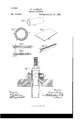
- FIG. 1 is a perspective view of a cylinderbushing constructed according to my invention.
- Fig. 2 is an enlarged transverse sectional view of the same.
- Fig. 3 is a perspective view of one of the artificial sheets which enter into the structure.
- Fig. i is a sectional View showing a number of the artificial sheets assembled to form an incomplete block, the dotted lines indicating the lines at which the block is divided to form strips.
- Fig. 5 is a sectional view of a completed block made up of said strips, the inclined dotted lines thereon indicating the lines on which said completed block is divided to form segments for constructing a cylindrical bushing or bearing.
- Fig. 6 is aperspective view of one of the segments.
- Fig. 7 is a sectional view of amachine for j acketing cylindrical bushings.
- ammonia to the water quickens the action of the latter on the particles, thus saving considerable time in the manufacture.
- a thorough mixture of the ingredients named the same is placed in amold and subjected to a heavy pressure, which eliminates all moisture, and the form is then taken from the mold and dried in a suitable kiln.
- My preferred construction involves the forming of artificial sheets, as a, by subjecting the reduced rawhide to heavy pressure, and coincident with or subsequently to the application of pressure thoroughly drying said sheets by steam or otherwise to expel therefrom all moisture.- A number of these artificial sheets so formed are then cemented together, pressure being applied, and the result is a block such as shown in Fig. at and lettered Z). From this block the necessary segments or other forms for building the bushings or bearings may be obtained, but I prefer to construct from the block 1; what I term a complcted block 0, (shown in Fig.
- Fig. 5 I have shown a method of cutting the block to form segments cl for a cylindrical or half-round bushing or bearing, by which the maximum economy of material is secured, said method consisting in dividing the block on the inclined lines 1 y, and thereby obtaining by a single cut the sides, so to speak, of two segments.
- said method consisting in dividing the block on the inclined lines 1 y, and thereby obtaining by a single cut the sides, so to speak, of two segments.
- g denotes a collar haying a tapering aperture and adjacent to said aperture recesses h for the escape of shavings.
- an annular knife t' At the point where the taper commences and coincident with said recesses is an annular knife t', which trues the periphery of the form as it passes downward into the contracted portion of the aperture.
- Pressure is applied-to the form by a Screw jand plunger j, and at the base of the aperture is placed the jacket f, into which the form is shown partially inserted.
- a bushing or bearing so constructed requires no lubrication, but to enhance its eifectiveness I sometimes mix the reduced rawhide with plumbago, which has the effect to further minimize the wear by acting as a ubr cant- It willbe evident that in abnshing or bearing constructed in accordance with the foregoing there is no grain; hence the resistance to wear is equal throughout.
- the method herein described of making bushings consisting of reducing rawhide to a finely-divided condition, mixing therewith warm water to form an adhesive film on the surface of the particles, eliminating the moisture from the mass by pressure, and then subj ecting the same to the action of heat.
- tubular articles consisting of reducing lawhide to a finely-divided condition, mixing therewith warm water to form an adhesive coating on the particles, subjecting the mass to pressure to eliminate the moisture therefrom and to form artificial sheets, subjecting said sheets to theaction of heat, cementing said sheets together, severing said assembled sheets to form strips, cementing said strips to form a block, severing said block on inclined lines in the manner set forth to form segments, and cementing said segments to form the bush-i11 6.
- tubular articles consisting of reducing rawhide to a finelymlividcd condition, mixing therewith warm water and concentrated ammonia to form an adhesive coating on the particles, subjecting the mass to pressure to eliminate the moisture therefrom and to form artificial sheets, subjecting said sheets to the action of heat, cementing said sheets together, severing said assembled sheets to form strips,
- a collar having a tapering aperture and an annular recess extending therefrom near its upper end, an annular knife-edge, one of the edges of which is contiguous with the IQ wall of the aperture, a device for forcing the bushing through said aperture and against said knife-edge, and a jacket to receive said bushing, so arranged as to form a continuation of said aperture.
Landscapes
- Engineering & Computer Science (AREA)
- General Engineering & Computer Science (AREA)
- Mechanical Engineering (AREA)
- Moulds, Cores, Or Mandrels (AREA)
Description
P. LATULIP. JOURNAL BEARING.
(No Model.)
Patented Jul 21, 1896.
c IIIIHIII!IIIlIlllllllllllllllllllllll mwwtoz f? lo WW UNITED STATES V [PATENT FFrcE.
FREDERICK LATULIP, OF SYRACUSE, NEIV YORK, ASSIGNOR OF ONE-HALF TO EDWARD J. SHANAHAN, OF SAME PLACE.
JOURNAL-BEARING.
SPECIFICATION forming part of Letters Patent No. 564,564, dated July 21, 1896.
Application filed September 11, 1896. Serial No. 562,133. (No model.)
To a whom, it may concern.-
Be it known that I, FREDRICK LATULIP, a citizen of the United States, residing at Syracuse, in the county of Onondaga and State of New York, have invented certain new and useful Improvements in J ournal-Bearings; and I do declare the following to be a full, clear, and exact description of the invention, such as will enable others skilled in the art to which it appertains to make and use the same, reference being had to the accompanying drawings, and to the letters of reference marked thereon, which form a part of this specification.
This invention is directed to improvements in the construction of bushings or journal-box bearings, and has for its object the production of an efficient rawhide bushing or bearing possessing advantages in point of durability and maximum economy in manufacture.
The nature of my invention will become apparent from a reading of the following detailed description when taken in connection with the accompanying drawings, in which- Figure 1 is a perspective view of a cylinderbushing constructed according to my invention. Fig. 2 is an enlarged transverse sectional view of the same. Fig. 3 is a perspective view of one of the artificial sheets which enter into the structure. Fig. i is a sectional View showing a number of the artificial sheets assembled to form an incomplete block, the dotted lines indicating the lines at which the block is divided to form strips. Fig. 5 is a sectional view of a completed block made up of said strips, the inclined dotted lines thereon indicating the lines on which said completed block is divided to form segments for constructing a cylindrical bushing or bearing. Fig. 6 is aperspective view of one of the segments. Fig. 7 is a sectional view of amachine for j acketing cylindrical bushings.
In carrying my invention into practice I reduce rawhide, by grinding or otherwise, to a more or less fine state, and from the material in this condition build up the bushing or other bearing-surface.
The rawhide when reduced is of about the same nature and condition as wood sawdust, being comparatively finely divided and free from dirt and other foreign substance. This material is then mixed thoroughly with moderately warm water, in the proportions of, say, five pounds of ground rawhide to one gallon of thewater,and to this is preferably added about one quart of concentrated ammonia. The action of the water or water and ammonia on the rawhide results in the formation of an adhesive film on the surface of each particle of the rawhide which causes said particles when subjected to a heavy pressure to unite to form a homogeneous mass, thereby dispensing with the employment of an additional ingredient as a binder. The addition of the ammonia to the water quickens the action of the latter on the particles, thus saving considerable time in the manufacture. After a thorough mixture of the ingredients named the same is placed in amold and subjected to a heavy pressure, which eliminates all moisture, and the form is then taken from the mold and dried in a suitable kiln.
My preferred construction involves the forming of artificial sheets, as a, by subjecting the reduced rawhide to heavy pressure, and coincident with or subsequently to the application of pressure thoroughly drying said sheets by steam or otherwise to expel therefrom all moisture.- A number of these artificial sheets so formed are then cemented together, pressure being applied, and the result is a block such as shown in Fig. at and lettered Z). From this block the necessary segments or other forms for building the bushings or bearings may be obtained, but I prefer to construct from the block 1; what I term a complcted block 0, (shown in Fig. 5,) and which is made by half reversing and cementing together under pressure strips cut from block b on the dotted lines 00 a: The completed block 0 is thoroughly dried, and is then ready to be divided into the segments or other forms of strips which enter into the bushing or bearing.
In Fig. 5 I have shown a method of cutting the block to form segments cl for a cylindrical or half-round bushing or bearing, by which the maximum economy of material is secured, said method consisting in dividing the block on the inclined lines 1 y, and thereby obtaining by a single cut the sides, so to speak, of two segments. As shown in said Fig. 5,
ing, and when arranged together are firsti cemented and then placed in a suitable clamp to form, for instance, the body 6. (Shown in Figs. 1 and 2.) This form is then subjected to a suitable drying process and is then ready to receive its metallic casing or jacket f, the operation of jacketing being as follows: The body, before or, if desired, after the drying process, is placed in a lathe and turned to a diameter considerably in excess of the diam-' eter of the casing or jacket into which it is-to be placed, and I then reduce the body under heavy pressure and force it in place, the device employed for this purpose being shown in Fig. 7. Referring to saidfignre, g denotes a collar haying a tapering aperture and adjacent to said aperture recesses h for the escape of shavings. At the point where the taper commences and coincident with said recesses is an annular knife t', which trues the periphery of the form as it passes downward into the contracted portion of the aperture. Pressure is applied-to the form by a Screw jand plunger j, and at the base of the aperture is placed the jacket f, into which the form is shown partially inserted.
The contraction of thediameter of the form to enable its entry into the jacket insures a very tight fit when in place, as said form has a tendency to expand to resume its normal diameter, and by this means no keys or other locking devices are necessary, as would be the case if the normal diameter of the form were the same as the internal diameter of the jacketor casing. Where the exterior of the form has in the first instance been carefully turned, the annular knife 2 may be dispensed with.
Vhile Ihave in the foregoing described the making of the segments or other forms ,of Strips from artificial sheets, I do not wish it understood that I confine myself thereto, as it is evident that the bushing or hearing can be formed either by molding the entire body or form at one operation or molding the segments or other forms of strips, which latter may be afterward assembled, as previously described.
A bushing or bearing so constructed requires no lubrication, but to enhance its eifectiveness I sometimes mix the reduced rawhide with plumbago, which has the effect to further minimize the wear by acting as a ubr cant- It willbe evident that in abnshing or bearing constructed in accordance with the foregoing there is no grain; hence the resistance to wear is equal throughout.
B y my invention I am enabled to utilize those particles of rawhide which have previously been regarded as waste and which have been in consequence discarded, and, in addition to this advantage of economy, the hide may be hardened by pressure to a degree greatly in excess of rawhide in its natural state.
I claim as my invention-- 1. The method herein described of making bushings, consisting of reducing rawhide to a finely-divided condition, mixing therewith warm water to form an adhesive film on the surface of the particles, eliminating the moisture from the mass by pressure, and then subj ecting the same to the action of heat.
2. The method herein described of making bushings, consisting of reducing rawhide to a finely-divided condition, mixing therewith warm water and. concentrated ammonia to form an adhesive film on the surface of the particles, eliminating the moisture from the mass by pressure, and then subjecting the same to the action of heat.
3. The method herein described of making bushings, consisting of reducing rawhide to a finely-divided condition, mixing therewith warm water to form an adhesive film on the surface of the particles, subjecting the mass to pressure to eliminate the moisture therefrom and to form artificial sheets, subjecting said sheets to the action of heat, cementing said sheets together to form a block, from which strips are cut to make the bushing.
4:. The method herein described of making bushings, consisting of reducing rawhide :to a finely-divided condition, mixing therewith warm water and concentrated ammonia to form an adhesive iilm on the surface of the particles, subjecting the mass to pressure to eliminate the moisture therefrom and to form artificial sheets, subjecting said sheets to the action of heat, cementing said sheets together to form a block, from which strips arecut to make the bushing.
5. The method herein described of making tubular articles, consisting of reducing lawhide to a finely-divided condition, mixing therewith warm water to form an adhesive coating on the particles, subjecting the mass to pressure to eliminate the moisture therefrom and to form artificial sheets, subjecting said sheets to theaction of heat, cementing said sheets together, severing said assembled sheets to form strips, cementing said strips to form a block, severing said block on inclined lines in the manner set forth to form segments, and cementing said segments to form the bush-i11 6. The method herein described of making tubular articles, consisting of reducing rawhide to a finelymlividcd condition, mixing therewith warm water and concentrated ammonia to form an adhesive coating on the particles, subjecting the mass to pressure to eliminate the moisture therefrom and to form artificial sheets, subjecting said sheets to the action of heat, cementing said sheets together, severing said assembled sheets to form strips,
IIO
cementing said strips to form a block, severing said block on inclined lines in the manner set forth to form segments, and cementing said segments to form the bushing.
7. As a means for jacketing rawhide bushings, a collar having a tapering aperture and an annular recess extending therefrom near its upper end, an annular knife-edge, one of the edges of which is contiguous with the IQ wall of the aperture, a device for forcing the bushing through said aperture and against said knife-edge, and a jacket to receive said bushing, so arranged as to form a continuation of said aperture.
In testimony whereof I affix my signature 15' in presence of two witnesses.
FREDRIOK LATULIP. WVitnesses:
A. A. BISHOP, E. J. SHANAHAN.
Publications (1)
| Publication Number | Publication Date |
|---|---|
| US564564A true US564564A (en) | 1896-07-21 |
Family
ID=2633281
Family Applications (1)
| Application Number | Title | Priority Date | Filing Date |
|---|---|---|---|
| US564564D Expired - Lifetime US564564A (en) | Frederick latulip |
Country Status (1)
| Country | Link |
|---|---|
| US (1) | US564564A (en) |
Cited By (1)
| Publication number | Priority date | Publication date | Assignee | Title |
|---|---|---|---|---|
| US2983131A (en) * | 1955-10-12 | 1961-05-09 | Clifford A Stephens | Manufacture of coated leather shaft seals |
-
0
- US US564564D patent/US564564A/en not_active Expired - Lifetime
Cited By (1)
| Publication number | Priority date | Publication date | Assignee | Title |
|---|---|---|---|---|
| US2983131A (en) * | 1955-10-12 | 1961-05-09 | Clifford A Stephens | Manufacture of coated leather shaft seals |
Similar Documents
| Publication | Publication Date | Title |
|---|---|---|
| CH633819A5 (en) | CONSTRUCTION MATERIAL AND METHOD FOR PRODUCING THE SAME. | |
| DE69503458T2 (en) | Porous ceramic material and process for its manufacture and valve unit | |
| DE2125905A1 (en) | Process for expanding and drying expandable microspheres | |
| DE1951564A1 (en) | Method and device for the continuous mixing of paste for electric batteries | |
| US743525A (en) | Method of molding stone. | |
| US1294008A (en) | Method of making candles. | |
| US867757A (en) | Pitch substitute and process for making the same. | |
| DE1619281A1 (en) | Water vapor permeable synthetic leather film material and process for its production | |
| DE937611C (en) | Axial fan made of acid-proof plastic with an electric motor built into the fan, especially for pumping acidic media | |
| DE2057971A1 (en) | Method for producing a hollow object with the shape of a rotational body from a ceramic material | |
| US140208A (en) | Improvement in rubber and plumbago compounds for bearings and other purposes | |
| US2649372A (en) | Method of making sheet material | |
| US909087A (en) | Process of preparing corncobs in the manufacture of pipes. | |
| US1259502A (en) | Composition plug. | |
| US972801A (en) | Composition of matter. | |
| DE102020004141A1 (en) | Laboratory extruder | |
| US517011A (en) | Method of making indurated articles from plastic material | |
| US150537A (en) | Improvement in artificial fuel | |
| US125552A (en) | Improvement in artificial stones | |
| USRE10794E (en) | Journal-bearing | |
| US349055A (en) | Mahlon eandolpet | |
| AT63032B (en) | Process for the production of resin-removed cattle feed from hops and other brewery waste. | |
| US412264A (en) | William kiel | |
| US520493A (en) | Method of mechanically compounding an oil o | |
| US237363A (en) | Covering for steam-pipes |