US5587099A - Safety container for microwave oven baking utensil - Google Patents
Safety container for microwave oven baking utensil Download PDFInfo
- Publication number
- US5587099A US5587099A US08/332,137 US33213794A US5587099A US 5587099 A US5587099 A US 5587099A US 33213794 A US33213794 A US 33213794A US 5587099 A US5587099 A US 5587099A
- Authority
- US
- United States
- Prior art keywords
- utensil
- container
- temperature
- food
- microwave
- Prior art date
- Legal status (The legal status is an assumption and is not a legal conclusion. Google has not performed a legal analysis and makes no representation as to the accuracy of the status listed.)
- Expired - Fee Related
Links
- 235000013305 food Nutrition 0.000 claims abstract description 47
- 229910000859 α-Fe Inorganic materials 0.000 claims abstract description 36
- 238000010411 cooking Methods 0.000 claims abstract description 28
- 238000010438 heat treatment Methods 0.000 claims abstract description 28
- 239000000463 material Substances 0.000 claims description 10
- 229910052751 metal Inorganic materials 0.000 claims description 10
- 239000002184 metal Substances 0.000 claims description 10
- 239000011159 matrix material Substances 0.000 claims description 8
- 239000002245 particle Substances 0.000 claims description 8
- 239000004033 plastic Substances 0.000 claims description 7
- 239000004593 Epoxy Substances 0.000 claims description 4
- 238000001816 cooling Methods 0.000 claims description 2
- 238000005452 bending Methods 0.000 claims 1
- 230000000295 complement effect Effects 0.000 description 4
- 230000005855 radiation Effects 0.000 description 4
- 238000013459 approach Methods 0.000 description 3
- 239000003822 epoxy resin Substances 0.000 description 3
- 229920000647 polyepoxide Polymers 0.000 description 3
- XEEYBQQBJWHFJM-UHFFFAOYSA-N Iron Chemical compound [Fe] XEEYBQQBJWHFJM-UHFFFAOYSA-N 0.000 description 2
- 239000004743 Polypropylene Substances 0.000 description 2
- 238000010521 absorption reaction Methods 0.000 description 2
- 239000003989 dielectric material Substances 0.000 description 2
- 230000000694 effects Effects 0.000 description 2
- 230000005291 magnetic effect Effects 0.000 description 2
- 238000004519 manufacturing process Methods 0.000 description 2
- 238000000034 method Methods 0.000 description 2
- -1 polypropylene Polymers 0.000 description 2
- 229920001155 polypropylene Polymers 0.000 description 2
- 229910000831 Steel Inorganic materials 0.000 description 1
- HCHKCACWOHOZIP-UHFFFAOYSA-N Zinc Chemical group [Zn] HCHKCACWOHOZIP-UHFFFAOYSA-N 0.000 description 1
- 230000001464 adherent effect Effects 0.000 description 1
- 229910052782 aluminium Inorganic materials 0.000 description 1
- XAGFODPZIPBFFR-UHFFFAOYSA-N aluminium Chemical compound [Al] XAGFODPZIPBFFR-UHFFFAOYSA-N 0.000 description 1
- 230000003466 anti-cipated effect Effects 0.000 description 1
- 229910052788 barium Inorganic materials 0.000 description 1
- DSAJWYNOEDNPEQ-UHFFFAOYSA-N barium atom Chemical compound [Ba] DSAJWYNOEDNPEQ-UHFFFAOYSA-N 0.000 description 1
- 230000015572 biosynthetic process Effects 0.000 description 1
- 235000008429 bread Nutrition 0.000 description 1
- 230000005294 ferromagnetic effect Effects 0.000 description 1
- 239000002223 garnet Substances 0.000 description 1
- 239000011521 glass Substances 0.000 description 1
- 230000002452 interceptive effect Effects 0.000 description 1
- 229910052742 iron Inorganic materials 0.000 description 1
- 150000002739 metals Chemical class 0.000 description 1
- 239000000203 mixture Substances 0.000 description 1
- 230000005298 paramagnetic effect Effects 0.000 description 1
- 125000006850 spacer group Chemical group 0.000 description 1
- 229910052596 spinel Inorganic materials 0.000 description 1
- 239000011029 spinel Substances 0.000 description 1
- 229910052566 spinel group Inorganic materials 0.000 description 1
- 239000010959 steel Substances 0.000 description 1
- 239000000126 substance Substances 0.000 description 1
- 239000011701 zinc Substances 0.000 description 1
- 229910052725 zinc Inorganic materials 0.000 description 1
Images
Classifications
-
- H—ELECTRICITY
- H05—ELECTRIC TECHNIQUES NOT OTHERWISE PROVIDED FOR
- H05B—ELECTRIC HEATING; ELECTRIC LIGHT SOURCES NOT OTHERWISE PROVIDED FOR; CIRCUIT ARRANGEMENTS FOR ELECTRIC LIGHT SOURCES, IN GENERAL
- H05B6/00—Heating by electric, magnetic or electromagnetic fields
- H05B6/64—Heating using microwaves
- H05B6/647—Aspects related to microwave heating combined with other heating techniques
- H05B6/6491—Aspects related to microwave heating combined with other heating techniques combined with the use of susceptors
- H05B6/6494—Aspects related to microwave heating combined with other heating techniques combined with the use of susceptors for cooking
-
- B—PERFORMING OPERATIONS; TRANSPORTING
- B65—CONVEYING; PACKING; STORING; HANDLING THIN OR FILAMENTARY MATERIAL
- B65D—CONTAINERS FOR STORAGE OR TRANSPORT OF ARTICLES OR MATERIALS, e.g. BAGS, BARRELS, BOTTLES, BOXES, CANS, CARTONS, CRATES, DRUMS, JARS, TANKS, HOPPERS, FORWARDING CONTAINERS; ACCESSORIES, CLOSURES, OR FITTINGS THEREFOR; PACKAGING ELEMENTS; PACKAGES
- B65D81/00—Containers, packaging elements, or packages, for contents presenting particular transport or storage problems, or adapted to be used for non-packaging purposes after removal of contents
- B65D81/34—Containers, packaging elements, or packages, for contents presenting particular transport or storage problems, or adapted to be used for non-packaging purposes after removal of contents for packaging foodstuffs or other articles intended to be cooked or heated within the package
- B65D81/3446—Containers, packaging elements, or packages, for contents presenting particular transport or storage problems, or adapted to be used for non-packaging purposes after removal of contents for packaging foodstuffs or other articles intended to be cooked or heated within the package specially adapted to be heated by microwaves
- B65D81/3453—Rigid containers, e.g. trays, bottles, boxes, cups
-
- B—PERFORMING OPERATIONS; TRANSPORTING
- B65—CONVEYING; PACKING; STORING; HANDLING THIN OR FILAMENTARY MATERIAL
- B65D—CONTAINERS FOR STORAGE OR TRANSPORT OF ARTICLES OR MATERIALS, e.g. BAGS, BARRELS, BOTTLES, BOXES, CANS, CARTONS, CRATES, DRUMS, JARS, TANKS, HOPPERS, FORWARDING CONTAINERS; ACCESSORIES, CLOSURES, OR FITTINGS THEREFOR; PACKAGING ELEMENTS; PACKAGES
- B65D2581/00—Containers, packaging elements, or packages, for contents presenting particular transport or storage problems, or adapted to be used for non-packaging purposes after removal of contents
- B65D2581/34—Containers, packaging elements, or packages, for contents presenting particular transport or storage problems, or adapted to be used for non-packaging purposes after removal of contents for packaging foodstuffs or other articles intended to be cooked or heated within
- B65D2581/3437—Containers, packaging elements, or packages, for contents presenting particular transport or storage problems, or adapted to be used for non-packaging purposes after removal of contents for packaging foodstuffs or other articles intended to be cooked or heated within specially adapted to be heated by microwaves
- B65D2581/3439—Means for affecting the heating or cooking properties
- B65D2581/344—Geometry or shape factors influencing the microwave heating properties
- B65D2581/3443—Shape or size of microwave reactive particles in a coating or ink
-
- B—PERFORMING OPERATIONS; TRANSPORTING
- B65—CONVEYING; PACKING; STORING; HANDLING THIN OR FILAMENTARY MATERIAL
- B65D—CONTAINERS FOR STORAGE OR TRANSPORT OF ARTICLES OR MATERIALS, e.g. BAGS, BARRELS, BOTTLES, BOXES, CANS, CARTONS, CRATES, DRUMS, JARS, TANKS, HOPPERS, FORWARDING CONTAINERS; ACCESSORIES, CLOSURES, OR FITTINGS THEREFOR; PACKAGING ELEMENTS; PACKAGES
- B65D2581/00—Containers, packaging elements, or packages, for contents presenting particular transport or storage problems, or adapted to be used for non-packaging purposes after removal of contents
- B65D2581/34—Containers, packaging elements, or packages, for contents presenting particular transport or storage problems, or adapted to be used for non-packaging purposes after removal of contents for packaging foodstuffs or other articles intended to be cooked or heated within
- B65D2581/3437—Containers, packaging elements, or packages, for contents presenting particular transport or storage problems, or adapted to be used for non-packaging purposes after removal of contents for packaging foodstuffs or other articles intended to be cooked or heated within specially adapted to be heated by microwaves
- B65D2581/3439—Means for affecting the heating or cooking properties
- B65D2581/3448—Binders for microwave reactive materials, e.g. for inks or coatings
-
- B—PERFORMING OPERATIONS; TRANSPORTING
- B65—CONVEYING; PACKING; STORING; HANDLING THIN OR FILAMENTARY MATERIAL
- B65D—CONTAINERS FOR STORAGE OR TRANSPORT OF ARTICLES OR MATERIALS, e.g. BAGS, BARRELS, BOTTLES, BOXES, CANS, CARTONS, CRATES, DRUMS, JARS, TANKS, HOPPERS, FORWARDING CONTAINERS; ACCESSORIES, CLOSURES, OR FITTINGS THEREFOR; PACKAGING ELEMENTS; PACKAGES
- B65D2581/00—Containers, packaging elements, or packages, for contents presenting particular transport or storage problems, or adapted to be used for non-packaging purposes after removal of contents
- B65D2581/34—Containers, packaging elements, or packages, for contents presenting particular transport or storage problems, or adapted to be used for non-packaging purposes after removal of contents for packaging foodstuffs or other articles intended to be cooked or heated within
- B65D2581/3437—Containers, packaging elements, or packages, for contents presenting particular transport or storage problems, or adapted to be used for non-packaging purposes after removal of contents for packaging foodstuffs or other articles intended to be cooked or heated within specially adapted to be heated by microwaves
- B65D2581/3471—Microwave reactive substances present in the packaging material
- B65D2581/3477—Iron or compounds thereof
-
- B—PERFORMING OPERATIONS; TRANSPORTING
- B65—CONVEYING; PACKING; STORING; HANDLING THIN OR FILAMENTARY MATERIAL
- B65D—CONTAINERS FOR STORAGE OR TRANSPORT OF ARTICLES OR MATERIALS, e.g. BAGS, BARRELS, BOTTLES, BOXES, CANS, CARTONS, CRATES, DRUMS, JARS, TANKS, HOPPERS, FORWARDING CONTAINERS; ACCESSORIES, CLOSURES, OR FITTINGS THEREFOR; PACKAGING ELEMENTS; PACKAGES
- B65D2581/00—Containers, packaging elements, or packages, for contents presenting particular transport or storage problems, or adapted to be used for non-packaging purposes after removal of contents
- B65D2581/34—Containers, packaging elements, or packages, for contents presenting particular transport or storage problems, or adapted to be used for non-packaging purposes after removal of contents for packaging foodstuffs or other articles intended to be cooked or heated within
- B65D2581/3437—Containers, packaging elements, or packages, for contents presenting particular transport or storage problems, or adapted to be used for non-packaging purposes after removal of contents for packaging foodstuffs or other articles intended to be cooked or heated within specially adapted to be heated by microwaves
- B65D2581/3471—Microwave reactive substances present in the packaging material
- B65D2581/3479—Other metallic compounds, e.g. silver, gold, copper, nickel
-
- B—PERFORMING OPERATIONS; TRANSPORTING
- B65—CONVEYING; PACKING; STORING; HANDLING THIN OR FILAMENTARY MATERIAL
- B65D—CONTAINERS FOR STORAGE OR TRANSPORT OF ARTICLES OR MATERIALS, e.g. BAGS, BARRELS, BOTTLES, BOXES, CANS, CARTONS, CRATES, DRUMS, JARS, TANKS, HOPPERS, FORWARDING CONTAINERS; ACCESSORIES, CLOSURES, OR FITTINGS THEREFOR; PACKAGING ELEMENTS; PACKAGES
- B65D2581/00—Containers, packaging elements, or packages, for contents presenting particular transport or storage problems, or adapted to be used for non-packaging purposes after removal of contents
- B65D2581/34—Containers, packaging elements, or packages, for contents presenting particular transport or storage problems, or adapted to be used for non-packaging purposes after removal of contents for packaging foodstuffs or other articles intended to be cooked or heated within
- B65D2581/3437—Containers, packaging elements, or packages, for contents presenting particular transport or storage problems, or adapted to be used for non-packaging purposes after removal of contents for packaging foodstuffs or other articles intended to be cooked or heated within specially adapted to be heated by microwaves
- B65D2581/3486—Dielectric characteristics of microwave reactive packaging
- B65D2581/3494—Microwave susceptor
-
- Y—GENERAL TAGGING OF NEW TECHNOLOGICAL DEVELOPMENTS; GENERAL TAGGING OF CROSS-SECTIONAL TECHNOLOGIES SPANNING OVER SEVERAL SECTIONS OF THE IPC; TECHNICAL SUBJECTS COVERED BY FORMER USPC CROSS-REFERENCE ART COLLECTIONS [XRACs] AND DIGESTS
- Y10—TECHNICAL SUBJECTS COVERED BY FORMER USPC
- Y10S—TECHNICAL SUBJECTS COVERED BY FORMER USPC CROSS-REFERENCE ART COLLECTIONS [XRACs] AND DIGESTS
- Y10S99/00—Foods and beverages: apparatus
- Y10S99/14—Induction heating
Definitions
- This invention relates generally to baking utensils, and more particularly to a utensil adapted to operate in a microwave oven to convert microwave energy to which the utensil is exposed to thermal energy for cooking the food contained therein, and more particularly to a safety container for protectively housing a utensil of this type so that when cooking is completed it cannot be removed from the container until the utensil has cooled to a temperature level at which it is safe to handle.
- Baking is the process of cooking food with dry heat. Heat is transferred to the food by convection, conduction or infrared radiation, depending on the nature of the oven. But in all cases, thermal energy is applied to the outer surface of the food and by reason of heat transfer from this surface to the inner body of the food, cooking takes place from the outside in. As a consequence, as cooking continues, the surface of the food may become scorched or browned. Because this action usually renders the food more palatable, such surface scorching or browning is normally regarded as desirable.
- microwave ovens are now installed in many households.
- a magnetron functions to generate microwave energy at a frequency of about 1000 mHz. This energy is conveyed by a wave guide to the interior of the oven to irradiate the food placed therein. Because food more or less absorbs microwave energy, this gives rise to internal molecular friction which heats the food at a rate that depends on its "lossy" characteristics.
- Some food products are heated more rapidly than others in a microwave oven; but in general the cooking of food by microwave energy is much faster than by conventional heating techniques, including infrared radiation.
- Cooking takes place in a microwave oven throughout the body of the food; hence browning or scorching of the outer surface or crust does not occur. Thus if one sought to bake a loaf of bread in a microwave oven it would have no crust. This is a recognized disadvantage of microwave cooking.
- U.S. Pat. No. 3,941,967 discloses a microwave cooking apparatus capable of scorching the surface of the food being cooked without excessively heating the interior of the food.
- This apparatus which is designed to be put into a microwave oven, takes the form of a casing within which is disposed a plate on which the food to be cooked is placed.
- a thermal heating element which generates heat by absorption of microwave radiation, use for this purpose being made of a ferrite heating element.
- the interior of the food is heated by the microwave energy absorbed thereby, while at the same time the exterior of the food is thermally heated and scorched by the plate heated by the ferrite heating element.
- a microwave browning utensil includes a metal platter on which the food to be heated in the microwave oven is placed.
- a thermal heating element formed by powdered ferrites dispersed in a matrix.
- the interior of the food on the platter which absorbs microwave energy is heated and cooked thereby, while its exterior is thermally heated and browned.
- Thermal heating takes place mainly by conduction; hence, the exterior of a body being heated is first subjected to the heat before it penetrates the interior of the food body, whereas with microwave heating, the radiation penetrates the interior of the body.
- U.S. Pat. No. 4,266,108 discloses the use of ferrite material adjacent a microwave reflecting member in which the ferrite material acts as a heating element that will rise in temperature to a predetermined level which depends on the Curie point of thee ferrite.
- U.S. Pat. No. 4,664,506 discloses an aluminum microwave cooking vessel having discrete layers of ferrite particles bonded thereto to convert microwave energy to thermal energy. When in its ferromagnetic state, the ferrite then absorbs microwave energy and is heated thereby. This action ceases when the ferrite enters its paramagnetic state.
- the heating element when a ferrite heating element is placed in a microwave oven and is subjected to microwave energy, the heating element will become increasingly hot until an elevated temperature is reached that depends on the Curie point of the ferrite, after which no more heat is generated even though the microwave oven is still operating. Thus, the ferrite heating element will effectively be turned “off,” even though the microwave oven is still "on.”
- the utensil adapted to operate in a microwave oven to convert microwave energy to which the utensil is exposed into thermal energy for cooking food contained therein.
- the utensil is composed of complementary, thermally-conductive upper and lower sections, each having bonded to its outer surface an epoxy matrix layer. Dispersed throughout the matrix layer are ferrite particles which absorb microwave energy to produce thermal energy that is conducted by the sections of the utensil to the food enveloped thereby.
- the Curie point of the ferrite particles is such as to arrest their absorption of microwave energy when the utensil temperature approaches a level which is excessive for the food product being cooked or baked.
- a safety container for a mold assembly for use by children to produce in a microwave oven shaped plastic play pieces, the assembly including a ferrite heating element responsive to microwave energy which acts to thermally heat the plastic material held in the mold assembly.
- This safety container which houses the mold assembly includes a removable cover which is latched when the heating element raises the temperature in the oven to a high level, and is automatically unlatched when the temperature is relatively cool so that the child can then safely remove the mold assembly from the container.
- the main object of this invention is to provide a safety container for housing a baking utensil which when placed in a microwave oven and exposed to microwave energy then converts this energy to thermal energy to cook the food therein, the safety container acting to prevent the removal of the utensil therefrom when its temperature is high and permitting such removal when the temperature is reduced to a level at which it can safely be handled.
- an object of this invention is to provide a safety container for housing a microwave baking utensil which does not interfere with the baking operation being carried out in a microwave oven, the container including a releasable cover that is only released when the utensil has cooled to a degree where it is safe to handle.
- a safety container for housing a baking utensil that include a ferrite heating element which when the utensil is placed in a microwave oven and is subjected to microwave energy converts this energy to thermal energy to cook food held in the utensil.
- the safety container includes separable upper and lower sections of a synthetic plastic .material that is insensitive to microwave energy for housing the utensil, the upper section functioning as a removable cover.
- the container is provided with latching means which latch the sections together when the heating element raises the temperature of the utensil in the oven to a high level and automatically unlatches the sections when the temperature is relatively cool so that one can then safely remove the utensil from the container.
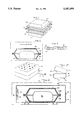
- FIG. 1 is an exploded view of a utensil in accordance with the invention
- FIG. 2 is a section taken through the utensil
- FIG. 3 is a section taken through the wall of a section of the utensil
- FIG. 4 shows in perspective a safety container in accordance with the invention for the utensil, the container being latched;
- FIG. 5 illustrates the container in its unlatched state
- FIG. 6 schematically illustrates the utensil enclosed within the container placed in a microwave oven.
- a microwave cooking utensil in accordance with the invention includes complementary upper and lower half metal sections 10 and 11, each in the form of a generally rectangular tray whose rim is provided with a flange 10F and 11F, respectively.
- a preferred metal for this purpose is zinc or steel which has a high thermal conductivity, but is insensitive to microwave energy.
- flange 10F of the upper section When the upper and lower half section 10 and 11 are combined to complete the utensil, as shown in FIG. 2, to envelop a food product 12 placed within the utensil, flange 10F of the upper section then is superposed over flange 11F of the lower section. Sandwiched between flanges 10F and 11F is a frame-shaped spacer 13 formed of polypropylene or other dielectric material to prevent sparking between the flanges when the utensil is exposed to microwave energy in a microwave oven. In practice the corners of the flanges and the frame are preferably rounded, for sharp edges are to be avoided in a microwave oven.
- the utensil illustrated herein is shown as being composed of a pair of rectangular tray-like sections, it is to be understood that the invention is by no means limited to this preferred embodiment, for a utensil in accordance with the invention, while it must have complementary upper and lower sections, these sections may be in a round, an octagonal or in any other shape.
- the upper section of the utensil may take the form of a lid for a tray like lower section.
- a matrix layer 15 of epoxy resin material is bonded to the outer surface of the shaped lower section 11 of the utensil and conforming thereto.
- ferrites refers to magnetic oxides containing iron as a major component. It is the high electrical resistivity of ferrites that distinguish them from magnetic metals.
- the three most common groups of ferrites are those characterized as spinels, garnets and hexagonal ferrites.
- the spinel ferrites have the chemical formula MeFe 2 O 4 .
- the garnet ferrites have the general formula 3MeO 2 5Fe 2 O 3 , while the composition of hexagonal ferrites include barium.
- Available ferrites have Curie points in the range of about 80° C. to over 500° C.
- the ferrite layers covering the sections of the metal sections shield the food contained in the utensil from microwave energy so that no microwave cooking takes place.
- the ferrites dispersed in the matrix layers absorb microwave energy and produce thermal energy that is conducted by the metal upper and lower sections 10 and 11 to the food product 12 enveloped by the utensil to effect cooking of the product from the outside in.
- the Curie point of the ferrites is such as to cut off the production of thermal energy when its temperature approaches a level that is excessive for cooking the food product contained in the utensil.
- the microwave oven In thermally cooking a particular food product whose cooking time is more or less known, there is no need to set the microwave oven timer so that the oven operates for a period just sufficient to effect thermal cooking of the food placed in the oven.
- the microwave oven may be set for a time period beyond the anticipated cooking time, for when the energy produced by the utensil approaches an excessive level, because of the Curie point of the ferrites, the production of thermal energy cuts off automatically.
- the Safety Container The Safety Container:
- a safety container in accordance with the invention which is adapted to protectively enclose a utensil of the type shown in FIGS. 1 to 3 or a similar type having a ferrite heating element without interfering with baking operations, has a box-like form constituted by complementary upper and lower sections 20 and 21. These are interhinged on one side, so that the upper section 20 functions as a cover that can be raised to admit or withdraw the utensil.
- the container is molded of polypropylene or other plastic material non-reactive to microwave energy and unaffected by the elevated temperature produced in the baking operation in a microwave oven.
- the sections are perforated to expedite cooling of the mold assembly after the container is removed from the microwave oven.
- Lower section 21 may be provided with feet 22 which raise the container above the surface on which it is placed.
- the hinge 23 for the container is a living hinge of the same plastic as the container itself.
- a temperature-sensitive bimetallic strip 24 At the front of upper section 20 of the container is a temperature-sensitive bimetallic strip 24 whose upper end is anchored on this section and whose lower end 25 which extends into lower section 21 is in a hook formation that is engageable by a non-metallic catch 26 on the lower section.
- strip 24 When the temperature of the strip is raised as a result of heat produced by the heating element of the assembly, strip 24 then bends in to cause hook 25 to engage catch 26, thereby latching the container. But when the mold assembly is close to room temperature and is safe to handle, the strip bends out to unlatch the container.
- FIG. 6 shows an operating microwave oven, represented by block 27, within which is placed the baking utensil 10 utensil 10 is then protectively enclosed in the safety container formed by sections 20 and 21.
- the child or adult who puts the loaded safety container in the microwave oven and then turns on the oven does not know exactly how long it takes to complete the baking operations; that is five to eight minutes, or whatever time it takes for baking to be completed.
- the microwave oven is set for say 10 minutes, or for a longer period beyond that estimated baking time then at the end of this period, baking will have been completed.
- the microwave oven When the microwave oven is shut off, and one removes the loaded latched container from the oven, one is then not able to remove the hot utensil from the container, for the container is still latched and remains latched until the utensil has cooled to a degree causing the container to automatically unlatch. It is at this point that the utensil may be safely removed from the container, and the baked food removed from the utensil.
- a utensil in accordance with the invention makes it possible to cook or bake a food product in a microwave oven without having to know how long it takes to bake the product, and without having to set the microwave timer to a predetermined baking period, for the utensil itself terminates the cooking heat when it reaches a predetermined level.
- the safety container makes it possible to carry out cooking with this utensil in a microwave oven without running the risk that the operator will handle the utensil while it is still so hot as to scorch the operator's fingers, for the operator is denied access to the utensil housed in the container while it is still too hot to handle.
Landscapes
- Engineering & Computer Science (AREA)
- Physics & Mathematics (AREA)
- Electromagnetism (AREA)
- Life Sciences & Earth Sciences (AREA)
- Food Science & Technology (AREA)
- Mechanical Engineering (AREA)
- Cookers (AREA)
Abstract
A safety container for a baking utensil provided with a thermal heating element having ferrites dispersed therein, which utensil when placed in a microwave oven and is exposed to microwave energy, converts this energy into thermal energy for cooking the food therein. The safety container in which the utensil is housed includes a removable cover and a temperature-responsive latching mechanism which releases the cover to permit withdrawal of the utensil from the container only when the utensil has cooled to a temperature level at which it is safe to handle.
Description
This application is a continuation-in-part both of our applications Ser. No. 08/166,517, filed Dec. 13, 1993, entitled "SAFETY CONTAINER FOR MOLD ASSEMBLY IN MICROWAVE OVEN" (now U.S. Pat. No. 5,396,051) and Ser. No. 08/173,784, filed Dec. 27, 1993, entitled "BAKING UTENSIL TO CONVERT MICROWAVE ENERGY INTO THERMAL ENERGY," the entire disclosures of these pending applications are being incorporated herein by reference.
1. Field of Invention
This invention relates generally to baking utensils, and more particularly to a utensil adapted to operate in a microwave oven to convert microwave energy to which the utensil is exposed to thermal energy for cooking the food contained therein, and more particularly to a safety container for protectively housing a utensil of this type so that when cooking is completed it cannot be removed from the container until the utensil has cooled to a temperature level at which it is safe to handle.
2. Status of Prior Art
Baking is the process of cooking food with dry heat. Heat is transferred to the food by convection, conduction or infrared radiation, depending on the nature of the oven. But in all cases, thermal energy is applied to the outer surface of the food and by reason of heat transfer from this surface to the inner body of the food, cooking takes place from the outside in. As a consequence, as cooking continues, the surface of the food may become scorched or browned. Because this action usually renders the food more palatable, such surface scorching or browning is normally regarded as desirable.
The use of a microwave oven to heat or cook food is commonplace, and microwave ovens are now installed in many households. In the typical microwave oven, a magnetron functions to generate microwave energy at a frequency of about 1000 mHz. This energy is conveyed by a wave guide to the interior of the oven to irradiate the food placed therein. Because food more or less absorbs microwave energy, this gives rise to internal molecular friction which heats the food at a rate that depends on its "lossy" characteristics. Some food products are heated more rapidly than others in a microwave oven; but in general the cooking of food by microwave energy is much faster than by conventional heating techniques, including infrared radiation.
In heating or cooking food in a microwave oven, the food is placed in a receptacle of synthetic plastic, glass or other material which is non-reactive to microwave energy; hence, it is only the food that is heated. U.S. Pat. Nos. 4,703,149 and 4,416,906 disclose microwave food heating utensils. In some cases, as pointed out in U.S. Pat. No. 4,416,906, microwave cooking of food is uneven because of dry spots in some areas of the food and moist spots in other areas.
Cooking takes place in a microwave oven throughout the body of the food; hence browning or scorching of the outer surface or crust does not occur. Thus if one sought to bake a loaf of bread in a microwave oven it would have no crust. This is a recognized disadvantage of microwave cooking.
U.S. Pat. No. 3,941,967 discloses a microwave cooking apparatus capable of scorching the surface of the food being cooked without excessively heating the interior of the food. This apparatus, which is designed to be put into a microwave oven, takes the form of a casing within which is disposed a plate on which the food to be cooked is placed. Below the plate is a thermal heating element which generates heat by absorption of microwave radiation, use for this purpose being made of a ferrite heating element. Thus, the interior of the food is heated by the microwave energy absorbed thereby, while at the same time the exterior of the food is thermally heated and scorched by the plate heated by the ferrite heating element.
A similar arrangement is shown in U.S. Pat. No. 4,496,815, in which a microwave browning utensil includes a metal platter on which the food to be heated in the microwave oven is placed. On the underside of the platter is a thermal heating element formed by powdered ferrites dispersed in a matrix. In this way, the interior of the food on the platter which absorbs microwave energy is heated and cooked thereby, while its exterior is thermally heated and browned. Thermal heating takes place mainly by conduction; hence, the exterior of a body being heated is first subjected to the heat before it penetrates the interior of the food body, whereas with microwave heating, the radiation penetrates the interior of the body.
U.S. Pat. No. 4,266,108 discloses the use of ferrite material adjacent a microwave reflecting member in which the ferrite material acts as a heating element that will rise in temperature to a predetermined level which depends on the Curie point of thee ferrite. U.S. Pat. No. 4,664,506 discloses an aluminum microwave cooking vessel having discrete layers of ferrite particles bonded thereto to convert microwave energy to thermal energy. When in its ferromagnetic state, the ferrite then absorbs microwave energy and is heated thereby. This action ceases when the ferrite enters its paramagnetic state. Hence, when a ferrite heating element is placed in a microwave oven and is subjected to microwave energy, the heating element will become increasingly hot until an elevated temperature is reached that depends on the Curie point of the ferrite, after which no more heat is generated even though the microwave oven is still operating. Thus, the ferrite heating element will effectively be turned "off," even though the microwave oven is still "on."
Our above-identified application, Ser. No. 08/173,784 discloses a baking utensil adapted to operate in a microwave oven to convert microwave energy to which the utensil is exposed into thermal energy for cooking food contained therein. The utensil is composed of complementary, thermally-conductive upper and lower sections, each having bonded to its outer surface an epoxy matrix layer. Dispersed throughout the matrix layer are ferrite particles which absorb microwave energy to produce thermal energy that is conducted by the sections of the utensil to the food enveloped thereby. The Curie point of the ferrite particles is such as to arrest their absorption of microwave energy when the utensil temperature approaches a level which is excessive for the food product being cooked or baked.
One who puts this utensil in a microwave oven does not exactly know how long it take for baking or cooking of food to be completed and therefore sets the microwave oven to turn off after a time period that is beyond the estimated cooking time. However, no danger exists that the food will be overcooked, for the Curie point of the ferrite particles is such as to cut off thermal heating when the utensil temperature exceeds a predetermined level. However, when cooking is completed and the utensil is to be removed from the microwave oven, the person who then removes the utensil from the oven runs the risk of being burned, for the utensil is still very hot.
In our above-identified copending application Ser. No. 08/173,784 there is disclosed a safety container for a mold assembly for use by children to produce in a microwave oven shaped plastic play pieces, the assembly including a ferrite heating element responsive to microwave energy which acts to thermally heat the plastic material held in the mold assembly. This safety container which houses the mold assembly includes a removable cover which is latched when the heating element raises the temperature in the oven to a high level, and is automatically unlatched when the temperature is relatively cool so that the child can then safely remove the mold assembly from the container.
The main object of this invention is to provide a safety container for housing a baking utensil which when placed in a microwave oven and exposed to microwave energy then converts this energy to thermal energy to cook the food therein, the safety container acting to prevent the removal of the utensil therefrom when its temperature is high and permitting such removal when the temperature is reduced to a level at which it can safely be handled.
More particularly, an object of this invention is to provide a safety container for housing a microwave baking utensil which does not interfere with the baking operation being carried out in a microwave oven, the container including a releasable cover that is only released when the utensil has cooled to a degree where it is safe to handle.
Briefly stated, these objects are attained in a safety container for housing a baking utensil that include a ferrite heating element which when the utensil is placed in a microwave oven and is subjected to microwave energy converts this energy to thermal energy to cook food held in the utensil.
The safety container includes separable upper and lower sections of a synthetic plastic .material that is insensitive to microwave energy for housing the utensil, the upper section functioning as a removable cover. The container is provided with latching means which latch the sections together when the heating element raises the temperature of the utensil in the oven to a high level and automatically unlatches the sections when the temperature is relatively cool so that one can then safely remove the utensil from the container.
For a better understanding of the invention as well as other objects and features thereof, reference is made to the following detailed description to be read in conjunction with the accompanying drawing wherein:
FIG. 1 is an exploded view of a utensil in accordance with the invention;
FIG. 2 is a section taken through the utensil;
FIG. 3 is a section taken through the wall of a section of the utensil;
FIG. 4 shows in perspective a safety container in accordance with the invention for the utensil, the container being latched;
FIG. 5 illustrates the container in its unlatched state; and
FIG. 6 schematically illustrates the utensil enclosed within the container placed in a microwave oven.
The Utensil:
Referring now to FIG. 1 of the drawing, it will be seen that a microwave cooking utensil in accordance with the invention includes complementary upper and lower half metal sections 10 and 11, each in the form of a generally rectangular tray whose rim is provided with a flange 10F and 11F, respectively. A preferred metal for this purpose is zinc or steel which has a high thermal conductivity, but is insensitive to microwave energy.
When the upper and lower half section 10 and 11 are combined to complete the utensil, as shown in FIG. 2, to envelop a food product 12 placed within the utensil, flange 10F of the upper section then is superposed over flange 11F of the lower section. Sandwiched between flanges 10F and 11F is a frame-shaped spacer 13 formed of polypropylene or other dielectric material to prevent sparking between the flanges when the utensil is exposed to microwave energy in a microwave oven. In practice the corners of the flanges and the frame are preferably rounded, for sharp edges are to be avoided in a microwave oven.
While the utensil illustrated herein is shown as being composed of a pair of rectangular tray-like sections, it is to be understood that the invention is by no means limited to this preferred embodiment, for a utensil in accordance with the invention, while it must have complementary upper and lower sections, these sections may be in a round, an octagonal or in any other shape. Thus the upper section of the utensil may take the form of a lid for a tray like lower section.
Bonded to the outer surface of the shaped upper section 10 of the utensil is a matrix layer 14 of epoxy resin material or any other dielectric material which is strongly adherent to the outer surface of the metal. Similarly bonded to the outer surface of the shaped lower section 11 of the utensil and conforming thereto is a matrix layer 15 of epoxy resin material. The advantage of an epoxy resin is that it is capable of surviving rough handling and should the utensil be dropped on a hard surface or otherwise mishandled, the epoxy layer will remain attached to the metal and will not crack.
Dispersed throughout the epoxy matrix layers 14 and 15 which are non-reactive to microwave energy, are fine ferrite particles P as shown in FIG. 3. These particles are highly reactive and absorb microwave energy. The term "ferrites" refers to magnetic oxides containing iron as a major component. It is the high electrical resistivity of ferrites that distinguish them from magnetic metals. The three most common groups of ferrites are those characterized as spinels, garnets and hexagonal ferrites. The spinel ferrites have the chemical formula MeFe2 O4. The garnet ferrites have the general formula 3MeO2 5Fe2 O3, while the composition of hexagonal ferrites include barium. Available ferrites have Curie points in the range of about 80° C. to over 500° C. The ferrite layers covering the sections of the metal sections shield the food contained in the utensil from microwave energy so that no microwave cooking takes place.
The ferrites dispersed in the matrix layers absorb microwave energy and produce thermal energy that is conducted by the metal upper and lower sections 10 and 11 to the food product 12 enveloped by the utensil to effect cooking of the product from the outside in. The Curie point of the ferrites is such as to cut off the production of thermal energy when its temperature approaches a level that is excessive for cooking the food product contained in the utensil.
In thermally cooking a particular food product whose cooking time is more or less known, there is no need to set the microwave oven timer so that the oven operates for a period just sufficient to effect thermal cooking of the food placed in the oven. In practice the microwave oven may be set for a time period beyond the anticipated cooking time, for when the energy produced by the utensil approaches an excessive level, because of the Curie point of the ferrites, the production of thermal energy cuts off automatically.
The Safety Container:
As illustrated in FIGS. 4, 5 and 6, a safety container in accordance with the invention, which is adapted to protectively enclose a utensil of the type shown in FIGS. 1 to 3 or a similar type having a ferrite heating element without interfering with baking operations, has a box-like form constituted by complementary upper and lower sections 20 and 21. These are interhinged on one side, so that the upper section 20 functions as a cover that can be raised to admit or withdraw the utensil.
The container is molded of polypropylene or other plastic material non-reactive to microwave energy and unaffected by the elevated temperature produced in the baking operation in a microwave oven. The sections are perforated to expedite cooling of the mold assembly after the container is removed from the microwave oven. Lower section 21 may be provided with feet 22 which raise the container above the surface on which it is placed. The hinge 23 for the container is a living hinge of the same plastic as the container itself.
At the front of upper section 20 of the container is a temperature-sensitive bimetallic strip 24 whose upper end is anchored on this section and whose lower end 25 which extends into lower section 21 is in a hook formation that is engageable by a non-metallic catch 26 on the lower section. When the temperature of the strip is raised as a result of heat produced by the heating element of the assembly, strip 24 then bends in to cause hook 25 to engage catch 26, thereby latching the container. But when the mold assembly is close to room temperature and is safe to handle, the strip bends out to unlatch the container.
FIG. 6 shows an operating microwave oven, represented by block 27, within which is placed the baking utensil 10 utensil 10 is then protectively enclosed in the safety container formed by sections 20 and 21. The child or adult who puts the loaded safety container in the microwave oven and then turns on the oven does not know exactly how long it takes to complete the baking operations; that is five to eight minutes, or whatever time it takes for baking to be completed.
But if the microwave oven is set for say 10 minutes, or for a longer period beyond that estimated baking time then at the end of this period, baking will have been completed. No danger exists in running the microwave oven for a longer period, than it takes to complete baking, for the ferrite heating element not only acts to heat the food contained in the utensil, but also the bimetallic element which then acts to latch the safety container while it is within the microwave oven. But the container itself remains relatively cool. And the Curie point of the ferrite heating element is such as to cut off thermal heating when the baking temperature exceeds a predetermined level.
When the microwave oven is shut off, and one removes the loaded latched container from the oven, one is then not able to remove the hot utensil from the container, for the container is still latched and remains latched until the utensil has cooled to a degree causing the container to automatically unlatch. It is at this point that the utensil may be safely removed from the container, and the baked food removed from the utensil.
Thus a utensil in accordance with the invention makes it possible to cook or bake a food product in a microwave oven without having to know how long it takes to bake the product, and without having to set the microwave timer to a predetermined baking period, for the utensil itself terminates the cooking heat when it reaches a predetermined level.
And the safety container makes it possible to carry out cooking with this utensil in a microwave oven without running the risk that the operator will handle the utensil while it is still so hot as to scorch the operator's fingers, for the operator is denied access to the utensil housed in the container while it is still too hot to handle.
While there has been shown a preferred embodiment of the invention, it will be appreciated that many changes may be made therein without departing from the underlying concept.
Claims (7)
1. A safety container for a baking utensil useable in a microwave oven to cook food held in the utensil, the utensil being provided with a heating element having ferrite particles which absorb microwave energy to produce thermal heat to heat the food, said container comprising:
A. separable upper and lower sections formed of a material insensitive to microwave energy for housing the utensil; and
B. temperature-sensitive latching means that latch the sections together when the heating element of the utensil housed in the container raises the temperature of the utensil to a high level well above room temperature and automatically unlatch the sections when the temperature of the utensil is relatively cool and one can then safely remove the utensil from the container.
2. A container as set forth in claim 1 in which the sections are fabricated of synthetic plastic material.
3. A container as set forth in claim 2, in which said upper and lower sections are interhinged by a living hinge.
4. A container as set forth in claim 2, in which the lower section is provided with legs to raise the container within the oven.
5. A safety container as set forth in claim 1, in which said latching means include a bendable bimetallic strip secured to and extending from the upper section into the lower section, and a catch secured to the lower section and engaged by the strip when the temperature is at said high temperature and said strip is then bent in, said strip bending out to disengage said catcher when the temperature is cool.
6. A container as set forth in claim 1, in which at least one section is perforated to promote cooling of the utensil when the container is removed from the oven after cooking is completed.
7. A container for a baking utensil as set forth in claim 1, in which the utensil is formed of metal and the heating element is formed by an epoxy matrix bonded to the metal and having said ferrite particles dispersed therein.
Priority Applications (1)
| Application Number | Priority Date | Filing Date | Title |
|---|---|---|---|
| US08/332,137 US5587099A (en) | 1993-12-13 | 1994-10-31 | Safety container for microwave oven baking utensil |
Applications Claiming Priority (3)
| Application Number | Priority Date | Filing Date | Title |
|---|---|---|---|
| US08/166,517 US5396051A (en) | 1993-01-04 | 1993-12-13 | Safety container for mold assembly in microwave oven |
| US08/173,784 US5493103A (en) | 1993-12-27 | 1993-12-27 | Baking utensil to convert microwave into thermal energy |
| US08/332,137 US5587099A (en) | 1993-12-13 | 1994-10-31 | Safety container for microwave oven baking utensil |
Related Parent Applications (2)
| Application Number | Title | Priority Date | Filing Date |
|---|---|---|---|
| US08/166,517 Continuation-In-Part US5396051A (en) | 1993-01-04 | 1993-12-13 | Safety container for mold assembly in microwave oven |
| US08/173,784 Continuation-In-Part US5493103A (en) | 1993-12-13 | 1993-12-27 | Baking utensil to convert microwave into thermal energy |
Publications (1)
| Publication Number | Publication Date |
|---|---|
| US5587099A true US5587099A (en) | 1996-12-24 |
Family
ID=26862326
Family Applications (1)
| Application Number | Title | Priority Date | Filing Date |
|---|---|---|---|
| US08/332,137 Expired - Fee Related US5587099A (en) | 1993-12-13 | 1994-10-31 | Safety container for microwave oven baking utensil |
Country Status (1)
| Country | Link |
|---|---|
| US (1) | US5587099A (en) |
Cited By (11)
| Publication number | Priority date | Publication date | Assignee | Title |
|---|---|---|---|---|
| NL1016154C2 (en) * | 2000-09-12 | 2002-03-13 | Marinus Giovanni Poortvliet | Accessory to enable whole egg to be cooked in microwave oven, uses an electrically conductive aluminum foil bag with a number of perforations through with radiation can pass |
| FR2816220A1 (en) * | 2000-11-07 | 2002-05-10 | Janick Simeray | Cooking training toy has simulated cooker which has temperature guards and can be placed in microwave oven |
| GB2369341A (en) * | 2000-11-22 | 2002-05-29 | Mccain Foods | A heat responsive food product container |
| JP2011009016A (en) * | 2009-06-24 | 2011-01-13 | Jfe Chemical Corp | Electromagnetic wave absorbing heating element, and cooking utensil for microwave oven |
| US20110204047A1 (en) * | 2010-02-19 | 2011-08-25 | Hilary Rich | Microwavable container |
| US20130082063A1 (en) * | 2010-06-08 | 2013-04-04 | Filippo Lizzio | Container for transporting heated foodstuff and related lid |
| ITMI20131031A1 (en) * | 2013-06-20 | 2014-12-21 | Ariete Di Ghirardello Sabrina | APPARATUS AND METHOD FOR COOKING AND / OR SINTERING MATERIALS THROUGH MICROWAVES |
| US20150020404A1 (en) * | 2013-07-19 | 2015-01-22 | Tae Hyung Kim | Multifunctional microwave oven |
| KR20170056863A (en) * | 2015-11-16 | 2017-05-24 | 삼성전자주식회사 | Cooking apparatus, control method thereof and laminated plate |
| US20180086536A1 (en) * | 2016-09-23 | 2018-03-29 | Michel Cabiran | Ring to Space Plates In Microwave Oven |
| US10244586B2 (en) | 2016-07-29 | 2019-03-26 | Dart Industries Inc. | Microwaveable container |
Citations (10)
| Publication number | Priority date | Publication date | Assignee | Title |
|---|---|---|---|---|
| US2125419A (en) * | 1936-01-14 | 1938-08-02 | Harold W Birk | Receptacle |
| US2565361A (en) * | 1950-08-09 | 1951-08-21 | Joseph G Elm | Automatic lid closer for receptacles |
| US3420923A (en) * | 1963-07-29 | 1969-01-07 | Ici Ltd | Process for manufacturing foamed plastic articles having outer skin by curing with microwaves |
| US3429359A (en) * | 1965-05-21 | 1969-02-25 | Litton Precision Prod Inc | Method and apparatus for blowing cores using microwave energy |
| US3511899A (en) * | 1967-07-20 | 1970-05-12 | Gen Motors Corp | Method of making a popcorn energy absorber |
| US3559839A (en) * | 1969-01-24 | 1971-02-02 | Raymond Joseph Seethaler | Pressure cooker with heat activated safety lock |
| US3585258A (en) * | 1965-10-19 | 1971-06-15 | Melvin L Levinson | Method of firing ceramic articles utilizing microwave energy |
| US4822966A (en) * | 1987-02-20 | 1989-04-18 | Yuzuru Matsubara | Method of producing heat with microwaves |
| US4882463A (en) * | 1987-10-30 | 1989-11-21 | Suntory Limited | Food vessel using heating element for microwave oven |
| US5396051A (en) * | 1993-01-04 | 1995-03-07 | Kuhn; James O. | Safety container for mold assembly in microwave oven |
-
1994
- 1994-10-31 US US08/332,137 patent/US5587099A/en not_active Expired - Fee Related
Patent Citations (10)
| Publication number | Priority date | Publication date | Assignee | Title |
|---|---|---|---|---|
| US2125419A (en) * | 1936-01-14 | 1938-08-02 | Harold W Birk | Receptacle |
| US2565361A (en) * | 1950-08-09 | 1951-08-21 | Joseph G Elm | Automatic lid closer for receptacles |
| US3420923A (en) * | 1963-07-29 | 1969-01-07 | Ici Ltd | Process for manufacturing foamed plastic articles having outer skin by curing with microwaves |
| US3429359A (en) * | 1965-05-21 | 1969-02-25 | Litton Precision Prod Inc | Method and apparatus for blowing cores using microwave energy |
| US3585258A (en) * | 1965-10-19 | 1971-06-15 | Melvin L Levinson | Method of firing ceramic articles utilizing microwave energy |
| US3511899A (en) * | 1967-07-20 | 1970-05-12 | Gen Motors Corp | Method of making a popcorn energy absorber |
| US3559839A (en) * | 1969-01-24 | 1971-02-02 | Raymond Joseph Seethaler | Pressure cooker with heat activated safety lock |
| US4822966A (en) * | 1987-02-20 | 1989-04-18 | Yuzuru Matsubara | Method of producing heat with microwaves |
| US4882463A (en) * | 1987-10-30 | 1989-11-21 | Suntory Limited | Food vessel using heating element for microwave oven |
| US5396051A (en) * | 1993-01-04 | 1995-03-07 | Kuhn; James O. | Safety container for mold assembly in microwave oven |
Cited By (16)
| Publication number | Priority date | Publication date | Assignee | Title |
|---|---|---|---|---|
| NL1016154C2 (en) * | 2000-09-12 | 2002-03-13 | Marinus Giovanni Poortvliet | Accessory to enable whole egg to be cooked in microwave oven, uses an electrically conductive aluminum foil bag with a number of perforations through with radiation can pass |
| FR2816220A1 (en) * | 2000-11-07 | 2002-05-10 | Janick Simeray | Cooking training toy has simulated cooker which has temperature guards and can be placed in microwave oven |
| GB2369341A (en) * | 2000-11-22 | 2002-05-29 | Mccain Foods | A heat responsive food product container |
| JP2011009016A (en) * | 2009-06-24 | 2011-01-13 | Jfe Chemical Corp | Electromagnetic wave absorbing heating element, and cooking utensil for microwave oven |
| US20110204047A1 (en) * | 2010-02-19 | 2011-08-25 | Hilary Rich | Microwavable container |
| US8618454B2 (en) * | 2010-02-19 | 2013-12-31 | Hilary Rich | Microwavable container |
| US20130082063A1 (en) * | 2010-06-08 | 2013-04-04 | Filippo Lizzio | Container for transporting heated foodstuff and related lid |
| ITMI20131031A1 (en) * | 2013-06-20 | 2014-12-21 | Ariete Di Ghirardello Sabrina | APPARATUS AND METHOD FOR COOKING AND / OR SINTERING MATERIALS THROUGH MICROWAVES |
| US20150020404A1 (en) * | 2013-07-19 | 2015-01-22 | Tae Hyung Kim | Multifunctional microwave oven |
| KR20170056863A (en) * | 2015-11-16 | 2017-05-24 | 삼성전자주식회사 | Cooking apparatus, control method thereof and laminated plate |
| CN108431505A (en) * | 2015-11-16 | 2018-08-21 | 三星电子株式会社 | Cooking equipment and its control method and double plates |
| EP3343111A4 (en) * | 2015-11-16 | 2018-11-14 | Samsung Electronics Co., Ltd. | Cooking apparatus, control method therefor and double plate |
| CN108431505B (en) * | 2015-11-16 | 2021-04-06 | 三星电子株式会社 | Cooking equipment and its control method and double plate |
| US11193676B2 (en) | 2015-11-16 | 2021-12-07 | Samsung Electronics Co., Ltd. | Cooking apparatus, control method therefor and double plate |
| US10244586B2 (en) | 2016-07-29 | 2019-03-26 | Dart Industries Inc. | Microwaveable container |
| US20180086536A1 (en) * | 2016-09-23 | 2018-03-29 | Michel Cabiran | Ring to Space Plates In Microwave Oven |
Similar Documents
| Publication | Publication Date | Title |
|---|---|---|
| CA1172317A (en) | Microwave heating appliance and method | |
| US5493103A (en) | Baking utensil to convert microwave into thermal energy | |
| US4454403A (en) | Microwave heating method and apparatus | |
| US4190757A (en) | Microwave heating package and method | |
| EP0284420B1 (en) | Microwave heating apparatus and method | |
| US4496815A (en) | Microwave browning utensil | |
| US4663506A (en) | Microwave cake and bread maker | |
| CA1145413A (en) | Temperature self-limiting microwave heating device and method | |
| US3974354A (en) | Microwave utensil with reflective surface handle | |
| CA1091305A (en) | Microwave heating package and method | |
| US3845266A (en) | Microwave cooking utensil | |
| US4701585A (en) | Microwave browning cookware | |
| US4486640A (en) | Cooker/baker utensil for microwave oven | |
| US3716687A (en) | Method and apparatus for cooking | |
| US4317017A (en) | Microwave steamer | |
| CA1323909C (en) | Heat generating container for microwave oven | |
| US3731037A (en) | Microwave kiln to cook food | |
| US3920944A (en) | Method of cooking food employing both microwave and heat energy | |
| US4220134A (en) | Toaster/oven accessory container | |
| US5396051A (en) | Safety container for mold assembly in microwave oven | |
| US5281784A (en) | Mold assembly for microwave oven | |
| JPH01204386A (en) | Microwave oven | |
| JPH06193887A (en) | Cookware | |
| JP6016832B2 (en) | Microwave cookware | |
| KR960004289B1 (en) | Microwave Heater |
Legal Events
| Date | Code | Title | Description |
|---|---|---|---|
| REMI | Maintenance fee reminder mailed | ||
| LAPS | Lapse for failure to pay maintenance fees | ||
| FP | Lapsed due to failure to pay maintenance fee |
Effective date: 20001224 |
|
| STCH | Information on status: patent discontinuation |
Free format text: PATENT EXPIRED DUE TO NONPAYMENT OF MAINTENANCE FEES UNDER 37 CFR 1.362 |