US5354535A - Synthesis of highly phase pure (Bi, Pb)-Sr-Ca-Cu-O superconductor - Google Patents
Synthesis of highly phase pure (Bi, Pb)-Sr-Ca-Cu-O superconductor Download PDFInfo
- Publication number
- US5354535A US5354535A US08/043,652 US4365293A US5354535A US 5354535 A US5354535 A US 5354535A US 4365293 A US4365293 A US 4365293A US 5354535 A US5354535 A US 5354535A
- Authority
- US
- United States
- Prior art keywords
- superconductor
- powdered
- mixtures
- preparing
- mixture
- Prior art date
- Legal status (The legal status is an assumption and is not a legal conclusion. Google has not performed a legal analysis and makes no representation as to the accuracy of the status listed.)
- Expired - Fee Related
Links
- 239000002887 superconductor Substances 0.000 title claims abstract description 39
- 229910052745 lead Inorganic materials 0.000 title claims abstract description 33
- 229910002480 Cu-O Inorganic materials 0.000 title claims abstract description 24
- 230000015572 biosynthetic process Effects 0.000 title description 2
- 229910052797 bismuth Inorganic materials 0.000 title description 2
- 238000003786 synthesis reaction Methods 0.000 title 1
- 239000000203 mixture Substances 0.000 claims abstract description 68
- 238000000034 method Methods 0.000 claims abstract description 39
- QPLDLSVMHZLSFG-UHFFFAOYSA-N Copper oxide Chemical compound [Cu]=O QPLDLSVMHZLSFG-UHFFFAOYSA-N 0.000 claims abstract description 30
- VTYYLEPIZMXCLO-UHFFFAOYSA-L Calcium carbonate Chemical compound [Ca+2].[O-]C([O-])=O VTYYLEPIZMXCLO-UHFFFAOYSA-L 0.000 claims abstract description 24
- 239000000843 powder Substances 0.000 claims abstract description 22
- 238000004519 manufacturing process Methods 0.000 claims abstract description 17
- 229910000018 strontium carbonate Inorganic materials 0.000 claims abstract description 13
- 229910000019 calcium carbonate Inorganic materials 0.000 claims abstract description 12
- YEXPOXQUZXUXJW-UHFFFAOYSA-N oxolead Chemical compound [Pb]=O YEXPOXQUZXUXJW-UHFFFAOYSA-N 0.000 claims abstract description 6
- 229910000464 lead oxide Inorganic materials 0.000 claims abstract description 5
- 239000005751 Copper oxide Substances 0.000 claims abstract 8
- 229910000431 copper oxide Inorganic materials 0.000 claims abstract 8
- BDAGIHXWWSANSR-NJFSPNSNSA-N hydroxyformaldehyde Chemical compound O[14CH]=O BDAGIHXWWSANSR-NJFSPNSNSA-N 0.000 claims abstract 8
- 229910000416 bismuth oxide Inorganic materials 0.000 claims abstract 4
- TYIXMATWDRGMPF-UHFFFAOYSA-N dibismuth;oxygen(2-) Chemical compound [O-2].[O-2].[O-2].[Bi+3].[Bi+3] TYIXMATWDRGMPF-UHFFFAOYSA-N 0.000 claims abstract 4
- 239000011575 calcium Substances 0.000 claims description 37
- 238000010438 heat treatment Methods 0.000 claims description 13
- 230000008569 process Effects 0.000 claims description 13
- 238000001354 calcination Methods 0.000 claims description 11
- BQCADISMDOOEFD-UHFFFAOYSA-N Silver Chemical compound [Ag] BQCADISMDOOEFD-UHFFFAOYSA-N 0.000 claims description 9
- 229910052709 silver Inorganic materials 0.000 claims description 9
- 239000004332 silver Substances 0.000 claims description 9
- 238000002156 mixing Methods 0.000 claims description 6
- 238000000137 annealing Methods 0.000 claims description 5
- 150000001875 compounds Chemical class 0.000 claims description 5
- XKRFYHLGVUSROY-UHFFFAOYSA-N Argon Chemical compound [Ar] XKRFYHLGVUSROY-UHFFFAOYSA-N 0.000 claims description 4
- 229910052786 argon Inorganic materials 0.000 claims description 2
- 150000004649 carbonic acid derivatives Chemical group 0.000 claims description 2
- 230000001186 cumulative effect Effects 0.000 claims description 2
- 238000000354 decomposition reaction Methods 0.000 claims description 2
- 238000007789 sealing Methods 0.000 claims 2
- 239000012071 phase Substances 0.000 description 35
- 239000000463 material Substances 0.000 description 14
- HTUMBQDCCIXGCV-UHFFFAOYSA-N lead oxide Chemical compound [O-2].[Pb+2] HTUMBQDCCIXGCV-UHFFFAOYSA-N 0.000 description 8
- LEDMRZGFZIAGGB-UHFFFAOYSA-L strontium carbonate Chemical compound [Sr+2].[O-]C([O-])=O LEDMRZGFZIAGGB-UHFFFAOYSA-L 0.000 description 5
- 238000004455 differential thermal analysis Methods 0.000 description 4
- 238000002844 melting Methods 0.000 description 4
- 230000008018 melting Effects 0.000 description 4
- 238000003825 pressing Methods 0.000 description 4
- 229910016264 Bi2 O3 Inorganic materials 0.000 description 3
- OYPRJOBELJOOCE-UHFFFAOYSA-N Calcium Chemical compound [Ca] OYPRJOBELJOOCE-UHFFFAOYSA-N 0.000 description 3
- 229910052791 calcium Inorganic materials 0.000 description 3
- 239000000919 ceramic Substances 0.000 description 3
- 239000011162 core material Substances 0.000 description 3
- 229910015901 Bi-Sr-Ca-Cu-O Inorganic materials 0.000 description 2
- KFZMGEQAYNKOFK-UHFFFAOYSA-N Isopropanol Chemical compound CC(C)O KFZMGEQAYNKOFK-UHFFFAOYSA-N 0.000 description 2
- 239000000470 constituent Substances 0.000 description 2
- 229910052751 metal Inorganic materials 0.000 description 2
- 239000002184 metal Substances 0.000 description 2
- 238000003908 quality control method Methods 0.000 description 2
- 230000009467 reduction Effects 0.000 description 2
- 238000005096 rolling process Methods 0.000 description 2
- 101100296543 Caenorhabditis elegans pbo-4 gene Proteins 0.000 description 1
- 238000002441 X-ray diffraction Methods 0.000 description 1
- 230000008859 change Effects 0.000 description 1
- 238000006243 chemical reaction Methods 0.000 description 1
- 230000003247 decreasing effect Effects 0.000 description 1
- 230000001627 detrimental effect Effects 0.000 description 1
- 238000005538 encapsulation Methods 0.000 description 1
- 238000005516 engineering process Methods 0.000 description 1
- 230000002708 enhancing effect Effects 0.000 description 1
- 230000008020 evaporation Effects 0.000 description 1
- 238000001704 evaporation Methods 0.000 description 1
- 238000001125 extrusion Methods 0.000 description 1
- 239000007791 liquid phase Substances 0.000 description 1
- 238000005259 measurement Methods 0.000 description 1
- 239000002245 particle Substances 0.000 description 1
- 239000002243 precursor Substances 0.000 description 1
- 238000007670 refining Methods 0.000 description 1
- 239000002002 slurry Substances 0.000 description 1
- 230000006641 stabilisation Effects 0.000 description 1
- 238000011105 stabilization Methods 0.000 description 1
- 239000007858 starting material Substances 0.000 description 1
- 229910052712 strontium Inorganic materials 0.000 description 1
- CIOAGBVUUVVLOB-UHFFFAOYSA-N strontium atom Chemical compound [Sr] CIOAGBVUUVVLOB-UHFFFAOYSA-N 0.000 description 1
- 239000000126 substance Substances 0.000 description 1
- 230000001052 transient effect Effects 0.000 description 1
- 238000011282 treatment Methods 0.000 description 1
Images



Classifications
-
- C—CHEMISTRY; METALLURGY
- C04—CEMENTS; CONCRETE; ARTIFICIAL STONE; CERAMICS; REFRACTORIES
- C04B—LIME, MAGNESIA; SLAG; CEMENTS; COMPOSITIONS THEREOF, e.g. MORTARS, CONCRETE OR LIKE BUILDING MATERIALS; ARTIFICIAL STONE; CERAMICS; REFRACTORIES; TREATMENT OF NATURAL STONE
- C04B35/00—Shaped ceramic products characterised by their composition; Ceramics compositions; Processing powders of inorganic compounds preparatory to the manufacturing of ceramic products
- C04B35/01—Shaped ceramic products characterised by their composition; Ceramics compositions; Processing powders of inorganic compounds preparatory to the manufacturing of ceramic products based on oxide ceramics
- C04B35/45—Shaped ceramic products characterised by their composition; Ceramics compositions; Processing powders of inorganic compounds preparatory to the manufacturing of ceramic products based on oxide ceramics based on copper oxide or solid solutions thereof with other oxides
- C04B35/4521—Shaped ceramic products characterised by their composition; Ceramics compositions; Processing powders of inorganic compounds preparatory to the manufacturing of ceramic products based on oxide ceramics based on copper oxide or solid solutions thereof with other oxides containing bismuth oxide
- C04B35/4525—Shaped ceramic products characterised by their composition; Ceramics compositions; Processing powders of inorganic compounds preparatory to the manufacturing of ceramic products based on oxide ceramics based on copper oxide or solid solutions thereof with other oxides containing bismuth oxide also containing lead oxide
-
- H—ELECTRICITY
- H10—SEMICONDUCTOR DEVICES; ELECTRIC SOLID-STATE DEVICES NOT OTHERWISE PROVIDED FOR
- H10N—ELECTRIC SOLID-STATE DEVICES NOT OTHERWISE PROVIDED FOR
- H10N60/00—Superconducting devices
- H10N60/01—Manufacture or treatment
- H10N60/0268—Manufacture or treatment of devices comprising copper oxide
- H10N60/0801—Manufacture or treatment of filaments or composite wires
-
- Y—GENERAL TAGGING OF NEW TECHNOLOGICAL DEVELOPMENTS; GENERAL TAGGING OF CROSS-SECTIONAL TECHNOLOGIES SPANNING OVER SEVERAL SECTIONS OF THE IPC; TECHNICAL SUBJECTS COVERED BY FORMER USPC CROSS-REFERENCE ART COLLECTIONS [XRACs] AND DIGESTS
- Y10—TECHNICAL SUBJECTS COVERED BY FORMER USPC
- Y10S—TECHNICAL SUBJECTS COVERED BY FORMER USPC CROSS-REFERENCE ART COLLECTIONS [XRACs] AND DIGESTS
- Y10S505/00—Superconductor technology: apparatus, material, process
- Y10S505/80—Material per se process of making same
- Y10S505/815—Process of making per se
- Y10S505/823—Powder metallurgy
-
- Y—GENERAL TAGGING OF NEW TECHNOLOGICAL DEVELOPMENTS; GENERAL TAGGING OF CROSS-SECTIONAL TECHNOLOGIES SPANNING OVER SEVERAL SECTIONS OF THE IPC; TECHNICAL SUBJECTS COVERED BY FORMER USPC CROSS-REFERENCE ART COLLECTIONS [XRACs] AND DIGESTS
- Y10—TECHNICAL SUBJECTS COVERED BY FORMER USPC
- Y10T—TECHNICAL SUBJECTS COVERED BY FORMER US CLASSIFICATION
- Y10T428/00—Stock material or miscellaneous articles
- Y10T428/12—All metal or with adjacent metals
- Y10T428/12014—All metal or with adjacent metals having metal particles
-
- Y—GENERAL TAGGING OF NEW TECHNOLOGICAL DEVELOPMENTS; GENERAL TAGGING OF CROSS-SECTIONAL TECHNOLOGIES SPANNING OVER SEVERAL SECTIONS OF THE IPC; TECHNICAL SUBJECTS COVERED BY FORMER USPC CROSS-REFERENCE ART COLLECTIONS [XRACs] AND DIGESTS
- Y10—TECHNICAL SUBJECTS COVERED BY FORMER USPC
- Y10T—TECHNICAL SUBJECTS COVERED BY FORMER US CLASSIFICATION
- Y10T428/00—Stock material or miscellaneous articles
- Y10T428/12—All metal or with adjacent metals
- Y10T428/12014—All metal or with adjacent metals having metal particles
- Y10T428/12028—Composite; i.e., plural, adjacent, spatially distinct metal components [e.g., layers, etc.]
- Y10T428/12049—Nonmetal component
-
- Y—GENERAL TAGGING OF NEW TECHNOLOGICAL DEVELOPMENTS; GENERAL TAGGING OF CROSS-SECTIONAL TECHNOLOGIES SPANNING OVER SEVERAL SECTIONS OF THE IPC; TECHNICAL SUBJECTS COVERED BY FORMER USPC CROSS-REFERENCE ART COLLECTIONS [XRACs] AND DIGESTS
- Y10—TECHNICAL SUBJECTS COVERED BY FORMER USPC
- Y10T—TECHNICAL SUBJECTS COVERED BY FORMER US CLASSIFICATION
- Y10T428/00—Stock material or miscellaneous articles
- Y10T428/12—All metal or with adjacent metals
- Y10T428/12333—Helical or with helical component
Definitions
- the present invention is concerned generally with an article of manufacture and method of preparing a high temperature superconductor. More particularly, the invention is concerned with a two step process of preparing a substantially phase pure (Bi,Pb)-Sr-Ca-Cu-O superconductor.
- High temperature superconductor materials show great promise for usage in numerous technologies. However, in order to make practical use of such materials, substantial improvements in electrical performance must be achieved. For example, large scale applications of high temperature superconductors generally require a critical current density (J c ) of about 10 4 amps/era 2 which is sustainable in magnet fields of at least one Tesla. In addition to such electrical performance characteristics, the superconductor must exhibit mechanical reliability and chemical and cryogenic stability.
- J c critical current density
- FIG. 1 shows a prior art one step process for preparing a (Bi,Pb)-Sr-Ca-Cu-O superconductor
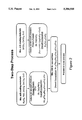
- FIG. 2 illustrates one form of the invention of a two step process for preparing a (Bi,Pb)-Sr-Ca-Cu-O superconductor
- FIG. 3 shows a representative microstructure of a superconductor prepared by the prior art one step process
- FIG. 4 illustrates a representative microstructure of a superconductor prepared by a two step process of the invention (same magnification as in FIG. 3);
- FIG. 5 illustrates the variation of critical current density as a function of Pb content in the 2212 precursor phase.
- FIG. 2 A preferred method of preparing a (Bi,Pb)-Sr-Ca-Cu-O superconductor in accordance with the invention is illustrated in FIG. 2.
- a powder mixture of Bi 2 O 3 , PbO, SrCO 3 , CaCO 3 and CuO is combined with a powder mixture of SrCO 3 , CaCO 3 and CuO.
- Each of these mixtures is calcined separately using conventional calcining temperatures and times (for example, 840° C.-900° C., at times of 24-48h).
- the calcination was preferably first carried out at reduced total O 2 pressures of about 3 torr, followed by final heating in ambient pressure CO 2 free air.
- the deformed product such as tape or wire
- heat treatment can be performed in a much shorter time than the conventional one step process.
- the method of the invention involves heat treatment at about 810°-825° C. in 8 to 13 percent O 2 in argon (or in air with 13 percent O 2 ) for at least about 50 to 350 hours and most preferably 250 hours (or alternatively at 830°-845° C. in air), versus 845° C. in air for 350 hours in the case of the prior art one step process (see
- FIG. 4 The appearance of the microstructures of a specimen made in accordance with the method of the invention is illustrated in FIG. 4. This can be compared with the microstructure in FIG. 3 of a sample prepared in accordance with the prior art one step process. Substantial amounts of second phases are clearly present in FIG. 3.
- the dark gray major phase is "2223”
- the light gray regions along the edge are the silver sheath
- the light gray and black phases embedded in the "2223” are second phases ranging up to about ten microns in size and comprise about ten volume percent of the superconducting core.
- FIG. 3 the dark gray major phase is "2223"
- the light gray regions along the edge are the silver sheath
- the light gray and black phases embedded in the "2223” are second phases ranging up to about ten microns in size and comprise about ten volume percent of the superconducting core.
- Further processing can also be performed, such as cold pressing product tape at about 2GPa to give about twenty percent reduction in tape thickness.
- An annealing step can be repeated until heat treatment times reach about 250 to 350 hours to optimize properties of the product.
- Ag can be added (up to about 20 wt.%) to the intermediate phases described hereinbefore.
- the powder mixtures with Ag added therein were subsequently processed in the manner detailed previously. Since the Ag lowers the melting point of the 2223 (and also any 2212) phases, the melting point of the Bi-Sr-Ca-Cu-O at the interface with the Ag tube will be lower than that of Bi-Sr-Ca-Cu-O away from the interface unless Ag is added throughout the powder mixture.
- Ag By addition of Ag throughout the core of powder mixture, more uniform melting of the superconductor core material will result during heat treatment steps. It is also helpful for strength and fracture toughness to add Ag.
- the composition of the starting materials is adjusted to ensure stabilization of the "2223" phase. This can be accomplished primarily by maintaining the percentage of Pb without much loss during processing. Encapsulation of the powered mixtures within Ag tubing prevents loss by evaporation at the elevated temperatures of processing. Without limiting the scope of the invention, it is believed Pb chemically stabilizes the "2223" phase and enhance the kinetics of forming the "2223" phase. In addition, the total Pb and Bi content is about 2.2 for the most preferred composition (1.8 of Bi and 0.4 of Pb). Since Pb effectively substitutes for Bi, the composition is effectively Bi rich which is believed to be nearer the actual phase pure composition of 2223 and thus assists in stablizing the "2223” phase. The ability to exert such quality control should make easier the task of refining and enhancing the superconductoring properties of the "2223" type of superconductor.
- a "2223" superconducting compound was prepared by mixing appropriate molar quantities of Bi 2 O 3 ,PbO,SrCO 3 ,CaCO 3 ,CuO to form a first batch material and SrCO 3 ,Ca 2 CO 3 and CuO to form a second batch material. These separate batch mixtures of powders were calcined separately in flowing O 2 at reduced total pressure to ensure decomposition of the carbonates. The first batch material was then heated at 840° C. for 24 hours in CO 2 free air at ambient pressure and for 48 hours at 900° C. for the second batch material.
- Example I The specimens prepared in Example I were cut into small samples and heat treated in air at 830°-845° C. or in 8%.O 2 at 810°-825° C. A 50h anneal was performed followed by uniaxially cold pressing at 2GPa to yield 20% reduction in tape thickness. The material exhibited a substantially pure microstructure (less than about 2% second phases as noted in measurements from FIG. 4). The tape specimens were then annealed for an additional 100h, and the process of pressing and heating was repeated until a heat treatment time of 350h was attained. The properties of the superconductor were measured after each incremental increase of annealing time, and optimum J c values were obtained for times of about 250 hours to 350 hours of cumulative annealing. For long lengths of wire, rolling can be used instead of cold pressing.
- the specimens prepared in accordance with Example I were tested in a conventional manner to determine Je which was determined to be about 40,000-50,000A/cm 2 .
- Specimen of (Bi,Pb)-Sr-Ca-Cu-O were prepared in the same basic manner as in Example I but up to 20% by weight Ag was added to the powder mixture of the two intermediate states. The resulting mixture was placed in Ag tubes which were drawn and rolled to produce a final tape thickness of 0.1 mm.
- a set of "2223" superconducting compounds were prepared by mixing appropriate molar quantities of Bi 2 O 3 , SrCO 3 , CaCO 3 , CuO; and various amounts of lead oxide ranging from 0 to 0.4 molar fractions were used to form a range of subspecimens for a first batch material.
- the first batch materials thus consisted of 2212 with varying Pb-content, ranging from 0.0 to 0.4 molar fractions of Pb.
- a range of subspecimens of second batch material was made by combining Ca 2 CuO 3 , Ca 2 PbO 4 and CuO.
Landscapes
- Engineering & Computer Science (AREA)
- Chemical & Material Sciences (AREA)
- Manufacturing & Machinery (AREA)
- Ceramic Engineering (AREA)
- Materials Engineering (AREA)
- Structural Engineering (AREA)
- Organic Chemistry (AREA)
- Inorganic Compounds Of Heavy Metals (AREA)
- Superconductors And Manufacturing Methods Therefor (AREA)
Abstract
Description
              TABLE I
______________________________________
Bi.sub.1.8 Pb.sub.x Sr.sub.2.0 Ca.sub.1.0 Cu.sub.2.0 O.sub.8 Study
Each mixture consisted of:
(1.0)Bi.sub.1.8 Pb.sub.x Sr.sub.2.0 Ca.sub.1.0 Cu.sub.2.0 O.sub.8 + (0.4
- x)Ca.sub.2 PbO.sub.4 +
(0.1 + x)Ca.sub.2 CuO.sub.3 + (0.9 - x)CuO.
x      Ca.sub.2 PbO.sub.4
                Ca.sub.2 CuO.sub.3
                            CaO  Comments
______________________________________
0.0    0.4      0.1         0.9  lead-free 2212
0.1    0.3      0.2         0.8
0.2    0.2      0.3         0.7
0.3    0.1      0.4         0.6
0.4    "0.0"*   0.5         0.5  two-step
0.0    0.0      0.5         0.5  0.4 PbO
______________________________________
 *Ca.sub.2 PbO.sub.4 was not deberately added as in the x = 0.0-0.3
 compositions, but a small amount was present, apparently because the
 solubility limit for Pb in 2212 is ≃.3.
Claims (16)
Priority Applications (3)
| Application Number | Priority Date | Filing Date | Title |
|---|---|---|---|
| US08/043,652 US5354535A (en) | 1993-04-06 | 1993-04-06 | Synthesis of highly phase pure (Bi, Pb)-Sr-Ca-Cu-O superconductor |
| PCT/US1994/003685 WO1994022620A1 (en) | 1993-04-06 | 1994-03-30 | Synthesis of highly phase pure bscco superconductors |
| US08/305,272 US5468566A (en) | 1993-04-06 | 1994-09-13 | Synthesis of highly phase pure BSCCO superconductors |
Applications Claiming Priority (1)
| Application Number | Priority Date | Filing Date | Title |
|---|---|---|---|
| US08/043,652 US5354535A (en) | 1993-04-06 | 1993-04-06 | Synthesis of highly phase pure (Bi, Pb)-Sr-Ca-Cu-O superconductor |
Related Child Applications (1)
| Application Number | Title | Priority Date | Filing Date |
|---|---|---|---|
| US08/305,272 Division US5468566A (en) | 1993-04-06 | 1994-09-13 | Synthesis of highly phase pure BSCCO superconductors |
Publications (1)
| Publication Number | Publication Date |
|---|---|
| US5354535A true US5354535A (en) | 1994-10-11 |
Family
ID=21928210
Family Applications (2)
| Application Number | Title | Priority Date | Filing Date |
|---|---|---|---|
| US08/043,652 Expired - Fee Related US5354535A (en) | 1993-04-06 | 1993-04-06 | Synthesis of highly phase pure (Bi, Pb)-Sr-Ca-Cu-O superconductor |
| US08/305,272 Expired - Fee Related US5468566A (en) | 1993-04-06 | 1994-09-13 | Synthesis of highly phase pure BSCCO superconductors |
Family Applications After (1)
| Application Number | Title | Priority Date | Filing Date |
|---|---|---|---|
| US08/305,272 Expired - Fee Related US5468566A (en) | 1993-04-06 | 1994-09-13 | Synthesis of highly phase pure BSCCO superconductors |
Country Status (2)
| Country | Link |
|---|---|
| US (2) | US5354535A (en) |
| WO (1) | WO1994022620A1 (en) |
Cited By (5)
| Publication number | Priority date | Publication date | Assignee | Title |
|---|---|---|---|---|
| US5569641A (en) * | 1995-04-10 | 1996-10-29 | University Of California | Synthesis of Bi1.8 Pb0.4 Sr2 Ca2 Cu3 Ox superconductor |
| US5674814A (en) * | 1994-11-14 | 1997-10-07 | University Of Chicago | Synthesis of increased-density bismuth-based superconductors with cold isostatic pressing and heat treating |
| US6265354B1 (en) | 2000-09-11 | 2001-07-24 | Hengning Wu | Method of preparing bismuth oxide superconductor |
| US6305070B1 (en) * | 1996-10-15 | 2001-10-23 | American Superconductor Corporation | Performance of oxide dispersion strengthened superconductor composites |
| US20040115121A1 (en) * | 2002-12-13 | 2004-06-17 | Clark Manufacturing, LLC. | Method for making oxide compounds |
Families Citing this family (5)
| Publication number | Priority date | Publication date | Assignee | Title |
|---|---|---|---|---|
| US5661114A (en) | 1993-04-01 | 1997-08-26 | American Superconductor Corporation | Process of annealing BSCCO-2223 superconductors |
| US6311386B1 (en) | 1994-10-28 | 2001-11-06 | American Superconductor Corporation | Processing of (Bi,Pb)SCCO superconductor in wires and tapes |
| US6295716B1 (en) * | 1994-10-28 | 2001-10-02 | American Superconductor Corporation | Production and processing of (Bi,Pb) SCCO superconductors |
| AU6367000A (en) * | 1999-07-23 | 2001-02-13 | University Of Chicago, The | A method for forming bismuth-based superconducting ceramics |
| US20050278939A1 (en) * | 2003-06-26 | 2005-12-22 | Sumitomo Electric Industries, Ltd. | Bismuth oxide superconducting wire rod and process for producing the same |
Citations (1)
| Publication number | Priority date | Publication date | Assignee | Title |
|---|---|---|---|---|
| US5057488A (en) * | 1990-02-12 | 1991-10-15 | General Electric Company | Synthesis of Bi-Pb-Ca-Sr-Cu-O superconductive material |
Family Cites Families (7)
| Publication number | Priority date | Publication date | Assignee | Title |
|---|---|---|---|---|
| US5032570A (en) * | 1987-08-04 | 1991-07-16 | Hitachi Metals, Ltd. | Method for producing ceramic superconducting material using intermediate products |
| US5204316A (en) * | 1990-04-02 | 1993-04-20 | General Electric Company | Preparation of tape of silver covered bi-pb-ca;sr-cu-o oriented polycrystal superconductor |
| US5147848A (en) * | 1990-07-11 | 1992-09-15 | Industrial Technology Research Institute | Precipitation process for forming Bi-Pb-Sr-Ca-Cu-O superconductors by dissolving nitrate salts in acid and adding a solution of triethylamine and oxalic acid |
| JP2567505B2 (en) * | 1990-08-08 | 1996-12-25 | 住友電気工業株式会社 | Method for producing bismuth oxide superconductor |
| JPH04292819A (en) * | 1991-03-20 | 1992-10-16 | Sumitomo Electric Ind Ltd | Method for manufacturing oxide superconducting wire |
| FR2677484B1 (en) * | 1991-06-10 | 1993-08-20 | Alsthom Cge Alcatel | PROCESS FOR PRODUCING BY FIBRATION OF A HIGH CRITICAL TEMPERATURE SUPERCONDUCTING FIBER AND FIBER OBTAINED BY THIS PROCESS. |
| US5324712A (en) * | 1991-08-16 | 1994-06-28 | Gte Laboratories Incorporated | Formation of the high TC 2223 phase in BI-SR-CA-CU-O by seeding |
-
1993
- 1993-04-06 US US08/043,652 patent/US5354535A/en not_active Expired - Fee Related
-
1994
- 1994-03-30 WO PCT/US1994/003685 patent/WO1994022620A1/en not_active Ceased
- 1994-09-13 US US08/305,272 patent/US5468566A/en not_active Expired - Fee Related
Patent Citations (1)
| Publication number | Priority date | Publication date | Assignee | Title |
|---|---|---|---|---|
| US5057488A (en) * | 1990-02-12 | 1991-10-15 | General Electric Company | Synthesis of Bi-Pb-Ca-Sr-Cu-O superconductive material |
Non-Patent Citations (4)
| Title |
|---|
| "An alternate preparation for (Bi, Pb)2 Ca2 Sr2 Cu3 Ox ", R. H. Arendt et al, Physica C176 (1991) 126-130. |
| "The fabrication of high critical current capability bismuth superconductor tape", R. H. Arendt et al., Physica C194, 383 (1992). |
| An alternate preparation for (Bi, Pb) 2 Ca 2 Sr 2 Cu 3 O x , R. H. Arendt et al, Physica C176 (1991) 126 130. * |
| The fabrication of high critical current capability bismuth superconductor tape , R. H. Arendt et al., Physica C194, 383 (1992). * |
Cited By (7)
| Publication number | Priority date | Publication date | Assignee | Title |
|---|---|---|---|---|
| US5674814A (en) * | 1994-11-14 | 1997-10-07 | University Of Chicago | Synthesis of increased-density bismuth-based superconductors with cold isostatic pressing and heat treating |
| US5569641A (en) * | 1995-04-10 | 1996-10-29 | University Of California | Synthesis of Bi1.8 Pb0.4 Sr2 Ca2 Cu3 Ox superconductor |
| US6305070B1 (en) * | 1996-10-15 | 2001-10-23 | American Superconductor Corporation | Performance of oxide dispersion strengthened superconductor composites |
| US6436875B2 (en) | 1996-10-15 | 2002-08-20 | American Superconductor Corporation | Performance of oxide dispersion strengthened superconductor composites |
| US6265354B1 (en) | 2000-09-11 | 2001-07-24 | Hengning Wu | Method of preparing bismuth oxide superconductor |
| US20040115121A1 (en) * | 2002-12-13 | 2004-06-17 | Clark Manufacturing, LLC. | Method for making oxide compounds |
| US7118726B2 (en) | 2002-12-13 | 2006-10-10 | Clark Manufacturing, Llc | Method for making oxide compounds |
Also Published As
| Publication number | Publication date |
|---|---|
| US5468566A (en) | 1995-11-21 |
| WO1994022620A1 (en) | 1994-10-13 |
Similar Documents
| Publication | Publication Date | Title |
|---|---|---|
| JP3450328B2 (en) | Improved processing of oxide superconductors | |
| EP2447958B1 (en) | Iron-based superconducting wire and manufacturing method therefor | |
| US5942466A (en) | Processing of (Bi,Pb) SCCO superconductor in wires and tapes | |
| US5468566A (en) | Synthesis of highly phase pure BSCCO superconductors | |
| WO1996032730A1 (en) | SYNTHESIS OF Bi1.8Pb0.4Sr2Ca2Cu3Ox SUPERCONDUCTORS | |
| US5376623A (en) | Method to enhance critical temperature of thallium-based superconductors | |
| US6481091B2 (en) | Method of preparing bismuth oxide superconducting wire | |
| JP3165770B2 (en) | Manufacturing method of oxide superconductor | |
| JPH01192760A (en) | Ag2o3-containing oxide superconductor and production thereof | |
| US6311386B1 (en) | Processing of (Bi,Pb)SCCO superconductor in wires and tapes | |
| CA2453922C (en) | Oxide high-critical temperature superconductor acicular crystal and method for producing the same | |
| EP0436723B1 (en) | Oxide superconductor and method of producing the same | |
| US5843870A (en) | Alkaline-doped mercury cuprate superconductors | |
| JP2648524B2 (en) | Ceramics and their manufacturing method | |
| Hakuraku et al. | Reaction and Intermixing at the Bi2Sr2Ca4Cu6O x/PbO Interfaces | |
| JP2821568B2 (en) | Method for producing superconducting whisker composite | |
| KR970010353B1 (en) | Mg-doped bithmuth - based superconductors | |
| EP0446552A1 (en) | Superconductive compounds and process for producing said compounds | |
| JPH01290530A (en) | Multiple oxides superconducting material and production thereof | |
| JPH01212225A (en) | Oxide superconducting material | |
| JPH0395808A (en) | Manufacture of oxide superconductor wire rod | |
| JPH01183450A (en) | Production of formed oxide superconductor | |
| JPH02296729A (en) | Oxide superconductor | |
| JPH0412023A (en) | Oxide superconductor | |
| JPH09502959A (en) | Superconductor containing at least one of barium and strontium and thallium, copper, oxygen and fluorine |
Legal Events
| Date | Code | Title | Description |
|---|---|---|---|
| AS | Assignment |
Owner name: UNIVERSITY OF CHICAGO Free format text: ASSIGNMENT OF ASSIGNORS INTEREST;ASSIGNORS:DORRIS, STEPHEN E.;POEPPEL, ROGER B.;LANAGAN, MICHAEL T.;AND OTHERS;REEL/FRAME:006587/0662 Effective date: 19930610 |
|
| CC | Certificate of correction | ||
| FEPP | Fee payment procedure |
Free format text: PAT HLDR NO LONGER CLAIMS SMALL ENT STAT AS NONPROFIT ORG (ORIGINAL EVENT CODE: LSM3); ENTITY STATUS OF PATENT OWNER: SMALL ENTITY Free format text: PAYOR NUMBER ASSIGNED (ORIGINAL EVENT CODE: ASPN); ENTITY STATUS OF PATENT OWNER: SMALL ENTITY |
|
| REFU | Refund |
Free format text: REFUND - PAYMENT OF MAINTENANCE FEE, 4TH YEAR, LARGE ENTITY (ORIGINAL EVENT CODE: R183); ENTITY STATUS OF PATENT OWNER: SMALL ENTITY |
|
| FEPP | Fee payment procedure |
Free format text: PAT HOLDER CLAIMS SMALL ENTITY STATUS - SMALL BUSINESS (ORIGINAL EVENT CODE: SM02); ENTITY STATUS OF PATENT OWNER: SMALL ENTITY |
|
| FPAY | Fee payment |
Year of fee payment: 4 |
|
| FEPP | Fee payment procedure |
Free format text: PAYOR NUMBER ASSIGNED (ORIGINAL EVENT CODE: ASPN); ENTITY STATUS OF PATENT OWNER: SMALL ENTITY Free format text: PAYER NUMBER DE-ASSIGNED (ORIGINAL EVENT CODE: RMPN); ENTITY STATUS OF PATENT OWNER: SMALL ENTITY |
|
| FPAY | Fee payment |
Year of fee payment: 8 |
|
| REMI | Maintenance fee reminder mailed | ||
| LAPS | Lapse for failure to pay maintenance fees | ||
| STCH | Information on status: patent discontinuation |
Free format text: PATENT EXPIRED DUE TO NONPAYMENT OF MAINTENANCE FEES UNDER 37 CFR 1.362 |
|
| FP | Lapsed due to failure to pay maintenance fee |
Effective date: 20061011 |