US5311995A - Stack for storing imbricated sheets - Google Patents
Stack for storing imbricated sheets Download PDFInfo
- Publication number
- US5311995A US5311995A US07/724,763 US72476391A US5311995A US 5311995 A US5311995 A US 5311995A US 72476391 A US72476391 A US 72476391A US 5311995 A US5311995 A US 5311995A
- Authority
- US
- United States
- Prior art keywords
- stack
- imbricated
- copy
- rows
- separator sheet
- Prior art date
- Legal status (The legal status is an assumption and is not a legal conclusion. Google has not performed a legal analysis and makes no representation as to the accuracy of the status listed.)
- Expired - Fee Related
Links
- 239000000463 material Substances 0.000 claims abstract description 21
- 239000010410 layer Substances 0.000 abstract description 29
- 238000000034 method Methods 0.000 abstract description 20
- 239000002356 single layer Substances 0.000 abstract description 3
- 238000005192 partition Methods 0.000 description 9
- 230000015572 biosynthetic process Effects 0.000 description 8
- 230000000903 blocking effect Effects 0.000 description 5
- 238000007639 printing Methods 0.000 description 5
- 238000013459 approach Methods 0.000 description 4
- 238000012546 transfer Methods 0.000 description 3
- 238000012986 modification Methods 0.000 description 2
- 230000004048 modification Effects 0.000 description 2
- 239000002699 waste material Substances 0.000 description 2
- 238000013461 design Methods 0.000 description 1
- 230000009977 dual effect Effects 0.000 description 1
- 238000005516 engineering process Methods 0.000 description 1
- 230000007257 malfunction Effects 0.000 description 1
- 238000002407 reforming Methods 0.000 description 1
- 238000005096 rolling process Methods 0.000 description 1
- 238000004804 winding Methods 0.000 description 1
Images



Classifications
-
- B—PERFORMING OPERATIONS; TRANSPORTING
- B65—CONVEYING; PACKING; STORING; HANDLING THIN OR FILAMENTARY MATERIAL
- B65H—HANDLING THIN OR FILAMENTARY MATERIAL, e.g. SHEETS, WEBS, CABLES
- B65H29/00—Delivering or advancing articles from machines; Advancing articles to or into piles
- B65H29/66—Advancing articles in overlapping streams
- B65H29/6645—Advancing articles in overlapping streams buffering an overlapping stream of articles
-
- B—PERFORMING OPERATIONS; TRANSPORTING
- B65—CONVEYING; PACKING; STORING; HANDLING THIN OR FILAMENTARY MATERIAL
- B65H—HANDLING THIN OR FILAMENTARY MATERIAL, e.g. SHEETS, WEBS, CABLES
- B65H29/00—Delivering or advancing articles from machines; Advancing articles to or into piles
- B65H29/26—Delivering or advancing articles from machines; Advancing articles to or into piles by dropping the articles
- B65H29/34—Delivering or advancing articles from machines; Advancing articles to or into piles by dropping the articles from supports slid from under the articles
-
- B—PERFORMING OPERATIONS; TRANSPORTING
- B65—CONVEYING; PACKING; STORING; HANDLING THIN OR FILAMENTARY MATERIAL
- B65H—HANDLING THIN OR FILAMENTARY MATERIAL, e.g. SHEETS, WEBS, CABLES
- B65H31/00—Pile receivers
-
- B—PERFORMING OPERATIONS; TRANSPORTING
- B65—CONVEYING; PACKING; STORING; HANDLING THIN OR FILAMENTARY MATERIAL
- B65H—HANDLING THIN OR FILAMENTARY MATERIAL, e.g. SHEETS, WEBS, CABLES
- B65H33/00—Forming counted batches in delivery pile or stream of articles
- B65H33/04—Forming counted batches in delivery pile or stream of articles by inserting marker slips in pile or stream
-
- Y—GENERAL TAGGING OF NEW TECHNOLOGICAL DEVELOPMENTS; GENERAL TAGGING OF CROSS-SECTIONAL TECHNOLOGIES SPANNING OVER SEVERAL SECTIONS OF THE IPC; TECHNICAL SUBJECTS COVERED BY FORMER USPC CROSS-REFERENCE ART COLLECTIONS [XRACs] AND DIGESTS
- Y10—TECHNICAL SUBJECTS COVERED BY FORMER USPC
- Y10S—TECHNICAL SUBJECTS COVERED BY FORMER USPC CROSS-REFERENCE ART COLLECTIONS [XRACs] AND DIGESTS
- Y10S206/00—Special receptacle or package
- Y10S206/821—Stacking member
Definitions
- the present invention relates to a storage assembly for storing imbricated or overlapped copies of printed and folded material upon a pallet.
- a storage assembly for storing imbricated or overlapped copies of printed and folded material upon a pallet.
- pre-printed material for later assembly with other printed materials.
- this was done by stacking individual printed copies, one on top of another, and placing these vertical stacks upon a pallet.
- partial vertical stacks were tied together to form bundles which were subsequently placed upon pallets.
- this form of storage is inefficient because it requires a machine to remove individual copies within an imbricated formation upon a conveyor belt and place them one on top of the other in a vertical stack.
- the stored materials are retrieved, they must be taken from a vertical stack and reformed into an imbricated form upon a conveyor.
- the machines for doing this type of storage and retrieval are complicated, subject to malfunction, and are relatively slow.
- Ferag's reeling machines solve the problem of inefficient storage and retrieval by maintaining the imbricated formation during storage and retrieval, there are other disadvantages that arise in using Ferag's approach to the problem.
- the storage spools do not use storage space efficiently.
- the most efficient shape for storing materials is a cubic-shape, and the most common form to achieve the cubic-shape is upon a rectangular pallet.
- Cylindrical spools inherently waste storage space.
- the cylindrical spools waste space at their respective centers.
- a second disadvantage of Ferag's machines is that cylindrical spools are inherently more difficult to handle. Pallets are the most common form of storage, and forklifts and other machines are built to handle rectangular pallets.
- a third disadvantage is that copy stream is stored on a curved path that temporarily deforms the normally flat printed copies. This makes handling the partially deformed copies more difficult, upon retrieval.
- a fourth disadvantage is that when handling and storing newspapers upon a spool, every other individual newspaper must be turned 180° prior to storing the newspapers. This is because the secondary folds of each newspaper make the newspaper thicker at one side, and the newspapers must be alternated to keep the spool balanced in width.
- Harris used special trays to form substantially horizontal stacks of newspapers, signatures, and other types of printed material. As the imbricated copy stream exits the conveyor, the copy stream is compressed upon an elongated tray such that the individual copies are standing almost vertically on end. Individual trays can subsequently be stacked, one on top of the other upon a pallet.
- Harris tray approach has not been found to be commercially viable within the printing industry. Although this approach allows the use of cubic-shaped storage units upon pallets, in contrast to Ferag's storage method, it still does not resolve the basic problem of inefficient destroying and reforming of the imbricated copy stream during storage and retrieval, respectively. Additionally, there are several other disadvantages associated with the use of Harris' storage method. First, this method requires specially formed trays that would be expensive. Second, some storage space is wasted between the top edge of the horizontal stack and the bottom of the next tray. Third, horizontal stacking of printed materials may deform the edges of individual printed copies. Fourth, the relatively narrow and long trays would be relatively unstable when stacked upon one another in a pallet arrangement.
- Another object of the invention is to provide a method and apparatus for forming a compact and cubic-shaped stack that takes up less space per printed copy than present prior art systems.
- Another object of the invention is to provide a method and apparatus for storing an imbricated copy stream in a relatively flat and horizontal position to avoid deformation of individual copies while in storage.
- the present invention comprises a method and apparatus for forming a stack of imbricated copies of printed material on a pallet.
- a plurality of conveyors feed a shuttle assembly with imbricated copy streams upon a plurality of side-by-side rows. Once filled, the shuttle is positioned over a relatively flat separator sheet and drops the plurality of rows onto the separator sheet, thereby forming a single layer.
- the layer is placed directly upon a stack which is formed upon a pallet.
- the separator sheet of the formed layer is supported by the copy streams which lie below on the preceding separator sheet.
- the resulting stack is cubic-shaped and includes a plurality of layers of a plurality of side-by-side rows of relatively flat and horizontal imbricated copy streams that run the full width of the pallet.
- the present invention further comprises a method of retrieving the copy streams from the stack and placing them back upon the conveyors.
- the same apparatus for forming the stack is also used to retrieve the copy streams from the stack and place the streams back upon the conveyors
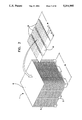
- FIG. 1 shows a perspective view of the formed pallet of imbricated copy streams of the present invention.
- FIG. 2 shows a perspective view of the sequential forming of individual layers within the stack of FIG. 1.
- FIG. 3 shows a perspective view of the apparatus for forming the stack of FIG. 1 and for retrieving the copy streams from the stack.
- FIG. 4 shows a side view of the apparatus of FIG. 3.
- FIG. 5 shows a top plan view of the apparatus of FIG. 3.
- FIGS. 6-9 show sequential side views of the storage cycle of the apparatus of FIG. 3.
- FIG. 10 shows an end view of the storage cycle of the apparatus of FIG. 3.
- FIGS. 11-14 show sequential side views of the retrieval cycle of the apparatus of FIG. 3.
- FIG. 15 shows an end view of the retrieval cycle of the apparatus of FIG. 3.
- FIG. 1 shows the preferred embodiment of the formed stack of imbricated copy segments of the present invention.
- the vertical stack 1 includes a pallet 2 onto which a plurality of horizontal layers 4 are stacked.
- Each layer includes a separator sheet that supports three rows or segments 8 of imbricated copy stream.
- the segments of copy stream are made up of uniform copies of printed material 10 that are arranged in an overlapped manner.
- the printed material could include newspapers, magazines, signatures, etc., and can be bound, unbound, or folded (as shown).
- the copy stream segments remain in their imbricated or overlapped form which is a common form used in moving and conveying printed materials.
- the copy stream segments remain in a substantially flat configuration. This prevents deformation of individual copies since they aren't stored on their edges or on an arcuate path, as are the aforementioned prior art storage systems.
- the layers are stacked one on top of the other to form the most compact and space saving stack, possible.
- the stack is formed in a substantially cubic shaped unit that can be placed on a pallet, as shown. Also, the cubic form of the stack uses storage space more efficiently than any cylindrical storage system.
- FIG. 2 shows the sequence of the stack formation. Individual separator sheets 6 are placed atop a stack during formation. Three rows or segments 8 of copy stream are received in a holding area, and are subsequently shuttled over the separator sheet. The building of the new layer of the stack is complete when the three rows are dropped upon the separator sheet allowing another layer to begin.
- the dimensions of the stack 1, layers 4, rows 8, and articles 10 are important within the interrelationships of these components.
- Individual copies 10 have a storage width X and are overlapped by a distance Y upon the next copy.
- FIG. 2 shows the copies as folded, but it should be appreciated that the copies could be single or multi-paged unfolded units. Additionally, the overlapped configuration could be made so that the folds of the copies are arranged along the length of the row instead of the width of the row, as shown.
- the overlapped or imbricated formation of the individual copies 10 is constructed by conventional printing equipment.
- the stack is formed from a plurality of in-feed conveyors of continuous streams of imbricated copies of width X and overlap Y, as will be explained later in the specification.
- the overlap Y is determined by the thickness and width of an individual copy, so that it may lay in a substantially flat manner in its overlapped configuration. The thicker the copy, or the less the width, the greater the overlap Y needs to be in order to preserve the substantially flat configuration of the copy stream.
- the stack is formed by separating the continuous streams into segments of length W. These segments are arranged in side-by-side parallel rows as shown to the right side of the stack within FIG. 2.
- the length W is predetermined as the width of the pallet 2.
- the overlap Y of the copy stream segments remains unchanged. This is directly different from the Harris stack of trays, noted above, where the overlap is removed by compacting the individual copies upon the individual trays.
- the number of rows or segments 8 upon each separator sheet is determined by the width of the copy W and the length of the pallet. In this case, three rows fit across the length of a single pallet.
- FIG. 3 shows the apparatus for forming the stack of FIGS. 1 and 2.
- the apparatus is divided into four separate units: the conveyor assembly 21, the apparatus support frame 31, the shuttle assembly 41, and the pallet elevator assembly 61.
- the conveyor assembly includes in-feed conveyors 22 and retrieval conveyors 23 for feeding and receiving a continuous imbricated copy stream of overlapped printed materials, respectively. Between the end 25 of conveyor 23 and the end of conveyor 22 lies a central holding conveyor 24.
- the central conveyor is narrower in width than either of conveyors 22 or 23.
- the central conveyor is arranged to temporarily hold a segment of imbricated copy stream before being placed upon the stack or before being moved onto the retrieval conveyors 23.
- the apparatus support frame 31 includes an open rectangular frame 32 for holding the shuttle assembly 41.
- Four legs 33 at each corner hold the frame at a height greater than the height of a full pallet of imbricated copy stream allowing the pallet elevator assembly 61 to be positioned entirely within the frame 32.
- Parallel guide tracks 34 extend across the entire length of the frame and support the shuttle assembly 41 for movement across the length of the frame 32.
- the shuttle assembly 41 includes a shuttle frame 42 which includes hinged gates 43 at the bottom of the shuttle frame.
- a hydraulic actuator 51 moves the shuttle assembly back and forth across the top of the frame 32 by extending or retracting the elongated piston rod 52.
- Guide bars 53 on either side of the shuttle assembly (only one of which is shown for clarity reasons in the broken away view of FIG. 3) cooperate with the guide tracks 34 of the frame to allow the shuttle assembly to move easily across the frame.
- the pallet elevator assembly 61 includes a base 62 positioned to the side of the conveyor assembly 21.
- a vertically movable platform 63 supports the pallet for movement up and down depending upon how full the stack is.
- Lifting arms 64 connect the platform to the base.
- FIG. 4 shows an end view of the apparatus of FIG. 3 to reveal several features hidden within FIG. 3.
- the guide bar 53 moves easily over the track because guide wheels 54 connected to the guide bar mate with the top of track 34 and allow the shuttle assembly to roll back and forth upon the frame.
- the platform 63 is moved up and down by a hydraulic actuator 65. Lifting arms 64 pivot to allow the platform to remain in a horizontal plane.
- FIG. 4 also shows further details of the conveyor assembly.
- the most common form that printed materials are conveyed in is within a continuous overlapped copy stream.
- the conveyance can be done entirely upon endless belt conveyors such as in-feed and retrieval conveyors 22 and 23 of FIG. 3.
- the printed materials can be delivered by a gripper conveyor 27 which deposits individually spaced printed copies upon an in-feed conveyor 22 to form an imbricated formation upon the endless belt conveyor.
- the gripper conveyor can also be used to pick up individual copies from the retrieval conveyor 23, as shown.
- FIG. 4 also shows the ends of the central conveyor 24 positioned between the ends of in-feed and retrieval conveyors 22 and 23 to allow the easy transfer of the copy stream from one conveyor to the next.
- the central conveyor receives a segment or row 8 from the continuous copy stream in-feed conveyor 22.
- the central conveyor temporarily holds the segments before the shuttle assembly transfers the segments to the stack.
- the shuttle assembly moves the segments of the copy stream back to the central conveyors 24 where they are subsequently transferred to the retrieval conveyors to form another continuous copy stream.
- FIG. 5 shows a view from above the apparatus.
- Three separate storage conveyors 22 feed three central conveyors 24.
- the three central conveyors also feed three retrieval conveyors 23. It should be noted that the preferred embodiment allows the stack to be built with three rows, but it should also be appreciated that the invention could also be achieved with any number of rows from one to many.
- FIG. 6 is a cross-sectional view of the stack and apparatus at the beginning of a storage cycle.
- the gates 43 are hinged to the apparatus and are movable from a horizontal position, shown in FIG. 7, to a vertical retracted position, shown in FIG. 6.
- the gates are moved by hydraulic actuators 44 that include pistons that are pivotably connected to the gates to swing the gates between their vertically retracted and horizontally extended positions.
- FIG. 11 is a cross sectional view similar to FIG. 6. This view also shows the layer separator tray 71 which was left out of FIG. 3 for clarity reasons.
- the layer separator tray is mounted for rolling movement upon a guide track 72 which cooperates with guide wheels 73.
- Three layer supports 74 extend across the width of the tray and serve the dual purpose of lifting an individual layer off of the stack, as shown in FIG. 11, and supporting the three copy stream segments once the separator sheet is pulled out from beneath the segments, see FIG. 13.
- FIGS. 11 and 12 also show details of the copy blocking partitions 45 mounted on the shuttle assembly to maintain the copy stream segments, in place, upon the layer supports 74 of the layer separator tray while the separator sheet is pulled out from beneath the copy stream segments.
- the copy blocking partitions include flexible strip brushes at their ends to maintain frictional contact with the separator sheet as it is pulled away while preventing the copy streams from moving during this process.
- the copyblocking partitions are also vertically movable up and down by hydraulic actuators 46 to allow the shuttle assembly to clear the central conveyors when moving from the conveyor position to the stack position.
- the separator 6 is pulled by a sheet puller 75 which clamps upon the end of the sheet and hydraulically pulls the sheet from beneath the copy streams.
- the storage cycle of the apparatus is best seen within the sequential views of FIGS. 6-9 and the end view of FIG. 10.
- the storage cycle is also the method by which the stack of the present invention is formed.
- the first step is to form three continuous rows of imbricated copy stream and convey these continous streams to the apparatus, as best seen in FIG. 10.
- the shuttle assembly 41 is positioned adjacent the in-feed conveyors 22 to the right of the stack 1 by the hydraulic actuator 51, as viewed within FIG. 6.
- the second step of the storage cycle is to divide the three continuous streams into three separate segments or rows 8 of a predetermined length and move these segments onto the central conveyors 24.
- the predetermined length is approximately equivalent to the length of the pallet or separator sheet. In this position, as seen in FIG.
- the hinged gates 43 are fully extended downwardly so that they do not interfere with the transfer of the segments to the central conveyors.
- the third step involves placing another separator sheet upon the stack, as best seen in FIG. 7. At this point the gates 43 are pivoted to a horizontal position to lift the copy stream segments 8 off of the surface of the conveyors 24.
- the fourth step involves pulling the shuttle back with the hydraulic actuator 51, as seen in FIG. 8, such that the segments 8 are positioned above the stack. At this time, the copy blocking partitions 45 are raised by hydraulic actuators 46 so that the shuttle may move to the left, as seen in FIG. 9. It should be noted that at all times, the original imbricated form of the printed materials is maintained.
- FIG. 9 The final step, FIG.
- the retrieval cycle of the apparatus is best seen within the sequential views of FIGS. 11-14 and the end view of FIG. 15.
- the retrieval cycle is also the method by which the stack of the present invention is dismantled.
- the first step is to position the stack 1 to the left of the conveyors 24, as seen in FIG. 11.
- the layer separator tray 71 moves upon its guide track 72 such that the lead edge of the first layer support 74 moves beneath the separator sheet 6 to separate the top layer from the remainder of the stack.
- the layer separator tray continues to move beneath the top layer until the entire layer is supported upon the tray, as seen in FIG. 12.
- the second step is to remove the separator sheet 6 by lowering the copy blocking partitions 45 such that the strip brushes at the ends of the partitions abut the sheet 6 and block the copy streams 8 from moving while the sheet puller 75 draws the sheet out from beneath the copy streams, as shown in FIG. 12.
- the individual rows of copy are stream are positioned on the layer supports 74 with gaps between each row.
- the hinged gates 43 are rotated to vertically extended positions (not shown).
- the third step is to further lower the copy blocking partitions 45 and hinged gates 43 through the gaps between the rows 8 of copy stream until the gates and partitions are positioned beneath the tray 71. The gates are then rotated upwardly to support the copy streams at their edges, as shown in FIG. 13.
- the fourth step is to raise the gates and partitions to lift the copy streams off of the tray 71, and subsequently move the shuttle assembly over the top of the central conveyors 24, as seen in FIG. 14.
- the final step is to retract the gates 43 and allow the copy streams to be carried away by the central and retrieval conveyors, as seen in FIG. 15.
- the cycle is completed by raising the stack the thickness of one layer, and moving the shuttle assembly to a position above the stack.
- the stack of the present invention and the apparatus for assembling the stack are unique from the prior art machines.
- the relatively flat lay of the copy stream is the most stable way to store the individual copies, and allows the stack to remain stable even if the individual copies are unsymmetrical in size and/or shape.
- the prior art stacks and machines are not efficient in storing such unsymmetrical articles.
- the shuttle assembly of the apparatus forms an inherent buffer to the system to allow the removal of one stack while the shuttle is being loaded from the in-feed conveyors.
- the cubic shape of the stacks allow the stacks to be vertically stacked upon one another allowing greater efficiency of storage space within a publication facility or warehouse.
Landscapes
- Mechanical Engineering (AREA)
- Engineering & Computer Science (AREA)
- Pile Receivers (AREA)
- Packaging Of Special Articles (AREA)
- Sheets, Magazines, And Separation Thereof (AREA)
- Discharge By Other Means (AREA)
- Making Paper Articles (AREA)
- Separation, Sorting, Adjustment, Or Bending Of Sheets To Be Conveyed (AREA)
- Auxiliary Devices For And Details Of Packaging Control (AREA)
- Nitrogen Condensed Heterocyclic Rings (AREA)
- Electronic Switches (AREA)
- Ultra Sonic Daignosis Equipment (AREA)
- Pallets (AREA)
- Stacking Of Articles And Auxiliary Devices (AREA)
Abstract
Description
Claims (4)
Priority Applications (9)
| Application Number | Priority Date | Filing Date | Title |
|---|---|---|---|
| US07/724,763 US5311995A (en) | 1991-07-02 | 1991-07-02 | Stack for storing imbricated sheets |
| NO921276A NO300170B1 (en) | 1991-07-02 | 1992-04-02 | Method and apparatus for storing overlapping sheets on a pallet |
| AT92401267T ATE151384T1 (en) | 1991-07-02 | 1992-05-06 | METHOD AND APPARATUS FOR STORING SHEETS IN SHADE FORMATION ON A PALLET |
| DE69218845T DE69218845T2 (en) | 1991-07-02 | 1992-05-06 | Method and apparatus for storing sheets in scale formation on a pallet |
| EP92401267A EP0522890B1 (en) | 1991-07-02 | 1992-05-06 | Method and apparatus for storing imbricated sheets upon a pallet |
| DK92401267.7T DK0522890T3 (en) | 1991-07-02 | 1992-05-06 | Method and apparatus for storing roofed sheets on a pallet. |
| FI922685A FI100875B (en) | 1991-07-02 | 1992-06-10 | Method and apparatus for storing overlapping sheets on a pallet |
| JP4197748A JP2578049B2 (en) | 1991-07-02 | 1992-07-01 | Deposit forming apparatus, deposit, deposit forming method, and method for retrieving a continuous line of printed matter from the deposit |
| US08/204,556 US5492444A (en) | 1991-07-02 | 1994-03-01 | Method and apparatus for storing imbricated sheets upon a pallet |
Applications Claiming Priority (1)
| Application Number | Priority Date | Filing Date | Title |
|---|---|---|---|
| US07/724,763 US5311995A (en) | 1991-07-02 | 1991-07-02 | Stack for storing imbricated sheets |
Related Child Applications (1)
| Application Number | Title | Priority Date | Filing Date |
|---|---|---|---|
| US08/204,556 Division US5492444A (en) | 1991-07-02 | 1994-03-01 | Method and apparatus for storing imbricated sheets upon a pallet |
Publications (1)
| Publication Number | Publication Date |
|---|---|
| US5311995A true US5311995A (en) | 1994-05-17 |
Family
ID=24911808
Family Applications (2)
| Application Number | Title | Priority Date | Filing Date |
|---|---|---|---|
| US07/724,763 Expired - Fee Related US5311995A (en) | 1991-07-02 | 1991-07-02 | Stack for storing imbricated sheets |
| US08/204,556 Expired - Fee Related US5492444A (en) | 1991-07-02 | 1994-03-01 | Method and apparatus for storing imbricated sheets upon a pallet |
Family Applications After (1)
| Application Number | Title | Priority Date | Filing Date |
|---|---|---|---|
| US08/204,556 Expired - Fee Related US5492444A (en) | 1991-07-02 | 1994-03-01 | Method and apparatus for storing imbricated sheets upon a pallet |
Country Status (8)
| Country | Link |
|---|---|
| US (2) | US5311995A (en) |
| EP (1) | EP0522890B1 (en) |
| JP (1) | JP2578049B2 (en) |
| AT (1) | ATE151384T1 (en) |
| DE (1) | DE69218845T2 (en) |
| DK (1) | DK0522890T3 (en) |
| FI (1) | FI100875B (en) |
| NO (1) | NO300170B1 (en) |
Cited By (2)
| Publication number | Priority date | Publication date | Assignee | Title |
|---|---|---|---|---|
| US5826716A (en) * | 1995-11-13 | 1998-10-27 | Hayes Lemmerz International, Inc. | Wheel separator and method |
| US20130327734A1 (en) * | 2012-06-08 | 2013-12-12 | Tina Ting-Yuan Wang | Storage Systems for Milk Bags |
Families Citing this family (4)
| Publication number | Priority date | Publication date | Assignee | Title |
|---|---|---|---|---|
| US5336041A (en) * | 1992-03-12 | 1994-08-09 | Graphic Management Associates, Inc. | Storage and retrieval device and method for imbricated planar articles |
| DE19500560A1 (en) * | 1995-01-11 | 1996-07-18 | Kolbus Gmbh & Co Kg | Transporting continuously supplied printed products |
| US7799568B2 (en) * | 2003-10-07 | 2010-09-21 | The Johns Hopkins University | Authentication of products using molecularly imprinted polymers |
| KR101968169B1 (en) * | 2018-11-28 | 2019-04-11 | 유정재 | Apparatus for transferring and stacking metal bar |
Citations (8)
| Publication number | Priority date | Publication date | Assignee | Title |
|---|---|---|---|---|
| US1386717A (en) * | 1920-10-04 | 1921-08-09 | Luckett James Stephen | Desk-tray |
| US3612300A (en) * | 1968-03-27 | 1971-10-12 | Marius Berghgracht | Installation for the palletization of flat rectangular objects |
| US3729367A (en) * | 1971-06-01 | 1973-04-24 | Oliver Tire & Rubber Co | Rubber product for tire recapping apparatus and method for making |
| US4416376A (en) * | 1982-09-30 | 1983-11-22 | Signode Corporation | Bag package and related method |
| US4701091A (en) * | 1985-06-13 | 1987-10-20 | Mitsubishi Mining & Cement Co., Ltd. | Apparatus for piling Portland cement packages in alignment on platform |
| US4927318A (en) * | 1988-02-09 | 1990-05-22 | Galpin Research, Limited Partnership | Method for forming, grasping and handling cubes of stacked printed products |
| US4984963A (en) * | 1987-04-25 | 1991-01-15 | The Langston Machine Company Limited | Stacking bundles of flat-folded boxes of corrugated board |
| US5135351A (en) * | 1989-12-05 | 1992-08-04 | Kolbus Gmbh & Co. Kg | Palletized storage method and apparatus |
Family Cites Families (5)
| Publication number | Priority date | Publication date | Assignee | Title |
|---|---|---|---|---|
| US3874522A (en) * | 1973-05-16 | 1975-04-01 | Harris Intertype Corp | Signature handling system |
| US4230311A (en) * | 1979-01-23 | 1980-10-28 | Faltin Hans G | Storage pallet arrangements for folded paper items |
| DE3643026A1 (en) * | 1986-12-17 | 1988-06-30 | Roland Man Druckmasch | TRANSPORT DEVICE, ESPECIALLY FOR FOLDED PRODUCTS |
| CH679993A5 (en) * | 1987-03-06 | 1992-05-29 | Ferag Ag | |
| SE468354B (en) * | 1988-09-15 | 1992-12-21 | Wamag Idab Ab | PROCEDURE AND DEVICE FOR INTERMEDIATE STORAGE OF JOURNALS |
-
1991
- 1991-07-02 US US07/724,763 patent/US5311995A/en not_active Expired - Fee Related
-
1992
- 1992-04-02 NO NO921276A patent/NO300170B1/en not_active IP Right Cessation
- 1992-05-06 AT AT92401267T patent/ATE151384T1/en not_active IP Right Cessation
- 1992-05-06 DE DE69218845T patent/DE69218845T2/en not_active Expired - Fee Related
- 1992-05-06 DK DK92401267.7T patent/DK0522890T3/en active
- 1992-05-06 EP EP92401267A patent/EP0522890B1/en not_active Expired - Lifetime
- 1992-06-10 FI FI922685A patent/FI100875B/en not_active IP Right Cessation
- 1992-07-01 JP JP4197748A patent/JP2578049B2/en not_active Expired - Lifetime
-
1994
- 1994-03-01 US US08/204,556 patent/US5492444A/en not_active Expired - Fee Related
Patent Citations (8)
| Publication number | Priority date | Publication date | Assignee | Title |
|---|---|---|---|---|
| US1386717A (en) * | 1920-10-04 | 1921-08-09 | Luckett James Stephen | Desk-tray |
| US3612300A (en) * | 1968-03-27 | 1971-10-12 | Marius Berghgracht | Installation for the palletization of flat rectangular objects |
| US3729367A (en) * | 1971-06-01 | 1973-04-24 | Oliver Tire & Rubber Co | Rubber product for tire recapping apparatus and method for making |
| US4416376A (en) * | 1982-09-30 | 1983-11-22 | Signode Corporation | Bag package and related method |
| US4701091A (en) * | 1985-06-13 | 1987-10-20 | Mitsubishi Mining & Cement Co., Ltd. | Apparatus for piling Portland cement packages in alignment on platform |
| US4984963A (en) * | 1987-04-25 | 1991-01-15 | The Langston Machine Company Limited | Stacking bundles of flat-folded boxes of corrugated board |
| US4927318A (en) * | 1988-02-09 | 1990-05-22 | Galpin Research, Limited Partnership | Method for forming, grasping and handling cubes of stacked printed products |
| US5135351A (en) * | 1989-12-05 | 1992-08-04 | Kolbus Gmbh & Co. Kg | Palletized storage method and apparatus |
Cited By (4)
| Publication number | Priority date | Publication date | Assignee | Title |
|---|---|---|---|---|
| US5826716A (en) * | 1995-11-13 | 1998-10-27 | Hayes Lemmerz International, Inc. | Wheel separator and method |
| US20130327734A1 (en) * | 2012-06-08 | 2013-12-12 | Tina Ting-Yuan Wang | Storage Systems for Milk Bags |
| US8955696B2 (en) * | 2012-06-08 | 2015-02-17 | Tina Ting-Yuan Wang | Storage systems for milk bags |
| US9279610B2 (en) | 2012-06-08 | 2016-03-08 | Tina Ting-Yuan Wang | Storage systems for milk bags |
Also Published As
| Publication number | Publication date |
|---|---|
| NO921276L (en) | 1993-01-04 |
| FI100875B (en) | 1998-03-13 |
| EP0522890A3 (en) | 1993-03-31 |
| FI922685A7 (en) | 1993-01-03 |
| DK0522890T3 (en) | 1997-10-27 |
| NO921276D0 (en) | 1992-04-02 |
| NO300170B1 (en) | 1997-04-21 |
| FI922685A0 (en) | 1992-06-10 |
| DE69218845D1 (en) | 1997-05-15 |
| EP0522890A2 (en) | 1993-01-13 |
| JP2578049B2 (en) | 1997-02-05 |
| JPH06340363A (en) | 1994-12-13 |
| EP0522890B1 (en) | 1997-04-09 |
| US5492444A (en) | 1996-02-20 |
| ATE151384T1 (en) | 1997-04-15 |
| DE69218845T2 (en) | 1997-11-20 |
Similar Documents
| Publication | Publication Date | Title |
|---|---|---|
| CN101489900B (en) | Device and method for the processing of stacks of sheets of securities into bundles and packs of bundles | |
| EP0736469B1 (en) | Palletizing system | |
| US6594970B1 (en) | Method and apparatus for wrapping palletized bundles | |
| US5842827A (en) | Bulk handling apparatus | |
| US5256028A (en) | Process for handling material | |
| WO2008122480A1 (en) | Method and device for layered stacking a support | |
| US4977827A (en) | Signature handling apparatus | |
| US5492444A (en) | Method and apparatus for storing imbricated sheets upon a pallet | |
| US5730579A (en) | Bundle feed apparatus for delivering multiple bundles to a load former | |
| JPH0471810B2 (en) | ||
| EP3194312B1 (en) | Improved apparatus for automatically palletizing containers and respective method | |
| JPH0332826A (en) | Methods for storing blank of pack and send- ing packing machine to folding unit | |
| US5336041A (en) | Storage and retrieval device and method for imbricated planar articles | |
| US4239432A (en) | Article handling apparatus capable of reversibly loading and unloading articles in predetermined rows | |
| US4068765A (en) | Stacking of materials | |
| JP2577768Y2 (en) | Article supply device | |
| JPS62180845A (en) | Methd and device for treating print, such as newspaper, magazine, etc. being fed under displaced and stacked state | |
| BR102016019384B1 (en) | AUTOMATIC MODULAR PALLET MACHINE WITH HORIZONTAL AND VERTICAL HANDLING OF THE CONVEYOR TABLE BETWEEN THE PRODUCTS UNLOADING LINES MODULES | |
| BE1002612A3 (en) | Method and device for stacking flat objects cylindrical packages with special coin rolls. | |
| CN223949572U (en) | Film roll grouping and stacking conveying system | |
| CN223982776U (en) | A film roll grouping and packaging system | |
| WO2002002446A1 (en) | Method and device for placing support sheets under layers of objects in a stack | |
| JPH0610054B2 (en) | Palletizer | |
| JPH09142613A (en) | Magazine physical distribution system for bookbinding | |
| JP2023158320A (en) | Accumulating device for flat seaweed bundles |
Legal Events
| Date | Code | Title | Description |
|---|---|---|---|
| AS | Assignment |
Owner name: STREAM TECHNOLOGIES A WASHINGTON GENERAL PARTNERS Free format text: ASSIGNMENT OF ASSIGNORS INTEREST.;ASSIGNOR:TERRY, JAMES D.;REEL/FRAME:005858/0902 Effective date: 19910929 |
|
| AS | Assignment |
Owner name: GRAPHIC MANAGEMENT ASSOCIATES, INC., A CORP. OF MA Free format text: ASSIGNMENT OF ASSIGNORS INTEREST.;ASSIGNOR:STREAM TECHNOLOGIES, A GENERAL PARTNERSHIP;REEL/FRAME:005880/0426 Effective date: 19911011 |
|
| AS | Assignment |
Owner name: GRAPHIC MANAGEMENT ASSOCIATES, INC. (GMA-DEL), Free format text: ASSIGNMENT OF ASSIGNORS INTEREST.;ASSIGNOR:GRAPHIC MANAGEMENT ASSOCIATES, INC. (GMA-MASS);REEL/FRAME:006336/0931 Effective date: 19921130 |
|
| FEPP | Fee payment procedure |
Free format text: PAYOR NUMBER ASSIGNED (ORIGINAL EVENT CODE: ASPN); ENTITY STATUS OF PATENT OWNER: LARGE ENTITY |
|
| REFU | Refund |
Free format text: REFUND - PAYMENT OF MAINTENANCE FEE, 4TH YR, SMALL ENTITY (ORIGINAL EVENT CODE: R283); ENTITY STATUS OF PATENT OWNER: LARGE ENTITY |
|
| FEPP | Fee payment procedure |
Free format text: PAT HLDR NO LONGER CLAIMS SMALL ENT STAT AS INDIV INVENTOR (ORIGINAL EVENT CODE: LSM1); ENTITY STATUS OF PATENT OWNER: LARGE ENTITY |
|
| FPAY | Fee payment |
Year of fee payment: 4 |
|
| FPAY | Fee payment |
Year of fee payment: 8 |
|
| REMI | Maintenance fee reminder mailed | ||
| LAPS | Lapse for failure to pay maintenance fees | ||
| LAPS | Lapse for failure to pay maintenance fees |
Free format text: PATENT EXPIRED FOR FAILURE TO PAY MAINTENANCE FEES (ORIGINAL EVENT CODE: EXP.); ENTITY STATUS OF PATENT OWNER: LARGE ENTITY |
|
| STCH | Information on status: patent discontinuation |
Free format text: PATENT EXPIRED DUE TO NONPAYMENT OF MAINTENANCE FEES UNDER 37 CFR 1.362 |
|
| FP | Lapsed due to failure to pay maintenance fee |
Effective date: 20060517 |