US529733A - Combined horse-collar and hames - Google Patents
Combined horse-collar and hames Download PDFInfo
- Publication number
- US529733A US529733A US529733DA US529733A US 529733 A US529733 A US 529733A US 529733D A US529733D A US 529733DA US 529733 A US529733 A US 529733A
- Authority
- US
- United States
- Prior art keywords
- hames
- collar
- socket
- hame
- keeper
- Prior art date
- Legal status (The legal status is an assumption and is not a legal conclusion. Google has not performed a legal analysis and makes no representation as to the accuracy of the status listed.)
- Expired - Lifetime
Links
Images
Classifications
-
- B—PERFORMING OPERATIONS; TRANSPORTING
- B68—SADDLERY; UPHOLSTERY
- B68B—HARNESS; DEVICES USED IN CONNECTION THEREWITH; WHIPS OR THE LIKE
- B68B3/00—Traction harnesses; Traction harnesses combined with devices referred to in group B68B1/00
- B68B3/04—Horse collars; Manufacturing same
- B68B3/12—Locks therefor
Definitions
- n4 'nonms wzi'gns cmmomuma. WASHINGTON. 0. c4
- the first part of the present improvements relates to an adjustable automatic lock for coupling the open ends of the hames, and
- the movable cap which forms the abutment to limit the movement of the open ends of the collar toward each other, and said cap is connected or fastenedto the adjustable member or keeper at two points so that it will be adjusted therewith, whereby the collar and ham'es can be widened or' contracted by the simple removal of a single screw, the connected cap and catch-keeper adjusted, and again fastening the screw.
- Another improvement which I have made consists in an improved means for fastening the trace-clip to the hame in a manner to admit of the vertical adjustment of saidhameclip and at the same time securely hold the clip on the hame without the useof headed, independent bolts.
- I provide a clip plate with longitudinal slots andform two openings in the hame, and through these openings and the slots in the trace-clip are passed the threaded ends of a lclevis, the head R of which bears on the under side of thehame, .while the nuts and washers are screwed on the threaded ends thereof and bear on the clip-plate to clamp the trace'clip in place.
- My hames are each given such form as to enable them to be cast or treated in malleable iron, or aluminium alloy, or other metals, producing a cheaper hame to manufacture than those now used which are necessary to be forged of wrought iron or steel, and said hames are so constructed at the bottom as to form the automatic coupling device, while the upper ends, which extend above the collar, are formed with right-angled seats which accommodate the correspondingly shaped sleeves on the hinged plate that connects the upper ends of the hames and holds the tele scopical or adjustable upper member of the collar, all as will be more fully hereinafter described and pointed out in the claims.
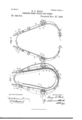
- FIG. 1 is a front elevation of the invention showing the hames applied to a sectional collar.
- FIG. 2 is a similar view of the hames detached from the collar.
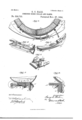
- Fig. 3 is a sectional view through the lower part of the collar and hames, the adjustable cap for the collar, and the adjustable automatic coupling for the hames.
- Fig. 4 is a perspective view of the sectional socket which forms one part of the hames-coupling
- Fig. 5 is a perspective view of the spring locking arm forming the other part of the hames couplin Fig.
- FIG. 6 is a detail View of the keeper which is to be attached to the socket member of the hames-coupling.
- Fig. 7 is a cross sectional view, on the line at a; of Fig. 2, through the adjustable trace-clip.
- Fig. 8 is a cross sectional view, on the line '1 y of Fig. 2, through the upper part of one hame and one of the sleeves on the hinged plate, to show the connection between the hame and the hinged late.
- A, B, designate the hames
- C is the collar.
- This collar is made in three sections or parts 1, 2, 3, its lower members 1, 2, being rigidly attached to the hames A, B, and its upper section, 3, which is made with hollow ends, is fitted over the upper ends of the lower members, 1, 2, so as to slide or move thereon andthereby rendered adjustable vertically with respect to the members 1, 2, and the hames, to lengthen said collar and hatnes and adapt the same for service on horses of difierent sizes.
- the upward or downward adjustment of this member 3, of the collar is limited by the hinged plate E, which is adjustably fastened to the upper ends of the fris, to connect said hames together.
- Each hame A, B is given the form shown by Fig. 2 of the drawings, to enable itto be cast; or otherwise wrought in a single piece of metal and reduce the cost of manufacture thereof.
- the hame has a continuous rib or flange, 2, which stands at an angle to the broad web, I), which parts (1,1), bear firmly against the outside of the collar practically throughout the length thereof, and said web, I), is given the curved form in cross section to enable it; to have such firm bearing on the collar.
- flange, a, andweb, b disposed at right angles to provide the seat, 0, which accommodates one of the sleeves, d, on the hinged, hameconnecting plate E, which sleeves are given a corresponding right-angled shape to adapt them to the seats, 0,0, and they are provided with clamping screws, 6, by which the plate E can be held at the desired height on the hames.
- the adjustable top-section, 3, of the collar is held against upward displacement, when thecollar is fitted on the horse, by the hinged plate, E, and straps,f, are provided on such section, 3, which can be fastened around the hames to keep the top collar-section, 3, in place.
- the lower end of the hame, A is constructed to form the locking arm, G, which constitutes one member of the hames-conpling, while the corresponding end of theother hame, B, is so formed as to provide the socket, I-I, which,in connection with the keeper, 1, constitutes the other member of the hames-coupling, these parts forming the automatic locking device which, as the hames and collar are fitted and closed around the horses neck, serves to fas-' ten the open, lower parts securely together.
- the lower end of the hame, A is made of such length that it projects some distance be yond the corresponding end of the collarmember, 1, and in this extended locking arm, G, thus provided, is formed a longitudinal groove or channel, g, in which is fitted the spring catch, g, the heel of which is permanently fastened to the hame, A, and the free end of which is provided with the beveled head 9" forming the abrupt shoulder g' in rear of the beveled face g" thereof.
- the lower end of the hame, B which is curved to The upper end of each hame has the IIO conform to the shape of the collar, is made the. inner side, it, the whole 1 forming the socket, H.
- this socket terminates flush with the end of the collar-section, 2, to'which the hame, B, is secured, and said mouth is flared or made bell-shaped, as shown, to enable the locking arm and its spring catch to easily enter the socket.
- the outer side of the socket is open, and over this open side is clamped or fastened the casting, I, which serves to complete the socket and forms a keeper, with which engages the spring catch, g, on the locking arm, G.
- This member, I has flanges, t', which interlock with corresponding flanges, t', on the edges of the socket walls, h, h, and the keeper or member, I, can be adjusted on the part, H, toward or from the flared mouth thereof, said keeper, I, being fastened in place by the single screw, I, which is passed through a perforated lug on the keeper and screws into any one of a series of threaded holes, j, tapped in one of the walls, h, of the part, H.
- This keeper, I is bifurcated at its heel to form the bridge, 70, over which takes the abrupt shoulder on the spring catch when the locking arm, G, fits in the socket, H, and the front edge of the keeper is beveled or inclined, as at It, to enable the spring catch to easily pass the bridge.
- L is the adjustable cap which is applied to the lower end of the collar-section, 2, to form the abutment for the lower end of the collarsection. 1, and in the front side of this cap is formed a slot or opening, L, through which the locking arm, G, is adapted to pass in order to enter the socket. H.
- This cap, L is attached to the adjustable member or keeper, I, so as to move therewith, and I prefer to form a lug, m on one end of the cap, which lug fits over the keeper and is fastened thereto by a screw, m, while a similar ear, n, fits over the side of the keeper and is fastened thereto by the adjusting screw, 1'.
- Each hame is provided with a trace clip, 0, having a plate, 0, the lugs, 0', and the bolt 0 around which the trace is fastened.
- the plate, 0, has longitudinal slots, 19, 19, formed therein, which slots coincide with openings, 1), in the hame; and a clevis, P, has its head fitted against the under side of the hame, while the threaded, right-angled ends of said clevis are passed through the holes and slots,
- the trace-clip can be raised or lowered by loosening the nuts on the clevis, moving the plate to the desired position, and retightening the nuts, and as the clevis cannot turn beneath the hame, it is evident that this adjustment of the trace-clip on the hame can be easily effected in a few seconds.
- the socket having a flared mouth and open'side, a keeper fitted over said open side of, and connected to, the socket by interlocking flanges, and a fastening device, combined with the hames, a collar, and a spring locking arm, substantially as and for the purposes described.
Landscapes
- Engineering & Computer Science (AREA)
- Mechanical Engineering (AREA)
- Mutual Connection Of Rods And Tubes (AREA)
Description
2 Sheets-Sheet I.
(No Model.)
. G. 0. HALE.
COMBINED HORSE COLLAR AND HAMES.
No. 529,733. Patented Nov. 27, 1894.
Z0647 esaas:
THE "5am: FErER$ 00., PNO'fQ-LITHQ, wAsHmcrmN. n. c.
(No Model.) 2 Sheets-Sheet 2'.
G. 0. HALE. COMBINED HORSE COLLAR AND HAMBS.
n4: 'nonms wzi'gns cmmomuma. WASHINGTON. 0. c4
1 IINITED STATES PATENT FFICEQ GEORGE O. HALE, OF KANSAS OITY, MISSOURI.
COMBINED l-IORSE- CO LLAR AND HAMES.
SPECIFICATION forming part of Letters Patent No. 529,733, dated November 27, 1894.
Application filed November 2, 1893. Serial No.489,854- No morlelJ To all whom it may concern;
Be it known that I, GEORGE C. HALE, a citizen of the United States, residing at Kansas City, in the county of Jackson and State of Missouri, have invented certain new and useful Improvements in a Combined Collar and Hames; and I do hereby declare the following to be a full, clear, and exact description of the invention, such as will enable others skilled in the art to which it appertains to make and tioned, it is necessary to provide a substantial, rigid construction which must be capable of quick adjustment, and of being fastened permanently together after such adjustment is eifected, to obviate any liability of the parts becoming loosened or disconnected when responding to an alarm or call.
In my prior patents of June 20, 1880, and May 26, 1891, I show combined collars and hames of the class above referred to and which are hinged at the top' and open at the bottom to adapt the same for suspension over the place to be occupied by the animal when attached to the apparatus, and said collars and hames have the upper hinged parts constructed for vertical adjustment to lengthen or contract the collar, while the lower, open end is coupled by an automatic lock and provided with a movable abutment or cap which serves to hold the lower meeting ends of the collar and hames at variable distances apart and thus effect the desired lateral adjustment.
The first part of the present improvements relates to an adjustable automatic lock for coupling the open ends of the hames, and
consequently the-lower ends of the collar; and it consists in the combination with a spring locking arm on one hame, of a sectional socket, one member of which is integral with,
In the preferred embodiment of the hame coupling, I construct the integral member of the socket with flanges or beads at the open sides thereof, and the adjustable section or keeper has corresponding flanges which interlock with the aforesaidtlanges to hold the adj ustable member or keeper against any sidewise play but permitting'it to have the desired endwise adjustment, and for quicklyv fastening said adjustable part, I provide a sing'le fastening screw which passes through the adjustable part or keeper and can be screwed into any one of a series of threaded openings formed in the integral or socket member, although this particular fastening can be varied or changed by a skilled mechanic. With this adjustable member and the collar is associated the movable cap which forms the abutment to limit the movement of the open ends of the collar toward each other, and said cap is connected or fastenedto the adjustable member or keeper at two points so that it will be adjusted therewith, whereby the collar and ham'es can be widened or' contracted by the simple removal of a single screw, the connected cap and catch-keeper adjusted, and again fastening the screw.
Another improvement which I have made consists in an improved means for fastening the trace-clip to the hame in a manner to admit of the vertical adjustment of saidhameclip and at the same time securely hold the clip on the hame without the useof headed, independent bolts. To this end, I provide a clip plate with longitudinal slots andform two openings in the hame, and through these openings and the slots in the trace-clip are passed the threaded ends of a lclevis, the head R of which bears on the under side of thehame, .while the nuts and washers are screwed on the threaded ends thereof and bear on the clip-plate to clamp the trace'clip in place. By using this clevis, I dispense with headed bolts, which heads of the bolts are liable to 1 urn or rotate underneath the hame, and thus the nuts can be turned and fastened and the parts adjusted more quickly to change the draft and at the same time the trace-clip is securely clamped. As a further means of holding the trace-clip and relieving the strain on the clevis, I fasten the clip-plate to the hame by interlocking tongue and groove which admits of the desired vertical adjustment of the trace-clip.
My hames are each given such form as to enable them to be cast or treated in malleable iron, or aluminium alloy, or other metals, producing a cheaper hame to manufacture than those now used which are necessary to be forged of wrought iron or steel, and said hames are so constructed at the bottom as to form the automatic coupling device, while the upper ends, which extend above the collar, are formed with right-angled seats which accommodate the correspondingly shaped sleeves on the hinged plate that connects the upper ends of the hames and holds the tele scopical or adjustable upper member of the collar, all as will be more fully hereinafter described and pointed out in the claims.
The preferred embodiment of my improved collar and hames is illustrated in the accompanyingdrawings,formingapartofthisspeciiication, and in which Figure 1 is a front elevation of the invention showing the hames applied to a sectional collar. Fig. 2 is a similar view of the hames detached from the collar. Fig. 3 is a sectional view through the lower part of the collar and hames, the adjustable cap for the collar, and the adjustable automatic coupling for the hames. Fig. 4 is a perspective view of the sectional socket which forms one part of the hames-coupling, and Fig. 5 is a perspective view of the spring locking arm forming the other part of the hames couplin Fig. 6 is a detail View of the keeper which is to be attached to the socket member of the hames-coupling. Fig. 7 is a cross sectional view, on the line at a; of Fig. 2, through the adjustable trace-clip. Fig. 8 is a cross sectional view, on the line '1 y of Fig. 2, through the upper part of one hame and one of the sleeves on the hinged plate, to show the connection between the hame and the hinged late.
Like letters and numerals of reference denote corresponding parts in all the figures of the drawings.
A, B, designate the hames, and C is the collar. This collar is made in three sections or parts 1, 2, 3, its lower members 1, 2, being rigidly attached to the hames A, B, and its upper section, 3, which is made with hollow ends, is fitted over the upper ends of the lower members, 1, 2, so as to slide or move thereon andthereby rendered adjustable vertically with respect to the members 1, 2, and the hames, to lengthen said collar and hatnes and adapt the same for service on horses of difierent sizes. The upward or downward adjustment of this member 3, of the collar is limited by the hinged plate E, which is adjustably fastened to the upper ends of the haines, to connect said hames together. No novelty is herein claimed for the collar embodying the generic features of construction and organization of the hames, the sectional collar, and the hinged plate, as the same are shown and described in my prior patent, No. 452,928, dated May 26, 1891, to which reference has been made.
Each hame A, B, is given the form shown by Fig. 2 of the drawings, to enable itto be cast; or otherwise wrought in a single piece of metal and reduce the cost of manufacture thereof. The hame has a continuous rib or flange, 2, which stands at an angle to the broad web, I), which parts (1,1), bear firmly against the outside of the collar practically throughout the length thereof, and said web, I), is given the curved form in cross section to enable it; to have such firm bearing on the collar. flange, a, andweb, b, disposed at right angles to provide the seat, 0, which accommodates one of the sleeves, d, on the hinged, hameconnecting plate E, which sleeves are given a corresponding right-angled shape to adapt them to the seats, 0,0, and they are provided with clamping screws, 6, by which the plate E can be held at the desired height on the hames.
The adjustable top-section, 3, of the collar is held against upward displacement, when thecollar is fitted on the horse, by the hinged plate, E, and straps,f, are provided on such section, 3, which can be fastened around the hames to keep the top collar-section, 3, in place.
The lower end of the hame, A,is constructed to form the locking arm, G, which constitutes one member of the hames-conpling, while the corresponding end of theother hame, B, is so formed as to provide the socket, I-I, which,in connection with the keeper, 1, constitutes the other member of the hames-coupling, these parts forming the automatic locking device which, as the hames and collar are fitted and closed around the horses neck, serves to fas-' ten the open, lower parts securely together.
The lower end of the hame, A, is made of such length that it projects some distance be yond the corresponding end of the collarmember, 1, and in this extended locking arm, G, thus provided, is formed a longitudinal groove or channel, g, in which is fitted the spring catch, g, the heel of which is permanently fastened to the hame, A, and the free end of which is provided with the beveled head 9" forming the abrupt shoulder g' in rear of the beveled face g" thereof. The lower end of the hame, B, which is curved to The upper end of each hame has the IIO conform to the shape of the collar, is made the. inner side, it, the whole 1 forming the socket, H. The mouth of this socket terminates flush with the end of the collar-section, 2, to'which the hame, B, is secured, and said mouth is flared or made bell-shaped, as shown, to enable the locking arm and its spring catch to easily enter the socket. It will be noted that the outer side of the socket is open, and over this open side is clamped or fastened the casting, I, which serves to complete the socket and forms a keeper, with which engages the spring catch, g, on the locking arm, G. This member, I, has flanges, t', which interlock with corresponding flanges, t', on the edges of the socket walls, h, h, and the keeper or member, I, can be adjusted on the part, H, toward or from the flared mouth thereof, said keeper, I, being fastened in place by the single screw, I, which is passed through a perforated lug on the keeper and screws into any one of a series of threaded holes, j, tapped in one of the walls, h, of the part, H. This keeper, I, is bifurcated at its heel to form the bridge, 70, over which takes the abrupt shoulder on the spring catch when the locking arm, G, fits in the socket, H, and the front edge of the keeper is beveled or inclined, as at It, to enable the spring catch to easily pass the bridge.
L is the adjustable cap which is applied to the lower end of the collar-section, 2, to form the abutment for the lower end of the collarsection. 1, and in the front side of this cap is formed a slot or opening, L, through which the locking arm, G, is adapted to pass in order to enter the socket. H. This cap, L, is attached to the adjustable member or keeper, I, so as to move therewith, and I prefer to form a lug, m on one end of the cap, which lug fits over the keeper and is fastened thereto by a screw, m, while a similar ear, n, fits over the side of the keeper and is fastened thereto by the adjusting screw, 1'.
Each hame is provided with a trace clip, 0, having a plate, 0, the lugs, 0', and the bolt 0 around which the trace is fastened. The plate, 0, has longitudinal slots, 19, 19, formed therein, which slots coincide with openings, 1), in the hame; and a clevis, P, has its head fitted against the under side of the hame, while the threaded, right-angled ends of said clevis are passed through the holes and slots,
- 9, p, p, in the hame and plate, to receive the nuts, P, and the washers, by which trace clip is clamped upon the hame, but which traceclip is capable of Vertical adjustment on said hame. To relieve the clevis, P, from undue strain, I connect the trace-clip to the hame in a manner to permit of its vertical adjustment, and this is efiected by forminga groove, q, on the inner side of the plate, 0, and a rib or tongue, g, on the hame, to fit in said groove or channel q.
My combined collar and hames present a substantial, rigid structure which will successfully stand the rough usage to which collars of this class are subjected, and the collar can be lengthened or widened in a few sec- To widen the collar, the screw, 1, is removed,
and the connected cap and keeper moved on the collar section, 2, and. the socket, H, respectively, and the screw again replaced.
The trace-clip can be raised or lowered by loosening the nuts on the clevis, moving the plate to the desired position, and retightening the nuts, and as the clevis cannot turn beneath the hame, it is evident that this adjustment of the trace-clip on the hame can be easily effected in a few seconds.
I am aware that changes in the form and proportion of parts, and in the details of construction, of the mechanism herein shown and described as an embodiment of myinvention can be made without departing from the spirit or sacrificing the advantages of my invention, and I therefore reserve the right to make such modifications and alterations as fairly fall within the scope of my invention.
Having thus fully described my invention, what I claim as new, and desire to secure by Letters Patent, is
1. The combination of the hames, one of which is constructed with a socket having a flared mouth, and the other having a spring locking arm adapted to enter the socket, the adjustable keeper fitted to said socket in the path of the locking arm, and a clamp for rigidly holding the keeper at the desired point of adjustment on said socket, substantially as described.
2. The combination with the hames, one of which is provided with a socket, open at one side thereof, and the otherhaving a yielding locking arm, of a keeper fitted to the open side of the socket and adjustable toward or from the mouth thereof, and a clamp carried by the keeper to hold the latter in a fixed positionat the desired point of adjustment on the socket, substantially as described.
3. The combination with the hames, and a spring locking arm von one of said hames, of the open socket H on the other hame, and a keeperlclamped to the open side of the socket and adjustable thereon toward or from its open flaring mouth, substantially as and. for the purposes described.
4. The combination with the hames, and a spring locking arm on one of the hames, of the socket on the other hame provided with a flaring mouth and an opening in the side thereof, the keeper I fitted over the open side of the socket, and a clamp for holding the keeper at the desired point of adjustment on the socket, substantially as and for the purposes described.
5. The combination with a collar and hames, of a locking arm, a socket, an adjustable keeper clamped to said socket, and a cap adj ustable with the keeper, substantially as and for the purposes described.
too
.6. The socket having a flared mouth and open'side, a keeper fitted over said open side of, and connected to, the socket by interlocking flanges, and a fastening device, combined with the hames, a collar, and a spring locking arm, substantially as and for the purposes described.
7. The combination with acollar and hames, ofa spring locking" arm, a socket, an adj ustable keeper clamped or fixed to said socket, and an adjustable cap fitted on one end of the collar and connected to the keeper to be adjustable therewith, substantially as and for the purposes described.
Publications (1)
| Publication Number | Publication Date |
|---|---|
| US529733A true US529733A (en) | 1894-11-27 |
Family
ID=2598515
Family Applications (1)
| Application Number | Title | Priority Date | Filing Date |
|---|---|---|---|
| US529733D Expired - Lifetime US529733A (en) | Combined horse-collar and hames |
Country Status (1)
| Country | Link |
|---|---|
| US (1) | US529733A (en) |
-
0
- US US529733D patent/US529733A/en not_active Expired - Lifetime
Similar Documents
| Publication | Publication Date | Title |
|---|---|---|
| US529733A (en) | Combined horse-collar and hames | |
| US523406A (en) | Combined collar and hames | |
| US450067A (en) | Gig-saddle | |
| US296140A (en) | cooper | |
| US334116A (en) | Harness-saddle | |
| US285844A (en) | roeel | |
| US529287A (en) | Harness-saddle | |
| US558431A (en) | William c | |
| US45060A (en) | Improvement in horse-collars | |
| US486092A (en) | Whiffletree | |
| US786870A (en) | Neck-yoke and pole coupling. | |
| US47960A (en) | Improved saddle-tree | |
| US335524A (en) | George m | |
| US452929A (en) | Coupling for horse-collars | |
| US160318A (en) | Improvement in horse-collars | |
| US449646A (en) | John m | |
| US177011A (en) | Teeeitoet | |
| US527994A (en) | Harness | |
| US81552A (en) | Christian adolph steinbbueczb | |
| US48735A (en) | Improved horse-collar fastener | |
| US53578A (en) | Improved gig-tree | |
| US481765A (en) | Of mansfield | |
| US408661A (en) | Harness-d | |
| US346036A (en) | Harness-buckle | |
| US942824A (en) | Metal-framed horse-collar. |