US5229055A - Method and apparatus of producing hollow profiles from multilayer starting material - Google Patents

Method and apparatus of producing hollow profiles from multilayer starting material Download PDF

Info

Publication number
US5229055A
US5229055A US07/857,456 US85745692A US5229055A US 5229055 A US5229055 A US 5229055A US 85745692 A US85745692 A US 85745692A US 5229055 A US5229055 A US 5229055A
Authority
US
United States
Prior art keywords
shaping
tools
workpiece
contact
endless
Prior art date
Legal status (The legal status is an assumption and is not a legal conclusion. Google has not performed a legal analysis and makes no representation as to the accuracy of the status listed.)
Expired - Lifetime
Application number
US07/857,456
Inventor
Erich Wintermantel
Oswald Landwehr
Current Assignee (The listed assignees may be inaccurate. Google has not performed a legal analysis and makes no representation or warranty as to the accuracy of the list.)
Individual
Original Assignee
Individual
Priority date (The priority date is an assumption and is not a legal conclusion. Google has not performed a legal analysis and makes no representation as to the accuracy of the date listed.)
Filing date
Publication date
Application filed by Individual filed Critical Individual
Assigned to ERICH WINTERMANTEL reassignment ERICH WINTERMANTEL ASSIGNMENT OF ASSIGNORS INTEREST. Assignors: LANDWEHR, OSWALD
Application granted granted Critical
Publication of US5229055A publication Critical patent/US5229055A/en
Anticipated expiration legal-status Critical
Expired - Lifetime legal-status Critical Current

Links

Images

Classifications

    • BPERFORMING OPERATIONS; TRANSPORTING
    • B29WORKING OF PLASTICS; WORKING OF SUBSTANCES IN A PLASTIC STATE IN GENERAL
    • B29DPRODUCING PARTICULAR ARTICLES FROM PLASTICS OR FROM SUBSTANCES IN A PLASTIC STATE
    • B29D99/00Subject matter not provided for in other groups of this subclass
    • B29D99/001Producing wall or panel-like structures, e.g. for hulls, fuselages, or buildings
    • BPERFORMING OPERATIONS; TRANSPORTING
    • B29WORKING OF PLASTICS; WORKING OF SUBSTANCES IN A PLASTIC STATE IN GENERAL
    • B29CSHAPING OR JOINING OF PLASTICS; SHAPING OF MATERIAL IN A PLASTIC STATE, NOT OTHERWISE PROVIDED FOR; AFTER-TREATMENT OF THE SHAPED PRODUCTS, e.g. REPAIRING
    • B29C53/00Shaping by bending, folding, twisting, straightening or flattening; Apparatus therefor
    • B29C53/16Straightening or flattening
    • B29C53/20Straightening or flattening of tubes
    • BPERFORMING OPERATIONS; TRANSPORTING
    • B29WORKING OF PLASTICS; WORKING OF SUBSTANCES IN A PLASTIC STATE IN GENERAL
    • B29DPRODUCING PARTICULAR ARTICLES FROM PLASTICS OR FROM SUBSTANCES IN A PLASTIC STATE
    • B29D24/00Producing articles with hollow walls
    • B29D24/001Producing articles with hollow walls formed of hollow ridges or ribs, e.g. separate ridges; continuous corrugated structure
    • BPERFORMING OPERATIONS; TRANSPORTING
    • B29WORKING OF PLASTICS; WORKING OF SUBSTANCES IN A PLASTIC STATE IN GENERAL
    • B29DPRODUCING PARTICULAR ARTICLES FROM PLASTICS OR FROM SUBSTANCES IN A PLASTIC STATE
    • B29D99/00Subject matter not provided for in other groups of this subclass
    • B29D99/0089Producing honeycomb structures
    • YGENERAL TAGGING OF NEW TECHNOLOGICAL DEVELOPMENTS; GENERAL TAGGING OF CROSS-SECTIONAL TECHNOLOGIES SPANNING OVER SEVERAL SECTIONS OF THE IPC; TECHNICAL SUBJECTS COVERED BY FORMER USPC CROSS-REFERENCE ART COLLECTIONS [XRACs] AND DIGESTS
    • Y10TECHNICAL SUBJECTS COVERED BY FORMER USPC
    • Y10STECHNICAL SUBJECTS COVERED BY FORMER USPC CROSS-REFERENCE ART COLLECTIONS [XRACs] AND DIGESTS
    • Y10S264/00Plastic and nonmetallic article shaping or treating: processes
    • Y10S264/73Processes of stretching

Definitions

  • This invention relates to a method of producing hollow profiles from multilayer starting materials, such as woven fabrics, knitted fabrics, laid materials, webs or the like, having a large width-to-thickness ratio, in a continuous process.
  • the invention also relates to hollow profiles which are produced in accordance with the method of the invention, the form of which is determined by features of the production process.
  • the known methods can be used to produce hollow profiles which have only one coherent cavity (hollow space) or profiles which have several separate cavities.
  • the method in accordance with the invention for production of hollow profiles from multilayer starting materials having a large width-to-thickness ratio is characterised in that the regions of one or more shaping tools which come into contact with the material that is to be or is being shaped are designed as endless, revolving component parts so that during the progressive shaping process substantially no sliding friction takes place between the starting material or the material being processed and the shaping tool or tools.
  • the starting materials may be natural materials of vegetable, animal or mineral origin, e.g. cotton, or wool, or glass or metal, respectively, or they may be synthetic materials, such as plastics. They will be prefabricated into appropriate multilayer form, with lines or regions of joins between the layers.
  • the endless revolving component parts may take the form of loops, more specifically rings, bands or belts, or of tubes or hoses or the like.
  • these revolving elements can be formed of homogeneous material or may be braided, knitted, woven or organised in a chain-like manner and they may have either a constant or varying cross-section over their length.
  • starting materials which, for the purpose of sealing and/or stabilisation, have undergone vapour deposition or are provided with a coating or are wetted or impregnated with a liquid or pasty matrix, this coating or matrix is not uncontrolledly displaced, reduced or removed.
  • this vapour deposit, coating or matrix can be hardened accurately, after shaping has been effected, while still on the shaping tool, e.g. by the supply of heat, without any structural damage arising to the vapour deposit, coating or matrix because of it being subjected to a squeezing process in the hardening phase.
  • the starting materials when they move over the shaping tools, can be limited from the outside, e.g. by bands or belts, and possibly by pressure, to achieve a high accuracy of size, without the risk of increased damage to the starting material, e.g. by warping.
  • the shaping tools do not wear away and lose their accuracy of shape as a result of abrasion.
  • the shaping tools do not get contaminated as a result of deposits and thereby lose their accuracy of shape.
  • the advancing movement of the starting material over the shaping tool or tools or with which the shaping tool or tools progress in or on the starting material can, on the one hand, be brought about by means separate from the shaping tool or tools, but, on the other hand, may be brought about directly by way of the shaping tool or tools themselves.
  • the tension which is introduced into the starting material from the shaping tool or tools increases or decreases, and/or
  • the cross-section of the shaping tool can, in this respect, in the initial position or after change of shape has been effected, define a round or otherwise curved contour or a symmetrical or unsymmetrical polygon contour.
  • these tools can have the same cross-section or different cross-sections.
  • Several shaping tools can also be arranged in such a way with regard to one another and be so designed that the starting material is not reshaped into a planar hollow profile structure, but into one which is curved or arched in its transverse direction or in its longitudinal direction or, indeed, in both those directions.
  • Suitable starting materials can, in accordance with the method of the invention, be restructured in such a way that they have channel-shaped cavities lying in an orderly aligned manner side-by-side or one above the other, or both side-by-side and one above the other, or aligned in a disordered manner with regard to one another.
  • Adjacent cavities/channels can be connected to one another continuously or only in certain sections, and either linearly or areally.
  • the shaping tools bring about shaping of the starting material by way of revolving endless loops or the like which necessarily stand directly in contact with the starting material.
  • the starting material and the shaping tool or tools have to move relative to one another to accomplish a progressive shaping process, so it is necessary to exert forces on the shaping tool or tools to fix their position, and on the starting material to bring about their advance over the tool(s).
  • retaining forces can be brought to bear on the shaping tools by mechanical support or suspension or contactlessly, e.g. by a magnetic or electrical field. If, for the shaping process, several shaping tools are arranged side-by-side and/or one above the other, then the retaining forces acting directly on the shaping tools arranged at the outside of the group of tools can be further transmitted contactlessly to the farther inwardly lying shaping tools
  • the shaping process can be carried out continuously and economically, with high reproducible quality of the hollow profiles produced
  • hollow profiles can be produced by methods in accordance with the invention.
  • Such hollow profiles may consist of several interconnected, e.g. integrally interwoven channel-shaped cavities and these cavities/channels
  • connection of adjacent cavities/channels can be effected linearly or areally (i e. over an area of their adjoining surface) and either continuously or with interruptions along their respective longitudinal axis.
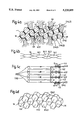
  • FIGS. 1 to 6 Characteristic features of various exemplary methods and hollow profiles in accordance with the invention will be explained with reference to the diagrammatic representations in FIGS. 1 to 6.
  • Each Figure, with the exception of FIG. 5, consists of several representations so that, for example, the representations FIGS. 1a to 1e belong to FIG. 1.
  • FIGS. 1a, 2a, 3a and 4a depict, in cross-section, respective shaping tools or parts thereof, surrounded by hollow profiles produced thereby;
  • FIGS. 1b, 2b, 3b and 4b depict, in cross-section, the substantially flat-lying unexpanded starting materials which are formed into hollow profiles by use of the shaping tools shown in the corresponding group of representations;
  • FIG. 1c shows in longitudinal direction the guidance of a single endlessly revolving shaping loop in accordance with the FIG. 1 embodiment
  • FIGS. 1d, 2c, 3c, 4c and 6a show longitudinal sections of the respective shaping tools with the hollow profiles formed thereover from the respective unexpanded or unstretched starting materials
  • FIGS. 5 and 6b show respective embodiments of shaping tools in perspective representation
  • FIGS. 1e, 2d, 3d and 4d are diagrammatic perspective representations showing the respective cross-sectional geometry of the hollow profiles which are produced using the shaping tools shown in the corresponding group of representations.
  • FIG. 1a shows several shaping tools 1, arranged side-by-side, each comprising four approximately diagonally disposed shaping units 1.1, 1.2, 1.3 and 1.4.
  • Each of these shaping units consists of an endless loop 1.1.1 and rotatably mounted deflection and guide rollers 1.1.2 and the respective shaping units are connected together by way of a retaining frame 1.1.3 on which the rollers are mounted.
  • the geometric shape and the positioning of the shaping tools determine the shape of the hollow profile H 1 produced thereby.
  • FIG. 1b shows the incompletely expanded starting material V 1, which has pockets or apertures V 1.1 and V 1.2, the circumference of which corresponds in length to the circumference of the channels H 1.1 and H 1.2 of the hollow profile H 1 to be formed therefrom.
  • the adjacent pockets V 1.1 and V 1.2 are connected together, for example by adhesion, welding or stitching or by means of an integral interlinking or interweaving.
  • FIG. 1c is a partial view of a shaping unit 1.1 in the direction of arrow A in FIG. 1, which clearly shows the unit to consist of a shaping loop 1.1.1, rotatably mounted deflection and guide rollers 1.1.2 and a retaining frame 1.1.3.
  • FIG. 1d shows one of the shaping tools 1 in a channel of the starting material V 1, or of the hollow profiles H 1.
  • the shaping loop 1.1.1 is shown being driven by means of a friction wheel 1.1.5 by way of gearing 1.1.4 to bring about either the advance of the shaping tool 1 in the starting material V 1 or movement of the hollow profile H 1 over the shaping tool 1.
  • FIG. 1e shows the hollow profile H 1 after shaping has been effected. It has channels H 1.1 and H 1.2 of different size which are connected together linearly in the longitudinal direction thereof.
  • FIG. 2a shows shaping tools 2, arranged side-by-side as mirror-inverted pairs, and each comprising three shaping units 2.1, 2.2 and 2.3.
  • the shaping unit 2.1 consists of a shaping loop 2.1.1 in the form of a flat belt and deflection and guide rollers 2.1.2 mounted on a retaining frame 2.1.3.
  • the shaping units 2.2 and 2.3 each comprise a shaping loop 2.2.1 and deflection rollers 2.2.2, and they are each adjustable both in height and laterally on sliding guides 2.2.3 and 2.2.4 to allow modification of the cross-sectional geometry of the channels H 2.1 and H 2.2 of the hollow profile H 2 which they form. Changing of the channel cross-sections can, depending on the technical design of the shaping tool, be effected either in steps or steplessly during the shaping process.
  • the starting material consists of an inelastic material the length of the channel circumference will have to be maintained upon any cross-sectional change.
  • cross-sectional changes can be undertaken which lead to circumferential dimensions which differ from one another.
  • FIG. 2b shows the associated starting material V 2 in the incompletely expanded state. It has several pockets V 2.1 of identical size.
  • FIG. 2c shows how the forces developed between the shaping tool 2, with the shaping units 2.1, 2.2 and 2.3, and the starting material V 1, or the hollow profile H 2 formed therefrom, and tending to bring about relative movement therebetween, i.e. to advance the material over the shaping tool 2 and/or to advance the latter inside the material, are absorbed by way of a retaining coupling 2.1.4 and a retaining rod 2.1.5 which extends through the corresponding hollow profile channel.
  • FIG. 2d shows the hollow profile H 2 which is the result and which has identical, but mirror-inverted channel pairs H 2.1 which are connected to one another over an adjoining area, connected alternately with channel pairs H 2.2 which differ in cross-sectional geometry therefrom.
  • the cross-sectional geometry of the hollow profile H 2 corresponds to the representation of this profile in FIG. 2a.
  • this hollow profile has a geometry which differs from the front plane B. The geometry change can be brought about during the production process by gradual repositioning of the shaping units 2.2 and 2.3 on the shaping tools 2.
  • FIG. 3a shows several shaping tools 3, of identical dimensions and design, arranged side-by-side.
  • Each shaping tool comprises, on the one hand, a component, profiling a channel H 3.1 of the hollow profile H 3 from the inside, which includes shaping units 3.1, 3.2, 3.3, 3.4 and 3.5 and, on the other hand, a component, profiling the said channel of the hollow profile from the outside.
  • the latter consists of a further shaping unit 3.6 having a shaping belt 3.6.1 and deflection rollers 3.6.2.
  • FIG. 3b shows the associated starting material V 3 having pre-formed pockets V 3.1 in an incompletely expanded state.
  • FIG. 3c shows that each shaping tool 3 is so designed that it shapes the starting material into a hollow profile H 3 which is curved in the longitudinal direction.
  • the curvature is brought about by appropriate guidance of the shaping loops 3.1.1 over deflection rollers 3.1.2 and intermediate guides 3.1.3.
  • the external profile-forming component with the profile-forming belt 3.6.1 and the deflection rollers 3.6.2 also has intermediate guides 3.6.3 positioned and/or shaped to impart curvature, and it is so designed that, at the same time, it also brings about the advancing movement of the starting material V 3 or the hollow profile H 3 over the tools 3.
  • one of the deflection rollers 3.6.2 is driven by means of a belt drive 3.6.4 and gearing/motor 3.6.5.
  • FIG. 3d shows the hollow profile H 3 formed as a result, which has channels H 3.1 arranged side-by-side and connected to one another over an area of their surface, and curvature in the longitudinal direction of the channels.
  • FIG. 4a is a section along the line G-K in FIG. 4c through the retaining magnets of several shaping tools, which are arranged both side-by-side and one above the other, and through a hollow profile H 4 with a corresponding channel arrangement, in which respect the cross-sectional axis M of the channels is curving.
  • three shaping tools D-I-D form a retention group.
  • the outer tools D in this group have their respective magnet retaining frames 4.2, 4.3 held in position directly by way of magnets 4.4.1 and 4.5.1 which are installed outside the hollow profile H 4 in respective fixed base frames 4.4, 4.5.
  • the shaping tool I arranged centrally in this retention group is, in contrast, held contactlessly and indirectly by way of the aforesaid outer shaping tools D.
  • FIG. 4b shows the incompletely expanded associated starting material V 4 with the pre-formed pockets V 4.1, V 4.2 and V 4.3, the pockets V 4.2 and V 4.3 being arranged one above the other and partially overlying or surrounding the pockets V 4.1.
  • FIG. 4c is a longitudinal section along the line E-F in FIG. 4a showing the above described group of three shaping tools D, I, D with the manner of the magnetic retention of the tools being clearly evident.
  • the retention forces for this group of tools are applied solely by the magnets 4.4.1 and 4.5.1 mounted in the respective base frames 4.4 and 4.5, which are arranged outside the starting material V 4 or the hollow profile H 4.
  • These magnets act directly on the outer shaping tools D which have the respective magnet retaining frames 4.2 and 4.3, and, by way of these, also indirectly on the shaping tool lying therebetween which has the magnet retaining frame 4.1.
  • FIG. 4d shows the resulting hollow profile H 4 which has channels H 4.1, H 4.2 and H 4.3 arranged both side-by-side and one above the other, and also has a curved cross-sectional central axis M.
  • FIG. 5 shows a further embodiment, namely a single channel of a starting material V 5 or of a resulting hollow profile H 5 with a corresponding shaping tool 5 arranged therein.
  • the endless shaping loop 5.1 is conducted successively over eight deflection rollers 5.2 to 5.9.
  • the deflection rollers 5.3 and 5.7 are driven by way of a common axial shaft 5.10 by means of a gearing/motor 5.11 to bring about movement of the loop 5.1 over the rollers 5.2 to 5.9 in sequence and more specifically advancing movements by the loop 5.1, along the four corner contact zones, which are equidirectional with regard to the starting material V 5 or the hollow profile H 5 (see solid arrows in FIG. 5).
  • FIGS. 6a and 6b show a fixed embodiment in which the shaping tool 6, shown inside a starting material V 6 or a resulting hollow profile H 6, is of considerably different form to the first five embodiments, consisting of an endless tube-like element the material or tube jacket 6.1 of which moves and in so doing turns in upon itself by returning up the centre of the tube.
  • the tube jacket 6.1 may be filled by a granular material 6.2 or by a liquid or paste or a gas.
  • the forces which, while advancing the material V 6, tend to move the tube 6.1 inside the profile H 6 in the opposite direction can be absorbed or counteracted by supporting rollers 6.4 mounted on a thrust rod 6.3 which extends through the hollow profile H 6.
  • FIG. 6b shows how at the "head” of the shaping tool 6 the tube jacket 6.1 expands out of the central bore of diameter "d” to the shaping diameter "D".
  • a shaping tool 6 of this type functions most effectively if the material which the tube jacket 6.1 is made is chosen to be a material which tends not to pleat in the centre "d” upon the circumferential reduction of the tube jacket 6.1 from D. to d. which takes place continuously during the production process.

Landscapes

  • Engineering & Computer Science (AREA)
  • Mechanical Engineering (AREA)
  • Architecture (AREA)
  • Civil Engineering (AREA)
  • Structural Engineering (AREA)
  • Moulding By Coating Moulds (AREA)
  • Laminated Bodies (AREA)
  • Woven Fabrics (AREA)

Abstract

Hollow profile elements are formed by shaping a starting workpiece that consists of multiple layers of a material having a large width-to-thickness ratio, e.g., woven fabrics or laid materials. The layers are joined by seams to define elongated pockets or channels. Shaping tools are inserted into these channels to form the profile elements with a desired cross sectional shape, which can be constant or varied. The shaping tools employ one or more endless belts that extend in closed loops around guide rollers; the belts are driven so that during the shaping process sliding friction is substantially eliminated between the material of the workpiece and the respective shaping tool.

Description

BACKGROUND OF THE INVENTION
This invention relates to a method of producing hollow profiles from multilayer starting materials, such as woven fabrics, knitted fabrics, laid materials, webs or the like, having a large width-to-thickness ratio, in a continuous process. The invention also relates to hollow profiles which are produced in accordance with the method of the invention, the form of which is determined by features of the production process.
Methods of producing hollow profiles from multilayer woven fabrics, laid materials, knitted fabrics or webs are known wherein these starting materials are shaped by being drawn onto mandrel-shaped tools or other shaping tools along with the occurrence of sliding friction. The cross-sectional geometry of the shaping tool or tools then determines the clear cross-section of the hollow profile which is produced or rather of the channels in the hollow profile which is produced.
Also known are processes for manufacturing hollow profiles in which the shaping is effected by pressure impingement on the channels or pockets which are already formed in the starting materials. The expansion and the final geometric shape of the hollow profiles can, in such cases, possibly also be influenced by external limitations. In the case of starting materials having an open surface, i.e. one permeable to gas and liquid, it is known to employ the latter method by introducing thin-walled foil tubes or sleeves into the channels or pockets of the starting materials, upon production or subsequently, to enable their expansion by pressure impingement thereon. After the shaping process is completed, these inserts can remain as "lost cores" in the hollow profiles or they can be removed.
In the various known methods, just mentioned, it is also known to wet or to impregnate the starting materials prior to or during the shaping process with a matrix, such as a synthetic resin or plastics material, and to cause this matrix, after shaping of the hollow profile structure has been effected, to harden, e.g. by the supply of heat, and thus to stiffen this structure.
The known methods can be used to produce hollow profiles which have only one coherent cavity (hollow space) or profiles which have several separate cavities.
OBJECTS AND SUMMARY OF THE INVENTION
The method in accordance with the invention for production of hollow profiles from multilayer starting materials having a large width-to-thickness ratio is characterised in that the regions of one or more shaping tools which come into contact with the material that is to be or is being shaped are designed as endless, revolving component parts so that during the progressive shaping process substantially no sliding friction takes place between the starting material or the material being processed and the shaping tool or tools.
The starting materials may be natural materials of vegetable, animal or mineral origin, e.g. cotton, or wool, or glass or metal, respectively, or they may be synthetic materials, such as plastics. They will be prefabricated into appropriate multilayer form, with lines or regions of joins between the layers.
The endless revolving component parts may take the form of loops, more specifically rings, bands or belts, or of tubes or hoses or the like. Moreover, these revolving elements can be formed of homogeneous material or may be braided, knitted, woven or organised in a chain-like manner and they may have either a constant or varying cross-section over their length.
By avoiding sliding friction between the shaping tool or tools and the starting material the following advantages are achieved:
With starting materials made from woven fabrics, knitted fabrics or laid materials, in particular those having a comparatively coarse-meshed structure and/or "loose" thread binding (open texture), no warping arises.
With starting materials which, for the purpose of sealing and/or stabilisation, have undergone vapour deposition or are provided with a coating or are wetted or impregnated with a liquid or pasty matrix, this coating or matrix is not uncontrolledly displaced, reduced or removed.
On initial products which, for the purpose of their sealing and/or stabilisation, have undergone vapour deposition or are provided with a coating or are wetted or impregnated with a liquid or pasty matrix, this vapour deposit, coating or matrix can be hardened accurately, after shaping has been effected, while still on the shaping tool, e.g. by the supply of heat, without any structural damage arising to the vapour deposit, coating or matrix because of it being subjected to a squeezing process in the hardening phase.
With starting materials which are conducted in an accurately fitting manner, and possibly along with certain initial tension, over the shaping tool or tools, only comparatively slight advancing or feeding forces needed to be expended.
The starting materials, when they move over the shaping tools, can be limited from the outside, e.g. by bands or belts, and possibly by pressure, to achieve a high accuracy of size, without the risk of increased damage to the starting material, e.g. by warping.
The shaping tools do not wear away and lose their accuracy of shape as a result of abrasion.
The shaping tools do not get contaminated as a result of deposits and thereby lose their accuracy of shape.
In the method in accordance with the invention, the advancing movement of the starting material over the shaping tool or tools or with which the shaping tool or tools progress in or on the starting material, can, on the one hand, be brought about by means separate from the shaping tool or tools, but, on the other hand, may be brought about directly by way of the shaping tool or tools themselves.
It is possible in some methods in accordance with the invention to vary the cross-sectional geometry of the shaping tool or tools gradually or steplessly during the shaping process in such a way that:
possible tolerances in size of the starting material are compensated for, and/or
the tension which is introduced into the starting material from the shaping tool or tools increases or decreases, and/or
from a starting material having constant or varying cross-sectional dimensions over its length, hollow profiles having cross-sectional geometries which are different over their length, e.g. becoming steadily or alternately larger or smaller, can be produced during the continuous shaping process.
The cross-section of the shaping tool can, in this respect, in the initial position or after change of shape has been effected, define a round or otherwise curved contour or a symmetrical or unsymmetrical polygon contour. In the case of shaping processes which involve the simultaneous use of several shaping tools, these tools can have the same cross-section or different cross-sections. Several shaping tools can also be arranged in such a way with regard to one another and be so designed that the starting material is not reshaped into a planar hollow profile structure, but into one which is curved or arched in its transverse direction or in its longitudinal direction or, indeed, in both those directions.
Suitable starting materials can, in accordance with the method of the invention, be restructured in such a way that they have channel-shaped cavities lying in an orderly aligned manner side-by-side or one above the other, or both side-by-side and one above the other, or aligned in a disordered manner with regard to one another. Adjacent cavities/channels can be connected to one another continuously or only in certain sections, and either linearly or areally.
In the method of the invention, the shaping tools bring about shaping of the starting material by way of revolving endless loops or the like which necessarily stand directly in contact with the starting material. However, the starting material and the shaping tool or tools have to move relative to one another to accomplish a progressive shaping process, so it is necessary to exert forces on the shaping tool or tools to fix their position, and on the starting material to bring about their advance over the tool(s). In various methods in accordance with the invention, retaining forces can be brought to bear on the shaping tools by mechanical support or suspension or contactlessly, e.g. by a magnetic or electrical field. If, for the shaping process, several shaping tools are arranged side-by-side and/or one above the other, then the retaining forces acting directly on the shaping tools arranged at the outside of the group of tools can be further transmitted contactlessly to the farther inwardly lying shaping tools
As a result of the procedures proceeding in a controlled manner and free from sliding friction between the shaping tool or tools and the starting material, the shaping process can be carried out continuously and economically, with high reproducible quality of the hollow profiles produced
A large number of different hollow profiles can be produced by methods in accordance with the invention. Such hollow profiles may consist of several interconnected, e.g. integrally interwoven channel-shaped cavities and these cavities/channels
have a round or otherwise curved circumferential contour, or have symmetrical or a symmetrical polygonal cross-sections,
have the same or different cross-sections,
be arranged in one plane side-by-side or one above the other or in multilayer manner both side-by-side and one above the other,
form a three-dimensional shape which has curvatures or archings over the transverse cross-section or along the longitudinal axis or both over the transverse cross-section and along the longitudinal axis.
The connection of adjacent cavities/channels can be effected linearly or areally (i e. over an area of their adjoining surface) and either continuously or with interruptions along their respective longitudinal axis.
Characteristic features of various exemplary methods and hollow profiles in accordance with the invention will be explained with reference to the diagrammatic representations in FIGS. 1 to 6. Each Figure, with the exception of FIG. 5, consists of several representations so that, for example, the representations FIGS. 1a to 1e belong to FIG. 1.
BRIEF DESCRIPTION OF THE DRAWING
FIGS. 1a, 2a, 3a and 4a depict, in cross-section, respective shaping tools or parts thereof, surrounded by hollow profiles produced thereby;
FIGS. 1b, 2b, 3b and 4b depict, in cross-section, the substantially flat-lying unexpanded starting materials which are formed into hollow profiles by use of the shaping tools shown in the corresponding group of representations;
FIG. 1c shows in longitudinal direction the guidance of a single endlessly revolving shaping loop in accordance with the FIG. 1 embodiment;
FIGS. 1d, 2c, 3c, 4c and 6a show longitudinal sections of the respective shaping tools with the hollow profiles formed thereover from the respective unexpanded or unstretched starting materials;
FIGS. 5 and 6b show respective embodiments of shaping tools in perspective representation; and
FIGS. 1e, 2d, 3d and 4d are diagrammatic perspective representations showing the respective cross-sectional geometry of the hollow profiles which are produced using the shaping tools shown in the corresponding group of representations.
DESCRIPTION OF THE PREFERRED EMBODIMENTS
Starting with the first embodiment depicted in the drawings of FIG. 1, FIG. 1a shows several shaping tools 1, arranged side-by-side, each comprising four approximately diagonally disposed shaping units 1.1, 1.2, 1.3 and 1.4. Each of these shaping units consists of an endless loop 1.1.1 and rotatably mounted deflection and guide rollers 1.1.2 and the respective shaping units are connected together by way of a retaining frame 1.1.3 on which the rollers are mounted. The geometric shape and the positioning of the shaping tools determine the shape of the hollow profile H 1 produced thereby.
FIG. 1b shows the incompletely expanded starting material V 1, which has pockets or apertures V 1.1 and V 1.2, the circumference of which corresponds in length to the circumference of the channels H 1.1 and H 1.2 of the hollow profile H 1 to be formed therefrom. The adjacent pockets V 1.1 and V 1.2 are connected together, for example by adhesion, welding or stitching or by means of an integral interlinking or interweaving.
FIG. 1c is a partial view of a shaping unit 1.1 in the direction of arrow A in FIG. 1, which clearly shows the unit to consist of a shaping loop 1.1.1, rotatably mounted deflection and guide rollers 1.1.2 and a retaining frame 1.1.3.
FIG. 1d shows one of the shaping tools 1 in a channel of the starting material V 1, or of the hollow profiles H 1. The shaping loop 1.1.1 is shown being driven by means of a friction wheel 1.1.5 by way of gearing 1.1.4 to bring about either the advance of the shaping tool 1 in the starting material V 1 or movement of the hollow profile H 1 over the shaping tool 1.
FIG. 1e shows the hollow profile H 1 after shaping has been effected. It has channels H 1.1 and H 1.2 of different size which are connected together linearly in the longitudinal direction thereof.
Turning now to the second embodiment depicted in the drawings of FIG. 2,
FIG. 2a shows shaping tools 2, arranged side-by-side as mirror-inverted pairs, and each comprising three shaping units 2.1, 2.2 and 2.3. The shaping unit 2.1 consists of a shaping loop 2.1.1 in the form of a flat belt and deflection and guide rollers 2.1.2 mounted on a retaining frame 2.1.3. The shaping units 2.2 and 2.3 each comprise a shaping loop 2.2.1 and deflection rollers 2.2.2, and they are each adjustable both in height and laterally on sliding guides 2.2.3 and 2.2.4 to allow modification of the cross-sectional geometry of the channels H 2.1 and H 2.2 of the hollow profile H 2 which they form. Changing of the channel cross-sections can, depending on the technical design of the shaping tool, be effected either in steps or steplessly during the shaping process. If the starting material consists of an inelastic material the length of the channel circumference will have to be maintained upon any cross-sectional change. In contrast, in the case of an elastic starting material, cross-sectional changes can be undertaken which lead to circumferential dimensions which differ from one another.
FIG. 2b shows the associated starting material V 2 in the incompletely expanded state. It has several pockets V 2.1 of identical size.
FIG. 2c shows how the forces developed between the shaping tool 2, with the shaping units 2.1, 2.2 and 2.3, and the starting material V 1, or the hollow profile H 2 formed therefrom, and tending to bring about relative movement therebetween, i.e. to advance the material over the shaping tool 2 and/or to advance the latter inside the material, are absorbed by way of a retaining coupling 2.1.4 and a retaining rod 2.1.5 which extends through the corresponding hollow profile channel.
FIG. 2d shows the hollow profile H 2 which is the result and which has identical, but mirror-inverted channel pairs H 2.1 which are connected to one another over an adjoining area, connected alternately with channel pairs H 2.2 which differ in cross-sectional geometry therefrom. In the front plane B the cross-sectional geometry of the hollow profile H 2 corresponds to the representation of this profile in FIG. 2a. In the intermediate plane C and all "imaginary" planes between B and C this hollow profile has a geometry which differs from the front plane B. The geometry change can be brought about during the production process by gradual repositioning of the shaping units 2.2 and 2.3 on the shaping tools 2.
Turning now to the third embodiment depicted in the drawings of FIG. 3,
FIG. 3a shows several shaping tools 3, of identical dimensions and design, arranged side-by-side. Each shaping tool comprises, on the one hand, a component, profiling a channel H 3.1 of the hollow profile H 3 from the inside, which includes shaping units 3.1, 3.2, 3.3, 3.4 and 3.5 and, on the other hand, a component, profiling the said channel of the hollow profile from the outside. The latter consists of a further shaping unit 3.6 having a shaping belt 3.6.1 and deflection rollers 3.6.2.
FIG. 3b shows the associated starting material V 3 having pre-formed pockets V 3.1 in an incompletely expanded state.
FIG. 3c shows that each shaping tool 3 is so designed that it shapes the starting material into a hollow profile H 3 which is curved in the longitudinal direction. The curvature is brought about by appropriate guidance of the shaping loops 3.1.1 over deflection rollers 3.1.2 and intermediate guides 3.1.3. The external profile-forming component with the profile-forming belt 3.6.1 and the deflection rollers 3.6.2 also has intermediate guides 3.6.3 positioned and/or shaped to impart curvature, and it is so designed that, at the same time, it also brings about the advancing movement of the starting material V 3 or the hollow profile H 3 over the tools 3. For this purpose, one of the deflection rollers 3.6.2 is driven by means of a belt drive 3.6.4 and gearing/motor 3.6.5. The relative motive forces which act during the shaping process on the component of the shaping tool 3 present in the hollow profile H 3, are countered by provision of pairs of magnets 3.1.5 inside the profile, mounted on a retaining frame 3.1.4 as a fixed constituent part of the inner component of the shaping tool 3, and associated pairs of magnets 3.1.6 mounted outside the profile. In this way a "floating" retaining force is generated, which holds the tool 3 in position in the profile, without making any further contact with the hollow profile H 3. The polarity of the magnets is identified by "N" and "S".
FIG. 3d shows the hollow profile H 3 formed as a result, which has channels H 3.1 arranged side-by-side and connected to one another over an area of their surface, and curvature in the longitudinal direction of the channels.
Turning now to the fourth embodiment depicted in the drawings of FIG. 4,
FIG. 4a is a section along the line G-K in FIG. 4c through the retaining magnets of several shaping tools, which are arranged both side-by-side and one above the other, and through a hollow profile H 4 with a corresponding channel arrangement, in which respect the cross-sectional axis M of the channels is curving. For the magnetic retention of the shaping tools, three shaping tools D-I-D form a retention group. The outer tools D in this group have their respective magnet retaining frames 4.2, 4.3 held in position directly by way of magnets 4.4.1 and 4.5.1 which are installed outside the hollow profile H 4 in respective fixed base frames 4.4, 4.5. The shaping tool I arranged centrally in this retention group is, in contrast, held contactlessly and indirectly by way of the aforesaid outer shaping tools D.
FIG. 4b shows the incompletely expanded associated starting material V 4 with the pre-formed pockets V 4.1, V 4.2 and V 4.3, the pockets V 4.2 and V 4.3 being arranged one above the other and partially overlying or surrounding the pockets V 4.1.
FIG. 4c is a longitudinal section along the line E-F in FIG. 4a showing the above described group of three shaping tools D, I, D with the manner of the magnetic retention of the tools being clearly evident. Ultimately, the retention forces for this group of tools are applied solely by the magnets 4.4.1 and 4.5.1 mounted in the respective base frames 4.4 and 4.5, which are arranged outside the starting material V 4 or the hollow profile H 4. These magnets act directly on the outer shaping tools D which have the respective magnet retaining frames 4.2 and 4.3, and, by way of these, also indirectly on the shaping tool lying therebetween which has the magnet retaining frame 4.1. In the case of the last-mentioned shaping tool I, by arranging the magnets 4.1.1 and 4.1.2 on the frame 4.1 so they are of opposite polarity to the magnets on the outer frames 4.2, 4.3 force transmission is effected in a "floating" manner. In other words, no frictional contact takes place to inhibit the advance movement of starting material V 4 or the hollow profile H 4 over the tools.
FIG. 4d shows the resulting hollow profile H 4 which has channels H 4.1, H 4.2 and H 4.3 arranged both side-by-side and one above the other, and also has a curved cross-sectional central axis M.
FIG. 5 shows a further embodiment, namely a single channel of a starting material V 5 or of a resulting hollow profile H 5 with a corresponding shaping tool 5 arranged therein. In this case the endless shaping loop 5.1 is conducted successively over eight deflection rollers 5.2 to 5.9. The deflection rollers 5.3 and 5.7 are driven by way of a common axial shaft 5.10 by means of a gearing/motor 5.11 to bring about movement of the loop 5.1 over the rollers 5.2 to 5.9 in sequence and more specifically advancing movements by the loop 5.1, along the four corner contact zones, which are equidirectional with regard to the starting material V 5 or the hollow profile H 5 (see solid arrows in FIG. 5).
FIGS. 6a and 6b show a fixed embodiment in which the shaping tool 6, shown inside a starting material V 6 or a resulting hollow profile H 6, is of considerably different form to the first five embodiments, consisting of an endless tube-like element the material or tube jacket 6.1 of which moves and in so doing turns in upon itself by returning up the centre of the tube. The tube jacket 6.1 may be filled by a granular material 6.2 or by a liquid or paste or a gas. The forces which, while advancing the material V 6, tend to move the tube 6.1 inside the profile H 6 in the opposite direction can be absorbed or counteracted by supporting rollers 6.4 mounted on a thrust rod 6.3 which extends through the hollow profile H 6.
FIG. 6b shows how at the "head" of the shaping tool 6 the tube jacket 6.1 expands out of the central bore of diameter "d" to the shaping diameter "D". A shaping tool 6 of this type functions most effectively if the material which the tube jacket 6.1 is made is chosen to be a material which tends not to pleat in the centre "d" upon the circumferential reduction of the tube jacket 6.1 from D. to d. which takes place continuously during the production process.

Claims (10)

We claim:
1. A method of producing an array of hollow profile elements from a formable workpiece that is composed of a plurality of layers of material having a large width-to-thickness ratio and joined to each other along longitudinal seam-like joins to define parallel longitudinal channels therein, comprising passing through respective ones of said channels a plurality of shaping tools to deform said workpiece into said profile elements of a desire shape, wherein each of said shaping tools comprises a group of at least three shaping units mounted on a support frame for location inside the respective channel of the workpiece, each said shaping unit including
an endless web and guide means for conducting said endless web in contact with said material the shaping units of each said tool being arranged so that only their endless webs make contact with the material of the workpiece during the shaping process in a manner that avoids any relative displacement between said webs and said material during the shaping process so that sliding friction is substantially eliminated between the material of the workpiece and the shaping tool.
2. The method of claim 1, wherein said shaping tools each include drive means for driving said endless web over said guide means, said drive means causing transport of said workpiece over said tools.
3. The method of claim 1, further comprising varying the geometry of one or more of said shaping tools as said workpiece is transported thereover to produce the respective profile element or elements with a variable geometry.
4. The method of claim 1, further comprising retaining the shaping tools at a predetermined position without mechanical contact with one another during the shaping process by applying an electromagnetic field between adjacent ones of said shaping tools.
5. The method of claim 4, wherein said plurality of shaping tools are disposed transversely with respect to the transport direction of said workpiece, and predetermined outermost ones of said shaping tools are positioned by outer stationary positioning means applying an electromagnetic field to said outermost tools.
6. A shaping tool arrangement for producing an array of hollow profile elements from a formable workpiece that is composed of a plurality of layers of material having a large width-to-thickness ratio adjoined to each other along longitudinal seam-like joins to define parallel longitudinal channels therein, the arrangement comprising a plurality of shaping tools to deform the respective channels of the workpiece into said profile elements of a desired shape, wherein each of said shaping tools comprises a group of at least three shaping units mounted upon a support frame for location inside the respective channel of said workpiece, each said shaping unit including at least one endless web, guide means for conducting said endless web in a loop in contact with an inside surface of a respective channel, the shaping units of each tool being arranged so that only their endless webs make contact with the material of the workpiece during the shaping process in a manner which avoids any relative displacement between said webs and said material during the shaping process so that sliding friction is substantially eliminated between the material of the workpiece and the respective shaping tool.
7. The shaping tool arrangement of claim 6 wherein said endless webs consist of respective belts, and said guide means consist of respective pairs of guide rollers on which associated ones of said belts each travel in a loop over the respective pair of guide rollers, and said frame mounts said guide rollers such that said belts pass on outer sides of their respective loops in contact with the material and return on inner sides thereof out of contact with said material.
8. The shaping tool arrangement of claim 7 wherein said frame includes means for moving at least one of said pairs of said guide rollers relative to the others of said pairs during the shaping process to produce said profile elements with a variable geometry.
9. The shaping tool arrangement of claim 7 further comprising positioning means for retaining said shaping tools at a predetermined position without mechanical contact with one another during the shaping process, including means applying an electromagnetic force between adjacent ones of said shaping tools.
10. The shaping tool arrangement of claim 6 wherein said web includes at least one endless belt, said guide means includes pairs of guide rollers over which said endless belt travels in a closed loop, and said frame mounts said guide rollers such that said belt passes on outer sides of the pairs of rollers in contact with the material and returns on inner sides thereof out of contact with the material.
US07/857,456 1991-03-26 1992-03-25 Method and apparatus of producing hollow profiles from multilayer starting material Expired - Lifetime US5229055A (en)

Applications Claiming Priority (3)

Application Number Priority Date Filing Date Title
DE4109885 1991-03-26
DE4109885A DE4109885A1 (en) 1991-03-26 1991-03-26 METHOD FOR THE PRODUCTION OF HOLLOW PROFILES FROM MULTILAYERED PRE-MATERIALS, IN PARTICULAR FROM WOVEN, KNITTED, FABRIC AND PLANTS, AND HOLLOW PROFILES PRODUCED BY THIS METHOD
EP91306748.4 1991-07-24

Publications (1)

Publication Number Publication Date
US5229055A true US5229055A (en) 1993-07-20

Family

ID=6428224

Family Applications (1)

Application Number Title Priority Date Filing Date
US07/857,456 Expired - Lifetime US5229055A (en) 1991-03-26 1992-03-25 Method and apparatus of producing hollow profiles from multilayer starting material

Country Status (6)

Country Link
US (1) US5229055A (en)
EP (1) EP0505637B1 (en)
JP (1) JP2899473B2 (en)
AT (1) ATE127392T1 (en)
DE (2) DE4109885A1 (en)
DK (1) DK0505637T3 (en)

Cited By (4)

* Cited by examiner, † Cited by third party
Publication number Priority date Publication date Assignee Title
US6269598B1 (en) 1999-01-08 2001-08-07 Wintermantel, Brich Flow channel structures, buildings incorporating flow channel structures, and methods of forming flow channel structures
US6389663B1 (en) * 1998-11-04 2002-05-21 Ferraro S.P.A. Stretcher for tubular fabric with magnetic attraction
US6615462B2 (en) * 2001-10-31 2003-09-09 Lindauer Dornier Gesellschaft Mbh Magnetically supported circular spreader for treating tubular textile goods
US20050262801A1 (en) * 2004-05-26 2005-12-01 Erich Wintermantel Core material for lightweight building constructions in a multi-layer mode of construction

Families Citing this family (3)

* Cited by examiner, † Cited by third party
Publication number Priority date Publication date Assignee Title
US5668876A (en) * 1994-06-24 1997-09-16 Telefonaktiebolaget Lm Ericsson User authentication method and apparatus
DE10002960C2 (en) * 2000-01-25 2002-06-27 Bkp Berolina Polyester Device and method for producing a multi-layer curable rehabilitation hose
DE102011106865A1 (en) 2011-07-07 2013-01-10 Yordan Kyosev Continuous production method for producing fiber-reinforced plastic profiles of any cross-sectional shape using web technology, involves forming a hollow textile structure and preparing the end section of hollow textile structure

Citations (9)

* Cited by examiner, † Cited by third party
Publication number Priority date Publication date Assignee Title
US2294642A (en) * 1941-05-20 1942-09-01 American Viscose Corp Apparatus for spreading and stretching fabrics in tubular form
GB690283A (en) * 1949-04-15 1953-04-15 Julien Dungler Improvements in apparatus for stretching and guiding tubular textile fabric
US3175272A (en) * 1961-11-29 1965-03-30 Samcoe Holding Corp Method and apparatus for treating tubular knitted fabric by lateral distention
US3201827A (en) * 1963-04-08 1965-08-24 Anaconda Wire & Cable Co Tube-stretching mandrel
US3378428A (en) * 1964-07-07 1968-04-16 Koppers Co Inc Apparatus for making fiber reinforced resin articles with hollow channels therethrough
US3860368A (en) * 1973-04-04 1975-01-14 Into Kerttula Continuous action board press
GB2035404A (en) * 1978-11-08 1980-06-18 Dornier Gmbh Lindauer Externally supported cylindrical spreader or expander for tubular knitfabric
US4628712A (en) * 1983-07-15 1986-12-16 Lindauer Dornier Gesellschaft Mbh Apparatus and method for feeding tubular textile fabric through a treatment range
US4799822A (en) * 1985-01-21 1989-01-24 Erich Wintermantel Profile elements, particularly for supply and/or removal of substances from environmental and/or flow material

Family Cites Families (13)

* Cited by examiner, † Cited by third party
Publication number Priority date Publication date Assignee Title
DE735112C (en) * 1940-02-20 1943-05-06 Dr Friedrich T Weickel Device for the continuous production of hoses or pipes
FR1222848A (en) * 1958-04-23 1960-06-13 Multi-layered fabric weaving process
DE1151369B (en) * 1960-04-21 1963-07-11 Koerting Radio Werke G M B H Device for the production of tubular tubes, containers, packaging etc. from an endless thermoplastic plastic tube by high-frequency welding
DE1263279B (en) * 1962-05-17 1968-03-14 Flexible Tubing Corp Eine Ges Device for the production of tubular objects of any length, in particular for the production of rubber and plastic pipes
ES313554A1 (en) * 1964-06-08 1966-04-16 Styra Doris Procedure and machinery for the manufacture of profiles reinforced with fibers of any size. (Machine-translation by Google Translate, not legally binding)
FR1480081A (en) * 1965-05-19 1967-05-05 Kalle Ag Method and device for producing oriented sheets of thermoplastic plastics
DE1929926B2 (en) * 1969-06-12 1971-06-09 DEVICE FOR PRODUCING A WINDING TUBE FROM PLASTIC TAPE
DE2167246C2 (en) * 1970-07-21 1984-06-07 Ole-Bendt Walchwil Rasmussen Fibrous or filamentary coextruded composite structure
US3897530A (en) * 1972-10-27 1975-07-29 Dow Chemical Co Method for gusseting continuous lengths of tubular material
GB1522432A (en) * 1976-10-21 1978-08-23 Ruggeri V Method of moulding hollow stiffeners or lightweight laminates or wholly box girdered laminates in fibre reinforced plastics
AT374304B (en) * 1980-11-18 1984-04-10 Huyck Fez Ges M B H DEVICE FOR SHAPING A MATERIAL SHEET IMPREGNATED WITH A THERMOPLASTIC FABRIC
DE3421364A1 (en) * 1984-06-08 1985-12-12 Bayer Ag, 5090 Leverkusen METHOD AND DEVICE FOR THE CONTINUOUS PRODUCTION OF LONELY HOLLOW BODIES, ESPECIALLY HOSES, TUBES OR INTERNAL LINERS FOR SUCH, FROM A LIQUID MATERIAL, LIKE REACTION MIXTURE OR MELT
CA2020731C (en) * 1989-07-19 1994-10-18 David John Kenneth Goulait Method for manufacturing a laminate having at least one pleated lamina

Patent Citations (9)

* Cited by examiner, † Cited by third party
Publication number Priority date Publication date Assignee Title
US2294642A (en) * 1941-05-20 1942-09-01 American Viscose Corp Apparatus for spreading and stretching fabrics in tubular form
GB690283A (en) * 1949-04-15 1953-04-15 Julien Dungler Improvements in apparatus for stretching and guiding tubular textile fabric
US3175272A (en) * 1961-11-29 1965-03-30 Samcoe Holding Corp Method and apparatus for treating tubular knitted fabric by lateral distention
US3201827A (en) * 1963-04-08 1965-08-24 Anaconda Wire & Cable Co Tube-stretching mandrel
US3378428A (en) * 1964-07-07 1968-04-16 Koppers Co Inc Apparatus for making fiber reinforced resin articles with hollow channels therethrough
US3860368A (en) * 1973-04-04 1975-01-14 Into Kerttula Continuous action board press
GB2035404A (en) * 1978-11-08 1980-06-18 Dornier Gmbh Lindauer Externally supported cylindrical spreader or expander for tubular knitfabric
US4628712A (en) * 1983-07-15 1986-12-16 Lindauer Dornier Gesellschaft Mbh Apparatus and method for feeding tubular textile fabric through a treatment range
US4799822A (en) * 1985-01-21 1989-01-24 Erich Wintermantel Profile elements, particularly for supply and/or removal of substances from environmental and/or flow material

Cited By (4)

* Cited by examiner, † Cited by third party
Publication number Priority date Publication date Assignee Title
US6389663B1 (en) * 1998-11-04 2002-05-21 Ferraro S.P.A. Stretcher for tubular fabric with magnetic attraction
US6269598B1 (en) 1999-01-08 2001-08-07 Wintermantel, Brich Flow channel structures, buildings incorporating flow channel structures, and methods of forming flow channel structures
US6615462B2 (en) * 2001-10-31 2003-09-09 Lindauer Dornier Gesellschaft Mbh Magnetically supported circular spreader for treating tubular textile goods
US20050262801A1 (en) * 2004-05-26 2005-12-01 Erich Wintermantel Core material for lightweight building constructions in a multi-layer mode of construction

Also Published As

Publication number Publication date
EP0505637A1 (en) 1992-09-30
DK0505637T3 (en) 1996-01-22
DE4109885A1 (en) 1992-10-01
JP2899473B2 (en) 1999-06-02
JPH0577328A (en) 1993-03-30
DE69112810D1 (en) 1995-10-12
EP0505637B1 (en) 1995-09-06
DE69112810T2 (en) 1996-05-02
ATE127392T1 (en) 1995-09-15

Similar Documents

Publication Publication Date Title
US3426804A (en) High speed bias weaving and braiding
US5394906A (en) Method and apparatus for weaving curved material preforms
US6107220A (en) Rapid fabric forming
US5229055A (en) Method and apparatus of producing hollow profiles from multilayer starting material
EP0830930B1 (en) Molded surface fastener member and method of manufacturing the member
JPH04327242A (en) Three-dimensional woven fabric for reinforcing heterogeneously functional composite material
DE69736005T2 (en) FAST METHOD FOR PRODUCING A SUBSTANCE
US6086802A (en) Process and plant for manufacture of latex foam products
IE44054B1 (en) Wire truss and apparatus for manufacturing a wire truss
US5375695A (en) Curved-path woven-wire belt and conveyance methods and apparatus
US4172748A (en) Method of forming non-woven net structures
US5857560A (en) Transporting means, method and arrangement for producing transport means
EP4230381B1 (en) Heating method and heating device for thermal conditioning of preforms with temperature-differentiated peripheral areas
US20140300027A1 (en) Systems and methods for applying a braid to an irregular core
FI78424B (en) KAETTINGNAET.
JP2002227065A (en) Continuous fabric take-down device for knitting machine
JP2535117B2 (en) Device for knitting three-dimensional braid structure
US4492096A (en) Hollow reinforcements of revolution made by three-dimensional weaving method and machine for fabricating such reinforcements
CA1290146C (en) Multilayer textile material and method and apparatus for producing the same
CA1222116A (en) Method and arrangement for winding and forming helixes of elastic plastic or metal wire
FI83380C (en) Method for designing dough rods and device for stretching dough
CH662141A5 (en) FEED DEVICE for continuously supplying open, TEXTILE HOSE WARE TO A PROCESSING STATION.
WO2014159378A1 (en) Industrial fabrics comprising infinity shape coils
US5074950A (en) Weaving machine for making fiberglass grating with improved tension control of fiberglass strands during layup
US6050394A (en) Component manufacture and operation of woven-wire conveyor belts

Legal Events

Date Code Title Description
AS Assignment

Owner name: ERICH WINTERMANTEL, GERMANY

Free format text: ASSIGNMENT OF ASSIGNORS INTEREST.;ASSIGNOR:LANDWEHR, OSWALD;REEL/FRAME:006492/0888

Effective date: 19930114

STCF Information on status: patent grant

Free format text: PATENTED CASE

FEPP Fee payment procedure

Free format text: PAYOR NUMBER ASSIGNED (ORIGINAL EVENT CODE: ASPN); ENTITY STATUS OF PATENT OWNER: SMALL ENTITY

FEPP Fee payment procedure

Free format text: PAYER NUMBER DE-ASSIGNED (ORIGINAL EVENT CODE: RMPN); ENTITY STATUS OF PATENT OWNER: SMALL ENTITY

Free format text: PAYOR NUMBER ASSIGNED (ORIGINAL EVENT CODE: ASPN); ENTITY STATUS OF PATENT OWNER: SMALL ENTITY

FPAY Fee payment

Year of fee payment: 4

FPAY Fee payment

Year of fee payment: 8

FEPP Fee payment procedure

Free format text: PAYER NUMBER DE-ASSIGNED (ORIGINAL EVENT CODE: RMPN); ENTITY STATUS OF PATENT OWNER: SMALL ENTITY

Free format text: PAYOR NUMBER ASSIGNED (ORIGINAL EVENT CODE: ASPN); ENTITY STATUS OF PATENT OWNER: SMALL ENTITY

FPAY Fee payment

Year of fee payment: 12