US5201954A - Multilayer peelable wall covering - Google Patents
Multilayer peelable wall covering Download PDFInfo
- Publication number
- US5201954A US5201954A US07/778,775 US77877591A US5201954A US 5201954 A US5201954 A US 5201954A US 77877591 A US77877591 A US 77877591A US 5201954 A US5201954 A US 5201954A
- Authority
- US
- United States
- Prior art keywords
- booth
- wall
- wall covering
- removable
- base layer
- Prior art date
- Legal status (The legal status is an assumption and is not a legal conclusion. Google has not performed a legal analysis and makes no representation as to the accuracy of the status listed.)
- Expired - Lifetime
Links
- 239000000463 material Substances 0.000 claims abstract description 17
- 238000005507 spraying Methods 0.000 claims abstract description 16
- 238000000576 coating method Methods 0.000 claims abstract description 14
- 239000011248 coating agent Substances 0.000 claims abstract description 12
- 239000007921 spray Substances 0.000 claims description 68
- 239000003973 paint Substances 0.000 claims description 26
- 239000000853 adhesive Substances 0.000 claims description 17
- 230000001070 adhesive effect Effects 0.000 claims description 17
- 239000002904 solvent Substances 0.000 description 12
- 238000004140 cleaning Methods 0.000 description 7
- 238000009825 accumulation Methods 0.000 description 6
- 230000001681 protective effect Effects 0.000 description 4
- 238000000034 method Methods 0.000 description 3
- 238000010422 painting Methods 0.000 description 3
- 230000007613 environmental effect Effects 0.000 description 2
- 238000004519 manufacturing process Methods 0.000 description 2
- 238000012986 modification Methods 0.000 description 2
- 230000004048 modification Effects 0.000 description 2
- 239000002245 particle Substances 0.000 description 2
- 239000004698 Polyethylene Substances 0.000 description 1
- 239000004820 Pressure-sensitive adhesive Substances 0.000 description 1
- CJPQIRJHIZUAQP-MRXNPFEDSA-N benalaxyl-M Chemical compound CC=1C=CC=C(C)C=1N([C@H](C)C(=O)OC)C(=O)CC1=CC=CC=C1 CJPQIRJHIZUAQP-MRXNPFEDSA-N 0.000 description 1
- 230000003115 biocidal effect Effects 0.000 description 1
- 239000003139 biocide Substances 0.000 description 1
- 230000000813 microbial effect Effects 0.000 description 1
- -1 polyethylene Polymers 0.000 description 1
- 229920000573 polyethylene Polymers 0.000 description 1
Images

Classifications
-
- B—PERFORMING OPERATIONS; TRANSPORTING
- B05—SPRAYING OR ATOMISING IN GENERAL; APPLYING FLUENT MATERIALS TO SURFACES, IN GENERAL
- B05B—SPRAYING APPARATUS; ATOMISING APPARATUS; NOZZLES
- B05B14/00—Arrangements for collecting, re-using or eliminating excess spraying material
- B05B14/40—Arrangements for collecting, re-using or eliminating excess spraying material for use in spray booths
-
- B—PERFORMING OPERATIONS; TRANSPORTING
- B05—SPRAYING OR ATOMISING IN GENERAL; APPLYING FLUENT MATERIALS TO SURFACES, IN GENERAL
- B05B—SPRAYING APPARATUS; ATOMISING APPARATUS; NOZZLES
- B05B16/00—Spray booths
- B05B16/40—Construction elements specially adapted therefor, e.g. floors, walls or ceilings
Definitions
- This invention relates generally to the application of spray coatings to articles, and more particularly to booths which are used for the application of spray coatings to automobile components.
- Spray booths are often used to apply coatings of paint to various articles such as automobile components. Such spray booths often have tracks or similar devices for bringing the component to be painted into the spray booth and then to carry the component through the spray booth. While the automobile component is within the spray booth, paint is either manually or automatically sprayed on the component. Once the component has been coated with paint, the component leaves the spray booth and may typically enter an oven where the paint is dried.
- overspray An undesirable characteristic often associated with the use of spray booths is that their walls may become coated with much of the airborne paint particles which do not adhere to the component being painted. Such airborne particles are generally known as "overspray.”
- overspray The presence of overspray is undesirable for several reasons. First, as overspray accumulates on the walls of a spray booth, the overspray tends to flake and peel away from the walls. These dirt balls or residue may then come into contact with an automobile as it is being painted thereby causing the coating of the paint applied to the vehicle to become nonuniform. Such nonuniformity may interfere with the appearance of the automobile to such an extent that at least a portion of the automobile must be repainted.
- the walls of the spray booths are often cleaned with certain solvents so as to remove the overspray on the walls.
- the process of cleaning a spray booth is a very time consuming process and may often cause the spray booth to be inoperable for a period of up to approximately 3-4 hours.
- solvents in the removal of overspray from the walls of spray booths may also cause a release of solvent vapors into the atmosphere. Such a release of solvent vapors may run afoul of environmental emission guidelines which may be established by the automotive manufacturer or by governmental agencies.
- An additional object of the present invention is to minimize the possibility that unwanted paint flakes will come into contact with the surface of an article while the article is being painted.
- Another object of the invention is to provide a spray booth having a protective wall covering which is relatively easy and economical to use.
- a further object of the present invention is to increase manufacturing productivity by eliminating the down time associated with the removal of overspray from spray booths.
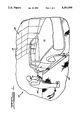
- FIG. 1 is a perspective view of an automotive paint spray booth showing a plurality of protective wall covering units according to the teachings of the preferred embodiment of the present invention
- FIG. 2 is an elevational view of a protective wall covering unit shown in FIG. 1 according to the teachings preferred embodiment of the present invention in which the outermost layer is partially removed;
- FIG. 3 is a perspective view of the spray booth shown in FIG. 1 in which overspray is being removed from the booth according to the teachings of the preferred embodiment of the present invention.
- the paint spray booth 10 is shaped in a manner which resembles an elongated tunnel in which paint is introduced in the form of a spray emitted by one or more handheld spray guns 14.
- the spray gun 14 and related components may be that which was disclosed in U.S. Ser. No. 07/237,838 which was filed on Aug. 29, 1988, though other suitable components may be used.
- the spray gun 14 may be part of a monoline coaxial paint circulating system available from Hose Specialties/Capri, Inc.
- the spray booth 10 is used to paint automobile components which are generally designated by the numeral 16.
- the spray booth 10 is defined in part by the walls 18 as well as the floor 20.
- the walls 18 and the floor 20 are used to confine the overspray (i.e., the paint which does not adhere to the automobile 12) within the booth 10.
- the spray booth 10 may be used to paint other types of articles in addition to the automobile components 16.
- the booth 10 may be used to apply other types of coatings in addition to paint to various articles.
- the spray booth 10 comprises a plurality of wall covering units.
- Each of the wall covering units include a base layer having first and second substantially parallel surfaces.
- the first surface of the base layer includes means for securing the base layer to the wall of the spray booth 10.
- the wall covering unit has a plurality of removable sheets disposed on the second surface of the base layer. At least one of the removable sheets (i.e., the "first removable sheet”) has means for securing the first surface of the first removable sheet to a second removable sheet.
- the first removable sheet has a second surface which is operable to receive a third removable sheet.
- the overspray generated by the spray gun 14 can be removed by removing the outermost removable sheets associated with the wall covering units. This permits the overspray to be removed from the booth prior to allowing paint flakes generated by the overspray to come into contact with the automobile component 16.
- the overspray generated in the spray booth 10 can be removed from the spray booth 10 without extensively cleaning the walls with solvents thereby reducing the costs associated with cleaning the spray booth 10 both in terms of manpower as well as the costs of solvents used to clean the spray booth 10.
- solvents because the use of solvents is reduced, there is less of an opportunity for solvent vapors to exceed environmental guidelines either imposed by governmental agencies or by the manufacturer using the spray booth 10.
- the wall covering unit 30 comprises a base layer 34 having first and second substantially parallel surfaces.
- the base layer 34 is generally rectangular in shape and has a pressure sensitive adhesive disposed on the first or lower surface of the base layer 34.
- the adhesive disposed on the first surface of the base layer 34 is used for removably securing the wall covering unit 30 to the wall 18.
- the base layer 34 may therefore be installed on the wall 18 of the spray booth 10 by positioning the wall covering unit 30 proximate to the desired position on the wall 18 and then applying a force against the wall covering unit 30 so as to cause the adhesive to secure the base layer 34 against the wall 18.
- the wall covering unit 30 further has a plurality of removable sheets 32.
- Each of the removable sheets 32 are generally rectangular in shape and are substantially the same size as the wall covering unit 30.
- each of the removable sheets 32 has a first or bottom surface which contains an adhesive material 36.
- the adhesive material 36 allows each of the removable sheets to be removably secured to the removable sheet 32 immediately below it. That is, a first removable sheet 32 within the wall covering unit 30 contains an adhesive on its lower surface which allows it to adhere to a second removable sheet 32 immediately below it within the same wall covering unit 30.
- a third removable sheet 32 may be disposed directly on top (i.e., on the second surface) of the first removable sheet 32 also by means of the adhesive 36 located on the lower surface of the third removable sheet. While each of the removable sheets 32 may be made from polyethylene and the adhesive material 36 may be microbial biocide adhesive, other suitable materials may be used. In addition, second surfaces of the removable sheets 32 may be lightly coated with an adhesive material to facilitate adhesion of dirt balls and residue.
- the overspray can be removed from the spray booth 10 by simply removing the outermost (i.e., the removable sheet 32 which is furthest from the base layer 34) removable sheets 38 on each of the wall covering units 30.
- the outermost removable sheets 38 on each of these wall covering units 30 may be removed while leaving intact the outermost removable sheets 38 of the other wall covering units 30. That is, not all the outermost removable sheets 38 on each of the wall covering units 30 are necessarily removed during cleaning of the spray booth 10.
- the painting operation can then continue until there is again a substantial accumulation of overspray on some or all of the wall covering units 30 whereupon the outermost removable sheets 38 are again removed in the manner described above. Once all the removable sheets 32 have been removed from one wall covering unit 30, the remaining base layer 34 of the wall covering unit 30 can be removed from the wall 18 and be replaced by a new wall covering unit 30.
- a plurality of wall covering units 30 are attached to the wall 18 of the spray booth 10 so as to cover substantially all of the wall 18. This is accomplished by removably securing the wall covering units 30 to the wall 18 by means of the adhesive which is deposited on the lower surface of each of the base layers 34 of the wall covering units 30.
- the automobile component 16 is then placed in the spray booth 10 and paint is applied to the automobile component 16 by means of the spray gun 14. As the automobile component 16 is sprayed with paint, overspray is accumulated on the outermost removable sheets 38 of some of the wall covering units 30.
- the operator 40 of the spray booth 10 inspects each of the wall covering units 30 to determine which of the wall covering units 30 have a substantial accumulation of overspray (i.e., which of the outermost sheets 38 should be removed to prevent the generation of dirt balls or residue in the spray booth 10).
- the overspray which is accumulated on the outermost sheet 3 of the wall covering units 30 is then removed from the spray booth 10 by removing the outermost sheets 38 upon which overspray has accumulated.
- additional automobile components 16 may be brought into the spray booth 10 and painted in the manner described above.
- the wall covering units may be of different shapes and sizes to accommodate the geometry of the spray booth.
- the spray booth may also be used to paint other articles in addition to automotive components.
- the wall covering units may also be used to protect the walls of other types of facilities such as operating rooms from other materials such as biological contaminates. It is, therefore, intended that the appended claims be interpreted as including such changes and modification.
Landscapes
- Details Or Accessories Of Spraying Plant Or Apparatus (AREA)
- Application Of Or Painting With Fluid Materials (AREA)
Abstract
Description
Claims (16)
Priority Applications (2)
| Application Number | Priority Date | Filing Date | Title |
|---|---|---|---|
| US07/778,775 US5201954A (en) | 1991-10-18 | 1991-10-18 | Multilayer peelable wall covering |
| CA002080101A CA2080101A1 (en) | 1991-10-18 | 1992-10-07 | Multilayer peelable wall covering |
Applications Claiming Priority (1)
| Application Number | Priority Date | Filing Date | Title |
|---|---|---|---|
| US07/778,775 US5201954A (en) | 1991-10-18 | 1991-10-18 | Multilayer peelable wall covering |
Publications (1)
| Publication Number | Publication Date |
|---|---|
| US5201954A true US5201954A (en) | 1993-04-13 |
Family
ID=25114357
Family Applications (1)
| Application Number | Title | Priority Date | Filing Date |
|---|---|---|---|
| US07/778,775 Expired - Lifetime US5201954A (en) | 1991-10-18 | 1991-10-18 | Multilayer peelable wall covering |
Country Status (2)
| Country | Link |
|---|---|
| US (1) | US5201954A (en) |
| CA (1) | CA2080101A1 (en) |
Cited By (15)
| Publication number | Priority date | Publication date | Assignee | Title |
|---|---|---|---|---|
| US5421885A (en) * | 1992-11-20 | 1995-06-06 | Trevisan; Ferdinando | Powdered-paint spraying plant with variable-section booth |
| FR2737981A1 (en) * | 1995-08-22 | 1997-02-28 | David B | Protective covering for walls of paint spray booth etc. |
| US5769703A (en) * | 1996-01-23 | 1998-06-23 | Conlin; Douglas | Paint spray booth with protective curtain |
| US5863335A (en) * | 1997-08-11 | 1999-01-26 | Wilber, Jr.; Willis Edwin | Wall protector |
| US6346150B1 (en) | 1998-06-19 | 2002-02-12 | Douglas Conlin | Paint spray booth with robot |
| US20040001932A1 (en) * | 2002-06-14 | 2004-01-01 | Krause Robert D. | Device for protecting a surface from paint spray |
| US20040050324A1 (en) * | 2002-09-18 | 2004-03-18 | Copp Mark H. | Layered painters shield |
| US20050069635A1 (en) * | 2002-01-29 | 2005-03-31 | Ingo Becker | Machine for the production and/or converting of a material web and methods for removing contaminations in regard to such machinery |
| GB2407756A (en) * | 2003-11-10 | 2005-05-11 | Philip Matthew Atkinson | Waste bin lid protector |
| WO2011014734A1 (en) | 2009-07-31 | 2011-02-03 | Hall, Mark | Wall mounted multilayered film and method of use |
| US20110118436A1 (en) * | 2009-11-17 | 2011-05-19 | Hanlon Jr Robert Joseph | Method For Degrading Water-Soluble Polymeric Films |
| WO2011086395A1 (en) * | 2010-01-13 | 2011-07-21 | Miltiadis Adamopoulos | Wallpaper sticker sheet membrane for vehicle paint ovens |
| FR3021233A1 (en) * | 2014-05-20 | 2015-11-27 | Faurecia Bloc Avant | PROTECTIVE DEVICE FOR PAIN MASK |
| US20180306727A1 (en) * | 2017-04-25 | 2018-10-25 | Eisenmann Se | Installation for optically examining surface regions of objects |
| CZ309800B6 (en) * | 2022-09-08 | 2023-10-18 | Libor Souček | A removable protective coating of the paint booth and the method of its creation |
Citations (11)
| Publication number | Priority date | Publication date | Assignee | Title |
|---|---|---|---|---|
| US3788941A (en) * | 1969-10-31 | 1974-01-29 | Grace W R & Co | Removable floor and wall surface coverings |
| US4151319A (en) * | 1976-05-26 | 1979-04-24 | United Merchants And Manufacturers, Inc. | Method for making a pressure sensitive adhesive coated laminate |
| US4162237A (en) * | 1976-04-10 | 1979-07-24 | Albert Kauderer | Cement for wall and floor coverings and the like |
| US4323030A (en) * | 1979-06-28 | 1982-04-06 | Lehmann Jr Ernst | Spray coating device |
| US4355074A (en) * | 1979-06-30 | 1982-10-19 | Hoechst Aktiengesellschaft | Bonding sheet-like material to a substrate from which it can be dry-stripped |
| US4499130A (en) * | 1982-03-01 | 1985-02-12 | Carprotec, Inc. | Temporary strippable protective laminate |
| US4505964A (en) * | 1982-09-11 | 1985-03-19 | Henkel Kommanditgesellschaft Auf Aktien | Dehesive lining paper for wall coverings comprising a fleece laminated to a film having a low-energy surface |
| US4555441A (en) * | 1985-03-06 | 1985-11-26 | Stik-Trim Industries, Incorporated | Self-adhesive wall covering or the like and method of making same |
| US4650704A (en) * | 1985-03-06 | 1987-03-17 | Stik-Trim Industries, Inc. | Self-adhesive wall covering or the like and method of making same |
| US4751121A (en) * | 1985-05-28 | 1988-06-14 | Huels Troisdorf Aktiengesellschaft | Multi-ply self-adhesive and deep-drawable protective sheet, especially for automotive vehicles |
| US4900604A (en) * | 1988-12-22 | 1990-02-13 | Decorate-It!, Inc. | Adhesive wall decorating system |
-
1991
- 1991-10-18 US US07/778,775 patent/US5201954A/en not_active Expired - Lifetime
-
1992
- 1992-10-07 CA CA002080101A patent/CA2080101A1/en not_active Abandoned
Patent Citations (11)
| Publication number | Priority date | Publication date | Assignee | Title |
|---|---|---|---|---|
| US3788941A (en) * | 1969-10-31 | 1974-01-29 | Grace W R & Co | Removable floor and wall surface coverings |
| US4162237A (en) * | 1976-04-10 | 1979-07-24 | Albert Kauderer | Cement for wall and floor coverings and the like |
| US4151319A (en) * | 1976-05-26 | 1979-04-24 | United Merchants And Manufacturers, Inc. | Method for making a pressure sensitive adhesive coated laminate |
| US4323030A (en) * | 1979-06-28 | 1982-04-06 | Lehmann Jr Ernst | Spray coating device |
| US4355074A (en) * | 1979-06-30 | 1982-10-19 | Hoechst Aktiengesellschaft | Bonding sheet-like material to a substrate from which it can be dry-stripped |
| US4499130A (en) * | 1982-03-01 | 1985-02-12 | Carprotec, Inc. | Temporary strippable protective laminate |
| US4505964A (en) * | 1982-09-11 | 1985-03-19 | Henkel Kommanditgesellschaft Auf Aktien | Dehesive lining paper for wall coverings comprising a fleece laminated to a film having a low-energy surface |
| US4555441A (en) * | 1985-03-06 | 1985-11-26 | Stik-Trim Industries, Incorporated | Self-adhesive wall covering or the like and method of making same |
| US4650704A (en) * | 1985-03-06 | 1987-03-17 | Stik-Trim Industries, Inc. | Self-adhesive wall covering or the like and method of making same |
| US4751121A (en) * | 1985-05-28 | 1988-06-14 | Huels Troisdorf Aktiengesellschaft | Multi-ply self-adhesive and deep-drawable protective sheet, especially for automotive vehicles |
| US4900604A (en) * | 1988-12-22 | 1990-02-13 | Decorate-It!, Inc. | Adhesive wall decorating system |
Cited By (19)
| Publication number | Priority date | Publication date | Assignee | Title |
|---|---|---|---|---|
| US5421885A (en) * | 1992-11-20 | 1995-06-06 | Trevisan; Ferdinando | Powdered-paint spraying plant with variable-section booth |
| FR2737981A1 (en) * | 1995-08-22 | 1997-02-28 | David B | Protective covering for walls of paint spray booth etc. |
| US5769703A (en) * | 1996-01-23 | 1998-06-23 | Conlin; Douglas | Paint spray booth with protective curtain |
| US5863335A (en) * | 1997-08-11 | 1999-01-26 | Wilber, Jr.; Willis Edwin | Wall protector |
| US6346150B1 (en) | 1998-06-19 | 2002-02-12 | Douglas Conlin | Paint spray booth with robot |
| US20050069635A1 (en) * | 2002-01-29 | 2005-03-31 | Ingo Becker | Machine for the production and/or converting of a material web and methods for removing contaminations in regard to such machinery |
| US20040001932A1 (en) * | 2002-06-14 | 2004-01-01 | Krause Robert D. | Device for protecting a surface from paint spray |
| US20040050324A1 (en) * | 2002-09-18 | 2004-03-18 | Copp Mark H. | Layered painters shield |
| GB2407756A (en) * | 2003-11-10 | 2005-05-11 | Philip Matthew Atkinson | Waste bin lid protector |
| GB2407756B (en) * | 2003-11-10 | 2007-01-31 | Philip Matthew Atkinson | Waste bin lid protection |
| WO2011014734A1 (en) | 2009-07-31 | 2011-02-03 | Hall, Mark | Wall mounted multilayered film and method of use |
| EP2459370A4 (en) * | 2009-07-31 | 2013-02-20 | Haldon Company | Wall mounted multilayered film and method of use |
| US20110118436A1 (en) * | 2009-11-17 | 2011-05-19 | Hanlon Jr Robert Joseph | Method For Degrading Water-Soluble Polymeric Films |
| US8404753B2 (en) | 2009-11-17 | 2013-03-26 | Robert Joseph Hanlon, JR. | Method for degrading water-soluble polymeric films |
| WO2011086395A1 (en) * | 2010-01-13 | 2011-07-21 | Miltiadis Adamopoulos | Wallpaper sticker sheet membrane for vehicle paint ovens |
| FR3021233A1 (en) * | 2014-05-20 | 2015-11-27 | Faurecia Bloc Avant | PROTECTIVE DEVICE FOR PAIN MASK |
| US20180306727A1 (en) * | 2017-04-25 | 2018-10-25 | Eisenmann Se | Installation for optically examining surface regions of objects |
| US10401302B2 (en) * | 2017-04-25 | 2019-09-03 | Eisenmann Se | Installation for optically examining surface regions of objects |
| CZ309800B6 (en) * | 2022-09-08 | 2023-10-18 | Libor Souček | A removable protective coating of the paint booth and the method of its creation |
Also Published As
| Publication number | Publication date |
|---|---|
| CA2080101A1 (en) | 1993-04-19 |
Similar Documents
| Publication | Publication Date | Title |
|---|---|---|
| US5201954A (en) | Multilayer peelable wall covering | |
| US4661182A (en) | Method and composition for repairing minor surface damage to coated surfaces | |
| EP1070546A3 (en) | Powder coating system | |
| CA2091383A1 (en) | Enclosure for painting and a method of enforcing evaporation from a coating on a panel surface | |
| US5254192A (en) | Process for matching color of paints on vehicles | |
| CA2174316A1 (en) | Method of forming a protective film on a coated surface and apparatus for carrying out the same | |
| US3377183A (en) | Electrostatic powder coating on heated parts | |
| CA1190739A (en) | Electrostatic spray support | |
| US6006999A (en) | Air knife blow-off for maintaining cleanliness of rotary powder applications | |
| JP2003290705A (en) | Method of coating elevator designed article | |
| JPH08224503A (en) | Coating method and apparatus therefor | |
| JP3760613B2 (en) | Coating method and coating gun used therefor | |
| CA2200343A1 (en) | Vehicle powder coating system | |
| US6189192B1 (en) | Electrostatic powder coating spray applicator turbine installation/removal tool | |
| JP3058983B2 (en) | Adhesive paint removal device | |
| US7413764B2 (en) | Process for repairing coatings having a critical thickness | |
| CN1162506A (en) | Bolt cover used in painting work | |
| USH2006H1 (en) | Method for repairing defective electrostatic spray coatings | |
| JPH0435763A (en) | Electrostatic coating method | |
| JP4657749B2 (en) | Powder coating equipment | |
| JPH0719570Y2 (en) | Spray gun cleaning device for automatic coating equipment | |
| JPH11147071A (en) | High hardness coating method | |
| Davis et al. | PAINT SPRAY BOOTH CLEANING PRACTICES IN THE AUTOMOTIVE INDUSTRY | |
| EP0879648A3 (en) | Method and system for application of aggregate coatings | |
| DE59707118D1 (en) | MULTI-LAYER PAINTING METHOD |
Legal Events
| Date | Code | Title | Description |
|---|---|---|---|
| AS | Assignment |
Owner name: HOSE SPECIALTIES COMPANY/CAMPRI, INC., A CORP. OF Free format text: ASSIGNMENT OF ASSIGNORS INTEREST.;ASSIGNOR:HOLT, EARL R.;REEL/FRAME:005885/0797 Effective date: 19911018 |
|
| STCF | Information on status: patent grant |
Free format text: PATENTED CASE |
|
| CC | Certificate of correction | ||
| FEPP | Fee payment procedure |
Free format text: PAYOR NUMBER ASSIGNED (ORIGINAL EVENT CODE: ASPN); ENTITY STATUS OF PATENT OWNER: LARGE ENTITY Free format text: PAT HLDR NO LONGER CLAIMS SMALL ENT STAT AS SMALL BUSINESS (ORIGINAL EVENT CODE: LSM2); ENTITY STATUS OF PATENT OWNER: LARGE ENTITY |
|
| FPAY | Fee payment |
Year of fee payment: 4 |
|
| REFU | Refund |
Free format text: REFUND OF EXCESS PAYMENTS PROCESSED (ORIGINAL EVENT CODE: R169); ENTITY STATUS OF PATENT OWNER: LARGE ENTITY |
|
| AS | Assignment |
Owner name: ILLINOIS TOOL WORKS INC., ILLINOIS Free format text: ASSIGNMENT OF ASSIGNORS INTEREST;ASSIGNOR:HOSE SPECIALTIES/CAPRI INC.;REEL/FRAME:009038/0475 Effective date: 19960116 |
|
| AS | Assignment |
Owner name: ILLINOIS TOOL WORKS INC., ILLINOIS Free format text: ASSIGNMENT OF ASSIGNORS INTEREST;ASSIGNOR:HOSE SPECIALTIES/CAPRI, INC.;REEL/FRAME:009038/0561 Effective date: 19960116 |
|
| FPAY | Fee payment |
Year of fee payment: 8 |
|
| REMI | Maintenance fee reminder mailed | ||
| FPAY | Fee payment |
Year of fee payment: 12 |