US5104468A - Method of producing a molded connection piece and method for joining tube with molded connection piece - Google Patents
Method of producing a molded connection piece and method for joining tube with molded connection piece Download PDFInfo
- Publication number
- US5104468A US5104468A US07/522,537 US52253790A US5104468A US 5104468 A US5104468 A US 5104468A US 52253790 A US52253790 A US 52253790A US 5104468 A US5104468 A US 5104468A
- Authority
- US
- United States
- Prior art keywords
- connection piece
- disk
- molded connection
- heating wire
- molded
- Prior art date
- Legal status (The legal status is an assumption and is not a legal conclusion. Google has not performed a legal analysis and makes no representation as to the accuracy of the status listed.)
- Expired - Fee Related
Links
- 238000000034 method Methods 0.000 title claims description 20
- 238000005304 joining Methods 0.000 title claims description 11
- 238000010438 heat treatment Methods 0.000 claims abstract description 74
- 239000000463 material Substances 0.000 claims abstract description 21
- 238000002844 melting Methods 0.000 claims abstract description 11
- 230000008018 melting Effects 0.000 claims abstract description 11
- 239000012815 thermoplastic material Substances 0.000 claims abstract description 7
- 238000004519 manufacturing process Methods 0.000 claims abstract description 5
- 238000003466 welding Methods 0.000 claims description 14
- 238000005452 bending Methods 0.000 claims description 5
- 238000011065 in-situ storage Methods 0.000 claims 2
- 229910052705 radium Inorganic materials 0.000 claims 1
- HCWPIIXVSYCSAN-UHFFFAOYSA-N radium atom Chemical compound [Ra] HCWPIIXVSYCSAN-UHFFFAOYSA-N 0.000 claims 1
- 238000004804 winding Methods 0.000 description 4
- 239000004033 plastic Substances 0.000 description 2
- 230000001681 protective effect Effects 0.000 description 2
- 238000005266 casting Methods 0.000 description 1
- 230000006835 compression Effects 0.000 description 1
- 238000007906 compression Methods 0.000 description 1
- 239000004020 conductor Substances 0.000 description 1
- 238000010276 construction Methods 0.000 description 1
- 230000001419 dependent effect Effects 0.000 description 1
- 238000011161 development Methods 0.000 description 1
- 238000005553 drilling Methods 0.000 description 1
- 238000005485 electric heating Methods 0.000 description 1
- 238000011156 evaluation Methods 0.000 description 1
- 230000004927 fusion Effects 0.000 description 1
- 238000007689 inspection Methods 0.000 description 1
- 238000005259 measurement Methods 0.000 description 1
- 238000012986 modification Methods 0.000 description 1
- 230000004048 modification Effects 0.000 description 1
- 238000000465 moulding Methods 0.000 description 1
- 230000000284 resting effect Effects 0.000 description 1
- 230000002441 reversible effect Effects 0.000 description 1
- 229920001169 thermoplastic Polymers 0.000 description 1
- 239000004416 thermosoftening plastic Substances 0.000 description 1
- 230000000007 visual effect Effects 0.000 description 1
Images


Classifications
-
- B—PERFORMING OPERATIONS; TRANSPORTING
- B29—WORKING OF PLASTICS; WORKING OF SUBSTANCES IN A PLASTIC STATE IN GENERAL
- B29C—SHAPING OR JOINING OF PLASTICS; SHAPING OF MATERIAL IN A PLASTIC STATE, NOT OTHERWISE PROVIDED FOR; AFTER-TREATMENT OF THE SHAPED PRODUCTS, e.g. REPAIRING
- B29C65/00—Joining or sealing of preformed parts, e.g. welding of plastics materials; Apparatus therefor
- B29C65/02—Joining or sealing of preformed parts, e.g. welding of plastics materials; Apparatus therefor by heating, with or without pressure
- B29C65/34—Joining or sealing of preformed parts, e.g. welding of plastics materials; Apparatus therefor by heating, with or without pressure using heated elements which remain in the joint, e.g. "verlorenes Schweisselement"
- B29C65/3472—Joining or sealing of preformed parts, e.g. welding of plastics materials; Apparatus therefor by heating, with or without pressure using heated elements which remain in the joint, e.g. "verlorenes Schweisselement" characterised by the composition of the heated elements which remain in the joint
- B29C65/3476—Joining or sealing of preformed parts, e.g. welding of plastics materials; Apparatus therefor by heating, with or without pressure using heated elements which remain in the joint, e.g. "verlorenes Schweisselement" characterised by the composition of the heated elements which remain in the joint being metallic
-
- B—PERFORMING OPERATIONS; TRANSPORTING
- B29—WORKING OF PLASTICS; WORKING OF SUBSTANCES IN A PLASTIC STATE IN GENERAL
- B29C—SHAPING OR JOINING OF PLASTICS; SHAPING OF MATERIAL IN A PLASTIC STATE, NOT OTHERWISE PROVIDED FOR; AFTER-TREATMENT OF THE SHAPED PRODUCTS, e.g. REPAIRING
- B29C65/00—Joining or sealing of preformed parts, e.g. welding of plastics materials; Apparatus therefor
- B29C65/02—Joining or sealing of preformed parts, e.g. welding of plastics materials; Apparatus therefor by heating, with or without pressure
- B29C65/34—Joining or sealing of preformed parts, e.g. welding of plastics materials; Apparatus therefor by heating, with or without pressure using heated elements which remain in the joint, e.g. "verlorenes Schweisselement"
- B29C65/3404—Joining or sealing of preformed parts, e.g. welding of plastics materials; Apparatus therefor by heating, with or without pressure using heated elements which remain in the joint, e.g. "verlorenes Schweisselement" characterised by the type of heated elements which remain in the joint
- B29C65/342—Joining or sealing of preformed parts, e.g. welding of plastics materials; Apparatus therefor by heating, with or without pressure using heated elements which remain in the joint, e.g. "verlorenes Schweisselement" characterised by the type of heated elements which remain in the joint comprising at least a single wire, e.g. in the form of a winding
-
- B—PERFORMING OPERATIONS; TRANSPORTING
- B29—WORKING OF PLASTICS; WORKING OF SUBSTANCES IN A PLASTIC STATE IN GENERAL
- B29C—SHAPING OR JOINING OF PLASTICS; SHAPING OF MATERIAL IN A PLASTIC STATE, NOT OTHERWISE PROVIDED FOR; AFTER-TREATMENT OF THE SHAPED PRODUCTS, e.g. REPAIRING
- B29C66/00—General aspects of processes or apparatus for joining preformed parts
- B29C66/01—General aspects dealing with the joint area or with the area to be joined
- B29C66/05—Particular design of joint configurations
- B29C66/10—Particular design of joint configurations particular design of the joint cross-sections
- B29C66/11—Joint cross-sections comprising a single joint-segment, i.e. one of the parts to be joined comprising a single joint-segment in the joint cross-section
- B29C66/112—Single lapped joints
-
- B—PERFORMING OPERATIONS; TRANSPORTING
- B29—WORKING OF PLASTICS; WORKING OF SUBSTANCES IN A PLASTIC STATE IN GENERAL
- B29C—SHAPING OR JOINING OF PLASTICS; SHAPING OF MATERIAL IN A PLASTIC STATE, NOT OTHERWISE PROVIDED FOR; AFTER-TREATMENT OF THE SHAPED PRODUCTS, e.g. REPAIRING
- B29C66/00—General aspects of processes or apparatus for joining preformed parts
- B29C66/01—General aspects dealing with the joint area or with the area to be joined
- B29C66/05—Particular design of joint configurations
- B29C66/10—Particular design of joint configurations particular design of the joint cross-sections
- B29C66/13—Single flanged joints; Fin-type joints; Single hem joints; Edge joints; Interpenetrating fingered joints; Other specific particular designs of joint cross-sections not provided for in groups B29C66/11 - B29C66/12
- B29C66/131—Single flanged joints, i.e. one of the parts to be joined being rigid and flanged in the joint area
-
- B—PERFORMING OPERATIONS; TRANSPORTING
- B29—WORKING OF PLASTICS; WORKING OF SUBSTANCES IN A PLASTIC STATE IN GENERAL
- B29C—SHAPING OR JOINING OF PLASTICS; SHAPING OF MATERIAL IN A PLASTIC STATE, NOT OTHERWISE PROVIDED FOR; AFTER-TREATMENT OF THE SHAPED PRODUCTS, e.g. REPAIRING
- B29C66/00—General aspects of processes or apparatus for joining preformed parts
- B29C66/50—General aspects of joining tubular articles; General aspects of joining long products, i.e. bars or profiled elements; General aspects of joining single elements to tubular articles, hollow articles or bars; General aspects of joining several hollow-preforms to form hollow or tubular articles
- B29C66/51—Joining tubular articles, profiled elements or bars; Joining single elements to tubular articles, hollow articles or bars; Joining several hollow-preforms to form hollow or tubular articles
- B29C66/52—Joining tubular articles, bars or profiled elements
- B29C66/522—Joining tubular articles
- B29C66/5224—Joining tubular articles for forming fork-shaped connections, e.g. for making Y-shaped pieces
- B29C66/52241—Joining tubular articles for forming fork-shaped connections, e.g. for making Y-shaped pieces with two right angles, e.g. for making T-shaped pieces
-
- B—PERFORMING OPERATIONS; TRANSPORTING
- B29—WORKING OF PLASTICS; WORKING OF SUBSTANCES IN A PLASTIC STATE IN GENERAL
- B29C—SHAPING OR JOINING OF PLASTICS; SHAPING OF MATERIAL IN A PLASTIC STATE, NOT OTHERWISE PROVIDED FOR; AFTER-TREATMENT OF THE SHAPED PRODUCTS, e.g. REPAIRING
- B29C66/00—General aspects of processes or apparatus for joining preformed parts
- B29C66/50—General aspects of joining tubular articles; General aspects of joining long products, i.e. bars or profiled elements; General aspects of joining single elements to tubular articles, hollow articles or bars; General aspects of joining several hollow-preforms to form hollow or tubular articles
- B29C66/51—Joining tubular articles, profiled elements or bars; Joining single elements to tubular articles, hollow articles or bars; Joining several hollow-preforms to form hollow or tubular articles
- B29C66/52—Joining tubular articles, bars or profiled elements
- B29C66/522—Joining tubular articles
- B29C66/5229—Joining tubular articles involving the use of a socket
-
- B—PERFORMING OPERATIONS; TRANSPORTING
- B29—WORKING OF PLASTICS; WORKING OF SUBSTANCES IN A PLASTIC STATE IN GENERAL
- B29C—SHAPING OR JOINING OF PLASTICS; SHAPING OF MATERIAL IN A PLASTIC STATE, NOT OTHERWISE PROVIDED FOR; AFTER-TREATMENT OF THE SHAPED PRODUCTS, e.g. REPAIRING
- B29C66/00—General aspects of processes or apparatus for joining preformed parts
- B29C66/90—Measuring or controlling the joining process
- B29C66/91—Measuring or controlling the joining process by measuring or controlling the temperature, the heat or the thermal flux
- B29C66/912—Measuring or controlling the joining process by measuring or controlling the temperature, the heat or the thermal flux by measuring the temperature, the heat or the thermal flux
- B29C66/9121—Measuring or controlling the joining process by measuring or controlling the temperature, the heat or the thermal flux by measuring the temperature, the heat or the thermal flux by measuring the temperature
- B29C66/91211—Measuring or controlling the joining process by measuring or controlling the temperature, the heat or the thermal flux by measuring the temperature, the heat or the thermal flux by measuring the temperature with special temperature measurement means or methods
- B29C66/91214—Measuring or controlling the joining process by measuring or controlling the temperature, the heat or the thermal flux by measuring the temperature, the heat or the thermal flux by measuring the temperature with special temperature measurement means or methods by measuring the electrical resistance of a resistive element belonging to one of the parts to be welded, said element acting, e.g. as a thermistor
-
- B—PERFORMING OPERATIONS; TRANSPORTING
- B29—WORKING OF PLASTICS; WORKING OF SUBSTANCES IN A PLASTIC STATE IN GENERAL
- B29C—SHAPING OR JOINING OF PLASTICS; SHAPING OF MATERIAL IN A PLASTIC STATE, NOT OTHERWISE PROVIDED FOR; AFTER-TREATMENT OF THE SHAPED PRODUCTS, e.g. REPAIRING
- B29C66/00—General aspects of processes or apparatus for joining preformed parts
- B29C66/90—Measuring or controlling the joining process
- B29C66/91—Measuring or controlling the joining process by measuring or controlling the temperature, the heat or the thermal flux
- B29C66/912—Measuring or controlling the joining process by measuring or controlling the temperature, the heat or the thermal flux by measuring the temperature, the heat or the thermal flux
- B29C66/9131—Measuring or controlling the joining process by measuring or controlling the temperature, the heat or the thermal flux by measuring the temperature, the heat or the thermal flux by measuring the heat or the thermal flux, i.e. the heat flux
- B29C66/91311—Measuring or controlling the joining process by measuring or controlling the temperature, the heat or the thermal flux by measuring the temperature, the heat or the thermal flux by measuring the heat or the thermal flux, i.e. the heat flux by measuring the heat generated by Joule heating or induction heating
- B29C66/91317—Measuring or controlling the joining process by measuring or controlling the temperature, the heat or the thermal flux by measuring the temperature, the heat or the thermal flux by measuring the heat or the thermal flux, i.e. the heat flux by measuring the heat generated by Joule heating or induction heating by measuring the electrical resistance
-
- B—PERFORMING OPERATIONS; TRANSPORTING
- B29—WORKING OF PLASTICS; WORKING OF SUBSTANCES IN A PLASTIC STATE IN GENERAL
- B29C—SHAPING OR JOINING OF PLASTICS; SHAPING OF MATERIAL IN A PLASTIC STATE, NOT OTHERWISE PROVIDED FOR; AFTER-TREATMENT OF THE SHAPED PRODUCTS, e.g. REPAIRING
- B29C66/00—General aspects of processes or apparatus for joining preformed parts
- B29C66/90—Measuring or controlling the joining process
- B29C66/91—Measuring or controlling the joining process by measuring or controlling the temperature, the heat or the thermal flux
- B29C66/914—Measuring or controlling the joining process by measuring or controlling the temperature, the heat or the thermal flux by controlling or regulating the temperature, the heat or the thermal flux
- B29C66/9161—Measuring or controlling the joining process by measuring or controlling the temperature, the heat or the thermal flux by controlling or regulating the temperature, the heat or the thermal flux by controlling or regulating the heat or the thermal flux, i.e. the heat flux
- B29C66/91651—Measuring or controlling the joining process by measuring or controlling the temperature, the heat or the thermal flux by controlling or regulating the temperature, the heat or the thermal flux by controlling or regulating the heat or the thermal flux, i.e. the heat flux by controlling or regulating the heat generated by Joule heating or induction heating
-
- F—MECHANICAL ENGINEERING; LIGHTING; HEATING; WEAPONS; BLASTING
- F16—ENGINEERING ELEMENTS AND UNITS; GENERAL MEASURES FOR PRODUCING AND MAINTAINING EFFECTIVE FUNCTIONING OF MACHINES OR INSTALLATIONS; THERMAL INSULATION IN GENERAL
- F16L—PIPES; JOINTS OR FITTINGS FOR PIPES; SUPPORTS FOR PIPES, CABLES OR PROTECTIVE TUBING; MEANS FOR THERMAL INSULATION IN GENERAL
- F16L47/00—Connecting arrangements or other fittings specially adapted to be made of plastics or to be used with pipes made of plastics
- F16L47/02—Welded joints; Adhesive joints
- F16L47/03—Welded joints with an electrical resistance incorporated in the joint
-
- B—PERFORMING OPERATIONS; TRANSPORTING
- B29—WORKING OF PLASTICS; WORKING OF SUBSTANCES IN A PLASTIC STATE IN GENERAL
- B29C—SHAPING OR JOINING OF PLASTICS; SHAPING OF MATERIAL IN A PLASTIC STATE, NOT OTHERWISE PROVIDED FOR; AFTER-TREATMENT OF THE SHAPED PRODUCTS, e.g. REPAIRING
- B29C65/00—Joining or sealing of preformed parts, e.g. welding of plastics materials; Apparatus therefor
- B29C65/02—Joining or sealing of preformed parts, e.g. welding of plastics materials; Apparatus therefor by heating, with or without pressure
- B29C65/34—Joining or sealing of preformed parts, e.g. welding of plastics materials; Apparatus therefor by heating, with or without pressure using heated elements which remain in the joint, e.g. "verlorenes Schweisselement"
- B29C65/3468—Joining or sealing of preformed parts, e.g. welding of plastics materials; Apparatus therefor by heating, with or without pressure using heated elements which remain in the joint, e.g. "verlorenes Schweisselement" characterised by the means for supplying heat to said heated elements which remain in the join, e.g. special electrical connectors of windings
-
- B—PERFORMING OPERATIONS; TRANSPORTING
- B29—WORKING OF PLASTICS; WORKING OF SUBSTANCES IN A PLASTIC STATE IN GENERAL
- B29C—SHAPING OR JOINING OF PLASTICS; SHAPING OF MATERIAL IN A PLASTIC STATE, NOT OTHERWISE PROVIDED FOR; AFTER-TREATMENT OF THE SHAPED PRODUCTS, e.g. REPAIRING
- B29C66/00—General aspects of processes or apparatus for joining preformed parts
- B29C66/90—Measuring or controlling the joining process
- B29C66/94—Measuring or controlling the joining process by measuring or controlling the time
- B29C66/949—Measuring or controlling the joining process by measuring or controlling the time characterised by specific time values or ranges
-
- Y—GENERAL TAGGING OF NEW TECHNOLOGICAL DEVELOPMENTS; GENERAL TAGGING OF CROSS-SECTIONAL TECHNOLOGIES SPANNING OVER SEVERAL SECTIONS OF THE IPC; TECHNICAL SUBJECTS COVERED BY FORMER USPC CROSS-REFERENCE ART COLLECTIONS [XRACs] AND DIGESTS
- Y10—TECHNICAL SUBJECTS COVERED BY FORMER USPC
- Y10T—TECHNICAL SUBJECTS COVERED BY FORMER US CLASSIFICATION
- Y10T156/00—Adhesive bonding and miscellaneous chemical manufacture
- Y10T156/10—Methods of surface bonding and/or assembly therefor
- Y10T156/1052—Methods of surface bonding and/or assembly therefor with cutting, punching, tearing or severing
- Y10T156/1062—Prior to assembly
- Y10T156/1064—Partial cutting [e.g., grooving or incising]
Definitions
- the present invention relates to a method of producing a molded connection piece, in particular a boring saddle formed of thermoplastic material. More particularly, the present invention relates to such a molded connection piece having a heating wire capable of conducting an electric current for producing a welded joint between the molded connection piece and an object to be joined with the molded connection piece.
- a boring saddle as described above may be utilized in situations where a "T" connection is to be made in an already existing plastic pipe.
- the saddle is provided with a shape corresponding to a segment of the existing plastic pipe and having a short pipe section extending at right angles therefrom.
- the saddle is placed against the existing pipe and welded thereto and an opening is drilled through the wall of the existing pipe drilling through the short pipe section. In this manner a "T" connection is formed in a pipe which had been previously placed.
- a molded connection piece provided with an electric heating element in the form of a metallic heating wire wound in the form of a spiral is frequently used.
- the heating wire is secured on or within the surface of the molded connection piece.
- electric current is passed through the spiral-shaped heating wire for producing a welded joint between the molded connection piece and an object to be joined with the molded connection piece, such as the tube described above.
- the generation of heat in the heating wire causes the material of the molded connection piece and the material of the object to be joined therewith to melt at the contact surfaces of the two parts.
- the spiral-shaped heating wire is secured by embedding it in the surface of a disk.
- the inside end of the heating wire is bent over and extended across the shaped spiral, separated from the surface of the disk by a reversible lip, in order to extend this end of the heating wire to the outside of the spiral so that both ends of the heating wire may be readily connected to a voltage source.
- This method has the drawback, however, that the surfaces facing each other at the point where the bent inside end of the heating wire and the spiral cross each other are heated in an uneven way, which non-uniform heating highly impairs the quality of the welded joint.
- the above object is accomplished according to the present invention by embedding the heating wire in both surfaces of a disk-shaped core, following the course of a spiral-shaped groove in each case, and by this core being joined with the molded connection piece
- the disk-shaped core consists of a material which, on melting, combines itself with the material of the molded connection piece.
- one heating wire is advantageously embedded in each of the two heating surfaces of the disk-shaped core in the shape of a spiral and the two heating wires are connected to each other on the innerside in the center of the spiral.
- the heating wire may be embedded in one surface of each of the two disks and the disks joined to form the disk-like core with their surfaces opposing the heating wire resting against each other.
- the molded connection piece may be adapted to the specific heating requirements for producing an optimum welded joint.
- the heating wire may be embedded as a blank or insulated heating wire; if the heating wire is wound in the form of a spiral, the spacing between the windings or the number of windings may vary from one surface of the disk-like core to the other; or the diameters of the heating wires in the two surfaces of the disk-like core may be varied; and the spirals consisting of heating wire may be wound selectively, for example anticlockwise or clockwise.
- each of the two surfaces of the disk-like core is advantageously provided with one heating wire, which permits a more uniform and complete melting of the disk-shaped core and of the surfaces of the molded connection piece adjoining the core, and of the surface of the object to be joined with the molded connection piece, for producing a permanent, high-quality welded joint.
- the size of the shaped spiral with the embedded heating wire depends on the size of the surface of the molded connection piece to be provided with the welded joint and the size of the surface of the object to be joined with the molded connection piece. Consequently, for producing a proper welded joint, ratings vary depending on the size of the spiral.
- an electric welding device for joining thermoplastic tubes is provided with a heating wire and an auxiliary resistor which is connected in series with the heating wire.
- an electric controlling and metering device is connected to the electric welding equipment in order to pass an electric current through the heating wire for a period of time conforming to the measured total resistance value.
- the period of time is set automatically, whereby it is assumed that a defined total resistance value presupposes a defined period of time, or duration of current feed.
- This method of resistance measurement is not very accurate for a universal system with automatic time setting as far as the measured resistance value is concerned. This is because different types of electric welding equipment from different manufacturers show highly varying resistance values for the heating wire for the same area of molded connection pieces, so that the tolerance of specific resistances of the heating wires may vary significantly, resulting in different resistance values.
- an auxiliary resistor is provided with the molded connection piece of the invention for the purpose of achieving an automatic welding operation.
- the auxiliary resistor is connected to the electric controlling and metering device by way of separate conductors in the same manner as the heating wire.
- the resistance value of the auxiliary resistor may be accurately determined independently of the resistance in the heating wire.
- the resistance value so determined may be used with any system for manufacturing a molded connection piece according to the invention provided that a defined resistance value of the auxiliary resistor, which, by way of example, amounts to 100 ohms or less up to 10,000 ohms or more, conforms to a predetermined welding time in seconds, for example 10 seconds or less up to 600 seconds or more.
- the auxiliary resistor may be mounted while the molded connection piece is being molded or after it has been molded.
- the auxiliary resistor is provided with a protective covering and fastened on the molded connection piece by means of connection pins.
- the welding time required to supply the desired output may be calculated after the resistance value of the heating wire of the molded connection piece has been determined, and the correct auxiliary resistor with the appropriate resistance value is fitted on the molded connection piece accordingly.
- the correct auxiliary resistor assures that the required energy is supplied during the predetermined period of time with the help of the electric controlling and metering device. In this way, the amount of rejects of produced welds may be advantageously reduced to a minimum.
- a socket is advantageously provided in the molded connection piece at any suitable point, whereby the wall or bottom of the socket is partially in contact with the heating wire and a matching, marked pin, of a material other than that used for the molded connection piece, is inserted in the socket.
- This marked pin advantageously serves for visually controlling the quality of the welded joint during the course of the welding process because the thermal expansion of the melting material produces an excess pressure and the melting material, due to this excess pressure, is forced into the socket, lifting the loosely inserted pin upwardly.
- the extent of such upward lift can be read on the outwardly projecting marking on the pin and is a measure of the quality of the weld produced because the height of lift of the marked pin is dependent on the amount of material melted in the welding process.
- the amount of material melted determines the area or size of the zone of fusion and thus the durability of the welded joint between the molded connection piece and the object to be joined with said piece.
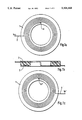
- FIG. 1a is a top view of a disk-shaped core with a spiral-shaped heating wire
- FIG. 1b is a cross-sectional view of the disk-shaped core of FIG. 1a;
- FIG. 1c is a bottom view of a disk-like core
- FIG. 2a is a longitudinal cross-sectional view of a boring saddle in which a disk-shaped core with a heating wire is fitted in a bent form, the core being provided with connection pins, an auxiliary resistor and a cylindrical socket having a pin loosely inserted therein;
- FIG. 2b is a cross-sectional view of the boring saddle according to FIG. 2a;
- FIG. 3 is a cross-sectional view of the disk-shaped core showing shallow grooves therein;
- FIG. 4 is a view similar to FIG. 3 with heating wires shown in the disk.
- FIG. 1 a disk-like core 1 having a spiral-shaped heating wire 2 embedded in its two surfaces.
- the inside ends bi and bi' of heating wire 2 are connected to each other in the center of spiral-shaped heating wire 2, so that when connected to an electric voltage source, current may flow from the outer end bu of the heating wire to the other outer end bu' of the heating wire.
- the pitch of the spiral-shaped winding of heating wire 2 is selected depending on the heating requirements.
- heating wire 2 may be provided with ten or less and up to thirty or more windings.
- FIGS. 2a and 2b there is shown a heating element consisting of a disk-like core 1 having a heating wire 2 and connection pins 7.
- the heating element is bent to such an extent that the bending radius conforms to the radius of a molded connection piece 3 to be formed.
- the heating element is placed as an insert in the compression or casting mold.
- the heating element with the disk-like core consisting of a material which combines itself with the material of the molded connection piece 3
- the heating element with the disk-like core consisting of a material which combines itself with the material of the molded connection piece 3
- a recess is kept clear in molded connection piece 3, as can be seen in FIGS. 2a and 2b, and the heating element is inserted or placed in this recess after the molded connection piece 3 has been produced.
- FIGS. 2a and 2b there is shown an auxiliary resistor 4 provided with connection pins 8.
- the connection pins On removal of molded connection piece 3 from the mold, the connection pins are inserted at a suitable point in the molded connection piece 3, or they are arranged as a unit after the molded connection piece 3 has been manufactured.
- This unit consists of auxiliary resistor 4 with connection pins 8 enclosed in a protective covering and which is mounted on the molded connection piece.
- FIGS. 2a and 2b show a recess or socket 5 which is formed during the molding of molded connection piece 3 with the help of a suitably shaped pin having a round, oval, square or any other cross section.
- a suitably shaped, marked pin 6 is loosely inserted in recess 5.
- molded connection piece 3 may have a plurality of recesses or sockets 5 with matching marked pins 6.
- the heating wire be disposed in shallow spiral grooves in the surfaces of the disk-like core.
- shallow grooves, designated 9, are formed in the shape of a spiral in both the top and bottom surfaces of the disk-like core 1.
- Heating wire 2, as clearly seen in FIG. 4, is disposed in the spiral-shaped grooves 9 such that it is partially embedded in the respective surfaces of the disk-like core.
Landscapes
- Engineering & Computer Science (AREA)
- Mechanical Engineering (AREA)
- Physics & Mathematics (AREA)
- Thermal Sciences (AREA)
- General Engineering & Computer Science (AREA)
- Branch Pipes, Bends, And The Like (AREA)
- Lining Or Joining Of Plastics Or The Like (AREA)
Abstract
There is provided a molded connection piece and a method of making the same, in particular a boring saddle made of thermoplastic material and having a heating wire capable of conducting an electric current for producing a welded joint between the molded connection piece and an object to be joined with the molded connection piece. The heating wire is embedded in both surfaces of a disk-shaped core, in each case following the course of a spiral-shaped groove, and the core having the heating wire is joined with the molded connection piece. The disk-shaped core is formed of a material which, on melting, combines itself with the material of the molded connection piece.
Description
This is a Continuation of my earlier filed application Ser. No. 257,815, filed Oct. 13, 1988, entitled "METHOD OF PRODUCING A MOLDED CONNECTION PIECE IN PARTICULAR A BORING SADDLE (As Amended), now U.S. Pat. No. 4,933,037, which is a Divisional application of my earlier filed application Ser. No. 141,101 (abandoned), filed Jan. 5, 1988, entitled "A MOLDED CONNECTION PIECE, IN PARTICULAR A BORING SADDLE, AND METHOD OF PRODUCING THE SAME", which is a Continuation-In-Part application of my earlier filed co-pending application Ser. No. 862,008, filed May 12, 1986, entitled A MOLDED CONNECTION PIECE, IN PARTICULAR A BORING SADDLE, AND METHOD OF PRODUCING THE SAME now abandoned.
The present invention relates to a method of producing a molded connection piece, in particular a boring saddle formed of thermoplastic material. More particularly, the present invention relates to such a molded connection piece having a heating wire capable of conducting an electric current for producing a welded joint between the molded connection piece and an object to be joined with the molded connection piece.
A boring saddle as described above may be utilized in situations where a "T" connection is to be made in an already existing plastic pipe. Thus, the saddle is provided with a shape corresponding to a segment of the existing plastic pipe and having a short pipe section extending at right angles therefrom. The saddle is placed against the existing pipe and welded thereto and an opening is drilled through the wall of the existing pipe drilling through the short pipe section. In this manner a "T" connection is formed in a pipe which had been previously placed.
Such a method as described above is disclosed in European Patent Application No. 82 401 203.3.
For the purpose of joining a tube made of thermoplastic material with a molded connection piece by means of welding, a molded connection piece provided with an electric heating element in the form of a metallic heating wire wound in the form of a spiral is frequently used. The heating wire is secured on or within the surface of the molded connection piece. For a preset period of time, electric current is passed through the spiral-shaped heating wire for producing a welded joint between the molded connection piece and an object to be joined with the molded connection piece, such as the tube described above. The generation of heat in the heating wire causes the material of the molded connection piece and the material of the object to be joined therewith to melt at the contact surfaces of the two parts. According to the above-cited European Patent Application No. 82 401 203.3, the spiral-shaped heating wire is secured by embedding it in the surface of a disk. The inside end of the heating wire is bent over and extended across the shaped spiral, separated from the surface of the disk by a reversible lip, in order to extend this end of the heating wire to the outside of the spiral so that both ends of the heating wire may be readily connected to a voltage source This method has the drawback, however, that the surfaces facing each other at the point where the bent inside end of the heating wire and the spiral cross each other are heated in an uneven way, which non-uniform heating highly impairs the quality of the welded joint.
It is the object of the present invention to enhance the method as described above so as to improve the quality of the welded joint and to provide a novel connection piece having embedded electrical heating elements for the attainment of this result.
The above object, as well as others which will hereinafter become apparent, is accomplished according to the present invention by embedding the heating wire in both surfaces of a disk-shaped core, following the course of a spiral-shaped groove in each case, and by this core being joined with the molded connection piece The disk-shaped core consists of a material which, on melting, combines itself with the material of the molded connection piece. Preferably according to the invention, one heating wire is advantageously embedded in each of the two heating surfaces of the disk-shaped core in the shape of a spiral and the two heating wires are connected to each other on the innerside in the center of the spiral. Also, it is possible to embed a two-lead wire in the shape of a spiral or to embed a through-extending heating wire first in one surface of the core and subsequently in the other surface of the core.
Furthermore, the heating wire may be embedded in one surface of each of the two disks and the disks joined to form the disk-like core with their surfaces opposing the heating wire resting against each other.
By selecting the shape and type of embedding of the heating wire, the molded connection piece may be adapted to the specific heating requirements for producing an optimum welded joint. By way of example, the heating wire may be embedded as a blank or insulated heating wire; if the heating wire is wound in the form of a spiral, the spacing between the windings or the number of windings may vary from one surface of the disk-like core to the other; or the diameters of the heating wires in the two surfaces of the disk-like core may be varied; and the spirals consisting of heating wire may be wound selectively, for example anticlockwise or clockwise.
However, in all possible embodiments of the molded connection piece according to the present invention, each of the two surfaces of the disk-like core is advantageously provided with one heating wire, which permits a more uniform and complete melting of the disk-shaped core and of the surfaces of the molded connection piece adjoining the core, and of the surface of the object to be joined with the molded connection piece, for producing a permanent, high-quality welded joint.
The size of the shaped spiral with the embedded heating wire depends on the size of the surface of the molded connection piece to be provided with the welded joint and the size of the surface of the object to be joined with the molded connection piece. Consequently, for producing a proper welded joint, ratings vary depending on the size of the spiral. According to European Patent Application No. 82 304 616.4, an electric welding device for joining thermoplastic tubes is provided with a heating wire and an auxiliary resistor which is connected in series with the heating wire. For determining the total resistance value of the heating wire and auxiliary resistor, an electric controlling and metering device is connected to the electric welding equipment in order to pass an electric current through the heating wire for a period of time conforming to the measured total resistance value. The period of time is set automatically, whereby it is assumed that a defined total resistance value presupposes a defined period of time, or duration of current feed. This method of resistance measurement, however, is not very accurate for a universal system with automatic time setting as far as the measured resistance value is concerned. This is because different types of electric welding equipment from different manufacturers show highly varying resistance values for the heating wire for the same area of molded connection pieces, so that the tolerance of specific resistances of the heating wires may vary significantly, resulting in different resistance values.
In order to remedy the above situation, an auxiliary resistor is provided with the molded connection piece of the invention for the purpose of achieving an automatic welding operation. The auxiliary resistor is connected to the electric controlling and metering device by way of separate conductors in the same manner as the heating wire. In this way, the resistance value of the auxiliary resistor may be accurately determined independently of the resistance in the heating wire. The resistance value so determined may be used with any system for manufacturing a molded connection piece according to the invention provided that a defined resistance value of the auxiliary resistor, which, by way of example, amounts to 100 ohms or less up to 10,000 ohms or more, conforms to a predetermined welding time in seconds, for example 10 seconds or less up to 600 seconds or more. The auxiliary resistor may be mounted while the molded connection piece is being molded or after it has been molded.
In a preferred embodiment of the invention, the auxiliary resistor is provided with a protective covering and fastened on the molded connection piece by means of connection pins. Depending on the tolerances of the specific resistance and diameter of the wire from which the heating wire is made, the welding time required to supply the desired output may be calculated after the resistance value of the heating wire of the molded connection piece has been determined, and the correct auxiliary resistor with the appropriate resistance value is fitted on the molded connection piece accordingly. During the welding step, the correct auxiliary resistor assures that the required energy is supplied during the predetermined period of time with the help of the electric controlling and metering device. In this way, the amount of rejects of produced welds may be advantageously reduced to a minimum.
In order to permit a visual evaluation or inspection the welding quality during the course of welding of molded connection pieces, preferably a socket is advantageously provided in the molded connection piece at any suitable point, whereby the wall or bottom of the socket is partially in contact with the heating wire and a matching, marked pin, of a material other than that used for the molded connection piece, is inserted in the socket. This marked pin advantageously serves for visually controlling the quality of the welded joint during the course of the welding process because the thermal expansion of the melting material produces an excess pressure and the melting material, due to this excess pressure, is forced into the socket, lifting the loosely inserted pin upwardly. The extent of such upward lift can be read on the outwardly projecting marking on the pin and is a measure of the quality of the weld produced because the height of lift of the marked pin is dependent on the amount of material melted in the welding process. The amount of material melted determines the area or size of the zone of fusion and thus the durability of the welded joint between the molded connection piece and the object to be joined with said piece.
Other objects and features of the present invention will become apparent from the following detailed description considered in connection with the accompanying drawings. It is to be understood, however, that the drawings are designed as an illustration only and not as a definition of the limits of the invention.
In the drawings wherein similar reference characters denote similar elements throughout the several views
FIG. 1a is a top view of a disk-shaped core with a spiral-shaped heating wire;
FIG. 1b is a cross-sectional view of the disk-shaped core of FIG. 1a;
FIG. 1c is a bottom view of a disk-like core;
FIG. 2a is a longitudinal cross-sectional view of a boring saddle in which a disk-shaped core with a heating wire is fitted in a bent form, the core being provided with connection pins, an auxiliary resistor and a cylindrical socket having a pin loosely inserted therein;
FIG. 2b is a cross-sectional view of the boring saddle according to FIG. 2a;
FIG. 3 is a cross-sectional view of the disk-shaped core showing shallow grooves therein; and
FIG. 4 is a view similar to FIG. 3 with heating wires shown in the disk.
Now turning to the drawings, there is shown in FIG. 1 a disk-like core 1 having a spiral-shaped heating wire 2 embedded in its two surfaces. The inside ends bi and bi' of heating wire 2 are connected to each other in the center of spiral-shaped heating wire 2, so that when connected to an electric voltage source, current may flow from the outer end bu of the heating wire to the other outer end bu' of the heating wire. The pitch of the spiral-shaped winding of heating wire 2 is selected depending on the heating requirements. Thus, heating wire 2 may be provided with ten or less and up to thirty or more windings.
In FIGS. 2a and 2b there is shown a heating element consisting of a disk-like core 1 having a heating wire 2 and connection pins 7. As can be clearly seen, the heating element is bent to such an extent that the bending radius conforms to the radius of a molded connection piece 3 to be formed. The heating element is placed as an insert in the compression or casting mold. After the molded connection piece 3 has been produced, the heating element with the disk-like core consisting of a material which combines itself with the material of the molded connection piece 3, is formed as a unit together with molded connection piece 3. According to a further development of the present invention, a recess is kept clear in molded connection piece 3, as can be seen in FIGS. 2a and 2b, and the heating element is inserted or placed in this recess after the molded connection piece 3 has been produced.
Furthermore, in FIGS. 2a and 2b there is shown an auxiliary resistor 4 provided with connection pins 8. On removal of molded connection piece 3 from the mold, the connection pins are inserted at a suitable point in the molded connection piece 3, or they are arranged as a unit after the molded connection piece 3 has been manufactured. This unit consists of auxiliary resistor 4 with connection pins 8 enclosed in a protective covering and which is mounted on the molded connection piece.
Furthermore, FIGS. 2a and 2b show a recess or socket 5 which is formed during the molding of molded connection piece 3 with the help of a suitably shaped pin having a round, oval, square or any other cross section. After molded connection piece 3 has been removed from the mold, a suitably shaped, marked pin 6 is loosely inserted in recess 5. If need be, molded connection piece 3 may have a plurality of recesses or sockets 5 with matching marked pins 6.
It is preferred according to the present invention that the heating wire be disposed in shallow spiral grooves in the surfaces of the disk-like core. As clearly seen in FIGS. 3 and 4, shallow grooves, designated 9, are formed in the shape of a spiral in both the top and bottom surfaces of the disk-like core 1. Heating wire 2, as clearly seen in FIG. 4, is disposed in the spiral-shaped grooves 9 such that it is partially embedded in the respective surfaces of the disk-like core. With this construction, the manufacture of the disk-like core is simplified and the implanting thereof in the recess of connection piece 3 is made more efficient because of the surface positioning of heating wire 2 which, when heated, causes the firm adherence of core 1 to connection piece 3.
While only two embodiments of the present invention have been shown and described, it will be obvious that many changes and modifications may be made thereunto without departing from the spirit and scope of the invention.
Claims (8)
1. A method of making a molded connection piece made of thermoplastic material and having a heating wire capable of conducting an electrical current for producing a welded joint between the molded connection piece and an object to be joined with said molded connection piece, said method comprising the steps of:
providing a molded connection piece;
providing at least one disk having opposite, generally parallel surfaces and a spiral-shaped groove in each of said surfaces thereof;
embedding a heating wire in both surfaces of said at least one disk, following the course of said spiral-shaped grooves in each such surface thereof; and
joining said at least one disk with said molded connection piece, said at least one disk consisting of material which, on melting, combines itself with the material of the molded connection piece.
2. The method according to claim 1, wherein said heating wire is in the form of a single, continuous length of wire, which is embedded in one surface of said at least one disk and then the other surface.
3. The method according to claim 1, additionally comprising the step of bending said at least one disk so that its bending radium conforms to the radius of said molded connection piece.
4. A method of making a molded connection piece made of thermoplastic material and having a heating wire capable of conducting an electrical current for producing a welded joint between the molded connection piece and an object to be joined with said molded connection piece, said method comprising the steps of:
providing a molded connection piece;
providing at least one disk having a spiral-shaped groove in each surface thereof;
embedding a heating wire in both surfaces of said at least one disk, following the course of said spiral-shaped grooves in each such surface thereof;
wherein said heating wire is only partially embedded in said groove, so that a portion of said wire projects outwardly of said groove; and
joining said at least one disk with said molded connection piece, said at least one disk consisting of a material which, on melting, combines itself with the material of the molded connection piece.
5. In a method for joining a tube made of thermoplastic material with a molded connection piece by means of welding, the improvement comprising the following steps:
providing a molded connection piece and a tube;
providing at least one disk having opposite, generally parallel surfaces and a spiral-shaped groove in each of said surfaces thereof;
embedding a heating wire in both surfaces of said at least one disk, following the course of said spiral-shaped grooves in each such surface thereof;
joining said at least one disk with said molded connection piece, said at least one disk consisting of a material which, on melting, combines itself with material of said molded connection piece;
placing said molded connection piece with said joined disk on to said tube to be joined; and
passing an electric current through said heating wire to in turn cause melting of said disk and the joining of said connection piece, said disk and said tube to be joined in situ.
6. The method according to claim 5, wherein said heating wire is in the form of a single, continuous length of wire, which is embedded in one surface of said at least one disk and then the other surface.
7. The method according to claim 5, additionally comprising the step of bending said at least one disk so that its bending radius conforms to the radius of the molded connection piece.
8. In a method for joining a tube made of thermoplastic material with a molded connection piece by means of welding, the improvement comprising the following steps:
providing a molded connection piece and a tube;
providing at least one disk having a spiral-shaped groove in each surface thereof;
embedding a heating wire in both surfaces of said at least one disk, following the course of said spiral-shaped grooves in each such surface thereof wherein said heating wire is only partially embedded in said groove, so that a portion of said wire projects outwardly of said groove;
joining said at least one disk with said molded connection piece, said at least one disk consisting of a material which, on melting, combines itself with the material of said molded connection piece;
placing said molded connection piece with said joined disk on to said tube to be joined; and
passing an electric current through said heating wire to in turn cause melting of said disk and the joining of said connection piece, said disk and said tube to be joined in situ.
Priority Applications (1)
| Application Number | Priority Date | Filing Date | Title |
|---|---|---|---|
| US07/522,537 US5104468A (en) | 1984-11-13 | 1990-05-11 | Method of producing a molded connection piece and method for joining tube with molded connection piece |
Applications Claiming Priority (3)
| Application Number | Priority Date | Filing Date | Title |
|---|---|---|---|
| NL8403462A NL8403462A (en) | 1984-11-13 | 1984-11-13 | METHOD FOR MANUFACTURING A CONNECTION FORM, IN PARTICULAR TAPER SEAT AND A CONNECTION FORMATION MADE ACCORDING TO THE METHOD |
| US07/257,815 US4933037A (en) | 1984-11-13 | 1988-10-13 | Method of producing a molded connection piece, in particular a boring saddle |
| US07/522,537 US5104468A (en) | 1984-11-13 | 1990-05-11 | Method of producing a molded connection piece and method for joining tube with molded connection piece |
Related Parent Applications (1)
| Application Number | Title | Priority Date | Filing Date |
|---|---|---|---|
| US07/257,815 Continuation US4933037A (en) | 1984-11-13 | 1988-10-13 | Method of producing a molded connection piece, in particular a boring saddle |
Publications (1)
| Publication Number | Publication Date |
|---|---|
| US5104468A true US5104468A (en) | 1992-04-14 |
Family
ID=27352117
Family Applications (1)
| Application Number | Title | Priority Date | Filing Date |
|---|---|---|---|
| US07/522,537 Expired - Fee Related US5104468A (en) | 1984-11-13 | 1990-05-11 | Method of producing a molded connection piece and method for joining tube with molded connection piece |
Country Status (1)
| Country | Link |
|---|---|
| US (1) | US5104468A (en) |
Cited By (19)
| Publication number | Priority date | Publication date | Assignee | Title |
|---|---|---|---|---|
| US5375889A (en) * | 1989-01-11 | 1994-12-27 | Osaka Gas Co., Ltd. | Electrofusion joint and hot water supply header using the same |
| GB2291411A (en) * | 1994-07-15 | 1996-01-24 | Smith David S Packaging | Container Connector |
| US5601315A (en) * | 1994-04-29 | 1997-02-11 | Georg Fischer Rohrleitungssysteme Ag | Molded connector for branch connections for a pipeline |
| WO2000026028A1 (en) * | 1998-11-02 | 2000-05-11 | Plasson Ltd. | Fusion bonding method and assembly produced in accordance with such method |
| US6250687B1 (en) * | 1996-04-30 | 2001-06-26 | Trolining Gmbh | Process for leak proof connection of branch lines to rehabilitated sewer pipes |
| US6364367B1 (en) * | 1997-11-03 | 2002-04-02 | Manibs Spezialarmaturen Gmbh & Co. Kg | Weldable clamp for a pipe made of thermally weldable material |
| US20030168853A1 (en) * | 2000-08-04 | 2003-09-11 | Friatec Aktiengesellschaft | Device for joining components made of fusible plastic |
| US20040239010A1 (en) * | 2003-05-27 | 2004-12-02 | Natsushi Miura | Method of manufacturing branching pipe |
| US6840546B2 (en) * | 2001-02-08 | 2005-01-11 | Mitsui Chemical, Inc. | Electrofusion joint |
| EP1674780A1 (en) | 2004-12-23 | 2006-06-28 | Uponor Innovation Ab | Tapping tee assembly |
| EP1683844A1 (en) | 2005-01-25 | 2006-07-26 | Uponor Innovation Ab | Joining metal and plastics surfaces |
| US20060244262A1 (en) * | 2005-04-27 | 2006-11-02 | Marco Genoni | Sleeve for protection and strengthening of head-to-head welds of plastic pipes |
| EP1724512A1 (en) | 2005-05-18 | 2006-11-22 | Uponor Innovation Ab | Tapping tee |
| WO2009047550A2 (en) | 2007-10-11 | 2009-04-16 | Radius Systems Limited | Purge tee assembly |
| US20100282337A1 (en) * | 2007-07-17 | 2010-11-11 | Radius Systems Limited | Tapping tee assembly |
| US20130051945A1 (en) * | 2011-08-25 | 2013-02-28 | The Boeing Company | Drilling tool |
| US20140110398A1 (en) * | 2012-10-24 | 2014-04-24 | Tokyo Electron Limited | Heater apparatus |
| EP2902172A1 (en) | 2014-01-30 | 2015-08-05 | PLASSON Ltd | Electrofusion coupler composition |
| EP2902171A1 (en) | 2014-01-30 | 2015-08-05 | PLASSON Ltd | Electrofusion coupler composition |
Citations (5)
| Publication number | Priority date | Publication date | Assignee | Title |
|---|---|---|---|---|
| CH336980A (en) * | 1955-09-16 | 1959-03-15 | Fischer Ag Georg | Process for welding together pipe elements made of plastic |
| US4455482A (en) * | 1981-07-01 | 1984-06-19 | Innovation Technique | Heating assembly for heating an area of a thermoplastic pipe |
| US4684428A (en) * | 1984-04-27 | 1987-08-04 | Glynwed Tubes And Fittings Limited | Method of making a fusion pad |
| US4770442A (en) * | 1985-11-13 | 1988-09-13 | Friedrichsfeld Gmbh, Keramikund Kunststoffwerke | Electroweld fitting or electroweld collar |
| US4851647A (en) * | 1986-04-04 | 1989-07-25 | Firma Riesselmann & Sohn | Process for welding butt-jointed plastic tubes and welding device for performing the process |
-
1990
- 1990-05-11 US US07/522,537 patent/US5104468A/en not_active Expired - Fee Related
Patent Citations (5)
| Publication number | Priority date | Publication date | Assignee | Title |
|---|---|---|---|---|
| CH336980A (en) * | 1955-09-16 | 1959-03-15 | Fischer Ag Georg | Process for welding together pipe elements made of plastic |
| US4455482A (en) * | 1981-07-01 | 1984-06-19 | Innovation Technique | Heating assembly for heating an area of a thermoplastic pipe |
| US4684428A (en) * | 1984-04-27 | 1987-08-04 | Glynwed Tubes And Fittings Limited | Method of making a fusion pad |
| US4770442A (en) * | 1985-11-13 | 1988-09-13 | Friedrichsfeld Gmbh, Keramikund Kunststoffwerke | Electroweld fitting or electroweld collar |
| US4851647A (en) * | 1986-04-04 | 1989-07-25 | Firma Riesselmann & Sohn | Process for welding butt-jointed plastic tubes and welding device for performing the process |
Cited By (26)
| Publication number | Priority date | Publication date | Assignee | Title |
|---|---|---|---|---|
| US5375889A (en) * | 1989-01-11 | 1994-12-27 | Osaka Gas Co., Ltd. | Electrofusion joint and hot water supply header using the same |
| US5601315A (en) * | 1994-04-29 | 1997-02-11 | Georg Fischer Rohrleitungssysteme Ag | Molded connector for branch connections for a pipeline |
| GB2291411A (en) * | 1994-07-15 | 1996-01-24 | Smith David S Packaging | Container Connector |
| GB2291411B (en) * | 1994-07-15 | 1998-06-24 | Smith David S Packaging | A junction device |
| US6250687B1 (en) * | 1996-04-30 | 2001-06-26 | Trolining Gmbh | Process for leak proof connection of branch lines to rehabilitated sewer pipes |
| US6364367B1 (en) * | 1997-11-03 | 2002-04-02 | Manibs Spezialarmaturen Gmbh & Co. Kg | Weldable clamp for a pipe made of thermally weldable material |
| WO2000026028A1 (en) * | 1998-11-02 | 2000-05-11 | Plasson Ltd. | Fusion bonding method and assembly produced in accordance with such method |
| US7204520B2 (en) * | 2000-08-04 | 2007-04-17 | Friatec Aktiengesellschaft | Device for joining components made of fusible plastic |
| US20030168853A1 (en) * | 2000-08-04 | 2003-09-11 | Friatec Aktiengesellschaft | Device for joining components made of fusible plastic |
| US6840546B2 (en) * | 2001-02-08 | 2005-01-11 | Mitsui Chemical, Inc. | Electrofusion joint |
| US20040239010A1 (en) * | 2003-05-27 | 2004-12-02 | Natsushi Miura | Method of manufacturing branching pipe |
| US7264764B2 (en) * | 2003-05-27 | 2007-09-04 | Toyoda Gosei Co., Ltd. | Method of manufacturing branching pipe |
| EP1674780A1 (en) | 2004-12-23 | 2006-06-28 | Uponor Innovation Ab | Tapping tee assembly |
| US20060182954A1 (en) * | 2005-01-25 | 2006-08-17 | Uponor Innovation Ab | Joining metal and plastics surfaces |
| EP1683844A1 (en) | 2005-01-25 | 2006-07-26 | Uponor Innovation Ab | Joining metal and plastics surfaces |
| US20060244262A1 (en) * | 2005-04-27 | 2006-11-02 | Marco Genoni | Sleeve for protection and strengthening of head-to-head welds of plastic pipes |
| EP1724512A1 (en) | 2005-05-18 | 2006-11-22 | Uponor Innovation Ab | Tapping tee |
| US20100282337A1 (en) * | 2007-07-17 | 2010-11-11 | Radius Systems Limited | Tapping tee assembly |
| US8201573B2 (en) | 2007-07-17 | 2012-06-19 | Radius Systems Limited | Tapping tee assembly |
| WO2009047550A2 (en) | 2007-10-11 | 2009-04-16 | Radius Systems Limited | Purge tee assembly |
| US20130051945A1 (en) * | 2011-08-25 | 2013-02-28 | The Boeing Company | Drilling tool |
| US8882410B2 (en) * | 2011-08-25 | 2014-11-11 | The Boeing Company | Drilling tool |
| US20140110398A1 (en) * | 2012-10-24 | 2014-04-24 | Tokyo Electron Limited | Heater apparatus |
| EP2902172A1 (en) | 2014-01-30 | 2015-08-05 | PLASSON Ltd | Electrofusion coupler composition |
| EP2902171A1 (en) | 2014-01-30 | 2015-08-05 | PLASSON Ltd | Electrofusion coupler composition |
| US10124533B2 (en) | 2014-01-30 | 2018-11-13 | Plasson Ltd. | Electrofusion coupler composition |
Similar Documents
| Publication | Publication Date | Title |
|---|---|---|
| US4933037A (en) | Method of producing a molded connection piece, in particular a boring saddle | |
| US4642155A (en) | Thermoplastic fitting electric heat welding method and apparatus | |
| EP0167977B1 (en) | Injection molding heated nozzle with brazed in heating element and method of manufacture | |
| JPH0140662Y2 (en) | ||
| US4376244A (en) | Injection molding heated probe | |
| EP0055891B1 (en) | Method of manufacture of a heat sealable fitting and fitting made by such method | |
| CA1118011A (en) | Sleeve made from thermoplastic material for joining thermoplastic line elements | |
| CA1134583A (en) | Process for the preparation of a shell-like sleeve member made from a thermoplastic material | |
| DK165521B (en) | ELECTRICAL MERGER CONNECTION TO PLASTICS | |
| US4253011A (en) | Plastic injection molding system having a temperature controlled electric heater element | |
| US5107098A (en) | Profiled sheathed wire for forming into an electric resistance welding insert | |
| US4530520A (en) | Electrically weldable bushings | |
| US5697143A (en) | Method of manufacturing an electrofusion coupler | |
| EP0151340B1 (en) | Coupling devices for use with electrofusion fittings of thermoplastic material | |
| JPH0739120B2 (en) | Manufacturing method of welded joint | |
| EP0119061A1 (en) | Improvements in or relating to weldable pipe fittings | |
| US4806181A (en) | Method for moulding a thermoplastics member with a fusion pad | |
| US4803779A (en) | Method for making a screw-on electrical connector | |
| JPS63260428A (en) | Manufacture of molding piece for connection such as branch saddle | |
| GB2137297A (en) | Branch pipe fitting for thermoplastic pipe | |
| EP0117953B1 (en) | Connection of plug pin to wire conductor | |
| KR200212873Y1 (en) | Thermoplastic Pipe End Connections | |
| CN85109514A (en) | Injection molded heating nozzle with brazed heating element and method of manufacture | |
| JPH11141786A (en) | Electric heating mat | |
| JPH10169878A (en) | Electric fusion type fitting and manufacture thereof |
Legal Events
| Date | Code | Title | Description |
|---|---|---|---|
| REMI | Maintenance fee reminder mailed | ||
| LAPS | Lapse for failure to pay maintenance fees | ||
| FP | Lapsed due to failure to pay maintenance fee |
Effective date: 19960417 |
|
| STCH | Information on status: patent discontinuation |
Free format text: PATENT EXPIRED DUE TO NONPAYMENT OF MAINTENANCE FEES UNDER 37 CFR 1.362 |