US5077066A - Method for preparing frozen comestibles for consumption - Google Patents
Method for preparing frozen comestibles for consumption Download PDFInfo
- Publication number
- US5077066A US5077066A US07/529,766 US52976690A US5077066A US 5077066 A US5077066 A US 5077066A US 52976690 A US52976690 A US 52976690A US 5077066 A US5077066 A US 5077066A
- Authority
- US
- United States
- Prior art keywords
- frozen
- comestible
- sauce
- dry
- constituents
- Prior art date
- Legal status (The legal status is an assumption and is not a legal conclusion. Google has not performed a legal analysis and makes no representation as to the accuracy of the status listed.)
- Expired - Fee Related
Links
- 238000000034 method Methods 0.000 title claims abstract description 26
- 235000015067 sauces Nutrition 0.000 claims abstract description 64
- 239000012141 concentrate Substances 0.000 claims abstract description 49
- 239000000470 constituent Substances 0.000 claims abstract description 40
- 238000010438 heat treatment Methods 0.000 claims abstract description 38
- 239000007788 liquid Substances 0.000 claims abstract description 24
- 235000013611 frozen food Nutrition 0.000 claims abstract description 11
- 239000004615 ingredient Substances 0.000 claims description 52
- XLYOFNOQVPJJNP-UHFFFAOYSA-N water Substances O XLYOFNOQVPJJNP-UHFFFAOYSA-N 0.000 claims description 33
- 235000013372 meat Nutrition 0.000 claims description 15
- 235000013311 vegetables Nutrition 0.000 claims description 15
- 235000015927 pasta Nutrition 0.000 claims description 11
- 239000000203 mixture Substances 0.000 claims description 10
- 235000015170 shellfish Nutrition 0.000 claims description 8
- 241000251468 Actinopterygii Species 0.000 claims description 6
- 235000019688 fish Nutrition 0.000 claims description 6
- 238000003756 stirring Methods 0.000 claims description 3
- 238000003303 reheating Methods 0.000 claims description 2
- 238000013022 venting Methods 0.000 abstract 1
- 230000005855 radiation Effects 0.000 description 23
- 239000003921 oil Substances 0.000 description 22
- 235000019198 oils Nutrition 0.000 description 19
- 239000003925 fat Substances 0.000 description 16
- 235000019197 fats Nutrition 0.000 description 16
- 235000013305 food Nutrition 0.000 description 16
- 239000000463 material Substances 0.000 description 10
- 241000234282 Allium Species 0.000 description 9
- 235000002732 Allium cepa var. cepa Nutrition 0.000 description 9
- 241000287828 Gallus gallus Species 0.000 description 9
- 229920002261 Corn starch Polymers 0.000 description 8
- 244000000626 Daucus carota Species 0.000 description 8
- 235000002767 Daucus carota Nutrition 0.000 description 8
- 239000006071 cream Substances 0.000 description 8
- 235000013599 spices Nutrition 0.000 description 8
- 235000007688 Lycopersicon esculentum Nutrition 0.000 description 7
- 240000003768 Solanum lycopersicum Species 0.000 description 7
- 238000010411 cooking Methods 0.000 description 7
- 150000003839 salts Chemical class 0.000 description 7
- 235000002639 sodium chloride Nutrition 0.000 description 7
- 239000004278 EU approved seasoning Substances 0.000 description 6
- 235000011194 food seasoning agent Nutrition 0.000 description 6
- 240000002234 Allium sativum Species 0.000 description 5
- 235000014121 butter Nutrition 0.000 description 5
- 235000013351 cheese Nutrition 0.000 description 5
- 235000004611 garlic Nutrition 0.000 description 5
- 235000011868 grain product Nutrition 0.000 description 5
- 244000144977 poultry Species 0.000 description 5
- 235000013594 poultry meat Nutrition 0.000 description 5
- 235000001674 Agaricus brunnescens Nutrition 0.000 description 4
- 235000010469 Glycine max Nutrition 0.000 description 4
- 235000015278 beef Nutrition 0.000 description 4
- 238000000576 coating method Methods 0.000 description 4
- 239000008120 corn starch Substances 0.000 description 4
- 229940099112 cornstarch Drugs 0.000 description 4
- 235000014102 seafood Nutrition 0.000 description 4
- 239000007787 solid Substances 0.000 description 4
- IIZPXYDJLKNOIY-JXPKJXOSSA-N 1-palmitoyl-2-arachidonoyl-sn-glycero-3-phosphocholine Chemical compound CCCCCCCCCCCCCCCC(=O)OC[C@H](COP([O-])(=O)OCC[N+](C)(C)C)OC(=O)CCC\C=C/C\C=C/C\C=C/C\C=C/CCCCC IIZPXYDJLKNOIY-JXPKJXOSSA-N 0.000 description 3
- 235000011299 Brassica oleracea var botrytis Nutrition 0.000 description 3
- 235000017647 Brassica oleracea var italica Nutrition 0.000 description 3
- 244000308180 Brassica oleracea var. italica Species 0.000 description 3
- 240000004713 Pisum sativum Species 0.000 description 3
- 235000010582 Pisum sativum Nutrition 0.000 description 3
- 239000011324 bead Substances 0.000 description 3
- 239000011230 binding agent Substances 0.000 description 3
- 235000013339 cereals Nutrition 0.000 description 3
- 235000020639 clam Nutrition 0.000 description 3
- 239000011248 coating agent Substances 0.000 description 3
- -1 e.g. Substances 0.000 description 3
- 230000005684 electric field Effects 0.000 description 3
- 235000021183 entrée Nutrition 0.000 description 3
- 239000000796 flavoring agent Substances 0.000 description 3
- 235000019634 flavors Nutrition 0.000 description 3
- 230000008014 freezing Effects 0.000 description 3
- 238000007710 freezing Methods 0.000 description 3
- 239000000787 lecithin Substances 0.000 description 3
- 229940067606 lecithin Drugs 0.000 description 3
- 235000010445 lecithin Nutrition 0.000 description 3
- 235000013336 milk Nutrition 0.000 description 3
- 239000008267 milk Substances 0.000 description 3
- 210000004080 milk Anatomy 0.000 description 3
- 235000008390 olive oil Nutrition 0.000 description 3
- 239000004006 olive oil Substances 0.000 description 3
- 239000002245 particle Substances 0.000 description 3
- 235000015277 pork Nutrition 0.000 description 3
- 239000000843 powder Substances 0.000 description 3
- 235000013580 sausages Nutrition 0.000 description 3
- SUKJFIGYRHOWBL-UHFFFAOYSA-N sodium hypochlorite Chemical compound [Na+].Cl[O-] SUKJFIGYRHOWBL-UHFFFAOYSA-N 0.000 description 3
- 238000003860 storage Methods 0.000 description 3
- 235000000346 sugar Nutrition 0.000 description 3
- 235000019465 surimi Nutrition 0.000 description 3
- 239000002562 thickening agent Substances 0.000 description 3
- 240000007087 Apium graveolens Species 0.000 description 2
- 235000015849 Apium graveolens Dulce Group Nutrition 0.000 description 2
- 235000010591 Appio Nutrition 0.000 description 2
- IJGRMHOSHXDMSA-UHFFFAOYSA-N Atomic nitrogen Chemical compound N#N IJGRMHOSHXDMSA-UHFFFAOYSA-N 0.000 description 2
- 235000007319 Avena orientalis Nutrition 0.000 description 2
- 244000075850 Avena orientalis Species 0.000 description 2
- 241000219130 Cucurbita pepo subsp. pepo Species 0.000 description 2
- 235000003954 Cucurbita pepo var melopepo Nutrition 0.000 description 2
- 241000238557 Decapoda Species 0.000 description 2
- 244000068988 Glycine max Species 0.000 description 2
- 240000003183 Manihot esculenta Species 0.000 description 2
- 235000016735 Manihot esculenta subsp esculenta Nutrition 0.000 description 2
- 240000007594 Oryza sativa Species 0.000 description 2
- 235000007164 Oryza sativa Nutrition 0.000 description 2
- 244000300264 Spinacia oleracea Species 0.000 description 2
- 235000009337 Spinacia oleracea Nutrition 0.000 description 2
- 235000021307 Triticum Nutrition 0.000 description 2
- 244000098338 Triticum aestivum Species 0.000 description 2
- 238000010521 absorption reaction Methods 0.000 description 2
- 235000013527 bean curd Nutrition 0.000 description 2
- 238000009835 boiling Methods 0.000 description 2
- 235000013410 fast food Nutrition 0.000 description 2
- 235000013861 fat-free Nutrition 0.000 description 2
- 235000013312 flour Nutrition 0.000 description 2
- 239000012530 fluid Substances 0.000 description 2
- JVTAAEKCZFNVCJ-UHFFFAOYSA-N lactic acid Chemical compound CC(O)C(O)=O JVTAAEKCZFNVCJ-UHFFFAOYSA-N 0.000 description 2
- 230000010355 oscillation Effects 0.000 description 2
- 235000021116 parmesan Nutrition 0.000 description 2
- 239000004033 plastic Substances 0.000 description 2
- 229920003023 plastic Polymers 0.000 description 2
- 238000005381 potential energy Methods 0.000 description 2
- 238000002360 preparation method Methods 0.000 description 2
- 235000009566 rice Nutrition 0.000 description 2
- IWYGVDBZCSCJGT-UHFFFAOYSA-N 1-(2,5-dimethoxy-4-methylphenyl)-n-methylpropan-2-amine Chemical compound CNC(C)CC1=CC(OC)=C(C)C=C1OC IWYGVDBZCSCJGT-UHFFFAOYSA-N 0.000 description 1
- 235000001270 Allium sibiricum Nutrition 0.000 description 1
- 241000237519 Bivalvia Species 0.000 description 1
- 244000056139 Brassica cretica Species 0.000 description 1
- 235000003351 Brassica cretica Nutrition 0.000 description 1
- 235000003343 Brassica rupestris Nutrition 0.000 description 1
- CURLTUGMZLYLDI-UHFFFAOYSA-N Carbon dioxide Chemical compound O=C=O CURLTUGMZLYLDI-UHFFFAOYSA-N 0.000 description 1
- 108010082495 Dietary Plant Proteins Proteins 0.000 description 1
- 102000004190 Enzymes Human genes 0.000 description 1
- 108090000790 Enzymes Proteins 0.000 description 1
- 108010068370 Glutens Proteins 0.000 description 1
- 240000005979 Hordeum vulgare Species 0.000 description 1
- 235000007340 Hordeum vulgare Nutrition 0.000 description 1
- 241000442132 Lactarius lactarius Species 0.000 description 1
- 235000003228 Lactuca sativa Nutrition 0.000 description 1
- 240000008415 Lactuca sativa Species 0.000 description 1
- 244000270834 Myristica fragrans Species 0.000 description 1
- 235000009421 Myristica fragrans Nutrition 0.000 description 1
- 240000004050 Pentaglottis sempervirens Species 0.000 description 1
- 235000004522 Pentaglottis sempervirens Nutrition 0.000 description 1
- 235000008184 Piper nigrum Nutrition 0.000 description 1
- 244000203593 Piper nigrum Species 0.000 description 1
- 241000276498 Pollachius virens Species 0.000 description 1
- 239000004698 Polyethylene Substances 0.000 description 1
- 239000004743 Polypropylene Substances 0.000 description 1
- 239000004793 Polystyrene Substances 0.000 description 1
- 244000028344 Primula vulgaris Species 0.000 description 1
- 229920002472 Starch Polymers 0.000 description 1
- 240000004922 Vigna radiata Species 0.000 description 1
- 235000010721 Vigna radiata var radiata Nutrition 0.000 description 1
- 235000011469 Vigna radiata var sublobata Nutrition 0.000 description 1
- 235000015241 bacon Nutrition 0.000 description 1
- QKSKPIVNLNLAAV-UHFFFAOYSA-N bis(2-chloroethyl) sulfide Chemical compound ClCCSCCCl QKSKPIVNLNLAAV-UHFFFAOYSA-N 0.000 description 1
- 235000013614 black pepper Nutrition 0.000 description 1
- 239000012267 brine Substances 0.000 description 1
- 235000011089 carbon dioxide Nutrition 0.000 description 1
- 230000006800 cellular catabolic process Effects 0.000 description 1
- 239000003795 chemical substances by application Substances 0.000 description 1
- 239000002131 composite material Substances 0.000 description 1
- 238000010924 continuous production Methods 0.000 description 1
- 235000015223 cooked beef Nutrition 0.000 description 1
- 229920001577 copolymer Polymers 0.000 description 1
- 230000018044 dehydration Effects 0.000 description 1
- 238000006297 dehydration reaction Methods 0.000 description 1
- 235000021158 dinner Nutrition 0.000 description 1
- 244000013123 dwarf bean Species 0.000 description 1
- 239000003995 emulsifying agent Substances 0.000 description 1
- 230000008020 evaporation Effects 0.000 description 1
- 238000001704 evaporation Methods 0.000 description 1
- 235000013355 food flavoring agent Nutrition 0.000 description 1
- 235000012396 frozen pizza Nutrition 0.000 description 1
- 239000010647 garlic oil Substances 0.000 description 1
- 239000007789 gas Substances 0.000 description 1
- 239000011521 glass Substances 0.000 description 1
- 235000021312 gluten Nutrition 0.000 description 1
- 235000021331 green beans Nutrition 0.000 description 1
- 238000007654 immersion Methods 0.000 description 1
- 239000004310 lactic acid Substances 0.000 description 1
- 235000014655 lactic acid Nutrition 0.000 description 1
- 235000021374 legumes Nutrition 0.000 description 1
- 239000007791 liquid phase Substances 0.000 description 1
- 241000238565 lobster Species 0.000 description 1
- 235000010746 mayonnaise Nutrition 0.000 description 1
- 239000008268 mayonnaise Substances 0.000 description 1
- 235000012054 meals Nutrition 0.000 description 1
- 235000013622 meat product Nutrition 0.000 description 1
- 230000008018 melting Effects 0.000 description 1
- 238000002844 melting Methods 0.000 description 1
- 229910052751 metal Inorganic materials 0.000 description 1
- 239000002184 metal Substances 0.000 description 1
- 150000002739 metals Chemical class 0.000 description 1
- 238000012544 monitoring process Methods 0.000 description 1
- 238000000465 moulding Methods 0.000 description 1
- 235000010460 mustard Nutrition 0.000 description 1
- 229910052757 nitrogen Inorganic materials 0.000 description 1
- 235000012149 noodles Nutrition 0.000 description 1
- 239000001702 nutmeg Substances 0.000 description 1
- 238000013021 overheating Methods 0.000 description 1
- 239000001931 piper nigrum l. white Substances 0.000 description 1
- 229920000573 polyethylene Polymers 0.000 description 1
- 229920000642 polymer Polymers 0.000 description 1
- 229920001155 polypropylene Polymers 0.000 description 1
- 229920002223 polystyrene Polymers 0.000 description 1
- 235000008476 powdered milk Nutrition 0.000 description 1
- 230000001902 propagating effect Effects 0.000 description 1
- 235000018102 proteins Nutrition 0.000 description 1
- 108090000623 proteins and genes Proteins 0.000 description 1
- 102000004169 proteins and genes Human genes 0.000 description 1
- 238000007789 sealing Methods 0.000 description 1
- 238000000926 separation method Methods 0.000 description 1
- 238000004513 sizing Methods 0.000 description 1
- HPALAKNZSZLMCH-UHFFFAOYSA-M sodium;chloride;hydrate Chemical compound O.[Na+].[Cl-] HPALAKNZSZLMCH-UHFFFAOYSA-M 0.000 description 1
- 239000007790 solid phase Substances 0.000 description 1
- 238000005507 spraying Methods 0.000 description 1
- 235000019698 starch Nutrition 0.000 description 1
- 239000008107 starch Substances 0.000 description 1
- 239000000758 substrate Substances 0.000 description 1
- 150000008163 sugars Chemical class 0.000 description 1
- 238000010257 thawing Methods 0.000 description 1
- 235000015112 vegetable and seed oil Nutrition 0.000 description 1
- 239000008158 vegetable oil Substances 0.000 description 1
Images

Classifications
-
- B—PERFORMING OPERATIONS; TRANSPORTING
- B65—CONVEYING; PACKING; STORING; HANDLING THIN OR FILAMENTARY MATERIAL
- B65D—CONTAINERS FOR STORAGE OR TRANSPORT OF ARTICLES OR MATERIALS, e.g. BAGS, BARRELS, BOTTLES, BOXES, CANS, CARTONS, CRATES, DRUMS, JARS, TANKS, HOPPERS, FORWARDING CONTAINERS; ACCESSORIES, CLOSURES, OR FITTINGS THEREFOR; PACKAGING ELEMENTS; PACKAGES
- B65D81/00—Containers, packaging elements, or packages, for contents presenting particular transport or storage problems, or adapted to be used for non-packaging purposes after removal of contents
- B65D81/34—Containers, packaging elements, or packages, for contents presenting particular transport or storage problems, or adapted to be used for non-packaging purposes after removal of contents for packaging foodstuffs or other articles intended to be cooked or heated within the package
- B65D81/3446—Containers, packaging elements, or packages, for contents presenting particular transport or storage problems, or adapted to be used for non-packaging purposes after removal of contents for packaging foodstuffs or other articles intended to be cooked or heated within the package specially adapted to be heated by microwaves
- B65D81/3453—Rigid containers, e.g. trays, bottles, boxes, cups
-
- B—PERFORMING OPERATIONS; TRANSPORTING
- B65—CONVEYING; PACKING; STORING; HANDLING THIN OR FILAMENTARY MATERIAL
- B65B—MACHINES, APPARATUS OR DEVICES FOR, OR METHODS OF, PACKAGING ARTICLES OR MATERIALS; UNPACKING
- B65B29/00—Packaging of materials presenting special problems
- B65B29/08—Packaging of edible materials intended to be cooked in the package
-
- B—PERFORMING OPERATIONS; TRANSPORTING
- B65—CONVEYING; PACKING; STORING; HANDLING THIN OR FILAMENTARY MATERIAL
- B65D—CONTAINERS FOR STORAGE OR TRANSPORT OF ARTICLES OR MATERIALS, e.g. BAGS, BARRELS, BOTTLES, BOXES, CANS, CARTONS, CRATES, DRUMS, JARS, TANKS, HOPPERS, FORWARDING CONTAINERS; ACCESSORIES, CLOSURES, OR FITTINGS THEREFOR; PACKAGING ELEMENTS; PACKAGES
- B65D2205/00—Venting means
Definitions
- This invention relates to methods of preparing frozen comestibles for immediate consumption.
- Frozen convenience foods have made very successful inroads in the consumer marketplace.
- such frozen foods typically require long periods of time to heat viz., up to an hour and more, in conventional particularly those with large amounts of a frozen sauce primarily of water, fats, spices, thickeners and binders).
- boil-in-bag for immersion in boiling water.
- the boil-in-bag technique obviates the need for a conventional oven, which heats primarily by radiation. It also is an efficient means of heat exchange, since the air in the interior of the bag is heated and the heated air evenly heats the frozen comestible therein. By using this heating source, relatively prompt heating occurs, and, unlike a conventional oven, the heated air is moist and will not tend to dehydrate the comestible as much as a conventional oven would, where such dehydration is undesirable.
- microwave ovens function by emitting radiation at a frequency (300 to 3,000 Megahertz, and, most preferably, 915 to 2,450 Megahertz) below that of visible light.
- a frequency 300 to 3,000 Megahertz, and, most preferably, 915 to 2,450 Megahertz
- the material may allow such radiation to pass through, may be heated or may redirect or intensify such radiation.
- Materials such as glass, ice or certain plastics, allow microwave radiation to pass through with minimal or no absorption. Other materials, such as most metals, reflect microwave radiation.
- microwave radiation acts as an applied electric field which causes the dipoles in water to orient themselves in a certain fashion along such electric field, thereby storing potential energy. Upon oscillation of the field, the dipoles attain a new equilibrium position, and the energy is released as kinetic energy (heat).
- kinetic energy heat
- microwaveable frozen comestibles must be specialty-packaged.
- the material must be transparent to microwave radiation.
- microwave heating involves heat generated internally in the frozen comestible, moisture losses due to evaporation can be just as severe as in conventional oven heating.
- unevenly sized food constituents can lead to uneven heating, e.g., overheating as to some portions, underheating as to others, or a combination of these. This is because microwave radiation only penetrates to a certain depth of the food until energy is fully absorbed. The rest of the interior is heated by heat conduction only.
- most frozen food products contain premade sauce, and the sauce is constituted of some edible liquid, more problems can be observed.
- the sauce must be specially constituted to prevent separation into watery and solid phases. Most importantly, the relatively large amount of water or liquid in such sauces signifies longer exposure to microwave radiation is necessary to generate sufficient heat to melt the ice by conduction. This again leads to uneven heating.
- the method of the invention attains even heating of each of the constituents of a frozen comestible, so as to prepare the comestible for immediate consumption. It also assures good mouth feel and tooth resistance with respect to items such as vegetables, which, upon overcooking, can suffer cellular breakdown and lose turgor.
- the invention further provides a microwaveable product with substantially reduced heating time in order to provide a ready-to-consume comestible in a minimum amount of time.
- the invention comprises a method for preparing a frozen comestible for consumption, comprising:
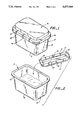
- FIG. 1 shows a perspective view of the preferred container and measuring closure used to store and heat the comestibles of the invention
- FIG. 2 shows a perspective view similar to that of FIG. 1, except that the closure has been removed and rotated 180°;
- FIG. 3 shows a cross--sectional view of the container with the closure in place
- FIG. 4 shows a cross--sectional view of the container being filled with a microwave--power absorbing, comestible liquid medium
- FIG. 5 shows a cross--sectional view of the container during the heating process, with the closure in place.
- the present invention provides microwaveable, frozen comestibles in the form of entrees which can be quickly heated by microwave radiation.
- a microwave-absorbing liquid e.g. water
- the cooking medium a microwave-absorbing liquid, e.g. water
- the cooking medium is a separately added constituent which, because it is already in liquid phase, does not require the additional heating time as do present frozen food products, whose premade sauces contain large amounts of frozen liquids, thus forming large blocks of ice.
- These ice chunks prevent the even heating of such prior art products because of the different densities of such products and the uneven melting times of such products.
- most frozen comestibles require rotation of the container in which they are heated (a drawback somewhat obviated by providing a self-actuated or mechanical turntable), in order to assure even heating.
- “Individually quick frozen” means that the food constituents, e.g., vegetables, meats, poultry, fish, shellfish, pasta, grain products (e.g., rice, barley, oats, wheat) will be sized in certain discrete dimensions and subjected to freezing as quickly as possible via liquid nitrogen, dry ice, or forced cold air, in ways known to those skilled in the art. The most important aspect is the sizing and segregating of such constituents into discrete components.
- Microwave power absorbing liquid medium means a liquid whose molecules form dipoles (i.e., shared pairs of opposite charges) when an electric field (microwave radiation) is applied thereto.
- Such medium is generally water, which is an excellent medium for microwave absorption; however, the water can be replaced with other liquids in which water is an integral constituent, e.g., milk, broth, brine, wine, or the like.
- oil-based sauces and dressings e.g., mayonnaise may also be utilized.
- microwave heating has been used, this is merely a colloquial expression, since, actually, heating occurs when the food material is impinged by a source of microwave radiation, its molecules are reoriented, storing potential energy, and, upon oscillation of the power source, kinetic energy is released as heat, and such energy is conducted through the food material.
- substantially dry sauce concentrate means a mixture of food solids, spices, thickeners, fat or oil, seasonings, meats, and vegetables which have been combined and prepared so as to remove substantially most of the free water (i.e., that water which is not chemically bound to any of the constituents).
- free water content should be less than preferably about 70%, more preferably less than 60%, and most preferably less than 55%, of the sauce concentrate.
- the types of products preferably used in the inventive method are frozen food entrees. Such products provide an "all-in-one" meal, i.e., such as a casserole.
- the advantages of the invention over the prior art products are many, but one of the chief advantages is speed of the inventive method.
- a full power application of microwave radiation on the product should yield a ready-to-consume product within less than five minutes total cooking time, most preferably, within less than three minutes total cooking time.
- An additional advantage is the evenness of heating since the microwaveable liquid medium, preferably water, is separately added, and is not frozen, which avoids the uneven heating of the prior art.
- These products will generally comprise a meat or mixture of meats, shellfish, poultry, or fish; a mixture of vegetables; a pasta or grain product; and the sauce concentrate.
- a wide variety of types of products which are attractive to the consumer market can be created and are marketed under such designations as "Italian Style,” “Oriental Style,” “Seafood Style,” “Vegetarian Style,” and the like.
- Meats, fish, shellfish, and other forms of edible protein comprise one group of typically added ingredients.
- shellfish a commercially available substitute known as surimi (pollock or other whitefish, which is extruded and mixed with spices, binders and flavorings) can be utilized as an inexpensive substitute for various shellfish.
- meat substitutes such well known meat substitutes as tofu (pressed bean curd), gluten-based materials, and soy products can be used.
- meat substitutes such as sausage, indeed, even other constituents may not necessarily be subjected to individual quick freezing processes. Some meat or products may merely be added to the assembled food product and then cooled down or otherwise frozen. Thus, while the majority of the constituents are individually quick frozen, such term is not to be construed as limiting the products or constituents of products of this invention.
- Pasta and grain products form another important ingredient.
- Pasta can include not only semolina-based products, but also such items as Chinese and Japanese style noodles, such as mung bean threads.
- Grains include rice, wheat, oats, and other grains. Generally, these pasta and grain products are pre-cooked.
- Vegetables comprise another important group of ingredients. Vegetables which contain smaller amounts of water (e.g., peas versus lettuce) withstand freezing and thawing relatively well, such as green beans, carrots and other types of vegetables, such as legumes. Others help to flavor the products as well, such as onions and garlic. Generally, these vegetables are least partially cooked, i.e., blanched, which helps to maintain color by deactivating enzymes and by removing some interstitial air.
- peas versus lettuce withstand freezing and thawing relatively well, such as green beans, carrots and other types of vegetables, such as legumes. Others help to flavor the products as well, such as onions and garlic.
- these vegetables are least partially cooked, i.e., blanched, which helps to maintain color by deactivating enzymes and by removing some interstitial air.
- These individually constituents will typically have a water content of anywhere from 15% to over 95% by weight. They will have densities of from about 0.25 to about 1.50 gm/cm 3 . Size will vary from about 1-6 cms in length, 0.1 to 1 cm width and a similar thickness or depth. These size ranges appear optimal for uniform heat transference during microwave heating.
- the dry sauce concentrate is a critical part of the products of this invention.
- the concentrate comprises a series of "dry” ingredients, such as powdered cheese, powdered milk, salt, emulsified oils, spices, seasonings, flavor additives, acidulants, sugars, food concentrates, food solids, emulsifiers, flow control agents, thickeners (e.g.s., flour, cornstarch and tapioca solids), soy, wine, and the like.
- dry ingredients are paired with "wet” ingredients, such as cheese, butter, cream, meat, poultry, shellfish or fish bases, fresh vegetables, fats, oils, uncooked or cooked meats or poultry and the like.
- the dry ingredients comprise about 20-80%, and the wet ingredients comprise 80-20% of the sauce concentrate, and the ratios of the two sets of ingredients are varied in accordance with the style of preparation.
- the wet and dry ingredients are constituted separately as portions of the sauce concentrate.
- the wet ingredients usually contain an oil or fat, in which a vegetable such as onions or carrots or other vegetables are sauteed (to help flavor the oil or fat, and to reduce unnecessary moisture). Then the dry ingredients are added to form a highly viscous paste or dough. This paste or dough is frozen and combined with the individually quick frozen constituents previously described.
- oil or fat is present as one of the major "wet” ingredients in the sauce concentrate, the amount present is preferably about 5-50%, more preferably 10-40%, and most preferably 15-35% of the "wet" ingredients.
- Oil or fat is desirable to act as a liquid binder for the dry ingredients in the to-be-formed paste or dough and because certain vegetables and flavorings are initially sauteed in such oil or fat, the oil is thereby flavored.
- the paste or dough becomes highly fluid, and is difficult to handle or process in large batches or in a continuous process.
- Additional oil or fat can be added back to the product: by coating the pasta, grain or other constituents; by spraying the assembled products with a stream of oil or liquified fat just prior to sealing the storage package; or, by adding in the form of emulsified oils or fats added as separate particles (e.g., frozen fat or butter particles).
- the proportion of sauce concentrate to the remaining constituents is typically about 5 to 50, more preferably 10 to 40, and most preferably about 12.5 to 30% sauce concentrate; pasta or grain product from 5 to 90, more preferably 10 to 80 and most preferably 15 to 60% meat, poultry, shellfish, fish, or meat substitute; 0 to 40, more preferably 5 to 35, and most preferably 10 to 35% ; and vegetables from 0 to 95, more preferably 5 to 90%, most preferably 10 to 50%.
- a container 2 and a measuring closure 4 comprise the portable, single serving storage and cooking container used in the invention.
- the container 2 is preferably cylindrical in form with a preferable depth of about 31/2 inches, a width of about 3 inches, and a length of about 5 inches.
- the volume of the container is about 19 fluid ounces.
- the container 2 has a bottom panel 6, which may be reinforced, from which a depending skirt 8 extends.
- An integral bead 10 serves to reinforce the container and to act as a locking mechanism when the container 2 and the closure 4 are combined.
- the measuring closure 4 has width and height dimensions just slightly greater than those of the container bead 10, so that the closure may tightly engage the container to form a strong seal.
- a plurality of vents 12 are provided in the closure. These vents are channels which are formed during the molding process which lead to orifices 13, which vent off steam.
- the closure is provided with tabs 16, which ride over bead 10 and tightly engage the underside thereof when the closure and container are combined.
- the closure acts as a measuring cup, and is provided on its interior wall surface with a measuring line 14.
- a removable film over-wrap is generally used to seal the container and is positioned between the closure and the container. Such over-wrap is to prevent moisture exchange from the constituents to the atmosphere and vice versa.
- the container and closure 4 may be constructed of any suitable plastic which may be blow-or injection-molded, such as polyethylene, polystyrene, polypropylene, and copolymers of these and other polymers as are known to those skilled in the art. Composite materials may also be used.
- the measuring closure 4 is filled with a microwave-power-absorbing liquid medium which forms part of the edible product.
- the closure is then snapped onto the container, and placed in a microwave oven, and subjected to microwave radiation.
- the liquid is water.
- the water acts as the heat propagating and conductive medium, but, upon initial application to the frozen comestible, it serves to partially thaw the same, thus further expediting the speed of the heating process.
- the water is added as liquid water, it starts to disperse the sauce concentrate. Finally, upon heating, the diluted sauce concentrate begins to bind therein.
- the water or other liquid medium is typically added a ratio of about 1:10 to 10:1 water to comestible, more preferably about 1:5 to 5:1, and most preferably 1:4 to 4:1.
- the temperature that the heated product attains is a function of time of heating, and power of the microwave radiation source. However it is preferred that the heated product attain a temperature of at least about 150° F. (65° C.), more preferably at least about 180° F. (82.2° C.).
- Example 1 The examples depict, in order, a sauce concentrate (Example 1), the constituents needed to produce a finished product (Example 2), and the method for preparing for immediate consumption (Example 3).
- Example 4-11 depict further examples of dry sauce concentrate and the constiuents added thereto to obtain finished products.
- the dry and wet ingredients are combined in amounts (651.65 grams, 529.5 grams, respectively) to comprise 55.17% and 44.83% of the sauce concentrate, respectively.
- Example 2 To prepare the finished product of Example 2, about 4 ozs. (113.40 gms) water are added to the product, in a suitably deep microwaveable container with dimensions of about 6 inches in diameter, 3 inches in height, and a volume of about 20 ounces (11/4 pints).
- the container has a vented cover or closure.
- the container is placed in a Sharp Carousel II microwave oven, rated at 700 watts, and microwave-heated for two minutes at high power. After heating, the product may, if desired, be stirred once, and reheated to further bind the resulting sauce, but such step is not critical to the invention and is a matter of preference.
- the stirring step takes about 1/2 minute (to break up any undispersed sauce concentrate particles) and the reheating step, about 1 minute.
- the finished products of Examples 5, 7, 9, and 11, below may similarly be subjected to the same heating process.
- the wet and dry ingredients are combined in amounts (626.22 grams, 553.8 grams, respectively), to comprise 53.07% and 46.93% of the sauce concentrate, respectively.
- the wet and dry ingredients are combined in amounts (260.64 grams, 703.0 grams, respectively), to comprise 27.05% and 72.95% of the sauce concentrate, respectively.
- the wet and dry ingredients are combined in amounts (235.68 grams, 635.0 grams, respectively), to comprise 28.07% and 71.92% of the sauce concentrate, respectively.
- the dry and wet ingredients are combined in amounts (256.36 grams, 1,236.0 grams, respectively), to comprise 17.18% and 82.82% of the sauce concentrate, respectively.
- the wet and dry ingredients are combined in amounts (89.95 grams, 125 grams, respectively), to comprise 41.85% and 58.15% of the sauce concentrate, respectively.
Landscapes
- Engineering & Computer Science (AREA)
- Mechanical Engineering (AREA)
- Life Sciences & Earth Sciences (AREA)
- Food Science & Technology (AREA)
- General Preparation And Processing Of Foods (AREA)
Abstract
The invention comprises a method for preparing a frozen comestible for consumption, comprising:
(a) combining frozen food constituents with a substantially dry sauce concentrate;
(b) adding a discrete portion of a microwave-power absorbing liquid medium to the combination; and
(c) heating the combination with a source of microwave power.
In a further embodiment, the invention also relates to a microwaveable, individual portion serving container, said container provided with a measuring closure, said container containing a frozen comestible comprising a quantity of frozen constituents and a substantially dry sauce concentrate, wherein said closure includes venting means to off-gas steam generated when said frozen comestible is combined with a microwave power absorbing liquid medium and heated with a source of microwave power.
Description
This is a continuation of Application Ser. No. 07/119,522, filed Nov. 12, 1987, now abandoned.
1. Field of the Invention
This invention relates to methods of preparing frozen comestibles for immediate consumption.
2. Brief Statement on the Prior Art
Frozen convenience foods have made very successful inroads in the consumer marketplace. However, such frozen foods typically require long periods of time to heat viz., up to an hour and more, in conventional particularly those with large amounts of a frozen sauce primarily of water, fats, spices, thickeners and binders).
Certain prior art allow for more efficient heat exchange via an enclosure for the frozen convenience food, e.g., the so-called "boil-in-bag" for immersion in boiling water. The boil-in-bag technique obviates the need for a conventional oven, which heats primarily by radiation. It also is an efficient means of heat exchange, since the air in the interior of the bag is heated and the heated air evenly heats the frozen comestible therein. By using this heating source, relatively prompt heating occurs, and, unlike a conventional oven, the heated air is moist and will not tend to dehydrate the comestible as much as a conventional oven would, where such dehydration is undesirable. However, these boil-in-bag devices still suffer from drawbacks, such as the need to boil the water beforehand and a still considerable amount of cooking time. There is also a danger of dehydrating part of the comestible, or achieving inconsistent cooking times because of the differences in density of the materials cooked therein. One partial attempt to solve this latter problem was disclosed in Tressler, U.S. Pat. No. 3,567,468. Tressler disclosed individually quick frozen constituents which were combined with a dry sauce mix, all contained in a boil-in-bag. The dry sauce mix becomes hydrated upon heating the boil-in-bag by the residual moisture of the constituents of the comestible, e.g., the vegetables. Unfortunately, this technique still does not avoid the prior step of boiling water and requires monitoring so that the contents are not overcooked. Additionally, the amount of water or other liquid present in the comestible may not be sufficient to produce a desirable amount of sauce or coating, and more water may need to be initially added to the comestible, which basically adds another frozen mass which needs to be thawed during cooking, thereby increasing the heating time.
In a further step towards added consumer convenience, the microwave oven was introduced in the 1940's. Today, the number of microwave ovens in domestic use has been estimated at over 60% of all U.S. households and an even greater number in commercial use. Microwave ovens function by emitting radiation at a frequency (300 to 3,000 Megahertz, and, most preferably, 915 to 2,450 Megahertz) below that of visible light. When microwave radiation impinges a material, depending on whether the material transmits, absorbs, or reflects such radiation, the material may allow such radiation to pass through, may be heated or may redirect or intensify such radiation. Materials, such as glass, ice or certain plastics, allow microwave radiation to pass through with minimal or no absorption. Other materials, such as most metals, reflect microwave radiation. However, most foods containing moisture absorb, and thus, are heated by, microwave radiation. Briefly, microwave radiation acts as an applied electric field which causes the dipoles in water to orient themselves in a certain fashion along such electric field, thereby storing potential energy. Upon oscillation of the field, the dipoles attain a new equilibrium position, and the energy is released as kinetic energy (heat). Taking advantage of these unique properties of microwave radiation on foods, some companies have developed innovative products, such as The Clorox Company in Hsia et al, U.S. Pat. No. 4,518,618, which discloses microwaveable coating mixes, yielding crisp food coatings for a variety of food substrates; and The Pillsbury Company, with specialty microwaveable containers containing a metallized "susceptor" to crisp dough on products such as frozen pizza.
Thus, microwaveable frozen comestibles must be specialty-packaged. The material must be transparent to microwave radiation. However, because microwave heating involves heat generated internally in the frozen comestible, moisture losses due to evaporation can be just as severe as in conventional oven heating. Moreover, unevenly sized food constituents can lead to uneven heating, e.g., overheating as to some portions, underheating as to others, or a combination of these. This is because microwave radiation only penetrates to a certain depth of the food until energy is fully absorbed. The rest of the interior is heated by heat conduction only. Also, because most frozen food products contain premade sauce, and the sauce is constituted of some edible liquid, more problems can be observed. The sauce must be specially constituted to prevent separation into watery and solid phases. Most importantly, the relatively large amount of water or liquid in such sauces signifies longer exposure to microwave radiation is necessary to generate sufficient heat to melt the ice by conduction. This again leads to uneven heating.
One attempt to circumvent the problem of uneven heating is a recent introduction by General Foods Corporation under the brand name "Bird's-Eye Fresh Creations" frozen dinners. These products borrow on the boil-in-bag concept by separately pouching each of the main constituents in e.g., an entree, for separate microwave heating of each. This approach, however, suffers from the complexity of the heating sequence (each separate constituent requires different heating times, different preparation, or both).
It has been surprisingly found that the foregoing disadvantages and drawbacks in the prior art are overcome by the present inventive method. The method of the invention attains even heating of each of the constituents of a frozen comestible, so as to prepare the comestible for immediate consumption. It also assures good mouth feel and tooth resistance with respect to items such as vegetables, which, upon overcooking, can suffer cellular breakdown and lose turgor. The invention further provides a microwaveable product with substantially reduced heating time in order to provide a ready-to-consume comestible in a minimum amount of time.
The invention comprises a method for preparing a frozen comestible for consumption, comprising:
(a) combining frozen food constituents with a substantially dry sauce concentrate;
(b) adding a discrete portion of a microwave-power absorbing liquid medium to the combination; and
(c) heating the combination with a source of microwave power.
It is therefore an object of the invention to provide a method for preparing a frozen comestible for prompt consumption in a minimum amount of time.
It is a further object of the invention to provide an improved method for heating frozen comestibles by microwave radiation without requiring separate heating of each constituent.
It is a still further object of the invention to provide an improved method for heating a frozen comestible by microwave radiation in which a microwave-absorbing liquid medium which forms part of the comestible is used to evenly heat each of the constituents of the comestible.
It is another object of the invention to provide a method of heating a frozen comestible by microwave radiation in which individually quick frozen constituents and a substantially dry sauce mix form the solids portion of the comestible, and a separately added microwave-absorbing liquid medium forms the liquid portion of the comestible.
FIG. 1 shows a perspective view of the preferred container and measuring closure used to store and heat the comestibles of the invention;
FIG. 2 shows a perspective view similar to that of FIG. 1, except that the closure has been removed and rotated 180°;
FIG. 3 shows a cross--sectional view of the container with the closure in place;
FIG. 4 shows a cross--sectional view of the container being filled with a microwave--power absorbing, comestible liquid medium; and
FIG. 5 shows a cross--sectional view of the container during the heating process, with the closure in place.
The present invention provides microwaveable, frozen comestibles in the form of entrees which can be quickly heated by microwave radiation. These products heat evenly because unlike prior art products, the cooking medium, a microwave-absorbing liquid, e.g. water, is a separately added constituent which, because it is already in liquid phase, does not require the additional heating time as do present frozen food products, whose premade sauces contain large amounts of frozen liquids, thus forming large blocks of ice. These ice chunks prevent the even heating of such prior art products because of the different densities of such products and the uneven melting times of such products. Note that most frozen comestibles require rotation of the container in which they are heated (a drawback somewhat obviated by providing a self-actuated or mechanical turntable), in order to assure even heating. However, even with these steps, there is no assurance that foods with lower densities or which are more thinly sliced or separated are not overheated or dehydrated; or that more dense foods, or those surrounded by large ice masses (i.e., sauces) are underheated, resulting in a still cold or even frozen core.
In this invention, the following definitions apply:
"Individually quick frozen" means that the food constituents, e.g., vegetables, meats, poultry, fish, shellfish, pasta, grain products (e.g., rice, barley, oats, wheat) will be sized in certain discrete dimensions and subjected to freezing as quickly as possible via liquid nitrogen, dry ice, or forced cold air, in ways known to those skilled in the art. The most important aspect is the sizing and segregating of such constituents into discrete components.
"Microwave power absorbing liquid medium" means a liquid whose molecules form dipoles (i.e., shared pairs of opposite charges) when an electric field (microwave radiation) is applied thereto. Such medium is generally water, which is an excellent medium for microwave absorption; however, the water can be replaced with other liquids in which water is an integral constituent, e.g., milk, broth, brine, wine, or the like. However, oil-based sauces and dressings (e.g., mayonnaise) may also be utilized.
Although the term "microwave heating" has been used, this is merely a colloquial expression, since, actually, heating occurs when the food material is impinged by a source of microwave radiation, its molecules are reoriented, storing potential energy, and, upon oscillation of the power source, kinetic energy is released as heat, and such energy is conducted through the food material.
"Substantially dry sauce concentrate" means a mixture of food solids, spices, thickeners, fat or oil, seasonings, meats, and vegetables which have been combined and prepared so as to remove substantially most of the free water (i.e., that water which is not chemically bound to any of the constituents). Thus, in such substantially dry sauce concentrates, free water content should be less than preferably about 70%, more preferably less than 60%, and most preferably less than 55%, of the sauce concentrate.
The types of products preferably used in the inventive method are frozen food entrees. Such products provide an "all-in-one" meal, i.e., such as a casserole. As mentioned, the advantages of the invention over the prior art products are many, but one of the chief advantages is speed of the inventive method. Using a conventional household microwave oven rated at 700 watts, a full power application of microwave radiation on the product should yield a ready-to-consume product within less than five minutes total cooking time, most preferably, within less than three minutes total cooking time. An additional advantage is the evenness of heating since the microwaveable liquid medium, preferably water, is separately added, and is not frozen, which avoids the uneven heating of the prior art. These products will generally comprise a meat or mixture of meats, shellfish, poultry, or fish; a mixture of vegetables; a pasta or grain product; and the sauce concentrate. A wide variety of types of products which are attractive to the consumer market can be created and are marketed under such designations as "Italian Style," "Oriental Style," "Seafood Style," "Vegetarian Style," and the like.
The types of constituent ingredients which are usually individually quick frozen run a wide variety of items.
Meats, fish, shellfish, and other forms of edible protein comprise one group of typically added ingredients. In the case of shellfish, a commercially available substitute known as surimi (pollock or other whitefish, which is extruded and mixed with spices, binders and flavorings) can be utilized as an inexpensive substitute for various shellfish. For vegetarian style products, such well known meat substitutes as tofu (pressed bean curd), gluten-based materials, and soy products can be used. It should also be noted that some meat products, such as sausage, indeed, even other constituents may not necessarily be subjected to individual quick freezing processes. Some meat or products may merely be added to the assembled food product and then cooled down or otherwise frozen. Thus, while the majority of the constituents are individually quick frozen, such term is not to be construed as limiting the products or constituents of products of this invention.
Pasta and grain products form another important ingredient. Pasta can include not only semolina-based products, but also such items as Chinese and Japanese style noodles, such as mung bean threads. Grains include rice, wheat, oats, and other grains. Generally, these pasta and grain products are pre-cooked.
Vegetables comprise another important group of ingredients. Vegetables which contain smaller amounts of water (e.g., peas versus lettuce) withstand freezing and thawing relatively well, such as green beans, carrots and other types of vegetables, such as legumes. Others help to flavor the products as well, such as onions and garlic. Generally, these vegetables are least partially cooked, i.e., blanched, which helps to maintain color by deactivating enzymes and by removing some interstitial air.
These individually constituents will typically have a water content of anywhere from 15% to over 95% by weight. They will have densities of from about 0.25 to about 1.50 gm/cm3. Size will vary from about 1-6 cms in length, 0.1 to 1 cm width and a similar thickness or depth. These size ranges appear optimal for uniform heat transference during microwave heating.
The dry sauce concentrate is a critical part of the products of this invention. Typically, the concentrate comprises a series of "dry" ingredients, such as powdered cheese, powdered milk, salt, emulsified oils, spices, seasonings, flavor additives, acidulants, sugars, food concentrates, food solids, emulsifiers, flow control agents, thickeners (e.g.s., flour, cornstarch and tapioca solids), soy, wine, and the like. These dry ingredients are paired with "wet" ingredients, such as cheese, butter, cream, meat, poultry, shellfish or fish bases, fresh vegetables, fats, oils, uncooked or cooked meats or poultry and the like.
Typically, the dry ingredients comprise about 20-80%, and the wet ingredients comprise 80-20% of the sauce concentrate, and the ratios of the two sets of ingredients are varied in accordance with the style of preparation. Generally, the wet and dry ingredients are constituted separately as portions of the sauce concentrate. The wet ingredients usually contain an oil or fat, in which a vegetable such as onions or carrots or other vegetables are sauteed (to help flavor the oil or fat, and to reduce unnecessary moisture). Then the dry ingredients are added to form a highly viscous paste or dough. This paste or dough is frozen and combined with the individually quick frozen constituents previously described.
It has further been found that when oil or fat is present as one of the major "wet" ingredients in the sauce concentrate, the amount present is preferably about 5-50%, more preferably 10-40%, and most preferably 15-35% of the "wet" ingredients. Oil or fat is desirable to act as a liquid binder for the dry ingredients in the to-be-formed paste or dough and because certain vegetables and flavorings are initially sauteed in such oil or fat, the oil is thereby flavored. However, it has also been found that when a larger amount of oil or fat is present (e.g., above about 20% of the wet ingredients, resulting in about 4-11 grams of oil or fat in the finished, individual serving of an approximately 226 gram product) the paste or dough becomes highly fluid, and is difficult to handle or process in large batches or in a continuous process. Thus, in another preferred aspect of the invention, it is desirable to limit the fat or oil portion of the wet ingredients to less than about 20% of the wet ingredients, such that the finished product in a representative 226 gram serving contains about 1-4 grams of such fat or oil. Additional oil or fat can be added back to the product: by coating the pasta, grain or other constituents; by spraying the assembled products with a stream of oil or liquified fat just prior to sealing the storage package; or, by adding in the form of emulsified oils or fats added as separate particles (e.g., frozen fat or butter particles).
The proportion of sauce concentrate to the remaining constituents is typically about 5 to 50, more preferably 10 to 40, and most preferably about 12.5 to 30% sauce concentrate; pasta or grain product from 5 to 90, more preferably 10 to 80 and most preferably 15 to 60% meat, poultry, shellfish, fish, or meat substitute; 0 to 40, more preferably 5 to 35, and most preferably 10 to 35% ; and vegetables from 0 to 95, more preferably 5 to 90%, most preferably 10 to 50%.
In TABLE I below, typical ingredient dimensions, moisture content, and density are given:
              TABLE I
______________________________________
Ingredient Dimensions
Sizes are an approx. range)
DENSITY
Length × Weight × Thickness (in cms.)
                         WATER
gm/cm.sup.3              CONTENT(%)
______________________________________
Cooked Fusilli (4.2 × 1.5) - (5.5 × 1.6)
                         70      1.42
Sliced Sausage (dia.) (2.5-3) × (.2-.3) thick
                         48      1.06
Green Bell Pepper (.7 × .9 × 6) -
                         94      .76
(1.8 × 1 × .6)
Tomato (2 × 3 × .5) - (1 × .6 × .7)
                         93      1.05
Gemellini, Cooked 1.8 × .7
                         70      1.42
Broccoli 3.15 cube - 1.26 cube
                         91      .76
Sliced Carrots (1.5 × .8) - (2.7 × .9)
                         91      1.06
Peas (dia.) .7-1         86      .49
Red Bell Pepper (3.7 × 1 × .5) - (1 × 1 ×
                         91)     .92
Canestrini, Cooked (6 × 1.9)
                         70      1.42
Diced Chicken (1 × 1.4 × .5) -
                         64      1.29
(1.5 × 1.3 × .7)
Quartered Zucchini (2 × 2 × .7) -
                         95      .71
(3 ×  3 × .7)
Sliced Mushroom (2 × 1 × .4) -
                         93      .95
(3.5 × 4 × .4)
Penne Riggate - Cooked 6-7
                         70      1.42
Cooked Beef Ground .315-.63
                         60      .367
Cooked Pork Ground .315-.63
                         56      .353
Cooked Mafalda (2 × 5 × .2)
                         70      1.42
Crumbled Sausage .1 × 1.5, diced
                         48      1.06
Mozzarella Cheese .5 × .2 × .4 (bits)
                         48      .43
Spinach Spirale, Cooked 5 × 1.2
                         70      1.42
Egg Spirale, Cooked 4.6 × 1
                         70      1.42
Julienne Ham .315 × .315 × 3.78
                         49      1.1
Julienne Carrot (2 × .3) - (4.9 × .4)
                         91      1.19
Surimi (ht.) 1.1 × 2 (dia)
                           21.5  1.04
Clam (1.2 × .9 × .3) - (2.2 × 1 × .7)
                         77      .97
Shrimp (1.5 × 1.2 × .6) - (3.8 × 1.4 × .8)
                         57      1.30
Orecchiete Baresi 23/4-3 × 11/2
                         70      1.42
Pepperoni (2.5-3) (dia.) × (.2-.3) thickness
                         50      1.08
Black Olives (dia.) 1.7-1.9
                         80      .40
Meatballs (dia.) 1.8-1.9 60      1.0
______________________________________
Referring to FIG. 1-2 a container 2 and a measuring closure 4 comprise the portable, single serving storage and cooking container used in the invention. The container 2 is preferably cylindrical in form with a preferable depth of about 31/2 inches, a width of about 3 inches, and a length of about 5 inches. The volume of the container is about 19 fluid ounces. Naturally, neither the configuration nor the dimensions of the container are critical to the practice of the invention. The container 2 has a bottom panel 6, which may be reinforced, from which a depending skirt 8 extends. An integral bead 10, serves to reinforce the container and to act as a locking mechanism when the container 2 and the closure 4 are combined. The measuring closure 4 has width and height dimensions just slightly greater than those of the container bead 10, so that the closure may tightly engage the container to form a strong seal. However, because of steam and gas build up during the microwave heating process, a plurality of vents 12 are provided in the closure. These vents are channels which are formed during the molding process which lead to orifices 13, which vent off steam. In order to close down the closure 4 onto container 2, the closure is provided with tabs 16, which ride over bead 10 and tightly engage the underside thereof when the closure and container are combined. Also, the closure acts as a measuring cup, and is provided on its interior wall surface with a measuring line 14.
In storage (FIGS. 2 and 3) the individually quick frozen constituents and the substantially dry sauce concentrate are stored in the container. A removable film over-wrap is generally used to seal the container and is positioned between the closure and the container. Such over-wrap is to prevent moisture exchange from the constituents to the atmosphere and vice versa.
The container and closure 4 may be constructed of any suitable plastic which may be blow-or injection-molded, such as polyethylene, polystyrene, polypropylene, and copolymers of these and other polymers as are known to those skilled in the art. Composite materials may also be used.
In operation (FIGS. 3-5), the measuring closure 4 is filled with a microwave-power-absorbing liquid medium which forms part of the edible product. The closure is then snapped onto the container, and placed in a microwave oven, and subjected to microwave radiation. Usually, the liquid is water. Not only does the water act as the heat propagating and conductive medium, but, upon initial application to the frozen comestible, it serves to partially thaw the same, thus further expediting the speed of the heating process. Further, since the water is added as liquid water, it starts to disperse the sauce concentrate. Finally, upon heating, the diluted sauce concentrate begins to bind therein. The water or other liquid medium is typically added a ratio of about 1:10 to 10:1 water to comestible, more preferably about 1:5 to 5:1, and most preferably 1:4 to 4:1. The temperature that the heated product attains is a function of time of heating, and power of the microwave radiation source. However it is preferred that the heated product attain a temperature of at least about 150° F. (65° C.), more preferably at least about 180° F. (82.2° C.).
In the EXPERIMENTAL section below, the products prepared using the inventive method are disclosed.
The examples depict, in order, a sauce concentrate (Example 1), the constituents needed to produce a finished product (Example 2), and the method for preparing for immediate consumption (Example 3). Examples 4-11 depict further examples of dry sauce concentrate and the constiuents added thereto to obtain finished products.
______________________________________
                      GRAM
INGREDIENT            WT.      PERCENT
______________________________________
DRY INGREDIENTS
Parmesan Cheese       200 g    30.96
Cream Powder (Beatrice Corp.)
                      114.65   17.74
Non-Fat Dry Milk       76.50   11.84
Clorox Cream Prod.     64.50   10.76
Pure Flo (Mod. Cornstarch, National)
                       40.35   6.24
Quicksperse (Mod. Cornstarch, National)
                       33.25   5.14
Salt                   25.50   3.94
Instant N-Oil (Mod. Cornstarch,
                       25.00   3.87
Tapioca, National)
Chives                 12.50   1.08
Lactic Acid            7.00    1.08
Granulated Onion       6.50    1.01
Granulated Garlic      6.50    1.01
Bacon Flavor HVR Dressing
                       5.00     .78
(Clorox Co.)
Mustard Flour          4.50     .70
White Pepper           3.00     .46
Lecithin 6450 (Central Soya)
                       1.50     .23
Nutmeg                  .40     .06
Romano Cheese          20.00   3.10
                      651.65   100.00
WET INGREDIENTS
Fontina Cheese        225 g    42.49
Butter                120.5    23.14
Cream                 120.5    23.14
Chicken Base (L.J. Minor's)
                       34.5    6.51
Gorgonzola             25.0    4.72
                      529.5    100.00
______________________________________
The dry and wet ingredients are combined in amounts (651.65 grams, 529.5 grams, respectively) to comprise 55.17% and 44.83% of the sauce concentrate, respectively.
To assemble a finished pasta alfredo product, 26.55% of the sauce concentrate of Example 1 is added to the following:
______________________________________
INGREDIENT        GRAM WT.   PERCENT
______________________________________
Egg Fettucine     88.0       38.94
Spinach Fettucine 52.0       23.01
Sauce Concentrate (Eg. 1)
                  60.0       26.55
Ham               12.0        5.31
Carrots           14.0        6.19
______________________________________
This provides a 226.0 gram or about 8.00 oz. serving.
To prepare the finished product of Example 2, about 4 ozs. (113.40 gms) water are added to the product, in a suitably deep microwaveable container with dimensions of about 6 inches in diameter, 3 inches in height, and a volume of about 20 ounces (11/4 pints). The container has a vented cover or closure. The container is placed in a Sharp Carousel II microwave oven, rated at 700 watts, and microwave-heated for two minutes at high power. After heating, the product may, if desired, be stirred once, and reheated to further bind the resulting sauce, but such step is not critical to the invention and is a matter of preference. If the further steps are utilized, however, the stirring step takes about 1/2 minute (to break up any undispersed sauce concentrate particles) and the reheating step, about 1 minute. Each of the finished products of Examples 5, 7, 9, and 11, below may similarly be subjected to the same heating process.
______________________________________
INGREDIENT        GRAM WT.    PERCENT
______________________________________
DRY INGREDIENTS
Parmesan/Romano Cheese Mix
                  295.30      47.15
Non-Fat Dry Milk  57.30        9.15
Cream Powders     96.40       15.39
Mod. Cornstarches 83.40       13.31
Instant N-Oil     21.70        2.47
Salt, Spices and Seasonings
                  69.62       11.12
Lecithin           2.50        .40
                  626.22      100.00
WET INGREDIENTS
Fresh Onions, Chopped
                  239.0       43.16
Cream, Heavy      152.0       27.45
Butter            135.0       24.37
Chicken Base      27.8         5.02
                  553.8       100.00
______________________________________
The wet and dry ingredients are combined in amounts (626.22 grams, 553.8 grams, respectively), to comprise 53.07% and 46.93% of the sauce concentrate, respectively.
To assemble a finished pasta primavera product, 26.56% of the sauce concentrate of Example 4 is added to the following:
______________________________________
INGREDIENT        GRAM WT.   PERCENT
______________________________________
Ganellini         98.0       43.36
Sauce Concentrate (Eg. 4)
                  60.0       26.56
Broccoli          23.0       10.18
Carrots           18.0        7.96
Peas              17.0        7.52
Red Bell Peppers  10.0        4.42
                  226.0      100.00
______________________________________
This provides a 226.0 gram or about 8 oz. serving.
______________________________________
INGREDIENT          GRAM WT.   PERCENT
______________________________________
DRY INGREDIENTS
Pure-Aid Tomato (Starch/Paste Mix,
                    24.30       9.32
Pacific Pure-Aid)
Tomato Powder       85.00      32.61
Mod. Cornstarches   74.80      28.70
Sugar               27.70      10.63
Salt, Spices and Seasonings
                    48.84      18.74
                    260.64     100.00
WET INGREDIENTS
Garlic in Oil       24.0        3.41
Onion               243.0      34.57
Olive Oil           121.0      17.21
Carrots             121.0      17.21
Chicken Base        118.0      16.79
Green Bell Peppers  76.0       10.81
                    703.0      100.00
______________________________________
The wet and dry ingredients are combined in amounts (260.64 grams, 703.0 grams, respectively), to comprise 27.05% and 72.95% of the sauce concentrate, respectively.
To assemble a finished chicken cacciatore product, 21.02% of the sauce concentrate of Example 6 is added to the following:
______________________________________
INGREDIENT        GRAM WT.   PERCENT
______________________________________
Cannestrini       77.0       34.07
Chicken           30.0       13.27
Zucchini          25.0       11.06
Mushrooms         21.0        9.29
Sauce Concentrate (Eg. 6)
                  48.0       21.24
Tomatoes          25.0       11.06
                  226.0      100.00
______________________________________
This provides a 226.0 gram or about 8.00 oz. serving.
______________________________________
INGREDIENT        GRAM WT.   PERCENT
______________________________________
DRY INGREDIENTS
Tomato PD         94.4       36.92
Mod. Cornstarches 42.0       16.43
Sugar             18.0        7.04
Salt, Spices and Seasonings
                  101.28     39.61
                  255.68     100.00
WET INGREDIENTS
Vegetable Oil     140.0      21.37
Olive Oil         20.0        3.05
Onion, Fresh      182.0      27.79
Celery, Fresh     56.0        8.55
Ground Mushrooms  70.0       10.69
Carrots, Fresh    56.0        8.55
Ground Ham        73.0       11.15
Beef Base (L.J. Minor)
                  58.0        8.85
                  635.0      100.00
______________________________________
The wet and dry ingredients are combined in amounts (235.68 grams, 635.0 grams, respectively), to comprise 28.07% and 71.92% of the sauce concentrate, respectively.
Rigatoni with Meat Sauce Constituents
To assemble a finished rigatoni with meat sauce product, 20.35% of the sauce concentrate of Example 8 is added to the following:
______________________________________
INGREDIENT        GRAM WT.   PERCENT
______________________________________
Pasta Penne Rigate
                  122.8      54.36
Beef              22.4        9.91
Pork              14.4        6.37
Tomatoes          20.4        9.01
Sauce Concentrate (Eg. 8)
                  46.0       20.35
                  226.0      100.00
______________________________________
This provides a 226.0 gram or about 8.00 oz. serving.
______________________________________
INGREDIENT          GRAM WT.   PERCENT
______________________________________
DRY INGREDIENTS
Mod. Cornstarches   124.00     48.37
Instant N-Oil        26.40     10.30
Cream Base (Clorox)  24.00     9.36
Salt, Spices and Seasonings
                     70.36     27.45
Centrolex 6450 (Lecithin,
                     8.00      3.12
Central Soya)
3H3 (Hydrolyzed Vegetable Protein,
                     3.60      1.40
Fidco, Nestle)
                    256.36     100.00
WET INGREDIENTS
Butter              340.0      27.51
Onion               600.0      48.54
Garlic Oil          100.0      8.09
Clam Base (L.J. Minor's)
                    60.0       4.86
Lobster Base (L.J. Minor's)
                    20.0       1.62
Chicken Base        36.0       2.91
Cream               73.0       11.15
                    1,236.0    100.00
______________________________________
The dry and wet ingredients are combined in amounts (256.36 grams, 1,236.0 grams, respectively), to comprise 17.18% and 82.82% of the sauce concentrate, respectively.
To assemble a finished seafood casserole product, 21.68% of the sauce concentrate of Example 10 is added to the following:
______________________________________
INGREDIENT       GRAM WT.    PERCENT
______________________________________
Canellini        104         46.02
Sauce Concentrate (Eg. 10)
                 49          21.68
Surimi           20           8.85
Clams            25          11.06
Broccoli         18           7.97
Shrimp           10           4.42
                  226.0      100.00
______________________________________
This provides a 226 gram or about 8.00 oz. serving.
______________________________________
WET INGREDIENTS
______________________________________
Onions, Fresh Chopped
                    55.0    44.0
Olive Oil           20.0    16.0
Celery, Fresh, Minced
                    15.0    12.0
Carrots, Fresh, Minced
                    15.0    12.0
Beef Base           15.0    12.0
Garlic in Oil        5.0     4.0
                    125.0   100.00
______________________________________
The wet and dry ingredients are combined in amounts (89.95 grams, 125 grams, respectively), to comprise 41.85% and 58.15% of the sauce concentrate, respectively.
To assemble a finished spaghetti with meatballs product, 19.91% of the sauce concentrate of Example 16 is added to the following:
______________________________________
INGREDIENT       GRAM WT.    PERCENT
______________________________________
Gemellini        101         44.69
Sauce Concentrate (Eg. 16)
                 45          19.91
Tomatoes, Diced  35          15.49
Mushrooms, Sliced
                 15           6.64
Meatballs, 1/2" Dia.,**
                 30          13.27
                  226.0      100.00
______________________________________
This provides a 226.0 gram or about 7.06 oz. serving
**Meatballs Gram Wt.  Percent
Ground Pork 30.00     41.32
Ground Beef 30.00     41.32
Salt        5.20      7.16
Granulated Onion
            4.60      6.34
Granulated Garlic
            2.30      3.17
Black Pepper
             .50      0.69
            72.60     100.00
The foregoing embodiments are not limiting to the invention, and obvious equivalents and the like are within the scope of the invention. The invention is further defined with reference to the claims which are appended hereto.
Claims (6)
1. A method for preparing a packaged, frozen microwaveable comestible product for consumption wherein the packaged frozen microwaveable comestible product is obtained by combining within a single compartment of a rigid container, predominantly individually quick frozen frozen food constituents having a free water content of from 15-95 wt. % and a substantially dry sauce concentrate having a concentration of 5-50 wt. % based on the total weight of the frozen comestible product and a free water content of less than 70 wt. %; said frozen comestible product comprising said frozen food constituents and said dry sauce concentrate;
wherein said rigid container is capable of both withstanding exposure to microwave power sufficient to heat said frozen comestible product to the temperature for consumption and holding, in addition to said frozen comestible, added water in an amount effective to uniformly heat said frozen food constituents when exposed to microwave power and disperse said dry source concentrate therein; and
said method for preparing said packaged, frozen microwaveable comestible product comprising:
(a) adding an amount of water to said frozen comestible comprising said frozen food constituents and said dry sauce concentrate contained within said compartment, wherein the amount of water added is such that the weight ratio of added water to frozen comestible ranges from 1:5 to 5:1 and is added in an amount and manner sufficient to uniformly heat said frozen food constituents when exposed to microwave power, disperses said dry sauce concentrate and form an edible liquid sauce therewith; and
(b) heating said frozen comestible and said added water in said compartment with a source a microwave power to a temperature and for a time sufficient to heat the frozen comestible to a temperature for consumption and form said edible liquid sauce.
2. The method of claim 1 wherein the heating step (c) has a duration of no more than 10 minutes at a power of 100 to 2,000 watts.
3. The method of claim 1 further comprising the steps of:
(d) removing said frozen comestible from the source of power and stirring; and
(e) reheating said frozen comestible for a short amount of time with a source of microwave power.
4. The method of claim 1 wherein the frozen constituents comprise discretely segregated segments of vegetables, meats, fish, shellfish, pasta and mixtures thereof.
5. The method of claim 1 wherein the sauce concentrate comprises a mixture of dry ingredients and wet ingredients in a ratio of about 1:4 and to about 4:1 wet:dry ingredients.
6. The method of claim 1, wherein heating step (c) is conducted without stirring.
Priority Applications (1)
| Application Number | Priority Date | Filing Date | Title |
|---|---|---|---|
| US07/529,766 US5077066A (en) | 1987-11-12 | 1990-05-25 | Method for preparing frozen comestibles for consumption |
Applications Claiming Priority (2)
| Application Number | Priority Date | Filing Date | Title |
|---|---|---|---|
| US11952287A | 1987-11-12 | 1987-11-12 | |
| US07/529,766 US5077066A (en) | 1987-11-12 | 1990-05-25 | Method for preparing frozen comestibles for consumption |
Related Parent Applications (1)
| Application Number | Title | Priority Date | Filing Date |
|---|---|---|---|
| US11952287A Continuation | 1987-11-12 | 1987-11-12 |
Publications (1)
| Publication Number | Publication Date |
|---|---|
| US5077066A true US5077066A (en) | 1991-12-31 |
Family
ID=26817429
Family Applications (1)
| Application Number | Title | Priority Date | Filing Date |
|---|---|---|---|
| US07/529,766 Expired - Fee Related US5077066A (en) | 1987-11-12 | 1990-05-25 | Method for preparing frozen comestibles for consumption |
Country Status (1)
| Country | Link |
|---|---|
| US (1) | US5077066A (en) |
Cited By (36)
| Publication number | Priority date | Publication date | Assignee | Title |
|---|---|---|---|---|
| US5362504A (en) * | 1992-06-23 | 1994-11-08 | General Mills, Inc. | Edible microwave susceptor composition |
| US5674546A (en) * | 1995-08-10 | 1997-10-07 | Nabisco Technology Company | Package for storing and cooking an omelet |
| EP0930021A1 (en) * | 1998-01-19 | 1999-07-21 | Societe Des Produits Nestle S.A. | Plated meal with individually frozen ingredients |
| EP0954981A3 (en) * | 1998-05-08 | 2000-08-23 | Bestfoods | Microwavable pasta in a bowl |
| EP0960570A3 (en) * | 1998-05-26 | 2000-09-27 | Bestfoods | Quick rehydrating pasta and method of manufacture by wet toasting |
| EP1046346A3 (en) * | 1998-05-08 | 2001-09-26 | Bestfoods | Microwavable pasta in a bowl |
| US6312744B1 (en) * | 1995-01-05 | 2001-11-06 | Jeno Paulucci | Method of microwave heating a pre-packaged frozen entree |
| US20020084264A1 (en) * | 2000-07-24 | 2002-07-04 | Mls Mikrowellen-Labor-Systeme Gmbh | Device for performing multiple chemical reactions and process in high frequency fields |
| US20040009279A1 (en) * | 2002-07-09 | 2004-01-15 | Unilever Bestfoods North America, Division Of Conopco, Inc. | Frozen layered pasta product |
| WO2004075642A3 (en) * | 2003-02-24 | 2004-10-07 | Mars Inc | Gelled foods |
| US20050079268A1 (en) * | 2001-12-21 | 2005-04-14 | Goetz Eckhardt | Kit for preparing a spread |
| US20050087471A1 (en) * | 2003-10-22 | 2005-04-28 | Thorlakson Lynette M. | Packaging for dog treats |
| FR2892388A1 (en) * | 2005-10-25 | 2007-04-27 | Cgl Pack Service Soc Par Actio | Tray for e.g. dessert, has secondary body mounted sliding in main compartment of main body guided laterally by lateral portions of main peripheral wall, where bodies are in rectangular shape with rounded corners |
| US20070148306A1 (en) * | 2005-06-03 | 2007-06-28 | Mattson Peter H | Method of Producing and Preparing Fresh Frozen Food From Quick Frozen Vegetables and Stock |
| USD610903S1 (en) | 2007-03-02 | 2010-03-02 | Conagra Foods Rdm, Inc. | Container assembly |
| US20100151086A1 (en) * | 2008-12-12 | 2010-06-17 | Kraft Foods Global Brands Llc | Powdered Sauces And Uses Thereof |
| USD635817S1 (en) | 2006-06-09 | 2011-04-12 | Conagra Foods Rdm, Inc. | Container assembly |
| USD638701S1 (en) | 2010-09-08 | 2011-05-31 | Conagra Foods Rdm, Inc. | Container |
| USD639186S1 (en) | 2010-09-08 | 2011-06-07 | Conagra Foods Rdm, Inc. | Container with sleeve |
| USD639656S1 (en) | 2010-09-08 | 2011-06-14 | Con Agra Foods RDM, Inc. | Container lid |
| USD645748S1 (en) | 2011-03-04 | 2011-09-27 | The Quaker Oats Company | Container |
| USD649054S1 (en) | 2011-03-04 | 2011-11-22 | The Quaker Oats Company | Container |
| US8302528B2 (en) | 2005-10-20 | 2012-11-06 | Conagra Foods Rdm, Inc. | Cooking method and apparatus |
| USD677162S1 (en) | 2011-03-04 | 2013-03-05 | The Quaker Oats Company | Lid |
| USD680426S1 (en) | 2012-06-12 | 2013-04-23 | Conagra Foods Rdm, Inc. | Container |
| US20130318871A1 (en) * | 2012-06-04 | 2013-12-05 | Eco Box Holdings, LLC | Planter having a multi-purpose lid |
| US8613249B2 (en) | 2007-08-03 | 2013-12-24 | Conagra Foods Rdm, Inc. | Cooking apparatus and food product |
| US8850964B2 (en) | 2005-10-20 | 2014-10-07 | Conagra Foods Rdm, Inc. | Cooking method and apparatus |
| USD717162S1 (en) | 2012-06-12 | 2014-11-11 | Conagra Foods Rdm, Inc. | Container |
| US8887918B2 (en) | 2005-11-21 | 2014-11-18 | Conagra Foods Rdm, Inc. | Food tray |
| US9027825B2 (en) | 2012-06-12 | 2015-05-12 | Conagra Foods Rdm, Inc. | Container assembly and foldable container system |
| US9132951B2 (en) | 2005-11-23 | 2015-09-15 | Conagra Foods Rdm, Inc. | Food tray |
| US9211030B2 (en) | 2005-10-20 | 2015-12-15 | Conagra Foods Rdm, Inc. | Steam cooking apparatus |
| US20160183572A1 (en) * | 2013-03-15 | 2016-06-30 | General Mills, Inc. | Shapable food seasoning |
| US9676539B2 (en) | 2013-05-24 | 2017-06-13 | Graphic Packaging International, Inc. | Package for combined steam and microwave heating of food |
| US20220395004A1 (en) * | 2019-11-08 | 2022-12-15 | Cj Cheiljedang Corporation | Microwavable packaged frozen rice having scorched texture |
Citations (36)
| Publication number | Priority date | Publication date | Assignee | Title |
|---|---|---|---|---|
| US610902A (en) * | 1898-09-20 | X m mjlk-can cover | ||
| US1076780A (en) * | 1913-02-06 | 1913-10-28 | Julius F Peter | Combined measure and stopper. |
| US2485659A (en) * | 1945-11-05 | 1949-10-25 | Ellis Foster Co | Delectric heating |
| CA479968A (en) * | 1952-01-01 | E. Welch Arthur | Method of treating foodstuff | |
| US3042247A (en) * | 1957-11-18 | 1962-07-03 | Bonnet Louis | Prefabricated packing-cases for dates and others |
| US3213634A (en) * | 1964-05-05 | 1965-10-26 | Air Reduction | Method and apparatus for individual quick freezing |
| US3228776A (en) * | 1961-11-14 | 1966-01-11 | Lever Brothers Ltd | Compartmented dehydrated food package |
| US3256101A (en) * | 1963-04-22 | 1966-06-14 | Robert G Arns | Method of microwave heating |
| US3402568A (en) * | 1965-06-25 | 1968-09-24 | Sucher Packing Co | Quick freezing of food products |
| US3410108A (en) * | 1966-09-16 | 1968-11-12 | Wentworth & Ass Inc A F | Apparatus for quick freezing solid foods |
| US3446030A (en) * | 1964-09-11 | 1969-05-27 | Thermice Corp | Method and apparatus for quick freezing individual food items |
| US3465873A (en) * | 1965-10-22 | 1969-09-09 | Otto John Munz | Combination food package,serving tray and shipping and display container |
| US3468369A (en) * | 1967-04-10 | 1969-09-23 | Freez Porter Systems Inc | Process and apparatus for handling perishable materials |
| US3479188A (en) * | 1964-12-30 | 1969-11-18 | Pillsbury Co | Cooking process and product |
| US3567468A (en) * | 1966-12-27 | 1971-03-02 | Donald Kiteley Tressler | Frozen foods |
| US3615646A (en) * | 1969-02-17 | 1971-10-26 | Stokely Van Camp Inc | Food package and process |
| US3700847A (en) * | 1970-07-06 | 1972-10-24 | Armour & Co | System for continuous processing of vienna sausage using microwave energy |
| US3854023A (en) * | 1968-02-09 | 1974-12-10 | M Levinson | Microwave oven heating member |
| US3868470A (en) * | 1973-02-16 | 1975-02-25 | Gen Foods Corp | Seasoning individually quick frozen vegetables |
| CA969139A (en) * | 1971-10-20 | 1975-06-10 | Warren R. Schack | Food package - cooking container combination |
| US3982404A (en) * | 1974-11-04 | 1976-09-28 | Lewis Refrigeration Co. | Individual quick-freezing of moist articles using deep fluidized bed and input conditioner |
| US3985991A (en) * | 1972-08-16 | 1976-10-12 | Levinson Melvin L | Methods of microwave heating in metal containers |
| US3987267A (en) * | 1972-10-25 | 1976-10-19 | Chemetron Corporation | Arrangement for simultaneously heating a plurality of comestible items |
| US4252268A (en) * | 1979-08-24 | 1981-02-24 | Maryland Cup Corporation | Lid for ovenable trays and resulting combined container |
| US4301659A (en) * | 1979-12-05 | 1981-11-24 | Refrigeration Engineering Corporation | Fluidized freezing |
| US4346815A (en) * | 1980-11-05 | 1982-08-31 | Seligco Food Corporation | Frozen food container |
| US4390555A (en) * | 1975-04-28 | 1983-06-28 | Levinson Melvin L | Microwave oven cooking method |
| US4390554A (en) * | 1975-04-28 | 1983-06-28 | Levinson Melvin L | Microwave heating of certain frozen foods |
| US4425368A (en) * | 1981-07-13 | 1984-01-10 | Golden Valley Foods Inc. | Food heating container |
| US4439656A (en) * | 1981-04-06 | 1984-03-27 | The Stouffer Corporation | Apparatus and method for the reconstitution of frozen foods in a microwave oven |
| US4448029A (en) * | 1981-05-29 | 1984-05-15 | Keller Jean Paul | Process for quick freezing and conditioning individual products, and apparatus for practicing this process |
| US4478868A (en) * | 1978-04-24 | 1984-10-23 | Mars Limited | Frozen food product and process for preparing |
| US4512497A (en) * | 1982-06-08 | 1985-04-23 | Dart Industries Inc. | Covered dish with adjustable opening |
| US4518618A (en) * | 1982-02-12 | 1985-05-21 | The Clorox Company | Food coating compositions for foods cooked by microwave |
| US4574174A (en) * | 1984-05-21 | 1986-03-04 | Mcgonigle Thomas P | Convenience dinner container and method |
| US4675197A (en) * | 1984-02-13 | 1987-06-23 | The Griffith Laboratories Limited | Food coating compositions |
-
1990
- 1990-05-25 US US07/529,766 patent/US5077066A/en not_active Expired - Fee Related
Patent Citations (36)
| Publication number | Priority date | Publication date | Assignee | Title |
|---|---|---|---|---|
| US610902A (en) * | 1898-09-20 | X m mjlk-can cover | ||
| CA479968A (en) * | 1952-01-01 | E. Welch Arthur | Method of treating foodstuff | |
| US1076780A (en) * | 1913-02-06 | 1913-10-28 | Julius F Peter | Combined measure and stopper. |
| US2485659A (en) * | 1945-11-05 | 1949-10-25 | Ellis Foster Co | Delectric heating |
| US3042247A (en) * | 1957-11-18 | 1962-07-03 | Bonnet Louis | Prefabricated packing-cases for dates and others |
| US3228776A (en) * | 1961-11-14 | 1966-01-11 | Lever Brothers Ltd | Compartmented dehydrated food package |
| US3256101A (en) * | 1963-04-22 | 1966-06-14 | Robert G Arns | Method of microwave heating |
| US3213634A (en) * | 1964-05-05 | 1965-10-26 | Air Reduction | Method and apparatus for individual quick freezing |
| US3446030A (en) * | 1964-09-11 | 1969-05-27 | Thermice Corp | Method and apparatus for quick freezing individual food items |
| US3479188A (en) * | 1964-12-30 | 1969-11-18 | Pillsbury Co | Cooking process and product |
| US3402568A (en) * | 1965-06-25 | 1968-09-24 | Sucher Packing Co | Quick freezing of food products |
| US3465873A (en) * | 1965-10-22 | 1969-09-09 | Otto John Munz | Combination food package,serving tray and shipping and display container |
| US3410108A (en) * | 1966-09-16 | 1968-11-12 | Wentworth & Ass Inc A F | Apparatus for quick freezing solid foods |
| US3567468A (en) * | 1966-12-27 | 1971-03-02 | Donald Kiteley Tressler | Frozen foods |
| US3468369A (en) * | 1967-04-10 | 1969-09-23 | Freez Porter Systems Inc | Process and apparatus for handling perishable materials |
| US3854023A (en) * | 1968-02-09 | 1974-12-10 | M Levinson | Microwave oven heating member |
| US3615646A (en) * | 1969-02-17 | 1971-10-26 | Stokely Van Camp Inc | Food package and process |
| US3700847A (en) * | 1970-07-06 | 1972-10-24 | Armour & Co | System for continuous processing of vienna sausage using microwave energy |
| CA969139A (en) * | 1971-10-20 | 1975-06-10 | Warren R. Schack | Food package - cooking container combination |
| US3985991A (en) * | 1972-08-16 | 1976-10-12 | Levinson Melvin L | Methods of microwave heating in metal containers |
| US3987267A (en) * | 1972-10-25 | 1976-10-19 | Chemetron Corporation | Arrangement for simultaneously heating a plurality of comestible items |
| US3868470A (en) * | 1973-02-16 | 1975-02-25 | Gen Foods Corp | Seasoning individually quick frozen vegetables |
| US3982404A (en) * | 1974-11-04 | 1976-09-28 | Lewis Refrigeration Co. | Individual quick-freezing of moist articles using deep fluidized bed and input conditioner |
| US4390555A (en) * | 1975-04-28 | 1983-06-28 | Levinson Melvin L | Microwave oven cooking method |
| US4390554A (en) * | 1975-04-28 | 1983-06-28 | Levinson Melvin L | Microwave heating of certain frozen foods |
| US4478868A (en) * | 1978-04-24 | 1984-10-23 | Mars Limited | Frozen food product and process for preparing |
| US4252268A (en) * | 1979-08-24 | 1981-02-24 | Maryland Cup Corporation | Lid for ovenable trays and resulting combined container |
| US4301659A (en) * | 1979-12-05 | 1981-11-24 | Refrigeration Engineering Corporation | Fluidized freezing |
| US4346815A (en) * | 1980-11-05 | 1982-08-31 | Seligco Food Corporation | Frozen food container |
| US4439656A (en) * | 1981-04-06 | 1984-03-27 | The Stouffer Corporation | Apparatus and method for the reconstitution of frozen foods in a microwave oven |
| US4448029A (en) * | 1981-05-29 | 1984-05-15 | Keller Jean Paul | Process for quick freezing and conditioning individual products, and apparatus for practicing this process |
| US4425368A (en) * | 1981-07-13 | 1984-01-10 | Golden Valley Foods Inc. | Food heating container |
| US4518618A (en) * | 1982-02-12 | 1985-05-21 | The Clorox Company | Food coating compositions for foods cooked by microwave |
| US4512497A (en) * | 1982-06-08 | 1985-04-23 | Dart Industries Inc. | Covered dish with adjustable opening |
| US4675197A (en) * | 1984-02-13 | 1987-06-23 | The Griffith Laboratories Limited | Food coating compositions |
| US4574174A (en) * | 1984-05-21 | 1986-03-04 | Mcgonigle Thomas P | Convenience dinner container and method |
Non-Patent Citations (6)
| Title |
|---|
| Chem Abs. 91:37611E, "Effect of Reconstitution Conditions of a Precooked Frozen Food on Heating Time and Food Quality". |
| Chem Abs. 91:37611E, Effect of Reconstitution Conditions of a Precooked Frozen Food on Heating Time and Food Quality . * |
| Copson et al, "Browning Methods in Microwave Cooking," in: Agricultural and Food Chemistry, vol. 3, May, 1955, pp. 424-427. |
| Copson et al, Browning Methods in Microwave Cooking, in: Agricultural and Food Chemistry, vol. 3, May, 1955, pp. 424 427. * |
| M. Karel, Fundamentals of Dehydration Process, in: Advances in Preconcentration and Dehydration of Foods (Fd. A. Spicer) (1974). * |
| The Green Giant Puts a New Twist in His Vegetables, Free Standing Insert, The Pillsbury Company, Oct. 18, 1987. * |
Cited By (55)
| Publication number | Priority date | Publication date | Assignee | Title |
|---|---|---|---|---|
| US5458898A (en) * | 1992-06-23 | 1995-10-17 | General Mills, Inc. | Process of microwaving a foodstuff |
| US5362504A (en) * | 1992-06-23 | 1994-11-08 | General Mills, Inc. | Edible microwave susceptor composition |
| US6312744B1 (en) * | 1995-01-05 | 2001-11-06 | Jeno Paulucci | Method of microwave heating a pre-packaged frozen entree |
| US5674546A (en) * | 1995-08-10 | 1997-10-07 | Nabisco Technology Company | Package for storing and cooking an omelet |
| US5807597A (en) * | 1995-08-10 | 1998-09-15 | Nabisco Technology Company | Process for storing and cooking an omelet |
| US6251447B1 (en) | 1998-01-19 | 2001-06-26 | Nestec S.A. | Plated meal with individually frozen ingredients and method of thawing and heating |
| EP0930021A1 (en) * | 1998-01-19 | 1999-07-21 | Societe Des Produits Nestle S.A. | Plated meal with individually frozen ingredients |
| GB2333222A (en) * | 1998-01-19 | 1999-07-21 | Nestle Sa | Frozen meal |
| US6605307B2 (en) | 1998-01-19 | 2003-08-12 | Nestec S.A. | Plated meal with individually frozen ingredients and method of thawing and heating |
| US6217918B1 (en) | 1998-05-08 | 2001-04-17 | Bestfoods | Microwavable pasta in a bowl |
| EP1046346A3 (en) * | 1998-05-08 | 2001-09-26 | Bestfoods | Microwavable pasta in a bowl |
| EP0954981A3 (en) * | 1998-05-08 | 2000-08-23 | Bestfoods | Microwavable pasta in a bowl |
| EP0960570A3 (en) * | 1998-05-26 | 2000-09-27 | Bestfoods | Quick rehydrating pasta and method of manufacture by wet toasting |
| US20020084264A1 (en) * | 2000-07-24 | 2002-07-04 | Mls Mikrowellen-Labor-Systeme Gmbh | Device for performing multiple chemical reactions and process in high frequency fields |
| US6717119B2 (en) * | 2000-07-24 | 2004-04-06 | Milestone S.R.L. | Device for performing multiple chemical reactions and processes in high frequency fields |
| US20050079268A1 (en) * | 2001-12-21 | 2005-04-14 | Goetz Eckhardt | Kit for preparing a spread |
| US20040009279A1 (en) * | 2002-07-09 | 2004-01-15 | Unilever Bestfoods North America, Division Of Conopco, Inc. | Frozen layered pasta product |
| US7344743B2 (en) * | 2002-07-09 | 2008-03-18 | Unilever Bestfoods, North America, Division Of Conopco, Inc. | Frozen layered pasta product |
| WO2004075642A3 (en) * | 2003-02-24 | 2004-10-07 | Mars Inc | Gelled foods |
| US20040197458A1 (en) * | 2003-02-24 | 2004-10-07 | Mars Incorporated | Gelled foods |
| US20060099316A1 (en) * | 2003-02-24 | 2006-05-11 | Masterfoods, U.S.A./Mainmeal | Gelled foods |
| US20050087471A1 (en) * | 2003-10-22 | 2005-04-28 | Thorlakson Lynette M. | Packaging for dog treats |
| US20070148306A1 (en) * | 2005-06-03 | 2007-06-28 | Mattson Peter H | Method of Producing and Preparing Fresh Frozen Food From Quick Frozen Vegetables and Stock |
| US9211030B2 (en) | 2005-10-20 | 2015-12-15 | Conagra Foods Rdm, Inc. | Steam cooking apparatus |
| US10569949B2 (en) | 2005-10-20 | 2020-02-25 | Conagra Foods Rdm, Inc. | Cooking method and apparatus |
| US9505542B2 (en) | 2005-10-20 | 2016-11-29 | Conagra Foods Rdm, Inc. | Cooking method and apparatus |
| US8302528B2 (en) | 2005-10-20 | 2012-11-06 | Conagra Foods Rdm, Inc. | Cooking method and apparatus |
| US8850964B2 (en) | 2005-10-20 | 2014-10-07 | Conagra Foods Rdm, Inc. | Cooking method and apparatus |
| FR2892388A1 (en) * | 2005-10-25 | 2007-04-27 | Cgl Pack Service Soc Par Actio | Tray for e.g. dessert, has secondary body mounted sliding in main compartment of main body guided laterally by lateral portions of main peripheral wall, where bodies are in rectangular shape with rounded corners |
| US9815607B2 (en) | 2005-11-21 | 2017-11-14 | Conagra Foods Rdm, Inc. | Food tray |
| US8887918B2 (en) | 2005-11-21 | 2014-11-18 | Conagra Foods Rdm, Inc. | Food tray |
| US9132951B2 (en) | 2005-11-23 | 2015-09-15 | Conagra Foods Rdm, Inc. | Food tray |
| USD635816S1 (en) | 2006-06-09 | 2011-04-12 | Conagra Foods Rdm, Inc. | Container basket |
| USD653495S1 (en) | 2006-06-09 | 2012-02-07 | Conagra Foods Rdm, Inc. | Container basket |
| USD635817S1 (en) | 2006-06-09 | 2011-04-12 | Conagra Foods Rdm, Inc. | Container assembly |
| USD636218S1 (en) | 2006-06-09 | 2011-04-19 | Conagra Foods Rdm, Inc. | Container assembly |
| US8866056B2 (en) | 2007-03-02 | 2014-10-21 | Conagra Foods Rdm, Inc. | Multi-component packaging system and apparatus |
| USD610903S1 (en) | 2007-03-02 | 2010-03-02 | Conagra Foods Rdm, Inc. | Container assembly |
| US8613249B2 (en) | 2007-08-03 | 2013-12-24 | Conagra Foods Rdm, Inc. | Cooking apparatus and food product |
| US20100151086A1 (en) * | 2008-12-12 | 2010-06-17 | Kraft Foods Global Brands Llc | Powdered Sauces And Uses Thereof |
| USD639186S1 (en) | 2010-09-08 | 2011-06-07 | Conagra Foods Rdm, Inc. | Container with sleeve |
| USD639656S1 (en) | 2010-09-08 | 2011-06-14 | Con Agra Foods RDM, Inc. | Container lid |
| USD638701S1 (en) | 2010-09-08 | 2011-05-31 | Conagra Foods Rdm, Inc. | Container |
| USD677162S1 (en) | 2011-03-04 | 2013-03-05 | The Quaker Oats Company | Lid |
| USD645748S1 (en) | 2011-03-04 | 2011-09-27 | The Quaker Oats Company | Container |
| USD649054S1 (en) | 2011-03-04 | 2011-11-22 | The Quaker Oats Company | Container |
| US20130318871A1 (en) * | 2012-06-04 | 2013-12-05 | Eco Box Holdings, LLC | Planter having a multi-purpose lid |
| US9027825B2 (en) | 2012-06-12 | 2015-05-12 | Conagra Foods Rdm, Inc. | Container assembly and foldable container system |
| USD680426S1 (en) | 2012-06-12 | 2013-04-23 | Conagra Foods Rdm, Inc. | Container |
| USD717162S1 (en) | 2012-06-12 | 2014-11-11 | Conagra Foods Rdm, Inc. | Container |
| US20160183572A1 (en) * | 2013-03-15 | 2016-06-30 | General Mills, Inc. | Shapable food seasoning |
| US11279552B2 (en) * | 2013-03-15 | 2022-03-22 | General Mills, Inc. | Shapeable food seasoning |
| US9676539B2 (en) | 2013-05-24 | 2017-06-13 | Graphic Packaging International, Inc. | Package for combined steam and microwave heating of food |
| US10301100B2 (en) | 2013-05-24 | 2019-05-28 | Graphic Packaging International, Llc | Package for combined steam and microwave heating of food |
| US20220395004A1 (en) * | 2019-11-08 | 2022-12-15 | Cj Cheiljedang Corporation | Microwavable packaged frozen rice having scorched texture |
Similar Documents
| Publication | Publication Date | Title |
|---|---|---|
| US5077066A (en) | Method for preparing frozen comestibles for consumption | |
| KR101517635B1 (en) | Pouch-packed liquid food | |
| US5674546A (en) | Package for storing and cooking an omelet | |
| US6380524B1 (en) | Microwavable food package having valve and method of use | |
| CA2251392C (en) | Plated meal with individually frozen ingredients | |
| EP0300809B1 (en) | Package | |
| TWI833151B (en) | Method for preparing frozen block, frozen block, and frozen food | |
| JP2008295383A (en) | Pouched liquid food | |
| CN102669759A (en) | Production method of frozen conditioning dish | |
| US5492711A (en) | Precooked preservative-free commercial semi-manufactured product for processing to give a crispy food suitable as a snack | |
| JPS61259975A (en) | Vessel containing fast food for electronic oven | |
| JPH11221056A (en) | Sauced food for being heated with microwave | |
| JP2001204399A (en) | Packaged food set for cooking by microwave oven heating | |
| JPS6119223B2 (en) | ||
| JPH09220064A (en) | Instant noodles in containers and method of cooking the same | |
| JPH09191860A (en) | Production of packaged food for microwave cooking and white sauce for the food | |
| JPH025846A (en) | Frozen food and production thereof | |
| JPH07237675A (en) | Food contained in packaging bag | |
| US20230217968A1 (en) | Method for preparing semi-finished products in a package with the possibility of their further automated heating and/or cooking | |
| JPH0779636B2 (en) | Boiled cooking container for microwave oven | |
| CA2062261A1 (en) | Microwaveable frozen comestibles for consumption | |
| JPH034754A (en) | Frozen seasoned cooked rice set | |
| KR100260406B1 (en) | Boiled rice with mussel and method for preparing thereof | |
| KR920001207B1 (en) | Manufacturing method of tray packaging thick cutlet | |
| Decareau | Microwave defrosting and heating |
Legal Events
| Date | Code | Title | Description |
|---|---|---|---|
| FEPP | Fee payment procedure |
Free format text: PAYOR NUMBER ASSIGNED (ORIGINAL EVENT CODE: ASPN); ENTITY STATUS OF PATENT OWNER: LARGE ENTITY |
|
| AS | Assignment |
Owner name: FOOD SERVICE PRODUCTS CO., CALIFORNIA Free format text: ASSIGNMENT OF ASSIGNORS INTEREST;ASSIGNOR:CLOROX COMPANY, THE;REEL/FRAME:006548/0032 Effective date: 19930528 |
|
| REMI | Maintenance fee reminder mailed | ||
| LAPS | Lapse for failure to pay maintenance fees | ||
| FP | Lapsed due to failure to pay maintenance fee |
Effective date: 19960103 |
|
| STCH | Information on status: patent discontinuation |
Free format text: PATENT EXPIRED DUE TO NONPAYMENT OF MAINTENANCE FEES UNDER 37 CFR 1.362 |