US481663A - Method of making rakes - Google Patents
Method of making rakes Download PDFInfo
- Publication number
- US481663A US481663A US481663DA US481663A US 481663 A US481663 A US 481663A US 481663D A US481663D A US 481663DA US 481663 A US481663 A US 481663A
- Authority
- US
- United States
- Prior art keywords
- head
- lugs
- making
- rakes
- braces
- Prior art date
- Legal status (The legal status is an assumption and is not a legal conclusion. Google has not performed a legal analysis and makes no representation as to the accuracy of the status listed.)
- Expired - Lifetime
Links
- 238000004519 manufacturing process Methods 0.000 title description 6
- 238000003466 welding Methods 0.000 description 12
- 238000010438 heat treatment Methods 0.000 description 3
- 238000000034 method Methods 0.000 description 3
- 238000010276 construction Methods 0.000 description 2
- 239000002184 metal Substances 0.000 description 2
- 238000005452 bending Methods 0.000 description 1
- 238000005520 cutting process Methods 0.000 description 1
- 238000005242 forging Methods 0.000 description 1
- 230000008569 process Effects 0.000 description 1
- 238000007493 shaping process Methods 0.000 description 1
- 239000002699 waste material Substances 0.000 description 1
Images
Classifications
-
- B—PERFORMING OPERATIONS; TRANSPORTING
- B21—MECHANICAL METAL-WORKING WITHOUT ESSENTIALLY REMOVING MATERIAL; PUNCHING METAL
- B21D—WORKING OR PROCESSING OF SHEET METAL OR METAL TUBES, RODS OR PROFILES WITHOUT ESSENTIALLY REMOVING MATERIAL; PUNCHING METAL
- B21D53/00—Making other particular articles
- B21D53/60—Making other particular articles cutlery wares; garden tools or the like
- B21D53/68—Making other particular articles cutlery wares; garden tools or the like rakes, garden forks, or the like
Definitions
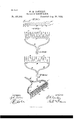
- Figure I represents a plan view of two blanks'cut or stamped out in carrying out my method of making rakes;
- Fig. II a View of a head-blank and braces before welding;
- Fig. III a view of the head-blank, braces, and tang after welding and
- Fig. IV a view of the finished rake.
- braces B are preferably formed from a rod doubled at its middle and having its arms curved to form the braces and its doubled middle forged to form a tang B.
- the reason for the forming of this butt-weld or scarf-weld is the following: In electric welding the two pieces to be welded are suitably clamped in the terminals of a circuit carrying a current of large Volume and of low tension, and the clamp holding the pieces are thereupon brought together with great force, bringing the meeting surfaces of the pieces, which have been heated to welding heat by the current, against each other and uniting them.
- the entire head would require to be heated to welding heat, as the points of the head where the welds are to be made cannot be brought to welding heat without heating the entire head, and this heating would in the meantime partly or entirely burn up the opposite braces.
- the head may be so clamped as to lead the current directly to the lugs, and to thus heat the latter to welding heat without heating the entire head.
- the teeth may be formed and the rake may be finished in any suitable or desired manner, said steps forming no part of the present invention.
Landscapes
- Engineering & Computer Science (AREA)
- Mechanical Engineering (AREA)
- Arc Welding In General (AREA)
Description
(No Model.)
W. H. OOWDERY.
METHOD OF MAKING RAKES.
No. 481,663. Patented Aug. 30, 1892.
' 01 {BIG-Ii- ]N VEN TOR.
W] T NESSES g-w jur 4 @Qg q AMORNE Y5 and shaping;
UNITED STATES PATENT OFFICE.
WARREN H. OOWDERY, OF ASHTABULA, OHIO.
METHOD OF MAKING RA KES.
SPECIFICATION forming part of Letters Patent No. 481,663, dated August 30, 1892.
Application filed November 17, 1891- $erial No. 412,152. (No model.)
To all whom it may concern:
Be it known that I, WARREN H. OowDEnY, a citizen of the United States, and a resident of Ashtabula, county of Ashtabula, and State of Ohio, have invented certain new and useful Improvements in Methods of Making Rakes, of which the following is a specification, the principle of the invention being herein explained and the best mode in which I have contemplated applying that principle so as to distinguish it from other inventions.
The annexed drawings and the following description set forth in detail one mechanical form embodying the invention, such detail construction being but one of various mechanical forms in which the principle of the invention may be employed.
In such annexed drawings, Figure I represents a plan view of two blanks'cut or stamped out in carrying out my method of making rakes; Fig. II, a View of a head-blank and braces before welding; "Fig. III, a view of the head-blank, braces, and tang after welding and Fig. IV, a view of the finished rake.
In carrying out my method I prefer to out two blanks from a flat bar of metal, as illus trated in Fig. I of the drawings, although one blank may be out at a time. By cutting the two blanks at one time the teeth of one rakeblank will mesh with the teeth of the other blank and waste of metal will be avoided. The blank severed from the bar consists of the headA and teeth a, and the headis formed with two lugs a, one at each end. When the blank has been cut from the bar, the lugs a are bent to project at right angles to the head and from the edge of the same, so as to form lugs for welding the braces to the head. The
braces B are preferably formed from a rod doubled at its middle and having its arms curved to form the braces and its doubled middle forged to form a tang B.
I prefer to employ the electric welding pro cess for uniting the braces to the head, and it is with this object in View that I form the blank with the 'two projecting lugs, so as to form a butt-weld or a scarf-weld instead of a T-weld. The reason for the forming of this butt-weld or scarf-weld is the following: In electric welding the two pieces to be welded are suitably clamped in the terminals of a circuit carrying a current of large Volume and of low tension, and the clamp holding the pieces are thereupon brought together with great force, bringing the meeting surfaces of the pieces, which have been heated to welding heat by the current, against each other and uniting them. If T-welds were formed between the heads and the braces, the entire head would require to be heated to welding heat, as the points of the head where the welds are to be made cannot be brought to welding heat without heating the entire head, and this heating would in the meantime partly or entirely burn up the opposite braces. By providing the lugs, however, the head may be so clamped as to lead the current directly to the lugs, and to thus heat the latter to welding heat without heating the entire head. The teeth may be formed and the rake may be finished in any suitable or desired manner, said steps forming no part of the present invention.
Other modes of applying the principle of my invention may be employed for the mode herein explained. Change may therefore be made as regards the mechanism herein set forth, provided the principles of construction respectively recited in the following claims are employed.
I therefore particularly point out and distinctly claim as my invention- 1. The improvement in the method of making rakes, which consists in forming the head with lugs projecting from the edge of the head and thereupon welding the braces to said lugs, substantially as set forth.
2. The method of making rakes, which consistsin firstformingthe ends of the head with lugs, then bending said lugs at an angle to the edge of the head, and finally welding the braces to said lugs, substantially as set forth.
3. The method of making rakes, which consists in forming the head with lugs projecting from its edge, doubling a rod to form braces, forging the doubled portion of the rod to form the tang, and welding the ends of the braces to the lugs upon the head, substantially as set forth.
In testimony that I claim the foregoing to be my invention I have hereunto set my hand this 13th day of November, A. D. 1891.
WARREN H. COWDERY. WVitnesses:
F. G. BAIL, EDwD. FAWL.
Publications (1)
| Publication Number | Publication Date |
|---|---|
| US481663A true US481663A (en) | 1892-08-30 |
Family
ID=2550515
Family Applications (1)
| Application Number | Title | Priority Date | Filing Date |
|---|---|---|---|
| US481663D Expired - Lifetime US481663A (en) | Method of making rakes |
Country Status (1)
| Country | Link |
|---|---|
| US (1) | US481663A (en) |
-
0
- US US481663D patent/US481663A/en not_active Expired - Lifetime
Similar Documents
| Publication | Publication Date | Title |
|---|---|---|
| US1347137A (en) | Manufacture of jaws for brake-rod connections | |
| US1522888A (en) | Means and method for uniting tools to handle shanks | |
| US979970A (en) | Method of electric welding. | |
| US414215A (en) | Manufacture of hollow-handled implements | |
| US398912A (en) | Method of manufacturing screws and bolts by electricity | |
| US914946A (en) | Method of welding. | |
| US923128A (en) | Process of electric welding. | |
| US323913A (en) | Manufacture of rakes | |
| US488503A (en) | William e | |
| US1900413A (en) | Method of making shears | |
| US1034256A (en) | Ax. | |
| US500904A (en) | A a a a a a a | |
| US514989A (en) | Lawn-rake | |
| US1164254A (en) | Method of shaping wire ends. | |
| US630537A (en) | Shears. | |
| US1314816A (en) | Laurence s | |
| US524719A (en) | Manufacture of pitchforks | |
| US489672A (en) | Lawn-rake | |
| US1321314A (en) | of la fayette | |
| US324553A (en) | Manufacture of | |
| US650687A (en) | Wire-cutter. | |
| US1063357A (en) | Process of electric welding. | |
| US1415091A (en) | Rod and method of making same | |
| US405661A (en) | Peters | |
| US134897A (en) | Improvement in spectacles |