US4672143A - Flame reactor for cracking hydrocarbons - Google Patents
Flame reactor for cracking hydrocarbons Download PDFInfo
- Publication number
- US4672143A US4672143A US06/796,382 US79638285A US4672143A US 4672143 A US4672143 A US 4672143A US 79638285 A US79638285 A US 79638285A US 4672143 A US4672143 A US 4672143A
- Authority
- US
- United States
- Prior art keywords
- flame
- products
- method recited
- hydrocarbons
- oxygen
- Prior art date
- Legal status (The legal status is an assumption and is not a legal conclusion. Google has not performed a legal analysis and makes no representation as to the accuracy of the status listed.)
- Expired - Fee Related
Links
- 229930195733 hydrocarbon Natural products 0.000 title claims abstract description 24
- 150000002430 hydrocarbons Chemical class 0.000 title claims abstract description 24
- 238000005336 cracking Methods 0.000 title claims abstract description 11
- 239000007789 gas Substances 0.000 claims abstract description 28
- 238000009792 diffusion process Methods 0.000 claims abstract description 16
- QVGXLLKOCUKJST-UHFFFAOYSA-N atomic oxygen Chemical compound [O] QVGXLLKOCUKJST-UHFFFAOYSA-N 0.000 claims abstract description 12
- 239000001301 oxygen Substances 0.000 claims abstract description 12
- 229910052760 oxygen Inorganic materials 0.000 claims abstract description 12
- KAKZBPTYRLMSJV-UHFFFAOYSA-N butadiene group Chemical group C=CC=C KAKZBPTYRLMSJV-UHFFFAOYSA-N 0.000 claims abstract description 11
- 230000002950 deficient Effects 0.000 claims abstract description 9
- VGGSQFUCUMXWEO-UHFFFAOYSA-N Ethene Chemical compound C=C VGGSQFUCUMXWEO-UHFFFAOYSA-N 0.000 claims abstract description 8
- 239000005977 Ethylene Substances 0.000 claims abstract description 8
- ATUOYWHBWRKTHZ-UHFFFAOYSA-N Propane Chemical compound CCC ATUOYWHBWRKTHZ-UHFFFAOYSA-N 0.000 claims abstract description 8
- HSFWRNGVRCDJHI-UHFFFAOYSA-N alpha-acetylene Natural products C#C HSFWRNGVRCDJHI-UHFFFAOYSA-N 0.000 claims abstract description 8
- NNBZCPXTIHJBJL-UHFFFAOYSA-N decalin Chemical compound C1CCCC2CCCCC21 NNBZCPXTIHJBJL-UHFFFAOYSA-N 0.000 claims abstract description 8
- 125000002534 ethynyl group Chemical group [H]C#C* 0.000 claims abstract description 8
- TVMXDCGIABBOFY-UHFFFAOYSA-N octane Chemical compound CCCCCCCC TVMXDCGIABBOFY-UHFFFAOYSA-N 0.000 claims abstract description 8
- QQONPFPTGQHPMA-UHFFFAOYSA-N propylene Natural products CC=C QQONPFPTGQHPMA-UHFFFAOYSA-N 0.000 claims abstract description 5
- 125000004805 propylene group Chemical group [H]C([H])([H])C([H])([*:1])C([H])([H])[*:2] 0.000 claims abstract description 5
- NHTMVDHEPJAVLT-UHFFFAOYSA-N Isooctane Chemical compound CC(C)CC(C)(C)C NHTMVDHEPJAVLT-UHFFFAOYSA-N 0.000 claims abstract description 4
- JVSWJIKNEAIKJW-UHFFFAOYSA-N dimethyl-hexane Natural products CCCCCC(C)C JVSWJIKNEAIKJW-UHFFFAOYSA-N 0.000 claims abstract description 4
- 125000000383 tetramethylene group Chemical group [H]C([H])([*:1])C([H])([H])C([H])([H])C([H])([H])[*:2] 0.000 claims abstract description 4
- PXXNTAGJWPJAGM-UHFFFAOYSA-N vertaline Natural products C1C2C=3C=C(OC)C(OC)=CC=3OC(C=C3)=CC=C3CCC(=O)OC1CC1N2CCCC1 PXXNTAGJWPJAGM-UHFFFAOYSA-N 0.000 claims abstract description 4
- 239000001294 propane Substances 0.000 claims abstract 2
- 238000000034 method Methods 0.000 claims description 14
- 238000006243 chemical reaction Methods 0.000 claims description 11
- 230000001590 oxidative effect Effects 0.000 claims description 9
- 238000002485 combustion reaction Methods 0.000 claims description 4
- OKTJSMMVPCPJKN-UHFFFAOYSA-N Carbon Chemical compound [C] OKTJSMMVPCPJKN-UHFFFAOYSA-N 0.000 claims description 3
- 229910052799 carbon Inorganic materials 0.000 claims description 3
- 239000000203 mixture Substances 0.000 claims description 3
- 238000000197 pyrolysis Methods 0.000 claims description 3
- IJGRMHOSHXDMSA-UHFFFAOYSA-N Atomic nitrogen Chemical compound N#N IJGRMHOSHXDMSA-UHFFFAOYSA-N 0.000 claims 2
- 238000001816 cooling Methods 0.000 claims 2
- 238000010438 heat treatment Methods 0.000 claims 1
- 229910052757 nitrogen Inorganic materials 0.000 claims 1
- 239000004215 Carbon black (E152) Substances 0.000 abstract description 7
- 239000000047 product Substances 0.000 description 22
- 239000000446 fuel Substances 0.000 description 9
- 238000004519 manufacturing process Methods 0.000 description 5
- 238000004939 coking Methods 0.000 description 4
- 239000000463 material Substances 0.000 description 3
- 239000000523 sample Substances 0.000 description 3
- 238000005070 sampling Methods 0.000 description 3
- OTMSDBZUPAUEDD-UHFFFAOYSA-N Ethane Chemical compound CC OTMSDBZUPAUEDD-UHFFFAOYSA-N 0.000 description 2
- 229910000831 Steel Inorganic materials 0.000 description 2
- 239000007795 chemical reaction product Substances 0.000 description 2
- VNWKTOKETHGBQD-UHFFFAOYSA-N methane Chemical compound C VNWKTOKETHGBQD-UHFFFAOYSA-N 0.000 description 2
- 238000012986 modification Methods 0.000 description 2
- 230000004048 modification Effects 0.000 description 2
- 239000003208 petroleum Substances 0.000 description 2
- 239000010959 steel Substances 0.000 description 2
- 150000001336 alkenes Chemical class 0.000 description 1
- 238000004523 catalytic cracking Methods 0.000 description 1
- 238000004517 catalytic hydrocracking Methods 0.000 description 1
- 239000000571 coke Substances 0.000 description 1
- 238000005260 corrosion Methods 0.000 description 1
- 230000007797 corrosion Effects 0.000 description 1
- 239000012634 fragment Substances 0.000 description 1
- 239000002737 fuel gas Substances 0.000 description 1
- 239000003502 gasoline Substances 0.000 description 1
- 125000004435 hydrogen atom Chemical group [H]* 0.000 description 1
- JRZJOMJEPLMPRA-UHFFFAOYSA-N olefin Natural products CCCCCCCC=C JRZJOMJEPLMPRA-UHFFFAOYSA-N 0.000 description 1
- 239000007800 oxidant agent Substances 0.000 description 1
- -1 propylene, butylene Chemical group 0.000 description 1
- 239000010453 quartz Substances 0.000 description 1
- 238000004064 recycling Methods 0.000 description 1
- 229920006395 saturated elastomer Polymers 0.000 description 1
- VYPSYNLAJGMNEJ-UHFFFAOYSA-N silicon dioxide Inorganic materials O=[Si]=O VYPSYNLAJGMNEJ-UHFFFAOYSA-N 0.000 description 1
- 239000004071 soot Substances 0.000 description 1
- 229910001220 stainless steel Inorganic materials 0.000 description 1
- 239000010935 stainless steel Substances 0.000 description 1
- 239000000126 substance Substances 0.000 description 1
- 238000004227 thermal cracking Methods 0.000 description 1
- 210000002268 wool Anatomy 0.000 description 1
Images


Classifications
-
- B—PERFORMING OPERATIONS; TRANSPORTING
- B01—PHYSICAL OR CHEMICAL PROCESSES OR APPARATUS IN GENERAL
- B01J—CHEMICAL OR PHYSICAL PROCESSES, e.g. CATALYSIS OR COLLOID CHEMISTRY; THEIR RELEVANT APPARATUS
- B01J12/00—Chemical processes in general for reacting gaseous media with gaseous media; Apparatus specially adapted therefor
- B01J12/005—Chemical processes in general for reacting gaseous media with gaseous media; Apparatus specially adapted therefor carried out at high temperatures, e.g. by pyrolysis
-
- C—CHEMISTRY; METALLURGY
- C07—ORGANIC CHEMISTRY
- C07C—ACYCLIC OR CARBOCYCLIC COMPOUNDS
- C07C4/00—Preparation of hydrocarbons from hydrocarbons containing a larger number of carbon atoms
- C07C4/02—Preparation of hydrocarbons from hydrocarbons containing a larger number of carbon atoms by cracking a single hydrocarbon or a mixture of individually defined hydrocarbons or a normally gaseous hydrocarbon fraction
-
- Y—GENERAL TAGGING OF NEW TECHNOLOGICAL DEVELOPMENTS; GENERAL TAGGING OF CROSS-SECTIONAL TECHNOLOGIES SPANNING OVER SEVERAL SECTIONS OF THE IPC; TECHNICAL SUBJECTS COVERED BY FORMER USPC CROSS-REFERENCE ART COLLECTIONS [XRACs] AND DIGESTS
- Y10—TECHNICAL SUBJECTS COVERED BY FORMER USPC
- Y10S—TECHNICAL SUBJECTS COVERED BY FORMER USPC CROSS-REFERENCE ART COLLECTIONS [XRACs] AND DIGESTS
- Y10S585/00—Chemistry of hydrocarbon compounds
- Y10S585/929—Special chemical considerations
- Y10S585/943—Synthesis from methane or inorganic carbon source, e.g. coal
Definitions
- the present invention relates to the cracking of hydrocarbons and more particularly to a diffusion flame reactor for hydrocarbon gas.
- Thermal cracking including catalytic cracking and hydrocracking, are extensively used for converting residual crude fractions or a heavy distillate into gasoline and light distillates, or reducing the viscosity of residual fractions, or for the production of coke.
- Coking and visbreaking are extensively used to convert hydrocarbons into more valuable products.
- Hydrocarbons are cracked, by pyrolysis in the center of a diffusion flame, or flame array, which has an interior which is at high temperature and is oxygen-deficient.
- the interior of such a flame forms a reactor for cracking the hydrocarbons.
- a reactor is embodied by a diffusion flame, as in the aforementioned Green application, or it is a flame array in a cylindrical or tubular configuration with a high temperature, oxygen-deficient zone at the center of the configuration.
- light hydrocarbons primarily C 2 -C 4 's and naphtha
- the flame or flame array is preferably in a cylindrical or tubular configuration oriented in the vertical direction.
- Fuel for the flame may be a portion of the feed stream itself or another hydrocarbon fuel which may be more readily available or less expensive.
- the feed is passed into the interior of the flame zone which is at high temperature and is oxygen-deficient. The flow rate of the feed is adjusted to optimize the residence time for good conversion and selectivity to the desired products.
- FIG. 1 depicts cracking in a single diffusion flame
- FIG. 2A is a side view of a flame ring reactor
- FIG. 2B is a top view of the reactor of FIG. 2A;
- FIG. 2C shows a flame ring reactor with the collector
- FIG. 2D shows a flame ring reactor bank and collectors
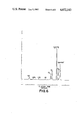
- FIG. 3 shows a chromatogram of products withdrawn from an n-propane flame reaction
- FIG. 4 shows a chromatogram of products withdrawn from an n-octane flame reaction
- FIG. 5 shows a gas chromatogram of products withdrawn from an iso-octane flame
- FIG. 6 shows a gas chromatogram of products withdrawn from a decalin flame reaction.
- hydrocarbons from a source 11 are fed through flow controller 12 to the diffusion flame burner 13 which includes burner tube 14, with the hydrocarbon gas being supplied to the bottom of the tube.
- Oxidizing gas flows past the top of burner tube 14.
- a 40% O 2 /60% N 2 mixture was fed to the inlet 15.
- the oxidizing gas flows through the coarse steel wool 16 upwardly past the top end of burner tube 14.
- a diffusion flame 17 is produced at the top of burner tube 14.
- a chimney 18 carries away soot and other combustion products. Cracked products are withdrawn from the center of the flame by the probe tube 19. The products are cooled convectively by the flowing oxidizing gas stream around the flame. This rapidly quenches the more cracked products, thereby stopping the reaction as desired.
- diffusion flame may be a single flame wherein hydrocarbons without oxidizing gas mixed therein are burned in a flame with oxidizing air being supplied to the outside of the flame.
- the reaction in the center of the flame is complex. Basically, it is pyrolisis wherein hydrogen atoms are stripped from the hydrocarbon gas.
- acetylene, C 2 H 2 ; ethylene, C 2 H 4 ; and ethane C 2 H 6 are produced. More complex propylene and butadiene are produced, depending on the residence time in the flame.
- the present invention provides a simple way to crack hydrocarbon gas to C 2 + materials which are valuable petrochemical feedstocks.
- the cracking levels can be maximized by recycling to the flame any unreacted gas which is collected, making the process multi-pass.
- the term "diffusion flame” may be a single flame as shown in FIG. 1, or it may be an array of flames with an oxygen-deficient zone in the center thereof, as shown in FIGS. 2A-2B.
- a circular array of fuel gas jets 20, 21, 22 and others establish a flame ring, or tubular flame, which is oriented in a vertical direction.
- the flames may be pre-mixed with air or other oxidant, or they may be pure fuel with the oxygen supplied from the outside of the flame array.
- the fuel for the flames is fed to the inlet 23 of the reactor and the feed gas is fed to the inlet 24.
- the fuel feed for the flames may be the same, or different, than the gas supplied to the reactor feed inlet 24.
- the gas jets 20-22 are closely spaced and form flames which are the reactor walls, as well as the heat source. This flame is operated at stoichiometric, or slightly fuel-rich, to ensure minimal oxygen content in the interior of the flame ring.
- the feed gas flows into the interior of the flame ring, along the central vertical axis where it undergoes pyrolysis to generate cracked products.
- the diameter of the flame ring, as well as its vertical dimension, are determined by the specific feed or feed/fuel combination to the burner such that the feed residence time/temperature history is optimized for product selectivity and conversion.
- the product stream is collected as it exits from the top of the flame ring by means of a sampling cap 25, as shown in FIG. 2C.
- the flame ring reactor is enclosed within the walls of a furnace 26 which exhausts the CO 2 , H 2 O combustions products from the flames.
- Another embodiment of the flame ring reactor is one in which the circular array of fuel jets is replaced by a thin slot which encircles the burner.
- a bank 27 of these flame ring reactors can be assembled as shown in FIG. 2D. Each is connected to a common feed line 28, and each of the collection caps is connected a common product withdrawal line 29. Products of combustion, primarily CO 2 and H 2 O, are collected separately via a single, overhead take-off port 30.
- the bank of flame ring reactors is enclosed in a refractory-line steel structure 31, the interior atmosphere of which is always oxygen-deficient due to operating the flame bank at stoichiometric or slightly fuel-rich.
- the present invention can be used in a cracking process for light olefin manufacture with improved thermal efficiency.
- a large volume chemical feedstock such as ethylene
- small gains in efficiency would result in large savings in manufacturing costs.
- the reactor operates without walls, high temperature materials limitations such as coking, corrosion and heat transfer are eliminated, leading to a process concept which is particularly useful for production of acetylene and butadiene.
- Hydrocarbons were precisely metered to the burner via a mass flow controller while a 40% O 2 /N 2 mixture was supplied separately to the burner at a flow rate of 12.5 liters/min.
- the products were withdrawn from the flame using either a stainless steel or quartz capillary sampling probe, collecting at a rate of approximately 5 cc/min.
- the reaction products were rapidly quenched by the withdrawal through the sampling probe which is cooled convectively by the flowing O 2 /N 2 gas stream around the flame.
- FIG. 3 shows a gas chromatogram of the gases sampled from an n-propane diffusion flame burning as described above. These gases were collected at a point corresponding to a residence time of approximately 200 m/sec. An analysis of the hydrocarbons shows the presence of ethane, ethylene, and acetylene, and other cracked products.
- FIGS. 4, 5 and 6 show gas chromatograms of sampled product gases from n-octane, iso-octane, and decalin diffusion flames, demonstrating the applicability of the concept to higher carbon number, saturated materials.
- the major products are unsaturates such as ethylene, acetylene, propylene, butylene and butadiene.
- FIGS. 3-6 were produced by a Carle refinery gas analyzer.
Landscapes
- Chemical & Material Sciences (AREA)
- Organic Chemistry (AREA)
- Chemical Kinetics & Catalysis (AREA)
- Engineering & Computer Science (AREA)
- General Chemical & Material Sciences (AREA)
- Oil, Petroleum & Natural Gas (AREA)
- Production Of Liquid Hydrocarbon Mixture For Refining Petroleum (AREA)
Abstract
A diffusion flame reactor for cracking hydrocarbon gas has an oxygen-deficient zone in the center of the flame or in the center of an array of flames. Propane, n-octane, iso-octane and decalin are cracked to ethylene, acetylene, propylene, butenes, and butadienes which are withdrawn from the flame.
Description
The present invention relates to the cracking of hydrocarbons and more particularly to a diffusion flame reactor for hydrocarbon gas.
Cracking is extensively used in petroleum processing for fracturing hydrocarbon molecules into smaller fragments. Thermal cracking, including catalytic cracking and hydrocracking, are extensively used for converting residual crude fractions or a heavy distillate into gasoline and light distillates, or reducing the viscosity of residual fractions, or for the production of coke. Coking and visbreaking are extensively used to convert hydrocarbons into more valuable products.
In particular, the manufacture of ethylene, acetylene, propylene, butenes, and butadienes from hydrocarbons having carbon number from 2 to 10 is an important part of petroleum processing.
It is an object of the present invention to crack hydrocarbons with a flame reactor which has no walls around the reaction zone.
It is another object of the present invention to minimize the problems of heat transfer across reactor walls and wall coking.
It is another object of the present invention to improve the efficiency of the cracking process.
"FLAME CONVERSION OF METHANE TO MORE REACTIVE HYDROCARBONS", Green, Ser. No. 796,366, filed 11/08/85 describes a single flame burner. That application is incorporated by reference herein.
Hydrocarbons are cracked, by pyrolysis in the center of a diffusion flame, or flame array, which has an interior which is at high temperature and is oxygen-deficient. In accordance with the invention, the interior of such a flame forms a reactor for cracking the hydrocarbons. Such a reactor is embodied by a diffusion flame, as in the aforementioned Green application, or it is a flame array in a cylindrical or tubular configuration with a high temperature, oxygen-deficient zone at the center of the configuration.
In accordance with the invention, light hydrocarbons, primarily C2 -C4 's and naphtha, are cracked to valuable products such as ethylene, acetylene, propylene, butenes, and butadienes. The flame or flame array is preferably in a cylindrical or tubular configuration oriented in the vertical direction. Fuel for the flame may be a portion of the feed stream itself or another hydrocarbon fuel which may be more readily available or less expensive. The feed is passed into the interior of the flame zone which is at high temperature and is oxygen-deficient. The flow rate of the feed is adjusted to optimize the residence time for good conversion and selectivity to the desired products.
Products are quenched/collected as they exit the flame zone with any unreacted feed. This unreacted feed is then recycled to the flame reactor. Since there are no walls associated with the reaction zone itself, problems with limited heat transfer across reactor walls and wall coking are eliminated. Therefore, the overall efficiency of the cracking process is improved using this scheme.
FIG. 1 depicts cracking in a single diffusion flame;
FIG. 2A is a side view of a flame ring reactor;
FIG. 2B is a top view of the reactor of FIG. 2A;
FIG. 2C shows a flame ring reactor with the collector;
FIG. 2D shows a flame ring reactor bank and collectors;
FIG. 3 shows a chromatogram of products withdrawn from an n-propane flame reaction;
FIG. 4 shows a chromatogram of products withdrawn from an n-octane flame reaction;
FIG. 5 shows a gas chromatogram of products withdrawn from an iso-octane flame; and
FIG. 6 shows a gas chromatogram of products withdrawn from a decalin flame reaction.
In FIG. 1, hydrocarbons from a source 11 are fed through flow controller 12 to the diffusion flame burner 13 which includes burner tube 14, with the hydrocarbon gas being supplied to the bottom of the tube. Oxidizing gas flows past the top of burner tube 14. In an exemplary embodiment, a 40% O2 /60% N2 mixture was fed to the inlet 15. The oxidizing gas flows through the coarse steel wool 16 upwardly past the top end of burner tube 14.
A diffusion flame 17 is produced at the top of burner tube 14. A chimney 18 carries away soot and other combustion products. Cracked products are withdrawn from the center of the flame by the probe tube 19. The products are cooled convectively by the flowing oxidizing gas stream around the flame. This rapidly quenches the more cracked products, thereby stopping the reaction as desired.
As used herein, "diffusion flame" may be a single flame wherein hydrocarbons without oxidizing gas mixed therein are burned in a flame with oxidizing air being supplied to the outside of the flame. The reaction in the center of the flame is complex. Basically, it is pyrolisis wherein hydrogen atoms are stripped from the hydrocarbon gas.
For example, acetylene, C2 H2 ; ethylene, C2 H4 ; and ethane C2 H6 are produced. More complex propylene and butadiene are produced, depending on the residence time in the flame.
The present invention provides a simple way to crack hydrocarbon gas to C2 + materials which are valuable petrochemical feedstocks.
The cracking levels can be maximized by recycling to the flame any unreacted gas which is collected, making the process multi-pass.
As used herein, the term "diffusion flame" may be a single flame as shown in FIG. 1, or it may be an array of flames with an oxygen-deficient zone in the center thereof, as shown in FIGS. 2A-2B. A circular array of fuel gas jets 20, 21, 22 and others establish a flame ring, or tubular flame, which is oriented in a vertical direction. The flames may be pre-mixed with air or other oxidant, or they may be pure fuel with the oxygen supplied from the outside of the flame array.
The fuel for the flames is fed to the inlet 23 of the reactor and the feed gas is fed to the inlet 24. The fuel feed for the flames may be the same, or different, than the gas supplied to the reactor feed inlet 24.
The gas jets 20-22 are closely spaced and form flames which are the reactor walls, as well as the heat source. This flame is operated at stoichiometric, or slightly fuel-rich, to ensure minimal oxygen content in the interior of the flame ring. The feed gas flows into the interior of the flame ring, along the central vertical axis where it undergoes pyrolysis to generate cracked products.
The diameter of the flame ring, as well as its vertical dimension, are determined by the specific feed or feed/fuel combination to the burner such that the feed residence time/temperature history is optimized for product selectivity and conversion.
The product stream is collected as it exits from the top of the flame ring by means of a sampling cap 25, as shown in FIG. 2C. The flame ring reactor is enclosed within the walls of a furnace 26 which exhausts the CO2, H2 O combustions products from the flames.
Another embodiment of the flame ring reactor is one in which the circular array of fuel jets is replaced by a thin slot which encircles the burner.
If an optimum flame ring dimension is realized for a given feed, but restricts the total throughput below that desired, a bank 27 of these flame ring reactors can be assembled as shown in FIG. 2D. Each is connected to a common feed line 28, and each of the collection caps is connected a common product withdrawal line 29. Products of combustion, primarily CO2 and H2 O, are collected separately via a single, overhead take-off port 30. The bank of flame ring reactors is enclosed in a refractory-line steel structure 31, the interior atmosphere of which is always oxygen-deficient due to operating the flame bank at stoichiometric or slightly fuel-rich.
The present invention can be used in a cracking process for light olefin manufacture with improved thermal efficiency. For a large volume chemical feedstock such as ethylene, small gains in efficiency would result in large savings in manufacturing costs. Since the reactor operates without walls, high temperature materials limitations such as coking, corrosion and heat transfer are eliminated, leading to a process concept which is particularly useful for production of acetylene and butadiene.
The following examples were performed with the laminar diffusion flame burner shown in FIG. 1.
Hydrocarbons were precisely metered to the burner via a mass flow controller while a 40% O2 /N2 mixture was supplied separately to the burner at a flow rate of 12.5 liters/min. The products were withdrawn from the flame using either a stainless steel or quartz capillary sampling probe, collecting at a rate of approximately 5 cc/min. The reaction products were rapidly quenched by the withdrawal through the sampling probe which is cooled convectively by the flowing O2 /N2 gas stream around the flame.
FIG. 3 shows a gas chromatogram of the gases sampled from an n-propane diffusion flame burning as described above. These gases were collected at a point corresponding to a residence time of approximately 200 m/sec. An analysis of the hydrocarbons shows the presence of ethane, ethylene, and acetylene, and other cracked products.
FIGS. 4, 5 and 6 show gas chromatograms of sampled product gases from n-octane, iso-octane, and decalin diffusion flames, demonstrating the applicability of the concept to higher carbon number, saturated materials. Among the major products are unsaturates such as ethylene, acetylene, propylene, butylene and butadiene. By controlling the residence time in the flame, and the flow rate, the type of reaction product can be controlled. Examples of this are shown in the aforementioned Green application.
FIGS. 3-6 were produced by a Carle refinery gas analyzer.
While a particular embodiment of the invention has been shown and described, various modifications are within the true spirit and scope of the invention. The appended claims are, therefore, intended to cover all such modifications.
Claims (9)
1. The method of cracking hydrocarbons comprising:
heating hydrocarbons in the oxygen-deficient center of a diffusion flame;
pyrolyzing the hydrocarbons to be cracked by pyrolysis in said oxygen-deficient center of said diffusion flame; and
withdrawing the cracked products from said oxygen-deficient center of said diffusion flame without mixing with the combustion products.
2. The method recited in claim 1 further comprising: flowing oxidizing gas outside of said diffusion flame.
3. The method recited in claim 2 further comprising:
cooling the withdrawn products to stop the reaction after withdrawal.
4. The method recited in claim 3 wherein the step of cooling is carried out by passing the withdrawn gas through the flowing oxidizing gas.
5. The method recited in claim 1 wherein said hydrocarbons are from the group consisting of propane, n-octane, iso-octane, and decalin.
6. The method recited in claim 1 wherein said cracked products have carbon numbers from 2 to 10.
7. The method recited in claim 6 wherein said cracked products are from the group consisting of ethylene, acetylene, propylene, butenes and butadiene.
8. The method recited in claim 1 further comprising:
controlling the residence time of said gas in the center of said flame to control the type of cracked products which are produced.
9. The method recited in claim 2 wherein said oxidizing gas is a mixture of oxygen and nitrogen.
Priority Applications (1)
| Application Number | Priority Date | Filing Date | Title |
|---|---|---|---|
| US06/796,382 US4672143A (en) | 1985-11-08 | 1985-11-08 | Flame reactor for cracking hydrocarbons |
Applications Claiming Priority (1)
| Application Number | Priority Date | Filing Date | Title |
|---|---|---|---|
| US06/796,382 US4672143A (en) | 1985-11-08 | 1985-11-08 | Flame reactor for cracking hydrocarbons |
Publications (1)
| Publication Number | Publication Date |
|---|---|
| US4672143A true US4672143A (en) | 1987-06-09 |
Family
ID=25168073
Family Applications (1)
| Application Number | Title | Priority Date | Filing Date |
|---|---|---|---|
| US06/796,382 Expired - Fee Related US4672143A (en) | 1985-11-08 | 1985-11-08 | Flame reactor for cracking hydrocarbons |
Country Status (1)
| Country | Link |
|---|---|
| US (1) | US4672143A (en) |
Cited By (1)
| Publication number | Priority date | Publication date | Assignee | Title |
|---|---|---|---|---|
| RU2172731C1 (en) * | 2000-07-13 | 2001-08-27 | Алесковский Валентин Борисович | Chemical processing of methane |
Citations (6)
| Publication number | Priority date | Publication date | Assignee | Title |
|---|---|---|---|---|
| GB908351A (en) * | 1958-06-27 | 1962-10-17 | Montedison Spa | Process and apparatus for thermal cracking of a hydrocarbon |
| US3153104A (en) * | 1961-03-22 | 1964-10-13 | Du Pont | Cooling by recirculated product in diffusion flame process for production of acetylene and ethylene |
| US3399245A (en) * | 1966-01-28 | 1968-08-27 | Monsanto Co | Process and apparatus for partial combustion of hydrocarbons |
| US3453084A (en) * | 1965-05-05 | 1969-07-01 | Air Liquide | Apparatus for cracking and burning hydrocarbons |
| US3541179A (en) * | 1966-11-10 | 1970-11-17 | Japan Gasoline | Process for manufacturing olefins by catalytic partial oxidation of hydrocarbons |
| US4136015A (en) * | 1977-06-07 | 1979-01-23 | Union Carbide Corporation | Process for the thermal cracking of hydrocarbons |
-
1985
- 1985-11-08 US US06/796,382 patent/US4672143A/en not_active Expired - Fee Related
Patent Citations (6)
| Publication number | Priority date | Publication date | Assignee | Title |
|---|---|---|---|---|
| GB908351A (en) * | 1958-06-27 | 1962-10-17 | Montedison Spa | Process and apparatus for thermal cracking of a hydrocarbon |
| US3153104A (en) * | 1961-03-22 | 1964-10-13 | Du Pont | Cooling by recirculated product in diffusion flame process for production of acetylene and ethylene |
| US3453084A (en) * | 1965-05-05 | 1969-07-01 | Air Liquide | Apparatus for cracking and burning hydrocarbons |
| US3399245A (en) * | 1966-01-28 | 1968-08-27 | Monsanto Co | Process and apparatus for partial combustion of hydrocarbons |
| US3541179A (en) * | 1966-11-10 | 1970-11-17 | Japan Gasoline | Process for manufacturing olefins by catalytic partial oxidation of hydrocarbons |
| US4136015A (en) * | 1977-06-07 | 1979-01-23 | Union Carbide Corporation | Process for the thermal cracking of hydrocarbons |
Cited By (1)
| Publication number | Priority date | Publication date | Assignee | Title |
|---|---|---|---|---|
| RU2172731C1 (en) * | 2000-07-13 | 2001-08-27 | Алесковский Валентин Борисович | Chemical processing of methane |
Similar Documents
| Publication | Publication Date | Title |
|---|---|---|
| Alzueta et al. | Low temperature interactions between hydrocarbons and nitric oxide: an experimental study | |
| CN102224221A (en) | Conversion of co-fed methane and low hydrogen content hydrocarbon feedstocks to acetylene | |
| CN106854127B (en) | Method and device for preparing acetylene and/or synthesis gas from hydrocarbon | |
| JPH0210186B2 (en) | ||
| BG62859B1 (en) | METHOD FOR CONVERSION OF HYDROCARBONS | |
| JPH0637402B2 (en) | Natural gas conversion method | |
| dos S. Vargette et al. | Comprehensive fouling assessment in steam crackers: fossil versus renewable NEXBTL naphtha | |
| US3685977A (en) | Partial oxidation of hydrocarbons | |
| US3213015A (en) | Cracking of hydrocarbons with steam or carbon dioxide | |
| US3515519A (en) | Apparatus for electric arc-cracking of hydrocarbons | |
| US4672144A (en) | Flame conversion of methane to more reactive hydrocarbons | |
| US8986639B2 (en) | Denox treatment for a regenerative pyrolysis reactor | |
| EA029584B1 (en) | Production of aromatic hydrocarbons | |
| US3156544A (en) | Apparatus for making combustible gas | |
| WO2004039921A1 (en) | Process for fluid catalytic cracking of hydrocarbon feedstocks with high levels of basic nitrogen | |
| US4251674A (en) | Method and apparatus for improving the selectivity of a process for hydrogenating acetylene to ethylene | |
| WO2004098766A1 (en) | Device for converting gaseous streams | |
| US7250449B2 (en) | High temperature hydrocarbon cracking | |
| WO1997016506A2 (en) | Single stage oil refining process | |
| RU2409542C1 (en) | Method of producing acetylene from methane | |
| Maraval | Characteristics of soot collected in industrial diffusion flames | |
| EP0205598A1 (en) | CONVERSION SYSTEM FOR NATURAL GAS. | |
| US3153104A (en) | Cooling by recirculated product in diffusion flame process for production of acetylene and ethylene | |
| RU2149885C1 (en) | Method of processing petroleum and petroleum derivatives | |
| NO850636L (en) | HIGH-TEMPERATURE PREPARATION OF NATURAL GAS FUEL |
Legal Events
| Date | Code | Title | Description |
|---|---|---|---|
| AS | Assignment |
Owner name: MOBIL OIL CORPORATION, A CORP. OF NEW YORK Free format text: ASSIGNMENT OF ASSIGNORS INTEREST.;ASSIGNORS:GREEN, GARY J.;YAN, TSOUNG-Y;REEL/FRAME:004481/0801 Effective date: 19851028 |
|
| FPAY | Fee payment |
Year of fee payment: 4 |
|
| REMI | Maintenance fee reminder mailed | ||
| LAPS | Lapse for failure to pay maintenance fees | ||
| FP | Lapsed due to failure to pay maintenance fee |
Effective date: 19950614 |
|
| STCH | Information on status: patent discontinuation |
Free format text: PATENT EXPIRED DUE TO NONPAYMENT OF MAINTENANCE FEES UNDER 37 CFR 1.362 |