US4552796A - Composite product having a low-porosity support layer - Google Patents
Composite product having a low-porosity support layer Download PDFInfo
- Publication number
- US4552796A US4552796A US06/664,533 US66453384A US4552796A US 4552796 A US4552796 A US 4552796A US 66453384 A US66453384 A US 66453384A US 4552796 A US4552796 A US 4552796A
- Authority
- US
- United States
- Prior art keywords
- plastisol
- low
- support
- precoat
- perforations
- Prior art date
- Legal status (The legal status is an assumption and is not a legal conclusion. Google has not performed a legal analysis and makes no representation as to the accuracy of the status listed.)
- Expired - Fee Related
Links
- 239000002131 composite material Substances 0.000 title claims abstract description 17
- 229920001944 Plastisol Polymers 0.000 claims abstract description 39
- 239000004999 plastisol Substances 0.000 claims abstract description 39
- 238000000576 coating method Methods 0.000 claims abstract description 25
- 239000000463 material Substances 0.000 claims abstract description 25
- 239000011248 coating agent Substances 0.000 claims abstract description 18
- 239000000758 substrate Substances 0.000 claims description 18
- 239000006223 plastic coating Substances 0.000 claims 1
- 239000010425 asbestos Substances 0.000 abstract description 15
- 229910052895 riebeckite Inorganic materials 0.000 abstract description 15
- 238000000034 method Methods 0.000 abstract description 14
- 238000005034 decoration Methods 0.000 abstract description 6
- 239000010410 layer Substances 0.000 description 27
- 239000000047 product Substances 0.000 description 26
- 238000004519 manufacturing process Methods 0.000 description 6
- 239000000203 mixture Substances 0.000 description 5
- 238000004873 anchoring Methods 0.000 description 4
- 239000011247 coating layer Substances 0.000 description 4
- 230000000694 effects Effects 0.000 description 4
- 238000009472 formulation Methods 0.000 description 4
- 230000032798 delamination Effects 0.000 description 3
- 238000007730 finishing process Methods 0.000 description 3
- 239000011888 foil Substances 0.000 description 3
- 239000000126 substance Substances 0.000 description 3
- 238000007646 gravure printing Methods 0.000 description 2
- 239000002184 metal Substances 0.000 description 2
- 229910052751 metal Inorganic materials 0.000 description 2
- 230000004048 modification Effects 0.000 description 2
- 238000012986 modification Methods 0.000 description 2
- 239000004033 plastic Substances 0.000 description 2
- 238000007639 printing Methods 0.000 description 2
- 239000007795 chemical reaction product Substances 0.000 description 1
- 239000003795 chemical substances by application Substances 0.000 description 1
- 238000010276 construction Methods 0.000 description 1
- 239000000839 emulsion Substances 0.000 description 1
- 239000012467 final product Substances 0.000 description 1
- 238000009408 flooring Methods 0.000 description 1
- 239000011521 glass Substances 0.000 description 1
- 238000009434 installation Methods 0.000 description 1
- 239000011490 mineral wool Substances 0.000 description 1
- 239000000123 paper Substances 0.000 description 1
- 239000004014 plasticizer Substances 0.000 description 1
- 229920000098 polyolefin Polymers 0.000 description 1
- 238000002360 preparation method Methods 0.000 description 1
- 238000006467 substitution reaction Methods 0.000 description 1
- 239000012209 synthetic fiber Substances 0.000 description 1
- 229920002994 synthetic fiber Polymers 0.000 description 1
Images
Classifications
-
- D—TEXTILES; PAPER
- D06—TREATMENT OF TEXTILES OR THE LIKE; LAUNDERING; FLEXIBLE MATERIALS NOT OTHERWISE PROVIDED FOR
- D06N—WALL, FLOOR, OR LIKE COVERING MATERIALS, e.g. LINOLEUM, OILCLOTH, ARTIFICIAL LEATHER, ROOFING FELT, CONSISTING OF A FIBROUS WEB COATED WITH A LAYER OF MACROMOLECULAR MATERIAL; FLEXIBLE SHEET MATERIAL NOT OTHERWISE PROVIDED FOR
- D06N7/00—Flexible sheet materials not otherwise provided for, e.g. textile threads, filaments, yarns or tow, glued on macromolecular material
- D06N7/0005—Floor covering on textile basis comprising a fibrous substrate being coated with at least one layer of a polymer on the top surface
- D06N7/006—Floor covering on textile basis comprising a fibrous substrate being coated with at least one layer of a polymer on the top surface characterised by the textile substrate as base web
-
- D—TEXTILES; PAPER
- D06—TREATMENT OF TEXTILES OR THE LIKE; LAUNDERING; FLEXIBLE MATERIALS NOT OTHERWISE PROVIDED FOR
- D06N—WALL, FLOOR, OR LIKE COVERING MATERIALS, e.g. LINOLEUM, OILCLOTH, ARTIFICIAL LEATHER, ROOFING FELT, CONSISTING OF A FIBROUS WEB COATED WITH A LAYER OF MACROMOLECULAR MATERIAL; FLEXIBLE SHEET MATERIAL NOT OTHERWISE PROVIDED FOR
- D06N3/00—Artificial leather, oilcloth or other material obtained by covering fibrous webs with macromolecular material, e.g. resins, rubber or derivatives thereof
- D06N3/04—Artificial leather, oilcloth or other material obtained by covering fibrous webs with macromolecular material, e.g. resins, rubber or derivatives thereof with macromolecular compounds obtained by reactions only involving carbon-to-carbon unsaturated bonds
- D06N3/06—Artificial leather, oilcloth or other material obtained by covering fibrous webs with macromolecular material, e.g. resins, rubber or derivatives thereof with macromolecular compounds obtained by reactions only involving carbon-to-carbon unsaturated bonds with polyvinylchloride or its copolymerisation products
-
- D—TEXTILES; PAPER
- D06—TREATMENT OF TEXTILES OR THE LIKE; LAUNDERING; FLEXIBLE MATERIALS NOT OTHERWISE PROVIDED FOR
- D06N—WALL, FLOOR, OR LIKE COVERING MATERIALS, e.g. LINOLEUM, OILCLOTH, ARTIFICIAL LEATHER, ROOFING FELT, CONSISTING OF A FIBROUS WEB COATED WITH A LAYER OF MACROMOLECULAR MATERIAL; FLEXIBLE SHEET MATERIAL NOT OTHERWISE PROVIDED FOR
- D06N7/00—Flexible sheet materials not otherwise provided for, e.g. textile threads, filaments, yarns or tow, glued on macromolecular material
- D06N7/0005—Floor covering on textile basis comprising a fibrous substrate being coated with at least one layer of a polymer on the top surface
-
- Y—GENERAL TAGGING OF NEW TECHNOLOGICAL DEVELOPMENTS; GENERAL TAGGING OF CROSS-SECTIONAL TECHNOLOGIES SPANNING OVER SEVERAL SECTIONS OF THE IPC; TECHNICAL SUBJECTS COVERED BY FORMER USPC CROSS-REFERENCE ART COLLECTIONS [XRACs] AND DIGESTS
- Y10—TECHNICAL SUBJECTS COVERED BY FORMER USPC
- Y10T—TECHNICAL SUBJECTS COVERED BY FORMER US CLASSIFICATION
- Y10T156/00—Adhesive bonding and miscellaneous chemical manufacture
- Y10T156/10—Methods of surface bonding and/or assembly therefor
- Y10T156/1052—Methods of surface bonding and/or assembly therefor with cutting, punching, tearing or severing
- Y10T156/1056—Perforating lamina
-
- Y—GENERAL TAGGING OF NEW TECHNOLOGICAL DEVELOPMENTS; GENERAL TAGGING OF CROSS-SECTIONAL TECHNOLOGIES SPANNING OVER SEVERAL SECTIONS OF THE IPC; TECHNICAL SUBJECTS COVERED BY FORMER USPC CROSS-REFERENCE ART COLLECTIONS [XRACs] AND DIGESTS
- Y10—TECHNICAL SUBJECTS COVERED BY FORMER USPC
- Y10T—TECHNICAL SUBJECTS COVERED BY FORMER US CLASSIFICATION
- Y10T428/00—Stock material or miscellaneous articles
- Y10T428/24—Structurally defined web or sheet [e.g., overall dimension, etc.]
- Y10T428/24273—Structurally defined web or sheet [e.g., overall dimension, etc.] including aperture
- Y10T428/24322—Composite web or sheet
- Y10T428/24331—Composite web or sheet including nonapertured component
- Y10T428/24339—Keyed
- Y10T428/24347—From both sides
-
- Y—GENERAL TAGGING OF NEW TECHNOLOGICAL DEVELOPMENTS; GENERAL TAGGING OF CROSS-SECTIONAL TECHNOLOGIES SPANNING OVER SEVERAL SECTIONS OF THE IPC; TECHNICAL SUBJECTS COVERED BY FORMER USPC CROSS-REFERENCE ART COLLECTIONS [XRACs] AND DIGESTS
- Y10—TECHNICAL SUBJECTS COVERED BY FORMER USPC
- Y10T—TECHNICAL SUBJECTS COVERED BY FORMER US CLASSIFICATION
- Y10T428/00—Stock material or miscellaneous articles
- Y10T428/249921—Web or sheet containing structurally defined element or component
- Y10T428/249953—Composite having voids in a component [e.g., porous, cellular, etc.]
- Y10T428/249987—With nonvoid component of specified composition
- Y10T428/249988—Of about the same composition as, and adjacent to, the void-containing component
-
- Y—GENERAL TAGGING OF NEW TECHNOLOGICAL DEVELOPMENTS; GENERAL TAGGING OF CROSS-SECTIONAL TECHNOLOGIES SPANNING OVER SEVERAL SECTIONS OF THE IPC; TECHNICAL SUBJECTS COVERED BY FORMER USPC CROSS-REFERENCE ART COLLECTIONS [XRACs] AND DIGESTS
- Y10—TECHNICAL SUBJECTS COVERED BY FORMER USPC
- Y10T—TECHNICAL SUBJECTS COVERED BY FORMER US CLASSIFICATION
- Y10T428/00—Stock material or miscellaneous articles
- Y10T428/26—Web or sheet containing structurally defined element or component, the element or component having a specified physical dimension
- Y10T428/269—Web or sheet containing structurally defined element or component, the element or component having a specified physical dimension including synthetic resin or polymer layer or component
Definitions
- This invention relates to an improved composite product having a low-porosity support layer and the method of manufacture thereof. More particularly, this invention relates to an improved composite product and an improved process for the manufacture thereof comprising a layer or substrate of a low-porosity material, such as asbestos, and intended to serve as a floor covering product.
- a low-porosity material such as asbestos
- this invention improves the bond strength and delaminating resistance of a sheet of a low-porosity material, such as asbestos, present as in internal layer in a floor covering product.
- the present invention produces an improved composite product, particularly a flooring covering product, having significantly improved bond strength via a new process of manufacture which results in a floor covering product having improved properties.
- the composite product is made by a process which comprises at least the following general steps:
- This finishing process can, in particular, include:
- the composite products to which the present invention is applicable typically employ an asbestos sheet as the internal support or substrate layer
- various other types of support may be found in these composite materials, which supports by reason of the low-porosity characteristics do not permit good chemical and/or physical anchoring or bonding of the various coating layers applied to the support layer.
- the present invention overcomes this problem by perforating the nonporous support layer so as to achieve, in effect, a riveting of the coating layers across the nonporous support layer to fix or anchor the nonporous support layer to the coating layers.
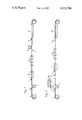
- FIG. 1 is a schematic illustration of the manufacturing sequence, and the equipment used therein, to effect the process and produce the end product of the present invention.
- FIG. 2 is a view similar to FIG. 1 showing a modification.
- the present invention produces an improved composite product, particularly a floor covering product, having significanly improved bond strength via a new process of manufacture which results in a floor covering product having improved properties.
- the composite product is made by a process which comprises at least the following general steps:
- This finishing process can, in particular, include:
- the composite products of the present invention will employ an asbestos sheet as the internal support layer; but various other types of supports or substrates, which by reason of their low-porosity characteristics do not permit good chemical and/or physical anchoring or bonding of the various coating layers to the support layer may also be used.
- possible support layers in addition to asbestos include known asbestos substitutes (e.g. rock wool), paper sheet, cardboard, other cellulosic materials, and felts of synthetic fibers based on polyolefines.
- metal foils e.g. copper or aluminimun
- these foils materials having the additional advantage of imparting desirable properties from a thermal standpoint.
- the support layer of nonporous or low-porosity material is perforated to provide anchoring or riveting sites for the layers coated on the support sheet.
- the perforations will preferrably be in a grid array, and the number, diameter and size of the perforations in the grid pattern will depend on the nature and thickness of the support material.
- perforations of from 0.5 to 3 mm diameter, arranged in a unit grid of from 2 to 20 mm on each side (i.e., one perforation per unit of grid) have been found to be suitable and preferred.
- These perforations can be produced by any mechanical means, such as by dies and punches, by means of spiked drums or by any other suitable apparatus.
- bond strenghts of 1.1 kg/cm where obtained using a 0.6 mm thick asbestos substrate sheet with perforations of 1.5 mm diameter in a unit grid of 8 mm on each side (i.e., one perforation of 1.5 mm diameter in each square section of 8 by 8 mm of the asbestos sheet).
- a bond strength of 2.6 kg/cm was obtained for that same material and perforation dimension using a grid dimension of 4 mm on each side; i.e., one perforation of 1.5 mm diameter in each square unit of asbestos measuring 4 mm on each side.
- a compact (i.e., nonexpandable or nonfoamable) plastisol precoat is coated onto both faces (i.e., front and back) of the perforated support.
- This coating on both sides of the perforated support can be effected successively on each side or simultaneously on both sides.
- the plastisol precoat is preferably applied in a thickness ranging from 0.005 to 3 mm and most preferably on the order of 0.15 mm onto both faces of the support.
- the perforations in the support are thus essentially filled up and the plastisol coatings on the two faces of the low-porosity support material join through the perforations and are then anchored to each other through the perforations.
- the compact PVC plastisol percoat may be applied to the substrate material by any well know technique, such as by the use of doctor blades, an air knife technique, or the so-called "reverse roll" technique.
- the parameters for chosing suitable PVC plastisol materials for use in accordance with the present invention are relatively simple.
- the compact plastisol should have a nonfoamable formulation; the base of the formulation is PVC of the emulsion type; and the nature and the content of the plasticiser must be such as to give sufficient tensile strength in the final product. It has been found that the use of highly plasticised and filled plastisol formulations typically used in preparation of glass web material are not suitable because they do not achieve bond strengths greater than 0.5 kg/cm regardless of the number of perforations per unit area of the support.
- the plastisol coat or coatings on the perforated substrates are gelled; and a foamable coating will also be employed in the finishing process of the floor covering product.
- Gelling will be carried out in the normal temperature range on the order of from 120° C. to 150° C. Expansion or curing of the foamable coating and final fusing are carried out at a higher temperature which will be determined by the formulation of the foamable composition, temperatures on the order of about 200° C. being typical.
- the gelling can be effected by any known technique, such as by use of a heated drum, in an oven or by radiant heat.
- FIGS. 1 and 2 illustration typical and practical embodiments of the present invention; but it will be understood that numerous other working configurations are also possible within the spirit and scope of the invention.
- a perforated support or substrate material 1 such as asbestos, is provides in the form of a roll or coil.
- a compact (non-foamable) PVC plastisol precoat 2 is applied to the perforated support or substrate 1, and the plastisol precoat is gelled on a heated drum 3.
- a second PVC plastisol 4 is then applied to the gelled precoat, this second plastisol 4 being foamable.
- the second plastisol is then gelled in oven 5.
- a four color gravure printing is then effected on the foamable layer at rolls 6.
- a third layer of compact, (nonfoamable) plastisol 7 is then applied to the back or reverse side of the support 1, followed by gelling on a heated drum 8.
- a fourth and last coating of an unfilled and transparent plastisol 9 is applied over the foamable and decorated plastisol to serve as a wear-resistant layer.
- the composite assembly is then expanded, cured and fused completely in oven 10.
- the perforated support or substrate material 1 such as asbestos, is provides in the form of a roll or coil.
- a first compact, (non-foamable) PVC plastisol precoat 2 is applied to the front or upper surface of the perforated support or substrate 1, and the plastisol precoat is gelled on a heated drum 3.
- a second layer of PVC plastisol precoat 2' is applied to the back surface of substrate 1, and the second precoat layer is gelled on a heated drum 3'.
- a second PVC plastisol 4 is then applied to the gelled precoat on the upper surface of substrate 1, this second plastisol 4 being foamable.
- the second plastisol is then gelled in oven 5.
- a four color gravure printing is then effected at rolls 6.
- a fourth and last coating of an unfilled and transparent plastisol 9 is applied over the foamable and decorated plastisol to serve as a wear-resistant layer.
- the composite assembly is then expanded, cured and fused completely in oven 10.
- the present invention makes it possible to produce floor coverings from nonporous support materials or support materials of low-porosity, such as asbestos, certain cellulosic materials or metal foils, which by their nature are unreceptive to chemical anchoring agents.
- the product and process of the present invention results in a composite material of high bond strengths which resist delamination and are particularly effective and suitable for use as decorative floor coverings.
Landscapes
- Textile Engineering (AREA)
- Engineering & Computer Science (AREA)
- Chemical & Material Sciences (AREA)
- Chemical Kinetics & Catalysis (AREA)
- Laminated Bodies (AREA)
- Floor Finish (AREA)
- Synthetic Leather, Interior Materials Or Flexible Sheet Materials (AREA)
- Coating Of Shaped Articles Made Of Macromolecular Substances (AREA)
- Paints Or Removers (AREA)
- Manufacture Of Porous Articles, And Recovery And Treatment Of Waste Products (AREA)
- Tents Or Canopies (AREA)
- Road Signs Or Road Markings (AREA)
- Window Of Vehicle (AREA)
- Transition And Organic Metals Composition Catalysts For Addition Polymerization (AREA)
Abstract
A composite floor covering product comprising a layer of low-porosity support material, such as asbestos, is produced by a process comprising the steps of
(a) perforating a low-porosity support material,
(b) coating a compact PVC plastisol precoat onto at least one face of the perforated low-porosity support, and
(c) finishing the product with various coatings and decorations, comprising at least one fusing or gelling stage.
Description
This application is a division of application Ser. No. 413,746, filed Sept. 1, 1982, now U.S. Pat. No. 4,492,606.
This invention relates to an improved composite product having a low-porosity support layer and the method of manufacture thereof. More particularly, this invention relates to an improved composite product and an improved process for the manufacture thereof comprising a layer or substrate of a low-porosity material, such as asbestos, and intended to serve as a floor covering product.
In particular, this invention improves the bond strength and delaminating resistance of a sheet of a low-porosity material, such as asbestos, present as in internal layer in a floor covering product.
In the floor covering market a certain number of products are known and available which include a layer, generally of asbestos, which serves as a support for various PVC plastisol coatings and ink printings combined in a known manner to obtain a finished product. If this support layer is sandwiched between two plasticised PVC sheets (as is typical in construction of this type), it has been found that the bond strength between the plasticised PVC sheets and the support layer is poor in the contact zone between those sheets. It has been found that it is possible to completely delaminate products of this type at low force or stress levels. Tests have shown that a force as low as 0.08 kg(1.73×10⁻³ W) per cm. width of material is sufficient to effect delamination in these prior art products. This delamination presents a serious problem and drawback to the utility of these floor covering products. Experience shows that bond strengths of at least ten times greater than are now generally available (i.e., on the order of 1 kg/cm) are required to insure that the composite material stays together during handling, in particular during laying or installation on floors, and remains together for long periods of use and service.
The present invention produces an improved composite product, particularly a flooring covering product, having significantly improved bond strength via a new process of manufacture which results in a floor covering product having improved properties.
In accordance with the broadest aspect of the present invention, the composite product is made by a process which comprises at least the following general steps:
(a) Perforating a nonporous support material,
(b) Coating a compact PVC plastisol precoat onto at least one surface of the perforated nonporous support layer, and
(c) finishing the product with various coatings and decorations, as known in the art, with at least one fusing or gelling stage.
This finishing process can, in particular, include:
(a) gelling the PVC plastisol precoat at a temperature compatible with the nature of the plastic employed,
(b) applying a foamable coating and decoration on to the face of the support which has received the plastisol precoat, and
(c) expanding or curing the foamable coating.
While the composite products to which the present invention is applicable typically employ an asbestos sheet as the internal support or substrate layer, various other types of support may be found in these composite materials, which supports by reason of the low-porosity characteristics do not permit good chemical and/or physical anchoring or bonding of the various coating layers applied to the support layer. The present invention overcomes this problem by perforating the nonporous support layer so as to achieve, in effect, a riveting of the coating layers across the nonporous support layer to fix or anchor the nonporous support layer to the coating layers.
Referring now to the drawings, wherein like elements are number alike in the two figures:
FIG. 1 is a schematic illustration of the manufacturing sequence, and the equipment used therein, to effect the process and produce the end product of the present invention.
FIG. 2 is a view similar to FIG. 1 showing a modification.
The present invention produces an improved composite product, particularly a floor covering product, having significanly improved bond strength via a new process of manufacture which results in a floor covering product having improved properties.
In accordance with the broadest aspects of the present invention, the composite product is made by a process which comprises at least the following general steps:
(a) Perforating a nonporous support material,
(b) Coating a compact PVC plastisol precoat onto at least one surface of the perforated nonporous support layer, and
(c) finishing the product with various coatings and decorations, as known in the art, with at least one fusing or gelling stage.
This finishing process can, in particular, include:
(a) gelling the PVC plastisol precoat at a temperature compatible with the nature of the plastic employed,
(b) applying a foamable coating and decoration on to the face of the support which has received the plastisol precoat, and
(c) expanding or curing the foamable coating.
Typically the composite products of the present invention will employ an asbestos sheet as the internal support layer; but various other types of supports or substrates, which by reason of their low-porosity characteristics do not permit good chemical and/or physical anchoring or bonding of the various coating layers to the support layer may also be used. By way of example, possible support layers in addition to asbestos include known asbestos substitutes (e.g. rock wool), paper sheet, cardboard, other cellulosic materials, and felts of synthetic fibers based on polyolefines. In addition, metal foils, (e.g. copper or aluminimun) may also be employed as the support or substrate material, these foils materials having the additional advantage of imparting desirable properties from a thermal standpoint.
As indicated above, the support layer of nonporous or low-porosity material is perforated to provide anchoring or riveting sites for the layers coated on the support sheet. The perforations will preferrably be in a grid array, and the number, diameter and size of the perforations in the grid pattern will depend on the nature and thickness of the support material. For an asbestos substrate layer, perforations of from 0.5 to 3 mm diameter, arranged in a unit grid of from 2 to 20 mm on each side (i.e., one perforation per unit of grid) have been found to be suitable and preferred. These perforations can be produced by any mechanical means, such as by dies and punches, by means of spiked drums or by any other suitable apparatus. By way of illustration of the improved results which have been achieved in accordance with the present invention, bond strenghts of 1.1 kg/cm where obtained using a 0.6 mm thick asbestos substrate sheet with perforations of 1.5 mm diameter in a unit grid of 8 mm on each side (i.e., one perforation of 1.5 mm diameter in each square section of 8 by 8 mm of the asbestos sheet). Also, a bond strength of 2.6 kg/cm was obtained for that same material and perforation dimension using a grid dimension of 4 mm on each side; i.e., one perforation of 1.5 mm diameter in each square unit of asbestos measuring 4 mm on each side. These bond strengths exceed, by a wide margin, the minimum value of 1 kg/cm which is considered necessary to have an acceptable product.
In the preferred embodiment of the present invention, a compact (i.e., nonexpandable or nonfoamable) plastisol precoat is coated onto both faces (i.e., front and back) of the perforated support. This coating on both sides of the perforated support can be effected successively on each side or simultaneously on both sides. The plastisol precoat is preferably applied in a thickness ranging from 0.005 to 3 mm and most preferably on the order of 0.15 mm onto both faces of the support. The perforations in the support are thus essentially filled up and the plastisol coatings on the two faces of the low-porosity support material join through the perforations and are then anchored to each other through the perforations. The compact PVC plastisol percoat may be applied to the substrate material by any well know technique, such as by the use of doctor blades, an air knife technique, or the so-called "reverse roll" technique.
The parameters for chosing suitable PVC plastisol materials for use in accordance with the present invention are relatively simple. The compact plastisol should have a nonfoamable formulation; the base of the formulation is PVC of the emulsion type; and the nature and the content of the plasticiser must be such as to give sufficient tensile strength in the final product. It has been found that the use of highly plasticised and filled plastisol formulations typically used in preparation of glass web material are not suitable because they do not achieve bond strengths greater than 0.5 kg/cm regardless of the number of perforations per unit area of the support.
As indicated above, the plastisol coat or coatings on the perforated substrates are gelled; and a foamable coating will also be employed in the finishing process of the floor covering product. Gelling will be carried out in the normal temperature range on the order of from 120° C. to 150° C. Expansion or curing of the foamable coating and final fusing are carried out at a higher temperature which will be determined by the formulation of the foamable composition, temperatures on the order of about 200° C. being typical. The gelling can be effected by any known technique, such as by use of a heated drum, in an oven or by radiant heat.
Also as indicated above, in order to produce a decorated floor covering as a finished product it will be necessary to interpose, among the various stages of production, one or more known steps or stages to effect a decoration for the finished product. These decorating steps are known and conventional in the art.
By way of general illustration, the following steps may be employed in carrying out the present invention:
(a) perforating a layer of support material which is nonporous or of low-porosity,
(b) coating a compact PVC plastisol precoat onto one or both faces of the perforated support,
(c) gelling the plastisol precoat on a heated drum at 145° C.,
(d) applying a compact plastisol back coating (on the reverse side of the perforated substrate if only side has previously been coated),
(e) gelling the back coat on the drum at 145° C.,
(f) applying a foamable coating to one face of the material,
(g) effecting a printing or other decorative process, as desired, to the foamable coating,
(h) applying a wear-resistant layer to the foamable coating, and
(i) expanding or curing, for example for three (3) minutes at 200° C. in an oven.
FIGS. 1 and 2 illustration typical and practical embodiments of the present invention; but it will be understood that numerous other working configurations are also possible within the spirit and scope of the invention.
Referring to FIG. 1, a perforated support or substrate material 1, such as asbestos, is provides in the form of a roll or coil. A compact (non-foamable) PVC plastisol precoat 2 is applied to the perforated support or substrate 1, and the plastisol precoat is gelled on a heated drum 3. A second PVC plastisol 4 is then applied to the gelled precoat, this second plastisol 4 being foamable. The second plastisol is then gelled in oven 5. A four color gravure printing is then effected on the foamable layer at rolls 6. A third layer of compact, (nonfoamable) plastisol 7 is then applied to the back or reverse side of the support 1, followed by gelling on a heated drum 8. Then, a fourth and last coating of an unfilled and transparent plastisol 9 is applied over the foamable and decorated plastisol to serve as a wear-resistant layer. The composite assembly is then expanded, cured and fused completely in oven 10.
Referring to FIG. 2, the perforated support or substrate material 1, such as asbestos, is provides in the form of a roll or coil. A first compact, (non-foamable) PVC plastisol precoat 2 is applied to the front or upper surface of the perforated support or substrate 1, and the plastisol precoat is gelled on a heated drum 3. A second layer of PVC plastisol precoat 2' is applied to the back surface of substrate 1, and the second precoat layer is gelled on a heated drum 3'. A second PVC plastisol 4 is then applied to the gelled precoat on the upper surface of substrate 1, this second plastisol 4 being foamable. The second plastisol is then gelled in oven 5. A four color gravure printing is then effected at rolls 6. Then, a fourth and last coating of an unfilled and transparent plastisol 9 is applied over the foamable and decorated plastisol to serve as a wear-resistant layer. The composite assembly is then expanded, cured and fused completely in oven 10.
As will be recognized and understood by those skilled in the art, the present invention makes it possible to produce floor coverings from nonporous support materials or support materials of low-porosity, such as asbestos, certain cellulosic materials or metal foils, which by their nature are unreceptive to chemical anchoring agents. The product and process of the present invention results in a composite material of high bond strengths which resist delamination and are particularly effective and suitable for use as decorative floor coverings.
While preferred embodiments have been shown and described, various modifications and substitutions may be made thereto without departing from the spirit and scope of the invention. Accordingly, it is to be understood that the present invention has been described by way of illustrations and not limitation.
Claims (2)
1. A composite floor covering product including:
a support substrate of low-porosity material;
a plurality of perforations in said substrate wherein said low-porosity support has perforations ranging in diameter from about 0.5 to about 3 mm, arranged in unit grid segments of from about 2 to about 20 mm in length on each side;
a coating of compact plastisol precoat on both surfaces of said perforated support substrate and extending into said perforations wherein said plastisol essentially fills said perforations, and wherein said coatings are joined and locked together through said perforations; and
a foamed plastic coating over said plastisol precoat.
2. A composite floor covering as in claim 1 wherein: said compact plastisol precoat is from about 0.005 to about 3 mm thick.
Applications Claiming Priority (2)
| Application Number | Priority Date | Filing Date | Title |
|---|---|---|---|
| LU83602 | 1981-09-02 | ||
| LU83602A LU83602A1 (en) | 1981-09-02 | 1981-09-02 | PROCESS FOR PRODUCING A COMPOSITE PRODUCT HAVING A LITTLE POROUS SUPPORT LAYER, SUITABLE AS A FLOOR COVERING PRODUCT AND PRODUCT OBTAINED |
Related Parent Applications (1)
| Application Number | Title | Priority Date | Filing Date |
|---|---|---|---|
| US06/413,746 Division US4492606A (en) | 1981-09-02 | 1982-09-01 | Composite product having a low-porosity support layer, and method of manufacture thereof |
Publications (1)
| Publication Number | Publication Date |
|---|---|
| US4552796A true US4552796A (en) | 1985-11-12 |
Family
ID=19729719
Family Applications (2)
| Application Number | Title | Priority Date | Filing Date |
|---|---|---|---|
| US06/413,746 Expired - Fee Related US4492606A (en) | 1981-09-02 | 1982-09-01 | Composite product having a low-porosity support layer, and method of manufacture thereof |
| US06/664,533 Expired - Fee Related US4552796A (en) | 1981-09-02 | 1984-10-25 | Composite product having a low-porosity support layer |
Family Applications Before (1)
| Application Number | Title | Priority Date | Filing Date |
|---|---|---|---|
| US06/413,746 Expired - Fee Related US4492606A (en) | 1981-09-02 | 1982-09-01 | Composite product having a low-porosity support layer, and method of manufacture thereof |
Country Status (11)
| Country | Link |
|---|---|
| US (2) | US4492606A (en) |
| EP (1) | EP0073367B1 (en) |
| JP (1) | JPS5865081A (en) |
| AT (1) | ATE16513T1 (en) |
| AU (1) | AU549091B2 (en) |
| CA (1) | CA1186187A (en) |
| DE (1) | DE3267437D1 (en) |
| DK (1) | DK386482A (en) |
| ES (1) | ES8401160A1 (en) |
| LU (1) | LU83602A1 (en) |
| NO (1) | NO822960L (en) |
Families Citing this family (4)
| Publication number | Priority date | Publication date | Assignee | Title |
|---|---|---|---|---|
| DE3036463A1 (en) * | 1980-09-27 | 1985-12-19 | Rheinmetall GmbH, 4000 Düsseldorf | TARGET-BREAKING RIFLE BULLET |
| EP0262184A4 (en) * | 1986-03-20 | 1988-07-29 | Vacutec Holdings | A panel and method of forming same. |
| JP2537102B2 (en) * | 1990-09-17 | 1996-09-25 | 永大産業株式会社 | Sound insulating wooden flooring |
| GB2595665B (en) * | 2020-06-01 | 2022-12-14 | Altro Ltd | Improvements in or relating to surface coverings |
Citations (4)
| Publication number | Priority date | Publication date | Assignee | Title |
|---|---|---|---|---|
| US1292705A (en) * | 1918-10-07 | 1919-01-28 | Congoleum Company | Floor-covering. |
| GB420644A (en) * | 1934-03-23 | 1934-12-05 | Johannes Buder | Improvements in and relating to floor coverings |
| US4016318A (en) * | 1976-07-16 | 1977-04-05 | General Latex And Chemical Corporation | Automotive carpet mat and method of preparing same |
| GB1543472A (en) * | 1976-08-05 | 1979-04-04 | Gaf Corp | Sheet covering material employing mechanically frothed foam |
Family Cites Families (7)
| Publication number | Priority date | Publication date | Assignee | Title |
|---|---|---|---|---|
| US1968246A (en) * | 1931-02-21 | 1934-07-31 | Congoleum Nairn Inc | Installation of linoleum |
| US2011130A (en) * | 1932-03-16 | 1935-08-13 | Neil C Ward | Burnproof material |
| GB1029085A (en) * | 1963-04-09 | 1966-05-11 | Marley Tile Co Ltd | Improvements in or relating to flooring materials and methods for the manufacture thereof |
| GB1206584A (en) * | 1966-08-12 | 1970-09-23 | Marley Tile Co Ltd | Improvements in or relating to flooring materials and methods for the manufacture thereof |
| GB1532621A (en) * | 1974-11-14 | 1978-11-15 | Nairn Floors Ltd | Bonded glass fibre substrate for flooring material |
| DE2461397B2 (en) * | 1974-12-24 | 1976-10-07 | Dynamit Nobel Ag, 5210 Troisdorf | COMPOSITE COVERING |
| GB2039978A (en) * | 1979-01-23 | 1980-08-20 | Goodnature David William | A flooring material |
-
1981
- 1981-09-02 LU LU83602A patent/LU83602A1/en unknown
-
1982
- 1982-08-09 EP EP82107192A patent/EP0073367B1/en not_active Expired
- 1982-08-09 AT AT82107192T patent/ATE16513T1/en not_active IP Right Cessation
- 1982-08-09 DE DE8282107192T patent/DE3267437D1/en not_active Expired
- 1982-08-17 AU AU87236/82A patent/AU549091B2/en not_active Ceased
- 1982-08-23 CA CA000409909A patent/CA1186187A/en not_active Expired
- 1982-08-27 JP JP57147875A patent/JPS5865081A/en active Pending
- 1982-08-28 ES ES515337A patent/ES8401160A1/en not_active Expired
- 1982-08-30 DK DK386482A patent/DK386482A/en not_active Application Discontinuation
- 1982-09-01 US US06/413,746 patent/US4492606A/en not_active Expired - Fee Related
- 1982-09-01 NO NO822960A patent/NO822960L/en unknown
-
1984
- 1984-10-25 US US06/664,533 patent/US4552796A/en not_active Expired - Fee Related
Patent Citations (4)
| Publication number | Priority date | Publication date | Assignee | Title |
|---|---|---|---|---|
| US1292705A (en) * | 1918-10-07 | 1919-01-28 | Congoleum Company | Floor-covering. |
| GB420644A (en) * | 1934-03-23 | 1934-12-05 | Johannes Buder | Improvements in and relating to floor coverings |
| US4016318A (en) * | 1976-07-16 | 1977-04-05 | General Latex And Chemical Corporation | Automotive carpet mat and method of preparing same |
| GB1543472A (en) * | 1976-08-05 | 1979-04-04 | Gaf Corp | Sheet covering material employing mechanically frothed foam |
Also Published As
| Publication number | Publication date |
|---|---|
| US4492606A (en) | 1985-01-08 |
| AU8723682A (en) | 1983-03-10 |
| AU549091B2 (en) | 1986-01-16 |
| ATE16513T1 (en) | 1985-11-15 |
| ES515337A0 (en) | 1983-12-01 |
| EP0073367A1 (en) | 1983-03-09 |
| DE3267437D1 (en) | 1985-12-19 |
| CA1186187A (en) | 1985-04-30 |
| NO822960L (en) | 1983-03-03 |
| ES8401160A1 (en) | 1983-12-01 |
| JPS5865081A (en) | 1983-04-18 |
| EP0073367B1 (en) | 1985-11-13 |
| DK386482A (en) | 1983-03-03 |
| LU83602A1 (en) | 1983-06-08 |
Similar Documents
| Publication | Publication Date | Title |
|---|---|---|
| US4698258A (en) | Surface covering product and process therefor | |
| US4138521A (en) | Flooring materials | |
| US4022943A (en) | Sheet type covering material with metallic luster and process for making same | |
| US3978258A (en) | Embossed decorative sheet-type material and process for making same | |
| US4675216A (en) | Process and apparatus for producing synthetic decorative covering | |
| US20200269555A1 (en) | Method for manufacturing a plate shaped product and plate shaped product manufactured thereby | |
| US4243709A (en) | Camouflage | |
| DE60306983T2 (en) | Elastic floor covering with textile insert | |
| US5536530A (en) | Laminate having textured wear surface and process of preparation | |
| JPS61102251A (en) | Decorative laminate | |
| US3428471A (en) | Method for the manufacture of embossed vinyl floor coverings and products obtained thereby | |
| US4675212A (en) | Process for manufacturing decorative surface coverings | |
| CA1094439A (en) | Embossed sheet type covering material | |
| US4552796A (en) | Composite product having a low-porosity support layer | |
| US3408248A (en) | Hard surface floor covering and method of manufacture | |
| US4122224A (en) | Wall and floor coverings | |
| US2260453A (en) | Method of making decorative sheets | |
| US3968290A (en) | Non-woven fabric floor | |
| US3968275A (en) | Non-woven fabric floor and method for production | |
| JPS6262193B2 (en) | ||
| CA1100275A (en) | Wall covering and method of making the same | |
| EP1426120B1 (en) | The use of collapsable microspheres to create texture in surface coverings | |
| US3157561A (en) | Hard surface floor covering and method of manufacture | |
| JP4155528B2 (en) | Decorative plate having a transfer printing section, coating roll and transfer pressure roll in an apparatus for producing the decorative plate, and transfer film peeling method | |
| GB1600246A (en) | Method of coating a sheet with a multi-coloured film and a sheet coated by such a method |
Legal Events
| Date | Code | Title | Description |
|---|---|---|---|
| REMI | Maintenance fee reminder mailed | ||
| LAPS | Lapse for failure to pay maintenance fees | ||
| STCH | Information on status: patent discontinuation |
Free format text: PATENT EXPIRED DUE TO NONPAYMENT OF MAINTENANCE FEES UNDER 37 CFR 1.362 |
|
| FP | Lapsed due to failure to pay maintenance fee |
Effective date: 19891112 |
|
| FEPP | Fee payment procedure |
Free format text: PAYOR NUMBER ASSIGNED (ORIGINAL EVENT CODE: ASPN); ENTITY STATUS OF PATENT OWNER: LARGE ENTITY |