US4510268A - Directional flexibilization of expanded thermoplastic foam sheet for low temperature insulation - Google Patents
Directional flexibilization of expanded thermoplastic foam sheet for low temperature insulation Download PDFInfo
- Publication number
- US4510268A US4510268A US06/367,183 US36718382A US4510268A US 4510268 A US4510268 A US 4510268A US 36718382 A US36718382 A US 36718382A US 4510268 A US4510268 A US 4510268A
- Authority
- US
- United States
- Prior art keywords
- axial
- foam
- flexibilized
- cell
- foams
- Prior art date
- Legal status (The legal status is an assumption and is not a legal conclusion. Google has not performed a legal analysis and makes no representation as to the accuracy of the status listed.)
- Expired - Lifetime
Links
- 239000006260 foam Substances 0.000 title claims abstract description 226
- 229920001169 thermoplastic Polymers 0.000 title claims abstract description 7
- 239000004416 thermosoftening plastic Substances 0.000 title claims abstract description 7
- 238000009413 insulation Methods 0.000 title abstract description 29
- XLYOFNOQVPJJNP-UHFFFAOYSA-N water Chemical compound O XLYOFNOQVPJJNP-UHFFFAOYSA-N 0.000 claims abstract description 50
- 238000007906 compression Methods 0.000 claims abstract description 32
- 230000006835 compression Effects 0.000 claims abstract description 30
- 239000002984 plastic foam Substances 0.000 claims abstract description 6
- 210000004027 cell Anatomy 0.000 claims description 68
- PPBRXRYQALVLMV-UHFFFAOYSA-N Styrene Chemical group C=CC1=CC=CC=C1 PPBRXRYQALVLMV-UHFFFAOYSA-N 0.000 claims description 34
- 238000000034 method Methods 0.000 claims description 28
- 230000035699 permeability Effects 0.000 claims description 27
- 229920005990 polystyrene resin Polymers 0.000 claims description 20
- 230000037303 wrinkles Effects 0.000 claims description 17
- 210000002421 cell wall Anatomy 0.000 claims description 16
- 230000008569 process Effects 0.000 claims description 15
- 229920005989 resin Polymers 0.000 claims description 13
- 239000011347 resin Substances 0.000 claims description 13
- 229920005992 thermoplastic resin Polymers 0.000 claims description 8
- 239000003039 volatile agent Substances 0.000 claims description 8
- 239000004793 Polystyrene Substances 0.000 claims description 6
- 229920002223 polystyrene Polymers 0.000 claims description 6
- 229920006327 polystyrene foam Polymers 0.000 claims description 5
- 230000006872 improvement Effects 0.000 claims description 2
- 230000004888 barrier function Effects 0.000 abstract description 11
- 238000012360 testing method Methods 0.000 description 35
- IJGRMHOSHXDMSA-UHFFFAOYSA-N Atomic nitrogen Chemical compound N#N IJGRMHOSHXDMSA-UHFFFAOYSA-N 0.000 description 23
- 230000032683 aging Effects 0.000 description 16
- 238000011156 evaluation Methods 0.000 description 13
- 239000007788 liquid Substances 0.000 description 13
- 238000001125 extrusion Methods 0.000 description 12
- 229920003002 synthetic resin Polymers 0.000 description 12
- 239000000057 synthetic resin Substances 0.000 description 12
- 229910052757 nitrogen Inorganic materials 0.000 description 11
- 239000004800 polyvinyl chloride Substances 0.000 description 10
- 229920000915 polyvinyl chloride Polymers 0.000 description 10
- 238000009826 distribution Methods 0.000 description 8
- 210000000497 foam cell Anatomy 0.000 description 8
- 238000003860 storage Methods 0.000 description 8
- 230000008859 change Effects 0.000 description 7
- 239000000203 mixture Substances 0.000 description 7
- 239000013638 trimer Substances 0.000 description 7
- 229910000831 Steel Inorganic materials 0.000 description 6
- YXFVVABEGXRONW-UHFFFAOYSA-N Toluene Chemical compound CC1=CC=CC=C1 YXFVVABEGXRONW-UHFFFAOYSA-N 0.000 description 6
- 239000010959 steel Substances 0.000 description 6
- 239000000853 adhesive Substances 0.000 description 5
- 230000001070 adhesive effect Effects 0.000 description 5
- 229920003229 poly(methyl methacrylate) Polymers 0.000 description 5
- 238000009833 condensation Methods 0.000 description 4
- 230000005494 condensation Effects 0.000 description 4
- 239000000178 monomer Substances 0.000 description 4
- 229920000642 polymer Polymers 0.000 description 4
- 239000004926 polymethyl methacrylate Substances 0.000 description 4
- ZWEHNKRNPOVVGH-UHFFFAOYSA-N 2-Butanone Chemical compound CCC(C)=O ZWEHNKRNPOVVGH-UHFFFAOYSA-N 0.000 description 3
- OKKJLVBELUTLKV-UHFFFAOYSA-N Methanol Chemical compound OC OKKJLVBELUTLKV-UHFFFAOYSA-N 0.000 description 3
- 239000011324 bead Substances 0.000 description 3
- 238000005452 bending Methods 0.000 description 3
- 238000005336 cracking Methods 0.000 description 3
- 238000002474 experimental method Methods 0.000 description 3
- 239000012530 fluid Substances 0.000 description 3
- 239000011810 insulating material Substances 0.000 description 3
- 239000003949 liquefied natural gas Substances 0.000 description 3
- 230000007774 longterm Effects 0.000 description 3
- 239000011120 plywood Substances 0.000 description 3
- 229920002635 polyurethane Polymers 0.000 description 3
- 239000004814 polyurethane Substances 0.000 description 3
- 229910001220 stainless steel Inorganic materials 0.000 description 3
- 239000010935 stainless steel Substances 0.000 description 3
- 239000004604 Blowing Agent Substances 0.000 description 2
- YNQLUTRBYVCPMQ-UHFFFAOYSA-N Ethylbenzene Chemical compound CCC1=CC=CC=C1 YNQLUTRBYVCPMQ-UHFFFAOYSA-N 0.000 description 2
- BAPJBEWLBFYGME-UHFFFAOYSA-N Methyl acrylate Chemical compound COC(=O)C=C BAPJBEWLBFYGME-UHFFFAOYSA-N 0.000 description 2
- VVQNEPGJFQJSBK-UHFFFAOYSA-N Methyl methacrylate Chemical compound COC(=O)C(C)=C VVQNEPGJFQJSBK-UHFFFAOYSA-N 0.000 description 2
- 230000002411 adverse Effects 0.000 description 2
- 238000004458 analytical method Methods 0.000 description 2
- 230000005540 biological transmission Effects 0.000 description 2
- NEHMKBQYUWJMIP-UHFFFAOYSA-N chloromethane Chemical compound ClC NEHMKBQYUWJMIP-UHFFFAOYSA-N 0.000 description 2
- 239000003086 colorant Substances 0.000 description 2
- 150000001875 compounds Chemical class 0.000 description 2
- 229920001577 copolymer Polymers 0.000 description 2
- 230000006866 deterioration Effects 0.000 description 2
- 230000000694 effects Effects 0.000 description 2
- 239000011888 foil Substances 0.000 description 2
- 239000007789 gas Substances 0.000 description 2
- 239000003915 liquefied petroleum gas Substances 0.000 description 2
- 239000002184 metal Substances 0.000 description 2
- 229910052751 metal Inorganic materials 0.000 description 2
- 230000000704 physical effect Effects 0.000 description 2
- 238000006116 polymerization reaction Methods 0.000 description 2
- 239000000047 product Substances 0.000 description 2
- 230000035882 stress Effects 0.000 description 2
- 238000010998 test method Methods 0.000 description 2
- RNFJDJUURJAICM-UHFFFAOYSA-N 2,2,4,4,6,6-hexaphenoxy-1,3,5-triaza-2$l^{5},4$l^{5},6$l^{5}-triphosphacyclohexa-1,3,5-triene Chemical compound N=1P(OC=2C=CC=CC=2)(OC=2C=CC=CC=2)=NP(OC=2C=CC=CC=2)(OC=2C=CC=CC=2)=NP=1(OC=1C=CC=CC=1)OC1=CC=CC=C1 RNFJDJUURJAICM-UHFFFAOYSA-N 0.000 description 1
- SMZOUWXMTYCWNB-UHFFFAOYSA-N 2-(2-methoxy-5-methylphenyl)ethanamine Chemical compound COC1=CC=C(C)C=C1CCN SMZOUWXMTYCWNB-UHFFFAOYSA-N 0.000 description 1
- OEPOKWHJYJXUGD-UHFFFAOYSA-N 2-(3-phenylmethoxyphenyl)-1,3-thiazole-4-carbaldehyde Chemical compound O=CC1=CSC(C=2C=C(OCC=3C=CC=CC=3)C=CC=2)=N1 OEPOKWHJYJXUGD-UHFFFAOYSA-N 0.000 description 1
- NIXOWILDQLNWCW-UHFFFAOYSA-N 2-Propenoic acid Natural products OC(=O)C=C NIXOWILDQLNWCW-UHFFFAOYSA-N 0.000 description 1
- SBYMUDUGTIKLCR-UHFFFAOYSA-N 2-chloroethenylbenzene Chemical compound ClC=CC1=CC=CC=C1 SBYMUDUGTIKLCR-UHFFFAOYSA-N 0.000 description 1
- KGIGUEBEKRSTEW-UHFFFAOYSA-N 2-vinylpyridine Chemical compound C=CC1=CC=CC=N1 KGIGUEBEKRSTEW-UHFFFAOYSA-N 0.000 description 1
- JLBJTVDPSNHSKJ-UHFFFAOYSA-N 4-Methylstyrene Chemical compound CC1=CC=C(C=C)C=C1 JLBJTVDPSNHSKJ-UHFFFAOYSA-N 0.000 description 1
- VJPPLCNBDLZIFG-ZDUSSCGKSA-N 4-[(3S)-3-(but-2-ynoylamino)piperidin-1-yl]-5-fluoro-2,3-dimethyl-1H-indole-7-carboxamide Chemical compound C(C#CC)(=O)N[C@@H]1CN(CCC1)C1=C2C(=C(NC2=C(C=C1F)C(=O)N)C)C VJPPLCNBDLZIFG-ZDUSSCGKSA-N 0.000 description 1
- HRPVXLWXLXDGHG-UHFFFAOYSA-N Acrylamide Chemical compound NC(=O)C=C HRPVXLWXLXDGHG-UHFFFAOYSA-N 0.000 description 1
- NLHHRLWOUZZQLW-UHFFFAOYSA-N Acrylonitrile Chemical compound C=CC#N NLHHRLWOUZZQLW-UHFFFAOYSA-N 0.000 description 1
- 229920001342 Bakelite® Polymers 0.000 description 1
- 239000004338 Dichlorodifluoromethane Substances 0.000 description 1
- XEEYBQQBJWHFJM-BJUDXGSMSA-N Iron-55 Chemical compound [55Fe] XEEYBQQBJWHFJM-BJUDXGSMSA-N 0.000 description 1
- CERQOIWHTDAKMF-UHFFFAOYSA-M Methacrylate Chemical compound CC(=C)C([O-])=O CERQOIWHTDAKMF-UHFFFAOYSA-M 0.000 description 1
- CERQOIWHTDAKMF-UHFFFAOYSA-N Methacrylic acid Chemical compound CC(=C)C(O)=O CERQOIWHTDAKMF-UHFFFAOYSA-N 0.000 description 1
- GYCMBHHDWRMZGG-UHFFFAOYSA-N Methylacrylonitrile Chemical compound CC(=C)C#N GYCMBHHDWRMZGG-UHFFFAOYSA-N 0.000 description 1
- 239000004677 Nylon Substances 0.000 description 1
- BZHJMEDXRYGGRV-UHFFFAOYSA-N Vinyl chloride Chemical compound ClC=C BZHJMEDXRYGGRV-UHFFFAOYSA-N 0.000 description 1
- 238000010521 absorption reaction Methods 0.000 description 1
- 238000007792 addition Methods 0.000 description 1
- XYLMUPLGERFSHI-UHFFFAOYSA-N alpha-Methylstyrene Chemical compound CC(=C)C1=CC=CC=C1 XYLMUPLGERFSHI-UHFFFAOYSA-N 0.000 description 1
- 230000015572 biosynthetic process Effects 0.000 description 1
- 238000005253 cladding Methods 0.000 description 1
- 239000011248 coating agent Substances 0.000 description 1
- 238000000576 coating method Methods 0.000 description 1
- 239000002131 composite material Substances 0.000 description 1
- 238000010276 construction Methods 0.000 description 1
- 238000001816 cooling Methods 0.000 description 1
- RKTYLMNFRDHKIL-UHFFFAOYSA-N copper;5,10,15,20-tetraphenylporphyrin-22,24-diide Chemical compound [Cu+2].C1=CC(C(=C2C=CC([N-]2)=C(C=2C=CC=CC=2)C=2C=CC(N=2)=C(C=2C=CC=CC=2)C2=CC=C3[N-]2)C=2C=CC=CC=2)=NC1=C3C1=CC=CC=C1 RKTYLMNFRDHKIL-UHFFFAOYSA-N 0.000 description 1
- 238000005520 cutting process Methods 0.000 description 1
- 238000011161 development Methods 0.000 description 1
- 230000018109 developmental process Effects 0.000 description 1
- 238000010586 diagram Methods 0.000 description 1
- PXBRQCKWGAHEHS-UHFFFAOYSA-N dichlorodifluoromethane Chemical compound FC(F)(Cl)Cl PXBRQCKWGAHEHS-UHFFFAOYSA-N 0.000 description 1
- 235000019404 dichlorodifluoromethane Nutrition 0.000 description 1
- 238000009792 diffusion process Methods 0.000 description 1
- 239000000539 dimer Substances 0.000 description 1
- 229910001873 dinitrogen Inorganic materials 0.000 description 1
- 239000012153 distilled water Substances 0.000 description 1
- 229920001971 elastomer Polymers 0.000 description 1
- 239000003063 flame retardant Substances 0.000 description 1
- 238000005187 foaming Methods 0.000 description 1
- 235000013305 food Nutrition 0.000 description 1
- 238000004817 gas chromatography Methods 0.000 description 1
- 238000002309 gasification Methods 0.000 description 1
- 229910010272 inorganic material Inorganic materials 0.000 description 1
- 239000011147 inorganic material Substances 0.000 description 1
- 230000002045 lasting effect Effects 0.000 description 1
- 238000011068 loading method Methods 0.000 description 1
- 238000003754 machining Methods 0.000 description 1
- FPYJFEHAWHCUMM-UHFFFAOYSA-N maleic anhydride Chemical compound O=C1OC(=O)C=C1 FPYJFEHAWHCUMM-UHFFFAOYSA-N 0.000 description 1
- 238000004519 manufacturing process Methods 0.000 description 1
- 239000013521 mastic Substances 0.000 description 1
- 239000000463 material Substances 0.000 description 1
- 238000005259 measurement Methods 0.000 description 1
- 239000012528 membrane Substances 0.000 description 1
- 229940050176 methyl chloride Drugs 0.000 description 1
- 238000002156 mixing Methods 0.000 description 1
- 238000000465 moulding Methods 0.000 description 1
- 229920001778 nylon Polymers 0.000 description 1
- 230000002093 peripheral effect Effects 0.000 description 1
- 230000002035 prolonged effect Effects 0.000 description 1
- 230000009467 reduction Effects 0.000 description 1
- 230000002787 reinforcement Effects 0.000 description 1
- 239000005060 rubber Substances 0.000 description 1
- 238000003892 spreading Methods 0.000 description 1
- 230000007480 spreading Effects 0.000 description 1
- 238000010561 standard procedure Methods 0.000 description 1
- 150000003440 styrenes Chemical class 0.000 description 1
- 239000006228 supernatant Substances 0.000 description 1
- 239000004094 surface-active agent Substances 0.000 description 1
- 239000002937 thermal insulation foam Substances 0.000 description 1
- 238000012546 transfer Methods 0.000 description 1
- 238000009827 uniform distribution Methods 0.000 description 1
- 238000009423 ventilation Methods 0.000 description 1
- 230000000007 visual effect Effects 0.000 description 1
- 238000004804 winding Methods 0.000 description 1
Images

Classifications
-
- B—PERFORMING OPERATIONS; TRANSPORTING
- B29—WORKING OF PLASTICS; WORKING OF SUBSTANCES IN A PLASTIC STATE IN GENERAL
- B29C—SHAPING OR JOINING OF PLASTICS; SHAPING OF MATERIAL IN A PLASTIC STATE, NOT OTHERWISE PROVIDED FOR; AFTER-TREATMENT OF THE SHAPED PRODUCTS, e.g. REPAIRING
- B29C44/00—Shaping by internal pressure generated in the material, e.g. swelling or foaming ; Producing porous or cellular expanded plastics articles
- B29C44/34—Auxiliary operations
- B29C44/56—After-treatment of articles, e.g. for altering the shape
- B29C44/5627—After-treatment of articles, e.g. for altering the shape by mechanical deformation, e.g. crushing, embossing, stretching
-
- B—PERFORMING OPERATIONS; TRANSPORTING
- B29—WORKING OF PLASTICS; WORKING OF SUBSTANCES IN A PLASTIC STATE IN GENERAL
- B29C—SHAPING OR JOINING OF PLASTICS; SHAPING OF MATERIAL IN A PLASTIC STATE, NOT OTHERWISE PROVIDED FOR; AFTER-TREATMENT OF THE SHAPED PRODUCTS, e.g. REPAIRING
- B29C71/00—After-treatment of articles without altering their shape; Apparatus therefor
-
- B—PERFORMING OPERATIONS; TRANSPORTING
- B29—WORKING OF PLASTICS; WORKING OF SUBSTANCES IN A PLASTIC STATE IN GENERAL
- B29K—INDEXING SCHEME ASSOCIATED WITH SUBCLASSES B29B, B29C OR B29D, RELATING TO MOULDING MATERIALS OR TO MATERIALS FOR MOULDS, REINFORCEMENTS, FILLERS OR PREFORMED PARTS, e.g. INSERTS
- B29K2025/00—Use of polymers of vinyl-aromatic compounds or derivatives thereof as moulding material
-
- B—PERFORMING OPERATIONS; TRANSPORTING
- B29—WORKING OF PLASTICS; WORKING OF SUBSTANCES IN A PLASTIC STATE IN GENERAL
- B29K—INDEXING SCHEME ASSOCIATED WITH SUBCLASSES B29B, B29C OR B29D, RELATING TO MOULDING MATERIALS OR TO MATERIALS FOR MOULDS, REINFORCEMENTS, FILLERS OR PREFORMED PARTS, e.g. INSERTS
- B29K2105/00—Condition, form or state of moulded material or of the material to be shaped
- B29K2105/04—Condition, form or state of moulded material or of the material to be shaped cellular or porous
-
- B—PERFORMING OPERATIONS; TRANSPORTING
- B29—WORKING OF PLASTICS; WORKING OF SUBSTANCES IN A PLASTIC STATE IN GENERAL
- B29K—INDEXING SCHEME ASSOCIATED WITH SUBCLASSES B29B, B29C OR B29D, RELATING TO MOULDING MATERIALS OR TO MATERIALS FOR MOULDS, REINFORCEMENTS, FILLERS OR PREFORMED PARTS, e.g. INSERTS
- B29K2995/00—Properties of moulding materials, reinforcements, fillers, preformed parts or moulds
- B29K2995/0012—Properties of moulding materials, reinforcements, fillers, preformed parts or moulds having particular thermal properties
- B29K2995/0015—Insulating
-
- Y—GENERAL TAGGING OF NEW TECHNOLOGICAL DEVELOPMENTS; GENERAL TAGGING OF CROSS-SECTIONAL TECHNOLOGIES SPANNING OVER SEVERAL SECTIONS OF THE IPC; TECHNICAL SUBJECTS COVERED BY FORMER USPC CROSS-REFERENCE ART COLLECTIONS [XRACs] AND DIGESTS
- Y10—TECHNICAL SUBJECTS COVERED BY FORMER USPC
- Y10S—TECHNICAL SUBJECTS COVERED BY FORMER USPC CROSS-REFERENCE ART COLLECTIONS [XRACs] AND DIGESTS
- Y10S264/00—Plastic and nonmetallic article shaping or treating: processes
- Y10S264/04—Molding and forming bendable and flexible product from rigid preform
-
- Y—GENERAL TAGGING OF NEW TECHNOLOGICAL DEVELOPMENTS; GENERAL TAGGING OF CROSS-SECTIONAL TECHNOLOGIES SPANNING OVER SEVERAL SECTIONS OF THE IPC; TECHNICAL SUBJECTS COVERED BY FORMER USPC CROSS-REFERENCE ART COLLECTIONS [XRACs] AND DIGESTS
- Y10—TECHNICAL SUBJECTS COVERED BY FORMER USPC
- Y10S—TECHNICAL SUBJECTS COVERED BY FORMER USPC CROSS-REFERENCE ART COLLECTIONS [XRACs] AND DIGESTS
- Y10S264/00—Plastic and nonmetallic article shaping or treating: processes
- Y10S264/15—Aging of foamed resin products
Definitions
- Rigid closed cell thermoplastic foams have been used extensively as thermal insulating materials because of light weight, good compressive strength and high insulating values. However, their rigidity and inelasticity are adverse factors for application to curved surfaces such as pipe lines and cylindrical or spherical tanks. Cutting pieces to fit or custom molding incur added fabrication problems and costs. Yet, if such foams are forceably applied to a curved surface, the closed cell structure is often cracked or broken resulting in loss of insulation value.
- Nakamura U.S. Pat. No. 3,159,700 describes a process for directional flexibilization of rigid plastic foam sheets by partial compression or crushing an expanded foam sheet in a direction generally normal to that of desired flexibility.
- the process is designed to introduce wrinkles into the cell wall of the plastic foam without rupturing the foam cells or causing significant loss of compressive strength in other directions.
- two-directional flexibilization can be achieved giving a foam product which can assume to a limited degree a compound curvature.
- LPG liquid petroleum gas
- cryogenic fluids such as liquid nitrogen demand even higher long term resistance to water vapor transmission while retaining compressive strength adequate for field application and use.
- Cell wall cracking and rupture must be reduced to a minimum.
- the present invention has for its objects providing a synthetic resin foam which:
- flexibilized, rigid plastic foam sheets with improved elongation and water vapor barrier properties particularly desirable for low temperature and cryogenic insulation can be prepared by mechanical compression of certain expanded, closed-cell foams having carefully selected structural and physical properties including age after expansion.
- the invention is an improved process for the flexibilization of a rigid, substantially closed-cell plastic foam sheet having a generally rectangular shape defined by the three-dimensional rectangular coordinates X (length), Y (thickness) and Z (width) and the YZ, XZ and XY planes normal thereto by partial crushing the foam sheet in a direction normal to that of desired flexibilization.
- the improvement is further characterized by (A) selecting a freshly extruded foam sheet having (1) a bulk density of 20-100 kg/m 3 , (2) an anisotropic cell structure oriented in the Y axial direction with an average y cell size of 0.05 to 1.00 mm, and (3) a Y axial compressive strength of at least 1.8 kg/cm 2 ; (B) compressing said foam sheet within 0.25 to 240 hours of expansion in a short confined compression zone to form a directionally flexibilized foam; and thereafter (C) recovering a directionally flexibilized foam having
- the resulting flexibilized foam has improved flexural workability and crack resistance particularly desirable for low temperature insulation. Indeed with a substantially closed-cell polystyrene resin foam having a bulk density of about 20 to 60 kg/m 3 , flexibilized foam with a Y-axial water permeability of less than 1.0 g/m 2 ⁇ hr by the water method of ASTM C-355 can be obtained which is stable and effective for long-term insulation of cryogenic storage tanks.
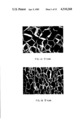
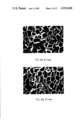
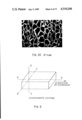
- FIGS. 1A, B, C and 2A, B, C are photomicrographs (magnification: 50 ⁇ ) of the one- and two-directionally flexibilized foam of preferred Examples 123 and 223 of the present invention showing the closed cell structure as view in the X-, Y- and Z-axial directions defined in FIG. 3.
- the flexibilized foams of this invention are characterized by an anisotropic cell wall structure in which the wrinkles in the cell wall are directionally oriented.
- wrinkles in the cell wall observed in the X-axial direction are significantly fewer than those observed in the Y- and Z-axial directions (FIGS. 1B and 1C).
- the cell walls are generally less wrinkled in the X-axial and Z-axial directions (FIGS. 2A and 2C) than in the Y-axial direction (FIG. 2B).
- the coordinates dimensions X, Y and Z correspond to the length in the machine or extrusion direction, thickness and width of the foam sheet, respectively.
- anisotropic wrinkles in combination with the properties of the formulated resin forming the cell walls membranes, the cell size and shape, and the foam density are important parameters of the flexibilized foam. Also such physical properties as axial elongation at rupture and water vapor permeability provide fairly accurate indication of the type, location and distribution of the anisotropic wrinkles.
- the present invention is greatly influenced by the properties of the initial expanded foam sheet or planks.
- the synthetic resin foams used herein must be of substantially closed-cell structure and include foams expanded by extrusion as well as those molded from expandable beads.
- most preferable are extrusion-expanded foam boards of substantially rigid, closed-cell structure.
- density, cell size, compression strength, and thermal resistance which in turn depend on the synthetic resin polymers used in making the initial foams.
- Suitable are synthetic resins mainly composed of styrene, vinyl chloride, vinylidene chloride, methyl methacrylate or nylon including copolymers thereof and physical blends of these resins.
- resins containing as a major component styrene or a styrenic monomer such as ⁇ -methyl styrene and o-, m-, p-vinyltoluene and chlorostyrene.
- copolymers of styrene or styrenic monomers and other monomers copolymerizable therewith such as acrylonitrile, methacrylonitrile, methyl acrylate, methy methacrylate, maleic anhydride, acrylamide, vinylpyridine, acrylic acid, and methacrylic acid.
- polystyrene resins consisting essentially of only polymerized styrene and, most preferable polystyrene resins containing 0.3 percent by weight or less of residual styrene monomer and 0.5 to 1.5 percent by weight of styrene oligomers, primarily dimer and trimer.
- Polystyrene resins containing such quantities of styrene monomer and styrene trimer provide expanded foams having particularly uniform distribution of density and cell size as well as improved resistance to repeated compression. Foams from such polystyrene resins are especially well suited for one- and two-directional flexibilization.
- rubber may be blended with such monomers before polymerization or added to the system after polymerization. Further, the foregoing resins may be blended with other polymers so long as the desirable properties of the styrene resins are not adversely affected.
- the synthetic resin foam have (1) a bulk density of about 20 to 100 kg/m 3 , and preferably about 20 to 60 kg/m 3 for one-directional flexibilization (2) a Y-direction cell size of about 0.05-1.0 mm, and (3) a Y-axial compressive strength of at least 1.8 kg/cm 2 .
- Y-axial cell size y a group of flexibilized foams having varied foam densities and Y-axial cell sizes were evaluated for Y-axial compressive strength as a parameter of creep resistance, X-axial and Z-axial tensile strengths as parameters of breakage or rupture resistance of the foams in use, variations in the X-axial and Z-axial tensile strengths as parameters of the uniformity of performance or quality, and Y-axial thermal conductivity.
- foams of the present invention must have a bulk density of about 20 to 100 kg/m 3 , average y cell size of 0.05 to 1.0 mm and average cell size ratios y/x and y/z ⁇ 1.05. More preferably the foams must be constructed substantially of cells having the major axis thereof more definitely disposed along the Y-axis with the axial average cell axial size ratios y/x and y/z are 1.10 to 4.0. If the average axial cell size ratios y/x and y/z exceeds 4, the balance between the dimensional stability, linear expansion coefficient and the tensile strength will be lost.
- Synthetic resin foams having the required bulk density and anisotropic cell structure and size can be flexibilized by compression in one or two axial directions as described in Nakamura U.S. Pat. No. 3,159,700 to provide the high water vapor barrier and other properties desired for low temperature and cryogenic insulation. However, carefully controlled conditions are required.
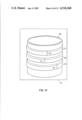
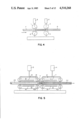
- FIGS. 4 and 5 show schematic diagrams of suitable compression equipment of flexibilizers.
- the flexibilizer of FIG. 4 there are provided infeed rollers 1, 2 and outfeed rollers 3, 4 spaced longitudinally from each other.
- the flexibilizer shown in FIG. 5 is provided with infeed belts 9, 10 and outfeed belts 11, 12 which are also spaced longitudinally from each other. These paired rollers or belts hold the expanded foam securely.
- the reference numerals 5, 6 in FIG. 5 and the reference numerals 13, 14 in FIG. 4 indicate foam holding pressure means which should be controlled accurately because the foam will undergo a significant thicknesswise compression if the pressure is too strong.
- the infeed rollers or belts are driven somewhat faster than the second (outfeed) pair so that the foam is compressed in the longitudinal direction in the gap between the infeed and outfeed rollers or belts.
- the foam is normally compressed first in the longitudinal (X-axial) direction.
- the one-directionally flexibilized sheet can be subjected to compression in another direction at right angle to the longitudinal direction, namely, in the lateral (Z-axial) direction to provide a more flexible sheet which can assume a compound curvature.
- the flexibilization conditions must be carefully selected and controlled. Particularly important are:
- a uniform quality for the initial expanded foam sheet is required since the foams are mechanically compressed for flexibilization one-direction at axis by axis a time, e.g., X-axially first and then Z-axially, while being held squeezedly Y-axially. Thus it is necessary that the foams have minimum variation in mechanical properties, especially compressive strength throughout the sheet.
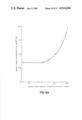
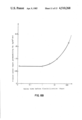
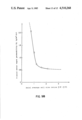
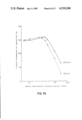
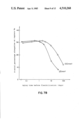
- FIGS. 7 and 8 The importance of minimum foam aging after extrusion or expansion and before flexibilization is shown in FIGS. 7 and 8.
- foam samples aged for varying length of time before flexibilization in the apparatus of FIG. 5 were evaluated for water vapor barrier and foam elongation properties particularly important in the use of the foam for low temperature and cryogenic insulation.
- the foam should be flexibilized while fresh shortly after initial extrusion, i.e., within 10 days (240 hrs) and preferably 3 days (72 hrs) or less.
- in-line flexibilization shortly after foam extrusion e.g., after about 0.1 hour to allow for cooling, may be advantageous.
- foam sheets ranging from 10 mm to 300 mm in thickness have been flexibilized without significant loss in Y-axial compressive strength, water vapor barrier properties and other desired properties.
- the flexibilizer of FIG. 5 is preferred. Elongation of foam processed with this flexibilizer can be controlled by the spacing between the infeed and outfeed belts.
- the compression distance D should be about 300 mm at the maximum, and preferably 200 mm or less, with a compression duration of at least one second. Line speeds of 5 to 40 m/min can be achieved with good results.
- flexibilized sheets can be laminated in desired configurations using a small amount of an adhesive applied sporadically to minimize the effect of the adhesive on the properties of the laminated foams.
- Flexibilization essential herein is achieved by the controlled introduction of anisotropically oriented wrinkles in the foam cell walls in a manner that does not unduly weaken the integrity of the foam or crack the cell walls and cause loss of thermal insulation and water vapor barrier properties. Since the foam cells are very small and have polyhedral shapes, it is very difficult to define the location of such wrinkles accurately in terms of cell shape and structure. However, the Y-axial water vapor permeability of the flexibilized foam indicates cracking or breakage of the cell walls. Also the percentage elongation at rupture in the three axial directions is a measurable parameter of the extensibility, location and distribution of the wrinkles. Typical results are given in the Examples, and particularly Tables 3 and 4.
- the foams contemplated by the present invention must have a Y-axial water vapor permeability Py equal to or smaller than 1.5 g/m 2 ⁇ hr to prevent or minimize deterioration in thermal-insulating properties over long use. More preferably, the water vapor permeability should be 1.0 g/m 2 ⁇ hr or less.
- the elongation at rupture in the three axial directions are useful parameters of extensibility, location and distribution of wrinkles and suitability for applications involving such severe conditions as encountered in liquid nitrogen storage tanks.
- Evaluation of the variations in the X-axial and Z-axial elongations at rupture shows the uniformity of the extensibility throughout the foam while the change in Y-axial thermal conductivity with time reflects loss of thermal-insulating properties from moisture absorption after prolonged use under Y-axial loads.
- cryogenic tests at about -160° C. and -196° C. show the crack resistance of the foam when used as thermal-insulation for liquefied natural gas and nitrogen tanks.
- the preferred polystyrene foams exhibit excellent properties as cryogenic insulation even without cladding reinforcement. Their bendability and thermoformability are particularly advantageous for field construction.
- two or more such foams may be bonded to form foam logs with biaxial extensibility. Also, they may be clad with metal foils or they may be combined with synthetic resin films having high gas barrier properties.
- the present invention also provides improved synthetic resin foams which can be applied to small-diameter pipes by adjusting the extensibility of the foams in the bending direction in accordance with the pipe outside diameter and the foam thickness.
- Other tests with 114 mm outside diameter pipes confirmed the applicability of the one- and two-dimensionally flexibilized foam sheet to a variety of curved surfaces including pipes and cylindrical and spherical tanks regardless of curvature.
- the polystyrene resins used for the extruded foam sheets were selected from commercial stock after analysis for residual volatiles (primarily styrene and ethylbenzene) and oligomers (styrene dimer and trimer) by gas chromatography using a flame ionization detector.
- the resin is dissolved in methyl ethyl ketone, the polymer precipitated with methanol, and the supernatant liquid analyzed.
- These resins had an intrinsic viscosity of about 0.83 measured in toluene solution at 30° C.
- the polymers were expanded into a rigid, substantially closed-cell foam with an extrusion-foaming system composed of a screw extruder, blowing agent blending feeder, cooler and board-forming die. More specifically, a mechanical blend of 100 parts of the polystyrene resin, 2 parts of a flame retardant and 0.03 to 0.1 part of a nucleator is continuously fed into the extruder with 12 to 17 parts of a 50/50 mixture of dichlorodifluoromethane/methyl chloride as a blowing agent. The thermoplastic mixture is kneaded under pressure, cooled to an extrusion temperature of about 90° to 118° C. and then extruded through a die and expanded into a foam.
- an extrusion-foaming system composed of a screw extruder, blowing agent blending feeder, cooler and board-forming die. More specifically, a mechanical blend of 100 parts of the polystyrene resin, 2 parts of a flame retardant and 0.03 to 0.1 part of a nu
- the extrusion conditions were controlled so that the foam was about 110 mm ⁇ 350 mm in cross-section and the axial cell size ratios y/x and y/z were about 1.1 to 1.25 and 1.1 to 1.17, respectively.
- the Y-axial cell size and bulk density D were varied in the range of 0.07 to 1.6 mm and about 21.5 to 77 kg/m 3 , respectively.
- Foams lighter than about 21 kg/m 3 were subjected to secondary expansion by exposure to steam at 100° C. for 2 to 6 minutes.
- the resultant foams have a bulk density of about 15.5 to 20 kg/m 3 . Analysis showed essentially no loss of residual volatiles or oligomers in the extrusion process.
- Standard test samples normally a 50 mm cube or a 25 mm ⁇ 100 mm ⁇ 100 mm sheet are cut from the center parts of the skinless foam board and their weight (g) and volume (cm 3 ) determined and the foam density calculated from the average of at least three specimens.
- the density variation calculated by the formula: ##EQU1## provides a useful measure of foam uniformity:
- the X-axial, Y-axial and Z-axial average cell sizes x, y and z in terms of the coordinates of FIG. 3 are measured by the method of ASTM D-2842 using nine specimens cut in the prescribed manner. Then as parameters of cell shape, the ratios of the Y-axial average cell size y versus X-axial and Z-axial average cell sizes x and z are calculated.
- the average cell size variation provides a measure of foam uniformity on the following evaluation scale:
- each specimen is subjected to X-axial tensile strength test with a jig or loading fixture attached to each end.
- the measured strength S 1 through S 12 are averaged and the tensile strength variation is calculated as follows: ##EQU2##
- the Z-axial average tensile strength and variation thereof are measured on another twelve specimens.
- a flexibilized foam board is cut into specimens each 200 mm square and 25 mm thick. Each specimen is then aged in a chamber partially filled with water and held at 27° C. The specimen is secured in the chamber about 30 mm above the water surface and a cold plate cooled to 2' C. by recirculated cooled water is brought into tight contact with the top surface of the specimen. After aging for 14 days, the specimen is taken out and its surface is wiped lightly with gauze. The thermal conductivity ⁇ ' of the aged specimen is measured in accordance with ASTM C-518 and the ratio of ⁇ ' to the initial thermal conductivity ⁇ of the specimen before aging is calculated.
- Each cryogenic test panel 34 is placed in a liquid nitrogen cooled cryostat box having an internal temperature controlled to -160° C. ⁇ 5° C. by controlled addition, gasification and diffusion of liquid nitrogen. After 5 hours, the test panel is quickly removed and left at room temperatures for about 1 hour. This process is repeated 4 cycles. After the last cycle, the test panel is visually checked for cracks in the four exposed faces of the foam specimen. Then one hour after removal from the cryostat, the plywood covers are removed with a slicer. Then a 10 mm thick slice of the foam is cut from the top surface and a mixture of a surfactant and colorant in water is applied to the surfaces of the cut foam to show any cracks formed therein.
- a cryogenic box partially filled with a liquid nitrogen is used.
- the plywood faced test panels are submerged in the liquid nitrogen and placed on triangular steel supports fixed to the bottom of the box.
- a steel weight precooled in liquid nitrogen is placed on the test panel top, and the panel held immersed for 30 minutes. Then the test panel is taken out and left at room temperature for one hour under forced ventilation.
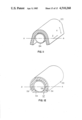
- A. Bendability Three pieces of flexibilized foam 200 mm wide, 500 mm long and 25, 37.5 and 75 mm thick are bent to the curvature of a steel pipe 54 about 114 mm in outside diameter by applying a bending stress Y-axially thereto with its Z-axis disposed in parallel with the axis of the pipe 54, as shown in FIG. 11. The specimen is bent until it is brought into close contact with the outer peripheral surface of the pipe over an area exceeding the outer surface area of a semicylindrical half section of the pipe (the section above the center line A--A shown in FIG. 11).
- Thermoformability The flexibilized foam pieces are bent to the outside curvature of the steel pipe 54 about 114 mm in outside diameter with its Z-axis disposed along the axis of the pipe. Markings are put on the cut edge of the pipe 54 diameterically oppositely along the center line A--A shown in FIG. 12.
- the bent specimen 56 is then totally covered with a galvanized, 0.3 mm thick sheet iron 55 and the opposite side ends of the foam specimen held with tensioning bands 57. Then the covered specimen 56 is placed in a hot-air oven with the tensioning bands 57 down and heated at 85° C. for 45 minutes. After being removed from the oven, the specimen is cooled at room temperature for two hours. Then, the galvanized cover 55 is removed and the gaps 58 and 59 from the outer ends of the foregoing markings to the intersections of the center line A--A and the inner wall of the specimen 56 are measured and rated as follows:
- Thermal Insulation Test Pieces of flexibilized foam cut to a 37.5 mm ⁇ 200 mm ⁇ 500 mm size are thermoformed as above in two layers and then cut Z-axially to provide inner and outer semicylindrical thermal insulation covers for a 114 mm o.d. pipe.
- the test cover pieces are then fit to a 114 mm o.d. stainless steel pipe about 800 mm long with flanges at each end and secured with a cryogenic polyurethane adhesive.
- the joints of the outer covers are staggered from those of the inner cover.
- the entire section is then coated with a 2.5 mm thick waterproof layer of polyurethane mastic. After 4 days aging, the covered pipe is connected to a cryogenic test line and filled with liquid nitrogen.
- the interior of the stainless steel pipe is maintained at -196° C. for 6 hours. Thereafter, the liquid nitrogen is discharged and the covered pipe left for 12 hours at 23° C. and 80% R.H.
- the foregoing test cycle is repeated four times while observing the surface conditions of the water-proof layer 66 including water condensation and icing.
- foam planks were prepared for one-directional flexibilization.
- the extrusion conditions were controlled to give a foam sheet about 110 mm ⁇ 350 mm in cross-section with a bulk density of about 21.5 to 60 kg/m 3 . Skins were removed from each of the foams and the resulting foam board was cut into three smaller planks each 100 mm square and 4,000 mm long.
- the foam planks were flexibilized by compression in the machine direction (X-axis) using the equipment of FIG. 5 and the typical conditions described in the procedures above.
- the flexibilized foam planks of the preferred Examples 101-112 were evaluated for density, Y-axial cell sizes, cell shapes represented by y/x and y/z, compression strengths (Y-axial and Z-axial), X-axial tensile strengths and elongation at rupture with the results shown in Table 1.
- the axial cell size ratios y/z were in the range of 1.00 to 1.25.
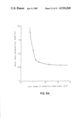
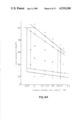
- the foam bulk densities were plotted on the chart FIG. 6A against the Y-axial average cell sizes y.
- the coordinates representing the foam specimens satisfying the objects of the present invention are marked with o, while those representing the specimens not satisfying the objects of the present invention are marked with X.
- the foams as intended by the present invention must have such Y-axial average cell sizes y and bulk densities D that fall in the pentagonal domain defined by five coordinates (1.0, 43), (1.0, 20), (0.05, 24), (0.05, 60) and (0.1, 60) and, more preferably, in the tetragonal domain defined by the coordinates (0.8, 42), (0.8, 23), (0.07, 26) and (0.07, 57).
- the bulk densities D and Y-axial cell sizes y of these foams satisfy the following formula:
- foam planks were prepared about 110 mm ⁇ 350 mm in cross-section, axial cell size ratios y/x and y/z about 1.1 to 1.25 and 1.1 to 1.17, respectively, while the Y-axial cell size and bulk density d are varied in the range of 0.07 to 1.6 mm and 21.5 to 77 kg/m 3 , respectively.
- Those foams lighter than about 21 kg/m 3 are subjected to secondary expansion by exposing them to steam at 100° C. for 2 to 6 minutes resulting in a bulk density of about 15.5 to 20 kg/m 3 .
- flexibilized foam planks of the Preferred Examples 201-212 and Reference Examples R201-206 having almost constant cell shapes with the axial cell size ratios y/x and y/z ranging from 1.2 to 1.4 are obtained. Then these flexibilized planks are evaluated by the standard procedures with typical results shown in Table 2.
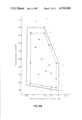
- the bulk densities D are plotted on the chart of FIG. 6B against the Y-axial average cell sizes y, in which the coordinates representing the foam specimens evaluated as excellent and good in Table 2 are marked with O and o, respectively, while those evaluated as unacceptable being marked with X.
- the foams as intended by the present invention must have such y-axial average cell sizes y in mm and bulk densities D in kg/m 3 that fall in the pentagonal domain defined by five coordinates (1.0, 55), (0.25, 100), (0.05, 100), (0.05, 26.5) and (1.0, 20) and, more preferably, in the pentagonal domain defined by five coordinates (0.8, 55), (0.25, 93), (0.07, 93), (0.07, 28.5) and (0.8, 23.5).
- the foams contemplated by the present invention must have such a foam density D (kg/m 3 ) and Y-axial average cell size y (mm) that satisfy the following formula:
- thermoplastic foam sheets are aged for at least several weeks before use to stabilize the foam structure.
- flexibilized foam for cryogenic insulation it was discovered that the age of the extruded foam at the time of compression flexibilization profoundly influenced the resulting foam properties.
- FIG. 7A shows the relation between X-axial elongation at rupture Ex of the flexibilized foams and the aging period of the initial foam sheet after extrusion
- FIG. 8A shows the relation between water vapor permeability and the aging period before flexibilization. It is evident that to obtain the improved elongation and water vapor barrier properties intended by the present invention, it is necessary that the aging period for the foams prior to compression flexibilization be not more than 10 days (240 hrs) and more preferably, 3 days (72 hrs) or less.
- FIG. 7B shows a relation between the X-axial percentage elongation at rupture Ex of two-directionally flexibilized foams and the aging time of the extruded foam planks. Note that aging affects the X-axial and Z-axial percentage elongations at rupture substantially equally.
- the initial fresh foam planks had a density of about 27 kg/m 3 , thickness of about 100 mm, and X, Y- and Z-axial average cell sizes of about 0.55 mm, 0.72 mm and 0.58 mm, respectively. After being cut to a thickness of 25 mm, the foams were subjected to one cycle of 37 percent compression X-axially first and then Z-axially at varied aging times.
- the Z-axial percentage elongations at rupture Ez ranges from about 80 to 90 percent of the X-axial percentage elongation at rupture Ex.
- the axial percentage elongations at rupture are representatively given as the X-axial percent-elongation at rupture Ex.
- FIG. 8B shows a relationship between the water vapor permeability Py of flexibilized foams and the aging period of the material foams after expansion thereof.
- the foam planks have the same density and axial average cell sizes as those above.
- Test pieces about 25 mm thick were cut and subjected to 20-37 percent compression applied one to three times in each direction.
- the resulting foams had an X-axial percentage elongation at rupture Ez of about 20 percent and Z-axial percentage elongation at rupture Ez of about 16 percent.
- the foam should be flexibilized while fresh, i.e., within 10 days or more preferably 3 days of extrusion and/or expansion. This applies especially to relatively thin foams as represented by the 25 mm thick samples used in the preceding experiments.
- the optimum time within the range of about 0.25-240 hours will, of course, depend on the specific properties of the initial foam and the desired results.
- Critical for low temperature insulation is the ability of the foam to be an effective barrier to the transfer of water vapor from the outer to inner surface of the insulation.
- flexibilizable foam planks were expanded from PS Resin A under controlled conditions so that the resultant foams had densities D in the range of about 22.5 to 51 kg/m 3 , Y-axial cell sizes y in the range of about 0.07 to 1.0 mm and axial cell size ratios y/x and y/z of about 1.35 to 2 and about 1.1-1.3, respectively. Then the resultant foam planks were cut to 100 mm square and 4,000 mm long and after aging for one day were compressed X-axially. Typical properties including water vapor permeability for these flexibilized foams are given in Table 3.
- the flexibilized foam of the present invention must have a water vapor permeability of 1.5 g/m 2 ⁇ hr or lower as determined by the water method of ASTM C-355.
- FIGS. 1A, B and C are photomicrographs (magnification: 50 ⁇ ) of the polystyrene foam of the preferred example 123 showing closed cells distributed as viewed in the X-, Y- and Z-directions shown in FIG. 3.
- the flexibilized foams of the present invention have a unique structural anistropy in which wrinkles in the cell walls observed in the YZ-plane (FIG. 1A) are significantly fewer than those observed in the XZ- and XY planes (FIGS. 1B and 1C). Since the foam cells are very small and have polyhedral shapes, it is very difficult to express the distribution and locations of such wrinkles accurately. However, considering the relations between Ex, E and the Y-axial water vapor permeability Py with reference to FIG. 1, these relationships provide fairly accurate structural parameters of the wrinkles including their type, location and distribution.
- Example 1 foam planks having the same cross-sections were extruded and expanded with a density of 27 kg/m 3 or 50 kg/m 3 and Y-axial average cell size of 0.61 mm or 0.11 mm with y/x of 1.20 or 1.15 and y/z of 1.25 or 1.20. These foam planks were compressed for flexibilization X-axially first and then Z-axially by using the equipment as shown in FIG. 5. Then the foam densities D and other properties including the Y-axial water permeability Py of the thus biaxially-flexibilized foams are measured. Also, the changes in Y-axial thermal conductivity as well as the X-axial and Z-axial cryogenic resistance at -160° C. and -196° C. are observed. Typical results are shown in Table 4.
- Table 4 shows that the foams of this invention must have a Y-axial water vapor permeability Py equal to or smaller than 1.5 g/m 2 ⁇ hr to prevent or minimize deterioration in thermal-insulating properties over a long period of use. More preferably, the water vapor permeability should be 1.0 g/m 2 ⁇ hr or smaller to secure a higher level of thermal-insulation.
- the preferred foams of the present invention must also satisfy the following conditions:
- FIGS. 2A, B and C are photomicrographs (magnification: 50 ⁇ ) of the flexibilized polystyrene foam of Preferred Example 223 showing the closed cells viewed in the X, Y and Z directions shown in FIG. 3. Note that the foam is characterized by structurally anisotropic cell walls. Those visible in the YZ and XY planes shown in FIGS. 2A and 2C are generally wavy only in one direction, namely in the Z-axial and X-axial directions respectively, but not in the Y-axial direction.
- Such anisotropically distributed cell wall wrinkles in combination with the foam density as well as with the sizes and shapes of cells are important structural parameters of the foams of the present invention, in view of the aforementioned relationship between Ex and Ez, and ratios of axial percentage elongations at rupture (Ex/Ey, Ez/Ey) and Y-axial water vapor permeability that represent the distribution and directions of such wrinkles.
- Table 5 shows the results of experiments on still another group of the preferred examples of the present invention and several reference foams. Since these evaluation items are substantially representative of the bendability, applicability to curved surfaces, adhesion workability, cryogenic insulating properties and other characteristics practically required to such foams, Table 5 does give overall evaluation for practical applicabilities of such foams.
- two or more such foams may be bonded so that the resultant foam logs show biaxial extensibility or they may be clad with metal foils or they may be combined with synthetic resin films having high gas barrier properties.
- foams namely the foams of preferred examples 222-225 and of the references R221, R223-225 are applied, respectively, onto a steel pipe of about 114 mm in outside diameter as a typical representative of cylindrical pipes having a very large curvature.
- the foams were sliced to a thickness of 25, 37.5 or 75 mm and applied in one, two or three layers to obtain an overall thickness of 75 mm.
- the longitudinal and circumferential seams of the semicylindrical foams sections applied in layers are butted, while those of the foam sections 77 mm thick are shiplapped.
- the synthetic resin foams of the present invention having larger extensibility in two axial directions show excellent bendability, thermoformability and applicability to pipes having small diameters. They can be easily applied to such small-diameter pipes and can be easily thermoformed to their bent shapes. Further, because of substantial freedom from crack formation in bending operation or under cryogenic conditions, the synthetic resin foams according to the present invention can provide excellent cryogenic thermal-insulating materials free from moisture condensation even at -196° C. which are generally applicable to pipes, cylindrical and spherical tanks.
- the reference foams compressed only X-axially or Z-axially have satisfiable bendability and thermoformability, they are not entirely satisfactory as cryogenic thermal-insulation because they may break under cryogenic conditions due to cracks spreading circumferentially of the pipe or in other directions. Such cracks form because these foams do not have sufficient extensibility to absorb stresses generated by sudden changes between the room and cryogenic temperatures.
- the improved flexibilization process is applicable to a variety of thermoplastic resin foams, both extruded and expanded.
- PS Resin A is a thermally polymerized polystyrene resin having an intrinsic viscosity of about 0.83 dissolved in toluene at 30° C. and containing 0.20 weight percent residual volatiles including styrene monomer and 0.87 weight percent oligomers including styrene trimer. Blends with other polystyrene resins richer in residual styrene monomer and trimer were flexibilized with typical results shown in Table 7. For such thermally polymerized polystyrene resins, preferred resins for the flexibilized foams are those containing 0.3 weight percent or less of residual volatiles including styrene monomer and 0.5-1.5 weight percent of styrene oligomers including trimer.
- the present invention is applicable also to foams expanded from polyvinyl chloride resins including blends thereof with inorganic materials, methyl methacrylate and the like resins other than polystyrene, and the resulting flexibilized foams satisfy the requirements of the present invention.
- a batch of prefoamed polystyrene beads having a bulk density of 11.6 kg/m 3 is placed in a mold, and steam is heated for about 40 seconds under pressure of 3 kg/cm 2 .
- the resulting foam was aged at about 70° C. for 12 hours. It had a density of 10.9 kg/m 3 with x of 0.33 mm, y of 0.31 mm and z of 0.32 mm.
- Three 350-mm cubes are cut out from its central portion by means of an electrically-heated wire cutter.
- One sample was flexibilized X-axially by compression to 90 percent of its original volume by applying 40 kg/cm 2 pressure with a 50-ton press. The compression was repeated continuous six times by relieving the pressure immediately after its application.
- the compressed foam has the size of 350 ⁇ 350 ⁇ 262 (mm) with a density of 14.5 kg/m 3 .
Landscapes
- Engineering & Computer Science (AREA)
- Mechanical Engineering (AREA)
- Manufacture Of Porous Articles, And Recovery And Treatment Of Waste Products (AREA)
Abstract
Description
______________________________________
Aging before compression:
                      1 day
Plank thickness:      100 mm
Infeed belt speed:    12 m/min.
Infeed/outfeed speed ratio:
                      25/21-28/21
Compression distance D
                      200 mm
(See FIG. 5):
Compression duration: 3.6 sec.
Cycles of compressions:
                      1-3
______________________________________
______________________________________
Good (GO)       Desired or target foam quality
Passable (PA)   Conventional foam quality
Unacceptable (UN)
                Below acceptable foam quality
______________________________________
______________________________________
Excellent (EX) Rated Good in all tests
Good (GO)      Rated Good/Passable in all tests
Passable (PA)  Rated Passable in all tests
Unacceptable (UN)
               Rated Unacceptable in at least
               one test
______________________________________
______________________________________
Rating          Density Variation
______________________________________
Good            <10% variation in density
Passable        10-15% variation
Unacceptable    >15% variation
______________________________________
______________________________________
Rating          Density Variation
______________________________________
Good            <35% variation in cell size
Passable        35-45% variation
Unacceptable    >45% variation
______________________________________
______________________________________
Rating      Average Compressive Strength (kg/cm.sup.2)
______________________________________
Good        --Y-axial: 2.2.sup.+
                          --X-axial: 1.1.sup.+
Passable    --Y-axial: 1.8-2.2
                          --X-axial: 0.9-1.1
Unacceptable
            --Y-axial: <1.8
                          --X-axial: <0.9
______________________________________
______________________________________
Rating       Tensile Strength
                          % Variation
______________________________________
Good         1.2.sup.+  kg/cm.sup.2
                          <20%
Passable     1.0-1.2 kg/cm.sup.2
                          20-40%
Unacceptable <1.0 kg/cm.sup.2
                          >40%
______________________________________
______________________________________
Rating     % Variation in Elongation at Rupture
______________________________________
Good       <20%
Passable   20-40%
Unacceptable
           >40%
______________________________________
______________________________________
Rating     Thermal Conductivity Change (λ'/λ)
______________________________________
Good       <1.07
Passable   1.07-1.12
Unacceptable
           >1.12
______________________________________
______________________________________
Rating          Observation
______________________________________
Good            No visible damage or cracks
Passable        Fine cracks
Unacceptable    Ruptures or large cracks
______________________________________
______________________________________
Rating          Observation
______________________________________
Good            Bends easily without cracks
Passable        Bends with careful attention
Unacceptable    Breaks
______________________________________
                                  TABLE 1
__________________________________________________________________________
One-Directional Flexibilization
            Y-axial               X-axial
            Cell
                Cell
                    Compressive
                            X-axial
                                  Tensile
Preferred
       Density
            Size
                Shape
                    Strength
                            Elongation
                                  Strength
                                       Overall*
Example No.
       (kg/m.sup.3)
            - y (mm)
                - y/-x
                    Y-axial
                        Z-axial
                            Variation
                                  Variation
                                       Evaluation
__________________________________________________________________________
101    32.3 0.53
                1.57
                    Go  Go  Go    Go   Ex
102    41.4 0.80
                1.57
                    Go  Go  Go    Go   Ex
103    23.3 0.80
                1.55
                    Go  Go  Go    Go   Ex
104    43.0 1.00
                1.50
                    Go  Go  Pa    Pa   Go
105    40.2 0.99
                1.53
                    Go  Go  Pa    Pa   Go
106    20.0 1.00
                1.55
                    Pa  Pa  Pa    Go   Go
107    41.5 0.26
                1.58
                    Go  Go  Go    Go   Ex
108    60.0 0.10
                1.45
                    Go  Go  Pa    Pa   Go
109    25.9 0.11
                1.50
                    Go  Go  Go    Go   Ex
110    23.0 0.10
                1.47
                    Go  Go  Pa    Go   Go
111    30.1 0.08
                1.51
                    Go  Go  Go    Go   Ex
112    56.8 0.07
                1.46
                    Go  Go  Go    Go   Ex
__________________________________________________________________________
 *Ex  Excellent;
 Go  Good;
 Pa  Passable;
 Un  Unacceptable
-17 log y+43≧D≧-3 log y+20
-15 log y+40≧D≧-3 log y+23
                                  TABLE 2
__________________________________________________________________________
Two-Directional Flexibilization
            Y-axial          Tensile
       Foam Cell      Y-axial
                             Strength
                                     Y-axial
       Density
            Size
                Cell Shape
                      Compressive
                             Variation
                                     Thermal
                                            Overall*
       (Kg/m.sup.3)
            - y (mm)
                - y/-x
                   - y/-z
                      Strength
                             X-axial
                                 Z-axial
                                     Conductivity
                                            Evaluation
__________________________________________________________________________
Preferred
Example No.
201    42.1 0.80
                1.38
                   1.25
                      Go     Go  Go  Go     Ex
202    55.1 0.80
                1.39
                   1.33
                      Go     Go  Go  Go     Ex
203    23.5 0.80
                1.29
                   1.26
                      Go     Go  Go  Go     Ex
204    20.0 1.0 1.24
                   1.21
                      Pa     Pa  Pa  Pa     Go
205    55.0 1.0 1.38
                   1.22
                      Go     Pa  Pa  Go     Go
206    60.2 0.20
                1.39
                   1.27
                      Go     Go  Go  Go     Ex
207    93.1 0.25
                1.38
                   1.30
                      Go     Go  Go  Go     Ex
208    25.0 0.10
                1.33
                   1.25
                      Pa     Go  Go  Go     Go
209    28.8 0.07
                1.31
                   1.26
                      Go     Go  Go  Go     Ex
210    93.0 0.07
                1.34
                   1.26
                      Go     Go  Go  Go     Ex
211    100.4
            0.09
                1.31
                   1.27
                      Go     Pa  Pa  Go     Go
212    99.8 0.25
                1.36
                   1.28
                      Go     Pa  Pa  Go     Go
Reference
Example No.
R201   21.0 0.12
                1.30
                   1.26
                      Un     Go  Go  Go     Un
R202   17.5 1.01
                1.26
                   1.25
                      Un     Pa  Pa  Un     Un
R203   41.5 1.60
                1.35
                   1.28
                      Go     Un  Un  Un     Un
R204   62.1 0.99
                1.37
                   1.30
                      Go     Pa  Un  Go     Un
R205   94.5 0.45
                1.37
                   1.32
                      Go     Pa  Un  Go     Un
R206   108.0
            0.11
                1.30
                   1.22
                      Go     Un  Un  Go     Un
__________________________________________________________________________
 Ex  Excellent;
 Go  Good;
 Pa  Passable;
 Un  Unacceptable
-75 log y+55≧D≧-5 log y+20
-75 log y+48≧D≧-5 log y+23
                                  TABLE 3
__________________________________________________________________________
One-Directional Flexibilization
                    Percentage
                           Y-axial
                                Thermal
          Y-axial   Elongation
                           Water
                                Conduc-   Cryo-
          Cell      at     Perma-
                                tivity
                                     X-axial
                                          genic
                                              Overall*
Density   Size
              Cell Shape
                    Rupture (%)
                           bility Py
                                with Tensile
                                          Resis-
                                              Evalu-
Kg/m.sup.3)
          - y (mm)
              - y/-x
                 - y/-z
                    E   Ex (g/m.sup.2 hr)
                                Time Strenth
                                          tance
                                              ation
__________________________________________________________________________
Pre-
ferred
Example
No.
121  29.4 0.52
              2.1
                 1.08
                    4.1 7.0
                           0.5  Go   Go   Pa  Go
122  33.1 0.52
              2.36
                 1.08
                    7.0 22.5
                           0.6  Go   Go   Go  Ex
123  35.2 0.52
              2.5
                 1.08
                    8.3 30.0
                           0.65 Go   Go   Go  Ex
124  39.2 0.52
              2.8
                 1.09
                    10.6
                        51.5
                           1.0  Go   Go   Go  Ex
125  44.8 0.52
              3.2
                 1.07
                    12.5
                        67.0
                           1.5  Pa   Go   Go  Go
126  27.2 0.45
              1.8
                 1.14
                    9.3 24.7
                           0.75 Go   Go   Go  Ex
127  32.5 0.45
              2.2
                 1.15
                    10.0
                        54.7
                           1.5  Pa   Pa   Go  Go
128  35.5 0.21
              1.6
                 1.22
                    5.3 8.0
                           0.35 Go   Go   Go  Ex
129  47.6 0.21
              2.13
                 1.23
                    10.2
                        56.5
                           1.0  Go   Go   Go  Ex
130  46.6 0.11
              1.58
                 1.30
                    4.5 7.1
                           0.3  Go   Go   Pa  Go
131  30.1 0.08
              1.51
                 1.36
                    6.8 15.1
                           0.6  Go   Go   Go  Ex
132  56.9 0.07
              1.7
                 1.34
                    7.1 15.5
                           0.2  Go   Go   Go  Ex
Ref-
erence
Example
No.
R121 28.0 0.52
              2.02
                 1.07
                    3.5 4.1
                           0.5  Go   Go   Un  Un
R122 45.7 0.52
              3.3
                 1.08
                    11.5
                        70.5
                           1.6  Un   Go   Go  Un
R123 48.1 0.52
              3.48
                 1.09
                    12.5
                        78.0
                           1.8  Un   Go   Go  Un
R124 35.1 0.45
              2.33
                 1.14
                    12.5
                        70.5
                           2.4  Un   Pa   Go  Un
R125 33.5 0.21
              1.51
                 1.23
                    3.5 4.0
                           0.35 Go   Go   Un  Un
R126 24.3 1.0 1.9
                 1.15
                    12.1
                        42.0
                           2.2  Un   Pa   Go  Un
__________________________________________________________________________
 Ex  Excellent;
 Go  Good;
 Pa  Passable;
 Un  Unaccetable
                                  TABLE 4
__________________________________________________________________________
 Two-Directional Flexibilization
__________________________________________________________________________
           Y-        Percentage
           Axial     Elongation at Rupture (%)
      Foam Cell      X- Z- Y-         Water Vapor
Example
      Density
           Size -y
               Cell Shape
                     axial
                        axial
                           axial      Permeability
No.   (kg/m.sup.3)
           (mm)
               - y/-z
                  - y/-z
                     Ex Ez Ey Ex/Ey
                                  Ez/Ey
                                      (g/m.sup.2 H)
__________________________________________________________________________
Preferred
221   30.0 0.61
               1.26
                  1.21
                      8.0
                        8.0
                           3.6
                              2.22
                                  2.22
                                      0.53
222   31.7 --  1.30
                  1.24
                     12.0
                        12.0
                           4.5
                              2.67
                                  2.67
                                      0.65
223   35.9 --  1.42
                  1.29
                     22.0
                        15.5
                           5.4
                              4.07
                                  2.87
                                      0.78
224   45.1 --  1.63
                  1.40
                     40.2
                        26.5
                           7.2
                              5.58
                                  3.68
                                      1.18
225   48.3 0.61
               1.44
                  1.70
                     23.5
                        52.3
                           7.4
                              3.18
                                  7.07
                                      1.31
226   58.3 0.11
               1.36
                  1.30
                     12.1
                        12.0
                           4.0
                              3.02
                                  3.0 0.43
227   53.7 0.61
               1.52
                  1.80
                     30.3
                        60.5
                           7.9
                              3.84
                                  7.66
                                      1.50
Reference
R221  29.1 0.61
               1.25
                  1.18
                      7.3
                        6.7
                           3.8
                              1.92
                                  1.76
                                      0.50
R222  57.4 0.61
               1.58
                  1.84
                     36.5
                        64.0
                           8.0
                              4.56
                                  8.0 1.65
R223  44.7 0.61
               1.90
                  1.20
                     62.8
                        7.7
                           7.3
                              8.60
                                  1.05
                                      1.20
R224  38.2 0.61
               1.62
                  1.20
                     38.7
                        7.3
                           6.5
                              5.95
                                  1.12
                                      0.9
R225  32.8 0.61
               1.40
                  1.18
                     20.6
                        6.8
                           5.2
                              3.96
                                  1.31
                                      0.7
__________________________________________________________________________
                Thermal
                Conductivity
                       Cryogenic Test
Example
      Variation
           Variation
                Change -160° C.
                               -196° C.
                                       Overall**
No.   in Ex
           in Ez
                With Time
                       X-axial
                           Z-axial
                               X-axial
                                   Z-axial
                                       Evaluation
__________________________________________________________________________
Preferred
221   Pa   Pa   Go     Go  Go  Pa  Pa  Go
222   Go   Go   Go     Go  Go  Go  Go  Ex
223   Go   Go   Go     Go  Go  Go  Go  Ex
224   Go   Go   Pa     Go  Go  Go  Go  Go
225   Go   Go   Pa     Go  Go  Go  Go  Go
226   Go   Go   Go     Go  Go  Go  Go  Ex
227   Go   Go   Go     Pa  Go  Go  Go  Go
Reference
R221  Pa   Pa   Go     Pa  Un  Un  Un  Un
R222  Go   Go   Un     Go  Go  Go  Go  Un
R223  Go   Pa   Pa     Go  Pa  Go  Un  Un
R224  Go   Pa   Go     Go  Pa  Go  Un  Un
R225  Go   Pa   Go     Go  Pa  Go  Un  Un
__________________________________________________________________________
 Ex  Excellent;
 G  Good;
 Pa  Passable;
 Un  Unacceptable
______________________________________
Ez ≦ 52 - Ez
8.3 ≧ Ex/Ey ≧ 1.8, 8.3 ≧ Ex/Ey λ 1.8
Ex + Ez < 12 Ey
where 40 ≧ Ex ≧ 12 and 40 ≧ Ez ≧ 12; and
Py ≦ 1.0
______________________________________
                                  TABLE 5
__________________________________________________________________________
 Cryogenic Insulation
__________________________________________________________________________
               Y-axial
               Cell  Cell      Elongation  X-axial Water
Example Density
               Size -y
                     Shape     at Rupture (%)
                                           Permeability
No.     (kg/m.sup.3)
               (mm)  - y/-x
                          - y/-z
                               E     Ex    Py (g/m.sup.2 H)
__________________________________________________________________________
Preferred
141     30.5   0.52  2.18 1.07 5.5   13.5  0.53
142     39.2   0.52  2.8  1.09 10.6  51.5  1.0
143     35.5   0.48  2.52 1.10 8.1   31.5  0.70
144     53.5   0.18  2.85 1.28 12.3  70.8  1.5
Reference
R141    38.8   1.33  1.45 1.10 9.8   44.0  1.6
R142    28.8   0.75  0.95 1.25 7.5   23.0  1.6
R143    28.0   0.52  2.02 1.07 3.5   4.1   0.5
R144    51.8   0.52  3.74 1.08 14.2  90.5  2.4
R145    40.6   0.58  1.68 1.07 10.2  42.0  1.7
R146    32.5   0.61  1.34 1.10 6.0   15.3  0.6
__________________________________________________________________________
Evaluation Items
Flexibilized Foams
                                      Thermal
           Y-axial     X-axial        Conduc-
           Cell
               Compressive
                       Tensile   Elonga-
                                      tivity
                                           Cryo-
Density    Size
               Strength
                       Strength  tion,
                                      Change
                                           genic
                                               Overall
Example
      Varia-
           -y  (kg/cm.sup.2)
                            Varia-
                                 Varia-
                                      with Resis-
                                               Evalu-
No.   tion (mm)
               Y-axial
                   Z-axial
                       Strength
                            tion tion Time tance
                                               ation
__________________________________________________________________________
Preferred
141   Go   Go  Go  Go  Go   Go   Go   Go   Go  Ex
142   Go   Go  Go  Go  Go   Go   Go   Go   Go  Ex
143   Go   Go  Go  Go  Go   Go   Go   Go   Go  Go
144   Go   Go  Go  Go  Go   Go   Go   Pa   Go  Go
Reference
R141  Go   Un  Go  Go  Go   Un   Un   Un   Go  Un
R142  Go   Go  Go  Go  Un   Un   Un   Un   Go  Un
R143  Go   Go  Go  Go  Go   Go   Go   Go   Un  Un
R144  Go   Go  Go  Go  Un   Go   Go   Un   Go  Un
R145  Un   Pa  Go  Go  Go   Go   Un   Un   Go  Un
R146  Pa   Un  Go  Go  Go   Go   Un   Go   Go  Un
__________________________________________________________________________
 *Ex  Excellent;
 Go  Good;
 Pa  Passable;
 Un  Unacceptable
                                  TABLE 6
__________________________________________________________________________
 Cryogenic Insulation
__________________________________________________________________________
Foams          Workability     Crack Resistance
 Tested            Thermo-
                        Thermal
                              1st Layer
Example        Bend-
                   forma-
                        Insulating        Other
No.   Flex.sup.(a)
          Layers.sup.(b)
               ability
                   bility
                        Properties
                              Longitudinal
                                     Circum.
                                          Directions
__________________________________________________________________________
Preferred
222   2D  2 × 37.5
               Go  Go   Go    Go     Go   Go
223   2D  2 × 37.5
               Go  Go   Go    Go     Go   Go
223   2D  1 × 75
               Go  Go   Go    Go     Go   Go
224   2D  1 × 75
               Go  Go   Go    Go     Go   Go
224   2D  2 × 37.5
               Go  Go   Go    Go     Go   Go
225   2D  2 × 37.5
               Go  Go   Go    Go     Go   Go
225   2D  1 × 75
               Go  Go   Go    Go     Go   Go
Reference
R221  2D  3 × 25
               Pa  Pa   Un    Un     Un   Un
R221  2D  2 × 37.5
               Un  --   --    --     --   --
R223  1D  2 × 37.5
               Go  Go   Pa    Go     Un   Pa
R223  1D  1 ×  75
               Go  Go   Un    Go     Un   Pa
R224  1D  1 × 75
               Go  Go   Un    Go     Un   Pa
R224  1D  2 × 37.5
               Go  Go   Pa    Go     Un   Pa
R225  1D  2 × 37.5
               Go  Go   Pa    Go     Un   Pa
R225  1D  1 × 75
               Go  Go   Un    Go     Un   Pa
__________________________________________________________________________
Foams
Tested    Crack Resistance
Example   2nd Layer                    Overall
No.       Longitudinal
                     Circum.  Oblique  Evaluation
__________________________________________________________________________
Preferred
222       Go         Go       Ex
223       Go         Go       Go       Ex
223       --         --       --       Ex
224       --         --       --       Ex
224       Go         Go       Go       Ex
225       Go         Go       Go       Ex
225       --         --       --       Ex
Reference
R221      Un         Un       Un       Un
R221      --         --       --       Un
R223      Go         Pa       Go       Un
R223      --         --       --       Un
R224      --         --       --       Un
R224      Go         Pa       Go       Un
R225      Go         Pa       Go       Un
R225      --         --       --       Un
__________________________________________________________________________
 .sup.(a) 1D = one directionally flexibilized, 2D = two directionally
 flexibilized.
 .sup.(b) Number of layers × thickness (mm).
 Ex = Excellent;
 Go = Good;
 Pa = Passable;
  Un = Unacceptable.
                                  TABLE 7
__________________________________________________________________________
Thermoplastic Resin Foams
Ex.
   PS Resin.sup.(1)
            Bulk Density (kg/m.sup.3)
                       Y-axial Cell Size (mm)
                                   Overall.sup.(2)
No.
   % Vol.
       % Olig.
            Average
                 Variation
                       Average
                             Variation
                                   Evaluation
__________________________________________________________________________
Pfd
151
   0.20
       0.87 28.7 Go    0.55  Go    Ex
152
   0.21
       0.69 28.8 Go    0.54  Go    Ex
153
   0.21
       0.50 29.0 Pa    0.57  Go    Go
154
   0.07
       0.50 28.7 Pa    0.53  Go    Go
155
   0.30
       1.50 29.2 Go    0.63  Pa    Go
Ref.
R151
   0.41
       0.52 28.7 Pa    0.60  Un    Un
R152
   0.34
       1.37 29.0 Pa    0.61  Un    Un
R153
   0.12
       0.38 28.9 Un    0.61  Pa    Un
__________________________________________________________________________
 .sup.(1) Polystyrene Resin:
 % Volatiles - % Oligomers
 .sup.(2) Ex = Excellent;
 Go = Good;
 Pa = Passable;
 Un = Unacceptable
                                  TABLE 8
__________________________________________________________________________
Thermoplastic Resin Foams
                 Y-axial
                 Average
            Foam Cell       Percentage Elongation
                                             Water Vapor
Example
       Resin
            Density
                 Size - y
                      Cell Shape
                            At Rupture (%)   Permeability
No.    (a)  (kg/m.sup.3)
                 (mm) - y/-x
                         - y/-z
                            Ex Ez Ey Ex/Ey
                                         Ez/Ey
                                             (g/m.sup.2.hr)
__________________________________________________________________________
Preferred
231    PVC  53   2.1  1.75
                         1.70
                            18.7
                               16.6
                                  3.2
                                     5.84
                                         5.20
                                             0.25
232    PVC  67   2.0  1.88
                         1.82
                            29.0
                               3.5
                                  4.7
                                     6.17
                                         6.70
                                             0.50
233    PVC  100  1.63 1.20
                         1.13
                            32.5
                               30.0
                                  14.7
                                     2.2 2.0 1.45
234    PMMA 45.7 0.55 1.43
                         1.47
                            15.2
                               17.2
                                  4.1
                                     3.7 4.2 0.85
Reference
R231   PSB  14.5 0.31 1.35
                         1.03
                            33.0
                               7.5
                                  7.7
                                     4.29
                                         0.97
                                             1.7
__________________________________________________________________________
                              Tensile
           Y-axial  Tensile   Strength  Y-axial
Example    Compressive
                    Strength  Variation Thermal
                                               Variation
No.   Resin
           Strength X-axial
                         Z-axial
                              X-axial
                                  Z-axial
                                        Conductivity
                                               in Ex
__________________________________________________________________________
Preferred
231   PVC  Go       Go  Go    Go  Go    Go     Pa
232   PVC  Go       Go  Go    Go  Go    Go     Pa
233   PVC  Go       Go  Go    Go  Go    Go     Go
234   PMMA Go       Go  Go    Go  Go    Go     Pa
Reference
R231  PSB  Un       Un  Go    Un  Un    Pa     Un
__________________________________________________________________________
               Thermal
                      Cryogenic Resistance
               Conductivity
                      -160° C.
                                 -196° C.
Example Variation
               Change X-Y    Z-Y X-Y   Z-Y Overall*
No.     in Ex  with Time
                      Plane  Plane
                                 Plane Plane
                                           Evaluation
__________________________________________________________________________
Preferred
231     Pa     Go     Go     Go  Go    Go  Go
232     Pa     Go     Go     Go  Go    Go  Go
223     Go     Pa     Go     Go  Go    Go  Go
234     Pa     Go     Go     Go  Go    Go  Go
Reference
R231    Un     Un     Go     Un  Go    Un  Un
__________________________________________________________________________
 (a) PVC = polyvinyl chloride;
 PMMA = polymethyl methacrylate;
 PSB = polystyrene beads.
 *Ex  Excellent;
 Go  Good;
 Pa  Passable;
 Un  Unacceptable
Claims (12)
y=0.05-1.0 mm, and
y/x and y/z≧1.05;
y=0.05-1.0 mm, and
y/x and y/z≧1.05;
Priority Applications (1)
| Application Number | Priority Date | Filing Date | Title |
|---|---|---|---|
| US06/367,183 US4510268A (en) | 1982-04-09 | 1982-04-09 | Directional flexibilization of expanded thermoplastic foam sheet for low temperature insulation |
Applications Claiming Priority (1)
| Application Number | Priority Date | Filing Date | Title |
|---|---|---|---|
| US06/367,183 US4510268A (en) | 1982-04-09 | 1982-04-09 | Directional flexibilization of expanded thermoplastic foam sheet for low temperature insulation |
Publications (1)
| Publication Number | Publication Date |
|---|---|
| US4510268A true US4510268A (en) | 1985-04-09 |
Family
ID=23446234
Family Applications (1)
| Application Number | Title | Priority Date | Filing Date |
|---|---|---|---|
| US06/367,183 Expired - Lifetime US4510268A (en) | 1982-04-09 | 1982-04-09 | Directional flexibilization of expanded thermoplastic foam sheet for low temperature insulation |
Country Status (1)
| Country | Link |
|---|---|
| US (1) | US4510268A (en) |
Cited By (20)
| Publication number | Priority date | Publication date | Assignee | Title |
|---|---|---|---|---|
| US4552904A (en) * | 1982-01-25 | 1985-11-12 | The Dow Chemical Company | Rigid thermoplastic resin foam and process for preparation thereof |
| US4585605A (en) * | 1982-01-25 | 1986-04-29 | Dow Chemical Company | Rigid thermoplastic resin foam and process for preparation thereof |
| US5114656A (en) * | 1987-07-17 | 1992-05-19 | Dionne Robert A | Method of forming packaging material |
| WO1993014923A1 (en) * | 1992-01-24 | 1993-08-05 | E.I. Du Pont De Nemours And Company | A flexible polymeric foam for use as an insulator and a moisture retardant and a process for producing it |
| US5520873A (en) * | 1993-09-08 | 1996-05-28 | Basf Aktiengesellschaft | Production of foam boards having improved sound insulation properties |
| US5575871A (en) * | 1993-07-19 | 1996-11-19 | Takeda Chemical Industries, Ltd. | Heat insulating material and method for producing same |
| US5616419A (en) * | 1995-06-07 | 1997-04-01 | Rohm And Haas Company | Method of producing coating on reconstituted wood substrate |
| US5713696A (en) * | 1996-10-24 | 1998-02-03 | Horvath; John S. | Elasticized geosynthetic panel and geofoam composition |
| EP0925898A1 (en) * | 1997-12-26 | 1999-06-30 | Sumitomo Chemical Company, Limited | Foamed thermoplastic resin sheet and manufacturing method of the same |
| US5977197A (en) * | 1996-02-02 | 1999-11-02 | The Dow Chemical Company | Compressed, extruded, evacuated open-cell polymer foams and evacuated insulation panels containing them |
| GB2339199A (en) * | 1998-06-08 | 2000-01-19 | Ikeda Bussan Co | Crushing apparatus for sucking air out of pad material |
| US20060148919A1 (en) * | 2004-11-12 | 2006-07-06 | Maurer Myron J | Impact-absorbing members for dynamic impact applications |
| US20060160949A1 (en) * | 2004-03-24 | 2006-07-20 | Styranec Thomas J | Thermoplastic sheet containing a styrenic copolymer |
| US20070142487A1 (en) * | 2002-05-31 | 2007-06-21 | Miller Larry M | To enhance the thermal insulation of polymeric foam by reducing cell anisotropic ratio and the method for production thereof |
| US20070158976A1 (en) * | 2006-01-10 | 2007-07-12 | Vo Chau V | Foams for vehicular energy absorbance |
| US20070179206A1 (en) * | 2002-05-31 | 2007-08-02 | Miller Larry M | To enhance the thermal insulation of polymeric foam by reducing cell anisotropic ratio and the method for production thereof |
| US20090062410A1 (en) * | 2007-08-27 | 2009-03-05 | Dow Global Technologies Inc. | Method of forming extruded polystyrene foams and the products made therefrom |
| US20110229693A1 (en) * | 2008-12-17 | 2011-09-22 | Myron Maurer | Continuous process for manufacturing a shaped foam article |
| US20130266766A1 (en) * | 2010-12-27 | 2013-10-10 | Dow Global Technologies Llc | High strength extruded thermoplastic polymer foam |
| EP2829377A1 (en) * | 2013-07-23 | 2015-01-28 | STO SE & Co. KGaA | Method for manufacturing an insulating element |
Citations (9)
| Publication number | Priority date | Publication date | Assignee | Title |
|---|---|---|---|---|
| US3159700A (en) * | 1962-05-31 | 1964-12-01 | Dow Chemical Co | Flexibilizing rigid foams |
| US3191224A (en) * | 1962-05-31 | 1965-06-29 | Dow Chemical Co | Flexibilizing rigid foams |
| US3206899A (en) * | 1961-01-09 | 1965-09-21 | Dow Chemical Co | Walled structure and method for making the same |
| US3244346A (en) * | 1963-06-26 | 1966-04-05 | Continental Can Co | Cold-working polystyrene foam container to enhance cushioning |
| US3300558A (en) * | 1963-07-19 | 1967-01-24 | Walker Mfg Co | Method of removing the cell walls of a resilient cellular filter material |
| US3384531A (en) * | 1961-12-07 | 1968-05-21 | Du Pont | Flattened ultra-microcellular structure and method for making same |
| US4017346A (en) * | 1972-04-07 | 1977-04-12 | The Dow Chemical Company | Insulation of vessels having curved surfaces |
| US4299883A (en) * | 1979-01-30 | 1981-11-10 | Jacques Roth | Method of making a sound-absorbent material, and material so made |
| US4338072A (en) * | 1978-08-09 | 1982-07-06 | Olin Corporation | Apparatus for crusing partially cured freely risen foam |
-
1982
- 1982-04-09 US US06/367,183 patent/US4510268A/en not_active Expired - Lifetime
Patent Citations (9)
| Publication number | Priority date | Publication date | Assignee | Title |
|---|---|---|---|---|
| US3206899A (en) * | 1961-01-09 | 1965-09-21 | Dow Chemical Co | Walled structure and method for making the same |
| US3384531A (en) * | 1961-12-07 | 1968-05-21 | Du Pont | Flattened ultra-microcellular structure and method for making same |
| US3159700A (en) * | 1962-05-31 | 1964-12-01 | Dow Chemical Co | Flexibilizing rigid foams |
| US3191224A (en) * | 1962-05-31 | 1965-06-29 | Dow Chemical Co | Flexibilizing rigid foams |
| US3244346A (en) * | 1963-06-26 | 1966-04-05 | Continental Can Co | Cold-working polystyrene foam container to enhance cushioning |
| US3300558A (en) * | 1963-07-19 | 1967-01-24 | Walker Mfg Co | Method of removing the cell walls of a resilient cellular filter material |
| US4017346A (en) * | 1972-04-07 | 1977-04-12 | The Dow Chemical Company | Insulation of vessels having curved surfaces |
| US4338072A (en) * | 1978-08-09 | 1982-07-06 | Olin Corporation | Apparatus for crusing partially cured freely risen foam |
| US4299883A (en) * | 1979-01-30 | 1981-11-10 | Jacques Roth | Method of making a sound-absorbent material, and material so made |
Cited By (36)
| Publication number | Priority date | Publication date | Assignee | Title |
|---|---|---|---|---|
| US4552904A (en) * | 1982-01-25 | 1985-11-12 | The Dow Chemical Company | Rigid thermoplastic resin foam and process for preparation thereof |
| US4585605A (en) * | 1982-01-25 | 1986-04-29 | Dow Chemical Company | Rigid thermoplastic resin foam and process for preparation thereof |
| US5114656A (en) * | 1987-07-17 | 1992-05-19 | Dionne Robert A | Method of forming packaging material |
| WO1993014923A1 (en) * | 1992-01-24 | 1993-08-05 | E.I. Du Pont De Nemours And Company | A flexible polymeric foam for use as an insulator and a moisture retardant and a process for producing it |
| US5575871A (en) * | 1993-07-19 | 1996-11-19 | Takeda Chemical Industries, Ltd. | Heat insulating material and method for producing same |
| US5520873A (en) * | 1993-09-08 | 1996-05-28 | Basf Aktiengesellschaft | Production of foam boards having improved sound insulation properties |
| US5616419A (en) * | 1995-06-07 | 1997-04-01 | Rohm And Haas Company | Method of producing coating on reconstituted wood substrate |
| US5741823A (en) * | 1995-06-07 | 1998-04-21 | Rohm And Haas Company | Polymerized latex emulsion suitable for producing coating on reconstituted wood substrate |
| US5635248A (en) * | 1995-06-07 | 1997-06-03 | Rohm And Haas Company | Method of producing coating on reconstituted wood substrate |
| US5977197A (en) * | 1996-02-02 | 1999-11-02 | The Dow Chemical Company | Compressed, extruded, evacuated open-cell polymer foams and evacuated insulation panels containing them |
| US5713696A (en) * | 1996-10-24 | 1998-02-03 | Horvath; John S. | Elasticized geosynthetic panel and geofoam composition |
| WO1998017870A1 (en) * | 1996-10-24 | 1998-04-30 | Horvath John S | Elasticized geosynthetic panel, geofoam composition and method |
| US6815047B1 (en) | 1997-12-26 | 2004-11-09 | Sumitomo Chemical Company, Limited | Foamed thermoplastic resin sheet and manufacturing method of the same |
| EP0925898A1 (en) * | 1997-12-26 | 1999-06-30 | Sumitomo Chemical Company, Limited | Foamed thermoplastic resin sheet and manufacturing method of the same |
| CN1319718C (en) * | 1997-12-26 | 2007-06-06 | 住友化学工业株式会社 | Foamed thermoplastic resin plate, and method for mfg. same |
| KR100620290B1 (en) * | 1997-12-26 | 2006-10-24 | 스미또모 가가꾸 가부시끼가이샤 | Manufacturing method of foamed thermoplastic resin sheet |
| AU750901B2 (en) * | 1997-12-26 | 2002-08-01 | Sumitomo Chemical Company, Limited | Foamed thermoplastic resin sheet and manufacturing method of the same |
| US6276921B1 (en) | 1998-06-08 | 2001-08-21 | Ikeda Bussan Co., Ltd. | Crushing apparatus for pad material |
| GB2339199B (en) * | 1998-06-08 | 2000-08-09 | Ikeda Bussan Co | Apparatus for bursting closed cells in pad material |
| GB2339199A (en) * | 1998-06-08 | 2000-01-19 | Ikeda Bussan Co | Crushing apparatus for sucking air out of pad material |
| US20090054541A9 (en) * | 2002-05-31 | 2009-02-26 | Miller Larry M | To enhance the thermal insulation of polymeric foam by reducing cell anisotropic ratio and the method for production thereof |
| US20070142487A1 (en) * | 2002-05-31 | 2007-06-21 | Miller Larry M | To enhance the thermal insulation of polymeric foam by reducing cell anisotropic ratio and the method for production thereof |
| US8557884B2 (en) | 2002-05-31 | 2013-10-15 | Owens Corning Intellectual Capital, Llc | To enhance the thermal insulation of polymeric foam by reducing cell anisotropic ratio and the method for production thereof |
| US20070179206A1 (en) * | 2002-05-31 | 2007-08-02 | Miller Larry M | To enhance the thermal insulation of polymeric foam by reducing cell anisotropic ratio and the method for production thereof |
| US20060160949A1 (en) * | 2004-03-24 | 2006-07-20 | Styranec Thomas J | Thermoplastic sheet containing a styrenic copolymer |
| US20060148919A1 (en) * | 2004-11-12 | 2006-07-06 | Maurer Myron J | Impact-absorbing members for dynamic impact applications |
| US7977396B2 (en) * | 2004-11-12 | 2011-07-12 | Dow Global Technologies Llc | Impact-absorbing members for dynamic impact applications |
| WO2007078468A3 (en) * | 2005-12-20 | 2007-12-21 | Nova Chem Inc | Thermoplastic sheet containing a styrenic copolymer |
| US7520559B2 (en) | 2006-01-10 | 2009-04-21 | Dow Global Technologies, Inc. | Foams for vehicular energy absorbance |
| US20070158976A1 (en) * | 2006-01-10 | 2007-07-12 | Vo Chau V | Foams for vehicular energy absorbance |
| US20090062410A1 (en) * | 2007-08-27 | 2009-03-05 | Dow Global Technologies Inc. | Method of forming extruded polystyrene foams and the products made therefrom |
| US8092727B2 (en) | 2007-08-27 | 2012-01-10 | Dow Global Technologies Llc | Method of forming extruded polystyrene foams and the products made therefrom |
| US20110229693A1 (en) * | 2008-12-17 | 2011-09-22 | Myron Maurer | Continuous process for manufacturing a shaped foam article |
| US20130266766A1 (en) * | 2010-12-27 | 2013-10-10 | Dow Global Technologies Llc | High strength extruded thermoplastic polymer foam |
| US9228070B2 (en) * | 2010-12-27 | 2016-01-05 | Dow Global Technologies Llc | High strength extruded thermoplastic polymer foam |
| EP2829377A1 (en) * | 2013-07-23 | 2015-01-28 | STO SE & Co. KGaA | Method for manufacturing an insulating element |
Similar Documents
| Publication | Publication Date | Title |
|---|---|---|
| CA1179463A (en) | Directionally flexibilized expanded thermoplastic foam sheet for low temperature insulation | |
| US4878520A (en) | Heat insulating structures for low-temperature or cryogenic pipings | |
| US7951449B2 (en) | Polyester core materials and structural sandwich composites thereof | |
| Marshall | Sandwich construction | |
| EP0062882A2 (en) | Directionally flexibilized expanded thermoplastic foam sheet for low temperature insulation | |
| US5334337A (en) | Production of foam boards of high compressive strength using a blowing agent mixture | |
| Feichtinger | Test methods and performance of structural core materials-1. Static properties | |
| Harding et al. | Effect of strain rate on the interlaminar shear strength of carbon-fiber-reinforced laminates | |
| GB2140422A (en) | Preparation of foam particles of ethylenic resin and foam moldings prepared therefrom | |
| PL105975B1 (en) | METHOD OF PRODUCING THERMAL INSULATION | |
| BR112013015136B1 (en) | FOAM FORMATION PROCESS BY EXTRUSION AND THERMOPLASTIC POLYMER EXTRUSED FOAM | |
| Kuwabara et al. | Basic mechanical properties of balloon-type TEEK-L polyimide-foam and TEEK-L filled aramid-honeycomb core materials for sandwich structures | |
| CA1244336A (en) | Heat insulating structures for low-temperature or cryogenic pipings | |
| AU590713B2 (en) | Heat insulating structures for low-temperature or cryogenic pipings | |
| JPH0235664B2 (en) | ||
| WO2005035217A1 (en) | Polyester core materials and structural sandwich composites thereof | |
| JPH0247348B2 (en) | ||
| JPH0247346B2 (en) | ||
| Soltani et al. | Flexural properties and failure modes of foam core sandwich beams reinforced by glass fiber laminates under quasi-static and dynamic loads. | |
| Clutlon et al. | Structure-Property Relationships in Thezmoplasttc foams | |
| Sparks | Low-temperature properties of expanded polyurethane and polystyrene | |
| Mazzola et al. | Fiberglass Reinforced Polyester Foams | |
| Wang et al. | Prediction of heat leakage through fish hold wall sections | |
| Kraus et al. | Characterization of an anisotropic low-density closed-cell polyurethane foam | |
| Muller | INSULATION SYSTEM FOR LIQUID-HYDROGEN–LIQUID-OXYGEN SPACE VEHICLES |
Legal Events
| Date | Code | Title | Description |
|---|---|---|---|
| AS | Assignment |
Owner name: DOW CHEMICAL COMPANY, THE Free format text: ASSIGNMENT OF ASSIGNORS INTEREST.;ASSIGNORS:TONOKAWA, HIROSHI;NAKAMURA, MASAO;REEL/FRAME:004180/0222 Effective date: 19820331 Owner name: ASAHI-DOW LIMITED Free format text: ASSIGNMENT OF ASSIGNORS INTEREST.;ASSIGNORS:TONOKAWA, HIROSHI;NAKAMURA, MASAO;REEL/FRAME:004180/0222 Effective date: 19820331 |
|
| STCF | Information on status: patent grant |
Free format text: PATENTED CASE |
|
| CC | Certificate of correction | ||
| FEPP | Fee payment procedure |
Free format text: PAYOR NUMBER ASSIGNED (ORIGINAL EVENT CODE: ASPN); ENTITY STATUS OF PATENT OWNER: LARGE ENTITY |
|
| FPAY | Fee payment |
Year of fee payment: 4 |
|
| FPAY | Fee payment |
Year of fee payment: 8 |
|
| FPAY | Fee payment |
Year of fee payment: 12 |