US4434565A - Non-slip overshoe - Google Patents
Non-slip overshoe Download PDFInfo
- Publication number
- US4434565A US4434565A US06/363,096 US36309682A US4434565A US 4434565 A US4434565 A US 4434565A US 36309682 A US36309682 A US 36309682A US 4434565 A US4434565 A US 4434565A
- Authority
- US
- United States
- Prior art keywords
- sole
- overshoe
- flap
- plate
- heel
- Prior art date
- Legal status (The legal status is an assumption and is not a legal conclusion. Google has not performed a legal analysis and makes no representation as to the accuracy of the status listed.)
- Expired - Fee Related
Links
- 239000002184 metal Substances 0.000 claims abstract description 32
- 239000000463 material Substances 0.000 claims description 13
- 230000002093 peripheral effect Effects 0.000 claims description 3
- 229920001971 elastomer Polymers 0.000 description 12
- 239000005060 rubber Substances 0.000 description 10
- 239000013536 elastomeric material Substances 0.000 description 8
- 239000000806 elastomer Substances 0.000 description 2
- 239000004033 plastic Substances 0.000 description 2
- 229920003023 plastic Polymers 0.000 description 2
- -1 polyethylene Polymers 0.000 description 2
- 229920000642 polymer Polymers 0.000 description 2
- 238000004080 punching Methods 0.000 description 2
- 229920003051 synthetic elastomer Polymers 0.000 description 2
- 239000005061 synthetic rubber Substances 0.000 description 2
- XLYOFNOQVPJJNP-UHFFFAOYSA-N water Substances O XLYOFNOQVPJJNP-UHFFFAOYSA-N 0.000 description 2
- 244000043261 Hevea brasiliensis Species 0.000 description 1
- 239000004698 Polyethylene Substances 0.000 description 1
- 239000004743 Polypropylene Substances 0.000 description 1
- 229910000831 Steel Inorganic materials 0.000 description 1
- 125000002947 alkylene group Chemical group 0.000 description 1
- 229920005549 butyl rubber Polymers 0.000 description 1
- 238000010276 construction Methods 0.000 description 1
- 238000007688 edging Methods 0.000 description 1
- 239000004744 fabric Substances 0.000 description 1
- 230000037431 insertion Effects 0.000 description 1
- 238000003780 insertion Methods 0.000 description 1
- 238000000465 moulding Methods 0.000 description 1
- 229920003052 natural elastomer Polymers 0.000 description 1
- 229920001194 natural rubber Polymers 0.000 description 1
- 229920001084 poly(chloroprene) Polymers 0.000 description 1
- 229920000515 polycarbonate Polymers 0.000 description 1
- 239000004417 polycarbonate Substances 0.000 description 1
- 229920000573 polyethylene Polymers 0.000 description 1
- 229920001155 polypropylene Polymers 0.000 description 1
- 229920002635 polyurethane Polymers 0.000 description 1
- 239000004814 polyurethane Substances 0.000 description 1
- 230000003014 reinforcing effect Effects 0.000 description 1
- 229920005989 resin Polymers 0.000 description 1
- 239000011347 resin Substances 0.000 description 1
- 239000010959 steel Substances 0.000 description 1
- 229920001059 synthetic polymer Polymers 0.000 description 1
- 125000000391 vinyl group Chemical group [H]C([*])=C([H])[H] 0.000 description 1
- 229920002554 vinyl polymer Polymers 0.000 description 1
Images

Classifications
-
- A—HUMAN NECESSITIES
- A43—FOOTWEAR
- A43C—FASTENINGS OR ATTACHMENTS OF FOOTWEAR; LACES IN GENERAL
- A43C15/00—Non-skid devices or attachments
- A43C15/06—Ice-gripping devices or attachments, e.g. ice-spurs, ice-cleats, ice-creepers, crampons; Climbing devices or attachments, e.g. mountain climbing irons
-
- A—HUMAN NECESSITIES
- A43—FOOTWEAR
- A43B—CHARACTERISTIC FEATURES OF FOOTWEAR; PARTS OF FOOTWEAR
- A43B3/00—Footwear characterised by the shape or the use
- A43B3/16—Overshoes
Definitions
- This invention relates to elastomeric overshoes with a myriad of small metal projections extending from the bottom of the sole and/or the heel of the overshoe.
- Overshoes, of elastomeric material have been made for years, particularly to protect the user's feet from water.
- the elastomeric material e.g. rubber, synthetic rubber, plastics, resins and the like, have been formed into many types of footwear. This includes low cut overshoes or rubbers, hightop overshoes, buckle overshoes or arctics, boots (including fishing boots and waders), and the like. While the elastomeric material may be satisfactory for keeping water from the user's foot, the elastomeric material tends to become slippery on ice, particularly when wet and when the sole of the overshoe is somewhat smoothly worn. This is so, even when the original sole was waffled, serrated or roughened to prevent slipperiness.
- non-skid polymeric, waterproof overshoe, or the like formed with a thin sole, and an imbedded metal plate with a series of sharp projections extending through the bottom of the sole forming a non-skid sole even on wet ice.
- Another object of the invention is to provide a lightweight polymeric overshoe with a myriad of sharp projections extending through the bottom of the sole forming a non-skid sole for an overshoe or the like.
- Still another object of the invention is to provide a non-skid polymeric overshoe having a thin metallic plate molded in the molded sole and/or the heel of the footwear, and metal plate having a series of sharp projections extending through the bottom of the sole producing a non-skid surface even on wet, slippery ice.
- Yet another object of the invention is to provide a polymeric overshoe having a molded sole and heel into which is molded a punched and expanded metal sheet covering the sole and/or the heel of the overshoe with the projections extending beyond the sole and heel bottom for contacting a walking surface.
- An additional object of the invention is to provide a polymeric, waterproof overshoe having molded sole into which is molded a thin metal sheet with punched out teeth which extend through the molded material forming a non-skid sole.
- Still yet another object of the invention is to provide a waterproof overshoe having an integreally formed flap for removeably and replaceably inserting non-skid, flexible, metal plate.
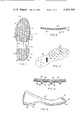
- FIG. 1 is a bottom, plan view of a shoe sole, for overshoes or the like, showing punched and expanded metal, molded into the sole, with projections extending beyond the sole material.
- FIG. 2 is a detailed, cross-sectional view of a portion of the sole of the device of FIG. 1, taken on section lines 2--2.
- FIG. 3 is a plan view of a sole of an overshoe with an imbedded, thin metal sheet, having punched out teeth protruding out of the sole material.
- FIG. 4 is an enlarged detailed cross-sectional view of a portion of the sole of FIG. 3, taken along section line 4--4.
- FIG. 5 is a side elevational view of one form of an overshoe using the metal plate according to the invention imbedded in the sole and a plate embedded in the heel with metal projections for a non-skid bottom.
- FIG. 6 is a bottom plan view of an overshoe sole with removable metal plates attached to a forward and heel portion of the sole.
- FIG. 7 is a side view of the overshoe of FIG. 6.
- FIG. 8 is a bottom plan view of the removable plates of FIGS. 6 and 7 detached from the overshoe.
- FIG. 9 is an enlarged detailed cross-sectional side view of the heel plate attachment area of FIGS. 6 and 7.
- FIG. 10 is a perspective view of a removable metal plate being inserted into an overshoe sole flap.
- the device of the invention is generally, a thin metal plate embedded in the molded sole and/or heel of an overshoe type of footwear, which is generally used over the normal shoes of a user.
- Such over-wear is formed of a polymeric material, which is an elastomer, either natural or synthetic, as natural rubber, synthetic rubber, as butyl rubber, neoprene, etc.
- the elastomer may also be synthetic plastic material as an alkylene polymer. e.g. polyethylene, polypropylene, etc.; other synthetic polymers as various types of vinyls, polycarbonates, polyurethanes, and many others.
- the main criteria is that the material is moldable, is generally soft and flexible, and is waterproof. Such material may be used alone as a molded overshoe or may include reinforcing as fabric, etc.
- the molding of the material, the shapes of the over-wear are well known.
- the device of FIGS. 1-2 shows a sole of a waterproof overshoe, shown generally by numeral 10, having an edging of elastomerc material 12 extending around the shoe, and an arch area 14 between a sole area 16 and a heel area 18.
- the sole is molded and includes an upper elastomeric sole layer 20, FIG. 2, and a punched and expanded, thin metal plate 22 covered by a lower sole layer 24.
- the elastomeric material preferably adheres to the metal.
- the punched and expanded metal plate 22 is originally a thin, flat plate, which has a series of slits.
- the heel 18, also, includes an upper elastomeric layer, a punched and expanded metal plate 30, and a lower layer of the heel (the elastomeric layers are not specifically shown but are similar to the sole layers).
- the heel includes sharp edged projections 32, which extend through the lower layer of the heel elastomeric material.
- a low cut one piece overshoe or rubber 40 includes an upper portion 41, a sole 42, and a heel 43, all integrally molded of an elastomeric material, as is conventional.
- the sole and the heel have punched and expanded plates embedded therein, as explained above, providing sharp edged projections 44 and 45 from the twisted lands of the plate between the slits.
- high top boots, full boots, wadders, etc. may include the metal plate to provide the projections.
- a metal plate 34 may have a series of holes 35, of rather large diameter, punched through the plate to produce a number of extending sharp prongs 36 around each hole 35.
- the prongs 36 represent the metal which has been pushed out of the holes 35, and this metal forms some 3 or more prongs 36 around the hole 35 depending on the punching tool. If the hole punching tool is used to produce the holes 35 from one side of the metal, the prongs 36 will extend generally perpendicular from the one surface of the plate.
- the plate 34 is embedded and preferably bonded with an elastomeric sole under the upper layer 38 and above the lower layer 39.
- the series of holes may be made in lines, and as many as desired or feasible.
- the metal of the plates may be steel, and may be hardened after working to produce the prongs. These plates are generally thin, being on the order of 20 gauge plate to thicker plates. The thinner plates have more flexibility, which is an advantage with the plates with the punched out prongs, while a punched and expanded plate is flexible by virtue of the open spaces and the lattice work.
- the metal plates permit the use of thin sole layers and the weight of the user on the projections in contact with a surface is spread throughout the sole and/or heel. Thus, the weight distribution is even throughout the sole even if only a few prongs are in contact with a surface. This maintains the plate in between the layers in the sole.
- an overshoe 10 such as rubber 40 may also be provided with removeable plate means such as a removable forward plate 50 and removable heel plate 50(A).
- the plates 50, 50(A) are attached to the rubber 40 by an attachment means such as resilient flaps 57, 58 intergrally formed with the rubber sole 42.
- the flaps 57, 58 may be stretched as shown by FIG. 10 to allow insertion of a plate 50.
- the plate is firmly held in the gap 60 formed by the upper surface of the flap 57, 58 and the lower surface of the sole 42.
- the removable plates 50, 50(A) have a smooth peripheral portion 53 which is encompassed by the flap 58.
- a pronged surface 55 comprising a planar surface 51 and downwardly depending prongs 52 is positioned inwordly of the area covered by the flaps 58 to provide a gripping surface.
- the prongs 51 extend substantially beyond the lower surface of the flap 58 to insure adequate gripping contact with a walking surface.
- the prongs 52 may be given a bi-directional orientation to further facilitate gripping.
- the prongs on the forward plate 50 are sloped in a rearward direction to prevent skidding as a person strides forward off the ball of his foot.
- the heel plate 50(A) is provided with forward slopping prongs 52 to prevent a person from falling backwards as his heel strikes a slippery surface in the ending portion of a stride.
- the use of removable plates may greatly extend the life of the overshoe 10 by allowing relatively inexpensive replacement of the portion most subject to wear.
- the replacement feature also allows the overshoe 10 to be adapted to a variety of uses which may require different types of plates. For example, relatively thin flexible plates might be desired for use with rubbers 40 in ordinary street use, whereas thicker plates with longer prongs might be desired for use with overshoes 10 used in construction and the like.
Landscapes
- Footwear And Its Accessory, Manufacturing Method And Apparatuses (AREA)
Abstract
Description
Claims (7)
Priority Applications (1)
| Application Number | Priority Date | Filing Date | Title |
|---|---|---|---|
| US06/363,096 US4434565A (en) | 1980-03-27 | 1982-03-29 | Non-slip overshoe |
Applications Claiming Priority (2)
| Application Number | Priority Date | Filing Date | Title |
|---|---|---|---|
| US13419280A | 1980-03-27 | 1980-03-27 | |
| US06/363,096 US4434565A (en) | 1980-03-27 | 1982-03-29 | Non-slip overshoe |
Related Parent Applications (1)
| Application Number | Title | Priority Date | Filing Date |
|---|---|---|---|
| US13419280A Continuation-In-Part | 1980-03-27 | 1980-03-27 |
Publications (1)
| Publication Number | Publication Date |
|---|---|
| US4434565A true US4434565A (en) | 1984-03-06 |
Family
ID=26832060
Family Applications (1)
| Application Number | Title | Priority Date | Filing Date |
|---|---|---|---|
| US06/363,096 Expired - Fee Related US4434565A (en) | 1980-03-27 | 1982-03-29 | Non-slip overshoe |
Country Status (1)
| Country | Link |
|---|---|
| US (1) | US4434565A (en) |
Cited By (33)
| Publication number | Priority date | Publication date | Assignee | Title |
|---|---|---|---|---|
| EP0250634A1 (en) * | 1986-07-03 | 1988-01-07 | PROTECTOR SAL S.a.s. di Giovanni Salutati | Nonskid hobnailed undershoe |
| USD319527S (en) | 1988-10-03 | 1991-09-03 | Jean Hartmann | Bowling shoe sole guard |
| USD334656S (en) | 1992-01-13 | 1993-04-13 | The Rockport Company Inc. | Shoe sole |
| US5315767A (en) * | 1989-09-07 | 1994-05-31 | Bradbury Frank M | Shoe sole saver |
| FR2709929A1 (en) * | 1993-09-13 | 1995-03-24 | Inova France | Non-slip sole |
| US5775005A (en) * | 1995-06-21 | 1998-07-07 | Wolverine World Wide Inc. | Footwear sole with cleated window |
| USD400946S (en) | 1996-07-29 | 1998-11-10 | St Amand Ronald T | Skate guard |
| US5974698A (en) * | 1997-11-26 | 1999-11-02 | New England Overshoe Company, Inc. | Overshoe construction |
| WO2000070982A1 (en) * | 1999-05-19 | 2000-11-30 | Blundstone Pty Ltd | Footwear manufacturing method |
| US6276073B1 (en) * | 1998-12-04 | 2001-08-21 | John J. Curley, Jr. | Dynamic permanent spike outsole |
| US6328761B1 (en) * | 1994-08-24 | 2001-12-11 | Kiribai Chemical Co., Ltd. | Disposable body warmer for use in footwear |
| US20030230006A1 (en) * | 2002-03-11 | 2003-12-18 | Ben Dombowsky | Resilient strap-on sole cover |
| WO2004080225A1 (en) * | 2003-03-10 | 2004-09-23 | Ben Dombowsky | Resilient strap-on sole cover |
| US20050193596A1 (en) * | 2004-03-05 | 2005-09-08 | Culton Dale M. | Waterproof protective overshoe for golf shoes |
| EP1616493A1 (en) * | 2004-07-12 | 2006-01-18 | Votolato, Earl J., Trustee of Votolato Living Trust | Elastic overshoe with slip resistant sole pads |
| US20080000102A1 (en) * | 2006-07-01 | 2008-01-03 | Rastegar Johangir S | Shoe covering for traction and/or sports |
| US20080184592A1 (en) * | 2005-09-15 | 2008-08-07 | Alfred Cloutier Ltee | Adaptable Shoe Cover |
| US20080250666A1 (en) * | 2007-04-16 | 2008-10-16 | Earl Votolato | Elastic Overshoe with Sandwiched Sole Pads |
| US20090241369A1 (en) * | 2008-03-28 | 2009-10-01 | Earl J. Votolato | Latticed elastic shoe cover with cleats |
| US20090249653A1 (en) * | 2008-04-07 | 2009-10-08 | Gunthel Peter J | Interchangeable slip-on golf overshoe |
| US20090249652A1 (en) * | 2008-04-07 | 2009-10-08 | Gunthel Peter J | Sports shoe sole with functional topography |
| USD625086S1 (en) * | 2010-05-20 | 2010-10-12 | Key Harriet J | Shoe sole cover |
| US8539698B1 (en) * | 2009-04-13 | 2013-09-24 | Michael J. Woodruff | Footwear safety apparatus, device, and method |
| US20130305565A1 (en) * | 2012-05-18 | 2013-11-21 | Merrick Jones | Traction device for footwear |
| US8814124B1 (en) | 2010-02-23 | 2014-08-26 | Vladimir Vayntraub | Article hanging device |
| US20150033582A1 (en) * | 2013-08-02 | 2015-02-05 | Arthur J. Colpack | Polymer shoe |
| US20160029739A1 (en) * | 2013-03-15 | 2016-02-04 | Olga Dias | A Sole |
| US20160213102A1 (en) * | 2015-01-27 | 2016-07-28 | Salomon S.A.S. | Footwear element |
| US9839257B2 (en) | 2015-09-16 | 2017-12-12 | Michael Edward Fransko, SR. | Flexible skateboard shoe protector overshoe |
| USD819936S1 (en) * | 2016-03-23 | 2018-06-12 | Safety2Shoes Aps | Low-dip overshoe |
| US20180255867A1 (en) * | 2017-03-07 | 2018-09-13 | Lorri Cornett | Cycling Shoe Cover |
| US11229282B1 (en) * | 2018-07-27 | 2022-01-25 | Sammy J Shafer, Sr. | Wearable cleaning apparatus |
| US20230404208A1 (en) * | 2022-04-18 | 2023-12-21 | Thomas Cono Isernia | Cleated Shoe Cover |
Citations (12)
| Publication number | Priority date | Publication date | Assignee | Title |
|---|---|---|---|---|
| US287748A (en) | 1883-10-30 | James w | ||
| US736082A (en) | 1902-02-05 | 1903-08-11 | William Foreman | Attachment for rubber shoes or the like. |
| US1211619A (en) | 1916-01-24 | 1917-01-09 | Albert L Tucker | Antiskid or antislip tread. |
| US1255911A (en) | 1917-04-19 | 1918-02-12 | Charles Bosley | Plate for boots and shoes. |
| US1615498A (en) | 1926-03-29 | 1927-01-25 | Andrew P Anderson | Antislip attachment for footwear |
| US1841710A (en) | 1930-12-06 | 1932-01-19 | Edward C Byrne | Overshoe for use in sports |
| US2776499A (en) | 1954-08-27 | 1957-01-08 | Giuntini Hilaire Luciano | Footwear |
| US2970390A (en) | 1959-06-22 | 1961-02-07 | Wayne S Brough | Overshoe |
| US3170251A (en) | 1963-05-03 | 1965-02-23 | Patrick Raymond | Antiskid attachment for shoes |
| GB1257524A (en) | 1969-02-12 | 1971-12-22 | ||
| US3643352A (en) | 1970-10-02 | 1972-02-22 | Raymond K S Adair | Overshoe for golf |
| US4202116A (en) | 1977-09-12 | 1980-05-13 | Dassler Armin | Sport shoe tread |
-
1982
- 1982-03-29 US US06/363,096 patent/US4434565A/en not_active Expired - Fee Related
Patent Citations (12)
| Publication number | Priority date | Publication date | Assignee | Title |
|---|---|---|---|---|
| US287748A (en) | 1883-10-30 | James w | ||
| US736082A (en) | 1902-02-05 | 1903-08-11 | William Foreman | Attachment for rubber shoes or the like. |
| US1211619A (en) | 1916-01-24 | 1917-01-09 | Albert L Tucker | Antiskid or antislip tread. |
| US1255911A (en) | 1917-04-19 | 1918-02-12 | Charles Bosley | Plate for boots and shoes. |
| US1615498A (en) | 1926-03-29 | 1927-01-25 | Andrew P Anderson | Antislip attachment for footwear |
| US1841710A (en) | 1930-12-06 | 1932-01-19 | Edward C Byrne | Overshoe for use in sports |
| US2776499A (en) | 1954-08-27 | 1957-01-08 | Giuntini Hilaire Luciano | Footwear |
| US2970390A (en) | 1959-06-22 | 1961-02-07 | Wayne S Brough | Overshoe |
| US3170251A (en) | 1963-05-03 | 1965-02-23 | Patrick Raymond | Antiskid attachment for shoes |
| GB1257524A (en) | 1969-02-12 | 1971-12-22 | ||
| US3643352A (en) | 1970-10-02 | 1972-02-22 | Raymond K S Adair | Overshoe for golf |
| US4202116A (en) | 1977-09-12 | 1980-05-13 | Dassler Armin | Sport shoe tread |
Cited By (47)
| Publication number | Priority date | Publication date | Assignee | Title |
|---|---|---|---|---|
| EP0250634A1 (en) * | 1986-07-03 | 1988-01-07 | PROTECTOR SAL S.a.s. di Giovanni Salutati | Nonskid hobnailed undershoe |
| USD319527S (en) | 1988-10-03 | 1991-09-03 | Jean Hartmann | Bowling shoe sole guard |
| US5315767A (en) * | 1989-09-07 | 1994-05-31 | Bradbury Frank M | Shoe sole saver |
| USD334656S (en) | 1992-01-13 | 1993-04-13 | The Rockport Company Inc. | Shoe sole |
| FR2709929A1 (en) * | 1993-09-13 | 1995-03-24 | Inova France | Non-slip sole |
| US6328761B1 (en) * | 1994-08-24 | 2001-12-11 | Kiribai Chemical Co., Ltd. | Disposable body warmer for use in footwear |
| US5775005A (en) * | 1995-06-21 | 1998-07-07 | Wolverine World Wide Inc. | Footwear sole with cleated window |
| USD400946S (en) | 1996-07-29 | 1998-11-10 | St Amand Ronald T | Skate guard |
| US5974698A (en) * | 1997-11-26 | 1999-11-02 | New England Overshoe Company, Inc. | Overshoe construction |
| US6276073B1 (en) * | 1998-12-04 | 2001-08-21 | John J. Curley, Jr. | Dynamic permanent spike outsole |
| WO2000070982A1 (en) * | 1999-05-19 | 2000-11-30 | Blundstone Pty Ltd | Footwear manufacturing method |
| US20030230006A1 (en) * | 2002-03-11 | 2003-12-18 | Ben Dombowsky | Resilient strap-on sole cover |
| US6968634B2 (en) | 2002-03-11 | 2005-11-29 | Ben Dombowsky | Resilient strap-on sole cover |
| WO2004080225A1 (en) * | 2003-03-10 | 2004-09-23 | Ben Dombowsky | Resilient strap-on sole cover |
| US20050193596A1 (en) * | 2004-03-05 | 2005-09-08 | Culton Dale M. | Waterproof protective overshoe for golf shoes |
| EP1616493A1 (en) * | 2004-07-12 | 2006-01-18 | Votolato, Earl J., Trustee of Votolato Living Trust | Elastic overshoe with slip resistant sole pads |
| US20080184592A1 (en) * | 2005-09-15 | 2008-08-07 | Alfred Cloutier Ltee | Adaptable Shoe Cover |
| US8474153B2 (en) | 2005-09-15 | 2013-07-02 | Alfred Cloutier Ltée | Adaptable shoe cover |
| US20080000102A1 (en) * | 2006-07-01 | 2008-01-03 | Rastegar Johangir S | Shoe covering for traction and/or sports |
| US20080250666A1 (en) * | 2007-04-16 | 2008-10-16 | Earl Votolato | Elastic Overshoe with Sandwiched Sole Pads |
| US7966748B2 (en) * | 2007-04-16 | 2011-06-28 | Earl J. & Kimberly Votolato, Trustees Of The Votolato Living Trust | Elastic overshoe with sandwiched sole pads |
| US20090241369A1 (en) * | 2008-03-28 | 2009-10-01 | Earl J. Votolato | Latticed elastic shoe cover with cleats |
| US20090249653A1 (en) * | 2008-04-07 | 2009-10-08 | Gunthel Peter J | Interchangeable slip-on golf overshoe |
| US20090249652A1 (en) * | 2008-04-07 | 2009-10-08 | Gunthel Peter J | Sports shoe sole with functional topography |
| US8539698B1 (en) * | 2009-04-13 | 2013-09-24 | Michael J. Woodruff | Footwear safety apparatus, device, and method |
| US8814124B1 (en) | 2010-02-23 | 2014-08-26 | Vladimir Vayntraub | Article hanging device |
| USD625086S1 (en) * | 2010-05-20 | 2010-10-12 | Key Harriet J | Shoe sole cover |
| US20130305565A1 (en) * | 2012-05-18 | 2013-11-21 | Merrick Jones | Traction device for footwear |
| US8991069B2 (en) * | 2012-05-18 | 2015-03-31 | Implus Footcare, Llc | Traction device for footwear |
| US20160029739A1 (en) * | 2013-03-15 | 2016-02-04 | Olga Dias | A Sole |
| US10039344B2 (en) * | 2013-03-15 | 2018-08-07 | Olga Dias | Sole |
| US20150033582A1 (en) * | 2013-08-02 | 2015-02-05 | Arthur J. Colpack | Polymer shoe |
| US9655401B2 (en) * | 2013-08-02 | 2017-05-23 | Arthur Joseph for Surell, LLC. | Polymer shoe |
| US20160213102A1 (en) * | 2015-01-27 | 2016-07-28 | Salomon S.A.S. | Footwear element |
| US9936769B2 (en) * | 2015-01-27 | 2018-04-10 | Salomon S.A.S. | Footwear element |
| US9839257B2 (en) | 2015-09-16 | 2017-12-12 | Michael Edward Fransko, SR. | Flexible skateboard shoe protector overshoe |
| USD819934S1 (en) * | 2016-03-23 | 2018-06-12 | Safety2Shoes Aps | High-dip overshoe |
| USD819937S1 (en) * | 2016-03-23 | 2018-06-12 | Safety2Shoes Aps | Overshoe with bleed |
| USD819933S1 (en) * | 2016-03-23 | 2018-06-12 | Safety2Shoes Aps | High-dip overshoe with bleed |
| USD819935S1 (en) * | 2016-03-23 | 2018-06-12 | Safety2Shoes Aps | Low-dip overshoe with bleed |
| USD819938S1 (en) * | 2016-03-23 | 2018-06-12 | Safety2Shoes Aps | Overshoe |
| USD819936S1 (en) * | 2016-03-23 | 2018-06-12 | Safety2Shoes Aps | Low-dip overshoe |
| US20180255867A1 (en) * | 2017-03-07 | 2018-09-13 | Lorri Cornett | Cycling Shoe Cover |
| US11470911B2 (en) * | 2017-03-07 | 2022-10-18 | Lorri Cornett | Cycling shoe cover |
| US11229282B1 (en) * | 2018-07-27 | 2022-01-25 | Sammy J Shafer, Sr. | Wearable cleaning apparatus |
| US20230404208A1 (en) * | 2022-04-18 | 2023-12-21 | Thomas Cono Isernia | Cleated Shoe Cover |
| US12349766B2 (en) * | 2022-04-18 | 2025-07-08 | Thomas Cono Isernia | Cleated shoe cover |
Similar Documents
| Publication | Publication Date | Title |
|---|---|---|
| US5634283A (en) | Resilient, all-surface sole | |
| US3616552A (en) | Antiskid footwear | |
| CN100548168C (en) | Anti-skid overshoes | |
| US4194310A (en) | Athletic shoe for artificial turf with molded cleats on the sides thereof | |
| US6470599B1 (en) | Climbing shoe with concave sole | |
| US3849915A (en) | Sport shoe | |
| US5396717A (en) | Convertible overshoe with tear resistant bead | |
| US3566488A (en) | Cleat guard | |
| US4045888A (en) | Athletic shoe | |
| US5384971A (en) | Boots for outdoor use by sports persons | |
| US3020654A (en) | Auxiliary sole for sport shoes | |
| US5513450A (en) | Sand soccer boot | |
| US3858336A (en) | Removable outsole for sport shoes | |
| US2076316A (en) | Removable outsole for sport shoes | |
| US3918181A (en) | Sport shoe | |
| US20070113424A1 (en) | Overshoes with raised inner surface portions and slip resistant sole portions for use on primary footwear | |
| US3932950A (en) | Footwear with non-slip tread | |
| US20150342305A1 (en) | Anti-Slip Overshoe with Flexible Cleats and Method of Gripping Natural Surfaces | |
| US5172496A (en) | Spiked shoe covering | |
| US2932096A (en) | Anti-slip device | |
| US3283424A (en) | Baseball spike guard | |
| CN210630710U (en) | A kind of rubber anti-skid and anti-puncture safety shoes | |
| US3763578A (en) | Flexible cleaner for the sole of a golf shoe | |
| KR20100033921A (en) | Footwear for fishing and outsole | |
| US20060101669A1 (en) | Reinforced toe |
Legal Events
| Date | Code | Title | Description |
|---|---|---|---|
| MAFP | Maintenance fee payment |
Free format text: PAYMENT OF MAINTENANCE FEE, 4TH YEAR, PL 96-517 (ORIGINAL EVENT CODE: M170); ENTITY STATUS OF PATENT OWNER: SMALL ENTITY Year of fee payment: 4 |
|
| MAFP | Maintenance fee payment |
Free format text: PAYMENT OF MAINTENANCE FEE, 8TH YEAR, PL 96-517 (ORIGINAL EVENT CODE: M171); ENTITY STATUS OF PATENT OWNER: SMALL ENTITY Year of fee payment: 8 |
|
| FEPP | Fee payment procedure |
Free format text: MAINTENANCE FEE REMINDER MAILED (ORIGINAL EVENT CODE: REM.); ENTITY STATUS OF PATENT OWNER: SMALL ENTITY |
|
| LAPS | Lapse for failure to pay maintenance fees | ||
| FP | Lapsed due to failure to pay maintenance fee |
Effective date: 19960306 |
|
| STCH | Information on status: patent discontinuation |
Free format text: PATENT EXPIRED DUE TO NONPAYMENT OF MAINTENANCE FEES UNDER 37 CFR 1.362 |