US4381891A - Film cassette for several strip films - Google Patents
Film cassette for several strip films Download PDFInfo
- Publication number
- US4381891A US4381891A US06/280,691 US28069181A US4381891A US 4381891 A US4381891 A US 4381891A US 28069181 A US28069181 A US 28069181A US 4381891 A US4381891 A US 4381891A
- Authority
- US
- United States
- Prior art keywords
- cassette
- film
- strip
- camera
- films
- Prior art date
- Legal status (The legal status is an assumption and is not a legal conclusion. Google has not performed a legal analysis and makes no representation as to the accuracy of the status listed.)
- Expired - Fee Related
Links
- 239000000839 emulsion Substances 0.000 claims description 18
- 230000007723 transport mechanism Effects 0.000 claims description 8
- 238000007789 sealing Methods 0.000 claims description 6
- 230000007246 mechanism Effects 0.000 claims description 3
- 238000003780 insertion Methods 0.000 claims description 2
- 238000005192 partition Methods 0.000 description 13
- 239000011888 foil Substances 0.000 description 2
- 239000000463 material Substances 0.000 description 2
- 238000000034 method Methods 0.000 description 2
- 230000004913 activation Effects 0.000 description 1
- 239000011248 coating agent Substances 0.000 description 1
- 238000000576 coating method Methods 0.000 description 1
- 238000005520 cutting process Methods 0.000 description 1
- 238000004519 manufacturing process Methods 0.000 description 1
- 239000002184 metal Substances 0.000 description 1
- 238000000465 moulding Methods 0.000 description 1
- 238000003825 pressing Methods 0.000 description 1
- 238000000926 separation method Methods 0.000 description 1
- 125000006850 spacer group Chemical group 0.000 description 1
- 238000003856 thermoforming Methods 0.000 description 1
Images


Classifications
-
- G—PHYSICS
- G03—PHOTOGRAPHY; CINEMATOGRAPHY; ANALOGOUS TECHNIQUES USING WAVES OTHER THAN OPTICAL WAVES; ELECTROGRAPHY; HOLOGRAPHY
- G03B—APPARATUS OR ARRANGEMENTS FOR TAKING PHOTOGRAPHS OR FOR PROJECTING OR VIEWING THEM; APPARATUS OR ARRANGEMENTS EMPLOYING ANALOGOUS TECHNIQUES USING WAVES OTHER THAN OPTICAL WAVES; ACCESSORIES THEREFOR
- G03B17/00—Details of cameras or camera bodies; Accessories therefor
- G03B17/26—Holders for containing light sensitive material and adapted to be inserted within the camera
Definitions
- This invention relates to a film cassette for at least two photosensitive strip films suitable for taking several pictures, consisting of a lightproof, flat flexible case substantially equal in length to a strip of film with intermediate walls for separating the strips of film and at least one cassette opening or film orifice which extends perpendicularly of the length of the case and which is provided with light-sealing means for the passage of the strips of film.
- This process is advantageous because twice the number of pictures can be taken using a single cassette controlled by the camera. However, it does require an elaborate camera with two transport mechanisms and a relatively wide cassette. Also, it is not readily possible optionally to use cassettes containing only one strip of film or cassettes containing several strips of film in this camera.
- an object of the present invention is to provide a film cassette which is as small as possible in its dimensions for a predetermined strip film format, is capable of accommodating several strips of film and may be used in a camera capable of taking a film cassette containing either only one strip of film or several strips of film.
- this object is achieved in accordance with the invention in that the strip films lie with their longitudinal edges one above the other in the film cassette and are arranged in the film cassette in such a way that, after a first strip film has been exposed, the cassette is removed from the camera and, after rotation parallel to one of its axes, (L,Q,V), may be re-inserted for exposure of the next strip.
- the cassette accomodates one, two, three or four strip films lying one above the other which, simply by withdrawing the cassette from the camera, turning it parallel to one of its axes and reintroducing it, are successively brought into engagement with the transport mechanism and the individual strip films are successively reduced by the camera from the cassette, exposed and pushed back into the cassette.
- a cassette for two film strips is distinguished by the fact that two film orifices are arranged one above the other in one end face of the cassette and two strip films each with an incision on one side and at least one perforation for transport purposes are provided, their emulsion sides pointing towards different flat sides of the film cassettes, and further by the fact that, to expose the second strip film, the cassette is turned about the axis running parallel to its longitudinal axis after exposure of the first strip film.
- a cassette is distinguished by the fact the one film orifice is arranged in each end face and two identical strip films are each provided at their beginning with two perforations for transport purposes and by the fact that the emulsion sides of the strip films point towards different flat sides of the film cassette and, to expose the second strip film, the cassette is turned about an axis running parallel to its width after exposure of the first strip film.
- the two embodiments differ from one another essentially in the arrangement of the film orifices which necessitates rotation of the cassette parallel to different axes on reintroduction.
- the beginning of the strip film receives an incision so that each strip of film may be individually taken up by film transport means on the camera side whereas, where the cassette orifices are arranged on different end faces of the cassette, there is no need for the beginning of the film to be cut for the strip films to be individually gripped.
- Perforations may be provided along both edges of the strip films for transport purposes.
- the emulsion sides of the strip films in the cassette may face either towards one side or to different sides of the cassette, depending upon the direction in which the cassette has to be turned after exposure of the first strip film.
- two film orifices are arranged one above the other in each end face of the film cassette and four identical strip films each comprising an incision on one side and at least one perforation for transport purposes at the beginning of the strips, the strip films being arranged in such a way that, at the end faces, their emulsion sides face in pairs towards different flat sides of the cassette and, to exposure the other strips of film, the cassette is rotated after exposure of the first strip of film about an axis running parallel to its longitudinal axis and about an axis running perpendicularly of the width and length of the cassette.
- This embodiment enables four times the number of pictures to be taken using one cassette.
- a camera designed for cassettes containing one or two strip films may be used for taking the pictures.
- a cassette accommodating only three strip films would also be possible in this embodiment.
- Multiple cassettes according to the embodiment described above are less expensive to produce on account of the smaller amount of material required for their production, especially since in the majority of cases there is no need for partitions between the backs of the films.
- the cassette and/or the strip films carry marks identifying the strip film sequence and/or numbers for correct loading into a camera and the camera is provided with a corresponding mark at the loading slot and after removal of the cassette from the camera, the mark and/or numbers can be removed from the cassette or the strip films.
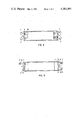
- FIG. 1 is a plan view of a cassette comprising two strip films and two films orifices in one end face of the cassette.
- FIG. 2 is a longitudinal section through the cassette shown in FIG. 1.
- FIG. 3 is a plan view of a cassette comprising a film orifice in each end face of the cassette.
- FIG. 4 is a longitudinal section through the cassette shown in FIG. 3.
- FIG. 5 is a plan view of a cassette containing four strip films.
- FIG. 6 is a longitudinal section through the cassette shown in FIG. 5 with partitions between the film strips.
- FIG. 7 is a longitudinal section through the cassette shown in FIG. with only one partition.
- FIG. 8 is a plan view of a cassette with guidance marks and numbers.
- FIG. 9 shows a cassette containing special strip films in which the transport tag is designed to be cut off or folded over.
- a flat, case-like film cassette for two photosensitive strip films 1, 2 suitable for taking several pictures consists of two flat, shell-like walls 11 and 12. They are made of a substantially rigid, only slightly flexible lightproof foil, for example, of metal or plastic material, which is capable of being formed, for example by deep drawing or moulding or thermoforming, and are joined to one another in lightproof manner along two longitudinal sides and one end side 5.
- the film orifices 6 for the passage of the strip films 1, 2 which are sealed off by light sealing means are situated in the open end side or face 5.
- the two walls 11, 12 may be symmetrical to one another or even different from one another in shape. In the embodiment shown in FIGS. 1 and 2, they are symmetrical to one another in shape.
- a shallow trough substantially equal in length and width to the strip films 1, 2 is formed in this edge by deep drawing or pressing, the two troughs forming the space required for the strip films 1, 2 when the walls 11, 12 are joined together.
- a separating foil acting as a partition 13 for the two strip films 1, 2 is welded or bonded in at the connecting lines between the walls 11, 12.
- this partition 13 is provided on both sides with light-proofing means so that each strip film 1, 2 is protected against the entry of light on both sides in the cassette.
- the film cassette is loaded into a camera and the transport mechanism of the camera engages in the first perforation 8 in the first strip film 1 and advances the strip film in the arrowed direction beyond the cassette for each exposure and, after the last exposure, pushes the strip of film back into the lightproof cassette in the arrowed direction.
- the camera may of course also be disigned in such a way that the strip film 1 is first completely withdrawn and exposed during its step-by-step return.
- the cassette After exposure of the strip film 1, the cassette is removed, turned through 180° about its longitudinal axis L and pushed back into the camera for exposing the second strip film 2.
- FIGS. 3 and 4 are respectively a plan view of and a section through an embodiment of a film cassette in which one film orifice 6 is arranged in each end face 5 for the passage of the strip films 1, 2.
- the film cassette is also formed from two wall shells 11 and 12 in which the strip films 1 and two are displaceable.
- one or even two rows of perforations 8 may be provided for transporting the strip films in the camera.
- the emulsion sides E of the strip films 1, 2 may be directed to one or different sides of the cassette. In FIG. 3 for example, both strips films are introduced with the photographically active coating, the emulsion side E' (FIG. 4), facing towards one flat side of the cassette.
- the cassette has to be rotated parallel in the vertical axis V after exposure and removal from the camera in order to expose the second strip of the cassette. If the strip films are introduced into the cassette in such a way that the sides coated with emulsion E face towards different flat sides of the cassette, the cassette has to be rotated parallel to the transverse axis Q of the cassette for exposing the strip film 2 before it is introduced into the camera for exposing the second strip film.
- the strip films may be introduced in such a way that their emulsion-free backs are in contact with one another, it is possible in this case, too, to dispsense with a partition 13 (not shown).
- FIG. 5 is a plan view of the film cassette which is similar in structure to a cassette of the type shown in FIG. 1 when two of these two-film cassettes are placed on one another, rotated through 180°, but with the difference that there is less need for a partition 13 for producing the cassette shown in FIG. 5.
- the cassette shown in FIG. 6 consists of an upper wall 11, three partitions 13 and a lower wall 12. For each of the four strip films 1,2,3, and 4, there is a cassette orifice 6 arranged in each case between the walls 11, 12 and the partitions 13.
- the strip films 1,2,3 and 4 are provided with an incision 7 which enables the film transport mechanism of an associated camera to engage only one film strip at a time through the transport perforation 8.
- all the strip films have at least one row of perforations, at least one perforation being provided per frame.
- the cassettes may be turned about their axes after exposure of the strip films.
- the cassette shown in FIG. 6 contains, for example, film strips of which the emulsion sides E on the strip film are all situated facing outwards away from the centre of the cassette. If the strip films are successively exposed in the sequence 1 to 4, the cassette is rotated parallel to the following axes between the exposure of the individual strip films: about the L-axis after exposure of the strip film 1, about the V-axis after the strip film 2 and again about the L-axis after the strip film 3.
- the individual strip films may of course be exposed in any sequence. This is of interest insofar as it is possible to load the cassette with different types of film.
- One cassette may contain, for example, black-and-white films and colour films or even negative or reversal films, so that black-and-white pictures or colour pictures and colour transparancies of a subject may be taken in rapid succession using one and the same camera.
- FIG. 7 shows a cassette of simpler structure. It consists of an upper wall 11, only one partition 13 and a lower wall 12. Film orifices 6 are arranged in both end faces 5 of the cassette, being shaped in such a way that both sides of the strip films 1, 2 and 3, 4 are protected against the entry of light. To this end, a sealing strip 16 is inserted between the strip films and is welded or bonded to the lateral longitudinal seams along the sides of the cassette. The strip films are introduced into the cassette in such a way that their emulsion-free sides are in contact with and slide in one another. In all four strip films, the emulsion sides E face outwards in pairs.
- a mark has to be provided either on the films or on the cassette to show the user or to enable him or her to ascertain whether or not a strip of film has already been exposed.
- FIG. 8 shows a simple device for preventing double exposures.
- a label with a mark 9 and a letter or FIG. 10 is associated with each strip film of a two-film or four-film cassette.
- the camera also has a corresponding mark (not shown) at the cassette loading point, namely on that side at which the strip of film is engaged and transported.
- the cassette is loaded or inserted into the camera in such a way that the marks 9 are situated adjacent one another.
- the label with the mark 9 and the film strip index 10 is removed by separation from the cassette. It can then be seen from the cassette that the unlabelled strip film has already been exposed.
- This method is simple and inexpensive, but is attended by the disadvantage that the user of the cassette is responsible for removing the label.
- FIG. 9 shows a device for avoiding double exposures which is considerably safer.
- the strip films 1,2,3 and 4 in the cassette have been punched through towards their front (at 7), leaving over only narrow transport tags 14 with transport perforations 8.
- the transport tags 14 may be provided with a perforation 15 at which the transport tag 14 with the transport perforation 8 may be cut off or folded over.
- the transport tag 14 with the transport perforation 8 is cut off so that, if the cassette is incorrectly reloaded into the camera by mistake, the strip of film can no longer be engaged. It is also possible for the transport tag 14 to be bent over, as shown in the case of the strip film 2.
- the transport tag 14 with the transport perforation 8 can be manually torn off by the user.
- the camera may be provided with a cutting edge which, after exposure and re-insertion of the strip film into the cassette, cuts off the transport tag 14 following activation by a special mechanism controlled by the camera or by opening the closure of the cassette slot in the camera for removing the cassette by hand (not shown).
- the invention also includes other embodiments in which at least two strip films are arranged with their longitudinal edges lying one above the other in a flat cassette.
- a cassette may also be made to accommodate three strip films (not shown).
- the strip films may be mounted in the cassette with spacer strips in such a way that they are capable of moving freely and of being removed and re-introduced with minimal effort at the camera end.
Landscapes
- Physics & Mathematics (AREA)
- General Physics & Mathematics (AREA)
- Details Of Cameras Including Film Mechanisms (AREA)
Applications Claiming Priority (2)
| Application Number | Priority Date | Filing Date | Title |
|---|---|---|---|
| DE19803026070 DE3026070A1 (de) | 1980-07-10 | 1980-07-10 | Filmkassette fuer mehrere filmstreifen |
| DE3026070 | 1980-07-10 |
Publications (1)
| Publication Number | Publication Date |
|---|---|
| US4381891A true US4381891A (en) | 1983-05-03 |
Family
ID=6106821
Family Applications (1)
| Application Number | Title | Priority Date | Filing Date |
|---|---|---|---|
| US06/280,691 Expired - Fee Related US4381891A (en) | 1980-07-10 | 1981-07-06 | Film cassette for several strip films |
Country Status (4)
| Country | Link |
|---|---|
| US (1) | US4381891A (de) |
| EP (1) | EP0043975B1 (de) |
| JP (1) | JPS5756840A (de) |
| DE (2) | DE3026070A1 (de) |
Citations (5)
| Publication number | Priority date | Publication date | Assignee | Title |
|---|---|---|---|---|
| US937129A (en) * | 1907-03-13 | 1909-10-19 | Frank Whitney | Photographic plate or film holder. |
| US947946A (en) * | 1906-08-02 | 1910-02-01 | Optische Anstalt Goerz Ag | Device for exposing light-sensitive layer-carriers and film structure therefor. |
| US1330235A (en) * | 1919-05-22 | 1920-02-10 | Augustus G Boxell | Recording plate-holder |
| US1698895A (en) * | 1927-08-01 | 1929-01-15 | Lloyd L Evans | Plate changer |
| US2576811A (en) * | 1947-12-10 | 1951-11-27 | Kalart Co Inc | Locking or control means for the slide of a plate or film holder for photographic apparatus |
Family Cites Families (1)
| Publication number | Priority date | Publication date | Assignee | Title |
|---|---|---|---|---|
| EP0014309A1 (de) * | 1979-01-12 | 1980-08-20 | Agfa-Gevaert AG | Filmkassette für einen für die Aufnahme mehrerer Bilder geeigneten lichtempfindlichen Filmstreifen und zu ihrer Verwendung geeignete Kamera sowie Verfahren zu ihrer Herstellung |
-
1980
- 1980-07-10 DE DE19803026070 patent/DE3026070A1/de not_active Withdrawn
-
1981
- 1981-06-30 EP EP81105043A patent/EP0043975B1/de not_active Expired
- 1981-06-30 DE DE8181105043T patent/DE3166015D1/de not_active Expired
- 1981-07-06 US US06/280,691 patent/US4381891A/en not_active Expired - Fee Related
- 1981-07-09 JP JP56106318A patent/JPS5756840A/ja active Pending
Patent Citations (5)
| Publication number | Priority date | Publication date | Assignee | Title |
|---|---|---|---|---|
| US947946A (en) * | 1906-08-02 | 1910-02-01 | Optische Anstalt Goerz Ag | Device for exposing light-sensitive layer-carriers and film structure therefor. |
| US937129A (en) * | 1907-03-13 | 1909-10-19 | Frank Whitney | Photographic plate or film holder. |
| US1330235A (en) * | 1919-05-22 | 1920-02-10 | Augustus G Boxell | Recording plate-holder |
| US1698895A (en) * | 1927-08-01 | 1929-01-15 | Lloyd L Evans | Plate changer |
| US2576811A (en) * | 1947-12-10 | 1951-11-27 | Kalart Co Inc | Locking or control means for the slide of a plate or film holder for photographic apparatus |
Also Published As
| Publication number | Publication date |
|---|---|
| DE3166015D1 (en) | 1984-10-18 |
| EP0043975A2 (de) | 1982-01-20 |
| EP0043975B1 (de) | 1984-09-12 |
| JPS5756840A (en) | 1982-04-05 |
| DE3026070A1 (de) | 1982-02-11 |
| EP0043975A3 (en) | 1982-07-28 |
Similar Documents
| Publication | Publication Date | Title |
|---|---|---|
| DE69129135T2 (de) | Filmpackung mit Aufnahmeobjektiv und Filmzufuhrvorrichtung und Packungshalter für ein Filmentwicklungsgerät | |
| EP0000469B1 (de) | Filmpatrone und Gerät zum Entwickeln eines in der Patrone enthaltenen Selbstentwicklungsfilms | |
| US4537307A (en) | Daylight film loading method and apparatus, film and film package used for same | |
| US3910692A (en) | Film handling cassette assembly | |
| EP0586040B1 (de) | Filmblatt-Zusammensetzung für einen selbstentwickelbaren Abziehfilm | |
| US4894674A (en) | Daylight bulk film loading system | |
| US3780634A (en) | System for taking and processing still pictures | |
| US5938031A (en) | Storage container for advanced photo system film canisters and index prints | |
| US3405619A (en) | Camera and film useful therein | |
| US4569578A (en) | Disk camera having disk carrying peel-apart film units | |
| US3152529A (en) | Photographic apparatus | |
| EP0664484B1 (de) | Matrix-Abzug, Packung für einen belichteten Film und Herstellung einer Filmpackung | |
| US5015089A (en) | Leader assembly and method | |
| US3673939A (en) | Photographic apparatus | |
| US4566772A (en) | Film processor for premounted transparency frames | |
| US4779110A (en) | Wet film cassette and transport system | |
| US3804626A (en) | Photographic film unit | |
| US3635139A (en) | Photographic film-unit assemblage | |
| US4630915A (en) | Multipart cassette for two component film system | |
| US5327187A (en) | Film cassette having a force transmitting member motion guiding surface incorporated therein | |
| US4568163A (en) | Camera back | |
| US4566770A (en) | Mount for transparency film frame | |
| US3986609A (en) | Microfiche film pack | |
| USRE30792E (en) | X-ray film package | |
| EP0665459A1 (de) | Lichtdichte Klappe einer Filmpatrone mit Schlitzen, welche mit den Filmführungsschienen einer Kamera ineinandergreifen |
Legal Events
| Date | Code | Title | Description |
|---|---|---|---|
| AS | Assignment |
Owner name: AGFA-GEVAERT AKTIENGESELLSCHAFT, LEVEKUSEN, GERMAN Free format text: ASSIGNMENT OF ASSIGNORS INTEREST.;ASSIGNORS:HOFFACKER, FRANZ;KOVACIC, GUIDO;LUHRIG, HERMANN;REEL/FRAME:003899/0505 Effective date: 19810610 |
|
| FEPP | Fee payment procedure |
Free format text: MAINTENANCE FEE REMINDER MAILED (ORIGINAL EVENT CODE: REM.); ENTITY STATUS OF PATENT OWNER: LARGE ENTITY |
|
| LAPS | Lapse for failure to pay maintenance fees | ||
| STCH | Information on status: patent discontinuation |
Free format text: PATENT EXPIRED DUE TO NONPAYMENT OF MAINTENANCE FEES UNDER 37 CFR 1.362 |
|
| FP | Lapsed due to failure to pay maintenance fee |
Effective date: 19870503 |