US4229645A - Detector and recorder of holes and disruptions in plastic material sheets and webs - Google Patents
Detector and recorder of holes and disruptions in plastic material sheets and webs Download PDFInfo
- Publication number
- US4229645A US4229645A US05/906,219 US90621978A US4229645A US 4229645 A US4229645 A US 4229645A US 90621978 A US90621978 A US 90621978A US 4229645 A US4229645 A US 4229645A
- Authority
- US
- United States
- Prior art keywords
- counting
- discharges
- web
- counter
- flop
- Prior art date
- Legal status (The legal status is an assumption and is not a legal conclusion. Google has not performed a legal analysis and makes no representation as to the accuracy of the status listed.)
- Expired - Lifetime
Links
- 239000000463 material Substances 0.000 title claims abstract description 6
- 230000002401 inhibitory effect Effects 0.000 claims description 6
- 230000035945 sensitivity Effects 0.000 claims description 5
- 230000007547 defect Effects 0.000 claims description 4
- 230000008878 coupling Effects 0.000 claims 1
- 238000010168 coupling process Methods 0.000 claims 1
- 238000005859 coupling reaction Methods 0.000 claims 1
- 238000001514 detection method Methods 0.000 abstract description 4
- 239000004020 conductor Substances 0.000 description 2
- 230000002950 deficient Effects 0.000 description 2
- 238000010586 diagram Methods 0.000 description 2
- 238000004519 manufacturing process Methods 0.000 description 2
- 238000009825 accumulation Methods 0.000 description 1
- 230000015572 biosynthetic process Effects 0.000 description 1
- 230000000694 effects Effects 0.000 description 1
- 238000010892 electric spark Methods 0.000 description 1
- 230000005611 electricity Effects 0.000 description 1
- 238000005259 measurement Methods 0.000 description 1
- 230000011664 signaling Effects 0.000 description 1
- 238000004804 winding Methods 0.000 description 1
Images

Classifications
-
- G—PHYSICS
- G01—MEASURING; TESTING
- G01N—INVESTIGATING OR ANALYSING MATERIALS BY DETERMINING THEIR CHEMICAL OR PHYSICAL PROPERTIES
- G01N27/00—Investigating or analysing materials by the use of electric, electrochemical, or magnetic means
- G01N27/02—Investigating or analysing materials by the use of electric, electrochemical, or magnetic means by investigating impedance
- G01N27/04—Investigating or analysing materials by the use of electric, electrochemical, or magnetic means by investigating impedance by investigating resistance
- G01N27/20—Investigating the presence of flaws
- G01N27/205—Investigating the presence of flaws in insulating materials
Definitions
- This invention relates to a device which identifies, detects, totals and records pinholes and possible cuts and disruptions on plastic material sheets.
- cuts or disruptions may occur on such articles and, if such defects are numerous or are clustered with a certain density, they make the articles defective and unsuitable for their intended use.
- Pinhole-detecting devices have already been suggested and these exploit the dielectric properties of the plastic material films.
- such devices signal the occurrence of the pinholes by an electric discharge which is experienced in correspondence with the pinholes whenever the film is caused to run between a high-voltage electrode (from 2 to 25 kV) and a conductive roller which is grounded (the unaffected film, being a dielectric, does not otherwise allow the flow of electricity between the electrode and the conductor).
- the electrostatic discharges have a low intensity of current, whereas those between the electrode and the conductor roller have a higher intensity.
- a low-impendance transformer with a gating circuit divides the two kinds of discharges and delivers to the detecting circuit only those signals which have a high current intensity.
- the device is so preset as to be able to count, by counting the relative discharges, the pinholes contained in a film coil and to identify their positions. It permits discrete discharges to be signalled and counted, whereas it switches the sequence of discharges to another counter.
- the circuit reacts in such a way that no further consecutive discharges can be passed onto the counter until a certain portion of pinhole-free film has run past, and simultaneously switches the consecutive discharges to the rip-counting device.
- the rip-counter As soon as the rip-counter receives a number of consecutive discharges equal to or higher than a preselected value which has been preset on the same counter in advance, the counter will receive a pulse which will be the signal corresponding to a torn place, the latter being then recorded on the same counter.
- the circuit will be reset which will permit discharges due to isolated pinholes to be detected and counted.
- the rip counter will count and record the discharges in sequence which correspond to a torn place.
- each discharge is counted and recorded with reference to its position on the film, to the total number of pinholes which has already been counted and to the code number of the film coil which is being processed.
- the apparatus in question is essentially composed by two units, viz.:
- the first unit generates voltage pulses at the fixed frequency of 50 hertz for calibrating the instrument and voltage pulses at a frequency which varies from 0 to 1,500 hertz consistently with the feed speed of the film, as used for work.
- the second unit effects a plurality of operations, viz.:
- the length of the web being checked is generally the length, in meters or millimeters, which corresponds to one square (as a matter of fact each film or web can have a different width and thus different lengths in decimal units, such as meters or millimeters correspond to one square).
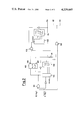
- FIG. 1 of the accompanying drawings shows a block diagram of the entire implementation
- FIG. 2 shows the block diagram of the inhibiting unit.
- the numeral 1 is for the source of electric power
- 2 is the high voltage pulse generator
- 3 is the high-voltage electrode
- 4 the roller on which the film or web runs towards the takeup
- 5 is a discharge detector which is composed of a transformer for detecting the discharges between the electrode and the roller, such detector being equipped with a logic circuit for the formation of the pulses to be delivered to the control and recordal unit.
- Detector 5 is connected to the generator 2 and the electrode 3 through the step-up transformer 6.
- the frequency of the pulses is adjusted through the governor 7 which can be controlled either manually or automatically (by means of a switch 8) as a function of the required sensitivity.
- the sensitivity that is the control interval given by the apparatus, is determined by a divider 10 which can be set with a counting device, a two-digit counter from 1 to 99 which divides by the preset number the number of pulses per second coming from the rotopulser 9 keyed to the roller 4, the number of pulses per millimeter of film running on the roller being thus established.
- the numeral 11 is the inhibiting device which is diagrammatically shown in FIG. 2.
- the other blocks of the layout are the counters which display the data relating to each measurement and are connected to the remainder of the implementation, from which they receive the signals through the sensitivity adjustment device and the inhibiting device.
- FIG. 2 shows the inhibiting circuit, in which 101, 102 and 103 are the gates, that is the outputs of the pulses towards the various circuits.
- the reference 104 is the divider (it divides by ten) on which the number of voltage pulses as received without detection of discharge is reduced.
- 105 shows the latching and enabling flip-flop of the outputs towards the several counter circuits, with automatic alternate setting of the outputs 106 and 107 at the levels 1 and 0.
- 108 is the coincidence device for transferring the commands between 104 and 105.
- 109 is the divider (by 100) on which is set the maximum number of consecutive discharges which correspond to a rip.
- the numeral 110 indicates the preselector of the number of consecutive discharges which is considered as corresponding to a rip.
- 111 is a condenser rheostat.
- the discharge command is present at the inputs of 101 and of 104.
- the flip-flop 105 is reset continuously by the output of the divider 108 and presents the outputs 106 at the level zero and the 107 output at the level 1.
- the output 106 at level zero latches and keeps latched the gate 103, thus latching the rip counter circuit.
- the output 107 at the level 1 enables the gate 102 and thus also the pinhole counting circuit.
- a pinhole passes, in addition to the discharge command coming from the divider 10 of FIG. 1, there is the passage of the signal of detected discharge.
- the signal "detected discharge” passes through the gate 102 and is counted by the pinhole counter (pinholes per square or per meter and total pinholes) and simultaneously the signal passes through the gate 101 and is returned to the flip-flop thus setting it with the output 106 at the level 1 and the output 107 at the level zero.
- the output 107 set in this way latches after a delay time caused by the rheostat condenser 111, the gate 102 thus preventing a possible subsequent discharge from being counted. If sequential discharges are experienced, a signal is generated, which maintains the flip-flop in the latched position and simultaneously prevents the divider 104 from counting so that a continuous series of discharges is counted as a single discharge.
- the output 106 of the flip-flop enables the gate 103 and the counter of the divider 109 counts all the inhibited discharges.
- a pulse emerges which is counted as a rip and thus is displayed on the counter 14 of FIG. 1, and simultaneously locks the gate 103 to prevent the count of a number of rips in the case of a continuous discharge.
- the initial circuit is reset when the divider 104 has received a number of discharge commands (voltage pulses with no detected discharges) equal to the number set on such divider.
- the flip-flop is reset with the output 106 at the level zero and the output 107 at the level 1.
- the gate 102 is enabled again and the circuit is in readiness for counting another possible pinhole.
Landscapes
- Chemical & Material Sciences (AREA)
- Analytical Chemistry (AREA)
- General Health & Medical Sciences (AREA)
- Physics & Mathematics (AREA)
- Health & Medical Sciences (AREA)
- Life Sciences & Earth Sciences (AREA)
- Chemical Kinetics & Catalysis (AREA)
- Biochemistry (AREA)
- Electrochemistry (AREA)
- General Physics & Mathematics (AREA)
- Immunology (AREA)
- Pathology (AREA)
- Controlling Rewinding, Feeding, Winding, Or Abnormalities Of Webs (AREA)
- Other Investigation Or Analysis Of Materials By Electrical Means (AREA)
- Investigating Or Analyzing Materials By The Use Of Electric Means (AREA)
Applications Claiming Priority (2)
| Application Number | Priority Date | Filing Date | Title |
|---|---|---|---|
| IT23804A/77 | 1977-05-20 | ||
| IT23804/77A IT1077171B (it) | 1977-05-20 | 1977-05-20 | Detettore e registratore di fori e strappi per fogli e nastri in materia plastica |
Publications (1)
| Publication Number | Publication Date |
|---|---|
| US4229645A true US4229645A (en) | 1980-10-21 |
Family
ID=11210121
Family Applications (1)
| Application Number | Title | Priority Date | Filing Date |
|---|---|---|---|
| US05/906,219 Expired - Lifetime US4229645A (en) | 1977-05-20 | 1978-05-15 | Detector and recorder of holes and disruptions in plastic material sheets and webs |
Country Status (5)
| Country | Link |
|---|---|
| US (1) | US4229645A (it) |
| DE (1) | DE2822023A1 (it) |
| FR (1) | FR2391468A1 (it) |
| GB (1) | GB1587094A (it) |
| IT (1) | IT1077171B (it) |
Cited By (4)
| Publication number | Priority date | Publication date | Assignee | Title |
|---|---|---|---|---|
| US4817424A (en) * | 1987-02-17 | 1989-04-04 | Enamel Products & Planting Company | Strip inspecting apparatus and associated method |
| US4865872A (en) * | 1987-02-17 | 1989-09-12 | Enamel Products & Plating Company | Strip inspecting apparatus and associated method |
| US5196799A (en) * | 1990-07-12 | 1993-03-23 | Drexel University | Method and apparatus for testing a protective barrier material for pinholes and tear strength |
| EP1022106A4 (en) * | 1997-08-14 | 2006-10-11 | Asahi Chemical Ind | ARAMID FILM AND ITS USE, MANUFACTURING METHOD THEREOF, DETECTION OF PIN HOLE IN THE FILM, AND DETECTION DEVICE |
Citations (4)
| Publication number | Priority date | Publication date | Assignee | Title |
|---|---|---|---|---|
| US3571574A (en) * | 1966-06-15 | 1971-03-23 | Ferag Ag | Counting device for folded sheets, particularly folded newspapers |
| US3729619A (en) * | 1971-03-04 | 1973-04-24 | Steel Corp | Apparatus for surface inspection of moving material with defect type recognition |
| US3778802A (en) * | 1972-03-20 | 1973-12-11 | Harwald Co | Film inspection apparatus |
| US3983371A (en) * | 1975-01-06 | 1976-09-28 | Gte Sylvania Incorporated | Apparatus and method for determining the proportion of defective wire in a length of moving wire |
Family Cites Families (3)
| Publication number | Priority date | Publication date | Assignee | Title |
|---|---|---|---|---|
| GB864785A (en) * | 1959-02-05 | 1961-04-06 | Detectron Inc | Apparatus for detecting defects in dielectric material |
| US3418570A (en) * | 1966-08-26 | 1968-12-24 | Henry H. Clinton | Electrical device for testing for and counting flaws in the insulation of an electrical conductor passing through an electrode |
| DE2435727A1 (de) * | 1974-07-25 | 1976-02-19 | Felten & Guilleaume Carlswerk | Vorrichtung zur kontinuierlichen pruefung der isolierung eines laengs abgezogenen isolierten elektrischen leiters |
-
1977
- 1977-05-20 IT IT23804/77A patent/IT1077171B/it active
-
1978
- 1978-05-15 US US05/906,219 patent/US4229645A/en not_active Expired - Lifetime
- 1978-05-17 GB GB20267/78A patent/GB1587094A/en not_active Expired
- 1978-05-19 FR FR7814986A patent/FR2391468A1/fr active Granted
- 1978-05-19 DE DE19782822023 patent/DE2822023A1/de not_active Withdrawn
Patent Citations (4)
| Publication number | Priority date | Publication date | Assignee | Title |
|---|---|---|---|---|
| US3571574A (en) * | 1966-06-15 | 1971-03-23 | Ferag Ag | Counting device for folded sheets, particularly folded newspapers |
| US3729619A (en) * | 1971-03-04 | 1973-04-24 | Steel Corp | Apparatus for surface inspection of moving material with defect type recognition |
| US3778802A (en) * | 1972-03-20 | 1973-12-11 | Harwald Co | Film inspection apparatus |
| US3983371A (en) * | 1975-01-06 | 1976-09-28 | Gte Sylvania Incorporated | Apparatus and method for determining the proportion of defective wire in a length of moving wire |
Cited By (4)
| Publication number | Priority date | Publication date | Assignee | Title |
|---|---|---|---|---|
| US4817424A (en) * | 1987-02-17 | 1989-04-04 | Enamel Products & Planting Company | Strip inspecting apparatus and associated method |
| US4865872A (en) * | 1987-02-17 | 1989-09-12 | Enamel Products & Plating Company | Strip inspecting apparatus and associated method |
| US5196799A (en) * | 1990-07-12 | 1993-03-23 | Drexel University | Method and apparatus for testing a protective barrier material for pinholes and tear strength |
| EP1022106A4 (en) * | 1997-08-14 | 2006-10-11 | Asahi Chemical Ind | ARAMID FILM AND ITS USE, MANUFACTURING METHOD THEREOF, DETECTION OF PIN HOLE IN THE FILM, AND DETECTION DEVICE |
Also Published As
| Publication number | Publication date |
|---|---|
| FR2391468B1 (it) | 1981-12-11 |
| IT1077171B (it) | 1985-05-04 |
| FR2391468A1 (fr) | 1978-12-15 |
| GB1587094A (en) | 1981-04-01 |
| DE2822023A1 (de) | 1978-11-23 |
Similar Documents
| Publication | Publication Date | Title |
|---|---|---|
| US4099118A (en) | Electronic wall stud sensor | |
| US3530450A (en) | Fire alarm systems with monitoring device for fire alarms connected in groups to a central station | |
| US3783680A (en) | Multipoint vibration monitoring system | |
| US4216413A (en) | System for sequentially operating flash lamps in repeated sequences | |
| US4229645A (en) | Detector and recorder of holes and disruptions in plastic material sheets and webs | |
| US3058223A (en) | Pulse actuated measuring apparatus | |
| US2701336A (en) | Flaw detector | |
| US3699349A (en) | Arrangement for determining frame lengths on film strips | |
| US3323701A (en) | Apparatus for detecting and counting defects in a plurality of insulated conductors | |
| US3657645A (en) | Thickness measuring device having a segmented roller and high gain amplifier | |
| US4177097A (en) | Method and apparatus for controlling the filling of a cable | |
| US3491290A (en) | Quick-response high voltage test system for locating and resolving faults in insulation of electrical cables | |
| US3919635A (en) | Apparatus and method for detecting holes in dielectric sheet materials | |
| US4438402A (en) | Electrostatic transducer for length measurement system | |
| US4697169A (en) | Device for detecting and localizing a fault in an aerial rope-way transport installation | |
| US3418570A (en) | Electrical device for testing for and counting flaws in the insulation of an electrical conductor passing through an electrode | |
| US3789295A (en) | Methods of and apparatus for detecting, classifying and locating insulation faults in insulated elongated conductors | |
| US3316760A (en) | Seam detector | |
| US3748567A (en) | Storage battery charging device | |
| US4056771A (en) | Remotely controlled high potential insulation tester | |
| US5126658A (en) | Generator rotor winding ground detection | |
| JP2926776B2 (ja) | コンデンサバンク用真空遮断器電極間耐電圧監視装置 | |
| US3185922A (en) | Device for determining the reproduction characteristics of a magnetic recording medium | |
| GB1288915A (it) | ||
| EP0337117A2 (en) | On-line web internal resistivity measuring apparatus |