US4189213A - Zoom lens system - Google Patents
Zoom lens system Download PDFInfo
- Publication number
- US4189213A US4189213A US05/801,353 US80135377A US4189213A US 4189213 A US4189213 A US 4189213A US 80135377 A US80135377 A US 80135377A US 4189213 A US4189213 A US 4189213A
- Authority
- US
- United States
- Prior art keywords
- sub
- lens
- group
- positive
- negative
- Prior art date
- Legal status (The legal status is an assumption and is not a legal conclusion. Google has not performed a legal analysis and makes no representation as to the accuracy of the status listed.)
- Expired - Lifetime
Links
- 230000005499 meniscus Effects 0.000 claims abstract description 20
- 230000008859 change Effects 0.000 claims description 12
- 239000011521 glass Substances 0.000 claims description 11
- 230000003287 optical effect Effects 0.000 claims description 8
- 230000004907 flux Effects 0.000 claims description 6
- 230000004075 alteration Effects 0.000 description 56
- 238000010276 construction Methods 0.000 description 13
- 201000009310 astigmatism Diseases 0.000 description 5
- 206010010071 Coma Diseases 0.000 description 4
- 230000000694 effects Effects 0.000 description 3
- 230000009471 action Effects 0.000 description 2
- 239000002131 composite material Substances 0.000 description 2
- 230000002411 adverse Effects 0.000 description 1
- 230000015572 biosynthetic process Effects 0.000 description 1
- 230000003247 decreasing effect Effects 0.000 description 1
- 238000009826 distribution Methods 0.000 description 1
- 239000000463 material Substances 0.000 description 1
- 239000005304 optical glass Substances 0.000 description 1
- 230000009467 reduction Effects 0.000 description 1
- 230000004044 response Effects 0.000 description 1
- 238000001228 spectrum Methods 0.000 description 1
Images



Classifications
-
- G—PHYSICS
- G02—OPTICS
- G02B—OPTICAL ELEMENTS, SYSTEMS OR APPARATUS
- G02B15/00—Optical objectives with means for varying the magnification
- G02B15/14—Optical objectives with means for varying the magnification by axial movement of one or more lenses or groups of lenses relative to the image plane for continuously varying the equivalent focal length of the objective
- G02B15/16—Optical objectives with means for varying the magnification by axial movement of one or more lenses or groups of lenses relative to the image plane for continuously varying the equivalent focal length of the objective with interdependent non-linearly related movements between one lens or lens group, and another lens or lens group
- G02B15/163—Optical objectives with means for varying the magnification by axial movement of one or more lenses or groups of lenses relative to the image plane for continuously varying the equivalent focal length of the objective with interdependent non-linearly related movements between one lens or lens group, and another lens or lens group having a first movable lens or lens group and a second movable lens or lens group, both in front of a fixed lens or lens group
- G02B15/167—Optical objectives with means for varying the magnification by axial movement of one or more lenses or groups of lenses relative to the image plane for continuously varying the equivalent focal length of the objective with interdependent non-linearly related movements between one lens or lens group, and another lens or lens group having a first movable lens or lens group and a second movable lens or lens group, both in front of a fixed lens or lens group having an additional fixed front lens or group of lenses
- G02B15/173—Optical objectives with means for varying the magnification by axial movement of one or more lenses or groups of lenses relative to the image plane for continuously varying the equivalent focal length of the objective with interdependent non-linearly related movements between one lens or lens group, and another lens or lens group having a first movable lens or lens group and a second movable lens or lens group, both in front of a fixed lens or lens group having an additional fixed front lens or group of lenses arranged +-+
-
- G—PHYSICS
- G02—OPTICS
- G02B—OPTICAL ELEMENTS, SYSTEMS OR APPARATUS
- G02B15/00—Optical objectives with means for varying the magnification
- G02B15/14—Optical objectives with means for varying the magnification by axial movement of one or more lenses or groups of lenses relative to the image plane for continuously varying the equivalent focal length of the objective
- G02B15/145—Optical objectives with means for varying the magnification by axial movement of one or more lenses or groups of lenses relative to the image plane for continuously varying the equivalent focal length of the objective having five groups only
- G02B15/1451—Optical objectives with means for varying the magnification by axial movement of one or more lenses or groups of lenses relative to the image plane for continuously varying the equivalent focal length of the objective having five groups only the first group being positive
- G02B15/145121—Optical objectives with means for varying the magnification by axial movement of one or more lenses or groups of lenses relative to the image plane for continuously varying the equivalent focal length of the objective having five groups only the first group being positive arranged +-+-+
Definitions
- This invention relates to a zoom lens system comprising five lens groups, and more particularly is directed to a zoom lens system of high performance for use with 35 mm still cameras which has a large value of a zoom ratio; that is, the ratio of the longest focal length to the shortest focal length, which covers the range of a standard lens on the shortest focal length side, and which is bright.
- zoom lenses are of the type in which a magnification changing system is followed by a relay lens system capable of correcting aberrations over the entire range of the focal length. It is known that the greater the size of the magnification changing system relative to the relay lens system, the more reduced the variation in aberration resulting from zooming. Therefore, in the field of zoom lenses for small motion picture cameras wherein the optical system is relatively large with respect to the picture-taking image field, lenses having a wide zoom range and large aperture are known. However, in zoom lenses for 35 mm still cameras wherein the picture-taking image field is diagonally about six times the size of 8 mm film, various difficulties are encountered when it is desired to design a lens having a wide zoom range and large aperture which is compact and which possesses high performance.
- zoom lenses of this type have suffered from the following problems.
- the full length exceeds the value of the longest focal length; that is, the telephoto ratio (the ratio of the distance from the lens surface of the lens system closest to the object side to the focal plane to the longest focal length) is greater than 1.0.
- the curvature of image field and astigmatism resulting from under-correction of the Petzval sum are appreciable over the entire range of magnification change.
- the fact that the magnification changing system is used under the brightest condition induces imperfect correction of the high order spherical aberration, as well as under-correction of the spherochromatism.
- the zoom lens system comprises, in order from the object side, a positive first lens group including a positive lens component comprising a negative and a positive lens cemented together and a positive meniscus lens component convex to the object side, a negative second lens group including a negative lens component and a negative lens component comprising a negative lens and at least one positive lens cemented together, a positive third lens group including at least one positive lens component and a positive lens component comprising a positive and a negative lens cemented together, a negative fourth lens group including a negative lens component, and a positive fifth lens group comprising a forward and a rearward group spaced apart a substantial distance from each other by an air space, the forward group including a positive meniscus lens component convex to the object side, the rearward group including a negative meniscus lens component convex to the image side and a positive lens component.
- the first lens group is movable on the optical axis of the system to perform the focusing function
- the second lens group is linearly movable on the optical axis and cooperable with the third lens group non-linearly movable simultaneously with but in the opposite direction to the second lens group to perform the magnification changing function, maintaining a predetermined image field position while converging the light flux over the entire magnification changing range.
- the fourth and the fifth lens groups are both fixed for the magnification change and the focusing to thereby form a so-called relay lens system.
- FIGS. 1, 2 and 3 show the lens constructions according to a first, a second and a third embodiment, respectively, of the present invention.
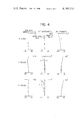
- FIGS. 4, 5 and 6 illustrate various aberrations in the first, second and third embodiments, respectively, for the shortest, the intermediate and the longest focal length conditions.
- the construction of the zoom lens system according to the present invention comprises, in the order from the object side, a positive first lens group, a negative second lens group, a positive third lens group, a negative fourth lens group and a positive fifth lens group.
- the first lens group chiefly has the focusing function by being moved toward the object side in the entire range of the variable focal length.
- the second lens group which is linearly movable, together with the third lens group which is non-linearly movable in the opposite direction, has a magnification changing function of maintaining the light flux at a predetermined image field position while converging the light flux over the entire range of magnification change.
- the fourth and the fifth lens groups are both fixed for magnification changing and focusing and constitute a so-called relay lens system.
- the first lens group comprises a positive lens component consisting of a negative lens and a positive lens cemented together and a positive meniscus lens component convex to the object side.
- the second lens group comprises a negative lens component and a negative lens component consisting of a negative lens and a positive lens cemented together
- the third lens group comprises a positive lens component and a positive lens component consisting of a positive lens and a negative lens cemented together.
- the fourth lens group comprises a negative lens component.
- the fifth lens group comprises a forward lens group and a rearward lens group spaced apart a substantial distance.
- the forward group consists of a positive meniscus lens component convex to the object side
- the rearward group consists of a negative meniscus lens component convex to the image side and a positive lens component.
- f 1 , f 2 , f 3 , f 4 and f 5 represent the focal lengths of the first, second, third, fourth and fifth lens groups, respectively, and fW the shortest focal length of the entire system provided by zooming.
- Condition (1) specifies the focal length of the first lens group. It also specifies the size of the magnification changing system relative to the relay lens in response to the property of the magnification changing system in the zoom lens. If the magnification changing system is greater in size, the variation in aberration resulting from zooming may be correspondingly smaller and the aggravation of Petzval sum toward the negative value may also be reduced, and further, the variation in aberration at short distance resulting from the focusing by the movement of the first lens group may also be smaller. On the other hand however, increase in size of the magnification changing system means a greater size of the entire optical system, together with an increase in the amount of movement required of the first lens group for short-distance shooting.
- the focal length f 1 of the first lens group must be optically determined with these factors taken into account. If f 1 exceeds the upper limit of condition (1) above, the telephoto ratio will exceed 1.0, and compactness of the entire system cannot be obtained. Conversely, if f 1 exceeds the lower limit of condition (1), the Petzval sum will be excessively great toward the negative so that astigmatism will have to be provided for the correction of curvature of image field and spherical aberration and curvature of image field will be corrected at the opposite ends of zooming, but the bulge in the intermediate portion will not be completely removed. As a result, there will be excessive astigmatic variation from a barrel shape to a bobbin shape.
- Condition (2) determines the focal length of the second lens group among the sizes of the magnification changing system determined by condition (1), and coupled with condition (3), it also indicates the magnitude of the magnification varying action of the second lens group.
- the zoom lens system of the invention is of the type in which the second and the third lens groups, which are spaced apart from each other, are moved away from each other to effect magnification change for lower magnification and are moved toward each other to effect magnification change for higher magnification.
- the magnification changing action is shared by the second and the third lens groups. Therefore, even after the size of the magnification changing system relative to the relay lens has been determined, the construction of the magnification changing system may be varied depending on the values chosen for the focal lengths of the second and the third lens groups.
- Such values must be chosen properly, for, if the upper limit of condition (2) is exceeded, the refractive power becomes weaker so that the stroke to obtain the desired magnification becomes longer, and this results in substantial increase of the total length and increased height of the principal ray passing through the first lens group, which in turn leads to an increase in the aperture needed for the first lens group. Conversely, if the lower limit of condition (2) is exceeded, the effective F-number of the second lens group becomes small to thereby render the correction of spherical aberration difficult; also, the intersection point of the non-axial principal ray with respect to the second lens group is substantially enlarged, thereby making it difficult to correct distortion.
- Condition (3) specifies the focal length of the third lens group.
- the third lens group has the function of a so-called compensator which always maintains the image point created by the magnification changing system at a predetermined position; this group also has the function of positively performing magnification change, as previously described. Therefore, setting of the focal length of this lens group not only affects the size of the magnification changing system but also plays an important role in correcting the variation in aberration resulting from magnification change.
- the third lens group is moved in the direction opposite to the direction of movement of the second lens group to thereby maintain the image point at a predetermined position, but since the movement of the second lens group is linear, the movement curve of the third lens group becomes non-linear so that the ratio of the amount of movement of the third lens group to that of the second lens group becomes sharply greater when the condition of Ix magnification is exceeded. Therefore, if the third lens group is used at a high magnification, the stroke of the second lens group becomes shorter while the amount of movement of the third lens group is increased, and thus, the use of the third lens group at a high magnification increases the effective F-number of the third lens group to render difficult the correction of the variation in spherical aberration.
- the third lens group when used at a low magnification, the amount of movement of the third lens group is decreased while the stroke of the second lens group is increased.
- proper setting of the focal length of the third lens group is essential. If the upper limit thereof is exceeded, the magnification changing system will become longer and if the lower limit is exceeded, spherical aberration will be corrected at the opposite ends of zooming but will still remain in the intermediate portion of the focal length, and such aberration will be difficult to correct.
- Condition (4) specifies the focal length of the fourth lens group.
- the fourth lens group, together with the fifth lens group, constitute the so-called relay lens system by which the image point created by the magnification changing system is focused at the final image field.
- the fourth lens group substantially collimates the light flux converging at the image point created by the magnification changing system ranging up to the third lens group and causes such flux to enter the fifth lens group.
- the first to the fourth lens groups may be regarded as constituting an afocal system with respect to the fifth lens group as a master lens.
- this lens group by being combined with the subsequent fifth lens group, has often been used to control the back focal distance and can correct the aberrations in each focal length.
- Condition (5) specifies the focal length of the fifth lens group.
- the fifth lens group together with the fourth lens group, constitute the relay lens and the property thereof that the aberration with respect to each focal length is varied in the fashion of parallel movement is utilized to maintain the balance with the aberration created by the magnification changing system and correct the aberration in the final image field.
- the necessary back focal distance must also be secured, and further, the negative Petzval sum resulting from the magnification changing system being made as compact as possible must be negated by the positive Petzval sum of this lens group.
- this lens group has heretofore tended to become complicated in construction and has often employed a Petzval-type lens to provide positive Petzval sum.
- the Petzval-type lens has a considerably large full length for its focal length, and even if the size of the magnification changing system is reduced at all, the lens must be enlarged for the correction of the Petzval sum, but this is not effective to make the entire system compact.
- the fifth lens group is divided into forward and rearward lens groups with a large air space therebetween.
- the forward group bears almost all the power of the fifth lens group while, at the same time, it cooperates with the fourth lens group to correct the aberration in the neighborhood of the diaphragm.
- the rearward group is disposed as far back as possible to ensure a necessary minimum back focal distance and to provide substantially zero power, thereby effecting the correction of the non-axial aberration.
- the lens system of the invention has succeeded in providing a positive Petzval sum while providing a telephoto ratio of approximately 1.0 for the fifth lens group itself, whereby a relay lens is provided which is compact but which secures a necessary back focal distance, and which is simple in construction and effective in performance.
- the focal length of the fifth lens group must be varied in accordance with the magnitude of the magnification of the afocal system with respect to the fifth lens group, even though the zoom ratio is identical between them.
- magnification changing system and the relay lens will both be longer and could not be arranged compactly. If the lower limit of this condition is exceeded, the negative Petzval sum created by the magnification changing system could not be corrected by the relay lens system, and correction of the curvature of image field over the entire range of the focal length would be difficult.
- the shape factor representing the shape of the lens is defined as (r F +r R )/(r F -r R ), where r F is the curvature radius of the lens surface on the object side and r R is the curvature radius of the lens surface on the image side, and the value of this shape factor is expressed as SF for the sake of convenience. It is to be understood that the first of the suffixes represent a group and the second suffix represents the order of the lens component in each group.
- the first lens group thereof is required to correct various aberrations, above all, chromatic aberration, and especially, the lateral chromatic aberration on the long focal length side which cannot be eliminated even by stopping down the diaphragm and which will adversely affect the image formation. It is therefore desirable that the following condition be satisfied:
- ⁇ 1p represents the Abbe number of the positive component of the first lens group and ⁇ 1n the Abbe number of the negative component of the first lens group, and whenever the secondary spectrum is taken into account, it is also desirable that the difference in partial variance ratio between the positive and the negative component be smaller. Further, when the properties of optical glass are taken into consideration, the use of a glass material which will satisfy these conditions will also prevent the Petzval sum in the magnification changing system from being aggravated toward the negative and it is thus desirable that the following conditions be satisfied:
- N 1p and N 1n represent the refractive indices of the positive and negative components, respectively, of the first lens group. Also, in order that the spherical aberration and curvature of image field over the range from the infinity to the shortest distance on the long focal length side may be corrected in a well-balanced manner, it is desirable that the following conditions be satisfied:
- SF 11 and SF 12 represent the shape factors of the positive double lens component and the positive meniscus lens component forming the first lens group.
- the second lens group should desirably be formed by two components; namely a negative single lens component and a negative doublet lens component, in order that the distortion and curvature of image field on the short focal length side and the spherical aberration on the long focal length side may be corrected in a well-balanced manner.
- a negative single lens component and a negative doublet lens component in order that the distortion and curvature of image field on the short focal length side and the spherical aberration on the long focal length side may be corrected in a well-balanced manner.
- the doublet lens component should preferably be disposed in the rear of the second lens group in order to well correct the lateral chromatic aberration on the short focal length side. Further, in order to ensure achromatization to be sufficiently accomplished, the following condition should be satisfied:
- N 21 represents the refractive index of the single negative lens components.
- the third lens group Since the third lens group is used in a state wherein its effective F-number over the entire range of magnification change is relatively small as compared with the other magnification changing groups, in this lens group it is important to correct the spherical aberration in each focal length in a well-balanced manner, it also playing the role of correcting the variation in chromatic aberration resulting from the variation in focal length, especially the variation in chromatic aberration in the intermediate focal length. The following condition should be satisfied:
- SF 32 represents the shape factor of the positive doublet lens component in the third lens group. If the lower limit of this condition is departed from, the spherical aberration will become excessive toward the positive while, at the same time, the axial chromatic aberration on the g-line as opposed to the d-line will become excessive toward the positive, and the lateral chromatic aberration will become excessive toward the negative. If the upper limit of this condition is exceeded, the contrary state will arise. In either case, it will be difficult to provide a proper balance of aberration. Also, for the purpose of achromatization, it is desirable that the following condition be satisfied:
- ⁇ 3p and ⁇ 3n represent the Abbe numbers of the positive and the negative lens, respectively, in the third lens group. Again in the third lens group, it is further necessary to prevent the Petzval sum of the magnification changing system from being aggravated toward the negative and for this purpose, the following conditions should be satisfied:
- N 3p and N 3n represent the refractive indices of the positive and the negative lens in this group.
- the fourth lens group In order to correct the spherical aberration and the balance of coma over the entire range of the focal length, the fourth lens group should satisfy the condition:
- SF 4 represents the shape factor of the negative lens component constituting the fourth lens group.
- the following condition should be satisfied in order to improve the Petzval sum in the fourth lens group:
- N 4 represents the refractive index of the negative lens component.
- the fifth lens group is of a construction which differs from the conventional relay lens; it is simple and yet has a high performance.
- the fifth lens group comprises a forward group bearing almost all the power of this lens group and a rearward group having very little power and spaced apart from the forward group by a very substantial air space. This lens group should satisfy the following relation:
- D 5 is the air space between the forward and the rearward group
- f 5 is the focal length of the fifth lens group as a whole.
- the upper limit of the space D 5 may desirably be as great as allowable with respect to the limitation in the back focal distance so that correction of the aberration balance becomes easier. If the lower limit of the space D 5 is exceeded, the position at which the rearward group in the fifth lens group cuts the non-axial ray will be lowered to render it impossible to draw the astigmatism toward the negative.
- the astigmatism may be drawn toward the positive while the air space D 5 is maintained small, but in such case the above-mentioned coma will become too excessive to be offset by the rearmost positive lens component and a high degree of coma will be created for each focal length condition so that it will be impossible to maintain a practicable aberration balance.
- the entire length of the fifth lens group itself may be maintained substantially equal to the focal length of the fifth lens group to thereby make the entire lens system as compact as possible. Further, for the correction of the spherical aberration and coma over the entire range of the focal length, the following condition should be satisfied:
- SF 51 is the shape factor of the positive lens component in the forward group.
- the negative meniscus lens component in the rearward group should desirably assume a shape which will satisfy the following condition:
- N 5p and N 5n represents the refractive indices of the positive and negative components in the fifth lens group.
- the lens construction according to a first embodiment is shown in FIG. 1.
- the following condition is satisfied:
- r 9 represents the curvature radius of the cemented surface of the second lens group and f 2 the focal length of the second lens group as a whole, whereby the axial chromatic aberration over the entire range of magnification change is well balanced while, at the same time, correction of the lateral chromatic aberration especially on the short focal length side becomes easier.
- the positive lens component in the third lens group which comprises a doublet the following condition should be satisfied:
- the lens construction according to a second embodiment is shown in FIG. 2.
- the positive meniscus lens component forming the forward group in the fifth lens group and convex to the object side is divided into a positive meniscus lens convex to the object side and a negative lens without the power of the forward group being greatly varied, whereby the Petzval sum is drawn to the positive so that the Petzval sum of the entire system is improved.
- the aberrations in this second embodiment for the respective focal length conditions are illustrated in FIG. 5, from which it is seen that the aberrations are maintained as well as in the first embodiment.
- the negative composite lens component in the second lens group is formed by a triplet comprising a positive meniscus lens concave to the object side, a biconcave negative lens and a positive meniscus lens convex to the object side, whereby the chromatic aberration resulting from the negatively excessive spherical aberration created by the cemented surface may be well corrected from the intermediate focal length to the long focal length.
- the single positive lens component in the third lens group is divided into two single positive lenses to thereby enable the effective F-number of the third lens group to be secured more easily, and the resulting increase in the curvature radius of the cemented surface of the composite lens component may easily prevent the over-correction toward the positive of the g-line as opposed to the d-line in the spherical aberration from the short focal length to the long focal length.
- the following conditions should be satisfied:
- SF 311 and SF 312 are the shape factors of the two divided positive lenses in the order from the object side.
- the aberrations in the third embodiment for the respective focal length conditions are illustrated in FIG. 6, wherein it is seen that as good a balance of aberration as in the other embodiments is maintained for any of the various focal length conditions.
- a proper power is arranged in each group and an appropriate lens construction in accordance therewith is accurately chosen, whereby a bright and compact zoom lens system is attained which is useful with 35 mm still cameras, which has a very short focal length beginning with the range of a standard lens, but has a high magnification; namely, a zoom ratio six times that of the standard lens, and which has a relative aperture of 1:4.5.
- r i represents the curvature radius of each lens
- d i the center thickness of each lens or the air space between adjacent lenses
- N i the refractive index of the glass of each lens for the d-line
- ⁇ i the Abbe number of the glass of each lens.
Landscapes
- Physics & Mathematics (AREA)
- General Physics & Mathematics (AREA)
- Optics & Photonics (AREA)
- Nonlinear Science (AREA)
- Lenses (AREA)
Applications Claiming Priority (2)
| Application Number | Priority Date | Filing Date | Title |
|---|---|---|---|
| JP51-62427 | 1976-05-31 | ||
| JP6242776A JPS52146250A (en) | 1976-05-31 | 1976-05-31 | High magnification high performance zoom lens |
Publications (1)
| Publication Number | Publication Date |
|---|---|
| US4189213A true US4189213A (en) | 1980-02-19 |
Family
ID=13199842
Family Applications (1)
| Application Number | Title | Priority Date | Filing Date |
|---|---|---|---|
| US05/801,353 Expired - Lifetime US4189213A (en) | 1976-05-31 | 1977-05-27 | Zoom lens system |
Country Status (3)
| Country | Link |
|---|---|
| US (1) | US4189213A (enExample) |
| JP (1) | JPS52146250A (enExample) |
| DE (1) | DE2724507C3 (enExample) |
Cited By (12)
| Publication number | Priority date | Publication date | Assignee | Title |
|---|---|---|---|---|
| US4380377A (en) * | 1979-09-17 | 1983-04-19 | Canon Kabushiki Kaisha | Compact zoom lens |
| US4398808A (en) * | 1980-01-31 | 1983-08-16 | Canon Kabushiki Kaisha | Compact zoom lens of high magnification |
| US4439017A (en) * | 1980-08-14 | 1984-03-27 | Canon Kabushiki Kaisha | Zoom lens |
| US5610766A (en) * | 1994-05-17 | 1997-03-11 | Olympus Optical Co., Ltd. | Zooming lens system |
| US5717520A (en) * | 1995-07-10 | 1998-02-10 | Nikon Corporation | Intermediate lens barrel for microscope |
| US5760966A (en) * | 1995-06-19 | 1998-06-02 | Fuji Photo Optical Co., Ltd. | Zoom lens |
| US5978150A (en) * | 1995-06-01 | 1999-11-02 | Nikon Corporation | Zoom lens |
| US6101045A (en) * | 1994-02-14 | 2000-08-08 | Minolta Co., Ltd. | Zoom lens system |
| US20040223232A1 (en) * | 2003-05-08 | 2004-11-11 | Akiko Takatsuki | Rear focus zoom lens |
| RU2298213C1 (ru) * | 2005-10-19 | 2007-04-27 | Государственное унитарное предприятие "Конструкторское бюро приборостроения" | Объектив с переменным фокусным расстоянием |
| RU2299455C2 (ru) * | 2005-08-15 | 2007-05-20 | Федеральное государственное унитарное предприятие "Научно-производственное объединение "Государственный институт прикладной оптики" (ФГУП "НПО "ГИПО") | Инфракрасный объектив с плавно изменяющимся фокусным расстоянием |
| RU2299454C1 (ru) * | 2005-10-31 | 2007-05-20 | Федеральное государственное унитарное предприятие "Научно-производственное объединение "Государственный институт прикладной оптики" (ФГУП "НПО "ГИПО") | Инфракрасный объектив с плавно изменяющимся фокусным расстоянием |
Citations (2)
| Publication number | Priority date | Publication date | Assignee | Title |
|---|---|---|---|---|
| US3970367A (en) * | 1972-07-20 | 1976-07-20 | Canon Kabushiki Kaisha | Zoom lens system |
| US3972591A (en) * | 1972-02-01 | 1976-08-03 | Canon Kabushiki Kaisha | Greatly variable magnification zoom lens system of large aperture ratio |
-
1976
- 1976-05-31 JP JP6242776A patent/JPS52146250A/ja active Granted
-
1977
- 1977-05-27 US US05/801,353 patent/US4189213A/en not_active Expired - Lifetime
- 1977-05-31 DE DE2724507A patent/DE2724507C3/de not_active Expired
Patent Citations (2)
| Publication number | Priority date | Publication date | Assignee | Title |
|---|---|---|---|---|
| US3972591A (en) * | 1972-02-01 | 1976-08-03 | Canon Kabushiki Kaisha | Greatly variable magnification zoom lens system of large aperture ratio |
| US3970367A (en) * | 1972-07-20 | 1976-07-20 | Canon Kabushiki Kaisha | Zoom lens system |
Cited By (13)
| Publication number | Priority date | Publication date | Assignee | Title |
|---|---|---|---|---|
| US4380377A (en) * | 1979-09-17 | 1983-04-19 | Canon Kabushiki Kaisha | Compact zoom lens |
| US4398808A (en) * | 1980-01-31 | 1983-08-16 | Canon Kabushiki Kaisha | Compact zoom lens of high magnification |
| US4439017A (en) * | 1980-08-14 | 1984-03-27 | Canon Kabushiki Kaisha | Zoom lens |
| US6101045A (en) * | 1994-02-14 | 2000-08-08 | Minolta Co., Ltd. | Zoom lens system |
| US5610766A (en) * | 1994-05-17 | 1997-03-11 | Olympus Optical Co., Ltd. | Zooming lens system |
| US5978150A (en) * | 1995-06-01 | 1999-11-02 | Nikon Corporation | Zoom lens |
| US5760966A (en) * | 1995-06-19 | 1998-06-02 | Fuji Photo Optical Co., Ltd. | Zoom lens |
| US5717520A (en) * | 1995-07-10 | 1998-02-10 | Nikon Corporation | Intermediate lens barrel for microscope |
| US20040223232A1 (en) * | 2003-05-08 | 2004-11-11 | Akiko Takatsuki | Rear focus zoom lens |
| US6985303B2 (en) | 2003-05-08 | 2006-01-10 | Fujinon Corporation | Rear focus zoom lens |
| RU2299455C2 (ru) * | 2005-08-15 | 2007-05-20 | Федеральное государственное унитарное предприятие "Научно-производственное объединение "Государственный институт прикладной оптики" (ФГУП "НПО "ГИПО") | Инфракрасный объектив с плавно изменяющимся фокусным расстоянием |
| RU2298213C1 (ru) * | 2005-10-19 | 2007-04-27 | Государственное унитарное предприятие "Конструкторское бюро приборостроения" | Объектив с переменным фокусным расстоянием |
| RU2299454C1 (ru) * | 2005-10-31 | 2007-05-20 | Федеральное государственное унитарное предприятие "Научно-производственное объединение "Государственный институт прикладной оптики" (ФГУП "НПО "ГИПО") | Инфракрасный объектив с плавно изменяющимся фокусным расстоянием |
Also Published As
| Publication number | Publication date |
|---|---|
| JPS5712125B2 (enExample) | 1982-03-09 |
| JPS52146250A (en) | 1977-12-05 |
| DE2724507B2 (de) | 1980-03-06 |
| DE2724507C3 (de) | 1980-11-06 |
| DE2724507A1 (de) | 1977-12-29 |
Similar Documents
| Publication | Publication Date | Title |
|---|---|---|
| US7227700B2 (en) | Wide zoom lens system | |
| US5076677A (en) | Zoom lens | |
| JPH0546525B2 (enExample) | ||
| JPH07151970A (ja) | ズームレンズ | |
| US4189213A (en) | Zoom lens system | |
| US4155629A (en) | Wide angle zoom lens system | |
| US4266860A (en) | Wide angle zoom lens system having shortened closeup focal length | |
| JPS6153696B2 (enExample) | ||
| US4806003A (en) | Inverted-telephoto type wide angle lens system | |
| JPH07199070A (ja) | ズームレンズ | |
| US4641928A (en) | Four-group telephoto zoom lens | |
| US4732459A (en) | Fast telephoto lens | |
| JP2864407B2 (ja) | ケプラー式ズームファインダー光学系 | |
| JPH0320735B2 (enExample) | ||
| JPH0444724B2 (enExample) | ||
| JPS6119967B2 (enExample) | ||
| JPH0123763B2 (enExample) | ||
| US4759619A (en) | Inverted telephoto type wide angle lens system with a rear focusing unit | |
| JPS6144288B2 (enExample) | ||
| JP2676400B2 (ja) | 高倍率なコンパクトズームレンズ | |
| JPH08190052A (ja) | 近距離合焦可能なズームレンズ | |
| JPS6148686B2 (enExample) | ||
| US4452513A (en) | Zoom lens capable of close range photography and method of focusing the same to a short distance | |
| JPS6146809B2 (enExample) | ||
| US4468096A (en) | Four-group telephoto zoom lens |
Legal Events
| Date | Code | Title | Description |
|---|---|---|---|
| AS | Assignment |
Owner name: NIKON CORPORATION, 2-3, MARUNOUCHI 3-CHOME, CHIYOD Free format text: CHANGE OF NAME;ASSIGNOR:NIPPON KOGAKU, K.K.;REEL/FRAME:004935/0584 |