US4189144A - Golf club - Google Patents
Golf club Download PDFInfo
- Publication number
- US4189144A US4189144A US05/785,175 US78517577A US4189144A US 4189144 A US4189144 A US 4189144A US 78517577 A US78517577 A US 78517577A US 4189144 A US4189144 A US 4189144A
- Authority
- US
- United States
- Prior art keywords
- club
- weight
- butt end
- grip
- end section
- Prior art date
- Legal status (The legal status is an assumption and is not a legal conclusion. Google has not performed a legal analysis and makes no representation as to the accuracy of the status listed.)
- Expired - Lifetime
Links
- XEEYBQQBJWHFJM-UHFFFAOYSA-N Iron Chemical compound [Fe] XEEYBQQBJWHFJM-UHFFFAOYSA-N 0.000 claims description 30
- 230000005484 gravity Effects 0.000 claims description 20
- 239000002023 wood Substances 0.000 claims description 19
- 229910052742 iron Inorganic materials 0.000 claims description 15
- 238000004519 manufacturing process Methods 0.000 claims description 8
- 230000003247 decreasing effect Effects 0.000 claims description 7
- 230000009467 reduction Effects 0.000 abstract description 38
- 238000010276 construction Methods 0.000 abstract description 29
- 230000001133 acceleration Effects 0.000 description 13
- 238000005452 bending Methods 0.000 description 11
- 235000000396 iron Nutrition 0.000 description 11
- 229910001104 4140 steel Inorganic materials 0.000 description 8
- 229910045601 alloy Inorganic materials 0.000 description 8
- 239000000956 alloy Substances 0.000 description 8
- 238000012360 testing method Methods 0.000 description 8
- 230000000694 effects Effects 0.000 description 7
- 238000005259 measurement Methods 0.000 description 7
- 238000004364 calculation method Methods 0.000 description 6
- 229910000831 Steel Inorganic materials 0.000 description 5
- 239000010959 steel Substances 0.000 description 5
- 238000013519 translation Methods 0.000 description 5
- 208000016261 weight loss Diseases 0.000 description 5
- 239000000463 material Substances 0.000 description 4
- 239000013585 weight reducing agent Substances 0.000 description 4
- 239000004593 Epoxy Substances 0.000 description 3
- 230000007423 decrease Effects 0.000 description 3
- 238000000034 method Methods 0.000 description 3
- 101100045694 Caenorhabditis elegans art-1 gene Proteins 0.000 description 2
- 238000004458 analytical method Methods 0.000 description 2
- 238000013459 approach Methods 0.000 description 2
- 239000002131 composite material Substances 0.000 description 2
- 230000002596 correlated effect Effects 0.000 description 2
- 230000003068 static effect Effects 0.000 description 2
- OKTJSMMVPCPJKN-UHFFFAOYSA-N Carbon Chemical compound [C] OKTJSMMVPCPJKN-UHFFFAOYSA-N 0.000 description 1
- 230000015556 catabolic process Effects 0.000 description 1
- 230000000052 comparative effect Effects 0.000 description 1
- 238000009826 distribution Methods 0.000 description 1
- 229910002804 graphite Inorganic materials 0.000 description 1
- 239000010439 graphite Substances 0.000 description 1
- 238000012986 modification Methods 0.000 description 1
- 230000004048 modification Effects 0.000 description 1
- 230000010355 oscillation Effects 0.000 description 1
- 238000005303 weighing Methods 0.000 description 1
Images

Classifications
-
- A—HUMAN NECESSITIES
- A63—SPORTS; GAMES; AMUSEMENTS
- A63B—APPARATUS FOR PHYSICAL TRAINING, GYMNASTICS, SWIMMING, CLIMBING, OR FENCING; BALL GAMES; TRAINING EQUIPMENT
- A63B53/00—Golf clubs
- A63B53/14—Handles
-
- A—HUMAN NECESSITIES
- A63—SPORTS; GAMES; AMUSEMENTS
- A63B—APPARATUS FOR PHYSICAL TRAINING, GYMNASTICS, SWIMMING, CLIMBING, OR FENCING; BALL GAMES; TRAINING EQUIPMENT
- A63B53/00—Golf clubs
-
- A—HUMAN NECESSITIES
- A63—SPORTS; GAMES; AMUSEMENTS
- A63B—APPARATUS FOR PHYSICAL TRAINING, GYMNASTICS, SWIMMING, CLIMBING, OR FENCING; BALL GAMES; TRAINING EQUIPMENT
- A63B60/00—Details or accessories of golf clubs, bats, rackets or the like
- A63B60/06—Handles
Definitions
- the golf equipment industry has been seeking ways of constructing lighter golf clubs.
- a number of approaches have been taken including the use of shafts constructed of graphite-epoxy and other composite materials. Such clubs have generally included heavier heads to obtain the required swingweight for the club.
- Another approach directed at improving the quality of golf clubs includes the use of shaft constructions with specific flexing characteristics.
- Matching of the different clubs in a golf club set has also been used to increase the performance of the clubs.
- the clubs in a set may be matched in different ways; and one way which has become generally accepted is to match the clubs in accordance with their swingweight which is a static measurement of the weight distribution of the club. Further effort has been directed toward matching the dynamic qualities of the clubs in a set.
- consideration may be given to such features as the frequency of vibration of the clubs, their total weight, location of center of gravity and the overall feel of the clubs to the player.
- the overall weight of the club is reduced primarily by reducing the thickness of the grip at the butt end section of the shaft.
- This reduction in the grip thickness is effected without significantly changing the overall outside diameter of the butt end section as compared to conventional clubs.
- This in turn is made possible by enlarging the diameter of the butt end section of the shaft while reducing its thickness.
- the club head With the reduction in the weight of the butt end section of the club, the club head is then reduced in weight by a correlated amount to provide a club having the same swingweight as a comparable club not having the reduced weight.
- the reduction in the weight of the club head adds to the total reduction of the club weight and also is a primary factor in reducing the moment of inertia of the club.
- the combination of these weight reductions also has the effect of shifting the center of gravity of the club toward the club head which is significant to the feel of the club as it is swung by the player.
- the improved golf club construction of the present invention has an acceptable overall appearance no different from conventional clubs, and has improved performance characteristics both in the feel of the club to the player and from the technical aspects of the club.
- the energy required to swing the club is less than in a comparable conventional club.
- an increase in the club head velocity is produced as well as an increase in the carry distance of the golf ball.
- the control and consistency of the performance of the club is also improved.
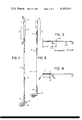
- FIG. 1 is a view of a golf club wood constructed in accordance with the teachings of the present invention
- FIG. 2 is a view of a golf club iron constructed in accordance with the teachings of the present invention.
- FIG. 3 is an enlarged cross-sectional view taken along lines 3--3 of FIG. 1 showing the improved construction of the butt end section of the golf club;
- FIG. 4 is a cross-sectional view similar to FIG. 3 showing the conventional construction of the butt end section of a golf club;
- FIG. 5 is a schematic view representing the swingweight balancing of a golf club.
- FIG. 6 is a schematic view showing the forces relating to the calculation of the moment of inertia of the club.
- FIGS. 1 and 2 generally show the wood 1 and iron 2 normally included in a golf club set. Both clubs include a club shaft 3, grip 4, and club head 5.
- the shaft is generally described in terms of having a butt end 6, butt end section 7, which generally corresponds in length to the length of the grip 4, and a head end 8.
- FIG. 3 is a cross-sectional view of the butt end section 7 of the golf club wood 1 of FIG. 1 showing in detail the construction thereof. From FIG. 3 it is seen that the butt end section 7 of the shaft 3 is tapered outwardly toward the butt end 6 of the shaft and has a thickness which decreases toward the butt end.
- FIG. 3 also shows the construction of the grip 4 which overlies the butt end section 7 of the shaft 3.
- FIG. 4 is included to show the typical construction of the butt end section of a golf club of conventional construction. From FIGS. 3 and 4, it is seen that the thickness of the grip 4 of applicants' improved golf club is reduced relative to the conventional grip construction. This is done while maintaining about the same overall outside diameter of the club in the butt end section. In most conventional golf clubs, the weight of the grip accounts for a large percentage of the total weight of the butt end section of the club. Therefore, a reduction in the thickness of the grip produces a significant reduction in the weight of the butt end section.
- Tables A and B below give the dimensions for a number one wood and number two iron constructed in accordance with the teachings of the present invention. For comparison, comparable figures of a typical prior art construction are given in parentheses.
- the specifications given in Table A are for a wood having an S flex and swingweight of D3.
- the dimensions are given for locations along the length of the club. In particular, location 1 extends for 5/16" from the butt end; locations 2-18 are 1/2" increments and cover a total length of 81/2"; locations 19-23 are at 2" increments for a length of 10"; and locations 24-33 are 11/4" increments for a length of 121/2".
- Locations 34 and 35 give the measurements just below location 33 and at the head end 8 of the shaft, respectively. Locations 34 and 35 cover a distance of 119/16".
- the shaft here is tapered at 0.0075" per inch.
- Table B sets out the dimensions for a number two iron having an S flex and swingweight of D3.
- location 1 covers an increment of 1/8"; locations 2-17 are 1/2" increments for a length of 8"; locations 18-22 are at 2" increments for a length of 10"; locations 23-27 are at 11/4" increments for a length of 61/4".
- Locations 28 and 29 are the increments immediately below location 24 and at the head end of the shaft, respectively.
- the taper of the shaft here is 0.0075" per inch.
- Tables A and B show an enlargement of the shaft and a reduction of its wall thickness generally at the butt end section of the club. Although this is the presently preferred construction, it is possible to enlarge the diameter of the shaft for a length below the grip and to also decrease its thickness along this length. Appearance and drag disadvantages, however, must be considered in increasing the diameters of the center and lower portions of the shaft. Also, consideration must be given to the desired reduction in moment of inertia effected with applicants' invention. Generally, decreasing the weight of the shaft below the butt end section works against increasing the moment of inertia.
- Tables A and B are specific to the dimensions of a number one wood and a number two iron having an S flex and a swingweight of D3, similar measurements can be taken for all other wood and iron clubs at the different flexes and swingweights. Only the measurements of Tables A and B are shown for purposes of simplicity. In construction, the other shafts and grips will be made in accordance with the same principles as shown in Tables A and B.
- the shafts for the improved golf clubs are constructed of 4140 steel alloy. This same material is also used in the shafts generally referred to as lightweight steel shafts and in conventional steel shafts which weigh about 1/2 oz. more.
- the grip 4 of applicants' improved club is of molded rubber dimensioned to slip over the butt end section of the shaft.
- the bending strength of the shaft construction shown in FIG. 3 has been made about equal to the bending strength of a conventional club constructed of the same material but without the reduced thickness and enlargement at the butt end section. With the increased diameters, the same bending properties can be obtained with less material. Therefore, the weight of the shaft itself can be reduced in the butt end section.
- manufacturing techniques and tolerances may limit the size and thickness dimensions.
- the manufacturing procedure used in constructing the shafts limited the thickness reduction at the butt end of the shaft so that actually the shaft is slightly thicker here than necessary to give the desired bending strength. Nevertheless, this is not a significant difference and can be avoided by using other manufacturing techniques.
- Swingweights are not specified in engineering units of torque. Rather they are designated using a system involving a letter followed by a number.
- the range of swingweights for men's clubs is from D0 to D7, with ladies' clubs having lower torques and designated C6 to C9. The lower the letter and the number, the lower the swingweight or unbalanced torque.
- swingweights are measured in oz.in. C6 is equivalent to 207.76 oz.in.
- Each successively higher swingweight can be calculated by adding 1.76 oz.in. for each swingweight point. This gives a value of 213.04 oz.in. for C9, 214.8 oz.in. for D0, and 227.12 oz.in. for D7.
- swingweight is a good basis for matching clubs in sets and describing their properties.
- Swingweight, or torque a static variable, is the first moment of mass.
- the first moment is a good compromise.
- the clubs have a swingweight of D3 which is equivalent to 220.08 oz.in.
- a weight reduction in the club head This not only results in a club having the same swingweight as the comparable conventional club, but one having the added advantage of a reduced dynamic moment of inertia.
- the weight of the head in the wood is reduced by reducing the amount of lead 10 contained in the center of the head. This lead is located generally behind the point of impact the head will have with the golf ball.
- the weight reduction of the head is effected by thinning the blade portion of the head.
- Tables C and D below give a breakdown of the weights, in grams, and percentage weights of the different sections of the clubs constructed in accordance with the teachings of the present invention and also of comparable conventional clubs. Tables C and D also give the dynamic moment of inertia in oz.in. 2 for each of the clubs and the location of the center of gravity in inches as measured from the heel of the club head 5 in a direction along the length of the shaft.
- the clubs designated 1-R, 1-S and 1-X are clubs constructed in accordance with the teachings of the present invention at flexes R, S, and X and using shafts constructed of 4140 steel alloy.
- the remaining clubs designated 2 through 13 represent typical prior art club constructions.
- the clubs designated 2-R, 2-S and 2-X are constructed with shafts of the same 4140 steel alloy as in the present invention.
- Club 3-S is constructed with a shaft of graphite epoxy while the remaining shafts 4-S through 13-S are constructed with shafts of steel generally weighing more than the shafts of the 2-S type.
- Table C is specific to the number one wood clubs while Table D sets forth the specifications for the number two iron.
- the clubs of applicants' invention and the 2-R, 2-S and 2-X type clubs have an overall length of 431/4" for number one wood and 391/4" for the number two iron. Many of the remaining prior art clubs were assembled with lengths as much as 1/2" less. All of the heads were the same style to give a swingweight of D3. The effects of reduced length are to increase the weight and decrease the moment of inertia at a given swingweight.
- the improved clubs of applicants' invention are compared to the comparable clubs using the same 4140 steel alloy. With respect to the remaining clubs, however, the comparison is simply made with the S flex clubs.
- the total weight of the butt end section as a percentage of the total weight of the club (line I) is significant in distinguishing applicants' invention from the constructions of the prior art.
- the percentage weight of the butt end section relative to the total weight of the club for conventional clubs is greater than 20% while with applicants' improved construction, this percentage weight is reduced to between 17 and 19%.
- Line V of Tables C and D gives the dynamic moment of inertia of the clubs constructed in accordance with the present invention and also the moment of inertia of conventional clubs. With respect to the number one wood, it is seen that the moment of inertia is reduced from more than 15,600 oz.in. 2 to between 14,900 and 15,500 oz.in. 2 . With irons, a similar reduction from above 14,900 oz.in. 2 to between 14,300 and 14,700 oz.in. 2 is produced with applicants' invention.
- This moment of inertia relates to rotational motion as weight rotates to linear motion.
- Weight is a measure of the force required to produce linear acceleration while the moment of inertia about an axis is a measure of the torque applied about that axis for producing an angular acceleration about the axis. Since a golf club swing involves both translation (linear motion) and rotation, reduction in both weight and moment of inertia contribute to increasing golf performance and in particular, the speed at which the golf club head impacts with the ball and the distance which the ball is carried.
- the precise axis of rotation changes somewhat during the swing but it is well approximated by the axis through the butt end 6 of the club.
- the applied force required to produce the needed linear acceleration is proportional to the mass (weight) of the club, so the effect of reducing the club's mass is to increase the linear acceleration produced by a given force input, and in turn increase the linear velocity.
- the applied torque required to produce the necessary angular acceleration is proportional to the moment of inertia of the club about the axis about which the club is being rotated.
- Table E sets out the results of pertinent computations made with respect to the moment of inertia of clubs constructed in accordance with the teachings of applicants' invention and club constructions not including the features of applicants' invention.
- the club of applicants' invention is designated as 1-S for both the wood and the iron. These clubs are of the same construction as the 1-S clubs in Tables C and D using a shaft of 4140 steel alloy. Clubs A are clubs comparable to club 2-S of Tables C and D using a shaft of the same weight 4140 steel alloy but without the features of applicants' invention. Clubs B are comparable to club 3-S in Tables C and D and include a shaft of graphite-epoxy, again without the features of applicants' invention. Finally, clubs C are comparable to 4-S through 13-S in Tables C and D using steels, such as 4140 steel alloy, but generally having weights of about 178 oz. heavier than clubs A. The heads used with each of the clubs A, B, and C were designed to give a swingweight of D3 to each of the clubs.
- the initial ball speed can be found using the expression: ##EQU2## where:
- W ball weight of the ball (1.62 oz.)
- W club head weight of the club head.
- V ball the initial ball speed in feet per second
- the moment of inertia is the rotational analog of force.
- the moment of inertia I of an object about any axis is the sum of all the scalar elements r 2 ⁇ m, where: r is the perpendicular distance from the axis to the mass element ⁇ m. This is expressed by the equation:
- the rotational axis of the golf club is approximated by the axis perpendicular to the shaft and through the butt end of the club. Since the head represents most of the club's mass and is the farthest from the axis, the moment of inertia of the club is largely determined by the head's mass, and reductions of the moment of inertia are most effectively accomplished by reducing the weight of the head.
- Torque is the rotational analog of force.
- the applied torque is related to the resulting angular acceleration by the rotational analog of Newton's law
- ⁇ is the angular acceleration. This means that a given applied torque will produce increased angular acceleration as the moment of inertia is decreased.
- the energy associated with the rotational motion is given by:
- I is the club's moment of inertia
- ⁇ is the angular velocity
- the angular velocity is related to club head speed by the expression:
- l is approximately the length of the club.
- K is a constant
- the moment of inertia about the center of gravity of the club is first determined. To this is added the value represented by the weight of the club times the square of the distances from the butt end 6 to the center of gravity. This calculation is represented by the following equation:
- the moment of inertia about the center of gravity of the club is determined by conventional measuring apparatus.
- Such an apparatus is manufactured by Inertia Dynamics of Coatesville, Conn.
- the club is suspended on a wire from its center of gravity so that it lies in a horizontal plane.
- the club is then twisted in one direction and a measure taken of the period (+), the time of one complete swing in one direction and then back in the other direction to the starting point.
- the moment of inertia about the center of gravity is represented by the following equation:
- the initial ball speed can be found from equation 5. They are given in Table E at column 8. Thus, if the motion were entirely rotational, it is seen that the driver club of the present invention (1-S) would produce the greatest initial ball speed. Similar results can be obtained with respect to the irons of Table E and they are also shown in column 8. As with the calculations under linear motion, a measured club head speed of 135.6 ft./sec. is used for the club A to calculate the speeds for the remaining irons.
- the properties of the test clubs are listed in columns 10-14.
- Club and head weights and moments of inertia are all very close to the average values determined from actual measurements.
- the moments of inertia were determined by measuring the periods of oscillation of the clubs about axes through their centers of gravity, calculating from these periods the moments about these axes, and then using the parallel axis theorem to obtain the moments about axes through the butt ends of the clubs.
- the head speeds just prior to impact were measured in the tests using a simple two-photocell arrangement monitored by a digital counter.
- One final but nevertheless important feature of applicants' invention relates to the location of the center of gravity or balance point of the improved club construction. With applicants' invention, a significant shifting of the center of gravity toward the club head is effected. This results in a greatly increased head feel which contributes to improved club performance.
- the location of the centers of gravity of the clubs constructed in accordance with the teachings of the present invention as well as those of the prior art constructions which are shown in Tables C and D at line W. Values given at line W are in inches and represent the distance from the balance point to the heel or bottom of the club head. It is noted that a significant shifting of about 1" is created in both the woods and irons with applicants' improved club construction.
- the principles of applicants' invention are equally applicable to other clubs of different swingweights and flexes.
- the presently preferred construction of applicants' clubs includes a shaft of 4140 steel alloy with a molded rubber grip. Lighter weight or composite materials can be used for the shaft as well as other techniques used for providing a grip as long as the weight and moment of inertia reductions are effected.
Landscapes
- Health & Medical Sciences (AREA)
- General Health & Medical Sciences (AREA)
- Physical Education & Sports Medicine (AREA)
- Golf Clubs (AREA)
Priority Applications (3)
| Application Number | Priority Date | Filing Date | Title |
|---|---|---|---|
| US05/785,175 US4189144A (en) | 1976-07-20 | 1977-04-06 | Golf club |
| GB28486/77A GB1588041A (en) | 1976-07-20 | 1977-07-07 | Weight reduction in golf clubs |
| JP8720277A JPS5331429A (en) | 1976-07-20 | 1977-07-20 | Golf club |
Applications Claiming Priority (2)
| Application Number | Priority Date | Filing Date | Title |
|---|---|---|---|
| US70695776A | 1976-07-20 | 1976-07-20 | |
| US05/785,175 US4189144A (en) | 1976-07-20 | 1977-04-06 | Golf club |
Related Parent Applications (1)
| Application Number | Title | Priority Date | Filing Date |
|---|---|---|---|
| US70695776A Continuation-In-Part | 1976-07-20 | 1976-07-20 |
Publications (1)
| Publication Number | Publication Date |
|---|---|
| US4189144A true US4189144A (en) | 1980-02-19 |
Family
ID=27107788
Family Applications (1)
| Application Number | Title | Priority Date | Filing Date |
|---|---|---|---|
| US05/785,175 Expired - Lifetime US4189144A (en) | 1976-07-20 | 1977-04-06 | Golf club |
Country Status (3)
| Country | Link |
|---|---|
| US (1) | US4189144A (enExample) |
| JP (1) | JPS5331429A (enExample) |
| GB (1) | GB1588041A (enExample) |
Cited By (13)
| Publication number | Priority date | Publication date | Assignee | Title |
|---|---|---|---|---|
| USD328484S (en) | 1989-11-14 | 1992-08-04 | Hsien James C | Golf grip |
| USD360445S (en) | 1993-12-09 | 1995-07-18 | Callaway Golf Company | Iron golf club head |
| WO1999036131A1 (en) * | 1998-01-15 | 1999-07-22 | Chorne Robert I | Golf club and method of use |
| US6106411A (en) * | 1999-10-05 | 2000-08-22 | Edwards; Upton B. | Golf club design and construction |
| US6558278B2 (en) * | 1999-03-01 | 2003-05-06 | Bunn, Iii Julian W. | Method of dynamically determining the relative stiffness of a golf shaft |
| US6779240B2 (en) * | 2001-05-02 | 2004-08-24 | Matthew J. Kluck | Golf shaft alteration technique |
| US6824475B2 (en) | 2001-07-03 | 2004-11-30 | Taylor Made Golf Company, Inc. | Golf club head |
| US20060009306A1 (en) * | 2004-06-02 | 2006-01-12 | Grunhaus, Llc | Golf club heads with inserts under compressive stress |
| US20090286617A1 (en) * | 2008-05-15 | 2009-11-19 | Voges Mitchell C | VCM Golf Club Grip System |
| US20100273567A1 (en) * | 2010-02-24 | 2010-10-28 | Sri Sports Limited | Golf club |
| US20100292021A1 (en) * | 2009-05-14 | 2010-11-18 | Voges Mitchell C | VCM Golf Club Grip System |
| US20130059674A1 (en) * | 2009-05-14 | 2013-03-07 | Mitchell C. Voges | VCM Golf Club Grip System |
| US8951142B2 (en) | 2010-02-24 | 2015-02-10 | Sri Sports Limited | Golf club |
Families Citing this family (3)
| Publication number | Priority date | Publication date | Assignee | Title |
|---|---|---|---|---|
| JPS6329455Y2 (enExample) * | 1979-12-13 | 1988-08-08 | ||
| JPS6196826U (enExample) * | 1984-11-27 | 1986-06-21 | ||
| JPH064049B2 (ja) * | 1989-11-27 | 1994-01-19 | 株式会社東芝 | 炊飯器 |
Citations (10)
| Publication number | Priority date | Publication date | Assignee | Title |
|---|---|---|---|---|
| US1594801A (en) * | 1926-06-12 | 1926-08-03 | Stackpole Joseph Lewis | Method of harmonizing a set of golf clubs |
| US2066962A (en) * | 1934-04-16 | 1937-01-05 | Cross Lloyd | Shaft for golf clubs or the like |
| US2236414A (en) * | 1939-02-27 | 1941-03-25 | Milton B Reach | Athletic implement |
| US2772090A (en) * | 1952-08-27 | 1956-11-27 | Spalding A G & Bros Inc | Lightweight grip |
| GB1261541A (en) * | 1968-12-10 | 1972-01-26 | Dunlop Holdings Ltd | Golf clubs |
| US3655188A (en) * | 1969-07-09 | 1972-04-11 | Karsten Solheim | Correlated golf club set |
| US3698239A (en) * | 1970-10-14 | 1972-10-17 | James L Everett | Dynamically matched set of golf clubs |
| US3809403A (en) * | 1969-01-13 | 1974-05-07 | C Hunter | Shaft for conventional golf club |
| US3871649A (en) * | 1968-10-04 | 1975-03-18 | Dunlop Co Ltd | Matched set of golf clubs |
| US3941390A (en) * | 1970-10-23 | 1976-03-02 | Douglas Hussey | Heel and toe weighted golf club head |
-
1977
- 1977-04-06 US US05/785,175 patent/US4189144A/en not_active Expired - Lifetime
- 1977-07-07 GB GB28486/77A patent/GB1588041A/en not_active Expired
- 1977-07-20 JP JP8720277A patent/JPS5331429A/ja active Granted
Patent Citations (10)
| Publication number | Priority date | Publication date | Assignee | Title |
|---|---|---|---|---|
| US1594801A (en) * | 1926-06-12 | 1926-08-03 | Stackpole Joseph Lewis | Method of harmonizing a set of golf clubs |
| US2066962A (en) * | 1934-04-16 | 1937-01-05 | Cross Lloyd | Shaft for golf clubs or the like |
| US2236414A (en) * | 1939-02-27 | 1941-03-25 | Milton B Reach | Athletic implement |
| US2772090A (en) * | 1952-08-27 | 1956-11-27 | Spalding A G & Bros Inc | Lightweight grip |
| US3871649A (en) * | 1968-10-04 | 1975-03-18 | Dunlop Co Ltd | Matched set of golf clubs |
| GB1261541A (en) * | 1968-12-10 | 1972-01-26 | Dunlop Holdings Ltd | Golf clubs |
| US3809403A (en) * | 1969-01-13 | 1974-05-07 | C Hunter | Shaft for conventional golf club |
| US3655188A (en) * | 1969-07-09 | 1972-04-11 | Karsten Solheim | Correlated golf club set |
| US3698239A (en) * | 1970-10-14 | 1972-10-17 | James L Everett | Dynamically matched set of golf clubs |
| US3941390A (en) * | 1970-10-23 | 1976-03-02 | Douglas Hussey | Heel and toe weighted golf club head |
Non-Patent Citations (4)
| Title |
|---|
| "Golf Digest", Dec. 1971, pp. 24-29. * |
| "Golf Digest", Jul. 1971, pp. 28-41. * |
| "Golf Digest", Jun. 1970, pp. 95-99. * |
| "Golf Digest", Mar. 1974, pp. 54-58. * |
Cited By (15)
| Publication number | Priority date | Publication date | Assignee | Title |
|---|---|---|---|---|
| USD328484S (en) | 1989-11-14 | 1992-08-04 | Hsien James C | Golf grip |
| USD360445S (en) | 1993-12-09 | 1995-07-18 | Callaway Golf Company | Iron golf club head |
| WO1999036131A1 (en) * | 1998-01-15 | 1999-07-22 | Chorne Robert I | Golf club and method of use |
| US6558278B2 (en) * | 1999-03-01 | 2003-05-06 | Bunn, Iii Julian W. | Method of dynamically determining the relative stiffness of a golf shaft |
| US6106411A (en) * | 1999-10-05 | 2000-08-22 | Edwards; Upton B. | Golf club design and construction |
| US6779240B2 (en) * | 2001-05-02 | 2004-08-24 | Matthew J. Kluck | Golf shaft alteration technique |
| US6824475B2 (en) | 2001-07-03 | 2004-11-30 | Taylor Made Golf Company, Inc. | Golf club head |
| US20060009306A1 (en) * | 2004-06-02 | 2006-01-12 | Grunhaus, Llc | Golf club heads with inserts under compressive stress |
| US20090286617A1 (en) * | 2008-05-15 | 2009-11-19 | Voges Mitchell C | VCM Golf Club Grip System |
| US20100292021A1 (en) * | 2009-05-14 | 2010-11-18 | Voges Mitchell C | VCM Golf Club Grip System |
| US20130059674A1 (en) * | 2009-05-14 | 2013-03-07 | Mitchell C. Voges | VCM Golf Club Grip System |
| US20100273567A1 (en) * | 2010-02-24 | 2010-10-28 | Sri Sports Limited | Golf club |
| US8241139B2 (en) | 2010-02-24 | 2012-08-14 | Sri Sports Limited | Golf club |
| US8784231B2 (en) | 2010-02-24 | 2014-07-22 | Sri Sports Limited | Golf club |
| US8951142B2 (en) | 2010-02-24 | 2015-02-10 | Sri Sports Limited | Golf club |
Also Published As
| Publication number | Publication date |
|---|---|
| JPH0462752B2 (enExample) | 1992-10-07 |
| GB1588041A (en) | 1981-04-15 |
| JPS5331429A (en) | 1978-03-24 |
Similar Documents
| Publication | Publication Date | Title |
|---|---|---|
| US4189144A (en) | Golf club | |
| US3473370A (en) | Correlated set of golf clubs having the same moment of inertia | |
| US5318296A (en) | Matched sets for golf clubs having maximum effective moment of inertia | |
| US4165874A (en) | Golf club shaft and set of golf clubs | |
| US3963236A (en) | Golf club set and method of making | |
| US3984103A (en) | Matched golf club set | |
| US4203598A (en) | Golf club | |
| JPS6133595B2 (enExample) | ||
| US4280700A (en) | Golf club and golf club set | |
| US5078400A (en) | Weight distribution of the head of a golf club | |
| EP0168041B1 (en) | A ball striking instrument | |
| US5879241A (en) | Matched set of golf clubs and method of producing the same | |
| US8597134B2 (en) | Golf club | |
| US3722887A (en) | Correlated set of clubs with indicator line | |
| US20200298057A1 (en) | Custom golf club fitting | |
| EP0724895A1 (en) | Shaft for a golf club, set of golf clubs and method of selecting shafts | |
| US4900025A (en) | Matched set of golf clubs and method of producing the same | |
| US5269518A (en) | Grip-weighted putter | |
| EP1177020A2 (en) | System for optimization of golf clubs | |
| US5417108A (en) | Method for dynamically balancing golf clubs on a conventional swing weight scale using radius of gyration as the controlling parameter | |
| US5608160A (en) | Balancing golf clubs to a common period of oscillation by balancing such clubs to a common equivalent pendulum length | |
| US4043184A (en) | Apparatus for measuring the swing weight of sporting implements | |
| US20060019765A1 (en) | Gravity compensated golf putter | |
| US5769733A (en) | Method for balancing a set of golf clubs | |
| EP0033227A2 (en) | Racquet |